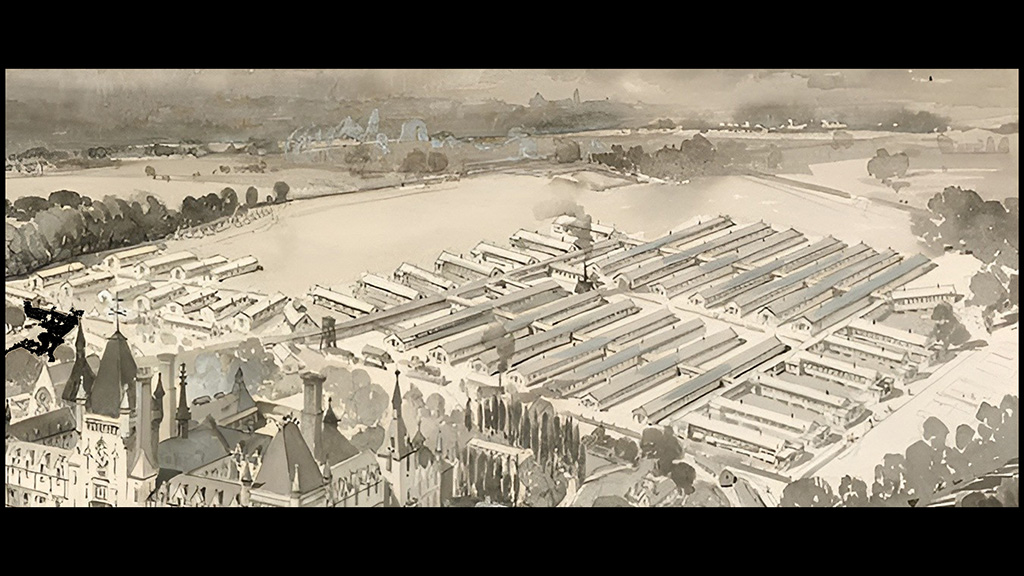
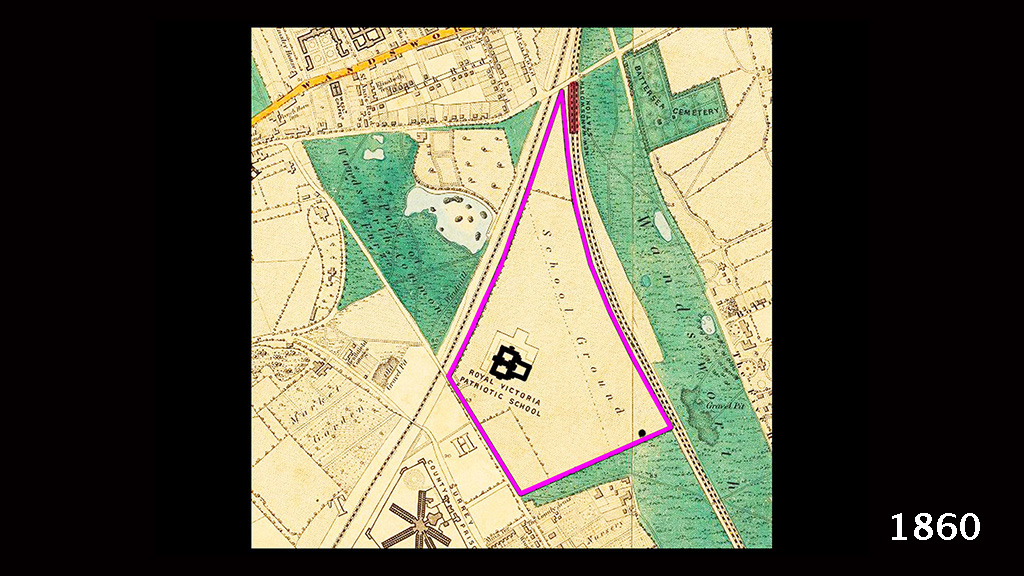
The Extension is the 20-acre area now called "The Cricket Field", near the cafe. Once part of the Common, it was included in the grounds of the Royal Victoria Patriotic Asylum for Girls from 1858 (paid for by charitable donations/after a worldwide appeal for donations).
John Buckmaster and others complained as early as the 1860s that any land not used by the RVPA should be returned to the Common. The Patriotic Fund who administered the Asylum/School disagreed, saying they'd bought the freehold from Earl Spencer and could do what they liked with it. The fact that it had been bought with charitable donations for another purpose entirely seems to have counted for nothing.)
The Boys' Patriotic school was closed after nine years and sold off to Emanuel School in 18??, in effect "privatising" it.
[See e.g. the eviction of the boys and the reopening by Emanuel, 14 December 1881 / https://www.historyofwandsworthcommon.org/chronicles/12/12-2022.html.]
A large area originally intended to produce food for the schools, but which [could not be made] was then rented to local nurserymen/tar paviors/cabmen (and much else) the Neals [dates?] for a very low rent in what appeared to be a "sweetheart deal". It was widely believed locally that the Patriotic Fund intended to sell off the land for housing as soon as possible.
[On the use of the grounds to disperse faeces etc, see e.g.
[However,] It was this area that became the Extension.
[Earlier calls for purchase?]
Money was collected locally to save the Extension.
WANDSWORTH'S OPEN SPACES.
AN APPEAL FOR FUNDS
A public meeting was held at the Wandsworth Town Hall on Friday evening of [?] week under the auspices of the committee inaugurated to raise a sum of £12,000 for the extension of Wandsworth Common by the purchase of the Royal Patriotic Corporation lands, some 20 acres in extent and known as "The Farm," Wandsworth Common.
In June 1912, Sir Edward Davis Stern, brother of Lord Wandsworth (Sydney Stern), pledged to fund any shortfall in money being collected to purchase the old Patriotic School grounds and restore it to the Common — now the invaluable 20-acre area that includes the Cricket Field, Tennis Courts, Bowling Green, and the Skylark Cafe.
[June: https://historyofwandsworthcommon.org/chronicles/06/06-2022.html]
Open air dancing, a bandstand, quoits and croquet on the Common — the Extension is finally "thrown open to the public"
After a long public campaign, the area was bought by the London County Council in 1912 [?] but used for the 3rd London General Hospital throughout the First World War. Restoration and development of the site took several years.

WANDSWORTH COMMON ARRANGEMENTS FOR SUMMER GAMES.
The L.C.C. has allocated space for the coming season of summer pastimes at Wandsworth Common. It has been decided to retain the former site for the open air dancing, and the band performances on Sundays will be given on the same site. No additional facilities will be provided for tennis.
The twenty-acre extension which formerly belonged to the Royal Patriotic Corporation and which was purchased by local authorities for £12,000 will be thrown open to the public. Though heavy games will not be allowed owing to the nature of the soil, light games will be permissible. The expenditure for laying out the land has amounted to more than £3,000.
An improved and enlarged quoits pitch will be available, and a croquet court will be provided in the vicinity of Bolingbroke Grove.
Not everyone was happy about the changes the LCC made.
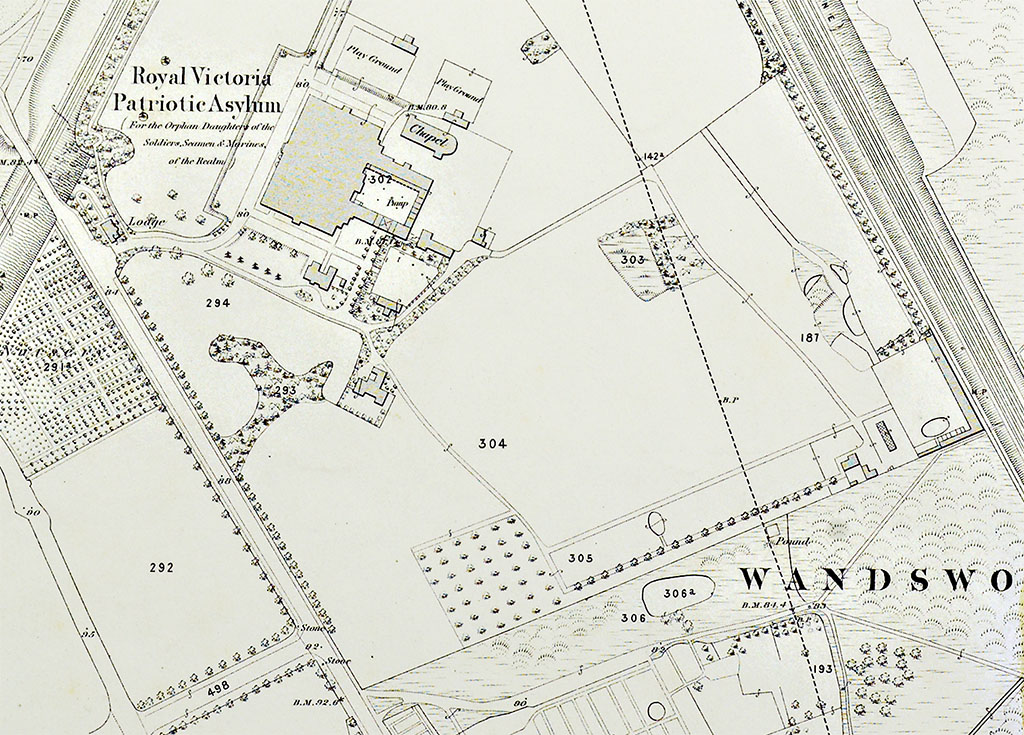
In many reports the Neals are treated as villains, but as the next item makes clear, they were also credited with having created a "once-smiling orchard" in their "Farm".
You can see rows of fruit trees on this map, from around 1871 (the year the Common was "saved"):
30 March 1889
John Burns
As soon as he was elected he went with other Councillors of the South-west district to inspect Wandsworth Common at the invitation of the Protection Association, and he there saw the encroachments that Mr. Robert Neal and his family for the last two or three generations had been carrying out. They inspected these encroachments, and saw how the Commons had been cut up by the carts of Mr. Neal. As far as they could stop those encroachments by action on the Council they would as efficiently and promptly as possible (cheers). [See DB]
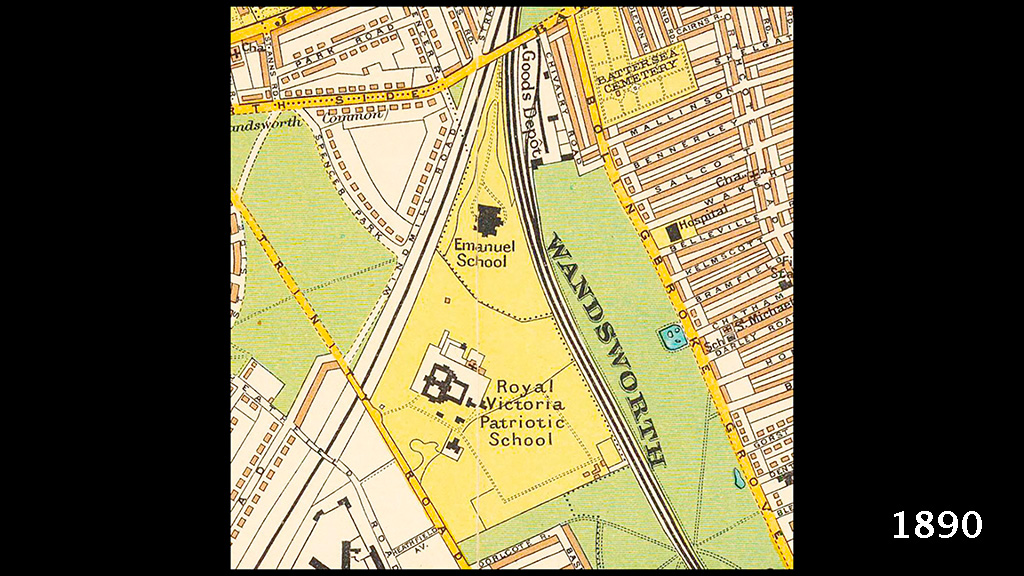
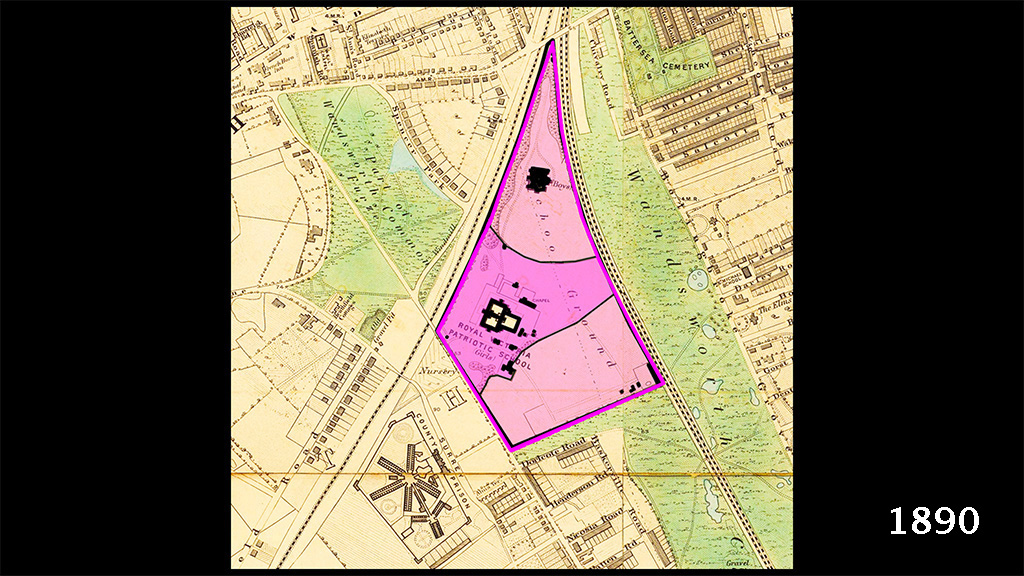
[Having caused such [?], the Neals were eventually forced to stop [cutting across the Common and mashing it up], and build a road within "their" farm.]
As late as 1920 and 1921 a large part of the Common — often called the "Extension" or "Neal's Farm" (and now the "Cricket Field") — was still occupied by the 3rd London General Hospital.
The land had been acquired by the London County Council in 1912 to be restored to the Common, having formed about a third of the total area sold by Lord Spencer (illegally or at least immorally, according to most local people) to the Royal Patriotic Asylum in the late 1850s.


But before much could be done to restore the land, the First World War began and the Asylum was repurposed as the "3rd London General Hospital".
Even after the last patient left (which I think was in 1920), a lot of "ugly accumulations" — buildings and equipment — remained.

In 1920, the Globe reported that "There is no sign of this land being thrown open to the public this summer." And this was becoming intolerable: "As the summer draws on, the need for the parks will become more strongly felt, and His Majesty's First Commissioner Works, who is responsible for housing all the Government Departments, will find that the London public attaches the same value its parks it did."

THE MILITARY OCCUPATION OF THE WANDSWORTH COMMON EXTENSION
The question of the continued occupation of Wandsworth Common Extension (Neal's Farm) by the War Office was considered. The War Office had itself stated that the 3rd London General Hospital was closed in July last, and that the last of the huts and other surplus property had been passed to the Disposal Board in September 1920.
In view of the facts it was thought that the time had come when the various authorities interested in the extension should be urged to take steps to secure its early reversion to the use of the public for games and recreation. It was unanimously agreed that a letter in these terms be sent to the War Office, Wandsworth Borough Council, Battersea Borough Council, and the London County Council.
On the suggestion of Alderman J Plumridge, it was also decided that the attention of the last three bodies should he drawn to the opportunity of finding work for of the unemployed.
[BNA: Link]
The last sentence is especially interesting. Unemployed men had on a number of occasions in the past been "given" work on the Common — chiefly laying and tarmacing paths. Were they also used in the early 1920s on the Extension/Cricket Area, perhaps creating the new tennis courts and bowling green?
[https://www.historyofwandsworthcommon.org/chronicles/02/02-2023.html]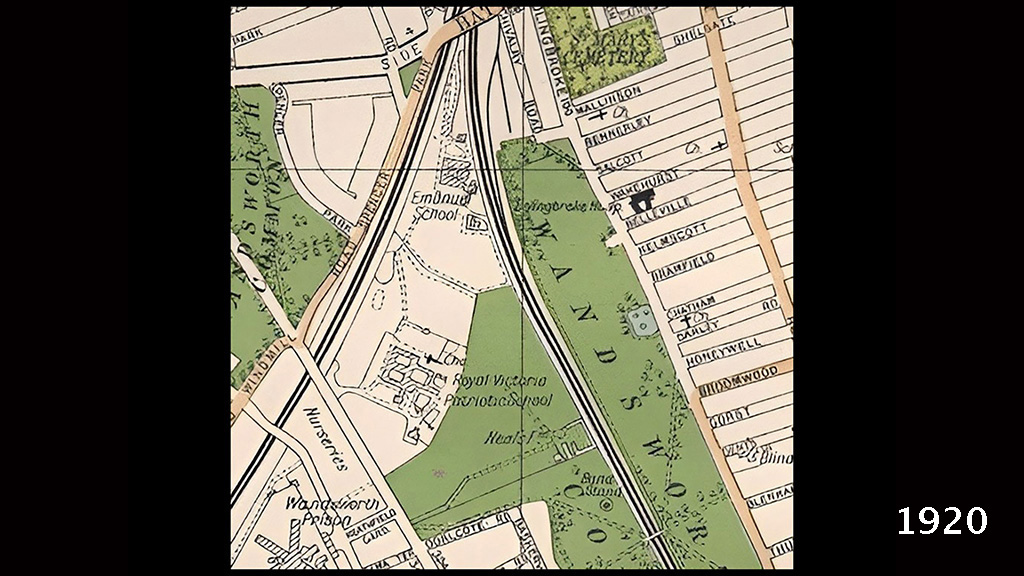
From 1920, the LCC worked hard to bring the Extension into public use for sport, though not everyone appreciated their efforts.
"In this district the council's greatest achievement is the reduction of the once-smiling orchard of "The Farm", Wandsworth Common, to a well-rolled cricket pitch . . . "
Nothing short of a ratepayers' strike will stop the orgy of destruction in which successive Councils have been indulging for many years.
At Spring Gardens * there is a fixed idea that every vestige of natural beauty is wrong and demoralising, and that therefore the common most be hacked and levelled to a prim uniformity.
The peculiar charm of open country is its diversity. its gentle slopes and verdant hollows, the play of light and the stateliness of well grown trees, the picturesqueness of furze clump and bramble bush.
The pride of the County Council is to destroy and to level. Wandsworth Common has suffered terribly and will continue to suffer with Clapham Common until both places are dusty areas sparsely strewn with struggling blades of grass.
In this district the council's greatest achievement is the reduction of the once smiling orchard of "The Farm", Wandsworth Common, to a well-rolled cricket pitch.
[Another complaint that the land was being used in the narrow interests of sport (particularly cricket, with small areas set aside for tennis and bowls). Some people assumed there a formal park would be created, with [walks and attractive plants]. Some wanted to call it Connaught Park. [Check the date people were suggesting this name.]
I assume this was Queen Victoria's third son, Prince Arthur, Duke of Connaught and Strathearn.
https://en.wikipedia.org/wiki/Prince_Arthur,_Duke_of_Connaught_and_Strathearn]
Why Connaught? Because of his long military career? Because for much of the time Governor-General of Canada? And the last of Queen Victoria's sons to die? But even so, so what?
[I'm not sure why Connaught was so appealing, but I notice there are Connaught Gardens in Sidmouth.]
Vandalism in the Parks.
LONDON takes a legitimate pride in its parks and open spaces, but the habit of fencing off certain portions of the common land is developing into a nuisance.
I believe I am right in saying that when the parks were taken over by the L.C.C. the Act of Parliament laid it down that no part of the land intended for the public was to be enclosed.
To the annoyance of thousands of people in south-west London sections of the parks and commons have been fenced in to such an extent that it is only possible to walk on the footpaths.
Wandsworth Common is one of the chief sufferers. Not only have large portions of the Common been fenced round, but the natural beauties have been laid waste. Lovely gorse bushes have been destroyed and trees cut down.
Protests have been raised against this vandalism on the part of the L.C.C.
[BNA: Link]
We gladly print Battersea Field Club's protest against the destruction of trees on Clapham Common. We fear, however. the ()mien will be unavailing. Nothing short of a ratepayers strike will stop the orgy of destruction in which successive Councils have been indulging for many years.
At Spring Gardens there is a fixed idea that every vestige of natural beauty is wrong and demoralising, and that therefore the common most be hacked and levelled to a prim uniformity.
The peculiar charm of open country is its diversity. its gentle slopes and verdant hollows, the play of light and the stateliness of well grown trees, the picturesqueness of furze clump and bramble bush.
The pride of the County Council is to destroy and to level. Wandsworth Common has suffered terribly and will continue to suffer with Clapham Common until both places are dusty areas sparsely strewn with struggling blades of grass.
In this district the council's greatest achievement is the reduction of the once smiling orchard of "The Farm", Wandsworth Common, to a well-rolled cricket pitch.

_______________TREE FELLING ON CLAPHAM COMMON
A PROTEST.
To the Editor.
I beg leave to enclose the following resolution, and to ask the favour of your powerful assistance in our attempt to prevent the destruction of trees on Clapham Common. From thirty to forty specimens are apparently to be cut down, on the plea of providing more space for games. Some of these trees are well-developed, robust specimens, a few might be historic, and were probably looked upon by Wilberforce, Macaulay, Henry Thornton and other celebrities of the neighbourhood.
Already the common has been in part "suburbanised" to a drab uniformity; the removal of these trees will further diminish its natural charm.
The Battersea Field Club, representing, it is believed, a considerable section of public opinion in this matter, recently passed the following resolution:
"this meeting of the Battersea Field Club learns with dismay of the intention to fell a large number of trees on Clapham Common, and, realizing that many of these trees are well-grown, healthy specimens which cannot be replaced within the lifetime of the present generation, and that there exists a widespread feeling against the proposed act of vandalism, respectfully begs the London County Council to re-consider the question with a view to cancelling the order for destruction."
I am, sir, yours faithfully. (
MISS L. B. Mosses, (Hon. Sec.) 64 Stormont-road, Clapham Common. March 23. 1920.
AIM25
Wandsworth Heritage Service
Battersea Field Club
IDENTITY STATEMENT
Reference code(s): GB 0347 D51
Held at: Wandsworth Heritage Service
Title: Battersea Field Club
Date(s): 1893-1944
Level of description: Collection
Extent: 1 box
Name of creator(s):
Please contact the Archive for further information.
CONTEXT
Administrative/Biographical history:
The Battersea Field Club and Literary and Scientific Society was formed on 10th January 1895 and was a development of the University Extension Society — Battersea Students Association, which had started in 1890. In 1902 the name was changed to the Battersea Field Club and the society was affiliated to the South East Union of Scientific Societies and the Photographic Survey and Record of Surrey. In 1906 it was associated with the British Association and finally disbanded in 1944.
CONTENT
Scope and content/abstract:
The collection consists of minutes, lists of members and lecturers, press cuttings, notes, programmes and balance sheets.
[https://www.historyofwandsworthcommon.org/chronicles/02/02-2023.html]