
Last modified: 4 October 2026 (Build 3)
A longer, ongoing account of the burial ground at Mount Nod, on Wandsworth's East Hill — its restoration, its interpretation panels, and the people commemorated there. Begun as part of July 2026's Chronicles; added to as the research allows.
Mount Nod is a half-acre plot opened for burials in 1687, and the resting place of around thirty Huguenot families among roughly 150 graves recorded here by the 1880s. Burials stopped in 1849, and for well over a century afterwards, the place quietly fell apart.
By the early 2000s it was genuinely derelict — overgrown, poorly lit, hemmed in by the ever-busier South Circular, and plagued by exactly the sort of trouble a locked, unloved burial ground attracts. Five of its Grade II listed tombs ended up on Historic England's Heritage at Risk Register, and in 2011 the site was closed to the public altogether. What turned things around was a Wandsworth Council management plan, funding finally secured in 2018, and a careful restoration carried out between 2019 and 2022. Mount Nod today is transformed: a genuinely lovely little pocket park, its headstones and tombs conserved, and its story told on site through a set of handsome copper-engraved interpretation panels. What follows traces that whole arc — the neglect, the turnaround, and the panels and memorials as I found them on a long visit in July 2026.
Things were pretty grim. Here's a fairly typical image of decay and dilapidation from around 2014:
But things were about to change, guided by Wandsworth Council's Huguenot Burial Ground Management Plan, 2010-2015 (pdf). It's a remarkably frank document:
"The cemetery is not easily accessible, with major roads . . . cutting it off from nearby residential roads. This means it is virtually unused . . . lacking any promotion of its historic significance to the Borough . . . Several of the tombs are in very poor condition, with the possibility of injury to visitors. Overgrown scrub and bramble . . . cover for rats . . . sense of unease. The cemetery is not locked at night . . . problems with youths using the site at night, causing damage and litter . . . Drugs paraphernalia . . . With only one gate to the main area, visitors may feel trapped if a threatening situation arose . . . There is no sign at the entrance, and the very uneven rough grass surface and derelict tombs does not encourage access . . . There are no paths, seats or litterbins . . . There is no known organised community involvement."
An assessment by a specialist restoration company in 2003 had led to no action being taken. In spite of the extreme precarity of the situation, there were no funds available.
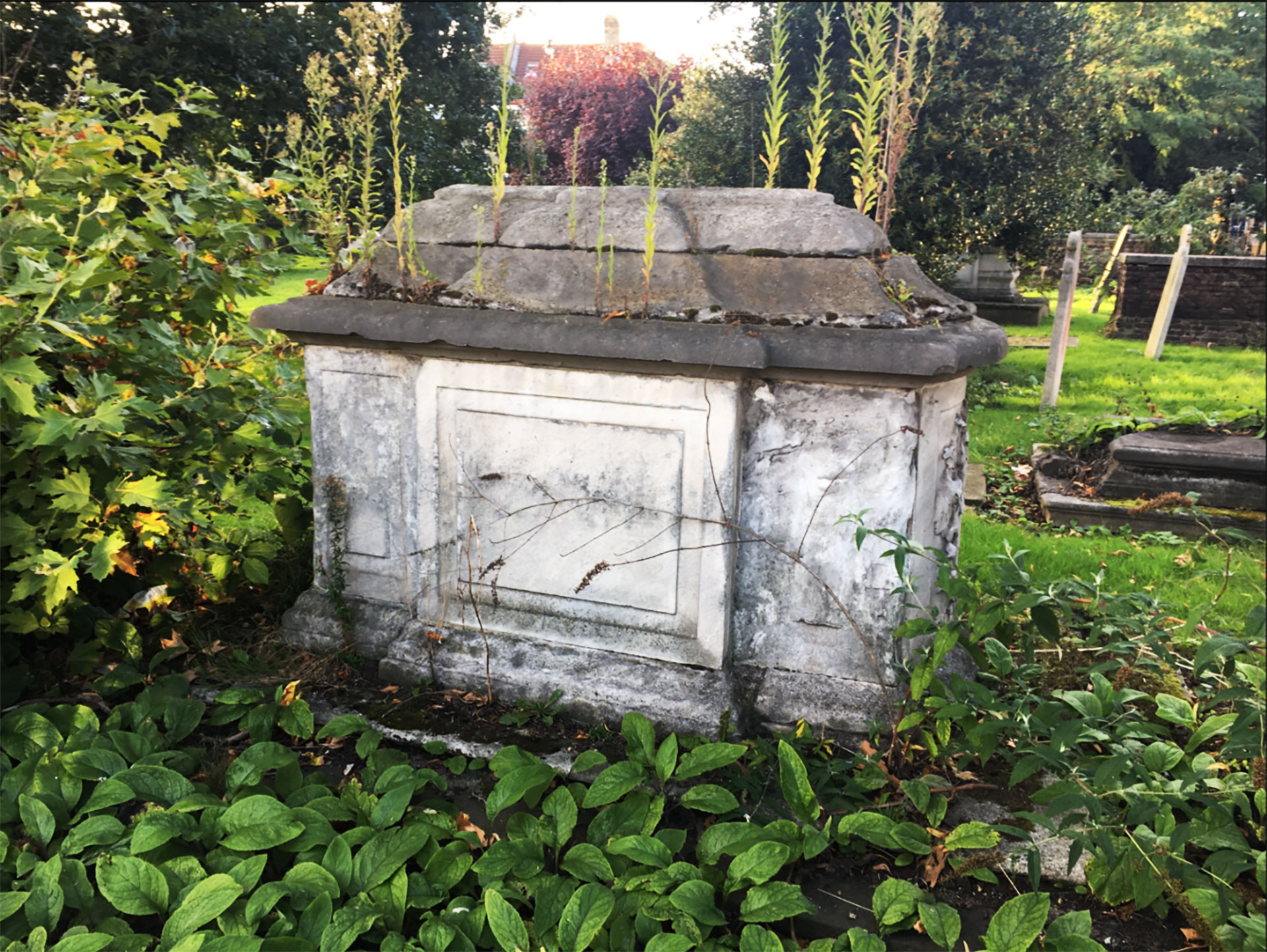
“HUGUENOT PLACE SW18 1. 5033 Huguenot Burial Ground Paggen Table Tomb TQ 27SE 4/5 II GV 2. 1720 stone-faced. Deep moulded plinth. Panelled sides with dedications to Peter Paggen, and to ‘the widow of Peter Paggen’ died 1724. End-faces of segmental section with Baroque escutcheons. Bold cap of curvilinear section. Listing NGR: TQ2630974793” — Historic England list entry 1065536.
The ownership of the site was complicated ("The site is assumed to be owned by Wandsworth Borough Council and managed by the Council’s Parks Service . . . The freehold title should be ascertained"). But eventually titles were secured and funds found, and work began. Between 2019 and 2022, which presumably includes periods of Covid lockdown, the burial ground was beautifully restored by not-for-profit contractor Enable.
I'd walked past many times since then but this was my first proper visit. It was a sublime day, and thanks to my phone I was able to take lots of photographs.
Copper engraved plaques drafted by Wandsworth Council, the Huguenot Society, the Wandsworth Society and the Wandsworth Historical Society.
I don't know about you, but I never find it easy to read plaques and panels in situ, so I often take photographs for later. Two of the interpretation panels are transcribed below, with related images where I have them; the rest of what's on site — the Restoration panel, and every individual memorial — is on its own page, linked below.
— Introduction: The Huguenot Burial Ground (Mount Nod)
— Huguenots in Wandsworth
The Restoration panel, and full transcriptions of all eight individual memorial plaques on site now have their own page: Mount Nod: Restoration and the Memorial Plaques.

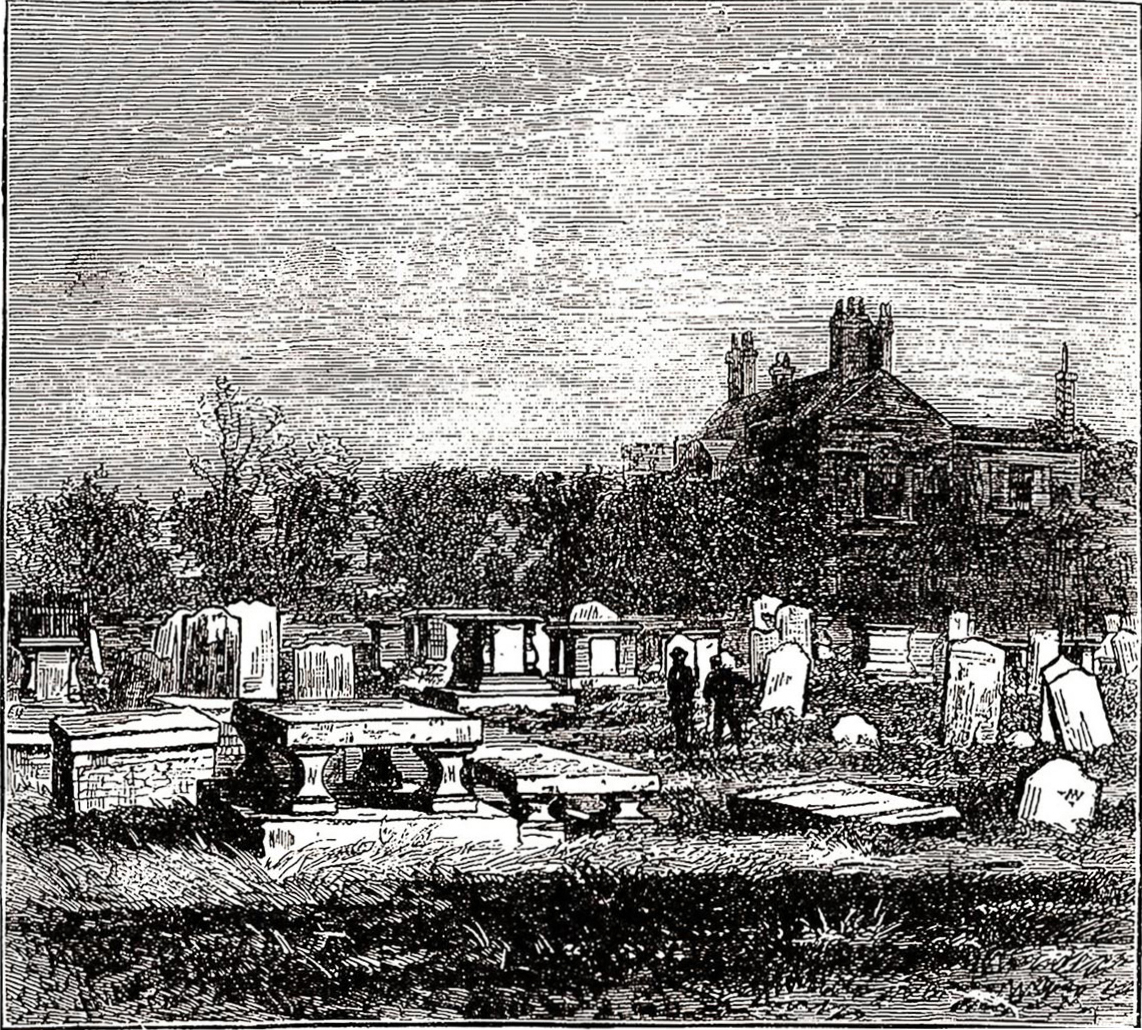
Although known as Huguenot Burial Ground, and for a time the French Cemetery, this site was a burial ground belonging to Wandsworth Parish, in which any parishioner might be buried. In 1680, with the churchyard surrounding All Saints Church on Wandsworth High Street running out of space, the parish began acquiring plots of land bordering what is now Wandsworth Common. This land was eventually opened as a burial ground in 1687. The site is also known locally as Mount Nod, the reason for this is unknown.
Burials eventually ceased in 1849. In 1886 John Traviss Squire recorded 150 graves here, of which some thirty were for Huguenot families. With this burial ground being the final resting place for a significant number of Huguenot refugees, the site remains an important historical record of some of the Huguenots who sought refuge in this country.
Restoration. Between 2019 and 2022 restoration work was carried out on the headstones, tombs and monuments and access to the site was improved. Around the site you will see that some of the graves are accompanied by plaques, including five Grade II listed tombs. These plaques provide an insight into the people buried there, although in certain cases we know no more than what is on the inscriptions.
The site remains very much as it was when it was closed in 1853. We hope you enjoy your visit and the chance to catch a glimpse of Wandsworth's past.
You may notice this symbol around the site. This is the Huguenot cross (croix huguenote) and is the distinctive emblem of the Huguenots and now an official symbol of the French Protestant Church.

The symbol is made up of a Maltese cross, signifying Christianity; four fleur-de-lys, totalling twelve petals indicating the twelve apostles; four heart-shaped spaces between each fleur-de-lys and the intersecting lines of the Maltese cross, reminiscent of the seal of John Calvin and symbolising loyalty; and the pendant dove representing the Holy Spirit.

Seeking refuge. The Huguenots were French Calvinist Protestants living in France and in the French-speaking part of what is now Belgium. They were persecuted for their faith by the French Catholic rulers in the 16th and late-17th centuries.
Around 50,000 Huguenot refugees are believed to have arrived in the UK between 1670 and 1710. The number of Huguenots seeking refuge in the UK particularly intensified following the Revocation of the Edict of Nantes in 1685, issued by King Louis XIV, which deprived the Huguenots of their religious and civil liberties.
Settling in Wandsworth. A number of Huguenot refugees made their homes in Wandsworth. A French-speaking church was established in the 1680s, situated in Chapel Yard south of Wandsworth High Street.

Illustration on the panel: "Old French church, Wandsworth, now demolished; from The Graphic, 24 October 1885. Credit: Look and Learn / Peter Jackson Collection."
Many were also skilled and highly regarded artisans; for example, in the early 18th century local Huguenot dyers and felt makers contributed to Wandsworth becoming a recognised centre for hat-making across Europe. Wandsworth's Huguenot residents also worked as merchants, clockmakers, silk-weavers, and market gardeners, whilst others gained prominence in the British army and the City of London.
In 1787 membership of the Wandsworth French Church had declined to such an extent that it closed its doors. In just over 100 years the Wandsworth descendants of the Huguenot refugees had become fully assimilated into their local community.
Not all Wandsworth Huguenots were buried here at the Huguenot Burial Ground, but many were, and their stories form a significant part of Wandsworth's history.
Since 1901, the Wandsworth Coat of Arms has featured blue teardrops representing the tears of the Huguenots who found refuge in this borough.

[PB: Our word "refugee" was first used in the 1680s to describe French Huguenots (from Latin refugium, a place of shelter, hence Old French refugier to take shelter).]
The Restoration panel and every individual memorial plaque now have their own page: Mount Nod: Restoration and the Memorial Plaques. There's still so much more to be said about Mount Nod — its setting, its history, the people buried here — and I hope to add to it over the coming month or so. Among what's still to come, each likely to get a page of its own in time: a map and transcription of John Traviss Squire's remarkable 1886 survey of the burial ground [PB: check the age at which Squire died]; more on the intrepid cemetery-chronicler Isabella (“Mrs Basil”) Holmes, who visited in 1896; the puzzling origin of the name “Mount Nod” itself; the house next door (plot 227 on Corris's 1787 survey); and the Wandsworth Society's 1985 memorial plaque. And doubtless plenty besides — the “unknown unknowns” that only turn up once I start digging.
Philip Boys (“History Boys”)