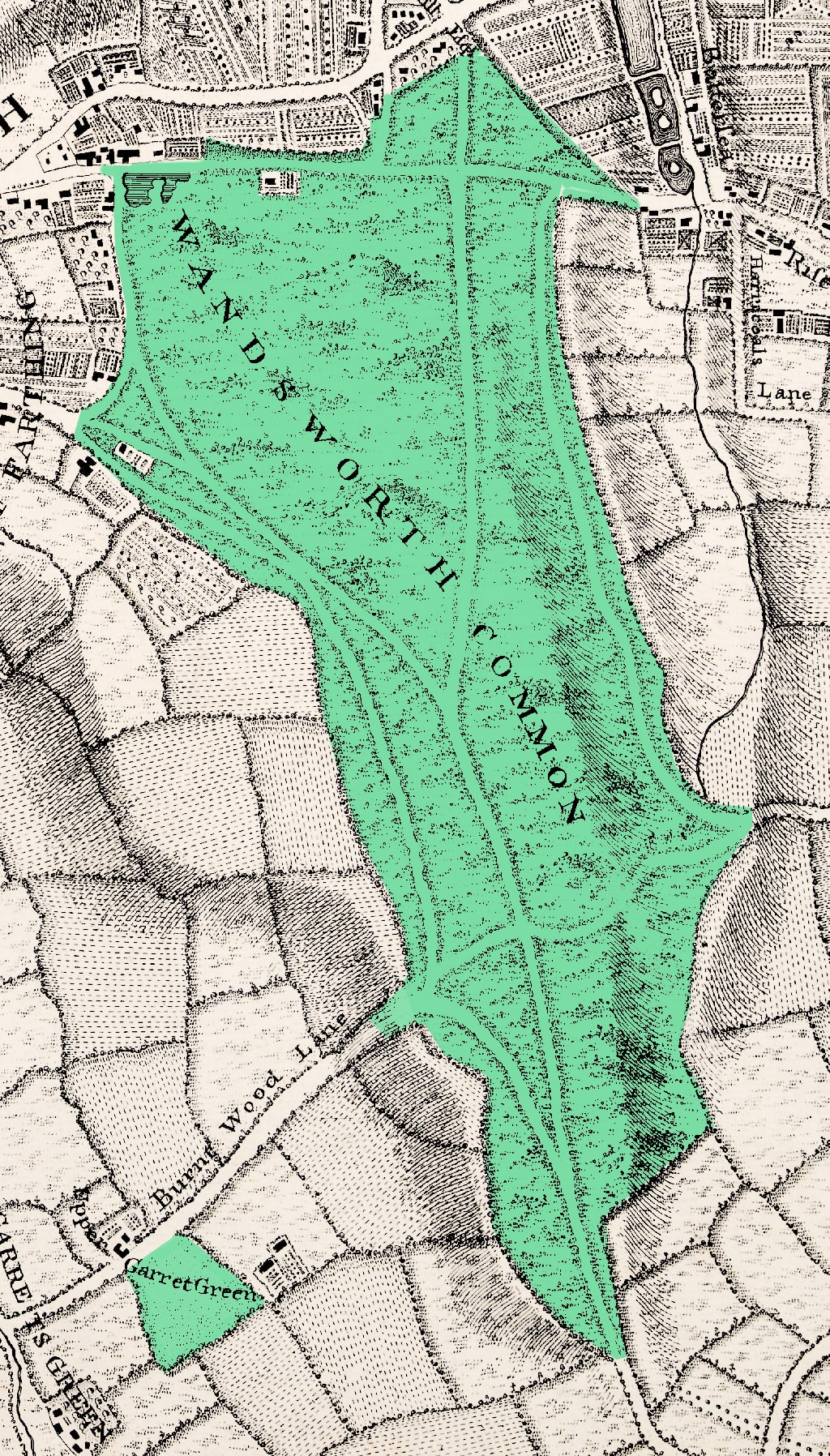
Wandsworth Common nearly three centuries ago, as shown on John Rocque's map of 1748. More than twice the area of today's Common, it was undivided and unobstructed by walls, fences, surfaced roads or railway lines. Very few houses are shown on or around its edges. (The green tint is my own.)
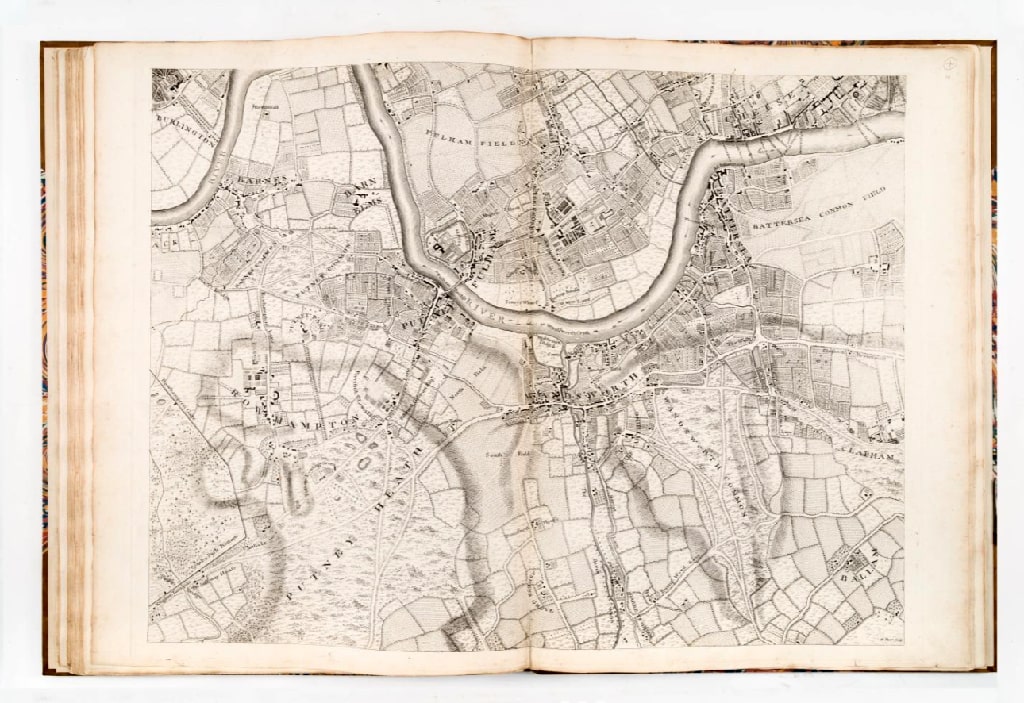
Wandsworth Common appears on one of the 16 maps making up John Rocque's "New and Accurate Survey Of the Cities of London and Westminster The Borough of Southwark with The Country about it for nineteen Miles in Length and thirteen in Depth . . . " (1748)
(Click on image to enlarge)
So how did I do? Will there be a plaque on the former St Mark's Infants School, Battersea Rise, one of Wandsworth Common's most sacred sites?
In last month's Chronicles, I outlined my case for Wandsworth Council to erect a plaque on this tiny school, where many Wandsworth Common Preservation Society and Battersea Vestry meetings were held in the late 1860s and 1870s. This is also where Samuel Sullings, imprisoned for fence-breaking nearby, was celebrated on his day of release.
The Committee selecting the new plaques met on April 4th. Was I successful?

St Mark's school (erected 1867-8) and church (1872-4), on Battersea Rise.
Well, er, the selection committee didn't actually consider my proposal, so the answer is no. But I really can't complain because it's all my own fault, since I had missed the deadline for submissions (April 4th). For some reason I had it in my head that the deadline was much later in the month.
(Clear message: never trust a historian with dates.)
Maybe another year?
I would like to take this opportunity to write about some aspects of the transformation of the Common in the last few hundred years.
Here's a simplified image of Rocque's Wandsworth Common which I've imposed on an Ordnance Survey map from 1868. I have also added the bounds of the three manors that inter-commoned here: Wandsworth, Battersea and Allfarthing.
["Inter-commoning" allowed local people to share the resources of the entire area of Common (for pasture of animals, digging of gravel, cutting of turf, collection of firewood etc), even though the contiguous parts were legally attached to separate manors.]
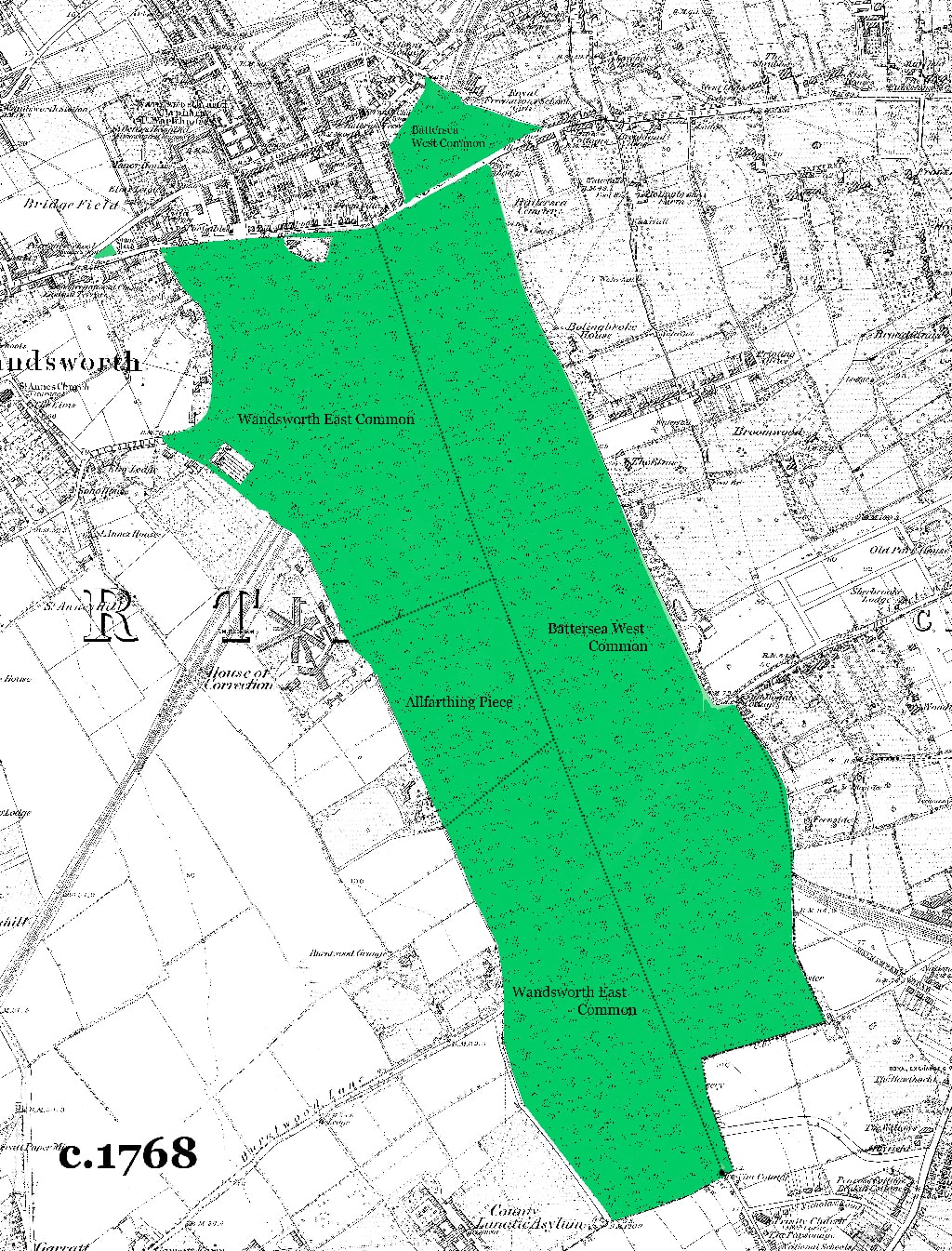
Today's Bolingbroke Field formed a large part of Battersea Manor's "West Common". The Scope and West Side/North Side was once Wandsworth's "East Common". The "Allfarthing Piece" — a thrust deep into the Common — has now all been built over as the Toast Rack. [Base map, 1868]
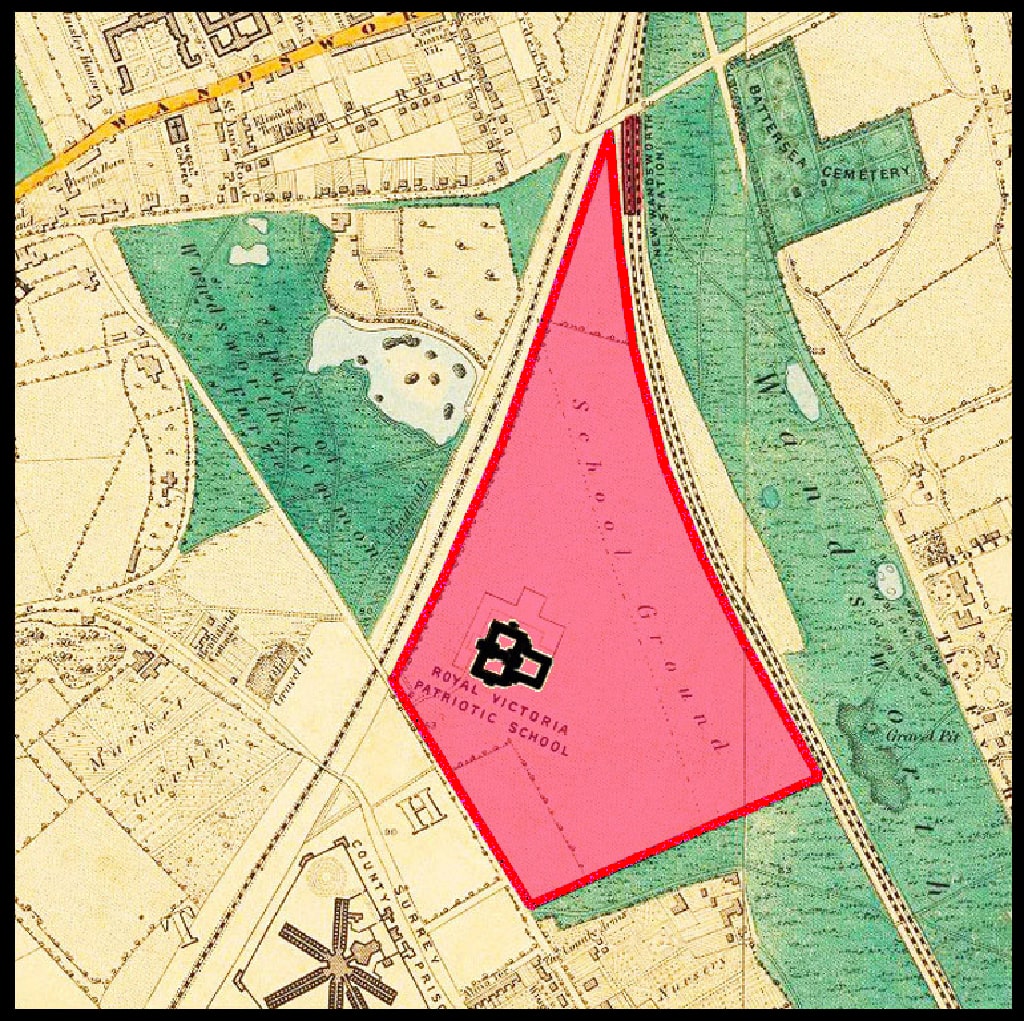
By the late 1860s, a century or so after Rocque's map was published, the Common was less than half the size, it was criss-crossed with roads and railways, and ringed around with large houses and charitable and state institutions (such as schools and a prison). In the late 1850s the Patriotic Asylum ate the heart out of the Common — more than 50 acres.
(Click on image to enlarge)
The Royal Victoria Patriotic Asylum for Girls c.1860, in a recent 50-acre enclosure of the Common. Its kite-like shape is defined by two sharply converging/diverging railway lines, the future Trinity Road, and a straight boundary at right angles ending at the railway line en route to Crystal Palace.
Traditional routes, once free and unobstructed in every direction, were now closed off, hence walkers had to find new, usually less convenient, ways across the Common. Notice, for example, how access to the Common is restricted to a narrow passage opposite the County Arms pub between the RVPA Asylum grounds (behind by a long high wall) and an enclosed nursery.
[This nursery area, leased from owner Magdalen College, Oxford, by the Neal family, had been open Common within living memory. This will eventually be built over as the "Toast Rack".]
If, in the 1860s, local people had not campaigned so hard to save the fragments of Common that remained, there would be little left for us to enjoy today.
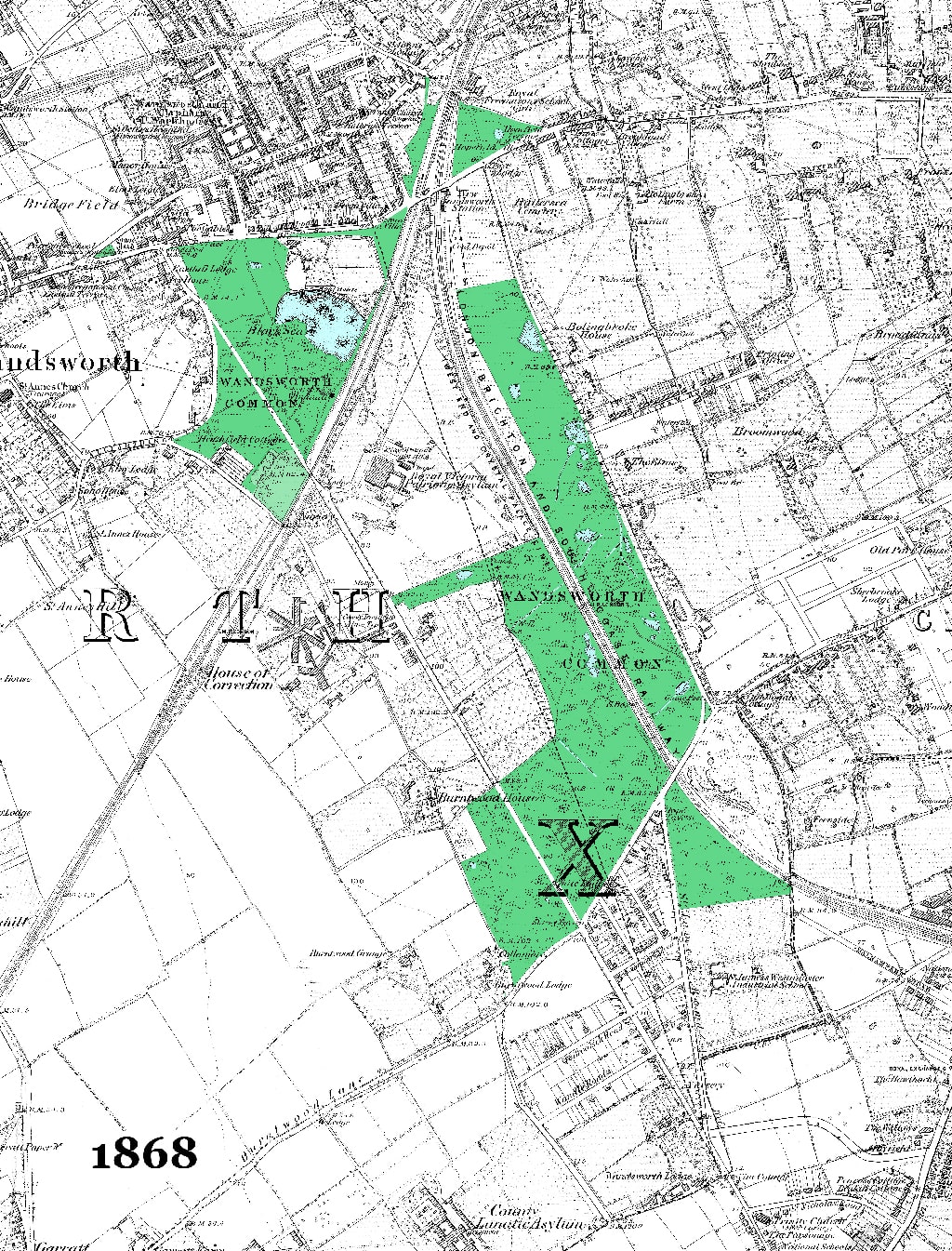
Wandsworth Common in 1868.
the Common was at its smallest in 1868, today it's 20 or so acres larger. A strip was lost when Trinity Road was "dualled" in the late 1960s, but patches were found here and there to compensate — such as "Prison Banks", and an acre or so in the grounds of the Patriotic Building.
The most significant area to be added occurred when the LCC bought the "Extension" — about a third of the old RVPA site — just before WWI. This fenced area now contains the cafe, cricket pitches, tennis courts and bowling green:
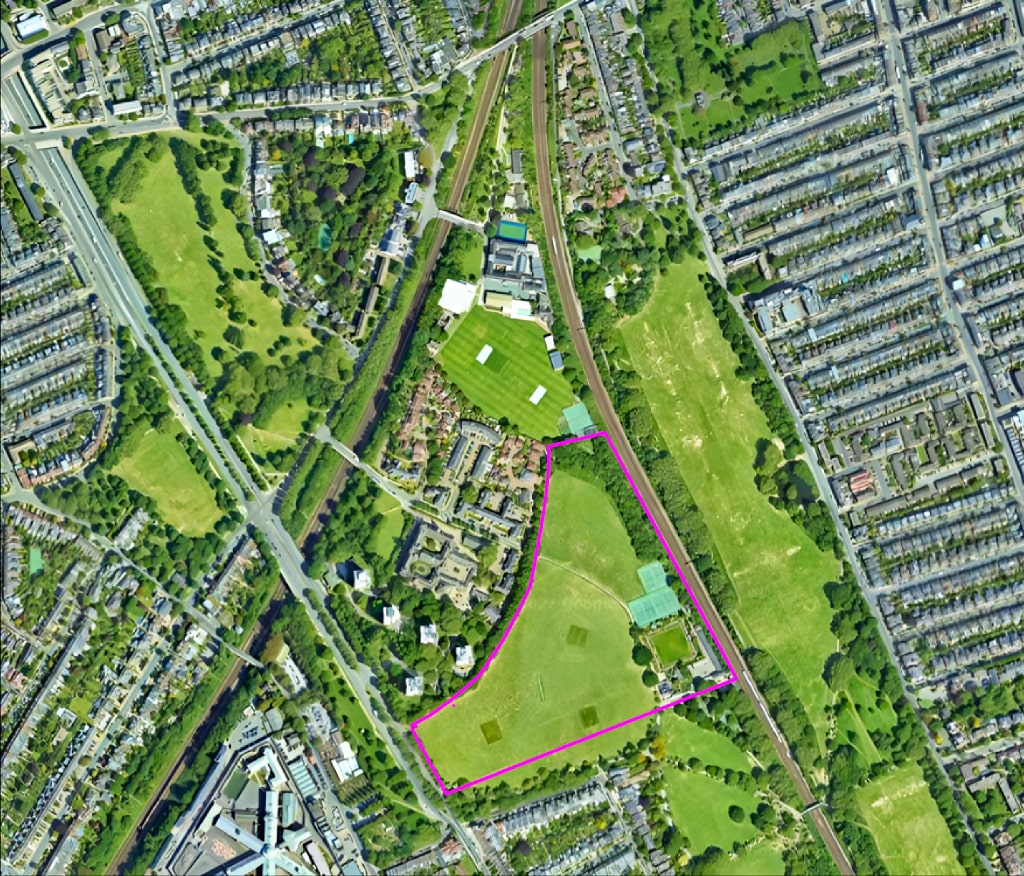
The northern area of Wandsworth Common, showing the Extension (restored to the Common in 1913).
(Click on image to enlarge)
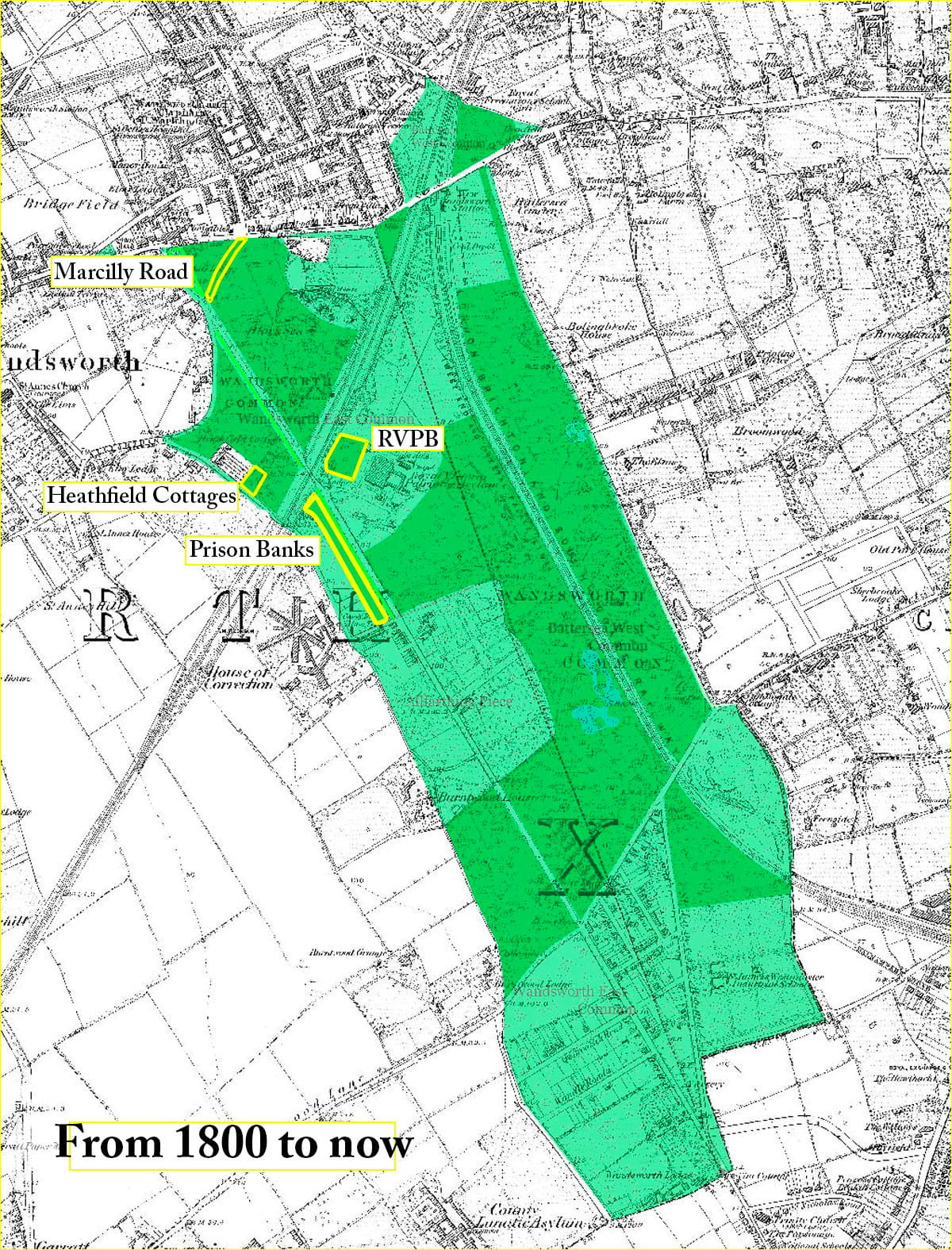
250 years of change: Wandsworth Common today shown within its likely extent in the late-C18. The four areas outlined in yellow were returned to the Common to compensate for losses due to the widening of the northern end of Trinity Road in the late 1960s.
(Click on image to enlarge)
"DOWN WITH THE FENCES!"
As promised last month, here is a closer examination of this fine "Down with the Fences!" poster (which is a history lesson in itself):
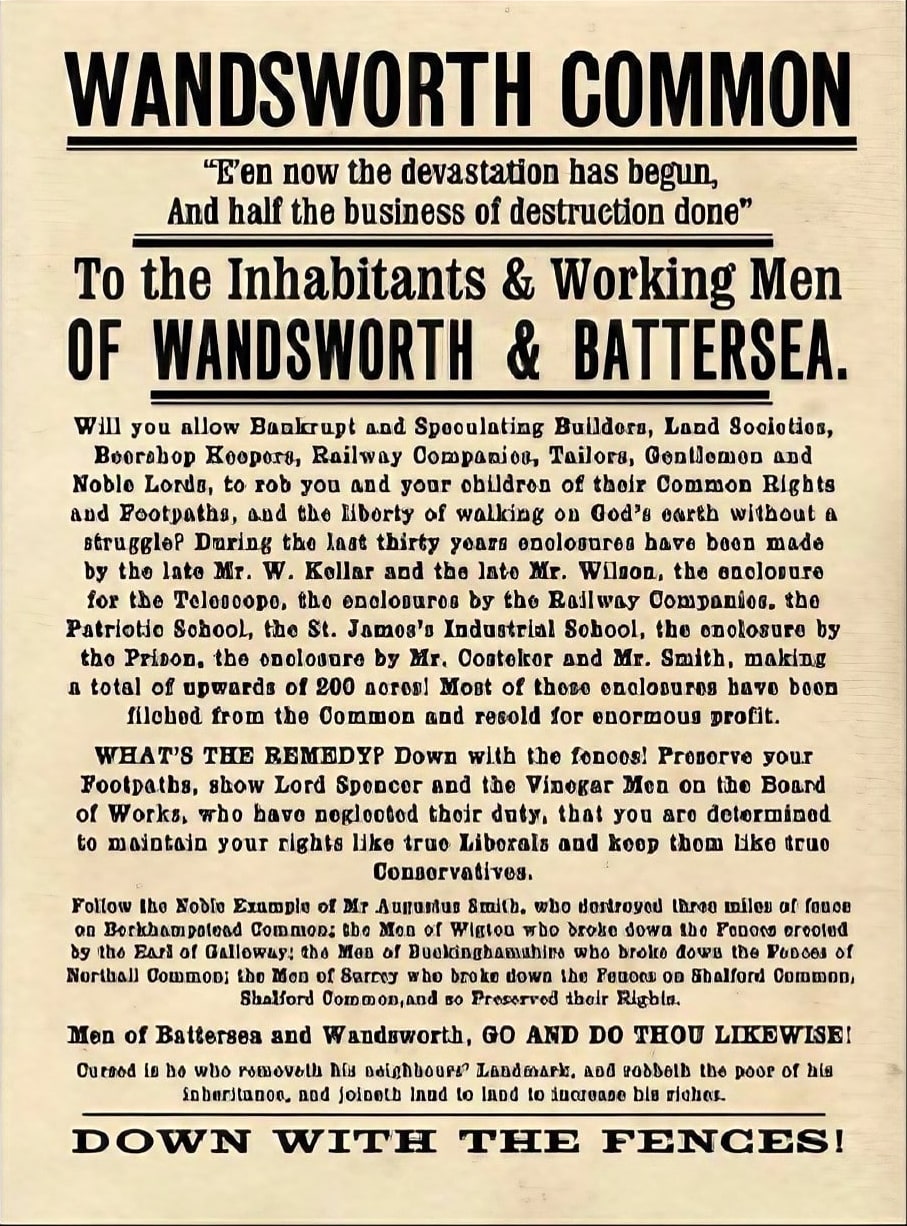
WANDSWORTH COMMON
__________________________
"E'en now the devastation has begun,
And half the business of destruction done."
__________________________
To the Inhabitants & Working Men
OF WANDSWORTH & BATTERSEA
__________________________
Will you allow Bankrupt and Speculating Builders, Land Societies, Beershop Keepers, Railway Companies, Tailors, Gentlemen and Noble Lords, to rob you and your children of their Common Rights and Footpaths, and the liberty of walking on God's earth, without a struggle?
During the last thirty years enclosures have been made by the late Mr. W. Kellar and the late Mr. Wilson, the enclosure for the Telescope, the enclosures by the Railway Companies, the Patriotic School, the St James's Industrial School, the enclosure by the Prison, the enclosure by Mr. Costeker and Mr. Smith, making a total of upwards of 200 acres!
Most of the enclosures have been filched from the Common and resold at enormous profit.
WHAT'S THE REMEDY?
Down with the Fences! Preserve your Footpaths, show Lord Spencer and the Vinegar Men on the Board of Works, who have neglected their duty, that you are determined to maintain your rights like true Liberals and keep them like true Conservatives.
Follow the Noble Example of Mr. Augustus Smith, who destroyed three miles of Fence on Berkhampstead Common; the Men of Wigton who broke down the Fences erected by the Earl of Galloway. The men of Buckinghamshire who broke down the Fences on Northall Common; the Men of Surrey who broke down the Fences on Shalford Common, and so Preserved their Rights!
Men of Battersea and Wandsworth, GO AND DO THOU LIKEWISE!
Cursed is he who removeth his neighbours' Landmark, and robbeth the poor of his inheritance, and joineth land to land to increase his riches.
___________________________
DOWN WITH THE FENCES!

I can't be sure, but the Down With The Fences! poster must surely have been composed by John Buckmaster himself. Buckmaster is a master wordsmith, his literary style, themes — and even his theatrical mode of delivery — inspired by his friend Charles Dickens.
[Indeed, when he addressed a large meeting in the Mechanics' Institute, South Shields at this time, newspaper reports remark that "Listening to Mr Buckmaster is like a reading from Dickens". [Newcastle Daily Chronicle — Monday 18 January 1869 .]
Notice the heady textual mix that JCB would have mastered as an itinerant "lecturer" on behalf of the Anti-Corn Law League in the 1830s:
Old-fashioned poetry: "E'en now the devastation has begun", from Oliver Goldsmith's classic "The Deserted Village" (1770), about the destruction of rural life after enclosure.
Biblical allusions: "Vinegar men" is a reference to the Crucifixion — when Jesus cried out for water, his tormentors gave him vinegar. "Cursed is he who removeth his neighbour's landmark . . . robbeth the poor of his inheritance . . . joineth land to land to increase his riches" are phrases cobbled together from Deuteronomy, Job, Hosea, and Proverbs.
Evangelical exhortation:"The liberty of walking on God's earth . . . Men of Battersea and Wandsworth, Go and do though likewise."
Popular invective: "filched . . . sold for enormous profit".
The whole bitter and abusive diatribe is suffused with wit and sarcasm, invective and fine phrase-making, with lots of rhetorical questions and exclamation marks.
Notice too the political intelligence — the explicit call to both Conservatives and Liberals (there was as yet no Labour Party): "Show Lord Spencer . . . that you are determined to maintain your rights like true Liberals and keep them like true Conservatives".
There is also a subtle class sensibility — one that aims always to unite the great majority against the few: the working and middle (and even upper-middle) classes against the landed aristocracy (in the person of Earl Spencer), and their allies and servants the "railway companies"", "beershop keepers", "bankrupt and speculating builders", and "bankrupt and speculating builders".
[We can attribute Buckmaster's hostility to publicans in part to his own father's alcoholism.]
The reference to "Tailors", incidentally, is not a (snobbish) criticism of the trade or craft as a whole. It is probably a specific reference to Henry McKellar, who lived in the large "Wandsworth Lodge" off Trinity Road. He had made his first fortune in India, dressing the East India Company.
McKellar (aka M'Kellar and Kellar, as in this poster) bought the nearby fields from Earl Spencer, 1848-53 — all of the land along to Burntwood Lane, including an area of Wandsworth Common (now "Trinity Fields"), and all of the Common between St James's Drive and Bellevue Road ("McKellar's triangle").
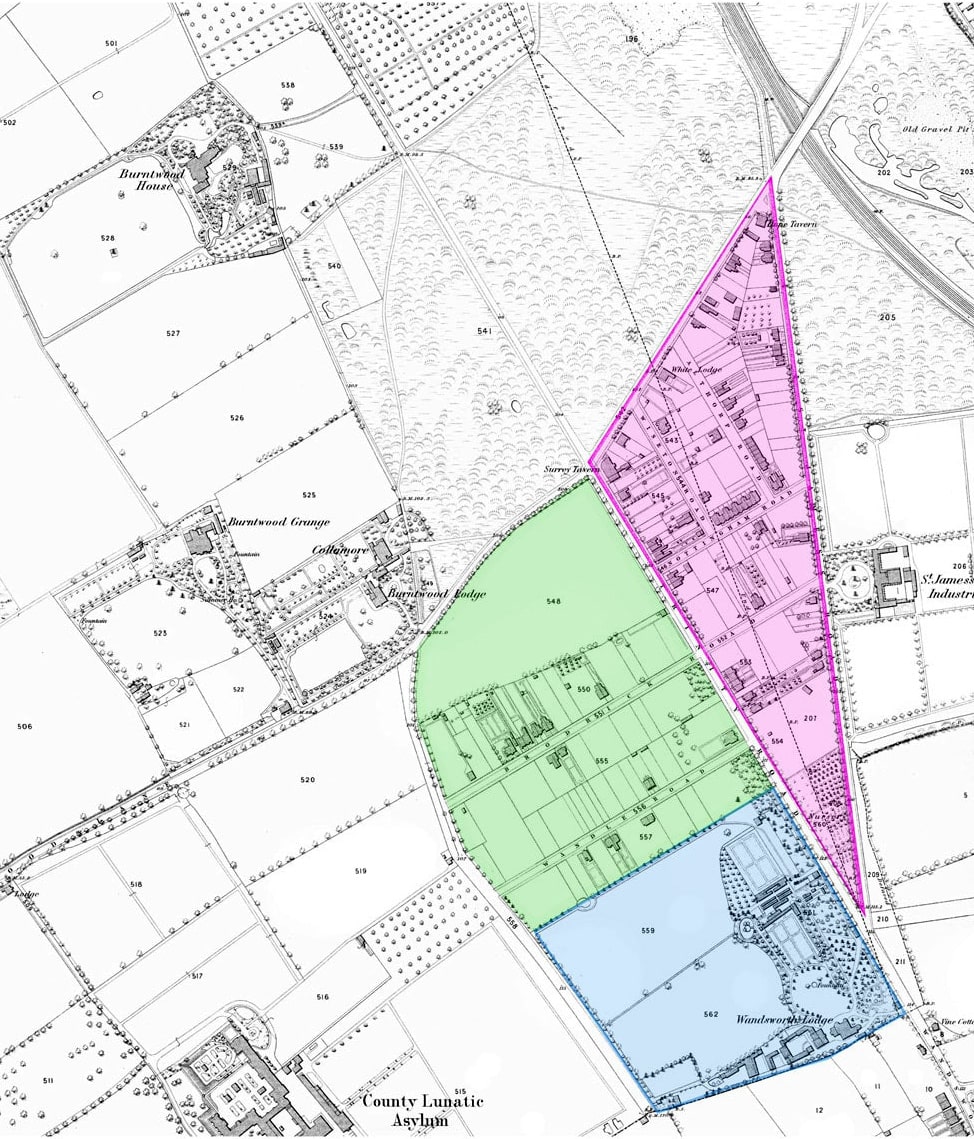
Henry McKellar's house (Wandsworth Lodge), gardens and fields on an Ordnance Survey map of c.1868 (tinted blue). "McKellar's Triangle" tinted pink. These fields, until recently part of the Common, were not built over until after his death in 1863.
After reading the above, regular correspondent, Graham Jackson, commentsed:
The area you have shaded in green to the north of Wandsworth Lodge which includes Trinity Fields was bought from Spencer by McKellar in 1852. Trinity Fields [field 548 on the map] was one of the lots that was up for sale on his death; but as it was known that there was a covenant on the lot, the property developers steered clear of it, whereas Brodrick Road was developed from about 1867.
What is still a little unclear — this is before Land Registry records — was in whose hands it remained after McKellar's death. I touch upon this in my book, but it would seem that it possibly remained with Ann McKellar [his wife] until her death in 1886. Her will transferred the copper mines in Wales to her son-in-law but the field is not mentioned in her will.
Perhaps there was an understanding that it would return to Spencer after her death, we do not know, but at some stage it seemed that it did. By then Trinity Fields had been used for sport from about 1877 and continued to do so.
Although Ann McKellar had moved away by then, it is possible, I suggested, that the administration of the field was taken up by landlord John Bonner at the Surrey Tavern on her behalf? Whatever, eventually it returned to Spencer who we think gave it to the London County Council who sold it in auction. The map in the library from 1871 clearly shows the field, marked in yellow, in private hands.
Thanks, Graham! Graham's comprehensive A History of Trinity Fields (Wandsworth Common) was published in 2021.
Another possible "Tailor" was John Costeker, discussed last month. If I am right, and he is the same man, J.C. was Warden of the Merchant Taylors' Guild in 1846 and its Master in 1853. For more on the "commons stealers" Costeker and Henry Compton Smith, see April 2025's Chronicles.]
On "the Noble Example of Mr. Augustus Smith, who destroyed three miles of Fence on Berkhampstead Common" [sic], see Wikipedia: Berkhamstead Common, and Augustus Smith (politician)". Also Campagner Kate: "To venge the Common Right".
[It would be interesting to know more about "The Men of Wigton who broke down the Fences erected by the Earl of Galloway . . . The Men of Buckinghamshire who broke down the Fences on Northall Common . . . The Men of Surrey who broke down the Fences on Shalford Common"".]
If possible, sometime soonish I'll follow up with a look at Tom Taylor's poem "The Cry of the Commoners", published in Punch magazine ten days after Samuel Sullings was jailed.
I would also like to discuss in some detail what I always think of as the "Great and Good" poster, targeted at the middle class, published at the same time as "Down with the Fences!":
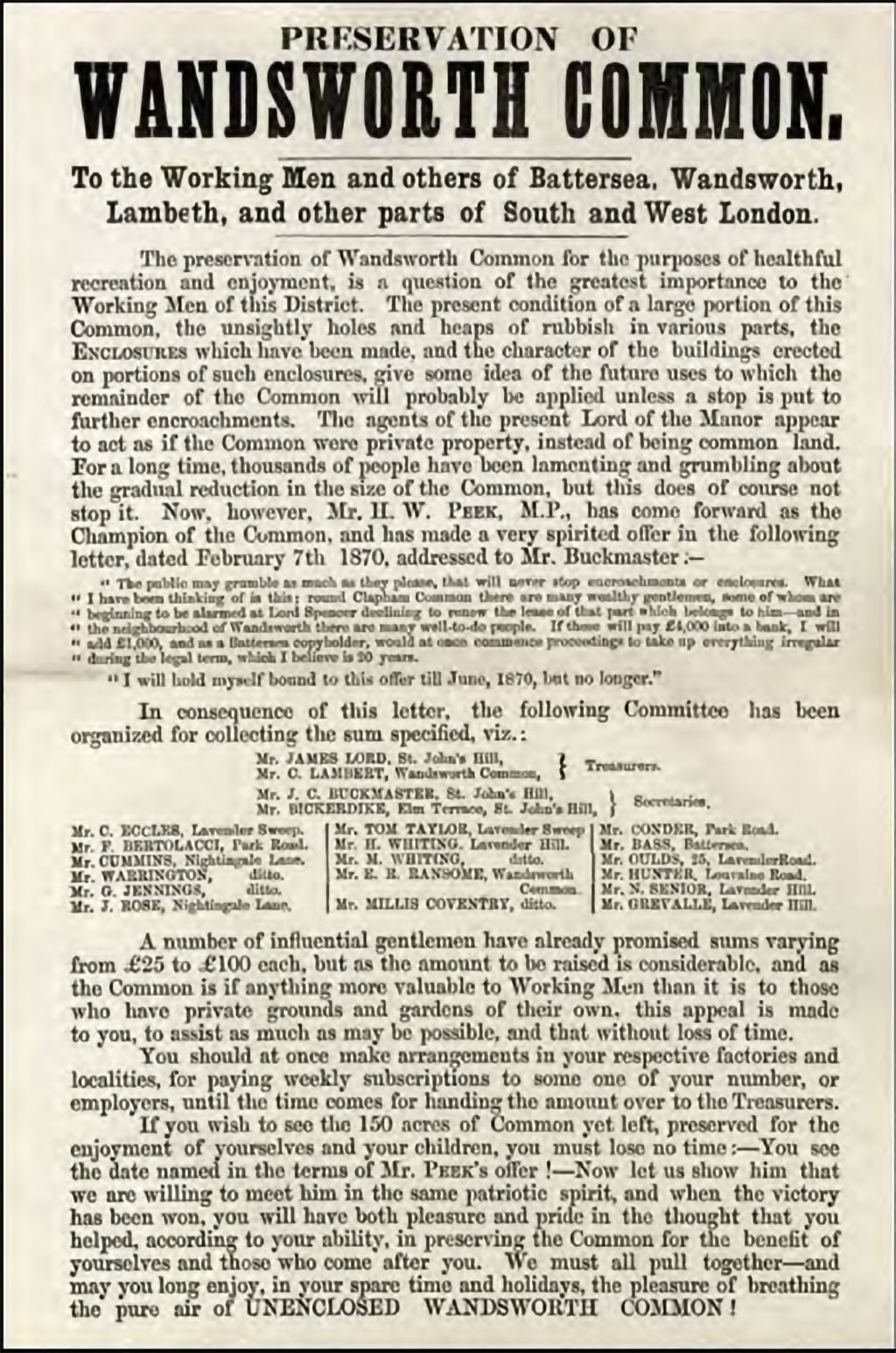
(Click on image to enlarge)
This May is 80th anniversary of the end of WWII in Europe
Four months before the start of the war (September 1939), estate agents and auctioneers remained "confident that the international horizon would clear before long ". At a local meeting they roundly condemned the "jitterbugs" who "should be ashamed of themselves":
"[P]roperty [is] still the finest investment . . . If war came, stocks and shares would fall, but bricks and mortar would stand. To imagine that flocks of aeroplanes would destroy London in a few days [is] absurd . . . "
Norwood News — Friday 5 May 1939

ATTACK ON THE "JITTERBUGS"
Should be Ashamed of Themselves
AUCTIONEERS ARE IN CONFIDENT MOOD
"JITTERBUGS" were attacked by South London auctioneers at the Ardington Rooms, Clapham Junction, on Friday. At the twelfth annual dinner of the South London branch of the National Association of Auctioneers, House Agents, Rating Surveyors and Valuers, Mr. H. Marshall (national president), proposing "The Branch," expressed the hope that when the branch next met they would not have the shadow of threatened trouble from overseas.
The difficulty of carrying on business worried him and he could see no way out of the difficulty, except that he was confident that the international horizon would clear before long.
"I think people to-day who are suffering from 'jitters' should be ashamed of themselves," he went on. "They are behaving neither as Britons nor even human beings. Great Britain and the British Empire have been in wars hundreds of times and we have always been successful. No doubt we should be successful again, although I do not think war will come. (Hear, hear.) To get the wind up before it comes, at any rate, is being childish."
THE FINEST INVESTMENT
Mr. Marshall urged that those who dealt in property should be brought to realise that property was still the finest investment. If war came, stocks and shares would fall, but bricks and mortar would stand. To imagine that flocks of aeroplanes would destroy London in a few days was absurd and gave no consideration to the naval and anti-aircraft measures.
If people would get over the "jitters" and get on with their jobs, auctioneers and property agents would have no difficulty in earning their livings . . .
[BNA: Link.]
Local heroes, Lyminge Gardens, 11 May 1941 [the last day of the London Blitz]
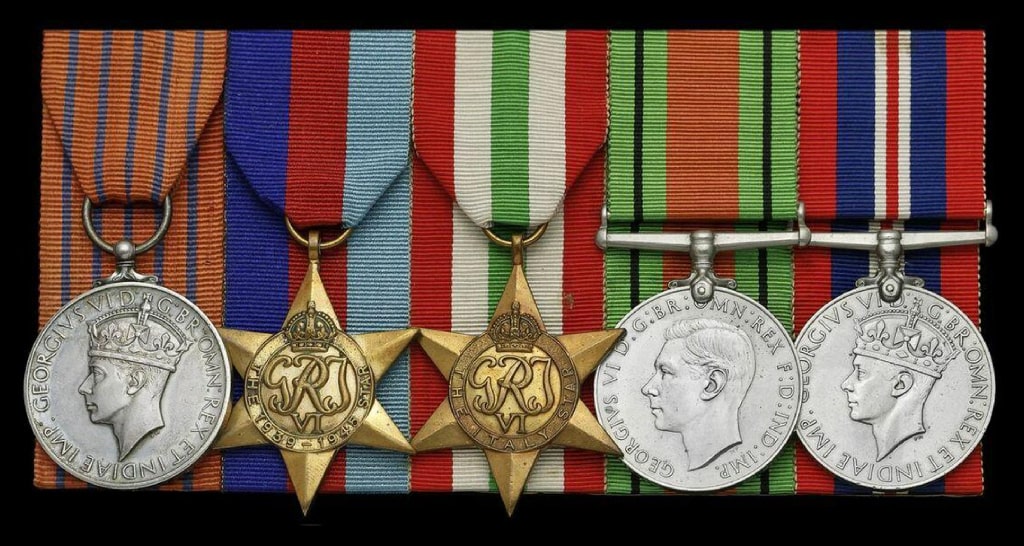
'The impressive 'London Blitz' George Medal group of five awarded to War Reserve Constable W. H. Young, 'W' Division Metropolitan Police, who was decorated for his great gallantry on the morning of the final major Luftwaffe raid on the Capital during the Second World War.''
[L to R: George Medal, G.VI.R. — 1939-45 Star — Italy Star — Defence medal — War medal]
In the very early hours of the morning of 11 May 1941 [Constable William Young] was one of four Police officers and an Air Raid Warden who responded to the total demolition of several houses at Lyminge Gardens, Wandsworth Common by a German high-explosive bomb.
Knowing a lady was alive — but trapped — inside one of the houses, Constable Young and his colleague Constable Gordon immediately set to work to free her, despite the air raid still being in progress, having no specialist equipment, and with the remainder of the building in imminent danger of complete collapse.
This they achieved after two hours of undoubtedly terrifying, exhausting and back-breaking labour — the lady was saved and, as further testament to their (but especially Young's) tenacity, almost unbelievably after a short rest he then went back on duty.
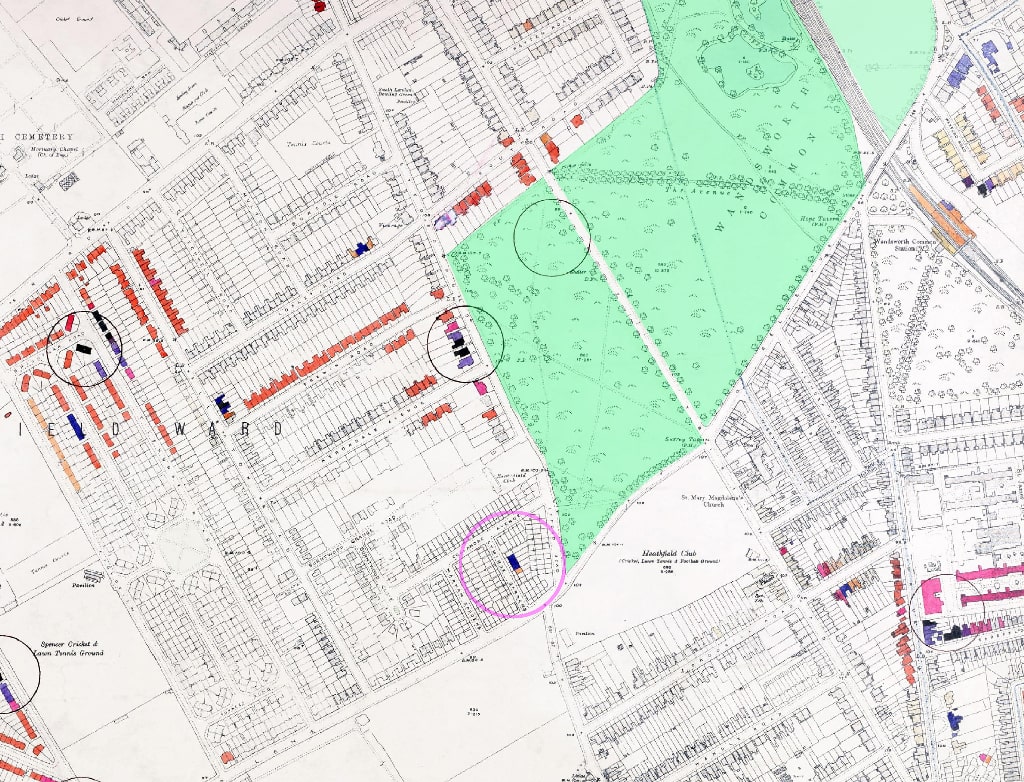
London County Council Bomb Damage Map (1945). The Lyminge Gardens bomb is circled in pink.
[For more about bombs on our area, see e.g. HoWC: Chronicles, September 2024 ]
Statement of Junior Station Inspector W. D. F. Williams, Metropolitan Police, 13 May 1941:
"'It was decided to attempt to clear a way through from the rear of the debris.
"At first glance the task appeared a hopeless one, as many attempts to remove the floorboards and beams would in all probability bring the remainder of the debris on top of the would be rescuer and the woman.
However, without the slightest hesitation W.R. Young commenced to dig and scrape with his bare hands. He succeeded in burrowing a hole big enough for him to work in, and then commenced to remove the boards and beams which lay across the woman.
"Time and again the debris and masonry above threatened to collapse on top of the W.R. but he continued working with complete disregard for his personal safety.
"The whole time that the W.R. was digging enemy aircraft were active overhead, thus preventing the use of any light.
"After digging and scraping for almost two hours the W.R. was able to clear away sufficient space for the woman to move her legs . . . When the W.R. was lifted from the hole in which he had been working he was suffering badly from cramp and exhaustion and had to be assisted to a nearby house, where after a short rest, he was able to return to Balham Police Station at about 5.15 a.m., 11th May 1941.
George Medal citation: London Gazette 29 August 1941:
"A high explosive bomb partially demolished a house and a woman was trapped. The beams and boards which were pinning her down were also holding up the debris and masonry which had fallen from above. Despite the danger, War Reserve Young burrowed a hole large enough to work in and, after two hours, managed to clear away sufficient rubble for the woman to be extracted.
"In the meantime, War Reserve Gordon got into the wreckage from a different direction and protected the victim from falling debris. His position was cramped and dangerous but he remained there, comforting the woman and indicating the best method of effecting her release.
"An air raid was in progress during the whole operation and there was the additional danger of the house collapsing, which it did shortly after the rescue was completed. Gordon and Young showed outstanding courage and determination."
Commissioner of Police for the Metropolis, Air-Vice Marshal Sir Philip Woolcott Game:
"The raid was going on during the whole operation and the two War Reserves had therefore to work in darkness. The risk they ran was shown by the fact that the house collapsed at the point where they had been working shortly after they had completed the rescue.
"There seems little to choose between the performances of these two men so far as regards danger. If anything, perhaps War Reserve Young had the harder task. When he finished he was exhausted and suffering from cramp, but he soon recovered and was able to resume duty . . . W.R.s Young and Gordon are recommended for George Medals.""
A brief biography of William Young:
William Henry Young was born in October 1912 at St. John's Wood in London; his birth certificate notes that his father — Herbert Arthur — was a Police Constable in 'S' Division, so perhaps family influence led William into the same calling. Newspaper and Police journal extracts also note he became very involved in extra-curricular activities with his uniformed colleagues, being a keen rower with the Balham Police Athletic Club.
Living in Clapham upon the outbreak of the Second World War, and with his civilian profession noted as a 'Motor car driver', he joined the Metropolitan Police as a War Reserve Constable shortly after war was declared. Not to be confused with Special Constables, War Reserve Constables nevertheless performed a similar voluntary role alongside their civilian professions and were authorised with the same powers as Regular officers.
All quotations above are taken from the Spink auction catalogue, 20 July 2023: "It was decided to attempt to clear a way through from the debris at first glance . . . ". I am indebted to Marcus Budgen, Head of Medals at the auction house Spink and Sons, for bringing these remarkable men to my attention — thanks, Marcus!
Rebuilding after the war
Letter from architect Terence Carr to H.W. Tee, Superintending Officer, Wandsworth Borough Council, 11 May 1946:
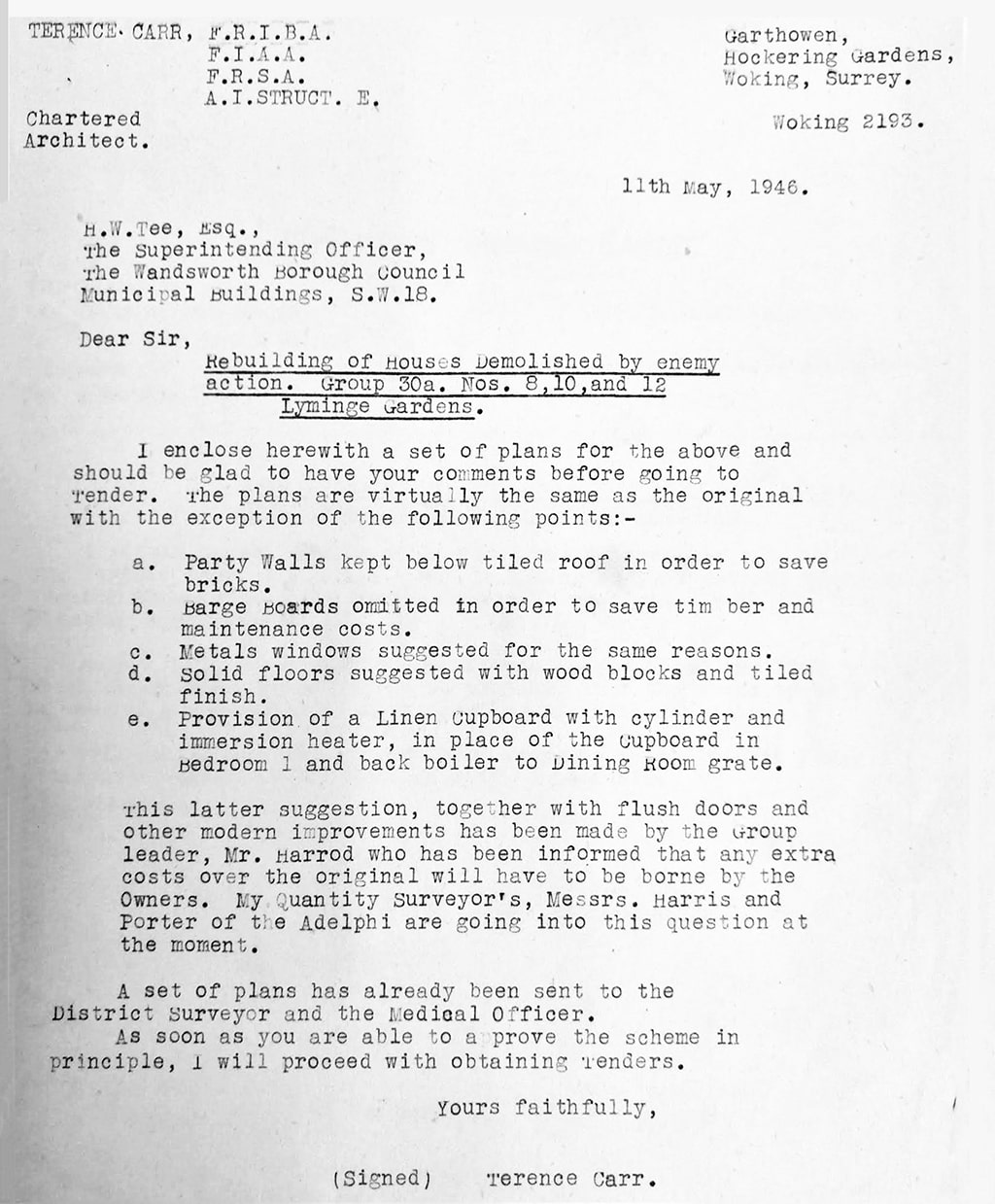
(Click on image to enlarge)
And today?
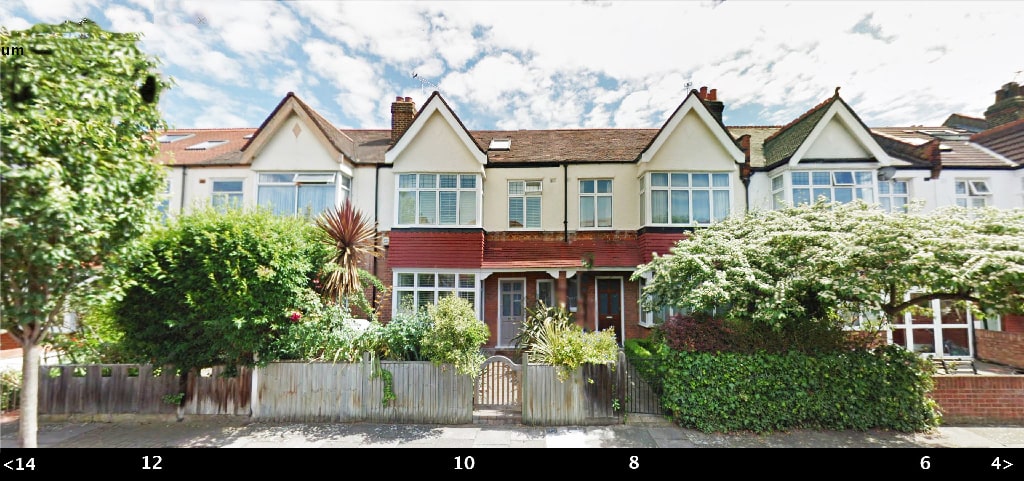
Lyminge Gardens, SW18: Which of these houses were destroyed by bombs and rebuilt after WWII? How can you tell?
Squirrels . . .
I've written about rabbits on Wandsworth Common before, but never I think about squirrels.

A Grey squirrel on Wandsworth Common, 2024. Photo by Lewis More O'Ferrall — thanks, Lewis!
(Click on image to enlarge)

Red Squirrel, from Revd Theodore Wood's Dwellers in the Woods (1908).
Revd Wood, vicar of St Mary Magdalene, lived in the fine Vicarage on the corner of Loxley Road and Lyford Road. He and his father (the Rev. J.G. Wood) were among the most influential 19th and early 20th century popularisers of natural history. More . . .
(Click on image to enlarge)
I find it hard to believe my memory, but as a child in the 1950s I simply do not recall seeing any squirrels on the Common — red or grey. Faulty memory?
Perhaps not. Here is a table from Monica Shorten's 1940s' study of the spread of Grey Squirrels:
Red v Grey . . .
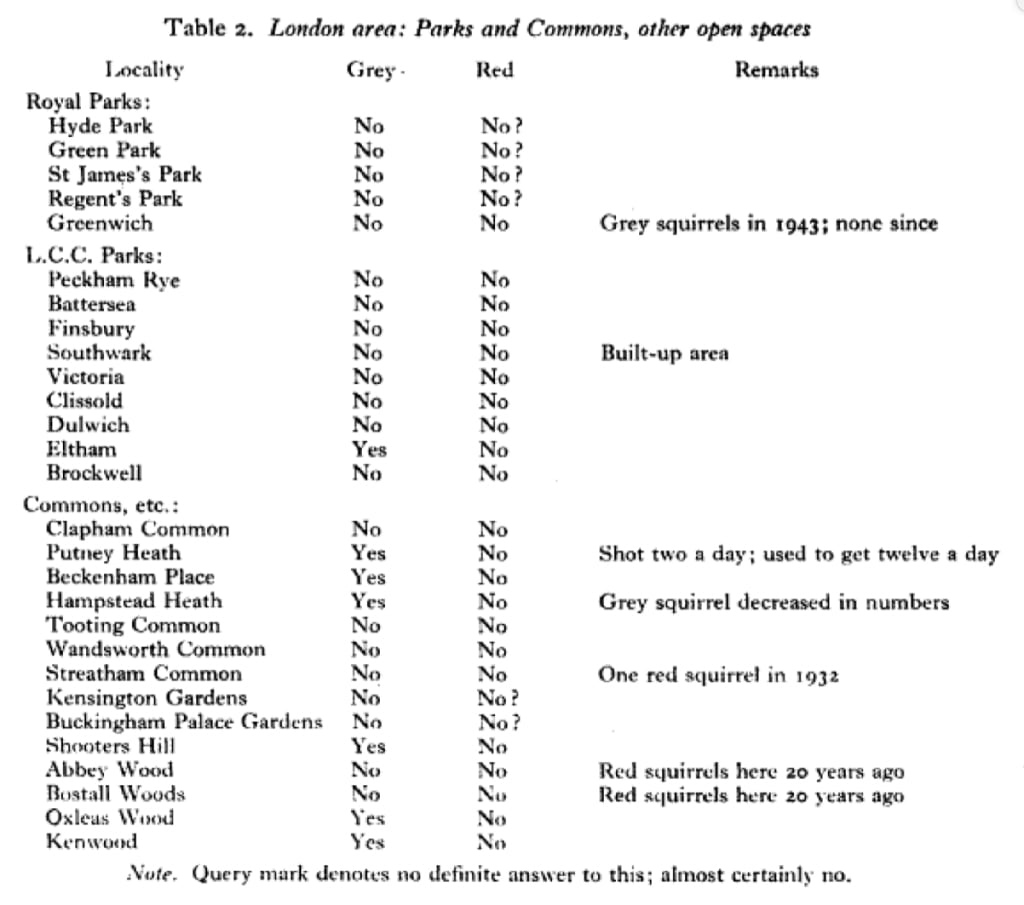
Distribution of Red and Grey Squirrels in London's parks and other open spaces, 1944-45.
Monica Shorten, "A Survey of the Distribution of the American Grey Squirrel (Sciurus carolinensis) and the British Red Squirrel (S. Vulgaris leucourus) in England and Wales in 1944-5", Journal of Animal Ecology, Vol. 15, No. 1 (May, 1946), pp. 82-92.
In London, all the Red squirrels had died out in the 1920s, but Grey squirrels were on the ascendant. They'd been introduced at least 30 times from the USA from 1876 as an ornamental species to populate the grounds of stately homes. They thrived. (It became an offence to import and release Grey squirrels in 1930.)
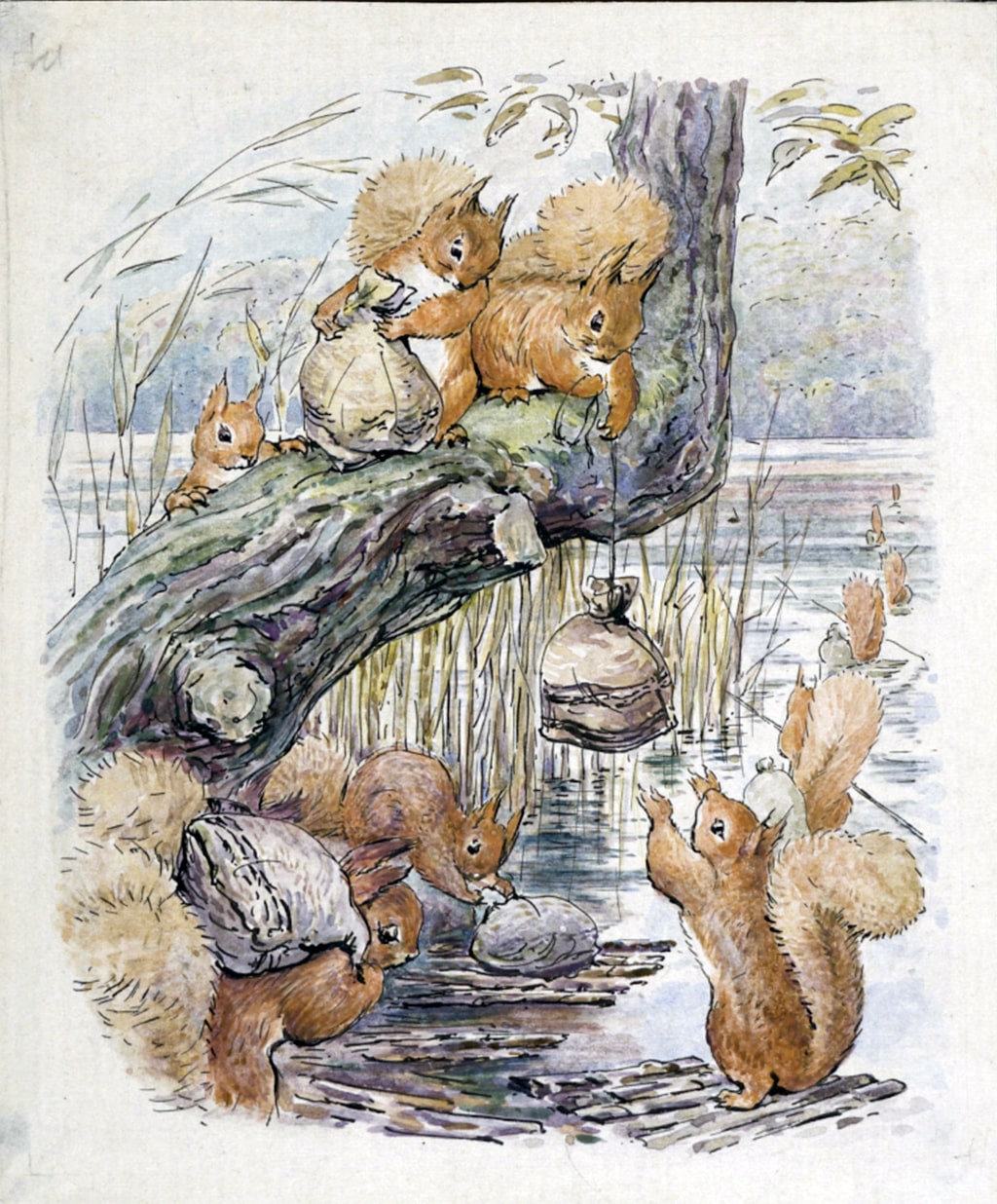
You probably know that Beatrix Potter sent illustrated letters about Peter Rabbit to young Noel Moore at No. 20 Baskerville Road; but it was new to me that she also wrote to him about other works in progress, including The Tale of Squirrel Nutkin (1903).
(Click on image to enlarge)
I wonder when the last Red squirrel/ first Grey squirrel was seen on Wandsworth Common?
Talking about red . . .
Where did you get that hat?
Last night, we watched Conclave, about the election of a new Pope by all the Cardinals in the Roman Catholic Church. Very enjoyable, very topical.
And very red.
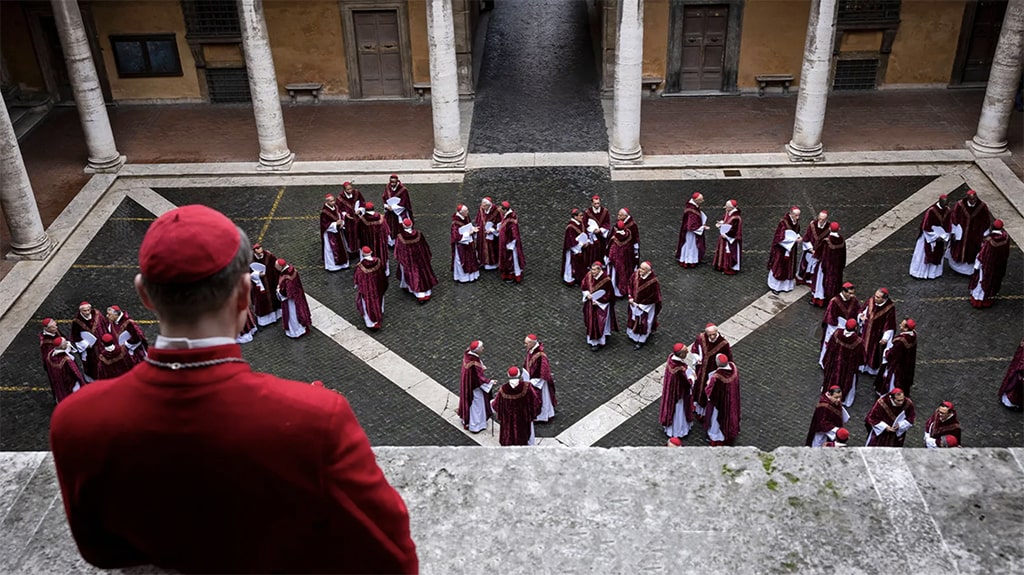
Conclave: Cardinals gathering.
(Click on image to enlarge)
I was reminded that one of Wandsworth's most successful exports was once a red or scarlet hat, much much prized by Cardinals. (This, I think, was the wide-brimmed Galero (a variety of Sombrero), rather than the small hemispherical skullcap, the Zucchetto ("little pumpkin"), seen above. )
(See Wikipedia: Galero. For a useful guide to the range of religious headgear, see "Papal Conclave: Why do Cardinals wear Funny Hats?.
Was this hat made in Wandsworth?

Peter-Paul Rubens, St Jerome, wearing a Cardinal's scarlet Galero.
(Click on image to enlarge)
Given the date that Rubens painted this picture, c.1625, definitely not. But had it been a century later, probably yes.
How so?
According to the historian of the Huguenots, Charles Weiss, writing in 1854:
"Hat-making was one of the most important manufactures taken into England by the refugees [i.e. the Huguenots].
"In France it had been almost entirely in the hands of the Protestants. They alone possessed the secret of the liquid composition which serves to prepare rabbit, hare, and beaver skins, and they alone supplied the trade with fine Caudebec hats in such demand in England and Holland.
"After the Revocation [of the Edict of Nantes, 1685, which deprived French Protestants of religious and civil liberties], most of them went to London, taking with them the secret of their art, which was lost to France for more than forty years.
In this period,
" . . . the French nobility, and all persons making pretensions to elegance in dress, wore none but English hats; and the Roman cardinals themselves got their hats from the celebrated manufactory at Wandsworth established by the refugees. "
[Charles Weiss, History of the French Speaking Protestant Refugees from the revocation of the edict of Nantes to our own days, 1854. p. 259-60.]
What an irony, then: Roman cardinals sourcing their hats from workshops established by Protestants fleeing Catholic persecution.
Hats and scarlet dye continued to be local specialities, as Daniel Lysons (The Environs of London, 1792) writes:
Towards the close of the last [i.e. C17] century, when great numbers of French protestants fled from the persecution which prevailed in the reign of Lewis XIV, many of them settled at Wandsworth, where they established a French church.
Among these refugees was a considerable number of hatters, who introduced their manufacture at this place, and carried it on with great success.
Though much diminished in its extent, the manufacture still exists; Mr. Chatting, a grandson of one of the refugees, being now a hatter in Wandsworth.
Lysons continues:
"The art of dying cloth has been practised at this place for more than a century. There are now two dyers here, Mr. Barchard and Mr. Williamson."
[Daniel Lysons, The Environs of London: Volume 1, County of Surrey (London, 1792), British History Online.]
Mr. Barchard — though I'm not sure whether he himself was of Huguenot origin — specialised in ‘Wandsworth Scarlet’, the vivid red textile dye made from the heartwood of a tree imported from Brazil, Paubrasilia (from the Portuguese "pau" or wood and "brasa" or ember. ]
[Indeed the name Brazil itself is a shortened from of "Terra do Brasil"", the land of the Brazilwood tree.]
According to a terrific article about Wandle Dyeworks on the Wandle.org website, Mr Barchard's "dyeworks were located on the east bank of the Wandle, about 70 yards north of the bridge carrying Wandsworth High Street, on a site now occupied by the rear buildings of the Ram brewery."
[There is a Barchard Street quite close to Wandsworth Town Hall.]
But conditions there cannot have been ideal. Earlier in the century, on 27 March 1743, Thomas Cecil complained to the Wandsworth Vestry that:
"from the filth Mud and dirt which from time to time is Washed into the River near to his Dyehouse by the great quantity of Road water that is discharged into the said River from the great Road or common Highway called Garret Lane . . . he is totally obstructed from carrying on his Trade or business of a Scarlet Dyer in the said Dyehouse . . . ".
The Surveyors of the Highways were asked to look into the matter.
At which point, the Spanish Inquisition arrived, unexpectedly:
"Nobody expects the Spanish Inquisition!" — Monty Python's Flying Circus, first shown BBC, 22 September 1970. (View on Youtube.. See also Wikipedia: The Spanish Inquisition (Monty Python).)
(Click on image to play video)
SO many more stories still to tell. But that's all for now, folks.
Send me an email if you enjoyed this post / want to comment on something you've seen on the site / would like to know more — or just want to be kept in touch.
If you would like to receive notifications of new Chronicles, let me know . . .
Philip Boys ("History Boys")
May 2025
Some organisations you really must join:
— Friends of Wandsworth Common
— Wandsworth Historical Society