
CSV-combine-tables-into-single-file-WC-DATABASE-ALL-RECORDS 2
TEXT_1 Date_publictn_Y Date_publictn_M Date_publictn_D
"Kensington News and West London Times — Friday 10 September 1954
Pitch Confusion at Wandsworth Common The Sunday Football Association are sending a letter of complaint to County Hall in respect of the alleged annoyance and inconvenience caused to the Fulham Ramblers FC by the park keepers Wandsworth Common last Sunday The Ramblers' team arrived at pitch No 20 as stated in their league handbook for fixture against Crescent United A team Seeing that the pitch had not been prepared for the game the players walked to the main dressing room no mean distance from their present position in search of the keeper
On arrival at this imposing edifice they met the superintendant who told them to return to pitch 20 When there they were told that the pitch was not ready for use and so returned to the main dressing rooms where no-one was able to obtain information as to what the next trek would be Eventually the superintendent allowed them to use the keepers' mess room for changing whilst the league vice president Mr J Bunce went in search of another keeper The keeper is alleged to have used abusive language when located and said that he had 1 matches to be played on 9 pitches The superintendant eventually allowed them to use pitch 11 The match began at 11-40 am almost an hour later than schedule.
The referee in his report blamed the confusion for the delayed kick-off.
[BNA: Link.]
BL_0001745_19540910_007_0007.pdf"
"[https]://www.britishnewspaperarchive.co.uk/search/results?basicsearch=%2Binwood%20%22wandsworth%20common%22&freesearch=inwood&phrasesearch=wandsworth%20common&exactsearch=false&retrievecountrycounts=false&newspapertitle=bell%27s%20life%20in%20london%20and%20sporting%20chronicle&sortorder=dayearly&page=5
BELLS LIFE IN LONDON, MARCH 29, 1846
. . . with the decision that offi:ial we snsll act, despite all "notice*" to the contrary. .., Inwood and Frost. — ln our account of the mile race between R brt Inwood of Tooting and George Frost of Holloway last week, stated that spring, the ttakeholder, had . . .
Published: Sunday 29 March 1846
Type: | Words: 11846 | Page: 7 | Tags: none
PEDESTRIANISM
. . . Robinson and W. Jones (the Marylebone Pet) — l2o yards, side, the Old Hat Inn, Baling. 31. — 1 L Inwood at.d fi. Roberts — HO yards, jt 10 a side, on Wandsworth Common. Within three from March 12. — W. Sheppard of Birmingham — to run one mile in four minutes and . . .
Published: Sunday 29 March 1846
Type: | Words: 1538 | Page: 7 | Tags: none
INWOOD AND ROBERTS'S RACE
. . . WOOL* AND ROBERTS'S RACE. Robert Inwood of Tooting and R. Roberts (the Footman) ran 140 yards for 410 a side, at two o'clock, on Monday last, on Wandsworth Common. It turned out a hollow affair, and many of the cognoscenti lost their money on the result . . .
Published: Sunday 5 April 1846
Type: | Words: 4283 | Page: 6 | Tags: none
PEDESTRIANISM
. . . ymark of I chester. 1 van rf Lambeth — lCO yard-, aweepstakrr, each, at the Kdiotfbur /li tf.uat'O — ev -S Leech md j! (both Toll inwood) -100 yards 45 a Mount, n ar the Top Lock, Hoi inwo'.d. — lla-ry-Burn d Jam vord — to tun three mile?, 45 side, have quarter . . .
Published: Sunday 12 April 1846
Type: | Words: 2035 | Page: 7 | Tags: none
20, 1840 — THE SALE OP WHICH EXCEEDS TWENTY-FIVE THOUSAND
. . . Surrey, and Robert Makepeace of London. — Toese men ran their match of half a mile, for *6lO a side, M--n lay last, on Wandsworth Common, bat the spectators did not muster so numerously it was anticipated they would, to witness the race, and the betting . . .
Published: Sunday 20 September 1846
Type: | Words: 9743 | Page: 8 | Tags: none
BELL'S LIFE IN LONDON, NOVEMBER 15, 1846 — THE SALE OF WHICH EXCEEDS TWENTY-FIVE THOUSAND
. . . make the deposit into Jt 3 side, when the dav will lie named. A Gentleman has given a silver watch to be run for on Wandsworth Common cn Wednesday next, between t. o anl three o'clotk, bynwices. Particulars may he and e: trances made at E. Cox's, the . . .
Published: Sunday 15 November 1846
BELL'S LIFE IN LONDON, JANUARY 10, 1847-THE SALE OF WHICH EXCEEDS TWENTY-FIVE THOUSAND
. . . a half mile race, for a silver watch, on Wandsworth Common, Nov SO — beat Weston, htlf mite, on Wandsworth Common, Dec 21. Ingham. George (alias Nimroo); beaten by John Holmes (the Malt-ahovel _hro), Dec^L Inwood, ftoKifr, of Tooling. Surrey best G Frost . . .
Published: Sunday 10 January 1847
PBDBBTRZAHISIC
. . . 130 yards, *3 a side, tear Windsor, AH J. — Norton of Windsor and Roberts of Somers Town — to walk ten miles, *5 side, on Wandsworth Common, Norton one mm-ite Start. Off; Roberts forleiting account of businw*- l. — T. Sutton of Kenton and S. Coulthard of Middltsbro . . .
Published: Sunday 14 February 1847
Type: | Words: 5943 | Page: 6 | Tags: none
DEBEN YACHT CL 18, 1847
. . . quarter of smile, for ou Tuesday last (Inwood giving his opponent 5 yards start), on Durdbam *n. near Bath. w excellent race, but Inwood passed man at anout yards, and eventually tan in a winner by yards. Inwood did ike diaiti.ee, it is slid, in 51$ seconds . . .
Published: Sunday 7 March 1847
Type: | Words: 9673 | Page: 6 | Tags: none
BOOK AND SMITH'S RACE FOR 5O
. . . witness the following sporting matches. The fmt was race of 100 yards, for between R, Inwood of i late of Tooting, Surrey) and Charles Usher of Weston, near Bath, Inwood giving Usher 30 yards start. The race was won by Usher by abool one yard. Usher is swell . . .
Published: Sunday 21 March 1847
Type: | Words: 4722 | Page: 7 | Tags: none
BELL'S LIFE L\ LONDON, APRIL 18, 1847 — THE SALE OF WHICH EXCEEDS TWENTY-FIVE THOUSAND
. . . start in 250, for .5O or . . .
Published: Sunday 18 April 1847
Type: | Words: 6613 | Page: 7 | Tags: none
THE FOOT-KACES AT NOTTINGHAM
. . . friend six yards start. Inwood and Berry. — Robert Inwood of Tooting and W. Berry of Lambeth are matched to run 150 yarda, for 10 side, on Monday, the 10th instant, between aix and aeven o'clock in the morning, on Wandsworth Common. Hinchliffb and Messenger . . .
Published: Sunday 2 May 1847
Type: | Words: 7292 | Page: 6 | Tags: none
BELL'S LIFE IN LONDON, MAY 9, 1847 — THE SALE OF WHICH EXCEEDS TWENTY-SIX THOUSAND
. . . made a match at the Duke of Clarence, London-road, walk three miles, for *5, on Monday, the 17th inst, the Plough, Wandsworth Common. ., ~ Bury. — A handicap race of 200 yards for a silver watch, given by Mr James Kenyon of the Pedestrian Tavern, . . .
Published: Sunday 9 May 1847
Type: | Words: 8635 | Page: 6 | Tags: none
pedestrian, which all hit opponents will to Book to-morrow (Monday) f* Mr Grosrenor-tqaare, when a ripper will ..
. . . were rewrtedto condition, and Inwood, who been the Beih for some lenuth time, looked to *rst-itt mim At tne ppoioied hour both stripped to rscine costume, sod ndse surls they bounded stray however, io few slrides Inwood led *f * sp'iitioir pace . . .
Published: Sunday 16 May 1847
Type: | Words: 1527 | Page: 7 | Tags: none
(CRICKET continued from the preceding puge.) Angu . . . Th. return mttcii nitk the Rugb, i. come off the Utter ..
. . . Tnursday next, at the Four Ashes, near Wolverhampton, between twelve and two — Hadley to have one and a half yard Kitchener and Inwood. — These men are matched to rua 200 yards, for 425 side, within month, Gannick Corner. A deposit of 42 aide baa been staked . . .
Published: Sunday 25 July 1847
Type: | Words: 7223 | Page: 7 | Tags: none
KATCHB3 COMB. . 2, -Like Forum Spencer of Itp round Hyde, _ M ke?'F r ffi Kd Wi'i.mw, -Shropshire — half
. . . is to fe forwarded or before the 11th inst. To run between twelve and three o'clock, and start the pull of a Inwood and Kitchener. — R. Inwood of Tooting and James Kitchener (the Hampstead Stag) are matched tc run 200 yards, for side, on Monday, the 23d . . .
Published: Sunday 1 August 1847
Type: | Words: 8516 | Page: 3 | Tags: none
BELL LIFE IN LONDON, AUGUST 15, 184? — THE SALE OF WHICH EXCEEDS TWENTY-SEVEN THOUSAND. Wo'rhoopton Ricn, who ..
. . . 106 yards race between Caulderbank of Lancashire and Biward Mitchell or London, for aide, came off on Monday last on Wandsworth Common, in the presence of several hundred spectators. The betting was favour of the former at 6to 4, and according tohia previous . . .
Published: Sunday 15 August 1847
Type: | Words: 1920 | Page: 3 | Tags: none
got wdl off together, Les wiimiDir by tw yards. If Washington al!ow choice of ground. The Batch can made at
. . . the money. Charles Mallbn and T. Mitch are matched to run 100 yards, for side, Mitchel to have four yarda start, on Wandsworth Common, on the 30th instant. To start between three and five in the afternoon. To Pedestrians. — The admittance to the Bellevue . . .
Published: Sunday 22 August 1847
Type: | Words: 4597 | Page: 7 | Tags: none
FURTHER MATCHES TO COME
. . . as. SATOHBtf '4O OOMK.,, Auo 30. — C. Mt'.l.n and F. Mitched — loo yards, Jtfs 6ide"the:attcr have four yard* start. Wandsworth Common. 30. — Grantham (ihe Eton Pet) and Waiter Taomas Welchman, — two miles, jfcSO a side, Salt Hill. 30. — W. Matthews andC. O . . .
Published: Sunday 29 August 1847
Type: | Words: 7679 | Page: 7 | Tags: none
BELL'S LIFE LONDON, NOVEMBER 7, 1847 — THE SALE OF WHICH EXCEEDS TWENTY-SEVEN THOUSAND. P. fassiit. Charlotte ..
. . . yards, on the 22d inst, on W'andsworth Common. _ . . . Inwood AND Andbbson. — lnwood of Tooting and Anderson (a Scotchmar ) are. we hear, matched to run 150 yards, for 410 side, on Wandsworth Common, to-morrow (Monday), at three o'clock., Priestley and . . .
Published: Sunday 7 November 1847
Type: | Words: 2999 | Page: 7 | Tags: none
CIbAPHAM grammar school match
. . . amount, and sign the document. Inwood and Anderson — The 150 yards race, for rflO aside, between Rj. ben Inwood of Tooting, Surrey, and Anderson, of Gateshead, near Newcastle-upon-Tyne, came off Monday last on Wandsworth Common, drew together many hundred . . .
Published: Sunday 14 November 1847
Type: | Words: 11067 | Page: 6 | Tags: none
on Tuesday. There is no donbt that when Conway is ia proper condition, one of the fastest runner* in kingdom,
. . . whipped into the bargain. The stakes will be given up to Brown, at our ofiice on Tuesday next, at ten o'clock. Inwood and Grbavion. — Robert Inwood of Tooting, Surrey, and J. Greavaon, afeotraan Brighton, ran 440 yards for a side, on Wednesday morning, on . . .
Published: Sunday 5 December 1847
Type: | Words: 6187 | Page: 7 | Tags: none
CHRONOLOGY OP PBDBSTRIANISM
. . . Robert, of Clapham, Surrey;beat Crane of ihe same place, 100 yards, *5 a side, Wandsworth Common, April I- beat William Ray, of London, 150 yards, *5 a side, Wandsworth Common, July s — beaten by John Howard of Kensington, November 15 — beaten by Redcap of London . . .
Published: Sunday 9 January 1848
Type: | Words: 4444 | Page: 6 | Tags: none
Akera of B rmingbam, SOO yards, aide, at Oicott College, near Birmingham, May S Taylor of London; beat Martin,
. . . 120 yards, 47 10a aide, at Bellevue, Nov Taylor, J., of Islington beat W. Moore of Clerkenwell, 440 yards, 45 a aide, Wandsworth Common, Aug 23 Taft, Josrph (the Derby Slcii per); beat T. Hodgkinson of Derby, walking four miles, 45 aide, near Derby, Oct . . .
Published: Sunday 9 January 1848
Type: | Words: 2651 | Page: 6 | Tags: none
HATOHBS TO OOMB,
. . . one mile, Hyde Park> Sheffield, 410 aide. I5. — F. James (alias Deacock's Novice) and W. Hazeman — 180 yards, 45 a'de, Wandsworth Common. 15. — M. Gutteridge and James Lampden — loo yards, 410 a aide. Old Hat, Ealing. i5. — J. Opensbaw (alias Cockoo) of Bury and . . .
Published: Sunday 7 May 1848
Type: | Words: 2889 | Page: 7 | Tags: none
FRESH MATCHES
. . . smart contest. W. Hazbman and F. James (Peacock's Novice) ran their 180 yards match, for *5 a side, on Monday last, Wandsworth Common. Hazeman, who was the favourite at 6 to 5, got the lead by half a yard, was two yards ahead at 30, when James slippml . . .
Published: Sunday 21 May 1848
Type: | Words: 2497 | Page: 7 | Tags: none
PEDESTRIANISM
. . . Sheffield. 22. — Havenhand and Rotherham — one mile, *l5 side. 22. — W. Robinson of Newton Moor and R. lawoodof Tooting — 44o yards, Inwood to receive five yards start, *2O aide. Of, Robinson 22. — J. Chfrke 'of Manchester and R. Chadwick (the Radcliffe Swallow) — . . .
Published: Sunday 21 May 1848
Type: | Words: 1977 | Page: 7 | Tags: none
BELL S LIFE IX LONDON, JUNE il, 1848-THE SALE OP WHICH EXCEEDS TWENTY-SEVEN THOUSAND
. . . name the place. Reed and Inwood. — These men meet to-morrow (Monday) night at Temperance's. Blue Boar's Head, Long Acre, to draw up articles for a 440 yards race, for j2s side, and make the deposit down into js a side. Inwood and Reed are matched to run . . .
Published: Sunday 11 June 1848
Type: | Words: 2974 | Page: 7 | Tags: none
PF Du&TRIAM ISM AT SHBFFILLD
. . . six miles, by novice* who have never won more than *2, on Monday, July 3d, on Wandsworth Common. Entries, 4s each, to made at the Cheshire Cheese, Grosvenor-road, Pimlico. Inwood and Martin — The next deposit of *sa side for this quarter mile race ia be made . . .
Published: Sunday 18 June 1848
Type: | Words: 5468 | Page: 7 | Tags: none
ft'ATOHBS TO COMB
. . . — Tisoof Warwick and Willsden L'ndon — to jump 150 yard* in sacks, side. 26. P. Payne and F. Dixon — one mile, a aide, on Wandsworth Common. 27. S. East and J. Mountjoy — to walk 30 miles, East to have two minutes start, side, Coach and Horses, Harlington Corner . . .
Published: Sunday 25 June 1848
Type: | Words: 652 | Page: 7 | Tags: none
BELL'S LIFE IN LONDON, JUNE 25, 1848 — THE SALE OF WHICH EXCEEDS TWENTY-SEVEN THOUSAND. him diwo, or befell ..
. . . Wednesday next. Payne (slias Rodwell) and Dixon run one mile on Wandsworth Common io>moriew (Monday), between two and five, for 45 a side. We have received the whole of the stakes. Inwood and Martin. — The second deposit of a side for this quarter spin" . . .
Published: Sunday 25 June 1848
Type: | Words: 2959 | Page: 7 | Tags: none
DOINGS AT BLX.LBVI7*. MANCHESTER
. . . side, on Monday, the 17th inst, on Wandsworth Common. A deposit of 41 10s side is down, and the remaindev to be made good on Wednesday night next, at Mr Conaina's, the Albion, Lon'g. lane, Bermondsey. Martin and Inwood. — We stated last week that Martin . . .
Published: Sunday 9 July 1848
Type: | Words: 2149 | Page: 7 | Tags: none
P ED E STR IANISM
. . . aide, on the Leeds and Huddersfield-road. 11. G. Cook and E. Thompson, yards, j6TS aide, at the Old Hat. Ealing. 11. — Robert Inwood of Tooling and Martin (the Cnmberlaad Pet) — 440 yards, side; renewed. 11. — E. Brown of Uigbgateand W. Calderbank — l3o yards . . .
Published: Sunday 9 July 1848
Type: | Words: 604 | Page: 7 | Tags: none
HATOBMS r OOMB
. . . J. Sherdon — to run six miles, aide, Hyde Perk, Sheffield. 24. — H. A. Reed of London and Robert Inwood of Tootiog-440 yards, jff2s side, on Wandsworth Common. 24. — G. Bishop of Birmingham snd C. Lawrence of Westt>romwicb — one mile, jfflOe side, at Tiridale . . .
Published: Sunday 23 July 1848
Type: | Words: 538 | Page: 7 | Tags: none
DOINGS AT BBLLCVUB, MANCHESTER,
. . . rate got bit. Reid and Inwood. — The whole of the stakes, 425 side, for this race of yards, between these celebrated pedestrians, nave been received by us, and they are to run to-morrow (Monda)) on the turnpike road Wandsworth Common, Surrey. They are to . . .
Published: Sunday 23 July 1848
Type: | Words: 3790 | Page: 7 | Tags: none
1BE AND BUCKLEY'S RACE AT KNU7SPORO
. . . miles, and the other eleven miles, at separate starts, for 450 or 4100 side each natch. Molynbux and Inwood, &c. — Mrditor: Igreatly surprised at Inwood not having come forward according to his challenge to me. Istill prepared to go en with the match, . . .
Published: Sunday 13 August 1848
Type: | Words: 3917 | Page: 7 | Tags: none
BELL'S LIFE LV LONDON, NOVEMBER 12, THE SALE OF WHICH EXCEEDS TWENTY-riCV-iN THOUSAND
. . . to-morrow. J. Delaney and W. Richards are matched t run vards, for sole, to morrow (Monday), oetween two ani four, Wandsworth Common, Delaney to have two yards start. Dixon and j*eld, — Tnomas Dixon end Joseph .reed (botu of Preston) ar . . .
Published: Sunday 12 November 1848
Type: | Words: 6530 | Page: 7 | Tags: none
DOINGS AT BTON
. . . Camden Town are matcheJ to walk six mile*, Mailey to have 50 yards start, for j3 side, on Monday, the 18th inst, on Wandsworth Common, between two aiid three o'clock. Atlay and Maoiwbss. — W. of Ousebarn and John Majfineis of Newcastle-upon-Tyne are matched . . .
Published: Sunday 10 December 1848
Type: | Words: 6353 | Page: 7 | Tags: none
BELL'S LIFE IN LONDON, DECEMBER 31, 1848-THE SALE OF WHICH EXCEEDS TWENTY-SEVEN THOUSAND
. . . March 20 Oblanby, James; beat C. Perkiaa, 158 yarda, *5 a aide, on Wandsworth Common, Sept 18 — beaten by 8. Driver, Oct — beat W. Richards of Marjlebone, 100 yarda, *5 side, on Wandsworth Common, Delaney had two yarda atart, Nov IS — beaten by J. Richard* of . . .
Published: Sunday 31 December 1848
Type: | Words: 9698 | Page: 7 | Tags: none
BELLS LIFE IN LONDON, JANUARY 7, 1849 — THE SALE OF WHICH EXCEEDS TkfENTY-SEVEN THOUSAND. THE RING. manifested ..
. . . aide, near Shooters' Hill, Black heath. Sept Poulson, J., of Shoreditch; beat Yeung Hall Fiaabnry walking six miles, on Wandsworth Common, Oct 9 Powbll (the Coven Star); won silver watch at the Boat lan, Stone, heating three others with starts. Feb 22-beat . . .
Published: Sunday 7 January 1849
Type: | Words: 6328 | Page: 6 | Tags: none
BULLOOK AMO HOPE'S BAOB
. . . blindfolded) will also take place, la all, we understand, there are 15 races. Wandsworth Common. — On Monday, 19tb Inst, tbs following races will come off on Wandsworth Common, visA handicap half mile race, for double-bottomed sllrer bunting watcb,open . . .
Published: Sunday 4 March 1849
Type: | Words: 2590 | Page: 6 | Tags: none
pedestrianism. MATOHB ITO COHS
. . . Hallifsx and Robert Inwood of Tootinr, Surrey, came off Wednesday last on Wandsworth Common, in the presence nearly 3,0C0 spectators. A more disgracefol affair never took place. Inwood deceiving aii his friends by not running yard to win. Both men are well . . .
Published: Sunday 22 July 1849
Type: | Words: 2262 | Page: 3 | Tags: none
WBSTHAI.I. AMD SMITH'S WALKING MATCH
. . . i aide, between F. Dmbleand L. Moore (both of London), the former giving 10 yards tart, c*me off on Monday last, ou Wandsworth Common, but appears it ended very unsatisfactorily. Moore, it ia said, led for upwards of two miles, but was compelled to give . . .
Published: Sunday 18 November 1849
Type: | Words: 10025 | Page: 7 | Tags: none
BELI/S LIFE .N LONDON, DECEMBER 30, ISiO-PUBLISHED IN TIMS FOR ALL THE SATURDAY MID-DAY RAILWAYS
. . . April 80-heat WeathaU and Bull in half mile race for ailver cup. Stepney, May Molyneux Halifax, July 18. la the latter race Inwood, doubt, never tried to win. jAUUas.of Clerkenwell; beat J. Smith, walking seven aide, at the Red Lion, Boulhall, June 4 — received . . .
Published: Sunday 30 December 1849
Type: | Words: 7826 | Page: 6 | Tags: none
PEDESTRIANIS M. matches to come
. . . slashing lime. When about 120 vards had been covered Inwood dashed past his opponent. ami ultimately won bv three quarters of a yard. The pace was good throughout. The stakes are to be given up to Inwood at Temperance's, Longacre, Tuesday night . . . and . . .
Published: Sunday 31 March 1850
Type: | Words: 2618 | Page: 6 | Tags: none
DOINGS AT BELIsEVUE, MANCHESTER
. . . not the case, and awarded the stakes to Bolton, who was leading at the time hy six yards. Finer at.d M'Cartiiv met on Wandsworth-common Monday walk seven miles for *5 side, but a dispute has arisen respecting the fairness McCarthy's walking, and the parties . . .
Published: Sunday 21 July 1850
Type: | Words: 2153 | Page: 7 | Tags: none
PEDEBTRXANIBM
. . . quarters mile, but Hill ultimately won 50 yards. Time, 4 min 56 sec., . Charlks Westhall ran * match against time on Wandsworth Common on Tuesday last, viz, one mile in 15 seconds under five minutes, for side, which won by few seconds, much to the astonishment . . .
Published: Sunday 11 August 1850
Type: | Words: 12725 | Page: 8 | Tags: none
PEDESTRIAN ISM
. . . races-viz AlOO yank race for fflO, W. Jona* C. WeatbaM, J. Howard, T. Bradford, O. Seward American). Inwood, and Pattoaon, who bare entered. A race for *lO, R. Inwood, J. Smith, C. Weslhal],T. Reed, J. Fnttceson. The Leger Stakeeof *2O flw- a.Qaarter mile race . . .
Published: Sunday 15 September 1850
Type: | Words: 5973 | Page: 8 | Tags: none
BELL'S LIFE IN LONDON, FEBRUARY 16. 1851 — PUBLISHED IN TIME FOR ALL THE SATURDAY MORNING MAILS AND EARLY ..
. . . are matched to hop run hops, for jfc 10 a side, on Hyde Park Ground, Sheffield, on the of March. and Inwood. — J. Tetlow of HolUnwood and R- Inwood of Tooting have staked 45 each to run one mile over Kuutsford Coarse, for side, on the 10th of March. . . .
Published: Sunday 16 February 1851
Type: | Words: 6443 | Page: 7 | Tags: none
DOINGS AT
. . . deadS^lWlio^KS Hemmingway Mr Woobot'., Market Tavern, Powkll and WiTHtas.-Thisfourmilea walking for *5 ride came off on Wandsworth Common, on Monday, and Fto#n won. an . . .
Published: Sunday 23 March 1851
Type: | Words: 3601 | Page: 6 | Tags: none
PEDESTRIANZSM. MATCHES TO COMB
. . . PEDESTRIANZSM. MATCHES TO COMB. Mat J. Hayward of Billingsgate and Cos Notting Hill — to walk seven miles, Ml side, on Wandsworth Common. 96. — Dean Swiff and John Broadhead (both Honky, near Huddersflld>-10e yards, *t& aide, Hyde Park, Sheffield. M. — Manks . . .
Published: Sunday 25 May 1851"
"LOOKING BACK FROM 1874
DEATH OF H.A. REED
. . . On the July 24 he met R. lnwood Tooting over a similar distance, fur _s side Wandsworth Common, mid although InwooJ dashed off with the lead, and kept it for 200 yerde, Reed then "put the steam to high pressure, " passed his opponent railway speed, end turned and laughed at Inwood, who nppenred tbandnretruck, and gtve up from the finish. The winner's tims for tms rnca was sod our states that the ground whs the the whole distance, likewiss that had Reed been pressed could hove done it in less time.
[BNA: Link.]
[The whole article:]
DEATH OF H. A. REED.
Snmi.j Imst Henry Allen Reed, whi.ee wonderful performances e pedeetrian are familiar to most of oar readere, erturted in the at Hanwell, in thedflth year e e. wee horn at High Wycombe, and for many yean pan bti splendid race of yards, turnpike road, against that wonderful American tnuuer, George Seward, has been known the fastest quartet" record; and although Richard Uuttery has outdone that time quarter second on cinder path, Reed's re still the fastest on record on turnpike road. 1846 Reed, then linendraper's assistant in Lamb's Conduit street, being thought have the appearance of speed, was tried agaiust Edward Smith of London, whose abilities a sprinter and hurdle racer were known to considerable, and the youngster proving unsuccessful, went back the counter for about a twelvemonth longer, when, under the name William Allen (aims Reed) of Holborn, ttnd him matched against George Martin of London, at 120 yards, for 1O side. The match came off at Emerson's, the Old Hat, Ealing, on Sept 20, 1847, and the tvro, who had been under the care of Kitchener (the Hampstead Slag) at Slough, came to the poet splendid condition, but, the rain descended in torrents, few were present. Reed (or Allen) showed hie quality after good many false starts by getting yard the best the start half way was four yards in advance, and came in winner by flee yards. Under the impression that it was barney, "a general row took place, and we left them at it, " is the record in our columns, but on the affair being clearly investigated meeting at Dsn Disuiore'a, on the foUowiug Thursday week, nothing could adduced to inculpate Allan, and the slakes were handed him, Disiuore also paying the bets he held. Two months later November, feir eetimete mnst have been taken of his powers, we dud him challengiog Inwood, tilen Cauht'e Pel), and the since famous John liradtord, latter two yerde in 120, hut mealing with no response. His neat appearance in our recorde wu on April 22, 1846, nt Bollevoo, Menchneler, scratch, in I'M Handicap, whan, although the umpiren decided that Marcruft Middleton, who had aix yards start, had woo. the finish was such close tiling that the first end Mcond prizw wer divided between bltn and Reed. a Yards Handicap same day Marcruft was also sue cessful, but had yards advantage of Reed, who came in next to him; thnt the Inltar's was becoming known la apparent from feet that the to all appaarancinvincible seward May 7, 1648, included him In challenge which issued to run five matchee of 100 yerde each in one hour. His neat essev, after receiving forfeits from Lowe of Haywood and Sutbntland of Manchester, was a 440 yards race with James Smith of (known by the cognuroeu of the Did Horse"), who had been reported cover the distance in d after keeping close company with hie opponent for yards, Heed put on the steam, and io about yards was four in advance, when Smith thought it u-eless to persevere, end Kerry cantered in alone. On the July 24 he met R. lowood Tooting over a similar distance, fur _s side Wandsworth Common, mid although InwooJ dashed off with the lead, and kept it for 200 yerde, Reed then "put the steam to high preseore, " passed his opponsnt railway speed, end turned and laughed at Inwood, who nppenred tbandnretruck, and gtve up from the finish. The winner's tims for tms rnca was sod our states that the ground whs the the whole diatauce, likewiss that had Reed been pressed could hove done it in 1 lees time. thn sums impression find Seward him or any mao seven yards in 120, sod they came together Jout 25, 184'J, in the e.nr-memorsole 440 yards match, the turnpike road near the Three Magpies. Hsrlington Corner, about thiaa miles from Uounsluw, the "take, being 100 side, and although thn correctness of tims has lately been questioned, end sswrlom made that it waf run when nearly dark, the fact tba. they ran about 7 o'clock June 25 broiling hut Jav by the wav) is sufficient disproof. cannot do belter than let o-ur account of the race!pek for itrelf The ground having been measured, and loin Oliver having roped the Inet yards the quarter of mile, the men proceeded down the rued to the sterling piece, end It has been aptly remarked that the vista, takee from the vehicle of the some yerde above the trio of Magpies, was at this moment peculiar and, pethaps, not to paralleled elsewhere than in this tight llltlt island Thn cords which marked the eidee the course ware densely pecked with every known and unknown specimen as is found in peop.ed wilderness civtheatiun — the rough, the smooth, the knave of reedv-finger, the labourer of the horny hand, the well dreesed 'idler' who lives his own means, nod the yet belter dressed idler who lives on others — were there, and among them those who love sport and manly exercises (
CHRONOLOGY OF PEDESTRIANISM FOR 1843
"[https]://digital.la84.org/digital/collection/p17103coll10/id/1438/" target="_blank">Link.
The Origins of Bicycle Racing in England: Technology, Entertainment, Sponsorship and Advertising in the Early History of the Sport
by Andrew Ritchie
STRATHCLYDE UNIVERSITY
Historical accounts of the beginnings of the bicycle in England in the late 1860s and 1870s have focused largely on technological and manufacturing aspects and the evolution of design, and have charted the brief flowering and the public reception of what was widely acknowledged as a "craze."1 It should be remembered that the two-wheeled "ve-locipede" was a brand-new phenomenon. Later critical accounts have noted the appearance of the many contemporary pamphlets and newspaper articles on the subject. These short publications were mostly of the "how to" variety, intended to give general back-ground information on velocipedes and instruct new riders on choosing a machine and learning to ride it. The authors frequently added a brief, and invariably inaccurate, history of the velocipede, as if to give its arrival status and viability. Two typical titles were, The Velocipede, Its History and How to Use It and Velocipedes, Bicycles and Tricycles, How to Make and How to Use Them, With a Sketch of Their History, Invention and Progress.2 The earliest competitive aspects of bicycling have not, however, received much criti-cal attention. This paper therefore examines the origins and early evolution of the sport of bicycle racing in Britain. How much evidence is there of the earliest bicycle competitions and races? What kinds of events were they? What was the economic and social stimulus behind them? Who organized them and where were they held? What sort of people were those who competed and spectated? Who made the bicycles which were used, and what kind of relationship did the bicycle makers have with the riders? This article also poses some further, broader questions about the social, economic and sporting context in which these competitions took place. Between 1869 and about 1880, how typical or untypical were they of athletic contests in general, and what were some of the characteristics they
shared with other contemporary sports events? From a social and class perspective, how should they now be viewed, how were they perceived at the time, and what kind of an audience might have attended an early bicycle race?
The year 1869 has been chosen as the starting point of this study because that was the year in which the sport can really be said to have begun in England; 1880 was more arbitrarily chosen as the chronological limit because by then, the sport of bicycle racing had assumed a remarkable degree of definition and institutional organization. These ear-liest years of the existence of the bicycle saw not only the manufacture of the machine itself, and its sale to those men with an interest in a somewhat risque, dangerous, athletic activity (women were in general excluded from velocipeding), but also the rapid development of a brand-new sport. The emerging bicycle competitions could at first be found in the context of a variety of existing athletic and social institutions before they evolved and developed their own more distinct characteristics. The well-documented velocipede "craze" which erupted in England in 1869 was, from its inception, as much concerned with sport and entertainment as it was about the potential of the new vehicle for personal utility and transportation, and leisure entertainment, sport and utilitarian transportation were three separate but interconnected aspects of this technological and social movement.3 The new sport of
in the years 1869-80 gave a powerful economic and manufacturing stimulus to the young bicycle industry, and racing and rapid design im-provements interacted and mutually stimulated each other in the early evolution of the bicycle.
Bicycle competition and racing was introduced into England, diffused from and stimu-lated by the sport that had already begun in France and the United States, at a moment when English bicycle making was still an embryonic industry.4 But from early 1869, velocipede activity exploded with displays and competitions of various kinds. Competitions were organized in a variety of locations, on road and track, outdoors and indoors — anywhere a promoter could hope to make a profit, a social festivity be justified, or a faster time over a known route be achieved. Riders competed for money, for equipment, or for a valuable cup. Indoor racing was held in halls and gymnasiums, and outdoor racing on fields and prepared tracks. Bicycle racing was integrated into horticultural shows and into athletic meetings, which also included running, jumping, hammer-throwing and horse-riding.
A predominantly urban phenomenon, race meetings frequently included exhibitions of new bicycles organized by makers and costume competitions for the riders.
Professional athletics (running, walking, prize-fighting, horse-racing) was already well developed in the 1860s, and organized amateur athletic activity was beginning to emerge as a distinct social arena within the old universities. Some of the early bicycle racing grew in a social and class context similar to that of the older sport of pedestrianism, in which races were either held on an enclosed track or place-to-place on the open road, although the initial cost of a bicycle may well have been prohibitive for a working-class athlete able to compete cheaply as a pedestrian. But in other respects, indoor bicycle competition was closer to circus or music-hall entertainment. Indeed, to the unaccustomed eye, balancing on a velocipede may well have appeared to be a trick, akin to juggling and other balancing acts. This early bicycle competition was well documented and widely reported in the 490 Volume 26, Number 3
British press. During the early 1870s, the sport became more specialized, and began to elaborate its own particular forms of organization.
Early bicycle racing provides an excellent example of the creation of a new mass-spectator sport in the mid-19th century, during which there was an urge to both market and consume a novel spectacle. Bicycle makers were galvanized into activity; promoters likewise saw the opportunity to make money; good riders sought other riders to compete against, and mostly urban spectators (both men and women) had enough leisure time and disposable income to attend events. The sport emerged from its varied origins extraordi-narily quickly and began to exert its particular priorities and needs, foremost among which were smoother, faster surfaces and lighter, stronger, bicycles. By the mid-1870s, bicycles had enormously improved, and cycling had elaborated its own institutions and clubs and become a well-established professional and amateur sport, supported and sustained by a flourishing manufacturing industry. From necessarily improvised beginnings, an exten-sive network of amateur clubs and race meetings had grown up, and national caliber professional "champions" such as James Moore, Fred Cooper, David Stanton and John Keen emerged, travelling from place to place to compete for substantial sums before of large crowds of spectators. International racing was also established between England and France, and national and "world" championships organized.
The Beginnings of Commercial Bicycle Production, 1868-69 The hobby horse or "pedestrian accelerator, " popularized in England in 1818-19 (and slightly earlier, in Germany, as the Draisine), was the first commercially-produced vehicle which enabled a man to balance on two wheels and "ride." It had no drive mechanism, but was powered by the legs pushing alternately against the ground. The period 1820-60 saw well-documented, if only occasional and not always consistent or coherent, experimentation in threeand four-wheeled velocipedes, and possibly the successful building of treadle-and-crank-driven two-wheeled velocipedes by Scottish artisan-mechanics Kirkpatrick Macmillan and Gavin Dalzell. These Scottish vehicles were probably the ear-liest "bicycles, " in the sense that they were two-wheeled machines which could be bal-anced at the same time as being propelled continuously forward.5 Although there is evi-dence of hobby-horse races in 1819, and occasional subsequent threeor four-wheeled velocipede speed trials, the vast majority of these machines did not progress beyond the prototype stage, were not put into production, and consequently could not effectively enter into any kind of competitive or sporting context.
The first front-wheel driven bicycles were produced in Paris in 1865-68 by Michaux and Lallement, creating a fashionable craze which included a considerable amount of racing. The United States followed closely behind, while what was widely called "the bicycle mania" in England began early in 1869. The bicycles we are concerned with here were initially heavy machines with cast-iron frames and wood-spoked wheels rimmed with a metal band. These earliest machines were initially the product of an advanced carriageand blacksmith-shop technology, but were soon mass-produced using more so-phisticated processes. Technical development was extremely rapid, however, and by about 1873 the heavy early velocipede was transformed, with a light, tubular frame and wire-suspension wheels with solid rubber tyres, produced within a more complex production
"The Racing Bicycle of 1874." Note the design changes from the 1869 machine. Reproduced from Salamon.
"The Bicycle of 1869." Repro-duced from Nahum Salamon, Bicycling: Its Rise and Devel-opment (1874; repr. Newton Abbot, Devon: David and Charles, 1970).
process. The reports and discussion within the periodicals and newspapers of the time demonstrate that sport was a crucial factor in this early evolution of the bicycle. Racing brought together the latest designs and technological developments in a conspicuous and competitive testing ground, and demonstrated clearly the weaknesses of old ideas and the strengths of new approaches. An identical competitive testing ground for new compo-nents can be seen in the contemporary professional racing arena, typified by the annual Tour de France.
Charles Spencer's Gymnasium A memoir of one of the earliest appearances of the bicycle in England links the importation of French bicycles into England, manufacturing activity, the selling of sporting com-modities, and the pursuit of physical fitness as a leisure activity. In an account published in 1875, John Mayall Jr. (the son of a well-known London photographer) described how in the winter of 1868-69 he had gone to Charles Spencer's Gymnasium in the City of Lon-don, "to look at some monster hollow dumb-bells that had just been made for a "profes-sional" to make a sensation with at a Music hall, "when a packing-case containing a French velocipede brought from Paris by Rowley Turner was brought in and unpacked. This was evidently the beginning of involvement with the bicycle for Mayall and Spencer, though Turner, agent in Paris for the Coventry Machinists Company which manufactured sew-ing machines, had already been exposed to the velocipede craze there. It was not the first appearance of the bicycle in England, but was certainly an early and significant event.
Rowley Turner would take this velocipede on to the Coventry Machinists Company fac-tory, where the earliest large scale English manufacturing activity would occur.6 Charles Spencer was an exchampion gymnast and an entrepreneur who manufac-tured and sold sporting goods. The velocipede was thus introduced into a context of athleticism, for Spencer's gymnasium was a center of physical fitness and gymnastic en-deavor in London, and velocipeding was at first very much an acrobatic ac-tivity, concerned with the skill of balance, taking place mostly indoors.
Mayall recollected that "the energy with which I went into velocipeding in its early days was essentially a part of my gymnastic tastes." With his business partner Snoxell, Spencer lost no time in marketing the velocipede. In mid- February 1869, The En-glish Mechanic, one of the most important scientific and manufacturing jour-nals, carried an advertisement announcing the company as "Velocipede and Gymnastic Apparatus Manufacturers" who had "introduced the best Paris Reproduced from The English Mechanic, 19 February 1869.
Model of the New Two-Wheel Velocipede, and having made several important improvements thereon, are now prepared to execute orders to any extent."7 These men who featured prominently in its indoor gymnastic beginnings in London also took the bicycle out onto the road. They were soon practicing riding in Regents Park, London, and in February 1869 they rode to Brighton. "They had a preliminary run around Trafalgar Square, and then started off at the rate of eight miles an hour on roads which proved to be generally good, but against a very strong wind all the way."8 This event was intended to advertise and promote Spencer's business and the sale of the velocipede, and was widely reported in the press. It proved that the machine was useful and could be used to travel a longer distance.
By 1870, Spencer's business was no longer associated with Snoxell, and his catalogue advertised him as "Manufacturer of Gymnastic Apparatus, Velocipedes, and all Athletic and British Sport Requirements." He was also "Contractor for fitting up all the Military Gymnasia to Her Majesty's Government for Home and Foreign Stations." The catalogue included many gymnastic and weight-lifting products, as well as fencing, football, cricket, hockey and croquet supplies. He also supplied velocipedes, "of first class manufacture only;" one model was "guaranteed for long journeys and hard wear" for 12, another "for ordinary use and racing" for 10. The catalogue also advertised his two books, The Mod-ern Gymnast and The Bicycle Its Use and Action.9 For Spencer, the events described here were the start of a long involvement with the bicycle, as rider, journalist and publisher. In 1873, as is described later, Spencer and three companions rode from London to John o'Groats, the northern-most tip of Scotland, a pioneering exploit. Spencer's Bicycle Road Book, giving details of mileages and road conditions throughout Britain, went through many editions in the 1880s and was the proto-type for the many route books published for cyclists in the 1890s.10 Although it was especially significant in early bicycle history because of the connection between Rowley Turner, Charles Spencer and the Coventry Machinist's Company, Spencer's gymnasium was but one of many points of diffusion of a new consumer fad and a new sporting entertainment.
Bicycle Competition as Athletic Novelty and Public Spectacle The British public could read accounts of velocipede racing in France as early as 1867.
The Sport reported "the mania for velocipedes" in Paris, where aristocrats were among those who raced, some of whom "have become so skilful as to go 24 kilometres (15 miles) an hour without the least fatigue. Some grand races during the autumn are at present being organized, the course to be gone over extending from the Champs Elysees to Saint Cloud . . . These gentlemen are about to form a velocipede club, to be devoted to the new sport."11 By late 1868, The Mechanic reported that Parisian velocipede races, generally held on a "fete day, " were "rather exciting affairs":
The racing-ground is all marked out with flags, and there is certain to be a large cluster of banners flying at the starting place, near to which, in some reserved enclosure, scores of velocipedists are exercising their docile steeds. A certain number of them wear jockey caps and jackets of various coloured silks, and all appear to have their legs encased in high leather boots. The moment of starting arrives, and the competitors are duly drawn up abreast The fair sex mount on chairs and wave their little hands and flourish their
pocket-handkerchiefs, and laugh and almost scream with delight as at the grounding of the starter's flag their several favourites dart off, working their legs up and down . . . After the lapse of a few minutes, the crowd opens to allow of the passage of the victor, who drenched in perspiration passes the winning post amidst the cheers and laughter of the crowd, who enjoy the sport more than they would the finest horse-race; and as soon as he has dismounted proceeds to dip his sun-burnt beak into a foaming glass of Strasburg beer.12 The many journalistic accounts of the earliest bicycle competitions in Britain contain frequent expressions of surprise, emphasizing the novelty and sensation of the new sport.
The fact that the machine could be balanced and ridden was at first sufficiently astonish-ing.
The new "two-wheeled velocipede" was promoted and reported in a variety of differ-ent competitive and entertainment contexts and promoters of events appear to have experimented to see what would entertain and make money. There was clearly a strong "show business" element at work. In the marketplace, velocipede competitions quickly took their place among the diverse forms of popular, commercial entertainment. Events were also staged by more "respectable" amateur social gatherings and velocipede clubs.
Bicycle racing was clearly "modern, " a sport created by a progressive, industrial, techno-logical society. Participation demanded at least access to, if not outright ownership of, the expensive machine and rental arrangements for the general public and cooperative credit schemes for club members facilitated access for the less well-off.
A successful commercial entertainment formula, however, was not predictably or easily created. An established London sporting journal was at first sceptical of the new sport: "The large hall at Islington seems governed by magic influence in its changes of attraction, " The Field commented sarcastically on 19 June 1869, fat cattle, monster balls, popular concerts and horse shows have followed in rapid succession, and now a "bicycle race" is the object of public interest; indeed we are not sure that it is any longer the "'Agricultural Hall" as the enterprising manager has named it anew the "Velocipede Cirque." . . . There is no doubt that the spectacle called a race was got up with a sole view to profit, and in all probability, so far as that was concerned, it answered excellently well but whether such an exhibition will prove a permanent source of profit we will not venture to predict.
On that occasion, The Field was disappointed with the poor quality of the racing in Islington, North London. "There is no doubt that as yet good riders are too scarce to make such contests interesting . . . We have certainly seen many better workers of the bicycle on the road than the majority of those who competed for the silver cup."13 At this race, the cup offered was "said to be worth 20." Twenty — three riders were each charged a 10s entry fee, and spectators paid 1s. Even though the promoter in Islington had spent 500 on installing a floor and stands, the event was still profitable. Perhaps the betting, which The Field regretted, helped to fill his pockets. But it was a risky business, and together with the risk of loss went the possibility of fraud. The value of a cup easily could be inflated, the results could be fixed, prizes left unpaid.
The new sport arrived quite suddenly, and was capable of attracting and fascinating large crowds. Promoters were quick to capitalize on this new sensation. Judging by the volume of press coverage, organized outdoor races and indoor contests were to a great extent responsible for the surge of popular interest in the new machine, as also were the frequently romanticized and somewhat sensationalized press accounts themselves. An ele ment of "hype" was in the air. Many people saw the machine for the first time because they paid to see it. But such displays demanded skilled riders and a recognizable entertainment formula. One such was the "Velocipede Derby" at the famous Crystal Palace at Sydenham, South London. "The Crystal Palace Company, ever on the alert for novelties, were not likely to let the velocipede mania subside without duly utilizing it . . . , " commented The Field on 29 May 1869:
The announcement of a velocipede race was sure to draw many hundreds of that faithful British public who, day after day, from year's end to year's end, go everywhere to see anything. They may be disappointed, but their faith remains unshaken . . . Accordingly, young and old went down to the Palace on Thursday to enjoy this latest sensation. We wish we could add that they did enjoy it, but the weather was dreadful, and the contests were neither exciting nor well conducted.14 The Crystal Palace promoters quickly learned the lesson of successful promotion, how-ever, and staged many interesting and important races at the ideally located South Lon-don venue through the summer of 1869.
Crowds did not only assemble in an indoor arena or around a track, although that was the easiest way for promoters to guarantee themselves a box-office fee. In April 1869, a "Great Bicycle Race" was held on the road between Chester and Liverpool, a distance of 13 miles. The road was "laid with macadam, but some portions of it were complained of as detrimental to bicycle travelling, owing to numbers of loose stones being scattered on the surface." The Liverpool Mercury carried a long report of the race, noting that "the excitement caused by this singular race was something marvellous":
A considerable gathering of spectators was expected, but scarcely anyone imagined that there would have been such an enormous crowd of persons assembled to see this novel contest. The competitors were announced to start from Chester about half past two o'clock, but long before that time thousands of people, rich and poor, thronged the Chester-road for miles, and up to four o'clock the thoroughfare from Birkenhead was dense with pedestrians. An immense number of well-dressed persons crossed the river from Liverpool and the Rock Ferry steamers alone, between one and four o'clock, carried over to Cheshire upwards of 3000 passengers. Besides pedestrians, there were vehicles of all sorts and sizes — bicycles, velocipedes, carriages, cars, gigs, spring carts, donkey carts, etc. At some points from Rock Ferry to Bromborough the road was almost blocked up, and farmers and others who were returning home from Birkenhead had great difficulty in making a passage through the crowds of people. In many parts the hedges were also lined with spectators . . . at all the villages on the route through which the bicycles passed there was a general turn-out of the inhabitants.15 The spectators were so dense, in fact, that they obstructed the competitors, who "had difficulty in winding their way through the crowd."16 A good race could hardly be held under such conditions, and other road users would certainly have had just cause to com-plain about the obstruction of their right of way, and of the perhaps unwanted distur-bance of rural harmony by city-dwellers — an issue that continued to be a problem for organizers of events and riders racing on public roads through the 1880s and 1890s.
Liverpool was a momentary hothed of velocipede competition, because soon after the road race, the Liverpool Velocipede Club was obliged to stage an extra evening perfor-mance of its "Bicycle Tournament and Assault at Arms" at its Gymnasium because "it was found utterly impossible to accommodate the whole of the people who applied for tickets for the first and the committee of the club was anxious to meet this popular demand." 496 Volume 26, Number 3
The Gymnasium programme included members of the club "Tilting at the Ring, Throw-ing the Javelin and demonstrating general proficiency in the various modes of managing the Bicycle." Tickets were 3s reserved and 1s unreserved. Just as it had been earlier at Spencer's gymnasium, the velocipede was found here in a gymnastic context, and the "Tournament" was a revamping of current gymnastic displays to capitalize on the enter-tainment potential of the new fad (with a hint of mediaevalism thrown in for good mea-sure!), though the bicycle was also perceived as having potential as "a safe and rapid means of locomotion."17 The Liverpool Weekly Courier carried a long appreciation of the "Tournament":
The public, who have been accustomed lately to see this latest novelty in locomotion under the unskilful guidance of venturous youth wobbling about the streets in an appar-ently unmanageable manner, in peril of being run down by the cabs and other vehicles, would scarcely conceive the absolute control under which the machine is brought by successful practice. Though this forms no part of the curriculum of physical education received at the Gymnasium, the bicycle has found there a patronage and encouragement sufficiently liberal to have enabled a large number of its admirers to attain a remarkable degree of perfection in its management, so as to place beyond doubt the fact that it may be made a safe and rapid means of locomotion. The skill of the riders and the efficiency of the various kinds of these machines which have been introduced in rapid succession since they were brought, still recently, before the attention of the public, could not be more thoroughly demonstrated than by such tests as those to which they were put in the Tournament on Saturday . . . The Gymnasium was thronged with eager spectators, the majority of whom were ladies, to whom the novelty of the joust afforded great diversion.18 In Liverpool, the "Bicycle Tournament, " staged by men, was graced with the presence of many "ladies, " whose presence validated it as a respectable social occasion, and the crowd-pleasing potential of bicycle entertainment was also evident in London. For the already mentioned "Velocipede Derby" at the Crystal Palace in May 1869, which was repeated at frequent intervals throughout the summer, "a large number of visitors was induced to go down to Sydenham with a view to witnessing the properties of a machine which has lately engaged so much public attention."19 At the Agricultural Hall, Islington, where "Grand Bicycle Races" were held for several weeks in June and July, opening night attracted "about 1500 persons, " and on a subsequent Saturday night "there was a much larger assemblage of persons present than on any past occasion, " allowing a reduction of the admission charge from ones to sixpence.20 Crowds of people continued to attend bicycle racing at popular venues in English cities as the sport expanded into open-air tracks and the initial craze appears to have solidified into a sporting habit. On a Saturday afternoon in April 1870, three thousand people were reported at Aston Cross Grounds, Birmingham for "the championship of the Midlands . . . The large space fronting the green, the great gallery, as well as the trees, were literally crammed, the green being reserved for the ladies, of whom a fair sprinkling were present."21 One thousand people were reported at Vauxhall Gardens, Wolverhampton, on Monday, 6 June 1870, to see "William Turner's All-England bicycle contest for amateurs who have never won any prize."22 In August 1870, to watch matches at Molineux Grounds, Wolverhampton between the international calibre racers John Keen, E. Shelton, James Moore, J.T. Johnson and others, "nearly 2,000 persons paid for admission on Saturday, and another 2,000 on Monday."23 Fall 1999 497 JOURNAL OF SPORT HISTORY
Barely a year after the sport had begun, an attendance of 2,000 people appears to have been fairly common at tracks in the cycling centres of England when well-known riders were competing, and there was soon a small group of "champions" who could be marketed as stars in the important racing cities: Birmingham, Sheffield, Liverpool, Manches-ter, London, and especially Wolverhampton.
Links Between Manufacture and Sport While there was no unifying organizing principle at work in the geographically widely scattered exhibition and racing events, the common factor that could be said to link them was that they tended to take place in those areas where the manufacturing and marketing of bicycles was most active — Birmingham, Sheffield, Liverpool, in and around London, Wolverhampton, and Manchester in particular. Reporting racing at the Molineux Grounds, Wolverhampton, in June 1873, the Wolverhampton Chronicle suggested that "Bicycle riding seems to have localized itself in Wolverhampton as an amusement no doubt owing, in a great measure, to the favourable nature of these grounds, but aided by the district being the principal seat of the manufacture of the two-wheelers."24 Especially in the larger cities, competitive events also gave promoters and manufac-turers an opportunity to mount exhibitions of machines as an additional attraction and source of income, an indication that the sport was, from its very beginnings, used as an advertising vehicle for the bicycle industry. Even in an unusual rural location, racing was linked with an exhibition of the very latest developments. At Studley Pleasure Grounds, Yorkshire, "within the shade of that famous and most beautiful of all monastic ruins, Fountains Abbey, " as part of its "11th annual exhibition of plants, flowers and vegetables, " the Ripon Horticultural and Floral Society organized a velocipede exhibition which historian H.H. Griffin wrote "brought together the finest display of cycles ever seen up to that date, " held at a moment "which was very prolific in new ideas."25 A document which provides telling evidence of this strong link between the sport and the industry in its very earliest days is the Wolverhampton Velocipede Clubs Rules from 1869. The Club was formed to buy velocipedes and make them available for the use of members at the Clubs "practice room." Membership was one guinea (21s), and lessons were ones each. The rules provided that "when the members are efficient in the use of the machines, excursions into the country will be arranged by the Committee, " and that "all races between other Clubs, and meetings, etc., are to be first submitted to the Club for their approval, and the Committee shall decide on the terms of every such Race and meeting." Most significantly, the back page of the booklet carried an advertisement for "Forder and Traves, Manufacturers to the Wolverhampton Velocipede Club, " an extraor-dinary mid-Victorian model of the kind of sponsorship relationship for the provision of equipment which still exists throughout the sports world today, including modern bicycle racing.26 A probably slightly earlier account from the Wolverhampton Chronicle suggests that the Club was originally conceived as the Wolverhampton and Staffordshire Velocipede Company or Association, formed "for the purpose of promoting velocipeding in the town and neighbourhood." Members would buy shares and earn the right to buy velocipedes "by paying 10 in monthly instalments . . . They would buy velocipedes, rent practice
grounds, teach velocipeding and lend velocipedes to members." Alderman Bantock at-tended a Saturday evening meeting at the Agricultural Hall and "recommended the use of the velocipede as a means of pleasant relaxation and healthful enjoyment." Forder and Traves demonstrated "the ease, rapidity and security of the bicycle" and "entered into an arrangement" to supply machines to the Company.27 A technological and athletic logic mediated the relationship between riders and mak-ers, and also made it likely that riders would become makers and vice versa. An ordinary customer might ride a velocipede occasionally, tolerating deficiencies. But serious riders were more demanding; they were acutely aware of discomfort, inefficiency, had design, heavy weight, harsh suspension, and technical problems. The key concern for racers was speed, but speed achieved through a difficult balance among efficiency, comfort and ease.
Speed and comfort depended then, as now, on overall design and quality manufacture, rigidity, light weight, and maximum mechanical efficiency, as well as the skill of the rider and the kind of surface ridden upon. All these aspects were debated constantly within racing and manufacturing circles and tested in competition. Thus, racers became the most critical and demanding of users, and gave the most valuable feedback to makers.28 Londoner John Keen, who participated in world professional championships at vari-ous distances between 1870 and 1880, winning at least eight of them, was the preeminent example of an outstanding "champion" who was also a distinguished maker. He was cre"
"The bicycle literally and figuratively transported women beyond the bounds of the home and into public space in late-Victorian London. Not surprisingly, this incursion into open areas, such as city streets and country lanes, caused mild moral panic among a society clinging to increasingly outmoded ideas about the division of space into masculine and feminine spheres. Parks emerged as an in-between space where women's cycling was accepted as part of a leisure trend popular with the respectable classes, which by Victorian definitions meant middle and upper class riders. Battersea Park in particular became known as the park of the lady cyclist during the craze years. Illustrations such as Samuel Begg's interpretation of the Battersea Park cyclists' row shown above depict a robust cycling culture as early as 1895 populated in the majority by women taking their leisure a wheel.
Battersea's development as a cycle park was in part due to an accident of legislation. When the craze began around 1895, bicycles were banned in open spaces falling under the Parks Regulation Act, which had jurisdiction over royal and municipal parks, including Hyde Park, Regent's Park, and St. James's Park. With these central greens off limits, there was a distinct want of a suitable grounds for cycling within city bounds. Battersea Park, however, was exempt from the Parks Regulation Act so lady cyclists soon gravitated there. The park, located south of the Thames in Surrey, was a relatively new park which had been established as part of a government intervention scheme to regenerate what had once been a notorious and impoverished part of town where raucous fairs were held.
Based on Thomas Cubitt's 1843 recommendations to Queen Victoria's Commission for Improving the Metropolis, an act was passed in 1846 allowing for the formation of a Royal Park in Battersea Fields. Three hundred and twenty acres were annexed, nearly two hundred of which were enclosed as parkland. In the 1890s, local Labour MP John Burns petitioned to have the park locally administrated, rather than put under royal parks jurisdiction. Burns's vision was to maintain the park as an open green space for the use and benefit of the working class people who lived in the vicinity as a healthy alternative to other less desirable recreations such as drink and the music hall. For the duration of the cycle craze, the park was managed by the LCC, which proved amenable to cyclists.
Though not intended explicitly for them, the middle classes who were drawn en masse to cycling in the 1890s benefited from Burns' improving park plan. In the summer of 1895, The Pall Mall Gazette observed, "it seemed as if the whole of the aristocratic wheeling population pounced upon the spot at one and the same time." The park's primary appeal was unrestricted cycling access at a time when bicycles were banned in other parks. Its physical attributes were also a draw. Smooth, hard-surfaced paths shaded by mature trees traced the park's perimeter, ran along the river, and cut through design features, including a tropical garden. Since the property had been leveled, the route was flat and effortless to ride. The riverside path was nearly two miles long, and the route running inland was one and a quarter miles in length. A full circuit of the park covered six-and-a-half miles, which was considered an ideal length for a woman's run.
By 1895, Battersea's cycle parade was one of the highlights of the season. The unprecedented crowds of thousands of lady cyclists who congregated in the park during the cycling craze attracted much attention. The Times noted in 1895 that, "This year has witnessed a great development of cycling among ladies, and the parks, especially Battersea, have become quite a parade-ground for them." The scene left a powerful impression on Jerome K. Jerome, who recalled in My Life and Times, that,
"In Battersea Park, any morning between eleven and one, all the best blood in England could be seen, solemnly peddling up and down the half-mile drive that runs between the river and the refreshment kiosk In shady bypaths, elderly countesses, perspiring peers, still at the wobbly stage, battled bravely with the laws of equilibrium; occasionally defeateddaughters of a hundred Earls might be recognized by the initiated, seated on the gravel, smiling feebly and rubbing their heads."
Images of Battersea Park from this era, such as Samuel Begg's image at the top of this post, depict its paths teeming with neat rows of impeccably dressed lady cyclists. The Queen's London printed the image of the cyclists in Battersea Park shown right, and described the emergent cycling scene as,
"'Better late than never,' cyclists said when Society took to riding bicycles on every possible occasion. Someone discovered that the roads in Battersea Park were excellent. and ere long the cycling parade there became quite one of the sights of the 1895 season. Rotten Row, in Hyde Park, soon became almost deserted by riders on horse-back, who preferred wheeling at Battersea. Scores of ladies and gentlemen belonging to the upper classes could be counted on any fine morning cycling at BatterseaOur picture shows a few of the cyclists, one of whom, a lady, is evidently a novice."
Though one of the riders does look a bit wobbly on her wheels, the image gives a strong impression of the throng of cyclists that could be observed most mornings in the park.
Battersea's flourishing cycle promenade was supported by the parks' infrastructure and amenities, as well as entrepreneurial schemes devised to capitalise on the cyclists' row. Restaurants, cafes, and club enclosures provided a socially selective, comfortable, and safe place to meet friends and relax. The Lake House, a caf attached to an LCC refreshment kiosk, was the park's preeminent gathering spot. In an article called "The West End on Wheels," for Badminton Magazine, August 1895 The Earl of Onslow described it as "a charming spotwhere screened by a wealth of may and blossoming chestnut from the gaze of the passing cyclists, the breakfast table may be spread on the shores of the ornamental water."
Cycling clubs often met for tea and riding in the park, including the exclusive Green Park Club and White's Club. Novices could take lessons in the park, bicycles were available to rent, and porters offered to watch bicycles while their riders went for tea. Sections of grass were set aside as rest areas for the cyclists, and the park even had lavatory, much to the relief of many lady cyclists (pun intended). Riders could rest easy about crime and harassment, since constables patrolled the park in case of accident, crime, or cycling infractionsunless of course they were scorchers in which case the police were onto them.
Interestingly, the majority of the highly fashionable and well dressed women who rode in the park did not arrive there on their own pedal-powered volition. Instead, lady cyclists had their bicycles delivered by carriage and off-loaded by footmen. The carriages then waited, often in lines so thick that the LCC was forced to restrict standing vehicles in the park. Another option was to hire a machine on site, or arrange for an agent to bring a machine to the park as needed. Battersea Park's proximity to a rail station made it convenient for women to transport their bicycles by train. For those who lived close to the park, and for whom chaperonage and public appearances were not an issue, it would have been simplest to arrive a-wheel. Once safely inside the park, anxieties about women's cycling were alleviated by Battersea Park's reputation as a respectable place for ladies to ride.
Society bicyclists were quick to desert Battersea Park when cycling hours were finally granted in Hyde Park late in the season in 1895. Nonetheless, Battersea had by then secured its reputation as an excellent cycle ground where women could ride relatively free from public comment or harassment faced on the roads. Spaces like Barrersea Park played an important role in gaining acceptance for women's cycling as a popular leisure fad, a status that in turn helped to some extent minimise resistance to women's cycling in the wider idea public sphere.
Selected Sources
Jerome K. Jerome, My Life and Times, 1926.
David Rubinstein, "Cycling in the 1890s," Victorian Studies, 1977
The Queen's London: A Pictorial and Descriptive Record of the Streets, Buildings, Parks and Scenery of the Great Metropolis, 1896 London: Cassell & Company, 1896.
Badminton Magazine, August 1895, 124.
Pall Mall Gazette, August-November, 1895
Lady Cyclist, July 1895
Harper's, January 1896
Golf and Cycling Illustrated, 1 April 1897, 18.
Illustrated Sporting and Dramatic News, 1895
Queen, 16 March 1895
The Times, 1857, 1874, 1895
Wheelwoman, April 1897"
BIRD SINGING
The final handicap for the season 1881, for a handsome lamp, presented by the proprietor of the Carpenter's Arms, Chatham road, Wandsworth Common; thirteen pair of goldfinch mules put up.
F Rush's bird won with 3 score 8.
A linnet handicap is now coming on, for two handsome prizes. Other races to follow.
H. Collins is open to sing any goldfinch mule (gaslight), once in the mouth, for 1. H.C. will be in waiting at the above house on Saturday, January 14, from seven to nine.
104 Chatham Road, Eagle, Miss Young
109 & 111 Chatham Road, Gardeners Arms, Miss Arlott
17 Chatham Road, Bolingbroke Arms, Briggs
39 Chatham Road, Carpenters Arms, Barrow
Carpenter's Arms must have been"
"CRICKET & FOOTBALL COMPLAINTS
Wimbledon 1800-ish
Mrs Nixon — 1880-ish
Boy trying to play too close to a path who attacks park keeper
Proximity was always a problem e.g. boy killed by cricket ball
And not just cricket
Complaints from prefab residents about footballs
OTHER STORIES?"
"John Buckmaster born
1819?1820?1821?1822?" 2
"MARCH THE 3RD by EDWARD THOMAS
Here again (she said) is March the third
And twelve hours singing for the bird
'Twixt dawn and dusk, from half past six
To half past six, never unheard.
'Tis Sunday, and the church-bells end
With the birds' songs. I think they blend
Better than in the same fair days
That shall pronounce the Winter's end.
Do men mark, and none dares say,
How it may shift and long delay,
Somewhere before the first of Spring,
But never fails, this singing day?
And when it falls on Sunday, bells
Are a wild natural voice that dwells
On hillsides; but the birds' songs have
The holiness gone from the bells.
This day unpromised is more dear
Than all the named days of the year
When seasonable sweets come in,
Because now we know how lucky we are"
"House of Commons, Thursday, June 11
[bottom left]
THE ROYAL VICTORIA PATRIOTIC ASYLUM". Mr. W. E. FORSTER asked the right hon. baronet the member for Droitwich whether, of the six ladies who were left on tho ladies' committee of the Royal Victoria Patriotic Asylum, after the resignation of the majority, one was the wife of th chaplain of the asylum, two were the wives of the two secretaries of the Patriotic Fund, one I3 at present m Canada, and a fifth had been prevented by illness in her family from ever attending j and alto whether any,h f g y d r e s d ladieshadbeen added to the committee, and. if o, wben and now many. ? Sir J. PAKINGTON said thst as the question had been put.tahirahe would reply to it; but as his right hon. friend the member for Tyrone had succeeded Lord Colchester as chairman of the committee such inquiries would in future be more properly addressed to him. The ladies* committee originally consisted of 13 members, of whom 7 resigned, leaving upon the committee 6-viz., Lady Sarah Lindsay, the Hon. Mrs. Wellesley, Mrs. Lefroy, Mr. Fishbourne, Mrs. Morrison, and Mrs. Korby. These six ladies had regularly visited the establishment from the disruption nntilthe present time. To five of them the hon. gentle. man's question had reference. Lady Lindsay had lately gone to Canada with General Lindsay, who had been appointed to the command of the Guards, and whose efficient services as a Royal commissioner and a member of 'the committee had therefore been lost to the institution. Mrs. Kirby was the wife of the chaplain, had not been in the habit of attending, and had now resigned. Mrs. Morrison was the lady who had been prevented, by illness'in her family, from attending ; that impediment stffl existed and she too had resigned. The two ladies referred to a tbo wives of the bonorary secretaries were Mrs. Fishbourne and Mrs. Lefroy, who were still members of the committee and lady visitors. Tho inference intended to be suggested by the question, he presumed; was that they wore not independent. Tho experience of tho asylum had, however, shown that husbands and wives were not, of necessity, of the same opinion (alaugh),withregardtothedetailsof school management nymore than withregard to ny other matter. He therefore earnestly hoped that they shonld retain the emce of these two ladies, of whose independence of action ho had no doubt. As, although the visitations had continued no-to-the present time, there was too small a number for the committee, he had great pleasure in informinr; thehon._ gentleman that on Tuesday last the Hon. Mrs. Lloyd Lindsay, Lady Pollock, Mrs. Jenkinson, tha wife of the-rectorofBattersea and sister of the right hon. baronet the Home Secretary, and Mrs. Lawrence, the wife of bir John Lawrence, had been apoointed and bad consented to act npon the committee. "The number of lady visitors thus rose to seven, hut as the executive committee were of opinion that even that number was rather l ??' wa3 frteoded to increase it to nine. Lady Radstock had consented to become a visitor, and Lady Havelock had been applied to. He hoped that she would consent, butif she did not, some other lady would be asked to ioin the committee.
Under-Secretary for the Colonies whether the G" 6 11
"EARLS SPENCER
John Spencer
[BNA: en.wikipedia.org/wiki/John_Spencer,_1st_Earl_Spencer
- 1734-1783
Father of George
[BNA: en.wikipedia.org/wiki/George_Spencer,_2nd_Earl_Spencer
- 1758-1834
Father of (1) John
[BNA: en.wikipedia.org/wiki/John_Spencer,_3rd_Earl_Spencer
-1782-1845
(2) Frederick
[BNA: en.wikipedia.org/wiki/Frederick_Spencer,_4th_Earl_Spencer
- 1798-1857
Frederick was father of John by 1st marriage
[BNA: en.wikipedia.org/wiki/John_Spencer,_5th_Earl_Spencer
- October 1857 — August 1910
Frederick was father of Charles by 2nd marriage
[BNA: en.wikipedia.org/wiki/Charles_Spencer,_6th_Earl_Spencer
-1857-1922" 7
"God's earth will be sacred': Religion, Theology, and the Open Space Movement in Victorian England
ELIZABETH BAIGENT (a1)
DOI: [https]://doi.org/10.1017/S0956793310000130
Published online by Cambridge University Press: 07 March 2011
Abstract
The Victorian open space movement is accounted for variously by nostalgia, progress, and a changed conception of national identity, but explanatory factors are generally understood in secular ways which take little account of the pervasive influence of contemporary Christianity. These explanations overlap with discussions of nineteenth-century leisure which stress its links with secularisation. Christianity however was a significant motivation for some open space campaigners whose theology explained how nature was to uplift those who experienced it. This paper considers the Commons Preservation Society, founded in 1865; the preservation of Epping Forest for recreation between 1865 and 1880; and the forest's management in the 1880s and 1890s. It argues that although histories of the Commons Preservation Society and the Epping Forest campaign describe them in secular, rational terms, many prominent campaigners were motivated by religion, in the sense of orthodox Christianity. Practical religion significantly affected the development of mass recreation for the poor in the forest. Explanations of the open space movement which ignore religion thus seem inadequate.
)?114. 'Epping Forest E. N. Buxton' The Times (3rd February 1883).
115. 'Epping Forest', The Times (12th February 1881).
116. 'Epping Forest', The Times (14th February 1881); 'Epping Forest', The Times (25th November 1881).
117. 'The Epping Forest Railway', The Times (12th March 1883).
118. 'The Epping Forest Railway Bill. House of Commons, Monday, March 12, Division Railway defeated', The Times (14th March 1883).
119. 'Epping Forest and the Great Eastern Railway', Daily News (29th December 1880).
120. Epping Forest, (preface to 1923 edition).
121. Russell, Lady Victoria Buxton, p. 115. Baigent, 'Buxton, Sir (Thomas) Fowell'.
122. Owen, David, English Philanthropy 16001960 (Cambridge, Mass., 1965), p. 3" 10
"Lake's Falmouth Packet and Cornwall Advertiser — Saturday 30 May 1863
THE DERBY WEEK Thursday's meeting is always considered of very little importance in the eyes the general public, and this year few but the real the turf congregated to witness the day's sport, which was of little Interest, excepting that Count carried oft' two of the stakes. The two ar old with "Midnight Mas',*'and the South Western Stakes with suburban.'' The Epsom Cop was the best race of the day, and was won Atherstone, 9st. nib. ; beating Zetland, flat. 10lb. ; Buck-done, Dst ; ar.d three oth rs. There was slight scene, however, during tho day, when Count BatSiyany called for Wells to explain cause of Tambour Major misconduct at the start for the Derby ; as, with the stable boy on his back, the hors bad shown of bad temper ; but, the contrary, had been tractable. Wills repliedtb.it he used every means to subdue him, but was unable to so. This did not appear to satisfy Count Bathyany, whereupon Wells suggested the propriety of resigning the jteket aud tap, which, in plain English, means, r the Count's acrvice. This was immediately accepted. The betting (he Oaks was rather animated, and the prices as follow*; 2 agst Sort alia (t.) ft Augusta (t. and off.) 12 1 Isoline (t) 103 8 Miis Armstrong (oft.) 14 1 Marigold (t.) 14 1 Torn ido (t.) 10 Sa Nymph (L) 1 Vivid (t), 1 Berth* (off.) 1 Amelia (oft.) 1 Old Girl (off.) The Oaks Day. The weather on Friday morning contrasted very favourably with that which prevailed the greater part of the Derby Day, and brisk easterly wind, not too cold, had made the streets of the metropolis perfectly white where the horrid water-carts" had not been in operation, and rendered tbe roads ciently dry for pleasant travelling without the inconvenience of particle of dust. The consequence wa.-i an unexpected number along the road, and the ladies' day'' lost none of its proverbial brilliancy, either with regard to the "turn-out*," or the freouer.cy of them upon tho several routes which lead to the course. The " Oaks has always been considered quiet * day, as well an aristocratic one ; and it is no less day when must of those who ''make book take their families down, and "do a little bit on the quiet" themselves, intermixed with as much business they can manage to transact profitably. Anyone who baa kept his eyes open on the course can pick out the betting fraternity with the sagacity of detective, aud bad such person stationed himself at the Elephant and Castle any time between eleven and one o'clock he would have seen hundreds of them, and all (with scarcely exception) occupying first-class vehicles, with excellent cattle, and driving to hair's breadth. Many of the "fours " and "pairs" bore unmistakable evidence that they had down tbe Derby," and various were passed to their condition, one facetious bussdriver remarking to friend of the whip, * l say, Harry, them there ossea was baked' afore they started ; they looks as if they was agoing home." And it was easy to identify very large number of "gents who had roughed it on the Wednesday. It was in vain that they had tried to renovate their napless drab* ; " they bore ineradicable evidence of the previous visit to the Downs, and incessant were the opinions passed upon the "shocking" character of these necessary articles of dresa.
The Weat-eud route, rid Hammersmith, Turnham-green. Kew-bridge, Richmond, Petersham, Ham, and Kingston, had succession of magnificently appointed equipages, and at Castle, at Richmond, the charges at which few years einceeven for the modest requirements of coffee and waferbiscuitswe have lively recollection of, there were the usual number .stoppages, and, believe, the same excellent wines for which the bouse has been so long celebrated. The numbers over this line of road were select rather than numerous.
One tho great stream of visitors flowed Westminster-bridge through Morden, Merton, where the favourite halting places, "The Six Bells" and the "Kings Head," had fair share of visitors. and Ewell — the latter town presenting refreshment for man and horse, at the well-known Spring Hotel." this route there wa-. an average Oaks day attendance.
Another stream by the way of Vauxhalt-bridge-road, through Wandsworth-common and Tooting, and third, by Brixton, Mitcham, and Sutton, and we did not observe any lack of numbers on these roads. far our observation enables u 9 to speak, the traffic to the race-course was conducted with the greatest possible good humour, and the bracing air on the Downs, and the sport of the day seemed in some measure to "make up" for the wretched weather on Wednesday. The first three horaes for the great rent came as follows: Queen Bertha . . . 1 Marigold 2 Vivid. 3
[BNA: Link.]
"1235? 1236?
Sources vary.
STATUTE OF MERTON
Merton, statute of, 1236. As much a discussion document as a statute, it arose from an assembly at Merton (Surrey) in January 1236 in Henry III's reign, and was an attempt to clarify a number of miscellaneous points of law.
Among the many issues, including rights of widows, heirs, and pasturage, was a difference between canon law and common law: canon law held that a subsequent marriage legitimated natural children, common law did not. Despite an earnest appeal by Robert Grosseteste, the barons refused to change the laws of England.
Another difference of opinion was between the barons, who wanted authority to deal with malefactors in parks and common pasture land, and the king, who was reluctant to grant it.
Powicke called the statute 'the first striking example of a changing attitude to law'. It was regarded as important, and copies were sent to all sheriffs and communicated to the king's representatives in Ireland.
J. A. Cannon
[BNA: Link.
Statute of Merton
From Wikipedia, the free encyclopedia
Jump to navigation
Jump to search
Statute of Merton
Parliament of England
Long title Ancient Statute of Merton
Citation 20 Hen 3
Introduced by Barons of the Peerage of England[a]
Dates
Royal assent 1235 by Henry II Iof England
Other legislation
Relates to Magna Carta
Status: Repealed
A page from a book, with the title "A list of the English statutes" and two columns of text below, one for English and the other for Latin. The Statute of Merton is the first statute listed.
Kilty's English Statutes, 1811; Volume 143, Page 262. Extracts from the Statute of Merton.
The Statute of Merton or Provisions of Merton (Latin: Provisiones de Merton, or Stat. Merton), sometimes also known as the Ancient Statute of Merton, was a statute passed by the Parliament of England in 1235 during the reign of Henry III. It is considered to be the first English statute, and is printed as the first statute in The Statutes of the Realm. Containing 11 chapters, the terms of the statute were agreed at Merton between Henry[1] and the barons of England in 1235. It was another instance, along with Magna Carta twenty years previously, of the struggle between the barons and the king to limit the latter's rights.
Amongst its provisions, the statute allowed a Lord of the Manor to enclose common land provided that sufficient pasture remained for his tenants, and set out when and how manorial lords could assert rights over waste land, woods, and pastures against their tenants.[2] It quickly became a basis for English common law, developing and clarifying legal concepts of ownership, and was one of the English statutes carried over into the law of the Lordship of Ireland.
Having long been disused, it was revived under Duke of Northumberland John Dudley in January 1550 to enable lords to enclose their land at their own discretion, out of keeping with the traditional Tudor anti-enclosure attitude.
The Statute also dealt with illegitimacy[3] stating that "He is a bastard that is born before the marriage of his parents". It also dealt with women's rights dowries ("A woman shall recover damages in a writ of dower"), and widows' right to bequeath land ("Widows may bequeath the crop of their lands").[4]
Chapter 4 of this statute was the Commons Act 1236.
Chapters 1 and 2 and 9 were repealed for the Republic of Ireland by section 8 of, and Part Iof Schedule 2 to, the Succession Act, 1965, subject to the savings in section 9 of that Act. The whole statute was repealed for that Republic by section 1 of, and Part 2 of the Schedule to, the Statute Law Revision Act 1983.
Contents
1 Dating and nomenclature
2 Extracts
3 See also
4 Notes
5 References
6 External links
Dating and nomenclature
The statute was passed in 1235 and is named after Merton, where it was passed. It is considered the first English statute.[5] Magna Carta was initially enacted in 1215 and is counted as a statute by some sources as early as 1225;[5] however, The Statutes of the Realm does not consider it as a statute prior to a 1297 confirmation.[5] The Charter of the Forest had been passed in 1217 but is not considered a statute.
Extracts
A woman shall recover damages in a writ of dower.[4]
Widows may bequeath the crop of their lands.[4]
He is a bastard that is born before the marriage of his parents.[4]
See also
List of English statutes
Henry de Bracton
Notes
The division of Parliament into the House of Lords and the House of Commons would not occur until 1341; Parliament met as a unitary body at the time of the passage of the Statute of Merton.
References
Merton's New Religious House Consecrated
Journals of the House of Commons (1803 reprint) Volume 27, page 574, originally published 1756
1788 Before European Settlement
"Archives of Maryland, Volume 0143, Page 0262 — Kilty's English Statutes, 1811".
Chisholm, Hugh, ed. (1911). "Statute" . Encyclopdia Britannica. Vol. 25 (11th ed.). Cambridge University Press." 1236 1
"Ipswich Journal — Saturday 28 June 1735
The Hopping Callico Printer of Wandsworth
First ref I've found of a Wandsworth sportsman, albeit in this case competing on Mitcham Common. And importance of Commons in sport)
callico-printer — reminder of (one of ) Wandsworth's main trades oin the C18.
Quite why a calico printer should be good at hopping, I don't know
Ipswich Journal — Saturday 28 June 1735
Bagnall's News
Last Saturday the Hopping Callico-Printer of Wandsworth, who was matched for 100 Guineas to Hop 60 Yards in 30 Hops on Mitcham Common, performed the same in 19 Hops, and two Yards over; the Betts were numerous, and the Odds were six to four against him.
The same Day the said Man was matched for 20 Gunieas [sic], to Hop five Yards at one Hop forward, and five Yards backwards; which he exceeded by hopping 16 Feet each way.
[BNA: Link.]
n Mitcham Common"
"Derby Mercury — Thursday 30 December 1736
Yesterday one Fielder, a Butcher, Goswell, a Baker, and Rowler, a Gardener, all of Wandsworth, were committed to the New Jail in Southwak, by Justice Pettywood, of Putney, for robbing the Rev. Dr. Baker of St. Mi-chael's Corn-hill, and Minister of Barnes in Surrey, of thirty Guineas and a Gold Watch, in the Manner following: They tied their Horses to a Gate and robbed as Foot-pads; but upon their Return the Horses had broke loose, which gave the Doctor's Man an Opportunity of alarming the Country People, who immediately pursued and easily took them before they could recover their Horses. In their Flight they flung away the thirty Guineas and the Gold Watch; but being perceived the Booty was regained by the Pursuers. Is is said they had been at a Cock-Match and lost their Money, which put them upon this desperate Way of recruiting.
[BNA: Link.]
May be clearer in
Newcastle Courant — Saturday 1 January 1737
[BNA: Link.]
"[https]://www.britishnewspaperarchive.co.uk/search/results/1700-01-01/1749-12-31?basicsearch=wandsworth&exactsearch=false&retrievecountrycounts=false
Derby Mercury — Wednesday 6 August 1740
Yesterday the Assizes began at Kingston, when five Persons were Capitally Convicted, viz, Creake of Henley, for robbing the Western Mail; his Brother in-Law, and Accomplice in the Fact, was admitted an Evidence.
Joseph Hooper, for robbing Mr. Comlyn of Wandsworth on the Highway: His Half-Brother, William Hooper, who was try'd for the said Fact, was acquitted.
George Metcalf, for robbing Mr. Francis Metcalf of a Silver Watch and five Guineas.
Green and Flood, the Ruffians that robb'd the two Jews on the Highway near Camberwell.
The Trial of Mr. Bartholomew Greenwood, for robbing of Roger Wheatley, Esq; on the Highway, did not come on yesterday, but was put off till this Morning, to the great Disappointment of many hundreds who went down to hear it.
[BNA: Link.]
NB
James Hooper
Age: unknown
Sex: male
Crime: highway robbery
Date Of Execution: 22 Aug 1740
Crime Location:
Execution Place: Surrey
Method: hanging
Executioner: unknown
Source: [http]://www.capitalpunishmentuk.org/surrey.html" target="_blank">Link.
James Hooper found guilty on an indictment for the highway robbery of Lough Cumlyn in the parish of St Mary, Lambeth on 16th June 1740: robbing him of a silver watch (valued at 5), a silver seal (valued at 1/-) and 5/- in money numbered.
[BNA: ww.britishexecutions.co.uk/execution-content.php?key=7018&termRef=James%20Hooper" target="_blank">Link.
NB
William Creak / Creake
[BNA: Link.
[BNA: ww.britishexecutions.co.uk/execution-content.php?key=2019&termRef=William%20Creak" target="_blank">Link.
WILLIAM CREAK
Mail robber: Executed, much lamented, on Bagshot-heath, and his body hung in chains, where he committed the robbery.
THIS is another particular case, which we do not find. any reporters who have gone before us to have noted.
We have already observed, that this species of public robbery, was formerly, though never pardoned after conviction, very common. It is now a matter of surprise, to reflect that such vast property, as always has been remitted by post-letters, should have been so insecurely guarded in their conveyance. A lad with the mail behind him, often carried thousands of pounds through lonely roads, in the dead hour of night. Hence, where there could be no resistance, every lurking cowardly thief, was able to take the mail at his pleasure; but happily, the disposal of the plunder seldom failed of leading to a discovery of the perpetrator.
When the unfortunate man, who is the subject of the present report, was tempted to swerve from the paths of honesty, in robbing the mail, he was a linen-draper of good repute, at Henley-upon-Thames. He married the sister of one Kitson, a maltster of the same town, by whom, it appears, he was seduced to commit the robbery; and who then, having received a part of the plunder, basely impeached, and brought him to an ignominious death. We say basely, though the public received benefit from the information of Kitson, yet cannot we divest ourselves of detestation of such individual treachery.
In consequence of this information, a warrant was issued for the apprehension of Creak, who had repaired to London with the remainder of the bank-notes, in order to pass them away. After considerable search, he was apprehended in the borough of Southwark; in the very, act of putting off some of the stolen notes, for payment of linens, and when he found that he was apprehended he stuffed the remainder into his mouth, and actually swallowed them before they could be recovered.
He was indicted at the Assizes held at Kingston, for the county of Surry, in the month of August, 1740, and convicted of robbing the Western and Portsmouth mails.
This man, though his offence was of so heinous a nature, may claim some compassion from the feeling reader. He had a large family, bore an excellent character among his neighbours, and his credit was still good with his merchants in London.
Unsuspicious of others, he had given credit to a considerable amount, and was deceived in promises of payment. It also appeared that this was the only piece of iniquity, in which he had been concerned.
[BNA: Link.
Jenny Diver — diver = pickpocket — executed at Tyburn with many others in 1740
[BNA: Link.
"Police Gazette — Friday 26 November 1773
Last Saturday afternoon two gentlemen in a post-chaise were robbed, by a single highwayman, between Wimbleton and Wandsworth; immediately after which, they returned to the house where they hired the chaise, and giving notice of the robbery, an hostler belonging to the inn, with another person, immediately set out in pursuit of him. Coming towards a gentleman on horseback, and calling out to him to stop, the gentleman, taking them for highwaymen, rose as fast as he could from them; they however came nearly up with him, fired, and lodged the whole of the shot in his back; they then seized him and brought him back to the house, when the post-boy declared he was not the person that stopped them. A surgeon was sent for, who extracted the shot, and the gentleman was brought home to his house in Southwark, on Sunday, very ill.
[BNA: Link.]
1773-11-26-highway-robbery-between-wimbledon-and-wandsworth-PoliceGazette-26Nov1773.png"
"Police Gazette — Friday 26 November 1773
Last Saturday afternoon two gentlemen in a post-chaise were robbed, by a single highwayman, between Wimbleton and Wandsworth; immediately after which, they returned to the house where they hired the chaise, and giving notice of the robbery, an hostler belonging t the inn, with another person, immediately set out in pursuit of him. Coming towards a gentleman on horseback, and calling out to him to stop, the gentleman, taking them for highwaymen, rose as fast as he could from them; they however came nearly up with him, fired, and lodged the whole of the shot in his back; they then seized him and brought him back to the house, when the post-boy declared he was not the person that stopped them. A surgeon was sent for, who extracted the shot, and the gentleman was brought home to his house in Southwark, on Sunday, very ill.
[BNA: Link.]
"[Wandsworth Common?]
Manchester Mercury — Tuesday 24 August 1784
On Tuesday Night. as Mr. Pitt was on return to Town from Mr Jenkinson's seat near Wandsworth, the Postilion mistook the way, and got bewildered, that Mr. Pitt was obliged to leave the Carriage, and go to the next Farm-house to ask the way to the great Road to Town. On his approaching the House, the Dogs began barking, which alarmed the Farmer, who got up and presented a loaded Gun against Mr. Pitt, telling him if he approached any farther he would shoot him.
Mr. Pitt remonstrated for a considerable Time, and endeavoured to persuade the Farmer of the purpose of his Business; but his Arguments tended more to rouse the Resentment and suspicion of the Countryman, that he was either a Highwayman or Housebreaker.
He accordingly fired, and the Bullet went through the Breast of Mr. Pitt's Coat, hut providentially did no other Mischicf.
1784-08-24-Pitt-shot-Manchester Mercury — Tuesday 24 August 1784 .png
If this is indeed Pitt the Younger. 1784 is the year of a
British general election resulted in William Pitt the Younger securing an overall majority of about 120 in the House of Commons of Great Britain, having previously had to survive in a House which was dominated by his opponents.
[BNA: Link.]
Was this Jenkinson the Earl of Liverpool, or perhaps his brother or other relative?
Morning Herald — Tuesday 1 June 1819
[BNA: Link.]
Earl of Liverpool is a title that has been created twice in British history. The first time was in the Peerage of Great Britain in 1796 for Charles Jenkinson, 1st Baron Hawkesbury,[1] a favourite of King George II I(see Jenkinson baronets for earlier history of the family). He had already been made Baron Hawkesbury, of Hawkesbury in the County of Gloucester, in 1786,[2] and succeeded as the seventh Baronet of Walcot and Hawkesbury in 1790.
His eldest son, the second Earl, served as Prime Minister of the United Kingdom from 1812 to 1827. The peerages became extinct in 1851 on the death of the latter's half-brother, the third Earl, while the baronetcy was inherited by a cousin (see Jenkinson baronets).
Earl of Liverpool is a title that has been created twice in British history. The first time was in the Peerage of Great Britain in 1796 for Charles Jenkinson, 1st Baron Hawkesbury,[1] a favourite of King George II I(see Jenkinson baronets for earlier history of the family). He had already been made Baron Hawkesbury, of Hawkesbury in the County of Gloucester, in 1786,[2] and succeeded as the seventh Baronet of Walcot and Hawkesbury in 1790. His eldest son, the second Earl, served as Prime Minister of the United Kingdom from 1812 to 1827. The peerages became extinct in 1851 on the death of the latter's half-brother, the third Earl, while the baronetcy was inherited by a cousin (see Jenkinson baronets).
. . .
On Lord Liverpool's death, he was succeeded by his son from his first marriage, Robert, who became a prominent politician and eventually Prime Minister of the United Kingdom.[4] The Countess of Liverpool died in October 1827, aged 82.[3]
[BNA: en.wikipedia.org/wiki/Charles_Jenkinson,_1st_Earl_of_Liverpool"
"[https]://convictrecords.com. au/convicts/ohara/john/98077
John O'Hara
John O'Hara, one of 1063 convicts transported on the Neptune, Scarborough and Surprize, December 1789
Name, Aliases & Gender
Name: John O'hara
Aliases: John O'harra
Gender: m
Birth, Occupation & Death
Date of Birth: 1766
Occupation: -
Date of Death: 27th September, 1809
Age: 43 years
Life Span
Life span
Male median life span was 52 years*
* Median life span based on contributions
Conviction & Transportation
Sentence Severity
Sentence Severity
Sentenced to 7 years
Crime: Theft~grand larceny
Convicted at: Middlesex Gaol Delivery
Sentence term: 7 years
Ship: Neptune, Scarborough and Surprize
Departure date: December, 1789
Arrival date: 26th June, 1790
Place of arrival New South Wales
Passenger manifest Travelled with 1071 other convicts
References
Primary source: Australian Joint Copying Project. Microfilm Roll 87, Class and Piece Number HO11/1, Page Number 50; Stevens, H 2000, 'The O'Hara story: John and Mary O'Hara and their descendants', Diploma thesis, Society of Australian Genealogists; Old Bailey Proceedings Online
Source description: This record is one of the entries in the British convict transportation registers 1787-1867 database compiled by State Library of Queensland from British Home Office (HO) records which are available on microfilm as part of the Australian Joint Copying Project.
Did you find the person you were looking for?
If John O'hara was the person you were looking for, you may be able to discover more about them by looking at our resources page.
If you have more hunting to do, try a new search or browse the convict records.
Know more about John O'hara?
Contribute to this record
Community Contributions
Heather Stevens on 1st August, 2018 wrote:
7 May 1788 at the Old Bailey in London, John O'Hara was convicted of theft, (described as 'Grand Larceny' as it involved the theft of goods of the value of 1 shilling or more). He was found guilty, and sentenced to transportation for 7 years. He spends the next year in Newgate prison.
May 1789: transferred from Newgate to the Dunkirk hulk in Plymouth Harbour
Dec 1789 transported as part of the Second Fleet, on the 'Neptune' which was probably the worst convict ship to come to Australia, with mortality of 147 men and 11 women. It arrived 26th June, 1790
1791 he is probably working at Toongabbie, at Superintendent Thomas Daveny's farm. Thomas Daveny had come to NSW as a marine in the First Fleet, had been appointed superintendent in April 1791, and in July married Catherine Hounsom (who had been tried the same day as O'Hara at the Old Bailey) — Catherine will later be a witness to John O'Hara's wedding.
In January 1792 John O'Hara was a witness at the trial of John Davis who was charged with stealing corn from the government farm and a melon from Daveny's garden. [SRNSW Judge advoactes Bench Proceedings 1/296 reel 654]
2 Aug 1792 is the date of birth of his son James, mother Mary Jones (ship 'Mary Ann' 1791). He was baptised 12 Aug 1792 at Parramatta by Reverend Johnson: 'James Jones son of John O'Harra & Mary Jones born August the 2nd'
23 Jan 1797 Marriage of John 'O'Harra', 'of Prospect Hill' and Mary Jones, by Samuel Marsden by Banns at Saint John's Church Parramatta. John marked with a cross, and Mary signed. Witnesses Catherine Daveney (marked with a cross) and Robert Collett
1 Aug 1799: Land grant of 60 acres granted by Governor Hunter at 'Toongabbie', and the only description is 'bounded on the NE side by Martin Farm'. It is later referred to as being in Seven Hills [Old system grant 2-289].
1800: The muster has the following information: 19 acres sown with wheat, 7 acres about to be planted with maize, and 10 hogs. He was receiving 'no stock or slops [clothing] or tools' from the Government. However, with no income from the farm as yet, his wife and child were still relying on government stores
1802: 30 acres of land had been cleared, most of this was planted with wheat and maize, and there was plenty of wheat and maize in store. He employed two free men and one convict, and was no longer on government stores
1806: The entire 60 acres of land is in production: 34 acres of maize, 20 acres of wheat, 2 acres of barley, 0. 75 acre of peas and beans, 0. 5 acre of potatoes, 2 acres of orchard and garden, and 0. 75 acre of pasture. Stock consisted of one female horse, two cows, four oxen, 28 female goats, two female hogs. He had 80 bushels in hand of maize and he employed three convicts.
7 Dec 1806: Advertisement in Sydney Gazette for a lost promissory note: Lost by Richard Parsons, Government Gardener at Castle Hill, drawn by Patrick Brannan, settler at Seven Hills, in favor of John Brannan, 8 in copper coin, if rendered to John O'Harra, will be liberally requitted
1806: In a landholders petition to Governor Bligh: He is one of the 244 settlers of the Hawkesbury and adjacent areas, asking for a civil rather than military justice system, a stable currency, freedom of trade, and complaining of 'the Infringement made on our Rights, Privileges and Liberties by John McArthur '
January 1808: Several hundred of the 'Free and Principal Proprietors of landed property' signed a new year's address of support for the Governor for 1808. Signatories included John O'Hara and his son James, who was now 15. However, Macarthur's Rum Rebellion is on 26th January.
March 1809 In the Sydney Gazette, there is a description of an absconder, George Gilbert, a stockman to 'Mr O'Hara, settler at Seven Hills', who accused him of robbery, and has 'taken to the woods': 5 ft 4 in high, fair hair, is somewhat round-shouldered, and stoops in walking. He wore a straw hat, blue jacket, and nankeen trousers.
27 September 1809 This is the date of his death. His grave is in St Johns Cemetery Parramatta. It is now unreadable, but in 1950 a transcription of the ledger stone of the grave was made:
Gloria in Excelsis Do
IHS
Sacred
To the Memory of
Mr JOHN O'HARRA
who departed this life
September the 27th 180-
Aged 43 years
also four lines of verse (which had worn away) ending with 'rise'. [J. Dunn (ed) The Parramatta Cemeteries: St Johns, 1991]
Oct 1809: In the Sydney Gazette are notices that John O'Hara's son James has Letters of Administration for his father's estate.
Source: Stevens, H 2000, 'The O'Hara story: John and Mary O'Hara and their descendants', Diploma thesis, Society of Australian Genealogists.
Heather Stevens on 1st August, 2018 wrote:
John O'Hara — the trial at the Old Bailey
JOHN O'HARA, Theft > grand larceny, 7th May 1788.
382. JOHN O'HARA was indicted for feloniously stealing, on the 27th of March, a pair of mocoa studs, set in silver, value 2 s. a silver tea spoon, value 2 s. four silver table spoons, value 30 s. one gold ring, set with garnets, value 10 s. one gold shirt buckle, set with garnets, value 5 s. a silver penny, one silver pap spoon, value 2 s. five tea spoons, value 5 s. the property of Eleanor Callow.
(The case opened by Mr. Silvester. )
JAMES BISHOP sworn.
Ilive at Clapham; I had taken a house in Stafford-street, Bond-street ; I had removed a house of goods there, that was the 25th of March, Lady-day; Iplaced them in a two pair of stairs room, adjoining to where the prisoner lived; he lived in the next room where the goods were; there were linen and bedding, and wearing apparel, and in short every thing that we had that was movable; this plate in the indictment was with them; the things said to belong to me, do belong to me, only the silver-penny, that was my housekeeper's; Imade the room fast with the folding doors; they properly call it a large closer, just room for one bed; there was a bed in it, but they took out the bed for me to put the things in; Isent for a carpenter to put on a padlock, clasp and bolt; there was a lock and no key before; Imissed the things on Thursday, about five, that was the 27th of March, I was taken ill, and my housekeeper came to town for some clean linen; the man was apprehended in our tap-room; there was found upon him, a pair of studs, a breast buckle and a gold ring, which was my housekeeper's.
Mr. Knowlys. Prisoners Counsel. Do you know how many persons lodged in this house? — No, I do not, my things were, Ibelieve they were, put under forty shillings, Ivalue them at thirty shillings.
ELEANOR CALLOW sworn.
I am housekeeper to Mr. Bishop; in this room in Grafton-street, there was a silver table spoon belonging to me, and the other things they were my property.
What is the value of them; as near as you can guess? — Five shillings; Icame to town on the 27th, and I found the box broke open; I found the drawers broke open; when Icame in, I took the key and opened the door, and found two drawers in the bureau, and one in a chest of drawers broke open; the door was locked, they unlocked the door; the padlock that was on appeared to be bent; the carpenter that Isent for, his name is Jackson; he found the hinges of the door had been taken off.
THOMAS JACKSON sworn.
I am a carpenter; Imade this place fast the 25th, by putting fresh bolts and a padlock; on the 27th I was sent for by Mrs. Callow; when Icame, I found the lock bent very much; here is the lock which had been picked seemingly; the hinge of the door dragged very much, which it did not before; the nails of the hinges appeared to have been drawn out, and were put in slightly, I know nothing about the house.
WILLIAM NATHALL sworn.
I am a lodger in this house; I know this room where Bishop's things were, the prisoner and another man lodged in a room adjoining about nine or ten months; Ibelieve he left the lodging about a day or two before he was accused, to the best of my recollection.
Was he there at Lady-day? — Yes, Sir, and after, because when the things were missed, the lodgers were warned out of the house, and he was there before that time.
Mr. Knowlys. You lodged in this house? — Yes, and had a considerable time.
The prisoner you say, did not leave the house till about a day or two before he was apprehended? — One or two days, I am not sure which.
He was apprehended I think about the 11th of April? — Somewhere thereabout.
How many persons lodged in that house? — I cannot positively say, about half a dozen.
What kind of house is this? — It is a public-house, the Goat, in Stafford-street.
Then the street door is of course open the greater part of the day? — Yes, Sir.
JOHN BOYD sworn.
I am a pawnbroker; a servant to Mr. Kates, the corner of Bedford-street, in the Strand, on Wednesday the 8th of April, the prisoner, in company with a very genteel woman, came into our shop; she asked me, if Ibought plate; I said, yes; upon that she put her hand in her pocket, and took out a handkerchief with this plate in it; and three more tea spoons, and a pair of sugar tongs; and said, she wanted to sell them; the tea pot she did not want to sell; she then gave me the five table spoons, the pap spoon and the pair of sugar tongs; and asked me what I would give her for them; I told her, I could give her three pounds for them; upon that, she referred to the prisoner, and asked him, if that would be money enough; she had the spoons in a handkerchief; the prisoner leaned on the counter, and he picked me out six tea spoons, and he asked me what I would give him for them; I told her, I could give thirteen shillings and six-pence for them; upon that she said something to the prisoner, and he said, that would do; and they wrapped up the other sugar tongs and three tea-spoons in the handkerchief, and went away; Igave them the money for them; after they were gone, I saw a hand-bill from Bow-street, giving a description of the plate; I applied to Bow-street, and found out where the plate was stole from; I went to the prosecutor's house, described the persons to him; and he directly fixed on the prisoner.
Are you sure the prisoner is the man? — Yes, I am; and this plate Ireceived from the woman.
Mr. Knowlys. This was not till the 8th of April you say? — Not till the 8th.
The person with whom you transacted this business you say was the woman? — I forgot to mention, when Ilaid down the money on the counter, the man took some, if not all the money.
Whether he gave it to the lady or no, you do not know? — I do not know what he did with it.
Your conversation was with the lady? — I did not hear him speak above two or three words.
Certainly your attention was chiefly directed to the lady? — Where they are in company, and it is referred to the other person, certainly my attention must be refered to them both.
Was not your attention particularly directed to the woman? — At first it was, because she took the plate out.
She asked you whether you sold plate? — No, she did not, she asked me, whether Ibought plate.
How long was this woman there? — They might be there four or five minutes.
Is your shop an open shop, or is it divided into boxes? — Part of the shop is divided into boxes, and part of it is open; we had just lighted candles; it is much darkened; it was just dark.
The woman Itake it stood forward? — They both stood even with the counter.
Was this in the part where the boxes were? — No, it was not; it was in an open part of the shop.
THOMAS DYER sworn.
I apprehended the prisoner; I found on him one gold ring, set with garnets, a garnet breast buckle, a pair of studs, and a silver-penny; I found them just in the same state, in this box as they are now; they were in his pocket.
(The tongs deposed to by Mr. Bishop. )
It has my mark, J. M. B. and one spoon; I do not swear to the studs, but they are mine without doubt.
(Mrs. Callow deposed to one table spoon, one pap spoon, and five tea spoons. ) The garnet ring and the garnet breast-buckle, I have no doubt but they are my property; but I do not chuse to swear to them; the penny-piece is mine, it was given to my little boy, when he was a baby, with a hole to put round his neck.
The prisoner called three witnesses, who gave him a very good character.
GUILTY.
Transported for seven years.
Tried by the first Middlesex Jury before Mr. Justice ASHURST.
[Old Bailey Proceedings Online ([http]://www/oldbaileyonline. org, version 8. 0, 31 July 2018), May 1788, trial of JOHN O'HARA (t17880507-53). ]
Heather Stevens on 30th May, 2020 wrote:
I would like to make a correction to the earlier notes: Thomas Daveny, also known as Thomas Daveney was not a marine — he was mariner. He was a seaman on the Sirius.
Convict Changes History
Heather Stevens on 1st August, 2018 made the following changes:
surname: O'hara (prev. O'Hara)
Heather Stevens on 1st August, 2018 made the following changes:
source: Australian Joint Copying Project. Microfilm Roll 87, Class and Piece Number HO11/1, Page Number 50; Stevens, H 2000, 'The O'Hara story: John and Mary O'Hara and their descendants', Diploma thesis, Society of Australian Genealogists. (prev. Austral
Heather Stevens on 1st August, 2018 made the following changes:
source: Australian Joint Copying Project. Microfilm Roll 87, Class and Piece Number HO11/1, Page Number 50; Stevens, H 2000, 'The O'Hara story: John and Mary O'Hara and their descendants', Diploma thesis, Society of Australian Genealogists; Old Bailey Pro
Heather Stevens on 28th August, 2018 made the following changes:
alias1: John O'harra" 1789
"Rowing and Sailing races
Chester Courant — Tuesday 28 June 1791
Tuefday afternoon, eleven failing boats Ratted from Blackfriars-bridge. The Lubentia, Captain Aughtree, of five tons, got the ftart, and kept the lead till flit had paired the boat moored off Putney-bridge, and upon her return till the came off Wandsworth, when the Mercury, Capt. Attley, of (even tons, fetched her, flute a-head, and kept her advantage till the came in at Vauxhall-ftairs, beating the Lubentia about eighty yards. The Mercury was of course entitled to the filter cup ; the Lubentia, as fccond, to the goblet. It was a very hard-run heat from Wandfworth between them, and great (kill was made ufe of by the commanders. A prodigious number of failing boats, barges, and wherries, were upon the river; and notwithltanding the rain, the bridges add both shores of the river were crowded with fpeCtators. A
[BNA: Link.]
"MAYOR OF GARRETT / GARRAT / GARRAT ETC
= 1796-08-24-Sir-Harry-Dimsdale-BM-24aug1796.jpg
[BNA:
Etching with use of the rocker Producer name Print made by: I saac Jehner School/style British Production date 1796 Materials paper Technique etching Dimensions Height: Height: 200 millimetres Width: Width: 138 millimetres Inscriptions Inscription type: inscription Inscription content: Lettered: 'I. Jenner Pinxt et Sculpst' and 'Publishd as the Act directs July 12, 1796 by J. Jenner at No 26, Crown Court St James's & W Row Great Marlborough Street' Curator's comments (Description and comment from M.Dorothy George, 'Catalogue of Political and Personal Satires in the British Museum', VII, 1942) At the last mock election at Garratt, Jeffrey Dunstan (see vol. vi) is said to have been defeated by 'Sir' Harry Dimsdale, a seller of muffins and tinware. 'D.N.B.' The election was on 24 Aug. 1796. 'Lond. Chron.', 25 Aug. See Hone, Bibliographic references BM Satires / Catalogue of Political and Personal Satires in the Department of Prints and Drawings in the British Museum (8871) Chaloner Smith 1883 / British Mezzotinto portraits from the introduction of the art to the early part of the present century (undescribed) Location Not on display Subjects satire Associated names Representation of: Harry Dimsdale Acquisition name Purchased from: A E Evans & Sons Acquisition date 1851 Department Prints and Drawings Registration number 1851,0308.193"
"CRICKET! Complaint of Cricketters [sic] playing too nigh the High Road; and Order theron: Complaint being made unto this Court, that divers persons frequently play at Cricket, on Putney Lower Common, near the gate leading from Windsor Street to Barnes, to the great inconvenience and annoyance of travellers passing and repassing, by the cricket balls being flung in the road, and the players stopping them with their batts, in an improper manner, to the obstruction of horses in carriages. It is ordered that the Bayliff of this Manor do take an account of their names and places of abode, and inform them that they will be prosecuted as trespassers, unless they carry on their games and diversions in future, so as not to be a detriment and nuisance to His Majesty's liege subjects. Court Baron 31 July 1800 COURT_ROLLS_WIMBLEDON_extracts etc True, this is not Wandsworth Common, but likely to be similar . . . Also don't forget the women's cricket match on Clapham Common, and the Westall [spelling?] painting of cricket on Tooting Bec . . . "
"London Courier and Evening Gazette — Tuesday 3 March 1801 On Sunday and yesterday mornings, John Rough, assistant water-bailiff, took into custody John Cole, man and Henry Soper, two fishermen, at work with their nets Wandsworth, fishing for smelts, contrary to law, and fourteen others; the first was stalling the tide with two anchors. His Lordship, after examining them, fined the first in the penalty of 71. and otdered his ptt find anchors to be strayed the others were severely reprimanded, and their nett ordered to be detained until the proper time allowed for using them to catch smelts, and were dismissed. [BNA: Link.] [BNA: en.wikipedia.org/wiki/Smelt_%28fish%29"
"London Packet and New Lloyd's Evening Post — Friday 27 March 1801 On Tuesday last, a lady driving in a light gig on the road near. Wandsworth, was interrupted by the approach of a wagon loaded with flour, when in endeavouring to, guide her horse. on the opposite side of the way, the animal started with a touch of the whip, and the violence of the jirk threw her out of the seat, when she unfortunately fell,under . the wheel of the waggon, which going over her head killed her on the spot. [BNA: Link.] Porcupine [BNA: Link.] Oracle and the Daily Advertiser — Tuesday 31 March 1801 Last week, as the waggon of William Currey, Esq. of East Horsley, was passing through. Upper Tooting, in the county of Surrey,the said waggon drove against a chaise, in which were two Ladies, viz. Mrs. Lewis and Mrs. Martin, both of Garrett, in the parish of Wandsworth ;, in consequence of which accident, which was entirely owing to the intoxication of the driver of the waggon, the said Mrs. Martin was so much injured, that she died in the course of one hour. We are sorry to observe, that she was far advanced in her pregnancy ; and, to the discredit of a Gentleman of the Faculty, it ought to be known, that he refused to attend her, after being sent for by the humanity of Mr. Turpin, of Upper Tooting. [BNA: Link.] "A Gentleman of the Faculty" ?"
"JUNCTION CANAL BILL? Oracle and the Daily Advertiser — Monday 20 April 1801 Several amendments were, made in the Junction Canal Bill, which passes through, Wandsworth into the Thames, and several new clauses, brought up by .Lord William Russell, saving the rights of . individuals, were also added to, it. [BNA: Link.] ?? [BNA: londoncanals.uk/2010/01/19/the-surrey-iron-railways-wandsworth-or-mcmurrays-canal/" target="_blank">Link
The Wandsworth or McMurrays Canal
RATS ISLANDER JANUARY 19, 2010 Allegedly claimed to be the shortest canal in London, but debatable especially with the modernised Grosvenor canal near Victoria, The sole reason for the existence of McMurrays canal was as a transhipment facility between barges and the Surrey Iron Railway of 1803. The Wandle is perhaps one of the better known waterways of London. It has always been popular for milling. There were plans to use it for navigation but none came to frutition because of the numerous mills along its length. An item in Canal & Riverboat (August 1981 page 5) does inform us that in 1655 it was recognised the Wandle's head of navigation was at Wallington Bridge, so it does seem quite possible that rudimentary use of boats or barges was used on the Wandle up until the 17th Century, but little else is known. This would tie in with what is known about London's other waterway, the Fleet, which has elements of fragmentary evidence of boats sailing as far as Camden Town. Canals seemed to be the next best option for opening up this part of Surrey to commerce. William Jessop was called in to investigate the conditions for a canal to Croydon. His report was not in favour of a canal as the River Wandle did not have spare water available to supply a canal. Jessop proposed a railway, then quite a radical idea, saying "they have been brought to the degree of perfection which now recommends them as substitutes for Canals; and in many cases they are much more eligible and useful."
1800: Plans were initially mooted for a Croydon and Wandsworth Canal. The above extract was taken from The Political State of the British Empire: containing a General View of the Domestic and Foreign Possessions of the CrownVol 3 by John Adolphus, 1818. So began the Surrey Iron Railway. Notice was given on 11 September 1800 of the intention to build this from Wandsworth to Croydon. This gave details of the planned basin/canal at Wandsworth. This was an added element which Jessop had not even mooted but perhaps one that had been made by the railway's committee. The Surrey Iron Railway Act of 1801 included "making a Dock or Bason for Barges and other Vessels, with a Lock, Cuts, and other Works from the said railway, at or near Ram Field aforesaid, into Wandsworth Creek, and thereby to communicate with the River Thames." Plans were clearly changed at some point for in the autumn of 1800 negotiations were under way with the Corporation of London to allow a cut to be built directly from the Thames to serve its basin at Ram Field. The railway itself was to be built from the basin for a distance of eight and half miles " to or near a place called Pitlake Meadow in the town of Croydon."
The dates of assignment for the Surrey Iron Railway and its associated works including the canal and basin. The waterway's official name seems to have been the Wandsworth Cut. But was also known as 'Railway Wharf' and sometimes as McMurray's Channel. In Hadfield's earlier books, referring to the Surrey Iron Railway, he mistakenly calls its basin the Grand Surrey Canal. One source cited in "The Making of the British Landscape" (2010) suggests the canal/Surrey Iron Railway began at 'Frying Pan Creek on the Thames.' This is another name, rarely used, for Wandsworth Creek. McMurrays Canal came into being when William McMurray, a Sscotsman from Gorbals, Lanarkshire, bought the paper mills in Wandsworth High Street. These became officially known as the Royal Paper Mills. The Wandsworth Mills were a risky venture where many others had failed, but McMurray made them profitable. The basin and canal were no doubt useful for it enabled direct imports from farms the family controlled in Spain, Algeria and Tunisia. The mills produced an ultra-thin paper which was excellent for newsprint and thus The Times, The Illustrated London News, The Graphic, The Guardian, The Sporting Lifeand The Lancet all benefited form this new paper. McMurray also owned the mills (closed 1885) on the River Chess in Rickmansworth, these were accesisble via the side cut off the main Grand Junction Canal at Batchworth. It is not known if there was any direct trade between these two mills.
Description for the Wandsworth Cut or McMurrays Canal Contracts for the construction of the canal/basin were let on 27 July 1801, plans included the entrance lock and a swivel bridge.The canal itself opened on either 7th or 9th January 1802 (some sources say July 1802, however a report in the Monthly Magazine for February 1802 confirms the earlier date.) a year before the railway itself. Clearly barges were used to deliver some of the materials required for the railway, including its hefty stone sleepers, and no doubt the railway was quite definitely in use prior to its grand opening in 1803. A report from 1802 confirms that "several carriages, of all descriptions, passed over the iron rails, without meeting the least obstacle." As all had turned out well, in June 1802 the Surrey Iron Railway was considered officially opened as far as Mitcham. Whether the tracks actually reached that town is another matter for consideration as Bayliss says tracks did not reach Garratt Lane until October 1802, whilst McGow says it was early as 23rd September 1802. A large stage was built over the basin to allow rail wagons to tip directly into the waiting barges. A turntable enabled wagons to run onto this stage, or pier and several cranes were provided to help speed up the transfer between the railway's wagons and the barges. Canals were still seen to be the preferred option for in 1809 the Croydon Canal opened, impacting even further on the fortunes of the SiR. As if to reinforce the commerical clout a canal could give, in 1810 Edward Banks proposed a waterway that was intended to link the proposed Grand Southern Canal to either the Surrey Iron or its extension the Croydon Merstham & Godstone Railway. But these were not to be, and in fact no more canals or iron railways were built in Surrey. The Grand Southern scheme was rejected in 1811. In view of the existing iron railway's flagging fortunes, it was decied to lease the concern. Anthony Lyons, a wharfinger and barge-builder at the Wandsworth basin, took on the new lease in 1819. Leases were the railway's means of possible fortune until 1846 when it finally closed.
Map showing lock, canal & basins, Ram brewery, the Upper Mills and the Surrey Iron Railway's route (marked red) Despite the success of the Croydon Canal its fortunes were not to last. The expansion of railways soon made itself felt in face of the inevitable the canal sold out and was converted to a railway. Ironically the older iron railway had outlived the later newcomer, but this was not to last, for it was also on its last legs as the following paragraph will reveal. The iron route was originally double track, but was eventually reduced to the use of just one line due to the costs of repair. The weight of the wagons easily broke the fragile cast iron rails and costs of relaying with new stronger rails were found too prohibitive. Ritchie, writing in his 'Railways, their rise and fall,' published 1846, had this to say: "The whole work is of a coarse description. The plates, being imperfectly laid down, are easily shaken, and the rails present many inequalities" Observers wrote of the deployment of donkeys and mules, which were quite unsuited for the purposes of the line. This was clearly an indicator the whole enterprise managed very badly. In time the company gave up the struggle citing that "Traffic along the said Line has ever since the Completion thereof been very small, and has of late years been gradually diminishing and Receipts barely sufficient to meet the Expenses of maintaining the Railway" Attempts were made to sell the SiR to the fledgling London & Brighton railway company, who wished to use the SiR's route for a new railway line. These ultimately fell through and the SiR was left with having to deal with its own fate. The line closed on 31 August 1846. In demolishing it's line, the company began at the Croydon end and worked northwards to the Wandsworth wharves, where its iron rails, stone sleepers and other sundry were offered for sale. Demolition was completed by 1848 and the Surrey Iron Railway was no more.
Disposal of the Surrey Iron Railway along with its canal basin. The canal and lock continued a for a little longer. When the SiR existed it was known as either Wandsworth basin or Railway Wharf. The name McMurray does not come in until later. In March 1847 it was decided to dispense of the basin and wharves. However it was not until 11 April 1848 an auction was held but found no buyers. A second attempt made in June 1848 saw a sale to Watney and Wells. By 1865 it had ended up under the ownership of William McMurray (or MacMurray.) In 1866 a proposal for a canal to Summerstown (presumably along the old Surrey Iron Railway's alignment) incorporated the use of McMurray's, but objections were lodged and the project was dropped. One of the largest objectors was William McMurray himself. Clearly he did not want his mills water supplies compromised. Contrary to popular opinion, the canal was never actually owned by Youngs Ram Brewery of Wandsworth. However it does appear that from an early date either Youngs (or a man named Alexander and possibly associated with Youngs) were using the canal for the workings of the brewery. In 1871 McMurray expressed concerns to Youngs brewery regarding "an encroachment on land between the River Head or Mill stream and the Canal" as this had caused an inproper function in the mills' working. The McMurray's family heirloom was converted to a limited company in 1891 known as McMurray's Royal Paper Mills Ltd, with an impressive range of industrial skills and modes of production including "manufacturers, dealers and distributors of paper, card, cardboard, rags, straw, grass, hemp, coal, coke and fuel." They were also "importers, engineers, owners of boats and barges, stevedoring, unloaders docks and warehouses." It was sold as a going concern in 1910.
Sale of McMurrays Mill & canal as depicted in the London Gazette April 12th 1910. McMurray's mills themselves ended production sometime in the 1920's and soon after part burnt down. The unaffected bit was converted for other uses, including a cabinet maker's. By the 1950's the buildings had become completely derelict, and demolition came in 1962. The Wandsworth Arndale shopping centre stands on the site of the old mills. McMurrays Canal part two
Home2010January19A look at the McMurrays Canal sites around Wandsworth
A look at the McMurrays Canal sites around Wandsworth
RATS ISLANDER JANUARY 19, 2010
Youngs Ram Brewery in Wandsworth, closed in 2006. The canal basin was sited just behind the works' iconic chimney.
Site of the canal basin within the brewery in 2013 (Permission was allowed by security to take these pictures from just inside the brewery gates.)
A comparision between today's scene & one from the 1920's showing the basin. The same building/windows evident in both. Ownership of McMurrays canal during the first few decades of the 20th Century is not known, but in the 1930's it was bought by the Wandsworth, Wimbledon and Epsom District Gas Company. Almost immediately the company filled in the basin and built the large gas holder that became such a prominent feature in this part of Wandsworth. Other sources claim the canal closed in 1937 and was filled in soon after. However archive pictures show the entrance lock and a substantial length of watered canal above still in situ as late as 1956. It appears that the main basin area was infilled in 1932 as previously mentioned, then the remainder of the canal closed in 1937, and this latter section lay disused until the 1950's.
McMurrays canal lift bridge would have been roughly where the large advert is seen. The location is Armoury Way
The canal and its lift bridge at what is now Armoury Way. The only building left from this 1930's scene is the church tower of St Ann's which is faintly seen at far left. The Church of St Ann's was one of the earliest in London to be lit by gas in early 1835. The adjacent Ram brewery also had part of its premises lit by the new energy source. The gas came from a small works built the year before and operational by February 1835. The Wandsworth Gas Light & Coke Works had its premises adjacent to McMurrays canal, and it was this company who later as the Wandsworth, Wimbledon and Epsom District Gas Company bought up the canal and had most of it filled in for a major expansion of its premises.
The red arrow marks the canal's former course from Armoury Way across this industrial land towards the railway. Compare the above with the painting below made from a similar location in the 1800's.
'Wandsworth Bason' where the Surrey Iron Railway began. A fixed bridge across the canal and two cranes can be seen. The above painting, artist unknown, and showing the railway in 1804, is said to have been procured in the 1820's and was painted at a spot about where Armoury Way is now. The man with the dog is said to have been connected with the brewery. One of his descendants was later a foreman at the Youngs Brewery. The painting passed from the foreman into the hands of Youngs Brewery and was displayed in the company's main offices. The painting has not been seen for a number of years and its current wherabouts is not known. It does appear from the above picture that the canal originally finished at what is now Armoury Way as the bridge appears to be fixed. The section to the brewery was completed with lift bridge under the railway's second act in 1805 authorising these works.
This flat area seen from the railway bridge would have at one time consisted of canal wharves and railway sidings.
The yard under the railway used to be a canal! Its the only surviving bridge from both McMurrays & Surrey Iron Railway days! The main railway between Clapham Juncton and Richmond (nowadays known as the Windsor Lines) began construction in the 1840's. As part of its construction an extra long iron bridge was provided across both the canal basin and the Surrey Iron Railway's sidings.
The railway was opened on 27 July 1846, just five weeks before the Surrey Iron Railway closed! Perhaps the extra expense in building a wider bridge crossing had been somewhat un-neccessary? This was one of only two overbridges across the Surrey Iron Railway, the other being at Earlsfield.
North of the railway, a electrical substation now sits on the former canal site. The waste transfer station is in the background. The tracks of the Surrey Iron Railway ended at a point at what is now a electrical sub station (shewn above) to the south side of the Causeway.
Looking along the canal alignment towards the Thames. The site is now the waste transfer facility.
Plaque by Wandsworth Creek reminding us of the erstwhile McMurray's Canal.
The Wandsworth Waste Transfer Station where the entrance to McMurray's Canal once stood. The former entrance from the River Thames is now the site of Wandsworth Solid Waste Transfer Station. Not a single trace of McMurrays canal or its lock remains.
2 thoughts on "A look at the McMurrays Canal sites around Wandsworth"
Ray Pool May 13, 2018 at 2:47 pm Irecall in the fifties that Tate and Lyle had a premises on one arm of the Wandle, which was visible from trains going west from Waterloo; this appeared to be a dead end. Plenty of oil stains in the water and a smell of gas I think. The Railway Clearing House map shows "Thorley's Siding" a spur coming from the head of the canal towards the Thames. I am curious to find out more if anyone has information. Many thanks. Ray Pool Reply Rat's Islander May 13, 2018 at 2:56 pm Thanks for your message. I didnt know Tate & Lyle had a factory on the river at Earlsfield! BTW I have had problems with the database and comments were affected too. These have just been restored and that is why there's a different date. Reply"
"Mirror of the Times — Saturday 4 July 1801
SAILING MATCH.Yesterday evening, about seven o'clock, eight gentlemen's pleasure-boats started from BlaCkfriarssbridge, for the annual silver cup given by the Proprietors of Vauxhall Gardens. At starting, the Produce, Captain Groves, of Vauxhall, took the lead, and considerable bets were — laid in her favour. Captain Byrne, of the Cumberland, who won the Jubilee Cup last year, was on board to assist in her management; but at length the Atalanta paised her, and turned the boat. stationed at Putnes -bridge ; as did the Caroline, Captain Turner, of Milbankstreet; and the Mercuty;- Capt. Astley, The Produce, and the -others; gave in the contest off Wandsworth, if Contest it could be called, there was little wind, and that from the South East, . About half past — ten o'clock the Atalanta arrived , at the boat moored off Vauxhall stairs, and was announced the victor by the firing of cannon ; the Caroline came in second, and the Mercury third.
[BNA: Link.]
"Oracle and the Daily Advertiser — Tuesday 23 March 1802
WANDSWORTH, SURREY
TO MARKET GARDENERS
By Mr WILLOCK
At the Sread Eagle, at Wandsworth, on
THE VALUABLE LEASE of a CONVENIENT 11. HOUSE, HOMESTALL, and FORTY ACRES cf MARKET GARDEN-GROUND, situate at Half [sic] Farthing, near the town of Wandsworth, in the occupation of Mr. John Emmett.
The, Land is well dunged, is in good heart, condition, and cropped with every vegetable in season.
TEN YEARS anc IAN HALF of the LEASE are unexpired, at a moderate rent, and the purchaser may have IMMEDIATE POSSESSION, on takilig the crops and utensils at a fair valuation.
To be viewed till the Sale, and particulars may be had on the Premises, at the Plough at Clapham, Raven at Battersea, Royal Oak at Vauxhall, King's Arms at .Fulhani, Coffeehouse at Hammersmith, of Mr. Rowell, Solicitor, Wandsworth, at the place of sale, and of Mr. Willock,No. 25, Golden Square, London.
[BNA: Link.]
"Oracle and the Daily Advertiser — Thursday 25 March 1802
FARMING. AND MARKET. GARDENING STOCK. By Mr. WILLOCK, Ily Order of the Trustees, for the benek the Creditors, on the Premises, TIIT DAY, at Three &Clock in-the Afternoon, r rilE FARMING and NIARKET. GARDEN- J_ LNG -STOCK, uteitills and ..implementsi of Mr. JOHN TiMMI.ITT, at Haa — Farthing, riearly aftioining to the of the town of Wandsworth, in the Comity ht . Surrey, consisting of THREE cANTAL HORSES, three cart s , a waston, harness, Scc. ,cc. To he till the sat, and Catalogue3 may be had on the r;reniises ; also at the Ploagh, at Clapham . ; Rateri, at Buttsrsea Royal Oak, at Vauxhall ; .at Fulham ; Coffee-House, at Hammersmith ; at the .sproiael Easzle, and of Mr. Doswell, Sollcitor, at Iyandswuril 5 and of Mr. Willock, No. 25, Golden -square, I.Ondon.
[BNA: Link.]
"Surrey Iron Railway
Bury and Norwich Post — Wednesday 9 June 1802
[BNA: Link.]
LOST, on Friday Brewing, a BLOOD BAY MARE, thorough bred, her off fore leg white on the fetlock joint to the hoof, the other three legs black, shews that she has cut behind,and is now five years old. She threw her groom on Wandsworth Common and ran off: sho had on a particular bit, with new double reins, a saddle made by Turner, of Epsom, and a white saddle-cloth.
She was stopped in the lane leading to the Wheat Sheaf, at Tooting, and delivered to a man on a grey horse, in brown livery.
Whoever will give notice where the said mare is, to Mrs Hall, Hamilton-street, Piccadilly; or to Mr. South, at the Leg of Mutton, at Ashted, Surrey, shall be amply rewarded for his trouble and expence; and any person detaining the saidm arewill be prosecuted as the law directs.
[BNA: Link.]
The "lane leading to the Wheat Sheaf" is now called Trinity Road — the Wheatsheaf pub is still there (was it rebuilt c.1890?), opposite Tooting Bec tube.
""Oracle and the Daily Advertiser — Tuesday 24 August 1802
MELANCHOLY ACCIDENT.On Sunday last, Lady and Gentleman, .of Leather-lane, Holborn, driving through Wandsworth in a single-horse chai r ' the horse took fright, and broke away from the riage, running all the way to. East-Sheen before was stopt, by which they were both thrown vo great violence out of the carriage, and the Lady 5 much hurt_ that she has not spoken since. withstanding her,life was despaired of, four other sons who were of this pleasure -party, in two oth vehicles of the like description, and knew of the accident; pursued their journey to Richmond; ing the disconsol a te h us b an d t o seek for assistance I, a strange place; but they did condescends to stoll e the evening, on their return, at the Spread-iag; Inn, vvherethey found their female friend, with lttt or .no hopes recovery. The chair was brog.` to pieces.
[BNA: Link.]
"Oracle and the Daily Advertiser — Friday 27 August 1802
FARMS AND GARDEN-GROUND, SURREY. TO BE LETT, in the Parish of Wandsworth, either together or in parcels, about TWO HUNDRED ACRES OF LAND, in high cultivation, fit for the immediate entry . of a farmer or gardener, together with houses and suitable buildings. The situation of the property is about five miles from London, near the Thames, .having the Surrey Iron-rail-way pass through part of it. , For particulars inquire of Mr. Trebeck, Solicitor, No: 58,' Park-street, Grosvenor-square; Mr. Leonard,. Land-surveyor, Chapel-court, New Burlington-street; or of Mr. James Fnrmage, Water-side, 'Wandsworth.
BUILDING LAND, WANDSWORTH, SURREY.
TO BE LET, on BUILDING-LEASES, SPACIOUS TRACT of LAND, eligibly 0a o.rth 'Cour, men, near — the* High-Road: leading from Wandsworth to Tooting, forming a Line of nearly three quarters of a Mile ; and commanding on one aspect a view of Hampstead, Highgate, and Harrow-Hills ; and on another a view over Wimbledon-Park, with an extensive prospect of the Surrey-Hills, Epsom-Downs, Streatham, &c. -The whole exhibiting a picturesque — Scene of the surrounding Country, and which, although distant only five Miles, -is equal in beauty and 'salubrity to any within fifty of the Metropolis.
Persons' Building upon the Property, maybe accommodate with quantities orPasture- Land attached to the BuildineScite, upon reasonable Terms. .
There is excellent Brick Earth, and Sand, on the Estate ; and as the Situation,,is only half a mile from the Thames, and the New Surrey Iron Railway, other Building_Materials may be easily conveyed to the Premises:
For further particulars, inquire of Mr. Trebeck, Solicitor, 58, Pa4ktstraet, Grosvenor:square; Mr: Leonard, Land- Surveyor, Chapel-Court, New Burlington -street ;'or, Mr". James Furmage, Water-side, — Wandsworth.
[BNA: Link.]
[BNA: Link.]
[BNA: Link.]
Sun — Friday 27 August 1802
1802-08-27-Oracle and the Daily Advertiser — Friday 27 August 1802.png"
"True Briton — Thursday 7 July 1803
DEAN V. BRANTHWAYTE, ESQ. This was an aaion by the Plaintiff, who is a Stable-keeper, against the Defendant, who is a Captain in the Dragoons, to recover the value of one horse that did, and a compensation for the in. jury that w as done to the health of another, in consequence uf-the conclua of the Defendant. The case was shortly this :--the Plaintiff, who is a Stable-keeper, let to hire a chaise and four horses to the Defendant, Captain Branthwayte, to take him and his company to Epsom, on the 26th of May last.
The Plaintiff furnished the carriage and the four horses, together with two Postillions to drive. The coach proceeded on the intended journey until it came to Wandsworth Common, when the, Defendant alledged, that one of the Postillions was drunk, and insisted on his coming off the hor , e, which the man did not obey; upon which the Defendant took him force and violence, and set him aside, by throwing him into a ditch. The Defendant then commanded the other Postillion, who rode the — near leading horse, to take the near wheel horse, and he, the Defendant, rode the near leading. horse himself, and gallopped the remainder of the way to Epsom, by means of which one of the horses was killed, and another much injured.
There v as a Justification on the Rcurd, stating that P_istillion, whom the Plaintiff employed and the Defendant, took off his horse, was drunk and incapable of driviog the carriage with safety, and therefore he, the Defendant, took the care of it, Acc. There was no doubt but that one of the horses, of the value oi 01. died soon after this job was r -o-t olned, and hat anoTher of them was a good deal injired. The justification upon the Record was rn ,uppo:led by the evidence, and therefore the Srst ques , ion for the Jury to consider was, whether the ii jury to these animals was dune by the violence of the Defendant's driving ? And if that was found in the affirmative, what was the value of the horse killed, and what the amount of the injury done to the one whose health was impaired. by that journey. 11,t Jury gave a verdiet for the Plaintiff. Damages 431. that is to say, 361. for the horse that did, and 41. for the horse that was injured by this improper driving of the Defendant.
[BNA: Link.]
LAW INTELLIGENCE. COURT OF KING'S BENCH, O. DEA, . V. BRATHWAITE.
This was an action of Trespass, brought by the Plaintiff, a stable-keeper, against Captain Brathwaite, for unlawfully seizing two horses, the property of the Plaintiff, and so immoderately driving them, that one of them died and the other was materially injured.
It appeared that the Defendant, on the 26th of Aiwist last, had hired a chaise and four for the purpose of going to Epsom races. He was accompanied by a Major Morgan, and their valets the valets rode inside the chaise, and the Defendant and his friend were in the Larowthe.
When they came to Wandsworth Common, the Defendant, who wished to get to Epsom time enough for the Derby plates, thought the postillion did not drive with sufficient speed.
He ordered him to dismount, and upon his refusal pulled him off, inhumanly kicked him on the face, and l ft him laying in the road, in a state of insensibility. He then took the reins himself, and drove with such rapidity, that when the animals reached Epsom, they appeared in a state of the utmost distress.
One of them, a fine free horse, before in perfeft health, staggered, and fell down. It rose again, was walked about a mile, then fell down, struggled, and diet.
The other was rendered Iand incapable of working as usual.
The defence set up was, that the Postillion was drunk, and tiait th Defendant had therefore pulled him off, and drive the chaise.
This defence was attempted to be substantiated by Major Morgan, but there did not appear the least foundation for it.
The Jury gave a Verdict for 41, allowing 36, for the horse, which had been killed, and 5 for the one injured.
[BNA: Link.]
""True Briton — Saturday 14 January 1804
1804-01-14-volunteers-TrueBriton_14jan1804
The Battalion then proceeded to Wandsworth Common, continuing their attacks upon the enemy posted upon heights protected by morasses, defended by ravines, &c.
QUEEN'S ROYAL VOLUNTEERS. — On Thursday last the 2d Battalion, accoutred with great coats, haversacks, etc. marched from their Parade at Chelsea College, at nine o'clock, and crossed the River at Battersea; as soon as they had passed the houses, the Light Infantry advanced and skirmished with the supposed enemy: the main body moving forward towards Clapham Common; after various manoeuvres and firing they halted to refresh themselves with what their haversacks afforded. The Battalion then proceeded to Wandsworth Common, continuing their attacks upon the enemy posted upon heights protected by morasses, defended by ravines, &c. They then took the high road towards Richmond, but turned off through Putney and Fulham, and returned to Chelsea College. The Battalion were out nine hours, and upon the whole, in their various marches and manoeuvres, must have gone over eighteen miles of ground very rough and swampy.
[BNA: Link.]
----------------------------"
"1806-08-16-bridgefield-auction-Sun-16aug1806
Sun — Saturday 16 August 1806
ELIGIBLE FREEHOLD ESTATES.
WANDSWORTH, SURREY.
Comprising an Eligible Compatt Villa and Land, in Bridge field; sundry Inclosures of Meadow, Garden-Ground, and Land in the open Fields; several Eligible Dwelling-Houses, a Chapel, sundry Tenements and the, Crane Public-House, on Wandsworth-Piain, and sundry Tenements adjoining.
TO BE SOLD BY AUCTION,
By Mr. ROBINS; At Garraway's Coffee-house, 'Change-alley, Cornhill on Thursday, Sept. 11 at, at Twelve o'Clock, — in Four Lots,
SEVERAL valuable FREEEHOLD ESTATES,
situate in Wands mirth, consisting-of Eligible and Gen_ tee! Dwelling-hou'ses, a Chapel, and sundry Tenements, Gardens and Lauds, situate. opposite. the Church, Waijds, worth, in possession. of Mr. Perfect, Surgeon, . and i thhers a compao Villa, Garden, ands La n d, t t e li g h t f u lly-situate, in Bridgefield, Wandsworth ; a Messuage, known by — the sign of the Crane, with the appurtenances, on Wandsworth-plain; a Blacksmith's. Shop, and eight 'Tenements, with Gardens, &c. adjoining also, sundry parcels. of Land in Wandsworth Common Field; the whole about twenty Acres, in possession of Mr. Ralph Langton, and others; the principal part on Lea. . se'
May be viewed by leave of the Tenants. — Particulars at the Spread Eagle, WandswOrrh ; tlteKing's Arins, Fulham ; Sun, Kingston ; at G a r ra t 4 ay' s ; o f Charles A lexancici-Craig, Esq. Great Scotland. yard, Whitehall ; of Mr, Bramwell. ' Palter, -buildings, — Temple ; and of Mr. Robins, Warwick. street, Golden-square.
[BNA: Link.]
"Hampshire Chronicle — Monday 21 December 1807
Yesterday morning duel took place on Wandsworth Common, between a Gentleman in the neighbourhood of High-street, Lambeth, and his confidential Clerk. After an exchange of three shots, the latter unfortunately fell, and expired almost immediately.
[BNA: Link.]
"[https]://convictrecords.com.au/convicts/duncan/william/110010" target="_blank">Link.]
William Duncan
William Duncan, one of 278 convicts transported on the Admiral Gambier and Eolus [Aeolus], July 1808
Name, Aliases & Gender
Name: William Duncan
Aliases: none
Gender: m
Birth, Occupation & Death
Date of Birth: 1785
Occupation: Gardener
Date of Death: 12th July, 1859
Age: 74 years
Life Span
Life span
Male median life span was 52 yearss
s Median life span based on contributions
Conviction & Transportation
Sentence Severity
Sentence Severity
Sentenced to Life
Crime: Murder
Convicted at: Surrey Assizes
Sentence term: Life
Ship: Admiral Gambier and Aeolus
Departure date: July, 1808
Arrival date: 20th December, 1808
Place of arrival New South Wales
Passenger manifest Travelled with 279 other convicts
References
Primary source: Australian Joint Copying Project. Microfilm Roll 87, Class and Piece Number HO11/1, Page Number 415 (207)
Source description: This record is one of the entries in the British convict transportation registers 1787-1867 database compiled by State Library of Queensland from British Home Office (HO) records which are available on microfilm as part of the Australian Joint Copying Project.
Did you find the person you were looking for?
If William Duncan was the person you were looking for, you may be able to discover more about them by looking at our resources page.
If you have more hunting to do, try a new search or browse the convict records.
Know more about William Duncan?
Contribute to this record
Community Contributions
D Wong on 21st February, 2015 wrote:
WILLIAM DUNCAN was employed in the service of William Chivers, Esq., as gardener, at Clapham Common. On the morning of the day of the murder, after breakfast, the niece of Mr Chivers, who resided with him, went in his carriage to take an airing. Mr Chivers, who was between seventy and eighty years of age, went into his garden to take a walk, as was his daily custom, inspecting the gardener at his work, and conversing with him. About half-past eleven o'clock the gardener ran into the house from the garden, in great agitation and terror, exclaiming to the servants: "Lord, what have I done! I have struck my master, and he has fallen"; and immediately left the house, without giving any explanation, and made for the town of Clapham. The footman went into the garden to discover what had happened, when he found his master on the ground, apparently lifeless, and his face a most shocking spectacle. It appeared that the gardener had struck his master with a spade that he was working with, the end of which entered the lower part of his nose, broke both his jawbones, and penetrated nearly to a line with his ears, so that his head was almost separated. The gardener had inflicted two deep wounds, one being about eight inches in length and three inches and a half in breadth. Duncan was soon after apprehended, and the magistrates committed him to Horsemonger Lane Prison. The cause of the shocking act was a dispute between him and his master respecting the pruning of a vine.
The jury, after having conferred for a considerable time, found the prisoner guilty of murder; and he was accordingly sentenced to be executed on the Monday following, and to be anatomised.
The prisoner, during the whole of the time, conducted himself with great composure. He was a tall athletic man of respectable appearance.
The Privy Council, however, did not, it appears, conceive that he was guilty of wilful and premeditated murder, but, on the contrary, admitted an immediate provocation on the part of the unfortunate old gentleman. They therefore represented him as a subject for Royal clemency, in consequence whereof he was twice respited, and then ordered to be transported for the term of his natural life.
At the time of the trial William was said to be 21 or 22 years old.
1811: TOL
2/4/1816: CP
12/4/1816: Passenger per 'Kangaroo' to Hobart.
12/4/1816: land grant and indulgences for Duncan, settler and holder of conditional pardon
1816: On list of persons who have had lands measured in Van Diemen's Land but have not received their grants.
25/5/1821: Indebted to the Government at Hobart
1823: Appointed as an extra Constable for the District of Glenarchy.
July 1824: Resigned as Constable.
5/10/1838: Married Maria Dillon and had 6/7 children.
12/7/1859: William died aged 74. He was a Licensed Victualler at the time of his death.
Convict Changes History
D Wong on 21st February, 2015 made the following changes:
date of birth: 1785 (prev. 0000), date of death: 12th July, 1859 (prev. 0000), gender: m, occupation, crime
'" 1808
"Artist WILLIAM EDWAR FROST b. Wandsworth 1810
[BNA: artuk.org/discover/artists/frost-william-edward-18101877" 1810
"1811 =
[BNA: Link.]
"Morning Post — Thursday 16 May 1811
Eligible Cottage, on Wandsworth Common — by WINSTANLEY and SON,at the Auction Mart . . .
A Very desirable COTTAGE RESIDENCE, elegantly fitted up
etc etc
[BNA: Link.]
"[171 acres!]
Morning Chronicle — Friday 19 July 1811
FREEEIOLD .RSTA'VES, 'at G 4 Wandsworthl comprising a Cottage Ornee, with gardens, shrubberies, and water, tastefully laid out, peach-house, coact ho'sus, ' stable and a meadow, the whole-about eleven acres. An elegant new Villa, containing six chambers, and suitable principai and domestic rooms, double coach house, four-stall stable' conservatory, garden, lawn, shrubberies and land, three acres and a half; and about forty acres of 'land int parcels, suitable for the eretdioai of Villas. The foregoing adjoin, and are delightfully sctuated onhtse side of Wandsworth Common, on an eminence, commanding uninterrupted views of Earl Spencer's Park, and an extensive country of unequalled beauty within the like distance from town.
One hundred and seventy-one acres of Arable and M eadow Ground, let to different' tenafts, at 5461. Ss. part mhprovable in 'a short time -groundrents amounting to iSol. IO0. arising out of houses, and 33 acres of land, highly improvable 's the leases dropin, and a quit rent 'of 41;per?? be viewvedas set forth in the particulars; which nsav be had of MUessrs. Tahourdin, selicitors, . Argyle~street; on the Premises onthe Common'; at the Spread Eagle, and at the Horn, Wandsworth;Wheat Sheaf, Tooting; Plough, Clapham, at the Aucdon Mart, 'and-of Mr. Abbot, 4%, Leicester-square. .
[BNA: Link.]
A;so
Morning Chronicle — Tuesday 23 July 1811
[BNA: Link.]
"Morning Post — Friday 10 December 1813
BURNTWOOD COTTAGE . . . Singularly Romantic FREEHOLD COTTAGE
Burntwood Cottage, Shrubberies, Plantations, and Fifteen Acres of rich Land, Waodsworth, — Pereaproriv, by Mr. MUNN. at the auction Sart, on Wroxtsoay, December 22, at Twelve, by direction of the Assizaves of Messrs. Clark and Brown,
THE Singularly Romantic FREEHOLD COTTAGE RESIDENCE, with suitable attached and detached Offices, called Burntwood Cottage, seated a desirable distance from the carriage road across Wandsworth common, leading from Tooting to Wandsworth, embosomed in a plantation of forest trees and shrubs of the choicest kinds, and fifteen acres of rich Land. 'The ground commands views In every direction singularly luxuriant and picturesque, and the Land is eteemed to be of the first quality.
The Residence, Plantations, and Eleven Acres of Land are I the tenure of the Right Hon., Albinia Countess Dowager of Buckinghamshire, on Lease for an unexpired term of 20 years, determinable at the expiration of six and fourteen years of the term, at an annual rent of two hundred and Eighty-five Pounds; the remaining four acres are in hand.
May be viewed with tickets only, which, with particulars, any be haut Sie, ban, Waibrovk, near the Royal Exchange; particulars aise oof G. 'Rabourdin, eq. Soltetor, King's Beachewalk, femptes of Messrs. Gaty and Haddon, Solicitors ac the Catnaussion, Lrrel-court, Thogmorton-street; and at eA ting stoi.
[BNA: Link.]
[BNA: en.wikipedia.org/wiki/Albinia_Hobart
Wife of
[BNA: en.wikipedia.org/wiki/George_Hobart, _3rd_Earl_of_Buckinghamshire
Mother of
[BNA: en.wikipedia.org/wiki/Robert_Hobart, _4th_Earl_of_Buckinghamshire
Lots of portraits, esp. caricatures
[BNA:
[BNA: Link. She's mentioned [with an image] in a VG twitter? blog about Daniel Lambert — in which the author argues her great size in caricatures represents her great influence in the politics of the day."
""Thomas Turner's correct name was Thomas Ternouth. He was the brother of the sculptor John Ternouth, but was transported for the term of his natural life having been convicted of stealing a horse at the Surrey Assizes." Wandsworth-connected? I think there's a 16-year-old Thomas Turner was sentenced to death for stealing a horse but transported. Is this him? [BNA: convictrecords.com. au/convicts/turner/thomas/55870 Contribute to this record Thomas Turner Thomas Turner, one of 188 convicts transported on the Atlas, 16 January 1816 Name, Aliases & Gender Name: Thomas Turner Aliases: none Gender: - Birth, Occupation & Death Date of Birth: - Occupation: - Date of Death: - Age: - Life Span Life span Median life span was 53 yearss s Median life span based on contributions Conviction & Transportation Sentence Severity Sentence Severity Sentenced to Life Crime: - Convicted at: Surrey Gaol Delivery Sentence term: Life Ship: Atlas Departure date: 16th January, 1816 Arrival dates: 16th September, 1816 Place of arrival New South Wales Passenger manifest Travelled with 196 other convicts s Arrival date is estimated References Primary source: Australian Joint Copying Project. Microfilm Roll 88, Class and Piece Number HO11/2, Page Number 250 Source description: This record is one of the entries in the British convict transportation registers 1787-1867 database compiled by State Library of Queensland from British Home Office (HO) records which are available on microfilm as part of the Australian Joint Copying Project. Did you find the person you were looking for? If Thomas Turner was the person you were looking for, you may be able to discover more about them by looking at our resources page. If you have more hunting to do, try a new search or browse the convict records. Know more about Thomas Turner? Contribute to this record Community Contributions Anonymous on 18th May, 2011 wrote: Thomas Turner's correct name was Thomas Ternouth. He was the brother of the sculptor John Ternouth, but was transported for the term of his natural life having been convicted of stealing a horse at the Surrey Assizes. Thomas too was a stonemason, his skill being used by Governor Macquarie on such buildings as the Macquarie Tower at South Head, St James' Church, Phillip Street, and the Stables at Government House (now the Conservatorium of Music) '"
"Hereford Journal — Wednesday 10 April 1816 HEREFORD. 10. Saturday was married, at Mary-la-bonne church, London, William Buisson, Esq. of Glynhyr, Carmarthenshire, to Caroline, youngest daughter of James Henckell, Esq. Wandsworth Common. [BNA: Link.] See also ADKINS-MILL_WANDLE-DUBUISSON-HENCKELL.pdf and WIMBLEDON-MILL-HENCKELL-ET-AL.pdf and probably many other articles too"
Morning Advertiser — Saturday 18 April 1818
BROUGHT on Saturday, April 11, 1815, a CHESTNUT GELDING, 15 hands high, aged, to the Widow Wallis, Wandsworth Common, supposed to have been stolen. The Man that brought it had but one eye, and was dressed in smock frock; is about 5 feet 5 inches high, and said he came from Colebrook. If not claimed within 14 days from the date hereof, will be dealt with according to Law.
Wandsworth, April 14, 1818.
J. COLLINGBOURN, Officer.
[BNA: Link.]
DEATHS
Lately, near Broadway, Worcestershire, Mrs Walsh Porter, relict of Prince [sic] Walsh Porter, Esq, of Wandsworth, Surrey, and daughter of the late Rev. Dr. Scrope, of Castle Coombe, Wilts.
1819-06-01-death-of Mrs-Walsh-Porter-nee-Scrope-Morning Herald — Tuesday 1 June 1819 .png"
"Morning Chronicle — Tuesday 4 April 1820
ASYLUM for the DEAF and DUMB. _ Ak ANNIVERSARY DINNER. HIs Ropi Highness the Dukee8 eLOUCES-TEsK; PAistRo.;, in the Chair. Most Noble the Tlarq. of BUCKINGHAM, K. G. PESabxaNT. Vlcs. PRaEsWsNS. Hit Grace the Duke of NorthSir R. C. Glyn, Bart. and AId. simberland. Sir Chas. Flower, Bart. & Aid. Hi4Grace the Dukeof Bedford Sit Thomas Turton, Bart. Rtalit Ron. Earl of Bristol SirIilltam. Weller Pepys, Be. Rt. Hdn. Ldrd Visc. Sidmouth Willm. Wilberforce, Esq4 M. P. Right lion. Lord Roae John Julius Angerstein, Esq. Rght Htn. Lord Arden Thomas Boddington, Esq. itt. Hosa. Lord Gambier, G. C. B. Charles Pleschell, Esq.
Right Hon. Lord Calthorpe T Joseph Jc yl1, Esq. Risht Bion. Lord Dsndas Frederick Webb, Esq. 'litg Hon. Lord Eardley — -
William Nottidge Esq. Treasurer.
Atthe City of London Tavern, Bishopsgate-street, on Tues day; 11th April, at half past five o'clock precisely.
Thomas Allan, Esq. George Gtnning, Esq. Harry Cook; Esq. s Wickens Hodges, Esq. Jdlin Copland, Esq. John Hunter, Esq. John Creasy, Esq. Zachary Macaulay, Esq. Ceorge-Goldring; Esq. Robert Salter, Esq. Frederick Goode, Esq. IJohn Webster Wood, Esq. 'lck; tst, 16s. each, to be had of the Stewards; and at the Bar of the Tavern. CHARLES COMPTON, Deputy Sec. — Asylum, Kent-road.
[BNA: https://www. britishnewspaperarchive. co. uk/viewer/bl/0000082/18200404/001/0001" target="_blank">Link.]
'"
"Morning Post — Monday 16 October 1820
On Saturday last, at Streatham Church, by the Rev. Herbert Hill. Captain Philip Ripley, of the Hon. East India Company's Service, to Mary Ann, first daughter of William Nottidge, Esq. of Wandsworth.
At the same time, John Ravenhill. jun. Esq. of Clapham Common, to Sophia Harriet, eldest daughter of the late John Richard Ripley, Esq. of the same place.
[BNA: Link.]
"Star — Friday 16 March 1821
ENGLISH OPERA-HOUSE. — Mr. MATHEWS last night produced, to a crowded audience of the most respectable character, a new Entertainment, in which he was as much At Home as in any of his preceding efforts; to none of which slid it yield in wit, humour, diversity of feature, or variety of character. The form of the entertainment was a narrative of the travels of Mr. MATTHEWS in Air, Earth, and Water, with a description of the several persons with whom he was brought in contact, accompanied with the most diverting mimicry of their peculiarities.
The first part describes his p reparation for an ascent in a balloon, with the inquiries, remarks, reflections, &c. of his acquaintance, Mark Mirabel, the wonderer; Mrs. Damper, a Job's comforter; and Major Longbow, the modern Munchausen, who becomes his travelling companion, and Monsieur Arc en Ciel, a French Professor, who gives a lecture on ballooning. The trial voyage is then described, with a landing at the side of Wandsworth Common, on the banks of the Thames, where the travellers encounter two cockney sportsmen; and a personification of " Patience in a punt, " in the person of a retired linen-draper of Putney, whose sole enjoyment centres in angling, and whose ideas of evil are confined to the frightening of the fish.
A second ascent is made, which carries them to Margate, at which place they alight as the steam-packet reaches the Pier, and a new set of characters are introduced, as passengers by the steam-vessel. The second part consists of adventures at Margate, in which a fresh list of characters figure; among whom is Daniel O'Rourke, the Steward of a Margate sailing packet, in which the party of aeronauts embark on their return to London.
The third part consists of this last-mentioned voyage, in which six characters axe introduced. This part is represented on the Stage, as in the cabin dare packet, and Mr. MATHEWS descends the cabin stairs dressed in each of the characters successively. The entertainment, on the whole, is a most amusing exhibition of the strong comic powers and extraordinary talent for mimicry and representation with which Mr. is so eminently gifted.
Amidst so great a variety it is difficult at once to point out the parts which excel; perhaps hardly any two persons could be found, out of the large number present at the performance, who would agree in opinion on that point; to ourselves, however, Monsieur Arc en Cie(' Essay on ballooning, and Daniel O'Rourke's Dream, were the choicest rnorceaux of the evening. The House was crowded, and his reception as flattering and cheering as loud applause and peels of laughter could make it.
[BNA:
[BNA: openlibrary.org/books/OL30385953M/Theater_playbill_for_Mr._Mathews_in_Travels_in_Air_Earth_Water_and_The_Polly_Packet_at_the_Theatre_W [BNA:
"Public Ledger and Daily Advertiser — Tuesday 8 May 1821 ASYLUM for the DEAF and DUMB. Patron — HLs Royal Highness the Duke of GLOUCESTER. PaTRONESS — Her R. H. the Duchess of GLOUCESTER. President — The M. N. the Marquis of BUCKINGHAM, VICE-PHES! DENTS, Grace the Duke of Bedford Sir homas Turton, Rart. The Duke Northumberland,Sir Carr Glyn, Bart Aid. Right Hon. the Earl of Briotnl Sir Charles Flowef, Bart. Aid. Right Hon. Ld.Visc. Sidmouth John Julius Angerstein, Esq. Rt. Rev. the Bishop Durham ISir VV. W. Pepys, Bart. The Right Hon. Lord Calthorpc-j Wm. Wilbejrforce, Esq. M. P. The Right Hon. Lord Rulle,! Thomas Esq. The Right lion. Lord Arden Joseph Jekyll, Esq. The Right Hon. Lord Ganibier Frederick Webb, Esq. The Right Hon. Lord Kardley! Treasurer — William Nottidge, Esq. S UR-Treasurer — Rev. John Townsend. Secretary — Rev. Richard Yates, D.D. THE ANNIVERSARY SERMON, in behalf of this INSTITUTION, will be preached at Park-street Chapel, near Oxford-r ad,on SUNDAY MORNING, May 13, 1821, the Right Rev. the Lord Bishop of Salisbiirv The Anniversary Dinner will take place the City of London Tavern, Bishopsgate-street, Tuesday, the 15th of May, at Half-past Five precisely. His Royal Highness the Patron in ihtCnair. stewards. SirC. Flower, Bt. and Aid. V.P.j Heriah Drew, Esq. Frederick Webb, Esq. V. P. Il John Hallam, Esq. Sir F. M. Ommanney M. P. Robert Finch Newman, Esq. J. Bailey, Esq. Charles Nottidge, Esq. John Butler, Esq. | Wm. Parnell, Esq. Mr. I saac Blackburn; John Preston, Esq. Adam Cuppage, Esq. R. N. | Samuel Tomkins, Esq. Tickets 16s. each, mav be had the Stewards, and at the Bar the Tavern. CHARLES COMPTON, Dep. Sec. [BNA: Link.] "Public Ledger and Daily Advertiser — Tuesday 8 May 1821 ASYLUM for the DEAF and DUMB. Patron — HLs Royal Highness the Duke of GLOUCESTER. PaTBONESS — Her R. H. the Duchess of GLOUCESTER. President — The M. N. the Marquis of BUCKINGHAM, VICE-PHES! DENTS, Grace the Duke of Bedford Sir homas Turton, Rart. The Duke Northumberland,Sir Carr Glyn, Bart Aid. Right Hon. the Earl of Briotnl Sir Charles Flowef, Bart. Aid. Right Hon. Ld.Visc. Sidmouth John Julius Angerstein, Esq. Rt. Rev. the Bishop Durham ISir VV. W. Pepys, Bart. The Right Hon. Lord Calthorpc-j Wm. Wilbejrforce, Esq. M. P. The Right Hon. Lord Rulle,! Thomas Esq. The Right lion. Lord Arden Joseph Jekyll, Esq. The Right Hon. Lord Ganibier Frederick Webb, Esq. The Right Hon. Lord Kardley! Treasurer — William Nottidge, Esq. S UR-Treasurer — Rev. John Townsend. Secretary — Rev. Richard Yates, D.D. THE ANNIVERSARY SERMON, in behalf of this INSTITUTION, will be preached at Park-street Chapel, near Oxford-r ad,on SUNDAY MORNING, May 13, 1821, the Right Rev. the Lord Bishop of Salisbiirv The Anniversary Dinner will take place the City of London Tavern, Bishopsgate-street, Tuesday, the 15th of May, at Half-past Five precisely. His Royal Highness the Patron in ihtCnair. stewards. SirC. Flower, Bt. and Aid. V.P.j Heriah Drew, Esq. Frederick Webb, Esq. V. P. Il John Hallam, Esq. Sir F. M. Ommanney M. P. Robert Finch Newman, Esq. J. Bailey, Esq. Charles Nottidge, Esq. John Butler, Esq. | Wm. Parnell, Esq. Mr. I saac Blackburn; John Preston, Esq. Adam Cuppage, Esq. R. N. | Samuel Tomkins, Esq. Tickets 16s. each, mav be had the Stewards, and at the Bar the Tavern. CHARLES COMPTON, Dep. Sec. [BNA: Link.] "Morning Post — Tuesday 8 May 1821 Mr. DENISON presented a Petition from certain Parishioners of Wandsworth, against the Select Vestry Bill. Mr. H. SUMNER expressed his conviction that many of the respectable Inhabitants nf Wandsworth differed from the opinions entertained by the Petitioners. After an observation from Mr. DENISON, the Petition was ordered to lie upon the table. [BNA: Link.] [BNA: en.wikipedia.org/wiki/Select_Vestries_Bill Select Vestries Bill From Wikipedia, the free encyclopedia Jump to navigation Jump to search A bill for the better regulating of Select Vestries, usually referred to as the Select Vestries Bill, is customarily the first bill introduced and debated in the United Kingdom's House of Lords at the start of each session of Parliament. The equivalent bill used by the House of Commons is the Outlawries Bill. The bill is read after the Queen's Speech, after the Commons have returned to their chamber, but before any debate on the contents of the Speech. The bill is given a pro forma first reading upon the motion of the Leader of the House of Lords, to demonstrate that the House can debate on whatever it chooses and set its own business independently of the Crown. Contents 1 Origin of the bill 2 Select Vestries Acts 3 See also 4 References Origin of the bill The vestry committees evolved in ecclesiastical parishes out of the feudal system and the removal of the influence of the Church after the Reformation. They had a dual nature and acquired civil duties such as the administering the Poor Law. These bodies met in the vestry of the local parish church and were responsible for imposing a form of local taxes known as the church rate. They were in effect the government of rural England and Wales until the reforms of the late 1800s creating counties and district councils. Satirical cartoon of the select vestry of St. Paul's, Covent Garden. Thomas Jones 1828 Whilst the open vestry was a general meeting of all inhabitant rate-paying householders in a parish,[1] in the 17th Century the huge growth of population in some parishes, mostly urban, made it increasingly difficult to convene and conduct meetings. Consequently, select vestries were created in some of these. They were administrative committees of selected parishioners whose members generally had a property qualification and who were recruited largely by co-option.[1] This took responsibility from the community at large and improved efficiency, but over time tended to lead to governance by a self-perpetuating elite.[2] This committee was also known as the "close vestry". By the late 17th century, the existence of a number of autocratic and corrupt select vestries had become a national scandal, and several bills were introduced to Parliament in the 1690s, but none became acts. There was continual agitation for reform, and in 1698 to keep the debate alive the House of Lords insisted that a bill to reform the select vestries, the Select Vestries Bill, would always be the first item of business of the Lords in a new parliament until a reform bill was passed. The first reading of the bill was made annually, but every year the bill never got any further. This continues to this day as an archaic custom in the Lords to assert the independence from the Crown, even though the select vestries have long been abolished.[3] Select Vestries Acts The term Select Vestries Acts collectively refers to two Acts of Parliament passed in 1818 and 1819 respectively, the Act for the Regulation of Parish Vestries (Vestries Act 1818, 58 Geo. II Ic. 69), and the Act to Amend the Law for the Relief of the Poor (Poor Relief Act 1819, 59 Geo. II Ic.12). These acts were promoted by William Sturges Bourne, MP and Chairman of a Committee to reform the Poor Laws, and are therefore also known as the Sturges Bourne Acts. See also Outlawries Bill in the House of Commons References Tate, William Edward (1969), The Parish Chest: a study of the records of parochial administration in England (3rd ed.), Cambridge University Press. Arnold-Baker, Charles (1989). Local Council Administration in English Parishes and Welsh Communities. Longcross Press. ISBN 978-0-902378-09-4. Parish Government 1894-1994. KP Poole & Bryan Keith-Lucas. National Association of Local Councils"
"WANDSWORTH LANE — IS THAT PUTNEY OR POSS> TRINITY RD? [BNA:
[BNA: Link.] "Star — Friday 25 January 1822 POLICE. BOW STREET. A pair of venerably-bearded Turks, in the full costume of the East, appeared before the sitting Magistrate, a few days ago, attended by one of the porters belonging to the Home Secretary of State's Office, who informed his Worship, that Mr. Hobhouse had desired they should be conducted before him, they having some complaint to make against a member of the University of Cambridge. Neither of the Asiatics could speak a syllable of English, but they were accompanied by a man who offered himself as their interpreter, and who also called himself a Turk though he was an exact personification of an English stage-coachman a sturdy, curly headed, red-faced, knowing-looking fellow; in top-boots, bird's-eye, and poodle berrjamin. To this man one of the strangers talked for nearly a quarter of an hour, with astonishing volubility, and most redundant gesticulations; and, having concluded, the man delivered the following narrative partly in English, partly in French, partly in Turkish, and partly in a dialect of his own, composed of all the others: The Turks, in the course of their travels, had sojourned some days at Cambridge; and whilst there had sold about ten pounds worth of their merchandize to a " college man," (a collegian one Mr., of Wandsworth Common, as appeared from an address written on a slip of paper which they produced). The " college-man" did not pay them for the merchandize at the time of their bargain; but promised to be ready with the money on a future day. When the day arrived, however, he was " gone somewhere away," and they could not find him. Some days more elapsed before he made himself visible; and then another day of payment was appointed; but when the day came he was gone away again. In short, as the interpreter said, he was " always far off, round about in the countries sometimes here, and sometimes there, sometimes every where, and sometimes nowhere at all." In all these eccentricities .the poor Turks endeavoured to keep up with him; and urged the chace so warmly that, it would appear, he began at length to grow confoundedly tired of it; and, hopeless of exhausting their patience by this kind of wild-goose chase, he hit upon the following queer contrivance to rid himself of their troublesome presence: Having apologised for the delay that had occurred, he appointed to meet them on the following morning at a certain public-house, about five miles from Cambridge, on the road to London, The Turks were exact in keeping their appointment, and they had not waited long before the " college-man" made his appearance. He was accompanied by a young woman; and he proposed to the Turks that they should escort this young woman to town for him; that they should take great care of the young woman, as she was very dear to him, and wait altogether at the White Horse Cellar, Piccadilly, till he joined them; that he would follow them in a day or two at farthest, and immediately on his arrival in town he would give them a cheque upon his banker for the original debt, and the travelling expenses altogether! This would have been a comical proposition to have made to an Englishman, but it answered very well with the poor Turks' they readily agreed to it; not doubting but he would keep his word when they had a Lady in pawn who was so " dear" to him and they took their departure for the Metropolis by the first coach that passed; the " college-man" taking a tender farewell of the Lady, and the simple Mussulmans escorting her along the road with as much care as though they had been conducting some fair Circassian to the Seraglio of the Grand Seignior. They arrived at the White Horse Cellar in due course, and waited day after day for the arrival of the "college-man;" but to their astonishment he never came, and their patience and faith evaporating together, they at length sought redress from the laws. The Magistrate (G. R. Itltnsnumt.. Esq.) said it appeared that the collegian, by this unprincipled trick, had killed two birds with one stone" he had disburthened himself of his creditor and his mistress at once. The stratagem, he said, was the more unprincipled, inasmuch as it was played off upon foreigners, who were utterly ignorant of the customs of the country, but still he was afraid it did not come within his jurisdiction. After some further conversation, his Worship having learned that the young woman was still under the protection of the Turks, he desired that she might be brought before him: and the Turks, with their interpreter, left the Office for the purpose of fetching her; but they did not return in the course of the day. [BNA: Link.] Also Morning Herald — Friday 25 January 1822 [BNA: Link.] English Chronicle and Whitehall Evening Post — Saturday 26 January 1822 [BNA: Link.] "Star — Saturday 26 January 1822 [House and 12 acres for sale] A FREEHOLD ELEGANT RESIDENCE, deemed, pleasantly cured at Wandsworth Common, Sut on a Lawn, tastefully disposed and adapted for tlui account. of a Family of the first Respectability; containing Soh-. sante Apartments on the Principal Story, with a tastefully c,.. signed Entrance by a double flight of Stone Steps to he three capital bed-chambers, with Dressing-rooms — closet on the First Floor, with S-rvinte Apartment the Basement, numerous excellent Offices of all d plentifully supplied with; Coach-Houses; five Ilones, and sithtir Out-buildings; Kirm-yard, Folding-gates, with Stable, Cow-h Cattle-shei houses, Piggery, Dog-kennel, Rick-yard, Ste. Kitchen-garden, Melon-ground, Tool and Rabbiteltssed by a lofty Wall and Paling; a beautiful Lam sure-ground, tastefully laid out, and ornamented by a . Cold Bath, with a constant supply of fine Water:. — untaining about TWELVE ACRES, in high cond May be viewed by Tickets, and Particulars hid mises; at the Spread Eagle Wandsworth; common; Griffin, and Mr. Knight. Kiagstott; T mond; Red Lion, Hounslow; of Messrs. Green, and Crawley, Solicitors, Salisbury-square Flret-strei raw ay's; and of Mr. Robins, Warwick -street, Gul of whom Tickets for viewing may be had. [BNA: Link.] "[https]://en.wikipedia.org/wiki/James_Mansfield Star — Saturday 26 January 1822 A COMMODIOUS FREEHOLD RESIDENCE BATTERSEA-RISE, WANDSWORTH-C0MMON, SURREY. MR.ROBINS, of Warwick-street, and Regent-street, informs the Public, that he FOR SALE BY AUCTION, By order of the Trustees of the Ri'ht Hen. s.vvr3 MA NSPIEI.I), Knt. deceased, late Lord Chief Jut;.;, : of the Common Pkas, At Garraway's oa Toe Fehrltary o A FREEHOLD ELEGANT RESIDENCE, deemed,pleasantly cured at Wandsworth-common,Sut on a Lawn, tastefully disposed and adapted for tlui accortt. of a Family of the first Res-pee:ability; containing Soh-. sante Apartments on the Principal Story, with a tastefeliv c,.. signed Entrance by a double fli7lit of Stone Steps to he three capital lled-chambi:rs, with Dressing-rooms — closet on the First Floor, with S-rvinte Ap.trtnrtni the Basement, numerous excllent Offices of all d plentifully supplied with ; Coach-Houses; five Ilones, and sithtir Out-buildings ; Kirm-yard, Folding-gates, with Stable, Cow-h Cattle-shei houses, Piggery, Dog-kennel, Rick-yard, Ste. Kitchen-garden, Melon-ground, Tool and Rabbiteltssed by a lofty Wall and Paling; a beautiful Lam sure-ground, tastefully laid out, and ornamented by a . Cold Bath, with a constant supply of fine Water :. — untaining about TWELVE ACRES, in high cond May be viewed by Tickets, and Particulars hid mises ; at the Spread %Ile, Wandsworth; common; Griffin, and Mr. Knight. Kiagstott ; T mond ; Red Lion, Houn4low ; of Messrs. Green, and Crawley, Solicitors, Salisbury-square Flret-strei raw ay's ; and of Mr. Robins, Warwick -street, Gul of whom Tickets for vi..wing may be had. [BNA: Link.] "New Times — Wednesday 19 June 1822' SALES BY AUCTION. Valuable Freehold Land, in a delightful situation for Buildings only six miles from London, in Surrey.-By WINSTANLEY and SONS, at the Marl, on Tuesday, July 9, ttt Twelve. in One Lot, unless an acceptable offer be previously made by Private Contract, ABOUT THIRTY ACRES of LAND, exonerated from the Land Tax, a most delightt'ul spot for the erection of a Villa. on a commanding eminence, possessing beau Ulul views over Lord Spencer's Park, being situate on Wandsworth Common, near to the high road leading to Tooting. To be viewed; printed Particulars may be had of Messrs. Sodlow, Francis, and Urquhart, Solicitors, Monument-yara; at the Mart; and of Winstanley and Sons, Paternoster-row. [BNA: Link.] '
Morning Advertiser — Friday 5 July 1822
WANDSWORTH FAIR.
The amusements of this interesting little fairei,J t,i at a late hour on Wednesday night, after having been supported with the greatest spirit for three successive days, during which period the town was a scene of the most lively bustle. Richardson%s Grand Theatre was very conspicuous in its linrllemy fair deco, rations, and the stage outside the show had to boast of every description of character that Life in London could produce, that being the piece hit upon season to entertain the regular fair-goers of the town.
The notorious Billy Waters seemed to excite much attention here as in London, and was pulled and hacked about by watchmen and Toms and Jerrys, whose dresses were certainly very good, but the fatigued actors seemed to be tired fretting and strutting their hour,% and their countenances seemed to express with Macbeth, that they murdered sleep,% which, by the bye, was not the only murder committed during the fair.
Cook and Brydges, equestrians, had their company in a large and commodious booth; and Frazier, with several other Itinerants, exhibited with all the splendour that they possibly could, and received a plentiful supply of mopu ses for their labours during the fair. The Crown and Anchor, City London, and Freemasons Taverns, &e. were erected, and dancing without affectation was kept till all was blue; audio various parts of the town some back-slum arrangements were made in order to inveigle the Joskins. We haJ the pleasur% of noticing some of the gentry from White Hart-yard and St. Giles%s, very busily employed in their occupations, and no doubt they made a plentiful harvest from the pockets of their country friends. In the adjacent fields all kinds of sports were kept np, such as r"
"Morning Chronicle — Wednesday 13 November 1822
LOST, on Friday Evening last, at the entrance of LA Wandsworth Common from Upper Tooting, a little BLACK TERRIER, with tanned feet, and a small mark over each eye of the same colour, answers to the name of Pincher.
Any person sending information where he may be found, or bringing him to Collins's Livery-stables, George-street, Sloane-street, may receive ONE GUINEA Reward.
["entrance"!]
[BNA: Link.]
RESURRECTION MEN. French Horn Tavern, Wandsworth. — For the las* ten days ihe town of Wandsworth has been the utmost confusion, in consequence of four dead bodies bavin [BNA: Link.] "New Times — Thursday 16 January 1823 STEALING DEAD BODIES. Yesterday in consequence of the alarm that. was excited by the stealing of four bodies from the burial ground it Garratt-lane, Wandsworth, a Bench of Magistrates, consisting of G. TRITTON, W. NOTTIDGE, H. J. BARCHARD, and J. F: ATLEE, Esquires, assembled at the French Horn Tavern in that . village, when George Wood and Henry Coldsiniik, two regular body snatchers, were brought into their presence in the custody of W. Coilingbourn, the officer of Union-ball, cn the charge . of stealing the said bodies. Henry White was also in custody, b i ut he was admitted in evidence against Wood and Goldsmith. Henry White, being sworn, stated that he was a labourer and lived on Wandsworth Plain. On Sunday the sth inst., about tour o'clock in the afternoon, the prisoner Wood came and drank tea at hisiliouse; he (witness) knew him, and when he came into the house he was in bed, much in liquor; Wood said he wanted to speak to him, and he was in consequenee awakened; on going down stairs he told him there was another mail coming to see him; witness guessed what he came about, because he well knew he was a " body snatcher." Wood after a short time went away, saying he would return presently with his friend; about eight o'clock in the evening the other man came, and he then.asked him if he had a mind to take a stitrone up that morn. ing (meaning a dead body); witness replied, he did not care if he did; the man then went away; about half past four o'clock next morning a rap came at the shutter of witness's room, and he got up. went into his yard, and put his horse in the cart; after which lie celled his brother John, and they proceeded as far as the Two Brewers 'Public house, at — the corner of Garratt-lane.. Witness then told his brother what he was going about, and he said he should return home. and have no hand in it. He left, and witness drove his cart up All Farthing. lane, where he was met by the prisoners Wood and Goldsmith, and another man; each threw a sack containing a body into the cart, and the strange man got up alongside him in the cart, and they drove to St. Bartholomew's Hospital. On their arrival there the man took the sacks one by one mit of the cart, and entered the gates, aid afterwards returned with the empty sacks, and threw them into the cart. On getting outside the Hospital gates he gave witness 555. for his job. On his return to Wandsworth he met his brother in the London-road, who told him the neighbourhood was in an uproar, and that his cart was seen in the burial.ground, and was suspected to have conveyed the bodies to London. Witness on hearing this determined not to return to Wandsworth, and gave his brother his horse and cart, who drove it to the prisoner Goldsmith's stable in London-street, London-road. Next morning he was taken into custody and held to bail. Witness subsequently met the prisoner Wood at the Three Stags public. house, near Bethlem, who said to him " I hear you have conic it"- (meaning confessed). Witness replied he should speak the truth .; Wood said he might as he liked about it, and they parted. Two witnesses deposed to having seen the cart, but did not know the persons of the prisoners. One of them deposed that he had mentioned the circumstance to a watchman, who refused to attempt to detain the prisoners. Hugh Callender, the beadle of Wandsworth, stated, that in consequence of Mr. Collingbourn, the High Constable, telling him that some of the graves in the burial.ground hed been robbed, he gave notice to the grave-digger, and several graves were examined; when four were found to have been robbed, the bodies were stolen, and the shrouds, &c. were left in the coffins. The bodies were those of Mr. Soper, Mr. Jackson; Mr. Sillibone, respectable inhabitants of the town, and a Mrs. Betton, a resident of Garrett, neither of whom had been interred a fortnight. Mr. Collingbourn, the High Constable, said, that the burial ground whence the bodies had been stolen was very retired, and any persons might gain access to it from some fields unperceived by any individual. The ground was now very full cf bodies, and some of them. were not more than 19 inches under the earth. The prisoners protested th in innocence; and they were committed to take their trial, and Henry White was remanded to' prison to give evidence against them. It is impossible to describe the indignation of the townspeople against the prisoners. On their being placed in the cart to be conveyed to Horsemonger-lane, it was nearly filled with snow that had been thrown by the mob at the execrable wretches; and they may think themselves very fortunate it did snow, by which means stones and other missiles were hidden, otherwise they certainly would have been dreadfully bruised. [BNA: Link.] "Commercial Chronicle — Thursday 16 January 1823 RESURRECTION-ME French Horn Tavern, Wandsworth — For the last ten days the town of Wandsworth has been in the utmost confusion, in consequence of four dead bodies having been disinterred from the burial-ground it, Garratt-lane; and the inhabitants have been so incensed against two brothers named White, who have lived in the town from their infancy, and who were necessaries with the body-snatchers in the removal of the bodies, that had it not been for the interference of the peace.ollicers,. certainly would have der- r i ve U them of existAnY:P: The whole oi the — 'vindows in the house Whites reside have been demolished. Yesterday, at two o'clock, a Bench of Magistrates, consisting of George Tritton (Chairman), William Nottidge, Henry James Barchard, and John Faulkner Attlee, Esqrs. assembled at the above Tavern, when Michael George Wood and Henry Goldsmith two regular body-snatchers, were brought into their presence, in the custody of William Collingbourne, tlw Officer of Union-Hall, on the charge of stealing the said bodies. Henry White was also in custody, but be was admitted as evidence against Wood and Goldsmith. Henry White being sworn, stated, that he was a labourer, and lived on Wandsworth plain. On Sunday, the sth instant, about four o'clock in the afternoon, the prisoner, Michael George Wood, came and drank tea at his house, he (witness) knew him, and when he came into the house he was in bed, much in liquor. IVood said he wanted to speak to him, and he was in consequence awoke; on going down stairs he told him there was another man coming to see him. Witness guessed what he came about, because he knew, he was a body snatcher. Wood, after a short time, went away, saying he would return presently with his friend. About eight o'clock in the evening the oth — cr man came, and he then asked him if he had a mind to take a stiff one up that morning (meaning a dead body). Witness replied he didn't care if he did, and the man went away. About half-past four o'clock next, morning a rap came at the shutter of witness's room, and, he got up, went into his yard, and put his horse in the cart; after which he called his brother John, and they proceeded as far as the Two Brewers public house, at the corner of Garratt-lane. Witness then told his brother what he was going about; he said he should return home and have no hand in it. He left, and witness drove his cart up All Farthiii4 . -lane, where he was met by the prisoners Wood and Goldsmith, and another man; each threw a sack containing a body imto the cart, and the strawee man got up alongside him in the cart, and they drove to St. Bartholomew's Hospital; and, on their arrival, he (the man) took the sacks one by one of the cat t and entered the gates, and afterwards returned with the empty sacks and threw them into the cart. On getting outside the hospital gates, he gave witness 355. for his job. Witness, on his road back to Wandsworth, met his brother in the London road, who told him that the neighbourhood was in an uproar, and that Ills cart was seen in the burial ground, and was suspected to have conveyed the bodies to London. Witness on hearing this determined not to return to Wandsworth, and gave his brother his horse and cart, and he drove it to the prisoner Goldsmith's stable, in Londonstreet, London road. Next morning he was taken into custody, and held to bail. Witness subsequently met the prisoner Wood at the Three Stags public-house, near Bethlem, who said him, " I hear you have come it" (meaning, confessed). Witness replied he should speak the truth. Wood said lie might do as he liked about it, and they parted. William Smith saw a cart in All Farthing-lane about quarter before live o'clock on Monday morning, the 6th inst.,, here were three men standing near it, apparently very ' in placingsomething in it, after which White drove the away. On getting into 11w town he heard the Resurrectionmen had been at work. The morning was very dark, and he could not see the features of the men; they were similar built men to the prisoners, but he could not say upon oathi they were the men. Henry Cooley stated that between four and 'five o'clock on the Sunday evening he was sitting in the tap-room of the, Bull public-house, when in came the two prisoners, who claimed an acquaintance with witness. After remaining there some time he left the Bull and went to the brewhouse, at Wandsworth, to sees friend, and in the course ofeonversation, witness inquired whether there had been any funerals that day: his friend inquired why he asked such a singular ques Lion, to which he replied that he had juht lett two desperate body snatchers at the Bull, and he was sure they intended to rob the graves that night. Several other witnesses stated that they had seen the prisoners about the town on the Sunday tiighl. James Gardner, a labouring man, stated that he was going to work up Garratt lane, soon after live o'clock in the morning, land saw a cart awl horse standing near the burial ground; near the ground he kicked against something apparently very bulky, the contents of which rattled; as le was:timit to overhaul the something, two men came up and laying hold of a sack at each placed it in the cart, and drove off, Witness gave in to Oakley, the is atrhinan, snd sa 3 al..he suspected they were resvrrection-men, and advising him to pursue them. He replied he could not be exiweted to attack two men without fire -arms, and as he was unprovided with any,, he should not risk his The Chairman said the conduct of Oakley was most shameful, and he was unfit for his situation. Witness could not say the prisoners were the men he saw; they were certainly very much like them. Hugh Callendar, the beadle of Wandsworth, stated that in consequence of Mr. Collingbounie, the High Constable, telling him that some of the graves in the burial-ground . had been robbed, he gave notice to the grave-digger, and several graves were examined, when four were found to have been robbed, the bodies were stolen, and the shrouds, Sm. were left in the coffins. Mr. Collin — gbourne, the High Constable, said, that the rial-ground from whence the bodies had been stolen was very retired, and any person might gain access to it from sonic fields unperceived by any individual. The grcand was now very foil of bodies, and some of them sVere not more than 19 inches under the earth. The prisoners protested their innocence, and they were committed to take their trial, and Henry White was remanded to prison to give evidence against them. It is impossible to describe the indignation of the townspeople against the prisoners. On their being placed in the coach to be conveyed to Horsemonger-lane, it was nearly filled with snow, that had been thrown by the mob at the execrable wretches; and they may think themselves veryfortunate it did snow, by which means st ones an d other missiles were hidden, otherwise they certainly would have beea dreadfully bruised. [BNA: Link.] "Morning Chronicle — Wednesday 26 February 1823 THE LATE A. F. PIESCHELL ESQ.-WINES. R. PHILLIPS respectfully announces, that on o SPO ISaturday next, at One, by Order of the Administrators, he shall Submit by AUCTION, at his Great Rooms, New Bond-street, TWO' CELLARS of excellent FRENCH and l' FOREIGN' WINES, selected with judgment from favourite st vintages, and greatly matured by time, the entire Property of the | lite A. F. PIESCHELL, Esq. a l which will be Sold without reserve, and delivered from the Cellars of his Residences, at Wandsworth Common, and Ballard's, — near Croydon, Three Hundred and Twenty Dozens of Old Port, Madeira, Sherry, Marcellas, Hock, Malmsey, Constantia, Bur- gundy, Champagne, BucelRas, Claret, Noyeau, Usquebagh, Run, Jrollands, &c. &c. The Ports have been in bottle eight and twelve years, and have retained their high flavour and colour. The Wines may be tasted at the time of sale, and will be warranted to accord with the samples exhibited, and removed from the binns as numbered, and an arrangement made for the removal to the purchasers at an easy expence. Catalogues will be ready on Thursday next; and then to be had at the Auction Mart; and 73, New Bond-street. [BNA: Link.] 1823-02-26-Pieschell-wine-auction-MorningChronicle-26feb1823.jpg] "New Times — Wednesday 26 March 1823 SURREY. Elegant COTTAGE VILLA, with attached and detached Offices of every description, Coachhouses. Stabling, Conservatory, Garden, Pleasure Grounds, &c. To be DISPOSED OF, by WINSTANLEY and Setts, the LEASE of an elegant COTTAGE VILLA, late the residence of Augustus F. Pleschell, Esq. called Burntwood Lodge, beautifully situate on the south side of Wandsworth Common, commanding most delightful views of Lord Spencer's Park and the rich surrounding scenery, about six miles only from London. The House is in the most perfect state of repair, having been recently fitted up in the immediate style, adapted ibr a family of respectability who are partial to retirement, containing a handsome drawing room, about 25 feet by 19, opening into the conservatory, eating room 19 feet by 15, morning parlour, boudoir, five principal chambers, bath room, &c. The offices are conveniently arranged, comprising two kitchens, footman's room, and three servants' chambers, detached brewhouse, dairy, bakehouse, &c. ; yard, with well of fine spring water and engine pump to supply the house, coach-house, stabling for six horses, granary, and various outbuildings; extensive lawn and shrubberies, capital garden and lofty fruit wall, orchard, and paddock; the whole comprising about Three Acres. To be viewed by cards only, which, with particulars, may be had of Winstanley and Sons, Paternoster-row. [BNA: Link.] '"
WANDSWORTHl COMMON.--Commodious FAMILY RESIDENCEr, with coach-house, Stabling, offices, g4rdens, pleasure grounds, and land, either ten, or fourteen acres. To be either LET or SOLD, by WINSTANLEY and SONS, a very commodious and comfortable RESIDENCE, delightfiffly Situate on Wandsworth Common, containing a lofty drawing room abbitt 29 feet by 23, an eatingroom, 28 feet by 16, with French windows opening: to the lawn, library, spacious hall, five principal chambers, two dressing rooms, five secondary and servants' rooms, capital kitchen, servants', butler's pantry, &c.; detached wash — house, hail laundry,, dairy, b r o li o; for eight horses, two coach-houses, farmyard; extensive gardens with lofty wall, hot-house, conservatory, lawns, shrubberies, Sic.; forming altogether a most desirable retreat for a family of respectability, only five miles from the west end of the town and six from the city. To be viewed by cards only, which, with further particulars, may be had of Winstanley and Sons, Paternoster-row . . . [BNA: Link.] "Have some madeira, m'dear Public Ledger and Daily Advertiser — Wednesday 7 April 1824 SALES BY AUCTION Choice WinesBy WTNSTANLICY ami SONS, At the AUCTION MART, near the Bank of England, FRIDAY, the 9th Instant, atOne, Small Quantity excellent POUT, consisting of about dozen, bottled the years 1808, 1810, 1811, and 1813; and dozen of Tima Madeira, the property of a Gentleman removing from his residence on Wandsworth Common, from whenceihe Wine will be regularly permitted to the purchasers. Samples may be had previous to the day of Sale, with Catalogues, of Winstanlcy and Sou, Paternoster Row ; Catalogues also at the Mart. [BNA: Link.] "Rowing and Sailing races Pierce Egan's Life in London, and Sporting Guide — Sunday 1 August 1824 [BNA:
"Rowing and Sailing races Weekly Globe — Sunday 12 September 1824 [BNA: Link.] "New Times — Wednesday 26 January 1825 Capital Residence, with Twenty Acres of fine Park-like Land, near to Clapham Common. & By Mr. HOGGART, at the Mart, on Friday, February 25, at Twelve, unless an acceptable offer is made by Private Contract, AN Elegant Detached VILLA, called SPENCER LODGE, delightfully situate on Wandsworth Common, within four miles and a half of the Bridges, with extensive gardens, pleasure grounds, lawns, shrubbery walks, and fine Meadow Land; the whole containing together about Twenty Acres. The House and offices are in complete and substantial order, containing eight bed rooms, two dressing rooms, closets, and water closet, dining parlour 26 feet by 19 feet, elegant drawing room, morning room, gentleman's room, and offices of every description. The detached offices include coach-houses, excellent stabling, farm yard, and outbuildings entirely new; daily, laundry, and wash-house. The purchaser may have early possession, and be accommodated with the Furniture at a valuation. To be viewed with Tickets only, which, with Particulars, may be had of Mr. Hoggart, 6, Old Broadstreet, Royal Exchange; Particulars also at the Mart. Patent Company for Sube ay [BNA: Link.] Also Public Ledger and Daily Advertiser — Thursday 27 January 1825 [BNA: Link.] Morning Post — Friday 28 January 1825 [BNA: Link.]
Bell's Life in London and Sporting Chronicle — Sunday 12 March 1826
On Tuesday last, the Earl of Derby's Stag Hounds met at the Hundred Acres, near the Oaks. A very fine stag was turned out half-past ten, In the presence the Karl of Dcihy, and a numerous field of Sportsmen. The stag went away gallant style the right of Clteam, through the enclosures to Morden. The noble Earl of Derby was up when a short check was allowed, to give the stag law; fine burst followed at speed the stag went away to the right of Lord Spencer's Park, over the river Wandle, the bank Wandsworth, across Wandsworth Common, along, part of the turnpike-road, into the Meadows between Battersea Open-fields and the Wandsworth-road, and was taken utiburt and sately boused, within a few yards of the Thames, at the back Catmbcrland Gardens, VauxbalL The lasted tww hours and quarter. Few were ia at the taking.'
[BNA: Link.]
Pierce Egan's Life in London, and Sporting Guide — Sunday 12 March 1826
Tuesday, March 7, the Earl of Derby's stag-hounds met at the Hundred Acres, near the Oaks. A very fine stag was turned out at half-past ten in the presence of the Earl of Derby and a numerous field of sportsmen.
The stag went away in a gallant style on the right of Cheam through the enclosures to Morden.
The noble Earl of Derby was up when a short check was allowed to give the stag law; a fine burst followed at speed; the stag went away to the right of Lord Spencer's park, over the river Wandle, up the bank of Wandsworth, across Wandsworth Common, along part of the turnpike road, into the meadows between Battersea open fields and the Wandsworth road, and was taken unhurt, and safely housed at Nine Elms, within a few yards of the Thames, at the back of Cumberland Gardens, Vauxhall.
The chase lasted two hours and a quarter. Few were in at the taking.
[BNA: Link.]
WANDSWORTH COMMON, Surrey.
Delightful COTTAGE VILLA, with Pleasure Grounds, sheet of Water, Walled Garden, and Thirty-five Acres of Meadow Land.-To be LET on LEASE, by WINSTANLEY and SONS, a very unique COTTAGE ORNEE, of tasteful elevation, known as Burntwood Cottage, formerly the retreat of Walsh Porter, Esq. delightfully situate on Wandsworth common, commanding most extensive and pic turesque scenery, including Lord Spencer's park, the Surrey hills, Epsom Downs, &c. surrounded by its own ornamental grounds, gardens, and thirty flee acres of meadow land, with all suitable attached and detached offices, coach house, and stabling, plentifully supplied with water,
To be viewed by tickets, which, with further particulars, may be had ot Winstanley and Sons, lPaternoster row.
[BNA: Link.]
Iassume this is the same house. It follows straight after the above, and compares closely.
Excellent RESIDENCE, with stabling for six horses walled g., rdens, suitable office.. pleasure ground, and meadow land, altogether, upwardss of thirty acres.
To be DISPOSED OF by WINSTANLEY and SONS, the LEASE with early possesion, of an eligible RESIDENCE, most desirably situated on an eminence, commanding awl interesting views, adapted for a large family of the highest respectability, convenient attached and detached offices, stabling, double productive garden, farmyard, cottages, barn, and requisite out holdings, and thirty-three acres of land.
The house is excellent order, well supplied with wat, , , and contains the following accommodations — viz. handsome drawing and dining gentleman', room or study, two staircases, entrance hall, four principal bed chambers, and a dressing room, morning room or library, nurseries, and suitable secondary chambers and servants apartments, kitchen, scullery, servant's: hall, store room, laundry, tvasli bousu, Alla convenient cellarage.
To be viewel by tickets, which with further particulars, may be had 01 Wiastanlay arid Sons, Paternosterrow.
[PB: Presumably the phrase "Stabling for six horses" is the contemporary index of overall value
""HOPPING MATCH.
On Friday, the 6th of October, 1826, Jackson agreed to hop against a Devonshire young man, of the name of Richard Roberts, for thirty pounds a side. William Jackson to hop fifty successive hops, and to give his opponent five yards.
The above match was 'made at Ben Burns', the Rising Sun, Windmill-street. The Windmill, on Clapham-common, was appointed as the place of rendezvous, and, shortly after five, both men being ready, they proceeded to choose their ground.
Jackson said he should prefer hopping on the turnpike-road, but to this the Devonshire man objected, as he intended hopping without shoes, and, after a short parley, Jackson agreed to concede that point, although he thought it rather to his prejudice.
A fine piece of turf was then selected, and Jackson having won the toss for the start, said he should hop first, and stripped forthwith for his task, being entirely naked, with the exception of a pair of short cotton drawers. He was in excellent condition, and showed an uncommon fine figure; few men, in fact, excel him in symmetry of frame.
The starting post having been fixed, he took a short run, and bounded off with the elasticity of a doe, in the first ten hops covering nearly forty yards; his spring then became gradually less till he got home. He never once put his right foot to the ground, and in his fiftieth hop reached (as was ascertained by subsequent measurement) 160 yards.
His antagonist, a slim young man, light but active, contented himself with merely taking off his shoes, coat, and waistcoat, and opening his shirt collar. He, like Jackson, in the first ten hops did wonders; but as he proceeded, his strength failed him, and in the fiftieth hop he was just fifteen yards behind his opponent, thereby losing the match by ten yards.
He was clearly out of condition, and subsequently stated that he had kept his bed five days during the week. He confessed, however, that he had been fairly beaten, and, in the most gentle manly way, congratulated Jackson on his success.
There was no betting, although six to four was offered on Jackson,
HOPPING-CLAPHAM-COMMON-from Pierce_Egan_s_Anecdotes_original_and_Sel.pdf
PIERCE EGAN'S ANECDOTES (ORIGINAL AND SELECTED ) OF THE TURF, THE CHASE, THE RING, AND THE STAGE; THE WHOLE FORMING A COMPLETE PANORAMA OF THESPORTING WORLD; UNITING WITH IT A BOOK OF REFERENCE AND ENTERTAINING COMPANION TO THE LOVERS OF BRITISH SPORTS .
1827"
BENCH OF MAGISTRATES, WANDSWORTH.
DEFEAT OF THE INFORMERS.
On Saturday last, Mrs. Lucy Eldridge, a respectable widow, who keeps the sign of the Nine Elms House," at Battersea, was summoned before George Tretton and William Nottidge, Esqrs. on two separate informations; the first for having her house open during the hours of Divine Service, on Sunday, the lath of April (Easter Sunday). Pearce, the informer, on the occasion, called his witness, who was examined, and in answer to two questions put him, described himself a bookbinder, residing in Hill-street, Walworth. He proceeded to state, that on the day mentioned in the information he saw the defendant's house open between the hours of eight and ten in the morning. The witness paused here, when Mr. Nottidge observed, I should be glad to know whether you have given the substance of the first information against Mrs. Eldridge? Informer's witness replied in the affirmative, when the Magistrates consulted together, and without a moment's hesitation dismissed the information. The second charge against Mrs. Eldridge was for keeping her house open after eleven o'clock at night on the following day (Monday). Pearce was also the informer in this case. Mr. Crisp, the attorney who attended for Mrs. Elridge, took an objection to this information, which t forth that the defendant did keep her house open contrary to the Act of Parliament," whereas it should been contrary to her recognizances, &c." The Magistrates held this objection to be fatal, and also dismissed the case. Several other informations which were laid by the same informer shared similar fate with the preceding. That the Licensed Victuallers in and about the Metropolis may be advised and set upon their guard as to this new adventurer, whose pretence for adopting the respectable calling of Informer is a religious one; they arc therefore informed that he is a tall thin man, with fair complexion, and pale. And his witness is short man, of a pale and cadaverous aspect. It appears that master and man have been very active since they commenced their new calling, but have generally been defeated in most instances.
[BNA: Link.]
"Pierce Egan's Life in London, and Sporting Guide — Sunday 21 October 1827
HARE AT CLAPHAM
On Wednesday last, at the request of some gentlemen of Clapham who had invited some friends from town, a trapped hare was turned loose before the crack pack of Clapham hounds on Wandsworth Common, but owing to their eagerness for the sport the poor timid hare was barbarously murdered before she had run 50 yards, the hounds being laid on too soon by Old Bill Day, the huntsman, who is likely to lose his place in consequence of it.
Determined to hear the cry of the hounds and see them run, they procured a string and tied it to the hare, when Sir William Doodle-doo, mounted on his celebrated hunter Rosinante, dragged it on round the common: no sooner had the hounds got scent than away they went full cry, followed by Lord Deal, Sir Joseph Pon Top, The Referee, Sir John Hashma Long Stockings, Black Adam, T. Whiteside, Esq. the Scotch Baker, T. Griskin, the Noted Trainer, and the Artful Boy.
[Why not real names?]
Among the company viewing the sport was principally noticed Sir T. Allsides, the Beadle of the Parish; who looked as sharp as was looking Out for a cove for a love-child; the Master of the Roll's, the Doctor and Master-of-all-Trades, the Renowned Wallace, but not of Scotch extraction — and last, though not least, was the 'Hardy Boniface of Leadenhall, who declared it to be a piece of cruelty. The company afterwards retired to Joe's, at the Plough, Clapham Common, and spent the evening in great conviviality.
t
[BNA: Link.]
"HOPPING LINKED TO CRICKET GROUNDS — presumably since flat etc
HOPPING — NOT WC BUT MAY BY USEFUL BACKGROUND INFO . . .
HOPPlNG.
Agreeably to the notice given in our last, Messrs. Wilson, of Manchester, and Jackson. of Yorkshire, met on Monday evening, at the Castle Tavern, Holborn, to make a match at 20 hops, but the latter declined giving five yards, which he had previously stated he would give to any man in England. Moreover , it appeared that Wilson's backers had disappointed him.. and he was deficient in" the needful." No match was therefore made; but on Thursday, at the same house, the following novel agreement was entered into tWilliam Jackson bets Henry Stocks three hundred poen& tirtwo hundred, that he hops seventy yards in twenty hops forwards, and seventy yards la twenty hops backwardsthat is to say, that the said Jackson runs tp the scratch, and hops out seventy yards, and then runs and hops in from the place en which be alights; ten minutes to be aliened between the hopping forward and the hopping backward ; and the said Jackson to have five trials; and if be shall fall in the fifth trial, to be considered to have lost.
The match to be decided on Thursday. the 22d of November, in Lord's Cricket Ground; the ground to be roped on each side six yards within the ropes; two umpires and a referee to be chosen on the ground, to whom all matters iii difference shall be left, and their decision to be conclusive. The men to be on the growl between twelve and one o'clock, and the hopping to commence at one; or if Jackson shall then refuse to hop, to forfeit the money down. In pursuance of, this agreement, 51. aside are now deposited; a further deposit of 501. aside to be made good at the Castle Tavern Holborn, on Thursday next, the 25th inst., and the whole of the money, at the same place on Thursday the 15th of November, or the money down In be forfeited by the party failing; the said deposits to be made between the hours of eight and ten o'clock.
[BNA:
"EXCELLENT — but part of the right hand column has been cut off. Any possibility of finding the complete article? Morning Herald — Friday 21 December 1827 ENCLOSURE OF CLAPHAM COMMON. Considerable sensation has been excited for some time past amongst the inhabitants of Clapham, Wandsworth, Tooting, Battersea, &c., a threat having been held out by Lord Spencer, as Lord of the Manor of Battersea, to cause a Bill to be brought in, in the ensuing Session of Parliament, for enclosing all the waste and common lands in the neighbourhood; and on the Bth of November last public notice was given by Messrs. Bicknell and Spedding, his Lordship's solicitors, that a petition would be presented to the Honourable the House of Commons, during the ensuing Session o Parliament, for leave to bring in a Bill, in order to obtain an Act of Parliament for "dividing, allotting, and enclosing all commons, open and common fields, meadows, pastures, and commonable lands and waste grounds, within the Manor and Parishes of Battersea and Wandsworth, in the county of Surrey. " This notice so alarmed the inhabitants, from the highest to the lowest, that deputations from each parish, consisting of the most opulent and respectable inhabitants, were formed, in order to negotiate with Lord Spencer and his agents on the subject; these negotiations, however, did not terminate to the satisfaction of the: inhabitants, and in consequence it was suggested to call a General Meeting, for which purpose the following circular letter was sent to all the inhabitants: BATTERSEA AND WANDSWORTH ENCLOSURE. We, the undersigned, having been deputed by many of the Inhabitanta and having in consequence had a conference with Lord Spencer, in order to state the strong objections which are felt to the proposed application to Parliament for a BID to obtain an Act for Dividing, Allotting, and Enclosing all the Common., Open and Common Fields, Meadows, Pastures, and Commonable Lands and Waste Grounds, within the Manor and Parishes of Battersea and Wandsworth, " Have deemed It necessary that a Public Meeting of the Inhabitants, Owners and Occupiers of Lands and Houses, In the Parishes of Battersea and Wandsworth, should be held, in order to take into consideration the probable effects of the measure, and to determine upon the steps which ought in consequence to be adopted. We do therefore request that you, and all persons interested, will meet on Thursday, the 20th December instant, at the Swan Tavern, Stockwell, at Nine o'clock in the Morning. ROBERT W. BARCHARD. JOHN DEACON. ALEXANDER GORDON. GEORGE SCHOLEY. WILLIAM NOTTIDGE. WILLIAM WILLIS, Jan. THOMAS ROOKE. The Chair to be taken at Ten o'clock precisely. At the appointed hour, yesterday morning, a very large number of some of the most respectable bankers, merchants, &c. of the city of London, and several Magistrates of the county, who have residences in the manor, owing to contiguity to the metropolis, were in attendance, and there were also present a number of the most humble of the peasantry of the neighhourhood, who appeared to take as deep an interest as their wealthy neighbours in the proceedings of the day. JOHN DEacoN, Esq. was called to the Chair, when he briefly told the Meeting the object for which they were assembled, in which they were all so deeply interested, and observed that Mr. R. W. Barchard, who had taken a most active part in the business, would relate to them all the previous correspondence and communication between the deputation and Lord Spencer, and his Lordship's agents, on this important subject. Mr. BARCHARD then, at some length, stated that so long hack as September last a rumour was afloat that it was the intention of Lord Spencer to resort to the measure of enclosing. the commons within the Manor. He was the first that called the attention of the inhabitants to it, and, in consequence, he had an assemblage of a number of those most interested, in his own parlour. It was resolved that a Committee of twelve Gentlemen should he appointed to watch the interests of the inhabitants, and that they should communicate to his Lordship in strong, although the most respectful terms, what the feelings of the inhabitants were. A communication of that sort was made, and a very polite reply was received; a number of negotiations followed this, and eventually his Lordship granted the deputation an interview. At that interview his Lordship, with his well-known urbanity, behaved in the most courteous manner to the deputation. Those Gentlemen represented to his Lordship, that any measure of the sort proposed would be destructive to the property of all the respectable inhabitants of the neighbourhood of Clapham; because, in the first instance, the opulent people residing there had paid enormous prices for their dwellings, for the purpose that they and their families should derive the benefit of fresh air, well knowing that the neighbourhood was surrounded by open commons and fields, and, therefore, the advantage was to be obtained. They next submitted to his t L h o i r s d a s a h v ip a, nt t a h g a e t it f thewas not possible to expect they could erjoy proposed Bill was passed; because it was manifest that the ground, when enclosed, would follow the fate of all other enclosed grounds in the neighbourhood of London, and be devoted to the purposes of building, and thus destroy the intentions of those who had become inhabitants for the express purpose of enjoying the air of the neighbourhood. His Lordship admitted the force of these arguments, but replied that they would not exist in the present case. The deputation urged particularly that the part of Clapham Common, within the jurisdiction of his Lordship's Manor should remain in its present state, and that such should form part of the Bill; and the result of the interview was, that Mr. J. G. Shaw Lefevre, his Lordship's Steward, should communicate a sketch of the intended Bill to the deputation; and accordingly the following letter was received from that Gentleman: 7, Fleet-street, Dec. 7. Dear, Sir, — l have the honour to submit the following propositions to the consideration of yourself and the other Gentlemen, who are adverse to the enclosure of Battersea and Wandsworth Commons, and open fields, I should feel obliged to you to communicate to me in writing their sentiments an soon as possible; for if the propositions are approved of, Ishall, without lows of time, submit them to Lard Spencer, and the other parties interested in favour of the enclosure, with the hope that they will, in their turn, consent to the introduction of clauses in the Bill to the same effect. — l have the h)nour to be, dear Sir, your obedient Servant, (Signed) JOHN GEORGE SHAW LEFEVRE. Addressed, "11. W. Barchard, Esq. Wandsworth. " — This was the reply of Lord Spencer's Steward; and the propositions he submitted, and which were referred to in his letter, were these, " That part of Clapham Common which is within the Manor of Battersea to remain in its present state. " But there was this note attached to it by the Steward, " I have no doubt but that Lord Spencer will concur with the gentlemen resident on that part of Clapham Common in such regulations respecting the digging of gravel, &c., and the planting and preserving ornamental timber, as may be found conducive to the beauty of the Common. " The next proposition was, that the avenue on the east side of Wandsworth or Battersea Common should remain in its present state, and then that the rentabacr of Battersea and Wandsworth Commons and wastes were to be enclosed, but no buildings to be erected thereupon, except dwelling-houses of the value of 1,000/. at the least, anst stables and offices necessary thereto — buildings (not dwelling-houses) requisite for the cultivation of the land, buildings for parochial or charitable purposes, excepted. The open fields were to be enclosed, but dwelling-house of less than to be erected upon them. Latchmoor Common (about 18 acres) was to be appropriated for the Battersea poor, and an appropriation of about the same quantity for the poor of Wandsworth. The cricket-ground was to be preserved as at present, or, if removed further south, the expense of the removal not to fall on those who were at the expense of making it. After some few more local suggestions, Mr. Lefevre concluded his statement by saying, "Although I much regret that any houses should be diminished in value by the interference of new buildings with their prospect, yet I cannot think this sufficient reason for imposing further of open field lands. I do not enter in of enforcing the above restrictions, I have clauses framed which shall effect litigation. " Now the deputation anything but satisfactory, and, the the determination of taking the opini public meeting on the subject; for t these propositions amounted to riot hi the Common which his Lordship to remain as it it was Ns property; for a doubt existed as to his Lordship's manor, or to an adjc e f limitation tieing so close. The poin ago disputed in a of Justice, a sides was so strong, that both parties juror, so that there was no boon in immediately this bill was passed, aid, part of the land was exempted, the might agree together, and find it to ti disputes, and get a Bill passed to em position regarding the other common less value than 1,000. was to be ere pletely ridiculous, because they knew was enclosed, it must be cut into 11 those who had a right of common; that any man who was entitled to not to do what he liked with that his own? And it was more likely that to a piece, would erect a hut or cettas suffer it to be disposed of otherwise; sition, that the remaining fields were cept for houses of value, why it house of less than MO/. value eon!d that description would, therefore:, be I would be found for them, and then parisb, whilst, in consequence of this the tespectable houses now inhabited creased, for the tenants would not re thus got surrounded by other houses 1 prospect, which was the only induce there. Another thing would be, the spectahle inhabitants left, the poor w, people that inhabited these ne become chargeable to the parish, must, of necessity, increase. Instanci bourhood of London were too frequen mons had been passed for Norwood, and in every instance had been attest(just described — namely, annoyance 1 tants, so as to compel them to remove consequently of poor's rates. But the: to look to the effect that it would man. Every poor labouring man mon for the purpose of pasturing an had any; hut let this Bill pass, and t he gone. Under all the circumstances that they were bound to oppose the not to he supposed that the oppositio to Lord Spencer, for there was no pe who entertained any personal feeling was against the system of enclosures g in particular. He had embodied the consulted in a series of resolutions, v now take the liberty of feeding to the lst — That it is the opinion of this /i sore. if carried into effect, will prove higi and interests of the inhabitants of thee, 2d — That it will operate as a measure c a considerable number of person, , whole, to the piece nought to be enclosed; and this Meeting, that they have only to vies system of enclosure in other nelghbourb crease of poor rates, and of the worst which will be more particularly felt by t cinity of the river and metropolis. 3d — That the preservation of the corny don, is eminently conducive to the healt of its inhabitants, and that the prop(highly objectionable upon public ground 4th — That the desired change in. the pri pregnant with these injurious results, is other bawls than the pecuniary interests and has no objects or advantages of a pu sth — That the modifications of the mea posed by Lord Spencer appear to this the principal objections in their full force acceded to. 6th — That this Afeeting will, from thee to the utmost of their power, the introd Intended Bill. 7th — Tnat a Committee be appointed, upon, and carry into execution, all such expedient for rendering this oppositior to add to their number the names of they shall think tit. St — h — That a subscription be entered of these proceeding., and that the eame hands of XVllllam Wittig, Eq., who is h Treasurer to the Committee. He truted that every Gentleman pres sentiments on this subject, and expr have; and, in order to give an oppor that the resolutions he had just read h Mr. Alderman SCIPLET seconded t The CHAIRMAN put them serialini. After the second resolution had bee affirmative — Mr. GUDE (of the Crown Office) inc cer had been apprised of the present IV The CHAIRMAN said that it was n. and, therefore, his Lordship must have Alderm'an SCHOLEY said he for he had rode that morning along wi ship's agent, and that Gentleman had fully aware of the Meeting; but from determined not to attend, as it was c inhabitants should be left to thernsel in an unbiassed manner. A Gentleman of the name of HORN] before the resolutions were passed, again submitted to the consideration o certain that his Lordship was still opei &iodation that could he suggested. Mr. inquired whether Lord! upon, and asked to consent to any fur intended Bill. It was replied that he had not. A Gentleman observed that he thoi to pause, and again negotiate with hi passed these resolutions, and thus heli length, be might be disposed to dot would not do. He thought there was that hit Lordship could, by his influel a Committee of the House of Commoi therefore, that a Committee should be sentiments of the Meeting to his Lr that personally there was not a tenant manors but what had the highest resp At the same time the speaker expressei lion to the enclosing of manors, both London, in the way they had been em years. After an explanation from Mr. HOR IThe CuAinmaN said that be trustei forget his own peculiar interests, and was assembled to act for the benefit of Mr. KATE (the Bank Solicitor) said must say, although the property he he that when he purchased it, which was under the impression that nothing of contemplated; for he had put that qu agent, and the reply he received was, tried during the period when his Lord Admiralty, hut could not be can arid therefore, if it could not Lordship was in the Cabinet, i to he carried when he was or His Lordship had, as he understood, rough state and appearance of Clapha Kaye) had offered himself, at his o counnon, and plant some ornaments ship would give him leave, and he wa time to time. Sixteen years, however not yet received an answer to the ques Commissioners of Woods and Forests contemplation to enclose Enfield C near 20,000 acres, and was more Oar but they 'did not succeed; and he, that Government would never sanctit spot of three or four hundred acre miles of the metropolis, and which health and recreation of the inhabiter London. Mr. GUDE read an extract from prove the necessity of this enclosure, new palace and new buildings in St, posed that fresh habitations on their necessary, particularly as an extra co plated by the proposed new bridge. Mr. KAYE said that what the Gent nothing hut an extract from a Joint tus for a new bridge — CA laugh.) A Gentleman observed that be felt cer would never persist in this measu of his tenants. It could not bring hi. a-year more; and that sum could be Mr. KATE said that, with respect t meant the disputed part) if that was eery suit would he chalked out for eel A Gentleman (a Magistrate, we bel parish of Wandsworth the enclosure w sequence, for on Wandsworth Comm which rave employ to 60 or 70 paupei contributed to keep in repair their were taken away, the employment for and the roads would lose the benefit Mr. BARCHARD (a Magistrate) fully lutions, and wished them to he adopt JELLICOE said that the propost lands would cause new roads to be n materially increase the highway rate. . After various suggestions, the reso and a Committee appointed. A subscription was immediately er expenses of opposing the Bill, and ab were subscribed in the room instantl: A vote of thanks was then passed t Meeting separated. [BNA: Link.] "London Courier and Evening Gazette — Friday 21 December 1827 CONTEMPLATED AJKASVRh FOR ENCLOSING BATTERSEA, WANDSWORTH, AND CLAPHAM COMMONS, AND OTHER OPEN LANDS. very numerous lueeting of the most affluent nod respectable resident gentry of the neighbourhoods of Kattersea, Wandsworth, and Commons, assembled at the Swna Tavern at for the purpose of adopting measures counteract a bill which was about U> be introduced into Parliament, for dividing, allotting, and enclosing ail the Commons, open and common fields, meadow, psstare, and commonable lands, and waste grounds, within the manor and parishes aforesaid. Several Gentlemen, whose properly was not at all likely to he affected by a measure of the kind, attended from public feeling, which is now in very active operation against the tremendous system ot which the projected Bill is considered a part. Deacok, Esq. in the Chair, The Chairman briefly stated, that the object of the meeting was to oppose Bill about be brought into Parliament Lord Spencer — a Bill calculated to very eJtensive mischief. Mr. Barciiako rose to slate the circumstances under which they were called together. A. rumour had bedn, he said, afloat, that it was the intention of his Lordship, and other persons who had an interest copyholders, to bring in bill for the abovementioned purpose. The rumour increased, and and about dozen other genilemeu met at his house consider subject of such impurUnco their interests. They determined write a strong but respectful letter, urging their objections to the proposition, and requesting a conference. Uis Lordship granted the conference to a deputation of the joint parishes, on the 2Gth of November, and upon that occasion admitted the strength of gome of the objections, if such objections had any found ition at all; blit thought that they could be easily removed if they really did exist. His Lordship added, that if his project could be proved to him to calculated to deteriorate property to any extent, be would cease to proceed — (Hear.) — and directed his steward to gi'e sketch of thn bill, which, thought, wouhtelfectually removeall |K>ssibleobjections. In correponrtence between the deputation and Mr. Lelevro, upon thepurl of his Lordship, that gentleman submitted the following propose tions way of modifications that part of Claphat-o Common vvliii.li was within the manor of Battersea, should remain in its present state; that the avenue on the east side of Wandsworth Battersea Common should remain its present state; that the remainder of the commons and wastes of Battersea and Wandsworth be enclosed; but that no buildings erected thereupon, except dwelling-houses of the value ofI.000/. each least, buildings (not dwelling-houses) lequisils for the cultivation of land, and buildings for parochial and charitable purposes; that theopen fields be enclosed, but no dvvelling-houtr of less value than 2001, be erected thereupon; that Lachmererommon (about 18 acres) appropriated the benefit Battersea poor, in such manner shall appear most beneficial; and that un appropriatiou of a similar extent be made for the Wandsworth pour." The deputation replied to this communication, that the propositions di not appear them calculated to obviate the objections, and a public meeting of the inhabitants wascalled. Now, with respect to the alleged modifications, the offer of his Lordship not enclose certain part of the common was certainly great favour, for it happened not to he possible to so, asa writ had been on former occasion issued to determine the boundary, without effect. Next, it was but prudent in his Lordship leave the avenue in the same state, ns any alteration there would certainly prejudice his Lordship's properly. With respect the proposal that no building of lets value than 1,0001. should erected the common, it was well known, that if the common was enclosed, it would he soon rut into small slices; and what was to prevent proprietor from building whatever sort of house he pleased U|ion his portion As for buildings requisite for the cultivation of land, a pigsty, or any foil of wretched cabin, was included under that head. He called up:ii the meeting to reflect upon the cons- icnccs of the erection of small houses. All small portions of land were devoted to building — the most profitable mode disposing of them. immense population of poor would b come parishioners, and the parish-rates would necessarily Buttaio alarming increase. (Hear, hear.) In Bromley enclosure of common was some time carried into effect, and the consequence was, that many of those who were induced to vote for it had much reason to regret the redundancy of a poor population, whicb the measure drew together, to declare that they would give 1,0001. each for repeal of it. There was similar cas-at Bexley; and in Chelsea, where but very small portion of land was enclosed, the rates at once rose from 9, 1. to Ud. At Horpsey and Norwood the annoyance and inconveniences were likewise intolerable, from the same cause. Mr. Barchard then spoke the great advantages of the situation and extent of Claplitnn-common and its vicinity the metropolis, and argued with considerable force against any intention troy those public end private advantages. The poor inhabitants would sustain great injury if the measure were carried into effect. They laid claim for their cattle to the pasturage the common, which they had enjnved so long that it was, if not actual right, something very like a r and their means in that respect would not only be quite destroyed, bat thev would driven into public-houses, mere roads not being the moat agreeable of walks. instant ed the rases of sume gentlemen who had taken houses, upon the impression that enclosure would take place, but who were scarcely settled in their habitations when they re surrounded by receptacles. The case of Botany Bay, Wandsworth, was in point. That wretched spot grown out of one of those measures which "ere evrr attended with public b>ss and iucouvriiieuc--. Mr, Barchard then called upon the meeting, with every respect for the character and conduct of Lord Spencer, to adopt such resolutions would show the determination of the inhabitants to resist the bill, and concluded staling that his Lordship had expressed that be was ashamed to see the Common in such a state as it was Id, and yet had refused either to improve its condition biiusr if, ur allow others to so. Resolutious which were the echo of the speech were then posed. Alderman SeiioLtv seconded the resolutions. He declared that be did more from feeling towards the public than from private feeling, although he was one of those who would be aff eted the projected measure. (Hear, hear.) Mr. Gude (of the Crown-office, we understood) asked whether Lord Spencer was apprised of this mMbng? Alderman ScHOLxy said that Mr. Uwtese knew of the meeting, but declined attending from a point of delicacy. parishioner said that he understood Lord Kpencer was most willing to hear from them on the Kubject of further modifications. The general principle was extremely exceptionable, hut something urglit done by modifying'. dJ Mr. Gcdf. said satisd Rpeucer whs aware any H>osi;ioq^^^^Hph^pKofH|RVLiil. Mr. Kin whole of the filled in sur.b manner to cause the every respectable man, had given high pnce.for his boose, under the impression that the enclosures which ware now meditated would not lake place. Some years ago, when llie common was in a very had slm.', asked Lord Spencer whether would allow him to drain it, and toM him be would plant trees in it also b.r, own exponce. His referred him to Mr. Harrison, who approved highly of the suggestion, and in the course of conversation said that Lord Spencer would net attempt obtain an enclosure bill, had failed in that object while was First Lord of the Admiralty. But although uoobjectioa was made, no answer was ever relumed to the application. His Lordship had said that was ashamed to see the state of the Gomroon. Why Because would neither drain and plant it himself, nor allow any body else to do to. (A laugh and applause.) At Enfield Chase, wbeu was the intentum of iho Conmiissionera Woods Hml Forest- to enclose some land, the inh&bituuts opposed the measure, principally on the ground of the fear of rendering the place nnhealthy coufiuing it, and the measure was withdrawn. Here that principle stronger operation, for the Common — in the immediate vicinity of town. What was the fact. They were driving thieves and vagabonds out of Field-lane, and otter places of the kind, and was it nut likely that Clapham, if converted into enclosed by and by be the place of refuge of persons of the Mnd^^^Kera). Mr. part an advertisement, rocon.incndicg the bridge, and used it as arguiu-ut to show that of property w as about lo take place Sunjgrsidc of the water. parisniooer said, that modification whatever obviate the pbwerftn to the Bill. The tueetieg should object the Bill altogether, and it was to hoped, that Lord Spencer would not allow an advantage of 1,0001 or 2, O(KW. year to induce him to such immense puWie, injury. (Hear, hear.) If his Lordship was waited upon with the resolutions, he' would most probably give up the measure altogether. (Cheers.) Mr, Kf.VE — The fact is, this Bill chalks out Chancery suit for every little cottage that may raised upon the ground. is nut amiss to sry, that pending the passing of the Bill, great many pretty promises are made which arc laughed when Hie thing discussed in Committee. Mr. Hknrv Barciiard objected the measure from his sense of the injury it would entail upon the country all round. Atier some more strong remarks upon the inevitable consequences of the obnoxious measure In contemplation by hla Lordship, the resolutions wereogreed to with no moie than three dis sentienls. Committee was then nppoinLd lo carry the into effect. Such was the alacrity upon the part the niembert of the assembly, that in lesa than five minutes after the Committee was appointed, the subscriptions to carry on resolute opposition amounted to between 1, 1002, and I2002. Thanks having leen ih(f Chairman, the meeting separated. launch at am . — Yesterday the Africiiine, a frigate of gaiuMAvhicli has been, some 'time lai.nhced tI? k 'l|6|BCmplctecl, was The dinner, given by the Friends of Civil and Religious Liberty Earl FiUwilUatn, took place oTe-day evening at Hayes Rooms. sou-street, Dublin. Lord Killeen, eldwt son of the Earl of Fingal, was in the Chair. Lord Pitzwilliaot sat on his right. Among the company were-Sir T. Esra inde Bart.; the Hon. Mr. Preston; Meters. O'Connell, Shiel and several other individuals of eminence. The company exceeded 120, and the entertainment was of the most eumptnous des-Hnlion. Among the toasts drunk, were the healths of their guest of The Marquis Welt-sle, "-Lord Goderich, and the Administration — ' The Marquisof Mr Suriag theeveniti^ '~ con>p — ny P , e late hour [BNA: Link.] The rage for enclosing and building upon the commons and other open grounds in the neighbourhood of the metropolis, threatens as complete an extinction of green. Ads and "country air" within four or five miles of London in the very centre of the city. The open spaces i rr tzd about London have always been considered as very acdt. cive to the preservation of the health of its inhabitants. So essential did the late Mr. WYNDHAM believe thole, open spaces to be to the salubrity of the air of the metropolis, that, at a former time, when some Babylonish project r.. 3 were for converting the squares and parks into pile!. bricks and mortar, he opposed every thing of the kind as 5 public evil, and called those places the " lungs of the metropolis. " It is now better than twenty years ago since TArl SPENCER, then a Member of the Administration, attempted to get a Bill brought into Parliament for the purpr: se of enclosing Clapham Common, and other comnieps and wastes in the manor and parishes of Battei!ea and Wandsworth. His Lordship, with all his power inflaence, failed in his object, as it was thought by Parliament that the encroachment upon open spaces in the; nity of this great city had gone far enough, and that th( bealth and convesdence ought not be sacrificed to tterests of an individual. We regret to find that Ear( peen has now thought proper to revive this project, but we hope the manly, firm, and judicious resistance to the proposed plan for " allotting, dividing, and enclosing all the commons, open and common fields, meadows, pastures, and commonable lands, and waste grounds within the manor and parishes of Battersea and Wandsworth, " will be effectual in preventing such a project from obtaining the sanction of the Legislature. The public meeting held on the subject, the other day at Stockwell, attended as it was by so many persons of respectability and opulence, whose interests this measure seriously affects, may give assurance to his Lordship that his Bill will not, like too many other local Acts pass sub silentio through Parliament, if he should persevere in his intention. It is a measure that deserves to be resisted, not only on the ground of public convenience, but as an infringement on the rights of both the rich and the poor. A great many wealthy persons reside with their families in the neighbourhood of Clapham Common, who, as Mr. BARCHARD stated at the Meeting have paid enormous prices for their dwellings, that their families might h: 1 the benefit of fresh air and the enjoyment of an ornamental prospect, and surely they have a right to what they paid for, as much as Lordship has to his estate. Indeed, Mr. KAYE, the Bank Solicitor, stated that he purchased the property under the impression, which Lord SPENCER'S agent encouraged, that no such act of enclosure was ever to take place. Then, as to the poor, their rights are also to be cut up, and taken away — for every poor inhabitant who keeps a horse or a cow has a right by law to depasture it on the Common, but the proposed Act would, of course, operate as a confiscation of that right, and thus would the Act, by driving the opulent families out of the neighbourhood, and limiting the means by which the poor man makes a livelihood, contribute, in a two-fold way, to increase the parish burdens. One fact which was stated by a Magistrate at the meeting, would of itself show that more mischief might be done by a Bill of this sort than could be easily obviated. He observed, that on Wandsworth Common there are gravel-pits which give employment to sixty or seventy paupers, and, at the same time, afford the means of keeping the roads in repair. Now if this ground were taken away, the employment for those paupers would be lost, and the gravel no longer obtained for the roads. We are glad, therefore, that the inhabitants have taken up the subject, as a matter of common interest, in the united and energetic manner which they have done. Their perseverance will probably be not only useful in this particular instance, but operate as a beneficial example in similar cases of projected encroachment on private rights and public convenience [BNA: Link.] "[https]://convictrecords.com. au/convicts/gunyon/james-charles/110225 James Charles Gunyon James Charles Gunyon, one of 184 convicts transported on the Woodford, 29 April 1828 Name, Aliases & Gender Name: James Charles Gunyon Aliases: none Gender: m Birth, Occupation & Death Date of Birth: 1790 Occupation: Clerk Date of Death: - Age: - Life Span Life span Male median life span was 52 yearss s Median life span based on contributions Conviction & Transportation Sentence Severity Sentence Severity Sentenced to 14 years Crime: Receiving stolen property Convicted at: Middlesex Gaol Delivery Sentence term: 14 years Ship: Woodford Departure date: 29th April, 1828 Arrival date: 25th August, 1828 Place of arrival Van Diemen's Land Passenger manifest Travelled with 183 other convicts References Primary source: Australian Joint Copying Project. Microfilm Roll 89, Class and Piece Number HO11/6, Page Number 383 (193). Tasmanian Archives, Convict Register (CON84-1-1). England Criminal Register (Class: HO26, Piece: 33, Page: 89). UK Prison Hulk Registers (HO9/8). Old Bailey — online. Source description: This record is one of the entries in the British convict transportation registers 1787-1867 database compiled by State Library of Queensland from British Home Office (HO) records which are available on microfilm as part of the Australian Joint Copying Project. Did you find the person you were looking for? If James Charles Gunyon was the person you were looking for, you may be able to discover more about them by looking at our resources page. If you have more hunting to do, try a new search or browse the convict records. Know more about James Charles Gunyon? Contribute to this record Community Contributions Iris Dunne on 25th November, 2018 wrote: Criminal Register: Aged 37, Offfence: Receiving stolen goods, Tried at Old Bailey Old Bailey: - SOPHIA GUNYON, JAMES CHARLES GUNYON, Theft > theft from a specified place, Theft > receiving, 13th September 1827. Before Mr. Justice Gazelee. 1603. SOPHIA (THE WIFE OF JAMES CHS. ) GUNYON was indicted for stealing, on the 12th of August, at St. George, Hanover-square, in the dwelling-house of Charles Crosby, one 50l., three 10l., and four 5l. Bank notes, the property of Marian Mason, against the statute; and the said JAMES CHARLES GUNYON was indicted for feloniously receiving the said notes, well knowing them to have been stolen, against the statute. MARIAN MASON. I am single, and teach the gymnastic exercise to ladies. I lodge in the house of Mr. Charles Crosby, at No. 3, George-street, St. George, Hanover-square. I pay my rent to Mrs. Crosby, his wife, who lives in the house. On Sunday, the 12th of August, I went out about half-past two o'clock in the afternoon, and left a pocket-book, containing 500l. in Bank notes, in my bed-room drawers — they consisted of twenties, tens, fives, and there was one of 50l.; I had seen both the pocket-book and the notes at nine o'clock in the morning — Ileft Margaret Peel, my servant, in the house, when I went out; I had given her leave to go out — Ileft my drawer locked; I found Peel at home on my return. I went to bed about half-past ten o'clock, without going to my drawer — I was disturbed at one o'clock in the night, by a ringing at thehouse-door bell — I got out of bed, looked over the stairs, and asked who was there — I saw nobody, but the female prisoner answered me, and said it was her husband, who had come to fetch the key of her house — she was in the room she slept in — she did not live in the house, but was engaged by Mrs. Crosby, as a charwoman, and had liberty to sleep in the house if she chose. I do not know how far off she lived — I did not miss my property till the Saturday after, about half-past two o'clock, when I was going to take it to Messrs. Drummonds', the bankers; I had placed the notes, 100l. in each parcel — I found the drawer locked; I took the notes out to count them, and missed 100l., the 50l. note was among it — the notes were confused, not as I had left them — I am not certain how many parcels I found; I did not know the date of the 50l. note till after Ilost it — I have not found it. I have seen one note since, but cannot say it is mine, not having the dates or numbers. EMMA MARGARETTA PEEL. I am the prosecutrix's servant. On Sunday, the 12th of August, she went out about half-past three o'clock — I went out at five, leaving the female prisoner in the house, and nobody else. Ireturned at seven, and found her still there; I had been to mistreas' bed-room in the morning — the door was quite open about twelve o'clock. I did not see her door after she went out — I went to bed at twelve o'clock that night; before I went to bed the prisoner told me her husband was to return from Battersea-house; I did not see her husband till the morning — he breakfasted there, and went away about nine o'clock. I saw him give her 1s. before breakfast — he said that was all he had got at Battersea-house the day before. Cross-examined by MR. PHILLIPS. Q. Are there many lodgers in the house? A. My mistress is the only lodger there — she holds her school there; many persons attend the school — there was a servant in the house at the time; I did not hear the bell ring in the night. MISS MASON re-examined. I have never seen Mr. Crosby in the house — he has not been there since I have been there; which will be twelve months in October — his wife lives in the house; I do not know where he lives — Ibelieve he is a house-agent. I saw him before I went to lodge there, for he made the agreement with me. MARY SIDWELL. I am a laundress, and live at Hampstead with my husband. I have known the female prisoner from an infant, and her husband, since they have been married, which is eleven years or more. On the 14th of August, about four o'clock in the afternoon, they both came to me and continued about an hour — they both asked if I had been into the country — I said No, but I was going down on the Saturday following, if nothing happened — that I was going to St. Albans; they both said they should very much like to go down with me, for they had not been down in the country for nine years before (the woman was born at St. Albans). I asked Mr. Gunyon if he had had a death in his family — he said No; that a friend had sent him some money — I asked that question because I knew they were very poor before, and I thought it not in their power to go into the country — they left; he said they would come up again on the Wednesday, which they did, between two and three o'clock; they both sat down, and Mr. Gunyon pulled out this purse with money in it, and said there were forty sovereigns in it — his wife asked him to give it to her, which he refused — she then said he had better leave it in my care, and he gave the purse into my hand; his wife took it and opened it, she put in a 10l. note, and said that made 50l.; she gave me the purse; Ilocked it up in a drawer — they stopped till the evening. I saw no more of them till Saturday morning, when they came to me again and had breakfast; Mrs. Gunyon took five sovereigns from the purse; we put it back into the same place again, under lock and key — we left Hampstead that morning and went to St. Albans, remained there until Monday morning at eight o'clock, and returned to Hampstead — they staid with me till evening, and then went home; they did not take the money with them. I told them I was coming to town on Tuesday morning on business; they said they would meet me at the Blue Posts, public-house, Tottenham-court-road. Iwaited there an hour for them; they did not come, and I went to their lodging in Monmouth-street, and found only a strange woman and their eldest child there; they were in custody, Iunderstood. Q. Was anything said about the money when they left you on Monday? A. Not a word; I was not to bring it to town, and did not — they had said they were going to take a little shop, and should like me to go with them; we were all at my mother's, at St. Albans, part of the time — the male prisoner is a waiter, or something at hotels. I did not know of the woman being employed at Crosby's. Cross-examined. Q. Had the prisoners a lodging of their own? A. Yes; they deposited the money with me of their own accord. Inever heard any thing against either of them before. HENRY GODDARD. I am a Marlborough-street officer. On the 18th of August Ifirst heard of this robbery: Imade inquiry; and, in consequence of suspicion, Iand Ballard took the prisoners into custody, at No. 68, Monmouth-street, on the Monday night, between ten and eleven, or rather later; we had been there at eight o'clock, but they were from home; we told them we took them on suspicion of stealing Bank notes from Miss Mason; they said we were welcome to search, for they knew nothing of them — we searched, and found no notes, but some new bed linen and wearing apparel; we asked how they became possessed of it — the woman said she had a 5l. note sent her from a Mrs. Pears, her sister, at Clapham, and had purchased them with that; we took them to the watch-house, and next day (21st) they were examined and remanded till the following Tuesday — we went to Mrs. Pears, at Clapham. I had information and went to Mrs. Sidwell, on the Tuesday afternoon, at Hampstead, with Ballard. Mrs. Sidwell gave Ballard thirty-five sovereigns and a 10l. note; on the following day we saw the male prisoner; and told him we had get 45l. from Mrs. Sidwell, and that he need not answer any questions unless he thought proper; that he might use his own discretion — Ineither threatened or promised him anything; he then said he had received the money from his wife on the Monday morning — we then asked what he had done with the 50l. note; he said he had taken it to a Mrs. Aglen, in Wellclose-square, and sold it for forty sovereigns — we asked if the knew where any of the other notes were changed — he said he did not; after that we saw his wife, and told her not to answer any questions unless she thought proper; she then said she had taken the money — that she had changed a 10l. note in Monmouth-street. another 10l. note at Waterloo-house, and a 5l. note in Oxford-street, that all she had taken was 85l. and that she thought at the time that the 50l. note was a five. Cross-examined. Q. Did you tell them that whatever answers they gave, you must give in evidence? A. No; their apartments appeared in a most distressing state. WILLIAM BALLARD. I am an officer, and assisted Goddard in taking the prisoners: we told them the woman was suspected of having stolen 100l. from Miss Mason, of George-street; she said she knew nothing about it; I said it was my duty to search; she said she was surprised Miss Mason should suspect her, and we were welcome to search — they were in bed at the time; I told them to remain in bed while we searched — we found a new bolster, new blankets, a mattress, and in the female prisoner's pocket were two sovereigns and some silver; their clothes appeared to be new; I asked how she came by the new things; she said she bought them with a 5l. note, which her sister, of Clapham, had given her — we took them to the watch-house. I went to Hampstead, and received thirty-five sovereigns and a 10l. note from Sidwell; we then went to the prisoners, and saw the man first — we held out neither threat nor promise to him. I told him we were come to ask him questions, and he was to do as he pleased about answering them; I thought it my duty to tell him first that I had thirty-five sovereigns, a 10l. note, a silk dress, and a lace cap and collar, from Sidwell; I did not say I must state what he said. I then said, "What have you done with the 50l. note?" he said, " I have sold it. " — "For what?" said I; he said for forty sovereigns — I asked to whom; he said Mrs. Aglen, who lived at a butcher's shop in Wellclose-square, and he must leave his wife to tell where the rest was changed; he said, "You say I took the notes, but I did not; " I said, " I cannot say you took them — when did you first have them?" he said in the morning — I asked at what time he got to Miss Mason's house; he said between twelve and one o'clock — that he had been at Battersea, and got home late. I then went to his wife and said she must do as she pleased about answering my questions, that we had got the things from Sidwell, and her husband had said he had changed the 50l. note, and left it to her to say what she had done with the others, but she must do as she pleased: she then said she had changed a 10l. note at Waterloo-house, where she bought a silk dress and collar, a 10l. note in Monmouth-street, and a 5l. note in Oxford-street, where she bought the bolster, blankets, and mattress: I said, "What have you done with the others?" she said there was no more; I said there was 100l.; she said No, there was only 85l., and she thought the 50l. note was a 5l., and she gave it to her husband on the following morning. Cross-examined. Q. They were in custody when you examined them? A. Yes; I did it of my own accord. COURT. Q. Were you present when they were examined before Sir George Farrant? A. Yes: I saw their examinations taken, heard it read over to them, and saw them sign them; Sir George said, "What have you to say for yourselves? you need not say anything unless you like" they said it was true, and they were very sorry. Sir George asked if they objected to sign it if it was taken down; they said the case was bad enough, and they hoped he would have mercy on them — it was taken down, and I saw them both sign this paper, (looking at it) and here is Sir George Farrant's signature to it. Cross-examined. Q. Had you given evidence of the confession they made to you before they signed this? A. I had. (Read. ) Charles Gunyon says "he admits receiving the 50l. Bank note, and a 10l. Bank note, from his wife, last Monday fortnight, and sold the 50l. note to a woman in Wellclose-square, for forty sovereigns. " J. C. GUNYON. Sophia Gunyon voluntarily says "Last Sunday fortnight she went up to Miss Mason's bed-room in the evening, and found on the floor a roll of papers, which she picked up, and then discovered that they were Bank notes; she put them into her pocket, and next day gave her husband the 50l. note. SOPHIA GUNYON, X her mark. MR. PHILLIPS to MISS MASON. Q. How do you know Crosby's name is Charles? A. I have heard him spoken of as such; my receipts have been always signed by his wife, in his name, as Charles. SOPHIA GUNYON — GUILTY — DEATH. Aged 32. J. C. GUNYON — GUILTY. Aged 37. Transported for Fourteen Years. Both recommended to mercy by the prosecutrix, believing them to be in great distress, and having five children. [BNA:
LINK^p Wandsworth fair will be held a* usual, viz.: on MONDAY, TUESDAY, and WEDNESDAY in the WHITSUN-WEEK. N. B. The first Day will he a Cattle Fair nsnal."
Morning Advertiser — Monday 19 May 1828
Sun — Monday 29 September 1828
CRICKET. The long-expected Match between eleven of Marylebone and eleven of Wandsworth was played last week at Lord's Ground, and excited considerable interest. It was only one day's play, and terminated as follows: Marylebone 240 IWandsworth The return match will be played on Wandsworth Common to-morrow.
[BNA: Link.]
STOLEN from Wandsworth-common, on ucs- JMJJjC/in, between the hours of eight and 5 day, tl.e ot J — *J ing about fifteen hands high, " Y ll rL front of both fore-legs-the u.side of ijlu e ;' fore ; *| Uh ( , clltlv injured by oven each-cut tail, and "ft/tais behind. FIVE POUNDS Keward wU Ibe given on iff,f the said Gelding, and conviction of the offenders, Mr Deane, lllery-stable-keeper, Upper Tooting,
[BNA: Link.]
"Morning Post — Saturday 31 December 1831
DUEL
A meeting took place yesterday on Wandsworth Common, lietween Lieut.-Colonel Sir Robert Gill, Lieutenant of the King's Yeomen Guard, and D. Finlaison, Esq., in consequence of a very serious dispute which occurred between those Gentlemen at one of the Clubs. The parties were accompanied to the ground by Sir J. Wedderburn, Bart., and Lieutenant Walsh, Royal Artillery; and after receiving Mr. Finlaison's fire without effect, ?? Robert Gill fired in the air, when an explanation took place satisfactory to the seconds, and the parties after becoming reconciled left the field.
[BNA: Link.]
Duel must have taken place on Friday 30 December]"
"Morning Post — Monday 25 June 1832
oness — H. R. H. the Duchess of GLOUCESTER. President — His Grace the Duke of BUCKINGHAM and CHAN DOS, K.G. VICE-PRESIDENTS. His Grace the Liord Archbishop Hon. Mr. Justice Gaselee of lanterbury Sir Win. Asbburnliam. Bart. His Grace the Duke of Bedford Sir Thomas Tun on, Bart. TheMost Noble the Marquis of Sir R. Carr Glyn, Bart., Aid. Bristol Sir Chas. Flower, Bart., Aid. Thi* RgW Hn. Lord Viscount Sir C. S. Hunter, Bart., Aid. Sidmouth Wm. Thompson, Esq., Alder- Right Hon. Lord Omnia. mar. and M.P. Rifht Hon. Lord Caltttorpe William Wilberforce, Esq. High! Hon. Lord Rolle Wm. Jos. Deuison, Esq., M.P. Kip lit Hon. JLiord Arden Joseph Jekyll, Esq. Rt. Hon. Lord Gambier. G.C.B. Frederick Webb, Esq. Treasurer — William Nottidg-e, Esq. Secretary Rev. Richard Yates, D.D. F.S.A. The ANNIVERSARY DINNER of this INSTITUTION will take place on W EDNESDAY, the 27th of June, it the City of London Tavern. Bishopsgate-street. Th.* Right Hon. Lord DUNDAS in the Chair. STEWARDS. .Icffercys T. Allen. Esq. Thomas William Meller, Esq. Richard H. Dowling, Eq. Frederick Nottidg-e, Esq. Re.. John Evans, A.M. Thomas Oswald, Esq. Michael Gibbs, Esq. Alexander Rowland, Esq. Tbumas?? Hough, Eq. Thomas Walker, Esq. Jehu Lowe, Esq. j Thomas J. Watson, Esq. Tickets may be had of the Stewards; at the Bar of the Tavern; and at the Asvluni. CHARLES COMPTON, Deputy Sec.
[BNA: Link.]
"Morning Post — Thursday 17 January 1833
FATAL ACCIDENT ON THE ICE. CORONERS Inquest.
— On Tuesday evening an Inquest was held at the Ram Inn, Wandsworth, before Richard Carter, Esq., Coroner, on view of the body of a fine youth eighteen years of age, named William Townsend, the son of Mr. Townsend, the shoemaker of Wandsworth, who met hi death under the following melancholy circumstances: It was stated in evidence that the deceased, on Sunday morning last, was desirous of going skating, and prepared his skates for the occasion. His lather, however, knowing the ice was not sufficiently strong to bear, cautioned him and did all in his power to dissuade him from going, and contrived: to secrete his skates. The ill-fated youth, however, persisted in his determination, and in the afternoon he, in the company or a lad a companion, proceeded to a large piece of water about twelve feet deep on Wandsworth Common, called the Black Sea. The surface of the water was covered with ice, but, nor of sufficient substance to allow of the weight of any person upon it. This, however, did not intimidate "the unfortunate youth, and both he and his companion ventured upon it and began to slide. They had not been many minutes there before the ice gave way. and young Townsend was immersed in the water. He called in vain for help, as no person was near him but his companion, who could atford liim noassistance. and the unhappy youth sunk under the icy surface. In aboui. a quarter of an hour after, assistance having l,een procured, the body was got out, and carried to the house of Mr. Wilson the Magistrate, where surgical aid was called in, and the means usually adopted to restore animation were resorted to. but all to no effect, as the vital spark was extiact. — The Jury returned a verdict of " Accidental Death."
[BNA: Link.]
Also brief accounts in:
Morning Chronicle — Thursday 17 January 1833
[BNA: Link.]
Accident on the Ica.-Ou Wednesday Inquest was held the Ram Inn, Wandsworth, on the body of fine youth, aged i. the son Mr. Townsend, shoemaker, of Wandsworth. The deceased, notwithstanding the caution of his father, went to the Black Sea." piece of water Wandsworth Common, about twelve feet deep, and though the Ice was very thin, and no person was on It, ventured to slide. Shortly after this daring act, the ice gave way, and, no person was near, he was drowned.
[BNA: Link]"
"IS THIS THE FIRST REFERENCE TO "BLACK SEA"?
Morning Post — Thursday 17 January 1833
FATAL ACCIDENT ON THE ICE.
CORONERS Inquest. On Tuesday evening an Inquest was held at the Ram Inn, Wandsworth, before Richard Carter, Esq., Coroner, on view ofthe body of a fine voutli eighteen years of age, named William Townsend, the son oi Mr. Townsend, the shoemaker of Wandsworth, who met hi* death under the following melancholy circumstances: It was stated in evidence that the deceased, on Sunday morning last, was desirous of going skating, and prepared his skates f.,r the occasion. His lather, however, knowing the ice was not sufficiently strong to bear, cautioned him and did all in his power to dissuade him from going, and contrived: to secrete his skates. The ill-fated youth, however, persisted in his determination, and in the afternoon he, in the company or a lad a companion, proceeded to a large piece of water about twelve feet deep on Wandsworth Common, called the Black Sea. The surface of rhe water was covered with ice, but, nor of sufficient substance to allow of the weight of any person upon it. This, however, did not intimidate "the unfortunate youth, and both he and his companion ventured upon it and began to slide. They had not been mny minutes there before the ice gave way. and young Townsend was immersed iv the water. He called in vain lor help, as no person was near him but his companion, who could afford him no assistance. and the unhappy youth sunk under the icy surface. In aboui. a quarter of an hour after, assistance having l,een procured, the body was got out, and carried to the liouseof Mr. Wilson the Magistrate, where surgical aid was called in, and the means usually adopted to restore animation were resorted to. but all to no effect, as the vital spark was extiact. The Jury returned a verdict of " Accidental Death."
[BNA: Link.]
"Sussex Advertiser — Monday 21 January 1833
Fat at. the Ice.On Tuesday evening an inquest was held the llam Inn, Wandsworth, before 11. Carter, Esq. coroner, on view the body a fine youth, ! years of age, named Win. Townsend, the sun of Mr. Townsend, shoemaker, of Wandsworth, who met his death under the following melancholy circumstances :" It was stated in evidence that the deceased, Sunday morning last, was derisous of going skating, and prepared his skates for the occasion. His father, however, knowing the ice was not sufficiently strong to bear, cautioned him, and did all in his power dissuade him from going, and contrived secrete Ins skates. The ill-fated youth, however, persisted in his determination, and in the afternoon he, in the company of lad, companion, proceeded to large piece of water about 12 feet deep, on Wandsworth common, called the Black Sea. The surface the water was covered with ice, but not of sufficient substance to allow of the weight of any person upon it. Tins, however did not intimidate the unfortunate youth, and both he and his companion ventured upon it and began to slide. They had not been many minutes there the ice gave way, and young Townsend was immersed in the water. He called in vain for help, as no person was near him but his companion, who could afford him assistance, and the unhappy youth sunk under the icy surface. In about a quarter of an hour after, assistance having been procured, the body was got out, and carried to the house of Mr. Wilson, the magistrate, where surgical aid is called in, and the means usually adopted to restore animation were resorted to, but all to no effect, as the vital spark was extinct'
The Jury returned a verdict of Accidental death."
[BNA: Link.]
Englishman — Sunday 24 March 1833'
ROBBERIES AND OTHER DEPREDATIONS. The following are among the most extensive robberies ted since our last publication . . .
Stolen, from a field at Sandy End, Fulham, a small she-ass, dark colour, the property of Dr. Keate, Parson's Green; on the following day, a dark-coloured she-ass was missing from Wandsworth Common, the property of Mr. Constable, builder, of High-street, Wandsworth.
[BNA: Link.]
""[https]://convictrecords.com.au/convicts/murrell/adam/31904
Adam Murrell
Adam Murrell, one of 310 convicts transported on the Mangles, 24 April 1835
Name, Aliases & Gender
Name: Adam Murrell
Aliases: none
Gender: m
Birth, Occupation & Death
Date of Birth: 1792
Occupation: Butcher
Date of Death: -
Age: -
Life Span
Life span
Male median life span was 52 yearss
s Median life span based on contributions
Conviction & Transportation
Sentence Severity
Sentence Severity
Sentenced to 7 years
Crime: Stealing
Convicted at: Middlesex Gaol Delivery
Sentence term: 7 years
Ship: Mangles
Departure date: 24th April, 1835
Arrival date: 1st August, 1835
Place of arrival Van Diemen's Land
Passenger manifest Travelled with 309 other convicts
References
Primary source: Australian Joint Copying Project. Microfilm Roll 90, Class and Piece Number HO11/10, Page Number 41 (22)
Source description: This record is one of the entries in the British convict transportation registers 1787-1867 database compiled by State Library of Queensland from British Home Office (HO) records which are available on microfilm as part of the Australian Joint Copying Project.
Did you find the person you were looking for?
If Adam Murrell was the person you were looking for, you may be able to discover more about them by looking at our resources page.
If you have more hunting to do, try a new search or browse the convict records.
Know more about Adam Murrell?
Contribute to this record
Community Contributions
Gill Alleeson on 27th August, 2020 wrote:
Adam Murrell Born 1792. Place of birth Stratford (London, England) Gender male. Height 5' 8. 5". Religion Protestant (unspecified). Hair black, grey (black to grey, blk to grey). Eyes blue. Distinguishing marks none. Has no tattoo. First recorded 1834.
Westminster, London, England, Church of England Marriages and Banns, Dec 1816 for Adam Murrell and Elizabeth Ruff
St James, Piccadilly (St James, Westminster)
In the presence of Richard Hyatt and J? H Thompson
London, England, Freedom of the City Admission Papers, 1817 for Adam Murrell, son of Joseph Murrell, butcher.
Birth of daughter Elizabeth Murrell (1819) St Peters Cornhill London
At age 22 Birth of Daughter Jane Juliet Murrell (1822)
London, England,
Birth of Daughter Margaret Murrell (1825 — 1898)
Abt. 1825
Clapham, Surrey, England
Birth of Son Adam Murrell(1828 — 1871)
Feb 1828
Bishopsgate, London, England
COURT CASE ONE
ADAM MURRELL.
Theft: pocketpicking.
3rd July 1834
London, England, Newgate Calendar of Prisoners, for Adam Murrell. Trial 4th July 1834 Stealing two legs of pork, the property of Clement Davies. Verdict not guilty.
979. ADAM MURRELL was indicted for stealing, on the 3rd of May, 20 lbs. weight of pork, value 7s., the goods of Clement Davis, from the person of George Davis.
CLEMENT DAVIS. Isell meat in Leadenhall-market. The prisoner came on the 3rd of May and bought two legs of pork — I was to send my boy with them to Aldgate to bring back the money — I told the boy to bring back the money or the pork — he came back without the money — I have known the prisoner sixteen or eighteen years, but Inever trusted him — he always paid for what he had.
GEORGE DAVIS. I am son of the prosecutor. The prisoner bought the two legs of pork — my father sent me with the pork, and told me to bring back the pork or the money — the prisoner took me as far as Harrow-alley — he then took the legs of pork out of the tray and went into a public-house — he came out again and went up the alley — I followed him — when he got to the end Ilost him — I went back to my father.
Prisoner's Defence. I wanted them for a person who was not in the public-house — I had to go on to Mansel-street — Imeant to pay for them.
Verdict NOT GUILTY.
UK, Prison Hulk Registers and Letter Books, Newgate for Adam Murrell
COURT CASE TWO
Name: Adam Murrell
Gender: Male
Birth Year: abt 1792
Court Date: 4 Sep 1834
Court Place: London, England
Role: defendant
Offense: Category: Theft; Subcategory: Simple Larceny
Crime Location: Long alley, Moorfields
Verdict: Guilty
Punishment: Category: Transport
Collection: Proceedings of the Old Bailey
1159. ADAM MURRELL was indicted for stealing, on the 12th of July, 48lbs. of lamb, value 30s., the goods of William Masters.
EMILY HART. I am servant to Mr. William Masters, a carcase-butcher, who lives in Long-alley, Moorfields. On the 12th of July a carcase of a lamb was hanging outside the door — a few minutes before seven o'clock there was an alarm, and the lamb was gone — Iran after the thief — I saw the prisoner with the lamb — I know it by one of the sets.
SAMUEL SMITH. On the 12th of July Imet the prisoner with the lamb on his shoulder, carrying it in a very awkward way — I heard some women say it was a pity no one would stop him — I followed him, and asked where he got it — he said he did not know — he then slipped it off his own shoulder on to mine, and I took it to the shop.
WILLIAM FITZGERALD. I was going to my employ, and saw the prisoner with the lamb on his shoulder.
PETER KELLY. I was going to work — I heard of this, and followed the prisoner, but he had been taken before Icame up.
GUILTY. Aged 42. — Transported for Seven Years.
Adam Murrell, one of 310 male convicts transported on the ship Mangles, 24 April 1835
21st April 1835. Sentenced to seven years. Sent to Van Diemens Land (Tasmania). Van Diemen's Land was the original name used by most Europeans for the island of Tasmania, part of Australia. The name was changed from Van Diemen's Land to Tasmania in 1856.
Arrived 1st August 1835
Occupation Cook & Butcher
Birth of Daughter Maria Murrell (c. 1835 — )
Abt 1836
City of London, England
REPORT. He has 5 Children. Wife, Elizabeth, Leadenhall Market, Coffee shop
AGE 46
Absconded 29th June 1838
Absconded 6th July 1838
Absconded 13th July 1838
AGE 48
Ticket of leave 8th February 1840
AGE 49
Absconded 21st April 1841
Absconded 30th April 1841
Absconded 28th May 1841
Freed 4th September 1841
Convict Changes History
Gill Alleeson on 27th August, 2020 made the following changes:
date of birth: 1792 (prev. 0000), gender: m, occupation, crime
'" 1835
EAST SURREY ELECTION. A DINNER is intended to be given at CROYDON, on (I, THURSDAY, Feb. 5, at Four o'clock precisely, to It. ALSAGETt, Esq., to celebrate his return for East Surrey, WILLIAM NOTTIDGE, Esq., In the Chair. A large number of gentlemen have already sent in their names as stewards, and those who may wish to add their names to the list are requested to communicate their intention to Messrs. Drummond, of Croydon. on or belore Thursday, the 29th of January. Gentlemen may add their names although unable to attend to the arrangements. Tickets, at 12s each, are to be applied for at the following inns as early as convenient,and not later than Saturday, the 31st January inst.: — Greyhound, Croydon; Ram, Wandsworth; George, Balham; King's Head, Mitcham; Griffin, Kingston; Queen's Head, Borough; White Hart, Godstone; Golden Lion, Camberwell; White Hart, Reigate; Prince of Wales, Brixton.
[BNA: Link.]
"Saint James's Chronicle — Saturday 25 April 1835
April 22, at Wandsworth, by the Rev. William Borrodaile, Vicar, the Rev. Henry Moseley, Professor of Natural Philosophy, in King's College, to Harriet, daughter of William Nottage, of Wandsworth Common, Esq.
[BNA: Link.]
Also
London Packet and New Lloyd's Evening Post — Monday 27 April 1835
[BNA: Link.]
"English Chronicle and Whitehall Evening Post — Tuesday 19 January 1836
On the 13th inst., at the house of William Nottidge, Esq., Wandsworth Common, J. Warner, the infant son of Capt. Philip Ripley, of York-terrace, Regent's-park.
[BNA: Link.]
target="_blank">Link]""English Chronicle and Whitehall Evening Post — Tuesday 19 January 1836
On the 13th inst., at the house of William Nottidge, Esq., Wandsworth Common, J. Warner, the infant son of Capt. Philip Ripley, of York-terrace, Regent's-park.
[BNA: Link.]
"BRANCH LINES?
Dover Telegraph and Cinque Ports General Advertiser — Saturday 5 March 1836
SOUTH-EASTERN RAILWAY.
IN Pursuance of a STANDING ORDER of the I_ Honorable the House of Commons, NOTICE IS HEREBY GIVEN, that a printed Copy of a Bill now depending in the House of Commons, intituled, " A Bill for making a Railway from " the London and Southampton Railway on Wandsworth Common, "to Dover, to be called the South Eastern Railway, ' with Branches " therefrom to join the London and Croydon Railway, and to Tunbridge Wells, " with a Map annexed thereto, will be deposited with the Parish Clerks of the several Parishes or Places of Battersea, Wandsworth, Tooting, Streatham, Mitcham, Croydon, Sanderstead, Coulsdon, War lingham, Catterham, Tandridge, Woldingham, Godstonc, Oxted, and Lympsfield, in the County of Surrey; and Edenbridge, Chiddingstonc, Hever, Brasted, Penshuist, Leigh, Tunbridge, Tudeley, West Tudeley, Capel, Middle Tudeley, East Tudeley, Yalding, Brenchley, Mereworth, Marden, Staplehurst, Headcorn, Sinarden, Pluckley, Bcthersdcn, Little Chart or Chart Parva, Hothfield, Great Chart or Chart Magna, Ashford, Willesborough, Sevington, Mersham, Brabourne, Sinceth, Aldington, Sellinge, Standford, Postling, Saltwood, Newington, Cheriton, Folkestone, Capel Ic Ferne, and Houghani, in the County of Kent on or before the 9th day of March next, for the inspeetion and examination of all Persons concerned CLUTTON and FEARON, Solicitors for the Bill
27th February, 1836.
[BNA: Link.]
"????
Public Ledger and Daily Advertiser — Friday 15 April 1836
GREAT INTERNATIONAL RAIL WAYS L ONDOS, PARIS, BRUSSELS, BY DOVER AND CALAIS. The directors of the .South-Eastern Railway have ' sued prospectus under the above title, marked "private and confidential," in which they state that an art of the British legislature, incorporating the company jf proprietors of the South-Eastern Railway between London and Dover, will probably pass in the present session of Parliament; but the public would do well to suspend their opinion upon the scheme until the legislature determine which Is the most eligible line for .1 railway proceed from London to Dover, as to combine the greatest accommodation individuals, the most expeditious transmission of mails, and the greatest public benefit. It is by no means certain that any of these advantages will obtained by the line proposed by the prospectus issued.
It has been declared before the Committee tw-whom the bill is referred that the South-Eastern Railway Company would abandon that part the bill which, a line to Wandsworth Common, would enable them to communicate with the metropolis. Their line is, therefore, only from Croydon to Dover, and it is not defined how travellers or mails by this line are to reach London.
The South-Eastern line does not pass through any the cities or towns in the county of Kent which are of importance in a public or commercial point of view, neither does it pass through those districts where extensive population offers a prospect of advantage to the projectors.
Besides these things, the engineering objections are said to be numerous and apparent, and hence it is not to expected that the committee to whom the bill referred will sanct ion a line that is circuitous, and which cannot be effected without many tunnels, and. ofcourse, a great expence. These observations may prevent hasty illations; they convey a caution which Is the more necessary, rumoured that a line will be exhibited before the committee of the Houae of Commons in which all that is objectionable, expensive, or difficult, is avoided; a line which,proceeding direct from London, will pass through, or near, Darttford. Gravesend. Chatham. Maidstone, &c. &c., to Deal and Dover, shortening the time of transit, increasing the facilities of communication both to government and the public, and showing, the same time, a fair source of remuneration the projectors for their outlay.
[BNA: Link.]
"Morning Post — Monday 25 April 1836
A FAMILY'S WASHING WANTED. Wanted, by a Laundress in the country, a FAMILY'S WASHING. Care and punctuality will be duly attended to. A respecable reference can be given. An address, post paid, to M. V., Penn's Cottage, Wandsworth Common, will meet with immediate attention.
[BNA: Link.]
1836-04-25-familys-washng-wanted-penns-cottage-25apr1836.png"
TROTTING MATCH
On Wednesday next a match will take place between Mr. Russell's brown mare and the Phenomenon, for one hundred guineas, to trot two miles on Wandsworth Common; betting six to four against the Phenomenon.After which. Mr. Day's pony, of the Old Serjeant, Wandsworth, is backed to trot two miles in eight minutes; betting against the pony.
[BNA: Link.]
Great Trotting Match on Mitcham-common
Yesterday the great feat of trotting two miles in saddle within eight minutes was accomplished. This description of English sport is every day gaining ground, and to those gentlemen of the sporting world who succeeded in finding where the contest took place yesterday, it was indeed a treat. It had been originally announced to come off on Clapham-common, and some hundreds of persons were down the road to have a look, and sport their blunt;" but the word was given that Wandsworth-common was the chosen spot. Here, also, many had assembled, and after marching and countermarching from Clapham to Wandsworth, and from Wandsworth to Clapham," the gratifying intelligence was conveyed that Mitcham had been chosen. It was a pony that accomplished this wonderful undertaking belonging to Mr. Day, the proprietor of some out-and-out good things in the way of cattle. She had been backed to a large amount to carry twelve stone. At four o'clock the backer of time and the proprietor of the horse were Croydon, and after setting the watches, the start took place from Mr. Warrington's farm, near the barracks, to the Blue Houses, on Mitcham Common. The pony went off well, never broke into a gallop, and won thirty-seven seconds within the given time. Betting was 1 against the performance.
[BNA: Link.]
"Surrey & Middlesex Standard — Saturday 21 May 1836
SURREY CONSERVATIVE SOCIETY FOR THE HUNDRED OF BRIXTON.
1 11-1 E FIRST ANNIVERSARY DINNER of this Soc:ety will take place in the Assembly Room, at the kkVS TAVERN, KENNINGTON, on WEDNESDAY, the 1 10' next. WILLIAM NOTTIDGE, Esq., the President Pi e ge Society, w ill take' the Chair at half-past Five o'Clock psely. (Admission at five o'clock.) liel,ekets, Fifteen Shillings each, may be obtained either of iteresident, or of any of the undermentioned Stewards, or qe Hono rar y S ecre t ar ies; but as the number of Stewards I,l:oited, on account of the size of the room, Gentlemen deof being admitted, should apply for them as soon as ible. ktk, The following is a list of the i l Stewards: — John, Es Alderman, Kemble, H. Esq. Grove-hill, r a.lbro o k Camberwell at t in9, J P. Esq. Walbrook. IKershaw, J. gallay, R. Esq. Camber- place 1:!el IKing, W. Esq. l ey, J. Esq. Buxton-place, Wandsworth i ' k, 4 4113eth Knight, G. Esq. 95, SloaneC. Esq. Camberwell- street 4roveLedger, J. Esq. St. John's, tClay, R. Esq. Clapham- Southwark "eTrimn o i Legg, T. R. Esq. Abbey, Berlea!ay, A . K. Esq. Grosveno- mondsr c e Lett, T. Esq. Herne-hill and ett. J .L. Esq. Wimbledon Commercial-road adaile W. Esq. Balham Lett, J. Esq. jun. Brixtonflan, B. R. Esq. South Ihill allOobeth Mackinnon, W. A. Esq. M.P. li:Nnell G E . Bermondsey F.R. S. F.S.A. 4, Hyde Parkutt; ~, Esq. Cham- place to ti . hin Meymott, J. G. Esq. Great t i, l e, T. Esq Balham Surrey-street A. Esq . . St. Saviour's, Morris, V. Esq. Battersea f;l4,,!lthwark Newsome, W. A. Esq. Ber- High-street, mondsey FA l,!)utl i wark Ommanney, Sir F. M. East ' a table J. C. Es Batter- Sheen ( .!o o lie l . a. ' Esq. Orlton, J. J. Esq. Great Sur- J. Ego C am b erwe ll rey-street n . t o gham, J. Esq. Carshal- Palm, J. Esq. LL.D. Barnes l ait n o Payner, W. Esq. Cornwall- Esq. The Priory, terrace, Regent's Park . 'ekliam Porter, G. Esq. Bermondsey J. Es(l. Stamford- Peache, J. C.Esq. Wimbledon IPreet, Pigeon, A.S. Esq. High-street, 41 e 4d ", J. Esq. Birchin-lane Southwark S. Esq. Montague-st. pigeon,H.Esq.Clapham-com. I,t'ssell-sq. Pott, C. Esq. Bridge-street, tito af in,, in T o . n Esq. jun. Dulwich Southwark Pott, A. Esq. Bridge-street, ' " le, A. J. Esq. West-hill, Southwark. 4,4,an"dsworth Pott, Wm. Esq. Bridge-street, 46, R. Esq. Streatham S ou th w ark Richmond- Ppynder,T.Esq Battersea-rise 1,, r i tt,: mteha a Ravenhill, J. Esq. Battersea, lemr, Lord Viscount, M.P. Richardson, Sir Wm. Henry, terkeley-sq. No. 25, Upper Harley-street erds, T. Esq. LL.D. 47, Roffey, R. Esq. Canterbury- ' l 'a h e,dford-sq. place, Walworth ~e llr ib,T.Esq.Harleyford- Roper,D. R. Esq . . Stamford-st . 1%;.?e, Kennington Rushbrooke, Lieut.-Colonel, T. B. Esq. Trinity- M.P. Arthur's Club, Westm.;lo ' 'Newington Saunders, T. Esq. 34, Yorke R Balham terrace, Regent's-park 11" sq. BelgraveSawyer, Samuel, Esq. Eff ra — te Vauxhall A Esq. Stockwell e 'nao J t t aJ. Esq. ree, Shrodabdo'icrivirxt.oEn owark c, di, Shears T. L T a . m D be . th E_sq. . La wn, fl:, n i c pir l le d, rclojVii.mToailheEa-srasqt.. M.P.31.P. Shears, J. H. Esq. B ank sid e Shebbeare,J.C. Esq. Clapnam — J. H. Esq. Upper si f ir o a mz n on anuel, Esq. Newing-11:, H. Es q Stockwell ton-place W:!Esq. Balham Simson, T. Esq. Rotherhith e 1 4 14,' e a' B. Esq. — Newington- Smith, J. Esq. Grange-road y r, Stahlschmidt, J. C. Esq. Bel-4%,; sq. Rotherhithe vedere-road V; rl l. Esq Stockwell Sterry, S. H. Esq. Grange-rd q' — ' — ' Es — Brixton-hill, Swinford, H. K. Esq. Streat%iireatbam q. ham-hill ti 'cl e k r: de n, J. Esq. Barnes Turner, C. Hampden, Esq. F. Es Roeh Rook's-nest, Godstone q* amp- Turton, Sir T. Bart. No. 8, I'l lll b, tiv Esq. New Cross, Lower Grosvenor-place ateha r h,t l So IT Watson, T. J. Esq. Kent-road r %itip. lll Esq. Battersea Weston, H.Esq. Boroughank i L. E sq . Cottage, White, Wm. Esq. Doddingtonelh,_ Peckham grove, r os _zr,i_eti, w. T. Esp. 22, Bed- Williams, H. Esq. Chester-pi. ' l io te r s q, Elzie, R u " e n_ sq. ' Winchester, H.Esq.Alderman, k e ttp n "',!,,Lsq. Mored on -h a ll Buckingham-street.Adelphi,, i; Esq. Bermondsey Young, C. A. Esq, Battersea I,Rrov:''' Esq. Camberwell- Young, H. Esq. Dulwich-hill c,,,_NEYMOTT, Great Surrey-street. 7 Hon. Secs. tLEY, Dyers'-hall and Wandsworth.s
[BNA: Link.]
"Bell's Weekly Messenger — Sunday 12 June 1836
EAST CONSERVATIVE SOCIETY. The first anniversary of the Bast Surrey Conservative Society was celebrated on Wednesday at the assembly room of the Horns Tavern, Keanington. The chair was taken by Mr. Henry Weston, the treasurer of the society, in the absence of the president, r. William Nottidge, who was prevented from attending by illness. The company mustered to the number of 350 electors of East Surrey. Amongst other influential gentlemen connected with the Conservative interest were — the Marquis of Chaudos, M.P., Captain Alsager, 31.P., the Hon. H. Ashley, M.P., the Hon. R. C. Scarlett, M.P., Mr. W. A. Mackianon, M.P., Lieutenant. Colonel Rushbrooke, 31.P., the Hon. Colonel De Roos, the Right Hon. Sir E. B. Sugden, dte. The Chairman said, he trusted that ages would pass away before the toast he was about propose would be received in any other manner than he was sure it would be received in that room. That toast was %i The King.** (Tremendous applause for some minutes.) The health of The Queen" was then drank with loud applause. The health of the Princess Victoria and the rest of the Royal Family" was then given from the chair, and drank with the usual honours* The Chairman then rose and said, could not propose the next toast without saying a few words. Attached all present were to the Protestant Church of this country, adorned as it was with talents and although an attempt was made in Ireland destroy it, he was convinced that nothing but misery could succeed its destruction. It was a church abounding in benevolence and Christian diarity; wherever it should flourish those virtues would flourish. He would con. elude with giving <( the health of his Grace the Archbishop of Canterbury and the Protestant Establishment of the United Kingdom." This toast, like the preceding, was received with great applause. The Rev. Dr. Kenney rose return thanks. The rev. speaker then eulogised the character of the archbishop. He knew the church was assailed, hut trusted it was not in danger. It was strong in thenurity of its d [BNA: Link.] Strange to say, we have only one fatal railway accident for the week to announce inquest was taken at St. Thomas's Hospital, before Mr. PAYNE, on view of the body of JOHN RADFORD, a labourer employed on the Southampton Railroad at Wandsworth. It appeared that the deceased was employed in filling some waggons with the soil which dug oat on the line of the Southampton Railway, for the purpose of forming a mound, which is to traverse Battersea-Fields in continuation of the line. The soil was of gravelly nature, but the substratum was very sandy. The deceased had finished filling his waggon, and he was, with several others, standing by the part which had been dog out, when several tons of the earth gave way; all except the deceased ran away, but for five minutes was covered over, when was extricated and brought to the hospital in a cart. The deceased had received a fracture the thigh, and of both bones of his right arm. Six ribs were broken, and there was rupture of the spleen. He died on Wednesday morning. Verdict — " Accidental Death." While on the subject of this most absurd speculation, we cannot but notice the outrage committed, we suppose, under the powers conferred by Act of Parliament, in placing barricades across the King's highway from Clapham to Wandsworth, with no other qualification than notice painted on board announcing that the said King's highway is stopped and blocked up until the brokers and barterers in shares of the Southampton Railroad can get money and men enough to build bridge over horrid chasm which they have made on Wandsworth Common, which henceforward is to be divided eternally, except where this to-be-built bridge is to unite it, destroying the comfort as well the appearance of the neighbourhood, and depriving the inhabitants of place of healthful recreation and amusement; and this rail-road is to run — if ever its patching pieces are brought together — from London to Southampton, to and from which place, including Winchester, Basingstoke, &c., four coaches per diem travel, never full, and which have to convey, as some wag says, nothing but prawns and parsons from Hampshire to London. The prawn season does not last all the year, and the parson-carriage will be greatly affected the reduction, under the orthodox Commission, of twelve Winchester prebendaries to four — so that, except a stray visitor to the Isle of Wight, bear from Guernsey, when the affair is finished, there will be nothing to run upon it. [BNA: "https://www.britishnewspaperarchive.co.uk/viewer/bl/0001945/18360731/022/0007" target="_blank">Link.]
John Bull — Sunday 31 July 1836
London Evening Standard — Thursday 25 August 1836
SALES BY AUCTION.
WANDSWORTH, SURREY
MR. RAINY respectful}' begs leave to ac- jLYJL quaint ths Public, that Lefts 13. 14, 80, 80, and 30, have been disposed of by Private c : ontract ; but the Sale* of the 37 re- maining Lots will take place on FR I>AY NEXT, the 2->X h instant, at Twelve fn One ?? Hoc precisely, as Adccitised. 14. Regent-street, August 24, 1836
WANDSWORTH and BATTERSEA, SURREY. — The FOURTH PORTION of VALUABLE FREEHOLD ESTATES, eligib'e for Investment, Occupation, or Building upon. — By Mr. RAINY, at the Gallery, 14, Regent-Street (the south entrance in the court-yard), on FRIDAY, August 2(1, at Twelve for One precisely, in Lots,
THE FOURTH PORTION of VERY
VALUABLE FREEHOLD ESTATES in the Parishes of Wandsworth and Battersea and County of Surrey, com- prising sundry Houses and Messuages on the south side ot the HIGH-STREET and of EAST-HILL. The capital residence called SPENCER LODGE, with the land contiguous thereto, on lease to Henry Wilkins, Esq. other residences in front of the turn pike-roed at BATTERSEA RISE and on WANDSWORTH COMMON, and rich meadow and garden ground, e-ottac, . partly em leases for lives and terms of years, forming eligible Investments, and partly in the occupation of tenants from year to year. Also several Inclosures of valuable land, containing about SEVENTY-TWO ACRES,
ln the occupation of Henry Perkins, Esej. , as tenant from year to year, delightfully situate close to WANDSWORTH COMMON and GARRATT-GREEN. From parts of it very beautiful views are obtained, offering an inducement for building. Printed particulars, with lithographed plans, may be had (at Is. each) 14 days preceding the Sale, of the person show the lands, who will attend at the Plough ptiblic Battersea Rise, every day (Sundays excepted) during that period; also at the Spread Eagle, Wandsworth; at N Norfolk-street, Strand; and of Mr. RAINY, No. 11, Regent-street.
FREEHOLD GROUND RENTS, with valuable forming most secure Investments, \\ BATTER_EA, SURREY. — By Mr. RAINY, at the <_ 14, Regent-street (the South entrance in the court-yard ), on FRIDAY', August 28, at Twelve for one precisely, in I
FREEHOLD GROUND HEMS, per ANNUM,
amply secured, with valuable Reversions, viz. : — 251. , 1. 11. , 201. , 30). , 211. , 121. 125. , i ?? 5*. , (jell, increasing in 1840' to 120!. , 121. , 18L, ML, 101. lis. , 151. 145. , 31. , 111. 10s. , 211. , 151. , 71* 10s. , 51. Piinted particulars may be had of the person appointed to show the Lots, who wil! attcnl at the Plough public-house, Battersea-rise, every day (Sundays excepted), till the SrU at the Spread Eagle, Wandsworth; at 23, Norfolk- Strand; and of Mr. RAINY, 14, Regent-street.
VALUABLE FREEHOLD BUILDING GROUND, between TOOTING and WANDSWORTH, SURREY. — By Mr. R VINY, at the Gallery, 14, Regent-street (the south entrance hi the court-yard), on FRIDAY, Aug. M, at Twelve for One pre- j cisely, in Lots,
VERY VALUABLE PLOTS OF LAND
for Building upon, of about li) acres, lSacres, 7 acres, 10 acres, and 12 acres, delightfully situate at and near GREAT GARRATT-GREEN, between Wandsworth and Tooting, and within six miles of the metropolis, commanding most beautiful views over Wimbledon Park and the ied. jae-e. it richly featured country, at present in the occupation of Henry Perkins, Esq. , as tenant from year to year, and possession may be had at Michaelmas, 1837. ??
To be viewed by permission of the tenant, and printed parti culars had till the Sale, of the person appointed to show the Lots, who will attend at the Plough public-house. Bat; rise, every day (Sunday excepted. ; al_o at the Spread Eagle, Wandsworth ; at 23, Norfolk-street, Strand ; and of Mr. RA INY, 14, Regent-street.
[BNA: https://www.britishnewspaperarchive.co.uk/viewer/bl/0000183/18360825/004/0001" target="_blank">Link.]
"Surrey & Middlesex Standard — Saturday 24 September 1836
THE SOUTHAMPTON RAILROAD.The works on this railroad are now proceeded in with alacrity; it is nearly completed through this county. All carriage-communication over Clapham and Wandsworth Common is at present suspended, until a new bridge is erected.
[BNA: Link.]
"LOTS OF REFS
[BNA:
There was scarcely a landlord either in Battersea, Wandsworth, or Putney, but sent forth his programme of amusements for the entertainment of the town and country folks. A variety of prizes were given by the hosts of the several inns and taverns for donkey racing, climbing a greasy pole for a leg of mutton, jumping in sacks, running for a shift, gingling matches, single-stick, wrestling, &c., and the candidates in general were very numerous, and their exertions likewise produced considerable fun and laughter. There were aquatic sports on " Old Father Thames," and the numerous rowing and sailing matches afforded plenty of life on the water. In the fair there were a large number of eating and drinking booths, and the edibles and potables were disposed of with a rapidity that would have astonished the renowned "Dando, had he been present. The hall rooms, dancing booths, or " hops," as they are technically termed, were crowded almost to suffocation; but, nevertheless, they were fair specimens of good nature, pleasure, and happiness. It is true that at each assembly a master of the ceremonies attended from the metropolis, to arrange the dances and keep good order; but the fact was, there was nothing like ceremony about it. Pride was out of the question; every man was as good as his neighbour, and the female portion of the company, the delicate votaries of Terpsichore, were all alive and merry on the " fantastic toe!" The assemblies generally commenced with quadrilles and terminated with country dances; and there was no time nor room for criticism respecting the steps%every one did his best, and hops, skips, and jumps passed unnoticed. There were a number of theatrical shows, and on this occasion " the tag-rag children of Thalia -, Melpomene's poor mob," mustered strongly, and great were their endeavours " to astonish the natives." A branch of the renowned " Muster" Richardson's show, in which were the united companies of the late hero of Bartlemy and Scowton, shone conspicuous, and some — idea may be formed of the celerity of the movements of " the heroes of the' — sock and buskin," when it is stated that in many of these practical theatres a five.act tragedy, or melodrama, in which three murders were perpetrated, and as many ghosts in blue, green, end red fire made their appearance, and vanished through vampire traps, together with a comic song, a terrific broadsword combat, and a pantomime, was flayed in the short space of twenty minutes by Shrewsbury clock. The equestrian and tight and slack-rope performances were good. There were also Jim Crows, conjurors, fire-eaters, learned pigs, wild Indians, white%haired infants, and fat boys in abundance. Such were the humorous features displayed at this rustic fete at Wandsworth. It was all happiness; everybody appeared pleased and satisfied, and not the slightest disorder occurred. [BNA: Link.] I found this on "JINGLING MATCHES" [including a VERY NICE PAINTING of Blind Man's Buff / Jingling match] The New Forest has always enjoyed a close association with the monarchy. During the eighteenth century it was a favourite destination for George III, who would often stay with his family before moving on to the seaside town of Weymouth. As a result of this royal patronage news of the comings-and-goings of the Forest folk was very popular. In August 1793 a most peculiar sports day was reported in the London newspapers. The venue for this event was more than likely the Lyndhurst Racecourse, where 'rustic Swains of the New Forest' were amused by racing and other diversions. One of the sports on offer was a Jingling Match, which according to the report was a very entertaining 'improvement on Blindman's Buff', which was a popular game in the eighteenth century. An area, measuring about 20 yards (18 metres approximately) in circumference, was roped off to make an enclosure into which a man 'with a number of Bells fastened on him' had to elude a group of players who were blindfolded. The blindfolded players had to follow the sound of the bells and if they were able to capture the jingler within the time allowed, which was believed to be a quarter of an hour, they won prize money, but if not he kept the cash. There was, apparently, much amusement from all the jostling and frequent falls of the blindfolded men. The day's amusements There were also a series of donkey races held, ridden by women, which resulted in two dead-heats. Women in the late eighteenth century would have been generally very petite, so making excellent jockeys for donkey raceing. Apparently the races afforded much sport, as anyone who has ever witnessed a donkey race can testify. For the men, there were pig catching contests where the winner was the man who could hold the pig by its tail. There is no mention of prizes or, indeed, if the pig was greased, which has often been done to make the task of catching the pig more difficult. The object of the day seems to have been to entertain the crowds, and by all accounts it was a large turn out. 'There were near one hundred carriages on the Course' observed the reporter. The day's amusements were finished off with an elegant dinner at the Crown Inn, Lyndhurst, to which the Lord Warden of the New Forest presented a brace of bucks, and another gentleman gave a turtle, 'the former was of the finest flavour, and the latter most admirably dressed.' Many 'fashionable families' attended from the local area, as well as 'visitors from Southampton'. The Crown Inn referred to in the article is probably the current Crown Manor House Hotel, which is located in Lyndhurst's High Street. The Lyndhurst Racecourse, though, ceased functioning in the late nineteenth century but its grounds were used briefly for the New Forest pony sales and then as part of the course of the Lyndhurst Golf Club, which still exists today. [BNA: newforestcommoner.co.uk/2016/04/17/new-forest-jingling-matches-and-donkey-races/"
SURREY ELECTION;---COMMITTEE for conducting the ELECTION of CAPTAIN ALSAGER and HENRY KEMBLE, Esq., MEET DAILY at the undermentioLed PLACES The Horns Tavern — Kennington (Central Committee). The Queen's Head — High-street, Southwark. The King's head — Poultry. No. I. Derby-street — Westminqter. The Duke of Clarence — St. George's-circus. The Woolpack — Bermondsey. The Europa — Rotherhlthe. The Golden Lion — Camberwell. The Plough — Clapham. The White Lion — Streatham. The Prince of Wales — Brixton. The Gr yhound — Richinend. The Greyhound — Croydon. The Grilhu — Kingscon. The Ram — Wandsworth. The White Hart — Reigate. The Nomination will take place at Croydon, on Friday morning, the 28th instant, at nine o'clock. The Poll will take place at the several polling places on Monday. the instant, from nine to four o'clock, and on Tuesday, the Ist of August, from eight to four o'clock. July 20, 1837. WILLIAM NOTTIDGE. Chairman. [BNA: Link.] Surrey & Middlesex Standard — Saturday 21 April 1838 EAST SURREY CONSERVATIVE IFOR THE HUNDRED OF BRIXTON. IOn Friday, the 25th of IA DINNER will take place in the Assembly Rootop p at the Horns Tavern, Kennington, to celebrate both the THlit tli 1 ANNIVERSARY of the establishment of this Society, and TRIUMPHANT RETURN of the two Conservative M0rnhe, . . . ..," fd r eeter Surrey at the last election; WILLIAM NOTTIDGE, Esq., 0 1 the Society, and Chairman of the Election Committee, will preo u ' occasion. Wishe d:. IA list of stewards, and further particulars, will shortly be P ti . cke ts a 1 In the meantime, gentlemen anxious to be present may bes Pe ak " admission, on application to us, 1 EDWARD MEYMOTT,34. Stamford-street,l See S ' B. C. LUTTLY, Wandsworth. [BNA: Link.] "Cock fighting
Morning Advertiser — Monday 19 February 1838
UNiON-HALL./osepA Page, gardener, Charlet Bedley and Joteph Deane, livery servants, and Tkomeu Pratt, silk-printer, were chained Rogerson mad Piper, constables of the Society for the Prevention Cruelty to Animals, with aiding at a cock-fight on Monday. It appeared that the constables Vvtrfit to a beer-shop on Wandsworth-common, and saw Bailey and Deane fighting two cocks, the defendant Page having stationed himself at the door for th* purpose of receiving the ahiiliag admission money. One of the cocks having been killed by the spur entering its head, two more cocks were matched, when one the birds belonging to Pratt wet also killed. Several otbei cocks were fought, in which * 4 sport" all the defendants took an active part, and they were taken into enstody. In the absence of evidence that they had been previotttly engaged in such scenes, the magistrate mitigated the fine to 20s. each, which the defendants paid, and thereby saved themselves from imprisonment for 14 days.
[BNA: Link.]
Globe — Monday 19 February 1838
[BNA: Link.]
London Courier and Evening Gazette — Monday 19 February 1838
[BNA: Link.]
"London Courier and Evening Gazette — Monday 19 February 1838
COCK FIGHTING
Joseph Page, a gardener, Charles Bailey and Joseph livery servants, and Thomas Pratt, a silk-printer, were charged at Union-hall office, by Rogerson and Piper, constables the Society for the Prevention of Cruelty to Animals, with aiding at a cock-fight on Monday.
It appeared that the constable went a beer-shop on Wandsworth-common, and saw Bailey and Deane fighting two cocks, the defendant Page having stationed himself at the door for the purpose of receiving the admission-money.
One of the cocks having been killed by the spur entering its head, two more, cocks were matched, when one of the birds belonging to Pratt was also killed.
Several other cocks were fought, in which sport all the defendants look an active part, and they were taken Into custody.
In the absence of evidence that they had been previously engaged in such scenes, the Magistrate mitigated the fine to 20s. each, which the defendants paid, and thereby saved themselves from imprisonment for fourteen days.
[BNA: Link.]
1838-02-19-cockfighting-LondonCourierandEveningGazette-19feb1838.jpg]
!-- ---------------------------------------------- -->"'
London Courier and Evening Gazette — Monday 19 February 1838
COCK FIGHTING, Joseph Page, a gardener, Charles Bailey and Joseph livery servants, and Thomas Pratt, a silk-printer, were charged at Union — hall office, by Eogerson and Piper, constables the Society for the Prevention of Cruelty to Animals, with aiding at a cock-fight on Monday. It appeared that the constable went a beer-simp on Wandsworth-common, and saw Bailey and Deane fighting two cocks, the defendant Page having stationed himself at the door for the purpose of receiving the admission money.
One of the cocks having been killed by the spur entering its head, two more, cocks were matched, when one of the birds belonging to Pratt was also killed. Several other cocks were fought, in which sport all the defendants look an active part, and they were taken Into custody.
In the absence of evidence that they had been previously engaged in such scenes, the Magistrate mitigated the fine to 20s. each, which the defendants paid, and thereby saved themselves from imprisonment for fourteen days.
[BNA: Link.]
'"
"DUBUISSON / DU BUISSON & THEFT OF SAUSAGES
March 1838
""John Bull — Monday 23 April 1838
ACCIDENTS AND OFFENCES. Oa Monday person named William Thorne, compositor, was conveyed to St. Thomad's Hospital, having unfortunately broken both hi* legs. It appears that on Sunday night was going across Wandsworth-common, when he thought hel heard the shrieks of a female at some distance, as if in distress; immediately proceeded with all speed towards the spot afford assistance, in doing which he sprang from a bank which lay in his way, and not being aware of the height he had to jump, it being dark at the time, met with the dreadful accident.
[BNA: Link.]
EAST SURREY CONSERVATIVE SOCIETY for the HUNDRED of BRIXTON. — On FRI- DAY, tha 25th of May, in the Assembly Room at the HORNS TAVERN, Kennlngton, a DINNER will take place, to celebrate the THIRD ANNIVERSARY of the Establishment oi this Society, and also the late triumphant Election of Two Conservative Members for East Surrey.
WILLIAM NOTTIDGE, Esq., the President of the Society, and Chairman of the Election Committee, will take the Chair at Five for Hall-past Five o'clock precisely.
The following is a list of the Stewards: — Addams, Richard, Esq. York- Kemble, Edwrd 8., Esq. Pur- place, Portman-square ley Oaks, near Croydon Angell, W. Sandell, Esq. Horn- King. W., E-q. East Hill, sey Wandsworth Astcll, Col., Everton House, Knight, George, Esq. 9s, SloaneBedford, and East India- street House MAdam, Sir James, Charlng- Baggallay, Richard, Esq, Cam- cross berwell Mackinnon, YV. A., Esq. M.P. Bailey, James, Esq. Buxton- F.R.S. F.S.A. 4, Hyde Paik- place, Lambeth place naldwin, Charles. Esq. Cam- Meller, T. W., Esq. Denmark- berwell-grove hill Barber, Joseph, Esq. ClaphaniMeymott, J. G., Esq. Great rise Surrey-street Barchard, Robert W-. Esq. Milward, George, Esq. Clapham- Wandsworth grave Barclay, Arthur Kett, Eeq. Morris, Valentine, Esq. Batter- Tooting sea Barclay, Chas., Esq. Grosvenor- ] Mortimer, Herbert R., Esq. place Tooting Barclay, Robert, Esq. Austin- i Nottidge, William. Esq. Wunds- friars Bennett, John Leach, Esq. ' Omn,anne> Merton netix. East sheen Bevan, Charles James, Esq. Palm, John, Esq. LI.I). Barnes Upper Harley-street Paynter, John, Esq. Hlackheath Rird, John, Esq. Putney Paynter, William, Esq. Corn- Booth, Sir Felix, Portland- wall-terrace, Regent's Park place Perkin, R. Thornton, Esq- Borradaile, William, Esq. BaiStreatham ham Perkins, Frederick, Esq. ChiiBrooke, S. 8., Esq. Bedford sted-place, Chevening, Kent New-road IPigeon, A. S., Esq. 158, High- Brown, Anthony, Esq. Alder- street, Southwark man, Ac. Mincing-lane Pinkett, Edward, Esq. 47, Brown, Robert, Esq. Welfield Upper Stamford-street House, Streatham Porter, George, Esq. Bermond- Bunbury, H. M.. Esq. Wandsworth ' Pott, Charles, Esq., BrldgeBurbidge, T. 8., Esq. Champio- street, Southwark bill 1 Pott, Arthur.K-,q. Bridge-street, Callaway, T., Esq. Wellington- Southwark street ' p o tt, William. Esq. BridgeCastle. Thomas, Esq. Upper 1 street, Se,uthwark Tooting! Pugh, William, Esq. Blackman- Cattley, Stephen W., Esq. Bed- i street ford New-road, Lambeth; Pugh, Charles, Esq. Blackman- Clark, Jacob, Esq. Camberwell- i street grove Ravenhill, J. Esq. Clapham- Clutton, J., Etq. High-street, i common Southwark j Reid, Geo. Esq. s, Clarence-ter- Cressingham, Jonah, Esq. Car- race, Regeut's-park shalton Rushbrooke, Lieut. Col. M.P. Da vey, Peter, Esq. Carnberwell. Rushbrooke-park, Bury St. Deacon, John, Esq. Stamford-, Edmund's street 1 Rogers, John, Esq. Tooting Deacon, John, Esq. Blrehm- Rush, J. Roger, Esq. Old Kent- lane road Dendy, S.. Esq. MontagueShears, D. T. Esq. Lawn, South street, Russell-square Lambeth Doxat, A. J., Esq. West-hill, Shears, Jas. Henry, Esq. Bank- Wsndsworth side Drew, George, Esq. Bermond- Shebbeare, Chas. J. Esq. Clap- sey street ham Dudin, Henry. Esq. St. John's Shuter, Thos. A. Esq. Shad Edwards, Thomas, Esq. LL.D. Thames 4. Bedford-square Silva, Emanuel, Esq.Newlng- Ewbauk, Henry, Esq. Den- ton-place mark-hill Simpson, G. Esq. Old square, Farncomb, Thomas, Esq. Har- Lincoln's Inn leyfoi d-pl.-ice Smith, John, Esq. GrangeEloud, Henry, Esq., Upper . road Tooting stahischmidt, J. C. E-q. BelveForbes, Charles I"., E.-q. K.H. dere-road. Lambeth M.D. Argyll-street, West- Stern-, Samuel H. Esq. Grangeniinster road Francis, (has., Esq. Vauxhall Stephens, William, Esq. Tiiu- -ieeni-u, J" Esq. High-stieet, berden Park, near Dorkim: Southwark Stokes, Folliot S. Esq. Clapham Fynmore, Thomas, Esq. Caro- Stringer, Miles, Esq. Efug- bei well ham-hill and Russell-square flaitskell. Colonel, Balhani lilleard, John, Esq. Upper Gay, George, Esq. Stock well Tooting Gay, James, Esq. East Dul- 1 Turner, Charles Hampden, Esq. wich Rooksnest, Godstone Godiug, James, Esq. BelgraveTegg, Thomas, Esq. Norwood- square?? _ .. hill Lodge Gomm. Major Gen. Sir W. M. Walker, Thomas, Esq. Den- K.CB.-rc. Upper Grosvenor- 1 mark-hill strict,, Waie, George, Esq. Blackman- GVace. Henry, Esq. Stockwell street Green. Joseph George, Esq. Watson, T. J. Esq. Old Kent- Camberwell-grove road Griffith, W., Esq. Laut-strect, Webb, Charles, Esq. Balham Southwark Wheeler, J. T. Esq. GrangeHaivey, G. R., Esq. Albany- road road, Cimberwell Williams, Hyde, Esq. Chester- Hicks, John. Esq. High-street, place Southwark Woolley, John, Esq. Camber- Higgs, Luke, Esq. Streatha.n well llillersden, John, Es. Haines Young, Florance Thon Hoare, Henry, Esq. Fleet-street M..rit_,gue-Btreet, ' Hodgson, Frederick, Ksq. m.p. square Lower Oroevenor-stieet Young, Henry, Esq. Dulwich- Jackson, J., Esq. High street, hill southwaik Young, Ihas. Allen, Esq. Bo- Kcmble, Edward, Esq. Camber- rough Bauk well-grove The cards of admission are?? each. Gentlemen desiious of being present should apply at ouce, to us, EDWARD MEYMOTT,?? Stamford street, \" H. C. lUTTLY, Wandsworth, /Hon. S
[BNA: Link.]
"BUCKMASTER & ANTI-CORN LAW
[BNA: Link.]
DUEL INTERRUPTED
March 1839
Alias Wilkinson, Smith and Jones . . .
[BNA:
London Courier and Evening Gazette — Thursday 21 March 1839 POLICE. A DUEL INTERRUPTED. lerda3r m their names as James Wilkinson, Edward Jones, and William Smith, were charred Union-hall with being concerned a duel, which was to have taken place that morning, but which was prevented the activity of the police. John Webb, policeman, stated that between sis and seven o clock that morning he was duty Battersea, and observed a cabriolet, closely followed by coach, going at a quick rate in the direction of Wandsworth Common. Having some reason to suppose that the parties In the vehicles were going to fight duel, he followed at some distance until they stopped at Wandsworth Common. Witness was at a considerable distance from the parties, that might not be observed at this period; but he distinctly saw the three defendants alight from the coach, and also witnessed two other persons get out of the cab. All the parties then proceeded some distance, over the common, and in very short time he heard the report of fire-arms, and saw smoke. He ran towards the spot fast as he was able, but before got up all the persons who were the ground fled to the spot where the vehicles were In waiting, into which they got and were driven off t quick rate towards Clapham. Witness, suspecting that the affair had not terminated, and that the parties still intended carry their object into effect at some other place, followed for some distance to frustrate their design. Finding, however, that be was outstripped in running the carriages, and suspecting that they would pull up at Clapham-common, he cut across the fields and arrived at a part of the common where the priodptls were just taking their ground at the time. Witness immediately rushed to the spot, and was not perceived until was dots open the parties, and succeeded in taking the three Into custody, one of whom, Wilkinson, bad duelling pistol in his hand at the time. The other two persons, one of whom was principal,, made their escape running off the common and jumping into the cabriolet, which drove off at quick rate towards town. Francis Robinson, driver of hackney coach, stated, that at five o'clock that morning he was engaged Trafalgar-square stand by Mr. Wilkinson and Mr. Jones, and drove them to Battersea-bridge, where the defendant (Smith) was waiting, and he got into the vehicle. After waiting some time a cab made its appearance, and witness was directed to follow it up closely, and they proceeded over Battersea-bridge into Surrey. The coach and cab stopped the same time, and witness saw two gentlemen alight from the latter vehicle, one of whom had bag with pistols in it. The defendants also alighted, and all the parties went across the common. After a short time witness saw the defendant Wilkinson and his antagonist take their stand at some distance from each other, the latter of whom attempted to discharge his pistol at his adversary, but missed fire, upon which Mr. Wilkinson discharged his pistol in the air. A policeman having been seen approaching now, all the parties hastily left the ground and got into the respective vehicles, and witness was ordered to drive to Clapham-common, where the apprehension of the three gentlemen who were in 'ail coach was effected; the others escaped. Ur. said that the evidence was sufficiently strong against all the defendants to make it necessary for him to call upon them to enter into sureties to keep the peace. Mr. Wilkinson said that the principals bad not fired at each other, and that the witnesses were mistaken with respect to that circumstance. It was true they might have heard a report, and saw smoke; hut it arose from trying the pistols before the parties who were to use them took their ground. Mr. Smith said that his principal motive for accompanying his two friends was for the purpose of endeavouring to effect amicable arrangement between the contending parties, and preventing the necessity of having recourse to weapons. The three defendants, having given written undertaking that no further stem should be taken in the affair, and also having entered into heavy cognisances to keep the peace and be of good behaviour for twelve months, were then liberated. [BNA: Link.] APRIL SEARCH FOR FOLLOW-UP [BNA: Link.] ' Bell's Life 24 March 1839 [BNA: ]
Suicide. Sunday morning police constable duty, while crossing Wandsworth Common, observed something lying among the furze, which on his near approach he distinguished to be the body of respectable middle-aged man apparently lifeless. immediately obtained assistance, and conveyed him to the house of Mr. Parratt, surgeon, who pronounced him to labouring under the effects of poison a strong dose of medicine was administered, and he was then removed to Guy's Hospital, where the house surgeon, Mr. Douglas, expressed his opinion, from the symptoms which presented themselves, that the unfortunate man had taken prussic acid. He received every attention, and a few hours far recovered to able to speak. He then stated his name to be James Blake, and that was native of Exeter, from which place he had recently arrived. said that he had taken a large portion the above named poison for the purpose of putting an end to his existence, but to repeated inquiries as to the cause of his attempting the suicidal act would make decided reply, first saying that it was in consequence of it having been stated that he had purloined money a considerable amount, and then attributing it ta a.disagreement with his wife anil her family. He continued to get apparently better liU about 8 o'clock Monday evening, when he suddenly sank into a state of stupor, from which he never rallied, and few moments ha 1 ceased to exist. Some curious documents and letters have been subsequently found in deceased's pocket book, and from the contents of one of the letters it is inferred that he was a tradesman in opulent circumstances. An inquest was held on Thursday, when the Jury returned a verdict of ** Temporary derangement." [BNA: Link.] Weekly Chronicle — Sunday 7 April 1839 THE LATE MEDITATED DUEL . . . We have been given to understand that the parties recently prevented from fighting a duel on Wandsworth Common, were Robert William Jackson, Eq., the barrister (formerly a camiidate for Armagh), and William John O'Connell, Esq , a relative of the member for Dublin. The police, who arrived just in time to prevent the exchange of shots, succeeded in capturing Mr. Jackson and his friends, and took them to Union-hall, where they gave their names Wilkinson, Jones, and Smith, and were bound over to keep the peace. Mr. O'Connell escaped; but one of his pistols, which he had lent to Mr. Jackson, was impounded by the magistrates, and still remains at Union hall. The parties would subsequently have carried out their intentions on the Continent, but were advised by two eminent eounsel that the recognizances of their friends would, , nevertheless, be forfeited. We understand the quarrel originated in some misunderstanding at Mr. Jackson's lodgings unconnected with politics. [BNA: Link.] St James's Chronicle Dublin Morning Register etc etc [BNA:
"[https]: //convictrecords. com. au/convicts/eggleton/thomas/64968 Contribute to this record Thomas Eggleton Thomas Eggleton, one of 296 convicts transported on the Cressy, 28 April 1843 Name, Aliases & Gender Name: Thomas Eggleton Aliases: Egglinton Gender: m Birth, Occupation & Death Date of Birth: 1815 Occupation: Shoemaker Date of Death: 1st June, 1891 Age: 76 years Life Span Life span Male median life span was 52 years* * Median life span based on contributions Conviction & Transportation Sentence Severity Sentence Severity Sentenced to 7 years Crime: Stealing Convicted at: Central Criminal Court Sentence term: 7 years Ship: Cressy Departure date: 28th April, 1843 Arrival date: 28th August, 1843 Place of arrival Van Diemen's Land Passenger manifest Travelled with 295 other convicts References Primary source: Australian Joint Copying Project. Microfilm Roll 91, Class and Piece Number HO11/13, Page Number 284
Source description: This record is one of the entries in the British convict transportation registers 1787-1867 database compiled by State Library of Queensland from British Home Office (HO) records which are available on microfilm as part of the Australian Joint Copying Project. Did you find the person you were looking for? If Thomas Eggleton was the person you were looking for, you may be able to discover more about them by looking at our resources page. If you have more hunting to do, try a new search or browse the convict records. Know more about Thomas Eggleton? Contribute to this record Community Contributions Erin Vink on 21st September, 2017 wrote: Thomas Eggleton (variation Egginton) married Mary Haggerty at the Church of St George, Hobart on April 13, 1857. He had 12 children with her over 18 years. He died in New Norfolk, Tasmania on June 1, 1891. D Wong on 21st September, 2017 wrote: Old Bailey: THOMAS EGGLETON, Theft > theft from a specified place, 31st January 1842. Offence: Theft > theft from a specified place Verdict: Guilty > no_subcategory Punishment: Transportation THOMAS EGGLETON was indicted for stealing, on the 26th of September, 67 lbs. weight of lead, value 12s. , belonging to the inhabitants of the county of Surrey, and fixed to a building. 2nd COUNT, the same not stating it to be fixed. 3rd COUNT, stating it to belong to Henry Heathcote Russell. HENRY HEATHCOTE RUSSELL. Ilive in Freeman's-court, Cornhill. I am clerk of the works, and superintendent of the Lunatic Asylum for the county of Surreythere was some lead missing about the 21st or 22nd of September, 1839it was a portion of the ridge lead, gone from a tool-house in the kitchen gardenit had been cut in length, and taken awayabout half a cwt. was leftthe policeman brought the lead, in a bag on the 23rd of September Icompared itseven pieces had been cut, which were worth 10s. or 12s. five out of the seven were brought backthe prisoner had been employed as a labourer there, Ibelieve during the month of Septemberthe tool-house belongs to the Asylumit was formerly the residence of Mr. Perkins, and the Magistrates of Surrey purchased the estate to build the Asylum. [THIS WAS THE SPRINGFIELD ASYLUM?] Cross-examined by MR. PAYNE. Q. What were the works going on? A. Building the AsylumMr. Edward Lappenter, the architect, employed me Ilived there, in Mr. Perkins's house I had the whole charge of the property. COURT. Q. Had Mr. Perkins any thing to do with it during the time you were there? A. No. JOHN WAYMARK (police-constable of Wandsworth. ) I have known the prisoner twenty yearsabout eight o'clock on the 20th of September, 1839, Ipassed the prisoner in Garratt-lane, Wandsworth, about half a mile from where the lead was stolenhe had the bag produced with himhe turned up the lane to the Asylum I did not speak to him I am sure he is the man. Cross-examined. Q. How do you know it was the 20th of September? A. I am sure of it I saw the bag, soon after it was found in Mr. Martin's fields, with the lead in it I was about two yards from the prisoner when I saw him in Garratt-laneit was a light-looking bag, and he was carrying it under his arm I did not tell the Magistrate that Imet him with a white bag which was quite empty, under his arm, and not the bag which has got the lead in it now. COURT. Q. Did you notice the bag? A. Yes, under his armit was a coarse-looking light bagthere is no mark on itthis is the same sort of bag. WILLIAM HEATH. I am bailiff of Mr. Martin. I was so in 1839Garratt-lane parts the Asylum from Mr. Martin's landMr. Perkins parted with the land in 1838he had nothing to do with it after the Asylum had begun building I had not seen him interferinghe used to do so beforein September, 1839, I was in one of our fields adjoining the lane with some men and women picking up potatoesit was twenty minutes to nine o'clock, on the 20th of SeptemberMr. Heath's factory-bell had rung half-past eight I saw the prisoner come over the stile into the lane into our premiseshe had a bag on his backhe ran into the first field, and threw the bag and its contents into a ditch, and covered it with some nettles I was about thirty yards from him I went towards him, and met him face to face I said, "What have you been putting in the ditch?"he said, "It don't belong to me" I said, " I suppose it is something you have been stealing; I suppose you have robbed some poor man's house? let us go and see"we were going to the ditch I got a little before himhe slipped behind me, and ran away Isent a boy after a policeman, who came before the boy got backthere was a bag under the nettles with something it it. Cross-examined. Q. Of course you told the Magistrate all this? A. I did, what I said was taken down, and read over to me, and Isigned it I had never seen the prisoner before that day Iswear to him because I took such particular notice of him I have said I did not know, till I saw him again whether I should be able to swear to him or not. COURT. Q. But when you did see him, you knew him? A. I knew him immediately I have no doubt about its being himthere were three women, a boy, and two men in the field. EDMUND BRUCE (police-constable V 19. ) On Friday, the 20th of September, 1839, I went with Heath to a ditch, and found a sort of fustian, light bag containing five pieces of lead I was present when Mr. Russell applied them to the roof of the housethey agreed with the marks where the lead had been ripped fromthere were seven pieces taken away Isearched for the prisoner I could not find him I did not know where he lived Isearched at Merton, Beddington, and round the countrythe building is in the county of Surrey. (The witness Heath's depositions being read, omitted to state that he had spoken to the prisoner. ) GUILTY. Aged 22. Transported for Seven Years. Before Mr. Common Sergeant. Thomas was listed as 24 years old on arrival. Previous Convictions: 6 months for a workbox. Thomas was 5'5" tall, reads and writes, single. Mother: Elizabeth Brothers: George, Robert, William. Sisters: Ann, Elizabeth. Convict Changes History Erin Vink on 21st September, 2017 made the following changes: alias1: Egglinton, date of birth: 1815 (prev. 0000), date of death: 1st June, 1891 (prev. 0000), gender: m, occupation, crime" 1839 9 "BUCKMASTER & ANTI-CORN LAW CARDIGAN — WANDSWORTH — ONE LAW FOR THE RICH AND ANOTHER FOR THE POOR ."IS THERE ONE LAW FOR THE RICH AND ANOTHER FOR THE POOR 1" In another portioni of our hoeet we have given tho tesult of the proceedings before the Wands. worth Magistrates, in the case of the Earl of Cardigan, by which it will be seen that his Lordship has, been comnitted to take his trial on a capital Charge, AND TifAT HE HAS BEEN ADMITTED TO W. On this we have one or two words to say. There is not one law for the rich and another for the poor9" bollow out the partizans of both Whig and Tory factious, "j It ia vile calumny to talk of the rich op- pressor and the poor oppressed," wimpers the scribe who does the Bolton Free Preas, acting as the month-piece of the Butchers of the Slaughter- house party. "Ditto, Ditto," yelp the snarling ours of the Judte Jliliieu Press in other parts of the country. LET THE FOLLOWING FACTS DECIDE. George White was apprehended on a petty charge of Mendicity, because he presumed to ask some of the " Rich oppressors" for a trifle to aid; in the Defence of the " Poor oppressed." The case against him. even if a just one, amounted only to a charge of Misdemeanour. " In cases of Misdemeanour, Magistrates MUST ake bail," lays down Judge Blackstone. "WE WILL NOT TAKE BAIL," was the decision of the Leeds Magistrates. George White was therefore committed to Prison. — A Judge of the land said "This conduct was highly reprehensible, indecent, and illegal." Did the Magistrates make reparation INot they fideed IThey even refused to restore the property they had stolen from poor White ! ! The Earl of Cardigan is charged with a CAPITAL OFFENCE. He is committed for trial. "Admit me to bail I" asks he. "Capital Felonies CAN NOT be bailed," lay down the highest law authorities. ".WE WILL ADMIT HIM TO BAIL,9" decide the Wandsworth Magistrates. "There is not one law for the rich and another for the poor! I! ! Cowsis, of Micheldever, a PooR labouring man, WAS HANGED for striking at Bingham Baring, with a Sledge hammer, theugh Bingham Baring was not hurt. The Earl of Cardigan is charged with an offence much worse, because accompanied by a greater evident intention to MURDER,-by an unmistakeable amount of malice. WILL THE EARL OF CARDIGAN BE HANGED? YES ! For " there is not one law for the rich and another for the poor." !!!! We shall see. [BNA: Link.] "[NB there are more Cardigan-related articles in the Northern Star around this time, and presumably in other newspapers] Check refs to Morpeth? WHIGGERY. IN former times the Senate-house was the great national stage, where, during the season, patriotism, eloquence, devotion, talent, and the superiority of reason over brute force was displayed. The warm reception of the most distinguished performers, not only by their own constituents, but by the nation at large, during the recess, was the only reward sought by patriots for their Parliamentary labours. England was then the common country of English- men; and the triumphs of a RUSSELL a HAMsnDEN, a SYDNEY, or a WILmEaS, were not confined to the mere locality of representation, but spread them- selves, like the genial rays of the noonday sun, over the whole land.' In those days of national darkness and popular ignorance, the spirit of a single individual, though inoperative for positive good, yet held the powers for evil in those trammels in which fearless virtue ever' holds timid vice. Vice is only bold when unopposed, or weakly opposed; but ever crouches her coward neck, and bends her pliant knee, before the irresistible charm of virtue. In those days, there could not be a law good for the rich and had for the poor. There could not be one law for the poor at Leeds, and another law for the rich at Wandsworth. But since the system of centralisation, and of binding the wrist of the pauper to the heel of the aristocrat, by the golden link of dependency, was established by PITT, and has been screwed more and more tightly by the Whigs of later days, wve find England, i though nominally under one code of laws, yet sub- divided by magisterial ignorance, party rancour, and Whig corporate depravity, into faction-made sta- -tutes, the spirit for a CARDIGAN, and the black letter for a WHITE, a CRABTraEE, an ASITONi a Hory, or i any other child of labour. Thus has England become subdivided into as many differint interests as localities; and all and every one of those localities being corrupt, and being l the several channels through which life is conveyed I to representative Government, has had the natural Ieffect of rendering our institutions impure and un t wholesome. INo man can allow himself, be his powers ever Iso great, to be carried upon this filthy flood, without, almost instantly, experiencing the effect of t his folly and his conceit. RussRLL, BROUGHIAM, O'CONNELL, GREY, and others, many others, have launched upon its surface, in the hope of either guiding the stream, wooing the storm, or mooring Iat pleasure from its influence; but each and all have f been hurried along by the irresistible torrent, without being able eithsr to govern its course, or escape from its fury. The had acts of public men we doubt not, proceed as often from vanity, disappointment, or jealousy, as from any innate viciousness of the mind. The ambitious man, who is not governed by strict c rules of honour, if baffled in the accomplishment of a favourite project which he has sought by fair and honourable means to attain, will, without scruple or hesitation, have recourse to the most unprincipled expedients to carry his point. These changes and e deviations dazzle, for a season, as meteors of skill t and invention, but are sure, eventually, to expose the designs of the hypocrite and the selfish. As it is with institutions, so it is with families. Hence we find the descendant of the nationally popular Rus- SELL, presenting a fair specimen of the principle of centralization and decay. Lord JOHN RussFnL, while apparently struggling for the rights of man, was recognised as the legitimate champion of his country. When he changed his course, and showed that he but wished to secure the ascendancy of fac- tion, his popularity dwindled to the disputed preference of a county; and as time developed the real intentions of the man, he became the rejected of' even that narrow constituency, and was driven to t the shelter of a mrere Whig borough, one of those harbours kept open by the Reform Bill, for the reception of Whig cruisers. And now public opinion awaits but the very first opportunity to drive him from his hiding-place, stamped with the brand of a nation's just contempt-eternal distrust;-and when thus punished for repeated delinquencies, the ingra- titude, or perhaps the ignorance, of the people, instead of the degeneracy of the statesman, will be assigned as reason for the melanscholy ekeonge. Upon the day of retribution RUSSELL will not not stand alone, for so general will be the manilbsta- tion of popular disgust upon the next opportunity afforded for the expression of public opinion, that we may fairly; anticipate the expedient of selecting a permanent Cabinet from the House of Peers being resorted to, to avoid a repetition of the frequent and awkward rejections of Ministers sent from the Lower House, to solicit a renewal of their trust. Vacancies are now generally filled up by persons whose only qualification appears to be a certainty of re-election; but so polluting and damning has everything Ministerial become, that even this scheme can be tried but once with the same individual, his very connection with the sweeps of Downing-street so covering him with soot, as to scare even the present electors. Do but behold Lord GaCY; what a miserable crea- ture, to be thus, in the latter end of his days, but a mere memento of large profession, narrow mind, and selfishness! Then see the once popular HARIY BROUGHAM, stranded upon the quickeands of vanity, ambition, disappointment, and spleen! Then behold the great navigator, whose very name was a talisman, not in a nation, an empire, or a single quarter of this narrow world, but throughout the length anid breadth of the habitable globe! Behold 'the man who, if he failed to conquer, yet drew the poison from defeat, by virtue of the world's acknowledgment .of his powers, his integrity, and his zeal! See him driven from question to question, from' nation to nation, from county to county; and at last compelled to take shelter from the merciless pelt- ing of popular rage under the wing of fanaticism! Behold th* avenger of the world's wrongs dwindled into the mere supporter of a factious pre-eminence! See the advocate of cheap Government, foremost in pandering to aristocratic last, and feeding over- gorged Royalty from scrapings filched from the pauper's scanty store! See the imperial physician, who promised health to all, turned into purging quack to a single corporationi O'CONNELL, who tgighthave.tit 6 ie m ongthe great; has becomes the least among the little IIon oldeogtimes, the greetings at the festive board, and the?? the people collected in open day around the,I~forr, werae the good man's only reward for his advocacy of popular rights in St. Stephen's. The patriot who would be hailed at Manchester, would e welcomed at Birmiugham. But so low has Whiggery fallen, even in the art of commemorating triumphs-by guzzling and boozing, that not a chimney sends forth its incense in commemoration of Whig achievements; nay not even a kettle's spout proclaims their won derfal works of those for the celebration of whose triumphs, and commemoration of whose principles, spacious balls were wont to be erected as if by magic, whose very walls resounded with the loud shouts of "onward" and defiance, till at length the echo dwindled into "finality" and "coalition." What now are the signs of Whig pre-eminence and popular attachment to Whig principles ITwo months of the time usually devoted to singing hal- lelujahs to Whiggery have passed away, and, alasl we behold no splendid hall in preparation for the celebration of the session's triumphs; no tongue lisps in praise; no poet laureate commemorates; no vil- lage bell peals a, welcome; no popular procession, or even village cheers, to help the hopeless, helpless, hapless Whigs on their weary pilgrimage.?? have the, mighty fallen!" or rather, how have the mighty knocked themselves down! RUSSELL, the once popular magician; RUSSELL, the champion of Reform, 'now prefers retirement at the palace of the Duke of BuccLEuaG, to the busy bustte of a popular reception at Glasgow, vulgar noise being now un musical to his lordly ears. Young SiUMOuT1 has had a taste of popular feeling at Crieff and Perth, and finds that Whiggery is out of season; (this turnkey to the Home-office was lustily hissed and properly groaned at those places); while NORalANBY, the Irish puppet-show, dared not even comply with the usual ceremony of returning thanks in person for his appointment to the office of High Steward of Hull. MORPETH retires from the "Great County," to make way for a walk-over liy JonNWosTLEY and Young MILwoN, two untried colts, who will be obliged to bolt in turn. 01 what a picture of the Home Department, and all who have been connected with domestic oppression! But the Whigsi resolved to hold on by the "flesh pot" to the last, have determined upon the expedient of changing, the scene of 'action to foreign parts, and out of English view, but not beyond reach of English pockets. We are now at war, or .promise fairly to be so, both at home and abroad. France is now watching the first fitting opportunity ' to deal a deadly blow. England is striking wide and wild, while France . is fencing close, and the first awkward blow aimed by England will be returned by a home thrust, through Ireland or Scotland, or, perhaps, in the very stomach. And then, to prove the falling off of popular affection for those laws and institutions foisted upon a, people in lieu of their own constitution, which was strong and invincible, because it recognised the penny of the pauper as part and parcel of the estate of the aristocrat, to which he .was but trustee. Where, in the event of invasion, should we look for the volunteer spirit of the despoiled people? where is the national fool to risk a mere existence in defence of the domestic tyrant's pelf? where the flocking of a, nation's pride-an independent peasantry, to the nation's common standard 2 where the cry of my house, my wife, my Alild, my country, and my home, are in danger IOut upon the rascals, who have deprived a great nation of such an army of volunteers, for the mere purpose of quartering their tinselled boobies, and natural born idiots, as. standing pensioners, upon the industrious, in time of peace! Enggland has been bankrupt by the agents of an oligarchy. The Exchequer is not only empty, but it has a hole in the bottom, and there is an open mouth underneath to catch every god-send between wind and weather If, upon the other hand, the labouring classes had an interest in the country's welfare, every farthirig that could be spared would be cheerfully contributed. to any great emergency, without even the form of an act of Parliament to enforce it, and every life would be ventured in defence of those institutions which, while they maintained one class in surpassing luxury, were not unmindful of the duties due to those who supplied the means. We have shown how Whiggery has declined in Britain, while, in Ireland, the great magician is obliged to denounce its influence to keep open shop; and yet will these national jugglers, these thimble-rigging scoundrels, after having blackened each other to their respective audiences during the recess, meet once more in the "National Hell," and use their united necromancy, not for a nation's good, not for the country's weal, not to make laws themselves, not to act positively as a Government, but merely, as they confess, To splutter, fence, and parry; to juggle, cheat, and spout To keep themselves in office, and to keep the Tories out. [BNA: Link.] "BUCKMASTER & ANTI-CORN LAW [BNA: Link.] Good article but no mention of Buckmaster" 1841 "APRIL 1841 [BNA:
"Naval & Military Gazette and Weekly Chronicle of the United Service — Saturday 3 April 1841 THE NAVAL AND MILITARY GAZETTE I have thrown out this hint as a sort of basis for formation of courts of honour, confident that if such a mode of settling quarrels could take root in the Navy and Array, the example would be followed in civil life. The great difficulty to such an arrangement might possibly be found amongst the lawyers, who would never look with favourable eye on the settlement of disputes by arbitration. Something, however, of this nature must be effected, or the laws themselves must be brought to meet the offences against feelings, or the present practice will continue. People, however, will he more cautious; they will not go to skirmish among the donkeys of Wandsworth Common, and if they see the ghost of the dusty miller, with a blue truncheon in its hand, they will adjourn to some uncommon common, or find a place of more secrecy. Bedford, 2Sth March, 1841. Fusbos. Since our remarks and the above letter were in type, we have received Dr. Millingen's new work "The History of Duelling," and including narratives of the most remarkable personal encounters that have taken place from the earliest period in different countries. The volumes are replete with curious details, and their appearance admirably timed. Certainly a more "eventful" publication never issued from the press, readily publish a stirring appeal in behalf of the widows and orphans of the brave men who sacrificed their lives in the noble attempt to afford succour to the Mary Stuart schooner. The details were given our last (p. 194), but we cannot avoid reprinting a brief extract. In an hour, the sea becoming somewhat abated, Lieut. Smith and five of the men jumped in and pushed ofif, amidst the loud huzzas of the assembled multitude, but scarcely had the cheers died away before a tremendous wave broke over the boat and swamped it. For a few seconds the gallant fellows were observed buffeting the waves; their struggles were, however, of short duration, and one by one disappeared. A general gloom pervades the place, the unfortunate men leaving 26 children to lament their loss." It would be impossible to point out a case having stronger claim on public philanthropy; and we therefore most earnestly pray that the appeal may be nobly responded to by all who appreciate the gallant daring of the British sailor, and have hearts to feel for his widow and orphans. T the Editor of the Naval and Military Gazette. Sib, The professional papers of the last week have recorded the melancholy death of Lieut. H. S. Smith R.N., and a Coast Guard boat's crew of five men, who perished in another of those gallant attempts in the cause of humanity which have never failed to draw from you their merited culogium, and which have tended not a little to raise the Service to its present estimation with the community at large; the total neglect of whose officers and the absence of all reward, it would seem, withering as its effects are generally felt, quench not in them that indomitable spirit which early professional habits have Implanted in their breasts, under even these encouragements; for what else can be supposed to urge men to continue their daring exertions whenever the opportunity presents itself, but an esprit de corps as naval officers, which, as surviving all hopes of professional advancement, is truly cxtraoidinary ? I have said, Sir, that actions of this nature have, as indeed they could not fall to do, raised this Service in public estimation; but 1 am not aware that on any similar distressing occasion it has produced any corresponding practical proof of public philanthropy in favour of the bereaved widow and orphan of any cf the many who have sacrificed their lives in honourable a cause. In juxta position to which I would venture to draw your attention to the noble and munificent subscription so honourably raised, and worthily bestowed, in the case of the lamented Captain and crew of the Fairy, between whose melancholy fate and that of Lieut. Smith and his boat's crew there is still this distinction, that the former was one of those inevitable occasional casualties only to which all in our profession are liable in the ordinary course of duty, as a contingent of the element we are employed to meet in all its fearful forms; whilst the latter were on shore in Safety and security, neither called upon by their appointments or duty to incur danger or risk of life, which on their pan was purely a voluntary act of devotion in the noblest cause, that of humanity. What, indeed, has the Lieutenant in the Coast Guard to urge him on? What has he to look to as his reward? Why, Sir, at the utmost (in case of success) to the receipt of a medal from some public, but not ministerial, institution, with the highly-valued and neverwithheld approbation of the heads of his immediate department. On the other hand, what has he to lose, in case of failure? his life, nothing more or less. And how does he leave his widow and children ? Alas, Sir, there's the rub. On pittance little more than equal to that of many of the common boatmen under his.orders on retirement, and with less than the income of the lowest man in the Service, left behind him, to linger on in penury, and most probably with a family whose future expectations will rest more with "the Commissioners," par excellence "the bashaws of Somerset-house," than with my Lords Commissioners of the Admiralty. There are not wanting instances of this description ; and when Iread in your columns the cases of officers perilling themselves so frequently, the only wonder is that they are not more numerous. 1 well remember, about a twelvemonth ago, the cade of an officer whose death was feelingly recorded in your obituary, who having gone off to a vessel in distress, in returning with part her crew was capsized, and although eventually, for a time, restored, it was but to take his berth in that bed from which, Ibelieve, he scarcely rose till carried from it to " his long home" by some of the gallant fellows who had been his companions in danger. And I do not forget, for I was in the neighbourhood, hearing, as well as reading in your Gazette, the gratification the poor fellow felt, before his eyes were closed for ever, at receiving from the hands of his Inspecting Commander the simple medal which, not his country, but a patriotic institution, had conferred on him. It was the fleeting spirit of the naval officer, but with the dying embers of the man came also the exclamation, " My poor poor wife! " As to the officers themselves, if ever there was a Board of Admiralty who might be expected to reward services of this description, surely it is the present, a majority of whom have lost their nearest and dearest by shipwreck, But is not for them, it is for the widow and orphan I would plead, and appeal to you for that assistance with the public you are ever so ready to grant. In the Coast Guard itself, in even less interesting cases, a subscription will immediately bo entered on, no doubt j and Ifancy there is in it no man with soul so dead as not to come forth with his day's pay,an example I hope to see extensively followed by the more fortunate good gifts; and, to be well done, 'twere well it were done quickly," for in this distressing case nothing can be more true than the old adage of Bis dat qui cilo did. Humanitas. As it is important that the laws which Military bodies are governed should be as clear as possible, and that officers should not be placed in command without well-defined legal means of maintaining discipline, beg to call attention to the Articles of War for the government of the Royal Marine forces while on shore, in the hope that the enactment for the year 1841 may he more explicit in some points than the one now in force. By the 3rd section 82nd article of the Articles of War, The Commissioned officers every division, and likewise the Commissioned officer of any detachment, may, by the appointment of their commanding officer, without other authority than these rules and articles, hold Divisional Courts-Martial, consisting of not less than five officers," &c. &c. After describing powers of the Court, the article concludes thus"but no sentence shall be executed until the commanding officer of the Division, who is in no case to be a member of the Couit, or Covernor of the garrison, shall have confirmed the same.'' The objections we make to this article are, first, that it not framed to meet the contingencies of the service, as it only provides for men serving at Division, or in garrison, and leaves undetermined the powers of their immediate commanding officer when in the field, in camp, or quarters. It may be asserted that by the term Coramanding officer ot the Division, the Colonel of a battalion serving abroad would be implied, and perhaps by a stretch of the imagination this might have been understood, had not the succeeding allusion to the Governor of the garri. son, and the direction that be should approve of the sen. tence, led to the impression there existed an intention to limit the authority of the officers in command of Marines. To exemplify what mean, we will suppose that a couple of battalions of Marines are serving abroad, out of Her Majesty's dominions, in the field in presence of an enemy, that an officer of the Line is in command of the Brigade, while Lieut.-Colonel of Marines commands each battalion. According the strict reading of this article, would thejunior Lieut.-Col. he empowered to assemble Divisional Courts-Martial? and would the sentences of such courts held in either of the battalions be approved by the Brigadier or by whom ? seeing that no access can be had to the Commanding officer of Division !the troops are not in garrison! The complaint not made of any offence committed against the property or person of un inhabitant! (see article 81) the offences are not committed on the line march (see article 85), and the force is not a Detachment serving either in any part of our dominions, or on hoard transports or merchant-vessels as provided for in article 89. Under these circumstances, any officer in command a battalion must entertain great doubt of bis legal powers under the Articles of War, although be might not hesitate in taking on himself the responsibility, for which there are several precedents, but think the law should be made as clear us possible, and that in such cases there should not be the least difference of opinion. Second, The Commanding officers of Royal Marines, who maybe full .Colonels, serving garrison with other troops, should have the same powers that are granted to officers the Line; and it is an anomaly to require the Governor of n garrison to approve the sentence of one of these petty courts, while the power assemble such court is vested in an inferior officer. Third, It appears inconsistent and absurd to limit the powers of an officer entrusted with the command of a battalion of marines serving out of Her Majesty's dominions ; while by article 89, any Field officer command of a district station, garrison, bat rack, island, or colony," in any part of the British dominions, may approve of the sentences of Detachment Courts-Martial, which courts have all the powers of Divisional Courts-Martial. On Thursday a Board of Admiralty embarked on board her Majesty's steamer Ardent, lately fitted with engines by Messrs. Seward, to witness the trial of disconnecting and connecting the paddle-wheels, the invention of those gentlemen. The Ardent is a war-steamer, of 200-horse power. The Driver, which accompauied her, is a steam-frigate of about 1,000 tons,' and 280-horse power, fitted with engines, cranks, on the same principle as the Ardent, &c., known as Seward's Gorgon Engines. The success of the trial far exceeded the most sanguine expectationsthe disconnecting and connecting process, operations which formerly took hours to perform, being repeatedly effected ia the short space of two minutes; moreover, giving a [BNA: Link.] "CHARLES KNIGHT John Bull — Saturday 17 April 1841 Charles Knight and John Taylor were indicted for stealing a horse, the property of W. Pryor, from Battersea Marshes. The horse was found on the premises of H. Towell, horse slaughterer, together with another belonging to H. Hussey, stolen the same night from the Marsh. Mr. Towell proved having purchased them for 50s. each of Knight, Taylor having the charge of them. The Jury found Knight guilty, and acquitted Taylor, considering that he acted servant to the other prisoner. They were then tried for stealing a mare from Wandsworth Common, the property of W.Mellish, and in this instance also the Jury found Knight guilty and acquitted Taylor. There was another indictment against the prisoners (for stealing Hussey's horse), but it was not proceeded with, and the the Court sentenced Knight to 15 years' transportation. [BNA: Link.] IS THIS HIM? [BNA: convictrecords.com.au/convicts/knight/charles/43910 Charles Knight Charles Knight, one of 267 convicts transported on the I sabella, 15 January 1842 Name, Aliases & Gender Name: Charles Knight Aliases: none Gender: - Birth, Occupation & Death Date of Birth: - Occupation: - Date of Death: - Age: - Life Span Life span Median life span was 53 yearss s Median life span based on contributions Conviction & Transportation Sentence Severity Sentence Severity Sentenced to 15 years Crime: - Convicted at: Central Criminal Court Sentence term: 15 years Ship: I sabella Departure date: 15th January, 1842 Arrival date: 19th May, 1842 Place of arrival Van Diemen's Land Passenger manifest Travelled with 269 other convicts References Primary source: Australian Joint Copying Project. Microfilm Roll 91, Class and Piece Number HO11/13, Page Number 3 (3) Source description: This record is one of the entries in the British convict transportation registers 1787-1867 database compiled by State Library of Queensland from British Home Office (HO) records which are available on microfilm as part of the Australian Joint Copying Project. Did you find the person you were looking for? If Charles Knight was the person you were looking for, you may be able to discover more about them by looking at our resources page. If you have more hunting to do, try a new search or browse the convict records. CHECK the OLD BAILEY Records YES! [BNA:
"[https]://convictrecords.com.au/convicts/prior/isaac/43879
Isaac Prior Isaac Prior, one of 200 convicts transported on the John Brewer, 01 December 1841 Name, Aliases & Gender Name: I saac Prior Aliases: none Gender: m Birth, Occupation & Death Date of Birth: 1812 Occupation: Dealer Date of Death: 28th November, 1884
Age: 72 years Life Span Life span Male median life span was 52 yearss s Median life span based on contributions Conviction & Transportation Sentence Severity Sentence Severity Sentenced to 15 years Crime: Horse theft Convicted at: Central Criminal Court Sentence term: 15 years Ship: John Brewer Departure date: 1st December, 1841 Arrival date: 6th April, 1842 Place of arrival Van Diemen's Land Passenger manifest Travelled with 199 other convicts References Primary source: Australian Joint Copying Project. Microfilm Roll 91, Class and Piece Number HO11/12, Page Number 417 (210) Source description: This record is one of the entries in the British convict transportation registers 1787-1867 database compiled by State Library of Queensland from British Home Office (HO) records which are available on microfilm as part of the Australian Joint Copying Project. Did you find the person you were looking for? If I saac Prior was the person you were looking for, you may be able to discover more about them by looking at our resources page. If you have more hunting to do, try a new search or browse the convict records. Know more about I saac Prior? Contribute to this record Community Contributions D Wong on 16th January, 2021 wrote: Globe London, England 25 Oct 1837 Isaac Prior, a labourer, aged 19, was also found guilty of having stolen a bay horse, the property of William Townsend, at Battersea, and was sentenced to ten years' transportation. Seems that I saac Prior served 2 years for the above crime and then was again convicted at the Old Bailey: ISAAC PRIOR. Theft: simple larceny. 14th June 1841 Verdict Guilty > unknown Sentence Transportation ISAAC PRIOR was indicted for stealing, on the 11th of June, i Imarc, price 7l., the property of William Goodchild and another; and that he had been before convicted of felony. MR. BALLANTINE conducted the Prosecution. JOHN PENNICARD. I am a carrier, and live on Clapham common. On Thursday night, the 10th of June, I had a brown mare — I turned her out that night on Clapham-common, about nine o'clock — I saw her next day, at half-past twelve, perfectly safe on the common — I did not see her again till the following Monday morning, when I saw her at Mr. Wallis's, Garret-lane, Wandsworth — it was afterwards at the police-office — she is worth 7l. EDWARD WALLIS. I am a horse-slaughterer, and live in Garret-lane, Wandsworth. I have seen the prosecutor's brown mare — Ifirst saw it on Friday, the 11th, about a quarter to five o'clock in the evening — the prisoner brought it to me, and said he brought it from his brother — I asked what he wanted for it — he said his brother would call and settle — I said that was not the way I did business, if Ibought the mare I would pay him for it — I wanted to know what he wanted for it — he named 3l. I said I should not give any such money as that, and offered him 2l. 5s., which he took, and Igave him 1s. for himself — Ireceived information on Saturday, and showed the mare to the prosecutor at the police-station. Cross-examined by MR. PHILLIPS. Q. Did you know the prisoner before? A. I have seen him, but never spoke to him — I do not know what he is, but his brother is a cow-keeper at Battersea — I think 2l. 5s. is the value of the horse — Iunderstand horses. WILLIAM LEE (police-constable V 38. ) I know the prisoner by sight. On Friday afternoon, the 11th of June, I was in Falcon-lane, in the parish of Battersea, and overtook the prisoner — he said, "Good morning" — I said, "Good morning; are you going to look at your stock?" — he said, "Yes, I am, " and he went towards Clapham-common, and Ireturned to Wandsworth — it was between three and four o'clock in the afternoon — he was coming in a direction from Battersea. Cross-examined. Q. What do you mean by his stock? A. knew he had a stock on the common at times — I do not know whether they were the prisoner's or his brother's — I have frequently seen him going that way — I was in my uniform. WILLIAM READ (police-constable V 18) On Saturday night I went to a lodging which I supposed to be occupied by the prisoner, in the Folly public-house at Battersea, about a quarter before twelve o'clock at night, and found him sitting in a chair by the fire — he looked up and said, "Do you want me, Mr. Read?" — I said, " I do" — I knew him before — he got up and put on his boots — I said, " I suppose you know what I want you for?" — he said, "Yes, I do, " and nudged me — I said, "Stop a little, I must secure you before you go out" — Iput the handcuffs on him, and took him to the station. Cross-examined. Q. Do you know if he has any stock on the common? Q. I know his brother has. MR. BALLANTINE. Q. Were you present when he was examined before the Magistrate? A. Yes — I heard him make a statement, which was taken down by the Clerk — (read) — " The prisoner says, ' I changed the horse at the White Lion public-house, at Streatham, between two and three o'clock, I drew 1l., and the horse Isold to Mr. Wallis. '" JAMES DEAN. I am turnkey of Chelmsford gaol. I have a certificate of the prisoner's former conviction at Chelmsford, which I got from the Clerk of the Peace — (read) — he is the person. GUILTY. Aged 21. - Transported for Fifteen Years. ____________________________________ Isaac was listed as 21 years old on arrival. Native Place: Battersea, Surrey. Occupation: Cattle dealer. Isaac was 5'7" tall, fresh complexion, dark brown hair and whiskers, brown eyes, large scar on right eyebrow, single, protestant, literate. Mother: Frances — 4 brothers and 4 sisters. 1846: TOL — by Mr. Hunter of Evandale, Tas. 31/10/1846: Permission to marry Jane Lowton(Lawton) — per Margaret. 1/1/1847: Married Jane Lawton, 30, a widow — I saac was 25 — at Launceston. 11/4/1848: TOL 1849: TOL, Tasmania. 31/5/1853: CP 14/8/1853: Steerage passenger, Launceston to Melbourne per 'Clarence' — had CP. 28/11/1884: I saac Prior died at Launceston, aged 72, a horse dealer, of heart disease. 29/11/1884 Daily Telegraph, Launceston: DEATH. Prior. - On the 28th November, at his son Frank' residence, Victoria-street, Mr I saac Prior, aged 72 years. Funeral Notice THE funeral of the late Mr I saac Prior, will leave his son's residence, Victoria street, to-morrow (Sunday), the 30th inst., at 4 o'clock. Friends will please accept this invitation. T. J. Doolan, Undertaker. Wellington-street. Convict Changes History D Wong on 16th January, 2021 made the following changes: date of birth: 1812 (prev. 0000), date of death: 28th November, 1884 (prev. 0000), gender: m, occupation, crime"
"BUCKMASTER & ANTI-CORN LAW [BNA:
Mr. Buckmaster, of Buckinghamshire j Mr. Thomson, of Northwich; Mr. Griffith Evans, chairman of the Carnarvon conference; Mr. T. Eger, of Grimstead; and other gentlemen, addressed the meeting, which separated at ten o'clock. PROCEEDINGS THIS DAY. The Anti-Corn Law delegates again resumed their meeting this morning at the Crown and Anchor shortly after eleven o'clock. Mr. Taylor took the chair, and said they read in history that in ancient times the people had their treasure wrested from them by the great and powerful, by means of instruments of torture. The landed aristocracy of the present age were, however, more daring than their ancestors, and used an engine of torture which wrung from the whole nation its wealth, and exercised their cruelties upon the destitute instead of the wealthy. (Cheers.) They (the delegates) had met again this morning for the purpose of destroying this monstrous machine; and it was in vain for Sir Robert Peel to tell them that the complex engine which he had iniroduced was not so painful that the agonies it inflicted were not quite so intense that its levers were not so long, and that the sinews of humanity would not be stretched to the same extent by it, as by that which it was intended to replace. (Cheers.) They had met to tell him that the use of neither the one nor the other should be continued. (Cheers.) They had the peace of the country in their hands. (Hear, hear, hear.) For t was much to be feared that the patience and long suffering of the people would give way when they learnt the heartless conduct of the aristocracy, as evinced through ihe First Minister of the . No, after what he had done he could not call him the First Minister of the Sovereign. (Hear.) If anything defended him from an outbreak of the people's vengeance, it would be the fact of their trusting to the deliberations of their delegates, and a wish lo hear what they had to propose as an alleviation of their grievances. (Hear.) Mr. Charles Villiers, M.P., then came forward amid great cheering, and said he wished to address a few words to them on those notices of motion which had been given in the House of Commons last night, and which they had doubtless seen in the newspapers the one given by Lord John Russell, and the other by himself (Mr. Villiers). It was that given by himself which he wished to answer for. (Hear.) It had been given in consequence of the resolution which they had communicated to him, adopted at this meeting, expressive of a desire on their part that the opinion of the House of Commons should, at the earliest opportunity, be taken on the question of the instant and entire abolition of the Corn Laws. (Cheers.) On learning their wish, he at once made inquiry of the Speaker as to the earliest opportunity he could take of making a motion to that effect. The Right Hon. Gentleman informed him that, it being a question of duties, no motion could be made upon it until the Speaker had left the chair The instant, therefore, that the Speaker left the chair, would be the moment for making a motion for the total abolition of the Corn Laws. (Cheers.) With respect to the notice of motion given by Lord John Russell, he (Mr. Villiers) believed it had been given in compliance with a request from several Liberal Members in the House, that he (Lord John Russell) would take an opportunity, before the House went into committee, of condemning the | proposition of Sir Robert Peel. (Loud cheers.) He was not j aware that that motion would at all prejudice the motion which would be made by himself in conformity with their wish. (Hear, hear.) Neither was he aware whether any motion falling short of total repeal would meet their views; and although there were many persons in the House of Commons interested in Lord John's motion, he was not sure it was the best sort of condemnation of Sir Robert Peel's imperfect, he might almost say, insulting motion. (Loud cheers.) The Liberal Members of the House would, however, be able to elect which of the two courses they preferred, either to vote with Lord J. Russell against the sliding scale, or to vote with him (Mr. Villiers) for the total abolition. After some further remarks the Hon. Gentleman concluded by saying that he would not longer occupy their time, thinking it more becoming that the delegates should enter into the statistical statements which they had to make to the meeting. (Cheers.) The Rev. Thomas Spencer, of Hinton, near Bath, next presented himself to move the first resolution, to the effect that it was desirable that simultaneous meetings of ministers of congregations should take place throughout the country. The resolution having been seconded by another clergyman of the Church of England, was carried unanimously. Other delegates addressed the meeting at considerable length. The memorial to her Majesty, adopted by the meeting yesterday, has already received a large number of signatures'. [BNA: Link.] Patriot — Monday 14 February 1842 EVENING SITTING. The Conference met again last night, for the purpose of affording the Delegates an opportunity of making statements of the condition of trade, and of the poor and industrious classes in their respective districts, who addressed the meeting at some length. Mr. Peter Taylor in the chair. The Chairman was followed by the Rev. Dr. Perry, of Reading; the Rev. Mr. Bailey, of Sheffield; Mr. Ashdown, Treasurer and Deputy from the Essex Anti-Corn-Law Association; the Rev. James Stirling, of Kerrymure; the Rev. Francis Bishop, of Warrington; the Rev. Mr. Strachan, of Forfar; Mr. Buckmaster, a youth, Delegate from a large body of the agricultural classes of the Duke of Buckingham's own "pattern county" of Buckinghamshire; Mr. John Thompson, of Northwhich; Griffith Evans, Esq., a landowner, possessing 2,000 acres, and chairman of the Carnarvon Conference; T. Edger, Esq., of East Grimstead, a landowner, occupier, and farmer; and J. Gadsby, Esq., of Manchester. Several delegates handed in statistical statements of the condition of things in their respective districts, for the assistance of the Executive Committee. The meeting then separated. [BNA: Link.] The Scotsman — Wednesday 16 February 1842 [BNA: Link.] Good long article West Kent Guardian Saturday 26 February 1842 Dartford. (Ju Tuesday last a meeting was held at the Town Hall, convened by the anti-corn law party, for the purpose of a Mr. Buckmaster, delivering lecture against the " abominable, cruel, and iniquitous Corn Laws" as the bills expressed it. As generally upon these occasions, the room was crowded almost to suffocation with the rabble of the town, who not being the politest of the polite, were vainly entreated to keep silence. After some little time order was obtained, and Mr. Hadley most strenuous opposer of the Corn Laws was called to the chair. He opened the meeting by making a few comments the state the country iv general, and concluded by saying that was aware that it was usual in other towns, where similar meetings had been convened, to open them by singing a few verses called " Anti Corn Law Hymns," and (if they would allow him) he would read them the first verses of one, and sing the two last. After reading in a peculiarly solemn and touching voice some lines, depicting in most heart rending-language almost every misery attendant on human life, each misery arising, of course, from the Corn Laws, the two last verses were sung by the whole of the gentlemen constituting the assembly, and this chanson dt lie was rendered particularly melodious by each adapting it to whatever tune and key be thought most suitable. When the singing had subsided, Mr. Hadley once more begged the attention of his " respected friends" in order to introduce to them Mr. Buckmaster who rose amid the shouts and yells the multitude, and proceeded to set forth, most glowing and enthusiastic language, the shameful duty imposed on the common necessaries life, more especially on the poor man's loaf; and again, on the other hand, the small tax levied upon the luxuries of the great. After quoting from different authors, drawing few exquisite similes and giving innumerable instances of the poverty so predominant in England, he concluded, after a lecture of about two hours and a half. What good it will do in Dartford, with respect to any of Sir Robert Peel's measures, we know not, neither will presume to judge. Another circumstance occurred last week which must inev tably lead to Sir Robert Peel's re-ignation. A few of the aristocracy of Dartford, to show their utter contempt for that individual, burnt figure, calling it his effigy. [BNA: Link.] [BNA: Link.] ANTI CORN LAW HYMNS [BNA: en.wikipedia.org/wiki/Ebenezer_Elliott Early works In a fragment of autobiography printed in The Athenaeum (12 January 1850) he says that he was entirely self-taught, and attributes his poetic development to long country walks undertaken in search of wild flowers, and to a collection of books, including the works of Young, Barrow, Shenstone and John Milton, bequeathed to his father.[1] His son-in-law, John Watkins, gave a more detailed account in "The Life, Poetry and Letters of Ebenezer Elliott", published in 1850. One Sunday morning, after a heavy night's drinking, Elliott missed chapel and visited his Aunt Robinson, where he was enthralled by some colour plates of flowers from Sowerby's English Botany. When his aunt encouraged him to make his own flower drawings, he was pleased to find he had a flair for it. His younger brother, Giles, whom he had always admired, read him a poem from James Thomson's "The Seasons", which described polyanthus and auricular flowers, and this was a turning point in Elliott's life. He realised he could successfully combine his love of nature, and his talent for drawing, by writing poems and decorating them with flower illustrations.[3] " . . . Political activity When made bankrupt, Elliott had been homeless and out of work, facing starvation and contemplating suicide. He always identified with the poor. He remained bitter about his earlier failure, attributing his father's pecuniary losses and his own to the operation of the Corn Laws,[1] whose repeal became the greatest issue in his life. Elliott became well known in Sheffield for his strident views on changes that would improve conditions for both manufacturers and workers, but was often disliked on this account by his fellow entrepreneurs. He formed the first society in England to call for reform of the Corn Laws: the Sheffield Mechanics' Anti-Bread Tax Society founded in 1830. Four years later, he was behind the establishment of the Sheffield Anti-Corn Law Society and the Sheffield Mechanics' Institute. He was also very active in the Sheffield Political Union and campaigned vigorously for the 1832 Reform Act. He was later active in Chartist agitation, acting as the Sheffield delegate to the Great Public Meeting in Westminster in 1838, and chairing the meeting in Sheffield where the Charter was introduced to local people. However, Elliott withdrew from the Sheffield organisation after the Chartist Movement advocated the use of violence. The strength of his political convictions was reflected in the style and tenor of his verse,[1] earning him the nickname of "the Corn Law Rhymer", and making him internationally famous. After a single long poem, "The Ranter", in 1830, came the Corn Law Rhymes in 1831. Inspired by a hatred of injustice, the poems were vigorous, simple and full of vivid description[1] and campaigned politically against the landowners in the government who stifled competition and kept the price of bread high. They also heeded the dreadful conditions endured by working people and contrasted their lot with that of the complacent gentry. He went on to publish a three-volume set of the growing number of his works in The Splendid Village; Corn-Law Rhymes, and other Poems (1833 — 1835), which included The Village Patriarch (1829), The Ranter, Keronah, and other pieces.[1] f Elliott's last poems, "The People's Anthem", first appeared in Tait's Edinburgh Review in 1848. It was written for music and usually sung to the tune "Commonwealth". When wilt thou save the people? Oh, God of mercy! when? Not kings and lords, but nations! Not thrones and crowns, but men! Flowers of thy heart, oh, God, are they! Let them not pass, like weeds, away! Their heritage a sunless day! God! save the people![5] The final refrain parodies the British national anthem, God Save the Queen and demands support for ordinary people instead. Despite its huge popularity, some churches refused to use hymn books which contained it, as it could also be seen as a criticism of God. In his notes on the poem, Elliott demanded that votes be given to all responsible householders. The poem remained a favourite for many years, and in the 1920s it was suggested it had qualified Elliott to be Poet Laureate of the League of Nations. etc etc See his autobiography: [BNA: books.google.co.uk/books?id=i_n3wsLTbh0C&pg=PA276&redir_esc=y#v=onepage&q&f=false _______________________" 1842 "What does " secured upon the Infant School-house" mean? Wandsworth.Valuable Freehold Building Ground, St. Ann's-hill, Wandsworth-common, commanding delightful views over Lord Spencer's Park, and a Freehold Ground Bent of per annum, secured upon the Infant School-house. PULLEN and SON are directed to Sell by Auction, the Mart, on Wednesday, May 11, at 12, in 4 Lots, about acres of FREEHOLD BUILDING GROUND, with a valuable frontage to St. Ann's-hQI, adjoining St. Ann's Church. Wandsworth, within ten minute*' walk of the Station of the Southwestern Railway, a delightful situation, and particularly eligible for the erection of villa residences, speculation which has been already attended with great success on the land immediately adjoining. Particulars be had days prior to the Sale, at the Spread Eagle, Wandsworth; at the Mart; of Messrs. Solicitor*. Hattoncourt; and of Joseph and Ron. Pose-street. Important Church Property,The Vicarage of Wandsworth.Perpe- after a life upwards of 8< years of age to the important Living of Wandsworth, Surrey, value 92til. per annum. PU LLEN and SON beg respectfully to announce that they have received directions from the Mortgagees to Sell by Auction, at the Mart, Wednesday, May 11, at 12 (unless an acceptable offer made in the meantime by private contract), the very valuable ADVOWSON and NEXT PRESENTATION, alter a very advanced life (upwards years of age), to the important VICARAGE of WANDSWORTH, the county Surrey, comprising a most capital residence, rebuilt within the last 15 yours, with eoaeh- Louse, stnbling. lawn, gardens, and pleasure grounds, with the tithes of the parish, which have been commuted, and the clear annual value the living la about 920/. per annum. The vicarage house delightfully situated on rit. Ann's-hill. and stand* in the midst its own grounds of about two acres and half; the distance from London Is about six miles, and the agreeable and healthful character and high respectability of the neighbourhood are too well known to require any comment. The vicar of Wandsworth has also the appointment of minister to the chapel of ease, the pew-rent* of which amount nearly 300/. per annum, which forms a considerable acquisition to the living. The property may be viewed cards, which, with particulars, may had of Messrr. Lowle&s. and 800. Solicitors. Hatton-court, Threadneedle-street; and of Joseph Pullen and Son, 80, Fore street, Cripplegate. [BNA: Link.] "BUCKMASTER & ANTI-CORN LAW [BNA: Link.] 11-03-1843 Protection of Labour Meeting. A crowded meeting of the silk weavers and other inhabitants of | Bethnal-green was held last night at the British Schoolroom, Abbey-street, in that locality, for the purpose of hearing address from Dr. Sleigh, on Protection of Labour Act of Parliament. " The doctor, who entertains this idea as panacea for all the ills the working classes, occupied great portion of an address Iof two hoars' duration in abusing the Anti-Corn-law League, manufacturers, mill-owners, and capitalists, ! who deal in labour, He urged his scheme with great | energy, drawing copiously on figures relative to the ex-1 port and import trade of the country, and endeavoured to prove that by the adoption of his plan the home trade I would be far larger and more beneficial than the whole of our foreign trade put together. This scheme the doctor intimated his intention to bring under the consideration of both Houses Parliament, and of her Majesty ; adding that its adoption or rejection would seal the fate of the government. " lie went into variety of details, and concluded his address amid the loud cheers his friends. A working man then moved the adoption of the doctor's "petition to her Majesty, " which being seconded in an energetic and vehemently delivered speech the doctor's son, was carried. Mr. Buckmaster then stepped forward, and was received with cheers mingled with hisses. applied himself to refutation of what he designated "the sophisms and new philosophy of Dr. Sleigh, " philosophy not to found in the writings of a M'Culloch, Smith, or other celebrated writers on this subject. "The doctor's principles, " proceeded, "appeared very fine in theory ; but it did not require much common sense to see their absurdity, and the impossibility of reducing them to practice. " Mr. Buckmaster was proceeding in this strain, when the doctor, stepping forward, cried " Time would not permit that i gentleman to go farther, " and cut him short, much to the annoyance of many supporters of unrestricted labour. Mr. Buckmaster, at this turn of events, challenged the doctor to a fair stand-up discussion, being repetition of similar challenge given him (but not accepted by the doctor) few weeks hack Aylesbury. The doctor, to the challenge in the present instance, replied by saying would meet Mr. Cobden, loud laughter following the intimation. The meeting then separated, it being past eleven o'clock when the business concluded. Hampshire Chronicle — Monday 31 July 1843 The crier of Petersfield announced on Wednesday evening that a lecture, on the Total Repeal of the Corn Law a would be delivered at seven o'clock, in the Square that town Shortly after that hour, Mr J. C. Buckmaster, from the Anti-Corn Law League, the son of Bedfordshire farmer made his appearance, amt commenced lecture, which lasted about hour and half. The auditory were numerous notwithstanding the short notice that was given. The lecturer explained the different acts which had been passed to protect the agriculturist, and demonstrated the utter failure ol tlio-e laws produce the desired effect forcibly pointiiig lhc misery which restricted trade had produced, and contended that the full employment of the people free commerce with different nations would enhance the price of labour, and thereby enable the great body of consumers to L'e rume comfortably, and consequently there would he greater demand for agricultural produce. At the conclusion Mr. Buckmaster announced that Sidney Smith, Esq. would deliver lecture on Wednesday next, being market day. [BNA: Link.] Sussex Advertiser — Tuesday 15 August 1843 HORSHAM Mr. Buckmaster, of the Anti Corn-law League, attended here on Saturday, and lectured in the Market Square, to a numerous and respectable audience, on the iinjurious tendency of the corn-laws as affecting the interests of the agriculturists, ex he fallacy of the oft repealed argument in favour of wscoro-laws — that the price would be ruinously low. the folly of the protection principle, and proved that "jury bad resulted from it. There was a good number of farmers, who listened with apparent interest to the speaker, throughout the whole of the address. There was interruption save from a miller from Dorking, who occasionally made ssome remarks, in which he did not meet with support from the s g. who the contrary expressed their disapprobation. — appear auk and tired ' of the present state ertV ! "ml many former opponents of the League ore now advocates, oral least neuter, and open to conviction. The lecturer pleaded the cause of justice in an excellent and convincing manner. Sidney Smith Esq. will lecture here on Tuesday evening. [BNA: Link.] Windsor and Eton Express — Saturday 2 September 1843 On Wednesday evening, Mr. Buckmaster, of the National Anti-Corn-law League, delivered a lecture at the Market Knowl, on the corn-laws, showing 'ho evils of the present system in a masterly style, and depicting, in glowing terms, the e\ils endured by the working of these laws, which are made for the benefit of the few at the expense of the many whom they rendered wretched and miserable. showed that the price could not be regulated act of parliament, but by supply and demand only. The farmer's friends, who have been continually legislating, they say, for the benefit of agriculture, he highly censured for their selfishness. Mr. Buckmaster concluded an argumentative appeal to the satisfaction of a numerous and delighted auditory, and was highly applauded the close his address. The revising barrister will have something to do here, there being no less than 75 objections and claims fur the borough. [BNA: Link.] Reading Mercury — Saturday 2 September 1843 NEWBURY, SATURDAY. Sept. One of the most interesting lectures on the Corn laws it was ever our lot to hear, was delivered by Sydney Smith, Esq. , (secretary to the Metropolitan Anti Corn Law League) at the Temperance Lecture-room, Northcroft-lane, on Wednesday evening last. The meeting was most respectable, and we are sorry that, for the want of better accommodation, numbers were deprived of treat which will be long remembered by those who were fortunate enough to hear it. Mr. Smith commenced bis observations by describing the pleasure be received on beholding the picturesque scenery of our town and neighbourhood. " witb its fine navigable river, its trees, its luxuriant soil, its salubrious air, all convinced him that if ever God intended man to be contented and happy, it was in such town as this ; but what was the fact — with all its adaptation, and its being one of the largest corn markets in England, situated in the heart of the largest agricultural district, and possessing most intelligent population, there were visible symptoms of decay. " Tbe lecturer then, in a very eloquent manner, reviewed the present condition of Ireland, Scotland, Wales, and England, tracing the misery and destitution which now exist to the monopoly of tbe corn laws. After speaking for upwards of two hours and half, to the pleasure of all who heard him, it was unanimously carried, " that this meeting, fully impressed with the necessity obtaining a free trade iv corn, will use their best endeavours to relieve the merchant, manufacturer, and labourer trom an oppressive tax, injurious to each and every class of society. " — From a Correspondent. On Saturday evening last, Mr. J. C. Buckmaster, from the anti corn law league, delivered a lecture (whicli lasted two hours) in the Market Place, favour of a total repeal of the corn laws. Tbe company was rather numerous. [BNA: Link.] Globe — Tuesday 19 September 1843 EXTRAORDINARY CORN-LAW SCENE. appears that a young Anti-Corn-law lecturer, named Buckmaster, recent ** agitating-expedition through the southern counties, pulled up at Cucktield, in Sussex, where delivered lecture to the labouring and working classes of the district the evils of the bread tax, " affects their wages, condition, comforts, independence, and moral and physical existence, and that was well received to be induced to comply with request to delivera second'address in the locality, choosing the agricultural branch of the subject, and the market-day for the delivery, most suitable to the farmers who were form his audience, and of whose attendance he had regular bumper, the course of the address all things were smoothly, the young lecturer scattering his Anti[ Corn-law seeds and truisms with a lavish hand, and the farmers drinking them with that degree of thirst that high rents" and great discouragements" may supposed to have engendered, when, all of sudden, attention was for the moment drawn away from him and fixed on Ur. ass, a gentleman of Conservative politics, resident the neighbourhood, who, flinging up the window of the inn which he had had a dining party, opened fire the lecturer in the following terms : Halloo ! there. You ought to be dragged through horse-pond. " (Laughter, surprise, and shouts of derision from the meeting, Mr. Buckmaster looking perfectly astonished. ) The Doctor — You have come here to prey upon the vitals of these poor men, and ought to be well ducked. (Laughter and cheers, amidst which Mr. Buckmaster was seen to shrug his shoulders. ) The Doctor — Were the meeting of mind, they would forthwith deal with you. Mr. Buckmaster (amid cries from the doctor's friends of hear, hear, ") began to fear" manipulation, " more especially the doctor, " suiting the action to the word, " flung three handfuls of wheat at him, amid loud cries of order, order, " " shame, shame, " laughter, and great confusion. The Doctor — You are paid by Cobden to come down here. (Cheers. ) You are a bully" of the League. — (Laughter. ) You are nothing but snob. " (Great laughter. ) You are "a liar. " (Order, order. ) I say so. Men are best oft' when bread is dear. (Shouts of laughter, and cries of oh, oh. ) You come here to set men against their masters. (Cries of no, no — order, order, and on, Buckmaster — go on, go on, " bravo, cheers, and much uproar. ) Mr. Buckmaster accordingly resumed, observing that hoped the doctor knew more of physic than seemed to know of the Corn-laws ; when ho was again interrupted by The indignant Doctor, who offered half-a-crown to any one who would throw pail of water over the anti-Corn-law lecturer, " when voice (amidst much laughter) cried out, Hold enough ! two can play that game hint which bad the effect of throwing damper" on the experiment. In the course of the above scene, constable of Cuckfield volunteered his assistance to the doctor, " and offered rudeness to the lecturer, for which the great body of the meeting were about to handle him roughly, had not Mr. Buckmaster interposed in his behalf. The lecturer then had his say" out, and the meeting separated. [BNA: Link.] Morning Chronicle — Tuesday 19 September 1843 EXTRA ORDINARY 1'RO-CORA-LATV SCENE AT CUCKFIELD, |IROM A COR1HSl'ONDENOT. 1 It appears that a young Auti-Corn-law lecturer, named Bllckmaerer, in a recent I Iagitating-exPedition" through the southern counties, pulled up at Cuolitield, in Sussex, where he delivered a lecture to the labouring and working clusses of the district on the evils of the " bread tax, " as it affects their Wages, condition, comforts, Independence, and meral and physical existence, and that he was so well re- ceived as to be induced to comply with a request to deliver a second address its the locality, choosing the agricultural branch of the subject, nod the market-day for the delivery, as most suitable to the farmers, who were to form his au- dience, and of whose attendance he had a regular bumper. In the course of the address all things were going cn smoothly, the young lecturer scattering his Anti-Corn- ]aw seeds and truisms with a lavish hand, and the farmers drinking them in with that degree of thirst that " high rents" and " great discouragements, " may be supposed to have engendered, when, all of a sudden, attention was for ttlt' nonteutdrawn away fromn hin and fixed on Dr. Byass, a gentleman of Conservative politics, Tesident in the netghbourbood, who, flinging up the window of the inn at which he had had a dining party, opened lire on the lecturer in the following terms : -" 11alloo! there. You ought to be dragged through a horse-pond" [laughter, sur- prise, and shouts of derislon from tise meeting, Mr. Buck- master looking perfectly astonithud 1. The Doctor ; You have come here to prey upon the vitals of these poor men, and ought to be well ducked Llaughter and cheers, amidst which Mr. Buckmaster was seen to shrug his shoulders]. The Doctor: Were the meeting of my mind, they would forthwith deal with you. Mr. Buckmaster (amid cries from the doctor's friends of " hear, hear, " began to fear " manipulation, " more esps- ciilly us the doctor, " suiting the action to the word, " flung three hands-full of wheatat him, amid loud cries of " order, order, " " shume, shame, " laughter, ond great confusion). The Doctor: You are paid bV Cobden to come down lhre Lcheersi. You are a " bulli" of the League laughter], You 'ire nothing bat a "1 snob" [great laughter]. You are " a liar" [order, order]. Ismy s, ). Men are best off when bread is deter [shouts of laughter and cries of " oh, oh"]. You come here to set men ?? their masters Lcries of " no, no, " "' order, order, " and " go on, Backmaster, " "go on, go oD, " " bravo. " cheers, and much uproar]. Mr. Buckmister accordingly restimed, observing that he hoped the doctor knew more of physic than lie seemed to k new of the coru-laws; when he was again interrupted by The indignant Doctor, who offered half-a-crown to any one who would " tlhrow a pail of water over the anti-corn- law lecturer. " when A voice (amidst much laughter) cried out, " Hold, enoug'! two can play at that game; " a hint which had the efftet of throwing" a cit ampsr" on the experiaent. Jn the course of the above scene, a constable of Cuck- f eld voluntvered his assistance to " the doctor, " and offered rudeness to thsle lcturer, for wlich the great body of the meeting were about to handle itml roughly, had not Mr. Buckinaster interlosed in his behalff. The lecturer then had " his say" out, and the meeting 0ssptrated. [BNA: Link.] Bradford Observer — Thursday 21 September 1843 DOMESTIC INTELLIGENCE. ENGLAND. Extraordinary Pro-Corn- Law Scene at Cuckkield. — It appezlrs that a young Anti-Corn-Law lecturer, named Buck- master, in a recent " agitating expedition " through the southern counties, pulled up at Cucktield, in Sussex, where be delivered a lecture to the labouring and working classes of the district on the evils of the " bread-tax, " as it affects their wages, condition, comforts, independence, and moral and physical existence, and that he was so well received as to be induced to comply with a request to deliver a second address in the locality, choosing the agricultural branch of the subject, and the market-day for the delivery, as most suitable to the farmers, who we_te to' form his audience, and of wliose attendance he had a regular bumper, In the course of the address all things were going ou sinoutlily. the young lecturer scattering his Anti-Corn- Law seeds and truisms with a lavish band, and the farmers drinking them in with tbat degree of thirst tbat " high rents " and " great dis- couragements, " may be supposed to have engendered, when, all ofa sudden, attention was for the moment drawn away from him and fixed on Dr. Byass, a gentleman of Conservative politics, resident in the neighbourhood, who, flinging up the window ofthe inn at which he had had a dining party, opened fire on the lecturer in the following terms : — " Halloo ! there. You ought to be dragged through a horse-pond " i laughter, surprise, and shouts of derision from the meeting, Mr. Buck- master looked perfectly astonished). The Doctor : You have come here to prey upon the vitals of these poor men, ami uught to be well ducked (laughter and cheers, amidst which Mr. Buckmaster was seen to shrug his shoulders). The Doctor: Were the meeting of my mind, they would forthwith deal with you. Mr. Buckmaster (amid cries from the doctors friendo oi hear, bear, began to fear " manipulation, " more especially as the doctor, " suiting the action to the word, " flung three hands- full of wheat at him, amid loud cries of " order, order, " " sham*. shame, " laughter, and great confusion). The Doctor : You are paid by Cobden to come down here (cheers). You are a " bully'^ ot" the League (laughter). You are nothing but a " snob " (great laughter). You are " a liar " (order, order. I say so. Men are best off when bread is dear (shouts of laughter, and cries of oh, oh"). You come here to set men against their masteis (cries of no, no, and order, order, and "go jn, l Buckmaster, go on, go on, " bravo, cheers, and much uproar). ! Mr. Buckmaster accordingly resumed, observing that he hoped I the doc, or knew more of physic than be seemed to know of the corn-laws; when he was again interrupted by the indignant Doctor, who offered half-a-crov. n to any one who would " thro* Ij a pail of wa er over the lecturer, " when a voice (amidst niucii Ij laughter) cried out, "Hold, enough! two can play at __J I' game ; " a hint which bad the effect of throwing " a damper Ijon the ex; "riment. In the course of the above scene, a con- | stable oi' Cuckfield volunteered his assistance to " the doctor, . and o. cred rudeness to the lecturer, for which tbe great ho. i of the meeting were about to handle him roughly, hail not M r ; : Bue. nirs. ei- interposed ?? hi. behalf. Tbe lecturer then h [BNA: Link.] Nottingham and Newark Mercury — Friday 22 September 1843 [Probably as above. ] [BNA: Link.] Also THE WEEKLY CHRONICLE. LONDON, SATURDAY, SEPTEMBER 23, 1843 . . . lly un d ers t oo d un til th e -- -- physic rr years has swept away the minor lights which stand seemed to know of tne corn-laws; when h e was aga i n i n t er — We have said little, hith er t o, o f t h e di stur b ances i n W a l es, eou e n n. . . Published: Saturday 23 September 1843 Newspaper: Weekly Chronicle County: London, England Type: Article | Words: 1545 | Page: 4 | Tags: none Weekly Chronicle TIM WEENLY CITRONICLE . . . is yet named, from the rejoicing of that day, Borgo Allegri. EXTRAORDINARY PRO CORN-LAW SCENE AT CUCKFIELD. — It appears that a young anti-corn-law lecturer, named Buckmaster, in a recent agitating expedition through the southern counties, pulled up at. . . Published: Saturday 23 September 1843 Newspaper: Weekly Chronicle County: London, England Type: Article | Words: 3116 | Page: 4 | Tags: none Weekly Chronicle EXTRAORDINARY PRO COEN LAW SCENE AT CUCKFIELD It appears that a young anti-corn-law lecturer, named Buckmaster, in a recent agitating expedition through the southern counties, pulled up at Cuckfield, in Sussex, where. . . Published: Sunday 24 September 1843 Newspaper: Weekly Chronicle County: London, England Type: Article | Words: 6900 | Page: 7 | Tags: none Coventry Herald COMMERCE, AGRICULTURE, &c An Anti-Corn Law lecture Cuckfield, delivered by Mr. ! Buckmaster, a young lecturer, was recently interrupted in a ludicrous manner, by a hot-headed opponent the. . . Published: Friday 29 September 1843 Newspaper: Coventry Herald County: Warwickshire, England Type: Article | Words: 2475 | Page: 2 | Tags: none Leeds Times POLITICAL INTELLIGENCE . . . and the Connexion as Church. — Wesleyan Clironicle. Singular Interruption of an Anti-Corn-Law Lecturer. — An Anti-Corn-Law lecture at Cuekfield delivered by Mr. Buckmaster, young lecturer, was recently interrupted in ludicrous manner by a. . . Published: Saturday 30 September 1843 Newspaper: Leeds Times County: Yorkshire, England Type: Article | Words: 5487 | Page: 7, 8 | Tags: none London Evening Standard — Thursday 16 November 1843 Protection of Labour. — Yesterday evening a meeting was held in the British school-room of the British School Society, Abbey-street, Bethnal Green-road, for the purpose of taking into consideration a memorial for the protection of labour, which it had been announced has been " within the last month enthusiastically adopted by public meeting in Huddersfield, Bradford, Keighley, and other places in Yorkshire, and would be submitted for adoption by Dr. W. W. Sleigh. " A silk-weaver, named Delaforce, was called to the chair, and introduced to the meeting, whicii was principally composed of artisans, the promovent of the business of the evening, Dr. Sleigh, who, in a speech which occupied upwards of two hours in the delivery, urged the necessity of labour being protected by legislative enactment, and the advantages which would accrue even to manufacturers themselves from such protection. The speaker contended that the repeal of the corn-laws was only agitated to benefit manufacturers, and that all the evils which now operated upon the industrious classes were to be attributed to the employment of machinery, and ended by moving the adoption of a memorial to her Majesty, embodying these opinions. A Mr. Sherrard seconded the motion, but de- clared his conviction that the prayer of the memorial would never be effected until " the People's Charter" became the law of the land. Mr. W. Campbell Sleigh addressed the meeting at some length in support of the memorial, and was followed by a Mr. Buckmaster, who, it was stated, was a paid emissary of the Anti-Corn-Law League. Mr. Buckmaster's oratory in opposition to some portions of the memorial was interrupted by the announcement that the authorities in charge of the school-rooms could no longer, after the late hour (11 o'clock) which had now arrived, permit the premises to be occupied, and that the meeting mnst either separate or adjourn. Considerable confusion ensued, in the midst of which the Chairman put the memorial to a show of hands, and after declaring it to be carried, the meeting dissolved. [BNA: Link.] Evening Mail — Friday 17 November 1843 Protection of Labour. — Yesterday evening a meeting was held in the British school-room of the Bntish School Society, Abbey-street, Bethnal-green-road, for the purpose of taking into consideration memorial for the protection of labour, which it had been announced has been within the last month enthusiastically adopted by public meeting in Huddersfield, Bradford, Keighley, and other places in Yorkshire, and would be submitted for adoption by Dr. W. W. Sleigh. " A silk-weaver, named Delaforce, was called to the chair, and introduced to the meeting, which was principally composed of artisans, the promovent of the business of the evening, Dr. Sligh, who, in a speech which occupied upwards of two hours in the delivery, urged the necessity of labour being protected by legislative enactment, and the advantages which would accrue even to manufacturers themselves from such protection. The speaker contended that the repeal of the corn laws was only agitated to benefit manufacturers, and that all the evils which now operated upon the industrious classes were to be attributed to the employment of machinery, and ended by moving the adoption of a memorial to Her Majesty* embodying these opinions. A Mr. Sherrard seconded the motion, but declared conviction that the prayer of the memorial would never effected until ''the People's Charter" became the law of the land. Mr. W. Campbell Sleigh addressed the meeting at some length in support of the memorial, and was followed a Mr. Buckmaster, who, it was stated, was paid emissary of the Anti-Corn Law League. Mr. Buckmaster's oratory in opposition to some portions of the memorial was interrupted by the announcement that the authorities in charge! the school-rooms could no longer, after the late hour (11 "'clock) which had now arrived, permit the premises to occupied, and that the meeting most either separate or adjourn. Considerable confusion ensued, in the midst of which the chairman put the memorial to a show of hands, and after declaring to carried, the meeting dissolved. [BNA: Link.] SHIP NEWS . . . in support of the memorial, and was followed a Mr. Buckmaater, who, it was stated, was paid emissary of the Anti-Corn Law League. Mr. Buckmaster's oratory in opposition to some portions of the memorial was interrupted by the announcement that the authorities. . . Published: Friday 17 November 1843 Newspaper: Evening Mail County: London, England Type: Article | Words: 8571 | Page: 3, 4 | Tags: none The Ipswich Journal MISCELLANEOUS . . . the subject of the corn laws, and the objects professedly sought by the league. put the following pertinent query : — I cannot for the life of me understand to what end the corn agitation is directed. Is it to raise the price of corn, or is it to reduce. . . Published: Saturday 18 November 1843 Newspaper: The Ipswich Journal County: Suffolk, England Type: Article | Words: 10941 | Page: 3 | Tags: News The Examiner POLITICAL . . . for all the ills of the working classes, occu- pied a great portion of an address of two hours' duration in abusing the Anti-Corn-law League, manufacturers, mill-owners, and capitalists, who deal in labour. He endeavoured to prove that by the adoption. . . Published: Saturday 18 November 1843 Newspaper: The Examiner County: London, England Type: Article | Words: 671 | Page: 7 | Tags: News Macclesfield Courier and Herald WM ooLigs. cros or _l/111111NOHAM . . . Sleigh ltddre. Pe'l the meeting at some length in support the memorial, and was killowed by a Mr. Buckmaster, who. it was stated, was !mid of the Anti Corn Law League. Mr. Bockmaster's oratory In npposstion to some portion s o f t h e nie i mortal was. . . Published: Saturday 18 November 1843 Newspaper: Macclesfield Courier and Herald County: Cheshire, England Type: | Words: 2290 | Page: 4 | Tags: none Age MANY THINGS IN FEW WORDS . . . meeting at some length in support of the memorial, and was followed by a Mr. Buckmaster, who, it was stated, was a paid emissary of the Anti-Corn Law League. Mr. Buckmaster's oratory in opposition to some portions of the memorial was interrupted by the. . . Published: Saturday 18 November 1843 Newspaper: Age County: London, England Type: | Words: 4948 | Page: 7 | Tags: none Halifax Guardian THE HALIFAX GUARDIAN AND HUDDERSFIELD AND BRADFORD ADVERTISER . . . support of the memorial, and was followed by a Mr 13uckmaster, oho, it was stated, was a paid emissary of the Anti-Corn Law League. Mr. Buckmaster's oratory in opposition to some portions of the memorial was interrupted by the announcement that the authorities. . . Published: Saturday 18 November 1843 Newspaper: Halifax Guardian County: Yorkshire, England Type: Article | Words: 3445 | Page: 8 | Tags: none Lloyd's Weekly Newspaper LAW INTELLIGENCE . . . nacea far all the ills of the working classes, occupied a great portion of an address of two hours' duration in abusing the Anti-Corn-law Leagete, manufacturers, mill-owners, and ca- pitalists, who deal in labour. IHe urged his scheme with great energy, drawing. . . Published: Sunday 19 November 1843 Newspaper: Lloyd's Weekly Newspaper County: London, England Type: Article | Words: 6844 | Page: 11 | Tags: Crime and Punishment Sun Sun — Tuesday 28 November 1843 LINCOLN'S INN-FIELDS ANTI-CORN-LAW ASSOCIATION. — A meeting was held last night at the Running Horse, Little Queen-street, Lincoln's Inn-fields, for the purpose of completing the formation of an Anti-Corn-law Association for that district. Mr. Osborne, in the chair, stated the objects of the meeting ; after which, Mr. Mills rose, and instanter moved that an association be formed, to be called " The Lincoln's Inn-fields Anti- Corn-law Association. " Mr. Vernall seconded the resolution, hich was put and carried unanimously. Resolutions were then passed, appointing Mr. Mills, Treasurer, and Mr. Stevens, Secretary. Mr. Buckmaster, who was in attendance from the Metropolitan Anti Corn. law Association, assisted in laying the frame-work of the new Association, the objects of which a Provisional Committee was appointed to carry out. Thanks were then voted to Mr. Buckmaster for his attendance, and to the Chairman ; after which the meeting separated. [BNA: Link.] BUCKMASTER & ANTI-CORN LAW [BNA: Link.] _____________________________ The Ipswich Journal Saturday 18 November 1843 The Ipswich Journal Saturday 18 November 1843 PROTECTION OF LABOUR Wednesdayevening a meeting was held in the British school-room of the British School Society, Abbey-street, Bethnal-green-road, for the purpose of taking into consideration a memorial for the protection of labour, which it had been announced has been "within the last month enthusiastically adopted by public meeting in Huddersfield, Bradford, Keighley, and other places in Yorkshire, and would be submitted for adoption by Dr. W. W. Sleigh. " A silk-weaver, nained Delaforce, was called to the chair, and introduced to the meeting, which was principally composed of artisans, the promovent of the business of the evening. Dr. Sleigh, who" 1843 MARRIED. On Tuesday, the 3d Inst., at Wandsworth, by the Rev. D. C. Delafosse, J. Jones, Esq., of Wandsworth common, to Ellen, eldest daughter of Daniel Watney, Esq., of the Distillery, Wandsworth. [BNA: Link.] "Weekly True Sun — Saturday 25 February 1843 A GENTLEMAN ACCUSED OF TREFT.-At Marlborough-street, on Wednesday, a well-dressed young man, most respectably connected, of the name of Charles Cook, surgeon, Burntwood-cottage, Wandsworth-common was charged by a coffee-house-keeper of the name of Harris ' residing in the Haymarket, with stealing a sovereign under the following most peculiar circumstances :The complainant, an Israelite, stated, that on Thursday evening the defendant came into his house and ordered a rump-steak and coffee. After he had partaken of them he paid the waiter, and then came to him and asked for change of a sovereign. He gave him the change on the counter; the defendant laid down the sovereign and took up the change. He immediately missed the sovereign, and on turning round to his wife to ask her whether she had taken it up, he found that the defendant had departed. He looked after him, but saw no more of him till that morning, when he came in again and ordered another steak. He at once taxed him with having been in his house on the night in question, and with having taking the sovereign. The prisoner did not deny that he had been at the house and obtained change, but most positively denied having re.taken the sovereign, adding that if he had done so he must have paid it to a cabman for a shilling. Mr. Cook most vehemently denied the imputation thrown upon him by the complainant, an imputation which was, he sald, of a nature to injure him for life, and not only mar his prospects, but entail disgrace upon his family. He would state at once who and what he was, and all he knew connected with the transaction. He was a surgeon, the son of an old East-Indian, who had retired to spend the remainder of his days at Burntwood-cottage ; he had only five weeks since himself come from the Brazils, after travelling over nearly the whole continent of India, and also South Australia, and part of South America. His father was a director of the Polytechnic Institution, and also most respectably otherwise connected. He had been at the complainant's house on the night in question, and paid 2s. for a rump-steak, and also gave the waiter some halfpence; he had afterwards, finding he bad no silver, asked for change. He laid down the sovereign, and had never seen it afterwards. So far from it being the fact that he had left the house directly, he had afterwards remained talking to Harris and his wife relative to a relation whom they said they had at Sydney. It was, besides, very unlikely, that if he had committed a theft, he should have ag ain gone to the coffee-house, and risked being taken into custody. The fact was, that he had, being a stranger in England, gone to the same house that morning, as he had found the refreshments good before. He was now on the point of going into business as a surgeon, and was going to pay 500/. for a concern. Mr. Maltby was perfectly satisfied that the complainant had made a mistake, and that the defendant left the bar without a taint. The defendant requested that, ' as he had been publicly disgraced by being accused of such a — crime, the public press would, for the sake of his family, give the refutation. Mr. Maltby would repeat, that not the slightest imputation rested upon him. Mr. Cook bowed and left the court. [BNA: Link.] "Illustrated London Life — Sunday 30 July 1843 PEDESTRIANISM. EXTRAORDINARY FEAT. On Tuesday, a large number of persons assembled at Garratt's grounds, Copenhagen House, to witness the performance of a novel feat by Weyat, the pedestrian, who had for a wager of 10 undertaken to pick up one hundred bricks, placed one yard apart, with his mouth, and without the use of his hands; to fetch one brick only at a time, and deposit them in a basket at one end, within one hour. In betting, odds were laid on time. Weyat entered upon his herculean task, and commenced at his farthest brick. To each brick was tied some tape, by means of which he was enabled to take them from the ground, and carry them, suspended by the tape in his mouth, to their destination. He worked hard, and finally concluded his arduous undertaking in fifty-eight minutes, winning by two minutes, to the astonishment of all present. The distance of ground he had to go over was 5 miles, 5 furlongs, and 200 yards. The foot-race between Patterson and M'Leash, alias the Unknown, over 150 yards of ground, for 25 a-side, terminated in a very unsatisfactory manner; the men met agreeably to arrangements entered into between them, on Wandsworth Common, on Monday last, when it was mutually agreed they should start by the report of a pistol; the ground was measured, and the men were prepared for the start, when unfortunately, the cap only went off. The Unknown started without his opponent, and ran over the ground and claimed the stakes. Patterson contending it was no race, inasmuch, as they were bound to start by a report, and as no report was made, he protested against the stakes being given up, and under this state of circumstances all parties left the ground. It would have been far much better had the men afterwards run the race and had it decided according to their merits, than resort to this quibbling speculation. [BNA: Link.] 1843-07-30-pedestrianism-IllustratedLondonLife-30jul1843.png"
"[PEDESTRIANISM] PATTERSON AND THE UNKNOWN The last deposit of 5 a side, for this 150 yards yards race, for this 150 yards race, for 25 a side (the Unknown receiving two yards start), was made good at Mr Whitte's, Horse and Groom, George Yard, Duke-street, Thursday night. The men run to-morrow ( Monday), and they meet at the Plough Inn, Wandsworth Common, — at 6 o'clock the mormng!- The stakeholder received all the money, except that deposited at the Phoenix, which has not yet been forwarded. John Weyat. the Oxford Baker, aged 53, has, we hear, undertaken to pick up 100 bricks, each placed a yard apart, with his mouth, and not touch them with his hands, in one hour, at the Copenhagen Cricket Ground, an Tuesday afterooon.at six o'clock. We are also informed that he will then be prepared to make match to pick up from 100 to 300 bricks with his mouth, against either Mountjoy, Gazely, Sutton, Temperence, or any other man in the world, for 25 or 100. [BNA:
Weekly Chronicle — Saturday 19 August 1843 THE STORM ON WEDNESDAY. — About seven o'cleck on Wedneeday morning, several parts of the suburbs of London were visited by a violent storm, which commenced in such a man ner as to excite the most serious and alarming apprehensions. At Clapham, the first intimation given was by a violent peal of thunder, and vivid flashes of lightning from the north- west, followed immediately by torrents of rain and hail, which fell with tremendous force, and speedily inundated the whole of Clapham-common, and the waste lands in that vicinity, besides inflicting a great deal uf damage among the hot-ouses, and other buildings of similar construction. The depth of the water covering Clapham and Wandsworth commons, became at last so great, that many persons who were compelled by business to be in town by a certain hour, were forced to be conveyed in carts to the high roads. In many places the horses drawing omnibuses and other vehicles, were up to their knees in water. From the low lands of Wandsworth a curious: view was beheld. The clouds, apparently almost resting on the chimney-pots of the metropolis, produced a sort of mirage, which threw the higher buildings of London into an artificial light. This, in the neighbourhood of Wandsworth, presented the picture of an aerial city. Much damage has been done by the Hoods to the houses situate in the Clapham and Brixton-roads. 1843-08019-storm0WeeklyChronicle-19aug1843.png "Morning Post — Friday 1 March 1844 WANDSWORTH. Yesterday a fashionably dressed and gentlemanly-looking young man, who at the station-house had given the presumed fietitiDu. name of Thomas Wicklow, and described himself as a gentleman of property Htlog in St. James's street, was charged with creating a disturbance at the house of the letter carrier for the Tooting district, and resisting the police in the execution of their duty. John William Grigg, a man far advanced In years, who said that he was the letter carrier for Upper Tooting, and resided in Wandsworth lane, Was the flrst witness examined, but owing to his excessive garrulity it was with extreme difficulty that the magistrate could glean the following fact- from him: it appeared tbat about one o'clock tbat morning the complainant and his two daughters were awoke out of their sleep by a tremendous knocking at the frontdoor. They all jumped out of bed, ahd complainant opened one of the windows, and seeing the defendant still knocking at his door, he asked him who he was, acd what he wawted. The defendant only laughed and jeered at him and continued knocking. Complainant then called for the police, and soon afterwards a constable Same up, and took ihe defendant into custody. He afterwards came to Wands worth to charge the defendant, and on the way he was abused most scandalously by bim. Police-constable Davis, 96 "V, stated that about a quarter to one o'clock that morning, he met the defendant on Wandsworth Common. The defendant walked with him until they came to Wandsworth-lane, when he asked him which was Grigg's, the postman. Witness pointed out the house, and defendant said he would have a lark with the old boy. Witness perceiving that defendant was rather elevated, told him he had better not make any disturbance, and advised him to go quietly home. He then went on in advance of defendant, but had not left him a minute before he beard a loud knocking, and upon going back, he saw the defendant hammering at Mr. Grigg's door. Witness then took him into custody, on the way to the Wandsworth station-house, the defendant was so violent in his conduct, that witness was obliged to obtain the assistance of another policeman, and even with the additional assistance, he could hardly keep the defendant from laying violent bands upon the complainant, towards whom he continually applied the most coarse and abusive language. Mr. Clive asked the defendant what answer he had to make to the charge. The defendant, who had treated the proceedings with considerable levity, laughingly observed that last summer he was living at Streatham, and had occasion many times on his way to and from town to pass the complainant's house. That person had two daughters, who, as he was passing on horseback, invariably ran out and asked him how be was, and applied the fondest epithets to him. This conduct on their part was very annoying, because frequently a lady accompanied him, so he thought that as they had been so polite te him he would return them the compliment. Mr Clive told the defendant it was fortunate for him that he had not been charged with assaulting the police, for if he had he (the Magistrate) should most assuredly have committed him for a month to the House of Correction. The defendant had called himself an independent gentleman, but be was not to suppose because he was so that he was to commit such outrages as those whicb it had been sworn he had committed. He should fine the defendant the utmost penalty he was empowered to do, viz. 405., and if the hne was not paid, he would be committed for a month. The defendant immediately paid the fine, and stepping into his carriage, which was waiting outside the Court, was driven off. [BNA: Link.] 1844-03-01MorningPost-01mar1844.jpg BL_0000174_18440301_037_0007.pdf "[PEDESTRIANISM] WALTER PEMBERTON and G. PARSONS, of Chelsea, walked three miles on Wandsworth Common, instead of Putney heath, on the morning of the 25th ult., which, according to the decision of the referee, was won by Pemberton by 30 yards. The running match between Cole and Osborn ended in a dead heat, and they are to run again. [BNA: Link.] "DEER
Bell's New Weekly Messenger — Sunday 26 May 1839
Northern Star and Leeds General Advertiser — Saturday 10 October 1840
Morning Advertiser — Monday 2 May 1842
Bell's Life in London and Sporting Chronicle — Sunday 23 July 1843
Bell's Life in London and Sporting Chronicle — Sunday 3 March 1844
The Era — Sunday 10 March 1844
SURREY STAG-HOUNDS.
. . . On Tuesday met at Malden, where Mr. Harman kindly entertained all the gentlemen of the hunt. After the good things had been disposed of, the country being very wet, the hounds were trotted on to Banstead where the Harrow hind was uncarted.
She immediately turned round and faced the low country, from which much trouble had been taken to keep her, and she went away to Cheam, then to Nonsuch-park, Worster-park, and Malden, crossing the Malden-road to the brook, where many a horse and rider parted company; the deer then took one of the most severe parts of the country, to Cannon-hill and Merton, crossed the Kingston-road, then took to the right over the Wimbledon-road, taking the river Wandle, just below the mills.
At this point one of the field was very near being drowned, by getting under his horse in the river.
The hounds then went away between Tooting and the Wandsworth-road to Wandsworth Common, and from thence to Clapham Common, where she took a ring and headed back to Wandsworth town, then away to Battersea, turned to the right, crossed the Clapham-road, and was taken near Kennington church, after a run of two hours and a half.
[BNA: Link.]
Transportation for stealing a horse from Wandsworth Common
(Click on image to enlarge)
''
CENTRAL CRIMINAL COURT. OLD COURT.
The RECORDER sat in this Court the whole of the day, and disposed of a great many cases of felony; but the following are the only ones deserving publicity: John Biggins, 25, was charged with stealing a mare, Value 201., the property of George Rough.
It appeared that the prosecutor lives at Wandsworth, and the mare in question was stolen from the common near his residence on the night of the 14th May. On the 17th the prisoner appeared with the mare at Shaftesbury, upwards of a hundred miles from the place whence the mare had been stolen, and he there bargained with a man, named Wright, for the disposal of the mare, and eventually he agreed to take another horse, a saddle and bridle, and two sovereigns for her; but Wright, as the prisoner was an entire stranger to him, refused to complete the bargain until he introduced him to some person who knew him. Upon this the prisoner took Wright to a person who said he knew him, but by a different name to that he had previously given, and the prisoner was then given into custody.
After being in gaol several days, and no person coming forward to identify the animal, he was set at liberty, but on the same day the prosecutor arrived at Shaftesbury and identified the mare, and the prisoner was pursued and taken into custody. The prisoner, in his defence, said he bought the mare for nine sovereigns at a fair in the neighbourhood of Shaftesbury, but he called no witnesses in support of his statement. The jury returned a verdict of Guilty, and the prisoner was sentenced to be transported for ten years.
[BNA: Link.]
Was he in fact transported? If so, can we found out more ?
No record for "John Biggins" or similar (that I can find) in
[BNA: convictrecords.com.au/search/results
"[ALFREY = ALFERY = ALFRID etc]
ATTEMPTED MURDER AND SUICIDE-On Monday evening, about five o'clock, a woman, about twenty-six years of age, named Amelia Alfrid, left her home at the water side, Wandsworth, with her two children, a girl and boy, aged respectively six and four years, and proceeded on to Wandsworth-common. She wandered about for nearly an hour, and then approached a large and deep pond, called the "Black Sea." It would appear that, whilst standing on the margin of this pond she tied the two children to her waist, and then precipitated herself into the water; the bank was shelring, and the water was rather shallow at that point; but so determined was the wretched woman upon making away with herself and her offspring, that she afterwards threw herself on her back, so that the water covered both the children and herself. At this critical period Wm. Alfrid, the brother of the unfortunate woman, a lad of not more than fourteen years of age, ran up to the spot, jumped into the water, and tried to rescue the children. Finding that he could not release them, he held their heads above water and halloed for assistance. Assistance arriving, the woman and her children were taken out of the water, the latter uninjured, but the former in a somewhat precarious state. She was conveyed to the Union Infirmary, where means were adopted for her recovery. There is little doubt but that the woman is Insane, and that that insanity has been brought on by ill-usage and distress.
She had lived for years at Wandsworth, her native place, with a journeyman carpenter and cabinet-maker, by whom she had her children. This man, in November last, was charged at the Wandsworth police-court with stealing a silver watch, which had by accident been left in a drawer of a cheffonier he had to repair, and was committed for trial. The woman Alfrid, who was then supposed to be his wife, proved her great attachment for the fellow; for she never ceased petitioning persons to speak for him on the day of trial. The prosecutrix even recommended the prisoner to mercy on her account, and he consequently hadi but a slight sentence passed upon him. Since his release he had deserted her. This cruel conduct was not without its effect upon the | poor creature, who became insane, and was passed by the magistrate at Wandsworth Police Court as a lunatic, to the Surrey County Lunatic Asylum, at Garrett, where she remained a short time, but was eventually discharged as cured. Yesterday the superintendent of the V division made Mr. Clive, the sitting magistrate, acquainted with the particulars; and it is understood that so soon as the wretched woman is capable of being removed, she will be brought to court to undergo examination upon a charge of attempting to murder her children.
[BNA: Link.]
SEE ALSO
Amelia Alfrey
Amelia M'Dougal Pringle
Also Sarah Read, an earlier case:
[BNA: ]
"[Alfery / Alferry etc]
Illustrated London News — Saturday 10 August 1844
POLICE. The Attempted Murder and Suicide at Wandsworth. Monday was fixed for the examination, at the Wandsworth Police-office, of Amelia Alferry, the young woman who, on Monday, the ypth ult., attempted the murder her two children and self-destruction, on Wandsworth-common. The prisoner is about 27 years of age, she was deadly pale, very weak, and had a vacant look. The children, one a girl six years of age, and the other a noble-looking boy about four [teen?] years old, were also brought into court. The charge, u entered on the sheet against the prisoner, was as follows i" Amelia Alferry, aged 27, single woman, charged with assaulting her children, Mary Ann, aged six years, and Henry, aged four years, with intent to murder them, by drowning, and also with attempting to commit suicide at the same time, to wit, on the 29th of July last."
William Alferry, a lad about 14 years of age. was sworn, and stated, Ilive near the White Horse, Water-side, Wandsworth, and am brother to the prisoner. On Monday evening, the 29th of July, between five and six o'clock, I was crossing Wandsworth-common, when I saw my sister sitting on the island near Mr. Wilson's; she had her two children with her; their names are Henry and Mary Ann French. Iwished her to go home; she said, 'You can go home l'm coming presently.'
I went home alone, but came back shortly afterwards to play at cricket.
My sister was still sitting on the island, and the children were playing near her ; she called them to her and said, We'll go home.' She then drew them to her, left the bench on which she had been sitting, walked to the water's edge and jumped in with them. The part info which the prisoner jumped is called the 'Black Sea.' I went in after the children and held their heads up to prevent them from drowning. Ihalloed for help, and kept the little children up until Mr. Steers came, and he walked into the pond and took the children out. Mr. Steers afterwards got sister out with a great deal of trouble, and laid her upon the grass. Prisoner had said nothing to me before she went into the water about drowning her children or herself. I do not know whether she went into the pond accident. It was in her way home."Mr. Burrell asked the prisoner if she had anything to say ?The prisoner, in a faint voice, said No more than that it was trouble that caused me do so."The prisoner was remanded till the next day.On Tuesday the prisoner was again brought up. After several witnesses had been examined, Mr. Clive asked her if she had anything to say? The prisoner, in a low voice, uttered the words, further than it is trouble." The various witnesses were then bound over to prosecute. Mr. Clive then informed the prisoner it was his duty to commit her for trial, but she would be allowed to sec her children.
The late Poisoning Case at Stepney.Committal of Mr. Belanet. At the Thames Police-court on Wednesday, alter the unusually long remand of six weeks, Mr. James Cockburn Belaney, surgeon, was brought up for final examination, charged with the wilful murder of Rachael Belaney, his wife, by administering to her quantity of prussic acid, at Stepney, on the Bth of June last. The prisoner was attired in deep mourning, and appeared haggard, and much thinner than he was on the last occasion, the effects, probably, of hi long confinement. He bowed respectfully to the bench on being placed in the felons' dock. The court was excessively crowded, and a number of ladies were present. Mr. Reynolds, who appeared on the part of the Crown, said he did not intend to offer any further evidence against the prisoner, as he considered that which had already been given was ouite sufficient to justify the magistrate in sending the prisoner before another tribunal. The coroner's jury hud already returned verdict of wilful murder against the prisoner, and the warrant for his committal was made out. He now prayed that the prisoner be forthwith committed for trial. Mr. Clarkson, who defended the prisoner, applied to Mr. Broderip. the magistrate, for a remand to Clerkenwell prison, on the ground that the prisoner would there have better facilities for seeing his friends and legal advisers. After a long discussion, however, Mr. Broderip declined the request, and committed the prisoner to Newgate for trial. Mr. Clarkson submitted that the papers in the possession of Sergeant M'Car dell, who had apprehended the prisoner, ought to be restored. M'Cardell said he had taken one letter and a bottle of poison (acetate of morphine) from the prisoner, and he had sent them to the solicitor of the Treasury. Mr. Reynolds assuied Mr. Humphreys, the letter, which was of importance, should be delivered to him.
[BNA: Link.]
Wm Berry, of Lambeth, and Robert Inwood, of Tooting — 125 yards, 5 a side, near the Plough, Battersea-rise
[BNA: Link.]
"BUCKMASTER & ANTI-CORN LAW
[BNA:
"[PEDESTRIANISM] INWOOD
Bell's Life in London and Sporting Chronicle — Sunday 9 February 1845
ROBERT INWOOD OF TOOTING AND FRED. DIXON OF PADDINGTON
This match, to run one mile for 5 a side a side, came off on Tuesday last, on _ Wandsworth Common, Surrey.
The friends of both men met, according to agreement, at the Plough Inn, near the common, where a good deal of betting took place at 6 to 4 on Dixon, who has won several first attempt in a mile race, he beinif there could not the men made their appearance ready to run. b they went have been less than 1, 500 spectators present.
At the i away together at a good pace, Dixon leading, his to him; this way they ran for about 1 would in distress, put on a little extra steam, and tr -F d S Rood not allow him to do so without a they both went style, running about 100 yards abreast.
The shouts from the were now deafening, and after a severe struggle Inwood went ahead, which he maintained to the finish, going in a gallant winner by a dozen yards, much to the surprise of a good many knowing ones, who dropped their money to some tune.
Inwood, who is only 18 years of age, ran with exceedingly good judgment throughout the race, and with a little care will make a good mile runner.
The money was given to the winner on Wednesday night at Mr Parr's. the r i Green Man, Green-street, Grosvenor-square, when Inwood made a match to run Rodwell one mile to-morrow (Monday), for 5 a side, at three o'clock, on Wandsworth Common. The men are to meet at the Plough, Battersea Rise, at two-oclock.
[BNA: Link.]
"HOPPING ETC — NOT WC
Robinson, William, of Newtoni Moor, beat Charles Jenkinson (the London Stag), a quarter of a mile, at the Old Hat, Ealing, 50 sovs a-side, Jenkinson having 10 yards start given him, and Robinson was allowed 10 sees to run near London, Jan S-beat John Smith (the Regent-street Pet), in a hopping match, for a small bet, in Hyde Park; Robinson cleared nearly 40 yards, and Smith about 38 yards, in ID hops,
April 3-heat E. Smnith, 30 yards, Isoy s-side Ion the Ealing-road, near the Old flat Inn, May 6-beat J. Smith (the Regent-street Pet), 100 yards, 50 sues a-side, at the Old Hat Inn, Baling, Slay 20-beat William Jackson (the American Deer), three quarters of a mile, 25 sees a-side, Vauxhall, Birmingham, Aug 5. Rodwell, W., beat T. Franklin, one mile, 5 sees a-side, at the Cats, Acton Bottom, time, 4m 57s, March 15. Robson, Prank, ran a dead heat witis Peter Mellross, 110 yards, 3 sovs a-side, on the Scotewood-road, near Newcastle, Dee 23, Ross, Elijah, of Armicy, heat Henry Johnson, 130 yards, at Gateshead Low Fell. 5sees a-side, Oct 20. Rogers (the Paddington Pet), heat Badeock, of Birmingham, 100 yards, 10 sees a-side, on P'utney Heath, Rogers recetving 2 yards start, Mareb 23. Rosier, James, of Mitcham, beat John Reade, of Kingston, 120 yards, 10 soya a-side, on Mitcham-common, April 2-beat John West, of Merton, Surrey, 120 yards, 5 sees a-side, at Beddington-corner, April 30. Rowley, Robert, heat Edward Atkinson, both of Newcastle, once round the race course, for ISee a-side, July S-beat J. Anderson, of Gateshead, once?? Race Course,8Ssees aside, time, alittle under urn, Ottml. Ruddocik, of Stainotrop, beat Chapman, of Auckland, 100 yards, 5 soya a-side, near the latter place, Dec 28. Rush, John, of Bradford, beat Joseph Bland, of Derby,1-20 yards, 26 soya a-side, at Hyde Park Cricket Ground, Sheffield, time, 124,s, April 8 -beat W hyler, of' Carlton, 100 yards, 50 soya a-side, on the turnpike-road, KStiulford, Aug- 12-beat Shaw, of Doncaster, 130 yards, 25 soes a-side, at Doncaster; when near the finish two dogs accidentally crossed the path, but without doing any injury, attd Ruth was declared the winner by the referee, Aug U. Salt, Sam, beat W. Hell (alias Legg), one mile, 3 sues a-side, Bellevue, Mianonester, Sept 1S. Salmon, Thomas, heat William Willis, 100 yards, for 2 sees and a din- ner for half-a-dozen, on Barnet-commou, Jan iS. Sandland, Thomas, of Lepton, beat George Berry (alias Goff), of Dalton, 300 yard's, for 4 sovs, on the Huodernsfield and Wakefield- road, Dec 26. Saunders, William, heat Joseph Harris, of Sutton, eight score yards, 3 sova a-side, Aug 27. Stanton, Charles, of Macclesfield, beat George Aldred (alias Lobscouse), of Ashton, 200 yards, 25 sees a-side, at Belleeue, Manchester, Sept 23. Scott (the Foleshill Hero), beat Bloxam, of Coventry, ten score yards, 10 soya a-side, on the Kenilweorth and BirmIng-ham-road, near the former place, May 2S. Scott, Frederick, os Hammersmith, beat Seward (the Cockfield Put- ter), who ran as Sh
etc etc
[BNA:
"Northern Star and Leeds General Advertiser — Saturday 15 February 1845''' DESTITUTION One of the moss appalling cases of human misery came under the notice of. the police on Wednesday mnorning last, On that day it was reported at the station of' the V division on Clapham-common, that a girl had been bound in adying state in a loft over an old and ruinous cowhouse, in the Wandsworth-road. Several constables, under the direction of a sergeant, were sent with a! stretcher to convey this wretched human being to the Wandsworth Union. On a heap of filthy litter in the corner of a loft over a cow-house, now in disuse and situate at the corner of the Albion-road, Wandsworth-road, they found a being with scarce any signs of life, and presenting all the appearances of tll exhumed corpse. Her apparel was but a bundle of' rags, and wholly insufficient"'to conceal hii person) much less protect her fron time intense cold. T Sonic weak brandy and wateri was l oured with difficulty through her lips, and the police then proceeded to place her with extreme care upon the stretcher; they covered her with horse-cloths and sacks, and then conveyed her to the union, hardly daring to hope thatshe would survive the journe.s Mr. and Mm's. Tring, the master anid matron of the Wandsworth Union, reccived the unfortunate crewec ture, and had her instantly conveyed to a warm; i apartment. Within five minutes of her arrival she' t was undressed and placed between hot blankets. Ierr clothes, which swarmed with vermin, '>ere ininiediately burned. An assistant to Dr, Conner, the surgeon to tle union, was in the house at the time, and after l examining the young woman, diiectted arrowroot and t dilutedawhice to be administcrcl Often, but with ex' treme care and in small quantities, as it was evident that her life hung as it were upon a thread. Mhen I this miserable object became partly sensible she was 3ninutely examinel, and a mole horrible and souli Isickening spectacle, perlaps, never before met the human sight. She is, it appears, not morc than 16 years of age, but she looled 00, 1er countenaico i was as pallid, and the skin as contracted, a; that of a corpse. 11er back was Oiec mass of sores, her frame was frightfully atse'luia ted, and her i Ifeet swollen and frost-bitten, seleled to be fast ap-' proachiiig mortitieatioi; but the mlostappallingsigllt was tle aiyriads of veraiin that crawled over her peison, and even exuded fiom her mouth, The walls of A the room were covered with them, and the colour of l the blankets and sheets oii the bed could not be distinguished. HIer head was covered with al mass of living corruption, at least an inch in thiicliiess, and it? appearance was horridintllextreie.?? nurses, to whlom the task ofelcausilng this niisei'able creature j was intrusted, wecre, for the safety of their owii per Isons, enveloped in sheets whilst they performed the C necessary offices. Within a very short space of time j nine blankets were placed upon her, and were removed loaded with vermiln, and immediately birned and to preserve thle health of the house, she was obliged t to be moved into another room, that that into whiceh she had been first brought might be whitewashed and otherwise cleanse(d of its impurities. During the night the poor creature was watched most c assiduously by two nurses. Her constant ciy, when s sensible, was for food, which was given her as often as was compatible with safety. On Thursday mornaing a hair-dresser was directed to shave he'l head, d and this he accomplished with difficulty, the stench j being so horrible that he was repeatclhy compelled to relinquish lhis task. In the course — of' Wednesday night this wretched being was enabled to converse C with Jane Toplis, one oftthe nurise, and she informed t her that her name was Mary Loveday, that she was 16 years of age, and the daughter ot' a gardener in the Union-road, Larkhall-lane, Claphiam. She said her s Lathers, who had recently marrried again, turned her out of the house on the 1st of December last, and told her to go and support herself by prostitution, as he would no longer support her. The first night she slept in a sand-pit; she then went upon the streets and'waisdered about from place to place. At last she came i back to the neighbourhood in which she had lived; ( she tfund out the loft already spoken of; and as her Iclothes had become shabby she?? there all day andi crept out at night, when she picked up what pittluicee she colild A number of' carpenters and bricklaye's r who were working at some new buildings in the Albionroad, and who knew her father, were aware that she had taken up her abode in the loft, as wore a chat): e cutter and a aiikman occupying contiguous preo mises, bet none of these persons attempted to rep move her. On the contral'y, they behaved kindly' to her and occasionially gave her food and half'pence. t On 'Jhmui'sdaylast slie became too ill to leave hern miserable bell, and from that day until Wednesday morning last no food or water passed her lips. On that morning she had some dim knowledge of one of e the carpclters, accompanied by a gentleman, coming' n up to her, and speaking to her, but she wvas beyond the power of' utterance and soon afterwards became i insensible. Tihe fotfleri, the mother-in-law, and ihe Ibrother of the unfortumiate creature visited her on N Thursday. 'rhoe lotier-in-lap' did not seem the least a affected, but upbraided the girl for not laving gone toY se'v ice. 'The father and brother are greatly grieved. The interview between the brother and i Isistei' was peculiai'ly aff'ecting: hle is a soldier, has i Ibeen abseiit from his counitry seven years, and who . t had only just returned home. T~ie fathler and mother-in-law both assured the master of the union I that their daughter might have come home if i she had chosen so to do. This of course they will say in selt'-defence; but their conduct has evidently been most atrocious, and should the unhappy girl die, murder, cruel, foul, unnatural murder will be too clearly ehargeable to their account. Such hellish i Ibrutality brings disgrace on the entire community, Iand odium upon the very nane of Englishmen and Englishwomen. Lynch law is surely too good for such savages. Dr. Connoi visited the wretched girlt on 'rhurs ay afternoon; ]ie ordered that the most l nutritious food should be given to her, and, that she should be kept quiet, but he has no hope of her ulti-; mate recovery, the system being so utterly exhausted, and it is inore than p'obabl that hei feet will ultiniately niortity. [BNA:
"INWOOD RODWELL OF LONDON, and INWOOD OF TOOTING, SURREY This match to run one mile for 5 a side, came off on Monday last, on Wandsworth Common, in the presence of nearly 2,000 spectators, many of whom sported their money freely at 6 to 4 on the London man. It was reported that he had been "planted" on Inwood, and was a clipper, but this was not the case as he has run several minor races, and is well-known as being about a third-rate man. His last match of one mile was with Thomas Franklin, whom he defeated at Acton Bottom, At four o'clock they started. Rodwell making the running a good pace, closely followed by his opponent, who when at half the distance tried to give him the "go-by," as did Dixon a week ago; but Rodwell was not to be so easily shaken off, and they both made a spurt at one time and ran nearly abreast for 300 yards, when Inwood fell a little off in speed, but still keeping within four yards of Rodwell, who, finding his opponent in distress, did not increase the speed, and he ran in a winner by about two yards, doing the distance in 5 min 12sec; the road was exceedingly heavy, being covered with snow several inches deep. The stakes were given to Rodwell the same night at Mr Parr's, the Green Man, Green-street, Grosvenor square. [BNA: Link.] 1845-02-16-pedestrianism-Bells-Life-16feb1845.jpg]
Bell's Life in London and Sporting Chronicle — Sunday 16 February 1845
Bell's Life in London and Sporting Chronicle — Sunday 30 March 1845
OLIVER and MITCHELL
Fred Oliver of Pimlico and Jem Mitchell of Westminster ran 110 yards, for 4 a side, on Monday last, on Wandsworth Common. A pretty good sum was laid out on Oliver.
At about half past three the men came to the scratch, and at the fourth attempt they got well off together.
Ultimately Mitchell put on little extra steam, and ran in a winner by several yards.
A second race, of 200 yards, took place between James Pike of Westminster and the Lambeth Shadow, for 1 a side, which the Shadow won easily.
1845-03-30-pedestrianism-BellsLife-30mar1845.png"
"INWOOD
PEDESTRIAMISM
Inwood and Williams's Race at Acton. — The mile race, for side, between Robert Inwood of Tooting, Surrey, and I saac Williams of Shepherd's Bush, came off on Tuesday laat, near the King'a Anna, Acton Bottom. There was immense assemblage of spectators, and not since Willox and Smith'a race has so much money been laid out. Williams won the silver cup given by Mr Parr short time since at Walworth, defeating Inwood and others, and so sanguine were the backers of Williams on Tuesday last, that they betted 7 io4 on their man, which odds were freely taken by the other party. Some women from Kensal Green were seen to bet to in several places on Williams, who teems ft be their pet. At five o'clock the youths came to the scratch to run from the third to the fourth mile stone from London. They hounded off in first rate style, and ran nearly abreast for half mile at splitting pace, each trying his utmost to take the lead. It whs evident they could not ruu much further at such ajieed, which proved to the case, for after going about twelve hundred yards, Williams fell off, having run himself nearly to stand still. This allowed Inwood to in advance, which he did most gallantly, and ultimately he ran in a winner by at least 100 yards.
The friends of Williams seemed thunderstruck at their man being defeated, and Slade, who trained Willians, was rather roughly used by several, but more particularly the women, who said had given something Williams to drink that made him lose the race. This, we are certain, was not the case, for no man, had any thing been administered to him, could have done the half mile in the time, viz., two minutes and nine seconds. The money was given to the winner the same night at Mr Parr's, the Green Man, Green-street, Grosvenor-square, when a match was again made for them to run for side in three weeks time. It ought to recollected, that Inwood, when be had a mod chance of the cup at Walworth, fell, after running three quarters of a mile.
[BNA: Link.]
1845-03-30-inwood-pedestrianism-BellsLifei-30mar1845.png"
"[ALFRED TWILLY or TWILLEY]
ROBERT INWOOD or INNWOOD]
[PEDESTRIANISM]
R Inwood of Tooting and A. Twilly of Wandsworth — to run one mile, 10 a side, near the Plough, Battersea Rise, Surrey.
Inwood and Twilley. — Robert Inwood Tooting and Twilley Wandsworth, Surrey, are matched to run one mile, for 10 a side. 5 a side are now down, and the race to come off on the 5th of May, near Wandsworth.
[BNA: Link.]
1845-04-13-inwood-twilly-pedestrianism-BellsLife-13apr1845.png
TWILLY SEARCH
[BNA:
"The Era — Sunday 20 April 1845 THE SURREY STAG HOUNDS These hounds have had another week of excellent sport. The meet was on Thursday,the 10th inst., at that excellent and well known agriculturist's, Mr. Daniel vleydwell, of Leatherhead, who, in the style of the "Old English Gentleman " feasted " both great and small.' There were present Lord 'Sheffield, Sir C. B. Head, Mr. Antrobus, M.P., Mr. Robinson, Mr. Simpson, and Messrs. Watney, Shaw, Layton, Brooks, M'Kel- lah, and a great many of the other principal members of the hunt, as also several gentlemen from the adjoining packs of hounds. After ample justice had been done to Mr. Meyd- well's entertainment, the Capel hind was uncarted in a meadow close to the house, the gates being fastened for the purpose of trying the mettle of both men and nags at starting with a good stiff stake and bound fence. This being well cleared by a few, and flinched at by many, they went away at a rattling pace for Headly, Walton, Hungary Bottom, Kingaswood, Upper Gatten, Chipstead, Porticals, and Hooley-lane, where she went round the cutting of the Brighton Railway, and through the Merstham- tunnel and Nutfield, headed back to Aldenseed, Tolsworth, Caterham-common, to Godstone-road, Birch Wood, Westall, Woldingham, Hornsey Green, through Sandersted great wood, and was taken at Harleigh after a run of nearly four hours. On Tuesday the meet was at Mr. White's, of Tolworth-court, where there was a repetition of the same hospitality shown as at Mr. Meydwell's, Mr. White taking every pains to add to the. amusement and comfort of his visitors. The Winchelsea stag was uncarted in a meadow near the house, and went away for the Powder Mills, at Ewell, and on to Banstead, headed back to Epsom Downs across the Common to Newton Wood, from thence to Rushent, Hook, Chessington, Hogshot-flat, Stoke and Cobham, where he was taken after a capital run of two hours and a half. On Thursday the meet was at Mr. Garner's, of Coombe Warren, the friend of every farmer and of every sportsman who conducts himself in the field so as to be entitled to be called one. There was a very large field both of ladies and gentlemen, who were one and all invited to partake of the hospitality of the worthy host, and all left deeply impressed with his kind libera- lity; indeed, the good feeling to this crack pack has been so general that it would be invidious to draw comparisons, we will, therefore, pass forward to the run. The Sidcup hind was uncarted, and went away for Malden, crossing the brook, where many a horse and rider parted company and took " refreshers." Then went away, leaving Cannon-hill to the right, headed back and crossed the Southampton Railway, Wimbledon, and Tooting., to Wandsworth Common, and was eventually taken at Balham, after a fast run of about an hour and a half. [BNA: Link.] See also South Eastern Gazette — Tuesday 22 April 1845"
"South Eastern Gazette — Tuesday 22 April 1845 THE SURREY STAG HOUNDS The hounds have concluded another season of first-rate sport, and a most satisfactory one as regards the extremely kind and liberal manner in which they have been received by the principal landholders in the county. In fact, we scarcely remember in the annals of sporting to have heard of such friendly and unbounded hospitality, as has been shown to the supporters of this establishment; it may well indeed be called the Farmers' pack, " for they never to a farm-house without meeting with a hearty welcome and a splendid breakfast. On Thursday, the 10th instant, the meet was at that excellent and estimable agriculturists', Mr. Maydwell, of Leatherhead, who, in the style of the old English gentleman, feasted both great and small. There were present Lord Sheffield, Sir Francis Head, Messrs Antrobus, Robinson, Simpson, Watney, Shaw, Layton, Brooks, McKellar, and many other members of the hunt; as also several gentlemen from the adjoining packs of fox hounds. After ample justice had been done to Mr. Maydwell's excellent entertainment, the Capel hind was uncarted in a meadow close to the house, the gates being fastened for the purpose of trying the mettle of both men and nags at starting, with a good stiff stake and bound fence. This being well cleared by a few, and flinched by many, they went away at a capital pace for Headly Walton, Hungary bottom, Kingswood, Upper Gatton, Chipstead, Porticals, Horley-lane, where she went into the cutting of the Brighton Railway, through the Merstham tunnel to Nuffield; headed back to Alderstcd, Toalsworth, Caterham-common, to Godstone-road, Birchwood, Westall, Wooldingham, Hamsey-green, through Sanderstead great wood, and was taken at Farley, after a run of nearly four hours. On Tuesday the meet was at Mr. White's, Talvorth Court, another farmer of the olden time; where there was a repetition of the kind hospitality shown at Mr. Maydwell's; Mr. White taking every pains to add to the comfort and amusement of his visitors. The Winchilsea stag was uncarted in a meadow near the house, and went away for the powder mills to Ewell and Banstead, headed bark to Epsom Downs, across the common to Xewton wood, from thence to Rushet Hook, Chessington, Hogshot flat, Stoke, and Cobham, where he was taken, after a capital run of two hours and a half. On Thursday the meet was at Mr. Garner's, Coombe Warren, the friend of every farmer, and of every sportsman, who conducts himself as such. There was a very large field both of ladies and gentlemen, who were all invited to partake of the known hospitality of the worthy host, and who all left deeply impressed with his kind liberality; indeed, the good feeling to this crack pack has been so general, that it would be invidious to draw comparisons. We will, therefore, pass forward the run. DEER The Sidcup hind was uncarted, and went away for Maldon, crossing the brook, where many a horse and rider parted company, and took a refresher. She then went away leaving Cannon-hill to the right, headed back, and crossed the Southampton Railway to Wimbledon and Tooting, then to Wandsworth-common, and was eventually taken at Balham, after a run of about an hour and a half. [BNA: Link.] COOMBE WARREN No obvious results for "Garner". [BNA: en.wikipedia.org/wiki/Coombe,_Kingston_upon_Thames [BNA: houseandheritage.org/2015/11/11/coombe-warren/" target="_blank">Link
[BNA: robertholmes.co.uk/news/history-of-coombe-kingston-upon-thames/" target="_blank">Link.
A Brief History of the Hunting Ban
Mentions "carted deer hunts"
[BNA: Link.
INWOOD AND TWILLY
The one mile between Robert Inwood of Tooting, Surrey, and A. Twilly of Wandsworth, came off on Monday last, on Wandsworth Common. The men and their friends agreed to meet at the Plough Inn, according to articles, at seven o'clock in the evening, but the time running was not sent to us by the landlord of the Plough, which should have been done, that the spectators, who mustered numerously from London and other places, might not have been detained from three o'clock to Mven.
Inwood, who had been in training under the care of the celebrated Robinson of Newton Moor, at Blackheath, looked in first-rate condition, but Twilly was fat and anything but up to the mark for mile race. This made the odds in betting 2 or 3 to Ion Inwood, which was freely offered by the knowing ones from London, but not so freely taken, although good deal of money was laid out.
At a quarter past seven o'clock the spectators, who numbered nearly two thousand, many of whom seemed quite tired of waiting, had the pleasure of seeing the men stripped and ready for action.
The signal being given, the men were soon at work, Inwood taking the lead at a merry pace, and at the first quarter of a mile beaded his opponent by a dozen yards, and continued gaining ground fast, Twilly already seeming in great distress, and he, finding that he had not a chance, gave up at half the distance, dead beat, Inwood running in an easy winner.
Twilly's friends seemed thunderstruck at his giving up so early in the race, and many said had not done his best to win; but this we are assured was not the case, for struggled to his ut'iiost to keep going, and when he gave up he was quite black in the face.
Berry of Lambeth and Pope from the West-end, ran race of 100 yards, for small slake, upon the same ground, the latter receiving three yards start, which ended in a dead heat, after a well contested race.
[BNA: Link.]
1845-05-11-twilly-inwood-pedestrianism-BellsLife-11may1845.png
[BNA: Link.]
"INWOOD PEDESTRIANISM
In wood and Another. waiter from the West End and Robert Inwood of Tooting, Snrrey, ran 130 yards, for 5 a side, on Monday last, on Wandsworth Common, in the presence of several hundred spectators, and after a well contested race throughout, the Waiter went in winner by yard. The betting was in favour of the waiter, but little or no money was laid out, this distance does not suit Inwood, mile being his forte.
[BNA: Link.]
1845-05-18-inwood-pedstrianism-BellsLife-18may1845.png"
"TWILLY PEDESTRIANISM
CHHENY AND TWILLY
The 150 yards match for 5 a side, between Cheeny of Clapham and A. Twilly of Wandsworth Common came off at the latter place on the 30th ult. It was a scratch start, and after about a dozen false attempts, Twilly went away with the lead, which he maintained to the end, winning by a yard and half.
[BNA: Link.]
1845-07-13-twilly-pedstrianism-BellsLife-13jul1845.png"
PEDESTRIANISM
MATCHES TO COME
JUNE 30 — Cheeney of Clapham and A. Twilley of Wandsworth Common — 150 yards. 5 a side, at the latter place.
[BNA: Link.]
Cheeny of Clapham and A. Twilly of Wandsworth Common came off at the latter place on fthe 30th ult. It was a scratch start, and after about a dozen false attempts, Twilly went away with the lead, which he maintained to the end, winning by a yard and half.
[BNA: Link.]
"BELL'S LIFE IN LONDON, DECEMBER 21, 1845
. . . but few takers. After two false starts they got awav. Inwood with the lead, hut Mak . . .
[BNA: Link.]
COULDN'T FIND"
"Bell's New Weekly Messenger — Sunday 4 January 1846
Snipes near London.
During the last fortnight large number of snipes have visited the outskirts of the metropolis, which circumstance indicates approaching frost. Several of these birds have been shot on Battersea fields and Wandsworth common.
[BNA: Link.]
Identical reports in many newspapers, including in Dublin — why?
[BNA: Link.]
"[PEDESTRIANISM]
Very complex, detailed listing of every runner's recent races, including o WC. Goives good idea of organisation of the sport.
[BNA: Link.]
[BNA: Link.]
LOTS of refs to Pedestrianism in Jan 1847
[BNA: Link,]
And Jan 1848
[BNA: Link,]
Jan 1849
[BNA: Link,]
Jan 1850
[BNA: Link,]
Jan 1851
[BNA: Link]"
"INWOOD
PEDESTRIANISM
INWOOD
BERRY OF LAMBETH
- beat Judd of Westminster, 120 yards, 10 a side, Acton Bottom, Feb 2
- beat a stranger, 80 yards, 2 a side, on Wandsworth Common, Berry gave 2 yards start, Feb 17
- beaten by James Pattison (the Flying Tailor), March 24
- beat the Walworth Novice, 150 yards, 2, in Tyer-street, Vauxhall, the Novice receiving two yards start, April 23
- ran dead heat with Pope from the West-end, 100 yards, for a small stake, Berry gave three yards start, on Wandsworth Common, May 5
- beat Spott of Stratford, 200 yards, 5 a side, on the turnpike road near the Swan Inn, Mitcham, May 12 (see E. Smith, July 7)
- beaten by Perch (alias Railway Jack), Sept 8
- beaten by G. Martin, Oct 27
- beaten by Inwood of Tooting, D c23.
[BNA: Link.]
1846-01-11-inwood-pedestrianism-BellsLife-11jan1846.png"
CHRONOLOGY OF PEDESTRIANISM FOR 1845
INWOOD ROBERT of Tooting; beat James Rosier of Mitcham, 120 yards, 5 side, on the Mitcham-road, Jan 3 — beat Fred. Dixon of Paddington, one mile, a side, on Wandsworth Common, Feb 4 -beaten by Rodwell of London. Feb 10 -beat Rodwell one mile, 5 side, at Child's Hill, Hampstead, Feb 24 — beat I saac Williams of Shepherd'* Bush, one mile, lO side, Acton Bottom, March [see James Byrom of Lancashire, April 14] — beat A. Twilly of Wandsworth, one mile, on Wandsworth Common, 10 a side, May 5 — beaten by a waiter of the West-end, May 12 — beat Williams of Shepherd's Bush, one mile, 10 a side (the latter had 15 yards start), at Acto Bottom, Dec 3 — beat R. Makepeace of London, 150 yards, 5 a side, o Wandsworth Common, Dec 15 — beat W. Berry of Lambeth 440 yards, 10 a side, on Wansworth Common, time 57 sec, Dec 23.
TWILLY, A. of Wandsworth; beaten by Robt Innwood of Tooting, May 5 — beat Cheeny of Clapham, 150 yards, 5 a side, June 30.
[BNA: Link.]
"PEDESTRIANISM
BERRY OF LAMBETH
- beat Judd of Westminster, 120 yards, 10 a side, Acton Bottom, Feb 2
- beat a stranger, 80 yards, 2 a side, on Wandsworth Common, Berry gave 2 yards start, Feb 17
- beaten by James Pattison (the Flying Tailor), March 24
- beat the Walworth Novice, 150 yards, 2, in Tyer-street, Vauxhall, the Novice receiving two yards start, April 23
- ran dead heat with Pope from the West-end, 100 yards, for a small stake, Berry gave three yards start, on Wandsworth Common, May 5
- beat Spott of Stratford, 200 yards, 5 a side, on the turnpike road near the Swan Inn, Mitcham, May 12 [see E. Smith, July 7]
- beaten by Perch (alias Railway Jack), Sept 8
- beaten by G. Martin, Oct 27
- beaten by Inwood of Tooting, D c23.
[BNA: Link.]
1846-pedestrianism-BellsLife-11jan1846.png"
"The Era — Sunday 18 January 1846
ATTEMPTED SUICIDE ON WANDSWORTH COMMON
On Thursday morning, about half-past seven o'clock, William Marsh, a basket-maker, living in Garrat-lane, Wandsworth, was crossing the common near to a large and deep piece of water called the Black Sea, when he heard several distinct groans, and on looking towards the pond he saw a woman floating on the water. He called to some laborers who were at work on the South- Western Railway line, which is contiguous to the spot, and one of them, named William Spencer, at the risk of his life, jumped into the water, and with the assistance of his comrades got her out. Life was, to all appearance, extinct, but the men, aided by police constable Dempsey, hurried her to the Wands. worth union, and in less than two minutes the unfortunate creature was placed between hot blankets, but it was not until more than an hour had expired that circulation was in part restored, and nearly another hour before she became conscious.
After the poor woman had become sensible, police constable Daley questioned her, and ascertained that her name is Amelia M'Dougal Pringle; that she is the wife of a plasterer, who is working at Kensington; was in her twenty-ninth year, and that she had only been married four months.
She said she was very wretched and did not wish to live. It was afterwards ascertained that she had called upon an old fellow-servant, who is married to a man named Cartwright, living in Love-lane, Wandsworth, and that she remained there until half past ten o'clock on Wednesday night, when Cartwright accompanied her to the foot of Battersea-bridge, and there left her, understanding she was going to her sister's at Islington.
There was no money or property of any a description found upon her, and it is probable that not having any means to pay the toll, she wandered back to Wandsworth common, where she had formerly been in service, and at last driven to madness she threw herself into the water. She is still in a very weak state, but when sufficiently recovered will be brought before the sitting magistrate at Wandsworth Police court.
[BNA: Link.]
target="_blank">Link]"ATTEMPTED SUICIDE ON WANDSWORTH COMMON
On Thursday morning, about half-past seven o'clock, William Marsh, a basket-maker, living in Garrat-lane, Wandsworth, was crossing the common near to a large and deep piece of water called the Black Sea, when he heard several distinct groans, and on looking towards the pond he saw a woman floating on the water. He called to some laborers who were at work on the South-Western Railway line, which is contiguous to the spot, and one of them, named William Spencer, at the risk of his life, jumped into the water, and with the assistance of his comrades got her out.
Life was, to all appearance, extinct, but the men, aided by police constable Dempsey, hurried her to the Wandsworth Union, and in less than two minutes the unfortunate creature was placed between hot blankets, but it was not until more than an hour had expired that circulation was in part restored, and nearly another hour before she became conscious.
After the poor woman had become sensible, police constable Daley questioned her, and ascertained that her name is Amelia M'Dougal Pringle; that she is the wife of a plasterer, who is working at Kensington, was in her twenty-ninth year, and that she had only been married four months. She said she was very wretched and did not wish to live.
It was afterwards ascertained that she had called upon an old fellow-servant, who is married to a man named Cartwright, living in Love-lane, Wandsworth, and that she remained there until half past ten o'clock on Wednesday night, when Cartwright accompanied her to the foot of Battersea-bridge, and there left her, understanding she was going to her sister's at Islington.
There was no money or property of any description found upon her, and it is probable that not having any means to pay the toll, she wandered back to Wandsworth-common, where she had formerly been in service, and at last driven to madness she threw herself into the water. She is still in a very weak state, but when sufficiently recovered will be brought before the sitting magistrate at Wandsworth Police court.
[BNA: Link.]
I have spent quite a time trying to find her in Ancestry — but absolutely no luck
From the article:
born c.1817
married late 1845
Was McDougal her maiden name?
Pringle?
I have found Pringles in Islington [where her sister lived]
See another entry for info about here former emplyrer — "Mr Rankin" — presumably John Ranking (father of Augustus Ranking)
There is a Cartwright family fitting the bill at Point Pleasant in 1841, and Love Lane in 1861
Follow up?"
William Berby and Sullivan (both of Lambeth) ran 150 yards, for side, on Monday last, on Wandsworth Common, the former giving the lafer five yards start. The spectators assembled numerously, but little or no betting took place, although Berry was the favourite at 2 to 1. It was a hollow affair, for Berry sprang close his opponent the signal given for the start, and before they had run 20 yards Berry was leading the way, was never caught, and won the race just as he pleased by three yards. The road was exceedingly heavy, and the pace was not fast. Spot was on the ground, and offered to run Berry then and there, but his challenge was not accepted.
[BNA: Link.]
["Spot was on the ground" ?]"
"[ALFRED TWILLY or TWILLEY]
Mills and Frost. The final deposit for this four miles race was made the Antelope, Wandsworth, on Thursday evening, and the men run on Tuesday on Wandsworth Common, and not at Ham as before stated. They are to meet at the Antelope at one, and to start not later than three o'clock. A good deal of money, we hear, has been laid out at evens.
. . .
John Hicks wishes to run Alfred Twilly 150 yards, for from 10 to 25 a side, and will meet him on the evening of Mills and Frost's race, the Antelope Inn, Wandsworth; and should he decline, he will run any party known in the parish as a forester, for the like sum.
[BNA: Link.]
["known in the parish as a forester" ??]
Final deposit? So money had to be lodged with an independent "stakeholder"
"[PEDESTRIANISM]
[BNA:
[BNA: Link.] "RANKIN = RANKING? I have found a "George Rankin" WC - BLACK SEA — SEVEN ISLANDS POND AMELIA MCDOUGAL PRINGLE? b.c.1818
Northern Star and Leeds General Advertiser — Saturday 14 February 1846
WANDSWORTH
MONDAY — ATTEMPTED SUICIDE
Amelia M'Dougal Pringle, a young woman about twenty-eight years of age, was brought up again for examination upon a charge of attempting self destruction, by throwing herself into the Seven islands Pond, Wandsworth-common. On the morning of the 15th of January the defendant was found floating in the above mentioned pond, and taken out by some labourers on the South Western Railway, and conveyed in an apparently dead state to the Wandsworth Union, where, however, the judicious treatment of the master and matron restored her to life.
On the 27th ult. she was brought before Mr. Clive, and her answer to the charge was, that she had been three years in the service of Mr. Rankin, on the Common; that about four months since she left to marry a plasterer, who deceived her in his circumstances, and having expended what money she had, and pawned her clothes, she determined upon destroying herself. She also accused her husband of having tried to persuade her to cut her throat by giving her an open razor, and bidding her to kneel down and do it. She -has remanded, that the lady of the furnished room she and her husband had occupied, might attend a end speak to the husband's conduct.
On Monday week Elizabeth Singer, of 51, Praed-street, Paddington, proved that the defendant had lodged at her house for three months, during which time she had thrice attempted to destroy herself; once with poison, the next time with a rope, and the last time with a razor; she did not consider that the husband was to blame, he gave her nearly all his wages when in work. She considered defendant of a very desponding nature.
Other witnesses were called and proved that prior to the defendants marriage, she i had been of a happy and cheerful disposition. The husband said he would do his best to support her, and Mr. Rankin authorized police constable Daley, 127 V, to state that he would take her back into his service if the husband was not permitted to come near her.
The defendant was again remanded for the attendance of the medical officer of the union to speak to her state of mind, Dr. Connor stated that the defendant was, although kt labouring under no delusion, decidedly depressed in It mind, and he considered naturally Inclined to melancholy
constable Daley said that Mr. Rankin was io still desirous to receive the defendant back into his servies; and she having expressed her wish to return, Mr. is Olive, after addressing the defendant in the most feeling ig auntr, and pointing out to her the enormity of her offence, said he would return her into the bands of a sl good master, and trusted that she would regain her cheerfulness.- the defendant was then discharged.
[BNA: Link.]
[Is "Rankin" the same as Augustus RANKING?
SEE ALSO
Amelia Alfrey
Amelia M'Dougal Pringle
Also Sarah Read, an earlier case:
[BNA: Link.
Lucy Upton"
"INWOOD
PEDESTRIANISM
R. Inwood and R. Roberts — 140 yards, 0 a side, on Wandsworth Common.
[BNA: Link.]
"[ALFRED TWILLY or TWILLEY]
MATCHES FOR THE WEEK
A. Twilly, of Wandsworth, aid T. Brown (the Brompton novice), 440 yards, 10 sovs a-side.
Also
INNWOOD AND ROBERTS
The distance to be run by these fleet-footed gents, was 140 yards, and the stake amounted to 20 sovs. The spot selected for the meeting was Wandsworth Common, and a strong muster was present to witness the result.
The odds were 2 to Iin favor of Roberts, who was booked a winner. At starting they got off well together, but Innwood soon showed in front, from which position Roberts could not dislodge him, therefore he went in an easy winner.
[BNA: Link.]
1846-sovereign.jpg]
!-- ---------------------------------------------- -->"[PEDESTRIANISM]
[ALFRED TWILLY or TWILLEY]
Twilly and Brown. The quarter of a mile race between A. Twilly, Wandsworth and Thomas Brown of Brompton, for 10 a side, came off Monday last, on Wandsworth Common, Surrey, and owing the unfavourable state of the weather, the rain pouring down nearly throughout the day, but few persons attended.
The race was anything but an equal match At a little past four o'clock the men showed themselves, Twilly looking in first-rate trim, but Brown was much too stout for such a distance. The was exceedingly flat, any odds being offered upon Twilly but met with no takers.
They got well away together, but it was soon seen who had the speed, for Twilly shot right from his opponent at a good paces, was never caught throughout the distance, and run in easy winner by nearly twenty yards.
[BNA: Link.]
London Journal and Pioneer Newspaper — Saturday 11 April 1846
JENKINSON and ROBERT INWOOD (of Tooting), are matched to run 1000 yards for 50 a-side, to come off within six weeks; a deposit is made, and articles will be signed on Tuesday next, at Delahays.
A TWILLY (of Wandsworth), and T. BROWN (of Brompton), ran 440 yards on Wandsworth-common, on Monday, for 10 a-side. It was a one-sided affair — Twilly taking the lead, keeping it, and running in a winner by about as many yards as he pleased.
[BNA: Link.]
Jenkinson was known as "The London Stag""
"Brighton Gazette — Thursday 23 April 1846
Mr Wilson (from Wandsworth Common) has taken 18, Brunswick Terrace, from the 1st of May.
[BNA: Link.]
www.britishnewspaperarchive.co.uk/viewer/bl/0000360/18460611/015/0004" target="_blank">Link.]
target="_blank">LINKA leopard-bunt took place Wandsworth on Wednesday. The leopard escaped from a show at Wandsworth fair and ran to the common; where a man noticed it, and thinking it was a dog he approached%only to take to his heels when he perceived his mistake. A mob assembled, and scoured the common: the stranger was eventually captured at Battersea by his keeper.
____"
www.britishnewspaperarchive.co.uk/viewer/bl/0000360/18460611/015/0004" target="_blank">Link.]
target="_blank">LINKA leopard-bunt took place Wandsworth on Wednesday. The leopard escaped from a show at Wandsworth fair and ran to the common; where a man noticed it, and thinking it was a dog he approached — only to take to his heels when he perceived his mistake.
A mob assembled, and scoured the common: the stranger was eventually captured at Battersea by his keeper.
____
Royal Cornwall Gazette — Friday 12 June 1846
On Wednesday last, a leopard hunt took place at Battersea. The animal was first discovered on Wandsworth Common, having escaped from a traveling menagerie temporarily located at a fair, held near. After leading his pursuers a bit of a chase, the creature took up his abode in a cart-shed, and quietly permitted his keeper to secure him.
[BNA: Link.]
"Leopard on Wandsworth Common [find the original article]
GOSSIP OF THE WEEK.
London for the time being is turned into a populous Saharaat least, the heat can hardly he more sweltering on the sandy desert; and, like Numidia, the metropolis during the week has been arida leonum nutrix," a day nurse of lions. Ibrahim Pacha and his bearded and redcapped suite, the Tunisian Ambassador and his tawny train, quite eclipse the Grand Duke Constantine and his broad-nosed, wasp-waisted Russians.
Lions wander through our streets, leopards are caught on Wandsworth Common, and she-wolves shot at Battle Bridge. Really, if the warm weather continue, shall have Surrey overrun with wild beasts, and Wombwell's occupation gone for ever.
The Egyptian lions have shown extraordinary tameness and docility. Nobles and gentlemen by the hundred have turned Yan for the nonce, and ventured into the den of the interesting foreigner at Mivart's. Hitherto, however, all has gone on tolerably well. The only outbreak of Eastern nationality which Abraham Parker," as he is familiarly called by the waiters, has committed, being a violent attempt to bastinado the boots for venturing to lay Christian hands on the sacred papooshes (slippers) of his Highness. John was already seized by the attendants, and his shoes in the course of being rudely taken oft; when his cries of Murder" and Police," brought to his rescue the Inspector of the A division, to whom his Highness has been given in charge Colonel Rowan. The Inspector, with some difficulty, succeeded in explaining to his Highness that in this land of liberty he must not take the law into his Own hands. On which his Highness proceeded to lay the kourbash (whip), which he always carries, over the Inspector's own shoulders, until strong force of the division was marched into the room, and his Highness forcibly handcuffed. The case, we believe, will be hushed up, out of respect to the illustrious visitor. In one particular, the Pacha is distinguished from ordinary lions. He has an awkward habit of asking questions, and, unfortunately, very intelligent questions too. The embarrassment and difficulty which the answering of these questions gives the officials whose duty it is to accompany the Pacha in his inspections, may be readily conceived. On the occasion of his visiting the Thames Tunnelno previous notice of his intention having been givenno one was ready to receive his Highness and suite. Immense confusion ensued. Policemen were rushing in all directions, in search of Chairman or Directoror even a Clerk of the Works. The attempt to find some person who knew something of the matter was quite unsuccessful for a long while; and the checktaker was on the point of doing duty for a Director, when the Secretary was lugged out of his hiding-place, and forced to play cicerone. This would have been ah easy task enough with the Emperor of Russia, or the King of Saxony, or Prince Albertwho are accustomed to the usages of society, and never ask any questions which can possibly embarrass public functionaries. But, Ibrahim wants, as he expresses it, "to have his mind enlarged." Question after question was poured, through the organs Nubar Effendi, on the devoted head of the unhappy Secretary. He got on well enough, however, by dint of evasions and invention, tiH'his Highness asked, " What was the use of the Tunnel ?" The , Secretary boggled dreadfully at this, but at last, managed to get out, To cross the river, your Highness." " MasbaUah! " said Ibrahim, "ask the Giaour, if they haven't bridges enough and boats enough ?" The poor Secretary was obliged to couiess that there was no want of either ; and, by torturing cross-examination, was forced to acknowledge that nobody had ever been known to enter the Tunnel, for the purpose of getting to the other side of the Thames. Ibrahim is considered by the Company to have treated them very un fairly in not giving notice of his visit, as it would have drawn a great influx of half-pence; and the stall-keepers under the arches have serious thoughts of getting up indignant remonstrance. The gentleman who keeps the weighing chair, made a forcible attempt to force the Pacha into his machine. His Highness evidently did not relish the appearance of it, but commanded an Eftendi of his suite to get in at once, evidently expecting that something painful would be the result. The poor man obeyed with many Allah Kerims," and Allah Akbars," and other Arabic expressions of furek," and seemed much reheved when he got out again, with his natural number of ears. The Pacha seemed a good deal disgusted with the Governor of the Bank. That excellent person put roll of notes into his Highness' hand, explaining that their value was 1,000,000. His Highness, with a chuckle, was about to consign the notes to the pocket of his capacious trousers, when Mr. Heath made a snatch at them, and shaking his head violently, put them back into the drawer from which he had taken them; the Pacha naturally enough thought, as backsheesh" or present of honour. The interpreter had great difficulty in explaining the transaction, and his Highness made remark in the Egyptian vernacular, equivalent to the English sentiment, "that it was scaly trick! " But it was at the Mint that the Pacha's inconvenient habit of asking questions came out most strongly. He evidently imagined that Sir George Clerk being Master of the Mint, knew all about the processes, and fairly upset him with interrogatories about blanks, and dies, and alloys, which Sir George answered in a manner which struck the by-standers as rather wild, to use a mild expression. His Highness afterwards acknowledged that his mind was enlarged on all points but one, and that was, how the business of all departments was got through hi England, when the heads of them seemed to khow nothing whatever of their business. What pity it is that his Highness doesn't pay visit to the Colonial Office, and interrogate the clerks. He would, certainly, go away with the impression that our colonial greatness was owing to our complete adoption of the Eastern notion that the greatest fools are the chosen recipients of wisdom from above, and that the government of our dependencies goes on well, because we have made such an admirable choice of young gentlemen, who, if inspiration and folly are conferred on man in the same ratio, must be mspired beyond Mahomet himself.
[BNA: Link.]
"Northern Star and Leeds General Advertiser — Saturday 7 November 1846
A STRANGE VISITOR
On Monday, one of those rare birds, the bittern, was shot on Wandsworth Common.
[BNA: Link.]
"Northern Star and Leeds General Advertiser — Saturday 14 November 1846
GREAT RUNNING MATCH FOR 50.
On Tuesday the running match between Brookson, of London, and Mathews, of Birmingham, came off in the presence of a large assemblage of spectators, near the Plough Inn, at Wandsworth. The distance was half a mile, and the stakes 25 aside. Mathews won.
[BNA: Link.]
"[PEDESTRIANISM]
LOOKS REALLY GOOD — FINISH OFF!
H. Strip and J. Heaver's match to walk for seven miles, for 5 a side, came off on Tuesday on Wandsworth Common, and although for so small a stake, the interest was much more exciting than is often the case in the great matches, and nearly 2000 spectators assembled, a good deal of money being sported on the event at 6 to 4 on Heaver, who is a smart little fellow, about seventeen years of age, standing only five feet one inch, and his opponent, who is a Birmingham youth, is very thin, and stands five feet eight inches, and was backed by Birmingham men who are now working in London.
At a little after three o'clock the sign was given and they set off at a very smart pace. Heaver, however, had the turn of speed, and took the lead, gained ground fast, and at the turn of the first mile was twenty yards ahead; at the second mile he was thirty yards in advance, exceedingly chopfallen, for the friends Heaver made a certainty of winning, and freely offered 3 to 1 on their man, who continued to gan ground, and at the fifth mile was leading by eighty yards, but he now showedi symptoms of distress, and fell off in pace.
The Brums observing this went up to their man, urged him on to increased exertion, and Strip gained fifty yards in the next half mile, and just before they turned the sixthmile he passed Heaver and led the way at a very good pace, ultimately going in a winner by a dozen yards, much to the joy of his friends, who at one time made up their minds that their man could not win, for at the fifth mile 6 to 1 was freely offered against him, but no takers could be found.
The winner accomplished the distance on a very hilly and heavy road, in 1 hour 4 minutes — not bad work for such youths.
The stakes are to handed over to the winner on Tuesday next, at Temperance's.
[BNA: Link.]
MAR 1. — Norton of Windsor and Roberts of Somers Town — to walk ten miles, 5 a side, on Wandsworth Common, Norton giving one minute start.
[BNA: Link.]
"[PEDESTRIANISM]
MATCHES ON WANDSWORTH COMMON.
Smith and Beynon.
Thomss Beynon of London and James Smith of Colchester walked their six miles, for a side, the former giving the latter or.e minute start, on Monday last, st the above named place, and the weather being exceedingly fine, there were nearly three thousand spectators present, but very little betting took place, in consequence of Boynon being novice, snd hi opponent, who had been kept "dark, " being reported as something out of the common way, and many of the cognosenti freely offered 6to 4on him. A four o'clock they came to the starting mark, and agreed to walk one mile in and out. Beynon, who is quite youth, then had the signal given, m — Marl, which he did in a very pretty style, but took very short steps; he, however, covered about two hundred yards, when Smith, who is nearly forty years of age, commenced business, and although he never came out in any paoiic match that we knew of, he has done something good several occasions srsmsitiine in different parts of the country. He cakes a very long stride, well adapted for a distance. When we saw him start, we felt convinced could win with ease; but he did not gain much ground the first two milw. After this he gradually nulled a foot, " and the fifth mile he went ahead of and the latter finding his chance gone gave up the contest. This allowed Smith time walk in a winner just he liked. The first four miles were done in thirty-six minutes, but after this it became slow, and the -" tsnee was done in fifty-eight minutes.
Smith now states that he w ill walk any the following men six miles, for rf'lO or side, vix, Thomas of Chelsea, and Richard- Shepherds Bush, level; Diamonds, Hamsworth, and Bennett will take one minute start from; Peck of Hammersmith he will take two snd a half minutes from; and either match can be made to-morrow (Monday) night, at Mr Haylett's, Admiral Duncan, Old Compton-street, Soho, when the stakes for his match with Beynon will be paid over to him.
John Parry and H. Wigzell then came to the scratch, to run 440 yards, for a side, the latter giving his opponent 30 yards start. On this race the was also dull, but in a few places 6 to 4 was laid upon Parry, who rattled away into his work earnest, and won the race by 30 yards. finding his chance up, gave in when near the finish.
[BNA: Link.]
1847-03-21-pedestrianism-matches-on-wc-BellsLife-21mar1847.png"
"Walking — Pedestrianism
[PEDESTRIANISM]
MATCHES ON WANDSWORTH COMMON. Smith and Beynon. — Thomas Beynon of London snd James Smith of Colchester walked their six miles, for a side, the former giving the latter or.e minu:e start, on Monday last, st the above named place, and the weather being exceedingly fine, there were nearly three thousand spectators present, but very little betting took place, in consequence of Boynon being novice, snd hi opponent, who had been kept "dark," being reported as something out of the common way, and many of the cognosenti freely offered 6to 4on him. A four o'clock they came to the starting mark, and agreed to walk one mile in and out. Beynon, who is quite youth, then had the signal given,m * Marl, which he did in a very pretty style, but took very short steps; he, however, covered about two hundred yards, when Smith, who is nearly forty years of age, commenced business, and although he never came out in any paoiic match that we knew of, he has done something good several occasions srsmsitiine in different part* the country. He cakes a very long stride, well adapted for a distance. When we saw him start, we felt convinced could win with ease; but he did not gain much ground the first two milw. After this he gradually nulled a foot," and the fifth mile he went ahead of and the latter finding his chance gone gave up the contest. This allowed Smith time walk in a winner just he liked. The first four miles were done in thirty-six minutes, but after this it became slow, and the *" tsnee was done in fifty-eight minutes. Smith now states that he w ill walk any the following men six miles, for rf'lO or side, vix, Thomas of Chelsea, and Richard* Shepherds Bush, level; Diamonds, Hamsworth, and Bennett will take one minute start from; Peck of Hammersmith he will take two snd a half minutes from; and either match can be made to-morrow (Monday) night, at Mr Haylett's, Admiral Duncan, Old Compton-street, Soho, when the atakes for his match with Beynon ill paid over to him. John Parry and H. Wiqzbll then came to the scratch, to run 440 yards, for a side, the latter giving his opponent 30 yards start. On this race the was also dull, but in lew places 6 to 4
[BNA: Link.]
"Welshman — Friday 2 April 1847
A new Prison fur Surrey, estimated to cost 110,000 has been ordered to be built, the site to be either Garratt-lane or Wandsworth Common. Britton House of Correction, built to contain 200 inmates, now hold. more than 600. Distress amongst the poorer classes, caused by the high price of provisions, is the cause to which this increase of crime is attributed.
[BNA: Link.]
[BNA:
"[PEDESTRIANISM]
Bell's Life in London and Sporting Chronicle — Sunday 4 April 1847
Jones and Parry."
"[PEDESTRIANISM]
CHEENY AND CHASE of Clapham ran their match of one hundred yards, for 5 a side, on Friday week, on Wandsworth Common. They came to the scratch about four o'clock, both in the trim, Cheeny being the favourite at 6 to 4.
They started at three yards scratch, and after a dozen false starts , they got away, Cheeny taking the lead and keeping it to the finish, winning easily by two yards. l, stakeholder, and reasonable pen-- Yen for two yards. If Crane is not satisfied, Cheeny will run him again the same distance, for from 5 to 25 a side, or any other man in Clapham from one hundred yards to a quarter of mile.
[BNA: Link.]
At Burnt Lodge, Wandsworth Common, on the 8th inst, Fistula, a filly by Calmack.
[BNA: Link.]
Fistula?
Fistula — an abnormal passage that forms between the bowel and nearby organs.
An anal fistula is a small tunnel that develops between the end of the bowel and the skin near the anus (where poo leaves the body). They're usually the result of an infection near the anus causing a collection of pus (abscess) in the nearby tissue. When the pus drains away, it can leave a small channel behind.
A fistula (plural: fistulas or fistulae /-li, -la/; from Latin fistula, "tube, pipe")"
"[PEDESTRIANISM]
Oliver and Exeter. — These men run their 100 yards race, for £5 a side, on Wandsworth Common, to-morrow, at four o'clock. They are to meet at the Plough, Battersea Rise.
The ground is to be roped and staked the whole of the distance, and the man breasting the handkerchief first to be the winner.
[PEDESTRIANISM]
___
J PARRY AND W. JONES are to run 440 yards tomorrow (Monday) for £5 a side, on Wandsworth Common. Parry is to have 30 yards start. They are to meet at the Plough, Battersea Rise, and run before five o'clock.
[BNA: Link.]
MATCHES OFF WANDSWORTH COMMON.
PARRY AND JONES'S RACE
W. Parry (a novice) and William Jones (the Marylebone Pet) ran 440 yards, for 5 aide, Jones giving 30 yard * Monday last, on Wandsworth Common, in toe presence of a . Spectators. and although the race waa for small amount it excited much We ".t, Ind . (toed de* took place,6 .0 *>?' Parrv which was readily taken fnenda of Jones.
At about four o'clock the men were on the scratch, and soon got off, Jones getting nearly five yards the start, and he rattled into bit work eiTd y* fl' a,,D ground exceedingly fast on his leading opponent ' h a d onWthTee covered bv Parry, Jonea wa# within ten yards of him: at 400 was only three yards in the rear, when the buratinjc pace that he had been going from the commencement now told upon him, in fact to much so that Jones was run to standstill, and gave the contest much against his inclination, within 20 yards of the finish. Parry was of course pronounced the winner.
Jones, although defeated, deserves great praise, for no man could have run in a more determined manner than he did, but such a start was enough to lick "Old Nick" himself.
F. OLIVER OF PIMLICO and J. EXETER of Drury-lane then came to the scratch race to run 100 yards for 5 aide. This was a dull event, little or no betting taking place. Oliver took the lead, was never caught, and was pronounced have come first by one yard.
[BNA: Link.]
"Northern Star and Leeds General Advertiser — Saturday 12 June 1847
St'lsoID ON Tbri SOUTHt WEsTEcN RAILWAY.- Oil Wednesday moriiing last, a young woman and a man, a stranger to her, were standing near to eclic other on the bridge which cros-es tise Wandsworth- road over tile South Wvstern Railway, near the " Plough," at Battersea. Thc young swonan Opened a gate at the side osf tile bridge, and as tile express down train camne in sight, she ran down the hank anid threv'iher.oelf upon the dowrv line of rails. Tlle line tiking a curve concealed her from the view of tite driver until the train was almost upon her. Thle driver called to her to get out of tho way, but almost momentarily what is termed the " guard" Ohf tle engine struck the unforttissateesteatuso and hurled her a disiance ol thirteen yards. She was thcrosen Iinto as nmal watercourse by thee side of tile line. ''he engiese hal struck her on the flee, inflicting a gaeb extending front the forehead to the reck. Iler right arm was completely snuishled, aud the thumb ald r. ?? I! _h. _ __ tsA r- 1- -vS I-. .. tN Af gfs W l q! gs Cc ci Ii (1 1'5 a, ! I fore-ainger of the left nlamn were cut off. bilen ns is taken. still alive, to the Wauidswortll Union, Where Ishe survived only ten m inuites after her atlitksion. 1 l There was nothing fiund upon deceaset to lead to fher identity. SHe is a remrarkably line growlsn wainalli ofabout thirty years of agee has daork brsvn hiahn andi V eyes, nnd very pleasing featsiese Sue was reisu, if ' ssy respectal ly. Hler landleerohioef avis marksd, r" F. C. A.." lisnd her liten " J. A." The body lies .th at the union, awaiting the inquest
was announced to be run for by novices, but not enough entering, it was left open for all comers, and the follewm* came to lie rost to contend foe the pnze; E. Brown ol I.llnpoD, Spencer of Woolwich, Reid (biother Rei.l of Holbern . M.yne M'J. E%d, Reid novice) and Caldeib.nk, a Larcsshire man. This was % ,aBt * honest run race but a very bad start was effected, the two Reids having lost seven vard. when the other, bennded away. Calderbank had the lead, which he maintained for fif y vanie, when Mayne srreat exertion breasted him, and when half the distance had been covered, Mayne showed >n front Spencer now made his rush, and got within hall yard of Mayne's quarters. Brown now made his last effort, and breasted the second man, and many persons shouted Brown wi- s,% but in spite of bis great exertion could not get clear with Mayne. who struggled maoful'y, and was pronounced a winner by one yard, afier one rf the best contested races seen for some time. Keut, the brother to Reid H obern, gained ground every stride be took, but %'over could make his lost ground. Brown was second and Spencer third, and the other?, bar the vice, well up. The prize was banded to Mayne, tne winner, on the ground., who seemed quite satisfied with it. There was but little betting on the event, although Brown's an *. Spencer's friends wanted to speculate on him.
MULLIN AND WIGZELL
The 400 yards race, for &mpound;5 a side [meaning?], between J. Wigzell and C. Mallin (both of Somers Town), the latter receiving five yards start, came off on Tuesday last on Wandsworth Common. No betting took place to our knowledge, the spectators being of the 'rough and ready' sort. The start was delayed until past five o'clock, and at the second attempt they set off but before they had run one hundred yards Wigzell led the way, and looked a certain winner.
When near the finish, however, he turned round to his opponent, and bade him follow, which did, and to the surprise of every one Mallin was proclaimed a winner by half a yard. A row took place, we left them at it, many declaring that Wigzell had a conference with Mr. Barney [meaning?].
We have received several letters concerning this race, from which it appears that the affair was a "barney" altogether. The conduct of John Bryant of Maiden-Lane [who he?] is spoke of in very strong terms; and it seems this is not the first affair has concerned in. It was got up to deceive one Mr G. Price [who he?]. If really true, B.'s society should always be shunned by honest men.
"A Lover of Fair-Play" also writes, and accuses two pedestrians of being the getters-up of the "barney". We have seen them, and they deny the accusation ins strong terms, and challenge the writer to meet them at any place he may choose to name. They say it can only done in spite by some back-biting fellows.
[BNA: Link.]
target="_blank">Link.][BNA: Link.]
""DEER
Lloyd's Weekly Newspaper — Sunday 14 November 1847
THE ROYAL STAG-HOUNDS. A very large field attended the meet on Wednesday at Ascot, when a splendid stag, hunted that day for the first time, was selected from the herd in the Great Park for the momlng's sport. . After a splendid run of nearly two hours, the stag was taken at Jim Crow's Gate, near Bracknell. The stag has been named "Jim Crow;" and from the excellent run it afforded, it was takes to the Paddocks to become one of the " hunting deer" for this, and (should it be lucky) succeeding seasons. The celebrated stag, of the same name, was killed during the past season.
[BNA: Link.]
"The Tablet — Saturday 8 January 1848
CROWDED STATE OP BRIXTON GAOL: At the Surrey Sessions, on Tuesday, the report of the visiting justices of this place stated that the greatest possible inconvenience was sustained in consequence of the manner in which the female prisoners were obliged to be crowded together. In the day rooms 115 women and 12 infants were distributed into 65 cells; and in class No. 8 there were 61 women and 5 children in 17 cells. Mr. Penrhyn, in moving the adoption of the report, dwelt upon the demoralising effect which so crowded a state of the gaol was calculated to produce. It had nearly ruined the health of the matron. Under present circumstances the evil was irremediable. Nothing that he knew of could be done to prevent it, but he trusted the erection of the new gaol on Wandsworth common, the plans of which were to be approved that day, would be proceeded with as fast as possible.
[BNA: Link]"
"Morning Post — Saturday 8 January 1848
[House and 40 acres]
WANDSWORTH COMMON. — To be LET, or Sold, an elegant RESIDENCE, and nearly Forty Acres of Land, delightfully situate and enjoying ver leS W the house is approached by an entrance lodge, and contains the most perfect accommodation for a nobleman's famiiv. It has been finished in a tasteful and very liberal manner, and is' in the highest order. The grounds and gardens are charmingly disposed", and richly stocked; and the meadows, which slope from the house to a fine sheet of water, are beautifully undulated and wooded and in- tersected by extensive gravel walks. Particulars may be' had of Uonlers B old a ond eet EState Agb " tS ' and A o c ' CT. JOHN 7 S WOOD — To be
[BNA: Link.]
target="_blank">Link]""[PEDESTRIANISM]
Levitt and Payne.- The race of one mile, for £10 a side, between J. Levitt of Battersea and William Payne of London, the former receiving 20 yards start, came off Monday last on the turnpike-road, on Wandsworth Common, and the spectators assembled numerousiy. Levitt, who about years of age, is a very slight made, active youth, weighing about 9st, stands 5ft 7in in height; and the very clever manner in which be defeated Elliott in a mile race short time since, at Wandsworth, made him a great favourite among his friends. Payne (alias Rodwell) is, no doubt, known to all who attend this sport, for he has been a public runner nearly seven years, but only lately at long distances. His supporters were also very sanguine, and speculated their money freely at 5t04 on him. About four o'clock they came to the scratch, and at the given signal away they bounded, Levitt making running at a merry pace, and before they had gone 500 yards, Levitt had gained at least 10 yards more than were given him he also appeared to run and with good judgment, while his opponent seemed to be labouring hard to gain ground, but it was labour in vain," and Levitt was ro * by 150 yards, completing the distance a little under five minutes.
The friends of Payne seemed thunder-struck at the result, and equally aamniahjrf at their man running indifferently. We were not all surprised that the race should have been won by Levitt, it being well known that Payne — in a terrible state, by the breaking out of boils on the calf of it. Was not in consequence such a stale of things that caused him to break down when ran five miles with Quinton? He then appeared very ill, and certainly could not have had sufficient time to recover. Levitt can have the stakes by calling at our office to-morrow (Monday), at one o'clock.
[BNA: Link.]
1848-03-05-Bell's Life in London and Sporting Chronicle — Sunday 5 March 1848.png"
"PEDESTRIANISM
[BNA:
Bell's Life in London and Sporting Chronicle — Sunday 2 April 1848
A Novice of Kenningtoo (16 yeara of ago)to walk four miles and run two and a half miles within the hour, Wandsworth Common, the backer of time staking jfi'lO to 21.
[BNA: Link.]
BURRIDGE AND SHEPHERD
The seven miles walking matcl, for side, between these Wandsworth youths, came off on Tuesday last, on the turnpike road, Wandsworth Common, at five o'clock. Shepherd took the lead at very smart pace, closely followed by Burridge for six miles and three quarters, when latter breasted him, and in a d< zen strides went in advance, anti ultimately won by 15 yards, accomplishing the distance in 66 minutes.
[BNA: Link.]
[BNA:
"40 ACRES — NEAR RAILWAY — FINE FLOWING SHEET OF WATER !! FERNSIDE ?? Morning Herald — Tuesday 18 April 1848 WANDSWORTH COMMON, near the Railway.To be SOLD, a noble RESIDENCE, with or without nearly 40 acres of land, beautifully situate, and enjoying very pleasing views. The house is approached by an entrance lodge, and contains a splendid suite of apartments, numerous bed-chambers and dressing-rooms. It has jest been completely repaired by the owner in a tasteful and very liberal manner, and is in the highest order. The grounds and gardens are laid out with great taste, and the meadows, which slope from the house to a fine flowing sheet of water, are beautifully undulated and wooded, and intersected by extensive gravel walks. The whole or part of the new and appropriate furniture may be had.Particulars may be had of Messrs. Brooks and Green, 28, Old Bond -street. [BNA: Link.] 40 acres = 161874 m2 Bushy common = 69,000m2 = 17 acres 1,320 ft x 1,320 ft 1,188 ft x 1,466.67 ft 1,056 ft x 1,650 ft 924 ft x 1,885.71 ft 792 ft x 2,200 ft 660 ft x 2,640 ft 528 ft x 3,300 ft 396 ft x 4,400 ft 264 ft x 6,600 ft 1,742,400 square feet is equal to 40 acres 40 acres is a circle with a width of 1,489.46 feet US site — 40 acres is roughly the size of 600 tennis courts, 720 average-sized houses, 52 football fields, UK: how big is a football pitch UK? The length of a pitch must be between 100 yards (90m) and 130 yards (120m) and the width not less than 50 yards (45m) and not more than 100 yards (90m). The typical width of a football pitch is around 68 metres. However, pitches are allowed to be anywhere from 45 to 90 metres wide. How Many Yards is a Football Pitch? The average football pitch measures 115 yards by 74 yards. However, pitches can range from 100 yards to 130 yards in length and 50 to 100 yards in width. 170 acres = 700,00m2 69.43 hectares (171.6 acres)"
Bell's Life in London and Sporting Chronicle — Sunday 21 May 1848
W. Hazeman and F. James (Peacock's Novice) ran their 180 yards match, for 5 a side, on Monday last, Wandsworth Common. Hazeman, who was the favourite at 6 to 5, got the lead by half a yard, was two yards ahead at 30, when James slipped his shoe, leaving his opponent to run in easy winner.
[BNA: Link.]
"MOLYNEUX INWOOD PEESTRIANISM
Molyneux and Inwood, &c. — Mr Editor: Igreatly surprised at Inwood not having come forward according to his challenge to me. Istill prepared to go en with the match, and will give him 45 for choice of ground, for side, or 410 for 4'50, to run in five weeks from the first deposit; or will give Smith of Knutsford five yards in 440; or John Smith (the Regent-rtrret Pet) 10 yards, at yards, and will give either of them 45 for cboice cf ground, to run in five or six weeks from the first deposit, for 435 or 450 side. If or be sent you, and articles to roe at Joseph Green's. 36, Holtcroft, Sheffield, Iwill sign them. lawood 1 prefer the first. — Yours &c, H Molyneux. — Colne, August 10.
[BNA: Link.]
"Illustrated London News — Saturday 7 October 1848
BANKRUPTS. J and K E NOBLE, Down-street, Piccadilly, plumbers. I IM WELLS, Ramsgate, baker. A M'ALLEY, Koinsey-terrace, Horseferry-road, builder, li NEAL, Wandsworth-common, nurseryman. IVES, Wakefield, dyer. J KOBINSON, Leighton, Cheshire, cheese-factor. W PRICE, Strand, dealer and chapman. J MADDOCK, Liverpool, tallow-chandler. W KEEs and E ROBERTS, Liverpool, builders. JAG SMITH, Manchester, auctioneer. SNOWDON, South Shields, grocer.
[BNA:
"Globe — Tuesday 17 October 1848 Enclosure of Public Footpaths. - Last night large and influential meeting of the parishioners of Battersea was held at Mr. Gosling's, the Swan Tavern, to consider what proceedings should be taken relative to the enclosure of portion of Wandsworth common, situate Battersea parish, through which had existed right of way, or public footpath, from very remote period. Mr. John Chancellor, of Hyde-house, Battersea, was the chairman, and stated that, although little acquainted with the details of the matter in question, felt that he had right, as an old parishioner, to resist an encroachment upon the rights of his fellow parishioners, had been given to understand that a court leet, held Wandsworth a short time since, had given Earl Spencer the power grant lease to two gentlemen, living contiguous to the footpath alluded to, of certain common land, and they had availed themselves of that privilege to enclose, not only common land, but the footpath. He did not question the right of the lord of the manor to dispose of common land, but no man had right to deprive the people of right of way which time had rendered sacred. Several resolutions were passed, the principal inviting the churchwardens of Battersea to call vestry meeting upon the subject. The requisition was signed by the greater portion of those assembled, and it was determined that subscription should be promoted to thwart this and other contemplated encroachments on public rights. [BNA: Link.] "[PEDESTRIANISM]
The Era — Sunday 22 October 1848
NECKHAM AND MALLEN
The one-mile run between these men for 5 sovs a side came off on Tuesday, on Wandsworth Common.
The muster that attended was tolerably numerous, among whom some spirited betting took place, the odds being in favour of Neckbam. At three o'clock the men came on the ground, and both appeared to be in first-rate " tif " for the occasion. nor was either lad less confident than his opponent as to the issue. At starting the peds. dashed away at a good pace, the lead being takenby Mallen, who by friends and boon companions is styled the 1' little-'un." This advantage he maintained until the first half mile had peen performed, when Neckham increased his speed, and soon afterwards collared his opponent. A capital and well-sustained struggle for pre- eminence now took place, but ultimately Neckham proved triumphant; Mallen being compelled to give ground. This decided the event, for, when within two hundred yards of the goal, Mallen pulled up, dead licked, leaving his opponent to land himself an easy winner.
[BNA: Link.]
"[PEDESTRIANISM]
Amateur Matches. — The quarter of mile race made at Reed's, Barbican, between Messrs K. and 8. far 410, came off on Tuesday, and to tender it private at possible, rcaae waa altered from Isle of Dogs to Wandsworth Common, at which latter place a select few the friends of both pa met, toclu ling aeveral celebrated pedestrians. Preliminaries were arranged, and they went off at slashing pace, the lengthy one" leading, and doing all he knew for 900 yarda, when Mr K. came up to bia mao, measured his capabilities, and at the ftrat symptoms of distress his op|K>nent, shot past him, the s
Flying Dutchman" coming in a gallant winner without turning hair. The race was good for iwo-tbirda of the diataoce, and the time, for amateurs, not to sneered at. The yards race, for 410, between Mr H. of
oathgate and Ur H. of Portlaod-atr et, decided on Fnday. They got off at the eirbtk attempt, when Mr H. of Southgate cut down his opponent slashing style, and wen yarda.
[BNA: Link.]
"EVENT IS 30 APRIL 1849, but came to court a week later,
The bricklayer Oswald Parsons in court — the first named Wandsworth Common fence-breaker. He is charged with having "unlawfully and maliciously committed damage and injury to and upon a certain dead wooden fence, the property of Mr. William Herring." Herring lived in [Ivy House, on the corner of St John's Hill and today's Vardens Road.]
WANDSWORTH.
Oswald Parsons, a bricklayer, residing on St. John's-hill, Battersea, was charged on a summons, with having, on the 30th of April last unlawfully and maliciously committed damage and injury to and upon a certain dead wooden fence, the property of Mr. William Herring.
Mr. Whitehurst, solicitor, occupying adjoining premises to Mr. Herring, said be appeared for that gentleman, who was in possession of a field or piece of land, which had been leased to him by Earl Spencer, the Lord of the Manor. The land in question was situated between the Wandsworth-road and Clapham-common-road, and on the day named in the summons the defendant was seen to come, accompanied by two other men, one carrying a new and another an iron bar. The defendant sawed through the bar of a gate which had been erected, and opened it. Defendant with the saw, and the man with the bar then went earnestly to work, and made a clear way through, and after having done it, said if the fencing was again put up, they would again pull it down.
Mr. Paynter here observed, he supposed the defendant denied the complainant's right to enclose this place, and if he showed a fair and not a mere colourable claim to a right of way, he should dismiss the summons.
Mr. Ambrose Haynes, who appeared for the defendant, said that the enclosure was altogether illegal, and they were determined to resist it.
Mr. Whitehurst asked to be allowed to prove the damage, and called
George Youlden, who stated that he had been gardener to Mr. Herring for three years. He knew him to be in the occupation of the field in question since autumn last. He saw the defendant on Monday last. He had two other men with him. He had a saw, the other an iron bar. As one sawed the other wrenched; the third man did nothing. When he saw them doing this, he went to the defendant and asked what made him injure his master's fences? and he said he was maintaining his right of way through, and he should always maintain it through that place.
In his cross-examination by Mr. Games, the witness said he recollected the place before the inclosure. There was not a regular foot-path, but had seen one or two persons go through, and had gone through once or twice himself. It was a direct communication between the two roads before mentioned, but he never saw a cart or a horseman pass that way.
Mr. Whitehurst It was no more than a piece of common-land. Believed it was like other parts of the common, and there was a track like on the common. He understood that his master had got a lease from the Earl Spencer.
Mr. Paynter said, Earl Spencer might have no right to the common. He would ask the witness if he had heard any one dispute the right of his master to put up this fencing?
The witness said he had; the person who broke it down did as also others.
W. Wright, a carpenter, said he had repaired the damage done; it amounted to 11s.10d.
Mr. Haynes asked the witness how long he had been is the neighbourhood? when the solicitor, on the other aide, said he was not entitled to examine him on any other point.
Mr. Paynter The question was a very pertinent one, and the witness must answer. The objection raised was frivolous.
The witness, on his cross-examination, said he had been a resident in the parish between 30 and 40 years, and during that period it had been used, as other parts of the common, for cattle and horses to turn on; there was no pathway, not as a regular path, but there were tracks like on the common. In autumn the springs rose and made it impassable. fled known sods of earth placed to make it impassable, and had seen cricket playing there. After this witness had answered a number of questions put to him by the complainant's solicitor.
Mr. Paynter said, Iwill not enter into any more evidence; this is a matter out of my jurisdiction, and must go for, trial. Two points have been set up by the defending party, either of which oust me in my jurisdiction; the one is a,1 right-of-way, and the other, that the ground where this; traipse. and damage has been alleged to have been committed, is common land. The Lord of the Manor might have a right to grant a lease of common land, with a view; of improving it, but then there mast be left sufficient, space for right-of-way. Besides, the lease specifies that only two shillings has been paid, which shows that no value, can have been put on the land, and the lease itself, sup-; posing it was otherwise proved that considerable value had been paid, was not evidence, as it had not been stamped.
Mr. Haynes intimated that the fence would be knocked down again to try the question.
Mr. Paynter recommended that in asserting this right no more was knocked down than to give sufficient space to, pass, and to be careful that no breach of the peace be; committed.
Mr. Whitehurst said there was a, timber-carriage near the, spot with an imitation piece of ordnance, with the words " Magna Charts" written on, and this, ho understood, was, to be used as a battering ram; therefore, he must ask for; the attendance of the police.
Mr. Paynter said a policeman should attend, but hoped 1 there would he no occasion for him to act.
PB: Oswald Parsons is named as "Oswald Painter" in Mark Gorman's, Saving the People's Forest, p120. However, Mr Paynter is the magistrate, not the defendant. A simple slip.
(Click on image to enlarge)
[BNA: Link]"
"EVENT IS 30 APRIL 1849, but came to court a week later,
The bricklayer Oswald Parsons in court — the first named Wandsworth Common fence-breaker. He is charged with having "unlawfully and maliciously committed damage and injury to and upon a certain dead wooden fence, the property of Mr. William Herring." Herring lived in Ivy House, on the corner of St John's Hill and today's Vardens Road.]
WANDSWORTH.
Oswald Parsons, a bricklayer, residing on St. John's-hill, Battersea, was charged on a summons, with having, on the 30th of April last unlawfully and maliciously committed damage and injury to and upon a certain dead wooden fence, the property of Mr. William Herring.
Mr. Whitehurst, solicitor, occupying adjoining premises to Mr. Herring, said be appeared for that gentleman, who was in possession of a field or piece of land, which had been leased to him by Earl Spencer, the Lord of the Manor. The land in question was situated between the Wandsworth-road and Clapham-common-road, and on the day named in the summons the defendant was seen to come, accompanied by two other men, one carrying a new and another an iron bar. The defendant sawed through the bar of a gate which had been erected, and opened it. Defendant with the saw, and the man with the bar then went earnestly to work, and made a clear way through, and after having done it, said if the fencing was again put up, they would again pull it down.
Mr. Paynter here observed, he supposed the defendant denied the complainant's right to enclose this place, and if he showed a fair and not a mere colourable claim to a right of way, he should dismiss the summons.
Mr. Ambrose Haynes, who appeared for the defendant, said that the enclosure was altogether illegal, and they were determined to resist it.
Mr. Whitehurst asked to be allowed to prove the damage, and called
George Youlden, who stated that he had been gardener to Mr. Herring for three years. He knew him to be in the occupation of the field in question since autumn last. He saw the defendant on Monday last. He had two other men with him. He had a saw, the other an iron bar. As one sawed the other wrenched; the third man did nothing. When he saw them doing this, he went to the defendant and asked what made him injure his master's fences? and he said he was maintaining his right of way through, and he should always maintain it through that place.
In his cross-examination by Mr. Games, the witness said he recollected the place before the inclosure. There was not a regular foot-path, but had seen one or two persons go through, and had gone through once or twice himself. It was a direct communication between the two roads before mentioned, but he never saw a cart or a horseman pass that way.
Mr. Whitehurst — It was no more than a piece of common-land. Believed it was like other parts of the common, and there was a track like on the common. He understood that his master had got a lease from the Earl Spencer.
Mr. Paynter said, Earl Spencer might have no right to the common. He would ask the witness if he had heard any one dispute the right of his master to put up this fencing?
The witness said he had; the person who broke it down did as also others.
W. Wright, a carpenter, said he had repaired the damage done; it amounted to 11s.10d.
Mr. Haynes asked the witness how long he had been is the neighbourhood? when the solicitor, on the other aide, said he was not entitled to examine him on any other point.
Mr. Paynter — The question was a very pertinent one, and the witness must answer. The objection raised was frivolous.
The witness, on his cross-examination, said he had been a resident in the parish between 30 and 40 years, and during that period it had been used, as other parts of the common, for cattle and horses to turn on; there was no pathway, not as a regular path, but there were tracks like on the common.
In autumn the springs rose and made it impassable. fled known sods of earth placed to make it impassable, and had seen cricket playing there.
After this witness had answered a number of questions put to him by the complainant's solicitor.
Mr. Paynter said, Iwill not enter into any more evidence; this is a matter out of my jurisdiction, and must go for, trial. Two points have been set up by the defending party, either of which oust me in my jurisdiction; the one is a, 1 right-of-way, and the other, that the ground where this; traipse. and damage has been alleged to have been committed, is common land. The Lord of the Manor might have a right to grant a lease of common land, with a view; of improving it, but then there mast be left sufficient, space for right-of-way. Besides, the lease specifies that only two shillings has been paid, which shows that no value, can have been put on the land, and the lease itself, supposing it was otherwise proved that considerable value had been paid, was not evidence, as it had not been stamped.
Mr. Haynes intimated that the fence would be knocked down again to try the question.
Mr. Paynter recommended that in asserting this right no more was knocked down than to give sufficient space to, pass, and to be careful that no breach of the peace be; committed.
Mr. Whitehurst said there was a, timber-carriage near the, spot with an imitation piece of ordnance, with the words " Magna Charts" written on, and this, ho understood, was, to be used as a battering ram; therefore, he must ask for; the attendance of the police.
Mr. Paynter said a policeman should attend, but hoped 1 there would he no occasion for him to act.
PB: Oswald Parsons is named as "Oswald Painter" in Mark Gorman's, Saving the People's Forest, p120. However, Mr Paynter is the magistrate, not the defendant. A simple slip.
(Click on image to enlarge)
[BNA: Link]"
MOLYNEUX AND INWOOD'S RACE
The 300 yards race, for 25 a side, between Henry Molyneux of Hallifax and Robert Inwood of Tooting, Surrey, came off Wednesday last on Wandsworth Common, in the presence nearly 3,000 spectators. A more disgraceful affair never took place. Inwood deceiving aii his friends by not running yard to win. Both men are well known pedestrians, and have run vast number of matches. Molyaeax la about 3 years of age, stands sft Sin, weighs sboat lOst 4lb, and is generally considered a good second-rate runner, but never showed any extraordinary fl-etnets, and his yards race with John Handley of NoUtugbsaa, only won by half a yard after most severe race. Inwood mncb about the tame height sad weight, years of age, with large blue cyca, and quite of the greyhound symmetry; has beaten a vast number of men at all distances, and was sever defeated natil ran (the champion) a quarter of mile. that occasion lnwood took the lead the commencement, and kept for yards, hounding orer the ground at (lying pace, which not only astooiihed every looker on, bat also Reed himself. Who afterwards said that Inwood was the fastest man for about that distance be ever ran with. lnwood's late tiia's tended to prove tbcite>. At about seven o'clock, and three hour* over the appointed lime, the men, in running gear, appeared on the ground, which was covered with spectators, there beli'g no ropes either tide to keep them off. Indeed, it loeke barneying" affair altogether, and sboat a doxeo good judges, who coold ate that a screw waa loose, left the ground without stayibg to witness the race, although they had previously been caught, having laid sC3O to df2o severs! times on In wood the Plough, Battersea Rise, which made bead quarters; and Mr Thomas Kendal, who held the whole of the money speculated, was sees three different times in bed-room counting what be had received. After two false starts (bey got off, going full two yards in advance; and although the pace was exceedingly slow, lowood laid his bead back and stared in the sky before yards bad been covered, and at half Ibo distance gammoned" to be dead beat," running all over the road to keep in the rear, while Molyneux turned to look after bun, not wanting to get too far ahead. Thus they "paddled" over the ground, and when within 40 yards of the finish Uolyoeux was nearly five yards in advance. Inwood, although ran all abroad, now made three extra lurches and gain* nearly all his lost ground; but Molyneux was proclaimed the winner by three parts of a yard, after one of the most barefaced swindles ever witnessed, the time alone will show. 57 accoods being occupied in daing the distance, which Charley Wedball, who was priaeet, said would undertake to beat with his bands tied behind him. Ir.wood, although appeared to in such yreat distrets at the finish, ran full 200 yards past the winning post, thus adding to the proof that be never ran to win. The spectators vowed vengeance against lowood. and then left the ground. It appears that tb back* rs of lnwood lost upwarda of [BNA: Link.] 1849-07-22-molyneux-v-inwood-pedestrianism-BellsLife-22jul1849.png"
"Northern Star and Leeds General Advertiser — Saturday 24 November 1849 FATAL OCCURRENCE ON TUE SOUTR-WESTERN RAILWAY.-On Tuesday morning Mr. D. M'Arthur, aged about forty-five, a baker at Wimbledon, died *at that place from the effect of injuries received from being run over by a train at the Wandsworth. common station of the South-Western Railway on the dav of the Thanksgiving. It appear that on that evening the deceased left Waterloo station by I the seven o'clock down train for Wimbledon. On the train reaching Wandsworth-common station, Iwhich is in a deep cutting, the deceased, and a gene tleman named Buckley, who resides at New Kings- towi, took advantage of the temporary stoppage of I the train to alight. Mr. Buckley first returned to the earriago, and the train had been set in motion, when he observed the deceased, who was a very portly maln, endcavouming to step on the foot board. To enable him to do so, Mir. Buckley held out his hand, which the deceased grasped and held so firmly that, not having effected hils footing on the board or step, lie dragged AMi. Buckley out of the carriae Iand that gentleman literally rolled over the ae- ceased on to the platform, at the same time re- leasing himself from the deceased, who fell between the carriage and platform; a portion of the carriage i passed over his body, and so injured the spine as to produce instant paralysis, which continued until death. Some otheri portion of the carriage, proba- bly the step, caught the unfortunate man's head, both sides of which were all but scalped, the skin and hair barely being retained on the skull. Mr. Buckley, as soon as lie could recover himself, set about removing the deceased from the line, and with further assistance he was carried into the station. Mir. Howell, sen., a surgeon at Wandsworth, at- tended, and Mr. Buckley, who acted throughout the matter with the greatest humanity, proceeded as quickly as possible with the deceased in a fly to Wimbledon, he being propped up by pillows, and Iperfectly incapable of any action except that ofl speaking. Ile was seen the same night by Mr. Fen- Inell, wvho continued to attend him until his death. [BNA: Link.]
Bell's Life in London and Sporting Chronicle — Sunday 18 November 1849
Re ns.The match to walk three miles, for i aide, between F. Dmbleand L. Moore (both of London), the former giving 10 yards tart, c*me off on Monday last, ou Wandsworth Common, but appears it ended very unsatisfactorily. Moore, it ia said, led for upwards of two miles, but was compelled to give up the contest at that distance, through number of roughs surrounding him and not allowing him to go any farther; tberefoie Double went ahead and came m alone. We have received a vast number of letters concerning this disgraceful affair, and it appears that Double's party took down number of rour'is to n.ake sure of win, if not to bring Oae fellow, a pugilist, is mentioned * being the fureni'si of the g4 r. one whom struck Mr Smith, Moore's backer, cevere the f ce, and another person got bissbo [BNA: Link.] W Wilson registers a beetle trap — BNA: Link.]
Morning Advertiser — Wednesday 20 February 1850
[BNA: Link.]
"'
Lincolnshire Chronicle — Friday 1 March 1850'
The furze Wandsworth Common, to the extent of three quarters of a mile, have been destroyed fire.
EXTRAMURAL INTERMENT.
The Board of Health has just issued its report on a general scheme for extramural interment, containing the principles upon which is proposed to found a bill for the adoption of Parliament during the present session. If there be any one sanitary evil that presses more immediately for removal than another in this metropolis and throughout the towns and cities of the whole country, it is the practice of intramural interment.
From various causes, to which we need not now allude, this practice has grown amongst us, and attained a gigantic magnitude, forming a distinguishing evil in our sanitary arrangements, from which the other civilised nations Europe have freed themselves. have too often referred to our system of burying the dead amongst the living as at once frightful source of disease, death, and immorality, to render it at all necessary that we should, the present occasion, repeat any the accumulated evidence of this report to show how pressing and paramount is the dutv of at once and for ever getting rid of monstrous abuse. Our present system of interment is not only dangerous and disgusting, but such is the feeling of awe with which man regards the circumstances death, that the business details which necessarily surround all things requiring human labour have not been subject to the regulating influences which act the other activities life; and the burial the dead has come to be amongst us the opportunity for extortion and imposition ot the most enormous and villainous kind. This system begins when the dead body is placed in the coffin, and attends every step of the melancholy details of interment, and ceases not till the grave close's upon the corpse. It appears from the system pursued by undertakers, and the objection that persons have resist any imposition which may be practiced upon them in these seasons sorrow, that the public plundered of "ot loss than from to por cent of what is spent upon funerals. It is calculated that the annual unnecessary expenditure for funerals m London alone is not less than 330.000 Sot only do the undertakers, bv taking advantage of the weakness of humanity in its most trying moments, maintain a system of extravagant expenditure on funerals and the burial of the dead, but in all the recent attempts tiiat have been made establish extramural cemeteries, they have become large proprietors, and have most effectually stilled every effort that lias been made either improve the methods of interment, reduce the expense of funerals. The principle features of Ibis plan are follows: — An act to be obtained first for London, and after this, all interments in churches and within the precincts of the metropolis, except in special oasis, are to strictly forbidden.
Public burial grounds are to be provided at suitable distances from the metropolis, and no new buildings are be permitted to erected near them, and no burials are to allow til in any other place. One of these burving-places is to situated on the borders of the mer, a highway passing through the largest extent of densely peopled districts, offering fad Li ties for establishing houses of reception its banks, " the advantages of steamboat conyevaiicc, atid thus preventing any interference with common traffic and with the throng of streets, and recommended bv the great comparative cheapness ot tins mode ot eunvovanee. The price of funerals to regulated according to senes of scales or classes. Part of the ground is consecrated, and part not: and the services to conducted in the same manner they now arc in parochial burying-groumls and private cemeteries. Compensation made to the benefice in rasa' of churchyards, and to of private burial-grounds and the holders of by act of Parliament. Parish clerks or sextons an' retained and their offices made use of for maintaining the parochial connection with the cemeteries. The whole to be curried nut under the direction a responsible commission of five, who are to appoint officers superintend the details, and who will medical men, with other important duties m relation public health and jurisprudence. order to carry out the plan, it is proposed to raise a loan, the principle and interest sucli loan to be defrayed out of the receipts of the cemeteries. It is calculated that the expense of constructing one large eastern water-side remoter), with reception houses, will; the extension of Kensall Green to form one large western cemetery, 50,000; the purchase of all existing metropolitan burring grounds and cemeteries AiOO.UUU; making in alfitfOO.UUO. The annua! expense paying the interests this sum and the working of the cemeteries estimated at ill-.uuh, which is only about third of the actual overcharge that now made tor our present mode of interment. . .
The selection of Erith the great eastern cemetery, making the Thames the highway" thereto, think open election Jo some it mav agreeable enough, to others the reverse; added which there are periods the vear, during winter, in Inca the Thames from IVauxlmll Bridge to London Bridge is altogether impassable for steamers. The congregation of all classes-even distinctions are made-m the same boat, will he revolting to the minds of many, is, however, otilv a fraction of the scheme, which may be easily modified.
There sufficient waste ground within a radius of five miles of the instance Old Oak Common, Wandsworth Common, Wimbledon Common, and similar places — where cemeteries might constructed with . i advantage to the neighbourhood, from the improvements which would made in laying out the grounds, that would far more popular, and certainly more convenient. ., . . . . ..,
The descriptions given by Dr aller Lewis of his visits to the vaults of our metropolitan churches most revolting, and the only surprise i< that such abominations should have been permitted exist long without check. They afford additional proofs, any were necessary, ot
the necessity immediate reform. The whole report offers tacts tor the gravest consideration.
[hole . . . gravest!]
[BNA: Link.]
WANDSWORTH. FIRING THE FURZE ON WANDSWORTH CommoN.-Thomm Candar, aged 17, and John Baker, aged 15, the sons of foremen on the works at the New Prison, were brought up from Horsemonger-lane Gael, to which prison they had been committed on Monday last, on a charge of setting fire to the furze on Wandsworth Common. The prisoners' friend had applied to bail them, but were refused, the offence charged against them being felony and transportable.
On Mr. Beadon takin his seat, Mr. W. Nottidge, a county magistrate, and r. wilson, two of the lessees of the common, intimnated their desirepof withsdrawing fromethe prosecution, They supposed that the prisoners were connected wvith others who had caused a number of incendiary fireR on the previous Monday night, but they had rince ascertned it was not so, that the boys' parents were respectable, end they were inclined to think it only a boyish freak.
Mr. Beadon said he had certainly intended to have comitted the prisoners for trial, presumng it would be shown they were connected with other fires. He was glad to dand it weas not so; and they were indebted to those gentlemen for not pressing the case. After some further remarksl, the magistrate ?? the parents must enter into suretie.^ on behalf ef the boye to keep the peae for twelvemonths'
[BNA:
Sun — Tuesday 2 April 1850
On the 27th ult , at Springfield, Wandsworth common , Jane, wife of Dr. H. W. Diamond.
[BNA: Link.]
Carlisle Patriot — Saturday 6 April 1850
At Springfield, Wandsworth .common, the 271h ult, Jane, wife of Dr H. W. Diamond, and eldest daughter the late Mr Mark Warwick* of Carlcton, Cumberland.
[BNA: Link.]
[BNA:
"[PEDESTRIANISM]
Bell's Life in London and Sporting Chronicle — Sunday 7 April 1850
SMITH AND FISH
These men (both of Lambeth) walked their four mile match, for 5 a side, on Monday last, on Wandsworth Common. Fish was the the favourite at slight (odds. They went off at a rattling pace, keeping neck and neck the first mile. Smith then took a decided lead, and at three miles was full 50 yards in advance, but in the last mile Fish gained considerably on his antagonist, who however went in winner by about 30 yards. The stakes are to be given up to Smith at our office, on Tuesday next at one o clock.
[BNA: Link.]
(Before Mr. Commissioner Law.) IN RE THOMAS ANDREW FITZGERALD REYNOLDS. This insolvent, an attorney, who applied under the Protection Act, was heard a year ago. He had been to France, and was now in prison.
He applied for further hearing, when Mr. Dowse appeared for Mr. Nichols Alfred May hew, with whom the insolvent had been in partnership, and Mr. Cooke for the insolvent. The other parties in the matter were represented by Mr. (of the Chancery bar), and Mr. Wood and Mr. Cooke.
The case occupied several hours on the present occasion, and ended in an adjournment, with the view to settle some matters, rather than continue a suit in Chancery. All parties expressed themselves anxious to avoid proceedings in equity.
The Court refused to grant protection to the insolvent.
[BNA: Link.]
____________"
"QUOITS
quoit throwing 2; quoit playing, 5
Flora Ground*, Bayswater. The national of old English sports will take place on Monday, the inst, when will given in various Ces, for the following races, each open to all comers, namely, 100 yards handicap flat race, for 410; seven miles handicap walking match, for 410; one mile handicap race, for 45; 100 yards race in sacks, for 42; a running high leap, for ; running long leap, for 45. Wrestling by men of all weights; for the first, and 41 for the second ; single stick, 42; lifting heavy weights; quoit throwing 2; quoit playing, 5.
[BNA: Link.]
"He had form! — this is 1850!
Morning Post — Thursday 18 July 1850
(Before Mr. Commissioner Law.)
IN RE THOMAS ANDREW FITZGERALD REYNOLDS.
This insolvent, whose case had been before the Court on several occasions, appeared for his final order. In the course of the case he became excited, applied several offensive epithets to the parties before the Court, complained of his treatment, and expressed his determination to rot in prison rather than again apply.
Mr. Commissioner Law, who had bestowed great pains on the case, could not prevail with the insolvent to restore order, and he was remanded to prison for an indefinite period.
[BNA: Link.]
[also Morning Advertiser — Thursday 18 July 1850]"
Pedestrianism — against the clock?
Couldn't find — try again using new computer
[BNA: Link.]
"Morning Post — Wednesday 4 December 1850
EXTENSION OF THE SURREY RURAL POLICE
THE FRIMLEY MURDER AND EPSOM BANK ROBBERY.
On Monday a special meeting of magistrates of the county of Surrey took place, in the Sessions House, Newington-causeway, for the purpose of hearing the report of the committee appointed at the last quarter sessions to ascertain the best means of extending a police force to that portion of the county beyond the limits of the metropolitan police district.
The committee was arranged shortly after the late melancholy murder of the late Mr. Holiest, at Frimley, a village at the extremity of the west division of the county, which is nominally without the protection of a constable. The following magistrates formed the committee: — Lord Lovaine (chairman), Earl of Lovelace, Lord Vaux of Harrowden, the Hon. Locke King, M. P. , Sir R. Fredericks, Bart. , Sit W. G. H. Jolliffe, Bart. , M. P. . Thomas Alcock, M. P. , H. Drutnmond, Esq. , M. P. . W. J. Evelyn, Esq. , M. P. . Thomas Puckle, G. P. Nicholson, E. Penrhyn, E. R. Adams, R. Austin, C. Barclay. A. B. Barclay, George Best. J. Briscoe, Colonel Chaloner, Baron de Tessier, H. Gosse: 11. W. Halsey, J. E. Johnson. William Nottidge, Esqrs. ; Colonel Leake, and the Rev. J. C. Wynter.
There were about 50 magistrates present — Thomas Puckie Esq. , in the chair. The Clerk of the Peace was directed to read the following report of the committee: — " The committee think it their duty to represent to the Court that they are unanimous in considering that, in the portion of the county of Surrey which is situate without the limits of the metropolitan police district, the ordinary officers appointed for preserving the peace are not sufficient foi the preservation of the peace and for the protection of the inhabitants, and for the security of property within sucl portion of the county; and that it is expedient that measures should be immediately adopted to remedy an evil o so serious a nature. "Taking this view, the committee, in pursuing the investigation with which they have been charged by the Court, find that there are two "methods already provided by the Legislature for the protection of the lives and properties o the inhabitants of rural districts. " 1. By the establishment of a rural police, under the acts of 2d and 3d Vict. , c. 93, and 3d and 4th Vict. , c. 88. " 2. By taking advantage of statute sth and 6th Vict, c. 109, which regulates the appointment and payment o1 parish constables. " The provisions of the Metropolitan Police Act mighl also be extended to that part of the county not now undei its control; this, however, could not be done without the assistance of the Legislature. Of these plans, the first mentioned has appeared to be the best and most desirable in all respects. In considering the best method of introducing the rural constabulary into this county, the committee have had to contend with the difficulty occasioned by the peculiai position in which the county is placed in consequence of the jurisdiction of the metropolitan police force extending over so important a portion of It in respect of population and wealth, and that difficulty has been much increased by the circumstance of the boundary of the metropolitan police district not being coincident with the boundaries of the petty sessional divisions, but including portions out of some of such divisions. " The committee therefore recommend the Court to introeluce into that portion of the county which is without the limits of the metropolitan police district a county constabulary, under the provisions of the 3d and 4th Vie, cap. 88, sec. 29The next step was to consider how the rural part of the county might be apportioned into divisions, each containing no less than 26,000 inhabitants, as required by the statute, in the most convenient manner, with reference to population, wealth, geographical position, and the general efficiency of the police force. In order to determine this point, and to obtain correct views of the numbers and expense of the force requiretl, as well as of its distribution, and the best method of its employment, the committee have examined persons both in the upper and lower class of those engaged in the duties of the police in othei | counties, as well as of Surrey, and have also been in communication with the metropolitan police commissioners; they have likewise caused tables to be drawn up exhibiting the extent, population, value, and assessment to the county rate of the several parishes. After bestowing their best consideration upon the subject, the committee have come to the conclusion that the rural portion of this county, which contains 96 parishes and places separately assessed to the county rate, should be formed into three police divisions, and that such be called the Chertsey, Dorking, and Godalming divisions. The committee further propose that the chief constable should reside at Dorking, which is the most central point in the three divisions. They propose that the various lock-up houses be repaired, and that station-houses, &c, be erected, the estimate cost of which would not exceed 3,000/. , which could be raised upon the security of the police rate, and repaid with interest in twenty yearly instalments. By statutes 2d and 3d V ie, cap. 93, the force must not exceed one individual for every thousand inhabitants, according to the last census, the population of certain boroughs and towns being deduced. The following is the proposed number of constables and their salaries, &c: — Chief constable, 300/. per annum, with 100/. for horses, travelling expenses, &c. ; chief superintendent, 170/. ; five superintendents, 450/. ; eight inspectors, 483/. 12s. ; and seventy constables, 3, 463/. 4s. ; allowances for clothing, &c, 1, 227/. lis. ; making an annual sum of 6, 284/. 7s. to be levied on those divisions by a rate of 3d. in the pound, which will produce 6, 377/. 14s. 9d. Against that expenditure the following savings will be effected by the force: — The conveyance of prisoners, 240/. ; the salaries of several inspectors of weights and measures, whose duties may be performed by the rural pohce, 380/. ; superintendents of lock-up houses, 80/. ; payments to constables at coroners' inquests 74/s parish, special, and private constables, at least 1, 800/!?? SlfiXS fr alt S ether 2; s s. A great saving may be effected from a great diminution in the number of trampers and vagrants who infest the country, and consequently m the amount of contributions levied by ensued the ble ~s sul 'wW s dd immediately ensue it the Poor-law unions within the proposed rural divi". sion adopt the urgent recommendation SfX conSttS and appoint the police to act as assistant relievinToffiS e^tabli iS fPs SUC T S f ss measure E b g eeffulh? been efferteS and a very large amount of saving has?? o s c total expenditure of 6, 284/. 7s. be deducted the ascertained amount of savings name v-?? there remains a balance of 3. 710/. 7s which wm be S E n < ther r. educed after the Proposed SeforS shall have been a short time in operation, that the expend of maintaining them will, it is believed, be little felt b yX rural portion of the county, while the committee are con! vmced that the security afforded to life and property wul amply repay the expenditure incurred, and that their recommendation, when carried into effect, will prove of the utmost advantage to all classes of the committee. " Signed by authority of the committee, t j t. . " Lovaine, Chairman. " Lord Lovaine, m moving that the report?? said that, t was quite time they had an efficient mral police to protect the lives i and property of the inhabitentTiS the remote villages rin the county. The most of?? committed by tramps and vagrants, and were escorted in the to r; h s^f Smtko i c. Secluded P lace s> which wX l avoided had they a sufficient body of police He oteerved?? l th B^r?f I the1 the — ^t>sb7W parish'^ j stables to be i I800/. He knew it would be 400/. more, and, no return, he believed it would! a k!T' 5 e dld not s to mate any long speech on tne subject as the report spoke for itself, therefore he should move that it be adopted?? Colonel Chaloner. seconded his lordship's motion. n Jt; T-n K?? M 'P?? thou S lltthatthe chairman and committee had acted with great assiduity in preparing the 'S??? bs had s mething to say respecting?? they had set forth-namely, Godalming, Chertsey, and Dorking. He did not like the latter place to be so directly 'chosen, as it would have been much fairer to have chosen Keigate, wmen was of more importance in a public point of view, being in proximity to the junction of the Brighton, Dover, and Ramsgate, and other important railway stations. Reigate ought to be the heid-quarters of one of the" divisions, as it was the chief place in the eastern part of Surrey; an d all the others were in the western division. A little while ago a prize-fight took place near there, and had they had any superior officer on the spot, such a disgraceful scene would have been prevented. He should therefore propose, as an amendment to the report, that Reigate be substituted for Dorking. The Hon, Locke KiNe; , M. P. , seconded the amendment. Lord Lovaine said the committee had paid proper attention to the various localities, and considered Dorking to be better than any other place, being equi-distant from all the other places. The hon. members were on the committee, and made no objection at the time when it was resolved that Dorking should be one of the districts. Under these circumstances he opposed the amendment. Sir W. Jolliffe thought Reigate more preferable than Dorking.
Mr. Alcock said his sole object was to see Reigate the residence of the chief constable instead of Dorking. Sir W. Jolliffe believed that the committee would be continued, and, if that should be the case, his hon. friend Mr. Alcock would be enabled to urge his ultimatum. There had been provision made only for six horses to do all the duty of the force. They could not perform it. There would be removing prisoners, and other duties, besides their being wanted by the superintendents. In a very short time prisoners for hard labour in the county would be removed to the New House of Correction at Wandsworth. Look at the distance from some places. An hon. Member — There are the railways. Sir W. Jolliffe — Then there will be no saving. Some; of the constables will be eight or ten miles apart, and the j inspectors who visit them must require horses constantly In! use. He merely mentioned this because, in adopting that! report, there should be some latitude for the committee to extend the number.
Mr. Austin objected to a division being taken on Mr. IAlcock's motion, as one of the superintendents would reside |at Reigate. The hon. baronet had made some allusion to I the horses. He (Mr. Austin) thought they would not be j wanted at all in a short time, however, as was the case with INorthampton. Sir R. Fredericks, Bart. , thought it a heavy tax on the j ratepayers, who had not been asked who should pay the Irate. The tenant farmer would be the man, and it would jbe a great hardship on him, as the great landlord would hardly pay anything. | Mr. Grey thought the report should at once be adopted, j and any alteration left to the committee.
Mr. Alcock said he should like to have the sense of the meeting on his motion. East Surrey ought to be protected as well as West Surrey, and the head-quarters ought to be at Reigate. After a few words from H. Drummond, Esq. , M. P. , the amendment was put, when there appeared seven for it, and twelve against it. Tiie original motion was then carried.
Mr. Drummond said he did not know when they should receive an answer from the Secretary of State, but a fit and proper person should be selected to till the important office of chief constable. He objected to the committee selecting the person, as he thought that every magistrate ought to have a vote in such a matter. (Hear, hear. ) He would, however, propose that the committee select a party whom they could recommend to the whole Court as a suitable person to fill the situation. After a few observations from the Chairman, the motion was carried. It was then resolved that the election should take place on the first day of Epping Sessions, and that the chief constable should select the superintendents, inspectors, and constables. A vote of thanks having been given to the chairman the meeting broke up. '
[BNA: Link.]
"Morning Post — Wednesday 4 December 1850
EXTENSION OF THE SURREY RURAL POLICE THE FRIMLEY MURDER AND EPSOM BANK ROBBERY. On Monday a special meeting of magistrates of the county oi" Surrey took place, in the Sessions House, Newington- causeway, for the purpose of hearing the report of the com- mittee appointed at the last quarter sessions to ascertain the best means of extending a police force to that portion of the county beyond the limits of the metropolitan police district. The committee was arranged shortly after the late melan- choly murder of the late Mr. Holiest, at Frimley, a village at the extremity of the west division of the county, which is nominally without the protection of a constable. The fol- lowing magistrates formed the committee : Lord Lovaine (chairman), Earl of Lovelace, Lord Vaux of Harrowden, the Hon. Locke King, M.P., Sir R. Fredericks, Bart., Sit W. G. H. Jolliffe, Bart., M. P.. Thomas Alcock, M.P., H. Drutnmond, Esq., M.P.. W. J. Evelyn, Esq., M.P.. Thomas Puckle, G. P. Nicholson, E. Penrhyn, E. R. Adams, R. Austin, C. Barclay. A. B. Barclay, George Best. J. Briscoe, Colonel Chaloner, Baron de Tessier, H. Gosse : 11. W. Halsey, J. E. Johnson. William Nottidge, Esqrs. ; Colonel Leake, aud the Rev. J. C. Wynter. Therewere about 50 magistrates present Thomas Puckie Esq., in the chair. The Clerk of the Peace was directed to read the following report of the committee : " The committee think it their duty to represent to the Court that they are unanimous in considering that, in the portion of the county of Surrey which is situate without the limits of the metropolitan police district, the ordinary offi- cers appointed for preserving the peace are not sufficient foi the preservation of the peace and for the protection of the inhabitants, and for the security of property within sucl portion of the county ; and that it is expedient that mea- sures should be immediately adopted to remedy an evil o so serious a nature. "Taking this view, the committee, in pursuing the inves- tigation with which they have been charged by the Court, find that there are two "methods already provided by the Legislature for the protection of the lives and properties o the inhabitants of rural districts. " 1. By the establishment of a rural police, under the acts of 2d and 3d Vict., c. 93, and 3d and 4th Vict., c. 88. " 2. By taking advantage of statute sth and 6th Vict, c. 109, which regulates the appointment and payment o1 parish constables. " The provisions of the Metropolitan Police Act mighl also be extended to that part of the county not now undei its control ; this, however, could not be done without the assistance of the Legislature. Of these plans, the first men- tioned has appeared to be the best and most desirable in all respects. In considering the best method of introducing the rural constabulary into this county, the committee have had to contend with the difficulty occasioned by the peculiai position in which the county is placed in consequence of the jurisdiction of the metropolitan police force extending over so important a portion of It in respect of population and wealth, and that difficulty has been much increased by the circumstance of the boundary of the metropolitan police district not being coincident with the boundaries of the petty sessional divisions, but including portions out of some of such divisions. " The committee therefore recommend the Court to intro- eluce into that portion of the county which is without the limits of the metropolitan police district a county consta- bulary, under the provisions of the 3d and 4th Vie, cap. 88, sec. 29- The next step was to consider how the rural part of the county might be apportioned into divisions, each con- taining no less than 26,000 inhabitants, as required by the statute, in the most convenient manner, with reference to population, wealth, geographical position, and the general efficiency of the police force. In order to determine this point, and to obtain correct views of the numbers and expense of the force requiretl, as well as of its distribu- tion, and the best method of its employment, the committee have examined persons both in the upper and lower class of those engaged in the duties of the police in othei | counties, as well as of Surrey, and have also been in com- munication with the metropolitan police commissioners ; they have likewise caused tables to be drawn up exhibiting the extent, population, value, and assessment to the county rate of the several parishes. After bestowing their best consideration upon the subject, the committee have come to the conclusion that the rural portion of this county, which contains 96 parishes and places separately assessed to the county rate, should be formed into three police divisions, and that such be called the Chertsey, Dorking, and Godalming divisions. The committee further propose that the chief constable should reside at Dorking, which is the most central point in the three divisions. They pro- pose that the various lock-up houses be repaired, and that station-houses, &c, be erected, the estimate cost of which would not exceed 3,000/., which could be raised upon the security of the police rate, and repaid with interest in twenty yearly instalments. By statutes 2d and 3d V ie, cap. 93, the force must not exceed one individual for every thousand inhabitants, according to the last census, the population of certain boroughs and towns being deduced. The following is the proposed number of constables and their salaries, &c : Chief constable, 300/. per annum, with 100/. for horses, travelling expenses, &c. ; chief superintendent, 170/. ; five superintendents, 450/. ; eight inspectors, 483/. 12s. ; and seventy constables, 3,463/. 4s. ; allowances for clothing, &c, 1,227/. lis.; making an annual sum of 6,284/. 7s. to be levied on those divisions by a rate of 3d. in the pound, which will produce 6,377/. 14s. 9d. Against that expenditure the following savings will be effected by the force : The conveyance of pri- soners, 240/. ; the salaries of several inspectors of weights and measures, whose duties may be performed by the rural pohce, 380/. ; superintendents of lock-up houses, 80/. ; payments to constables at coroners' inquests 74/ * parish, special, and private constables, at least 1,800/! ?? SlfiXS fr alt S ether 2 ; s *. A great saving may be effected from a great diminution in the number of trampers and vagrants who infest the country, and consequently m the amount of contributions levied by ensued the ble ~* sul ' wW * dd immediately ensue it the Poor-law unions within the proposed rural divi". sion adopt the urgent recommendation SfX conSttS and appoint the police to act as assistant relievinToffiS e^tabli iS fP* SUC T S f ** measure E b g eeffulh? been efferteS and a very large amount of saving has ?? o * c total expenditure of 6,284/. 7s. be deducted the ascertained amount of savings name v- ?? there remains a balance of 3.710/. 7s which wm be S E n < ther r . educed after the Proposed SeforS shall have been a short time in operation, that the expend of maintaining them will, it is believed, be little felt b yX rural portion of the county, while the committee are con! vmced that the security afforded to life and property wul amply repay the expenditure incurred, and that their recom- mendation, when carried into effect, will prove of the utmost advantage to all classes of the committee. " Signed by authority of the committee, t j t . . " Lovaine, Chairman." Lord Lovaine, m moving that the report ?? said that ,t was quite time they had an efficient mral police to protect the lives i and property of the inhabitentTiS the remote villages rin the county. The most of ?? committed by tramps and vagrants, and were escorted in the te r ; h s^f Smtko i c . Secluded P lace s> which wX l avoided had they a sufficient body of police He oteerved ?? l th B^r?f I the1 the -^t>*b7W parish'^ j stables to be 1 800/. He knew it would be 400/. more, and, no return, he believed it would! a k!T' 5 e dld not * to mate any long speech on tne subject as the report spoke for itself, therefore he should move that it be adopted ?? Colonel Chaloner. seconded his lordship's motion. n Jt;T-n K ?? M ' P ?? thou S lltthatthe chairman and committee had acted with great assiduity in preparing the ' S? ?? b* had s mething to say respecting ?? they had set forth-namely, Godalming, Chertsey, and Dorking. He did not like the latter place to be so directly ' chosen, as it would have been much fairer to have chosen Keigate, wmen was of more importance in a public point of view, being in proximity to the junction of the Brighton, Dover, and Ramsgate, and other important railway stations . Reigate ought to be the heid-quarters of one of the" divisions , as it was the chief place in the eastern part of Surrey ; an d all the others were in the western division. A little while ago a prize-fight took place near there, and had they had any superior officer on the spot, such a disgraceful scene would have been prevented. He should therefore propose, as an amendment to the report, that Reigate be substituted for Dorking. The Hon, Locke KiNe;, M.P., seconded the amendment. Lord Lovaine said the committee had paid proper atten- tion to the various localities, and considered Dorking to be better than any other place, being equi-distant from all the other places. The hon. members were on the committee, and made no objection at the time when it was resolved that Dorking should be one of the districts. Under these cir- cumstances he opposed the amendment. Sir W. Jolliffe thought Reigate more preferable than Dorking. Mr. Alcock said his sole object was to see Reigate the residence of the chief constable instead of Dorking. Sir W. Jolliffe believed that the committee would be continued, and, if that should be the case, his hon. friend Mr. Alcock would be enabled to urge his ultimatum. There had been provision made only for six horses to do all the duty of the force. They could not perform it. There would be removing prisoners, and other duties, besides their being wanted by the superintendents. In a very short time pri- soners for hard labour in the county would be removed to the New House of Correction at Wandsworth. Look at the distance from some places. An hon. Member There are the railways. Sir W. Jolliffe Then there will be no saving. Some ;of the constables will be eight or ten miles apart, and the j inspectors who visit them must require horses constantly In ! use. He merely mentioned this because, in adopting that ! report, there should be some latitude for the committee to extend the number. Mr. Austin objected to a division being taken on Mr. IAlcock's motion, as one of the superintendents would reside |at Reigate. The hon. baronet had made some allusion to I the horses. He (Mr. Austin) thought they would not be j wanted at all in a short time, however, as was the case with INorthampton. Sir R. Fredericks, Bart., thought it a heavy tax on the j ratepayers, who had not been asked who should pay the Irate. The tenant farmer would be the man, and it would jbe a great hardship on him, as the great landlord would hardly pay anything. | Mr. Grey thought the report should at once be adopted, j aud any alteration left to the committee. Mr. Alcock said he should like to have the sense of the meeting on his motion. East Surrey ought to be protected as well as West Surrey, and the head-quarters ought to be at Reigate. After a few words from H. Drummond, Esq., M.P., the amendment was put, when there appeared seven for it, and twelve against it. Tiie original motion was then carried. Mr. Drummond said he did not know when they should receive an answer from the Secretary of State, but a fit and proper person should be selected to till the important office of chief constable. He objected to the committee selecting the person, as he thought that every magistrate ought to have a vote in such a matter. (Hear, hear.) He would, however, propose that the committee select a party whom they could recommend to the whole Court as a suitable person to fill the situation. After a few observations from the Chairman, the motion was carried. It was then resolved that the election should take place on the first day of Epping Sessions, and that the chief con- stable should select the superintendents, inspectors, and constables. A vote of thanks having been given to the chairman the meeting broke up.
[BNA: Link.]
[BNA: Illustrated London News — Saturday 11 January 1851
Royal Freemasons' School for Female Children.
The annual meeting 01 the Subscribers and friends of this charity took place on Thursday, the school. Westminster-road; Mr. W. V. Beadon in the chair. The report stated that there were tire candidates to be elected in April next. There were children in the house at present, who were boarded, clothed, and educated; and out of the 600 who had been brought up in that establishment, there had not been a single case in which they had not turned out to the perfect satisfaction of their employers. The building committee made a most favourable report. The committee had effected the purchase of two acres of land for new school at Wandsworth Common, close to the Clapham Station, and it was their intention to build a most efficient schoolhouse. The report was adopted, and a vote of thanks the chairman concluded the business of the meeting.
[BNA: Link.]
target="_blank">Link]""[Pedestrianism]
tke P. R. is matched to run Johnny Maloney (Chendler'e Novice), one mile, for *8 tide, on Tuesday nut, an Wandsworth Common. Adkins and Thom have made another deposit for their 130 yards race, for *lO tide, which it to take place ow Hat mat. J
[BNA: Link.]
W. Bishop and J. Conner 300 yards, 10 a side, on Wandsworth Common.
[BNA: Link.]
Pedestrianism"
"PUT A STOP TO BY THE POLICE?!
Crates and GRBBrrr.This 150 yards race was have come off Monday on Wandsworth Common, but was put stop to by the police. We have not heard whether they have agreed upon another day to run.
[BNA: Link.]
SEE
"[PEDESTRIANISM]
CONNER AND BISHOP.-
t will be borne in mind that on Monday, the 7th of the current month, these pedestrians met on Wandsworth-common for the purpose of bringing to a decision their 300 yards' spin.
The match, however, was prevented from being then decided owing to the totally unexpected interference of the police, who forbade the men running in or about that locality. The respective champions were full of confidence as regards being able to defeat his adversary, therefore, by the way of giving some additional interest to the match in the opinion of sporting men, they have mutually agreed to increase the stakes from 10 to 15 a side.
By the way of earnest, 5 more has been already deposited with the stakeholder, and the final instalment of the same amount is to be staked on Monday week, at the Cobham's Head Clerkenwell.
The event is now to come off at far-famed Boxmoor, on the 28th instant.
[BNA: Link.]
Boxmoor — near Hemel Hempstead, Herts
NB There are earlier refs to this race"
"IS THIS really Palmyre Garneron [Garnerin] — i.e. the niece? of the famous ballooning family? Or ? Poitevin — named in other contemporary reports (e.g. 21 September 1852)?
1851-07-26-BALLOON-FLIGHT-Mdlle-Garneron-(garnerin) lands-on-WC-Sun-26jul1851.png
CREMORNE GARDENS
Last night Mdlle. Palmyre Garneron [Garnerin] made a successful balloon ascent from the excellent al fresco place of amusement. Te evening was very fine, and highly favorable for aerial navigation/. After rising steadily for a few hundred feet, the balloon took a south-wetserly direction, and after a short but pleasant passage across the river, Mdlle. Garneron effected a safer descent on Wandsworth-common. The gardens were very full.
Sun — Saturday 26 July 1851
Good article:
[BNA: en.wikipedia.org/wiki/Cremorne_Gardens,_London
Cremorne Gardens were popular pleasure gardens by the side of the River Thames in Chelsea, London. They lay between Chelsea Harbour and the end of the King's Road and flourished between 1845 and 1877; today only a vestige survives, on the river at the southern end of Cheyne Walk . . . .
A vestige of the gardens survives next to the Thames, just east of Lots Road Power Station. It is largely paved over, and there is little to suggest the grand scale of the original gardens, though it still has two attached jetties, an echo of the landing stages where visitors to the original pleasure gardens would arrive by boat. Recently, one of the original grand iron gates from the gardens has been restored and stands on the current site 51.47983N 0.17834W.
. . . .
The famous artist James Abbott McNeill Whistler painted several nocturnes of Cremorne Gardens between 1872 and 1877. He was a resident of Cheyne Walk, a mere few hundred yards from the Gardens. His painting Cremorne Gardens No 2 is full of fashionable and active figures and parallels to some extent the 'modern life' paintings of his French associates Manet and Tissot with whom he was in close contact during the early 1870s. Cremorne Gardens was doubtless a most attractive location, not only for its light displays but also for the brilliant array of fashionable people who gathered there. They provided the setting for Nocturne in Black and Gold: the Firewheel and Nocturne in Black and Gold: the Falling Rocket of c.1874, the latter resulting in the Whistler versus Ruskin trial of 1878.
Walter Greaves was the son of a Chelsea boat-builder who used to ferry Turner across the river; Walter and his brother Harry also performed the same service for Whistler, and in about 1863 became his unpaid studio assistants and pupils. They adored Whistler, accompanied him wherever he went, imitated his dress and manner, made the frames for his canvases, bought his materials and prepared his colours. Walter said; "He taught us to paint, and we taught him the waterman's jerk". Their close association lasted well into the 1890s, Whistler favouring Walter as he was the more gifted of the two brothers. Two of his most successful images were Regatta at Hammersmith Bridge and Chelsea under Snow; like Whistler he concentrated on areas around the Thames. He died in poverty, having been taken in by the Charterhouse.
Greaves chooses to depict Whistler near the Crystal Platform. A reporter in the Illustrated London News (30 May 1857) admired the structure's "inclosing ironwork . . . enriched, by Defries and Son, with devices in emerald and garnet cut-glass drops, and semicircles of lustre and gas jets, which have a most brilliant effect." The pavilion was about three hundred and sixty feet in circumference. It was encrusted with ornamental pillars, gas jets, and over forty plate-glass mirrors in black frames. In the upper portion of the pagoda (seen here), where the orchestra played, there were seventeen gas lit chandeliers.
This particular feature of the Gardens was clearly a favourite with Greaves as he chose to depict it on several occasions, for example The Dancing Platform, Cremorne Gardens (1870s) and in an etching of this period, which depicts the same view as Whistler in the Cremorne Gardens. In the former Whistler is depicted as the natty flaneur, striding along with and yet separate from the crowd. In the latter Whistler is seated but maintains the image of flaneur, the impartial, non-judgmental observer of contemporary life. He leans to one side to acknowledge a fellow dandy, much to the impatience of the young woman who stands at his table. Cremorne Gardens rapidly acquired a reputation as the territory of the demi-monde frequented by women of questionable morals. His associate could buy such a woman; this is implied by his indifference towards her, the attention of the passing woman as well as the undisguised stare of the gentleman at the railing.
Whistler and the Greaves family were frequent visitors before the gardens closed in 1877. Cremorne Gardens never acquired the fashionable fame of Vauxhall Gardens, and finally became so great an annoyance to some of the more influential residents in the neighbourhood that a renewal of its licence was refused, and most of the site of the gardens was soon built over. The name survives in Cremorne Road.[2]
See also 21 September 1852"
"North British Agriculturist — Wednesday 29 October 1851
THE NORTH BRITISH AGRICULTURIST. of the atmosphere may prevail to the exclusion of the other, or that they may be replaced by totally different gases, without involving the destruction of the living organism ; of course they cannot increase in snbranee without carbonaceous food, yet the deprivation of this appears only to lead to an indefinite suspension of their functions. Doubtless the actual constitution of the atmosphere is that which is most to the permanent well-being of the whole of the organised creation, and perhaps it is equally requisite both for plants and animals ; yet it is evident that great deviations from its normal constitution may take place without producing serious injury.
We purpose to present our readers, from time to time, as opportunity may occur, with a few rough jottings of I.ondon, noticing especially those features of horticultural and botanical interest which the environs of the City, the Great Exhibition in Hyde Park, and the Museums in tho City itself, presented to notice during a brief visit in September last. Many of our readers may have had more ample time and better opportunities than we bad, for seeing to advantage the many interesting objects of attraction which have invited the attention of visitors 6o London during tho past season; our time was limited to a fortnight's holiday, and as our object was to spend that short period in as peaceful and retired a manner as our location in the vicinity of London would adroit, it will readily be imagined that we were not in the most favourable position for seeing sights and making observations, and consequently have little of novelty to promise our readers. The object of these papers is not, however, to draw attention to new objects of importance which are likely to have escaped other visitors, but to present a few boughs on familiar things which everyone is likely to have seen, and to record our first impressions of them, as well as to detail any interesting facts concerning them which wo were enabled to glean. In thus freely offering our " first impressions " we may bo able to convey some useful information, by leading to soontemplation of the differcnt objects in the peculiar light in which we viewed them. Our observations on London must, therefore, be looked upon as literally and actually "jottings;" we took very few notes of what we saw at the time, and these papers will merely consist of a few reminiscences of things in which wo really telt interested, and which we thought worthy of bearing in mind, for, amid the multitudinous array of objects presented to the view of a stranger in London, in the eventful 'al, he is very apt to become bewildered, unless he inclines to a special path of observation. We shall follow no chronological order in our observations, but rather group together our remarks on those subjects which bear upon one another, and which are likely to interest particular classes of individualsmerely premising in the outset that our stay in London was from the 11th till the 24th of September, daring which time we enjoyed most delightful weather.
One day was agreeably spent in botanizing around the neighbourhood of Wandsworth, the far-f.med Wimbledon Common, and Battersea-fields, all in Surrey. The first plant that struck our fancy was tho English Furze (Ulex nanus), with which Patney Heath, and Wimbledon Common, are in some parts covered to a great extent. Although this plant does not surpass the prevalent Scottish species (U. europaeus) in gaiety, it is nevertheless a neater plant when allowed to grow freely, and more "genteel" in its general aspect. There was abundance of Betonica ofti einalis, growing up through the furze bushes, and in good flowering condition at the time of our visit. Cuscuta was hastily, but vainly, looked for on various parts of the Heath and Common (which are continuous); but we found much consolation in the unexpected treat afforded by a miry pond densely inhabited with fre,li-water Molluscs, among which were Planorbis corneus, Drap.. and P. margivatus, Drap.; the former unknown, we believe, in Scotland, although very abundant in some parts of England ; the latter is not uncommon in Seethed, and may be found in abundance adhering to the Water-lily leaves in the pond in the Royal Botanic Garden of Edinburgh. Several individuals of P. marginatus obtained from the pond in the Botanic Garden in June last, are still alive and thriving well with us in a hyacinth-glass, along with Vallisneria &c., a successful experiment which has pointed out the proper mode of cultivating 3lollusrs as domestic pets. We are well aware that the general sympathy of society is not warm towards these interesting animals; the very name of snail is a most opprobrious epithet. But we can assure our readers that during the past summer we derived very much real delight iu watching the habits of various freshwater Mollusea transferred from the pools an l ditches of our neighbourhood to a series of jars and hyacinth-glasses, in which they were more conveniently observed. We hope every reader is deeply impressed with the poet's belief, that, The lowest thing Some lesson of worth to the mind can bring; and really a more beautiful object is not than the little Physa fontinalie, Drap.,w hich abounds in almost every streams and which is truly "an interesting object when viewed crawling against the surface of the water, and extending itadelicate. transparent divided cloak over the surface of the shell" (Fleming, " Brit. An.") ; indeed, our fresh water lakes aad streams teem with life and beauty. All are designed For some great end! not alone the plant Of ;Wei./ growth, the herb of glorious hue. But each mon,
EACH SHELL, HACI ICRAWLING ISSECT, hoot* a rank Important in the plan 01 Him who framed This stale beingsholds a rank which lost Would break the chain, and leave behind a gap Which Nature's self would rue. Almighty Being! Cause and support of all things ! Can Iview These objects of my wondercan Ifeel T Iese One sensationsand not think of TREE. In the Planorbis pool we found plenty of Limneus stagnalis, Drap., &highly interesting species to the Scottish Zoologist, and one which we had previously observed in great quantity, along with other beautiful Molluscs, in the small circular pond in the centre of the Chelsea Botanic Garden. We brought with us to Edinburgh, several hundreds of each of the Molluscs observed, in a living state, with the view of requesting Mr M'Nab's permission to introduce them to the pond in the Botanic Garden, where they would have afforded interesting objects of study to our local students of natural history; but they all died, probably in consequence of the heat of the room in which they were placed,; the shells have been largely distributed as specimens among those of our friends given to such studies. ' So soon as the stormy weather begins to cast up the marine shells and sea-weeds on our shores, we may take occasion to draw the attention of our readers to these interesting objects of study, which afford pleasant instruction and are peculiarly suitable for filling up the long winter evenings, when general botany is out of season. In the meantime, however, we may embrace this opportunity to direct the attention of those engaged in the study of our local fresh-water Molluscs to the riches of a small loch iy. ing in the fields between Blackhall and Coratorphino Hill, to which our notice was first drawn by Professor Fleming. The botanist will there find Stratiotes abides (which has been introduced), and a great variety of good aquatic plants which we have no room in this place to enumerate. On the roots and lower parts of the stems of most of them, the zoologist will find large clusters of the beautiful fresh. water bivalve Cyclas corneus, the animal of which is a highly interesting object for examination in a gla-s of water. Physa fontinalis is in great abundance. The leaves of the Stratiotes, and the upright stems of Sparganium afford resting places to large numbers of the inter. eating fresh-water Limpet, Ancylus lacustris, a rather rare species, which, however,likowise occurs in plenty in the Loch of Rescobie, in Forfarshire, and other places. A. tluviatilis is much more abundant, occuring on atones, &c., in running streams. Some months ago, Mr Andrew Kerr, of Montrose, brought to us specimens of the curious Conovulus denticulatus, Gray., which ho had gathered in a salt-marsh near to Montrose ; it is not rare in England, but so far as we can learn, is very seldom found in Scotland, and this is a new locality to record for it. We have, perhaps, been rather discursive on the subject of Molluscs; but we have been induced to offer these remarks here, under the impression that the progress of aquatic gardening will, by and bye, render it of importance to every gardener, to possess a knowledge of Mollusca. Perhaps our views on this subject are peculiar; we believe they are so: the development of them may probably occupy our attention at a future time. In the meantime, we would desire to impress our readers with the fact, that the aquatic snails have a relation to gardening very different from that in which the land species are justly regarded ; a very slender knowledge of their habits is sufficient to lead to such a conclusion. The vegetation of the Planorbis pond was very meagre, and altogether we were somewhat disappointed with the botanical results of our visit to Wimbledon, which was, however, a very hasty one. Having no guide, many of the stations were of course unknown to us; and Mr Watson's unmeasured denunciation of the " Flora Metropolitana" is not altogether uncalled for. Such early plants as Anemone apennina (which grows in Wimbledon woods), were of course out of flower, and not to be expected. On the Common, we observed plenty of Rubi, which we had no time either to examine or collect, and on our way homewards picked Anthomis nobilis, besides other plants unusual in Scotland, although common in such situations in England.
At Wandsworth we fared better, in a botanical point of view, for we were enabled to make a good collection of plants, many of which, however, bear very strong suspicions of having been introduced to the locality with foreign seeds or by other means. We shall shortly enumerate some of the more interesting species observed in the environs of Wandsworth:-- Allot/saris Alsinastrum, Bab.Since the original discovery of this plant by Miss Kirby in September, 1847, in ponds connected with the canal at Foxton Looks, near Market Harborough, Leicestershire, numerous other stations have been recorded for it in different parts of Britain, to some of which it is well known to have been introduced, while in many localities it appears to be really native.
We have one station to add to those already on record, having found the plant growing in the ditches at Wandsworth Common; it was intermixed with Potamogetou densus, and from its slight general resemblance to that plant was not readily observable at a distance. No flowers were observable on the Anacharis, and the specimens were otherwise in bad condition.
On 15th October, 1850, Mr Joseph Whittaker, of Breadaall, Derby, forwarded specimens of Anacharie, which he had gathered in that locality, accompanied by a letter containing some interesting observations, which we may take the present opportunity of recording:" I have much pleasure in forwarding you specimens of Anaeh.tris .tlsinaatrum, B.bb., which I discovered growing abundantly Iin ponds, near the North Midland Railway, in this parish,
[BNA: Link.]
[use image of advert]
GO TO GOODWINS FOR ALL THE Leading Makes OF MODERATELY PRIMED CYCLE
REPAIRS A SPECIALITY
(24 HOUR SERVICE)
15 BELLEVUE RI., S.W.17
WANDSWORTH COMMON
H.P. Terms arranged to suit you Telephone: BALHAM 1725
Link.]
------------------"
Three single wicket matches will be played Wandsworth Common to-morrow (Monday) between Messrs Wells and Brown. Messrs Becket and Cooley, and Messrs Salter and Becket, commencing at four o'clock.
[BNA: Link.]
"Age 1852 — Saturday 17 July 1852
DEATH FROM COUP DE SOLEIL
On Monday evening, Mr W Carter, coroner for East Surrey, held an inquest at the County Arms Tavern, Wandsworth Common, upon the body of Matthew Kerley, aged 75, a labourer, who died under the following circumstances.
On Friday last deceased, who worked for Mr Robert Male [presumably NEAL], a nurseryman on Wandsworth Common, was hoeing some ground, when he suddenly dropped to the ground, and was found by a labourer named John Young, lying on his back, with his eyes wide open and senseless. This man got assistance, and a deceased was conveyed to a shady part of the ground.
Mr Wilkinson, the resident surgeon of the new prison, was apprised of the circumstance, and quickly attended the deceased, whose head he found to be very hot, and the pulse beating fast. He bled him in the temples and adopted are the remedies, but he gradually sunk, and died in about two hours. There was no doubt of the powerful rays of the Sun bring the the primary agent. The jury returned a verdict of quotes "Died by the visitation of God."
[BNA: Link.]
EARLY CLOSING OF SHOPS WANDSWORTH. — A well-attended and very spirited public meeting, for the promotion of this object in all trades, was held at the Assembly flumes. Wandsworth, oa Friday evening last, and was presided over by Dr. Longstaff. The meeting was t. slveoed sad conducted by some of the principal tradesmen of the town, and severally addressed by the Chairman.
Mr. Lilwall (who attended as a deputation the parent society).
Mr. Treacy (draper), Mr. Nicholson (builder), RAT. K. L. fowidiend, M. A. (vicar), Martin Blackinore, A. Brown, Esq. (surgeon), Bev. G. P. DAViii, B. A. (lalmam. dent), Mr. Thomas Hayden (butcher), William Nottidge, Esq. , Rev. H Mosely [Moseley]. M. A. (King's College), &c. A short report, of a very encouraging character, was read by the honorary secretary.
Mr. L. Hayden (draper). and several motions favourable to the object of the meeting. were unanimously passed, also one containing a vote of thanks to the Chairman, when the audience separated. '
[BNA: Link.]
'"
"SEVERAL ARTICLES TO FOLLOW UP:
[BNA: Link.
21 September 1852"
"South Eastern Gazette — Tuesday 21 September 1852
AN AERIAL OMNIBUS
On Monday evening M. Poitevin, accompanied by twenty-five ladies and gentlemen, ascended from Cremorne Gardens, in the largest balloon ever constructed, it requiring upwards of 120,000 feet of gas. Some idea may gained of its ascending power when it is stated that nearly two tons of sand, in was attached to it, mid men were occupied in preventing its untimely ascent.
Madame Poitevin made another very successful descent in a parachute, landing in a garden near Clapham-common, and the party in the balloon also descended in safety at Beckenham.
Fourth Parachute Descent of Madame Poitevin.On Thursday evening Madame Poitevin again ascended from Cremorne in a parachute, and effected a successful descent near Wandsworth Common, returning to the gardens within an hour of her aerial departure.
[BNA: Link.]
"ATMOSPHERE / AIR
Wexford Independent — Wednesday 26 January 1853
The Craig Telescope. — This giant refractor lately erected Wandsworth Common, of two feet aperture and eighty feet focal length, has been brought to bear up in the planet Saturn on the first favourable evening after its erection. The instant result has been to set the question at rest for ever amongst astronomers as to the satellite haring a third ring. This Telescope has brought out this third ring beautifully. It of a bright elate colour, and one the Fellows of the Royal Society is preparing a drawing of the planet, exhibiting it with its rings, as now palpably defined. are unable to state the powers brought to bear upon the planet when the rings were discovered. The appearance the moon in crossing the meridian at midnight — this telescope having the power of about 1,0)0 looking upon it -is object surpassing beauty. The Craig telescope, however like that of the Earl of Ross's giant reflector, can only work so ns to bring to light its marvelous powers in weather that affords a calm as well as clear atmosphere. When the atmosphere is disturbed, the telescope shows its rising and surging like the waves of the sea and hence no high powers can be used to look at the heavens through such medium. In fine weather the wonders of the heavenly bodies are exhibited by this eighty feet refractor, in a way that the eye of man has never heretofore been permitted to see them.
[BNA: Link.]
target="_blank">Link]""Saint James's Chronicle — Saturday 19 March 1853
March 17, at Wandsworth, Surrey, William Nottidge, Esq., aged 85.
[BNA: Link.]
Patriot — Monday 21 March 1853
March 17, at Wandsworth, Surrey, universally respected, William Nottidge, Esq., in the 86th year of his age.
[BNA: Link.]
"Saint James's Chronicle — Saturday 19 March 1853
March 17, at Wandsworth, Surrey, William Nottidge, Esq., aged 85.
[BNA: Link.]
"[PEDESTRIANISM]
Alfred Badger and George Shaw's match to run half a mile, for 10 aide, on Wandsworth Common, on Monday last, did not take place, in consequence the police interfering. The men met at Mr Chandler's the following morning, and staked an additional 2 10s a side, to run at the Copenhagen Grounds on Monday next, between two and four o'clock.
[BNA: Link.]
[Why did the police get involved?]
[Which Copenhagen grounds? ]"
"Patriot — Monday 21 March 1853
March 17, at Wandsworth, Surrey, universally respected, William Nottidge, Esq., in the 86th year of his age.
[BNA: Link.]
"[PEDESTRIANISM]
PEDESTRIANISM. Robert Allen and William Simpson.
Yesterday these parties met on Wandsworth Common in a race of 200 yards for 20. On the ground there was a considerable amount of betting. Allen, who is a fine powerful young man, and one that is extremely likely to gain notoriety as a pedestrian, being the favourite at sto 4. Seven false starts were made ere the champions got off, the lead being slightly in favour of Simpson, who maintained this advantage until within fifty yards of the finish, when Allen dashed in front, and after a severe "run" to the goal, breasted the handkerchief first by nearly three yards.
[BNA:
"[PEDESTRIANISM]
Bell's Life in London and Sporting Chronicle — Sunday 3 April 1853
JAMES JONES and F HOBBS are natched to run two mils, for 5 a side, on the 19th inst, Wandsworth Common. Jones to receive 20 yards start.
[BNA: Link.]
"[PEDESTRIANISM]
CUNNINGHAM AND EGAN
These pedestriansa raa two miles on Frtdar wook, on Wandsworth Common, ter MS Mdo. Egan took the lead, and reUinad for mile office and received the takes.
[BNA: Link.]
"Morning Chronicle — Thursday 14 April 1853
[PB: Can we work out which of the "5 houses" this was?]
Sale by auction of a "beautiful suburban villa with upwards of 14 acres of pleasure grounds and gardens" in Bolingbroke Grove
[LOCATE ON MAP & ADD IMAGE]
(Click on image to enlarge)
SALES BY AUCTION.
Bolingbroke-grove, Wandsworth-common.- Beautiful Suburban Villa, with upwards of 14 acres of pleasure grounds and gardens and rich paddocks of meadow land, the whole presenting an attractive situation for residence arid for building operations of the first class.
MESSRS. SHUTTLEWORTH and SONS have .lV.L been favoured by instructions to SUBMIT to PUBLIC AU/'TION, TO-ISORROW, April 16, at Twelve, in One Lot, an Important and valuable
FREEHOLD ESTATE;
comprising a bandsome
SUBURBAN VILLA, offices, shrubberies, gardens, and paddocks of rich meadow land, eomprislig altogether
NEARLY FIFTEEN ACRES,
late in the occupation of Mrs. Hoper, commanding a very attractive situation ui the ?? avenue distinguished as
BOLINGBROKE-GROVE,
on the margin of Wandsworth-common, and the road leading from Battersea to rooting and Epsom, about six miles from the three bridges, and within a few minutes' walk of the railway station.
THE RESIDENCE IS OF SUBURBAN CHARACTER,
and very commodious, contalinlg eight alry bed ehrimbers, wlth dressieg roo"s acd water-closets; dining-room of good dnsensions, an elegant drawing-roosn, a breakfast parlour communicatiug with a library and geistlemnais's morning room, entrance hall, principal aiid secondary staireases, domestic offices of every degeription, appropriate coach-houses, stabling for earriage and riding hcrses, lease boxes for Iunters
FARMYARD AND AGRICULTURAL BUILDINGS; EXTENS1VE SHRUBBERY-WALKS,
embellished with choiea evergreens, exotics,
AND STATELY TIMBER, embracea beautiful lawi in the rear, and conduct to all admirable
WALLED FRUIT AND VEGETABLE GARDEN.
The approach from Bolingbroke-grove is by a bold carriage sweep and lawn, and from Battersea-rise by a green lane,
WITH LODGE AND GATES OF ENTRANCE in common with the several adjoining proprietors, double access being thus obtained.
A FINE SITE IS PRESENTED FOR THE ERECTION OF TERRACES, CRESCENTS, AND DETACHED VILLAS.
There is a pew in the parish church appropriated to the family.- May be viewed with tickets only, and particulars, with plans, obtained of Messrs. Tatham, Upton, and Johnson, solicitors, 20, Austin-friars, and 24, Lincoln's-inn-fields; at the Auction Mart; and of Messrs Shuttleworth and Sons, 28, Poultry.
[Source: BNA LINK]"
"People's Paper — Saturday 16 April 1853
SUICIDE OF A GIRL THROUGH JEALOUSY.
The body of a fine young woman, named Lucy Upton, the daughter of respectable parents residing at Wandsworth Plain, has been found lying in the water of a pond cal.ed the "Black Sea, " upon Wandsworth Common, and there is no doubt but that the deceased committed suicide while in a state of temporary insanity, caused by a fit of jealousy. It appears that the unfortunate young girl, who is only eighteen years of age, had become very much attached to a young man, the son of a licensed victualler in the neighbourhood, and she had latterly seen him in company with another young woman, which roused her jealousy, and she had been heard to declare that she would make a hole in the water for him. She seemed in her usual spirits, and her parents left her in the parlour, in which room she slept, washing her feet, previously to her going to bed. Thei went up stairs and retired to rest, and, before they did so, the deceased was heard to lock her door. Nothing more was heard of her until the following morning, when her body was found lying in the water of the Black Sea, on Wandsworth Common. Her bonnet and shawl were discovered lying on the edge of the pond, and it is supposed that the deceased waited until her parents were asleep, and then unlocked her door and made her way straight to the common. The water in the pond is very shallow, and where the body was found lying it is only three feet.
[BNA: Link.]
Kentish Mercury — Saturday 16 April 1853
Suicide of Girl through Jealousy.
On Sunday ! the body of a young woman, named Lucy Upton, the daughter of respectable parcnts residing at Wandsworth' plain, was found by a labourer in a pond called the "Black Sea," upon Wandsworth-common, and there is no doubt but th U the deceased committed suicide while in stale of temporary insanity, caused fit of jealousy. It appears that the unfortunate young girl, who is only 18 years age, had become attached to young man. the , j svi of a licensed victualler in the neighbourhood, and she had latterly seen him in company with another young woman, which roused her jealousy, and she had been heard declare that she would make hoi * in the water for him.
On Saturday night she seemed in her usual spirits, and a-out 11 o'clock her parents left her in the front parlour, in which ro >n> she slept, washing her feet, previously to her going to bed. Thev went stairs and retired rest, and, { befoit the/ did so. the deceased was heard lock her door. Nothing more was heard of her nnti! the following morning when her was found lying in the water of the Black Sea. Wandsworth-common. Her bonnet and shawl were discovered lying the edge of the pond, and supposed that the* deceased waited until her parents were asleep, and then unlocked the door and made her way straight to the common. The water in the pond very shallow, and where the body was found lying it is only three feet. Snioci Accident.
[BNA: Link]"
"Glasgow Free Press — Saturday 23 April 1853
SUICIDE OF A GIRL THROUGH JEALOUSY
On Sunday morning last, the body of a fine young woman, the daughter of respectable parents, residing at Wandsworth Plain, was found lying in the water of a pond called the 'Black Sea,' upon Wandsworth Common, and there is o doubt but the deceased committed suicide while in a state of termporary insanity, caused by a fit of jealousy. It appears that the unfortunate young girl, who is only eighteen years of age, had become attached to a young man, the son of a licensed victualler the neighbourhood, and she had latterly seen him in company with another young woman, which roused her jealousy, and she had been heard to declare that she would make a hole in the water for him.
[BNA: Link.]
"Kentish Mercury — Saturday 6 August 1853
CLOSING OF GRAVE YARDS. Several months ago had occasion to notice the fierce warfare that was taking place in the Borough of Lambeth, between the parishioners and the local Burial Board, respecting the large expenditure which, the Board had to recommend for the of I forming a parochial pauper cemetery. The plan pro| posed was to purchase 25 acres of land Norwood, | at the enormous rate of acre; and the estimate for enclosing the land, forming approaches &c., &c., was 16,000; making a total of about 30,000. j Th'ig sum was to be borrowed of the Government Commissioners, and to be repaid by equal instalments, spread over period of years. The number interments, annually, in the parish and out liberties of Lambeth is 500; so that, for 20 years to come, the cost for ground alone, for the burial of every pauper, would have amounted to several pounds; no matter ] whether each body became freeholder of single j grave, or occupied tenant in common, grave containing many coffins deep there are stories in the workhouse itself. Payment for the grave-digger's j labour is small item in parochial sepulchral expenditure; and burial by contract is reasonable enough; — even the quartern of gin which it may be supposed would be allowed to the chief mourner, selected from I the workhouse rolls, would not add much to the expense; but the sum to be paid for each grave was) enormous, even in comparison with the heavy outlay Iwhich held to be requisite for the purpose of bringing consolation to sorrow, and satisfying the under1 taker for his sympathy and skill in providing instruments of grief. The parishioners of Lambeth, our 1 readers already know, ignored the Board's plan, and determined by resolution in vestry, that a site for burial ground should sought in some locality in which land might be obtained at a cheaper rate. At that time the necessity for early decision was not so apparent as it has become by notice which the churchwardens of St. Mary's Lambeth have received from Lord Palmerston during the past week, requiring pursuant to the powers vested in him, in his capacity of Secretary of State, that on and after the Ist of January next the grave-yards of old Lambeth Church; St. John's Waterloo-road; St. Mark's Ken. nington; St. Matthew's Brixton; St. Luke's Norwood; and the burial-ground in Highs-treet, shall closed. The Board, after the failure of the Norwood scheme, made application to Earl Spencer, with view to the purchase of about acres of his lordship's land Wandsworth Common. The residents and owners of land and houses in that neighbourhood, however, proved themselves to be refractory the inhabitants of Norwood. Immediately after knowledge of the application reached them, they addressed memorial Earl Spencer beseeching his lordship not to sanction a measure which would be so injurious to the health of large and increasing population, and so destructive of much valuable property." Ilia lordship, in reply, signified that it was not his intention to entertain the proposal. The Lambeth Board, has, therefore, once more to look about with all haste for place of interment in order that may not have write over the workhouse gate let the dead bury their dead." The position which the Borough of Lambeth is m at present, will soon become the position the Borough of Greenwich. It is therefore the duty of the inhabitants this populous district to adopt measures for procuring site for district cemetery, before'the whole the land in the neighbourhood suitable for such purpose is applied to other uses. The parishioners fully assured that the time is close at hand when they will receive notice that not another dead hotly to interred within this Borough. The wonder that the notice has been long delayed. The churchyards, both m Woolwich and in Deptford, are quite pestilential anv in Lambeth: and the Greenwich church-yard, believe, is more crowded than either. It is well-known fact that four or five years ago, vault could not found for receiving the remains of the late Mr. Clark without cutting through surrounding i coffins: and the present time the digging of graves is brought so near to the street that the earth from them falls into the footway — that earth being itself, in all probability, composition of rotten elm and human bones. We have twice had the cholera in Greenwich, once most fearfully; — and that terrible scourge of the human race is at the present moment no farther off from us than the Baltic. Why should we leave till the last hour the means of diminishing great evil that of heaping un materials for putrefaction the very centres of these populous towns? Two great questions are simultaneously pressing ] themselves the inhabitants of this overgrown mej tropolis; amel y. how to dispose of its filth, i where to find a resting place for its dead. At present there the river Thames to receive the one; but: there will soon no Available ground, within the verv outer circle that circumscribes its population, Ireceive the other. If take as radios to that < circle line in the direction of (ircenwich where is its extremity? Not Greenwich: for Greenwich now _joined to Woolwich — not Woolwich; for building? are rapidly rising along the whole of the North Kent ii and at almost every outlet from London we, have entire streets and palaces pointing the way, i the far country — a sign of that overswolleo grandeur which, from the beginning of the world, has alwavs preceded the destruction and desolation 1 cities and of nations.
[BNA: Link.]
DIED. On the 25th inst., at Wandsworth, Surrey, sincerely lamented, Mary, relict of the late William Nottidge, Esq., in the 79th year of her age.
[BNA: Link.]
DIED. On the 25th inst., at Wandsworth, Surrey, sincerely lamented, Mary, relict of the late William Nottidge, Esq., in the 79th year of her age.
[BNA: Link.]
"Night of 6/7 January
Mrs Lilian Francis Leyshon shot by retired Army man
I was shot on Common
Lyford Road
Many articles
[BNA: Link]"
"Chelmsford Chronicle — Friday 7 April 1854
BANK OF ENGLAND. UNCLAIMED STOCK. APPLICATION having been made to the Governors of the Hank of England to direct the retransfer from the Commissioners for the Reduction of the National Debt of the sum of 98. Bs., 3. ss. per Cents., heretofore standing the names George Nottidge, iun., of Bocking, Essex, Banker; Frederick William Nottidge. Bermondsey, Esq.; and William Nottidge, Wandsworth, Esq.; and which was transferred to the said Commissioners, consequence the Dividends thereon not having been received since the 10th Oct. 1838 — NOTICE IS HEREBY GIVEN that, on the expiration of three months from this date, the said Stock will be transferred, and the Dividends thereon paid to George Nottidge, jun.. the survivor, who has claimed the same, unless some other claimant shall sooner appear and make out his claim thereto.
[BNA: Link.]
"Chelmsford Chronicle — Friday 7 April 1854
BANK OP ENGLAND. UNCLAIMED STOCK. APPLICATION having been made to the Governors of the Hank of England to direct the retransfer from the Commissioners for the Reduction of the National Debt of the sum of 98. Bs., 3. ss. per Cents., heretofore standing the names George Nottidge, iun., of Bocking, Essex, Banker; Frederick William Nottidge. Bermondsey, Esq.; and William Nottidge, Wandsworth, Esq.; and which was transferred to the said Commissioners, consequence the Dividends thereon not having been received since the 10th Oct. 1838 NOTICE IS HEREBY GIVEN that, on the expiration of three months from this date, the said Stock will be transferred, and the Dividends thereon paid to George Nottidge, jun.. the survivor, who has claimed the same, unless some other claimant shall sooner appear and make out his claim thereto.
[BNA: Link.]
"HOLY TRINITY, TRINITY RD, CofE
1855
Built of Bath stone in the early English style, Holy Trinity Church was consecrated on 2 June 1855. Created out of part of the ancient parish of Streatham, the establishment of the parish was the work of John Richard Nicholl, rector of Streatham for 61 years. (He was also instrumental in the foundation of 17 other churches.) Upper Tooting in 1855 was a village of about 1000 people and Canon Nicholl was strongly criticised for building a church capable of seating 650. His confidence, however, was justified for in less than 40 years the population rose to over 10,000. The flourishing parish established a mission district in the early 1880's and on 10 March 1931 the parish church of Saint Augustine was consecrated making the mission district a parish in its own right.
The following items P95/TRI2/51-76 relate principally to two properties used as Holy Trinity vicarage, 26 Wandle Road purchased in 1952 and 14 Upper Tooting Park purchased in 1965." 1855
. . . AND JEAN CAN'T JEAN was playing handball. Jean was playing It well, catching the ball that came at her from all angles. by Victor Thompson and Wales, and used 12,000.) Linden Lodge puts on school plays, has scholarships, turns out whole citizens. It is one of the most heartwarming Educational projects in the world and what Ilike particularly about it Is that you and Iare paying for it. There are no fees. Needs are studied, but not cash. As Ileft, boy, 95 per cent Which was specially clever of her because she has been totally blind for twelve of her thirteen years . . .
Jean is one of 107 boy and girl pupils at Linden Lodge, near London's Wandsworth Common. The Lodge is the miracle of S.W.11 a school that has survived all educational streamlining to become the foremost training centre for the blind in all the world, a Mecca for teachers everywhere.
BEFORE Imet Jean, and Iwalked up the school drive, three sturdy boys swirled past on roller skates. was about say, "Look where you're going," when realised that, being pupils, they could not look. " Von should have -said It," said Headmaster R. Peppttt, kind, spare, grey-haired. "We make few allowances for disability here. Our whole idea Is to develop independence." He showed not wily Jean playing handball, not only the blind roller-skaters, but blind footballers, blind billiards players. The green-baize experts, Oliver and Henry, had about one tenth one good eye between them. Oliver confessed me almost shyly that " I can see the sun sort of." SEE A THING blind, peered at me and said, I've lost my school tie." They have a school tie of black and gold though? will it.
Where? " asked. " Iput it down with my pullover somewhere near here." "Then it will be somewhere near here, old chap. Have look for it." The teacher with me nodded approvingly. I had told a blind person to LOOK. I had learned more than anybody .else had. there, that day.
[BNA: Link.]
target="_blank">Link]"Cricket on the ice
href = "/years/1855/1855_03_04_Cricket_on_ice_Back_Sea_BellsLife_4mar1855.jpg" Target="_blank">
Cricket on the ice
The match was played on the Black Sea, Wandsworth Common, on Friday week, between 11 players of Battersea and 11 of Wandsworth, which, after a hard contest, ended in favour of Battersea by 21 runs.
On Saturday a match was played between 22 players from Messrs Price's Battersea. Score; J Allen's side 57 and 27 total 84 with seven wickets to go down; G Steer's side first innings 27.
Bell's Life in London — 4 March 1855
Cricket on the ice
The match was played on the Black Sea, Wandsworth Common, on Friday week, between 11 players of Battersea and 11 of Wandsworth, which, after a hard contest, ended in favour of Battersea by 21 runs."
Cricket the Ice. — A match played the Black Sea, Wandsworth Common, on Friday week, between Eleven of Battersea and Eleven of Wandsworth, which, after a herd contest, ended in of Battersea 21 runs.
On Saturday match played between Twenty-two Playera from Messrs Price's, Battersea. Score: J. Allen's ndts: and 27 — total (with seven wickets go down) jG. Steer's side first innings 27.[https]://www.britishnewspaperarchive.co.uk/viewer/bl/0000355/18550304/062/0006" target="_blank">Link.]
[BNA: Link.]
"Illustrated London News — Saturday 19 May 1855
BANKRUPTS. P. FENX. Brock nock-place, Camden-town, lincndraper.W. S. F. SPARKS, New Bond-street, waterproofer.U. ADAMS, High-street, Uxbridge, mealraan. W. JARMAN. Gloucester-terrace, Hyde-park. lioarding-house keeper.
R. NEAL, Wandsworth-common. Surrey, carman and nureen man.
W. H. PAUL. Cornbill, City, share dealer.T. LATIMER, Brighton, clothier.G. ANDERSON, Ij per-Mnet, Islington, stationer.T. BOOKER. Reading, tailor.J. V. SIMPSON, St. Swithin's-lane, City, and Herne Bay, Kent, bill-broker.E. PATTERSON, Birmingham, draperJ. SIMS. Blakeney. Gloucestershire, tailor.S. MAYER. E. BOULTON, and S. BOULTON, Bnstol and Nailsea, Somersetshire; and City Basin, Middlesex, potters.J. KITCHING (and not Hitching, as advertised in last Friday's Gazette'), Clayton, Yorkshire, manufacturer.J. CARVER and W. CARVER, Halifax, Yorkshire, machine-makers.H. WATSON. Sheffield, brewer.J. G. CLAUS (and not Clans, before advertised). Liverpool, merchant.J. WEICHBRODT, Liverpool, merchant.F. NORBURY, Manchester, builder.
[BNA:
London Evening Standard — Wednesday 29 August 1855
Man found Dead on Wandsworth-common* Yesterday information was received that the dead body of a man, apparently between 40 and 50, with mark of ill- usage, the nose being broken, hads been found on Wandsworth-common. The deceased is clad in black coat and cord trousers, his linen is marked "D. Ringe", and his hat, " Cooper, 1, Cross-street, Golden-square."
[BNA: Link.]
Saint James's Chronicle — Thursday 30 August 1855
MAN FOUND DEAD ON WANDSWORTH-COMMON. Information has been received that the dead body of a man, apparently between 40 and 50, with marks of illusage, the nose being broken, has been found on Wandsworth-common. The deceased is clad in black coat and cord trousers, his linen is marked "D. Ringe," and his hat, "Cooper, 1, Cross-street, Golden-square."
[BNA: Link.]
I wonder if this person was ever identified? And what happened?
A bit more info:
Oxford Chronicle and Reading Gazette — Saturday 1 September 1855
Discovery the Dead Body op Gentleman Wandsworth Common. lnformation has been given the discovery of a dead body of a gentleman on Wandsworth Common, about years of age, 5 feet inches; dressed black shooting coat, speckled waistcoat, light cord trousers, white shirt, marked Ringe," black hat, maker's name D. Cooper, Cross-street, Golden-sqnare. The body is taken to Wandsworth Union to be owned, and the inquest held. .
[BNA: Link.]
CRICKET AT WANDSWORTH
The return match between the Wandsworth Literary and Scientific Institution Club and the Battersea Literary and Scientific Institution Club was played on Wandsworth Common on Thursday, Sept. 13.
Score:
[NB not high scoring games! Bumpiness of the pitch?]
1855-09-30-cricket-wandsworth-v-battersea-literary-and-scientific-institutions-BellsLife-30sep1855.jpg]
!-- ---------------------------------------------- -->"Farmer's Gazette and Journal of Practical Horticulture — Saturday 12 January 1856
OBSERVATIONS ON SOILS. It is now the opinion of some of our finest florists that a really sound loam, of velvetty softness, composed chiefly of extremely fine dun-coloured silex, alnmine, pale oxide of iron, and about six per cent, of chalk, all blended in such proportions by nature perfectly to balance each other, is the staple earth of Horticulture; we may add, that a handful of such loam, if taken up and pressed strongly together, will break and separate entirely on falling to the ground; any strong-rooting vegetables, stove plant, pine-apple, melon, or flower shrub that does not require moor-soil, will flourish in it and be in health; but that if the loam be defective, it is for more safe to employ two or three year-old leaf soil, with a good quantity of pit-sand, and occasionally some heath-mould, making up by pressure of the hand what the soil wants in solidity. In this soil all the Gloxinias, the Pelargoniums, Calceolarias, Fuchsias, and many other plants, will grow, freely with deep verdure of foliage; but it must never be permitted to become quite heart-dry and parched. Imay add, also, that the Thnnbergias will prosper in it, though not to such an extent of broad, deep foliage in true peat. The mention of this word demands immediate explanation. Peat is now in the mouth of every one, bogearth'' was thirty years ago, and it occurs in all the pages of floriculture; but in no one instance is it correctly used, nor do the parties employing the term intend what they express. Peat is short, easy word, and being used conveniently, passes for the heath-soil, or moor-earth, of Bagshot Heath, Wandsworth Common, or Hampstead Heath — the top spit, in a word, of a heath-common; which consists almost entirely of white, siiicions sand, say 90 per cent., with some black vegetable remains of heath or short grass, and decayed twigs; the Prussian tests (ferrocyanurets of pottasa and soda) detect in it also trace of iron. But peat, true peat of the turbaiy or peat bog, very compound substance, more approaching to sodden marl than anything else. It was thus described by Davy: — "The earthy matter of peats is uniformly analogous to that of the stratum on which they repose; the plants which have formed them must have derived the earths that they conuin from this stratum. Thus, in Wiltshire and Berkshire, where the stratum below the peat is chalk, calcareous earth abounds in the ashes, and very little alumina and silica. They likewise conuin much oxide of iron and gypsum, both of which may be derived from the decomposition of the pyrites (sulphur and iron) so abundant in chalk. Different specimens of peat which 1 have burnt, trom the granite and schistose soils of different ports of these islands, have always given ashes principally silicious and aluminous," etc. A specimen of very old Berkshire peat, exposed twenty years to the air, was of close texture and gray-black; not particle of sand could be seen in it. When broken and comminuted, Thunbergia elata throve in it with a luxuriance that nothing could surpass. But peats are not to be trusted; therefore we must apply to leaf-mould and heathsoil, to bind which a tenth or less portion of finely powdered pipe-clay (which consists of pure alumina and some silex extremely fine, if we mistake not; might be blended with safety and effect.
Of leaf-mould, one of the best adjuncts to the potting department, a good deal ought to be said and understood. Were it possible, we would always reject beech-leaves and laurel; the former, because they contain much chalk, and the latter because thev decompose unkindly. But when we talk of leaf-mould, we infer the gradual decay of a wood pile, where all the twigs, amputated boughs, and leafclearings of the park and shrubbery are collected. Thus we obtain the decomposed bark as well as leaves, and in the course of three or four years procure ample store of vegetable earth, in three stages of laboration. The first and oldest, unctuous substance, like old peat, rather brown, the very representative of humus, just fit to into the earth. The second, screenings of the mass, abounding with mnch of the same soil, with a considerable portion of half reduced twigs and stalks. This should stand the seasons of another year. The third, a quantity of the latter substances, and but little reduced vegetable earth. Leaves alone do not produce, by decay, a mould so valuable, nor yet so tractable as does the wood-pile; therefore recommend the latter. The quite reduced three year-old mass incorporated with two-thirds of silver sand forms excellent substitute for heath-mould.
[BNA: Link.]
target="_blank">Link]""CRUELTY TO DONKEYS ON CLAPHAM COMMON
London Evening Standard — Monday 31 March 1856
WANDSWORTH.
Disgusting Cruelty to Donkeys.
William Roser, a boy about 14 years of age, appeared before Mr. Dayman te answer a summons, at the instance of the Clapham branch of the Society for the Prevention of Cruelty to Animals, charging him with being concerned, with another boy, named John Paabey, in severelv ill-treating a donkevnpcn Clapham-common, on Good Friday. — Knights, the officer, deposed tbat on the afternoon of Good Friday the defendant and several other boys were on Clapham-common with donkeys, riding and driving them about for the amusement of the people. He watched the defendant, but more particularly Pasbey, who he had cautioned several times before, and he saw them both ill-use their donkeys by cruelly beating them with sticks to make them go on quicker. After he had been watching them for about two hours, the defendant Pasbey, and several others, who had donkeys, started off together for a race. Pasbey's donkey was unable to koep up with the defendant's, and both the boys (the defendant and Pasbey) commenced belabouring the unfortunate animal witb their thick sticks upon its legs until it could scarcely stand. The officer also stated tbat he never saw a donkey receive so severe a boating as the one in question, for the boys were on each side oi the animal striking it about the legs and body as bard as they possibly could to make it run quicker and keep up with the other animal. — The Defendant pleaded guilty, and commenced blubbering loudly, promising at the same time that he would never do so again. — Mr. Dayman said it was au exceedingly disgusting and cowardly act to ill-treat a donkey in the manner described, and it was an offence he would never look over.
He fined the defendant 40s. or one month's imprisonment; and he hoped it would be a caution to him in future. — The defendant was locked up in default John Pasbcjf was also summoned, but be did not make his appearance until after the adjudication in the other case. — the same evidence was offered, and the Defendant declared that he only used a thin stick, and that (Usee never struck it at all. — Mr. Dayman repeated big observations upon the cruelty to the donkey, and said he should also fine him 40s., or one month's imprisonment. — The defendant had no money, and he was accordingly locked up in the oeli-.
[BNA: Link.]
"April 9, 1856 --- Death of a Lunatic
A patient's death at the Surrey Lunatic Asylum in Wandsworth prompts a national outcry over the treatment of such unfortunates.
65-year old Daniel Dolley, not a violent man but described as "excitable and foolish," had that morning struck Dr. Charles Snape, the resident Superintendant. Dolley landed a "good sharp blow" to the doctor's head with his fist before being subdued by three "keepers." The angered Snape orders that the man be placed in a narrow shower-bath; "Pull the string, keep him in a half-an-hour." For 28 minutes, drenched by unheated waters, Dolley remains in the cubicle, less than two feet square, secured by an iron bar. Removed by an orderly, the poor man is dead within a quarter hour's time. At a perfunctory inquest at "the dead house," Dr. Snape pressures the autopsy surgeon to conclude that death was due to a bad heart.
The surgeon, however, surreptitiously removed Dolley's heart, which he then carried round to several London physicians, none of whom saw evidence of significant heart decay. The Commissioners in Lunacy soon charged Dr. Snape with "unlawfully causing the death of an aged lunatic." With an unblemished record, Snape admitted he had never treated a patient like that before, but he had never been struck by a patient before either. He's also supported by several experts who testify to the efficacy of the shower-bath in calming unruly madmen. Investigators for the Commissioners computed that Dolley had been drenched by some 618 gallons of cold water. One doctor even spent nine minutes in the cramped bath, he called the experiment "quite disagreeable," conceding that the experience had been probably even worse for "an exciteable lunatic."
Although the charge was reduced to manslaughter, a grand jury refused to indict. The Times, though acknowledging the "universally asserted" benefits of the shower-bath, called for restraints on its use, "It would be extremely difficult to convince twelve jurymen, not selected from the inmates of Bedlam, that any human being could endure the rush of water from a shower bath of unusual severity for half-an-hour without imminent hazard of life."
[The Surrey Lunatic Asylum from British Heritage]
Posted by Tom Hughes at 4:50 AM No comments: Email
[BNA: victoriancalendar.blogspot.com/2011/03/"
"Bucks Herald — Saturday 26 April 1856
[BNA: Link.]
IVINGHOE. PETTY SESSIONS.Apri I19. (Before F. J. Moore, Esq., and the Rev. Jas. Williams.) On our entrance into the Town-hall this morning, it was apparent that something of more than usual u 8 W3S about t0 take P lace tne body of the hall, and the number of the influential yeomen who were accommodated with seats; amongst noticed Messrs. Paxton (steward to the r- "' lf ord), Cooley, Proctors, GadscnL ger ' n, the Rev. .
Mr. . Hamilton, &c. The steward a attem the part of Lady Alford's f T a point the vdlage of Slapton over a and savin! to CUltin off of the road, yards teller a distance of 150 200 and ** all 01 the parish of Slapton, labourers, were charred Ion the information Daniel Dell, with unlaSly and maliciously breaking and destroying a fence to certain lands in the occupation of Stephen Byers, and damaging the same to the amount of ss. .
Mr. . Grover appeared for the complainant, and Mr. Day for the defendants. Daniel Dell statedOn the 9th inst., I went to watch a fence newly erected at the boundary of a meadow alongside the Slapton Road, in the occupation of Mr. Byers. Between five and six o'clock in the evening, the three defendants purposely left the high road on which they were passing towards Slapton and jumped over a ditch (on the bank of which stood the fence in question), close to which was set up a board with a notice on it, to the effect that any person found trespassing would be prosecuted according to law. I got over the fence and cautioned them. Wesley then went away across the field, and out of his way, to Slapton. The others went over the fence for home in another direction. On the following day, at nearly six o'clock in the evening, Seabrook "came in the same direction as the day before; he jumped over the ditch again, and with a pick knocked his way through the fence, and came direct across the field to where Istood. He then began to knock the fence down. I said, " John, do you know w hat you are about ? Iconsider you are doing wrong." He then told me it was nothing to me. Heley and Wesley stood and afterwards went back across the field with Seabrook and helped him to cut down the remaining part of the fence, Wesley holding it whilst Seabrook sawed it. Cross-examined by Mr. Dayl have lived here for fourteen years. These men removed a kind of slab or board. I do not know the name of this field, as never heard it until to-day. I have been constable for fourteen years. I have come over this path on former occasions as one of the public, and never was obstructed. The: Rev. J. WilliamsAt the time you went over, was there any notice up? Witness: No, there was nqt. sir. Inot remember meeting any one on the path. have no doubt but what I have seen parties on the path. The road round this field leads for Slapton and Horton, and crossing over this field, instead of going round the road, would save as much as 150 or 200 yards.
Mr. GroverThere was a stile, but not a very strong fence. Iremember, in my time, there was a gateway for horses to go through. .
Mr. . Moore You do not remember it having been put down? Witness: No, sir; there is a brick field on the opposite side of this field, and the parties who work go through this field in the direction of their homes. .
Mr. . Day then made a forcible appeal to their worships behalf of the defendants, referring them to the 7th and Bth George IV., cap. 22. sec. 24, as shewing that these parties were only setting up their right; submitting that this was not the proper place to try the question of right. He would, with a great deal of confidence, state that he was in position to satisfy a jury that these men were right, as he would show that this path had been for a long time used as a public way. He should likewise prove that, antecedent to the enclosure of this field, there was a footpath there, and that the late Earl of Bridgewater so far acquiesced in the right of the public to this path that he actually made two stiles for them to get over; and this, in point of fact, was an acquiescence to the public, and which has stood for more than forty years. He should produce three or four old men who knew the locus in quo long before the inclosure was made. Wm. Turneyl live at Horton, and am a farmer, aged sixty-six yeafs. Iremember very well when the inclosure took place, and this piece of land was then the occupation of my father. There was a public foot-path there before the inclosure took place. The land did not then all belong to the Countess Bridgewater. The inclosure took place in 1810, and, at the Michaelmas after, it was fenced and railed. When the fences were done, there were some stiles put on each side of the field. There was likewise a cart gate as well as a stile. The gate was at the Slapton end. Iremember this field before the brick-yard was made. Formerly the path went down inside of the brick-yard. have frequently crossed the field in going to school, and Inever was stopped. My father never stopped any one from going over it. By Mr. Groverl never saw any notice board up before three years ago; there was then a board at the end towards Slapton to stop people going over it. .
Mr. . DayBushes were laid there on purpose to prevent the public going over; the public removed them and used their right of going that way. Thomas Heley, of aged sixty-seven years, James Walker, of Great Billington, aged sixty-seven years, and Mr. Buckmaster, of Wingrove, farmer, proved to the path being there before the enclosure; Heley stating that he was bred and born at Slapton, where his father was farmer, and that he had frequently gone that way himself, and had seen other parties do the same without interruption. Walker stated that he had known the field in question for fifty years, and there was always a regular foot path there, and any one went over it, after the enclosure, without interruption. .
Mr. . Buckmaster proved that the path had been there for thirty or forty years. .
Mr. . Grover said that as the evidence was so overwhelming on that point, and as this was not the place to settle it, he would not now attempt to carry it on any further, but leave it for a higher tribunal to settle. The Chairman saidlt is quite clear to us that we hare no jurisdiction in this matter, and therefore we will dismiss the summonses and leave it to be decided elsewhere. The case was accordingly dismissed."
NUISANCE FROM WANDSWORTH PRISON. On • report the Surveyor, orders were directed to be served on the authoritin of Wandsworth prison, to abate nuisance from °meow drains connected with cesspools. _ 140 °PIN The Scaveron reported 140,70, feet of cleansed derive the past week, at an exposes of 9 Os. 94. CSIISPOOL.. On a report from the Surveyor. recommending that tenders should be obtained for the emptying of cesspool., a specification accompanying game, Mr. R. advocated the adoption of a schedule of prices as the foundation of sewer contracts. He wondered why this plan was not adopted by the board. Mr. Humesy moved that tendelt should be invited for the crop. tying of estspools.—Seconded and carried. It was ordered that the contract should be advertised for in the Iforerisig Advertises sad the down Landow LOC& Journal,. INS Or r•LCON SNOOK Mr. J. T. the made in the cleansing of the Brook sewer by the Metropolitan to be reported by the surveyor. The cleansing of that sewer appeared to have soddenly ceased. a the board stated that the was is, proper. °PIN Mr. IT. %Valour enquired many Men were employed in the clonally of the open sewen by the District Board The Si7arevon replied that twelve were thus employed. Mr, J. T. considered the number quite The cool weather should be taken advantage of, as the open sewn, could not be cleansed in the hot sesson. It seemed to hint that the board proceeding to work in • most manner. Mr. thought that the Surveyor had been very active In this matter, for he had actually gone out of the parish to cleaner sewers (laughter). lie alluded to a ditch which he,believed war in the parish of Barna. _ The Sunviroa replied that on examining the meg he found the said ditch to form the boundary between the perishes of Putney and Banns. The boundary line drawn down the middle of the ditch, and se he could not cleanse merely a longitudinal half, he had clamed the whole. discussion, The Su on that the considered he had a sufficient foe this purpose. The subject then dropped. The Inspector's consplaint and ceder was produced. Mr. Hv aa RV regretted to aud that the sanitary .rvey of district was not being carried out in the way intended by resolution. The work was being door in • very irregular wanner. and whole streets would be omitted. TM Cuatastam mid that the inspectors taking the viols, cases firs. MO the intention of ultimately giving all the infor. ligation required by the resolution of Mr. Hubert. A complaint emanated from MI. McDooogh,stating that the two near the Lyham-rosd, unlit and neglected. It was stated that roads in question were private property. but, under the statute, the board wave required to light private road.
etcTHE CRYSTAL PALACE RAILWAYS.
Probably no other country than our own in either ancient or modern times ever possessed an institution so eminently calculated to refine the popular taste, and give a high moral and intellectual tone to the great mass of society, as the Sydenham Exhibition. 1 originating in, and carried out by, that ever-active l spirit of enterprise which marks the British character and declares its results in extent of empire, material wealth, preponderating influence, and every other element of a nation's greatness-and, though t claiming to be merely a place of public amusement a where a leisure hour or day may be pleasantly, cheaply, and temperately enjoyed, it is fast assuming E a position as an educational establishment higher t than any institution existing under governmental s patronage and endowed with the public money has t yet succeeded in attaining. Adapting itself to every t order of mind and to every stage of proficiency, it t administers its silent lessons in the attractive guise of the most delightful recreation.
No matter what the natural bent of a man's mind may be, at the Crystal Palace he will find that which will both gratify and instruct. The poor, but enthusiastic, amateur florist who reats the sickly geranium at his garret window, and shuts out the squalid wretchedness and filth of the court below by the screen of broad leaves and bright scarlet blossoms which for the few brief summer months embower his humble casement, finds at the People's Palace an ample field for the fullest indulgence in his favourite amusement, and at the same time for acquiring some knowledge of the art in which he delights. The working mechanist whose daily toil is directed to the application of mechanical powers to the purposes of locomotion, manufacturing productions, and many other purposes whereby manual labour is economised and the aggregate of wealth multiplied for the benefit of mankind, learns there the theory of the science which he practises, and possibly draws from the various mechanical combinations in the machine-room new ideas, which may grow and fructify in his mind until they develop themselves in e some grand invention from which the whole civilised c world may reap advantage. The painter and the sculptor have in that wondrous glass house subjects for the pencil and the chisel, and in the specimens of the masters of those arts there collected examples to guide and direct their studies — while the architect, in the contemplation of those splendid models -a ppreaching as near as possible to realities — which bring before us the architecture of every people and every age, derives that knowledge of his art which hitherto he has been compelled to gather superficially and unsatisfactorily from books, or more perfectly by a long and expensive course of foreign travel and ] laborious research. The fine arts-the useful sciences-and now,as t we are informed by a recent announcement, the belles lettres, all are in some way or other represented and to a certain extent taught at the Crystal Palace. That an establishment offering to the public such a superabundance of intellectual amusement and valuable information should be popular can ( surprise no one. The only wonder is, that its popularity has not far exceeded instead of fallen below the remunerative standard which its projectors anticipated in the prospectus wherein they invited the cooperation of the public to supply the requisite capital.
It cannot be said that the high charge for admission has operated as a prohibition to the enjoyment of the attractions of the Crystal Palace by the working classes, and thus has been the cause of the comparative financial failure of the speculation. An outlay of a shilling once or twice a year is within the means of even the worst paid artizan, or the most needy day labourer; and it would be very difficult indeed to find a person in any position of life who does not occasionally spend much more in pleasures of a less profitable character.
As it appears to us. the only drawback is the distance of the Sydenham Exhibition l from some of the most densely populated districts of the metropolis, and the inadequacy of the facilities which have hitherto been provided for overcoming that which at the outset was foreseen by all but the over-sanguine speculators themselves to be the great difficulty. It is true that there is a railway from l London running directly into the Palace grounds, upon which trains travel to and fro every half-hour throughout the day; but that railway cannot be said to afford facilities to more than a small proportion of the aggregate of the metropolitan population. A railway, whose terminus is at London-bridge, is of but little use to the denizens of the far away regions of Paddington, Marylebone, Kensington, Chelsea, or even Belgravia, as a means of conveyance to the Norwood extremity of Sydenham. It may be answered that there are omnibuses from all parts of the town, and from Chelsea steamboats in addition, constantly plying to London-bridge; but to the working man this extr expense will often make the whole difference between going and staying at home. Whether, with all its appliances, the Brighton Company could convey the increased multitudes who would flock to the Crystal Palace were its terminus as accessible to the northern and western L districts as it is to the eastern, is questionable. Admitted that the number of trains which now run daily between London-bridge and the Palace would accommodate more than the average eight or ten t thousand individuals who on the shilling days during the fine weather usually congregate within the Crystal Palace walls, provided that eight or ten thousand were equally distributed amongst the whole number of trains. Bat that is tot the ease, nor ano any regregalation which ay badopted by the company cmas it e i. heo great gareority of persons .who go to spend a day at the P slal on those days . a re of that class whibhica n very rarely affod for the themelves the indulgence of a holiday, and when theyy do, a re naturlly desirous, therefore, of extending it to its utmost r limits, and obtaining as much value for their money ) as possible. The consequence is that the early trains t to and the late trains from the Palace station are 3 almost invariably crowded to excess, while those E which ron during the intervening hours are compara [ tively empty. Any person who has witnessed the struggling for seats in the Crystal Palace trains at holiday times, or on a flue Monday morning during 3 the summer season, at the London-bridge platform, or what is worse, has had to undergo the ordeal of waiting in the crowd in the evening at the Palace station r (especially if he happen to have had one or two ladies, or two or three children under h's charge) until he could succeed in fighting his way to a carriages having sufficient unoccupied space for his accommodation, and then, as nut unfrequently occurs, a to contest his right with those who, having stored their bodies more copiously with the liquid allutei m ontes of the third class refreshment bar than their?? minds with the intellectual attractions of the apartments above, were temporarily oblivious of the difference between first and a third class compartment, will be slow in asserting that, under any circumstances, the existing Crystal Palace line can supply those facilities of transit which are necessary to meet the public requirements.
But the question is one of more immediate importance to the shareholders of the Crystal Palace Corn pany than to the public, and to the holders of the original shares more particularly. With them the accessibiIity of the exhibition to the whole metropolitan population involves the vital consideration of dividend or no dividend — whether their property shall remain un marketable except at a sacrifice of 3-5ths of its cost, or whether it shall become a profitable investment realisable at any moment at its fall nominal value. The existing agreement between the Palace Company and the Railway Company is probably, so far as it goes, advantageous to both parties; but the impossibility of providing at any one point the requisite facilities ot conveyance for the whole metropolis to some other one point necessarily renders it under all r circumstances inadequate to the public requirement. a It is therefore a duty which the Crystal Palace Company owe both to the public and themselves, to take care that no narrow-minded jealousy on the part of the railway company against the participation of a some other line in the Crystal Palace traffic shall interfere to prevent the formation of those additional: means of railway communication which the convenience of the public and the interest of the Crystal Palace shareholders call for. I
Some two or three sessions ago, while the Crystal 3 Palace was yet in course of construction, a project for a new line was sanctioned by parliament, professing to supply the want which it was foreseen would arise. As originally planned, the West-end and Crystal Palace line would, in all probability, have commanded a very considerable amount of local traffic from the wealthy suburbs of Clapham, Brixton, Dulwich, and Lower Norwood, through which it was intended to pass; but as regards the through traffic from the West-end of London to the Crystal Palace the facilities it offered were not very much greater than those which might be obtained by the London-bridge line.
Its so called West-end terminus was to be in Battersea-fields, close to Battersea Park; and though, to conciliate a rather powerful opposition, its promoters were obliged to abandon the local advantages upon which they had calculated, and forsaking the Clapham and Brixton route to take another, and a much less convenient one, through the comparatively uninhabited districts of Wandsworth-common, Streatham, and so on, to Norwood and Sydenham; the least valuable feature of the scheme, the Battersea Park terminus, was still retained.
From the half-yearly reports which have been issued by the directors from time to time during the progress of the works, we learn that this terminus has been abandoned, and the last report presented to the shareholders the other day informs them and the public that the present intention is to stop the line short at Wandsworth-common.
So that the through communication will be from that uncultivated waste — whose chief inhabitants are, we believe, the prisoners in the House of Correction and the inmates of the County Lunatic Asylum — to the Sydenham Palace. True, the directors speak of some distant day when they will continue the line to a terminus at the foot of the new Battersea-park Bridge; but the intimation that a working agreement has been entered into with the Brighton Company would lead to the inference that that day will be deferred to some time subsequent to the Greek Calende.
As far as the public are concerned, the abandonment or postponement of this terminus is of no very great moment. What they want is railway conveyance from the West-end, which can only be supplied by a line having a bona fide West-end terminus. Nor-leav. ing the rivalry of railway companies out of the question-does it seem at all a difficult matter to afford them this boon, and at the same time complete a system of communication between the Crystal Palace and all parts of London, There is at present a company in existence with powers to construct a terminus for the south pontine lines in Westminster, close to Victoria-street, and in the immediate vicinity of Belgravia; but as that project has been allowed to remain so long in abeyance, it may be presumed that it is not regarded with any very great favour by either of the railway companies for whose special benefit it was intended. A junction between this terminus line (which is to cross the river opposite the Penitentiary) and the South Western somewhere about the Vauxhall Station, and another junction between the Weest-nd and Crystal Palace Line and the South Western near Wandsworth, would give the through communication from the south-western portions of the West-end, and, by the Waterloo terminus, from the defqsly peopled localities near the Strand to the Crystal Paacand Iat a comparatively small coat; while the existing North and South Western Junction Line might, under proper arrangements, and without any very xonsiderable outlay, be made available for extendicg similar advantages to the inhabitants of St. Pancras, Marylebone. Kilburn, Hammersmith, Islington, Hackney, Kingsland, Bow, and even Blackwall and Stepney.
Against such a combination the Brighton line would in all probability exert its utmost influence, for that it would ease that line of some portion of the eastern London traffic to and from the Crystal Palace would be certain though the saving in time, owing to the reduced distance as compared with the other route and the close proximity of its terminus, would always ensure to it the whole of the City traffic, and quite as much of that from the other metropolitan localities as it could accommodate with comfort to its customers. Bat whether that influence be exercised or not, the public convenience must in the end be served; and when that is done, the permanent stability of the people's palace as a prosperous as well as a great educational institution will be established, and those whce money has been risked in the speculation will obtain that remuneration to which the genius, the taste, and the liberality which have erected such a building and brought together such a collection entitle them.
[BNA: Link.]
TO SCAVENGERS and Others.DUST.
The Board of Works for the WANDSWORTH DISTRICT, will, at meeting to be held at the Offices of the Board, Bolingbroke-grove, Wandsworth Common, WEDNESDAY, the 12th day of November next, at Quarter-past Three o'clock in the Afternoon, be prepared to receive TENDERS for REMOVING the SCRAPINGS the roads, and for collecting and removing all DUST, dirt, ashes, rubbish, ice, snow, and filth, in the parishes of Battersea, Clapham, Putney, and Wandsworth, in the said District, for a period of twelve months from the first day of December next.
Forms of tender may be had on application, and the conditions upon which the tenders are to be made, may be seen at the Offices of the Board, No other form tender will be accepted. All tenders are to be left at the said Offices of the Board on or before Tuesday, the 11th day of November next. The Board do not pledge themselves to accept the lowest or any tender. By order of the Board of Works for the Wandsworth District.
ARTHUR ALEXR CORSELLIS, Clerk to the Board.
Bolingbroke-grove, Wandsworth Common, 21st October, 1856.
[BNA: Link.]
RAILWAY INTELLIGENCE. LONDON, BRIGHTON, AND SOUTH COAST. We have received the report to be presented at the twenty-second ordinary meeting, on the 29th insl. The following are the most important portions of it: — "The accounts for the half-year ending December 31, 18 6, are subjoined, and show the following results: — "capital account. "The amount of capital raised to December 31, 1856, is 7, 75!, 4 15?., consisting of — Mortgage debt £1.906,135 Preference capital 1,234,726 Consolidated stock 4,618.554 £7,709,_15 " The tolal outlay on capital account during the half- year has been 7746?., of which 479 H. has been expended in the executiou of woi ks necessary to accommodate the in- creasing traffic, and the remainder has been applied towards the construction of an electric telegraph on the Portsmouth and Hastings lines and minor branches. "
The extra number of miles now worked over, to which a further addition will be made when the West-end line is opened throughout, will render it necessary that the rolling stock should be augmented, so as to meet these requirements, as well as those of the generally increasing traffic.
The directors think it right to call attention to this subject, as the available capital being only 75921., it will be necessary at an early period, to ask the proprietors to sanction an application to parliament for power to increase it; for, should the traffic coutiuue to expand, it will not be possible to conduct it wilh efficiency and economy unless adequate means are provided. " The continued high rate of interest bas hitherto prevented the balance of the 5 per cent, stock being issued to advantage, and the same cause has operated against any steps being as yet taken towards the conversion of the mortgage debt into a debenture stock, as authorised at the last half-yearly meeting. It is, however, satisfactory to state that the average rate of interest on the mortgage debt still remaius at 11. 2s. per cent. " REVENUE ACCOUNT. " the gross revenue for the half-year has been 433,572?., showing an increase of 24,900/. over the corresponding half-year of 1855, and making a total increase of 57,229/. for the year 185 C, as compared with 1855. Upon examiningthe detailed accounts of traffic, it ia satisfactory to find that tbis increase is not confined to any particular locality, but is distributed generally over every portion of the company's system of lines. "
The first portion of the West-end line, from the Crystal Palaco station to Wandsworth common, was opened for traffic on the lst of December last. It affords great accommodation to the inhabitants of Streatham, Tooting, Balham Hill, Wandsworth-common, .-c.and considerable numbors avail themselves of this new route to the City. The experience already obtained leads to the conclusion that so soon as the line is completed it will prove of great service to the public and to its promoters as well as this company.
The statements show that the directors have continued to pursue the policy referred to in their rejioi t of January, 185rt, and that, accordingly, a considerable sum has been again expended in renowals of the permanent way, carriages, and waggons. At the same time it must be remembered that the vehicles now constructed by the company are more costly than tlio old ones which they replace; inasmuch as they are of a superior and more duiable quality, and capable of carrying a much larger number of passengers. Considerable additions and improvements have also been made in the locomotive stock, to which five powerful engines have been added during the past half-year; an.l if revenuo J3 now debited with charges which usually appear in the capital account, it must be borne in mind that, should the adopted computation of the durability of an engine prove correct, the stock thus added at the cost of revenue will stand in the place of engines which will have hereafter to bo disposed of. " Another reason for the continued high charge under the head cf renewals, is that the reserve fund being ex hausted, the whole of the proportion chargeable to the past half-year for renewals and improvements of the permanent way, in placed to the debit of revenue. The length of the main lino remaining to be ro-laid and fish jointed is 12 miles, the larger portion of which will be completed daring the current year. The system adopted by the directors has resulted in placing the permanent way, buildings, and rollingstock, in a most efficient and satisfactory condition, and they are also pleased to have it iv tboir power to inform the proprietors that this efficient condition of the line and plant, combined with the zeal, intelligence, and energy of their staff, has enabled them to carry on a largely increased traffic during the past year, with perfect safety to the public, and without an accident. "Noticehas been given of the intended application to parliamen t for powers to construct certain 1 ines of rail way by which thia company might be injuriously affected. These schemes will receive the careful attention of the directors, wbo have reason to hope that the amicable relations existing with neighbouring companies will prove useful in preventing en- croachments by unnecessary schemes. "The attention of the diiectors has been called to two districts adjoining this company's lines by the landowners, who stand greatly in nood of railway accommodation, and who have respectively promoted schemes which have been carefully considered by the board. the fir.it is for a line from Lewes to Uckfield, a distanco of 7 J miles, along the valley of the Ouso, traversing a fertilo agricultural district, at pre-ent unprovided with railway accommodation. the line will be inexpensive, and easy of construction; and the directors bave, subject to the sanction of the proprietors, entered into an agreement with the promoters, similar to that made with?? Company, the rent in this caso being 1880/. per annum, or 4 per cent, upon a capital of 47,000/., this company scouring the right of purchasing it atanytime for that sum. The other scheme is for a line, about 14.J miles in length, from Horsham to Petworlh. The district and the circumstances are nearly similar to those at Uckfield, excepting that this line is one which has been urgeutly asked fqr by the inhabitants for several years. The cost of construction will be about 7000/. .per mile; and the directors have made a similar arrangement with its promotors, at 4 per cent, upon the estimated cost, with power to purchase it at any time upon like terms. " At the special meeting held on the 19th June last, the bills introduced into parliament last session for legalising the agreement entcrod into with the West-end of London and Crystal Palace Railway Company, and authorising this company to take a lease of the Wimbledon and Croydon Railway, were submitted to and approved by the proprietors of this company. Those bills have now become law. The Wimbledon act contains a clause requiring that the formal agreement with that company shall again be submitted to the shareholders of this company for approval; and the West-end act contains a clause requiring that the agreement between the two companies shall be approved by the Board of Trade, who, in sanctioning the same, have directed that it shall, in its comploto state, be confirmed by the proprietors of tbis company. To meat these requirements special meetings have been called for the 29th inst., and in the mean time the directors need only state that both agreements are in accordance with the arrangements which were long since reported to, and sanctioned by, the proprietors. " The directors think it right to inform the proprietors that in consequence of recent occurrences elsewhere, they have felt it proper to investigate personally the whole of the accounts of tboir transfer department, and they are phaseto be able to stato that the result has proved per- feebly satisfactory. They havo, however, thought it advisable to adopt additional checks, which, it is believed, will meet nil possible requirements. i'he net amonnt at the credit of the revenue account is 166,0 HM., out of which the directors recommended the payment of a dividend of 3 percent, for the half-year, amounting to 161,649/., leaving a balance to the credit of the cm rent half year of 440R, and making the dividend for the year 1856 amount to 6 per cent. A vacancy having occurred in the direction by the resignation of Beanmont Hankey, Ksci., who retired by reason of the pressure of his commercial engagements, it was tilled np by the election of William Coningbam, Esq., who, togethor with Admiral Laws, retires by rotation at the present meeting, and being both eligible for re-election, they offer themselves accordingly. " One of the auditors, James Reeves, Esq., retires by rotation, and being eligible for re-election, will offer himself accordingly." " REPORT OF THE AUDITORS. " We have continuously audited the accounts of the company for tli.i pa-t half-year, an 'l examined the several balances standing in tlis company's ledger, which we find quiio correct. "The books are kept with gioat clo.irns-.s and accuracy. " The mortgage debt, it will be observed, bas increased by the small sum of 8400/. " Wo have received the usual certificates of the engineer and the superintendent of the locomotive department, which testify to the R.itisfactory condition of the railway and of the rolling stock."
The Affair at Canton. — lt is asserted by " A Merchant" that Yeh, the Governor General of Canton, has,: in the shoit time during which be has been in office, be' headed no less than 70,000 human beings.
[BNA: Link.]
target="_blank">Link]""Friday, February 6, 1857. Price 4d.
(12 pages}
BIG BEN'S BOOM.
To the Editor of The Times.
Sir.It may be interesting to you and your readers to hear that on a journey from
Kensington to Upper Tooting on Tuesday last, across Battersea-bridge and Wandsworth-common, Imost distinctly and clearly heard the boom of Big Ben, and that not a muffled, but a good, round, clear, and open note which to my ear (musically inclined) recognized, even beyond St James's Industrial Schools, as E. The wind was east.
It might be more interesting if on the next occasion of his roaring a few look-outs (er rather hear-outs) were stationed at different points — say, Kew, Richmond-hill, and even Windsor, to try and hear him.
J am, Sir, yours obediently.
ECHO.
* Big Ben was still a novelty. The Parliamentary report of February 4 had
referred to the opening of Parliament by Commission instead of by Queen Victoria.
Nevertheless, in spite of "a cutting east wind and a nipping frost," groups of spec-
tators collected in Palace Yard and Westminster Hall. "The announcement
that * Big Ben" was to be put into requisition to do honour to the occasion no doubt
had also its influence in drawing together the concourse."
1857-02-06-big-bens-boom-heard-Times-6feb1857.jpg]
!-- ---------------------------------------------- -->"South London Journal — Tuesday 7 April 1857
WANDSWORTH DISTRICT BOARD OP WORKS. _ _ . On Wednesday, a meeting of the Board of Works for the Wandsworth District was held in the Board Room of the offices, Bolingbrook Grove, Wandsworth Common. Members prelent, Dr. LONOSTAPP (chair), Messrs. To'cher, Greenwood, Harris, Hooper, Jucr, Davidson, Smith, M'Kellar, W. Wright, Bradford, Webber, Norwood, Foupart, Lost, Jackson, Sewell, Watney, Hunter, Graham, Poore, Hart, Corthorn, Nottidge, Fulton, Hubert, Finch, and Seller. MINUTES. The minutes of the previous meetings were read. Mr. PART said there was an omission in the minutes as regarded the watering of Battersea. Mr. WATNEY said there were two resolutions, one excluding Battersea from watering, andthe other adjourning the question as to the other parishes. The first resolution was omitted in the minutes. Mr. SEWELL considered the matter important. Mr. WASHER urged that the omission must be supplied. Mr. CORTHORN said there was a notice in the newspaper of the passing of such a resolution. Mr. DAVIDSON argued that this omission showed the necessity of compliance with the bye-laws, by every resolution being written by the mover. The CHAIRMAN said the clerk had no recollection of suth a resolution having been put from the chair. Mr. TOLCHEE said there was great deal of confusion at the time it was put. Mr. PART Moved, and Mr. WEBBER seconded, that the minutes be amended by the insertion of the omitted resolution.Carried. The minutes, as amended, were then confirmed. FINANCE. The Finance Committee recommended that cheques be drawn to the amount of 1,877 13s. 9d.; and that the tender for the loan of l,OOO introduced by the clerk be accepted, and thatthe amount be equally divided between the parishes of Putney and Tooting Graveney, and charged accordingly. Mr. WATNIIIC moved the adoption of the report. Seconded and tarried.
ROADS AND MORTIS COPOUTTRE. The Roads and Lighting Committee recommended that the board cause their common seal to be *Axed to a contract with the South Metropolitan Gas Company, on the terms of the specification approved by such committee, and accompanying their report; that the surveyor be instructed to purchase of Mr. Boas, four barges of Poet Philip granite, at Os. per yard, to be used in the pariah of Clapham; and that *even additional public lamps be placed in Nightingale-lane, at a distance of six chains spurt; and that the cost of lighting such lamps be charged as follows, viz. :three to the pariah of Clapham, and two to each of the parishes of Battersea and Streatham. Mr. moved the adoption of the report. Seconded and carried.
[BNA: Link.]
"South London Journal — Tuesday 14 April 1857
WANDSWORTH. CRYSTAL PALACE RAILWAY.The announcement that the Crystal Palace would be open on the afternoon of flood Friday drew a large number of intended visitors to the terminus on Wandsworth Common, but the arrangements were so inadequate, that considerable ilieappointmeat was experienced, not only at that point, but all along the line between it and the Palace. The trains ran only at very long intervals, and when they did run, there was a deficiency of carriages to convey the passengers.
[BNA: Link.]
"24 June 1857
BV Slater
RVPA Boys and Emanuel School
Land was purchased from rd Spencer for 3,700 on 24th June, 1857. The fifty-acres were described as "waste land"."
"RVPA BOYS
Acc. to BV Slater, 52 acres of "waste land" were bought from Lord Spencer on 24 June 1857 for 3700."
"RVPA BOYS
Acc. to BV Slater,
Queen Victoria lays first stone of Girls' school — completed (except for the Infirmary) on 1 July 1859
(In 1871, when work began on the Boys school it was decide NOT to have a ceremony for the laying of the foundation stone
Boys school roofed in before Christmas
Ready for occupation October 1872"
"South London Journal — Tuesday 25 August 1857
LOTS OF REFS TO REYNOLDS
WANDSWORTH DISTRICT BOARD OF WORKS.
A meeting of the Wandsworth District Board of Works was held on Wednesday afternoon, at a quarter three o'clock, in the Board Room, Bolingbroke Grove, Wandsworth Cominon. The meeting had been specially summoned for the purpose of considering the propriety of revoking certain resolutions affecting the salaries of the surveyor, medical officers, and the surveyor's assistant; affecting the appointments of the medical officers and the surveyor's assistant. The requisition for the ineetim: war Aignfd by Messrs. Reynolds, Juer, Poupart, Sewell, and Tolcher.
The members present were Dr. Greenwood (in the chair, ) Messrs, Reynolds., Neate, Nottidge, Webber, Tolcher, Hooper, Nicholson, Smith, Hunter, Juer, Poupart, Sellar, Curtis, Barton, Meades, Davidson. Norwood, R. Williamson, Sewell, Wdatney, Bridge, Graham, Hudnott, Waller, Carpmael, Dagnall, Garrard, Jeons[?], Fulton, Bradford, W. Williamson, Wood, Hubert, and Warrington.
The minutes of the last meeting were read and signed as correctly entered.
ORDERS ON THE OVERSEERS
Te orders of the overseers, agreed to at the last meeting of the board, were passed under the seal of the board.
K. drew the of the board to the h i. " raring at Clapham. There jn. t been made s LI. sewers Irate. As new sewers could not he constructed till the &Maori was seeomplished, he wanted to know the reason for so Irony a? Mr. au that the id. rate was to meet the demand of the Metropolitan Board. Mr. to Miff. Dir. Totem ru said the. . matters WITS broard. t before the board. t licit various ata gen no that en inseenraey might he corrected. m e the on Wandsworth for r 2, 100 oppressive.
Mr. R. WILLIAMSON moved that no much of a resolution panned On the 23rd of January, be rextinded, or directed. That the Surveyor be authorized to engage it rompetent person to amiat him at a eatery not exceeding forty shillinga per week. " Mr. J sea seconded. Mr. Tommie there was a recommendation of the General Purposes Committee for the board to appoint an assistant to the purveyor the rescinding of this resolution merely opened the way for the consideration of that qoestion. Me, wished to know if the committee had taken up the subject of or whether they had been instructed to consider it? Mr. llayworeis argued that thin motion was merely to enable the board to consider the report of the General Purposes ('ommittee. lie thonght the committee had well eonsiderol the circumstances of the roe. With the large rating of the district, it wan a question whether the bueineas of the hoard could not be conducted at a less expenditure for wages. They were expertmentalising at their formation in the previous year, arid did not know bat their expeneis would amount to, nor what their re. . quirements would be. They had now ascertained that they were paying a higher rate of wages than other districts. Mr. Caere cwt comeidered that good reasons ought to be given before a resolution rescinded. in the beginning of 1850, the hoard had to appoint officers, and they asked' those gentlemen if they would leave the question of remuneration for the board to decide et the expiration of six months. After six months experience, in July of the name year, the amount of the various salaries was agreed upon. He could not understand why that arrangement should be disturbed, unless substantial realms were given to chow either that the officers were underpaid or overpaid. If the reoon was that the officers more than was anticipated, that could not Conn a sound argument for a redaction. The reseona neceseary to convince that meeting had not been adduced. If the market would supply better at a lower price, then there might be wiadom in adopting the proposed course. They ought not to take that course, however, until it had been shown ether that the officers were inefficient, overpaid, or that the hoard had committed a blunder in July twelvemonths. Mr. TOUldita that the hoard was not justified in pay. lag their present rate of rotaries. Their surveying department had mot them 1, 137 during the past year' 100 was the highest amount that was paid to any surveyor be any district board. They had been told in the General Purposes Committee, that they could >ot get an efficient surveyor for 310) per auncin; be would retort that there was not. one Purveyor employed by a district board who reeelved more than that The surveyor had said be mold dispose with this assistant, sad would provide for PP PPP rON. the duty being efficiently performed. The present movement that Mr. John loam be awarded the was not to got rid of the surveyor, if lie promoed to remain, but MT. MOWS. lire, from the lot day of Januar, , to reduce his to . 310. They had agreed to give the scream of 1: 23 per annum. _Ace as collector of the late veyor per annum, and afterward. . they allowed him 7 per ISZaI, as compeneation for logs oi wr i e d. week to provide an maddest. That a.;: ount bail been raleed to Clapham Lighting Tenn. — Seconded 435., wildcat any order of the ho ird, and therefore it might be PANITART I'OIIIIIITTIN, the raised still The time had arrived for the reduction of The Sanitary (Wetmore reemonended that the reps. 4 p calories the conatnetre hid been unanimous in their recomMedical totems of Health for the quarters ending respect. . o e dularion. The Hon. Mr. Cur: am, a friend of the surveyor, the 20th of March, end the 27th of Jose last, be printed, and that — nVi that recommendation. They must economies. . as choleraic disease had shown itself in several parts of the dis. c comparing the expendituro of 1, l OO oinc. — trict, the respective local committees be vested with powers to Mr. salary of cisewbcre. The act in eases of emergency, and that they form local boliee, to in the dist, lit, , whom the Medical Officers of Health might apply for and e tses were not analogous. asidetance carrying out the measures it might be necessary to Mr. thought he was L, ar th. enforce. say that no other district spent no much as el, The report having been received, verse denartment. Mr. Tote-lira moved that the report. be printed aa recomMr. Henna? said the report Inn not adopted nnanimondy. mended. He thought that the only objection would be on account He did not vote against 1., as it was useless to offer any oppo s ltlan of the expense, but that w ou ld he trifling, Considering the in. at the committee. Tie what be could againgt tHe reccesformation they ecentaleed, it would he wise to print them fur the mendaMsw. . nformation the ratepayers. Si k h as wire th ere recor d e d mr. protested against Mr. Hubert'. ob i ac he rra li t, ie n es, m se r. ought to be known, for Indoors', to redbirds of the inhabitants of he (Mr. Impart) was Ills only Wandaeorte were drinking water whirl, was prejudicial to Curzon wielted the reeolation to lo peened unanimously, and lie health. These report" to be printed roan to furnieh copies therefore lift the 1. 1. 113 before the votes were taken. to the Medical Aeociation of iii, . Officers of Health; to the Mr. Wool, thought Mr. Hubert meant to sly that the feeling of College of Surgeons, and to the Registrar-General, the committee Was not unanimous. The surveyor had not under. Mr. NICIIOI. OoN, is seconding the motion, that the water taken toils the wnrk of the assistant himself. If he did Pay angst Wasdsvrorth wee eo bed as it was stated, thing, it was that he would not object to provide each aoistance Mr. opposed to the printing, as he considered
as alight be required. — -A llMPlieff
the reports were full of rubbish. The information in them could be procured from the Reglstrar-General's returns; and the board was made acquainted with all necessary facts through the Sanitary Committee. Mr. R. agreed with Mr. Reynolds about the reports not being printed, if the pence were taken care of, the pounds would look alter themselves. A Mennen eoasidered that It would be a serious matter to send forth such statements as that about the water at Wandsworth, unless they were true. Mr. stated that the reports might as well be printed at once, as they must otherwise be printed at the end of the Iyear Mr after Mr. Toleher's reply, objected to the printing sow, aa they would then be printed twice over. Mr. Tounmi answered that the clerk would retain a sufficient number of copies to Insert in the annual reports. The resolution wan then put and negatived. Mr. TOLCH FR moved the adoption of the remaining portion of the report. I to urged that the district ought always to be in a prepared state to meet and grapple with an outbreak of cholera. The Local Committees could not do anything letter than what wan recommended in the report. Mr. floormi Mr. Dsvioson said this WV Ihe ad OeMed long sioce. Formerly the invectors were under the direction of the committees, and when the nuivanee report: . were read at the Bovril of Guardians, the complaints had been moitly remedied. It would save the time of the board to adopt similar mode. The motion woo then carried unanimously. CLAP11 II. The Clapham Committee recommended that the ironwork, woodwork, fee., mentioned in the list prepared by the surveyor he repaired arid painted where necessary by contract, and that. soecifiestions for such work be prepared by thcaurveyor, and tenders invited for the same. Mr. moved the adoption of the recommendation. Mr. Mrs. 's seeonded. — l'arricil. Mr. 8. . W. I. LIAMSON and Mr. HOOPFIL thought the tenders should name one round sum for the work. Mr. moved a resolution accordingly. — Seeonded and earr. ed. PRISCNOT /SON TAN The hoard then proceeded to consider the payment of the precept from the Metropolitan Board. Mr. said that the Chairman of the old Comtnissieners of sewer. did work efficiently by frightening every person that CANN before him. The successors of that body did their wart. in a gentler manner. On the question before the board an opinign had been expressed by lord Campbell. Wheu the came of the Vauxhall Bridge Company had been heard and decided, his lordship, upon being premed, stated that the aseessinent of ' sewers rates must alwaye have reference to the benefit derived. He would move that coemeel's opinion be taken as to the liability of the board to pay the demand made upon it. They had been: payieg for years without deriving any beneilt, because no one had h ai the pluck to fight the question. Mr. SILLAN seconded the motion. The Cries atated that the abovementioned opinion had been expressed subeequent to his advice to the board, and had very much astonished him. He considered counsel's opinion ehould be taken before complying with the precept. Mr. Wanted to know ISIS IO be referred to counsel. The hoard had acted upon the precept, had collected the money. The mentioned had been decided upon the old Sewers Act, but this precept was issued under the new act. If the money were paid wrongly, the Central Board acted as the money would be put to the credit of the district. If they refused to pay the money, the Metropolitan Board would collect it, and no the people a mild have the money demanded of them a second time. If they rushed into law it would entail an expense of thousands of pounds. The CLNRIL that in taking the opinion of cnunsel, he did not think that it would he advisable for the hoard to mist pay. meet. He thought the present precept should be paid, an opinion taken ou a subsequent one. Mr. could not agree with Mr. Carpmael's law. If the rentral board sent a collector into the diatrict, no question but the district board would indemnify all parties who had paid. As they had got the money, it Kali a question to whom it was to he paid. Mr. Toi. enan remarked that there maid be no doubt of their liability to pay the establishment charges included in the precept. AD. wanted to know what counsel's opinion would The elm — About five guineas. Mr. moved as an amendment that the precept- be paid. Mr. seconded, as there would be no risk in paying, bean-, the Metropolitan Board would hold the money as trustees. Mr. hoped the amendment would not be put in that form. IMr. CARPNAF. t. briefly alluded to unbenefited parties haring to pay to those who Lad been benefited. Mr Ray urged that if is man paid money in his own wron, ! he could not recover it. Thr. inendment having been withdrawn, kr . . . rw ELL moved that t, oou be paid on neconnt. — Seenniled aadc. ried. APTLICATION. A letter W 24 read from the Superintending Architect to the MetropiAltatt Board, stating that such board had given their con-, wet to the erection of two shops adjoining Mr. Hatfield's, M. John's-road, Battersea-rise. bRAINALOU Or LAWWWORX A let 'or was read from the engineer of the Metropolitan Board, in reference to a nuisance caused by drainage from the Latch Imore I)Istillery; and recommending the District Board to stop up a dean. that been constructed without leave. Mr. stated that there had been an action about this drain a ith the old Commissioners of Sewers, but it never came to, a heal. dg, and the drain had continued open ever Rifle!. IMr. emir said that he, Mr. Basalgette, Mr. Grant, and Mr. Young met and inspected the Heathwell sewer. It had been scoured for a week before, and now it was again in a most filthy Icondition. Mr. Toteura would like to PRO these in authority who delayed the main drainage scheme put Into the Heathwell sewer (laughter). Mr. was satisfied the sewer was kept in as good a contlitiou as possible. Mr. GRAHAM mid that there were six or seven men lying about basking on the banks of the sewer. They ought to he well looked after. If the mud was cast, two or three men could keep the sewer clean. The said, six men were constantly engaged cleansing the sewer. Mr. H. WILLIAMSON said, the board hail been draining all the filth of the locality into the sewer, and now complained of the nuisance. The board did not make any OR the letter. 11111oICAL The following report Mr. Whiteman was received and referred to the Sanitary Committee: "TO 100 HOARD OP WORKS TM! DISTRICT . . . _. "Gentlenien, — The registered death!. in the entire Wandsworth District during the fortnight that ended Saturday, oth August (up to which time 1 pommel the returns of the Registrar (teneral), numbered 37, viz., 21 in the first week, and 16 in the second. This, notwithstanding the prevalence of In almost every Rub-district, is a rate of mortality considerably below Lb. corrected average of the corresponding weeks of the ten pre. clout years. return for the last of these two week, is para. cularly f tameable, there having occurred lean death, by 12 than would have been registered hail the average rate of mortality leontinue(l. _ several of the cases of diarrlitra have been severe, and some dozen in different parts of the district have presented spnp-1111114 of malignant cholera resulting in death however in but comparatively few instances, amongst and very aged persons exclusively. One case in the workhouse, believed by Dr. Connor to have been decided Asiatic cholera, ' was noticed in a, former report as mere aggravated case of diarrhtsa, the return containing the particulars not having come to hand until after my summary was written. Irefer to this correction for the purpose of observing that happily this case did not prove fatal, but that its occurrence with others of a similar character elsewhere afforded sufficient indications of the presence of cholera in the district as to warrant me in calling my colleagues together take their opinion upon the course to be adopted in the event of a further outbreak. The result of this meeting was ths adoption of a resolution (already submitted to the Sanitary stiggesting the nomination of local committees in each sub-district, to be in readinrss to act with the ntedical officer, In ease a necessity should arise for putting in fusee state otringont and expensive measures of precaution thou such officer would alone and unsanctioned feel hiinself justified in ordering. To this remlntion, embodying n suggestion deemed by the Sanitary Committee of considerable importance, I would respectfully beg the immediate attention of the board. "Moot of the local returns of my colleagues speak of the, epidemic as being at present singularly amenable to treatment, but still it is by no means certain that the malady will continue throughout the autumn to present itself in the name ncm-fatal form, and hence it is thought to be the more prudent course to prepare for any emergency. " (be suggestions in the present local returns for sanitary and the removal of nuisances, are not numerous, but of an important character. " I am, Gentlemen, most obediently yours, "It. I I%ELAND WIIITEMAN, 'tmChairman of the Associated Health Officers of the Wandsworth District. "Putney, 19th August, 1937. " The reports of the Local Medical Officers were referred to the Lord Committees. BALA%pt. OF THE OFFISFRS. — - — Mr. remarked that the assistant surveyors superintended a very great dad of the works of the hoard. Mr. K. did not thiuk the question was as to wbo the surveyor was to be. n had the board fe4, 474 to spend 29, 591. If a private tradesman's establishment expenass amounted to one half that sum, he would say he was doing busing. s and grain' nothing by It. It was high time to go Into I the narks: and get their work done cheaper If they weld. If they wanted to employ clerks or surveyors for their own pu!shay walla go the cheapest way to work. Mr. Mackintos= other gentlemen only received 3OO or less per year. He opposed to the amount of the surveyor's salary from the commencement; he blamed the board and not the surveyor. Mr. newri. s. said that nothing 'surprised him more than that gentlemen should say the report of the (lerieral Purposes Commlitee was not adopted unanimously, and equally so, that it stated that the feelingof gentlemen was In a different threaten. Mr. Tolchcr's views were that the salary of the surveyor duseld be less than 300; and Mr. Wood wialied it to be e oo. Th e recommendation of 1; 350 was a compromise. Mr. to order. The question was the surveyor'a sagistant, and not the surveyor. 31e. Biwa'. considered the vote in the committee a unanimous WATNIT said it would he an argument of the greatest weight if the surveyor said he would do the work of the assistant himself. He should like to know the fact from the Ourvevor's own lips (no no). Mr. Totes replied that be took down the surveyor's words, he stated that he would be willing to dispense with the sees vires of hig assistant, as he wished his salary to remain at 5OO. slr. remarked that it had been urged that the object of the present movement was a saving of expenditure. He foiled the expenditure for the efteen months ending last March was 0, 500, on in rental of 4. 80,000. This gave a rate of 2nd. in the pound, which gave IGd. for the year; deducting the watering rate it left, which was one penny cheaper than under the old highway board. The board had increased the rating of Clapham (great contagion). This said nothing at all in rekrence to the increased value of the parish commodities and materials, and that the rating would be therefore reduced in future. There was, therefore, no why faith should be broken with men who had been appointed to the situations they now held. 'fbe propositions on the agenda papers turned round on the officers a most extraordinary way. )dr. sawstr, said that hts rates had been increased 200 per cent. since 1851. Mr. observed that the surveyor had called on him to ask his views as regarded the movement now under considerstion. lie told him be ought to be responsible for the conduct of' hs subordinate-, and ought to be put beyond the reach of the temptation of allowing himself to be trilled with by any parties. lie did not think such man could be procured at a lower salary than 5OO. They had got an efficient surveyor, and this was proved by the tact, talent, and assiduity exhibited. He wanted to make the surveyor responsible for all the acts of the subordinatrs. Mr. RCYPOLDI I had not beard any one say that the surveyor's salary should be niaintained at its present amount. The board at I to formation was composed mainly of the gentry, but now there was it larger infusion of the middle classes. The only reason he had heard in opposition was that a foolish thing having been done, therefore, the board should perpetuate It. The resolution was curried by 2. 5 against 7. Mr. keynotes moved that the resolution passed on the 9th day of July, 1856, iltiug the salary of the surveyor at per annum, be rescinded. Mr. seconded. Mr. Totenta again urged that the vote of the oommittee was unanimous, lie thought the business of the district would be better done, if it were divided into sub-distriets, and a surveyor appointed to each. He had proposed this, but was outvoted. Clapham was not fairly represented on the teneral Purposes Committee, as it only had the same number of representatives as Tooting, lie yielded up his own opinion as to the surveyor's salary being fixed at BOO, in order that the vote might be unanimous as to He would read the Hon. Mr. Curzon's observations (great Interruptions). That gentleman candidly admitted that too large a salary was given in the first instance. Flo had sent elsewhere to ascertain what rate of salary was paid in other districts, and he found that no board paid so much as themselves. Mr. CAILPMARL wished the places mentioned by Mr. Tolcher to be stated, so that it might be seen whether the eases were analogous to that of Wandsworth. Mr. Tweeze alluded to Whitechapel with a population of nearly 74,000 represented by 58 members, with houses built on every available plot of land as closely as possible. Westminster was another case, and in both these instances the salary was MOO. Hackney gave 250 to the surveyor, and 15O to the clerk of the works. St. in the Fields paid the surveyor 2OO. The board ought to be cautious as they were trustees of the public money. Mr. Hester asked if these gentlemen were allowed a private practice! Mr. Totem ma replied that it was so in one ease, but he thought not in the others. Whitechapel was not in a condition to allow of the Purveyor having a private practice, and it was not likely it was allowed. lie had not procured information as regarded vestries, but only in relation to Wards, so that the eases might be analogous to their own. The Strand allowed 250 for the whole time of their surveyor. The recommendation of their committee was for 5O more than any other surveyor was paid. A Mrwara hod heard it said that this movement arose from personal infecting, but nothing of the kind had arisen in the course of the discussion. They were either too liberal, or other boards were illiberal. If they had gone too fast, they must retnite their steps. _ Mr. 'Moon remarked that no district in the metropolis could be compared with their own. Their diatrict was miles acrem 4 and the surveyor was compelled to keep a horse and chaise, and necessarily be would have his hands continually in his pocket. Their's w. is a new district, and all its sewerage was to he carried out, as nothing had been done as yet. In Putney they had commenced their sewer wen ka, and had had professional services too far greater value than they had been rated for, lie was surprised that the inspectors had been called amistant surveyors. It was unfair to pay a man less., because he had more men to _ superintend. — Mr. MEADIX argued that he had heard the point of area urged oil nauseant. It had nothing to do with the question. If man had to walk 50 mace, it mattered little whether he walked it right out, or whether he walked It in and out through a number of streets. The proper way was to take the length of the roads. They had got their roads made, and as there was very little traftle, very little superintendence wax required. Sewers were to be constructed and therefore they employed ii surveyor, but that was mostly prospective work, and that gentleman's time was principally occupied with the royals. In Lambeth, with an expenditure of 233,000, the ailavy was at Rest 230, subsequently increased to OWL It might he said that there they had one surveyor for the roads and another for the sewers. This was an unfair argument, aa they had the whole time of each gentleman and paid accordingly. Mr. Itattrox argued gentleman, in London the roads were eo made that hanlly anything was required to be done to them for year. together. There was no district where there was so great a variety of work to he done as in theirs. Mr. wanted to SATO money ea much as any one, but be queetioned whether there would be any saving by reducing the salary of their chief officer 150; this was not. the way to reduce the expenditure, to accomplish that the local committees must be careful an to the work+ ordered to be executed. The inspectors had risen from the ranks of workmen, and could not for a moment he put into competition with men educated professionally. Their surveyor conducted the business most efficiently, which was more than would be accomplished if the work were handed over to four or more inspectors. Mr. It. did not consider that the queation of area hail anything to do with the subject. lii Whiteehapel, there wag a baililinj at every step, and every place not occupied as a yard, roadway, or footpath wan occupied as a building. If Mr. Young were efferent his choice of Whitechapel or Wandsworth at 350 a year, he would rather take the latter at a year hey wanted to inch after the poor ratepayers and the bard-hearted landlerds. Clapham-common, Wandsworth-common, pleasure grounds, the houses of the gentry other places did not need inspection, thus much reducing the labour of the surveyor. They, paid too for the work done; no gentleman would pay a surveyor more than 5 per cent., whereas the board was paying more than that. One half of the work to be done consisted of an inspection of cesspool cleansing, the laying down of drains and 'melt requirements which did not require. 0 tremendous an intellect. There were few surveyors who went down into the sewers. The board wanted a good practical engineer. They had been overpaying both the surveyor and clerk. They only paid the clerk to the union 250 per annum. They must cut down their expenses on much as possible. Mr. W. spoke of the drainage work executed in Tooting, and stated that the surveyor went through the sewer and inspected it. Mr. Ferrets considered area had a great deal to do with the question. In London all the sewers were laid down and the rates were therefare lower there then in their district. The expenses of the staff had been under 5 per cent. Mr. CAI, MAIL said that area hail a great deal to do with the matter. In the district there were blocks of houses built about with no proviaion for towering them, and it needed a profeeelonal man to lay out the necessary sewers. . The arguments of Mr. It. Williamson constituted an indirect attack on the surveyor (great confusion). He had Intimated that surveyors in general neglected their duties, bail urged that the surveyor to the board should not have so large a salary, had Included by insinuation the surveyor in the above category. He did not know a more dial', cult task than that of laying out the lowers of a district, as a trivial error might lead of thousands of pounds. It was highly important therefore to have a highly talented professional gentleman as their officer. In Whiteehapel more sewers had been constricted by the late commissioners than in any other part of the metropolis. The houses were all built there, and about throaty duty of the surveyor was to see that the district was kept in cleanly state. Tee difference of requirements the two districts was as wide as between the talents of a builder and a housemaid in their separate vocations. Croydon was an unsewered town some few years back, and they engaged a gentlemen of first-rate talent to lay down the ievels, and paid him a large sum. The work being done, they engaged a sot veyor at only a year. There was a difficult to perform in the Wandsworth district, and it would require talent of the highest class to lay down sewers at the lowest possible cost. They could never procure a competent person for so low a as OW or 350 year. He had paid as much as 3OO to a draughtsman who could not handle a theodolite. The board should not be led away by Mr. Toleber, as his statistics only showed the amount of salary paid to Officers of like name ' not whether those gentlemen powiteseed equal qualifications. There was no proof that they all had like duty to discharge. They must also remember that the question of salary had not been hastily deeded. They had postponed the question for six months, and then enquired as to the salaries paid by other boards before they had come to a decision. He had only known Mr. Young through his connexion with the board, and be felt convinced that but few men would have -erased the boned for the same amount of salary. Lambeth hail not a hundreth part of the requirements of thdr district. 'He hoped they would pause before they branded a man by taking from him a third part of his salary. He had been induced to throw up his private practice, and to incur expenses commensurate with his present salary, in consequence of the resolution of the board. He called span Mr. Reynolds to show juo cause why the resolution should be revoked. Mr. itremmens thought that the surveyor, if present, would wish to be preserved from his friend+. The present proposition would not brand the surveyor, nor did it propose to take one penny t rom the surveyor's salary. lox large establishment if It became necessary to reduce salaries, gentlemen would be informed that they might remain at the lower salary if they pleased. They ought to pay now proportion to work done, and when extensive works were in operation, it would be time to augment the salary. They were not all unanimous at first in the committee, some proposing 4OO some 3 41 0, but ultimately they: greed to 050. They thee as compared with other districts, flowed 5O for a horse andchaire. There was not any in — to make the inspectors surveyors, and so to do away w ltb t th n e surveyor. Itpon a division the resolution was negatived by 15 against 19. Mr. moved the revocation of the following mimed the 9th day of July, 1050, vie.: — "Tbat the services of the present seven Medical Officers of the Wandsworth Poor I. ew Union be continued as the Local Medical officers of Health to the Board. " — fteeonded and carried. Mr. moved that the following reeoletton, named the )th day of July, 1856, be reminded:-o That the sum of be anually appropt tided for the payment of the Medical Officers of + district. ". . Mr. seeded. — Carried. Mr. Itryirozos moved the rewinding of the following resolution, plowed on the 16th day of July, 1856, That the sum of 409 per minima, awarded to the Local Medical Myers of Health for the district be divided umongst them as follows: Battersea, ; Clapham, 85; Putney. 30; Streatham, 35; Balham, 25; Tooting, 35; and Wandsworth, OS. " M r. . 1 fiR e r n or M lle tte th r f e o c r l4 th rn e " illtl i t cd riet th b a e t ' th redtteed for e . . . . . . . — tu T t. h r e e, G t e h ne e m ra L P ic u a rp l rce to in number; one to be appointed for 11-itteraea, one for 1 taut= one for Putney and N'andiworth, and one for Streatham. e — t and that their aalaries be per annum each; and surveyor be a; Wary of per an. fur thi future.. i mi ' — surveyor be appointed by the; an assetant o imbmovradilaetaat notary m h o ry nt o h f 's r notice. Mr. Itryset t moved the adoption of the report an regarded calendar d that he be rethe Medical Officers. Mr. MT. AI. r, wonted. Mr. Tolson. /ng nn amendment, ', That th ere b e one Medical tittioer for Putney and another for Wandsworth, the nthrr Medical Officer, to be appointed according to the recommendation nf the report"
Mr. Nicwocsom seconded. Mr. WOOD did not see but that one officer could do the work of Wandsworth and Putney. Mr. WATNEY agreed with Mr. Wood. Mr. C intended to voto for the report. Mr. NICNOLMON alluded to the density of the population of Wandsworth, and did not think one gentleman could do justiec to Wandsworth and Putney as one district. Mr. Totted t withdrew his amendment, and moved the adjournment of the question. Mr. W seconded. — Carried. The adoption of the other recommendation was not proposed. Cheques wore signed for 167 15s. Rd. wages; and 100 on account of the expenses incurred by the Putney Park-lane action. rasa PUTNTY
[BNA: https://www.britishnewspaperarchive.co.uk/viewer/bl/0004101/18570825/058/"
WANDSWORTH — COMMON. RICH LOAM and PEAT hi large or small quantitiea, delivered any distance by land or water. Apply to Mr. Robert Neal, nurseryman and contractor, Wandsworth-common.
[BNA: Link.]
"CHECK
LAMPS?
Morning Herald
SOUTHWARK
. . . rate-book was similarly worded, although in this case Wandsworth-common had been included in the remaining portion of the parish. Mr. Wheeler and several other large ratepayers of Wandsworth-common were summoned. The lamps had recently been put up, and . . .
Published: Thursday 10 September 1857
Newspaper: Morning Herald
County: London, England
Type: | Words: 2787 | Page: 8 | Tags: none
[BNA:
Daily News — Friday 29 January 1858
I-lOBDO,72 HRIaHTOI-AK SOUTH COAST I,,?? — Zawu r ., . z.D id. Te haf-yealy metiq of the shareholders of this houn a hed yesterday, at?? Hotel, London-bridge, for the general purposes 6f the undertaking, by and for the election of three directors,- in the room of Mr. T. W. Henderson, Mr. James Scott, and Mr. James Wbishaw, who retired by rotation, but offered themselves for re-elec-. tion. Mr. LEo SCHt-SvT,1 chairman of the company, preaided. I th The report, which has already appeared in the iDaily. 2News, was taken as read. The CiHAtmiAN said-Gentlemen, by the report you will 1., see that we have been obliged to have recourse to the suspense account for sumas of mono expended upon works; which could ihno longer be delayed, 7can only now repeat the assurance ththat has been before given to the proprie3tors that your directors will exercise the greatest possible economy in the ith further expenditure of capital. At the same time you wiill see the necessity of maintaining our system of floes and all your railway plant in an efficient state, and rectifying any- Oy. thing that a aebe eetv nteoiia osre toafor inisanco, the Lewes station, which. is one of the iesfrwhich we heave incurred expense during the last. Ihal-yea. Itwas absolutely necessary, -with the increasirng traficat hatstation, at once to rebuild it. At Lewes we have trains arriving from London, from Brighton, from Newhaven, and from Hastings, and trains departing from 2that station to the different places I have enumerated; and we shall shortly have another line to Uckfleld, which will also have trains to be accommodated at that spot going and coming. It was the most incomplete and injudicious station ever erected, hut we have now provided not only for our prssent, but for all our future requirements at that spot. (Heair hear.) The next point I have to touch upon is a .,more agreeable uaie, and that is the state of our debenture debt., We have passed through a great commercial crisis. We have had money upon an average at 61 per cent. ny, during the whole of the year 1857; and I am glall to inform the proprietors that at thep resent moment the fly, average interest that we pay upon our dlebt does not exceed 41. 3s. per cent.--(hear, hear).-or only is. in excess of what it was twelve months ago. We -hays not renewed a single mortgage bond at a higher rate of interest than 4J per cent.-(hear, hear)-and of course from the presrnt time we expect to have the h onds renewed upon much more bene-?? flopel terms. We also fully anticipate that our debenture stock at a perpetual annuity of four per cent, will readily be taken up, not only by parties who apply for a renewal of the bends, but also bjthe holders of the present debenture bonds, ant to whom, in all probability, we shall shortly submit the option of taking up these perpetual debenture bonds in lieu of the securities which they now hold. Ilook upon this as being most advantageous to the holders of the bonds, and in an equal By. degree advantageous to the company. Although we have been successful through these evil times, and have avoided Y. any great increase of expenditure on interest account, still aY, I hold it to be advisable for a company so firmly fixed as this is, not to have to look constantly to its financial ar- rangements, but that they should ho placed upon a firm and permanent basis, so as to know that we have a certain sum to pay as a perpetual annuity, and then have done with it Ir. for ever. (Hear, hear.) I have next to call your attention to the revenue account for the year, which does not show the canal increase; but we have the satisfaction of informing you that this is not owing to any falling off or standing still, Id. or any want of progress in your ordinary traffic, but htarises entirely from the cessation of that extraordinary httraffic that we had to carry in consequence of the Crimean war,=wenthe army were departing to and returning from that cuty; and looking into our accounts we find that our Portsmouth traffic shows apositive deficiency in what we call the coaching-that is, the passenger and parcel ith traflic-of upwards ofl12,0001., besides 2,0001. or 3,0001. for carrisge of military stores; and inasmuch as we know that I. the ordinary traffic to Portsmouth has not decreased, but rather increased, during the whole of the last half-year, I?? think we are entitled to come to the conclusion that instead of having an increase of 6,0001. upoct the year we have in reality an increase in the ordinary traffic of 20,0001. Oar goods traffic shows a deficiency, but looking to the fact that T.there hav been some small alterations in the charge for wharfage, which is hereafter to be charged as carriage, I?? think it will be found that there is no increase, and that we he attribute entirely to the' cessation of building operations in in our district. WeV have no manufactures in our districts, and nt we can never expect a very large goods traffic on our ad line. With regard to~ the expenditure, we have the us satisfaction of informing you that it hass not in- Im creased although we have now a much greater number of?70 miles, inasmuch as we have very considerably increased the Im accommodation on the coast lines during the seven months tiof the bathing season. During that season in the last year S'e we increased the accommodation by adding to the number ad of trains and reducing the prices, issuing return tickets for a longer period at reduced prices, and also reducing the oil prie of the periodical tickets, which upon the whole has or phadl a satisfactory result. The only' increase we have, I am a- sorry to say, is under the head of taxation. You will be a- surprised when Itell you that whilst we have something a- like 160,0001. to divide amongst you this half year, we have re paid for rates and taxes-income tax and so on-78,0001. a- during the last year. (Hear, hear.) Ireally think this is or a?? which d(eserves your most serious consideration. ih (er, hear.)
In our report we state that we have had Ia-700 passengers per week arriving at our London-bridge of station from the new line of railway celled the West-end at line. This was during the week that the repart was published. Ifind on examining the account that the average a- number during the whole of the year was upwards of rn 8,000 passengers per week booked for Londona-bridge from .t- Wandsworth-common and two other small stations on that ip line; during the summer we had between 11.000 and 12,000 lie weakly, but in winter time there is naturally a falling off. ot Still the 'number is very extraordinary, and more than we could have anticipated; and, from the point where the West-end joins the Crystal Palace line, the receipts frem I thence to London-bridge are entirely our own. (Hear, hear.) That is one of the advantages 'Which we derive from the?? line. Ihare in the next place to advert to the ~nnecessity we find ourselves under to go again to parliament 1 I to defend your interests, by opposing certain schemes and D- applying for powers for our own purposes. The scheme to S. which Imore particularly allude is, a continuation, of thoset es3 extensions made by a certain party to coerce us into the -1 purchase of a line that was promoted in the year 1852- t,ha line commencing at Godalmiug and terminating at Ilid Havant, called the Portsmouth line. By what right it isE 0-called the Portsmouth Riae I am at a loss to conceive, inas-t h.much as It merely shortens the distance between London I10 and Portsmouth. It is a line not construceted for the pur- C al pose of carrying such a traffic as that which would go to at Id port like Portsmouth. The line is one containing EL great re number of gradients of 1 in 80-a single line, with long ~O tunnels; and after all it is only a middle piece, and has neii4ther h'ead nor tail. it commencees on a portion I-of the South-Western at Godalming, and terminates nearT id to our own coast line at Havant. We do not Is feel called upon to recommend to you the pur- U.chase or lease of that line. They are an independent company. They make a boast of their indc- it pendence; and for my own part, I; say when the line is n finished by all means let themn work it, and we shall LO be very happy to receive the traffic from them at Havant kand carr it o for them, taking it upon the most favour- F .d able terms and exacting nothing but what is reasonable, 12,y and whattwe are justly entitled to. But these parties to ' whom Iallude have sought other means of getting rid of that;n most unfortunate speculation; because I have no hesitation a d in isaying it was a speculation of one or two parties who put b le down their names for 80,0001. out of 300,0001., and at the 0 LO same time became contractors'.for the line. These parties, for Ile some reason or other best knowin to themselves, do not atzpr- t. 5 sent atteck our South-Western frienads. They have a line from 0 Le Peterefleld to Southampton. They have surveyed the line, v and the Soth-Wetr have received hints that if tedoP not succeed with the Brighton they will go neat aseon fr is that line. This has been openly stated, and we are prepared fl .d for it. I cannot believe that the legislature will it a fail to elicit the motive for the promotion of the scheme k, Le which is now before parliament, for making a lin b )f from Horshamato Shorehanm. In the first instance they issned el d a prospectus for a line up to Darking, and from Dorking to V a1 Leatherhead, higher up?? thus formaing a connexion with ft Sa line that was granted las~t" year, or the year before, froma a y Epsom to Leatherhead, and also to Wimbedon. The pro- S Iit s;etus rested its chief merits upon having access to the n d aterloo Station of the South Western. We applied to our n friendly neighbours the South Western, to know whether it ti 0 was with their sanction that such circulars should be sent tl I' round to the lauded propiietors. They at once declared that a! e such a line had neither their sanction nor their support, a. IWe asked them to favour us with that statement in te Y writing, for the pa~rpose of publication, distinctly stating C4 V the object we had in view, and after a little time we got t IIf this reply. When we obtained this, itwaoudtyo un 'W rdeceive, ta peopls of the district throuhwihteln a tc -to go, and inform them of the relsaeoth cs. V I went myself to Henfield, where Iunesodtrewso fr -have been a public meeting to supportthtlnofriwy or st f an other which should go to their pae n ttdwa rha occurred, and the result was htteihbtns of ti Henfleld and the neighbourhood at once tre onad without a single dissentient, declared thtteywud u-o port the Brighton scheme and withdrawternmsfo hi -the petition in favour of the rival project.Tepoetr gi t could not obtain subscriptions for the whoeshmcs-m quently they dropped the line from Horshamt oka.adr Iup to Leatherhealf and proposed to confino themselves to the In r 17 miles of line from Horsham to Shoreham, which they M 3 stated could be made at a cost of 160,0001.. As railway pro- prietors, I would call your attention to this fact, that the w Iare patties who construct middle pieces of railway, and then li( I they apply to parliament for powers to run over the lil Isuburban lines, or achieve an entrance into the terminal V l stations of other companies. (Hear.) If you look at the ex re penditure of railway companies you will find that it is not the middle pieces which are the chief expense, but the last 10 ma or 16 miles into London, or other large cities, and the ter- m L minal station there, which involves the great expenditure. te hear, bear.) There is the Portsmouth Company applying in uring this session for running powers over our line from so Havant to Portsmouth, and also for the construction of a line from Havant to Casham. I cannot for a moment believe that a property in this country in which there is now H invested from 310,000,0001. to 320,000,0001., is altogether mi undeserving of the protection of the legislature. I cannot he believe that any committee of the House of Lords or Con- th mons wiji grant powers for eommitting such a theft-if Ive may so call it-such an inroad upon the property of others. pr (Hear, hear.) In 1837 or 1838, when the Brighton line was of test introduced into parliament, and several other schemes sh were brought forward, a government engineer was &P- do pointeds to decide upon the best line to be adopted, and he ml gave the preference to Mr. Rennie's line over that of Mr, George St'ZIphePsou, Mr. Otephenson took the valley line, i whilst Mr. Ren?sle took the straight lins from Croydon to BrIghton. There? is en article in the Quarterly Renew which states that Mr. Ben?? avoided all the populous of towns of thedistrict. Now Ifind that Epsoux in 1851 had a poptdation?of 4,100; Lestherheed, 2,000; Dorklng, 5,500?; el, Horsljam, 5,700; Henfield, 1,700; Steyning, 1,500. These are all the tovasthat line would have commedated Just T. look on the other hand whether the government engineer was right in his view or not. He saw that there was already a line formedto Croydon, and that an important district was run over; consequently, there would be a saving of con- struction of some ten miles of railway, end he could go? straight as the crow flies to Brighton, which QUr line does, without curves, with excellent gradients of not more than 1 ill in 264,. Ibelieve we have proved, by the working of the lee Brighton line, that nothing could he hatter. (Hear, ild hear.) If Mr. George Stephenson's line had been ice adopted, it would have had its terminus at mr Brighton, at the back of the Bedford-hotel; but he from the Bedford Hotel I do not see how they could have ill got to the county town of Lewes or Hastings, whilst at the all same time the town of Croydon would have had no accom- iy- modation for getting down to the coast. By our line we not ic- only get a good coast road to the county town of Lewes and;he many other important places, such as .llastbourne and Has- eat. tinge, but we a by e branch at Haward's4ieath, save ug some ten miles in the distance. This could not have been the we case if Mr. Stephenson's line had been granted. Then we im have at Three Bridges a branch to East Grinstead. That,m may be not looked upon as a place of great importance; but nd if you look at the distance between the South Eastern and?? our own line, you will see what an enormous district there is nd unprovided with railway accommodetiun; and, however on snoali the population may be, these places are feeders to the mr main line. Where would East Grinstoad have been if the ot. line had run by Dorking and Horsham Iwishto enlighten a the proprietors a little as to what the proposed line is to be. ire There are as many as 19 inclines of 1 in 100 to 112, whilst as. the total length of those inclines is l3? miles; and that line at. is put forward in opposition to the Brighton line. I cannot to entertain the least fear or apprehension that such a thing he would be, if granted, taken up by any persons of wealth and 'ed standing. It would be worth nothing; it would be like the iat Sheffield razor-made to sell, end no one but a fool would a buy it. (Laughter.) I have to ask for your approval of the,er necessary steps to oppose this rival scheme in parliament. we (Hear, hear.) We likewise ask your sanction for a line ic- to accommodate the inhabitants of Steyning and ire Hentleld, With regard to Steyning in particular, be I10(1k upon it we have been pledged to it for be some time past. We had obtained powers to construct that Is, line, and we consider we are in duty and in honour en bound to give them a line, and in order to deprive the in- he habitants of that district of all means of complaint against st us, we purpose to extend the line from Steyning to Hen- ral field, end from Henfield to go up by West Grinstead- ye another small?? join the Mid-Sussex at Itching. ed field; thus giving excellent accommodation south end north, ill and also to Petworth and Peelborough. It certainly is not as a very straight line; but it is better than coach travelling, Lr- and it is the best we can give them at present. (Hear, Iad hear.) The next subject that [ have to call your attention 101 to is one which Ilook upon as of vital Importance to the it interests of this company. We have at present a most ox- en cellent metropolitan station at London-bridge to accomeno- he date all our traffic in the City; but I am sorry we have ag no better accosamoclation for the greater portion of the II, metropolis west of Temple-bar. We know the difficulties ut of getting through these gorges, if Imay so call them, to ry reach the West-end. We have received your sanction to in obtain a West.end station. We have the right of m running over the West-end and Crystal Palace line as far at as Batterses, but we have now presented to us the oppor- at tunity of crossing the river, which has always been the great el desideratum, particularly when we find that parliament reor sisted the pressing application that was made last session to at abolish the toll over the Ranelagh-bridge. Going across the it river we get a mile nearer into the very heart of the West- Iend, and Ianticipate that it 'will give us as good a footing al in the west as we have here in the east- Imay, without cx- in aggeration, say a better cne-(hear, hoar)-with wider ap- ir proaches, a larger population, and a communication with the at only portion of the suburban district of London which can r be extended, and in which the annually increasing population Iof London can find dwelling. We may before long look for?e a population of 3,000,000 in the metropolis, and we may n sefely say we could accommodate twa-thirds of those from .d that station; end whatever the expense may be, you will find ir it remunerative to you. We know by experience that these Le suburban lines do pay, and that ohe increase in that traffic is I- surprisingly large. Our traffic at the stations out of London, if Forest-bill, Sydenham, Anerly, Norwood, the Crystal e Palace, and Croydon have increased from 110,0004 to is 250,0001. in revenue in the last six years. (Hear hoar.) ir I have only further to observe, that the directors of?? Pr End and Crystal Palace line were so fuliy convinced of the ir necessity of a better station than the proposed one at Bat- .0 teresa, that they have agreed to build one at the end of Vic- 5 toria-atreet, to be called the Victoria-station, end have fur- n tlcer agreed that on all the bookings from their station into 'e ours we are to receive 25 per cent, on the net receipts to- g wards the cost of maintaining that station. The Crystal 0 Palace Company have?eedtopay us a penny for every passenger that we book for them, I have no hesitation in s saying, that these contributions 'will, in the course of about 1. five years, pay us for the whole cost of that station-(hear,?? when Ilook to the increased charge which we d ear?,,-aud to persons coming to the stetion, Iem porfootly d satisfied that we shall do right in obtaining it. (Hear, hoar.) — Inow beg' to move that the report he received and adopted. 0 (Cheers,) f Mr. SCOTT seconded the motion.? Mr Asiumeoun wished to know the amount of the popula- *? tion between Shoreham and Horsham. 0 The CIOAIRMAO I said he did not believe the population hetwean those places exceeded 3,000 or 4,000. Mr. ASHMOItE observed that he could not see the use of a laying out 150,0001. on the construction of that line which? according to the statement of the directors themselves, thsr? was every reason to believe could not produce any profit, e and 'which moreover would compete with the existing line from Brighton to the Three Bridges. (Hear, hear.) He? therefore moved as an amendment, " That so much of the? report as relates to the making of a railway from Horsham to Shoreham he not adopted." (Hear, hear.) o Mr. AnnosoN seconded the amendment, and condemned — the policy now pursued by the directors. They had gone on It prosperously, and raised the dividends to a handsome figure,? and now they were about to reduce them by adopting what? — they celled a protective policy. He trusted the shareholders? would for once take their affairs into their own hands, and — consider the statistics which had been laid before a them, which showed an expenditure of 603,0001., not less than 160,0001. being intended for the promotion of a scheme which was not expected to produce any profit. — With respect to the West-end terminus, he wished to remind a the meeting that an excellent thoroughfare had been deter- r mined upon from Southwark to the different bridges, 'whereby an easy means of access would be afforded to and from the I- West-end. The expense of erecting a bridge over the river — must necessarily be very great, and the other necessary works I- would cost a considerable sum; and he would ask any one whether the West-end terminus would give them a single Iadditional passenger to Brighton. ("Hear, hear," and P laughter.) Ho wosild also put it to the meeting whether the Iproposed expenditure of 450,0001. was likely to produce 6 per cent.; because, if it did not, the dividend could not be kept up at the present amount. (Hear, hear.) He thought the company could well afford not to take any notice of the schemes to which allusion had been made, and which had been brought forward merely by way of acting on the fears Iof the directors and shareholders. There were a great num- Iher of directors, engineers, contractors, end others who thought its delightful thing to have large sums of money to expend; but he warned the shareholders that if they did not wish to run the risk ofa Lower dividend they must resist the proposed new expenditure. (" Hear, hear," and "Oh, oh.")? Mr. C. Barr considered the Cosham end Havant Project a moat impudent one, and trusted the directors would OppOset it vigorously at whatever cost. (Hear, hear.) He wishe know with whom the contract for the Victoria station was to t be made, and whether they were parties of repute and sub- stance, and likely to complete the contract, because if they? were responsible parties, the scheme would present a more favourable and important appearance. (Hear, hear.) He? also wished for some information as to the building of the 9 station at the river side. He believed the Victoria station was not only desirable, but that it had become a matter of actual necessity. (Hear, hear.) He understood the agreement with 0 the West-end and Crystal Palace line to stand thus:-For 0 the use of that line for the Brighton traffic up to the river side at Battersea they were to pay 8,0001. a year. They were also to have the working of the traffic of the West-end hue taking 42.? per cent, for working expenses, the West-enti company taking 57? percent., and paying out of that sum el the governmsnt and passenger duty. He wished to know n 'whether the 25 per cent. which the West-end company were am to pay for every passenger departing from or arriving at the 01 Victoria station was to be in addition to the mileage rate 'iv from the portion of the line at the riser up to the Victoria n statiou. u The CHAIotCSAN replied that the 25 per cent, would include 'w that rate. p1 A PotornIEToot said that if a right of way was reserved? over the bridge and the railway by the promoters of the line, t< he did not think the Brighton Company had made a veryj? gcod bargain Kentish lines would want accom- because the w.au. me osrectors ought to have the exclusive tt right over the two lines of rails, and it would have been hi much better if they obtained the line in conjunction with the u2 West-end and Crystal Palace Company. P Another PROPITORxro observed tbat the pres~ent station was totally inadequate to meet the West.-end traffic. Hye bev lieved a million persons would avail themselves of the new eX line, and was quite satisfied if it could be obtained for 5r 450,0001, that the traffic wrould bring a large inicrease to the 01 revenue. (Hear, hear.} C3 ~r. LAwnrIE considered the West-end terminus one of the fc most important projects that had been brought forward for }E many years, 'and believed that it wrould to an enormous ex fc tent promote the interests of the company. He trusted that bi in making the terminus plenty of elbow room would be left, 01 so ass to acceommodate any increase of traffic which might take Oi Mr. MtONTEFIRE~a believed the line from Shorebsan to 01 H~orsham to be almost as important as the West-end tar- c minus, end expressed his regret that the standing orders Oi had not been complied with. [The Solicitor intimated that the non-compliance was on a mere matter of form and of BS very lttle importance.] Such accommodation ought to be S Iprovided for the district as would prevent the carrying out Jr of any rival schemes. If the opponents of the company th should succeed in obtaining their line, there could ha no th doubt t hat it would be ultimatey carried on to Dorking, end E: materially interfere writh the Brighton traffic. (Hear.) 49 Mr. CEUTTONP expressed his approval of the W~est-end ter- of minus en, else of the 13horeheen line, the constrgotion of pe. to which would prevent th-t--leo Sw diverted into other channela. (REar sci pan-y frse 1 La?? tA n reply to the van ta ohd ee gut) and to the objctisstio'QU )0.; said he di not anticipate tpofitouonst 1hi whicA__ esee he should be well saiae ~oi h een r ust the ntereston th it pad the workin ag e ine, ' eatteitretorh capital. it was a proexp~, ens8,, erits object was to remove all case o otplaint?? tdy 4abitants of the district, scatuse prvettht s-ea, wasnacig an Opposing scheme. (sear hear.) Iotein4t5 21-vley line recommended?? W?? b go ago, and would give accommaodation to Ste e'Y Yfam ~eo, and West Grinstead-the only places fy~n1ls 1 1 modation had niot yet beenprovided-an ghacoi the outed at the most convenient in and it twou" Ibe z ar, gard to econiomy. (Elearnhear),T shdwi?? o 3en Crystal Palac8 traffic, he might state, for the 7Tab5 of t4 at after its opening, the couipany O.ev os-, the tix butt they received 43,153!. i 185, 48 7 37,9dst, lu e.ve If any one had said that the' Outlay In 1857, 46,8? th aebeen more than paid off In so soft t5Oo',3l? in- would have been given to such an?? oer~A not course the directors Ivere owp aserin. Ih iud surance of receivin ~ ing theyspoto fhel 5err as- (Hear, hear.) With regard to the Pimthe proprieors ave had the satisfaction of stating that the dirto o the dealing with substantial parties, JOr. Role direcrs we promoters of the scheme, iti those elko w ne f th?? bat were resonse ibeen Mr lkhdete i but greeentwith the Marquis of Westm e end. he had full authority to proceed, th ter no ud 0nri ve fwater, which they considered a nuieaac?? Marquis of Westminster was an iouso a h ep a~le.e teother companies as well as the Brighiton Compccotaoit fedirectors could not have soocceeded In obtpajon, smad that company al~~one. WVich respect to tii AD5 site fer 01st entertoined by one hon. proprietor that two Ip?? -me afford sufficient facilities for croesin the~s would niot niot chairman) was perfectly satisfied that~the bridge, he (the Ing meet every requirement which?? tr 0 two lian Wul md was under a mile, andi the trniwol'fr te diElsne, the than two minuts Th cmpan would not eccapyte aid Iferential rights which they wvould have aluts~esdi the pre the tersea station had been erected, for posse fteat. t.manlagemelat of the line. With regardhY?? me. the station, the directors had comie to au to the bizilding6 of Ind the West-end Company. They inen?? with rhalf the toll by the amn of I0CQt and to 05.t for the site for the Station at Pimlico wul be he ch~ htthe company, they would he able to cnotthold O our port ion of the toll; and, in cons..idecm teheorl in- tie11, they would erect the station terslettos f b lesarua nest The amendment was then put and etlda. en- hands being held up in its favo ur; cuad ntgahe~ ' 13 w- as agreed to, there being only one di~~theon'tg"'ol m~i 2g. The CIcAOILMAN then moved the folloin reo th, tion:-" That the directors be utirce gt ace slo cot may think expedient in order to carr inutho eecto scb asthe:1g, ments with the Victoria Station and PimlO fet h aae!ir, Pany, and also to obtain acts in the pre y ~iw~Con. 011 ment for the construction of a ratiw,~nY frsom Sofehpo liethe Itchingfield, the raising of further eapia i-this company of the East Grinstetad, tho?? o e,,t to- Croydon, and the Lewes and Reekfield Itailwav ~rfr n LOof these purposes; and to maesdagree to si r 'for 16tes ndee r modifications of te same respectively a's they ntay demexpedient, and also to act as they way deem expeiot,4 to in opposing any bill which they may consider it advisetle to to OPIs of 31r SCOTTseconded the mogtion, which was agr-eed to Par A dividend of 3J per cent, for th afya wste o )r- dtared. tehl-erwste e,at The retiring directors were then re-eleceadM.Jb Is- Chapman was re-elected as auditor. oteadr.oh to Captain YO UNG moved, " That all syotematic traffit o4 he the Lord's Day' he discontinued throughout the line at- arrangements being made to meet cases of nectosity izi ng9 mercy." Xt- Mr. Tucxrun eeconded the motion, which was put sen, P-negatived, only ten hands being held up in its favour. Captain YouxG then moved, "1That further ootourao- anmnt be afforded by the company to persons in businesy on wishing to visit their friends in Brigten by increasing the,or time allowed for return tickets from Saurday to Monda cy The CorAincoAN explained that greater facilities were nm already given than those contemplated by the motion. ad the motion was then withdrawn, Captain YOUNG eX- Se0 pressing his determination to renew it at the heat meeting, is and, after a vote of thanks to the chairman the proceedings' n, terminated.?? to t- r- to' al La .It r? 'e ly I. R1AIL iA A27D OOTHEE BILLS ON STA1VDDrG Yesterday the following applications for bills were disposed of by the examiners on standing orders: EAST KENT RAILWAY (DovEn EX'raNSeOro).-To extend the time for purchase of lands and houses, and complerion of works, for a period of four years. Standing order complied FNoreror BRcITIS IRALOWAY (HAIVICK AND2 CARLISLE JUrNCTION RAILWAY) -For anew railway from theo Hawick branch to the Caledonian Railway at Rockliffe, withbrbtche to Canobie and the Port Carlisle, Glasgow and Sooth e Western Railways, at a cast of 100,000k. Heardandad- Vjourned. B.RDiLt COrNTIEs RATLWAY . . . -.or an extensionlis L from the Boiling to near Riccarton Buruhoad; power to Maes 100,0001., increase of directors; power to other celcpanieeto subscribe and to make working arrangemnents. Adjourned. _ MA XCcoTit, SnEr'FILD, A NDD LINCOLNSIRE RAIL- wAY.-To, make a new railway from their Newton and Hyde statiorttoMarple,???? Compatall branch; proposed capital, 133,0001. Standing If order complied with. EeaD VALLEY RAILWAY.-To make a line from the Lancaster and Carlisle, near Clifton, to the South Darhani and Lancashire Union, near Kirkby Stephen, and to form Ijunctions with these railways;, proposed capital, 135,0010. Adjourned. MA-CoeaSTan, Sicrrr-IELD, AND?? AXD GREAT NORcTHERN RAILIWAY5S.To authorise these com- panies to work in common and to make trafficarrangements, adjust differences, and settie disputes. Standing orders com- plied with. SHOREZRAar, HosiLrAOC, AND DOnXING RinLw.er.-TO make a railway from Shoreham to Horsham with a branch thereout; proposed capital, 160,0001. The fine is a compet- ing one with the Sh oreham and Henfleld line of the Brighton Company. Standing orders complied with.
[BNA: Link.]
"Morning Chronicle — Saturday 6 March 1858'
THE ROYAL VICTORIA ASYLUM, WANDSWORTH Cajsiz,, . i I0 This structure is Situated onl the eastern siel, monl in a fine healthy situation. The cost of Iwill be liquidated out of the surplus of "II Ilu, e 'Crimean Patriotic Fiend, " which, as' a tor Cai1 to thle large Sul' of 1, 441i, 985, thle C\Ceue, actually paid ont beinig 178, M0, of WhIc l. I38,000 were set asidel for the erection~ C. Ibuilding, and 140,000 resierved for it(el The new asylum is designedl lby Hawkins, Lsq., architect, and front tion which is intended to hie cut over IIe entrance its purposes wvill be fully exlelije, "l scription, from some caucse that dle.3~ no(t parent, is intended to be both in. English arilli following purport, viz.:-" For thes Orleh1asllie thle Soldiers, Seamen, and Mariiess of t1. Il. henceforth, England, her Colomnies, and Iel aided by 'maiiy not subjects oftes Croeuie Asylum, frone a part of ties Patriotic Flunid to", and 1855, at the desire of Queen Victoia el new edifice forices three qluadrianglzs er around which the various aleartiiceets r lr, general and external style of tile lei~i e, us of some of tile coictinental cleateatee, aclil t)elei tions of Heriot's Hospical, Eelieburgh. 'le. freom principal block is 224 feet in length, withl ?? feet. The front of the ieinor building, at tlc.ra cures 124 feet, aied its side elevations 21; f" each. Tue general height of the pricpl et ridge of the roof, is 67 feet, coceelrisedl ili svhich stories, The principal fa~ado will lhe heoldpel i. and effective. Thes central portioni, which f~re,, trance, will project 1S iechecs froeie thle is els s over it rises a lofty tower, itt thle ?? . ?? which a clock will be iciesrted. There . tower of sieceilardeic at each lesd of description, the whole leavieeg high pitch0iel r,,, a circular turret at each cornier, serneeba Iii of Harlot's Hospital Edlinburgh, to swhicel j Iiadverted. Around thee interiors of tiles ?? i1 the principal courts there will be cloikteors re i eight feet wide, suitable for the iriestit to akt~. during tunfavourable weather. Geneij;al ieshso tt plain surfaces of thle exteresal swall., 'are r"1, ai. d IAlleec's Ballinegdon sslceon-culoeired ~iut,, lk briAS I.ie various dressitegs of ties windows and otler ul, . Iare to be of ffare Hill stotee, except the whnjnof5elt. meent plinthis, wlcicle are already fixed aceel aire eef 1hitli:; Fall stone, which latter is%, swe leresinos ee, o~ Iits great streng1th and peculiar eyialiti,, s ing daceep and wet. Thes foundations Will a bed of concrete aix feet in tltickecst. The re will considerable acetout of eteebellilshedllmacirv ctee tue entracece and thle stories fiwietediaterly tllcc forminig part of tlse great central teswer. Oiji each l, thle doorway titers are intetendd tO be coiest. jl polished granite, with enriched capital>, care, I?? natural leafage; ated projected on the front0 of ecllqneinor tewers; will be bandeoute oren swiediw., The itii r' arrazegecieents oftliesstruceture will inelulelolc theeroeci, Ii~ schlool-roones and teaclaers~ resets, a conntueteitr'io:1 Iroottes, lavatories, and nteatron'saertctcee.k Iroon, andkitcteit, togethier with a tlarge ?? 11", by35 ft. its widths. Three of the school rooiiiec rttetiii measure 53 feet 9 itichos Iby 21 feet in thle etlw Al011 general Iteiglet of the story will lee Ili feet. Tit floor is to contain dlorimitoriess for tli cite roottes, matron's and teachers' sleephieg ?? leat; tories, water-closets, . and every otlher jieve4sr, % an ct. I for suds an establishneent. Iii the third f~~te four large doretitories, avrgie 5 feet I?? iy wide, together with teachters' st(i tes1troll--> ing rootts anl other accoetetniedatiori.s. Tliec intetetded to be four stoics staircasvi; Icfcleit.: its tile butilding, to~gether seitli a gallert-rs large central hall. Thee floors swill bie firr, ref. Iand Barrett's principele, andttltee btiildhtg sill Iwith hot water on Mr. Rosser's systeml. S'itctiltea: rear titers are to be two large ventilatinig chuftiz. . Ifeet itn height and 10 feet square ?? the laea 3r., hr M1yers, builtler, Belvedere-road, Lamebethe. les tile ?? for the variotis works, wvlose accepted tvtelcr i ?? Mr. De Wilde is the clerk of works, teieder tecl! of the architect, ated Mr. Hensry Buetler is the her%` foremeate ons the part of thes cotetracter.
Building News'
[BNA: Link.]
OPENING of the WEST-END and CRYSTAL PALACE RAILWAY, from Battersea to New Wandsworth, Wandsworth Common, Streatham, Balham. Lower Norwood, Gipsey Hill, Crystal Palace, Sydenham, Forest Hill, New Cross, and London Bridge, and to West Croydon, Carshalton, Sutton, Cheam, Ewell, and Epsom.
The West-End and Crystal Palace Railway is opened for passenger traffic throughout from Battersea to London Bridge. The new bridge over the Thames is also opened.
For trains see special Time Tables of the London, Brighton, and South Coast Railway Company. The service between Battersea and Brighton, Hastings, Portsmouth, and the South Coast will be announced as speedily as possible.
FREDERICK SLIGHT, Secretary. London Terminus, March 30, 1858.
[BNA: Link.]
OPENING of the WEST-END and CRYSTAL PALACE RAILWAY, from Battersea to New Wandsworth, Wandsworth Common, Streatham, Balham, Lower Norwood, Gipsey Sydenham, Forest Hill, New Cross, and London Plon k -4 . to West Croydon, Carshalton, Sutton, Cheam, Ewell, and , — and Crystal Palace Railway is opened for passenger " e nghout from Battersea. The new bridge over the kal t ita: Pened. For trains see special Time Tables of the London , aaid South Coast Railway Company. The service between and Brighton, n Hastings, Portsmouth, and the South be anuoucedas speedily as possible. t endon rn
FREDERICK SLIGHT, Secretary. ' e nninns, March 30, 1858.
[BNA: Link.]
"Herapath's Railway Journal — Saturday 3 April 1858
WEST-END AND CRYSTAL PALACE. On Saturday last the Directors and their friends passed over the new portion of this line, about 81 miles in length, from Wandsworth Common to the new station at Battersea, previous to opening the line for public traffic. The station at Battersea is situated close to the new suspension-bridge over the Thames to Chelsea. A special train started from Brighton station at London-bridge Ifew minutes past three o'clock on Saturday, and proceeded along the Brighton line to the Crystal Palace, where the West-end line commences by means of a well-constructed tunnel under the right wing of the Crystal Palace; thence to Gipsey Hill, Lower Norwood, Balharn, Streatham, Wandsworth, and Battersea.
The works appeared to be well constructed, and the permanent way was in excellent condition. The new portion of the line forms a curve front its late terminus at Wandsworth-common to the South Western railway, alongside of which it runs on a level for a distance of about a quarter of a mile, when it gradually descends and by means of a curve passes under the South Western railway to the Battersea station which was much admired for its spaciousness, convenient design, and economical construction. The length of the line is about 8 1/4 miles from the Crystal Palace, and will, no doubt, be a great convenience to the inhabitants of Chelsea and the surrounding district. The new bridge consists of three openings on the suspension principle; the chains are double and attached to the bridge on each side of the carriage way. The chains are of great strength, and the roadway appeared to be very firm. It was paved with wooden blocks set carefully in a kind of cement or asphalie. A footway is placed en each side of the carriage way outside the chains, and paved with wooden blocks like the carriage way. The bridge has a very handsome appearance and seems well adopted for the purpose intended.
A pier for landing and emb liking passengers is in course of construction near the station. the convenience of the public is iniendcd to be further consulted by an extension from the West etid railway across the Thames to Victoria-street, with a view to secure traffic from Belgravia, West
spinster, and Tyburnia, to the Crystal Palace, Brighton and other places. The train returned to the Crystal Palace about a quarter past five o'clock, where an excellent dinner was provided. Abont 200 gentlemen sat down to dinner, Mr. S. Beale, M.P., Chairman of the Company, presided. He was supported on the right by Mr. Schuster, Sir Joseph Paxton, and Mr. Farquhar, and on the left by Sir Morton Peto, Bart., Mr. J. Scott, and Mr. The. M.P. There were also present Sir Cusack Roney, Mr. Lightly Simpson; Mr. Till, Mr. G. P. Bidder, Mr. Locock Webb, Mr. J. Wishsw, Mr. F. Slight, Mr. Bellamy, Mr. Leach, Mr. Kalp, Mr. C. Watson, Mr. F. Fuller, &c., &c. After discussing the various courses in succession, and testing the merits of wines and numerous dishes by practical experiment, the cloth was *- moved. The health of the Queen was given and duly responded to, and the health of Prince Albert followed, as a matter of course. Success to the West-end and Crystal Palace railway was drunk with great enthusiasm; Mr. Schuster and the Brighton Company; the Crystal Palace, and other toasts followed. Mr. S. Beale, the Chairman of the Company; Mr. G. P. Bidder,. the engineer Sir Morton Peto and the contractors; Mr. Farquhar, Chaittnan of the Crystal Palace Company; Mr. Kelp, the resident engineer; Mr. Leach, the solicitor; and a few other toasts were given and responded to. In the course of which, The CHAIRMAN alluded to the very kind and liberal manner in which they had been treated by Mr. Schuster, the Chairman of the Brighton Company. The West-end Company had had numerous difficulties to contend against; Sir Morton Peto had rendered the Company great assistance; Mr. Bidder, who had laid down the line, was also en. titled to their thanks; Mr. Kalp, the resident engineer, and Mr. C. Watson, the agent of Messrs. Brassey, had performed their duty well and effectively. Mr. Leech, the solicitor, had also done good service. He (the Chairman) had no doubt that when the advantages and merits of the line, as a West-end communication, were appreciated by the public, that the Shareholders would have no reason to complain of the result. The works on the line were heavy, but the cost as a Metropolitan line was very moderate. Mr. BIDDER had lived long enough to know that the merits of public men in England were tested alone by their commercial succes.s It was of no use to say to Shareholders that the line was admirably designed by the engineer, and the works skilfully and solidly constructed by the contractor, if there were no dividends to back such statements at the half yearly meetings. Sir MORTON PETO, in a short and able speech, complimented Mr. Schuster on his forethought in having secured for the Brighton Company an admirable West-end terminus. A few years ago the sites of Belgravia, Chelsea, and Tyburnia, were nothing but swamps and fields, now they formed an immense city in themselves, and no one could tell what the importance of that West-end terminus, extended to Victoria street, would be, in the course of a few years, to the public and the Shareholders. Sir Joseph PAXTON thought the new line would tend more than anything else to the ultimate success of the Crystal Palace as a commercial undertaking. Mr. FARQUHAR, Chairman of the Crystal Palace Company, had no doubt whatever that he would be able to succeed in making the Crystal Palace a paying concern. The proceedings terminated a little before a quarter to ten o'clock, when the train conveyed the guests to London-budge. The proceedings were of a most harmonious character throughout. The line was opened for public traffic on Monday last.
[BNA: Link.]
"RECORD 1935 DULICATES RECORD 1908?
LONDON, WEDNESDA Y, APRIL 7.
THE Commissioners, in their Report on the Sanitary Condition of the Army, have recorded their opinintore that the defective construction, the want of ventilation, and the over-crowded state of the barracks ket: contribute in a very great degree to produce that per excess of mortality which has been found to exist in Iwai the Army as compared with the civil population at bah the same ages. Lord PANMURE, in his late speech the be on barrack accommodation, while admitting that the there was still great room for improvement, denied his that it exercised such an injurious influence as was alleged, and attributed the high rate of mortality in by the Foot Guards to the amount of night duty required Pa. thy~ ~ ~ ~ ~?? of them. He also stated that the principal objectionhi to the increase of barrack accommodation in London yoi was the enormous expense and the difficulty of finding sor a site, and in support of his statement asserted that Po "1including the purchase of a site, the erection of bar- th( "racks in the neighbourheodof London for theaccom-- do "modation of 1,000 Guards would not cost less than Hi "from 150,0001. to 200,0001." Now, it appears a d question of great importance whether the night duty of could not be reduced and suitable barracks provided to without involving so serious an outlay; for it is by tie no means improbable that after the money has been off el d expended it would be discovered that there had been g some serious oversight on the part of the engineers, 'ri and that the new was not one -whit better or more w' healthy than the old barrack. C1 a The first question that occurs with. reference to?? enight duty is, Of what use are the numerous sentries bE Inow posted at the doors of the public officesP Do ar e they ever interfere in any way with persons enter- hi 10ing or leaving the buildings? and even if To 1l called upon by any one to do so, could t 2 Si "they interfere P The duty of protection is at S tpresent done by the police, and if the sentries were d] )r all removed to-morrow the buildings would not be hi anin any degree the less secure. There are no sentries il oc to protect the Houses of Parliument,uand yet we never t,s hear of any mischief arising from want of them- a ~y nay, even the War- office, in Pall-mall, is left without at r. one. The present system of sentries on the public ei Ir- buildings is but another proof that the military autho- u,h rities, like the laws of the Modes and Persians, change p at not. The necessity for these sentries ceased when a er the Metropolitan police was organised, butb the san- E ~.tries still are posted. The first step, therefore, to. an wards improving 'the health of the Guards should be f, to to remove all the sentries in the West-end of Lon don b,c- except those at Buckingharn Palace. If it be deemed ' lie necessary as a matter of State to keep up those at of St. James's Palace, their number might easily be rea gs duced by at lcast two-thirds. If this arrangement r okwere fairly carried out, we doubt whether it would 11 cd. be necessary to have more than fifty men mounting s ad guard daily for public duties at the 'West-end. The t to sentries for the Cownmander-in-Chief's office would,th of course continue to be furnished by the gentlemen Iin cuirasses and j ackboots. he But another advantage would arise from this relo- duction in the number of sentries. Two battalions Lie would be sufficient to furnish all the public and in the barrack guards, and to allow the men to have er- ten or even mnure nights in bed. By retaining only as two battalions for the West-end duties the number I~en of men would be so small as to enable the autho- on, rities to give up Portman Barrack, and still have aed sufficient accommodation; and the rooms in the 3x- other barracks might be re-distributed so as to Ieafford to each man abundant cubic space. The other:us two battalions thus sat free might be sent to Aldershott, where they would be removed from those dedr. moralisiug influences which are alleged by some to Lof be among the chief causes of the high mortality of dethe Guards, and from whence they could be brought ner to London when required for occasions of State, at an ice. expense much less than the interest of the sum men- hts tioned by Lord PAN MURE. the It may, however, be allegedl that it is necessary to ~er- have a larger force in London or its vicinity than and two battalions. Now, although we do not see the 'ion necessity for this, the objection might be met in a ical way which would be conducive to the health of the 04ards. The Commissioners atotg that thef. olay
army in which the mortality is lower than that of the civil population is the native army of India, and it has this peculiarity, that it is hutted instead of being barracked. They also mention as a fact worthy of notice that the mortality of the army before Sebastopol in 1856, " when hutted," was less than that of the army at home.
Why should not the experiment be made of hutting the two battalions of Guards within a short distance of London? There would be no great difficulty in getting sufficient space to erect hut barracks at Wandsworth-common, or some other point on the Crystal Palace Railway, by which the troops could on an emergency be brought into London in as short a time as if they were at St. John's-wood; while on ordinary occasions they might be marched into town, and thus be practised in that duty in which it is said they were fairly beaten by the Line in Bulgaria.
If this plan were adopted, it would be not only an experiment in improving the sanitary condition of the Guards, but also a measure of great economy. Instead of costing 2001. per man for barrack accommodation, according to Lord PAINMURE'S estimate, the expense of hutting ought not, if the system is honestly worked, to exceed 101. per man. If the huts required to be renewed every ten years-and they ought to last much longer-or if at the end of five years the ex perimeut were found to be unsuccessful, the cost to the country would not have amounted to the interest of the capital which under the present system mast be sunk in building a barrack which after all may not be found suitable or healthy. The measure pro- posed would as a matter of course be unpopular with the officers of the Guards; but it is high time that their convenience should be sacrificed when opposed to the health and lives of the men. We are not sanguine, however, that it will find favour with the military authorities, for it appears by the evidence of Sir A. TULLOCII, given before the Commission, that lie recommended the adoption of the hut system at Aldershott as a measure of economy, but his pro- position was negatived by the military authorities. We trust, however, that some of the friends of the soldier in the House of Commons, who are untram- melled by the fetters of military routine, and are anxious to obtain the greatest amount of health and comfort for the soldier compatible with his position, even though it may be obtained with economy and despite of red-tape, will take up the question, and force it, if necessary, upon the consideration of the War Minister.
[BNA: Link.]
"RECORD 1935 DULICATES RECORD 1908?
London Daily News- Wednesday 7 April 1858
Now the railway has come, why not erect barracks on Wandsworth Common and remove soldiers from the unhealthy crowded centre of London?]
THE Commissioners, in their Report on the Sanitary Condition of the Army, have recorded their opiniont ore that the defective construction, the want of ventilation, and the over-crowded state of the barracks ket: contribute in a very great degree to produce that per excess of mortality which has been found to exist in Iwai the Army as compared with the civil population at bah the same ages.
Lord PANNMURE, in his late speech the be on barrack accommodation, while admitting that the there was still great room for improvement, denied his that it exercised such an injurious influence as was wa alleged, and attributed the high rate of mortality in by the Foot Guards to the amount of night duty required Pa. thy~ ~ ~ ~ ~?? of them. He also stated that the principal objectionhi to the increase of barrack accommodation in London yoi was the enormous expense and the difficulty of finding sor a site, and in support of his statement asserted that Po "1including the purchase of a site, the erection of barracks in the neighbourheodof London for the accommodation of 1,000 Guards would not cost less than Hi "from 150,0001. to 200,0001."
Now, it appears a d question of great importance whether the night duty of could not be reduced and suitable barracks provided to without involving so serious an outlay; for it is by tie no means improbable that after the money has been off el ~ ~ ~ ~ ~ ~ ~ ~ ~ ~~~d expended it would be discovered that there had been g some serious oversight on the part of the engineers, 'ri and that the new was not one -whit better or more w' healthy than the old barrack. C1 a The first question that occurs with. reference to?? enight duty is, Of what use are the numerous sentries bE Inow posted at the doors of the public officesP Do ar e they ever interfere in any way with persons enter- hi 10ing or leaving the buildings? and even if To 1l called upon by any one to do so, could t 2 Si "they interfere P
The duty of protection is at S tpresent done by the police, and if the sentries were d] )r all removed to-morrow the buildings would not be hi anin any degree the less secure. There are no sentries il oc to protect the Houses of Parliument,uand yet we never t,s hear of any mischief arising from want of them- a ~y nay, even the War- office, in Pall-mall, is left without at r. one. The present system of sentries on the public ei Ir- buildings is but another proof that the military autho- u,h rities, like the laws of the Modes and Persians, change p at not. The necessity for these sentries ceased when a er the Metropolitan police was organised, butb the san- E ~.tries still are posted. The first step, therefore, to. an wards improving 'the health of the Guards should be f, to to remove all the sentries in the West-end of Lon don b,c- except those at Buckingharn Palace. If it be deemed ' lie necessary as a matter of State to keep up those at of St. James's Palace, their number might easily be rea gs duced by at lcast two-thirds.
If this arrangement r okwere fairly carried out, we doubt whether it would 11 cd. be necessary to have more than fifty men mounting s ad guard daily for public duties at the 'West-end. The t to sentries for the Commander-in-Chief's office would,th of course continue to be furnished by the gentlemen Iin cuirasses and jackboots. he But another advantage would arise from this relo- duction in the number of sentries. Two battalions Lie would be sufficient to furnish all the public and in the barrack guards, and to allow the men to have er- ten or even mnure nights in bed. By retaining only as two battalions for the West-end duties the number I~en of men would be so small as to enable the autho- on, rities to give up Portman Barrack, and still have aed sufficient accommodatin; and the rooms in the 3x- other barracks might be re-distributed so as to Ieafford to each man abundant cubic space.
The other:us two battalions thus sat free might be sent to Alder- urd shott, where they would be removed from those dedr. moralisiug influences which are alleged by some to Lof be among the chief causes of the high mortality of dethe Guards, and from whence they could be brought ner to London when required for occasions of State, at an ice. expense much less than the interest of the sum men- hts tioned by Lord PANMURE. the It may, however, be allegedl that it is necessary to ~er- have a larger force in London or its vicinity than and two battalions. Now, although we do not see the 'ion necessity for this, the objection might be met in a ical way which would be conducive to the health of the 04ards. The (QQmmissioners atotg that thef. olay 01 11 1,I, I. I11 1i L: a II Ia i army in which the mortality is lower than that of the civil population is the native army of India, and it has this peculiarity, that it is hutted instead of being barracked. They also mention as a fact worthy of notice that the mortality of the army before Sebastopol in 1856, " when hutted," was less than that of the army at home.
Why should not the experiment be made of hutting the two battalions of Guards within a short distance of London? There would be no great difficulty in getting sufficient space to erect hut barracks at Wandsworth-common, or some other point on the Crystal Palace Railway, by which the troops could on an emergency be brought into London in as short a time as if they were at St. John's-wood; while on ordinary occasions they might be marched into town, and thus be practised in that duty in which it is said they were fairly beaten by the Line in Bulgaria. If this plan were adopted, it would be not only an experiment in improving the sanitary condition of the Guards, but also a measure of great economy.
Instead of costing 2001. per man for barrack accommodation, according to Lord PANMURE'S estimate, the expense of hutting ought not, if the system is honestly worked, to exceed 101. per man. If the huts required to be renewed every ten years-and they ought to last much longer-or if at the end of five years the experiment were found to be unsuccessful, the cost to the country would not have amounted to the interest of the capital which under the present system mast be sunk in building a barrack which after all may not be found suitable or healthy. The measure proposed would as a matter of course be unpopular with the officers of the Guards; but it is high time that their convenience should be sacrificed when opposed to the health and lives of the men.
We are not sanguine, however, that it will find favour with the military authorities, for it appears by the evidence of Sir A. TULLOCII, given before the Commission, that lie recommended the adoption of the hut system at Aldershott as a measure of economy, but his proposition was negatived by the military authorities. We trust, however, that some of the friends of the soldier in the House of Commons, who are untrammelled by the fetters of military routine, and are anxious to obtain the greatest amount of health and comfort for the soldier compatible with his position, even though it may be obtained with economy and despite of red-tape, will take up the question, and force it, if necessary, upon the consideration of the War Minister.
[Source: Link]"
SHERWOOD CLUB
The of this olub, wuoae bead's the Antelope, Wandsworth, bad their first meet- quarters are Antelope,' Waodswortn, uv. -- ing on Wandsworth Common, on Saturday, April 17th, between eleven Over Thirty, and eleven Under Thirty. The club being numerous there was good attendance and some good play exhibited. theOverThirty in the first innings scoring theUuder Thirty In the second innings, the Under Thirty dispoeed of the Orer Thirty for run*, time not allowing the game played out. "
[BNA: Link.]
"Cricket Single v Married
WANDSWORTH UNITED CLUB
The members of this — one of the most influential of the suburban district clubs — opened their season on Wednesday last on Wandsworth common, and the game was witnessed by a highly-respectable company.
Two elevens were selected from the "married " and "single" players . . .
Messrs. W. Hill and Sheppard were umpires. The members afterwards dined together at Mr. W. Finch's, County Arms, where the club assemblcs.
Score:- SINGLE GENTLERMEN. MARRIED GENTLEMEN. Cooke, run out, b Townsend?? s " INa, a FRos?? Lukyn, a Sayers, b Blamford?? 0 B Iioewel, b?? Green, o Bamford, b Townsend 2 ICuilly, b Lukyn?? 2 Pepe, run out, is Towneend?? W. Sayers, be Frost?? W. Cook, not?? 0 IBamford, lb?? Frost, c Garret, b I amford?? IPorridge, c Green, be Lukyn . . . 0 Linfield, run out, b ditto?? Townsesd,oCollingbern,b Frost 20 Ball, hit wicket, ba Townsend .. 4Garratt, b Frost?? Easton, b Townsend?? 4 IE. Sayers, e Frost. b Popea . . . 7 Collinborne, lb?? 3 Ward, o and b Frost?? 2 W. Finch, b ditto?? 1 IFranks, itot our?? 0 Byes5, w . IByes???? 112??
'Wandsworth United Club. The members of?? of the moat influential of the suburban district clubs-opened their season en Wednesday last en Wandsworth common, and the gmem was witnessed by a highly -respectable company. Two elevens were selected from the " married " and "single" players. Messrs. W. Hill and Sheppard were umpires. The members afterwards dined together at Mr. W. Finch's, County Arms, where the club assemblcs. Score:- SINGLE GENTLERMEN. MARRIED GENTLEMEN. Cooke, run out, b Townsend?? s " INa, a FRos?? Lukyn, a Sayers, b Blamford?? 0 B Iioewel, b?? Green, o Bamford, b Townsend 2 ICuilly, b Lukyn?? 2 Pepe, run out, is Towneend?? W. Sayers, be Frost?? W. Cook, not?? 0 IBamford, lb?? Frost, c Garret, b I amford?? IPorridge, c Green, be Lukyn . . . 0 Linfield, run out, b ditto?? Townsesd,oCollingbern,b Frost 20 Ball, hit wicket, ba Townsend .. 4Garratt, b Frost?? Easton, b Townsend?? 4 IE. Sayers, e Frost. b Popea . . . 7 Collinborne, lb?? 3 Ward, o and b Frost?? 2 W. Finch, b ditto?? 1 IFranks, itot our?? 0 Byes5, w . IByes???? 112??
[BNA:
"With 3 good pics
Illustrated London News — Saturday 22 May 1858
LIGHTS AND SHADOWS OF EPSOM DOWNS,
I was dining at Our Club" on the Saturday preceding the Derby. It has been a long-established rule with me to dine out on Saturday. In the first place, it is cold-mutton day home ; and mutton, cold, a gastronomic offence that should not be tolerated, even when palliated by pickles. In the second place, the naturally sweet temper that angel woman whom Heaven has bestowed upon me to sweeten the cup of domestic souchong is apt to turn acid on those days of weekly commotion; wherefore, as I have said, Ialways dine out oa Saturday. My vis-i-vis at the particular table in the window which the waiters invariably reserve for me on my dining days, was friend Brown. Iname him Brown because, like Smith and Jones, it may belong to anybody in the world; and Icall him my friend, although he has never proved his friendship by lending me his horse, or putting his name across a bit of stamped paper for me. But Brown and I have dined together once a week for the last twelve year* (Brown, Ineed scarcely add, is also married man, with decided centrifugal tendency to fly off from the home circle on Saturdays), and our hearts have in that time gradually ripened and mellowed over the mahogany, like two peaches on a southern wall, in the warm glow of a decanter of sherry, or the ruddy radiance of a magnum of port. You to the Derby, next Wednesday? Iobserved, carelessly by way of filling up the hiatus between the soup and the cutlets. No; I have never been to the Derby in my life." Now, the idea of a man having lived some five-and forty years London, and never having seen one of the most extraordinary national spectacles that England affords, was so preposterous that my astonishment was not unmingled with a feeling of contempt for my friend Brown, who, perceiving by my countenance that he was going down rapidly in my estimation, hastened to explain. Not that I have any objection to horse-racingupon principle," said he; the contrary, esteem it a fine, manly, and thoroughly English sport; but somehow there has always been obstacle of one kind or another to prevent me gratifying my longing to see a Derby run." What is to hinder you making your debut at this meeting ? If you like to accompany me, we will go down together. What yo say ? The very thing I was about to propose," replied Brown. Nothing could give me greater pleasure. We'U go together." Agreed. But I have made my arrangements to down on Tuesday evening." Oh, that will make no difference." said Brown, briskly. can order beds to be provided for in Epsom, and it will be so jolly be awakened in the morning by the nightingale. By-the-by, is it the nightingale or the lark, for Inot quite certain which of these interesting ornithological specimens is addicted to early rising and sola singing before breakfast ? " You shall have an opportunity of deciding the question upon auricular evidence, for Ipurpose seeing the Downs by night." night! he exclaimed. Yes, 1 fancy it will be a feature,' as the reporters saya novel effect in the panorama of the great meeting which has hitherto escaped the pen and pencil of the graphic illustrators of the race-course. young artist, a friend of mine, with a rapidly-growing reputation and beard, who has also taken a fancy to study nature iu her nightgown, will of our party. We expect to reach the Downs by ten o clock at night." But where are to sleep ? inquired Brown, uneasily. Genius never sleeps! If exhausted nature should demand repose, we will bivouac on the Downs," Ireplied, with sublime indid'erence. Brown did not seem altogether to relish the idea, but he offered no objection to the plan, and it was decided before we left the table that would make night of it on the Downs. Some years ago, before railways had made travelling what it is, the annual trip to Epsom was an event looked forward to the Londoners with extreme solicitude. Select parties were then formed for the Derby months beforehand. The Smiths and Joneses agreed to amalgamate on that day in a phaeton and four, with postillions in scarlet jackets; the Jenkinses had a whole coach to themselves, inside and out, with a huge hamper pregnant with ham and lamb and pigeon-pies in the boot; Stokes the grocer, and_ Thompson the butcher, crammed their fat wives and six children into a couple of one-horse shays; Spriggs the stockbroker, from the City, paraded Jemima Giggles down the road iu his spicy gig, with a carnation in liia button-hole and a cigar in his mouth; Sir Carnaby Jenks, the Honourable Frank Foddles, and dozen other fellows of the Guards, arranged to down iu Sir Carnaby's four-in-hand drag;young Softhorne was booked to take a "party" from the Opera, in a private brougham;while all those who had neither shay, nor drag, nor brougham, trusted to fortune to get a seat on coach or omnibus for a few shillings at the Elephant and Castle; or, if need be, like the merry rogue Autolycus, to foot it all the way, to the tune of the old ballad on, jog on, the footpath way. And merrily bent the stile Your merry heart goes all the day, Your sad tires in mile a. Punctual to the appointed hour on Tuesday evening, Brown presented himself to onr admiring eyes on the platform of the Epsom Railway, costumed, expressly for the occasion, iu an illnminated pair of tronsei s, a pictorial waistcoat, chromatic necktie, and a hat of a peculiarly picturesque shape. While X was congratulating him upon the semation lie would create in Epsom, Iperceived that Tom Sharpe, my artist friend, was covertly engaged in taking a memorandum of him in his sketch-book, where it is still preserved for the inspection of his friends. The sun had set before our train started, and, we emerge from the terminus, slowly at first, we have leisure to notice surrounding objects. each side lies a confused mass of housetops, expanse of bricks and tiles, bristling, far the eye can reach, with chimneys and steeples; while long lines of gas-lamps indicate the veins and arteries of the mighty city through which the human tide flows with ceaseless pulse. Around us are sounds and noises stranger than those that affrighted the shipwrecked sonli in Shakspeare's Enchanted Isle. Impatient engines are n> filing to and fro without any apparent purpose; making false starts, and, after short gallop down the line towards Brighton or Dover, pulling up, and coming back again, snorting and puffing in a most vinous maimer. Here is one fellow blowing oft' his steam, with tremendous violence, before betaking himself to rest; and there goes another crawling, like huge blackbeetle, into some remote shed. Now begin to get clear of the tuck, and to leave the town beliiud us. Dark and darker it grows : the houses, we glide past them, look dim and shadowy; and, instead of flaring gas from shops and gin-palaces, modest lights gleam through the curtained windows of scattered villas and cottages half hidden amidst trees and gardens. Hark; here comes an up-train! We look out, and behold a pair of fiery eyes glaring at us in the distance, like some terrible monster rushing down upon us. A will scream, -an 1 a prolonged deafening rush, as of Niagara suddenly loosed, mike us involuntarily shrink back iu our seats a succession flashes passes rapidly before our eyesand the next moment are quieily thudding along our iron road. Imagine at length arrived at Epsom. It is dark nightpast eleven o'clock. The rural stillness of the place forms a striking contrast to the excitement and bustle we remember here times past the eve of the Derby, when the whole body of turf men and betting men were wont to come down on Sunday, and take up their quarters in the town, which on these occasions gave itself to a rakish, upall-night sort of a life, totally variance with its usual demure and regular habits. Every square foot bed was then worth at least crown ; and those who had not prudently secured a lodging a week or two at least, previously, stood a good chance of being obliged t camp in a stable-yard or pass the night in hayloft. Scarcely a soul is to be seen the lonely street except a few stable men and touts, who are loitering near the door of the Spread Eagle, and in the low taprooms and beershops about the town. At the bar of the King's Head a few late visitors are dallying the time away, and, at each demand for a fresh libation, propitiating the drowsy Hebe with illusory promises of that particular glass being the last. The majoiity the inhabitants have retired to rest. Here and there,
[BNA: Link.]
inddeed, a bed-room window, emitting a dull light, suggests a solitary inmate brooding over his Derby book, and calculating with thoughtful brow and anxious heart the chances of the eventful morrow. Notwithstanding the solemn warning of the landlord of a little hostelry where we halted for refreshment, as to the probability of our being robbed and murdered by the tramps at that late hour, and the certainty of catching our death from cold on the Downs, we persisted, in opposition to the strenuous remonstrances of Brown, in chartering a fly to carry us directly to the course. Nothing could be more beautiful than the bright starlit night we slowly ascended the long steep Ml to the course, past Sir Gilbert Heatbcote's park, Brown as to the cause of these unusual illuminations Some of the neonle bloso the f , on^ f f he nl htl . n e*}f> and th ? scent of the chestnut won't go to bed all night, to be ready for the early birds who walk down from blossoms from the loaded trees, made the very air seem a perfumed melody. London, and will be on the Downs before day-break." 11 g 80u Ii met v nti: emerged from the sheltered road on And the gipsieswhere are the gipsies ? asked our artist who was the open Downs, when, by the pale rays of the rising moon, we could occasion- enthusiastic on the subject of gipsies ally perceive dark figures moving in the direction were going, and could Oh, they be higher up the hill there, in their tents, amongst the furre n. la w; j;. to. . . . W,, n., V i.v — m . , . L. Them the booths, rephed our young charioteer to an inquiry from It's my opinion we have seen quite enough ot them," suggested Brown; EPSOM RACES THE NIGHT BEFORE THE DERBY. THE IRISH HOTEL, " it s getting dencedly cold, and Imay say disagreeable, here. Suppose we return to the town and get comfortable beds for the night. Who talks of beds ? The heath this night shall be my bed. The bracken curtains for my head, cried our enthusiastic artist, springing from the carriage and throwing into theatrical attitude. foot is on my native hills," {Singing) Chasing the wild deer, and following the roe, heart's the Highlands, wherever Igo.
EPS The boy who had driven us, having received his fare, tamed his horse to retrace his way to town with the utmost expedition. For a minute or two we heard the rumble of the wheels as they descended the rough carriage track; then all was still, and we stood, like Macbeth't weird sisters, at midnight on the broad bare Downs. What's to be done now ? cried Sharpe, who had lighted his short black pipe. Ivote that up among the gipsy tents." The gipsy tents!" cried Brown, his teeth chattering with cold and terror; ''you would never venture amongst a lawless, reckless, horde of vagabonds at such an hour, to be plundered, or perhaps murdered? Good God ! what is that ? The object which alarmed Brown was an intensely brilliant light flashing suddenly upon through the darkness, accompanied by the authoritative interrogatory, Now, then, what are you doing here ? The welcome accents were those of Sergeant Blogg, of the division of police, who, with a party of the same deeply, darkly, beautifully blue" conservators of the Queen's peace, had been appointed to the important duty of patrolling the Downs during the night, and had fixed his head-quarters in the Grand Stand. Happening to have a slight acquaintance with the sergeant, X communicated to him the social, literary, and artistic objects of our visit, and invoked his assistanee in carrying out our design. Certainly, gentlemen," replied the courteous Blogg; happy to do anything in my power. We're making our round now, and if you like to come with us Ipromise that you shall see all that's to be seen on the Downs to-night. Lead onl'll follow thee! cried Sharpe;while Brown, buttoning his coat close up to his chin, appeared less disturbed in his mind, now that he felt himself secure in the protection of Blogg and his country. Tramp, tramp, tramp, over the rough ground, we proceeded in the direction of a fire of brambles and brushwood, around which about twenty trampers had assembled. Some lay stretched apparently asleep on the groundlndian-like, with their feet towards the fire; others, more wakeful, crouched over the flame, and, as it flashed fitfully on their swart and haggard countenances, the effect was singularly wild and picturesque. "Salvator Rosa, by Jove!" exclaimed Sharpe, producing his sketch-book; and while Bloggobliging Bloggafforded him a light from his bullseye, he hastily sketched the Bivouac on the Downs." A withered little old man who stood outside the circle, leaning on his stick and smoking a short pipe, touched his hat to us, with an air that bespoke a grade in society above the rude tramper. "They seem pretty comfortable here ?" Iremarked, pointing to the figures who surrounded the fire. Yes, Sir: when the night's dry, and not too cold, it's pleasant enough sleeping under a sky blanket; but it's bad work when it rains and freezesas IVe seen it before now on the Downsand the poor creatures are obliged to huddle up in corners, under carts and sheds, and the sheltered sides of the booths wet, cold, and hungrythrough the long night. It's hard lines for such o' them has no covering for their heads." And how many of these wandering people, do you imagine, take up their temporary quarters on the Downs at these race times ? Well, Sir, that depends on the weather. When it's nice and warm, like this 'ere night, I dare say there can't he less than from thousand to fifteen hundred trampers, gipsies, and one sort or another of them ; but that's nothing to the number that will be up here at daybreak in the morning." And how do they all live f Some one way and some another. There's a many of them sells correct cards and lists; some of them is Ethiopian serenaders; more sells pencils and fusee lights for cigars j some brush the coats and shoes of the gentlefolks, and a good lot get tidy jobs touting for the flymen or helping about the stable booths. Moat of them, Sir," and here my informant lowered his voice to a whisper, ''ain't no ways p'ticklar picking up any little matters that comes in their way. It's a dreadfhl way of life after allbut I suppose they like the freedom of it, and wouldn't change it for a better." And, for yourself, what brings you Epsom Love of the sport. Yes, Sir; if you'll believe me, never missed a Derby for the last forty years ; and, though I'm nigh hand seventy, Iwalked here from Newmarket yesterday, for I can't afford to pay by railway; and if it wasn't for the rheumatiz in my bones I shouldn't matter the journey a straw. But I'm fond of horse-racing : there's nothing equal to it in the world; leastways, that's my feeling, and Iought to know something about it, for I was a jockey myself since I was the height of that stick. You may have heard, Sir, of the great match between Cannon Ball and mare called Shin, at Newmarket. Irode Cannon Ball, and beat the mare by a head j but that was thirty years agoa long time, ain't it, Sir ? and people don't grow younger with timedo they, Sir There was no disputing this original proposition; so, slipping a small consideration into the palm of the old jockey, and having appeased the clamorous demand for bakshish which the English Arabs had set up, proceeded to another part of the Downs, where a miscellaneous crew were collected in what was called "The Irish Hotel," from its being reserved for the accommodation principally of the natives of the sister isle. This caravanserai was merely a long wooden shed, open on one side, intended a temporary stable or stand for horses during the day. As we approached it we could hear clear, and not unmusical, voice singing an Irish ditty, of which Icaught the following stanza was on a bright May morning Iwalked yonder bill And every tear as it down Would asy turn a mill. The birds wor singing In the trees, And the little fishes, too But, och I I disregarded them, For Molly proved untrueoooooo IBlogg's peremptory demand, "Who's making that noise there?" had the effect of silencing the vocalist; and as our guide unclosed his official bullseye, and cast its light on the spot, an extraordinary scene presented itself to us. Men, women, and children, huddled together in an inextricable complication of heads, legs, and arms, occupied the entire length of the shed, with donkeys, carts, and handtrucksthe latter vehicles being converted into luxurious conches by the fortunate proprietors, who enjoyed in them an enviable degree of seclusion. Of this strange multitude many slept heavily, while not a few were gathered into little groups, laughing, singing, and talking with that national spirit of gaiety which no privations can subdue. May the light of Heaven shine on you, sergeant if ever you get ent' ' me( voice in a rich Milesian brogue, as the bright disc of Blogg's bullseye fell on one of these groups. Hould whisht, Phil, and go to sleep, will ye f cried another. Sleep, is it ? answered Phil. Who the divel can sleep while Tim Doolan's screeching Murdher! ' there in the corner ? Paddy Hoyle, can you lind a sthraw out of your feather-bed ? I want to put it undher head for a bowlsther." Tare-an-ages, boys! there's the gentleman taking all off!" cried a curious individual who had been investigating Sharpe's sketchbook over his shoulder. Iwish he'd take off Larry Costigan, then ; he's been lying acrass iny legs all the night," observed a struggling native, endeavouring to extricate himself from the heavy weight of a snoring countryman. then, by this and that! if he hasn't put down Con KeUly and the donkey, and the bit of a dhudeen in his mouth, as nathral as hfe! cried the same inquisitive inspector of the sketch. Don't draw out that ugly blackguard Tim, Sir; if you want a nate, tasty hoy to put in your picther, here I am; and the speaker, who looked as like Barney Williams's Bagged Pat one potato does to another, pushed forward to catch the artist's eye. . It's the likes of you would have the impidence, Mike Magrath, wid that ginteel coat of yours, that's only fit to riddle bulldogs through! retaliated Con Eielly. The laugh which followed this comment on his costume did not in the least disturb the philosophic Mike, who maintained his vote with becoming gravity, while a prettylooking girl, who had been lying her mother's shoulder, watching
THE NIGHT BEFORE THE DERBY. INTERIOR OF BOOTH. the sketcher intently, raised her head, and, with the natural instinct of her sex, arranged her dark hair, which had fallen into disorder, and, placing herself in a naturally graceful attitude, looked the artist with an expression that said plainly, "You'll not pass me by, I know." When the sketch was finished, and the bakshish again distributed, we followed our faithful pilot to small booth, a little removed from the larger structures which had been planted in close proximity to the course. Lifting up the canvas on one side, we perceived, the light of a candle placed on the head of a beer barrel, the occupants of the tent, consisting of a father, mother, and three children, sleeping soundly on the ground in their clothes, close to a fire of charcoal, which burnt brightly in chafingdish. All right here said Blogg, putting the usual official interrogatory to the sleeping party. Blogg felt it his duty to put this leading question under every possible circumstance. The man, raising his head, answered drowsily, All right 1 and again dropped asleep. That's an honest, industrious fellow," said the sergeant, moved off. "He keeps target, at which they shoot for nuts; the wife sells correct cards,' and the children pick up a living by selling oranges and fusee lights. They say he has saved moneyin his way. Now, here's one of the regular refreshment booths. We'll have look in, and see what they're about." So saying, Blogg insinuated his stalwart proportions through a slit the drapery. Following closely in his wake, found ourselves amidst a rather numerous party. The buxom hostess, whose hair was adorned with flowers, and whose ample bosom palpitated beneath superb brooch (the flowers, to be sure, were artificial, and the brooch mosaic), was ensconced behind little bar flanked by a battery beer barrels, kegs, tin cans, earthen mugs, and pewter measures; while the miscellaneous guests were lazily smoking and drinking at the long deal tables, grouped round the fire at the lower end of the booth,collected in front of the
p12
Bar — or sleeping like .
CONTINUES . . .
P13
col1
Day.
CONTINUES
col2
again alive with returning pedestrians. An unclouded sun throws its slanting beams over the beautiful Surrey hills, and sheds a golden radiance upon the broad Downs and the stately trees of Mr. Heathcote's park, whose umbrageous heads seem to nod kind farewell, and gently rustling leaves to murmur soft adieu till our next merry meeting in 1869. J. Stirling Coynb.
[BNA: Link.]
[BNA: Link.]
STORMY VESTRY MEETING AT BATTERSEA.
A public meeting of the ratepayers of Battersea, was held in the Infant School, Green-lane-road, Battersea, on Thursday evening, for the purpose of electing nine members for the Vestry, and five auditors of accounts.
Mr. Picking, churchwarden, occupied the chair. About 100 ratepayers were present.
Mr. Reynolds proposed Mr. Neate and Mr. Jeuer inspectors of votes. The Chairman nominated Mr. Reynolds and Mr. S. Smith, jun., inspectors of votes.
After considerable dispute the names passed. A contention succeeded as to the reading of the minutes of the last Vestry meeting. After the Clerk had read them, Mr. Jeuer opposed the minutes being signed as they were incorrect. The minutes related to the accounts of the church-rate contest. z.ad stated that the accounts had D-?ssed the meeting.
Mr. Jeuer, however, contended that these accounts did not pass the meeting, but it was adjourned. A call was then made for the rough minutes; the Clerk, however, said he had destroyed them, after entering in the minute-book. Several persons then remarked on the importance of preserving the rough minutes.
Mr. Reynolds defended the Clerk from the insinuation of "cooking the minutes." He had heard of such practices as cooking accounts, but not of cooking minutes. Possibly the Clerk might be dilatory; but neither he nor his father before him were guilty of the conduct now alleged against him.
Mr. Jeuer denied accusing the Clerk of cooking the minutes: but really what did Mr. Reynolds know of the parish, he was only a mere mushroom in its affairs. He wished the business of the evening to go on, but protested against confirming the minutes. He moved the minutes be not signed.
Mr. Reynolds said he would move they be signed, or demand a poll upon it. After some discussion as to the difference between confirming and signing the minutes it was decided to adjourn the question.
Mr. Chadwin, the clerk, having read the requisition calling upon the parish to elect nine members for the Vestry — eight to supply ordinary vacancies, and one by death, Mr. Starling said that 10 members were required — 8 ordinary vacancies, 1 by death, and 1 in the place of Mr. Reynolds. To suit his purpose, the latter had confused the 54th and 64th clauses of the Act. (Hisses.) Mr. S. then quoted the respective clauses which went to show that no person holding any office or emolument under the Vestry or District Board was eligible for Vestryman. Battersea was included under schedule; and as Mr. Reynolds was solicitor to the Vestry, he was thereby disqualified and not legal Vestryman, though he had sat there for two years.
He (Mr. S.) was aware they could not then elect a tenth member, as they had not given proper notice but he could inform Mr. Reynolds he should not continue a member of the Vestry, remaining which he was liable to a penalty of 50.
Mr. Reynolds — Perhaps Mr. Starling thinks he would make a fitter member. (No, no interruption.) Let Mr. Starling put the fine in force. (Great confusion.) Mr.Buckmaster said it was some years since he had taken any active part in parish affairs, and if he had consulted his own convenience be would not have been there. But the time had come when it was a virtue to resist and duty to obey. Parochial affairs had not been conducted aright, and he disapproved of the way in which the money had been spent; to expose which he knew he would subject himself to the calumny of those whose good word could not help him and bad word could not injure him. But he was not going to be disturbed by a little inflated feeling. It was too evident that one right after another had gradually disappeared — little more than the right to elect Vestrymen remaining. may be no matter to some whether the rates be 2s. or 6d. in the pound; but to the majority it is of importance, especially to those who can scarcely obtain sufficient to procure a Sunday's dinner. ww their duty to stand between the rich and the poor, protecting the interests of the latter. The question wa whether oligarchy of Mr. Reynold's providing should sit in the Vestry, or a fair representation of the spirit of the parish. (Vociferous cheering.) For few years past the parish had been governed by one man — the churchwardens, clerk, vestry, He (Mr. Buckmaster) had two or three years ago lifted up his voice in opposition to the perversion of parochial management. He would next allude to the law costs of the parish. If that question was to be tried, why not have done it in a business way. He had seldom known such nefarious transaction. Mr. R. may be profound the law, but they might find another lawyer equally learned. Originally the question was to have been settled within a month, then in three months, then some other time was named, when, nobody knows. It was high time the case was put into other hands. For the last two or three years a tide of corruption had set in such as no other parish would tolerate. In a calm and temperate tone he was determined to use what influence he might have until the neck of the corruption was broken, and the foot of Mr. Reynolds was removed from the throat of the parish. (Hear.) He had eaten none of Mr. Reynold's suppers. (Tremendous cheers.) Some years ago a sum of money was given for a right of common to the inhabitants, and Mr. Reynolds, through the churchwardens and overseers, attempted to divert the expenditure of the money from the object which had been decided on by the ratepayers. (Hisses.) Nothing was too great or too small for that individual to engage in — like the trunk of the elephant he could pick up pin or employ himself in transactions of magnitude to suit his purposes. (Vociferous applause.) He hoped to obtain the support as well as sympathy of the meeting in proposing the following names for Vestrymen: — Messrs. Poupart, Hewer, Hart, Finch, Evill, Starling, Brayne, Broad, and Passmore. Mr. Graham seconded. Mr. Reynolds said he had been elected last year for three years as Vestryman. He expected Mr. Buckmaster would have given figures support of his accusations. He protested against the incorrectness of the placards relating to Penge. The sum of 18s. 6d. was for magisterial proceedings, mostly for police expenses. 197 was for removals, but against that they had received 300 last half-year. Some of the paupers had been chargeable for five or six years. As to the 900 (A voice, " Not particular to hundred or two.") for law costs, there were included fees to various persons. The auditor could produce vouchers for 200 more, which had been paid and was owing to him. (Oh, oh.) He now proposed for Vestrymen: Messrs. Lambert. Walton, Whiting, Carnes, Brocking, Dives, Griffin, Smith, sen., Jones. Mr. Neate seconded. Mr. Parsons had first drawn attention to the Penge question, when he was given to understand that it would prove good " hatch" for the parish; but be would like to know where the hatch was. Mr. reach proposed a third list, selected from all classes. Mr. Buckmaster should remember if a second lawyer was employed, he would have to go through the whole case and thus entail further legal expenses. He had been called a slippery fish, it not being known what he was — and he would take care they did not know, being determined to belong to no party: The ratepayers should have their eye upon the District Board. He proposed Messrs. Evill, Finch, Hewer, Baker, Whiting, Fowns, Poupart, Noble and Carr. Mr. Lee seconded. Mr. Starling showed how the names of the above list were either already proposed or ineligible. He then reviewed the Penge affair observing that the case was only begun, and no one could tell when and where it would terminate. The meeting then divided, and the names being recorded there were for Mr.Buckmaster's list, 73; for Mr. Reynolds's list, 28. The result was received with deafening applause. Mr. Reynolds, in the name of five ratepayers, demanded a poll, which was announced to take place on the next day. The following persons were proposed and consented to become auditors: — Messrs. F. Parsons, Clark, Simmons, Darby, and Green. This terminated one of the most exciting meetings we have attended. On Friday, yesterday, the polling commenced at eight o'clock in the morning, and was to be continued until eight in the evening, consequently we are unable to give the result of the election.'''''"
"DUPLICATE? Lambeth and Southwark Advertiser — Saturday 3 July 1858 MELANCHOLY DEATH OF A CHILD ON WANDSWORTH-COMMON. O IWediMdty Mr. Carter, coroner for Et Surrey, concluded an inquest the Nag's Head Inn, xoTk>road, on the body of George F. Milne, aged years, whose , death was caused by being struck down by horse on Wandsworth-common. . # It anpears that the deceased was the son of Mr. surgeon, residing in the York-road, Batteraaa, At the firat in* the father ol deceased had made a charge that the horse question was the property of Mr. Churchwarden Picken, and ihiomh this Mr. F. A. F. Reynolds, of 67, Chancery lane, attended wafh the case on behalf of that gentleman. After the empanelling of the jury along dispute arose, relatire to the choice of foreman, but ultimately Mr. 8. Day, f the George and Dragon, York-road, was selected. From the evidence adduced appeared that the deceased on the day of the occurrence left his home and went on Wandsworh Common. While sealed on the grass ahorse suddenly rushed upon him. and before he could get out of the way was knocked down, the horse passing over him. He was soon possible conveyed to hts father's heme, where he received every attention, but strange to say, for some time, owing to lus Urstorted features, was not recognised hint. The deceased lingered short period, but gradually sank and died. According to the testimony of Mr. Weston, surgeon, the deceases died from the injuries received. From some further evidence it was however proved that the horse did not belong Mr, Picken, it being shown that he was out with his horse two o'clock until nearly five, thus proving that the horse could net have been on the common when the accident occurred. This being the conclusion of the evidence, Mr. Reynolds in the father of the deceased, said hoped that after what had been stated he would not say that the horse was Mr. Picken's. Mr. Milne (the deceased's father) said he wasa perfectly satlsfied that it was not. The court was then cleared of strangers, and after short yime the jury returned verdict of accidental death, but also remarking that no blame whatever could he attached to Mr. Piuken, as it was satisfactorily proved that was not his horse which the deceased was killed, may but tight to roe ition that throughout the inquiry deal of interest was manifested the >riah, owing to the present diffculties which the vestry are in, as regards that body not yet completed in consequence of the difference of opinion of the inspectors of vuteiatthe election to whom were elected, ana likewise owing to the churchwardens not having published thl list on the proper uay. It was therefore rumoured that the charge at this inquiry against Mr. Church* warden Picfcen was made through party feelings, but whether or not, it has fallen to the ground. [BNA: Link.] "An apprentice on the railways called Wigley is imprisoned for not turning up to work Morning Herald — Monday 5 July 1858 WANDSWORTH. CONVICTION AN APPRENTTICE. John Wigley, an apprentice to Mr. Beattie, the superintendent of the locomotive department of the South-Western Railway, at Nine Elms, was summoned for absenting himself without leave. The offence having been proved, the defendant gave as an excuse for is conduct that he never gave satisfaction to the foreman, and that he should — like to work under some other person. Mr. Dayman said it would be elranging all practice for apprentices to be the choosers of their foreman. He could not admit of that excuse, and as a caution to others he should sentence the prisoner to 14 days' imprisonment with hard labour. The defendant was then locked up. . [BNA: Link.] London Daily News — Thursday 9 September 1858 WANDSWORTH. William Wilcox, a labourer, appeared before Mr. Ingham, to answer a summons charging him with having used abusive and insulting language to Mr. T. A. F. Reynolds, a solicitor, of Battersea, whereby a breach of the peace might have been occasioned. The defendant pleaded not guilty. The complainant stated that there had been a great deal of excitement in the parish of Battersea, in consequence of certain proceedings at the vestry meetings. Witness, who was solicitor to the parish, had been carried about in effigy, ye and afterwards burned and buried. On the afternoon of co Thursday, the 26th ult., he was walking along the High- C, street, with Mr. Smith (a late overseer), and another Ci gentleman was following behind, when he heard a person, who was identified by Mr. Smith as the defendant, call out, "There goes two rogues, and there is another P( ?? words waco ceuplc d with most offensive H expressions, Ile took no notice on that occatriccui, but on the Sc following Saturday evening, while returning home with his P mother and a large Australian dog, the defendant repeated I the language, — which was of worse description. He then returned to where the defendant was standing with a number 2( ef other men, and upon getting his rame bie found that it Cc was the same person who had insulted him on the Thursday. 9id The defence set up was that Mr. ?? was under the Iinfluence of liquor on the Saturday, cand that hi dog run against his (the defendant's) wifle, an,, frightened her. Mr. Reynolds denied that he Wats intoxicated, or that his 3" d,,g tan against the wife. It wccs frees these annoyances B that he wished to be protected, fir he did not know where l~ they would end. He had mcidog-with him on the Thursday. 4, Mr. S. Smith, the late overseer of Battersea, was called to prove the use of the insulting language on the Thursday, and a man named John Taylor was examined by the defendant to show that Mr. Reynolds was intoxicated on the bc Saturday, and that his dog frightened the wife. Air. Ingham asked the last witness if he assisted to burn B Mr. Reynolds in effigyF Taylor said he never saw it. at Mr. Ingham then asked if he saw Alr. Reynolds's effigy dragged about in a cart ? Taylor answered that he did not help to do it, as he was b- in town that clay. Mr. Ingham said it was clear the dog bad nothing to do 0 with the matter, and that fthe feeliicgs exhibited by the defendant arose out of the Parish affairs This kind of conduct moont be put a stop to, but if the defendant promised not to ri repeats it, he would only order him to enter into his own recognisanee to keep the peace for six months. a The defendant consented, and was then bound over, but was lucked up in default of paying 4s. costs. [BNA: Link.] Also
West Middlesex Advertiser and Family Journal — Saturday 11 September 1858
[BNA: Link.]
Battersea.A labouring man, named Wilcox, was summoned Mr. T. A. F. Reynolds a solicitor, residing in Battersea, for having used abusive language to him. From some parochial squabbles, the effigy of this gentleman has been carried about, burned and buried, but Mr. H. still having a bodily presence, the defendant carried his enmity beyond the grave, and exclaimed as he passed with a friend"there goes two rogues." A repetition of this insulting conduct compelled Mr. Reynolds take steps to suppress it. Wilcox said in defence that Mr. Reynolds was drunk, and that his dog had run against the defendant's wife and frightened her. Mr. Ingham expressed his determination to put a stop to such conduct, and the prisoner promising that it should not be repeated,'was bound over to keep the peace for six months, but was locked up in default of paying 4s."
Whitehall, March 2. The Lord Chancellor has appointed Thomas Andrew Fitzgerald Reynolds, of Battersea-square, Battersea, Gentleman, to be a London Commissioner to administer oaths in the High Court of Chancery.
[BNA: Link.]
Whitehall, March 2. The Lord Chancellor has appointed Thomas Andrew Fitzgerald Reynolds, of Battersea-square, Battersea, Gentleman, to be a London Commissioner to administer oaths in the High Court of Chancery.
[Source: Link]
Blimey!
Yet clearly he just can't help himself, so just a few years later:"
WANDSWORTH: BUILDING A HOUSE IN TWO PARISHES
SINGULAR DISPUTE BETWEEN TWO DISTRICT SURVEYORS
Mr. James Spicer, a builder, of Denbigh-street, Pimlico, was summoned before Mr. Ingham, at the instance of Mr. Hiscock, the district surveyor of Wandsworth and Tooting, for the non-payment of 2/. 155., being a fee for a house built on Wandsworth Common East.
lt appeared from the evidence in support of the claim, that the land in question was formerly Spencer Park, and within the last few years the whole had been laid out for building purposes. One of the frontages upon which this house had been built was in two parishes, namely, Battersea and Wandsworth, and the complainant contended that the front part, and also the forecourt, were in his district, and therefore he was entitled to the fee.
He had made a claim upon the defendant for the amount, but he had refused to pay it, on the ground that Mr. Taylor, the district surveyor of Battersea, had also demanded the fee. The matter had stood over for some time, in order that some settlement might be made, but there appearing no chance of doing so, his worship recommended the complainant to summon the district surveyor of Battersea as a witness.
Mr. Charles Taylor was now sworn, and he said he was the district surveyor of Battersea. The defendant had given him notice of his intention to build a house on the spot in question, and he had since surveyed it, for which he charged the fee. He found that by drawing a line from one boundary post to the other, that the house 5t0, 41 five-sixths in the parish of Battersea. He had not taken the line by measurement, but merely with his eye. There was a house upon the same frontage, and that was assessed to Battersea.
The Complainant said he understood that the Board of Works intended to assess this house to Wandsworth.
Mr. Taylor was a member of the board, and would, perhaps, inform his worship if it was the case. Mr. Taylor said he was a member of the Wandsworth Board of Works, but he knew of no such intention. The overseers of the two parishes had been requested to meet for the purpose of making some arrangement.
Mr. Angell, the surveyor of the Board of Works for Wandsworth, said he had been directed to make a plan, in consequence of the dispute. He should say that the house was two-fifths in the parish of Wandsworth, and three-fifths in Battersea.
Mr. Ingham thought the best way of settling the case was for the defendant to pay Mr. Hiscock the two-fifths of the fee and Mr. Taylor the remainder.
The Defendant said the reason he had not paid the fee was in consequence of the same demand being made by both surveyors.
All the parties seemed satisfied with this arrangement, and then left the court.
[BNA: Link.]
WANDSWORTH UNITED CLUB. The opening match of the season will take place on Wandsworth Common on Good Friday. The club will be happy to hear of any match for the present year. special general meeting will be held at the County Arms, Wandsworth Common, April IS.
[BNA: Link.]
WANDSWORTH.
DETERMINED SUICIDE OF A PRISONER.
Serjeant Russell, the van conductor of this district, announced to the Court on Thursday that a man, named Henry Allen, who was remanded on the previous day by Mr. Ingham, on a charge of stealing a silver watch belonging to Mr. William Finch, the landlord of the County Arms public-house, Wandsworth Common, had committed suicide in Horsemonger-lane Prison. It appeared that on Tuesday afternoon Mr. Finch's son was in the parlour of the County Arms, and hearing a noise in the bar he went out and saw the deceased behind the bar, with his father's silver watch in his hand. He was looking at it, and was apparently leaving the bar as he entered. The son immediately seized him, and the prisoner said he found the watch on the counter. It seemed that the watch had been kit on the sideboard behind the bar, and it could be seen from the outside. The small door at the end of the bar was open, and the prisoner had no difficulty in entering the bar and taking the watch. The prisoner, who was a stranger to Mr. Finch, said it was a great temptation to a man that was hard up to see a watch exposed in that way. He was brought before Mr. Ingham on Wednesday, and as lie was not known he was remanded until next Wednesday fbr inquiries to be made. He was taken in the van in the usual way to Horsemonger-lane Gaol, and was locked up in a cell by himself. On Thursday morning, at 6 o'clock, one of the officers discovered him suspended from a water pipe, and quire ad. He had taken the strap of the hammock, and had fastened it round his neck. In order to fasten the other end of the strap to the pipe he had placed the seat of the cell upon the table, and by that means he was able to reach it. Having securely fastened it to the crank, he threw himself off the seat, and death must have been instantaneous. He appeared to have been dead some time, and it was supposed that the tict was committed soon after the lights were extinguished on the previous night. The deceased was a bricklayer, and formerly kept a beer-shop in Lambeth-walk. Ile was about 50 years of age.
[BNA: Link.]
GARRATT LANE, There were great number of respectable persons assembled on these grounds to witness the race 130 yards, for side, between
Goss (of Clerkenweli), and Heath (of Walworth). These men, our readers ate aware, have been for some time matched, and regularly pud their deposits; both hare likewise been in strict training, sad in their trials had given their backers and friends every satisfaction. These circumstances combined served to create large amount interest in the rase, and it was anticipated by many that a good race the result; bat in this, like, to number of other cases, they were doomed to disappointment. The race eras set to ran between the hours two and four o'clock. four o'clock precisely Heath and his friends came the ground prepared to ran, but Goss was no* ett. A gentleman from the office of Belt i life in London (according articles) was referee; and after waiting a quarter of hour for Goss to put in an appearance, ordered Heath to ran the ground over, and awarded him the stakes. At about half-past four Goss arrived at the ground, and complained most bitterly at the sharp praetioe of the referee; and be likewise ran the ground over. Thus present the matter stands, and it remains to see what steps the tskeholder, under the circumstances, will take.
PUDNEY AND COOKE — We now hold 419 tide for the ten race between these men, and the final deposit of 10 a aide has to be made our office to-morrow (Thursday). The race takes place Friday neat, at Mr. Sadler's, Garratt-lane, Wandsworth. The men we hear are in strict training, and both well; therefore olipping race may be expected. Pudney allows Cooks a start of 440 yards.
CHILD of Chelsea, and T. Bo MCE, of the same plsce, are matched to ran 100 yards for side, Garratttt lane, Wandsworth, on the 22nd April.
BLINCKO and HARRIS. — These well-known metropolitans ran spin of 100 yards for rids Monday last, on Wandsworth Common. After toeing the scratch for few minutes, they started off at terrific pace, being shoulder to shoulder np to 80 yards, when Blincko pot on sport, and went in winner by yard. Harris was the favourite at 6 to 2.
[BNA: Link.]
WANDSWORTH. Impudent Robb_et op Wearino ArrARKt. — A young man, who gave the namo of Gcorije Beng, and pretended that he did not understand English, was placed in the dock before Mr. Dayman, charged with being concerned with another not in custody in stealing a quantity of wearing apparel, under the following singular circumstances:
lt appeared from the evidence, that the prosecutor, William Lawford, a gardener, lived at a cottage called Wandsworth Lodge, Upper Tooting, upon the premises of his master, a gentleman named M'Kellar, with a fellow- servant, also a gardener, in the same employ. About two o'clock on the previous afternoon, he lef. the cottage, for the purpose of attending to the fires, and when he returned, about an hour afterwards, to his surprise, he found the door locked, and he was unable to enter. He had lei. his fellow-servant in the cottage when he went away, but it appeared that he also went out soon afterwards, leaving the cottage unoccupied. Upon Lawford looking through the window, he saw two men busily employed in packing up the things. He immediately raised an alarm, upon which the men opened the door, and rushed out. He seized the prisoner, who was then wearing two of his coats, and endeavoured to detain him. The other man returned, and drew a dagger, and threatened him with violence. Ho was alarmed at the sight of the dagger, and recognised the prisoner, and both the men then ran away in opposite directions. He followed the prisoner, who during the chase took off Lawford's overcoat, and threw it into a field. Ultimately the prisoner was captured, concealed amongst the furze upon Wandsworth Common. the cottage was completely rifled, and a carpet-bag was found full of different articles ready to be carried off. The other man escaped with a pair of boots and a coat, and had left his own things behind. The prisoner had also left his own coat behind, and when taken he was wearing Lawford's under-coat.
Mr. Dayman asked the prisoner if he had any questions to put to the witness?
The Prisoner mumbled out something, and pretended ho did not understand. -
Payne, the summoning officer, said the prisoner spoke very good English when he gave his name,
Mr Dayman remanded him for inquiries.
[BNA: Link.]
Lammas Hall. Literary and Scientific Institution.
The new Lammas Hall recently erected at Battersea was opened on Wednesday evening a very excellent concert given by the West Surrey Choral Union, assisted Miss Milla, Miss Seasdale, and Mr. Uuckland. The attendance was highly respectable though not so large as we had expected, especially as the proceeds, as we understand, were to be given in aid of the Literary Institution. The performance throughout was highly creditable and satisfactory, and we have no doubt the Hall will supply great want in the parish.
During the interval Mr. Buckmaster delivered the following address
Ladies and Gentlemen, — I have been requested by the Committee to bring briefly under your notice the origin and history of this Institution. In the year 1857 the present Bishop of Bath and Wells, Sir James Kay Shuttleworth, and Mr. Mitchell, established Walter St. John's School a small library and reading -room. During the winter short popular courses of lectures were delivered by the parochial clergy and persons connected with the training college. The object of this little organisation was set forth in the following remarks: — ' are desirous of providing the young men and apprentices of the parish with the means of improving their leisure time useful reading, and for those who are not so anxious about their improvement we have provided dominoes, chess, draughts, and backgammon; but the main object of the society is to supplement the education of the day schools, and remedy as much as possible the early removal of the boys from school. ' I have no hesitation in saying that for some years this small society labored zealously and usefully in this direction, as nearly the whole of tne funds necessary for the support of the library and reading room were provided Mr. Mitchell, liberally assisted, as every good work is, gentlemen in the parish. The general government was in the hands of the person who found the money. After Mr Mitchell left the parish the spirit of the undertaking began to flag and the boys who had now grown to young men became clamorous for representative form of government. A committee was formed, but Lord Auckland, Mr. Mitchell, aud Sir James Kaye Shuttleworth had left, and not long after meeting was called to consider the propriety of breaking up the institution, and selling the property to pay its debts. This was its first crisis, but after two or three meetings it was thought that the parish had considerably altered, and a society might be formed on a more comprehensive basis, and is right to state that no one was more anxious for this result than the present icar, who gave a liberal donation and consented to become the president. A new set of rules were agreed upon, and when Iconsider that we had three lawyers on the committee Iregard the passing of those rules as the most extraordinary event in the history of this parish. The old title ' Mutual Improvement Society' was swept away, but not without struggle, and the grander title ' Literary and Scientific' was substituted. Inot quite sure that this was wise step. The new literary and Scientific Institution inherited the goods aud chattels of the Mutual Improvement Society, and was inaugurated by a Concert. In six months we numbered 200 members, Jbesides a good number of presidents.
The late Earl Spencer contributed Ten guineas to the library, and several gentlemen on the common sent liberal donations. In twelve months the library had increased from 320 volumes to nearly 4000 volumes, besides liberal supply of the current periodicals and reviews. For two years the institution was very prosperous; the treasurer had always balance in hand at the annual meetings. My connexion with the institution as secretary was thought some as injurious to its interests and accordingly resigned the office. If others have no wish to revert to the past have none, but Ishall never shrink from it if the necessity arise.
After three years of painful struggle and difficulty, last December another crisis arrived. A meeting was again called to discuss the propriety of closing the Institution. At the request of the members Iagain accepted, with a new committee, the office of secretary, and we inherited a considerable debt, the greater part of which has been paid off, but we are sadly in want of funds for the repair and addition of the library, and any assistance you can render will be thankfully acknowledged. We are now, I hope, after an existence of years, during which time we have moved about from place to place, permanently settled in a Hall which, in education, will, hope, be the corollary of those noble schools which are at once the ornament and blessing of the parish. Itrust the expense of the past will give us wisdom for the future, and assoonasthe Instituteisout of debt we shall devote ourselves earnestly to the work, for which the institution was originally established. The mere teaching of reading and writing a dangerous experiment, for unless you have some means of watching over a boy during that perilous period wdiich intervenes between leaving school and adult age, you have no security that his early education will be of the least value in forming habits of selfreliance in times of difficulty, and of fortitude and virtue in the hour of trial and temptation. The future character of the man depends greatly on the external associations of his youth. Every oath, every ballad that is sung in the streets or the beer shop, and every coarse expression, are elements the formation of the national character too important to be neglected. It is a part of the duty of Institutions like these to gently guide the habits, to elevate the taste to a perception of the beautiful, to nature, and to art, to refine the mind with a higher and more ennobling source of enjoyment than are usually found in the street or the beer shop. I have no sympathy with the man who could stand amid the ruins of ancient cities with no higher feelings than if he were the yard of a stonemason. There is no reason why the workman should not have all the refiueuient and good feeling of a gentleman. Tlieie is nothing degrading in labour; if rightly understood, it is the great humaniser of mankind, but in excess it is embittered with all the sorrows of the primaeval curse. There is a great work for Institutions like this to do. The moral marching of this country can never Operate as it ought till the impediments caused by ignorance and intemperance are removed. It is the dread of this power preponderating in the State that makes men hesitate in political legislation. The Heading Koom is perhaps, after all, the most attractive part ol the Institution, and it should be made cozy and comfortable. No one can tell how much the English practice of reading newspapers tends to enlarge our views on subjects of national and political importance, and the habit of constantly being brought into contact with our own neighbours tends to promote feelings good will and friendly intercourse, and v/e gradually feel an interest in the welfare of each other, and the habit of reading when once acquired is seldom lost, with all the desponding I hear expressed, I have an unfaltering hope in the future. think Isee the signs of better and brighter days, when the coarseness and excessive toil which grinds men to the dust shall pass away befo. e a more enlightened and benevolent humanity, when we shall all rise to a higher and brighter perception of God's goodness and man's imperfection ; aud, as the light streaming through some battered window shutter may light some poor wayward traveller to his home, so may this Institution, under Providence, save our young men from habits idleness and vice. The National Anthem was sung with great spirit and enthusiasm, and the meeting broke up highly pleased with the evening's entertainment.
[BNA: Link.]
"1859 REYNOLDS BUCKMASTER
Startling Parochial Disclosures.
BATTERSEA OVERSEERS' ACCOUNTS.
J. C. Meymott, Esq., the Poor Law Auditor, resumed his investigation into the accounts of Mr. Reynolds on Tuesday morning last, in the Board Room of the Union Workhouse, relative to the law charges made by him in connexion with the enge proceedings, which has for some time past created very great dissatisfaction in the parish. The Auditor, after a minute investigation of some of the late Overseers' receipt books, inquired whether Mr. Reynolds was present, when his clerk stated that he was unable to attend in consequence of illness, but that a gentleman would shortly arrive who would act as his representative.
Mr. Lvth wished to know bow long Mr. Reynolds had been unwell, had passed him that morning on the road, and he then appeared in perfect good health. This statement was corroborated by other ratepayeis who had also seen him. The Clerk — He has been unwell for some days, and I can vouch for the truth of it. The Auditor stated that it appeared that the sum paid, and that was the amount ofthe bills. very important communication had been, made to him, by Mr. Buckmaster, which contained an objection the accounts that must once decided. It slated that the terms made Mr. Reynolds was to the following effect undertake to carry on the action, and if succeed will make the legal charges, but if unsuccessful Iwill then only bring in a bill for costs out pocket." Mr. Biet ley, the gentleman previously referred to, said that he had been suddenly requested by Mr. Reynolds to attend that occasion, and he would commence by reading an explanatory letter from him, which might also be considered au apology for his absence. The Auditor — But what do say is the cause of his non-attendance to-day? iN}r. Bierley had not seen Mr. Reynolds, and he could therefore only read the communication, as at that time he was almost entirely ignorant of the facts of the case. He proceeded to read the letter, which stated that such was the state of his health that he had been advised to avoid any excite.nent, and consequently he was prevented from attending the audit. It then purported to detail the whole of the proceedings connexion with the law-suit. He had been appointed solicitor to the Overseers, &c. and intimated that the course now pursued towards him was not fail or just. It likewise stated that he believed there had been some tampering with the minutes, and that there was some power at the Board which was inimical to him, hut the whole art'air viewed as intended to embarrass the late Overseers.
The Auditor — l cannot entertain the question in reference to the motives of individuals. Have you any documents? What you have read can only be considered as a statement or a speech.
Mr. Bierley — l have not any with me such as you require. Ihe Auditor expressed his willingness to hear any statement from those persons wdio were present when the a.leged conditions were made.
Mr. Hart said that Mr. Reynolds guaranteed the ratepayers that ho would not charge more than costs out of pocket if was unsuccessful. This declaration wa-. made in the open Vestry.
Mr. S. Poupart jemembered perfectly well the Vestry at which the agreement was made. There was a strong objection made to the Penge lawsuit, and a poil took place.
Mr. Reynolds distinctly made the conditions, as stated, and it was only on that assurance that he had voted for thi legal proceedings for otherwise he should most certainly not have acquiesced.
Mr. G. Bass confirmed the previous testimony.
Mr. Reynolds said it would be a great advantage to the parish if he succeeded, and, not, the expense would be but trifling.
Mr. Chadwin, the vestry clerk, spoke to the same effect as regarded the conditions made at the public Vestry. At a subsequent meeting the Overseers, Mr. Reynolds said that he should withdraw his former proposal. The Auditor — Was the subject then regularly brought forward? Mr. ( hadwin — It was conversational, and the Overseers replied that that was understood, and he (Mr. R ) added that there must be no interference with him.
Mr. Green gave similar evidence to the conditions, but he voted against the proceedings. The Auditor read aloud Mr. Reynolds' letter, and said it conflrmed the evidence given. Considerable discussion here took place respecting the taxation the bills, &c., which was stopped (he Auditor referring again to the letter, wherein it stated that the conditions were superseded in consequence of his having been prevented, by rule obtained, from acting as the attorney the Pengc proceedings. But the ratepayers were not to suffer on that account. Because there was another attorney that did not affect the original agreement, and the proceedings might have been continued.
Mr. Merriman, who appeared for the present Overseers, said that the difference in the amount would be very considerable. The parish documents relating to the proceedings were not now produced, nor was it known who possessed them.
Mr. Montague read a notice which he had sent to the Churchwardens and Overseers, intimating that he should appear at the next audit and oppose any further payment on account of the Penge lawsuit, but notwithstanding they had since paid 500 to Mr. Reynolds.
Mr. D. Jones referred the circumstance of the parish officers, after receiving the above mentioned notice, expending a sum of money to ascertain how they were proceed under such circumstances.
The Auditor said he should now go into an examination of the bills, and the sum of 56 at once disallowed an old account, with observation from the Auditor that Mr. Reynolds had received a great deal more than costs out of pocket on those bills.
Some other charges were reduced. ordered the other accounts to be amended, which the Clerk, with Mr. Bierlev, immediately did. The following was the result of the Auditor's decision:
The amount bills 17 8 Reduced auditor to . . . . 1448 0 Disallowed 17 Struck off on the Ist day of audit 22 16 6 Total amount disallowed 0
The next general meeting the Battersea Ratepayers' Protection Society will be held at the Lammas Hall, on Tuesday evening next, June 14, at seven o'clock, when the Committee invite all members to attend.
[BNA:
"The Era — Sunday 18 December 1859 FRIGHTFUL SUICIDE.-On Tuesday morning a frightful suicide, occurred on Wandsworth-common. It appeared between four and five o'clock police-constable Chapman, of the V division, was walking upon bis beat on Wandsworth-common, when his attention was drawn, to the body of a respectable-looking man lying at full length upon the ground. Hs at first supposed that the man was asleep or intoxicated, but upon moving the body he was horrified at seeing a frightful gash on the left side of the throat, and a razor in the right hand. He immediately raised an alarm, and Dr. Connor was soon on the spot, and pronounced life to be quite extinct, although the body was warm, Upon searching the clothes of the unfortunate man, the following letter was found written in pencil:-" My poor dear Wife,-When you receive this Ishall be lost to you for ever. It is far better that I should go before all is gone. I want to write a long letter, but my hand shakes so much I cannot. May God bless you and make you happy. Pray for me, pity me, and try to forgive me. Good by. Your poor lost husband, Charles Bower- man." The letter was addressed to Mrs. Bowerman, 16, Bouverie-street, E.C. The body of the deceased was removed to the Wandsworth and Clapham Union workhouse, to wait an inquest. The son of Mr. Wright, a builder, of Battersea Rise, subsequently identified the deceased as his uncle. It also appeared that the deceased was unfortunately addicted to drinking, but had been a teetotaller for some time, and latterly had broken out again into his old way. It is supposed that he came down to Wandsworth by a late train, and; wandered about the common until he committed'the dreadful act of suicide. He was about forty-five years of age. [BNA: Link.] "TRE7SIJN, LONDON, THURSDAY EVENING; DECEMBER 29, 1859 . . . Belgium, residing in Spencer-street, Battersea, was placed in the deck before Mr. Ingham charged with stabbing Mr. Charles Thomas Jones, one of the rate collectors of Battersea. Mr. Reynolds, the solicitor, of Battersea, attended to watch the . . . Published: Thursday 29 December 1859 Newspaper: Sun [BNA: Link.]
Morning Advertiser — Thursday 29 December 1859
[BNA: Link.]
WANDSWORTH.
Stabbing a Rate Collector.
Philip Alexander Mail, native of Belgium, residing in Spencer-street, Battersea, as placed in the dock before Mr. Ingham charged with stabbing Mr. Charles Thomas Jones, one of the rate collectors of Battersea. Mr. Reynolds, the solicitor, of Battersea, attendedto watch the case on behalf of the prisoner. Inspector Loveless handed bis worship a medical certificate stating that the complainant was unable to attend from the injuries he bad received.
Mr. Ingham inquired if there was any witness who saw the occurrence. Inspector Loveless said no person witnessed it. Sergeant Heyre, 16 V, said that on Tuesday night, in con- of information he had received, be went in search of the prisoner, and at first he could not find him. Ultimately he saw him near his house, and upon telling him he was charged with stabbing Mr. Jones with some sharp instrument, he replied that he assaulted him first. He also said that he went to Mr. Jones's house, that he had some wine with him, and they had a dispute about some eggs. Mrs. Jones wanted to know the price, and he (the prisoner) said his price was half a dozen kisses. The prisoner afterwards said it was through jealousy. Witness saw Mr. Jones in bed, and he was suffering from a wound in the back of the head, and from another in the nape of the neck. Four of his fingers on the left hand were cut, and also one of the fingers on the other band.
In answer to questions from Mr. Reynolds, the witness said the prisoner did not offer to run away. He had marks about the head and face. Mr. Ingham asked Mr. Reynolds if he had any bail, as be intended to remand the prisoner for a week. . * . Mr. Reynolds said his client was ratepayer, and would be able to produce bail.
The prisoner was accordingly remanded, but was locked up as the bail was not present."
"[RVPA AND HUMAN EXCREMENT]
Nottinghamshire Guardian — Thursday 9 February 1860
TOWN SEWAGE.
Mb. Ald. Mechi has just published a pamphlet on the folly of neglecting to turn to good account the sewage of large towns. We wish our municipal authorities could be brought to read Mr. Mechi's suggestions, and, if possible, apply them. We have room for the following extracts : -
How Farmers would benefit by Town Sewage.
lf farmers depended entirely on the sewage of towns for the supply of manure, it is quite dear that they might be perjmtj.b? their landlords to sell off, without damage to the ???? and green crops, provided they could find a market for them, or provided it was more advantageous to them than feeding cattle. They might also grow hemp, flax, rape for seed, potatoes, mustard and other crops, which would be considered, under our present system, scourging or exhausting.
Provided an abundant supply of town sewage were annually used, it would be impossible to exhaust the soil by any cropping; and our farm leases might be a great deal shorter than they are at present. The generality of farms are now only manured once in four years. Such a system would suit farmers of a limited capital. The only excuse for treading our straw under foot, and consuming our hay, straw, and green crops on the farm, is to produce manure to grow the cereals. It is quite clear that as sewage manure contains all the elements of every crop that can be grown, we need no longer feed out oil-cake at a loss, or pay away our money for guano, bones, blood and other manures.
Those who will read Fortune's, Davis's, and Oliphant's recent books on China, will see, that it is almost entirely by the use of human excreta that the 412 millions of Chinese can obtain their food. How much is their example in this respect needed by us, under our new sanitary arrangements? Where the Movement is Taking Place. — Although farmers and landlords have done little or nothing as regards the sewer movement, it is gratifying that several public bodies connected with lunatic and charitable asylums, are applying the sewage and waste of the numerous inmates to agricultural production.
This has been successfully done at the Colney Hatch Lunatic Asylum, and is proposed for the Royal Victoria Patriotic Asylum near Clapham Common, and some other Institutions.
When our prison discipline is connected with agricultural labour (as Itrust some day it will be), we may hope to see the "avails" of our criminals applied to the soil. The Messrs. Harvey, of Glasgow, who have over a thousand cows, still continue to force the sewage out of town to their farm, which supplies early and abundant resources of green and root crops. At Mr. Kennedy's and Mr. Teller's farms, in Scotland, the irrigation is continued. We should never forget that the sewage system at Messrs. Harvey's, of Glasgow, was suggested and carried into operation by that far-seeing and excellent friend to agriculture, the bite Mr. Smith, of Deanston, whose views ( I know by frequent personal conversation with him) were very early and very strongly in favour of sewage applications. Agriculture owes to his memory a debt of gratitude. Lord Essex's experience with the Watford sewage is important, and will be found in the Appendix.
The difficulty to which I have just referred has an important bearing. Oar thb Terms of Contract between Sanitary Boards and Sewage Companies. — lt is quite clear that, until a change is effected in the agricultural mind, sewage companies, formed for its general distribution, must be great experiments. As such, they should, in the first instance, be encouraged; and, even, probably, subsidized by the towns for the first few years, no charge being made to them for the sewage. In course of time, when the operation shall have resulted in good dividends to the shareholders, the sum to be paid to the towns, might bear an equitable relation to the per centage of profit realized by the share-holders. Except by such an arrangement, capital will not be advanced for such companies, for, it will take some years to convince agriculture that she will be benefited by using and paying for town sewage. If landholders desire to prevent the exhaustion of soil by the restoration of the sewage they must give practical evidence of that desire, by taking shares in, or giving other facilities to, any public companies who will devote their capital to such an object.
Some years ago a Company was formed, to pump sewage from the Counter's Creek Sewer to the market gardens at Fulham. This was like "carting coals to Newcastle," for we all know that the soil, naturally very fertile, receives annually, per acre, from 50 to 100 loads of London stable-dung, which is brought back free of cost for carriage, by the carts that have taken the vegetables to London.
It is on the poor soils, beyond this influence, that the water and sewage will be profitable. I foresee that the time will come when the towns will derive a huge revenue from their sewage ; but that can only be when agriculturalists have tested its value. In order to induce them to do this, every temptation and encouragement must be offered to them, and to those companies to propose to supply them.
[BNA: Link.]
TO THE EDITOR OF THE TIMES.
Sir, — I hope you will agree with me in thinking that the following facts ought to be made public.
This day, at about half-past 3 p.m., I was walking on Wandsworth-common with my sister and some of my children. Four persons, dressed in the uniform of a rifle corps, were practising on the common; one of them aimed at and shot a very handsome dog belonging to my sister; one of my little girls was close to the dog at the time. These four "gallant defenders" of the nation immediately ran away, leaving us in great distress at the moans of our poor dog, to seek aid from a couple of workmen who presently came in sight, and who showed no lack of sympathy with the victim, nor of indignation against those whom they scrupled net So call cowards.
The shot might be attributed to ignorance or awkwardness; the flight needs no comment.
I am, Sir. your obedient servant,
E. G..
March 20.
[Source: Link]
href = "/years/1860/1860_03_dog.jpg" Target="_blank"> TO THE EDITOR OF THE TIMES. Sir, — I hope you will agree with me in thinking that the following facts ought to be made public. This day, at about half-past 3 p.m., I was walking on Wandsworth-common with my sister and some of my children. Four persons, dressed in the uniform of a rifle corps, were practising on the common; one of them aimed at and shot a very handsome dog belonging to my sister; one of my little girls was close to the dog at the time. These four "gallant defenders" of the nation immediately ran away, leaving us in great distress at the moans of our poor dog, to seek aid from a couple of workmen who presently came in sight, and who showed no lack of sympathy with the victim, nor of indignation against those whom they scrupled net So call cowards. The shot might be attributed to ignorance or awkwardness; the flight needs no comment. I am, Sir. your obedient servant, E. G.. March 20. [Source: link.gale.com/apps/doc/CS202544758/TTDA?u=whl_earl&sid=TTDA&xid=21204a37" target="_blank">Link,] " 1860 3 ?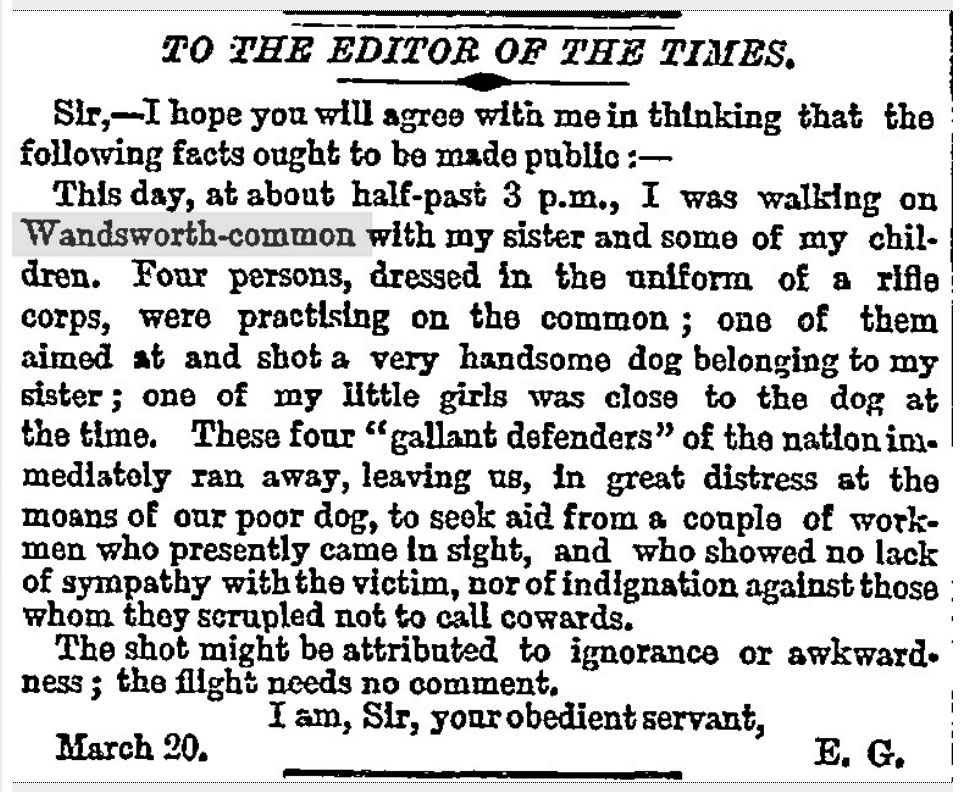
(Click on image to enlarge)
Sun — Thursday 29 March 1860
THE RIFLEMEN ON WANDSWORTH COMMON.
Lord ASHLEY asked the Secretary of State for the Home Department whether his attention had been directed to a letter, signed E. G., which appeared in the Times of Thursday last, complaining that on the 20th of March four persons, dressed in the uniform of a rifle corps, while practising on Wandsworth Common, aimed at and shot the favourite dog of the writer's sister, immediately upon which fatal catastrophe they all ran away; and whether it would not be advisable to authorise the police to put a stop to sharp-shooting upon public footpaths ?
Sir G. C. LEWIS said that he understood the North Surrey Volunteers were drilled in the Neighbourhood in question on the day named, and that four men in the uniform of that corps were seen the same day on Wandsworth Common, but the police could not discover who they were. No sharp-shooting had taken place on the public footpaths. (Laughter.)
[BNA: Link.]
EXTRAORDINARY PAROCHIAL PROCEEDINGS AT BATTERSEA.
The proceedings in this parish on Easter Tuesday are very likely to engage the attention of the ecclesiastical or civil courts of law. The members of the representative Vestry met in the Lammas Hall, Battersea, at nine o'clock on the morning of the above day for the purpose of electing a churchwarden for the ensuing year.
Mr. Hart and Mr. Allen, both members of the Ratepayers' Association, were respectively nominated, but the choice fell on Mr. Hart by a majority of one vote. This Vestry, since the Metropolis Local Management Act came into operation in the parish, a period of about four years, have always elected the churchwarden. In the usual printed notice, however, which is annually issued by the churchwardens, calling an open or public vestry of the inhabitants, and which was held at half-past nine o'clock of the same day (Easter Tuesday), for sundry purposes, it stated, in addition, that the inhabitants were also, "according to annual custom, to proceed to the election ot churchwardens, sidesmen," &c, thereby repudiating the previous election of Mr. Hart by the representative Vestry in the earlier part of the morning.
Accordingly, at half-past nine o'clock, a numerous meeting of the ratepayers assembled in public Vestry, at the Evening School Room, Green Lane road. The first business was to receive the report of the Auditors on the Churchwardens Accounts for the past year, and to make a rate or assessment for and towards the necessary repairs and expenses of St. Mary's and St. George's Churches for the present year.
H. S. Thornton, Esq., the vicar's churchwarden, presided.
Mr. Buckmaster objected to two sum 3 in the churchwardens' accounts, and stated that one of them especially had been illegally placed there. He read a clause in the act showing the consequences or penalties attached to such a procedure.
The Chairman: If anything illegal has been done you have a remedy at law. After considerable discussion the accounts were passed.
Mr. Pariss moved that a church-rate be levied at 3d. in the pound.
Mr. Sellars rose to second the motion. He had no doubt it would appear strange that a dissenter from the Church of England should adopt such a course, but when he considered that church rates would soon be abolished, and kuowing the present need of repairs at both the churches, together w- r the fact that those holding minor offices had to paid their stipends, ha thought on the score justice a rate ought to continue for another year. After a stormy discussion a divi. ion took place, and the rate was only carried by the chairman giving his casting vote.
Mr. Paris* then rose to move that Mr. S Ncnfe he elected churchwarden for the "ensuing } v which being duly seconded produced considerable excitement.
Mr. Buckmaster protested against such a dishonoiable course of proceeding.
Mr. Reynolds, and other gentlemen who acted in concert with him, attended the Vestry held that morning at the Lammas Hall, and thus" admitted its legality, but. now came to the public Vestry, and declared the previous proceedings in the morning tc be illegal.
Mr. Reynolds here denied the inference drawn, and a very considerable altercation took place, when The Chairman stated that he could stop longer, and called on the meeting to appoint another cnairman, whereupon Mr, Alder was unanimous')' requested to occupy the chair, to which propositi 11 he consented. .
Mr. Buckmaster continued"lt was the duty ot the rateyayers to set their faces against this laid stratagem. If the present motion was carried and the proceedings of the Vestry annulled, alt the efforts they had made to obtain parochial reform* for the last four years, would be rendered entirely nugatory. .
Mr. Bridge vindicated the course be had pursued and denied that he had expressed any opinion on the subject as imputed to him. He contended that they were now acting legally.
Mr. Reynolds pursued a similar course of argument, and said that they had been acting under a mistake.
Mr. Juer wished to know how it was that Mr. Reynolds had for four years sanctioned the select Vestry in electing a churchwarden? The proceedings must have been illegal.
Mr. Reynolds explained that having been ecclesiastically admitted into the office the elections were? legal. He then said he should move an amendment,, which was that Mr. Allen be elected churchwarden. He did so to show that he was not actuated by party feelings.
Mr. Bridge would second the amendment for the same reason.
Mr. Buckmaster said (ironically), and Ipropose Mr. Reynolds for churchwarden, in consideration of the great services he has rendered to the parish. (Great laughter.) f A scene of the greatest confusion here ensued, and Mr. Juer moved an adjournment, which was lost.
Mr. Alder, as chairman, asked the Vestry Clerk which of the elections would be legal.
Mr. Chadwin, the vestry clerk, said he was incompetent to answer the question.
Mr. Juer referred to the second section of the amended Metropolis Local Management Act, July, 1856, and said he should most certainly gi v in a written protest against the election.
Mr. Poupart considered the proceedings altogether illegal, and he should therefore protest against the course adopted.
The chairman put the motion in favor of Mr* Neate, but only two hands were raised. The amendment was next put and carried by a large majority of those present. He then officially declared that Mr. Allen had been duly elected, in open and public Vestry, as the churchwarden far the year ensuing. Thus terminated these extraordinary proceedings for the present.
[BNA: Link.]
[BNA:
[BNA:
"J. Silva, Wandsworth Common, South London Chronicle — Saturday 28 April 1860 ART-UNION OF LONDON. The annual meeting the subscribers of thi* institution took place Tuesday in tlic New Adelphi theatre, Lord Montcagle occupying the chair. Mr. George Godwin, the secretary, read the report, the following are the principal portions: — 1 The Art-Union of London lias now been established 21 years. Exclusive of the current year's subscription, and the thousands added prizeSr., aS? i ' anJ distributed the sum of 251,143?., which 138,662/. have been paid to artists, anil for the production f statuettes bronzes, and other prizes; and 64,023/. to engravers, and for the supply of impressions to the subscribers. It has sent some hundreds of thousands of engravings over the world-to the gold-diggers Australia, the backwoodsmen of Canada, to New Zealand, China, the Indies, Egypt, the United States; in fact, to nearly every corner of the globe where there is an English settlement, as "!, cr — v cit y> towll > n village of the United Kingdom; and it finds itself, on the present occasion, with a subscription of 14,138/. The total sum which has been expended by the Art-Union of London on paintings, exclusive of the further large amount added by the prizeholders themselves, is 118,765/., while for bronze and porcelain statuettes, medals, works in iron, enaes, it lographs, and other pi oductions given as prizes, the sum of 19,807/. has beeu paid. the council have recently offered a premium of one hundred guineas for a series of designs in outline, or outline slightly shaded, illustrative of Tennyson poem, " The Idylls of the King." hey have further offered premium of seventy guineas for a group or statuette in plaster, representing some subject from English history, to be subsequently executed bronze or Parian, and thirty guineas for the work selected, as second in merit. They propose hereafter to invite designs for a vase, a tazza, or other similar art work. Ihe following a condensed statement of receipts and disbursements: — Subscriptions received £1-1,138 15 Printing, advertising, salaries, and other expenses, including reserve of 24 percent 3,393 16 0 Amount set apart for printing and volume of wood engravings . . 4,489 19 Amount allotted for prizes . . . . 6,255 18 The reserve fund now amounts to the Sllln of 9,383 Lord Monteagle, moving the adoption of the report, said that he never did so with greater satisfaction than at that moment. It spoke well of the past, and augured well for the future. His lordship went into the details connected with the laws and management of the Art Union, and referred to Mr. Labouchere having suggested a kind of National Gallery for themselves. He congratulated he members havings,, eh distinguished men a, the of St. Paul's, Mr. Monckton Milnes, and others of like eminence, added to their council (cheers) H e felt peculiarly happy in seeing that the Art-Union was able to illustrate that finest pro-I' f — " eate ' modern poet, Tennyson's i,n n i " £'_ ' Although he did not look 1 upon such undertakings as props to the line arts, for they wanted no props; he thought they were wing, to carry out abroad to the farthest corners of e ear 1 (cheers.) His lordship commented in evere terms upon the attempts now being made r, a nval ocety, having nothing in common w hthem, except unfairly appropriating their! So of the 6 reportf C e '"_* 1 Carried unanimously Mr. Monckton Milnes, M.l'., said felt much whTrt.?' elc;? tl0 " which had connected him The drawing was then proceeded with, the first prize of consequence being one of 100/., drawn for Miss Dunn, of e dale, Yorkshire; Commodore Hopkins, of Merthyr Tydvil, 200/ Mr Thomas Gallop, Albert-road, Regent's Park, the remaining 200/. prize. The other prizes occupied about an hour and a half ill drawing from the wheel, after which the proceedings were concluded. Prize 30/., J. Church, Walworth; prize of' 25/., W. Curling, Denmark Hill; prize of 20/., C. IGoocli, Camberwell; prizes of 10/., F. T. Bntchelor. Newington Butts, H. Cristall. Uotherhithe, J. Silva, Wandsworth Common, and T. Stirling, Lambeth. Group of Venus and Cupid. — J. Jones, Batter-j sea; 11. S. Robinson, Greenwich: Miss Swaine. 1 Pcckhain. [BNA: Link.] Art Union of London The Art Union of London, established in 1837, was an organisation which distributed works of art amongst its subscribers by lottery. Art Union of London From Wikipedia, the free encyclopedia Jump to navigation Jump to search The Art Union of London, established in 1837, was an organisation which distributed works of art amongst its subscribers by lottery. Contents 1 Art unions 2 Foundation 3 Membership and its benefits 4 Dissolution 5 See also 6 References Art unions Art unions were organisations created to function as patrons of art. Members would pay a small annual subscription. The union would spend the subscriptions on works of contemporary art, which were distributed among its members by means of a lottery. The idea emerged in Switzerland at the beginning of the 19th century, and was imitated in various German territories. It was introduced to England in the late 1830s on the recommendation of a House of Commons Select Committee on the Arts and Manufactures in the United Kingdom.[1] Foundation The Art Union of London was established in 1837, following the establishment of similar organisations in Edinburgh and Liverpool.[1] It described its aim as being "to aid in extending the love of the Arts of Design, and to give Encouragement to Artists beyond that afforded by the patronage of individuals."[2] Its first meeting was led by four young social radicals: Edward Edwards, Henry Hayward, George Godwin and Lewis Pocock. By the end of the year a formal management committee had been formed, which included the architect Charles Barry, William Ewart MP, chairman of the 1835 select committee, N.W. Ridley Colborne MP, who had also been a member of the select committee and Lord Prudhoe, later Duke of Northumberland.[1] The committee was to prove stable, with nine of the original members still serving in 1857.[1] In its first year, 1837, the union raised only £480; by 1842, however, annual subscription revenue stood at almost £13,000 a figure that would remain fairly stable for twenty years.[1] By 1876 there were more than 20,000 members.[3] The Union persuaded Samuel Carter Hall, editor of The Art Journal, to publish the Union's documents and reports in his magazine, and to promote the annual exhibition of its prizes.[1] Membership and its benefits Each member paid a subscription of one guinea a year. In return they all received a large engraving annually, said to be at least equal in value to their subscription. In addition they had the chance of winning a prize at a yearly draw,[3] initially either a proof copy of that year's print, or a painting.[4] The committees of earlier art unions had selected the prize works for their members, but the winners of Art Union of London prizes had a free choice of any painting, up to a given value, shown at any of the London exhibitions that year.[5] At a draw held early on in the Union's history, in 1839, there were 62 prizes. They consisted of 20 proof impressions of the annual engraving, twenty impressions on India paper; nine pictures valued at £10, two at £30, four at £50, one at £100 and one at £150.[4] At that year's meeting George Godwin announced the Committee's intention to hold the draw at an earlier date in the future, to allow the winners' selections to be made before most of the best pictures had been sold.[4] The annual engraving was, at least in the early years, selected from amongst the paintings chosen by the prize-winners.[4] As the number of subscribers increased, so did the value of the prizes, totalling about £9,000 annually at the peak of the Union's success.[3] From the 1840s there were yearly exhibitions of the prize selections.[1] In addition to paintings and proof engravings the Art Union of London began to offer various specially manufactured "art objects" as prizes. In 1842 it launched a series of medals illustrating the history of British art. Thirty of each were cast in silver as prizes, and bronze versions were offered as an alternative to the annual print.[3] In the same year the Union began to offer bronze statuettes as prizes. As a cheaper alternative they developed the idea of issuing sculptures in the unglazed porcelain known as "Parian Ware"; the first to be issued was John Gibson's Narcissus, produced by Copeland and Garrett in an edition of fifty in 1845 and offered in the following year's draw. The success of the venture led the Union to organise a competition for works that could be reproduced on a small scale in Parian.[6] Dissolution By 1895 the number of subscribers had fallen to below 5,000. The Union was wound up following a resolution passed in 1912.[3] References Sperling, Joy. ""Art, Cheap and Good:" The Art Union in England and the United States, 1840 — 60". Nineteenth-Century Art Worldwide. Retrieved 4 May 2013. "[Advertisement]". The Art-Union Journal. 1: 74. 1839. Beaulah, G. K. "The Medals of the Art Union of London" (PDF). "The Art-Union of London". The Art-Union Journal. 1: 82. 1839. "The Art-Union of London". The Art-Union Journal. 1: 20. 1839. "Art Union of London". Mapping the Practice and Profession of Sculpture in Britain and Ireland 1851 — 1951. University of Glasgow History of Art and HATII. Retrieved 4 May 2013."
"May 14, 1860 --- A Perjurious Charge After two closely watched trials, featuring charges of "an indecent description," 11-year old Eugenia Plummer is convicted of perjury. In the first trial, the Wiltshire girl's testimony had sent her former tutor to jail for four years with hard labor. The Rev. Henry Hatch, chaplain at Wandsworth jail (left), had sought companions for his adopted daughter by advertising as a tutor for young girls. The Plummers placed Eugenia and her 4-year old sister Stephanie with Rev. Hatch but the arrangement lasted only two weeks. Mrs. Plummer retrieved the girls, claiming that her daughters were unhappy sleeping on calico sheets. Within days, however, the Plummers complained to their Bishop that the girls had been molested. Under the law of the day, neither Hatch nor his wife could testify at his trial. The jury was left with Eugenia's sordid tale, "narrated with steadfast countenance, with perfect mastery of the language descriptive of matters usually left in decent obscurity." Convicted, jailed and reviled, Rev. Hatch fought to clear himself from Newgate Prison. By filing perjury charges, he's now able to confront his accuser in court. His lawyer dismisses Eugenia's tale as "entire fiction, the result of a prurient and depraved imagination." While the exact charges are "unfit for publication," Hatch admits that he and his wife did permit the girls to come into their bed, but only beneath the coverlet. Indeed, Mrs. Plummer had suggested that her daughters — who had been to several schools — needed "petting." Hatch denies parading half-naked or worse in front of the girls. Lawyers for the girl ask what motive had she to lie but Eugenia was overheard telling her sister, " Ihate the Hatches." Summing up, the trial judge admits the case comes down to "contradiction upon contradiction." The jury finds Eugenia guilty but urges "the utmost mercy," given her "want of moral and religious education." The judge, placing much of the blame on the parents of the young liar, orders Eugenia to spend three weeks in a detention center. The child will then be placed in the care of "a lady of known benevolence and good judgement in the treatment of juvenile offenders." Hatch's career was wrecked and he ended his days as a rural clergyman in Essex. [BNA: victoriancalendar.blogspot.com/2011/04/"
"POLICE COURTS . . . parish of Battersea, for distress warranto against their goods and chattels, for the non-payment of precept issued by the board for the sum of los. as*ed upon the:r parish for the main drainage rate. Mr. Reynolds, solicitor, of Battersea, appeared for . . . Published: Wednesday 23 May 1860 Newspaper: Morning Advertiser
County: London, England [BNA: Link.] WANDSWORTH. THE DERBY DAY SPORTELHenry _Letts, who was described as a clerk at No.B, Bartlett's-buildings, Holborn, was placed in the dock before Mr. Ingham, charged with wilfully throwing crackers in a public throughfare to the danger and annoyance of the public.lnspector Proctor, of the V division, stated that about eight o'clock in the evening he was on dutyat Clapham-common, near the Windmill, where therewere crowds of persons waiting to see the return of the carriages from the Derby. He saw several young gentlemen throwing a number of crackers at the persons in carriages as they passed along the road. He cautioned several of them, and passed on. He returned shortly afterwards, and he then saw the crackers thrown at the carriages in perfect showers; they were thrown by the score at a time by different persons. Be hurried up a number of constables, and gave directions for the parties to be taken into custody. He saw the prisoner throw three crackers into carriages as they passed.The prisoner was fined 10s., or seven days imprisonment. The money was immediately paid.Several other young gentlemen were also fined for a similar offence. [BNA: Link.] South London Chronicle — Saturday 26 May 1860 [BNA: Link.] PAROCHIAL SQUABBLING IN BATTERSEA. Mr. Corsellis -, the clerk of the Wandsworth district board, attended before Mr. Wandsworth Police Coart in support of summonses against Messrs. George Alder, G. Ayles, W. F. Cross, S. Seldon, J. C. Buckmaster, T. Reeve Oinny, . Hillicr W. Pickering, and H. Sykea Thornton, oTerseers for the parish of Battersea for di warrants against their goods and chattels for the nonpayment of a precept issued the board for the sum of 938/. 15s. assessed upon their parish for the main drainage rate. * The facts of the case were theseOn the of November last the board issued the precept to ail the defendants, with the exception of Messrs- Buckmaster, Hillier, and Denny, and it set forth that the mcney should be paid on or before the 20th of April. The rate for that order was not made until January last, and Mr. Corsellis showed that part of the money had been collected, and not any of it paid over. It also appeared that there was a sum of 600/. which had been drawn from the current account of the overseers, and placed to the private account of the late overseers, Messrs. Alders, Ayles, Cross, and Seldon, and that proceeding had given rise to dispute. The board complained that they had money to pay over, but would not obey the order. Mr. Reynolds explained with respect to the 600/. He was formerly the legal adviser of the late overseers, and when the new ones came into power they thought that they could dispense with his services, the keeping of a lawyer was a dear article. He was in possession of certain papers which the new overseers called upon him to deliver up, but he declined until his claim was paid. Proceedings were taken, and the court ruled that the papers should be delivered up upon their paying his demand, something about 500/., and the overseers drew cheque from the current account and placed it to their own account in order to protect themselves. Mr. Corsellis said the 600/. had nothing to do with these proceeding, and eould be only mentioned to show that the overseers were in possession of Mr. Ingham inquired when the new overseers came into office. Mr. Reynolds. — On the 31st of March. Mr. Ingham thought the order should have been made upon th overseers to pay within their term of office. Mr. Corsellis contended that the duty was attached to the office and not to the officer. Mr. Reynolds differed in that opinion, and said that supposing the late overseers had collected the while of the rate, and had absconded before the new overseers were appointed, the subsequent overseers could never be made liable for the deeds of their predecessors. Mr. Ingham thought Mr. Reynolds was right. The question required consideration, more especially when he was asked levy a distress warrant. The late overseers might say that they had handed their books over to their successors perfectly correct, and on the other hand, the new overseers might say that they had not sufficient time to collect the money. Mr. Reynolds said there were now seven rates under the Metropolis Local Management Act in the course of collection in Battersea, and argued that the proceeding was quite hostile on the part of Battersea, which had been in arrears very considerably with their rates, and hence the difficulty. Several of the overseers said the rate had been . made, and if a sufficient time were allowed the money would be paid. The summonses, at Mr. Ingham's recommendation, were accordingly adjourned for a month. PAROCHIAL SQUABBLING IN BATTERSEA. Mr. Corsellis, the clerk of the Wandsworth district board, attended before Mr. Wandsworth Police Court in support of summonses against Messrs. George Alder, G. Ayles, W. F. Cross, S. Seldon, J. C. Buckmaster, T. Reeve Oinny, . Hillicr W. Pickering, and H. Sykes Thornton, overseers for the parish of Battersea for di warrants against their goods and chattels for the nonpayment of a precept issued the board for the sum of 938 15s. assessed upon their parish for the main drainage rate.' The facts of the case were these/ On the of November last the board issued the precept to ail the defendants, with the exception of Messrs Buckmaster, Hillier, and Denny, and it set forth that the money should be paid on or before the 20th of April. The rate for that order was not made until January last, and Mr. Corsellis showed that part of the money had been collected, and not any of it paid over. It also appeared that there was a sum of 600/. which had been drawn from the current account of the overseers, and placed to the private account of the late overseers, Messrs. Alders, Ayles, Cross, and Seldon, and that proceeding had given rise to dispute. The board complained that they had money to pay over, but would not obey the order. Mr. Reynolds explained with respect to the 600/. He was formerly the legal adviser of the late overseers, and when the new ones came into power they thought that they could dispense with his services, the keeping of a lawyer was a dear article. He was in possession of certain papers which the new overseers called upon him to deliver up, but he declined until his claim was paid. Proceedings were taken, and the court ruled that the papers should be delivered up upon their paying his demand, something about 500/., and the overseers drew cheque from the current account and placed it to their own account in order to protect themselves. Mr. Corsellis said the 600/. had nothing to do with these proceedings, and could be only mentioned to show that the overseers were in possession of Mr. Ingham inquired when the new overseers came into office. Mr. Reynolds. — On the 31st of March. Mr. Ingham thought the order should have been made upon the overseers to pay within their term of office. Mr. Corsellis contended that the duty was attached to the office and not to the officer. Mr. Reynolds differed in that opinion, and said that supposing the late overseers had collected the while of the rate, and had absconded before the new overseers were appointed, the subsequent overseers could never be made liable for the deeds of their predecessors. Mr. Ingham thought Mr. Reynolds was right. The question required consideration, more especially when he was asked levy a distress warrant. The late overseers might say that they had handed their books over to their successors perfectly correct, and on the other hand, the new overseers might say that they had not sufficient time to collect the money. Mr. Reynolds said there were now seven rates under the Metropolis Local Management Act in the course of collection in Battersea, and argued that the proceeding was quite hostile on the part of Battersea, which had been in arrears very considerably with their rates, and hence the difficulty. Several of the overseers said the rate had been made, and if a sufficient time were allowed the money would be paid. The summonses, at Mr. Ingham's recommendation, were accordingly adjourned for a month. [Source: www.britishnewspaperarchive.co.uk/viewer/bl/0000443/18600526/018/0004" target="_blank">Link "?? Weekly Mail — Saturday 1 September 1860 during the day shot for a handsome rifle, which l'3B carried off by William 'Page, the wearer of several medals, . . . entry has most munificently offered the corps any portion of money. To be competed for with Enfield rifles, long or Wandsworth-common most saitable for the erection of a abort, government pattern. This cross was gained by Mr. b u t t . , Jahn teibb, of . . . Published: Saturday 1 September 1860 Newspaper: Weekly Mail County: London, England Type: | Words: 3407 | Page: 5 | Tags: none [BNA: Link.] "Volunteer Service Gazette and Military Dispatch — Saturday 30 March 1861 SURREY. i The members of the Ist Surrey Hides assembled m the Oval, Kcnnington, on Saturday last. The first bugle sounded at cite>.m. After the brass band, under the direction of Bandmaster J. Callcott, the Ist Surrey Militia, had | nlaved selection of favourite, airs, the men, having pre- viously been furnished with five rounds of ammimition, were formed into seven companies, numbering about 300 rank and , file, with cadet corps of about 25; and, after undergoing light infantry drill, which was performed with much pre- ] cision, especially the wheeling, the corns left the Oval, and, commanded Lieutenant-Colonel Macdonald, marched along the Clapham-road, Clapham-common, the men marching very steadily. On arriving at the common a few minutes before six o'clock, a company was detached to keep the -round, the number of spectators being large. The corps then throw out skirmishers in the face of an enemy supposed to advancing the suburbs from Wandsworth-common, 7 . . . ? [BNA: Link.] "The vengeance of JCB / JCB Avenging Angel file:///Users/philipboys/Desktop/DESKTOP%20BUDA%2025aug2021/john-buckmaster/buckmaster_v_reynolds.html" target="_blank">Link
South London Chronicle — Saturday 26 May 1860
<
Wandsworth Common
Buckmaster v Thomas Andrew Fitzgerald Reynolds
THOMAS ANDREW FITZGERALD REYNOLDS
This was the name of Buckmaster's (first) crooked lawyer (the second was Corsellis, of course)
September 2020
I told Keith, who got on with his own research, just as I did.
From John Buckmaster, A Village Politician:
A low, drunken, unprincipled lawyer, who had represented himself as a person connected with the aristocracy, very influential, with large expectations, began to interest himself about the parish charities; and nothing is so popular in a parish as doubts whether these charities go to the right persons. By corrupting the churchwardens and overseers and a few others he was appointed legal adviser to the parish. Everything was litigated, and his bills were cheerfully paid, and the man who questioned
[332]
them was threatened with a writ. Some of them were of the most shameful character, such as removals, making out summonses, advising as to rates, appearing before the magistrate to excuse certain defaulters. At last a few began to rebel; these he threatened with writs. He used to attend the vestry meetings half drunk with a horsewhip, and it was left to me to fight him. I knew he was a scoundrel, and I was not afraid of him.
I was at first in a minority, and could do nothing until I changed the minority into a majority, which I did at the next election, and which you can always do if you are in the right and will work for it. When he knew how the election was going he rushed into the room with five or six others and tried to take possession of the ballot-box, but they failed. He said, "That fellow," pointing to me, "has turned the parish against me by lying, and before I have done with him he and his children shall come to my house and beg a piece of bread."
Iresolved to have my revenge. It is better to have a thief for your enemy than for a friend.
[333]
The late Board of Churchwardens and Overseers had to procure a piece of land for a cemetery. Their legal adviser ran up a bill of upwards of seven hundred pounds, which was paid at a public-house the night before they went out of office. This bill was the most extraordinary piece of parish robbery ever known. Charges for supplying ten copies of the agreement, to superintending the drains, to meeting the inspector, to advising as to suitability of the soil. At the foot of this bill was written, " I have examined this bill. — W. Anderson." And this was represented as a taxation.
Ifelt this was a robbery, but my colleagues were not disposed to take any steps. We had got rid of him, and why trouble further. But as long as he was in the parish there was danger. Isuggested a meeting of the ratepayers, but this was not thought desirable because there was still a strong party in the parish who had profited in various ways by his companionship. At last Imanaged to have the bill referred to a well-known parish lawyer, who advised us to obtain an order for the taxation of the bill. The Vice-Chancellor hesitated because the bill was paid,
[334]
but we obtained the order. The lawyer said, as he left the court, "You can't get butter out of a dog's mouth," and more than half the charges were taxed off. Then an order was made for payment of upwards of three hundred pounds. He had previously sold his furniture and moved into another county and then there was further delay. Then he moved a long distance away, where he lived in grand style for a few months. Some of his old companions used to visit him.
I was determined to hunt him down for his insults, and, contrary to the advice of the lawyer and the Board, Iput an advertisement in the Telegraph asking for information as to his whereabouts. As soon as the advertisement appeared his house was besieged with tradesmen from a near town who wanted their money. He returned to the neighbourhood of London, when by accident a friend who had heard me speak of him gave information as to his whereabouts, and in a few days he was in prison, and there Ileft him. The parish thought I had done a greater service in ridding it of their legal adviser than in
[335]
saving the common, and I was presented with a service of plate. All this was going on during the common agitation, and it was he who had frightened Wrigsby and told him to tell the court all I had said to him. Plausible in his manner, with a pleasant smile, those who knew but little of his inner character thought him a nice kind gentleman and wondered why I should be so spiteful. I had not forgotten his threat — that was why I followed him.
[PB: MY FIRST SPECULATION, which Ishared with Keith: [Is it possible to find who this crooked lawyer was? "W. Anderson"? Was this his real name, or Buckmaster's creation? Where did Iget the name "Anderson"? Surely it wasn't James Anderson Rose, who was a lawyer, but a stalwart of the campaign?] Ilater realised it was Reynolds.]
1864: For ridding the parish of Reynolds, JCB is given a dinner service
" . . . by a few gentlemen, in acknowledgment of services rendered in the parish during period of great trouble and difficulty "
[NEEDS EDIT]
Testimonial to Mr. Buckmaster.
The great parochial battles of Battersea are now ended. There will, however, lively discussions in the Vestry whether a lamp-post should be 8 feet or 8 feet inches, or whether it be more economical to use Purbeck or granite for kerbing footpaths, or whether it be possible to do things which are impossible. These vital questions will occasionally occupy the serious attention of men rated at 25 a year.
Happily no one now suspects the parish officers of any misappropriation of parish money, and the great man, before whom all small men were terrified, and parish officers worshipped, now in prison; but Mr. Buckmaster, against whom lawyers on both sides of the river have times sworn vengeance, has achieved a great victory. For years he exposed the chicanery, the deceit, and falsehood of a party now defunct.
Extracts from lawyers' bills were printed and circulated for the edification of the ratepayers; affidavits and opinions of counsel for a time defeated his efforts; but a man waits the truth and justice of his case will the end receive its proper and just reward; and although we cannot endorse all Mr. Buckmaster's opinions, we believe he deserves well of the parish, and this recognition of his services must be as agreeable as, we understand, was unexpected.
the anniversary of his wedding-day he received a polished oak box, containing the following inscription: "St. Mary, Battersea. — This box, containing 64 pieces of plate, was presented to Mr. Buckmaster, by a few gentlemen, in acknowledgment of services rendered in the parish during period of great trouble and difficulty. — August, 1864."
Keith
Thanks for the latest hare to pursue through the archives, Philip — a really interesting one.
His grandfather, Thomas Reynolds, one time tenant of Kilkea Castle in Co. Kildare, was a United Irishman whose life in an exhaustive 2-vol. biography (750pp plus) by his son Thomas (TAFR father; b.1798) was published in 1838 and is on Google Books if you've got the odd few weeks to spare!!!
To cut a long story short, TAFR was born while the family were in Copenhagen (1819), thence to Paris where the grandfather died of cholera in 1832. TAFR married Anne Raikes at Paris in May 1840 — she came from Yorkshire. He soon came to London and was indentured in Sept. 1840 to A Queen's Bench lawyer.
In 1851 he described himself as Solicitor's Fundholder and lived at Devonshire St. Finsbury. In 1856 his office was in Chancery Lane and home at 3 Farnborough Tce Westbridge Road (quite close to the "gothic villas) at the east end, north side. He dubbed the house "The Poplars" and was there in 1861, 'attorney-at-law' with his wife and adopted daughter Jessie.
[PB: Where was "The Poplars" — marked on any maps?
Anne Reynolds died in 1864 at Beaumont St Marylebone, leaving 7,000. The fact that her sole executor was her brother Robert Raikes of Crickhowell is suggestive to say the least. No trace of him in 1871 though he didn't die until 1/1/1878 at Milman Street (Chelsea??) leaving <100.
Not surprised he got up the nose of a man like Buckmaster!!
[ Ireplied with 3 successive long emails.]
I
Splendid, Keith — many thanks for following up
I'd got some of it myself — and I was just about to send you a summary & some links, because I knew you would find it interesting
I had downloaded the 2 vols about Thomas Iby Thomas II, but yes they were too much even to skim — and of course, as the work of his son (i.e. our man's father) not entirely, er, objective.
On the other hand, nearly all the articles published in Ireland are committed to damning him — he's nearly always styled "Thomas Reynolds, Informer". Not surprising of course.
But my goodness how interesting ! My knowledge of the United Irishmen movement is sketchy, and sadly is likely to remain so.
I thought this summary looked good. It also helps explain how Thomas II I(our Thomas) was born in Copenhagen and married his wife in Paris:
REYNOLDS, THOMAS (1771 — 1836), informer, was born on 12 March 1771 at 9 Park Street, Dublin, in which city his father, Andrew Reynolds (1742 — 1788), had acquired a considerable fortune as a manufacturer of poplins. His mother was Rose (d. 1797), eldest child of Thomas Fitzgerald of Kilmead, co. Kildare, and it was at Kilmead that Reynolds spent the first years of his life under the supervision of a Roman catholic priest.
At the age of eight he was sent to a protestant school at Chiswick, near London, where he remained till the beginning of 1783, when he was removed to a jesuit seminary at Lige.
He returned to Ireland in the spring of 1788, and, his father dying shortly afterwards, he inherited considerable property from him. But falling into dissipated habits, in consequence of which he became seriously ill, he went for the sake of his health by sea to Rotterdam.
From Rotterdam he proceeded to Paris, and in the spring of the following year he made a journey through Switzerland into Italy, returning to Paris in July. Becoming alarmed at the progress of the French revolution, he returned to Dublin, where he speedily relapsed into dissipation.
In March 1792 he came of age, and, according to his son's account, into the possession of a fortune of £20,000, exclusive of his share in the capital and profits of his father's business. Living thus in affluence, he passed his time idly and agreeably to himself. He represented the city of Dublin in the catholic convention of 1792, and continued to be a member of the committee till its dissolution, after the passing of the relief act of 1793.
On 25 March 1794 he married Harriet Witherington (1771 — 1851), whose sister Matilda was the wife of Theobald Wolfe Tone [q. v.] But, in consequence of the dishonesty of a partner, his business had at that time so far declined that he found himself in serious pecuniary embarrassment. His principal creditor was a wealthy Dublin merchant of the name of Cope, to whom his firm stood indebted for 5,000l.
Hitherto he had avoided politics, but in January or February 1797 he yielded to the solicitations of his friends, and became a United Irishman.
Shortly afterwards he obtained an advantageous lease of Kilkea Castle in co. Kildare from the Duke of Leinster, through the good offices of Lord Edward Fitzgerald [q. v.], by whom he was in November induced to accept the post of colonel of the so-called Kildare regiment, and subsequently, in order to enable him to attend the provincial meeting, that of treasurer of the county.
On 19 Feb. 1798 there was a provincial meeting of the Leinster directorate at Oliver Bond's house in Dublin, and it was only then, according to his own account, that he became for the first time acquainted with the real designs of his fellow-conspirators, and of their intention to seize Dublin and to subvert the government by force of arms. In terror — real or feigned — at his discovery, he consulted his friend and creditor Cope, and, having disclosed enough to arouse Cope's curiosity, he was invited to play the part of informer.
Cope, who was subsequently rewarded with a pension, was authorised by Cooke, the under-secretary, to stick at no sum — not even 100,000l. — in order to induce him to turn approver. Reynolds was willing to assent on less exorbitant terms. His name was to be kept a secret, and he was to be substantially indemnified for any loss he might sustain. Whether his readiness to reveal the conspiracy was due, as his son and biographer argues, to a desire to save his country from the horrors of a bloody revolution, or to less honourable motives, it is beyond a doubt that he was at the time, except for his lease of Kilkea Castle, practically a bankrupt.
In consequence of information furnished by Reynolds, government was able to arrest the provincial committee at Bond's house on 12 March, and so practically to kill the conspiracy. That Reynolds had betrayed them was certainly the opinion of some of the United Irishmen, and it is said that only his coolness and intrepid bearing on being challenged with his perfidy by Samuel Neilson [q. v.] saved him from being shot dead on the spot. Others were not so credulous as Neilson, and more than one attempt seems to have been made to assassinate him; and, in order to disarm suspicion, he took an oath before a county member that he had not betrayed the meeting at Bond's.
For a time his secret was so well kept that his property at Kilkea suffered severely from the military, who were freely quartered there, in consequence of his supposed 'croppy' politics. On 5 May he was actually arrested on a charge of harbouring Lord Edward Fitzgerald, and it was not till he had been taken to Dublin, and his identity revealed to Under-secretary Cooke, that he was set at liberty. It was impossible to return to his house, and so, having promised to give evidence at the forthcoming trials, he was accorded shelter in Dublin Castle till the storm had blown over.
The terms of the bargain were arranged by his wife, and, in addition to a pension of 1,000l. a year, to commence on 25 June 1798, with 5,000l. in hand, it was agreed that he might settle in any part of England he liked, and receive from government letters of introduction, recommending him and his family to the particular attention of the gentry of the place. He was the principal crown witness at the trial of John McCann on 17 July, but it was said that under the fierce cross-examination of Curran, it was rather he than McCann who was on his trial. He was, again, the principal witness at the trial of William Michael Byrne on 21 July, and of Oliver Bond on the 23rd, and was on the last occasion scornfully denounced by Curran.
After the suppression of the rebellion and the restoration of the metropolis to some degree of tranquillity, Reynolds emerged from his quarters in the castle and took a house in Leinster Street. By the influence of government he was on 15 Oct. made free of the guild of merchants of Dublin, and on 19 Oct. received the freedom of the city. But the feeling of the populace was extremely hostile to him, and one night, when Major Sirr was dining with him, his house was attacked by the mob. The assailants were driven off; but Reynolds, not feeling secure, removed shortly afterwards to England, going in the first place to Allonby in Cumberland, and subsequently to London.
After a short time he was compelled, by his habitual extravagance, to retire to Usk in Monmouthshire; but, returning to London, he eventually, in 1810, succeeded in getting himself appointed postmaster or packet agent at Lisbon. The emoluments of the office during the four years he held it amounted to 5,600l., but on the withdrawal of the British army from the Peninsula they sank so low that he resigned it, and in September 1814 returned with his wife to London.
Early in 1817 he was offered the post of British consul in Iceland, and after some hesitation, and stipulating that he should not be obliged to reside there, he accepted it. The appointment occurred about the time of the trial of Wilson and others for high treason in connection with the Spa-fields meeting. True bills were found against the prisoners by the grand jury of Middlesex; but, Reynolds's name appearing on the panel, public feeling was greatly aroused against government. 'He should retire,' said Curran, 'from public view, hid beneath the heap of his own carnage.'
Lord Castlereagh, who suffered acutely from the untoward incident, evidently took this view of the situation, and in July Reynolds was quietly shipped off to Copenhagen to take up the duties of his consulship. The salary attached to the post was barely 300l., and after a brief trial, including a visit in the summer of 1818 to Iceland, he determined to resign it.
Returning for that purpose to London, he was allowed to transfer the consulship to his son, and to travel for his health on the continent.
After Lord Castlereagh's death in 1822 he was informed by Canning that government desired to have as little to do with him and his family as possible, and that the consulship would be abolished but an adequate allowance allotted him. He retired permanently to Paris, where he loved to parade his pompous person in the Champs-Elyses.
He is said to have undergone a religious conversion in 1831. In the following year he was attacked by cholera, to the effects of which he eventually succumbed on 18 Aug. 1836. He was interred in the family vault in Welton church, Yorkshire.
In 1839 his younger son, Thomas (d. 1848), undertook the task of vindicating his father's character; but the investigations of Madden, and more recently of Fitzpatrick, do not tell in Reynolds's favour. A more judicial and less hostile view is taken by Mr. Lecky.
[Reynolds's Life of Thomas Reynolds, to which is prefixed an excellent portrait; Madden's United Irishmen, vol. i.; Curran's Life of Curran; Fitzpatrick's Secret Service under Pitt, containing much curious information; Howell's State Trials, vol. xxvii.; Lecky's Hist. of England in the Eighteenth Century; Webb's Compendium of Irish Biography.]
[Source: Link]
Isn't it interesting how Thomas II Ialways insists on his connection with Kilkea or Kilkee Castle — he's not embarrassed — even this brief death notice makes it central:
For example, in the report of his death in the London Evening Standard — Thursday 10 January 1878
Thomas Andrew Fitzgerald Reynolds, Jan 1, Thomas Andrew Fitzgerald Reynolds, Esq. aged 59, late of Kilkee Castle, Kildare, Ireland.
[Source: Link]
More in a bit . . .
All best
Philip
PS You really don't have to read let alone respond to all this stuff — but Ireally appreciate having the opportunity to just write it all down . . . .
II
Hello again, Keith
Thomas II Iseems to have been a chip off the old block.
Stories about Thomas Ioften mention his dissipation as a very young man, how he blew ALL the fabulous money he was left etc
And Thomas II I too seems to have been up to no good from the earliest age.
This is 1850!
(Before Mr. Commissioner Law.)
IN RE THOMAS ANDREW FITZGERALD REYNOLDS.
This insolvent, an attorney, who applied under the Protection Act, was heard a year ago. He had been to France, and was now in prison.
He applied for further hearing, when Mr. Dowse appeared for Mr. Nichols Alfred May hew, with whom the insolvent had been in partnership, and Mr. Cooke for the insolvent. The other parties in the matter were represented by Mr. (of the Chancery bar), and Mr. Wood and Mr. Cooke.
The case occupied several hours on the present occasion, and ended in an adjournment, with the view to settle some matters, rather than continue a suit in Chancery. All parties expressed themselves anxious to avoid proceedings in equity.
The Court refused to grant protection to the insolvent.
[Source: Link]
And just LOOK at what happens next, i.e. well BEFORE his Battersea days
Morning Post — Thursday 18 July 1850
(Before Mr. Commissioner Law.)
IN RE THOMAS ANDREW FITZGERALD REYNOLDS.
This insolvent, whose case had been before the Court on several occasions, appeared for his final order. In the course of the case he became excited, applied several offensive epithets to the parties before the Court, complained of his treatment, and expressed his determination to rot in prison rather than again apply.
Mr. Commissioner Law, who had bestowed great pains on the case, could not prevail with the insolvent to restore order, and he was remanded to prison for an indefinite period.
[Source: Link]
And yet and yet here is just 9 years later:
London Evening Standard — Wednesday 9 March 1859
Whitehall, March 2. The Lord Chancellor has appointed Thomas Andrew Fitzgerald Reynolds, of Battersea-square, Battersea, Gentleman, to be a London Commissioner to administer oaths in the High Court of Chancery.
[Source: Link]
Blimey!
Yet clearly he just can't help himself, so just a few years later:
London Evening Standard — Wednesday 26 October 1864
BANKRUPT. (To Surrender at the Bankruptcy Court London.)
Thomas Andrew Fitzgerald Reynolds, Cecll-st. Strand, solicitor, Nov. 14, at 12: sol. Mr. Aldridge, Moorgate-st ; off. assig. Mr. Cannan, Basinghall-st.
[Source: Link]
You couldn't make any of this up.
I've also got lots of material about the ding-dongs between Buckmaster and Thomas II Iin the vestry.
I'll send them separately.
All best
Philip
III
Hello, Keith
Just for kicks, here are some of the articles Icame across re Buckmaster v Reynolds
I've yet to find out how/where Buckmaster tracked down Reynolds. Or the court case that led to his imprisonment (again).
Perhaps you've had more luck?
(Curiously there are FAR FAR more articles about Buckmaster v Corsellis — and even more explicit. I wonder why Buckmaster doesn't mention this civil war — or was he perhaps rolling both lawyers together?)
Anyway, for your sake and mine I'd better stop this self-indulgence straight away
All best
Philip
STORMY VESTRY MEETING AT BATTERSEA.
A public meeting of the ratepayers of Battersea, was held in the Infant School, Green-lane-road, Battersea, on Thursday evening, for the purpose of electing nine members for the Vestry, and five auditors of accounts . . . .
[Source: Link]
London Daily News — Thursday 9 September 1858
WANDSWORTH.
[PB: Ibelieve this and some other references may have been copied in full to the WC Database.]
London Daily News — Thursday 9 September 1858
WANDSWORTH.
William Wilcox, a labourer, appeared before Mr. Ingham, to answer a summons charging him with having used abusive and insulting language to Mr. T. A. F. Reynolds, a solicitor, of Battersea, whereby a breach of the peace might have been occasioned, The defendant pleaded not guilty.
The complainant stated that there had been a great deal of excitement in the parish of Battersea, in consequence of certain proceedings at the vestry meetings. Witness, who was solicitor to the parish, had been carried about in effigy, ye and afterwards burned and buried.
On the afternoon of co Thursday, the 26th ult., he was walking along the High- C, street, with Mr. Smith (a late overseer), and another Ci gentleman was following behind, when he heard a person, who was identified by Mr. Smith as the defendant, call out, "There goes two rogues, and there is another P(?? words waco ceuplc d with most offensive H expressions,of the took no notice on that occatriccui, but on the Sc following Saturday evening, while returning home with his P mother and a large Australian dog, the defendant repeated I the language, — which was of worse description.
He then returned to where the defendant was standing with a number 2( ef other men, and upon getting his rame bie found that it Cc was the same person who had insulted him on the Thursday. 9id
The defence set up was that Mr.?? was under the Iinfluence of liquor on the Saturday, cand that hi dog run against his (the defendant's) wifle, an,, frightened her. Mr. Reynolds denied that he Wats intoxicated, or that his 3" d,,g tan against the wife. It wccs frees these annoyances B that he wished to be protected, fir he did not know where l~ they would end. He had mcidog-with him on the Thursday. 4, Mr. S. Smith, the late overseer of Battersea, was called to prove the use of the insulting language on the Thursday, and a man named John Taylor was examined by the defendant to show that Mr. Reynolds was intoxicated on the bc Saturday, and that his dog frightened the wife. Air. Ingham asked the last witness if he assisted to burn B Mr. Reynolds in effigyF Taylor said he never saw it. at Mr. Ingham then asked if he saw Alr. Reynolds's effigy dragged about in a cart? Taylor answered that he did not help to do it, as he was b- in town that clay. Mr. Ingham said it was clear the dog had nothing to do 0 with the matter, and that fthe feeliicgs exhibited by the de- P fendant arose out of the Parish aff~ira This kind of conduct moont be put a stop to, but if the defendant promised not to ri repeats it, he would only order him to enter into his own recognisanee to keep the peace for six months. a The defendant consented, and was then bound over, but was lucked up in default of paying 4s. costs.
[BNA: Link.]
[Source: Link]
BATTERSEA OVERSEERS' ACCOUNTS.
Startling Parochial Disclosures.
1859 REYNOLDS BUCKMASTER
Startling Parochial Disclosures.
BATTERSEA OVERSEERS' ACCOUNTS.
J. C. Meymott, Esq., the Poor Law Auditor, resumed his investigation into the accounts of Mr. Reynolds on Tuesday morning last, in the Board Room of the Union Workhouse, relative to the law charges made by him in connexion with the enge proceedings, which has for some time past created very great dissatisfaction in the parish. The Auditor, after a minute investigation of some of the late Overseers' receipt books, inquired whether Mr. Reynolds was present, when his clerk stated that he was unable to attend in consequence of illness, but that a gentleman would shortly arrive who would act as his representative.
Mr. Lvth wished to know bow long Mr. Reynolds had been unwell, had passed him that morning on the road, and he then appeared in perfect good health. This statement was corroborated by other ratepayeis who had also seen him. The Clerk — He has been unwell for some days, and I can vouch for the truth of it. The Auditor stated that it appeared that the sum paid, and that was the amount of the bills. very important communication had been, made to him, by Mr. Buckmaster, which contained an objection the accounts that must once decided. It slated that the terms made Mr. Reynolds was to the following effect undertake to carry on the action, and if succeed will make the legal charges, but if unsuccessful Iwill then only bring in a bill for costs out pocket."
Mr. Biet ley, the gentleman previously referred to, said that he had been suddenly requested by Mr. Reynolds to attend that occasion, and he would commence by reading an explanatory letter from him, which might also be considered au apology for his absence. The Auditor — But what do say is the cause of his non-attendance to-day?
Mr. Bierley had not seen Mr. Reynolds, and he could therefore only read the communication, as at that time he was almost entirely ignorant of the facts of the case. He proceeded to read the letter, which stated that such was the state of his health that he had been advised to avoid any excite.nent, and consequently he was prevented from attending the audit. It then purported to detail the whole of the proceedings connexion with the law-suit. He had been appointed solicitor to the Overseers, &c. and intimated that the course now pursued towards him was not fail or just. It likewise stated that he believed there had been some tampering with the minutes, and that there was some power at the Board which was inimical to him, hut the whole art'air viewed as intended to embarrass the late Overseers.
The Auditor — l cannot entertain the question in reference to the motives of individuals. Have you any documents? What you have read can only be considered as a statement or a speech.
Mr. Bierley — l have not any with me such as you require. Ihe Auditor expressed his willingness to hear any statement from those persons wdio were present when the a.leged conditions were made.
Mr. Hart said that Mr. Reynolds guaranteed the ratepayers that ho would not charge more than costs out of pocket if was unsuccessful. This declaration wa-. made in the open Vestry.
Mr. S. Poupart jemembered perfectly well the Vestry at which the agreement was made. There was a strong objection made to the Penge lawsuit, and a poil took place.
Mr. Reynolds distinctly made the conditions, as stated, and it was only on that assurance that he had voted for thi legal proceedings for otherwise he should most certainly not have acquiesced.
Mr. G. Bass confirmed the previous testimony.
Mr. Reynolds said it would be a great advantage to the parish if he succeeded, and, not, the expense would be but trifling.
Mr. Chadwin, the vestry clerk, spoke to the same effect as regarded the conditions made at the public Vestry. At a subsequent meeting the Overseers, Mr. Reynolds said that he should withdraw his former proposal. The Auditor — Was the subject then regularly brought forward? Mr. ( hadwin — It was conversational, and the Overseers replied that that was understood, and he (Mr. R ) added that there must be no interference with him.
Mr. Green gave similar evidence to the conditions, but he voted against the proceedings. The Auditor read aloud Mr. Reynolds' letter, and said it conflrmed the evidence given. Considerable discussion here took place respecting the taxation the bills, &c., which was stopped (he Auditor referring again to the letter, wherein it stated that the conditions were superseded in consequence of his having been prevented, by rule obtained, from acting as the attorney the Pengc proceedings. But the ratepayers were not to suffer on that account. Because there was another attorney that did not affect the original agreement, and the proceedings might have been continued.
Mr. Merriman, who appeared for the present Overseers, said that the difference in the amount would be very considerable. The parish documents relating to the proceedings were not now produced, nor was it known who possessed them.
Mr. Montague read a notice which he had sent to the Churchwardens and Overseers, intimating that he should appear at the next audit and oppose any further payment on account of the Penge lawsuit, but notwithstanding they had since paid 500 to Mr. Reynolds.
Mr. D. Jones referred the circumstance of the parish officers, after receiving the above mentioned notice, expending a sum of money to ascertain how they were proceed under such circumstances.
The Auditor said he should now go into an examination of the bills, and the sum of 56 at once disallowed an old account, with observation from the Auditor that Mr. Reynolds had received a great deal more than costs out of pocket on those bills.
Some other charges were reduced. ordered the other accounts to be amended, which the Clerk, with Mr. Bierlev, immediately did. The following was the result of the Auditor's decision:
The amount bills 17 8 Reduced auditor to . . . . 1448 0 Disallowed 17 Struck off on the Ist day of audit 22 16 6 Total amount disallowed 0
The next general meeting the Battersea Ratepayers' Protection Society will be held at the Lammas Hall, on Tuesday evening next, June 14, at seven o'clock, when the Committee invite all members to attend.
[Source: Link]
EXTRAORDINARY PAROCHIAL PROCE" 1862
"POLICE INTELLIGENCE
. . . Election Battersea. Mr. Reynolds, the solicitor of Battersea, accompanied by Mr. Eyerly, another solicitor, attended before Mr. Ingham, at the Wandsworth Police-court, with reference to the late proceedings in that court against Mr. . . .
Published: Saturday 21 June 1862
Newspaper: West Middlesex Advertiser and Family Journal
County: London, England
[BNA: Link.]
"[BUCKMASTER HEADS THE "WHITE" PARTY v Reynolds's RED PARTY]
London Evening Standard — Saturday 15 November 1862
BUCKMASTER (APPELLANT) V. REYNOLDS (RESPONDENT.)
This was an appeal from the decision of magistrates. An information was preferred by the plaintiff, who was one of the inspectors of votes for Battersea, against the defendant, a solicitor, for interrupting and preventing the polling for the election of eight vestrymen for the parish of Battersea, and trying to get possession of the balloting-box.
It appeared that a poll took place for the election of eight vestrymen for the parish of Battersea, when there [sic] two balloting-boxes, one for the "red" party and the other for the "white" party. In the polling-room policemen were placed to prevent disorder, and it was alleged against the defendant that he being at the head of a number of persons in favour of the "red" party (who were losing the poll), broke into the room, declaring that it was after eight o'clock, sat on the table, tried to get possession of the balloting-boxes, and obstructed the voting for ten minutes.
The magistrate refused to convict, and the question now came before this Court. The Court were of opinion that the matter should be remitted back to the magistrate.
Mr. Watkyn Williams appeared for the appellant, Mr. Day for the respondent. Judgment accordingly. (Sittings at Nisi Frius, before Mr. Justice Willes and a Common Jury.)
[NB In the same paper, same page, money is announced that will be sent to relieve "THE DISTRESS IN LANCASHIRE", because of the AMERICAN CIVIL WAR.]
[BNA: Link.]
DREADFUL SUlClDE.Yesterday morning the police authorities at Scotland-yard received intelligence of a dreadful suicide committed near the Patriotic Asylum, Wandsworth. common. It appears that on Monday Wm. Cedes, a postmaster, carrying on business as a baker in York road, Battersea, was seen by two platelayers loitering near the West-end and Crystal Palace Railway at Wan dsworth -common, and on the approach of the Brighton express train he ran down the embankment and placed his head upon the metals. The train immediately passed over it, smashing it in a most dreadful manner. To such an extent was the poor man's head crushed that he could only be identified by his clothes. His remains were carried to the workhouse of the Wandsworth and Clapham Union, to await an inquest.
[BNA: Link.]
The BNA records about 30 similar (typically verbatim) reports over the next week, from all over the country, including
Barrow Herald
Irish Times, Dublin
Cork Daily Herald
Chelmsford Chronilce
Hull Packet
Manchester Courier
Coventry Herald
Some introduced the item with the phrase
"Suicides in London are becoming alarmingly frequent."
..
Dreadful Suicide.On Tuesday morning the police authorities at Sootlaud-yard received intelligence of a dreadful suicide committed near the Patriotic Asylum. Wandsworth Common. It appears that on Monday William Cades, a postmaster, carrying on business as a baker in York-road. Battersea, was seen two plate-layers loitering near the West End and Crystal Palace Itailway Wandsworth Common: and on the approach of the Brigh ton express train he ran down the embankment and placed nis head upon the metals. The train immediately passed over it. smashing it in most dreadful manner. To such an extent was the poor man's head crushed that could only identified byhis clothes. His remains were carried the workhouse of the Wandsworth and Clsphsra Union, await inquest. From the inquiries made of his friends it appears that the deceased had been in desponding state for some time.
[BNA: Link.]
[BNA:
Illustrated Sporting News and Theatrical and Musical Review — Saturday 18 April 1863 WANDSWORTH WORKING MEN'S REFORM TEETOTAL CLUB v. CHELSEA TEETOTAL CLUB This match was played at Wandsworth Common on Easter Monday, April 6. Score: — Wandsworth 111 and 47, obtained thus; W. CarRY 4 and 0, G. Brooks 19 and 4, Robinson 13 and 0, 11, Lucas 3 and 18, B. 5 and 1, W. Street 0 and, W. Whitby 21 and 6, Mr. Fry 5 and Mr. Jaw" 19 and 9, C. White 11 and 8, F. Thomas 6 and 1. Chelsea United 112 and with eight wickets down; Eller 8 and 0, W. Dyke 8 and 8, 0, Hill 32 and 4, Drockland 3 and 4, bongworth 11 and 18, J. Dyke 2 and 6, Tiptaft land 8, 5 and 1. Collins 13 and (not out) 5, G. French 15, Hervey 7; extras 9. [BNA: Link.] WANDSWORTH WORKING MEN'S REFORM CLUB NB Icame across articles in which the WWWMTC show their support for Poland liberation On Working Men's Clubs more generally — with speaker Henry Cole! — see e.g.
Birmingham Daily Post — Thursday 2 April 1863
SEARCH e.g.
"wandsworth working men's club "
[BNA:
"[WORKING MEN'S CLUBS]
London City Press — Saturday 18 April 1863
CLUBS AND KITCHENS FOR WORKING MEN.
We are in the habit of laying that the world grows wiser, and the race of mankind better. Whether these postulates sound or not, we can at least say with truthfulness that philanthropist! are much more practical than they used to be, and nprhaps much more tolerant and unostentatious. The long- talked of millennium that was to ushered in to the trickling of pure water over the face of the eartb, and the repressing of all human passion and pride and paltriness, is still somewhere beyond the horizon of reasonable hope, and nobody expects to see it the ripe product of mere speechmaking and dreaming. From the earliest saints and sage* have given men good advice about the evils of intemperance and anger, improvidence and lust, but we are still in need ol hospitals, and prisons, and workhouses, and penitentiaries, and if there remained for us no bettei sort of efforts than oratory and inditing tracts, we might as well give it up as a bad job, and leave flie human race to work out its destiny, only possessed of physical capacities, and destitute altogether of the moral and the spiritual.
A day's work is belter than a lifetime of talk, and fortunately many of the most hopeful of the Eclectics begin to pursuaded that much more good mav be accomplished directing the appetites, and fn-iiishing them with wholesome diet, than telling people that their desires are wicked, and should be put under moral restraint or corporeal lock and key. Cheap newspapers have solved the problem of how to make the people think for themselves the appetite for news is found to be useful as a means of supplying intellectual food of lasting value, and aiding self-culture among the masse", without the help of Government grants or Exeter Hall meetings. The teetotallers are likely to be superseded by agencies that step in between a man and the drink might covet, and effect a reformation by giving him the very amusement he desires, without any taste of the poison of the bowl or any of the temptations that accompany alcoholic excitements. Working men's clubs are doing wonders for the people for whose good they are especially designed, and there is a promise of similar pood results the establishment poor men's kitchens. must be evident to anyone moderately acquainted with human nature that it is not the love of vice which leads men to drink in the first instance, however the love vice may predominate in the end. It is simply the desire for enjoyment, and the tavern provides a species of enjoyment that is very enjoyable, and that will be participated in so long as there are no other enjoyments equally cheap, acceptable, and accessible.
Lectures, concerts, religious services, and all sorts of schemes have been devised, and all good in their way, but not so generally attractive as to influence large bodies, nor so permanently impressive as to modify the habits and make excesses all kinds obnoxious as they shonld be. All these things have done good in their way, and the teetotallers have played their part bravely, and have a good account to give any day of the blessings that have their labours. But all these agencies are partial. They begin by accepting the conditions imposed Mrs. Glasse on the cook ambitious of excelling in certain department of his art. You must first catch your hare; you must get your folks to come to the meeting before you can hope to reason with them of temperance, and righteousness, and judgment to come. This difficulty has been acknowledged, and to diminish it to the least possible extent all sorts of attractions have been devised — teetotallers have olioirs that sing delightfully, the religious folks have descended occasionally to sensationalism, and the musical people have added tea and crumpets to the attractions of lutes and trumpets. We beg the question as to the attractiveness of social comfort, in a perfectly free-and-easy way. But it does not follow that free-and-easy should be only another name for bad music, ribaldry, and guzzling. What is a downright good family party but a free-and-easy, without a taint of vice, or a temptation to wrong? the people drink wine while they chatter and $iag, what is that to any. body, if they can afford to pay for itf So if you want to see working men in their element, and yet out of danger, let them have the free-and-easy, compounded, not of poison and bagpipes, but of books, pictures, newspapers, chess-boards, opportunities for gossip, discussion, and merry-making, and with something good to eat and drink, while engaged in rest and recreation.
We imagine it is for such purposes as these that working men's clubs have been established. The greatest charm in life is society, the best exhibition in the world is a lot of human faces; if handsome and happy faces all the better; but, anyhow, plenty of faces and unquestionably the faces should be of both sexes, or the affair is onesided and very nearly a sham. Everybody has heard of the movement in Glasgow for providing the working-classes with cheap and good food, and the progress of that movement in London, and in other cities and towns. It is to the working men's clubs movement as Hyperion to a satyr, and we are bound to wish abundant success, and hope to see it spread its benefits far and wide wherever there are stomachs to be filled and narrow purses to pilot provender to its proper destination. The working classes are made of the same stuff as is the rest of mankind. Peers, millionares, middle-class traders, even sectarians and devotees, want recreation, and those who repudiate that impeachment own. to needing bodily sustenance. Has it not often puzzled the reader how a man earning, it may be, pound a week, manges thereupon to keep a wife and twelve young children ? There is one thing certain : the money all goes in bread, and if these people want aught else than bread they must get in debt for it. Twenty shillings will only buy forty loaves at the best of times ; yet, everybody who has attempted devil a kidney or cook a I'nib's heart, knows that it is possible to waste money in bread, and that there are many viands, "holesome and less costly; available to satisfy appetite and nourish the body for people who *) where to get them and how to cook them.
When Mr. Corbett started working men's kitchens Glasgow, it was one of his first objects to introduce wholesome dishes that could be produced at a very low rate, in fact, to turn to useful account some of those ambiguous materials which the world dignifies with the name of offal. We confess that we do not kuow the constitution of a " haggis " or a dish of collops, but we accept the testimony of those whom we know to be judges of such matters that such things are good, and that openly recognizing them, a good dinner may be furnished for a few pence, which will be as enjoyable and as rourishing as one costing a few shillings. Now, why should the children's bread be cast to the Why should we cast out from our markets, " offal, " materials capable furnishing many man with a good meal, who, without such to digestion, must hope for mere bread and *' hing more, or make a change once a-week r -h a joint badly cooked, and vegetables boiled brown. It has often been said that good cookery the beat advocacy of temperance; but well-tort') workmen carry their steaks to the capacious gridiron at the Pig and Whistle, and make one turn deserve another, because there they can, the help of the genius called "potman, " and 1 the society of their companions, and with a good b'i to warm their toes, do better for a meal than 1 home, because their wives worked at trades like themselves till they were married, and then were either lying-in, or had wrong notions of the. . ce of cookery. No doubt there was much >iih this, but there are bachelors as well as edicts among working men, and, married or ; . th e y must eat; and if they can be provided 1 dinners for sixpence each better than can be '> shilling, why, let it be doue; and, instead cookshops that sicken passers-by in sultry ta with the odour of tallow and cinnamon, w. "". . to " cookin depdts for the working Wherever the working classes congre-0 lere 13 fair proportion of hungry and humble passers-by, and there will nerer be lack of business if good food is served in cleanly manner.
Mr. Alexander Burrell has lately visited the cooking depots in Glasgow, and reported thereon the Society of Art*, of which he is an active member. In this report, Mr. Burrell makes a very curious comparison, and we commend that to the consideration of philanthropists of all classes. It is to this effect; that convicts are in many in stances better fed than labourers, and in all cases, have enough not only to support life, but to sustain them in full health and vigour, so that when sent away on tickets-of-leave they are in "good fettle " (we believe that the word) for breaking open doorways, cash-boxes, and for the gentle art of midnight garotting. The average cost of a convict's diet is less than 4d. per man. At the Ely House of Correction the charge 3id. each ; at the Salford New Bailey the daily cost of food is 2|d. head; for the whole of England the average cost of each prisoner's diet is 3|d. per day. Now, if vagabonds who scarcely deserve food, and who are fed simply because, for the sake of humanity, we dare not starve them outright, can be kept well at this price, why should not honest men be well fed at the same rate, or a trifle more? It all turns upon how to do it, and that problem is being solved by the establishment of " cooking depots. "
The sooner we see a movement made in the City for the establishment of cooking depots, the sooner we shall believe that the friends of temperance — or, rather, the real philanthropists — are on the alert. Nowhere are workmen's homes, workmen's clubs, and workmen's kitchens more needed. The carpenter and mason are not wanted at the bar of the Bay Tree. The ready-cut joints of cold fowl, and the hot sausages, and rumpsteak puddings, so nicely dished up at a moment notice, like a feast in a pantomime, are not the things to suit men whose secular mission it is to use their bones and sinew 9; and if the fare suited them the prices are beyond their means, and the neat gentlemen who " lunch " at such places do not wish to have their cloth variegated with white marks by contact with chalky fustian. Nowhere in the world is there greater need of all such things as these than in the City of London, where there are daily amongst our well-dressed crowds myriads of hungry and fatigued labourers who want food, and rest, and recreation. Satisfy the natural wants of the body and mind, and there will be little desire for artificial stimulants, or for recreations that have at their core the seeds of moral degradation.
[BNA: Link.]
"[WORKING MEN'S CLUBS]
WORKING MEN'S CLUBS,
Under the impulse and guidance of the Working Men's Club and Institute Union, the movement for the formation of clubs and institutes for the industrial classes makes steady progress. Additional clubs are almost daily being estab. lished, and there is a growing desire among the managers of mechanics' institutes to modify their constitution so as to allow of the adoption of the club features. The council of the Union have just issued the firstb of a series of "Occasional Papers" on the formation, progress, and results of working men's clbs, halls, and institutes and in which short statements are given relating to clabs Charlton Marshall, Blandford, Lictlemore, Iffily, Notting Hill Salford, Keensington, Potteriea, Duck Laneo( Vestmnn. stern, and Southampton. These papers are designed to afford practical illustrations and ecouragemlent of the ob. jects and principles of the movement, and to enlist a more general sympathy in the public mind for these useful asso- ciation S.
A most interesting experiment is being tried at the pre. sent time in the vicinity of Soho Square, where a number of men employed in the building trades are heartily engaged in starting a dtub. The rent of a house for the first year has been guaranteedby a member of the council of the Union, and a body of carpenters, plasterers plumbers, &c., are at. tending to the necessary repairs, matmng furniture, &o,, for the club. A subscription has been opened in the locality for the purchase of the wood and the other materials, and the labour is thankfully given by those who are desirous of having such a club in their neighbourhood.
An effort of a similar character, but conducted on a larger scale, was carried to a successful issue recently in Bearborough, where a club has been open during a month or five weeks, and has already attracted 1,250 weekly members, all classes joining in generous rivalry to give lbbonr or At Forest Hill a meeting was held on Monday evening for the purpose of forming a working men's club and insti. tute. The chair was taken by Henry Cole, Esq., and addresses were given by the Rev. Henry Solly and E G. Clarke deputation from the Working Alen's Club and Institute Utnion), J. M. Rare, Eqq., Charles Herbert, Esq., several of the leading local gentry, and a working man, a carpenter.
The building will hold from 800 to 400 persons, and has in connection with it a class room and a basement-floor, suitable for refreshmert and smoking-rooms, and for various recreations. The premises have been taken by V. T. Haynes Esq., for three years, and are given by him, free of cost, for the use of the club. The working men of the district seem disposed to rally round the promoters of the club, and express their satisfaction at the extent to which the management will he left in their hands; and cordial promises of support to the effort are given by several gentlemen and ministers of the neighbourhood.
The fol. lowing resolution was carried by the meeting with great enthusiasm: " That the liberal and advantageous offer of Mr. Haynes to place these premises, under certain con. ditions, at the disposal of the work;ug men of the neigh. bourhood, for the formation of a Working Mlen's Club and Institute, deserves the warm and grateful appreciation of all classes in the ?? proceedings terminated with hearty votes of thanks passed to the deputation frona the council of the Union and to the chairman. Similar progress is reported at about twenty other places in town and country.
[BNA: Link.]
"George Rough's haystack in Streatham burned by 3 children
LAMBETH. CHARGE OF INCENDIARISM AGAINST CHILDREN.On Monday, George Dymock. aged 10, Henry Sharp, 9, and James Hedgecoek, 9, the children of decent parents, residing at Norwood, were charged with wilfully setting fire to and destroying a haystack, the property of Mr. George Rough, a tradesman residing in Wandsworth- ' common. Police-constable Mathews, 358 P, said that on the preceding evening, about 4 o'clock, he was informed that a stack of hay, the property of Mr. Rough, in a field close to Leighamcourt-road, near Streatham, was on fire, and he hastened to the place as fast as he could. On reaching the spot he found all of the stack in flames, so that it wax impossible to wive l any portion of the property. From inquiries he (witness) was informed that the three prisoners were the persons who set fire to the stack, and he subsequently went in search of them. He first saw Sharp, and on charging him with the offence he said he did it, but that he had the matches from the other boys. He next saw Dymock, and he said his cousin Sharp did it; and Hedgecock said the same; and he took them into custody. Mr. George Rough said the stack of hay was his property, and that, on going to the place next morning, he found nearly the whole of it consumed. The value of the stack was from 7B to kW. Dymock said he tried to put out the fire, but could not. Sharp said his intention was to make a fire in the field of the loose hay, and that the wind carried the sparks to the stack. The three boys were remanded, and Mr. Elliott refused to accept any bail for them.
[BNA:
West Middlesex Advertiser and Family Journal — Saturday 25 April 1863
[BNA: Link.]
ALCOHOL IN WORKHOUSES.
To the Editor of "The West Middlesex Advertiser"
Sir. It must be a source of satisfaction to the ratepayers of Chelsea, to learn from your report on a pvevious week that the management of their workhouse like that at Kensington, is so admirable. But to adopt a favorite test of mine referred to the published accounts to see what was the consumption of alcoholic articles in the workhouse. I found that in the year to the 25th March, of last year the cost of beer, wine, and spirits consumed by the inmates was 249 15s., and taking the average number of inmates throughout the year as 490, the average cost per head for man,} womun and child was 10s. 2d. But assuming that only one-third of the inmates would be consumers of these articles it would give 30s., per head annually.
For curiosity sake Ilooked into the published accounts of the Wandsworth board of guardians for the same period,to how much less that rural district, (which includes Putney .Tooting, Streatham, &c.,) expended in stimulants, to my great horror and surprise I found the following charges, for their average number of inmates of 508, housed on Wandsworth common ale and porter 626 2s. 10d., wine and brandy 139 18s., gin 56 14s., tobacco and snuff 63 14s, 6d., total 886 9s. 4d., or 35s., per head for man, woman and child, or taking one-third as the consumers, 5 5s., per year or 2s., a head' per week.
Ifelt inclined to ask you Sir, how to account for it that in a close and therefore more depressed locality like Chelsea a less quantity of artifical stimulant would suffice, than in the salubrious and open situation of the Wandsworth workhouse. The first question that occurred to me, whether the guardians themselves gave "a liftf'to consume some(8000 gallons of beer, and about 22,000 " screws" of tobacco in the year in their workhouse, I could not conceive that to be the case. Then was it, that like Sir J. Jebb, the guardians made " pets" of the pauper lambs" by pampering and quieting them. This also seemed questionable.
The only conclusion I could therefore come to, is this, that in the case of Chelsea, the bull's eye'' of the press penetrates the proceedings of the' board of guardians, as of all the parochial boards. You Sir are not only allowed to report all their proceedings, but have every facility given you of inspecting the workhouse and to catechise the inmates in your character as public journalist whilst as Iunderstand in the Wandsworth union, the press is not allowed footing on the threshold of the board room, much less the opportunity of putting the unfortunate inmates in the "confessional." Yours &c, CONSTANCE.
[BNA: Link.]
ALCOHOL IN WORKHOUSES. To the Editor of "The West Middlesex Advertiser" Sir. — It must be a source of satisfaction to the ratepayers of Chelsea, to learn from your report on a pvevious week thatthe management of their workhouse like that at Kensington, is so admirable. But to adopt a favorite test,pf mine referred to the pubilshed accounts to see what was the consumption of alcoholic articles in the workhouse. I found that in the year to the 25th March, of last year the cost of beer, wine, and spirits consumed by the inmates was 249 15s., and taking the average number of inmates throughout the year as 490, the average cost per head for man,} womun and child was 10s. 2d. But assuming that only one-third of the inmates would be consumers of these articles it would give 30s., per head annually. For curiosity sake Ilooked into the published accounts of the Wandsworth board of guardians for the same period,to how much less that rural district, (which includes Putney .Tooting, Streatham, &c.,) expended in stimulants, to my great horror and surprise I found the following charges, for their average number of inmates of 508, housed on Wandsworth common — ale and porter 626 2s. 10d., wine and brandy 139 18s., gin 56 14s., tobacco and snuff 63 14s, 6d., total 886 9s. 4d., or 35s., per head for man, woman and child, or taking one-third as the consumers, 5 5s., per year or 2s., a head' per week. Ifelt inclined to ask you Sir, how to account for it that in a close and therefore more depressed locality like Chelsea a less quantity of artifical stimulant would suffice, than in the salubrious and open situation of the Wandsworth workhouse. The first question that occurred to me, whether the guardians themselves gave "a liftf'to consume some(8000 gallons of beer, and about 22,000 " screws" of tobacco in the year in their workhouse, I could not conceive that to be the case. Then was it, that like Sir J. Jebb, the guardians made " pets" of the pauper lambs" by pampering and quieting them. This also seemed questionable. The only conclusion I could therefore come to, is this, that in the case of Chelsea, the bull's eye'' of the press penetrates the proceedings of the' board of guardians, as of all the parochial boards. You Sir are not only allowed to report all their proceedings, but have every facility given you of inspecting the workhouse and to catechise the inmates in your character as public journalist whilst as Iunderstand in the Wandsworth union, the press is not allowed footing on the threshold of the board room, much less the opportunity of putting the unfortunate inmates the "confessional." Yours &c,
[BNA: Link]"
ROYAL VICTORIA PATRIOTIC ASYLUM,
On the question that the house resolve itself into a committee of supply
Mr J. ABEL SMITH rose, pursuant to notice, to ask the Under Secretary of State for War whether his attention had been drawn to the report of the Patriotic und, and the causes of the resignation of the majority of the members of the Ladies' Committee of the Royal Victoria Patriotic Asylum, appointed in January, 1862; also to notice the admission of the late Sir George Cornewall Lewis, that a girl of{ sixteen years of age had been flogged in that cstablishtaken out in a year. There were 19,000 or 20,000 publicans | d further that the conduct of thc officials who had in England, and the licences issued did not, in consequence coinm e< this act was condoned by the executive comaverage average two or throe licences per week but the publican the recurrence of such practices. Before putting the question said it was not worth liis while take out two or three he would briefly state the circumstances. The Loyal comiiccnccs a-week for perhaps only small gatherings, and commissioners appointed Royal charter for the management sequent!? many cricket clubs were in danger ol dying out. of the Patriotic Fund applied a portion of the funds which He begged, under those circumstances, to move, as an were furnished by the patriotism and munificence of tns amendment to the clause, to reduce licence -ss. to nation thc establishment of two schoolsone for boys, the crown. other for girls. The girls school was called the Royal The CHANCELLOR of the EXCHEQUER said he did not Viet oria Patriotic Asylum. It was opened in 1809, for a limited think tho hon. gentleman had made out a case. If thc number of inmates, afterwards increased to 208, and it was cricket club mentioned was in danger extinction, how intended, if it had not been already done, to increase the did those cricket clubs get on before there were any occa- number to 300. Thc commissioners devoted a very large sional licences at all 'r The question was upon what prin- and handsome sum to the establishment the school* cinlo charges of this kind wore made. Thc change for thc 203,000/., at Wandsworth-common. At this school a girl, annual licence was about 17/. a-year, which was about la. named Bennett, was subjected to military confinement, foe a-dav; and charge for occasional licence os., going over two days, by order thc chaplain, for some act of mr.iborthree days, was Is. Sd. a-day; but the hon. gentleman pro- dination. That is, she was locked for two days, but posed that the occasional licence should only lOd. a-day. allowed to leave the room in order to go to bed. the Mr SEYMER thought the amendment a reason- evening of the second day, about eight clock, a girl able one, and hoped the right hon. gentleman, the Chancel- went to release her for that purpose found her bimit te lor of tho Exchequer, would assent the proposal, because death. She was the daughter of a soldier, but being too oia when there were only small gatherings of people the publican to admitted as pupil she was taken as servant, tcougn could not afford pay so high a price for a licence. he believed without any wages. She was servant, anduot Sir JOHN SHELLEY said he had been a cricketer all his pupil, and believed the chaplain had more right life and he never knew case where they were not supplied subject her t< confinement than he had a right to shut up with beer It was illegal to supply it without a licence, but member of that house. He thought it right to say that the it was done. lady superintendent had nothing do with this lamente Mr. D. GRIFFITH considered it his duty to support tbc able transaction. A committee of ladies had been apamendment, to which hoped thc right hon. gentleman pointed to assist the management of the school, and would agree. alter some inquiry they found that there had been Mr. HENLEY thought it would wise in the right hon. mismanagement and irregularity. It appeared that "cntleman to reduce thc -is. licence, which revenue about years of age, had been flogged with birch, undec would get something, whereas by keeping up thc high licence the direction of thc chaplain ; and that thieving and thev miehtget nothing.(Laughter.) People would have sorts of dishonesty prevailed throughout the establishment, beer, and not all thc Chancellors of the Exchequer in thc and that nothing of what had been going on had cornworld would prevent them. (Laughter.) Where there was municatcd to thc executive committee. On one occasion it a gathering in a small village there might not be more than was found that two young girls had been sent to Lonhalf a barrel of beer consumed at os., and that would he a don alone, by Captain Fishbournc, the hon. secretary. Oirifl heavy tax upon tho article. , , school were frequently allowed to go about the tewn Mr. HUNT suggested that thc case might be met thc with servants without being under proper control, xqo&b right gentleman consenting to thc tax being half a ladies also found that the conduct of the girls who had crown a-day, which arrangement, if the gatherings quitted tho asylum hud been far from satisfactory. Having should extend to three days, he would get 7a. Gd. instead of reported to the executive committee that the institution had half a crown. been entirely mismanaged, that the chaplain had exceeded The CHANCELLOR of the EXCHEQUER said he con- powers, that his punishment tho girls was severe eidered the suggestion of thc hon. gentleman very good revolting, and that the lady superintendent did not P<9 one, and, perhaps, the best way would be to allow the sufficient judgment. They made some suggestions clause to stand over until a future day. were adopted in modified form ; but the execuave com- Mr. HUNT thought tho better way would be to re-commit mittee positively refused to dismiss the chaplain urn tho bill on future day in order to insert the amended lady superintendent, of whose conduct the committee ox clause. ladies complained. It appeared to him that excellent rca- CHANCELLOR of the EXCHEQUER assented. sons were afforded for removing Captain Iishhournc from The amendment was then withdrawn, and tho clause was his place. He occupied a singular and anomalous position, agreed to. He was called honorary secretary, but he received a salary The CHANCELLOR the EXCHEQUER moved thc of 700/. a-year. The decision of tne executive committee insertion of clau.se enable thc Commissioners of Taxes not to discharge him and the chaplain was contirmea tm in any county hold their meetings within adjoining commissioners. After that decision the ladies comm_ county or other place of jurisdiction. reconsidered thc matter, and seven them resigned. y Thc clause was agreed to. agreed to a resolution that, being powerless for _*' The CHANCELLOR of tho EXCHEQUER .aid had thought it hotter to retire than responsible for coarca other clauses to propose. The Income-tax Acts provided of proceeding of which they could not approve, .* that the income tax should not be deducted from dividends Chester, who also had taken great interest in the . in the funds where a dividend was under oos. That pro- resigned his position as chairman of the commissi vision was well adapted to the state of the law with incomes assigning as his reason that the executive committee less than 100/. a-year; hut when they adopted the prin- come to a unanimous vote eanctionmg punislmentwi ciple of stock certificates the rule was entirely altered, and cane at thc uncontrolled discretion of thcschoojn oven the largest holders funds would receive their dividends The hon. member concluded by repeating the question oi i small amounts. He, therefore, proposed clause autho- which given nonce. _. _ rising a deduction in the income tax on all amounts received The Marquis of HAITINGTON -aid the manage Stock certificate the Patriotic Fund was in no way whatever under the coagreed to trol of the War Department, and as thc Secretary for War Mr. HUNT said he had a clause to propose which he be- had power to interfere with the management of the lieved would remedy what was omission in the act of fund, it would to hold for last session. clause which he begged propose would what had been done the mstitution referred to. fine, exempt from stamp duty the instruments of appointments of however, any responsibility matter fie surveyors of highways, and thc securities given by them, had .had his attention directed to it, he tbougfit He considered that such exemption would just, and the right hon gentleman opposite (Sir J Iakington% *fiO that it ought to be agreed to in principle and in precedent, was one of the Royal commissioners, would give the hon. The tax was virtually a new one, and at the time*; was en- gentleman in a more satisfactory manner the information acted no such appointments existed under the Highway Act. which he sought, Ha found that in the new Poor Law Act clauae wa. reteo- Sir J. PAKCTOTON, one the Royal Commissonc duced which every kind instrument for carrying the 1 atnqtio Pond, .aid had some reason complamM out the law from stamp duty, and why should not such the manner which the hon. member for Chicherter imd provision be embodied in the Highway ActHe found also put Ms question the paper. Ho did not thmk the hon. that in South Highway Art it was crpreeel, dc- intended anything unfair, but the toms ol
p3
or per tentage urKn car' l iK'fwtK'n J. i'Uu>K- _iooiooo;, m.tm. in addition ti thi., the non wk tvt.Tml to. but the were scattered over various parts 1.-mdon, and great loss expense, and inconvcuionoe arose those who had fc . m..'l d.MpUno do thorn. pere'QS. could not K_ . ti sin'ct Mr. said that, practically, the estimate barely b m January. ll, in- that last ear. The reason why tho items which 1 death the verdict accidental made up tho sum 20, for maintenance and request was hold, and the should have pairs public offices were n.>t given in detail was. that they (Uth. Th _," "im won! of , won. *. numorou. that their boil, carried out in detail rseted satisfied with t . — * private com- w.'uld have caused great expt'nso and. after all, have thrown w .ub S a .Hear.) vury l.ttle Ihjht to, 1,700 iloma Bjonications the budj . _ v;, r-feronco to of surveys and problematical estimates were included .mmJmit com- the total, there war thi, that the sotl events that and ho much by taking lump sum they were enabled one Bjjttee. dUft-nnces oiiinion ; item was in excess in tho estimate make tho surplus isaretted that tnen wen, . , v * theo dil- apply any item whore the cost had been under-estimated, theladies ladu-s without coming to tho house. was surprised to fawnce? led to the r. accepted tho trust that hear on objection. The total cost tho supply water constitutingthe coranmwe. > _ the public offices was .1,000/.surely not too much. As to was reposed in them, and in the institution the for pumps, pipes, and engines, that was now quire into the manner appointed in the month , item. His attention had been called the very defective were carried on. Those lauies 1 . fir ran aments for dealing with tires should they occur in the of Jantury last year, and they 1 uses rarliament in any the adjacent offices in those meeting* was that . . ti j 0 , Whitehall. It was proposed to take advantage tho immised inquire into the wnoto . * inquired measely increased power which steam conferred upon tirocollecte very great engines, and to render the Government independent of a supjily into all the , l|nliut te o from any tho water companies' mams, by propointed out.(Hear. . . K.un.l sav that, viding for complete and abundant supply of water from tho their I.TIW galUm. mmuto thrown tho Uont . U.e ob)to of J l Korofon OlSoo when orootod, and would courre which thought. '.. 0 , 1n1111U ,.,. thu* they higher than any other, now existence. Iteeides, Urge . commumcatien t' _ committee unless they (tho i tanks would placed the roof. With respect to tho prooreutire ceramitfe,.'' censent.il dismis. the lady .uporin- r-Ml that tho public offloj. when in public buildings should lustitutien. Now that was most emhumisung pay rent, it would vutually carry back to very ob- SmioriuMtc ami placed tho esocutivo in , system, to remedy which the separation ol the McSt ntuatien. Htbmed the house would not suppose , of woods and the olhco of works had some years boon hesitated as curse which they ought to ! upon of woods roccired nll per- not "dismiss the lady superintendent without revenues trail the Crown property. Ihe of CSig any evidence she could bring forward. It was in works had such permanent revenue to deal with. But tkfmJnth March that tho ladies' committee called 1 property which they rented from woods thoir"ttcntien to tl.o matter, and it was not until the would, if let to other persons, produce rental It was MIV that they cave their decision; and they passed therefore, only a matter account, while, under present That the committee having carefully considered system, abuses were prevented from creeping in. hoped, and communications that have been submitted | therefore, that his hen friend wimld net press hit motion them, in respect certain punishments reported l-onl J MANNtUb said that though the question Muted -iris in the Koy.d Victoria Patriotic School, which had been raised was important ono, it was not new but disapprove of and regret the conduct tho the House of fommons. A predecessor right hen. superintendent and the chaplain some instances: gontlcman, when olhco, for somewhere over md- Wn tho pt'culior circumstancs under which bon money to purobaa sito for tho metaou public tto'svstem the schoolhad carried on. the committee ethccs. But the took fright the proposal, and tho or inion th:it a tecurrence of those irregularities matter fell through. No doubt it would pay tho long be prevented without having recourse to the dismissal , run but tho difficulty would be to got bouse to agree to the lady superintendent.'* That resolution was unani- , such a vote. asked some explanation m reference to the usly passed by Lord Colchester. General Lindsay, If. Burlmgrijn House. What was to be done with John Colonel Adair, the Rev. Mr. Cooke, one of *t The present Government had abandoned the projects i her Majesty inspectors schooU. and Captain Fishbourne. j their for fcupymg IThose six gentlemen concurred without a single dissentient , b.VI.OMoNS asked what waa _ voice in that resolution. the May another meet- 10,900/. for * rents, taxes, donations m lieu theret-f. ing was convened, and that occasion nine members Mr. COWTKK explained that in looses the Government i the committee were present, comprising Lord Colchester, Iwere often bound to pay rates and taxes, and where the pro- General Lindsay, Colonel Adair. Sir John the perty belonged to the Crown, they often made donations Rev. Mr. CV-oke, Captain Pishbourne, Sir Henry Alexander equivalent to what they would have paid had tho buildings Spearman, Mr. T. Paring, Sir Richard Curling, and Colonel been rated. As to Burlington Rouse, ho was not prepared Lefrey ; and those members heard the minutes of tho make any explanation at that moment. Some offices were previous meeting read, unanimously agreed it. They had necessarily in certain localities; as, for instance, tho Seamen's come to that decision after grave consideration the evi- Registry, which must at tho Kostcnd ; but hoped that dence, and never knew any body of men more unaui- i in few years there would be such additions the public tnous. The next step was meeting to consider the present- j offices as would render much tho expense now incurred for of the report to tho Royal Commissioners, and at hiring offices unnecessary. j that meeting Earl Grey expressed himself not satisded, i Mr. W. asked for some explanation as to tho | and moved a resolution the effect that the committee 000/. for the officers of the Copyhold Commission. should have dismissed the lady superintendent and tho chap- thought they had little nothing to do, and that it was lain and that resolution was supported two of the com- quite time this item should got rid of. missioned, namely, by I-ord Nelson and laird St. Leonards, Mr. said it was quite mistake to suppose that while all the rest of members present, amounting to Copyhold Commissioners hud nothing to do. They bad seven, voted for it. The executive committee had been re- a great deal important work to do, but there was not constructed, and the Eov. Mr. Woolley, who was one of the timo to into the question. They could not turned out Commissioners of Government Schools, was one its mom- of doors, and the building they occupied was not too largo bera. The establishment had boon much improved, and for their work. although the ladies* committee had pledged themselves to Lord JOHN MANNERS said if tho lion, gentleman resign before the executive committee commenced their in- j wanted to have asked a question about the Copyhold Comquiry, could not help believing that even tho ladies them- missioners. should have asked why the office was filled up reives' would more pleased tho result that had been again other day, when ono tho commissioners died, arrived at than otherwise. He had himself visited tho (Hear, and laughter.) — " school, and seeing birch rod bunch of cane in the room. Colonel BAUTTELOT asked meaning of "donations, inquired what it was, and ascertaining, ordered its !
Mr. COWI'ER explained that, where uot liable for rates, use discontinued, and it was not now used. assured Government sometimes made donations lieu rates, the house that everything that could done had been done. which were mostly the exact amount at which, if they and that to hia satisfaction, without making victims two ! had been liable, they would have been rated, persons. Hoar.) j
Mr. A. SMITH withdrew amendment, and tho vote Mr. KINN'AIRJ) thought the explanations that had been was agreed to. given by tho right hon. baronet would give great satisfac- B.B o complete the sum necessary for furniture for tion hear.) He felt that his hon. friend below him , public offices. had done good service in bringing the question forward, and Mr. WILLIAM WILLIAMS called attention to the item that he was entitled to thanks for having done so. He (Mr. of 0,464/. for the department of science and art in tho South thought that the use of cane should never Kensington Museum, and objected it. allowed in the girls' school. (Hear.)
Mr. AUGUSTUS SMITH also objected to the item, and Mr. BRISCOE was much pleased on hearing from the said that it was only sly way of getting or 0,000/. right hon baronet that the use the cane in the girls' more than would otherwise granted, school was prohibited. thought it would be weU if the Mr. COWPER said that the expenditure on furniture was committee ladies would superintend the establishment of very carefully watched, and what was here asked was only the trirls* school, and it would, in his opinion, be well if they what was really wanted to enable public make were to meet once a-month at least. Ho agreed that his proper use tho museum, hon. friend who brought forward the subject of the present After some discussion. motion was entitled to thanks.-(Hoar, hear.)
[BNA: Link.]
[BNA: Link.]
ROYAL VICTORIA PATRIOTIC ASYLUM,
On the question that thc house resolve itself into a committee of suppl
Mr J. ABEL SMITH rose, pursuant to notice, to ask the Under Secretary of State for War whether his attention had been drawn to the report of the Patriotic und, and the causes of the resignation of the majority of the members of the Ladies' Committee of the Royal Victoria Patriotic Asylum, appointed in January, 1862; also to notice the admission of the late Sir George Cornewall Lewis, that a girl of{ sixteen years of age had been flogged in that cstablishtaken out in a year. There were 19,000 or 20,000 publicans | d further that the conduct of thc officials who had in England, and the licences issued did not, in consequence coinm e< this act was condoned by the executive comaverage average two or throe licences per week but the publican the recurrence of such practices. Before putting the question said it was not worth liis while take out two or three he would briefly state the circumstances. The Loyal comiiccnccs a-week for perhaps only small gatherings, and conmissioners appointed Royal charter for the management sequent!? many cricket clubs were in danger of dying out. of the Patriotic Fund applied a portion of the funds which He begged, under those circumstances, to move, as an were furnished by the patriotism and munificence of tns amendment to the clause, to reduce licencess. to nation thc establishment of two schools — one for boys, the crown. other for girls. The girls school was called the Royal
The CHANCELLOR of the EXCHEQUER said he did not Viet oria Patriotic Asylum. It was opened in 1809, for a limited think the hon. gentleman had made out a case. If thc number of inmates, afterwards increased to 208, and it was cricket club mentioned was in danger extinction, how intended, if it had not been already done, to increase the did those cricket clubs get on before there were any occanumber to 300. Thc commissioners devoted a very large sional licences at all 'r The question was upon what prinand handsome sum to the establishment the school- cinlo charges of this kind wore made. Thc change for thc 203,000/., at Wandsworth-common. At this school a girl, annual licence was about 17/. a-year, which was about la. named Bennett, was subjected to military confinement, foe a-dav; and charge for occasional licence os., going over two days, by order thc chaplain, for some act of mr.iborthree days, was Is. Sd. a-day; but the hon. gentleman prodination. That is, she was locked for two days, but posed that the occasional licence should only lOd. a-day. allowed to leave the room in order to go to bed. the Mr SEYMER thought the amendment a reasonevening of the second day, about eight clock, a girl able one, and hoped the right hon. gentleman, the Chancelwent to release her for that purpose found her bimit te for of the Exchequer, would assent the proposal, because death. She was the daughter of a soldier, but being too oia when there were only small gatherings of people the publican to admitted as pupil she was taken as servant, tcougn could not afford pay so high a price for a licence. he believed without any wages. She was servant, anduot Sir JOHN SHELLEY said he had been a cricketer all his pupil, and believed the chaplain had more right life and he never knew case where they were not supplied subject her t< confinement than he had a right to shut up with beer It was illegal to supply it without a licence, but member of that house. He thought it right to say that the it was done. lady superintendent had nothing do with this lamente Mr. D. GRIFFITH considered it his duty to support tbc able transaction. A committee of ladies had been apamendment, to which hoped thc right hon. gentleman pointed to assist the management of the school, and would agree. alter some inquiry they found that there had been Mr. HENLEY thought it would wise in the right hon. mismanagement and irregularity. It appeared that "cntleman to reduce thcis. licence, which revenue about years of age, had been flogged with birch, undec would get something, whereas by keeping up thc high licence the direction of thc chaplain; and that thieving and thev miehtget nothing. — (Laughter.) People would have sorts of dishonesty prevailed throughout the establishment, beer, and not all thc Chancellors of the Exchequer in thc and that nothing of what had been going on had cornworld would prevent them. — (Laughter.) Where there was municatcd to thc executive committee. On one occasion it a gathering in a small village there might not be more than was found that two young girls had been sent to Lonhalf a barrel of beer consumed at os., and that would he a don alone, by Captain Fishbournc, the hon. secretary. Oirifl heavy tax upon the article., , school were frequently allowed to go about the tewn Mr. HUNT suggested that thc case might be met thc with servants without being under proper control, xqo&b right gentleman consenting to thc tax being half a ladies also found that the conduct of the girls who had crown a-day, which arrangement, if the gatherings quitted the asylum hud been far from satisfactory. Having should extend to three days, he would get 7a. Gd. instead of reported to the executive committee that the institution had half a crown. been entirely mismanaged, that the chaplain had exceeded The CHANCELLOR of the EXCHEQUER said he conpowers, that his punishment the girls was severe eidered the suggestion of thc hon. gentleman very good revolting, and that the lady superintendent did not P<9 one, and, perhaps, the best way would be to allow the sufficient judgment. They made some suggestions clause to stand over until a future day. were adopted in modified form; but the execuave comMr. HUNT thought the better way would be to re-commit mittee positively refused to dismiss the chaplain urn the bill on future day in order to insert the amended lady superintendent, of whose conduct the committee ox clause. ladies complained. It appeared to him that excellent rcaCHANCELLOR of the EXCHEQUER assented. sons were afforded for removing Captain Iishhournc from The amendment was then withdrawn, and the clause was his place. He occupied a singular and anomalous position, agreed to. He was called honorary secretary, but he received a salary The CHANCELLOR the EXCHEQUER moved thc of 700/. a-year. The decision of tne executive committee insertion of clau.se enable thc Commissioners of Taxes not to discharge him and the chaplain was contirmea tm in any county hold their meetings within adjoining commissioners. After that decision the ladies comm_ county or other place of jurisdiction. reconsidered thc matter, and seven them resigned. y Thc clause was agreed to. agreed to a resolution that, being powerless for _-' The CHANCELLOR of the EXCHEQUER .aid had thought it hotter to retire than responsible for coarca other clauses to propose. The Income-tax Acts provided of proceeding of which they could not approve, .- that the income tax should not be deducted from dividends Chester, who also had taken great interest in the . in the funds where a dividend was under oos. That proresigned his position as chairman of the commissi vision was well adapted to the state of the law with incomes assigning as his reason that the executive committee less than 100/. a-year; hut when they adopted the princome to a unanimous vote eanctionmg punislmentwi ciple of stock certificates the rule was entirely altered, and cane at thc uncontrolled discretion of thcschoojn oven the largest holders funds would receive their dividends The hon. member concluded by repeating the question oi i small amounts. He, therefore, proposed clause authowhich given nonce. _. _ rising a deduction in the income tax on all amounts received The Marquis of HAITINGTONaid the manage Stock certificate the Patriotic Fund was in no way whatever under the coagreed to trol of the War Department, and as thc Secretary for War Mr. HUNT said he had a clause to propose which he behad power to interfere with the management of the lieved would remedy what was omission in the act of fund, it would to hold for last session. clause which he begged propose would what had been done the mstitution referred to. fine, exempt from stamp duty the instruments of appointments of however, any responsibility matter fie surveyors of highways, and thc securities given by them, had .had his attention directed to it, he tbougfit He considered that such exemption would just, and the right hon gentleman opposite (Sir J Iakington% -fiO that it ought to be agreed to in principle and in precedent, was one of the Royal commissioners, would give the hon. The tax was virtually a new one, and at the time-; was engentleman in a more satisfactory manner the information acted no such appointments existed under the Highway Act. which he sought, Ha found that in the new Poor Law Act clauae wa. reteoSir J. PAKCTOTON, one the Royal Commisonc duced which every kind instrument for carrying the 1 atnqtio Pond, .aid had some reason complamM out the law from stamp duty, and why should not such the manner which the hon. member for Chicherter imd provision be embodied in the Highway ActHe found also put Ms question the paper. Ho did not thmk the hon. that in South Highway Art it was crpreeel, dcintended anything unfair, but the toms ol
p3
or per tentage urKn car' l iK'fwtK'n J. i'Uu>K_iooiooo;, m.tm. in addition ti thi., the non wk tvt.Tml to. but the were scattered over various parts 1.-mdon, and great loss expense, and inconvcuionoe arose those who had fc . m..'l d.MpUno do thorn. pere'QS. could not K_ . ti sin'ct Mr. said that, practically, the estimate barely b m January. ll, inthat last ear. The reason why the items which 1 death the verdict accidental made up the sum 20, for maintenance and request was hold, and the should have pairs public offices were n.>t given in detail was. that they (Uth. Th _, " "im won! of, won. -. numorou. that their boil, carried out in detail rseted satisfied with t . — - private comw.'uld have caused great expt'nso and. after all, have thrown w .ub S a .Hear.) vury l.ttle Ihjht to, 1, 700 iloma Bjonications the budj . _ v;, r-feronco to of surveys and problematical estimates were included .mmJmit comthe total, there war thi, that the sotl events that and ho much by taking lump sum they were enabled one Bjjttee. dUft-nnces oiiinion; item was in excess in the estimate make the surplus isaretted that tnen wen, ., v — theo dilapply any item whore the cost had been under-estimated, theladies ladu-s without coming to the house. was surprised to fawnce? led to the r. accepted the trust that hear on objection. The total cost the supply water constitutingthe coranmwe. > _ the public offices was .1,000/. — surely not too much. As to was reposed in them, and in the institution the for pumps, pipes, and engines, that was now quire into the manner appointed in the month, item. His attention had been called the very defective were carried on. Those lauies 1 . fir ran aments for dealing with tires should they occur in the of Jantury last year, and they 1 uses rarliament in any the adjacent offices in those meeting- was that . . ti j 0, Whitehall. It was proposed to take advantage the immised inquire into the wnoto . — inquired measely increased power which steam conferred upon tirocollecte very great -r engines, and to render the Government independent of a supjily into all the, l|nliut te o from any the water companies' mams, by propointed out. — (Hear . . . K.un.l sav that, viding for complete and abundant supply of water from the their I.TIW galUm. mmuto thrown the Uont . U.e ob)to of J l Korofon OlSoo when orootod, and would courre which thought. '.. 0, 1n1111U, ., . thu- they higher than any other, now existence. Iteeides, Urge . commumcatien t' _ committee unless they (tho i tanks would placed the roof. With respect to the prooreutire ceramitfe, .'' censent.il dismis. the lady .uporinr-Ml that the public offloj. when in public buildings should lustitutien. Now that was most emhumisung pay rent, it would vutually carry back to very obSmioriuMtc and placed the esocutivo in, system, to remedy which the separation of the McSt ntuatien. Htbmed the house would not suppose, of woods and the olhco of works had some years boon hesitated as curse which they ought to! upon of woods roccired nll pernot "dismiss the lady superintendent without revenues trail the Crown property. Ihe of CSig any evidence she could bring forward. It was in works had such permanent revenue to deal with. But tkfmJnth March that the ladies' committee called 1 property which they rented from woods thoir"ttcntien to tl.o matter, and it was not until the would, if let to other persons, produce rental It was MIV that they cave their decision; and they passed therefore, only a matter account, while, under present That the committee having carefully considered system, abuses were prevented from creeping in. hoped, and communications that have been submitted | therefore, that his hen friend wimld net press hit motion them, in respect certain punishments reported l-onl J MANNtUb said that though the question Mutediris in the Koy.d Victoria Patriotic School, which had been raised was important ono, it was not new but disapprove of and regret the conduct the the House of fommons. A predecessor right hen. superintendent and the chaplain some instances: gontlcman, when olhco, for somewhere over mdWn the pt'culior circumstancs under which bon money to purobaa sito for the metaou public tto'svstem the schoolhad carried on. the committee ethccs. But the took fright the proposal, and the or inion th:it a tecurrence of those irregularities matter fell through. No doubt it would pay the long be prevented without having recourse to the dismissal, run but the difficulty would be to got bouse to agree to the lady superintendent.'- That resolution was unani, such a vote. asked some explanation m reference to the usly passed by Lord Colchester. General Lindsay, If. Burlmgrijn House. What was to be done with John Colonel Adair, the Rev. Mr. Cooke, one of -t The present Government had abandoned the projects i her Majesty inspectors schooU. and Captain Fishbourne. j their for fcupymg IThose six gentlemen concurred without a single dissentient, b.VI.OMoNS asked what was _ voice in that resolution. the May another meet10, 900/. for — rents, taxes, donations m lieu theret-f.ing was convened, and that occasion nine members Mr. COWTKK explained that in looses the Government i the committee were present, comprising Lord Colchester, Iwere often bound to pay rates and taxes, and where the proGeneral Lindsay, Colonel Adair. Sir John the perty belonged to the Crown, they often made donations Rev. Mr. CV-oke, Captain Pishbourne, Sir Henry Alexander equivalent to what they would have paid had the buildings Spearman, Mr. T. Paring, Sir Richard Curling, and Colonel been rated. As to Burlington Rouse, ho was not prepared Lefrey; and those members heard the minutes of the make any explanation at that moment. Some offices were previous meeting read, unanimously agreed it. They had necessarily in certain localities; as, for instance, the Seamen's come to that decision after grave consideration the eviRegistry, which must at the Kostcnd; but hoped that dence, and never knew any body of men more unauii in few years there would be such additions the public tnous. The next step was meeting to consider the presentj offices as would render much the expense now incurred for of the report to the Royal Commissioners, and at hiring offices unnecessary. j that meeting Earl Grey expressed himself not satisded, i Mr. W. asked for some explanation as to the | and moved a resolution the effect that the committee 000/. for the officers of the Copyhold Commission. should have dismissed the lady superintendent and the chapthought they had little nothing to do, and that it was lain and that resolution was supported two of the comquite time this item should got rid of. missioned, namely, by I-ord Nelson and laird St. Leonards, Mr. said it was quite mistake to suppose that while all the rest of members present, amounting to Copyhold Commissioners hud nothing to do. They had seven, voted for it. The executive committee had been rea great deal important work to do, but there was not constructed, and the Eov. Mr. Woolley, who was one of the timo to into the question. They could not turned out Commissioners of Government Schools, was one its momof doors, and the building they occupied was not too largo bera. The establishment had boon much improved, and for their work. although the ladies- committee had pledged themselves to Lord JOHN MANNERS said if the lion, gentleman resign before the executive committee commenced their inj wanted to have asked a question about the Copyhold Comquiry, could not help believing that even the ladies themmissioners. should have asked why the office was filled up reives' would more pleased the result that had been again other day, when ono the commissioners died, arrived at than otherwise. He had himself visited the (Hear, and laughter.) — " school, and seeing birch rod bunch of cane in the room. Colonel BAUTTELOT asked meaning of "donations, inquired what it was, and ascertaining, ordered its! Mr. COWI'ER explained that, where uot liable for rates, use discontinued, and it was not now used. assured Government sometimes made donations lieu rates, the house that everything that could done had been done. which were mostly the exact amount at which, if they and that to' hs satisfaction, without making victims two! had been liable, they would have been rated, persons. — Hoar.) j Mr. A. SMITH withdrew amendment, and the vote Mr. KINN'AIRJ) thought the explanations that had been was agreed to. given by the right hon. baronet would give great satisfacB.B . to complete the sum necessary for furniture for tion hear.) He felt that his hon. friend below him, public offices. had done good service in bringing the question forward, and Mr. WILLIAM WILLIAMS called attention to the item that he was entitled to thanks for having done so. He (Mr. of 0, 464/. for the department of science and art in the South thought that the use of cane should never Kensington Museum, and objected it. allowed in the girls' school. — (Hear.) Mr. AUGUSTUS SMITH also objected to the item, and Mr. BRISCOE was much pleased on hearing from the said that it was only sly way of getting or 0,000/. right hon baronet that the use the cane in the girls' more than would otherwise granted, school was prohibited. thought it would be weU if the Mr. COWPER said that the expenditure on furniture was committee ladies would superintend the establishment of very carefully watched, and what was here asked was only the trirls- school, and it would, in his opinion, be well if they what was really wanted to enable public make were to meet once a-month at least. Ho agreed that his proper use the museum, hon. friend who brought forward the subject of the present After some discussion. motion was entitled to thanks.-(Hoar, hear.)
[BNA: Link.]
[BNA: Link.]
"ROYAL VICTORIA PATRIOTIC ASYLUM
House Of Commons, Monday, June 1.
Date: Tuesday, June 2, 1863
Publication: The Times (London, England)Issue: 24574
[8]
The case of the girl Bennett
On the question that the speaker leave the chair to go into committee of supply,
Mr J.A. Smith said he rose to ask the question of which he had given notice, and which he postponed on Thursday, believing it to be the wish of the right hon baronet the member for Droitwich that he should do so. The Royal commissioners appointed by Royal
[9]
ible to offer their explanation eqnaujpnbEely.The questioin alludes in very prominent terms-to the flogging,iathe hon. member call it, of a girl of 16. The hon. gentleman has justtdtthatsuewasnot16. She ws a &irlin her 16th year, and for an act of insubordination she was punished with a birch rod. I do not either in myown name or in that of the committee for is moment vindicate that proceeding. (Hear, hear.) The executive committee entirely disapproved of it, and have taken such precauions as wilt most effectually prevent the recurrence of sny such punishment.. Iwill go further, and state that we have ascertained that in the early days of this establishment there were several things done, and several practices adopted, of which we aro equally una!ble to approve. At the same time, although it is not my duty to caist blame upon parties who are not before this House Isin bound to state that for the irreg~ularities to which IS have adverted there are parties who are more to bTame than either the lady superintoadent or the chaplain. The lady superintendent is the daughter of a verv distinguished naval officer, and a lady of the highest character.a The chaplain is a most highly respectable clergyman of the Chmrch of England asnd oath these persons are, as I am sure the House will admit, entitled to the strictest justiceat the hands of those who have to judge of their conduct. The hoc. gentleman has fallen into a mistake in saying that the management of this school is under the executve committee In the first instance that was in some respects the case, bui the executive committee aftervards apnoiuted a sub-commnittee of their body, called the house committee, to undertake that duty, and as a was not a member of that body, Ionly speak of what occurred at this early peiod from hearsay. Ialso oughlt to have said that this whipping of the girl took place in the month of January, 18i61, and in Januarv, 1862, oceurred the death by fire of another pupiL I hope Ineed iot assure the Houso that the executive committee and every one counected with the establishment, heard of that melancholy event with the feelings of sorrow which it was calculated to inspire; but I do think that the hon. gentleman has made a most extraordinary statement this eveninag The coroner's jury returned a verdict of " Accidental death, " and Ibe-, leve that lo verdict was over more thoroughly justified by the facts; but the hon. gentleman has told us that ho has made it his duty to hold private communication with the jurymen who sat upon that inquiry, and that he has ascertained from them that they were dissatisfiedwith the wholo of the proceedings. rthink that Imay venture to say that I am dissatisfied with the proceeding of the hon. gentleman. Inever heard of & more irregular proceeding bear, hear), and I hopa that the rouse will not allow its judgment to be influenced by the private conversation between the hou. member for Chichester and the jurymen, who, whatever feelings they may have entertained about the proceedings did not record them in the verdict which they found. (Hear, hear.) I am sure that my hon. friend is the last man to say that in a discussion in this House we can listen to any opinion of ajury except as it is recorded in the verdict returned by the jury upon the case into which they have to inquire. But what else aidthe hon. gentleman tell us? If thero isanyparticular object in his question, it is to censure the executive committee for what he called "condoning" the officials, viz., the lady superintendent and the chaplain — and he has told us, in speaking of this melancholy event, that when it occurredehe ladysuperitendent was far away from the building, and that her two sc'nooTmistresseswho were in fault were dismissed. Under these circumstances I was surprised to hear him eadeavour to swell his charge either against the officials, as he calls them, or against the executive committee by alluding to this melancholy event of which I have givQn to the Houm an explanation whieh I think must be considered quite satisfactory, The hon. gentleman is quite correct in saying that the sad event led to the appointment of a committee of ladies T am very sorry to be obliged to admit the fact to which the hon. member has also adverted, that a great difference of opinion arose between those ladies and the executive conmmittee, and was carried to such an extent that seven out of the13ladies resigned their positions outho comniittee. No one is more sensible than I am of the excellent and most benevolent motives with which those ladies undertook their duties; and further, I am quite willing to admit that they discharged those duties with considerable ability and acuteness. 'hey accepted the trust reposed in them, and the finst thing they did was to assemble at the institution and carry on a diligent inquiry into the modo in which its operations were conducted. If Iremember rightly, they were appointed last year late in January orin the beginningof February, and inthe monthof February they held two meetings, which resulted in a report, not to the house committee, but to the executive committee, which promised to institute a searching invesyigation into every complaint made by the ladies' committee. The hon. gentleman opposite admitted that the executive committes did correct by far the greater number of pointso
bjected to by the-ladies' committee, and thosecorrections were amply acknowledged by them. But I deeply regret to say thatexcellentandrunquestionable as were the motives of these ladies, they adopted a course at the commencement of the investigation by the executive committee which was injudicious and unfortunate. The majority of the ladies forwardeda communication stating thattheywould notcontinue to act unless wO dismissed from their situations the Ltdy superintendent and the chaplain. The House will see that the executive committee was thereby placed in a most painful and embarrassing position. We had two alternatives before us, either to dismiss this highly respectable lady and clergyman frorn their situations, because the ladies' committee told us to do so on pain of losing their services, or, on the other hand, to go judicially into an investigation of the conduct of thlese twvo persons and to come to such a conolusion as our sense of justice might think fit. I hope the House will not suppose that the executive committee hesitated which course to adopt. (Hear.) Our investigation of the circumstances occupied a considerable time, although no pains were spared to arrive at a just and a promrt conclusion. In March we received an intimation forom the ladies that they would insist on the dismissal of these officers, and on the 9th of May the executivocommittee adopted this resolution:, " Resolved,That the committee, having carefuly considered the coasmnmicatlons and evidence which have been submitted to them, with respect to the managpement of the Royal Victoria Patriotic Asylum, and certain punishments which have been infficted, disapprove and regret the conduct of the lady superintendlent and the chaplain in somie instances. But considering the peculiarcircumstances under which the schools have been carried on in the absence of regular supervi3ion, excepting that of the senior honorary secretary of the Royal Commission, the commnittee are of opinion that a recun-ence of these faults may be prevented by improved regulations and proper inspection, and that taerefore it is not necessary to proceed to the extreme measure of nov calling upon either the lady superintendent or chaplain to resign their situations.", That resolation was passed without a dissentient 'voice by the executive committee, and Iwvill beg leave to read the names of the gentlemen by wvhom it was adopted:-Lord Colchester, in the chair, General Lindsay, Sir J. Paldngton, Colonel Adair, Rev. F. C. Coolk, and Captain Fishbourne. On the 2Sth of 3May another meeting of the executive committee vas held, and was more fully attended, nine gentlemen being present on that occasion. These were Lord Colchester, as before, in the chair, Sir J. Pakington, General Lindsay, Sir Alexander Spearinanu, 3r. T. Baring, M.P., Sir Richard Kirby, Captain Fishbourne, Colonel Adair, and Colonel Lefroy. The minutes of the previous meeting were read and confirmed, and although my name stands as one upon the list of gentlemen I have Pamed, I think Imay appeal without presumption to the House whether thoso are names likely to como lightly or rashly to a decision. We did so after grave consideration and full discussion of the evidence, and Inever saw any body of gentlenien moro unanimously persuaded of the Justice of the course they took. The next step was to present a report embracing these, proceedings to theRoyal Commissiouers, and at a meeting of that body Earl Grey, who was not satisfied vith the decision of the executive conimitteo or the report to which they had agreed, moved a resolution in a con-rary sense, declaring that the lady superintendent and chaplain ought to be dismissed. That resolution was fuUy considered by the Royal Commissioners preseut, only t, vo of whlom supported it, a majority of seven voting for itsreection. My hon. and ca'danstfriend the member for North Lancashireaccidentallyleftthe room, and was not present at the division, hut came in immediately after-, sards, and expressed his great regret that ho was not in time to record his vote wvith the majoriiy. Therefore I think I am fairly at liberty to say that eight to three of the Royal CommissiOnerS were in favour of the unanimous decision of the executive committee. the two Commissioners who supported Earl Grey's view were Lord Nelson and Lord St. Leonard's. The opinion of Lord St. Leonaril's Ineed not say is entitled to great weight, but his daughter being a mamber of the ladies' committee, he entertaied a very warm opinion on the matter. However, themr was a meeting of the Royal Comnmissioners about 10 dtys or a fortnightago, which Lord St. Leonard's attended, and in the most frank spirit lie declared that having passed several hours on the previous day in looking over the establishment at Wandsworth, be felt bound, after the part he took the year before, to state that he had never seen greater imiprovements effected in the time, or a public institution in a more satisfactory condition. (Hear, hear.) It only remains for me nowv to answer the Lhtter part of the question of the hon. gentleman. lean assure him that we have endeavoured to take everypossible precaution to prevent the recurrence of any of the features wbich we felt bound to disapprovo in connexion with the institution. Instead of leaving the care of the asylum to a sub-committee, the two committees, are now ifentical, and the supervision devolves upon .the whole execative committee. That committee has bereconstituted, and amongother additions Imav mention that it now includes the name of the Rev. Dr. NWoolley, inspector of Government schools under the Admiralty, and also that of the Chaplain to the Forces. (Hear, hear.) We have established regular monthly meetings at the asylum, at which all the proceedings are investigated by the committee; and lately we haveone a step further and organized inspection, week after week, by individual, members of the committee. (Hear, hear.) The ladies' committee had unfortunately pledged themselves to resign before the decision of the executive committee had been taken, and thereby cut the ground from under them, and were obliged to, carry out thei. intention. He believed, however, thateven these ladies would rejoice to hear that the management of the institutionwas now placed on a satisfactory basis, and that this had been done without inflicting injustice on two most respectable individuals. The hon. member considered the resignation of Lord Colchester a grave matter, and said that the masters and mistresses now would have the po er of usintg the cane at their uncontrolled discretion. Tlas was not the fact; teltre was a punihsonent book, in which all punishments were entered. The committee adopted a resolution that corporal punishment might be inflicted to the extent of giving three stripes on .the hand with a cane, and. Lord Colchester thereupon resigned. Last year when the executive committee wero investigating these matters, and were, engaged in drawing up a new code of rules, they made it their duty to visit three or four of the great pnblic establishments in the neighbolurhood of the methopolis in whiclh children of both sexes wrere brought utp. Thley found that the use of the cane to a limited extent was considered necessary in these schools. In visiting one of these asylums the first thing that attracted his atteation in the board room was the, regulations permitting the infiction of this corporal panish., tnent with the cane. When the House, remembered theclassof children in these establishments, e nd thenecessity of prtsersing disdplin, they would, he thought, consider that the committee had not acted very far wrong in borrowing this regulation from the large schools near London. "He trasted he-had satisfied the lion, member tnati the report of the Madies' committee had received respectful atteunion. The whole establishment, had been put on a newr footing, and that had been done without making a victim of two persons who did not deserve it. The executive committee considered it to be their duty to look to the future rather than to the past. They did not shrink from the responsibility of what they had done, and were perfectly wiinu; tosubmit to any inquiry which Parliament might think It necessary to institute. (Hear, hear), Mr. EINAIRiD said that the explanation of the right hon. gentleman would give great satisfaction after the reports that had been current. The lato Secretary of Stste for War had told him that the report of the Committee of the Patriotin Asylum would be laid before Parliament, but it had notyet beenpresented. [Sir J. Pakington.-"Itwill be laidon the tableto-night, "] At presentno one knew whether the committee were responsible to Parliament or not. An institution containing 30 girls certainly required a ladies' committee., Sir T. P?AKIGTOLT said that only seven out of 13 of the indies' committee resigned. The asylum had never ceased to be superintended by ladies., Mr. KINNAIRI) was sorry that the right bon. gentleman had justified the use-of the Cane in the girls' school, as he believed that other punishments rmight bea found, and that it was undesirable to give the mistress the power of infiiCting personal chastisement upon some unfortunate girl in a moment of anger., Mr. BPIISCOE was glad that his hon. friend (Mr. J. A. Smith) had brought this subject under the notice of the House. Hebelieved he understood the-right hon. gentleman to say that the use of the bireh iwas entirely discDntinued. [Sir J. Paldngton.-" Yes."] He could not think it Tight that the secretary to the asylunm should have the power of sending two girls to be mesmerizad, as had been tdone., M hr. CORRY said that a medical officerof experience i now attended the asylum daily, and no cases were treated, except under his direction., The motion was then agreed to, and the House went into Committee of Supply., On the vote of .30, 8431. to complete the charge for maintenance and repairs of Royal palaces, , Mr. AUGUSTUS SMITH said the vote wYas not arranged qntoe as persp1cuonusy as could be desired. For instance, they jumped fror Windsor to Pimnnco, and from that to Richmond or HLampton Court. It was also a question whether the large sums expended on furniture should Sot have come out of the privy purse. Some few years ago it was said that the savinos in the Civil List arounted to several thousands a year, which w, ere paid into the privy purse. If that was so, it was not fair to make those additional char">es. He wanted to know why the ornamental gates which~ had been removed from Ham pton Conrt to lKensington had not been restored to their place alt H ampton Court., SirJ, . SHELLEY said he thoughttheosystemofsuper vision of the Offico of Works with regard to sapplying the furniture of the palaces was exceUent., Mr. AUGUSTUS SMITH said he did not object to the vote on that score, but what he wvanted to know was why the matter was put under two or three different heads., Sir M. PETO called the attention of the noble viscount and the right bhon. gentleman (Mr. CoDwper) to the total iuadequacy of the arrangements for the reception of Her MIajesty's subjects at St. James's Palace on State occasions. He trusted the noble lord would turn his attention to this matter., Mr. COWPER said the hon. member for T;, .ro complinned of the system upon which the accounts were arranged, but he thought it was a very clear and intelligible one. The whole was arranged under three headfirst, as related, to palaces in the personal occupation of Her Majesty; secondly, to palaces in partial occupation, such aS St. James's; and, thirdUy, to the palaces which were not in any respect occupied by Her Majesty. With regard to the furnishin"of the first, the expense wvasprovided by the Lord Cbam'6erlini, but the expense for the furnishing of St. James's Palace, as far as related to the State rooms, came out of the vote before the Committee, andthat was the case also with respect to the palaces under the third head. With respect to the ornamental railing which had been at Hampton Court, it was so damaged from long exposure to the weather that it was thought weitnot to leave it any longer in the open air. The managers of the South Kensington MEuseum thoug-ht that the money would be well spent in restoring the railing, and they did restore it. It was a most beautiful specimen of iron workmanship, and was a great additionto theindustria1museum; but it could not be again placed in the open air without injury., The vote was then agreed to., On the vote of 82, 7511. to complete the sum for maintenance and repairs of public buildings, supply of water, &c.s, Mr. WILLIAMS'said there were items of 3,0001., 4,0001., and 3, 1001., or upwards of 10,0007, alto"ether, for supply of water to both Houses of Parliament, to otier publiobuildings, and to the fountains of Trafalgar-square. That was a very heavybcharge for a thing which ought have been amply provided for many years ago. He also wished to know what was meant by proposina houses and furniture for the forification department in this vote., Mr. COWPERWaid thatthe War Depaftmentin Pall-mall woS not large enough to afford accommodation for the drawing of the fortification plans, and it had been necessary to hire a house for the purpose., Mr. CHILDERS rose to call attention to the totally inadequate supervision at present exercised over the public works and buildings in which the Government were interested. If the present age were an age of engineering, as ithad been described by an hon. member, it was certainly rather extraordinary that Parliament should have so singularly neglected to make some adequate provision for the supervision of our great public works and buildings. Considering the enormous staff which this country had at its command a few years ago, it must be notorious to everr one that we were rapidly losing ground, as to our public works and buildinas, in comparison with continental nations. He did not wish that we should servilely copy the arrangements of foreign nations, but something must speedilybedone, foritwas impossible to go on with the present insufficient arrangements, which in a.few years hence would probably place us under the necessity of resorting to a change, perhaps, of soniewhat a revolutionary character. The very position of the President of the Board of Works WaS a sufficient indication of the unsatisfactory nature of our arrangements. To him seemed to be assi"ned the general superintendence of public works, but hi'energies were principally devoted to the supervision of the casual erection of one or two great works in the metropolis, to look after the public parks, and to see that the futrniture of the public offices was properly purchased and properly accounted for. What might be called the genersl en"ineering superintendence of our publio works was divided between two or three different departments. Harbour works, for instance, were supervised by the Treasurymilitary works, of course, , by the War Department; and the Board of Trade had the supervision of the railway works. In fact, the functions of supervision were so confused and scattered among different departmuents tint it was impossible they could be efficiently and economically exercised. He hoped that before long some member of the House would take up the subject, and would enforce the necessity of a change. He had no wvish servilely to copv the arrangements of our neighbours, but if the supervision of the cvil buildings (for military works must of course be excepted) were concentrated under one departinent, and if that department were charged with the functions now exercised by five or six, great inconvenience and many blunders would be avoided., Lord PALMERSTON.-The proposal of my hon. friend, I am afraid, would involve a more material change in our system than is congenial to our constitutionalarrangements. It is quite true that in France and other countries the Government execises great control over all works, whether private or public, but that is not a proposition wvhich would he in accordance with the feesings of this country or with the general arrangements which prevail her. do not admit what my hon. friend starts with, that we are behind other countries in architectural develop. meat. If anybody wiU go to Liverpool, to Leeds, to Man. chester, or to other great towns, he wil see buildings of the most beautiful description, erected, not under the control of the Government, but by persons employed bv the municipalities of the towns themselves. (Hear, hear.) Build.ings which are realy an honour to the country and are quite eq, ual in beauty to anything on the continent. Myhon. friend I am sure cannot mean that a department of the Government should supervise and direct the municipal corporations and the publc buildings of the towns., Mr. CHILDERS.- Iconfined my remarks to the publio buildings of the Government., Lord PALMERSTON.-There are very few public buildings connected with the Government, and they are under the supervision of my right hon. friend the First Commissioner of Works. It is quite clear that different public works require different supervision. You would not put the same man to supervise the erection of a barrack whom you would put to supervise a post-office or a harbour. There must be different kinds of supervision, and I do not believe thatyou woul find any arran"ement different from that which now exists which wouldIs compatible with our Constitution. (Hear.), M1r. AUGUST'US SMITH thought there was a great want of consistency of plan in our public workcs, as well as of regularity in the way in which theywere conducted. He objected to the first item in this vote of 25,0001 as " the sum that will be 1, required for the maintenance and repair of public offices, anm char-ges attendlant thereon." Some explanation shouild be given of this. The last item in the vote was 1s3, 512I. for Scotland, whereas last year's estimate was only 10.8901. This made it the more necessary that details should be given. He observed that the charge made for rent where public propertywas occupied appeared to be growing, although the country was, in his opinion, as vell entitled as the Crown to the use of that property rent free. The, might as well charge rent on thepalaces or parls. A ground.rent of upwards of 1,000ws paid on the Geological Museum in Jermyn-street. Again, a su of money baa been voted to purchase land for pubhc offices, and it had actually been psid to the WVoods and FRorests. He moved the reduc. tionof the vote by the susm of 7, O00t, MAr. BRISCOE thought details should be given, otherwise comparisons could not fairlybo made one year with another. Looking to some of the ether stems, he asked was it necessary to expend 4.0001. on pipes and engines every year7 With regard to this miserable fountains je Trafalgar-squnre, be thought it wrould be much better to have them filled with azaleas and other beautiful plants, than continue the objects of public derision, , Sir IL PETO observed that the amount paid last year for the rent of public oEfices was 24,0007.; this year the estimate was 20, 35Si. This represented little short of a millioji of nioney capitalized. He hopedl the' right hon. gentleman would, during the recess, consult some architect who was competent to deal with the ouestior. having special rcgard, to the fact, tbnt at present'7rnany.E the public offices were so tistnut from e2ch other hat it " as much s any man, having occasion to go to several of them; could acCODplish in the course of a mornig.', ldr. COWfPER slaid the apparenlt intcrease of 3, 2591. over lastyearwas iowingnto certain re-vot f4chitwas ecessary to takeof moneys nexpended on the 31st of March last, auD which had, according to rule, to be re'aid into the Exchequer. Therefore, the vote of this year did not realy exceed that of last year. The sum of 20, 41J. for repairs in publio offices was nor given in detail, because it was made up of many hundreds.of separate items which would have greatly swelled the budlk of the printed Estimates The subsequent items wre. for buildings, wich did not como under the category of public offices. He was surprised to hear complaint made of thersum spent for the supply of watertothe Eouses of Parliament and other pub, lic buildings, &c. The suc required for the ordinary supply was 3,000!. a year-a lessamor, ntby800! than that for which it could beobtained from the companies besides which. the water wvas the only really pure water in Iondon. There was another item of 4, 00DI. for engine, pumps, and pipes to provide a proper supply in case of fire, the meanus previously available for that purposebeingdeemedin sufficient. This wasinthenature of a first charge. not a recurring expense, and wonld lie a very prudent and economical outlay. Pipes would be laid down which would bring the water from the Serpentine at any momentwhen it was required, and the steamn engine would be of sufficient power to raise it to the level of the tanks on the top of the Houses of Parliament, the new Foreign-office, the India-office, and the other public buildinus in that vicinity. The motion of the hon. member for Truro, with a view to preventanyrentheing paidby the Ofcce of Works to the Office of Woods went entirely in the wrong direction. the great advantage of the Act of 1851 was that none of the moneys of the landrevenue could be spent on objects the cost of which ought to be defrayed out of the votes of Parliamnent. But theeffectof thehon. gentleman's proposal would be that the revenues from the hereditary land3 of the Crown would be spent instead of the funds voted by Parliament, and that the old abuses which the present arraDgement was intended to repress would be revived. For example, before the houso now used as. a Geological Museum in Jermyn-street was so occupiedit might gave been let to private parties, and great confusion of accounts would arise from depriving the Laud Revenue of th6 rent it would otherwise receive from letting the property to private individuals merely because it happened for the time being to be occupieEffor a publicpurpose. The Office of Woods received all the proceecs it could obtaia from land beneficially used, and of which it was the trustee. TheOffice of WYorks received noi money from any land, its only receipts being the casual sums derived from grazing in the Parks, and that seemed a much more accurate division of the functions of the two offices than the hon. gentleiiianrecommended. The hon. member asked whether it was not right that a public use should be made of some of these houses. There was no objection to that, except that the matter vws one of mere account, and it-woulclavoid confusion if such a course were not adopted. le hoped the hon. gentlemian would not go to a division., Lord J. 3MANNERS said the hon. baronet the member for Finsbury had raised an important question, but it was not altogether new to that Honse. When Lord Lhanover was at the Office of WVorks he broached a great scheme for, purchasing a large tract of land in the immediate vicinity of the Houses of Parliament as a site for public offices, at all expense of considernbly over a million sterling, but the House took fright at the magnitude of the proposal, and it was dropped. (Heir, hear.) He was afraid that, although the execution of such a giantic scheme might be atser and more economical in the end than the existing arrangement, the House would be again appalled at its proportions. The various departments were, nodoubt, in an unsatisfactory state; but it should be recolected that many of the offices were temporary in their nature, and it was hardly worth while to go to great expense in purchasing sites and erecting stately buildings upon them. He observed a small item for Burlington-house. What did the Government pro-, se to do with that building and the ground attached to it? The late Government had a scheme for devotin" Butlin"ton-house to important. public purposes, but wAten Lord Derb7 left office that scheme was knocked on the head, and Burhngton-house still remained almost unoccupied. He wished to know whether any additional use was to be made of it., Mr. Alderman SALOMONS asked for an explanation of the enormous item of 10, 9001. for rates and taxes, or donations in heu thereof, and insurance., Mr. COWPER replied, that in cases of leases the Government were often bound to pay rates and taxes. They were not so bound by law in the case of Crown property, but they were in the habit of giviug donations in lu of rates and taxes. He might mention that only a small portion of the 26,000!. was spent for Government offices, prop3rly so called, considerable sums being given for such houses as law offlces and courts, museums, the NTational Portrait Gallery, and the Seamuen's Registry. About 1.2, 0O0l. or 13, 0ool was the amountpaidoenaccount of officeswhich might be accommodated in one large building. Ho did not Contemplate any such grand scheme as that to which the noble lord oppositehadalluded; but he boped that in the course of a few years something would be 'done with the sites which had been purchased for public offices. The site in Downing-street, for example, might probably have an office built upon it as soon as the Foreign-office was completed. He was not prepared at present to make any statement with respect to Barlington-house., Mr. WILLIAMS reminded the right hon. gentleman that he had not explained the necessity for baving three copyhold commissioners in a house rented at 900!. a year., Mfr. COWPEP. said that more work had been thrown upon the commissiouersbv several Acts of Parliament. The comnmissioners had a great deal of business to do, and the building they now occupied was not too large for them. It was necessary that they should be lodged somewhere., Lord J. MANTERS thought it would have been more to the point if the hon. member had asked the head of the Government why, when one of the commissioners died sometime ago, the vacant office was filled up., Mr. AUGUSTUS S TIITH withdrew his amendment, ancd The vote was agreed to., On the vote of 18, 879!. for furniture of public offlces, , Mr. AUGUSTUS SMITH moved the reduction of the vote by 6, 4641., the ameount charged for the Science and Art Department. This sum, he said, was not really wanted for furniture, which formed the subject of a separate item, but for fittings. It was, in short, a sly way of getting a few thousands more under the head of furniture., Mr. CO WPER said that the Science and Art Department would only he too glad to he allowed to determine their own fittings and furniture. He assured the comniittee that the items had been carefully examinesl, and that the fittings and furnishings in question were really necessary in order that t"
"[CHARLOTTE BENNETT]
CATHERINE BENNETT & CORPORAL PUNISHMENT
Bedfordshire Mercury — Saturday 13 June 1863
ROYAL VICTORIA PATRIOTIC ASYLUM.
CORPORAL PUNISHMENT.
If it had not been from the very formal manner in which this subject was introduced to the attention of the House of Commons by Mr. J. A. Smith, and the delicate way in which Sir J. Packington was compelled to admit the soft impeachment, it would have been scarcely possible for us to believe that the rod was used at any of our public educational establishments as a means of correction; and the disclosures which have now been made in reference to the treatment of offenders, at the Royal Victoria Patriotic Asylum, are of that revolting nature, that will compel many of our readers to question the efficiency and competency of those parties entrusted with its management.
According to the statement of Mr. Smith, it appears that on one occasion a girl named Bennett, for some act of insubordination, had been subjected, by the express directions of the chaplain, to two days' solitarv confinement, being released at night for the purpose of going to bed, but on the second day when her food was being conveyed to her, she was found to be burnt to death. On another occasion, also by the express order of the chaplain, a girl of sixteen years of age was flogged in that establishment, with a birch [and in] additon to these things, it was found that a general system of theft and dishonesty' pervaded the establishment, and the consequence was that the Executive Committee appointed a Ladies' Committee for the purpose of enquiring into the case, management, and direction of the School.
That Committee met, and having thoroughly investigated all matters, came to the conclusion, that the state of moral discipline in the school was most unfortunate, and in their report, insisted upon the dismissal of the Lady Superintendent and the Chaplain, who had sanctioned and earned out such disgraceful proceedings as flogging girls of sixteen years of age. The Executive Committee, in considering the report of the Ladies Committee, adopted many of their valuable suggestions, but refused to dismiss the officials complained of — in fact their offences were condoned, and the blame was shifted from their shoulders to Captain Fishbourne, who claims the merit of hon. secretary, with a salary of 700 a year.
The contemptuous manner in which the Ladies' report was received by the Executive Committee, gave great offence — as well it might — to those who had devoted so many patient hours to arrive at a just conclusion, and seven out of the thirteen members of the Ladies' Committee felt it incumbent upon themselves to resign. The next step was to present a report, embracing these proceedings to a meeting of the Royal Commission, at which Earl Grey and Lord St. Leonards disapproved of the decision, at which the Executive Committee had arrived, and moved the dismissal of the Chaplain and Lady Superintendent, but were outvoted by majority of eight, and Lord Colchester, has since resigned his position as Chairman of the Executive Committee, in consequence of a unanimous vote of that Committee sanctioning punishment with the cane the school mistress, at her uncontrolled discretion. These were the matters brought before the House, and Sir J. Packington who holds seat in the Executive Committee, though he strove hard to explain them a way, and shift them from the Chaplain and the Lady Superintendent, was obliged to admit that the whole statement was true. The Chaplain had ordered one girl to solitary confinement and another girl of sixteen years to be indecently flogged with a rod; the Ladies' Committee had investigated these cases, found them strictly true, and insisted upon the dismissal of the offenders. The Executive Committee, however, condoned the offences, and throw their shield of protection over the Chaplain, seven of the Ladies' Committee resign, 'and subsequently Lord Colchester, on the persistence of the Executive Committee to retain the system of corporal punishment.
Were the Patriotic Asylum a private institution, there would not wanting pens to denounce the attempt to revive the rod and the cane in girls schools; but as a public educational institute, founded by public generosity, and intended to send out into the world women of moral character, it becomes the duty of the journalist to denounce in the severest terms the degrading discipline pursued at the Victoria Asylum. To birch girls, or rather young women, on the bare person, may do for a Haynau or in Austria but is disgusting to our enlightened notions of morals and of decency; and we unhesitatingly say, that the clergyman who could order such a revolting punishment is not only morally unfit to hold his situation at the Asylum, but ought no longer to be considered qualified to wear his gown as a minister. If this be the way he would correct little acts of insubordination, we would give him very little credit for the morals of his pupils. In insisting upon his dismissal, the Ladies Committee acted as became their sex; and finding their request was not listened to, they could not with any sense of delicacy or refinement hold als in the Committee; and we feel pained to think that Sir J. Packington, who has ever been regarded as educational philanthropist, should have allowed himself to so deceit ed and blinded as to plead the cause of a chaplain guilty of such shocking depravity. But these disclosures will not have been revealed in vain and have no doubt the Press and public will take the matter with earnestness.
[BNA: Link.]
"CATHERINE BENNETT & CORPORAL PUNISHMENT
Bedfordshire Mercury — Saturday 13 June 1863
ROYAL VICTORIA PATRIOTIC ASYLUM.
CORPORAL PUNISHMENT.
If it had not been from the very formal manner in which this subject was introduced to the attention of the House of Commons by Mr. J. A. Smith, and the delicate way in which Sir J. Packington was compelled to admit the soft impeachment, it would have been scarcely possible for us to believe that the rod was used at any of our public educational establishments as a means of correction; and the disclosures which have now been made in reference to the treatment of offenders, at the Royal Victoria Patriotic Asylum, are of that revolting nature, that will compel many of our readers to question the efficiency and competency of those parties entrusted with its management.
According to the statement of Mr. Smith, it appears that on one occasion a girl named Bennett, for some act of insubordination, had been subjected, by the express directions of the chaplain, to two days' solitarv confinement, being released at night for the purpose of going to bed, but on the second day when her food was being conveyed to her, BliDfMftSiHWidto be burnt to death. On tmbtHflilil&Sasion, also the express order of sixteeil y ? * e iathat establishment, with a birch to these things, it was found that a general system of theft and dishonesty' penaded the establishment, and the consequence was that the Executive Committee appointed a Ladies' Committee for the purpose of enquiring into the case, management, and direction of the School. That Committee met, and having thoroughly investigated all matters, came to the conclusion, that the state of moral discipline in the school was most unfortunate, and in their report, insisted upon the dismissal of the Lady Superintendent and the Chaplain, who had sanctioned and earned out such disgraceful proceedings as flogging girls of sixteen years of age. The Executive Committee, in considering the report of the Ladies Committee, adopted many of their valuable suggestions, but refused to dismiss the officials complained of — in fact their offences were condoned, and the blame was shifted from their shoulders to Captain Fishbourne, who claims the merit of hon. secretary, with a salary of 700 a year. The contemptuous manner in which the Ladies' report was received by the Executive Committee, gave great offence — as well it might — to those who had devoted so many patient hours to arrive at a just conclusion, and seven out of the thirteen members of the Ladies' Committee felt it incumbent upon themselves to resign. The next step was to present a report, embracing these proceedings to a meeting of the Royal Commission, at which Earl Grey and Lord St. Leonards disapproved of the decision, at which the Executive Committee had arrived, and moved the dismissal of the Chaplain and Lady Superintendent, but were outvoted by majority of eight, and Lord Colchester, has since resigned his position as Chairman of the Executive Committee, in consequence of a unanimous vote of that Committee sanctioning punishment with the cane the school mistress, at her uncontrolled discretion. These were the matters brought before the House, and Sir J. Packington who holds seat in the Executive Committee, though he strove hard to explain them a way, and shift them from the Chaplain and the Lady Superintendent, was obliged to admit that the whole statement was true. The Chaplain had ordered one girl to solitary confinement and another girl of sixteen years to be indecently flogged with a rod; the Ladies' Committee had investigated these cases, found them strictly true, and insisted upon the dismissal of the offenders. The Executive Committee, however, condoned the offences, and throw their shield of protection over the Chaplain, seven of the Ladies' Committee resign, 'and subsequently Lord Colchester, on the persistence of the Executive Committee to retain the system of corporal punishment. Were the Patriotic Asylum private institution, there would not wanting pens to denounce the attempt to revive the rod and the canc in girls schools; but as a public educational institute, founded by public generosity, and intended to send out into the world women of moral character, it becomes the duty of the journalist to denounce in the severest terms the degrading discipline pursued at the Victoria Asylum. To birch girls, or rather young women, on the bare person, may do for a Haynau or in Austria but is disgusting to our enlightened notions of morals and of decency; and we unhesitatingly say, that the clergyman who could order such a revolting punishment is not only morally unfit to hold his situation at the Asylum, but ought no longer to be considered qualified to wear his gown as a minister. If this be the way he would correct little acts of insubordination, we would give him very little credit for the morals of his pupils. In insisting upon his dismissal, the Ladies Committee acted as became their sex; and finding their request was not listened to, they could not with any sense of delicacy or refinement hold als in the Committee; and we feel pained to think that Sir J. Packington, who has ever been regarded as educational philanthropist, should have allowed himself to so deceit ed and blinded as to plead the cause of a chaplain guilty of such shocking depravity. But these disclosures will not have been revealed in vain and have no doubt the Press and public will take the matter with earnestness.
[BNA: Link.]
"CHANCERY — DU CANE — KEMP-V-NUNN-NUNN-V-KEMP-1863-1890s
In Chancery: "Kemp v. Nunn,'' " Nunn v. Kemp." — Valuable Freehold and long Leasehold Building Land, Residential Estates, Ground Rents, Dwelling-houses, and Shops, with land tax, as to the principal part, redeemed.- Upper Tooting, Streatham, and Balham.
FRANCIS FULLER, the person appointed by the Judge, to whose Court the above causes are attached will SELL, by AUCTION, at the Mart, opposite the Bank of England, on MONDAY, the 31st day of August, 1863, at twelve for one o'clock, pursuant to an Order of the High Court of Chancery, made in the said causes, with the approbation of the said judge.
Several Valuable FREEHOLD and LEASEHOLD ESTATES in thirty lots, comprising an important building estate remarkably well situate at Upper Tooting, and admirably adapted for the erection of family mansions and first-class villa residences, possessing excellent frontages to the high road from London to Tooting, and from Tooting to Wandsworth, beautifully ornamented with timber, having gravelly sub-soil and within easy access byroad and rail of all parts of the metropolis, six freehold Dwelling-houses four with shops, situate at Upper Tooting.
Desirable Freehold and part Leasehold Family Residence, pleasure grounds and gardens, known as the Hawthorns, situate at Upper Tooting, on lease at a rental of tltitf pt annum.
A very beautiful Residential Estate, known as The Willows, situate at Balham, within a few minutes' walk of the station: comprising residence and park-like pleasure grounds the whole containing upwards of 13 acres, and let on lease at £150 per annum.
[WAS THIS WHERE THE FUTURE DU CANE COURT WILL BE BUILT?]
Certain well-secured Ground Rents, amounting to £45 per annum, arising out of two remarkably well-built villa residences.
Desirable Family Residence, known as The Boundary, with pleasure grounds and gardens of four aces beautifully situate close to Wandsworth-common and within a few minutes walk of Balham Station, let on lease at a ground rent of £55 per annum, with early reversion to the rack rent estimated at £100 per annum.
The well-known Nursery dwelling-house. gardens, and out-buildings, close to the Balham station. Two well-secured Ground Rents of £9 each arising out of two excellently-built family residences, and pleasure grounds and gardens, situate at Balham-hill, with early reversion to the rack rents, estimated at £80 each. Semi-detached Villa Residence, pleasure grounds and gardens, let on lease with early reversion to the rack rent, estimated at £100 per annum.
Five well-built Family Residences (one with shop), and garden ground attached, the whole forming Balham-place and numbered 1 to 5 respectively, directly facing the high road from London to Tooting, and let on lease at ground rents producing £35 per annum, with early reversion to the rack rents estimated at £130 per annum.
Desirable semi-detached Family Residence, with lawn and pleasure grounds overlooking the high road from London to Tooting and within a few minutes' walk of the Balham Station, let'?? ground rents producing am per annum, with eariy re version to the rack rent, estimated it -I'o nJ
A Remarkably beautiful Residential Estate known as Fernside, pleasantly situate, overlooking Wandsworth common and within a few minutes' walk of the Balham and Wandsworth stations, comprising family mansion, park-like pleasure grounds, ornamental lake, and flower gardens, the whole encircled with terrace walks and shrubberies, and 'containing upwards of 12 acres, on lease, expiring Lady-day, 1899, at £79 17s per annum, with reversion to the rack rent, estimated at £350 per annum.
Five well-built family residences, pleasure -3? -3 and outbuildings, beautifully situate, overlooking Wandsworth common; the whole producing £230 per annum.*" with early reversion to the rack rents, estimated at ib00 per annum
Particulars and conditions are ready, and may be had of Messrs. Palmer, Nettleship, and Eland, solicitor*, i Tn, aig*ir yaru, FX, of Messrs. Lamb, Brooks, and challis, solicitors Basingstoke . of Messrs. Johnson and Weather alls, solicitors kings-bench- walk. Temple, E.C.;at the Railway Hotel, o^l site the Balham station; the White Lion. Streatham the Greyhound, Croydon; the Wheatsheaf. Tooting; the Swan Stock wel;of Fuller and Withall, architects and surveyors V 0 n larl:ainent-street. Westminster: at the Mart: and of the am-' tioneer, Francis Fuller. 10, CornhiU, E.C. Dulwich-common, Surrey.
["rack rent" seems to mean the full annual market rent — as opposed to the lower rent currently prevailing? i.e. and therefore attractive to capitalists?]
___
TO FOLLOW UP?
I wonder what the case and counter-case was all about?
Cause number: 1861 K2. Short title: Kemp v Nunn. Documents: Bill only. Plaintiffs: . . .
Reference: C 16/31/K2
Cause number: 1861 K2.
Short title: Kemp v Nunn.
Plaintiffs: John Young Kemp, John Simpson and John Edward Bovill.
Defendants: Henry William Nunn, William Henry Nunn, Selena Bovill spinster, Benjamin Stevens Bovill and Emily Rose Bovill his wife, Edward I'anson, William Bovill, John Robert Bell, Maria Elizabeth Clarke widow, Robert John Clarke, Stephenson Clarke, Harvey William Clarke, James Strachan Clarke, Arthur Clarke, Maria Jane Clarke spinster, Edward Dawn, Rose Ann Dawn his wife, George Sewell, Constantine Post Forrester, Solodovinkoff Matveieff and Mary Emily Matveieff his wife, George Goss Frederick Alexander Matveieff, Revd Thomas Harvey, Emily Jane Harvey his wife, Thomas Harvey the younger Heathfield Smith, Henry Gordon Harvey, Spencer Philip Harvey and Emily Clare Harvey spinster.
Amendments: Amended by order 1898. Plaintiffs: Mervyn Henry Nunn, Charles Fryer and Ethel Mary Fryer and Alice I sabel Nunns.
Provincial solicitor employed in Hampshire.
[BNA: discovery.nationalarchives.gov.uk/details/r/C7873055
[BNA: vlex.co.uk/vid/kemp-v-the-west-804095793
Kemp v The West End of London and Crystal Palace Railway Company
" KEMP V. WEST END OF LONDON 1K. & J. 682. were the lessees of a valuable leasehold estate at Balham, Surrey, which was held by the Plaintiffs under several leases thereof,: granted by Peter Du Cane the elder and Peter Du Cane the younger, for two several terms, making together a term of eighty years. On the 10th of May 1854 the Defendants gave to the Plaintiffs the usual notice to treat for the purchase of the lands and hereditaments described in the schedule to such notice, which was as follows :- " The Schedule referred to in the within notice. " All those pieces or parcels of land, buildings and hereditaments situate in the parish of St. Leonard, Streatham, in the county of Surrey, containing by measurement five acr" 1863 8
"NEEDS EDIT
CONVEYING A WOMAN NAKED THROUGH THE STREETS
Police-constable Lane, 128 V, said about nine o'clock on Saturday night he was on duty in Five-house-lane [soon to be renamed Bolingbroke Grove], Wandsworth-common, when he saw the prisoner, who was drunk, and using obscene language to females as they passed. He persuaded her to away, but she refused, and last he was compelled take her into custody.
He then had a difficulty to take her to the station. She told him that if took her it should be without any clothes.
He obtained the use of a cart, into which she was placed, and she then divested herself of every particle of clothing, and tore them to pieces. He was compelled to drag the cart, with assistance, and the prisoner in a state of nudity, to the station, distance of three miles. During the way she was so violent that he was obliged to tie her hands.
The constable further stated that the prisoner had been convicted seven or eight times since Christmas.
Inspector Abrook informed his worship that the prisoner had only been liberated a few days from the Wandsworth House of Correction [i.e Wandsworth Prison, which had a separate female building at this time] after imprisonment of two months.
George Hall, coachman to Mr. Lambert, of Five-house-lane, said the prisoner was using obscene language about five yards from their gate. He asked her to get up and go away, but she refused, and going to pull her away, she repeated the disgusting language, and kicked him two or three times in a dangerous part of his body.
The prisoner, on being asked whether she had any questions to put the witnesses, commenced laughing and replied, " Iwill say nothing. I had better leave it alone."
Mr. Dayman told her that she appeared not to have taken warning by the previous convictions. He must now make the punishment more severe. He sentenced her to be imprisoned for two months with hard labour for the assault, and at the expiration of that time ordered her to find one surety for her good behaviour for six months.
The prisoner said, "Thank you, Sir," and left the court quietly, much to the surprise of the officers.
[BNA: Link.]
""Lloyd's Weekly Newspaper — Sunday 20 September 1863
THE ENCLOSURE QUESTION
The annual cricket match of the tradesmen sE Wandsworth took place on Tuesday, on the cricket ground, Wandsworth-common, after which dinner, was provided at Mr. Finch's, the County Arms, when there was a large attendance of the inhabitants it having been announced that on this occasion would be taken into consideration what steps should be adopted to prevent the threatened enclosure of the cricketing-ground. The chair was taken by h. Smith, and the vice-chair by Mr. Frost.
Mr. M'Kellar [PB: McKellar — but presumably not the Wandsworth Lodge McKellar] read a memorial proposed to be presented to Earl Spencer; who is the lord of the manor deprecating any further encroachment on the common, and particularly on the cricket-ground.
Mr. Frost, after alluding to the interests in the out-door games of the people manifested by her Majesty and the late illustrious Prince Consort, and referring to ?? Russell's observations on the opening of Baxter-park, Dundee; on the advantages of out-door recreation, complained that the ground on Wandsworth Common was being gradually appropriated to the use of proprietary bodies. l our aares had been attached to the station of the Crystal-palace line, and the Patriotic Fund school had acquired a large portion, and had stopped up a footpath, compelling passengers to go a considerable distance round.
However, the inhabitants would cheerfully put up with this last mentioned encroachment if it stood alone, for they were glad of anything that could promote so laudable an object. But it was now intended to dispose, on building leases, of the portion of the common where, at a considerable expense to the parishioners, a cricket ground had been levelled and maintained. There was no other spot in the neighbourhood available for cricket.
The memorial was adopted, a committee appointed and a vote of thanks accorded to Mr. Buckmaster who had obtained more than 300 signatures to it.
[BNA: Link.]
"Westmorland Gazette — Saturday 3 October 1863
The American Water-weed. — In answer to your leading article*(see p. 889), inviting communications on the Anacharis, Ibeg to give you our experience. Several years ago the weed made its appearance in a fiveacre pond on Wandsworth Common. We were told that an aquarium owner, living more than half mile off, had pat small plant in a pond near his house, for the sake of getting good tank specimen. With spread very rapidly, soon overpowering all the old weeds, and destroying all pleasure in rowing. My brother, who had lately returned from India, suggested dragging it by means of boat oar pushed to the bottom and then twisted round and round; this brought a huge bunch of weeds, with their roots and some mud adhering to them. We found this by no means a bad gymnastic evening exercise, and two of us, one at each end of a pnnt, in little more than an hour had pulled up as great a load as it was pleasant to punt with Finding a greater impression had been made on the enemy than we at first anticipated would be the case, man was employed work constantly, and in about three weeks an immense pile on the bank was the result; this in a few months settled down into a solid black mass, cutting like cheese, which being nsed as manure for the garden has given such Peas and Cabbages as we never had before. Next year the weed came up again in about the same strength. Our friend the late Professor Henslow gave us some hopes that the great strength of growth was partly due to its having found, to it, a virgin soil. Next year came equally strong again, and was converted into another great heap of good manure. This year the growth has been stronger than ever. This is probably due not to the fine summer alone, but also to the fact that our windmill used keep up the water supply supply has been out of order, and that consequently the pond popularly known as the Black Sea " has been much shallower than for some years past. It took about five weeks to clear weed enough to make rowing pleasant, and now have still greater heap of the manure than , usual. We calculated that for our thin soil over gravel the value of this soil-like manure about paid for the man's 1 wages employed. In the country, where there are young men with leisure time and a boat, amateur extraction will be found by no means unpleasant muscular exercise. G. F. Wilson, Wandsworth Common. Gardeners' Chronicle.
[BNA: Link.]
"1863 MEETING WITH SPENCER
Express — Saturday 10 October 1863
ENCLOSURES ON WANDSWORTH-COMMON.
Yeeterday a deputation consisting of the Rev. J. S. Jenkinson, vicar of Battersea; the Rev. W. Hodgson, member of the Wadsworth Board of Works ; Mr. James Walton. churchwarden of Battersea ; Mr. W. Todd, Mr. IL Season, Mr. Buckmaster. and Mr.Corsellis vestry-clerk of Battersea, had audience with Lord Spencer, lord of the manor, relative to the enclosures on Wandsworth-common. After a memorial to his lordship on the subject had been read, Mr. Buckmaster made a statement to his lordship epee the dealt. ability of open spaces being preserved for the recreation sod enjoyment of the public. Earl Spencer replied that he was most anxious to continue the friendly relationship which had always subsisted between himself and the parish, sod that at preset be had no intention or idea of any scheme for enclosing any portion of the common ; that be coacut red in the views expressed by Mr. Buckmaster concerning the desirability of providing open spaces for public recreation to populous localities, and that if at any future period a plan should be brought under his consideratioe he would bear this in mind. He believed that outdoor games arid exercises greatly contributed to the happinesi and morality of the humbler classes, and any future scheme for 'echoer" would be considered with, reference to that object. lordship did not no bow the recent enclosures of the railway, which were, be believed, the only considerable ones that had been made since his succession to the propertr, could sow be interfered with but there wee not the slightest objection to further inquiry being made in the matter parochial authorities ought to have urged their o bjections at the proper times.
After some further explanations from Mr. Walton and Mr. Todd, the deputation thanked his lordship for the very favourable consideration be had given the matter, and then withdrew.
[BNA: Link.]
Here's an interesting account of Wandsworth Common at the start of the 1860s — at the start of the agitation that saved the Common in 1871.

THE METROPOLITAN COMMONS.
London enjoys an advantage peculiar to itself, which if properly utilised might be made a genuine and valuable means of health and recreation to the three millions of inhabitants recorded in the last census returns . . .
We refer to the various large tracts of common land which surround it on every side, and which in consequence of the rapid construction of short lines of railway from the City and West-end are becoming more accessible every day, but which, as they are growing more valuable for the same reason, are threatened with universal enclosure, unless some means be taken to preserve them from the encroachments of building speculators, connived at by lords of the manor, who are every day tempted by large pecuniary offers to give up their own slender rights, forgetful that at the same time they are destroying the rights of the common people, to whom these commons, after all, really belong, and for whose benefit they might be made so many noble free parks and play-grounds . . .
The short railways are opening up the commons to Londoners day by day, and no sooner does the little station crop up amid the wild heather than down the building speculators, matters are "made pleasant" with the lord of the manor, and the common rights of the millions of the two metropolitan counties are remorselessly destroyed . . .
Close to Battersea-park lies Wandsworth-common, one of the most beautiful, healthful, and romantic of all our suburban wild lands; but Wandsworth-common is rapidly becoming the prey of the spoiler. It stretches from the high road to between London and Wandsworth on the one side, down to Tooting and Wimbledon on the other, with a noble breadth of heath-covered land all the way, over which a healthful breeze continually plays.
Wandsworth-common is now within a few minutes' distance of London-bridge, of the Waterloo-road, and the Victoria stations, in fact of the most thickly peopled centres of London population. It would, if drained and levelled, make a splendid recreation ground for the toiling millions, and also, what we want most sadly, a noble Champ de Mars for our volunteer army.
The Clapham Junction station, which is situated at about a quarter of a mile distance from the common, is passed by the almost incredible number of 550 trains per diem [PB: it's now more than 2000], the Brighton line has a station close upon its verge, and the South Western Company has secured twelve acres of land within the common itself.
By these means, fifty or a hundred thousand men could at any time be brought to the ground with the greatest facility, as well as ten times that number of spectators, who would be only too proud to see their volunteer army of defence thus turn out some half-dozen times in summer within stone's throw of the great city.
But Wandsworth-common is in imminent peril. The enclosure demon has been nibbling at it during these last twenty years, and it was only a few days since that the copyholders laid their grievances at the feet of Earl Spencer, the lord of the manor.
We are happy to add that the result was so far satisfactory that his lordship promised that no further encroachment should take place during his lifetime; but then a matter in which the public has so deep an interest should not be left dependent on the will of any individual, however influential, whose power to carry out his good intentions ends with his life.
The manorial rights over Wandsworth-common were vested some century or so ago in no less a personage than the famous Lord Bolingbroke; and there is a tradition in the neighbourhood of their having been won from St. John by the Lord Spencer of the period whilst the two were riding across Clapham-common into town, in the highly exciting game of pulling halfpence out of a haystack.
However that may have been, the common remained intact in all its primitive wildness under the Spencer rule until about a quarter of a century since, when the work of enclosure, without any parliamentary formalities, began.
First twenty acres were taken for St. James's School.
Then certain persons leased a large portion, with powers merely to cut turf and cart gravel, and undertaking to apply their profits to the drainage and other improvements of the land in their immediate neighbourhood. They made large profits, but forgot the improvements, and one of their body secured and inclosed about forty acres on his own account, which, on his death, very recently, were sold by auction.
The South Western Railway Company have secured twelve acres in the very centre of the common and enclosed it, having given the copyholders £80 for their right of "tetherage," and of course satisfied the claims of the lord of the manor.
The London, Brighton, and South Coast Company have a station just as its edge, and four acres of surrounding land, and their line runs right through to Wimbledon. This encroachment would seem to have been a must beneficial one, for it enables people to get from London-bridge or Victoria station to the common in a few minutes, and has wonderfully stimulated building speculation in the adjoining (not common) land.
On the right hand side of the high road, from Clapham to Wandsworth town, an extensive settlement has sprung up, called New Wandsworth, consisting of hundreds of handsome villas and cottage, and so great is the demand for these residences consequence of the railway facilities for getting to town, that no sooner is the foundation of a new house dug than the contractor is pestered with applications from intending tenants. This thriving colony is deeply interested in the preservation of the common rights, and its numbers increase every day.
The Patriotic school took a tremendous slice, fifty-two acres, the school buildings forming a conspicuous feature in the prospect, and the great telescope requires some twelve or fifteen acres for its accommodation.
These are a few of the greater encroachments, but there are, in addition, numberless smaller ones of which there is no very distinct record as to how they came about; but there they are, and their tendency is to spread until the whole common is swallowed up if steps be not taken to preserve it for some public use, either a park, a recreation ground, a volunteer review field, or some arrangement which shall answer all these purposes.
There is, for example, a row of houses called Heathfield, running across the centre of the common, of which the history is a little curious. In the year 1832 the spot was occupied by a few tumbledown old houses, mere squatters' huts, and when the first visitation of the cholera broke out in that year theee huts were wed as a sort of suburban cholera hospital. When the pestilence ceased, the present row of handsome houses rose mysteriously in their place, but their very situation shows them to be nothing but as encroachment on the common.
The condition of the ground, which is still left intact, is not satisfactory. The inhabitants of the neighbourhood complain that it the resort of bad characters, and the scene of a great deal of profligacy and immorality.
One of the large prisons impinges on the common — we are not sure whether it is not also an encroachment — but it has a custom which renders it a great nuisance to the neighbourhood. The male prisoners whose time has expired are all let loose at nine in the morning, and the females at ten, and they generally spend the day on the common, surrounded by their friends from town, making holiday in a manner which does not at all conduce to the tranquillity of the vicinity.
A small patch near the western boundary is used as a cricket ground, but the tenant of a neighbouring villas making strenuous efforts to have the cricketing suppressed, on the ground that when the cricketers are tired of their game they are apt to seek variety in the less genteel pastime of "knock 'em downs," a practice to which this gentleman and his family have, it appears, a decided aversion. Should he succeed in banishing the cricketers, another enclosure will most probably follow, and thus, one by one, on one pretence or another, the whole common will be enclosed.
Lord Spencer has, we understand, the right to let, but not for enclosure or building purposes; and on the other hand, the copyholders, who claim exclusively the common rights, can only insist on "tetherage," and the right to cut turf and dig gravel. It is therefore obvious that it is in just such a case that the government ought to step in, purchase the slender rights of both parties, and secure the common for the general public.
Clapham-common is protected, so is Streatham, and Battersea-fields have been purchased. There still remain Wandsworth, Wimbledon, and Tooting, all which are now brought by the railways within a few minutes' ride of the centre of the town, and the opportunity is most favourable for securing them for ever for that portion of the public who are the head landlords of all English ground, but who can show no title-deeds for their ancient patrimony.
[BNA: Link.]
target-"_blank">LinkWANDSWORTH BRIDGE.
lncorporation of a Company for making a New Bridge across the Thames, with approaches from the York-road, Wandsworth, to the X bus's* road, Fulham, and to the jurc'lon of Moore Park-road, a;.d Britannia-road, Fiilhim — Amendment of Aofs.)
NOTICE is HEREBY GIVEN that APPLICATION is intended to be made to PARLIAMENT in the coming Session for an ACT to effect the objects hereinafter mentioned, or ionic of them (that is to say),
1. lo incorporate a company (herein called the company) for the purposes hereinafter mentioned.
2 .To enable the company to make the following works (that is to say), (1.) A new bridtrc for carriages, carts, borers, mil ras'encers, a*'ios6the Rive' Thames, with read approaches thereto, on both sides, and wi.h all convenient ar.d necessary abutments, p; ers, laii'ling stairs, and works, to commence in the York-road, Wa is_ worth, 250 feet or thereabouts to the eastward of the junctkn therewith of Jews-road, in the parish of Wandsworth, in the county of Surrey, and to terminate in the King's-roid, in the pirish of Fulham, in the county of Middlesex, 170 feet or thereabouts to the south-westward of the public-house called the Pccrborough Arms, which said bridge, roads, and npproaehes will bo made in or pa-s from, through, or into the several parishes, townships, and extraparochial places 'ollowl'/, or some o r them (that is tosay), Wandsworth, in tke co.inty of Surrey, and Fulham, in the county of Mid dlesex.?? A road commencing In tbo Kings-Toad aforesaid, in Fulham, in the county of Middlescx, at (hi termination of the work hereinbefore described under the number (1) and terminating in the Moore Park-road in Fulham a'orcsaid, on the south-west of, and nearly adjoining to the poi.it where suoh road is crossed by the Britannia-road in Fulham afo*.>C:aid, which said road will bo situate in the said parish of Fulham.?? A road commencing in the York-roa-1, Wandsworth, by a junction with the work hereinbefore described under the No. (l),and formulating at the junction of the high road from Wandsworth to Loudon, and the high road from Wandsworth to the new Wandsworth Station of the Crystal Palace and West-end Kailway,?? said work will be situate in Cie said paris'i of Wandsworth.
3. To enable the company to cro-s, divert, alter, or stop up, either temporarily or permanently, any streets, roads, approaches, ways, wstercoursea, drains, sjwers, and pipes, within the respective parishes, townships, or places aforesaid, whi.*h it may be expedient to cross, divert, alter, or stop up for the purposes a'bresaid.
4. To authorise the company to purchaso by compulsion and by agreement lands, houses, and hereditaments for the pur oses aforesaid, and to vary and extinguish any rights and privileges connected therewith, and all other rights and privileges which would interfere with the execution of the objects of the intended act.
5. To authorise the company to levy tolls, rates, and duties in respect of the said intended bridge, roads, and approaches, and to alter, vary, and extinguish existing t-.lle, rates, and duties, and to confer, vary, or extlnguish exemptions from the payment of tolls, rates, and duties, and to confer, vary, and extinguish other rights ancPprivileges.
To Incorporate with the said bill all or some parts of "The Companies Clauses Consolidation Act, 1815," "The Companies daises Act, 1883," " The Lands Clauses Consolidation Act, isir," "The Lands Clause 3 Consolidation Acts Amendment Act, I860," "The Railways Clauses Consolidation Act, 1815," and "The Railway s Clauses Act, 1863." 7. To repeal or alter the following nets (that Is to say), "The Thames Conservancy Act, 1857," and 'The Waterme#s and'Lightermeu's Amendment Act, 1859." Ou or before the 30th day of November, IW6, plans and sections of the proposed bridge, roads, appruaches, and works, together with a I'ook of reference to such plans and a copy of this notie?. IHshcl in the" London Gazette," will bo deoosited for public inspection with the clerk of the peace for the county of Middlesex, at his office at Clerkenwell.in that oonnty, and with the clerk of the peace for the county of Surrey, at his office at Lambeth, in that county, mid on or before the said 30th day of November, so much of the siid plans and sec ions and book of reference as relates to each parish Irom, or through, or into which th proposed hridge, approaches and works will bo made or j.assed, with a copy of this notice aa published in the "London Gazette," will be depoelted M follows (that Is to say;, in the case of the parish luroiuhl.ro icd as hcicg in the canity of Surrey, with the clerk of the district board of works of the Wandsworth district, and in the ease of the parish hereinbefore described as being In the county of Middlesex, with the clerk of the district board of works of the Fulham district.
On or bc r ore the 23d day of December, 1863, printed copioa of the proposed bill trill bo deposited in the Private BU IOffice of the House of Commons.
Dated this llth day of November, 18f!3. FEARON and CLA BON, 21, Great George-street, Westminster.
[BNA: Link.]
"


WANDSWORTH BRIDGE
lncorporation of a Company for making a New Bridge across the Thames, with approaches from the York-road, Wandsworth, to the Kings's road, Fulham, and to the junction of Moore Park-road, and Britannia-road, Fulham — Amendment of Acts.)
NOTICE is HEREBY GIVEN. that APPLICATION is intended to be made to PARLIAMENT in the coming Session for an ACT to effect the objects hereinafter mentioned, or some of them (that is to say),
1. To incorporate a company (herein called the company) for the purposes hereinafter mentioned.
2. To enable the company to make the following works (that is to say),
A new bridge for carriages, carts, horses, and passengers, across the River Thames, with road approaches thereto, on both sides, and with all convenient and necessary abutments, piers, landing stairs, and works, to commence in the York-road, Wandsworth, 250 feet or thereabouts to the eastward of the junction therewith of Jews-road, in the parish of Wandsworth, in the county of Surrey, and to terminate in the King's-road, in the parish of Fulham, in the county of Middlesex, 170 feet or thereabouts to the south-westward of the public-house called the Peterborough Arms, which said bridge, roads, and approaches will be made in or pass from, through, or into the several parishes, townships, and extraparochial places following, or some of them (that is to say), Wandsworth, in the county of Surrey, and Fulham, in the county of Middlesex . . .
(2.) A road commencing in the Kings-Road aforesaid, in Fulham, in the county of Middlescx, at the termination of the work hereinbefore described under the number (1) and terminating in the Moore Park-road in Fulham aforesaid, on the south-west of, and nearly adjoining to the point where such road is crossed by the Britannia-road in Fulham aforesaid, which said road will be situate in the said parish of Fulham.
(3.) A road commencing in the York-road, Wandsworth, by a junction with the work hereinbefore described under the No. (l),and formulating at the junction of the high road from Wandsworth to London, and the high road from Wandsworth to the new Wandsworth Station of the Crystal Palace and West-end Railway, said work will be situate in the said parish of Wandsworth.
3. To enable the company to cross, divert, alter, or stop up, either temporarily or permanently, any streets, roads, approaches, ways, watercourses, drains, sewers, and pipes, within the respective parishes, townships, or places aforesaid, which it may be expedient to cross, divert, alter, or stop up for the purposes aforesaid.
4. To authorise the company to purchase by compulsion and by agreement lands, houses, and hereditaments for the purposes aforesaid, and to vary and extinguish any rights and privileges connected therewith, and all other rights and privileges which would interfere with the execution of the objects of the intended act.
5. To authorise the company to levy tolls, rates, and duties in respect of the said intended bridge, roads, and approaches, and to alter, vary, and extinguish existing t-.lle, rates, and duties, and to confer, vary, or extinguish exemptions from the payment of tolls, rates, and duties, and to confer, vary, and extinguish other rights and privileges.
6. To incorporate with the said bill all or some parts of "The Companies Clauses Consolidation Act, 1815," "The Companies Clauses Act, 1883," "The Lands Clauses Consolidation Act, isir," "The Lands Clause 3 Consolidation Acts Amendment Act, I860," "The Railways Clauses Consolidation Act, 1815," and "The Railway s Clauses Act, 1863."
7. To repeal or alter the following nets (that is to say), "The Thames Conservancy Act, 1857," and 'The Watermen's and Lightermen's Amendment Act, 1859." On or before the 30th day of November, 1863, plans and sections of the proposed bridge, roads, approaches, and works, together with a I'ook of reference to such plans and a copy of this notie?. IHshcl in the" London Gazette," will bo deoosited for public inspection with the clerk of the peace for the county of Middlesex, at his office at Clerkenwell.in that oonnty, and with the clerk of the peace for the county of Surrey, at his office at Lambeth, in that county, mid on or before the said 30th day of November, so much of the siid plans and sections and book of reference as relates to each parish Irom, or through, or into which th% proposed bridge, approaches and works will be made or j.assed, with a copy of this notice aa published in the "London Gazette," will be depoelted M follows (that Is to say;, in the case of the parish luroiuhl.ro icd as hcicg in the canity of Surrey, with the clerk of the district board of works of the Wandsworth district, and in the ease of the parish hereinbefore described as being In the county of Middlesex, with the clerk of the district board of works of the Fulham district.
On or before the 23d day of December, 1863, printed copies of the proposed bill will be deposited in the Private BU IOffice of the House of Commons.
Dated this llth day of November, 1863. FEARON and CLA BON, 21, Great George-street, Westminster.
[BNA: Link.]
PRIESTS AND PRISONERS AT WANDSWORTH GAOL.
$outl) 't'f. Saturday, jasvast cite>, isci. The Surrey Magistrates have taken action in accordance with the provisions of the Prisons Minister? Act of 1863, and have appointed a Roman-Catholic Priest to visit prisoners the House Correction at Wandsworth, at a salary of 100 per annum. The discussion the Magistrates at the Newington Sessions House was not of i\ very profound character As the Legislature had left it optional with the magistrates to appoint Eomish chaplains for prisons, it comes fairly within the province of the magistrates to discuss the principle of the Act Mr. Godwin Aitsttx, in introducing the question to the court, complained the visiting justices for " interfering in the passing of the measure petitioning Parliament against it. This was," he observed "in excess of the discharge of their duties, and he complained of the statements they had set forth in their petition as grounds for the rejection of the bill by the Legislature. He was at a loss to understand how the Metropolitan County of Surrey should set itself up against the views and intentions of the Parliament." This is a most extraordinary complaint to make. A body practical men not allowed to petition Parliament ! We always thought the proper time for opposing a vicious measure was when it was budding as a billnot after it had bios- somed into an Act of Parliament. And why should not the 44 County of Surrey set itself up against the views and intentions of Parliament"? Parliament au infallible body? Is it pure body ? Mr. Tilsos was not a great way from the truth when he observed, that ** the bill was a pure party move the present Government to obtain the support of Irish Roman Catholics, and was supported the Opposition in order that they might not lose that same support," while Major Bebesford inconsistently observed, u that it was only a sop in the pan from the Government to the Roman Catholics, yet as it was the law of the land," he should vote for the motion. Some singular statements were made, and no one appeared to deny them. Facts were opposed to arguments, and both to the decision arrived at by the meeting. The Imover of the resolution for the appointment ' of Romish chaplain, said that out of prisoners in the House at Wandsworth only 136 were Roman Catholics, and Major Pesetas added, that out of " 13*5 Roman Catholic prisoners 43 had refused the the visits of the Roman Catholic priest, leaving only who desired his ministrations." Mr. Loxo said "the compensation suggested was ho extravagant that he believed it would astonish every Roman Catholic priest in the kingdom." Yet in the face of these facts the meeting voted 100 a-year to a priest to teach doctrines which their own church calls u damnable heresies." And many agreed to this because the Legislature had given the magistrates the power to appoint. It was not compulsory. Palmerston's puppets knew would not swallow the pill with that colour, and so it was given discretionary colour. Why, the Legislature had for years voted English taxes for the support of idolatry in India, and superstition in Ireland. The fact is, that the Legislature, as a body, has neither conscience nor principle. Every thing is decided upon by a miserable expediency, and the Legislature is the last body we should refer to as a guide in questions of principle and conscience. We say nothing against fcincere Catholics. We would allow them all the liberty which their church denies to our countrymen in Spain and elsewhere. It does not concern that, Mr. Tilsox remarked, " the Catholics had got the thin end of the wedge in, and were now trying to drive it further." All we say is, that it is a positive disgrace to a body of churchmen to spend the money of the ratepayers in support of a priestcraft which, they say, trying to undermine the Church of England. Is it not sufficient that nearly 100 acres of wild romantic land, where the people were wont to recreate themselves, have been taken from them for prison purposes, but that in addition to the heavy cost to the county of erecting and maintaining a House of Correction Wandsworth Common, an additional expence must be incurred to supply a spiritual luxury to some of the vagabonds within its walls ? It is sinple non- ense to talk about prisoners wanting priests for any other purpose than to relieve the monotony of their silent cells; or, as Mr. Mebby, the senior visiting magistrate of Reading Gaol, put it, " It is quite within the compass of a prisoner's cunning and ingenuity to declare himsclt any persuasion that would afford him occasional relief by out-door visitors from the punishment of the separate cell." The silence of the cell is at once a punishment and a means of reformation; and we have more faith in its power than in all the parrot-preaching of priests. If that does not cause a law-breaker to resolve to abandon vice and pursue the paths of honest industry, the priest may appear to prevail, but it will only be far the prisoner will leave the prison one more sin that of hypocrisy. According the testimony of magistrates it appears that the Prisons Ministers Bill will l>e for the bene lit Catholics principally. if not altogether; for one the magistrates at Reading; observed, '"that was comparatively few Dissenters that were Isent to gaol. He had been magistrate in l neighbourhood where there were more than for above twenty year?, and from that district had not known a single Dissenter committed to gaol.*' Whatever the Act may provide for other denominations differing from the established chnrcli, as Dissenter appears to a rara avi* in a gaol, has but little to thank the Legislature for providing for his spiritual wants prison. At one time Dissenters filled the gaols- but it was for conscience's sake ami 'hoy would then have been clad to have ha< ministers admitted to them to speak word? of comfort and promise, and to strengthen heir faith to endure imprisonment tor righteousness' sake. If any benefit conferred by the Act can only enjoyed by tin n*mies of Protestanism. And if we couhl a<*(|iiit our Government of the charge political mameuvring, could congratulate *hem upon setting an example to the world, the very antithesis of what is going on Catholic countries.
[BNA: Link.]
PRIESTS AND PRISONERS AT WANDSWORTH GAOL.
outl) 't'f. Saturday, jasvast cite>, isci. The Surrey Magistrates have taken action in accordance with the provisions of the Prisons Minister? Act of 1863, and have appointed a Roman-Catholic Priest to visit prisoners the House Correction at Wandsworth, at a salary of £100 per annum.
The discussion the Magistrates at the Newington Sessions House was not of i very profound character As the Legislature had left it optional with the magistrates to appoint Eomish chaplains for prisons, it comes fairly within the province of the magistrates to discuss the principle of the Act Mr. Godwin Aitsttx, in introducing the question to the court, complained the visiting justices for " interfering in the passing of the measure petitioning Parliament against it. This was," he observed "in excess of the discharge of their duties, and he complained of the statements they had set forth in their petition as grounds for the rejection of the bill by the Legislature. He was at a loss to understand how the Metropolitan County of Surrey should set itself up against the views and intentions of the Parliament." This is a most extraordinary complaint to make. A body practical men not allowed to petition Parliament! We always thought the proper time for opposing a vicious measure was when it was budding as a bill — not after it had blossomed into an Act of Parliament. And why should not the 44 County of Surrey set itself up against the views and intentions of Parliament"? Parliament au infallible body? Is it pure body? Mr. Tilsos was not a great way from the truth when he observed, that the bill was a pure party move the present Government to obtain the support of Irish Roman Catholics, and was supported the Opposition in order that they might not lose that same support," while Major Beresford inconsistently observed, u that it was only a sop in the pan from the Government to the Roman Catholics, yet as it was the law of the land," he should vote for the motion. Some singular statements were made, and no one appeared to deny them. Facts were opposed to arguments, and both to the decision arrived at by the meeting. The Imover of the resolution for the appointment ' of Romish chaplain, said that out of prisoners in the House at Wandsworth only 136 were Roman Catholics, and Major Pesetas added, that out of " 13 5 Roman Catholic prisoners 43 had refused the the visits of the Roman Catholic priest, leaving only who desired his ministrations." Mr. Loxo said "the compensation suggested was ho extravagant that he believed it would astonish every Roman Catholic priest in the kingdom." Yet in the face of these facts the meeting voted £100 a-year to a priest to teach doctrines which their own church calls u damnable heresies." And many agreed to this because the Legislature had given the magistrates the power to appoint. It was not compulsory. Palmerston's puppets knew would not swallow the pill with that colour, and so it was given discretionary colour. Why, the Legislature had for years voted English taxes for the support of idolatry in India, and superstition in Ireland. The fact is, that the Legislature, as a body, has neither conscience nor principle. Every thing is decided upon by a miserable expediency, and the Legislature is the last body we should refer to as a guide in questions of principle and conscience. We say nothing against sincere Catholics. We would allow them all the liberty which their church denies to our countrymen in Spain and elsewhere. It does not concern that, Mr. Tilsox remarked, " the Catholics had got the thin end of the wedge in, and were now trying to drive it further." All we say is, that it is a positive disgrace to a body of churchmen to spend the money of the ratepayers in support of a priestcraft which, they say, trying to undermine the Church of England. Is it not sufficient that nearly 100 acres of wild romantic land, where the people were wont to recreate themselves, have been taken from them for prison purposes, but that in addition to the heavy cost to the county of erecting and maintaining a House of Correction Wandsworth Common, an additional expence must be incurred to supply a spiritual luxury to some of the vagabonds within its walls? It is sinple nonsense to talk about prisoners wanting priests for any other purpose than to relieve the monotony of their silent cells; or, as Mr. Mebby, the senior visiting magistrate of Reading Gaol, put it, " It is quite within the compass of a prisoner's cunning and ingenuity to declare himsclt any persuasion that would afford him occasional relief by out-door visitors from the punishment of the separate cell." The silence of the cell is at once a punishment and a means of reformation; and we have more faith in its power than in all the parrot-preaching of priests. If that does not cause a law-breaker to resolve to abandon vice and pursue the paths of honest industry, the priest may appear to prevail, but it will only be far the prisoner will leave the prison one more sin that of hypocrisy. According the testimony of magistrates it appears that the Prisons Ministers Bill will l>e for the bene lit Catholics principally. if not altogether; for one the magistrates at Reading; observed, '"that was comparatively few Dissenters that were Isent to gaol. He had been magistrate in l neighbourhood where there were more than for above twenty year?, and from that district had not known a single Dissenter committed to gaol. ' Whatever the Act may provide for other denominations differing from the established church, as Dissenter appears to a rara avis in a gaol, has but little to thank the Legislature for providing for his spiritual wants prison. At one time Dissenters filled the gaols — but it was for conscience's sake ami 'hoy would then have been clad to have ha< ministers admitted to them to speak word? of comfort and promise, and to strengthen heir faith to endure imprisonment for righteousness' sake. If any benefit conferred by the Act can only enjoyed by the enemies of Protestanism. And if we couhl a(|iiit our Government of the charge political manoeuvring, could congratulate them upon setting an example to the world, the very antithesis of what is going on Catholic countries.
[BNA: Link.]
target="_blank">Link]""1864
[BNA:
"GARIBALDI PRICE . . . . . . . . . 4d. STAMPED' . . . thanks to your devoted patriotism and indomitable courage, almost freed from the foreign oppressor, we bid you welcome. Your name is to us a household word, the symbol of liberty, associated with lofty daring, bold enterprise, and unselfish devotion to the cause of human progress; for your deeds we thank, love, and welcome you; and in the name, the sacred name of that liberty for which you have fought, bled, and won for the oppressed peoples, we give you a place, the first place in our hearts; and while doing so we cannot forget that there are many who have been associated with you in your glorious enterprises who are also deserving of our admiration and esteem,especially the illustrious Joseph at e t d desire r s e e e f i o r r g Titazzini, who has done so much for Italy, Freedom, and Humanity. We therefore hope soon to be able to show our love fur your co- work ers, Acc e pt, then, dear brother, our re s s hi^rig r a fe f lt r delight ve n in hopes, viz., your country's and the world's freedom, once ware — i n the u ffull o r u e r alis i a d t s i t o m n an o of your hop es, in the unbounded fulness of our love for yon and liberty — Welcome. General Garbaldi, to this addrest, replied as follows: Ilike to see the working man particularly. lam very grateful, and will never forget in my life the welcome of that class I have the honour to belong to. You call me brother. Ilike to be called the brother of the working man in every part of the world. (Cheers.) The Italian address was presented to the Genet al on his arrival at the platform. The gallant General then shook hands with every person who came within his arms-length, the ladies struggling quite as much as the men for such an interchange of cordiality. After the greatest difficulty the carriages provided for the General and his friends were reached, and when they emerged into the yard fronting the station they were met with one general and deafening shout of admiration from the thousands who had been possessed with tickets admitting them to the Company's premises. The carriage containing General Garibaldi then proceeded to the gate of the station in the Wandsworth-road, and there the working men of London, the Italian residents, the Odd Fellows, the Foresters, the Temperance Societies, the Volunteer Fire Brigades, &e., filwel before it. Some notion of the Extent of the procession, and the time it took to pass the General's carriage. may be imagined, when the first body began to nr.ve in the Wandsworth-road, the latter portion of it was at Wandsworth common. As each of the societies passed the General's carriage they stopped, took off their hats, and cheered him; and this process, which always lasted some few minutes, gave ample opportunities to the crowd to fill up the gaps thus made in the ranks of the procession. Thus, at last, the "procession" began to wear very much the aspect of the whole body of spectators who had come out to welcome him, and with the same privileges of moving on or stopping as they might best please. It was not difficult, under these circumstances, to foresee that the three-mile route before the General was likely to be a slow one. At the corner of Miles-street, owing to the main drainage work in the upper part of the Wandsworth-road, the procession had to take a bye-route, but one of the grey horses in the first carriage reared, cracked the pole, fell iunder the off horse, which of course began plunging. The damage was scarcely repaired when a band struck up behind, and the same brute, again rearing, repeated the performance, to the imminent danger, as well of the dense crowd as of those in the carriage. But luckily, although the pole was smashed and the vehicle disabled, no worse result ensued. But now came a hitch somewhere. The first part of the procession having moved off became lost to sight, and was never again in view; the second part was for the same time delayed, and meanwhile the crowds — and crowds is hardly the words for such a dense mass, made up of roughs and respectable folks — had filled the path, which the very strong police force on the ground was utterly insufficient to keep. It:was four o'clock before the general's carriage had moved, and then came the difficulty. Miles-street was packed, Bonelestreet was comparatively clear, though the pole of the first carriage had still to wedge a way through the people; but when the railway bridge crossing Upper Kennington-lane was reached it became apparent what was the real nature of the reception awaiting Garibaldi. One would have said that in Kennington-lane was collected the whole of the population of South London, so closely were the people crowded together. But Kennington lane was nothing compared to the Kennington-road. Where did the people come from? That was very decidedly the question in everybody's mouth. If all South London was in Kennington-lane the whole metropolis must have been in Kennington-road. But, still the further the eye stretched and the more the pole of the first carriage clove its way through the mass of people, the denser the crowds appeared to become. Whenever the carriage containing the g,,ncr.,l was seen the shouts grew uproarious, the ladi s waved their handkerchi:Ss, and the children in ertne — the inevitable chikren in arms: — set-Emma as lustily anybody (Ise, but roov,d by lees personal gratification. It was not so touch a reception of a stranger hero as the welcoming of an old friend. But what was this to what was to come? The people were, in comparison, few and scattered before the procession — and in speaking of the procession we speak only of its hinder and more important part, for the head of it was far beyond our ken — arrived in the Westinin.tEr-road. Where the St. George's-road runs into the Westreinsler.roA the people were so thick that it was a matter attended with imminent danger to life and limb to attempt a passage through therm But the passage had to be made, and here Superintendent Walker and one or two other mounted chiefs of the police did good service. Taey had disposed their men at the points where the cross roads were most likely to bring great additional crowds, and consequently more uncontrollable pressure. And here their forethought was rewarded. The policemen did their very best, and it was a considerable help, but all the policeman at the disposal of Scotland-yard would have done no good but for that oftreferred-to-pole of the first carriage wedging itself into and cleaving asunder the dense mass. So at length the railway bridge crossing the Westminster-road was reached, and then there was a lengthened halt; why nobody exactly knew. At length there was a short move, and then it appeared likely that instead of going faster still reduced speed was probable. For rounding the turn in the road Westminster Bridge came in view, and the incline leading up to the bridge was simply packed. Where the passage was to be found was the problem that presented itself at once to the mounted officers of police and the people in the foremost carriages. But by dint of great effort a way was found somehow, and then came the bridge. The rate of the procession's speed may be guessed from the fact that the first vehicles were fiveand-twenty minutes in crossing the river, and then came a few minutes of relief; for though the crowds were nearly if not quite as thick as ever they had the " A reserve" to deal with, and they had in that body met their match. A very tolerable lane was kept from the Clock Tower to half-way up Parliament-street, and all was therefore plain, if somewhat slow, sailing. It was close upon seven o'clock when the procession turned the corner into Parliament-street, at which point the mounted police-officars received an addition to their numbers, enabling them to do their work more effectually. And it was not before it was needed that there came this extra force, headed by Sir R. Mayne in plain clothes. For near the Irish Office, and debouching into Whitehall, the procession came in contact with the thickest crowd yet:encountered. In fact, it was so thick that in such a narrow thoroughfare loss of life appeared inevitable if the procession moved. Whitehall was fairly gained without other aecident than a few slight bruises; and in the more open space, though the crowds were still immense, there was more room for the mass of people to retire as the carriages advanced. just as the procession came oppposite the Horse Guards a company of the guards was being marched out to relieve sentries, and a cry was raised that they were going to present arms. But as unconcerned looking as if there was no crowd around and in front of them the Guards moved off to their duty, and by the time the head of the 'Recession came up to the Admiralty, where the officials had gathered in great force with their friends on the boundary wall, the Guards were out of sight. Charing-cross was in itself a scene to afford material for columns of detailed description, but a few words must serve to say what it was like. From the fountains then, right down to the Ship Hotel, the area was crammed; the base of Nelson's Pillar served as a good stand for a few adventurous spirits, who were, however, distanced in daring by the dozens who, clambering up the pediment of the statue of Charles 1., perched themselves about the horse, one man going so far as to get on the stone steed's back behind the figure of the Martyr king. Right over to Northumberland House the people stood in compact mass, and towards the bottom of the Haymarket, all along Cockspur-street, the packing was made denser and more dense as the police forced a passage for the earriages. Turning into Pall-mall there was the thickest crowd of all, but every one engageti in the procession summoned heart of grace as the end of the journey drew near. The windows of the Reform and the Carlton clubs were tided with leuiee, who, " for this occasion only," were permitted to invade the sacred and mysterious precincts of the haunts of their relatives. The War Office had its whole staff about its wi n d ows and the queer semicircle in which the sentries pace in front of it. The other palaces in the Rue des Clubs were all full of sightseers. The general arrived at Stafford House at 20 minutes to S o'clock, having been five hours and 20 minutes since ho lett the railway carriage at Nine Elms undergoing the agonies of a popular ovation. The enthusiasm here was as marked as elsewhere, and as Garibaldi descended from his carriage, and was received at the doer by his host and hostess, the cheers broke forth again and again, and the people would no doubt have lingered till midnight but that it became generally understood that the hero of the day was utterly tired and would not on any account show himself before morning to the populace. S o th ey qu i et l y di sperse d; an d it Garibaldi was at once as much gratified and as much tired as those who accompanied him in the procession he had earned sweet sleep and pleasant dreams in the princely mansion which shelters him. What might he'ce been made one of the most imposing" 1864 4 "Garibaldi arrives in England — great excitement - Some notion of the extent of the procession, and the time it took to pass the General's carriage, may be imagined, when the first body began to arrive in the Wandsworth-road, the latter portion of it was at Wandsworth common. The whole scene, from the Nine Elms Station, was exciting in the extreme. Sun — Monday 11 April 1864 ___ Arrival of Garibaldi at Southampton, SOUTHIAMPTON, APRIL 11. Garibaldi arrived at the Royal Pier in a special steamer from the Isle of Wight at 11.30 e.m. A salute of guns from the platform battery announced his arrival. Ho proceeded from the pier to the railway terminus in a carriage accompanied by Mr. Seely, NIX., the Mayor, and authorities of Southampton. Thousands of persons thronged the thoroughfares lid the railway premises. The cheering was tremendous everywhere, especially on the platform. Garibaldi and party left for London by a special train at 12.15 p.m. ARRIVAL OF GARIBALD IIN LONDON, (THIS DAY). The public entry of General Garibaldi took place today amidst the greatest excitement. The arrangements have been so repeatedly published, and must have become so generally known, that repetition is quite unneeded. Although it was known the General would not arrive from Southampton until late in the afternoon, immense numbers of persons, as early as cloven o'clock in the morning, began to station themselves at various points from which commanding views of the procession might be had: The route along which the cortege was to pass presented a scene of the greatest excitement. Immense processions, headed by powerful bands, were continually passing, and the nearer the station of the South Western Railway at Vauxhall was approached, the greater became the excitement. In the Westminster road immense quantities of flags and banners floated from the houses on either side of the way, and, in many instances, large banners stretched entirely across the roadway. In every convenient place ranges of seats held been erected, and all were filled to overflowing, the attendance of the ladies being exceedingly .immense, and we must say they vied with the "lords of the creation," in their desire to give vent to their enthusiasm. The most favourite article of dress was the red Garibaldian shirt; bat, without exception, every lady wore in some way or other the national colours of Italy. At half-past 12 those holding tickets were admitted to the goods shed at Nine Elms, which had been gaily decked with flags of all nations, the tricolour of Italy of course being most conspicuous. Many of the banners bore inscriptions. amongst which were the following: — " The Man of Peace," "The Hero of Italy," "The Pure Patriot," and " Welcome Garibaldi;" in addition to which a portrait of the General was placed in the centre, surrounded with flags. A space had been railed of in the middle of the " shed," upon which was laid a very beautiful carpet, where the various addresses were to be presented, and on either side of this the members of the different committees ranged themselves. Nearly the whole of them wore some decorative badge, but the most striking was a broad ribbon of red, white, and green, which was worn across the shoulder and tied under the left arm. Altogether, the scene was a most animated and imposing one. Amongst those present were the Duke of Sutherland, the Marquis Townshend, Hon Arthur Kinnaird, Hon Ashley l'onsonby, Mr schen, M,P., Col Sykes, M.P., Mr Ayrton, M.P., Mr W. Ewart, M.P., Mr Crawford, M,P., Sir John Shelley, M,P., Mr Onslow, M.P., Mr Dunlop, M.P., Mr P. Taylor, M.P., Mr Illrycy Lewis, M.P., Mr Mr Doulton, M.P., Rev Newman Hall, Mr John Richardson, At 20 minutes to three the train containing General Garibaldi and his friends arrived at the platform, and on alighting the General was received with a volley of the most deafening cheers. 'With little or no ceremony he at once proceeded towards the enclosed space in the goods shed, but it was with the greatest difficulty the gallant General made his passage thereto, owing to crowding and crushing of the immense body of friends by whom he was surrounded. Immediately the General entered the place appointed for the delivery of the address, all previous arrangements seemed to melt away, and in the excitement of the moment everybody seemed to do precisely as he liked. Some cheered, others waived their hats; others, again, sent forth cries of " Welcome, Welcome," tut the whole presented one of the most exciting scenes it is possible for the imagination to conceive. The gallant General wore his usual light cloth cloak lined with scarlet, the world renowed shirt of the same colour, drab trousers, and a black felt hat. In addition to this costume the General had a silk bandana carelssly tied across his shoulders, the colours being a kind of lavender or mauve, with white intermixed, After a great deal of struggling, sufficient space was cleared in front of where the General stood, when Mr. Richardson came forward and read the following address: The inhabitants of the British metropolis rejoice to wet- you among them — rejoice in the opportunity thus afforded them of testifying their enthusiastic admiration' for the first of living patriots, the undaunted and disinterested champion of not only the freedom and independence of his own beloved and classic land, but of civil and religious freedom throughout the world. Free England welcomes with affectionate and heartfelt respect the great apostle of liberty — the heroic and chivalrous soldier, whose sword is never drawn but in a just cause — the conqueror of a kingdom, that ho might deliver its people from oppression: poor himself whilst making others rich; the self-devoted, self-denying citizen, loving the ri g ht s a nd welfare of his own country and of the whole human race better than his own life; the truly, good. pure-hearted and upright man, whose private worth is only surpassed by his public virtues and more than Spartan and Roman magnanimity. We thank you, General, for thus honouring as by becoming for a time our guest, and we sincerely and profoundly trust and pray that the same merciful and Almighty Powers which has hitherto, and in a marvellous manner, preserved, amidst the greatest perils and dangers, a life so precious to Christendom and mankind, will complete your restoration to perfect health and strength, and enable you yet to accomplish all that your heart desires for the future, making that future even mose glorious than the past, more fruitful in great and good works more beneficial to Italy and all other oppressed nationalities. The reading of the address again renewed the excitement, and for some minutes the cheering was extraordinary, but immediately the General attempted to acknowledge the compliment the cheering, if it were possible, seemed to in- crease in intensity. At length silence was obtained, and General GARIBALD Ireplied in the English language. lie said — l am very happy to be enabled today to give my thanks to this noble nation for its general sympathy for the cause of my country and for the cause of mankind. (Immense applause.) Long ago Iwished for this day, and lam very happy today to express to all my gratitude. (Loud cheering ) The following address of the working classes was then presented: Illustrious Chief! — ln the name of Britain's sons and daughters of toil we bid you welcome to this metropolis. We hail you as the representative of a regenerated and united Italy, and for the love we bear to that beautiful land, and its noble people, eo long oppressed' but now, thanks to your devoted patriotism and indomitable courage, almost freed from the foreign oppressor, we bid you welcome. Your name is to us a household word, the swybol of liberty, associated with lofty daring, bold enterprise, and unselfish devotion to the cause of human progress; for your deeds we thank, love, and welcome you; and in the name, the sacred name of that liberty for which you have fought, bled, and won for th e oppressed peoples, we give you a place, the first place in our hearts; and while doiug so we cannot forget that there are many who have been associated with you in your glorious enterprises who are also deserving of our admiration and esteem, especially the illustious Joseph Alazzini, who has dune so much for Italy, Freedom, and Humanity. We therefore hope soon to be able to show our love for your co-workers. Accept, then, dear brother, our heaartfelt &tight at seeing you in our midst; and, pressing a fervent desire for th) full realisation of your hopes, viz., your country's and the world's freedom, once more — in the unbounded fulness of our love for you and lihorty — Welcome. General Garbaldi, to this address, replied as follows Ilike to see the working man particularly. lam very grateful, and will never forget in my life the We l come of that class I have the honour to belong to. You call tne brother. Ilike to be called the brother of the Working man in every part of the world. (Cheers.) The Italian address was presented to the General on his arrival at the platform. the gallant General then shook hands With every person who came within his arms-length, the ladies struggling quite as much as the men for such an interchange of cordiality. Atter the greatest difficulty the carriages provided for the General and his friends wore reached, and when they emerged into the yard fronting the station they were met with ono general and deafening shout of admiration from the thousands who had been possessed with tickets admitting them to the Company's premises. The carriage containing General Garibaldi then proceeded to the gate of the station in the Wandsworth-road and there the working men of London, the Italian residents, the Odd. Fellows, the Foresters, the Temperance Soeta:es, the Volunteer Fire Brigades, &c., &c., then passed in procession before it. Some notion of the extent of the procession, and the time it took to pass the General's carriage, may be imagined, when the first body began to arrive in the Wandsworth-road, the latter portion of it was at Wandsworth common. The whole sane, from the Nine Elms Station, was exciting in the extreme. __ [BNA: Link.]
Sun — Tuesday 12 April 1864
ARRIVAL OF GARIBALD IIN LONDON, A portion of the following . appeared in our late edition last night: The public entry of General Garibaldi took place yesterday am'dst the greatest excitement. The arrangements have been so repeatedly published, and must have become so generally known, that repetition is quite unneeded. Although it was known the General would not arrive from Southampton until late in the afternoon, immense numbers of persons, as early as eleven o'clock in the morning, began to station themselves at various paints from which commanding views of the procession might be had: The route along which the cortege was to pass presented a scene of the greatest excitement. Immense processions, headed by powerful bands, were continually passing, and the nearer the station of the South Western Railway at 'Vauxhall was approached, the greater became the excitement. In the Westminster-road immense quantities of flags and banners floated from the houses on either side of the way, and, in many instances, large banners stretched entirely across the roadway. In every convenient place ranges of seats had been erected, and all were filled to overflowing, the attendance of the ladies being exceedingly immense, and we must say they vied with the "lords of the creation," in their desire to give vent to their enthusiasm. The most favourite article of dress was the red Garibaldian shirt; but, without exception, every lady wore in some way or other the national colours of Italy. At half-past 12 those holding tickets were admitted to the goods shed at Nine Elms, which had been gaily decked with flags of all nations, the tricolour of Italy of course being most conspicuous. Many of the banners bore inscriptions, amongst which were the following: — " The Man of Peace," "The Hero of Italy," "The Pure Patriot," and " Welcome Garibaldi;" in addition to which a portrait of the General was placed in the centre, surrounded with flags. A space had been railed of in the middle of the "shed," upon which was laid a very beautiful carpet, where the various addresses were to bo presented, and on either side of this the members of the different committees ranged themselves. Nearly the whole of them wore some decorative badge, but the most, striking was a broad ribbon of red, white, and green, which was worn across the shoulder and tied under the left arm. Altogether, the scene was a most animated and imposing one.
Amongst those present were the Duke of Sutherland, the Marquis Townehend, Hon. Arthur Rinnaird, Hon Ashley Ponsonby, Mr Gosehen, M.P., Col Sykes, M.P., Mr Ayrtou, M.P., Mr W. Ewart, M.P., Mr Crawford, M,P., Sir John Shelley, M.P., Mr Onslow, M.P., Mr Dunlop, M.l'., Mr P. Taylor, M.P., Mr Harvey Lewis, MX., Mr Doulton, M.P., the Rev Newman Hall, Mr John Richardson, &c.
At 20 minutes to three the train containing General Garibaldi and his friends arrived at the platform, and on alighting the General WAR received with a volley of the most deafening cheers. With little or no ceremony he at once proceeded towards the enclosed space in the goods shed, but it was with the greatest difficulty the gallant General made his passage thereto, owing to crowding and crushing of the immense body of friends by whom ho was surrounded. Immediately the General entered the place appointed for the delivery of the address, all previous arrangements seemed to melt away, and in the excitement of the moment everybody seemed to do precisely as he liked. Some cheered, others waived their hats; others, again, sent forth cries of " Welcome, Welcome," but the whole presented one of the most exciting scenes it is possible for the imagination to conceive. His rest in the Isle of Wight has made a considerable improvement in the bronzed, hardy vigour of his aspect, as compared with the tired and travel-worn look he wore when he landed at Southampton. His lameness, however, seemed as permanent as when he limped from the Ripon, and without the aid of his stick it was evident that walking would be a slow and most laborious effort. As he advanced up the platform to where he was to receive the addresses ladies sometimes offered their hands to him over the barriers, and for the General and his friends were reached, and when they emerged into the yard fronting the station they were met with one general and deafening shout of admiration from the thousands who had been possessed with tickets admitting them to the Company's premises.
The carriage containing General Garibaldi then proceeded to the gate of the station in the Wandsworth-road, and there the working men of London, the Italian dents, the Odd. Fellows, the Foresters, the Temperance Societies, the Volunteer Fire Brigades, &c., filed before it.
Some notion of the Extent of the procession, and the time it took to pass the General's carriage, may be imagined, when the first body began to arrive in the Wandsworth-road, the latter portion of it was at Wandsworth common.
then his ordinarily sad expression of countenance at once changed, as with the most winning courtesy he turned to press their hands, and always had for each fair partisan a word or two of English to thank them for the honour they did him. A little child was put forward to present him with a bouquet, but he scarcely looked at the lowers, as with the most perfectly natural and fatherly manner he took the child in his arms, kissed it, ratted its curls, and tried as well as he was able to speak to it in English. Little as this incident was, it was so unexpected, and, above all, so per- rcsi,l_
BIT MISSING
road, the latter portion of it was at Wandsworth common.
As each of the societies passed the General's carriage they stopped, took off their hats, and cheered him; and this process, which always lasted some few minutes, gave ample opportunities to the crowd to fill up the gaps thus made in the ranks of the procession. Thus, at last, the " procession" began to wear very much the aspect of the whole body of spectators who had come out to welcome him, and with the same privileges of moving on or stopping as they might best please. It was not difficult, under these circum- fectly simple and natural, that it did more than elicit ap. plauae — it seemed to establish familiar and domestic rela. tions between Garibaldi and all the ladies present. stances, to foresee that the three-mile route before the General was likely to be a slow one. At the corner of Miles-street, owing to the main drainage work in the upper The gallant General wore hie usual light cloth cloak part of the Wandsworth-road, the procession had to take a bye-route, but one of the grey horses in the first carriage reared, cracked the pole, fell junder the off horse, which of course began plunging. The damage was scarcely repaired when a band struck up behind, and the same brute, again rearing, repeated the performance, to the imminent danger, as well of the dense crowd as of those in the carriage. But luckily, although the pole was smashed and the vehicle disabled, no worse result ensued. But now came a hitch somewhere. The first part of the procession having moved off became lost to sight, and was never again in view; the second part was for the same time delayed, and meanwhile the crowds — aid crowds is hardly the words for such a dense mass, made up of roughs and respectable folks — had filled the path, which the very strong police force on the ground was utterly insufficient to keep. It;was four o'clock before the general's carriage had moved, and then came the difficulty. Miles-street was packed, Bond-street was comparatively clear, though the pole of the first carriage had still to wedge a way through the people; but when the railway bridge crossing Upper Kennington-lane was reached it became apparent what was the real nature of the reception awaiting Garibaldi. One would have said that in Kennington-lane was collected the whole of the population of South London, so closely were the people crowded together. But Kennington-lane was nothing compared to the Kennington-road. Where did the people come from? That was very decidedly the question in everybody's mouth. If all South London was in Kennington-lane the whole metropolis must have been in Kennington-road. But still the further the eya stretched and the more the polo of the first carriage clove its way through the mass of people, the denser the crowds appeared to become. Whenever the carriage containing the general was seen the shouts grew uproarious, the ladies waved their handkerchiefs, and the children in arms — the inevitable children in arms Iscreamad as lustily as anybody else, but moved by less personal gratification. It was not so much a reception of a stranger hero as the welcoming of an old friend. But what was this to what was to come? The people were, in comparison, few and scattered before the procession--and in speaking of the procession we speak only of irs hinder and more important part, for the head of it was far beyond our km — arrived in the Westminster-road. Where the St. George's-road runs into the Westminster-road the people were so thick that it was a matter attended with imminent danger to life and limb to attempt a passage through them. But the passage had to be made, and here Superintendent Walker and one or two other mounted chiefs of the police did good service. They had disposed their men at the points where the cross roads were most likely to bring great additional crowds, and consequently more uncnitrollable pressure. And here their forethought was rewarded. The policemen did their very best, and it was a considerable help, but all the policemen at the disposal of Scotland-yard would have done no good but for that oft referred-to-pole of the first carriage wedging itself into and cleaving asunder the dense mass. So at length the railway bridge crossing the Westminster-road was reached, and then there was a lengthened halt; why nobody exactly knew. At length there was a short move, and then it appeared likely that instead of going faster still reduced speed was probable. For rounding the turn in the road Westminster Bridge came in view, and the incline leading up to the bridge was simply packed. Where the passage was to be found was the problem that presented itself at once to the mounted officers of police and the people in the foremost carriages. But by dint of great effort a way was found somehow, and then came the bridge. The rate of the procession's speed may be guessed from the fact that the first vehicles were fiveand-twenty minutes in crossing the river, and then came a few minutes of relief; for though the crowds were nearly if not quite as thick as ever they had the " A reserve" to deal with, and they had in that body met their match. A very tolerable lane was kept from the Clock Tower to half-way up Parliament-street, and all was therefore plain, if somewhat slow, sailing. It was close upon seven o'clock when the procession turned the corner into Parliament-street, at which point the mounted police-officers received an addition to their numbers, enabling them to do their work more effectually. And it was not before it was needed that there came this extra force, headed by Sir R. Mayne in plain clothes. For near the Irish Office, and &benching into Whitehall, the procession came in contact with the thickest crowd yet:encountered. In fact, it was so thick that in such a narrow thoroughfare loss of life appeared inevitable if the procession moved. Whitehall was fairly gained without other accident than a few slight bruises; and in the more open space, though the crowds were still immense, there was more room for the mass of people to retire as the carriages advanced. Just as the procession came oppposito the Horse Guards a company of the guards was being marched out to relieve sentries, and a cry was raised that they were going to present arms. But as unconcerned looking as if there was no crowd around and in front of them the Guards moved off to their duty, and by the time the head of the procession came up to the Admiralty, where the officials had gathered in great force with their friends on the boundary wall, the Guards were out of sight. Charing-cross was in itself a scene to afford material for columns of detailed description, but a few words must serve to say what it was like. From the fountains then, right down to the Ship Hotel, the area was crammed; the base of Nelson's Pillar served as a good stand for a few adventurlined with scarlet, the world-renowed shirt of the same colour, drab trousers, and a black felt hat. In addition to this costume the General had a silk bandana carelessly tied across his shoulders, the colours being a kind of lavender or mauve, with white intermixed. After a great deal of struggling, sufficient space was cleared in front of where the General stood, when Mr. Richardson came forward and read the following address: The inhabitants of the British metropolis rejoice to welcome you among them — rejoice in the opportunity thus afforded them of testifying their enthusiastic admiration for the first of living patriots, the undaunted and disinterested champion of not only the freedom and independence of his own beloved and classic land, but of civil and religious freedom throughout the world. Free England welcomes with affectionate and heartfelt respect the great apostle of liberty — the heroic and chivalrous soldier, whose sword is never (hewn but in a just cause — the conqueror of a kingdom, that he might deliver its people from oppres sion: poor himself whilst making others rich; the self-devoted, self-denying citizen, loving the rights and welfare of his own country and of the whole human race better than his own life the truly, good. pure-hearted and upright man, whose private worth is only surpassed by his public virtues and more than Spartan and Roman magnanimity. thank you, General, for thus honouring us by becoming for a time our guest, and we sincerely and profoundly trust and pray that the same merciful and Almighty Power which has hitherto, and in a marvellous manner, preserved, amidst the greatest perils and dangers, a life so precious to . Christendom and mankind, will cora. plete your restoration top . erfect health and strength, and enable you yet to accomplish all that your heart desires for the future, making that future even moer glorious than the past, more fruitful in great and good works, more beneficial to Italy and all other oppressed nationalities. The reading of the address again renewed the excitement, and for some minutes the cheering was extraordinary, but immediately the General attempted to acknowledge the compliment the cheering, if it were possible, seemed to increase in intensity. At length silence was obtained, and General GARIBALD Ireplied in the English language. He said — l am very happy to be enabled today to give my thanks to thisnoble nation for generous sympathyfor tb.e cause of my country and for the cause of mankind. (Immense applause.) Long ago Iwished for this day, and I am very h a ppy today to express to all my gratitude. (Loud cheering.) The fol classes was then lowing address of the working presented: illustrious Chief I- ln the name of Britain's sons and daughters of toil we bid you welcome to this metropolis. We hail you as the representative of a regenerated and united Italy, and for the love we bear to that beautiful land, and its noble people, so long oppressed; but now, ous spirits, who were, however, distanced in daring by the ' dozens who, clambering up the pediment of the statue of Charles 1., perched themselves about the horse, one man going so far as to get on the stone steed's back behind the figure of the Martyr king. Right over to Northumberland House the people stood in compact mass, and towards the bottom of the Haymarket, all along Cockspur-street, the packing was made denser and more dense as the police forced a passage for the carriages.
Turning into Pall-mall there was the thickest crowd of all, but every one engaged in the procession summoned heart of grace as the end of the journey drew near. The windows of the Reform and the Carlton clubs were filled with ladies, who, " for this occasion only," were permitted to invade the sacred and mysterious precincts of the haunts of their relatives. The War Office had its whole staff about its windows and the queer semicircle in which the sentries pace in front of it. The other palaces in the Rue dos Clubs ware all full of sightseers. The general arrived at Staff )rd House at 20 minutes to S o'clock, having been five hours and 20 minutes since he left the railway carriage at NiLe Elms undergoing the agonies of a popular ovation. The enthusiasm here was as marked as elsewhere, and as Garibaldi descended from his carriage, and was received at the door by his host and hostess, the cheers broke forth again and again, and the people would no doubt have lingered till midnight but that it became generally understood that the hero of the day was utterly tired and would not on any account show himself before morning to the populace. So they quietly dispersed; and if Garibaldi was at once as much gratified and as much tired as those who accompanied bim in the procession he had earned sweet sleep and pleasant dreams in the princely mansion which shelters him. What might have been made one of the most imposing
[BNA: Link.]
"Building land on Althorp road for sale
Surrey Comet — Saturday 23 April 1864
WANDSWORTH COMMON, Surrey.-Eligible Freehold Building Laud. MR. WHITTINGHAM instructed to SELL by AUCTION, at the MART, London, on Monday, May 2, at for 1 o'clock, la S Ilots, the fourth portion of the eligible Freehold Building Land, free of tithe and land tax, situate in the new road called Althorp Road on the roads leading to Wandsworth.Tooting andClapham, close to Wandsworth Common, and within short distance the Wandsworth, Clapham Junctian, and Balham Stations on the South Western, Victoria, Crystal Balaev, aid Kensington Railways. Niue-enths af the purchase mosey may remain on mortgage or contract at 5 per evut.. to be paid in sins years half yearly iuslalmeuts: but the whole or any part of the balance may be paid off any time without notice. Particulars, plans, and coudiliousof sale may be obtained 10 days before the sale, at the principal inns in the neighbourhood; of Messrs. Russell ana Davies, 59, Coleman London, 8.C.; of the foreman on the estate; of the auctioneer, 11, M-nirgate, Loudon, E.C.; and the place of sale.
[BNA: Link.]
Similar adverts:
[BNA:
Bell's Life in London and Sporting Chronicle — Saturday 28 May 1864
Fatal Accidents on the Derby Day.
A pleasure van. belonging to Mr Howlett, of Edgware road, was crossing Wandsworth Common from Epsom, when one of the party let fall the lighted end of a cigar among the loose straw at the bottom of the vehicle, which speedily blazed up, set the canvas curtains and awning on fire, and for a few minutes filled the van with flames and smoke.
Great difficulty was experienced in getting the women out. as some of their clothes had taken fire. Mrs Howlett and the Misses Liddiard, of Nutford-place,were severely injured.
[BNA: Link.]
[Two other fatalities in same report:]
On Wednesday evening Mr William Fo-d, of Myrtle Villa, South Lambeth, accompanied by Mrs Ford, was driving a phaeton towards home on their return from the Derby.and at Stockwell the horse took fright, ran the carriage with great violence against an omnibus, causing the carriage be upset, and throwing Mrs Ford with great force into the road. She was immediately conveyed to a surgeon's, when it was aseertained that she had received severe injuries at the back of the head. She was promptly conveyed home, where she expired hour after the sad accident
-A fatal accident happened also to Winslow, a cab proprietor, w resided in Short's gardens. Drury-lane. H*' was proceeding on horseback at a rapid ' pace along the Wandsworth-road. when he was thrown from the I saddle and his foot hung in the stirrup with his head on the ground for a consideruble distance On the horse being stopped Mr Winslow was released, hut died shortly after from the effects of the frightful injuries he had received."
28 May 1864
Fatal Accidents on the Derby Day.
A pleasure van belonging to Mr Howlett, of Edgware road, was crossing Wandsworth Common from Epsom, when one of the party let fall the lighted end of a cigar among the loose straw at the bottom of the vehicle, which speedily blazed up, set the canvas curtains and awning on fire, and for a few minutes filled the van with flames and smoke.
Great difficulty was experienced in getting the women out, as some of their clothes had taken fire. Mrs Howlett and the Misses Liddiard, of Nutford-place, were severely injured.
[BNA:www/britishnewspaperarchive.co. uk/viewer/bl/0000355/18640528/100/0008" target="_blank">Link.]
"East London Advertiser — Saturday 4 June 1864
Coming from the Derby.A pleasure van, belonging to Mr. Howlett, of the Edgware-road, crossing Wandsworth-common from Epsom on the Derby-day, with a party who had- been to witness the race for the Derby. One of the party let fall tle and, for a few lighted end of a cigar a mon g the l oose straw at v a a n n d with awning flames o n ns and bottom of the vehic le, which speedily blaz e d up, se t diffi cu lty was experience d i n getting the W( m loa out, the canvas filled as som?of the ir clothes had taken fire. Mrs. Ho w lett and the Mis ses Liddiard, of Nutford-placo were Fin severe ly injured that it is feared they will not sa fire, smoke. Great curtainse d th e NMI
[BNA: Link.]
"ATMOSPHERE / AIR
VVG
South London Chronicle — Saturday 2 July 1864
ENCLOSURE OF OPEN SPACES NEAR THE METROPOLIS.
On Monday evening meeting was held at the IHawkstone Hall, Waterloo-road, fur the purpoHC! of petitioning Parliament against any further enclosure the open space* near the metropolis. Mr. Fowler prttdded. The <'hawicax, in opening? the proceeding*, said they had met together to agree upon jxtiiioninif; Parliament upon a very im]>orlaut subject. It was a subject wholly addressing itself to the inhabitants of that part of South London, being less than that of taking means to preserve the oj%en s]%ac%*s around London. The civilization of l/>ndon had long i directed itself to and in it was necessary to take that healthful ru nation whieh nature demanded. Tin y had around the metropolis, |iartieularly around the south side, large o]*%n whieh had liccn for the recreation tin- public. They would find, first all, in itmni|wnr%% of the large number of railways which had brought, to the metropolis, that some oi these ojn had bti-n taken away from them; and, secondly, attempt* had Im-. ii made lilch away that which they now enjoyed. Then- could doiilit, unless some steps were taken, they would lose those parts of the metropolis known as
[BNA: Link.]
Testimonial to Mr. Buckmaster.
The great parochial battles of Battersea are now ended. There will, however, lively discussions in the Vestry whether a lamp-post should be 8 feet or 8 feet inches, or whether it be more economical to use Purbeck or granite for kerbing footpaths, or whether it be possible to do things which are impossible. These vital questions will occasionally occupy the serious attention of men rated at 25 a year.
Happily no one now suspects the parish officers of any misappropriation of parish money, and the great man, before whom all small men were terrified, and parish officers worshipped, now in prison; but Mr. Buckmaster, against whom lawyers on both sides of the river have times sworn vengeance, has achieved a great victory. For years he exposed the chicanery, the deceit, and falsehood of a party now defunct. Extracts from lawyers' bills were printed and circulated for the edification of the ratepayers; affidavits and opinions of counsel for a time defeated his efforts; but a man waits the truth and justice of his case will the end receive its proper and just reward; and although we cannot endorse all Mr. Buckmaster's opinions, we believe he deserves well of the parish, and this recognition of his services must be as agreeable as, we understand, was unexpected. the anniversary of his wedding-day he received a polished oak box, containing the following inscription: — St. Mary, Battersea. — This box, containing 64 pieces of plate, was presented to Mr. Buckmaster, by a few gentlemen, in acknowledgment of services rendered in the parish during period of great trouble and difficulty. — August, 1864
{PB: Ivaguely remember somebody saying critically in a later meeting that this was in effect payment for some underhand dealing by JCB — sounds implausible, but perhaps worth following up.
NB "now in prison" — can we find Reynolds? How?]"
"Bath Chronicle and Weekly Gazette — Thursday 22 September 1864
THE MICROSCOPICAL SOIREE. Last evening microscopical soiree was held at the Assembly Rooms under the auspices of the Bath and Bristol Microscopical Societies, and it may be fairly doubted whether a more distinguished and fashionable company was ever brought together in Bath, even in the reign Beau Nash the Ureat. Eight o'clock was the hour appointed for opening the doors, but long before that time a large and eager crowd had assembled, and the approaches to the Assembly Rooms were lined with hundreds of carriages. Within a few minutes after eight the whole of the rooms were well filled, and in another half-hour became so crowded that locomotion became matter of no little difficulty. The arrangements, which were under the able direction of Dr. Wilbraham Falconer, President of the Bath Microscopical Society, Mr. Morris, its secretary, and Mr. Leipner, the acting secretary of the Bristol Microscopical Society, were admirable in the extreme ; and we must not omit to mention that the sergeants of Militia, stationed the doors of the various rooms, carried out the orders they had received with respectful firmness which contributed in no slight degree to the comfort of the company. brilliant was the assemblage that it appears almost invidious to enumerate the names of any of the company who w ere present. We may, perhaps, however, be excused for mentioning the names of a few of the more distinguished members of the British Association whom we observed threading their way through the throng, and examining, with eager curiosity and delight, the numerous objects of interest which were displayed. We, noticed then, Sir Charles Lyell, Bart, the illustrious President of the Association, the Right Rev. Dr. Colenso, Bishop of Natal, Dr. Livingstone, Professor Phillips, the President elect of the Association, Jtrom Mureh, Esq. (Mayor of Bath), Sir J. Bowring, the Dean Cork, Captain Selwyn, and Dr. E. Smith. And must not forget the ladies who mustered in great force, indeed, they always do upon such occasions, and by their fascinating presence added very considerably to the attractions of the evening. Science, learning, wit, and beauty were all equally well represented, and the result was a scene which will never fade from the memory of those who witnessed it, and of which it may be said in the words of a celebrated Irish poem as translated by Dean Swift, that like " O'Rourke's noble feast, it will ne'er be forgot, By those who were there, and those who w ere not." A distinguished microscopist, who has attended many exhibitions of a similar kind, was heard to declare that he was never present at one, either in this country or on the continent, more distinguished, and in every way interesting than that which was held last night in the Bath Assembly Rooms. Entering the vestibule we behold an instrument which was kept constantly at work during the whole of the evening to the great delight of the visitors. It the Lepaul Printing Telegaph Instrument, and is exhibited by Captain J. Selwyn and M. Raioul Facheux. it improvement on the Morse Telegraph, generally used the United States. Passing to the Octagon we find ourselves surrounded large array of optical, mathematical, and philosophical instruments, constructed the most eminent manufacturers in the country. First, then, an electromagnetic induction machine, exhibited by Mrs J. Bayues . Thompson, London. Its application has been fully explained in a paper lately read Section A, and it therefore ill suffice now to say that the machine is self-acting, and that it is driven the same current that produces the induction. Three or four celLs, the interposition of this machine, do the work of three four hundred without it, thereby saving an immense consumption material and of trouble in attending to tiie cells. It has been tested the London, Chatham and Dover telegraph line with complete success. As philosophical instrument, it is admirably adapted where electricity of great tension required, while for testing tdlegraph cable it leaves nothing further to desired, because it can easily adjusted to the quantity and intensity of any number of cells, from 10 to 1000. Next t) this, attention arrested a collection of twenty powerful and exquisitely-finished microscopes. Some these are binocular, and are especially remarkable for the low price at which they are produced, the cheapest costing only 5 10*. Orf. The exhibitor is Mr. C. Baker, High Holborn. Amongst the objects placed under these microscopes was the fresh-water cristillata, a polyp found in the Black Sea, Wandsworth. Then we come improved air-pump exhibited by Mr. J. A. Rudge, 1, New Bond-street, Bath, and a binocular laicroscope, a table stereoscope, and other interesting objects exhibited by Mr. John Browning, optician, of London. Near this is an astronomical object glass, 16 inches diameter, and only 12 feet 4 inches focal length, which is believed to the shortest ever made at the above aperture to define well when high powers are used the manufacturer is Mr. T. Slater, 136, Euston-road, London. Mr. Jopling, of Tendon, exhibited several photographs of Ammerdown Memorial Pillar, with the object illustrating apparatus far drawing different curves. Among the many microscoj>es on the table are severaLvery fine ones manufactured by Messrs. Husbands and Clarke, Bristol; Mr. Wm. Ladd, of Beak-street, Regent-street, London ; Mr. W. Crouch, of Bishopsgate-street, Within ; and by Mr. C. Collins, of Creat Titchfield-street, Oxford-street, London. The latter are binocular, and are constructed on the principle proj>osed by Professor Harley, by which they may altered from one power to another instantaneously, thus effecting a great saving of time and trouble. A number ttt specimens of photo-sculpture by M. Claudet are also distributed in different parts of the Octagon. Three geological niaps and numerous diagrams were hung on the walls, and were examined with great interest. leaving the Octagon we push our way through the crowd, and, to use an Americanism, "wire into" the large ball room, the walls of which are profusely covered with diagrams illustrative the objects displayed on the tables placed along the sides the room. The glass "slides" to viewed through the microscopes are almost countless, and the bare enumeration of them would fill a goodly volume. First in order come those which illustrate the wonders of the vegetable kingdom, and of the extent of these the subjoined general list will convey a tolerably good idea. Vegetable Kingdom. Vegetable Cell and Cell Contents. Forms of Cells, Hairs of Plants, exhibited by Mr. Wilkinson ; Spiral Cell and its modifications, Mr. Collins ; Fungus for Wine Cellars, Mr. Wadhaui Cell contents, Mr. Doughty; Starch, Raphides, Cystolitlis, Mr. Parker. TiuUlogens.- -Algai. Volvocineae, Volvoxglobator, Desmidiaceae, Mr, Prangley ; Diatomaceaj, Mr. Pooley ; Paimellacea?, Ulvacew, Oscillatoriaceae (living), Nostocacea? (Hiding), Mr. H. Thomas Siphonaceae, Vaucheria, Confervacere, Conjugates:, Zygnema, Ohaetophoracea;, Mr. Mitchell; Batrachospermeaj, Characeai, Chara, Nitella, Mr. Mitchell M elanospennea), Mr. Beattie ; Rhodospermeae, Rev. R. C. Jones. Fungi and Lichens. Spores, Gonidia, Sections of Fungi, Moulds, Mr. Mortimer Orenville. Acrogens. Hepatvca.. -Jungermanniaj of Bristol District, Mr. Wilson ; Swres and Elaters Jungermannia, Fructification of Marchantia, Dr. Hensley. Musci. Development of Mosses : Antheridia, Archegonia, Capsules, Mr. Evelyn. Lycoj-odiacew.- Fruit of Selaginella, Mr. WhitwelL Equisetacece. Siliceous cuticle, Fructification, Dr. Fowler. Filices. Development of Ferns. Prothallus, Dr. Fowler ; Sections, Fructification, &c., Mr. Moni-t, and Mr. Bagshaw. End'Mjens. Sections Canes, Palms, Lilies, 4c., Mr. Ravis Grasses, Siliceous Cuticles. Pollen, Mr. Pitman. Exogens. — Epidermal Structure, Mr. Townsend ; Stem Structure, Mr. Hunt Pollen, Seeds, 4c., J. J. Fox. Animal Kingdom. Protozoa, Rhizopoda. Amcebea, Mr. Highett; Foraniinifera, Mr. Pooley; Soundings : Atlantic, Red Sea, Sec., Mr. F. R. Marher (3). Spongidee. — Sponges, Spicules, Stc, Mr. Saunders (4). Infasoria. Vorticella, Stentor, 4c, Mr. Perry; Noctiluca. Vibrioses in Vegetable and Animal Infusions, Mr. J. Roberts. Cceknterata, Hydrozoa. Hytlra viridis, &c, Mr. Williams; Myriothela, Coryne, Tubularia, Laomeclia. Sertularia, 4c, Mr. James; Polypidoms of Plunmlariadse, Sertulariadae, 4c, Mr. Harding ; Auiiitory Organ of Medusa, Mr. Gaiue. Actinozoa. Spicules Alcyonium. Gorgoniae. Spisules of Gorgoniae, Mr. Tate. MtilMtm. WilsSss Cais Collcomb. Polyzoa. Polyzoaries. Polypes. Marine. Pedicellinida. U'yclostomata. Otenostomata. Cheilostomata, Mr. Maynard ; Polypes, Fresh-water, Mr. Fedder. Brachiopoda. Sections of Shells, Mr. John Wilson. Conch if era.Sections of Shells. Cilia on Gills of Oyster, Anodon, &c, H. W. Sanders; Embryo of Oyster, Viviparous ova of Auodon, Mrs. Daniell; Parasite of Anodou, Mrs. Daniel. Gasteropoda. [G. Pulmonata. G. Dicecia. G. Lingual Ribbons, Mr. Simons ; Internal Shell and Arion, Rev. W. A. Jones ; Otoliths. Dissections, Mr. W. A. Sanford. Cepluxlopoda. Shell of Cuttle Fish. Suckers. Lingual Ribbon, &c, Mr. Leipner, jun. Annuloxa, Echinodernuita. Orinoidea. Comatula. Development and Histology of Comatula; Parasite of Coinatula; Asteridia, Mr. W. _ alkner ; Ophiuridea Pedicellaria; of Asteridia and Echinidea, Dr. Herapath (both); Spines, and Sections Spine, of Echinus and Cidaris, Mr. Church; Holothuridea. Calcareous plates of Synapta, Sue. Scolecida. Rotifera, 4c, C. T. Hudson ; Turbellaria ; Nematoidea, Stc., Dr. Brittan Taeniada ; Head of T. elliptica. T. Crassicollis, 4c. Ovaries, 4c. Cysticercus from Human Brain partially developed into Ta[>e Worm ; Trematoda, Fluke, 4c, Dr. Brittan. Annelida. Discophora. Original preparations Johnson, illustrating his work on the Leech. Crustacea. Cirrhipedia. Histology of Lepas Eillii, Conchoderma virgata, [BNA:
"1864 REYNOLDS BANKRUPT London Evening Standard — Wednesday 26 October 1864 BANKRUPT. (To Surrender at the Bankruptcy Court London.) Thomas Andrew Fitzgerald Reynolds, Cecll-st. Strand, solicitor, Nov. 14, at 12: sol. Mr. Aldridge, Moorgate-st ; off. assig. Mr. Cannan, Basinghall-st. [BNA: Link.] "HENRY MEYER — Bird illustrator — "Illustrations of British Birds" — buried Battersea Rise Cemetery [BNA:
Open Spaces (Metropolis).^p^pMr. DOULTON, moving for select committee to inquire into the best means of preserving for the public use the forests, commons, and open spaces in around the metropolis, said the question was one which did not admit '.f delay, for if something was not done at once towvds its tettfoment the question would settle itself, and the few open spaces that remained would be applied to other purposes than what believed their legitimate use. The fact that bill was introduced in the present session for dealing with oi.e valuable common, namely, Wimbledon Common, showed the necessity that existed for. a Parliamentary inquiry. In proposing a committee he was only following the wish which the bouse had expressed. The object of the inquiry was not with the view of enclosing those op--n spaces, and keepii g them trimly laid out; his desire rather was that iboso commons and open sf aces should be preserved in their present wildness and irregularity, which ho believed their greatest charm, and that those whom those commons had been used should have free, uncontrolled, aod, might say, boisterous enjoyment, which they could not have the parks, which were necessarily under restriction. The metropolis was present well supplied with parks; hut what was wanted was, to preserve the opo:i spaces in their prosent irregularity.^p^pMr. Alderman ROSE seconded the motion. said motion had been put the paper that the Enclosure Bill for Wimbledon Common should > Mr. S. LEFEVRE said the state of the law as regarded public rights was in menacing jiosition. The courts of law recognised the rights of the public to places of recreation they had not been given away almost all the world. They had, in point of fact, enjoyed those rights from the time of the second Charles. ono esse the inhabitants claimed a right the common, and Sir Matthew Hale, in giving his decision, said;-% This is a good custom, and it is necessary for the inhabitants to have their recteation;'' and this had become one the loading cases on w.lich the rights of public were dotormiootl the courts of law, bow. ver, a sort of duellistn between good and evil prevailed. Amongst other cases was one arising out dcite>puto on the turf, in which the trustees of Newmarket Heath warned off the course a gentleman who had made ugly ol>servations against them the newspapers. He pleaded immemorial usage; but. on the other side, it was pleaded that general custom was bad. and therefor% had right to there; although, had be claimed inhabitant of Nowmarket, he might have had such aright. In the case of Woodford Green, in Forest, Mr. Justice Wightman, in summing up the jury, had in fact pointed out that the claims of the inhabitants of a particular village play ou the green had boon abandoned, boc..u-e, though being near place like London, the green had become enjoyed all the world. This might be law, but it did stem to him to opposed to all| common sense and fooling. (Hoar, bear.) The law had indeed come such ridiculous point that the only thing to was to alter it and say that customs which were general were good customs, and it was good custom to play village green. (Hear, hoar.) Mr. MARSH hoped justice would be done, but protested against the expenditure of shilling of the public money for this purpose. The motion was then agreed to. [BNA: Link.] OPEN SPACES(METROPOLIS). . Mr. DOULTON, in moving for select committee to inquire into the beat means of preserving for the public use the forests, commons, and open spaces and around the metropolis, said the question was one which had received the consideration of the house on more than one occasion. Having shown what had been done in the matter former occasions, he alluded the Wimbledon Common bill, and spoke strongly upon the necessity of keeping open the existing commons, heaths, forests, &c" In the vicinity of the metropolis, and in all their wildness. He trusted the result of committee up-stairs would be Wme suggestion or measure the result of which would preserve to the people the one hand the enjoyment of these commons and open spaces, and on the other hand, to reserve without encroachment all private rights (cheers). Mr. Alderman ROSE seconded the motion. The question was one of which feared the importance was not recognised by the public largo by that house (hear). The motion for the second reading of the Wimbledon Enclosure Bill was postponed fora month in order await the results of this committee, believed if this committee were appointed tha-t public outrage would perpetrated (ob, oh). The hon. gentleman then referred to the enclosure -f Wandsworth Common, by which, said, every public and private right had been outraged. Lord BURY defended Lord Spencer's proposal with respect Wimbledon Common, which, said, was most liberal one. He protested against the improper language of the hon. gentleman. Colonel NORTH said that nothing could be more kind liberal than the offer of for Spencer although ho differed from noble lord as to his mode currying out his views. Alderman ROSE explained. felt strongly upon the subject; and if he had conveyed Ms sentiments in other than parliamentary terms he begged to withdraw what had said. Mr. JACKSON hoped it would lie understood hat this Wimbledon enclosure was not result any claim upon the public funds (bear. hear). Mr. LOCK said he was have seconded this motion, he had supported a similar one last year, which whs carried large majority, but being late the session there was not time to appoint a committee. the duties of the committee now about appoints! would therefore curtailed, as would not necessary for them go into the question whether or not these spaces should kept open. referred the remarks of his bon. tri (.Mr. Jackson), with which entirely disagreed, and that, with regard to Wimbledon, had a strong objection to any fi nc being put up. After few words from Mr. and Colonel TORRENS, Mr. COWPER said that when last year the subject was before the house, he had suggested hoo. member that would have been better have moved for select committee, and was glad that step had now been taken (hear, hear). He enumerated the open spaces London possessed, the preservation of which was, said, essential for the health and enjoymen t of the people of this tm tr; ai d he believed th: when the committee ne inquire into the subject they would experience noditticul finding whatever funds might wanted from metropolltan, as distinct from sources. Mr. PEACOCKE said that the whole question was, whether Lord Spencer had had not the right a-t he proposed with Wimbledon Common. There could be doubt that the noble lord had acted from the n.o-c generous motives; but as the extent his power was called in question it was very desirable that the selcot committee should inquire into the subject. Mr. LEFEVRE said that if the public had legal Jit, the lord of the manor could at any time enclose common. But if, the contrary, the public had right in the common the interest the lord of ihe manor could bought for comparatively small sum. The quest of Wimbledon-common was one detail, and it. would, doubt, brought before the committee. He was convinced that Lord Spencer meant to deal with the public the most generous spirit; but man who did generous thing did not always get the credit deserved. The Hon. gentleman then referred the legal bearing of the question, and suggested some considerations for the commit- ee. After some remarks from Mr. MARSH and Mr. f'OX, Mr. DOULTON said he proposed that the inquiries the committee should extend to distance of 15 miles from London. The motion was then agreed to. [BNA: Link.] "OPEN SPACES AROUND LONDON
Bell's Weekly Messenger — Saturday 25 February 1865
London Evening Standard — Wednesday 22 February 1865
South London Press — Saturday 25 February 1865
OPEN SPACES AROUND LONDON.
The rapid and ever-increasing absorption of the open country around our vast metropolis must make every thoughtful man anxious, not only for the sanitary requirements of its present denizens, but of the immensely-augmented population which in few years will congregate within the metropolitan district. Of course, in a country like this, where the rights of private property are held sacred, and very properly so, it is not likely that' any attempt will ever made to prevent those who hold it from doing as they like with their own," and the tempting prices which are offered for building-land, concurrently with the steady growth of demand for house accommodation, is certain year by year to eat up every green field, shady lane, upland, and plantation, within some score miles of London, which are at the disposal of private proprietors. In view of this state of things, with reference to the sanitary considerations alone, and without regard to pleasure and relaxation," think Mr. Doulton, the member for Lambeth, deserves credit for having called the attention of the House of Commons to the subject this week, moving for a select committee to inquire into the best means of preserving for public use the forests, commons, and open spaces in and . around the metropolis.
He reminded the House that at the close of last session decided majority expressed opinion that it was the duty of the Government, or of some other body, to see that this was done, and that unless some practical steps were speedily taken in the matter, the question would settle itself, for there would soon be few commons which would not be disposed of for purposes other than those which Parliament believed their legitimate use.
As an illustration, Mr. Doulton referred to the Bill for converting Wimbledon Common into a park. He expressed no opinion on that proposal, but he thought it was a strong reason for inquiry. London had already neat and trimly laid parks; what Mr. Doulton, in common with every other healthy-minded man, wants, is that the forests and commons should be preserved their present wild state, which is their greatest charm, and that the people should continue to have that enjoyment in their use which is incompatible with the very nature of restrictions, regulations, rules, and park-keepers, in formally laid-out grounds.
With the steady increase of our population these relies of the old times; when "wild in woods the noble savage ran," become "few and far between," and yet every one who has ever rambled for a few days in the New Forest, for instance, will admit that new sense of enjoyment was, as it were, created in him by the utter absence of restriction; that the wildness and irregularity of the scenery appealed to something in his own nature, which, however deeply hidden and strongly repressed in the everyday drudgery of common existence, only required contact with the proper conditions to burst into life and give it zest never enjoyed before.
All the more important therefore is it, that the few forests and commons we have, should be preserved, as far as possible, in their present state, and that we take to the sole and simple object of the motion of the hon. member for Lambeth. Wi allusion to the proposed enclosure of Wimbledon gave rise a rather animated passage-atarma.
Alderman Rose, who seconded the motion for select committee, called the enclosure "a public outrage which ought not to be perpetrated," and referred to Wandsworth Common, where the Spencers are also lords of the manor, as specimen of the way in which both private and public rights had been sacrificed. A largo workhouse had boon built there, a burial-ground had been opened, a large space had been given to a railway company, there were jails, schools, and every description of incongruous buildings springing up on land which few years ago was regarded aa pnblio property. Was the same fate to befal Wimbledon under the management of the noble lord? Thereupon, up sprang Lord Bury to protest against this strong language, and to vouch for the pnblic-spirited, patriotic, and philanthropic intentions of Earl Spencer, who was bent upon sacrificing his own rights for the benefit of the public, who courted inquiry, and if committee should decide against the enclosure, would no doubt consider whether be should not give up a power which he was advised he legally possessed. Upon this assumption of Lord Spencer's, there has betel rather smart correspondence in the daily papers this week.
The solicitor for the Earl, in letter addressed to the Times, took very high ground as to the legal rights of his lordship, on the faith opinions given by eminent counsel. The committees appointed by the Commoners and others resident at Wimbledon and Putney, repudiated, upon the authority of equally eminent lawyers, the extravagant and unfounded claims the lord of the manor, and the contest has been carried on with great energy by various correspondents in other papers.
Mr. Shaw Lefevre brought out with great distinctness the very anomalous and unsatisfactory state of the law this subject. Through the later decisions the Courts of Law, what were recognised at one time as the rights of the public, have been almost refined away to nothing by the introduction of principle which declared that, although when confined to the inhabitants of particular place, the right to recreation — the liberty of playing all lawful games, sports, and pastimes at all seasonable times of the year at their own will and pleasure — was good, yet it was bad if claimed by the whole people.
It was no wonder that this strange legal cobweb, spun out of the brain of some subtle double-refined special pleader, created laughter, but the law in its present state is no laughing matter.
A law which makes the custom for a whole people to play on a public green, like Clapham or Blackheath, a bad custom, is, as Mr. Lefevre very properly said, a ridiculous law, and the proper way is to alter the law, and say that the custom, when general, is a good custom.
Of course some of the county members, in assenting to the appointment of the committee, entered their usual protest against any money being taken from the Imperial purse for the benefit or improvement of the metropolis, and Mr. Cowper, the first commissioner of works, while cordially assenting to Mr. Doulton's motion, differed from Mr. Locke, the member for Southwark, in thinking the public purse should be applied to for metropolitan purposes, and gave broad hint to the committee that it would be wasting its time in directing its attention to the means meeting the expenditure for these open spaces out of Imperial resources.
If there was any expenditure more properly belonging to the metropolis than another it was this. With all deference to Mr. Cowper and those who take that view of the subject, we hold that the capital of great empire cannot in this respect be placed the same footing any provincial city, however large, wealthy, and important.
Whatever tends to facilitate locomotion, to promote health, convenience, and enjoyment, and to satisfy what may called the educated and refined artistic tastes of the community, becomes, in fact, not the property of the residents of the capital, but of the whole people, and as such all may fairly called upon to bear their share of the cost of making the capital worthy the greatness of the empire, and of the wealth and civilisation of the nation.
[BNA: Link.]
COMMONS AROUND THE METROPOLIS.
Mr. Doulton, in moving for select committee to inquire into the best means of preserving for the paolic the forests, commons, and open spaces in and around the metropolis, said the question was one which had received the approval of the House on more than one occasion.
In 1863, the House passed resolution for an address to Bar Majesty calling upon her not to exorcise any rights which Her Majesty had with respect to Epping Forest At the close of the last session the House, by considerable majority, expressed an opinion that it was the duty the Government to provide for the preservation the oommons and open spaces in and around the metropolis. Although thsrs was strong diversity of opinion as to the policy of the motion, there was but one opinion that ft was urgently necessary to have Parliamentary inquiry into the whole question. The question was one which did not admit delay, for if something was not done at once towards us settlement the question would settle itself, and the lew open spaces that remained would be applied to other purposes than what believed to m their legitimate nse. The fact that Bill was introduced in the present session for dealing with one most valuable common, namely, Wimbledon Common, showed the necessity that fora Pauliamentary inquiry. proposing committee was only following np the wish which the House had already expressed. The object of the inquiry was not with the view of enclosing those open spaces, and keeping them trimly laid out; his desire rather was that those oommons and open spaces should bepreserved in their present wildness and irregularity, which believed to be their greatest charm; and that those by whom thoee commons had bean used should have free, uncontrolled, and, he might say, boisterous enjoyment, which they could not have in the parks, which were necessarily under restriction. The metropolis was at present well supplied with parks; but what was wanted was to preserve the open spaces in their (assent irregularity. The parks necessitated large annual expenditure. found sum of 6,000 for Battersea Park, and a like sum for Victoria Park. The hon. member repudiated the idea that his object was to secure gnat public advantage by the confiscation of private rights. All he desired, while respecting those rights, was to secure public rights; because there was such thing as the confiscation of public rights which had been made sacred by the usages of centuries. His desire in moving for the committee was to have the subject considered in all its varieties, with the result, hoped, of some practical suggestion which would admit of preserving the commons and open spaces freely to the people hitherto, and, on the other hand, not encroaching in any way upon private rights.
Mr. Alderman Hose seconded the motion. He said a motion had been pot upon the paper that the Enclosure Bill for Wimbledon Common should be postponed for month, to await the consideration of this committee. He believed, if that committee were appointed, they would give such information that such public outrage as believed the enclosure to be would not be perpetrated. (Cries of "Oh, and Hear, bear.") It was said that the noble lord who was interested in carrying out that Bill was acting for the public benefit Hon. members of the House had an opportunity of judging for themselves of the public spirit of the operation by riding from Battersea Park across Wandsworth Park. The proof f the noble lord's public spirit was shown the enclosure that was going on of Wandsworth Common the present time, which believed was owned by the noble lord. There was not public right which had not been sacrificed, or private right which had not been outraged, contrary to all law. The noble lord wanted to extend the same private management to Wimbledon Common. The operation of all Enclosure Acts was give private advantages. Lord Barr, M the person the Billwhich the hon. member had stigmatised a public outrage, protested against such improper language being applied in that House to what the noble lord, Earl Spencer, belie red be great boon offered to the public. He courted open and fair inquiry, and, the meloeure was objected the committee, no doubt the noble lord would be prepared to oonsi- THE SOUTH dor whether he should not rive the power of enclosure, (Hoar, hear.) Colonel North said it was not necessary to defend the character of Earl Spencer. Every one who knew him would know also that what had been said of him by the hon. member for Southampton was altogether unworthy. (Colonel North) had property at Putney, and, though he differed from Ban Spencer to the policy of enclosing Wimbledon Common, must bear testimony to the fact that nothing could be more liberal and courteous than the offer the noble lord had made. Ha could not allow the hon. member for Southampton to speak of Lord Spencer in the way had done without rtoingto aay that such opinion did not exist In the nrighbonrhood of Putney.
Mr. Alderman Bose said that fdt strongly on the subject, and he had spoken strongly; but; If had convoyed his feelings in other than parliamentary terms, hoped the House would allow him to withdraw those terms.
Mr. Jackson hoped that the Wimbledon Common Enclosure Bill was not the beginning of cell upon the Consolidated Fond.
Mr. Locke deprecated the objection of the hon. member who had just spoken then, and of the hon. member for West Norfolk (Mr. Bentlnok) on previous occasions, to any imperial expenditure for the improvement of the metropolis, fie (Mr. Looks) thought it was necessary to do more for the metropolis of a country to which every one went than for any provincial town. With regard to the Wimbledon Bill, his strong feeling was against any fence being pat up in any open place, as it entirely destroyed the enjoyment that people had from roving about unrestrictedly. The committee, took it, was for the purpose of protecting the rights of the public against any innovation. If they could lay down any clear and just principle with regard to these common lands and embody it in Bill, they would confer great benefit on the public.
Mr. Bentinck said that, had been referred to, would reiterate his objections to any money being taken from the imperial purse for the purpose of metropolitan improvements. After few words from Mr. Torrens, Mr. Cowper Raid that be was glad the hon. member for Lambeth had moved for select committee. The matter was one of great interest and importance to all who resided in Ixmdon, but great deal more information was required before the subject would be ripe for legislation. He believed the details which might be obtained by committee would be of great ralne. London was peculiarly fortunate at present, both in the parks, which were in its centre, and the belt of open places and commons which surrounded it on all sides. There were twentyeight commons and greens encircling the metropolis which at present were open to the public. These became every day of greater importance to the inhabitants, because railways enabled the poorest as well as the richest to enjoy such open places; while, on the other hand, the enormous growth of London tended rapidly to engulf those commons. They saw how London former times had ongnlphed open spaces by taking within its embrace such maces as Saffron-hill, Boeemary-lane, and Mayfair. The increase of building naturally tempted lords of manors and commons to combine, and get profit out of their rights, and thus to destroy the commons. He thought that wealthy city like London could well afford to buy up such rights and keep the commons in their state of native wildness. He must turn deaf ear to the pleadings of the hon. member for Southwark, who had endeavoured to induce the House to concur in'this szpenditnre out of the public purse. If ever there was expenditure wnieh more particularly belonged to the metropolitan funds, it was the preservation of those open spaces. There was nothing imperial in the question, and if the committee was granted it must be on the understanding that they would only waste their time if they turned their attention to meeting that expenditure out of the public revenn- Their object would be to find how the funds of the metropolis could be employed. The ratepayers were already heavily taxed, but would suggest that the owners of the fee-simple of the land did not at present contribute anything to the permanent improvement of the metropolis. All the expenditure was derived from the occupiers. He, however, felt sure that the metropolis would be willing in many ways to find more money for the preservation of the surrounding open spaces. Ur. Pm0oolm wished inform the House of the actual state in which the Enclosure Act stood. If the landlord and the homage agreed, it was unnecessary to oome to that House; hut if, on the other hand, opposition was made, they were obliged to apply to Parliament The whole question of Wimbledon rested upon this: has Lord Speneer the consent of the homagers or not? If had not, would find it necessary to apply to the Honse; if had, he made most munificent proposition to enclose the Common. (Hear, hear.) The people in that neighbourhood disputed his power. If had a legal right to do it, no one could complain; if had not that legal right, the people had the usual remedy in their own hands. The same remarks would, thought, apply to Epping Forest, to which had been continually asked why Parliament did not afford help.
Mr. S. Lefovro thought Lord Spencer had intended to act in an extremely-generons manner towards the public, and might console himself with the reflection that those who did this did not often get tiie credit they deserved. He was anxious to deal with those commons- where they could not expect the lord of the manor toi be so generous as the noble lord had been — such as Blackheath, Hampstead, Clapham, and a variety of others. The state of tiie law regarded public rights was in menacing position, and not such one as those who took the part of the public would like to see it in. The courts of law recognised the rights of the public to places of recreation if they had not gradually been given away to almost all in the world. They had, in point of fact, enjoyed those rights from the time of the second Cbaries, when, might be supposed, the people turned to amusements after the strictness of the Puritans. In one case the inhabitants claimed a right to the common; and Sir Matthew Hale, in giving his decision, said, "This is good custom, and it is necessary for the inhabitants to have their recreationand this had become one of the leading cases on which the rights of the public were determined. In the courts of law, however, sort of duellism between good and evil prevailed. Amongst other oases was one arising out of a dispute on the tnrf, in which the trustees of Newmarket Heath wanted off the course there gentleman who had made ugly observations against them in the newspapers. He pleaded immemorial usage; but, on the other side, it was pleaded that general custom was bad, and therefore had no right_ to be there; although had he claimed as inhabitant of Newmarket, he might have had such right. In the case of Woodford Green, in Epping Forest, Mr. Justice Wightman, in summing to the jury, had in fact pointed out that the claims of the inhabitants of particular village to play on the green had been abandoned, because, through being near a place like London, the green had become enjoyed by all the world. This might be law, but it did seem to him to be opposed to all common-sense and feeling. (Hear, hear.) The law had, indeed, come to such ridiculous point that the only thing to do was to alter it and say that customs which were general were good customs, and that it was a good custom to play on a village green. (Hear, hear.) Mr. Marsh hoped justice would be done, but protested against the expenditure of shilling of the public money for this purpose. There might some excuse for applying the national revenue to the preservation of public buildings, because the public might there; but when people came up to town they did not go to see rural places, which were entirely for the use of the metropolis. Hr. Cos would bring the House down to what had taken place within the last two or three years.' The lord of the manor asked the House in 1862 to pass a
the people to eaeloee it, and to deprire the public of the right the/ had heretofore enjoyed. On bia notion, the matter wa referred to select committee, the result being that fifty acne were allotted to the free use of the inhabitants of the metropolis; but the Enclosure Commissioners had not yet stated where that ground was to be, should be glad to receive some information on the subject. With regard to Epping Forest, the inhabitante of the metropolis had no desire to deprive the lord of the manor of any right he might possess. All they required was that the two or three hundred acres they had hitherto had for their enjoyment might be left in the same wild state now, and that the trees might not be out down, nor gravel walks made to despoil the forest of the charms it had for pio-nks. the motion was then agreed t&
[BNA:
South London Chronicle — Saturday 4 March 1865
THE PRESS ON MR. DOULTON. M.P. AND OPEN SPACES.
The contributor of a series of a clever popular sketches of the "Inner Life of the House of Commons, " apjiearing in the fflnttrtfed refers to Mr. Doulton's motion for a Select Committee on the preservation of Open Spaces, in his latest article "On Tuesday — Mr. Doulton brought forward hi.motion for committee to preserve the op spans 1:1 and around the metropolis. The motion .
ittraet'i large number of members; and Mr. Doulton. usual, made very effective speech. It is the i;. to sneer at the metropolitan members; but then' not twenty members in the House who can i Is more effectivelv than Mr. Doulton. always and'ean make the House understand.'
he is talking about, and in few words. 1/1 tl>' _ vilersof Mr. Doulton note of this. makes pots! " True; and the late Sir Robert — father spun eottnn.
Mr. Alderman Rose rush. Ii _
to the house in hot haste, to speak upon this _ and, gracious powers! what a speech he e. in charity we will drop the curtain, first the Alderman is not a metropolitan m
', r;'! .'ih revilers might revile. Him to honour.' Whilst the was'
his Brummagem philippic against Lord Spencer, his Lordship sat calndy under the gallery and smiled." article of Parliamentary gossip, entitled " Below the Gangway, " has been lately introduced once
very week into the Morning Star. In the range of J, Dies, and in the style of writing, this weekly contribution closely resembles the sketches in the ll!, titrated Time', almost to indicate that both proceed from one pen. Here, too, Mr. Doulton's motion was commented upon, and in the following terms: " What a curious calumny it is which the snoboraey never weary of repeating that the metropolitan members are below the average of the House in intellect. had a proof what a libel this is on Tue-jy. when Mr. Doulton brought forward his motion for a select committee to enquire into the best means preserving the commons and wastes round There are not fifty men — no, nor hardly a Joore — in the House who can speak better than the — ruber for Lambeth did then. His style and manner were perfectly unexceptionable: there was not a _article hesitation, not a slip in the grammar or Sonounciation. Iadvisedly say pronounciation, because if were to listen to the stupid scandals afloat we must believe that Marylebone, Finsbury and Lambeth send men to Parliament who hardly know how to talk their mother tongue.
Mr. Doulton, too, has nther merits. may never attempt any eloquence rhetoric, but always understands his subject and never wastes time. The fact is, that the metropolitan representatives, rule, are superior to the general run. Let any sober minded-man take 'Dod's Parliameiitary Companion, 'and cast his eye down the list the members, calling to mind the Parliamentary achievements of each, and then sec if he can conscientiously sav that the majority have ever given any signs of such overwhelming superiority to men like Mr. Doulton and Mr. Locke.
What a silly exhibition Mr. Rose, alderman and member for Southampton, made on that motion of Mr. Doulton's, to which I have just referred! The hon. gentleman has done many foolish and extraordinary things the House, but Inever heard him do anything more foolish or extraordinary than did on Tuesday last.
When Mr. Doulton had finished his speech the alderman jumped state of the most evident excitement. Poor man! his faculty of expression is not very great, his feelings are very strong, his mental capacity not large, and his knowledge of the English language but scanty; that altogether he got into a considerable muddle. About the enclosure waste lands, too, very sensitive. He lives at Upper Tooting, close to Wandsworth Common, and has his soul vexed every day at the prospects of six-roomed houses being built that sacred domain. Imagine him, then, infuriated, and irritated perhaps at the presence of f.i ri Spencer, his tormentor, who sat just before him under the gallery, starting to his legs, and commencing a wild attack on his lordship. It was extremely difficult to follow him, for he talked more like an angry washerwoman than a sane and dignified representative of the people; but the word outrage came in pretty frequently, and charges were made against the lord of the manor of Wandsworth, which, if they could have been raved, would have formed very good basis for an indictment.
The reporters have mercifully given some kind of shape and form to the Alderman's efforts; otherwise what he said would be perfectly unintelligible. He was strong, for instance, against Lord Spencer, because at Wandsworth 'every public right had been outraged and h-m — ha — h-m
out.' The Alderman really should not speak when he gets in such temper. I hope too he will allow to tell hiin that the word narrow is not pronounced 'narrer.'"
[BNA: Link.]
[BNA: en.wikipedia.org/wiki/Frederick_Doulton"
"Lots of enclosure articles
1865
AND
Sun — Friday 7 April 1865
[BNA: Link.]
THE WANDSWORTH COMMON ENCLOSURES
The Committee appointed to inquire into the best means of preserving for the public use the forests, commons, and open spaces in and around the metropolis, met again yesterday, Mr. LOCKE in the chair Nearly all the members of the commaittee were present.
Previous to taking evidence respecting Wandsworthe-common,
The Hon. Charles Gore, one of her Majesty's Commissioners of Woods, was examined with respect to the
duction of Earl Spencer's Enclosure Bill. The crown allowed rights in respect of property at Mestiake, It was a part of to the crown. It was situate in East Sheen, and was called March-gete-farm, he righte of the crown had not boom settled. oe ie thas Earl Spencer denied existence common.
The crown claimed in respect of enclosed fed one The Parliamentary survey of 1649 contained various Sndings with respect to the rights of the lord and the tenants over the commons, and among the customs of the manor were the cet ant, Crery cottager thas is heouldr, of | the said manor may keepe on commons witkia the sara maaor twenty-five sheep, two cows ope mare sada
and is to have once im every yearn allowed him one carte load of wood from of the pollards of the said commons and he that hathe ffteene acrec or the trove of fifteene acres of copie hould land is to have the tike likertia of com- monesy and fireboote." He could not tell off-hand what the crown aright claim by virtue of that provisioe, If the crows compensation for common rights, it was in the case of enclosure, The land of the crown was generally common rights, Ho balioved ss cet meezan these common believed the crown to possess
"ike Baetedhe Snead aod unin by Me
080, > was Alderman Rose with respect to the state of Wandsworth-commons. He said — I am the owner of property on the east side of Wandsworth-common, and have been so for the last 13 years. A
that time there were no enclosures except one piece of land wae, aa oe Wilson's house The first enclosure made was parieh .
for a workhouse of for parochial schools, The tect eens & railroad running right through the common. The next Pankarer cs Tond Parposes, -o Gxcavations to make the embankments up eden; There were 13 acres excavated to a j and left im that condition.
Of land
____
were enclosed tr M'Kella,
Were these enclosures made under the Enclosure Act? — No. I am not aware by what authority they have been made. The general o is that they have been made by no lawful a oly ver, At the timel went there there were public footpaths over the whole of Wandsworth.
common. whole of these have been stopped up, except one whioh crosses in the ceatre, in a straight line. The enclosures have been made up to the carriage road in some instances without leaving asy footpaths.
With regard to the drainage, in what state was the common when you went to live there? — It was kept in good order thirteen years go by the inhabitants, who held a lease. They excavate gravel at certain points in such a manner as to convert the spaces into ornamental waters.
In what state is the common now! — I- is a morass now, A great portion of it is under water all the winter, and Water en the 20th March. A portion of it is now under water, summer time the water soaks in, bat it leaves the common in a had condition, Iconsider Wandsworth-common an unhealthy place, on account of the want of drainage. In olden times excavations were made 80 as copymont of the tis be nee the hast fee mee tne on}; 6 gravel has been excavated in extrecpdinary quastitiey, 0 that the common is not useable by the commoners, tis fall of pits and water; and some age the dead body of a man was taken out of one of these pits.
In the whole area of Wandsworth-common is there sufficient space for a cricket-ground? — There is only a small space near Wandsworth town. The enclosures have been bests property i. the neighbourhood ith the eerie
perhaps of Me eee ho" interests of the public have
Ane, inealets baler ey' made nal, cd
8 worth-common was
district, in the name ay het Clea a te
same wa now
was kept in order by a. public re They had an
epen space for the public use and enjoyment. Ibelieve
-t a deputation waited on Kari Spencer to ask him to grant a pew lease, on condition that they would preserve the
park for public use and enjoyment,
koopars Dut thers fo oot naa, There was 8
common uw nope a was an avenue of trees a mile long, planted by the inhabitants | of the district, The ground has been dug right up to the | | trees, one-half of which sre wholly destroyed, and the other half are in such a had condition that they might as well be | taken away. The last enclosure was made right up to these! trees, Earl Spencer is the lord of the manor of Clapham. | | There has been no enclosure there. Ibelieve a new lease | ' was granted 30 years ago of that portion of Clapham-common of which Earl is lord of the manor. (Clapham-common is to the use of the public at 0 very | | small expense. Iin of the greatest service to the public, |: There is a large open space for cricketing, and a large por- | Sion coveted with gorse. |
What is the difference between Clapham-common and | | Wandsworth-common? — Around Clapham-coommon there ate numerous mansions, inhabited by the rich, the rental | | exceeding 50,0002, a ear, and any enclosure would be re| | sisted by them. Wandeworth-oommon fe & poor district, | ' the money, or Dove nat Coy sa camber, and could aot raise
money, or have no co contend against lord of the manor, he baviog unlimited resources and a | ' etinite object, and they having no definite object aad small resources, I am not aware any nuisances on Wands. |: Be the gt: Groat those committed with the sanction | | of the lord of manor or his agents, I-do| | Hologic ne Gibaies mulsance, I have never lost azy- | | thing by them. t there are people who come on Wands. ' vorth-common who are objectionable a ey come from the considerable numbers, They are sometimes interfered with by the police; but I am n aware thas they are interfered with by the lord of the manor, The gaol is situate at the edge of the common. .
___
at She { Sy Mr. Lefevre — -Before those enclosures took place the | | common was much used in summer time, The population o argindaworth is about 10,000, The extent of open space is not more than one-half w The rgnally. Iem not ( awnte of ay common rights. The copy are few in 1 number, are entirely under the infinence of the lord of the manor, The lease to which Iallude-expired five or six | ears 7*By the Chairman — Tooting fe at one end of the common, Many houses are in the course of erection in the neighboar- 1 Some time I applied on behalf of myself and | three other persons tobe allowed to enclose a space oppocite ' The arene aolely to prevent any one else from #0, | | The application was to Earl Spencer's agents, 'That | | was in 1860, In November of that year an answer was |! received from them, stating thet Earl Spencer was not very ] So uae antag one tg common at Wandeworth, so m previously been enclosed, stating if we were in a position to make an offer it might facilitate | ' | matters, I did not make an offer, and there the matter Ey Mr. Cowper — Ipresume the railway enclosure took place under the railway act. the enclosure made by the | — Th obtained the pooper ot tar ne tot of parliament.
there was no title, The price was about 30s. per nore. Ipresume the amount was paid to the lord of the | manor, Mr. M'Kella enclosed in conjunction with ' the lord a the manor. eo. ad wed him the { or so m money, Faso." alive that there is' no title 10 theve ene i closures, fences are run up very rapidly, Of way to interfere is to knock them: down; bat is would be rather awkward to do sed mith oat ots railway company. 1 I have never communicated with the lord of the manor, No | { application is made, because our beliet is that it would be |; aati iy Stes SOS sue vet | . e oa our palllag down the: fence is Bi as Tou Hieht by ' 'mapor? Because that would be a preliminary to a long litigation. My neighbours would not find money for that and it would have been useless to commence ' pulling down the fence. I hope the legislature will deal with the matter, and act us into conflict with Earl Spencer. If I had sufficient mony I would contest the matter with him to the end, but there is no worse form of — carrying on litigation than by a committee of inhabitants, P Ear' would have advantage in such a case, i aod might scidce all pubic right 1 thece enclosure the rallwaytacta Ne hatever, | — One By Mr, Baillio~-When I went to Wandsworth the common ' or the expense being 20 enormous,! The ootamittee thea adjourned until efter the hoiiaer f — -
[BNA: Link.]
"VVG MUST TRANSCRIBE PROPERLY
SEE ALSO THE VERSION IN
It was also covered in e.g. Express 7 April 1865
[BNA: Link.]
But this seems easier to edit
Morning Herald — Friday 7 April 1865
THE WANDSWORTH COMMON ENCLOSURES
The Committee appointed to inquire into the best means of preserving for the public use the forests, commons, and open spaces in and around the metropolis, met again yesterday, Mr. LOCKE in the chair Nearly all the members of the commaittee were present.
Previous to taking evidence respecting Wandsworth-common,
The Hon. Charles Gore, one of her Majesty's Commissioners of Woods, was examined with respect to the Crown rights over Wimbledon-common. He said his attention had been called to the subject in consequence of the introduction of Earl Spencer's Enclosure Bill. The Crown claimed rights in respect of property at Mortlake. It was a part of the private property of George II Itransferred to the Commissioners of Woods in 1820, and afterwards regranted to the Crown. It was situate in East Sheen, and was called Marsh-gate Farm. The rights of the Crown had not been settled. He believed that Earl Spencer denied the existence of rights of common. The Crown claimed in respect of enclosed land at Mortlake. The parliamentary survey of 1649 contained various findings with respect to the right of the lord and the tenants over the commons, and among the customs of the manor were the following: — " Every cottager that is a copy houldr. of the said manor may keepe on the commons within the sayd menor twentie-five sheepe, two cows, one mare, and a coult, and is to have once in every yeare allowed him one carte load of cropp wood from of the pollards of the said commons, and he that bathe fifteene acres, or the greate pte of fifteene acres of copie hould land is to have the like libertie of communing and fireboote." He could not tell off-hand what the Crown might claim by virtue of that provision. If the Crown claimed compensation for common rights it was in the case of enclosure. The land of the Crown was generally let on lease, and the lessee might or might not exercise these common rights. He believed the Crown to possess the rights which he had described.
Mr. Rose, solicitor, was called, and examined by Mr. Alderman Rose with respect to the state of Wandsworth-common.
He said: I am the owner of property on the east side of Wandsworth-common, and have been so for the last 13 years. At that time there were no enclosures, except one piece of land, in front of Mr. Wilson's house. The first enclosure made was by the parish of St. James, Piccadilly, for a workhouse, or for parochial schools. The next was by a railroad running right through the common. The next was for railroad purposes, for excavations to make the embankments up to the Crystal Palace. There were 13 acres excavated to a considerable depth, and left in that condition. The next enclosure was for the Patriotic School. Then pieces of land were enclosed by Mr. Mella.
Were these enclosures made under the Enclosure Act? — No. I am not aware by what authority they have been made. The general opinion is that they have been made by no lawful authority whatever. At the time I went there there were public footpaths over the whole of Wandsworth-common. The whole of these have been stopped 11p, except one, which crosses in the centre, in a straight line. The enclosures have been made up to the carriage road, in some instances without leaving any footpaths.
With regard to the drainage, in what state was the common when you went to live there? — lt was kept in good order thirteen years ago by the inhabitants, who held a lease. They excavated gravel at certain points in such a manner as to convert the spaces into ornamental waters. In what state is the common now? — lt is a morass now. A great portion of it is under water all the winter, and was so up to the 20th March. A portion of it is now under water. In summer time the water soaks in, but it leaves the common in a had condition. Iconsider Wandsworth-common an unhealthy place on account of the want of drainage. In olden times the excavations were made so as to preserve the beauty of the common and its use to the enjoyment of the public; but during the last five years the ground has been excavated in extraordinary quantities, so that the common is not useable by the commoners. It is full of pits, and water, and some time ago the dead body of a man was taken out of one of these pits.
In the whole area of Wandsworth-common is there sufficient space for a cricket ground? There is only a small space near Wandsworth town. The enclosures have been made contrary to the wishes of persons living there or having property in the neighbourhood, with the exception perhaps of Mr. M'Kella. The interests of the public have been totally sacrificed by the 'making of these enclosures. The inhabitants believe they have been made illegally, and contrary to all right and justice. Wandsworth-common was held on lease by a certain number of the inhabitants of the district, in the same way that Clapham is now held, and it was kept in order by a public subscription. They had an open space for the public use and enjoyment. Ibelieve that a deputation waited on Earl Spencer to ask him to grant a new lease on condition that they would preserve the park for public use and enjoyment.
And what was the answer? — He refused. There was a common-keeper, but there is none at present. There was an avenue of trees a mile long, planted by the inhabitants of the district. The ground has been dug right up to the trees, one-half of which are wholly destroyed, and the other half are in such a had condition that they might as well be taken away. The last enclosure was made right up to these trees. Earl Spencer is the lord of the manor of Clapham. There has been no enclosure there. Ibelieve a new lease was granted 30 years ago of that portion of Clapham-common of which Earl Spencer is lord of the manor. Clapham-common is preserved to the use of the public at a very small expense. It is of the greatest service to the public. There is a large open space for cricketing, and a large portion covered with gorse.
What is the difference between Clapham-common and Wandsworth-common? — Around Claphain-common there are numerons mansions inhabited by, the rich, the rental exceeding 50,000/. a year, and any enclosure would be resisted by them. Wandsworth-common is a poor district. The residents around are few in number, and could not raise the money, or have not the courage to contend with the lord of the manor — he having unlimited resources and a definite object, and they having no definite object and small resources. I am not aware of any nuisances on Wandsworth-common, except those committed with the sanction of the lord of the manor or his agents; I do not consider the gipsies a nuisance. I have never lost anything by them. But there Are .people who come on Wandsworth-common who are objectionable. They come from the gaol at the expiration of their sentences, and congregate in considerable numbers. They are sometimes interfered with by the police, but I am not aware that they are interfered with by the lord of the manor. The gaol is situate at the edge of the common.
By Mr. Lefevre. — Before these en closures took place the common was much used in summer time. The population of Wandsworth is about 10,000. The extent of open space is not more than one-half what it was origi nally. lam not aware of any common rights. The copyholders are few in number, and are entirely under the influence of the lord of the manor. The lease to which Iallude ext-)ired five or six years ago.
By the Chairman.---Tooting is at one end of the common. Many houses are in course of erection in the neighbourhood. Some tune ago I applied on behalf of myself and three other persons to be allowed to enclose a space opposite to our houses, solely to prevent any one else from doing so. The application was male to E trl Spencer's agents. That was in lii November of that year an answer was received from them, stating that Ein Spencer was not very desirous of parting with any of the common at Wandsworth ' so much having previously been enclosed; but stating that if we were in a position to make an offer it might facilitate matters. I did not make an offer, and there the matter dropped.
By Mr. Cowper. — l presume the railway enclosure took place under the railway act. The enclosure made by the parish of St. James tock place under no act of parliament. They obtained the property at a very low price, because there was no title. The price was about 30s. per acre. Ipresume the amount was paid to the lord of the manor. Mr. M'Kella enclosed in conjunction with the lord of the manor. The lord sold him the property for so much money, and he put up the fences. Ibelieve that there is no title to these enclosures. The fences are run up very rapidly, and the only way to interfere is to knock them down; but it would be rather awkward to do no in the case of a railway company. I have never communicated with the lord of the manor. No application is made, because our belief is that it would be entirely useless. That is the general opinion.
By Mr. Tollemache. — Why did you not try your right by pulling down the fences in the case of the lord of the manor? — Because that would be a preliminary to a long litigation. My neighbours would not find money for that purpose, and it would have been useless to commence pulling down the fences. I hope the legislature will deal with the matter, and not lead us into conflict with Earl Spencer. If I had sufficient money I would contest the matter with him to the end, but there is no worse form of carrying on litigation than by a committee of inhabitants. Earl Spencer would have every advantage in such a case and might sacrifice all public rights.
By Mr. Peacocke. — Has there been any act relative to these enclosures except the railway acts? — None whatever.
By Mr. Baillie. — When I went to Wandsworth the common was unenclosed._
By the Chairman. — The enclosures would never have been made but for the expense of litigation being so enormous. The committee then adjourned until after the holidays.
[BNA: Link.]
That the clerk request Mr. J. B. Smith, and the Rev. J. S. Jenkinson, to transfer to the Board the sum of 573 Is. 3d., three per cent, consols held by them in trust for the parish of Battersea, for the purpose of keeping in repair the road from Bum wood-lime to Nightingalelane, Wandsworth Common, per agreement between the above parish and Messrs. Bush and Perkins in the year 1827.
[BNA: Link.]
THE ENCLOSURE OF WIMBLEDON COMMON
It is difficult to understand on what grounds the House of Commons proceeded on Thursday night, when they allowed Lord Spencer's scheme for the alteration of Wimbledon Common to be read a second time, even with the proviso that it is to be sent to select committee.
The committee "open spaces," moved for by Mr. Doulton, and of which Mr. Locke is chairman, evidently had, in anticipation of the discussion of the Bill, after taking full evidence on the subject, reported very decidedly against the scheme., They objected to fencing in the Common, and extinguishing common rights. They thought it was neither necessary nor desirable to sell any of the land, and thus struck at the root of many of these schemes, when they recommended the immediate repeal of the "Statute of Merton," which enables a lord of the manor to enclose, without the concurrence of the Commoners or the sanction of Parliament. Yet, in the face this report, Lord Bury, who has been Lord Spencer's advocate in the Committee, urged, in presence of his ''noble friend," who was sitting under the gallery, the second reading of the Bill, and the House of Commons deliberately set aside the recommendation given to it by a committee of its own appointment — a most unusual, and must say contemptuous course, for the adoption of which can find no justification, in the advocacy of the measure itself. Lord Spencer, and his advocates and his abettors, loudly profess their desire to benefit the public that and that alone, they declare is the sole object
the Bill; bat the public might surely claim to too* what is good for them as well Lord Spencer, and if he really wishes them so well, and 2riies earnestly to promote their comfort and jtcnotion might pay some respect their rejgo ns trances, and let the people happy in their own way. They say that Wimbledon Common is T well as it is — that it is breezy, wild, free, and healthy, and all they desire is that it may be left alone. If Lord Spencer really desires to benefit them, there is one thing he can do: let him give np to the public any rights may possess, suppose to possess, over the Common, and thus secure to the people without litigation the light to roam freely oyer it for all time come. It is yery suspicious whon_ noble lords press "fayonrs" upon people in this Srtinacious style, and notwithstanding Lord Spencer's earnest assurances that will comply with the two recommendations of the committee, and neither fence the Common nor sell any the land if the inhabitants will raiae a rate drain it efficiently, hope that the select committwe, which the Bill is to be referred, will give it its quietus and rid na for oyer of this yory questionable "public boon."
The evidence given before the committee to Wandsworth Common the very day on which the Bill was read a second time, ought to be sufficient to ensure its ultimate rejection.
Lord Spencer is the lord of the manor of Wandsworth, as well as Wimbledon Common, and how have his powers been exercised there? Thirteen years ago it was as open and free to the public Wimbledon now is. There were public footpaths over the whole the Common. The whole of them have been stopped up, except one which crosses the centre in a straight line, and the numerous enclosures have been made up to the carriage-road, in some instances without leaving any footpaths. the whole of these enclosures have been made contrary to the wishes of persons Hying there or having property in the neighbourhood. No one can tell under what authority they have been made, but the Commoners are few in number, the district is poor, and not able to enter into litigation with the lord of the manor, who, having all his own way, has shown at Wandsworth what he would like to do at Wimbledon, under the pretext of conferring great boon on the public. We hope that if his lordship is so ill-advised to persist pushing forward his Bill, that will sustain humiliating defeat by its rejection, either by the Private Bill Committee or the House of Commons.
[BNA: Link.]
"VVG piece!
London Evening Standard — Monday 10 April 1865
The glories of the breezy common and the open heath are passing away. Our civilisation is settling down into a maze of streets, highways, and fenced-up footpaths, dotted here and there with a park wherein it becomes increasingly difficult to tread anywhere but on the hard, unyielding gravel — in some respects worse than paving-stones, particularly in dry weather, when the pebbles run loose, and set their sharp edges against the foot of the pedestrian, who tries to fancy that he is walking amid rural scenes.
There is not a common nor unenclosed space in all this kingdom that is safe from being shut up, parcelled out, and built upon. We cannot help thinking that this state of things is mainly caused by a neglect to ascertain and defend the rights' of the public.
The lord of the manor, of course, will take care of himself; but who is to care for Brown, Jones, and Robinson, who ramble over the heath and play cricket on the common in the fond belief that the open space is purely "common ground," devoted to the general enjoyment of the community? If the lord of the manor sets lip a fence, who is to knock it down? and if anybody is bold enough to make a show of resistance, who, is prepared to go into the law courts, and become the hero of ' a suit, with the prospect of paying an enormous bill of costs and the certainty of gaining no personal benefit? The lord of the manor generally has a' long purse, and if he litigates, it is in the hope of gaining some substantial advantage, worth a good round sum at the Auction Mart.
As for the law itself, it seemingly disdains to take note of the public — an incorporate idea out of which nobody takes costs, and which sends no counsel into court. The law looks out keenly for the man in possession, and. having found, him favours him. the faintest shadow of a right on the part Of the manorial proprietor goes down in the scale with ponderous effect, while the most sacred privileges of the public are frittered away by ingenious technicalities which leave Brown, Jones, and Robinson even less than the oyster-shell's. Very often, however, there is no law at all in the matter — the lord of the manor simply does as he likes; and, as nobody knows how to interfere, the affair papsca off sub sik. ntio. The extent of the public interest in questions of this sort needs to be ascertained and strictly enforced.
The committee on commons and open spaces in and around the metropolis has an important duty to perform, and we trust its members will take care that the work is thoroughly done. It is not a very pleasurable thing to hear an enclosure commissioner saying — " Where there is an open common, the public have no right to go over it. " In like manner Earl Spencer puts forth the statement, that in " strict law" the public on Wimbledon-common are " mere trespassers. " Even a person possessing common rights, if he goes on the ground for other purposes than looking after his stock is thereby a " trespasser. " As for the right of way, that can only be represented by a " beaten path " (gravel again), and if the lord of the manor were to build up a wall twenty feet high on each side of the path we suppose the public would have no legal ground of complaint. It may have been the custom from time immemorial for the people to roam about in all directions over a particular space of ground; but Mr. Wingrove Cooke says, that "there is no such thing known to the " common law as the right of the public in such " a case. " If a village green is dedicated to the public, then, this gentleman says, the law may recognise the right of the people to assemble there and play their games. But Mr. Cooke seems at a loss to define the difference between a "common" and a "green;" and in the case of Woodford-green the judge ruled that unless the custom was vested in some particular community it went for nothing. Thus "everybody" is nobody in a court of law, so far as the enjoyment of anything more than a right of way is concerned — which right is rigidly confined to a beaten track.
Recreation grounds may be granted to parishes according to their population, but this indulgence also is very strictly limited. The proximity of London or any other great city has nothing to do with the extent of the allotment. The population of the nearest parish is the sole rule which guides the final arrangement — in which respect the Enclosure Act of 1845 clearly calls for amendment. Thus at Barking 528 acres are being enclosed, while the allotment for recreation is only five; at Warlingham, 290 acres are to be enclosed, with four for recreation; and Viscount Bury stated in the recent debate that in regard to Wimbledon common, only four acres could be claimed out of the entire thousand for recreative purposes! While the "parish" allowance is thus miserably small, the interest of the general public — the non-parishioners — is still less, going in fact down to zero. How wretchedly this important subject is neglected is shown by the statement of Mr. Cooke, that "if large " enclosures were about to take place in the " neighbourhood of London the commissioners " have no power to interfere even if the enclosure should be illegal. " Further — "If an " enclosure were contemplated at Walthamstow " the commissioners would not think it necessary " to insert advertisements in the London papers, " nor is it their duty to take any steps to ascertain the rights of the public. " It is no wonder that courts of law have ceased to believe that the public have any rights at all in the matter, and that lords of the manor begin to think themselves lords paramount to do as they please. Under these circumstances the process goes on merrily enough. At Walthamstow we have 207 acres enclosed; at Upshaw, 76; at Edgware, 58; at Carshalton 1149, at Barnes 21, and at Benhill Wood, 54 — a total of 1565 acres, all enclosed within the last 20 years, and all situated within 15 miles of London, whHe ip none of these cases do we hear anything of a " recreation ground. "
But if we wish to see how a common can be pulled to pieces without the aid of the enclosure commissioners, we may just hear what has to be said about Wandsworth-common by a gentleman who has held property in the vicinity for the last 13 years. At that period — not very remote — there was only one enclosure on the common, and that seems to have been merely a small piece of land opposite a gentleman's house. [PB: The Bevington field? Wilson? Compton-Smith/Costeker? Other?] For a considerable period of time the inhabitants of the neighbourhood had held a lease of the common, and at their own expense they kept the land in good order. They planted an avenue of trees a mile long, and so contrived that when gravel was dug the hollows were converted into sheets of ornamental water.
Such was the golden age of Wandsworth-common. But the lease fell in, and Earl Spencer refused to renew it. Then came The Era of spoliation. Land was sold to the parish of St. James's, Piccadilly, and a sort of juvenile workhouse in the shape of industrial schools made its appearance. Then there came a railway, right through the midst of the common.
Next, excavations were made for the purpose of constructing embankments elsewhere, and a considerable portion of the common was carried off in order to make up the line for the Crystal Palace. Thirteen acres were thus disembowelled, leaving an ugly chasm for ever afterwards.
Next came the Patriotic School — an admirable institution, which deserved a happier foundation. One after another the various footpaths over the common were stopped up and disappeared, one only being left. Hacked to pieces and neglected, Wandsworth-common — where not built upon — is now a morass, haunted by discharged prisoners from the adjacent gaol, and altogether shorn of the beauties which it possessed at the time when Earl Spencer assumed its entire control. Enclosures have been run round the common in some places so close to the road as to leave no footpath. The beautiful avenue of trees has been undermined and otherwise damaged, so that it is utterly ruined. Yet we are told that the nobleman who has thus completely sacrificed Wandsworth-common, possesses "sympathies" which are "opposed to the enclosure of any commons," and which move him to seek for the preservation of Wimbledon common, so that the land shall be swept of every nuisance and delivered from every species of invasion — railways and hotel companies included.
At Clapham the golden age is not yet extinguished. There the inhabitants still hold their lease and keep the place in order by public subscription. The expense is small and the benefit is great. Earl Spencer is also lord of the manor there — at least over some portion of the common, and we may devoutly hope that the lease has yet many years to run. Experience proves that in order to preserve a common from nuisances and encroachments there is no necessity for fences, and lodges, and an array of park-keepers with "suitable cottages."
The history of the past also serves to show that Earl Spencer has a curious way of carrying out his popular " sympathies. " His lordship declares be has right on his side, and would have us believe that what lvoflers ia a great concession, in which hi_ aioi: i in But we are not gui La Burt t. . at F??. 1 fathomed he depths c? the Win. l . cheme. There is to be a dedication to the?? of 688 acres, encumbered with certain conditions; 158 acres, or less, lying round about, are to be sold. A hundred and fifty acres, or more, remain lo lie accounted for; and we seem to apprehend some arrangement between his lordship and the remaining "commoners" which will not be without its advantages to the stronger party. It is fair to suppose that the lord of (ha manor can appreciate the difference between gipsy tents and villa residences. But let this be as it may, the manner in which the 688 acres are to be "dedicated" is in itself open to some degree of doubt, and we would very much rather that the gravel-digging and pasture-letting and compensating rent-charge were eliminated from the scheme. Surely it is possible to provide for the rights of Earl Spencer and the privileges of the public in some simpler fashion than this.
[BNA: Link.]
"April 14, 1865, U.S. Pres. Abraham Lincoln was shot while attending a performance of Tom Taylor's Our American Cousin in Washington,
a performance of the comedy Our American Cousin that evening at Ford's Theatre. Gathering his fellow conspirators, Booth outlined a plan to assassinate not just President Lincoln but also Vice Pres. Andrew Johnson and Secretary of State William Seward. Booth tasked Lewis Powell, a tall and powerful former Confederate soldier,
[BNA:
"Suffolk and Essex Free Press — Thursday 1 June 1865 GOING TO THE DERBY. Ths usual chapter of accidents connected with tho Derby Day has not been wautinrthu ycur. Amonr the first was a fatal accident. Mr. Le*-?att. enparjr. Cole road. Islington, in company with Mr. Anscll and Mr Pcare, set out in a dojr cat lor Epsom. They had crossed Westminister an.l wore towards Konmngton. when the hors went off at terrific pace. Mr. Lcggatt, lo*t all cm- trol over the animal, and th' dog cart came u>lnt collision with heavily laden van and three | gcntl. m-n wore hurled a u-anco. i ' , were taken in insensible state tho h, *P' where Mr. expired. Mr. Aaacll and Mr. Pearae were not expecte>! to recover. , Tno next o-o irro ic reported that of p enure van catching firo. It appears tha*. a lirg* pleasure van. filled with persms of both sexes, was crossing Wandsworth common on Lpsom, when was discovered to on fire through some the smokers having dropped their lighted tobacco omo tho loose straw. The dresses of some of the ladies were sot on fir-, and one or two were rather i severely burnt. Tho flames communicated with the j curtains and awning, and water being at hand tho van was rendered a complete wreck. [BNA: Link.] [ADD IMAGE OF ARTICLE] WC in WESTMINSTER REVIEW, VOL LXXXIV, JULY & OCTOBER 1865
books.google.com/books?id=0EegAAAAMAAJ&pg=RA1-PA224&dq=wandsworth+common&output=text#c_top" target="_blank">Westminster Review, July-October 1865
Westminster Review, 1865
Westminster Review, 1865
[Wikipedia: en.wikipedia.org/wiki/The_Westminster_Review" target="_blank">Link.]
The Westminster Review — Page 219 [PB: I can't find this source again! Where is it? It's a superb account. I wonder who wrote it? George Eliot was in practice the main editor rather earlier, 1852-1854]
1865
According to the evidence of Mr. Rose, who has some property adjoining Wandsworth Common, that common has been undergoing a rapid degradation for several . . .
Art. VII. — Commons Round London.
1. Reports of the Select Committee of the House of Commons on Cultivation and Improvement of Waste Lands. 1797 and 1798.
2. Report of the Select Committee of the House of Commons on the means of Facilitating the Inclosure and Improvement of Waste Lands. 1800.
3. Reports of the Select Committee of the House of Commons on Open Spaces (Metropolis)- 1865.
The growth of that incoherent aggregation of villages which we call London is daily bringing up fresh problems for solution. It would be difficult under any circumstances to compress a nation within the limits of a city without causing much inconvenience. But the difficulty is increased tenfold by the incapacity of our municipal institutions to conform to circumstances.
London is compelled to expand, not like a vertebrate animal, by a uniform development of all its parts, but like a creature of the lowest order of existence, by throwing out a series of imperfectly organized growths. It is, perhaps, needless to remark that this irrational state of things is not a legitimate consequence of any principle of self-government. It is not that the sphere of government is too narrow, but that it is divided and parcelled out amongst too many, and too feeble authorities.
In any country where the adaptation of institutions to circumstances is not tempered by a superstitious regard for vested rights and ancient corporations, the city which is a unit by its geography is also allowed to be a unit for administrative purposes, and certainly without any evil consequence to its independence. In fact, the impotence of our local centres of authority compels the constant interference of the national authority in matters which are properly of merely local interest.
To settle such purely municipal questions as the main drainage and the Thames embankment, Parliament had to create a new authority, and afterwards could not refrain from meddling — not always successfully — with its action. The evils which result from the curiously complicated system of jurisdictions under which we live, have been often enough illustrated, and are indeed obvious to the eyes and noses of us all.
London is allowed to develop according to its own sweet will, without any attempt at providing against the dangers of the future. Railways have been permitted to cut their way through populous districts, and to force back the displaced inhabitants into streets already overflowing; and no care has been taken to render the transition to the new state of things as easy as possible. There has indeed been, of late, a revolt against the tyranny of railway companies, but the want of any central will or intellect must always give advantage to the assaults of interested persons upon interests which there is no one to look after.
The state of the commons round London is an illustration of this very obvious truth.
By a piece of good fortune there are still a number of unenclosed pieces of wild land within the Metropolitan District. Fragments, as it were, of moor and heath lie at our very doors, and a few years ago they still remained in a position of apparent security. The transformation which London is undergoing, no less than Paris, though after a different fashion, is bringing many of them into jeopardy.
It is curious to remark the various gradations by which London fades into the country, or as we should more accurately say, by which the country is gradually swallowed up in London.
The main army is preceded by an advance of villas, thrown out like skirmishers. They begin by seizing a few picked positions, but are to be found, as their numbers increase, wandering off into the fields, where they can only be approached along muddy and unlighted lanes.
Then come the more solid ranks of the semidetached, forming in continuous lines along the high roads and in the neighbourhood of railway stations.
They are followed by rows of shops, generally headed by an enterprising gin-palace, which bind together the more irregular forces and complete the army of occupation.
We find some morning that a town has grown up which has a physiognomy peculiar to these suburban districts. For it is evidently no articulate whole, but a mere fragment, which will soon be assimilated by the advancing mass behind.
The houses, too, have that cramped and mean appearance which speaks of pressure in the dingy crowds of London. They bear the stamp of their origin, and show in contrast with the remaining fragments of picturesque old country houses as a Cockney would show amongst the gathering of a Highland clan.
Of course these houses, and streets, and towns have a tendency to congregate round the commons. The pieces of wild land are gradually surrounded with a girdle of town houses, which seem to look down upon them with a show of town-bred arrogance. The common becomes an island in the dingy ocean of coal-smoke, and, unfortunately is too often in danger of being entirely engulphed by the rising tide of bricks and mortar.
It has seldom or never happened, indeed, that a common has been swallowed up wholesale, for reasons which we shall presently have occasion to notice. Small outlying fragments, however, are frittered away; squatters effect settlements upon them; and the enemy succeeds in establishing a lodgment.
Meanwhile, nuisances of various kinds grow up: the drainage is left to take care of itself; the surface is degraded in a variety of ways; heaps of rubbish are shot upon it; gravel-pits are dug without the smallest regard to its beauty or convenience; and as the police are not responsible for preserving order and decency upon it, it becomes in some cases a resort of had characters.
By these means the common, which was formerly an ornament to the neighbourhood, and which a little foresight might have converted into a permanent reservoir of fresh air and country beauty, degenerates into a nuisance. The immediate interest of a whole army of spoilers is allowed to prevail over the interests of the population at large, which are watched by no intelligent guardian; and before public attention has been aroused the evil may be consummated. Even if the common still remains unenclosed, it may have. been so damaged that its enclosure is no longer regarded as an evil.
There are, however, symptoms that Londoners are beginning to awake to their danger. The case of Wimbledon Common last year drew attention to some of the more important considerations involved. Wimbledon is, without doubt, one of the most beautiful of our commons. The furze-covered slopes of the hill fronting Combe Wood, with their miniature glens and broken undulations of ground, have a peculiar attraction. They are in pleasant contrast to the more formal graces of the neighbouring Richmond Park. Fortunately, too, they had stronger claims upon public interest than any derivable from mere beauty of landscape. Artists might admire them; but artists have as yet established no locus standi to resist the encroachments of builders or of railways upon their favourite haunts.
Luckily the preservation of Wimbledon Common is almost indispensable for the interests of the volunteers. There is no body which is pinched more to the quick than the volunteers by the growing pressure of population; although in this they are only most conspicuous representatives of all those to whom air and exercise are becoming daily more valuable and more difficult to obtain. The difficulty of obtaining anything like satisfactory rifle ranges is so great, and the distances which have to be travelled in order to obtain them increase so fast, as to be a severe discouragement upon the practice of shooting.
But it is also becoming difficult to obtain a fair space for drilling. A few companies may contrive to make some sort of shift in the backyards and sheds to which London volunteers are ordinarily doomed. But there is no place within a moderate distance of London where more than a battalion or two can be manoeuvred with anything like the facilities obtainable at Wimbledon. Hence any blow aimed at the common would instantaneously cripple the London volunteers.
With the common would perish the only space where field-days can be held on a satisfactory scale, and the only space where the National Rifle Association could hold its meetings. Its enclosure would have the same effect upon them as the closing of their last breathing-holes would have upon fish in a frozen pond.
There was, therefore, no common round London whoso integrity would be guarded with more eager jealousy; and the inhabitants of the neighbourhood are of that class who are able to make their voices heard in Parliament, and, if necessary, to provide means for a legal contest.
The proposal made by Lord Spencer in the last session was therefore received with great interest, as it was avowedly, and no doubt sincerely, intended to reconcile the interests of the commoners and the lord of the manor. Wimbledon consists of about 1000 acres: of these it was proposed to sell 300, or so much of them as should be sufficient to compensate all the persons concerned, and pay the necessary expenses. The remainder of the common was to be surrounded with a fence, to be drained and reduced to the likeness of a park; a house was to be built in the centre, to be occupied by the "Protector," the name under which Lord Spencer and succeeding lords of the manor were to be the supreme rulers of this little domain.
Lord Spencer, in making this proposal, undoubtedly conceived himself to be making a generous offer; but the value of his concession of course depended upon the nature of the rights which he abandoned. If it had been in his power to sell the whole, or nearly the whole common, for building land, then he would have deserved due gratitude for the generosity which secured so large a fraction for public purposes. If, on the other hand, he had no legal power to sacrifice a single acre to the builder, it was plain enough that the last state of the common, as contemplated in his scheme, was worse than the first.
Now, as the commoners took the narrower view of the lord's rights, whilst i.< -: Spencer approximated more nearly to the broader, it is not surprising that they received his offer with small show of gratitude. He was, in their opinion, only granting to them a part of what was theirs already; they decidedly objected to selling any part of the common; they objected also to the proposed enclosure; they very much preferred the present wild growth of fern and gorse to the new park, with its central "protectoral" residence. They maintained that the really necessary drainage might be accomplished at a very trifling expense, which could be raised without a sale of any part of the land; and, on the whole they very decidedly requested to be let alone, except so far as measures for the preservation of the common were necessary.
The committee of the House of Commons, to which the question was referred, so far adopted their views as to declare that no inclosure was desirable; and the proposal for any permanent settlement of the matter dropped through, leaving the common, for the present, in the same state as before. The committee. however, took evidence as to the state of many of the other commons round London, and proposed a general plan for securing them in their present integrity.
The various complaints which were made illustrate forcibly the complication of evils which commons in these days are heirs to. Some are threatened with instant annihilation; others are gradually perishing by an insidious process of consumption; and most of them are suffering from diseases which arc rapidly spoiling their remaining charms.
We may give an instance or two of the various fates with which they are threatened. It is unnecessary to go over again the story of Hampstead Heath, which has long been the object of assault, and which has been so far preserved (possibly at some expense to private interests) by the vigilance of Parliament; on the death of the present lord of the manor, his successor will probably claim a right to cut up the whole of it into building plots.
Sir Thomas Wilson stated very frankly before the Committee that he should simply consider how he could best improve Hampstead Heath for his own advantage. He considered himself to have been already seriously aggrieved; the public had, in his view, no rights whatever upon the heath; and he would enter into no arrangement with regard to it. He had once intended to lay out Hampstead Heath as a recreation-ground for his own houses. Now, he said, he might, if he chose, "turn it into an Agar Town" — Agar Town being a place where cottages have been built on short leases for poor people.
We express no opinion upon the grievance to which Sir Thomas Wilson conceives himself to have been subjected; but it is pretty clear that if he can establish his view of the legal rights of the question, the public hold upon one of the most delightful of London recreation grounds is, to say the least, precarious. In fact, it is only reasonable to presume that lords of manors will, as a rule, take the most extended view of their rights, and will endeavour to enforce them by all means in their power. On the assumption, however, 'that they may find their view of the matter to be erroneous, it does not at all follow that commons will escape unscathed.
Commons have strong attractions for various other classes of depredators. One example will show the nature of the most flagrant evils. According to the evidence of Mr. Rose, who has some property adjoining Wandsworth Common, that common has been undergoing a rapid degradation for several years past.
Thirteen years ago [i.e. c.1852] it was kept in a satisfactory state, under an arrangement similar to one still in force and still producing satisfactory results at Clapham. A certain number of the inhabitants had a lease from Lord Spencer, the lord of the manor, and kept the common in order for public use and recreation. They dug gravel at certain points, so as to make ornamental pieces of Water in the places from which it was excavated, and to allow the water from the common to drain off satisfactorily. It was then, as Clapham still is, a beautiful oasis of country scenery in the outskirts of the metropolitan wilderness.
For some reason or other the lease was terminated. The common was neglected: gravel was dug at random, without any regard to its beauty or convenience; and a series of inclosures gradually came cranking in and cut "monstrous cantles" out. The irresistible powers who have been cutting and slashing the map of London according to their will, were not long in claiming their share of the spoils.
Two or three railway companies in succession fell upon the devoted common, the danger of whose position may be inferred from the immediate vicinity of that mysterious station, Clapham Junction, whence, to the bewildered mind of the passengers, every railway in England seems to radiate. A space of open land was too tempting not to invite attack. The South-Western Railway seized a fragment; the Crystal Palace Railway appropriated 29 acres; and the London, Brighton, and South Coast 7 acres.
Besides encroachments pure and simple, the inclosures made under Lord Spencer's authority appear to have amounted to 140 acres; of which, whatever consolation the public may derive from that fact, the greater part have been granted to charitable institutions.
If our pockets are picked, it is of course gratifying to know that the money has been put into a missionary-box; and we may take some comfort in the thought that we are being ousted from our scanty supplies of green grass and fresh air by the boys of the Patriotic School.
The mere diminution in area of the common is by no means the only evil. The remnant which is left to us is deteriorated. Railways and other intruders, like the Harpies, spoil the fragments of the feast which they do not touch. Thus all the public footpaths across the common, with one exception, have been stopped up. The space formerly used as a cricket-ground has become useless, and in Mr. Rose's language:
"Wandsworth Common is a morass now; it has been excavated to such an extent that the whole of the space from Nightingale-lane up the centre of the common is under water all the winter; it was under water up to the 20th of March, when I was there, and is now (April, '64) to a considerable extent; and although in the summer the water soaks away, it leaves the common in a very had state, so that it cannot be used for any purpose."
As an illustration of the results of excavating gravel in a reckless way, Mr. Rose mentions that he, with two of his neighbours, took the dead body of a man out of one of the pits, which had been placed (as traps are set for elephants in Africa) in the direction of a public path, the water being at such a level that he could not reach up to the bank.
Lord Spencer's agent, who appeared before the committee, did not dispute the existence of these grievances but the responsibility of Lord Spencer. He mentioned an additional evil, which results from the inability of the police to exercise authority upon the common, except in the case of an actual breach of the peace. He stated that there were loose women living upon the common who had no other home, and who insulted and annoyed people as they went about.
The encroachments by which the common has been mangled appear in some cases to have been made without any sort of claim; but the commoners are disloyal enough to their feudal superior to doubt the legality even of those sanctioned by his authority. They venture to say that they consider these inclosures to be disastrous to the neighbourhood altogether, and have "a strong sense that they are done illegally, and contrary to law and justice." These misguided men will be finding fault with the British Constitution next.
They entertain, however, a strong opinion that it is impossible for a poor man, or even for a rich man, having a right, successfully to contest an inclosure; and as Wandsworth is a poor parish the various inclosures have been allowed to pass without protest.
It might be hoped that the abuses of which Wandsworth is a most flagrant case would be avoided in cases where the Crown is lord of the manor; it might be anticipated that its powers would be used to secure a more satisfactory state of things. If a lord of the manor prefers his own interests to the interests of the public, the public cannot be surprised. But the interests of the Crown are presumed to be those of the public.
Blackheath, which is in this position, should therefore be a model common, especially as it is one of the rare breathing spaces upon which the crowded population of the East end congregates with most eagerness. It is stated that as many as 80,000 people have gone to Blackheath upon Easter Monday and Tuesday. Now the heath is stated to have very much deteriorated during the last few years. The principal causes of this are the absence of all control, and the gradual breaking up of the surface by digging for gravel. Booths and photographic vans, and other habitations of our nomad population form temporary settlements, which tend to disfigure the beauty of the heath.
The Hon. C. Gore was examined upon this point, and stated that the Crown received 56/- a year from the gravel, besides II. from a photographer, 4s. 6d a-year from the Blackheath Improvement Association for certain posts and rails, and 11. a-year for a tool-shed belonging to the man who digs grave). Part of this princely revenue is raised to prevent any one from encroaching on the Crown rights; the 561. is raised at an expense, as we have seen, of serious injury to the Heath.
Mr. Gore was asked whether it was not his duty, as trustee for the Crown, to see that whilst the revenue was raised the comforts of the people were not interfered with. He answers, " I do not see what right I have to forego the public revenue that is derived from Crown lands for any local purpose, however beneficial the purpose in itself may be." This enlightened policy, by which the nation at large realizes 561. annually at the expense of a permanent injury to a London common, is carried out on a nobler scale in the case of Epping.
A committee of the House of Commons, in 1863, stated that there were two courses which might be followed with regard to the forestall rights: the first was to discontinue the sale of those rights, and to maintain them vigilantly without regard to cost, in order to prevent future inclosures, and preserve the forest in its wild state; the other was to obtain the sanction of Parliament for the inclosure of the forest by sale of rights, and otherwise "to secure an adequate portion for purposes of health and recreation." The committee recommended this last plan, as, in their view, the use of such rights to prevent inclosure was of questionable justice. The House of Commons, however, passed a resolution recommending that no sales of forestal rights should be made to facilitate inclosures within fifteen miles of the metropolis.
The result of this resolution was singular. The Commissioners of Woods and Forests discontinued the sale of rights; but, after taking a legal opinion, they decided that it would not pay to take legal steps against encroachments already made. The pecuniary value of the rights preserved would be more than swallowed up by the law expenses; and as they look at the question as simply a matter of pounds, shillings, and pence (and, we may add, very few pounds and shillings), they declined to take any steps against encroachments.
The result of the House of Commons' resolution thus appears to be, not that no further encroachments are made, but that we receive nothing for them; the rights are appropriated instead of bought. Now Epping is a beautiful open tract of country within a few miles of the most crowded part of London.
These will be sufficient examples of the chief dangers by which commons in the neighbourhood of London are surrounded, and of the spirit in which they are generally met. It is scarcely necessary to dwell upon the importance of preserving these open spaces, nor to point out that those in the metropolitan district have especial claims upon us. The destruction, indeed, of commons in the country districts is one which it is not possible to contemplate with entire equanimity, attracted as we may be by the promise of increased production.
We are all treading too closely upon each other's toes in this little island of ours, not to grudge the closing of any interstice which yet remains unfilled. When men inhabited little oases of cultivated land in the midst of a wilderness, the sight of uninclosed land was a vexation of spirit. The case is now reversed — we value a bit of unbroken ground as our ancestors valued a garden. In the words of Mr. Mill, in one of those eloquent passages which stand out from the philosophic calm of his ordinary writing: —
"There is not much satisfaction in contemplating the world with nothing left to the spontaneous activity of nature; with every rood of land brought into cultivation which is capable of growing food for human beings; every flowery waste or natural park ploughed up, all quadrupeds or birds which are not domesticated for man's use exterminated as his rivals for food, and scarcely a place left where a wild shrub or flower could grow without being eradicated as a weed in the name of improved agriculture."
It is not impossible, indeed, that in the power of that name injury may be done, not only in a sentimental, but in a very prosaic point of view. The improvement of agriculture is not always synonymous with the improvement of those who live by agriculture; and there is reason to suppose that in the war against the waste lands a larger part of the spoil has somehow fallen to the share of the rich men among the conquerors than of their poorer allies — a result not quite without analogy in other cases. Professor Fawcett, in his lectures on the "Economic Position of the British Labourer," speaks of some of the unfortunate results that have ensued to particular classes, from a process intended to increase the general wealth of the nation:
"The commons," he says, "are now being rapidly swept away. Cottagers have now no means of keeping a cow, a pig, or poultry; the village games are gone; every acre of ground is carefully fenced; the beaten path of the frequented highway cannot be left without committing the crime and incurring the penalties of trespass, and I have been too often gained to find that the turnpike road is now the only recreation ground for village children."
Mr. Fawcett shows some reason for doubting whether in point of fact the destruction of commons has increased the material wealth of the country. But the effects upon the poorer classes have generally been of unmixed evil. Some inadequate compensation was generally awarded, which was spent by those who received in The next generation had simply descended a step in the scale; they were in the position of their predecessors, minim these common rights, which had formed an inalienable piece of property; the labourers, as he remarks, had formerly the special advantage in the right to keep cows or poultry, that they could enjoy luxuries which daily wages never placed within their reach. "Every one," he says, "who knows the working classes will tell you how much their children suffer when they are unable to obtain milk, as some additional nourishment to their scanty food."
It may therefore be maintained that the inclosure of waste lands beyond a certain limit has been far from an unmixed advantage; even if the productive powers of the country have been increased, the benefits have been by no means equally distributed. The increase of agricultural power per se would of course be a clear gain; the man who makes two blades grow where one grew before, is, we know, a benefactor to his country, unless, indeed, he accomplishes the proverbial feat at his neighbour's expense. But it is important to remark, first, that this argument, whatever its worth, has no application to the metropolitan commons; and secondly, that it was the sole ground of the legislation by which inclosure elsewhere was made practicable.
The first Inclosure Acts were founded on reports made by select committees of the House of Commons in the years 1795, 1797, and 1800. Anxiety was felt at that time on account of the scarcity of corn. The sums paid for corn imported in three years had amounted to over 7,000,0002., and according to the political economy of the day, the last committee pointed out that this turned the balance of trade against this country, besides producing various other evils. They calculated that a cultivation of 148,000 acres additional would be sufficient to raise as much corn as had been imported on an average of the last twenty years.
On the other hand, they estimated that there were in England and Wales nearly eight million, and in Scotland over fourteen million acres of waste and uninclosed lands. After allowing for land which was either unimprovable or only partly improvable, they calculated the value of the annual produce which might be raised from these lands at 20,000,0002. yearly.
They reported in 1795 that there was reason to believe that the waste lands might not only be speedily brought into cultivation, but might even be improved so as to increase the stock of provisions within the next two years, and "more particularly to furnish a very large additional supply of potatoes." They further argued that inclosure would be favourable to an increased growth of men as well as of corn and potatoes.
The purpose, then, of the first inclosure Acts was purely agricultural; it was to meet a great strain upon the resources of the country during the early period of the French war by increasing the area of cultivable land. It was intended to raise larger supplies of food, and was passed in the interests of the country at large, not of private owners. As the national wealth would receive an infinitesimal improvement by ploughing up Wimbledon Common or covering Hampstead Heath with villas, it is plain that the precedent has no application. If, that is, the interference of Parliament is necessary in order to facilitate the inclosure of the metropolitan commons, no sort of claim can be founded upon these inclosure Acts for legislative assistance.
The measure was not designed merely with a view to help private persons to an easy mode of dividing property amongst themselves, but distinctly and principally because the inclosure was proved to be of the highest importance to the national welfare. The legal obstacles which impeded a division of common lands amongst persons interested might, for anything that appears, have been left untouched, if the national welfare had not been concerned; and mighf have been scrupulously maintained, if the national welfare had, as now, been concerned on the other side.
It is necessary to observe what were the difficulties which had made the inclosure of com^ mons almost impracticable. The statute most commonly referred to as justifying the principle of inclosure is the 20 Henry III., c. 4, commonly called the Statute of Merton. This ancient and all but extinct statute provides that "because many great men of England have complained that they cannot make their profit of the residue of their manors, as of wastes, woods, and pastures," the lords may, as it is technically called, "approve," or inclose the waste, after leaving sufficient pasture to satisfy the rights of the commoners.
This statute had, however, become practically obsolete. The lords had, it may be presumed, taken advantage of the statute by enclosing the "residue," which was not required to satisfy the claims of the commoners. It was rare to find any common sufficiently extensive to leave a surplus of any importance. Moreover, it was difficult for the lord to prove (and the burden of proof rested with him) that he had left a sufficiency of pasture; finally, where there were rights of"turhary" or "estovers," — that is, of cutting turf or wood — the lord could not approve any part of the waste. As the commoners grew rich, it became more difficult for the lord to come to terms with them, the rights of rich men having a decided tendency to gain consistency.
Commons could only bo inclosed by the unanimous consent of all persons concerned. And thus for a long time previous to the inclosure Acts of this century, inclosures had only been practically effected by means of private legislation. This process, however, was so expensive and troublesome, that the number of Acts was beginning to decrease; and as, for the reasons we have noticed, it was thought of great importance to the public interest that the process of inclosure should be accelerated, the necessary machinery was provided by the different inclosure Acts.
The Inclosure Commissioners are applied to in the first instance by the persons interested. If the proposed inclosure appears to be advantageous in an agricultural point of view, and is supported by two-thirds of the interests" 1865 7
href = "1865/1865_08_26_lynch_law_OxfordChronicleandReadingGazette_26aug1865_1024.jpg" Target="_blank">
LYNCH LAW AT WANDSWORTH — EXTRAORDINARY SCENE.
LYNCH LAW AT WANDSWORTH.- EXTRAORDINARY SCENE.
Last evening it was my ill fortune to witness an extraordinary scene on the borders of Black Sea.
Lest any readers should suppose that I am one the foreign correspondents of the Star, Imay state that the Black Sea is the local name for a pood of no great extent or beauty in the neighbourhood of Wandsworth.
On the banks of this not very pellucid lake, the scene last evening was of the the quietest description.
Gentle nursery-maids led forth their interesting chargee to enjoy the odour of duckweed which arose from the lonely mere.
Wandsworth Common was beautiful under the placid influences of sunset.
But in the midst of this general tranquillity there occurred a strife of elements which reminded one of the battles of the ancient megalotheria in their homes of mud.
As a peaceful preliminary to the strife I noticed a lady descend from a cab, displaying in her right hand a white handkerchief.
She looked wonderingly about for a few minutes.
Presently a gentleman repeated the signal peace; and then, having pocketed his handkerchief, walked forward to the lady, and shook her warmly by the hand. It was a singular but not extraordinary meeting; and I was about once more to dwell in mild contemplation on the beauties of wood and lake, when Iobserved the gentleman lead the lady in a very affectionate manner towards a seat which was separated from the pond by only a very narrow bank.
Nor was there much unusual in this occurrence; but no sooner had they prepared to seat themselves than the lady in a very wonderful way abruptly left her companion and ran off, while the gentleman was seized by two rough-looking men, who forthwith had the assurance lug him down to the banks of the lake and chuck him into its waters.
Suddenly the delightful stillness of the Black Sea was broken a series of the most heartrending shrieks and he was seen wallow out on all fours from the plain of mud in a vary deplorable condition.
When at last he emerged he presented one of the must unhappy spectacles that ever a gazer witnessed.
He glistened from head to foot with mud like some enormous boa-constrictor.
His coat was rent across; his hat was smashed; while his face revealed the most hideous mass of mud that ever made a human being look like a chimpanzee.
Immediately the scene of this extraordinary dip, which beat all to pieces the header" in the Colleen Bawn, was the pole whither everybody on the common was attracted; and it seemed as though the miserable experimenter on this new sensation-scene was well known to most Wandsworthians, for he underwent a singular amount of hooting as he shuffled off.
But these expressions of public disapproval were redoubled. They increased to groans, wild cries; they took visible form in sundry showers of inodorous eggs; and, finally, the j unhappy gentleman made a humbling appeal to his feet, and ran off swiftly as they could carry him.
I was j just about to transfer to my pocket book the closing lines of a sonnet on "Solitude in Wandsworth" when this untimely provocation occurred; and I forthwith found it imperative run along with the crowd that was now collecting in wake of the ducked one.
Opposite is a large public bouse (which shall mentioned in sonnet) [i.e. The Freemasons/Round House] the stranger turned upon his assailants, and singling out one of them, knocked off his hat, and finally closed with him.
Several of the crowd were about to help their comrade when the English love of justice intervened, and a loud cry of "One to one" was raised.
One to one it was; though I do not consider that principle applies cases in which the one is covered with mud and the other is a decently-dressed Englishman.
The gentleman attacked suffered more from mud than blows, though his scarf and collar were tom open.
His clothes received a faint lithographic impression of the Black Sea, and his face presented a faithful portrait thereof.
Finally live man who had been ducked backed off, and took refuge the tavern already mentioned, in front which assembled a crowd of natives to discuss the matter.
From these people Ireceived, in snatches, the following details, which may or may not be true, and which, if libellous, are attributed solely the Dogberries in question.
A foreign nobleman, whom Ishall call Count Caskowhisky, and who is reputed to descended from the Caskowhiskies who invaded Bavaria in 1649, has for some time back been in the habit of inveigling into a correspondence young ladies desirous of being wedded; and it is allege! that in not a few instances these foolish girl have been made pay the penalty of their folly by being forced to contribute to the count's yearly income under fear of exposure.
Hitherto the count has been slippery, and eluded conviction.
But more recently a gentleman in Wandsworth thought fit to reply to one the advertisements put forth by Count Caskowhisky, and succeeded in enticing the count into correspondence.
The letters, l am told, are sufficiently warm both side .
Clorinda is gushing; Philander is recklessly pious .
Clorinda talks of the dreams of her youth; Philander displays his knowledge of Scripture and swears by it.
Philander, in fact, indulges in what is called by the ugly name of blasphemy, and Clorinda represents herself being possessed of 300 a year, Philander is more than ordinarily violent in demonstratious of his passion.
Finally, so the story runs, a meeting was arranged on Wandsworth-common; and a married lady who volunteered to become a weapon of punishment on behalf of her suffering sisters, undertook to personate Clonnda.
Hence the scene which disturbed my poetic reverie; and which raised such commotion last evening in the peaceful neighbourhood of Wandsworth.
Ifear the proceedings were altogether very unjustifiable.
Doubtless revenge is a a rude sort of justice; but it is a form of justice which is not quite in accordance with the modem law of Great Britain.
While, therefore, 1 lift my hands in horror at the summary vengeance taken by the Wandsworthians, Iventure to lay before your readers such details as came under the observation of an eye-witness.
Several other articles:
[BNA: Link,]
e.g.
Particularly popular in Scotland?
LYNCH LAW AT WANDSWORTH EXTRAORDINARY
YART BOWL A correspondent of the Star, writing on Friday, says: — brat evening it was my good or ill fortune to witness an extraordinary scene on the borders of a pond of no great extent or beauty in the neighbourhood of Wandsworth. On the banks of this not very pellucid lake, the scene last evening was of the quietest description. Gentle nursery-maids led forth their interesting charges to enj..iy the odour of duckweed which arose from the lonely mere. Wandsworth Common was beautiful under the placid influence of sunset.
But in the midst of this general tranquillity there occurred a strife of elements which reminded one of the battles of the ancient megalotheria in their homes of mud. As a peaceful preliminary to the strife I noticed a lady descend from a cab displaying in her right hand a white handkerchief. She looked wonderingly about for a few minutes. Presently a gentleman repeated the signal of peace; and then, having pocketed his handkerchief, be walked forward to the lady and shook her warmly by the band.
It was a singular but not an extraordinary meeting; and Iwax about once more to dwell in mild contemplation on the beauties of wood and lake, when 1 observed the gentleman lead the lady Ma very affectionate manner towards seat which was separated from the pond by only a very Harrow bank. Nor was there much unusual in this occurrence; but no sooner had they prepared to seat themselves than the lady in a very wonderful way abruptly left her companion and ran off, while the gentleman was seized by two rough-looking men, who forthwith had the assurance to lug him down to the banks of the lake and chuck him into its waters.
Suddenly the delightful stillness of the pond was broken by a aeries of the toast heartrending shrieks; and the gentleman was seen to wallow out on all fours from the plain of mud in a very deplorable condition. When at last he emerged he presented one of the moat unhappy spectacles that ever a game whammed. He listened from bead to foot withiandlihe ba Victor; his coat was rent wren; his bet was entombed; while his face revealed the /wag hideous nen of 'nod that ever mate lumen he kick a the Mls Minh hest pines the 'Mier' he was the psis whither the emmon was; and it esemed the miserable se this Dew error wJ ale Melba as aL gm 'gumless pails They lamed to poem to wed nine; they Me in sen un happ dry y a @hewers Mimes Me bet, nes meg as thmid emery him. Mt attain a tavern, in front of which s_a natives
to disco= the matter. From these people Ireceived, in snatches, the following details.
A foreign nobleman has for some time back been in the habit of inveigling /into a correspondence with young belles desirous of 'being wedded; and it is alleged that in nut a few instances th e se foolish girls have been made to pay the penalty of their folly by being forced to contri b ute to the count's yearly incr.me under fear of an exposure. Hitherto the count has been slippery, and eluded conviction. But more recently a gentleman in Wandsworth thought lit to reply to one of the advertisements put forth, and succeeded in enticing the count into a correspondence. A meeting was arranged on Wandsworth Common, awl a married lady who volunteered to become a weapon of punishment on behalf of her suffering sisters. undertook to personate elorinda. Hence the scene which rained such commotion last evening in the peaceful neighbourhood of Wandsworth.'
[BNA: Link.]
[Short version still running a fortnight later.
An odd case is reported. A man who calls himself by some foreign title has been in the habit of advertising for a wife, and having procured interviews with certain foolish young women, has so far succeeded in compromising their characters that they have gladly paid a kind of black mail to secure his silence. This has been discovered by some indignant brothers and other relations, who last week entrapped the pseudo count to Wandsworth Common, where he was ducked in a most unsavoury pond and afterwards hunted out of the neighbourhood. The police appear to have looked with tolerance, if not with complacency.
[RATHER LIKE INTERNET TODAY — groomers versus online vigilantes etc]
Launceston Weekly News, and Cornwall & Devon Advertiser. — Saturday 7 October 1865
"The Matrimonial Chameleon; or, The Adventures of Count Caskowhisky," is the name of pamphlet which professes to give the fullest information concerning what is considered a most men tod, if somewhat illegal, punishment inflicted on a so-called Polish count, living in the neighbourhood of Wandsworth. The pamphlet informs us how this man was mine habit of inveigling young girls, while still at school, into a correspondence with him, and then of obtaining hush money from their relatives. A trap was, however, laid for him, and after much ingenuity had been displayed he was decoyed to Wandsworth-common, and there dragged through a horse-pond.
The letters written by the count and those of his fair correspondent are given. The lady's letters are exceedingly well managed: they are precisely those which a silly romantic school-girl, foolish enough to answer a newspaper advertisement, would write; the count's are the moat hideously blasphemous ever read. Names are given in full, and the pamphlet should be read by all who care to see the nature of the traps laid for youth, or the degree of vilenesato which human nature may descent!.
The profits of the pamphlet will he given to the Society for the Protection of Women and Children and the Mendicity Society.
[BNA: Link.]
I googled the title and found
Bibliografia XIX wieku — Bibliografia Estreichera
www.estreicher.uj.edu.pl xixwieku baza
=44750 Herr Ingowater. The Matrimonial Chameleon, or the Adventures of Count Caskowhisky, the Polish Alligator by . . . Wandsworth, C. Bell printer, b.r.,
Herr Ingowater.
The Matrimonial Chameleon, or the Adventures of Count Caskowhisky, the Polish Alligator by . . . Wandsworth, C. Bell printer, b. r.
Might be worth following up — it would be good to see/ show the actual pamphlet!
[Herr "Ingowater!]
The Home page is
[BNA: Link.
It appears to be current
Is it a listing of an actual library? Do they have copies of these books, is it a bibliography e.g. of all works relating to Poland?
Is it possible to email them?
Alcester Chronicle — Saturday 7 October 1865
"The Matrimonial Chameleon ; or, The Adventures of Court Caskowhisky," is the name of a pamphlet which professes to give the fullest information conenrolee what is considered a most merited, if somewhat illegal, punishment inflicted on a so-called Polish count, tw i ce us is the neighbourhood of Wandsworth. The pam phletinformshow this man was in the habit of vitiating young girls, while still at school, into a oerrespondenee with him, and then of obtaining hush mosey from their relatives. A trap was, how ever, laid for him, and after mush ingenuity had been &played he wee decoyed to Wandsworth common, sad there dragged through a horse-pond. The letters written by the count and those of his fair correspondent are given. The lady's letters are exceedingly well weneged ; they are precisely those which silly romantic school-girl, foolish enough to answer a news. paper advertisement, would write; the count's are the mostbkleously blesphereouseverreed. Names are given i tall, and the pamphlet should be read by all who care to see the nature of the traps laid for youth, or the degree of vileness to which human nature may descend. The profits of the pamphlet will be given to the Society for the Protection of Women and Children and the Mendioity Society.
[BNA: Link.]
"Glasgow Free Press — Saturday 2 September 1865
A MATRIMONIAL ADVENTURER LYNCHED
A cessxsseirpsinr of the Star, writing Friday bat, myc Lilt evening it was good* U1 fortune to wiCuas an extraordinary msdsou the battel of spend gf grist extent or in the neighbourhood of Wandsworth. the beaks of this not vory pellucid Igke, the scene last evening was the qeietest description. Gentle nurserymaids led ferih their intenetiag cham* to onjoyth* odour of duck-weed which arose today mars. Wandsworth Common was bsaatUul plead Influences of sunset. But in midst of this (mini tnsqallUty thsra occurred a>Mle of elements whlsh renisdef one of tbs hattiss of the aaoient megtlotheria in then iomsssf mud. peaoeful preliislnsry the strife, aottesd lady descending from cab displaying In her right Into white hnadkarshMf. looked ehoDt slevmiutea Presently guntleman repentsd lbs of asee; and ten. haringpoeketed his handkerchief, ha walked iowirdtothalady, and shook bar warmly by the hand, u wasingalar bat not an extraordinary meeting; and Iwm _host OBOe more to dwell la mUdoontemplntloa on the besatiea wood and take, when Iobeerved the gentleman tend the Indy very nWwtlantte meeueeto wards seat which was afarnted from the pond cdy a vary narrow bonk. Nor ws than amah nananal tat this ooeomnoa t but no sooner Imd ctepareri thsemfvie than the lady very wontotal way abruptly left bar com pan ion and ran of, while the pa'Jensa was aMsd by two rough-looking man. who forth* eitbbad the aasoraaee to log him down to the bonks of the hke and chock him into its waters Suddenly the delight!al aUbuai of the pond was broken by scries of the most benrtretoleg eh risks, and the genUeman teen to wallow out ell loan troa ptern of mod in very dtploenbla aondi* don. When at last emerged presented one of the moat unhappy spectacles that tvar gaser witnessed. listened (rotajitad to lost with and sannoas boa constrictor; coat was rant noram t hi* hat was smaihed; while his teas mealed the meal bid eons mass of mod 'that ever mad* human being look shlmpasaea Immediately the assn* this extraordinary dip, which beat kb to pieces the header' is the Colleen waa pete whither everybody the commoe sss sttraeted i sad It seamed tboagh the miserable experimenter on tills mw smm wm well no Wudsworthians, tor got a slugalar amount of boohtog be of. Bat them expression* at pabtio (Uaa>- proral wan fedoabled. They laoraased to groans, to wild alee; they took risible farm In can dry showers of inode roes tad, finally, the unhappy gentleman mad* an hambling isperi to bis Isst, and ran ofl a* swiftly a* they could carry tin. Fisslly be took refnge la tavern. In. IKmt of whito memhied crowd of untiva* to diacnas the matter. From tea pcepie Iraesfved, in metshss. tbs toUowing details >A tote aoWmma has far soau ttate hack bam la th* habit tirtUlag into eomapoodmes yonng ladtas dsstrons sf bsiag ydtod; and it allsgsd that to ant lew tnstensss thras Mto gtris have hem made to pay the penalty sf thrir lolly brief (arced to eswtrlbuto to the sound's yearly teems* ester tear ol exposure. Hitherto the oonnt has bem lUptery end riudto cmristtm. But amro reemtly gatolsman Windswocth It to reply osss of the advertiaaraats pat forth, and ssssmdm te the into wreepodence, A toaaring waa arrmagM on Wandsworth Common, snd eraairisd tody, who volunteered to ow htr tiifleiiox undertookto Henoethe cnmmnflcntetheptosefnlnelghbonrhoodof Winds warih
[BNA: Link.]

THE CHOLERA
TO THE EDITOR OF THE EVENING MAIL.
Sir, — We are receiving constant warnings through the press of a visitation of cholera either this autumn or next year. It is through the press, therefore, that representations should be made of culpable carelessness on the part of those on whom the country chiefly depends for enforcing sanitary regvulations. 0 For a long time past the inhabitants of Lavender-hill, Wandsworth-road, have been suffering from three grievous nuisances.
1. At the foot of the high ground called Battersea Rise there is a large open sewer, passing in its course several rows of cottages, inhabited by labour-ing people. This sewer (the Falcon sewer) is as black as ink and as thick as gruel. The smell from it is, Ineed hardly say, &host offensive.
2. On the summit of the hill is a pond, in which the older inhabitants remember catching fish some 40 years ago, and which until the last two years was filled with pure water. But an obliging neighbour turned his house-drainage into it and when, after repeated warnings, he diverted the house drainage elsewhere, he established a muck heap in such a position that the drainage from it filters into the pond and renders it putrid and offensive.
3. There is an open ditch, nearly a quarter of a mile in length, which receives the drainage of several of the houses on Lavender-hill, and conducts it down the hill to join sewer No. 1. The exhalations from this ditch are most noisome. Two medical men have assured me that it is a nest of typhoid fever. There have been several cases of typhoid illness in the immediate neighbourhood, clearly traceable to these nuisances.
I, and other inhabitants of Lavender-hill, have for more than a year past been making repeated applications to the Board of Works for the Wandsworth district on the subject of these nuisances.
At one meeting of the Board it was decided that the pond should be filled up. At the next meeting this order was reversed. No steps at all were taken as to the other and greater nuisance. I then applied to the parish inspector of nuisances, who has done what he could by causing chloride of lime to be placed. in drain No. 3. But the good effect passed off in a week, and he is unable to take any further steps, as the Board have not authorized any.
Possibly this carelessness on the part of the Board may be accounted for by the fact that the Board consists of 56 gentlemen, gathered from five parishes, and only one of these gentlemen resides in the neighbourhood of Lavender-hill.
I am aware that our remedy is to the an information in Chancery. On a recent visit, however, to the officer of the Board I found that they are quite alive to the fact that an information filed in the Long Vacation, when the judge is away from town, involves an expense which no private person would be likely to incur.
Before incurring such expense I hope to arraign the Board of Works for the Wandsworth district at the bar of public opinion in your columns — a more summary and effectual redresser of grievances than Her Majesty's High Court of Chancery in the Long Vacation.
I am, Sir, your obedient servant,
NASSAU JOHN SENIOR. Lavender-hill, Wandsworth-road, Sept. 2.
[BNA: Link.]
""Elopement With A Groom.
Date: Thursday, Sept. 7, 1865
Publication: The Times (London, England)
Issue: 25284
ELOPEMENT WITH A GROOM
At the Wandsworth court yesterday -eo* st,.ed> years, Of short stature; iiaid of very boyish appearance, was,baced in the dack before Mr. -GAAM charged withtihe a duetIon of a;oung lady, and also with robbery.,Mbprer. Hane olOictotr; of Wandsworthappeared for the prisoner.,InsVectci Loelace, v iisioii, stitel t&at at 4 c,'clock on ues ay afternoc atwo gentlemene oane to the police-statios ad informedi hira thatthey had reason to behevethedaug.Vter o one of them, the Rev. Mr. Crosse, of Ockham, Surre, was living with a young man semewiere in the neigbourhoodac& Wandsworth and.ha.d considerable prperty beloxgiuo to her father izk her possession. Witness went'to lo. 1; St.- Ann's.plsce, Love-lanet and he there found ia an upper rcom the plisoner with He youig ladyr Heasked the prisoner whether he had the property in the roborZ anl Ltaee obelieved the yoang lady handed him,, whimh her father, who had accompanied him, at ance ideutifled. Witness found apoet the prisoner a,,arse contamins 11. 2'., and in the boxhe fou)t 41. in gold. le also found in the room a4liastityof clothing, dresses, bonnets, and feuale wearing appareL lHe then tookthee,D. risoner into custodiy. — ',The Itev. Robert Croise, rector of Ockham, said his Oaaugtei's natte was Alice Caroline, and the was 20 years of ajeiu lune lest. 1he hadieen living with himauntilthe *snght, or, striv tpcakin;, the morning of the 26th ult. He nissed her frorr the house. He knew the prisoner. RelLad been groom and.general servant in his house. Ho had sent 'him away On the Thursday previously. Witness recognizedl the box antd sxticles as belonging to his daughter. To the,est of his belief- -sotbing was said in the room about the bd.uction. ie spoke to his lauglter about the elothing.,Mr. INGHAM inqiuired- whether any property was found tut what was expreasly.purohased for his dau-hter.,The wtness said that sonteof the articles were not pur. chatshedr for his5 daughter. Some of tliem belonged to her Another.,-Mr. IXGrAVr said he woouid pass oi frora that part of the case, WSlt was not necessary to go into the question of rob-,The wlitneas was then questioned with reFerenee to pro. G (rty veSted is his daughter. Ho said that on her coming,'lot ifurter rspects oln thte denat,eOth ofhr mouther anzd Mr, IieGoU inqyuirmd whether he ctoul swear tbat the drisoder was aware of that,*The -vitniess said he had no proof of the fact, but ha had teasn6 to believe that he was aware of it, because his daughter was in the habit of speaking about her prospects.,By-M.r Haynes.-His daughter hbd not stated her reason -for lIaving. He discharged the prisoner because it had * een copnrte4. that she haa bean seen in the stable with hinT. Releftt'ehouse on the 24th nlt., and tooklodginga just outside witness' property. Ho could not say at what tinie his daughter left, but it must hxvo hees before half-past 3 o7cleck in the rnorning. He discovered her missing at 7 o'clock.,In answver to further questions, the wituess said he ceiild -rt say wahether the young lady left by herself, but he had Tensota believe that she didnot. Re conl rnot see thatshe could get out of anupperwindow withoutassistance. Be found.the window of her bedroom open, and the cord of the curtain torn dowvn. The window is about 14 feet higb, and looks-out on to the Iawn. He only saw the case of his danghter's unibrclla, that had been dropped on the lawn ulnderneath the window. The ground waS too bard to leave foatmarks. He did not see anu marks of a ladeor nor any. thing fixed. to the window.,r.-. Havues sugested that she could easily have jumped from the rIndow.,Witness.-ils daughter wras slender andaactive. It was milusual for the windowto be open. Heoerrfoaunditopen before. It war so wide open tbat be Saw in a moment what had taken place. It was an iron casement windoyr, and opened like a door. The outer I domrs were not unloaked.,the housemaidn first discovered his daughter gone on enter. Iu= her bedroomn.,MArt Hn&yes.-T.th eoing away ws sVi volntay on, the Tart of your daugh-Iter?,Witesvi,- I don't knoW at ptesent.,Mr. Imasrar.-Was anything said in the prisoner's pro. sence about taking her away?,* Witness.-i did not speak to hir. Ihavc spoken to 'my daughlter on the sul'ject. I have reason toberieve that she -was in the babit of burning paper at the winwaw as a signal fortheprisonerto come to her. I tound.ashesof burnt pacer in the window.,Inspector Lovelace was reealled, a-ad he sSia tiat he took the prisoner intocustody simply for the A obbery, and that;,e rcoverdsftion tookplace with reference to the yonughad'fs expectaions. Vitness'believed bereceived the boxof jewels jima the daugliter.,Hrsit Jane Wietns, the wife of a labotuer, of, St. Ann's.> Eplace,,saM that an last Satardsy week the p is- r car e tc. haer house with his wife, as she thought. theylbothispolve,ebouttselolagngs She askedlthem whethertheyTwererma-,ain4 wife, satheylookedso4y6ttg,andweirenorelik)bot'her anadsister. Ileseli~, " Oh, ee, we are man amcl wife." They t,Ok the lodgings for- weK; hntthey remainedbeyosld that iitme. -Witness coulnhsee that she swas a perfect dTand,thobetroom togetlher Thel ay made the agreemeit and paid witness t'he rent.,Mr.T JoahnHam eltn, of Fyne-court, Somerset, said that 'ie was surmmoned by hFie brother. Witnms carefuIlys-ex amnieth window and found traes of soineperson getting eut. and the ivy was pulled down.,The Rev. Mr. Crosse saidulie noticed that the iiy wasrtezr nnderneath tle wmndow, uownwards. It was imposs-ble to put a feot on the ivy, as it was not strong aenoigh to hear the weight of a person. The ivy was torn only just at the atoP.,Mr. Hamilton, in continuation of his evidence,. saidIhe 'rxamiaed the ground nnr7erneath the window. At rIght an gles of the honuse was alowv brick aill, and by standing saponit a persox could.be assisted out of the window. He exammed the top of the wall, and he observed traces df heavwyslices or'boots havingrisbbed away the brickworl, and esldentl'thesebhaa been proaduced by somne person ulho liad stood on the wall,,Mr. IDs.A l having expressed a deseie to examline the young lady, Inspector Lovelace broughtlier upstairs into the court and placed ber ia the witness-hbax. She iSnR slight, lady-nikeyeungwonian,having irlis'h appeainee, and was,et-y snmply dressed in a small black straw hat, black silk cane, and a spotted mslin dress. She dll not exhibit any oympAdu ofnrv-latrronsness. Onlbring sworn,absetstated thit jsbe hadheen livin- with lier fathier until Tecently.,Mr. A. Taylor (the Chief Clerll.-Now- explain how yen caine t4 leave your falthe's bouse.,t> Smith. Hewasnearly tworears in y fatme s service.,giiunlt Ohcitmu,s,-a littlehbCefore, perhaps.teCnUlQR,Mr.. 155ORAa.-gOw did the iatinssp' osinsiene?,Wititcss.-By riding with bitn. Iwrant oit riding, and he accomnanied me aSR nr,Isr. X2cGfl&.-Wh -smade the frst advomlee Witsese. — I den't know eraotly.,slr. GtUM.-You can tell me tlwt.,Witnsess (sinilins ).-.. I think w e wnere sboutt eellla. M,r. Iirur.uer-Did you ever go into the etabhe s,gee the hories cleanea,d.etElt,*1 . tS IGHc a_ . . . -WhO first proposed that you should leave Wituees.- I think Ipropnsed tha. There had been a,re:rt row, and I was anlmappy; Rand Iwisbied to leave. ihcrowaaagreat roDwwhen itwasfoundout-about 3 week beefore I went away-.,Mr. Iira3s,ts.-?qow. tell me all ab ont it.,Witue s.-Iarrin,,edi6-. Rewassentawayat aminute's ~eolice. 1 sAW him en the pasage wshen he vwas leaviur, and P[ merely told l im. to comhe the niglit after to my bedroom 'window. Iusedtolightpaperinithewindow.,31r. 1NGUAly^.-What happened ontho night in question? 'W'itess.-Ye.s, directly after pa wpa vest to bed.,The Utev. Mr. Crocee (excplining).-4 wvent to bed about WittesL-T lit paper in the'window, and he canae -p rntside, I think he was in the lane. I told him I should go away. Iput my things out of the window, and then I got uut myself. Iscrambled ouit someholw, as I had no assistF ne. I think hb helped me alittle when I gotnearlvdown. I think r was slipping down, 'and be held me. blothing u irther took place, you know, exrcept that we walked toe ter t6 the station. I did not know where I was going, ntIthbuiht I was going to London. Iiroposed walking to Wevbriage station. It is s distance of about five miles and a hslf along the road. We.walked there togbther. We took a mail tr to: London, and Ipaid the fare. I don't knowrwho uald for It, as on-r imonea Vwas put together. 1 3ranl abeelt 21., and he hbad 51. 2s.. — The mnoney was put to-. Leiher -AtWeylridge. I took tlrt money.I,Mr. INGHAe,.-Yoa took his money, in fact?,'WitnleSS.-.YeS (L,o1rgiter.) We Went tO 'Waterloo Station.'thence to a cof'eehlou.e in the city, wtere we had smnie co ee. We wert to Doctor's-commons for a licence of narriage. He applied for it. We could not have it with. oct myraither'sconeent e Id Inot hear'what was said, as Iw,s nntpsesent. mRe tolda m6 tA afLrwards. We came itr'.ght. to Wandsworth. Iproposed Wandsworth, as I thought it would be more convenient. I had ofton been through Wandsworth. We took loddeugeat Mrs. Wiggins's fromin osin a card in her wiiidow. Ikiow what fortune I am entitledlto; Iinevertalkedimeich about it. Since Ibase,srirat Wandsworth ase IRn sadssol aipt i ndo the, unenee,BeFore I1lef home IterIdbim I shoujli 'hare sanmetbing, not the exact sun. ' Iwill Swear clid not tell.him the exact,.erm. To the bea of my belief I did ne * mention an.y sum, in particular. Irthought I should I have smtIgo h death .ofimvImother. Inever mentioned 'that in nhia prorence. I toldl htineishould nthve anthlting on my fistther's,eleth.Tlitwaseoew hlvolecnrDr- n4~tthinkjgpoke .of thatbheforel lefthborne. -1havea d-utaotit i,ILsve apoken abouat mV prosPect, boorlthet hbomei. Itih,Thie 11er. Mer. Crms~e..-j leave evidncoc to hrorv'that 'the V.-iway tickets. w-erepaid for. by.the prisone'r,sIr. Hi:e,v~ rnunnr handedl to hM,The .ftev. AMr. Crosse.-Thab Ire erpenihs ue,to ~Lie monod' out, ajed renraried that lire had vet tte, letoo,W'itaese.-I. hdl he-aid thirit there wvas a. Proloability of my 'Living nionoy- aLtmy fathtar's death';- bre T-c~ ~s ot If Iniatrried George. Irmight hive Said. Iabbuhl.lkot have,havea. esttf. bfy fat-bos'ris"in goodclircunestancs.1 'Re keeprs two; hioresqsandacaMige I suppoeserryfathier ist irichi =a.not very ricTr. E'dh't kneu hterte~i soner knwbat myfather had.- Ieapps6oire thoregltity fathier in ~good circumstances.'; Inever talked to himi abouti 3nt- sister..,-Bv r fe. 114ss.-It wrs iiv~ Ownl actasd deed,tha.t of Iav-ing- moe f~'9 r'a house: 0th priomr doe~s not detain,ouig~outofWimddr.Whether George was there or not, s4ould, home g~oli. I don't 3ne'w whetlier I shou1cld jvt jeft that ivenitiegif lie .hasl-noth beeethere. .IL ead rileu.de,ame iriuh o -ea~e tehe aries o~estenit as I I hould ieiv Wt2f, eorr~;hd ded. fter 12w'~aoutof the,me actogaway. whbnligout ofto thowinaon; heasked-ine if Ihiad not better stay. I said I wottlclrat'her not., Ee,akedl a policeman abiout Dootora'.eonmonB. I417d -not know muc'h about, It. Iproposed asking a policeman, and we got the informatioa frors one. The prisaoer went isside, and Iwaited outside,.,Thia bets Uteeidne hhE!.iurdwe thrthere was any bail for the prisonut.,ldr. Haynes said he lid not new, as'-tile priseier wasa, stranger. He 'wag not' likely to run away after the MR.ntstrati bail l*ouglet out the fact that t'heyonla, wais liktly to have 4 large fortune. yugld,Didir eantakn aaywithou theftehkolde,Mr~ ayne o~s~edthat the. proeridntaehe,noL InumenH. a~Ii a qe tio flw htera.p. Wasslta haer go hdeidelehere.Teqeto a,jid the fare, and esol.lk to hea h vdnee,Mr.llanisthoghtthe'word, "fraudulent" mnsaat to impl tht sme mprpermeans had beenaused to entice.,Mr.lic~ni~ sidke didl xot think it yroper tolet the prione goat arg 'wthot affiies hal.He, should reman hunto se 'wat frthe eviencewas ffered. Hze, I hoive, tougt terewasnot muh& chnefins rauning',Theo Young lady, was askedl 'uetion byr the magistrate at thle suggestien of her father. SheSdened that the prisoner ever toldl her that she 'wouila die if she remained at her fatheres house.,Iu answer to further questions she aid. thet prisoner was going-to wor-k for his brother, a farmer. lI!othinig wast said about-that until they came to Wandsworth. They talkedl,shocut how they shou d live in the winter, san hie said thaLt,he could 'work for 'his brother. She proposed that they should buy abausiess with the mousy she 'would.have, lHe ask-ea her not to touich the muoney.,rgr. -I2onAN -then cossentecl to accept two sureties InL,1004. each for the prisoner's appearanc.,The young ladv retired 'with her friends andl the prisoner was remove(i to the cella. — The bail, -two tradesmenL of, Wandsworth, were, however, soon forthcoming, and he -was ledaaw.w ly ythem in a half-fainting condition. q,Mn ITaynes madle anapplica6tion for the etoration of themoney belonging to the priioser, laut -,The XAGsrTnAT refused to make asny order at present.,It-was sta-ted that the banns of mnarriage between the prisoner and his late young mistress had keen published in Wandsworth Church.
[BNA: go.gale.com/ps/retrieve.do?tabID=Newspapers&resultListType=RESULT_LIST&searchResultsType=SingleTab&hitCount=1&searchType=AdvancedSearchForm¤tPosition=1&docId=GALE%7CCS151167271&docType=Article&sort=Pub+Date+Forward+Chron&contentSegment=ZTMA-MOD1&prodId=TTDA&pageNum=1&contentSet=GALE%7CCS151167271&searchId=R1&userGroupName=whl_earl&inPS=true" target="_blank">Link.]
"CRICKET
Illustrated Sporting News and Theatrical and Musical Review — Saturday 9 September 1865
NINE PLAYERS AND TWO GENTLEMEN v. TWENTY ONE GENTLEMEN AND ONE PLAYER.
This match took place on Monday near the County Arms, Wandsworth-common. The Twenty-two took the batting first, and the conspicuous scorers were Messrs. Green 23, Foster 18, Bamford 12, and Mills 8. Total of the innings,
The bowlers were Harwood and Southon, who divided the wickets between them.
On the side of the Eleven Mr. Wix scored 20, Lee 10, Oliver 13, and Parr, of Clapham, 22 (not out). Total 99, thus losing the match by five only. Lott, ifowick, and W. B. Shepherd bowled, the latter throughout. He howls well, and would boa good acquisition to his county (Surrey). Subjoined is the score of ELEvErt. Mr. Wiz.b Bamford 2O Wheatley o b Shepherd 1 Lee e and b Bamford Oliver b Shepherd Harpour o Untield b Bamford 3 Southon b Shepherd Parr not out 22 The game was well contested. Llttlorc Foster b Loa 0 Harwood o Frost b Lee 5 E. Ball a Cbinery b Howlok 4 W. Ball a Lee b llowick 0 B 10, w b 2 l2
Total 99
[BNA: Link.]
""Cheltenham Chronicle — Tuesday 19 September 1865
[BNA: Link.]
Lincolnshire Chronicle — Saturday 16 September 1865
A curious case came before the Lambeth magistrate last week. On the 26th ult.. Miss Alice Crosse, daughter of the rector of Ockham, in Surrey, eloped with her father's groom — a lad of 18, named George Smith. The young coupleMiss Crosse is 20were traced to Wandsworth, where they had taken lodgings as husband and wife, and Smith was given into custody on the charges of abduction and of stealing certain articles which the lady seems to have carried with her flight. Miss Crosse was put into the witness box, on Wednesday, and affirmed that she left ber father's house of her own accord, and because she " preferred Smith's society;" but the young man was remanded, and on bail being tendered and ac cepted, he was " led away in half-fainting condition."
[BNA: Link.]
Lancaster Gazette — Saturday 9 September 1865
LATEST NEWS. ELOPEMENT WITH A GROOM. A curious ease came before the Wandsworth Pofiaa Magistrate on Wednesday. On the 39th alt. Miss Alice Crosse, daughter of the rector of Oct ham. m Surrey, eloped with her father's groom — a lad at La. named George Smith. The young couple — Miss Crosse- is 20 — were traced to Wandsworth, where tbmg bam taken lodgings as huskaad and wife, aad Sraidt wan given into ousted/ on the charge- of abduction end est stealing certain articles wbiob th- lady seem- to base carried with bar in bar flight Miaa- Crassa waa m- into the witn--a box. on Wednesday, and amrmea emmt she left ber father's house of her own accord, sadhaeause die " preferred Smith's society; " but th- fmmmg man was remanded, and en, bail bt iag tendered and accepted, he was " led away in a half-fainting condition".
[BNA: Link.]
"Saturday, September 3, 2011
September 14, 1865 --- A Romance in Real Life
A police escort is needed to lead the bride and groom through happy, cheering crowds outside All Saints, Wandsworth. The bride is 20-year old Alice Crosse, only child of a wealthy, widowed, rector from Ockham. The groom is just that, the family groom, 18-year old George Smith.
Their romantic elopement, with Alice's midnight clamber down the ivied wall of her father's rectory and their pursuit by hired detectives, had been closely followed across England. Rev. Crosse had forbidden Alice's fancy for George without success and so the groom was sacked in August. Two nights later, they ran off to London. Turned away at the Registry Office as Alice was under age to marry without parental consent, they went to Wandsworth where George had family. The trail was not hard to follow.
George was charged with abduction and robbery. Rev. Crosse claimed the young man "systematically worked upon [Alice's] feelings to dislike her home." He accused him of lusting more for Alice's inheritance, 2600, hers at age 21. The crowded Police Court fell silent when Alice took the stand. Without nervousness, she declared her love for George. Asked who made the first advance, she answered, "We were about equal"; about the elopement, " Iproposed it"; about the flight to London, " Iarranged it." Reversing the robbery charge, she boasted of taking George's money to pay for the train. As for her father at home, Alice insisted, "Whether George was there or not, I should have gone."
The case was remanded for a week and George given bail, the young lovers managed to convince Rev. Crosse to drop the charges. Nor would he stand in the way of their marriage, once satisfied that — in his words — "Alice returned home as intact as on the day she left." The father of the bride opts not to attend the wedding, however. At their modest reception, George and Alice appear at the window to acknowledge the crowd outside. In the words of The Times: "A public scandal, which has greatly shocked well-regulated minds in the genteel classes of society, but which, after brilliant sequel, will doubtless be the theme of admiring and envious comment in many a Servant's Hall."
Their married life was short as Alice died in 1871.
Posted by Tom Hughes at 2:46 PM
[BNA: victoriancalendar.blogspot.com/2011/09/" target="_blank">Link.
Hey, we have that lovely poem (written in cockney) about this!
Where is it? HERE!
[BNA:
"ALICE CROSSE [BNA: Link. [WC in poetry] href = "1865/1865_09_18_poem_bride_and_her_groom_Standard_18sep1865_600.jpg" Target="_blank"> THE BRIDE AND HER GROOM. By Policemah X. 0 pleasant is a parson's life — Beneath no cares to writhe. To spend your trooly rooral days Midst smiling rustics blythe; And drive your Poney carridge hout Collectin of your Tythe. But hevry rose has got a thorne, Vich him that smells it feels; Though at a distance hit alone Its pooty looks reweals — And even Parsons has sum cares Beyond their daily meals. Sometimes his curates goes estray, Or Bishops thwarts his course; Sometimes hit Is a unpayed Tythe, Sometimes a limpin orse; Sometimes it is his childering dear — So 'twas with Mister +! Vich + by name he was, but not I hopes by nature so; Miss Alice was his daughter fair, And she had chose a Bo (The brightest eyes that shoots fourth darts Will sometimes hame them low). Equestering exercise she took Whenever she'd a mind, George Smith the groomb (haged 18 years), He should have rode behind — But hoft he cum up side by side, Miss Alice was so kind! And to the stables she would go Her darling nags to view (Vich whilst she kissed their noses warm — As most young ladies do — Preaps, by haccident, she mite Have fondled George's too.) Vich wen her father came to find This orrifying fac, Iope he neither swor nor cust (No parson so should ack), But he gave Miss A. a scolding sharp, And Mister George the sack. Ho, fancy those young loviers then, Ow sad their fate did loomb — Pore Alice she was sent up-stairs, And ad to keep er roomb; And pityus was the diction hof That pore young Boy the Groomb. But love at locksmiths laughs, they say And so (it wosn't right) Sly Alice, wen 'twas dark, displayed A burnin paper light, Attractin George, to whom she vowed, "We'll fly this very night." Then she goes and packs her cloze (Vich sum was her mamma's), And down the ivied wall she climbs, Dispizin locks and bars, And to the Rail five miles they walks By lite of moon and stars. Vich Alice then esumed kermand (Has females loves to do), And took his capital away (Vich were just £5 2s. 0d.), And bought two tickets for herself And George to Waterloo. Ven Doctors-commons waked that morn, The coves in aprins white Observed (vich was to them a sweet And soul inspirin sight) Our lnnicents a wanderin round In anxshus puzzled plight. Beneath the Arch those veskits vite, They led the infants in, But R! too soon they turned them out, Whilst lookers-on did grin — Without her Pa they couldn't get A Lisins to begin! Their true love's course untimely checked! By hobstacles like these, Towards Wandsworth Common off they set, And sat beneath the trees, And sor the windmill turnin round, And herd the cacklin geese. Vich rooral sounds inspirin hope, They joins eaoh other's hands, And off they goes, and tells the Clerk To publish of their bans, And takes a lodgin in Love-lane In a terras called St. Hans. But soon to that abode of Bliss Inspector Lovelace came (It's hodd that such a man as im Should ay a hammerous name), And on a vile phelonions charge He stopped their little game. Pore George he took afore the Beak, Where Mister + erose, And swore he steeled his daughter's heart, And likewise stole her cloze (Vich she it was as rifled him, As well my reader noze). Brave Alice boldly pled his caws, And did herself avow That she it was that pland their flite, Becos " there was a Row." And that it was a equall flame She redly did allow. But all er smilin blushin looks They wos of no aveil To save her George from being soon Remanded to the jail, Until so be as he might find Two good substanshal bale. They bore him faintin from her sight, And hall is ope he found In thinking with wot faithful love His Alice did abound- That Hangel in a hat and cape And spotted muslin gownd! But, hout on fickle woman's love! A week had scarcely past Hare Alice broke the vows she swore From life to death she uld last, And flung away the faithful heart That clung to hers so fast. She told him be might "Go away" She'd never see im more" — Inspector Lovelace, standing by, It pleased his very core, And off to Ockham Mister + His perjured daughter bore! On Vensday last when George came up His Alice was not there! To him, the Beak who set im free Spake nothing but Despare — His fond young hopes he thought wos wrecked Upon a quicksand fair. But O, faint-harted George mistook! (Like many a other man). Ven Alice bade him "* Go away" Twas all a artful plann By soothing Pa, to keep him safe From Lor's tremenjus ban! No sooner was the case dismissed, Than Alice, quite elate, Declared that now, till 21, She patiently would wait, And then to George she would return, And be his married mate! O sore it grieved the Parson's heart Such desperate words to hear, But hacting like a man of sense He faced his fate severe. (That he would have to yield at last He saw wos very clear.) A wilfull man," said Mister + , "We know must hav is way. — Hay foresheory, so will girls: No longer He say nay — That she may not her choice repent Iearnestly do prey!" So Friday last, in Wandsworth Church, There was a wedding gay, And George and Alice one were made By Mr. Gower that day. The belles ring out! the people shout! True love has got its way! R, wonderful is woman's ways To pleasure or to vex! No wonder that they even did A Solemnun perplex. O Soosan! lovelier than all The loveliest hof thy Sex, Be true to me, as I to thee, Thy changeless PLEASEMAN X. Sept. 16. [BNA: Link.] Posted by Tom Hughes at 2:46 PM Saturday, September 3, 2011 [BNA: victoriancalendar.blogspot.com/2011/09/" target="_blank">Link. ALICE CROSSE September 14, 1865 --- A Romance in Real Life A police escort is needed to lead the bride and groom through happy, cheering crowds outside All Saints, Wandsworth. The bride is 20-year old Alice Crosse, only child of a wealthy, widowed, rector from Ockham. The groom is just that, the family groom, 18-year old George Smith. Their romantic elopement, with Alice's midnight clamber down the ivied wall of her father's rectory and their pursuit by hired detectives, had been closely followed across England. Rev. Crosse had forbidden Alice's fancy for George without success and so the groom was sacked in August. Two nights later, they ran off to London. Turned away at the Registry Office as Alice was under age to marry without parental consent, they went to Wandsworth where George had family. The trail was not hard to follow. George was charged with abduction and robbery. Rev. Crosse claimed the young man "systematically worked upon [Alice's] feelings to dislike her home." He accused him of lusting more for Alice's inheritance, hers at age 21. The crowded Police Court fell silent when Alice took the stand. Without nervousness, she declared her love for George. Asked who made the first advance, she answered, "We were about equal"; about the elopement, " Iproposed it"; about the flight to London, " Iarranged it." Reversing the robbery charge, she boasted of taking George's money to pay for the train. As for her father at home, Alice insisted, "Whether George was there or not, I should have gone." The case was remanded for a week and George given bail, the young lovers managed to convince Rev. Crosse to drop the charges. Nor would he stand in the way of their marriage, once satisfied that — in his words — "Alice returned home as intact as on the day she left." The father of the bride opts not to attend the wedding, however. At their modest reception, George and Alice appear at the window to acknowledge the crowd outside. In the words of The Times: "A public scandal, which has greatly shocked well-regulated minds in the genteel classes of society, but which, after brilliant sequel, will doubtless be the theme of admiring and envious comment in many a Servant's Hall." Their married life was short as Alice died in 1871. Hey, we have that lovely poem (written in cockney) about this! Where is it? HERE! [BNA: Link. "
"SEE ALSO AUGUST 1865 [Short version still running a fortnight later. An odd case is reported. A man who calls himself by some foreign title has been in the habit of advertising for a wife, and having procured interviews with certain foolish young women, has so far succeeded in compromising their characters that they have gladly paid a kind of black mail to secure his silence. This has been discovered by some indignant brothers and other relations, who last week entrapped the pseudo count to Wandsworth Common, where he was ducked in a most unsavoury pond and afterwards hunted out of the neighbourhood. The police appear to have looked with tolerance, if not with complacency. >THE INSANITY OF LOVE Miss Alice Crosse, aged 20, daughter of the parish clergyman of Ockham, has afforded abundant food for gossip during the last ten days. The young lady had formed an attachment to Master George Smith, aged 18, a groom in her father's service, and as Mr. Crosse considered the young gentleman from the stable was scarcely suited to his the husband of his daughter, he turned him out of the house. Miss Crosse, however, appears to have will of her own, while Master Smith seems to be more fool than rogue. The young lady planned an elopement; but the lovers were followed and arrested, and last week Master Smith found himself before the Wandsworth police magistrate charged with the abduction of his young mistress. Miss Crosse told the story of her elopement with extraordinary candour. " I think," she said, Iproposed to leave the house. I arranged it. He (the groom) was sent away at a minute's notice. I saw him in the passage when he was leaving, and Imerely told him to come the night after to my bedroom window. Ilit papers in the window, and he came up outside. I put my things out of the window, and then I got out myself. Iscrambled out somehow, as I had no assistance. I was slipping, and he held me. Nothing further took place, except that we walked together to the station. I did not know where I was going, but I thought I was going to London. Iproposed walking to Weybridge station. It is a distance of about five miles and a half along the road. We walked there together. We took a mail train to London, and Ipaid the fare. We went to Waterloo station, and from thence to a coffee-house in the City, where we had some coffee. We went to Doctors' Commons for a license of marriage. He applied for it. We could not have it without my father's consent. We came straight to Wandsworth. Iproposed Wandsworth, as I thought it would be more convenient. We took lodgings at Mrs. Wiggins's from seeing a card in her window." Mrs. Wiggins described how the young people came to her house, how she questioned them whether they really were "man and wife," as she thought they looked more like brother and sister, and how she was sure all the time that the lady was a "real lady." The magistrate had no doubt that Miss Crosse give her consent to the elopement, but doubted whether, as a matter of law, a young lady under age was competent to give it. He therefore adjourned the case, but admitted the defendant to bail, and the poor boy was led out of court by his sureties, the report says, "in a half-fainting and hysterical condition." Miss Crosse was entitled to considerable property, and had proposed to her lover that as soon as she got possession of it they should take a business. When the magistrate at Wandsworth concluded his examination, the friends of the young lady wished her to go home with them; but this she resolutely refused to do. At last she consented to remain with the family of Mr. Inspector Lovelace, and promised that she would not hold communication with her lover. The latter, however, discovered her abode, and proved his fidelity by repeatedly walking up and down in front of the inspector's house. The inspector urgently requested him to desist from so doing, but he persisted, defied the officer was in the highway, and said that nothing short his "dear one " wishing him to go away should induce him to do so. Miss Crosse, in the presence of the inspector, accordingly asked him, and said," George, go away; I don't wish see you." George at once yielded to his mistress, and walked off. On Wednesday Smith again appeared at the police-court, but there was no one present prefer any charge against him. He was therefore discharged, and his money was ordered to be returned to him. Mr. Lewis, solicitor, who attended on behalf of the Rev. Mr. Crosse, said after the young lady eloped her father set inquiries on foot, and was informed that the prisoner had by cunning induced her to leave her home; but after the evidence which he heard on the last examination, and which took him so much by surprise, he resolved to withdraw from the prosecution. The young lady had by her own wish returned to her home, and was as intact as on the day she left. When Smith left the court he was loudly cheered by the spectators. A contemporary has discovered some amusing nominal coincidences in connexion with the affair. The Earl of Lovelace bestowed the living of Ockham on the young fugitive's father; Inspector Lovelace first discovered the retreat of the runaways; and the house in which they took up their abode was most appropriately situated in Love-lane. The story has been terminated dramatically by the marriage of the parties, at Wandsworth, with the consent of the bride's father. After the first inquiry before Mr. Ingham the young lady had returned to her father's house, and was said have bidden eternal farewell to her lover. The romance was thought to be at an end, especially when the father withdrew from the prosecution, and George Smith, the object of Miss Crosse's misplaced affection, was discharged from custody amid the cheers of a sympathising crowd. The finale however was yet come. Finding his daughter really attached to Smith, and determined to marry him as soon as she might come age, Mr. Crosse wisely relented, the marriage ceremony was performed on Thursday, and the scene ended by Mr. Smith addressing his admiring friends from a first-floor window. The bridegroom was daintily dressed in black, with white waistcoat and kid gloves. The Times says, "It was surely great pity that Mr. Crosse, instead of proceeding hastily against the culprit, did not at once make such inquiries as would have satisfied him of the true state of the matter. He would thus have saved himself and his family the pain of a public scandal, which has greatly shocked well-regulated minds in the genteel classes of society, but which, after this brilliant sequel, will doubtless be the theme of admiring comment in many servants' hall" [BNA: Link.] [CHECK THE TIMES REPORT] "Kings County Chronicle — Wednesday 20 September 1865 MARRIAGE of Miss Crosse with her Groom Scene in Yesterday morning at half-past nine o'clock, George Smith, who was discharged yesterday at the Police-court the charge preferred the Key. K. Crosse, of Ockham Rectory was married to his daughter by licence, and with his consent, in All Saints' Church, High-street, Wandsworth, the interesting ceremony being performed by the curate, the Rev. Mr. Gower. One of the most extraordinary scenes ever witnessed in Wandsworth occurred on the occasion. Although the townsfolk often assembled in large numbers at the church wedding occasions, yet there was never such a crowd as gathered this morning in and about the sacred edifice. The church was crowded and every available spot, both inside and out. in which a glimpse could be obtained of the happy couple was occupied. The roads and paths were literally blocked up for some distance, and the pretty church bells rang a merry might have supposed that nothing short of a Royal mat-rage was being celebrated. The happy couple arrived in Wandsworth last night, and took up their temporary abode at the house Mr. George, baker, in the High-street, who was one of the groom's bail. They were unaccompanied by any friends except those which had been made in Wandsworth. Mr. George and his daughter accompanied them to church and acted their best friend. After the ceremony was concluded, and on walking from the church, they were received with loud and continued cheering r. The young lady was dressed in a pink bonnet, with black silk cape and purple silk dress. The young gentleman looked exceedingly happy, and escorted his bride his arm to the residence of Mr. George, Inspectors Lovelace and Usher excortiii"' themselves manfully clear the path for them. As*the young couple walked for the few yards from the church she seemed to have the advantage of height over her husband, who, however, presented a natty" appearance, he being dressed in a black coat and trousers, with a white waistcoat and white kid gloves. They were quickly ushered into the baker's shop by the police, but quickly reappeared at the first-floor window, where Mr. Smith cook of his hat and bowed repeatedly to the crowd with few appropriate remarks. He thanked his friends sincerely for all their kindness and sympathy shown to him since he had been in Wandsworth, and hoped they would all live long and happy This short speech was received with tremendous cheering, and it was some time before the police could clear the streets and restore order. It was understood that the happy pair intended to travel for a short time. This finished one of the most exciting cases that had ever startled and so deeply interested the good folks of Wandsworth. — Globe of Thursday. [BNA: https://www.britishnewspaperarchive.co.uk/viewer/bl/0001376/18650920/032/0002" target="_blank">Link.] THE MATRIMONIAL CHAMELEON. TO THE EDITOR. Sir, — Some years ago, when residing in Staffordshire, an English friend of position told me that an interesting young Polish refugee had been introduced to him, M. Waszkowaki name, whom he wished I should befriend. Iconsented to receive him house, and on his arrival Iaddressed him in my native language, but to my surprise he did not understand me. Ipressed him hard as to what country he belonged,when he said he was a native of Prussia. After this I thought it my duty to make some inquiries as to his character and antecedents, and found him to be a worthless, idle, conceited adventurer, living upon the credulity and stupid sentimentality of silly old maids. Since residence here, met me in the street, when he made an effort to renew the acquaintance with the view of getting Into my debt. I took care, however, to caution some of the neighbouring tradesmen as to the character of the"distinguished foreigner,'' who was favouring Surbiton with his presence. In justice to my countrymen, Ibeg you will insert this in your widely-circulated journal, to show that the "Hero of the Black Sea of Wandsworth" is not a native of Poland. I am, Sir, Your obedient Servant, A POLE. Surbiton Hill, Oct. 3lst. P.S. the public know that the elderly lady mentioned is the pamphlet is in the enjoyment of national pension ? [MEANING?] [BNA: Link.] " target="_blank">Link,] "SAYERS — ANOTHER ACCOUNT OF THE FIGHT ON WC TOM SAYERS Illustrated Sporting News and Theatrical and Musical Review — Saturday 2 December 1865 ORIGINAL ANECDOTES OF SAYERS. BY Mn. B. KIND, Ms BROTHER-IN-LAW. At the age of fourteen years Sayers came to London to my wife, Louis's eldest sister, at Camden-town, where I was then residing. He was desirous of learning a trade, and the one he chose was that of a bricklayer. I found him a very sharp boy, and I thought he would make a bright man in the world. Iput him along with the bricklayers and be soon got on, but after a little while I was told by some of them that he was always fighting with some boy or other. Iused to talk to him and so did his sister, but all of no avail, for it appeared fighting was his delight. Irecollect that at some extensive works I was carrying on at the Hippodrome Race Course, Notting-hill, there was a poor Russian refugee, who could not speak English, and was constantly asking sue in his way to give him a job as a labourer. Tom asked me to take him on, and I did so, and the Russian had not been many weeks at work before he met with an accident, but was soon well and at work again. There were on the works about sixteen navigators, and one of them one day at dinnertime, tormented the poor Russian. Tom took the Russian's part. The navvy told Torn if he did not hold his tongue be would give him "a slap of the head." Tom replied that "he had better try it on." Tom was then in his seventeenth year. A ring was formed, and at it they went, and Tom gave the navvy, in about ten minutes, a severe thrashing. The navvy's Mate who seconded him, not being satisfied at Tom's thrashing his friend, challenged him, and at it they went, and in less than a quarter of an hour the other navvy was glad to say "enough" and succumb to a mere boy. This gained Tom many friends among his mates, nod he had several rough fights with fellows about that part, and always with bigger men than himself, but never failed to come off victorious. After Icompleted the works Tom thought he could better himself, and left me for some time, but soon returned and asked me to give him a job; I did no, for at that time I had some very extensive works on Wandsworth Common. One day the labourers were what is termed "having a run," which is to overload the scaffold with bricks and mortar. Among the gang of labourers there was a tall strong Irishman, and he shot a hod of bricks over Tom's feet. Tom spoke civilly to him and told him not to do it again; but he did it a second time and Tom again spoke to and he told Tom if he did not like it he would give him a slap of the head. Dinner time came, and as the Irishman and mates began chaffing Tom a fight was agreed on. All the men started to the common, as I could not allow it on the works — the Irishman told Tom he would get him ready for his coffin — and a ring was formed. The two stripped, and the difference between them surprising. Tom a mere boy, not eighteen years old, and the other a man above six feet high. The fight commenced, and during the first hour Tom was thrown tremendously. The ground was very slippery, and Tom could not keep his footing. He pulled off his boots, and at it he went, and, after fighting two hours and three quarters, the poor Irishman was laid for dead on the ground. Tom, with only a few bruises, commenced dancing, and was soon at his lodgings, while the Irishman was carried on a shutter to his lodgings, three doctors attending all night, for they did not know one hour from another but what he would die. He had never been beaten before, and had fought some very good men. Towards night the police were after poor Tom, but his mates let him know of this, and he was concealed at Tooting in a stable in a large corn bin till three o'clock in the morning, when he came up to London under a load of hay. He went to his sister's, and was ready to go to work again in three days. This fight got quite a name about Wandsworth and Tooting, and a waterman sent word he would fight him for 5. Tom's mates soon got the five pounds, but when man and money put in an appearance Mr. Waterman would not fight him, as Tom told him, if he could not got the money he would give him a chance, and fight, him to see which was the best man; but it was no go: no fight came off. Another time, when Tom was at work on the Railway works at Chalk Farm, one Saturday evening a quarrel took place among the bricklayers. One of the number, a fellow who was considered a first-rate man, offered to fight the best man in the works. Tom was ready, and up he sprang to go out and fight him. The bricklayers laughed at the boy, but at it they went, and, after a severe battle of about three-quarters of an hour, the big man, for such he was, called enough. Many more rough fights he had, but his first prize fight was with one Abraham Crouch for five pounds aside, whi.th is published in his career. I have often heard hint say that he would rather go out and have a fight than have his dinner or go to work. THE CLERGYMAN AND THE PRIZE FIGHTER. A. clergyman residing in a village not twelve miles from St. Paul's, the other day missed the 'bus which was his usual means, of conveyance. He was in a burry, and did not feel inclined to walk three or four miles. In this dilemma . he applied to the landlord of the nearest public house. Boldface, who was Mr. W. P. Warner, of the Welsh Harp, Hendon, would assist him with pleasure. There was a gentleman in the house who was going to start for Loudon immediately; would he give the clergyman a lift. Of course he would The clergyman was delighted, and away he and his newly-formed acquaintance rode. As they approached near town, it seemed to the clergyman that, every one was staring at them. He could not understand it. The more he thought of it, the more unintelligible did the general staring appear. At length he said to his driver, " can't see that there is anything peculiar about our appearance, yet every one appears, to be staring at you or me — can you explain that to me 7" "The truth is, " said the driver, "my name is Tom Sayers." "Oh, indeed, " said the clergyman, " "then perhaps you will have the kindness to set me down." "Indeed Inot, " replied the hero of the Ring; " Ipromised to drive you to London — and to London you go along with me." And thus the worthy pair rode on — the mob greeting Sayers everywhere as a favourite — the clergyman feeling not a little out of place. TOM SAYERS'S DOG IN THE 011UTORES OF THE LONDON DOG STEALERS. A short time previous to last Christmas Day, Tom Sayers was on a fraternal visit at Brighton and Wt his dog at his stables in Camden-town, under the guard of his stableman. Those impudent varlets, the London dog thieves, had often threatened, in Tom's hearing too, to " lift " the hound, early or late, and Were invited to try and do their best, as Torn had that the dog would tear to atoms any stranger who might have the temerity to take liberties with the brute. More than one of the scamps had frequently followed Tom from sporting houses to "drums" where Tom usually dropped in at, but as the dog when left on the trap outside, attracted much attention, the dog-imps found their prey too well guarded to attempt to raid upon. By some means a worthy child of Autllyeus, rejoicing in the title of " jack-the-kid, ".and hailing from Golden-lane, ascertained that Tone was at the sea-side, and had left his dog in town, and it was not long before the animal changed his snug quarters for the kennel of Daddy-longlegs, in Golden-lane, where his arrival created quite a stir amongst the gang of dog prigs, who at once set the price. of "fifty quid" upon the dog, and ', min& were advanced upon the expectant reward by the dogs' pawnbroker, and drink in wine, toasting Tom's jelly good health, and better luck to him next time. Tom had a telegram of the " rieving, " and to the astonishment of the, 4 sc h" e l, , , a reward of three pounds was only offered. The dog's necklace the school valued at more than Tom's proffered reward, and this was at once taken from the animal's neck. A London banker, a well-known friend to Tom, next interested himself in the recovery of the dog, and some of the dog chaunters waited upon that gentleman, offering to restore it for .50. They were assured that Tom would give no more than three pounds, as he well knew the longer the dog was kept the greater its burthen to the gaolers. Days and weeks elapsed and Tom called into his services Mr. William Kendillon, formerly a superintendent of police, and afterwards employed by royalty and the nobility, to recover lost dogs. Kendillon advised Tom not to pay one farthing, and Tom left the matter entirely in the ex-officer's hands. In a very short time, Torn was directed to meet two of the gang at a certain hostelry, and received his boat favourite, minus the necklace, and not liking to break his word, gave one of the fellows the three pounds, but ere the thieves left the place, the money was spent, and by way of a finish, one of the scamps was shook of ether loose cash, by standing him on his head. For once, the school were done, and the dog pawnbroker ranked of six quid, beside the expense of maintaining Tom's elephant some thirty-four days. IN MEMORIAM THOMAS SAYERS. .I.OONISTX 001IONATI, QU INATUS EST, A.D. ' 1826; OBIIT, A.D. 1865 ANNO /I.;TATIs SUE, 40. Who not seen the "Octoroon, " And shudder s d, when the knife Forth from the collar of each " coon " Flash'd for the deadly strife? Who has not read, as foreign news, uf brave won, stiff and stark Pierced by stilettoes, spite of thews And sinews, in the dark? Who has not heard; in courts of law Of men whose teeth uproot Noses and lips? who lash, till raw, Infants, from head to foot? Who has not heard of, read of, seen, A stand-up English fight? No weapon but the fist, Iwenn, And "God defend the right!" No dastard's blow unfairly struck, But Englishmen's " Pair play!" Down with brute force! "ris English pluck And science win the day! One who thus fought (the eye grows dim) Has found an early grave: English — aye, every inch of him — And bravest of the brave. All honour to the glorious scars the wounded soldier shows! All honour to the gallant tars Who scatter England's foes . Honour to him, whooo Heaven-made pair Of pistols ne'er hung tiro IHeroic, honest bricklayer, In Nature's own attire. The gentleman who laughs to see A hero of ouch stuff, Deserves — ) he deserves to be " Well punish'd " by "a rough." Did not of old Olympia sound (As every scholar reads) The praises of her champion, nrow n, d For lees heroic deeds " 'Tis irreligious." Theo, my lord, 'rue warrior's trade eschew; written: They, who take the sword Shall perish by it too." Shall we (policeman-like), while A r t Her teachers loves, shout " Hence, Ye skill'd professors, who impart The Mt of Self-Defence?" No! Absit oineul Stand aside, While heroes of the fist that humble name with pride, , 4 Tom SAYERS, Pugilist." May we all fight, without a foe, Stiletto, teeth, or knife, Ac Sayers fought at Farnborough The Battle stern of Life. CAuourfi. TOM SAYERS AND HIS CIRCUS. Tom, when a little boy, had a the " riders, " . as the circus people were great penchant for seeing called, and more than he received a " lorruping" for cutting a hole in the canvas to gratify his curiosity. Tom never forgot this, and when he had a of his own (which he said he would have some day, and had it) he never forgot his youthful longings. We have seen him repeatedly smuggle in a ragged lad, lift up the canvas, and allow the youngster to crawl in, and with his well known good-humoured merry laugh at having deceived, or "kidded" his own check-taker. The anecdote is nothing, but it shows the pure and simple mind of the man. [BNA:
"allen buckmaster battersea vestry 1866 [BNA: Link.]
London Evening Standard — Monday 18 September 1865

(Click on image to enlarge)
Wells Journal — Saturday 16 September 1865
Cheltenham Chronicle — 19 September 1865
Surrey Comet — Saturday 4 November 1865
While we're covering adverts, this is rather interesting. It refers to an "everything-must-go" sale of plants from Robert Neal's Nursery, "on account of my nursery grounds being required for building purposes". This is almost certainly land he rented from Magdalen College on which the Toast Rack now stands. Building started shortly after, but proceeded very slowly. Demand for houses in what was then styled "College Park", at least initially, was not great.
TO NOBLEMEN and GENTLEMEN
PLANTING. — In consequence of some of my nursery grounds being required for building purposes, I am induced to offer a large quantity of the following cheap Standard and Dwarf ROSES, and dwarf roses in pots, standard and dwarf fruit trees, standard ornamental trees and shrubs, large specimen cedrus deodora varying from lift, to 15ft., and a general collection of evergreens, American plants, &c., including some of the newest and best kinds of rhododendrons and some very large trees suitable for making an immediate blind.
Catalogues to be had on application to Robert Neal, the Nurseries, Wandsworth-common, Surrey.
[BNA: Link.]
There's a lot to be said about the Neal dynasty (but perhaps not now). Nevertheless, here are a couple of items:
""Paisley Herald — Saturday 6 January 1866
A bustard was shot on Wednesday on Wandsworth Common by two lads who were out shooting small birds.
[BNA: Link.]
target="_blank">Link]""Stroud Journal — Saturday 20 January 1866
[What came earlier?]
MORTALITY OF INFANTS. At a recent meeting of the Statistical Society, Dr. W. Farr, read a . paper on " The Mortality of Children in the principal States of Europe.' Facts have now been obtained from official 4ources which enable us to compare the loan of life in infancy in England with that loss in continental countries. England, at present, stands alone in publishing an account of the causes of death of the whole of the population, so the comparison is restricted to the mortality from all cense/. The facts do not all refer to the same period of time, but range variously from 1851 to 1863 in the different countries. In Italy and Prussia the . birth rate is 39 per 1,000 of the population; in Spain and Austria, 37; in England, the Netherlands, Denmark, and Sweden, 34; in Norway, 33; in Belgium, 30; and in Spain, 26. Of children under five years of age, the annual rate of mortality per 1,000 living of the same age is in Norway 41; in Sweden, 51; in Denmark, 53 in England, 68; in Belgium, 75; France, 79; Prussia, 82; Netherlands, 91; Austria, 104; Spain, 112 and Italy, 114. In 30 large town districts of England, the mortality of children aged 0-5 is 101; whilst in the 63 healthy districts it is only 40 per 1,000. Of 1,000 children born alive in Norway, 833 attain five years of age .; in Denmark and Sweden, 797; in EngLnd 736; in Belgium, 732; in France, 711 in Prussia, 683; in the Netherlands, 673; in Austria and Spain, 637;in Italy, 606; Russia, 603;in 63 English healthy districts, 823; and in 30 large town districts, 355. The records of the Peerage of England show that out of 100 children born alive in peers' families, 90 survive, 10 die, in the first five years after birth; and the deaths among the children of the Enliq clergy are nearly in the same proportion. By the English life table, of 100 children born alive, 15 die in eir first year, sin the second, 3in the third, 2 in the fourth, and 1 in the fifth — making 26 in the five years; and of the 15 who die in the first year, 5 die in their first month, 2 in the second, and 1 in the third month after birth. It may be taken as a rule generally that the greater the mortalitT in any country, the greater is its excess in the first days of life. Dr. Farr announced that he was now in communication with the principal official statists of Europe, and he hoped eventually to be in a position to discuss the causes of the deaths of children in the various states. With regard to one of those causes — infanticide — it had been recently stated by the Abbe C.isare Contini, an Italian statist, in the Journal of the Paris Statistical Society, that 13/300 children under seven years of age . perished in England yearly, by the hands of their parents. This extraordinary estimate is founded upon the strangest misconception of the nature of the coroner's inquest, which M. Contini imagines is held only in cases where absolute guilt or suspicion of guilt is involved; and as 6,500 inquests were held in 1863 on children under seven years of age, B. Contini, adopting an estimate of Dr. Lankester, that as many cases of infanticide as were investigated escaped observation in London, assumes that an equal number are lost eight of in the whole of England, and so he gets at his number of 13,000 infanticides. Dr. Lankester's estimate is reasonable enough as appliedto London, but would be quite inapplicable to coun dis try tricts; and, indeed, the absolute returns of the coroners for the year 1863 give only 180 deaths of children under rive years of age as the result of both murder and manslaughter, while the deaths of children of that age from all causes were 178,513. So that only one death in 1,000 of young children is referrible to infanticide, a proportion inconsiderable as compared with the untimely deaths from other causes. The registration of the stillborn is very necessary,. and would close one of thegates which lead to crime; but the removal of the causes which engender disease, and the gradual substitution of good hygienic conditions for those evils now existing, will in due time approximate the mortality of children to the natural standard.
Dr. Lankester said that by paying attention to the mortality of the young we could almost test the amount of regard people entertained for the life of their own race. It struck him as extraordinary that Norway, Denmark, and Sweden should stand so high above us in regard to the relative mortality of infants. This might be attributable in some dreo to climate, a point upon which Dr. Farr had not dwelt. Warmer climates were more favourable to the development of the reproductive tendencies of the human race; and consequently a proportionate carelessness about life was engendered. In colder climates more care was taken of the offspring. Perhaps this would explain why Norway, Denmark, and Sweden, which were not remarkable for sanitary regulations, should stand highi.r than this c.mnitry in regard to the mortality of children. With regard to the assertion that there were 13,000 lives of children destroyed annually in England by their parents, Dr. Lankester observed that no calculation upon any published statistics or data in this country could have led to that conclusion, without the gratest possible error. The statement was evidently founded upon the estimates which had been made of the number of children found dead in the streets of London. In the district over which he was coroner, containing about 1,000,000 people, there were from seventy to eighty children found dead in the streets annually. Judging by the advanced state of decomposition in which many of them were found, he thought, probably, that for every one found at least another one escaped finding. That would give, in his district alone, 150 children destroyed annually, in a population of 1,000,000. Supposing the population of the country to be 30,000,000, the 150 should be multiplied by 30, and it would give as the number found in the streets every year, 4,500. Dr. Farr had probably arrived at the right solution of or Contini's misstatement — that be had taken all the cases in which inquests were held on children under five years of age, and imagined them to be cases of infanticide. There was a large number of illegitimate children under five years of age on whom inquests were held; but these were not cases in which the children had been directly deserted or murdered by their parents. At the same time they belonged to a class of cases which required the earnest attention of the philanthropists of England. Dr. Lankester then alluded to a calculation for which, he said, he had frequently been called to account, as it had been made such absurd use of. It related to the number of women living who had "put " their children. It was not probable that the 150 women in hie district would commit the crime of infanticide are second time: and, therefore, it was fair to suppose that the 150 a-year were new mothers. The average age of these women was about 20 years, and the expectancy at that age was 40 years; if they multiplied 150 by 40, they would have the number of women living . in his district who had made away with their children. There were 360,000 adult women in London; so that, according to his calculation, there were 12,000 women, or one in thirty, who had mutdered their children. In consequence of this, some English papers had stated that he had said there were 12,000 children murdered in London every year, and we had been held up, on the Continent and in America, as monsters of iniquity. Dr. Farr had pointed out some defects in the registration of children, and if these were remedied hlrger amount of crime even than we suspected migt be detected. Stillborn children were not registered in England, and he thought this was a matter in which action should be taken. There were thousands and tens of thousands of these children buried every year in England with no better guarantee that year in been born dead than that afforded they persons who brought them to the undertakers. Something like sentiment had been allowed to interfere between us and the proper registration of children, and that sentiment ought to be got rid of. Stillborn children should be registered in such a way that no means should exist bye d ich a child who had been born alive and murdcoul be passed off as stillborn. There was no compulsory registration of births in this country, and if they could impress the Legislature with the necessity of enforcing this, the same as it in Scotland and Ireland, the results would be most beneficial. He was sorry to say that the tendency to infanticide was extending to children of a riper age. It had recently come under his official duties to investigate the deaths of children found in the streets who had been from two to six weeks old, showing that there was a tendency on the part of parents to forget the duties they owed to their offspring altogether. This view of the question of the deaths of children was a very minute portion of the great question of those deaths. It was perfectly astounding to see the number of children that were positively killed for want of knowledge on the part of their parents of the laws of life and health. Every year he held above 100 inquests on children who were suffocated in bed by their mothers. Then the system of dressing children inmothers. Englan d was most absurd. They wouldsee them in the streets at this time of year with bar arms and legs, whilst adults, who required ar were well covered from head to foot. They required food, air, beat; and, as Dr. Farr had said, talk as we would the poor did not get pure water. A contemporary says: On Tuesday last. just before midnight, the surerintendent of the Poplar casual wards was aroused from his quietude by the appearance of several gentlemen seeking admittance — not as recipients of the relief bestowed by the guardians, but for the purpose of satisfying themselves that the deserving henseless poor were properly cared for. The unexpected visitors were none others than Sir George Grey, Mr. Waddington, Sir Richard Mayne, and his two sons. The first call made by the Home Secretary was at the Sailors' Home, Well-street, wt ieh was duly Inspected, after which they proceeded direct to the Poplar casual wards, which for the past six weeks have been placed under the police, and who issue all orders for admittance. This had been done by the sanction of Sir Richard Mayne, and has worked exceedingly well; the vagrant class have disappeared, and the number seeking admittance nclucrel to one-third. Prior to the appointment of the police as assisting relieving officers, 28 cases were taken before the magistrate in one month for destroying clothing, whereas only one case has occurred since. This is evidence that the alteration has worked well, and that to a very great extent the vagrant class have disappeared from the Poplar casual wards. It was wise, therefore, for the Horne Secretary to make this his first visit on his midnight tour, to convince himself that the really destitute poor are well cared for in this union. On the occasion alluded to, the wards were comparatively quiet; the occupants did not number twenty, one of whom had recently entered, had taken his bath, and wig eating his meal of breed. Thus the Home Secretary had ocular demonstration that not only had the 'smileless poor a comfortable night's lodging, but that cleanliness was a prominent feature, at d he expressed himself as perfectly satisfied with the arrangement& The visitors, after making themsivee thoroughly acquainted with the system adopted in this union, proceeded on their tour of inspection to other casual ward', as likewise to several licensed lodging-houses in the locality, for the purpose of witneseing the distinction between the accommodation offered by the casual wards and the threepenny lodging houses. The accommodation of the Poplar casual wards, no doubt, is far preferable to that offered by these lodging-houses; but the poor have not been so well cared for in other unions. Even in some of the wards visited on Tuesday night the poor were all huddled together on the floor, with scarcely any covering on them, and not one equalled Poplar in comfort and accommodation. This, of course, speaks well for the guardians of this one union, but unfortunately a uniformity is wanting throughout the metropolis. Every act and deed of the Poor-law Board further demonstrates the necessity for treating the metropolis as one onion, otherwise it is merely shifting the burden from one to the other, for the poor will undoubtedly go where they are best treated.
They had to carry it up to their rooms in pails, and there it got impure by decomposition. He estimated that a great deal of the diarrhcea which occurred in London arose from impure water or milk, the latter oftentimes being allowed to stand for twenty-four or thirty-six hours until it got into a putrescent condition. Some persons said it was impossible to keep children from getting ill, that they must die. That was the sort of philosophy that was talked by vestries. He had seen gentlemen with a kind of London mechanics institution education, get up and parade their knowledge of the laws of nature by saying they did not see how those laws were to be got rid of.
In connexion with St. James's, Westminster, there was a school of from 150 to 180 children on Wandsworth Common; and though these were pauper children of from two to sixteen years of age — the offspring of the vicious, the drunkard, and the wretched — yet this school had existed for thirteen years, and only three children had died in the whole of that time. Other p wishes having schools in the country could bring forward similar facts, and here then was the remedy. It behoved them to insist that there were de Alm taking place for which society was responsible, inasmuch as they might be arrested if proper measures were adopted.
In conclusion, Dr. Lankester urged the necessity of the upper classes sitting wmking men a better example in regard to strong drinks, contending that much of the misery and Exist depravity existing was attributable to the fact that they spent that for drink which cught to buy them and their children clothes and food, and that no great change for the better could be expected amongst the poorer classes until the richer set them a good example. Dr. Webster referred to the very high mortality of children in foundling hospitals in Spain, where 70 per cent. died in their first year.
[BNA: Link.]
target="_blank">Link]"[What came earlier?]
MORTALITY OF INFANTS.
At a recent meeting of the Statistical Society, Dr. W. Farr, read a paper on " The Mortality of Children in the principal States of Europe."
Some persons said it was impossible to keep children from getting ill, that they must die. That was the sort of philosophy that was talked by vestries. He had seen gentlemen with a kind of London mechanics institution education, get up and parade their knowledge of the laws of nature by saying they did not see how those laws were to be got rid of.
In connexion with St. James's, Westminster, there was a school of from 150 to 180 children on Wandsworth Common; and though these were pauper children of from two to sixteen years of age — the offspring of the vicious, the drunkard, and the wretched — yet this school had existed for thirteen years, and only three children had died in the whole of that time.
Other p wishes having schools in the country could bring forward similar facts, and here then was the remedy. It behoved them to insist that there were de Alm taking place for which society was responsible, inasmuch as they might be arrested if proper measures were adopted.
In conclusion, Dr. Lankester urged the necessity of the upper classes sitting wmking men a better example in regard to strong drinks, contending that much of the misery and Exist depravity existing was attributable to the fact that they spent that for drink which ought to buy them and their children clothes and food, and that no great change for the better could be expected amongst the poorer classes until the richer set them a good example.
"IMPORTANT MEETING AT THE MANSION HOUSE
A public meet was held at the Mansion House on Wednesday in favour of a measure being introduced into Parliament in the ensuing session for preserving the commons and open spaces round the metropolis for the use of the public. The Lord Mayor presided.
Amongst those present were Mr. J. Locke, M.P., Mr. C. Ruxton, M.P., Mr. Chambers (Common Serjeant), M.P., Mr. T. Hughes, M.P., Professor Fawcett, M.P., Mr. Shaw Lefevre, M.P., Sir T. F. Buxton, M.1.; Alderman Hale, (ex-Lotd Mavor), Lawrence Rose. Lusk, M.P., and Lesley; Dr. Lank ester, Mr. Scott (City Chamberlain), Messrs. Carpraael and Le Bret n (of the Metropolitan Board of orks), Mr. Gassier, J.P., Mr. Taylcr, Mr. Bontems (Islington Vestry), Mr. G. Saywtll (Clerkenwell Vestiy), Colonel Adair, Mr. F. C. Buckmaster (Wandsworth Common), and good many other gentlemen representing the influence and wealth of tne metropolis.
The Chairman, in opening the proceedings, called attention to th proposal of the Board of Works to place the control of those open spaces in their hands, and that the Board he allowed let for building purposes portions th land, so as to defray some of the expense of the purchase. lie gave the Board credit for doing their work well; but he thought they ought to take the responsibility and legislate the matter.
Mr. J. Locke, M.P., moved the first resolution, as follows;
"That the preservation of the commons and open spaces in the metropolis is absolutely essential to the health and requirements of the public Alderman M.P., seconded the motion, which was supported Alderman Rose, Mr. Le Breton, 'tnd Mr. Stott, and canied unanimously.
Mr. Shaw M.P., moved — " That in the opinion of the meeting it is incumbent the Legislature deal with the question of commons and open spaces, and that this meeting pledges itself to aupport the Preservation Society in its efforts to press the subject on Parliament. -' Mr. T. Hughes, M P., seconded the motion, and it was supported by Mr. Gassier, J.P., Mr. C. Buxton, M.P., Mr. Carpmael, and Alderman Rose, after which it was put and carried.
Sir Win. Fraser moved that subscriptions in support of the object of the society invited from those pres' nt, and that list of subscriptions be opened at the Mansion House. Alderman Bei.t y seconded the motion, and it was agreed to non. eon. Sir F. Buxton, M P., moved that a petition be presented to both Jlous-s of Parliament, urging immediate legislation on the subject of open spaces. After some remarks in support ot the motion from Mr. Toyrbey and C-lmel AJair, the latt-r gentleman sting that commanders of volunteer corps should be invited interest the members of the various corps on the subject, position was carried unanimously. On the motion of Mr. Locke, M.P.. seconded Mr. Lefevre, M.P., The meeting was brought to a close the passing of cot dial vote of thanks to the Lord Mayor for his kindness in giving the hail for the occasion and for presiding.
[BNA: Link.]
"Globe — Friday 16 February 1866
HOUSE OF COMMONS, Feb. 15. The Speaker took the Chair Four o'clock. Hampstead, Hiqhoate, and Charinq cross Railway Bill. — Hampstead Heath. the motion for a second reading.
Mr. DOULTON moved that this bill read a second time this day six months, on the ground that it was proposed to give powers to purchase 29 acres of Hampstead-heath.
Mr. W. S. POWELL said the House had manifested a spirit to prevent encroachments the commons of the metropolis. He was glad that this was the case, but he had to call their attention to the fact that Wandsworth Common had almost ceased to exist, and that Tooting Common had also been invaded. The House should pause before allowing the second reading of this bill. It should protect the open spaces where the humble citizens enjoyed great rights, the exercise of which their health was greatly promoted.
Mr. WATKIN understood the object of the bill was to provide means whereby people could get to place where they could get fresh air, and he appealed to the House whether it ought not to be committed.
Mr. HUGHES thought the House ought not to grant such immense powers to the metropolitan railways which were springing up in this city (cheers) without insisting upon proper terms for the poor (hear, hear). Unless this were done those companies would become social tyranny (hear, hear).
The first thing a new company did was to pull down all the houses they were empowered to take, and for many which, belonging to the poor, they gave no compensation, although the inhabitants were forced out after few weeks' notice, and had to throw themselves into whatever courts and cellars they could find in the neighbourhood (hear, hear).
Such was the amount of social disorganisation they were producing that it might take 50 years to bring these classes into state of Christian civilisation. He hoped the House would, not only in this case but in all others, make proper terms with railway companies before entrusting them with compulsory powers under the Lands Clauses Consolidalion Act {hear. hear).
The SPEAKER then took the opinion of the House, when the measure was thrown out without division.
North Metropolitan Railway Bill.
Mr. H. LEWIS, moving the second reading of this bill, arrangement had been come to, by which the proposed railway would not interfere either with Hampstead Heath or Hackney Downs.
Mr. DOULTON intimated that, after this explanation, he would withdraw his opposition to the bill. The bill was then read second time.
[BNA: Link.]
A TRIP to the COUNTRY with an OBJECT. At the famous hostelry of Mr. Perns, the Surrey Tavern, beautifully situate the borders of Wandsworth-common, will Drawn for on the .''th April, Eight o'clock in the Evening, GRAND WARDKOBE, the tune of the Commonwealth. The Wardrobe may seen and Tickets procured, os. each, on application the Landlord. Supper will provided on the Evening of the Drawing, and the proceedings will enlivened by the Volunteer Rand.
[BNA: Link.]
1866-04-02-surrey-tavern-MorningAdvertiser-2apr1866.png"
(Click on image to enlarge)
Valuable Freehold Property — Wandsworth-common
MESSRS McLaren, SON, and ROLFE have received instructions to submit for Sale by Public Auction, at the Mason's Hall, Masons-avenue, Basinghall-street, on the 3rd day of May next, at Io'clock (unless previously sold by private treaty) a valuable
FREEHOLD PROPERTY
known as the
HOPE TAVERN
conspicuously placed at the junction of two important thoroughfares on
WANDSWORTH-COMMON
The property consists of newly-erected establishment, upon scale both extensive and great completeness, combining in its appointments every facility for business and every domestic comfort of a home. As the construction but recently finished, the property at present stands without a spirit licence, although there can be no doubt, fairly judged, that it will granted upon application.
When the building operations now in progress in the neighbourhood are completed, and the railway station which is to be placed immediately opposite is established, an extensive trade must the result, which will stamp the Hope Tavern a very valuable and first-class property.
Cards to view of the Auctioneers. Particulars and conditions of sale of George Brown, Esq., Solicitor, 19, Paddington-green; at the Masons Hall; upon the premises; and at the Auction Offices, 119, Great Russell-street, Bloomsbury.
"1866_04_24_abandoned_baby_catherine_leonard_Times_24apr1866.jpg
The Times — Wednesday 25 April 1866
(Click on image to enlarge)
At WANDSWORTH, a young woman, who gave the name of Catherine Leonard, and stated that she was without a home, was placed in the dock on a charge of wilfully abandoning her infant, whereby its life was endangered.
Inspector Usher, V division, stated that at 9 o'clock on Saturday evening he was on duty at the station, when a man named Richard Davis and his wife came in with a baby, between four and five weeks old, and informed him that they found it in a field, among some cabbages, on Wandsworth-common. The child was shivering, and appeared to require immediate attention. It was dressed in a frock and flannel. He immediately sent for a person to do something for the child, and he afterwards had it removed to the union workhouse.
He subsequently made inquiries which led to the apprehension of the prisoner, who admitted that the child belonged to her. She said destitution had caused her to leave the child on the common, and she was very sorry for what she had done. She further stated that she had been in Lambeth Union for a week, and she left there on Friday morning, as she did not receive sufficient food. The prisoner said she left the workhouse on Saturday morning. In reply to the Magistrate, the inspector stated that neither Davis nor his wife had attended.
Other evidence was given to the effect that the, prisoner, who was sent to the workhouse after her apprehension, stated to the nurse who gave up the child to her to suckle, that she left her baby on the path as she thought some person would pick it up.
Mr. Ingram remanded her until Tuesday next. Inspector Usher wished to know whether the magistrate would send her back to the workhouse, where she would be perfectly secure. Mr. Ingham thought it would not do the prisoner any harm to send her to prison in the usual way. The prisoner was then removed to the cells.
[Source: Link]
INHUMAN CONDUCT OF A MOTHER. CHILD DROPPING.
WANDSWORTH. INHUMAN CONDUCT OF A MOTHER. CHILD DROPPING. A young woman, who gave the name of Catherine Leonard, and stated that she was without a home, was placed in the dock on a charge of wilfully abandoning her infant, whereby its life was endangered.
Inspector Usher, division, stated that at nine o'clock on Saturday evening was on duty at the station when man named Richard Davis and his wife came with a baby between four and five weeks old; and informed him that they found it in a field among some cabbages on Wandsworth-common. The child was shivering and appeared to require immediate attention. It was dressed in frock and flannel. He immediately sent for person to do something for the child, and afterwards had it removed to the union workhouse. He subsequently made inquiries which led to the apprehension of the prisoner, who admitted that the child belonged to her.
She stated that it was destitution that caused her to leave the child on the common, and she was very sorry for what she had done. She further stated that she had been in Lambeth Union for a week, and she left on Friday morning she did not receive sufficient food to support the baby.
The prisoner said she left the workhouse on Saturday morning.
In reply to the magistrate, the inspector stated that neither Davis nor his wife had attended.
Other evidence was given to the effect that the prisoner, who was sent to the workhouse after her apprehension, stated to the nurse, who gave up the child to her to suckle, that she left her baby on the path, she thought some person would pick it up.
Inspector Usher said he believed the prisoner had been an inmate of a lunatic asylum. Mr. Incham remanded her until Tuesday next to give full time for inquiry.
Inspector Usher wished to know whether the magistrate would send her back to the workhouse, where she would be perfectly secure. Mr. Ingham thought it would not do the prisoner any harm to send her to prison in the usual way.
The prisoner was then removed to the cells.
[Source: LINK ]
Also Express — Tuesday 24 April 1866
[BNA: Link.]
NB She is called Catherine "Lemaire" in the Pall Mall G`zette and elsewhere, 15 May 1866
1866_Catherine_Lemaire_Pall_Mall_Gazette_15may1866.png
[NOTE]
A Case of Exposing a Child on Wandsworth Common
[Refs to Burntwood House, Alma Terrace, County Arms, "Garratt Lane Lunatic Asylum" (presumably Springfield?), Wandsworth Workhouse (the old one or the new in Swaffield Rd?]
(Click on image to enlarge)
Note: In a number of accounts she is called "Catherine Lemaire".
THE CASE OF EXPOSING A CHILD ON WANDSWORTH COMMON.
WANDSWORTH. THE CASE OF EXPOSING A CHILD ON WANDSWORTH COMMON. Catherine Leonard, aged 26 years, who was described as having no home, was brought before Mr. Ingham, for final examination, the charge of unlawfully abandoning exposing a child, being under the age two years, whereby the life of such child was endangered. The case bad stood over for some time for the completion of the depositions. Richard Davis, coachman at Burntwood House, Wandsworth-common, stated that Saturday night, the n t., was walking along a path near some cottages in field about quarter of miie from the railway bridge Wandsworth-common, when he heard the crying of a child. He looked into the field and saw a child lying upon a piece of flannel among some cabbages. He at once took the child to the police-station. In answer questions, the witness further stated that there was no person in sight when he found the child. At that time of night the footpath is not frequented. The weather was foggy, but not Emma Raneb. of Ata -l ii e, WMiiimorth-'oaimoii. said that ,h. .. r . . ' , '> the cuter the County Arms," and she then a child hr arms. S — ' I' ttlJg ' r ,hnel, of . M d that cn Sunday, t!. t came t the station at Olapham mid bt&temcnt to the effect that she had child about five week old; that she had been with Lambeth Workhouse, but not harm sufflaent food she left, and that her mother-in-law had behaved badly to her and would not her return home. the night before, about eight o clock, she was near Garratt-lane Lunatic Asylum, when the felt tired, and laid down to rest in a field. Not having change of clothing for the child, or food, she thought the best tiling the could do to leave it close to a footpath, so that if an; one came along it cnes would be heard that she hoped would found alive, and take harm. Witness then sent her to the Wandsworth Loliccstation. r Nurse Parker, at the Wandsworth Workhouse, where the prisoner was afterwards taken to suckle her child, proved tt the prisoner said distress was the cause of her leaving child, but that she afterwards returned to look for it and found it gone. Mr. Ingham committed the prisoner for trial.
[Source: LINK ]
[NOTE: Is there a follow up to this story? A BNA search for "Catherine Lemaire" produced only brief accounts: www.britishnewspaperarchive.co.uk/search/results/1866-01-01/1866-12-31?basicsearch=catherine%20lemaire%20&exactsearch=false&retrievecountrycounts=false&sortorder=dayearly" target=__blank">LINK]"
"A later account Morning Advertiser, 16 May 1866>
[Refs to Burntwood House, Alma Terrace, County Arms, "Garratt Lane Lunatic Asylum" (presumably Springfield), Wandsworth Workhouse (check — elsewhere she is reported to have left the Lambeth Workhouse — but if Wandsworth, presumably the one on St John's Hill.]
added that Catherine Leonard was aged 26, that the baby was found by Richard Davis, coachman at Burntwood House,
aturday night, the n t., was walking along a path near some cottages in field about quarter of mile from the railway bridge Wandsworth-common, when he heard the crying of a child. He looked into the field and saw a child lying upon a piece of flannel among some cabbages. He at once took the child to the police-station. In answer questions, the witness further stated that there was no person in sight when he found the child. At that time of night the footpath is not frequented. The weather was foggy, but not Emma Raneb. of Ata — l ii e, WMiiimorth-'oaimoii. said that, h. .. r . . ', '> the cuter the County Arms, " and she then a child hr arms. S — ' I'ttlJg 'r, hnel, of . M d that cn Sunday, t!. t came t the station at Olapham mid bt&temcnt to the effect that she had child about five week old; that she had been with Lambeth Workhouse, but not harm sufflaent food she left, and that her mother-in-law had behaved badly to her and would not her return home. the night before, about eight o clock, she was near Garratt-lane Lunatic Asylum, when the felt tired, and laid down to rest in a field. Not having change of clothing for the child, or food, she thought the best tiling the could do to leave it close to a footpath, so that if an; one came along it cnes would be heard that she hoped would found alive, and take harm. Witness then sent her to the Wandsworth Loliccstation. r Nurse Parker, at the Wandsworth Workhouse, where the prisoner was afterwards taken to suckle her child, proved tt the prisoner said distress was the cause of her leaving child, but that she afterwards returned to look for it and found it gone.
Mr. Ingham committed the prisoner for trial.
_____
Abandoning a child.
TuosJay, Catherine Leonard (iti), who was doaeriboil M having uo home, waa charged on remand with unlawiully abandoning and exposing child, being under the age two yean, whereby the life of such child wa endangered The ease had stood over for some time for the completion ot the depositions. Richard Daria, coachman Hurutwoodbouse. Wandsworth-common, stated that Saturday night, the 21st nit., ho was walking along a patli noarsoms cottages in Held about quarter of a from the railway bridge Wandsworth-common, when hoard the crying of child. lie looked into the Held and saw a child lying upon a piece of liannel among somo cabbagoa. once took the child the on. Emma Bough, of Alma-terrace. Wandsworth-common, said that the evening In question she saw prisoner outer Hie County Arms, and she then carried child in her arm*. Witness subsequently met her near the railway bridge, and she was then without the child. Inspector Itushnell said that Sunday, the 22ud ult, prisoner came station Ciapham, and made a statement to the effect that she had child about live weoka old; that site bad been with It in Lambeth Workhouse, but not having sufficient food aha left; tnat her mother-in-law had behaved badly to her, and would not let her return homo. On the night before, about rt o'clock, she was near Lunatic Asylum, when she felt very tired, and laid down to rest in Held. Not having change of clothing or food tor the child, she thought the best tiling she could was to leave it close to the footpath, so that if any one came along its cries would heard, that alio lioiied it would be found alive and take harm. Witness then sent her to Hie Wandsworth police-station. N urso 1 aruor, at the Wandsworth Workhouse, where prisoner was afterwards taken to suckle her child, proved that pr sonar said distress was the cause of her leaving the child, nl that she afterwards returned lo look for it and found it gone. ilr. Ingliam committed prisoner for trial
[BNA: Link.]
[Note: Some newspaper accounts refer to her as "Catherine Lemaire". Is there a follow up to this story? A BNA search for "Catherine Lemaire" produced only brief accounts: www.britishnewspaperarchive.co.uk/search/results/1866-01-01/1866-12-31?basicsearch=catherine%20lemaire%20&exactsearch=false&retrievecountrycounts=false&sortorder=dayearly" target="_blank">Link.]
While I was looking for further information about Catherine Leonard, Icame across this story. [It's not directly relevant]
1866-02-10-poor-and-their-dead-ManchesterTimes-10feb1866.jpg
POOR AND THEIR DEAD.-On Mr. Dayman, police magistrate of. Wandsworth, taking his seat upon the bench on Saturday, a poor looking young woman p eselnted herself before him, and said. Please, sir, my husband went to the parish on Wednesday or Thursday to busy our baby, and they would not. He was told to get up a subscription amongst his friends and neighbours. I have only got 3s., and I don't know 'what -to do.-Mr. Dayinan : Imake it a; rule never to give ,'nythin- for a funeral.-Applicant: Can you give me any advice ?-Mr. Dayinan: No, I cannot.-Applicant: Mly husband only earns sia week, and he has been out of work three months. Mr. Dayman: If the parish officers think that you require relief, or that it is necessary for them to bury your child, they wi ll o so. -Applicant: The child has been dead four days, aimd I have no coffin for it, Mr'. Dayman: I am very sorry for you. I cannot give you any advice. I think the law is in a very unsatisfactory state on the subject of people burying their dead. Imake it a rule never to subscribe toa ?? applicant, who cai'ried the certificate of her child's death in her hands, then left the court, evidently perplexed as to what she should dloin her dilemma.
[BNA: Link.]
See also this n appalling story from the same month (and doubtless a proper search would reveal many more).
Clerkenwell News — Monday 9 April 1866
[BNA: Link.]
[BNA: Link.]
CATHERINE LEMAIRE — OTHER NAME? LEONARD?"
Abandoning a child. — TuosJay, Catherint Leonard (iti), who was doaeriboil M having uo home, was charged on remand with unlawiully abandoning and exposing child, being under the age two yean, whereby the life of such child wa endangered The case had stood over for some time for the completion of the depositions. Ilichard Daria, coachman Hurtwoodbouse. Wandsworth-common, stated that Saturday night, the 21st nit., ho was walking along a patli noarsoms cottages in Held about quarter of a from the railway bridge Wandsworth-common, when hoard the crying of child. lie looked into the Held and saw a child lying upon a piece of liannel among some cabbages. once took the child the on.
Emma Rough, of Alma-terrace. Wandsworth-common, said that the evening In question she saw prisoner outer Hie County Arms, and she then carried child in her arm-. Witness subsequently met her near the railway bridge, and she was then without the child. Inspector Itushnell _aid that Sunday, the 22ud ult, prisoner came station Clapham, and made a statement to the effect that she had child about live weoka old; that site had been with It in Lambeth Workhouse, but not having sufficient food aha left; tnat her mother-in-law had behaved badly to her, and would not let her return homo. On the night before, about rt o'clock, she was near Lunatic Asylum, when she felt very tired, and laid down to rest in Held. Not having change of clothing or food for the child, she thought the best tiling she could was to leave it close to the footpath, so that if any one came along its cries would heard, that alio lioiied it would be found alive and take harm. Witness then sent her to Hie Wandsworth police-station. N urso 1 aruor, at the Wandsworth Workhouse, where prisoner was afterwards taken to suckle her child, proved that pr sonar said distress was the cause of her leaving the child, nl that she afterwards returned lo look for it and found it gone. ilr.ingliam committed prisoner for trial
[BNA:
South London Press — Saturday 19 May 1866
WANDSWORTH. "Spttlins" with an Organ-grinder. On Satu dy, Mr. M. jwn, of hebterjeld-lo;tge,Clphm--r >ld, w:i. sammooe 1 kii Ital.an named Joseph for wilfully duma^in; his Defendant said the organ-srind''rm had become serious nuisance his neighbourhood. Complainant was playing in front premises on part vrhirh was not public, and on telling bim to away defied him, and began to cbatter pretending not to understand him. then told complainant if di 1 not go lie should nse force to remove him. be would not pushed him and his organ away. looking at the organ, Mr. Ingham thought half-a-sovereign would more than enough to cover liio damage. He told defendant should not impose a penalty, buibo recommended him to settle with complainant. The parties then withdrew, when complainant accepted the half-sovereign. .%n Expensive "Smoke." Saturday, Hr. C. Major, of Alawbey-atreet, South i.ambolh. appeared to answer summons which charged him with smoking tobacco in second-class carriage while passenger on the South-Western Railway. Mr. Horns, also of South Lambeth, stated that the -hid inst. de rndaut, who was accompanied by another young man, entered a secondclass carriage in which be was seated, at Wandsworth station, and smoked all the way to Vauxhali. Defendant, in explanation, said the witness never made any objection to his smoking. Witness, in reply, reminded him that never asked him whether his smoking was objectionable. Defendant further said that did not ask for bis consent, but ho had the sanction of two ladies in the carriage. The magistrate said smoking in railway carriage was not proper thing It was contrary to law, and It should no assumed that smoking was offensive all persona If defendant intended break the law, the least could was to obtain the consent of his fellow passenger*, as it wa not fair throw the odium upon them to make complaint. It was his business in the tlr.-t instance to ascertain whether the smoking would be disagreeable ar not those persons who were riding with him. Defendant was eventually ordered pay Uuo of -JOs, and it. costs.
Derby-day Aiuenltlc*. On Thursday, Louit UtlJock, gentlemanly-looking young man, was charged follows: Sergeant Beaumont said that on the previous night was on duty opposite Alexander Hotel, Clapham-road, when he saw prisoner throwing crackers, one of which hit person the bead, and witness then took him into custody. Witness produced number of crackers which he found upon prisoner. Prisoner was fined half-a-crown William Kaby, was next charged with throwing empty soda water bottle female named Frances and Beverley cutting her on the bead while standing with her husband in Hlgh-etreet of Tooling loo.tiug at people returning from Derby. Several witnesses wore called, and proved that prisoner passed inafour-horse carriage threw the bottle which struck the female Her head was cut open, and site did not recover her souses until the next morning. The husband proved that she Wits too ill to attend. Prisoner denied having thrown tho bottle the particular time, but admitted having previously thrown away some empty bottles on the road side- His ister, an underwritar at Lloyd's, was called, and proved that the prisoner was sober. lie master) did not see the bottle thrown. .Mr. Ingham said had uo doubt prisoner threw the bottle. Unfortunately there was great deal of thoughtless kind of conduct on these Derby days. Ho did not believe prisoner intended to do any mischief. The master expressed his willingness pay the docior's bill and expenses, and lo hound for bis servant's appearance on Wednesday to see how the iemsie progressed.
BATTERSEA VESTRY
The above Vestry was held at the Lammas Hall Tuesday evening, Mr. Walton in chair. Present :%Messrs. Alder. Poupart, Purdy, Spooner, Denny, Clark, Smith, Finch, Gerrard, &c.
The principal event of this meeting was to consider the resolution of the Ratepayers, at a meeting recently held, touching the appointment and duties of the Vestry clerk.
The Clerk having read the announcement of the meeting.
Mr. Turner introduced the subject and referred to Mr.Buckmaster in connection with it, saying he had devoted much time in the interest of the parish, and hoped the business they would have to consider would be conducted in a straightforward manner. If they were wrong in the appointment of their officer it was too late to alter it now, but if there were certain duties neglected in that office it was a matter the Vestry should take cognizance of.
There were questions concerning an overcharge of accounts, but this he thought was impossible the Vestry could through then, but it was compatible for them to see that their Clerk performed his duties. He then intimated that Mr. Buckmaster should address the Vestry.
The Chairman said it was quite clear that none but Vestrymen could speak on this occasion, but a Reporter being present made the matter public, and any parishioner was free to speak. On the subject however before them, they could appoint Committee from the Vestry and elect to call evidence.
The Clerk read the Resolution at the meeting of Ratepayers, and said that the Poor Law Board had written to him to communicate to them what he chose on the subject. But this he considered a private correspondence.
Mr. Buckmaster did not think the communication should private.
The Chairman thought if they appointed a committee the letters leceived on the subject would be read and report be afterwards delive ed to the Vestry.
Mr. Buckmaster remarked that the Poor Law Board said the Committee was not necessarily to be appointed Vestrymen but could also be selected from the Ratepayers.
Mr. Turner said he did not scruple at the manner of forming the Committee and therefore named Mr. Buckmaster, Mr. Spooner, Mr. Ayles, to serve upon it.
The Chairman observed that he had laid to Mr. Corsellis, Why not and answer any one at the Committee, and he could then rebut any charge that was made.% fie approved of a Committee, and had every desire that all should be done fairly aod compatible with their position. He had spoken to Mr. Ayles and others on the matter.
Mr Smith said if the Vestry were not composed entirely of Vestrymen he should wish to propose Mr. Symonds to act upon it.
The Chairman said he must rule that the Committee be formed strictly of Vestrymen and several names were mentioned.
Mr. Smith then remarked that he objected to a packed body.
The names proposed were all o d members, and he could not understand why new blood could not be introduced into it. After a discussion, as to the propriety of the Chairman's ruling, the following names were agreed upon as terming the Committee: Messrs. Turner, G. Todd, Walton, Gerrard, Young, Smith, Witt, Purdy, and C. W. Todd.
Mr.Smith then proposed that the Committee should have access to all books and papers of the Vestry.
The Chairman said the Committee had full power to examine everything, and then consider the resolution of the Ratepayers and report thereon to the Vestry.
Mr. Buckmaster objected to the notice convening the meeting of Ratepayers, saying it should have been signed the Churchwardens He referred to Mr. Stewart's meeting called by the Churchwardens, and said unless the change was made as he desired he would not attend the meeting and give evidence, but continue his correspondence with the Poor Law Board. A Vestryman asked the Clerk if the meeting alluded to was legal.
The Clerk replied that he only took the minutes of the Vestry meetings but that alluded to was not one. After some interrogatories by Mr.Buckmaster to the Clerk to former precedents, wherein the latter took minutes, the alteration in the notice as desired by Mr. Buckmaster was agreed to.
Mr. Buckmaster said he did not think lie should attend the Committee, notwithstanding what had been done, he thought the whole affair would be useless by reason of the minutes of the meeting not being fully recorded by the Clerk.
Mr. Watson said this was the first time he had addressed that Vestry, an knew tiltl# of the matter before them, tie thought the Committee should meet t after fully cunsiderina: the subject should give full report to the Vestry Air.
Buckmaster's charge was one of a grave character. It was, however, ex partei statement, they all knew the effect of getting up a meeting and making flaming statements. He thought the subject should be fully investigated, an I knew nothing of Mr Corsellis, yet thought fair play should exercised. Any one could get meeting, but such a place was not a proper one for Mr. Corsellis 10 explain It occurred him that the gentleman who made the charge should be present at the Committee to fully substantiate it, and be did so Mr. Corseliis was not worthy to fill his office at that Board.
The party who made accusation now say he did not know whether he would at tend the Committee, therefore if he did not go a id state the charges face to face with the Clerk the meeting would be usj'ess.
The question should r>e fully sealed at once.
There was no difficulty in the case,and with common sense they would soon know who was right sad who wag wrong.
Mr. Buckmaster asked the speaker if he could state the specific charges that were made.
Mr. Watson said the impression on his mind was from the statements, that the Clerk bad been doing something with the parish money which he ought not have done. He spoke also of the impression of the meeting, which was of a dereliction aof duty.
Mr. Poupart said that such was his impression.
Mr. Buckmaster said he was the gentleman who made the statement, but never charged Mr. Corsellis with dishonesty, that he repudiated. A Vestryman referred to the origin of the matter, and said there were certain charges in the parish accounts which ought not to be.
Mr. Watson then rose to order, saying they had appointed Committee and the present was not the time to diisuss the question He thought the best plan would be to the next business.
Mr. Buckmaster observed that he was ready to go before the Committee if Mr. Turner would confine himself to the five points concerned in the question. Half-past six o'clock was then determined on as the time of meeting of the Committee next Tuesday evening, and Mr. Bnckmaster in the meantime was allowed free access to the books, to arrange his case.
Mr. Smith asked Mr. Buckmaster if he pledged his word attend at the Committee.
Mr. Buckmaster replied that he did, and the Vestry proceeded discuss the questions of the stoppage of the foot path from the New Wandsworth Railway Station, of the path across Plough Green, and the foot-paths generally throughout the parish. To Correspondent*."
"- Saturday 7 July 1866
[BNA: Link.]
BATTERSEA VESTRY The above Vestry was held at the Lammas Hall Tuesday evening, Mr. Walton in chair. Present: Messrs. Alder. Poupart, Purdy, Spooner, Denny, Clark, Smith, Finch, Gerrard, &c. The principal event of this meeting was to consider the resolution of the Ratepayers, at a meeting recently held, touching the appointment and duties of the Vestry clerk. The Clerk haring read the announcement of the meeting.
Mr. Turner introduced the subject and referred to Mr.Buckmaster in connection with it, saying he had devoted much time in the interest of the parish, and hoped the business they would have to consider would be conducted in a straightforward manner. If they were wrong in the appointment of their officer it was too late to alter it now, but if there were certain duties neglected in that office it was a matter the Vestry should take cognizance of. There were questions concerning an overcharge of accounts, but this he thought was impossible the Vestry could through then, but it was compatible for them to see that their Clerk performed his duties. He then intimated that Mr. Buckmaster should address the Vestry.
The Chairman said it was quite clear that none but Vestrymen could speak on this occasion, but a Reporter being present made the matter public, and any parishioner was free to speak. On the subject however before them, they could appoint Committee from the Vestry and elect to call evidence. The Clerk read the Resolution at the meeting of Ratepayers, and said that the Poor Law Board had written to him to communicate to them what he chose on the subject. But this he considered a private correspondence.
Mr. Buckmaster did not think the communication should be private. The Chairman thought if they appointed a committee the letters received on the subject would be read and report be afterwards delivered to the Vestry.
Mr. Buckmaster remarked that the Poor Law Board said the Committee was not necessarily to be appointed Vestrymen but could also be selected from the Ratepayers.
Mr. Turner said he did not scruple at the manner of forming the Committee and therefore named Mr. Buckmaster, Mr. Spooner, Mr. Ayles, to serve upon it. The Chairman observed that he had laid to Mr. Corsellis, Why not and answer any one at the Committee, and he could then rebut any charge that was made." fie approved of a Committee, and had every desire that all should be done fairly aod compatible with their position. He had spoken to Mr. Ayles and others on the matter. Mr Smith said if the Vestry were not composed entirely of Vestrymen he should wish to propose Mr. Symonds to act upon it. The Chairman said he must rule that the Committee be formed strictly of Vestrymen and several names were mentioned.
Mr. Smith then remarked that he objected to a packed body. The names proposed were all o d members, and he could not understand why new blood could not be introduced into it. After a discussion, as to the propriety of the Chairman's ruling, the following names were agreed upon as terming the Committee: Messrs. Turner, G. Todd, Walton, Gerrard, Young, Smith, Witt, Purdy, and C. W. Todd.
Mr.Smith then proposed that the Committee should have access to all books and papers of the Vestry. The Chairman said the Committee had full power to examine everything, and then consider the resolution of the Ratepayers and report thereon to the Vestry.
Mr. Buckmaster objected to the notice convening the meeting of Ratepayers, saying it should have been signed the Churchwardens He referred to Mr. Stewart's meeting called by the Churchwardens, and said unless the change was made as he desired he would not attend the meeting and give evidence, but continue his correspondence with the Poor Law Board. A Vestryman asked the Clerk if the meeting alluded to was legal. The Clerk replied that he only took the minuter of the Vestry meetings but that alluded to was not one. After some interrogatories by Mr.Buckmaster to the Clerk to former precedents, wherein the latter took minutes, the alteration in the notice as desired by Mr. Buckmaster was agreed to.
Mr. Buckmaster said he dil not think lie should attend the Committee, notwithstanding what had been done, he thought the whole affair would be useless by reason of tha minutes of the meeting not being fully recorded by the Clerk. Mx. Watson said this wanthg first time he had addressed that Vestry, an knew tiltl# of the matter befjre them, tie thought the Committee should meet t after fully cunsiderina: the subject should give full report to the Vestry Air. Buckmaster'a charge was one of a grave character. It was, however, ex parti statement, they all knew the effect of getting up a meeting and making flaming statements. He thought the subject should be fully investigated, an I knew nothing of Mr Corsellis, yet thought fair play should exercised. Any one could get meeting, but such a place was not a proper one for Mr. Corsellis 10 explain It occurred him that the gentleman who made the charge should be present at the Committee to fully substantiate it, and be did so Mr. Corseliis was not worthy to fill his office at that Board. The party who made accusation now say he did not know whether he would at* tend the Committee, therefore if he did not go a id state the charges face to face with the Clerk the meeting would be usj'ess. The question should r>e fully sealed at once. There was no difficulty in the case,and with common sense they would soon know who was right sad who wag wrong.
Mr. Buckmaster asked the speaker if he could state the specific charges that were made.
Mr. Watson said the impression on his mind was from the statements, that the Clerk bad been doing something with the parish money which he ougiit not have done. He spoke also of the impression of the meeting, which was of a derelictio aof duty.
Mr. Poupart said that such was his impression.
Mr. Buckmaster said he was the gentleman who made the statement, but never charged Mr. Corsellis with dishonesty, that he repudiated. A Vestryman referred to the origin of the matter, and said there were certain charges in the parish accounts which ought not to he.
Mr. Watson then rose to order, saying they had appointed Committee and the present was not the time to discuss the question He thought the best plan would be to the next business.
Mr. Buckmaster observed that he was ready to go before the Committee if Mr. Turner would confine himself to the five points concerned in the question. Half-past six o'clock was then determined on as the time of meeting of the Committee next Tuesday evening, and Mr. Bnckmaster in the meantime was allowed free access to the books, to arrange his case.
Mr. Smith asked Mr. Buckmaster if he pledged his word to attend at the Committee.
Mr. Buckmaster replied that he did, and the Vestry proceeded discuss the questions of the stoppage of the foot path from the New Wandsworth Railway Station, of the path across Plough Green, and the foot-paths generally throughout the parish."
"[https]://www.britishnewspaperarchive.co.uk/viewer/bl/0000971/18660707/041/0005" target="_blank">Link.]
BATTERSEA VESTRY
The above Vestry was held at the Lammas Hall Tuesday evening, Mr. Walton in chair. Present :%Messrs. Alder. Poupart, Purdy, Spooner, Denny, Clark, Smith, Finch, Gerrard, &c. The principal event of this meeting was to consider the resolution of the Ratepayers, at a meeting recently held, touching the appointment and duties of the Vestry clerk. The Clerk having read the announcement of the meeting.
Mr. Turner introduced the subject and referred to Mr.Buckmaster in connection with it, saying he had devoted much time in the interest of the parish, and hoped the business they would have to consider would be conducted in a straightforward manner. If they were wrong in the appointment of their officer it was too late to alter it now, but if there were certain duties neglected in that office it was a matter the Vestry should take cognizance of. There were questions concerning an overcharge of accounts, but this he thought was impossible the Vestry could through then, but it was compatible for them to see that their Clerk performed his duties. He then intimated that Mr. Buckmaster should address the Vestry. The Chairman said it was quite clear that none but Vestrymen could speak on this occasion, but a Reporter being present made the matter public, and any parishioner was free to speak. On the subject however before them, they could appoint Committee from the Vestry and elect to call evidence. The Clerk read the Resolution at the meeting of Ratepayers, and said that the Poor Law Board had written to him to communicate to them what he chose on the subject. But this he considered a private correspondence.
Mr. Buckmaster did not think the communication should private. The Chairman thought if they appointed a committee the letters received on the subject would be read and report be afterwards delivered to the Vestry.
Mr. Buckmaster remarked that the Poor Law Board said the Committee was not necessarily to be appointed Vestrymen but could also be selected from the Ratepayers.
Mr. Turner said he did not scruple at the manner of forming the Committee and therefore named Mr. Buckmaster, Mr. Spooner, Mr. Ayles, to servo apoo it. The Chairman observed that he had laid to Mr. Corsellis, Why not and answer any one at the Committee, and he could then rebut any charge that was made.% fie approved of a Committee, and had every desire that all should be done fairly aod compatible with their position. He had spoken to Mr. Ayles and others on the matter. Mr Smith said if the Vestry were not composed entirely of Vestrymen he should wish to propose Mr. Symonds to act upon it. The Chairman said he must rule that the Committee be formed strictly of Vestrymen and several names were mentioned.
Mr. Smith then remarked that he objected to a packed body. The names proposed were all o d members, and he could not understand why new blood could not be introduced into it. After a discussion, as to the propriety of the Chairman's ruling, the following names were agreed upon as terming the Committee: Messrs. Turner, G. Todd, Walton, Gerrard, Young, Smith, Witt, Purdy, and C. W. Todd. Mr.Smith then proposed that the Committee should have access to all books and papers of the Vestry. The Chairman said the Committee had full power to examine everything, and then consider the resolution of the Ratepayers and report thereon to the Vestry.
Mr. Buckmaster objected to the notice convening th- meeting of Ratepayers, saying it should have been signed the Churchwardens He referred to Mr. Stewart%s meeting called by the Churchwardens, and said unless the change was made as he desired he would not attend the meeting and give evidence, but continue his correspondence with the Poor Law Board. AVestryman asked the Clerk if the meeting alluded to was legal. The Clerk replied that he only took the minuter of the Vestry meetings but that alluded to was not one. After some interrogatories by Mr. Buckmaster to the Clerk to former precedents, wherein the latter took minutes, the alteration in the notice as desired by Mr. Buckmaster was agreed to.
Mr. Buckmaster said he dil not think lie should attend the Committee, notwithstanding what had been done, he thought the whole affair would be useless by reason of tha mi nutes of the meeting not be ng fully recorded by the Clerk. Mx. Watson said this waa_ thg first time he had addressed that Vestry, an knew tiltl# of the matter befjre them, tie thought the Committee should meet t after fully cunsiderina: the subject should give full report to the Vestry Air.
Buckmaster's charge was one of a grave character. It was, however, ex parti statement, they all knew the effect of getting up a meeting and making flaming statements. He thought the subject should be fully investigated, an I knew nothing of Mr Corsellis, yet thought fair play should exercised. Any one could get meeting, but such a place was not a proper one for Mr. Corsellis 10 explain It occurred him that the gentleman who made the charge should be present at the Committee to fully substantiate it, and be did so Mr. Corseliis was not worthy to fill his office at that Board. The party who made accusation now say he did not know whether he would at* tend the Committee, therefore if he did not go a id state the charges face to face with the Clerk the meeting would be usj'ess. The question should r>e fully sealed at once. There was no difficulty in the case,and with common sense they would soon know who was right sad who wag wrong.
Mr. Buckmaster asked the speaker if he could state the specific charges that were made.
Mr. Watson said the impression on his mind was from the statements, that the Clerk bad been doing something with the parish money which he ougiit not have done. He spoke also of the impression of the meet* ing, which was of a derelictio aof duty.
Mr. Poupart said that such was his impression.
Mr. Buckmaster said he was the gentleman who made the statement, but never charged Mr. Corsellis with dishonesty, that he repudiated. A Vestryman referred to the origin of the matter, and said there were certain charges in the parish accounts which ought not to be.
Mr. Watson then rose to order, saying they had appointed Committee and the present was not the time to discuss the question. He thought the best plan would be to the next business.
Mr. Buckmaster observed that he was ready to go before the Committee if Mr. Turner would confine himself to the five points concerned in the question.
Half-past six o%clock was then determined on as the time of meeting of the Committee next Tuesday evening, and Mr. Buckmaster in the meantime was allowed free access to the books, to arrange his case.
Mr. Smith asked Mr. Buckmaster if he pledged his word attend at the Committee.
Mr. Buckmaster replied that he did, and the Vestry proceeded discuss the questions of the stoppage of the foot path from the New Wandsworth Railway Station, of the path across Plough Green, and the tout-paths generally throughout the parish. To Correspondent*."
"Illustrated Sporting News and Theatrical and Musical Review — Saturday 14 July 1866
LONDON PRESS v. CANTERBURY (NIAUDSLAY'S). A match between the above clubs was played on a portion of Wandsworth Common, near Finch's, "County Arms, " on Saturday last, terminating in favour of the London Press on the first innings. time not allowing the match to be played out. The fielding was very good on both sides.
Score: -
LONDON PRESS. J. Weedon bW. Comber Hose b Batt Prebble c Aylilig b W. Comber Bri, ter bW. Comber lO b Denny Piek wick b W. Comber 0 b Batt Triggs, hw, b Batt 0 b Batt W. Weedon b Batt lO b Batt W. Steele b W. Comber Weldon b Batt 1 Robinson not out lO b Comber 4 Winder c Strickland b Batt 1 not out 1 B 3, 1 b 2, w 3 Total Total As. 6l
CANTERBURY. H. Ackerman run out G. Ayling bJ. Weedon W. Oomber run out 23 Denny bJ. Weedon R. Batt b J. Weefion Strickland b J. Weedon 0 Reeve b Robinson 1 Luke b J. Weedon Quelcb, 1 b w, b Robinson 3 _ Total ---t. e"' In!M=; ;
[BNA:
A cricket match between a one-armed and a one-legged man is announced for Monday, on Wandsworth-common. The opponents are to be "Randall, the Barber, " and "W. Cook, of the East-end," who compete for 1 a side. [BNA: Link.] "ATMOSPHERE / AIR?
South London Press — Saturday 11 August 1866
South London Press — Saturday 25 August 1866
The Burial of the Dead at Wandsworth.
A resident of Wandsworth, writing on the disposal of the dead, states that in that large district there is but very small piece of ground set apart for that purpose, and part of the ground, long since closed by order of the Secretary of State,has been yet used. A person once connected with the undertaking business, and of course familiar with the place, assured that ho constantly saw bodies interred within three or four feet of the surface. Ve all know that putrescent matter evolves gas, and that gas seeks an upward course. I have observed myriads of gnats come from this graveyard the summer; they hover about the ground they would over stagnant atmosphere near the surface. Now, this place, with a largely-increasing population, say in round numbers 20,000, has only this small ground available for this multitude Battersea Cemetery now used exclusively for residents in that parish, and rodents only are allowed to purchase ground in it.
[BNA: britishnewspaperarchive.co.uk/viewer/bl/0000213/18660825/082/0010" target="_blank">Link.]
"Sporting Gazette — Saturday 25 August 1866
CRICKET — BUTCHERS V BAKERS
(The Bakers won)
BUTCHERS OF WANDSWORTH V. BAKERS OF WANDSWORTH.
Played at Wandsworth Common on the 21st lust, the bakers being victorious by 71 rune. Score: -Butchers: Claridge 4 and 2, Speed 4 and 12. Frost 17 and 0, Pearce 0 and 21, T. Front 0 and 3, Jones 1 and 0, Townsend 1 and (not out) 0, Smith 2 and 0, Jenkins 0 and 1; extras and 10; total 39 and (ii. Bakers: Sinclair 3 and 7, Boxiill 20 and 0, Parkes 1 and (out out) 39, Cook 2 and 1, Vale 4 and 3, Vincent 2 and 9, Sherman' 2 and 2, and 4, Winn 3 and 4, Spell 0 and 3, ineeLt 4 and 6; extra,. 6 . nnd 13; total bland 110.
ill required.
[BNA: Link.]
"'
'''
ALLEN V BUCKMASTER'
THE BATTERSEA VESTRY CLERK
To the Editor of the South London Sir, Iread with no little surprise and pain the letter of Mr. Allen in the columns of your contemporary, the Souih l.omlon Journal, of the 19th in-t. Those who attended the meeting hold at the Lammas Hall, Battersea, short time ago, to consider Mr. Corsellis's legal appointment and management (?) of the affairs of the parish as vestry clerk, will well remember the apeoch of Mr. Allen on that occasion, and Mr. Buckmaster's reply. Sorely wounded and piqued, Mr. Allen has found relief in your contemporary's columns for the outpouring of his splenetic mind and disappointed feelings. I say "disappointed" advisedly. Mr. A. is not a parish officer. Looking down from the supreme pinnacle of his sapience with sorrowful commiseration on three or four hundred ratepayers of the parish, devoid of the common-sense which should prompt them to reject the "demagogue "-like, self-laudatory, mischievous utterances of such a "spouter" as Mr. Buckmaster, Mr. Allen must indeed have been suffering excruciating agony while at the meeting, and is matter for surprise that he was silent. Allow to state, in vindication of Mr. Buckmaster, who, with Mr. Ayles, deserves the best thanks of the parish for his efforts in bringing jobbery to light, and thns paving the for leas burdensome rates, that the repetition the M tale a schoolboy would be ashamed of was essential the enlightenment ef those gentlemen who had not attended former meetings; and that far from not making a "point, " or having any pith, " the reading of the letter from the Poorlaw Board, explaining their reason for allowing to the vestry clerk what surcharges their auditor had justly disallowed%viz., that the parochial authorities, who are the trustees of the parish funds, had requested that the disallowed money might be paid%was very strong point; and the memorial to the Poor-law Board, signed by the chairman on behalf of the meeting, surely was something approaching to pith. To term Mr. Buckmaster's oratory verbal juggling, " and Mr. Ayles's jocose utterances of unpalatable facts clownish, reminds one of the bestowal of abuse on the opponent's counsel by unscrupulous attorney who has no case.
The meeting was enthusiastic in its applause of Mr. Buckmaster; and his proposition for the presentation of the memorial was carried without a dissentient. If any besides Mr. Allen dissented, they, with him, had not the courage to exhibit their opposition. Mr. Allen's letter, judgment, is wanting in courtesy, in good taste, and in truth; and it would have been well if Mr. Allen had refrained from writing on a subject upon which, in the Lammas Hall, with full opportunity for discussion, he had observed the golden rule of silence.%l am, sir. yours obediently, Carolus.'
[BNA:
South London Press — Saturday 27 October 1866
ALLEN V BUCKMASTER'
THE BATTERSEA VESTRY CLERK
To the Editor of the South London Sir, Iread with no little surprise and pain the letter of Mr. Allen in the columns of your contemporary, the South London Journal, of tho 19th inst. Those who attended the meeting hold at the Lammas Hall, Battersea, short time ago, to consider Mr. Corsellis's legal appointment and management (?) of the affairs of the parish as vestry clerk, will well remember tho apeoch of Mr. Allen on that occasion, and Mr. Buckmaster's reply.
Sorely wounded and piqued, Mr. Allen has found relief in your contemporary's columns for the outpouring of his splenetic mind and disappointed feelings. I say "disappointed" advisedly. Mr. A. is not a parish officer. Looking down from the supreme pinnacle of his sapience with sorrowful commiseration on three or four hundred ratepayers of the parish, devoid of the common-sense which should prompt them to reject tho "demagogue "-like, self-laudatory, mischievous utterances of such a "spouter" as Mr. Buckmaster, Mr. Allen must indeed have been suffering excruciating agony while at the meeting, and is matter for surprise that he was silent. Allow to state, in vindication of Mr. Buckmaster, who, with Mr. Ayles, deserves the best thanks of tho parish for his efforts in bringing jobbery to light, and thns paving the for leas burdensome rates, that the repetition the M tale a schoolboy would be ashamed of waa essential the enlightenment ef those gentlemen who bad not attended former meetings; and that far from not making a "point," or having any pith," the reading of the letter from the Poorlaw Board, explaining their reason for allowing to the vestry clerk what surcharges their auditor had justly disallowed%viz., that the parochial authorities, who are the trustees of the parish funds, had requested that the disallowed money might be paid%was very strong point; and the memorial to the Poor-law Board, signed by the chairman on behalf of the meeting, surely was something approaching to pith. To term Mr. Buckmaster's oratory verbal juggling," and Mr. Ayles'a jocose utterances of unpalateable facts clownish, reminds one of the bestowal of abuse on the opponent's counsel by unscrupulous attorney who has no case. The meeting was enthusiastic in its applause of Mr. Buckmaster; and his proposition for the presentation of the memorial was carried without a dissentient. If any besides Mr. Allen dissented, they, with him, had not the courage to exhibit their opposition. Mr. Allen's letter, judgment, is wanting in courtesy, in good taste, and in trnth; and it would have been well if Mr. Allen had refrained from writing on a subject upon which, in the Lammas Hall, with full opportunity for discussion, he had observed the golden rule of silence.
l am, sir. yours obediently, Carolus.'
[BNA:
South London Press — Saturday 27 October 1866
ALLEN V BUCKMASTER'
THE BATTERSEA VESTRY CLERK
To the Editor of the South London
Sir, Iread with no little surprise and pain the letter of Mr. Allen in the columns of your contemporary, the South London Journal, of the 19th inst. Those who attended the meeting hold at the Lammas Hall, Battersea, short time ago, to consider Mr. Corsellis's legal appointment and management (?) of the affairs of the parish as vestry clerk, will well remember the speech of Mr. Allen on that occasion, and Mr. Buckmaster's reply.
Sorely wounded and piqued, Mr. Allen has found relief in your contemporary's columns for the outpouring of his splenetic mind and disappointed feelings. I say "disappointed" advisedly. Mr. A. is not a parish officer. Looking down from the supreme pinnacle of his sapience with sorrowful commiseration on three or four hundred ratepayers of the parish, devoid of the common-sense which should prompt them to reject the "demagogue"-like, self-laudatory, mischievous utterances of such a "spouter" as Mr. Buckmaster, Mr. Allen must indeed have been suffering excruciating agony while at the meeting, and is matter for surprise that he was silent.
Allow to state, in vindication of Mr. Buckmaster, who, with Mr. Ayles, deserves the best thanks of the parish for his efforts in bringing jobbery to light, and thus paving the way for leas burdensome rates, that the repetition the M tale a schoolboy would be ashamed of was essential the enlightenment of those gentlemen who had not attended former meetings; and that far from not making a "point," or having any pith," the reading of the letter from the Poorlaw Board, explaining their reason for allowing to the vestry clerk what surcharges their auditor had justly disallowed % viz., that the parochial authorities, who are the trustees of the parish funds, had requested that the disallowed money might be paid % was very strong point; and the memorial to the Poor-law Board, signed by the chairman on behalf of the meeting, surely was something approaching to pith.
To term Mr. Buckmaster's oratory "verbal juggling," and Mr. Ayles'a jocose utterances of unpalatable facts clownish, reminds one of the bestowal of abuse on the opponent's counsel by unscrupulous attorney who has no case. The meeting was enthusiastic in its applause of Mr. Buckmaster; and his proposition for the presentation of the memorial was carried without a dissentient.
If any besides Mr. Allen dissented, they, with him, had not the courage to exhibit their opposition. Mr. Allen's letter, judgment, is wanting in courtesy, in good taste, and in truth; and it would have been well if Mr. Allen had refrained from writing on a subject upon which, in the Lammas Hall, with full opportunity for discussion, he had observed the golden rule of silence.
l am, sir. yours obediently, Carolus.'
[BNA:
South London Press — Saturday 3 November 1866
[BNA: Link.]
BATTERSEA DOCTORS' BILL.
To the Editor of the South /xmdoit Sm, — It would be a good thing for Mr. Allen's soul if were retire for a time into private life and do penance for course of inconsistent conduct which has no parallel in parochial politics. A number of men are still living who can recollect Mr. Allen as fierce Radical, if not a Republican; he is now staunch Conservative, enemy to Reform, and muscular supporter of Church and State. was once the sworn enemy Mr. Reynolds; he was Mr. Buckmaster's rival in strong invective against the lawyer; and subsequently became the boon companion and friend of the man whom had publicly denounced as parish thief and a robber.
He advised Mr. Horcock to appeal the Quarter Sessions against the decision of the-magistrate, and then left the poor man and his surety to got out the difficulty and expense as best they could.
He was ready to sell his shirt to contest the legal right of Mr. Hart to the churchwardenship. During his short official career he offered to fight either Mr. Ayles or Mr. Buckmaster, or both of them. He was brought forward to contest, unsuccessfully of course, the churchwardenship against Mr. Walton; and is there any one in the parish who can forget the inglorious career of Mr. John Allen as sergeant-major and secretary of the 21st Surrey?
And does he remember that Mr. Ayles and Mr. Buckmaster, the men whom he delights to vilify, once successfully interceded with the parish officers prevent the execution of a warrant 'which had been issued against Mr. Allen's goods and chattels for the payment of rates?
Would it not better reflect on these things rather than write letters to newspapers about persons whose public conduct and character lose nothing by comparison with Mr. Allen's?
How would a little gentle exercise at pianoforte-making and teetotalism suit Mr. Allen's complaint? It might carry off the excess of bile to which is liable, and perhaps be more conducive his own happiness and the welfare of his family. Before he daubs other people, he might with advantage little whitewash on himself. John Allen, then bitest against file, and the vestry clerk is proud of your teeth. Verbum Sap.
[PB: "pianoforte-making and teetotalism" ? A reminder/hint that TR got drunk and smashed a piano?]
[PB: Verbum sap = short for Verbum sapienti satis = a word to the wise is sufficient = "enough said"]
[PB: I've got a vague recollection that JCB uses the phrase "bitest against a file" in his autobiography — I wonder if "Verbum sap is JCB himself?]"
"They hate trees and everything that is beautiful" — John Buckmaster
href = "/years/1866/1866_LondonEveningStandard_7nov1866.jpg" Target="_blank">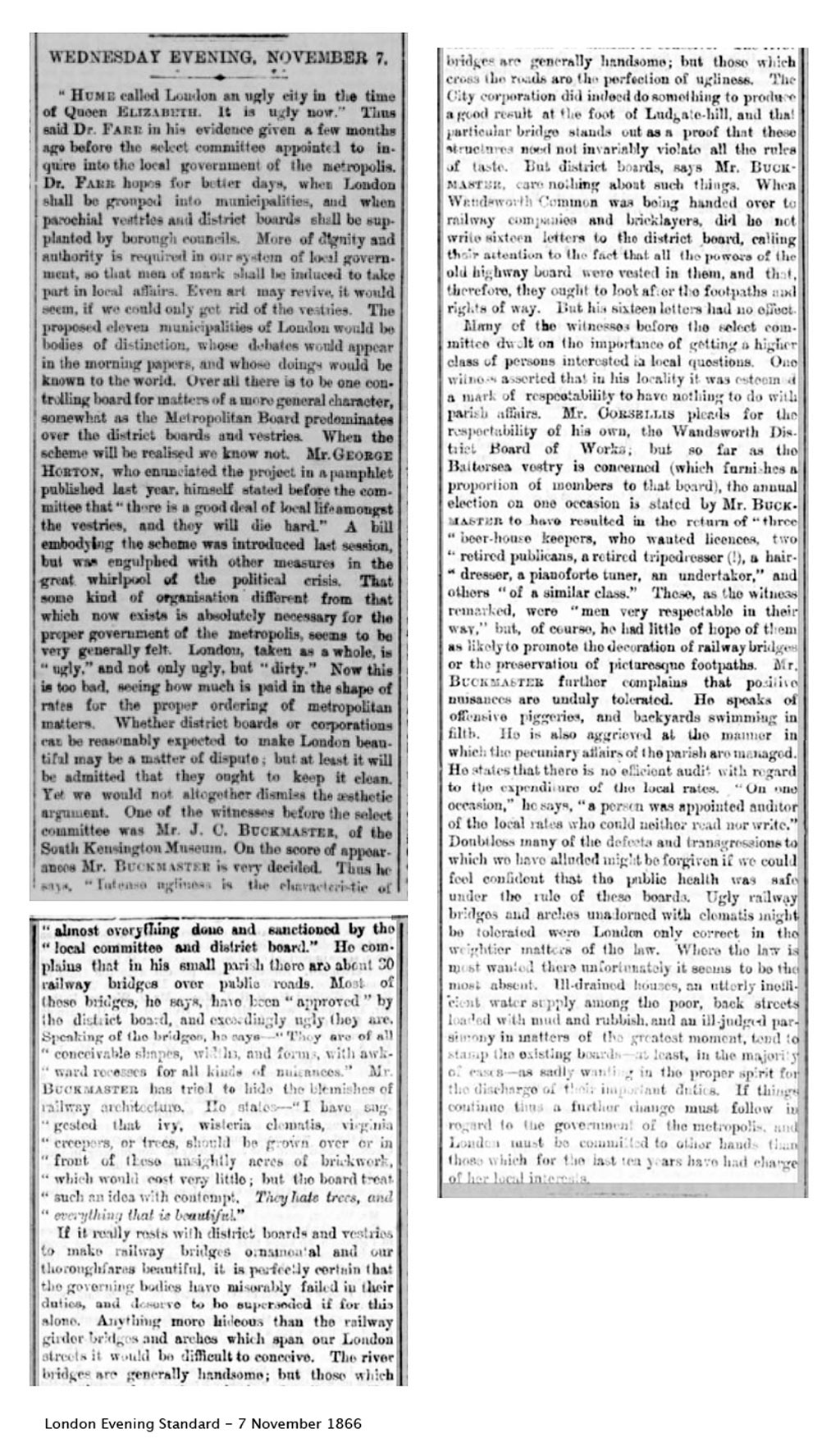
WEDNESDAY EVENING. NOVEMBER 7.
Hume called London an ugly city in the time of Queen Elizabeth. It is ugly now.
Thus said Dr. Farr his evidence given few months ago before the select committee appointed to inquire into the local government of the metropolis. Dr. Farr hopes for better days, when London shall be grouped into municipalities, and when parochial vestries and district boards shall supplanted by borough councils. More of dignity and authority required in our system of local government, so that men of mark shall be induced to take part in local affairs. Even art may revive, it would seem, if we could only got rid the vestries. The proposed eleven municipalities London would be bodies of distinction, whose debates would appear in the morning papers, and whose doings would be known to the world.
Over all there is to be one controlling board for matters of a more general character, somewhat as the Metropolitan Board predominates over the district boards vestries. When the scheme will be realised we know not. Mr. George Horton, who enunciated the project in a pamphlet published last year, himself stated before the committee that there is good deal of local life amongst the vestries, aud they will die hard." A bill embodying scheme was introduced last session, but was engulphed with other measures in the great whirlpool of the political crisis.
That some kind of organisation different from that which now exists is absolutely necessary for the proper government of the metropolis, seems to be very generally felt.<.p
London, taken a whole, is "ugly," and not only ugly, but "dirty." Now this is too bad, seeing how much is paid in the shape of rates for the proper ordering of metropolitan matters. Whether district boards or corporations can be reasonably expected to make London beautiful may be a matter of dispute; but at least it will be admitted that they ought keep it clean. Yet we would not altogether dismiss the aesthetic argument.
One of the witnesses before the select committee was Mr. J.C. Buckmaster, of the South Kensington Museum.
On the score of appearances Mr. Buckmaster is very decided. Thus he says, "Intense ugliness is the characteristic of almost everything done and sanctioned by the local committee and district board." He complains that in his parish there are about 30 railway bridges over roads. Most these bridges, he says, have been approved by the district board, and exceedingly ugly they are. Speaking of the bridges, he says — "They are of all conceivable shapes, widths, and forms, with awkward recesses for all kinds of nuisances."
Mr. Buckmaster has tried to hide the blemishes of architecture. He states — " I have suggested that ivy, wisteria, clematis, virginia creepers, or trees, should be grown over or in front of these unsightly acres of brickwork, which would cost very little; but the board such an idea with contempt.They hate trees, and everything that is beautiful."
If it really matters with district boards and vestries to make railway bridges and our thoroughfares beautiful, it is perfectly certain that governing bodies have miserably failed in their duties, and deserve to be superseded if for this alone.
Anything more hideous than railway girder bridges and arches which span our London streets it would difficult to conceive. The river bridges are generally handsome; but those which cross the roads are the perfection of ugliness. The City corporation did indeed do something to produce a good result the foot of Ludgate-hill, and the particular bridge stands out as a proof that those structures need not invariably violate all rules of taste. But district boards, says Mr. Buckmaster, care nothing about such things.
When Wandsworth Common was being handed over to railway companies and bricklayers, did he not write sixteen letters to the district board, calling their attention to the fact that all the powers of the old highway board were vested in them, and that, therefore, they ought to look after the footpaths and rights of way. But his sixteen letters had no effect.
Many the witnesses before the select committee dwelt on the importance of getting higher class persons interested in local questions. One witness asserted that in his locality it was esteemed a mark of respectability to have nothing to do with parish affairs.
Mr. CORSELLIS pleads for the respectability of his own, the Wandsworth District Board of Works; but so far as the Battersea vestry is concerned (which furnishes a proportion of members to that board), the annual election on one occasion is stated by Mr. BUCKMASTER to have resulted in return of "three beer-house keepers, who wanted licences, two retired publicans, retired tripedresser (!), a hairdresser, a pianoforte tuner, an undertaker," and others "of a similar class."
These, as witness remarked, were "men very respectable in their way," but, of course, had little of hope of them as likely to promote the decoration of railway bridges or the preservation picturesque footpaths.
Mr. BUCKMASTER further complains that positive nuisances are unduly tolerated. He speaks of offensive piggeries, and backyards swimming in filth.
He is also aggrieved at the manner in which the pecuniary affairs of the parish are managed. He states that there is no efficient audit with regard to the expenditure of the local rates. "On one occasion," he says, a person was appointed auditor of the local rates who could neither read nor write."
Doubtless many of the defects and transgressions to which we have alluded might be forgiven if we could feel confident that public health was safe under the rule of these boards.
Ugly railway bridges and arches unadorned with clematis might be tolerated were London only correct in the weightier matters of the law. Where the law is most wanted there unfortunately it seems to be most absent. Ill-drained houses, an utterly inefficient water supply among the poor, back streets loaded with mud and rubbish, and an ill-judged parsimony in matters of greatest moment, tend to stamp the existing boards — at least, in the majority of cases — as sadly wanting in the proper spirit for the discharge of their proper duties.
If things continue thus a further change must follow in the government of metropolis, and London must be committed to other hands than those which for the last years have had of her local interests.
[BNA: Link.]
"A possible vignette? An extract of 1866 — Gypsy Life As It IS
On Saturday, Abraham Smith (12), whose feet were naked, and who appeared destitute of underclothing, and Edward Cherry (13), both living in the gipsy encampment near the Wandsworth Railway Station, were brought up on remand charged with soliciting alms off foot passengers on Wandsworth-common. In answer to questions.
Police-constable Smith, who took the into custody, said he had made inquiries about them. He went to the tent in which Cherry lived, and found his sister in it with child, which was "stiff" from cholera. There was mao in the tent, also suffering from cholera. Prisoner had father, but not a mother. The father had four children, and they all lived and slept in the tent In the case of the other boy he found lu persons, consisting of two families, all sleeping in one small tent. There was piece of canvas in the tent used to separate the families, but it was full of holes.
Mr. Dayman: How do they get their living?
Constable: Ity nuking lew pegs and selling them.
The father of Cherry came forward and stated that he was employed on the sewer works, and that he was obliged to live in the tent, he was unable to obtain lodgings.
Mr. Dayman said there were great complaints about little boys, who, under the pretence of sweeping crossings, made it a means of begging, and they had become quite nuisance to the inhabitants. He would have to send some of those children to reformatory, and make an order upon the parents to contribute towards their maintenance. If the nuisance continued. He told the father of Cherry that It would be better to send his children to school than for them to go out sweeping crossings.
Smith's mother said if his worship would let her boy go this time she would send him to school.
Mr. Dayman remarked that tlie for boys to to school was when they were young. It was their only opportunity, for when they grew older they would expected to earn their owa living. Prisoners were then with caution.
[BNA:
" target="_blank">Link
"[ERSKINE CLARKE & CHATTERBOX]
English Children's Literature: Annuals--Chatterbox
Figure 1.--This was the last issue of "Chatterbox" published in 1955. Note that the boy pictured wears a red blazer from an exclusive private school. This was not what most British boys wore to school. We wonder if this private school image did not affect the popularity of "Chatterbox". As was copmmonly the case for annuals, the illustrator was not identified.
Chatterbox was one of the most popular English publications for children. It was first published December 1, 1866. The last edition was in 1955. Chatterbox was created by the Rev. John Erskine Clarke (1827-1920) of Derby. He also served as the Editor until 1902. Unlike the Boy's Own and Girl's Own, the other best remembered English children's publications, Chatterbox was designed to appeal to boys and girls. Clarke conceived Chatterbox as a weekly paper for children.
Given the relative cost of books and magazines in the 19th century, many readers saved the weekly issues and some even had them bound. cite>Chatterbox was primarily a story annual and the content varied over time. There were, however, puzzles, poems, interesting facts, and a variety of interesting activities. Chatterbox was lavisgly illustrated, especially after the turn of the 20th century when the technology for lothographic printing improved.
Publishing History
Chatterbox was one of the most popular English publications for children. It was first published December 1, 1866. The last edition was in 1955 (figure 1). Few publications have a longer uninterupted history. As such it is a wonderful source of information about children's clothes and childhood in general. The fact that it was often lavishly illustrated makes it a particularly useful source of information.
Editors
Chatterbox was created by the Rev. John Erskine Clarke (1827-1920) of Derby. He also served as the Editor until 1902. Harvey Darton replaced Clarke as editor in 1902. Clarke decided to persue his religious calling and became the Vicar of Battersea near London and a Canon of Southwark, another London suburb. [Skinner 2]
Gender
Unlike the Boy's Own and Girl's Own, the other best remembered English children's publications, Chatterbox was designed to appeal to boys and girls.
Format
Clarke conceived Chatterbox as a weekly paper for children. Given the relative cost of books and magazines in the 19th century, many readers saved the weekly issues and some even had them bound. Many families did not have a great deal of money to buy books and were not disposed to throw away something that could be reused. The saved copies were alkso useful for younger children as they grew up. Clarke began selling such bound editions, but I am not sure just when. For many years Chatterbox annuals were simply a collection of the weeekly issues with no original material, although the covers of the Gardner/Gardner Darton editions were different in the weekly and annual versions. The annuals were popular children's gifts. We notice one inscribed, "To Archie, Xmas 1921 with fondest love and best wishes."
Content
Chatterbox was primarily a story annual and the content varied over time. There were, however, puzzles, poems, interesting facts, and a variety of interesting activities. A HBC reader reports, " I had look through the 1955 edition of the Chatterbox Annual the cover of which is seen here (figure 1). The content and is pretty much mundane and rather lacking in illustrations. Inote there are many short stories where there is interaction between teenage girls and boys and some stories more dedicated to teenage girl readers. i.e. 'Phillipa on Location' for girls and 'Derek's Amazing Quest' or boys. The stories are essentially mystery and adventure, first day of the new school term (almost always at private boarding schools), meeting distant cousins for the first time, travels to distant countries (an Uncle who invites his nephew to Kenya) and such like. Interspersed are puzzles, quizzes and hobby features. It's interesting to note there is no romance interaction between the boys and girls, rather they are pre-occupied in solving mysterious lights in the dark woods and so on.
Foreign Children
We have primarily used Chatterbox and other British periodicals as a ource of information on British cjildren's cloting. The illustrations in particular seem a reasonably accurate source of information on children's clothing. Here the publication primarily depicts middle-class children, not the average British child or a range of childrn of different backgrounds. White Chastterbox was primarily for and about British children, there were also some articles and illustrtions depicting children in other countries as well. We are not sure, however, as to the accuracy of these depictions. Asfar a e can tell, they seem as accurate as the depicions of British boys. his is ust a preliminay assessment as outr information is sill quite limited.
Illustrations
We have varying reports as to the illustrayions in Chatterbox. One report indicates that it was lavishly illustrated, especially after the turn of the 20th century when the technology for lothographic printing improved. Illustrations in the 19th century were mostly black and white line drawings. We note the 1908 annual. There is virtually no photographs but many illustrations are in ink and about 8 colour plates and a color cover illustration. Many of the illustrations are noteworthy as they depict boyswear and British school uniforms of the day. The 1921 edition had a color frontispiece and several other color plates plus a great many black and white and engravings in a book of 317 pages. We are unsure about the illustrators as most of the illustrations were unsigned. A HBC reader tells us that the 1955 edition that he has was "rather lacking in illustrations". Normally the illustrators were not idebtified. This was not only in Chatterbox, but in most of the other annuals as well. The illustrations normally depict children from comfortable middle class families and do not refflect a range of childhood experiences. Working class children were rarely depicted.
Publisher
Gardner/Gardner Darton was the principal publisher, producing Chatterbox for 60 years. The first few editions of Chatterbox was published in London (1866-70) by William Macintosh. Other publishers included: W. Wells Gardner (1870), Wells Gardner Darton (about 1886), Simpkin Marshall (1929) and finally Dean (about 1936). Curiously, there were two versions of the cover for many years. Well Gardner, presumably to make the annual version more interesting printed two different versions of the cover, one for the weekly edition and a different one for the annual. [Skinner 2]
Cost
The basic Chatterbox weekly cost a halfpenny. There was some special 1 penny edition with with a loose color plate. Unfortunately these color plates were not included in the Annual version, thus they are relatively rare. For readers who wanted to collect the weekly editions into annuals, they could purchase a special case which cost 1 shilling. The basic Chatterbox Annual cost 3 shillings done in "fancy board" and 5 shillings for the more expensive cloth edition with gilt edges. [Skinner 2]
Advertisements
Chatterbox was clearly a children's publication. Curiously, many of the adverisements were for adults. Presumably the editors anricipated parents reading the articles to the family, a rather cozy Victorian image. A good example is the advertisement for Tatcho Hair Restorer! It was only the inexpensive 3s editions that had adverisements. The 5s cloth edition was advertisement free, although sometimes there were lists of children's books at the back. [Skinner 2] The 1921 edition had paste-downs have advertisements for various products. The front board was paper-covered, and show a boy and girl giving a puppy a bath at the beach. The Back board was an advertisment for Pear's Transparent Soap.
American Editions
The Chatterbox Annual was published in the United States for several years. There was no original American material. The British editions were simply reprinted. The authorized editions were printed by Estes & Lauriat and subsequently Dana Estes, LC Page, and Cupples Leon (NY). In addition therecwerecunauthorized pirate editions in the 1880s. [Skinner 2]
Sources
Skinner, Frank 1. Children's Annuals.
Skinner, Frank 2. Children's Books: The Chatterbox
Created: September 19, 2002
Last updated: July 26, 2003
[BNA:
"NOTTIDGE — MOSELEY — ORIGIN OF EARLSFIELD RD — South London Journal — Saturday 1 December 1866 BUILDING APPLICATIONS. Letters from the Metropolitan of Works stated that they had approved of Mr. Maplesden's plan to form a new road (40 feet) along the north-eastern corner of Wandsworth-common, to be called Freemasons-road ; and that they had under consideration a proposal of Mr. William Moseley to form a new road (40 feet) to be called Nottidge road leading, leading out of Garratt-lane, Wandsworth: and an application from Messrs. Hovenden and Heath for permission to bring forward the fronts of three houses, and to erect two new houses in Falcon-lane, to the same line as shops recently sanctioned there. [BNA: Link.] ["
"JCB mentions Bovill, doesn't he? Positively, I think (but could be wrong) The fat that he lived in Wimbledon may be significant
Illustrated London News — Saturday 15 December 1866
[BNA: Link.]
THE NEW CHIEF JUSTICE OF THE COMMON PLEAS.
Sir William Bovill, who has exchanged the precarious office of Solicitor-General to the Administration of Lord Derby for a permanent seat on the judicial bench as Chief Justice of the Court of Common Pleas, is the second surviving son of B. Bovill, Esq., of Dunsford Lodge, Wimbledon, and was born in 1814. He was called to the Bar at the Middle Temple in January, 1841, and went the Home Circuit; he was made a Queen's Counsel in 1855, and is a Bencher of the Middle Temple. Mr. Bovill was first returned to Parliament as member for Guildford, in March, 1857; and married, in 1844, the eldest daughter of J. H. Bolton, Esq., of Lee Park, Blackheath. The members of the Home Circuit entertained the new Lord Chief Justice of the Common Pleas at dinner at the Albion Hotel two or three weeks ago. Mr. Montagu Chambers was in the chair. Three times within the last three years the Home Circuit has thus met to commemorate the promotion of one of its leaders. That Circuit has now six of its old members on the judicial bench, and if we may add to the list the Lord Chief Baron, who travelled the Home Circuit before joining the Norfolk, his name will make a seventh. Of these seven all were present, with the exception of Mr. Justice Lush, whom the Winter Assizes had called away from London. The dinner had been originally arranged to enable the Circuit to congratulate Sir William Bovill his appointment as Solicitor- General ; but, as was remakedby Sir Fitzroy Kelly, "his advancement had outrun their good intentions," and in the interval between the invitation and the dinner he had become Lord Chief Justice of the Common Pleas. In responding to the toast of the evening, Sir William Bovill gave sketch of his progress at the Bar ; and, the fact of his having been a pupil of Mr. Baron Channell having been mentioned, stated that in his chambers he had learnt, what was more valuable to a young barrister than knowledge of special pleading, that the profession of the law was not inconsistent with high conscientiousness and enlarged benevolence. He dwelt slightly on his political career, remarking, however, that when he, from SH IWILLIAM BOVILL, THE NEW CHIEF JUSTICE OF THE COUBT OF COMMON PLEAS, -v J-> -Vi*"
"A Glance at the Commons & Open Spaces near London. Reprinted from the "Parochial Critic.". 1867
A Glance at the Commons & Open Spaces near London. Reprinted from the "Parochial Critic.".
1867
WANDSWORTH COMMON.In the parish of Wandsworth ( called Wandlesworth , or the shore of the Wandle ; in Domesday Book , Wendlesorde ,) there are, or were, four manors : Battersea and Wandsworth , Dunsfold, and Alfarthing ; all , with the exception of Dunsfold , are now held by Earl Spencer. Many interesting facts are connected with the early history of these manors, in which royalty and nobility figure conspicuously. The commons of Battersea and Wandsworth manor consist of 150 acres, but B
14 COMMONS AND OPEN SPACES .
little remains of the Battersea portion ; its once celebrated " Fields " have been converted into a park , and the remaining waste lands have either been built over or consumed by a net-work of railways. No waste lands appertain to the other three manors . When Wandsworth Common was being excavated for the two railways that now intersect it, a suite of 30 species of fossil shells was discovered in the London clay, but no fossils are to be found in the gravel pits that so sadly disfigure, and , if the modus operandi be permitted to go on unchecked and uncontrolled , will destroy the beauty of the Common .
Encroachments and inclosures have taken place by the railways, by the parish of St. James's, Piccadilly , by the Crimean schools, by the county gaol, and also by private persons, When the Common was leased by a committee of gentlemen some supervision existed, but at present there seems to be none to abate nuisances and to regulate the gravel-digging . Yet, notwithstanding all the damage that has been done, Wandsworth Common is very attractive to pedestrians when taking their "constitutionals."
An avenue of trees a mile in length still remains, and is an especial object of beauty when the trees have put on their spring clothing. But how long the trees will remain is very doubtful, for since the above was written two of the trees immediately opposite the entrance to the cemetery have been destroyed to make room for the erection of a public house! This act of desecration has roused a strong feeling of indignation, and two or three public 15 spirited gentleman have commenced proceedings to stay, by means of an injunction , any further building operations .
An ornamental piece of water, about five acres, called the "Black Sea," fed by the drainage of a portion of the Common, assisted by the pumping-power of a windmill, is remarkable on account of being studded with thirteen small islands, adorned with trees and flowers .
This and eight acres of ground were leased to the late Mrs. Wilson ; since her decease, the lease has been purchased by the lord of the manor, and the gravest apprehensions are entertained in the neighbourhood that the eighteen acres will be turned into building sites.
[PB: This is the future Spencer Park. NB This says |"13" islands, some reports say 7 etc etc. Follow up.]]
Only a small triangular piece of the Common is adapted for cricketing, and that is much frequented by cricketers.
Wandsworth Old Town, with its 10,000 inhabitants, is being rivalled by New Wandsworth Town which abuts the Common .
[BNA:
WANDSWORTH-COMMON PRESERVATION SOCIETY. The following circular has been issued: "The attention of the inhabitants of the districts surrounding Wandsworth-common is urgently requested to its condition, more especially on the following points: 1st, The enclosures of common which have taken place; At present Wandsworth-common is a receptacle for species of filth, which is brought from the most distant parts and there deposited. It has been made a depot for dust, ashes, and excrement of the district, and has been excavated to such an extent that parts are covered with water during winter, and are consequently very injurious to the public health both of the immediate and adjoining districts. All these and other matters relating to the deplorable state of Wandsworth-common were specially brought under the notice of Earl Spencer, Lord of the Manor, in 1865, when evidence was given before The Open Spaces Committee uf the House of Commons. Earl Spencer was present and heard a lengthened detail of the nuisances complained of. It is not saying too much to add that every grievance then complained of has een aggravated since that time. Very large public meetings have been held at Wandsworth, at which resolutions have been unanimously passed for the purpose of preserving and amending the condition of the common. A committee has been appointed, consisting of the following gentlemen, with power to add to their number: Mr. Samuel B. Bevington, Lake-terrace, Wandsworth-common; Mr. Bickerdike, 1, Elm-terrace, St. John's hill, New Wandsworth; Mr. J. C Buckmaster, churchwarden of the parish of Battersea, Si John's-hill, Wandsworth; Mr. J B Cummins, Heathbourne, Wandsworth-common; Mr. J. G. Jennings, Nightingale-lane; Mr. Charles Lambert, the Elms, Wandsworth-common; Mr. Ord, St. John's hill; Mr Paine, Belmont Lodge, St John's-hill; Mr. J. Anderson Rose, Wandsworth-common; Mr. Compton Smith, Wandsworth; Mr. Warrington, corner of Nightingale-lane, Wandsworth-common; Mr Wix, Loraine-road, St John's-hill;
C. Lambert, Esq, of the Elms, Wandsworth-common, has been appointed treasurer. The following gentlemen are authorised to collect subscriptions in districts the east and south sides of the common ; Mr. Cummins, Heathbourne, Wandsworth-common; Mr. Jennings, Nightingale-lane; Mr. Rose, Wandsworth-common; and in the districts on the north and west sides of the common: Mr. Bickerdike, Elm-terrace, St John's-hill ; Mr. Gammon, Spencer-road; Mr. Ord, St John's-hill; Mr Paine, Belmont Lodge, St John's-hill; Mr. Wix, Loraine-road, St John's-hill — Committee Room, Freemasons Hotel, New Wandsworth Station. I HAVE DONE UP TO END 1867 = p.3 www.britishnewspaperarchive.co.uk/search/results?basicsearch=%2Bspencer%20%2Bwandsworth%20%2Bcommon%20%2Bbuckmaster%20&freesearch=spencer%20wandsworth%20common%20buckmaster&retrievecountrycounts=false&sortorder=dayearly&page=2" target="_blank">LINK.] "WC — SPENCER — METALLURGICON 1867 pp29-30 Much has been said of late respecting the value of the open spaces around London; not only for the health and recreation of the resident population, but for that of the metropolis itself. Public spirit, coupled with the needful subscriptions, has been successful hitherto in preserving Wimbledon and Tooting Com mons. We have not heard as yet of any attempt to enclose the noble and well-kept Clapham Common; but unless active steps be speedily taken to preserve the portion of unenclosed land which still remains as Wandsworth Common, it is greatly to be feared that in course of a very few more years not a vestige of it will be left for the enjoyment of the public. Indeed, there appears every prospect that every available space will be devoted to coal heaps, goods sheds, and railway sidings. It is greatly to be doubted whether the people of Wandsworth and Battersea have in Earl Spencer a lord of the manor of a like spirit to Sir Thomas Maryon Wilson, who has appeared so determined to carry out his designs upon the celebrated Hampstead Heath. On the contrary, it is almost certain that so amiable and generous a nobleman would readily consent to sell all his rights in respect of Wandsworth Common upon easy and liberal terms. It is therefore earnestly to be hoped that the public spirit of the inhabitants will be speedily aroused, and that, assisted by the subscriptions of all classes proportioned to their means, and the active efforts of the District Board of Works, a complete purchase of the estate of the late Mrs.Wilson, including the beautiful lake known as the Black Sea, and all the open portions of the Common, will be promptly made. If some small outlying portions, with certain eligible frontages, were let upon building leases, much of the purchase money would be recoverable; and for a comparatively small outlay a beautiful and park-like appearance might be given to the whole of the space still reserved, which would not materially suffer in beauty or convenience by the intersection of the railway, the proximity of the County Gaol, or the existence of the Royal Patriotic Asylum in the centre . . . The Black Sea, before alluded to, when frozen over, is a favourite resort for skaters, as are also the small lakes on Clapham Common." 1867 WONDERFUL DISCOVERY ON WANDSWORTH COMMON. BUT FOR INFORMATION APPLY TO G. FERRIS, (late of the Falcon Tavern, Wandsworth Road,) WINE & SPIRIT MERCHANT, Surrey Tavern, TRINITY ROAD, TOOTING, On the borders of Wandsworth Common. CHOICE SPIRITS & MALT LIQUORS Stabling Accommodation. [BNA: Link,] Similar advert on other days [BNA: Link,] 6 April 1867 [BNA:
[Gravel from Spencer] THE BATTERSEA LOCAL COMMITTEE Recommended fixing lamps Latchmere-lane, Auckland-road, and that other applications be deferred for the present; that the footpath to Clapham Junction be made a pavement, and that an offer be made to Earl Spencer for gravel from Wandsworth Common. — Approved . . . . LETTERS WERE RECEIVED From Capt. Page, stating with reference to the request of the board to Earl Spencer to grant them easement over part of Wandsworth Common for the benefit of the public, that before giving any definite reply his lordship wouldawaitthe issueof the proceedings which had been commenced against him, as Lord of the Manor of Wimbledon, by Mr. Peek, to his position as such lord; from Mr. Ollivier, complaining that ever since the completion of the main drainage works near his house in Nightingale-lane, his front garden and the road just outside his gates have been a continual swamp, and quite impassable also complaining that the gas-lamps between Bolingbroke and the Triangle, at the point of Nightingale-lane, have not been lighted for several nights . . . [BNA: Link.] Gravel from Wandsworth Common. — The clerk was instructed to write to Earl Spencer, making an offer of 1s. 6d per yard for rough gravel, and 6d. per yard for fine gravel, for the parish of Battersea, from Wandsworth common. [BNA: Link.] "Globe — Tuesday 22 January 1867 Case of Wholesale Robbery a Poothah.- The Advantages of Photography. Henry Wurnecke, loolmsn, and Ksndolpb KUlk copper smith, both Germans, were re-examined at Wandsworth the charge of stealing and receiving considerable quantity of miscellaneous property. It will be recollected that Warnocke had been the set- Tice of Mr. Richard Henry Wyatt, Wandsworth Lodge. Wandsworth Common, footman, for about four months. He was seen by Police-constable Coates come master's house with hamper, which he gave to the other prisoner, who walked away with it. Both prisoners were apprehended, and the hamper was found contain glasses, soap, candles, and other property belonging to Mr. Wyatt; and both in the footman's room and also at the residence of Klots, 16, Porter-street, Soho, variety of articles belonging the prosecutor were also found. Since the prisoners had been in custody Hm police had been in communication with the authorities In Warnecke's box were found some note-paper bearing the words "Beaufort House, St. Leonards," and also album which contaioed his photograph. The prisoner photograph was removed from the album, and sent to the Hasting police to ascertain whether was known them. A reply had been received from Mr, Superintendent Glenister, stating that the photograph was that of Henry Warnecke, who was formerly in the sotvroe or snia. Mason, Beaufort House, St. Lmmsrf and was tried the sessions in Hastings the Md October, 1865, when was sentenced to nine months imprisonment for larosoy as reward. He was time, four cases of obtaining goods by and pleaded guilty the whrie. WeletMr that had since his rtloAssbemUruMla toe Mem Klits, Porter-street. Hewpors to obtain situation by false pretim — that enquiries had been made about AUls, on. nuvuing was known against him. w mainatlon which belonged Mr. other articles in bedroom. Mr. Wyatt valued all the peepeTO Mr eaid thonld commit the prisoners for trial, k"tfoslv remanded them for the attendance eta person tom Hsstiageto proo the former conviction. [BNA: Link.] WANDSWORTH, Attempted Suicide in tub Black Sba. 'A Alatbimunial Si^uauule. Annie Walters, 22, of Westmeon, Petersfield, North Hants, was placed in the dock, charged with attempting to commit suicide. Police-constable Wilson said that about eleven o'clock last night he was on duty on Wandsworth-common, when he heard the cries of a female for help. hastened to piece of water ailed the Black Sea," where he found the prisoner. She was reclining in the water with her left arm and head above the surface. went into the water and brought her to the bank, when, she appearing to be getting exhausted, he remained with her for several minutes and then took her to the station, ?ir. Mr. Dayman.Was she out of her depth Constable.No, sir. Mr. Dayman.Was :?he then leaning on the bank. Constable. She could cot have been resting on the bank, the v atc-r was up breast. She said she had had a quarrel with her husband, and she meant to drown herself. Mr. Dayman (to the prisoner).What have you to say Prisoner.At present I can't say much. I should like to speak n 1 am more composed. The Constable. Her friends are here. Mr. Dayman. She is remanded for a week, and she can compose herself in the interim. The prisoner was then removed to the cells. It was stated that the constable had only been in the force about fortnight, and was quite ignorant of the depth of water in the sea." [BNA: Link.] "Portsmouth Times and Naval Gazette — Saturday 9 February 1867 PETERSFIELD Attempted Suicide. At Wandsworth police-court on Saturday, Annie Walters, a young married woman, who gave the address Westmeen, near this town, was charged with attempting drown herself. Police-constable Wilson, No. 241 V., said that on the previous night was on duty on Wandsworth Common, when he heard the cries of woman for help. He hastened to piece of water called the "Black Sea," where he found the prisoner. was reclining in the water with her left arm and head above the surface. He went into the water and brought her to the bank, when she appeared to getting exhausted. He remained with her a few minutes, when he took to the station. She told him it was on account of her husband, and meant drown herself. In reply to the magistrate, the constable said she could not have been resting her arm, the water was up to his breast. In answer to the charge the prisoner said she would like to speak when she was more composed. Mr. Dayman remanded her for week. County Bench. [BNA: Link.] PB: There are plausible Annie Walters on Ancestry, including one married recently to a musician It is also possible the "Westmeen" [Hants?] was actually West Meath, ireland."
TO THE EDITOR. Sir, Iunderstand that some of the land forming part and parcel of Wandsworth Common is already, about be, sold to Mr. Todd, of Battersea. doubt that gentleman an enterprising Auctioneer and Surveyor, as well as a staunch Conservative, parochially and politically; but he would not, we all know, support any suggestion for selling or enclosing the property he has contrived to get a bit of except when his own private interests are at stake; and then, although a public man, it would seem that he is anything but scrupulous as to how the parochial interests are preserved. In all deference to his professional genius he is the last person that should permitted to buy up all the freehold land in the neighbourhood, to cut it up in "patches and batches", to euphonise with his tasteless innovations. He has done enough of this already, and the sooner he is denied the purchase of any more land, either in Battersea or Wandsworth, the better. In buying this land Mr. Todd materializes the popular impression that he has been acting a double part in his public capacity at the Wandsworth District Board of Works. There is doubt that he has bought it with a view of erecting some more of his wind-proof (?) houses, and it is to be hoped that he will not re-elected when his representative term at that Board expires. Yours obediently A BATTERSEAITE. [BNA: Link.] [PB: The "(?)" is in the original.] 1867-03-02-Todd-ChelseaNews-2mar1867.jpg] "Pall Mall Gazette — Saturday 6 April 1867 Wandsworth Common. A singularly beautiful Residential Estate known as "Fernside," with pleasure grounds and park-like land of about thirty acres in a ring fence, within five miles of the City and West-end, and a few minutes' walk from the New Wandsworth and Balham Stations of the London and Crystal Palace Railway, by which the City or Victoria Stations may be reached in a few minutes; with possession. MESSRS. FULLER AND HORSEY M are instructed to SELL by AUCTION at the MART, Tokenhouse-yard, on WEDNESDAY, June 5. 1867, at One o'clock precisely, in One Lot, the very valuable and beautiful Estate distinguished as "Fernside," with pleasure grounds and undulating park-like land, of about thirty acres, in a ring fence, delightfully situated, and commanding extended views of rich and varied scenery, and within a few minutes' walk of the New Wandsworth and Balham stations of the West London and Crystal Palace Railway, by which the City or Houses of Parliament maybe reached in a few minutes. The Mansion, seated on high ground, is of good elevation, with a handsome stone portico to the entrance, and is approached by a private road with entrance lodge leading from Nightingale-lane and Wandsworth-common, with a carriage drive encircling the front lawn. It contains on the ground floor a suite of reception rooms, fitted up with much taste and judgment, and comprising two elegant and lofty drawing-rooms 44 feet by 17 feet 6 inches, recently decorated by eminent artists, opening on to a stone terrace with steps descending to the lawn; morning-room 24 feet 6 inches by 20 feet communicating with the library by folding doors; breakfast-room and a noble dining-room, 35 feet 6 inches by 20 feet 6 inches, with Doric columns to form recess; vestibule and spacious outer and inner halls. On the upper floors are four principal bed- chambers and two dressing-rooms and eight secondary bed-chambers; extensive and convenient domestic offices on the basement. In the rear of the mansion are the pleasure-grounds and lawn, ornamented with choice specimens of the cedar, and planted with a profusion of flowering shrubs and evergreens, sloping to a sheet of ornamental water, flower garden, garden with terrace walks and shrubberies, a well-stocked walled kitchen garden, with two large vineries, melon pits, &c., the whole bounded by rich undulating park-like land, belted with fine forest timber. The stabling and farm buildings are conveniently placed at a short distance, though entirely screened from the house, and consist of four-stall and three-stall stables, two loose boxes, two double coach-houses, granary, cowhouse, piggeries, cart shed, &c., gardener's and coachman's cottages. The mansion, outbuildings, and grounds in the rear containing about 12a. 3r. 36p., are held on lease for an unexpired term of about sixty-eight years at a ground rent of 79 17s per annum. The remaining portion of the land, about seventeen acres in extent, is held on lease for the same term at a peppercorn. The entire property offers numerous advantages as a building speculation if desired, combined with a residence possessing every comfort, for a family of distinction, and which need be but little (if at all) interfered with by judicious building operations under the control of the proprietor. May be viewed by cards only, to be had of the Auctioneers. Particulars with plans are in preparation, and when ready may be had of Messrs. McLeod, Stenning, and Watney, Solicitors, London- street, Fenchurch-street; at the Mart and of Messrs. FULLER and HORSEY, 13, Billiter-street, London, E.C. [BNA:
"FERNSDE! Morning Post — Tuesday 23 April 1867 Wandsworth-common. — A singularly beautiful Residential Estate, known as Fernside, with pleasure-grounds and parklike land of about 30 acres, in a ring fence, within five miles of the City and West-end, and a few minutes' walk from the New Wandsworth and Balham Stations of the London and Crystal Palace Railway, by which the City or Victoria Stations may be reached in a few minutes. With possession MESSRS. FULLER and HORSEY ar instructed te SELL, by AUCTION, at the Mart Toke"! house-yard, on WEDNESDAY, June 5, at two o'clock precisely in one lot, J IThe very valuable and Beautiful ESTATE, distinguished a3 IFernside, with pleasure-grounds and undulating park-like land: of about 30 acres, in a ring fence, delightfully situate, and com Imanding extended views of rich and varied scenery, and withir i . _ eW "? _! ut?? Wa . k of the New windsworth and Balham Sta"tions of the \V est London and Crystal Palace Railway, by whict?? o F Bouses . of Parliament may be reached in a few . minutes, fhe mansion, seated on high ground, is of good ele-1 I-?", h v a portico to the entrance, and ia approached by a private road, with entrance-lodge, leading from jMghtingale-lane and Wandsworth-common, with a carriage — drive encircling the front lawn. It contains on the ground rt . or a suite of reception-rooms, fitted up with much taste and judg-; ment, and comprising two elegant and lofty drawing-rooms, 44ft. | by 17ft. 6in., recently decorated by eminent artists, opening on i to a stone terrace with steps descending to the lawn; morning — Iroom, 24ft. 6in. by 20ft., communicating with the library by ' folding-doors; breakfast-room, and a noble dining-room, 35ft. Oin. by 20ft. Oin., with Doric columns to form recess; vestibule, and spacious outer and inner halls. On the upper floors are | four principal bed-chambers and two dressing-rooms, and eight \ secondary bed-chambers; extensive and convenient domestic offices on the basement. In the rear of the mansion are the pleasure grounds and lawn, ornamented with choice specimens of the cedar, and planted with a profusion of flowering _hru_e and evergreens, sloping to a sheet of ornamental water, flower garden and terrace walks and shrubberies, a well-stocked walled kitchen garden, with two large vineries, melon pits, etc, the whole bounded by rich undulating park-like land, belted with fine forest timber. The stabling and farm buildings are conveniently placed at a short distance, though entirely screened from the house, and consist of four-stall and three stall stables, two loose boxes, two double coach-houses, granary cowhouse, piggeries, cart-shed, Ac.; gardener's and coachman ': cottages. The mansion, outbuildings, and grounds in the rear. containing about 12a. 3r. 36p., are held on lease for an unexpired term of about 68 years, at a ground rent of 79 17s. per annum. The remaining portion of the land, about 17 acres in extent, is held on lease, for the same term, at a peppercorn. The entire property offers numerous advantages as a building speculation, if desired, combined with a residence possessing every comfort for a family of distinction, and which need be but little, if at all interfered with by judicious building operations under the control of the proprietor. May be viewed by cards only, to be had of the auction_fcs Particulars, with plans, are in preparation, and when rt___v may be had of Messrs. M'Leod. Stenning, and WatneyaLuL tors, London-street, Fenchurch-street; at the Mart surfof i Messrs. Fuller and Horsey, No. 13, BilUter street, Loaioa^^?? i~ [BNA: Link.] "BUCKMASTER South London Press — Saturday 27 April 1867 [BNA: Link.] ELECTION OF VESTRYMEN . . . . St. Mary's, Battersea. meeting of the elected vestry of this parish was held at the Lammas Hall, on Easter Tuesday, at the customary hour of? a.m., the special object of the meeting being the election of church officers, and the reception of the accounts of the Burial Board. There were present: The Vicar (in the chair), Messrs. Paine, Kempster, Turdy, Sellar, Walton, Stuart, Todd, Lord, Turner, Alder, Poupart, Acomb, and Gerrard. The minutes of the previous meeting having been confirmed, and the notice convening the meeting read, the vicar appointed John Archibald Stuart, churchwarden, and Wm. Henry Kempster, sidesman, for the next year, accompanying his nomination with a few complimentary remarks, in which he expressed his regret at the loss of Mr. Gibson. need not say anything at present respecting the late parish warden, but would simply call upon them to chose his successor. [PB: So is Purdy the outgoing "parish warden" — job? the same as "churchwarden"? — suggesting JCB should be his replacement? This fits with JCB's own account in AVP, where no dates are given. What, then, had been Buckmaster's postion prviously — none, though he had attended a lot of meetings and brought down the crooked lawyer Reynolds?] Mr. Purdy wished to bring before the meeting, as churchwarden of the parish, a gentleman whom he desired to propose, not because of any personal acquaintance with him, but because what he knew of his conduct led him to believe it his duty to propose him for election. He referred to Mr. Buckmaster. It was the wrong time of the day to make any speech, and perhaps he was the greatest stranger to Mr. Buckmaster among all those then present. Mr. Sellar seconded the proposition, in the firm conviction that Mr. Buckmaster was thoroughly independent and a thorough reformer. When he first came into office, some six years ago, the condition of the parochial matters certainly was most deplorable. It was mainly through Mr. Buckmaster's indomitable perseverance that this dilemma was got out of at an expense of some thousands of pounds. He was sure that Mr. Buckmaster was thoroughly competent to fulfill the duties of the office, and it was therefore great pleasure to second his name. Mr. G. P. Turner supported the proposition, quoting from a letter, written by Mr. Buckmaster to him, an expression of that gentleman's willingness to serve. Mr. Buckmaster had been a good servant of the parish, who had been in opposition to those in office constantly "trimming them. He should like now, that he might be in office, so as to give opportunity for trimming him by others. The motion was then carried without opposition, and Mr. Turner appointed sidesman. Messrs. J oar and Nicholls were appointed auditors of the accounts; Mr. Nicholls, organist of St. Mary's (%5O), Mr. Curtis, organist of St. George's (%40); Homer and Whitehall (beadles). Messrs. Jewell, Todd, and Purdy retired from the Burial Board. Messrs. Purdy, Sellar, and Turner were appointed in their place. Mr. Alder called attention to marks in the burial ground having been removed from the grave and another substituted so as to prevent identification of graves, and some were two feet below the surface. It was stated that there was a plan by which the position of any special grave could be accurately pointed on. Ou the plan being produced it was found to bo useless, as there was no register number kept. It was determined that such a plan should henceforth be adopted and adhered to. The accounts of the Burial Board showed a total receipt %1,062 10s. Bd. (%6OO being loan from the Pelican Life Office.) The expenditure was for labour, &c, -rv. 18s " 6d *' the balance in hand bein g 12s. 2d. accounts of the Parochial Charities showed an aggregate of %78 14s. 10d., which had been distributed Bma ll gifts amongst the poor. %J Mft at P m — appointed for the election of vestrymen and auditors ofaccounts. a yeai for the premises in Cheapside occupied by him on a lease of 21 years, commencing from the expiration of the present lease. A letter was also received from Messrs. Newton and Durbin offering %200 year for their premises on like lease. Mr. Walton begged the vestry not to deal with them, since the leases would fail duri 1872 _ 3 The offer was declined. Mr. Turner proposed vote of thanks to Mr. Walton for his services churchwarden. Though the demands on the parish had been increased the rates had not been increased in proportion to the demand, but rather had inverse ratio been diminished. Mr. Sellar exceedingly regretted that Mr. Walton was about to retire he had done all the secular work of the parish as if it had been his own property, and cordially agreed with the regret his health?* ' " He Eastbour would recruit his vicar (who had hoped the vote would have originated with him) expressed his sorrow at the loss Mr. Walton, who had been a most useful mm. and to whom they owed deep debt of gratitude for his kindness and activity. He had been with them long, but not too long. a churchwarden, he had served and supported the Church well, had attended duly at her services; and more than that, he had been enabled by his ability and influence to sustain the Church. He hoped that Mr. Walton's successor would follow his steps, and that Mr. Buckmaster would be similarly useful, though perhaps he could not be as useful as Mr. Walton" He regretted the loss both of active parish-offiVer and pleasant neighbour. prayed that Cod's blessing might rest upon Mr. Walton, and that he might be spared to live usefully through many happy years. Mr. Walton replied that in leaving Battersea he should be leaving many friends and dear associations behind him. had worked there, he believed not unsuccessfully, and hoped those who followed him would go and do likewise. He would also like to propose a vote of thanks to the overseers who had kindly assisted him. This was seconded by Mr. Alder, and carried unanimously. Some discussion took place the reappropriation of the charities of the parish. As regards that of St. Walter and St. John, Mr. Corsellis stated that he had not as yet been able to get a copy the will: nor had Messrs. Jones and Starr, of Gray's Innlaue, though had called and written many times, given him any help to find it. Various -suggestions having been made in the course of a desultory conversation, it was decided that meeting the Charity Committee should be convened to arrange a meeting on parish matters between themselves% the trustees and the Charity Commissioners. Complaint having been made of the voluminous accounts which the auditors had to examine, and desire expressed (without result) that paid accountant should be employed to prepare a balancesheet for their guidahco, The meeting closed by vote of thanks to the chairman."
THE ENCROACHMENTS ON WANDSWORTH-COMMON Yesterday a meeting of nearly 5,000 inhabitants of the parishes of Wandsworth and Battersea was held on the piece of land lying close to Clapham Junction, in accordance with a promise made at the Spread Eagle, a few nights before, that the assembly should take place, and the destruction of the fence surrounding a portion of the common enclosed by the Brighton Railway Company, signalise its gathering. Earl Spencer learning this, applied to Sir Richard Mayne [Commissioner of the Metropolitan Police] for a body of mounted police to be on the spot to check any damage. The request was granted. The railway company appeared also to have prepared resistance to any aggression, for a suspicious number of "navvies" stood in knots among and in the outskirts of the crowd apparently ready for emergency. The proceedings commenced with an address from Mr. J. C. Buckmaater, churchwarden of Battersea, who implored all present to abstain from any act of violence. All they had now to do was to protest against cruelty and injustice. Up to 1831 there had been no encroachment for generations. Now, they were told they had "no right whatever on the Common," though the House of Commons had said otherwise. If they were trespassers, why didn't Lord Spencer order them off, and punish them for being there? When they saw the Common taken away without reasons assigned and a huge board before them, "This land to be let on building leased," it was time to take action. It was no secret that he meant to have that board down. He appealed to those present to abstain from violence that night, since it might endanger future success. Two or three gentlemen had arranged privately to break down the fence, and so assert their rights, fortified in the act by the expression of public opinion there manifested. The following resolution was carried unanimously: "That this meeting regards with extreme sorrow and regret the enclosures which have taken place on Wandsworth-common, and urges the committee appointed for its preservation to take every step to restore the privileges which the public have enjoyed from time immemorial" Cheers were then heartily given for Mr. Buckmaster, Mr. Rose, and the committee, with groans for Lord Spencer. The people did not immediately disperse, but stood about in groups on the Common till late in the evening. STRIAE or AGRICULTURAL LABOURER& %Yesterday 200 soldiers of various regiments stationed at the Colchester barracks were dmughted off to harvest work, in accordance with the recently-issued regulation. This is partly owing to the difficulty felt by the farmers in inducing the labourers to remain at work at the usual rate of pay, and because of a strike amongst those who attend to the stearn.threshing machines. The farmers were obliged to send theirordinary labourers to the machine, but they too objected unless they received extra pay. The consequence is, nearlyall the steam threshers inthe vicinity have refused to work, and roost of the machines are now lying completely idle. The disaffected labourers refuse also to work with the military, because they say that the remuneration paid to the soldiers is nothing but % little beer. The farm labourers of Essex are talking of organising. There an abundant crop of wheat and other cereals; and notwithstanding the drawbacks connected with the recent unf%vourable weather, the greater portion of the " golden grain " would and no doubt will have been secured within a few days. [BNA: Link.] London Daily News — Saturday 24 August 1867 THE ENCROACHMENTS ON WANDSWORTH-common. Yesterday a nieting of nearly 5i,000 inhabitants of the parishes of Wandsworth and Battersea was held on the piece of land lying close to Clapham Junction, in accord. ance with a proenise made at the Spread Eagle, a fewnights before, that the assembly should take place, and the destruction of thes fence surrounding a portion of the oem. mon enclosed by the Brighton Railway Company, signalise its gathering. Earl Spencer learning this, applied to Sir Richard Mayne for a body of mounted police to be on the spot to cheek any damage. The request was granted. The railway company appeared also to have prepared resistance to any aggression, for a suspicious number of "navvies" stood in knots among and in the out. skits of the crowd apparently ready for emergency. The proceedings commenced with an address from Mr. J. C. Buckmaster, churchwarden of Battersea, who implored all present to abstain from any act of violence. All they had now to do was to protest against cruelty and injustice. Up to 1881 there had been no encroachment for generations. Now, theywere told they had " no right whatever on the Common, " though the House of Commons had said otherwise. If they were!trespassers, why didn't Lord Spencer order them off, and punish them for being thece? When they saw the Common taken away without reasons assigned and a huge herd before them, "This land to be let on building leases, " it was time to take action. It was no secret that he meant to have that board down. He appealed to those present to abstain from violence that night, since it might enidanger future success. Two or three gentlemen had arranged privately to break down the fence, and so assert their rights, fortified in the act by the expression of public opinion there manifested. The following resolution was carried unanimously: "That this meeting regards with extreme sorrow and regret the enclosures which have taken place on Wandsworth-comnmon, and urges the committee appointed for its preservation to take every stop to restore the privileges which the public have enjoyed from time immemorial." Cheers were then heartily given for Mr. Buckmaster, Mr. Rose, and the committee, with groans for Lord Spencer. The people did not immediately disperse, but stood about in groups on the Common till late in the evening. [BNA: Link.] [Also in the same edition of the SLP, this even longer piece?] [p5] "SAVE WANDSWORTH COMMON!" Public Meeting. With this despairing cry — probably founded on the daily stimulant administered to the Crusaders at sunrise, " Save the Holy Sepulchre " — the inhabitants of Wandsworth, or a portion of them, called on their long-suffering fellows to publicly protest against the system which has of late gradually sapped the outworks of the old pleasaunce by ye Wandle, " and bids fair to imperil it, even more than the breezy heath of Hampstead. The meeting was convened in the large room of the Spread Eagle Inn, which shortly after the time appointed was crowded by the gathering of inhabitants. The chair was taken by the Rev. E. W. T. Chave, D.D., vicar of Wandsworth, who was supported on the platform by Messrs. J. C. Buckmaster, Rose, Wallis, Lawrence, Turner, Hole and other gentlemen. The meeting was enthusiastic its reception of the speakers, and of the "levelling sentiments they expressed. The chairman believed the subject of consideration did not need his advocacy, though it was one which he took a deep interest, for he should be sorry to see the right of enjoying the fresh air assailed. Unless active measures wero taken all the open spaces round London would be swallowed up, and the childreu deprived of the fresh air; which, as it was, they too seldom enjoyed. He would not detain them, but would at once call on the gentlemen who had promoted the gathering to detail the steps they had taken, and what must be done to secure the common in future. Mr. Wallis mentioned that the Lord Mayor was prevented by dining with the judges from being present at that time, but hoped joining them later in the evening to show his sympathy with the effort. (Applause.) Mr. Parsons thought himself entitled to make a few observations on a subject which had employed him 20 years. He never dreamed that his grain of mustard seed would be ripened into so strong a shoot, with Parliamentary Committees giving their attention to it, and the merchants of the City coming forward with such munificent aid. Part of the Common of Wandsworth, at Tibbett's Corner, was enclosed by Earl Spencer, but was subject both to right of " tubbery " as well as pasturage. By the evidence of his deputy steward before the committee, appeared that Earl Spencer claimed power to enclose the land. However, he paid the parish of Battersea a year rent, till it was sold to its present proprietor, when the parish of Battersea, having no money to go to law, let the matter drop. What they ought to have done, was to have done what he had — gone with an axe and cut down the enclosure. (Applause.) Mr. Beaumont was now one of the richest proprietors in the kingdom, partly through that very enclosure. The committee before them that night aimed to preserve these rights, and only needed support cany out the objects desired. those who spoiled the people of their land and air commit moral crime? Land without the population was of value. They had exercised their right of going over the Common, and it belonged to them. The meaning of the Act of Merton was simply that the Lord of the Manor, if very poor, enclose a portion to keep up his dignity. If a man stole a loaf, to stay his hunger, from a shop he was called thief, and punished by the law! But here was an individual who "walked away" hundreds and thousands of pounds worth of property with impunity. (Hisses.) Did da t -u as he had served Wandsworth Common? No. (Applause.) They had a right to cut timber there. His grandfather had sent him to cut wood there, and told him, Well, done, boy. This wood warms you twice warms you when you cut it, and warms you when you burn it." He would warm the first encroacher with such a turn at the machine in the centre of the common — (laughter) — as should render him an counter 6Very L the Manor Mr. J. C. Buckmaster, M.A., was not going to discuss the rights the Lord of the Manor but simply to state that he took a great interest the preservation of open spaces, which he believed tended to influence the people morally. It was necessary to preserve these places for the purposes of recreation and health for the public, and if so 15 years ago it was much more important now Fifteen years he could walk over any part of Wandsworth Common without let or hindrance; now, only a small portion of open Common space was left, and that he desired to preserve. He thought it a monstrous thing the enclosure of these Commons should go on without any right to do so being shown by the parties enclosing. He could recollect the time when they could walk round the Black Sea — (hear, hear) — and also when a gentleman obtained permission of the Court Leet to enclose 10 acres on the north side of the Black Sea. on condition that the public should walk round it when they liked. Now that had fallen into desuetude, and he believed grand plans for building thereon had been sanctioned by the Board of Works, who had given no assistance in preserving the Common or its footpaths. Another part on grand scale given up by the Court Leet, similarly, was covered by stucco and fine sites for builders. Then there was the Telescope enclosure, given up for seven years. Nobody objected to the temporary use for scientific purposes, but there it was now, still enclosed. The enclosure of the St. James's School and the Patriotic School made gentlemen open their eyes for they saw then the direction of these movements. was surprised at the apathy of the copyholder- but still more important were the rights of the freeholders. He should be very ready to co-operate — not in a spiteful, litigious way but fairly, and in a friendly spirit — in any endeavour to ascertain the rights of the Lord of the Manor by an appeal to law. When it was first mooted that a piece of the Common should be given up for the purposes of a cemetery, he called upon the late Lord Spencer, who assured him that he thought enclosure had gone far enough, and no more should be enclosed. But since that time more than 50 acres had been enclosed. Most of them recollected the large piece that had been appropriated by the railway company. He looked at its fence with friendly eye, and applied to the Board of Works who informed him that it was enclosed under the Act of Parliament that sanctioned the construction of the railway: and on a second letter, that "it was included in the line of deviation." He assured them that it was not, and requested them to obtain tracing. asked the board, then, to preserve footpath that was taken away; but they replied, '"Tisn't a footpath " — (laughter) — but a "trespasspath." He then asked them to point out the difference, but the exceedingly clever men at the board got very angry, and sent him a polite letter from their clerk stating that he might try the question himself. So he went and broke down the railway fence in presence of the railway authorities — (applause) — and wrote to the local board, asking them to maintain the right. No proceedings were taken against him, and he had broken down the fence again and again. A footpath had been defined as " the right of going from one place to another for 20 years, " and on that judicial definition he was prepared to try the question. Moreover, the board had once ordered their surveyor to repair this at the public expense. While Clapham Common had not been touched owing to the wealthy persons around it, Wandsworth Common was cut up in every direction. The district board ought to have preserved the footpaths. Why had they not? A good many were copyholders, who naturally desired not to offend the Lord of the Manor; then another gentleman liked to lay down the law on the subject, and the clerk nodded his head that being the easiest way of getting out of a difficulty. Others of the gentlemen were from Clapham "or elsewhere, and cared nothing about Wandsworth. only knew that he had seen piece after piece of the Common enclosed and as he told the railway, the right of any party to enclose portion of the Common ought to be as indisputable as their title to a carriage. For four years after their line was made, the company never enclosed this piece of ground. Now there was a large carriageway to be constructed across the Common probably sanctioned on the principle, " Don't interfere with my business, and I'll let yours alone." He had seen working men, with their wives and children, get out of the train and have a little picnic on the breezy Common, under the pleasant shadow of the trees, and go home all the happier and better for it.' Would health and morals be improved by the place being covered with houses, and "public" stuck at every street corner? He appealed for the moral influence and support of all, and for the assistance in the fighting out of the matter, of the wealthier. He hoped this would be but the prelude to larger meetings; and that they would meet on the Common and take some practical steps to preserve what they believed to be their rights. (Applause.) Mr. Lawrence, as one who had been present the Committee of the House of Commons iv 18U5, said that Mr. Foster stated there that Earl Spencer had received suggestions from people in the neighbourhood for the enclosure of the common, and except a protest from Mr. Hose, there appeared no strong feeling against the enclosure Wandsworth Common. In the last 20 years 140 acres had enclosed the sum of 15,000, received by Lord Spencer. The Common originally consisted of 300 acres; so, at the present rate, a score more years would take the rest away. (Laughter). The old rural life was now dead in the suburbs, and the local organization of the olden time called "the Homage " that attended to the lopping gorse, or pollards, or the use of pasturage, and watched these rights jealously for the village-folk. But now these interests were gone and there was common-life, whilst the scene of local interests was shifted to the City. There was, therefore, no ono to take theso rights for the inhabitants. the Lord of the Manor wished to enclose, he did so, and stood his chance of action. Thus if they were rightly advised, Earl Spencer had gained 15,000, to which he was not entitled, from the Common. The only thing was for the inhabitants to revive the old "homage, " as organization to preserve the public rights. It was not to be done by sitting still; and if such a committee had been organized 20 years back, the Common would not have been treated as it was. A committee would havo to be formed, and its members would have to give a portion of their time, and must be assisted with money in order to retrieve the errors of past neirlitr " J m. " not believe the Lord of the Manor 1.2 these matters, for b P he had been obliged to give way ma^eTbTthe d ed t0 See ' litt]e affa They Wandsworth people in their own not earned??, Und 1U Earl one who had conn?lf tUle 0r his wealth by services his WaS neither a warrior, nor great seaman, nor a great statesman, nor a wise juage — a mau endowed by Providence with almost unparalleled wealth, noble library, and all that lortune of birth could bestow. God and his country demanded of such a man that instead of being curse to his neighbours he should be a benefit and a blessing. He had been face to face with Earl Spencer and detailed the wrongs he had done; and was entitled to do so now, that redress might procured. The lord had the right to dig turf, to dig gravel, to pasture beasts upon the Common; but had no right to seek to pocket the price of its fee. As a man, and a nobleman he should have shown himself grateful to God for the blessings showered upon him and not commit "crimes he committed daily " He would compare him with Mr. Bowyer who renewed his half of the lease of Clapham Common [p6] whilst Earl Spencer would not do so, " because he had been so treated at Wandsworth." St. James's parish wanted a school for its pauper children: leave was was granted them to build on the Common. As soon as their 20 years' title was expired, they would be off to some other spot, and sell the old for building ground. The Brighton Railway had enclosed 12 acres of land, which were not their plan of deviation, and Mr. Buckmaster had broken down the palings there five times. As a lawyer, he told me that fence was utterly illegal, and they had every right to destroy it. He also mentioned that the sale of the land was concealed as carefully as could be, so that the inhabitants of the locality might not know about it. it might be there was no sale whatever, and that it was only the nominee of the Brighton Railway, who was enclosing and building on the land. He didn't understand how a man who failed three years ago in Chelsea, could buy up Wandsworth Common. (Applause and laughter.) He had a map in his hand, which showed the pieces of Common that had been taken marked black. He had shown that to Lord Spencer, who, with his agent, said he knew nothing about it, he supposed those parts still belonged to them. (Laughter.) He could not understand why the Board of Works constantly answered they had nothing to do with the Common. He saw daily, men going two miles to get to their work, when there used to be eight or nine footpaths they might have used. Well, Earl Spencer had the right to dig turf and gravel and pasture. had dug gravel till the whole was undermined, and the soil was a morass; had pastured there till there RM nothing left for cattle to eat, and cut turf till there was no turf left. Now to three millions of people more than all Scotland held — dwelling one great city, breathing and imbibing noxious vapours and exhalations from each other's bodies, pure air was of vital necessity; and open, breezy commons were the finest manufactory for pure air ever created. This was not a rich man's question, but a poor man's. The merchant might go farther afield as houses were reared arouud him; the labourer must live by the spot where he gained his bread. Abroad, any public authority would have protected and manured the grove trees on the Common. Here, excavations were being made under them, and actually under the footpath! He had written to the Board of Works about it. That body simply replied that they had nothing to do with it, though the duties of the highway boards had been transferred to them, and they were the conservators of the public rights. He had told Lord Spencer the pieces of water were being made into a foetid nuisance, the receptacle of the filth of the district, instead of health giver — a source of disease death. It was a fact that one good lady at Clapham had kindly sent three carts of night soil to throw in there! The only way of preventing these encroachments was to break down the fence. He would be one to do it — (applause)-. — and would subscribe 50 to keep it down. (Applause.) Lord Spencer found there was this determination in the minds of the people, he would give way, for he was a coward at heart. He had gone himself to law with the railway company, and promised if he beat them to dedicate what was recovered to public use. There was no time to lose. One tree to which ho referred had fallen that week, and the others would soon follow if immediate action was not taken. Mr. Rose resuming his seat three cheers were given for him with right good will, and resolution passed to the effect that the condition of the Common required the earnest attention of the inhabitants to prevent further encroachment, and to improve the condition of such portion as yet remained; also appointing as a committee to take such steps as they might think advisable, Messrs. Wallis, Buckmaster, Rose, Turner, and Lawrence. Mr. Bevington had seen with regret the enclosure that had taken place. Some years back a local committee had taken counsel's opinion which was then adverse to them. Since then, however, Act had been obtained that gave greater power to inhabitants to protect their rights. He moved that the committee be requested to invite subscriptions to form fuud for the carrying out the first resolution. Mr. Wallis seconded this, believing they had met for the common good. also mentioned that the meeting had been called through a chance remark by him to the effect that it was a pity the Common should be so cut up. He was delighted to see such meeting, and at the hearty reception given the views propounded. An inhabitant asked when the meeting might be expected. Mr. Buckmaster said that for several reasons he desired it on the Common — In the enclosure "] — (applause) — [" Cut the fence down first"] He then proposed a vote of thanks to the chairman, which Mr. seconded, and which was cordially acknowledged by Dr. Chave, who observed that he felt himself called on to identify himself with any legitimate, and proper movement of the parishioners. They had gone with the speakers that night and must go a little further. Unity was strength. such a cause, he thought there could be no difference of opinion. was absolutely necessary to keep up these Sanatoriums he would call them. Take away the outlets from the people, and whore are they to go for fresh air? Take away their air, you take away their vitality — their lives! (Applause.) The meeting then broke up. [BNA: Link.] WANDSWORTH DISTRICT BOARD OF WORKS. This body met on Wednesday last at their offices. Present: Messrs. Meaden (in the chair), Carter, Sarson, Rolls, Gaitskell, Dagnall, Purdy, Riches, Loat, Barringer, Bemish, Lacey. Watlin, Young, Hewett, Turner, Poupart, Selwood, Clarke, Silvester, Clayton, Greenwood, Langton, G. Todd, C. W. Todd, Osborne. HEALTH OF THE DISTRICT. Battersea. — Births 50, deaths 47. No remarks. Clapham. — Births 35, deaths 17. The weekly average being now 8.15, the health of the district was good, though some epidemic disease prevailed. Streatham. — Births 13, deaths 3. General health good, and zymotic disease rare. Wandsworth. — Births 26, deaths 11. Health of the district continued very satisfactory; as indicated by the continued lowness of the mortality, the absence of any deaths from epidemic disease, and the character and amount of sickness prevalent amongst the parochial poor. letters were received From the Commissioner of Police, calling attention to a nuisance Chapel-place, York-road, Battersea; from Mr. F. Whitaker, requesting the erection of lamp in Cross-street, Battersea; from Mr. J. Blackmore, expressing surprise at any complaints of the state of the roads in Wimbledon Park after his sower work there; from Messrs. Few and Co., relative to the proceedings instituted by Messrs. Clark and Sons for compensation for damages done to them by the construction of new sewers Clapham, and requesting the amount of compensation and costs to be paid at early date; from Mr. Reed, Atkin's-road, Clapham, complaining of negligence of the dust contractor; from Messrs. Baxter, Rose, and Norton, ou behalf of the Brighton Railway Company, stating that the company's contractor had instructions as to what roads the company were liable to repair, and that if Streatham Church road was one, the work would bo done. Twelve tenders were received for sewer work at Putney. The highest was that of Mr. Blackmore ( £1,650), the lowest that of Mr. Thackrah ( £050). The latter's was accepted. the battersea local committee recommended That the clerk be requested to give his opinion as to whether the board are liable, the matter of Mr. Holland's claim for compensation for using party wall, &c, in the erection of the cottage at the stone yard. That the attention of the Metropolitan Board of Works be called to the serious nuisance arising from the ventilators of the main sewers. That the apportionment of the cost of paving Russell-*street, Henley-street, St. John's Hill Grove, and Little Europa-place, as accompanying the report, be approved, and that Mr. George Nichols collect the amounts. That the clerk be instructed to take the necessary legal proceedings immediately against the liquidators of the West London Wharves and Warehouses Company, to compel them to reinstate the bridge in the Lower Wandsworth-road. That a sewer be constructed Landseer-street, and the cost thereof charged to the owners of property abutting thereon, and that the surveyor be instructed to prepare a plan and section thereof for the approval of the Metropolitan Board of Works. The whole of the recommendations were adopted. The committee further stated that they have instructed the inspector of nuisances to take proceedings at the police-court against William Hexell alias Crisp, of Ashley's-buildings, Battersea, for offering fish for sale on the 9th inst., the same being unfit for human food, and in future to take immediate proceedings at the police-court against any persons whom he may detect offering food for sale, which the medical officer of health may pronounce to be unfit for human food. The inspector of nuisances reported that he has inspected houses, all of which are now drained into sewers, and are clean and well supplied with water; also that he has served nine notices, and that 14 nuisances have been abated. Letters were received from the superintending architect of the Metropolitan Board of Works with reference to Mr. Eedwood's shop front in Orchardstreet, Wandsworth, stating that such a shop front is permitted by the 26th section of the Building Act, and that such law is usually carried out under the supervision of the district surveyor, in cases where no interference with the powers of the street authorities is likely to arise, and that the proposal of Mr. Redwood, which was refused by such board, related to a larger projection. The like, inviting suggestions, with reference to an application by Mr. Thomas Cocks, for permission to erect a one-storey addition front house adjoining Pilgrim Cottage, York-road, Wandsworth. the like, stating that such board have approved of Messrs. Drew's plan for the formation ot a continuation of Leigham Valley, and of three new roads (40 feet wide) adjoining Leigham Court-road, Streatham. ____ WANDSWORTH COMMON. The following letters were received on this subject: " The Elms. Wandsworth Common. " Sir, — I have been served with notice that the roads by and across the Black Sea contemplated the parish are illegal. It certainly seems to me an unwarrantable expenditure of the parish funds. — Dear sir, yours truly, 'Chas. Lambert. [To] "A. A. Corsellis, Esq." ____ " 11, Salisbury-street, Strand, London, lir ~ T 23rd August, 1867. Gentlemen, — l informed that the Wandsworth District Board of Works have agreed the destruction of the ornamental water called the Black Sea, on Wandsworth Common: 'and to make or and making roads to facilitate the enclosure and building on Wandsworth Common Earl Spencer. Ihereby give you notice that any such expenditure on the part of the board is utterly unwarrantable, and is, Ibelieve, illegal; and that Ishall oppose by every means in my power, by legal proceedings or otherwise, any such expenditure by the board I am, gentlemen, your obedient servant, "J. Anderson Rose. " The District Board of Works." ____ " 11, Salisbury-street, Strand, London, " 23rd August, 18(57. "Dear sir, believe I am entitled under the Local Management Act to inspect and take a copy of the minutes of the board. " Iunderstand the board has passed a resolution with reference to the Black Sea on Wandsworth Common, and it would be a convenience to me, and save the trouble of my personal attendance, if you would allow your clerk to send me a copy of the resolution of the board, for which Ishall be happy to pay any charge. — l am, dear sir, yours truly, J.A. Rose [to] Mr. A. A. Corsellis, Clerk to District Board. A long letter was also received from Mr. Buckmaster. In it he stated that he was directed by the committee for the Preservation of Commons and Open Spaces to inquire if the board intended to take any steps to preserve the footpaths on Wandsworth Common — especially the footpaths taken away by the Brighton Railway Company, and the one referred to by Mr. Corsellis in a case drawn up by him to be submitted for counsels' opinion, as having been used without interruption for years - (Mr. Corsellis: " Imay say that is incorrect") — and if the board did not intend to do so, if they would kindly inform him of their reasons for non-interference. He begged also to direct the attention of the board to the destruction an elm tree near Battersea cemetery, and asked, conclusion, that the board would allow the committee to meet the offices of the board occasionally, in order to avoid the expenses of meeting at a public-house. The Chairman: The first letters are with regard to the road. I suppose our clerk can say whether or not we have legal right to make that road. Mr. Purdy thought that as it was usual for holders of private property to make their own roads, they ought to have any departure from the ordinary custom brought prominently forward on the agenda paper and properly investigated. Mr. Dagnall remarked that the board had already agreed that the road should be formed. [At the previous meeting it was resolved, "That the Battersea and Wandsworth surveyors be instructed to prepare an estimate of the cost of the proposed new road across Wandsworth Common, and to report as to the relative lengths abutting upon private property and the Common in each parish."] Mr. Meaden apprehended that no mischief could occur by waiting till the full report was ready, which would state the exact length abutting on private property. He thought every one would highly approve making a good road. The only thing was that in the minds of some persons there existed an impression that there were reasons yet behind the scenes why this road should not be constructed. The only notice the board had the matter was the desire to act for the public good, and no more could be done if the Common was the hands of the Metropolitan Board. If any member desired to oppose the construction of this road, he could call a special meeting of the board. Mr. Turner desired to give notice of special motion to be taken into consideration at the next meeting of the board — "That the condition of Wandsworth Common be taken into consideration by this board " — as there had been a good deal of discussion on the matter out of doors — " with a view of ascertaining whether this board has any power, aud, if any, what power, to preserve the Common." Mr. Dagnall: Better let it alone, for we have the promise of Lord Spencer that it shall be appropriated to public recreation. Mr. Sarson: Lord Spencer wants to help the parish, and the parish won't let him. Mr. Turner: It's said outside there's no member of the board who takes any interest in the matter. The Chairman: Ibelieve every member of this board is as anxious as any one can be out of doors to preserve our open spaces, if possible, but Ifear our powers are limited. When the discussion comes on we shall know exactly what they are. I know what the feeling of the Metropolitan Board is in this matter. I have tried to find out what reason those members who oppose the making of this road have for opposing it, and I should like to ask Mr. Turner what it is that he wants done. Mr. Turner: If you ask me, I don't want anything done at all. Mr. Gaitskell observed that the board had a meeting about a month ago on the very same subject. It appeared now that the surveyors for Battersea and Wandsworth were instructed to prepare estimates of the cost of the proposed road across Wandsworth Common, and to report as to the relative lengths abutting on private property was given to understand that the property belonged to Earl Spencer, who had conveyed his interest in it to the board, and considered that the only thing that remained to be done by the board was formally to adopt the surveyor's estimates. Mr. Meaden observed that it was meant to indicate on the plan private property as distinguishable from common land, which had not yet been done. He advised the board to go on the right way, and take no notice of what was said outside. Mr. Sarson remarked that if Lord Spencer had been paid £1,000 for the land, it would have been all right. He hoped that as Lord Spencer had signed deed of gift The Clerk: It's not deed of gift. It's a deed of dedication. Mr. Sarson: Well, then, a deed of dedication. I hope it will be returned to him in common honesty, if the road is not made. The clerk said that the matter was still incomplete, as Earl Spencer had not signed the plan of the proposed road. DRAINAGE EXTRAORDINARY. Mr. Loat complained of the excessive depth of a main sewer that ran across Clapham Common. It lay so deep that it put those who had houses near it to enormous charges. Mr. Irving had to pay £i > for the simple connection of his house drainage with the main sewer. The chairman suggested that four or five neighbouring residents should conjointly lay down a subsidiary drain to take the drainage off all their houses, having only one connection with the main sewer. Referring to Mr. Buckmaster's letter afterwards, he observed that there were three points in that letter for reference — the footpath, the elm tree, and the committee room. Mr. Poupart contended that the track referred to by Mr. Buckmaster never was a footpath. When the South-Western Company went across the Common long before the Brighton Railway was made, there was a footpath across by the Plough, near where the elm tree was now destroyed. On the railway taking away that path, the parish insisted on a footbridge being made the company, and one was made near the Freemasons' Schools. When the Brighton Railway Company came afterwards, they paid the parish as compensation, and entered into an arrangement with it to keep the arches and bridges in repair. the footpath they took was the one tlme went across from Wandsworth to Nightingale-lane. Those were the only two recognized footpaths. There was also a track by the Plough towards the Freemasons' Almshouses [PB: Almshouses?], but it never was recognized. Those to which he referred were the only two shown upon any maps. With regard to a path referred to as having been mended at the expense of the board, he would mention that when the board met at Bonnerville-road [?], many members got out at the New Wandsworth Station, the nearest way from which was by track across the Common, and that being in a bad state, requested the surveyor to lay a little gravel on it to make it a little cleaner. Mr. Dagnall corroborated this statement. Mr. G. Todd remarked that he had spoken to Sir Charles Forbes respecting it, and he said it was merely a beaten track, and not a footpath at all. He remembered when first it was made. The subject of the preservation of open spaces, more particularly that of Wandsworth Common, was dear to all. Many gentlemen then present had a great stake in the neighbourhood, and it was manifestly to their own personal advantage, even if they were actuated by no more praiseworthy motive, to seek to preserve such open spaces. What they wished to do, however, was to act as the board desired to do — legally, honestly, fairly The chairman reminded the speaker that the subject was simply one of the footpath. Mr. G. Todd said that the question had been discussed often, and invariably it had been decided that the footpath was not public, and that therefore the board had no right to interfere all in the matter. Mr. Turner had known the place 10 years, and certainly there was footpath there on which he could walk. All he would say was this:It is very desirable that the board should ascertain what is a footpath. If have any power to preserve that footpath, by all means let them preserve it full force. Mr. Meaden remarked that many years ago persons were very anxious respecting the Putney Park-lane question. It was told the board over and over again that they ought to press the question. They did so. It cost immense deal of money, and they found to their cost that the mere fact of a path being made and used for a term of years did not establish right. The Battersea Local Committee had decided this was not a public path. Should the board be justified in going to law on a question, compared to which that respecting the Park-lane at Putney was clear? Mr. C. W. Todd: Supposing they gained their point, and found it was a parish footpath; if they tried to use it, they'd find themselves walking into the company's coal bunks. It leads nowhere. Mr. George Todd hoped that if the board interfered at all, it would be to take the Common upon a lease the same as that at Streatham. It seemed to him a very simple matter to do so. Mr. Poupart asked whether the board had not already passed resolution in regard to Mr. Buckmaster's correspondence? Mr. Sarson was quite willing to give up a portion of his time for the public good, but certainly demurred at having it frittered away by useless repetition of the same discussion. The subject had been carefully gone into, and so satisfied were the board in their own minds that they had no power whatever to interfere, that, his opinion, all that it was necessary to do, would be to refer Mr. Buckmaster to the former communication of the board. As to entering into any wildgoose scheme for no purpose and no end, he never would endorse such a step. Mr. Turner: Have the board ever had any legal opinion on the subject besides the clerks? The Chairman: Well, sir, why should the board take action upon it at all, when the matter has been referred to the local committee, and they say it's not a public path at all? We are met here by Mr. Buckmaster Mr. Turner: It's not Mr. Buckmaster! It's idle to disguise the fact. It's the inhabitants as well. The meeting originated entirely apart from Mr. Buckmaster — (Mr. Todd: "No, no") — with a man little known in this district. I don't want the board to bother itself about this matter, but if we have counsel's legal opinion, there's our answer to Mr. Buckmaster. The Chairman: Why should Mr. Buckmaster, or any one else, force us into court of law Mr. Dagnall: If Mr. Buckmaster wants opinion, let him go and take it. Mr. Turner: He's a ratepayer, and has a right to ask us if we can do anything in the matter — . Mr. Dagnall had been a good many years the parish — ever since boyhood; but there was no footpath across the Common in the place referred to. Mr. Sarson: The argument amounts to this. If you take opinion for every dissatisfied ratepayer who comes up here with a crotchet and says: " Oh, you're only falling back the opinion of your clerk. Why don't you take counsel's opinion?" you would take it on the merest rubbishy trash possible. But we have not only the opinion of our legal adviser, but also that of Mr. Poupart, who is au authority in himself, and who was for years connected with the Highway Board. All the evidence that we can collect shows that this is not a footway at all. Mr. Poupart: I have taken the trouble privately with Mr. Buckmaster of going over every map and plan of the parish I could get at — Lord Spencer's private maps and the tithe maps. There's not one that shows this track across the Common. The chairman remarked that it was an entire mistake to suppose that the board set itself opposition to the wishes of the ratepayers as regarded the enclosure of the Common. The only bit ever enclosed since they were a board, was the little piece taken for the schools. [?] They did all they could to prevent that being done. The other piece was taken by the railway, and belonged to it years before the Board of Works was existence. Mr. G. Todd: it's not all wind of that great agitator, Mr. Rose, he distinctly said he should take a legal opinion on it. He told a falsehood, saying I was the nominee of the railway company — The chairman stopped the speaker. Mr. Sarson: They are collecting funds for the purpose of litigating this question. Let them take the opinion. The Chairman: Can make this plain to them? So far as have evidence, and in the opinion of our law clerk, this is not a public footpath, and therefore the board cannot interfere. Mr. Todd: We don't need counsel's opinion. You may depend Mr. Rose will get one if he wants it He had given notice of injunction against the Brighton Railway Company. He told me he thought he hadn't a leg to stand on, but thought it a good way of coming to a settlement. ("Laughter.) Excuse me for feeling rather warm on the subject, but Isuffered little at the hands of the mob. An answer was settled to be returned that all information had been already given. With regard to the elm tree, Mr. C. W. Todd observed that people shouldn't tell lies, and say the whole of those trees were going to be taken down. The chairman remarked that the board were most anxious to preserve all the trees if they only had the power to do so. There were other trees they would be very glad to get rid of, but they hadn't the power to do so. How would that part be answered respecting the application for the use of the offices Mr. Todd: 1 have gone into a society that wish to save your rates very much — the teetotal society. I should like the use of this board-room for them immensely, and have as much right to ask for it anyone else. Mr. Dagnall observed: They have got their Lammas Hall. Let them meet there. Mr. Turner thought the application very reasonable. The matter had been taken by many influential persons, and the board-room was a very central place to meet at. There could be no objection to let them have a little room once fortnight or once a month. The board ought to sympathize with their object. He thought any refusal of the room might be construed into the opinion that the board not only took no interest in the Common, but was opposed to the movement for its preservation. Mr. Meaden could see why they should be asked if the committee consisted of gentlemen who lived in the neighbourhood, but it was a general committee collected from all parts of the metropolis he could see no reason for the grant. Mr. Purdy also thought it would be wise to avoid ill-feeling granting the application on the understanding that the committee was composed of local residents. Mr. G. Todd objected on the ground that the committee only sought to come there to get certain status to fight their battles with. He belonged to a private committee that had attempted to arrange the matter by taking the Common from Earl Spencer on lease or to buy the freehold of him. But they had been thoroughly thwarted the fact that people had been calling him names, that he refused to see anybody on the subject. Mr. Barringer seconded Mr. Turner's motion, that the committee should have the room if it was composed of local men. Mr. Dagnall Mr. Sarson, and Mr. Todd opposed the motion, which was after a long discussion lost by a very large majority. The board then adjourned. [BNA: Link.] "WANDSWORTH DISTRICT BOARD OF WORKS . . . the Wandsworth District Board of Works have agreed the destruction of the ornamental water called the Black Sea, on Wandsworth Common : 'and to make or and making roads to facilitate the 'en.-Insure and building on Wandsworth Common Earl . . . Published: Saturday 31 August 1867 Newspaper: South London Press County: London, England Type: Article | Words: 3758 | Page: 5 | Tags: none"
WANDSWORTH DISTRICT BOARD OF WORKS. This body met on Wednesday last at their offices. Present: Messrs. Meaden (in the chair), Carter, Sarson, Rolls, Gaitskell, Dagnall, Purdy, Riches, Loat, Barringer, Bemish, Lacey. Watlin, Young, Hewett, Turner, Poupart, Selwood, Clarke, Silvester, Clayton, Greenwood, Langton, G. Todd, C. W. Todd, Osborne. HEALTH OF THE DISTRICT. Battersea.Births 50, deaths 47. No remarks. Clapham.Births 35, deaths 17. The weekly average being now 8.15, the health of the district was good, though some epidemic disease prevailed. Streatham.Births 13, deaths 3. General health good, and zymotic disease rare. Wandsworth.Births 26, deaths 11. Health of the district continued very satisfactory; as indicated by the continued lowness of the mortality, the absence of any deaths from epidemic disease, and the character and amount of sickness prevalent amongst the parochial poor. letters were received From the Commissioner of Police, calling attention to a nuisance Chapel-place, York-road, Battersea; from Mr. F. Whitaker, requesting the erection of lamp in Cross-street, Battersea; from Mr. J. Blackmore, expressing surprise at any complaints of the state of the roads in Wimbledon Park after his sower work there; from Messrs. Few and Co., relative to the proceedings instituted by Messrs. Clark and Sons for compensation for damages done to them by the construction of new sewers Clapham, and requesting the amount of compensation and costs to be paid at early date; from Mr. Reed, Atkin's road, Clapham, complaining of negligence of the dust contractor; from Messrs. Baxter, Rose, and Norton, on behalf of the Brighton Railway Company, stating that the company's contractor had instructions as to what roads the company were liable to repair, and that if Streatham Church road was one, the work would be done. Twelve tenders were received for sewer work at Putney. The highest was that of Mr. Blackmore (1,650), the lowest that of Mr. Thackrah (050). The latter's was accepted. the battersea local committee recommended That the clerk be requested to give his opinion as to whether the board are liable, the matter of Mr. Holland's claim for compensation for using party wall, &c, in the erection of the cottage at the stone yard. That the attention of the Metropolitan Board of Works be called to the serious nuisance arising from the ventilators of the main sewers. That the apportionment of the cost of paving Russell-*street, Henley-street, St. John's Hill Grove, and Little Europa-place, as accompanying the report, be approved, and that Mr. George Nichols collect the amounts. That the clerk be instructed to take the necessary legal proceedings immediately against the liquidators of the West London Wharves and Warehouses Company, to compel them to reinstate the bridge in the Lower Wandsworth-road. That a sewer be constructed Landseer-street, and the cost thereof charged to the owners of property abutting thereon, and that the surveyor be instructed to prepare a plan and section thereof for the approval of the Metropolitan Board of Works. The whole of the recommendations were adopted. The committee further stated that they have instructed the inspector of nuisances to take proceedings at the police-court against William Hexell alias Crisp, of Ashley's-buildings, Battersea, for offering fish for sale on the 9th inst., the same being unfit for human food, and in future to take immediate proceedings at the police-court against any persons whom he may detect offering food for sale, which the medical officer of health may pronounce to be unfit for human food. The inspector of nuisances reported that he has inspected houses, all of which are now drained into sewers, and are clean and well supplied with water; also that he has served nine notices, and that 14 nuisances have been abated. letters. Letters were received from the superintending architect of the Metropolitan Board of Works with reference to Mr. Redwood's shop front in Orchard-street, Wandsworth, stating that such a shop front is permitted by the 26th section of the Building Act, and that such law is usually carried out under the supervision of the district surveyor, in cases where no interference with the powers of the street authorities is likely to arise, and that the proposal of Mr. Redwood, which was refused by such board, related to a larger projection. The like, inviting suggestions, with reference to an application by Mr. Thomas Cocks, for permission to erect a one-storey addition front house adjoining Pilgrim Cottage, York-road, Wandsworth. the like, stating that such board have approved of Messrs. Drew's plan for the formation ot a continuation of Leigham Valley, and of three new roads (40 feet wide) adjoining Leigham Court-road, Streatham. WANDSWORTH COMMON. The following letters were received on this subject: "The Elms. Wandsworth Common." Sir, — I have been served with notice t hat the roads by and across the Black Sea contemplated the parish are illegal. It certainly seems to me an unwarrantable expenditure of the parish funds. Dear sir, yours truly, 'Chas. Lambert. "A. A. Corsellis, Esq." " 11, Salisbury-street, Strand, London, lir ~ T 23rd August, 1867. Gentlemen,l informed that the Wandsworth District Board of Works have agreed the destruction of the ornamental water called the Black Sea, on Wandsworth Common : 'and to make or and making roads to facilitate the 'enclosure and building on Wandsworth Common Earl Spencer. Ihereby give you notice that any such expenditure on the part of the board is utterly unwarrantable, and is, Ibelieve, illegal; and that Ishall oppose by every means in my power, by legal proceedings or otherwise, any such expenditure by the board I am, gentlemen, your obedient servant, "J. Anderson Rose. " The District Board of Works." " 11, Salisbury-street, Strand, London, " 23rd August, 18(57. "Dear sir, believe I am entitled under the Local Management Act to inspect and take a copy of the minutes of the board. " Iunderstand the board has passed a resolution with reference to the Black Sea on Wandsworth Common, and it would be a convenience to me, and save the trouble of my personal attendance, if you would allow your clerk to send me a copy of the resolution of the board, for which Ishall be happy to pay any charge.l am, dear sir, yours truly, Mr. A. A. Corsellis, Clerk to District Board. A long letter was also received from Mr. Buckmaster. In it he stated thart he was directed the committee for the Preservation of Commons and Open Spaces to inquire if the board intended to take any steps to preserve the footpaths on Wandsworth Commonespecially the footpaths taken away by the Brighton Railway Company, and the one referred to by Mr. Corsellis in a case drawn up by him to be submitted for counsels' opinion, as having been used without interruption for years(Mr. Corsellis : " Imay say that is incorrect")and if the board did not intend to do so, if they would kindly inform him of their reasons for non-interference. He begged also to direct the attention of the board to the destruction an elm tree near Battersea cemetery, and asked, conclusion, that the board would allow the committee to meet the offices of the board occasionally, in order to avoid the expenses of meeting at a public-house. The Chairman : The first letters are with regard to the road. 1 suppose our clerk can say whether or not we have legal right to make that road.Purdy thought that as it was usual for holders of private property to make their own roads, they ought to have any departure from the ordinary custom brought prominently forward on the agenda paper and properly investigated. Dagnall remarked that the board had already agreed that the road should be formed. [At the previous meeting it was resolved, " That the Battersea and Wandsworth surveyors be instructed to prepare an estimate of the cost of the proposed new road across Wandsworth Common, and to report as to the relative lengths abutting upon private property and the Common iv each parish."] Mr. Meaden apprehended that no mischief could occur by waiting till the full report was ready, which would state the exact length abutting on private property. He thought every one would highly approve making a good road. The only thing was that in the minds of some persons there existed an impression that there were reasons yet behind the scenes why this road should not be constructed. The only notice the board had the matter was the desire to act for the public good, and no more could be done if the Common was the hands of the Metropolitan Board. If any member desired to oppose the construction of this road, he could call a special meeting of the board.Turner desired to give notice of special motion to be taken into consideration at the next meeting of the board"That the condition of Wandsworth Common be taken into consideration by this board " — as there had been a good deal of discussion on the matter out of doors" with a view of ascertaining whether this board has any power, aud, if any, what power, to preserve the Common." Mr. Dagnall: Better let it alone, for we have the promise of Lord Spencer that it shall be appropriated to public recreation.Sarson: Lord Spencer wants to help the parish, and the parish won't let him.Turner: It's said outside there's no member of the board who takes any interest in the matter. The Chairman: Ibelieve every member of this board is as anxious as any one can be out of doors to preserve our open spaces, if possible, but Ifear our powers are limited. When the discussion comes on we shall know exactly what they are. I know what the feeling of the Metropolitan Board is in this matter. I have tried to find out what reason those members who oppose the making of this road have for opposing it, and I should like to ask Mr. Turner what it is that he wants done. Mr. Turner: If you ask me, I don't want anything done at all.Gaitskell observed that the board had a meeting about a month ago on the very same subject. It appeared now that the surveyors for Battersea and Wandsworth were instructed to prepare estimates of the cost of the proposed road across Wandsworth Common, and to report as to the relative lengths abutting on private property. was given to understand that the property belonged to Earl Spencer, who had conveyed his interest in it to the board, and considered that the only thing that remained to be done by the board was formally to adopt the surveyor's estimates.Meaden observed that it was meant to indicate on the plan private property as distinguishable from common land, which had not yet been done. He advised the board to go on the right way, and take no notice of what was said outside.Sarson remarked that if Lord Spencer had been paid 1,000 for the land, it would have been all right. He hoped that as Lord Spencer had signed deed of gift The Clerk: It's not deed of gift. It's a deed of dedication.Sarson: Well, then, a deed of dedication. I hope it will be returned to him in common honesty, if the road is not made. The clerk said that the matter was still incomplete, as Earl Spencer had not signed the plan of the proposed road. DRAINAGE EXTRAORDINARY. Loat complained of the excessive depth of a main sewer that ran across Clapham Common. It lay so deep that it put those who had houses near it to enormous charges.Irving had to pay i > for the simple connection of his house drainage with the main sewer. The chairman suggested that four or five neighbouring residents should conjointly lay down a subsidiary drain to take the drainage off all their houses, having only one connection with the main sewer. Referring to Mr. Buckmaster's letter afterwards, he observed that there were three points in that letter for reference-the footpath, the elm tree, and the committee room.Poupart contended that the track referred to by Mr. Buckmaster never was a footpath. When the South-Western Company went across the Common long before the Brighton Railway was made, there was a footpath across by the Plough, near where the elm tree was now destroyed. On the railway taking away that path, the parish insisted on a footbridge being made the company, and one was made near the Freemasons' Schools. When the Brighton Railway Company came afterwards, they paid the parish as compensation, and entered into an arrangement with it to keep the arches and bridges in repair. the footpath they took was the one that went across from Wandsworth to Nightingale-lane. Those were the only two recognized footpaths. There was also a track by the Plough towards the Freemasons' Almshouses, but it never was recognized. Those to which he referred were the only two shown upon any maps. With regard to a path referred to as having been mended at the expense of the board, he would mention that when the board met at Bonnervilleroad, many members got out at the New Wandsworth Station, the nearest way from which was by track across the Common, and that being in bad state, requested the surveyor to lay a little gravel on it to make it a little cleaner.Dagnall corroborated this statement.G. Todd remarked that he had spoken to Sir Charles Forbes respecting it, and he said it was merely a beaten track, and not a footpath at all. He remembered when first it was made. The subject of the preservation of open spaces, more particularly that of Wandsworth Common, was dear to all. Many gentlemen then present had a great stake iv the neighbourhood, and it was manifestly to their own personal advantage, even if they were actuated by no more praiseworthy motive, to seek to preserve such open spaces. What they wished to do, however, was to act as the board desired to dolegally, honestly, fairly The chairman reminded the speaker that the subject was simply oue of the footpath.G. Todd said that the question had been discussed often, and invariably it had been decided that the footpath was not public, and that therefore the board had no right to interfere all in the matter.Turner had known the place 10 years, and certainly there was footpath there on which he could walk. All he would say was this :It is very desirable that the board should ascertain what is a footpath. If have any power to preserve that footpath, by all means let them preserve it full force.Meaden remarked that many years ago persons were very anxious respecting the Putney Park-lane question. It was told the board over and over again that they ought to press the question. They did so. It cost immense deal of money, and they found to their cost that the mere fact of a path being made and used for a term of years did not establish right. The Battersea Local Committee had decided this was not a public path. Should the board be justified in going to law on a question, compared to which that respecting the Park-lane at Putney was clear ? Mr. C. W. Todd: Supposing they gained their point, and found it was a parish footpath; if they tried to use it, they'd find themselves walking into the company's coal bunks. It leads nowhere.George Todd hoped that if the board interfered at all, it would be to take the Common upon a lease the same as that at Streatham. It seemed to him a very simple matter to do so. Poupart asked whether the board had not already passed resolution in regard to Mr. Buckmaster's correspondence? Mr. Sarson was quite willing to give up a portion of his time for the public good, but certainly demurred at having it frittered away by useless repetition of the same discussion. The subject had been carefully gone into, and so satisfied were the board in their own minds that they had no power whatever to interfere, that, his opinion, all that it was necessary to do, would be to refer Mr. Buckmaster to the former communication of the board. As to entering into any wildgoose scheme for no purpose and no end, he never would endorse such a step.Turner: Have the board ever had any legal opinion on the subject besides the clerks ? The Chairman: Well, sir, why should the board take action upon it at all, when the matter has been referred to the local committee, and they say it's not a public path at all ? We are met here by Mr. Buckmaster Mr. Turner: It's not Mr. Buckmaster! It's idle to disguise the fact. It's the inhabitants as well. The meeting originated entirely apart from Mr. Buckmaster(Mr. Todd: "No, no")with a man little known in this district. I don't want the board to bother itself about this matter, but if we have counsel's legal opinion, there's our answer to Mr. Buckmaster. The Chairman: Why should Mr. Buckmaster, or any one else, force us into court of law Mr. Dagnall: If Mr. Buckmaster wants opinion, let him go and take it.Turner: He's a ratepayer, and has a right to ask us if we can do anything in the matte* — .Dagnall had been a good many years the parishever since boyhood; but there was no footpath across the Common in the place referred to.Sarson: The argument amounts to this. If you take opinion for every dissatisfied ratepayer who comes up here with a crotchet and says : " Oh, you're only falling back the opinion of your clerk. Why don't you take counsel's opinion?" you would take it on the merest rubbishy trash possible. But we have not only the opinion of our legal adviser, but also that of Mr. Poupart, who is au authority in himself, and who was for years connected with the Highway Board. All the evidence that we can collect shows that this is not a footway at all.Poupart: I have taken the trouble privately with Mr. Buckmaster of going over every map and plan of the parish I could get atLord Spencer's private maps and the tithe maps. There's not one that shows this track across the Common. The chairman remarked that it was an entire mistake to suppose that the board set itself opposition to the wishes of the ratepayers as regarded the enclosure of the Common. The only bit ever enclosed since they were a board, was the little piece taken for the schools. They did all they could to prevent that being done. The other piece was taken by the railway, and belonged to it years before the Board of Works was existence.G. Todd: it's not all wind of that great agitator, Mr. Rose, he distinctly said he should take a legal opinion on it. He told a falsehood, saying I was the nominee of the railway company — The chairman stopped the speaker.Sarson: They are collecting funds for the purpose of litigating this question. Let them take the opinion. The Chairman : Can make this plain to them ? So far as have evidence, and in the opinion of our law clerk, this is not a public footpath, and therefore the board cannot interfere.Todd: We don't need counsel's opinion. You may depend Mr. Rose will get one if he wants it He had given notice of injunction against the Brighton Railway Company. He told me he thought he hadn't a leg to stand on, but thought it a good way of coming to a settlement. ("Laughter.) Excuse me for feeling rather warm on the subject, but Isuffered little at the hands of the mob. An answer was settled to be returned that all information had been already given. With regard to the elm tree, Mr. C. W. Todd observed that people shouldn't tell lies, and say the whole of those trees were going to be taken down. The chairman remarked that the board were most anxious to preserve all the trees if they only had the power to do so. There were other trees they would be very glad to get rid of, but they hadn't the power to do so. How would that part be answered respecting the application for the use of the offices Mr. Todd: 1 have gone into a society that wish to save your rates very muchthe teetotal society. I should like the use of this board-room for them immensely, and have as much right to ask for it anyone else. Dagnall observed: They have got their Lammas Hall. Let them meet there. Turner thought the application very reasonable. The matter had been taken by many influential persons, and the board-room was a very central place to meet at. There could be no objection to let them have a little room once fortnight or once a month. The board ought to sympathize with their object. He thought any refusal of the room might be construed into the opinion that the board not only took no interest in the Common, but was opposed to the movement for its preservation. Meaden could see why they should be asked if the committee consisted of gentlemen who lived in the neighbourhood, but it was a general committee collected from all parts of the metropolis he could see no reason for the grant. Purdy also thought it would be wise to avoid ill-feeling granting the application on the understanding that the committee was composed of local residents. G. Todd objected on the ground that the committee only sought to come there to get certain status to fight their battles with. He belonged to a private committee that had attempted to arrange the matter by taking the Common from Earl Spencer on lease or to buy the freehold of him. But they had been thoroughly thwarted the fact that people had been calling him names, that he refused to see anybody on the subject. Barringer seconded Mr. Turner's motion, that the committee should have the room if it was composed of local men.Dagnall Mr. Sarson, and Mr. Todd opposed the motion, which was after a long discussion lost by a very large majority. The board then adjourned. [BNA: Link.] "[Rus in urbe!] WANDSWORTH COMMON. To the Editor of the South London Press. Sir, In a very interesting discussion, reported in your journal of the 31st ult., Ifind that the Board of Works gravely discuss the point of what is a pathway, it appearing that a beaten track is not footpath. May Ibe permitted to remark that I, for one, never walk on a beaten track when I can fresh turf for my feet; and it really monstrous to spend time in settling whether an open Common, traversed for thousand years from all points of the compass, is not altogether a footpath although not worn down into ruts and straight lines, as it is provident the public must learn to do. Is there human being who can desire to have the only pretty walk within 10 miles abolished, and to satisfy practical builders, permit the Black Sea, with its islands, to be levelled and covered with angular villas, fitted up with backyards for the children to play in and annoy the neighbours Ishudder at the thought. I am, sir, your obedient servant, Rus in Urbe. [BNA: Link.] 1867-09-07-SouthLondonPress-07sep1867.png"
Wandsworth-common. The Clerk reported on the question referred to him to the public right? over the common. Was of opinion that there had not been a defined and distinct footpath that had been interfered With. A letter from Earl Spencer was read in answer the Board's application for a perpetual easement over the common, and in the event of that being declined, to know upon what terms he will part with his interest, with view to its being secured to the public for ever. The Earl replied that he should postpone any action in the matter until after a decision is given with reference to Wimbledon-common. It will be more satisfactory to wait for that decision than to act Upon any course which may afterwards be set aside. T [BNA: Link.] Christmas Dinner to Poor Children at New Wandsworth. At 1 o'clock on Christmas Day 70 poor children, picked up from the highways and byeways of Wandsworth and Battersea, sat down to a hunger-dispelling dinner at the Freemasons' Hotel, New Wandsworth. Mr. G. Bickerdike was the prime mover in this charitable effort, the room at the hotel being freely lent for the occasion by the landlord, Mr. Hare. Several influential families of tho neighbourhood were present, and gave at once a charm and a heartiness to the occasion by their genial and untiring exertions in waiting on the little ones, and cheering them on in their enjoyment of the good things placed before them; and after the little folks had partaken freely of the good Christmas fare provided for them, they were gladdened by receiving from Mr. Buckmaster a gift of 2d. each to keep in their pockets for Boxing Day. [BNA: Link.] "1868 — 5000-STRONG MASS MEETINGS TO DEFEND COMMON — CALL FOR MBW TO TAKE OVER — SAMUEL BEVINGTON HAS BABY — DICK TURPIN & PLOUGH — LETTER TO TIMES RE BLACK SEA THREATENED — MBW & WC — BUCKMASTER FINDS A COPYHOLDER TO TRY THE CASE AGAINST SPENCER - [BNA:
"CAMPAIGNERS FOR THE COMMON [May 1868] In May, 1868, the Vicar, the Rev. T. S. Jenkinson, invited a few gentlemen to meet at his house to consider if anything could be done to stop the continual encroachments on the Common. A road was made by the side of the South Western Railway from the railway bridge, opposite the Freemasons Arms, past the old pumping mill to the bridge on Trinity road, another road, being a continuation of Spencer-road was made to form a building frontage to the Spencer Park Estate. There was also an enclosure of a long strip of green sward on the side of the main road, which now forms the north frontage of the Spencer Park Estate. A committee was appointed, and frequent meetings were held, which at last resulted in a memorial to Earl Spencer, which was signed by upwards of 200 ratepayers of New Wandsworth. All these efforts were useless At last the indignation and enthusiasm of the neighbourhood were fully aroused, and the way prepared for further action. Application was made to the District Board of Works to take charge of the Common, and prevent further encroachments. [17th of June, 1868] This was supplemented by an appeal to the Metropolitan Board of Works, and at a meeting held on the 17th of June, 1868, Mr. Meaden presented a memorial from the Wandsworth Board of Works, praying the Metropolitan Board to enforce the provisions of the Commons Act of 1866, so as to save what remained of the Common from further encroachments. This was referred to the Works Committee. A deputation attended of inhabitants of Wandsworth and Battersea, introduced by Mr. Meaden, who presented the following memorial: The memorial of us the undersigned inhabitants of the parishes of Wandsworth and Battersea, showeth - 1. That the whole of Wandsworth and Battersea Commons are within your jurisdiction. 2. That these Commons formerly consisted of about 300 acres, but, in consequence of many enclosures and encroachments, the open spaces now remaining, do not, we believe, consist of more than 150 acres. 3. That from time immemorial these Commons have been entirely open for the public use and recreation, and were formerly noted for their great natural beauty and fertility, and are, not-withstanding their present neglected state, still greatly resorted to by the inhabitants of the metropolis, the access by rail being remarkably easy, and the fares low. 4. That the continual encroachments on these Commons, the excavation of gravel pits which are left in a dangerous state to the public and serve as resorts for dissolute characters — the deposit of rubbish, and other nuisances of a like nature, have given rise to a wide-spread feeling of regret and dissatisfaction, which has resulted in an application to the Board of Works for the Wandsworth District to enforce the Commons Preservation Act of 1866. 5. The necessity of maintaining the Commons and open spaces around London, in consequence of the rapid increase of the population, has been recognised both by your honourable Board and the Legislature, and we would respectfully urge that the preservation, unenclosed, of Wandsworth and Battersea Commons has become a matter of great importance to the inhabitants of the metropolis. Your memorialists therefore hope that, in consideration of the public importance of the subject, your honorable Board will be pleased to direct immediate steps to be taken to put the Commons Preservation Act of 1866 in operation, to secure and maintain, unenclosed, for the benefit of the public, in perpetuity, the existing Commons of Wandsworth and Battersea. J. S. Jenkinson, Vicar of Battersea. E. R. Ransome, Rushmere Cottage, Wandsworth Common H. Brown, Cornwall Villa, Wandsworth common; J. D. Keighley, Ashdown, Wandsworth common; Charles Gray, Chestnut Villa, Wandsworth common; William Carter, Althorp House, Wandsworth common; George Alder, Battersea Rise; G. H. Page, Spencer road; C. M. Hanson, Spencer road; Hubert de Carteret, Spencer road; Paul Oppitz, Vardens road; G. H. Swounell, Wandsworth common; John Costeker, St. John's hill; Wm. Compton Smith, Ivy Lodge, St. John's hill; Alexander Webster, 25, Oberstein road; H. W. M. Wilson, Spencer road; James Mudie, Park road, New Wandsworth; Francis R. Bertollacci [Bertolacci], Park road, New Wandsworth; John Archbutt, Wandsworth common; Andrew McKay, Park road, New Wandsworth; Ambrose P. Boyson, Wandsworth common; T. S. Watson, The Gables, Wandsworth common.; James Du Buisson, Wandsworth common; Edward Coventry, Wandsworth common. Mr. Lord and Mr. Buckmaster addressed the Board on the subject, asking them. to interfere for prevention of further encroachment without delay, pointing out the gradual increase of enclosure and buildings. [Shortly after November 1868, the defenders of the Common finally despaired of the MBoW, who they realised were contemplating selling off parts of the Common.] Moreover, Earl Spencer's agent with the connivance of the district surveyor, enclosed a long strip of common to add to the north side of the said estate, cutting the main road down to a mere 40ft road, instead of its being a good wide road as it had been from time immemorial. A petition signed by more than 200 ratepayers of New Wandsworth was sent to Earl Spencer, protesting against, these encroachments, but a deaf ear was turned to us. 1870. — March 14th. — A large and influential meeting was held at the Lammas Hall, Battersea, convened by Mr. J. C. Buckmaster, churchwarden of the parish of St. Mary's, Battersea, at the request of seven influential parishioners, including the vicar and the late Tom Taylor. The hall was filled by eight o'clock, amongst those 5 present being Messrs. Lord, Eccles, H. Whiting, Lambert, Bertolacci, Buckmaster, Ransome, Bass, Bickerdike, Carter, Taylor, Goldsmith, Coventry, B. Smith, Clark, Owen, Noir, Griffiths, Poupart, Todd, and others. Mr. Buckmaster, having been voted into the chair, read Mr. Peek's letter, addressed to himself, as follows: " Wimbledon House, 7th Feb. 1870. " My dear Sir Iread your remarks in the City Press of Saturday, and I have sent a copy of the paper to Earl Spencer. The public may grumble as much as they please; that will never stop encroachments or enclosures. What I have been thinking of is this: round Clapham common there are many wealthy gentlemen, some of whom are beginning to feel alarmed at Lord Spencer declining to renew the lease of that part which belongs to him. And in the neighbourhood of Wandsworth there are also many well-to-do people. If these will pay 4,000 into a bank Iwill add 1,000, and, as a Battersea copyholder, would at once commence proceedings to take up everything irregular during the legal term, which, Ibelieve, is 20 years. " We are vigorously defending this common, and intend to leave no stone unturned to settle the question once for all. I have my hands very full, but am quite willing to do what I say, but not on a less scale, having named the precise sum we fixed on here. Yours faithfully, HENRY W. PEEK . To J. C. Buckmaster, Esq. PS — Iwill hold myself bound to this offer to June, 1870, but no longer." . . . A substantive resolution, pledging the meeting to use its utmost endeavours to raise the sum requisite to secure Mr. Peek's offer of 1,000, was moved by Mr. Eccles, and seconded by Mr. Lord, who said he appeared on that platform as one interested, like them all, in the present movement, and he considered the time had now arrived when this long-vexed question ought to be submitted to a proper tribunal for a legal settlement once for all, and announced, amidst loud cheers, his subscription of 100. Mr. Ransome, from the body of the meeting, congratulated those present on the practical turn it had assumed, and submitted that a committee of management should be then named, with power to add to their number, and that meetings be held at Wandsworth and Clapham, and sub-committees formed for raising subscriptions throughout the neighbourhood, and his 50 should be ready at any moment. Mr. Ransome spoke with much earnestness, and was deservedly cheered. Mr. Lambert and Mr. Bertolacci also addressed the meeting, also several working men, whose remarks were listened to with marked attention, as showing how largely they participated in the movement and suggestions were made for establishing district committees amongst themselves for raising penny subscriptions. The following gentlemen were named on the executive committee, viz.: — Messrs. Lord, Lambert, Eccles, Whiting, Ransome, Bertolacci, Rose, Bickerdike, and the chairman (Mr. Buckmaster). Subscriptions were announced amounting to nearly 400. A cordial vote of thanks having been given to the chairman, some of those present went home with a deep-seated determination to be up and doing, which augured well for the successful issue of this movement. In order to carry out the resolution for raising funds the members of the committee, with subsequent additions in numbers, divided the district for house to house visitation. Mr. Ransome undertook the residents on the edge of the common. He called upon the late Mr. Du Buisson and told him he wanted 100, which he agreed to give, and invited the committee in future to hold their meetings at his house. The members of the committee used to go daily (mostly in the evening) to the various houses, perhaps ten or twelve in a day, and thus helped to rouse a wide-spread interest in the movement. Collecting subscriptions involved a great deal of time and labour but nothing seemed to deter some of the more earnest workers. Mr. Ransome stated that the moving cause of zealous efforts on his part was a religious conviction that it would be good, both morally and spiritually, for those who might succeed him, to have such an open space as this preserved for public use; that he himself had often felt the benefit of being able, even for a short time, to retire from the noise and bustle of city life, and quietly to enjoy what there might be left of country. This feeling, no 6_1 doubt, actuated others. We are now enjoying the outcome of labours but for which other portions of the common would long since have been devoted to building purposes, and Wandsworth-common by this time would have been a thing of the past. On April 4th, 1870, a public meeting was held at Price's Candle Works Institute, York-road, Mr. Lord being the chairman, supported by Messrs. Buckmaster, Ransome, Bertolacci, Hatcher, and others, and a large number of working men of the neighbourhood. Mr. Lord briefly alluded to the movement, and said that now or never was the time to be in earnest, that they might have an uphill battle to fight, but by all putting their shoulders to the wheel they would, he felt sure, ultimately triumph. Mr. Buckmaster next addressed the meeting with his accustomed earnestness and fluency, pointing out the various enclosures and encroachments by which the area of the common had been greatly reduced, and rousing the enthusiasm of the audience to do their part towards putting a stop to further encroachments. Mr Ransome followed in a somewhat similar strain, remarking that they were not there to interfere with Lord Spencer's rights, if he had right on his side, but they were there to vindicate their own rights, which they believed were being invaded. He preferred conciliation to coercion, believing that more flies were caught by sugar than by vinegar; but at any rate they were determined to come to an issue. He exhorted the working men to believe that much could be done by small contributions, and urged them to take the matter up in a spirit of determination, as one in which their health and that of their families was largely concerned. Mr. Fithian, Secretary of the Commons Preservation Society, stated the peculiarities of the law of common rights as between one party and other. Manorial rights differed in various counties; but the rights of copyholders and inhabitants were one and the same. Mr. Ounds, as representing the artisans in Messrs. Price's establishment, stated the strong interest felt in every workshop on the question, and said that before June arrived they would be prepared with substantial evidence, by their subscriptions, to show their sympathy with the movement. Mr. Conder and others made a few remarks, and Mr. Turner pledged himself to collect 5. In the early part of April, 1870, Mr J. G. Mason and Mr Ransome were deputed by the committee to call upon the Lord Mayor for permission to have a meeting at the Mansion House, with the view of enlisting public sympathy and help, but the Lord Mayor did not at that time see his way to assent, although in the following July he consented to a public meeting. [On April 13th, 1870, about 150 men in midday attacked some gates and fencing which had been put up at the rear of the "Plough" Inn, where there had been a footpath in constant use across that portion of of the common known as Plough-green.] On the evening of this memorable April 18th [CHECK TEXT — actually 13th?], 1870, a crowded public meeting was held at the "Spread Eagle" Assembly Rooms, under the presidency of Mr. Bevington, J.P., supported by Messrs. Buckmaster, Ransome, Eccles, Coventry, Boyson, Hunter, [p.7] Mason, Conder and others. The Chairman, who was received with loud applause, said that it was very inspiriting to himself and his friends to be received with such cordial marks of approval as had been evinced towards them that evening. After referring to Mr. Peek's letter, he observed that they wished the work to be prosecuted in a temperate and strictly legal manner, and that he could not, as a magistrate, countenance the proceedings which had that day taken place near the "Plough" Inn, for such doings were calculated to prejudice rather than assist in determining what the rights of the Lord of the Manor really were. He understood that Battersea had already commenced liberally to contribute towards this fund, and he hoped Wandsworth in this respect would not allow itself to be out-distanced. Mr. Ransome then rose and announced that their chairman had just told him he would give 50. The applause excited by this announcement having subsided, Mr. Buckmaster, who was greeted with a perfect ovation, came forward and said he was glad to have been privileged to bring before their notice a question, not of local, but national importance. He was there to deprecate, with just indignation, the gradual absorbtion of Wandsworth Common, an open space surrounded, for the most part, by poor people unable to help themselves, and which should therefore remain open and unenclosed. (Applause.) He then described with great earnestness the various enclosures and encroachments made since the year 1846. His humorous reference to the Telescope piece and House of Correction served to mingle good humour with earnest determination. He stated also that the attention of the Board of Works had been repeatedly drawn to these enclosures, but that this had produced no practical effect. The Chairman observed that after Mr. Buckmaster's eloquent address, he should like some gentleman on the other side to say a few words on the subject. No one responding to this invitation, a motion was brought forward by Mr. E. Coventry, pledging the meeting to raise as large a proportion as possible of the sum of 4,000 for the parish of Wandsworth. Mr. Boyson, in seconding the motion, observed that they should strive for their rights in a legal manner. He was quite sure they would do their best to collect the money, remembering that not themselves only, but all London was interested in the matter, [NB We must include info about Mr Clark(e). And what was the name of the man who was paraded at one or more of the demos for having been fined for fence-breaking in the 1840s? Parsons! [https]://www.historyofwandsworthcommon.org/years/1849.html] On the evening of this memorable April 18th [CHECK TEXT — actually 13th?], 1870, a crowded public meeting was held at the "Spread Eagle" Assembly Rooms, under the presidency of Mr. Bevington, J.P., supported by Messrs. Buckmaster, Ransome, Eccles, Coventry, Boyson, Hunter, [p.7] Mason, Conder and others. The Chairman, who was received with loud applause, said that it was very inspiriting to himself and his friends to be received with such cordial marks of approval as had been evinced towards them that evening. After referring to Mr. Peek's letter, he observed that they wished the work to be prosecuted in a temperate and strictly legal manner, and that he could not, as a magistrate, countenance the proceedings which had that day taken place near the "Plough" Inn, for such doings were calculated to prejudice rather than assist in determining what the rights of the Lord of the Manor really were. He understood that Battersea had already commenced liberally to contribute towards this fund, and he hoped Wandsworth in this respect would not allow itself to be out-distanced. Mr. Ransome then rose and announced that their chairman had just told him he would give 50. The applause excited by this announcement having subsided, Mr. Buckmaster, who was greeted with a perfect ovation, came forward and said he was glad to have been privileged to bring before their notice a question, not of local, but national importance. He was there to deprecate, with just indignation, the gradual absorbtion of Wandsworth Common, an open space surrounded, for the most part, by poor people unable to help themselves, and which should therefore remain open and unenclosed. (Applause.) He then described with great earnestness the various enclosures and encroachments made since the year 1846. His humorous reference to the Telescope piece and House of Correction served to mingle good humour with earnest determination. He stated also that the attention of the Board of Works had been repeatedly drawn to these enclosures, but that this had produced no practical effect. The Chairman observed that after Mr. Buckmaster's eloquent address, he should like some gentleman on the other side to say a few words on the subject. No one responding to this invitation, a motion was brought forward by Mr. E. Coventry, pledging the meeting to raise as large a proportion as possible of the sum of 4,000 for the parish of Wandsworth. Mr. Boyson, in seconding the motion, observed that they should strive for their rights in a legal manner. He was quite sure they would do their best to collect the money, remembering that not themselves only, but all London was interested in the matter," 1868 "Mrs Braddon — Wandsworth Common Philip Boys To: Philip Boys philip.boys@btinternet.com; 12/12/21 13:15 1 Norfolk News — Saturday 11 January 1868 Eclectic and Congregational Review. — We have been endeavoring to read some of the articles this periodical, and by dint of much perseverance have scrambled through few pages. This is the first number we have seen for several years, and we had always entertained the opinion that the "Eclectic" was a well written and well edited review. We unhesitatingly pronounce this the greatest literary abomination that ever came under our obsorvatioa. Eots th ihei, is about it, " the printers' l -_ Pinters' readers are an unknown luxury We might select from nearly g of the truth of one. Page 29We must pass by Miss Bi-addon's extravagant untruthfulness, her comparison of objects; merelynqmring wherein lies the of comparing the 'Lady's Mile' the 'Great Sahara' and Wandsworth Common to 'patch 6361^111^ centre of Africr.' Toretnark that we do not conceive Miss Braddonto ia any sense whatever religious person, all her procuvities appear'to point in an opposite direction; true, dec, &c. ISow, we ask, can any one make any sense of those half-dozen lines? And yet there scarcely a page that we have examined that has not some like specimen of workm?JfPj Pint the passage as it should printed We must pass by Miss Braddon's extravagant untruthfulness in her comparison of objects, merely inquiring wherein liesthe reasonableness of comparing the ' Lady's Mile' to the Great Sahara, and Wandsworth Common to patch of desert in the centre of Africa, ' to remark that do not conceive Miss Uraddon to be any sense whatever religious person. All her proclivities appear to point in an opposite direction. True, " Ac, That may be said, is the printer's fault. Whose is this page 27, the writer is criticising Miss IJraddon s style, and proves his abity to do so the followmg sentence: "The one word more than any other which conveys to the reader's imagination an adequate idea of our authoress's peculiar diction, is embodied in that of dashing:' Does the writer mean that "dashing" is the word to describe Miss Braddon's diction? presume so. Why, then, does he say that the word he means i 3 embodied in " that of dashing? writer criticising the style of popular author should certainly write English. Take an another sentence in aiticle on the Key. John Campbell, which seems to have been written by the editor himself. At page he says: ' His literary tastes, however, were in the course of formation; the course of these years, and as illustrations of the power a strong and resolute lad, to help himself his pursuit of knowledge; we wish that his biographers had dwelt some greater length upon them hesems to have had no vantages either of early training or of wealthy friends to introduce him to his course of university discipline." Now, what in the name of common-sense does that mean By the exercise of little manipulation of semicolons and commas we might probably show our readers what the writer wants to say, but we leave it as a curious literary puzzle. After this, who will not be disposed to agree with the dictum on page 21 concerning John Campbell, notwithstanding its slip-shod English: knew how to edit a magazine — a gift not of the greatest — not equal to the writing an In Memoriain' or a 'Sordello;' bu.i a gift we know few who in the present dag possess among all editors, especially among religious editors. ' the interest of the p-ibiic, and in justice to the respectable publishers of this periodical we have lelt bound to point out the glaring defects manifest not on one or two pages only, but nearly every page of their periodical, papers are probably very well written on tne whole, but they are deformed by a want of common-sense on the part of the printer, and neglect of revision of the proof-sheets by the editor, that person of discrimination taste can possibly read them with comfort. [BNA: Link.] "Norfolk News — Saturday 11 January 1868 Eclectic and Congregational Review. We have been endeavoring to read some of the articles in this periodical, and by dint of much perseverance have scrambled through a few pages. This is the first number we have seen for several years, and we had always entertained the opinion that the "Eclectic" was a well written and well edited review. We unhesitatingly pronounce this the greatest literary abomination that ever came under our observation. For all the workmanship there is about it, it might have been edited by the the printers' devil in an establishment where printers' readers are an unknown luxury We might select from nearly every page an illustration of the truth of our remarks. We select one. Page 29: "We must pass by Miss Braddon's extravagant untruthfulness, in her comparison of objects; merely inquiring wherein lies the reasonableness of comparing the 'Lady's Mile' to the 'Great Sahara' and Wandsworth Common to a 'patch of desert in the centre of Africa.' To remark that we do not conceive Miss Braddon to be in any sense whatever a religious person, all her proclivities appear to point in an opposite direction. True," &c., &c. That it may be true is the printer's fault. Whose is this? At page 27, the writer is criticising Miss Braddon's style, and proves his ability to do so in the following sentence: [NEEDS PROOFING . . . ] "The one word more than any other which conveys to the reader's imagination an adequate idea of our authoress's peculiar diction, is embodied in that of dashing:' Does the writer mean that "dashing" is the word to describe Miss Braddon's diction? presume so. Why, then, does he say that the word he means i 3 embodied in " that of dashing? writer criticising the style of popular author should certainly write English. Take an another sentence in article on the Key. John Campbell, which seems to have been written by the editor himself. At page he says: ' His literary tastes, however, were in the course of formation; the course of these years, and as illustrations of the power a strong and resolute lad, to help himself his pursuit of knowledge; we wish that his biographers had dwelt some greater length upon them hesems to have had no vantages either of early training or of wealthy friends to introduce him to his course of university discipline." Now, what in the name of common-sense does that mean By the exercise of little manipulation of semicolons and commas we might probably show our readers what the writer wants to say, but we leave it as a curious literary puzzle. After this, who will not be disposed to agree with the dictum on page 21 concerning John Campbell, notwithstanding its slip-shod English: knew how to edit a magazine — a gift not of the greatest — not equal to the writing an 'In Memoriam' or a 'Sordello;' but a gift we know few who in the present day possess among all editors, especially among religious editors. ' the interest of the public, and in justice to the respectable publishers of this periodical we have lelt bound to point out the glaring defects manifest not on one or two pages only, but nearly every page of their periodical, papers are probably very well written on tne whole, but they are deformed by a want of common-sense on the part of the printer, and neglect of revision of the proof-sheets by the editor, that person of discrimination taste can possibly read them with comfort. [BNA: Link.] [The Electic and Congregational Review 1867-10: Vol 13 = [https]://archive.org/details/sim_eclectic-review_1867-10_13] [BNA: en.wikipedia.org/wiki/Mary_Elizabeth_Braddon [Wandsworth Common was as lonely this evening as a patch of sand in the centre of Africa] [I] went out on this particular evening for a solitary ramble amongst the quiet Surrey suburbs, in any lonely lanes or scraps of common-land where the speculating builder had not yet set his hateful foot. It was a lovely evening; and I, who am so much a Cockney as to believe that a London sunset is one of the grandest spectacles in the universe, set my face towards the yellow light in the west, and walked across Wandsworth Common, where faint wreaths of purple mist were rising from the hollows, and a deserted donkey was breaking the twilight stillness with a plaintive braying. Wandsworth Common was as lonely this evening as a patch of sand in the centre of Africa; and being something of a day-dreamer, Iliked the place because of its stillness and solitude. [BNA: Link,] [SEE ALSO a similar metaphor — "a dreary desert transported out of Central Africa, — " used later .] The railway journey between Shorncliffe and Derby was by no means the most pleasant expedition for a cold spring night, with the darkness lying like a black shroud on the flat fields, and a melancholy wind howling over those desolate regions, across which all night-trains seem to wend their way. I think that flat and darksome land which we look upon out of the window of a railway carriage in the dead of the night must be a weird district, conjured into existence by the potent magic of an enchanter's wand, — a dreary desert transported out of Central Africa, to make the night-season hideous, and to vanish at cock-crow. Mr. Carter never travelled without a railway rug and a pocket brandy-flask; and sustained by these inward and outward fortifications against the chilling airs of the long night, he established himself in a corner of the second-class carriage, and made the best of his situation. ]"
1868-01-18-auction-farm-nightingale-lane-SouthLondonPress-18jan1868 WANDSWORTH COMMON. Important and unreserved Sale of the Genuine Live and Dead FARMING STOCK, powerful cart horse, two useful cows, three stacks meadow hay, corn and fodder, 10 sacks potatoes, three strong tumbril and loading carts, and numerous other effects. MR. FLETCHER will SELL, as above, by PUBLIC AUCTION, at The Farm, corner of Nightingale-lane, Wandsworth Common, Surrey, Thursday, January 23, 1868. Luncheon at half-past 10 o'clock. Sale to commence at 11 precisely. On view day prior and morning of the auction. Catalogues at Mr. Whipham'e, and Carlton Bouse, New Wandsworth. London- [BNA: Link.] "Globe — Saturday 18 January 1868 WANDSWORTH COMMON We hear that the Wandsworth Common Preservation Society has come to a standstill, after the expenditure of much vituperation but very little money. A rather good joke is, that the gipsies turned of a field they rented at Battersea for health's sake — being told by certain of the committee that the common was public property, and not Earl Spencer's — have encamped on it near their friends' houses, and prove such a nuisance that the latter have now applied to the Local Board of Works to get rid of them! South London News [BNA: Link.] [Is there a longer item in the South London News? It has not been digitised by BNA, so far as I can tell. Iassume this refers to something I've seen involving Anderson Rose?] 1868-01-18-WC-preservation-soc-gypsies-Globe-18jan1868 Ditto Morning Advertiser — Monday 20 January 1868 / [https]://www.britishnewspaperarchive.co.uk/viewer/bl/0001427/18680120/013 /0002" target="_blank">Link.] 1868-01-18-auction-farm-nightingale-lane-SouthLondonPress-18jan1868 WANDSWORTH COMMON. Important and unreserved Sale of the Genuine Live and Dead FARMING STOCK, powerful cart horse, two useful cows, three stacks meadow hay, corn and fodder, 10 sacks potatoes, three strong tumbril and loading carts, and numerous other effects. MR. FLETCHER will SELL, as above, by PUBLIC AUCTION, at The Farm, corner of Nightingale-lane, Wandsworth Common, Surrey, Thursday, January 23, 1868. Luncheon at half-past 10 o'clock. Sale to commence at 11 precisely. On view day prior and morning of the auction. Catalogues at Mr. Whipham'e, and Carlton Bouse, New Wandsworth. London- [BNA: Link.] Mr Craig had manufactured a refracting telescope with an object glass twenty inches in diameter; it was erected on Wandsworth Common, in a tube resembling a Brobdignagian cigar, but so imperfect was its achromatism and aplanatism that it has long been laid aside as practically useless. etc etc [BNA: Link.] "SEARCH FEB 1868 [BNA:
"Cardiff and Merthyr Guardian, Glamorgan, Monmouth, and Brecon Gazette — Saturday 8 February 1868 EXTRAORDINARY MURDER OF A CHILD. - On Saturday afternoon Mr. W. Carter, the coroner, proceeded with an inquiry, in the Board-room of the Wandsworth Union, Battersea Rise, respecting the death of a female child about five months old, who was found in a pond called the Black Sea at Wandsworth Common. Evidence having been adduced respecting the finding of the child, and tending to the suspicion that its unfortunate mother had committed suicide, the jury returned the following verdict: — That the deceased child was wilfully murdered by being thrown into a pond called the Black Sea, but they (the jury) further say by what person or persons the evidence before them failed to prove. [BNA: Link.] May newspapers around the country report the event. Why so many? e.g. Bee-Hive — Saturday 8 February 1868 [BNA: Link.] WANDSWORTH COMMON. It was resolved that the London, Brighton, and South Coast Railway should be requested to remove the gipsies camping on their land at Wandsworth Common." [BNA: Link.] Suspected Suicide at the " Black Sea, " Wandsworth-common. On Saturday afternoon Mr. W. Carter, the coroner, proceeded with an inquiry, in the Board-room of the Wandsworth Union, Battersea Rise, respecting the death of a female child about five months old, who was found in pond called the Black Sea at Wandsworth-common. Evidence having been adduced respecting the finding of the child, and tending to the suspicion that its unfortunate mother had committed suicide, the jury returned the following verdict: That the deceased child was wilfully murdered by being thrown into a pond called the Black Sea, but they (the jury) further say by what person or persons the evidence before them fails to prove.' [BNA: Link.] See Amelia Alfrey, Amelia Pringle et al"
"Oxford Chronicle and Reading Gazette — Saturday 15 February 1868' Juvenile Horse Stealers. — At the Southwark police-court on Tuesday, Henry Lovett, 11 years of age, whose head scarcely reached the top of the dock, was charged with stealing a hone, the property of some person unknown. Police-constable 26 M said about nine o'clock was duty in the Blackfriars-road, when he saw the prisoner leading hone up Friar-street Being so very young he followed him, and saw him turn into Green-street, where he rang the bell Winkley's, the horse slaughterer's, and wanted dispose of it Witness went up him and asked whose horse it and not getting a satisfactory reply took him to the stationhouse. He had since tola witness that he had fetched the horse from Wandsworth-commonMr. Burcham asked whether there was anybody else with him? The constable replied that there was a younger boy with him. - Alfred Green, quite a child, was then put forward, and be said the other boy asked him with him Wandsworth common to get a horse. did not know what he was going with The constable informed his worship that the parents of both boys were hard-working people, but he was of opinion that some older persons had got hold of them. Mr. Burchatn said could not think detaining such a young child for horse stealing. The horse would detained, and the child given up to his father.' [BNA: Link.] Also e.g. South London Chronicle"
Blenheim Cricket Club. 'Phis chib held H eighth MtnxMtl meeting Seturdny evening Worm weld's, Windmill Tavern, Kennington-Inue. Mr. George Welle (president) presided. Mr. Ilartand secretary) expressed his gratification once more presenting the report of the club's doings during the past year, which stated to have been one of the most prosperous the club has yet known, they had not been beaten once upon their ground at Wandsworth Common. During the season arrangements were made play 17 but owing wet Saturdays and other causes, only 13 were played, resulting in eight wins, two drawn, three lost. In addition, five matches were played amongst the members of the club and their friends, but these were only considered friendly games, their results are not reckoned in the averages. Referring to the doings individual members, the secretary announced Mr. Rood the winner of the first prize of the season, hawing made the largest avenge number of ntas; Mr. Boswell as the winner of the second prize, for having scored the second highest and Me. White the third prize, for having made the highest single score of the season. the athleyic sports held by the club Guy's Half-moon Ground, I'utoey, in October last, were reported a success, although the attend anee of members and friends was considerably marred the unusually bleak weatheit But thaseoretary, in announcing the club's intention to hold similar sports during the coming season, hoped for still better and more favourable weather. In oommeuting upon tbs want proper cricket ground accommodation, the secretary stated that Wandsworth Common, like all other spaces around the metropolis, had become so crowded with cricketers that the club have determined to play their matches at Guy's Ground at Putney, but as this spot lies too far away for evening practice, the committee have yet to determine where the members can practice; but an early intimation will be given. concluding his statement, Mr. Hnrlaod reported the club financially and numerically sound, and, assuring the members of a prosperous season for W6B, resumed his seat amidst loud applause. The president then presented prize bat eachto Messrs. Bead, Boswell, and White. The election of officers for the present year then took place, and Mr. George Walls was re-elected president, Mr. W. Strong treasure Mr. W. Uarland secretary, Mr. 8. Cox captain, and Hassrs. Boswell, Dana, Gilbert, Johnson, Beaker, and Sims oommittee. The president, in thanking the members for his re-election, complimented Mr. liarland upon the able report he hod presented, and also for his unceasing efforts the behalf, and assured the members that so long they continued united, the Blenheim Club would rank A amateur cricket clubs. the other officers haring responded in suitable terms, the meeting concluded with hearty votes of thanks to each and all of tbs ottoere for their exertions during the past season, and to the president for his. conduct in the chair. Lambeth County Court. (Before J. Pitt Tavuor, Esq., Judge*) [BNA: Link.] [BNA: Link.] THE CONSERVATIVE LAND SOCIETY MEETING THIS DAY . . . The next allotment of land will be on Wednesday, the 29th of April, on which day the sale will be commenced of the first portion of the Clapham Junction Estate, well known as Bolingbroke Park, with fine frontages to Battersea Rise and Wandsworth Common. The proximity of this property to two stations, and the increasing demand for house property in the southern district of the metropolis, justify the anticipations of the committee that the Clapham Junction Estate will prove one of the most valuable building properties hitherto acquired for the society. [BNA: Link.] The lessees of Clapham Common are appealing for aid from the publichaving exceeded their income by .32. In the last quarter-century the inhabitants have laid out J87,000 in maintaining it. The committee for the preservation of Wandsworth Common are doing the same, the railway company having again made a further encroachment. [BNA: Link.] THE South London Press
Saturday, May 90, 1868. far possible, the election of any vestry all. In preventing one last year, it will be remembered some inhabitants were successful, the result being almost dead lock parish business. Messrs. Tuner and Brace to act as inspectors of votes for the chairman, and after half an hour's vain appeal to others. Messrs. Ashley and Barrow accepted the like office behalf of the ratepayers. The seats to be filled were those of Messrs. Aider Bardsley, Brown, Clarke, Condy, Denny, Finch! Lord, Mellor, Hellish, and Spooner, which ought to have been filled last year. Those Messrs. Acomb. Austen, Baker, Beauchamp Broad, Cattle, FlexmorS Gerrard, Poupart, Purdy, bellar, George Todd, retiring this year; and three "casual vacancies in the room of Messrs. Harris, Henry Smith, and James Walton. The vestry clerk was asked for a list of ratepayers quaiified to serve, and stated that he had not one. A ratepayer in the meeting said that he had commenced to make out one, but "had been prevented by that uice-looking clerk of Mr. Corsellis'." Mr. Ayles proposed that the meeting should be adjourned till Friday next to enable the vestry clerk to prepare list. Major Carteret moved that the present election forward, and that at all future elections list be prepared for the use the ratepayers. This Mr. Barker seconded, and Mr. Purdy supported. Mr. Hugh Wallace, whilst believing that a list should have been prepared, hoped that such unseemly behaviour would take place to bring the parish into disrepute. After half hour had been wasted on this matter Mr. Ayles withdrew the resolution. Mr. Buckmaster then, in proposing a list of names of vestrymen, defended his previous conduct, alleging that the people had lost confidence in those previously office, whom he had, therefore, left out of his list. (A Voice: "Poor things.") He then revived the complaints to which most of his hearers had listened time after time before, alleging deficient rating of compound houses and the Vestry Hall (Mr. G. Todd: " It's the guardians who rate property, not the vestry") — besides incompetent collection of rates, which had left 3,000 outstanding. (Mr. Poupart: "No, 1,000.'') The collector, Mr. Hilliers, stated that the close of the October audit there was about 1,000 out Since then 300 had been paid in. After some wrangling on this point between Mr. Buckmaster and the collectors, the former asked how were these irrecoverable rates to be reduced to the lowest possible sum. Mr. Geo. Todd: the churchwardens doing their duty. Mr. Buckmaster: And by the overseers not obstructing them. Mr. Baker (overseer): Tell me how they've done so. You never came or attended at all. Mr. Buckmaster: You obstructed me when Iobjected to pay some money charged by the vestry clerk perfectly inconsistent with the understanding made at the time of his appointment. Yon and a number of others signed it, and said it was a monstrous thing for me to object it. (Applause and hisses.) Mr. Purdy advised the meeting to hand the parish over to Mr. Buckmaster altogether. The latter then told the collector he was thoroughly unfit and incompetent for his office, and promiesdl, if he would retire, he would use his best exertion to get the Poor-law Board to allow him a superannuation. The poor-rate made last March was not yet in course of collection, and the collectors couldn't get the books. Mr. Baker; If you'd succeeded in your attempt to adjourn our last meeting, it would have been thrown back another month. Mr. Buckmaster wound his speech by proposing his list of names, follows: William Baker, ftancis Bertolazzi. Henry Brown, Captain Carteret, Edward Clark, Win. Gerrard, John Costeker, John Doulton, Edwin Gammon, Chas. Lambert, Robert Mellor, Captain Mellor, Andrew Mackay, Edwin Gammon Anson, Wm. Duce, Thos. Elliott, George Swonnell, Henry Salter, H. Wallace, Philip Wood, Henry Condy, James Lord, Paine Shepherd, and Morgan. Mr. Purdy did not desire to go to poll to the cost of the parish, but pointed out that this was not equally distributed representation, there only being two proposed to represent the district from Bridge-road to Lambeth. He proposed that no vestry should be elected, and that Mr. Buckmaster should be made Emperor of Battersea. There was a great deal of truth in what he had said, but a very great deal more of untruth. If his admirers joined him in the government of Battersea, they would soou find out what was. If would alter his list so as to give fair distribution representation, be (Mr. Purdy) would support it. Mr. Poupart considered that if the assessments had been wrong, Mr. Buckmaster was to blame. He was churchwarden, and ought to have corrected what he knew to be wrong. Mr. George Todd denied statement (to give his idea mildly) that he considered Mr. Buckmaster had put about respecting his connection with Wandsworth Common. It had also been said that the vestry were in league to give up parish ground worth 500 to Mr. Parsons. The fact was that Mr. Parsons gave the parish, without a penny, what was worth 500. malign men in such way was disgraceful in the extreme. He never built on or owned a single inch of the Common. He owned but the house he lived in, and paid his rates according to his assessment. (Mr. Buckmaster: "Was it your father's?") It was not. His father refused to assess it. The man who assessed it was he who gave Mr. Buckmaster a silver teaservice to keep him from opposing him churchwarden, and paid for it all out of his own pocket. He had the testimony of Mr. Wood — whose name appeared on the "testimonial" — that he never gave a penny towards it, or permission for his name to to used. He should be ashamed of traducing men, were another then present, who if not so educated, were very likely far more honest. Mr. Buckmaster denounced the builders and publicans. He (the speaker) was surveyor and a teetotaller; but whilst the present customs lasted they had much right to be considered as a schoolmaster. The much-abused builders had made Battersea land worth 1000 an acre instead of 100. What was really wanted was a paid accountant. Then the silly statements thrown in their eyes like dust would be disproved. Here was the pitiful spectacle before them man who only came there about once a year, and then indulged in clap-trap, personal attack, and ungentlemanly language, complaining The vestry haven t made me do my duty." He could longer support such a man, and could only keep the company of gentlemen. Clap-trap and bombast were not what were wanted there. (Hisses.) Mr. Buckmaster: He's performed his vestry duties and other duties very well, no doubt but there's one duty he's forgotten to perform, and that is — to pay his debts! A great uproar ensued on this climax to the previous assertions of the speaker, who forthwith had applied to him three words by Mr. Todd, which gave, m the tersest Saxon, distinct reflections on his lUU . To P them would be libellous. Mr.?? continued gesticulating amid the uproar for some minutes regretted that there was nothing but gross personality at these meetings. He withdrew his name from Mr. Buckmaster's list, declining to be after had p — of calmness and sense there was nothing but noise H^wff OU 'to their credit that '-Another Howl from Battersea!" was to be seen in the South /?e suggested that two gentlemen should take the list proposed, and that which Mr. 1 urdy was prepared move, and decide those to submitted for election. . uded Mr. Buckmaster's list. Webster defended the action the Board of Works in reference Earl Spencer's claims. opinion adverse to them was given Judge Bayly' [https]://www.britishnewspaperarchive.co.uk/viewer/bl/0000213/18680530/012/0003''''''''''"
NOVEL PEDESTRIAN FEAT. Yesterday named Wigley ran, walked, wheeled a barrow, trundled a hoop, and hopped on one leg over a distance of five miles, in separate feats of a mile each within one hour, for 20, and won with two minutes to spare. The feat was performed on Wandsworth-common. [BNA: Link.] Home News for India, China and the Colonies — Friday 31 July 1868 GREAT PEDESTRIAN FEAT. On July 27, a pedestrian, named Wigley, undertook for a wager of 20 to run one mile, walk one mile, wheel a barrow one mile, trundle a hoop one mile, and hop on one leg one mile, and complete the five miles in one hour. This herculean feat was performed over a measured mile of road on the Wandsworth Common. Wheeling a barrow the mile occupied 14 minutes, running 8 minutes, trundling the hoop 10 minutes. walking 10 minutes, and hopping the mile 11 minutes, and the whole distance was accomplished in the several modes stipulated in 58 minutes, and Wigley exhibited no signs of fatigue at the conclusion of his task. He subsequently ran two miles in 16 minutes for a wager of 5, winning easily. [BNA: Link.] Morning Herald — Tuesday 28 July 1868 NOVEL PEDESTRIAN FEAT. Yesterday named Wigley ran, walked, wheeled a barrow, trundled a hoop, and hopped on one leg over a distance of five miles, in separate feats of a mile each within one hour, for 20, and won with two minutes to spare. The feat was performed on Wandsworth-common. [BNA: Link.] Sydenham Times — Tuesday 4 August 1868 A MAN named Wigley ran, walked, wheeled a barrow, trundled a hoop, and hopped on one leg over a distance of five miles, in separate feats of a mile each within one hour, for 20, and won with two minutes to spare. The feat was performed on Wandsworth-common. [BNA: Link.] Repeated in several newspapers around the country."
OUR PAROCHIAL PARLIAMENTS. WANDSWORTH. The members met on Wednesday afternoon, when there were present Messrs. (in the chair), Dagnall, Gaitskell, Costeker, Hrown, Barringer, Yooght, Alder, Hewett, Batten, Wright, Ourney, Langton, Greenhill, Kempton. Medical Reports. Wandsworth, fortnight ending July 18th: births 24, deaths 22. The mortality was considerably above the average, such excess being due to a large fatality from epidemic disease, principally diarrhoea. The last named disease was extensively prevalent, especially amongst infants. The amount of disease current amongst the parochial poor underwent during the past week a great and sudden augmentation from that disease. Battersea : births 91, deaths 39. The deaths from zymotic diseases had been more numerous, attributable chiefly to diarrhoea, which had become very general and continued to be confined very much to young children. One case of infantile cholera had been registered as occurring in a child three months old, and there were from scarlet fever, 1 from diphtheria, 3 from typhus, and from diarrhoea. Streatham, Tooting, and : births 10, deaths 6. The locality Well's-lane, Streatham, had been affected by diphtheria, many as 3 deaths having been reported. The cause of death could not be laid to the want of drainage. There were two cases in one house, one case probably occurring from infection. births 21, deaths 14. Diarrhoea and fevers were prevalent. Amongst the parish poor there were 44 new cases of illness and 5 deaths. Putney and Roehampton: births 10, deaths 4. The deaths were caused by bronchitis, chronic spinal disease, low vitality, and diarrhoea. The latter disease was becoming very prevalent. A deposit of manure at Howard's-lane was complained of. The Disputed Footpath. The Chairman asked what should be done with respect to the footpath of which Mr. Buckmaster had supplied the Board at its former meeting with evidence. Mr. Loat: Refer it to the Battersea Local Committee. The Surveyor: They will make no recommendation at all. The Chairman said he was anxious that it should not be said that the Board had received evidence and would not use it. He thought there had better be a special meeting of the Local Committee, and that it should come to some resolution. It was impossible for members of other parishes properly to understand and go into the matter. The dispute was % was the path a public way or not ? Mr. Buckmaster said it was and brought forward his evidence: was that evidence sufficient to go to court of law, or should counsel's opinion be taken. He thought these were the alternatives be decided on. In answer to question, the clerk said he could not undertake the responsibility of the evidence offered. The Surveyor suggested that the Board should obtain the amended plans which were laid before the committee of the House of Commons. member said that Mr. Webber had stated that a few years ago he went to some expense to obtain evidence in order to obtain a legal opinion. Judge Bailey's opinion was taken, and afterwards that of a learned counsel, which confirmed Judge Bailey's opinion that a common must not be looked upon as a street in town, and that if it were used by the public for a thousand years that would not constitute a public right of way. The Chairman: If no one has any motion to make, the matter drops. There was no order. [BNA: Link.] PASTIMES. CRICKET. Wandsworth Distillery t. Eleven Gentlemenor the Civil Service. This match was played at Wandsworth on Saturday last, resulting in easy victory on the Distillery bide. Anuoxed is the score: etc etc [BNA: Link.] "Bedfordshire Mercury — Saturday 2 January 1869 [Along with other articles under a general heading, "Christmas in the London Workhouses"] [BNA:
He felt these explanations were due to the ladies and gentlemen who had taken an interest in the dinner, and especially to Mr. Leyland, for his great kindness in decorating and placing the room at their disposal, and in many ways helping their success; but for his ready assistance their object must in great measure have failed, because they could not have accommodated at any other place the same number of children. Let those gatherings be solemn admonitions to more earnest work and the diffusion of a more enlarged and enlightened spirit of Christian charity and brotherhood, which recognises every human being equally precious in the sight of God, and help them to appreciate the childlike simplicity which is necessary for another state. Mr. Leyland, in reply, said he was only too happy to render assistance to such an object. For more than 30 years had been deeply interested in the reformation of poor outcast boys, and he was glad to say that his labours had not been in vain. Messrs. Taylor, Bickerdike, and Landon made humorous addresses, and thanked the ladies. A lump of cake and oranges, and the singing of "God Save the Queen" brought the proceedings to a very successful and satisfactory termination. [BNA: Link.] "1869 — DOWN WITH THE FENCES — BUCKMASTER AGAINST FRAGMENTED WORK — "LIKE A READING FROM DICKENS" — WANDSWORTH PRESERVATION SOC — BUCKMASTER VERSUS CORSELLIS — VESTRY POLITICS — POOR LAW — HARE & HOUNDS ACROSS WC — LOOSE CHARACTERS ON COMMON — MORE POLICE NEEDED — VELOCIPEDE RACE — BUCKMASTER IN COURT — BUCKMASTER V TODD — NEW RD (WINDMILL DRIVE) — FOOTPATHS — HEATHFIELD COTTAGE — WC IS DISAPPEARING INTO THE POCKETS OF BUILDERS — SPENCER & THE IRISH LAND QUESTION — CLARKE THE BUTCHER V COSTEKER — BLACK POPLAR TO BE PLANTED — TRIANGLE OPP LAKE TERRACE ENCLOSED — TODD & GRAVEL — MUTILATION OF THE COMMON — COSTEKER AGAIN ENCLOSING COMMON TO PROTECT IT! — DEMANDS FOR END OF GRAVEL EXTRACTION [BNA:
"Bedfordshire Mercury — Saturday 2 January 1869 [Along with other articles under a general heading, "Christmas in the London Workhouses"] [BNA:
He felt these explanations were due to the ladies and gentlemen who had taken an interest in the dinner, and especially to Mr. Leyland, for his great kindness in decorating and placing the room at their disposal, and in many ways helping their success; but for his ready assistance their object must in great measure have failed, because they could not have accommodated at any other place the same number of children. Let those gatherings be solemn admonitions to more earnest work and the diffusion of a more enlarged and enlightened spirit of Christian charity and brotherhood, which recognises every human being equally precious in the sight of God, and help them to appreciate the childlike simplicity which is necessary for another state. Mr. Leyland, in reply, said he was only too happy to render assistance to such an object. For more than 30 years had been deeply interested in the reformation of poor outcast boys, and he was glad to say that his labours had not been in vain. Messrs. Taylor, Bickerdike, and Landon made humorous addresses, and thanked the ladies. A lump of cake and oranges, and the singing of "God Save the Queen" brought the proceedings to a very successful and satisfactory termination. [BNA: Link.]
2nd, The enclosures and building now began or threatened;
3rd, The stopping up of public footpaths;
4th, The numerous nuisances now existing on the common; and
5th, The necessity for the improvement of the condition of the common generally.
Mr. Warrington, Wandsworth-common;
" 1867
South London Press — Saturday 5 January 1867
South London Press — Saturday 19 January 1867
South London Chronicle — Saturday 19 January 1867
London Evening Standard — Saturday 2 February 1867
Chelsea News and General Advertiser/cite> — Saturday 2 March 1867
Express — Saturday 24 August 1867
South London Press — Saturday 24 August 1867
South London Press — Saturday 24 August 1867
South London Press — Saturday 31 August 1867
South London Press — Saturday 31 August 1867
South London Press — Saturday 7 September 1867
South London Chronicle — Saturday 23 November 1867
South London Press — Saturday 28 December 1867
South London Press — Saturday 18 January 1868
South London Press — Saturday 18 January 1868
Newcastle Journal — Thursday 30 January 1868
South London Press — Saturday 1 February 1868
South London Chronicle — Saturday 8 February 1868
South London Press — Saturday 15 February 1868
Sun — Tuesday 7 April 1868
South London Press — Saturday 11 April 1868
South London Press — Saturday 30 May 1868
South London Chronicle — Saturday 1 August 1868
South London Chronicle — Saturday 26 September 1868
Here's a slightly random advert for the Surrey Tavern (now Brinkley's, on the corner of Bellevue and Trinity Road). It's one of a series of witty promotional ads by on behalf of the landlord, "G.Ferris".
Lost on Wandsworth Common — £1000 reward offered
Wandsworth Common. A letter was received from the vestry clerk of Battersea, enclosing a copy of a resolution passed such vestry, as follows: "That the attention of the Wandsworth Board of Works called the present filthy and unhealthy condition of the Black Sea on Wandsworth Common, with a hope that steps may be taken to remedy it."
[BNA: Link.]
" target="_blank">Link,]
These were the last days of the Black Sea, and the house and extensive gardens of the Wilson family next to it. A deal was set up whereby Earl Spencer would agree to reduce the annual payment to be made by the people of Battersea and Wandsworth from £500 to £250. The Black Sea was soon filled in and Spencer Park built on the land.
[BNA: Link.]
On dit that the Poor-law Board has charged three Battersea vestrymen (Messrs Buckmaster, Decarteret, and Thorne) the amount of 200 for expenses incurred in investigating the parochial rates at the latter end of last rear. The same authority declares that Mr. Buckmaster has been obliged to pay 30 into court, to stay proceedings him for breaking the windows of the beershop opposite St. Mary's Cemetery, New Wandsworth, which act be committed to assert the right of the ratepayers to forbid the erection of buildings on Wandsworth Common.
[WHERE WAS THIS "BEERSHOP"? — surely the Freemasons (now Roundhouse) was too far to be described as "opposite" the cemetery — and besides there were railway lines. [In another article I've seen it called "THE LORD OF THE MANOR", and the window broke while JCB was "removing" a poster]
Keith Bailey has written that it was on the corner . . . check his email
Pubology says "open by 1868" (on OS 1868)
[BNA:
"1870 — DOWN WITH THE FENCES POSTERS — BUCKMASTER LOOKS BACK — REFORMATORY FIRE — MEETING AT PRICES AGAINST ENCLOSURE — HENRY PEEK OFFERS 1000 — THREATENED ENCLOSURE — SAMUEL SULLINGS IMPRISONED — RIOT — ANTI-BUCKMASTER LETTER — MANSION HOUSE MEETING — COSTEKER V CLARKE [BNA:
"[https]://www.britishnewspaperarchive.co.uk/search/results/1870-01-01/1870-12-31?basicsearch=%22wandsworth%20common%22&phrasesearch=wandsworth%20common&retrievecountrycounts=false&sortorder=dayearly&newspapertitle=south%2blondon%2bchronicle DIGBY V SPENCER South London Chronicle — Saturday 1 January 1870 Common Rights.ln the case "Digby v. Earl Spencer," in which a question was raided to rights of Wandsworth Common, an application was made to the Chief Clerk, Mr. Church, at the Rolls Chambers, on Friday, for time to amend. The bill of complaint was filed in January, 1868, and Earl Spencer has filed h's answer, aud time was required to amend. The Chief Clerk gave to the loth January, on which an objection was made on the part of his lordship, and the matter was referred the Master of the Rolls. [BNA: Link.] A fund is being raised to defray the coats of Mr. J. Buckmaster, 8.A., of St. John's-hill, New Wandsworth, defending the action brought against him in connexion with his assertion of the public right of way over Wandsworth Common. Sir Charles Dilke, Bart., SI.P., has subscribed 5 it. [BNA: Link.]
South London Chronicle — Saturday 15 January 1870
South London Chronicle — Saturday 15 January 1870
A fund is being raised to defray the coats of Mr. J. Buckmaster, M.A., of St. John's-hill, New Wandsworth, defending the action brought against him in connexion with his assertion of the public right of way over Wandsworth Common. Sir Charles Dilke, Bart., M.P., has subscribed £5 it.
[BNA: Link.]
"BERKHAMSTEAD or BERKHAMPSTEAD?
BERKHAMPSTEAD COMMON
OUR readers may remember the great battle of Berkhampstead fought a few years ago, when the fence thrown up by the lord of the manor was levelled during the night by a detachment of navvies from London. The campaign opened by that vigorous action has been raging ever since, although transferred, from the field to the courts of law, and carried on by pleading instead of pickaxes. We are glad, however, to observe, that victory still adheres to the same side. The Master of the Rolls gave judgment on Friday last in favour of the rights of the commoners; and we may hope that one very charming bit of scenery will henceforth be preserved for public enjoyment.
It is a pity that Berkhampstead is not a little nearer to the metropolis; but every open piece of land, even at a distance of thirty miles, is beginning to have an increased value. The evidence taken before the House of Commons committee in the last session showed how rapidly and with what disregard to the interests of the poorer classes many waste pieces of land have disappeared before the advances of cultivation. It is a matter of congratulation when it is discovered that any unbroken stretch of gorse and heather is likely to be free from park walls, or from the worse fate of a settlement of suburban residences.
The case of Berkhampstead is in many ways peculiar. The warfare of which the present judgment is the last event began 250 years ago. A settlement was originally made in the year 1619, by which The lord of the manor — at that time the Duke of Cornwall — was allowed to enclose 300 acres, which it was agreed would leave a sufficient remnant for the commonable rights of the tenants. After this, in 1649, another attempt was made to enclose the same, or very nearly the same, tract of 400 acres which has been the subject of the present dispute.
The village Hampdens who resisted that attempt successfully were nearly the contemporaries of the original hero of the ship-money; and we are glad to see that their spirit is still extant. Mr. Augustus Smith, as their representative, has succeeded in establishing their rights of "herbage, pannage, and the cutting of furze and gorse."
The Master of the Rolls decided that, under the circumstances, it was incumbent upon the lord of the manor to prove that his enclosure would leave sufficient for the commonable rights of the tenants. This the lord neither did nor even attempted to do, and a perpetual injunction is accordingly granted against him.
This principle is obviously of great importance, and much in favour of the preservation of commons. It is very difficult — in any given case to determine precisely who are the commoners, what are their rights, and how much will be sufficient to satisfy those rights.
The difficulty is of course increased in the case of commons near the metropolis, where rights of the nature described have been allowed to fall out of use in consequence of the increase of population. If it were necessary to prove what was the precise extent of these rights in each case, the task would often be impossible, and the lord of the manor would get the whole advantage resulting from their practical disuse.
If, on the other hand, he is bound to show that he has left a sufficiency before proceeding — to enclose the surplus, the difficulty will rest with him, and the commons may remain in their native wildness.
We may therefore take the decision as a good thing in itself, and as a good omen for the various suits now in progress. We hope that the case may at any rate encourage persons now engaged in the defence of our remaining open spaces.
It is difficult to attract any attention to the matter while questions of more general interest are being agitated. Yet it is very important that something should be done, while we still have the commons, or some considerable fragments of them, among us.
It is due to a fortunate combination of circumstances that there are still within a few miles of London pleasant bits of unbroken country free from the formality of parks, and becoming every day more valuable as our great masses of hideous brick push their advanced forces farther into the green fields.
There are few pleasanter rambles than across Wimbledon Common or the still unannexed stretches of Epping Forest. The indifference of the inhabitants and the natural accumulativeness of lords of the manor have combined to fritter away many such open regions. Wandsworth Common is only a shadow of its former self; and railways and encroachments of various kinds have made sad havoc of several others.
The Commons' Preservation Society has done something to arouse public attention; and the lawsuits which are now being carried on will, it may be hoped, succeed in some cases in effecting a permanent rescue.
The Berkhampstead victory should encourage them to fresh efforts. If Mr. Lowe's principles of economy are to be carried out at all hazards, we may fear that Epping Forest will be simply given away to the landholders of the district. We will hope for better things; but meanwhile it is some consolation that the law does not seem to be so unfavourable to the rights of commoners as lords of the manor had generally assumed, and that a good deal may be done to prevent the whole face of the country being overrun by suburban villas-perhaps the most detestable variety amongst the various detestable performances of modern — or being surmounted in every direction by placards against trespassers, by simply putting in force the existing rights. Berkhampstead is but a small place, and rather too far for a Sabbath day's journey. But the precedent may be applicable nearer home. It is rumoured that the Metropolitan Board of Works is about to cut the knot in the case of Hampstead by the payment of £50,000. to the lord of the manor.
The Berkhampstead case should surely suggest that it would be as well to wait till the rights thus bought should be first established at law. If it is decided that the lords of the manor may simply appropriate our commons, it may become necessary to buy them out. But to buy them out unnecessarily is not merely to throw away money — a process to which the Board of Works may not be specially reluctant — but to form a very inconvenient precedent. The sums of money which would be necessary to purchase some of the larger commons would be so great that a purchase might well be impracticable, and though we would make sacrifices rather than lose them, we have no desire to raise difficulties by acknowledging rights shown by the case of Berkhampstead to be very questionable.
[BNA: Link.]
It is in this light that he is referenced in a well-known stanza of one of the most famous of English poems — Thomas Gray's 'Elegy Written in a Country Churchyard' (1751) — where the poet speculates that the churchyard's dead may include 'Some village-Hampden, that with dauntless breast/The little Tyrant of his fields withstood' . . .
The early 19th century British radical movement set up Hampden Clubs, while he was referenced by Radical poet Percy Shelley. In Mary Shelley's novel, Frankenstein, he appears as a symbol of rebellion against patriarchal authority."
"Pall Mall Gazette — Monday 17 January 1870
BERKHAMPSTEAD COMMON
OUR readers may remember the great battle of Berkhampstead fought a few years ago, when the fence thrown up by the lord of the manor was levelled during the night by a detachment of navvies from London. The campaign opened by that vigorous action has been raging ever since, although transferred, from the field to the courts of law, and carried on by pleading instead of pickaxes. We are glad, however, to observe, that victory still adheres to the same side. The Master of the Rolls gave judgment on Friday last in favour of the rights of the commoners; and we may hope that one very charming bit of scenery will henceforth be preserved for public enjoyment. It is a pity that Berkhampstead is not a little nearer to the metropolis; but every open piece of land, even at a distance of thirty miles, is beginning to have an increased value. The evidence taken before the House of Commons committee in the last session showed how rapidly and with what disregard to the interests of the poorer classes many waste pieces of land have disappeared before the advances of cultivation. It is a matter of congratulation when it is discovered that any unbroken stretch of gorse and heather is likely to be free from park walls, or from the worse fate of a settlement of suburban residences. The case of Berkhampstead is in?? ways peculiar. The warfare of which the present judgment is the last event began 250 years ago. A settlement was originally made in the year I6 19, by which The lord of the manor — at that time the Duke of Cornwall — was allowed to enclose 300 acres, which it was agreed would leave a sufficient remnant for the commonable rights of the tenants. After this, in i649, another attempt was made to enclose the same, or very nearly the same, tract of 40o acres which has been the subject of the present dispute. The village Hampdens who resisted that attempt successfully were nearly. the contemporaries of the original hero of the shipmoney; and we are glad to see that their spirit is still extant. Mr. Augustus Smith, as their representative, has succeeded in establishing their rights of " herbage, pannage, and the cutting of furze and gorse." The Master of the Rolls decided that, under the circumstances, it was incumbent upon the lord of the manor to prove that his enclosure would leave sufficient for the commrnonable rights of the tenants. This the lord neither did nor even attempted to do, and a perpetual injunction is accordingly granted against him. This principle is obviously of great importance, and much in favour of the preservation of commons. It is very difficultin any given case to determine precisely who are the commoners, what are their rights, and how much will be sufficient to satisfy those rights. The difficulty is of course increased in the case of commons near the metropolis, where rights of the nature described have been allowed to fall out of use in consequence of the increase of population. If it were necessary to prove what was the precise extent of these rights in each case, the task would often be impossible, and the lord of the manor would get the whole advantage resulting from their practical disuse. If, on the other hand, he is bound to show that he has left a sufficiency before proceedingto enclose the surplus, the difficulty will rest with him, and the commons may remain in their native wildness. We may therefore take the decision as a good thing in itself, and as a good omen for the various suits now in progress. We hope that the case may at any rate encourage persons now engaged in the defence of our remaining open spaces. It is difficult to attract any attention to the matter while questions of more general interest are being agitated. Yet it is very important that something should be done, while we still have the commons, or some considerable fragments of them, among us. It is due to a fortunate combination of circumstances that there are still within a few miles of London pleasant bits of unbroken country free from the formality of parks, and becoming every day more valuable as our great masses of hideous brick push their advanced forces farther into the green fields. There are few pleasanter rambles than across Wimbledon Common or the still un annexed stretches of Epping Forest. The indifference of the inhabitants and the natural accumulativeness of lords of the manor have combined to fritter away many such open regions.
Wandsworth Common is only a shadow of its former self; and railways and encroachments of various kinds have made sad havoc of several others. The Commons' Preservation Society has done something to arouse public attention; and the lawsuits which are now being carried on will, it may be hoped, succeed in some cases in effectinga permanent rescue. The Berkhampstead victory should encourage them to fresh efforts.
If Mr. Lowe's principles of economy are to be carried out at all hazards, we may fear that Epping Forest will be simply given away to the landholders of the district. We will hope for better things; but meanwhile it is some consolation that the law does not seem to be so unfavourable to the rights of commoners as lords of the manor had generally assumed, and that a good deal may be done to prevent the whole face of the country being overrun by suburban villas-perhaps the most detestable variety amongst the various detestable performances of modern architects-orbeing surmounted in every direction by placards against trespassers, by simply putting in force the existing rights. Berkhampstead is but a small place, and rather too far for a Sabbath day's journey. But the precedent may be applicable nearer home. It is rumoured that the Metropolitan Board of Works is about to cut the knot in the case of Hampstead by the payment of 5o, ooo0. to the lord of the manor. The Berkhampstead case should surely suggest that it would be as well to wait till the rights thus bought should be first established at law. If it is decided that the lords of the manor may simply appropriate our commons, it may become necessary to buy them out. But to buy them out unnecessarily is not merely to throw away money — a process to which the Board. of Works may not be specially reluctant-but to form a very inconvenient precedent. The sums of money which would be necessary to purchase some of the larger commons would be so great that a purchase might well be impracticable, and though we would make sacrifices rather than lose themn, we have no desire to raise difficulties by acknowledging rights shown by the case of . Berkhampstead to be very questionable.
[BNA: Link.]
target="_blank">Link]"A bitterly angry letter from John Buckmaster, looking back to c.1855. Notice his approval of Smith v Brownlow — the Berkhamstead fence-breaking case that had rumbled on for some years. Also of the tailor — Iassume this is McKellar rather than his successor, also in a sense a "tailor" — ? De Selincourt, [owner of] Swan and Edgar. [No — Inow think it's Costeker — prominent in the Merchant-Tailors Guild.]
href = "/years/1870/1870_01_20_buckmaster_angry_letter_LondonDailyNews_20jan1870.jpg" Target="_blank">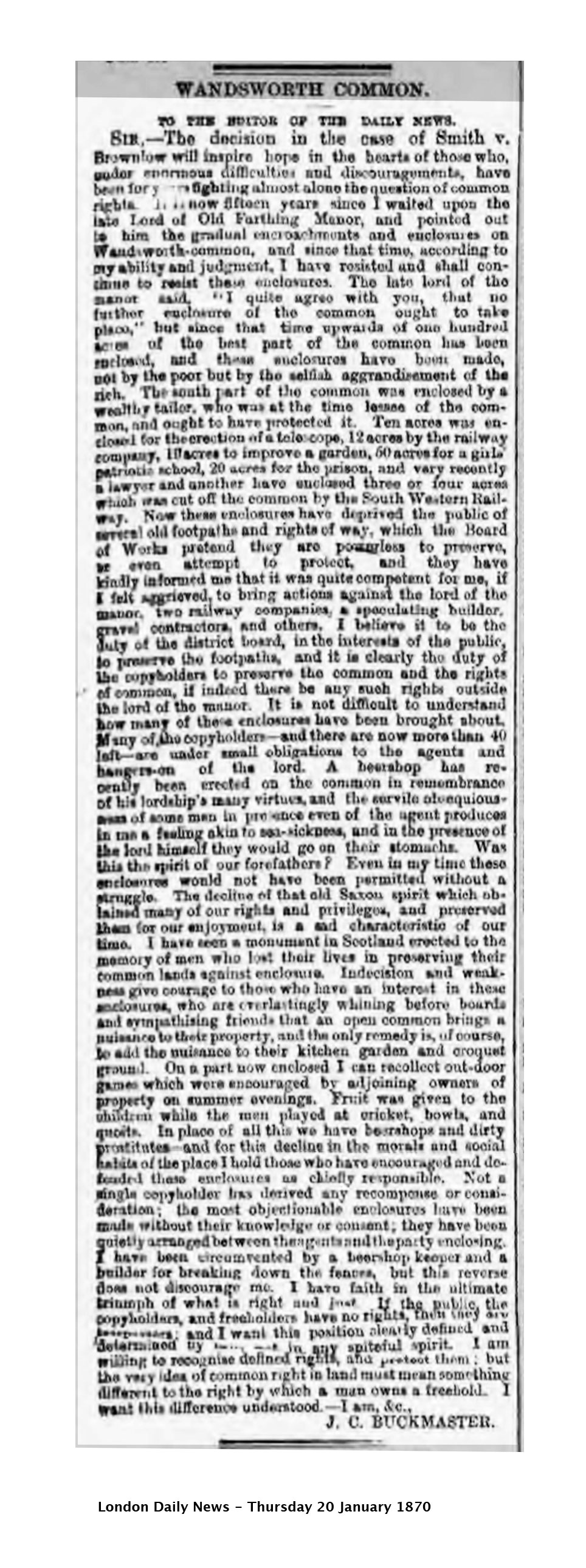
WANDSWORTH COMMON.
TO THE EDITOR OF THE DAILY NEWS.
SIR, — The decision in the case of Smith v. Brownlow will inspire hope in the hearts of those who, under enormous difficulties and discouragements, have been for years fighting almost alone the question of common rights.
It is now fifteen years since Iwaited upon the late Lord of Old Farthing Manor [Spencer?], and pointed out to him the gradual encroachments and enclosures on Wandsworth-common, and since that time, according to my ability and judgment, I have resisted and shall continue to resist these enclosures.
The late lord of the manor said, " Iquite agree with you, that no further enclosure of the common ought to take place," but since that time upwards of one hundred acres of the best part of the common has been enclosed, and these enclosures have been made, not by the poor but by the selfish aggrandisement of the rich.
The south part of the common was enclosed by a wealthy tailor, who was at the time lessee of the common, and ought to have protected it.
Ten acres was enclosed for the erection of a telescope, 12 acres by the railway company, 10 [?] acres to improve a garden, 60 acres for a girls' patriotic school, 20 acres for the prison, and very recently a lawyer and another have enclosed three or four acres which was out off the common by the South Western Railway.
Now these enclosures have deprived the public of several old footpaths and rights of way, which the [Metropolitan] Board of Works pretend they are powerless to preserve, or even attempt to protect, and they have kindly informed me that it was quite competent for me, if Ifelt aggrieved, to bring actions against the lord of the manor, two railway companies, a speculating builder, gravel contractors, and others.
Ibelieve it to be the duty of the district board, in the interests of the public, to preserve the footpaths, and it is clearly the duty of the copyholders to preserve the common and the rights of common, if indeed there be any such rights outside the lord of the manor.
It is not difficult to understand how many of these enclosures have been brought about.
Many of the copyholders — and there are now more than 40 left — are under small obligations to the agents and hangers-on of the lord. A beershop has recently been erected on the common in remembrance of his lordship's many virtues, and the servile obsequiousness of some men in the presence even of the agent produces in me a feeling akin to sea-sickness, and in the presence of the lord himself they would go on their stomachs.
Was this the spirit of our forefathers? Even in my time these enclosures would not have been permitted without a struggle. The decline of that old Saxon spirit which obtained many of our rights and privileges, and preserved them for our enjoyment, is a sad characteristic of our time.
I have seen a monument in Scotland erected to the memory of men who lost their lives in preserving their common lands against enclosure. Indecision and weakness give courage to those who have an interest in these enclosures, who are everlastingly whining before boards and sympathising friends that an open common brings a nuisance to their property, and the only remedy is, of course, to add the nuisance to their kitchen garden and croquet ground.
On a part now enclosed I can recollect out-door games which were encouraged by adjoining owners of property on summer evenings. Fruit was given to the children while the men played at cricket, bowls, and quoits. In place of all this we have beershops and dirty prostitutes — and for this decline in the morals and social habits of the place I hold those who have encouraged and defended these enclosures as chiefly responsible.
Not a single copyholder has derived any recompense or consideration; the most objectionable enclosures have been made without their knowledge or consent; they have been quietly arranged between the agents and the party enclosing.
I have been circumvented by a beershop keeper and a builder for breaking down the fences, but this reverse does not discourage me. I have faith in the ultimate triumph of what is right. If the public, the copyholders, and freeholders have no rights, then they are [illegible], and I want this position clearly defined and determined by [illegible] in any spiteful spirit. I am willing to recognise defined rights, and protect them: but the very idea of common right in land must mean something different to the right by which a man owns a freehold. I want this difference understood.
I am, &c., J. C. BUCKMASTER.
[ADD notes on "Smith v Brownlow"? "Wealthy tailor"? "Lessee of the common"? NB JCB includes the prison as once part of the common.]
"A bitterly angry letter from John Buckmaster, looking back to c.1855. Notice his approval of Smith v Brownlow — the Berkhamstead fence-breaking case that had rumbled on for some years. Also of the tailor — Iassume this is McKellar rather than his successor, though also in a sense a "tailor" — ? De Selincourt, [was it he or his son who became owner of] Swan and Edgar]. [No — Inow think it's Costeker — prominent in the Merchant-Tailors Guild.]
href = "/years/1870/1870_01_20_buckmaster_angry_letter_LondonDailyNews_20jan1870.jpg" Target="_blank">Link,] -- CLICKABLE PIC ENDS -- WANDSWORTH COMMON. TO THE EDITOR OF THE DAILY NEWS. SIR, — The decision in the case of Smith v. Brownlow will inspire hope in the hearts of those who, under enormous difficulties and discouragements, have been for years fighting almost alone the question of common rights. It is now fifteen years since Iwaited upon the late Lord of Old Farthing Manor [Spencer?], and pointed out to him the gradual encroachments and enclosures on Wandsworth-common, and since that time, according to my ability and judgment, I have resisted and shall continue to resist these enclosures. The late lord of the manor said, " Iquite agree with you, that no further enclosure of the common ought to take place," but since that time upwards of one hundred acres of the best part of the common has been enclosed, and these enclosures have been made, not by the poor but by the selfish aggrandisement of the rich. The south part of the common was enclosed by a wealthy tailor, who was at the time lessee of the common, and ought to have protected it. Ten acres was enclosed for the erection of a telescope, 12 acres by the railway company, 10 [?] acres to improve a garden, 60 acres for a girls' patriotic school, 20 acres for the prison, and very recently a lawyer and another have enclosed three or four acres which was out off the common by the South Western Railway. Now these enclosures have deprived the public of several old footpaths and rights of way, which the [Metropolitan] Board of Works pretend they are powerless to preserve, or even attempt to protect, and they have kindly informed me that it was quite competent for me, if Ifelt aggrieved, to bring actions against the lord of the manor, two railway companies, a speculating builder, gravel contractors, and others. Ibelieve it to be the duty of the district board, in the interests of the public, to preserve the footpaths, and it is clearly the duty of the copyholders to preserve the common and the rights of common, if indeed there be any such rights outside the lord of the manor. It is not difficult to understand how many of these enclosures have been brought about. Many of the copyholders — and there are now more than 40 left — are under small obligations to the agents and hangers-on of the lord. A beershop has recently been erected on the common in remembrance of his lordship's many virtues, and the servile obsequiousness of some men in presence even of the agent produces in me a feeling akin to sea-sickness, and in the presence of the lord himself they would go on their stomachs. Was this the spirit of our forefathers? Even in my time these enclosures would not have been permitted without a struggle. The decline of that old Saxon spirit which obtained many of our rights and privileges, and preserved them for our enjoyment, is a sad characteristic of our time. I have seen a monument in Scotland erected to the memory of men who lost their lives in preserving their common lands against enclosure. Indecision and weakness give courage to those who have an interest in these enclosures, who are everlastingly whining before boards and sympathising friends that an open common brings a nuisance to their property, and the only remedy is, of course, to add the nuisance to their kitchen garden and croquet ground. On a part now enclosed I can recollect out-door games which were encouraged by adjoining owners of property on summer evenings, Fruit was given to the children while the men played at cricket, bowls, and quoits. In place of all this we have beershops and dirty prostitutes — and for this decline in the morals and social habits of the place I hold those who have encouraged and defended these enclosures as chiefly responsible. Not a single copyholder has derived any recompense or consideration; the most objectionable enclosures have been made without their knowledge or consent; they have been quietly arranged between the agents and the party enclosing. I have been circumvented by a beershop keeper and a builder for breaking down the fences, but this reverse does not discourage me. I have faith in the ultimate triumph of what is right. If the public, the copyholders, and freeholders have no rights, then they are [illegible], and I want this position clearly defined and determined by [illegible] in any spiteful spirit. I am willing to recognise defined rights, and protect them: but the very idea of common right in land must mean something different to the right by which a man owns a freehold. I want this difference understood. I am, &c., J.C. BUCKMASTER. [BNA: Link.] [ADD notes on "Smith v Brownlow"? "Wealthy tailor"? "Lessee of the common"? NB JCB includes the prison as once part of the common.]"
London Daily News , Thursday 20 January 1870]
Daily News — Thursday 20 January 1870
aily News — Thursday 20 January 1870
WANDSWORTH COMMON. TO THE HD1IT0 OF TUB DALY SEWS. SiRt,-The decision in the case of Smith v. Brownlow will inspire hope in the hearts of those who, ssder enormous difficulties and discouragements, have beenfor y sis fighting almost alone the question of commnon xights.
It is now fifteen years since Iwaited upon the late Lord of Old Farthiing Manor, and pointed out to him the gradual encroachments and enclosures on Wandsworth-commou, and since that time, according to gny ability and judgment, I have resisted and shall conainue to resist these enclosures. The late lord of the manor said, " Iquite agree with you, that no further enclosure of the common ought to take place," but since that time upwards of one hundred acees of the best part of the common has been enclosed, and these enclosures have been made, not by the poor but by the selfish aggrandizement of the rich. The south part of the common was enclosed by a wealthy tailor, who was at the time lessee of the common, and ought to have protected it. Ten acres was enclosed for the erection of a telesoope, 12 acres by the railway Company, Ilacres to improve a garden, 60 acres for a girls' patriotic school, 20 acres for the prison, and very recently a lawyer and another have enclosed three or four acres which was out off the common by the South Western Railway.
Now these enclosures have deprived the public of several old footpaths and rights of way, which the Board of Works pretend they are?? to preserve, or even attempt to protect, and they have kindly informed me that it was quite competent for me, if Ifelt aggrieved, to bring actions against the lord of the manor, two railway companies, a speculating builder, travel contractors, and others. Ibelieve it to be the duty of the district board, in the interests of the public, to preserve the footpaths, and it is clearly the duty of the copyholders to preserve the common and the rights of common, if indeed there be any such rights outside the lord of the manor. It is not difficult to understand bow many of these enclosures have been brought about. Many of the copyholders- andt here are now more than 40 eft- are under small obligations to the agents and hangers-on of the lord. A beershop has recently been erected on the common in remembrance of his lordship's many virtues, and the servile obsequiousness of some men in presence even of the agent produces In me a feeling akin to sea-sickness, and in the presence of the lord himself they would go on their stomachs. Was this the spirit of our forefathers? Even in my time these enclosures would not have been permitted without a struggle. The decline of that old Saxon spirit which obtained many of our rights and privileges, and preserved them for our enjoyment, is a sad characteristic of our time. I have seen a monument in Scotland erected to the memory of men who lost their lives in preserving their common lands against enclosure. Indecision and weakness give courage to those who have an interest in these enclosures, who are everlastingly whining before boards and sympathising friends that an open common brings a nuisance to their property, and the only remedy is, of course, to add the nuisance to their kitchen garden and croquet ground. On a part now enclosed I can recollect out-door games which were encouraged by adjoining owners of property on summer evenings, Fruit was given to the children while the men Played at cricket, bowls, and quoits. In place of all this we have beershops and dirty prostitutes-and for this decline in the morals and social abie of the place Ibold those wvho have encouraged and defeuded these enclosures as chiefly responsible. Not a lingle copyholder has derived any recompense or consideration; the most objectionable enclosures have been made without their knowledge or consent; they have been quietly arranged between theagents andtheparty enclosing. I have been circumvented by a beershop keeper and a builder for breakingdown the fences, but this reverse does not discourage me. I have faith in the ultimate triumph of what is right anid j,1 the public, the copyholders, and freeholders have no rig}ts, ien Llte a5b"rncq~rs and I want this;cositios clearly defilued and determinaed By eo l.ind n piteful spirit. Iala willing to recognise deie naa oothn; u the vesv idea of common right in land mustmeansomsthing different to the right by which a man owns a freehold. Itiant thie difference understood.- I am, &c., J. C. BUCKMASTER.
[BNA: Link.]
target="_blank">Link]"The action raised against Mr. J. C. Buckmaster, M.A., of St. John's Hill, New Wandsworth, for breaking in the windows of a beerhouse erected at the corner of Wandsworth Common, to assert the public right to the use of the Common, and to protest against the lord of the manor (Earl Spencer) leasing the ground to builders, is still pending. A fund is being raised to defray the costs of the action, as Mr. Buckmaster acted exclusively in the public interest. Sir Charles Dilke, Bart, M.P., has subscribed £5 towards the fund.
BNA: Link.]
target="_blank">Link"
[PB: appears to be an editorial.]
href = "/years/1870/1870_01_23_SouthLondonPress_23jan1870.jpg" Target="_blank">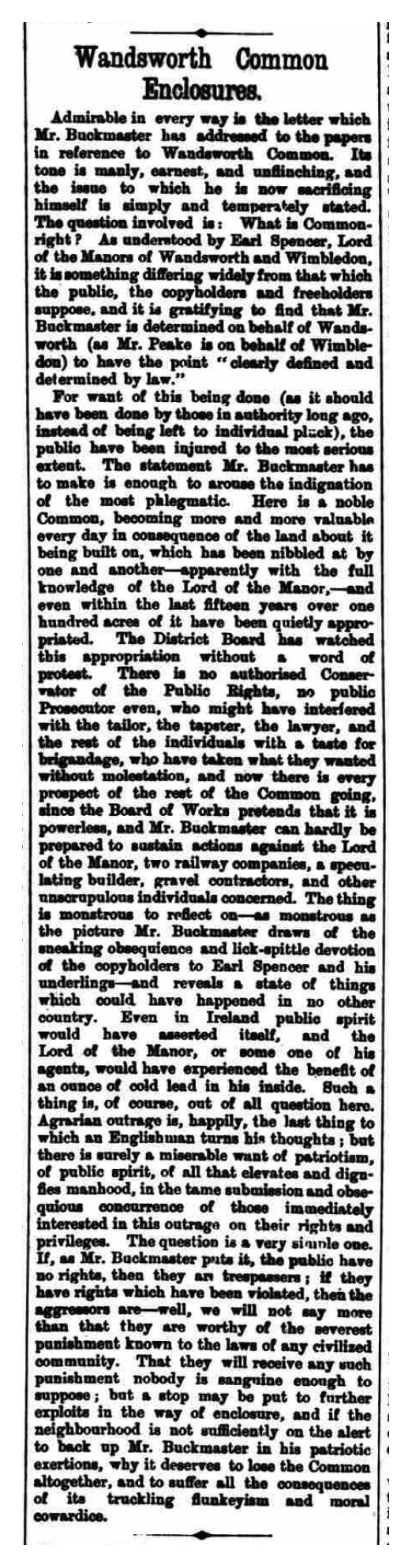
South London Press — Saturday 22 January 1870
Wandsworth Common Enclosures.
Admirable in every way is the letter which Mr. Buckmaster has addressed to the papers in reference to Wandsworth Common. Its tone is manly, earnest, and unflinching, and the issue to which he is now sacrificing himself is simply and temperately stated.
The question involved is: What is Common-right? As understood by Earl Spencer, Lord of the Manors of Wandsworth and Wimbledon, it is something differing widely from that which the public, the copyholders and freeholders suppose, and it is gratifying to find that Mr. Buckmaster is determined on behalf of Wandsworth (as Mr. Peake is on behalf of Wimbledon) to have the point "clearly defined and determined by law."
For want of this being done (as it should have been done by those in authority long ago, instead of being left to individual pluk), the public have been injured to the most serious extent. The statement Mr. Buckmaster has to make is enough to arouse the indignation of the most phlegmatic.
Here is a noble Common, becoming more and more valuable every day in consequence of the land about it being built on, which has been nibbled at by one and another"
LETTERS BY RADICAL.
London, January 20th 1870. The Duke of Cambridge, it is said, yahemonttv objects, he has always done, the removal of his office the Horse to the War Office in Pall, and powerful the present Government may be, will have to confess to Parliament that it accomplished this useful little bit of reform. Not that the change in itself is of any very grreat moment. A messenger two mi"ht probably saved, and Mr. Cardwell, whenever might wish to see the Duke, would only have to step into the next room, instead of walking across the Park. The real importance His Royal Highness refusal to move, lies in this — that it is typical of his obstinate opposition to all attempts at economy and improvement. It is of no use blink the fact, that so long is Commander in Chief we shall have to wait for the least approach to any of those brilliant successes which have distineruished The administration of Mr. Childers the Admiralty. It ii very foolish of His Royal Highness, bat than ho is not over wise.
My Uncle Toby in Tristram Shandy tells a story of Walloon officer, at the battle of Landen, who had one part of brain shot away by mnsket ball, and another part of it taken out by a French surgeon, and after all recovered, and did his duty verv well without it," which is not all improbable, our experience in the Crimean war having proved that many noble and gallant officers, enormously praised, had no brains whatever. It seems for long while past to have been favourite theory in this country, that not want any brains even for the place Commander in Chief, although prima facie to a non-professional observer it would appear that if there is one post on earth where they are necessary, it is there.
One the essayists in the volume recently published by the Cobden Club, calls attention to the extraordinary cost of conveying land in England, and mentions a case where £'23 14s. 7d. was spent to transfer land worth only iJIOO. I do not recollect anything quite so bvl that, bat I distinctly remember .£23 b.'ing paid to transfer land worth only .£l5O, and in addition there was all the waste of time in visits and correspondence, worth, at least, another j£lo. The investigation of the title meant going through mass of pipers a foot thick, searches the General Register Office, Inland Revenue Office, and the Will Office, while the now title to the purchaser was solemn, massive piece of sheepskin, ponderous enough to convey a principality.
What crying evil is this, and yet if any improvement were to be suggested in the House of Commons, the lawyers would one and all sit upon it and declare that any alteration for the better was impossible, and that the present system is simply perfection. Nay, it is very doubtful whether any improvement conld suggested, seeing that the proposal must come from the lawyers, who of coarse prefer that conveyancing, to suit their own ends and those of the solicitors, should be made intricate and expensive.
The preservation of open spaces is serious matter for the people that Mr. Augustus Smith, who has been successfully resisting Lord Brownlow in his attempts enclose Great Berkhampstead Common, deserves public thanks. Mr. Augustus Smith was formerly in the where he was usually considered a bore. had oiie pet subject, that of foreshores, on which he would talk, ia season and out of season, to alarming extent. However, all that is cheerfully forgiven quia muHum amavit the poor and their rights. When Lord Brownlow's agents put np the fence, some two years ago, Mr. Smith chartered train on the London and North Western Railway, filled it full of navvies, sent it down one night quietly to Berkhampstead, and by the morning the fence had vanished. Thereupon ensued an action at law, bravely defended Mr. Smith, who ia, fortunately, able to hold his own even against an Earl, and on Friday last judgment was given by the Master of the Rolls, that Mr. Smith had succeeded in establishing rights of u herbage, pannage, and the cutting of furze and corse," A perpetual injunction has consequently been granted against the Earl.
This is glorious, but "the misfortune is that every Common has not got a Mr. Augustus Smith for its champion. The profits of enclosing are enormous, and far more than sufficient tempt a wealthy lord of dho manor to spend years in the to gain possession of piece cf waste, while the commoners are generally poor, and have no such overwhelming interest in defending their interests.
The House of Commons ought to interfere — and would have interfered long ago if it had been anything else than what it always has been, is now, and apparently for vet will bo, a House of rich men. What these gentlefolks who lire in parks care about commons? What do they car, that T, who am forced to dwell in a suburb, am being gradually shut out from every breath of fresh air by the greed of man like Lord Spencer, the lord of Wandsworth and Wimbledon Here, at least there is one question which few working men in Parliament would help to solve little more satisfactorily than have done hitherto. Wandsworth Common has nearly gone, Wimbledon is threatened, Banstead Downs are completely rained, and Ensom, most magnificent of all, ia merely waiting to swallowed, half of the neighbouring Common at Leatherhead having already disappeared.
It is generally understood that the Education Bill, despite Mr. Forster's confident predictions, will not pressed this session. may be introduced, but that will be all. Mr, Forster, for a variety of reasons, some public and some personal, is very anxious to get the Bill through, but he will have to wait Waiting a very hard task for him. He says that the work of holding his tongue, when ho wishes to say something, is harder than sitting five or six hours in the House. Undoubtedly for him this so. marvellous and utterly unaccountable as it may appear. But he must not so anxious. Mr. Bright's is the wiser course, and Mr. Bright's opinion is that of every other member of the Cabinet. Mr. Forster would drive the six omnibuses through Temple Bar one after another, and would like the session to on." Oh, mercy
[BNA: Link.]
"The action raised against Mr. J.C. Buckmaster, M.A., of St. John's Hill, New Wandsworth, for breaking in the windows of a beerhouse erected at the corner of Wandsworth Common, to assert the public right to the use of the Common, and to protest against the lord of the manor (Earl Spencer) leasing the ground to builders, is still pending. A fund is being raised to defray the costs of the action, as Mr. Buckmaster acted exclusively in the public interest. Sir Charles Dilke, Bart, M.P., has subscribed £5 towards the fund.
[BNA: Link.]
target="_blank">Link]". . . absorbed in the one desire to keep out the Tory foe. Wandsworth Common Enclosures. Admirable in every way is the letter which Mr. Buckmaster has addressed to the papers in reference to Wandsworth Common. Its tone is manly, earnest, and unflinching, and the . . .
[BNA: Link.]
[PB: appears to be an editorial.]
-- CLICKABLE PIC STARTS --
href = "/years/1870/1870_01_23_SouthLondonPress_23jan1870.jpg" Target="_blank">South London Press — Saturday 22 January 1870
-- CLICKABLE PIC ENDS --
Wandsworth Common Enclosures.
Admirable in every way is the letter which Mr. Buckmaster has addressed to the papers in reference to Wandsworth Common. Its tone is manly, earnest, and unflinching, and the issue to which he is now sacrificing himself is simply and temperately stated.
The question involved is: What is Commonright? As understood by Earl Spencer, Lord of the Manors of Wandsworth and Wimbledon, it is something differing widely from that which the public, the copyholders and freeholders suppose, and it is gratifying to find that Mr. Buckmaster is determined on behalf of Wandsworth (as Mr. Peake is on behalf of Wimbledon) to have the point "clearly defined and determined by law."
For want of this being done (as it should have been done by those in authority long ago, instead of being left to individual pluck), the public have been injured to the most serious extent. The statement Mr. Buckmaster has to make is enough to arouse the indignation of the most phlegmatic.
Here is a noble Common, becoming more and more valuable every day in consequence of the land about it being built on, which has been nibbled at by one and another apparently with the full knowledge of the Lord of the Manor, and even within the last fifteen years over one hundred acres of it have been quietly appropriated.
The District Board has watched this appropriation without a word of protest. There is no authorised Conservator of the Public Rights, no public Prosecutor even, who might have interfered with the tailor, the tapster, the lawyer, and the rest of the individuals with a taste for brigandage, who have taken what they wanted without molestation, and now there is every prospect of the rest of the Common going, since the Board of Works pretends that it is powerless, and Mr. Buckmaster can hardly be prepared to sustain actions against the Lord of the Manor, two railway companies, a speculating builder, gravel contractors, and other unscrupulous individuals concerned.
The thing is monstrous to reflect on — as monstrous as the picture Mr. Buckmaster draws of the sneaking obsequience and lick-spittle devotion of the copyholders to Earl Spencer and his underlings — and reveals a state of things which could have happened in no other country. Even in Ireland public spirit would have asserted itself, and the Lord of the Manor, or some one of his agents, would have experienced the benefit of an ounce of cold lead in his inside.
Such a thing is, of course, out of all question here. Agrarian outrage is, happily, the last thing to which an Englishman turns his thoughts; but there is surely a miserable want of patriotism, of public spirit, of all that elevates and digsflea manhood, in the tame submission and obsequious concurrence of those immediately interested in this outrage on their rights and privileges.
The question is a very simple one. If, as Mr. Buckmaster puts it, the public have no rights, then they are trespassers; if they have rights which have been violated, then the aggressors are well, we will not say more than that they are worthy of the severest punishment known to the laws of any civilized community. That they will receive any such punishment nobody is sanguine enough to suppose; but a stop may be put to further exploits in the way of enclosure, and if the neighbourhood is not sufficiently on the alert to back up Mr. Buckmaster in his patriotic exertions, why it deserves to lose the Common altogether, and to suffer all the consequences of its truckling flunkeyism and moral cowardice.
[BNA: Link.]
target="_blank">Link]""Rochdale Observer — Saturday 22 January 1870
["HOUSE OF RICH MEN""]
THE ROCHDALE OBSERVER, SATURDAY, JANUARY 22, 1870. LETTERS BY A RADICAL
. . . question which few working men in Parliament would help to solve little more satisfactorily than have done hitherto. Wandsworth Common has nearly gone, Wimbledon is threatened, Banstead Downs are completely rained, and Epsom, most magnificent of all, ia . . .
The preservation of open spaces is serious matter for the people that Mr. Augustus Smith, who has been successfully resisting Lord Brownlow in his attempts enclose Great Berkhampstead Common, deserves public thanks. Mr. Augustus Smith was formerly in the where he was usually considered a bore. had oiie pet subject, that of foreshores, on which he would talk, ia season and out of season, to alarming extent. However, all that is cheerfully forgiven quia muHum amavit the poor and their rights. When Lord Brownlow's agents put up the fence, some two years ago, Mr. Smith chartered train on the London and North Western Railway, filled it full of navvies, sent it down one night quietly to Berkhampstead, and by the morning the fence had vanished. Thereupon ensued an action at law, bravely defended Mr. Smith, who is, fortunately, able to hold his own even against an Earl, and on Friday last judgment was given by the Master of the Rolls, that Mr. Smith had succeeded in establishing rights of u herbage, pannage, and the cutting of furze and gorse," A perpetual injunction has consequently been granted against the Earl. This is glorious, but "the misfortune is that every Common has not got a Mr. Augustus Smith for its champion. The profits of enclosing are enormous, and far more than sufficient tempt a wealthy lord of dho manor to spend years in the to gain possession of piece cf waste, while the commoners are generally poor, and have no such overwhelming interest in defending their interests. The House of Commons ought to interfere — and would have interfered long ago if it had been anything else than what it always has been, is now, and apparently for ever will be, a House of rich men. What these gentlefolks who lire in parks care about commons? What do they care, that T, who am forced to dwell in a suburb, am being gradually shut out from every breath of fresh air by the greed of man like Lord Spencer, the lord of Wandsworth and Wimbledon Here, at least there is one question which few working men in Parliament would help to solve little more satisfactorily than have done hitherto. Wandsworth Common has nearly gone, Wimbledon is threatened, Banstead Downs are completely rained, and Epsom, most magnificent of all, ia merely waiting to swallowed, half of the neighbouring Common at Leatherhead having already disappeared.
[BNA: Link.]
target="_blank">Link]"Halbrake School Athletic Sports.
The above annual sports came off on Saturday last, in a field situated near St. Anne's Church, kindly lent for the occasion by James Du Buisson, Esq.
The varied costumes of the boys, the numerous flags used in marking out the ground; the spectators, who included the fashion and beauty of Wandsworth and neighbourhood; and the excellent music dispensed by the indefatigable band of the 1st Surrey Artillery, under the direction of Mr. W. Bourd — all rendered the scene one of exceptional gaiety; and though the sun at times disdained to shine, and the envious clouds showered forth their displeasure, the effect was but transient — "all went merry as a marriage bell".
The successful athletes were well rewarded for their exertions, as it is a rare case in which prizes so elegant and valuable, and at the same time so numerous, are awarded in school sports.
One interesting feature of the day's proceedings was the fact of Mr. H. M. Stanley's boy Kalulu (who is being educated at the school) entering for several events, who, although not fortunate enough to win, displayed considerable aptitude in the various events in which he was engaged, and evinced much improvement upon his last year's attempts — his healthy, robust appearance being much admired. We are informed that Mr. Stanley would have distributed the prizes, had not his recent all-important engagement prevented.
The ladies' prize for general proficiency was won by E. HAwer; but owing to an arrangement that it cannot be taken by the same boy tee successive years. it fell to the lot of the second — viz., D. E. Bower, brother to the former. The president of the sports was the Rev. John Conder. headmaster of the school, and the committee were E. Nicholson. E. Hower. the Hon. Evelyn Denison, and J. Mossop. The prizes were presented to the candidates by Mrs. Conder, and the following is the
LIST OF WINNERS.
Throwing Cricket Ball (for boys under 12): G. Corvallis. Thr — jimg Cricket Ball (open): D. E. Bower, 7 3 / a rdb. Gilbert, Race (100 yards, boys under 12): F. Putt — the Weight: E. Nicholson. Flat Rae. Ow yards handicap, open): D. E. Bower, 1 Young, 2.. Flat Race 180 lards boys unaer 11): S. Perks, 1: South, 2. iopeol: Edg. Bower, 1, Mt. sn. Flat Race quarter of a mile handicap, open): H. Homo. Back Rao e (80 yards. open): W. H. Webber, 1. Walking Race (quarter of a mile handicap, opsn): J. I. Pole Jump (open): A. Hodges,;ft. Sin. Hurdle Race: E. Bower, 1. Three-legged Race: Hodges and Young, 1. Flat Race (half a mile handicap, open): E Bower, 1. Long Jump (open): W. H. Webber. Sack Ram (open): A. Hodges. Old Pupils' Base (1100 yards): W Corsellis, 1. radars' R&M (quarter of a mile): C. A. Gilbert, 1. Sack Race (boys 12): C. Madie, 1; E. Cox, 2. _ _ (100 yards, boys 12): Breboer, 1. Consolation Race (open, 200 yards): A. E. Parratt, 1, Race for the Members of the Band (200 yards): A. J. Ham, 1. An opportunity taken in the 'course of the day to vary the proceedings by chit exercises, in which the party selected displayed much skill and considerable muscular development. The following prizes for gymnastic exercises, which had been previously awarded, were distributed simultaneously with the above: First Division (boys over 13): Champion gold Medal, A. Hodges; certificate from Mr. Winterbottom, J. Mcsnop and J. Cunninghame. Second division (boys between 11 and 13): Silver medal, Eric. Conder; certificate, G. Corsellis. Third Division (boys under 11): Bronze medal, John Conder; certificate, L. Bowers. Drilling Prises: J. Moseop, 1; E. Bower, 2; H. Mossop, 3. _
[BNA: Link.]
"Dangerous Condition of Battersea Cemetery.
Dr. ()Amen, medical officer of health for West Battersea, has recently submitted to the Wandsworth Board of Works a report on the state of the Battersea Cemetery, and the manner in which the law with reference to interment is carried out. lie states that he has visited the cemetery on several occasions, and finds that it centrists of eight acres in ertent, one-eighth of which is taken up with paths, which are fairly drained, chapels, mortuary, &e., and the remaining seven acres are used for the purpose of burials; the ie planted with trees, principally of the Ardor Vt,r claqs, and well covered with grass, and the Isurface of very many graves is laid out wi:h flowers. The cemetery is divided into consecrated and unconsecrated parts, in each of whieh are portions of ground called common ground. It is the latter poitions of the oemetery which principally occupy the attention of the report, as being the parts in which r.quirementa of the law are not Amerved, the other portions of the cemetery being let as private graves. 'the cemetery is situate on Battersea Rise, the south-west side taming Wandsworth Common, and the nor itmet adjoining the back gardens ot the houses in Middleton-road, and the south-east side adjoins the gardens of Malleson road. Houses are situated 25ft. from open grave ground in Middleton-road, and 5101 t. from Manama-road. tty open grove ground, meaning ground in shieh deep graves are dog, and remain open till sufficient corpses are forthcoming, with an intervening portion of earth, to fill the grave within a certain distance of the Bedew. This cloee proximity of houses, apart from the nature of the soil, makes the present site of the burial ground bad, though there can be no loubt that at the time the cemetery was laid out, no were within the prescribed limits. En order to be possessed of correct information. Dr. Oakman placed hims-If in direct communication with the Burial Board, and submitted to them a series of goestions, to which they returned answers. The substance of these answers is that the cemetery was first used as a burial in 1861. Ten thousand hun dred and ninety-five burials 'tare taken plaee from 1860 to June, 1874, and 518 svid-borne from May, 1889, to June 24, 1874, no account being previously kept. In 1873 there were 1,098 iuterments. The graves are dug at various depths ranging from 6ft. to Mlle.. Mt. of earth being left between the top coffin and the surface when the grave is full. On opening a grave already used, one foot of earth is left between the two coffins, second burial. The greatest number of adult persons in one grave is 14, and the greatest number under 10 years of age, 26. Formerly one foot of earth was left between two coffins, it now rft. The common graves after a burial are not immediately filled up, and it is not the practice of the board to never the sineace with turf or shrubs. Fourteen years are allowed to elapse before a foil grave is opened for second interment, but six have been opened since August, 1874. The grave space allowed for persons above 10 years of age is nine feet by four, and under that age six feet by three. Three feet depth of is left between the-coffins and the earth when it is full. In vaults or brick graves the are not seuerately entombe i in all oases. The cemetery is drained to the depth of eight 110 are taken to connect each grave with the drain.
Dr. Oakman's observations on the above are as follows: cemetery was opened on November 16, 1860, in which year 12 burials took place; since then 10,583 have been buried, besides 518 still-born infants, during the last five years, previous to which no account of still-born. was kept. In the yeer 11361 the number buried was 240, since that time the population has so increased, and consequently the deaths, that last year (1873) I,OJB interments took place. This large and increasing demand on the ep of the Geese tery must have plainly told the Burial Board that unless some means were devised the cemetery would soon be filled; for it is clear that with a burial ground of seven acres of actual useable space already containing 10,54. corpses, and burials now amounting to over 1,000 per annum, that if the instructions to Burial Boards were carried out, there wont i not be en:ficient space for one year's burials. These Acts, 15 and 16 Vie. cap. 85, and 16 and 17 Vic. c q) 134, state that if a dry, porous, gaudy, or earthy soil be selected, such a soil, speaking approximately, would admit of being buried in at the rate of 120 interments per sere per annum; if a wet or clay soil be choon, not more than 60 or 70 interments per acre per annum could take place in it." To make up then for the want of superficial space, Ifind that sleep opus running graves from eft, to hilt. deep were substituted in Deeember, 1868, in which a number of bodies are put. The greatest number of adult persons in one of these deep graves is 14, the average being 11, and the greatest number of persons under 10 years of age in one of these deep graves is 26. It will be sans by reference to question 21, that one foot of earth is left between each coffin. How then is it possible to place 14 adult coffins in a grave 1911. deep, and leave a foot of earth between **eh coffin The coffin would be one foot deep, and 141 t. of earth would make 28ft., and three feet from the surface would make the depth of the grave near 3lft. These open grave 4 are situate two in the common consecrated and two in the common unconsecrated ground, and at the times of my visits were tour in number. They were deep, far below the depth a drainage of the cemetery, which is eight feet, in dense day, mid contained water, which cool 10.17 get away by very slowly percolating in the direction of the *lope of the cemetery; these graves are kept open until there are sufficient burials to fill them, and until oa receatt, 011 my representing the matter to the Burial rd, one foot of earth was left between each coffin, now two feet of earth are left. It may be a week, or perhaps a month, before such a grave is finally closed, dating which time the bodies decompose, and the soil being of such a nature (clay) the games given off are not absorbed, consequently they escape into the atmosphere. The stench from these open graves is very bad. and produced., visible effect on myself and surveyor when inspecting. Imay a!so mention that the have complained to me o f th e very disagreeshlderegi uty to perform the funeral service Dear theme graves, and when it is remembered that 'warners worn out with anxious attendance on their departed friends, or in a condition of health very snaceptakie to paon. s tee d on the borders of the, graves, it will be r -ftdily seen that the emanations from the decomposing bodies must be dlvirosa in the extreme. practice of deep oven ru nn i ng graves i s teary to the regulations for conducting intermeate in burial grounds provided under the Burial Art" 15 and 16 Victoria, cap. 85; 16 aad 17 Victoria, cap 13$; 17 and 18 Vie-laria cap. 17 and 18 and 19 Victoria, cap. 128. which 18, " Whenever a burial has taken place except in a private vault, the grate shall be forthwith filled up with earth, and the surface shall be covered with fresh tad or be pleated with fresh shrtslos, or other suitable vegetation, unless a is to be erected upon it, bat in 140 case shall the bare earth be left exposed." Page 246, regulation 11, says: "No more than one body shall be buried fa any vault or grave eraopt in a vault or grave purchased for the exclusive use of a family." Page 246, regulation 17, stales "No grave in which as interment has taken place except it be a vault or grave purchased for the exclusive use of a family shall be reopened for another interment until after the expiration of stated periods of time." It will readily he seen from these rules that no more than one body shall be buried in ene grave, unless that grave belongs to a private individual. That the common grave, in which as limey as 2t; persons are placed, is not the property of say one private person, or that they all belong to the came family, cannot for a moment be argued, therefore this mode of burial is in direct violation of the eiders of the Hume Office. Rule 18 states that whenever a burial has taken place, *Rapt in a private vault, the grave shall be forthwith filled up with earth, and the Waded. The common graves are not forthwith filled up with earth, neither i the surface turfed or planted with shrubs, Sic.: the answer to which is " Not unless paid for." It would surely be a matter of controversy as to who should pay for turfing the surface of a grave in which are 26 bodies. In these respects the orders of the lions Office are not properly carried out. Regulation 17, page 248, states that no adult grave (except private) shall be reopened for second tate:- meat till after a period of 14 years. which states that six have been reopened. This question applies be common graves, anal was understood so by the superintendent. These graves contained as many bodies as the answers to certain questions states. I cannot understand why they should have been reopened. Regulation 8, page 249, states that no coffin shall be buried in any untrained grave within 44t. of the ordinary level of the ground, it contains the b.xly of a child under 12 years of age, when it shall not he less than Mt. the Burial Board allow at. in all eases, which is not sufficient for adults, which according to the above order should be 4f4. Buriars in vaults: Tim regulations, page 23), require each coffin to be separately entombed either by stone or cement, to be never rainsl again. /legislation 1, page 248, states: That the burial ground, if necessary, shall be ntderdrained to such a depth as will prevent water remaining in any grave or vault;" the graves being 18ft. deep, and the cemetery drained only Bft. deep, it follows that the deep graves are not drained so as to prevent water remaining in them. This may for water bein gin graves at the ti me of my visits. This regulation is not observed, sad no means are taken to connect each grave with the drain. The area. regulation 2, page 248, used graves, is not divided out into grave spaces, consequently no plan is kept shewing them; this regulation is therefore not observed. The regalationn which refer to private grates Ibelieve are hsibbfally carried out . . . . The grave space superficial allowed — viz., Oft. by Mt. for an shalt, and 6t1.. by Sft. for children, is the siorrect amount as ordered by Regulations 7 and 8, page 243. From what I have stated — viz., that only two acres now remain for burial purposes, and that the number of graves which will fall into the hands of the board by lapse of time, for re-interment. will be so few, and that the interments now number over 1,000 per year, it follows that the cemetery, if the orders of the Home Office are carried oat, must be closed as a burial ground in about three years; for two acres of ground, taking the deaths as half adults and half children, will but accommodate 3.630. Though if the board should apply to the Home Secretary, it is possible mine regulations might be issued, other cemeteries, which would give some extension of time. It appears to me just a question whether it would not be as well if the Burial Board were to clo4e the ground against all persons except those for whom the law compels the board to tind a burial place, and those who possess private graves or vaults; by this means it is true the parishioners would have to provide burial places at other grounds, but then they would be spared the expen, e for some years of purchasing fresh cemetery ground. Finding on inquiry that different cemeteries were governed by special regulation, I applied to the Burial Acts Office to ascertain if any special application had been made by the Battersea Burial Board to the Home Secretary for any special regulations to apply to Battersea Cemetery, and was informed that no application had been made, and that the Battersea Cemetery was governed by the regulations provided under the Burial Acts, . — . Ihare, gentlemen, in drawing up this report, been as brief as matters would allow. It is a wide subject, and requii%ci a considerable deal of time and attention. I have endeavoured to place before you the points in which Ifind the orders of the Home Office are not carried out, and have also referred you to the number and page of special order, where it is to be found on which any question arises, and hope they are in so lucid a manner as to be capable of easily being understood. I have also avoided any sensational remarks on what may be considered the moral aspect of the case. Imast, in conclusion, thank the Burial Board for their courtesy in this matter, for without their assistance, it would have been impossible to have presented anything like a reliable report; and, although knowing that the replies they gave to the questions Iput to them must be evidence against them, still they did not shrink the responsibility.
[BNA: Link.]
The Sanitary Condition of the Battersea Cemetery.
It will be remembered that iome tew weeks since Mr. Cleave brought before the local Vestry a complaint which had been made by several of the residents in the vicinity of the Battersea Cemetery with reference to its alleged unhealthy condition, and the prevalence of sickness rightly or wrongly attributed thereto: and we suggested at the time the medical officer for the district should be called upon to investigate and report upon the question. This has been done and at the last meeting of the Board o Works Dr. Oakman presented his report, which will be found at length in another column. It will be seen that the report is by no means so assuring as the opponents of Mr. Cleave would have the to believe, either as regards the sanitary condition of the cemetery, or its desirability as an adjunct to the houses in the immediate neighbourhood. The report states that the cemetery is eight acres in extent, and in portions of it the requirements of the law are not earned out. In the year of opening, 1860, only twelve burials occurred, but the interments have rapidly increased year by year until during the past twelve months they were 1,093, bringing the number up to 10,500 bodies which the cemetery has received since 1860. It appears, however — and herein lies the gravamen of the report — that the graves in the common ground range from six to eighteen feet in depth, and they are what are termed the " open ", graves, which are not closed until they have received a sufficient number of bodies to fill them, as many as fourteen adults, or twenty-six children having been buried in one grave. When it is stated, therefore, that the Burial Act imperatively demands that one foot of earth should be placed between each body, it will be at once apparent that this wise provision has been ignored, and the charge of overcrowding lies at the door of the cemetery authorities. Dr. Oakman also states that the graves have sometimes remained open for a month before they were finally closed, the result being naturally that after rain water remains in the open graves, the bodies discompose, and noxious gases escape. His words on this point are very emphatic. He says: 'The stench from these open graves is very bad, and produced a visible effect on myself and surveyor when ' inspecting." This but confirms what has been before alleged, that officiating clergymen have, whilst reading the service, complained of the smell, and consequently such a state of things must have come to the knowledge of the Burial Board. They are therefore inculpated in the serious charge which Dr. Oakman implies when he states that persons, while mourning over their loss at the grave, were peculiarly liable to zymotic diseases, and might, by reason of inhaling the noxious effluvia, be put in extreme danger. Mr. Cleave has done good service in calling public attention to so serious an evil, and as the practice is a direct violation of the Burial Act, we have no doubt that the Home Secretary, to whom the Board of Works has referred the report, will take prompt action to prevent a recurrence. Dr. Oakman received the thanks of the Board for his full and straightforward statement, and we think deservedly. It is only few weeks since we alluded to the efforts to improve the ornamental aspect of the cemetery; but it is to be hoped that the Burial Board will now be called upon to turn their attention to its sanitary condition. One important fact we should not omit to mention, and we are following the report, that were the Home Office regulations strictly adhered to the cemetery ought to be closed in one year. It, is imperative that the Home Secretary, to whom the report has been forwarded, should take some steps, not only to meet the present necessities of the case, but also to provide for the future.
[BNA: Link.]
DANIEL CLARKE LAWRENCE, aged 12 years, the son of a gentleman residing at 37, Heath-road, Wandsworth, was crossing a field near Wandsworth Common when he was attacked by a stray horse, kicked in the head, and so seriously injured that he died shortly afterwards. A verdict of accidental death was last night returned by a jury.
[BNA: Link.]
"THE " GYPSIES " OF EPPING FOREST. TO T251-: LDItTOi OF 'it
E D&ILY NEWS. Sin,Wo have lately Ileard a good dol about Epping Forest for the Peoplc." A recent experience of mine?? me to ask who " the people " are, and to uile upon the proper authorities, whosoever they may be, tlic dutv of settling this question pretty speodily. A few days silne. Iweut, with mnv wife and chcidreo, to a pert of the foreot ill the iminlldiato neigbourhood of Chigwell RO1W. We teok soms?? with up, and hoped to sudld a few hoars of quiet enjoyxuoit and recreaion ll t IC pleas:ll t shade. 1at our ho)ec wore, to IL great degree, frustrated by the sesterouitic and pertinacious annoyance to which we wore subjected by the vagabonds Wio, under the nam11e of "gypsies, " infest the place in swarms, The nuisance heogin by three women forcing their coiplily upon us and urging us to have our "fortunes" told — of course for a consideration. For a long time we could uot get them to believe that wve refaced to avail oursolves of their intimacy with the fates, oi to encourage their rascally trade by giving theic 2l0oev. When at length they lhad boneo00 convinced of our sincerity they plied us with all manner of insults, mingling jeers nud abuse in pretty equal measure, and winding up with the threat that we Should riot hlve a sno'xeut'e p2eace, for that they would secul uis pa ty if for 1arty witl donkeys, ponios, Aunt Sallios, and what nuot. Nor was the threat an idle one. Successive parties of vagabonds duly appeared on the scene, tethering their beasts in the little open space we occupied, thrusting themselves into our midst, and extending their filthy bodies en the grnas beside us — in short, perpetrating every sort of annoyance short of actual violence. I have since learnt that ours is by no inllsa an isolated case; on the contrary, that this is what all have to look forward to who visit the forest with the same?? as ourselves. Hence it would seem that " the people" for whom the forest is to be carefully preserved, are these so-called "' gypsies." But surely, Sir, this interpretation of "the forest for the people" is one that her Majesty's decent lieges have a right to dnmaid shall be abolished, Who is answerable for this disgraceful state of things? Surely there are magistrats, or commissioiners, or ofticers'of sonic kind who have the power, and therefore on whom devolves the duty, of regulating the procoedings of those noisuolne vanabonds, and proventing them froin molestiug quiet and inoffensive persons. I, for one, protest against the continsanco of this ahominatiou, and hopo this lotter will be followed up by energetic remonstrances from other quarters.
anm your obedient servant, SUB-URDBAUS.
[BNA: Link.]
"CHECK THE TIMES
ALSO CHECK
[BNA:
12 Mar 2020 Dr Francis Anstie was a workhouse doctor, also known for publishing the theory of the 'Anstie's limit'. He proposed that 1.5 ounces of . . . THE LATE DR. ANSTIE. — The Lancet [BNA:
Anstie's alcohol limit: Francis Edmund Anstie 1833-1874. [BNA: ajph.aphapublications.org pdf AJPH.67.7.679
by AD Baldwin 1977 Cited by 36 "Anstie's Limit" or Rule refers to the daily amount of alcohol that the average drinking . . . quately how great is the loss to our country in Dr. Anstie. Daguerreotype portrait of a Dr Anstie in case | Science Museum . . . [BNA: collection.sciencemuseumgroup.org.uk objects The Board of Trustees of the Science Museum. Daguerreotype portrait of a Dr Anstie in a tooled leather case, lined with embossed velvet, English, 1839-1860 . . . Sexton Blake (TV Series 19671971) — Arthur Brough as Dr. Anstey . . . [BNA:
ON Saturday, 12th inst., in his forty-first year, after an illness of only four days' duration, died Dr. F. E. Anstie, from the consequences of a . . . Images for Dr anstie View all Feedback View all The Late Dr. Anstie — Thomas Buzzard — Google Books [BNA: books.google.com books about The_Late_Dr . . . The Late Dr. Anstie. Front Cover. Thomas Buzzard. Macmillan & Company, 1875 — Physicians — 46 pages. 0 Reviews. Reviews aren't verified, but Google checks . . . Page navigation 1 2 3 4 5 6 7 8 9 10 Next Leicester Daily Post — Saturday 19 September 1874 DEATH OF DR. ANSTIE . It Is with much regret that we announce the premature and almost sudden death of Dc. Anstie, which occurred on Satonlay at his house in Wimpolestreet, London, after a short illness brought on by exposure to sewer gas. The school of the Patriotic Fond at Wandsworth has lately been. visited by serious illness, Ievidently due to structural military defects; and,' sonic of the cases having terminated fatally, Dr. Anetie was called in, to advise not only as to the treatment of the survivors:, but also as to the causes of sickness. To the duties thus imposed upon him ha devoted six hours of Sunday, the 6th inst., and again visited the school on Tuesday, and on both occasiooi examined minutely into defects of sewerage to which he attributed the outbursts of disease. On Tuesday evening and on Wednesday ho complained of being ailing, Ind woe able to continue his professional avocations. On Thursday morning he was unable to leave his bed, and on Satunlay he died, with syroptons of overwhel going blood-poisoning. Dr. George Johnson and Dr. Burdondianderson attended him with sedulous care; but his case was characteristically hopeless from its commencement. Dr. Anstie first came before the public en investigator of the uses of alcohol as a food, not as a mere stimulus or spur, and succeeded in establishing by direct experiment the importance of the pantity administered in relation to this aspect of the question. [BNA: Link.] Stroud News and Gloucestershire Advertiser — Friday 25 September 1874 THE DEATH OF DR. ANSTIE. The Times, referring to the death of Dr. Anstie from miasma generated in the schools of the Royal Patriotic Fund at Wandsworth, and to a letter which it publishes from the architect of one of the schools, says :" It would seem that the girls of this school have been exposed to a noxious atmosphere compared with which that of many a common lodging-house is pure. It is often disheartening to perceive how hard it is to impress even upon intelligent and well-intentioned people the results of experience, the most painfully and laboriously acquired. Victims without number to typhoid fever and other forms of sewage poisoning have illustrated the fatality of any neglect of due precautions in this matter, especially in the case of large institutions ; and yet within a few miles of London a great national institution must sacrifice the gives of several children and one doctor before the perils of a stagnant cesspool can be appreciated. The time is at band, if it has not arrived, when no excuse can be admitted for such neglect. There are, no doubt, many obscurities in medical and sanitary sciences. But a number of leading principles are now so well established that to disregard them is nothing short of culpable stupidity. If diseases arising from "impoverished and poisoned blood" prevail among healthy children in a healthy neighbourhood,, there can hardly fail to be some plain cause for it. At' all events, if sewage is left to stagnate, if water supply flagrantly impure, if filters are allowed to become worse than useless through dirt, responsible persons deserve no more to be excused than if they stored up gunpowder in the neighbourhood of an open stove." [BNA: Link.] "On 16 Sep 2022, at 11:55, Philip Boys Dr. Anstie. Date: Monday, Sept. 14, 1874 Publication: The Times (London, England) Issue: 28107 DB. ANSI';.,It is with much regriettlta we annouuco th4 premature and almost sudden death of Dr. Anstiec wrhich occured on Saturday at his house in Wimpole-street, after & short illness brought on by a= posure to seur erg. The school of tho Patrioti. Fend at Wandsworeh has lately been isited by serious illnesses, evidently duo to structural samtary defects; and, somec of the cascs having ternulnated fatally, Dr. Anstie wvas called in, to advisenot only as to the treatment of the survivors, but also as to the causes of siclness. Tothe tdties thus imposed upon him he devoted six hours of Sundav, the th inst., and again visited the school on Tuesday, and on both occasions exanined minutely into defcts of sawerage to which he attributed the outbursts of discase. On Tuesday evening and on Wednesday ho complained of being ailing, but was able to continue his professional avocations. On Thursdav morning ho was unablo to leave his bed, and on Saturday he died, with symptoms of ovenrhelming blood-poisoning. Dr. Gcorge Johnson and Dr. 2Burdon-Sanderson attended luhn vith sedulous care; but lis case was characteristically hopeless from its commencement.,Dr. Austie first caine before the public xi an investigator of the uses of alcohol as a food, not as a mero stimulus or spur, and succeeded in establishing by direct experiment the importance of the quantitv admiinistered in relation to thiis .aspect of the question. He wvas the originator and chief conductor oi the hrqury into the state of workhouses, which a..s published some years ag,o in tho Lan-ct, and -which, by the facts it disclosed, was the immediate cause of ,reat improvements in those institutions, as well as df 1r. Hardy's Act for the better treatment of the sick poor in the metropolis. At the College of Physicians he was an acknor.edged leader of the party of reform, by hliieh maany important inprovements in medical educationa havo been effected, and he was the instigator of the recent pStition of the College to the Preniier on tho subject of the overcrowded dwellings of the poor, which led to tho Act requiring Railway Companies to provideL houses for tlh,popuLations which they might displace. ALs a practical physician he was widely known by his researches into the nature and causes of neuralgia, on wrhich he had published a valuable treatise. He was Physician to the Vestminster Hospital, and, in addition to much literary labour of various kinds, he had been for somie years cditor of Tic Pracitiwwr.,By a large circle of privato friends Dr. Anstia will be long and sincarely lamented. Hlis hatred of oppression or w-rong-doing, hi3 love of truth for its own fake, his generous and chivalrous eharacter, had endeared hun to all who were brought within the rango of his personal nfluence. Of av warm heart and a somewhat combative temperament, ho was engaged in mauny controversies-but he never suffered his sLhare in them to degenerato into personality, aud never forgot to distiu ish Ibetween the abuses he condemuned and the possibly innocent persons who administered tbem."
"On 16 Sep 2022, at 11:55, Philip Boys Dr. Anstie. Date: Monday, Sept. 14, 1874 Publication: The Times (London, England) Issue: 28107 DB. ANSI';.,It is with much regriettlta we annouuco th4 premature and almost sudden death of Dr. Anstiec wrhich occured on Saturday at his house in Wimpole-street, after & short illness brought on by a= posure to seur erg. The school of tho Patrioti. Fend at Wandsworeh has lately been isited by serious illnesses, evidently duo to structural samtary defects; and, somec of the cascs having ternulnated fatally, Dr. Anstie wvas called in, to advisenot only as to the treatment of the survivors, but also as to the causes of siclness. Tothe tdties thus imposed upon him he devoted six hours of Sundav, the th inst., and again visited the school on Tuesday, and on both occasions exanined minutely into defcts of sawerage to which he attributed the outbursts of discase. On Tuesday evening and on Wednesday ho complained of being ailing, but was able to continue his professional avocations. On Thursdav morning ho was unablo to leave his bed, and on Saturday he died, with symptoms of ovenrhelming blood-poisoning. Dr. Gcorge Johnson and Dr. 2Burdon-Sanderson attended luhn vith sedulous care; but lis case was characteristically hopeless from its commencement.,Dr. Austie first caine before the public xi an investigator of the uses of alcohol as a food, not as a mero stimulus or spur, and succeeded in establishing by direct experiment the importance of the quantitv admiinistered in relation to thiis .aspect of the question. He wvas the originator and chief conductor oi the hrqury into the state of workhouses, which a..s published some years ag,o in tho Lan-ct, and -which, by the facts it disclosed, was the immediate cause of ,reat improvements in those institutions, as well as df 1r. Hardy's Act for the better treatment of the sick poor in the metropolis. At the College of Physicians he was an acknor.edged leader of the party of reform, by hliieh maany important inprovements in medical educationa havo been effected, and he was the instigator of the recent pStition of the College to the Preniier on tho subject of the overcrowded dwellings of the poor, which led to tho Act requiring Railway Companies to provideL houses for tlh,popuLations which they might displace. ALs a practical physician he was widely known by his researches into the nature and causes of neuralgia, on wrhich he had published a valuable treatise. He was Physician to the Vestminster Hospital, and, in addition to much literary labour of various kinds, he had been for somie years cditor of Tic Pracitiwwr.,By a large circle of privato friends Dr. Anstia will be long and sincarely lamented. Hlis hatred of oppression or w-rong-doing, hi3 love of truth for its own fake, his generous and chivalrous eharacter, had endeared hun to all who were brought within the rango of his personal nfluence. Of av warm heart and a somewhat combative temperament, ho was engaged in mauny controversies-but he never suffered his sLhare in them to degenerato into personality, aud never forgot to distiu ish Ibetween the abuses he condemuned and the possibly innocent persons who administered tbem."
"The Late Dr. Anstie. Author: H. SAXON SNELL.Date: Tuesday, Sept. 15, 1874 Publication: The Times (London, England) THlE LATE DR. ANSTIE.,TO THE ID1TOR OF THE TDIES.,Sir,-In your notice of tho lamented death of Dr. Anstio after a short illness, brought on by exposuro to sewer gas while examining defects in tho drainage of the schools of the Patriotic Fund at aYandsworth, it is stated that the children have lately becn visited by serious illnesses " cidently duo to structural sanitary defects.",Tho schools referred to consist of two distinct buildings situatedl upon adjoining grounds,and about 1,100 feet apart. The one, btuilt of whito brick, contains about 400 girls, aud the other, built of red brick, contains about 230 boys.,As the Boys! School was erected from my designs, you will, I hope, permit me to state that the illnesses wlich neceswitated the calling in of Dr. Anstie arose in the Girls' School, anid that no similar cases have occurred in the building for which Iacted as architect At the same time it is but just to the architect of the Girls' School that I should express my conviction, from professional inspections mande by rue, that theso illnesses arc in no wvay attributable to structural sanitary defect of either of tbo buildings, but rather to tho mode adopted for the disposal of the sewago after it Las left them. The sewago is carried by earthenware drain-pipcs from the buildings to largo tanks, covered with looso boarding aand situated withinabout 130 yardls of tho girls' dornmitories and 80 yurds from one of their playgrounds. In these tanks the sewage stagnates until it can be pumped over tho Land, and then it is distributed rotnm, and about the buildingsas wcU as over the kitchen garden and lueadow adjoin.,ing it.,The greater part of the illnesses to which the girls of this school have been subject for some years past is such as irould ariso from impoverished and poisoned blood, and it scarcely, therefore, Would secm necessary for the I toyal Commissioners of the Patriotte Fund to seek further than ticir sewvage tanks and Iother irrigation works for the causo of the diseases now and for some timt, past prevalent in their schools.,At a comprnatively small cexiense, the wbole of the sewge of both schools mT1igt lhe taken into the 3letropolitan fioard of Works' scver, and this should be done irasuediately. I am, Sir, your obedient servant.,IL SAXON S'?%F.T.,22, Southanpton-buildingw, W.C., Sept. 14. — -"
"The Late Dr. Anstie. Author: H. SAXON SNELL.Date: Tuesday, Sept. 15, 1874 Publication: The Times (London, England) THlE LATE DR. ANSTIE.,TO THE ID1TOR OF THE TDIES.,Sir,-In your notice of tho lamented death of Dr. Anstio after a short illness, brought on by exposuro to sewer gas while examining defects in tho drainage of the schools of the Patriotic Fund at aYandsworth, it is stated that the children have lately becn visited by serious illnesses " cidently duo to structural sanitary defects.",Tho schools referred to consist of two distinct buildings situatedl upon adjoining grounds,and about 1,100 feet apart. The one, btuilt of whito brick, contains about 400 girls, aud the other, built of red brick, contains about 230 boys.,As the Boys! School was erected from my designs, you will, I hope, permit me to state that the illnesses wlich neceswitated the calling in of Dr. Anstie arose in the Girls' School, anid that no similar cases have occurred in the building for which Iacted as architect At the same time it is but just to the architect of the Girls' School that I should express my conviction, from professional inspections mande by rue, that theso illnesses arc in no wvay attributable to structural sanitary defect of either of tbo buildings, but rather to tho mode adopted for the disposal of the sewago after it Las left them. The sewago is carried by earthenware drain-pipcs from the buildings to largo tanks, covered with looso boarding aand situated withinabout 130 yardls of tho girls'dornmitories and 80 yurds from one of their playgrounds. In these tanks the sewage stagnates until it can be pumped over tho Land, and then it is distributed rotnm, and about the buildingsas wcU as over the kitchen garden and lueadow adjoin.,ing it.,The greater part of the illnesses to which the girls of this school have been subject for some years past is such as irould ariso from impoverished and poisoned blood, and it scarcely, therefore, Would secm necessary for the I toyal Commissioners of the Patriotte Fund to seek further than ticir sewvage tanks and Iother irrigation works for the causo of the diseases now and for some timt, past prevalent in their schools.,At a comprnatively small cexiense, the wbole of the sewge of both schools mT1igt lhe taken into the 3letropolitan fioard of Works' scver, and this should be done irasuediately. I am, Sir, your obedient servant.,IL SAXON S'?%F.T.,22, Southanpton-buildingw, W.C., Sept. 14. — -"
"The Late Dr. Anstie. Author:C. AUBYN HAWKEN Publication:The TimesLondon, England Wednesday, Sept. 16, 1874Issue 28109p. 10Letter to the editor TlB ZATE D A8f,TO TH EDIToRl OF E TI,Sir,-ThO -tao enttited in 2 TJ& g of to.dq of ith,death of Dr. Aiste Mu havo been a panful suprise u4 only; to his ny friczds, bUt to ALa eprOpoetOa Of S me;ical profesion, to who I.is hligh scicatific stt&ime=b,must be so well koown Except his reltives, no yencn ca -nore keenly regret hir decease thn myself.,Th't V:). Austie died frome e os poisonuo ther is no doubt, but it wa not from inh3ig ewer gus. As the rOeasn assigned far the loss of such a vuble life is not only inasccrate,but Calculated to cause consideraiblc dnxiety to the fricuds of the inmates of the Royal Patriotic Fund Girls' School, I would beg the favour of your isating this letter.,This buildingis frequently inspectd by memb., of the Committee, cnd very -ccontly, before the outbre3k ef disease, tlle Sccrceta o' the lBoyal Coimiaiou ana myself made a ninute exanmnation of every closet. TIk whole were in goad working rder and free from smnelL Afte, the epiderio Lad shown itself another examination Wsu made, Wlies a deftc*, which 'Was 'Lot appareut before, was disWvered ia a 3clost in a Part; o the building furthest r,mored froza the division of girls prin.ipally aHec Tho defect was immediatey remedied. This was befre Dr. Axistic came to tho s3chol,and on his fir4t visit Leo epressed his warm aProval of tho alteration mado to rmedy the defect aUuded to, which would elctualy pnrvnt th'l recurralcea of any objectio2iable smell,In all, there h,.e boen four deaths out of52 S streated iu IL VeCied of eight days. Tho first chlod sufed from m'sentoric abscess, but her death was hostened by tho epidminic then showing itself. The death of the second little girl folIowed so closcly au her first beingt nill,tlmt v:lien others were1 seriously affected D:. Anstio'S adviceand asius rC wcrc rc Quated, nd he wan s ai niL beforo the third and fourth deaths oc(uacir Tho disease was so pecular and novel that Dr. Anstie wasTery much intera:nd ; to use his own exprecsion, "It was wn3 in medical literature," antd, with his characteristic eergy, he sought to discover tie cause.,He only insected ono Or two of the closetc, with the couditin ofhibih hewas quito atiied,d hc felt Conilecd thlt invcstg;Uossmus bc made elswhere, and, ini fact, narrowed the search by ecluding altogether t}e idea of ewevrage having anything to do withl the outbak; cOnsequently, there was no yossibility of la having inhaled sev er gas. Had there been any poison of this nature, theJ Secretary of the Patriotic Fund, or myself, or some of the unca earoloved, would surely have raffered, as the wholc of us wvould hlve been much more exposed to seek igteneo. had it e-Lted. than lDr. Anstie.,The tanlrs and the means of filtrtion were tlhoro dy cleansed and ewi charcoal was put in t this sgt of tho preceedings, the Sunday on which Dr. Anstie w here for everal ho-four of whihel le WAs engaged in the poet mzorteia exaniination, aLot hbaf An hour in inspecting tho arrangoments for the water supply, the lan-S hving been previously cleased, and about another halflhourin seeing the children whLo were ill-his dilculty was to aceguat for the fact that one divisiou of the school sufferedso much more than the others. The water supply of cvery part of the building was traced, and it w.,s found that, from some uniaccountable tause, ono lavatory, where the &rls some tim3C drink water, was not Counneted with the tanb. a, every other part of the building was, but dreOVitasupplyfroma ciste in tho laundrywhich ars only intended for washing pur,eoses,and vis fillcd by water from a large rain-water tank, which from the long drought hod recently bcer. brouht low. unles from a de sire on the parb of thepltmbers to sve 'themaselves trouble gt the time of the firstitting of the building, is i=0po3_ aile to couiecture Why this lavatory W thus eneeted vith tho l'undsF,as within a few feet there wa supply of water from tho tans. Immediately tho discovery was mado the eounexion vwith the laundry was severed, and an improvement in tho heLalth of tho children,wau at onc manifested.,Dr. Anstie was here on tho Aondly after Mlee Important discovery had been smade in the momring, and ko then said our trouble would soon be over. Frorn that timo a( c,of tle same nature has occured, and thoso who lud been previously affec:ed have been restored to their uual state' Of health; in short, the epidemie has cntirely ceased, and the infirmary wards arc at thi moment in their usta COndition.,And now I would mention the retal cauc of Dr. Anstic; death. H I tookpart on the 6th inst. in the PO* norten examination of tho last lite girl that dicd, and in the conr, of the operatiou slightly cut ono of his fnges, and thus imbibed the poison which so unhappily proved fitaL, ItruSt yoU ril pardon theo length of this letter, but after the sttement in your issue of to-day it seemed to ne eaential that tlhe full particulars shuld be serrvti., I have the honour to be, biir, your obedient servant.,V. ;3. AULBYN UAWEE!I,. ILILQSR,3etlcica1 Oficer. I toyal vietoria Patiotic Asylum for Girl,,Wand rth-cammnon, sept. 14.,Sertemlarl5.,PS-Thc forezoing lotter was wrifttn lat cvcnin. I,hawo saice s-en your article Of to-day, 4 Iare you that thero is no foundation for thc araunct Ued in rfrcnco to the sewazc, which is not staoznut in the pits, and from the distribution of which Dr. Austio had, after tha whole subject had been c.xplained to him, exprened his de,c:ied opinion that no i11 result could be anticipated. Iin. vito with co:didcrce an inspection of the building asd all its adjuncts by any gentleman interested. Exeept by such a minute testing as that adopted, it would hate bren imupossiblo to discover the fact of tho ofeending pipe having been led through a hole into the wll separatiogthe lvatory from t1he lautdzy."
"The Late Dr. Anstie. Author: F. R. C. S.Date: Thursday, Sept. 17, 1874 Publication: The Times (London, England)Issue: 28110 TRE LATE DR. ANETsE.,TO THE EDITOR OF THE Tri .,Sir,-The letter of Zir. Hawidns, in ne Trimes of this day's date, has occasioned mne some surprise. A few days before hisla muneted death, Dr. Anstie told mie of tho invcstigation in which he was engaged, ansd drew a rough diagram to illustrate th state of the playground at the schools-a state wlhich he then thought was sufficicnt to explain the sickness amoug the pupils. According to this diagra tho playground is a quadraagle, excavated below the level of the surrounding soil, always damp, and entered by descending a flight of steps on any of three sides On tho fourth side there is a roof, covering in a portion of the ground for use in wet weather, and under the roof, in the centre of the boundaxy Wa1 oa this side, an opening leading to a row of latrines, which are otherwiso entirely enclosed. It follows from this arrangement that the gases gecerated by the decomposition of the contets of the latrines were poured undiluted into tho covered part of the ground, where, in wet veather, the ehldren wcro lilely to be thicldy congregated. Dr. Austio told me that this arrangerment was about to be altered forthwith; but it then,eemead to bina to be the prebable cause of the outbreacs of disease. He added that tae architect had originally made provision for filtering the water supplied by the L-ambeth Company, but that the filters had not been cleaued from time immemorial, that they were fuU of sludge, and that they fulfilled only the superfluous function of rendering tho water dirtier than it was before. Ho could hardly havo arrived at the knoNledge wvhich he imparted without such personal investigation as must have exposed hin to atlcmst the same risks as the children theiselves wcre daily caled upoato incur.,Itis, unfortunately, too true that he was pricked by a needle in the course of the posse-orlenz examination which hIr. Hawlins mentions; aid Ilearn to-4ay that Dra. George Johnson and Burden Sanderson, on a review of all the circumstances of the case, arc of opinion that this injury was the immediate cause of his decease. It is diffcult to exdude the belief that exposure to the emanationsawhich I have mentioned was at least a predisposing cause; and it is certain that, if the managers of the schools had brcnght reasonablo knowledge and care to assist them in tho discharge of their onerous and responsible du ties, the ocasimon for the post-2oiortcs would never have occurred., I am. Sir. vour obeaient seri-t,F. IL 0. S.,September 1G."
The Battersea Burial Board have unanimously elected Mr. Albert Thomas Ackerman, who for the past seven years has been one of the charge officers at the Surrey County Lunatic Asylum, Tooting, as Superintendent to the Battersea Cemetery. The selection was made out of upwards of two hundred applicants. This is the first alteration that has occurred since the Government inquiry took place some few weeks since. The dismissal of the superintendent of the Battersea Cemetery is to be made the subject luoiry at the ensuing meeting of the Battersea Vestry. The opinion that the kuperintexiimt, has been made a scapegoat ft r the I Iin their incompetent administration of at Ow zemetery, which, at the inspeeti u by rile Office authorities, was so etrougly mod e me . . . xl, is fast gaining ground. It i s difficult to believe that he is t'espossible for the overcrowding of the graves, inasmuch the returns would the cumber of the interments in each grave; and to this matter the superintendent should surely have received some official check from the Board itself. The pending inquiry will, however, probably elicit some informatio on this head. o AN official inquiry has been made by the Home Office into the present condition of the Wandsworth Cemetery in South-street, which has resulted in Dr. Holland reporting that the burial ground must be closed at the expiration of next year to all who have not family graves therein. The inspection was made at the instance of the Rev. Dr. Chave, by whom, and the Rev. W. Buck master, Dr. Holland was conducted through the cemetery. It will be necessary, therefore, to be on the look-out during the coming sixteen months for an available site upon which to form a new cemetery. THE official visit recently paid by Dr. Holland, the local government inspector, to the crypt of St. Mary's Church, Battersea, will no doubt result in the Rome Office issuing such instructions to the local authorities as will prevent the possibility of any nuisance arising from the large number of bodies which the crypt contains. The coffins of many of these are in many instances much decayed by age, and liable to leak or burst at any time, so that attention to the matter is absolutely necessary. There is always danger of their becoming most unpleasant to the inhabitants of the neighbourhood and the worshippers at the church. Dr. Holland recommends that in future the content of each fresh grave shall be so regulated by the depositing ot each coffin in a layer of soil and charcoal as . to admit of the reception of about four bodies. [BNA: britishnewspaperarchive.co.uk/viewer/bl/0000213/18740919/061/0009" target="_blank">Link
South London Press — Saturday 19 September 1874
"The Patriotic Schools.
Author: H. SAXON SNELL.Date: Tuesday, Sept. 22, 1874
Publication: The Times (London, England)Issue: 28114
THEB PATRIOTIC SCHOOLS.,TO THE EDITOlt OF THE TmE.,Sir.-In a letter to you of tho 14th inst. I described the taode adopted for the disposal of the sewage at these schools on Yandasworth Coramon, and Istated my opinion that it was unncess ary for tho Roytl Commissioners of the Patriotic Fuud to seek further than their sewage tanks and other irrigation works for the causo of tho diseases now and for soumo timoe past prevalent in their schools.,SincethenyoutLavepublishedtwoletters from the medical officer and the xecretary of the institution, denying edther directly or infcrentially these statements, and inasmuch as in your leading article of the 15th inst. you did we tho honour to accept and to comment upon my assertions and cndorse the conclusions I drew from them, I do not think it would be right that I should now furthor hesitato to defend them.,M1r. Eawlken states as the cause of the late outbreak that the girls were in the habit of drinking water only intended for washing purposes, and supplied from "a large rain. water tank, which from tho long drought had recently been brought low," and he says that this rain-water drinking tap> has existed without discovery " inco the time of the first fit'ing of the building"',Any one who has tasted rain water will at once have rejected such a proposition as this. The building has been created uplwards of 1 years, and the droughts in scme of them have certainly been far greater than tho late one. It is, therefore, not simply impure, but at times, istagnant, rain water that you arc told has for anl these years beenunconsciously imbibed by these children.,Neither of theso two correspondents attompts to deny that my statement as to the position and distance of the cesspools in referenco to the dormitories and playgroundsis considerably within tho facts. They confine themselves to stating that " tho 3ewage is not stagnant in the pits," and the publio is inNited to snake an inspcetion with the assurance that they will find this to bo the case.,In the maost naive manner, however, Mr. Mugford a few paragraphs previously says that since tho late outbreask and before Dr. Anstie saw thens " the filtering beds had been thoroughly cleansed, new charcoal having been put in andthe tanks scrubbed with a mixture of carbolic acid," and then ho asks triumphantly, " EHad sewer 5as been the cause of the epidemic, why has it not been continued ? as nothing has been done to tho drains or cesspools.",But observe, Sir, that so far from nothing having been donc to these cesspools, in the previously-quoted paragraph he has stated that sinco the outbreak they have been "s crbbed with a mixture of carbolic acid," and he midht have added that this was the first time since their erection that they had been subjected to such a cleansing process.,In further defence of these cesupools the secretary says:-,' The cesspits are not aLowed to become stagnant. They arc and have been pumped out every day, Sundays excepted, and sometimecs S3atu.-days, as the engine requires attention. The g,reat quantity of w;ater froml the laundry, the baths, anl the lavatories of so la:,e an1 institution not only cleanses the drains, but dilutes the sewage. The covers of thle ceespits have ventilatinlg apecrtures, so that the possibility of their generating gOas is reduced to a m??}i/ninsml.", I am at a loss to understand how the generation of gas could be influenced by these ventilating apertures, but it is quito easy to couceivo that tanks partly filled with fccal and other liko matter would generato and evolve a large quantity of noxious gases, especially when hot water from "the laundry and baths of so large an institution" is constantly poured into them froms a height varying with their fulness of from 3 to 20 feet. There can only bo txvo outlets for these gases-cither they retcrn through the drain,pipcs into the building or they permeate through the loose-boarded coverings of the tanks into the open air. Tho return of the gases into the building is prevented (so long as the tanks are properly pumped out) by proper trapping, and they therefore dislcharge themiselves, as Ibefore stated, within 80 yards of the cliildren's playground and 130 yards of their dormitories. Tho quantity of theso gases reaching tlho children is dependent only upon thc direction and force of the wind. It may bo true, as stated by tho secretary, "1 that you can staud wvithin tvo or threo yards of theso pits and, from their absence of any offensive smell, you would be unconscious ef being in their vicinity," but tho conditions are that thyc have been lately well "scrubbed," and tho wind must bo blowing past you and towards tho tanks.,it is admittea that the children's playground contains latrines which are emptied and flushed every morning, and that always on Sundays and sometimes on Saturdays the cesspools remaie unemptied. The matter collected in the latrines on the Friday is therefore not emptied on to the ground until tho following Monday. This is quite long enough in hot weather to produce staguation, aud certainly the cesspools have been une-mptied for moro than a weelk at a time when tho engine (the only engine) has been under repair.,If the ceaspoals of these establishlments are kept constantly clean 3nd disinfected by scrubbing and carbolic acid,and the soewage they contain is not allowed to stagnate before beinthrown on tho ground, Iwill admit that no serious results are to be apprehended. Iwill even go further and say that drains and cesspools aro entrely unnecessary, snd that " commodes " situated in the dormitories and day-rooms, if subjected to similar cleansing operations, are quite suEcoent for all sanitary purposes.,Why, however, shoula any ruch expedient be adopted when there run within 3,OOOft. or 4,OOOft. of the building tvo sewers beloning to the Metropolitan Board of Works? The first expense of carrying tho drainage into these sewers would in a very few years be recouped by the saving in euginecering works, carbolic acid, and scrubbing alone.,Had it not been that in your notice of Dr. Asnatic's death the impression was conveyed to many of my friends that structural sanitary defects existed in tho building for which Iacted as architect Ipossibly should not hLavo mado my opinions on tho subject pubec; but inasmuch as I have long sinco unavailingly represented to thc secretary my object6ons to the present mode of dealing with the sewage, the result will, perhaps, bo beneficial by caUing the attention of the Commissioners to at least tho necessity of an inquiry, and that the consequence wil be an entire change of the present system I do not for a moment doubt.,Somo years since, at a large institution nacr London, for which Iacted as architect, tho same system of irrigation existed, and it was only on the deaths of four or five chiL dren from typhus fever that tho authorities were induced to agree toan altcration of the system, and carry the drainage into an adjoining sewer. W"hen, however, this was done, tho chango in tho childrcn's health was most marked, and no such cases of fever have occurred since., I could mention other instances of a like character, but that I have already too much reason to apologize for the length to which this letter has extended., I am, Sir, your obedecnt servant-,IL SAXON sN9LT,zz, Nouthbption-buildingw, W.O., Sept 2L"
THE LATE DR. ANSTIE.-A large and influential Date: Thursday, Sept. 24, 1874 Publication: The Times (London, England) Issue: 28116
"THE LATE DR. ANSTIE.-A large and influential
Date: Thursday, Sept. 24, 1874
Publication: The Times (London, England)Issue: 28116
Tan LATm Dr. ILAsTiL-A large and influeutial meeting of the professional and privato friends of the late Dr. Anstic was held last evening at the houso of Dr. George Johnson, in Savile-row, for the pwrpose of talzing step3 to raiso a fund to bo appxlied in perpetuation of Dr. Astic's memory, ad in recognition of his publio and professional services. Dr. Georgo Johnson presided, and among thoso present wero Vrs. Andrew Clark, Sibson, Murchison, Burdon Sandersou, V. P1layfair, Liveing, Dfluin, Douglas Powell, Wiarton Hood, Sturges, and Glover, Messrs. MacmillaE, J. S. Storr, T. If. llslq, John Wood, Henry Smith, Christopher HIeath, Henry Power, Bond, Netten Itadcliffe, and Brudenell Carter, and many others. Ltters from many eminent professional men expressivo of sympathy with the object proposed and of regret at unavoidable absence, wvero read to the tuceting, and then Dr. Bur. don Sanderson moved, and Dr. Glover secouded, a resolution-" That, considering tho labours of the lato Dr. Anstic for the promotion of science, and the srcuinstances of hluntinely death, it is desirablo that somo permanent memorial of his career should be established." In speaking to this resolution it vas pointed out that Dr. Instic's widowand threo young children were but slenderly provided for, and henco that his only son would probablv be unable to obtain thu completo education whicb his ftser if his life had been spared, had intended to secure for him. It,was feltthat theproposed memorialnsightfittiuglyta+iethe for-n of a fundto be devoted to this object,and it washoped that such an applicat:on of monoymight not bounacce ;tailo to his family, and might bo receiwed bythem asatitting tribute to the estimation in which Dr. Anstio was held. By subsequent resolutions a large ceomittee vns appointed to carry out the objects of the meeting, and 3r. J. S Storr of 2t,, I;ing-strect, Covent-garden. was appointed treasurer and Ir. Brudencll Carter and Dr. Whaxton Hood were appointed joint honorary secretaries. An executive oemmittee was also nominated- and an opinion was eressed that the circumstances of br. Anstie s death, in tho discharge of his duty, as well as miuch of the work which he had done during Jifo to ameioratethe condition of the poor wer.i suflicient to justify an appeal to the general publie as well as to his own profession. T'he meeting terminated with a voto of tharsks to the chairman.,"
The Battersea Cemetery Scandal
The lime Office has communicated to the Board of Works the result of the late tion into the alleged scandal in connectiOn with the Battersea Cemetery, and it certainl justifies the action taken b?' the residents wk tailed attentive to the existence of the gularities in question. Commencing by formally stating that the Home Office had caused an inquiry to be made In reference to the report of Dr. Oatmeal, the offieial letter states that the complaint as to the non-observance of the regulations directed to be observed in the cemetery founded; but the Local Banal Board haviag expressed their regret, and the manager It the cemetery having been dismissed. Mr. roes considers it sufficient to warn the Burial Board that a, strict observance of the regulation must be enforced in future. To know that an alteration in the old system is imperative will no doubt be satisfactory to the promoters of the movement, who, so long as they had to deal with the members of the board themselves, were only met with contradictions and recriminations of anything but a desirable character; but it is not felt in the neighbourhood to be at all satisfactory that the dismissal of the 'superintendent of the cemetery should be the panacea through which the virtuous and just indignation of the Government was appeased. No one for a moment believes that the whole and sole control of the cemetery has been vested in the hands of the manager. or that he was solely responsible for the wrong-doings of the entire Burial Board. His dismissal, therefore. seems an arbitrary measure, desigued to cloak the greater responsibility of those in authority over him, and whose duty it was to check any wrong procedure of their paid servants. Premising that the returns of the number of bodies interred in each grave were duly rendered, and that the periodical meetings of the board (from which, by the bye, members of the press were rigidly excluded) were something more than mere matters of form, it most follow that the Burial Board were fully cognizant of the action of their own servants. Moreover, when the subject was first mooted at the of the local vestry. Mr. Cleaver was met with the most indignant denial that any nuisance or any objectionable proceeding from the cemetery existed, and the accuracy of his statement was something more than called in question. We have been informed that subsequently to the question being mooted by clergymen in the parish, whose duty it was to officiate at interments, the foul exhalation from these open graves was noisome in the extreme, and that they had so represented the matter. That the superintendent was not wholly to blame was vouched for by Mr. Dnrrants a member of the board, at the time of Dr. Holland's visit of inspection, he (Mr. Durrant) stating that " if any irregularity had occurred, it was not the fault of their present manager, as he had only followed custom." Mr. Cleaver also stated that when a member of the Burial Board in 1870 he had asked for the regulations governing the cemetery, and was told they could not be found."
The evidence of the Battersea surveyor, Mr. Pilditch, was also confirmative of the dangerous state of the cemetery so far back as June last, that gentleman stating "that when making a plan of the cemetery he was surprised to And so much water in the graves, and the effluvia arising from these graves was so had that it made him ill, and his medical man ascribed his illness to these noxious smells." The superintendent admitted that they had made graves 241 t. deep, in which 14 adults were placed. This may certainly argue a degree of culpability on his part; but it is idle to think that the action of their superintendent was not known to the board, either collectively or through individual members. If it were not, then the periodical sittings must be mere matters of form, and the responsible portion of the supervision must have been left in the hands of the man who, of all others, needed direct personal supervision. How ever the amount of blame may be apportioned, we cannot refrain from an expression of surprise that such a stake of things could exist in the presence of a properly-constituted managerial body; and that, moreover, in the face of intimation from various persons outside their own body, that such a grave and compromising state of things really existed.
We trust that the Battersea Burial Board will see the error of its ways, and perhaps, by admitting a little more light upon their proceedings — by the admission of representatives of the press — they will n it rnntherisk of tuture official censure, and the stigma which cannot,Lil to attach thereto.
[BNA: britishnewspaperarchive.co.uk/viewer/bl/0000213/18740926/058/0010" target="_blank">Link.]
Battersea Vestry.
THE DISMISSAL OF THE CEMETERY SUPERINTENDENT.
On Thursday evening a meeting of the elected vestry of Battersea was held at the Lammas Hall, when there were present — Rev. J. Erskine Clarke In the chair — Messrs. Griffin, Cleave, Price, Denny, Kllite, Chapman, Milner, Lancaster, Colebrook, E. Lathey, Elmslie, Trott, Wallace, Chadwin, Kuipler, Durrant, Ward, Gosden, Gerrard, Kaley, Burroughs, Kesterton, S. lothey, Buist, and Trow.
The minutes of the previous meeting having been confirmed, the clerk read a correspondence that had taken plaice with the Local Government Board relative to his (Mr. Harrap's) increase in salary, voted at a previous meeting; whereupon Mr. Cleave again took exception to the mode of payment of the iecrease suggeeled — vis., out of the local rates con. tending also that the clerk had acted prematu;ely in carrying on the correspondence prior to the deferred consideration ot the vestry, in accordance with the mantic@ at the previous meeting. He (Mr. Cleave) also endeavoured to re-open the question of the desirability of an increase by a motion which would virtually have cancelled the conclusion arrived at when the vestry voted the increase, and was supported by Mr., who wooded the notion, to which ullllit was moved by Mr. Wallace and seconded by Mr. Chadwin confirming the increase, but throwing the burden upon the parish rate, which was carried by a majority of four, the votes being — For the amendment, 1%; for the motion, 10.
OF TME CEMETERY MUCEEINTENDENT.
Mr. Gerrard rose, in pursuance of a motion, "to call attention to the dismiseal of Mr. White, superintendent of the Battersea Cemetery, and to ask the reason thereof fro m the Burial Board." In acing so he (Mr. Gerrard) said he was a member of the beard when Mr. White was first appointed, and could speak of the peculation and disorder which viously prevailed; but upon the appointment tier White the peculation ceased, and it was thought they had the right man in the right place. A change was certainly desirable, and it seas made. When he was a member of the Burial Board be had always believed that the cemetery belonged to the ratepayers, and not to the clergy. Be thought that an undue amount of ill-feeling existed on the pert of the clergy against Mr White, owing to the fact that they were under the impression that Mr. White was the instijcator of the increased number of internomts which had recently taken place in the unconsecrated portion of the cemetery, the use of which, in the matter of fees, proved detrimental to the pockets of the clergy. shad noticed latterly that "worldly affairs were receiving very great a ttention in the parish, but spiritual ma tt er s very little." (Cries of "Question" and Order.") He was surprised to see that although a portion af the cemetery belonged to the Nonoonforintsts, there was not a single member to represent them on the Burial Board. It was again understood that no person should be elected as a Wive of the ratepayers at the Burial Board w not a vestryman, although the subject when discussed at the vestry meeting was not pressed to a resolution. Be could remember the time whoa the accounts of the cemetery were kept in a tworony memorandum book, but since Mr. 'White's appotatment they had been efficiently registered. White had been a faithful servant to the board; but, notwithstanding, had been badly treated, and more especially by the clergy. He had been compelled by the board to levy illegal fees — fees upon which counsel's opinion had been taken and proved illegal, and the money actually returned by the parish clerk. It was a well-known fact that in the consecrated portion of the ground a charge of . £1 s. Gd. was made for every memorial stone, and he should like to know into whose pocket fees went — the ratepayers' or the clergy. He (Mr. Gerrard) could cite cases where poor people who wishedto erect a tombstone were debarred from doing so by this illegal foe. He maintained that it was nothing less than actual oppression. He cited these extraneous matters to prove what an irresponsible body the Burial Board really was, and the manner in which their affairs were oonducted. He (Mr. Gerrard) then vehemently denoasosi the action of Om board in laying the whole ease of the meat scandal upon the 'orris. tendeat's did the not discover he wrong? They held presided at which the ed, spa the minis' of the number of bodies were constantly beirre meeting; yet in ling as the fees were increased, Isot Gee word of remonstrance was offered. When he was a number of the board — (a voice: " I did yen uot remise ono?")--(" I was disgusted with the disorderlyconduct of the members") — the board belonged to the rstepayers. and now he thought it wa. unler the udinence of the clergy. He could only contrast the generous conduct of the lists Mr. Soule, the late Baptist minister. with the graeniug conduct of the clew, who drew their free from the consecrated part of the etery, while the former gentleman frequently and almost returnod the fees to the f *ends of the d oe . ai. a when %Usk position not enable t h e m to lay. The patent aduaiarati in, as iastained in the tombstone fee, drew every vniay j passible from survivors. He again unhesitatlogy with c onsiderable warmth expressed it to opiaioa that Mr. White incurred the dis ORION of the clergy because it was thought be haduivieed isterinents in the imoonseerated portion of cemetery, where the foes were sot so high. Be npos the Burial Beard, therdore, to say why Mr. White had been diiintiosed. Mr. Cicero the question a% ti the fees levied at the cemetery with regard to their comparative and th eir legality, had be *fated, was most important, and he had no doubt tam: chairman was prepared with a expusnatiun. As regarded Mr. White's dismissal, he mould be very sorry If it was thought be had any in triaging the before the and Me public, or incurring aloe We laie superiuteudent, whom be highly we:whew/tad tise straigutaorwani mama in wheat tie mei him in any be had to make Lounecied w.th books er the supervision of meet:mete:l. lie never dreamt that the result would be the deposing of iLr. % bite from his post of euperintendent. The chairmen said he was very glad that Mr. Gerrard had afforded them the opportututy ot clearing up this question. He would retrain teem dealmg the statements of a personal uature which had fallen from that gentleman, but would rather content himself with reterring to the dismissal of Mr. White, whom he (the vicar) believed was under the impression that in making use of the space at his disposal, he was best serving the interests of the Burial Board. As they were aware, Dr. Holland visited the cemetery and otheially inspected rs, after which a number et Alters were written by Dr. Holland to the Board, in one ot which he expressed his great surprise at the extraordinary disregard had evidentay prevailed for wine tune past ot toe teifulations ot the Burial A.t, and in which it was plainly mutilated that nothing short ot the dismissal ot the manager of the cemetery would satisfy the Horne thrice be that at a meeting ot the board it was resolved that no other course remained open to them, U they did not wish to piece thenmeives in opposition to the Lomat tiovernment authorities and the!Lowe Secretary, than tusuussal. tie (the curtaimy must admit that. tr. White was battering individually for tic misdeeds of the board thcmselves, who should have been better acquainted with what was gulag on. In contradistinctiuu with the feeling that slr. Gerrard had accused him ot harbouring against the late saperiutendeut, he (the vicar) had suggested that a letiriug peusiou should be uttered to air. White, and he should be most happy to take part in soy moveineut having that object in view. naiey said he had always thought that the Burial Board was a ratepayer's board, but it was evident that it was a Waal now — l4 remark which ceded forth cries both ot assent and dissent. A member here asked how many bodies had been interred in any one grave. The vicar said he tethered 27, hut this statement was oontriulicted, it being understood that 14 adult bodies in one 24 feet grave, or 26 children, was the maximum number. Mr. liatey said that before the advent of Mr. White, the bodies of stillborn children were touud under the trees in the cemetery, and the pecuniary condition of the board was anyttoug but heafilly; but now they had been euateed to erect a tent*, mainly owing to the exemplary manner in which air. White studied the whiteout ut the board. Mr. Wallace regretted very much that the discussion had taken tue phase of a contest " conformity anti Ls oscouturieity," aid tie isuu.nds of prudence and propriety been exceeded at attribut-1441 religious mow es as the mainspring of Mr. White's dismissal. He was certainly ot opinion that Mr.;White had been made tie scapegoat of the whole business, and h.,d to bear tie whole weight of the sins which should have 'alien on the board. He wished to bear his testimony and that of all he had heard speak upou the matter to the respectability ot Mr. W bite — testimony which he was glad to bear aim fall the lips of the rev. chairman. He was of opinion that it wouid have beta much inure manly if the board had taken the iniquities upon their own shoulders, and pleaded guilty to the (merge of careassuese, without making a sacrifice of their superintendent. Had the latter body acted as they ought to have done, ltr. White would not have been in his present position. (Hear, hear.) it was clear that a tiuthtul and honourable servant had been dismissed, and he thought if the question could in any way be reCOollidered, so that what he considered a greet act ot injustice might be avoided, he should be happy to hear some such proposition. He was sure that if the Local Government Beard were made aware that the dereliction of the whole board was being visited upon Mr. White, they (the Local Government Board) would duly consider any such representation. A member here said that the board no doubt knew, or could hardly have failed to know, whet was going on, yet they palmed it over until an inquiry was set afoot, and then the whole onus had to be borne by a subordinate olficiaL Mr. Durrant endeavoured to justify the dismissal of Mr. White, but was evidently at a loss to defend them. Personally, amid as a young member of the board, he must certainly plead ignorance of the regulations — (Mr. Wallace: "They are all alike") — but it should be borne in mind that Mr. White was himself at one time a member of the Burial Board, and should have been conversant with the regulation* contained in the Act. Mr. Whitt here volunteered to answer Mr. Durrant, but it was ruled, after some discussion, that he, not being a member of the vestry, would render such a course irregular. After a desultory cunversation, in which the prevailing opinion that Mr. White had been harshly treated, Mr. Wallace proposed that the Burial Board be recommended to reconsider the came, and that they should allow Mr. White as large a retiring pension as possible, if they were legally empowered to do so. The resolution to that effect was then put and carried unanimously, and the business of the meeting terminated.
[BNA: britishnewspaperarchive.co.uk/viewer/bl/0000213/18740926/027/0006" target="_blank">Link.]
"DR ANSTIE
RVPA
Evening Mail — Monday 28 September 1874
THE PATRIOTIC School-%Mr. H. Snai l writes to us, under date Brighton, " A sentence your notice a Or. Atomic &fading' dered it incumbent upon we to state that the cause of prevalent at these was not atlass ur4 sanitary defects' in the budding for which Iacted as tact. Igreatly regret, however, that in doing appear nocesaarily to have cast a reflection tile management of the institution, and IWf gl.lly avoid saying more upon the subject. 3 X IJNr fonIL however, while disclaiming the for veraial cer.vsponibuca, insists upon denying a' ' melds, would now have you believe that because Iww not the architect of the original building I' can know no thing whatever of the condition of the cesspits or 00 1 41 pilice, or matters connected with that fthe mix ' Wliat Idu about these matters is sone yea!s since the whole of the drainage of this school was amine(' and partially reconstructed under my s uperman , ' once, that (under protest) Ialso designed en'l lu r j f i : tended the erection of one of the sewage tanks. L and auction pipes employed to empty all ed th e % It in not necessary or me to base teen main . irsou_, since in order to know what is the present conslitww " these ceaspouls, because' in his letter ot tl:e 19th last.th Ihmforil tells you, in support of his conviction.
Dr. Anstie WAS not exposed to sewer gas at Wandsworth the tanks had been scrubbed with a mixture of earbo'w, acid, and were in full working order before he (Dr. Awn . " ever saw them.' It is to be regretted that in a ference to this quotation Iused thu won't tissue; of 'tanks,' and thus gave Mr. filisgford the e pyortuals; accusing nie of mitetatement. A sudden weTd . ties has prevented my you this letter earlier.
[BNA: Link.]
Wandsworth.Dr. Nicholas reported 2t births and 13 deaths. This gave a death-rate of 12-40 per 1,000 per annum ; the health was in a satisfactory condition.
He was glad to report that no fresh cases of the lately prevalent epidemic disease at the Royal Victoria Patriotic Asylum for Girls since the period of his report on the subject.
[The matter alluded to by Dr. Oakman was the occurrence of 52 cases of peritonitis and 4 deaths from the 31st August to the 9th of September. After examining the institution and its premises on two separate occasions he agreed with Mr. Mugford (the secretary), and Mr. Hawken (the surgeon), attributing the epidemic to the use of the foul water contained in the rain water tank of the establishment, which was a underground reservoir receiving all the rain water from the roofs as well as the overflow from the drinking water cisterns, and which the time of the immediate occurrence of the outbreak, had run nearly dry.
The water of the tank was intended for laundry purposes only, but by some error had been laid on to one of the lavatories used by the junior section of the school, which suffered mostly from the disease. This water supply has been since cut off, and the b.id arrangements remedied.]
[BNA: Link.]
[Are there any newspaper reports of these 31 August — 9 September deaths? Can we find who hey were?]
Yet there was at least one more death
Wandsworth
Dr. Nicholas reported 16 births ani 16 deaths. Four occurred in the Surrey Comity Lunatic Asylum, and Iin the Royal Victoria Patriotic Asylum. The facts showed a highly favourable condition of the health of the sub-district.
[BNA: Link.]
"The "Anstie Memorial Fund."-The com-
Publication:The TimesLondon, England
Saturday, Oct. 24, 1874Issue 28142p. 11Article
TiE " AsNsT -mEontAL FPUm."-The comnitte. formed to pronmoto a memorial to the late Dr. .Anstie now includes, hin addition to the leading mnembera of the trofession, tho Archbishop of Yorl, the Duke oft Wscatainster, the Earl of Shaftesbury, Lord Henry Pertay, orn Julian Goldsmid, Sir Henrv CLavering, Sir. Shaw Stewart, SIr. Macmillan, the Rers. ilarry Jones and Henre o NWac,ansl ohers. The committee havo issued the fellowiug circular :-'" The death of tOm lato Dr. Anstie, which took place on tna 12th of September, in the 41st year of his Age, was occasioned by blood-poisoning, received, probably, tro;ugh an accidental Nound a i the coun-se of a po morteeth examination, while he was decnied in investiomatind the nature anacauses of an obscurie diseaso whicl' hai dbe,troyued the lives of some of the children ir the Royal Victoria Patriotic Asylum at W eandsworth. A few days later, on the 23d of September, aL meeting of some of his professional and privafe friends was hed at tho house of Dr. George Johnson, FALS., 11, Savile-row; and at this meeting it was resolved :-' That, conisidering the labours of th late Dr. Anstie for the prometion of science, and the circumstances of his untiinely death, it is desirble that some ermalnent memorial of his career nsould be established.' In order to giv effect to this resolution, the nucleus of a omraittte was at once formed by the gentleo Uuen present ; whiloe a second resolution afuthorized the commAttee to determine tlo precise form of the memorialei,andk othera appoistedan executive comnittee, a treasurer, and honorary secretaries, and furnished theim w%ith the necessary powers for the work they were shout to undertake Dr. Anstie has left a widowr Gand thre yong cilden ( aeand t-o daughters). Ile hadl not faild byt insurathes andoher proper and prudent means,,qtom,and proiion fo r tharenai t nant of his fanmly buttim inwhih t domer thn tis asnot affordead,im. The life of a London physician u to iis fortieth ter, is tusually ent of expendituro Tate r than of gain ; and,Jr. Anstie's estate, when invested as a source of income, till not procure for his chilaren any approachi to the educational and other alvantages whicehtheywould have enjoyed if he had been spared to them. Under these circurmstances, aud in accodaucoe with a wish very generally cxpressed,tho esecutive committee have decided to recommend that a small portiorn of the sumn subscribed, say ahout 20, sball he expended in the erection of a tablet or other metorial in ime sutable *plae, and thatb thCe lesidue shall be deposited with trustees, so ho by them applied to theeucation of the chilren orto hei advnccentin ife insuch a mianner as crcustacesmayrendr eedi'itandin accordlance as ealy s ossbl, wththewiheswhchtheir lamented thi effect hsbe sulbmitted toMs.Asoanhs received her approval and acceptance. In the maedicaa profession Dr. Anstio was as widely known as he was warmnly beloved, anud the Committee entertain iso doubt that a, large number of practitioners will he anxious to embrace this opprtunity of testifying to the affectionate re-gard in -whichfMemenry is held, and to the vs,.lue of the -seletific work which he hus done aLnd from which he lhns beenL so early called away. Besides his distinguished mecrit as a. bhysician, Dr. Anstie did good service as aL pmeticaL philanthropist. H is disclosures of tho state of workhiouse infir. Lnarf. In the 3etropolis mairily led to Mlr. GaLthorne Hlardy's Act for the establishment of the present improved s1atein, and it was by his means that the College of P'lyslicans was Induced to represent to the Premier the overcrowded state of the dwellings of the poor in Londlon, and thus to obtain the Act by wbich railway companies will for the futare be compilIed to provide houese aor the population which they displace. Ho died a i-ictisn- to thte insanitary state of a public institution ; and on all these grounds it is felt that the public mnaygracefully and rightly combino with the members of his own calling in ini end eavour to mitigate, in such small degree as maybe possible,the effects of thio irreparable loss which his orphans have sustaiined. ISubscrip,tioms way be p~aid to the credit of thseAsstie MIemorial Fund at the bunkc of Sir S. Scott and Co.,Cavendizah.,Aoet-adx so, .O. or AtoneithrsofTherundersge, to5,,rtginal applications by articled clerks t.o be admitted as Mttoeraes Jn the ensulnx term,"
Wandsworth Board of Works.
The fortnightly meeting of the Board was held on Wednesday afternoon, at the Board-room, Battersea-rise. The following members were present: Messrs. Meaden (in the chair), Gordon, Brown, Kapley, Hodges, Riches, Weir, Todd, Durrant, Kaley, Stokes, Howick, Young, Hiscox, Gadskell, Cook, Gerrard, Kesterton, Tullv, Selwood, Vooght Adamson, Fenton, Webster, Uurney, Healey, lie Castro, Morton, Frodsham, Watson, Cox, and Corry.
Reports for the Fortnight.
East.Dr. Kempster reported 61 births and deaths. Nine deaths had been registered from scarlatina, and in every case of death from zymotic disease the inspector of nuisances had been directed to disinfect the apartments in which the death took place, well as the clothing, and to report as the general sanitary condition of the house.
About 2 cwt. of Ostend rabbits were condemned the medical officer on ' >ct. 17. ltatterKfa Dr. reported births and 24 deaths. The mortality is above the previous, three above the corresponding fortnight of last year, and three below the fortnightly average. l'ulnrif mid Roehampton. Dr. Whiteman reported i births and deaths. All the cow and slaughter houses in the sub-district were being carefully examined the medical officer, with a view to the usual report prior to the day of licensing.
Wandsworth.Dr. Nicholas reported births and ll> deaths, occurred in the Surrey County Lunatic Asylum, and 1 in the Royal Patriotic Asylum. The facts showed a highly favourable condition of the health of the sub-district.
Clapham Dr. McDonogh reported 41 deaths and deaths. In the la it two weeks the health the sub-district continued good, and but little epidemic disease prevailed.
and Tooting.Dr. Noel reported 16 births and 10 deaths. The general health was reported very favorable.
The Royal Patriotic School.
A report was read from Dr. Muter, to the result of his analyses of earth, sewage, effluent water, and drinking water from the premises and neighbourhood of the Royal Patriotic School on Wandsworth-common.
With respect to the effluent water. Dr. Muter observes, that in this case "irrigation is a dangerous and unsuccessful method of dealing with the sewage of the school." After giving the details of his analyses, he concluded: "The tap water an ordinary sample closely resembling Thames drinking water; but the well water is very bad, showing most marked contamination.
On the whole Ibeg to report that, in my opinion the outbreak of disease in the school fully accounted for.
(1.) By the keeping Open of the " Boys' School" well, which is a true disseminator of zymotic poison.
(2.) By the that the School to the fields upon the surface of which sewage in poured, and thus permitted permiacate soil, which, from its nature, does not possess the disinfecting and absorbent properties good earth. Until these defects are remedied, I have no doubt that the school will suffer from periodical outbreaks of typhoid fever and allied diseases."
It was decided that twelve copies of the report sent the manager the School.
The Deposit at Latchmere-grove. Dr. Muter, having made an analysis of sample of land at this deposit, reported : " I am of opinion that the poisons contained in the refuse are not volatile, and consequently could not of themselves do any harm to the neighbourhood, except in-so-far as any domestic animal might concerned which happened to eat a quantity. I am, however, of opinion that the sample represents a very offensive collection of decaying matter, which would render the surrounding atmosphere and disagreeable, and which would doubtless common with all such putrefying masses prejudicial to the public health."
[BNA: Link.]
DR MUTER — almost certainly John Muter
[BNA: wellcomecollection.org/works?query=john+muter"
"ANSTIE
Pall Mall Gazette — Friday 4 December 1874
THE ANSTIE MEMORIAL FUND.
The death of the late Dr. Anstie, which took place on the 12th of September. iD the forty-first year of his age, was occasioned by blood poisoning, received, probably, through an accidental wound to the course of a post-mortem examination, while he was engaged irk investigating the nature and causes of an obscure disease which had destroyed the lives of some of the children in the Royal Victoria Patriotic Asylum, at Wandsworth.
Shortly afterwards a committee was fretorci, of which Dr. George Johnson, ?? rlsosician to King s College Hospital, is Chairman, and cf which the Archbishop cf York, the Duke of Westminster, the Earl of Shaftesbury, Lieut.- Central Lord Henry Percy, Sir Henry Clavering, the Roev. Hairy Jones, and Rev. H. Wace, together w5ithl nearly 2no of the most distinguished of the medical profession, are members, for the purpose of raising scme suitable tribute to his tremory.
After due consideration of all the circumstances of the case, it has been determined that the Memorial can assume no better forts than that of a Fund for the education and advancement in life of his children. For this purpose a sum of ;6,5co has been contributed by the medical profes sion, and by the personal friends and fellow-workers of the deceased, but the Executive Committee desire to increase this amount to at least L2,ooo, before they can feel that they have fitly discharged the task wihich has been entrusted to them.
Besides his distinguished merit as a physician, of which it would be superfluous here to speak, Dr. Anstie did good service as a practical philanthropist. jiis disclosures of the state of workhouse infirmaries int the metropolis mainly led to Mr. Gathorne Hardy's Act for the establishment of the present improved system; and it was by his means that the College of Physicians wvas induced to represent to the Premier the overcrowded state of the dwellings of the poor iii London, sod thus to obtain the Act by which railway companies will for the future be compelled to provide houses for the populations which they displace. He died a victim to the insanitary state of a public institution;* and on all these grounds it is felt that the public may gracefully and rightly combine with the members of his own calling in an endeavour to mitigate, in such small degree as may be possible, the effects of the irreparable loss which his orphans have sustained. The Executive Committee are permitted to quote the following words from a letter addressed to the lion. Secretary by Miss Ntghtingale: — "Though somewhat heavily pressed down by business and illness, I cannot forbear writing a line (with my contribution to the Memorial Fund) to express, what I cannot express adequately, how great is the loss to our country in Dr. Anstie. Had le lived, many thousands of lives would have been spared, which now will fall victims to the want of the Public Health Measures of which he was such a devoted supporter.'
SUBSCRIPTIONS may be paid to the credit of the Anstie Memorial Fund, at the bank of Sir S. Scott and Co., Cavendish square; to the Treasurer, J. S. Storr, Esq., s6, King-street, Covent-garden, 5.C.C; or to either of the undersigned, to whom abso any inquiries relating to the matter may be addressed. R. BRUDENELL CARTER. 69, Wimpole- Street, W. HOD. WisArTON HooD. M.D., 65, Upperj Sees. Berkeley-street, Portman-square, W., London, December, 2174.
BATTERSEA WINSVIVAT lita,
Your correspondent, "Audi Allem* Nikons," wishes, from the tenor of his to hear what the members of the board bey* to urge in their defence. I had hoped the, would have forwarded somethinl of a statement; as they have not done so, Iconsider it Ii necessary for me to conclude my owe statement, end leave it to them to their owe comae in the matter.
The members of the board at their seeing wished to shelter themselves under the plea that they were ignorant of the number of interments that took place in each grave; but as every must appear in my books, which they had to examine, they being laid been them for that purpose, how can they support that plea, when if any certain number of 6, gra,* appears as entered 14 times, it must lsa plata to any one there must have been 14 interment 3 in,bet grave?
How they be Ignorant or their own books I am at a loss to know.
I this* it is a proof of my being a zealous perveat of the board that during my four years of no errors have ever beoripsiartid ant as existing in my books; no mistake ce tiet of mine has east the board a single In one matter atone I saved them pounds, carrying out the alterations in the drainage the graves being now comparatively dry. Ibuilt the north wall, obtaining the materials at cost price, without remuneration or even thanks.
The mode of burying, condemned by Dr. Holland, brought no advantages to me; I had no alternative but to carry out the orders of the board; and my reward been to throw all the blame on my shoulders, and to sacrifice me for their acts.
Yana, Le., Wane, Late Superintendent Battersea Cemetery. 83, Bridge-road, West.
[BNA: britishnewspaperarchive.co.uk/viewer/bl/0000213/18750102/079/0011" target="_blank">Link.]
SOUTH LONDON PEOPLE AND PLACES
XIII.--IN THE MAYORALTY OF GARRATT. There are comparatively few people who remember that there was once a — Mayor of Garrett. Imay go further and say that not many people--unless we reckon the actual inhabitants of that particular district of South London — know precisely where Garrett really is, or could direct a stranger (off-hand) what direction to take in order to reach it. Yet Garrett has, so to speak, a history, though not exactly an antiquity, of its own; and is interesting enough to merit the honour of an excursion as a village of some note. The happy-go-lucky petleFtrian between Wandsworth and Tooting, who finds himself some mile and a half from the former, in the long thoroughfare still called Garratt-lane, is quite close to the village itself, almost without knowing it. But he has had a pleasant walk if he has chosen such a day as Thursday last, when the sun is bright, the air clear, cold, and dry, the ground firm, and the sky with the first intimation of spring in its golden glow. In spite of a queer series of half-rural cottages and rather squalid shops which form a part of the irregular highway known as Southstreet, forming, as it were, the first half. mile of Garratt.lane, there are glimpses of the country, and glints of the river Wandle, which meanders sometimes quite close to the road, and then again diverges to a quarter of a mile, but still follows about the same course as that by which we are proceeding. One quaint, old, one-storeyed mansion, with Fable ends, and standing in its own grounds, is perhaps old enough to have been on the spot when Foote wrote his once celebrated "Comedy of the Mayor of Garrett " and another old-fashioned buikling was probably at one time a goodly inn, though it is
now only a el a nmeiser which are to be fous cirtively short intervals all the way. we have Ises to au with the high row' 'with ihe iillage itself; and here, bernd
the meaner shops, with their stock in trade of dapping, sweetstuff, and old clothes, and Past the blank wall by the gasworks, we come to Allfarthing-lane, to open fields, stretching towards Wandsworth Common, to a nearer glimpse of the Wandk, to the mission-room of St. Anne's Church, and so, beneath the railway, to a good broad road, by which we reach the very centre of Garrett itself. And having reached it, what then? Well, not very much, truly. A few comparatively modern country cottages, of a very commouplam deficri 'on, and, twenty — five or thirty ruipau! 'Novels, lgfve ap.: parent4Y keen tu ahinre a ceetury, and are in such nTV $, ritinoof copdu
- especitilly those of number are comapeed Of wood and er — that it would really be a good day's work for some local board t? e r::: the order to have them sway. ancient tenements are by what appears to be a piece of covanioft garden ground; and at the end of the village s itretelt of meadow-land, with the river beyond, bordered by a row of really fine trees: In which of the decaying cottages the Mayors of Garrett were su pp osed to have held their state, no local history exists to tell; but in the centre of the village, the one important house is a plain unpretentious inn, of red brick, and bearin,, the good old sign of "The Leather Bottle." Now, as this quiet hostelry is certainly a good deal more than a hundred years old — as the late proprietor, Mr. Fenton, was born within its walls, and, as it had been in the possession of his family for nearly eighty years, we would imagine that here, if anywhere, the traditions of the Mayoralty would be preserved. This fancy is strengthened by the appearance of the snug bar — by the fact that in the tap-room is a veritable leather bottle, which, with one of the oddest old clocks in all Surrey, forms the chief attraction of the apitrtmept: Such expectations be diaappuinted, however; and beyond a few vagne notions that there such a persoa ae the Mayor of Oarratt, sad that the first individual elected to office was one Jeffrey (afterwards 'ffir Jeffrey) Dunstan, a deformed or d fellow, who was considered to be ha .witted, we shall obtain little clue to the leg i that s the object of our journey. here are records, however, which go beyond even the Fame to Foute's Comedy in explaining the origin and maintenance of the Mayoralty; and though moot of us have regar4e4 the play as the chief authority for the local historian, we may discover even from a preface, subsequently published with the drama itself in later editions, that Foote founded it on au actual custom, and that even _ _ . if Sir Jacob Jollup, Jerry Sneak, Lieutenant Bruin, Snuffle, and Sturgeon, were not copied from the life, the Mob, and fleeltap, the leader and orator of Garratt, were real enough. It is said, indeed, that the character of Major Sturgeon (usually played by Foote himself) was taken from that of a retired fishmonger named Lamb, residing at Acton, who .bad been appointed to a commission in the, as alio to another in the Middlesex militia, whose amiable officers the major describes as "quiet and peaceable as lambs." But the Oarratt elections, with all their pothouse humour and riotous absurdity, began some time before Foote wrote of them — and began, too, in a protest against those encroachments which have been but too successful in many places where the people have lacked the determined public spirit to protect their common lands. The inhabitants of Garrett had such a piece of common, their rights in which were ignored by certain high-handed gentry, who attempted to appropriate a portion of the 'village green but however humble the rude forefathers of the hamlet may have been, they had advanced so far in civilization as to meet together in a dub, and made use of this organization to elect s president, and ultimately to take successful action against the usurpers. It is not easy to fix the exact date of this triumphant assertion of rights and privileges; but as it occurred at the time of a general election, a certain mock solemnity and no little practical jesting characterized the whole of the sativ e urt proceedings. The president, who was the Mayor, was to hold office during the sitting of Parliament, and was to be re-elected or to have a successor, and afterwards two mayors or members were chosen to represent the local interests of Garrett, and all the rough excitement of a Parliamenta7 contest was carried on in the broadest spirit of turlesque. It need scarcely be said that the innkeepers of Wandsworth profited so greatly by the observance that when the general public participated in the joke, and the Garrett elections began to draw thousands of spectators to enjoy the fun, it was kept up with considerable ardour; in fact, the licensed victuallers subseribed to pay the election expenses, and all kinds of queer humorous fellows were put forward as candidates. Curiously enough, though 110 little information can now be obtaiued at the Leather Bottle on the subject of these elections. in one of three exmedingly lever and mirth-moving engravings in " lione's Every Day Book, " the Keno of the 4;arratt election is represented in front of this very inn; while the other two are taken from the front of the Spread Eagle and the Raw, awl at the entrance of Garratt-laue. It would appear that there was a kind of wasque ads procession, and the principal features in w hich were on wheels drawn by horses, and containing absurdly-dressed eharacters t _one of which, according to Bone was "Lady make." An old lady of li'audswohli, speaking to lions about this figure, bays — " Iremember her very and so Iought, for I had a good hand in the dressing of her. Ihelped to put together many a good pound of wool to make her hair up. I suppose it was more than throe feet high at least; and as for her mlays, Ialso helped to make them down in Anderwee Own. TlE:are neither than gc walingwithout the pot well coventil bed' ed outside 4 i I to a stomacher. As he sat in the boat, she was one of the .drollest creatures for size and dress ever seen." The common way opposite the Loather Bottle, and in the engraving one of the candidates is seen addressing his constituents from a phaeton drawn by six borses, amidst a crew of miukpiaraders in all sorts of extravagant costumes; while in a corner of the picture, representing the front of the Spread Eagle, is the figure of the celebrated Sam House, the publican, who was such a determined Foxite in the Westminster elections, and who never wore either hat or cost. The e ng ravings are the work of Valente Green, a arwickshire man, who came to London from arwickshire in 1765, and was afterwards appointed keeper of the British Institution on firet foundation. Of humorous and extravagant addresses of the candidates, examples have been preserved in a curious collection of handbills and broadsides in tte possession of the family of Mi. ttlacknoite, of Wandsworth, who communicated film contents to the Messrs. Chambers for publication in those most interesting volumes entitled "The Book of Days. Theis enable us to go as far back as 1747, 'when Squire Blowmedowu and Squire Gabbing were rivals contesting the election. The first was one John Willis, a Wandsworth waterman,
the second, James Simmonds, the landlord of the Gubbins Head, in Blackmanstreet, Borough. In "A Letter from an Elector, " the claims of Illowmedown are eloquently enforced, and the appeal concludes by saying "as our worthy candidate judiciously observes, if drinking largely, heading a mob majestically, huzzaing eloquently, and fetading voraciously, be merits in Any degree worthy the esteem of the good people of this land, a Garrott, I must ingenaously confess, is too mean an apartment for such a worthy; for Envy herself must confess, if the above qualifications are of any efficacy, the iniversal voice of the whole realm of Great Britain would not be equivalent to his wondrous deserts." Seven years afterwards the same candidates were in the field, when Gabbing asks, "Where was Esquire Blowmedown when the Jew Bill, Matrimony Bill, and Wheel Bill passed ?" And further, " Blowmedown washes his boat every Sabbath day, that he may not be induced to rise on Alouday morning before high water." Again there is an N.B. declaring that "time esquire entertains his friends at all the houses in Wandsworth on the day of election, which will be elegant and generous, without any other expense than that of every one paying for what they call for." Of course many of these handbills and addresses were written by the wits who joined in the "fun of the fair, " which . maybe said to have culminated in 1761, when nine candidates were in the field, and some of the squibs and harangues were said to hare been furnished by Foote. Garrick, and Wilkes. Foote was at the election, and with his. friends occupied a room in Wandsworth, opposite the church, paying nine guineas for the accommodation. The famous comedy was the result of his visit, and the characters of the play are said to have been drawn from actual persons. "Snuffle, " the sexton, was one John Gardiner, a cobbler, and the parish gravedigger. who was one of the candidates under the name of Lord Twankum. " Crispin " Heeltap was another candidate brought forward as Lord Lapstone. The other five were Kit Noisy, Esq. (one Beecham, a waterman), Lord Wede, Lord Paxford, John Crambo, and Beau Stivester. The address issued by the latter is exceedingly humorous, and concludes thus: My abilities will procure you the knowledge of your wants, if not the gratification of your desires; and those that dare advance the price of the darling essence of Sir John Barley will incur my displeasure, if not fail the weight of my reseatment. Through my purer and universal connection, your liberty and commerce shall be spread to the Antipodes, and Isill order yet undiscovered raglans to be alarmed with your &me; in your borough Ierect a non-existent edifice for the transaction of your timber business, and in your suburbs plant an imaginary grove for your private affairs. My unknown fortune shall be ever ready for your 1113
sistauce, my useless sword drawn in your defence, and my waste blood I'll freely spill in your protection. It was in 1781, when the Garrett election was again a very remarkable one, that the notorious Sir Jeffrey Dunstan became Mayor. "Sir .Jeffrey" was a big-headed, knock-kneed dwarf, whose business it was to deal in secondhand wigs, and his habit to cry them in the streets in a whimsical manner. Ile went about without coat or hat, with his shirt open at the breast, and his stockings about his leek Sir Jeffrey was a foundling, for he had been picked up as an infant at the church door by a churchwarden of St. Dunstan-in-the-East. His two daughters — one of whom, "Lady Ann, " married "Lord Thompson, " a dustman of Bethnal ( heen
- were fine young women, and he regarded them with remarkable affection, speaking of them as "Miss Dinah" and " beautiful Miss Nancy." The dwarf Mayor, of Garrett was a buineurist in his way, and his election speeches were full of an inflated imitation of statesman-like harangues. These speeches and his imitations of London crier he was in the liabit'uf delivering at public-houses in Whitechapel, for the amusement of the company, and so gained consitlerable popularity, his effigy appearing on numerous tradesmen a tokens and on t4vern b irJ eff rey died from the effects of a drinking bout in 1797, and the Garratt elections may b.! said to have died with him, for his saccessor, who gained the election witinrt him in 17teti, was Sir Harry pitartlale, a deformed muffin man, and dealer in tin ware; who, however, had nut many qualifications for the Aim, and died before his year of Mayoralty had terminated. Probably by that time public taste, even at Garrett, bad revolted from the low debauchery and riot of the elections. The original joke ba . it grown stale; the humour of the thing failed. Wits and dramatists no longer aided the ea!Wilde., and the publicans declined to linker& any more money. Thirty-four the rat son 1826) in attempt as Wily. the abairdif, but it fail, a on subject of the Mayors of Garrett, the Leather Bottle itsel has dried up.
[BNA: Link.]
"Stamford Mercury — Friday 19 February 1875
EDUCATION
LADIES' COLLEGE, Prospect House, East hill, Wandsworth Common, near London. Every home comfort and superior Education. Eminent Professors, and Resident Foreign Governess. Pupils prepared for the Cambridge Examinations. Terms moderate. — Apply to the Principal. announcements.'
[BNA: Link.]
WANDSWORTH COMMON ACT 1871
NOTICE IS HEREBY GIVEN that the WANDSWORTH ni (mu ON CV RV ATOM+, iscorooreied by the above h appealed FM-1/ 'Y. the 19th day of March. 1075. horn s o'clock In the forenoon until 10 o'clock in the and &eine, In the afternoon until ti o'clock in the eft et no..n. at the how of James du Buisson, Esq.. of Wandsworth Common of her Majesty's Justices of the Peace hr the County of Surrey to be the day. hour, and ple .:e t the see n. IP Iea! ton to be held tinder the Act. inited this t-ttli der of February. NJ GRANT C. WALSH. Clerk to the said Conservators.
[BNA: Link]'''''
[BNA: Link.]
[BNA:
"''
South London Press — Saturday 13 March 1875
Wandsworth Common Improvements.
It is seldom a report emanating from a body entrusted with the care of public rights is so thoroughly satisfactory as that which has just been issued by the conservators of Wandsworth Common.
The proceedings relating to the preservation were familiar enough to our readers some five years ago, but possibly are now but dimly remembered; but as the experience then gained is of some value we make no apology for giving a of the various stages which have at last culminated in the securing of the Common to the public in perpetuity.
The first step in the matter was taken — perhaps unintentionally — by a person named Digby, a copyholder who, in 1887 [1867?], commenced an action against Lord Spencer, as Lord of the Manor, for having alienated to certain parties a portion of the Common, thereby attracting his rights as a copyholder. Though this action was not settled until after the passing of the Wandsworth Common Preservation in 1871, public attention was drawn to the matter, and in 1868 a deputation from the parishes of Wandsworth and Battersea waited upon the Metropolitan Board to induce them to take steps for the preservation of the Common, but without goy moult.
In [?] Mr. J. C. Buckmaster went a step further by throwing down a portion of a fence which had been put round a plot of ground opposite the Battersea Cemetery, and matters were brought to a rids when, in 1870, the fence round a strip of land opposite the Freemason's Schools, previously sold by Lord Spencer, was forcibly tetnoted.
An action at law followed, which was tried at Guildford, and though abundant evidence was adduced to show that the ground had always been an unenclosed portion of the Common, Mr. Justin Bovill ruled that because no exactly defined path could be ascertained, the plea of free-user could not be established, and the appropriation of the land to private purposes was suffered to be carried out.
Public meetings were then held, and a committee appointed, and soon after Mr. H. Peek offered to give .Cl,000 and commence proceedings to test the legality of past enclosures, provided the inhabitants would raise £4,000 more for a guarantee fund. Subsequently, Lord Spencer offered to enter into a friendly relation for the cession of all his rights over the Common, and this somewhat modified the position of affairs. However, the sum of £2, 600 having been collected, Mr. Peek to contribute £500 towards carrying the proposed arrangement, which could be done by Act of Parliament.
Negotiations were then entered into with Lord Spencer, and the terms ultimately proposed were — the maintenance of all enclosures hitherto effected, and the transfer to some representative body of the inhabitants of all he lordship's rights and profits, including the piece of water known as the " Meek Sea, " for the sum of £500 per annum; or for £27, 0 per annum, providing the " Meek Sell" remained in Lord Spencer's bands. The latter alternative was agreed to, and an application was then made to Parliament to authorize the aoasomp . ish men t of the scheme bye rate not exceeding one halfpenny In the polled. When the bill sas introduced Into the House a difficulty was raised by opposition of the Metropolitan Beard, who put In an appearance for the purpose of gaining powers to purchase the Common out of funds at their disposal, and of course to assume the i Iownership and management. The committee, believing that a careful and economical adi Iministration of the Common would be more likely to be secured by placing it in the hands of some of the inhabitants than if it were placed ', in those of a public body not locally interested, opposed the proceedings of i I the board with success, the Act being ultimately obtained.
The result that the management of the Common was vested in eight conservators, to be elected by the ratepayers of Wandsworth and Batteries. and three to be appointed respectively by the Home Office, the Office of Works, and the Metropolitan Board. The import was submitted at this meeting of the conservators bold this week, and el which an account will be found in another g platen. It extends over three years — that is to say, from the time when the conservators came into office, and gives a vet, complete amount of the work which has out daring that period. The first step nee was to secure the restoration to the itres el l i s i r gm Common of certain portions which bed been previously enelogied.
This included the getting book of a fence adjoining Bolingbroke ()rots for ell feet throughout its whole length; the throwing open 41 an enclosure on the eastern side of the London and Brighton Railway, comprising several sores in esteem; the removing of a fence of many years standing surrounding that potion of the Common on which the large telescope formerly stood, and in extent about two acres, and the restoration to the of portions enclosed with posts and chains at the south-west corner.
In addition, Mr. J. Bevington has, during last year, made over to the conservators, without pecuniary consideration, his rights over the land, formerly part of the Common, situated at its north-western em that, on the whole, the formet of been considerably enlarged.
The opposition of the Metropolitan to the bill entailed considerable cost to the and consequently, when the conservators entered upon their duties, they found themselves considerably hampered by want of luau. A loan was consequently obtained, but Upon very favourable terms; and as the repay. meat is spread over years, the burden noon the ratepayers will be but trifling. The halfpenny rate, as may be iin%iined, does not produce a very large amount; but, Is spite of this, the conservators have
eon enabled to carry out some important improvement% While others have been effected by means of voluntary subscriptions, raiud through the activity of certain of their number.
The amounts thus subscribed were, in 1872, £174 0s. 7d. i In 1873, .L82 7s. 9d.; in 1874, .225 15s. ed. — sufficient evidence, as the conservators justly remark, of the advantage of placing the management of the Common in local hands As the receipts were of two kinds — statutory and voluntary — the conservators have decided to apply the money levied ender the rate in furtherance only of the general purposes of 'the Act, while the subscriptions are to be used for such purposes under the Aot as the donors. may sugttept.
The results attained by of the receipts under the thet mentioned h. ad, include the entire removal of encroaelon..ute of various kinds, the protection of trees, , tart, and gorse, the stoppage of the removal of gravel, Esc. Among the effected by means of money voluntarily contributed may be mentioned the formation of three uincheeeded footways, the restoration and maintenance of other footways formerly in a had state, the planting and protection of 300 additional trees, the tidying up of unsightly gravel pits, the provision of more than ?? seats, the fitting up of four sites for use its beating carpets, the establishment and maintenance (assisted by the Spencer Cricket Club) of the Spencer Cricket Ground in a condition suitable for the use of recognised clubs, the restoration of the spring well, the filling in of stagnant ponds, and the general improvement of the surface of the Common.
In regard to the formation of an ornamental piece of water, It may be mentioned that an erperiinental ponti (the cost of which was defrayed by subscription) was ventured upon, but the general opinion of those more immediately concerned being, so far as Gould be escort/duel, averse to the project, it has since been abandoned. From the analysis of the amounts which is appended to the report, it appears that the conservators have laid out the money with greet care. Of the total ausount (avert from subscription) about 33 per omit. only has been under their immediate control, the remainder being for charges (such as the annuity to Spencer, Sinking Fund, in regard to whit the conservators have no discretion. Of thet 33 per cont., 28 per cent. has been laid out upen the care and improvement of the Cotr.moi, whilst but 5 per cent. has been spent for administrative charges, thus contrasting very favourably with the outlay in other undertakings, where, in some instances, the establishment charges have been at no less a rate than 47 per cent. The total expenditure, we may add, including law charges (which, in consequence of the opposition shown by the Metropolitan Board, were very heavy), amounted to £3, 795 175., of which . £382 lod. was voluntarily subscribed. Judging from this report, it would seem that the ratepayers have every reason to congratulate themselves upon the feat that their money has been well spent, and that the conservators, if elected to serve another three years of office, will continue to maintain that vigilance and care they have already displayed.
[BNA: Link.]
Wandsworth Common Improvements.
It is seldom a report emanating from a body entrusted with the care of public rights is so thoroughly satisfactory as that which has just been issued by the conservators of Wandsworth Common.
The proceedings relating to the preservation were familiar enough to our readers some five years ago, but possibly are now but dimly remembered; but as the experience then gained is of some value we make no apology for giving a of the various stages which have at last culminated in the securing of the Common to the public in perpetuity.
The first step in the matter was taken — perhaps unintentionally — by a person named Digby, a copyholder who, in 1887 [1867?], commenced an action against Lord Spencer, as Lord of the Manor, for having alienated to certain parties a portion of the Common, thereby attracting his rights as a copyholder. Though this action was not settled until after the passing of the Wandsworth Common Preservation in 1871, public attention was drawn to the matter, and in 1868 a deputation from the parishes of Wandsworth and Battersea waited upon the Metropolitan Board to induce them to take steps for the preservation of the Common, but without goy moult.
In [?] Mr. J. C. Buckmaster went a step further by throwing down a portion of a fence which had been put round a plot of ground opposite the Battersea Cemetery, and matters were brought to a rids when, in 1870, the fence round a strip of land opposite the Freemason's Schools, previously sold by Lord Spencer, was forcibly tetnoted.
An action at law followed, which was tried at Guildford, and though abundant evidence was adduced to show that the ground had always been an unenclosed portion of the Common, Mr. Justin Bovill ruled that because no exactly defined path could be ascertained, the plea of free-user could not be established, and the appropriation of the land to private purposes was suffered to be carried out.
Public meetings were then held, and a committee appointed, and soon after Mr. H. Peek offered to give £000 and commence proceedings to test the legality of past enclosures, provided the inhabitants would raise £4,000 more for a guarantee fund. Subsequently, Lord Spencer offered to enter into a friendly relation for the cession of all his rights over the Common, and this somewhat modified the position of affairs. However, the sum of £2,600 having been collected, Mr. Peek to contribute £500 towards carrying the proposed arrangement, which could be done by Act of Parliament.
Negotiations were then entered into with Lord Spencer, and the terms ultimately proposed were — the maintenance of all enclosures hitherto effected, and the transfer to some representative body of the inhabitants of all lie lordship's rights and profits, including the piece of water known as the " Meek Sea," for the sum of £500 per annum; or for £27,0 per annum, providing the " Meek Sell" remained in Lord Spencer's bands. The latter alternative was agreed to, and an application was then made to Parliament to authorize the aoasomp . ish men t of the scheme bye rate not exceeding one halfpenny In the polled. When the bill *as introduced Into the House a difficulty was raised by opposition of the Metropolitan Beard, who put In an appearance for the purpose of gaining powers to purchase the Common out of funds at their disposal, and of course to assume the 1 ownership and management. The committee, believing that a careful and economical ad- 1 ministration of the Common would be more likely to be secured by placing it in the hands of some of the inhabitants than if it were placed ',in those of a public body not locally interested, opposed the proceedings of 1 the board with success, the Act being ultimately obtained. The result that the management of the Common was vested in eight conservators, to be elected by the ratepayers of Wandsworth and Batteries. and three to be appointed respectively by the Home Office, the Office of Works, and the Metropolitan Board. The import was submitted at this meeting of the conservators bold this week, and el which an account will be found in another g platen. It extends over three years — that is to say, from the time when the conservators came into office, and gives a vet, complete amount of the work which has out daring that period. The first step nee was to secure the restoration to the itres el l i s i r gm Common of certain portions which bed been previously enelogied.
This included the getting book of a fence adjoining Bolingbroke (}rots for ell feet throughout its whole length; the throwing open 41 an enclosure on the eastern side of the London and Brighton Railway, comprising several sores in esteem; the removing of a fence of many years standing surrounding that potion of the Common on which the large telescope formerly stood, and in extent about two acres, and the restoration to the of portions enclosed with posts and chains at the south-west corner. In addition, Mr. J. Bevington has, during last year, made over to the conservators, without pecuniary consideration, his rights over the land, formerly part of the Common, situated at its north-western em that, on the whole, the formet of been considerably enlarged. The opposition of the Metropolitan to the bill entailed considerable cost to the and consequently, when the conservators entered upon their duties, they found themselves considerably hampered by want of luau. A loan was consequently obtained, but Upon very favourable terms; and as the repay. meat is spread over years, the burden noon the ratepayers will be but trifling. The halfpenny rate, as may be iin%iined, does not produce a very large amount; but, Is spite of this, the conservators have eon enabled to carry out some important improvement% While others have been effected by means of voluntary subscriptions, raiud through the activity of certain of their number. The amounts thus subscribed were, in 1872, £174 0s. 7d. i In 1873,.L82 7s. 9d.; in 1874, .225 15s. ed. — sufficient evidence, as the conservators justly remark, of the advantage of placing the management of the Common in local hands As the receipts were of two kinds — statutory and voluntary — the conservators have deeided to apply the money levied ender the rate in furtherance only of the general purposes of ' the Act, while the subscriptions are to be used for such purposes under the Aot as the donors. may sugttept. The results attained by of the receipts under the thetmentioned h. ad, include the entire removal of encroaelon..ute of various kinds, the protection of trees,, tart, and gorse, the stoppage of the removal of gravel, Esc. Among the effected by means of money voluutatilP contributed may be mentioned the formation of three uincheeeded footways, the restoration and maintenance of other footways formerly in a had state, the planting and protection of 300 additional trees, the tiding up of unsightly gravel pits, the provision of more than seats, the fitting up of four sites for use its beating carpets, the establishment and maintenance (assisted by the Spencer Cricket Club) of the Spencer Cricket (hound in a condition suitable for the use of reeognised clubs, the restoration of the spring weU, the filling La df stagnant ponds, and the general improvement of the surface of the Common. In regard tp the formation of an ornamental piece of watM, It may be metioned that an erperiinental ponti (the cost of which was defrayed by enbscription) was ventured upon, but the general opinion of those more immediately concerned being, so far as Gould be escort/duel, averse to the project, it has since been abandoned. From the analysis of the amounts which is appended to the report, it appears that the coaservators have laid out the money with greet care. Of the total ausount (avert from subscription) about 33 per omit. only has been under their immediate control, the remainder being for charges (such as the annuity to Spencer, Sinking Fund, in regard to whit the conservators have no discretion. Of thet 33 per cont., 28 per cent. has been:laid out upen the care and improvement of the Cotr.moi, whilst but 5 per cent. has been spent for administrative charges, thus contrasting very favourably with the outlay in other undertakings, where, in some instances, the establishment charges have been at no less a rate than 47 per cent. The total expenditure, we may add, including law charges (which, in consequence of the opposition shown by the Metropolitan Board, were very heavy), amounted to £3,795 175., of which . £382 lod. was voluntarily subscribed. Judging from this report, it would seem that the ratepayers have every reason to congratulate themselves upon the feat that their money has been well spent, and that the conservators, if elected to serve another three years of office, will continue to maintain that vigilance and care they have already displayed.
[BNA:
South London Press — Saturday 13 March 1875
Wandsworth Common Improvements.
It is seldom a report emanating from a body entrusted with the care of public rights is so thoroughly satisfactory as that which has just been issued by the conservators of Wandsworth Common.
The proceedings relating to the preservation were familiar enough to our readers some five years ago, but possibly are now but dimly remembered; but as the experience then gained is of some value we make no apology for giving a of the various stages which have at last culminated in the securing of the Common to the public in perpetuity.
The first step in the matter was taken — perhaps unintentionally — by a person named Digby, a copyholder who, in 1887 [1867?], commenced an action against Lord Spencer, as Lord of the Manor, for having alienated to certain parties a portion of the Common, thereby attracting his rights as a copyholder. Though this action was not settled until after the passing of the Wandsworth Common Preservation in 1871, public attention was drawn to the matter, and in 1868 a deputation from the parishes of Wandsworth and Battersea waited upon the Metropolitan Board to induce them to take steps for the preservation of the Common, but without goy moult.
In [?] Mr. J. C. Buckmaster went a step further by throwing down a portion of a fence which had been put round a plot of ground opposite the Battersea Cemetery, and matters were brought to a rids when, in 1870, the fence round a strip of land opposite the Freemason's Schools, previously sold by Lord Spencer, was forcibly tetnoted.
An action at law followed, which was tried at Guildford, and though abundant evidence was adduced to show that the ground had always been an unenclosed portion of the Common, Mr. Justin Bovill ruled that because no exactly defined path could be ascertained, the plea of free-user could not be established, and the appropriation of the land to private purposes was suffered to be carried out.
Public meetings were then held, and a committee appointed, and soon after Mr. H. Peek offered to give £1000 and commence proceedings to test the legality of past enclosures, provided the inhabitants would raise £4,000 more for a guarantee fund. Subsequently, Lord Spencer offered to enter into a friendly relation for the cession of all his rights over the Common, and this somewhat modified the position of affairs. However, the sum of £2,600 having been collected, Mr. Peek to contribute £500 towards carrying the proposed arrangement, which could be done by Act of Parliament.
Negotiations were then entered into with Lord Spencer, and the terms ultimately proposed were — the maintenance of all enclosures hitherto effected, and the transfer to some representative body of the inhabitants of all lie lordship's rights and profits, including the piece of water known as the " Meek Sea," for the sum of £500 per annum; or for £27,0 per annum, providing the " Meek Sell" remained in Lord Spencer's bands. The latter alternative was agreed to, and an application was then made to Parliament to authorize the aoasomp . ish men t of the scheme bye rate not exceeding one halfpenny In the polled. When the bill *as introduced Into the House a difficulty was raised by opposition of the Metropolitan Beard, who put In an appearance for the purpose of gaining powers to purchase the Common out of funds at their disposal, and of course to assume the 1 ownership and management. The committee, believing that a careful and economical ad- 1 ministration of the Common would be more likely to be secured by placing it in the hands of some of the inhabitants than if it were placed ',in those of a public body not locally interested, opposed the proceedings of 1 the board with success, the Act being ultimately obtained. The result that the management of the Common was vested in eight conservators, to be elected by the ratepayers of Wandsworth and Batteries. and three to be appointed respectively by the Home Office, the Office of Works, and the Metropolitan Board. The import was submitted at this meeting of the conservators bold this week, and el which an account will be found in another g platen. It extends over three years — that is to say, from the time when the conservators came into office, and gives a vet, complete amount of the work which has out daring that period. The first step nee was to secure the restoration to the itres el l i s i r gm Common of certain portions which bed been previously enelogied.
This included the getting book of a fence adjoining Bolingbroke (}rots for ell feet throughout its whole length; the throwing open 41 an enclosure on the eastern side of the London and Brighton Railway, comprising several sores in esteem; the removing of a fence of many years standing surrounding that potion of the Common on which the large telescope formerly stood, and in extent about two acres, and the restoration to the of portions enclosed with posts and chains at the south-west corner. In addition, Mr. J. Bevington has, during last year, made over to the conservators, without pecuniary consideration, his rights over the land, formerly part of the Common, situated at its north-western em that, on the whole, the formet of been considerably enlarged. The opposition of the Metropolitan to the bill entailed considerable cost to the and consequently, when the conservators entered upon their duties, they found themselves considerably hampered by want of luau. A loan was consequently obtained, but Upon very favourable terms; and as the repay. meat is spread over years, the burden noon the ratepayers will be but trifling. The halfpenny rate, as may be iin%iined, does not produce a very large amount; but, Is spite of this, the conservators have eon enabled to carry out some important improvement% While others have been effected by means of voluntary subscriptions, raiud through the activity of certain of their number. The amounts thus subscribed were, in 1872, £174 0s. 7d. i In 1873,.L82 7s. 9d.; in 1874, .225 15s. ed. — sufficient evidence, as the conservators justly remark, of the advantage of placing the management of the Common in local hands As the receipts were of two kinds — statutory and voluntary — the conservators have deeided to apply the money levied ender the rate in furtherance only of the general purposes of ' the Act, while the subscriptions are to be used for such purposes under the Aot as the donors. may sugttept. The results attained by of the receipts under the thetmentioned h. ad, include the entire removal of encroaelon..ute of various kinds, the protection of trees,, tart, and gorse, the stoppage of the removal of gravel, Esc. Among the effected by means of money voluutatilP contributed may be mentioned the formation of three uincheeeded footways, the restoration and maintenance of other footways formerly in a had state, the planting and protection of 300 additional trees, the tiding up of unsightly gravel pits, the provision of more than seats, the fitting up of four sites for use its beating carpets, the establishment and maintenance (assisted by the Spencer Cricket Club) of the Spencer Cricket (hound in a condition suitable for the use of reeognised clubs, the restoration of the spring weU, the filling La df stagnant ponds, and the general improvement of the surface of the Common. In regard tp the formation of an ornamental piece of watM, It may be metioned that an erperiinental ponti (the cost of which was defrayed by enbscription) was ventured upon, but the general opinion of those more immediately concerned being, so far as Gould be escort/duel, averse to the project, it has since been abandoned. From the analysis of the amounts which is appended to the report, it appears that the coaservators have laid out the money with greet care. Of the total ausount (avert from subscription) about 33 per omit. only has been under their immediate control, the remainder being for charges (such as the annuity to Spencer, Sinking Fund, in regard to whit the conservators have no discretion. Of thet 33 per cont., 28 per cent. has been:laid out upen the care and improvement of the Cotr.moi, whilst but 5 per cent. has been spent for administrative charges, thus contrasting very favourably with the outlay in other undertakings, where, in some instances, the establishment charges have been at no less a rate than 47 per cent. The total expenditure, we may add, including law charges (which, in consequence of the opposition shown by the Metropolitan Board, were very heavy), amounted to £3,795 175., of which . £382 lod. was voluntarily subscribed. Judging from this report, it would seem that the ratepayers have every reason to congratulate themselves upon the feat that their money has been well spent, and that the conservators, if elected to serve another three years of office, will continue to maintain that vigilance and care they have already displayed.
[BNA:
South London Press — Saturday 13 March 1875
The Wandsworth Common Conservators, ANNUAL MEETING.
On Monday evening the annual meeting the conservators of Wandsworth CeitunoL, appointed under the Wandsworth Common Act. , WI, was held, by die kind permission of the Rev. J. Conder, in the schoolroom of Halbrake House, Park-road, New Wandsworth, when, notwithstanding the interest taken in the preservation of the Common as a plaos of recreation, the attendance was but limited. Amongst those present were: Messrs. T. S. Watson, M. Ransome, -- cleave, P. he Foider. J. C. buckmaeter, and the Rev. P. Conder. Mr. Watson having been voted to the chair, that gentleman read a letter of apology ei the attendance of the chairman of Board of Conservators, Mr. James Du Buisson, on account of ill health. The clerk (Mr. Nugent Walsh) thee real the report of the doings of the board for the past year — a of which will be foiled elsewhere — and from which it boons that the conservators are endeavouring to fulfil the trust reposed In them under the by which they are elected. The report, which was considered satisfactory, was then, on the motion of Mr. Cleave, I3C 0 u led by Mr. Iin outer, adopted. sad the conservators empowered to take such steps es thoy may deem necessary kr its circulation amongst the ratepayers of the district. The amounts for the year ending the Ist Dec. , 1471, were then considered, the receipts being. 01. 604: mi. 10d. , and the total expenditure ba. tld. , leaving a balance in bawl of 2: 11 tts. td. Thu item of. 03 13s. Bd. for law charges, it was elisited, was principaUy spent in proesenting the case of the Conservators Hough, which wav reported at the time in these ooktune, whereby it was thought expedient to test the question whether persons not being copyholders could legally claim the right of pasturage. The remainder of the amount was spent in conveying the of ground at the north-west portion of tre im i g uirk front Ms. lievintrom to the cotiservatora. On the ity)tio cif 3lr. seconded 11 Mr. Buckmaster, the accounts *Ore Unanimously paired.
Mr. Cleave proposed, and Mr. Le Neve Foster second, a vote of thanks to the rev. principal of Halbrake House (Mr. Conder) for use of the room on that and other occasions; and Mr. Buckmaster, Mr. Foster seconding, moved a similar vote to the conservators for the energetic manner in which they looked after the interests of the ratepayers, which, with the customary vote of thanks to the chairman, brought the prodings to a close. It should he mentioned that the election of conservators takes place on the 19th inst. , at house of Mr. James Du Buisson, when the *flowing gentlemen, who are the only candidates, offer themselves for re-election — via. : Messrs. James Du Buisson, J. P. , Charles Eccles, Charles Lambert, Edwin Rayner Ransome, and Thomas Simons Watson.
[BNA: https://www.britishnewspaperarchive.co.uk/viewer/BL/0000213/18750313/050/0010?browse=true
[BNA: https://www.britishnewspaperarchive.co.uk/viewer/BL/0000213/18750313/050/0011?browse=true" target="_blank">Link.]
"HEATHFIELD COTTAGES ETC / JOHN LEACH
South London Chronicle — Saturday 8 May 1875
"Wandsworth common and High, street, Wandsworth. — Six Freehold Villa Residences, known Xos. 1 to 6, Heathfield, with gardens, having long and important frontage* to Wandsworth-common and to a public high road. Five of these houses are at present let for short terms, amounting to 209 per annum : the sixth is occupied by the vendors, and prompt possession will be given of it. They are, therefore, all available either for early occupation, or for investment.
The gardens attached are sufficiently large to admit of several additional houses being erected, and the choice, open situation insures constant demand for such villas ; also the capital Business Premises, comprising a House and Shop, No. 84, High-street Wandsworth, let lease until Christmas next to Mr. Richard Beckett, at the very low rent of but now worth considerably more*; also the Four Houses and Shops, Nos. 4, 0, 8, and 10, High-street, Wandsworth, let On lease to Mr James Fox for two lives, aged about 69 and 64 years respectively, at the very low rent of 25. On the decease of these lives the purchaser of this lot will be entitled to the full rack rents.
"MESSRS. DEBENHAM, TEWSON, and FARMER are instructed by the Trustees of the late Mr. John Leach to SELL, at the Mart, Thursday, May 20, at 2, in three lots the above-named very eligibly situate FREEHOLD PROPERTIES, all of which are deserving the attention of capitalists, affording unusually safe and improving investments. Particulars of John Pendergast, Esq., 334, Commercial-road, and the Auctioneers, W, Cheapside.
[BNA: Link.]
1875-05-08-heathfield-cottages-sale-SouthLondonChronicle-8may1875 .png"
The Scene at Battersea Cemetery.
It will be seen by our report of the meeting of the Battersea Vestry that the rumours as to the unseemly proceedings at the burial of the unfortunate lighterman, Budd., which found an echo in last week's South London Press, were substantially correct. The grave was too small. Though wide enough to admit the coffin of the deceased, it was not sufficiently wide to permit of its being properly lowered; therefore it was of necessity taken out, and the sorrowing friends were perforce compelled to wait until the body could be properly and regularly interred. It is a matter of no moment whether the defect was at the mouth of the grave or at some feet lower down. That an unseemly impediment did occur is admitted. We are also at a loss to see how no blame attaches to the superintendent. Whose duty is it to see that the graves are properly and suitably made, and fit for the reception of the bodies to be interred Anthem? Is it the business of the clerk to the Board? Is it that of the irresponsible gravediggers? It is certainly somebody's duty; for if the superintendent was not to blame, who was? And what are the superintendent's duties and responsibilities? The officiating clergyman says in his letter to the Burial Board: "There was nothing unseemly beyond the delay, and the mourners bore the trial of waiting, and the distress it must have been to them, with great calmness and quietness." Now, in noticing the report as it reached us, we said there might be some exaggeration in it. The clergyman admits that ten minutes was absorbed in enlarging the grave, and the words in italics, which latter are our own, show that it was a great trial and source of distress to the mourners, as indeed it could not fail to be, and the substratum of truth underlying the slight exaggeration is not so slight as to be passed over, and waived away with the explanation afforded to the member of the Vestry who brought the matter forward. If there is no one to see that the graves are properly dug, then, to avoid a similar occurrence, which may at any time happen, the least the official representative of the Burial Board could have done would have been to promise that some such appointment should be made.
But again we ask — What is the superintendent paid for? Battersea Cemetery is not in good odour, and this twins from the fact that it would seem to be nobody's business to attend to anything. It was nobody's duty to prevent the overcrowding of the graves, which created the last scandal at this cemetery, though it appeared to be everybody's duty to wink at the fact of its being done. The Burial Board attempted to pooh-pooh the complaints of the parishioner*, when stated by Mr. Cleave on that occasion. The matter was, it will be recollected, treated with levity, until officially substantiated; anl the same tone has been adepted now. But this will not avail. The only effect, or we are greatly mistaken, will be to convince the public of Battersea that the complaints as to the " scene " at Lighterman Sudds' funeral are well grounded, though, as in so many cases of the kind, there might have been exaggeration.
[BNA: Link.]
"GET THE WHOLE OF THIS
Mysterious Murder of a Child.
INQUIRY BEFORE MR. CARTER, AT WANDSWORTH. Considerable excitement has been caused in the neighbourhood of Wandsworth and Batter. sea by the discovery on Sunday last of a newly. born child, under circumstances of a suspicious if not mysterious character. From the information furnished to the police, they were induced to apprehend a Mrs. Turtle, of Provi. deuce Dairy, Usk-road, Battersea, a widow, well known in the locality and very much respected ; but the magistrate before whom she was charged with "having exposed the dead body of this child on Wandsworth Common" considered the evidence insufficient to aupport the charge, and he accordingly dismissed it. The magistailed inquiry took place on Monday. On Wednesday evening there was a further inquiry into the circumstances attending the death of the child by Mr. Carter, the coroner for East Surrey. It was held at the Red Lion public. house, and lasted several hours; the evidence adduced being of a very conflicting character. The first witness examined was Police. constable James Bellew, 106 V. lie said he was on duty in the High-street, Wandsworth, on Sunday morning. About half-past 7 o'clock. a man named John Smith met him, and from what he said be accompanied him to Wandsworth Common, close tea place known formerly as the Black Sea, but which was now enclosed all round, and called" Spencer Park." He there saw Henry Davis, who showed him the body of a female child v. rapped up in a calico bed-gown, and there were three sheets of brown paper lying by it, and a piece of string underneath it. Witness sent for the coroner's officer, and handed the child and the articles he had mentioned to him. The coroner's officer (Mr. Planner) stated that he had received the child from the last witness. The child apparently had only recently been born. The nightdress had no name or mark upon it, and there was a needle in it. He received with the child three pieces of paper and some twine. The child weighed six pounds and a quarter. There did not appear to be any marks of violence upon the child. There was a caul attached to the child. Henry Davis. plasterer, 30, Paulk-road, Battersea, said he was in the habit of taking a walk every Sunday morning to Wimbledon Common. On Sunday morning last he took his usual walk, and on reaching the enclosed part alluded to by the previous witnesses, he had occasion to go inside for a purpose, and whilst there some cows entered, and he saw a woman also enter. Here the witness produced a plan, and entered into a minute description of the part where he had, as he asserted, seen the woman enter, and an opening in the fence from which, as he stated, he had seen her run away. Having no suspicion of her, he did not take notice where she went or the cows, until subsequently he was walking along outside the fence, and had his attention drawn to a parcel he could see in the small opening. The opening was too small for the parcel to have been pushed through without injuring it. The parcel was about one foot inside, he put in his hands through the opening of the fence, and lifted it uo bit and bit, until it reached the top of the fence, and then he was enabled to get hold of it in a proper manner. The parcel weighed about seven or eight pounds, and it was tied up with string. He cut the string and opened it, and then discovered the child in a chemise. He felt quite sick for a few motnents, and then called out to a boy who was passing at the time. Be sent the boy for a policeman, and he looked round and saw a neighbour, a Ir. Smith, and, at a little distance from him, the woman whom he had previously seen mar where he had found the parcel. Ile did not then see the cows. The cows were out on the Common. He spoke to the woman, remarking, "Here's"' pretty thing! I have found a child." Mr. Smith and the woman came to where the child had been left. He told Mr. Smith where he would be able to find a policeman, and he went away. The woman then made the remark, "It is born with a caul on its; head." The child was partly uncovered. The Coroner: How did she express heaself ? Witness: That is all she said. The Coroner: What then? Witness: I saw no more of her. I have since seen her. I did not know the belonged to her. I had never seen her begun. BY a Juror Whew she mime in had a stick in her hand. Ibelieve she told the detective she went in to take the cows out. I did not think of anything until I saw this parcel. Another Juror: Might it not have been put there before this woman went in? Witness: It would have been wet with the dew. By &Juror : Might it not have been placed there from the outside ? Witness: The opening was not sufficient to allow of it being pushed through. By &Juror : Could it not have been put over the ? Wicsiess — : If so, the piper would have boo
broken from the distance the parcel would have fallen. By a Juror: Could the parcel not have been Pot there in the same way you say you took ft out ? Witness : It might have been done that way. The Coroner: Did you notice any other person before you found the parcel? 'Witness : None at all before. The Coroner: How far from the opening did you see the woman? Witness: About a dozen yards, running iway. Coroner: Was the dew knocked off the ? Witness: I did not go to see. I did not see any other person than the female before I saw the parcel. The Coroner: You saw the child; what part of the body was exposed? Witness: It was lying sideways. The Coroner: Could you see the child's face? Witness: Only a portion of it; the smell was ',,so bad I had to give upit made me sick. [With the local knowledge of the jury and the coroner, together with the constant referenees to the plan, the evidence of this witness might have been intelligible to them. It certainly, however, was not at all clear to those not possessing the advantages referred to Detective-Sergeant Alfred Brook, of the V division, was then examined.
The Coroner: Did you see the lad witness on Sunday?
Witness: Yes; and in consequence of what he stated I went to Mrs. Turtle's house. I told her I was a police officer, and asked her to go with me to the police-court about a child that had been found exposed on the Common. She said, "Oh, dear! I went in to Spencer Park to drive my cows out, and a man spoke to me respecting the body of a child, and asked me to go for the police; but I did not see one until half-past 8 o'clock in Plough-lane, and I thought it was too late then." I told her all the circumstances, and she said, " Iwill go with you anywhere." I asked her if she had any lodgers, and she desired me to look over the house; but I found not the slightest indication of any one being there ill. Mrs. Turtle's husband is dead, but the business of a dairyman is still kept on. Cows are kept, and there is a van, and milk is sold. The cows are kept on the Common. She is in the habit of driving them there every day. She wra taken before the magistrate on Monday and discharged. The Coroner: You cannot trace this child to her possession? Witness: Not the slightest trace. The Coroner And the articles have not been identified by any one? Witness: No; these cases are very difficult. The Coroner: Have you seen the spot where the child was found? You know this man sees cows, and it is only reasonable to suppose that the woman would go in to drive them out, being private property, and aa there was some rough ground, she may have gone a little to the aide? _ Witness: The ground is very rough. The Coroner: The supposition of this man would seem to be that this woman put the parcel there. Looking at the nature of the qatrture, could it have been put through the fence? Witness: No; it might have been dropped over. , It was further stated to the coroner that the grass near the spot had not been disturbed, and that the woman could not have been within 10 yards of the spot on the inside. Dr. Hawkins, of 20, North-street, Wandsworth, was then examined. He said he went to the parish mortuary on Sunday morning at 11 o'clock, at the request of the coroner's officer, and there he saw the body of a female child. It was that of a well-nourished child. He was of opinion that the child had been dead some four or five days, as there were signs of external decomposition. The Child was lying in a night-shirt that had only ken half worked, the sleeves not being in; Ind numerous pieces of camphor were scattered around the child, presumably for the purpose taking of the smell. He then entered into various details of a scientific character respectlug the condition of the child as bearing upon the question whether or not it had had a separate existence, and also as to any violence having been used to cause Its death. The whole of the bones of the chest had been COZhiin. Great pressure must have been t to bear upon the child's chest, probably with the view to prevent its screaming sad breathing. There was every indication that the child had received no attention. On the had, and extending some distance down the back, was a caula most unusual thing. On the Monday he made a p44-tasortens examination of the body and the head of the child. There were no injuries to the head. The lungs were fully expanded. It was one of the clearest cases of a child having lived that he knew of. Decomposition would account for the weight of the child being so little, there were only two things against his assertion that the condition of the lung 3 indicated that the child had breathed, and these were absent. Death was, in his opinion, attributable to one of two causes: either hcemorxhage, resulting from causes which he explained, or the great Pressure which had been brought to bear on the child's chest. Witness asked to be allowed to make a statement in reference to Mrs. Turtle and those in her house, remarking that he wished to do so in justice to them. He then explained that he had, at the request of the magistrate, examined the inmates of the house, and that there were no grounds for the slightest suspicion in regard to their condition. The coroner here intimated that if Mrs. Turtle was desirous of making any statement, she could do so. At the same time she was not obliged to make any such statement, and if she did, it might be used against her. Mrs. Turtle said she felt justified in desiring to say something. She then explained that the man Davie had brought a charge against her for which she had suffered already, and it was so false that she felt in own mind The Coroner: Do you wish to explain why you went into the field that morning? A young man here stated that there was a witness present who saw Mrs. Turtle go into the field on the morning in question. Henry Bromley, a warder, was accordingly examined. He said he was going to his duty on Sunday morning, when he noticed a, female go into Spencer Park. She had a stick her hand, and followed some cows Spencer Park, the rest being in the road. She had nothing in her hands but the stick; if she had had he could have seen it. There was a man who kept raising himself up from behind a heap of gravel. He stood at the gate and watched the woman about ten yards away from the gate, and he then saw the man raise himself up from behind the gravel. That took his attention more than anything else. 'Dm woman was going in the direction after the cows. The man raised himself up and down twice behind the heap of gravel, about 30 yards from the gate where he (witness) stood. Witness wondered what the man was watching the woman about for. The Coroner: Are you quite satisfied in your own mind that she really had nothing Witness: I am satisfied she only bed a stick in her hand. I was only 20 yards behind her. I should have been bound to have seen a parcel if she had had one _ _ _ _ The Coroner: Did you see any more of her? Witness: No, sir. I was obliged to hurry on to get to my duty in time. After she had got inside the gate, and I had seen the man raise himself up twice, I went on a little further and looked over the fence, remarking that it was not a very pleasant thing to go amongst the wet grass, but the woman did not make any answer back; she kept on driving the cows. The woman did not go near the fence within 10 or 12 yards, except when she went in at the gate. The Coroner: Did you see her 'come out again? Witness: Istopped, and then went on. The Coroner: Did the man see you? Witness: I don't know; his head was no sooner up than it was down again. By the Jury: I was in private clothes. She did not drive the cows in; she followed them in, as Ibelieve, for the purpose of getting them out. I did not see her run at all, nor stoop down. The coroner, addressing the jury, asked them whether, after this testimony and that of the doctor, who had satisfied himself that there was no one in the house to whom the child could be traced, there was anything to lead them to think that the child could possibly have come from the house where Mrs. Turtle lived? As to the cause of death, the evidence of the doctor was very clear, and if the jury took his view, there would be no difficulty in regard to that point. The next question, however, was by whose hand the injury had been inflicted. Upon that there was really no evidence. If the jury thought the child had died from the injuries described by the doctor, they would either return an open verdict, or the inquiry could be adjourned. The , verdict would, in the former case, be that the child had died from injuries done by some person or persons unknown, or, in other words, "Murder." The evidence adduced by the various witnesses was not read over to thema circumstance to be regretted, considering the peculiar character of the evidence of the witness Davis. .1 he room was cleared whilst the jury were considering their verdict. . . . _ . . On the public being again admitted, it was understood that the jury had returned a verdict of wilful murder against some person or persons unknown.
[BNA: Link.]
Halbrake House Athletic Sports.
The celebration of the annual sports in connection with Halbrake House Schopl, New Wandsworth, constitutes one of the permanent features in the diary of events to come amongst the middle and upper classes resident in the neighbourhood, and is looked upon by the parents of the pupils as entirely a red-letter day.
Saturday last proved no exception, and the principal, the Rev. John Condor, may be congratulated upon the success of the day's proceedings, the attendance being both numerous and select, notwithstanding that the sports had been postponed, on account of unfavourable weather, from July 15 — a period more favourable to a large attendance than the present, when so many families are absent at the seaside. Although on this account many familiar faces amongst the local gentry were absent, there were still many of the leading inhabitants present. The scene was an effective one. The ray toilets of the ladies, as the latter flitted hither and thither — the bright costumes of the competitors, in addition to the gay colours of the flags which marked out the scene of contest, afforded the necessary elements to the production of an animated and festive assembly, whilst the military-attired band of the Laylands Boys' Houle, under their evidently painstaking master, Mr. W. Herring, infused an additional spirit into the proceedings.
The locale selected — a field adjoining the residence of Mr. James Du Buisson, J. P. , which was kindly placed at Mr. Conder's disposal, was both central and well adapted for the purpose, the picturesque and rural surroundings lending an additional charm.
The original list of the officials selected to conduct the sports in July — viz. , Messrs. D. E. Bower, A. Hodges, W. 11. Webber, and the Hon. Evelyn Denison, as committee-men; the Revs. C. E. Jones and U. S. Winslow, and Mr. A. J. Seeatlebtu7, judges; Messrs. Matthews and Clark, starters; and Mr. Bower, clerk of the course — was adhered to almost in its entirety, the Hon. E. Denison and A. Hodges being enforced absentees, consequent upon the adjournment previously alluded to. Amongst those present we noticed the Rev. Dr. Chave. M. A. , vicar of fit. Ann's, Wandsworth; the Revs. C. E. Jones and H. B. Winslow; Dr. Darwen, Messrs. Long, Wainwright, Corsellis, Todd, Cleave, Bowyer, Millar, Memoir, &c.; whilst of the lady subscribers to a laudable feature in the programme — viz. , the Ladies' Prize, awarded to the winner of the greatest number of marks in sports open to all competitors, and whose names are as follows, the majority of them, or members of the family, were present — viz. , Mrs. Abbott, Bower, Bowers, Brebner, Bishop, Cleave, Corsellis, Conder, Dangerfield, Foster, E salt, Hodges, Hutchins, Hart, Law. rent*, Lihme, Millar, Mills, Nelson, Parsons, Perks, Pemberton, Powell, Robinson. Sillett, Staineby, Webber, Webster, and Lady Otho Fitzgerald. The contests were many of them close and exciting, D. Bower and Webber particularly distinguishing themselves.
The following is a list of prizes and the successful competitors:
Throwing the Cricket Ball. — Prize, a silver mug. (Far boys under 12). by Barlow. Throwing the Cricket Ball — Open. — Prize, an ice pail. Won by D. Bone r. Flat Race, 100 Yards, Handicap (for boys under 12). — Ist prize, silver watch, S. Perks; 2, handled goblet, Brebner. Flat Race, 100 Yards Open Handicap. -I, Pember. ton; 2, Mills, . This race was won by D. Bower, was disentitled by having won two other prize& High Jump (for boys under 1 2). — Prize, goblet, given by the principal. Won by Cleave. 80 Yards Flat Race (for boys under 1 0). — Wonby J. E. Conder. High Jump — Open. — Prize, mug, given by Mr. W. Cutler. Won by Eric Conder. Flat Race, Half Mile Handicap. Ist prize, Pemberton; 2nd, Mills, . Back Race, 80 yards — Open. — Set of gold studs, given by Mr. George Gough Todd. . Won by Hutchins. Walking Race, Quarter Mile Handicap — Open. — Won by Mostop. Siamese Race — Open. — Won by Messrs. Perks and Hutchins. Pole Jtimp — Opsn. — Prize, boneypot, given by Mrs. Conder. Won by Webber. Hurdle Race — Open. — Priae, goblet, given by "Old Pupils. " Won by D. Bower. Flat Rene, Halt Mile Handicap. — lat prize, Wilson (60 yards allowance); 2nd, hionisop (16 yards allowance). Long Jump — Open. — Won by Webber. Sack Race. -15& prize, Wilson; 2nd, Bishop. Old Pupils' Race, 200 yards. — Won, easily by li. Bower. Sack Race. --1j hard; 2nd, S. Perks. Consolation Races. (for boys over 12). prize, Nicholson; 2nd, Gilbert; 3rd, Consuls; 4, Robinson. For Boys under 12. — let prize, Lihme; 2nd, Parsons; 3rd, Mudie. The winners of the prizes presented by the principal for gymnastic exercises were awarded: First Division, boys over 13. — Champion gold medal, A. Hodges; certificate, W. H. Webber. Second DiTi boys 11 and 13. — Silver medal, J. E. Conder; certificate, A. L. Bowers. Third Division, boys under 11. — Bronze medal, A. Libmc; certificate, F.). '. Parsons. Drilling Prize, presented by the instructor, Mr. Winterbottom. — Won by H. Mossop.
It should be here said that the principal has always considered it desirable to encourage the pupils in the eminently useful science of natation by the awarding of a silver medal to the best swimmer in the school, to be held three consecutive years. The winner this year having been once previously successful, and in consideration of the excellent nature of the present year's performance — viz. , the accomplishment of 1, 240 yards in minutes (very good time)-Mr. Conder decided to waive the third year's victory, and presented the holder, W. 11. Webber, with the medal, the announcement of the fact being received with hearty cheers. The holders of 'swimming certificates are the Hon. E. Denison, E. Raghib, Robinson, G. Langton, Barlow, Eric Conder, Parry, Waterer. S. E. Raghib, Powell, John E. Condor, 'rut Millar, I fossop, Hodges, Nicholson, and R. Todd. The last but not the least meritorious prize. given by the wife of the principal, Mrs. Conder, to the "most orderly boy in residence, " awarded to Parry.
At the conclusion of the presentation of the prizes — a ceremony gracefully performed by Mrs. Conder — three hearty cheers, again and again repeated, were given for that lady, and a similar compliment was most lustily paid to Mr. Conder.
It may interest many if, before closing our notice, we state that Kalulu — who is more familiarly known as "Stanley's boy, " being brought home by the celebrated journalist and traveller, Mr. H. D. Stanley — has once more cast in his fortune with his patron, and left Halbrake House, where he was placed by Mr. Stanley for tuition, and has gone out with Mr. Stanley to act as a medium of linguistic intercourse between that gentleman and the natives; so that Kalulu was not this year, as last, one of the lions, or rather the lion of the day.
[BNA: Link.]
[BNA: Link.]
THE EPPING FOREST COMMISSION
In th6 courso of the sitting of the Commission at the. v uinidhall, lVestrousoter, yesterday, Mir. Fverott, continuitg his 8 address on behalf of tho Metropolitan Board of Works, who seek t to obtain control of the forest on behalf of the public, pointed t out thlat thoe Ietropolitan heard is an eleetive body iosplisible ja to the pablic, includes within itself three reproeselatives of the City, and has juriidictiou extending to the verge of the forest. ] 'hilo tilh City Sehenme vould involve no obhliation at all on the 1A Cororation, the AMetropolitanBoard of Worki had boen entrubted s by Parhlament with the preservatiors, amonic other ope spatefi, of Blacklhcath, containing 201 erres; Hasopatrad heath, 240 ares, and Tooting Common. On these, and ot grounds pro- viouely set forth, ho held that the Metropolitan Ilgard was the proper authoritv to Uave command over Eippsng Forest. Their schemo vwoandempowerthem todo cortamint upeeallaubstritially in accordanco with thse solchemues which Plarloainthad thought lit to approvo of in other ca8es. Itlprovidedhts far asprhcseaisbl to avoid interference evith the natural features of the forest, and i to this ead no perticular line or barrow would be mlade. It then- A proposed to allow village greces to Po retalned by the variosa ieatlitices, as they hid bcen in times, past. Their bye-laws had . beea found sufkirently oampreihnsive in other carts, aid had been approved by Act of IParliamsent. With refcriakce to cultivated lands, the rent or rate to be phid.l bhould be such as might be determined by the Conmmiseihuere. The loaxld sought a quite as much as the City to prevent ?? to the public, end uo bye-lowe would have effect until sanctioned and catirmd by tho decretary of State. As to the rights of coaunon, if the Comemissioners thouight itright to admit sheep to grace, thelloard N would raise no objection. Wood-ontting was peculiar to the i valley of Lomghton, and might bo dealt with eiither oln thi baste of value or by apportiolrins a partinitc part 01 the forest Iltl evould not be necessary to snalitain all the ancient forest courts. lhs Board did hot propose to hunt on Easter Mlonsday, and there- fore did not propose to beep deer any some than they would kelsp L a uenageie. At tle seine time, they would have no objection to preserving a few deer, ift uggested by the Commoosifonrs. With reference to the City soohienu the learoed counsel ooatenaded that the Act of Parliahent never contemplated enth-usthig the Coryu-r ration with jurisdiction over so largo a space as Eplpifg Foreu,. Large soasses of people in Shoreditehi, for exaniple, were ,usot ' within the jurieditetion of the City; and it was uiiquestfouaole that the Corporation never would btive juvisdietion over the = numerous populatiou onl whose behalf the Coneissisolrne were a. skaled to preseuit a schema. In coutintation of the natgemodtl Ale. Douglas StraIcht, who also appeared ol behalf of the Metro- politan itoard of Works, addressed the Coammssioaner. The mtetropolitan hoard of Wvorks, tic reeLarlced, had noa, spent 'the ratonayers money in a ClauLetry suit, lnamxted their barners in Epp ig Forest, or brought influence to bear ol niewspapers to induce them to pubirsh favourable artieles inut WeO I they on I)t this accoumt ttoe lees qualified for the snanagoslueit of the -. Yocest IIS any ostitleatuon of their claims wslr required, it was to be found in tho report of tae Open Spaces Committee, show- ?? that the Notroaliontaa1oard of Wollrs wvere the authority for dosliug; with theso eoonmnons. Upping Forelt, lb added, was largely freeoented by people from D])ruuy-laose, thotlinal-grcen i Poplar, Yor~ditrb, nod IHooileys all of whleh places vero roprestntti att the Metropolitan loard of Wortas Oui the oalier tand, what were the claimsl of the Lord Mlayor end lBhers9 to tlke charge of this vaste i( 'learlY ?? denov of the ituste of Cousmons Was not iii tho diretiini ot iox- tondingtho powers of the Corporation. hJJ hoped, however, tleet o whatever the reault might be, a e0heels ?? a ?? whidc st would secure to the public the beneilto whils Parliament ron tesm- plated should be seoured to them.
At the conclusion for the day of the addresses of counsel, Mr Clegg tendered a few observations.
He had lived in the forest 26 years, and had been disposed to see it preserved for the enjoyment of the public. Within that period his views had undergone considerable modification. What he had seen their head filled him with horror and discussed, I did his opinion to leave the forest as it would be to perpetuate the most disgraceful State of things. Demoralisation of servants who are permitted to Rovin the forest, prostitution, and thieving we arrive. Pauperism was increased, the percentage of illegitimate children in the neighbourhood was very large, and there were no fewer than 60 prostitutes in the small verge of Epping. The amount of indecency among person so went to the forest was shocking to contemplate. He would suggest that one third of the crown rights should be reserved for public recreation in the shape of a park or Gardens, and the residue should be divided fairly between the Lords of the manners, copyholders, and commoners.
The chairman pointed out that the commission had no power to close the forest. Several other suggestions were submitted, including a scheme of drainage and ornamental water.
The commissioners adjourned until this day
[BNA: Link.]
Extraordinary Scandal in Battersea Cemetery.
We trafee again the painful task of recording a "scene" in connection with the conduct of funerals at Battersea Cemetery. The facts which have reached us certainly reveal a most unseemly episode, and as one of the parochial clergy has given his version, it will be interesting to learn what explanation will be offered by the Nonconformist minister concerned. The existing state of things at this cemetery reflects no great credit upon its authorities, and these fends between the clergy of the Church of England and the Nonconformists simply add to an unhappy state of things greatly to be deplored.
But to the facts.
A few days since, the Rev. C. Kirtland, minister of Battersea Chapel, went to officiate at a funeral, of which due, notice had been given to him. As soon as the corpse had been taken into the chapel, a young curate, the hey. Edmund Peel, entered, and in the name of the parents of the child required that the corpse should be given up and buried in consecrated ground. Mr. Kirtland expressed his astonishment at such interference, characterized the conduct of certain of the Church party in reference to Nonconformist funerals as ungenerous and mean, and said a demand like that which had just been made was a kind of "body-snatching," from which honourable men ought to shrink. He aided that it was not the first, second, or third time that funerals had been taken to the Episcopal side after arrangements had been made with himself to officiate. The curate replied that he acted for the parents, whose wish had but that moment been expressed. 'the Nonconformist minister observed that he could not think clergymen would stoop to such conduct as that of which lie complained, but an under-current of influence was at work against burials on the Nonconformist aide, which he would do his best to search out and expose. He could neither lose his time nor submit to be trifled with; and although he had no power to oppose the N% ish of the parents, he should mark his disapprobation of the course that had been pursued by demanding his fee. This was immediately paid by the undertaker, when the body was removed to the chapel on the opposite side, and interred in consecrated ground. The clerk asked the undertaker for his fee, but was told that it had been paid to the gentleman over the way. It is stated that the cause of these indecent and unseemly proceedings was this: Just as the mourners were about to follow their child into the chapel, a lady — whose name did not transpire — interposed, and persuaded them to have it buried on consecrated ground. The letter which we append, however, puts rather a different colour on the matter: Sir, — l think it well to call the attention of the Church folk of Battersea to the following painful incident. While rendering temporary assistance to the clergy of the parish the other day, it fell to my lot to officiate at the funerals at the cemetery. On arriving to take a funeral there, I found a father and mother waiting in the church in great distress because the body sif their child had been carried by the undertaker into the chapel belonging to the Nonconformists. I was requested to have the body removed into the church, so that the service might be read by a minister of the Church of England, and the body buried in consecrated ground. Thereupon I told the Dissenting minister that a mistake had been made ' and I asked him to allow the body to be removed from the unconsecrated chapel to that iii which the parents were waiting. He replied that he had received notice from the undertaker to bury the deceased, and he refused to give up the body unless he first received the fees, at the same time saying that it was not the money but the principle that he cared about, and adding that an extensive practice, which he termed bodysnatching," was carried on by members of the Church of England — a subject which I declined to discuss in the presence of the dead. On his persisting that he would not allow the body to be removed until the money was paid into his hands, the undertaker handed over 4s. in my presence, after demanding a guarantee from me that no claim would be made by the Parish for fees. This having been done, Iagain asked the minister whether he would allow the body to be removed into the church. He replied that now that he had received the fees he had no objection. I then performed the ceremony, and myself paid the usual fees due to the incumbent and clerk.
In justice to the Dissenting minister, I must add that the friends of the deceased had left the whole matter in the hands of the undertaker.
My object in writing is to guard the Church people of Battersea against tearing these matters in the hands of the undertakers, as they appear to have some mysterious interest in conducting funerals to the unconcecrated side — an interest which, perharps, some of your readers may be able to explain.
Yours, &c., EDMUND PEEL.
Battersea, Nov. 22.
[BNA: britishnewspaperarchive.co.uk/viewer/bl/0000213/18751127/073/0010" target="_blank">Link.]
AT BATTERSEA CEMETERY. . elm -
Reluctant as I am to take pert in any public disputes, the letter which appared in your last impression, signed "Edmund Peel," renders it impossible that I should be silent. Although Mr. Peel does not mention my name, the paragraph that precedes the letter must lead all your readers to identify me with the Dissenting minister" to whom he alludes. ' Ihe writer states that "on arriving to take a funeral there (Battersea Cemetery), I found a fatherland another waiting in the church in great distress, because the body of their child had been carried by the undertaker into the chapel belonging to the Nonconformistk."
Further on, Mr. Peel endeavonre to fir the blame on the undertaker — " In justice to the Dissenting minister, I must add that the friends of the deceased had left the whole matter in the bands of the undertaker." Now, sir, some one must have imposed on he writer of this letter by a complete misstatement as respects the facts of the case. I have seen the undertaker in question, and he has assured me that, in accordance with his invariable custom, he inquired of the parents on which side of the cemetery they wished their child to be buried; and in taking it to the Nonconformist side he faithfully carried out their instructions. They distinctly told him the " chapel," or "unconsecrated" portion. What, then, becomes of the implied charge against the undertaker f having misled the parents? But how came the corpse to be taken into one chapel and the parents into the other? When the carriage reached the archway, certain influences were used which induced the mourners to change their minds. As to the" great distress" of which Mr. Peel speaks, that arose naturally from the loss which they had sustained; and if it was increased by the circumstances in which they found theneselves so unexpectedly placed, the blame belongs to those who separated them from their child. I cannot help calling such interference with the rights of parents at such a time as both "unseemly and indecent." Had Mr. Peel been acquainted with all the facts, Ifeel certain he would not have committed the indiscretion of denetnditig the body of this poor child. Mr. Peel says he declined to reply to certain remarks of mine " in the presence of the dead." I think it would have Ibeen only fair and honourable towards a brother minister if he had declined to act in the matter at all — at least, until the patents had expressed their wishes to me personally. Of course, I could not enter the other chapel and request an explanation. To me, for such a purpose, that was forbidden ground. Mr. Peel represents the minister" as Raying that "now he had received the fees, be had no objection to have the body removed." Igive to this my most emphatic denial. I said it was not the money that Icared about; but as a protest against such interference, and to prevent a repetition of such annoyance, I should require the fee. The fact is, sir, matters have reached such a pitch in the Battersea Cemetery that prompt iaterference is demanded. Ioften receive notices to officiate at funerals, but until Ireach the cemetery Inever know whether my services will be required. A few days since my name was inserted in the notice paper for the interment of a child. Before the funeral my name was erased and that of a clergyman insetted. Early in the prevent week I saw the father of this child, and asked the cause of the alteration. lie replied: "Why, sir, it's the women. Icare nothing for the Church; but a lady (Mrs. — ) came and talked my wife over. This is happening frequently; but the board might prevent it by resolving that when a notice has been filled up, no alteration shall be made. How these officious people gain their information I do Lot know. I have my suspicions, but they may be unfounded. Na.. conformists have never acted unfairly towards the Established Church in such matters. They shrink from such practices as those to which I have referred. Sir, from my very heart Ihate these squabbles. My desire and aim is to "follow peace with all men;" but the persistent and disingenuous attempts that are being made to bring'" unconsecrated" grouud and Nonconformist burial services into odium, call for exposure and rebuke. Iwish some one with the Bible in his hand would try and poin;; out the spiritual advantages conferred on those who are buried in " consecrated " ground, which those who sleep in the" unconsecrated" portion do not possess. — Yours. C. litamann.
[BNA: britishnewspaperarchive.co.uk/viewer/bl/0000213/18751204/086/0010" target="_blank">Link.]
"[There's a slightly abbreviated version on = Record 2837
Sporting Gazette — Saturday 4 December 1875
THAMES HARE AND HOUNDS
As a rule the T.H.H. would no more perform out of Roehampton than the Christy Minstrels out of London — bat there are exceptions to every rule, and one of such exceptions took place butt Saturday, when the club met for the first time at the County Arms on Wandsworth Common, only a short distance from Clapham Junction, a situation which, owing to its comparative contiguity to the Metropolitan Meat Market, held out, and correctly, a greater probability of animal food being obtained than at the old rendezvous.
Hares, H. Moresby and W. Rye (both T.H.H.), were sent out at 3.40 — far too late — and after nearly a quarter of an hour's interval, were followed by the pack, which consisted of the following, who had successfully grappled with the somewhat intricate map on the club circular, namely, H. A. Dryden (T.H.H. and L.A.C.), J. H. A. Rey T.H.H. and Civil Service), 0. W. Mapleton ( T.H.H.), R. Bargess, jan. T.H.H. and B.B.), T. R. boobs (T.H.H. and Harlequins F.B.U. ) P. H.: tanning (T.H.H. and Olevedon F. 13.0.), A. P. Smith (T.H.H. cad Richmond C.C.), A. E. Ball (T. 13.11. and L.A.0.), W. M. Green (T.H.11.), F. Heloke (T.ILU. and Twickenham R. 0.), J. Tyler (4. visitor), and W. E. Fuller (T.H.H. and L.A.C.).
The scent ran back a little, outside Neal's nursery grounds on to Wandsworth Common to the west of Nightingale-lane and the right of the station, over the broken ground behind St. James's Schools and across some meadows — with plenty of jumps — in the direction of Balham, till it turned back by the church and across Upper Tooting-street.
The rough furzy ground on Tooting Beck Common to the left of the Avenue afforded several opportunities for false scents, which were not neglected, one especially across the road by the railway bridge deserving especial notice.
Thence by St. Leonard's Church, Streatham, it stretched down the road, leaving Norfolk House to the left, till the turning for Streatham Wells was reached.
Up Wells-lane it extended to the Spa, where, crossing a big brick wall — jumped by A. P. Smith in a manner which will render the incident ever memorable in the club history — it was taken up some very steep grass fields and a road till Streatham Common was reached.
When it was reached, the hares incontinently involved themselves in a thicket of furze, from which they hardly escaped with any skin, but eventually struggling through, got off the Common on to a nice range of damp grass fields to the right of the Rookery, and so down into the Croydon-road.
Crossing a brook near the roadside by Hermitage Bridge, some more meadow land — close by the steeple-chase course — was reached, and after dodging over the brook, backwards and forwards, -ad nauseam-, the trail was laid to Pig's Marsh, where it grew so dark that, instead of going home by Colliers Wood and Merton Abbey, as was originally intended, the hares returned along the road by Lower and Upper Tooting, coming home about 10 minutes in front of their pursuers.
Of the hound, the visitor, who was not endowed with any supernatural torn of speed, was the first to fall away. which he did promptly.
Heinke was the next seceder, but the others went on together until three miles from home, when a general stampede, headed by Smith, took place.
Eventually Fuller, though he lost a shoe, ran the last two miles with only a sock on, came in first by fifty yards, Smith second, Ball, Green, and Stenning together eighth and ninth.
Reay, whose first appearance it was, went very well indeed for six miles, but not unnaturally got tired, and had the satisfaction of not being last.
The distance run has since been carefully measured, and found to be a trifle over 11 1/4 miles.
Hares were away 1 hour 20 minutes, and hounds 1 hour 15 minutes.
There will be a ran this afternoon over the course of T.H.S., No. 19, " whatever the state of the weather' may be.
Entries for this open race, which is to be run over the short coarse, close next Saturday. There wIll be four prizes, the first a silver cup, value 7. 7s., presented through Mr. C. R. Mason.
[BNA: Link.]
1875-12-04-hare-and-hounds-county-arms-SportingGazette-04dec1875.jpg]
!-- ---------------------------------------------- -->"SLIGHTLY ABBREVIATED . . .
Sporting Gazette — Saturday 4 December 1875
THAMES HARE AND HOUNDS
. . . the club met at the County Arms on Wandsworth Common, only a short distance from Clapham Junction . . .
Hares, H. Moresby and W. Rye were sent out at 3.40 — far too late — and after nearly a quarter of an hour's interval, were followed by the pack. . .
The scent ran back a little, outside Neal's nursery grounds on to Wandsworth Common to the west of Nightingale-lane and the right of the station, over the broken ground behind St. James's Schools and across some meadows — with plenty of jumps — in the direction of Balham, till it turned back by the church and across Upper Tooting-street.
The rough furzy ground on Tooting Beck Common to the left of the Avenue afforded several opportunities for false scents, which were not neglected, one especially across the road by the railway bridge deserving especial notice.
Thence by St. Leonard's Church, Streatham, it stretched down the road, leaving Norfolk House to the left, till the turning for Streatham Wells was reached.
Up Wells-lane it extended to the Spa, where, crossing a big brick wall — jumped by A. P. Smith in a manner which will render the incident ever memorable in the club history — it was taken up some very steep grass fields and a road till Streatham Common was reached.
When it was reached, the hares incontinently involved themselves in a thicket of furze, from which they hardly escaped with any skin, but eventually struggling through, got off the Common on to a nice range of damp grass fields to the right of the Rookery, and so down into the Croydon-road.
Crossing a brook near the roadside by Hermitage Bridge, some more meadow land — close by the steeple-chase course — was reached, and after dodging over the brook, backwards and forwards, ad nauseam, the trail was laid to Pig's Marsh, where it grew so dark that, instead of going home by Colliers Wood and Merton Abbey, as was originally intended, the hares returned along the road by Lower and Upper Tooting, coming home about 10 minutes in front of their pursuers.
. . . Fuller, though he lost a shoe, ran the last two miles with only a sock on, came in first by fifty yards, Smith second, Ball, Green, and Stenning together eighth and ninth.
Reay, whose first appearance it was, went very well indeed for six miles, but not unnaturally got tired, and had the satisfaction of not being last.
The distance run has since been carefully measured, and found to be a trifle over 11 1/4 miles.
Hares were away 1 hour 20 minutes, and hounds 1 hour 15 minutes.
1875-12-04-hare-and-hounds-county-arms-SportingGazette-04dec1875.jpg]
!-- ---------------------------------------------- -->FUNERALS IN BATTERSEA CEMETERY
Sin, — The action of Ike clergy in respect of some recent funerals in Battersea CeMetery seems to be misunderstood. I ask, therefore, for space to state the feeling of those who minister in *4 t. Mary's parish. It is a common method of showing sympathy with any one who has suffered bereavement to attend the funeral or the departed member of the family. The clergy and district visitors, whose almost daily work it is to visit the sick and dying, from time to time wish to show such sympathy. Often when they have visited a sick person for many weeks or months, and have ministered to them the Word of Life, they desire to say the last thee over them, or to stand by and join in the prayers when it is said by another. Often the clergyman or district visitor has been a witness of the heart-rending grief of those who survive, and has tried to console them while de ath was in their dwellings. Every one knows that where the loss of some loved one is keenly felt, the time of leaving the remains in the grave is a time of supreme impish, and although it can do comparatively little, yet the presence and voice of one known and felt to sympathize with the sorrow does something to anstain and comfort a mourner at such a season. Now it has happened not infrequently in the last two or three years Hitt the clergy and district visitors have found that those with whom they have thus desired to sympathize have unwiltingly arranged for the funeral to take place on the unconsecrated aide of the cemetery, and when the mourners had arrived at the cemetery, they have found that instead of the clergyman whom they knew and expected to meet there, the femeral service has bcen conducted by some person engaged by the undertaker, who is not always a recognized minister, or even member, of any denomination whatever. It may be aeLed, "How can such a mistake occur?" and the answer is this: In most homes a death is not a fiequent occurrence, and people do not as a rule prepare themselves for the possibility of a death in their family by ascertaining beforehand the nature and rules of the cemetery. In their sorrow and dismay they probably send for the nearest undertaker. With the poor the expense of a funeral is a serious matter, and they naturally tell the undertaker that it must cost as little as possible. Not seldom in this railway neighbourhood the people have come from country parishes, and know nothing of anything but the churchyard. Cases have occurred to us in which people so little understood the technical phrases of the undertaker about the cemetery that the funeral has been taken to the unconsecrated side when the clergy were themselves paying the fees. The — retison — of this, Ibelieve to be, is that the undertakers can make somewhat more profit on funerals on the unconsecrated side. I had last year in my possession a printed card from a person who called himself an " Undertaker's Chaplain," and who offered a certain percentage on all funerals entrusted to him. Igave this card to a respected Nonconformist minister of Battersea, Mr. Shaw, suggesting that he should do what he coull to check such a ghastly trade. I have heard that there are others who offer similar inducements to the undertakers, and if this be so, it may account for some cases which have caused private pain awl public scandal. As far as the clergy of St. Mary's are concerned — and I have no doubt the same applies to the district parishes — it is not a question of fees. For myself, I would gladly give up all fees if I could do so in justice to others. The clergy have no wish to say the sublime scriptural office of the Church ever those who did not value the Church's teaching in their lives; but we feel that it is a cruel addition to the woes of mourners if, when they go to the cemetery expecting to meet there a clergyman whom they know, and to hear the office of their own Prayer-book, they find a stranger in his ordinary dress, who says over their dead what he thinks fit. Itrust the public discussion of this matter in the press may prevent the recurrence of apparent strife in what should be emphatically " the place of peace." All that is needed is that undertakers should put the case fairly and honestly before those who entrust funerals to them, and that Church folk, who wish to have their own office and minister, should state clearly and in writing that the interment is to take place in Consecrated grouud. — Yours, J. Vicar of Battersea. fool it necessary to write in answer Mr. Kirtland's let ter of last week. My object in bringing the matter forward at all was not to enter into a controversy, but to warn the Church people of Battersea against leaving to the undertakers the choice of the ground in which their friends should be buried. Mr. Kirtlandtakes exception to my former letter on the ground that I must have been misinformed as to the facts of the case. I can only say that had I known then as fully as Inow do, I should have acted precisely as I did. Mr. Kirtland states that he seen the undertaker, an interested party. I went to the fountain head, and ascertained from the mother of the that, though the parents had left the arrangements in the hands of the undertaker, she had distinctly informed him that they were members of the Church of England — in spite of which the undertaker took the body to the unconsecrated side, and further asserted that on the chapel side the ground was drier and the prayers nicer! The father also assured the clergyman — who, had he been able, would have taken the funeral — that he did not wish the child to be buried in unconsecrated ground. Mr. Kirtland objects to the words of my letter that "now that he had received the fees be had no objection." He did say that it was not worth his while to leave his home and lose his time for nothing; he did say that the bod: should not be removed from the chapel till he had received the fees; and after having received the fees he made no further objection. But to return to my original point. The fact remains that undei takers do convey bodies of Church paople to the unconsecrated ground without the sanction of their and Inatueally ask myself what inducement the undertakers have for doing so. Mr. Kirtland that he has his suspicions. I have mine; and Itake this opporlutiit f alkivg Mr.!Kirtland whether he has or has not at any time offered and paid to undertakers a percentige on his foss for funerals brought by them to the unconsecrted ground? If so, what becomes of his statement that " Nonconformists have never acted unfairly towards the Established Church in such matters, and that they would shrink from such practices?' Yours, to.. EDMUND Battersea, Dec. 8. think I can throw some light on the recent " scene" at the Battersea Cemetery. A gentleman of my acquaintance recently saw a circular letter which had teen sent by a Baptist minister to the undertaken, offering them a pere.mtage as an inducement to employ him at the cemetery. This fact needs no comment of any kind. Allow me also to give another fact. One day, when at the cemetery, I saw the same minister enter the Church of England Chapel and take therefrom the burial-service book, used by clergymen, and proceed with it to officiate at a funeral. This fact is highly suggestive, and also needs no comment. Again, allow me to inform your readers that there may be seen frequently officiating on the Noneonformist side a n, a little of whose personal history may re ei rstructive just now. This person, some time since, was an undertaker he is now a printer, and to his occupation he has tacked i on that of parson at the cemetery . . . . Imethion this in connection with the recent occurrence, to show that the parishioners of Battersea need to be on the alert. If they are not very careful, their deceased relations and friends may be taken by unscrupulous undertakers to unscrupulous ministers; and there is the possibility of this printer-parson being there to officiate on the occasion. — Yours, &c., Battersea, Dec. 8.
[BNA: britishnewspaperarchive.co.uk/viewer/bl/0000213/18751211/071/0010" target="_blank">Link.]
Halbrake House School, New Wandsworth. SPEECH DAY. On Monday nail Tues.lay evenings the annual carnival of the pupils of Ha'brake house Collegiate School, presided over by the Rev. J. Conder, LL.D., was celebrated with the customary (Idol, the schoolroom being filled each evening with a highly fashionable and influential audience. Amongst those present were her Highness the Princess de Nar Hey.
Mr. and Mrs. Prior, Dr. St. Aubyn Hawker, Mr. and Mrs. Mossop.
Mr. Langton and party. Rev. and Mrs .Gilbert, Mr. and Miss Long, Mr. and Mrs. Dower, Mrs. Corsellis.
Mr. and Mrs. Abbott. Dr. and Mrs. Lawrence, Rev. and Mrs. Faunthorpe, Rev. C. E. Jones, Mr. P. Davis (an old pupil, and wrangler at Cambridge this year), the Misses Halle, Miss Davis, Mr. Cleave, Mr. Parry, Mr. and Mrs. Goddard, Mr. and: Mrs. Pemberton, Mrs. Lihone, &c., (t.c. — The schoolroom had been suitably decorated with flags, evergreens, do., and the stage had been rendered replete with the usual accessories, a handsome dropscene having been painted for the occasion by a scenic artist attached to one of the metropolitan theatres, the handsome proscenium transforming the schoolroom for the nonce into a bijou theatre, to which additional similitude was given by the ladies in evening dresses; and it needed but a slight stretch of the imagination to believe that the stalls were really in existence.
The scenery, it should be stated, had been painted by the pupils, and reflected the greatest possible credit upon the youthful disciples of the brush. Indeed, we have seen far worse scenery at leading provincial theatres. The dresses were thoroughly in keeping with the Ps scene, and this was more eepecially noticeable in the Shakesperian play. They were also genealogically correct, the view of the Principal being to render the pupils familiar with the costumes of the period, thus appealing to both the eye and ear to enforce a dual lesson. The best indication of the studious care and attention devoted to the boys was thus r, adored apparent; and that no little pains had been devoted to rehearsal was evident from the almost letter-perfect delivery of the text which characterized the by no means light programme which was set before the patrons, and which was frequently interrupted by universal applause. The plays selected were Shakespeare's "King John, " Diolire's " L'Avare, 'and the screaming farce "Turn Him Out, " which were through out so evenly rendered as to make any individual praise almost invidious. Exception to this rifle must, however, be taken in favour of Lawrence, whose excellent rendering of Arthur in the Shakesperian play deserves more than passing notice; and it is only just to say that In the concluding faros Mr. Mathews, one of the masters, rendered most excellently the low-comedy part of Nicodemus Nobbs, the itinerant vendor of toys. The part of the dandy and fop (Roselt at), well played, served to inculcate in the youthful mind a wholesome detestation of ridiculous dandyism and foppery. The following are the complete casts of the various pieces:
IF NECESSARY, TRANSCRIBE CAST LIST
view-source:[https]://www.historyofwandsworthcommon.org/years/1876.html" 1876 1
"'
Bee-Hive — Saturday 5 February 1876
CLASS LEGISLATION. (AN TUESDAY EVENING NEXT, FEB. BnT, a PUBLIC MEETING, will ho held at the LAMMAS HALL, BATTERSEA, to protest against the continuance of the dangerous and immoral laws known as the" Contagious Diseases Acts, 1866-69." Among the speakers will be EDMUND JONES (of Liverpool) President of the Working Men's National League for the Repeal of the Contagious Diseases Acts; G. W. OLIVER, B.A., Principal of the Wesleyan Training College. Battersea; and Dr. J. BAXTER LANGLEY.
The chair will be taken at a quarter to 8 o'clock by EDWIN R. RANSOME, of Wandsworth Common; who will be supported on the platform by a number of Ministers of Religion.
Among those who voted for the Repeal of these Laws in the last Session of Parliament were W. E. Gladstone, John Bright, James Stansfeld, Samuel Morley, W. E. Forster, Henry Fawcett, Anthony Mundella, Henry Richard, Peter Taylor, and many other representative men.
Doors open at 7 o'clock. (THE OLD HOUSE).'
[BNA: Link.]
Metropolitan Board of Works. YESTERDAY.
. . . Mr. Meaden (of the Wandsworth District Board of Works) was unanimously elected a conservator under the Wandsworth Common Act, 1871 — Mr. Richardson, who proposed him, remarking that that gentleman had always taken the greatest interest in the commons in his locality.
[BNA: Link]
Meaden elewcted
[BNA: Link.]
"Field — Saturday 12 February 1876
ARABS V. A VERY pleasant and well.contested match was played between these clubs on Wandsworth Common, on Saturday List, and resulted in a win for the visitors by ono goal (disputed), one try, and five touches down to one touch down. Por the principal part of the game the ball was kept in neutral territory, the Arabs getting rather the best of the scrummages. for which the Kensington atoned by rather better back play. Shortly after the kick off the visitors. playing well together, enabled Leonard to score a try, but the place kick failed. After this nothing of any consequence was scored on either 'side until a minute before no side, when the Arabs, by a moat extraordinary weak piece of play, allowed Rawson to obtain another try, but the result of the place kick was disputed.
For the Arabs A. F. Wright, E. W. Mountford, and T. Simpson deserve especial mention; for the visitors B. James, T. Rawson, C. Chinn, W. Chanibers. — Arebs. W. E. Wallis (captain), J. W. Reid (backs), W. E. Houghton )three quarter back), A. F. Wright, J. Dixon (quarter backs), E. W. Monntford, T. Simpson, Robin. son, H. E. Wallis, J. T. Wright, A. Burrell. J. Shepherd, C. E. Sayer, A. W. Borman, 8. T. Penny (forwards).
Kensington: R. James (captain), T. Rawson (quarter backs), W. Compton (three-quarter back), C. Chinn, H. Judge (backs), M. Chambers, J. Bradford, E. Judge, A. Judge. 0. Durant, R. Leonard, 8. Leonard, E. Paul, E. Tustone, C. Torny (forwards).'
[BNA:
"Surely Du Buisson / Dubussion was an old man? ?? Births, Marriages, Deaths . . . Stevenson, of a daughter. on Ole 4th Inst.. 36, Manor Park, Lee, the wife of Mr. W. Shrimpton, a daughter. the 4th inst., at Wandsworth Common, the wife of Mr. Jamies Du Buisson, of a son. the 4th 1,i4, ut Alliert Grin 7 e, reekham, the wife of Mr. J. Moylan . . . Published: Saturday 12 February 1876 Newspaper: South London Press
Link appears not to lead to right page: [BNA: Link.]
London Evening Standard — Friday 17 March 1876
V useful details of slaughter-house legislation in City of London
[BNA: Link.]
Closing of Battersea Cemetery. No time should be lost by the Battersea Vestry in taking steps to provide a cemetery for the parish, in lieu of the one which ere long will be entirely filled up. A return issued this week by the Burial Board shows that the closing of the ground is but a matter of two or three years; and as land near London becomes every year more difficult to procure, the necessity for prompt steps is at ones apparent. From the return in question we find that the actual number of unused grave spaces available for interments amounti to 1.596. of which 871 are in consecrated ground and 725 in unconsecrated. In what is termed C ground, where common interments take place, it is the practice to bury tour adults, or live children; but as there are but 33 au this portivu, the extra numl,er accommodated is not very large. In the other portions only two interments take place, so that, at the very outside, there cannot be accommodation for more than 4.000. In the year ending June, 1874, the total number of interments was 1,174, while for the following year it had increased to 1,502, and in 1876 to 1.531. There seems to be considerable difference between the increase quoted, and the reason we are not prepared to assign, unless it is that owing to the notoriety wnich the cemetery has gained during the last two years, people prefer to go further afield. Taking the figures, however, as they stand, it is apparent that two years and a half is the longest period whieh can safely be given, whOe, according to a statement of the superintendent, certain portions can be used for two years only, owing to the difficulty of disturbing the ground. The Vestry, it will be seen, has referred the matter to a committee, and after the statistics quoted above, it is unnecessary to ca their attention to the necessity for a speedy decision. We might, however, suggest that, as Wandsworth is similarly situated, and must soon compulsorily close its burial ground in Garratt-lane, that the two parishes should take common action and obtain a site applicable for and suitable to the requirements of both. It is said that there is not that friendly unity between the two Vestries likely to be conducive to the amicable working of such a scheme, and if there be truth in the rumour, it is greatly to be regretted. The joint action of the two Boards would certainly ease the way considerably in regard to the selection of ground, and we hope the committee now appointed will take this into their serious consideration.
[BNA: britishnewspaperarchive.co.uk/viewer/bl/0000213/18760729/048/0009" target="_blank">Link.]
"Kentish Mercury — Saturday 8 July 1876
By order of Trustees.
Wandsworth, Surrey.
The St. Ann's Park Estate, eomprUng Freehold Ground Benia of 9O par n-innm, a auperior Beaidesoa and about 00 acuta of ig land. HARDS, VAUGHAN, ft JENKINSON Are Inauncted by the Tnatect of the Will of the lata William Nottidge, Eeq., SHX Auenow, to the Mart. f\Jf FRIDAY, Jnlf *B>h, at Two o'clock. Id nU f able lota, Ttloablc FREEHOLD PROPERTY (land lax redeemed), known as the *' 8t Ann * Park Estate,*' iltnate at St Ann's HU), Wanda worth, lying between Wanda worth Common and Garrett Lane, abort distance from the Wandsworth Station on the South Western Loop-line, or from Claoham Junction, and com prising about W acres of Building Land, haring frontages to All Farthlne Lane and to Garrett Lane, and extending to the South Wtalarn Railway Main line, affording facilities for new Station on the Estate. The Property has been partially dartloped, law residences of good rises hare been built, the remaining portion of the land being let for market garden purposes three months' Much of the land ilea high, commanding exteasire views. The soil is sand and grarsL anotheie is an excellent spring of water. The Property is ripe te immediate operations as Building Estate, and is HitaUe for the erection of modentteelssd rilias smaller houses, and offers more than one desirable site te public school or Institution. It is estimated that If jadiciotalr plotted, about 90,000 feat of frontage oould be secured.
Also FREEHOLD GROUND RENTS of AM per annum, secured upon *8 prirste ramdrncea and dwelling houece, being 4,8 t Ann's Park Tillas, tbs whole of St. Ann's Tames, detached houses known as ''Malaanatta,'* 1 to 4, Nottidge Terrace, and 0, Place. Also > enpancr deteehed Reeidence, known ee Ann's Honee," wHk stabling and good garden, situate in Sc Ann's Fwfc Roed, end let to reapaosibie tenant repairing leans, at the rery low rent of <9O per annuia.
St Ann's House may be viewed by cards sonly. Particulars and conditions of sale may obtained of Messrs. Wilkinson & Drew.
[BNA: Link.]
1876-07-08-Nottidge-estate-for-sale-KentishMercury-8jul1876.jpg]
!-- ---------------------------------------------- -->"Kentish Mercury — Saturday 8 July 1876
By order of Trustees.
Wandsworth, Surrey.
The Ann's Park Betata, compring Freehold Ground Benia of 90 per annum, a superior Beaidesoa and about 00 acuta of ig land. HARDS, VAUGHAN, ft JENKINSON Are Inauncted by the Tnatect of the Will of the lata William Nottidge, Eeq., SHX Auenow, to the Mart. f\Jf FRIDAY, Jnlf *B>h, at Two o'clock. Id nU f able lota, Ttloablc FREEHOLD PROPERTY (land lax redeemed), known as the *' 8t Ann * Park Xatate,*' iltnate at St Ann's HU), Wanda worth, lying between Wandsworth Common and Garrett Lane, abort distance from the Wandsworth Station on the South Western Loop-line, or from Clapham Junction, and co prising about W acres of Building Land, haring frontages to All Farthlng Lane and to Garrett Lane, and extending to the South Western Railway Main line, affording facilities for new Station on the Estate. The Property has been partially developed, law residences of good rises have been built, the remaining portion of the land being let for market garden purposes three months' Much of the land ilea high, commanding extensive views. The soil is sand and gravelL anotheie is an excellent spring of water.
The Property is ripe te immediate operations as Building Estate, and is HitaUe for the erection of modentteelssd rilias smaller houses, and offers more than one desirable site te public school or Institution. It is estimated that If jadiciotalr plotted, about 90,000 feat of frontage oould be secured. Also FREEHOLD GROUND BENTS of AM per annum, secured upon *8 prirste ramdrncea and dwelling houece, being 4,8 t Ann's Park Tillas, tbs whole of St. Ann's Tames, detached hooss known as ''Malaanatta,'* 1 to 4, Nottidge Terrace, and 0, Place. Also > enpancr deteehed Reeidence, known ee Ann's Honee," wHk stabling and good garden, situate in Sc Ann's Fwfc Roed, end let to reapaosibie tenant repairing leans, at the rery low rent of <9O per annuia.
St Ann's House may be viewed by cards sonly. Particulars and conditions of sale may obtained of Messrs. Wilkinaon & Drew. aoUdlon, Ul, Bermoodey Streot: the Mart i end of the Aacthmesn. Sum. To Btiekmakcrs and others.An extremely valuable Freehold (and email part LasmhoU) Property, oomprlsiog ebont 4M aerca of Lead, includiogTwo BHckOelds already tasead, paaawdeaof whieh can had.
[BNA: Link.]
"BV Slater
RVPA Boys and Emanuel School
19 September 1876 five girls were on the Boys' School ground talking to the boys . . . admitted through the windows by two of the yound servants etc etc"
"RVPA BOYS
Acc. to BV Slater,
On the evening of Tuesday 19th September 1876 ("between a quarter to seven and ten minutes to eight o'clock") five girs [from the RBV{A Girls School next door" were on the Boys' School ground taking to the boys. they were admitted through the windows by two of the young servants, Janet Bradford and Mary Jane Vickers". "George S. Cray wrote the note to the girls; Michael Delahery and George Ward were the channels of communicatioon".
[MinuteBook of the House Committee]
The servants were sentenced to be dismissed, the girls to be sent home to their mothers. The bouys who conveyed the notes were caned before the whole school."
"SMALLPOX
London Evening Standard — Friday 8 December 1876
THE SMALL-POX EPIDEMIC. The virulence of the small-pox ep!den appears to be travelling towards the extreme east of London. Mr. W. D. Co'dins, of the B. aural green euardians, yesterday reported that the parish, whisk had hitherto counted its small pox patients almost by units, hod now 22 Colin at the flomerton Hospital, and the guardian@ have rewired to continue the suspension of doh of paupers In the workhouse end the schools the prohlbiton extending even to those who In the spiritual oversight of the Mr. Wentzell reported on W. aziesZay to the Harkey guardians a rapid increase In the number of smit'l pos patiaaa from the parish. There been 40 additional cases during the week in Hackney. Hackney had DOW a total of smallpox patients in the hospitals, of were at Romerton, total number week ago being IV. Dr. Stevens, Local Government Board inspector, has made an Inquiry the vaccination work in Hackney, and 'czarists I to oiri, ion into two districts, the resent district being too large for ose during themmeht eir triter-F.
A meeting of the board of guardians for Westminster was held yea/airily, to deputation on the subject of the resolution passed by the board on the inst., . whereby the guardians agreed to give up possession of their schools on Wandsworth common to the Metropolitan Asylum Board tomorrow for the pupae of a tempormy borpital for small pox patients, pursuant to an order of the Local Government Board lamed last Bettazday night. Henn reek, lai P., intro. dared the deputation, which was comp at inhaM teats and OW err of property le the neighheurheod of the school. After representing how touch a hospital in that position would the utility of Wandsworth common as breathing et ace for the metropolis, and the injury it would do to the property to the looa:ity, it was stated that eenneelaapiniathad been taken which doubted the pewerof the Local use. rawest Board to tame the order.
A memorial then presented from several hundred persons resident on the Shaftesbury peak Estate, who represented that the drainage from the common passed late the sewer which flowed down towards the estate. — Mr. Wyatt, Rea of the reses, said be was authorised to appear C I the post of the Surrey maghstertes te protest against the enention of art older, which would neciessatily leave effect on the Inmates of the county prison and court, asylum for lunatics. — Alderman Six W. Rose corn' planed that the president of the Local Goverement Hoard had ref hied to receive deputation on the subject — Mr. Goat, M.P., she spoke the proposed teamster.
At a subsequent meeting the guardians adopted the following resolutien That the resolutions of the board on Tuesday, the sth Desember. the giving we el the mam en a Wandsworth Common. and lhe ebilaben le tbs else at the bused Union, be sad that the he required to inform the deeetesset Mead-- haviag mad to the state. by the bedded ad lodesettel deputation this day received by the heed sad regard to the, haste wlth whisk the ef de Lied Government Board was gulped ad breed, ad de burry with which the resolutions at the sad to the views at le el the and serious permanent dames Wm, wee temporary occupational the owe deo at trend indict upon the adjoining 14 urea in ter present to mrry taut the et tie Led IMAM sad Igive up possonisa at the sabeels takes this illegally compelled eel compellable to oarry out lame order."
[BNA: Link.]
"1877
QUOITS. — The proprietor of the Britannia, Wandsworth-road, has at considerable expense made what is certainly one of the best grounds for the practice of the above game in South London. The plot is 109! ft. by 60ft, wile, and is surrounded by a spacious lawn, shrub, arbour, de. The ground possesses an appreciable advantage in being Perfect Private, and should be well patronized by all who delight in the pastime.
[Implies quoits was dangerous when practiced elsewhere?!]" 1877
"CARRY ON FROM HERE
[BNA:
"ATMOSPHERE / AIR Winters must have been particularly hard for Gypsies and other Travellers. They were widely employed in Wandsworth and Battersea, particularly in market gardens and nurseries, or working with horses (for example, at breweries such as Young's). George Borrow called an area of Wandsworth a "grand Metropolitan Gypsyry". Families had pitched camps on and around Wandsworth Common for many generations, often travelling backwards and forwards outward into Surrey or across London to Epping. By clamping down on overnight stays on the Common, the 1871 Act that saved Wandsworth Common meant the end of a way of life for such "comers and goers". For a while, some found spaces on small empty plots of land around the Common, or near railway lines. Conditions were typically far inferior to the Common, which increased public hostility. " . . . the scent of Mr. Miles' camp on Wandsworth Common"
OUR GIPSIES There be troubles of all sorts in this ill-conditioned world of ours — the most important are not always the most keenly felt — there be some which should be no trouble at all, and yet do torment us greatly. We are worse than worried; we are outwitted by our gipsies, who, in spite of the rules which should govern their own health as well as ours, will persist in living in tents, defying the attacks of the atmosphere, rude enough to kill any Christian simply by poisoning it with their own emanations. The magistrates have born sorely perplexed with Mr. Miles, who owns a plot of ground on which the gipsies have gathered (for it cannot be called spread) their tents, small hoods of canvass, beneath which whole families cluster together, and sleep away the hours of the night when many a denizen of a well-built house lies shivering in bed, unable to obtain a wink of slumber from the cold. What is to be done? The ground belongs to Mr. Miles. No man has power to wrench it from him. Even Frederick the Great was beaten on that name plea of ownership by the millers of Sans Soucie, who defied his Majesty, "while the judges were sitting at Berlin." The only redress to be obtained by the neighbours round the field belonging to Mr. Miles is an indictment for nuisance. Wit.). While the doctors, less squeamish, gather about the spot in amazement to behold the strange sight of men, women, and children lying all night upon the bare frozen ground, with no other roof than a thin canvass covering; held down by the snow. Some of the learned fraternity fancy that the clue to this endurance of cold is to be found in the manner of constructing their tents. The canvass tenement is divided within by wooden poles in the form of a cross. The feet of the inmates all converge towards the centre, while their bodies lie so closely wedged together in circle that it is impossible for one of them to move in one division of the cross to move without disturbing the others in the same division. None of the doctors have had the courage to try the experiment of testing the possibility of sleeping on the cold ground in this vitiated atmosphere, all declaring that bottle of brandy and a barrel of eau-de-cologne would not be sufficient to combat the deleterious vapours amid which these children of nature lay down to sleep contented at night and rise rejoicing on the morrow, amid the frost and snow or pelting rain of winter, or in the stifling heat of summer, and yet, as a rule, live to a greater age than the most luxurious dwellers in houses well warmed, well ventilated, and well drained con ever hope to accomplish. Travellers tell that the scent of Red Indian camp is made manifest for miles before it is reached; the scent of Mr. Miles' camp on Wandsworth Common will certainly reach to Buckingham Palace as soon as the permanent thaw sets in, and the wind blows from the right quarter. [BNA: Link.] Alas, I have not been able to locate Mr Miles's camp (though Iwill continue looking). But there were clearly a number of such open spaces in Battersea and Wandsworth, often quite small, in which gypsies and other travellers could find a little space to live, having been turfed off the Common by the 1871 Act that handed Wandsworth Common over to the control of Conservators. These fields or yards were clearly often enclosed and wretched — far inferior to conditions once enjoyed on the Common. I have a lot of remarkable material on the history of gypsies and travellers on Wandsworth Common which I hope to publish in some from in the nearish future. Let me know if you want to know more. "
"1877-01-20-wandsworth-cricketclub-controversy-SouthLondonPress-20jan1877
Wandsworth Common. We understand that an influential body of residents in Wandsworth and Battersea have projected a new cricket club, which it is intended shall rank as the leading club in the neighbourhood. Dr. Howell has consented to become president, and the Wandsworth Common Conservators have, upon certain conditions, granted the use of a portion of the Common, which is to be levelled and kept in order at the expense of the club. The action of the Conservators in apportioning the Common, or a part of it, to the almost exclusive use of the club, does not, however, find universal favour, the objectors reasonably arguing that the Common was conserved for the use of the district generally, and they question the right of the Conservators to apportion any portion of it to any particular body of individuals, however influential. The site chosen for transformation — or, as the opponents of the scheme allege, spoliation — is that nearest Bolingbroke Grove, and running parallel with the Brighton Railway. It cannot be denied that this portion of the Common is much resorted to during the summer for pedestrian and re-creative purposes, and now presents, from the profusion of gorse, etc., a decidedly rural aspect. The gorse-bushes will of course be scrubbed up, and the picturesque aspect of the Common in this particular neighbourhood be, in a great measure, destroyed. Already a considerable portion is devoted to cricketing purposes, and should the same guarantee as to expenses and keeping up of the ground be given the Conservators by any other body of respectable residents in the vicinity, we can hardly see bow they can be refused, with the present instance as a precedent. Thus the whole common may be parcelled out t 9 the exclmion of the legitimate user . That which is understood to be the cricket-ground proper of the Common — namely, adjacent to Mr. Du Buisson's residence — is, it is argued, sufficient for all practical purposes; and when it is considered that another private club has also taken possession of a plot at the upper end of the Common, it will be seen that cricketers have already a very large share of what was really intended to be, when secured to the people, a recreation ground for all comers. The enclosure of any portion, whether for cricket or any other purpose. is clearly against the principle enunciated during the agitation for the preservation of the Common.; and the inhabitants are quite right in protesting against the contemplated action of the Conservators. [BNA:
"' Welshman — Friday 2 February 1877' What is taking place in the Metropolis at this moment! The Metropolitan Asylums Board agreed to adopt a building in Dod-street, Limehouse, as a hospital for convalescent small-pox patients, under the sanction of the Local Government Board. The inhabitants in the East of London have spoken very plainly upon the matter, and a deputation, backed up by a considerable demonstration, saw the Asylums Board on Saturday upon the subject. The answer received was, that until the new hospitals at Fulham and Deptford are ready the board must use other buildings, .and the premises in Dod-street must be used if needful; at the same time the Board promised not to use the premises until compelled to do so. This did not satisfy the inhabitants of Limehouse, and on Monday the watch committee they have appointed met for the purpose of drawing up a memorial to Lord Beaconsfield, praying him to interpose in their behalf. A memorial was duly drawn up and approved, and while the committee were discussing the future proceedings a messenger from the firm of Messrs West and Co., army clothiers, of Dod-street, entered the room, and stated that an ambulance had just been driven into the hospital with four patients wrapped up in blankets, and that all the hands - about six-hundred in number--in Messrs West's establishment, had struck work and had determined to leave the building, and not to return to it as long as the hospital was allowed to remain opposite. The committee saw the workpeople and reasoned with them, but all with one consent refused to stay. At other firms a similar state of things was found to exist, and the whole neighbourhood is in a state of excitement. To take another part of the Metropolis, we find that at the last meeting of the guardians of the Westminster union the order of the Local Government Board placing at the disposal of the managers of the Asylums Board the lands and buildings on Wandsworth Common, belonging to the Union, for the purpose of providing for the accommodation of the smallpox patients of the Metropolis, was again considered. A letter was read from Mr Gorst, M.P., stating that " understanding that the matter would be again considered by the Board he was requested to inform them that those inhabitants of the locality he represented on a former occasion desired to urge the Guardians to resist the order of the Local Government Board, the opinion of counsel taken by them being that the order was illegal. They renewed the guarantee they had given to the Guardians to indemnify them for any loss they might sustain in taking legal proceedings to contest the order." A letter was also read from the Secretary to the committee of inhabitants of Wandsworth Common to the same effect. He very properly stated that the establishment of a hospital on the common would not injure the rich residents, who could move away, so much as the many poor people who had purchased from the savings of years small freeholds and built houses upon them. In consequence of these representations, and the indignation of the inhabitants in the neighbourhood of the Common, the Board of Guardians again postponed the consideration of the subject for two months, in the belief that by that time the epidemic would have so far abated as to render the appropriation of the land unnecessary. So that life in the Metropolis is considered of some value, but in Carmarthen its value is very small indeed, in the opinion of the Corporation. The Carmarthen ratepayers are the most submissive people on earth. They are ready at any time to pay for a system of ventilation best calculated to promote the spread of typhoid fever in the town, and the next moment they are equally willing to spend their money on a hospital calculated to still further promote the spread of that or any other disease. As we have before remarked a portion of the station house was fitted up as a hospital some half dozen or more years ago; at what expense we do not remember. But it was never used except once, and then as a recepticle for a dead body on its way from some English county to Cardiganshire. Should the small-pox visit the borough we do not suppose there would be m ny virulent cases, seeing the strict attention which is being given to vaccination; and the few cases that might occur would be treated with far leas danger to the public by leaving the patients in the houses in which they are at first discovered, and finding a place of safety for the unaffected members of the''' [BNA:
"Alliance News — Saturday 3 February 1877
The Assistant Chaplain Of the House of Correction, Wandsworth Common, has written a pamphlet (which may be had of the author, price ad.), in which he descnbes "The Drunkard's Lot," and proves that drunkenness is the cause of greater crime. On the first page the fallacy that only the weak and uneducated are the victims of drink is refuted. Strong, thoughtful, and intelligent men, women of respectable positions and creditable families ; and poor women ready to buckle to and do a hard day's work when soberall these are brought down to the crying disgust of being shut up in a prison cell for periods varying from three days to a month. Bat the mere act .of intoxication is not so painful as the sins that accompany it." The writer, Rev. John Pitkin, is emphatic on the evil influence of the public-house. "Public-houses, either in themselves or their operations, are a fruitful source of crime. This Ibelieve from my heart It is this consideration that causes me to hail with delight any attempt to limit the building of them. Burs lam that if the respective parishes had more power in this matter there would be far less abuse, far less drunkenness, and 'far less crime." Mr. Mikis gives some painful cases in illustration of his thesis, that the greater crimes spring chiefly out of drunkenness; and, unpretending as it is, his pamphlet would do a world of good to many writers of high pretensions, who dogmatise on social questions with a confidence equal to their ignorance. Mr. Piddn's production may be usefully circulated in all quarters. [BNA: Link.] "Surrey Comet — Saturday 3 February 1877
WANDSWORTH CRICKET CLUB. FOR some years the want of a CRICKET A. CLUB in WANDSWORTH has been much felt, the chief obstacle baying been the difficulty in obis/rig a suitable ground. This year, owing to the kindness of the Wandieroeth Common Comparators (who have granted piece of the Common for cricket ground), this 'brick his been overcome, and a hen bees ersolsai trader brilliant aurplces and pallrerege. la to start the leer slab frldir if 2OO Ii to appeal to the al to bap either by beoserng honorary ast subscription of one or by any diarriller may pram to give. SUBSUNIPTIONS will be nerved at the Loolon and South Western Brisk, Wandsworth (by the Lindner of J. Moreop, , the hoe. tressurer), or by the following members of lb. committee M. Arcs, Freemasons' Hotel, Wandsworth Mr. Bum St. Ann's-hill, Wandrrorth. Mr. Coot, St Ann's hill, Wandsworth. Dr. UM. West hill Lodge, Waedsworth. Mr. New Wandsworth. Mr. New Wandsworth. Mr. SurivAlD, Sirigate-road, W. Mr. J. J. Wandsworth. Mr. New Wandevrortb. Mr. J. Lmt, Barnes. or Mr. B. ANGEL% Hon. Sec., St. John's-hill Hew, St. Ana's-road, Wasdewortb Common. llkesureene' Hotel, Wandsworth Common, January, 1817. [BNA: Link.] ARABS v KINGSTON. Tb return match between clubs was played Wandsworth Common on Saturday last, and resulted in easy victory for the Arabs bv three goala, two tries, and several touch downs to nothing. Sides ; Arams W. E Wallis (captain) and P. Litchfield (threequarter backsl, T. Simpson, H. Simpson, A. Hurrell, H. Wallis, W. R. Haugbton, H. Gooosbridge, A. Wakeman.T. Ellenor and Watts (forwards), E. Dallas and J. Dixon (half-backs), W. W. Bolton and E. A. Raitt (backs). Martin, Adam?, Billett, Fielding, Jones. Field, and substitute (forwards), F Marriott and A. Marriott (halfbacks), Adkins (three-quarter back), and Eldridge (back)- [BNA: Link.] STEALING HORSEREANI. Will;am Whtte (iti), of Wardley-street. Wandsworth, a labourer, was charged with stealing about a gallon of horsebeans, the property of his master, itobart Neal. James Boatnuht, detective of the V Division, said he saw the prisoner about 6 o'clock on Friday evening in Old Farthing-lane, NVandsworth, carrying a basket. The basket contained about a gallon of borsebeaus, and as the prisoner could not satisfactorily account for their possession witness took him into custody. Prisoner offered witness a sovereign to let him go. Robert Seal, of Wandsworth Common, contractor, identified the beaus as his property. Prisoner was a yardman in his employ, and had charge of the stores. He had been so employed about two years. Prisoner also had a little general shop in Wardley-street, and kept two horses. Prisoner pleaded guilty, and begged for mercy on account of his sick wife and seven children. He did not know he could have been so silly as to take the beans. He had the heartache all the way home after he had taken them. Mr. Bridge sentenced him to six weeks' hard labour. [BNA:
"[Brief refs to George Neal, James Neal, Robert Neal] Exeter Flying Post — Wednesday 14 February 1877
COPY of RETURN,,pursuant to 7 and 8 Vic., Cap. 32. NAME OF FIRM THE LONDON AND SOUTH WESTERN BANK, LIMITED, Persons of whom the Company or Partnership consists Name Residence. Occupation. [BNA: Link.] "Sheffield Independent — Tuesday 27 February 1877
EUSTON SQUARE, LONDON This square, which has so long been in a disgraceful stale, has at last been planted and arranged by Mr. Neal, of Wandsworth Common. Many fine weeping ash trees have been killed owing to the quantity of rubbish heaped over their roots. - The Garden. [BNA: Link.] [The Garden = [https]://www.biodiversitylibrary.org/item/82651#page/174/mode/1up — says nothing more!]"
Wandsworth Common. The annual meeting of the Conservators appointed under Act of 1871 was held on Monday night. meeting is prescribed by the Act in order that the ratepayers may have an Opportunity of stating their grievances, and on this occasion, they conspicuous by their absence, we may assume that, speaking generally, they are satisfied with the management. The accounts of the Conservators showed that during the year ended December 30, 1876, a sum of 717 had been received from the halfpenny rate levied in Battersea and Wandsworth, and a sum of .148 odd from other sources, making a total income of 764 18a. More than half of thisviz., Age ls. 3d.was absorbed for payments beyond the control of the Conservators such as annnity to Earl Spencer, &o.; of the remainder all but a very small proportion was laid out upon t . mos. It is noticable that during the six years that the Act has been in force, the administrative ex. paths have averaged but 6 per cent, of the total. M was stated at the meeting that daring the year there had been ao complaints of a serious character, and that it had not been necessary to in any case the penal clauses of the Act for misbehaviour ea of the public. There had, in consequence of the drought simmer, been an nausea of extensive fires amongst the gorse.; but though some might have wilfully caused, the majority were no doubt due to the carelessness of smokers. The paths had the drainage kept in a conditics as satisfactory silks heavy rains of the winter permitted, end trees planted to repines others which had decayed. The funds Mr the cost of a second drinking fountain and cattle trough having been subscribed by the inhabitants, it had been erected at the expa n se of the Metropolitan Drinking Fountain and Cattle Trough Association on a part of the Common opposite Nightingale-lane, and would be maintained and supplied by the association. Subscriptions raised in Battersea and Wandsworth having been handed over to the Conservators, they bad the formation of an additional cricket near Bolingbroke Grove. This ground, it was hoped, would be is order before the commencement of the cricket season, whFu it would be available for the matches and practice of recognized cricket clubs, under conditions prescribed by the Conservators. A vote of thanks to Mr. Edwin Ransoms, who occupied the chair, concluded the business of the Con- [BNA: Link.] {WHERE?] THE directors of the London and South-Western Railway Company have responded somewhat cavalierly to the representations made to them by the Wandsworth District Board of Works upon the subject of the building now being erected adjoining their station at Wandsworth. From time immemorial the ground upon which the new booking office is in course of construction has been regarded in the light of public property, and so treated until a few days ago, when suddenly, without the usual statutory notice, the Company commenced digging the foundations of the building, which is by this time nearly finished. With a promptitude contrasting favourably with their usual dilatoriness, the Wandsworth Board wrote a letter to the Company, remonstrating with them for not giving the legal warning, and in answer thereto the potentates of Waterloo coolly replied that they did not "consider themselves bound" to give the statutory notice, and denied that any encroachment had taken place. It is, however, gratifying to observe that Dr. Brown bad the public spirit to move that proceedings be taken against the Company, which, as they are undoubtedly in the wrong, will bring them to their senses, and punish as barefaced an act of spoliation as it is possible to imagine. [CRICKET] IT will be remembered that we commented somewhat adversely upon the scheme for converting a portion of Wandsworth Common into a private cricket ground, the circular issued at the time warranting us in believing that the Conservators had (as the circular, in fact, stated) granted the particular club the space in question. The attention of the Conservators having been drawn to the matter, the objectionable word " granted " has been eliminated from the circular, and the more general term of "set apart for cricketing purposes" takes its place. We are furthermore assured officially that it is not intended that the Wandsworth Club should monopolize the ground, but that they should have common usage with any other recognized club whom the Conservators may deem of sufficient standing in either Battersea or Wandsworth to possess a local claim, or who have a bona fide locus standi in either parish. This is as it should be, though the fact must not be lost sight of that a certain a priori claim might really be pressed by the gentlemen of the Wandsworth Club, inasmuch as they have subscribed the sum of one hundred pounds, and paid the amount over to the conservators as a guarantee that the work of levelling, &c., when commenced, will be carried out. The work of making the ground has been placed in hands of Messrs. Stevens, of Putney, wha have already entered upon the task, for which they are to be paid the sum of 65 by the Wandsworth Club. It is possible our previous remarks on the saire subject may have been looked upon as lwercritical ; but the" setting apart for general purposes," and "granting " 6 a certain yin are two very different matters, and we are glad to find that our remarks have led to the desirable emendation. [BNA:
"1877-03-24-WCC-controversy WANDSWORTH CRICKET CLUB. Wednesday evening, a meeting convened by handbills was held at the Freemasons' Tavern, Wandsworth Common to enrol members and pass the rules of the club'. Notwithstanding that all interested in cricket or lovers of the game were invited to attend, the response was not by any means a hearty one. Consideratly after the announced time, the meeting commenced by Dr. Eady being voted to the chair. The rules having been read and passed after a desultory discussion, and the chairman having intimated hat any householder would be allowed to speak, Mr. Hawkins proposed the following resolution: "That in the opinion of this meeting the Conservator= of Wandsworth Common have neither morally nor legally any right to appropriate any portion of Wandsworth Common for the purposes of what is in reality a private cricket club; that it is contrary to the provisions of the scheme whereby the common was made over for the use of the general public; that it was never intended that any club or clubs should possess any monopoly, whether less or more limited, over any portion of the common; and that the Conservators have exceeded their powers as trustees for the Wandsworth and Battersea ratepayers." After a long and somewhat warm discussion, the matter dropped, and the secretary proceeded to enrol members. [BNA:
Wandsworth Common and Local Cricket Clubs. The following letter, explaining the terms on which the Wandsworth Cricket Club are allowed by the conservators to use a portion of Wandsworth Common, has been forwarded to us for publication: Wandsworth Common Conservators, St. Anne's Park, Wandsworth Common, December 14, 1876. Sir. — Referring to the conference between the Committee of Wandsworth Cricket Club and myself on the 7th ultimo, I have now to inform you that the Wandsworth Common Conservators are not averse to the proposal that they should form a cricket ground at the part of the Common indicated on the plan handed 0 by the chairman presiding at that conference. If the club are of opinion that they can procure the necessary work to be done at a cheaper rate than that at which the conservators can secure its execution, the latter are willing that the dub should obtain a plan, estimate, and draft contract for the week. On these being submitted to the conservators, they will examine them, and, if they appear satisfactory, will he willing to adopt them. After eke deposit of the amount of the estimate with the conservators, which will be carried to a sews-e account, to be milled "The Wandsworth Cricket Ground Account, " the conservators will give orders for the execution of the work, which, as be stipulated in the contract, must be carried out to the satisfaction of the conservators, or by some person duly authorised by them in that behalf. On the formation of the ground the conservators will make a rule setting it apart for the matches of recognized cricket clubs, and will erect a notice to the same effect, and also requiring that, before it is need by any club, application for permission to use the ground should be made to the conservators, and a fine not exceeding 10s, be deposited with them to defray the cost of removing the posts and chains, sad preparing the ground. In the case of the Wandsworth Cricket Club, the conservators will be willing, before the commencement of each cricket season, to receive and consider a list of proposed matches. They will then, if the list appear reasonable, approve it, and issue authority to the club to use the ground on the days named — waiving, in the of the above mentioned club, sad in intasifieratien of the part taken by the club in the formation of the ground, the fee to be required before the is-tie of authority in the ease of other clubs. This latter condition, however, to be contingent on the club themselves removing and the posts and chains en the days allotted to the club. The conservators think it right to remind the club that, as they have no power to bind their successors in this respect, the undertaking to waive the payment of the fee prior to the issue of authority to use the ground cannot be guaranteed by them beyond the teeth of April, 1878, when the present conservators go out of office, and, further, that it may legally be withdrawn by the present conservators at any date. The conservators direct me to add that, should the necessary work be carried out for a less sum than that paid into the separate accounts, they will return the balance to the club. I am, sir, your obedient servant, C. WALSH. To S. Angear, Esq., Honorary Secretary, Wandsworth Cricket Club. [BNA: Link] WANDSWORTH COMMON. Sir, Permit me to thank you for giving publicity to a resolution proposed at a meeting of the Wandsworth Cricket Club, reported in your columns of Saturday last, and to ask your indulgence to state why Iproposed the resolution in question. In the first plum, sir, the cricketing space hitherto existing is in fair proportion to the limited area of the common, which by encroachments had grown small [?] by degrees and beautifully less. In the second place, the portion selected for the proposed cricket-ground is one of the most rural and picturesque to be found within the confines of the In the third place, it has been amply proved that the appropriation, either wholly, part, or any portion, of the common to a particular club is not desirable. The commotion mused some time ago by the refusal of the Spencer Club (who are monopolists, I am sorry to say, of a portion of the common) to allow a body of Wandsworth tradesmen to play upon their ground is fresh in the recollection of all local cricketers. But upon a broad basis the action which has been taken upon the matter is to be deprecated, and INalmilit, sir, that it is inexpedient that the general public should be deprived of their right to walk unrestrained and unrestricted across any portion of the common, and without the intervention of prohibitive posts and chains, which are indicative of anything but freedom or of common land. It was understood at the meeting of Wednesday last that an a priori or preferential. claim would be advanced by the Wandsworth Club to play upon the space selected, and I know that it is the opinion of many of the ratepayers that the Conservators have exceeded their power as trustees for the general body of ratepayers, in granting wholly or in part the use of the ground to any particular club or clubs. That it was granted the first circular of the club clearly stated, but, sir. the Conservators, finding that there was likely to be some opposition, called upon the club to withdraw the word "granted, " and insert "set apart for cricketing purposes." so; this was never doubted, but primarily and in the main, sir, for the purposes of a purely local club. Now, sir, how was this great privilege obtained! We are told that the Conservators yielded to a petition numerously signed. Admittedly so; but will the secretary say how many ratepayers signed the petition — whether the idea was over submitted to the general body of the ratepayers, i.e., inclusive of Battersea, either in public meeting assembled, or by circular; and whether the numerously-signed petition contains the names of many ratepayers on the Battersea side of the district rated to keep the common in proper order, and which side of the district contributes towards the commons preservation:ate twice as much as their Battersea neighbours . . . We are told that — a few cricketers met together October; by some means these few cricketers obtained the names and influence of certain gentlemen who would have weight with the Conservators, anti the latter, yielding to the request of the petitioners, granted the club, which originated (rido the newspaper report) with a few cricketers, the permission to use and level a certain portion of the common for their as a match and practice ground. But this was impolitic, and it was thought better that the Conservators should do it. Decidedly 80, but with the money of the Wandsworth Club, who will decidedly expect a quid pro quo in the way of enhanced privileges, prior' claims in the way of practice, &c. It would not have done for the club to have had too much of a finger in the pie, or the thing would have been too transparent, so the Yon do it" and " We'll pay for it" idea was hit noon. As to the legal aspect of the question, Sections 33 and 34 of the Wandsworth Common Act distinctly forbids the appropriation for any purpose of any portion of the common. Ergo, Is this an appropriation' Imaintain it is, and for this reason: The club in question is to have allotted them for use in matches and practice the portion of ground in question, in consideration of a certain sum for levelling, which amount will give the club in question the first claim to the usage of such ground, and which ground, when it is not being played upon, is to be enclosed by posts and chains which cannot be taken down by any other club, unless they pay a certain amount for their removal and expenses. Icontend that the of a body of ratepayers paying (if cricket be allowed at all) for the right to play upon their own property is absurd in the extreme. Admitted that the Wandsworth Club do pay the expense of levelling, they would have to do the same if they had rented a private field, and pay, in addition, the yearly rental; so that this gives them really no right. In fact, they have been provided with a ground made on common land filched from the ratepayers generally, at something like a six years' rental — or say even ten years' rental — at I:10 per year, or for the mere expense of levelling it. I, sir, very much eines — aim whether the Battersea ratepayers will allow the common to be encroached upon in this way by a body who could not muster at their opening meeting more than twenty strong, two of whom were publicans in the neighbourhood, and two others in the cricket. bat and ball trade, and who did not deign to ask the Battersea ratepayers' consent to the encroachment — for the best possible reason, sir: they knew they would not obtain it. The Battersea Tradesmen's Club, the Shaftesbury Park Ratepayers' Association, and the Battersea Vestry, will all be communicated with, and, I think, the Conservators will yet have to give an account of their stewardship. It was stated that Putney or Tooting gentlemen would be admitted as members, so we poor ratepayers have to view the edifying spectacle of those whom we trust to act for nil, providing a cricket ground for non-ratepayers and non-parishioners, appropriated from the common, which only a few years ago so hard a struggle was fought to keep and maintain as a public recreation ground. That, sir, was a case of builder's "kleptomania." Now', sir, we in Battersea are to suffer from Wandsworth cricketers' "kleptomania." — Yours, Sze., J. E. HAWKINS. [BNA: Link]"
Wandsworth Common and Local Cricket Clubs. The following letter, explaining the term, : on which the Wandsworth Cricket Club are allowed by the conservators to nee a portion of Wandsworth Common, has been forwarded to us for publication: Wandsworth Common Conservators, St. Anne's Park, Wandsworth Common, December 14, 1876. Sir. — Referring to the cott!erenoe between the Committee of Wandsworth Cricket Club and myself on the 7th ultimo, I have now to inform von that the Wandsworth C zumou Conservaton are not kverse to the proposal that they should form a cricket.gronnd at the part of the Common indicaied lon the plan handed 0 by the chairman presiding ttt that conference. If the club are of opinion that they can procure ihe neeetau7 work to be done at a cheaper rate than that at which the conservators can secure its execution, the latter are willing that the dub should obtain a plan, estimate, and draft contract for the week. On these being submitted to the conservetore, they will examine them, sad, if they appear satisfactory, will he willing to adopt them. After eke deposit of the amount of the estimate with the mmeervators, which will be carried to a sews-e account, to be milled "The Wandsworth Cricket Ground Account, " the conservators will give orders for the exeetition of the work, which, as be stipulated in the contract, must be carried out to the satisfaction of the conservators, or by some person dnly antisorised by them in that behalf. On the formation of the ground the conservators will make a rule setting it apart for the matches of recognized cricket clubs, and will erect a notice to the same effect, and also requiring that, before it is need by any club, application for permission to use the gro::nd shr d be made to the conservators, sad a i.nin not exceeding 10s, be deposited with them to defray the cost of removing the posts and chains, sad preparing the ground. In the case of the Wandsworth Cricket Club, the conservators will be willing, before the commencemeet of each cricket season, to receive and consider a list of proposed matches. They will then, if the list appear reasonable, approve it, and issue authority to the club to use the ground on the days named — waiving, in the of the abovisaneutioned club, sad in intasifieratien of the part taken by the club in the formation of the ground, the fee to be required before the is-tie of authority in the ease of other clubs. This latter condition, howeviir, to be contingent on the club themselves removing and the posts and chains en the days allotted to the club. The conservators think it right to remind the club that, as they have no power to bind their suecessors in this respect, the undertaking to waive the payment of the fee prior to the issue of authority to use the ground cannot be guaranteed by them beyoed the teeth of April, 1878, when the presait conservators go out of office, and, further, that it may legally be withdrawn by the present conservators at any date. The conservators direct me to add that, should the necessary work be carried out for a leas sum than that paid into the separate accounts, they will return the balance to the clab. — l Ism, sir, your obedient servant, C. IiVALSIt. To S. Angear, Esq., Honorary Secretary, Wandsworth Cricket Club. [BNA: Link.] THE ENCROACHMENT ON WANDSWORTH The clerk then read a letter from Mr. E. Hawkins, of Clapham Junction, complaining at a proposed spoliation and encroachment on a portion of Wandsworth Common by a body called the Wandsworth Cricket Club, and requesting that the vestry might take such steps in the matter as they deemed necessary. Mr. Cleave said that the matter was a very important one, and it appeared to him that if they had any power to deal with it they should certainly do so. It was well-known that by the Act Wandsworth Common was preserved for the purpose of being devoted to unrestricted recreation, but such would not be the case if the Conservators handed over a considerable portion of the land to a particular cricket club which might at any moment be dissolved. He moved, "That having received a letter concerning the proposed appropriation of a part of Wandsworth Common to a particular cricket club, trusts that the Conservators will keep strictly within the lines laid down in the Wandsworth Common Act — viz., the keeping of the common for unrestricted exercise and recreation, whether by cricket or other games." Mr. Gosden inquired if Mr. Hawkins was a ratepayer. The Clerk: Yes. Dr. Kempster seconded the motion, as he knew personally that there existed a very great objection against any part of the beautiful common being fenced off or in any way appropriated to a particular purpose. Mr. J. H. Ward did not wish to express an opinion one way or the other, but he had been advised that fencing off of the land was not an "appropriation', within the meaning of the Act, and in support of that view, he quoted various sections and bye-laws hearing bearing upon the case. The resolution was then put to the meeting and carried unanimously. [BNA: Link.] "PEDESTRIANISM [PEDESTRIANISM] LOCAL AMATEUR PEDESTRlANISM. Ort Saturday evening the quondam quietude of the neighbourhood of Wandsworth Common was somewhat rudely disturbed by the carrying out of a pedestrian feat, which, from the notoriety of the actors therein, deserves /naming record. Mr. Bertram, of Park-road, New Wandsworth, a gentleman hitherto not credited with Westonian or O'Leary-like proclivities, undertook, for a wager, to walk from the Hope Tavern, Wandsworth Common, to Clapham Junction station in 20 minutes, accompanied by the referee, Mr. Bell Miller, a gentleman inclined to corpulency, and who was consequently entirely out of training, and by a somewhat diminutive medical student, who acted the part of "coach." Th.: well-known amateur commenced his task, which he accomplished in 19} minute.; but not before the corpulent retiree had got what in pedestrian parlance would be called a good buoketting, and the diminutive coach had been compelled to resort to anything but "fair heel-acid-toe" pedestrianism. The match has been the talk of the week in New Wandsworth and Clapham Junction pedestrian quarters, and the out-paced student has been beard to swear by St. George and various Mbar baspital saints that he will never more attempt be ad me Mr. Bertram's mentor, and yet the performawn is not a great one, unless the lateness of the hour be considered. [BNA:
THE ENCROACHMENT ON WANDSWORTH COMMON. A letter was read from Mr. Nugent Walsh, clerk to I the Wandsworth Common Conservators, acknowledging the receipt of the resolution passed by the vestry at their last meeting respecting the proposal to enclose a portion of the Common for the purpose of cricket. The epistle stated that the conservators would be communicated with on the subject at the earliest opportunity. [BNA: Link.] "NEALS BUILD STAMFORD BRIDGE Illustrated Sporting and Dramatic News — Saturday 5 May 1877
Judging from present appearances, the members of the L.A.C. are to be congratulated 011 the change of venue which they have just made from the Lillie to Stamford Bridge ground, at which latter place they most successfully inaugurated the season on Saturday last. The ground, which Imay remark en passant, has been laid out with the utmost celerity, is situate immediately opposite Chelsea Station on the Fulham main road, is 440 yards to the oval-shapecl lap, while, if necessary, a straight sprint of 240 yards is obtainable. The work of construction has been most ably performed by the Messrs. R. and G. Neal, the celebrated contractors, of Wandsworth Common, and the best use has been made of the space at command. At the entrance to the running path proper a capacious grand stand has been con structed of nearly 1 ,ooo-seat-power, and if it is not precisely a thing of beauty," it is well adapted for the purpose of affording a shelter against both the blasts of Eurus and the rays of Sol, though the assaults of the latter would at present seem to be postponed sine die. The proceedings, on Saturday, commenced with, the declaration by the Lady Mayoress that the grounds were open, and this ceremony took place with the most praiseworthy punctuality. Immediately follow ing this came the race for the 100 Yards Challenge Cup, for which two competitors H. Macdougall (holder), and F. T. Elborough appeared, but the latter, geting off badly, was beaten by barely half a yard, his wily opponent, as usual, being the quickest on the mark, and obtaining nearly four yards the best of the start, won in 10 2-5sec. For the half-mile challenge cup, which was next on the programme, F. T. Elborough walked over, no one caring to oppose him at this distance. S. W. Mitcalfe (holder) and J. Berry then showed up for the three miles challenge cup (walking), and, although the latter made a game struggle for a mile and a half, repeatedly denying the holder to pass him, he was ultimately beaten by about 80 yards in 23mm 25sec, and both men had apparently had quite enough of the "tramp." F-T. Elborough next won the 600 yards China challenge cup handicap (limited to L.A.C. members) from scratch, by a few inches, H.J1- Oliver (40 yards) being second, F. B. Montague (20 yards) third, and four others, including J. D. Sadler (holder) (20 yards) being unplaced two yards divided second and third, and the tune was imin I5sec. The next event on the tapis was the 120 yards (Open) Handicap, for which no less than 71 were coloured on the card, but want of space precludes my entering into details of the multitudinous heats, and I must content myself with the result ol the final, which was won by \V. P. Phillips, L.A.C., 4 yards! R. G. Bolton, L.A.C., 6 yards, being second, and S. F. AVesuli L.A.C., qj yards, third, the time I2;jsec; and this event thus went "in the family," the respective "daylights" at the finis j being six inches between first and second, the third manlyingsvE11 up. In the 440 yards Members' Handicap, which was run in w"r trials and a final, J. Shearman (scratch) won by half a yard, G. F. Ellis (22 yard.^ closely pressing him, and IT. H. Sturt yards) occupying the third place, beaten a yard time 52 4"5secs' As was the case throughout the afternoon, no time was lost er the men appeared for the 1,000 yards (Open) Handicap, for wh'c 25 were "contents," the winner turning up in J. A. Voelcke 1 [BNA: Link.] The Encroachment on Wandsworth Common. The opposition to the encroachment on Wandsworth Common by the Wandsworth Cricket Club is growing stronger. At an extraordinarily full meeting of the Battersea Vestry on Thursday evening. a memorial was presented from many of the inhabitants of the vicinity against the space in question being applied tit the purpose 464 nate in contemplated. The clerk was also instructed to ropiest that an early answer b, sent to the letter of the Vestry previously addressed to the Conservators, awl which us yet simply remains Iacknowledge.). We quite concur with the opinion expressed by a member of the Vestry On Thursday evening. that the subject was of Isufficient importance for the Conservators to . convene a }rein! meeting. It is very nub. worthy that when a petition, singed by Wandsworth residents. was presented to it Board which really appears to ) represent Wandsworth only. it took but a short space of time t .1 a pp r pr iat e or barter away a portion of common land. belonging equally to both parishes, of which. how. ever. both in six,- anal amount of contribution to the commons preservation rate. Battersea is considerably the larger; whilst on the other hand, when the Battersea Vestry osspresent ins the ratepayers, unanimously- pass:t resolution. and write to the Conservators. they merely get a formal acknowledgment of their letter. We know very little of the spirit of the Battersea ratepayers if they will brook seeing the Common gradually drifting into the hands of private cricket clubs, As pointed out by Mr. Hadfield. even subscribers of no insignificant amounts are actually debarred by the posts and chains of the 'Wandsworth Cricket Club from walking unrestricted across the very ground they have subscribed to keep untrammeled and open to the public. it is well known that at present another club has claimed for some time the monopoly of another portion of the Common; and, as Mr. Cleave pertinently remarked in the Vestry discussion of Tuesday evening, because a mere handful of cricket-players. not representing by any means the general body of contributors to the Commons Preservation Fund. have expressed a wish to have a private ground. or what is virtually from the restrictions placed upon it a private ground. the whole of the Battersea ratepayers are coolly ignored by their neighbours in Wandsworth. and what is more extraordinary. by the very men which are elected to conserve the Common for free and general use. and net for the occupation at will of a very limited Iclique. The only apologist found at the Ilate Vestry meeting for the action taken by the Conservator:; was Mr. Hext Wait). who stated that the chains were only temporary. and would be removed when the ground was formed. We can only say that, so far from this being the case. there is a rule in the club's 'seek that a certain sum must be paid by any other club wishing to play on the Common, and which was stated at a public meeting of the club to be for the renewal of the very posts and chains before each match. whirl_ Were suggested by Mr. Ward as likely to be only temporary. It has been a subject of discusion whether the Conservators or the club have any power to levy-811dt a tax upon any body of the ratepayers who may wish to play on Wandsworth ('..::anon. Vie telly knew that any such attempt on Blackheath or Clapham Common se emit only lead to a set-isms Ills- Iturletne!: and the latter din not belong to the inhabitants by right of a direct Common rate as is the case with Battersea. The ratepayers who are sumel:11.g a special rate tow: towards the maintenance of the Common urn toll by the C. insert atom. i i ter:illy. t hat they must not play on a certain portion of their own property without paying n further tes either to the club or the Coasen abbrs. it matter; not which. The present Conservators eo out of office nest April. and. as Mr. Ida 1;..1,1 shrewdly pointed sin'. t ill r34 eraYerSlia'V then the matter in their lean hands. as the iseenissi,ei granted Ow %Valets.% melt Club by the present Board eau be %vizi% i drawn by the next. It therefore behooves the Battersea ratepayers to elm awn who will co se:ste the Common in the interests of Battersea e at! Wandsworth alike, and not of a narrow clique. who, by virtue of the pay-snout of some Ltin. secure a valuable piece of //ebbe land to their prior. if not abAnte Wm'. lN h ' I-t Ihe p sir outside ratepayers. who are::eaen members of the club. must pay for the n tielval 4 Of .6 posts and chains " ere they can le.' permitted to play upon the land they are lose.' to maintain. A more scandalous anomaly one cannot imagine: and the feeling exhibited by the Battersea Vestry ern the;object will, if we mistake not. prove much t.s., strop for the present usurpers. The Government Inspector and Battersea Cemetery. INQUIRY YESTERDAY. Dr. Holland, of the Home Office, attended at the Battersea Cemetery yesterday for the purpose W Iofficially investigating certain allegations made lug the the cemetery. Truth compels us to say that about the time for commencing the proceedings half a dozen gentlemen only were in attendance. The room which the inquiry was opened was, however, too for the comfort of every oue concerned, and an adjournment was made to the premises of the Wandsworth District Board of Works. Ultimately about a store of gentlemen constituted the attendance. Dr. Holland, in opening the proceedings, said be had been instructed to make this investigation in am. sequence of a letter that had been received from Rev. C. Butler and others. This letter drew attention to the present condition of Batterses parish escsakwy, situated at Battersea Rise. The et, memorialists stated, consisted of eight and had been open for 16 years. During that there had been in it 14,900 interments, and according a report that had been recently presented to the DMA Board by their clerk, it was stated that in lbw It months ending June, 1876, there were 1,531 showing, as compared with previous yeass. a steady increase, commensurate with the grew& of the parish. In the same document it was observed "that under these circumstances it would be seen that-the. eemetery could not be available for more than sr three years longer, and even then great care would to be taken in economising the Lace. The al the soil was inch that some coffins 12 years were still perfect, and their contents poisoning the earth. The cemetery was now surrounded on two sides by dwellings, those on one occupying a lower level on the slope on w hi t i i the cemetery stood. The population in tie adjoining district was rapidly increasing, being areadiy very numerous, and building was in progress there was any available space. It was evillest on inspection that the whole of the cemetery (with) the exception of a very small portion for which biglor fees were charged) was full to excess. IS places it was difficult to distinguish graves, they were in such close proximo". Being convinced that serious risks to wawa involved in the present state of things, the — respectfully hat earnestly desire, to bring it under in the hope that it would be thought fit to interdisit — without delay all further use of the oenteta7 forgone. . Imes of burial unless in the unused part." The hour or memorial was signed by the Rev. C. E. sb e . Rev. H. B. Vernon, and Messrs Wm. Conner and A. H. T. Conner. After reading the letter Dr. Holland asked W tisa memorialists had anything to add to it. The Rev. C. E. Butler said the letter eapreased agile views so thoroughly that he did not think they add anything to it. The facts had been quota a ha b the report made to the Burial Board itself. He fore apprehended it was now a matter for Dr. decision. _ said the statistics u to the aummior et burials was correct; but it was not cornet be that the graves were in close proximity owe The Rev. C. E. Butler said he would la statement that the graves were in close prexiaitytw another to such an extent that in some plus* it ism di cult to distinguish them. hir. Durrant contended that, as a rule, lbstlarsani Cemetery had a larger interval between the graves am was the practice in other cemeteries. The superintendent of the cemetery wee thaw sallisk and questioned by Mr. Darrant, and corrolawaise Durrant's new of_ the Oise. Mr. Cleave Said the report to which allusion had made was drawn up for the purpose of vestry to authorise the Barba Board to acqoureaaM cemetery. Dr. Holland: Can't you enlarge the present ocanderyi Mr. Cleave explained that the present cemetery surrounded by houses and a pubic thoroughfare. then contended that the memorialists had neglected show any distinet case against the cemetery. Nu thought it was only right that some intimatiewsbania have been given to the Burial Board. (Hear beem) As it was, they had only known of it ma when there was hardly time to summon this (The Vestry Clerk: "There was no tisse.'> then suggested that Dr. Holland should demand' distinct evidence of what was alleged and not general statements which were hardly matte, foram. ofkrial iayEtiry z _ Dr. Holland: For inquiry, but nothing more. Dr. Colbora statkd that he unfortunately lived at foot of the hill, and being a medical wan, had io good deal to do with the people living in the neighbour hood. He should not be exaggerating in stating tie& one tbird of his patients complained of peculiar smells in their houses, and the throat cases he had had were as lasowledge could to oessety. Within as lile be bad lost two Manes, " th roat 01111 wee sever 'sweet," and when the top windows were Mad, them mell which was only found ia vieu=o l mastery. from =a s to effect that the s M. wished to know if overcrowd jag was the only Question of complaint, or whether then was also as alleged P If they were &bat be intents quad= of smells, hems prepared to give e,jeses flealy sontradietiag that submitted, sad he keeled he was batter able to form an opinion on that mak& thss Meer Dr. Colbert or his patients. Dr. (method officer of health) referred to a ingen7 that had taken place, and stated that ! Sheathe riles laid down for the guidance of the , Buriel Head had been strictly carried oat. He had, ' too, been at the cemetery, sad had not come IMO dliflo ease of nuisance. With respect to the those mil so forth, alluded to by Dr. Colborn, be night espial that scarlet fever had been very revaluate . . . host the parish. As toeloaing the amatory, K. di use ems bow that could affect the alleged evil. If makellea would come and live at the bottom of a hill, at the tep of which was a cemetery, they must the risk ed the drainage from it finding its way to the bottom. To prevent that, it would undoubtedly be best to have an intercepting sewer. So far as he was concerned, however, he had bad so ease of complaint since 1874, and he was not aware that any oomplaint had been made to his board. Dr. Colborn said that he did not refer to gimlet fever mesa, but to a low form of inflammation of the throat, sad so on. Dr. Oakman said he was quite aware of this, and his reworks einallYarlied to the oases alluded to. Mr. Durant asked if the Burial Board were to be held respongible became people had chosen to build close to the cemetery. He believed it was a rule buildings should not come within 100 yards of a smeary bat the practice was that the moment mastery cemetery; decided upon, speculative builders ran up dose to it. Assuming that there was a leakage roast% cemetery, could the Burial Board be held We, especially when people voluntarily came = i d close to the cemetery? He denied, however, that there my such nuisances' had been alleged, and held that the Burial Board and others had been dragged unnecessarily into this investigation. Dr. Conner suggested that the matter was being a personal one, and he urged that there was no &respect Maeda towards the Burial Board. Dr. Jacobs asked whether the common ground was Sled in or not. The Superintendent of the Cemetery It has been buried over once, but a long time ago. I think it is shout two acres and a half in extent, but I have not measured it. Dr. Holland: Is it true that you have buried 10,000 in four acres? The Sups r i n teedent : Ibelieve my precleceuor used to make " omnibus graves" and put in as many as be could cram--some 20 to 30but that is not curled em sow. In reply to various questions, the superintendset stead that there was room for burials for some three man in the ground. Mr. Cleave said there were three separate portions d the cemetery. "A " was reserved for the highly aspostable, " B " for the next and " C " was where the "common people" went. Dr. HoUand : The highly-respectable people are those who pay the highest price Mr. Cleave said that was so. Now, in the "C " ground there was room for burials for the next three in the " A " ground for the present genera,unless by some regulation or another the latter mild be used for common interments. This question, however, was a pa r ishioners', or ratepayers' one. As to the tamest inquiry, he did not think it related to eneraroweling, and the real point therefore was how far the cemetery was inimical to the public health F Dr. Holland: Are the regulations strictly observed? Mr. Cleave said they were practically almost obeyed to the letter. The Rev. E. Clarke said it resolved itself into a = as to the drainage of this immense mass of corruption down that hill. If the medical officer o health said it was a good sanitary arrangement, there was an end of the matter. They were not present I to dog with a sentimental or ecclesiastical, or any other but a sanitary one. There had been com=Unlade on the present occasion, and though it mead no doubt have been better if they had been first and. to the Burial Board, still it was perhaps not to be !impala, inasmuch as a decision on the part of an would be satisfactory to all partiesreiCZmiwteorsand grievance, and to the Burial Board Omit. He would &motor* ask the medical officer of health if he smoldered the present drainage arrangements of the cemetery satisfactory from sanitary point of view. la answer to Dr. Holland, Dr. Colborn said he had in the habit of hearing complaints about the esseeat for two years pat. Dr. Holland: Where is the evidenee of it ? Dr. Colliers: You must take my word for it. The medical officer of health (Dr. Oakman) said it 'not to be supposed that an eight-feet sewer could elleetually drain a cemetery in which some of the graves have been dug down 40 feet and lower, and /sags numbers of persons buried in them. An interdrain would mitigate any nuisance of this kind to the adjoining houses. Dr. Hansa Is there any nuisance then? Dr. said he thought there would naturally smell, especially this hot weather. He had not naked my himself, but Dr. Colborn and others had of it. Dr. Censor : And if so, it would be injurious to health? Dr. replied in the affirmative, but added that theeleemet the emeteey, as had been proposed, would ' el may _eliding nuisance. d if the Rev. Mr. Butler bad noticed mg he lived arising from the cemetery. The Mor. O. Ba ther said he had taken the matter Dr. =re. ehme no personal complaint? 'The Roe. C. E. Butler: No; Ilive on the upper part el hill. Mir. Durant: And yet yea signed the memorial. Dr. 'Nab., as an is= ratepayer and resident neer the said, be could not go so far mi be tram fevers to the cemetery, yet them were assess* ameget the residents is the mi their children which in any other way. re _ __flood fres , matimikasiribb ether medical gentle- Mee that feels lima emetimeelb imposable ; moo . bad masa there ivia *sots& to Bo panel& pf 11=11:fire. efirles the poseent graves In the ammo MOIL He OA there would be a sennling and if it Should _ho found that thew wee to aas for alarm, the maid be sod the Burial ought also to be glad. The Bow. Mr. Kirtland said his noes was quite as Mmitive to smells as mar risikahs in the seem, mad although be bad eikm limb to the _y, ad stood over open graves dug resently between the di graves, he bad not experienced the slightest smell. That was his experience, and the gegarieteedent had bad no complaints from the diggers mkt 'The J. Toone stated that his curate had Wa a f em oral at this cemetery last week, and he m a body from former interment fell into the =NM sassed a most unpleasant effluvia. As a amitter, be thought the common ground at any Tie be Mead. Zee. G. Scott corroborate' what had been said sheet the mergence of sicknesses, for which no other preaunity to this cemetery could be ascribed, siad attributed his own good health to the fact that he seldom in his house. Mr. Dreamt said it was only the usual course adopted to bury in the spaces between graves after there had no interoteate there for 14 years. Dr. Jambe mid if he were appealed to, he should say that that was decidedly not a sanitary arrangement. Mr. Durant said any alteration with regard to the drainage was quite another matter. There was, however, no overcrowding, sad as for future burials, there are two acres still untouched. In the course of some replies to questions, the superintendent of the cemetery stated that he had had no eemplaints from the diggers as to smells. The diggers were healthy, as could be judged when they were seen, ' and so was himself sad family, although he lived in the euesstery. With regard to what Mr. Toone had mentioned, be did not think it was so bad. A little earth' had fallen, that was all, and it was in the second-class portion of the ground. Dr. Conner said he had had a conversation with a gravedigger, who had told him that there was s leakage of black fluid from one grave, and that the fluid had stunk most aborsinally. The Superintendent : It hes never been known tome. In reply to qpestions by Kr. Cleave, the superintendent of the cemetery stated that the 'measures taken to improve the drainage had very nearly stopped the askance formerly complained about. Dr. Holland mid it elest that the mow airy, whike was plass with a rim in-0,, . . . a was way auk tee lift new thud bad tea Is least be ground Mr. Ohs 's: point us to the by whisk eseastrry ? Dr. said it was eslf-evident that burials geoid eel gime in the cemetery much longer. Their suU esitionlei at three years, and it was in egilden over-estimated. He did not think the cemetery weld be available for so long as two to three years. Mr. Cleave suggested that there was no compulsory power to provide a new cemetery. Dr. Holland said the parish would in a short time be to make other provisions to bury elsewhere. " J rd r e .Cleave : That is itbury elsewhere. Dr. Holland said be did not think he could recommend any interference with the at present, except to see that the Burial Booed attended to the regulations laid down for them. Whether there should be additional ground procured, or burials should take Iplace elsewhere, was a question for the parishioners to settle. Mr. Cleave: That question has been settled, the vestry declining to provide a new burial ground. The inquiry then terminated. [BNA: britishnewspaperarchive.co.uk/viewer/bl/0000213/18770619/044/0005" target="_blank">Link Battersea Vestry. recognized A. Mem% On Thursday evening the monthly meeting of this vestry was held at the Lammas Hall. Present: Rev. Canso Clarke (chairman). Rev. J. Toone, Messrs. Spooner, Milan Gay, Merrywood, Owen, Hadfield, Etnislis, Guyon., Appleton, Young, Beaman, Raley, Sehollsid, Dews, Geary, Girling, Harrison, and Rev. Jeep" Shaw, THE WANDSWORTH COMMON ENCROACHMENT. The clerk (Mr. Harrap) read a letter from the clerk to the Wandsworth Conservators, in reply to the letters of the vestry respecting the alleged enclosure of a portion of Wandsworth Common. Mr. Cleave said that since the last meeting he had found that a notice board had been placed upon the space in question, stating that it had been for the use of recognized cricket clubs, who must give 14 days' notice for permission to play there. This, he contended, was contrary to the spirit of the Act, which provided for the unrestricted use of the common for purposes of recreation, and contrary to the purpose for which they, as ratepayers, were taxed by the Commons Preservation rate. He did not consider the letter of the clerk to the conservators a satisfactory answer to questions raised by the memorialists, and he should move that the clerk be instructed to call the attention of the conservators to the notice board in question, and ask them if they considered it in accordant:- with the 33rd section of the Act, whereby they were pledged to resist any encroachment, and to keep the common unenclosed and unappropriated. Mr. Hadfield seconded the motion, and said that since their last meeting he had obtained a copy of the appropriated h/O-laws regalaileg the us of the common, and be found by 15 it was possible the conservators might shelter under that clause, whereby the emmernstemoonld snake certain enclosures for the preservation of the trees, &e, and could devote a pottill& oi the common to cricketing purposes, and no usenthorised persons should make of the spesially!protected. The ( t anstion then became, who an authorised person He was of opinion that the had, in making the law, gone beyond their powers and contravened the spirit of the Act, aad be strongly that they had no right to prevent persemertm a ratepayer of the par; say portion of the common. It wee a that affected the rights and privileges of the ratepayers, sal wee decideMy a question for their considersUm. A. lashed remarked at the last meeting, it entirely a question with them whether the conservators had failed ie tboirdety, and if.', they at the next election had the matter in their own hands, as they could then have the opportunity of ousting the present body. Mr. Ciwyane said for his part he would rather env:anew discourage the game of cricket being played. The warn taken did not exclude the general public from aeons to this portion of the common when cricket was not being played, and it did not prevent others from playing Ana Several Members: YOB! Mr. Cleave: There is aboard stating distinctly oat, socanized clubs can play there. A Member: It is enclosed by posts and chains. Mr. But they might get over or under the po s te and ch e ws it they thought fit, might they not? Bee, young contended that the objectors should, if they felt aggrieved, test the question by removing the pests and chain. A measlier contended that it was a wise course to parsue to resadate the matches played, and the posts and chains were, perhaps, provided for that purposewhen matches were played. The Rev. John Toone: The ropes and are not there for that purpose only, but at other times to keep the peoplooff that postion of the ground. Mr. Wood, speaking.as a resident in the neighbourhood, said it was undoubtedly intended that the use of the commons' a public recreation ground should be unrestricted, and he contended with Mr. Hadfield that the conservators had acted in a spirit contrary to the Act. Mr. Gay said that he thought they had not so snuck reasea to complain of cricket being played upon the common as to ~-preferential claim being given to any particular club. He thought they should ask the conservaton to withdraw any preference that had been bestowed. Mr. Cleave deprecated the idea that the opponenta were unfavoureble to cricket per Sc, but here was a common for which they had subscribed largely, and were taxed for the purpose of keeping perfectly free and unappropriated, being by degrees panelled out cricket grounds. Spaces applied to the game already existed; but if they went on enclosing any more, very little room would be left — in fact, very little now remained for the purposes of general recreation. (Hear, hear.) The conservators had taken .CBO from particular persons for a particular purpose; and the point was whether, on account of this payment, the ratepayers generally who wished to traverse the were to be thrust out of their coarse by posts and rails erected at the cost of a particular cricket club.of the believed that the chains had already been levelled, and, in fast, so strong was the feeling in the neighbourhood, that the posts and rails would no doubt be removed by the public. Upon being put to the vote, 14 voted i for Mr. Clerwe's motion, and four against. [BNA: Link.] "404 New Scientist 18 August 1977
HENRY MOSELEY (1801-1872) Founding Fathers of Science Education (2) Britain's first science HMI David Layton is professor of science education at the Centre for Studies in Science Education at the University of Leeds Henry Moseley FRS (1801-72) was the architect of Britain's first national science curriculum reform, Involving the teaching of applied physical science in elementary schools in the late 1840s and early 1850s The Reverend Henry Moseley FRS was the first scientist of distinction to be employed as an educational civil servant, being for a critical decade in the mid-19th century one of Her Majesty's Inspectors of schools and training colleges (HMI). In that capacity he was the principal architect of a national curriculum reform movement to establish the applied physical sciences as a basic component of elementary education for the masses. Scientific knowledge was to be used selectively as a potent resource which could aid children in the development of rational modes of thought and of greater control over their physical environments. At a time when for many of the lower orders, life was brutish, unpredictable and capricious, this was an ambitious objective. Moseley's scientific reputation was established before he entered government service; he had graduated from Cambridge in 1826 as 7th wrangler and in 1831 was elected to the "Chair of Natural Experimental Philosophy, including Astronomy", in the newly opened King's College, London. Here his course of mechanics included a consideration of strengths of materials and the equilibrium of structures, embracing also the theory of railroads, steam-engines, drainage, running streams and harbours. His Treatise on Mechanics Applied to the Arts (1834) was a notably popular text, achieving numerous editions, while a later work, The Mechanical Principles of Engineering and Architecture (18431, became an international standard, translated into German and prescribed for use at West Point in the United States. Moseley was teaching at a time when the expansion of transport systems-new roads, canals and railways-and the search for mineral resources had created a demand for trained engineers, architects, mechanics and surveyors which far exceeded the available supply. His classes at King's College can be seen as a response to this situation, the principal limitation on their effectiveness being the restricted attainments in science and mathematics which students brought from their previous education. Dawes's curriculum In 1844, Moseley resigned his chair in order to join the Education Inspectorate, in which he had particular responsibilities for the work of the Church training colleges for men. The post provided him with a unique opportunity to put into practice his views on the educational value of scientific knowledge. In elementary schools for the children of the lower orders, he saw the lc? Moseley's illustration to show the centre of gravity ase Treatise Mechanics Applied to the Arts, 1847) [Portrait] Henry Moseley FRS (1801-1872) , central problem of curriculum design as the identification of those branches of knowledge with the greatest potential for moral and intellectual development. Not all subjects were of equal worth. To break off a fragment of upper class education and to offer it to the poor man's child in charity, was to ignore the springs of opinion among the poor and to flout their independence. Instead, education needed to bear upon the everyday life of the learners, who should be led to reflect and reason on the "common things" around them. Increasingly, as he inspected schools throughout the country and especially after he had witnessed the uniquely scientific and outstandingly successful curriculum devised by Richard Dawes in his village school at King's Somborne, Hampshire, Moseley championed the cause of applied physical science as an educational resource of unique potential. Not only would chemist, and mechanics enable a child to satisfy his ______ New Scientist 18 August 1977
405 curiosity about the world around him, but they equipped him to transform it and undertake labour in a thinking and purposeful Manner. "To develop this character of the maker in the child," Moseley asserted, "is the function of physical science in elementary education." In order to generalise the grass-root innovation at King's Somborne, Moseley deemed it essential to provide three ingredients for change, suitable apparatus for elementary experimental work, texts written at an appropriate level of difficulty, and a steady supply of well-trained teachers. First, kits of scientific apparatus were commissioned and grant aid for their purchase was offered to schools and colleges. Charles Griffin, founder of the present firm of scientific apparatus manufacturers bearing that name, marketed two sets of chemical apparatus for demonstrating the elements of agricultural chemistry, the basic collection of 39 items essential for the experiments in Johnston's Catechism of Agricultural Chemist, costing 1 5s. A more substantial approved "cabinet" of apparatus which equipped an elementary school for work in hydrostatics, pneumatics, electricity and magnetism, as well as agricultural chemistry, cost 20, two thirds of which was recoverable in the form of government grant. To accompany the experimental work, secular reading lesson books were sought. John Tyndall, the newly appointed professor of natural philosophy at the Royal Institution, was approached in 1853 with a view to his preparing an introductory physics text. His set of 18 lessons on natural philosophy was eventually published in a series of reading lesson books edited by Edward Hughes, headmaster of the Royal Naval Lower School, Greenwich. The cost of such readers was high, however, and they provided little com-petition for the extraordinarily successful Irish lesson books, which accounted for over one-half of all reading books ordered by managers of elementary schools in Great Britain in the late 1850s. Apart from low price, and the availability of grant in aid of purchase, few other books contained the same amount of scientific information as the Irish reading lesson books. "Industrial mechanics" Thirdly, and most importantly, Moseley brought about changes in the training college regulations. In a consider-able and pioneering undertaking, which resulted in an examination development on a scale larger than any before held in the country, he seized the opportunity to consolidate physical science as a basic subject of elementary education. "Industrial mechanics." was made a prescribed subject of examination for all teachers in training at the end of their first year study. For those who took a second year, their examination was to include physical science. By the mid-1850s the supply of appropriately trained teachers appeared to be ensured. It is all the more surprising then to find Moseley confiding in the summer of 1856, that "The friends of eke education of the working classes have a sense of being at last beaten". In fact his judgement was sound, if a shade pre-mature, in relation to his hoped-for innovation. In essence, Moseley had underestimated the complexity of the dynamics of curriculum change. His innovation had been mistakenly perceived by some, and hence opposed, as narrowly vocational, restricting occupational choice and imprisoning children within the confines of their immediate environment. The alternative was held to be a liberating education, which offered the possibility of unrestricted ascent up Huxley's ladder from the gutter to the university. Opposition came also from some of the leading scientists of the day, including the young T. H. Huxley. They saw the association of applied science with education as likely to promote the public evaluation of science in utilitarian terms, a prospect which the event of the Great Exhibition of 1851 had already encouraged. In contrast, they urged 179. A triangular form is sometimes given to the puts of a frame-work supporting the parts of a wooden bridge, or a roof of A wide span, by combining two or more polygon, of beams, as in the preceding cut, which represents a en principal. or supporting frame of the roof of a shed in the dock-yard at Cherbourg. It is of very large span. conceive the number of such polygon tob: Moseley's depiction of a "principal", or supporting frame for a roof of large span (from A Treatise on Mechanics Applied to the Arts, 1847) that the pursuit of scientific knowledge should not be trammeled by questions such as "Cui bono?". Disinterested inquiry was the sovereign good. Furthermore, Huxley in particular was concerned to further the cause of the biological sciences; in his debut as an educational speaker in 1854, he delivered a powerful address in support of the proposition that "the natural history sciences" were effective instruments of mental training, as well as being influences on the finer feelings of man by encouraging him to seek out the beauties of nature. In an age when, as a later Huxley was to point out, "a tour of Westmorland was as good as a visit to Jerusalem", such civilising outcomes had strong appeal. The final blow came from those who saw Moseley's innovation as incompatible with the overall goals of elementary education, which were conceived by many in terms of social ___ control and induction into prevailing values and attitudes. Moseley, successor in the Inspectorate, Frederick Temple, a future Primate of All England, immediately revised the training college regulations; the weighting of marks in the first year examination w. now such . to discourage any student from taking the course in median.. In the second year, physical science w. relegated to one of four options, the others being the prestigious Latin, English literature, and higher mathemati.. Not only did the acquisition of rational modes of thought and environmental control not consort well with the objectives of schooling as perceived by many providers, them wttt also a fear, expressed by some, that the acquisition of scientific knowledge by one class of society, when it was not available to others, might have socially disruptive consequences. Knowledge was power, and in the limit, curriculum change was a political activity. Achievements at Clifton Moseley himself was transferred from the Inspectorate in 1853 to become canon of Bristol Cathedral. He nevertheless maintained his interest in scientific research — his observations on the flow of lead on the Cathedral roof leading him to a theory of the movement of glaciers. He became involved in the foundation of Clifton College, serving on the Council, for a time as chairman. The outstanding science teaching achievements at Clifton in the late 19th century might be seen in some measure due to Moseley's influence. No less remarkable was another educational venture for which his responsibility was direct and total. Out of the rundown Diocesan School, Moseley created, shortly after his removal to Bristol, a Trade School for the sons of the upper working class. Here the principal subject of instruction was experimental science — chemistry and certain branches of physics — standing in the middle of the curriculum, as classics did . . . elsewhere, "like a column by which the whole teaching of the school is supported, and round which everything grows and clings". Subsidiary only to science was geometrical drawing; for future "makers" and "producers", the properties of materials and a knowledge of space, dimensions and form were to provide the ingredients of a liberal education. " I would sooner see a man with horny fingers . . . who knew well . . . all the great laws of nature that link themselves with . . . the material part of God's world in which he works . . . . than the man who would come with delicate fingers and write me a beautiful letter with flourishes, fine spelling and fine words", Moseley told the School Inquiry Commissioners in 1865. As for the evaluation of the Trade School curriculum, there was "a quickening and an impregnation of the understandings of the boys which Inever myself have seen anywhere before". The British Trade School was incorporated into the Merchant Venturer's Technical College in 1885. As with elementary education, the manifestations of Moseley's educational ideas were superseded by those of alternative conceptions. In the field of scientific research his legacy was more enduring, his son Henry Nottidge Moseley holding the Linacre Chair of Anatomy at Oxford and his grandson, Henry Gwyn Jeffreys Moseley (of atomic number fame), being the most promising of English physicists of his generation when he was killed at Gallipoli, aged 27. New Scientist, 18 August 1977
[BNA: books.google.co.uk/books?id=vUe6H6jzd-4C&pg=PA401&lpg=PA401&dq=%22new+scientist%22+henry+moseley+1977&source=bl&ots=vVQmi1tn4M&sig=ACfU3U2Yos3DZnMzfeOY2vlj0aMKqmwZNw&hl=en&sa=X&ved=2ahUKEwimorDEsZXzAhUnQUEAHc-3DzAQ6AF6BAgAEAE#v=onepage&q=%22new%20scientist%22%20henry%20moseley%201977&f=true" target="_blank">Link THE SHOCKING DISCOVERY ON WANDSWORTH COMMON Dr. Barrett, of Ramsden-road, has concluded his post mortem on the body of a man discovered on Wandsworth Common. No food was found in the stomach, and the lungs, heart, and kidneys were very much wasted. No marks of violence were found on the body. Dr. Barrett is of a decided opinion that death in due to starvation, and that the body has been lying on the common for about a week. [BNA: Link.] LOCAL CRICKET FRACAS. The Wandsworth Club appears desirous of maintaining the not Trey enviable prestige attaching to it in connection with the Wandsworth Common enclosure. On Saturday evening, the club-house — the Freemason's Tavern — was the scene of a fistic encounter, in which the original secretary of the club, a well-known medical student, played a conspicuous part. Whether the heat, or the generous fare provided by the club hostelry, is responsible for the melee, or the diminutive ex-secretary's temper had been soured in the course of the day's cricket, we know not: but a wordy encounter came about between that gentleman and one of Boniface's patrons, resulting in the ex-secretary being very cruelly handled. After a short but merry "mill," the bar door was opened, and the assailant of the little man was ejected by the landlord, ice and arnica being applied to the bruised one. Truly, the gentlemen of the Wandsworth Club are bent upon distinguishing themselves. The little bout has been the talk of the neighbourhood during the past week. Several present were anxious to know why the proprietor, in his zeal for the club patrons, ejected the wrong man, who was certainly the most insulted, if the least punished, of the two. [BNA:
14-year-old boy, a signalman, killed on the railway [BNA:
"Sporting Gazette — Saturday 20 October 1877
The Clapham Rovers played their first match on their new ground near Wandsworth Common Station on Saturday, their opponents being the Marlborough Nomads. The home team won by a goal and a try to nothing, but this victory can hardly go for much, as the Nomads have not been in very brilliant form this season. The Rovers had Birkett and Stiles playing for them at three-quarter back, and Bassano (late of the Harlequins) back. Among the forwards they had C. C. Bryden and F. Collier, both of whom seem to be showing as good form this years as they did last . The Clapham men have been peculiarly lucky in securing such a good ground as they have done on the loss of their old one. Really first rate playing-fields are rare birds to catch nowadays. Thomas Andrew Fitzgerald Reynolds, Jan 1, Thomas Andrew Fitzgerald Reynolds, Esq. aged 59, late of Kilkee Castle, Kildare, Ireland. [BNA: Link.] CONSEQUENCE OF THE MASONS' STRIKE. Thomas Divall, of 7, Anstin-road, Battersea, stonecarver, was summoned for 125., due forthe maintenance of his son William in the Boys' Home Reformatory, Wandsworth Common. Defendant said was quite willing to pay the money, but could not on account of the masons' strike. There was no work for stone-carvers while the masons were on strike. He could not work as a mason, as he had not been brought to it, and the two trades were entirely different. Mr. Bridge adjourned the summons for three weeks. [BNA: Link.] "Surrey Comet — Saturday 26 January 1878
ROBERT & GEORGE NEAL (Sons and Successors to Robert Neal), NURSERYMEN, SEEDSMEN, AND CONTRACTORS, WANDSWORTH COMMON, S.W. TAR PAVING and all kinds of ASPHALTING done by Contract. Estimates furnished at the shortest notice. Loam, Peat, Mould, Turf, Gravel, and Sand. FLOWER POTS, STICKS, STAKES, HURDLES AND FAGGOTS, &c. GROUNDS LAID OUT AND PLANTED. [BNA: Link.] Robert Neal (Senior) must have retired in the last part of the 1870s and two of his sons took over the business, as is suggested in this advert: ROBERT & GEORGE NEAL (Sons and Successors to Robert Neal), NURSERYMEN, SEEDSMEN, AND CONTRACTORS, WANDSWORTH COMMON, S.W. TAR PAVING and all kinds of ASPHALTING done by Contract. Estimates furnished at the shortest notice. Loam, Peat, Mould, Turf, Gravel, and Sand. FLOWER POTS, STICKS, STAKES, HURDLES AND FAGGOTS, &c. GROUNDS LAID OUT AND PLANTED. [BNA: Link.] On the ult, at St Mark's_Church, New Wandsworth, the Rev. C. E. Butler, Arthur 'Crosby Brett Jones, oldest son Mr. Edward Jones, M.D., of Sydenham Park, to Amelia Margaret Bertolacci, daughter of Mr. Francis R. Bertolacci, of Park-road, Wandsworth Common [BNA: Link.] "Royal Cornwall Gazette — Friday 15 February 1878'' On Friday night, shortly before ten o'clock a daring and successful burgiary waa committed at the residence of Mr. Morris, a gentleman living at Melrose Tower Wandsworth Common. The thief, having gained possesion of a ladder which had been left at the building near, entered one of the bedrooms at the back of the house, which he hastily ransacked. About 25 in cash was obtained from one of the drawers, together with a quantity of valuable antique jewellery, the whole of the property being estimated at between _50 and 66. The robbery was not discovered until the family retired for the night. Several burglaries have recently taken place in the neighbourhood. [BNA:
"DISPLAY ADVERT Surrey Comet — Saturday 16 February 1878' ROBERT & GEORGE NEAL, (Sons and Sucessors to Robert Neil), NURSERYMEN, SEEDSMEN, AND CONTRACTORS, WANDSWORTH COMMON, S.W. TAR PAVING and all kinds of ASPHALTING don by Conract. Estimates furnished on the shortest notice. Loam, Peat, Mould, Turf, Gravel, and Sand. FLOWER POTS,STICKS, STAKES, HURDLES AND FAGGOTS GROUNDS LAID OUT AND PLANTED. [BNA:
The Battersea Vestry has unanimously passed the recommendation of the Burial Board to increase the salary of the superintendent of the cemetery, which may be taken a just recognition the services of Mr. Ackerman, whose careful tending of the much-debated burial ground has been markedly effective in redeeming it from the ill-repute into which it had fallen. All who, on business purposes intent, or merely from curiosity, have recently visited the cemetery, and whose recollection carries them back some few years, cannot fail to be struck with the vast improvement effected, and will readily endorse the warm encomiums which fell from the chairman of- the Burial Board (Mr. Cleave), from the vicar (the Rev. Canon Clarke), and from Dr. Oaktnan. The enhanced scale of salary cannot be considered too high even by the most rigid economist, and the well-deserved recognition of Mr. Ackerman's indefatigable services will doubtless be endorsed by the local community large, and more especially those who have some departed relative or friend interred the Battersea Cemetery. The scandals which were at one time so rife are now conspicuous by their absence, which is mainly owing to the energetic and faithful manner in which the instructions of the Burial Board have been carried out since Mr. Ackerman's appointment. [BNA: britishnewspaperarchive.co.uk/viewer/bl/0000213/18780223/145/0013"
that the annual meeting of the Conservators, of Wandsworth Common takes place on Monday, the 11th of March, at half-past six o'clock in the evening. The proceedings are public, and are held at the offices of the Conservators. St. Anne's Park. opportunity is thus afforded those who protested against the alleged spoliation and encroachment a local cricket club to attend and demand full explanation of what was considered many unjustifiable and partial conduct on the part of the Conservators, and which was sharply criticised at the Vestry. The time appointed for the meeting — viz., C.:iO p.m., is a most unusual one, And will doubt deter many from attending who would otherwise have been present. A LADY writes follows: Iunderstand that a person officially connected with the parish is canvassing the inhabitants for-signatures to a petition to the magistrates to grant license to a public-house in the French Horn Fields. Is it not bad enough that another official had given his aid to prevent this beautiful site from being kept an open space, it being Lammas land not evil enough been done him in destroying what is called the line of frontage in two raids, without another official being allowed to torvve thoroughfare through the held to the station into a rendezvous of riotous roughs? Ifind it very disagreable to have to wade ankle deep through the road to the station caused the speculative builders' carts: but that would he as nothing compared to the nuisance a public-house the way, especially Wandsworth one. As the South London Press is the only locil newspaper possessing any influence in this neighbourhood, I hope you will print this protest against the threatened evil." there no member of the Wandsworth Board of Works with sufficient public spirit (this is not a joke) this matter up ? I. [BNA:
A fortnight ago the Battersea Vestry, chairman included, went into fit of ecstatic admiration the improved condition of Battersea cemetery. Since that Vestry meeting, however, the four out of six fine elm trees which decorated the centre of the burial ground have been cut down, the fourth one falling on Monday last. The result of this piece of vandalism is that there are only two big trees in the cemetery, except those along its out skirts, and the place looks bare a brickfield, and as miserable new square in metropolitan suburb. Surely these trees, which were particularly fine specimens of their kind, might have been permitted to remain without injury to any one. Trees and shrubs, with their luxuriant foliage, are so extremely desirable in a burial ground, and greatly add to the beauty of the lost resting-place of those we have loved and lost, that hope the individual, whoever be may be, who is responsible for the destruction the trees I have named, may be promptly called to account for his conduct. Surely it cannot be the superintendent of the cemetery, whose salary was so recently raised as a reword for the efficient performance of his duties. [BNA: britishnewspaperarchive.co.uk/viewer/bl/0000213/18780302/164/0017"
The destruction of the trees at Battersea Cemetery, alluded to on Saturday last, was, I am informed, unavoidable, the trees being felled to avoid their coming down voluntarily. One of the clump fell short time back, doing injury to some the graves, and the Board had to make the damage good. The trees felled recently only realized seven pounds, and the Board simultaneously voted twenty-five pounds for the purchase of other trees. It is another instance of one tale being very good till the other side has been told. Iwillingly place the matter before our readers in the right light. PETER PICKUP. [BNA: britishnewspaperarchive.co.uk/viewer/bl/0000213/18780309/125/0017"
The failure of Messrs. Willis, Percivnl, and Co., the well known bankers, leaves them the debtors of the Battersea Burial Board to the tune of some L 350. This unlucky for the Burial Board, and will put the worthy coadjutors of the chairman, Mr. Cleave the Caustic, in no means good humour with themselves. One or two members of the various local Boards also suffer by the collapse. The Burial Board will, it is said, eventually inter their banking book in their own cemetery, the "Dead March" from Saul being displaced for the occasion by "Down among the dead men," sang in slow time. Stone fees lasing in force at the Battersea cemetery, it has been decided, in view of their pecuniary loss, that the Board shall not erect any ad misericordiam appeal in the way of tombstone over the financial tome ; but it was suggested that the appropriate motto, "Put not your faith in Banks,'' should be chosen. [BNA: britishnewspaperarchive.co.uk/viewer/bl/0000213/18780316/151/0017"
"Sheffield Daily Telegraph — Saturday 16 March 1878
Stag and Hounds among Suburban Villas. About five o'clock the other evening the quiet i suburban villas between Wandsworth-common and Tooting were startled by the arrival among them, at full speed of hunted stag and its attendant pack, all seeming to have bad a good burst from Ewell. The stag cleared a garden wall, and took refuge there till he had recovered somewhat, when again went away. hounds waited in the street quietly until about 5.30, when the huntsman called them away towards Tooting, and one of the quietest suburbs of London settled down to its usual stillness. It was said to be the second stag the hunt had followed during the day, the first being from Ashstead. [BNA: Link.] '"
March 22 1878 — We came from Bolingbroke Grove to Arundel Terrace and slept here for the first time. Our house is the south-east corner one where Brodrick Road crosses Trinity Road down toward Wandsworth Station, the side door being in Brodrick Road. Whilst the new Wandsworth 'Cemetery is being rapidly proceeded with, it appears to generally understood that when the time arrives for the Battersea Cemetery to be closed, it will not be succeeded by a new parochial burial ground, and that arrangements will be made for the conveyance bodies to Woking. It has been suggested that the Railway Company should be asked to provide a siding where the necropolis train could take up funerals from Battersea parish, However, seeing that the Battersea Rise ground is likely to last for some time yet, it is, perhaps, premature to allude to the scheme. [BNA: britishnewspaperarchive.co.uk/viewer/bl/0000213/18780406/084/0013"
SouthLondonPress-Saturday20April1878
The State of Battersea Cemetery. GOVERNMENT INQUIRY. Monday, Mr. Philip H. Holland, M.R.C.S., medical inspector for the Home Office under the Burials Acts, held inquiry the Offices of the Wandsworth District Board of Works, Battersea Rise. as to the condition of Battersea Cemetery. On taking his seat, Mr. Holland said the inquiry was held in consequence of the following letter, which be read, addressed Mr. J. E. Gorst, Q.C., M.P., to the Secretary of State for Home Affaire namely: 6. Crown Offloc-row, Temple, K-C. 2Sr.ii March, l(S7e. Hear Mr. Cross, l w.i t to call your attention the ehnmiiiablc condition of the UatteiuM Cemetery Wandsworth Common. For some >ears, prior 1575, bodies were buiiod deep ""omnibus graves dug down below drainage the cemetery, many 2- in one grave. This i l ly%-! 1 practice was st.q>iH-d in by Home Cltioc inquiry. The popnlation Battersea an.doO, and rapi ily iacromdog; tlm anm " the came erv ciglit acrca. Tlicieare IS.OSO bodies already burled (17,000 tin are in a space of less than four acres). The number of funerals is l.Siai per annum and increasing. (In January last there were IS. '). cemetery is already entirely surrounded houses, and trrsh houses lire being rnpi-lv built the neighbourhood. My questions are (l) Ought not tno cemetery to closed? (2) Can anything done to mitigate the sanitary mischief caused bv the illegal interments prior to 1575? Vours very truly, J, i. tionsT, QO., M.l*. In answer to th- inspector, Mr. Harrap (yestry clerk of Battersea) said tuat the population of the pariah was nearer 80,000. Mr. Ackerman (superintendent of the cemetery): The number corpses interred to Saturday evening last was 10,101. Mr. Cleave (member of the Burial Board): Tlie cemetery is not entirely surrounded by bousea. two sides it is quite open. Mr. Ackerman: There are not throe acres to common use, but only two acres throe roods and 11 poles. Mr. Cleave: Within three acres have buried 10,000 bodies, two-thirds of whom are children. Mr. Ackerman: Quito that, not more. Mr. Holland: How is it that such n very dia- proportionate number are children? Mr. Ackerman: I don t know. We call them all children to 10 yoara old. Mr. Holland: cemetery cannot be cloeed directly, but may bo indirectly closed euch rcxulatione as may practically close it. That is what hare consider in this inqniry. Mr. Cleave: The bodies that are there can t take away bloc. We must to the Home Office for authority in each individual case to remove them if it should be necessary to do so. Mr. JDcrraot (member the Burial Board): There has not been one single complaint made against the cemetery to the vestry or Burial Board since the last inquiry in 1875. - . . . Dr. B. J. Mann: Irepresent Mr. Gorst, who is unfortunately prevented from being here to-day. Ibold jo my hand a memorial signed by every medical man in the district of the cemetery, and by over 200 residents around it, asking that the cemetery may closed, on account of the deleterious influence it spreads around. Mr. Harrap: Was any complaint made to the Burial Board Dr. Mann: Inot believe there was; bnt I cannot say. The memorial was only put into my hand to present to Mr. Holland this morning. Mr. Harrap: Then will that I know there was no complaint mode to the Burial Board. Mr. Cleave; None was made to the sanitary authority either. Dr. Mann: Mr. Gorst could hove brought the matter before the House of Commons, but he thought it would more respectful and better to take the stops which he has done to bring about this inquiry. blame was attached to the Burial Hoard in any way, and it was believed they had dono their duty. Mr. Holland then read the petition, which Dr. Mann handed to him, follows: Wc, the undersigned rc-ldonta la the nolghb urhood of the Battersea Cemetery, being infnrme.i that you purpose holding another iry into the condition of the cemetery, bog respectfully to submit that while much Improvement has taken place the managementof the cemetery, and have complaint make as t its arrangements, yet are persuaded'that tiiuo has arrived when It should cease used general bunal ground. Uatteisca Cemetery was opened years ago for the palish, which then contained about inhabitants, whereas the population Is now estimated about 80,000. The cemetery is only about eight acres in extent, and It contains IG.OUO bodies. this numbo- bodies are being added the rate of from 1,500 v.ouo each year. the uumbjr interred p. January last was 19S. This wo sub oil most injurious to health large number residents the Immediate neighbourhood of the cemetery, as been expressly stated by medical men practising in lids portion of the parish. Mr. Cleave: Thonph not the cbnirman, I-b active member of the Buriat Board, and object the petition being received. It has never cornu before that board; and, in fact, the letter of Mr. was only communicated to us as a board last Monday nighty A. mine has been sprung upon ns this long petition, and it is quite impossible for ns to make any reply to to-day. After long discussion, Mr. Holland decided to accept the petition. Dr. Mann: We wish inquiry to made on the broad principle of public health. Mr. Durrant: There has been great improvements in the cemetery during the last few years. The Burial Board, since you (Mr. Holland) were here before, have put down a very commodious sewer at a cost of .-l5O to drain the cemetery and give fall affect to the sanitary condition thereof. have also put a large number of trees round the cemetery to improve its sanitary condition. the cemetery is in a most excellent condition, and it ought to be held up pattern to all the cemeteries of the metropolis. Go when you may to it, yon will always fiod it decent and in order. Dr. Mann: Ireside close to the cemetery. _ Am ratepayer, and man of soipe experience in scientific matters. There is charge brought against the Barial Board, and this is the first time I have beard any complaint against it. We place our case upon the bread fact that now have bodies per month put into the cemetery, and this number of course will increase wifh the population. You cannot preserve the public health the district long under those circumstances. Mr. Cleave: The vestry have considered whether it was expedient to take steps for another cemetery, and they resolved large majority not have another. The inhabitants should bury their dead in one of the various joint-stock companies cemeteries. We have room for 35,000 bodies in the seven acres the cemetery according to the Home Office regulations, which allow four yards for each grave and four bodies to one grave. We can therefore have 1,210 graves in one aero of ground, and the cemetery will not fnll for many years. The houses round the cemetery have come to it, as according to the Act of Parliament the cemetery when opened was not within 100 yards of any inhabited house. We have still four acres virgin ground where we can proceed at once to inter nearly 5,000 bodies per acre. If inter many more in the present three acres, the sanitary authority may proceed against us, but that is another matter. Ilive as near that cemetery as many of the people who have signed that memorial, and.l have no reason to complain it. When the inquiry took place in 1875 it was upon my complaint, and npon letter wrote to the sanitary officers the district. The fact is the system drainage of the houses round the cemetery is faalt, and that causes the complaints that have been made. In 1875 the graves were left open, and unreasonable number of bodies were put in the graves. The result was that the Burial Board dismissed their superintendent, but they now have an efficient inspector. Mr. Mann: beg to call attention to the incrossing number of houses being bnilt round the cemetery now, though originally the burial ground was properly placed at distance from houses. This is what led to the closing of other grounds in London. That is our point. Canon Erskine Clarke (the vicar of Battersea): I should personally very much regret it if the cemetery were closed; but wo have it continually shown by medical men that the cemetery, continuing open, is deleterious health. have to meet a complaint [BNA: britishnewspaperarchive.co.uk/viewer/bl/0000213/18780420/021/0003" target="_blank">Link BATTERSEA CEMETERY. Sir, In consequence of the letter of Mr. Gorst, M.P., to the Home Secretary, Mr. Holland held an inquiry on Monday morning into the condition of Battersea Cemetery. Mr. Gorst's letter was read, also a memorial from number of persons living near the cemetery. They contained the old allegations of overcrowding and injury to the public health, which were made and refuted at the inquiry held last July. One of the speakers challenged Dr. Mann, the representative of Mr. Gorst, to furnish evidence in support of the assertion that the cemetery was detrimental to the health of persons living near it, but not a single fact was named. The same speaker asked Dr. Oakman if the sickness and mortality had been greater in the immediate neighbourhood of the cemetery than in other parts of the parish, which that gentleman, with his accustomed candour, answered in the negative. Now I cannot help saying that if those gentlemen who manifest such tender solicitude for the health of their neighbours on St. John's Hill were to get nu agitation about the Battersea piggeries, they would show a much more genuine philanthropy than by trying to frighten people by dangers which are purely imaginary. Some persons have expressed surprise that the parochial clergy shonld give their support to a movement which, if successful, will deprive them of their fees. But would the closing of the cemetery have this effect Wonld not the vicars of the parishes from which funerals were taken receive for each interment Brompton 10s.; Norwood, 7s. (id.; and Woking, Os. 2d., and that without attending the funerals, cither themselves or deputy '< lienee they would be relieved a distressing duty, and receive higher fees than they now. If statement is not true, some of your clerical readers will doubtless tell how the matter really would stand. That parish like Battersea should be without burial-place of its own, and be obliged to scatter its dead over the Woking wildernessthe place to which, on economical grounds, people would chiefly resort must be repulsive to every natural feeling. Most people like to have their dead near them as may be convenient, that they may visit their graves and adorn them with nch floral or other mem their affection in which their taste nJ, enable them indulge. Yours, &c" VIGILANCE [BNA: britishnewspaperarchive.co.uk/viewer/bl/0000213/18780420/121/0010" target="_blank">Link (Click on image to enlarge) [NEEDS EDIT . . . ] I notice that the Spencer Cricket Club, which have so long monopolized portion of the Tooting side of Wandsworth Common, have now taken a private ground. The posts and rails still exist, but, it is to hoped, only temporarily. The sight of posts and rails on public common, which should be free and open all comers, is anything but a healthy one. the Conservators will well to guard against any future appropriation of the space in question. yielding the petition Wandsworth Club, very unwise stop was taken, which was suitably resented the Battersea Vestry and others. Were all applications for space to play matches submitted to the ballot, all objection would cease. Iunderstand several clubs will watch very jealously the course taken Conservators during the present season with regard to the disputed space in question, which is, or should be, the property of all. Should any undue preference shown, the opposition will take very decided shape — whether of the De Morgan character or not I am not able to say. [PB: "whether of the De Morgan character or not I am not able to say" — ooh, a threat of direct action! (This is around the time of the Plumstead "riots".) Or is it just a joke?]"
The State of Battersea Cemetery. GOVERNMENT INQUIRY. Monday, Mr. Philip H. Holland, M.R.C.S., medical inspector for the Horae Office under the Burials Acts, held inquiry the Offices of the Wandsworth District Board of Works, Battersea Rise. as to the condition of Battersea Cemetery. On taking his scat, Mr. Holland said the inquiry was held in conse- quence of the following letter, which be read, addressed Mr. J. E. Gorst, Q.C., M.P., to the Secretary of State for Home Affairenamely : 6. Crown Offloc-row, Temple, K-C. 2Sr.ii March, l(S7e. Hear Mr. Cross,l w.i t to call your attention the ehnmiiiablc condition of the UatteiuM Cemetery Wandsworth Common. For some >ears, prior 1575, bodies were buiiod deep omnibus" graves dug down below drainage the cemetery, many 2 in one grave. This i l ly_! 1 practice was st.q>iHd in by Home Cltioc inquiry. The popnlation Battersea an.doO, and rapi ily iacromdog; tlm anm the came erv ciglit acrca. Tlicieare IS.OSO bodies already burled (17,000 tin are in a space of less than four acres). Tbe number of funerals is l.Siai per annum and increasing. (In January last there were IS.''). cemetery is already entirely surrounded houses, and trrsh houses lire being rnpi-lv built the neighbourhood. My questions are(l) Ought not tno cemetery to closed? (2) Can anything done to mitigate the sanitary mischief caused bv tile illegal interments prior to 1575 ?Vours very truly, J, i. tionsT, QO., M.l*. In answer to th inspector, Mr. Harrap (yestry clerk of Battersea) said tuat the population of tbo pariah was nearer 80,000. Mr. Ackerman (superintendent of the cemetery): The number corpses interred to Saturday evening last was 10,101. Mr. Cleave (member of the Burial Board): Tlie cemetery is not entirely surrounded by bousea. two sides it is quite open. Mr. Ackerman : There are not throe acres to common use, but only two acres throe roods and 11 poles. Mr. Cleave: Within three acres have buried 10,000 bodies, two-thirds of whom are children. Mr. Ackerman : Quito that, not more. Mr. Holland: How is it that such n very dia- proportionate number are children ? Mr. Ackerman : I don't know. We call them all children to 10 yoara old. Mr. Holland: cemetery cannot be cloeed directly, but may bo indirectly closed euch rcxulatione as may practically close it. That is what hare consider in this inqniry. Mr. Cleave : The bodies that are there can't take away bloc. We must to the Home Office for authority in each individual case to remove them if it should be necessary to do so. Mr. JDcrraot (member the Burial Board) : There has not been one single complaint mud ' against the cemetery to the vestry or Burial Board since the loat inquiry in 1875. . . . Dr. B. J. Mann : Irepresent Mr. Gorst, who is unfortunately prevented from being here to-day. Ibold jo my hand a memorial signed by every medical man in the district of the cemetery, and by over 200 residents around it, asking that tho cemetery may closed, on account of tho deleterious influence it spreads around. Mr. Harrap : Was any complaint made to the Burial Board Dr. Mann : Inot believe there was ; bnt I cannot say. The memorial was only put into my hand to present to Mr. Holland this morning. Mr. Harrap: Then will that I know there was no complaint mode to the Burial Board. Mr. Cleave ; None was made to the sanitary authority either. Dr. Mann : Mr. Gorst could hove brought the matter before the House of Commons, but he thought it would more respectful and better to take the stops which he has done to bring about this inquiry. blame was attached to the Burial Hoard in any way, and it was believed they had dono their duty. Mr. Holland then read the petition, which Dr. Mann handed to him, follows : Wc, the undersigned rc-ldonta la tho nolghb urhood of tho Battersea Cemetery, being infnrme.i that you purpose holding another iry into tho condition of tho cemetery, bog respectfully to submit that while much Improvement has taken place the managementof tho cemetery, and have complaint make as t its arrangements, yet are persuaded'that tiiuo has arrived when It should cease used general bunal ground. Uatteisca Cemetery was opened years ago for tbe palish, which then contained about inhabitants, whereas the population Is now estimated about 80,000. The cemetery is only about eight acres in extent, and It contains IG.OUO bodies. this numbo- bodies are being added the rate of from 1,500 v.ouo each year. Tho uumbjr interred p. January last was 19S. This wo sub oil most injurious to health large number residents the Immediate neighbourhood of tho cemetery, as been expressly stated by medical men practising in lids portion of the parish. Mr. Cleave: Thonph not tho cbnirman, Ib active member of the Buriat Board, and object the petition being received. It has never cornu before that board ; and, in fact, the letter of Mr. was only communicated to us as a board last Monday nighty A. mine has been sprung upon ns this long petition, and it is quite impossible for ns to make any reply to to-day. After long discussion, Mr. Holland decided to accept the petition. Dr. Mann : We wish inquiry to made on the broad principle of public health. Mr. Durrant: There has been great improvements in the cemetery during the last few years. The Burial Board, since you (Mr. Holland) were here before, have put down a very commodious sewer at a cost of .l5O to drain the cemetery and give fall affect to the sanitary condition thereof. have also put a large number of trees round the cemetery to improve its sanitary condition. Tho cemetery is in a most excellent condition, and it ought to be held up pattern to all the cemeteries of the metropolis. Go when you may to it, yon will always fiod it decent and in order. Dr. Mann: Ireside close to the cemetery. _ Am ratepayer, and man of soipe experience in scientific matters. There is charge brought against the Barial Board, and this is the first time I have beard any complaint against it. We place our case upon the bread fact that now have bodies per month put into the cemetery, and this number'of course will increase wifh the population. You cannot preserve the public health the district long under those circumstances. Mr. Cleave : The vestry have considered whether it was expedient to take steps for another cemetery, and they resolved large majority not have another. The inhabitants should bury their dead in one of the varions joint-stock companies' cemeteries. We have room for 35,000 bodies in the seven acres the cemetery according to the Home Office regulations, which allow four yards for each grave and four bodies to one grave. We can therefore have 1,210 graves in one aero of ground, and the cemetery will not fnll for many years. The houses round the cemetery have come to it, as according to the Act of Parliament tho cemetery when opened was not within 100 yards of any inhabited house. We have still four acres virgin ground where we can proceed at once to inter nearly 5,000 bodies per acre. If inter many more in tho present three acres, the sanitary authority may proceed against us, but that is another matter. Ilive as near that cemetery as many of the people who have signed that memorial, and.l have no reason to complain it. When the inquiry took place in 1875 it was upon my complaint, and npon letter wrote to the sanitary officers the district. The fact is the system drainage of the houses round the cemetery is faalt, and that causes the complaints that have been made. In 1875 the graves were left open, and unreasonable number of bodies were put in the graves. The result was that the Burial Board dismissed their superintendent, but they now have an efficient inspector. Mr. Mann: beg to call attention to the incrossing number of houses being bnilt round the cemetery now, though originally the burial ground was properly placed at distance from houses. This is what led to the closing of other grounds in London. That is our point. Canon Erskine Clarke (the vicar of Battersea): I should personally very much regret it if the cemetery were closed; but wo have it continually shown by medical men that the cemetery, continuing open, is deleterious health. have to meet a complaint which not ii new one, and which iendored by most of the acientific people the Bat 1 that yon will dismiss from mmd ftny iao tnat there is oy attack on the Burial Board. _ The Kev. C. ICirtland: When the last iminiry was held, the medical eridence brought forward had nothing to teat on. It was all contradicted persons who head the spot. Going the cemetery, 1 do, two or three times a week. bare yot ne.er beard complaint The men at work there enjoy eaeellent health. superintendent, his wife, and children, who lire there, state that they nerer had better intbem lires. Mr. Gorst should not hare gone to the Home Office till be had first obtained the opinion the inhabitants. wish to askfirst, to what extent hare the funerals increased during the past two three years Secondly what evidence has Dr. Mann support bis statement that the cemetery deleterious to the health of the inhabitants in its neighbonrhood ? We want facts, not opinions. And thirdly, is the public health the neighbourhood of the cemetery worse than in other parts the perish ? In answer to the inspector, the superintendent said it was customary to bury four bodies adults, or fire of children, the same grave, with a foot of esrth between each cofim; they buried one to-day and one to-morrow. Mr. Holland said that was contrary to law, the same grave shoold not be opened again for U years. The Kev, H. B. Verdon asked whether 36 bodies had not been buried in one grave. Mr. Ackerman, the superintendent, said that was before his time. . . * Mr. Omkman, district medical officer of health the parish, said the practice now going on in the cemetery was bury bodies in the intermediate spaces, foor feet wide, between the graves already existing. In order this the bodies had to be pnt with their feet towards the beads of those previously buried. This allowed only about two inches of earth between the sides of the coffins, with about two feet earth on top. This did not think was sufficient to absorb the gases given off decomposition. would say, however, that of the 3,000 persons living in the houses immediately surrounding the cemetery, the only deaths from epidemic disease during the past year were three from diarrhoea, the remainder being principally from long and brain diseases. , Hr. Mann said the soil the cemetery was mainly clay and adiposin from the bodies accumulated, and was not decomposed. This might result in the spreading disease, as it bad done Faria 50 years ago. allusion to the numberjof deaths of children, said children were more sensitive to deleterious influences thsitaadults. , ~, c j Mr. Cleave said numbers of adults who died were buried at Woking or Norwood Cemeteries. vestry had resolved by a large majority not to open another oometery for the parish. After heating number of other gentlemen, Mr. Holland said it was quite clear the cemetery could not be closed at present, but for the future only one body must be buried in a grave. , Mr. observed this would practically close the cemetery in about year 18 months. The inquiry then concluded. [BNA: Link.] "NEW CLAPHAM ROVERS GROUND 1878
refs to topography seem to fit the Loxley area rather well: CLAPHAM ROVERS FOOTBALL CLUB. That the annual meeting of the above club has lost nothing in popularity by the change of venue was plainly evinced on Saturday, for quite as brilliant a company assembled at the new ground, close Wandsworth Common, as one was wont to see at Bromwood Park [sic]. The weather was exceedingly fine, although windy, and the scenery around the plateau whereon the sports were held was alone worth the visit. The task of dotting out the coarse was by no means a thankful one; Harry Andrews, to whom it was entrusted, had done his best. Portions of the quarter mile circle were, however, extremely rough, and this drawback, coupled with the fact that a strong wind blew right in the teeth of the competitors as they came down the straight for home, will explain the moderate time in which some of the events were ran. In fact, now and then such a gale would sweep down the course, that the wonder was how running speed was kept up at aIl. As usual, the programme was of considerable length, and the entries numerous. The start was fired for 2 o'clock, and the word to go to those in the first heat ef the 100 Yards Race, with which the proceedings commenced, was given almost to the minute. It is almost needless to say that the arrangements made were excellent, the capital manner which the competitions were ran through reflecting no small amount of . . . Nice also in the account of the ONE MILE FLAT RACE HANDICAP "this was the order until going up the hill on the far side" [BNA: Link.] "January 1879, Thomas Hardy — "A January Night" — relates to an incident which occurred here at Tooting — see Thomas_Hardy_Life_pp112-154.pdf page 126 A JANUARY NIGHT (1879) The rain smites more and more, The east wind snarls and sneezes; Through the joints of the quivering door The water wheezes. The tip of each ivy-shoot Writhes on its neighbour's face; There is some hid dread afoot That we cannot trace. Is it the spirit astray Of the man at the house below Whose coffin they took in to-day? We do not know. -------------------------------------------------- January 1881? — my third month in bed — . See Thomas_Hardy_Life_pp112-154.pdf — p147 onwards" 1879 1 "1879-01-11-hyacinths-SouthLondonPress-11jan1879.png HYACINTHS and other dutch bulbs. E, & G-. 3iT"E3-A.Xj BEG respectfully to inform the Gentry of Wandsworth and the surrounding districts, that they have received their ANNUAL CONSIGNMENT OF DUTCH BULBS, and are pleased to say that they are in fine condition. Catalogues will forwarded post free on application. THE NURSERIES, WANDSWORTH COMMON, S.W. ROBERT & GEORGE NEAL (Sons and Successors to Robert Seal), HXJBSEBYMEN, SEEDSMEN, AND CONTEACTOES, WANDSWORTH COMMON, S.W. min PAVING and all kinds ASPHALTING done Contract. Estimates furnished on the Shortest Notice. I,OAM. PEAT. MOULD, TUEF, GEATEL AND SAND. FLOWER POTS, STICKS, STAKES, HURDLES, AND FAGGOTS, &c: GROUNDS L"
1879-01-11-hermit-v-maltese-SouthLondonPress-11jan1879.png FOOTBALL. HERMIT V. MALTESE. This match was played at Wandsworth Common on Saturday, and resulted, after close game, in a victory for the Hermit one try, and one try and one touch-in-goal to nil. [BNA: Link.] [25th — yet school started 23rd — so must have been under-recruited. What relation to Halbrake? And Highfield on Trinity/Patten?] 231 HIGHFIELD COLLEGIATE SCHOOL, Park. road. Wandsworth Common. .Head Master, Mr. J. Hadwem, F.K.G.S. NEXT TEEM, commence JANUARY 23 1879. For prospectus and all particulars, apply to the Head Master. [BNA: Link]"
"1879
Neals and hyacinths [BNA:
1879-01-11-hyacinths-SouthLondonPress-11jan1879.png HYACINTHS and other dutch bulbs. E, & G-. 3iT"E3-A.Xj BEG respectfully to inform the Gentry of Wandsworth and the surrounding districts, that they have received their ANNUAL CONSIGNMENT OF DUTCH BULBS, and are pleased to say that they are in fine condition. Catalogues will forwarded post free on application. THE NURSERIES, WANDSWORTH COMMON, S.W. ROBERT & GEORGE NEAL (Sons and Successors to Robert Seal), HXJBSEBYMEN, SEEDSMEN, AND CONTEACTOES, WANDSWORTH COMMON, S.W. min PAVING and all kinds ASPHALTING done Contract. Estimates furnished on the Shortest Notice. I, OAM. PEAT, MOULD, TURF, GRAVEL AND SAND. FLOWER POTS, STICKS, STAKES, HURDLES, AND FAGGOTS, &c: GROUNDS LAID OUT AND PLANTED'''''''''' [BNA:
Curious Discovery of an Infant at Clapham Junction. - Tuesday afternoon one of the men employed upon the Brighton Company line discovered between the Freemason's bridge, Wandsworth Common, and the St. John's Hill bridge female child few weeks old. It was warmly wrapped up, the clothes bearing the marks of the Lambeth Umon. surprised workman first thought his treasure trove" consisted of doll, but on picking discovered that it was animate one, and ouce conveyed it to the office of Mr. Came, the stationmaster, whence it was removed to the infirmary. The police are making inquiries with a view of tracing the mother, it is supposed the child must have been thrown out of a passing train, but in that case it is miraculous that it escaped injury. When found it was not only uninjured but hearty.''' [BNA:
"[BATTERSEA OLD CEMETERY] Warrington Evening Post — Thursday 27 February 1879
The remains of the late Mr. Le Neve Foster, secretary of the Society of Arts, were interred on Monday, in the New Wandsworth Cemetery, Wandsworth Common, in presence of a large circle of friends. [BNA: Link.] Warrington?"
The fact that Mr. Robert Davis, a wealthy City merchant, residing at Earlsfield House, Wandsworth Common, had purchased some ninety acres of land, lying to the right of the London and South-Westem line, and extending from the Wandsworth prison to Garratt-lane, is now tolerably well known. It is intended, we are informed, to erect thereon villa residences, averaging in cost from 800 to 1,000 each plot, having some forty feet frontage and a depth of from one hundred to one hundred and eighty feet. The plans, which have been drawn up; by Mr. T. G. Lynes, the well-known architect of Saif oik House, St John's Hill, have been passed by the Metropolitan Board, and the contract for making the principal road, which is to be called Earlsfield-road, and will extend from the end Windmill-road to Garratt-lane, has been given to Messrs. Robert and George Neal, of Wandsworth Common, the following being the various tenders sent in: Messrs. Nowell and Robson, 7,700; Neave and Son, 6,348; Clarke (Thornton Heath), 5,997 3s. 4d. ; Hampton (Wandsworth), 5,586; Aviss (Putney), 5,498; James Neal, 5,283; and R. and G. Neal, 5,266 (accepted). The estate, when completed, will be important addition to the neighbourhoodthe names of owner, architect, and contractors being a guarantee that it will be also credit to the vicinity. [BNA: Link.] "Burton Chronicle — Thursday 10 April 1879
THE PATRIOTIC FUND. The newspaper., have been requested by the Executive Comittee of the Conunitaionera of the Patriotic Fund to state, in answer to the numerous appeals made to them for relief of the widows and orphans of those who have fallen in Afghanistan and South Africa, that they deeply regret that they have nu funds available for grants to those widows and orphans. The committee are desirous, in order to prevent misconceptions on the subject, that the circumstances of the Patriotic Fund, and the present extent of their powers, should be accurately known. The Patriotic Fund was established under a commission issued by her Majesty in 1554, for the relief of the widows and orphans of the soldiers, sailors, and marines who might "die amidst the ravages and casualties of the Russian War." The sum of 1,4110,000 was collected at that time for times objects, and this sum has received additions from investments. Out of the fund which was thus created, the sum of 1,470,000 has been disbursed in allowances to widows and orphans, and in educational allowances to orphans. At an early period of the administration of the fund a part Wag appropriated to the erection and endowment of two schools, situated on Wandsworth Common, capable of receiving 500 children of soldiers and sailors, which are called the Royal Victoria Patriotic Asylums for Girls and Boys. The part thus appropriated amounted to nearly 1.20,000. In addition, the sum of 44,000 was appropriates, to the purchase of nominations for the admission of sons and daughters of officers to the Wellington College, the Royal Navy School, and other institutions. There is now remaining in the hands of the Commissioners a sum of nearly 470,000, but this mini is, in the judgment of the Commissioners, not more than sufficient to cover the claimed the persons on the hooka of the fund under sainting arrangements. In 11467 it use considered desirable that the appropriations made by the Commissioners for the sichools and noniinationsahove.mentioned should be sanctioned by Act of Parliament, and an Act was pawed (30 and 31 Viet., c. 9ti) confirming those appropriations. These schools and nominations are now made available fur the orphans of any war. [BNA: Link.] HALBRAKE SCHOOL. New Wandsworth, S.W. C. HERON WALL, Translator of Moliere, Author of Student's Grammar the French Language, " &c., &c. DISTINCTIONS GAINED IN THE YEAR 1877-1878
Ist. - Six Pupils passed the Oxford Senior, Oxford JeninCambridge Senior, Cambridge Junior Examinations (two Honours and distinguished in French); the Competitive Civil Service and the Examination for the Army. Fourteen obtained Certificates from the College of Preceptors in the following subjects: Scripture History English Grammar and Literature. English History, Geography, Arithmetic, Algebra, Euclid, French, Latin, and Drawing. Whether Battersea, like its neighbour Wandsworth, is to have a cemetery of its own, or transport its dead to the wilds of Woking, remains to be seen. At any rate, the report the committee appointed by the Vestry is in many quarters -eagerly looked forward to. With the recollection the proposal to spend twenty-three thousand pounds upon Vestry Hall mind, is to be hoped that we shall hear no canting cries of economy and heavy expenditure. No doubt the cry of the undesirability laying out a cemetery a position likely surrounded sooner or later by house property will be raised; but as evil from this cause has never been satisfactorily proved, the cry will not be of much avail. Many instances might be quoted where the existing cemeteries are surrounded houses — notably, Norwood and Brompton and no complaint ever arises from the inhabitants in the vicinity. The utter collapse of the agitation some time ago against the present Battersea Cemetery, and the result of the Home Office inquiry, must be fresh in the recollection of our readers. We understand the strongest opposition is likely to come from the parochial clergy, who would, if the idea of a parochial cemetery were given up, be freed from much unpleasant duty. This aspect of the case should be closely watched; and, with this in view, it was certainly refreshing to hear the manly and feeling remarks of the Rev. Charles Kirtland in introducing the question at the Lammas Hall. The majority of the inhabitants would no doubt prefer a last resting place for their relatives and friends more easily accessible than Woking, where their visits, especially those of the poorer class, must, owing to the expense of a railway journey, be few and far between. We cannot believe that in the vast acreage between Battersea and Wimbledon now under tillage, a suitable site could not be found for a cemetery. [BNA: britishnewspaperarchive.co.uk/viewer/bl/0000213/18791213/109/0010" target="_blank">Link Within a few years, Robert Neal Senior died (1 January 1880). Unsuprisingly, his funeral a week or so later, in Battersea Old Cemetery, was spectacular, and obituaries were lavish with praise: Death and Funeral of Mr. Robert Neal, Sen., of Wandsworth Common. The opening year, ere yet its advent had been many hours proclaimed, saw the death of one of the oldest inhabitants of South London — Mr. Robert Neal, a gentleman whose early industry created the firm which, under the title of Messrs. B. and G. Neal, the well-known contractors, and proprietors of the Wandsworth Common Nurseries, has assumed mammoth proportions. The deceased had for some time past, owing to failing health and his ripe old age, ceased to take any active part in the business which is so widely known, and now successfully carried on by the sons. Indefatigable and industrious in his younger days, and possessing business aptitude of no mean order, the deceased, by dint of rare energy, successfully fought against many difficulties, until he had laid the foundation of one of the most successful businesses in the metropolis, and which, under his guidance, continually increased, until he was able to hand over to his successors a clientele of which but few local firms can boast. The deceased was distinguished thorough probity and straightforward dealing, and was also an excellent master and kind and generous friend. It was therefore by no means surprising that Monday last, the day of the funeral, witnessed one of the largest assemblies ever seen within the Battersea cemetery. In addition to the large body of employes engaged by the firm, there were present a considerable number of tradesmen and professional men, who assembled round the grave to see the last of one whom they had so long known and esteemed — expressions of regret the termination of so thoroughly practical and useful life being heard upon all sides. The remains were interred in the private family grave, and the funeral service was taken by the Rev. John Toone, vicar of St. Peter's, Battersea, assisted by his curate. The funeral arrangements were carried out by Mr. Johnson, Bellevue-road, Wandsworth Common — the appointments and accessories doing every credit to his establishment. the cortrge, which started from deceased's residence shortly after 12, consisted of the hearse, drawn by four horses richly-caparisoned with velvets and plumettes, and four mourning coaches, each drawn by two horses similarly bedecked. The mourners consisted of Messrs. J. Neal, sen., G. Neal, sen., R. Neal, sen., R. Neal, jun., G. Neal, jun., Scott, Murfin, Hawton, Pearson, Over, Merrett, Boxhall, Chandler, and Rose. The coffin, a massive oak one, was covered with black cloth, elaborately studded with electro-plated noils. the handles were of mediaeval design, and the ornaments en suite. The electro plate on an ebony mount bore the inscription: ROBERT NEIL Died 1st January, 1880. Aged 78 years. The large crowd participators in the mournful procession, which proceeded via Trinity-road, Bellevue-road, and Bolingbroke, included large body of the working men employed by the firm, the numbers gradually increasing till the arrival at the cemetery, where admirable order and decorum were sustained — the arrangements of the superintendent of the cemetery, Mr. Akerman, being all that could be desired, the vast concourse of people being evidently imbued with respect for the deceased and the relatives. The deceased was one of the largest employers, if not the largest, in the county of Surrey. [BNA: britishnewspaperarchive.co.uk/viewer/bl/0000213/18800110/135/0013" target="_blank">Link "The Sportsman — Friday 2 January 1880
Wandsworth Common. Arabs v. Vipers [BNA: Link.] Death and Funeral of Mr. it. Neal, Sen., of Wandsworth Common. The opening year, ere yet its advent had been many boors proclaimed, saw the death of one of the oldest inhabitants of Sontb London — Mr. Robert Neal, a gentleman whose early industry created the firm which, nnder the title of Messrs. B. and G. Neal, the well-known contractors, and proprietors of the Wandsworth Common Nurseries, has assumed mammoth proportion". The deceased had for some time past, owing to failing health and his ripe old age, ceased to take any active part in the bnslness which is so widely known, and now successfully earned on by the sons. Indefatigable and indnstrions his yonoger days, and possessing business aptitude of no mean order, the deceased, by dint of rare energy, successfully fought against many diffienlties, until he had laid the foundation of one of the most successful businesses in the metropolis, and which, nnder his guidance, continually increased, until he was able to hand over to his successors clientele of which but few local firms can tioast. The deceased was distinguished thorough probity and straightforward dealing, and was also an excellent master and kind and generous friend. It was therefore by no means surprising that Monday last, the day of the funeral, witnessed one of the largest assemblies ever seen within the Battersea cemetery. In addition to the large body of employes engaged by the firm, there were present a considerable number of tradesmen and professional men, who assembled round the grave to see the last of one whom they had so long known and esteemed — expressions of regret the termination of so thoroughly practical and useful life being heard upon all sides. The remains were interred in the private family grave, and the funeral service was taken by the Rev. John Toone, vicar of St. Peter's, Battersea, assisted by his curate. The funeral arrangements were carried out by Mr. Johnson, Bellevne-road, Wandsworth Common — the appointments and accessories doing every credit to his establishment. the cortrge, which started from deceased's residence shortly after 12, consisted of the hearse, drawn by four horses richly-caparisoned with velvets and plumcttes, end four mourning coaches, each drawn by two horses similarly bedecked. The mourners consisted of Messrs. .1. Neal, sen., G. Neal, sen., R. Neal, sen., Neal, iun., G. Neal, jnn., Scott, Murfln, Ilawton, Pearson, Her, Merrett, Boxhall, Chandler, and Rose. The coffin, a massive oak one, was covered with black cloth, elaborately studded with electro-plated noils. the handles were of mediaeval design, and the ornaments en suite. The electro plate on an ebony mount bore the inscription — Koiieut Nexl Died Ist January, 1880. Aged 78 years. The large crowd participators in the mournful procession, which proceeded via Trinity-road, Bellevue-road, and Bolingbroke, included large body of the working men employe by the firm, the numbers gradually increasing till the arrival at the cemetery, where admirable order and decorum were sustained — the arrangements of the superintendent of the cemetery, Mr. Akerman, being all that could be desired, the vast concourse of people being evidently imbued with respect for the deceased and the relatives. The deceased was one of the largest employers, if not the largest, in the county of Surrey. [BNA: britishnewspaperarchive.co.uk/viewer/bl/0000213/18800110/135/0013"
Death and Funeral of Mr. it. Neal, Sen., of Wandsworth Common. The opening year, ere yet its advent had been many boors proclaimed, saw the death of one of the oldest inhabitants of South London — Mr. Robert Neal, a gentleman whose early industry created the firm which, under the title of Messrs. B. and G. Neal, the well-known contractors, and proprietors of the Wandsworth Common Nurseries, has assumed mammoth proportion". The deceased had for some time past, owing to failing health and his ripe old age, ceased to take any active part in the buslness which is so widely known, and now successfully earned on by the sons. Indefatigable and industrious his younger days, and possessing business aptitude of no mean order, the deceased, by dint of rare energy, successfully fought against many difficulties, until he had laid the foundation of one of the most successful businesses in the metropolis, and which, under his guidance, continually increased, until he was able to hand over to his successors clientele of which but few local firms can boast. The deceased was distinguished thorough probity and straightforward dealing, and was also an excellent master and kind and generous friend. It was therefore by no means surprising that Monday last, the day of the funeral, witnessed one of the largest assemblies ever seen within the Battersea cemetery. In addition to the large body of employees engaged by the firm, there were present a considerable number of tradesmen and professional men, who assembled round the grave to see the last of one whom they had so long known and esteemed — expressions of regret the termination of so thoroughly practical and useful life being heard upon all sides. The remains were interred in the private family grave, and the funeral service was taken by the Rev. John Toone, vicar of St. Peter's, Battersea, assisted by his curate. The funeral arrangements were carried out by Mr. Johnson, Bellevue-road, Wandsworth Common — the appointments and accessories doing every credit to his establishment. the cortege, which started from deceased's residence shortly after 12, consisted of the hearse, drawn by four horses richly-caparisoned with velvets and plumcttes, end four mourning coaches, each drawn by two horses similarly bedecked. The mourners consisted of Messrs. .1. Neal, sen., G. Neal, sen., R. Neal, sen., Neal, iun., G. Neal, jnn., Scott, Murfln, Ilawton, Pearson, Her, Merrett, Boxhall, Chandler, and Rose. The coffin, a massive oak one, was covered with black cloth, elaborately studded with electro-plated nails. the handles were of mediaeval design, and the ornaments en suite. The electro plate on an ebony mount bore the inscription — Koiieut Nexl Died 1st January, 1880. Aged 78 years. The large crowd participators in the mournful procession, which proceeded via Trinity-road, Bellevue-road, and Bolingbroke, included large body of the working men employed by the firm, the numbers gradually increasing till the arrival at the cemetery, where admirable order and decorum were sustained — the arrangements of the superintendent of the cemetery, Mr. Akerman, being all that could be desired, the vast concourse of people being evidently imbued with respect for the deceased and the relatives. The deceased was one of the largest employers, if not the largest, in the county of Surrey. [BNA: britishnewspaperarchive.co.uk/viewer/bl/0000213/18800110/135/0013" target="_blank">Link "LOTS OF ROBERT NEAL AND GEORGE NEAL ADS [BNA:
Wandsworth Common Dispensary On Saturday a public meeting was held at House, Wandsworth Common, at which Sir Trevor Lawrence, M.P.. presided, in addition to whom noticed present . . . [BNA:
Wandsworth equitable permanent BUILDING SOCIETY, 2, FIELD TERRACE, WANDSWORTH. Trustees: Robert Davis, Esq., Earlsfield, Wandsworth Common; John Hennell, Esq., Rosebill-road, Shares 2O each, secured by one payment of lO, or a monthly subscription of Sd. for years. Interest 5 per cent., simple or compound, according to peried shares remain in existence. Money advanced on security of laud or buildings at very low rates of repayment. Fines and fees low. Shares issued and subscriptions received first Wednesday evening in each month from 7 till 9. Deposits of 2O and upwards taken. Office open;or inquiries from 7 till 9 every Tuesday evening. K. SIMMONDS. Secretary. [BNA:
IUNDERSTAND it intended to nominate Mr. Cameron, of the Bolingbroke Grove, one of the Wandsworth Common Conservators at the next annnal meeting, rirr Mr. Du Buisson, deceased. The selection is no means a bad one. Mr. Cameron certain to watch the interests of the ratepayers, and the ratepayers of the district in which he resides could far worse than send him to the Battersea Vestry. he would make an excellent aide-de-camp to Mr. Cleave, who, a little bird whispers me, is likely to return to the Vestry during the present year. Mr. Thompson, the President of the Bolingbroke Club, needs the support these gentlemen would be able give him, and which would have been particularly valuable the new Vestry Hall question. With regard to the latter, Imay remark en passant that the Local Government Board have promised, in reply to a communication addressed to them by a ratepayer, that they will thoroughly consider every objection that may be raised prior to sanctioning the proposed outlay.'' [BNA: Link.] "South London Press — Saturday 14 February 1880
The attempt made some time ago by local cricket club to appropriate a portion of Wandsworth Common to what was practically their own uses signally failed, owing to the wholesome opposition it engendered. lietter fate . . . Published: Saturday 14 February 1880
Newspaper: South London Press'''''"
"TRIGGS REPOSITORY, OPPOSITE BATTERSEA CEMETERY? This is the site of Triggs' Repository." So runneth an announcement placed upon the dilapidated buildings opposite the cemetery at Battersea Rise. It is satisfactory, certainly, to know that this positive eyesore will at some date, distant or otherwise, be removed. The old ramshackle structures which now disgrace and disfigure the spot have stood quite long enough; and it would indeed be a happy relief to the inhabitants in the neighbourhood it they found them improved for ever from the face of the Wandsworth Common earth.'' [BNA:
Among the Wandsworth Lunatics [BT THE "OCCASIONAL"] Have any of my readers ever attempted to visit Wandsworth Lunatic Asylum on a dark and gusty night ? If not, take my advice and don't make the experiment. Of all heaven-forsaken places, Wandsworth Common railway station in the dark appeared to be the worst. How it looks in the daytime I cannot tell; but when I was shot out on to the Common, and left to my own devices as to finding the whereabouts of the asylum, and could see nothing around me but gloomy wafwO, with light or two glimmering in the far distance, with the wind and rain contending for mastery, and with no umbrella, Ifelt as much inclined to use strong language as ever I did in my life. However, as the programme I had in my pocket contained the cheering information that the Surrey County Asylum was "near Wandsworth Common station, " I took courage — (but not a cab, for there were none to be had) — and asked my way of a friendly stranger, the only person Imet that desolate and dreary spot. First turning to the right, first to the left, first to the right again, and then bear to the left, " was as definite piece of information as I could expect, and my only doubt was whether I could retain the whole of it in my mind. Fortunately Isucceeded in doing this, and arrived at the Ultima Thule where I was to bear to the left." Ibore and bore, but with much misgiving; for no country lane left to the tender mercies of cart wheels for the whole of a wet season could have been in a more appalling state of mud than that same bearing" to the left. The road had either monopolized the footpath, or the footpath had been trying to make its way to the opposite side, and had got lost in the attempt; for not a vestige of difference conld be seen, I had to perform what might be described stepping-stone dance, " selecting by the light of my own inner consciousness — for there was no other light — the firmest places for the soles of my feet. And this was not the only anxiety. Where was the asylum ? A building which held I don't know how many hundreds of inmates, to say nothing of the staff, conld not be a small one; and yet not the ghost of anything like a building of this kind could be seen anywhere. True, there was a fairly high wall, and this looked encouraging; for my experience is that your mad-house is nothing without its preliminary wall. Suddenly, and without any warning, Icame upon huge lamp on this wall, placed there without any apparent reason, and by-and-bye i I discovered a small door with a bell handle beside it. No donbt it was very unreasonable to wish that a board having upon it, after the style of the explanatory legends of the Elizabethan drama, the announcement, This is a lunatic asylum, " had been placed upon the gate, and Iconfess Irang the bell with some degree of trepidation. The bell had a deep, sonorons, publicinstitution kind of tone, which Iat once recognized. Still, Ihalf expected to be received either with burst of langhter or with an explosion of indignation when i I asked, in my mildest and most conciliatory manner — " Is this the lunatic asylum ?" Instead of being at all astonished, the gentleman who opened the gate not only replied the affirmative, but invited me to walk in. I did but found that my jonmey was by no moans ended. A mysterious walk, with a rough fence on one side, and a dark, limitless waste (which might have been a ploughed field in the daytime, but which appeared to be anything but what it was in the night) on the other of a couple of hundred yards or f-o, brought me up through more mnd to a porter's lodge. More unlocking of locks and rattling of keys, and I was really in the asylum, which, as far as I could see in the darkness, appeared to be a collection of buildings squat to height and elongated as to length, the architecture of which seemed at some time or another to have tried to be in the Tudor style, bnt had given up the attempt as a bad job, and straggled off into something else. This is how it struck in the night, but no doubt by daytime the appearance was very different. Indeed, Iafterwards learned that I had entered by the back door, and that the front of the asylum was somewhat imposing. Possibly it is; but as the only glimpse i caught of it when leaving was considerably interfered with by the blinding and driving rain, I cannot say.' Once inside the building, all difficulties ended. Through a multitude of passages, corridors, colossal kitchen, Brobdignagian laundry, and Iat length reach the goal of my sole ambition — the room in_ which a company of amateurs were about to entertain the mad people with a dramatic representation. I am bonnd to confess that I went prepared to be more interested in the audience than in the performers; but I am compelled to say that before the evening was over, I discovered that my expectations were not destined to be realized. There were the lunatics — the males on the one side and the females on the other; there were the attendants ot the males, the majority of th%m young, active men, dressed in a neat uniform, and there were the attendants of the females, as comely a collection of damsels as one wonld desire to see, also in uniform a brown dress, with a somewhat coquettish cap — l dare not attempt to describe it, lest I expose my ignorance of millinery matters — on the back of the head. But this was alt You conld see, of coarse, that the poor creatures were, to use common expression, "not quite right." The vacant eye, the listless expression, and the mechanical bearing, were sufficient to denote this; but there was no eccentricity of gesture, no manifestation of individual crazes, and indeed they were well behaved as any audience one wonld see at any public place of amusement — perhaps, if the truth be told, better behaved. It is true one old dame appeared to consider it her doty to rise at stated intervals, generally when some of the quality, " who occupied the front seats, were passing; but this may have been owing to an irrepressible feeling of courtesy, and tnere was nothing very extraordinary in it I have been to concerts and entertainments in madhouses where oae gentleman persisted every five minutes in throwing up his handkerchief in Price Twopence. the air, where another took advantage of a moment of silence to proclaim to the company generally that he was the continent of Asia, and where a third _distinguished himself violent of laughter in the most pathetic portion of a sentimental tenor's solo But there was nothing of this kind Wandsworth. Doubtless the asylum has its eccentricities ot genius; but among so large a number of inmates, it was easy to select a large audience the fairly convalescent and harmless; and this, Ipresume, was case the occasion of visit.' Deprived of any chance of novel tv to be derived from the audience, Iturned my attention the stage, and may say at ones that the performance was far above the average of amateur efforts. The pieces chosen were 11. T. Craven Chimney Corner, and "musing comedy, Wonderful Woman." The Lhimuey Comer " belongs to class of pieces w hich always take with an audience, and which may be described' as the idealization of the commonplace. aren drim s are all based on the same model, and, like most pieces written to show off one particular part to he acted by the author, always lose when the original exponent of the character is absent. This is not said with a view to any detriment to the acting of Dr. J. Strange Biggs, who played Peter Probity, but may taken as a rule which holds good under almost any circumstances. The performance was excellent all round; and especially worthy of praise was the clever playing of Mrs. Conyers D'Arcy as Patty Probity. In Miss Florence orth, the Thalian Amateur Company possess young lady whose attractive face is at once a passport the favour of an audience, and who happily possesses other more important qualifications even than this. Her representation of Grace Emery, though the part somehow is not a particularly grateful one, was natural and unaffected, and the little she had to do she did well. Dr. Strange Biggs I have already mentioned. His representation or the chandler-shopkeeper had just the happy mixture of humour and pathos which the part requires, and the applame of the audience was thoroughly deserved. Captain Metcalfe was the supercilious and scheming Charles Chetty to the life; and Mr. W. H. Komaine-Walker was admirably made as the nonagenarian Solomon Probity — the only au It I had to find being that when he stood and walked he was rather too vigorous for such a senile old gentleman. A little more stoop in the shoulders and tottering in the gait would have realized the conception more perfectly. Successful as the Chimney Corner was, the performance of A Wonderful Woman" was even mote so. This clever comedy has rarely been better acted even by professional stars." The Wonderful Woman was played by Mrs. Conyers D'Arcy with a grace and realization of the part beyond praise. Two such perfect pieces of acting in such opposite directions as her Madame Bfertrand and Patty IProbity show Mrs. D'Arcf to be possessed of no ordinary dramatic powers, and had she chosen the stage as a profession she could not fail to have taken a very high rank. Miss Florence Worth, with her winsome face and charming manner, was the most delightful of ingenues, and her vivacity and archness were irresistible. Captain D'Arcy was agallant Marquis de Frontignac, and he looked — what isnot always attainable on the stage — agentleman. The success ot the piece, however, was in a large measure due to the clever and subtle acting of Mr. Douglas Fonrdrinier as the eccentric cobbler, Crepin. Without exaggeration, it may be said that Mr. Fourdrinier achieved piece of character-painting which showed him to be thorough artist. Mr. H. Warhurton (who should have been mentioned as taking the part of John Probity in the previons piece) made an accepbable Bodolphe, and Mr. Ilomaine-Walker carried oat the idea of Court official in the person of the Viscomte Millefleurs exceedingly well. So much for the performance. A better one Inever saw, and I am certain the inmates of the asylum never did. far as the latter were concerned, they seemed to appreciate it fully as much did the saner portion of the audience, and in regard to enjoymeut, all were decidedly of one mind." Iwill pass over my journey back to Wandsworth Common station, how Imissed my way, and, having arrived at the station, coaid find no entrance it, eventually being obliged to climb over a fence in most ignominious fashion. Suffice it that I did reach Victoria, but with a very pronounced opinion that the only mad people in the neighbourhood of Wandsworth were the Loudon and Brighton Railway Company.' [BNA: Link.] THE WANDSWORTH COMMON ACT, 1871. TVTOTICE IS HEREBY GIVEN that the WANDSWORTH COMMON CONSERVATORS, incorporated l.vlhe nb'jvc Act. hnve appointed WKDNESDAY, the 17th d iv of March, 18M). from o'clock ithe forenoon until o'clock In the afternoon, at the Office of the said Conservators in Ail Fnrthin(?-lare. Anne's Hill, in the Parish of Wandsworth, m the County Surrey, to be the Day. Hour, ami Place for the ELECTION of a CONSERVATOR under the said Act, In the place of James Du Buisson, Esquire, deceased. Dated this 14th day of February. NUGENT C. C. WALSH. Clerk to the said Conservators. Xj> Section the Act provides that: person, other than outgoing Conservator, shall not be eligible unless 14 clear clays least before the day election he been Proposed by an Elector and Seconded by another Elector, by joint writing under their hands, delivered at or sent registered letter to the Office of the Conscr\atora. Only Electors arc eligible Candidates. THE WANDSWRTH COMMON ACT, 1871. NOTICE IS HEREBY GIVYEN that the ANNUAL MKI-: UNO the WANDSWORTH COMMON CONSERVATORS, incorroniU-il by the above Act. will beheld on MONDAY the Bth ilav of March next, at half-past 8 o clock In the evening, at the!, hCTURR HALL, adjoining the f'hnrch t. . I- hn's Hill, in the pariah of Wandsworth! In the county of Surrey: . . . . Aua Notice i Hereby ui ilu r Given, that the said Conservators have caused full and true Statement and Account to be drawn out of all Hates or essments made, and all Contracts entered into, and of all raonejs received ami exnonded them during the period ended on the 31st day of Decemlier. 187 a, and also of all debts owing them on the said 31st day of December. 1879, And Notice is Hereby Further Given that the said Statement and Account nro printed, and he at the office of the Conservators, ready for the inspection of the ratepayers er other parties interested. Dated this 12th dnv February. 1R0. NUGENT C. WALSH, Clerk to the said Conservators. [BNA: Link.] The Battersea Cemetery Committee arc still actively engaged in attempting to find a suitable site for the proposed new burying ground. They have now under consideration piece of land at Mitcham, Which they viewed on Wednesday, and are also turning their attention to the Garratt-lane site, the property of Mr. Davis, of Earlsfield House, Wandsworth Common, who has offered them thirty acres at a reduced price to that originally quoted. The latter offer is a somewhat extraordinary one, inasmuch as Mr. Davis is building a largo estate which will be contiguous to the cemetery should the Vestry decide upon purchasing the land he offers. The opponents of local burial grounds adduce as one their principal arguments the great decrease in the value of adjacent property. Evidently the proprietor of the Earlsfield Estate does not agree with them. This site certainly possesses great advantage over any other in consequence of its comparatively short distance from Battersea. [BNA: britishnewspaperarchive.co.uk/viewer/bl/0000213/18800306/115/0009" target="_blank">Link The Wandsworth Common Conservators. ANNUAL REPORT. The annual report of the Conservators charged with the maintenance of Wandsworth Common under the Act of 187 f will no doubt be road with considerable interest. That the present Conservators successfully aim at due discharge of their onerous trust cannot bo gainsayed by those who visit the common for pnr poses of recreation or otherwise. The report, too, will also have an especial interest, inasmuch that is thought desirable by some of the inhabitants that the Metropolitan Board of Works should be asked to take over the enstody of the common. It shonld ha said that the report was adopted unanimously at the public meeting held last week the Conservators, to whom, the thanks of the ratepayers were voted for the admirable way in which they discharged their functions. The Conservators, in reporting to the ratepayers of Battersea and Wandsworth, the ninth annual meeting held since the passing of the Act for the Pre. serration of Wandsworth Common, have to refer, with extreme regret, to the death of their late respected chairman, Mr. James Du Buisson. Mr. Du Buisson, as one of the treasurers to the original fund for the preservation of the common, one of the most earnest workers in the cause, and one of the largest contributors to the cost, became, on the passing the Wandsworth Common Act, the first chairman of the board, and in that position — to which he was annually re-elected — was constant, until short time before his death, in Ids personal attention the work of the board. The Conservators are glad direct the attention of the ratepayers to the fact, shown in the published statement accounts, that, the exercise of the most rigid economy, they have already been enabled to pay off a third part of the loan which it became necessary for them to contract, in order to discharge the costs incurred in procuring the passing of the Wandsworth Common Act. The Conservators have not contented themselves with setting aside for this purpose the proportion legally required, but have also, from time to time, re-invested the dividends accruing on the sinking fund. The purchases of stock on this account were made at an average price of . £94 3s. 2d, per cent. The sale of stock to repay part of the loan was . £96175. Cd. per cent. The Conservators have again in the past year, as in each former one, been aide to avoid recourse to the enforcement of penalties under their bye-laws, and have yet, as they believe, succeeded in securing the due maintenance of public order. The growth of population around the common has, however, appeared to them to render necessary the employment third common keeper; and they intend, before the commencement of the summer season, when the common is most frequented, to make such au appointment. The Conservators, finding that the arrangement under which certain portions of the common have been set apart for cricket matches commended itself to large section of the ratepayers, have decided to continue the system under which the two cricket grounds (the Bolingbroke cricket ground and the Spencer cricket ground) have been, after ballot, allotted to different clubs. Use was made of these grounds during the last season by seven clubs, the greater part of which have sprung into existence since the preservation of the common, and the increased facilities for the game which have been thereby afforded the Conservators. The third ground (the Heathfield cricket ground) has remained, heretofore, open to all comers for the games of cricket and football — each in its respective season. It has been found expedient, in the interests of public safety, place temporary enclosure round the ground when matches of football have been ** examination of the London, Brighton, and South Coast Railway (Various Powers) Bill, introduced last session, it became obvious that care was required to prevent the possible risk of encroachment upon the common under its provisions, and the Conservators, in consequence, lost no time in instructing their solicitors to take steps for this purpose. After some negotiation, a clause was inserted in the bill fully protecting the interests of the Conservators — the promoters, at the same time, undertaking pay the larger portion of the costs. Under the Act, as finally passed into law, no portion of the common can acquired by the railway company; whilst, compensation for any temporary damage that may caused the progress of the extension works, moderate sum will be payable to the Conservancy Fund. It has been a source of much satisfaction to the Conservators that during the past year the state of the funds at their disposal has admitted of their complying with the terms their Act regards the erection an iron fence to prevent encroachment upon the piece of land restored to the common, opposite to the Battersea Cemetery in Bolingbroke Grove. From its peculiar situation this part of the common can never, the Conservators fear, lie rendered attractive, but its preservation, even under present conditions, appears to them to be preferable to its entire loss to the public. [BNA: britishnewspaperarchive.co.uk/viewer/bl/0000213/18800327/032/0005" target="_blank">Link "Wandsworth and Battersea District Times, 24 April 1880
[This relatively informal pitch continued in use for many years — much to to the annoyance of some local people, such as Mrs Nixon, who around 1880 lived in the nearest house in Heathfield Cottages and was tired of retrieving cricket balls batted over her wall. She soon moved, but later a wire-mesh fence was erected, and residents of the Cottages were given one shilling a year in compensation. The 1881 Census shows Frances Nixon as a 45-year-old widow of independent means, living with 3 daughters (20, 19, 16) and a widower brother (39). She was still there in 1883, mis-spelt as Mrs Nickson. But she'd gone by 1891. This is also the ground on which the Wandsworth tradesmen played prior to the 1863 meeting with John Buckmaster at the County Arms to plot a defence of the Common. See 1827 for mention of the "Wandsworth New Ground", where the MCC presumably played.] (Click on image to enlarge)"
HARDY_8_MILLION_EYES The Hardy's house near the southern edge of Wandsworth Common, was in an elevated position . . . Close to the highest point around our area The Hardy's' house at Upper Tooting stood in a rather elevated position, and when the air was clear they could see a long way from the top windows. The following note on London at dawn occurs on May 19 [1880], a night on which he could not sleep, partly on account of an eerie feeling which sometimes haunted him, a horror at lying down in close proximity to "a monster whose body had four million heads and eight million eyes": In upper back bedroom at daybreak: just past three. A golden light behind the horizon; within it are the Four Millions. The roofs are damp gray: the streets are still filled with night as with a dark stagnant flood whose surface brims to the tops of the houses. Above the air is light. A fire or two glares within the mass. Behind are the Highgate Hills. On the Crystal Palace hills in the other direction a lamp is still burning up in the daylight. The lamps are also still flickering in the street, and one policeman walks down it as if it were noon. Notes Note how far he could see London's population grew fro 1 million to 4.5 million by the time this was written "
THE BATTERSEA CEMETERY QUESTION. Sir, — The attempt that is being made by several members of the vestry to get rid of the Battersea cemetery question by raising side issues, is one which I, in common with many others, most earnestly deprecate. On the 30lh of March, the vestry decided by majority of 19 against in favour of a new cemetery,"and instructed the Bnrial Board to enter into preliminary negotiations with the owner of the Earlsfield Estate, with a view to the purchase of that ground. By this vote, the matter passed out of the hands of the vestry for the present, and full authority was given to the Burial Board to proceed with the business. At the vestry held on the 13ch inst., effort was made to set aside the resolution of the 30th of March on the ground of an alleged informality in bringing it before the vestry. Failing this, the objectors changed their front, and tried to execute another flank movement. The Burial Board was charged with incapacity or carelessness in the management of the finances entrusted to its care, and an intimation was given of an intention to propose gentlemen to fill the vacancies in the board who understood their business — that is, gentlemen who would try to undo the work of the present board in reference to the new cemetery. In plain English, the policy of the objectors is one of obstruction. If they succeed, what then? Why, they would leave a parish with a population of abont one hundred thousand souls, and increasing annually at enormous rate, without burial-place of its own. The question forces itself upon ns — Where shall bnry onr dead? Some say Brompton, which close at hand; others Woking, miles distant. Bnt what abont the cost of interments in either of these places compared with local cemetery? This is a matter which chiefly affects the working classe, who form an overwhelming majority of the population. To men ample means, distance and expense are of small moment, but to those whose weekly earnings range from 20s. to 40s. the cost of funeral is a very serious thing. Let us take Brompton first. A common interment for adult, including everything, except of course the undertaker's charges, is £1 16s. In Battersea it is ICs. 6d., making difference of 19s. GJ. At Woking common interment is £l. If in conaecrated gtonnd, fee.of Cs, 2d. has to be paid to the Battersea incumbent. This is settled Act of Parliament as compensation for the loss of fees through the closing of the churchyard, so that two ministers have to paid — the chaplain and the incumbent of the parish from which the corpse taken, the Utter having do to perform. The sum of 6s. 2d. added 20s. makes 265. 2d. Bnt there is the railway charge for mourners in addition, which is 3s. for a third-class ticket. Now, if only two persons accompany a funeral, we have 20s, 6s. 2d., and 45., making a total of 30s. 3d., being 13s. Sd. more than at Battersea. But this does not represent the entire cost. moat cases it will be the loss of a day's work. In justice the vicar of Battersea, and other incumbents in the parish, it ought to l>c known that while the barial of onr dead at Woking or Brompton wonld increase their fees and relieve them from the not very agreeable office of attending funerals, they have heartily sappicted-the project of a new ce netery. Now, sir, if Woking is our futnre burial-place, one two things will often happen: Poor Churchmen, with a view of saving the incumbent's fee of 6s. 2d., will throw ov;rd their preference for consecrated ground, and select the other side, or they will cast the burden of interment on the parish. Tne objectors to a new cemetery are trying to alarm the ratepayers with the cry of large increase to onr local hardens. When it was proposed to erect a Vestry Hail on Lavender Hill at a cost of, I think, over £20,000, which of those gentlemen, who are now pleading for economy, raised a voice, or gave a vote against the scheme? A Vestry Hall is probably desirable, bnt cemetery is a necessity. Let deal now with the estimated cost of a cemetery. For 31 acres at Earlsfield, £34,000 is demanded. Fencing. laying out the ground, erection of lodge, chapels, &c., £B.000 more. A loan of £42,000, at 4 per cent., could be repaid in years, follows: It in calculated that twopenny rate for 12 years, three-halfpence for 11 years, five farthings for four years, and a penny for toe remaining three years, would repay the loan with interest. The above estimate is exclusive of the large profits that would accrue from a properly-managed cemetery, which, with extra parochial funerals, would go a long way to make it self-supporting. In a parish like Battersea, toe cemetery question is emphatically working man's question. Sickness and death bring heavy expenses which he can ill afford to meet, and these must be largely increased by taking his dead to Woking. If be wished to visit the grave of a departed wi or child, he must travel nearly miles there and back, and pay 2s. each way for a third-class ticket. Iprotest against the attempt to force Woking on the parish, and respectfully call on working men, one and all, to attend the ward meetings on Wednesday evening next, and if the cemetery question is raised by the opposition, to vote for those candidates who will support the Burial Board in their present course of action. — Yours. &c., Charles Kirkland. May 17, 1880. [BNA: britishnewspaperarchive.co.uk/viewer/bl/0000213/18800522/120/0011" target="_blank">Link
Dublin Evening Telegraph — Tuesday 7 January 1879
South London Press — Saturday 20 January 1877
Bell's Life in London and Sporting Chronicle — Saturday 10 February 1877
South London Press — Tuesday 13 February 1877
South London Press — Saturday 17 March 1877
South London Press — Saturday 17 March 1877
South London Press — Saturday 24 March 1877
South London Press — Saturday 31 March 1877
South London Press — Saturday 31 March 1877
South London Press — Saturday 31 March 1877
South London Press — 5 April 1877
South London Press — Saturday 21 April 1877
South London Press — Saturday 5 May 1877
South London Press — Saturday 9 June 1877
South London Press — 9 June 1877
South London Press — Tuesday 19 June 1877
South London Press — Saturday 7 July 1877
South London Press — Tuesday 21 August 1877
South London Press — Saturday 8 September 1877
South London Press — Saturday 13 October 1877
London Evening Standard — Thursday 10 January 1878
South London Press — Saturday 19 January 1878
Surrey Comet — Saturday 26 January 1878
South London Press — Saturday 2 February 1878'
South London Press — Saturday 23 February 1878
South London Press — Saturday 23 February 1878
South London Press — Saturday 2 March 1878
South London Press — Saturday 9 March 1878
South London Press — Saturday 16 March 1878
South London Press — Saturday 6 April 1878
South London Press — Saturday 20 April 1878
South London Press — Saturday 20 April 1878
South London Press — 20 April 1878
South London Press — Saturday 20 April 1878
Bell's Life in London and Sporting Chronicle — Saturday 25 May 1878
South London Press — Saturday 11 January 1879
South London Press — Saturday 25 January 1879
South London Press — Saturday 8 February 1879'
South London Press — Saturday 5 April 1879
South London Press — Saturday 3 May 1879
South London Press — Saturday 13 December 1879
South London Press — Saturday 10 January 1880
South London Press — Saturday 10 January 1880
South London Press — Saturday 10 January 1880
South London Press — Saturday 7 February 1880
South London Press — Saturday 7 February 1880
South London Press — Saturday 14 February 1880
South London Press — Saturday 21 February 1880'
South London Press — Saturday 21 February 1880
South London Press — Saturday 28 February 1880'
South London Press — Saturday 6 March 1880
South London Press — Saturday 27 March 1880
South London Press — Saturday 22 May 1880
22 May 1880
THE BATTERSEA CEMETERY QUESTION.
Sir, — The attempt that is being made by several members of the vestry to get rid of the Battersea cemetery question by raising side issues, is one which I, in common with many others, most earnestly deprecate. On the 30lh of March, the vestry decided by majority of 19 against in favour of a new cemetery, "and instructed the Burial Board to enter into preliminary negotiations with the owner of the Earlsfield Estate, with a view to the purchase of that ground. By this vote, the matter passed out of the hands of the vestry for the present, and full authority was given to the Burial Board to proceed with the business. At the vestry held on the 13th inst., effort was made to set aside the resolution of the 30th of March on the ground of an alleged informality in bringing it before the vestry. Failing this, the objectors changed their front, and tried to execute another flank movement. The Burial Board was charged with incapacity or carelessness in the management of the finances entrusted to its care, and an intimation was given of an intention to propose gentlemen to fill the vacancies in the board who understood their business — that is, gentlemen who would try to undo the work of the present board in reference to the new cemetery. In plain English, the policy of the objectors is one of obstruction. If they succeed, what then? Why, they would leave a parish with a population of abont one hundred thousand souls, and increasing annually at enormous rate, without burial-place of its own. The question forces itself upon ns — Where shall bnry onr dead? Some say Brompton, which close at hand; others Woking, miles distant. Bnt what abont the cost of interments in either of these places compared with local cemetery? This is a matter which chiefly affects the working classe, who form an overwhelming majority of the population. To men ample means, distance and expense are of small moment, but to those whose weekly earnings range from 20s. to 40s. the cost of funeral is a very serious thing. Let us take Brompton first. A common interment for adult, including everything, except of course the undertaker's charges, is £ i I16s. In Battersea it is ICs. 6d., making difference of 19s. GJ. At Woking common interment is £ l. If in conaecrated gtonnd, fee. of Cs, 2d. has to be paid to the Battersea incumbent. This is settled Act of Parliament as compensation for the loss of fees through the closing of the churchyard, so that two ministers have to paid — the chaplain and the incumbent of the parish from which the corpse taken, the Utter having do to perform. The sum of 6s. 2d. added 20s. makes 265. 2d. Bnt there is the railway charge for mourners in addition, which is 3s. for a third-class ticket. Now, if only two persons accompany a funeral, we have 20s, 6s. 2d., and 45., making a total of 30s. 3d., being 13s. Sd. more than at Battersea. But this does not represent the entire cost. moat cases it will be the loss of a day's work. In justice the vicar of Battersea, and other incumbents in the parish, it ought to l>c known that while the barial of onr dead at Woking or Brompton wonld increase their fees and relieve them from the not very agreeable office of attending funerals, they have heartily sappicted-the project of a new ce netery. Now, sir, if Woking is our futnre burial-place, one two things will often happen: Poor Churchmen, with a view of saving the incumbent's fee of 6s. 2d., will throw ov; rd their preference for consecrated ground, and select the other side, or they will cast the burden of interment on the parish. Tne objectors to a new cemetery are trying to alarm the ratepayers with the cry of large increase to onr local hardens. When it was proposed to erect a Vestry Hail on Lavender Hill at a cost of, I think, over £ 20,000, which of those gentlemen, who are now pleading for economy, raised a voice, or gave a vote against the scheme? A Vestry Hall is probably desirable, bnt cemetery is a necessity. Let deal now with the estimated cost of a cemetery. For 31 acres at Earlsfield, £ 34,000 is demanded. Fencing. laying out the ground, erection of lodge, chapels, &c., £ B. 000 more. A loan of £ 42,000, at 4 per cent., could be repaid in years, follows: It in calculated that twopenny rate for 12 years, three-halfpence for 11 years, five farthings for four years, and a penny for toe remaining three years, would repay the loan with interest. The above estimate is exclusive of the large profits that would accrue from a properly-managed cemetery, which, with extra parochial funerals, would go a long way to make it self-supporting. In a parish like Battersea, toe cemetery question is emphatically working man's question. Sickness and death bring heavy expenses which he can ill afford to meet, and these must be largely increased by taking his dead to Woking. If be wished to visit the grave of a departed wi or child, he must travel nearly miles there and back, and pay 2s. each way for a third-class ticket. Iprotest against the attempt to force Woking on the parish, and respectfully call on working men, one and all, to attend the ward meetings on Wednesday evening next, and if the cemetery question is raised by the opposition, to vote for those candidates who will support the Burial Board in their present course of action. — Yours. &c., Charles Kirkland. May 17, 1880.
britishnewspaperarchive.co. uk/viewer/bl/0000213/18800522/120/0011" target="_blank">Link.]
target="_blank">Link "The Battersea Cemetery Scheme.
The opposition of the Wandsworth people, shadowed forth at the recent election of vestrymen, to the Battersea Cemetery Scheme,, grows in intensity — whether because of the proposed site at Earlsfield being within the Wandsworth parish and closely contiguous to the local burial place, we are unable to say. On Wednesday evening, at the Vestry meeting, resolution to oppose the cemetery upon sanitary grounds was adopted. This certainly seems somewhat dog-in-the-manger policy, inasmuch as they have recently laid out a cemetery immediately adjacent. We presume the Wandsworth people, between whom and their Battersea neighbours no love is lost, not contend that from sanitary point of view the bodies of the latter are any more objectionable than those of their own parishioners. In all probability the opposition in Battersea itself will defeat the scheme of the supporters of new cemetery; but it is at any rate ungracious on the part of the Wandsworth people, who for parochial purposes arc allied with Battersea both at the Poor-law Union and the District Board of Works, to take such a decided step as an appeal to the Home Secretary without first making their objections known to the Battersea Vestry. We heard none of these sanitary ideas mooted when it was necessary to have a cemetery of their own, and on this ground alone the action of the objectors is open to suspicion, if not reproof. Were the two parishes altogether distinct for local purposes and not confederated,, there would be greater reason for opposition, looked upon in many quarters factious. The objection of the Wimbledon people was founded upon a more substantial basis, as for all parochial purposes it is distinct township; and it was hardly to be expected they would, tacitly submit to the contemplated provision of a cemetery in their midst for the reception of the Battersea departed. It would at any rate, as we have said, have been more gracious on the part of the Wandsworth Vestry to have first intimated their objection to their neighbours before endeavouring to obtain the intervention of Sir William Harcourt. Whether the latter course will prove successful., remains, however, to be seen; but from the isolated situation of the land at Earlsfield, and the neutral zone it is intended to create so as to bring the cemetery well within the radius prescribed by the Act of Parliament, the supporters of the scheme arc jubilant at the probability of defeating their opponents, should it be determined to purchase the land. This is, however, the hardest nut to be cracked, for if the recent Vestry election at Battersea be a criterion, the opponents of a new cemetery will be very much in the ascendant. The question is one such importance, that before any decision is come to, public meetings should be called, if possible, in each ward, to test the feeling of the inhabitants pro or con, as only in this way, or by a house to house canvass, can any accurate opinion be obtained. The attendance at the ward meetings when the opponents were returned was, though large compared with past years, by no means representative of the whole body of ratepayers, many of whom cannot even yet got to take sufficient interest in their local representatives to be present at their return. The subject also requires to be still further thrashed out. Mere ex parte statements, in the shape of newspaper letters, must taken for what they are worth — namely, the views of the individual writers. We are therefore glad to find that the practical suggestion of Messrs. Hiscox and Cameron has been adopted. The return moved for will be an important item of information on a much-vexed question.
[BNA: britishnewspaperarchive.co.uk/viewer/bl/0000213/18800605/093/0009" target="_blank">Link.]
The Wandsworth and Battersea Cemetery Scheme.
The good people of Battersea seem exceptionally unfortunate in connection with their local burial place. It will be remembered that the Government inspector has twice visited the present cemetery, and not only was it proved by the medical officer of health for the district that the neighbourhood of the cemetery was — even whilst contagious and infectious diseases were raging in other parts of the parish — particularly free from "cases," but that the rate of mortality in the vicinity compared most favourably with that of other localities. The bogey cry has again been raised, and the cemetery has been declared the vestry clerk of Wandsworth, acting under instructions, to be nought else but a nuisance. Hence the endeavour to prove that to establish a new cemetery near the boundary line which separates the two parishes of Wandsworth and Battersea would be creating a similar evil. The arguments were, however, ridiculously weak; and the opponents of the new cemetery certainly forgot that they had recently established cemetery of their own closely adjacent, when the cry of "nuisance was, during its formation, never so much as heard. It was not be supposed that these "arguments would unanswered, and accordingly Mr. Edward Wood, a member of the Battersea Vestry and Wandsworth Board of Works, has combatted the nuisance theory by stating that he had lived for nine years close to the present cemetery, and in a position where, if any ill effects existed, he would soon have experienced them, and capped his very practical evidence by stating that five out of six of his neighbours had lived in their houses from the time they were built. Mr. Tully followed, and (after alluding to the expenditure, which had been magnified to £70,000) said, upon what authority we are at loss to know, that the Battersea people had declared in favour of Woking. Eo doubt the majority of the opponents are men who can well afford to inter their departed friends and relatives amongst the Woking wilds, and can visit them at their leisure; but the poorer people, who may not be direct ratepayers, and who have not been consulted, cannot do so. It is therefore essential that there should be a local cemetery; and, so far as the present one is concerned, i-ather than being a public nuisance, it is one of the attractions of the parish. Tojjrove that the opponents will not stop at any misstatement in advocating their case, one speaker, a Mr. Cooke, stated that some three or four years ago the neighbourhood of the present cemetery was a den of fever. Dr. Oakman, the district medical officer of health, at once challenged this extraordinary statement, not only denying it point blank, but further stating, on unimpeachable authority — that of his own active medical experience — that the immediate vicinity of the cemetery bore comparison with that of any other part of the parish. Mr. Cooke's statement was no doubt made in good faith, but we are afraid it was on the strength of misleading reports, propagated at the time of Dr. Holland's second inquiry, which, it will be remembered, did not result, as the promoters desired, in the immediate closing of the cemetery. The question is a most important one in a neighbourhood like Battersea, very populous hut none too wealthy, and before it is decided to to Woking, or the inhabitants denied the opportunity of having a local cemetery, their opinion should he more directly expressed, and some of the "cobwebs" swept away with which, in the shape of fictitious statements as to the cost and the sanitary cry, the question has been surrounded."
The Battersea Cemetery Scheme.
The proposed new cemetery for Battersea and Wandsworth was made the subject of an inquiry in the House of Commons on Thursday evening, when Sir H. Peek asked the Secretary of State for the Home Department whether he was aware that the proposal of the Battersea Burial Board to purchase nearly forty acres of land near Wandsworth Common, in the parish of Wandsworth, had caused great consternation among the ratepayers, inasmuch as there were already seven cemeteries in or close to Wandsworth. and one on the borders of that parish for Battersea; that the establishment of another cemetery for a thickly-populated parish would not only be prejudicial to a large amount of rateable properly, but also in contravention to the intention of the Burial Acts; whether he had been informed that the matter was strongly opposed by the ratepayers of Battersea on account of the large price to be paid for the land; if it were known that the land in question had a sub-soil of clay; and if he would be so good as to cause immediate and full inquiries to be made into the subject.
The Home Secretary stated that inquiry had been made into the proposal of the Battersea Burial Board to purchase nearly forty acres of land near Wandsworth Common for use as a cemetery. The Inspector of Burials had made a report to the effect that the approval of the Secretary of State should not be given to the site. That site would not be approved.
This settles the question of adopting the Earlsfield site, which we suppose will be at once abandoned, but leaves the matter in a very unsatisfactory state. We should be glad to know the terms of Dr. Hoffmann's report, on which the Home Secretary has based his decision. Had the Wandsworth Vestry not recently purchased a piece of ground for cemetery purposes, we should have been disposed to accept the opinion of the Inspector of Burials as final; but surely what is good for Wandsworth is equally good for Battersea. In spite of the "sentimental " objections which have been urged against cemeteries, it is impossible to cite an instance where the presence of a cemetery has done the least harm to the neighbourhood in which it is placed.
The case of the old London church-yards cannot be said to apply in any possible way. There was forty years ago no sanitary authority or the least supervision over grave-yards, and such a state of things as was exposed by Dr. Walker could not possibly arise again. Why, then, there should be an objection to the appropriation of these forty acres in an open space, and in a neighbourhood by no means crowded, we altogether fail to see.
In justice to the inhabitants of Battersea, who will be placed in a very awkward predicament in a few years time — for the present cemetery cannot possibly remain open for long — the Home Secretary ought to vouchsafe a little more information than has at present been given.
[BNA: britishnewspaperarchive.co.uk/viewer/bl/0000213/18800710/091/0010" target="_blank">Link.]
1880-07-10-SouthLondon Press-10jul1880.png"
Apropos of the bogey cry connection with parochial cemeteries, it is somewhat amusing to note how different are the actions in practice of the denouncers of Battersea Cemetery and the scheme for new burial ground. No sooner are new houses built in the neighbourhood than they are let. 1 suppose this is called sign of unhealthiness? Again, the opponents declare that the district around the cemetery was the hotbed of fever. This is why Iimagine Canon Clarke selected a site within a few yards for his Provident Hospital and Dispensary. Again, well-to-do people and members of Parliament choose residences in Bolingbroke Grove, the same thoroughfare which the obnoxious and fever-producing cemetery i situated. In fact, the amount of nonsense that has been written and spoken by the opponents of a new cemetery and by the advocates of Woking is really surprising, and if the late cemetery possessed one half the deleterious attributes its opponents have endowed it with, the wonder is there has not been a general exodus from the neighbourhood, instead of the house property and residents being continually the increase.
Dr. Hoffman's report on the proposed site for a new cemetery should certainly be made public. It will be interesting to see what glaring disadvantages there are between the Earlsfield land and that upon which the new cemetery for Wandsworth has been laid out. The Wandsworth people say they do not want the Battersea dead in their parish. Probably not; it a sufficiently dead and alive place already. Even an additional cemetery, one would have thought, would have improved it, though it could not said to put more life into the place.
[BNA: britishnewspaperarchive.co.uk/viewer/bl/0000213/18800717/138/0010" target="_blank">Link.]
A propos of the bogey cry connection with parochial cemeteries, it is somewhat amusing to note how different are the actions in practice of the denouncers of Battersea Cemetery and the scheme for new burial ground. No sooner are new houses built in the neighbourhood than they are let. I suppose this is called sign of unhealthiness?
Again, the opponents declare that the district around the cemetery was the hothed of fever. This is why Iimagine Canon Clarke selected a site within a few yards for his Provident Hospital and Dispensary.
Again, well-to-do people and members of Parliament choose residences in Bolingbroke Grove, the same thoroughfare which the obnoxious and fever-producing cemetery i situated. In fact, the amount of nonsense that has been written and spoken by the opponents of a new cemetery and by the advocates of Woking is really surprising, and if the late cemetery possessed one half the deleterious attributes its opponents have endowed it with, the wonder is there has not been a general exodus from the neighbourhood, instead of the house property and residents being continually the increase. Dr. Hoffman's report on the proposed site for a new cemetery should certainly be made public. It will be interesting to see what glaring disadvantages there are between the Earlsfield land and that upon which the new cemetery for Wandsworth has been laid out. The Wandsworth people say they do not want the Battersea dead in their parish. Probably not; it a sufficiently dead and alive place already. Even an additional cemetery, one would have thought, would have improved it, though it could not said to put more life into the place.
[BNA: britishnewspaperarchive.co.uk/viewer/bl/0000213/18800717/138/0010" target="_blank">Link.]
BATTERSEA CEMETERY.
The Rev, C. Kirtland presented a petition from number of inhabitants in favour the provision of new cemetery. The petition was signed 13 of the various denominational ministers throughout the parish. These men, Mr. Kirtland said, wore all representative men, having congregations numbering many thousands of people, all of whom were interested in the parish. The selfish dog-in-the-manger policy of the Wandsworth Vestry upset the Earlsfield site. The Liberafiof Wandsworth had petitioned Sir Henry Peek.
Mr. Cleave: No, not the Liberals. The gentleman who went to Sir Henry Peck was a Conservative. Mr. Kirtland said he understood it was the lain rals who moved in the matter. He then went on to speak of the Mitcham site, which was not far distant, while the price was reasonable. The site was still open to them, and the Croydon Vestry recently purchased the piece of land adjoining. With regard to Woking, he considered it would bo very great hardship to the working classes if the bodies their dead were taken to that place. He had been told, when mentioned the sentimental view of the question, that it should not be looked at in that light; but ho disagreed, and thought it worthy of their consideration. He then moved that the memorial received and entered on the minutes. This proposition was unanimously agreed upon.
Mr Kirtland then moved That the Burial Board instructed to make farther inquiries ns the land Mitcham, or any other site that may heard of. Mr Gay seconded the motion . Mr Cleave said it was not their province to provide for the parishioners when living, and he did not see it was incumbent upon them to provide bunal ground He denied that the Wandsworth Vestry set Sir Henry Peek motion; it was really the residents m the neighbourhood. They had already tried their hand at burying the dead locally, but it had been a vast financial failure. They had cemetery some other parishes-for instance. Clapham had not-and the people there had no doubt quite as much respect for their dead the Battersea peop e Mr. Durrant: But Wandsworth has one. Mr. Cleave concluded by moving an amendment that it was inexpedient, in face of the decision of the Home Secretary, to take any further steps for the to the memorial, stating that the signatures were those of gentlemen who had interest in the matter of fees. Bethought it was a question for the ratepayers and tlie Ratepayers' Association had already decided that it was impolitic provide a new cemetery. (av snoke strongly in favour of having a of their own. thought the dead pant should bury its dead, and they should act in living present. He held that to Pf f . wodd niriit affecting the action of the committee wonll discourteous; and, until .c report of the committee before them, it wou.d PTC mature and ill-advised to take tliat affect the dec of the committee. The tact other parishes had cemetery of their own had nothing whatever to with them. ~ . Mr. Thomson thought the Burial Board could act upon their own responsibility — in which Mr. concurred, remarking that they could, Buna Board, purchase the ground and make the vestry pay Mr Wood was glad Mr. Cleave had moved to amendment, because he had distinctly it to thc vestry as to whether it was desirable to have ceme or not. He wished the vestry to distinctly Understand this. For his (Mr Wood's) part, was in favour of Mr. Cleave's resolution., Mr. asked if Mr. Cleave spoke on behrif of the ratepayers for he doubted whether that gen man r with the ratepayers to their looked sstotem merely hi* personal opinion. A* to hi* argumt that certain parishes had no w very well; did not tell theni all those. He deprecated all this waste time not seem at all. satisfactory to have all these missions and arrive no conclusion. " limm Mr. Cameron said the question could Ite sum under two heads — the sanitary,, _ was quite sure a new cemetery could be '" jc financially. They had gone on the toe.r present cemetery wrong financial basis, income from interments had ayeniged l . . ' j whereas their expenditure amounted to X Iper head. It they added 100 per cent charges, new cemetery could be P fwas question of income and Statistics quoted by Mr. .Rutland had H(; tlie present charges, which was a losing scale. He hHad a warm feeling towards Mr Kirtland's motion, had rm of facts to whether any ^" the committee misrlit consider should worthy, scheme thonelit thev should report, their tho..P' locftl trrTt but, '''"tl.or uoldy into the Wok in- question. This was r and for that reason should support it was very little use their _ Mr the matter if the Burial Board had power independently and in defiance of the vestry. clerk stated that the Burial Board could J'ct without the sanction of the vestry; hut if the,". refused their sanction, the Burial Board could .|, Home Secretary, who could, if chose, / the decision of the vestry and support the upsci I5, Viurii'iifT spoke strongly in favour of the provi-10n of cemetery, and was satisfied that if the rate.aver were polled a very largo majority would in favour a local cemetery., Vfr Donaldson said it was very easy to understand the meetings at the last elections declared cemetery. It was because they were shrined' the bugbear statements that had been S with regard to the old cemetery. He had wove been in favour of new cemetery, and they k-ht take it for granted that the Burial Board won d not make the same mistakes that had been made in connection with the old cemetery. (Hear, hear.) Kirtlaml replied at some length, and asked Mr Cleave to withdraw his amendment until the matter had been fully thrashed out when it would Sill open to Cleave to take the course had declined to withdraw his amendment i tbeing, as said, a question of principle and not | being put to the Vote, 11 voted for the amendment and 22 for Mr. Kirtland's proposition. the new vestry hall. The following resolutions, it stood over — Mr. Cameron having undertaken to con- Tone special meeting:, . Tliatin view of the contemplated legislation having Vestry laM bd u'lil are hereby Jlscharged, and that the . nkh '.if th' vestry lie awarded to both committees for Bin services they have rendered the vestry in connection?? therefore resolves that the churchwardens and I2LT rcDCClfui y reu nested to enter into commiml-0,0,o n trustees of Lammas Hall with view a Mlal deflaed the Channcery scheme affecting the Trust. The vestry then adjourned.
[BNA: britishnewspaperarchive.co.uk/viewer/BL/0000213/18801016/027/0004?browse=true" target="_blank">Link.]
It has now been officially notified that the interment in the common ground at Battersea Cemetery must cease. the reserved ground there is still room for further interments, but even there the space is limited, and first-class fees will have to be paid. That extraordinarily inefficient body of incapables, the Battersea Vestry, have, after their manner of dealing with parochial questions, had the subject under their discussion for many months without arriving at any practical issue — a climax hardly to be expected from a body of men who meddle and muddle with almost everything they undertake. What Battersea will do with its dead remains to be seen.
[BNA: britishnewspaperarchive.co.uk/viewer/bl/0000213/18801211/137/0010" target="_blank">Link.]
"The Sportsman — Saturday 1 January 1881
FOOTBALL
Wandsworth Common, Clarence Rovers V Clapham Grasshoppers
[BNA: Link.]
Mr. Ellice Hopkins has kindly promised to address meeting of ladies on Tuesday afternoon, the 25th inst., in the drawing-room of Bolingbroke House, Wandsworth Common, the object being to promote the formation of a Battersea Association for Friendless Girls. The enterprise laudable one, and should receive, as doubt will, the hearty support of the wealthy residents the Reality.
[BNA:
EDUCATION.- FRENCH and GERMAN (thorough)),with or without Classical training. HALBRAKE SCHOOL (estab. I862), Wandsworth Common. Principal, Mr. HERON-WALL Snecial foreign testimonials. Lists of English Examinations passed by boys. [BNA:
EDUCATION.- FRENCH and GERMAN (thorough), with sound semi-Classical training. HALBRAKE SCHOOL (estab. I862), Wandsworth Common. Head Mastere, Mr. HERON-WALL (14 years at Brighton College). About 50 pupils have passed Examinations of various kinds during the last three years. Snecial foreign testimonials. Lists of English Examinations parsed by boys. [BNA: Link.] "The Referee — Sunday 9 January 1881
[How do you know who won, in absence of points?] GUILD v. ROVERSA v HAMLEY. This match was played on Wandsworth Common to-day (Saturday), and resulted in a victory for the Rovers by one goal (A. Pickard), one try, and one touch down to one try, one touch-down, and one touch in goal Tries obtained by O Baker and A.Pickard for the Rovers. [BNA: Link.] PROPOSED ERECTION OF AN IRON CHURCH AT WANDSWORTH On the recommendation of the building act committee, it was resolved that the application of the Rev. J.E. Clarke for the approval by the board of a plan for the construction of a temporary iron church in Darley-road, Bolingbroke Grove, Wandsworth Common, be granted. [BNA: Link.] [PB: Presumably this is St Michael's]"
London Evening Standard — Saturday 8 January 1881
South London Press — Saturday 8 January 1881
South London Press — Saturday 15 January 1881
PROPOSED ERECTION OF AN IRON CHURCH AT WANDSWORTH
On the recommendation of the building act committee, it was resolved that the application of the Rev. J.E. Clarke for the approval by the board of a plan for the construction of a temporary iron church in Darley-road, Bolingbroke Grove, Wandsworth Common, be granted.
[Source: Link.]
[PB: This is the future St Michael's.]
""Daily Telegraph & Courier — Thursday 20 January 1881
[Obviously Spencer Park]
WANDSWORTH-COMMON. BOLINGBROKE-GROVEj VILLAS LET. bent £-*6. Uon- )iuuidiatcly trouts the common in its best part. (las. bay winnows. Vcuctlsn bl nds, five bed rooms, two reception rooms, kitchen, buck Ientrance, Ac. Also Houses, bay windows gas. Ac, £j £, £3O, and £26. Many look back on private park of about 100 acres. 10 minutes from Wandsworth common and Clapham Junction stations.- Address Mr. Best, Estate Office, 6. Bolingbroke-grove| villas (corner of Darley-road) Wandsworth-connon.
[BNA: Link.]
At Wandsworth Common, Mohawk v. Clarence Rovers.
[BNA: Link.]
{What's this about? Where was this? Why Conservators of Wandsworth Common?]
THE WIDENING OF FALCON-LANE. The Battersea Local Con.miner recommended with reference to the letter from the secretary of the Bolingbroke Tradesmen's and Ratepayers' iiluh, forwarding copy of resolution passed hy such club approving the action of the board in widening Falcon-lane at its Junction with York-road, and calling attention to the necessity throwing the enclosed piece of ground at the junction of Falconlane and Lavender Hill into the public road,that the clerk be instructed to apply to the Conservators of Wandsworth Common for permission to remove toe posts and rails which enclosed the piece of ground in question, with the view the roads there being widened and improved by the board. Mr. Tullv, in moving the adoption of the recommendation, described the piece of land question as a ' perfect monstrosity," Mr. Hlscox thought would he illegal to remove the posts and rails. Let the petitioners themselves apply to the proper authority . . . , A member asked whoso authority a similar piece of land at Wandsworth Common had been thrown into the road. He believed the work was cone by the men in the employ of the board. Mr. Purdy supported the rccou fact the suggestion emanating from tradesmen's club should not deier them *rom doing their duty. The recommendation was carried.
[BNA: Link.]
"BNA SEARCH
FEB 1881
James McNeill Whistler, Arrangement in Grey and Black, No. 2: Portrait of Thomas Carlyle, c.1873-74 (Glasgow Museums, 671)
[BNA: glasgowmuseumsslavery.co.uk/2020/11/18/thomas-carlyle-historian-writer-racist/" target="_blank">Link.
[Source]
A number of literary and scientific figures have regularly come to Wandswprth Common for exercise, contemplation and rumination — including he great (but patholiooigcally shy? misogynistic?) physicist Henry Cavendish, who lived at Clapham Common around 1800. He walked here down Nightingale Lane every day, returning via Battersea Rise:
[Quote]
His regular walk was down Nightingale Lane to Wandsworth Common, and home by another route. On one occasion, when he was crossing a stile, he saw that he was watched, and thenceforth he took his walks in the evening, but never along the same road.
One of his many achievements was to "weigh" the Earth.
""South London Press
. . . from satisfactory, if not actually reprehensible. Whilst the Poor-law accounts and the rate for the preservation of Wandsworth Common stand in the books duly audited, the district rates are not duly certified. Such a mode of conducting the parochial business . . .
Published: Saturday 5 February 1881
Newspaper: South London Press"
THE PATRIOTIC SCHOOLS. The Parliamentary Committee reported that they had considered the subject of the drain *go of the Patriotic Scheme, Wandsworth Common, and that they were informed that the Metropolitan Board of Works proposed to construct new main sewer which would pass through the school grounds. The committee had therefore adjourned the consideration the subject, and they that the Coinmiasiocera of the Patriotic Fund be informed accordingly reply to their letter the -Bth ult. On the motion Mr. Morton, the recommendation was approved.
[BNA: Link.]
"''
Norfolk News — Saturday 12 February 1881''
OUR LONDON LETTER. London, Thursday Although Carlyle's letter to Goi the describing Craigenputtoc and its surroundingt has often been quoted, and was reproduced in the Times obituary article, Ihare never seen notice of the remarkable series of criticisms by, Goethe" upon Carlyle and his earlier hooka which is to be, found in the thirty-third volume of the Stuttgart and j Tubinger edition of" 1810, Goethe had the most wonder-, ful instinct for genius although it might altogether, undeveloped, and it is moat instructive to see how he, recognized even early as the year 1825 a talent which, C-irlyle's own countrymen scarcely suspected. Not only so,, he penetrated to the very heart of Carlyle, and instantly singled out his distinctive excellence. He observes on the Life of Schiller that Carlyle had been able to distinguish Schiller's special characteristics and to see the real Schiller even his earliest and unformed words. We all know it Carlyle's capacity t? present living portraits men became later years. Goethe also describes Carlyle as a man. who living in quietude seeks to cultivate himself in the best sense, " and the last and truest word said by the Timess leading article about him, is that perhaps his mightiest influence has been derived from the ideal of simple living and high thinking, which his life has always held up before men. Carlyle wrote to Goethe about Bums, and all that he said about Bums, and all that Gos; the said about him ought to translated, for it is of the very greatest interest. Goethe it seems, had heard of Bums; he had read John Barleycorn. He pronounced the author at once to be a genuine poet, and afterwards, despite the difficulties of dialect, he knew enough to decide that Burns possessed " an extraordinary talent, " and was the first rank of poets. Goethe was much touched by the justice which Carlyle did to German literature, and it is not going too far to say that the old age of the great German poet and sage was much cheered thereby. One of the prettiest records of Carlyle is a little picture painted Mr. Tait good many years ago, of the interior of the house at Chelsea. It was photographed to please Mr. Carlyle's friends, but the photograpls are not very common. It was exact, as i I can testify. Bearing in mind what Mr. Carlyle's troubles and habits were, it is extraordinary that he should have lived to such an age. There must have been amazing vitality in the race. Years ago Iremembered him saying that he suffered so much from dyspepsia, that the scratch of pin would wake him at night, and when he was writing the Life of Frederick the Great, he used to course over Wandsworth Common on horseback — literally for his life. i I don't believe that anybody was ever more beloved. He was frugal and careful with his money, but I have known him lend impulsively hundred pounds to a man rather remotely connected with him: and hundred pounds to Mr. Carlyle, who was never very rich, was largo sum. The most diverse of human beings were attracted to that house m Cheyne Row, not simply admiration for Carlyle's genuis, but by pure personal love, and the bitterest things he said never wounded because there was no personal spite in them. Nobody has spoken sharper words about the Church than Carlyle, hut there were clergymen who were dear friends of his. He is gone, and many of us in middle life who have grown up under his influence will feel more and more the more we think about our loss, that with him goes an epoch, and that henceforward are in a strange new world, the world of the future, to which we do not properly belong. One by one our friends have departed. Dickens, the Brontes, Thackeray, George Eliot, Carlyle no more. There are left one or two — Browning, Tennyson, and Emerson, and when these shall have disappeared, it will time for us too to set our houses in erder, and make ready for our inevitable journey.'
[BNA: Link.]
"Portsmouth Evening News — Thursday 17 February 1881
ASSAULTING A LADY. A greengrocer named Steabey, living at Wandsworth Common, called at a customer's house the night of the 7th iust. for an account. Mrs. Lewis told him to call when her husband was home, whereupon he struck her across the shoulder with a whip. A surgeon, the n-jxt morning, found a mark eight or ten inches long, which indicated that the lady had received a severe blow. At the Policecourt yesterday Steabey was fined in penalty which, with costs, amounted to 4 19s.
[BNA: Link.]
Similar brief acounts e.g.
London Evening Standard — Thursday 17 February 1881
[BNA: Link.]
Also Hampshire Advettiser. Leeds Times, Manchester Times, Bury and Norwich Post, Leighton Buzzard Observer and Linslade Gazette , Dundee Weekly News, Aberdeen Weekly News, etc etc"
"Manchester Evening News — Thursday 17 February 1881
HORSEWHIPPING LADY. Yesterday, at the "Wandsworth Police Court, London, James Sheabey, greengrocer, of Bellevue Road, Wandsworth Common, appeared to answer a summons charging him with having assaulted Mrs Ada Lewis, lady residing at Star Villa, in the Bellevuo Road. The complainant said that on the night of the 7th instant the defendant called for account, hut sue told him that her husband was not home a quarter 12 he came again, and then carried with! him a long carter's whip. She told him to call the morning when her husband was at home. He rushed her assa — He, however, struck her With the whip severely, the thong passing from the shoulder along the breast He also used abusive and threatened to murder her. — The defendant the assault, and said he struck a dog which flow at him. Hie complainant said the dog did not fly him. When the dog barked her sister pushed it into the room. That occurred before the defendant whipped her. — Mr. Matthews surgeon, said he was called the complainant the Bth inst., and found that she had a mark eight ten inches in length, extending from the shoulder to the breast. The skin was not broken, but the blow had been severe. A blow from a whip stick would have caused the mark. The complainant, in reply to the magistrate said she wore a thick dress and an ulster too, as she w;>s very cold. Her husband came home by the last train Mr. Lewis said he had been threatened by the defendant. The defendant applied for adjournment of the casej but Mr. Paget refused to grant it, and said he had been guilty of very cowardly conduct. He fined him 2. lbs. with 2. 4s. costs, and the money was paid.'
[BNA: Link.]
"[https]://www.britishnewspaperarchive.co.uk/search/results?basicsearch=reynold%20battersea%20vestry&exactsearch=false&retrievecountrycounts=false
1888 — DAYTIME MEETINGS OF VESTRIES EXCLUDE WORKING PEOPLE
[BNA: Link.]
"Pall Mall Gazette — Monday 18 April 1881
(Click on image to enlarge)
A youth named Walter Jackson was charged at Wandsworth police-court oa Saturday with behaving disorderly, and damaging a flag belonging to the Salvation Army. Charles Humphreys, a bookseller, living in Greenwich, said on Good Friday he and several other members of the Salvation Army went to Wandsworth-common to hold a meeting. A number of roughs interrupted them, and to avoid a disturbance they proceeded to march back again to the hall. The prisoner rushed at the banner, caught hold of the stick, and broke it.
A policeman said he saw the army hustled off the common by the roughs. In the Spanish-road matters were likely to become serious, as there were 500 and 600 persons. He had to rush in between them. He was alone.
Mr. Paget: You were alone between the two armies.
The constable further said that when he took hold of the prisoner there was a shower of stones and mud. He had a fair share of them.
Mr. Paget said it was a disgraceful business to all parties. The prisoner had no business to interfere, however foolish people welt to parade the streets in that way. He committed him to prison for seven days.
[BNA: Link]
PB: The Salvation Army was still relatively new — founded 1865. This is a good example of the use of the Common for public gatherings — religious, political and so on. Notice the numbers — between 500 and 600 persons. Presumably this had brewed for some time. I wonder what happened later?
August 2021: interesting article on PastTense website about hostility (from the "Skeleton Army") towards the SA, 1881.
I have seen similar accounts of the break-up of Baptist gatherings, which eventually led to the building of e.g. the Chatham Rd Baptist Chapel [date?], in which the Spurgeons, father and sons, were involved. And of course Pamela Hansford Johnson describes similar scenes in the 1930s. /p>"
"Inventor of a lucrative grease — follow up!
Death of Sir William Anderson Rose at Clapham.
It is our painful duty to record the sudden death of Sir W. A. Rose, on Thursday morning, in his 61st year. For some time past Sir William had not been in very good health, and had been advised by his doctors to take rest. He, however, seemed to be unable to tear himself away from business.
On Tuesday week the deceased signified to his brethren of the Court of Aldermen the unsatisfactory state of his health, and was granted six months' leave of absence to enable him to proceed to the south of France. On Thursday morning, when his death occurred, he left his residence Upper Tooting shortly after 9 o'clock in his brougham, accompanied by his son. Soon after he left his 'residence, the window of the carriage being open, he said that he felt the north wind, and his son closed the window. Shortly after he asked that it should he opened again, which was done.
When almost opposite Cavendish-road, Clapham Common, he fell back as if in fainting condition. His son immediately gave directions to the coachman, who drove as fast possible back towards Tooting, and when at Balham station Dr. King was called upon.
Dr. Jones, who is in charge of Dr. King's practice during his absence, attended to the deceased, hut found life extinct. As soon as the deceased reached home, Dr. Woodward, of Tooting, was also called, but the deceased gentleman was past all human aid. The cause of death was the sudden stoppage of the heart's action.
Sir William Anderson Rose was born in London on the 16th of August, 1820. He was educated at the London University, and early in life entered business as oil refiner. In this capacity proved successful, and was the sole inventor of the antifmetion grease used for railway carriages. He subsequently became the principal partner in the firm of Sir W. A. Rose and Co., oil refiners, Vintry Wharf, Lower Thames-street.
Deceased was closely associated with the Corporation, and his loss, both as an alderman and magistrate, will be greatly felt, he was very popular. was member of four City Companies — viz., the Clothworkers, Wax Chandlers, Spectacle Makers, and Lorincrs. He belonged to the courts of the two former, and had been twice master of the Spectacle Makers'.
In 1854, on the death of Mr. Alderman Hooper, was elected Alderman of the Ward of Queenhithe, and served the office of Sheriff of London and Middlesex in 1855, in the mayoralty of Mr. Alderman Salomons.
He was Lord Mayor in 1862-63, and as such took a leading part in the reception of the Princess of Wales on her first arrival in this country. He was present in his official capacity at the marriage festivities of the Prince of Wales, and on behalf of the citizens of London presented his royal consort with magnificent diamond necklace and earrings, valued at . £10,000, wedding gift from the Corporation of London.
In recognition of liis services (during the mayoralty, he received, on the 13th of) July, 1869, the honour of knighthood. He was very regular attendant the courts, and his genial presence will be greatly missed there.
During the whole of his life he was a very ardent politician. He was member, in the Conservative interest, for Southampton from 1862 to 1865. He also contested this constituency unsuccessfully in 1865 with Sir Russell Gurney.
On both of these occasions Mr. James Anderson Rose, his brother, acted his auent; and he was only precluded from again standing for Parliamentary honours from the fact that his brother, fearing that the work would he too great for the deceased, refused again to act for him. He was for many years Governor of the Irish Society, and was only recently persuaded to resign this office on account of failing health.
From 1870 to 1880 he was Colonel of the Royal London Militia, and last year retired, when he was gazetted as honorary colonel. He was on the lieutenancy of the City of London, and also for some time lieutenant-colonel of the London Rifle Brigade. He occupied the position of Justice of the Peace for Middlesex and Derry, and was a member of the Carlton Club.
The deceased married twice, and leaves a widow and six children — three boys and three girls — to mourn his loss. His remains will be buried on Tuesday in the family vault in Battersea Cemetery, where his father and mother's remains now lie.
The friends are particularly anxious that there shall no public funeral, and to this end have only invited relatives, one or two special friends, and the executors.
Deceased was noted for his generosity of character, and in his relations with his employes was highly honoured.
[BNA: britishnewspaperarchive.co.uk/viewer/bl/0000213/18810611/042/0005" target="_blank">Link.]
"BV Slater
RVPA Boys and Emanuel School
On 14th December 1881, the boys were addressed in the dining-hall by the Chairman of the Committee, Earl Nelson, and a parting supper was authorised for them, "with the amusement of a Magic Lantern".
A few months later, as we have seen, the Asylum had disappeared for ever, its place taken by a migrant from Westminster."
"Acc. to BV Slater
But nothing could save the the Asylum. On 14th December 1881, the boys etc etc parting supper . . . Magic Lantern show . . . the Asylum disappeared for ever, its place taken by a migrant from Westminster."
THAMES HARE AND HOUNDS.
Saturday last the usual fortnightly ran of this ohl. established club took place at the King's Head, Roehampton. The hares — J. A, Voelckerand M. Wilson — left twenty-fire minutes to four, and the hounds — F Chattaway, T H. Sachs, E. T. Powell, W. O. Scott, J. C. Lawrence, B. Wilson, H. Y. Oroomhridge (members), and H. Hardy (Hampton Court Hare and Hounds) fourteen minutes to four. the trial was laid by Putney Heath Trinity Church, across the fields; Merton-road, over South-Western Railway, turning to the left to Wandsworth Common, and from thence by Burntwood-lane, through Garratt Green, Wimbledon Hill, and home by the Common.
The hares arrived home at seven minutes five, hounds twelve minutes past five, in the following order: — Chattaway first, ten yards ahead of Hardy, Groombridge being third, and Sachs close fourth; Lawrence fifth (first time out for twelve months), and the rest some distance behind. Distance covered, between tea and eleven miles.
[BNA: Link.]
"Chattaway first, " I wonder if he was a relation — Chris's dad? Grandad fits the date better — CC was born 1931
Almost identical report
[BNA: Link.]
"BIRDSONG
[BIRD SINGING — BUT NOT WANDSWORTH or BATTERSEA]
BIRD SINGING.
Tub three-pairs linnet handicap for a parlour timepiece, offered for competition Mr. C. Martin, the Sportsman. Bermondsey New-road, was productive of most interesting contest, the winner (the property of Mr. Neil) making capital score 7.1 t, the runner-up (owned by Mr. Reeves) uuttiug score 4. The house was well attended. A series handicaps and matches to follow, particulars of which will advertised in the Sporting Painters' Arms, St. John's Wood.
The' proposed competitions for birds of all classes, to be two three times week, commenced on the llth inst. with chaffinches, the prize being a haunch of prime mutton, (he big joint placed on Mr. table by the aid his little bird with score IS. next day prize consisted of pair vases, which were secured Mr. Bailey's representative with score I, Mr. Woolgar's champion having to take second on this occasion with 5 score IS. contest was continued with the first heat goldfinch handicap, for the chief prize iir vases, the victor the evening, the property Mr. Brown, making score 8. anticipated, the final heat the liuuel lumduan. for the case of valuable stuffed preseutwl for Mr. Pctre, of the Roebuck, Pcacock-slrect. Newington. showed marked improvement in the quality of feathered champions, the prixe, altera most interesting contest, lulling to Mr. Elides representative with score 1. Mr. Slade had also the good fortune to carry off teapot (day singing), his merry little bird putting in score 17 In thirteen minutes. competed for tlio Perseverance. Great St. handsome copper kettle, for six pairs of goldfinches, one m the mouth, open all comers. Rules to aeon the bar. Boom conducted by J. bettor known Long Pat. Tub host of the Sir John Pals toff, Orchard-street, Balls Pond-road, N" will present handsome slvado flowers to sung for four pairs of linnets the Bind inat.: first pair birds nail at half-post one p.m, sharp. Rtttrifa to drewq for Saturday evening, — [Apvt.]
[BNA: Link.]
LETTER PROM THE INMATE OF A LUNATIC ASYLUM. Dr Waring brought forward a letter received by him from an Inmate the Surrey Lunatic Asylum, thanking that gentleman for his kindness to his wife and children during their illness, and alleging that he (the inmate) was in perfect health ami mind, and would like see his homo again. thought very hard be there when he might bo doing work sufficient to keep hlmsdf. It was agreed, the motion of Dr. Waring, that the case should inquired into. The board then adjourned. Wandsworth and Clapham Guardians. the usual weekly meeting of this board was hold Thursday afternoon Workhouse, t-t. John Hill, New Wandsworth-tho Rev. Canon Ersktne Clarke in the ohnlr. There were also present: Messrs. Uixon. Haydon, Stokes, Collins, Hancock, Rapley, Barringer, Healc, and the Beva. J. G. Holmes and T. Lander.
THE WANDSWORTH LUNATIC ASYLUM. A. letter was read from the clerk of the peace, stating that the Justices at quarter sessions had considered the application of the Wandsworth and Clapham Guardians that arrangements should made to receive patients In the lunatic asvlum on Wandsworth Common from the adjoining parishes when there is room, in preference to those from outlying districts The Justices would be glad meet the views of the Wandsworth and Clapham Guardians as far as possible, but it should be remembered that patients from the Croydon, Epsom, Godstone, Kingston. and Richmond unions must be revived at the Wandsworth Asylum at any time, while the Wandsworth and Clapham Union, along with other metropolitan onions, sent 'heir patients one half the year to the Wandsworth Asylum, and the other half-year to the asylum Brook- E
EXPENDITURE AT TITR NORTH DISTRICT SCHOOLS. Mr. Barringer, pursuant to notice, called attention to whht he termed the extraordinary expenditure at the above schools. The Wandsworth and Clapham Union paid about £12,000 annually to these schools, and had, an average, about 317 children. The cost per head each child was 16s. per annum, of which £l3 Bs. was for maintenance, for ofllomls' salary, and the remainder for interest on loans, Ac. He thought that the amount paid for salaries was exorbitant. He moved that the Local Governn ent Board be written to the subject. Mr. Heale said that, as compared with several years ago, there had been reduction of about £l3 per head. The Rev. J. G Holmes said that Chelsea and Kensington, who formerly sent their children to the now had their own schools, where each child cost £1 Os. 3d. per week, equal to 8s Bd. per year. This showed that the Anerlev Schools were not extravagant. The chairman, after passing high eulogtum on the services Mr. Wainwriaht. the guardians representative the North Surrey D.strict Schools, observed that all possible pains were taken to manage that institution with economy, and the annual cost had been steadily decreasing he wasconfldent could be efficiently maintained at less cost to the ratepayers, but after what had been said he would comply with a request that had b made to him and withdraw lus motion, leaving the matter m the hands of the mi
THE TOOTING VACCINATION STATION. The Vaccinayion Committee having reported to the board that accommodation at the Lower Tooting vaccination station (Dr. surgery) was, J that occasionally there was supply lymph, and that the vaccination officer. Dr. Chapman, was unpunctual in his attendance, that gentleman now attended, tne invitation of the board, explain the matter, said the statements made were entirely untrue. The matter was adjourned and the board rose.
[BNA: Link.]
The London and South-Western Railway propose to construct a railway about quarter of a mile long, to commence junction with the main line just westward of the Royal Freemasons' School, Wandsworth Common, and terminating a junction with the Richmond Railway at Clapham Junction station. It will pass under a public footpath leading to Plough-lane, and under Wandsworth-road, at a depth of sixteen feet two inches below the roadway. The scheme includes the widening on both sides of the railway the north side from Barnes station to Clapham Junction, and on the south from Barnes station to within a distance of about five hundred feet west of Putney station. The widening on the south side will continued from point about five hundred feet east of Putney station to near the crossing York-road Wandsworth station. The proposed railway and widonings will cross over the Board's main low level sewer in Wandsworth-lane, and again at York-road, Wandsworth; the Putney boundary sewer, near Oxford-road, Putney; and many local sewers. The Wandsworth District Board will oppose this bill, with the view of obtaining the insertion of certain clauses, whichjthoy consider to important in the interests of the inhabitants. By the South-Western and City Junction Railway there arc proposed to he four short lengths of railway to form junctions with the South-Western Railway — viz. (1), connecting the main line at Waterloo station; (2) connecting the new suburban railway; (:j) connecting the main line at Westminster Bridge-road, and (4) connecting the Richmond and Windsor Railway at Waterloo Bridge Station. These four railway junctions will converge to point where Windmill-street crosses Wootton-street; they will then carried on by a continuous lino of rails, crossing over the river Thames at about 1,700 feet westward of Southwark Bridge, and terminate at a short distance south of Cannon-street. The bridge to constructed to carry the railway over the river Thames is to be of three spans. The Surrey arch is to feet span, and 2G feet headway above Trinity high water mark; the centre span 230 feet, and headway feet; and the Middlesex span 200 feet, and headway 26 feet. Prom the river Thames the railway will continued towards Cannon-street, but stopping short of it by about 130 feet. There will also be a railway to connect the proposed railway at the crossing of Blackfriars-road with the* London, Chatham, and Dover Railway at the southern end of the bridge which carries that railway over the river Thames: and a junction with the proposed railway at Sumncrstrect to connect the London, Chatham, and Dover Railway at the bridge which carries that railway over the South-Eastern lino.
[BNA: Link.]
"STANLEY OWEN BUCKMASTER
Freemason
[BNA: search.ancestry.co.uk/cgi-bin/sse.dll?_phsrc=PMG3692&_phstart=successSource&usePUBJs=true&indiv=1&dbid=60620&gsfn=john%20charles&gsln=buckmaster&cp=0&msbdy=1820&new=1&rank=1&uidh=1se&redir=false&gss=angs-d&pcat=37&fh=4&h=1264294&recoff=&ml_rpos=5&queryId=bd383029ac94306c41d2d6e86ab32bee
In his small memoir is brother Martin Buckmaster says he was a mason for a while.
Yes, here:
"Surrey Comet — Saturday 5 August 1882
MID SURREY. GREAT CONSERVATIVE DEMON STRATTON WILL BE HELD In (he Grounds of J. Anderson-Rose, Esq., WANDSWORTH COMMON (Adjoining Wandsworth Common Railway Station, end minutes' walk from Clapham Junction), On SATURDAY, AUO. 5, 1882, AT FOUR P.M., COL. SURTEES, J.P., IN THE CHAIR. Speeches will be Delivered by THE RT. HON. VISCOUNT CRANBROOK, SIR HARDINGE GIFFABD, Q.C., M.P., Supported by The Bight Hon. Vieoonnt Midleton, the Bight Hon. Lord St. Leonards, Sir Henry Pmlc, Bart., M.P., Sir Trevor Lawrence, Bart, M.P., Sir H. T. Holland. M.P., the Hon. Fran Scott, J.P., Onslow, Eaq., M.P., the Mayor of Kingttoo, and other t.HnmM.l Noblemen and Gentlemen. The Victoria Band unit perform before and after the tpeechet. ADMISSION FREE TICKET, To obtained of BamssrAMr. W. Taylor, 52a, Victoria Dwellings, Battersea Pork. , _ _ . Mr. J. Solomon, 30, Meynck Road, Battersea. Mr. B. Gooch, 21, Queen Square, Battersea. Mr. J. T. Nerney, 20, Lindore Road, Battersea Rise. Mr. W. Dickson, 63, Tyneham Road, Shaftesbury Park. Mr. G. Beaves, 1, Hazeldaen Villas, Bennerley Road, Wandsworth Com- Mr" B. Barry, 100, Castle Street, Battersea. Kisostox-Mt. W. M. Wilkinson, Town Clerk's Office, Kingston. Mr. C. Baseingham, 4, Albert Road, Norbiton. Mr. A. D. Michael, Prindptl Agent, 34 4, Great Winchester Street, E.C. Lose Dnros-Mr. H. Bright, 2, Park Place. Qlgg's Hill, Thamot Ditton. Malden Mr. Beale, L Sycamore Villas, New Malden. Mortlaki Mr. E. Anderson, Leonards, Mortlake. Rdgatk Mr. J. M. Head, Reigate. , , Richmond Mr. T. Skewes Cox, 29, Townahcnd Villas, Richmond. Mr. J. T. Sanders, RodhHl- Mr. 6. T. Hutchins. Redhill. SottoiiMr. A. R. Jackson, Glen Rose. Sutton. Tooting Mir. W. P. Mellhuish, High Street, Lower Tooting. Mr. E. D. Powys, Bellevue Road, Upper Wakiwoth E. Grevllle, 8, Cranrillo Road, Waodiworth. Mr. W. J. Gilka. 4, Hill Villa*, West Hill, Wandsworth. Wimbledon Mr. H. Crickmay, 66, Merton Road, South WimtusdoD. T. SKEWES COX, Hon. Secretary. Committee Boom, , North cote Hotel, Olapham Junction.
[BNA: Link.]
"A handy guide to rambles in the district . . .
Author
Wimbledon, Putney, and Barnes. Wimbledon, Putney, and Barnes.
Published
London,[1883].
Description
p.Maps and other illus.sm.8vo
Rights
Public Domain, Google-digitized.
Permanent URL
[BNA: hdl.handle.net/2027/hvd.32044081231615
Page 27
CHAPTER III.
WIMBLEDON PARK TO WANDSWORTH COMMON.
To the average Londoner Wimbledon Park is a terra incognita. That it should be so is, perhaps, not very surprising when we remember that to-day a private park in the vicinity of the metropolis is usually one of two things — either it is a nobleman's estate, jealously surrounded by high walls impregnable to the rambler, or it is a "highly eligible building site," beautifully laid out in roads and streets, with never a square inch of turf about it. Wimbledon Park, however, scarcely falls into either of these categories.
Of old a portion of the pleasure grounds of the Wimbledon Manor House, its broad acres were alienated by Lord Althorp in 1836 to relieve the estate of debt, and cut up into building plots of not less than one acre in extent. There are a good many houses built on it, but most of these stand in fair grounds surrounded by ancient and umbrageous trees. The effect is this: the houses are scarcely seenat least they do not obtrude themselves upon the sight, but are seen only through screens of greenery in occasional glimpses. There is a vast extent of pasture land where oxen graze contentedly, and several of the roads are flanked by fair grassy margins and unkempt hedges, which go far to
Page 28
28 WIMBLEDON, PUTNEY, AND DISTRICT.
prove that the place has by no means been given up to the tender mercies of the builder. This by way of prelude. The park has several entrances and exits; good roads, some of them fine avenues of stately trees, lead to or from Putney, Wandsworth, Wimbledon, and the common. — --Hospital for Incurables. The Lodge Gate. On this occasion we will enter it from Putney, as we wish, en route, to take a peep at one of the most beautiful works in which Christian charity has found practical expression. Leaving Putney station, we mount the pleasant tree-shaded hill until we reach the summit. Here a turning to the left bears the name of Cut Through Lane, which
Page 29
HOSPITAL FOR INCURABLES. 29
is said to be a softened form of Cut-throat Lane. We cut through here and find ourselves out on the Kingston Road, opposite a church. A little to the left is a lodge gate through which we catch pleasant views of distant country through a natural arch of green boughs. The gate opens to our touch and we soon find ourselves on the edge of a fine lawn, about which in fair weather the patients are wheeled in invalid carriages and chairs. We soon come in view of what was once Melrose Hall, but which has been so much added to in the way of new "wings," that the old building now forms but a small portion of the whole. From twelve till six on each week-day the gates are open to any visitor who wishes to see what kind of work is being done here, and he will meet with every courtesy and attention from the officials. The class of cases admitted is probably the saddest of all for whom benevolent institutions have been founded. Surely of all the noble plans for the amelioration of the condition of the suffering and the needy, projected and carried out by the fertile brain and large heart of Andrew Reed, this is the noblest. And indeed it was the work that engaged almost his last thoughts and words. It is said that every year some six thousand persons are discharged from our hospitals as being hopelessly incurable. Rheumatism, paralysis, spinal and chest diseases, cancer or deformity-these are generally the complaints which send their victims to this haven of rest. Many of them come from homes impoverished by reason of the cruel malady that has stricken down the bread-winner, and where that care and attention which is necessary to the very existence of the patient is impossible. Admitted here, everything that can be done to make life bearable and even happy is done. The idea of home is striven after, and, we are
Page 30
30 WIMBLEDON, PUTNEY, AND DISTRICT.
bound to admit, very largely realized. Comfortable wheel-chairs and couches are provided for the twisted spine or the lifeless limbs, so that the patients may be moved along the corridors, from room to room, or into the pleasant rural grounds, without the least jar or movement of the afflicted parts. The bedrooms are large and airy; there are separate sitting-rooms and dining-rooms for the males and for the females, a library filled with volumes given by visitors and friends, and presided over by an incurable librarian, who also fills the post of amanuensis to those who have lost the use of their hands. There is also a large assembly-room (the banqueting-hall of old Melrose), where all the patients are brought together for prayer, for musical gatherings, or lectures. The male patients enjoy the additional luxury of a smoking-room and a billiard table. A recent biographer of Andrew Reed relates how, a few days before his death, he thus spoke to his son (Sir) Charles, a member of the Board of Management : "Charles, remember this : every one of these poor creatures is infirm, most are crippled. See to it that the plan of building is so laid that you may get rid of steps and stairs; wherever you can, use the inclined plane, and the 'lift" everywhere, and make it easy for the sufferers to be wheeled out into the sunshine on the terrace walks, and have the windows low enough to give even the bedridden a cheery prospect. This is my wish, remember. My love to them all. I hope my country will remember the charities." It is almost unnecessary to state that these almost dying instructions of the founder have been carried out. The late Mr. Huth (a former treasurer, and one of the greatest benefactors to the Hospital) provided all the patients with * H. A. Page, "Leaders of Men."
age 31
HOPITAL FOR INCURABLES. — 3 I
wheeled chairs, couches or beds, and contributed a considerable portion of the expense of two hydraulic lifts, by means of which the patients, in their chairs, may all be noiselessly and imperceptibly gathered together from all parts of the building. Every room has a pleasant outlook over quiet, fresh greenery and sloping pastures. "The door at the end of the passage is standing open ; a world of greenery rises to the view at every step. Old oaks, tall elms, a huge round-topped thorn, in early summer showing as a globe of snow : beyond slope and field the eye travels to the distant hills of Kent, whilst, a little on one side, the Crystal Palace glitters and twinkles in the sun." "The healing influence of nature" is clearly not lost sight of here. Even where a patient is prostrated and bedridden, unable to assume any attitude but the horizontal, she (for the majority of the patients are females) is enabled to gaze upon the ever-changing face of nature through the medium of a mirror fixed at the proper angle to reflect the outdoor scenery. "The patients are brought near to Nature, not in trim suburban neatness, but in her proper dress. Here are two friends who have met from different parts of the metropolis, their afflictions not the same, yet they were alike in the common lot of the town invalid; cramped in close rooms, pining for fresh air, they longed for the elastic green-sward, and the sight of sweet-breathed cattle. They had despaired to realize such a dream, as of an earthly paradise out of reach, when the chain of providential events led them to Melrose. Their dream has come true; nor theirs alone, but of many another, able to walk or to be wheeled out of doors, or, at least, to watch from the window the fickle countenance of the heavens, and the shifting tints of the seasons. It is a
32
Page 32
32 WIMBLEDON, PUTNEY, AND DISTRICT.
saying that patients coming to Melrose take a new lease of life. Iscarcely wonder at it; they have acquired a double freedom, from the chains of poverty and dependence, the prison-house of circumstances, and from the walls of the changeless apartment, to see, perhaps to tread, the green carpet of God's earth." The visitor cannot fail to be struck with the wonderful A Group on the Lawn. cheerfulness and content of these poor helpless creatures. Here, for instance, is a man with whom we commiserate on his being unable to leave his bed to join his fellow-patients at their meals downstairs. "Ah! but," he says, with broken, jerky speech, " I am quite happy and * "Memories of Melrose."
Page 33
WIMBLEDON PARK. 33
comfortable here; I have all I want." As he speaks we see that a "cradle" prevents the bed-clothes from touching his legs, and that the bed shakes with the violent tremors of his poor frame. He is "sick of the palsy," and informs us that he has suffered in this way for nineteen years. On the female side of the building probably the most touching sight is afforded by a room tenanted by three sisters, all seriously ill and confined to their beds. We converse with the eldest and find the same cheerful tone, evidencing a kind of happiness under a load of affliction so great. All are willing to converse with you, but none do so in complaint of their sad lot. We regret that want of space prevents us from doing justice to the admirable organization, which is everywhere in full harmony with the wishes and intentions of the noble founder. But we would urge upon every visitor to Putney to look in upon Melrose and its patients; he can scarcely leave it without a freshened, deepened sense of the practical character of the Christian religion which finds expression in such institutions as this. Of old Melrose was the residence of the Duke of Sutherland, and the grounds were then very extensive, but their present extent is a bare twenty-five acres of sloping pasture-land with a splendid outlook to the Norwood Hills. Leaving the lodge gate we stroll along the Kingston Road in the direction of Putney Heath. Here the second of two turnings on the left bears the name of Victoria Roada tree-bordered thoroughfare with detached mansions on each side. At the end of this road the stranger will be very agreeably surprised. The road dips considerably and allows of a fine prospect over a wide extent of park scenery. To the left is the lake, 3
Page 34
34 WIMBLEDON, PUTNEY, AND DISTRICT.
whose full extent is not yet seen, and consequently it strikes one as being more extensive than is actually the case. Straight away rise the well-wooded slopes of Wimbledon, with the spire of St. Mary's rising sharply above the trees, and all backed by the blue downs of Epsom and Banstead. Several of the side roads are very pleasant and tolerably secluded, flanked by a reach of turf, and hedges garlanded with wild roses and honeysuckle, or white with hawthorn bloom. Many wild flowers may be found on the banks under the hedges, in springtime blue with the trumpet flowers of ground ivy and the more brilliant but fleeting blooms of Speedwell. Here are said to grow the wild tulip, the mountain anemone, the tuberous comfrey, and the Star of Bethlehem. We have not noticed either of these, and it is very probable that some of them are now extinct within the park. The lake offers good sport for the angler, who is . entitled to fish to his heart's content on payment of a small fee. Skiffs may also be hired in summer, and in winter the lake is a favourite resort of skaters, who are also charged for the privilege of skimming over the glassy surface. Sutherland House was the quarters selected by Government as the home of the Indian Contingent during their stay in London at the close of the Egyptian campaign. The desultory rambler may take almost any direction when he reaches the bottom of the Victoria Road. That sharp to the right will bring him out on the common, after ascending a little bit of hilly road where the arching boughs from either side mingle above his head, getting by the way the perfume of the hay-field, the lowing of contented kine, or the flood of rapturous trills poured out by the nightingales in the neighbouring thickets.
Page 35
WIMBLEDON PARK, 35 To the left there is a road bordered with fine trees, which skirts the park on its eastern side, and leads out on the Merton New Road by the railway; but it is now reserved for the use of the tenants. If, instead, we follow the main road through the centre of the park, it will bring us to Wimbledon Church, and thence to a cross-road from Wimbledon-lane. Following the direction of a guide-post, which directs us to Wandsworth, we cross the bridge and continue along fine road, where we frequently come across the white comfrey in the ditches. We cross the Durnsford Road and along the lane to the Wandle near Messrs. Pontifex's Copper Works. This lane was formerly known as Fulling-Mill Lane, from the fact that up to the seventeenth century this mill was one for the "fulling" of woollen cloth. In 1452 Archbishop Kempe, Lord of the Manor, granted a twenty-one years' lease of this mill to a fuller named John Cromwell, who appears to have been the father of Walter Cromwell previously referred to.
Following this lane, and taking the right branch where it forks, we pass the St. Clement's Almshouses and emerge upon Garrett Lane, nearly opposite a narrow path. This leads to Garrett Green. Garrett forms a hamlet of Wandsworth, and is chiefly interesting on account of a mock ceremony which used. to take place here during the last century, and to which the lower classes used to flock from London. What was the origin of this affair, which was known as the Garrett election, there is no satisfactory evidence to show. Originally a Mayor of Garrett was elected, and afterwards it came to be the election of a Member of Parliament for Garrett. Foote wrote a comedy, produced at Drury Lane in 1764, in which he dramatized the incidents of the mock election. Those candidates stood the better chance who were deformed and good at "patter." Sir
Page 36
36 WIMBLEDON, PUTNEY, AND DISTRICT.
Richard Phillips, in his "A Morning's Walk to Kew." (1817), says: "None but those who have seen a London mob on any great holiday can form a just idea of these elections. On several occasions a hundred thousand persons, half of them in carts, in hackney coaches, and on horse- and ass-back, covered the various roads from London and choked up all the approaches to the place of election. At the last two elections I was told that the road within a mile of Wandsworth was so blocked up by vehicles that none could move backward or forward during many hours, and that the candidates, dressed like chimney-sweepers on May Day, or in the mock fashion, were brought to the hustings in the carriages of peers, drawn by six horses, the owners themselves condescending to become their drivers."
He also says that the publicans along the line of route from London "made a purse to give it character." We should think it was a pretty good investment for the publican, if it produced a thirsty crowd of a hundred thousand persons. All had a voice in the election, and the oath was administered on a brickbat. Phillips further states that some of the election addresses were written by Foote, Garrick, and Wilkes.
Ultimately it became such a nuisance that in 1796 it was suppressed. Thirty years later an attempt was made to revive it, but this the authorities would not allow. The last two mayors were Sir Henry Dimsdale, M.P. (a muffin seller) and Sir Jeffry Dunstan, M.P. (a dealer in old wigs). Portraits of these celebrities will be found in Hone's "Every-day Book," together with much information concerning the election.
The path across the green brings us out upon Burntwood Lane, and after a walk of about half a mile to the right, we find ourselves on the edge of what is left of
Page 37
WANDSWORTH COMMON. 37
Wandsworth Common. Railway companies and speculative builders have had their own sweet way with Wandsworth Common, but still there is a considerable acreage in detached parcels. There are several ponds where the microscopist and the student of larger life may find specimens, but the old pond in which grew the Water Soldier has long since been filled up.
Several fresh(a) Cyclascornea; (b) Limnea peregra water algae will be found in and spawn. (c) Planorbis vortex and each of the ponds, and some ---i-) #. #: : afford Melicerta ringens, the Planor-is. building rotifer, in abundance on the leaves of Elodea and Potamogeton. The large pond west of the railway by the foot-bridge affords the fresh-water snails Limnea peregra, L. stagnalis, Planorbis vorter, Bithynia tentacu-ata, and the interesting little bivalve Cyclas cornea. The active little sticklebacks are there in shoals, and under the bushes on its banks may still be found a few plants of Creeping Jenny (Lysimachia nummularia). The smooth newt and the crested newt bask on the surface, where the whirligig beetles gyrate madly in the sunshine, and the boat-ly rows himself placidly among them, scattering them right and left. There are many water-beetles here; frequent among them is Py-cmargina". the large Dytiscus marginalis, a tiger of the pond. As may be expected, the extensive drainage effected by the two railway cuttings has robbed the common of
Page 38
38 WIMBLEDON, PUTNEY, AND DISTRICT.
much of its old flora, and none of the rarer forms of plants now occur. Still the collector wants common things as well as others, and here he may still find yarrow, water plantain, chamomile, harebell, bittercress, Canadian pond-weed, white-rot, bird's-foot trefoil, watercress, lousewort, silver-weed, self-heal, celery-leaved crowfoot, lesser spearwort, bracken, horsetails, &c.
The shallow pond under the trees opposite Chatham Road, on the east side of the common, usually swarms with the two species of newts mentioned, and a sample of the somewhat thick water will yield results interesting to the microscopist. Among others he is sure to find such common forms as Vorticella, Rotifer, &c.
The geological formation of the common is similar to that of the higher-lying Putney Heath. The gravel has been dug rather extensively in the past, and small sections may still be seen in the little hollows left by such operations.
The railway cuttings are in the London clay, and it was probably from these that Dr. Mantell obtained #!// the good things in the way of fossils -4.7 recorded by him in the geological section of Brayley's "History of Surrey." These strata, of course, are now inaccessible.
The large piece of enclosed land between the two cuttings is occupied by the Royal Patriotic Asylum. There are two buildings-one for boys, the other for girls-endowed by the surplus from the Crimean Patriotic Fund, for the education and maintenance of the orphans of soldiers, sailors, and marines.
On the opposite side of the road is the gloomy-looking front of the Surrey County Prison, familiarly known among the criminal classes as Roti-er.
This page contains an image.
Page 39
CLAPHAM JUNCTION. 39 Wansor Castle. Buildings of this class have probably little interest for the rambler for whom these pages are intended, so we will but mention that the County Lunatic Asylum lies off the Burntwood Lane, which we traversed on our way hither. The imposing redbrick Gothic pile nearer to Clapham Junction is the Freemasons Girls' Schools.
From Clapham Junction we may return to any part of London most convenient to us, or by taking the main road south across the common the ramble may be extended to Tooting and its Common. * Anglice, Wandsworth.
[BNA: babel.hathitrust.org/cgi/ssd?id=hvd.32044081231615;seq=1;num=" 1883
Some men are indeed very difficult to please! Disconsolate One," writing from Wandsworth Common, wishes me to make the fact known the South London world that on the evening of Saturday, 30th December last, a large black tom-cat, answering to the name of Jumbo," disappeared from his home, and has not since been heard of. Now, Jumbo " was not the only household god which went astray last year; and as some time has elapsed since the sad event took place, I am really afraid he has gone the way of all cats An inquiry down Bermondsey way might possibly not be altogether profitless, for they have habit there of describing feline pets as Ostend rabbits!
Or, perchance, the interesting animal may yet be found in one of the many mews round Wandsworth Common. "Jumbo" will easily be recognized, according to the owner, by the fact that he has "two white whiskers." Now, this should bring about his identification forthwith ; for whoever yet saw a cat with "two white whiskers?" Truly a marvellous whiskerus naturae !
[BNA: Link.]
Mv Dear Peter Pickup, Kindly as numerous readers to remove the ashes, which l am sure they must have , after reading your paragraph last week concerning my loss. I am pleased to inform you that Jumbo has returned not the late elephantine favourite of the Zoological Gardens, but the lost feline pet of the "disconsolate one" of Wandsworth Common.
After many roving days, Jumbo is home again, looking much "leaner" after his ramble, his two remarkable white whiskers establishing beyond a doubt his identity. His owner breathes with relief now that he knows he will not have to contemplate the dreadful possibility of Jumbo appearing on the table of a Bermondseyite, in company with a piece of his porcine relation the pig, and to know that the dish will not be wrongly called Pork and Ostend rabbit."
[BNA: Link.]
"Norfolk News — Saturday 20 January 1883
OUR LONDON LETTER.
. The D*tly bae callad attention subject which was started this column some months agoin fact, just after timo had expired for the deporit plena for the railways to come before Parliament this session. This burning question is the renewed onslaught the railways the common land of the country. It cannot too generally understood that the common* are perpetually endangered railways. Lords of the manor* are too glad to exchange their rights which are worth nothing for good round sum, and mil ways of course will long way round to have a cut at a common, because they get the land for next to nothing If anybody want* to tee what railway can do f*r common, let him look at Wandsworth Common. The line ha* been curved to run a* far a* jOMible over the uniucloeed ground, and huge coal riding* have been carved out of it, completely ruining it. About eight or nine mile* further on the same railway ha* divided Banstead Downs with deep trench, and has appropriated acres ou either side for spoil banks. In neither case was there any opposition. The attack this year is worse than ever, and if only one-tenth of the scheme* succeed annually very short time not single open space worth preserving will be left.
The most flagrant of all thise contemplated crime* is the Borrowdale project. Borrowdale is now bad since the wretched builder's villa* began deface tbe road but railwav goes there it bad better at once ta the enterprising architects of Roaherville or North Woolwich and turned into place in which pend "happy day."
[BNA: Link.]
"Liverpool Mercury — Wednesday 24 January 1883
[Who's this? Edward Thomas's wife's dad i.e. a brother to her? Belleville Rd?]
NOBLE- -Jan. 20 at 68, Believille-road, 'Wandsworth Common, Lhoan, S.W, the wife of James Ashcroft Noble, of a son.
[BNA: Link.]
[Rose? Primrose?]
ROSE HILL v. PRIMROSE.
The return match between these clubs, under Rugby Union rules, came off on Wandsworth Common on Saturday last, and, after a well-contested game, victory rested with the Rose Hill one goal and several touches down to one try. The ball was set in motion by the home team, but being weil relumed, the first scrummage was formed well in the centre ; by combination of short runs and some good dribbling, was soon, however, transferred to the other end of the ground, where a series of well contested scrummages look place, but nothing resulted, cicept that the visitors touched down in self-defence. Following the drop-out Grimmette, Pocock, and Larduer tried hard to relieve their side from the attack, but to no purpose, dribbling again became the order of the day, and once more the Primrose goal was in clanger, when, from throw out of touch, Stanbury ran in, and secured try for the Rose Hill, which Dagnall converted into goal. The visitors now played better together, and eventually forced their opponents to act on the defensive, when Grimroette ran behind, and secured a try. which the same player failed to improve upon. "Half-time:was now culled,and Rose Hill soon began to press their adversaries, and several times were within ace of scoring, but the tackling of the visitors* backs was too sure to allow too near an approach, as, besides one or two minor points scored the home team, nothing further was scored, and no-side brought a most enjoyable game a close. The Primrose played three men short. Sides: Rose Hill. G. Hayward (captain) and C. B. Hayward (halfbacks), Dixon, and Larkin (three-quarter-backs). Starr (back), Halt, Stanbury, Jupe, Head, Pincham, Wbilmec, Pearson, Quinlan, and Cutting. PaiMOS.Godfrey Gardner (half-backs), Grimmette (captain) and Ballantine (three-quarter-backs). (back), Daly, Pocock, Glewis, Barnes. Jugs, King, and F..V, King.
[BNA: Link.]
Battersea grammar school, ST. JOHN'S HILL, WANDSWORTH COMMON (Close to Clapham Junction). Head MasterW. H. BINDLEY, M.A. (Cambridge.) Pupils distinguished in public examinations, London matriculation, local examinations, College Preceptors, Medical, Legal, Civil Service, and at the Universities, Thorough preparation for business life. Careful grounding for young boys, Healthy site near Common. Large schoolroom. Extensive playground attached, for cricket, football sports. Fees (inclusive) from upwards per term (threeterras) Boarders received by the Head Master from l5 per term.
[BNA: Link.]
The Bolingbrook Pay Hospital, Wandsworth Common.
- We have frequently expatiated upon the merits of Canon Clarke's scheme to provide veritable "home in sickness" in the shape of pay hospital, to which that class may resort who are inimical to embracing the open doors of free institutions, that it is only necessary to record the fact that on the evening of the 6th instant a grand fancy costume hall will be held in aid of the funds of Bolingbroke Hospital, theremtebeing, aslastyear, the Albert Hall. That the venture will prove an immense success is undoubted. Last year, it will remembered that when organized under sirailar auspices the executive were compelled decline issuing any further tickets. The list of patrons secured by Canon Clarke and his helpers in the good work is a numerous one, and amongst others may be mentioned the Lady Mayoress, Lady Folkestone, Lady Freake, Mrs. Millais, Mrs. Littleton, Lord Clarence Paget, Mr. E. H. Leicester Penrhyn, Colonel Watford, Mr. Mark Beaufoy, cum multis aliis. The honorary secretaries, Mr. J. S. Wood, of Woodville, Upper Tooting, and Mr. Thomas Simpson, West House, Clapham Common, have once more shown themselves indefatigable in their earnest labours in aid of the hospital, and right worthy aidesde-camp of Canon Clarke. The band of the Coldstreams will supply the music, under the leadership of Mr. Thomas, and a brilliant coup d'cnil may be safely prophesied, as well us, trust, a very handsome addition to the funds of the institution, of which South London has the more reason to be proud, not only that it has been established by South London clergyman, but is the first institution of its kind, we believe, yet promoted in the metropolis.'
[BNA:
South London Press — Saturday 3 February 1883'
The Bolingbrook Pay Hospital, Wandsworth Common.
We have frequently expatiated upon the merits of Canon Clarke's scheme to provide veritable "home in sickness" in the shape of pay hospital, to which that class may resort who are inimical to embracing the open doors of free institutions, that it is only necessary to record the fact that on the evening of the 6th instant a grand fancy costume hall will be held in aid of the funds of Bolingbroke Hospital, theremte being, as lastyear, the Albert Hall. That the venture will prove an immense success is undoubted. Last year, it will remembered that when organized under sirailar auspices the executive were compelled decline issuing any further tickets. The list of patrons secured by Canon Clarke and his helpers in the good work is a numerous one, and amongst others may be mentioned the Lady Mayoress, Lady Folkestone, Lady Freake, Mrs. Millais, Mrs. Littleton, Lord Clarence Paget, Mr. E. H. Leicester Penrhyn, Colonel Watford, Mr. Mark Beaufoy, cum multis aliis. The honorary secretaries, Mr. J. S. Wood, of Woodville, Upper Tooting, and Mr. Thomas Simpson, West House, Clapham Common, have once more shown themselves indefatigable in their earnest labours in aid of the hospital, and right worthy aides-de-camp of Canon Clarke. The band of the Coldstreams will supply the music, under the leadership of Mr. Thomas, and a brilliant coup d'cnil may be safely prophesied, as well us, trust, a very handsome addition to the funds of the institution, of which South London has the more reason to be proud, not only that it has been established by South London clergyman, but is the first institution of its kind, we believe, yet promoted in the metropolis.'
[BNA: Link.]
"Illustrated London News — Saturday 17 February 1883'
BOLINGBROKE HOSPITAL FANCY BALL The Bolingbroke House Pay Hospital, on Wandsworth Common, is "a home in sickness for those who need the advantages of hospital treatment, and who are able to pay wholly or partially for the same, " the cost of each patient being, the average, two guineas a week. This institution, of which the President is the Rev. Canon Erskine Clarke, Vicar of Battersea, and Mr. J. S. Wood is Honorary Secretary, has been two years in operation; and we have more than once commended it to public support. For the benefit of its funds, resorting to agreeable method of raising money that is fashionable in these days, a Grand Fancy-Dress Ball took place on Tuesday night of last week at the Royal Albert Hall, Kensington. About four hundred and fifty ladies and gentlemen wearing costumes
[BNA: Link.]
1892-02-17-fancy-dress-ball-albert-hall-for-bolingbroke-hospital-17feb1892.psd
1892-02-17-fancy-dress-ball-albert-hall-for-bolingbroke-hospital-17feb1892.psd-oriiginal.pdf"
"The Graphic — Saturday 17 February 1883
THE BOLINGBROKE HOSPITAL BALL The Bolingbroke Fancy Costume Ball was held at the Albert Hall, February 6th, and was even more successful than last year, being both numerously and fashionably attended. At midnight the area of the vast interior presented to those looking down from the box tiers a veritable kaleidoscope of brilliant and ever-changing colour. Among the characters there were, as a matter of course, Carmens, Mascottes, Madame Favarts, French Cooks, Pierrots, and Jack Tars there was a very handsomely-attired Marie Antoinette, an Amy Robsart in blue plush and pearls, an Austrian Vivandiere in a crimson velvet jacket, trimmed with white fur a Colleen Bawn in a green dress and a scarlet-hooded cloak, a charming brace of Boulogne fish wives a pair (male and female) of Egyptian slaves and a lady who cleverly represented a Paint Box, by wearing a skirt of dark brown, arranged with squares of all colours to represent the paints, a palette fan, and hair fastened with palette knife and brushes. We borrow the foregoing details from the Court Circular.
The Bolingbroke House Pay Hospital, on behalf of which this entertainment was organised, is a spacious and conveniently arranged mansion, standing on the verge of Wandsworth Common. It is intended to offer to sick persons who are able to pay, wholly or partially, for their support, all the advantages of hospital treatment and nursing, with, as far as possible, the comfort and privacy of home. Patients are admitted on payment of a reason able proportion of their weekly cost, which averages 2 1. 2s., il they are really unable to pay the whole of that sum. Each room contains from two to six beds. A private room may be had at from 3 y. weekly. Full particulars concerning the Hospital may be obtained from the Honorary Secretary, J. S. Wood, Esq., Woodville, Upper Tooting,
[BNA: Link.]
"''
THE WANDSWORTH GUARDIANS AND OUT RELIEF. — A HARD CASE Stk
The decision of the guardians of the Wandsworth and Clapham Union to build new workhouse, which will probably cost .lOO,000 before it is ready for occupation, and the senes of resolutions recently adopted by the same body for the purpose of dealing with applicants for out-relief, have led ran to give some attention to the present system of admimstering the Poor-laws. With the object obtaining information upon some matter of detail, Icalled at the workhouse Tuesday week, when the assistant clerk (Mr. Taylor) very courteously replied to my enquiries, and evinced the utmost willingness to afford me facility for obtaining such information as would enable me to form a correct opinion upon this exceedingly complex question. It is not my intention in this letter to deal with the financial bearings of the honsc test that is an important subject upon which Ishall probably have something to say at future time; but my present object is to call attention to case which Imet with quite accidentally while the workhouse, and which strikingly illustrates the injustice such test sometimes inflicts. After leaving the clerk office. I was passing through the square which number f the male inmates were walking, when Ipaused for the purpose of examining their countenances; and while some of them were far from prepossessing, I was surprised at the intelligence and respectability stamped upon others.
One of the men was within few feet of me, and as his hand was in thick glove and apparently disabled, Iaccosted him, and asked what was the matter with it. From what be told me then, and from what I have since ascertained from reliable and independent sources, Iable to give the following particulars: For 16 years he was employed at Price's Candle Factory, and afterwards went to work at the Battersea parish stables, where he continued for six years. In June, 1881, he had a bad hand, and after being treated by local medical man, he was sent to a hospital to have one of his fingers taken off. The amputation did not take place, but when discharged from the hospital the hand was quite useless, and continues to be so. The old man, thus disabled, in his 63rd year, with his wife aged 67, made application for little out-relief. The "house test" was applied, and this old couple, who had lived together nearly 40 years — having been married in 1843 — and who had never previously received parish relief, were compelled to starve or go into the house." They accepted the house, and are now allowed to see each other twice a week in a public hall in company with the other inmates. The fact that this man — James Baldry — held two situations for 16 and six years respectively some evidence of respectability; bat I have questioned those who knew him well, who were not aware that he was in the workhouse, and who had no idea of the object of my inquiries, and in each case he has been spoken of as a highly respectable old man. He is the only inmate of the workhouse to whom Ispoke. I knew nothing of him when Iaccosted him, therefore it cannot justly be urged that this is picked case.
Several of the guardians are gentlemen with whom X am well acquainted, and for whom I have a very high regard; but Ifeel bound to say that if this is the class of cases that are being forced into the house by the "house test, " a grievous wrong is being done to the poor people themselves, and an unnecessary burden is being imposed upon the ratepayers, as it costs about twice as much to maintain person in the workhouse as would be allowed in the shape of out-relief. lam taking such steps ns will, Itrust, speedily relieve the guardians of the charge of this aged couple, and enable them to spend their few remaining days together; but the case struck me as such a glaringly unjust one, that I have felt it my duty, with your permission, to give publicity to it. -
Yours, &c., Edward Wood. 9, Kingsdown Villas, Wandsworth Common.
[BNA: Link.]
Highfield school, WANDSWORTH COMMON. Head Master-MR. JOHN HENRY HADWEN, assisted an efficient and experienced staff of English and Foreign Masters. Boys prepared for the Universities, Public Schools, and all Examinations, as well as for a Mercantile Life.'
Battersea grammar school, ST. JOHN'S HILL, WANDSWORTH COMMON (Close to Clapham Junction), Head Master — W. H. BINDLEY, M.A. (Cambridge.) Pupils distinguished in public examinations, London matriculation, local examinations, College of Preceptors, Medical, Legal, Civil Service, and the Universities. Thorough preparation for business life. Careful grounding for young boys. Healthy site near Common. Large schoolroom. Extensive playground attached, for cricket, foo the ll sports., Fees (inclusive) from upwards per term (three terms) Boarders received the Head Master from 15 per term.'''
1883-02-24-hisghfield-school-battersea-grammar-SouthLondonPress-24feb1883.png'''''"
"Phoebe Emily Buckmaster, Reading and Penmanship.
JCB's daughter Phoebe Buckmaster
Prize for "reading and penmanship"
[BNA: Link.]
Vicarage House School, Battersea.
MIDSUMMER GATHERING.
The Vicarage House School is becoming quite an ancient institution, for it is now in its 12th year, and through all the period it has had Miss Crofts as its principal. The audience which filled the largo room on evening of July 20 contained very many who were formerly scholars, as well parents, brothers and sisters of tho present 120 pupils. The programme began with a new form of musical drill the younger girls, in which they skilfully used wooden dumb-bells, clashing them together with wonderful accuracy. This was followed the graceful calisthenics with rings by the elder division, which elicited cordial applause. In the programme which followed, both the music and recitations maintained their high character. Where everything was good, and all did excellently, it is invidious to specify, but as marking the taste of the audience, it may be said that the dialogue from Alice in Wonderland," Mrs. Robinson's Evening Party," and the selection from ** King Lear evoked special applause, and the part-song, Tho Miller," sung the smallest children, had to be repeated. The pianoforte playing was very spirited. Before distributing the reward books and Winchester crosses for good conduct, Canon Clarko congratulated tho parents on still having the teaching of Miss Crofts ami her assistants. They could judge for themselves as the great improvement in the part-singing, which was due to Mr. Mills' teachingone of the benefits they had from living under the shadow of Battersea Training College. Another benefit was that Canon Daniel kindly examined the reading and recitations of the elder pupils, and awarded the prize?, which were difficult to decide when all were so good. Canon Daniel reported: " The girls read with much intelligence and expression, bringing out the meaning of their author with taste and considerable power of appreciation. Tho iccitations were accurately learnt and forcibly delivered. I was much struck with the progress made girls who had been for some time in the school." The vicar explained that the names of two pupils who took part in the recitations, Sarah Mason and Alice Plowman, did not appear on the prize-list, because at the date of the examination they were sitting for Government Examination, and hoped it would be found that they had done well. They were, wisely, going to be trained for the honourable vocation of teachers. There was now a fine career open to girls as there had long been for lads, in the ministry of education, and he hoped that more pupils of the Vicarage House would follow the example of those who were going to a training college. The handsome reward books and the silver crosses were then distributed according to the following list:
Form VT.Gertrude Fox, Conduct, Scripture, Grammar, Geography, and Mental Arithmetic. Florence Tait, History, Botany, and Theory of Music. Charlotte Elizabeth Waters, Arithmetic and French. Phoebe Emily Buckmaster, Reading and Penmanship.
Form V.Amelia Honey, Conduct, Arithmetic, and Mental Arithmetic. Edith Simmonds, Map Drawing (Form vi.), Freehand Drawing (Form v.), and Theory of Music. Nelly Jones, Geography and Map Drawing. Jessie Playle, Botany and Freehand Drawing, (vi.) Jessie Shuttleworth, Reading and French. Emily Charlotte Mason, Grammar. Helena Patou, Scripture. Alice Carver, Penmanship. Margaret Pitman, History. Edith Coad, Improvement in Music.
Form IV.Mary M'Gowan, Conduct, Reading, and Theory of Music. Jessie Hills, Scripture and French. Florence Sheerman, History and Penmanship. Currie Hora, Mental Arithmetic. Emma Smith, Grammar and Improvement in Music. Alice Ashby, Arithmetic. Rose Ewington, Geography. Clara Davis, Freehand Drawing. Alice Pink, Botany.
Form lll.Cicely Tait, Reading and Penmanship. Harriet Kilsby, Arithmetic and Improvement in Music. Jessie Fuller, Geography and History. Ethel Pink, Scripture. Ethel Oldham, Grammar. Fanny Coates, French. Caroline Delorme, Conduct. Alice Mullett. Drawing. Form ll.Amy Davis, Grammar and Geography. Derma Duller, conduct and History. Alice Spence, Penmanship. Mabel Lambert, Arithmetic. Lydia Richards, Scripture. Eleanor Coombe, Reading. Gertie French. Minnie Longley, Drawing. Form I.Daisy Reushaw, Conduct and Arithmetic. Beatrice Wheeler, Penmanship. Elizabeth Wilson, Scripture. Sarah Hunter, Reading. Irene Simmonds, Drawing.
The pupils again testified their affection for Miss Crofts giving her on her birthday handsome silver necket.
[BNA: Link.]
Good photo of the vicarage
[BNA: britishlistedbuildings.co.uk/101299844-st-marys-vicarage-including-railings-and-gates-st-marys-park-ward#.YrhbCDQo_mE
Something about it in the SURVEY?
battersea-vol-49-chap-4 Schools & Colleges.pdf
Did it house the school?
Yes
Girls' schools included a young ladies' boarding school opened near Battersea Bridge in 1790, 'each of whom will be allowed a separate bed', promised the proprietress;6 and the 'Battersea House Boarding School' to which Jeremy Bentham paid fees for a niece in 1821.7 Their number dwindled after schools became purpose-built, but they persisted in outmoded villas with long gardens and the like. Under Erskine Clarke, for instance, the vicarage was again appropriated as the Vicarage School for Girls, later [WHEN?] transferred to the Shrubbery near Clapham Common."
St. John's and St Paul's Battersea Flower Show.
The third annual flower show in connection with the above churches took place on Tuesday in the grounds of Mr. John Watncy, York-road, kindly lent for the occasion. There was au excellent show and a good attendance. The band of the Wandsworth V Division of Police rendered valuable services, giving some excellent musical selections. The Revs. J. Tooue and G. Barr, Mr. Coventry, Mr. Watney, Mr. Bell, Mr. Kidd, and the secretary, Mr. Cronk, worked hard to make the show a success, and they succeeded admirably. It was happy idea to select street and give prizes for the best-kept gardens, and the miniature gardens arranged by children were very interesting. Sir Trevor and Lady Lawrence were present, her ladyship having consented to distribute the prizes, which were awarded as follows:
Section I. GeraniumsMrs. Wilmot, Mrs. Holme.?, and Mrs. Cragg. MuskMiss Southey. Nettle Plant Mrs. Crane. Creeping JennyMrs. Estick. Fuchsia Mrs. Taylor and Mrs. Edwards. Begonia Mrs. Haylett. LobeliaMiss Hine. Special Prize, Miniature Model GardensBeatrice King, Ellen Burt, Walter Davis, and Hannah Morse. GrassesWalter George, A. Smith, and E. Gibbs. Cut Flowers Amelia Gibbs and Lily Bowriug. Wild FlowersMrs. Stanfield and Alice Crane. Well-kept GardensMiss Hiue, Miss Rogers, Mr. Webber, Mr. Horrastrong, Miss Meadows, and Mrs. Biddles. ExtraMr. Bradden. ExtraMr. Haylett. Section 11. (Children).-GoranimnsFlorence King, W. Parsons, E. Gibbs, Ada Oram, G. Rogers, A. Baker, Needam, E. Fear, and A. Harris. FuchsiasJessie Curtis, Walter Davis, and Emily Brockway. Myrtles W. Barulmm, Louisa Barton, and Emily Collyer. Musk Emily Brockwav, A. Harris, and Hetty Smith. Aloe Amy Walden. Onion PlantElizabeth Andrews. Creeping JennyAlice Gibbs and Rose Gibbs. ColeusM. Skelton. Calceolaria William Stone and J. Steptoo. FernsA. Stanlleld. lachensCharles Burgess. PelargoniumsFlorence King. CarnationWilliam Stone.
A hearty vote of thanks was given to her ladyship, and Sir Trevor, in responding, gave some sound practical advice on questions of gardening, and dwelt much upon a garden source of pleasure. He advised that attention should not only paid to shortlived plants, which were beautiful for time, but that the garden should be made as fur as possible to look w-ell all the year round. Mr. Toone announced that the Horticultural Society had sent a medal, which would awarded to Mr. Hine. Messrs. Bell, Mayhew, and Crouk gave short addresses, and hearty cheers were given for Sir Trevor and Lady Lawrence and Mr. and Mrs. Watney. The show was certainly one of the best ever held in Battersea.
[BNA: Link.]
"Railway News — Saturday 19 January 1884
["When a year or two ago they proposed to utilise a portion of Wandsworth Common they brought a hornets nest about their ears, for the whole of the aristocracy of Surrey, headed by the Earl of Lovelace, jealous of any interference with those open spaces (in no portion of England are the commons more beautiful), opposed the proposal tooth and nail. " ?? Who he?]
PRIVATE BILLS IN PARLIAMENT. THE SOUTH-WESTERN GROUP. FOR some years past the south-western district of England has been the scene of remarkable Parliamentary contests, the aim of the attacking parties being to deprive the London and South-Western Company of their traffic flowing to and from the Southampton Docks, or, as they said, to break down a monopoly and afford a direct communication between the manufacturing districts of the north and the several fleets of steam ships, which deliver and take in cargo at Southampton. This session, however, it would appear, from the list of plans deposited at the Private Bill Office, that a lull has succeeded the storm, as there are only two proposals of schemes dealing with the territory in questionnamely, the Aldershot Farnham and Petersfield, and the Basingstoke Alton and Petersfield, for the little Easton and Church Hope line, lying wholly within the island of Portland, can scarcely be said to belong to the group. The list of petitions, however, somewhat dispels the impression created by its precursor, the list of plans, as there we come upon the names of the old belligerents, but they show that the parties have come to a state of peace, and are now burying their hatchets. The Swindon Marlborough and Andover Company seek to be invested with further powers to enable them to make about six miles of railway from the station at Marlborough to a point on the Marlborough line proper, at a place called Burbage, and thence to a junction with their other line at Great Bedwin. To enable them to carry out those works, they ask to be allowed to increase the amount of their capital by 75,000. The Swindon and Cheltenham Extension Company are also petitioners for further powers. They wish to abandon a portion of their line between Preston and Andover park, and to substitute for it a new line of over twelve and a-half miles in length. They also propose construct four short connecting links between the South-Western branch of the Great Western and the Cirencester branch of the same undertaking, in the parishes of Kemble and Siddington, and for these purposes they seek power to raise .650,000 additional share capital. While each of those two companies are thus seeking to better its position, the one independently of the other, they also approach Parliament together, and ask to;be amalgamated into one corporation, under the name and title of the Midland and South-Western Junction Railway Company. This is a renewal of a proposal made by them last year, with the exception that they do not now ask to be permitted to pay interest out of capital. They allege that, with the exception of the short lines authorised by Parliament last session, they have carried out all the works entrusted to them, and state that they are now, if amalgamated, able, by means of the Parliamentary powers which they possess over portions of the Great Western Marlborough Berks and Hants Extension, London and South- Western, Banbury and Cheltenham, Didcot and Midland Railways, to afford the public a continuous route from Cheltenham, in the north, to Southampton and Stonepoint, in the south.
Meanwhile, the Great Western Company are in the field, asking to be authorised to construct three connecting links between the Cirencester branch and the Swindon and Cheltenham Company's line, which may be regarded as alternative proposals to those which that company propose to carry out in the parish of Siddington, Gloucestershire. The Various Powers Bill of the London and South-Western Company proposes an additional expenditure of half a million of capital in connection with their undertaking.
A large portion of the improvements which they propose to carry out are geographically in the south-eastern district, such as the widening of the line at Vauxhall, Wandsworth, Malden, and Merton Junctions with the Wimbledon line, a deviation of the Wimbledon and Epsom line at Raynes Park station, a part of which undertaking they propose to abandon. In all these localities they seek to acquire additional land in connection with their undertaking, and to extend the time for the completion of the Kingston line. They also propose new works at Basingstoke and Bishopstoke, to lay down additional rails at Netley and Hound, to widen the line at Winchester, and in association with the Midland Company to widen the Somerset and Dorset (Bath Extension), between Banister and Rodstock.
Among the lands which the company require for these various purposes is a portion of Barnes Common. Here they provoke hostility which may prove fatal to this part of . . their scheme.
When a year or two ago they proposed to utilise a portion of Wandsworth Common they brought a hornets nest about their ears, for the whole of the aristocracy of Surrey, headed by the Earl of Lovelace, jealous of any interference with those open spaces (in no portion of England are the commons more beautiful), opposed the proposal tooth and nail. Their conservatism on the point of preserving the rights of the commons has not since cooled down, nor is it likely to be diluted by the company's offer to reconstruct the common by adding to it out of their own estate at Barnes as much la right I'm getting myselfnd as they propose to clip from it for the purposes of the railway. T
hey repudiate the idea of paying interest on the new capital until . the works for which it is raised have been executed and earning revenue, except in regard to calls paid in advance. The . Basingstoke Alton and Petersfield scheme, proposes to raise a share capital of 450,000 for the construction of 22 34 miles of railway from the London and South-Western line at Basingstoke to Petersfield, where, as it is proposed, it will form a junction with what is known as the Portsmouth Direct line. At Alton there is to be a short branch a little over y, mile in length to connect this line with the Alton Alresford and Winchester Railway. The Petersfield and Midhurst branch of the South-Western Railway is also to be connected with the proposed railway at a place called Sheet, by a junction line half-a mile in length. They ask, too, to be authorised to use portions of the South- Western, including Basingstoke station, the Reading and Basingstoke branches of the Great Western line, and so much of the Portsmouth Direct as will be situate between their junction with that line and the line of the London Brighton and South Coast Company at Havant, and thence over that line into Portsmouth Town and Harbour stations. They also claim the right of using the Petersfield and Midhurst line, and so much of the Mid- Sussex and Midhurst line as lies between it and the Midhurst station, which they will also occupy. They also ask to be permitted to run from their junction with the Guildford Alton Alresford and Winchester line at Alton, into the Alton station. They are, however, willing to accept facility arrangements. They propose to pay interest out of capital at the rate of 4 per cent. per annum from the date of the certificate of the Board of Trade that two-thirds of the ;capital have been paid up, until the works are completed, or else for four years. The proposers of the Aldershot Farnham and Petersfield scheme are also candidates for incorporation. The share capital which they propose to raise is 220,000, on the calls for which they undertake to pay 4 per cent. per annum, with the same limitations as the other company to whose proposal reference has been just made. Like the promoters of that scheme they are by no means chary in their demands for summary powers over the other undertakings which they will encounter in carrying out their scheme. They propose to use the Aldershot Town station, the Liss and Havant stations, and the two stations at Portsmouth. They propose that the other railway companies who have lines in the same neighbourhood shall, subject to agreement, facilitate the interchange of traffic in connection with their undertaking, which is to commence at Farnham, by a junction with the Guildford and Alton branch of the South- Western Railway, to the same branch line at Bentley, and thence to Liss station, on the Portsmouth Direct line, the whole run being a little over fourteen miles. Call
[BNA:
SCHOOL-BOARD EXPENDITURE. BreadTO THE EDITOR OF THE STANDARD. SIR, I was glad to see your article this morning, and I can give you a case in point. The School Board recently made an attempt, which they are now understood to have abandoned, to establish a school at Wandsworth -common, a district already well supplied with schools, and. 'ihabited almost exclusively by middle-class people, able to pay for the education of their own children. Tiiere are in the whole place scarcely twenty people of the class towards whom the attention of the School Board should legitimately be directed. The increasing waste of money is not, Ibelieve, due to intentional extravagance on tho part of members of the Board, but to their weakly or carelessly allowing themselves to be dominated by permanent otlicials, whose interests cannot be expected to incline towards economy. I am, Sir, your obedient servant, A RESIDENT. [BNA: Link.] "St James's Gazette — Wednesday 30 January 1884
THE LONDON SCHOOL BOARD AND WANDSWORTH COMMON. A deputation waited upon the Works Committee of the London School Board yesterday in opposition to the proposal to erect a Board school upon land formerly part of Wandsworth Common, and which was conveyed upon the that it should never be built upon. The chairman of the Works Committee announced that the proposal would be abandoned and an alternative site selected. [BNA: Link.] "BNA SEARCH FEBRUARY 1884
"CONSERVATORS RANSOME DU BUISSON THE WANDSWORTH COMMON ACT, 1871. I, EDWIN RANSOME, Chairman of the Board of Conservators incorporated under the above-mentioned Statute, do Hereby CERTIFY that, at the ELECTION of CONSERVATORS holden this Day, the under-mentioned Persons having been DULY ELECTED as CONSERVATORS for executing the said Act during the Period of three years, commencing on the First Wednesday in the Month of April next; that is to say: ANDREW CAMERON. R. ORAM. E. R. RANSOME. T. DU BUISSON. J. ERSKINE CLARKE. As witness my Hand, this Third day of March, One thousand eight hundred and eighty-four. EDWIN R. RANSOME, Returning Officer. [BNA: Link.] "[https]://www.britishnewspaperarchive.co.uk/viewer/bl/0000213/18840621/126/0010" target="_blank">Link
London Evening Standard — Wednesday 23 January 1884
Bell's Life in London and Sporting Chronicle — Wednesday 14 May 1884
tricts %extending from Battersea to Kingston%there is good reason to believe, are Liberal; and these districts, was hoped, would do much to outweigh the places where Tories predominate. The Conservatives had five clear days' start, every elector receiving on the 10th a circular containing Sir Henry Peek's farewell and Sir John Ellis's address. The time was short for a systematic campaign, but it was felt that there was advantage in Mr. Stern being known to the constituents, whilst Sir John Ell was not. The "Combined Political Council" %a body which embraces representatives of the Battersea Radical Association, the Bridge-road Liberal Club, the Irish Laud League, other bodies %adopted attitude in the election which astonished even those who from experience were prepared for any erratic movement on the part of that body. A few the members met on Monday night, and passed resolutions pledging the body to abstain from giving any support to the Liberal candidate. Such a resolution was regarded singular one to emanate from party which has literally besieged those in high places with expressions of approval of the Franchise Bill, the London Government Bili, other measures which Mr. Stern pledged himself to support. This resolution was not regarded, however, ns indicating the feeling of the Battersea Radicals generally, but only the expression of personal pique from few%a very few, who have taken umbrage over some trivial matter, are not sufficiently earnest their political opinions to sink personal feeling for the common good. At the meeting which was held at the Radical Club when the resolution in question was passed, there was stormy discussion deal of excitement, not altogether attributed to the impending election. Personalities were numerous, and not few left the meeting in haste, not disgust. The resolution abstain from voting was carried a majority, but it is noticeable fact that the minority embraced some of the most earnest active politicians in Battersea. The effect lias really been to alienate from the Council, a body which might have done useful political work, those members who secured its cohesion and made its deliberations of consequence. There has been much activity and enthusiasm all the week. A meeting support the candidature of Mr. Sydney Stern was held the Liberal Club, Sleaford-street, on Monday night. Mcs-rs. Donaldson, Thomson, and others addressed the meeting, which was of evidently earnest character. Mr. Donaldson said Mr. Stern had a claim the gratitude of the constituency for the gallant fight lie made four years ago, and the readiness with which lie again came forward to oppose man who was simply the nominee of party, and had not been requested stand representative body of the tlcctors, Mr. Thomson said Sir J. Whittaker Ed had been thrust upon the constituency in order to oppose the London Government Bill and the Franchise Bill, two measures which promised so much benefit to the working classes. Every tactic which could resorted to had Icon adopted; but was to hoped that the working men, who were the most interested in the matter, would let their votes speak out plainly, show that they deserved the reform which the Government was striving hard to bring about. This election would watched with interest, it would indicate the feeling working men the franchise. The meeting heartily responded to the speeches, and volunteer canvassers came forward in good numbers. There was every indication that No. 1 Ward would stir itself in the election. On the same evening Sir J. Whittaker Ellis met the electors the Town Hall, Wandsworth. The chair was taken Mr. A. Drydcn. and the platform were Sir Trevor Lawrence, Bart,, M.P., Captain Elton, Messrs. J. Langton, Clements, V. T. Lewis, The meeting was very fall one, and the speech of Sir J. Whittaker Ellis was heard with many signs of approval. Replying to Mr. J. Bell, who asked the candidate if he was in favour of the equalization the borough and county franchise, whether in favour of free trade, and whether ho was in favour of the annexation Egypt, Sir John Whittaker Ellis said that there were none blind as those who would not see and none so deaf those who would not hear. He had told the meeting that was in favour of free trade, if there possibly could such a thing ; was favour of the extension of the franchise : but as to Egypt, the present Government had got them into such a mess that would require some man superhuman to getthem out of it. Mr. Marriott, M.P., having supported a resolution in favour of Sir John. Ellis's candidature, it was carried large majority. On Tuesday evening a crowded meeting in support of Mr. Stern's candidature was held the Town Hall, Wandsworth. The chair was occupied Mr. C. M'Laren, M.P., who was supported Mr. Sydney Stern, Mr. G. Somes, J.P., Messrs. Hcathcoto, J. Bell, 0. V. Morgan, and other 'gentlemen.
From the commencement the meeting much interruption occurred. A number of young men attended, with the evident intention of disturbing the meeting, and the shouting music-hall scums, whistling, hooting all .Vileuij the chairman maintain order. The chairman, us well could, endeavoured to express his admiration for Mr. Stem's conduct in coming forward the Liberal cause, and the hope that lie would secure triumphant return. The chairman's remarks, however, were soon drowned in cheers for Sir W. Elii-, and a loud vocal expression of the opinion that was a jo'iy good fellow. Un Mr. Stern rising to address the meeting, loud cheers completely drowned ths rowdy disturbance, but only for time. Taking advantage slight lull, Mr. Stern said the Conservatives ought to he satisfied with the great difficulties under \yt !i the Liberals were placed in this contest, without disturbing their meeting. They had fought hard battle 1880, and he appealed to those present to put forth their utmost strength to present the same result this time. Mr. Gladstone, was now endeavouring to pass through Parliament two of the greatest measures had County Franchise Bill and the London Government Bill, both which waild give more power to the working classes. appealed to them record their vote in his behalf Friday, and use all their efforts place him at the head the poll. (Cheers and uproar.) After attempts speeches several gentlemen, resolution in support Mr. Stern's candidature., to which Mr. J. Bull, Mr. Healhcote, and other gentlemen spoke, was declared carried, and most disorderly meeting closed in confmion. Simultaneous with the above meeting, cue was being held at Shaftesbury Hall, also in favour of Mr. Stern's candidature. Mr. J. T. Manic occupied the chair, and was ably supported Messrs. Howe, Davey, Willis, Hopkins, Gill, and others. The chairman, speaking of the candidate, said he was thorough Liberal, who would vote straight for what would benelit the working men. had expressed himself thoroughly in favour the Franchise and the London Government Bills, and hi* actions in the House of Commons would be more valuable than a lot of speech-making. (Hear.) Mr. Howe, in the course of forcible speech, said he had received letter from a working man Reading, asking for particulars about tho hours of polling, and saying that he meant to come and record his vote the sacrifice of two days' work. (Cheers.) Mr. then addressed the meeting. protested against government certain class of men who believed, or assumed to believe, that they had tlie right divine to govern wrong. He objected to the coercive policy of the Tories, and objected still more to their patronage. Mr. Stern was made of different material altogether. He did not patronize the working classes; he respected them. (Cheers.) had come there to fight their battle, but should not fight it alone. The Liberals would not only support him, they would elect him, and they would not be content with that; let them elect Mr. Stern, and would soon not be the only Liberal representative in Mid-Surrey. (Cheers.) Mr. Davey moved That electors Mid- Surrey, in public meeting assembled, thankfully recognizing the gallant fight made Sydney Stern, Esq., at tho last general election, and the unselfish manner in which he has again placed his services al the disposal the constituency, pledge ourselves promote, by every means our power, bis triumphal return as M.P. for Mid-Surrey on the present occasion." ~. . Mr. Willis seconded the resolution in animated speech, in which he strongly condemned any .want of unity, and called upon every section of the Liberal party to its duty. Mr. O. V. Morgan then entered the hall, and was received with loud applause. He severely criticised the address issued by Sir J. Whittaker Ellis, as attempt to mislead the constituency allusions English history, which was distorted suit the ends of the Tories. He contended that it showed want of respect for the electors on Sir Henry Peek's part, to imagine that they were to he handed over to Sir J. Ellis, as if they had no opinions choice their own. In conclusion, Mr. Morgan contra-tel the conduct of the meeting with what he had witnosse Iat Wandsworth, and said that lie relied the common-sense of the working to return Mr. Stern in triumph. Mr. Stern, entering at this moment, was received with loud prolonged cheering. congratulated the Liberals on the splendid work they were doing, which was simply marvellous the short time. He asked them to vote for him because he represented Liberalism. (Cheers.) In reply to Mr. George Harris, Mr. Stem said he was in favour of Northampton obtaining its rights, and was in favour of the Shipping Bill and the Deceased Wife's Sister Bill. The meeting closed with three cheers for Mr. Stern, which were heartily given, and a vote of thanks to the chairman, proposed Mr. Morgan, seconded in happy speech by Mr. Gill. meeting support of Mr. Stern was hold at Lammas Hall ou Wednesday. Mr. John Cleave presided, and among those present were Messrs. Dean, Mellor, Griffith, Worley, Howe, and Durant. The chairman said that the Conservative candidate was not the man for Battersea. He would withhold votes from the working men, and could not even give plausible reason for doing so. They had had experience Conservatism, they did not like it. They wanted a man who would support the reforms which the Government had undertaken, and which the people had in no half-hearted manner demanded. r. Gay moved "That this meeting protests against the hurried manner iu which the election has been forced upon the constituency." said that the way the election had been hurried ou was un-Eoglish and unfair, and some 2,000 men would practically disenfranchised the action of the sheriff. Mr. Worley seconded the resolution, ami strongly denounced the Conservative scheming." The resolution was then put and carried with acclamation. Mr. Dean moved " That this meeting thoroughly endorses the action of the Mid-Surrey Liberal Association in bringing forward Mr. Sydney Stern a candidate for the vacancy in the representation of Mid-Surrey, and pledges itself to all iu its power secure his return." appealed strongly for unity of effort, and hoped that the Radicals would especially work for man who was really ready to give staunch support to Radical measures. Mr. seconded the resolution, which was supported Mr. J. C. Durant. He was glad to see that Battersea was waking to the importance of political life and activity. The resolution was carried, and the meeting was subsequently addressed by Mr. Howe and Mr. O. V. Morgan, who had just come from Kingston. Mr. Morgan said that the Liberals throughout the division looked to Battersea to win the election. hoped that Battersea would win such a victory for the Government had been won iu Lincoln. One of the most uproarious political meetings ever hold in Richmond was that which took place on Thursday night iti connection with the candidature of Mr. Stern. The College Hall was crowded to excess, and the speakers, which included the Liberal candidate, Mr. Daniel Grant, M.P., the Hon. K. Marjorihanks, M.P., and the Hon. F. A. Russell, experienc the utmost difficulty iu making their observations heard even at the reporters' table. A resolution iu favour of Mr. Stern's candidature was put amid great excitement, and declared the chairman to he carried. On Thursday evening mass meeting support of the Liberal candidate took place on the Green, in the Queen's-road, Battersea. This was, without doubt, the most successful meeting the campaign. Major Morgan presided, and the meeting was addressed Messrs; Gay, Cleave, Willis. Buckmaster, G. C. Whiteley, George Mitchell, Donaldson, Bailey, and others. The speeches were all animated and to the point, and an immense audience listened with attention, only interrupted outbursts of enthusiastic cheering, as many telling points were made the various speakers. Resolutions pledging the meeting to secure the return of Mr. Stern, and vote of confidence in the Government, were unanimously carried. A marked feature of tins meeting was the emphatic manner in which many of the audience announced themselves Radicals, and repudiated the action those who bad issued handbills declaring the Radicals would abstain from voting. The speech of Mr. Whitolcy, which was racy and anecdotal, was loudly cheered, and the meeting was declared the most successful and enthusiastic one held for many years in Battersea. The polling opened 8 o'clock yesterday (Friday) morning at the polling stations throughout the constituency. The excitement was less than at any previous contest. The declaration of the result of the poll will made 12 o'clock to-day (Saturday),"
"[SYDNEY STERN = 1st BARON WANDSWORTH]
tricts %extending from Battersea to Kingston%there is good reason to believe, are Liberal; and these districts, was hoped, would do much to outweigh the places where Tories predominate. The Conservatives had five clear days' start, every elector receiving on the 10th a circular containing Sir Henry Peek's farewell and Sir John Ellis's address. The time was short for a systematic campaign, but it was felt that there was advantage in Mr. Stern being known to the constituents, whilst Sir John Ell was not. The "Combined Political Council" %a body which embraces representatives of the Battersea Radical Association, the Bridge-road Liberal Club, the Irish Land League, other bodies %adopted attitude in the election which astonished even those who from experience were prepared for any erratic movement on the part of that body. A few the members met on Monday night, and passed resolutions pledging the body to abstain from giving any support to the Liberal candidate. Such a resolution was regarded singular one to emanate from party which has literally besieged those in high places with expressions of approval of the Franchise Bill, the London Government Bili, other measures which Mr. Stern pledged himself to support. This resolution was not regarded, however, ns indicating the feeling of the Battersea Radicals generally, but only the expression of personal pique from few%a very few, who have taken umbrage over some trivial matter, are not sufficiently earnest their political opinions to sink personal feeling for the common good. At the meeting which was held at the Radical Club when the resolution in question was passed, there was stormy discussion deal of excitement, not altogether attributed to the impending election. Personalities were numerous, and not few left the meeting in haste, not disgust. The resolution abstain from voting was carried a majority, but it is noticeable fact that the minority embraced some of the most earnest active politicians in Battersea. The effect lias really been to alienate from the Council, a body which might have done useful political work, those members who secured its cohesion and made its deliberations of consequence. There has been much activity and enthusiasm all the week. A meeting support the candidature of Mr. Sydney Stern was held the Liberal Club, Sleaford-street, on Monday night. Mcs-rs. Donaldson, Thomson, and others addressed the meeting, which was of evidently earnest character. Mr. Donaldson said Mr. Stern had a claim the gratitude of the constituency for the gallant fight lie made four years ago, and the readiness with which lie again came forward to oppose man who was simply the nominee of party, and had not been requested stand representative body of the tlcctors, Mr. Thomson said Sir J. Whittaker Ed had been thrust upon the constituency in order to oppose the London Government Bill and the Franchise Bill, two measures which promised so much benefit to the working classes. Every tactic which could resorted to had Icon adopted; but was to hoped that the working men, who were the most interested in the matter, would let their votes speak out plainly, show that they deserved the reform which the Government was striving hard to bring about. This election would watched with interest, it would indicate the feeling working men the franchise. The meeting heartily responded to the speeches, and volunteer canvassers came forward in good numbers. There was every indication that No. 1 Ward would stir itself in the election. On the same evening Sir J. Whittaker Ellis met the electors the Town Hall, Wandsworth. The chair was taken Mr. A. Drydcn. and the platform were Sir Trevor Lawrence, Bart,, M.P., Captain Elton, Messrs. J. Langton, Clements, V. T. Lewis, The meeting was very fall one, and the speech of Sir J. Whittaker Ellis was heard with many signs of approval. Replying to Mr. J. Bell, who asked the candidate if he was in favour of the equalization the borough and county franchise, whether in favour of free trade, and whether ho was in favour of the annexation Egypt, Sir John Whittaker Ellis said that there were none blind as those who would not see and none so deaf those who would not hear. He had told the meeting that was in favour of free trade, if there possibly could such a thing ; was favour of the extension of the franchise : but as to Egypt, the present Government had got them into such a mess that would require some man superhuman to getthem out of it. Mr. Marriott, M.P., having supported a resolution in favour of Sir John. Ellis's candidature, it was carried large majority. On Tuesday evening a crowded meeting in support of Mr. Stern's candidature was held the Town Hall, Wandsworth. The chair was occupied Mr. C. M'Laren, M.P., who was supported Mr. Sydney Stern, Mr. G. Somes, J.P., Messrs. Hcathcoto, J. Bell, 0. V. Morgan, and other 'gentlemen. From the commencement the meeting much interruption occurred. A number of young men attended, with the evident intention of disturbing the meeting, and the shouting music-hall scums, whistling, hooting all .Vileuij the chairman maintain order. The chairman, us well could, endeavoured to express his admiration for Mr. Stem's conduct in coming forward the Liberal cause, and the hope that lie would secure triumphant return. The chairman's remarks, however, were soon drowned in cheers for Sir W. Elii-, and a loud vocal expression of the opinion that was a jo'iy good fellow. Un Mr. Stern rising to address the meeting, loud cheers completely drowned ths rowdy disturbance, but only for time. Taking advantage slight lull, Mr. Stern said the Conservatives ought to he satisfied with the great difficulties under \yt !i the Liberals were placed in this contest, without disturbing their meeting. They had fought hard battle 1880, and he appealed to those present to put forth their utmost strength to present the same result this time. Mr. Gladstone, was now endeavouring to pass through Parliament two of the greatest measures had County Franchise Bill and the London Government Bill, both which waild give more power to the working classes. appealed to them record their vote in his behalf Friday, and use all their efforts place him at the head the poll. (Cheers and uproar.) After attempts speeches several gentlemen, resolution in support Mr. Stern's candidature., to which Mr. J. Bull, Mr. Healhcote, and other gentlemen spoke, was declared carried, and most disorderly meeting closed in confmion. Simultaneous with the above meeting, cue was being held at Shaftesbury Hall, also in favour of Mr. Stern's candidature. Mr. J. T. Manic occupied the chair, and was ably supported Messrs. Howe, Davey, Willis, Hopkins, Gill, and others. The chairman, speaking of the candidate, said he was thorough Liberal, who would vote straight for what would benelit the working men. had expressed himself thoroughly in favour the Franchise and the London Government Bills, and hi* actions in the House of Commons would be more valuable than a lot of speech-making. (Hear.) Mr. Howe, in the course of forcible speech, said he had received letter from a working man Reading, asking for particulars about tho hours of polling, and saying that he meant to come and record his vote the sacrifice of two days' work. (Cheers.) Mr. then addressed the meeting. protested against government certain class of men who believed, or assumed to believe, that they had tlie right divine to govern wrong. He objected to the coercive policy of the Tories, and objected still more to their patronage. Mr. Stern was made of different material altogether. He did not patronize the working classes; he respected them. (Cheers.) had come there to fight their battle, but should not fight it alone. The Liberals would not only support him, they would elect him, and they would not be content with that; let them elect Mr. Stern, and would soon not be the only Liberal representative in Mid-Surrey. (Cheers.) Mr. Davey moved That electors Mid- Surrey, in public meeting assembled, thankfully recognizing the gallant fight made Sydney Stern, Esq., at tho last general election, and the unselfish manner in which he has again placed his services al the disposal the constituency, pledge ourselves promote, by every means our power, bis triumphal return as M.P. for Mid-Surrey on the present occasion." ~. . Mr. Willis seconded the resolution in animated speech, in which he strongly condemned any .want of unity, and called upon every section of the Liberal party to its duty. Mr. O. V. Morgan then entered the hall, and was received with loud applause. He severely criticised the address issued by Sir J. Whittaker Ellis, as attempt to mislead the constituency allusions English history, which was distorted suit the ends of the Tories. He contended that it showed want of respect for the electors on Sir Henry Peek's part, to imagine that they were to he handed over to Sir J. Ellis, as if they had no opinions choice their own. In conclusion, Mr. Morgan contra-tel the conduct of the meeting with what he had witnosse Iat Wandsworth, and said that lie relied the common-sense of the working to return Mr. Stern in triumph. Mr. Stern, entering at this moment, was received with loud prolonged cheering. congratulated the Liberals on the splendid work they were doing, which was simply marvellous the short time. He asked them to vote for him because he represented Liberalism. (Cheers.) In reply to Mr. George Harris, Mr. Stem said he was in favour of Northampton obtaining its rights, and was in favour of the Shipping Bill and the Deceased Wife's Sister Bill. The meeting closed with three cheers for Mr. Stern, which were heartily given, and a vote of thanks to the chairman, proposed Mr. Morgan, seconded in happy speech by Mr. Gill. meeting support of Mr. Stern was hold at Lammas Hall ou Wednesday. Mr. John Cleave presided, and among those present were Messrs. Dean, Mellor, Griffith, Worley, Howe, and Durant. The chairman said that the Conservative candidate was not the man for Battersea. He would withhold votes from the working men, and could not even give plausible reason for doing so. They had had experience Conservatism, they did not like it. They wanted a man who would support the reforms which the Government had undertaken, and which the people had in no half-hearted manner demanded. r. Gay moved "That this meeting protests against the hurried manner iu which the election has been forced upon the constituency." said that the way the election had been hurried ou was un-Eoglish and unfair, and some 2,000 men would practically disenfranchised the action of the sheriff. Mr. Worley seconded the resolution, ami strongly denounced the Conservative scheming." The resolution was then put and carried with acclamation. Mr. Dean moved " That this meeting thoroughly endorses the action of the Mid-Surrey Liberal Association in bringing forward Mr. Sydney Stern a candidate for the vacancy in the representation of Mid-Surrey, and pledges itself to all iu its power secure his return." appealed strongly for unity of effort, and hoped that the Radicals would especially work for man who was really ready to give staunch support to Radical measures. Mr. seconded the resolution, which was supported Mr. J. C. Durant. He was glad to see that Battersea was waking to the importance of political life and activity. The resolution was carried, and the meeting was subsequently addressed by Mr. Howe and Mr. O. V. Morgan, who had just come from Kingston. Mr. Morgan said that the Liberals throughout the division looked to Battersea to win the election. hoped that Battersea would win such a victory for the Government had been won iu Lincoln. One of the most uproarious political meetings ever hold in Richmond was that which took place on Thursday night iti connection with the candidature of Mr. Stern. The College Hall was crowded to excess, and the speakers, which included the Liberal candidate, Mr. Daniel Grant, M.P., the Hon. K. Marjorihanks, M.P., and the Hon. F. A. Russell, experienc the utmost difficulty iu making their observations heard even at the reporters' table. A resolution iu favour of Mr. Stern's candidature was put amid great excitement, and declared the chairman to he carried. On Thursday evening mass meeting support of the Liberal candidate took place on the Green, in the Queen's-road, Battersea. This was, without doubt, the most successful meeting the campaign. Major Morgan presided, and the meeting was addressed Messrs; Gay, Cleave, Willis. Buckmaster, G. C. Whiteley, George Mitchell, Donaldson, Bailey, and others. The speeches were all animated and to the point, and an immense audience listened with attention, only interrupted outbursts of enthusiastic cheering, as many telling points were made the various speakers. Resolutions pledging the meeting to secure the return of Mr. Stern, and vote of confidence in the Government, were unanimously carried. A marked feature of tins meeting was the emphatic manner in which many of the audience announced themselves Radicals, and repudiated the action those who bad issued handbills declaring the Radicals would abstain from voting. The speech of Mr. Whitolcy, which was racy and anecdotal, was loudly cheered, and the meeting was declared the most successful and enthusiastic one held for many years in Battersea. The polling opened 8 o'clock yesterday (Friday) morning at the polling stations throughout the constituency. The excitement was less than at any previous contest. The declaration of the result of the poll will made 12 o'clock to-day (Saturday),
[BNA: Link.]
"South London Press S 3. Saturday, June 21, 1884.
1 to a cause on which an adverse verdict may he said to have been pronounced before the evidence was heard. The question of the merits women's suffrage has been so exhaustively discussed that there is scarcely any one interested in politics who not acquainted with the arguments which have been put forward in favour of or in opposition to the movement. The press of the United Kindom is now almost unanimous in admitting that the cogent arguments and pleas advanced by Mr. Gladstone on behalf the agricultural labourer, apply with equal or greater force to the claims women householders, and that only sentimental objections remain. We have heard continually that woman's mission is to be wife and mother, that her sphere is the household, and that her legitimate influence would weakened should she take part in the political life of the nation, that at first sight it may appear almost revolutionary to suggest that it would probably be better for the human race as whole if women were trained and educated to feel not only that their interests are safer in their own hands than in those of men, but that they have no right to throw on men the entire responsibility of making laws for women as well as themselves. so doing, women weaken their own sense of responsibility, and thus place a formidable barrier in the way of their moral and intellectual advancement. We are assured that men do not object to this double responsibility, and that women may safely trust their interests to the care of fathers, brothers, and husbands. Our reply to this assertion that the constitution the laws of marriage, divorce, custody of children, and other subjects which deeply affect women, show that hitherto the masculine idea of what is beneficial for the opposite sex can scarcely be said to accord with the principles of abstract justice. By claiming to know always better than women what is good for women, and by endeavouring to limit the development of the feminine mind Iby their own personal wishes and convenience, men are guilty of the same injustice that so frequently committed when one nation forces its laws and institutions on another whose tastes and habits are materially different, and the constitution of whose temperament is such that renders what was good and just for the one tyrannical and injudicious for the other. We not want the whole race mankind moulded after one pattern. The most patriotic Englishman will scarcely suggest that it would improvement were the whole world peopled solely by his compatriots. To say the least, there would be appalling lack of variety. How many fields of thought would yet remain unexplored%how many sources of delight and happiness still he undiscovered! We are too apt to think that that which is not understood is not worth understanding, and that modes of thought differing from our own are necessarily inferior. Let us rather believe that in a perfect society all shades of opinion would have their place and value, and be found blended together in the same harmonious variety as the instruments in exquisitely-balanced orchestra, where each one contributes something to the general effect, but never attempts to assert its own individuality at the expense of the beauty of the whole. Women only ask the freedom to develop them selves in their own way. They not wish to force t hemselves into channels already overcrowded, but to open out new paths, and so add to the intellectual wealth of the human race. It is for this reason they so ardently desire the Suff rage; for it only having voice in the making of the laws which they arc governed that they can hope to obtain that liberty action which is the soul of progress and improvement %Yours, Ac., Agnes Larkcom.
[BNA: Link.]
"Illustrated London News — Saturday 16 August 1884
POLITICAL MEETINGS Last Saturday was a day of political activity, the Conserval having most of the innings. Conservative demonstration of unusual magnitude was held in Manchester, attended by many thousands people from different parts of Lancashire, the Marquis of Salisbury formulated indictment of failure against the Government, and defended the course taken the House of Lords. Lord Randolph Churchill was certain that, notwithstanding the clamours of Radical agitator's, an appeal the people was imminent.
Lord Stanhope addressed a large Conservative gathering his seat, Chevening Park, Sevenoaks. Sir Charles Mills, M.P., also addressed the assemblage. Lord 'W'innmrleigh presided at Conservative meeting Lancaster, which was addressed at length on the present situation Mr. Gibson, M.P. there was Conservative demonstration at Bangor, presided over by the Hon. Sackville West.
Mr, James Anderson Rose entertained the members of tire Wandsworth and Putney Working Men's Conservative Association, the Battersea Conservative Association, and the Battersea Beaconsfield Club, at a social gathering in his extensive grounds at Wandsworth-common.
t meeting protest against the continued existence the House of Lords, held'in the evening in St. James's Hall-Sir Wilfrid Lawson, M.P., in the chaira resolution was passed declaring that the House of Peers in Parliament is useless and injurious, and ought to abolished. All over the country other meetings were held for the purpose of advocating reform and condemning the action of the House of Lords."
"The Sportsman — Saturday 1 November 1884
THAMES HARE AND HOUNDS.
A.A.A. Rules.
MORTON RANGERS FC
The muster at the Surrey Tavern on Tuesday evening last numbered ten, seven of whom turned out for the usual four miles spin. The following comprised the pack: G. Gravatt, H. T. Tees, R. Senton, and G. Morgan (Ranelagh H.), W. Thomas (Isledon H.), and H. Rogers and G. P. Manson (members).
The first three to finish were G. Gravatt, H.T. Tees, and Manson.
J. Elms. E Rogers, and A. Embel (members) did not run.
Usual road run (about four miles) next Tuesday evening, starting from Tavern, Wandsworth Common, at nine o'clock sharp.
Nearest station, Wandsworth Common, L.B. and S.C. Railway. Trains from Victoria, 7.58 and 8.25. Visitors welcome.
[BNA: Link.]
WANDSWORTH COMMON AND GARRET LANE NURSERIES. ROBERT & GEORGE NEAL BEG to call the attention of GENTLEMEN, BUILDERS, and the TRADE to their largo and varied STOCK of HARDY ORNAMENTAL, FOREST, FRUIT TREES, ROSES, SHRUBS. &c., grown at their Nurseries, which comprise 70 Acres of a remarkable collection of those Plants and Trees most suitable for growing in or near large towns. early inspection is solicited. All goods delivered free rail in Loudon or at own residence within six miles of the Nurseries. Catalogues by post on application.
ROBERT &, GEORGE REAL (Sons and Successors to Robert Neal), NURSERYMEN, SEEDSMEN, and CONTRACTORS, WANDSWORTH COMMON, S.W. TAB PAVING anil all of ASPHALTING done Contract, stimates Famished on the Shortest Notice* LOAM, PEAT MOULD, TURF, GRAVEL, & SAND. LOWER POTS. STICKS, STAKES. HURDLES, AND FAGGOTS, &c. GROUNDS LAID OUT AND PLANTED,
[
[BNA:
"Barnsley Chronicle — Saturday 3 January 1885 A GIRL IN A THOUSAND. JEAN MiDDLEMASS. Author of of "Lily Muri. r* S -. nt. " "The Spider and the Fly, " Poistmod Arrows, Wild Goo; gi}, " &c. , See. CHAPTER I. BRIGHT-EYED PHYLLIS Simon Knight was a well-to-do man, better to do than most of acquaintances; and knew it full well, and expressed it in his sleek, comfortable, and times slightly insolent mien, though in wors he was perpetually forcing on general notice that he was a poor hard-working individual who, with all his strivings was little more than a pauper. No one believed him. How could they with that well-built substantial red house of his staring them in the face as they walked across Wandsworth Common, and the well-stocked yard lying behind it: why the brass on his door alone startled outsiders into an enormous respect for the man's position as a tradesman: SIMON KNIGHT. Builder. . . (Funerals punctually attended. ) etc etc Thin latter line was engraved larger letters than the preceding ones; people said this done to torment wife, who had an intense horror of all allusion the subject death, and could not think why Simon didn't stick building houses for the living and leave the dead folk to get buried without his interference. " Simon, however, saw things not at all in this light, and stood by his own door, clay pipe in mouth, in the gloaming of May evening, was chuckling over an order he had received that day for burial of Wandsworth magnate, and reckoning how fir larger was the jau^cutagegained supplying funerals than that could ever hope for iu the ordinary course his building business. "Folks always easier It in when they depressed. " he remarked himself, "and when the will hasn't euu read and they ain't -sure who'll have pay Urn bill — give funerals Indeed ! Hannah's fool — but then she always was a poor thing — a _ory poor tbinsr. Whatever would she make of life if I was die She shan't have much money to squander another man. I'm blessed if she shall. I'll tie it up tight the gal. The gal ! It was just luck have a gal, instead of boy, Phyllis enough and loves me, Imake no doubt, but if was only boy could succeed iu this bit business I'd be better pleased — succeed mo, gracious power, . Simon Knight, you're getting maudlin — you'd best down to the public for a bit and pull yourself together — succeed — there won't Ik succeeding for many a year yet; that time we'll see if grandson can't it. " And having come to the end of his soliloquy very much to his own satisfaction, Simon Knight knocked the ashes out his pipe preparatory to a saunter down the road the Three Griffins, where he Tory frequently spent his evenings and came back well, not exactly what might called worse for liquor; but decidedly inclined to most disagreeable his wife and daughter. Having emptied his pipe, put it in his pocket, an!, looking round, called out, "Mind the door, Hannah ; Tm going out bit. " "All right, " answered a querulous voice from a distant room. Simon Knight, though could well have afforded it, kept no servant, but made his wife, who was means strong, and pretty Phyllis, who was only seventeen, all the work of the red-built establishment, even to washing and ironing the builder's shirts and white waiscoats, of which latter wore considerable number the summer months. Ho thought they added to his importance, said, and truly was right, if meant that they made his portly figure look more portly, and for man of forty-five, was of means proportions. Besides a white waiscoat indulged in white hat, which was generally put on rather on ono side, and these were the only white things about him, for his well shaven face was so red as to almost scarlet, and his cloth clothes were always seedy looking and dark. the white hat rather more on one side than usual, ho swaggered few yards along the road and then paused look over his own wall. "Why that there timber has never been taken down to Cummingses, and I told Greaves about it this morning. I'll discharge Greaves if I have to speak about tilings twice. Hullo, whatever is that moving, in among them planks. No one's right to iu the yard at this hour the evening then shouting out, 1 say you there, who are ye, and what are at At first there was answer. Simon Knight nhouiod again, this time more loudly and angrily than before. One of the planks fell with clatter though nervous trepidation lurked behind it, and curly head, surmounted round brown hat, appeared ; the rust of the individual's person was invisible, planks forming sort of barricade which concealed it. Mr Knight, however recognised the head at once, even in the rapidly increasing darkness, and called out still in voice of thunder, " Phyllis, why what devil are vou doing there Como and help me instead asking questions, " said, you sec I have got into difficulties. " Phyllis was evidently not afraid her father however cross and harsh he might bo. Afraid ! no, with her winsome ways and bright eyes, she would have been an utter little fool to afraid of any man. And Phyllis Knight was by means a fool and ho knew full well that to manage her old savago of a father she must meet him more or less on own ground. To assist Phyllis in extracting herself from the planks among which she had business, and from which in the event of their all coming clattering down she stood in some danger of her life, Mr Knight had to back to the house door and through the house to the yard. There was a gate leading from the lane at the farther extremity the yard, but of tlus Mr Knight had not the key. it was always kept on nail in the parlour out of work hours. It took him minute or two then to reach Phyllis, and during that minute or two Phyllis had not lecn idle, but had managed with an agility, for which she was renowned, to scramble the top tottering tack of timber. Good God ! Phyllis, you'll break your neck, " cried Mr Knight. You are the most audacious gal. Now bide there still till I can reach you. " " All right, fatherbut the end the brief entenoo was a most overwhelming crash that brought people within a quarter mHe to their windows and made Simon Knight's red face turn as white his waistcoat, whHe it paralysed him that ho did not attempt to move one step farther. the last echo of the crash, however, had not finished its reverberation through the yard, when ringing peal of laughter fell his car. Phyllis had jumped from her perilous position, and though she hud brought the whole stack of wood down behind her. she was standing unhurt on terra firma in front of her father. "It is all Greaves fault, " she said. " I heard yon tell him this morning load that wood and cart to Cummings's. " " Greaves hanged 1" interrupted Knight, getting angry now he saw his daughter was safe. " What the devil business bad you to get there I hould like to know Well I was coming in at the back gate — and it was dark you know — and course I thought the wood was gone since I heard — " " Nonsense, girl: what were you doing the back gate? I've told you fifty times I won't have that there key took off it's nail — after dark too. You'd no business out. Your mother ought to be ashamed of herself. Where have you been ? Answer me. d've bear. But Phyllis [BNA: Link.]
South London Press — Saturday 14 February 1885
WANDSWORTH DISTRICT LOCAL GOVERNMENT ASSOCIATION. (Non-political Non-sectarian.) Comprising Battersea, Clapham, Putney, Streatham, Tooting Graveney, and Wandsworth. Chairman . . . George Somes, Esq., J.P Treasurer . . . James T. Helbt, Esq., Hon. Sec, . . . W. H. Dickinson, Esq., Bramblebury, Wandsworth Common. THE OBJECT of the ASSOCIATION is to promote SoaudEconomy, Efficient Administration in all branches of Local Government within the district and is entirely unconnected with any political party or religions denomination. Full particulars, with the Rules of the Association, may be obtained on application to the Hon. Secretary, Ratepayers desirous of joining the Association are requested to send their names to the Hon. Secretsry.
[BNA: Link.]
STAR v. RATHGAR
This match was played on Saturday last on the ground of the latter club Wandsworth Common, resulted, after very pleasant and evenly-contested game of hour 40 min. duration, in their favour by two goals (Faffard and Adams) to one (Maraden).
During the progress of the game two balls burst, but Utile time was wasted. Hill, Price, and Kensington played well for the Star, who were one short all through the first half.
[BNA: Link.]
"Ally Sloper's Half Holiday — Saturday 25 April 1885
A ROMANCE OF THE ENGLISH CLIMATE. wot the English climate our noble country's bane W. , 11 A. 1 know 'tis always, always Snowing when it does not rain. Well I know young Alfred Pringle Loved to madness I sabella ; Well I know he wooed and won her, Wooed her 'neath a spread umbrella. List whHe I the story tell you, WhHe I do my best to rhyme it ; Listen to a truthful ballad Of our very horrid climate. Came young Alfred ey'ry morning, : n gr. * t 1 4 4 Spruce and gay, and lightly tripping ; Went young Alfred ev'ry evening. Dank and damp, and moist and dripping. Came a bright and glorious morning, , Ea. !), birds pick'd up their grub, Sunshine glitter'd through the raindrops, "Conic, my I sabi. ll. l. Like Aurora in her tub. Little birds sang twitter twitter In the bright blue sky above, Came young Allred to his Bella, Burning to express his love. "Come, my I sabella — come, a now, Take your out-door gear and don it ; " "Don't you think, " quoth she. "'twill rain, dear? Don't you know 'twill spoil my bonnet?" "Never think 'twill rain to-day, love ; Tr yourself sweet girl, to me ; Iwill take my big umbrella. You shall take your parapluse. " a Cloudy grew the sky above them, Big drops tumbled as they stood ; Angrily cried I sabella, " Drat the rain I- l knew it would I" " Sweet. " quoth Alfred, " hear my love song. You're to me by fate allotted ; " Answered I sabella, " Bother ISee the way my dress is spotted!" 4 Drat the rain. " Love me, I sabella I'' — " Nonsense 1 See my boots, how sadly soffd ; See my petticoats all munched, See my bonnet wholly spoil'd I" Standing 'neath a tre. t imploring, Begg'd young Alfred she'd say, "Yes ; " Standing 'need) ~ tree indignant, Bella moan'd her damaged dress. "Dearest, think, how sweet existence, You and Ialone together I" "Silly, you should not have ask'd me Out to walk this horrid weather I" "Angel I think not by a shower Love's fierce flame can e'er be quench'd ; " " What's the good of going on so? Don't you see my things are drencb'd?" " Loved one Ilisten and believe me, True the tale — yes, true as old ; " " There! the wet is through my boots now I Ishall catch a dreadful cold !" Gleam'd the sunshine through the branches, Ho Flicte l rtt n in e A. : h t e h c!uer p d p s i h n a g dz; tred, Softly smiled the humid maid. 1 ' Come, my o p wn rec r i me, L a o c l u i. r l, Alired ; Le. t. i m ea e usitle shelter, ' i shield, and guard you family umbrella I' IC a me his Bella, moist and blushing, Nestling to his driest side, WA Saying, " Alfred, I forgive you ; " Signing, " Iwill be your bride I" 1, "Oh what joy I" exulted Alfred, In his arms he clesp'd the fair ; Kiss'd the rein-drops off her forehead, Nestled to his driest side. Squeezed the moisture from her hair. Now I have the story told you, And I've done my best to rhyme it ; 'Tis a very truthful ballad Of our very horrid climate. AN ANECDOTE. ONE alit: moon an eminent filiteatesir of the name of SLOPER met. Johnson as he was entering the hostelry of Mr. Bodega. With that test' for which he is so celebrated, he immediately inquired if the or would drink a glass of Oporto. " Iwill, sir, " replied the Doctor. o glasses of Oporto were ordered, and as the Doctor received his, Perceived Mr. Boswell watching him. "Sir, " said Dr. Johnson, o you like Oporto?" " Exceedingly, sir I" replied Boswell eagerly, king that the Doctor was about to offer him some. "Then see me 'nk it I" exclaimed Johnson, emptying his glass. But the hilarity ch the Doctor indulged in after this pleasantry was cut short by ing that Mr. SLOPaR (who had uo doubt been called away by an portant engagement) had departed, and had left him to settle the reckning.
col2
ALLY SLOPER'S HALF-HOLIDAY. THE EDITOR'S LETTER-BOX. -4-
We are not responsible for the compostitions printed, wise or otherweise. Here they exact; ly as they are sent to us.
WANDSWORTH COMMON, 18 April 1885
MY DEAR MR. SLOPER. -1R your very amusing "HALF'-HOLIDAY" you give your readers some excellent advice and recipes. Now could you — really now — give me a cure for ticklishness t It is my one puticular weakness, and some of my friends are mean enough to take advantage of it. U you can give me a cure. Iwill remember you on your next birthday. If you let me know when it Is. Hoping I have not taken up too much of your valuable time, — l am, dear MR. SLOPRR, yours truly. J. HARTE.
P. S — Please don't write and say you can't answer my letter, as you have lost the address. Ishall anxiously watch for the postman.
ALLY SLOPHR, Esq. ST. MARGARET'S. ROCHESTER, April 17th, 1885 DEAR Miss SLOPER. — How very good it is of you, dear, to correspond with so many diflerent people, and to be so liberal with your charming photos. AU the girls in our school do admire you ; and, confidentially, we were all going to enter for the " Love letter Competition, " but on comparing our individual efforts, theme was such a similarity of "sweet nothings. ' and suc's an absence of originality, that we reluctantly admitted that we failed lamentably in describing love s paroxysms ; consequently. dear Mild SLOPER, you will be spared an infliction. The men are donkeys, but they do wnte nice loveletters. My first sweetheart was the butcher's boy that serves our school. He was such a darling chubby boy, till be learned to smoke ; and then — oh Iand how our bead-mistress did scold when she smelt me and he only kissed me once IBut Iwill tell you more about my sweethearts another time, that is if you care to hear, dear? You must let me know before Iwrite again. Ibegan to write this letter just to tell you that we girls think it would be awfully jolly if you could be persuaded to describe places in London, where our cousins could take us when we visit them. Poor thing; I they are not bright, and always seem at a loss how to spend a day in outing. Do think it over, d ear, and say, " Yes. " It is a great pity such a nice girl as you should haw so unfortunate a pa. Does drinking hurt him much? Tell him aud. unoms are the best things to put in the mouth to take away the scent. You can buy them at any chemist's. Mr. SLOPER looks very noble Our governess says all noble men have large noses. Dues your Pa's make much noise when he blows his? What a terrible bussing he must make when he has a cold, and talks through his stupendous nasal organ. There, Miss SLOPER, It is too bad of me. I know. to 1 iugh at your poor Pa's peculiarities; but you are so nice, that if Mr. SLOPER'S nose looked like his feet — corrugated, for your sake. your admirers would put up with your Pa, and even his friend Mr. McGooseley. Before Ifinish, Iwill tell you a true story. A few Sunday evenings back we went to St. Paul's Church. A lady and a small boy sat in the pew immediately in front, and the child would talk. His mamma told him that if he persisted in talking the beadle would beat hint with his wand. Presently the beadle came walking up the aisle ; and before he could pass, the little fellow jumped up, crying. "It wasn't me, sir ; it was that man up there in the night-gown, " pointing to the clergyman. How we did giggle ; the service could hardly go on fur some time. No more at present, (Var. beyond good wishes of all the girls in our school. and, — Yours respectfully, S HILLYER. MISS SLOPER. To Me 114lor o j " ALLY SLOPER'S HALIHOLIUAY. " April t7th. 1885. Ste, -1 observe that Mr. A. Sloper is conferring a degree wnich entitles the possessor to place the letters F. O. S. after !vs name. Mr. S. is probably not aware that by so doing he is infringing the rights of the " Fellows of the olntetrical Society of London. " — Yours, " F. O. S "
THE LATEST. He betterhalf of Mr. Flybynights, the dashing young tailor of Upper Tendom Street, cotuplaina that he is never at home. "How on earth can Ihelp that?" replied Flybynights ; " you know I have to be always calling out!"
HUNDREDS AND THOUSANDS. ADVIC: E TO AMATEUR CHEESEMONGERS. — Mind, that when you begin, that you see your whey clear. WHY could not a pretty woman see Stonehenge ? — Because she would have to go to Salisbury plain. SOME one advertises in the Telegraph that his portrait has been stolen. Every une is having his likeness taken nowadays. A HAND-TOMOUTH Existence — That of a dentist. ALLY reacts in the paper that a book-keeper is wanted. He himself would particularly like to come across that young man who borrowed three of his back volumes, and stuck to them. CLAP a blister on a poet, and it will make him soar. WHEN a patient begins to feed more, the doctor is feed less. A MATCHLESS MELODY. — " Here you are, sir — the last two Loxes for a bap'ny I" WHY ought crockery to know when it's going to be broken 7 — Because it must be a-ware. A CHOP Dinner — Minced real. ONE WIFE TOO MUCH. By Me A Who, o " Two. , B. uir, Too Matey. CHAPTER XX IHE Is NUT HAPPY. IHAVk been to the butcher and given him a bit of my mind. I was in no humour to brook the fellow's insolence at this moment. He has given me a goodish bit of Air mind also, and says be don't want my custom, and none of my ' stuck-up bounciness, neither. " and, if convenient, bed like his bi. t settled. Very well, there are other butchers, Ipresume. It la a good long walk to any of their shops ; but I don't care about that. I have returned in tri nmph with a piece of beefsteak. It is Me ft is a straggling kind of piece to look at, somewhat resembling the map of Great Britain when spread out, and Clarissa says it will take a lot of banging, she knows, before any one can put their teeth through it, but that is of little consequence. I have just found my left slipper locked up in a drawer of my writing. table in my study. The key of my drawer was on a bunch I had in my pocket. This Ls most singular. We have worried some Clari, b4 htittp the Kt: or the steak, and I am seated in an exhausted condition before the parlour fire, with one leg crossed over the other, deep in thought. Suddenly Iobserve Mrs. Penny. eye resting on my foot, and ask what is the matter. " Nothing, " she says ; " I was only thinking how unbecoming carpet slippers are. " There are moments when it is unwise to rouse the slumbering lion, and this is one of them. The lion is roused, the slippers have been hurled into space, and I am striding the length and breadth of the parlour in my newest and tightest toots. " I can't think how it is, " says Mrs. Penny, "that men — particularly little men — will persist in buying things that creak so. " lam not happy Ilam anything but happy IThere have been words between Mrs. Penny and me, and things may have been said that may possibly be regretted ; but it appeared to me at the time necessary that I should assert my authority, and my authority has been asserted. If I have a doubt now, it is as to the efficacy of the assertion. With the ordinary run of females, according to my experience, which has extended over some years, I have no hesitation in saying that what I said would have been fonnd to have a queuing effect ; but in Mrs. Penny I do not notice this Tbi. confession may, looked at in some lights, possibly appear to be a humiliAting one to make ; but I candidly own I have been mistaken in Mrs. Penny. It would appear that Inever have understood Mrs. Penny. I don't understand Mrs. Penny now, aad I am half inclined to doubt whether Iever shall. Presently Iaccidently overbear Mrs. Penny asking Clarissa, who has gone upstairs for her bonnet what ever is the matter with the master, and whether she does not really think Irequire medicine or medical advice. Ialso overbear Clarissa saying she thinks it would do me a power of good. adding, that she herself always takes two compound rhubarbs and a black draught In the morning. There are moments *ben rage and fury master one, as it were, and one kicks inoffensive objects, such as carpet slippers, into space, and this is one of them. There ! There IThere IAnd yet it does seem hard, too, on those carpet slippers. Hers. (1 mean the other Hers, of course I) And why should I? Why, indeed? A sort of kind of pathetic remorse — overwhelming, as a whole though somewhat vague In its attendant details — prompts me to pause and pick up the left-band slipper, and kiss and cry over it, and wish Iwere dead, to the spluttering bgbt of a solitary burner at the end of the passage ; which, by the way, the gas company have written to say will be cut off tf the last quarter isn't paid up the day after to-morrow. Clarissa returns full of a mysterious import I don't quite feel equal to grapple with, and asks if I don't think I should like a nice nightcap tonight. And why shouldn't I, after all? Indeed occasionally — that is to say, generally — l do love what is called in the vernacular or vulgar tongue a nightcap IGood Heavens! There is a most extraordinary taste about thisl Surely — but no, that is almost incredib'e out of a penny number or a lady's novel, published by a high-class West-end publisher Surely she cannot — she would not — IAnd yet I have been led to unrerstand (by my favourite lady novelist) that many — l may almost say, the generality ofwives pat them away by the aid of a deadly bat inicrutahle fano. . . After all, it was only the good medicine they tried to administer thus. Alter all, they meant well, only Iwish they hadn't. . lamln a deuce of a mess IMy man in the City has written to me relative to the investment of my little capital, and the result as regardt the little capital (1 can't help laughing in sardonic tones as Imention the fact) is that the little capital is worse than nowhere, and Ishall never see a penny piece of it again. After mastering the contents of my business man's communications five minutes ago, l had laid it aside and was adding up the items of the unpaid and seemingly unpayable tr idestnen's bills as a kind of pastime, but now I think Imay as well open the rest of the letters. What's this? 1 ought to know the writing. To be sure. It's from Twopennyin point of fact, from the father of the Twins — and — come, this is not bad of Twopenny — he is complaining of my want of regularity in discharging the 'Twins' school bills. Here also is a letter from the schoolmaster himself, saying that if the Twins' arrears are not paid up at once, he will be reluctantly compelled so send the Twins home to me To me, too I Ilike that. Why to me, I should like to know? How about Twopenny? Hullo IThis is an epistle from the Girls IWhat's wrong with them, I wonder? It is most astonishing how those Girls do always contrive to turn up at the wrong moment with some preposterous sense of injury, and now I suppose — No, I say, this is too tad I"We have heard all, " they say, " and shall be with our poor, dear, unfortunate, mi. prudent brother almost as soon as this letter reaches him. " I should like to escape somewhere, if it would not be an unmanly act to desert Mrs. Penny. But perhaps it would. By the way, though, where is Mrs. Penny? I have neither seen nor heard anything of her all the morning. "Clarissa!" Clarissa, questioned on the subject, says that Mrs. Penny received a telegram about two hours ago, and put on her bonnet immediately, and left the house In a great hurry, without saying a word. What in the name of all that is mysterious? — 50. . , t thing aroug. By Jove l here is the telegram, and it is a, Becher. Penny's long-lost father, generally supposed to have gone down the Bell: witn the Claimant and Kemely, his turned up again, and, like ack Robinson, would appear never to have been drowned at aIL (To de continued next week. ) el, 5 4 V
co 3
THE LATEST. He betterhalf of Mr. Flybynights, the dashing young tailor of Upper Tendom Street, cotuplaina that he is never at home. "How on earth can Ihelp that?" replied Flybynights ; " you know I have to be always calling out!" HUNDREDS AND THOUSANDS. ADVIC: E TO AMATEUR CHEESEMONGERS. — Mind, that when you begin, that you see your whey clear. WHY could not a pretty woman see Stonehenge ? — Because she would have to go to Salisbury plain. SOME one advertises in the Telegraph that his portrait has been stolen. Every une is having his likeness taken nowadays. A HAND-TOMOUTH Existence — That of a dentist. ALLY reacts in the paper that a book-keeper is wanted. He himself would particularly like to come across that young man who borrowed three of his back volumes, and stuck to them. CLAP a blister on a poet, and it will make him soar. WHEN a patient begins to feed more, the doctor is feed less. A MATCHLESS MELODY. — " Here you are, sir — the last two Loxes for a bap'ny I" WHY ought crockery to know when it's going to be broken 7 — Because it must be a-ware. A CHOP Dinner — Minced real. ONE WIFE TOO MUCH. By Me A Who, o " Two. , B. uir, Too Matey. CHAPTER XX IHE Is NUT HAPPY. IHAVk been to the butcher and given him a bit of my mind. I was in no humour to brook the fellow's insolence at this moment. He has given me a goodish bit of Air mind also, and says be don't want my custom, and none of my ' stuck-up bounciness, neither. " and, if convenient, bed like his bi. t settled. Very well, there are other butchers, Ipresume. It la a good long walk to any of their shops ; but I don't care about that. I have returned in tri nmph with a piece of beefsteak. It is Me ft is a straggling kind of piece to look at, somewhat resembling the map of Great Britain when spread out, and Clarissa says it will take a lot of banging, she knows, before any one can put their teeth through it, but that is of little consequence. I have just found my left slipper locked up in a drawer of my writing. table in my study. The key of my drawer was on a bunch I had in my pocket. This Ls most singular. We have worried some Clari, b4 htittp the Kt: or the steak, and I am seated in an exhausted condition before the parlour fire, with one leg crossed over the other, deep in thought. Suddenly Iobserve Mrs. Penny. eye resting on my foot, and ask what is the matter. " Nothing, " she says ; " I was only thinking how unbecoming carpet slippers are. " There are moments when it is unwise to rouse the slumbering lion, and this is one of them. The lion is roused, the slippers have been hurled into space, and I am striding the length and breadth of the parlour in my newest and tightest toots. " I can't think how it is, " says Mrs. Penny, "that men — particularly little men — will persist in buying things that creak so. " lam not happy Ilam anything but happy IThere have been words between Mrs. Penny and me, and things may have been said that may possibly be regretted ; but it appeared to me at the time necessary that I should assert my authority, and my authority has been asserted. If I have a doubt now, it is as to the efficacy of the assertion. With the ordinary run of females, according to my experience, which has extended over some years, I have no hesitation in saying that what I said would have been fonnd to have a queuing effect ; but in Mrs. Penny I do not notice this Tbi. confession may, looked at in some lights, possibly appear to be a humiliAting one to make ; but I candidly own I have been mistaken in Mrs. Penny. It would appear that Inever have understood Mrs. Penny. I don't understand Mrs. Penny now, aad I am half inclined to doubt whether Iever shall. Presently Iaccidently overbear Mrs. Penny asking Clarissa, who has gone upstairs for her bonnet what ever is the matter with the master, and whether she does not really think Irequire medicine or medical advice. Ialso overbear Clarissa saying she thinks it would do me a power of good. adding, that she herself always takes two compound rhubarbs and a black draught In the morning. There are moments *ben rage and fury master one, as it were, and one kicks inoffensive objects, such as carpet slippers, into space, and this is one of them. There ! There IThere IAnd yet it does seem hard, too, on those carpet slippers. Hers. (1 mean the other Hers, of course I) And why should I? Why, indeed? A sort of kind of pathetic remorse — overwhelming, as a whole though somewhat vague In its attendant details — prompts me to pause and pick up the left-band slipper, and kiss and cry over it, and wish Iwere dead, to the spluttering bgbt of a solitary burner at the end of the passage ; which, by the way, the gas company have written to say will be cut off tf the last quarter isn't paid up the day after to-morrow. Clarissa returns full of a mysterious import I don't quite feel equal to grapple with, and asks if I don't think I should like a nice nightcap tonight. And why shouldn't I, after all? Indeed occasionally — that is to say, generally — l do love what is called in the vernacular or vulgar tongue a nightcap IGood Heavens! There is a most extraordinary taste about thisl Surely — but no, that is almost incredib'e out of a penny number or a lady's novel, published by a high-class West-end publisher Surely she cannot — she would not — IAnd yet I have been led to unrerstand (by my favourite lady novelist) that many — l may almost say, the generality ofwives pat them away by the aid of a deadly bat inicrutahle fano. . . After all, it was only the good medicine they tried to administer thus. Alter all, they meant well, only Iwish they hadn't. . lamln a deuce of a mess IMy man in the City has written to me relative to the investment of my little capital, and the result as regardt the little capital (1 can't help laughing in sardonic tones as Imention the fact) is that the little capital is worse than nowhere, and Ishall never see a penny piece of it again. After mastering the contents of my business man's communications five minutes ago, l had laid it aside and was adding up the items of the unpaid and seemingly unpayable tr idestnen's bills as a kind of pastime, but now I think Imay as well open the rest of the letters. What's this? 1 ought to know the writing. To be sure. It's from Twopennyin point of fact, from the father of the Twins — and — come, this is not bad of Twopenny — he is complaining of my want of regularity in discharging the 'Twins' school bills. Here also is a letter from the schoolmaster himself, saying that if the Twins' arrears are not paid up at once, he will be reluctantly compelled so send the Twins home to me To me, too I Ilike that. Why to me, I should like to know? How about Twopenny? Hullo IThis is an epistle from the Girls IWhat's wrong with them, I wonder? It is most astonishing how those Girls do always contrive to turn up at the wrong moment with some preposterous sense of injury, and now I suppose — No, I say, this is too tad I"We have heard all, " they say, " and shall be with our poor, dear, unfortunate, mi. prudent brother almost as soon as this letter reaches him. " I should like to escape somewhere, if it would not be an unmanly act to desert Mrs. Penny. But perhaps it would. By the way, though, where is Mrs. Penny? I have neither seen nor heard anything of her all the morning. "Clarissa!" Clarissa, questioned on the subject, says that Mrs. Penny received a telegram about two hours ago, and put on her bonnet immediately, and left the house In a great hurry, without saying a word. What in the name of all that is mysterious? — 50. . , t thing aroug. By Jove l here is the telegram, and it is a, Becher. Penny's long-lost father, generally supposed to have gone down the Bell: witn the Claimant and Kemely, his turned up again, and, like ack Robinson, would appear never to have been drowned at aIL (To de continued next week. ) el, 5 4 V
[BNA: https://www.britishnewspaperarchive.co.uk/viewer/bl/0002165/18850425/026/0007" target="_blank">Link.]
1885-04-25-AllySlopersHalfHoliday-25apr1885.pdf"
WANDSWORTH COMMON
Clearance Sale — Wandsworth Lodge, Trinity-road, Wandsworth Common.
Messrs, J. Mclachlan & sons have been favoured with instructions from C. De Selincourt, Esq., to SELL by AUCTION, on the premises as above, on Wednesday, 13th May, 1885, at 2 o'clock precisely, the BEDDING-OUT PLANTS, lawn mower, garden engine, hose and reel, hand and wheelbarrows, vase, garden seats, iron hurdling, striking frames, staging, lavatory and urinal, handsome brougham, waggonette by Perry of Bristol, a four-wheel chaise, boat, a shorthorn cow calving this month, an Alderney cow in milk a young black Berkshire sow, a magnificent peacock, a quantity of poultry, and sundry outdoor items and other effects.
May be viewed the morning of sale, and catalogues had of the Auctioneers, Clapham Common. S.W.
www/britishnewspaperarchive.co. uk/viewer/bl/0000213/18850509/185/0012" target="_blank">Link
1885-05-09-wandsworth-lodge-SouthLondonPress-9may 1885.png
""Field — Saturday 16 May 1885
CLAPHAM ROVERS FOOTBALL CLUB.
Starter — H. Andrews. Judges — Messrs R.S. Whalley, P. W. P. Palm, N. L. Jarkron" If. P. Turner. and W. I. Payne (hue . . . c. ). S. R. later and T. Shone. MA The committee.
OF the invitations issued by the Clapham Rovers Football Club for their meeting of Saturday last a sufficient number were accepted to make up a fairly good attendance. It was a remarkably select company that assembled on the elevated spot, near Wandsworth Common, whereon the Rovers disport themselves at football and cricket, and doubtless it would have been more numerous had the weather been less wintry. Scarcely had the first race been run when the ground was visited by a sharp if brief hailstorm; and, though sunshine prevailed during the greater portion of the remaining time. the chilly influence of a strong wind was constantly felt.
Despite this, ladies were present, as usual, in goodly proportion, and here and there could be distinguished a costume more fitting for a warmer season, though the large majority were, both in hue and fabric, of a character in with the capricious weather the "merrie month" has, so far, dealt out to us.
Excellent arrangements had been made for the carrying out of a not too extensive programme, but the absence of all those who were named as' judges and starters respective for &moment threatened to upset matters.
The stewards, however proved equal to the mansi on, a nd with Mr N. L. i Jackson to assist them n the judging, and the sou of the late " Hurry" Andrews to perform the duties of starter, all difficulties were sown]. ounted, and their sixteenth annual meeting may be added to the list of the Rovers' many siumesses. The events included two open to all amateurs, the distances being a quarter and a mile. For the former twenty-five euterel, and all but one started. Of the winner, O. Burgoyne, a schoolboy, little could have been known, the start allotted to him procured for him a very aisy victory, The softness of the turf proved prejudicial to the chances of the scratch and short start men. The mHe went to J. W. Malted, after a grand race home with E. Leaver. The Ibis Harrier won the members' mHe and half mHe handicaps at hie own club sports on the previ. Saturday, and be may, therefore, be mid to have begun the season well. Bail as the start wee in the 120 yards Minclicap, the race proved interesting between the winner (S. Colman) and C. C. Bryden; and the 100 yarde, won by A. W. Kitson, also provided a good finish. The 123 hurdle handicap was a poor adair, F. H. A. Bell winning almost as he pleased. A. H. fhyden moved victory in the half on easy terms, and A. W. Kitson h a d littl e di ffi culty in seouriug his second win in the quarter mile. Possibly the handicappers for the mHe challenge cup were afraid of being accused of giving the trophy to T. R. Bryden e who, having won it twice in su o o ess i on, h a d but to again prove siseceedul to make it his own property. Certain it is that the holder had little chance with either R. H. White, who won, or A. N. Morley. His pace during the first half was. remarkably good-too good some mid-but it is doubtful if other tactics would have served him mach better. The longer hurdle handitap went to E. T. Hardman, the veterans' baadicap to N. 8. Bevington, and the yards to F. A. Coles. Ihitads 100 Yards Hondictip.Fiat Met: W. J. Payne, lOyds, 1; F. A. Coles, syda. 2 H. 8. Payne scratch. 3; J. R. Reed, lyil, O. Wou by yard. — Secaud Went i E. B. Prior, Syds, 1; 8. Colman, 3yds, 2; A. M. Payuft. 3rds, 3; F. W. F. Collier, lOyds, 0; H. 8. Bering ton, llyd a, 0. Woe by half a yard.Thini Heat: A. W. Kitson, wretch, 1; C. C. Dryden, 7yds, 2; E. T. Hardman, eyrie, 3; J. L. Reed, 171, 0; W. P. Carp mae l, 10 7 19, O. Won by a yard; a like (Batmen divided second end third. The winner got a lot the beet of the startFiaal Heat; Colman, l; Dryden, 2; l'rior, 3; K Rant Coles, 0; W. J. Payne, 0. misunderstanding at the start caused Coles sad W. J. Payne to be left at the poet, and Kitnon to get badly ote Colman won by thrarquarters of a yard; a toot divided second and third. Time, Hurdle Race. 120 larcle.First neat F. H. A. Bell (penalised 2yds), Second Heat N. C. Bailey (penalieed half a yard), 1, 8. Colman (penalised lyd), 2 E. B. Prior, O. Won by a yard and a half had third.Fien Heat: Bell, 1; Colman, 2; Bailey, 0. Colman tripped over the seventh hurdle sad wsa beaten fee chief honours by nine yards; Bailey retired halt way. Time, 194 sec. /7n/f MHe //nridicap.A. S. Bryden, 25yds, I IG. H. Klteno, 30yda, 2; A. M. Payne, 80yde, 3; W. J. Payee, 110yds, 0. Kitcou went to the front three hundred yards from home, bu in another fifty yarde he had to give way to Bryden, w Payne ho ultimately won by twenty yard s; s i x yards separated Kits= 100 Earth Hrtee.Fi red Heat A. W. Kitson (penalised 2yds). 1: C. Holden. White (penalised 1 yd), 2; J. U. Used, 3; T. W. Denby, 0; J. L. Real.
[BNA:
London Evening Standard — Friday 17 July 1885
THE BRIGHTON LINE.
TO THE EDITOR OF THE STANDARD.
Sir, — In your paper to-day you mention the case of a little boy killed on the Brighton line. May Icall attention to the fact that a great part of the same line from Clapham Junction, running through Wandsworth Common, is protected only by an open rail, and that nearly every evening a dozen littie children may be seen on the bank inside the fence, and within a few feet, sometimes, of the metal?
Surely some further protection ought to be afforded where a line runs through a suburban common swarming with young children who can scarcely know their danger.
I am, Sir, your obedient servant,
J WEST
Endlesham-road, Balham, July 16.
[BNA: Link.]
THE BRIGHTON LINE.
TO THE EDITOR OF THE STANDARD.
Sir, — In your paper to-day you mention the case of a little boy killed on the Brighton line. May Icall attention to the fact that a great part of the same line from Clapham Junction, running through Wandsworth Common, is protected only by an open rail, and that nearly every evening a dozen littie children may be seen on the bank inside the fence, and within a few feet, sometimes, of the metal?
Surely some further protection ought to be afforded where a line runs through a suburban common swarming with young children who can scarcely know their danger.
I am, Sir, your obedient servant,
J WEST
Endlesham-road, Balham, July 16.
1885-07-17-children-playing-near-railway-lines-LondonEveningStandard-17jul1885.png"
"Cricket — Thursday 27 August 1885
GEORGE ALFRED LOHMANN.
A South Londoner, himself, by every association, to South London belongs the credit solely and wholly of the crioket training of the young professional who has done such good service for Surrey, with bat as well as ball, during the last two seasons. Born in 1865, on June 2, Lohmann first saw the light at a period of Surrey cricket when Jupp and Tom Humphrey had just made their reputations as two of the best batsmen of the day.
All his early practice was had on Wandsworth Common, and, in fact, the whole of his cricket until he was fifteen or sixteen years of age was learned on the Common. A member of the Church Institute Club which played there, it was with it that be first showed any signs of ability as a cricketer, and for three successive seasons (1876-77-78) he won both the average bat and ball given for the most successful batsman and bowler of that society.
Though he played little in the two following summers he became connected with the Alma Club in 1881, and he was not only actively connected with it at the time when he first appeared at the Oval, but is still a member.
His introduction to Surrey cricket was a little out of the ordinary course. Indeed he came up to the test practice of last year, on the Surrey Ground, in April, without any credentials and without a testimonial of any kind. In fact he was not at all fancied as a cricketer even by many in his own neighbourhood, and it was really the favourable impression created by his promising all-round form at this preliminary trial of Colts which gave him his first step in promotion as a professional cricketer. His unmistakable keenness and evident ability procured him the immediate offer of an engagement as a bowler at the Oval, and the commencement of last season found him regularly attached to the ground staff of the Surrey Club. Losing no opportunity of practice his cricket steadily improved, and in the numerous Colts' matches played at the Oval during the early
-=--
part of May he rarely failed to to advantage, with either bat or ball. Against Surbiton and District, in particular, his all-round cricket was very promising, and it was in a great measure due to his form on this occasion that he was elected to represent Surrey, against
----
Leicestershire, at the Oval, in the third fixture of the season. Though only moderately successful in the earlier matches he made his mark with a capital 24 not out against Gloucestershire, and also had the satisfaction of getting Mr. W. G. Grace caught from his bowling in the
24 second innings. At the end of the same week he figured even more prominently against Cambridge University, and his second score of 69, though not faultless, was a very promising display of batting. His stand with Wood, indeed, entirely altered the aspect of the game, and, while they were together, ths two professionals added as many as 95 runs to the Surrey total.
So far Lehmann had been more successful as a batsman, and it was not till nearly the close of the season that he reappeared in the Surrey eleven. His first achievement, too, on his return was with the bat, and he signalised his re-instalment with an exceedingly well-got thirty-two against Lancashire at the Oval, the highest score in Surrey's first innings. The three last matches on the Surrey programme of 1884. too, proved his capabilities unmistakably as a bowler, although he was also fairly successful with the bat, in particular against Yorkshire, in which match he got nineteen runs in very good style. The wickets just at the close of last summer helped the ball materially, and Lehmann advanced his reputation considerably as an all-round cricketer by the judgment he showed as a bowler in moat of the later fixtures. The victory of the Surrey eleven in the closing match of the season against Sussex at the Oval was indeed, in a great measure, due to his effective bowling. Varying his pace with considerable skill and getting a lot of work on to the ball, he puzzled the Sussex batsmen completely, and altogether in the two innings was credited with nine of their wickets at a cost of only 58 runs. Thougo unsuccessful with the bat in the opening match against Essex at the Oval, Lohinann began this season very auspiciously as a bowler. He was not put on at all in the fiitt innings of Essex, but in the second the Essex batsmen could nothing with him, and in all seven wickets, five of them bowled, fell to him at the very small expense of thirty-thrt e rune. His best score during the early part of the summer was one of 86 against Oxford Univer-
___
sity, at Oxford, and runs were got at such a rapid rate while he was in that 100 were added in an hour. Though for a time, after this he was comparatively unsuccessful with the bat, he has recently, several times shown capital cricket, and more than once at very important periods of the game. His plucky play with Mr. Horner won Surrey a most exciting match at Gravesend against Kent with one wicket to fall, and too much praise could hardly be accorded to him for his excellent score of 34 not out. The following week, against Notts, at the Oval, he played sound cricke.t for his thirty; and again, a little later, showed to the greatest advantage against the Kent bowling, carrying out his bat for 92 in the second innings without a mistake. In the early put of the season his bowling proved very effective, and in the fiest few matches he got a large number of wickets. His best record was at Southampton, whore he seamed twelve for 31 runs. The heavy work, though, of the Surrey programme seems of late to have told on his bowling. and his only notable performance of late has been this week at Taunton, where he was credited with eight Somersetshire wickets at a cost of 67 runs. With care, Lohmann ought to make a first. class all — round cricketer. He bowls fast round, with a high delivery, and when the wicket helps him at all gets a lot of work on from the off. He is not afraid of pitching the ball up as so many bowlers are, and varies his pitch and pace with judgment, his slow ball being;particularly dangerous. He is likely, too, to train on into a good batsman. He plays the ball hard and can hit freely, although a little more discretion in his hitting, which will come with experience, will improve his play materially. Lohmann is also a capital field anywhere. Our portrait is from a photograph by E. Hawkins and Co., of 108, King's-road, Brighton.
[BNA: Link.]
"BOLINGBROKE CHAIN GROUND!
AUCKLAND v. ESHER-STREET, KENNINGTON
This match was played on the Bolingbroke Chain Ground, Wandsworth Common, on Saturday, a remarkable feature being the deadly bowling of Bate and Collier for Auckland, nine men returning to the pavilion without scoring a run
[PAVILION?!]
For Auckland. Dale made 16, Ralph IS, Cockell 13, Cbarman 11, the total being 78 for eight wicketa. Saber-atreet'e total waa 22, of which Grey made IS not out and 8 were extraa." Wyatt had ais the iglit Auckland wicketa. Thb nineteenth annual gala, fete, and ball of the South of the triinroea Victuallers Cricket Club takce place the Surrey Cricket Ground. Keonlngton Oral, to day (Wedneaday). There w.U two cricket matches, a concert and rariety entertain* oieut, with dancing in the marquee ateeren cite>.m. J. A. Bowlash, of St. C.O., Fulham, ploying ageing St. Clement'a Green ou Saturday. September 6. for Irun took eight wicketa. the last five with five successive balls, the first three clean bowled and the next two caught. Albxahdba C.C. (good medium) want match on opponents' ground for Mturday next Rcpt.mtior 11, Alowndr* flnaaig Ac. — K. Chaflln. 168, Tuliiell Fork road, N, H.T.C.C. r. STAB. — Flnyed l.ordship lane on Snturday. September B. and re ulted an a victory for the former. Score*Silver Star, 12; Holy (three wicketa down), 49. Woodviplb v. JB*uiariLP GaUErx Paqk — -Thia malrh wj, oil SMHrd.y U tb. .round of tb Uttrr .t J.nrlr . .nu r. in > dr ureally in favour of -Woods' who two men short their coranlamonl fiarltlield wont runa to art to win, with one wicket to' fall day (19). ten.lone (SO). Mutlin (14). and UiionlU) lreald the howl,nil without mercy, the former .cor Ist and is run. nearly over- On Krlillo:it aolna in bat they had only fifty five minute*' play, but so well did Penetone and Dixon bowl that before Time! was rs'lrt, of the r wickets fel fop 17 runs Bcoicj: — Wo'dvillc. liorlsr.cld. 17 wicket.)
[BNA: Link.]
"Globe — Tuesday 15 September 1885
PRIZE FIGHTS. A fight for between W. Hellish, Deptford and W. Xattie, of Walworth, took place few miles from London yesterday. Fifty-two rounds in all are reported have been fought before the appearance the police put stop the contest . A pitch was first made the Kentish bank of the river, but the place of the encounter was afterwards changed to the opposite aide the water. Upon the call of "time" the referee the fight commenced* Mellishwho is a stone heavier than his opponent, and has won several fightsdriving Nattie upon the ropes, where fell. Rounds two and three were rather equal character, Nattie getting severely punished n the nose, and his adversary being hit full in the eyes. the sixth round Nattie was again knocked down the ropes, one the stakes giving way. The encounter went on in this manner, both combatants getting very heavily punished. Nattie made severe use of his left hand, but his opponent's weight was certainly telling, and in addition to this Mellish relied to great extent upon his wrestling powers. The character the punishment may imagined from the fact that in one the rounds the Walworth man severely cut his knuckles right across in delivering tremendous blow his opponent's mouth. At the olst round it was either's battle, and soon after the men had left their corners for the time a policeman appeared, and general stampede ensued, most those present getting away towards their boats. Thr fight Listed close upon an hour and a half. Early yesterday morning determined prize fight took place in the Higham Ferrers district of Northamptonshire. The competitors, locally known Tush and " the Butcher," fought 20 rounds in half an hour. Tush had his eye knocked the first round, but did not give until greatly punished and completely exhausted. The victor was a taller and heavier man. Sixty persons, including number of the pugilistic fraternity from Northampton, witnessed the fight, the combatants being seconded well-known men, one of whom recently won big fight in the neighbourhood. There was police interference. For the past week so it has been known the police in the neighbourhood of Briston that several prominent patrons the " fancy have been endeavouring arrange for t*. series of prize-fights in this locality, and consequently sharp look-out has been kept by the officers of the law. The principals intending to take part in the contest are, it is believed, some of those who were before the Croydon magistrates last year. As proof of how near completion the arrangements for the opening match were, it may be stated that few nights ago some of the ringleaders were spotted Loughborough Junction with number of articles inseparable from a prize-fight in their possession. was anticipated in certain quarters that an attempt would be made to bring off a fight for large stakes early this morning, and. therefore, the police were well the look out.
Two or three suspicious conveyances passed rapidly through Brixton towards Wandsworth Common at early hour, but nothing is reported to have occurred at the latter place. This may probably be attributed to the precautions taken the police, who have been indefatigable in their efforts to frustrate the prize-fighters in their object. That it is contemplated have one match off at all hazards there can be doubt; but the authorities are posted in the movements of the combatants and their agents.
[BNA: Link.]
THE LONDON FOOTBALL ASSOCIATION. The general meeting of this association was held Anderton's Hotel. Fleet-street, lest evening, when the various affiliated clubs were well represented, the large room in therear of tbe hotel being (airly crowded. following clubs were represented, via.: Acton (two), Alexandra (two), Barnes (two). Bow (one). Clapham Rovers (one), City Ramblers (one), Clapton (two), Clapham Pilgrims (two), Champion Hill (two). Casuals (two), Corinthians (oue). Condor (two), Dalston Rovers (two), Dulwich (two), Grosvenor (one). Grove House (two). Hampstoad (two), Hendon (two). Hotspur (two). Hermits (two), Irnnhoe (one), Lyndhurst (one), Morton Rangers (one). Nondescripts (two), Old Brightonians (two), Old Foresters (two). Old Westminsters (two), Olympian (one), Oakshott (one), Pilgrims (ono), Phoenix (one), Rangers (two), St. Peter's (one), St. Bride's (two), Luke (one). Upton Park (two), Union (one), Upton Excelsior (two). United London Scottish (two), Vulcan (two), Woodford Bridge (one), Waverley (two).
Mr. It. A. Ogilvie, vice-president, officiated chairman, and after Mr. Jackson, the hon. sec., had read the minutes the business of the evening was proceeded with. The balance sheet showed a considerable increase on Inst year. Then the funds in the bank and in hand represented l9), but the commencement of the present season shows balance of 241 4s. 4d., fact tbit speaks volumes in favour of the present management. Mr. L. N. Jackson fir.it rose to bring forward the following alterafon standing in his nameiii Rule 2:To insert tho words, "twenty miles off General Post Office in place of the " London postal radius." which measure he took in deference the recent rule passed by the Football Association. Tb's proposal was eventually withdrawn. A proposition brought forward Hr. T. M. Ford (Aoton), seconded by Mr. F. Burnett (Upton Park), that the general committee should be abolished, and supplemented by committee of fifteen members (no club to have more than one member on the committee, which shall elected at tbe annual general meeting), and to reconstruct the rule according to this resolution, was carried majority exceeding two-thirds of the members present. The proposit on of Hr. J. Henderson (Pilgrims), which was seconded Air. C. R. Hodges (Pilgrims), that in Rule tbe substitution of " each club shall be entitled to send ono of its members in place of * two its members," was negatived by overwhelming majority. Mr. J. P. Mmpratt (Old Brightonians) seconded by Dr. Stevenson (Lyndhurst) in his motion substitute the word September "for "August" in Rule G, and to add after the words "alteration shall" the words "with any alteration proposed by tbe Committee," and, after short discussion, the motion was carried. The next alteration, proposed by Mr. J. Armstrong (Union), seconded Dr. Stevenson (Lyndhurst) bore ou Rule 11. To substitute fertile present rule the following:That any jhle member of club belonging to this Association shall he eligible to represent this Association in matches." The question evoked lengthy discussion, in which, after several delegates had expressed their views, the motion was altered the words of ''one month's standing" being interpolated after "bonafide member." the quelsion being again put the vote, was carried 60 to 19.
The election of officers for tbe ensuing season was then proceeded with. The Hon. P. A. Kinnuird, proposed by the chairman, was unanimoudy re-elected pres dent, while following gentlemen resume officeiVice-presidenta, Messrs. O. W. Alcock (Wanderers) and R. A. Ogilvie (Clapham Rovers); treasurer, Mr. C. E. Hnrt (Pilgrims); lion, secretary, Mr. N. L. Jackson (Corinthians); Of the gentlemen " put up" as committeemen the following were duly elected, vis., Messrs. Harding, Hotspur; Blccley, Casuals: tiolden-Wliito. Rovers; Dr. Stevenson, Lyndhurst; Henderson, Filurims ; Armstrong, Union: Wall, Ranger*; Squire, Old Westminsters; Ponrns, B'irnes; Whittle. Dulwich; Q. P. Musprntt. Old Urightonians; Harnett, Upton Park; Uouldiworth. U'lapton; Stokes, Morton Rangers; Perry, Hendon; Fry, United London Scottish; Ford, Acton; Paravicini, Old Etonians; Kemp, Old Harrovians; H. Guy, Old Forester*. Preceded hearty vote of thanks to Mr. JaeUson, tho secretary, the usual compliment to tho chairman closed the proceedings
ALEXANDRA v. NONDESCRIPTS.This match will played on Saturday next, the 3rd inst., Wandsworth. Dress at Surrey Hotel, five minutes from Wandsworth Common Station. Commence half-past three sharp.
[BNA: Link.]
"[Numerous Casuals' matches played on "their usual ground at Wandsworth Common"]
[BNA:
[BNA: Link.] "Surrey Mirror — Saturday 2 January 1886 SINGULAR DEATH IX A COUNTY ASYLUM. On Wednesday afternoon Mr. A. Braxton Hicks, coroner, held an inquiry at the Surrey County Lunatic Asylum, Wandsworth Common, concerning the death of Mary Phillipson, aged seventythree years, an inmate, who died on ChrUtmas Day, from the effects of a wound indicted by another lunatic named Searle. Alice Page, an attendant at the asylum, deposed that she had charge of No. 8 ward, and the deceased was under her care together, with other patients. There were four attendants altogether. On December 10th the deceased, who was very troublesome and liked to interfere with the other patients, had finished her dinner and got up from her place. Going up to patient named dearie, who was slow eater, she tried to take away her plate. the time Searle was holding her knife and fork in her hand, and she struck the deceased on the wrist with the kn fe. Witness went across to Phillipson, and seeing a cut on her arm asked how it was done, and Searle said. I did it with this knife. She put her hand on my plate." She was not at all excited. Witness bathed and dressed the cut, and shortly afterwards reported the occurrence to Dr. Jackson. Two days later the de ceased was dosing on chair, when she fell off, striking her head on the floor and inflicting a bruise. She gradually sank and died on the 25th inst. Dr. James S. Biggs, the medical superintendent of the asylum, said the deceased was admitted there in April, 1884. She was very restless, noisy, and destructive, and interfered with those around her. Searle was admitted in August, 1874, having previously been in the Peckham House Asylum for two years. She was discharged in November of that year as cured, but returned in January, 1878, and had been there since. She was by no means a troublesome patient, except when she had epileptic attacks to which she was subject. By the Jury: He considered four attendants quite sufficient for that ward. Dr. Jackson, the resident medical officer, stated that he was called to the deceased the 19th inst., and found incised wound on her wrist. On the following , day her hand was swollen, and there was inflammation about the wound, which wis poulticed. The swelling increased until the 21th, when witness injected some brandy under the skin. Death ensued the next day. Upon making a post-mortem examination he found that she had di*d from . blood-poisoning, with "acute pleurisy and congestion the lungs. No doubt the injury to the wrist was the primary cause of the blood-poisoning, which, in his opinion, set up the cengestion of the lungs. The bruise on the head had nothing to do with the cause of death. By the Jury: did not think there was any want of attention or care on the part of the attendants when the accidents occurred. The injury was inflicted a moment. The knife, produced, would inflict such a wound. It was blunt in every part except at ; a small space in the centre of the blade, and that was not very sharp. This concluding the evidence, the Coroner summed up the case.'explaining that . in the event of the Jury returning a verdict of manslaughter, the only result that he could foresoe was that an application would be made to the Home Secretary to have the woman Searle transferred to another asylum. After some deliberation the Jury returned a verdict, that "The deceased died from the effects of an injury to her wrist inflicted by a woman named Searle, the said injury being sustained by misadventure,'' and added the following rider" We are of opinion that blame is attached the attendants, and that every care and attention was shown the de- ceased by the medical officers. [BNA: Link.]
Sporting Life — Wednesday 6 January 1886
BATTERSEA ROVERS ATHLETIC CLUB. About twenty members and friends tamed up on Saturday lost to take part in the seven miles run. Only one pack started. The course taken was fairly rough one, starting from the Pavilion Tavern along Prince of Wales road, Latohmore road, up Pig Hill, through Altenburg Gardens, along Battersea Rise, across Wandsworth Common, and skirting the prison, down Nightingale-lane, and round Clapham Common.
The men, who kept well together nearly the whole of the way, drew at this point which is about mile from homefor good burst, passing down Codars-road at rare pace, U. Meane, lagh Harriers, showing the way in fine stylo, followed by B. Vickery, 8.E.A.C., and K. Jones, 8.R.A.C., tho rest in close attendance. About 500 yards from home A. Abbey. 8.E.A.C., spurted, but Vickery and Meaue would not denied, and after punishing finish the former arrived at head-quarters first ten yards, the order being;B. Viekery, first; A. Abbey, second; G. Mcane, third; P. Common, F, White, J. Milton, W. E. Jones, J. Fowler, J. Rice, A. Pound, G. W. Tait, E. Eeed, E. Weeber, W. M. Thomas. W. Frost (unattached), B. Puchini (unattached), E. Barton, G. French, G. Harding, H. Osborne, and W. Osbomo. After the run the member were well supplied with tbe good things of season by Mr. George mine host of the Pavilion Tavern, and the afternoon's outing was pronounced by one and all most enjoyable.
[BNA: Link.]
[notice icy conditions / changes of venue / difficulties of meeting up!]
Cambridge Wanderers v. Dulwich.This match, under Rugby Union rules, was originally fixed for decision at Dulwich, but, the ground not being available, change was made Wandsworth Common. It should have been decided yesterday (Thursday), but on the arrival of our representative signs of the players was visible, and if they had put in appearance it would have been impossible for play to have taken place consequence of the frozen state of the field. Enquiries were made the usual dressing place, tho Surrey Hotel, but no tidings could be gleaned, so it supposed that the match has been abandoned in consequence of the state of tbe weather.
[BNA: Link.]
WANDSWORTH COMMON. Mr. Selway moved that Mr. Meaden be reappointed the representative of this board at the Board of Wandsworth Common Conservators. Ho remarked that Mr. Meaden lived in the neighbourhood of the Common, and had served the Metropolitan Board well in the past. . The motion was seconded, and unanimously earned.
[BNA: Link.]
THE STATE OF BALHAM ROAD. deputation representing inhabitants of the Sarsfield and adjoining roads waited upon the board to urge the necessity of making up the Balham Park-road , The spokes man of the deputation stated that altbough the inhabitants of the SaraficM and Ouseley and othtr roads l ad been put to great expense for making up their roads, the improvement had been practically of no use them. They did not wish to walk up and down their own well-paved roads, but to reach railway stations, market places, and other points of interest. This they were unable to do on account of the wretched condition of Balham Park-road and other places at Streatham. So bad was the conditicn of some places that one member of the deputation, a doctor, was unable to have his carriage draw up to bis door. , Mr. Meaden said that no application had been made for the board to take over the Balham Park-road. He thought the matter really rested with the owners in the locality. The subject would receive consideration, The deputation withdrew.
[BNA: Link.]
Ref to conservaTISM & J Anderson Rose — " the oracle of Wandsworth Common! " [is that he?]
Mr George Langton, who presided at the Wandsworth working: men's Conservative dinner, told me with an air of triumph, that the committee could have sold another hundred tickets or that banquet.
Now case any inclined to doubt the statement of Mr. r.; sfe "old-for orator was not the only attraction at the gathering Wandsworth Town Hall. , " .. ConB ervtive working man who with -'a splendid shilling or even I,p pieces would doreceived apiece twelvi penny p golden letters, the pasteboard . to be digested with the speeches of the oracle of Wandsworth Common! \ Kow I know Mr. Debus, the contractor, don't mix politics with his business, and Isure he would not undertake to appease even 6 and potatoes baked and boiled, they could listen for two minutes to such choice language as he gave them. One speaker desired to have Mr. Bose language recorded on imperishable stone Whit portion of Mr. Rose's oration did wantimmortalized? Was it that choice storv about "Joe" Chamberlains waistcoat? However, the Wandsworth dinner served one good purpose. It enabled Mr. Kimber to deliver the oration which the House of Commons would not listen to, and it enabled him. to tell admiring and wondering crowd of his "filled" constituents that his debut in the House of Commons was made m obedience to a special request from the front Treasury bench. Lord Salisbury must have been in "parlous state" when he had to send express requests to the member for Wandsworth to support him with his maiden oratory . PETER PICKUP. [BNA: Link.] "' The Sportsman — Friday 5 March 1886 THE WANDSWORTH COMMON FOX-TERRIER meeting. The second meeting wos held in very successful style hard by Wandsworth Common yesterday. Although decidedly cold the weather woe bright and tolerably pleasant, and the spectators, who mustered in goodly numbers, had plenty of sport provided for them, details of which are appended: Match for IW.. best of three courses. — Mr W. B. Rowland's Jim beat Mr A. Coo's Solder, winning the first two courses easily. The Challenge Stakes, for dogs of 201 b and under. — Mr Talbot's Rage beat Mr King s Bit of Fashion, Mr Huxley's Tatters beat Mr Robinson's Willoughby, Talbot's Rip beat Sibley's Rough Rider, Puttick's Vixen (a bye), Mr Evans's Greg disqualified, being over weight, Huxley's IndyKlotighUy (a First ties: Rags beat latlen. Rip beat lady Golightly, vixen bye). Second ties: Rags beat Vlxeo, Rip (a Deciding course: bast Rip. The Upper Tooting Stakes, for dogs of ISlb and under. — Mr Pnttlck's Vixen beat Mr Hammond's Dick Dunn, Mr Mulley's Brandy bye). Sir Joel's Beatrice being overwe gbt, Hammond's Bosco (a bye). First ties: Bosco beat Vixen, Brandy (a bye). Deciding course: Bosco be Brandy. lii Stakjes, for docs of 151 b and under. — Mr Follej'a Tat ten beat Mr Secret, Mr Howell'a Je.mle beat Mr Kitcbea'a Trucfol (after nndadded), Mr BaaMord'a Beatrice beat Mr Pawley'a Spot, Moiley a Quick beat Talbot'a Match Girl, Mr Puttlcfcsa Sunbeam beat Mr Klnx Soot, Ur Klmber Jumbo and Mr Qrora'a bone disqualified, both beliif OTerwelgbt. Pint Ties: Jennie beat Tatten, Beatrice beat Quick, Sunbeam (a Second Tlea; Sunbeam beat Jannle (after an undecided course), and Beatrice had bye. Bedding Coarse; Sunbeam beat Beatrice. In the made-up a Lake f.c 181 b dags, Mr Mulley'a Brandy beat Joel's Beatrice in the final course For Dog Stake (made an), fife dogs were entered, and in the decider Mr Howeu'a Jennie beat Grove's soli a, following matches for small stakes were also decided Kraus's Greg beat Mr Rowland's Jim after several undecided courses, Mr Talbot's Bags beat Evans's Greg, and Sibley's Bough Rider beat Huxley's Tatters. [BNA:
THE CHAMPION ALL-ENGLAND FOX TERRIER RABBIT COURSING MEETING. The third meeting of the season will be held on Wednesday, March 17, 1880, in large meadow near the Surrey Tavern. Wands worth Common. This is one of the best fields ever used for rabbit coursing, and is very easy of access, being only three minutes walk from Wandsworth Common Station. L.B.S.C. Railway, and fifteen minutes' walk from Clapham Junction. Treasurer, Dick Dunn, Esq.; secretary, Mr. H. Gladwin. THE CHAMPION STAKES, for eight fox terriers, islb or uuder; entrance, lls.Gd.; winner, X'B; second, i. THE GREAT MAIDEN STAKES, for thirty-two fox terriers. 801 b or under, that have never won stake or cup value i'10; entrance. 215.; winner, 2O; second, third, 1; fourth.l. THE SURREY CUP, for sixteen fox terriers, 181 b or under, that have never won stake cup value 5; entrance, 15s.; winner, handsome cup value 8; second, 2. THE WANDSWORTH STAKES, for sixteen fox terriers. 201 b or under; entrance, 165.; winner, second, thud, 1; fourth, The Tooting Stakes, for sixteen fox terriers, icib or under; entrance. 10s. (id.; winner. second l. THE TOOTING STAKES, for sixteen fox terriei's, 17lb or under, that liave not >?on stake or cup value 10 Ibis season; entrance. 165.; winner, second. third. 1; fourth. l. THE CHALLENGE STAKES, for sixteen fox terriers. 14lb or under, that have never slake or cup value 10; entrance, 10s. winner, 5; second, l. Entries close Monday next, March 15, at seven p.m. The draw will lake place at nine aaroo oveniur. All enmes to made to Mr. H. W. Gladwin. 135, Gloucester-road. Regent's Park, N.W., from whom entry forms and all particulars can obtained. [BNA: Link.]
Sporting Life — Tuesday 9 March 1886
Sporting Life — Friday 23 April 1886 1888?
FOX TERRIER COURSlNG. Champion All-England Coursing Meeting, near Surrey Tavern, Wandsworth Common (1 p.m.).
[BNA: Link]"
"'
THE ALL-ENGLAND FOX TERRIER CHAMPION COURSING MEETING. Holiday makers turned out en masse witness the above meeting 'held in the cricket field adjoining Wandsworth Common yesterday. The arrangements all round were superb, out, unfortunately, owing to the lateness of the season, rabbits could not obtained, and the executive rather than disappoint the numerous company early had notices posted outside the enclosure announcing the fact. excellent programme had been arranged, but from the reason mentioned only two of the important events were decided, namely the Surrey and Good Prfdav Cups. The former was won that genuine little bitch Duchess, but unfortunately the deciding course was not satisfactory as it might have been. Certainly was close!v contested, but it was run the flag might have gone up for Farmer's Bov. The Good Friday Cup was looked upon as good thing for Mr. Baker's Boxer, but he was put out in rather fluky trial by the winner, Grace Cup, in the first course.
Mr. StovelTs bitch, however, won her next three courses in splendid style, and as she had been trained the minute, just possible that the course was no fluke all. Ribs ran exceedingly well, and Peter, who has a coat on hira like a_ Skye terrier. plenty of pace, but did not come well round with his rabbit.
Mr. J. Fellows judge gave general satisfaction, and Chandler handled the leash with great judgment; whilst Mr. Herbert Gladwin did his utmost make things as pleasant as possible to all. Details. . The Surrey Cup, for nine fox terriers, 201 b or under, that have never won stake or cup value 10; winner, handsome cup, value 5 ss,
First Round. — Mr. Walker's Rip beat Mr. M. Kings Winnie, Mr. B. Battle's Farmer's Boy beat Mr. Kitchen s Lady Charles, Mr. W. Baker's Rusper Rose beat Mr. E. S. Ford's Tiney, Mr. T. Ashbv's Old Time beat Mr. Cowen's Jock, Mr. Walkers Duchess a bye. Second Round. — Farmer's Boy beat Rip, Dueness beat Rusper Rose, Old Time, bye. Third Round. — Duchess heat Old Time, Farmers' Boy bye. Fourth Round. — Duchess beat Farmer's Boy, and won. . . . ., The Good Friday Cup, for sixteen fox terriers, under, that have not won stake or cup value 10 this season; winner, handsome silver cup, value t; BTOOTd, Round. — Mr. Shear's Peter beat Mr, Hammond's Dick Dunn (1), Mr. C. Stovell s Grace Cup heat Mr. Baker's Boxer, Mr. Holloway s My Jack Mr. F. Frosh's Jennv Hewlett, Mr. Hart's Scot-free beat Mr. F. Tremayue's Butterfly, Mr. B. Battle's Farmer's Boy beat Mr. Hammond's Young Duchess.
Mr. C. Stovell's Frolic beat Mr. E. Court's Rosy Cross, Mr. W. Pilbrow's Ribs beat Mr. G. Scoles's Fritz, Mr. J. Hughes's Korfolk Pet beat Mr. J. Jones Jess. Second Round.-Graoe Cup beat Peter, beat My Jack, Frolic beat Farmer's Boy, Ribs beat Norfolk Pot. Third Round. -
Grace Cup beat Scot-free, Ribs beat Frohc. Fourth Round,
-
Grace Cup beat Ribs, and won.
[BNA: Link.]
"The English illustrated magazine. v.3 Oct.1885-Sept.1886.
ROBERT HUNTER, LONDON'S COMMONS, part 1
[BNA: babel.hathitrust.org/cgi/pt?id=pst.000066655978&view=1up&seq=1&q1=wandsworth
HUNTER'S MAJOR BOOK is
Robert Hunter / The preservation of open spaces, and of footpaths, and other . . .
The Preservation of Open Spaces, and of Footpaths, and Other Rights of Way: A Practical Treatise on the Law of the Subject
Front Cover
Robert Hunter
Cambridge University Press, 3 Oct 2011 — Business & Economics — 454 pages
0 Reviews
Sir Robert Hunter (1844-1913) became a leading legal authority on common land. As solicitor to the Commons Preservation Society, where he first met Octavia Hill, he was instrumental in saving Hampstead Heath, Epping Forest and the New Forest for the nation, and he developed the principles of protection upon which the National Trust would be founded. First published in 1896, and informed by a lifetime of experience, this work was devised specifically to instruct 'those who are interested in preserving the open lands of the country'. Covering iconic English landscapes ranging from cliff tops to forests and from village greens to allotments, each chapter explores real cases and the statutes that shaped their conclusions. The result is an account of the nineteenth-century legal developments that provided the foundations which both government and charitable bodies have since used in preserving the heritage — both natural and man-made — of the nation.
More
individsual pages can be dloaded from
[BNA: babel.hathitrust.org/cgi/pt?id=hvd.hw26ri&view=page&seq=11&skin=2021
Goog;le says no ebook availbale on one site, but OK from
[BNA: books.google.co.uk/books/download/The_Preservation_of_Open_Spaces.pdf
=
The_Preservation_of_Open_Spaces.pdf" 1886 10
THE DEATH-TRAP AT BATTERSEA. With reference to the letter from Mr, James Robertson, stating that his son had been drowned in the river Thames near the Silk Factory-lane, York-road, that 20 lives had been lost there within two years, Mid requesting that steps might be taken to prevent recurrence of such calamities, with further observations thereon, it was agreed that a copy of Mr. Robertson's letter sent to the Thames Conservators, the Commissioner of Police, and Messrs. Price and Co., such company having a suction pipe in the river the place in question.
[BNA: britishnewspaperarchive.co.uk/viewer/bl/0000213/18861016/030/0005" target="_blank">Link.]
SWIMMING?"
"NEAL
Diss Express — Friday 29 October 1886
Attracted day after day tho headline, "Spoliation of Wandsworth Common," in my favourite morning paper, 1 journeyed south of the Thames two days hence to see tho encroachment for myself. For an hour Ifailed either to find it, or to meet with anyone who could tell mo where it was. At last one of the keepers of the common pointed out the corner, and thither Irepaired. At first Iconfessed to being fairly astonished that so much fuss had been made about so trifling matterthe denounced spoliation consisting merely of a couple of tracks, very ugly, certainly, across the furze, to give approach to a farm. But I then remembered a dozen great public spaces that have been infamously curtailed by some such insidious commencement as this. Forest and Hampstead Heath are examples of the most scandalous land robbery of this public character. The agitation with regard to Wandsworth-common indicates after all that these days even the smallest things cannot be done with impunity. At the same time, if the farmer whose carts have ploughed up this small section of Wandsworth-common had not been so bold, his doings might have escaped detection. But thanks to the heavy rains of the last three weeks, and a heavy contract he had made for the parish manure, the two lines of black quagmire which he created aroused public attention and indignation, and the High Court of Justice will have to decide the disputed right of way.
[BNA: Link.]
" heavy contract he had made for the parish manure" — buried/spread the muck on the common?"
"Pall Mall Gazette — Friday 17 December 1886
VANDALISM AT WANDSWORTH COMMON.
THE inhabitants of Battersea and Wandsworth have a very clear grievance against the Royal Commissioners of the Patriotic Fund; and they are taking vigorous action, by public meeting and otherwise, to get that grievance removed. The first Report of the Royal Commissioners of the Patriotic Fund, issued in 1858, contained the announcement that the lord of the manor and commoners of the parishes of Battersea and Wandsworth had generously allowed some fifty-five acres of the common (the value of which at that time was Cioo, ooo) to be transferred to the Royal Commissioners of the Patriotic Fund, for the purpose of a site for two schools for the maintenance and education of the orphan children of our soldiers and sailors who sacrifice their lives in the defence of their country,
What has happened since then? The schools and grounds as first established were intended [ to affortda "visible and permanent memorial of the national generosity, " but since that time the Commissioners have. sold the boys', school, :and. with i a |
site of eleven acres; and they have leased for profit nearly twenty acres of
the site in connection with the girls' school to a market gardener, who, forsooth, is also a lime and cement merchant, a tar pavior, and a contractor for public works, whose horses and carts have for months past been working over a portion of the common, doing damage to the turf and the footpaths, notwithstanding the fact that in 1871 the inhabitants secured at great cost the passing
C. House newly built for tenant.
of an Act to preserve the remainder of their common. They claim now that the Commissioners should not allow any portion of the grounds, whether |, leased or unleased at the present time, to be diverted for building' purposes; and that they shall give some assurance that the school and 'the
whole of the grounds' as originally established shall either continue to be "a
visible and permanent memorial of the national generosity which provided
tle:means for its foundation, " or if not now required for its original pur-
pose be restored to the common. That is a perfectly fair and reasonable.
request, and it will be strongly urged at the meeting to be held to-night at |
Balham, At any rate, the inhabitants will not cease their exertions, for they
know full well that if they do the end of it will be the covering of the land | |
with buildings. Our map explains the agitation., |
[BNA:
"The People — Sunday 2 January 1887 [Many versions — some possibly with more detail.] A fire occurred on Wednesday evening at the Boys' Home, Wandsworth Common, caused, it is believed, by "clothing falling on as stove." The front room on the first floor, used as offices and stores, was injured. Part of the roof was destroyed, and the workshop adjoining was seriously affected. [BNA:
SKATING RESORTS IN TXS METROPOLITAN DISTRICT. . A sharp frost prevailed yesterday, with every prospect of a con. tinnaaoe. Skating was carried with vigour at the various resorts. For the convenience of onr readers append the follow* ing resume of the principal skating resorts round about the metropolis The south of London, though not so well watered as the east and west, has a fair share of surface. Among the best known sheets are those on Eye. Clapham Common, Wandsworth Common, Blackheath, Greenwich Park, Champion Hill, and, of course, the Crystal Palace. A large piece of private water is be found Barnes Elmes. estate recently opened as a club, while other ponds are at Manor Park, Streatham, Herne Hill, and Lewisham. There Is also ft small piece of water on Barnes Common, near tnd Richmond Railway. Tempting as all these spots may be, it fa to the north of London that skaters flock their thousands. On this side of the metropolis all tastes are catered for. The public generally, (that is to say, those skate but indifferently at best) frequent the ponds on Hampstead Heath, or perchance those Lora Mansfield's grounds dt Thera latter, five in Humbes, are close to Gospel Oak, and are usually densely, and not too aristocratioally, crowded. The Hampstead pond proper, in the Vale ol Health, fa too well known to need more than mention, while the four upper ponds at the southern extremity the Heath are, thanks to the researches of the famous Mr. Pickwick, among the best known features of London. For those who prefer the use of ioe reserved from the genera) public, and especially those energetic skaters who are never happy unless cannoning off other people in their mad career, attempting to beat record over the ioe and rushing to their own destructionthose in short who disdain figure skating, and go In for the straight, we most cordially recommend the Brent reservoir Ilendqn, locally known Kingsbury Lake, and colloquially referred to the Welsh Han). This anortnous sheet of Water Covers SoO acres. It fa two miles long, and half a mile wide at the broadest part, measuring eight miles round its entire margin. Here fa space, and to spare, for many thousand skaters, and the ice is usually the best, owing to the time allowed elapse before the reservoir fa thrown Open to skaters, this being necessary account of its size and its great depth, in parts over 00ft. There are many pieces of water in London, besides those mentioned. but they are for the most part closed, excent the privileged few. In this class are the various reservoirs the different water companies: the river Ravensbourae, which. the neighbourhoad qfCfttford Bridge, fa exceedingly beautiful; the Wand Te. between Wandsworth Wimbledon ; and the Mole, near BshCr. These waters are bordered, for the most pvt. private grounds, and are therefore not open the general public. [BNA: Link.]
Sporting Life — Monday 3 January 1887
South London Press — Saturday 8 January 1887
Wandsworth Board of Works. This hoard met on Wednesday afternoon at the Board-room, Battersea EiseMr. G. P. Meaden in the chairwhen there were present: Messrs. Wood. Hewitt, Tnrnor, Grey, Hammond, Langton, Gurney. Wilson, Merrifield, Powell, Oxley, Lambert, Heale, Norton, Muncey, Campbell, Odam, Spearing, Taylor, Morton, Stowell, King, Ugle, Dawes. Clench, Poole, Phillips, Webb, Davies, Beddoes, Western, Hunt, Shatter, Street, Lidiard, Oram, and others. . . .
. . . IMPROVEMENTS ST. JOHN'S HILL.
With reference to letters from Mr. D. Kettle, offering to sell to the board a piece of land on the St. John's Hill side of the railway footbridge by the Freemasons' School, in order to widen the road there to 40 feet for the sum of A 450, the same conditions as the portion of land previously given up to form part of the public way by the Plough public-honse there, and to indemnify the London and South-Western Railway Company against any further claim in respect of the land for the purchase which the company had served him with notice to treat, it was agreed that the board agree to pay the sum of .450 upon the terms above mentioned, for so much of land as is necessary to make the road in question 40 feet wide.
With reference the letter from the clerk to the Conservators of Wandsworth Common, stating that the Conservators will prepared, subject to arrangement as to certain matters of detail, to allow sufficient of the Common to be devoted to the public way to permit the eastern road and footways leading to the Freemasons* School to be the width 40 feet; to the letter from the secretary the Freemasons* School, stating that they will give up the road leading from the end of Bolingbroke Grove to the school, and both the enclosures (the former be kept as a road for ever) in front of such school, upon condition that the wall from the front gate of the school to Cromyn-road built by the board at their own expense in straight line, and the road made of an uniform width, that trees be planted the Common in front of the school, and that all expenses be borne the board; and to the report of the surveyor, that in consequence the requirements of the school authorities for the southern end of the new wall to be built in straight line, it will be necessary to obtain a further narrow strip the Common in order to make the road there feet wide, it was agreed that the terms of the school authorities agreed to (estimated cost of the wall 150), and that the surveyor be instructed to endeavour to arrange with the Conservators for the extra piece of Common being added to the road as re- After the ordinary routine business had been transacted, the board adjourned.
[BNA: Link.]
[Scarlet Fever!
Is "Upton Park" the future West Ham?]
UPTON PARK v. UNITY. The tie between these clubs was originally fixed to be played at Wimbledon, but, owing to an outbreak of scarlet fever there, it was decided to change the venue, and the Clapham Rovers having offered their field at Wandsworth Common, it was mutually agreed late on Friday to accept the hospitality extended. Although the surroundings and the approaches to the scene of action were far from being prepossessingsnow, ice and slush predominating the field, owing to the carefulness and energy of the ground man, was in fair condition, though the goal nearest the road was not altogether as safe as might have been.
[DOWN HILL! "GOAL NEAREST THE ROAD"?]]
The Unity won the toss, and elected to play down hill for the first forty-five minutes. Thompson, kicking off for the Uptonians, passed on to Mitchell, who endeavoured to break away, but without success, and, favoured by the ground, the Unity forwards were quickly advancing Cowards the Park goal. Aylen and Duthoit several times tackled and deprived when the ball was too close to the Upton citadel to be at all pleasant to the custodian. After some fifteen minutes' play Villiers sent tho sphere on to Thompson, the latter very smartly transferring to Barnett, who put in a swift daisy cropper that Hollis could not get at. A claim for off-side was righteously disallowed, evidently to the disgust and annoyance of the majority of the somewhat large company of onlookers present. On restarting, the ball was again taken back into the Unity quarters, some very fine passing ending in Ross securing the second goal for Upton. Still keeping the pressure, Mitchell was next conspicuous, a very hot shot being well saved Hollis. Barnett returned, but ehot wide. Beattie and Collard, on restarting, put in good run on the right. The latter was becoming dangerous, when Duthoit tackled and deprived him, the ball going outside. Upon the throw in the Unity forwards became very troublesome. Brough sending in a splendid shot, which Aylen partially stopped, but sent behind. The corner was well placed, being dropped right in front of goal, but muffing the ball, the Unity allowed Ross and Barnett to go the whole length the field. just averted the danger, but in so doing gave a corner. Smith placed well, and several shots were sent in, tho ball ultimately going behind. The Parkites were again round the Unity goal, and after a very hot scrummage were rewarded with a corner, which was badly placed. Ross was next conspicuous, putting in a very warm shot, which Hollis stopped and threw away. Whitfield and Brough immediately made tracks on the left, and for some few minutes play was very even in mid field, until Thompson and Mitchell went away, and hands being given again-t the Unity close to goal, several warm shots were put in, Collard getting the ball away on the right, and combined attack was commenced by the Unity forwards, who were within an ace of scoring several times, but owing to the slippery state of the ground in places, accurate shooting was rather out of the question. Nothing farther was done before half-time, when the game stood two to nothing in favour of Upton Park.
In the second half of the game the play was very fast, and at times somewhat rough, anything the Unity, although playing hill, having the better of it, but failed to score, whilst from a comer taken by Smith the ball wont through off Mounts, Upton Park at the call of Time ! being victorious three goals to none. For the winners Mitcnoll, Thompson, Ross, and Duthoit were in the better form, whilst for the losers Collard. Rowland, Coates, and Sharman were conspicuous, whilstpraise is due to Hollis for the way in which he saved several very difficult shots. Umpires, Messrs. F. Barnard and W. Evans: referee, Mr. C. E. Harts. Sides: Upton Park.P. U. Evans (goal), C. H. Aylen and Rev. H. C. (backs). E. I). Ellis, E. K. Villiers, and S. Smith (halfbacks), E. It. Ross and J. Barnard (left wing). T. G. Thomps>n (contio), and H. R. Barnett and A. Mitchell (right). v.J. Hollis (vonl), C. T. Sharman and J. Mounts (hacks), Keiamtt, W. T. Coates, and D. F. Thomas (half-backs). W. F. Beattie and K. Collard (right), E. L. Rowland (captain), (centre), J. Brough and T. Whitfield (lofts).
[BNA: Link.]
"1887 — PARADES OF UNEMPLOYED AT WC STATION ETC — NEAL & PATRIOTIC FUND — CONSERVATORS OPPOSE TRANSFER OF CONTROL TO MBW — BUCKMASTER FULMINATES "lost everything gained nothing "
SPORTS WILL NOT BE PLAYABLE SINCE TOO LITTLE SPACE
[BNA: Link.
Times — 11 January 1887
Yesterday several large parties of the unemployed in the neighbourhoods of Battersea, Wandsworth, and Clapham paraded the various thoroughfares asking alms. They were divided into parties numbering from 50 to 100, who walked in procession five and six abreast.
The thoroughfares traversed included Battersea Park-road, Falcon-lane, St. John's and East-hill, Bolingbroke-road, Trinity-road, and other localities in the neighbourhood of Wandsworth-common and Tooting.
At Wandsworth-common Railway Station, where one of the divisions made a halt, a white flag with black letters announced that the contributions solicited were for the unemployed of Tooting and Wandsworth, and there were also similar announcements at other points along the several routes taken.
Last night an open air demonstration to ventilate the grievances of the unemployed was . . . addressed by Mr. Morris (Social Democratic Federation) [i.e. the artist William Morris]. . .
In Battersea some members of the Social Democratic Federation had visited 29 streets up to the present, and had taken the names and addresses of every one out of work. In those 29 streets there were 483 men out of work for three months on the average.
The people of England would not know this were it not for the men who had now taken up the cause of the unemployed, because the rich classes were too busy to attend to such matters."
1887 — PARADES OF UNEMPLOYED AT WC STATION ETC
Yesterday several large parties of the unemployed in the neighbourhoods of Battersea, Wandsworth, and Clapham paraded the various thoroughfares asking alms. They were divided into parties numbering from 50 to 100, who walked in procession five and six abreast.
The thoroughfares traversed included Battersea Park-road, Falcon-lane, St. John's and East-hill, Bolingbroke-road, Trinity-road, and other localities in the neighbourhood of Wandsworth-common and Tooting.
At Wandsworth-common Railway Station, where one of the divisions made a halt, a white flag with black letters announced that the contributions solicited were for the unemployed of Tooting and Wandsworth, and there were also similar announcements at other points along the several routes taken.
Last night an open air demonstration to ventilate the grievances of the unemployed was . . . addressed by Mr. Morris (Social Democratic Federation) [i.e. the artist William Morris] . . .
In Battersea some members of the Social Democratic Federation had visited 29 streets up to the present, and had taken the names and addresses of every one out of work. In those 29 streets there were 483 men out of work for three months on the average.
The people of England would not know this were it not for the men who had now taken up the cause of the unemployed, because the rich classes were too busy to attend to such matters."
CONTINUED EXCITEMENT IN SOUTH LONDON.
During the past week the Socialists and the unemployed have been very much en evidence, and the local authorities hare had time of some anxiety some of the more timid bosoms not being altogether free from apprehension. A meeting of the unemployed was held on Saturday morning in the open space in front Christ Church, Battersea, to receive the reply of the Local Government Board to the deputation which waited upon them on the previous day. Mr. Morley recapitulated the demands of the deputation (which complained of the action of the guardians of the Wandsworth and Clapham Union, and pointed out that the thorough, fares of Battersea were in such state that they could afford employment for many hundreds), and afterwards read letter from the Local Government Board which ha had received the previous evening, stating that the board had considered the representations of the deputation, and had communicated with the Wandsworth Board on the subject. After the meeting number of men paraded the streets of the district with collecting boxes, bearing large placards on which was the word Unemployed.' ' In the poorer districts and streets they were fairly rewarded for their trouble with contributions to the box bnt amongst the villas, where the inhabitants subscribe to the Charity Organization Society other organisations, they met with but little encouragement. Sunday morning there was, in Battersea, large gathering for the purpose of holding Socialist and Unemployed Church Parade. Shortly before church time several hundreds met on the open space in front of the Prince's Head. The meeting was addressed by Mr. H. Rogers, the secretary the Battersea branch, who, after asking the men to qoiet in church, marshalled them four deep, the rear being brought by mounted and foot police. The procession marched by the way High-street to the perish church, where it arrived at about tea minutes to 11. The church was crowded in every part, and chairs had to placed down the aisles. Hundreds were unable to obtain admission, amongst these being many members the regular congregation- After the usual lessons of the day were gone through, some opposition being givenin the shape of hissing at the mention of Queen Victoria and the Prince Wales, The Bcv. J. Bnekland delivered his sermon, taking hi* text the words, Where the spirit of the Lord is there berty," from St. Paul's Second Epistle to the Corinthian*. He dwelt upon the wickedness of men who were piling coin upon coin and spending their live* in amassing wealth. Others, said, tried to make name for themselves by leading crowds tatray with ridiculous social notions. After the sermon the men filed ont of the church and marched to the place of meeting, where they were addressed by Messrs. Marion, Rogers, Eossiter, and John Ward, who criticised the sermon and called on the men to assemble there again next Thursday morning to march to the board of guardians. Mr. Rogers stated that John Ward, the navvy, had, on account of the part he took in the unemployed agitation during the week, been offered the situation of taskmaster at the union, and was to enter upon his duties on Monday miming. He also stated that several other prominent members were to be offered situations, among them being John Burns, who, they had beard good authority, was to be offered situation as superintendent of police. The meeting then dispersed in orderly manner, no occasion being required for the interference of the police, who were present in considerable force.
At the Battersea Vestry, Thursday night, letter wa* read from her Majesty's Commissioners Works, stating that that body could not undertake the cleansing of the lake in Battersea Fork, as there were no funds to do it with. Mr. Wood, the chairman, and other speakers, pointed ont that the Local Government Board were urging local authorities to find work for the unemployed. They did not wish throw one Government department at another, but it seemed strange that under the circumstances the Commissioners of Public Works should refuse to carry out work which sanitary considerations demanded should done. Mr. Percy Thorn ion said could not be question of funds, as local committee had money in hand to pay for the work if responsible body could undertake it. A resolution was adopted, urging that the lake should cleansed, not only for the purpose of finding work (or men needing it, but remove the danger health from the insanitary condition of the water. We understand that the local authorities Bat- tersea yesterday pat some 200 men to work to clear the side streets of snow. On Thursday morning large body of the unemployed, numbering some 2,000, attended outside the offices of the Wandsworth and Clapbam Union, to ask the board of guardians for work. Previous to the meeting they met at the open space front Christ Church, Battersea, and marched in procession to the offices of the guardians, where 17 their number, after inquiries by the porter, assisted by the police, were admitted interview with the board. Before the interview, Mr. Grey, member of the board, had stated that the decision of the board last week had been entirely misunderstood, and the chairman — the Rev. Canon Clarke — also stated that what the board intended was either to supply relief, under the regulations of the Local Government Board, or those who required work could put down their names in the register provided at the workhouse, and the members the board would use their individual efforts to obtain work for those so applying. This was explained to the deputation, several members of which addressed the board, and complained bitterly of their condition. One man said be had been a teetotaller for seven years, was known in Battersea as a hard-worker, and yet his children were in absolute want of bread. The chairman, in kind and feeling manner, explained the position of the guardians. letter from the Local Government Board was read in answer a communication from the guardians, to how far they could relieve the working men remunerative wages, stating that the guardians were only empowered to apply the rates for the relief of the destitute, but they were not empowered to apply them for any other purpose.
A meeting was held on Wandsworth Common after the interview with the board, at which about 1,500 attended, and body of police were on the ground. Mr. Rogers, the secretary of the local branch of the Democratic Federation, announcing the result of the application, said that the answer was a very unsatisfactory one — (hear, hear) — and exhorted those present to march to chnrch on Sunday, with a view of calling attention to their demands. Mr. Rossiter said that the only alternative held out to them was the right to starve. He felt that their next step was most serious matter. (A voice, Make it.")
Mr. H. Spencer, a painter, proposed that a vote censure should be passed on Canon Clarke for his recent statement that there was no exceptional distress in Battersea.
Mr. Rossiter seconded this, and it was carried unanimonsly. Mr. Rogers then proposed that Canon Clarke (the vicar of Battersea and chairman of the board of guardians) should be asked to preach a sermon to the unemployed next Sunday morning. Mr. Bailey, in seconding the resolution, said if they could not move Canon Clarke, they would move his church. (Lend cheers.)
The resolution was carried, and after other speeches the meeting dispersed. The leaders specially exhorted the men to attend church, and said no doubt Canon Clarke would preach them excellent sermon — probably from the text, If thy children ask for bread, will ye give them a stone?"
In Bermondsey the police and the Bermondsey Vestry officials were apprehensive of farther trouble with the Socialists at setting-on time at the vestry yard on Saturday morning. quarter to 7 o'clock detachment of police, under Inspector Williams, presented themselves at the gates, where about 100 the unemployed were waiting to set to work, conspicoons among them being Ur. Morris, who, finding that only small number of them were taken on, asserted that Mr. Ford, the clerk of the works, had orders to take on everybody who came, and demanded that he should carry out those instructions. Inspector Williams called upon the men to take no notice of Morris's observations, and warned the latter that unless he behaved himself he would be taken into custody. Most the men, acting on the advice given, soon dispersed, and Morris and those who remained with him were eventually got away by the police, who kept them moving on. About 200 persons were present on Sunday morning at the customary Sunday morning meeting of the Bermondsey branch of the Social Democratic Federation, held in the open-air at the corner of Page's Walk, by the Bricklayers Arms goods station, Old Kent-road. Mr. Scott presided, and the proceedings were watched by a police-inspector and several constables and detectives. Mr. Morris, in referring to what had taken place last week at Bermondsey vestry, said Mr. Ford (the clerk of the works) had told the men on Saturday that owing to the change in the weather it would be use any of them coming for work on Monday morning, but (the speaker) said they did not intend to take any notice of that. He called on all the unemployed present to be at the vestry gates at a quarter to 7, and would be there with them and would get more work for them next week than they had last. He had been informed from several sources that Sir Charles Warren had given the police authority to use bludgeons if there was any more trouble with the Socialists. If they did, could assure them they would have to meet with something stronger than bludgeons. Mr. H. Qaelch followed, warned the fwlice that they began to resort to the methods of the Continental police, then the Socialists would retaliate with the methods of the Continental revolutionists. The meeting, which was perfectly orderly, soon afterwards terminated. On Wednesday night the Bermondsey branch of the Social Democratic Federation called meeting of the unemployed at Millpond Bridge, Jamaica-road. The conveners of the meeting arrived shortly before 8.30, and began at once to erect their usual platform. Having finished their preliminary arrangements, Mr. Morris gotnp to address those present, of whom it was expected there would be large number. He had scarcely finished couple of sentences when gave it np, his reason for doing so being, as sail, that "he could not speak to the wind," there being only present six of his comrades from the branch, and not soul to represent the unemployed or any one else. This occasioned little laughter among the "supporters" of Mr. Morris, and they finally threw np the meeting in disgust, as they could not even attract the attention of passer-by, much less those ont of employment. At the meeting of the Camberwell Guardians Wednesday — Mr. B. Strong presiding — a deputation, representing the unemployed, consisting of Messrs. U'Gowan and Martin, attended before the board and presented the copy of resolution passed at meeting of the unemployed, held under the auspices of the local branch of the Social Democratic Federation, calling upon the board to erect artisans' dwellings, baths and washhouses, and other works. The chairman said the relieving officers oraers to deal liberally with exceptional eases distress, bnt that the board had no power to carry the works suggested by the deputation. The deputation then left. the meeting the Guardians on We — neiday — Ur. O. Hewlett preaiding — the question whether there was exceptional distress in the district wm raised. In reply to Ur. Idle, each of the relieving officers remarked that there waa no exceptional distress in the district.
[BNA: Link.]
THE METROPOLITAN BOARD OF WORKS POWERS) BILL.
The Various Powers Bill of the Metropolitan Board of Works, which has been deposited in the Private Bill Office of the House of Commons, to be brought forward next Seas on, is of a somewhat voluminous character. The bit is divided into five parts. Pert 1. deals only with interpretation clauses, pr.-- limitary and other formal matters. Part IL is devoted to the question of street improvements, and by it powers are sought to construct a bridge over the Grand Surrey Canal on the site of the existing swing bridge which connects Cauterburytroad, Deptford, with Merton-road, Camberwell. Powers are also sought to widen Elm-street, Holborn, on the southern side between Gray's-inn-road and Mount Pleasant, and to appropriate the frontages on the south side of Elm-street for the erection of artisans' dwellings, which, with other lands in Gray's-inn-road, be sufficient to accommodate 1200 persons.
Part 111. deals exclusively with open spaces. It is proposed in this pert of the Bill to transfer to the Board all the powers conferred on the Conservators by the Wandsworth Common Act, 1871. except the power to levy the existing rate. It is also propitsed to enlarge Boated' Heath, at Plomitead, on the north side, and to vest in the Board a p ere of open land at Brook-green, Hammersmith, for the eiilargement of that recreation ground. Powers are also sought to purchase Davenscourt Park, comprising about 32 acres, bait the cost of such purchase to be borne by the Vestry of the parish of Hammersmith.
The Lewisham District Board are also empowered to purchase certain lands at Petite for the purposes of a recreation ground, the Metropolitan Board undertaking to contribute 2500 f. towards the purchase. Part IV. of the Bill deals exclusively with the disposal of the sewage in the detached portion of the parish of St. James's, Clerkenwell, tituated at Muswellahill, the powers sought being to connect, by agreement, the 'ewe:* of this district with the sewers of Tottenham, Horsey, or Friern 13artiet. or any otie of them, or, faiiing agreement, with such adjoining local authority as the Local Government Board shall devil.. The preamble stales that these powers are songht to save the great expense of connecting the sewers with the main drainage system of the metropolis. Part V. refers to powers of a Mts. cellaneuus character, among which are an extension of time until the Ist Acgust, 1890, for the completion of the new Battersea Bridge, and the alteration of Vauxhall Bridge, and until the lit August. 1889. for the completion of the Gray's-inn-road improvement.
[BNA: Link.]
"The Sportsman — Thursday 27 January 1887
CLAi'iiASi Hahbirrc.A very pleasant run was secured on Monday, in which twenty eight enthusiasts participated. The pack kept dote comp my as far as Wandsworth Common, when a few branched off to the right fur a spin of four miles, the larger keeping ami negotiating about five . . .
[BNA: Link.]
Canon Clarke has printed the sermon which he preached last Sunday at the request of a meeting of the unemployed," held at Wandsworth Common the Battersea Branch of the Social Democratic Federation. It is a peculiar discourse. There is nothing in it to object to, and yet it is scarcely suited to the audience.
The Canon evidently meant well, but he lacked the skill to make the most of the occasion. What was wanted was a lucid exposition of the teaching of Christianity concerning wealth and poverty, and of the degree in which the present evils society are the result the failure of the community, especially of those who profess to Christians, to act according to that teaching. It is true he enlarged upon the golden rule, and the happy results which would follow if we could only put it in practice.
This was very good, so far as it went, but it was too general. Everybody will agree to a general rule or a general truth. What the preacher ought to do is to point out in detail the ways in which the golden rule is violated, and the consequences of such conduct to the persons who are guilty of it, as well to their victims. If the Canon had done this, he would have made a much deeper mid more salutary impression upon the Socialistic end unemployed part of his audience, than by dwelling on what the Church had done for the education the people, or what himself had done in the way building churches. From the style of his discourse, it may be inferred that the preacher had a very low estimate of the intellectual capacity of his audience. If he had occasion to come into close quarters with some of them, it is probable that he would see the necessity changing his mind on this pointy
[Continues with accounts of other "well-meaning attempts" e.g. in Camberwell.]
[BNA: Link.]
"HANSARD 18032005 _ 1880s _ 1887 _ February 1887 _ 3 February 1887 _ Commons Sitting _ QUESTIONS.
COMMONS (METROPOLIS) — WANDSWORTH COMMON ACT, 1871 — LEASING OF LAND.
HC Deb 03 February 1887 vol 310 cc546-8
546
MR. KIMBER (Wandsworth)
asked the Secretary of State for War, Whether land (about 55 acres), part of
547
Wandsworth Common, was given to the Royal Commissioners of the Patriotic Fund for the purposes of the asylum, since erected thereon, to afford a visible and permanent memorial of the national generosity which provided the means for its foundation; and was enclosed from the Common without any equivalent or compensation to those enjoying right over the Common; whether the Royal Commissioners have recently admitted that a portion (about 20 acres) of the land is not required for the purposes of the asylum, and have leased the same, as a market garden, to a contractor for public works, who, by an extensive vehicular traffic, has for some months past done grievous damage to the existing portion of the open Common reserved for purposes of exercise and recreation under the provisions of "The Wandsworth Common Act, 1871; " whether any offer of such land was made to the Wandsworth Common Conservators; and, in what manner the advertisement of their intended letting of the ground, referred to on page 8 of the last Report of the Commissioners, was published; and, why no notice thereof was given to the Conservators?
THE SECRETARY OF STATE (Mr. E. STANHOPE) (Lincolnshire, Horncastle)
The land on Wandsworth Common was not given to the Commissioners of the Patriotic Fund; but was purchased by them from the lord of the manor at a substantial price. The Commissioners have recently leased about 20 acres of their estate to a market gardener; but this is not, in reality, any variation from the original object for which the Commissioners held the ground. That object was to produce vegetables for consumption in the boys' and girls' schools, and to instruct the boys in the art of gardening. But the boys' school was given up, and it was found that the ground was cultivated at a loss.
By the present arrangement the vegetables are obtained from the tenant, and there has been so great a gain that the Commissioners have been enabled to maintain seven more beds.
As regards the increase of traffic across the Common an action at law is now pending; and my hon. Friend will understand, therefore, that I cannot express any opinion upon it. The letting of the ground was publicly advertised in The Times newspaper of June 19, 1885, and also in
548
The Gardener's Chronicle and in The Agricultural Gazette.
[BNA: https: //api. parliament. uk/historic-hansard/commons/1887/feb/03/commons-metropolis-wandsworth-common-act
[PB: Itried to find these ads, but failed. Try again.]"
WANDSWORTH COMMON. .
TO THE EDITOR OF THE STANDARD.
Sic, — Ibeg to enclose the reply of the Royal Commissioners of the Patriotic Fund to the Memorial addressed to them by a public meeting on November 18th, 1836, Ihe meeting was summoned under the auspices of this Association, and the Memorial prayed that the Com- missioners would restore the laud no longer required for the purposes of the Schools to the public use and enjoyment. I am, Sir, your obedient servant, W. "H. DICKINSON, Hon. See. Wandsworth District Local Government Association, Bramblebury, Wandsworlh-coininon, February 13.
"Royal Commission of the Patriotic Fund, "53, Charing-cross, Feb. 12. 1887. "
I am directed by the Royal Commissioners of the Patriotic Fund to acknowledge the Memorial addressed to them by the meeting held 16th November, 1386, of which you were Chairman, and to point out to you that it deals with a question closely connected with the sub- ject matter of an action commenced by the Conservators of Waudsworth-common against the Commissioners, which is still pending. " The Commissioners regret that under the circumstances it is impossible for them to enter into any farther communication upon the subject of the Memorial, and they feel convinced that now that this action thus commenced against them has been brought to your notice you will feel the justice of the course they are compelled to pursue. " I have the honour to be, Sir, " Your most obedient servant, " J. S. You_*.o, for Secretary. "Edward Wood, Esq.. Wandsworth District Local Government Association."
[BNA: Link.]
[EDWARD WOOD WAS PY BETTS'S MATERNAL GRANDFATHER'S NAME! Surely not the same person? Or was it? What was the "Wandsworth District Local Government Association"?"
WANDSWORTH COMMON. . TO THE EDITOR OF THE STANDARD. Sic, Ibeg to enclose the reply of the Royal Commissionersof the Patriotic Fund to the Memorial addressed to them by a public meeting on November 18th, 1836, Ihe meeting was summoned under the auspices of this Association, and the Memorial prayed that the Commissioners would restore the laud no longer required for the purposes of the Schools to the public use and enjoyment.
I am, Sir, your obedient servant, W. "H. DICKINSON, Hon. See. Wandsworth District Local Government Association, Bramblebury, Wandsworlh-coininon, February 13.
"Royal Commission of the Patriotic Fund, "53, Charing-cross, Feb. 12. 1887. " I am directed by the Royal Commissioners of the Patriotic Fund to acknowledge the Memorial addressed to them by the meeting held 16th November, 1386, of which you were Chairman, and to point out to you that it deals with a question closely connected with the subject matter of an action commenced by tlie Conservators of Waudsworth-common against the Commissioners, which is still pending. " The Commissioners regret that under the circumstances it is impossible for them to enter into any farther communication upon the subject of the Memorial, and they feel convinced that now that this action thus commenced against them has been brought to your notice you will feel the justice of the course they are compelled to pursue. "
I have the honour to be, Sir, " Your most obedient servant, " J. S. You_*.o, for Secretary. "Edward Wood, Esq.. Wandsworth District Local Government Association."
[BNA: Link.]
THE CONTROL OF WANDSWORTH COMMON.
Yesterday evening the report of the Conservators of Wandsworth Common was presented to the sixteenth annual meeting of the ratepayers of Wandsworth and Battersea, held in the Town Hall, Wandsworth.-.Mr. Reginald M. Bray was elected chairman, in succession to Mr. E. R. Ransome.-In the report it was stated that there had been introduced into Parliament by the Metropolitan Board of Works a " Various Powers " Bill, which contained provisions for vesting in?? the future management of the Common. The views of the majority of the ratepayers had to be learnt, and on the first Wednesday in April the term of office of the present Board would?? adoption of the report having becn moved, r. E. Wood, member of the Metropolitan Board of Works, proposed an .amendment to the effect that the meeting deemed it advisable that the control of the Common should be transferred to the Metropolitan Board, and the cost of its maintenaneo be made a charge upon the metropolis; and was farther of opinion that the action of the Conservators in opposing the Bill now before Parliament having that object .would lead to a wasteful and unjustifiable expenditure He said that when, in 1871, the Wandsworth Common Act was passed the Metropolitan Board only controlled two open spaces, and the coat thus entailed was merely 2, 9001., the contribution from Battersea and Wandsworth amounting to 331. Therefore at that time it did not seem particularly hard that their district should maintain its own open sso, or common, seeing that practically it did Dot assit in supporting other ILondon open Spaces. But at the present time tho, case was altogether different, and?? and Wandsworth had to contribute 1, 313 . towards the maintenance at open spaces in various districts of London. Was it, therefore, anything but just that the ratepayers in those districts should contribute towards the maintenance of Wandsworth Common? The two parishes paid i I4301.per annum now thai the Common Was a local Fb e;, would only pay about 401. if it was a metropolitan one. Tree, it was only a hafpery rate that they were haggling over; but that rate wold provide a fe libra1.-
Mr. Cleave having seconded the amendment, Mr. Ransome opposed it, objecting to the alienation of the Common as parish Iand.
In supporting the amendment, Mr. Andrew Cameron, one of the Board of Conservators, said-that that boay hiad been evenly divided on the question, but that the then chairman hadgi his casting vote agaist the transference to the politan Bad.A l onlg end o y s di scsion was concluded at a late boorbyte aend-^ met; upon a show of hands, lbeing caie byT a lar majority.
[BNA: britishnewspaperarchive.co.uk/viewer/bl/0000051/18870315/017/0003'''''"
"2 April 1887
The Custody of Wandsworth Common.
The result of the election of conservators of Wandsworth Common was not made known until very late hour last night. Mr. Bray, Q.C., waa the returning officer. The counting took place at Bolingbroke Hall. The "independent" candidates, Messrs. Etheridge and Mitchell, were stated to have received very few votes. Messrs. Cameron, Turner, Bell, Hamilton, and Howick were (up to the time our latest inquiry) confident of success. These gentlemen are in favour of the transfer of the custody of the Common to the Metropolitan Board.
[BNA: Link]"
"St James's Gazette — Monday 11 April 1887
MYSTERIOUS DEATH ON WANDSWORTH COMMON. The police have issued the description of the body of a woman which was found in the waters of a pond on Wandsworth Common last evening, and which is now lying at the Battersea mortuary awaiting an inquest and identification. The deceased was aged sixty-five years. She had large scar on cheek and right side of forehead ; and had on a black dress, bonnet, and shawl.
[BNA: Link]
Also check
[BNA: Link]
[BNA: Link]"
"The Sportsman — Saturday 16 April 1887
REINDEER HARRIERS — This promising club, whose muster-roll now shows a total of ninety-five members, have now changed their head-quarters to the Freemasons' Hotel. Battersea Rise, Wandsworth Common, and the following are the handicaps decided during the summer evenings: — April 27, 120 Yards Handicap; June 1, 880 Yards Handicap; July 6, One Mile and Photo; August 3. One Mile Walk; Seplember 7, 300 Yards Handicap. The races will decided the vicinity of their head-quarters, which are about two 10100103' walk from Clapham Junction. Three prizes will be given for each race, and entries for the sprint should sent the hon. sec. on or before Wednesday next, April 20. All officers are requested to attend the committee meeting at the Freemasons' Hotel on the same date, at 8 p.m.
[BNA: Reindeer Harriers]
Several interesting-looking articles e.g. BNA: Link"
"Hackney and Kingsland Gazette — Wednesday 4 May 1887
[For some reason this is in the midst of a report about the dealings of the Shoreditch Vestry — rather odd. Presumably vestiges were sharing experiences. Was the extraction of gravel a continuing problem?]
REMOVAL OF SUBSOIL.
A letter was read from the Wandsworth District Board of Works on the subject of the removal of subsoil. It was not expedient, the Wandsworth anthorities thought, to create a separate authority to control such a matter.
The Clerk: It does not much affect this parish. We have not many new roads to make.
The Chairman: The local authorities are made, under the new Bill, the persons take action; but there is be a saving danse providing, in case of their neglect, that the central anthority should step in. I think that is a very good provision.
. . .
ENCROACHMENT OF COMMONS
A circular letter from the hon. sec. Wandsworth Common Protection Society, protested against encroachment on the above common by letting out a portion as market gardens.
The Chairman explained that there was proposal to take Wandsworth Common ont of the hands of its conservators and place it in those of the Metropolitan Board of Works. This might lead to expense, and was of sufficient importance to be referred to committee.
Referred to the Parliamentary Committee accordingly.
[BNA: Link.]
"Morning Post — Wednesday 22 June 1887
"AGRICULTURAL EDUCATlON. Gentleman Farmer, /\ working over 1,000 acres on three different kinds of soil, assisted ?? r. Sc. and practical smith, RECEIVES a COUPLE of YOUTHS to be thoroughly instructed. The Beeches, Wandsworth -common, Surrey
[BNA: Link.]
Morning Post — Wednesday 22 June 1887.png"
"ENORMOUS NUMBER OF NEAL CONTRACTS!
Truth — Thursday 21 July 1887
The List opened cn Monday, the 18th inst., and will close for Town and Country on or before Thursday, the 21st inst.. at noon. The London and South-Western Bank, Limited, are authorised to receive applications for the undermentioned Capital at their Head Office, Fenchurch-street, London, 8.C., and at their Branches.
GEORGE NEAL & COMPANY, LIMITED.
WANDSWORTH and BATTERSEA. — Capita I100,OO, in 100.00) Shares of 1 each. First issue of 75,000 Shares, of which 15,000 are taken by the Vendor in part payment of the purchase. Pa) able, 2s. 6d. on Appliestion, 7s. 6d. on Allotment, ss. Ono Month after Allotment, and Is. Two Months after Allotment. DIVICTOIIB. D. R. Ratcliff, J.P., Chairman, 21, Lancaeter-gate, W. (Director Miler.' Safe Company, Limited). George Howick, High-street, Wandsworth (Director Reliance Building Society). G. P. Simpson, Winchester House, Old Broad-street, Civil fingineer. F. G. Kewney, Esat-hill, Wandsworth (Director Reliance Building Society).
*George Neal, Wandsworth and Battersea. Will join the Board after Allotment. BA-exalts — The London and South-Western Bank, Limited, 7, Fenuhurchstreet, E.C., and Branches. BROKERS. — Roger Mortimer S; Co., 75, Old Broad-street, London, and the Stock Exchange. Soucyrona. — Coreellie & Mossop, Wandsworth, and Quality-court, Chancery. lane. AUDlTolll. — Watson ik Co., Wandsworth. MArtiosa. — John Pearson. OFFlClB. — Wandaworth: Trinity-road, Wandsworth Common. London: 10, Moorgate-street, E.C. SICRITANY (pro tens.). — E. B. Woodford.
ABRIDGED PROSPECTUS. The Company has been formed to acquire, as a going concern, and further develop the business, well known throughout the whole of the metropolis, of Mr. George Neal, of Wandsworth and Battersea, lime, cement, and brick merchant, wharfinger, ballast, tar-paving, arid general contractor and carman, started by the late Mr. Robert Neal as far back as 1826.
The business, one of the largest of its class on the south side of the Thames, is principally with various boards of works and vestries, the London and South. Western Railway Company, large contractors and builders, and freeholders of large estates. The following are some of the contracts in hand (those marked with a star have been continued for the last five years):
*London and South-Western Railway — Widening Works and Paving Platforms. Hornsey Local Board — Dr iinage.
*Kensington Vestry — Tar Paving. St. Olive Burial Board, Southwark — General Contract.
*Wandsworth District Board of' Works (comprising Wandsworth, Battersea, Clapham, Tooting, Streatham, and Putney — General Contract.
*Royal Masonic Schools, Wandsworth — General Contract.
Royal Patriotic Schools, Wandsworth Common — General Contract.
'Price's Candle Company, Battersea — General Contract.
'Surrey County Lunatic Asylum, Tooting — General Contract.
Wandsworth New Union — Tar Paving and Drainage.
*Perry & Co., Bow — Tar Paving and General Contract.
*Artisans' Dwellings Company, Shaftesbury Park — General Contract.
Pontifex & Wood, Garrett Mills — General Contract.
West Hall Estate, Bytleei — Roads and Sewers.
Ashbourne Estate, Putues — Roads and Sewers.
Canbury Park Estate, Kingston-on-Thames — Reads and Sewers.
The business is taken over as from the 30th day of June, 1687. so that no interruption will take plane consequent upon the transfer to the Company, and the Company will have the benefit of all contracts in hand. The book debts and liabilities of the business to that date are respectively taken and discharged by the Vendor. The books of the business have been regularly investieited and audited by Mr. Watson, of Wandsworth, aecountaut, since the dissolution of the partnership in 1895, and previously thereto for about eighteen years, so that he has a long experience of the nature and extent of the business. He certifies as follows: "12, High-street, Wandsworth, June 30, 1847. " I have regularly investigated and audited for many rears the books of the late Mr. Robert Neal, and of Messrs. Robert and George Neal, who succeeded to his business, and since the dissolution of partnership in 1835, the books of Mr. George Neal. The books show a steady, increasing, lucrative business year by year. There has been a proper percentage allowed for had debts, depreciation, &c. The present net profits are equivalent to 8 per cent. on 75,000. Ihe additional capital the proposed issue will provide can be readily and profitably employed, and should increase the net profits to at least 10 per cent, on the 75,000." The business and properties which the Company acquires, including the goodwi.l, plant, machinery, implements, horses, waggons, carts, barges, stock-in-trade, and general effects, have been valued by Messrs. Weatherall & Greea, of Chancerylane, Auctioneers and Surveyors, for the purpose of the acquisition thereof by the Company as a going concern at the sum of 70,645. The Freehold and Leasehold Properties situate in Battersea and Wandsworth comprise:- 1. The important range of Freehold Wharves, situate in the Lombard-road, leading from the York-road to Battersea, sub-divided as follows: -
A, " Falcon Wharf," fronting on the Lombard-road, e ith s total depth on the South side of 334 ft. 4 in., with a Draw Dock on the south side, and a Dumb Dock on the north side, both direct from the river, the latter about 145 ft. in length. The total of the river frontage, inclusive of the two docks, is about 191 ft. 9 in., and the wharf itself is enclosed by a very substantial river wall, erected to the approval of the Thames Conservancy Board. The right of foreshore extends to about 70 ft. into the river from the front of the river wall.
B, "Granite Wharf," let to Mr. If . 8. Treherne, granite merchant and general contractor, at a rei.tal of per annum.
C, " Canada Wharf," with a frontage to Lombard-road of about feet flinches, with a depth on the south side of 109 feet; let to Messrs. Kirk Brothers, builders and contractors, at a rental of Cl5O per annum, Grove Wharf," with a frontage to Lombard-road of 85 feet 2 inches, with a total depth on the south side of s n out 230 feet, and important frontage to the River of about 85 feet, enclosed by a river wall of similar character to "Falcon Wharf, — and right of foreshore.
2. The Freehold Tar Paving Works in the Warple Way, Wandsworth, comprising:
A, Two Blocks of Five Freehold Brick-built Houses, each situate on either side of the entrance to tre works; let on leases for 97 years unexpired, at ground. rents amounting to 42. per annum.
B, The works in the rear, specially fitted and adapted, comprising suitable sheds for storage, tar boiling. crushing and mixing, with accommodation for labourers, offices, &c.
3. The Home premises in the Trinity-road, Wandsworth, with capital brick-built dwelling house for Manager, Principal, and Clerks' Offices, stabling for 90 horses, with loose boxes, fodder stores, granaries, saddlers', wheelwrights', and blacksmiths' shops, pick horse stable, coach-houses, accommodation for labourers, and spacious lofts for storage. Held on lease from Magdalen College, Oxford, for an unexpired term of about eighty years at a ground-rent of BO per annum.
[ WHERE WAS THIS?! " The Home premises in the Trinity-road, Wandsworth, with capital brick-built dwelling house for Manager, Principal, and Clerks' Offices, stabling for 90 horses etc etc"? Rented from Magdalen College? ]
Relying upon the Valuation and Report of Messrs. Weatherall & Green, the Certificate of Mr. Watson, and the reputation which the business has obtained, the Directors have every reason to believe that the Shareholders will at once enter into a sound, Dividend Earning, and lucrative concern, and that the Shareholders may anticipate good Dividends on their investment.
Mr. Neal, who retains a large interest in the business, has agreed to accept a seat on the Board, after allotment, so that the Company will have the benefit of his long experience. The services of Mr. Pearson, who has been the Manager for about 10 years, have been retained for a period of five years, in the same capacity as heretofore. The Contract for purchase is dated the 30th June, 1887, between George Neal of the first part, John Pearson of the second part, and Edwin Briar Woodford, on behalf of the Company, of the third part. by which the price is fixed at E 85,000, payable 50,000 in cash and 16,000 in fully-paid shares, ibeing the price by! s;: .".(olra,
* the Vendor prior to the valuation of Messrs. Weathers & Green. All relit rainary expenses of the Company down to allotment are paid by the Vendor. The contract further secures the services of Mr. Pearson. The Directors draw attention to the fact that there are current contracts betwee i the Vendor and his customers, employes, and others, relating to and beneficial to the business, which will be taken over in the ordinary course by the Company. All applications for Shares are received and allotments will be made on the footing of no further question being raised by reason of the omission to specify the dates and names of the parties to such contracts. It is intended in du s course, to apply to the Stock Exchange for a settlement and official quotation. The Memorandum and Articles of Association, Contract, and the Certificate, Valuation, and Report can be inspected by any intending subscriber at the Offices of the Solicitors to the Company. Applications for Shares should be forwarded, with a remittance for the amount of the deposit, to the Company's Bankers. Where no Allotment is made the deposit will be returnel in full. Prospectuses and Forms of Application for Shares can be obtained at the Offices of the Company, and of the Bankers, Brokers, and Solicitors. The LISTS of APPLICATIONS for SHARES will CLOSE on or before FRIDAY, the 23rd inst., for both Town and Country, when the Directors will proceed to Allotment. THE PORTMAN ROOMS, LIMITED (Late Madame Tussaud's, Baker-street). Incorporated under the Companies Acts, 1802 to 1883. Capital 25,000, in 5,000 Shares of 5 each, payable as follows i-10s. per Share on Application, 2 per Share on Allotment, and the balance as required. Dtazczoas. — Dr. Danford Thomas, Park Lodge, Park-place-villas, Maida-hill, W.; James Shoolbred, Esq., 33, Laucaster gate, Hyde.park, W.; Joseph Off ord, Esq., 6, Boundary.road, N W., and George-street, W.; Alfred Probyn, Esq., Enfield, and Royal Agricultural Hall, Islington; F. Jenour Upton, Esq., 58, Baker-street, W. Will join the Board after Allotment. BANKERS — Nat. Prov. Bank of England, Lim,53, Baker at., & 112, Bishopsgate-st. SOLICITOUS-241mm Hindson, Miller, & Vernon, 8& 10, Moorgate-street, E.C. AVDITOIIB-3dessra. Bewley, Crump, & Deeks, Chartered Accountants, Ingrain. court, Fenchureh-street, E.C. Sze. (pro tern.) — Mr. A. A. Gleaves. Reentered Offices-68, Baker-street, W. ABRIDGED PROSPECTUS. — This Company has been formed for the purpose of taking over and developing the Portman Rooms, bakeestreet, W., which were formerly occupied by Madame Tussaud's Exhibition. The Vendor, who is the Lessee, has expende 1 large SUM in adapting the building to its present uses, and at the last meeting of the Middlesex 6dagistrates obtained the full licence for Music and Dancing. The business carried on is similar in character to that of Willis's Rooms, Kensington Hall, Princes' Hall, and other places, viz., Letting the Rooms for Public Private Concerts, Balls, Wedding Breakfasts, Banquets, Cinderella Dances, &c., and s ready were the requirements of the public for an additional establishment of this kind that, between the granting of the licence on October 16, 1886, and the end of May, 1887, no less than 170 lettings have taken place, with a financial result which has marked the undertaking as a distinct success from the first week of its existence. The Vendor finding his resources unequal to meet the expense of the necessary estension of the premises to cope with the growing increase in the business has entered into contract to transfer the whole of his interest therein to this Company, who will extend and fit up the establishment in order to render it worthy of the support it commands. The Grand Ball or Concert Room is 112 ft. long, 47 ft. wide, and 33 ft. high, and is, without exception, the handsomest and best proportioned room in the Metropolis, being without pillar or obstruction of any kind. The existing Resreshment. room is ..0 ft. by lift., and 30 ft. high, in addition to a Reception-room 47 ft. by 22 It,, and extensive Cloak-rooms. &c. Large, however, as is the space now occupied, the demand has constantly been inside for anothY room, in which the whole of the 300 to 600 visitors at a ball could sup together, there being no istion in London at present for obeli large parties, as at other estabish. meats the guests have to be entertaned in separate rooms. It is, therefore, proposed to add to this noble suite of rooms by acquiring a further space on the same level of 80 It. by 60 ft., together with adjoining premises in Dorset-street, the whole forming an establishment which will be without a rival, and laming a superficisl area of nearly 20,000 square feet. There will be two distinct suites of ROOM, which cal be used either separately or at the same time — the entire suite on the occasion of large gatherings, aad toe smaller ones when lesser numbers have to be aveommodated. The entrances will be ample — viz., Baker-street, Dorset-street, and King-street. The Ball-room being the largest in London, and in such a first-class and central position, it may be fairly assumed that large proportion of the principal public and private balls will take place at these Rooms, while the smaller suite of Rooms supply a want which will ensure their being let almost nightly. There will be a complete plant to enable the Company to provide for Banquets, Dinners, Wedding Breakfasts, and Suppers, and an outdoor catering trade can also be cultivated as an additional source of profit. The great advantage which these Rooms possess over all others of a similar claps is their adaptability for concerts, as, with the exception of Bt. James's Hall, there is no building in the West-end of London which has such accommodation. There is space for an audience of at least 1,000 in the Large Hall, and the smaller Hall will accommodate upwards of 500. The increasing popularity of Balls, Concerts, Cinderella Dances, Banquets, Meetings, &c., will at once commend this property to the investor as a sound and remunerative undertaking; and the business being entirely ready money, there is no risk of had debts. It may be mentioned that Willis's Rooms, Limited, with a capital of 65,000, has less than half the area of the Portman Rooms. The purchase-money is based upon valuations of the lease, goodwill, fixtures, and fittings made by Thomas Verity, Esq, F.R.1.8.A., of 27, Regent-street, and Messrs. Edmund Robins & Hine. of 5, Waterloo-place, Pall Mall; the originals may be seen at the Company's offices. The premises are held on agreement for a lease for a term expiring in 1920, at rents amounting to .21,12./ (except in the ) ear lien, when additional or premium rent of .2250 for that year only has to be paid); of this SUM A2:10 is let off, and another 60 may be derived from letting the upper porti, a of the house in Dorset. street, leaving the moderate-rental of 2320, which includes rates, taxes (with the exception of the Dorset-street house, ot the rental value of 7O), and insurance on the whole building. The purchase-money payable to the Vendor for so underlease of the premises for the whole of his ter . . . Ocala three days), and for all his interest in the property, including the goodwill, &c &c., is 15,500, which he is willing to accept in fully paid-up Shares, and he will act 89 Manager upon the terms set out in the Agreement hereinafter referred to. The Vendor has also agreed to pay all the expenses of the formation of the Company up to the date of allotment. The only Contract entered into by the Company can be seen at the Offices of the Solicitors to the Company. Should there be no Allotment, the applit ation money will be returned in foil. Applications for Shares should be made upon the Form accompanying the Prospectus, and sent to the Bankers of the Company, together with the amount payable on application. Forms of Application for Shares may be obtained at the Company's Offices, or at its Bankers. _
[BNA:
"NB these are FURTHER provisions the MBW is calling for What were the regulations already in existence — how different? Did they get through? London Evening Standard — Tuesday 16 August 1887 METROPOLITAN BOARD of WORKS — BYELAWS for the REGULATION and MANAGEMENT of WANDSWORTH COMMON Notice is hereby Given, that in pursuance of the Metropolitan Board of AA'ortsr Various Powers) Act, 1887. rind the Metropolitan Board o f?? 1877, 40A"ict., c. 8, the Metropolitan Board of Works huiaade?? forth. Regulation of Wandsworth common, .uatiwt itis the intention oi the Board, at the expiration of one month from this date, API'LY to the Secretary of state for the Home Department for his ALLOWANCE ot the .-aid Bye-laws. Section 6 of the Act 40 Vict, c. 8 above referred to is as follows: " 6. With respect to the Bye-law. of the Board under this Act the following further provisions shall nave etfect, namely (1) Byelaws shall not have any force unless and until they be allowed ta one of hi r Majesty's Principal Secretaries of State; (2) Bye-laws shall not be allow ca unless notice of the intention to apply for allowance thereof and of the effect of this Section has been published by tl: _ Board one month at least before the application, by ad rerti semen ti in two morning daily papers pul >hea in London or Middlesex i (o) During one month at least before the application a copy of the Bye-laws to be submitted for allowance shall be kept at the office of the Board open for inspection by persons interested, and the Board shall furnish a printed copy thereof to every person applying forthe same on payment, of a sum not exceeding on# si idling for each copy, and a printed copy of Bye-laws of .he Boar 4 under "this Act, authenticated by their Seal, shall be couclusiva evidence of the existence, contents, due making, conrirmation, publication, and allowance thereof, without proof of such seal, orj of any o the r thing." The Bye-Laws are as follows: 1. the Acts and things specified in the followin . Clauses nun. bered 1 to _3 respectively, oi this Bye-lavr, are hereby prohibited, and, throughout these Clauses and the Bye-laws, the word " Board " shall mean the Metropolitan Board of Works, the words "the Common, " shall mean Wandsworth Common as comprised in the Metropolitan Board of Works [Various Powers) Act, 1887, Section 25, and the word "officer" shall mean an officer appointed under Section 8 of the said Act of 1877. 1. R'TOovms or injuring any of the fountains, statues, monuments, busts, posts, chains, railings, fences, t< t-, barriers, gates, lamps, lamp-posts, notice-boards,?? buildings, or other matters or things on the Common, or defacing or disfiinirinir the same by-posting any hill, placard or notice, or by writing, stamping, cutting, prmtm" . dra-.yiu^, or markini. in any manner. 2. Cutting,?? np, ledtr.., Darning, plucking, breaking^ climbin. up or upon, or doin?; damage or injury to the timber or tf aay of the tree., shrubs, bru_nvo_d, fi-ncin^, post., poles, plant^ Horrors, grass, gorse, heather, furze, fern, or turl on the Comn?on_i or goins. or attempting to go, within any temporary inclosura formed for the purpose of reviving the turf. 3. Committing any encroachment on, or making any inclosura of, any part of the Common. 4. 'Erecting or placing on the Common (unless with the. consent of the Board in writing, under the band of their Clerk) any post, rail, fence, photographic apparatus, cocoa-nut, pole, peg, spike, tent, booth, screen, stand, swing, or any building, erection, or obstruction of any kind whatsoever. 5. Using any portion of the Common for shaking or beatin . any carpet, mat, or other thins, or aa a drying or .leaching; ground, by placing clothes or other tlun .s on any of the trees <>r?? _, or on the turf, grass, or ground, or in any.ay so as to overhaul, the Common, or by putting up any pole or line or other support for clothes or other aiticbs, or for shaking, beating, or brushing carpets, mats, or other things. 6. Committing any nuisance on the Common, or against any of the trees, shrubs, walls, railings, or fences th. reof. 7. Depositing or leaving ou the Common, or in any pond thereon, any road-sand, timber, bricks, stone, refuse, rubbish, paper, manure, mow, dead animals, or other matters or thini_, or removing ice from any p end, or fishing with net or rod therein, or in any other way interfering with the fish or water-fowl; or bathing or washing . any "do . or other animal. 8. Going. or attempting to go, on any pond when it is frozen, for the purpose of waiting,?? skating, or ior any other?? po-e. alter notice by the Board's Officers or the Police, such notice to be affixed in a prominent [dace, that the ico is daneeious. 9. Taking, digging, cutting, damaging, or removing any grass, gorse, furze, fern, heather, timber or other tn es, brushwood, gravel, sand, sods, l_>g-earth, clay, turf, mould, soil, or other substance of or from the Common, without the consent of the Board, under the hand of their Clerk. 10. Lighting any rin-, burning or doing any act which might anise any timber, wood, brushwood, gorse, furze, fern, earth, paper, rubbish, or other substance to be burned on the Common, or sorting rags or matter of like nature, or minding any chair or other aviicle, " or causing a litter on the Common. 11. Plying for hire on the Common with, or lcttin. out, an.r hor.te. pony, mule, ass, Koaf, or other animal or usin . as a standing place any portion of the Common, for any horse, pony, mule, a__-!.oat, or other animal, or for any carriage or iroat-_h_i_e, without the consent of the Board, under the hand of their Clerk. 12. Turning out to graze, or feed, or allowing or suffering to stray, be, or remain on the Common, without the consent of the Board in writing, under the hand of their Clerk, any cattle, sheep, swine,???? mule, goose, duck, fowl, or other animal. 13. Unlawfully constructing or laying any sewer, drain-pipe, or waterway or other matter of like nature, on, into, or under any part of the Common. 14. Making or forming any new road or path over or across the Common, without the consent of the Board in writing, under the hand of their Clerk. 15. Bird-catching, bird-trapping, or Inying or placing any net or trap for the taking . til birds, taking birds' eggs or nests, or shooting or chasing, or attempting to shoot or chase any bird, game, or animal, or throwing any stone or stick, or other missile, with intent to injure or catch any bird, game, or animal on the Common. 16. Firing any gun or pistol, loitering with any firearm, discharging any fireworks, or throwing any stone or s:ick or other missile, or playing any musical instrument, or doing anything which may?? the public . orb-: decried a nuisance, obstruction, or annoyance to the public: or gambling, playing at any game of chance, bitting, or playing with cards or dice on the Common. 17. Brawling, fighting, quarreling, cursing, swearing, or using indecent or improper language, or holding or taking part in any running, fighting, boxing, wrestling _ or walking match, sleeping oa aiir of the seats, or sleeping, sitting, or resting thereon, or on the Common in an indecent _wcite>ture, or being disorderly upon the Common, or wilfully or designedly doun any act which outragepublic decency, or which ceim ..it'iiu the meaning of the 4th section ca the Vagrant Act, a George IA r ., cap. .3, whether the offence shall have been or be committed with intent to insult any female or not. 18. Bathing or washing, or washing clothes or any other thing, in any pond or water, or in any trough, or other thing, on the Common. 19. Drawing, driving, standing, or plur-in . any trim or gun-carriaml, limber, or waggon, cart, carriage, van, velocipede, bicycle, tricycle, truck, wheelbarrow, or vehicle on or across the ground a turf, on or over any footpath, or in any shrubbery on the Common. 20. Ridin _ leading, lunging, or br_a_m_-in, any horse, ass, mule or other animal on, over, or across the turl, oranyfootpath, or on any purr of the Common. 2 1. l'laym _ or milking prepa ration to play, at cricket, football, golf, or any other game, on the Common, except with the content of the Board, under the hand of their Clerk. 22. Interfering with, obstructing. <>i annoying any person or persona who are exercising as Volunteers, or playing, oi have made preparation for playing; at cricket, football, golf, o_ other game on the Common with the consent of the Board. 23. Delivering, uttering, or reading any public speech, leetareb pray er. Scripture, sermon, or address of any kind or descriptiou whatever, or siiuin. any sacred or secular song, or entering int. any public discussion niaiataiuin.. the right to dr liver, utter, oi read any public speech, lecture, prayer. Scripture, sermon, cr dis course, or holding, or causing, or taking part in any public assemblage, except ?? sunrise and sunset, and on the site r.r sites to be approved by the Board, which site or sites shall be denoted by notice-boards "on the Common, and delineated on duplicate plans deposited at the Home Office, and at the Offices of the Board at Spring-gardens. 2. Any person committing any breach of these Bye-laws shall be subject to a penalty not exceeding forty shillings, and for every continuing offence to a penalty not exceeding twenty shillings for each day on which such offence shall coutiuue, after written notice of the offence shall have be. n given. 3. It shall be lawful for any Officer of the Board to exclude or remove from the Common all gipsies, hawkers (whether licensed or not,, beggars, and rogues and vagabonds, and if any such person, after being told by any Officer of the Board not to come upon the Common, shall come thereon, or after being told by any Officerol the Board to go thi reirom, shall neglect or refuse to go. or having left the Common after being told as aforesaid to go therefrom, or having been removed therefrom as aforesaid, shall return thereto, such person shall be guilty of an offence against these bye-laws, and be liable to a penalty not exceeding forty shillings. 4. If any person assaults or resists, or aids or incites any person to assault or resist, any officer of the Board or other person in the execution of liis duty, or the lawful exercise of any authority under these Acts, or any Bye-law thereunder, he shall, for every such offence, be liable, on conviction, to a penalty not exceeding! forty shillings. 5. Nothing in these Bye-laws shall take away, abridge, or limit any remedy now existing by way of indictment, or shall interfere with the powers of the Metropolitan police, or any authoritylegally existing, for preventing or punishing offences, or withthpowers of the Bo.ird as having the control of the Common. 6. Nothing in these Bye-laws shall be construed as prohibiting on. the Common (aj Infantry military drill. (b) Bncampment oi" troops for a single night for a halt on_ march to or from the Metropolis. tc) A review (with the previous assent of the Board! of hee Majesty's troops and auxiliary forces, such assent to be subject ta the lollowing conditions: AVhen an adequate area for such drill, encampments, and reviews, respectively, has been fixed by the Board, that area only shall be used for such purposes. All damage done by her Majesty's troops and auxiliary forcei to the surface of the (lammon, which shall lie capable of imme. diate reparation, shall be made good by the troops and forcet encamped bnfore they leave the Common, and any damage which can be compensated only by pecuniary payment shall be so com. pensated by the Secretary of State for War. Any difference which may ariso between the secretary oi State for War and the Board concerning the adequacy of the area lixed by the Board for the respective purposes aforesaid, or concorning coniiiciii-ation for damage done to the Common shall La determined by the First Commissioner of AA'orlrs. A. The Board's Officers are authorised oy the Board, being the owners of the Common, to apprehend,?? warrant, to be dealt with according to law. all rersons who may be found committing Offences against (1) the Vagrant Act, 5 Geo. IV., cap. 83, as amended by 31 and. 32 Vie, cap. 52, sec. 3. ( 2) The Larcenv Act, 24 and 25 Vie, cap. 96, other than tha. offences excepted in the 103 d Section of that Act. (3) The Malicious Injury to Property Act, 24and 25 Vic.cap.97_ (4) The Police Act, 2 and 3 Vie, cap. 47. (5) All persons committing a breach of the peace. B. By Section 9of the before-cited Act of 1877 it is enacted that " Any Constable or any Officer of the Board, and any person, ' called to the assistance of such Constable or Officer, may, withont other warrant than this Act, seize and detain any person committing or having committed any offence against tins Act, or any Byelaw thereunder, whose name or residence is unknown to such Constable or Officer, and shall convey him with all convenient speed before a Justice to be dealt with according to law." And Notice is hereby further Given, that a copy of the above Bye-laws is kept at the Office of the Board open for inspection by persons interested, at any time during office hours; and that a printed copy thereof will be furnished to any person applying for the samw on payment of a charge sum not exceeding one shilling, for each copy. By order, J. E. WAKEFIELD, Clerk of the Board Spring Gardens, S.W. August 12 [?] 1887 [BNA: Link.] of AA'ortsrVarious rowers) Act, 1887. rind the Metropolitan Boardof?? 1877, 40A"ict., c. 8, the MetropoUtan Board of AA'nrks huiaade?? forth. Regulation of Wandsworth common, .uatiwt itis the intention oi the IJoard, at the expiration of one month from this date, API'LY to the Se.-rc'arV of stale for the liome Department for his ALLOWANCE ot the .-aid Bye-laws. Section 6 of the Act 40 Vict, c. 8 above referred to is as follows: — " 6. AA'ith respect to the Bye-law. of the Board under this Act the following further provisions shall nave etfect, namely — (l) Byelaws shall not have any force unless and until they be allowed ta oneof hi r Majesty's Principal Secretaries ot State; (2) Bye-laws shaft not be allow ca unless notice of the intention to apply for allowance thereof and of f he ettect of this Section has been published by tl: _ Board one menth at least before the appli-ation, by ad rerti semen ti in two morning daily papers pul >__hea in London or Middlesex i (o) During one month at least before the application a copy of the Bye-laws to be submitted for allowance shall be kept at th office of the Board open for inspection by persons interested, and the Board shall furnish a printed copy thereof to every perso applying forthe same on payment, of a sum not exceeding on# si idling for each copy, and a printed copy of Bye-laws of .he Boar 4 under "this Act, authenticated by their Seal, shall be couclusiva evidence of the existence, contnts, due making, conrirmation, publiration, and allowance thereof, without proof o such seal, orj of any o the r thing." The Bye-Laws aie as follows: — 1. the Acts and things specilied in the followin . Clauses nun. bered 1 to _3 respectively, oi this Bye-lavr, are hereby prohibited, and, throughout these Clauses and the Bye-laws, the word " Board " shall mean the Metropolitan Board of Works, the words "liie Common, " shall mian AA'andsivorth Common as comprised in the Metropolitan Board of Woiks [Various Powers) Act, 1887, Section 25, and the word " officer " shall mean an officer appointed under Si-ction 8 of the said Act of 1877. 1. R'TOovms or injuring any of the fountains, statues, monuments, busts, posts, chains, railings, fences, t< — t-, barriers, gates, lamps, lamp-posts, notice-boards,?? buildings, or other matters or things on the Common, or defacing or disfiinirinir the same by-posting any hill, placard or notice, or by writing, stamping, cutting, prmtm" . dra-.yiu^, or markini. in any manner. 2. Cutting,?? np, ledtr.., Darning, plucking, breaking^ climbin. up or upon, or doin?; damage or injury to the timber or tf aay of the tree., shrubs, bru_nvo_d, fi-ncin^, post., poles, plant^ Horrors, grass, gorse, heather, furze, fern, or turl on the Comn?on_i or goins. or attempting to go, within any temporary inclosura formed for the purpose of reviving the turf. 3. Committing any encroachment on, or making any inclosura of, any part of the Common. 4. 'Erecting or placing on the Common (unless with the. consent of the Board in writing, under the band of their Clerk) any post, rail, fence, photographic apparatus, cocoa-nut, pole, peg, spike, tent, booth, screen, stand, swing, or any building, erection, or obstruction ox any kind whatsoever. 5. Using any portion of the Common for shaking or beatin . any carpet, mat, or other thins, or aa a drying or .leaching; ground, by placing clothes or other tlun .s on any of the trees <>r?? _, or on the turf, grass, or ground, or in any.ay so as to overhaul, the Common, or by p-^ttin? up any pole or line or other support for clothes or other aiticbs, or for shaking, beating, or brushinc carpets, mats, or other thin .s. 6. Committing any nuisance on the Common, or against any of the trees, shrubs, walls, railings, or fences th. reof. 7. Depositing or leaving ou the Common, or in any pond thereon, any road-sand, timber, bricks, stone, refuse, rubbish, paper, manure, mow, dead animals, or other matters or thini_, or removing ice from any p end, or fishing with nit or rod therein, o_ in any other way interfering wirh the fish or water-fowl; orbathine or wasliin . any "do . or other animal. 3. Goinc. or attempting to go, on any pond when it is frozen, for the purpose of waiting,?? skating, or ior any other?? po-e. alter notice by the Board's Officers or the Police, such notice to be affixed in a prominent [dace, that the ico is daneeious. 9. Takin-, digging, cutting, damaging, or rtmovin.. any gra=s, gorse, furze, fern, heather, timber or other tn es, brushwood, gravel, s'md, sods, l_>g-earth, clay, turf, mould, soil, or other substance of or from th 10. Liirhtin. any rin-, burning or doing any act wliich might anise any timber, wood, brushwood, gorse, furze, fern, earth, paper, rubbish, or other substance lo beburned on the Common, or sorting rags or matter of like nature, or minding any chair or other aviicle, " or causing a litter on the Common. 11. Plying for hire on the Common with, or lcttin. out, an.r hor.te. pony, mule, ass, Koaf, or other animal or usin . as a standing place any portion of the Common, for any horse, ponjr, mule, a__-!.oat, or other animal, or for any carria.e or iroat-_h_i_e, ivitiiout the con^-nt of the Board, under the lavnd of their Clerk. 12. Turning out to .raze, or feed, or allowing or suffering to stray, be, or remain on the Common, without the consent of the Board in writing, under the hand of their Clerk, any cattle, sheep, swine,???? mule, goose, duck, fowl, or other animal. 13. Unlawfully constructing or laying any sewer, drain-pipe, or waterway or other matter of like nature, on, into, or under any part of the Common. 14. Making or forming any new read or path oyer or across the Common, without the consent of the Board in writing, under the hand of their Clerk. 15. Bird-catching, bird-trapping, or Inying or placing any net or trap for the takin . til birds, taking birds' eggs or msts, or shooting or chasing, or attempting to shoot or chase any bird, pame, or animal, or throwing any stone or stick, or other missile, with intent to injure or catch any bird, game, or animal on the Common. 16. Firing any gun or pistol, loitering with any firearm, discharging any fireworks, or throwing any stone or s:ick or other missile, or playing any mwsical instrument, or doing anything which may?? the publi. orb-: decried a nuisance, obstruction, or annoyance to tinpublic: or gambling, playing at any game of chance, bitting, or playing with cards or dice on the Common. 17. Brawling, fighting, qiiarrellmg, cursing, swearing, or using indecent or improper language, or holding or taking part in any running, fighting, boxing, wrestling _ or walking match, sleeping oa aiir of the seats, or sleeping, sitting, or resting thereon, or on the Common in an indecent _wcite>ture, or being disorderly upon the Common, or wilfully or designedly doun any act which outragepublic decency, or which ceim ..it'iiu the meaning of the 4th section ca the Vagrant Act, a George IA r ., cap. .3, whether the offence shall have been or be committed with intent to insult any female or not. 18. Bathing or washing, or washing clothes or any other thing, in any pond or water, or in any trough, or other thing, on the Common. 19. Drawing, driving, standing, or plur-in . any trim or gun-carriaml, limber, or waggon, cart, carriage, van, velocipede, bicycle tricycle, truck, wheelbarrow, or vehicle on or across the ground a turf, on or over any footpath, or in any shrubbery on the Common. 20. Ridin _ leading, lunging, or br_a_m_-in, any horse, ass, mule or other animal on, over, or across the turl, oranyfootpath, or on any purr of the Common. 2 1. l'laym _ or milking prepa ration to play, at cricket, football, golf, or any o the r game, on the Common, except with the content of the Board, under the hand of their Clerk. 22. Interfering with, obstructing. or annoying any person or persona who are exercising as Volunteers, or playing, oi have made preparation for playing; at cricket, football, golf, o other game on the Common with the consent of the Board. 23. Delivering, uttering, or reading any public speech, leetareb pray er. Scripture, sermon, or address of any kind or desc-jptiou whatever, or siiuin. any sacred or secular song, or entering int. any public discussion niaiataiuin.. the right to dr liver, utter, oi read any public speech, lecture, prayer. Scripture, sermon, cr discourse, or holding, causing, or taking part in any public assemblage, except?? sunrise and sun.-et, and on the site r.r sites to be approved by the Board, whicli site or sites shall be denoted by notice-boards "on the Common, and delineated on duplicate plans deposited at the Home Office, and at the Offices of the Board at Spring-gardens. 2. Any persi m committing any breach of these Bye-laws shall b subject fo a penalty not exceeding forty shillings, and for every continuing offence to a penalty not exceeding twenty shillings for each day on which such offence shall coutiuue, after written notice of the offence shall have be. n given. 3. It shall be lawful for any Officer of the Board to exclude or remove from the Common all gipsies, hawkers (whether licensed ot not,, beggars, and rogues and vagabonds, and if any such person, after being told by any Officer of the Board not to come upon the Common, shall come thereon, or after being told by any Officer of the Board to go thi reirom, shall neglect or refuse to go. or having left the Common after being told as aforesaid to co therefrom, or having been removed therefrom as aforesaid, shall return thereto, such person shall be guilty of an offence against these bye-laws, and be liable to a penalty not exceeding forty shillings. I 4. If any person assaults or resists, or aids or incites any person to assault or resist, any officer of the Board or other person in the execution of liis duty, or the lawful exercise of any authority under these Acts, or any Bye-law thereunder, he shall, for every such offence, be liable, on conviction, to a penalty not exceeding! forty shillings. 5. Nothing in these Bye-laws shall take away, abridge, or limit any remedy now existing by way of indictment, or shall interfere with the powers of the Metropolitan police, or any authoritylegally existing, for preventing or punishing offences, or withthpowers of the Board as having the control of the Common. 6. Nothing in these Bye-laws shall be construed as prohibiting on. the Common — (aj Infantry military drill. (b) Bncampment oi" troops for a single night for a halt on_ march to or from the Metropolis. tc) A review (with the previous assent of the Board! of hee Majesty's troops and auxiliary forces, such assent to be subject to the following conditions: — AVhen an adequate area for such drill, encampments, and reviews, respectively, has been fixed by the Board, that area only shall be used for such purposes. All damage done by her Majesty's troops and auxiliary forces to the surface of the Common, which shall lie capable of imme. diate reparation, shall be made good by the troops and forcet encamped before they leave the Common, and any damage which can be compensated only by pecuniary payment shall be so compensated by the Secretary of State for War. Any difference which may ariso between the secretary oi State for War and the Board concerning the adequacy of the area fixed by the Board for the respective purposes aforesaid, or concerning coniiiciii-ation for damage done to the Common shall La determined by the First Commissioner of AA'orlrs. A. — The Board's Officers are authorised oy the Board, being the owners of the Common, to apprehend,?? warrant, to be dealt with according to law. all rersons who may be found committing Offences against — (1) the Vagrant Act, 5 Geo. IV., cap. 83, as amended by 31 and. 32 Vie, cap. 52, sec. 3. (2) The Laicenv Act, 24 and 25 Vie, cap. 96, other than tha. offences excepted in the 103 d Section of that Act. (3) The Malicious Injury to Property Act, 24and 25 Vic.cap.97_ (4) The Police Act, 2 and 3 Vie, cap. 47. (5) All persons committing a breach of the peace. B. — Bv Section 9of the before-cited Act of 1877 it is enacted that — \ " Any Constable or any Officer of the Board, and any person, ' called to the assistance of such Constable or Officer, may, without other warrant than this Act, seize and detain any person committing or having committed any offence against tins Act, or any Byelaw thereunder, whose name or residence is unknown to such Constable or Officer, and shall convey him with all convenient speed before a Justice to be dealt with according to law." And Notice is hereby further Given, that a copy of the above Bye-laws is kept at the Office of the Board open for inspection by persons interested, at any time duiing office hours; and that a printed copy thereof will be furnished to any person applying fi^r the samo on payment of a charge sum not exceeding one shilling, for each copy. By order, J. E. WAKEFIELD, Clerk of the Board. Sprting gardens, S.W. August 12 [?] 1887"
"BUCKMASTER & THE COSTERMONGERS Wandsworth Board of Works and the Costermongers. On Tuesday night, in the open space in front of Christ Church, Battersea, mass meeting of coster mongers, and ratepayers who sympathize with them, was held to protest against the action of the Wandsworth District Board in removing the Battersea costermongers and street traders from the thoroughfares where they have gained livelihood for so many years, and to condemn the board for confiscating the goods of those who were alleged to obstruct the thoroughfares. A costermonger's barrow served as a platform, from which the speakers addressed the meeting, which numbered several hundreds, and which was, from first to last, enthusiastic, businesslike, and orderly. The Rev. W. Daniel, of Milton Hall, presided. He said he was, he regretted to say, a stranger to many of those present, but he was not stranger to the injustice and wrong which had been done them by those who were placed in positions of authority, and who had used their power to injure a number of hard-working and poor people who were striving to get an honest living. (Cheers.) The costermongers were a class of men who suffered a great deal of hardship. They worked a great number of hours, they were exposed to all the inclemencies of the weather, which frequently ruined their goods and reduced them to a penniless condition, and they had to put up with such hardships that any right-thinking man would imagine the authorities would be more inclined to stretch point in their favour than to interpret the law in a manner which would increase the difficulty they had to get an honest living. (Cheers.) He had read with a feeling of burning indignation an account in the South London Press — an account which had not been contradicted, and therefore presumably correct — of how a costermonger's stock of fish had been seized, taken to the workhouse, and there, because it was not a fish day, destroyed. (" Shame.") It was indeed a shame, and as minister of the Gospel, who had to visit the sick and poor who needed the food, he felt it to be monstrous that whilst poor people all round wore wanting food, good wholesome fish should be burned and wasted. Such an act would disgrace a savage nation; it was certainly disgrace to board of gentlemen who were supposed to be elected for the good of the people. (Cheers.) Had we been at war with a people, and seized their food and destroyed it, whilst all around the place of destruction there were women and children wanting food, the action would have been condemned as a crime and a shame, and questions would have been asked about it in the House of Commons. He hoped yet that in the House of Commons some member would have the opportunity and the courage to condemn the arbitrary and cruel oppression under which the Battersea costermongers were now suffering. (Cheers.) He hoped this large, enthusiastic, and orderly meeting would not be content with mere talk." They would see everywhere that rights and privileges were only protected by combination, and he sincerely hoped that the outcome of this demonstration would be some organized effort to direct attention to the hardships, difficulties, and injustice under which the costermongers suffered. (Cheers.) He was sure the public were on the side of the costermongers, and he felt that those who now held the reins of office would not long be able to resist the force of public opinion. (Cheers.) He advised them in any agitation they might engaged in to behave in thoroughly orderly manner — to state their grievances, plainly and simply, in their own language, and he could not but believe that when the Wandsworth Board of Works were convinced that they were inflicting unnecessary hardships on an industrious and deserving class they would cease to put an obsolete law in force, and would suffer a body of hard-working men to obtain for themselves, their wives and children, that which they had a right to — an honest living. (Cheers.) Mr. Willis, who was received with cheers, moved" That this meeting of ratepayers and inhabitants of Battersea indignantly protests against the illegal and unjustifiable action of the Wandsworth District Board in persecuting the Battersea costermongers, and in confiscating by force their goods and those of the small shopkeepers exposed for sale in the streets, and pledges itself to use every endeavour to frustrate the efforts of the board as being opposed to justice and public convenience." He said they had lost year agitated this question, and had held large demonstration in favour of the costermongers at the park gates. The outcome of that demonstration had been the formation of a society for the protection of the costermongers' rights. Had they stuck together, subscribed few pence per week, and kept their organization up, they would probably not at this moment have to complain so much of the oppressive action of the Wandsworth Board. (Hear, hear.) It was clearly shown last year that the public sympathized with the costermongers, and when the handful of shopkeepers who were putting the law in force against them saw that, they, for some short time, held their hands and stayed their oppressive action. But the attempt at organization ceased, and, as a result, the shopkeepers had it all their own way. He contended that in patting the obsolete Michael Angelo Taylor's Act — an Act passed in 1817 — into operation against the costermongers, the Wandsworth Board of Works were acting in unjust and an illegal manner. (Cheers.) The police had ample power to keep the streets free from obstruction. The costermongers obeyed all reasonable orders for the convenience of the public, to whom they looked for their living, and such a high-handed act as seizing and destroying their goods was altogether cruel and unjustifiable. (Cheers.) It had been shown again and again that the public required the costermongers, from whom they obtained goods at a lower price than they could had at the shop. It was to the interests of the costermongers to study public convenience, and they had no desire to prevent the circulation of traffic* the free circulation of people brought them their living. Having again declared that a qireful reatling of the Acts of Parliament, and legal knowledge of those Acts, convinced him that the Wandsworth Board, in confiscating the costermongers' goods, were acting in an illegal manner, Mr. Willis concluded by moving the resolution, and urging upon the costermongers to organize and combine for the protection of their right* and their property. (Cheers.) Mr. Stewart seconded the resolution. He declared that it was only the shopocracy " of Battersea who were attempting to put down, with a high hand and by illegal means, a hard-working hody men who were getting an honest living in the streets of Battersea. and saving the public good deal of money. The shopkeepers had to pay heavy rents and heavy taxes, and. in order to do so, had charge a high price for their goods. There might lx? arguments for the reduction of rents and taxes but there were reasons for suppressing and wiping: out a class of traders who benefited the public aowipetition. He denounced the action of the Wandsworth Board tyrannical, and disgrace to a civilized community. He did not wonder at them crying Shame wiien they heard of wholesome food*, bought with honest money, being seized and destroyed. He liad heard from friends all around Battersea that the costermongers were much missed in the public streets, and now they were cleared away, the people said that Saturday night in Battersea did not seem like Saturday night, and complaints were made that poor people were forced to to shops instead of to street stalls, and to pay some 25 per cent, more for the goods they purchased. He (Mr. Stewart) believed in free trade, and in the right of every man to get his living. Tlie only restriction he would put was this: That if he were costermonger, he would boycot the shopkeeper who tried deprive him of his bread. (Cheers.) Mr. James Beal, who was received with loud cheers, supported the resolution. declared that the Police Acts recently passed had virtually repealed tlic obsolete Michael Angelo Taylor's Act, passed in tlc reign of George IH., when his sacred Majesty was in state of lunacy. (Laughter and cheers.) Again and again magistrates had refused to grant a summons under Michael Angelo Taylor's Act, distinctly saying that the regulation of the street trade was a matter best left in the hands of the police. He (Mr. Beal) strongly advised the costermongers to combine and form themselves into an association for mutual protection. They would find that outside their own class the r e would be plenty to sympathize with and help them. He believed the costermongers of Battersea could rely on the advice and help of his friend Mr. Buckmaster, who was well-known Battersea Kadi cal. and whose sympathies were always with the oppressed. (Cheers.) Some years ago the shopkeepers of Hammersmith had endeavoured to suppress the costermongers, and a consequence they had partially ruined their own trade. The costermongers made market," and where they were, trade was brought to the shops. (Cheers.) The Hammersmith costermongers had themselves regulated the street traffic. They made themselves into a sort of police preserve order, and to sweep up the streets after business was done, so that the vestry should have no cause of complaint. He advised them in Battersea to follow the example of Hammersmith. If obstruction was avoided, order was preserved, and the streets kept clean, he could not see that the local board had any just reason to try and suppress costermongcring, which was ancient and honourable ealliug. (Cheers.) If, in spite of all attempts to conciliate the authorities, the costermongers were still oppressed, and their goods confiscated, they must obtain legal advice; they must combine and organize, and resist to the utmost cruel, unjust, and unnecessary interference with their means of livelihood. (Cheers.) The resolution was then put, and unanimously and enthusiastically carried. Mr. Maskerry moved that copy of the resolution just carried be sent to the clerk of the Wandsworth Board of Works and the Battersea vestry clerk. He said he was a street trader himself, and could speak with authority for his mates. They were all perfectly willing to abide by the police regulations. They were willing to keep a space of three feet between the harrows, and to do all possible tq preserve order. The attempt to suppress the costermongers* was not an attempt made in the interests of the public, but of the shopkeepers, and only small section of those w'ho happened to have been elected on the vestry by a small number of votes. Mr. Rogers seconded the resolution. He said he was pretty well known member of the Social Democratic Federation ; but did not speak in that capacity to-night. He was quite content to leave the cause of the costermongers in the hands of his Radical friends, who hod so well fought their battle for them last year. (Cheers.) Mr. Willis had undertaken to bring the matter on in the vestry, which would meet on the Bth of September. He advised them to let the vestry see that thqy felt an interest in the matter. Let them go and crowd the gallery, and show that they were not apathetic with regard to their own interests. (Cheers.) Let them mark the vestrymen who were putting an obsolete law in action against them, and let them take care that those men were not again returned to the vestry. (Cheers.) He had lived in Battersea for 24 years, and he, like Mr. Daniel, could declare that there were hundreds of poor people in Battersea who would have been glad of a bit of fish, which was cruelly seized from an honest trader, taken to the workhouse, and destroyed in the boiler stoke-hole, while the officials stood watching, and would not permit one of the poor paupers to have one of the wholesome kippers" as a relish for his tea. ( Shame.") It was a crying shame that good food was destroyed when people were starving for it, and they must take every means to prevent repetition of an act which was disgrace tfi the authors of it. (Cheers.) The resolution was unanimously carried. Mr. Moran, of Wandsworth, in an animated speech, denounced the action of the Wandsworth District Board, and declared that the oppression of the costermongers was typical of the injustice which the poor suffered, and were likely to suffer whilst the present Government were in office. What they wanted was London to follow the example of Northwich. They would then have the Grand Old Man hack in power, the Irish question would be settled, and London would stand a chance of some beneficial legislation, which would take the power out of the hands of the present incompetent vestries and boards, and place it in those of a properly constituted authority. A person in the crowd handed up the following question to the chairman: Does not the chairman this meeting consider it to be the first duty of Mr. O. V. Morgan, M.P., to protect the poor of his own constituency, by protesting against these parochial robberies, and whether, if such things had occurred in Ireland, should not have Mr. Morgan denouncing these disgraceful proceedings ?" The chairman, in reply to this question, stated that Mr Morgan was at present in Switzerland for the benefit of his health, but they must not suppose he was not anxious that justice should be done in this matter. At present the administration of parochial affairs rested with local bodies. Mr. Morgan had long been most anxious to get parochial government improved, and if it was found that Michael Angelo Taylor's Act was unjust and oppressive, he was quite sure that Mr. Morgan would do his best in Parliament to get that Act repealed. (Cheers, and a voice, That's what we want.") Other speakers followed, and it was arranged that committee should be formed to organize some legal resistance to the action of the Wandsworth District Board. The following names were received on the committee: Messrs. Holloway. May, Simmonds, Willis, Maskerry, Stewart, Sleeth, Boxall, Kite, Wynn, Steers, Ward, and others. Mr. Hants was appointed treasurer, and at once received good collection of coppers. The meeting closed with the usual vote of thanks to the chairman, who said he would place a room of Milton Hall at the disposal of the committee. At the close of the meeting, some of the costermongers who had had their goods seized by the Battersea street-keeper gave particulars of such seizures to our representative. The following may be token as typical cases: — Francis Sleeth, said; Ilive at 4, Francis-street, York-road. am a costermonger, and sell whatever I can earn a bit upon — buying goods according to the season, or more often according to the money I have got to lay out for stock. I have sold goods in the streets of Battersea for years, and stood on one pitch year after year, and never heard a word of complaint from the shopkeepers or the public about obstruction. I have heard complaints from the street-keeper, who has — though he had no call to do it — summoned me twice. The first time I was found three shillings, which Ipaid. The second time I was found five shillings, which I couldn't pay, and I had to go to prison 'five days, which was very hard on a man whose only crime was trying to sell his goods to keep himself and wife out of the workhouse. Some days ago I had my barrow in the thoroughfare where I had stood often enough before, and given no trouble to anybody. I had borrowed few shillings and got bit of stock — five boxes of kippers and a box of herrings and if I had been allowed to sell them out at fair price, they'd have fetched me 305., and I could have paid mate and had bit of stockmoney left. Mr. Wilson, the Battersea street-keeper, came along and shoved into my hand what he called a notice. I couldn't read it, but Iguessed he meant I was going to be summoned again. I'd no idea could take arbitrary action that night. About 20 minutes after he gives me the notice, Mr. Wilson comes back with half a dozen men from the stoneyard with three four policemen, and a police patrol on horseback, and they seize my goods, and wheels them off to the stooeyard. The next day my good wholesome herrings were burnt in the stoke-hote of the boiler the workhouse, and neither 1 nor my wife have been able to get our living since, to pay our real, which ss. 6d. a week. Thomas Ward stated that last Saturday night the street-keeper had seized his donkey and harrow and stock of 11 dozen cabbages. He had been allowed bring away'lus donkey the Saturday night, but had mid harness and cabbages detained till Monday morning. Ho had had to pay 10s. to the surveyor, Mr. Pilditch. before he had been allowed to have his goods ; and when he did get his cabbages, they were rotten through being kept. wanted to know what power the surveyor had to demand 10s. of him. and what was done with the money; and he wanted to know also why should be deprived of the chance of getting honest living in the streets, where had sold goods for years and years, and never had any complaint. He had a wife and two children to support, and the seizure of the cabbages and the payment the 10s. thevliad all felt as hard lines. [BNA: Link.] WANDSWORTH. A DOG FIGHT BATTERSEA. Gcorjo Whitehead, labourer, was charged, before Mr, Bennett, with cruelty to a dog, urging it on to fight. Sergeant Rowan deposed that on Sunday afternoon was in ork-road, Battersea, when be received information which induced him to go to Linda-street, where ho saw crowd of persons. He get through the crowd, but was prevented. saw two dogs fighting in the middle of the road. The prisoner was stooping, keeping back the crowd which bad formed in a ring, and urging his dog attack the other. The dogs fought for two miuntcs after he arrived. The prisoner picked up his dog and carried it into house, leaving the other prostrate. Witness went into the house, and saw the dog in the back yard unable to move, snU'ering from seven bites abont its head and body. The other dog was taken away. The prisoner said he parted the dogs. Thomas Clavis, a French polisher, stated that he heard the prisoner say, Let him go; he will kill the other." did not attempt to separate the dogs. Inspector Ford, who took the charge at the station, gave a description of the dog. Ho said it was in distressed condition. was bitten upon the head, bleeding from the ear, and could not walk. Mr. Bennett fined the prisoner £3, and in default ordered him to be imprisoned for one mouth. , STEALING FROM AN EMPLOYER. John Goldsmith (17) was charged with stealing sovereign, the property of his employer, Walter George Woolley, a draper, of High-street, Morton. The prosecutor said tho prisoner had been in his employ week. On Friday witness’s wife gave tho prisoner a sovereign fetch some things, but never went the shops, and did not return. He saw him in custody on Monday night. The prisoner said lost tho sovereign and looked for it. did not home, was afraid of being thrashed his father. Mr. Bennett referred to the prisoner's clothes, which, said, appeared to bo quite new. Sergeant Young said the trousers and vest were new. The prisoner accounted for the possession of the clothes by stating that he worked for an ice cream seller, who gave them to him. Mr. Bennett said be did not believe tho prisoner, and committed him for one month. ASSAULTING A WIFE AT BATTERSEA.
William Mahoney, a porter, was charged, before Mr. Bennett, with eenonsly assaulting his wife, Matilda Mahoney, who lived in Stewurt’s-road, Battersea. The magistrate was informed that the wife was injured and unable appear. Ann Boot, the wife of a carman, said that that morning she heard noise and ran down stairs, and saw the prisoner beating his wife about the head. Witness said, What the matter?'s He replied that wanted to see his child. Ho stepped back and kicked violently the back. Witness fetched a doctor. The prisoner's wife was lying on the bed nuable to move. The Prisoner; Did yon s-ee Kick wife Witness : I did. Police-constable Smith was called to the house, and saw the wife sitting on the bed. There was blood on the tioor, her clothes were saturated. The prisoner alleged that his wife was living with a dustman, and said he wanted to see his child, lie was within the law. He did not kick bis wife. Mr. Bennett remanded the prisoner, and refused an application for bail. [BNA: britishnewspaperarchive.co.uk/viewer/bl/0000213/18870903/029/0004" target="_blank">Link
South London Press — Saturday 20 August 1887
South London Press — — Saturday 20 August 1887
1887-09-03-oppressive new-MBW-regulations-for-WC-SouthLondonPress-03sep1887"
"MORGA — BUCKMASTER _WC
Mr. 0. V. Morgan, M.P., on The Last Session of Parliament." On Tuesday night Mr. O. V. Morgan, member for Battersea, addressed a crowded meeting of his constituents at Lammas Hall. The meeting, which was a perfectly free and open one, commenced at 8 o'clock, by which hour the hall was filled in every part. A large number of Socialists were present, amongst them being John Burns. Mr. Thomas Tyrer, chairman of the Battersea Liberal and Radical Association, presided, supported by Mr. Gale, Mr. Willis, Mr. Masson, the Rev. J. T. Jarratt, Mr. W. H. Poole, Messrs. Davies, Gill, Davey, and other well-known Battersea Liberals. Mrs. Morgan and other ladles occnpied seats on the platform. The chairman, who was received with cheers, said the large meeting he had the pleasure of addressing would agree with him that they had good cause to rejoice that their honoured member, Mr. Morgan, was with them once again, restored to health and recruited in strength after session of hard Parliamentary work. (Cheers.) He was sure that if Mr. Morgan had presented himself to them before he went away, they would have pitied him, for his appearance then would have been an instance of the effects which hard work os member of Parliament could produce. There were members of Parliament and members of Parliament. There were some gentlemen who only regarded themselves members of the finest clnbin Europe." (Laughter.) Mr. Morgan, however, had been a working member. (Cheers.) He had not been drone in the Westminster hive, and they could congratulate themselves quite apart from any party or political opinions that hod such a conscientious, painstaking, and industrious member. (Cheers.) He was quite sure that when Mr. Morgan gave them account of his stewardship, they would acquit him of any desire to shirk his dnties and responsibilities. Those duties were of two kinds — they were duties to Battersea as a whole, quite irrespective of politics or party, and they were duties to his party. How Mr. Morgan had performed his duties to Battersea they all knew. (Cheers.) That cheer showed that they knew. The manner in which he had performed his duties to his party — hod won golden opinions even from those who were not of his way of thinking. (" Hear, hear ' ' from a well-known Conservative present.) Mr. Morgan's energy, tact, and courtesy had produced such an impression, that early in his political career he had been made member of the committee of selection of the House; and those who knew anything about the working of the House of Commons would know that tliat was a very great honour for their member. (Cheers.) With regard to Mr. Morgan's position in Battersea, he (the chairman) would only venture to repeat the words of staunch Conservative-a regular old Tory — who said, 44 1 consider it would a disaster to Battersea if Mr. Morgan were to cease to be your member." (Cheers.) That expression from one of the men of light and leading in the Conservative ranks in Battersea he cordially endorsed. It was testimony to Mr. Morgan's efficiency, and to his being entitled to continue the member for Battersea. (Cheers.) There were many gentlemen who would gladly have been present at this great meeting if they could have managed it. Ho would not trouble them with a long list of apologies.
Mr. Morgan had received one letter from his resolute and staunch old friend, Mr. Buckmaster. (Cheers.) He was sure they would gladly hear What Mr. Bnckmastcr had to say; Mr. Morgan would read the letter. He called on the honourable member to address them. Mr. Morgan, who was received with loud and prolonged dicers, said;
Ladies and Gentlemen, — Your chairman referred to a letter I have had the pleasure of receiving from our old and true friend, Mr. Buckmaster. I am sure yon will be quite willing that 1 should read it: — St. Jolin'a Hill. Wandsworth. September 28. Dear Mr. Morgan, — A, long-standing engagement at will, Ifear, prevent my attendance at the Lammas Hall Tuesday. I think you will have no difficulty satisfying your constituency that the promises and pledges you gave on the hustings have, fares possible, been carried out in the House of Commons. local matters you have been, on one question least, a little in advance, but I cheerfully submit to the free will and opinion of the majority. This Ibelieve to lie the essence ail democratic Governments. Who among our opponents the last election thought Coercion Bill, and Government of crowbars and rifles as means of pacifying Ireland!
I hope your health will iieuent your proposed voyage to America; bnt I hope even more strongly that the deputation of which Ibelieve you form part, will succeed in its mission. The eight hundred millions which has been piled by successive Governmenu since the time William Hi. bear the expenses of wars ia which the middle and working classes had no interest, one of the darkest pages of our political history. war shoiild undertaken except by vote the House Commons. Bnt go 00. International Arbitration, which is now ridiculed and laughed by the Tory party, will become dogma their political creed. hen the thing inevitable, shall be told that they were always favour able. 1 write this
hurriedly and badly. I hope you will hare aa earnest and enthusiastic meeting, and that shall once more, if necessary, fight as one man under the old flag.
Yours truly, J. C. Buckmaster.
The points in Mr. Buckmaster's letter were frequently and heartily cheered. Mr. continuing, said: Imay mention that by the one question, " Mr. Buckmaster refers to Wandsworth Common. Most of the residents near the Common were not very willing to give its control to the Metropolitan Board of Works. I took contrary view, and did everything I could to get the charge and expense connected with the Common transferred from Battersea to the Metropolitan Board of Works. I am sure that four-fifths of the ratepayers of Battersea think I did right. (Cheers.) It saves a penny in the pound on the rating, and that is just the amount want for the free libraries. Wo have still got Wandsworth Common, and I don't think the change of control will cause it to suffer, and we shall have free libraries in the near future. (Cheers.) I should like to say. with regard to Mr. Buckmaster, that him more than to any one else is due the fact that Wandsworth Common is not built over. Those who have lived in Battersea some 20 or years know the active part Mr. Buckmaster took in protecting our rights on Wandsworth Common; new-comers, however, arc not so well aware what owe him. When some two years ago you did the honour of returning me the first member for Battersea, Imade up my mind that the first meeting I would hold in Battersea after the session would held in this hall, and that I would devote the evening to an account of my personal experiences and observation in the House of Commons. The times, however, an? really too serious to devote an evening to such a purpose, and Ifeel constrained to speak mainly on the great questions of the day. (Hear, hear.) Iabout to proceed to America to advocate international arbitration between this country and the great Republic. From what I know of the people of that country, I think it is very likely that we sliall meet with considerable success in the United States. Later on I think we shall be able bring the same influence to bear on the continental Powers. After sketching in his usual interesting and gossipy manner points of interest in the inner life of the House of Commons, Mr. Morgan wont on to speak of the blocking bills. He said: When Iintroduced bill which has been passed for the better government of Battersea, which you have among yourselves been pleased to term the Battersea Home Rule Bill and not at all a had title — that bill was blocked immediately by one of the metropolitan members. As long as that bill was blocked there was no cliance of getting it through the House of Commons. After good deal of pressure, conversation, and manccavnng, I got the gentleman to withdrew his block, and was therefore able to get the second reading of that bill passed about 3 o'clock in the morning. The blocking is done proposing amendment, and this generally takes the form of Mr. So-and-So — in this case it was Mr. I saacs — proposing that the bill be read that day six months — meaning time when Parliament is not sitting. (Laughter.) If Mr. I saacs hod not been persuaded to remove his block, I should not have met with success. In the Hoase we on until 2, 3, or o'clock, and sometimes later, and during the last session it has been as often daylight as dark when I have got home in the morning. This session began in January and lasted until September; generally it begins in February and lasts until August. 1 noticed the other day, speech delivered Lord Randolph Churchill — (hisses) — at Whitby, expressed the opinion that on the whole the last has been very satisfactory session. Well, I don't think that any session can be very satisfactory in which bill snch as the Coercion Bill has been passed into law. (Cheers.) What is the record of the session? Government have passed these bills they promised: Crimes Bill for Ireland, Land Bill for Ireland, an Allotments Bill, Secretary for Scotland Bill, a Criminal Law Procedure Bill for Scotland, Merchandise Marks Bill. The bills they promised to poss are: Local Government Bill for England, Local Government Bill for Scotland, Local Government Bill for Ireland, Bill for Referring Private Bill Legislation, Land Transfer Bill, Tithe Rent Charge Bill. They have passed the following bills they never promised: Coal Mines Regulation Bill, Technical Schools Bill Local Government Boundaries Bill. The first Iwill refer to is the Coercion Bill — (hisses) — and a very disgraceful proceeding that bill was from beginning to end. (Cheers.) Nearly every Conservative candidate at the election last year was pledged to vote against any Coercion Bill for Ireland. I don't know what woold have happened late opponent, and 1 am glad call him my friend, Mr. Cooper Willis, if he had been returned for Battersea. I cannot say whether he would have voted with the Government; but if he had fulfilled what he promised the electors of Battersea, he would have voted against the Government, and would have been the only man on the Conservative side who did so, because they made promises the constituencies, and failed keep them, and followed their leaders like flock sheep. 1 liave seen the Government whip lay hold of man bodily, and fairly carry him to the lobby. (Laughter.) Ishall have to refer to good many bills during the coarse of the evening, and can onlv refer to them very briefly. As soon Icome back from America 1 hope to hold a series of meetings in different parts of Battersea, and then I can go into detail on matters of which Ishall only touch the fringe this evening. The Government not only carried the Coercion Bill, but they also proclaimed the National League in Ireland. ("Shame.") There was a great difference of opinion among the followers of the Government on that point, and also among the Liberal Unionists. Lord Hartmgton, who is followed by nearly 70 members, and Mr. Chamberlain, who is followed six or seven, both declared themselves against this proclamation. Lord Hartington, although very much opposed to the policy of the Government, said be would not vote against them, as they must know their duty better than he did. Mr. Chamberlain took a widely different view, and not only did os Lord Hartington, speak against the proclamation, but voted against it. Iwish to give him credit where I can, because in times post lias been one of our soundest and best Liberals. (A voice, good man pone wrong, " and laughter.) I am afraid the coercion in Ireland is leading to coercion in England. Wo have seen in London that there is not as much liberty as in former days. I don't know whether any one has been here from the police to get the names the speakers; but very close by, at Tooting, they did so. Ireminded now of what was mentioned by Mr. Arnold White. He was canvassing for Mr. Boutledge, in Paddington, a few weeks ago, and Imet him, and bo told me that he hod seen 11 electors who liad voted for the Conservative candidate last year who this year were going to vote for the Liberal candidate — (cheers) — and then he went on to say that they told him they could not support the Coercion Bill, because, if it was put in force in Ireland, the next thing would bo they would have it applied to themselves. (Cheers.) It was customary to give man credit for being honest and respectable until lie had been guilty of breaking the law. But now it is different. Inot blame the police; they have their orders from the Home Office, and they have only to carry out those orders. remember severe! years ago being in Naples after it had passed from the hands of the Bourbons, and they were about as had and wicked rulers as ever existed. I was taking a drive in the suburbs, and noticed man with whom I thought Imight do business. I asked him who he was. and when 1 asked him some more questions, he said, You are from the police, " and he then ran away and shut himself up. (Laughter.) That showed what they had been brought those Southern European countries. And the same thing exists in Ireland and if are not careful, the same thing will exist here. It quite evident that the people are determined to bold meetings in Ireland. (Cheers.) Meetings arc being held, and many more meetings are to lie held, and it will lie impossible for the pohee to prevent them. (Cheers.) It will be question of government force or government by kindness. In 188(i we on the Liberal side said were in favour of conciliation and opposed coercion, and Mr. Gladstone — (loud cheers) — said, You have either to adopt conciliation or coercion. You must have one or the other." The Government said they would nothing of the kind, and that they would govern Ireland the same laws in England. The laws should lie the same and administered the game way. You know as well as I do how they have carried out their promises. You are aware that I was for conciliation and opposed to coercion, and the result was that Ivery nearly lost seat; but I think things have changed little since then. (Cheers.). Having spoken at some length on the Irish Land Bill- Mr. Morgan next touched upon the Allotments Bill. Referring the land, he said: I don't know whether 3-ou arc aware that 100 years ago from this time — in 1787 — half the population who lived labour in this country were engaged on the land, and today seveneighths ore employed in large towns and only oneeighth on the land. That is very serious question. The agricultural people come to the towns in large numbers. There is no work for them if they come. If they gel work they take the place of other men, and we all suffer. (Hear, hoar.) Upwards of private bills were introdneed private members during the last session. It will give you some idea of the need there is for local legislation in this country when every other member in the House of Commons may be said to introduce bill. Of these bills about 12 passed into law. Two days in the week
'>e allotted to private members, but ire have ill since I have been in the House of Commons. We have to pet little time when can. always at late hours, and that wa when the blocking of bills came in. The private bills passed are r Juvenilc Offenders Bill, which instead of sending young children who have committed a small crime to prison, they are simply to watched. Hear.) has bo n in practice for many years in some of the States the United States-pnncipally in Massachusetts — and also in the Australian colonies, and especially in hew Zealand Ibelieve this bill will lie very beneficial to the vouiig people of this country, because children cuminitted to prison for small crimes often become criminals for life. (Cheers.) A very useful little bill was introduc 'd by the member for West Ham (Mr. Pulton), dealing with water companies, limiting their powers, and preventing their cutting off the tenants' supply 'when the rates were payable the landlords, and had not been paid them. I know many of my constitncnts have suffered in this way. and found that they have no water because their landlord neglected to pay the rates. Then there was a hill that caused a great deal of discussion — the Hntterinc Bill. It is now illegal call batter and lard mixed butterine. instead of margarine or oleomargarine. That shows that the whole question of our food production wants to dealt with seriously. (Hear, hear.) There was also a bill passed for the early closing of public-houses Scotland, introdneed Hr. Cameron. We stopped in the House of Commons late, until i or 5 o'clock, to vote for this bill, and it was then spoilt the House of Lords, and were unable to remedy it. Then came the Public Libraries Amendment Bill, introduced Sir John Lubbock, making some slight improvements the bill, anil Iintroduced some amendments there behalf of Mr. Brunner, the present member for Northwich. (Cheers.)Mr, Brunner was in the Parliament of ISBS-Wl. ami had only come hack from tour round the world seven or eight days before the vacancy occurred. mapped out the rontc for him, you will understand that are good friends. His little amendment dealt with parishes where the Public Library Act was in force in two or three parishes, or in one parish and part of another, and I had much pleasure in introducing the amendment. now come to one or two hills which Itake a more active intcrc.-t. The Knfranchiscment of Police in England and Wales Bill was one of these. This Ims (Mien in force for a long time in Scotland, and was agreed to without division. It was proposed in the Honscof Commons Mr. Coutts, and he was anxious that some one on the Liberal side should second it, and was invited to so. accepted that position with great pleasure, because I have always felt it was great hardship that the police in England and Wales should not lie entitled to the franchise when almost cverv other respectable force now is, and I saw no sufficient reason why they should any longer remain political outcasts. (Cheers.) I was glad to have the opportunity of seconding the motion, the hill without division. I have had great opportunities of seeing the police in almost every large city ji the world, and Iventure to say there is no police force in existence that is equal to the English police force. Istated that in the House of Commons and f repeat it now. (A voice, They're all rigid: it's their masters whot's wrong, " and applause.) After referring to the Truck Bill, and speaking terms praise Mr. Mr. Morgan dealt with local matters. He said: t glad to say that after great deal of labour I have succeeded in getting the Government to appoint whole day magistrate for the Wandsworth district. hope no one in this hall lias ever had occasion to there citherns witness or anything else. I have hod to several times to the court. The last time I went there was when man, who had been several years in employment, was cliargcd with offence, and went and said what I could in favour of him, that I did not think him capable of doing what he was charged with. (Cheers.) I then found that the hurried way in which justice was administered at the court was disgrace to the place; one know when the magistrate would begin or leave off, and that lias been going on for eight or nine years. But until Battersea got member to itself, Battersea did not succeed in getting a whole day magistrate. I don't moan to say that those who preceded in the representation of Mid-Surrey did not their best, but they never succeeded, and I have been fortunate in doing. (Cheers.) Then I fonnd that considerable number of the lower-pay people at Soutli Kensington livcil in .Battersea, ami was asked to get them more favourable terms with regard to their times, allowances, Ac. think I have met with some little success in the matter. (A voice, You have, sir, and thank you.' ) The last and the most important private hill I have had to with is the Battersea Home Kuio Bill. That occupied great deal of ray time. Ibelieve Iwatched that bill just as a mother watches her first infant. 1 put off any other engagements when I thought anything would chance to come on with regard to it. At last I got it through, nnd was one of the 12 private members who arc legislators tills session. I think three metropolitan members altogether have succeeded in getting private bills through this year, nnd I can congratulate myself on being ono of the three. (Cheers.) I cannot very well pass this little review of the acssion without referring what is known the Cass case. It was most extraordinary proceeding on the part of the Government. Mr. Atherley Jones, friend of my own, put a question to the Homo Secretary, and asked if inquiry would held into the circumstances, which seemed to mo to bo a most reasonable tiling to do. The Home Secretary said lie would nothing of the kind. And then Mr. Cham, bcrloin got up spoke and pressed the Home Secretary, who then agreed to the inquiry. The matter was revived in sonic extraordinary manner, then two members of the Government got up nml made such muddle that the House of Commons was determined to go division, nnd what astonished the members of the Government was that they got beaten five. (Cheers.) That was the only time the Government have been defeated this session. (A voice, More the pity. ') I have gone very hurriedly through some of the leading events of the Mission. I don't think there is time now to through any more, because I am very anxious hear what constituents have to say. soon Icome hack from America. 1 propose to hold some six or seven mootings to cover the whole district. Before Isit down I have to propose the following resolution: That this meeting deeply sympathizes with the Irish people in their struggle for justice " — (cheers) — - expresses its indignation at the attempt to suppress the right of public meetings free speech in Ireland, and declares its opinion that the only specific for the pacification of Ireland is to be found the policy of Mr. Gladstone and Homo Rule measures." The hon. member resumed his seat amid loud cheers. . . . . . the resolution was seconded in a vigorous speech by Mr. Gale, Ho said thought the Tories were doing their best to fulfil promises they gave before the last election. They said there should be one law for England Ireland. They were making cruel taws for Ireland, nnd then endeavouring to govern England in similar manner. (A voice. "They shan't do it.'') Ho hoped that if any attempt were made to coerce meetings of honest Liberals in Battersea, the protest against such a proceeding would In' plain and vigorous. (Cheers.) They would protest not only for themselves, but for the poor ill treated people of Ireland — for the victims of Mitchelstown English Liberals should not rest until the policy of Mr. Gladstone — (loud chcers)-was triumphant, and Ireland enjoyed freedom and prosperity. (Loud cheers.) . . . .. . The resolution was put and earned with enthusiasm. Mr. Masson, in an excellent speech, moved: That tins meeting hereby records its hearty appreciation the many senrices rendered to this constituency Mr. O. V. Morgan, thanks him for the consistent support given him to Mr. Gladstone Home Rule policy for Ireland, and expresses its desire that be shall again returned represent the Battersea the next general election, and with considerably [BNA: Link.]
South London Press — Saturday 29 October 1887
WANDSWORTH COMMON. It was agreed that the View Committee of the Battersea Local Committee be appointed a deputation to wait upon the Parks and Open Spaces Committee of the Metropolitan Board of Works, to urge upon them the desirability of allowing the board to deposit road sweepings on a portion of Wandsworth Common, as hitherto.
[BNA: Link.]
1887-10-29-street-sweepings-SouthLondonPress-29oct1887.png"
"BIRDS
The Sportsman — Saturday 31 December 1887
A real live woodcock has been discovered on Wandsworth Common. On learning this item of information we felt that the time might be approaching when Londoners would be enabled to have good sport without journeying to the far north or the green breasts of the Yorkshire Wolds.
With the harmless but necessary woodcock flapping its wing on Wandsworth Common doubtless we shall soon hear of grouse at Walham Green, the red deer roaming amidst the wilds of Balham, or a good day's partridge shooting being obtained at the Green which lies alongside Fulham bearing the clerical name of Parsons.
[BNA: Link.]
"Westminster & Pimlico News — Saturday 7 January 1888
[Innumerable examples of this and similar ads]
PUBLIC (ENDOWD) SCHOOLS
By means of large Endowments a High-class education is given, in the unermentioned s hoolst a 'erg moderate to ;Presto. Is aerials of sad adversity the ere wholly or partially remittal. A of shillala are adoulted free from Inemmstary of Westetiaster,anif, as retards Ira.
EMANUEL SCHOOL, Wandsworth Common, S.W. Bearden All 4 year Iday boys .19; piano At 4s. bath, gymnaaium. cricket Iground. Ac.
UNITED WESTMINSTER SCHOOLS, Unman Wm/minima Sonoma, Palace-street, Videria-street Victoria Stationdl Fees inclusive 4 10s.. and 9 6.. year.
GREY COAT HOSPITAL, Day School for Gil., near Victoria-street, Westminster. toe , toll , . He. year piano
Preparation for univenitr and examine- Vona. Sihelarahipe in the schools on leaving. Protuses free of C. Spencer Smith. Clerk, Palaceet. S.W.
[BNA: Link.]
WANDSWORTH COMMON BRIDGE. The Battersea Local Committee recommended that a vehicular bridge be constructed over the railways on the site the present footbridge connecting Wandsworth Common with Strath Terrace, and that application be made to the Metropolitan Board of Works to contribute half the cost thereof. That Mr. W. Andrews be engaged to prepare plans and specification for the construction of the above-mentioned bridge at cost of not exceeding 2,000, and that he be paid the sum of J 212125. for preliminary expenses, ana 5 per cent, on the cost of the work. These recommendations were adopted nem. dis. on the motion of Mr. Cameron. .. . .
[BNA: Link.]
SOUTH OF THAMES SECOND CLASS INTER — CLUB The above event will take place on Saturday next, January 14. at three o'clock, from the Freemasons' Hotel, Battersea Rise, Wandsworth Common.
The coarse lays follows Starting from green opposite head-quarters, over Railway Bridge, turning to right up Chivalry-road, across Wandsworth Common, to left round station, crossing Balham high road, Bedford Hill, across Tooting Bcc Common, down Back-lane to Tooting Junction Station (half distance), across Figges Marsh, taking to the plough, up Mitcham-lane to Tooting Common, then Tooting Bee lane to Trinity-road, through Spencer Park and home, finishing on the preen.
After the race meat tea will bo provided, tickets for which can be obtained (2s. each) from the secretary of any competing club, or of Mr. W. J. Perry, hon. sec. and treasurer, 6, The Pavement. Birchanger-road, South Norwood. A. capital programme has been arranged for the smoking concert, at which the prizes will be presented to the successful competitors.
[BNA: Link.]
"Willesden Chronicle — Friday 13 January 1888
IN A THOUSAND. Bt JEAN MIDDMMAB& Authore( M Lady Meriel'e Secret," "The Wjter nd the Fly* "Poieoned Airewe," "Wtol OeregH" *?.*<>. * CHAPTER beaee Knight well-to-do maa. bettor to Bethea moot hie eeqneintancee; ana knew it fall well, end expratoei it in hi* rieek. eemfioctaMe, end at time* eUghtly ineoleet miea, though in wonts be was perpetouly forcing notice that waa a poor hard-working indlvUaal who, with all hie strivings waa little mat* than panper. Noons believed Urn. How eonld they with that well-hoQt snbetantial red honas of taring them in the face they walked acne* Wandsworth Common, and the well-stocked yard lying behind it; why the brae* plate on his door dona, startled ontaidera into an enormous ruptlt or the man's position a* tradesman SIMOH KWIGHT, Builder. (Funerals punctually attended.) , This latter line was engraved in larger letton than the preceding ones; people said this waa des to torment his wile, who had an intense horror to all allusion to the sabiect of death, and conld not think why Simon didn't stick to bnUding houses for the living and leave the dead folk to get buried without his interference." Simon, however, saw things not at all in tUs tight, and he stood by his own door, elaypipe ia mouth,'in the gloaming of mMay evening, was chuckling over order had received that day for the tmrial of Wandsworth magnate, and reckoning how far larger was tire percentage gained supplying funerals than that he could ever hope for in the ordinary coarse of his building business. Folks is always cosier let in when they is depressed," remarked to himself, and when the will hasn't been read and they ain't sure who'll have to pay the billgive funerals indeed I. Hannah's foolbut then she always was poor thinga very poor thing. Whatever would eh* make of life n I was to me. She shan't have much money to squander on another man. Im blessed if alie shill. I'll tie it up tight the cal. The cal! It was just lock to hare a gal, instead of a boy. Phyllis ia comely enough and loves me, Imake doubt, but if she was only boy aa could succeed me in this hit of bnsinesa I'd be better pleasedeoooeed me, gracious power. Simon Knight, yon're getting niAudlinyou'd host go down to the public for bit and poll yourself togethersnooeodthere won't be no succeeding you for many a year yet? that tima we'll see u grandson can't do It." And having come to the of his soliloquy very much to his own satisfaction, Simon Knight knocked the ashes out of his pipe preparatory to saunter down the road to the Three Griffins, where very frequently spent his evenings and came backwell, not exactly what might called tho worse for liqnor; bnt decidedly inclined to ha most disagreeable to hie wife and danghter. Having emptied his pipe, put it inhis pocket, and, looking round, called out, Mind the doer, Hannah ; I'm going out hit." "All right,'' answered querulous voice from distent room. Simon Knight, though ba oould well afforded it, kept no servant, but made his wife who no means strong, sud pretty Phyllis, who was only seven teen,do all the work of the rad-brisk establishment, oven to washing and ironing buildor's shirts and white wautooate, of which latter be wore considerable number in the summer months. He thought they added to hia importance, he said, and truly was right, if he meant that they made hia portly figure look more portly, and for man of forty-five he was no mean prwpertloaa. Besides white waistcoat he indulged in white hat. Which was generally put on rather one aide, and these were the only white things about him. for his well-shaven face waa ao ted to be almost scarlet, and hiaelotb clothes were always seedylooking and dark. The white bat rather more on one aide than usual, swaggered few yards along the road and then paused to look over his own wall. "Why, that there timber bes never been taken down to Cummingses, and I told Crearm about it this morning. I'll discharge Greaves if I have to speak abont things twice. HnHo, whatever i that moving, in among them planks. No one's right to be in the yardat this bonrof the evening'* then shouting ont, I say yon there, who are ye, and wlmt are at 1" At first there was no answer. So Simon Knight shouted again, this time men loudly and angrily than before. One of the planks fell with clatter though nervous trepidation lukad behind it, and curly head, surmounted by round brown hat, appeared; thereat of the individual's person was invisible, planks forming sort concealed it Mr. Knight, however, recognised the head once, even in the rapidly increasing darkness, and called ont still in voioe of thunder, "Phyllis, why what the devil an you doing there Come and help instead of asking qneslions," she said, " yoa see Ihare got into Phyllis was evidently not afraid oi her father however cross and harsh might he. Afraid Ino, with her winsome ways and bright eyes, she would have been utter little foot to M afraid of any man. And Phyllis Knight was by no means fool and she knew full well that to manage her old savage of father she most meet him more or lam his own ground. To assist Phyllis extricating herself from the planks among which she had busineas, and from which, in the event of (hfir all coming cluttering down she stood in some danger of her life, Mr. Knight had to back the house door and through the house to the yard. There was a gate leading from the lane the fnrtiier extremity the yard, hat of this Mr. Knight had not the key, as it was always kept on a nail in the parlour out of work hours. It took him minute or two then resell Phyllis, and daring that miriqte or two Phyllis had not hoen idle, tart had managed with agility, for which she renowned, to scramble the top tottering stack of timber. * Good God t Phyllis, you'll break neckcried Mr. Knight. "You are the most audacious gal. Now bide there still till I can reach yon." "All right, father; * hot the end of the brief sentence was most overwhelming crash that hrangfat people within quarter a mile to their windows ana made Simon Knight's red face tarn as white his waistcoat, while it so paralysed him that did not attempt to move one step farther. The last echo of the crash, however, bad act finished its reverberation through the yard, when ringing peal of laughter fell ear. Phyllis had jumped from her perilous position, and tliougli die had brought the whole stack wood down behind her, she was standing unhurt on terra finna In front of her father. "It is all Greaves's fault," she said. Ibeard yea tell him this morning to load that wood and curt it to Cummingses." "Greaves hanged 1" interrupted Hr. Knight, getting angry now lie saw his daughter was safe. " What the devil business hod you to get there ( should like know t" "Well, 1 was earning at the back rateand it was dark you knowand of course. I thought the wood Was gone since I heard" "Nonsense, girl; what were you doing tha hoekgate? I've told you fifty tunes 1 won't hava that there key took off its nailafter dark too. You'd no business out Yonr mother ought to ashamed of herself. Where have yon been? Answer me, d'ye hear." Bot PhylHa did not answer him, only tried to get past him into the house. She mode point never answering him if she could help it when lie was angry, "It only led to words " she sagely decided. Ur. Knight, however, appeared in no mood to change hie tone. "Slandering, that's what yaa're been after," he went on,"sad I toll yon, yon young hussy, that it ain't good yonr starting lovers. Iain't atosrte victual none of laxv chapr thinks your pretty taco ano tue enance ot a nuay-muae business'nd eiiit'em. You'll many well-to-do middle-class respectable tradesman of ehoosin', or yon won't many at all." Lor*, father, how yon rattle on," sried Phyllis laughing, and compelled to answer, ia spite of herself, " Who ia thinking of marrying love-making; it ain't me, if that's what yon mean l've been to the station with Mias Irene." "Miss Irene, has she been here again? I'm Weosed if she ain't always here, and I'm pretty 'nigh siek on't Phyllis, that's what I am. Those grand folk always hanging abont,and your mother eaooangts them. Don! do yoa good, gal they fill your head with their own beastly sirs and grace*." " Why, father, I thought yon were devoted Mr. Stanhope; that it wae he or his father who first set yon in life.'' Who told yon that, gal?" asked Simon, his red face turning into sort purple. Phyllis was going to say "mother,''bat even In the Bemi-darknessstie could not fail note the expreesion of the bnilder's countenance, and in moment was sorry she had been imprudent to speak. If she shielded her mother he would think it some member of the Stanhope family who had been goesipping, and considering that Simon seemed to have objected very much of late to the frequent visits of these people to bis yard, and still more to hers and her mother's constant journeys to Mr. Stanhope's boose in Eatonsqnare, she was little oit perplexed what te answer. While she was thinking, be thundered forth the qneiy second time. " Poor mother Shell have to bear the brent of another storm. Bat if it wasn't about this it would be about something else," decided Phyllis, all in harry. And she was right. Many were the vials of wrath poured forth on Mrs. Knight's unoffending bend, when her lord and master chase to be oat of temper. sooner had Phyllis pronounced in subdued voice the simple wonl " mother*' than strode into the house, straight into the parlour where his wife was sitting at work. " How dare youhow dare yon say that I'm beholden to the Stanhopes t What do know about the matter, I'd like to inquire?" he asked vehemently, the words almost seeming to choke him they came out, and his whole appearance giving the impression that apoplectic seizure was imminent. Mrs. Knight laid her work in her lap,and looked up him quietly and sorrowfully. She was little woman, bearing on her face the remnants of great beauty; but she was, oh! faded and weniy-looking that it mode even the gayest beholder end for second or two he gazed at her. As for Phyllis, she idolised her mother, and her heart often ached for her, while she strove hard make matters bit smoother for her she had inherited all her mother's beauty, and good deal her father's spirit, which enhanced it, and made her brighter and more capable woman than ever her mother had been. " It'e nothing, mother," she broke in now. " Only foolish remark of mine that has set father raging." " Hold your tongue, you hussy," shouted Simon, " and don't interrupt me." Then turning to hie wife, " Did yon or did yon not say, Hannah, I was beholden to them Stanhopes! " Inever said anything bat the truth, Simon," replied his wife meekly, bat firmly, " Yoa know the truth as well Ioa" "The truth," sneered, "blessed if I think yon know much abont the truthif I thought yon did, I'd break every bone in your skin. Mrs. Knight quivered and shut her eyes. Was it only too possible that she did not know nil the truth, she wondered, and that last sentence here bod served a shot, and hod gone homo. She did not attempt answer him; except off Phyllis's account uie would, perhaps, have been thankful if had finished her stralgfat off; existence, with this tyrant for household lord, stirring no perpetual domestic broils, was almost more than she could endure. Phyllis, usual, came to the rescue. Look here, father, if you want to break hones breokjnine. they orenrettv hardcot hit of vour
[BNA: Link.]
OR
[BNA: Link.]
"Illustrated Sporting and Dramatic News — Saturday 14 January 1888
REINDEER HARRIERS. ", J This club, which has the patronage of Messrs. i n cnCCi
["our illustration"? As in example of a possible course?]
Mr. S. E. Musk, the honorary secretary and treasurer. The present number of members is 134, which shows very rapid progress indeed. The Freemasons' Tavern, Wandsworth Common, is the headquarters of the "Reindeers, who have a capital club and concert-room there, and good dressing accom modation. The club intend sending a team to compete in the South of the Thames Seeond-class Inter-Club Competition, and the following will rank amongst the selected twenty W. Jones, E. J. Eaples, F. Wood, J. A. Greswood, C. Carter, T. Pond, E. Hearn, It. II. Clarke, H. Golding, E. Parsons, J. Keen, E. Dance, T. II. Highland, L. Medcraft, and A. G. Hearn. In addition to the prizes given by the general com mittee, the club purpose giving a gold medal to their first man home, and prizes to the next three and next five.
Our illustration includes the Headquarters, the well-known Three Island Pond on the east side of Wandsworth Common, and the old Mill in front of the Royal Victoria Patriotic Asylum, which marks the commencement of the straight run home. The ordinary course is from headquarters east, as far as the cemetery, then southwards along the side of the common as far as the railway bridge, westwards till the Surrey Tavern is reached, then sharp to the light along Trinity-road, over the railway, past the Mill, home.
[BNA: Link.]
And several other newspapers
[BNA:
South London Press — Saturday 14 January 1888
[gates onto the Common]
WANDSWORTH COMMON. It was resolved that the board do adopt the licenses issued by the late Conservators of Wandsworth Common, to the persons named the report, for the use of foot-gates doorways opening on to such Common from their premises, and do instruct the accountant to collect the rents mentioned such licenses.
[BNA: Link.]
[Increased popularity of runningnumber of fair sex watching]
SOUTH OF THE THAMES SECOND CLASS CLUB BACE.
The wave of athletic feeling that for the past few years has been ever increasing in volume has, length, rolled another competition. namely, that which appeals the head of this column, the distance being about eight mites. The great increase in country running has brought number of young organisations into the held that aru unable to successfully copo with their older ami more powerful brethren when matched terms of although their members very frequently score a victory in bandi. caps owing to their prowess being too lightly thought of tho allolter of starts. After a good deal of prelim nary talk it was suggested hold a "Second Class Club's '' Championship, to run on similar lines to the Southern Counties' one, and the arrangements having been placed the able and willing handsel Mr. W. Perry (South Norwood Harriers), ably assisted Mr. S. E. Musk (of tho Reindeer Harriets), seven clubs entered, and the event was brought to a successful issue last Saturday from the Free, masons' Hotel, Battersea Rise, Wandsworth Common. In the end the winner t urned in W. Jones, of the Reindeer H., hotly pursued by A. Fowles. of tho Oakley Harriers; another Reindeer, E* Eagles, finishing third. It worthy of note that this time the * clever'' division were fairly in it." five of the most fancied men finished in the first six. A large muster of spectators, including a charming contingent of the fair sex. were present, and Brown and W. H. Tope were hard work canvassing for entries for the Finchley Hamers' and Wostboume A.C. Open Chasas, which shortly will be brought off. The trail laying was ably performed by members the various clubs engaged and other volunteers, and the start was ejected at twenty-eight minutes past three. The following gentlemen assisted in various capacities H. Wright. Raoelagh U., starter and referee: Judges. O. Cameron (Nonhead H.). A. Sinclair (8.C.C.C.A.), S. E. Musk (Reindeer H.),G. Robinson (N.5.8.C.), 11. Lonsdale (V.P.1.H.), W. Rider (Finchley 11.); iron. sec. and treasurer, W. Petrj (South Norwood H.). The result was Position. M. 8. 1 . . . . . . Jones. Reindeer H. 49 51 2 A. Fowles, Oakley 49 3 E. J. Bugles, Reindeer H A. Strathie. Clapham 24 6 G. Bailey, Y.P. 1. 60 C A. Stotesbury, Argus H. 7 . . . . . . G. A. Fowles, Oakley 8 E. Mills. South Norwood H 61 9 K. E. Gibbs. St. Luke's 61 25 C. Carter, Reindeer H. 61 11 Ha: l .ern, Clapham 12 Parsons. Claphara H, 61 58 . . . . . . C. A. Boyd, V.r.I.H 62 14 . . . . . . T. Pond, Reindeer I I62 13 15 H. Gondale. St. Luke's 14 C. W. Borrett, St. Luke's H 17 . . . . . . T. T. Chown, St. Luke's 18 J. C. George, Oakley H. 31 19 J. A. Griswood, Reindeer 4t 20 W. T. Scraggs. Argus H 2 21 C. Gabriel, Oakley H. 63 11 . . . . . . E. Parsons, Reindeer H 63 16 E. Yates, Argus U. 63 21 . . . . . . T. H. Oakley 63 J. 31. Bat sett, Oakley H. 27 The position of the clubs was as follows. , — Habbiers, first (09 points).W, Jones, first ;L. *. Eagles, third; C. Carter, tenth; T. Pond, fourteenth; J. A. Griswood, nineteenth; K. Paisons, twenty-second; P. Lewis. 0 ; J. Kevn E. E. Hearn, R. H. Clarke, 0; E. Lance, 0; A. G. Oaki.ky second (97 points).A. Fowles, second; G. A. seventh; J. C. George, eighteenth ; C. Gabriel, twenty, li; st; T. H. Lapworth, twenty-fourth; J. J. M. Bassett, twentyliith; H. Gilbcy, U; J. W. 0; H. Smithson, 0; Stevens,o; C.J. Winter, 0. , Clapham Harbibrs,third (114points).A.Strathio, fourth; Daftern, eleventh; J. Parsons.twelfth; W.C. l-nend.twentv-suih; O. Bullivaut. twenty-ninth: C. Jones, thirty second; J. A.aitcombe, 0; W. G. Tarling, 0; T. Smith, 0. " St. Luke's Uakbiers, fourth (I2BpmntB).E. B. Gibbs, ninth j R. Goodale. fifteenth: C. Borrett, sixteenth; T. Chown, soventeenth ; A. Philips, tliii-ty.th.nl; eighth; A. E. Goode, 0 ; A. Jackson, 0; U. C. C. all, 0; F. Owen, 0; W. Walker. 0. Victory Place Institctb Harriers, fifth points)-G. Bailey, fifth; C. A. Boyd, thirteenth; K W. twentyseventh ; Rudd, thirty-flrsts H. Wright, H. I)en. ton 43; K. Dram, 0; A. W . Osborne, 0; \\. B. Lonsdaie, 0; A. Stephens, 0; W. H. Hutchens. 0; C. W. Metcalf, 0. Akops Uabbieks, sixth points).A. Stotesburv, sixth ; w. Si*nitres twentieth; E. Yates, twenty-third; W. Uephani, Svi-thf c. forty-siith; H. Wright, ttfty-first; G. Giddings, 0; G. Martin. E.C. Chase. W.Wwsley. p. Sol Norwood Harriers, unplacedB. Mills, eighth; t. Stuchberry, forly-nintb; J. Bellfteld, flfty-third; \\. Wooduut^ sixty-fonrih; K. May bank, E. Bucklon,o. * Soon after the startStmthie and Jones went to the front, and at half mile were running in close order, W tail had aavady formed of fully 100 yards. A mile and half having been covered Jones was forcing the pace from rath te, Bailey, Eagles, Chown* Dai.eni, Gibbs,and G. A. Powies. The leader kept hia p'ace nntil four miles had been reeled off, wlicn Gibbs headed Campbell by twenty yards, with Jones next. The latter, however, went to front again, and half mile from the limMi was mnmng level with A Fowles. Eagles being about eighty yards behind. Jones now went away from Fowles. who was slightly implied m tberim-in, justice done to it, Mr, S. T. Brown (Finchley U.) took the chair. Amongst present were A. S;n-hi .i. /s CCA \V. 11. Tope (W.A.C.), 11. right (Ranelaga 11.) s. E. Musk and A. C. Glad well (Reindeer H.), W. ( Ion sec of the meet), H, Harriers), and L. L. Gibbs (St. Luke's Harriers). The programme commenced with a brilliant pianoforte solo bignor Vanol., R Keys (0.U.) gave ''Sailing, and Mr. T. 1. Coown was heard to advantagp in The Shoreditch Handicap. "bv Mr. H. Wright (Argus H.). and the Dream of ths Half" Hr. K. O. (li.H.) w<-re ll rMWI. and then tbe virtues the late "Toni were extolled C Gabriel (0.U. ). 3lr. H. J. Smithson (0.H.) now gayo ancitation How beat the favourite,*' and after Mr. A\ I. ) had given long the world goes round, the chairman Mr Brown, oblked with cue of his humorous com- Sinus parody "Jack's Yarn,'* and on conung m for ovation recited in truly comical manner " The sliowman. Mr. Short (Christ Church Surrey Ins.itute) had sung How d do dear boy" and "To there, tlio prices preseatw. Medals were given too Association to the first three men and to firet six men in. the winning team. The Harters also prosontod their winu.ng six with meda.s, amis- ofthooihSKbi announced their in tout urn of doing likewise. Harmonr was then resumed, and showed very sign coni inuimt to Into (or early) hour. 'lTie clubs niaj cer- Iptiulv tvcongratuiated on the way which the aitair was brought ! tea head.
[BNA: Link.]
"Lichfield Mercury — Friday 20 January 1888
SCHOOL FOR THE INDIGENT BLIND. A special general court of the governors of this charity has Been held at the City Terminus Hotel, Cannon Street, London, for the purpose of electing 12 male pupils anil eight female pupils for admission to the institution ; six of the boys and five of the girls to be admitted to the institution in St. George's-in-the-Fields, Southwark, and the others to the branch at Wandsworth Common. The institution, which was founded in 1799, and incorporated in 1830, has for its object the support and teaching of trade number of children, whereby they may be enabled to maintain themselves, and become good and useful members of society.
Reading is taught by means of embossed books, and arithmetic by special frames, and instruction in vocal and instrumental music is also given. As a means of assisting adult male workers, a workshop has been established in connection with the school, where various articles are made, and are ready for sale. Doormats, plain and fancy worsted rugs, basket work of every description, brushes, brooms, and chairmaking are amongst the industries carried on, and the purchase these articles will assist the charity materially.
Votes of thanks the chairman, Mr. E. C. Johnson, and the officers the institution concluded the proceedings.
[BNA: Link.]
Lichfield Mercury — Friday 20 January 1888
SCHOOL FOR THE INDIGENT BLIND. A special general court of the governors of this charity has Been held at the City Terminus Hotel, Cannon Street, London, for the purpose of electing 12 male pupils anil eight female pupils for admission to the institution; six of the boys and five of the girls to be admitted to the institution in St. George's-in-the-Fields, Southwark, and the others to the branch at Wandsworth Common. The institution, which was founded in 1799, and incorporated in 1830, has for its object the support and teaching of trade number of children, whereby they may be enabled to maintain themselves, and become good and useful members of society.
Reading is taught by means of embossed books, and arithmetic by special frames, and instruction in vocal and instrumental music is also given. As a means of assisting adult male workers, a workshop has been established in connection with the school, where various articles are made, and are ready for sale. Doormats, plain and fancy worsted rugs, basket work of every description, brushes, brooms, and chairmaking are amongst the industries carried on, and the purchase these articles will assist the charity materially.
Votes of thanks the chairman, Mr. E. C. Johnson, and the officers the institution concluded the proceedings.
[BNA:
South London Press — Saturday 21 January 1888
London Tramways Company. On Monday the ordinary general meeting of this Icompany was held at the offices, Camberwell Newroad. Mr. David P. Seller (chairman) stated that they had run nearly 100,000 more miles than they did in the corresponding half-year of 1886, but the weather I had been greatly against them, and the receipts, in consequence, had been j3os less. At 6d. mile the increased mileage run had cost .2,500, making a difference to them of 2,800 on the half-year. The revenue account was, however, short only 2,400, | that they had really worked their lines more economically than they did a year ago by, be calculated, 7OO or BOO. The report was adopted. The chairman then called attention to the two bills which the company intended to ask Parliament to sanction, and said that beside the extension they were endeavouring obtain authority to use mechanical power, to run omnibuses in connection with their service, ami to make cars and omnibuses for sale. It was proposed to extend the company's lines from their present terminus at Westminster Bridge-road over Westminster Bridge to point opposite the entrance to the Westminster station of the Metropolitan District Kailway. and from the termini at Clapham and Brixton to Balham and Tooting, and Telford Park, Streatham, respectively. A resolution was passed approving of the respective bills. The largest most beautiful Cemetery in Europe is the London Necropolis, Brookwood, Woking, Surrey. All are recommended to inspect it before depositing their dead in the overcrowded and seeiffimg London cemeteries. Simple funerals. Explanatory pamphlet gratis. Offices, Lancasterilacc. Strand.Ad London and South-Western Railway. THE EAELSFIELD TRAIN SERVICE, Last week Mr. H. Kimbcr, M.P., introduced a deputation of gentlemen from Earlsficld Mr. Scotter, at the General Manager's Office, Waterloo station. The deputation included Messrs. Butler, Bradshaw, Stark, Hawkins, and other gentlemen, who placed before Mr. Scotter the following resolutions passed at a public meeting at Earlsfield: That this meeting of the inhabitants of Earlsfield and its surrounding neighbourhood deeply regrets the discontinuance of the weekly ticket from Earlsficld for the 8.16 to Waterloo, and believes to be seriously detrimental to the development of this neighbourhood, and calculated to drive away those to whom the cheap train was the chief attraction to the place. That this meeting also earnestly trusts tliat the directors of the London and South-Western Kail way Company will reconsider their decision in the matter. hat this meeting urges upon the directors the necessity for a further reduction in fares and an increased tram service from Waterloo, as the development of the district depends almost entirely upon the inducement offered in this respect." . . . . *. Mr. Scotter, who received the deputation in a most cordial manner, invited Mr. Kimber to express the opinion of the deputation. The member for Wandsworth then laid the resolutions before Mr. Scotter, and pointed out that the meeting at which the resolutions were passed was a representative meeting who felt a real interest in their neighbourhood, and desired to approach the company in a spirit of fairness. Mr. Kimber pointedoutthatup to December 31, loo?, persons holding workmen's tickets had the privilege of travelling by the 8.16 a.m. train. A large number of the inhabitants had been induced to come down and live in the neighbourhood, believing that they could continue to use this train and travel cheaply, and they felt themselves much injured when they were deprived of the privilege of travelling by that tram. Mr. Kimber went on to say that it was tone the company, in stopping the tickets, had acted strictly within their rights, and they had, in order to somewhat meet the wishes of their customers, put on a workmen tram due at Earlsfield at 7.58 a.m. It liad been, however, freely stated at the meeting that those who had been in the habit of travelling by the 8.16 did not wish to be compelled to start 20 minutes earlier, seeing that a later train suited them better. Mr. Scotter, after stating that he fully grasned the points Mr. Kimber had urged, went on to say that the company had to contend with very great difficulties m regard to the suburban traffic. He could not himself see that any great hardship had been inflicted the inhabitants of Earlsfield by the withdrawal of the 8 16 train. He thought, indeed, tliatthe company liad well considered the interests of the working classes by patting ft train entirely at their service, instead of allowing them to use workmen's tickets for the B.lb train, which had become crowded, although If time to time carriages had been added. He might tell the deputation at once that it was impossible to make any alteration. The Act of Parliament specified that workmen's trains could run up to 8 o clock, and he thought the company had done well making the last workmen's train late as 7.58. Mr. Kimber said it was not only question of tins one train. There was a general feeling that Earlsfield required better train servicemore frequent trains, and at lower fares. " . — ~ . Mr, Stark said the people at Earlsfield were not near so well off with respect to train service those living near Wandsworth Common station. He thought it would be beneficial to the railway company they would grant a workman's daily ticket and a monthly season ticket. An ordinary working man could not manage to procure a quarterly ticket. If the company would split the quarterly ticket up into three payments, many working men would avail themselves of the opportunity and secure one. With regard to weekly tickets, working men often felt the hardship of having paid for a weekly ticket, and then being prevented, frosty or bad weather, from following their occupation. IThey were thus paying for ticket which was for days together useless to them. . Mr. Scotter, in kindly manner, said this was point which should receive serious consideration. Mr. Hawkins said there was no tram between 5.4 and 7.8 a.m., which compelled persons who really did not require to get to their work before 6.30 or 7 to get before 5 o'clock in order to catch the 5.4 train. If they missed this, they wonld have over two hours to wait. If they caught this train, they would get I to town too early, and have wait about before com- Imencing their duties. He thought that a train ought I to put on about 6 o'clock. This would induce Inumber of persons to come and live in the district. Mr. Scotter said he would promise that train should be started just before 6. It would probably Icommence running from February 1. Ihe trains stopping at Earlsfield had since the station had been built, and in lb7 eight Imore trains had been made to stop than in 188(5. He hoped that before long Earlsfield would so far develop I that the company wonld feel justified building their Iproposed middle platform. ~ , , Mr. Kimber, on behalf of the deputation, thanked Mr. Scotter for his courtesy, and the deputation with- I drew.
[BNA: Link.]
"Sporting Times — Saturday 21 January 1888
[What are these queries/answers?]
NOTES TO QUERIES. We cannot undertake to return rejected manuscripts even when accompanied with addressed and stamped envelopes. % Jfocontributions seal by the puhlio and inserted in this paper will he paid for unless it is distinetltf stated in the first instance that remuneration and at vfhat rate expected.
PWFA
A most excellent book, though you might well tell your publisher that the wife of Sir Robert Davonant. Bart., is not Lady Robert Davonant. really enjoyed it The ordinary bread and butter love making between the fresh, breezy English girl and the nice man, and the coarse of trne love never running smooth, and all winding in cottage on Wandsworth Common, with Venetian blinds, hot and cold water, and convenient for train, tram, and 'bus wearies us unto death. And while we have been laid up our dearest lady friends have sent us baskets of fruit and French novels, our dearest male pals have called with whisky, cigarettes, and French novels. Hence we have got loathe the committing of the Seventh Commandment; hate the fat little bald-headed notary, bis spiritnolle wife, the dark and dashing flamer, and the precocious daughter who knows all about her mother's crime. "Ninon" is new and interesting, but we have fallen back on the one hook in the English language which is worth reading, the only book without a particle of love interest in from start to finish, a book we always read least three times year, and book which will lay you six to four you don't know anything of.
[BNA: Link.]
[BNA: Link.]
"Chichester Observer — Wednesday 25 January 1888
[This advert/testimonial appears in many enwspapers]
TESTIMONIALS. 1, Haran Villaa, Bognor, SSkh January, 1898. (Ur,l hart to erpre mj great of the prompt careful, and safe manner in removing furniture, Ac., (especially valuable pianoforte) from Lee to Bognor; also the way everything was relaid and refined at such a moderate coat. Yours truly. J. DBATNKR. t, Althorp-road, Wandsworth Common, February find. 1888. Hist Barton has much pleasure in cipressiaf her satisfaction as to the care and attention shown C. Knowlss, of West-street, Bognor, in removing her furniture from Parkroad. Bognor. to the above address, and in laying earpcto and fitting the bouse she now occupies.
[BNA: Link.]
WANDSWORTH. William Wilkes, a cabdriver, was charged with assaulting Rosa Rowbotham, a draper's assistant, of Newington-Causeway.
The Complainant said at ten minutes to ten on the night of the 28th ult., as she was walking along the Balham High-road, by the side of Clapham-common, a hansom cab drove up with two men on the back of it. One man jumped off and ran up, putting his left arm round her neck and punching her face with his right hand. Her lip was severely cut, a tooth was knocked out, and she had a black eye. She had been attended by a doctor ever since. She screamed, and at last assistance was rendered and the man ran away. The Prisoner admitted to the Magistrate that he got off the cab, but he did not remember striking the Prosecutrix.
Arthur Zell, a barman, out of a situation, said he rode on the springs of the cab which was driven by the Prisoner. A young woman, a friend of the Prisoner, was riding in the cab. They started from Clapham, and rode to the Wheatsheaf [the pub at the end of Trinity Road?], where the young woman got out and ran away. The Prisoner looked for her, and when returning he saw a young woman in the road, and they jumped down, and presently a scream was heard.
Serjeant Tower said it was a case of the Prisoner mistaking the Complainant for the young woman.
Edith Hughes, the young woman, was called into Court. She said the Prisoner was her young man. She ran away, as she had a quarrel with him.
Mr. Paget said that the Prisoner had made a serious attack upon the Complainant. It seemed that he intended the violence for another young woman. He sentenced him to be imprisoned for four months with hard labour, and revoked his cabdriver's licence.
[BNA:
"' London Evening Standard — Friday 16 March 1888 WANDSWORTH AND CLAPHAM COMMONS. TO THE EDITOR OF THE STANDARD. Sir, The savage assault by the cab-driver Wilkes, and its severe punishment, reported in to-day's paper, bring vividly to mind the condition of our Commons in South-West London at night. Not only at night, but during the day, numbers of the most disreputable characters are allowed to lurk about both Clapham and Wandsworth Commons. Exposures of the most inherent kind are frequent; so that children sent from Wandsworth Common to Clapham Schools are obliged in the day time to take the long route by road instead of crossing the Commons. The Metropolitan Board of Works has now full control. Its inability, however, to check lawlessness is becoming painfully evident. Contractors' carts continue to plough a roadway across Wandsworth Common into the most disgraceful condition, in order to cultivate twenty acres of land which a few years ago were open common: scores of people grope their way at night with no friendly lamp along the footpaths. Whilst the ratepayers of Lambeth and Brixton are purchasing open spaces at heavy cost, the inhabitants of Wandsworth are allowing their Common to be the sport of carman and contractor by day, and the haunt of the footpad and vagabond by night. I am. Sir. your obedient servant, C. [BNA: Link.] 1888-03-16-common-as-haunt-of-footpads-LondonEveningStandard-16mar1888.png [ I have located and transcribed the story re the cab-driver Wilkes London Evening Standard — Thursday 15 March 1888"
London Evening Standard — Monday 19 March 1888
[FIND CORRESPONDENT C — FOUND HIM! London Evening Standard — Friday 16 March 1888 !]
WANDSWORTH AND CLAPHAM COMMONS.
TO THE EDITOR OF THE STANDARD.
Sin, — By the publication of the letter of your Correspondent " C," who has directed attention to the condition of these open spaces, now under the control of the Metropolitan Board of Works, you have rendered a public service.
Being a resident iv the vicinity of Wandsworth-common, I can but express my humble opinion that the inhabitants of the district are a loyal and very long-suffering-people to permit the Common to remain in its present condition. No such thing would be permitted in a northern town, nor would the people of, say, Birmingham or Northampton tolerate audi a state of things.
But it must net be forgotten that the Metropolitan Board of Works is not elected by, or in touch with, the people; still, its action has recently been deemed worthy of some attention in Parliament. The one thing that surprises me is the total indifference of Metropolitan members of Parliament. They, at least, may rest assured that the day of reckoning will arrive.
What, I ask, is the use of spending large sums of money on the purchase of open spaces if the Metropolitan Board of Works does not properly maintain them?
Perhaps Imay be allowed to mention that it is within my own knowledge that, in the Summer of last year, a memorial was carefully prepared, circulated in the district, and subsequently presented to the Metropolitan Board of Works, directing attention to a number of details well worthy of consideration; but the Board has not yet found time to take any notice of it. At least, there are no visible signs of its having done so.
I am, sir, your obedient servant, March 16.
E.
TO THE EDITOR OF THE STANDARD.
Sir, — It appears to me that your Correspondent "C." is adding insult to injury when he says, in The Standard of to-day, " The inhabitants of Wandsworth are allowing their Common to be the sport of carman and contractor by day and the haunt of the footpad and vagabond by night." The inhabitants of Wandsworth saw but too clearly what must be the inevitable result of surrendering to the control of au irresponsible body at Spring-gardens the management of a Common in Surrey, five miles from the seat of government. At the poll taken last year upon that question the ratepayers of Wandsworth decided in favour of the continuance of local control, but they were out-voted by the dwellers iv Battersea, who, having Battersea Park for their recreation-ground, had but a slight interest in Wandsworth-common.
Provided, however, that the saddle be put upon the right horse, I(and hundreds of others at Wandsworth-common) am prepared to endorse every word of your Correspondent's complaint, and sincerely trust that your powerful advocacy may not be wanting in support of a remedy for the sad state of the Common under its new manager.
I am, Sir, your obedient servant,
R.
Wandsworth-common, March 16.
[BNA: Link.]
London Evening Standard — Monday 19 March 1888 .jpg]
!-- ---------------------------------------------- -->WANDSWORTH-COMMON. TO THE EDITOR OF THE STANDARD.
Sib, Without entering at large into the controversy in your columns with regard to Wandsworth-common, I think it only just to my late colleagues on the Board of Conservators of Wandsworth-common to state emphatically that, whilst that Common was under their control viz., from 1871 to 1887 no single rood of Common land was alienated from, public use.
Nay, more. Owing to the strong personal interest inseparable from local control, many acres apparently lost before the passing of the Preserving Act of 1871 were restored to public use and enjoyment, and although the income available for the Common was limited to a halfpenny rate, out of which two hundred aud fifty pounds a year had to be paid to the Lord of the Manor, besides wages for keepers aud labourers, _c, yet, with such small means at their command, the Conservators opposed and prevented divers attempted encroachments, converted some half-dozen or more obsolete ragged gravel pits into grassy slopes, filled up a number of stagnant ponds, constructed some ten or a dozen good foot- paths, planted and guarded upwards of eight hundred young trees, provided some dozens of new seats, besides filling up, levelling, and draining a host of ugly, uneven holes and ditches, and in other ways car- rying out improvements, which they would have con- tinued to do to the present day, if the Common had not been transferred to other hands. Moreover, they instituted legal proceedings against the authorities of the Royal Patriotic Asylum, to restrain their tenants' destructive uso of a portion of the Common as a road for heavy traffic. This matter was still in progress when the Common was last year alienated from the two parishes in which it is situated. Thus, the local Conservators, when they were extin- guished last year, were able to hand over to the Metro- politan Board of Works a larger Common, and in far better conditions than existed when steps were first takeu iv 1870 towards securing it for public use in perpetuity. I am, Sir, your obedient servant, EDWIN R. RANSOME, late Chairman of tha Wandsworth-common Conservators. Saint Anne's Park, Wandsworth-common, March 20."
THE HORRORS OF COURSING.
Referring to a letter in your paper headed "The Pleasures of Coursing, " I(" VT. J. A.") regret to say that it would seem that putting dogs to pursue and kill rabbits in an enclosed field from which they cannot escape is not illegal.
The case of "Pitts v. Maier, " "Law Report" 9, Q. B. 380, seems to show this. In that case the Queen's Bench quashed a conviction where the circumstances were on all fours with the case mentioned by your Correspondent. The head note is, "A match took place between the owners of two dogs as to which could kill the greatest number of rabbits by running after them. The match took place in a field containing an area of three acres, walled in so that the rabbits could not escape. Held that this was not baiting animals within the meaning of 12 and 13 Victoria, c. 92 (for preventing cruelty to animals) section 3."
The language of Cockburn, C.J., seems hardly consistent with the judgment. His Lordship is reported to have said, " I am clearly of the opinion that the pursuit of rabbits by dogs is not baiting animals. That term is usually applied where an animal is tied to a stake, or confined, so that it cannot escape."
The latter was just the very thing that occurred in the case before the Court.
Perhaps some well-disposed person may the matter up and get the law amended.
[BNA: Link.]
WANDSWORTH-COMMON.
Mr. Edward R. Ransome, late Chairman of the Wandsworth-common Conservators, writes: — Without entering at large into the controversy in your columns with regard to Wandsworth-common, I think it only just to my late colleagues on the Board of Conserrators of Wandsworth-common to state emphatically that, whilst that Common was under their control — viz., from 1871 to 1887 — no single mod of Common land was alienated from public use. Noy, more. Owing to the strong personal interest inseparable from local control, many acres apparently lost before the passing of the Preserving Act of 1871 were restored to public, use and enjoyment, and although the income available for the Common RAS limited to a halfpenny rate, out of which two hundred and fifty pounds a year had to be paid to the Lord of the Manor, besides wages for keepers and labourers, &c., yet, with such small means at their command, the Conservators opposed and divers attempted encroachments, converted some half-dozen or more obsolete tuned gravel pits into grassy slopes, filled up a number of stagnant ponds, constructed some ten or a dozen good footpaths, planted and guarded upwards of eight hundred young trees, provided some dozens of new seats, besides; tilling up, levelling, and draining a host of ugly, uneven holes and ditches, and in other ways carrying out improvements, which they would have continued to do to the present day, if the Common had not been transferred to other hands.
Moreover, they instituted legal proceedings against the authorities of the Royal Patriotic Asylums, to restrain their tenants' destructive use of a portion of the Common as a road for heavy traffic. This matter was still in progress when the Common was last year alienated from the two parishes in which its, situated.
Thus, the local Conservators, when they were extinguished last year, were able to hand over to the Metropolitan Board of Works a larger Common, and in far better conditions than existed when steps were first taken in 1870 towards securing it for public use in perpetuity."
WANDSWORTH-COMMON.
TO THE EDITOR OF THE STANDARD.
Sir,
Without entering at large into the controversy in your columns with regard to Wandsworth-common, I think it only just to my late colleagues on the Board of Conservators of Wandsworth-common to state emphatically that, whilst that Common was under their control — viz., from 1871 to 1887 — no single rood of Common land was alienated from public use.
Nay, more. Owing to the strong personal interest inseparable from local control, many acres apparently lost before the passing of the Preserving Act of 1871 were restored to public use and enjoyment, and although the income available for the Common was limited to a halfpenny rate, out of which two hundred and fifty pounds a year had to be paid to the Lord of the Manor, besides wages for keepers and labourers, &c, yet, with such small means at their command, the Conservators opposed and prevented divers attempted encroachments, converted some half-dozen or more obsolete ragged gravel pits into grassy slopes, filled up a number of stagnant ponds, constructed some ten or a dozen good footpaths, planted and guarded upwards of eight hundred young trees, provided some dozens of new seats, besides filling up, levelling, and draining a host of ugly, uneven holes and ditches, and in other ways carrying out improvements, which they would have continued to do to the present day, if the Common had not been transferred to other hands.
Moreover, they instituted legal proceedings against the authorities of the Royal Patriotic Asylum, to restrain their tenants' destructive uso of a portion of the Common as a road for heavy traffic. This matter was still in progress when the Common was last year alienated from the two parishes in which it is situated.
Thus, the local Conservators, when they were extinguished last year, were able to hand over to the Metropolitan Board of Works a larger Common, and in far better conditions than existed when steps were first taken in 1870 towards securing it for public use in perpetuity.
I am, Sir, your obedient servant,
EDWIN R. RANSOME,
late Chairman of tha Wandsworth-common Conservators.
Saint Anne's Park, Wandsworth-common, March 20.
[BNA:
www.britishnewspaperarchive.co.uk/viewer/bl/0000183/18880322/021/0003" target="_blank">Link.]
"
"Middlesex & Surrey Express — Saturday 21 July 1888
A BALLOON VOYAGE. Considerable excitement was caused in the neighbourhood of Uxbridge on Saturday evening last, owing to the descent of the balloon Eetipme, which had travelled from the Crystal Palace with a party, of three aeronauts, under the charge of Captain Dale. The balloon was first discovered hovering over the outskirts of the town, and as it appeared likely to descend, its course was followed by a large number of persons. On reaching " Devil's Acre, " a meadow on the Harefield Piece estate, the aeronauts in charge threw out an anchor, which ultimately got good hold, and in a few minutes the party landed safely on terra firma.
Through the courtesy of Mr. J. Downs, of Fist Greenwich, who formed one of the party, we are enabled to give the following particulars of their trip:
5. 30 p.m., started from Crystal Palace, wind S. E., light (4 in car). 5. 35, 2, 600 ft., fairly clear. 5. 40, 2 000 ft., passing over Streatham. 5. 55, 1, 400 ft., passing over Balham. 6, 1, 800 ft., passing over Wandsworth Common. 6. 10, 2,000 ft., good view of Wimbledon Camp; could hear shooting. Passing over Thames about Battersea Bridge. Threw out small quantity of ballast. Wind changed about this time to E. about. 6. 12, 2, 300 ft., garden party below us; hear hand play distinctly. 6. 17. 2. 500 ft. 6. 23, 1, 700 ft., falling feat, crossing Thames again. 6. 25, 1,000 ft., threw out more ballast, started travelling faster, crossing Thames again; spoke steamer passing underneath. 6. 57, 550 ft. 628, over Kew Gardens; 500 ft.; threw out more ballast. 6. 32, 1, 300 ft., travelling very slow, crossing Thames again. 635, 2,000 ft., still over ' Thames, travelling slow; sir cool, very foggy. 6. 37, 2, 500 ft. 6. 45, 2, 900 ft., rather foggy, keeping about Mine altitude; wind S. E. 6. 49, 3,000 ft. 6. 50, 2, 800 fr., falling slightly; very misty below, beautifully clear above. 6. 52, 2 500 ft. 6. 55, 2,000 ft., sight sensation in ears; can distinguish nothing below. 6 58, 1, 500 ft., clearer below, travelling faster. 7, 1,000 ft. 7. 1. 800 ft., asked whereabouts; could hear shouting, but could not understand what was said; threw out more ballast. 7. 4. 650 ft., asked what Iname nearest town; understood somebody to say itabridee, " and " When are you coming down r 7. 7, 1, 500 ft., rising. 7. 10, 2,000 ft., rising. 7. 12, 2 500 tt., country very pretty; can distinguish people haymaking; few villages scattered about. 7. 14, 2, 9( ) feet, getting in readiness for dropping. 7. 19, 3,000 ft. 7. 21, open valve, started descending rapidly. 7. 23, 600 ft., threw out more ball set. 7. 26, struck, let go anchor, rose 20 to 30 ft. shout; struck again, rose few feet, settled. After landing in the meadow referred to along the canal-side, the navigators packed up the balloon, and, having placed it in a van, proceeded to Uxbridge. They appeared to be satisfied with their aerial voyage, and, after inspecting the town, left for London by the 10 5 train. The balloon, it may be added, contained 30,000 ft. of gas when it ascended in the Crystal Palace grounds, and the dimensions of the car were-sft. long; 3ft. wide; 2/ft, deep.
[BNA: Link.]
"Ally Sloper's Half Holiday — Saturday 4 August 1888
CONSALL LODGE, ST. JAMES'S ROAD, WANDSWORTH CoMMON, 22id, 188 S,
DEAR OLD CRIMSON' BEAR,--1 hope you will excuse me addressing you in such familiar terms, but the truth is, like yourself, I have been indulging in too much fire-water. How are the nippers getting on 1 I was very sorry to see you reduced to such poverty at the seaside. Selling air-balloons, too! No wonder Miss Sloper was ashamed of you. Words cannot express my astonishment when the barman at the "Elop er Anne" informed me that you have all your " Unsweetened' on "strap " , and sneak all the matches out of the bar, too ! It is disgraceful to swindle respectable hotelkeepers as you are doing. Yours truly, W. H. HASSALL.
[BNA: Link.]
Followed by:
SOMEBODY'S SON; OR, THE SONG OF THE UNKNOWN.
OH I'm the son of a muleteer;
It's an awful lie, but there's no one near,
So I'll say it again without any fear
I'm the son of a muleteer.
No II'm the son of a gondolier
Who plied his trade at Margate pier,
And died of drinking fourpenny beer.
I'm the son of a gondolier.
Stop! I'm the son of a gamho!ier,
Known at clubs as an Irish peer,
Whose gambling cost him awfully dear.
I'm the eon of a gambolier.
Ha! I'm the son of a Grenadier!
I was born in Chelsea Barracks near;
1 love the sight of the bearskin dear
Worn by the British Grenadier.
Oft on a morning dull and drear,
Of the drums and fifes Ifall to the rear,
Control the sigh and ready tear.
I know I'm the son of a Grenadier."
The New Battersea Cemetery. — On Monday afternoon the members of the Battersea Burial Board paid visit to "Hobald's Farm," the land which has been acquired for the new Battersea Cemetery. It was found that the drive to Morden was a short and pleasant one, and an examination of the ground by experts showed that the soil was well adapted for a cemetery, and Battersea can be congratulated on having acquired such an excellent tract of land at reasonable price. Mr. Poole, surveyor to the board, produced his plans, which were carefully studied on the ground. Several modifications were suggested, and there seemed to general opinion that without spoiling the natural beauty of the place the necessary boundary walls, chapels, &c., could be erected at an economical cost. Most of the features of Mr. Poole's plans won generally approval. The want, long felt, of cemetery for Battersea seems in a fair way of being speedily and adequately supplied.
[BNA: britishnewspaperarchive.co.uk/viewer/bl/0000213/18880915/040/0007" target="_blank">Link.]
WANDSWORTH COMMON. Mr. T. EGERTON, in reply to Mr. Kimber, said it was not true that the Metropolitan Board of Works had agreed to hand over a part of Wandsworth Common to the Vestry of Battersea.
[BNA: Link.]
Bramblebury Garden Party.
The Liberals and Radicals of Wandsworth had very pleasant time on Saturday afternoon, -although their enjoyment was somewhat interfered with the weather. Mr. W. H. Dickinson, L.C.C., invited his friends of the Wandsworth Liberal Club to spend the afternoon at Bramblebury, his residence on the edge of Wandsworth Common.
Here there was ample room and verge enough for a garden party on a large scale. Some seven or eight hundred persons assembled,and enjoyed the many means provided for their amusement. The children were delighted with the Punch and Judy shows, swings, see-saws, and music, whilst lawn tennis, cricket, athletic sports, and the district band, under the conductorship of Mr. B. J. Haynes, afforded much enjoyment to their elders. A deal of fun was extracted from tho various contests, many of which produced good fields and exciting finishes.
W. Wright, R. Boyd. H. Brown, H. Peacock, agd E. Stanbnry were amongst the winners. There were ladies' races well, and in these Hiss Alice Cox, Miss Ada Halbert, MiaaElizabeth Cbx.Hiss Ellen Elliott, and Misa I sabel Robinson Won distinction. In the boys' races, W. Harris, F. Bentoft, and A. Hart took prizes.
There were poetical speeches, bat in a conversational way Hr. Hicks, and a few such active Radicals, talked over Wandsworth political affairs. It was said that the Wandsworth Liberal Club has paid off its debts, and that affairs are so financially healthy that a paid registration agent has been engaged. Unfortunately soon after son had distributed the prizes heavy rain forced the visitors to the friendly shelter of Mr. Chubb's refreshment tent, and outdoor sports had to be abandoned. The good people of Wandsworthand of Battersea tooare, however, looking forward to another viit to Bramblebury/' for this charming place will the scene of the great" Polytechnic Bazaar."
[BNA: Link.]
1889"The Sportsman — Wednesday 2 January 1889
EAST SHEEN v. CLAPHAM ROVERS. Atreounn the outlook was very promiring on leaving the metropolis yestenlay afternoon, a doom white fog was met with ere Clapham Junction was reached, which entirely disarranged the suburban trams ant of Waterloo. At Wandsworth Common It was even worse, so it was no surprise to our representative to find, on putting In en appearonce at the Surrey Arm., where the teams dress, that the match had been postponed.
[BNA: Link.]
"Leicester Daily Post — Tuesday 3 January 1888
Cheerful, refined home school life in a most bracing country situation, with the very best educational advantages and facilities for in and outdoor recreation is, that's insuring good health and steady progress to young, delicate, or backward Boys; Indian and colonial pupils may remain during holidays pro rata.
Dr Blackburn, MA, BSC, the Beeches Wandsworth Common, London S.W.
[BNA: Link.]
[BNA: Link.]
"Bury Free Press — Saturday 5 January 1889
SATURDAY, JANUARY 5, 1889. BELMONT HOUSE SCHOOL BOYS Trinity Road, Wandsworth Common. S.W
Play careful tuition, Home comforts, healthy locality,. English, Latin, French, music, drilling,7 &c. 30 to 36 Guineas (according to age) per annum.
Pupils prepared for civil service and other exams. Special attention given to backward and delicate pupils.
For prospectus and full particulars apply to the head master.
The next term begins January 15.
[BNA: Link.]
Highfield school. WANDSWORTH COMMON. Head Master-MR. JOHN HENRY HADWEN, assisted by an efficient and experienced staff of English and Foreign Masters. Boys prepared for the Universities, Public Schools, and all Examinations, well as for Mercantile Life.
[BNA: Link.]
"North British Advertiser & Ladies' Journal — Saturday 13 January 1883
FATALITIES FROM FOOTBALL
A young rq, , sl 'sixteen, was recently knocked over, win! playing football on Wandsworth Common, by a blow from the bail, which struck him full on the chest ; he did not appear to injured at the tittle, and continued to play until the of tiie , gone. After iii, retort' Mune, however, he complained of his fall, uaoteil a restless i night, and on the following morning remained in bed owing to hesulache. On tin secoud ; day after the aocisleut, on attempting to rise, he became very ill ; and the surgeon, who I was then callesl in, (mud lino unconscious. Iimprovement in the symptoms occurred, and the patient died on Deeettiber U, the I fourth Ilay after the accident. Au was held by Mr William Carter, awl a verdict of " AceMentail death" WAS ieturnesl, the evidence of at, eye. witness proving I that the ball, when it W ruck the deceased, had been kicked in the ordinary of the game. I'The case is a rather obscure liii One, ! and we are inclined to think that the evidence Iof surgeon is wrongly reported he is made to say that the collS4 of death was 1 "concussion ;" the mytilptistus point, we be. I.hone, ti istifle gradually established cocupres. 1 Isine. Knightly np.saking, there may be said ! to be two categories, into one or other of j which all these eases of slowly developed Iunconsci.iusnese, after injury to the head, ! fall. Of theme, one Oars is constituted by ' cases in which there ilaS been meningeal extravamatiou. Carer' record where there has born little or of conscionsnese at the time of an injury, which has yet Ibeen severe enough to produce a fracture of 1 the skull, traversing the groove in the inner ; surface of the parieal bone, iii which the , middle meningsal artery hea deeply; the Iartery, ruptured by the friettire of the Lone, Ihas gradually Mel, slowly giving to a large estravasation. A alight inereath its the contents of the cranium can take place without giving rise to myinptoms ; but, at first slowly, and afterward. inure 'rapidly, coma ' becomei establimlied. Tb clam of to which we refer are those where the ' injury to the brain its membranes has not been sufficiently severe in quantity to prodiee bid been of such I Iquality es to lead to inflammation and softening; urgent syroptnnia, due to tramnatic encephalitis, may not appear for ' forty-eight hone, after the accident, but are seldom delayed longer. It would seem probable, from the reported evidence, that the case of the young football player falls , this latter category. On the obvious.s mo r a l to be drawn from much a cane we shall forbear to insist ; it is to attempt to argue 101 l the sulsject with au eiithurliustie football , pl. iyer ; such an one takes pride in the, sprained ankle, or the broken leg or collar- , — bone, which, by it, crippling effect, never lets , him forgot the prowess he has abilutel, mid the featm of legs and shoulders which lie has performed, a hard-fought field. But there in one piece of aslvice that may be tenderedand we would appeal to our younger brethren, in whose ranks many ardent players . are to be found, to 'spread the by prej eept and by example arid this is, that when , a severe fall or blow on the head has been 1 reeeived, it is only wise anl prudent for the iiij sred player to withdraw and rest, and !11., account to neglect the earliest ayiniitmes ,if posaible intracratiial ruimehief. Much may ; hoped for in an early stage of injuries , from proper surgical attention; little or nothing can be time when the "symptoms have once become well established.British Medical Journal.
The Lancet :The ink scarcely dry on the paper on which we had penned a few remark. concennng the and death in the football of young man at Belvedere, . . Kent, only a few ilti r ys ago , when we received intelligeocit of two similar occurrencesone Iat Dulwich and the other near Bolton. In all three cases the death was attributed to heart &new. In the case of the death at Belvedere the medical 1.1111 WllO cow the deceased attributed death rather to shock to ' the central nervous system thou to actual ! cardiac mischief. Stiil in this case there was evidence that the patient was suffering from a "weak heart." In such case a chock to the nervous system would no doubt tend to produce fatal syncope. No external injuries were found on the bodies of any of the victims. They died apparently it, each , from shock and failure of the heart's ' action. We have frequently spoken in condemnation of foothill as a game as played according to the present rules. Casualties among the players are extremely frequent, and we have recorded in these column,' an enormous number of fatalities. It has been
Urged against our objections to the rough and tumble nature of the game and it's extreme danger that the risk attending it or not greater than those which occur in the hunting field or in Alpine climbing. This objection, even if true, would not stand, since the argument that because one amusement is dangerous another equally dangerous may be permitted is absurd. But the cases are not parallel. In the Huntingfield, at least, if a man comes to grief it is the fault of himself or his horse; nobody lives to blame himself are having crashed crushed or stamp to the life out of a fellow creature. But not only all the rules to be modified to prevent injury to the strong and healthy, but it should be made incumbent on secretaries and captains of football clubs to see that no member of a club be allowed to engage in Club matches unless free from heart or other organic disease. In no game played is there such stress thrown on the circulatory system, and a"Heart "that might stand any ordinary strain gives way under such pressure. A fully a full enquiry then can be held at a coroners inquest is called for when such deaths occur. At present the verdict of the coroners juries are not satisfactory. Iguess maybe quotes accidental, quotes but they are preventable. We fear, to, that many acts of undue violence are off on her stop, "out of consideration for the feelings of others."
[BNA: Link.]
CHASE.
Reindeer harriers 5 miles Steeple Chase
Notwithstanding the inclement weather prevailing on Sunday the members turned up at the headquarters the Freemasons Arms, Battersea rise, for their 5 miles steeplechase, for which for prices were offered, including one for the first novice home. The start took place from the headquarters as above, up Spencer Road and on to Wandsworth Common across the common and the fields for about a mile and a half the country here was stiff, including some very heavy ploughing and strong?.
Passing on from this and crossing Garrett's Lane and the wonder more grass and ploughed fields come in for negotiation.? On from here the course lays past the watercress beds and? Somers town and up to Burntwood Lane, again taking to the? And over onto Wandsworth Common and into Trinity Road, where there is a straight run of about a mile, and the finish being made at the headquarters. . . . The following were allotments ill dicapner (the hon. sec., 3lr. W. Commons), vis.:!.. M. 4 min'. sac. start; Vallor, min. 13 sue, ; A. .T. _. W. Oomm, and W. H. min. 3 ->c. ca.h min. sac.; J. Kain, min.; F. Cooper, 2 min. . Bird. 2 min. SOsoc.; .f. Jolly. min. 13 sec.; J. Rid>-r. 11. D.ivis. Imin. sec.; 11. Goldin?. min. 5 .. r. soc.: T. Docking. SO sec.; K. J. sec. r-'". _ been called, starter anti fimekeoper, 3lr. 11. 11. Wright deer and Uanelagh Harriers), d'spaU'hed the man, v tinning to fall throughout tlrsrace. The limit man. stay, held thu lead from start to finish, and won easily, That; -.: placing! were very hotly eoti'ested for the last .100 yard-, and fee. separatiog them. Below are the placing? h dozen men: — Start. lime. t: m. s. m. s. 1. li. 3( 7 J: 2. T. 4 4' 3. W. A. Nailer 4 13;0 5 . 4. K. J. 20 0
[BNA: Link.]
Reindeer Harriers 5 miles steeplechase
Not with standing the inclement weather prevailing on Sunday the members turned up at the headquarters the Freemasons Arms, Battersea rise, for the 5 miles steeplechase, where for prices were offered, including one for the first novice. The start took place from the headquarters as above, up Spencer Road, and on to Wandsworth, Wandsworth Common, across the common and the feels for about a mile and a half. The country here was stiff, including some very heavy ploughing and strong?.
Passing on from this and crossing Garratt Lane and wonder, more grass and ploughed fields came in for negotiation.? On from here the course lays past the watercress beds and through Somers town and up to Burntwood Lane, again taking to the fields? And over onto ones with common and into Trinity Road, where there is a straight run of about a mile, the finish being in? The headquarters. Et cetera et cetera
[BNA: Link.]
"The Sportsman — Friday 18 January 1889
REINI.CIat ARRII.ILI.No less than twentr.flre members put in an &p)+ arance foe a long-distance sleadv run of ten miles last. N ednesdar evening from the club's headquarters, the Freennisotis Hotel. Battcrrea-rise. Wands. worth Common, W. J. Skier, F. C. Wood. W. Keen J. Kern. W. H. Rodd, O. Collins. It. B. Mom. L. Metieraft. F. Cooper. A. Godin, K. Dance. A. G. llama, B. J. Eagles, H. Golding. T. Fund, 11. Darla (members); G. Y. Harris and H. Louver (South London If.), J. H. Joins (Falcon II.). H. S. Page and A. Duilins iltanriagh H.). W. Fuller and Conroy (Wandsworth H.), W. B. Friend (Clapham H.), and IL Milton (unattached). The course bake. was from head-quarters, &CMS Wandsworth Common, through Tooting and on to Thornton Heath, where a circuit was taken, and corning back by the way of Mitcham, }aim MAUI,. and home. On arrival back at head-quarters all soemed to hare tad enough running for the evening, the pack having turn out one hour and three-quarter., The&will be au ordinary ruu tomorrow at 3.30. and members are also earnedtly requested to attend the run on Mon lass. Wednesdays. and Saturdays So often as t.odbie now tbit the CLeunplouslaip Contest is soarer at band. If you suffer from loss of appetite take a glass of lamivita" before luncheon and dinner. It Is the best, = and most delicious appellees. Can be obtained at getresiunana and uublic-Lowa ban.Anyla IN'I'KEINATIONAL
[BNA: Link.]
"The Sportsman — Friday 18 January 1889
Reindeer Harriers . From headquarters, across Wandsworth Common, through tooting and onto Thornton Heath, where is circuit was taken, and coming back by way of Mitcham Common, fix Marsh, and home. On arrival back at headquarters all seem to have had enough running for the evening, the pack having been cut having been out one hour and 3/4. There will be an ordinary run tomorrow at 3:30, and members are also earnestly requested to attend the runs on Mondays, Wednesdays, and Saturdays as often as possible now that the championship contest is so near at hand. Sleep
[BNA: Link.]
"Norfolk News — Saturday 20 January 1883
[BNA: Link.]
"Globe — Wednesday 24 January 1883
EMMANUEL SCHOOL.
Emmanuel School, which was formerly known as Emmanuel Hospital, and which was founded in 1594 by Lady Dacre, Westminster, for the education and maintenance of sons and daughters of poor parents resident in the city of Westminster, has been removed to Wandsworth Common, where the new school has just been opened. The management of the school has been reconstructed the Endowed School Commissioners, the late masters at Westminster being dispensed with. The present headmaster is the Arthur Powsey, M,A., who was for eleven years assistant-master at the City of London school. All pupils are now required to pay moderate sum for their education, though boys from Westminster enjoy certain privileges.
[BNA: Link.]
"The Sportsman — Wednesday 30 January 1889
REINDEER HARRIERS
The members had a run from their bead-quarters, the Freentarone Anna Dattencarche. on Saturday of ten miles. The course taken mem from the head-quarters up Trinity-reed, down Alladdax South Fields. through it imbledeet tart M e ril amen Rlmbledoo Common, taking the ploughed Melds and pea, and on to Wandsworth Common. with& eheight run hems of about a mile sad a ball, this beinngt ON Mee coulee se will he taken for the handicap next Saturday.._ Sr. Jog,. B.II.IIIIIEIe.DINOMI,Unter SLUSOLIOIIIIIae ISatrdey eleven members hole war the eight mike own& Movie
Ha
[BNA: Link.]
WEST SOUTHWARK HARRIERS. On Saturday last the following members turned ont for an oight miles spin across some of the finest conntry within oasv distance of town J. O. Devereux, W. Leech, J. Kicnmond, G. A. Kobinson, H. Gray, C. Hall, A. Jones, F. Deoves, B. Brown, H. J. Prudames, Q. Brown, H. A. Seaman, A. W. Osborne, F. Brown, and E. J. Fry.
The course was from the Fishmongers' Arms, St. John's-hill, Wandsworth, down St. Anne's road, across Wandsworth Common, thiough Allfarthing-lone, across the Wandle, by the Paper Mills, over South Fields, thence across a large number of ploughed fields to 'Wimbledon Lake and Wimbledon Park, round to the village, returning way the fields. Half a mile from home the pack enjoyed good dust up, which ended-in favour of J. O. Doverenx, closely followed J. Richmond and Leech. Gentlemen wishing to train for the forthcoming championships will find this course well adapted for the same. Tisitors are always welcome to these runs. Important notice to members. The Seven Miles Handicap. fixed to take place on Saturday next, has been abandoned by the committee, and instead a One Mile Handicap, for three handsome prizes, will take place on this Kate at Sayos Court Grounds, Depttord. Entries positively plose midday. Thursday, to the hon. sec., Mr. J. 0. Devereux, 11, Charlos-street, Blackfriars, S.E. Gentlemen wishing to join this club enn obtain all information from the hon. sec.; terms, 4a. per annum.
[BNA: Link.]
"The Sportsman — Wednesday 30 January 1889
REINDEER HARRIERS
The members had a run from their headquarters, the Freemasons Arms, Battersea rise, on Saturday of 10 miles. The Corrs taken was from the headquarters up Trinity Road down all Farthing Lane crossing South fields, through Wimbledon Park, and across Wimbledon Common, taking the ploughed fields and grass, and on to Wandsworth, no, with a straight run home of about a mile and a half, this being the same course as will be taken for the handicap next Saturday.
[BNA: Link.]
"The Queen — Saturday 30 March 1889
Mrs Dickinson, of Bramblebury, Wandsworth Common, has consented to stand as a candidate for the office of poor law guardian of the Wandsworth and Clapham Union. Dickinson is interested in and has given practical support to various forms of social work. Her son, who takes an active part in local affairs, was recently elected to the County Council.
[BNA:
South Western Star — Saturday 30 March 1889
"As soon as he was elected he went with other Councillors of the South-west district to inspect Wandsworth Common at the invitation of the Protection Association, and he there saw the encroachments that Mr. Robert Neal and his family for the last two or three generations had been carrying out. They inspected these encroachments, and saw how the Commons had been cut up by the carts of Mr. Neal. As far as they could stop those encroachments by action on the Council they would as efficiently and promptly as possible (cheers)."
JOHN BURNS'S STEWARDSHIP.
Attesedim to the promise made his mem 'thumb at the time of his candidature, Mr. John Barmy LC C., delivered aa =moat et the work by the London County Cottrell and his =lien in commotion therewith, his last Friday ersoiog, at Chapel Lecture Hall, Plough-road, Betterese Mr. H. B. Rogers presided, and then a very crowded attendance. After a few introductory remarks by the allatanax, Mr: Bt ass commenced his melt aad is an address of extreme on kept the audienoe upwards of an hour. l After some remarks as to the fair Imearter It wklithe bad been treated by the 411
014- Wester* atm, llseepeakerdwelture the ef the Closatil on the Slot Jan., at which be said purely formal was treneected. After the election of a clerk and fir John Lubbock as temporary chairmen the Council proceed to the election of alder: He was opposed to aldermen because emy were not directly elected by the people, hut as the Act of Parliament directed that there should be aldermen, he was in favour of their being chosen from the men who had been directly elected by the people to be members of the Council; and be voted accordingly, and for men who had given earnest of their to do something to improve the social =edition of the people. The next gaestion wa s at what time they should meet, and as seven o'clock was regarded as the democratic hour of meeting, he seconded Mr. Timm in endeavouring to get that hour fixed as the hour of meeting. That was lost, bowever, and three o'clock was the time 46 votes spinet 39. The third was for the election of Chairman. He Lord Rosebery because he was conwith a home of financiers who might bly have negotiations with the Council rather large of money. He was, elsoted by 107 to 17, Mr. Tim and he (the speaker) voting against kiss. In every sense Lord Rosebery had bind( to be of the best and most . . . . it Chairmen that had ever di.. that duty for anybody. Then came . th ill e i tChairman, and although he thought Sir John Lubbock would have been better left free to devote his leisure to the question of hours of labour, be was elected to that he made in favour of Mr. Firth as deputy-Chairmen, and that gentleman wee elected. Mr. Bur= then went on to state that be had bad design for the Conseil drawn by Mr. Walter Crane, representing t h e free and popular suffrage by which the Osanty Council was elected, and white, if by the Council, would be a geese more tor the labour movement. He bad secured the abolition of all distinctions In the matter of address. These were only smail points, but they were paids is a democratic direction. a lot of committees were appointed, and he was elected on the Board of Works Committee to transfer the porn duds' and liabilities of the Metropolitan Board to the County Council. He was also elected to the Main Drainage, the the Bridges, the Parliamentary, and Asylums Committees. The nest important step in open the was the resolution for the abolition of the Coal and Wine Deem As they all knew, theme dues had realised between 300,000 and 400,000 annually. Beene members of the progressive patty wasted to make out that the abolition athlete dem would be as immense advantage to the poor. He believed that if those dues were abolished the advantage would, in a greater go to manufacturers who burnt large quantities of coal, than to the poor, es: ile if they were continued the rich would reap most benefit from them. He voted for their abolition for neither of ' these reasons, however, but because he was against indirect taxation. He voted for direct taxation, and only incidentally for the abolition of the dues. The same burden have to be carried, but it would be mon te* distributed. Then he bed smooded the resolution for the abolition of bars and pt.. in the Metropolis, which he condemned as a vested interest. He was moved by a howling Conservative from St. and If that was Omeervatient the more they had of it the bettor. The next resolution was also moved by a one spinet sweating. He had intended to move the resolution to the 00101., but he seconded Mr. Foster's motion, sad some excellent 1 speeches were by men of all political 1 the result being that a resolution , = G i r irn7that all contracts accepted by the Council should be from men who did not sweet their employee, and demanding from all their contractors that they paid a fair rate of wages, was carried unanimously (cheers). The met question was that of ways, it being rioted out by Mr. Bassett Hopei NS that the leases of several companies would lapse during the next two years. It was urged that them tram ways, as the koms fell in, should be taken over in the Ourof the people, and where it was to project new tramways the Council d se its present power, and if that was net sufficient appeal to Parliament for new, powers to enable them to am in this dimities- The result was that the question was referred to a committee, and Gera was no doubt when that committee reported the Council would be of opinion that the tramways should be taken over and the whole of the profit go to the reduction of taxation. After that they undertook the biggest job of the lot, and that was how best to deal with the gas and water monopolies. Mr. the veteran municipal reformer, to whom in this matter sufficient credit was net given pointed out the necessity acquirilg we:Mrwerke on terms that would be favourable to the ratepayers, and above all the necessity of looking out for sew moms of supply. Be (Mr. Burns) was positively =evinced that it they were to secure new moron of apply with all the detail of administrations and the works necessary to them as; if all this was the absolute arty of the County Council they would to the water eosepanies later on as to they would have in the way of ooropenmums. That resolutions was passed unani by. tite I;hat woo net Iris& work, but 1101 NO might them — itid . 0 tie the ouSe any* e thing. They might, however, rely that there woe a body of wok on the Oesocil who did not terry &berate resolatious for sotking, he would endeavour to see that all of these rearilntions whioh lad been carried were rigidly ..ed. Nov he had got to fief unpleasant part of the duties of the Coma. They all knew of the untimely, or es some of them wield my the timely end of the Metropolitan Besse. Up to three weeks ego the Metropolis, Board showed Conseil the greatest by opening all their committees, and itubil facility for the members to so- Ore a knowle of the way in which the work was done. However, when the Connell asked them to stay their hand in increasedg Salaries and granting pensions, and they returned no answer, the Council became suspicious, and these suspicions were increased on the refusal to postpone the Blackwell Tunnel scheme, the result of which was that the Council took over their powers below) they had time to do any further mishief. Towards the last dAys of their existence they saw their mistake, and were in the position of Colonel Orookett's coon, which was up a tree (Laughter); but the Council bad its back up, and executed the happy dispatch of the Metropolitan Board.
As soon as he was elected he went with other Councillors of the South-west district to inspect Wandsworth Common at the invitation of the Protection Association, and he there saw the encroachments that Mr. Robert Neal and his family for the last two or three generations had been carrying out. They inspected these encroachments, and saw how the Commons had been cut up by the carts of Mr. Neal. As far as they could stop those encroachments by action on the Council they would as efficiently and promptly as possible (cheers).
The speaker also spoke at length au the question of Lomita drainage, expressing the opinion that a better result meld be secured at a cheaper cost. He also at leagth to the Woolwich ferry. In speak*: of the work before the Council, and the arduous character of the duties, be mid that he promoting duties he had hood he weasel quits so strong as he might be, but he had thought it was neoereary to acquire all the knowledge he could, after which he woald be able to somewhat relax his efforts for a time and have a rest, reiersisg be the work with vigour afterwards. The only fault he boil to Lind with the Council was that the were too eager, La too mush of a burg, rather too enthusiastic to undertake work, Bee trouble and responsibility of which, in enthusiasm, they did not properly entimele gauge. As a prestioal leas he did adllikkrall under this diaadventage. ion In its infancy, and it was for the people to educate it up to a vigorous mama by a freely expressed and healthy piddle *Mon. He appealed for encouragement in the week Itekee them, and expressed his gratitude for the pregamee of those who had attended that ovemag. He was encouraged to go on in the work with which they had entrusted him by mostioga of that description, sad should do his for his constituents whatever their politico might be (cheers). of questions were pat ooottopol, end the key. W. Hamm, then — not in the opinion of this misting Berns has shown praiseworthy 'gel in gposplag duties of the Council, andoulided die judgment of this eceslitesecy Is &aim to position of trust, and so availing themselves of as opportunity of secering the social advancommt of the people."Mr. seconded this taco* wee sapported by Mr. T. Ovum mod motalmosoly. Avery spresesful with vote of links to tie thole Irammed"
The Presentation to Messrs. Meaden and Weir. We give below the full text of the illuminated addresses which have been presented the Wandsworth District Board of Works to Messrs. Meaden and Weir, late members of the Metropolitan Board of Works.
To George Pitney Meaden, Esq
The Board of Works for the Wandsworth District desire to convey to you their thanks for the valuable services which you hare rendered as their sole representative at the Metropolitan Board of Works from the 31st of July 1867, to the 16th of September, 1885, and as one of such representatives down to the 21st of March, 1889, when the Metropolitan Board of Works ceased to exist.
Daring this period (nearly 22 years) the population the district has enormously increased, large areas of land have been covered with houses, numerous roads have been formed and sewers constructed, and other works carried out, which have combined to render the duties representative of this board especially burdensome.
Amongst the many improvements effected in this district the Metropolitan Board of Works daring yonr membership have been the taking over the control and maintenance of Clapham, Streatham. Tooting Bec, Tooting Graveney, and Wandsworth Commons; the freeing of the Putney, Wandsworth, Battersea, Albert, and Victoria Bridges; the erection of the new Putney and Battersea Bridges; and the construction of many miles of capacious main and relief sewers.
In promoting these works, all matters affecting the well-being of the district and the metropolis at large, the board have found you ever ready devote yonr time and attention unreservedly to their interests; and they gladly avail themselves of this opportunity of recording their high appreciation of the uprightness, zeal, and ability with which yon have discharged the important and onerous duties which have devolved upon you.
Sealed by order, Henry George Hills, Clerk, the Board. April, 1889.
[BNA:
"Field — Saturday 11 May 1889 CLAPHAM ROVERS FOOTBALL CLUB. Handicappers — Open Event, Mr S. H. Baker: Closed Events, a committee. Starter — Mr C. L. ley. Jaia, .. — .Mesura S K. Dolmen, 11 S. Whalley. and W. Rye. TimekeeperDr Daniell. From Broomwood Park to Wandsworth Common was a change of venue which in no way affected the character of the old-established Clapham Rovers meeting. On the breezily situated ground at the top of the common assembled the same brilliant company that was wont to find its way to Sir Charles Forbes's well-known inclosure, and the sport until recently was in keeping with earlier years. The change from Wandsworth to Balham last year was not attended with so much success as could have been desired, and hence probably the selection of Stamford Bridge for Saturday's gathering — the twentieth. As usual, the admission was by invitation only, and there was a very fair company present; but the charm of the older meetings of the club — the promenade on springy turf and the freedom from conventionalities — was to a great extent missed, though splendid weather prevailed, and there was some interesting sport. The affair bore a striking contrast to the generality of the present day metropolitan meetings, and the change was not altogether unwelcome. In a programme of modest proportions, the chief item was a 600 yards invitation race, containing the names of thirteen good class men. Nearly half were, however, absent, and the event was deprived of all excitement by the liberal allowance made to J. D. Sadler, who won in the fast time of Imin 14 2/3sec, and M. H. Few, who followed the winner home. From the particulars appended it will be seen that S. Colman secured the lion's share of the prizes. G. Roberts for the second time asserted his right to hold the Watney challenge cup, and he also took first prize in the half mile handicap. The band of the Grenadier Guards, by their fine music, added to the pleasure of those present, and Mr J. Saunders Gilltait distributed the prizes. 120 Yards Handicap. — First Heat: Hon. E. A. Pomeroy, 3yds, 1; H. T. Kerr, 7yds, 2; W. J. Payne, 13yds, 0; E. T. Madman, aids, 0. Wou by half a yard. Time. 130aec. — Second Heat S. Column, scratch, 1; A. M. Payne, Gyds, 2; C. K. Granville, 4yds, 0; W. B. Richards, Clyde, O. Won by foot easily. Time, Heat: Colman, 1; Payne, 2; Pomeroy, 3; Kerr, 0. Won by three-quarters of a yard; a like distance divided second and third. Time, 13sec. Bunnr Handicap, Yards.-8. Colman, penalised 7yils, 1; H. T. Kerr, 0. Won with remarkable e ise, by ten 3 ards. Time, Viten. H s vitae wi, itirap.-0. Roberts, 45yds, 1; H. H. Scott, s, yds, 2; W. W. Bkilbeck, scratch, 3; T. A. F. Hog, 20yds, 0; H. T. Kerr, 25yds, 0; S. G. Stafford, 30yds, 0; G. H. Kitson, 35vds, 0; H. Duusmuir, 50yds, 0; A. Devonshire, s.syds, 0; R. Allport, 60yds, 0; W. P. Carpmeel, 65yds, 0. After covering a little over yards, Scott took up the running, but when within 180 yards of home he was headed by Roberts, who ultimately secured victory by four yards; twice that distance separated second and third. Time, itmin 54sec. Yards Sacs. — S. Colman, penalised Syds, 1; Hon. E. A. Pomeroy, 2; A. M. Payne, 3;P. W. Ballantyne, 0. Won by a little over a yard; a foot between sec and and third. Time, Quarter Mile Handlcap. — H. T. Kerr, ilyds, 1; Hon. E. A. Pomeroy, scratch, 2; S. Colman, scratch, 0: P. W. Ballantyne, syds, 0; T.A. s'. Hog. 20yds, 0; W. P. Carpmael, 25yds, 0. Colman worked his way to the front after covering about 390 yards, and was leading third of the way down the home straight, when lie quitted the track, leaving Kerr to go on and win by two and a half yards from Pomeroy. Only two finished. Time, 56}sec. One Mile Handicap (Watney challenge cup). — O. Roberts, 70yds. 1 0. H. Kitson, 100yds, 2; T. B. Bryden, scratch. 3; W. W. Skilbecl, 35yds, 0; T. A. F. HOW, 70yds, 0; S. U. Staffer!, 8 Ids, 0; 0. Ransome, 90yds, 0. Kitson continue i to show Vie way until met after entering the last lap, when Roberts took up the running and Bryden became third. The positions now taken up by the foremost division tioderwent no change, Roberta winning by four yards from Kitson, while Bryden finished between eight and nine yards behind the first man. Time, 4min 48aeo. Hurdle Handicap, :S') Ineds. — E. T. Hardman, 7yds, 1; 8. Colman, scratch, 2; H. 8. Payne, 35yds, 3; Hon. E A. Pomeroy, syds, 0; H. H. Scott, lOyds, 0; H. T. Kerr, 15yds, ; W. W. Slilheck, 20Yds, 0; W. J. Payne. 44yds, 0. Won by a yard; two and a half yards separated second and third. Time, 37(sec. Invitation Race, t.:00 Yards. — J. 1). Sadler, L.A.C., 45yds, ; M. H. Few, Marlborough Nomads P.C., 35yds, 2; A. R. M. Lawford, L.A.C., layds, 3; E. H. Pelting, L.A.C., syda, 0; I). Landale, Fettevian Lorrettonians F.C., syds, 0; C. N. Jones, S. .H., Ilyds 0; A. Beason. 13.L.H., 1 . ds, O. Sadler and Few kept their places throughout, and at the finish they were separated by five yards. Lawford was third eight yards behind the old Marlburian, but it looked se if Bessell might have occupied his position. Jones and Palling gave up about sizty yards from home. Time, ]min 13isec. Whalley Handicap, Yards. — A. M. Payne, Association, 25yds, 1; S. 0. Stafford, Rugby, 90yds, 2; W. W. Skilbeck, Rugby, 10yds, 3; lion. E. A. Pomeroy, Association. scratch, 0; H. T. Kerr, Rugby, lOyds, 0; O. Roberts, Association, 15yds, 0. Won by a yard and a quarter; twice as much divided second and third. Time, 331 sec. Sack Race. — E. T. Hardman, 1; W. P. Carpmsel, 2. Three-legged Rare. — W. P. Carpmael and A. M. Payne. Tag of H'ar. — A. Allport, R. Allport, W. W. Skilbeck, and EL D. Fairless."
"Numerous meetings of the Social Democratic Federation throughout London, many in the open air. Justice — Saturday 18 May 1889 SOOIAL-DEMOCRATIC FEDERATION. LONDON. Saturday, May, 18. Whitechapel, Jones Coffee Rooms. 87, Cambridge Road, Mile End, at 8 p.m., Branch meeting; at 9.30 p.m., Drill. Sunday. May. 19. Bermondsey, Southwark Park, (open-air), at 11.30. a.m., Quelch. Peckham Park Road, S.R. (open-air), at 7.30 p.m.; 592, Old Kent Road, at 7 p.m, drill; at 8p m, Hyndman, Marz's Theory of Value. Walworth, Bast Lane. near Board Schools (openair) 11.30 a.m., Boorman. Battersea, South East Gates Battersea Park, (openair), at 11. a.m. Watts. Clapham Common, (open-air), at 3.30. p.m.. Watts. Sydney Ha 11, 36, York Road, Battersea, at 7.30 p.m., Phillips, " Work, Wages and Want. Barking Broadway, (open-air), at 11 a.m., Burrows. Gas workers' meeting. Canning Town, Beckton Road (open-air). at 11.30, a m. De Mattos. Byford's Temperance Ale Stores 144, Barking Road, Canning Town, at 8 p.m., a lecture. Poplar, East India Dock Gates, (open-air), at 11.30 a.m. Limehouse, Staineby Road (open-air), at 11.30 a.m., Chambers. Branch Rooms, 339, Burdett Road, E. at 8 p.m. Mile End Waste (open-air) 11.30 a.m. Underwood; at 7 30. p.m. De Mattos. Bethnal Green Road, opposite G.S.R. Station (openair), at 11.30 a.m., Culwick; Holly Bush Gardens, Bethnal Green Road, (open-air) at 8. P-mVictoria Park i'open-air) at 3 p m., Burrows, Gas Workers' meeting. ntenham, end of Seven Sisters Road, near Seven Sisters Road Station, G.E.R. (open-air), at 11.30 a.m. Snow and Taylor; 2, Alexander Terrace, Seven Sisters Road, S. Tottenham, at 8 p.m. H R. Taylor. 'ood Green, Jolly Butchers Hill (open-air), at 6 30 p m., Tipple and Bradfield. lerkenwell, Clerkenwell Green (open-air), at 11.30 a.m., Macdonald Owens' Row, Boswell Road, (open-air), at 7 p.m. Somers Town, Ossulton Street, Euston Road, (cpen-air), at 8. p.m. Henderson. Islington, Prebend Street, Packington Street, (open-air), at 11.30 a.m., John Wood. Claremont Chapel, Pentonville Road, at 3.30. Regents Park, near Zoological Gardens, (open-air), at 3.30. p.m. Quelch. Kensal Green, near " King William IV, " (open-air), at 11.30.. Kehoe. Hyde Park, (near the Marble Arch), at 3.30 p.m. Williams. Paddington. Earle Street, Edgware Road, (openair) at 7.30.. Culwick. Paddington Branch, Paddington Coffee House, 344, Edgware Road, at 8 p.m.. Wandsworth, Buckholt rd. (open-air), at 11.30 a.m., Taylor: East Hill (open-air), at 7 p.m. The Old Academy, Red Lion Street (near the Town Hall), at 8. Wandsworth Common (open-air) at 3 p m., Hobart. Gas Workers' meeting. Mitcham Branch, Mitcham Cricket Ground, (openair), at 11 30 a.m., Chelsea, World's End (open-air), at 11.30 a.m. Branch. Kennington, Albert Embankment (open-air), at 11.30 a.m., Clifton. Short Street, New Cut, (open-air), at 11.30 a m., Buckeridge. Southwark and Lambeth, Nelson Coffee Tavern. Lower Marsh, Westminster Bridge Road, at 8 Mrs Schack, How Woman can help the Socialist Movement. Deptford, Broadway (open-air), 11.30, Clayton. Hatcham Liberal Club, Portlana House, New Cross, at 8 p.m. Annie Besant, " True Radical Policy." Monday, May 20th. Southwark and Lambeth, St. George's Coffee Tavern, lo6, Westminster Bridge Road, at 8 p.m Elocution Class. Mensal Green branch, Sudell's Coffee Tavern. at 8 p. m, branch meeting. St. Pancras, 67 King Street, Camden Town, at 9 p m Branch meeting. Deptford Branch, Hodgson's Coffee Tavern, Deptford Bridge at 8 p.m. Branch meeting. Kennington, Veterinary Institute, 28 Albert Embankment at 8 p.m. Branch Committee Meeting. Chelsea, Pelham Rooms, Kimbolton Row, Fulham Road, Committee meeting at 8 p.m. [BNA: Link.] "Numerous meetings of the Social Democratic Federation throughout London, many in the open air. Justice — Saturday 18 May 1889 SOCIAL-DEMOCRATIC FEDERATION. LONDON. Saturday, May, 18. Whitechapel, Jones Coffee Rooms. 87, Cambridge Road, Mile End, at 8 p.m., Branch meeting; at 9.30 p.m., Drill. Sunday. May. 19. Bermondsey, Southwark Park, (open-air), at 11.30. a.m., Quelch. Peckham Park Road, S.R. (open-air), at 7.30 p.m.; 592, Old Kent Road, at 7 p.m, drill; at 8p m, Hyndman, Marz's Theory of Value. Walworth, Bast Lane. near Board Schools (openair) 11.30 a.m., Boorman. Battersea, South East Gates Battersea Park, (openair), at 11. a.m. Watts. Clapham Common, (open-air), at 3.30. p.m.. Watts. Sydney Ha 11, 36, York Road, Battersea, at 7.30 p.m., Phillips, " Work, Wages and Want. Barking Broadway, (open-air), at 11 a.m., Burrows. Gas workers' meeting. Canning Town, Beckton Road (open-air). at 11.30, a m. De Mattos. Byford's Temperance Ale Stores 144, Barking Road, Canning Town, at 8 p.m., a lecture. Poplar, East India Dock Gates, (open-air), at 11.30 a.m. Limehouse, Staineby Road (open-air), at 11.30 a.m., Chambers. Branch Rooms, 339, Burdett Road, E. at 8 p.m. Mile End Waste (open-air) 11.30 a.m. Underwood; at 7 30. p.m. De Mattos. Bethnal Green Road, opposite G.S.R. Station (openair), at 11.30 a.m., Culwick; Holly Bush Gardens, Bethnal Green Road, (open-air) at 8. P-mVictoria Park i'open-air) at 3 p m., Burrows, Gas Workers' meeting. ntenham, end of Seven Sisters Road, near Seven Sisters Road Station, G.E.R. (open-air), at 11.30 a.m. Snow and Taylor; 2, Alexander Terrace, Seven Sisters Road, S. Tottenham, at 8 p.m. H R. Taylor. 'ood Green, Jolly Butchers Hill (open-air), at 6 30 p m., Tipple and Bradfield. lerkenwell, Clerkenwell Green (open-air), at 11.30 a.m., Macdonald Owens' Row, Boswell Road, (open-air), at 7 p.m. Somers Town, Ossulton Street, Euston Road, (cpen-air), at 8. p.m. Henderson. Islington, Prebend Street, Packington Street, (open-air), at 11.30 a.m., John Wood. Claremont Chapel, Pentonville Road, at 3.30. Regents Park, near Zoological Gardens, (open-air), at 3.30. p.m. Quelch. Kensal Green, near " King William IV, " (open-air), at 11.30.. Kehoe. Hyde Park, (near the Marble Arch), at 3.30 p.m. Williams. Paddington. Earle Street, Edgware Road, (openair) at 7.30.. Culwick. Paddington Branch, Paddington Coffee House, 344, Edgware Road, at 8 p.m.. Wandsworth, Buckholt rd. (open-air), at 11.30 a.m., Taylor: East Hill (open-air), at 7 p.m. The Old Academy, Red Lion Street (near the Town Hall), at 8. Wandsworth Common (open-air) at 3 p m., Hobart. Gas Workers' meeting. Mitcham Branch, Mitcham Cricket Ground, (openair), at 11 30 a.m., Chelsea, World's End (open-air), at 11.30 a.m. Branch. Kennington, Albert Embankment (open-air), at 11.30 a.m., Clifton. Short Street, New Cut, (open-air), at 11.30 a m., Buckeridge. Southwark and Lambeth, Nelson Coffee Tavern. Lower Marsh, Westminster Bridge Road, at 8 Mrs Schack, How Woman can help the Socialist Movement. Deptford, Broadway (open-air), 11.30, Clayton. Hatcham Liberal Club, Portlana House, New Cross, at 8 p.m. Annie Besant, " True Radical Policy." Monday, May 20th. Southwark and Lambeth, St. George's Coffee Tavern, lo6, Westminster Bridge Road, at 8 p.m Elocution Class. Mensal Green branch, Sudell's Coffee Tavern. at 8 p. m, branch meeting. St. Pancras, 67 King Street, Camden Town, at 9 p m Branch meeting. Deptford Branch, Hodgson's Coffee Tavern, Deptford Bridge at 8 p.m. Branch meeting. Kennington, Veterinary Institute, 28 Albert Embankment at 8 p.m. Branch Committee Meeting. Chelsea, Pelham Rooms, Kimbolton Row, Fulham Road, Committee meeting at 8 p.m. [BNA: Link.] "Reynolds's Newspaper — Sunday 19 May 1889 THeF satire of those remarkable novels of Jewish life-written by members of the Hebrew race" Dr. Phillips " and " rwubsn Snchs "-has received a singular and, indeed, brutal confirmation of their truth by a case which has just been disposed of in the Portsmouth County Court. Hannah Hart, a Jewess, sued Joseph I saacs, her son-in-law, a pawnbroker, for the recovery of a number of artioles valued at 20. Issacs alleged that these articles were part of a marriage portion. " He did not want the wife; he wanted the 'money, " added this specimen of JTudaic morality. " We nevor marry for love; it is the cash we marry for. There is no love about it, " he proceeded to ex plain. One sometimes wonders how a race, which sticks so obstinately to its religion, can reconcile anything of a spiritual nature with the hard, eager, callous pursuit of wealth, which is the marked characteristic of the Jew. It is very remarkable also that so few Jewish women are to be found who take any interest in the welfare of the human race. It is only in the case of Jewesses who have thrown off the old dogmatic beliefs that there is any disinterested regard for humanity. And at present, so far as one can observe, these women are almost exclusively Socialists, like Mrs. Aveling, the daughter of Earl Marx. There are to be two important gatherings in London this Sunday. In Victoria-park, at three o'clock, Messrs. Hyndman, Herbert Burrows, John Burns, and Mrs. Besant will protest against the vindictive sentence of three months' hard labour passed by Sir Peter Edlin upon Diemshitz, the steward of the International Workers' Club, who was assaulted by the police in Berner-street. It is to be hoped some reference will also be made to the case of poor Harrison, sentenced by the most brutal judge on the English bench — Mr. Justice Stephen-to five years' penal servitude for an alleged assault on a policeman who was bludgeoning a procession proceeding near Westminster-bridge to Trafalgar-square on Bloody Sunday. Meetings in connection with the gasworkers' agitation will be held also on Sunday afternoon at the same hour in Victoria-park and Wandsworth-common; and on Sunday morningiat 11.30 in Barking-broadway. HOME SECRETARY MATTHEWS seems to be the conduit pipe for official falsehood. He tells Mr. Cuningham-Graham that Edlin, the Assistant Judge of the London Sessions, did not refuse to accept the verdict of a jury. Why, lie refused twice, and ordered the jury to he locked up for two hours because they declined to seinr the verdict he wanted. It was a rare exception of a jury having a will of its own at the London Sessions and for that reason Mr. Graham, who is indefatigablen the thankless office of exposing official misconduct, is entitled to our warmest thanks. The lie which was put into Matthews' mouth in the case ot Diemshitz is too atrocious. He denied that the counsel for Scotland-yard had agreed before the trial that if the defendants pleaded guilty to a nominal assault he should ask merely that they should be bound over in their own recognizanices to heevi the pelce. This is the misfortune of having a Jesuit for a Home Secretary. [BNA: Link.] "LCC SPORT WC PROTECTION SOCIETY
West London Observer — Saturday 25 May 1889
RAVENSCOURT AND WANDSWORTH.
Ravenscourt Park stands greatly in need of the swift and stringent interyaotion of the London County Council and docs Wandsworth Common. The one demands a prick applying " the sides of the intent" the Hammersmith Veotry ao tint may become, in Borne real aanae, place of public recreation at once, the other sorely in need of powerful protection ao that it may not be rained acene Metropolitan pastimes. The County Council will eagerly expected, in Hammersmith, to that the necessary works Ravenscourt Park are promptly completed, and that the grateful glories of the beautiful orchard, which our local vandals propose to destroy, shall not be injured is the least. As to the petition of tbs Wandsworth Common Protection Association it is really the voice of London, and deserves correspondingly attentive considerstion.
There can be no doubt that the physical deterioration of the inhabitants of all our great cities ie one of the most pressing questions of the day. It is only the favoured few who are able to escape at night from the scene of their daily labours. The conditions of health are, of course, highly favourable to those who work in the town but sleep in the country, and can find an hour or two in the morning or the evening for bodily exercise. The great majority of persons, however, are compelled to live near their work and have little opportunity for those exercises which keep the body in health, and are indeed, absolute necessity in greater or less degree for all except, perhaps, those advanced in life.
This want, along with impure air, defective sanitation, and unwholesome food, is accountable for that deterioration of our race in great centres of population which has of late been a frequent subject remark by scientific men. In truth the question is one that affects not the health only but the very means of existence of dwellers in towns.
The process of migration from the country, which has now for some time been going on — and Mr. ARTHUR ARNOLD, be it remembered, is told by the masters of the London workhouses that country labourers are still coming into the Metropolis in droves — has been observed to hove a strange and alarming result.
On his first arrival from the country the rustic is a formidable competitor for the employments that demand muscular strength and power of endurance. At first he finds comparatively little difficulty in securing work, but in a few years the new conditions of his existence begin to tell upon his frame. His once brawny arm withers, his lung-capacity dwindles, and his power of endurance is dwarfed. He finds that the latest arrival from the hillside and meadow is preferred to him. Privation soon tells upon him, and he rapidly sinks into the ranks of the unemployed, to a large extent because he is unable to discharge satisfactorily the duties of his calling.
Nor does this experience refer only to those who are engaged in heavy manual occupations. All workers need health, and the mind cannot be healthy unless the body is healthy too.
From every point of view it is clear that a vigorous condition of bodily health is necessary for all.
As was pointed not Lord Wolseley some little time ago%end he every right be regarded ae an authority on the eubject %the moat important factor the health problem of great centres of population, like that under the jurisdiction (he Hammersmith Vestry and that which surrounds Wandsworth Common, is that sufficient number of open spaces should be rescued for ever from the hands of the spoilers and so maintained as to provide the greatest amount fresh sir and verdant beauty. But next to this, Lord Wolseley, in that memorable speech of his to London gymnasium, placed athletics. In pregnant sentence, he declared that health and athletics hand in hand, and improved morality follows very close behind.% Not only are both the propositions contained in these worde absolutely true, but they truthe that are often wholly disregarded. There are a large number of young men who, st the commencement of their lives, slip into sedentary habits and rapidly become incapable of rising above the condition into which they have fallen. No doubt, a certain percentage the male inhabitants of all parts of London are Volunteers, or are adepts at boating, cricketing, tennis, bicycling, football, or golf, or other more less national pastimes, but certain amount of skill is required for all these eporte, and, unless some distinction attained they are apt to become uninteresting. Moreover, it none too easy even yet, after all the marvellous improvements in such respects in the West and South West of London to find place and the opportunity for indulging each recreations, so that as regards vast number of people, they most practically be put out of consideration in considering the problem before ns. That problem, briefly elated, is this: How are young men, whose occupations are sedentary, or, if of physical kind, making only slight call most the muscles and limbs, to secure for themselves the opportunity of daily exercise such meaner as shall healthy, economical, and interesting? The that Lord Wolseley gave was, that the best form of recreation is to be fonnd in the gymnasium. That institution is well known in Germany, where it has, undoubtedly, done good eervice to the children of the Fatherland. The Turn-Verdn is a national institution great importance that country, and arouses the greatest enthusiasm in the minde of its members. The exercises the gymnasium can be carried on very warm, airy, and well-lighted hall, a foggy winter evening, as well cricket can be played on sunny afternoon in summer. There are many variations too the forme the exercise, and to them are added boxing, fencing, and single-stick. We know no reason why oven to this augmented programme should not be added that skill in wrestling, which the Westmoreland and Cumberland Amateur Association has just been founded to encourage. After all, however, extend, vary, or minimise the gymnasium course much you like it never can attract, and therefore never can benefit much more than mere fraction of the population, and, that fraction practically confined to the youth of one aex, and even that benefit may be said to strictly limited to the winter months. If, therefore, the gymnasium is worthy of so much encouragement Lord Wolseley says it is as great preservative of the health and stamina of of our race, what shall we say of the extent of the civic blessings which Ravenscourt Park when completed will afford all through the summer alike to men and women, boys and girls, babies and greybeards, in respect of sylvan beauty, grateful shade, and opportunities sweet and wholesome open air recreation? What, on the same grounds, shall say in commendation the public-spirit of tboae who are jealously watching the thorough protection of every right the community has acquired yet in Wandsworth Common? Surely the County Council will lose time in hurrying on the Hammersmith Vestry to its duty the former matter, and in strengthening the hands of the Wandsworth Common Protection Association. the moral and social aspects of parks, commons, recreation grounds, and gymnasia, a very great deal might easily said. There is, for instance, greater help morality than wholesome occupation in teienre boars for mind and body. Possibilities of escape from indoor temptations to wholesome outdoor exercises, and from the tedium of lonely lodgings or dismal home to the brightness and beauty of a shady park or rolling common are always to be welcomed and encourage! in gnat city like this. Although physical recreation will not take the place culture of mind, there never can be doubt will serve high purpose if be duly encouraged. The principle at the root of the petition in the completion of Ravenscourt Park, without any farther dilly-dallying, and the preservation of its great trees for the sake their natural graceful charm to all beholders, and because their produce would be welcome to the patients of the West London Hospital is the same principle that has called forth the other petition in favour of the London County Council acquiring the manorial rights of Wandsworth Common so as to more effectually guard against every kind of encroachment upon it in future. It is principle which we cannot doubt Lord Rosebery and his colleagues will show they deeply sympathise with, and it is principle which, the more it is applied, will the better serve the public good. In reality too, what the principle costs in money, will be a good investment, permanently raising the value of property everywhere around the reserved open spaces.
[BNA: Link.]
"permanently raising the value of property everywhere around the reserved open spaces." !
Also in:
[BNA: Link.]
"Justice — Saturday 25 May 1889
GAS WORKERS.
Several meetings were held last Sunday. One at East Ham and another at Wandsworth. The latter meeting, which was called for Wandsworth Common, was held in "Ye Olde Academie, " kindly lent by the Wandsworth Branch, S.D.F. A number of names were given in to form a branch.
At Victoria Park, notwithstanding the wet, a very large meeting was held, some 2,000 persons being gathered together. In the morning a number of delegates met, and pushed on with the business as rapidly as possible. It appears there is one slip in the rules, that is, the name happens to be the same as one started some years ago, and still on the register. The name will, therefore, have to altered.
[BNA: Link.]
"MIDDLESEX ACQUIRES SURREY LUNATIC ASYLUM?
BECAUSE WANDSWORTH NO LONGER PART OF SURREY?
Tottenham and Edmonton Weekly Herald — Friday 14 June 1889
June 14, 1889.
MIDDLESEX COUNTY COUNCIL
A meeting of the Middlesex County Council was held on Thursday last week at the Sown Hall, Westminster. Anwar- thosepeseent 111111 re Cr. R. D. M. Littler, Q.C. (asuman); Ct. M. Sharps (vice-chairman); Aldermen, J. Reward, M.P., M. Latham; Cr, . J. Pedliti: J. Reheat, G. Gripper, and A. M. Smith Tuttenhese); W. H. Rice (Wood Green); J. . Doe, and J. T. Whitley (Edmonton); H. F. Bowles, M.P., H. Rummy, and J. J. WOrnon (Enfield); 0. Rum, and C. B. Melluish (South Hammy); A. Fowler and 11. Robins (Nests/), fist, to. THIN TIIILLA IW IL!'
A report was submitted to the Council from tie Apportionment Committee, dealing with the, maistimis of dispute over old Middlesex. It mid: ', tin the 25th April last, an application for apportionment was made by the London County Council to the Commissioners, and notice of the application was sent to Mr County Councillor Littler, Q.C., by the direction 44 the Earl of Roseberry (the chairman .4 the London County Council.) Prior to any further steps being taken, an unoiticial intimation reached your Chairman that en arrangement might he come to of all differences if Middlesex would take the Wandsworth Asylum, which London had inquired from Surrey. Tour Committee at ono- met, and being most anxious to avoid, if possible, the expense and delay attending an application to the Commisaineere, directed your Chairman to inform Lord Rooiebery that any suggestion of his Lordship's Council, which was brought in tangible form before your Committee, would receive their most careful and anxious consideration. In the result, a letter, dated 17th May, 1889, was received from the London County Council, suggesting, informally, that Middlesex should take the Wands. worth Asylum, and stetting that, if the difficulty which had 'sisal with regard to the Asylums was gut over, the London Committee did not apprehend that the apportionment of the remainingieruparty nisei offer any complications. Some members of your Committee made it their duty to inspect the Asylum at Wandsworth, and were favourably impressed with the site, the state of the building.. sued the accommodation which the institution affords.
The asylum, which is situated near the south-west corner of Wandsworth Common, at a short distance from the station of that name on the London, Brighton, and South Coast Railway, wee opened in the year 1841, and its site, with grounds, dc., contains about 140 acres, which cost LVI, MS4 Me. The buildings cost ttlO, 2OXl 13e 74.1. These are the prices which the London County Council report were agreed upon in the adjustment with the Surrey County Council. The debt on the amyl= on April Ist was 49, 150. The furniture, fittings and outfit were taken at flB per bed, making total rause, pigment due from Middlesex to London on this amount, if Wandsworth bs taken, of 915, 868 Is 7d. The asylum affords accommodation for 1,000 patient.. 450 males and CIO females. The Commissioners in lunacy in their last printed report my as to this asylum that ' haying visited every department we are able to report favourably of its present condition. The wards are well warmed, cheerful, and comfortable, and their sanitary state satiates. tory.' The weekly rate was, last year, 1d. The accommodation &trended at the asylum is more than sufficient for the present wants of Middlesex, and will probably meet the require. meats of the new county for ten or twelve years to some. Moreover, your Committee are advised that, should the County of Middlesex need, in the future, further accommodation, it would be very .14 to build s wing for the housing of some 300 more patients. Indeed, your Committee are informed that the Surrey justices WMe time ago had plans prepared with a view to an addition of this kind. " Having considered the informal suggestion made by the London County Council, your Committee deputedyour Chairman and Mr County Alderman Findlay to meet Lord Risiebery and Mr Boulnois, of the London County Council, in order to see if some arrangement could not be come to on the basis of Middlesex taking the Wandsworth Asylum. A conference took place between the four gentlemen mentioned, when some draft suggestions for an arrangement submitted by Mr Littler were taken as the basis of the negotiations. They were carefully eon'adored seriatim, and it was found on discussion, that a sincere desire existed on the part of the London County Council to arrive at a fair compromise. In the result it was agreed to recommend for adoption by the two Councils the following:
"Middlesex Apportionment — Heads of the arrangementsato between the Chairman of the London County Council and the Chairman of the Middlesex County Council, as the result of a conference held 24th May, 1889. " Asylums. — London to take all the Middlesex asylums, and the site and foundations at Claysbury, at eat of land, buildings, and fixtures, shown in the County books. Middlesex to take Wandsworth Asylum at the price at which London took it from Surrey. The fittings, furniture, and outfit, other than fixtures, in all the asylums to be brought into account as an extra at a uniform price of 212 per bed, being the amount paid by London in the case of Wandsworth, and th e stocks, on the farms and gardens to be taken by valuation or agreement by the respective Councils.
"Feltham School. — To be taken by London on the amine terms ow the asylums. London to board Middlesex boys, ea a prior claim, but not as a perpetual obligation, should the number of London boys inenw so as to 811 the School. " Militia Barracks. — To be taken by Lindon, and Middlesex to be credited with their share of the proceeds of ells. "Session Houses. — Loudon to take the Clerkenwell Sessions House. Middlesex to take the Guildhall, Westminster, and to pay to London in respect thereof the sum of 20,000. Lord Rosebery agreed not to Kees the full claims of London in the matter of the Sessions Houses, in order to facilitate a settlement, and with that object assented to the foregoing terms, which, he believes, are decidedly favourable to Middlesex. Mr Littler considered that the valuation ought to proceed on another principle, but accepted the bgure as a reasonable comp:. seise of a ditticult problem. Weights and Measures. Local standards. London to take two sets, and Middlesex two seta. " Inspectors. — London to take the Inspectors for the eastern district (David Faulkner), and the western district (Charles James Co:). Middlesex to take the other Inspectors. " Balances in Treasurer's hands, and balance- as to County Patients in hands of Committee of Visitors. — To be divided on the basis of rateable values. "County Bridges (including Metropolitan Contribution). Lotd Rosebery declined to enter on this question as being a legal one with which he could nut died, and as, moreover, he was advised that there was no liability under this head; but he assented to Mr Littler's suggestion that the solicitors to the two County Councils should jointly state a case to Counsel and agree as to the Counsel selected, and that any question of liability should be decided by the Counsel so agreed upon ' and his decision embodied in the order herein after mentioned. " Petty Sessional Divisions — Clerks of Divisions which are partly in both Counties — Proportion of salaries to be paid and fees to be received by the respective County Councils to be settled on the recommendation of the respective Standing Joint Committees of each County. "Petty Sessional Court Houses — Rents to be paid by County using the buildings, or, where the two Counties use the same building, the proportions of rent to be settled by the respective Standing Joint Committees of each County. " Rent of Lend. — Attached to (a) Hanwell Asylum, attached to (b) Feltham School. — To be paid by London. 'County Debt. — (e) Prisons. (b) Barracks, to be apportioned on basis of tamable velem (c) Asylums, (d) schools, to be left the adjust' ment of the Finance Committee of London, and the Apportionment Committee of Middlesex, and in cam of difference between the Ommitt -, the siljestreest to be settled by the Right Holt. H. Fowler, or some person nominated b p = and Superannuation Allowances.-To hapill by London, Middlesex to pay to London Middlesex proportion quarterly. " Salaries. — Where the districts am is both Counties, the salmis, — to be apportioned the heels .4 the aver number of inquests' held intro and extra Metrop.htan Middlesex dating the pest years. " The County So mayor. — To be taken wholly by Middlesex. "Clash of the Peace. — The uuestion .1 the wportionment of the salary of the Clerk of the Pease to be settled by agreement between the Standing Joint Committees two Countess, or in cage 14 need by the Right Hon. U. Fowler, or scans person nominated by him. " General.-Except where otherwise specified the whole of the apportionments to be subject to financial adjustment between the above. named Committees of the two Councils, on the basis of rateable value of the areas within the respective Counties of London and Middleeet, ' which 1.10411 together formerly the entire County a( Middlesex, in force up to the appointed day under which 861 per cent. of the property, etc., will come to the County of London, 131 per amt. to the County of Middlesex. " Subject to the consent of the Finance Com suttee of the London county Council, the nom, which on the financial adjustment, is found to be due from Middlesex to London, to be paid In equal instalments of principal and interest, extending over a period of 30 years, on the limas of the 3 per cent. table/. "The tau County Councils to make a j o int appliestMn to the Commissioners under the Local Government Act, 1888, for a cement order iiinhmlying the forgoing terms, and meanwhile joint application be made to the justices to transfer the properties in accordance with this agreement, without waiting for the formal order. "Lord Rneebery has intimated that he is prepared to advise the Council to agree with the terms embodied in these heads arrangement, which have already been accepted by the Committee ~f the London County Council, conditionallybstA on their being accepted by Middlesex as a whole. Your Committee now to recommend that they be in accepted by the oonty Council of Middlesex, and they may perhaps be allowed to state that, although the agreement conditionally come to has naturally assumed a give-and take character, yet, under all the circumstance., Iyour Committee feel that, if the terms be accepted, they will constitute a settlement of nosy difficult questions which, on the ground of expense, inconveniency, and delay, it will be wise fur the County Conseil to adopt. Your Committee further recommend that any other matters of apportionment nut n.entioned in the foregoing heads should he armored on the tooting most applicable to the Lets and circenistsinsea, referred to above, and that application be made by this Council, in concert with that of London, to the justices of Middlesex, to transfer the properties in accordance with the arrangement now submitted for the approval of the Council. Your Committee also recommend that they be re-appointed until all the matters named in reference to them have been finally disposed of. In conclusion, your Committee desire to piece on record their appreciation of the friendly spirit in which Mr Littler and Mr Findlay were met by Lord Roeobewy and Mr Boulnois in the negotiations which have taken The Chairman, commenting upon the report, said it spoke very much for itself, but he wished to remark that in the first instance they felt that anything like agreement with London would he impossible, and when at last some means of coming together were found, nothing could exceed the curtsy and consideration with which they were received by Lord Rosebery. (Hear, hear.) They felt that the thing to be done was not to fight for advantage over the ocher, but to come to some conclusion which would be fair and reasonable settlement. The first and most important point of course referred to the asylums. A suggestion was made about which he was not quite sore whether it emanated from members of their Counsil or of the other side, but so far as regarded Councillors Regester and Williams, members of their Council, and Lord Monkswell, of the London Council. they' were very much indebted to them and he' desired publicly to record his obligations to them for their very valuable suggestions. He had, himself, ventured to sketch out some headings which might be aeceptable to them, and they were taken as a heals in all their navels. tions. The suggestion in the report as to their taking over Wandsworth Asylum seemed to kiss to be a must valuable one. Referring next ti m m 17 of the: report with regard to the of the valuation of the Sammons House, he thought it was a very important matter as he was going to ask thins hang their resolution upon it. It was, however, a matter of extreme difticulty to value these buildings . By some people fabulous valaations had been placed on the Guildhall, but he was glad to hay that Lord Moeller, had entered into the matter in very fair spirit. Mr Littler repeated that he attached great importance to section 17. It would he no great loss to London, as that Council could borrow as much money as they liked at 1 per cent., and it was very important that Middlesex, being a new comity, and unable therefore to borrow so easily at 3 per cent., howover god its credit, should not have the necvenity and trouble of bern.wing all this money. It was also a matter .4 oonsideration that they should have a uniform percentage of borrowing, and he was very glad to have the concurrence of so good an authority and a banker as Alderman Dixon Hartland. He had now formally to ask the Council to give their assent to a series 14 resolutions, one by one, as follows: — First, that the bends .4 arrangenients conditionally agreed upon between the Chair. men of the two Councils on the 24th May. be omfinned. Secondly, that Middlesex jointly with London make application to the Com-4113111 for a consent order embodying the terms agreed to, and that joint applacation be nude to the Justices to transfer the properties as agreed upon, without waiting fur the formal order. Thirdly, that the Apportionment Coin. mittee be re-appointed with power to take any action neoenary for the settlement .4 twitters not included In the heads of arrangement. Alluding to Wandsworth Asylum Mr Littler said be had received a letter from the Chairman of the Visiting Committee expressing their regret at having to give the Asylum up, as they were already enamoured of it; the letter added that next Saturday had been appointed for con. adoring 'entracte for the ensuing nine months and he inked for the opinion of the Council as to what they would like to have done — whether they would like the Visiting Committee to enter into a nine months or a provisional con. tract in fact they desired to do entirely what Middlesex thought best. Mr Littler thought that as it would be some time before they took porasoon of the Asylum they might ask the testing Committee to continue the contnects on existing terms until the end of the financial year, and he was going to suggest that Middle sex should ask them to be good enough to meet on Saturday the members of the Council's Asylum Committee in order that they should have a chalice of getting into harness. The resolutions above mentioned were then adopted, the Chairman pointing out that they had already been accepted by the London Council. Mr Littler also moved that the committee of Wandsworth be requested to continue the contracts at existing prices, or on such better terms as could be made, until the end of the financialyear. Councillor Regester seconded, and speaking of Wandsworth Asylum said there was not one of the Middlesex Asylums that mind compare with it, in position, quality of the buildings, staff, and the soil upon which it stood. The resolution was carried. RIPORT or QI'WIOY or THZ ' The following report was read by the Clerk: " The Committee reported that with reference to the Treasurership it did not admit that Mr George Allen had become transferred, and that in order to protect itself from the liability which it would otherwise incur if it Mt Allen as County Treasurer of New nu, the Committee that notice be to Mr Allen to terminate the Aloe Coenty Tremont in tams similar to the notice dated the Net March given by the London Council to Mr Allen end other County Tree'aewees, and that dui Council request Allen to temporarily take charge ot any that might he paid on account of the new county, and to expend the same under the ineructions of the Council lending the ameiatinent of treasurer. The also nasomiwind that the further question of the trusaurership he postponed, and that Mr Walter George Austin. the assistant clerk, he deputed by tee Council to sign cheques when Sir Richard Nicholson was nut wrailablo. With relive . . . to a letter from the Treasury requesting the payment of Bl3 6d towards the cow of the Iteriaing Hamster, the Committee was ads lard that the amount warn payable by the Quarter Sessions for the eld County, and application would therefore be made to that Authority for the discharge of the amount out of the lel:ince in hand on the let of April. The Committee having had their attention called to the fact that it is 'invited to estimate in the first quarter the whole of the annual amount, some f 450,000 payable by the new County to the Exchequer, the Committee reormmend that the attention of the Treasurer and Leal Govern. meat Board be celled to the greet uxonvestienoe which must result from the propioal, of risen effect to, and that the authorities be urged to be content to roesive the soartributiun quarterly.
The Committee also recommend that it be a recommendation from the Highways to the Finance Committee that County Surveyor be authorised to order repairs to the county bridges, in his reputt, requiring urgent repair, at a sum not exceeding 500." The Finance Committee recommend the pap meat of amounts on account of repairs, de. of Mu county bridges,000; ens& ion awarded by the Executive Committee under the Con. tagtons Dimities (Animals) Act, to owners fur animals slaughtered, Le.. k 1, 043. Alderman Sir Alexander Miller. Q.C., moved that the report ho printed and circulated. Alderman Di tun.liertland formally messided, and general, liacumion anus on the point raised with . regard to the Treasurer, Councillor Phillips pointing out that unless the notice was given to the Treasurer that he should end office as Treasurer of Ild Middlesex question might arise as to whether the Middlesex Council ought not to face the whole compensation. The motion was cerried.
RYa MOZWAYS CANOUITII IAND ILO 11.. Kr Councillor Williams, Chairman of the Committee, moved that the report be printed and circulated, and the following resolutions paned gran the report were adopted. That the consideration of all applications for the adoption of roads to be main roads be postponed until November nett; that the form of application now submitted to the County Council for roads to be declared main roads, should he made and approved, and that in future all similar applications be made in that form; that the contract now submitted to the County Council for the maintenance an d repair mein roads with the following Ilighiray Authorities, he sealed with the seal of the Casual: Finchley, Uxbridge, and South also that the Staines Local Board he required to maintain its roads for the next twelve months. OILNIKAL PUIPO4IIO towurrres REPORT. Councillor Gripper brought up this report which contained the following: Coal and Wine Dam. Bowles has reported to the Committee that with reforms- to the question be promised to put in the Hew, be understands the Government will not take any steps in the Matter until the report al the Select Committee has been reenowi. With reference to the letter from the Town Clerk of Croydon they do not that any action be taken. The County Analyea — Dr. Redwood. of Square, the County Analyst, baring bees appointed by the Janice' subject to the app oval of the Local Government Board. Hie aeale of remuneration is as follows For the het 100 Gana in any oneyear a guinea for each car, and V the number of cams should sassed 900 in one year, then for each cake above 900.!be Oonunitthe meommended that Dr. Redwood be continued on the same terms. — "Prn ne Barnet Extenaion. — The Committee here directed a connuuniastion to be addressed to the Southgate Local Board inquiring whether it consisted to the proposed alteration. The Committee recommend that subject to the approval of the Southgate Local Board the Council make an order in the terms of the "mentors! Divisions. — The Conionttee has had Wore it representations by the members of the Council fur the Hornsey and Finsbury Park Electoral Divisions, pointing out the 10C.11. venience to which the electors are put by the present situation 11 the electoral and 30, and of the Horne y and Ftssibery Park Parliamentary Polling Distrieta. The Committee recommend that the alterations in 37, 38, and 30 he accepted. and that application be made to the local Government Board for an order on the subject. It further recommends that the Parliamentary Polling District of Honssey be nude to coincide with the electoral division 37, and that the Finsbury Park polling district be divided into two districts, and be made to cuincide respectively with the 38 and 30, which now comprises that part of the South Homey Local Board district which lies on the south side of the Seven Sisters-road, that it is proposed to extend this division by including within it part of the district the Homes, Local Board which lies between the Seven Sisters-road and the South and Upper Tolling. ton Park and the northern boundary of the Finsbury Park on the north. No. 38 Finsbury Park division will comprise that part of the district of the Horrisri Local Baud, which pin north of the Board new northern boundary of No. 30, and south of an imaginary line drawn along the centre of Weston Park, and thence easterly in straight line across the Great Northern Railway to the eastern boundary of the Board. The No. 37 Hornig division will comprise that part of Horner, which lies north of division 38 and mut of the Highgate division. One of the members of the Council for Twickenham has brought up a copy of a resolution et the Twickenham Local Board to the effect that representations be made to the Council that the Board are of opinion that the present division of the pariah east and west Twickenham is nut an accurate one taking population as the bans, ituanouch as it has been discovered since the divisions were made, that the population of one division is considerably larger than the other. The Committee are of opinion that these alterations are desiraide." It was agreed Go adjourn the consideration of I the report until the nest meeting.
[BNA: Link.]
"MIDDLESEX ACQUIRES SURREY LUNATIC ASYLUM?
Tottenham and Edmonton Weekly Herald — Friday 14 June 1889
June 14, 1889.
MIDDLESEX COUNTY COUNCIL
A meeting of the Middlesex County Onemtil was held on Thursday last week at the Sown Hall, Westminster. Anwar* thosepeseent 111111 re Cr. R. D. M. Littler, Q.C. (asuman); Ct. M. Sharps (vice-chairman); Aldermen, J. Reward, M.P., M. Latham; Cr,. J. Pedliti: J. Reheat, G. Gripper, and A. M. Smith Tuttenhese); W. H. Rice (Wood Green); J. . Doe, and J. T. Whitley (Edmonton); H. F. Bowles, M.P., H. Rummy, and J. J. WOrnon (Enfield); 0. Rum, and C. B. Melluish (South Hammy); A. Fowler and 11. Robins (Nests/), fist, to. THIN TIIILLA IW IL -!' A report was subswittsd to the Council from tie Apportionment Committee, dealing with the,maistimis of dispute over old Middlesex. It mid: ', tin the 25th April last, an application for apportionment was made by the London County Council to the Commissioners, and notice of the application was sent to Mr County Councillor Littler, Q.C., by the direction 44 the Earl of Roseberry (the chairman .4 the London County Council.) Prior to any further steps being taken, an unoiticial intimation reached your Chairman that en arrangement might he come to of all differences if Middlesex would take the Wandsworth Asylum, which London had inquired from Surrey.
Tour Committee at once met, and being most anxious to avoid, if possible, the expense and delay attending an application to the Commissioners, directed your Chairman to inform Lord Rosebery that any suggestion of his Lordship's Council, which was brought in tangible form before your Committee, would receive their most careful and anxious consideration. In the result, a letter, dated 17th May, 1889, was received from the London County Council, suggesting, informally, that Middlesex should take the Wands. worth Asylum, and stetting that, if the difficulty which had 'sisal with regard to the Asylums was gut over, the London Committee did not apprehend that the apportionment of the remaining ieruparty nisei offer any complications.
Some members of your Committee made it their duty to inspect the Asylum at Wandsworth, and were favourably impressed with the sits, the state of the building.. sued the accommodation which the institution affords. The asylum, which is situated near the south-west corner of Wandsworth Common, at a short distance from the station of that name on the London, Brighton, and South Coast Railway, wee opened in the year 1841, and its site, with grounds, dc., contains about 140 acres, which cost LVI,MS4 Me. The buildings cost ttlO,2OXl 13e 74.1. These are the prices which the London County Council report were agreed upon in the adjustment with the Surrey County Council. The debt on the amyl= on April Ist was 49,150. The furniture, fittings and outfit were taken at flB per bed, making total rause, pigment due from Middlesex to London on this amount, if Wandsworth bs taken, of 915,868 Is 7d. The asylum affords accommodation for 1,000 patient.. 450 males and CIO females. The Commissioners in lunacy in their last printed report my as to this asylum that ' haying visited every department we are able to report favourably of its present condition. The wards are well warmed, cheerful, and comfortable, and their sanitary state satiates. tory.' The weekly rate was, last year, 1d. The accommodation &trended at the asylum is more than sufficient for the present wants of Middlesex, and will probably meet the require. meats of the new county for ten or twelve years to some. Moreover, your Committee are advised that, should the County of Middlesex need, in the future, further accommodation, it would be very .14 to build s wing for the housing of some 300 more patients. Indeed, your Committee are informed that the Surrey justices WMe time ago had plans prepared with a view to an addition of this kind. "
Having considered the informal suggestion made by the London County Council, your Committee deputed your Chairman and Mr County Alderman Findlay to meet Lord Rosebery and Mr Boulnois, of the London County Council, in order to see if some arrangement could not be come to on the basis of Middlesex taking the Wandsworth Asylum. A conference took place between the four gentlemen mentioned, when some draft suggestions for an arrangement submitted by Mr Littler were taken as the basis of the negotiations. They were carefully eon'adored seriatim, and it was found on discussion, that a sincere desire existed on the part of the London County Council to arrive at a fair compromise. In the result it was agreed to recommend for adoption by the two Councils the following: "Middlesex Apportionment — Heads of the arrangementsato between the Chairman of the London County Council and the Chairman of the Middlesex County Council, as the result of a conference held 24th May, 1889. " Asylums. — London to take all the Middlesex asylums, and the site and foundations at Claysbury, at eat of land, buildings, and fixtures, shown in the County books. Middlesex to take Wandsworth Asylum at the price at which London took it from Surrey.
The fittings, furniture, and outfit, other than fixtures, in all the asylums to be brought into account as an extra at a uniform price of 212 per bed, being the amount paid by London in the case of Wandsworth, and th e stocks, on the farms and gardens to be taken by valuation or agreement by the respective Councils.
[BNA: Link.]
"MISSION STATION A FEW YARDS DISTANT FROM THE GATES OF WANDSWORTH PRISON?
It ia bat the other day, to say, that, the kindness of the Lord Mayor, a' nnmerously-attended and influential meeting was held at the Mansion Honse in support of the claims and objects of the St. Giles's Christian Mission, and in particular manner "to consider the work in aid of discharged rtsoners, homes for homes for the'destitute, " in connection with the institution. Inasmuch as one field of ike mission's operations is sitnate in tionth London, may perhaps, the interest of our readers, give a resume' of the work carried this truly noble institution, of Mr.George Hatton is founder and superintendent, and Mr. William Wheatley the efficientsecretary. Its work south of the Thames is eonneoied with the Surrey County Prison, situate at Wandsworth Common. Every Saturday morning throughout the year — in the most bitter of winter weather well as during the most bright _ad: enlivening of summer sunshines — the courteous secretary may seen wending, his way from the Clapham Junction station towardsthe mission station of the 'institution, which is sitnate but a few yards distant 'from the entrance Wandsworth Prison. Recently, in appeal to the generons public, various reasons are 'given by the authorities of the mission why the institution should be supported. Amongst those reasons are the following: The mission daily receives from the Sooth London as well as North London fo'jce-conrts lads who have been charged with offenses for the first time. The mission provides such lads with a home, clothes, and food, and obtains work for them, giving the employers against loss while remain in their service. The institution-apprentices many lads to [BNA:
[ ICOULDN'T FIND ON PAGE] . . . great Battersea Polytechnic Bazaar" are steadily progressing. All concerned seem pleased that it is to be held at Bramblebury, Wandsworth Common, place which is so well adapted for an outdoor file. Children are now invited gigantic posters to send in dressed . . . [BNA: Link.]
South London Press — Saturday 10 August 1889
South London Press — Saturday 17 August 1889
The Battersea Polytechnic. — The Polytechnic Bazaar Committee held meeting Tuesday night.
A large number members the committee attended, and some excellent work was done. The Duke of Fife has kindly consented to be patron of the bazaar. Mr. David Roberts, draper, has kindly sent parcel drapery for the Ladies' Working Committee.
Miss Elizabeth Bessie, the popular actress and authoress, has come forward to help the bazaar in the most generous manner. She has undertaken to give pastoral play on Thursday, 10th, and Friday, 11th October, and .on the Saturday her talented friends and herself will appear popular farce comedy.
The pastoral play will Twelfth Night, " which will presented with the following powerful cast Duke Orsino, Mr. Arnold G. Forbes; Sir Toby Belch, Mr. Austin Rutter; Sir Andrew Aguecheek, Mr. Leonard Howard; Malvolio, Mr. Sidney Herberte-Basing; Sebastian, Mr. M. P. Leeson Antonio, Mr. Henry Arncliffe; Clown, Mr. Fred. Bousfield; Viola, Miss Elizabeth Bessie; Countess Olivia, Miss Ellen Rutland Maria, Miss Mary Bessie.
Bramblebury, Wandsworth Common, where the bazaar will be held, is a most picturesque place, and Olivia's "Garden in Illyria" will easily realized. This pastoral play ought to ensure the success the bazaar. Mr. George has kindly undertaken the refreshment department, so that those who visit the bazaar will have fault to find that score. Mr. Chubb, Messrs, and Austin, Mr. G. C. King, Battersea Park-road, and other tradesmen, are giving generous co-operation and support. The committee make -a special appeal for material, which the Ladies' Working Committee can make into saleable articles. Parcels may be sent to Mr. R. Watson, 61, Belleville-road, Wandsworth Common, S.W.
Young ladies in Battersea, Wandsworth, and Clapham should at once take interest in the doll competition in connection with the bazaar. Prizes are offered. Dolls may sent any Wednesday afternoon the Ladies' Committee, St. Mark Vestry Hall, Battersea Rise.
Mr. Genochlo on Tuesday night announced that the Battersea and Wandsworth Co-operative Society had voted five guineas to the Polytechnic fund. Other handsome donations are promised. It is hoped that the bazaar will not only be a financial success, but will cause a widespread interest in the Polytechnic movement. Messrs.
[BNA: Link.]
"MUSIC
NEAR SPENCER PARK
Band for Wandsworth Common.
By permission of the London County Council a band now plays on Wandsworth Common in an excellent position close to Spencer Park. Mr. B. J. Richardson is the secretary of the Band Committee. His residence is 120, May ale-road, and he makes an earnest appeal for subscriptions carry this excellent movement.
The band which now enlivens somewhat dull neighbourhood is the In tiers and Wandsworth Military Band, which Mr. Haynes is the conductor.
The programme afternoon kas follows: March, "The British Tar's Patrol" (Asch); valse, "Cling, Clang overture, "Primrose" (Brepsant) cornet — 'olo. "Better Land" (Cowen); dance, "Girandole' (Ascb) valse, " Donau Wellen (Ivanovlcj); gavotte, " Genista (Kofctaun); polka, "Ring o' Belis" (Lowthiau); and march, Shilling and Kiss" (Pontet) concluding with the National Anthem.
[BNA: Link.]
"The Battersea Polytechnic Bazaar. — The committee of the Battersea Polytechnic Bazaar met on Tuesday night, and made good progress with the arrangements. The Earl of Meath sent donation, The Countess of Grosvcnor wrote expressing regret that 'her health woald not permit her to take part in "the pleasant and interesting work" a bazaar. Mr. George Wyndham, M.P., sent donation, and wished the bazaar every success. Mr. Gilliat, M.P., Mr. Kimber, M.P., Mr. Mark Beanfoy, M.P., Mr. Cyril Flower, M.P., Mr. Cosmo Bonsor, M.P., Mr. Reginald M'Kenna, Mr. J. T. Helby, and others are generous help to the bazaar fnnd. Mr. David Roberts has sent parcel of drapery for the ladies' working committee. Other drapers should follow this example ; there are many skilful fingers waiting for material. The Graphic has sent soma books. Miss Winifred Parker has consented to sing. Federico Porde, from the Spanish Exhibition, will attend with his troupe of Spanish guitar-players. Mr. George Harris has joined the committee. He will be most useful in tie gymnastic section. The committee earnestly appeal for personal help ; they want stewards, and help the various amusements." They want, more particularly, goods suitable for sale "universal bazaar. Address, K. J. Watson, 51, s.w. Wandsworth Common, WANDSWORTH. Streatham, Balham, and Tooting. The Unity Athletic Club (employes Messrs. Tarn) sports take place to-day at Wimbledon. , , Fire Yoek-ROAD.On Sunday ailernoon, soon after 3 o'clock, a serious fire * broke out 306, York-road, Wandsworth, upon the premises of Mr. W, Freeman, oil and colourman. The flames broke out from an unknown cause in the front shop, and, burning very fiercely amidst the inflammable material at hand, soon spread all over the house, and attacked tiro next door premises of Mr. 3. M. Lyon, house decorator. Mr. Freeman's premises were eventually destroyed, and Mr. Lyon's much damaged.
Wandsworth Common Band.The Battersea and Wandsworth District Military Band, under the direction of Mr, Haynes, will play the following selection this afternoon near Bramblebury, Wandsworth Common; March, " The League of the Cross (Asch); valse, Lusitania (Florence Fare); selection, " Maritana'' (Dubois); oornetsolo. Sergeant Brimley; horn solo, Mr. Elliot; enphonium solo, Mr. Holman; euphonium (Air Varie), "Sehnsucht '' (Hartmann), Mr. Holman; Roman dance (Boggettt); polka, " Sunshine (Shaw); valse, Maid of the Mill'' (Liddell); and march, "Distant Greeting" (Doring).
[BNA: Link.]
The Battersea Polytechnic Bazaar
CHAT WITH MR. J. A. PRINCE. The genial president of the Bolingbroke Tradesmen's and Ratepayer's Club was just recovering from the hard and exciting work of presiding warm club debate on the vital question of road-making, when he fell into the hands a representative of the South London Press, who wanted to know all about the forthcoming bazaar aid the Polytechnic Fund, which is to be held under the auspices of the Bolingbroke Club. Mr. Prince, who looked as if the debate he had just closed had been eondneted at temperature of So, and no shade, merely stopped to mellow his voice in the manner so approved the reader to the Golden Dustman, " and then plunged into the subject with enthusiasm. The bazaar is to be big thing, " he said the biggest thing of its kind ever seen in Battersea. And I'll tell yon what it will do: it will not only add good round sum to the Polytechnic Fund; it will cause widespread interest in the movement for establishing People's Palace in this district — a district where such recreative institution is much needed." "Ton anticipate sucess, then?" said the Press man if we can only arrancre fine weather for the three days of the bazaar, " said Mr. Prince, success will be certain. Look here!" — and he displayed a paper as long a panorama of the Lord Mayor's Show.. Did you ever see such a programme?" i The Press man having other work to do before he dies declined to devote the remainder of his life to perusing the programme, and preferred to receive information through " ear-gate from vivacious Mr. Prince, , "To-night, " said the president, "our club-room was crowded — nothing wonderful about that, and Ishall be very glad when we get into our new room, for our club grows, sir, amazingly — and although the cost of road-making is an attractive subject to reforming ratepayers, I'm sure the Bazaar Committee'sreport was the chief item of interest." " And was the report favourable?" " I should rather think it was, " said Mr. Prince. — "Look at this programme;" and again the strip of paper as long as a lawyer's bill or the report of Royal Commission was fiourished with pride. " The club unanimously thanked the executive committee for the work they are doing, thanked also donors and patrons for liberal support; and, what is more, the club are pledged to make the affair a success, and in the bright vocabulary of the Bolingbroke Club there's such word as fail.- " And Mr. Prince, as remembered the splendid record of his club, " swelled' wisibly with natural and pardonable pride. " What have the committee done deserve this warm approval of the club?" asked the Press man. "I'll tell you, " said Mr. Prince. "Whilst other! people have been holiday-making, they've worked like niggers. They've secured the patronage of the Duke; of Fife, the Earl of Meath, and Countess Grosvenor, ' and M.P.'a and others too numerous to mention. They've obtained gifts of goods from Price's Candle Company and other local firms, and Ibelieve they've asked every firm in London, and every firm, when they know the object of the bazaar, must respond. 1 As for work, everybody is willing lend hand. score of ladies meet every Wednesday at St. Mark's vestry, and I'm told the rattle of the sewing machines is equal to the noise in a cotton mill. As for amusements — you know how rich South London is in musical' and dramatic talent." The Press man nodded assent; with the recollections of some thousands concerts, and the anticipations of the musical season, he knew well. Look at this programme, " said Ur. Prince — and again the bill, huge as the great sail of frigate, was flourished and jon'U find such an array talent as will astonish jon." A section of the programme was examined, and the Press man had to admit his astonishment.
Unless the acres of Bramblebury, Wandsworth Common, is divided off into dozen concert-rooms — if that term will do — and programmes performed simnltaneously, or unless the bazaar is continued for month, half the available talent cannot possibly do a turn." There are to be pastoral performances of Twelfth Night Hiss Bessie's Company; Richardson's Show, with thrilling local melodramas and a screaming burlesque glee parties, concerts by gentlemen from the 1 Chapel Royal, troupes of Spanish serenaders, and 1 songs by clever artistes whose name is legion. Icongratulate yon, Mr. Prince, " said the Press . man. -' Tour club has taken large order to carry this out with success. What can I do to help you r — Just let the thousands of readers of the South London Press know what we are doing, " said Ur. Prince. Tell them the bazaar is in aid of an object which will benefit hundreds of thousands of the poor dwellers on the Surrey side. Tell them we want to help establish People's Palace in Battersea, and that ought to enough Enough for what P' ' asked the Press man. Enough to make the letter-box of Ur. Watson, 51, Belleville-road, Wandsworth Common — our seeretary — crammed full of letters every post with donations for the Bazaar Fund; enough to fill his house from garret, if he has one, to basement, if he has one, with goods to be sold the bazaar — and our stallholders can sell anything; enough make ladies flock to St. Uark's, Battersea Rise, on Wednesday afternoons to help the Work Committee; enough to make young and old, rich and poor, seek out the Bazaar Committee and try and help good cause, and finally, enough, when the bazaar is open, to make the people flock in their thousands to Bramblebury and enjoy themselves thoroughly, and help grand movement." Ur. Prince paused to take breath. The Press man took his departure. He has done os Mr. Prince desired. The report of Ur. Prince's conversation is not hundredth part of the length of the bazaar programme; it is not nearly so eloquent the president of the Bolingbroke Club, but may it prove "enough." Ur. Watson is the secretary of the Polytechnic Bazaar Committee, and he lives atsl, Belleville-road, Wandsworth Common. This fact is worth repeating. Goods for the bazaar can also be sent to Ur. J. A. Prince, president of the Bolingbroke Club, St. John's-road, Clapham Junction. No one need afraid to send too many articles, or articles of too large size. Ur. Prince has a large warehouse, and until the bazaar " comes off — in a week or two — be is willing to store anything, from child's pair of socks to a grand piano. It might be worth while, however, to hint — in case he should be cramped for room — that cheques and postal notes are not bu
[BNA: Link.]
MEETING OF LAUNDRESSES ON WANDSWORTH COMMON
Towards the end of last year society, the Amalgamated Society of Laundresses, was started in Wandsworth, with a twofold object viz., to seek a reduction of the present hours of labour, and to obtain increased pay.
The society, guided by Sarah Barber as secretary, has made considerable progress, and on Sunday afternoon mass meeting was held on Wandsworth Common.
The members and their friends mustered in large numbers, and, headed by a couple of bands and their banner, paraded the streets of Battersea and Wandsworth.
Upon arriving at Wandsworth Common the speakers mounted cart, and the proceedings commenced. Mr. M'Cord took the chair, and addressed the large assemblage. His remarks were received with cheers. He said that trade unions were the only way in which employees could make known to masters their needs.
Laundresses toiled from morning to evening, and deserved a higher wage. He admonished them to work day and night till they obtained their emancipation.
Mr. Daffey, the next speaker, narrated to those present the success of the agitation amongst gas workers. He was a stoker in the employ of a gas company, and was proud his body had secured their demands. He admonished the laundresses to be determined and combined, and then they would meet with success.
Mr. John Ward, the Socialist candidate for the borough of Wandsworth, moved the following resolution: "That this meeting having heard the objects of this society is of opinion that it is their duty do their utmost to assist the society, and to sweep the evils they complained of into oblivion."
The resolution was carried with enthusiasm.
[BNA: Link.]
"[BNA: Link.]
"MEETINGS
DEMONSTRATIONS
Meeting of Laundresses on Wandsworth Common.
Towards the end of last year society, the Amalgamated Society of Laundresses, was started in Wandsworth, with twofold object viz., seek a reduction of the present hours of labour, and to obtain increased pay.
The society, guided by Sarah Barber as secretary, has made considerable progress, and on Sunday afternoon mass meeting was held on Wandsworth Common.
The members and their friends mustered in large numbers, and, headed a couple of bands and their banner, paraded the streets of Battersea and Wandsworth.
Upon arriving at Wandsworth Common the speakers mounted cart, and the proceedings commenced. Mr. M Cordtook the chair, and addressed the large assemblage. His remarks were received with cheers. He said that trade unions were the only way in which employees could make known to masters their needs.
Laundresses toiled from morning to evening, and deserved higher wage. He admonished them to work day and night till they obtained their emancipation.
Mr. Dafiey, the next speaker, narrated to those present the success of the agitation amongst gas workers. He was a stoker in the employ of a gas company, and was proud his body had secured their demands. He admonished the laundresses to be determined and combined, and then they would meet with success.
Mr. John Ward, the Socialist candidate for the borough of Wandsworth, moved the following resolution: That this meeting having heard the objects this society is of opinion that it is their duty do their utmost to assist the society, and to sweep the evils they complained of into oblivion."
The resolution was carried with enthusiasm.
[BNA: Link.]
"The and Wandsworth Military Band. This band plays on Wandsworth Common every Saturday, and grows more popular week by week, A large audience assembled on Saturday afternoon, when, under the direction of Mr. E. J. Haynes, the band performed the following interesting programme; March, "lolanthe" (Newton); valse, Soldatea Sieder (Gung'l); overture, d'Or (Brepsant); Roman dance (Boggetti); valse, "Elaine" (Lowthiau); fantasia, Echoes of the Night" (Rivibre); solo (trombone), Mr. Williams; solo (hom), Mr. Elliot; serenade, "May Night," (Hartmann); polka mazurka, Entre Nous ' (Faust); and pas redouble, " March of all Nations (Asch).
[BNA: Link.]
March, Iolanthe
[BNA: m.youtube.com/watch?v=k5g4MFL0wJ8
valse, Soldatea Sieder
[BNA:
"The Queen — Saturday 5 October 1889 A remarkable (fic ie being organised by the of Batteress, and the basaar will be held on Oct. 10, rend 13, ae Beacbieteey, Wands- worth Common. Twelve monthe ago there eppeared to be little chance of Faltorese gutting ite Polytechnic Institute. However, after twelve moathe' work, on by Mr Evan Gpicer's Central Commitios, and ~ 2800 wa the Obari Conaeoalsaere ME5O O00 by wn purpose @ year = | aa ance ymous donor, two Zeatious of 10,000 aad more than zho00 has been collected by the Batterses Committees in their own neighbourheod. Thas there oaly 14,000 to be collected ia order to complete the scheme. To secure this 14,000 various agencies are at work. The Bolingbroke Tradesmen's Cluben important body of residents in Batterseabave determined to hold a grand bazaar aad fancy fair, and have iaduced Mr Di:kineson to leed his charming grounds on Wandeworth Commos for the cocasica. The patrons inciede the Deke of Fite, Lord Welesiey. the Lord Mayor the Sheriffs, Mr O. V. Morgan. M.P., &c. lst of amusements includes 8 Finer! pier. ""Pwelfth Night' ie to be performed ca she lawn by EB. Bow aad = distingnished compen of , om Oot. 10 11 in the after- noon. Mr W. 8. Poaley Penelope, supported by eminent articts, on the efterneon of the 11th. There are two original dramas belong written for the Richardson show, one of which hes fer its sub- title ** Robin Hood up to Date." There are performances by Spanish cereneders, popaler concerts, muaical drill, performances Payot ehildrea, lotto ports, chosting gulleriee, boxing '* Lighte o' London '' Caravan Mant erared, fol leeal Doster Marigold. The ceremony, ia the absence of the Lord Mayor, will oa behalf by the incoming eberiffe. Lady opened large at Jedburgh on the 37th alt., for the parposs of paying the dott on the parish church at Orailing. [BNA:
"Tinted Venus, Wandsworth Common, Oct 12 1889 . . . [BNA:
"Burntwood House Advt. More Cubes Asthma and Coughs Dr. Locock's Pulmonic Wafers.From Mr. C. Collins, Chemist, Brettell-lane, Stourbridge, writes: Several have taken them for asthma, coughs, &e,, and in every case they have had the desired effect. In opinion they surpass anything that has been offered to the public." They instantly relieve and rapidly cure asthma, consumption, coughs, bronchitis, colds, gout, rheumatism, and all nervous complaints. They taste pleasantly. Sold all druggists at- Is. lid, and 2s. 9d. per box."
"South London Press, Saturdays October 19, 1889 One of the Famous Six Hundred. There died ids residence on the 11th inst., at 25, Park-road, Old Battersea, John Breese, aged 72, respected and beloved by all who knew him. This aged veteran was one of the redoubted 600 who took part the famous charge of the Light Brigade. He had his right arm shot off in the charge, and was removed to Scutari Hospital, and through the kindness and devotion of Miss Florence Nightingale recovered his health. When her Majesty visited the wounded soldiers, she was struck with his soldierly bearing that she appointed him one of the yeomen of her Majesty's Royal Bodyguard, in which corps he served 34 years as a yeoman, and nine years a sergeant-major. Mr. Breese had the Turkish medal, the Crimean medal and three clasps, and the medal for distinguished conduct in the field."
"Evening News — Wednesday 1 January 1890 The adios of the &misty Council in endeavouring to stop the litigation about the encroachments on Wandsworth Common by the trustees of the Patriotic Fund, is not acceptable to the inhabitants of the district, as represented by the Wandsworth Common Protection Association. There has been a manifest encroachment on public rights as defined by special Act of Parliament, and the people of Battersea and Wandsworth, having suffered deeply similar thefts of their land in the past, are in no mood to come to terms with the spoiler. It is to be hoped that the County Council will not lend itself to compromise, but will fight the action out as trustees kw the people to the bitter end. Local opinion is unanimous, and Mr. W. H. Dickinson and Dr. E. H. Longstaff, the County Councillors for Wandsworth, may le trusted to act for their constituents. No common has suffered so much the bands of spoiler as Common, and it is high time a stop was put to the depredations. [BNA: Link.] "Home News for India, China and the Colonies — Friday 3 January 1890 CHEERFUL refined HOME-SCHOOL LIKE in a most bracing country situation. with the best educational advantage., and facilities for in and out door recreations, thus ensuring good health and steady progress to young, delicate, or backward BOYS. Indian and Colonial pupils re. main during holidayspro rata.Dr Blackburn, 11. A., B.Sc.. The Beeches, Wandsworth common, Surrey. [BNA:
Home News for India, China and the Colonies — Friday 28 February 1890 [BNA:
"Home News for India, China and the Colonies — Friday 3 January 1890 CHEERFUL refined HOME-SCHOOL LIKE in a moat bracing country situation. with the hest educational advantage., and facilities for in and nut door reereatione, thus ensuring good health and steady progress to young, delicate, or backward BOYS. Indian and Colonial pupils re. main during holidays pns mtg.Dr Blackburn, M. A., B.Sc.. The Beeches, Wandsworth common, Surrey. [BNA:
? "Wandsworth Common Protection Assosiation. ciation has its hands full of work just now. There is an action impending to test the claim of the Patriotic Fund Trustees to a right of way over the Common to certain points of the land they hold, a claim which is stoutly opposed by f the many of those who live in the neighbourhood. The County Council holds the Common in trust, c ess in accordance with the terms ot au.Act passed iu. d ere 1S71, and the Association is doing all it ean-to- t ion impress upon theso trustees that the dispute , le. cannot be settled by any plan which would u ble alienate any part of the open space, Waudsworth 1 on. Common is now only a fraction, probably about a a Us- third, of -what it once was. Large enclosures c is have beon made, and a long slice has been it absorbed by the railway which runs down the 2 le- middle. No wonder that the commoners jealously watch over the relics of their play- Iground, and look to the County Council for C ?en help in the ecfort to regain at least those parts C ral of the enclosures which have not yet beon h !ite covered by bricks and mortar. Another matter sat -vhiehl has come before the Association is the C )rn question of making proper footways along h for some of the beaten tracks, and lighting these at v DS0 iight. The Dist ict Board of Works has refused n a to do either, much to the disgust of those who c' r- have to grope their way from one side to the b g o'her in the inky darkness of a moonless night. o There is a great deal of traffic along these 8 ,at paths, and the present wide tracks might be c ich replaced by narrow footways with great ad- h o. vantage to the turf as -well as to the passengers, 3ut and the absence of lamps is little short of a v .ng public danger. [BNA: Link.] The Wandsworth Ratepayers' Association, which has a membership of nearly 100, held meeting on Wednesday evening the Spread Eagle Assembly Booms, Wandsworth, nnder the presidency of Mr. Steed. The association decided petition the Local Board in favour of the introduction of electric light into the district. The Lighting Wahdswoeth Common. The residents of Wandsworth Common are making strenuous efforts to get their demands granted in the matter of the lighting of the common. They have communicated with the Wandsworth District Board of Works, which decided to hear a deputation from them at their next meeting. The deputation will ask that the main footpaths which cross the common, many being five feet wide, shall be lighted with gas lamps. [BNA: Link.] "GRASS WANDSWORTH COMMON. The Committee reported that is desirable to obtain turf for restoring the worn portions of Wandsworth Common ; and we recommend That, subject to an estimate being submitted to the Council by the Finance Committee, a required the statute, the Council do authorise expenditure ef ll9 for the purchase of turf for use Wandsworth Common. [BNA: Link.] "Hackney and Kingsland Gazette — Friday 21 March 1890 TO CRICKET CLUBS. LONDON COUNTY COUNCIL Hereby IGives Notice that it will prepared to consider Rvmltcatious Cricket Clubs for Pitches for Dutches at the following Parka and Open Spaces under its control for the season lodO, commencing on 1st May, and ending on 30th September: Battersea Park, men and boys. Blackbeath, men and boys. Comraen, men. Clissold Park, men. Dnlwich Park, men and boys. Eel Brook Common, men and boys. Finsbury Park, men. Hackney Downs, men and boys. Hampstead Heath, men. Highbury Fields, boys. London Fields, boys. and South Mill Fields, Hackney, men and boys. Peckham Rye, men and boys. Plumstead Common, men and boys. Southwark Park, men. Tooting Common, men and boys. Victoria Park, men. Wandsworth Common, men. Well-street Common, Hackney, boys. of the pitches available can seen and forms of application obtained gratis on applying personally the officer in charge each place, or the Clerk department Spring Gardens. 1, , ! " WOODS, g.b, on before the April, 1890., [BNA: Link.] "AERIAL WC! THE HIGH SHAFT OF THE PRINTING WORKS BY WANDSWORTH COMMON? CHARLES BALDWIN? JUDD-GREEN? Tate young gentleman, now known by the professional name of Charles Baldwin, is a familiar figure in the neighbourhood of Clap- parachutist 'on aes england, this precocious youth used to descend from the top of the high shaft at the Printing works by Wandsworth Common with a parachute of his own manufacture. When he at last reached the height of his ambition, and became possessed of a balloon, engagements flowed in u ' re has ey, ascents end descent a in parts of England; his daring and graceful performance bave een propoanced a! \ .a rapidly. : 1 oN ; He hes made om Zz ; asoonte sad de- $ : ne. scents in partes ae N of England; his - = daring and graceful . performance have een pronounced by the provincial prese to have surpassed in interest the performances of his predecessors. His groat descent at Boohdale wil! be re- mem . To be sure of clearing the in hie descent, he had to ascend two miles. In making his descent he bad the option of drop- ping on the telegraph wires or into the canal choee the latter. He is not twenty-one yet, and if he don't break his neck soon he will shortly beat the record as Fprachotist, ** Baldwin " is the young brother of Mr. Richard Judd-Green, eud a nephew of Mr. James Judd, the well-known Surrey J.P. [BNA:
Bolingbroke Tradesmen's and Ratepayers' Club. This chib met on Tuolay night at the Plough, St. John's Hill. In the absence of Mr. Hyem, president of the club, Mr. Dupree occupied the chair. interesting discussion took place with regard to the removal of snow. This reported elsewhere. The chairman reported that a deputation from the club had waited on the vestry and urged that body light the main paths over Wandsworth Common. At the present moment the vestry had not arrived any decision the subject. [BNA: Link.]
South London Press, Saturdays October 19, 1889;
Daily News — Saturday 4 January 1890
South London Press — Saturday 18 January 1890
West London Observer — Saturday 8 February 1890
South London Press — Saturday 6 September 1890
South London Press — Saturday 3 January 1891
Weekly Dispatch — Sunday 4 January 1891
The Streatham Shooting Case Caine again before the Wandsworth magistrate on Monday. James Penton, a horse dealer, residing at 2, Earlsfield-viUss, Balham Park-road, Streatham, shot Kr. James Harrow, chief clerk at Wandsworth Common railway-station. Mr. Thomas Cole barrister, who represented the accused, said Penton deeply deplored the circumstance, and was the last person who would intentionally inflict an injury upon Mr. Harrow, with whom he had for a considerable time been on terms of lois friendship. Mr. Denman pointed out that the prisoner was charged with intent to murder. He took up a gun, and, with a threat, deliberately shot the injured man. The prisoner was further remanded, the application for bail being refused. The injured man is still in the hospital.
[BNA: Link.]
"Sheffield Evening Telegraph — Friday 16 January 1891
MISTAKEN IDENTITY A MOST REMARKABLE CASE. the Central Court yesterday Mr. Jnstic Smith, James AngeL painter and paper-! hanger, Ealham, aged GO, was indicted for com-] rape on Fanny Newell, 21 years ot age.' Mr. Matthews prosecuted behalf of the Treasury, and Mr. Gin defended.The prosecutrix stated that : some day in February last she was path leading towards the Routh road from Wandsworth Common, She met prisoner, who told her not to along' that path, as there were some rough feUows lower down who had got a young girl arid were nogood. He took hold of both her arms. She asked to let her alone, or she would call someone. Bfl then prodnced a broad-bladed knife, and said she murmured would stick Into her. Some footsteps being heart the man ran away, and she did not sec again until November IS, when she: was going across Wandsworth Common about half-| past six the evening. Prisoner came to her; and said, " Ibeg your pardon, miss, but I should! not over the wooden bridge." and then repeated] almost word for word what had said on thai previous occasion. , Sas Rtco"si3i!D Him Outers his voice and manner, and general appearance, though on the night February it was dark and she could not see the man's face. She turned to fun away, but he caught her round the waist and dragged her to the fnne. She called out " Murder," when he put his hand over her mouth and punched her tho chest, and showed her what appeared like a white-handled penknife, with which threatened to stab her. He also said had loaded pistol his pocket, with which would! shoot her she did not "hold her row." She! struggled, was unable to prevent the man! commlttmg the offence with which the prisoner was | charged. Witness, cross-examination, admitted] that she had first described her assailant as man with a black hat and dark moustache, -whereas the prisoner when she identified the station, had a brown hat and red moustache. was His Voics that Cosvinced that was the man who had assaulted her the two occasions referred to.Medical evidence having been given to the nature the assault, Caroline Jeffreys, another domestic servant, aged 28, positively identified the irrisoner haying: Indecently assaulted her in tho same locality on the same evening. November 13, when also threatened hex with a knife.Tho police evidence went to show that a number of complaints having been made indecent assaults upon respectable girls neaghbourrrood of the common, a special watch was kept and the prisoner, who had two hnlves his possession, and who seemed to answer the description given the girls, was arrested on suspicion while crossing the common. Police evidence was given as to Tint TnESTmcATioji op ths other girls In connection with assaults on Clapham and Wandsworth commons.Mr. Gill, powerful address to the jury, argued that this was a case of mistaken identity, and -produced iwltuesses In support of that theory.Mr. and Mrs. Hodgett. who the same house, stated that prisoner was man of excellent character, and that he was home on November 13 the time question. The prisoner was then placed in the witness- box and gave evidence straightforward manner on oath, to tally denying the charges brought against him, and accounting tor his presence the night in November home, and a mission which he attended close to the house.The prisoner's wife corroborated the statement, and Mr. John Taylor, Tooting, who was engaged at the mission, said the prisoner was A Most Man, thorough home husband and father, and total abstainer.The prosecuting counsel admitted that Sergeant Windsor, having made all inquiries, gave the prisoner the highest character man could bear every relation life At the same time urged the importance of the evidence of identification, and the erxtraordinary coincidence of the knives.Mr. Gill suggested that the real miscreant was still large, as similar assaults had been 1 made on women in the neighbourhood, accompanied similar threats, since the prisoner was under arrestThe case lasted the whole day. and at a late hour Mr. Justice Smith summed up, remarking that it was one of the most remarkable cases ho had had to deal with the bar or on the bench, and he urged upon the Jury the danger acting upon qnestiona of identity not corroborated other evidence.The jury, after a short absence, returned a verdict of not guilty.
[BNA: Link.]
"Reynolds's Newspaper — Sunday 18 January 1891
XTQAORBDIWARY CRAtGM -O nAPE At the Cectral Crimiuml Court, on Thursday, James Angel, 30, a respectablo-looking man, was indicted for a fe!onious assault upon Annie Newell, a girl twenty-two years old. The indictment oontain'!d counts charging the prisoner with indecently assaulting seven other girls, icaiced?? Kirk, Laura Lawrence, Caroline Jeffrey,,onisa Spenkling, hva Dredge, Amy Mallet, and Her- riot Soar. Mr. C. Matthews prosecited for the Public Pro- secutor, and the prisoner was?? by Mr. C. F. Tihe prisoner was a married man witli a family. It apucared that for nearly twelve months there had been conplaints that the neighbourhood of Wandsworth Common was frequented by a man who in the dusk of the evening WIs in the habit of committinge assaults upon respectable girls and women residing in the locality. The prosecutrix Newell was in service near the common, and from her evidence it appeared that in Feb-ruary hlst year sheo was assailedl by ticis man and in- decently nssarulted, blut he got awa . Onc Oiloveliber Is, as she wns returnilng bome in tbh evening, she was again cttlacked by a man, ncd shr recogised him by hci voice as theo ciall who had assa:ccltcd hier oic the pro- violld occasion. When sce screemed for assistance he drow a Irnife from his pocket nud threatenecd to stab her if sho macie a n )ise, and sho was so terrified that Ipe succeeded in committing thc o'fetce in spite of her resistancer.of the again iiiado hs escape on this occasion. Thei pcoseclltrix saw the pilsoner a few days afterwards, anl she swore positively to his identity Tice other girls whose naucaq were mecntioned spoke to hicivicnc been assaulted on other occasions by a man, who, threo or four of them swore positively, was the prisoner. A deteotire officer, who was place Ioi special duty on the comncon to cndecavocr to appreheud the oufender, took thie prisoner into custody on having seen him, as he thocight, conducting himself in a suspicons mannor, but when the accused was charged with the offence he declaced that?? was innocect. He was, moreover, very mimic excited, and made an attempt to escape, but the constable succeded in cocvceying him to the police sttion. The derence was that tic prisoner was inceocent, and thnt the witicesses were mictakon in speaking to his identity. With reccrcd to the charge umade by thc girl Newell an alibi was set up, and witnesses wer exa,- mined to show that lie was at anotlcr place at the time this offence was alleged to have beu ecommitted. The Prisoner himself was exaicined as a witness, and he swore positively thiat he wavs entirely innocent, and that there was not the slightest ground for accusing him of the crime laid to his charge. He declared that it was entirely by accident that lce WilS on Wandsworth Common whien he wccs apprehended by the constable. The wife of the prisoner was also examinec as a wit- ness on his behalf. Several witnesses gave the prisoner an excellent character. The leaxned Judge, in summnicg up, said that the case was undoubtedly a very remarktallde cc, and mcc- less tis prosecution had clearly established that the prisoner was guiltv of the offncne laid to lis echarge, the prisoner wvas entitled to be acqcsittcd t The jury, after a lshort deliberation, foundic thce prisoner "N~ot guilty,' and prisoner wi~as dibeharged,
[BNA: Link.]
The Alleged Assaults Wandsworth Common. — A Hard Case. — A correspondent writes: "James Angell, painter and glazier, Balham, was indicted for alleged assaults on Wandsworth Common. Being refused bail the police magistrate Wandsworth, the accused was committed and confined in Holloway Gaol for eight weeks pending his trial the Central Criminal Court. As recorded in your columns, he was acquitted; and what Iwish to lay emphasis on is the fact that working man is taken from his employment (his solo means of living), incarcerated for two months, has to pay Is. lid. per diem for his food daring that period only alternative being to partake of the ordinary prison diet provided for criminals), and, in order to prove his innocence at his trial, has incur great expense; is parted meanwhile from his wife and family, who arc dependent on him, and owing to his imprisonment are reduced to rely upon the charity of others. He is finally discharged, to find himself free man again, but with a burden of debt round his neck, his chances of re-emplovment imperilled, and his home in process of dissolution, and no claim by law for any compensation." t
[BNA: Link.]
cla-UHA-m; and TBATTB RiS'EA. On Wednesday the Battersea Vestry appointed deputation to wait upon the County Council to ask that body, as the custodians of Wandsworth Common, to light the principal footpaths.
[BNA: Link.]
"[https]://www.oldbaileyonline.org/print.jsp?div=t18910309-317
BRIAR BANK, WC?
is too strong — it was a mistake to swear he had no right to deduct his salary — Iswore, "Whenever he had not enough in hand to pay his salary Igave him a cheque on the Saturday; he never made disbursements on my behalf out of his own pocket to my knowledge" — two or three weeks there was a balance of a few shillings against me — he was not entitled to claim commission for matters that were in the office while he was there, when the money was paid after he left my employment; I was so advised — by his letter before he entered the employment he stipulates that he is entitled to commission on every matter — if a house were let or a purchase completed after he left he was not entitled to commission — I said, " I told him I did not often show my teeth, but when I did Ibit" — I don't think Iswore, "In no single instance has a cheque that I have given been dishonoured" — if it is on the depositions I must have sworn it, but it is a mistake — Iafterwards said, " Igave a cheque which was brought back in consequence of the irregularity of the signature " — that was the case of Simmons — I said one cheque on my private account had been dishonoured; that was one Ilent him to pay his rent — he did not say he must have money on his commission account — he did not at that time ask me for money on his commission account; his commission account was overdrawn — my private account for domestic matters is at the Peckham branch of the Imperial Bank; I have had it there for three or four years — I have only one account — I have one for business at the Victoria branch — I don't know how many of my cheques have been dishonoured — when Iswore that no cheque of mine had been dishonoured I had not thought anything about the getting a copy of abanking account; I was not aware that there was a process by which a copy could be got — I don't know if from 1st May, 1888, to the present time bills and cheques of mine to the number of seventy, amounting to 2, 253, have been dishonoured — they have all been paid since — I have no means of checking this bank account now; it is a respectable bank — the cheques were taken up directly afterwards — the prisoner has not from time to time pressed me for money for expenses — I have not told him I had no money to give him, nor have I told him when he asked for money that he must go out and get money somewhere — I must have said, if it is on the depositions: "When he has asked me for money for petty expenses I have told him to go out and get money" — I did tell him that — I had no recollection of sending him for money, because I knew money must be provided to carry on the business — Igave him. money from time to time — I do not remember once when he asked for money saying I had. only got ten shillings, and changing that and giving him six shillings out of it — I said, " I did not tell him to got out and collect some accounts " — he had no authority to sign the name of Richards — I did not invariably sign myself at auction marts — contracts were shown me which the prisoner had signed "Richards" in my presence; they were private sales, not in auction marts — Iremember a memorandum of the sale of 123, St. James Road being produced to me signed by the prisoner, and saying I had never seen it, because Inever had; he conducted the transaction privately — I saw the contract in the case of Roseneath when it was produced in Court, not before, because that was sold privately — I did not say before the Magistrate that when he asked me for money Igave him 10, and told him to do as well as he could to put matters straight — I am not in the habit of changing everybody in my employment with being a rogue as soon as he has a dispute with me — Inever make a charge until I have occasion to do so — I did not charge Stoner with being a rogue; he was only with me a fortnight — Ireceived this letter from him after this prosecution was started. (This complained of the prosecutor coming into and prowling about Stoner's office) — Ireturned it after writing on it, " Ireturn you this with the answer that you are as great a rogue as Child " — Isent back this tradesman's account after writing on it, "You must be a rogue or a fool or a compound of both to send in this sss You ought to go where Child is" — that was because he applied for an amount that had already been paid — I have never signed the prisoner's name to any cheque to my knowledge — Iendorsed this cheque of 20th December, 1890, in the prisoner's name; because it came to me after he left my employment, it was my money — Iused to have business transactions with Harvey and Richardson, of Leicester — there was a dispute with them about the signature to acceptances many years ago — Iaid not then go to Spain; I went to Paris, and through France and Spain, and back to England — I was away about eight weeks — the question of the acceptances was not settled by my brothers in my absence; Isettled it myself before Ileft England.
Re-examined. The cheque which Iendorsed in the prisoner's name was made payable to him, and sent in after he left my service for an account due to me — Inever saw him after he left my office on 19th December — I did not sign his name to any other cheque — the cheques Ireceived from the prisoner in connection with the branch office Ipaid into the banking account of my firm, and never into my private account — on 5th.
August there was a balance due to him from me of 4 2s., on 11th August 2 2s. 11d. on 18th August 2 2s. 11d., on 25th August i I0s. 5d.; on each occasion I discharged the balance as soon as I saw it — Inever kept him waiting for money, nor was he unable to go on in the office without it — Istill bank at the Imperial Bank; they have not closed my account, but have paid every cheque that has been paid in — in the private sale of Roseneath the prisoner was authorised to use the firm's name, with A. J. C. under it; never "E. Richards and Co. " — it is quite untrue that he had frequently pressed me for money — when Imade the statement about his not being entitled to deduct his salary from the cash received by him at the office, I had no legal assistance — on the second Saturday that Stoner was with me he came into the office half drunk, and was very abusive and insolent, and I discharged him — Ioffered him his wages for the current week — he took out a summons for two weeks; Ipaid one week's wages into Court, and he took it in satisfaction — I have heard that he and the prisoner are now carrying on business as "J. Chester and Co. " — it is untrue that I am in possession of the cash-book — I had not seen it since 15th December — Ionly heard of the suggestion at the interview of 15th December and in the letter of 20th December — I applied to Mr. Denman for a warrant, and then to Mr. Partridge, who said it was unnecessary to have a warrant, I could give him into custody at once, as it was a case of felony — at the office there were all the ordinary books for such a business as Icarry on.
EDGAR HUGH SANDS. I was formerly in the prosecutor's employment at Wandsworth Common — Imade out under the prisoner's direction a good many monthly statements of account which were forwarded to the head office — these are in my writing, March, April, May, June, July, August, and September — the rest are in his writing.
Cross-examined. I was at the Wandsworth office nearly all the time — the prisoner was backwards and forwards there — Ibelieve the prosecutor "had the cash-book sometimes — I heard there was difficulty in getting the book before any question of this kind arose — Ionce went to the railway station with the prosecutor in order that he might change half a sovereign and give me 6s. to bring back to the prisoner — I think that was a Saturday, I don't remember the exact amount — the prosecutor's son was sometimes at Balham, sometimes at Wandsworth — he had full opportunity of seeing what was going on.
Re-examined. I am not in the prosecutor's employment now.
GEORGE THORLEY (Detective V). Iarrested the prisoner at his house at Wandsworth Common on the morning of 9th January — I told him I was a police officer, and should take him to Wandsworth Police-station, where Mr. Barrow would charge him with stealing 1 1s. paid him by Captain Whyte for and on account of his master, Mr. Barrow — he said, "All right; I hear there have been inquiries made about me; I went last Tuesday to Wandsworth Police-station and made some inquiry, but was unable to gain any information" — I took him to the station, and wired for Mr. Barrow, who came and charged him, and signed the charge-sheet — the prisoner made no reply when the charge was read.
Cross-examined. Iacted entirely on Mr. Barrow's instructions in arresting the prisoner — Iascertained the prisoner had been to Wandsworth Police-station to make inquiry.
NOT GUILTY.
There were three other indictments against the prisoner for embezzlement, forgery, and uttering, upon which no evidence was offered.
NOT GUILTY.
'"
"Kilburn Times — Friday 3 April 1891
SALES BY AUCTION. Wandsworth Common, and Worthing. — Fret'ltold Building Plots. Purchaae-monry payable instalments. Free cooreyances, no law MKBBRB. BAKER and SONS will BKIX AUCTION, FREEHOLD BUILDING PLOTS, follows WANDSWORTH COMMON. — In roaruuee on the Estate, on Monday Next, April 6th, at 2. 30, by direction of Executors late Robert Davies, Esq. , J. P. , first portion of tle Earlsfield Estate, five minutes Clapham Junction and Wandsworth and Earlsfield stations, adjoining the common, comprising 103 plots of Freehold Building Land, fronting Heathfield-road. All Farthing-lane, Earlsfield-road, and other roads, offering sites for medium-sized villas.
One lot will comprise the family mansion, facing St. Ann's-hill, containing five reception and 15 bedrooms. office, stabling, and gardens. Well adapted for school, institution, club, or similar purposes. The whole free of tithe and land tax. — Luncheon 1. 30 p. m — Vendors' Solicitors, Messrs. and Davis, 12, Paneras-lane, E. C. S
[BNA: https://www.britishnewspaperarchive.co.uk/viewer/bl/0001813/18910403/056/0004" target="_blank">Link.]
"[https]://www.oldbaileyonline.org/browse.jsp?id=t18910504-442&div=t18910504-442&terms=wandsworth_common#highlight
Old Bailey Proceedings Online (www.oldbaileyonline.org, version 8.0, 26 March 2022), May 1891, trial of JOHN BENTLEY (21) (t18910504-442).
JOHN BENTLEY, Damage to Property > unknown, 4th May 1891.
442. JOHN BENTLEY (21) PLEADED GUILTY to maliciously setting fire to certain furze on Wandsworth Common.
Four Months' Hard Labour.
Before Mr. Common Serjeant
MORE ABOUT HIM HERE:
Wandsworth Common Protection Association.
A public meeting of subscribers and friends of ibis association was held on Wednesday evening the St. Michael's School, Darley road, Bolingbroke Grove. Colonel A. Kotton, L.C.C., presided, and among those present were Mr. A. Black, Mr. Bargcss, Mr. J. H. Cowham, Mr. F. G. Delano (bou. treasurer), Mr. Diplock, Mr. W. K. Edwards, Mr. 0. Innour-, Mr. E. Johnson (hon. sec.), Mr. J. 11. Mace, Mr. Maxwell, Mr. J. B. Moore, Mr. E. Steele, the Rev. Russell-Wing, and others.
The chairman made brief and suitable reference to the progress and improvement which had been made since the Common came under the control of the London County Council. He said it was a great pity that action for the preservation of the Common not been taken earlier. It was most humiliating to think that in past years 365 acres — an acre a day had been filched from what ought have been an open space for the public. The of the association had been very successful in preventing further robbery — it deserved that title — of what ought to have been sacredly preserved as an open space for the enjoyment the people.
Mr. Steele, in a humorous speech, which reviewed the history of Wandsworth Common, moved: That the draft report and an audited statement of receipts and expenditure of the committee be approved and circulated." was stated that the financial report was of a very satisfactory character. Enough money had been subscribed to admit of copies of the various pamphlets connected with the agitation being bound into volumes and presented to various public libraries.
[PB: Bound volumes of WC-related pamphlets? In public libraries?]
The Rev. Russell-Wing seconded the resolution, expressing warm approval of the improvements recently carried out on the Common.
Mr. Diplock moved, and Mr. Burgess seconded, the following resolution; -- That this meeting desires to record its conviction that owing to action of the committee the association perpetual serious damage has been averted and numerous improvements have been made to the Common, and that the cordial thanks this meeting be tendered to the committee for their exertions." resolution was carried unanimously, and Mr. Johnson (hon. sec.) addressed the meeting, and returned thanks behalf of the committee, whom, stated, it had been pleasure to serve, meeting then passed votes thanks to Sir Henry W. Peek, Bart., for the gnat exertions be had made behalf the Common; Lord Spencer for his great kindness in transferring his manorial rights the London County Council; and to Parks and Open Spaces Committee of the London County Council for the improvements recently made to the Common.
Mr. Algernon Black rose to move — "That this meeting desires to place on record, and to convey to Mr. Edward Johnson, its sense of the value and importance and thanks for the service-- he has rendered to the public, and its appreciation of the ability and energy he has shown as honorary secretary of the Wandsworth Common Protection Association." Mr. Black explained, in sympathetic terms, that subcommittee had been formed, and under their direction, without Mr. Johnson's knowledge, appropriately worded and beautifully ill ain touted address had been prepared and framed, which would, when signed, presented to him as mark of appreciation of his services. Mr. W. Kershaw Edwards seconded the resolution, which was supported Mr. J. H. Cowham and Mr. F. G. Delano, and carried unanimously. Mr. Johnson briefly replied, and tendered Ins best thanks to his friends had spoken so kindly of his services. illuminated address was on view. The run as follows:
WANDSWORTH COMMON PROTECTION ASSOCIATION.
Adilrrs-. bij a Testimonial, presented at a Public Heeling, hi Id the Schoolrooms of at. Michael's Church, Bolingbroke Grove, on the 3rd June, I totton, LCC., in the chair), Johnson, Eli. We, the undersigned, members of the Wandsworth Common Protection and inhabitants the vicf.aly Wandsworth Common, desire to convey Mr. Edward Johnson our appreciation of the eminent utrricea htta rendered to the public by his labours past fire years as honorary secretary of the stove association. He has been indefatigable, able, sagacious, and courteous, and, the tueatur-B has mainly devised and carried into effect, has stopped anti remedied a serious encroachment on the Common, has greatly improved its condition and attractiveness, boa stimulated and enlightened public bodies — directly indirectly concerned with the Common — in regard to their rights and duties, and has won universal respect and esteem. la the contemplation the results the work voluntarily undertook and has so successfully carried through, trust he may have the satisfaction attendant aimo achieved and suit-imposed duty accomplished, and knowing that he carries with him the regard and good wishes all who are acquainted with his good work, and especially of tlmse who have been associated with him in his arduous labours in connection with the protection and improvement of Wandsworth Common. [Then follow the names of the subscribers.] It should mentioned that the subscription-list to the Testimonial Fund is not yet closed. All who feel grateful to Mr. Johnson for good work well done should send to Mr. W. K. Edwards, 5, Morella road, Wandsworth Common.
An interesting meeting closed with hearty vote of thanks to the chairman.
[BNA: Link.]
STAFF ARRANGEMENTS. The staffs of the South London parks were recommended upon as follows: That the architect be authorized to employ one man for three months during the mowing season at Peckham Eye at a cost 11s.; that the architect be authorized to employ labourer for three months to mow Streatham Common, at cost of l7 11s.; that the architect .fee authonzed employ two extra labourers for mowing Wandsworth Common for three months, at a cost 2a.; that 12 additional labourers be employed in Battersea Park for period of eieht weeks, cost of 129 125.; that West appointed jobbing man at firockwell Park; that Mr. Melville, now superintendent of Dolwich Park be promoted to be superintendent of Finsbury Park* at fne usual commencing salary of 125 per annum and that sergeant-constable be appointed at the usual rate of wages in Southwark Parkviz., 28s. a week.
[BNA: Link.]
A SNAKE ON WANDSWORTH COMMON. On Saturday consultation was held St. Thomas's Hospital with reference to boy named Minmon, aged U, residing at 22, BoshlU-road, Lavender-hill, who was bitten by a snake Wandsworth Common. The snake has been captured, and is now in the hospital.
[BNA: Link.]
PB: Er, the snake is now in hospital?
Evening News — Monday 10 August 1891
One is reminded of Goldsmith's mad dog by the account of proceedings in the case of a boy bitten by a snake on Wandsworth Common. On Saturday, we are told, "a consultation was held at St. Thomas's Hospital with reference to the boy; the make beat the hospital." Goldsmith's hero, it will be remembered, "recovered of the bite; the dog it was that died." The Wandsworth snake is a/ready in hospital.
[BNA: Link.]
""Streatham Cemetery
CAROLYN ROCKMAN
Wandsworth Historian No.64 1992
ALTH0UGH centenary celebrations would have been inappropriate, it may be noted that the land for Stneatham cemetery was purchased on 12th August 1891.
A conveyance describes the site as all that piece of Iand forming part of Springfield in the Parish of Streatham in the County of Surrey containing by estimation 23 acres one rood and three perches or thereabouts abutting on the North and North East sides thereof upon Iand belonging to the Middlesex County AsyIum and on the South East upon Iand known as the Springfield Nursery and on the South Side thereof upon Garratt Lane" [The Wandsworth History CoIIection.].
The conveyance also contains a map of the Iand that shows the positions of three trial holes made before the punchase.
The vendorns were Geonge Taylon and Henry WiIliam Matin who were selling off pant of Iands and hereditaments Ieft by another Henry William Martin (who had Iived at the Cottage, Stneatham Hill and died on Februany 17th 1888. The approval of Martin's widow, Sarah Ann Martin of 13 Tierney Road, Streatham Hill, had been given for the sale and the price paid £17,684 5s 0d was apparently suggested by her.
The purchaser was The Buria IBoard for the Parish of Streatham which was "incorporated under an Act of Parliament passed in the fifteenth and sixteenth yeans of the Reign of Her Majesty Queen Victonia Caps 85 insituled ( sic) An Act to amend the Laws concerning the Burial of the Dead in the Matroplis
The Wandsworth Histony CoIIection."
"Islington Gazette — Monday 31 August 1891
THE PLEASURE GARDENS OF THE POOR
The question of securing open space for the people is becoming every day more and more one national interest. Lord read paper on the subject before the Hygienic Congress, and the throwing open of Lincoln'siuo'heldfl. as we showed lately, is arousing public attention. London will soon be city of gardens and open spaces. Ere long will bare nothing to envy in the tree-planted citiea the Continent. few years ago the people the metropolis had the parks only, and not too many of these. The richer quarters had the charm of leafy squares but the poorer no trees cr flowers, no sight of growing grass or expanse sky, brought sweetness or freshness, or 4 touch distinction, into the dismal monotony never-ending streets and court-. At all points the compass now the park- and gardens spreading. The wilderness ibeginning to blossom like the rose. Taking the and commons, the gardens and playgrounds. the burial-grounds thrown open and planted for the enjoyment the living, it icomputed that within the metropolitan ares, or very little beyond it, there are between 230 and 210 open spaces, covering over 21,000 acres, which are definitely secured the people. The West is still most richly endowed, little judicious management will enable a man to walk from Kensington to Charingcross amid grass and trees, and to be scarcely aware that he the neighbourhood houses. Taking Holland-park as his startias; point, making his way through the alley- of Kensington — gardens, on trough Hyde-park, crossing the road over to the Green-park, striking across to Bt. James'spk. eurorges out of the grace and stillness cnltic&ted nature to find himself the entrance the Strand. Should choose to continue his walk through the gardens of the Emb&nkment. and through those of the Temple, he would find himself near the heart of the City. If a bird flew over the other parts of London, would find there, too, innumerable resting placegreen for the sole of its foot. There would be the larger expanses in the East — Victoria-park, Hackney-downs and Marshes, West and Wanstead-parks, above all Forest. in K.O. the bird would fare badly. The Southern and SouthEastern districts would, besides commons, heaths, and Peckham-rye, furnish Greenwich, Kenningtou, and Southwark-parks; opened last Jane, and given to the people the Dulwich College Governors; Hyatt'sfirids, another free gilt, upon the laying out of which the Metropolitan Public Gardens has spent over 9,000; Uaryou-park, opened last October, gift to the people from Sir Spence? Wilson. The North-West favoured district, with its breesy hill-tops and the Hampstead region. The North baa Finsbury and Clissold-parks, the Highgatewoods, and Highbury-flelds; it will soon have Waterlow-park, a free gift from ex-London apprentice. Sir Sydney Waterlow, to the London _ County Council. his flight, this social and philosophic bird would take in Richmond-park! and Wimbledon-common.
The more especial object of this article Is not visit to the parks and breezy tracts of common lands, but to the little gardens, the green corners, the playgrounds that may be described the chapels of ease of our parks, and which are beginning to gladden the arid suburbs where dwell our working classes. Pour societies have now been work some years, their several ways, bringing about the extra ordinary results which we have just indicated. are the Commons' Preservation Society, the Eyrie Society, the Metropolitan Gardens' Association, and the London Playing Fields- Committee. The special work of the Commons' Preservation Society explained its name. its energy may be attributed the definite proprietorshlp by the people of sixty commons, measuring some 100 or 120 acres each, that girdle London; and the remnant of Epping forest, securing to it 6,000 acres of woodland shade and peace. The Society, which was founded in 1877 for the express purpose of bringing beauty home to the people, " has held it one of its first duties to help the work of acquiring, preserving, beautifying open spaces. The name of Miss Octavia Hill is one conjure with. This lady and her sister Miranda are the head and front of the Association. The society has planted a number of pretty gardens In dejected and forlorn districts; has secured for the South of London The Lawn, now known some eight acres extent, thrown open just year ago. Several public bodies subscribed towards the 50,000. Bliss Hill ret herself to collect for the purchase of the ground, and the society laid out the garden designs furnished w by Miss Wilkinson, its landscape gardener.- Mr. Fawcett lived toms years in The Lawn, and died there. His garden has become part of the park; his favourite tree is one of the landmarks of the place. On average, some 15,000 persons visit Vauxhall-park on holidays. Since 1883, the year of its formation, the Metropolitan Public Gardens Association, under the leadership of Lord Meath, has headed the movement for "open spaces." It has added 43 gardens and nine playgrounds to London, and has influenced the School Board to throw open 166 playgrounds on Saturday afternoons, thereby giving the children over 100 acres more to disport themselves on that day. It has spent during the past year about 1, 200 planting thoroughfares with trees.
The London Playing Fields Committee was founded scarcely more than a year ago, under the auspices of Captain Sinclair and Mr. Chandos Leigh. Its aim is to encourage and to keep within the area of London, the good old games of cricket and football. organises the demands of clubs, and inquires into their condition and requirements. It has established within a year new cricket and football grounds at Wandsworth-common, Raynes-park, In the St. Quentin estate near Wormwood Scrnbbs, at Flats, and Obingford, near Forest, and is now negotiating with public bodies for establishing pitches in Higbgatewoods nod Sudbrook-paxk.
Under the administration of the County Council the work of these societies has received great stimulus. Much has been done, bat much remains still done ere the gospel of innocent joy in beauty and nature is heard through every court and alley. Vast districts exist, especially in the east, south-east, and south, having still no playgrounds for the children, no sweet restfulness of gardens for the people. Let us Saturday afternoon visit some of the gardens and playgrounds in various districts. our way we pass Saint Paul's Cathedral, ami have a glimpse of children playing, and of elder folk sitting among the tombstones, gathered under the quiet shadow of the church. Flocks of pigeons strut about the sunlit sward. Toynbee-hall, the centre from which has emanated much of the New Learning, which teaches ttm value of innocent happiness life, is, in somewhat zig-zag voyage, our next haltingplace. The quadrangle this little bit in Oxford Whitechapel, is lit with festoons of coloured light, in the pleasant summer evenings when al-fresco concerts are given to crowded sadieuces. Our next visit is to the district about the Tower, the dockers' quarter. The Custom-house Quay, strip of ground some yards long 30 brood, was opened at the beginning of the summer as lounge for the men. Today the benches are crowded with resting labourers; pigeons swartn about the rich granaries, and add to the pioturesquenees of the scene. Lost May, the Tower-wharf, close by, was opened to the people. Here groups sit, and watch the steamers starting for Amsterdam and Rotterdam. Decently-dressed persons only are admitted here, out the Towergardens all may come. In the spring of ISBB, these gardens were first thrown open tentatively, for it was matter of speculation how the rough river-ride population would use the privilege. The conduct of the visitors has surpassed expectation. There need to put wires to keep the children and their elders off the grass, or preserve the flower-beds charmingly laid out Miss Wilkinson. The people behave first-rate, " said the carekeeper. Last Sunday more than 8,000 persons passed the gates, and not so much as a flower was trampled out of its place." The alleys and benches are crowded, men and women are reading, chatting, watching the boys playing cricket in the moat, sweethearts making love with the unblushing frankness young folk accustomed to publicity. Children make merry in every direction; the small Israelites are easily distinguishable by the Oriental love of colour their garments display. large per-centage of the visitors are asleep. Nothing strikes us more onr pilgrimage through the open spaces than the number figures huddled there slumber — wearied workers, old people, invalids, rough, tattered figures, wrapped in sleep. The ragged sleepers are the majority. This indicates the only abn-'e precious privilege, but one that mote 1-69 inevitable. The loafing poor, who ou find ratine ploco foe the iole their feet the London streets, come in largs numbers to dose in the public gardens. In this way they fill the dreary interval between the closing of the casual ward in the morning and the opening night. The ctrekcopers will tell us of men and women who come simply to sleep. Aft the gate Red Lion-square three or four women wait every morning for it to open, and, depositing themaelvee benches, sleep more less through the day. Baker's-row shelter, where 2,000 to 3,000 persons and children congregate on an average daily, the retired soldier who keeps order knows some men who have never missed their day's sleep during the eighteen months that he has been on duty. These loafers are kept strictly on their good behaviour, and, if they have fault, is that they are too quiet. On Saturdays, Sundays, and holidays, and of evenings, they seem instinctively to give place to those for whose benefit the gardens were designed, and who avail themselves of the advantage overwhelming numbers. On the off days of the week they steal back to the benches, and it must be admitted that they contribute nothing to the beauty of the scene. AU that can said in favour of the indulgence that extended to them that in the public gardens they are least out of mischief. There is incidental benefit to the public in their presence. It is right, perhaps, that we should be reminded these blots in the picture of public recreation bow much there is to before we can render It perfect in every detail. North, Booth, eaat and west, we go on oar pilgrimage, and the scene la always the same. The open spaces are immensely used. The garden done lot for the neighbourhood, " repeated with almost reiteration by the oarekeepen. Some of the open spaces, especially some of the disused burial-grounds, are mere apologies for gardens; some are simply asphalted enclosures. Others are spots of beaoty, blessed islands of foliage and per fa me, let into desolate seas of small bouses and sordid streets. It may be laid down axiom that the better oared for and more beautiful the garden is, the better the behaviour of the visitors. cornea home u how much the ignorant, the uncivilised, are susceptible to the spiritual influences of beanty and order, of music, now liberally provided the London County Council, and by many private societies. These open spaces have been aptly oaUed the drawing-rooms of the poor; they are also their day nurseries and their play rooms. In the heart of the Bast-end. St. GeorgeVin-the-Esst, one of the first disused churchyards restored to the use of the Uving. spreads an oasis of loveliness in one of the most sordid and dreary quarters of London. Its trees and fountains, its ferneries and flower beds, the gravestones ranged against the walls draped with creepers, add to its beauty. No garden in London is prettier than this stretch of God's Acre, measuring about three acres, through which a thoroughfare runs, and which the beloved haunt of the netghhood. Bed Gross-street Garden, in Southwark, characteristically exemplifies the rest hetic taaie of the Kyrle Society. A miniature bridge. the Old Bogliah style, spans stream covered with water lilies; a mosaic of the Good Shepherd is let Into the wall, with an inscription to the late Ur. S. Cross, who gave the money for this garden. A hall is attached to the little pleas ore-ground, where secular concerts are given on Sunday afternoons through the winter. Mr. Walter Crane has famished designs for future frescoes to decorate the walls. Playgrounds have been opened several districts — at Poplar, at Penge, Silver-street (London Docks), Drary-lane. The Horsemonger-lane Gaol is, perhaps, the most important. It covers half the site of the ancient prison. Some 1, 500 2.000 children congregate there in holiday hours. The space is divided a paliog — one side, given over to the girls and little boys, is famished with swings and a gymnasium; the other side, belonging the bigger boys, also bas Its gymnasium. No trees or flower beds oppress the youngsters' spirits with a sense of responsibility. The mothers bring their little ones, " the carekeeper says, and 1 see no barm comes them. We allow no fighting here. Bless yon, the playground is the msking of the children. one time the boys were always breaking the church windows. You see, they had no place to play In. Now they behave first-class." At Wspping we visit the Tench — street Recreation-ground, " lately opened. Two years ago it would have been difficult to discover green spot, amid the dismal streets roughly-paved courts of that nautical neighbourhood, where perhapa still linger the traces of the Glaimant's Infant steps. Out of Nightingale-lane we come two acres and half of gravel, through which rings the shrill voice of children at play. The space is overlooked low red-roofed houses, behind which rise the masts of vessels anchored in the docks. It was unsavoury spot covered with bricks of demolished houses when Mr. Day, of the Metropolitan Public Gardens Association, drew attention to tit. waste place and urged that it should be made into playground. The Metropolitan Board of Works bought the area for 52,000, and the London County Council spent 9OO in laying it out, half a playground for the youngsters, half a pleasureground for their elders. A memorial signed by number of schoolmasters, urging the use of gravel in preference to asphalte for playground, was presented by Mr. Day. The Drury-lane Garden, where there is considerably less garden than asphalted walks, stands next door to the London and County Printing Works, it is the daily resort of 200 or 300 children. The benches ranged around are much used the women and men porters of Covent-garden market. Time will not allow os to do more than peep in the disused burial — ground in Russell coart, Catherine-street, said to be the one poor Joe swept for love the dead law-writer who was " werry good to him." There is the miserable iron grating, the passage, the dismal labyrinth of courts. Five years ago the gravestones were ranged against the walls, and the uneven ground was asphalted over. It _till looks Go---spot. The trees are faded, the rough children have broken the drinking fountain, the tirinea ere out of order. Could not something done to bring touch of sweetness into the place, memory of the man who wrote of children with such incomparable sympathy Six o'clock is about to strike, the hour at wbiob the gates of the Temple-gardens open to the children. Till nine they can play on those smooth shaven lawns. From Lambeth, from the slums of Westminster, from the City, little feel are harrying towards those enchanted grounds. These are but a few of the open spaces given to the people and the children. The Court of Chancery has just decided in favour the people's right to the Poor-# Land, Bethnal-green. Among the citizens who took leading part the good fight for securing this garden for the East-end Sir. Edward Poulson. The Benchers of Lincoln's inn have now given permission to the children the neighbourhood to play the beautiful garden from five till dusk. Lord Meath is trying hard to win Victoria-park Cemetery. These eleven acres, situated in the roughest part of London, are the scene of ruffianism which only garden change. All such efforts tend to spread those influences of nature that are not earthly only but spiritual in their effect. — Ztai/y News.
[BNA: Link.]
Old Chartist's Funeral.
Monday the remains of Thomas Holliday were interred in Battersea Cemetery, The deceased was member of the Battersea branch of the Social Democratic Federation, and number of his late comrades were present, with their red bows draped with crape. One them carried wreath of flowers samonniud red flag, and with inscription stating that it was sent as mark of respect by his late comrades.
After the burial service had been read, address was given by H. B. Rogers, in he said their deceased comrade had reached the allotted age of man — three-score and 16 — 50 of which had spent [??] the cause of the workers. During the Chartist movement of he was active member, and was present at the great meeting at Kennington Common, afterwards becoming a member of the Magna Charta Association.
After broke np be joined the Social Democratic Federation, and since his membership be had never once been absent from any of their demonstrations or gatherings. The speaker urged upon his bearers follow in their late comrade's footsteps, and work in the interest of freedom, justice, and humanity. Then could it be truly raid, "O death, where sting? O grave, where is thy victory?"
[BNA: britishnewspaperarchive.co.uk/viewer/bl/0000213/18910905/180/0008" target="_blank">Link.]
"The Sportsman — Wednesday 2 December 1891
VAMPIRES t. MS P. W. JANSON'S ELEVEN, Wandsworth Common. Vampires AJ. Walk (Ml . A Cro-sbUy and W. 1. Lirl ( ton (hscks). O. 8. Prseels. F. A **U. A O Mills
[BNA: Link.]
Opening of Battersea Cemetery.
Monday afternoon, in the midst of a dense fog, Mr. J. Ren, chairman of the Battersea Burial Board, performed the ceremony of formally opening the new cemetery which has been laid oat Morden, near Raynes Park, for the use of South London in general and Battersea in particular. Battersea has long _ceded such a place of interment for such populous perish, the old cemetery at Battersea Rise having been dosed for some lime. The present cemetery has lily been obtained after efforts on the part of the Banal Board, which might almost be described as "heroic." Attempts were made to obtain a site at Rose Hill and other places, but these attempts fortunately failed. We say fortunately for there is manner of doubt that the present site was the cheapest and best within reach of Battersea.
The rite Morden, comprising 125 acres, was secured for 3616,890. Sixty acres have been laid out for the purposes of a cemetery and the remainder left untouched for the present. A considerable amount has also been expended in the erection of chapels, offices, and other necessary works, and the total cost of the whole will exceed . £30,000. Some acres have been set apart for consecration; and to meet the requirements of both Church and Dissent two commodious and hand_ome chapels have been erected from designs by Mr. C. Poole, A.R.1.8.A., architect to the board. The Rev. William Hamilton, of Battersea Chapel, baa been elected chaplain to the board. Monday's ceremony was commend ably brief character. Taking a position the entrance gale, Mr. Rees, who had becu presented with a silver **7 by the architect, and was supported by Messrs. W. Wilkins, G. N. Street, W. F. Grey, W. Poole, W. Hammond, Daws, Bishop, Donaldson, Ugle, and ttocr members of the board, vestry, &c., said they had taken the greatest care to arrange scale of fees *, * * ass could feel that their position had been overlooked. The time when the eemetcnr would be pen would extend over nearly the whole ffliy, and, as spokesman for the Burial Board, thought that the chapel and other works would satisfy every requireent. course great deal of work yet remained be done, from a landscape point view, but that would have to be approached gradually, mid there remained 5 acres which could be taken in when necessary. Mr. Rees then unlocked the gate, and declared the cemetery open for public use. The Ret, y; y — ilton offered brief prayer, and mn ceremony closed. Later in the day the members of the Burial Board, vfllli few friends, partook of refreshment the Angel, Sutton. Mr. Rees again alluded the difficulties which had been successfully overcome, Mr. Donaldson and other gentlemen spoke, and warm praise was giver, to Mr. Poole, the architect, Mr. Bishop, the superintendent, and others who had worked hard to secure the new cemetery for Battersea. It may be stated, typical of the promptitude and public spirit of the Battersea Burial Board, that the board offered to bury the victims of the calamitous fire on Lavender Hill free of cost, some little aid to the sufferers by the fire, a public expression of regret at such terrible calamity.
[BNA: britishnewspaperarchive.co.uk/viewer/bl/0000213/18911226/130/0006" target="_blank">Link.]
"Cycling — Saturday 23 January 1892
[Nice image]
WE RECEIVED ON JANUARY STH, 1892, From W. S. JACKSON, Esq., North Side, Wandsworth Common, S.W. P.S.Would just like to say that I have every reason to be thoroughly satisfied with the machine. I have ridden some hundreds of miles on the E. and W. of England roads, thus giving it a fair trial, and it is as sound at the end of the season as when new; not a screw or spoke failing, which speaks volumes for the thorough workmanship used in the construction. The " SPARTAN " is a thoroughly reliable machine. W. S. JACKSON.
[BNA:
"Cycling — Saturday 30 January 1892 [for images etc rudge quadricycle tandem
"
WANDSWORTH COMMON. The committee reported that adjoining Wandsworth Common station, near Nightingale-lane, wore about nine acres of land which were originally part of Wandsworth Common, and purchased many years ago by the London, Brighton, and Sooth Coast Hallway Company, and them .freed commonablc rights. The company haring all the land they required, resold the remainder to the late Mr. J. A. Rose, who kept the area unbuilt upon as an adjunct his own grounds. Mr. Rose, however, died last year, and his property was now the market. Xhe committee thought that so much it comprised what was originally Wandsworth Common should obtained if possible, and restored to that open space, but they were not prepared to recommend the Council to pay excessive or building land price for it. They recommended: That Mr. E. Bray informed that, although the Council consider the ground referred to would be of use as open space, it is not prepared to pay 12,000 for it.'- . the suggestion of Mr. Burns, the matter was referred to the local authorities for their opinion.
[BNA: Link.]
PROPOSED ADDITION TO WANDSWORTH COMMON. The Works and General Purposes Committee recommended that, with reference the letter from Mr. E. M. Bray, dated February 4, suggesting the desirability of the Council acquiring and adding Wands worth Common the piece of land lying between Wandsworth Common railway station and the private lane the south-west end of Nightingale-lane, and asking that vestry should contribute towards the cost, the vestry clerk should be directed to address a communication the Council urging desirability of the acquirement by the Council the land question for the of the public. In connection with the same subject a letter was read from Mr. H. la Hooke, clerk, London County Council, dated March 3, stating that the Council had been offered this land for the earn .12,000, bnt that the Council were not prepared themselves to pay so largo sum for the land, although they were satisfied that the acquisition of the land would be of advantage the public, and they inquired whether the vestry and the board works for the Wandsworth district were prepared contribute towards the cost and The recommendation the committee was adopted.
[BNA: Link.]
"HAYES VILLA, WANDSWORTH COMMON?
MARY AGNES ILLINGWORTH?
Old Bailey Proceedings Online (www.oldbaileyonline.org, version 8.0, 26 March 2022), April 1892, trial of GEORGE MOTTE (t18920404-452).
GEORGE MOTTE, Deception > forgery, 4th April 1892.
452. GEORGE MOTTE , Forging and uttering an order for 10, with intent to defraud.
MR. KIDD Prosecuted, and MR. ELLIOTT Defended.
SIDNEY SMITH . I am the son of Sidney Smith, a grocer, of Kirkdale, Sydenhamon the evening of 11th March the prisoner came into the shop and presented this envelope, enclosing a note and a cheque Iread it and said, " Isee you want change for this, and I am not sure I have got it"he said, "Well, I should like you to oblige me if possible, because there is a party on, and a little baccarat"we have a customer named Craig, but I do not know his writing I had not got enough, and got it from Mr. Glass, and gave the money to the prisoner, and three bottles of whiskyhe then said, "What champagne have you got?" I showed him the list; he selected a pint bottle, and told me to send a dozen next day to Mr. Craig I did so, and it was returned the following, week Iendorsed the cheque and gave it to Mr. Glass, and it was returned marked "No account" I had been to the station the day before and described the man as a man in evening dress, but I did not describe him fullyFrederick Newland, our stableman, was about the premises.
Cross-examined. I had never seen the prisoner before I was not quite able to identify the prisoner at the station, and I heard a voice behind me say, "Who is the nearest?"
Re-examined. I have no doubt now; I cannot say who said thatseveral policemen and detectives were there; there were twelve or fourteen people in a row.
JOHN CRAIG . I am a manufacturer, of Upper Sydenhamthis letter is not my writing; I do not use paper like thisthis is my address at the topmy son bears the same name; it is not his writing I do not bank at the London and South-Western Bank I was out of town on 11th March.
Cross-examined. My son has no paper with this heading I know nothing of the prisoner.
FREDERICK NEWLAND . I am. stableman to the prosecutoron 11th March, about closing time, 8.20, I was outside the shop, and saw the prisoner walk in and out I saw young Mr. Smith come back from Mr. Glass, and give the prisoner something, and he left with a parcelon 23rd November I was in High Road, Balham, with Sergeant Bunting, and saw the prisoner on the opposite side of the road; Ipointed him out, and he was taken into custodyhe was not dressed in the same way on the 11th; he had a dark coat on, a high hat, black trousers, a chain, and a white neck-tie, evening dress, I suppose; and on the 23rd he had a dark blue coat and dark trousers Inave no doubt the prisoner is the man.
Cross-examined. My attention was called to the matter about three days after the 11th I saw him for about five or six minutes on the
11thhe was as if he was waiting for my masterhe had a dark overcoat on; lit was not buttoned I could not see what sort of coat he had on underneathhe displayed a good bit of shirt front, and had a white tie I had instructions from Mr. Smith to go to Balham on the 23rdthe detective took me thereit is rather more than six miles offthe detective told me if I saw a man I knew I was to point him outafter accusing the prisoner I went back to the shop and told Mr. Smith we had got the man, and he went to the station with me and identified him I did not describe him to Mr. Smith in any way, nor did he ask how he was dressed when Iaccosted him I did not give a description to him of how the man was dressed on the 11th, nor did Itell the Magistrate soif it is down in my deposition it is a mistake I did give him a description after he had been to the station, but not beforeone of the assistants told me that the cheque was bad I did not know when I saw the man on the 11th that he had given a cheque to be changed I knew nothing of the business that was going on.
Re-examined. On the night of the 11th the prisoner seemed to be waiting for something, and Iremembered that on being told that a forgery-had been committed.
HARRY WALLIS . I have been for five years a clerk at the Clapham Junction branch of the London and South Western Bankwe have no customer named John Craigthere has been an alteration in the numbers of this cheque (produced), 83 in my opinion was 38, which is the number of the Clapham Junction branch I cannot tell what figures have been altered in the other number, but I know some have.
Cross-examined. We have no such number in our cheque books as is now represented by this cheque; three or four other cheques have been drawn on our books by persons who have no account, which have been cashed by tradespeopleMr. Ernest Carter, junr., banks at our branch.
By the COURT. The prisoner had no account at our bankthis was originally a Clapham Junction branch cheque.
FREDERICK BUNTING (Detective P). On March 23rd I was with Newland in Balham High Road at 10.30 a.m., he pointed the prisoner out, and I said I was a police officer, and should take him in custody for uttering a cheque on March 11th to Sidney Smith, of Sydenhamhe said, "You have made a mistake, I am surprised at your stopping a gentleman in the street like this. I have been in Balham fifteen years. I am just going to pay my taxes; did you say Sydenham? I have not been there for 'three years, I suppose I can go before a Magistrate to-day. Can you tell me what sort of day it was on 11th March?" I said, "It was snowing"he said, "That man you have with you belongs to the Powis's, who hare done this" I took him to the station, and found on him four memoranda, a tax-paper and cheque, five pawn-tickets, one albert, one eraser, one knife, and fourpence. (The cheque was for rates drawn the London and South Western Bank, Balham branch, signed George Motte.) I said, "Is this your writing?he said, "Yes" I found two cheque-books at his house, one of which was on the London and South-Western Bank, Clapham branch Icompared the letters found on him with the letter asking for the cashing of the cheque, and there is a similarity in the "f' s" and in the "C"in "Conservative club," and told the prisoner that the letters corresponded Iplaced him with ten more at the station and told Smith to see if he knew any one therehe looked
and said, " I am not sure, but I think that is the man,"pointing to the prisoner I said, "If you see him, go and touch him"he said, " I am sure that is the man," and touched him.
By the COURT. I did not hear any one behind Mr. Smith say, "Who is nearest?"
Cross-examined. Ifind that the prisoner has an account at the Balaam branch of this banka forged cheque has been cashed by Mr. Killett, a tradesman of Balhamhe knows the prisoner perfectly well, and says he is not the person who cashed the chequethe letter given by Mr. Killett has the same style of heading and the same style of writing; I should say it was written by the same personthere are two other cases, and the tradesmen in each have failed to identify the prisonerthe circumstances are similar.
The prisoner's statement before the Magistrate: " I know nothing whatever of the case. "
Witnesses for the Defence.
GEORGE FELLOWS (Detective V). Ireceived instructions in February from Mr. Killett, of Balham, to make inquiries respecting a person who had presented this forged cheque (produced) to himthis note was with the cheque I do not say that the letters are on similar paper Iarranged for Mr. Killett to see the prisoner in custody, he knew him personally and said he was not the man; there have been two other cases in which the tradesmen not only failed to identify the prisoner, but they said he was not the man.
Cross-examined. I was present when Mr. Killett said he was not the man; and when we got outside he said, " I know that man" I went with him to Greenwich Police-court.
FANNY EDDLES . I am the wife of Robert Eddies, a baker, of Balhamon Friday, March 11th, we were living in the same house as the prisoner and his wife; we had done so since last autumnhis sister-inlaw did not stay there, but she called there Iused to go out at five o'clock and return between six and seventhe prisoner was not at home at that time Iprepared my husband's supper at a little after sevenwhen I went out that evening between eight and nine the prisoner opened the parlour-door I have never seen him in evening dress during the whole time I have lived in the house, and I have known him twelve years.
Cross-examined. I cannot be sure whether I saw him on the Thursday or the day before, but I know I saw him on Wednesday evening I saw him on Saturday evening about ten minutes' walk from Balham Station I do not know how long it would take to go to Sydenham by train; it takes about twenty minutes to go to the Police-station.
Re-examined. Iremember March 11th because it was my birthday, and he wished me many happy returns of the day Ireceived a letter, which I have with me now.
MARY AGNES ILLINGWORTH . Ilive at Hayes Villa, Wandsworth Commonthe prisoner married my sister Icalled on her on Friday, March 11th, about 7.15 p.m.the prisoner was at home Iremained till 8.20he was there the whole timehe was not in evening dress, he was dressed as he is now, except that he had a light tie, it was not white, it was a little check.
Cross-examined. Ioften call there Icalled there the day after, and
again on the Monday Icalled on the Saturday afternoon and took the children a pine apple Icalled on the Monday about eight o'clock I am always in the habit of calling on my sister on Fridays and Mondays I have been a witness in this Court before in the case of Miss Harrison for libel; she was acquittedIt was suggested that I had written the letters to myself I am not married; I am living with my parents.
The prisoner received a good character.
NOT GUILTY ."
"Globe — Saturday 9 April 1892
College Park building land for sale; [NB "College Park Estate" is now called the Toast Rack.]
(Click on image to enlarge)
WANDSWORTH, S.W. Eligible Building Land, being the uncovered residue of the College Park Estate, situate Wandsworth, adjoining the Common. It comprises nearly five acres, with upwards of 1,600 feet of important building frontages. Held from Magdalen College, Oxiord, for unexpired term of 87 1/2 years, at nominal ground-rents, in all 6 per annum.
MESSRS NORTON, TRIST, and GILBERT have received instructions to SELL the above BUILDING LAND by AUCTION, at the Mart, Tokenhouse-yard, London, E.C., on TUESDAY, April 26th, at Two o'clock precisely, in Three Lots of nearly two acres each. Particulars, with Plans, may obtained of Messrs. Budd, Son, Brodie, Solicitors, 33, Bedford-row, W.C.; and of the Auctioneers, 63, Old Broadstreet, E.C."
"[=TOAST RACK"]
Sussex Agricultural Express — Saturday 16 April 1892
WANDSWORTH, S.W.-ELIGIBLK BUILDING LAND, being the uncovered residue of the College Park Estate, situate Wandsworth, adjoining the Common, about a quarter of mile from Wandsworth Common Station, on the L.B. and S.C. Railway, and about one mile from Clapham Junction Railway Station. It comprises altogether nearly five acres, with upwards of 1, 60u feet of Important building frontages Trinity, Baskerville, Henderson, and Dorlcote-roads. Held from Magdalen College, Oxford, for an unexpired terra of 87$ years at nominal ground rents, in all 8 per annum.
MESSRS. NORTON, TRIBT, AND GILBERT HAVE received inatructionn TO SELL the above BUILDING LAND BY AUCTION, at the Mart. Tokenhouae yard, London, K.C., on TUESDAY, April 26th, 1892, at Two o'clock precisely, in three lots of nearly two acres each. Particulars, with plans and conditions of sale, may be obtained of Messrs Budd, Son, and Brodie, Solicitors, 33, Bedford-row, W.C.: at the Mart; and of the Auctioneers. 62, Old Broad-street, E.C.
[BNA:
"GOLF TOOTING COMMON Wallington & Carshalton Herald — Saturday 21 May 1892 In consequence of complaints of danger from playing golf on the Tooting Commons received by the London County Council, the Parks Committee of that body have recommended the Cauneiland the Connect adopted the recommendationto prohibit the playing of golf there in future. The danger i s greater at Tooting than on some open ',pates, because the force prevents the pl being always sem. Whilst the club is arranging a new ground it is propound that golf chill be allowed on the Tooting Commons up to half past 10 in the morning, thia aoncession to for a period of six weeks only. [BNA: Link.] "[https]://www/oldbaileyonline.org/browse. jsp?id=t18920523-583&div=t18920523-583&terms=wandsworth_common#highlight Old Bailey Proceedings Online (www/oldbaileyonline.org, version 8. 0, 26 March 2022), May 1892, trial of WALTER BEADON (t18920523-583). WALTER BEADON, Theft > burglary, 23rd May 1892. 583. WALTER BEADON, Burglariously entering the dwelling house of George Harold Quaint, and stealing twelve pieces of paper and thirty-six postage stamps his property. M. R. RAVEN Prosecuted. GEORGE HAROLD QUAINT. I am schoolmaster at St. James' Industrial Schools, Upper Tooting — Ilive on the premises — on 2nd May I went to bed at 10 p. m., leaving the place properly shut up — there was a screw through the window; the top sash was pinned — the prisoner was at school there four years ago — next morning, at six, the boy who does my room told me something, and I went down and found the sitting-room window open, the things strewed about the room, the clipboards and drawersopen, and the contents of a portmanteau strewn about the room — Imissed a writing desk, which were about twelve Post-office form forms for the boys to affix stamps to and When they are filled up you make a deposit in the bank — there were some stamps on each at them, stack on like this — these (produced) are three of them — the boys' names are in pencil at the back; they bring their stamps or pennies, and Ikeep them till Inave got one shilling worth, and then pay them into the post-office — the friends send them the stamps; it is an orphan school — I had no dealings with this particular post-office. MARY LIZZIE ENGLEEFEILD., I am a clerk hi the post-office, Queen'sroad, Chelsea — Iissued this Post office Savings Bank book — on May 4th the prisoner called for the book between seven and eight — he wanted topay in 3s., but I had closed my account — I took these three slips, and asked him to call in the morning for the book, which he did between nine and ten, I think, and Igave this book; which shows a deposit of 3s. in the name of Walter Beadon — the 3s. was paid by these forms. GEORGE HUARD. I am a clerk at the General Post Office — these three Savings Bank deposit slips came to open an account from the. Queen's Road, Chelsea, Office, on May 5th; Ireceived the stamps as cash. Francis Gunn (154 V). On 6th May about 3. 15 a. m., I was on duty on Wandsworth Common With another, officer — I saw the prisoner running along the rail way — Ibeard a bell ringing; we stood under a black fence, and when he got within a few yards Istepped out, and, said, "Where are you going? what ate you running, for this time of morning?" — he was carrying this basket — he said, "what has that todo with you?" — I told him I was a police officer; we were in plain clothes — he said, "Well, I am going to Chelsea" — I said, "Where do you come from now?" — he said, " I am not going to tell you any more I have told you enough already" — I took him to the station. The prisoner produced a Written defence, part of which only applied to this case. He stated that he had saved 3s. towards buying a barrow, and a fellow-lodger, whose name he did not know, asked him to buy the stamps of him, which he did, and deposited them in the bank in half an hour. G. H. QUAINT (Re-examined). My window was hinged? the bottom part does not go. up or down-it is six feet high — a stool. had been put outside on the Bowers, and a ladder. GUILTY. ss He then PLEADED GUILTY to a conviction at this Court of burglary on April 6, 1891. There were two other indictments against him - Eighteen Month's Hard Labour. '"
"V ODD PENNY STORY Stamford Mercury — Friday 1 July 1892 At Wandsworth police-court, on Saturday, Charles Ward, a schoolboy, living near Wandsworth Common, was placed in the dock charged with stealing a pennyworth of hay from a field at Blackshaw-road, the property of Mr. J. J. Keosil, of Norfolk Farm, Tooting. Mr. Denman told the boy that he was charged under a section which entitled him to be discharged on paying the value of the hay. The boy hesitated, and made no reply. Mr. Denman then said he would lend him the penny, and the boy could return it whenever felt disposed. He, nevertheless, assured the boy that, in lending him the money, he way desired to encourage him in his theft. Tbe penny was passed to the boy, who offered it to the prosecutor, but he refused to accept it, stating, before leaving tbe court, that he was induced charge him in consequence of circumstances which had come to bis knowledge about a previous matter. The penny was returned to the magistrate, amid some laughter, and the boy left the court. [BNA: Link.] "[https]://www.oldbaileyonline.org/browse.jsp?id=t18920725-680&div=t18920725-680&terms=wandsworth_common#highlight THE WANDSWORTH COMMON BRIDGE. The vestry unanimously resolved to contribute the sum of 200 towards the cost the widening the London. Brighton, and South Coast Railway Company's bridge over Bellevue-road, Wandsworth Common, to ?? feet. Certain roads are also widened to full feet. [BNA: Link.] "Morning Post — Tuesday 16 August 1892 SOUTH-WESTERN Two girls, named Annie Miller and Margaret Hyatt, aged 13 and 10 years, were charged with robbing a number of children of small sums of money en f rusted to them by their parents. Detective Lenman, who had charge of the case, said that 11 children were robbed on Saturday in the neighbourhood of Wandsworth-common. The prisoners, although very young, were considered expert thieves. Their habit was to stand outside the shops of pawnbrokers and accost young children as they were about entering to redeem articles, taking the money, which was invariably wrapped in paper, from their hands, and after substituting copper coins for silver ones, returning them wrapped up in the same way. The children only ascertained that they had been robbed when they opened their small paper parcels to pay the pawn- broker or the tradesman, as the case might be. The mother of Hyatt attended, and "aid that her daughter had been led away by the other girl. Mr. Plowden thought that was, perhaps, true, and ordered her to be discharged. He remanded Miller to the workhouse, remarking that it was most difficult to know what to do with a girl so young. [BNA: Link.] ""This required a good deal of pretence, for besides the fact that my brother's invitation was anything but cordial, I knew that Charles, being dyspeptic and abstemious and frugal in the matter of diet, and having a serious turn of mind, devoted the few hours of relaxation which business permitted to open-air preaching on Wandsworth Common. " Leeds Mercury — Saturday 3 September 1892 KITTY'S FATHER. A Romance of the Period. FRANK BARRETT, Author -Tha Admirable Lady Baddy Fane, — -Fettmd for lilt, ' CHAPTER XIX. / vr fast, arm i. parted the street a- the door the tM, York, _baking hand pfftmreflr, with the prrwn to drop Lato theatre and between the act-. Bat Shis I was only intended to mislead asy bystanders who might observing us. I saw him more wlriie wors Liverpool, and as there were more ia Birkenhead or the neighbourhood, Iconcluded that left very after our interview. And now for acme two or three wmius nothing mined to break the monotony rf our existence. monotonous, indeed, was after the exciting erects that preceded Jock's and Ipleasant companionship oi our lost friend more than I could anticipated. But what was thai loss compared with that which Kitty had to bear! And yet she went through her performance night after night with unfiling spirit, and ia our daily intercourse suffered repining word or impatient action to betray the dm? narrow and bitter disappointment she to endure. Her resignation, her fortitude, and unvarying swe--nesi of temper under these trying conditions put mo to the blush. It was she who made light the trifles that annoyed me; she who coaxed me into action when got torpid and morose; she who found topics ci conversation when I was silent. Then I would say myself, "It ia too had that such a spiritless, dufi, old ielftow . " Still there were signs of secret suffering winch fae had not the power to conceal. Outsiders like Cooper, not remarkable for quick observation snd sympathy, whispered to me,What's the matter with Kitty? She looks quite old when ahe cornea off the stage. She's losing flesh, and she ought not to hare three lines under her eyes." This depreaaaon; but were not yet the end our vein ill-luck. One day in the second wed July, Cooper, after paying me my week's salary, Mid — " You'll have to look out for another show, Holderness. I've made over all the rights "The Blue Stacking" to Howard, and he's goting to produce it London. Ispoke to him about Kitty, but it seema his wu'e is take her part, > that's go." "Well, you will start mother show, suppose?" said "No thank you. Ire weighed sll up, and find that when I've squaral up with everybody Ishall just about wbm I was Istarted. 1 to get out of it without burning my lingers, but 1 shea't meddle with hot onels again for little while." "This is had job for us — out of collar the middle the off season. When you dos--f" "July the 30th. I'm very sorry, you know, old man, but I have to look after my little hit-" Seeing my long face when IKitty asked me st am what had happened. Iin Kitty knew this, for ahe was hardly leas delighted than Iwhen, just the moment, I got an to conduct the band at Scarborough during th - [TO BE CONTINUED] [BNA: Link.] LABOUR MOVEMENTS . . . . A meeting of the Navvies and Bricklayers' Labourers' Union was held yesterday at the corner of Chatham- road, Wandsworth Common, to organise the large number of men engaged in the building trade residing in that locality. A resolution calling upon all unskilled labourers to at ence join their Union was carried unanimously. [BNA: Link.] The enlargement of Wandsworth Common by the throwing into the "Railway Enclosure Piece," which originally formed part of the Common, is a very desirable object and one to which I hope the wall extend the most sympathetic 47,50, is the sum required and the hope to from the Battersea Vestry, from dos Wandsworth Board of Works, half the purchase mosey from the London County Council, and the remainder by public subscription. Everythrig which tends to make the locality more attractive pays lv. the long ma, and thousand pounds expender in ill way all find its way back again in ratft largely it. creased by the fact that there are few empty in the parish llcreover, the value of property bermes and the rateable value in proportion. It pays to have open spaces and stir ctive commons, and ig only from that point of view the project is worth supporting. [BNA: Link.] " target="_blank">Link
London Evening Standard — Monday 12 September 1892
South Western Star — Saturday 12 November 1892
OPEN SPACES.
At the Board of Works for the Wandsworth District, Mr. B. Wise presiding, the clerk (Mr. H. G. Hills) reported the receipt of a letter from the secretary of the Wandsworth Common Protection Association in favour of the acquisition of the "railway enclosure piece (adjoining Wandsworth common Railway-station), with the view to its restoration to the common, stating that the price asked for the five acres by the trustees of the late Mr. Anderson Rose is 7500/. The matter was referred to the General Purposes Committee for consideration and report.
[BNA: Link.]
"OPEN SPACES. The Trustees of the London Parochial Charities have made a further grant of 1000/. towards the purchase of the Paddington Recreation Ground, in addition to the sum of 1000 t. already promised. The grant is conditional on the remainder of the money C4BOl. out of a total of 50,8801.) being forthcoming, and on the passing of the Bill.
At the Board of Works for the Wandsworth District, Mr. B. Wise presiding, the clerk (Mr. H. G. Hills) reported the receipt of a letter from the secretary of the Wandsworth Common Protection Association in favour of the acquisition of the "railway enclosure piece (adjoining Wandsworth common Railway-station), with the view to its restoration to the common, stating that the price asked for the five acres by the trustees of the late Mr. Anderson Rose is 7500/. The matter was referred to the General Purposes Committee for consideration and report
At the Plumstead District Board of Works yesterday, Colonel Hughes, M.P.. L.C.C., reported that the London County Council had completed the purchase of Bostal Wood, and the Plumstead parish could now arrange to open it at any time.
[BNA: Link.]
POSTAL FACILITIES NEAR IT. . — . . . The IA orks Committee brought up a report stating that they had received a letter from Mr. H. De la Hooke. Clerk to the Landon ( malty Coancil, stating that the Post Office anthorities had applied for per mission to place a pillar letter-box on Wandsworth Common near ht jarnes's-road. On the 54th Sep. (ember last the committee recommended that a similar application of the district postmaster should not be conceded on account of the narrowness of the footway, and were of opinion that a writable position for the box would be by the side of the paved foot Ipath crossing the Common. They therefore that the Council be informed accordingly The recopsmendaticei was adopted.
[BNA: Link.]
"Wallington & Carshalton Herald — Saturday 17 December 1892
PROPOSED RESTORATION TO WANDSWORTH COMMON
A letter has been received by the General Purposes Committee from the Wandsworth Common Protection Association. in favour of the acquisition of the Railway Enclosure (adjoining Wandsworth Common railway station) with the view of its restoration to the Common.
The pries asked for the 5 acres wan 7,500, and it was suggested that the Board of Works should contribute l,000.
On the recommendation of the committee it was resolved that the he informed that the piece of land in question not being within the district of the Board, and having regard to its position and the extent of open spaces in the locality, the Board declined to make any contribution towards the cost of acquring it.
[BNA: Link.]
Wandsworth Common. The District have refused to contribute towards the purchase of five acres, near the Surrey Tavern, Wandsworth Common, which the London County Council propose to acquire. Battersea Vestry declined to contribute 1000 towards the purchase of the piece of land adjoining the railway station, Wandsworth Common, for the use the public.
[BNA: Link.]
This is the Railway Extension Piece [james Anderson Rose's land]
1892-12-31-SouthLondonPress-31dec1892.png"
The Wandsworth District Board on Wednesday night re!need to contribute towards the purchase of five acres, near the Surrey Tavern, Wandsworth Common, which the London County Council propose to acquire.
Battersea Vestry declined to contribute towards the purchase of the piece of land, adjoining the railway station, Wandsworth Common, for the use of the public.
[BNA: Link.]
JAMES ANDERSON ROSE"
"Morning Post — Wednesday 4 January 1893
The snow has done a good turn to some of the unemployed, who were yesterday employed in considerable numbers by the Vestries in clearing the footpaths. At the Metropolitan Parks there was plenty of profitable work in connection with the skating. There was a considerable improvement in the ice all round yesterday as compared with Monday's thickness, as is shown by the borings made yesterday morning.
The results were the following: — Serpentine, 3 Jin. to 4in.; Round Pond, 4gin. to _Jjin.; Long Water, 3^in. to?? and St. James's Park, 4iin. The whole area of the Serpentine remained open to the public yesterday, and the official report states that duiing the day about 40,000 used this beautiful ex panse of ice, to which the snow has not done much injury. There were about 10,000 skaters on the Long Water ice, and there were no accidents and no immersions. Upon the ice of the Round Pond, according to the report of the Deputy Superintendent, there were 7,000 skaters, and on Regent's- park about 10,000. Yesterday the third of the large Highgate ponds in Parliament-hill-fields was thrown open for public skating for the first time this season, thus making, with the six ponds on Hampstead Heath, nine good skating grounds available to the general public. In the morning snow fell for some time, covering the ice on all the ponds, but the London County Council's sweepers soon remedied that, and on all the ponds large numbers of skaters enjoyed themselves until a late hour at i.ight.
At Battersea-park yesterday, notwithstanding the fact that snow was tailing, skaters were early upon the ice, which, when tested in the morning, reached 4Jin. in thickness. It was estimated that at least 40,000 persons visited that park yesterday. The lowest temperature during the day showed lCdeg. of frost, and the ground was covered with about three-quarters of an inch of suow.
There was no decrease in the number of skaters on the ice at Clapham-common yesterday, notwithstanding the snow, and the same remark applied to Wandsworth Common, Tooting, and the other outlying districts of South London.
The inhabitants of riverside towns in the Thames Valley district are experiencing to the full all the discomforts attached to the present severe weather. The frost having found its way into the houses, there is a great lack ot both water and gas, the pipes being frozen in every direction. The Water and Gas Companies are doing tlieir utmost to cope with the difficulty. In the West Middlesex district stand pipes have been erected in most of the public thoroughfares by the Grand Junction Company, so that householders may obtain a supply of water direct from the mains. Barge traffic has beeu suspended on the river above Kew-bxidge, and also on the canals connected therewith. Thus a large number of men and boys have been thrown out of work. Building operations are also practically at a standstill, and to the working classes the outlook is decidedly gloomy. The ice on the Thames at Kingston continues to thicken, and now covets the whole width of the river, save in one or two places where the current runs strong. Even the tidal waters in the neighbourhood of Kew, Richmond, and Twickenham are almost completely frozen over. The frost on Monday and yestei day was of the most biting character, and had a remarkable effect upon the river, especially above Teddington Lock. Here the ice, thickly covered with snow, which presents au extraordinary appear- ance for miles up the river, is now over an inch thick, and dogs trotted across tiie frozen surface with perfect safety. Skaters are now more hopeful than ever of hoing able to engage in their favourite sport on the Thames — as iv the years 1882 and ISSS-80 — before the expiration of the present week. The ice, however, is very rough iv many places,,aud hugh ice floes are piled one above the other in various directions. Meanwhile the ponds and lakes at Richm ond and Bushey Parks continue to be utilised by thousands of skaters. The attendance at Perm Ponds yesterday was enormous. Veiy few accidents have occurred on the ice up to the present. There was again a very large muster at the Welsh Harp Lake, Hendon, yesterday, when the race for the Metro- politan Opeu Championship was brought off under the auspices of the Metropolitan Branch of the National Skating Association. The distance of the race was one mile and a half, with three turns, and was open to all skaters residing for a period of not less than two years within a radius of 20 miles of Charing-cross. The winner is entitled to the appellation of " Metropolitan Open Speed Champion," a distinctive badge, and £5 in money; the second to receive £2 10s., and the third £1. The race brought 10 starters to the post, amljwas keenly contested throughout, the winner being Tyrell, of Clapton, who com- pleted the mile and a half in stnin. 30sec.; Oakes, of Canning Town, was second, and Sampson, of Kilburn, third. There will again be a meeting at Hendon to-day, when an amateur straight away mile race with a Hying start will be run. The first prize will be an object of the value of £5. Snow fell in South Berkshire and North Hampshire at intervals dnring yesterday, but not in sufficient quantity to interfere materially with skating, as great numbers of people of both sexes frequented the extensive lake at Highclere Patk, the seat of the Earl of Carnarvon, and the other ornamental waters in the district around New- bury, all of which were thickly frozen. The Kennet and Avon Canal, along the valley between Devizes and Reading, also continues to afford capital skating. The Duke of Bedford has thrown open the large pond in Woburn Park, which covers some 13 acres, and now presents a magnificent sheet of ice, which afforded skating to hundreds of people yesterday. Several thousand people were again skating on the Luton-Hoo Lake, where some important matches are expected to be decided this week. There were 15deg. of frost last night in the Fens around Peterborough, and every appearance of the frost lasting several days. There is good skating on the river. At a meeting last evening the Peterborough Skating Association decided to invite the champion and James Smart and the best of the Fen skaters to take part in a match to-moriow. A proof of the severity of the weather on the South Coast is afforded at Southampton by the fact that yesterday no less than three yachts weie sunk by floating ice coming down from the fresh water of the River Test. One of these was the Irena, a yacht of about 12 tons, which was in the possession of the Southampton Police, owing to the fact that the owner is awaiting his trial for fraud. As a young man named John Jordan, aged 23, employed by a clay company at Newton Abbott, was sliding yester- day across a corner of a disused clay pit which had become filled with water, the ice gave way and he was drowned. His body was recovered two hours afterwards. More snow accumulated yesterday on the Bast Yorkshire Wolds, and farmers are in great straits. Mr. Eglin, a master butcher, fell on the ice at Driffield yesterday after- noon, and both bones of his right leg were broken. _ka???? wm?? i?? Cardiff, yesterday afternoon. A girl named Maud Miller, aged about 11, ventured with her sister upon the river Taff, which flows between the Gardens and Lord Bute's private grounds, and when above one of the deepest pools in the river the ice gave way, and the girl was drowned. A number of lads who were playing football in an adjoining field promptly rushed to the rescue, and two of them were nearly drowned in attempting to recover the body of the girl. There was a severe snowstorm in Cheshire and North "Wales yesterday, but the fall was not sufficiently heavy to interfere with railway traffic. The Dee is now frozen over hard from Chester to Eaton Hall, a distance of five miles by water, and the estuary continues to be so completely blocked by ice that all shipping has been suspended. The port of Connah 's Quay is now completely ice-blocked. Mr. Daniel Davies, of Pencraig, a well-known Cardigan- shire farmer and owner of large flocks, has been missing from home for several days, and it is believed he has. perished on the hills. A Renter's telegram, dated Paris, January 3, says: — " The cold here continues intense. Since this morning the ice floes on the Seine have begun to solidify, and in some parts, especially near the Pont de la Concorde, the river is completely icebound. According to the newspapers, two wealthy old ladies living on private means, have been found dead in their apartments, the cause of death being congestion due to the cold. They were so miserly that they had grudged even ihe small expenditure necessary for firing, although in the room of one of them bonds were found to the value of over 300,000fr. A Reuters telegram from Vienna states that snowstorms of unprecedented violence have occurred throughout the country lying between Vienna and Trieste, causing interruption of railway communication. At Trieste the streets are almost deserted, and the theatres are closed. Snow- drifts several feet in height have formed in the public thoroughfares, and vehicular traffic is sus- pended. The steamship service between Trieste and Venice has also been discontinued. In Vienna and its environs traffic is likewise rendered very difficult by the large masses of snow covering the ground. Eleven thou- sand unemployed, both men and women, who for the greater part are most poorly clad and have seen better times, have been engaged by the authorities to clear away the snow, thus receiving temporary relief in their distress. A telegram from Vienna last evening says: — "The snowstorm here is still increasing in intensity. The Ring-strasse now presents a curious spectacle, huge banks of snow being piled up on either side. The falling snow is exceptionally fine, almost resembling clouds of smoke. By reason of the extreme cold the Btreets are practically deserted, and tramcars consequently find scarcely any passengers. Notwithstanding the assistance of four horses it is only with great difficulty that the vehicles are able to make their way through the snow. The barometer this evening reads very low. Should the storm continue much longer Vienna will be cut off from all railway com- munication."
[BNA: Link.]
"Morning Post — Wednesday 4 January 1893
The snow has done a good turn to some of the unemployed, who were yesterday employed in considerable numbers by the Vestries iv clearing the footpaths. At the Metropolitan Parks there was plenty of profitable work in connection with the skating. There was a considerable improvement in the ice all round yesterday as compared with Monday's thickness, as is shown by the borings made yesterday morning. The results were the following:Ser- pentine, 3 Jin. to 4in.; Round Pond, 4gin. to _Jjin.; Long Water, 3^in. to ?? and St. James's Park, 4iin. The whole area of the Serpentine remained open to the public yesterday, and the official report states that duiing the day about 40,000 used this beautiful ex- panse of ice, to which the snow has not done much injury. There were about 10,000 skaters on the Long Water ice, and there were no accidents and no immersions. Upon the ice of the Round Pond, according to the report of the Deputy Superintendent, there were 7,000 skaters, and on Regent's- park about 10,000. Yesterday the third of the large Highgate ponds in Parliament-hill-fields was thrown open for public skating for the first time this season, thus making, with the six ponds on Hampstead Heath, nine good skating grounds available to the general public. In the morning snow fell for some time, covering the ice on all the ponds, but the London County Council's sweepers soon remedied that, and on all the ponds large numbers of skaters enjoyed themselves until a late hour at i.ight.
At Battersea-park yesterday, notwithstanding the fact that snow was falling, skaters were early upon the ice, which, when tested in the morning, reached 4Jin. in thickness. It was estimated that at least 40,000 persons visited that park yesterday. The lowest temperature during the day showed lCdeg. of frost, and the ground was covered with about three-quarters of an inch of snow. There was no decrease in the number of skaters on the ice at Clapham-common yesterday, notwithstanding the snow, and the same remark applied to Wandsworth Common, Tooting, and the other outlying districts of South London.
The inhabitants of riverside towns in the Thames Valley district are experiencing to the full all the discomforts attached to the present severe weather. The frost having found its way into the houses, there is a great lack ot both water and gas, the pipes being frozen in every direction. The Water and Gas Companies are doing tlieir utmost to cope with the difficulty. In the West Middlesex district stand pipes have been erected in most of the public thoroughfares by the Grand Junction Company, so that householders may obtain a supply of water direct from the mains. Barge traffic has beeu suspended on the river above Kew-bxidge, and also on the canals connected therewith. Thus a large number of men and boys have been thrown out of work. Building operations are also practically at a standstill, and to the working classes the outlook is de- cidedly gloomy. The ice on the Thames at Kingston continues to thicken, and now covets the whole width of the river, save in one or two places where the current runs strong. Even the tidal waters in the neighbourhood of Kew, Richmond, and Twickenham are almost completely frozen over. The frost on Monday and yestei day was of the most biting character, and had a remarkable effect upon the river, especially above Teddington Lock. Here the ice, thickly covered with snow, which presents au extraordinary appear- ance for miles up the river, is now over an inch thick, and dogs trotted across tiie frozen surface with perfect safety. Skaters are now more hopeful than ever of hoing able to engage in their favourite sport on the Thames as iv the years 1882 and ISSS-80 before the expiration of the present week. The ice, however, is very rough iv many places, ,aud hugh ice floes are piled one above the other in various directions. Meanwhile the ponds and lakes at Richm ond and Bushey Parks continue to be utilised by thousands of skaters. The attendance at Perm Ponds yesterday was enormous. Veiy few accidents have occurred on the ice up to the present.
There was again a very large muster at the Welsh Harp Lake, Hendon, yesterday, when the race for the Metropolitan Open Championship was brought off under the auspices of the Metropolitan Branch of the National Skating Association. The distance of the race was one mile and a half, with three turns, and was open to all skaters residing for a period of not less than two years within a radius of 20 miles of Charing-cross. The winner is entitled to the appellation of " Metropolitan Open Speed Champion," a distinctive badge, and 5 in money; the second to receive 2 10s., and the third 1. The race brought 10 starters to the post, amljwas keenly contested throughout, the winner being Tyrell, of Clapton, who completed the mile and a half in stnin. 30sec. ; Oakes, of Canning Town, was second, and Sampson, of Kilburn, third. There will again be a meeting at Hendon to-day, when an amateur straight away mile race with a Hying start will be run. The first prize will be an object of the value of 5.
[BNA: Link.]
"Globe — Wednesday 18 January 1893
Windmills having gone out of fashion, the County Council yesterday spent hour tilting at a postal pillar-box. The Post Office wanted to put one of these harmless necessary structures on Wandsworth-common; thereupon speech after speech was made wearisome length. Mr. Bums objected to it because the children would sure to play around it, inwmvasiienot other people. Another member thought tho red colour the box would spoil the rusticity of the view; whereupon jovial antagonist suggested that it might be painted to represent a tree. And so the discussion went on from frivolity to frivolity.
[BNA: Link.]
Globe — Wednesday 18 January 1893
Windmills having gone out of fashion, the County Council yesterday spent hour tilting at a postal pillar-box. The Post Office wanted to put one of these harmless necessary structures on Wandsworth-common; thereupon speech after speech was made wearisome length.
Mr. Bums objected to it because the children would sure to play around it, inwmvasiienot other people. Another member thought the red colour the box would spoil the rusticity of the view; whereupon jovial antagonist suggested that it might be painted to represent a tree. And so the discussion went on from frivolity to frivolity.'
[BNA: Link.]
"RECOLLECTIONS OF CARLYLE.
The Rev. Gerald Blunt, Rector of Chelsea, yesterday afternoon unveiled a bust of Thos. Carlyle, in the Chelsea Public Library, Manresa-road, which has been presented to the Library by Mr. C. S. Pemberton. It is of white marble, and stands on a pedestal of alabaster in the reference room of the Library, where a considerable number of residents in Chelsea had assembled to witness the ceremony. The bust was executed by Signor Raggi, and has been copied from Boehm's statue of Carlyle, which stands on Chelsea Embankment.
Mr. D. H. Hodge, Chairman of the Commissioners for the Chelsea Public Libraries, briefly opened the proceedings, and, after referring to the extensive use which was made of the libraries, called upon the Rector to unveil the bust. Mr. Blunt, in responding to the invitation, said he would give a few of his own personal recollections of Carlyle. Some of the reminiscences which he communicated to tbe meeting have been already made known to the public through the pages ot Mrs. Carlyle 's letters, Carlyle's Reminiscences, Proude's Biography, and other sources ; but several of them have not yet found their way into print.
His first acquaintance with Carlyle began iv 1861, when t "arlyle was sixty-five years old. He was then in the middle of writing his "Life of Frederick the Great," and he was heartily sick of it, but be was bound to go on to the end of his task. If one asked him how he was, he replied that he was as well as could be expected, barring the shadow of Frederick the Great. The first introduction he had to Mr. Carlyle was not an auspicious oue. They had Ieen trying in 1861 to set up a library and scientific institution in Chelsea, and he and a friend now a Bishop in the English Church were deputed to ask Carlyle if he would become one of the Vice Presidents. So with trembling and misgiving they weut to No. 5, Cheyne-row, one very dark and wet afternoon. They were both dripping and wet, and perhaps not very presentable, and he sent up his card, and they were shown up to Mrs. Carlyle. She received them very ungraciously. She held his card in her hand, while he explained to her the object of their visit. Mrs. Carlyle told them that Mr. Carlyle was very much engaged, that there was no use of her asking him to undertake more, and, in fact, they were bowed out without having been asked to sit down. But, about half an hour afterwards, a note came from Carlyle himself, saying that his " good wife," as he called her, bad not read their card, being half blind, and the room being dark, and adding that he would be glad to help anything good in Chelsea. So he became one of tbe Vice Presidents. Never again was there any occasion to complain of want of courtesy in Mr. or Mrs. Carlyle. The latter had really never been done justice to, and a more noble or brilliant woman it would be difficult to find or to read of in the history of our century. She was always most interesting ; her conversation was as good as Carlyle's own. Sometimes when he had been sitting with her at five o'clock tea, the door would open and a gaunt-looking visage looked in, and if the company was satisfactory a figure would enter in a dressing-gown it was no other than Carlyle himself ; and with his long pipe in his mouth he would sit down on the floor beside the tire, and leaning against the mantel-piece, in order to smoke up the chimney on account of Mrs. Carlyle's health. When he entered Mrs. Carlyle never said more, but allowed him to pour out pages of monologue, much more like pages of his books than anything else. That conversation' of Carlyle's was always depressing, and one always went away with a great feeling of the terrible state of all things, public and private, and of all " men, great and small." He himself always felt that it did him no good to listen to it, but he believed that Carlyle felt he was exagge- rating very much, aud he often ended his oration with a hearty laugh, as if he meant to say, " Don't take me seriously." At the same time, he seemed to think and feel that we were living in a fool's paradise, and that we were all going straight to destruction as fast as possible. Sometimes he happened to catch Carlyle up as he was walking alpng Brompton-road to Hyde-park-corner. On one of these occasions he told him a good deal about his childhood, about the extraordinarily beautiful and noble life he lived as a boy, the hardships he had to undergo, tbe poverty, tbe work, aud the influence which Scotch Calvinism had upon him when he was youug. As a boy, he said, his father used to take him tothe Scotch Kirk, the minister of which was a great Calvinist, stern, inflexible, and righteous, whose influence in the village was very great. That man was respected by all, and if several men were quarrelling in the street, and this Scotch minister's figure was seen coming along, by tacit consent they suspended their quarrel and went aside until he was past. On Sundays the shepherds would come eight or ten miles in wet weather, and hang their dripping plaids up on the church walls, aud sit out not one sermon but two, and then go home again in the rain. This Calvinism never ceased to affect Carlyle all his life. He was absolutely unchanged until the end of his life, and to the end of his life also he remained a peasant a noble, gifted, inspired peasant, but still a peasant. His absolute resignatiou to the will of God was the one root and ground of his whole religion. And when we think of Carlyle we must think of him as a man who had a great deal of intolerable sadness through his whole long life. Part of it was due to his religion, but part ot it was due to the fact that during his life he had had bad health, brought on when he was a young boy by his waut of proper nourishment. He told him (Mr. Blunt) one day that he had had forty years of dyspepsia, and that he was never free from it. He was always taking medicine. His poverty, too, was most pathetic, because until within a few years of his death he was really a poor man. He was dreadfully anxious how to pay bis way in the world, his weekly bills, his house rent, and so on, and all this weighed upou his mind. When Carlyle was at the Rectory oneevening after dinner he said that he remembered one snowy day when be was a boy his father went to the market, and there came to the door a poor, wretched, miserable beggar, who had no clothes on worth mentioning, ana "asked for some- thing to buy food. Carlyle said he bad saved up his pennies in a " penny pig," an earthenware vessel for saving money, with a narrow slot in it. This stood on tbe mantelpiece, and be got a chair and took it down and gave all the contents of it be the poor wretch. Carlyle added, as he told the story, that he had never known what Heaven could be like before. Mr. Blunt then narrated the circumstances connected with Mrs. Carlyle's sudden death, how he had met her empty carriage returning home, how the coachman, with tears runuiug down his face, had told him what had happened, how he himself then weut for Mr. Froude, and how they, not knowing Carlyle's ad- dress in Scotland, where be had been delivering his Rectorial Address, had to open a letter from Carlyle to his wife to find out his address, and how at last Carlyle returned a brokeu-hearted man. He saw Carlyle a few da\s afterwards, and the noble and pious resignation of the man was wonderful. During the fifteen years that followed Carlyle never recovered from the shock caused by tbe death of his wife. There was no doubt there had been much un- happiness and friction between tbe two. There were always two sides to every story, aud he thought there were two to that ; but at the same time they were devotedly fond of each other. On one occasion Carlyle had been at Westminster Abbey, and he (Air. Blunt) asked him what he thought of it. He replied that Westminster Abbey would require a gaol delivery before any honest man could be at peace there. Then Dean Stanley got him to meet the Queen. He (Mr. Blunt), alter the meeting was over, asked him how he got on with the Queen. He replied, spitting first, as he often did, " Well, I was very- much struck with the Queen's appearance. No one could doubt, wheu she came into the room came swim- ming into the r->o_ that she was the greatest lady in all the land." " Yes, but what did you say to her, and what did she say to you V " Well, she praised the Scotch very much, and said they were an intelligent people ; and I said to her, ' Very well, Ma'am ; they are just like other folk neither much better nor much worse.' " He added also, " I am an old man, Ma'am ; excuse me, 1 must sit down." In answer to tbe ques- tion whether he thought the Queen had read his books, be replied that she might have read many books, but he did not think she had read his.
Dean Stanley bad told him (Mr. Blunt) afterwards that the interview between her Majesty and Carlyle had been no great success.
Carlyle, in 1865, after having finished "Frederick the Great," said one day that he had ridden as many miles in his life as would have taken him round the globe, and as he would ride no more he offered him (Mr. Blunt) his horse. It was one which Carlyle, he thought, had got from Lady Ashburton. Well, he accepted the horse, but it was one which had exceedingly bad manners. There was no riding him.
Carlyle used to ride him out to Wandsworth Common and Clapham Common, and while doing so would begin to think about Frederick, so that the horse had his own way, and frequently people would see the horse grazing at the side of the road and a tall figure sitting all unconscious on his back thinking about Frederick the Great (laughter). When he (Mr. Blunt) tried to get the animal past some places, nothing would induce him to move, and he gave him up altogether. He had been a good horse once, but had been entirely spoiled by Carlyle's habits.
Mr. Blunt concluded by some further references to Carlyle's religion, which Carlyle had summed up to him in the remark that a man's religion consisted not in the many things about which he doubted, but in the few to which he had no doubt. The bust was then unveiled amid cheers, after which a vote of thanks was passed to the Rector for his interesting narrative. Among those present were Mr. W. E. H. Leckyand Mr. and Mrs. Courtney.
[BNA: Link.]
ames McNeill Whistler, Arrangement in Grey and Black, No. 2: Portrait of Thomas Carlyle, c.187374 (Glasgow Museums, 671)
[BNA: glasgowmuseumsslavery.co.uk/2020/11/18/thomas-carlyle-historian-writer-racist/"
"Thomas Carlyle died 5 February 1881
RECOLLECTIONS OF CARLYLE.
Carlyle, in 1865, after having finished "Frederick the Great," said one day that he had ridden as many miles in his life as would have taken him round the globe, and as he would ride no more he offered him (Mr. Blunt) his horse. It was one which Carlyle, he thought, had got from Lady Ashburton. Well, he accepted the horse, but it was one which had exceedingly bad manners. There was no riding him.
Carlyle used to ride him out to Wandsworth Common and Clapham Common, and while doing so would begin to think about Frederick, so that the horse had his own way, and frequently people would see the horse grazing at the side of the road and a tall figure sitting all unconscious on his back thinking about Frederick the Great (laughter). When he (Mr. Blunt) tried to get the animal past some places, nothing would induce him to move, and he gave him up altogether. He had been a good horse once, but had been entirely spoiled by Carlyle's habits.
James McNeill Whistler, Arrangement in Grey and Black, No. 2: Portrait of Thomas Carlyle, c.1873-74 (Glasgow Museums, 671)
[BNA: glasgowmuseumsslavery.co.uk/2020/11/18/thomas-carlyle-historian-writer-racist/" target="_blank">Link.
[Source]
A number of literary and scientific figures have regularly come to Wandswprth Common for exercise, contemplation and rumination — including he great (but patholiooigcally shy? misogynistic?) physicist Henry Cavendish, who lived at Clapham Common around 1800. He walked here down Nightingale Lane every day, returning via Battersea Rise:
[Quote]
His regular walk was down Nightingale Lane to Wandsworth Common, and home by another route. On one occasion, when he was crossing a stile, he saw that he was watched, and thenceforth he took his walks in the evening, but never along the same road.
One of his many achievements was to "weigh" the Earth.
"Messrs, arding and hobbs having secured the above spacious Hall, one of the largest in and around London (facing entrance to Clapham Junction Station', in the midst of a densely-populated neighbourhood of all classes, most central for access to City West-end, being close to Clapham and Wandsworth Common.*. Junction now one of the largest market centres andcveiling promenades in the metropolis.
Messrs. A. and H. hold SALES EVERY TUESDAY and FRIDAY EVENING Auction of Household Furniture, China. Glass, Paintings. Engraving.*, Jewellery, Wearing Apparel, Unredeemed Pledges Trade Stocks, and every description of Property, They therefore invite Householder*, Executors. Solicitors, Auctioneer*. Pawnbrokers, Bill of Sale Holder*. Fornicate Dealer*, and others to forward consignments. Furniture and Household Effects purchased, from a fdnglo article the contents of a mansion. Commission 10 per cent, charged for Rolling property, which includes all advertising, posters, catalogues, and every expense except removal (or arrangements made). Accounts settled for goods sold the day after each sale, if required. Money Advanced to any omounton Furniture and Effects for collected, legally recovered, and estates managed. Auction Sale* conducted ai Private Residence?-, and also of Home Property. Land, Freehold Ground R:ut*. 4c., cither the Mart.Tokenhorae Yard, City, or at Hot elsluus, or Public Halls Suburban Property. and Hobbs' Monthly Register contains over Famished and Unfurnished House*, Land, Investments, 4c. To be obtained, free of charge, at their Auction and Estate Offices, Janet ion, S.W. Telegraphic Address. Greatness London. Telephone No. 001.
[BNA: Link.]
"Lloyd's Weekly Newspaper — Sunday 29 January 1893
QUOITS.
B. Harcourt by R. Hunt — These players tried conclusions at Wandsworth.common in a match of 31 points on even terms. Harcourt held an advantage throughout, and won by four.
[BNA:
"NB See also the re-run on 1894 03 — 12 HARE-AND-HOUNDS [BNA: Link.]
Sporting Life- Monday 13 March 1893
THE SOUTH OF THE THAMES JUNIOR CROSS-COUNTRY CHAMPIONSHIP
W, MITCHELL (TUNBRIDGE WELLS HARRIERS) FIRST MAN
TUNBRIDGE WELLS WIN CHAMPIONSHIP.
-We anticipate the success of the TUNBRIDGE WILLS HARRIERS,
with the NORTH SURREY as their runners-up." — Vide SPORTING LIFE, March 11.
On Saturday the Junior Cross-Country clubs South of the Thames were especially favoured in every respect for their championship race, as not only did the sun shine out gloriously, but a refreshing breeze blew continuously and nicely tempered what would otherwise have proved a very warm, if not oppressive, atmosphere.
To add the last desire on behalf the executive and the athletes themselves, and make everything complete and perfect, the turf was in really grand and elastic condition, thus minimising breakdowns so liable to occur in races this description from either under or over-training.
Most satisfactory were the entries, fifteen clubs putting strong contingents in the field, which ensured the event being, as designated, legitimate championship for the district the junior clubs. Several inter-club con testa have previously taken place South of the Thames, but the one under notice is the first held under the new association; therefore, it is not necessary to refer farther to the past winners thereof.
It is needless almost say that event of such importance and magnitude drew together an immense concourse of spectators to neighbourhood of Wandsworth, especially at the starting-point, the East Hill Hotel, and great interest the proceedings was manifest on every hand.
The officials worked most energetically, and great success was achieved, the race being run without a hitch.
At the half distance it was readily seen that the Tunbridge Wells Harriers would win, as W. Mitchell and V. Evenden, of that club, led the field, running level, and covering the first circuit in 25 min 5sec, and eventually finishing in first and second place.
On going into figures the close of the race it was found that Tunbridge Wells had won first position handsomely, with low aggregate of [??] points for the first six men home, whilst North Surrey obtained second place with 96 points, and Alexander United third, with 169 points.
The first man home (W. Mitchell) receives a gold medal for his success, and in addition second gold medal, along with the other five placed men of his club, whilst the six North Surrey Harriers get gold-centre medals, and the first half dozen of the Alexander United silver medals. Further particulars and positions of all that finished the race are appended.
The line of country travelled over may briefly described follows:
THE COURSE.
Start from the East Hill Hotel, across the Common to the Windmill, turn to the left, then over Railway Bridge, up Chivalry-road, across Bolingbroke Common (keeping hills to the right), over Wandsworth Common Railway Bridge, on Common, to where directed by flags, turn sharp to the left across Common to Burntwood-lane, down about half-mile, then enter Mr. Maxwell's field, coming out by Clapham Rovers field, entering Heathfield-road, to Common to Bramblebury, and over same course again, finishing at Bramblebury — in all about eight miles.
THE RACE.
Considering the numerical strength of the field the start could not be considered any means a late one, the advertised time was exceeded by a little over half an hour. The competitors drawn up in close lines on the skirts of Wandsworth Common, in the presence of some thousands of spectators the race commenced.
As the athletes had to make a double journey over the same boundary the race was very interesting one, as the whole of the half-distance positions could be seen.
After about 30 minutes had elapsed news arrived by cycle and otherwise that the Tunbridge Wells men were in front, and so it proved.
Mitchell and Evenden completing the first circuit abreast in 25 min. 5 sec. from the start. They were closely followed by Ethermgton, of the Cambridge, Stapley (Southwark) Smith of the North Surrey, and Caiger (Epsom), whose name was in everybody's mouth as the most likely winner. The Mitchell and Evenden. however, kept their places ngfat up tttf finish, whilst Caiger (ell back little, ana ultimately ran heat with Brown, of the Tunbridge, for tenth place. The whole the men finished at close intervale, with the exception of lad three or (bar, as will be seen scrutiny of the subjoined positionand times:
POSITIONS AND TIMES OF THE FIRST TWENTY MEN, Time. Position. Name. Club. m. t. W.MitcheD . . . Tunbridge Wells H. . . . S IV. Evsnden, Tunbridge Wells H. . . . SO 3 H. Davies North Surrey H 3 . . . . . . E. Roper . . . North Surrey H 4ft J. Hetherington Cambridge H. 49 6 . . . . . . J. H. Stapled Southwark H. 03 7 B. Smith. North Surrey H 04 8 F. B. Thomae Tunbridge Wells J. W. Kay Walworth H. 18lOl Brown Tunbridge Wells H . . . . Ioi Caiger . . . ., Epsom H. 71 12 .. . . . G, James Epson H., 29 13 . . . . . . H. M. 5imp50n . . . . . . . . . Herne Hill EL H. Wiggins.., . Tunbridge Wells H. . . . 61 39 15 E. Dittrich Earls field 61 1G W. C. Sntton South Lambeth H 17 . . . . . . W. N. Bundle Tunbridge Wells H. . . . 61 37 . . . .. G. Heath Alexandra United H . . . . S 3 A. Simpson South Lambeth H 61 65 . . . . . . E, J. Harman . . . . . . . . . Alexander United H . . . . 61
Denotes dead-beat, the points divided. Also W. B. Phelp. North Surrey H.; A. C. Cooper, H.; G. C. Woolven, Alexander United H: J. T. Milton, Wat worth H.; A. Holland. Cambridge H.; J. Ballard. Southwark H.; C. Cottle, Alexander United H.; F. H. Stuchberry, Falcon H. C. Otway, Herne Hill H.: W. Hastings. North Surrey H. j J. J. Hunter, North Surrey H.; A. Barren, Falcon H..B. SivaO. Walworth H.: O. Newman, Swindon H.; W. G. Soffield, Hill H.; A. EUey, North Surrey H.; W. C. Skelsey. South H.; J. T. Tunbridge Wells H.; H. Packer. Alexander United H. W. Klmcs. T.W.H.; H. Brown, A.U.B.; A. O. Herne Hill H.; C. W. Colthrop, Falcon H.; P. Wratten. Tunbridge Wells H.; U. Clarke. Cambridge H.: G. Ailles, Falcon H.; H. J. Marshall, North Surrey H.: J. G. Ooy, Falcon H.; E. H. Fort. Alexander United H.: H. Milton, North: Surrey H.; C. Martin, North Surrey H.; G. MelUard, Falcon H.j A, Tucker. South Lambeth H.; A. Walden, Walworth H.: W. Bolt, Tunbridge Wells H.; A. H. Barber, Alexander United H.; C. W. F. Pearce, Falcon H.; T. 0. Blaue, Herne Hill H.; T. Hawkins, Swindon H.: A. B. Swain. Southwark HamersF. Duplock, Epsom Harriers; W. Bolton, Harriers; J. De Graffe. Cambridge H.; J. Hogsdea. Epsom H.; H. Eeltham. Herne Hill H.: T. A. Hawkins. Bpeora H.; A. Jennings, Walworth H.; J. Cottrell, Cambridge EL; F. G. Fletcher, North Surrey H.; W. Sraerdon, Cambridge H.; E. Johnson, Swindon H.; T. Bradshaw. South Lambeth H.; ASpackman, Swindon H.: B. Morton, South Lambeth H.; A. H. Alexandra United J. Baker, Walworth H.; B. Priest, Walworth H.; Rowley, Walworth H.; A. Jordan, Cambridge H.; H. T. Savii ye, Walworth Harriers; P. icholson, Brixton Harriers; H. F. Harwood, Brixton Harriers; J. L. Dorwacd, 1 Harriers; C. T. H. Freshwater. Falcon H.; H. . Otway, Herne Hill H.. A. Hales. Brixton H.; H. Brain, Sooth Lambeth H.; W. Gay ton, Epsom Harriers; Bubertson, Wandle H.; E. S. B. Boon, Earla, field H.; W. Stone. Epsom H.; A. Simpson, Herne Hill H.: /, Farrall, Epsom H. F. Sraerdon, Cambridge H.: W, Hardings Kpsora H.; J. Parktngton, Swindon H.; C. J. Metcalf, Alexander United H.; W. J. Foreman, Cambridge H.: P. H.; W. Cocken, Brixton H.; A. W. Ayling, Brixton S. Collett. South H.; G. Burnley. Southwark H. . J. J. Lamb. Cambridge H.; T. Fry, Tunbridge Wells H.: H. Ehworth, Herne Hsll H.; A. Tooth. Cambridge H.; G. Helmet, H.; P. Gilbert, Wandle H.; F. Elhs, EarLrfield H.; T. M'Calla, Earlstield H.; F. Shoebr.dge. H.; W. Fuller, H.: Phipps. Rarlstieiii U.; C. Tapley, Southwark H.; E. Lawience, Southwark H. ANALYSIS OF POINTS. Position. Points. Position. Point-. 1 . . . Tunbridge Wells . . . . . . Cambridge16 2 . . . North Surrey 9t> . . . Epsom 3 . . . Alexander United . . . . ICB 10 Southwark 4X6 4 . . . Falcon 219 11 Wandle . . . 5 . Herne Hill . . . Brixton 644 6 . . . Walworth 283 13 'Swindon 7 . . . South Lambeth . . . 271 . . . Earlsfield five men finished m these teams.
Philip
This is it! As you can see the position of Clapham Rovers field is approximately where we think it should be now, possibly where Burntwood Playing Fields is located where Spencer played (?) so the course may have perhaps been a little closer to that field than you have shown?
Regards
Graham
From: Philip Boys [mailto:philip.boys@btinternet.com]
Sent: 15 March 2021 13:45
To: Graham Jackson
Cc: Philip Boys
Subject: Re: Is this is?
Importance: High
THE COURSE.
Start from the East Hill Hotel, across the Common to the Windmill, turn to the left, then over Railway Bridge, up Chivalry-road, across Bolingbroke Common (keeping hills to the right), over Wandsworth Common Railway Bridge, on Common, to where directed by flags, turn sharp to the left across Common to Burntwood-lane, down about half-mile, then enter Mr. Maxwell's field, coming out by Clapham Rovers field, entering Heathfield-road, to Common to Bramblebury, and over same course again, finishing at Bramblebury — in all about eight miles.
After Chivalry Rd, the "hills" are the mounds along the railway line . . .
Then across the "railway bridge" — probably the pedestrian bridge that we now call the Cat's back
Then more or less diagonally (perhaps with detours?) to the corner of Burntwood opposite the Field
The Mr Martin's field (was that as yet not part of the London playing field — wasn't this where the Clapham Rovers Ground was?
OR is it possible their ground the Summerstown football ground, next to Earlsfield Station — this was not shown on the OS map of 1893, but is marked in 1913
The up the as yet unmade up Magdalen Rd to the footpath left into heathfied . . .
Along Heathfield to Bramblebury
I'm sending two maps
The two Bramblebury photographs I'll send separately
All best
Philip
PS "Mr Martin's field" is definitely worth trying to locate
On 15 Mar 2021, at 12:17, Graham Jackson wrote:
Philip
Yes, you've got it! What concerns me is the description of " The Course" and the reference of the Clapham Rovers ground and then Heathfield Road which just seems out of context. Mind you Ialso cannot reconcile the route between Wandsworth Common Railway Bridge and Burntwood Lane! If the runners followed the Course instructions followed here, they would all get lost!!
Any ideas?
Could not find your picture of Bramblebury.
Of course Lyford Road although broken by the Heathfield Bowling club did continue as a street name through into Burntwood Lane until the short bit of road from the bowls club into Burntwood Land was renamed Sandgate Lane probably during the 1930s or 1940s.
However, with all the cross references to the Clapham Rovers playing on the Field through press reports and so on it is still "bolted on" that the Field was the home of Clapham Rovers. The Harlequins even refer to it as being so, when they went to the Field in 1901.
Regards
Graham
From: Philip Boys
Sent: 15 March 2021 11:23
To: Graham Jackson
Cc: Philip Boys
Subject: Is this is?
Hello, Graham — Is this it?
I must try to find "Mr Maxwell's field"
(Plus I'm attaching a couple of pics of Bramblebury )
_____"
JUST IT OUGHT TO BE
Upon the recommendation of the Street Cleansing Committee the Vestry resolved to continue for a period .1 four weeks the allowance of a week to Roadman W. Johnson, who is still absent from work on account of blindness.
PERMISSION GIVEN UPON PAYMEINT.
The Street Cleansing Committee reported that they had considered a letter from the Parks and Open Spaces Department of the London County Council, asking for permission to take water the standpipes belonging to the Vestry for the purpose of watering turf on Wandsworth Common, and they recommended that the Council be informed that they will be allowed to draw water subject to it being paid Sot at the same rate as that paid by the Vestry. Adopted.
THE HEALTH OF THE PARISH
The medical dice& report stated that during 'the fortnight ended April tsth, and births were regnterod, males and ras females. The birth-rate was oral to 329 per 5,000, as compared with 35.3 per 1,000 for the whole Metropolis. Tbe deaths daring the period munbered ps, viz., so males and females. The death-rate equal to per u compared with 204 per 1,000 foe the whole Metropolis.
A PROPOSED SLAUGHTER-HOUSE IN BELLE VUE ROAD
With reference to a letter from the London County Council, inquiring the grounds upon which the Vestry object to Mr. G. S. Miller establishing the business of a slaughterer of cattle at the rear of No. 16, Belle Vue-road, the Sanitary Committee reported another slaughter-house was not wanted in the neighbourhood, and were strongly of the opinion that the time has arrived when public abattoirs should be provided in place of private slaughter-houses. They recommended that the Vestry adhere to they previous decision.
["another slaughter-house was not wanted in the neighbourhood,"?]
MILK AS IN ZATTALSKA.
The report of the analyst showed that of eight samples of milk analysed three samples were adulterated to a serious extent, and a berth was of an "inferior quality." ' Ihe Vestry directed proceedings to be taken against the three adulteraton, sad a letter of caution to be sent to the fourth
[BNA: Link.]
"All that is needed is a little more shade and perhaps a bandstand.
WANDSWORTH COMMON UP TO DATE. pimple of Battersea, Olsphs-i and vary little to oomplain of _ . is the trey a seams: but 110 ooe Weedewetti Oeseueon without beioN inialitlly impressed the idea tisat it weight to he nisch than it le, awl that huge " have been mit of it frees time to then The sere that the wLiall wed to the jeaction of FalconIces with Levesderkill was at time a of the Commie, shows bow Bowline the builder sad et the have takes advantage of the opportunity width the apathy of the people pressated; and if it ever came tops.. that who waled fat es the proceeds of eseloeur were called upon to mate restitalies is money value, the result weak% be oven more beneficial to the rates tls little upon whiter Mr. fleecy H. is jest sow pluming himself. No mere words of gratitude can adequately 'sprees the foaling which we might to entretabs towards the whq, some 20 or 30 rioc% mow- forward Is as to ita7 the f rcapiog hand of the terry builder sad his friesdv. Reaves way knows what Waudsweeti Grows. might bees had I Iset hose fur the pablieepirited sedge which was des initiated. It would no doubt bees bees tesesformed by time into wideness ot bricks and mutter, sign of Names abodit, save perhaps a stunted gersaissi is of "deviate's villa sad of gawky flowers ia genies di the same. it is not kw are ea this seaside ger over the story of the battiest Oommee--bow it was fought sad how it was woe. We all know it by beset, or ought to, sad what os via- at this prestos needs% it is being sow. We can all reesserbee thuds, . die Waadoworth Owens.good, amiable sod well sadly twatpored by el orease, ado, it must he essfeseed, did set some up to the standard what is segeired is does lamer days. They did their last ao doubt, mad they had to email 41/0111 01 aviation ou those raw whoa they came forward to renter as a-000st of their steseedabip. The lallpenareabe which Batteessa sad Woad- worth were called upon to pay was by se salleieet to meet the easeasities of MOP and ii was certaisly a good day's work wsta, after long rassegal is pat the cost of staisteserros upon Loades — an of justice, amiss welted to pay our resod of cod tif spasm all esjoyed. It is sot eight to at theeersatters in a sanest lima spirit A writer Its a riontempocary, evidently sofferiag &revere attack ef Amapa- istpleinn of Boman Heed being aequired; es the ground that Battersea folk sal help' ta pay for but sewer use ie. Surely he mow bars that the people of Wootwich: have.to pay their share of the meta Wear& word end Battersea link, they have small obese, of truing. thing all right if only looked at in a propecmaseser. Yew years or es the by sorcersion, into the hear- of the Loads. Ceummil, and it has lorded ep ever 'Look, for insteps% at the whisk have been at thu and. soar th. woodier bridge--rwea to be rebuilt. A little bit laud has bees made a pledest attractive lie, on which a gawp .of swans at this musseat disporting thew Pasty walks bra been averaged monad, essgurtsils.swats all ready ior visitor. .Just now by hurdles is order that the turf may Imes &chasm of growing, but is a few weeks tis:ei these will be samoved, asildhen there wit he ese of the mast phonemics and one wield wish to Me. Parts of the arestiLvety to speak 4, hut eves cannot de everything at . osseous(' they will be looked slier in time. The fataalies bee as pert of the natured boost, of the Oronarea, and sillope they will set be Clashed. 112 All that is needed is a little more shade and perhaps a bandstand. Then is plesty.of food fee reflection mond the Oesuaria. It is garhaps a assemity of the, in which we list (hats shoeld a Cosmos in and that the horrid of losantotive ermines shouldbreak in 1 every few minutes upon the aileses which would tiberwia. pervade. And yet as thunder one help dishing of what the will serail are allies what time you cannot within sound of their And then away to the loft Obese I. the lofty tower which roulade you splendid benevolesn of the Masonic order; the pretty budding a bid. Louses de orphaned daughters of those who have died is service of their 'Guidry; the other of building-, which is now the headquarters of an oceient shoo!, but In whisk de eons of moldier& and were otos trained to duty. Yam thiskiampodaps, that the eon gave up for national aid patriotic purpose ought not to been made over to a wealthy foundation without year having had sornetiriog to re", as the matter. But it is don. now, and little good canes of grumialing. Then, it you look Is a sesteary directioir you catch a .4 th. gloomy portaleof the big looses in which thew who broken the law are " doiog time." What would not matey of them to be out with you breathing the free frisk air heaven, going as they please, and oomiog es it suits thesat Peor wretches! You ' your shoulders wed pees tn. And then the shadows brain to fall you make your way is the fading light to Battersea and bone, passing the Cod's in whisk so many of your friends soak the great day of resurrection book to the beetle of the Junction, a n d to de br.sy haunts of me., with a mental Dots is favour of those who made Wandsworth Common possible.
[BNA: Link.]

On Wandsworth Common, London, at one o'clock on Wednesday, the thermometer registered 120 degrees in the sun and 94 in the shade.
[BNA: Link.]
Note: 120 degrees Fahrenheit = 49 degrees Celsius. 94 degrees F = 34 degrees C.
""The Sketch — Wednesday 30 August 1893
[BNA:
Dining with genial Charles Hardy, the popular manager of the Richmond Theatre, the other night, our conversation naturally turned to a performance that had taken place in the Old Deer Park the previous evening, when "young Baldwin," as Hardy called him, in [PORTRAIT] descending with his parachute from a tremendous height, had, on reaching terra firma, narrowly escaped a very nasty accident. "Young Baldwin!" I exclaimed, my mind reverting to an interview I had recorded some years ago with the parachutist at the Alexandra Palace. Young Baldwin," repeated Hardy, reprovingly, and a very charming young fellow, too. I expect him round here directly if you can wait, you might be able to do' him for one of the papers." Though the hour was late, the prospect of doing" anyone, especially without the victim knowing it, was too good to lose. Iwaited. In a very few moments he was announced, and Hardy having revealed my identity in the course of introducing me, I had to own up to being an occasional contributor to a leading illustrated paper, playfully warning him the while that anything he might say hereafter would be used as evidence against him. Iunderstand you have had a nasty accident," Ibegan. Oil, nothing, Iassure you. The stupid fellows who were to catch me on the ground, being new to the job, caught me by the legs instead of by my body, and as a consequence Ifell heavily on my arm and put it out." And yourself Quite so. I was more than put out, as it is the arm by which Ihang to the balloon." [PIC] May I ask have you been many years professionally engaged as a parachutist?" About three or four." "Then you are not Oh dear, 110. I know what you are going to say. I am not T. S. Baldwin. My name is Charles, Charles Baldwin. The man of whom you are thinking retired some time ago, and is living in Illinois, Ibelieve, devoting his energies to balloon-making, which he finds is nearly as profitable as making balloon ascents." You are very young, surely Well, that 's not my fault. Imade my first appearance on the stage of life on Nov. 1, 1869, so I cannot help being under twenty-four years of age." Clean shaven as he is, with a particularly pleasing expression, and with honesty and good nature oozing out, as it were, of every line of his [PIC] happy face, Iwatched him with a worried look, till at last he suggested Imight not be well. He explained that, though an abstainer himself, our host on so special an occasion might find a little Scotch, but I was not up to chaffing point. "Bosh!" I exclaimed. "You remind me strongly of someone, and I can't think who it is. It is that that's worrying me. " Perhaps I can help you. Lord Charles Beresford That 's the man. Beresford as a boy, of course. You have been told so before, evidently." Once or twice. As a matter of fact, Icome of very good naval stock, who would not be honoured at the idea of their relative hanging 011 to a balloon for a living good one though it be." Quite so. But how came you to achieve the art of parachuting?" The story is long, and (taking out his watch) time is short. I was always fond of sensational jumps, and as a boy ( Ismiled strongly here) well, schoolboy, if you like, used to devour one particular HnnV T "Had you no fears?" "None then." "And now?" [PIC] [NEXT PAGE NEEDS TRANSCRIBING] " I am a little nervous sometimes since my fearful accident on account of the balloon getting away." "Which accident" "Oh, that was in all the papers! It was at Stockport.There wa a fearful wind; the balloon was travelling forty miles an hour, an making straight for a tall chimney. [lad Ikept on, [saw I was boun to be smashed, so 1 released my hold and dropped 6) ft., to be picked u fractured in several places." "Have you ever disappointed the public ?" " Only once, at Paignton, in Devon, and that was not my fault. The gas was badthat is, it was not 'lifting' gas. We only went up 30 f in consequence, when [ was blown against some trees and fell. The gre shame about it was that, notwithstanding the gate money was returned t all who had paid, the crowd outsidewho had not paid a cent mark you ' : " * ? . we . . * You won't go there again in a hurry." "To did go there again, and very much in a hurry, On the first vacant dateit was the Regatta day Iascended from the gas-work: giving a free show, made one of the biggest drops on record, and one the biggest cheques ] have had as yet." * How was that?" "The Committee paid me 50, the crowd collected 80, and a wel known racehorse owner who lives at Paignton, and 's u sportsman, if yo like, made me a present of a new balloon." "Ts that your biggest success ?" "No. At the Infirmary Gala at Rochdale I drew the biggest crow ever known there. I don't recollect figures: 40,090 or 50,000 peopl At any rate, the Infirmary netted about 1000." * How many ascents have you made ?" "Somewhere about cighty. 1 average about three a week, m biggest drop being two miles and three-quarters, ard the lowest 80 ft." Iaccompanied him to his temporary residence at Richmond (he liv at Farnham when at home), obtained from him some of his most rece photormphs, fecling very satistied with my jnterview with Kentleans [BNA: Link.] "Eastern Daily Press — Tuesday 5 September 1893 STARVATION IN LONDON. At the Wandsworth Town Ralf yesterday, Mr. Braxton Hicks held an inquiry as to the death of lames Friderick Leonard, aged et yesn, blacksmith, lately rmiding in Orupp Street, We ell who was found dead on Wandsworth Common on Murkily last. Roane Lorillard, the widow, stated that for the last twelve months her husband had besot out of work a treat deal, in consequence of his eight ! failing. Re had enjoyed good health, but often gereved himself of food for the sake of his sorsa Mama Whiten went out to work herself, and two of the sons earned a little every week, but they were linable to keep the rent paid up, and were in mean. A notice to quit had been served on the 26th ult. , which had worried the deceased i very much. Lest Thursday morning witness left home to go to her work, and later on in the day she was informed that her husband had been found dead on Wandsworth Common. The deceased was a steady man, and a good husband and a good father to the children. " Frederick James Leeward, a sou, Mated that his father had eaten scarcely anything for some time past. The demised lett home at 1145 pa Thursday, when there was no food in the house. Re seemed w, " but did not complain. Dr. Arthur Thomas of Trinity Road, Wandsworth, stated that a post-mortem examination revealed that, with the exception of the heart being somewhat tatty, the Internal organs were all healthy, but the stomach and Intestines were absolutely devoid of any signs of food. Death, in witness' opinion, wee due to syncope from exhaustion caused by starvation. The Coroner — Toe cannot say anything more tnao that it was a case the men being gradually starved? Wither — That le so, sir. The Coroner — lt very aad cow indeed. The jury returned a verdict in accordance with the medical evidence. The Coroner intimated his intention of andstinx the widow and children with tilde money and clothing. Dr. Thomas handed his fee cd 62 2s. to the widow of the deceased. T [BNA: Link.] "St James's Gazette — Tuesday 5 September 1893 Mr Braxton Hicks held inquest yesterday at the Wandsworth Town Hall, concerning the death of James Frederick Lennard, whose body was found on Wandsworth Common on Thursday. Rosina Lennard Leonard, the widow, of 19 Orsepp Street, Vauxhall, Lambeth, said hsr husband was a blacksmith. He had been out ef work good deal dating the last twelve months, owing to failing eyesight. Money was accordingly very short, and bad not had enough to eat, often saying that eould not eat himself while his children were hungry. They had got into arrear with the rent, too, owing the landlord about 5. The latter gave deceased notice to leave about week ago. This upset him very much. The witness last saw him alive on Thusday, the 81st nit, when left home to look for work. William Calder. a Common inspector, the service of the London County Council, said that last Thursday evening was on Wandsworth Common, when saw the deceased lying desd his back within few yards of . tbs footpath. Dr Arthur Thomas, of 261 Kent Road, stated that had made a post-mortem examination and found there was no food in the stomach. He attributed death to syncope, resulting from gradual starvation. The jury returned verdict in accordance with this evidence. [BNA: Link.] dito Shields Daily News — Tuesday 5 September 1893 DEATH FROM STARVATION IN LONDON. A SAD OABB etc [BNA: Link.]
South London Press — Saturday 9 September 1893
YESTERDAY,
Mr. Denman and the Watchman
An old man, paralyzed, applied to Mr. Denman to know if he could grant him free license for his dog. He was night watchman on a lonely part of Wandsworth Common, and a dog would be protection to him, but he could not afford license.
Applicant said was well known to the Battersea police. Mr. Denman (smiilng) : Hut cant yOn give any other reference Ap. Oh, yes, your Mr. Denman: Very well, Iwiil have made into your case, what can done for you. Applicant then wished know if he could be compelled to keep his son, who was of of age. Mr. Denman: You ere not bound to keep him when can maintain himself."
WANDSWORTH COMMON.
The same committee recommended that the attention of the London County Council should be called to the danger arising from a projecting piece of Wandsworth Common at the south-east corner of V. Indira-road [Windmill?} and Trinity-road, and that the Council be requested to allow inch piece of land to be added to the public way; also that the members of the Council foe this district be requested to support the application.The recommendation was adopted.
[BNA: Link.]
CHECK where exactly — should be visible on OS maps"
"NB this appears to be a re-run — on the identical course — of the first such event on 1893 03 13
ATHLETICS
SOUTH OF THE RIVER THSAMES JUNIOR CROSS-COUNTRY CHSMPIONSHIP
TUNBRIDGE WELLS SCOOP THE CLUB BOARD.
SMART RUNNING BV EPSOM POOLE.
BURFOOT, THE PUBLIC IDOL, LOSES THE TRAIL.
Referee, Stephen John chardson (SroTixa Likk). Starter and Timekeeper; H. aht, Judges: 8. cite>amltert, Hampstead H.; E, J. Clarke, Epsom II.; P. R. Thomas. Tunbridge Wells H.:J. O. Deter. u, Southwark H.; W. C. Gillson, Aleiander United H.; E. J. Pry, Falcon H.; J. Etheringtou, Cambridge M.; K. J. Eagles. North Surrey H.; A. C. Kdlick, Tunbridge Wells H. Chief Clerk of the Course: G. Jamieson. Wandle U. Chief Trad Layer: W. B, Whte. Surrey B. Hon. Treasurer: C. W. P. Pearce, Palcon U. Hon. Secretaries: Albert G. Hearn and Harry Gilbert.
From the B shop of A to the members of the Shoeblack Brigade — a tolerable margin — who is not sportsman in his own mild way? Battersea, Clapham, and Wandsworth contain their full quantum. That is to say, if the immense crowd present round and about the East Hill Hotel, Wandsworth, on the Common, and on Trinity Road on Saturday to witness the above race be any criterion thereof.No one can gainsay but that it was the greatest cross-country show on earth.
Let us see who was there Why Messrs. J. B. Forman (South London Harriers). GotehoundKn ght. M'Arthur, hon. s;., and T. Lloyd (St. Rs During the that ensued prior to the start renewed confidence was expressed in the ability Uurfoot win outright. Onour inauiringoi toe affable Tunbri.lge scribe how their crack was, repli.'tl, "Oh! r'ffht ths mail, thanks. our dying da.v shall never forgot the expression of his mates ronnteuancos when their pet finished third. And then, in a serions hut sportsman like tone, one of theirs told us that Burfoot had overshot the trail. Later on it aas admitted that the bits o paper scarce. Naturally runner's bead became like had truuk everything " "omed to breaking inside it. Have you teen the paper? one in juired. That was the burning question of the run. Very harmless proposition this on our part. It to the effect that the course shall indicated by Hags next year. That was redeeming feature in the National at Blackpool. For many moons F. Caiger. of the Epsom Harriers, hud been mentioned as bound to win good race. Well, he got left in the Junior, at Wembley Park. So did we. Glad, indeed, tint he was marked dangerous; forsooth took him in our trio of Saturday! Now Caiger is going to win, said wo to Bcaley, of Ockham renown, wo passed along under the wall towards Ram.-lade, " pretty house, from whoso bow windows a bevy of charming girls watched the stronger f?) sex at play. "Why, Inever knew Caigcr or Poole, for the matter of that to be better trim, replied the scarlet runner. l ll eat my hat it there's one of them within two lengths of their brushes the finish. Ah! That famous athlete's (H. A. Heath), runner "in was right. How well Caiger ran! did his pal, G. Poole. The representatives the salts town administered psppor to their Held this journey. Quite right, for the Primrose Hoops are the premier colours, are they not? Falcon Freshwater ran in the pluckiest manner poss ble, and C. Chnrcber, of the Hastings Harriers, stamped himself b.o an athletejof great promise. What slashing sprint m was that between A. Satchell Harriers) (No. 337 the card), and C. H. Cottle (No. 7 on the card) (Alexander United Harriers). The former secured shop 43 only by the sk n of his teeth. An exciting raxzle dazzle, too. ensued up ths straight when O. Melliard Harriers) (182 the card) W. J. Stephen, of the same nest (188 on the card) had go. Just well fur the Alexander United Hamers that ticked off No. 7. Hade suoh difference on the club )>oll.yoa know! Auuty Hearn and her novice nephew. Harry Gillett, deserve every credit for the excellent manner in which they supervised the arrangements. A notability, mounted on his bonnie grey mare, namely. Suh-Divis onal Inspector Gillies (E Division), must accorded hearty vote of thanks. Mainly through hit tact and energy clear course was kept for all. Neither should Inspector Colgaai or Sergeant Hardy passed unnoticed, for they rendered invaluable services on the occasion. The course was up Trinity-road, the Common to the Windmill, turn to the left, then over Railway Bridge, Chivalry-road, across Bolinghroke Common (keeping hills the right), over Wandsworth Common Railway Bridge, on to Common, to where directed Flags, turn sharp the left across Common to Bnrntwo lane. down about half-mile, then enter Mr. Mixwell s field, coming out Clapham Rovers field, entering lleathfield-roid. Common to Bramblebury, and over same course again, finishing at Bramblebury. PLACINGB AND TIMES THE FIRST FIFTY MEN. Time. Position. Name, Club. m. s. 1 . . . P. Epsom . . . G. Poole Epsom . . . . . . O. Bnrfoot . . . Tun. Wells 60 2H| 4 . . . K. W. Hosier . . . Tun. Wells 61 6 . . . C. T. 11. Freshwater Falcon . . . C. Churoller . . . . Hastings 6116 7 . . . H. Penfold . . . . . . Tunbridge 61 29 8 . . . P. 11. Sluchbcry Falcon 61 9 . . . L. Vine Redbill 10 . . . W. C. Sutton . . . N. Surrey 61 11 . . . J. H. Stapley . . . Southwark 61 53 12 . . . J. Kay Walworth 61 61 13 . . . E. Roper N. Surrey 65 14 . . . J. Fetios Boro Poly IS 15 . . . H. M. 8 mpson.. H. Hill 20 . . . E. Die: rich 62 23 17 . . . E. Hodgson Southwark 62 25| IS . . . J. I. White Redhill 62 27 . . . Hastings . . . .. North Surrey . . . . . . H. Smith North Surrey . . . 62 21 . . . G. James Kpsom 62 41 22 . . . K. Hakim Epsom 62 . . . 11. South West Kent 62 21 . . . W. Elms Tunbridge19 . . . J. Ballard Southwark 52 . . . Q. Cox Tunbridge 62 60 27 . . . G. T. Hart Falcon 62 . . . H. Woodcock . . . North Surrey . . . 62 . . . J.R. Falcon 62 30 . . . Evcnson Cambridge 62 67 31 . . . V. Jenncr Hostings 32 . . . C. H. Briant . . . . . . Walworth . . . A. G. Wooliven.. Alexander United 53 . . . T. Helm Wnndle 63 12 35 . . . J. 13 S 3 . . . T. Hodgson Southwark . . . .. 63 17 37 . . . L.Slroatfield . . . Hmu 1111 . . . J. Roliei-tson 18J 9 . . . C. Welsh Tunbridge 53 20 . . . Adams . . . . . . .. Ilaatings 2lt 41 . . . W.Surfield HcrnoHill 22 42 . . . W. Bolt Tunbr dge 63 22 . . . J. Satehell Wandle 63 27 . . . C.Coitte AK'xauderUnited 63 23 . . . J, Hammond . . . West Kent 63 29 . . . Townsend . . . Southwark 63 30 . . . A. Tucker . . . . . . . . . Brixton 32 . . . O. Melliard Falcon 53 . . . W. Stephens Falcon 34 . . . S. Ford Red Hill 35 man, A. o. [BNA: Link.] Funeral of Mr. Andrew Cameron. On Saturday afternoon the funeral of Mr. Andrew Cameron took place Battersea Cemetery, Battersea Rise. The whole neighbourhood gave every token regret and respect. The shops in the immediate neighbourhood of Battersea Rise were closed, and St. Mark's Church, where the first part of the service took place, was thronged members of the vestry and others who hud known Mr. Andrew Cameron for nearly 20 years earnest municipal and parochial reformer, and hard worker for temperance and education. The funeral service at the church was conducted by the Rev. Canon Clarke, who was assisted the Rev. John Park, of East Hill Church, who also read the committal service at the graveside. The funeral service was attended by Mr. John Burns, M.P., Mr. P. M. Thornton, M.P., and Mr. W. Willis, L.C.C. The Battersea Vestry, the Wandsworth District Board of Works, the Baths and Library Commissioners, and other public bodies were well represented. Mr. Cameron, who was only 51 years age, had filled nearly every office in the parish, was the lost chairman of the Board of Conservators for Wandsworth Common, and was at one time representative of the district on the Metropolitan Board of Works. He was advanced Liberal in politics, and, whilst health, had taken prominent part in the promotion of Progressive works. Of late years, however, he had been crippled rheumatic gout, but, in spite of this, attended to his duties until few weeks ago. At the graveside the Rev. Canon Clarke gave a short address, in which spoke of Mr. Cameron's long illness, attributed largely to his devotion to public work. Canon Clarke said that Mr. Cameron had borne his sufferings with marvellous patience and courage, and throughout his career had been an example of what public man should bo, not thinking of himself, but unselfishly devoting his great abilities and energies to the public good. Mr. Bishop, superintendent Morden Cemetery, personally attended to the arrangements for the burial, and the grave was beautifully lined with evergreens and flowers. Mr. Cameron was a partner in the firm of and Cameron, coal merchants, London and Brighton, and the coffin was borne grave on the shoulders of eight of their employes. chief mourners were the widow, sons, and other members of Mr. Cameron's family. Mr. Evans, of the Battersea Park-road and Falconroad, conducted the funeral in a most satisfactory manner. On 'Sunday the grave was visited large numbers of persons, who looked with mournful interest upon the beautiful wreaths which were sent by Mr. and Mrs. Lowther (Brighton), Mr. M. Lowther (Bletcbley), Mr. G. P. Lowthcr (Chcrtsey), Mr. and Mrs. Mouutford, Mr. and Mrs. Veit, Mr. and Mrs. Charles Page, Mr. and Mrs. Charles Pago, inn., Mr. Albert Page, Mr. and Mrs. Peacock, Mr. James Hanbary, Mr. Edward Wood, J.P.,.Mi33 Wood and Miss Arkell, Mr. Raw and Miss Arnott, the Vernon family, Mr. D. Kettle, Dr. Oram, officials Battersea Vestry, Moderate party Battersea Vestry, Brighton staff (L. and C.), Chertsey staff (L. and C.), Holloway staff (L. and C.), New Wandsworth office staff, New Wandsworth wharfingers and carmen, and many others. At Wednesday's meeting of the Battersea Vestry Mr W, Davies referred in feeling terms to the death of Mr. Cameron, whose upright and honest character had won, he said, the admiration of all his colleagues. Mr. Davies moved that a vote of regret and condolence sent to Mr. Cameron's family. This was spoken to Mr. Arthur Bridge and others, and unanimously adopted. The Rev. Canon Clarke, who was in the chair, in nominating his churchwarden, also alluded to the loss the vestry and the parish had sustained the death of Mr. Cameron. [BNA: britishnewspaperarchive.co.uk/viewer/bl/0000213/18940331/067/0002" target="_blank">Link.]
South London Press — Saturday 31 March 1894
South London Press — Saturday 7 July 1894
Sunday Orators at Battersea.
There was no falling off in the attendance at the various lectures and discussions which took place in Battersea on Sunday. In the morning, the Prince's Head, Mr. Peddio gave address on Diggleism and the School Board Mr. Mark Hutchins, president of the Gas workers' Union, made an appeal on behalf of trades unionism.
In the evening Mr. W. Crooks, L.C.C., lectured for the Land League Battersea Park, and Mr, W. Willis, L.C.C., addressed a large audience on Wandsworth Common on behalf of the Labour League.
There was also the annual parade for the benefit of the. Victoria Hospital for Sick Children at University Teaching.
The Battersea Centre Committee reported in May that the result of five years' work bowed probable deficiency of about to tho end of the present session. The lectures have undoubtedly been of considerable benefit many students, who cannot afford to pay higher fees than those they have hitherto been charged, and is hoped that the deficiency will be mot. To meet the future needs of this centre, the governing body of the Polytechnic have kindly placed lecture-room at the disposal of the committee, rent free, and is hoped that the expenses of the lectures in the. future will he met the fees of the students
[BNA: Link.]
"Western Daily Press — Friday 27 July 1894
WORKMEN AS ATHLETES.
Mr John Burns, M.P.. speaking at the conclusion of sporta hold in the cricket ground, Wandsworth Common, said he read in that evening's papers that Samuel Laing, chairman of the Brighton Railway, said that day that it was obvious that demand for shorter hours could only be met by employing a larger number of men, and that the directors found that m reducing the hours of labour there was considerable cost added to the working expenses, and that as they had to pay three men of two for certain work the old rate of wages, the charge was a heavy one.
It was a pity Mr Laing did not say this twelve months ago. Now the question was, how were workmen, and especially railway men, to spend their leisure? To himself, as a workman and an athlete, nothing gave him greater pleasure than to the railway men not going, as it was prophesied they would, to spend their leisure the public-house, but at cricket, cycling, football, and other sports. The workers seemed determined that their leisure time should devoted to the development of their physical condition, which meant their moral condition, because was a believer having a cultivated mind a sound body.
For all the working hours were getting short enough to enable the young to resort to the cricKet field, the football field, and the tennis court, and for the older men to go to the libraries and the polytechnics.
[BNA: Link.]
"Globe — Saturday 12 January 1895
SKATING IN LONDON. ICE ACCIDENTS AT CLAPHAM. TWO PERSONS DROWNED, AND SCORES IMMERSED.
A Mries alarming ice accidents occurred on Clapham Common last night, causing the utmost excitement. Each of the four large pieces water, which have been so greatly improved the London County Council, were invaded before the ice was sufficiently strung to bear, with the usual melancholy results.
The most terrible accident took place the large piece of water known the Long Pond, which is within few hundred yards of the tramway line running between the Plough and Balham High-road. The ice there was in such dangerous condition that the park officials watched it during the whole day to prevent the public from venturing upon it. They were successful in their efforts till about half-past nine, when, in spite their cautions, number of peoplemen, women, and boys began to walk upon the ice. When about a third of the way across, the ice suddenly collapsed, and all who were near the spot were immersed. A scene of the greatest excitement ensued, and the most energetic attempts were made, both by the officials and the spectators, to extricate the unfortunate people. There is great discrepancy in tire accounts to the number of persons immersed, but there must have been least a dosen involved in this first collapse. Among the victims was young woman, who was the water about quarter of hour before she could rescued. A young man was also extricated after similar delay. 'Most of the others were mote fortunate, but each case it was exceedingly difficult to got to tire land, tire ice giving way at every struggle. In spite the best efforts the officials, police, and spectators, two young men were drowned, and their bodies are now Iying in between four and five feet of water. Long before the work of rescue was complete. large crowds had been attracted to the spot, and the scene witnessed was moat painful one. attempt Iras yet been made to recover the bodies, and the task, when commenced, will doubtless difficult one, the ice being very broken and dangerous condition. . , The young man and woman who were longest in tire frozen water were unconscious when taken out. They were at once removed to a neighbouring hotel, where thev were attended bv two doctors, and were afterwards taken to their homes', and they ore still suffering from their long immersion. Altogether, including the number of people immersed during the operation rescue, at least 30 persons must have gone through tire ice this pond alone. , " , _ ,
On another piece of water, known the Cook Pond, near Clapham Library, very exciting scene was also witnessed soon after nine oclock last night. In spite of the efforts of the officials people would venture upon it, with the result that at least dozen went through the frozen surface at one time. They were all rescued, but with the greatest difficulty, from about four feet of water. During the evening the number of immersions was greatly increased, through the fool-hardiness of men and boys persisting in trying the ice. On a third piece of water, which is much used for bathing in the summer evenings, known as the Mount Pond, there was attempt to start skating in the course of yesterday, but there were so many immersions some of them serious nature that the Common officials were compelled to clear it. This they could only the aid ropes, which thev dragged around the circular piece of water, making the central island a point for the operation. must have been at least 20 immersions there during the day. all ponds the ice this morning was in a very broken and unsafe condition. , , . *
Skating was commenced the large piece water Wandsworth Common to-day, where the ice was at least three inches thick. Hundreds people availed themselves of the opportunity, and are now reaping the reward of not venturing upon it yesterday.
WHERE TO SKATE AND HOW TO GET THERE.
During the 24 hours up 8 o'clock this morning the temperature was a couple nf degrees milder than in the previous hours, the highest temperature registered being 30 degrees, and the lowest during the night 23 degrees. At 8 o'clock this morning the thermometer in Hyde Park stood degrees or 8 degrees of frost, being four degrees colder than at the corresponding hour vesterday morning. the same tame the barometer stood at 29.65, with east north-easterly winds. Following we give list the principal places where skating is taking place, with hints, where neccssarv, the way in which they may be reached Connaught Waters, Chingford.lce continues good. Great Eastern Railway from Liverjxiol-street. Crystal Palace.Excellent skating. Chatham and Dover or Brighton Railway. , . Earlsfield and Wimbledon Park.lce excellent. Rail from Waterloo. _ . . . . Grand Junction Canal, Brentford.lce fair in places. Rail from Waterloo. . . . Hampstead.Skating is confined to White- Pond. Omnibus or North London Railway. Heron Pond, Bushey Park.lce rather rough. Waterloo to Teddington. , . / Highara Park, Woodford.lce good. Rail from Fenchurch-streel Livcrpool-strcet. Paddington Recreation Ground.lce still excellent. Omnibus from Charing-cross, or Metropolitan Railway to Praed-strcet. . . . j Penn Ponds, Richmond.Skating improved. South- Westem District Railway. , Regent's Park.lce Sin. thick, with good surface. St. James's Park. Good skating. Wanstcad.lce thick. Rail from Livctpool** Welsh Harp. Hendon.Open for skating. Midland Railwav from St. Pancras. " ~ ~, . Wembley Park. Good ice. North-Western MetropoliUn Railway.
The Post Office give notice of considerable telegraphic delav to Dublin and all Irish offices north Dublin and Limerick, also to Cornish offices below Redruth. Telegrams for Penzance are being sent tram from Truro and
SNOWSTORM IN DEVON. One of the eevereefc snowstorms experienced for years past prevailed over mid-Devon this morning. A terrific gale blew from the South-Last, causing the snow to drift to such depth altogether to stop carriage traffic in many places. The storm, which set m about ten o'clock, likely to continue during the day. On Dartmoor the snow is already several feet deep.
FATAL BOILER EXPLOSION. The House of Mr. Ferguson, colliery manager, Leamington, near Newcastle, has been wrecked through the explosion of kitchen boiler, caused the frost. infant daughter of Mr. Ferguson was killed, and another child it not expected to recover.
Mr. J. H. Steward, 406, Strand, writes to nii Die minimum temperatures registered last night Loudon and suburbs was follows; S.E .^district, Z2deg. Fabr. (lOdeg. irost) j S.W. district. 25dcg. (7dcg. of frost); Strand, 26Ueg. (6deg. of frost)- This morning's readings (8 a.ra.) were 22deg.. Zodeg., ana Wasther *Forecslst Used at th. Offiea for tha twenty-four beurs ending now *
[BNA: Link.]
"S
porting Life — Monday 14 January 1895
The course was across Common, down Nightingale lane on to Burntwood-lane, to the bottom. Then away over Maxwell's to Magdalene-road. and across Wandsworth Common to Broomwood. Bound Clapham Common homo, llnishing at the Parish Church. deference to the recent rule passed the r. fort first selected stood down, but the vacant seat was admirably filled slr. K. J. Fagles. the way this gentleman experienced little trouble so far as the preliminaries connected with the race were com erned, but happily all was well at last. As may readily imagined, the going proved exceedingly hard, but the Harriers scudded along merrily as a cricket on the hearth. Sound the trumpets, beat the drums in honour of Trail Layers W. O. Tarling, H. Harwood, and several members of the Harriers. Bight well and truly they scattered the scraps pjper. Nimble as kittens, but with eyes like a hawk, we:e the energetic clerk- of the course, T. H. Bradley, A. Milton, W.Uiainson, C. Wiliiamson (North Surrey 11. Laud W. J. Stephens Falcon H.). fains the race was concerned, . . . .
[BNA: Link.]
"St James's Gazette — Tuesday 29 January 1895
LONDON SKATING RESORTS
HOW REACH THEM. The following is a list of the principal skating grounds in London and neighbourhood, with directions how they may reached : LaiTicKSEA I'akk. Railway troni Loudon iindge, Waterloo, Victoria, Kings Cross, and Ludgate-lml. Ice not sale yet. Park : Diana and Lsg-of-Mutton Ponds.-Railvv iy from Waterloo Hampton Court leddnigion. bk.itiug penuittcd. Ci.apha.m Co.M.'tu.v. Rauway Victoria, Ludgatehill, King's Cross, and London Fridge; Jim lion Irom Victoria, Waterloo, London Addison-road, Moorgate-slreei, and Ludgate-lnil, Llecmc Ranway iro ~ Ring Wuiiain sticet to Chip iain. Tramtars and omnibuses (roiu VVestuimster and lilaciciriars Fridges; omnibuses Irom i.cadaiiliall-street, lee i ll.iek.iess, out not yet sale. P.-.uk, i\.; iwo ponus. Trains from Moorgate street. CRVST.M. Pai.ack. Railway London Bridge, Victoiia, Addison-road, Moorgate-streei, Hoibcrn \ induct, King's Cross, and Ludgaie-liill. ouus not LCal Par r. Railway Kiug's-cross, Furringdou-street, Moor* gale-sited, Broad street, Lonauu Bridge, and Ludgaie-hill. Hacknky Mau.-aiks -itway Irom Broad street (North Loudon), to Victoria Park or Ho.iierton. skatm*;. IIAMPSXEAO Hii.vru : Four Ponds.Railway irotu Broad-street and Mansion House, via Addison-ioad. not general. idtuHitAXK: Ponds.Railway from King's-cross, Mourgale-street and Broad-streetto Highgate-ioad Moorgate-strect. Hyde Park; The Serpentine. Ice dangerous. Kensin. ton ; Round Pond and the Long Water. Iso skating yet Osturi.kv Park. ; Large Lake.Any District Railway station. Paddington Ground. Train from Broad- trect Kiiburn; Metropolitan Railway and tiience by oniuiaus. Capital ice, grouna iliuimnated at nigat. IvY troui Lu :g.ite Util and Victoria and trams
THE SEVERE WEAT H E R. SKATING IN LONDON TO DAY. The Irost continued last night with increased severity,tlie thermometer {ailing from 26 deg., which point it stood lust evening, to lodeg., 17 deg. t tost. Last night was, thcrelore, one ot the coldest experienced this winter, and hut lor the fact that the ice is covered by a slight fall of suow, it is certain that another inch would have been added to its thickness. The Royal Humane Society received notice last evening that that portion ot the ornamental water in Regent's Park known as the private enclosure would be thrown open to the public this morning, and consequently Mr. Horton, the superintendent, sent number ot icemen with lue saving apparatus to the park this morning the park superintendent set number ot men to sweep the enclosed part, but at 9.30 little progress had been made, and it is probable that one will be allowed till the a.ternoon. The ice is in capital condition, being entirely iree Iroin cracks. The borings showed that the ice is rather more than 2in thick. The Serpentine covered v/ith good ice to the depth ot but this piece ol w.itcr will not be thrown open until depth o, in. has been reached. Prohibitory notices were displayed and constables were on duty cither sice o! the bauk to prevent venturesome persons from going on. The ice on Long Water and the Round Pond, Kensington, is also in a good condition, ami with continuance ol the frost it expected that these waters will be declared open morrow. There was splendid skating ail day yesterday at Hackney Marshes. suriace is in grand condition and is wed swept L. C. C, men. Marshes were crowded up till ten cite>.m., when the ice was cleared. It is years since there has be :n such excellent skating the Marshes. he lorectst lor London and tne tugiaud :or twenty-four hours ending noon tomorrow : South-westerly to westerly winds, light; unsettled, some snow, becoming milder. At noon to day Messrs. Negrctti and Zambra's barometer at the office the SV. James Gazelle registered 30.23 (r.siug). Kl-:PORTS FROM THE FKOVINCES, the south east coast the Sunday night was exceptionally intense, the cold being so severe that the Granville Dock, in Dover Harbour, was uo/.en over yesterday morning. Sixteen degrees ol frost were registered at Dover Sunday mgnt. With a change wind yesterday the temperature rose, but it tell again at night. Snow leli more or less all day. Toooggann.ng attractci large numbers of people to the castle slopes. Whilst a number of persons were skating in the grounds of Hoy's Hal), VVillesborough, Kent, Sund iy alternoon, the ice broke, and a man was drowned. Several otners had narrow escapes. Sk.iliiig w.is general yesteulay ou the meadows Inc valley of the and the surrouuuiug lens. Ai i-'areet lad named Arthur VVuilwell, a ,ed ten, lell ice one ol the dykes and was drowned he.ore his companions could render luni assistance. Skating was Ircely indulged in yesterday the Lincolnshire Fens; and the ice Cowoit Wash, winch extends lor iniies, presents a r.ither reniarkaulc appearance. hen; the oest sheet o; ice known there lor many years, the sur.ace being i.k-; glass. Snow led neavtly yesterday, and in some parts o tnc U..-,lncl drilled to a considerab.c interiering vvitu velncular trallic. Last night it was ireezing hard. The irost in Yorkshire recoining keener. S.uvv lias fallen heavily over the Mortha.lcrton district, and snow ploughs .>re at work the Kastern Ka.lway. Yesterday r.ioriung the Carlton Royal Mail cart became embedded in a great cn.ion the road, lu the town ot Leicester ail tramcm — and omnibus traltic is suspended. LONDON SKATING RI'SOR from Blackfriars and Westminster Bridges. Small pond opened to the public- Regents Park. Metropolitan Railway to Portland-roaJ or Baker-street; also omnibuses from Charing-cross Station. Skating not permitted. Richmond Park : Penn Ponds. Railway from Waterloo, Proad>street, Ludgate-hill, Mansion House, and Aldgate. Trams from Hammersmith and Kew. St. James's Park ; Ornamental Waters. Ice dangerous. Victoria Park: Three Ponds.Railway from Broad-street.
Wandsworth Common. Railway to Claphara Junction iroru Waterloo, and Victoria; to Wandsworth-common from London Bridge, Victoria, and Kensington.
Harp, Hendon. Icc will ready to-morrow, Wlmcliy Park. Trams from any Metropolitan station, via Bakerstreet. Railway Welsh Harp Su Pancras. WIMIiI.EDON. Railway from Waterloo, London Hiidge, V'icloria, Ludgatehill ; tram Irom Mansion House, and Uisuict stations, VViiiitilccloa Park. Skating now allowed. SHIPPING DISASTERS. LOSS OF A STEAMER AND TWENTV-TWO LIVES. Particulars have been received in South Shields the wreck
[BNA: Link.]
[Maxwell's Fields? Where? Def. Near Wandsworth Common These seem to feature in a quite a number of cross-country races. North side of Burntwood Road
CROSS-COUNTRY RUNS. NORTH SURREY HARRIERS.
Yes! Everyone will acknowledge thir. the weather on Saturday ruled biting. A term much anpreriated the disciples of Old Izaak. doubtless. Still, the nibble sleet that fell to the lot of those who went Clxph&ra Old Town way on January 5 proved most irritating. Fortunately for the North Hurray Harrier* there were no empty jerseys or missing dawg-i wanting, when huntaiuun Eaglessuch a nice man, too too tied bis horn for the peck muster at Ye ill's Head," Old Town, Clapham, And good wine needs no bush, so their emb history is too well known to require one word of commendation from us. So far aa the North Surrey are concerned, they not measure their runs a standard much more like that of the *' bolded than the " quirt eystein. Bricks and mortar get away! Crosscountry runncia bid innovation take any shape bnl that. Ciapliam country of >e oldon lime is fust being oouverted into airings of Riruscn-Tla'ic Roman cement ices. words of a Jack Jonrs comic song impersonator, where aro when trying todnditasi; was its oocirnt past ore glory. But, truce with meditations. Ie!! across old ;ithle:e the person Aiiaan, . . . in hand piloted n* to Bull. Never pos-mm did our old friend on the cir.dtu* path. true Damasi'us steHl. Avery fine and oorfunodioiia hotel Yo Bull, aid con tains Sacha glorious boudoT for ufchletos. Dargeyed and full of chaff Topalum Jimmy." Still, all alive ni klobiog. and not to marry yet. Como, k the Sand, as it were. NorthSuney, for the.o in those eyes. Evening was. make vile pun. .ting down ere that courteous and painstaking trainer, Dick turned the runners out for their scurry, spin and spanas Bob Nmhtinga'lwhrn sporting the Epsom Harrier RoreJjery colours, almost turned wheels and somersaults when sighting raveral aembus the Hill Har. iers, Take our word for it, thiscinb is coming on. And t iking another shot before the s'ert. hit" the genial faces owned H. Martinlooking none too worse for his 8.-.lham daysJ. H. Frie*tloy, and G. Willianunn. The run under notice was written down as a kind of good fellowship prior the Invitation Race Saturday next. denv cut that all those who off-ousted fastened (he line with theappMitoofaghoul the moment fc. J. Engles gave the word 'Go " The lads who were:North Surrey Hamare.H. Smith, W. Hastinsa, W. U. C. Martin, J. H. Byfield, H. "W. J. Prouling. E. Fnher. G. Uo'lins. and H. Murrslt. Herne Hill Ha riora,A. C. Davall, W. Spicer, H. Hinton. H. SI. Simpson, A. Lock, G. Goodwin, T, Herrington, and J. May.
Right joyously they slipped out from their kennels, and then across Common, throngh Nightingale-lane, to Field *, over threi'-.ju&rtei's mile plough, back on to Wandsworth Common. 'Urvmgli Broom wood, round the rood-and think this*, nowfin Mi. i tho Fansii Church. Say now, though it must not bo forgotten that they crossed the Bar. H. Smith (N. 5.11.) proved to man home, w; ion H. Feltham (N.S.il. and H.H.H.) second, and 11. SI. Simpson third. There was darkness love, still snnshino below, the lst men man trotted h kennel. It is evidently lion. sac. Eagles' mission endeavour ra'Ne the glory of his club. to bear mind that what is worth doing at Iis doing well. We shall expect sec our remarks borne out to the lei ter Jan. 12. on the occasion the invitation Race. Likewise at the musical puffer, which fixed to lake place the Gauden Hotel, adjoining Clspham-road Station, Postscript.Entries for tho Invitation Race close last nos' tonight (Monday) E. J. Eagles, hon. see..o, Nopaul-wad. ersea, S.W. Keieree, Stephen John liicbardaon, SroailNti
[BNA: Link.]
"Bognor Regis Observer — Wednesday 6 February 1895
An excellent and most useful innovation in the drill of our volunteers was made in London on Saturday evening. The War Department desired to test bow the metropolis could be protected by the citizen soldiers in case of emergency, and a great " turn-out " was ordered accordingly. The idea was that an invasion had taken place, and that the enemy was pushing on towards the capital from beyond Mitcham, with the result that the general in command of the Home District had determined to rendezvous his seven brigades of infantry at and around Clapham, so as to effectually block the main road to London. It was at half-past five that the order to march was issued from the Horse Guards, and within an hour and three-quarters the many thousands of volunteers, who were assembled on the Thames-embankment, in would Q 1 Hyde-park, at the Horse Guards, at various great West-end barracks, and at Camberwell, bad reached their assigned points on Clapham and Wandsworth-commons and at Claphampark and Tooting. General Lord Methuen, the Commander of the Home District, showed himself remarkably well pleased with the success of the movement ; and, although there were some points of detail which demanded friendly criticism, the whole was a decided triumph for the volunteers.
[BNA: Link.]
"ORIGINS OF CROSS-COUNTRY RUNNING IN HARE AND HOUNDS
Illustrated Sporting and Dramatic News — Saturday 2 March 1895
CROSS-COUNTRY RUNNING-. How many years is it since cross-country running became a popular pastime amongst the youth of this country? If we were to believe all that we sometimes hear, we should imagine that it has existed as a definite branch of athletics almost from time immemorial. Within the last week, indeed, a London daily paper has spoken of it as having been popular for a century.
Those of us, however, who have not yet begun to think of our growing infirmities can remember when it first found votaries among the athletic and football clubs of the metropolis. It has not yet been a recognised form of sport for thirty years, and even in that time it has largely changed its early character
Originally it was "paper-chasing pure and simple, the pack following the trail laid by the hares, and if any one desires to know to how long a period fifteen minutes can be spun out, I can only recommend him, if an old paper-chaser, "to recall his experiences when waiting during the quarter of an hour's start given to the hares, with the pleasing consciousness that the latter were getting further and further away every moment.
In snowy weather the scent, "consisting originally of white paper, torn to fragments, was difficult to follow. So it was if the wind blew it about and I have a vivid recollection of finding myself, upon one occasion, with the other leaders of the pack, some miles from home and utterly at fault because the scent had been carried, as we afterwards ascertained, over some ground covered with white stones. In those days football clubs entered largely into the spirit of the sport a fact which is evidence alike of the some what primitive character of the arrangements and of the slender interest which was taken in football compared with that which is felt to-day.
The progress of the builder has not been without its effect in substituting for the original paper chasing, "cross-country running as we now know it. The substitution of streets for fields in the suburbs of the metropolis and of our large towns has helped to bring men together, at some suitable spot, from a wider area but Iremember, when "paper chasing" was in its infancy, starting, upon one occasion, from a field in the neighbourhood of Brixton, long since covered with houses, and running all round by Norwood, Streatham Common, Tooting Common, Wandsworth Common, and Clapham Common, and being for much the greater part of the distance on the turf.
The commencement, indeed, of the athletic revival itself in this country is not so very remote. The late H. F. Wilkinson refers to (i the testimony of an old cadet" to establish the fact that half-yearly athletic meetings were held at Sandhurst as far back as 1812, and it is certain that the first meeting at Woolwich was held in 1849. At the two Universities, however, there were no athletic sports of any description until 1852, when a meeting was held at Exeter College, Oxford. Even in 1858, athletic gatherings were described as "rural and interesting revels, " and as "a revival of good old English sports." The Crick Run" at Rugby, which may be regarded as the genesis of cross-country running, dates from 1837, and there are ac counts of the Shrewsbury School Huut since 1842. It was in the winter of 1867-8, however, that Walter Rye introduced paper-chasing" to London athletes, the original object being to supply rowing men with some method of keeping themselves in condition during the winter. The Thames Rowing Club, in fact, was the originator of cross-country running, as soon as the pastime ceased to be merely a school sport, and the result was the formation of the Thames Hare and Hounds. The idea, as I have already indicated, was quickly taken up, and Imay per haps be forgiven for suggesting that one of the causes of its rapidly acquired popularity was the belief that it offered a
chance of distinction to men who fancied they could plod on for ever, but who were too slow to win races in those days of rudimentary handicapping. the best of the long-distance runners of the day were, at first, hardly inclined to take part in the new pastime. At any rate, though I should not like to say positively that W. M. Chinnery, who was mile and four-mile champion in 1868 and 1869, never took part in a paper-chase, I am certain that he did not give any great attention to the pursuit. It is, perhaps, to the establishment of clubs expressly devoted to cross-country running, and to the consequent evolution of inter-club rivalry, that one must ascribe the participation in this form of athletics of a better class of runners. The first competition between clubs took place in 1877, when the Thames Hare and Hounds defeated the South London Harriers and the Spartan Harriers. In the winning team were P. H. Stenning and W. E. Fuller — both of whom have recently passed away — as well as C. H. Mason, who had been mile champion in 1872. The trail for this initial competition was laid from Roehampton across Wimbledon Common, and round the neighbourhood, and this district was the scene of what became an annual contest until 1884, when the rules laid down or the National Championship provided that the struggle was to he decided over varying courses. In 1878, the Thames athletes RCM beaten by the Spartans, but the former were victorious again the following year, whilst 1880 saw the first success of a non-metropolitan club. That year the Birchfield Harriers won the championship, and Birmingham also supplied the successful team for each of the four following years, victory resting with the Moseley Harriers, W. G. George, running in the colours of this club, being-first man home upon two of the occasions of his team's success. It is a matter for regret that the once strong Midland Association, to which both the Birchfield Harriers and the Moseley Harriers belonged, should be practically defunct. In 1879 an attempt was made to establish a "North of the Thames Cross-Country Union, " but it was not until 1884 that the Northern, Midland, and Southern Associations were formed, their amalgamated forces constituting the National Cross-Country Union. Skipping a few years we come to 1892, which was noticeable for the first appearance of the Essex Beagles, a club which had been formed from the old Beaumont Harriers, with the addition of several members of the Spartan Harriers. In the Southern Counties Championship, decided over a course at Ockham, near Ripley, this club was just beaten by Finchley; but, in the National Championship, the new club tied with the Birchfield, Heath, of the South London Harriers, being the first man home upon both occasions. In the following year, Heath achieved the same individual distinction, the Essex Beagles gaining the Southern Championship, and their first man, Kibblewhite, finishing third. Last year the Essex Beagles were again successful in the south, H. Watkins, of the Walthamstow Harriers, who had finished third in the National of 1893, achieving the honour of being first man home, though in the National he succumbed to G. Crossland, of the Salford Harriers. Last Saturday's struggle at Wembley Park is now added to the events of history. Once more Watkins has won the honour of being first past the judge, but the Essex Beagles had to succumb to Finchley. G
[BNA:
"POCKET PICKING ON RAILWAY — WANDSWORTH COMMON STATION he Commons and the People. Mr. J. T. Bees, Mr. Sayer, Mr. Hall, and other well-known gentlemen were very indignant (at meeting of the Bolingbroke Ratepayers' Club Tuesday night) about the County Councll's treatment the commons. On Claphamand Wandsworth Common*hurdles were put while the turf was being renewed, and the public were ?? off the gnss. Know appears that what was regarded only temporary arrangement is to permanent, end those who manage the commons desire to keep the public to the shingle paths, the order " keep off the grass" being rigidly and not over courteously enforced, Mr. Watts, secretory the club, said the complaints about Hus state of affairs were many. It was resolved to send deputation to the Park* Committee the London County Council, conveying from the club otrong protest against the public "being deprived their ancient common rights." [BNA: Link.]
South London Press — Saturday 11 May 1895
MUCH MORE SERIOUS MATTER. He asked whether it was not fact that members of the board had speculated with the plot* of land at the Battersea Cemetery; whether it was not true that members purchased plots land minimum price, and sold them a maximum price? .., _ . . Mr. WMtchousd (chairman of the Burial Board): Yes: It is fact. Mr. W. F. Grejr, a former member of the board, bought private grave for 305., and it was sold again an undertaker for £25, the undertaker telling the purchaser it ought After this the board passed resolution that no further burials take place the cemetery except private grave?, and at the discretion of three members. What these three members did b* could not say., .,,, Mr. asked if a return had been made showing the number of plots land sold since the closing of the cemetery, and: No, bat this could Costigan said the sooner was done the Mr. Morris asked it was correct that the day the board bought the office furniture they finished going to the Empire, and whose expense? .. _ Mr. Wtutehonse; did to the Empire, had perfect right to. Mr. explained that the work they did for the board finished at 5 o'dock, and after that they had a right what they liked their own time. went to say that the persistence of two or three members the board had got 5 per cent, reduction off the price of the furniture. The furniture was bousfbtat Maple's. The firm would not allow discount, but they saw the manager, "chucked him a bit bogey telling him that would get lot more orders, and so they got the discount. (Laughter.) Mr. Morris What became the o per cent.? . Mr. That can seen if yon examine the books. Replying to many other questions, Mr, Whitehouse said the books were open the not been able to find out who the present solicitor of the hoardis., .., Mr. Wbitehonse said the solicitor was Jones, Wandsworth. .,,, Considerable uproar here took throngh the interchange of personalities, and Mr. asked for protection as ho was being assailed another vestryman. The chairman also had to appeal for support if the business was to be conducted. Ultimately the farther of the accounts was adjourned, Mr. Costigan and others saying there ought a searching inquiry, and members of the Burial Board retorting that they invited it.
[BNA: britishnewspaperarchive.co.uk/viewer/bl/0000213/18950511/054/0003" target="_blank">Link.]
"Kilburn Times — Friday 19 July 1895
Notice of Sale.Wandsworth common.Eleven Plots of Freehold Building Land,on the Bramblebury Estate. MESSRS. BAKER and SONS beg to announce that they have Sold, by private contract, Lots 29 to 39 of the above Freehold Estate, which were bought in at their Auction, the Mart, on Friday, July 5.
[BNA: Link.]
????
BALHAM and WANDSWORTH-COMMON.
Messrs. DAVIS and BARROW have all the available Houses to be Let or for Sale in these delightful neighbourhoods:
[IS THERE MORE?]
Published: Saturday 1 June 1895
Newspaper: London Evening Standard
County: London, England
Type: Advertisement | Words: 42761 | Page: 1, 4, 7, 8, 9, 10 | Tags: Classifieds
Hendon & Finchley Times — Friday 7 June 1895
Wandsworth-common. In lots to suit all classes of buyers.Eleven Freehold Residences, Nos. 1 to 6, Bramblebury-gardens, and Nos. 22 to -road, all let and together producing per annum. Also two acres Freehold Building Land, on the Bramblebury Estate, facing the best part of the common, offering charming sites for villa residences. Vendor's Solicitors, Messrs. Uopgoods and Dowsou, 17, Whitehallplace, S.W. Particulars may be bad of the respective Solicitors, and of the Auctioneers, I], Queen Victoriastreet, E.C
[BNA: Link.]
[BNA: Link.]
SOUTH-WEST. — Battersea Labour terse& Park-road, Plough-road: Mr. " Shall we Nationalise Ireland'" 11.30 p (near band-stand), Mr. John Burns, General Election and its Lessons, " t — 11, 1-, r.. a 7 lar Hall, Vrince of Wales's-road S.W. — Battersea Park Gates: Mrs. " Woman and the Bible, " 11-30. — Clapham Labour League Wandsworth Common (near footbridge), Mr Best [?] 6.30. [?]
[BNA: Link.]
Mr. John Burns, M.P., on the Cardiff Congress.
There was a great gathering of trade unionists and Radicals the Battersea Town Hall on Monday night, when Mr. John Burns, M.P., gave address on the Cardiff Congreae. Mr. J. Verdon, secretary of the Boilding Trades Federation and member of the Battersea Vestry, occupied the chair, and in the course of his opening address spoke of the important matters the congress had had to deal with, the rigorous and decisive action which had been taken on many questions, and the prominent part Mr. Burns had played. He knew they all knew — that the actions and words of Burns had been much discussed. That night Mr. Burns would attempt to vindicate the position had taken, and he could not face an audience better qualified to appraise his conduct. The trade unionists of Battersea were men well acquainted with Labour problems, and tlmy would take a good all-round and judicial view of the action of their representative without favour, fear, or prejudice. (Cheers.) Mr. Burns rising to address the meeting was received with loud choers, mingled with some biases from the small knot of Social Democrats and members the Independent Labour party present. He said was true that he hod taken an active pact m the Cardiff Congress — a part which had not beeu altogether pleasing man|, bat object was to purge Ibo Labour movement and secure complete political, municipal, and industrial emancipation for the working classes. The Cardiff Congress marked now epoch, for Labour had there made bold stand and had renonneed the Bon-reprcsentative parasites who had too long preyed upon it. The meeting was more genuine and representative than its predecessors, and its decisions would be more farreaching and useful. After contradicting the statement which had been made tliat he had some extent inspired the president's address, Mr. Burns proceeded to deal with the history of the new standing orders in great detail, and to justifv his action in the matter. Henceforth ibo non-representative character of the congress would eliminated, and it would reflect the genuine, honest opinions of the trade anions. The very fact that he had been excluded made him fight more pluckily than if things had been the other way about. Having explained what the new standing orders were exactly, he said the true union world would be delighted with them, and would see that they served their best interests.
It was quite ridiculous find revolutionists pleading for constitutional methods. For Social Democrats and members of the Independent Labour party to crying out for ** constitutional methods ''was like the worms in Battersea cemetery crying out for cremation. (Laughter.)
Too new standing orders insisted that all delegates should elected members by vote, and not the executive, and that delegates should not elect themselves, and that was great point gained. expected to make many enemies through standing out so strongly for purification in the interests of true delegation, but that would uot deter him in the least. Some people said he desired to exclude promineut members of Independent Labour party, but it was not true, and be had advocated the same cour-e foe the last 10 years. He took the same stand in his own trade anion, and now the election of publicans, insurance and sewing machine agents, and other non-representative elements, was thing of the past. Similar men occupied positions in the friendly and building societies all oyer the country, but they must be got ri of. The anomalous busybodics in every movement, who were in it simply for what they could make out of it, must sent to the rightabout. A man could help a movement well out of it as in it; there must be no House of Lords in the Labour movement. He did uot like non-elected aldermen, and he was determined never to create Labour hierarchy of men whose only qualification for occupying representative posts was record of past services. When they accepted such position they would have congre.-s of extinct volcanoes, whereas they wanted men of mid democratic tendencies. Under the old system small unions were overrepresented and large ones were under-represent'd, the skilled workmen being practically disfranchised; but all that had been altered. Big onions would not now have thing* all their own way. and prove their generosity be reminded his hearers of the noble efforts large unions had made in defence of weaker bodies and of workers who were not organised at all. Bogus delegates were now impossible, and if men were not sent by their trade unions they did not want them. Dealing next with the attacks upon the Parliamentary Committee, Mr. Burns contended that they had uot pandered to the noisy faction, but Lad gone about their business in the most honest and straightforward manner. When Labour leaders ceased fight they began to die. They must tackle Ihrir enemies on their own ground, for generally they only advocated the unattainable because tko possible was beyond compreheneion. Ko Parliamentary Committee had worked harder than the last, and claimed that they had do everything that was possible. He had voted in divisions on Labour question* the House Commons, where they had attained the greatest legislative aebievements ever recorded. Socialism had discredited itself in being associated with the Independent Labour party. present the Labour hou £ was bettor order than had ever been, federation was growing every day, and prospects generally were most hopeful. Alter summing up the gains and lessee of the congress, Mr. Burns warned the new unions not to elect as delegates men who were simply good speaaCM; practical men and eve* nastailed unionists were their best friend*. They must col otf ike cackle rs and secure honest and sympathetic workers. Many men had been driven out the unions by the jealousy rival leaders, and others had been lost because union fought against union instead of looking Mter their mutual interests. Many were di-gusiid with the weakness and vanity of some leaders, and had left because the officers were not the ablest men that could be found. They must hav* men of reputation, above suspicion, and then they would able bring back those who had ceased be members of the unions. As a candid friend of the Independent Labour party, told them they must alter or they would utterly perish. Whether thev did so or not, the Labour movement had had the courage stand the congress, and they would on without the Independent pibour party. Politically, municipally, and industrially, Labour could not afford Lave narrow, charmed circle of elect persons who thought that all who did not agree with them were hopelessly lost. Their leaders wanted more charity, toleration, judgment, and breadth view. Democracy had won the day; but there was more be done, and all fads and sections must unite. They must not pull each other down and disintegrate the movement by petty jealousies, bat see who could the most build it up. (Load cheers.) He knew that had made enemies, but would continue to work in the future ae he had done the past. had started on purificatiou job, and be meant go until not only trade anions were purged, but also friendly and bunding societies and even Parliament itself. (Loud cheers.), Daring the course of Mr. Burns address there had been frequent expressions ot dissent and occasional disorder, but Mr. Verdon managed the meeting with admirable tact. At the conclusion of his speech, however, Mr. Burns was assailed on all sides. A Mr. Kennedy obtained hearing on the ground that represented the Amalgamated Society of Railway Servants. He defended the Independent Labour party, and accused Burns of personal abuse of members that party. He declared that Burns in this matter was actuated small personal motives. From all sides Mr. Kennedy was asked, What about the Independent Labour party balance-sheetsr" They would be published, said Mr. Kennedy, bat could not say when. There was some difficulty getting together the figures relating to candidates. Mr. Burns, who had been quietly amused at Mr. Kennedy's exhibition of himself, then "went for" his assailant. He demonstrated that Mr. Kennedy was no representative of the railway servants, but Tom Mann's assistant. At this there was great uproar, and hundred hands were stretched towards Mr. Kennedy with the evident intention making his exit to Lavender Hill more speedy than dignified. Mr. Burns, however, prevented violence. "Let him go hack his governor," shouted Burns. '* have run one fox his hole. I thought Lis hands seemed too white for platelayer or signalman." Barns continued: These men accused him of being personal, when they wrote scurrilous articles about him and caricatured him picking up sovereigns from Liberal capitalists. He had attacked their independence and unstatesmanlike methods; but had never accused Keir Hardie, Tom Mann, or any other of their leaden of having merely pecuniary motives view. But this was done every day by the liars the Independent Labour party. If it were true that the Cardiff Congress was Burns's Congress — and it not — it certainly knocked (ho bottom out of the statements of the Independent Labour party and Social Democratic Federation that be was losing hit influence the Labour movement. After acme further discussion, the meeting quieted down. Mr. Sander., Mr. Oswald, and others spoke a rote of thanks Burns for his splendid address,and this rote heartily earned, in spite of some rather noisy opposition.
[BNA: britishnewspaperarchive.co.uk/viewer/bl/0000213/18950921/185/0008" target="_blank">Link.]
ADD INTRO?
NORTH SURREY HARRIERS\
FIVE MILES INVITATION STEEPLE CHASE
KENNINGTON HARRIER TUCKER TOP OF CLASS
When you come t think it, tk North liftmen her very reason to proud of lb tucceee their invitation me achieved last Saturday. Unfortunately, the weather ruled that orl in which would venture out with her best Sunday bonnet. Nevertheless, the friends the pood old junior dab bucked is reel earnest. New, the (ryal wee at To Bull'e Head, Old Town, Clapham, S.W. Oh, so jolly to be there! A very comfortable hostelrie if that presided over by Mr. and Mrs. Chamlen. wle, in addition, have called o the bar Mias Baker and Mica Kensitt. Better accommodation fr a pack could not be desired. Quite of tbe high as your head form. Ratter a nice billiard room within ite portal*. Certainly a vary ain art marker in Parkin*. The *! man who pul the weights together for the runners was Mr, . it. Birties. High* gate Mirriers and A.A.A. Like Nelson of old. right well he did duty. the way, happy returns of the day, and to the Utile ens liome wen. shades of night were falling fast ere the racers came home. Kennington Harrier A. Tucker, 1 min. 40 seo. start, the first to the goal, much to the delight of a gentleman who was attired in a Sundaygo-to-meeting hat. which reminded on for all the world of big extinguisher farden dip. Well run. St. Peter's Institute Harriers Was not H. Young, min. start, second; P. A. Barnes. 1 min. fiO sec., sistb; and happy father, H. White, eeo., seventh very good form, indeed. White, your fast-time medal proves. Pint unplaced runner home of the o!ub leading the largest entry turned up in T. D. Hook
The line was from "Ye Old Bull'e Head," across Common, pnst Broomwoodwhere once the Claphsm Raven, bold high athletic revelfon Wandsworth Common, over the Railway Bridge to Bruntwood-lane. Some three-auartera of mil# at in plough, acroaa Maxwell** Field*, into Magdalene-read. to Wands worth Comtnon, and home. C, Martin tod at the Bridge, and re* taioed hie ait. until half-way over the plough, when young \y. H., of St. Peter's, headed him, and made play until arriving the Band Stand. Now Tucker made bis effort, end coming away in rare atria, won, after good finish, three Th* officials were : Refer-e. E. Eagles (N.8.H.): judges, J. (V.V. ll.ghgate H.). K. J. Pry (Falcon mJ, O. Reid (Bt. Petew's H. [BNA: Link.] "Croydon Guardian and Surrey County Gazette — Saturday 22 February 1896 DAT, 27th FZIOWAHT, at SIE o'clock precisely, The handsome and very conveniently-platioed detached double-fronted RESIDENCE, known "The Beeches, " Trinity-road, Wandsworth common in an excellent situation, close to common, and within a five minute walk of Wandsworth-common Railway Station; containing three reception rooms, eleven bedrooms two drawing rooms, bathroom, kitchen, scullery, larder, uoveroom, and very complete domestic offices; good garden in rear, well stocked with fruit trees, lawn. and greenhouse. Now in hand, and is of the estimated rental aloe of 100 annum.per'' . . . irlay be viewed by permission of the person in charge. Particulars and coadinosta id tale may be obtained of C. E. S. Whitford, Earl., solicitor, 4. Walbrook, E C.;:11e-gra. W. H. Lorden and &MN house agents, Trinity-road, Upper Tooting; at the place of sale; and of the auctioneers, 4, George street, Croydon. SAL/ THURSDAY NEXT.'' [BNA:
"EDWARD THOMAS Thanet Advertiser — Saturday 11 April 1896 DEATH OF MR. JAMES ASHCROFT NOBLE It is with great regret we announce the death of the well known journalist and critic, Mr. James Ashcroft Noble, brother to Mrs. M. J. Poole, of Ramsgate, which took place on Good Friday morning, at bis residence, No. 6, Patten-road, Wandsworth Common. He had been in delicate health for many years past. Abont ten months since, serious symptoms developed, and be became alarmingly ill, so that the end was not altogether unexpected. Ur. Noble was greatly attached to Ramsgate and was a frequent visitor here, where had a large circle of friends. It will perhaps be remembered that be was present and took part in the service at the induction of the Rev. H. W. Dyson to the pastorate of the Congregational Church, and it may be of some interest to his Ramsgate friends to know that his last appearance in public was on the occasion of the opening of our Public Library. The remains of Mr. Noble were interred Wandsworth Cemetery on Tuesday afternoon. The service in the chapel was conducted by the Rev. W. G. Tarrant, of Wandsworth, and at the grave by the Rev. H. W. Dyson. Among those present at the graveside, in addition to the relatives of the deceased gentleman, were Messrs. Coulson Kernafaan. Mackenzie Bell, W. Miles, A. E. Fletcher, William Clark, Beaumont Fletcher, McKenzie Mcride, the Rev. Garratt Herder, and Rev. Thos. Simon, Mr. Noble began his literary career by writing occasional articles for weekly papers and magazines. His first regular connection with the press was an engagement on the staff of the Liverpool Leader. Subsequently he became the editor of the Liverpool Arrus, journal that did not live long, but which has great literary interest at it contained the earliest published poems of William Watson, well as some of the earliest work of Hall Caine and William Tirebuck. After the death of the Argus be. had control of the weekly literary supplement 'if the Maeukester Examiner. He was appointed on the reviewing staff of the Spectator and far many years post wrote regularly the monthly articles containing criticism of recent fiction. wrote much in the Academy, the Daily Chronicle, and in the Westminster Gazette. In the Chronicle and Gazette he reviewed enthusiastically the Bonnie Briar Both," being among the first authoritative critics to recognise the great merits of that book. Subsequently he become acquainted with the author and wrote excellent account of him in the Woman at Home few months ago. In the new volume of Great Thoughts he commenced series of papers "Seme Living Poets." Swinburne is the subject of the first article. In literature first came prominently before the public with bis Peliaon Papers which enjoyed considerable popularity. He made, later, other excursions into literature and collected and re-published many of his garticles in book form. The best known among these publications ore the "Bonnet in England* and "Impressions and Memories." Thslsttsr book has some localmterest it contains two sketches. published charming volume of poems under the modest title of "Verses of Prose Writer." Latterly he became part (proprietor of The New Age and conducted tha Uterary department of that journal. [BNA: Link.] Thanks lo the London County Council, Battersea Park has now an excellent bowling green. It not just present quite as smoolin as a billiard table, but the absence ram accounts for that fact. It was the Battersea Tradesmen's Club which first suggested a bowling green in the park, and as early as 7 the morning Mr. Cyrus Symons. Mr. Rider, and other bowlics may seen playing. Is there another match with the Bolingbroke Ratepayers' Club ? Mr. G. J. GingeU, of 8, Broom wood-road. Wandsworth Common, is forming * The Clapham United Cricket and Lawn Tenuis Club. This should success, 0 has been secured. [BNA: Link.] THE LUNGS OF GREATER LONDON. L WANDSWORTH COMMON. Of the commons within a reasonable walk or short drive of the heart of this Metropolis, and itself the centre of a large suburban population, there is not one presenting greater features of interest and more pleasant views than that of Wandsworth. The application to it of the name Wandsworth — that is, the village on the Wandle — lying at the northern end of the dip separating the heights of Wimbledon from those of Clapham and Tooting — is somewhat of a misnomer, or rather the survivals a past state of things, for the greater part of the existing common is in the parish of Battersea. But in old days Wandsworth Common was an unbroken expanse, stretching from the village of Wandsworth for two miles to Balham and Streatham. Standing on high ground, with an ascent to it from whichever side it was approached, it had as had a name for footpads and highwaymen as Hounslow Heath, only it was more carefully avoided. It was not, indeed, until the Brighton Railway bisected it, sixty years ago, and the extension of the College Estate along the road to Balham under the auspices of Magdalen College, that it became known first for its exceptional suitability for the cultivation of asparagus, and, secondly, for the rare salubrity of its air and gravel soil. This addition to its reputation seriously affected its dimensions, and a very large part of what was common land between Allfarthing and Burntwood lanes is now occupied by streets of suburban villas and such public institutions as the Prison and the Patriotic School. That process of absorption was only arrested in time less than fifteen years ago, and the present common, broken into two detached portions by the railway, across which there are only two bridges, and with a separate section half a mile away at Spencer Park, does not exceed 150 acres in extent. In the part which has been preserved the London County Council has carried out many useful improvements, but the fear is now entertained that if it attempts any further improvements it will undo the good it is admitted to have accomplished. It has made two artificial lakes, which at certain periods of the year are evil-smelling, but it has done nothing to preserve the group of trees on a sandy knoll near Bolingbroke Grove — the reputed site of many felons' executions. The more interesting portion of Wandsworth Common is that lying on the eastern side of the railway, which is, and always was, in Battersea. Here we have not only Nightingale-lane (the derivation of the name being equally attributed to the nightingales that used to frequent it and the well-known Surrey family so called), and Bolingbroke Grove, the still splendid old avenue of elms and chestnuts; but also Bolingbroke House, the home of the St. Johns, lords of the manor of Battersea, and of that famous Henry Viscount Bolingbroke whose cynicism specially suited and earned the applause of Disraeli. It was at Bolingbroke House — then a far larger and more imposing edifice — that the last English statesman to espouse the cause of the Stuarts passed his declining years after he left Daw:ey, his "farm" near Uxbridge, where he used to entertain Pope and Swift. The grove or avenue was perhaps his favourite walk, but his own grounds seem to have extended as far as Nightingale-lane. There is a fine monument to him in Battersea Church, and the cedar room, which he is said to have preferred as a study, still exists in the house that hears his name, and is now used as a sort of private hospital. The Bolingbroke Estate was broken up in 1763, and passed into the hands of the Spencers. Although there is nothing on the western side of the common with as interesting an association as Bolingbroke House, there are still some features that deserve notice. In Allfarthing-lane is preserved the name of a manor which was the private possession of the oid abbey of Westminster, and which on the dispersion of the monasteries Henry VIII gave to Thomas Cromwell. Some distance nearer Tooting, at the turning which provided the shortest route through Merton to Epsom, stood the old Burntwood Grange which was famous for its fine gardens among all the suburban residences of eighteenth century London. Several more modern residences occupy this well-placed site on the summit of the common and slope to Earlsfield and Garratt. The latter name recalls a curious old and, we fear, not very reputable, institution called the Garratt Election, which was a mock election held under some local authority as the excuse for an orgy after each appeal to the country. It was one of those old institutions whose disappearance was not regretted, but the green on which it was held still stands there in an untouched condition. Wandsworth was also the scene of an annual fair until a comparatively recent period — that is to say, within the recollection of the oldest inhabitant; but about Wandsworth Common itself there is little of the past that would interest beyond what has been stated. It and its neighbour of Clapham — which, although more extensive, has none of its charm in fine trees, and gorse that is not surpassed for its size by Ockshott or Holmwood — provide a thickly-peopled and an increasing part of Southern London with two most agreeable and beneficial open expanses, which in parts justify the belief that one is far in the country, instead of embraced within the limits of the modern Babylon [BNA:
CLAPHAM AND BATTERSEA The Wandsworth District Board Wednesday resolved to petition the London County Council requesting them to remove the hurdles on Clapham and Wandsworth Commons, as they impeded the public from the free use and enjoyment of the commons. [BNA: Link.] __ On the motion of Mr. Manser, the vestry agreed to request the London County council remove a good many of the iron fences which now obstruct the pathways on Clapham and Wandsworth Commons. [BNA: Link.] "VIOLENT SCENES IN THE BATTERSEA VESTRY . . . CHALLENGE TO A DUEL VIOLENT SCENES. AND THE LODGED LIST. tbi3 -restry was held on Wednesday night, Mr. W. Danes, J.IL.C.t.. presided, and there were present Sir. Harold tiridir. and Messrs. Beasley, Best, Burton, Davev. Dean. C. Hall, Harries, it. Lathey, W Lather, Morns, Muncy, -North, later, Uantor, Smith. Sweeney. J. dtard- Anstm, Bcft. Blake, Briggs, J. Brown. Cassidy. LUis, Git-ham. Goodley, Hopkins. Jelley, Lane, Lethbridge,!'!. Marshall. L. U. ilarsoall, Matthew-, Mat. Melville. Mouuee, Nelson, Potter. Seliicks, Taylor, Verdon, ost. hitehouse, Williams, Aitken, Baker. Billings, Chuwn, Clift, Gilder, Gorlin", H.W. Hall. Hockley. Hunt, Kidman, M'Munus, Marels, Mason Paskell, Lutlnnd, liyan. Sanders, A. A. ard. Bolton, Boyce, Bradlord, Buckle, Chandler. Costigan. Catting, Fottescae, Gnskell. Hale, K J Hall.Hurt. son, Hajthorntbwauc,Hudson, Kettle, Kettle)-, Manser, Marriott. .Moone, Norris. Taylor, and Thoma-. YIOI-l-NT BCFSES.,, At the last meeting ot the permission was given Mr, Pilditch sorreyor) to ns arbitrator in same slight dispntc Mrs Whiling and the proprietors the Shakespeare Theatre. This perrai-sion was gircii the almost unaniniou-i rote of tue yestre. the chairman having stated that such permissiou was not contrary to the bye-law-. Balt now called attention to this ruling of the chairman, and moved: That this vestry strongly condemns the action of the chairman'in over riding standing order No. i;,i page 41, and allowing the surveyor to perform duties outside those connected with the V
Mr. Morris hinted that the had shown certain favours to Mtwits. and Verdon, and they in their turn supported the surveyor in tasiug this outside work. . Verdon replied to Mr. Moms speech, which was frequently SS said that neither Mr. Belt nor Mr. Morris were actuated any eP'M fmthebyc-laws, but only desire flinedirt the chairman and their colleagues. The bitterness of Mr. eniou's invective brought Mr. Morris to his feet in and he assailed Mr. Verdon with cries of Liar, traitor, and scoundrel. Mr Verdon, speaking with suppressed passion, said that was not the time place treat Mr. Morns as lie deserved. Bat -a d Mr. Verdoo, " Iready to meet Mr. Ma-rn where and when pleases, and when I have don- with him Ipromise him his hair will combed, and that'e more than it s boon since he has been the vestry. Mr. Sweeney and others also spoke strongly in defence of the chairman. Mr Moon and two or three other Moderate vestrymen said they regretted the chairman's ruling, but they ccrtmnly oot endorse the violent Beit's After a very heated debate, Mr. neit a motion was defeated nverwnelming '"'"ove'seirs TII,T,V Mr. C'netigan moved hat the Board of Orerfoers be invited to supply the vestry with a detailed account of the item or items of ennendimre this year's registration espouses which did not occur registration espouse. of fi7. GSrlinT"id Mr. Cosligan seemed to hint that thc'overscers had gone out of their wn to do some improper thing with come political motive. This suggestion was absolutely uat-o- The overseers regretted that lodgers who wanted to pat on voters hst had make claim in certam form which had obtained from political agent. Ibis application for form was really disclosure 1 of political opinion, and contrary rte? recy the ballot. The overseers, both Tories and Radicals, desired to what they could to remedy grievance. They had some forms of claims printed giro applicants, and wishing know how far they could towards making it easy for lodger get his, th*.y had taken counsel's opinion. and the whole of the expenditure they had incurred, ana which Mr. Costigau seemed to suggest was d-e.idful crime, had amounted to about 4.0. u 7. 11, J. Hull said was Conservat but thought it deplorable stupid lod-er who wanted claim should have to political wirepuller The expend.- lure the over?ef*r3 had incurred was an in the interests of f..rness smd common sense and not intended to heneht one party more ttou another. The, account would, before the auditor, and if the overseers haillegailv, though righteously, money then would pay that money out of Ih.tr Mr^tta others defended the action *-Mr in reply, said the overseers had need to money counsi opinion, for the Act of Parliament was quite clear Counsel told them what tncy chottl-t have known before-that the overseers had to print lodger clatm-, and power make inquiries as to what lodgers were euut.eu,0 the register, claun oo es-ential part the lodger qualification. The overseers had, in fact, goneoul way -o it was pointed out that the information Mr. Costigan had asked for had been s.ipp.ieJ, and every detail could had it necessary. The subject dropped. Hits'-ELL AXEOGS. The vestry dealt with sereral matters of a miscellaneous character. The Committee reported t.iat they had ordered 1.030 new volume* of books. medical officer reported the cor deuth-rute of the parish had beenB per 1.000, as against 2 pei 1,000 for the the driver, and collectors of should supplied with waterproof overalls . ovt*"alt. cost os. eaeli. On the motion of Mr. Manser, the vestry agreed to request the London County council remove a good many of the iron fences which now obstruct the pathways on Clapham and Wandsworth Commons. Routine business was transacted, anl the vestry then adjourned. [BNA: Link.] "Illustrated London News — Saturday 8 May 1897 The will (dated Nov. 21, 1894) of Mr. George Nind, of 6, Eingford Eoad, Wandsworth, who died on Jan. 26, has been proved by Henry Nicholas Corsellis, the surviving executor, the value of the personal estate amounting to 71,623. The testator gives 2000 to the Commissioners of the Wandsworth Free Library: 2000 to the Pharmaceutical Society for the purposes of the General or Benevolent Fund; 1000 to the Church Pastoral Aid Society, Falcon Court; 500each to the Church Missionary Society, Salisbury Square, and the Christian Evidence Society, 13, Buckingham Street; 2000, upon trust, for a stained-glass window for the chancel of All Saints, Wandsworth; all chattels belonging to him and having relation to the Kind family, and the books written by his late brother, the Itev. William Nind, to the Commissioners of the Wandsworth Free Library; his pharmaceutical books and his diploma to the Pharmaceutical Society ; and a few small legacies to relatives, executor, and servant. The residue of his real and personal estate he leaves, upon trust, to apply the income to such purposes, being charitable purposes (within the moaning, purview, and interpretation of the preamble of the Act Elizabeth, chapter 4) connected wdth or calculated to assist or extend the objects and work of or being carried out or undertaken by, or to increase the efficiency of, the Church of England in the parishes of St. Anne, All Saints, St. Faith, St. Andrew (Earlsfield), St. Mary (Somers Town), St. Paul and St. Barnabas, St. Michael (Southfiolds), and St. Stephen, Wandsworth, or any them or any other Church of England parish, for the time being, of Wandsworth, as his special trustees may from time to time think fit; but no part of the said trust funds or the income thereof is at any time to be invested or applied in or towards the purchase of any land or interest m land as sites for in or towards the erection, repair, improvement, or alteration of churches, rectories, parsonages, vicarages, or almshouses; but any part of the income may be applied in repairing, improving, or altering any mission-room and other building devoted to charitable, social, educational, or religious purposes. He further states that he would like some part of the income to be applied either occasionally or by way of donation or annually, in providing for additional clerical or lay help, or to augment the stipends of needy curates, or to help those who by reason of old age or sickness are unable; to help -themselves. The said trust is to be called the Nind's Wandsworth Church Trust," and is distributed as nearly-as possible on May 16, his birthday. [BNA:
TO GRAZIERS AND OTHERS. The LONDON COUNTY COUNCIL is prepared receive TENDERS for the privilege GRAZING, by sheep only, for a period of eight months, viz., from August 1,1897, to March 31. 1893. the following places under its control .Battersea Park, about 70 acres; Black heath, about 25)acres; ClaphamCommon, about 203 acres Peckham Rj'e. about 63 acres; Tooting Common, about 203 acres; Wandsworth Common, about 150 acres. Tenders must be on separate forms for each place, though in addition one can made for the whole. Forms can obtained gratuitously application at the Parks Department, 9, Spring-gat dens, S.W. Tenders roust marked on the cover "Tender for ({razing," and must lie addressed to too "Clerk of the Council," and delivered at the County Hall. Spring gardens, 8.W., not later than 10.0 o'clock a.m. on July 2.1397. The Count il does not bind itself accept the highest or any tender. . C. STEWART, Clerk of the Council. Spring-gardens, S.W.. June 1,18)7 [BNA: Link.]
South London Press — Saturday 23 May 1896
Westminster Gazette — Friday 7 August 1896
South London Press — Saturday 8 August 1896
South London Press — Saturday 28 November 1896
South London Press — Saturday 28 November 1896
Sporting Life — Wednesday 2 June 1897
South London Press — Saturday 16 October 1897
MALICIOUS DAMAGE
George Street (26). plumber, of 328, Eorlsfield-road, Wandsworth, and Herbert Vanden (23), French polisher, 108, Earlsfield-road, were charged with damaging tree growing Wandsworth Common and belonging to the London County Council. The prisoners were seen to damage the tree deliberately. They bow expressed their regret. Mr. Denman said commons would become barren waste if that kind of thing was allowed. Mr. Denman fined each prisoner 405., or days.
[BNA: Link.]
"Stamford Mercury — Friday 12 November 1897
Serious Bicycle Accident.On Monday, while inan named Selwuod, living in the New Kent-road, was riding his bicycle along Trinity-road. Wandsworth Common, he wat thrown from his machine by a runaway horse, tht rider having lost complete control of the animal. When picked Seiwood was found hay' sustained concusnic [BNA: Link.]
South London Press — Saturday 27 November 1897
Mb. Tayler, the genial past-president of the Bolingbroke Ratepayers Association, wore his most severe frown on Tuesday night when he rebuked the extravagance of the Battersea Cemetery Committee. It was the old story of Vestrymen's refreshments."
Mr. Tayler is no foe to good living — indeed, as he is perhaps the heaviest and most bulky man to be found a day's march — in Battersea — he may be popularly supposed to have a healthy appetite himself; bat it is his own good nature " that is the secret of Mr. Tayler's jovial appearance. Tuesday, however, all amiable qualities gave place to just indignation. Look at what this committee spent," said Mr. Tayler, scanning document almost as long as the Northcote-road. Meat, 18s. 9d.; cheese. Is. l0d.; whisky, Bs.; cigars, 95.; attendance, 9s. 4d.; spent on the route, lla. lid., &c., &c. Why, it's shameful! And no bread!" he added, with scorn and unconscious repetition of the horror which the Falstaff Tavern bill excited no bread I" And the observation lost none of its force from the fact that Mr. Tayler is — a baker.
[BNA: britishnewspaperarchive.co.uk/viewer/bl/0000213/18971127/166/0005" target="_blank">Link.]
"South London Mail — Saturday 5 February 1898
George Thomas Henry Baker, a cab washer, of 3, Oval-place, Dorset-road. Clapham, was charged with stealing a kW bank-note, belonging to Mr. H. B. Tilbury. a cab proprietor, of 147, Fentiman-road, Lambeth; George Ellis. 41, of 34. Hemanstreet, Wandsworth-road, an itinerant musician, and Alfred Barker, 36. a billiard marker, of 14, Wiseton-road, Wandsworth Common, were charged with feloniously re:Tiring the note. Ihen Ellis was arrested he admitted the offence, while Barker, who was employed at the "Surrey Arms. — Warelsworth Common, admitted lie had bought 'he note for .C 2. The Xltt note was recovered. The magistrate remanded the prisoners.
[BNA: Link.]
"[https]://www.oldbaileyonline.org/browse.jsp?id=t18980207-193&div=t18980207-193&terms=wandsworth_common#highlight
Old Bailey Proceedings Online (www/oldbaileyonline. org, version 8. 0, 26 March 2022), February 1898, trial of HENRY PETER JENSEN (55) (t18980207-193).
HENRY PETER JENSEN, Sexual Offences > bigamy, 7th February 1898.
193. HENRY PETER JENSEN (55), Feloniously marrying Adelaide Annie Betts, his wife being alive.
MR. BURROW Prosecuted.
JOHN WINZAR (Police Sergeant V). Iarrested the prisoner on January 18th, on Wandsworth Common, and told him I should take him into custody for marrying Adelaide Annie Betts his wife being alive, and said "You married her in the name of Olson, " he said "Yes that is my skipper's name, she wanted me to marry her and I would not do so" — Iproduce a certificate of his marriage to Elizabeth Allison Wrigglesworth in Yorkshire in 1830 — Imade inquiries about his wife, but I have not seen her — he was sentenced by a Magistrate for not maintaining her, and imprisoned for three months — he was arrested three months ago when he was living with his real wife — he saw her on the day before he was sent for the three months, that was November 16th, last year — I have witnesses to prove that he lived with her five years — he said that he had lived at Wapping with the skipper and she had threatened to communicate with the Revenue authorities, and that to shut her mouth he married her.
ADELAIDE ANNIE BETTS. Ilive at 309, Wandsworth Road — I was married to the prisoner on May 25th, 1889 — he said that he was a widower — I was not a widow — he said that his real name was Olsen — I knew that he had been engaged in smuggling operations because he had just lost his ship by smuggling — I asked him to marry me — the charge was not brought till nine years afterwards because I had to bring a summons against him for maintenance — he deserted me three months after the marriage — I did not act before because I did not know where he was — I found him at Hull, living with another woman, whom Ibelieve to be his wife — I have had two children before Imarried him, but none by him — we were living together when I asked him to marry me — I had no money.
THOMAS DIXON. Ilive at Chambers Alley, Whetham, Hull — I know Elizabeth Wrigglesworth — I was living next door to her and the prisoner for about five years, when they were living there as man and wife.
Cross-examined. by the prisoner. I did not know that your wife went to sea with you — she took charge of the children while you were away — I do not know anything about Mrs. Hinely.
Prisoner's defence: My wife is dead, she died on November 26th, 1886 — it is not my wife that I am living with now. No one can say that I have ever seen my wife since November 26th.
JOHN WINZAR re-examined. The person who the prisoner is living with now is Elizabeth Alice Wrigglesworth — when Iarrested him I said, "You will be charged with bigamy, marrying Adelaide Annie Betts, your lawful wife being alive; " he said, "Yes, that is right; " I said, "Your lawful wife Elizabeth Allison Wrigglesworth being then and now alive" — the witnesses to the marriage are both dead.
The prisoner. Inever said to anybody whether she was alive or dead.
NOT GUILTY.
Before Mr. Justice Lawrance.
'"
"Pall Mall Gazette — Thursday 24 February 1898
[BNA: Link.]
"Pall Mall Gazette — Thursday 24 February 1898
COST OF THE COUNTY COUNCIL PARKS
[BNA: Link.]
[BNA: Link.]
A sad case of death by starvation THE rNEMPLOYED. which took place this week brings the question of the unemployed, and the prutable condition of things in the coming winter, most painfully to mind. In this instance, a blacksmith, who been very often out of work during the past year, found dead on Wandsworth Common from syncope resetting from starvation. Probably there are many homes iii London like his, where food is very scanty, and where the father starves himself in order to lessen his children's butger. There is no prospect of a revival of trade in the tear future, but rather of continued and increased depresten ; and it will not be very long before winter is actually us. Steps to relieve the distress ought, therefore, to be tat.% at once.
Mr. W. Crooks, L.C.C., has put forward Itangible scheme which might lighten the difficulty in Loudonat least for the time. He recommends the authorities to set about reclaiming the foreshore of the Thames 'Work that would give employment to some 25,000 men. The one great drawback to such a large scheme as this is the danger that the prospect of work would draw up men front the country, so that fresh unemployed would arise as as work was provided. This danger would have to be ; but it could be lessened if local authorities IQ all places where there were many out of work would also p:lsh on any public improvements that were needed.
[BNA: Link.]
BATTERSEA VESTRY has again found itself famous.
Some of the French journals have noticed and approved the decision to erect a refreshment kiosk in Battersea Cemetery. Monsieur considers that this is another proof of John Bull's "practical spirit." Punch, too, alludes to this cemetery kiosk in the following lines:
Spirits, of course, will be there.
And bier would not out of place;
But yet, methinks, I would not care
To eat where death had left its trace.
The heart would be with oppressed with gloom
To think that lots to live had ceased.
And a reminder'd be each tomb
Of "the skeleton at the feast."
[BNA: britishnewspaperarchive.co.uk/viewer/bl/0000213/18981001/128/0005" target="_blank">Link.]
"Reynolds's Newspaper — Sunday 13 November 1898
Wandsworth Vestry have agreed to ask the London County Council, in consequence of the band performance on Wandsworth Common, to erect there a permanent bandstand and to forral at enclosure for seating accommodation round the bandstand.
[BNA: Link.]
"Lovely graphic and text about Sandwichmen
Reynolds's Newspaper — Sunday 13 November 1898
Reynolds's Christmas Fund for Sandwichmen
Friendless
Hopeless
Penniless
[BNA: Link.]
REYNOLDS'S CHRISTMAS FUND FOR SANDWICHIEN.
"A man of Sorrow and Acquailted with Griof."-Isaiah.
THR SANDWICHMEN OF LONDON.
Short is the history of our guild -
Soddened streeot and a shilling a day. flow on bhat s . rstrrictsre build A hop)e of holiday P Watts psieteid Hope on a ruined world; Last of all thing, to fly away. Bettor hava plinted ai sonaichriclman Alive ca na shiuing a day ? Boots ! Lor' bless you, we find. orirselves, And anxiously scan as we peso along Psices correct en boot shop shelves And tustt er, " Lord, how long P"
For, after all, we are Englishmen,
And not the natives of the Soudan;
And maxim guns can't be used to thin
Our ranks in this desert land -
Desert to us of all that is dear Friends and home, a kindly greetingTired, despondeost, denip, andl drear, Wo shufflo os, parhing and meeting. Desert! lo, an oas'io smiles, A day of rejoicing, of evldcome warm, Editor R. of the People's Friend Bids us to coine in a smarm. Honey hived by unselfish heart, Good cheer gathered by helpful hands. T'ank the Lord some onei takes our part, We are not a deserted baud. 1I6A, Lavender-hill, S.W. E. Blucura,
He gives twice who gives quickly. We ask those of our readers who intend to subscribe to our Christmas Dinner and Gift Fund and Entertainment to Sandwichmen to send in their contributions without delay, so as to enable us to make the necessary arrangements. We propose this year to entertain 800 persons at one sitting. Through the courtesy and goodwill of Mr. Ramp, the popular managing director of the I folhorn Restaurant,, we have secured these marble halls for our Christmas Eve treat. We are receiving promises of support from altfistes for the subsequent Smoking Concert. Voluntary assistance at table is invited. Subscriptions to this Fund ought to be addressed: Editor, Reyno 0ds's Newspaper, 313, Straen l, Londoun, W.C. IIs conueiti.sn ?? it we propose to present to those who secure most subscribers a little badge, to be called
REYNOLDS'S ORDER OF MERIT,
which some will value more than empty titles. The following amounts have been sent to us:Previouisly acknowledged ?? , 22 16 5 Dr. Coates (Patrington) ?? Georgoe Duke (W. Dllwich) ?? , 05 0 Cornowllt ?? , . 0 1 0 Jorseph Cites (Earusham) ?? , ,,0 2 6 Bore Beverley (Theatre Rloyal, Bury) ?? 0 1 0 Collocted by Robert Jenaings ?? 5 3 3;itty asic)n ?? 0 1 0 Gerge' Harvey (Cardiff ?? 0 2 0 Alexander D;can (a, Fifty Years' TCetotldler), Tingetolloll-r'thame ?? , O S 0 The 1iolbfhrn liestoesant Cellar Staif ?? ?? Brother . ?? 2 6 ?? .0,.O 2 G . FRdiv;u Drews ?? (, 2 0 H, Leoe J. Jones (LEiverpool Food AEsocition) . . . 0 5 0 Collected at a meeting of the United Roldeys' Labourers' Union at Wappigrr Frow is Friend, 4s.; Mr. Racreham, 5i.; per D. Ilaggerty ?? 0 9 0 H. S. S. (Clophaoa Common) ?? 0 b 0 Collectd sby IV. Stevenuso, ?? e ta mest. fio at Batterenu Park Gates oel the Gth inst, ?? 0 14 0 A Fri oad ?? ' , .0 2 6 ScLactie ?? ?? ?? 2. O 6'3.o Moses ?? .. 0 20 rB . . . 0 2 0 NV. . 1 . 0. 0 A. C. Merton. . 0 O0 Dr. l1-dl ai . rd . 2 .) T. Deano ?? 2 F. J. D. (4th donation) ?? 0. ?? ?? M Aonr-y . . ?? Charles Mellohie ?? . .0 5 0 . E'.h'bhoro ?? .0 , 2 (; A iV . ?? ,, 5i ?? o. 05 Celilo Oliprhant ?? , ?? . ?? ,, A, ?? Ptaddinton ?? . ?? 0 ; — 0 }I. L. IChioswic) ?? , 5 0 Tisiothy Svllivaii (.Millcove) ?? ?? i) 2 i6 H L. .0 1 0 Aaron . .0 1 0 WVo sro glad to Ie privately informed that one of our most generous supporters intends to repeat the hand. some present given by him last year. GIFT OF TOBACCO. 'With great generosity the well-known tobacconists, Messrs. Adkin and Sons, of 31, Aldgato High-street, B., have promised to repeat their gift of last year and to present '1i8 'oz. packets of their famous tobacco,
HOLBORN RESTAURANT EMPLOYEES HELP. TO Tsr1 EDITOR OF RETNOLDS'S N'EWSPArsm.
DEAR SIR,-WC have much pleasure in hauding you the sum of ds. td., beinsg a small contribution torrards your Sandwichmen 's Christmas Eve Dinner Fund. We sincosely Lope first they will kayoca snost cnjoyable e~vening, and we trust that the readers of Reynssde's w~ill not be behind in putting their trifles towards this ?? arc, fafthl'silly yours, T}In IoanOffiN REsrAUlNeee Os.
An STAFr. AID FROM BUILDERS' LABOURERS.
Mr. VW. Stevenson, the able general secretary of the United Builders' Labourcrs' Union, in his mouthly Tradc Circular, soys: " The editor of Reyieltds's 3eTrsppper? who, amongst all jonsualists is in te front ralnk is advanced thought and action, and also in whom the broadest of human sympathies are specially mani. fest, is ngain pushing forward the claims of the London sandwichmen, which he so nobly inaugurated last year, for the purpose of providing a Christmas dinner and clothing. We think that many will respond to this appeal, even in greater number than last year, for it must be admitted that, while those men patiently toil day by day before the gaze of the richest ns vwell as of the poorest of the people, no one appeared to have a kindly though7t or regard for them in their labours and terribly isuder-paid efforts to earn a pittance till ReynosldS' so courageously toonc up the matter. Whrat maker the action the more noble and gratifying is the fact that the promlotors are most anxious that there shall be no taint of charity about the matter. We know what these men arc; we helped toxwait on them last year and we hope to do so this. Their behaviour so well expressed their appreciation and their good manners were so marked that it was coalmeooted upon as a most pleasing feahtre of the whole proceedings. And because we know all this we are personally most interested in secing the fsnd sufficiently largo and the gifts so much more numerous that we earnestly appeal to osir members to take their share int this good nod pleasant work nod help as much as possible the Rernorilds's Christmas Fund for Sandwich. mon. Branchies snaking collections can send the same direct to the editor of Reynolds's onl contribution forms or they can send it on to these ofiices, 59, St. James's-road Bermondsey, S.E."
The East London Branch of the National Secular Society are holding an open-air meeting this morning at Saleson's-lano Tritngle, at the conclusion of wv hich a collection will ho truade for our Sandwichmen's Fund.
Certain Christian hooligans are attempting to interfere with these meetings.
[??]
OUR EXAMPLE IMITATED.
TO THE EDITOR OF REYNOLDS'S NEwOsPAPER
DEAR SiR,-It gives me great pleasure to enclose Ss., same as last yenr, towards your capital idea of giv ing a dinner lto sandwiclrmen nt Christmas-tinso. Yoe will doubtless be healseld by the enclosed cutting, show. ing that I have felt the idea worthy of imitation in iverpool, nurl Vou will note that Iino in a fair way to bring the matter to a suceessful issue,- Iremain, dear sir, yousrs very trstly, H. LEE J. Josts. Liverpool Food Association, 119-121, LimnekiL-lane.
A GAELIC SEBVICE for Higtlandors will be eon. ducted at 3.30 this afternoon by the Rev, L. Miae. kinnon (Barvas, Isle of Lewis) in the Scottish Church, Crown-court, Covent Garden, W.C."
North Surrey Harriers. — Today there will a run over the four miles course to be used in the handicap on Boxing morning from the Freemason Hotel, Wandsworth Common. A start will made eleven o'clock. A splendid entry has been received. This will bo the third handicap for the Jones Challenge Shield. Handicap will appear in Monday's Sporting Life, Instead of the ordinary run from head-quarters on December 31 the committee have decided to have paper chase from the Dog and Fox, Wimbledon, the last proving such a great success. — F. J. Willgoss, 43, Afghanload. Falcon-road, Junction, S.W.
[BNA: Link.]
"Cycling — Saturday 4 March 1899
WHITELEY EXERCISER, new, 8/6, cost 12/6, will exchange acetylene lamp, Excelsior preferred.
Williams, Ramslade, West Side, Wandsworth Common.
[BNA:
Sporting Life — Wednesday 24 May 1899
NORTH SURREY HARRIERS
Late entries for the One Mile Handicap, to be decided at head-quarters, the Freemason Hotel, Wandsworth Common, will accepted till tonight's post latest. The club photo will taken before the race, and is hoped all members will not fail to put in appearance make the group complete.
We should also pleased see all wheelers present. In the evening, commencing at eight o'clock, an impromptu smoker will held the billiard saloon, and during the evening the presentation of shield. Members and their friends we hope to see in strong force. Joint athletic meeting, Horne Hill, on Saturday, July 15. when the following handicaps are down for decision — 100 Yards, Four Miles. One Mile, and One Obstacle.
F. J. Willgoss. 99, Clyde terrace, Plough-road. Clapham Jonction.
[BNA: Link.]
"SPENCER GROUND
LOXLEY RD = LYFORD RD
CRICKET SCORES. SPENCER v. LONDON COUNTY COUNCIL.
Played at Lyford-road, Wandsworth Common.
County Council L. 8. Jackson b Hunt 11 W. E. Bloomfield not A. H. Saunders E. out 110 R. Barton 22 A. F. Newmau b F. 8. run Goortchild A. P. Corayns bE. R. H. W. Wheeler c Barton S b Wneht . 16 A. E. Terry run out . T. J. Wheeler notout P. W. Goodchild c P. B. Cox, F, M. Barton, M. Barton b 11. W. L, Wood. K. R, Bar. Wheeler 14 ton, A. J. Lane. T. H. W. Stobold c M. C. Hunt, and 8. Hedges E. R. BarW. Hedges did not ton bat. J. o Newman b Hunt N. S. Khrimpton c Wood b E. B. Barton . . . B. H. Fastnedgo F. M. Barton Hunt 0 J. Hondick not out . . . Extras Total 186 Extras . . . 9 Total (for two wkts) . . . 190
The L.C.C. paid visit to Lyford-road last Saturday, and going in first, found the bowling of the Spencer so much to their fancy that they ran total of 186, no less than eight of the side scaring double figures, though the highest score was only 29. The Spencer fielding was noticeable for its extreme slovenliness. This left the homo club one hour and 35 minutes in which to get the runs, and W. E. Broomfield and A. F. Newman started the innings, the score being rapidly taken 66, when the latter was bawled. On H. IV. Wheeler joining Broomfield, they at once sot about scoring, and the total mounted rapidly, runs being scored in two overs (16 to Wheeler, and 12 to Broomfield). When H. W. Wheeler was ont to a grand catch on the boundary, the score was 166, and still 20 to play. When T. J. Wheeler joined Broomfield the result was quickly placed beyond doubt, Broomfield monopolized all the scoring, and not only completed his century, hut made the winning hit five minntes from time. Broomfield's innings was a grand one, his driving being especially powerful; and also word must bo said in praise H. W, Wheeler, who has not this season been seen to such advantage, his catting being simply perfect.
While first eleven was winning exciting match at home, the second eleven were at the Middlesex County Asylum also going throngh excitiug experience, though instead of making they were preventing runs. Spencer batted first, and owing to a fine innings of 60 W. D. Macbeth, they scored 120, F. W. Baatow (18) and H. Hooper (17 not out) being the only other double figure scorers. M.C.A. looked all over winners, ns the score was 104 for the loss fivo wickets, when A. F. Gadsdon and E. E. Elkington went on bowling, and in 10 overs they finished the innings for 11 more runs, the M.C.A. thus losing five runs. Spencer, in the remainder of the time nt their disposal, scored 40 without loss (G. Sturgeon notout and F. W. Baatow 19 not out). There was surprising collapse of the Honor Oak men against Catford, the whole side being out for 82. G. Grant, a new addition to the ranks of the "Kittens, " secured six of the wickets at small cost, Sabin taking the remainder. Some fine batting E. S. Barry and C. S. Sabin, who scored 77 and 63 respectively, assisted Oatford to run the excellent total of 205. For exactly two years the Townley Park A eleven has warded oil defeat, bat this long and splendid record was broken last Saturday week by Addiscombe, duo to some lino bowling by Allen and Moore. It is given to few clubs to hold unbeaten certificate for so long a period, and it reflects infinite credit those members who have, skill and merit, worthily maintained an unbroken sequence of victories. No doubt during 1897 and 1898 there was not another second eleven in London that were capable of extending the Townlcy Park A eleven, under equal conditions. Again on Saturday the team sustained their second successive reverse, Battersea being their victors. The team, however, was weak, Christison, Vivian, Palmer, and A. Hoe being absept, Thomson made his first appearance for the Dulwich club this season. Spencer 111. went Barnes play the second string that club, and the homo club ran up total of 149, A. Sissons (33), F, A. Wright (31), and H. A. Basher (24) being the principal scorers. W. E. Featherstonhnugh again performed well with the ball, taking six wickets for 38 runs. Captain Vickery altered the order of his side in going in, and the first wicket fell at 4, the second 11, and then Black (21) and tbs captain (34 notont) took the score to 54 before the former was howled, Gordon end Vickery then playing out time. The total was 63 for the loss of three wickets, the match being thus left in very even state. Heathfield played drawn game with Clupbam. Heathfield won the toss, and went in on capital wicket, and ran up a total 213 for five, when the innings was declared closed. The feature of the innings was the splendid batting of Conner and Spraggs. These two got together when the score stood at 55 for five wickets, and the bowling was soon mastered. Both scored at rapid rate, the tens appearing on the scoreboard in quick succession. The spectators were delighted with the brilliant display. In the end. Gunner scored 106 and 77, both not out, and came in for oration on. returning to the pavilion. Only one difficult chance could be against Gunner, when his score stood 95. Spraggs' innings was withont a chance, and the team were delighted to eee their old captain in such brilliant form. Clapham were left with an hour and a half bat, and from the first played the stonewalling game to perfection. Only runs were scored from the in this time, and only during the last half-hour, when a draw was inevitable. Their spiritless display contrasted very unfavourably with the innings Heatbfield. Two bowlers bowled seven and five maiden overs respectively succession during the last half-hour.
[BNA: Link.]
"Cycling — Saturday 15 July 1899
WHAT OFFERS, Abingdon road racer, splendid condition, gear 84, Clinchers, Smith bands. Jolntless rims, dropped and straight handlebars, very fast, accessories, about 7.
Ramslade, West Side, Wandsworth Common.
[BNA:
"Stamford Mercury — Friday 11 August 1899 The Dunmow Flitch. — The ancient custom of presenting a flitch of bacon to each of those married couples who could swear that in a twelvemonth and a day they had "repented not in thought or in any way" of their married state was observed with all the old amusing ceremonial at the small village Dunmow, Essex, Monday. The ceremony was held inside marquee erected a field about half a mile from the railway station. There were two couples for trial by the jury of six maidens and six bachelors. One couple, Mr. and Mrs. Bennett, of Heathfield-house, Wandsworth-common, were quite youthful; in the case of the other — Sergeant and Mrs. McCulloch, of Norwich — there was a marked disparity of years between husband and wife. The maidens in the jury were attired in white dresses, and the bachelors were also dressed in their best. The presiding judge, Mr. James Mackenzie, was attired scarlet robes, and wore full-bottomed wig. Mt. W. G. Linsell acted counsel for the claimants; and Mr. T. Gibbons was entrusted with the task of "saving the bacon in his capacity as counsel for the imaginary donors of the bacon. Mr. James Hamilton was marshal and clerk of the court. After the customary mock trial the flitch was awarded to Sergeant. McCulloch and his wife; but the jury also decided to give a portion of the bacon to Mr. and Mrs. Bennett. [BNA: Link.]
South London Press — Saturday 12 August 1899
Mr. and Mrs. Devereux, of Westsquare, Southwark, were too late in their application for the Dunmow flitch. lam glad to say, however, that some Essex bacon has come to South London after all. Mr. and Mrs. Bennett, of West Side, Wandsworth Common, convinced the Dunmow jury that for year and day they had lived in state of matrimonial bliss, and as a result bore away the flitch in triumph. Mr. and Mrs. Bennett have had trials and troubles, but have not allowed things to spoil their tempers or cloud their happiness. think the idyllic surroundings of Heathfield House may have had something to do with the prolonging of love's young dream.
[BNA: Link.]
ALTERING PARISH BOUNDARIES
The secretary of the London Government Act Commission wrote asking for representations as to minor alterations of the boundaries of the parish for the purposes of convenience of administration.
The committee reported that they were in favour of alterations being made in the boundaries of the parish, but as a certain section of the Act provided that nothing in, or done under, the Act shall be construed as altering the limits of any Parliamentary borough, the committee were opposed to any alteration of the boundaries unless the alteration were made to apply for all purposes, i.e., Parliamentary and County Council as well as parochial.
The committee therefore recommended that the commissioners be informed that the Vestry were opposed to alterations unless the alternatives should apply to all purposes. They suggested the following alterations:
(I) That boundary from St John's Hill to North Side, Wandsworth Common, be the centre of St. Ann's-road.
(2) That the boundary at the southern-most corner of the parish be a straight line from Boundaries road, westward, and that the boundary in Boundaries road be straightened.
(3) That the boundary on the east side of the parish be altered so that the whole of Queen's-road shall be in Battersea, the bunary instead of crossing Queen's-road to be continued southward, at the back of the houses on the east side of the road, to Wandsworth-road, and thence at right angles (taking in the houses on the north side of Lavender Hill from Queen's-road) to
THE PRESENT BOUNDARY.
(4) That the boundary in Wix's-lane be straightened (i.e., the wall abutting on the east side of the lane to be the parish boundary).
The committee further recommended that a communication be addressed to the Commissioners asking them to acquaint the Vestry with the number of councillors they proposed to assign to the borough, in order that the Vestry may be in a position to advise them as to the best method of dividing the parish into wards.
The secretary of the Commission had intimated that a public inquiry was to be held with regard to the detached portion of Clapham, "with a view to the preparation of a draft order in council."
The committee recommended that officers of the Vestry be instructed to oppose the detached part of Clapham being attached to Battersea. The committee were of opinion that the Commissioners should hold a public inquiry to assist them in preparing the draft order for Battersea, and they recommended that the Commissioners should be requested to direct that any matters affecting Battersea should be taken at the inquiry.
All these recommendations were adopted and passed without discussion.
[BNA: Link.]
"Birmingham Mail — Wednesday 31 January 1900
Two "professional" ratcatchers to the London County Council were appointed yesterday — one for Battersea Park at a fee of 5.15s per annum, and the other for Clapham and Wandsworth Common at 5.5s.
[BNA: Link.]
"Morning Post — Tuesday 27 February 1900
HOUSE OF COMMONS. Monday. Mr. J. W. Lowtiier (Deputy Speaker), in the absence of the Speaker, took the Chair shortly after three o'clock. On the order for the second reading of the London County Council (General Powers) Bill, BATTERSEA IMPROVEMENTS. SirF. DIXON-HARTLAND moved as an amendment: " Tbat this House is of opinion that it is undesirable to sanction a Bill to enable a London Vestry to build on allotment gardens, which serve the purposes of an open space in a densely — populated district." He was very much surprised that tho London County Council, who were supposed to be the champions of open spaoes in LondoD, should have taken steps tc dtrey bent eleven acres of open p__c la aac af ths moat densely-populated parts of the Metropolis. He could not find out what the County Council bad to do with the land tbat waa threatened by one of tbe clauses of the Bill, and which waa granted by Lord Spencer to the Battersea | Vc-.try for allotment purposes. Some years a_o that Ivestry eooght [to acquire similar powers, but their Bill waa i not sr an ted a second reading. He had no desire to object ' to the County Council general purposes scheme, and if they , would withdraw that part of the Bill which sought to inter- \ fere with one of the lungs of London he would withdraw his opposition. Out of 108 allottees 92 had petitioned against the proposal to erect artisans' dwellings on their land, and the House of Commons would take on itself a great responsibility if it did not prevent the proposed en- croachment.
Sir J. BRUNNER seconded the motion, observing that while the London County Council had hitherto distin- guished itself by championing the acquirement of open spaces, their present proposal was qnite unworthy if not of the Council certainly of London.
Mr. BURNS, while agreeing with what had been said as to the importance of preserving open spaces in London, contended that the primary object of the clause under dis- cussion was to promote the causa of open spaces. The 11 acres of land referred to were miscalled allotments. More than half of it was used by the local authority as a slop shoot, while the remainder was devoted to the production of a few consumptive cabbages and to the purposes of a rendezvous for dead cats and do^s. (Laughter.) What they wanted to do was to convert four acres of the land into an effective recreation ground, to erect cottage dwelling* for artisans on five acres, and to use the remainder for roads.
Batter sea-park was within 300 yards of the land, Clapham-common and Wandsworth-common were not far distant, and within the parish were also three smaller recreation grounds and five or six gymnasiums, so that it could not be contended that Battersea was in need of open spaces. It was neither insanitary nor overcrowded. It did not require open spaces so much as more dwelling accommodation for artisan-, and it would be absurd to go into the agricultural districts when there were eleven acres available for building within the parish.
Mr. THORNTON opposed the amendment on similar grounds, contending that additional dwellings were an absolute necessity in view of tho improvements that were being effected in the neighbourhood of Nine-elms. Jir. E. HUGHES said the plot under discussion was practically of no use os an open space. If the amendment were carried it would mean the destruction of the Bill altogether. The amendment waa defeated withont a division, and the Bill was read a second time.
[BNA: Link.]
"GEORGE NEAL — MANSLAUGHTER OF LOTTIE CRUMP
[BNA:
Cross-examined. It was after the accident that I shouted at him, and when I saw him the second time he was coming back. RICHARD TURPIN (420V). On the evening of February 20th Icame up to the spot where Welton was talking to the prisoner — I took the prisoner into custody — he was drunk — he staggered, and smelt of drink, and his speech was thick — I took him to the station — he said he did not know if he had knocked anybody down — he denied being drunk, and a doctor was sent for. Cross-examined. The station is nearly a mile from the spot — it was about an hour after Ifirst saw him that the doctor came — his horse was rather a spirited animal. CHARLES COLDON (Police Inspector). On February 20th Turpin brought the prisoner into the station at Wandsworth, about 6. 30 — he was charged with being drunk, and recklessly driving a hansom cab — something was said about a child being run over — the prisoner was drunk — he made no reply — when Iread the charge over to him he said he did not remember running over anybody — there were other cabs in the road at the time — he asked if he could see a doctor, and Isent for one — he could not stand upright in the dock, and had to have the assistance of the rails of the dock — about an hour and a half afterwards I heard that the child was dead, and I charged the prisoner with manslaughter — I saw the horse; it was very restive in the station yard, and it took two men to hold it — I should say it had been driven rapidly, from its state. Cross-examined. I should not say he was in a beastly state of intoxication. SPENCER ROE. I am a registered medical practitioner and acting divisional surgeon of police — I was called to the station about 7 p. m. on February 20th, where I saw the prisoner — my opinion was that he was then the worse for drink — his state was not one in which he ought to have had charge of a vehicle in the streets. Cross-examined. He was unsteady at 7 o'clock. CECIL LESTER. I am medical superintendent at Bolingbroke Hospital, Wandsworth Common — the deceased was brought in about 6. 40 p. m. on February 20th — I heard that she had been run over — she only lived for 15 minutes — Imade a postmortem examination — there were no external marks, but I found that the liver had been lacerated, and also one of the kidneys — the cause of death was shock and hamorrhage, due to ruptured liver and kidney — being knocked down by a rapidly driven vehicle and run over by the wheel would account for the injuries. JACK CRUMP. I am a smith's hammerman, and am the deceased's father — on February 20th she and her brother went out to buy something — Iafterwards went to the hospital and saw her dead body — she was aged 5 years 5 months; the boy is 11 years old. The Prisoner, in his defence, on oath, said that he did not see the child, and did not know he ran over her; that he was not drunk, that he did not hear anybody call out to him to stop, and that the reason he was leaning over the top of his cab was, that he had an internal complaint which prevented his sometimes sitting down. DR. ROE (Re-examined). I asked the prisoner if he was suffering from anything, and he said from piles — I did not examine him — I have no doubt that he was the worse for drink. The prisoner received a good character. GUILTY of culpable negligence. Strongly recommended to mercy by the JURY. - One Month in the Second Division. '"
"[https]://www.oldbaileyonline.org/browse.jsp?id=t18980207-193&div=t18980207-193&terms=wandsworth_common#highlight GEORGE NEAL PRO-BOERS AND THE WAR. ALLEGED LOCAL RIOTS. Several of the morning papsn have contained highly Fes strained accounts of desperate figh t. and sanguinary riots which were se to have taken ' simultaneously on Clapham and Wandsworth Commons and in Battersea Park on Benday afternoon. The Boer flog was alleged to have been hoisted, mid at once torn to raga. noes who attempted to defend it were driven in otter rout. We were in Battersea Park, but heard of no struggle between pro-Boers and patriot., and this Led of our representatives to make a few closer inquiries. On Sunday evening the Socialists, including gentleman — from Johannesberg, denounced the capitalists and the Government to their heart's content. A fairly large gathering listened in moody silence. There was no breath of disturb/MM . . . . " I had a short talk, " he writes. " wit h the sergeant who had charge bf the London County Council police arrangements in Battersea Park on Sanday. Ionly asked him one question. foe his answer was so emphatic that I could tell he had beard of nothing unusual." "No, " he said, " I was here in charge on Sunday and heard of no pro-Boer meeting. If there had been the other constable, would have reported it to me." From this officer I went in march of the park superintendent, Mr. Coppin, who with other t was enjoying a game of bowls. I produced the cutting from the morning paper which he carefully read. " Is it correct?" leaked. _ . Mr. Cowin sesered me that nothing of the kind took place within the pork. He further pointed out that crowd were supposed to have met by the west gate. "If that's the ease, " he concluded, " might have been down by the Dogs' Home somewhere." . . Iacam way thinking that perhaps that was A MORE APPROPRIATE SPACE than Battersea Park for the holding uch gatherings. I was also very fortunate, our correspoodent adds, in meeting the inspector who supervised the arrangements for preventing disorder en Clapham Common. He smiled as be read the vivid description of the hoisting of the Transvaal fisw by a mar with the grev beard, the light with wsdking.sticks, and the tiering of the pro-Boers. " Why, on Sunday, " he said, "we were saying bow very slack people were in coming up. We had the Salvation Armyand two or three other religious bodies. There was no pro-Hoer held at the usual meeting places. and if one had taken place in any other part, it would have been reported to me, There was certainly a man bare with grey beard, but hi was preaching religion." The inspector preferred not to have his name mentioned so it is withheld. I have since endeavoured to find the truth about the supposed gathering on Wandsworth Common. but can find no one able to vouchsafe reliable information. [BNA: Link.]
South London Press — Saturday 9 June 1900
SCENES ON CLAPHAM COMMON. There were lively episodes in Battersea Park and on Ciaphum Common on Sunday. Battersea has not a few sympathizers with the Boers (Mr. Rogers, Battersea guardian, has openly expressed his desire for Kruger's success), and a few have held meetings to denounce "Joe Chamberlain and all his works. " Clapham Common has been safer place for such meetings than Battersea Park, for those who frequent Clapham Common keep their tall bats out of scrimmage. On Sunday, however, those who had so joyously celebrated the relief of Mafeking and the entry into Johannesburg were not in humour to tolerate the oratory of a small knot of pro-Boers, and when of these gentlemen bad the audacity to wave a Transvaal flag there was a lively 10 minutes. The flag was speedily demolished. One of the pro-Boers was severely handled, for he had large cut over the right eye and a contusion on the head. After the pro-Boers bad defended themselves best they could for a few moments, they all took to their heels and fled to the south side of the common, pursued by the howling crowd. When they reached the road they were in a measure protected by the police, but many of them, still running, took to the side and back streets and disappeared, At Battersea Park large crowd gathered. At nearly o'clock four gentlemen, one carrying backless ebuir, came the scene near the west gate, and one of them ascended the improvised platform and commenced to denounce the British Government and the war generally. Instantly the chair was turned over and and the pro-Boers boat a hasty retreat. In this case they retired to a house near by, evidently arrangement, and the mob was with difficulty restrained from an attack upon the place.
A meeting on Wandsworth Common ended in similar way, and one of the pro-Boers escaped from his pursuers by way of the railway line that crosses the common.
Surgeon-Colonel H. Wright, the well-known Kennington Park-road practitioner, has just left for the front. Ho has been gazetted major in the army. This makes four officers that the 4th V. B. "The Queen's" (Royal West Surrey) Regiment has at the front, the others beitig Surgeon-Captain Berkeley (Royal Army Medical Corps), Captain Buxton Carr, and Lieutenant Mullen. Mr. J. Mortleman, 7, Woods-road, Peckham, writes: "Characteristic Cricket Match" was played in aid of "The Daily Telegraph " Fund, on Peckham Rye, on Monday. As the London County Council do not permit collections to be made on the parks and open spaces under their control, it was, of course, impossible to collect, but sum was gathered on the outskirts of the Rye. The Peckham and Dulwich boys turned out few minutes after 11 o'clock, under the leadership of Mr. H. F. Brian, and they were greeted with roars of laughter and showers of coppers by the spectators. They were dressed varied costumes, red, white, and blue being the predominant colours. The Peckham Boys united fint, nd wore all out for 61, and th Dulwich Boj got 47 for eight. Mr. M. ST. Brian directed the proceedings- The amount collected was j6l 11s. Bd.
[BNA: Link.]
SCENES ON CLAPHAM COMMON.
There were lively episodes in Battersea Park and on Ciaphum Common on Sunday. Battersea has not a few sympathizers with the Boers (Mr. Rogers, Battersea guardian, has openly expressed his desire for Kruger's success), and a few have held meetings to denounce "Joe Chamberlain and all his works." Clapbam Common has been safer place for such meetings than Battersea Park, for those who frequent Clapbam Common keep their tall bats out of scrimmage.
On Sunday, however, those who had so joyously celebrated the relief of Mafeking and the entry into Johannesburg were not in humour to tolerate the oratory of a small knot of pro-Boers, and when of these gentlemen had the audacity to wave a Transvaal flag there was a lively 10 minutes. The flag was speedily demolished. One of the pro-Boers was severely handled, for he had large cut over the right eye and a contusion on the head.
After the pro-Boers had defended themselves best they could for a few moments, they all took to their heels and fled to the south side of the common, pursued by the howling crowd. When they reached the road they were in a measure protected by the police, but many of them, still running, took to the side and back streets and disappeared,
At Battersea Park large crowd gathered. At nearly o'clock four gentlemen, one carrying backless ebuir, came the scene near the west gate, and one of them ascended the improvised platform and commenced to denounce the British Government and the war generally. Instantly the chair was turned over and and the pro-Boers boat a hasty retreat. In this case they retired to a house near by, evidently arrangement, and the mob was with difficulty restrained from an attack upon the place.
A meeting on Wandsworth Common ended in similar way, and one of the pro-Boers escaped from his pursuers by way of the railway line that crosses the common.
[BNA: Link.]
TRAMS FOR BOLINGBROKE GROVE. It was reported that the London County Council were considering the desirability of acquiring a strip of Battersea Cemetery if it became necessary to widen Bolingbroke-grove for tram traffic.
[BNA: britishnewspaperarchive.co.uk/viewer/bl/0000213/19000728/048/0002" target="_blank">Link.]
The London County Council is prepared to Receive TENDERS for WROUGHT IRON HURDLES, to be delivered, at the various Parks and Open Spao-s. Persons . . .
Published: Monday 24 September 1900
Newspaper: London Evening Standard
TO IRON FENCE MANUFACTURERS and Others. — The London County Council is prepared to Receive TENDERS for WROUGHT IRON HURDLES, to be delivered, at the various Parks and Open Spaces. Persons desiring to submit Tenders may inspect the drawings and obtain the specifications, form of Tender, and other particulars at the Parks Department, 11. Regent-street, S.W. Tenders must be upon the official forms, and the primed instructions contained therein must be strictly complied with. The Contractors will be bound by the Contract to pay to all workmen (except a reasonable number of legally bound apprentices) employed by them wages at rates not less and to observe hours of labour not greater than the rates and hours set out in the Council's list, and such rates of wages and hours of labour will be inserted in and form part of the Contract by v.ay of schedule. I
Tenders are to be delivered at the County Hall, in a sealed cover addressed to tlie Clerk of the Loudon County Council. and marked "Tender for Iron Hurdles. ' No Tender will be received after Ten a.m. on Friday, the sth day of October, ISCO. Any Tender which docs not comply with the prim, d instruc- tions for Tender may be rejected. The Council?? not bind itseh to accept the lowest or any Tender, end b v. ill not accept the Tender of any person or linn who shall on any previous occasion have withdrawn a Tender after the same has been opened unless the reasons for the withdrawal were satisfactory to the Council. ' C. J. STEWART. Clerk of the Council. Spring-gardens. S.W., 13th September. 1900.
[BNA: Link.]
IMPROPER CONDUCT
Mr. Garrett was informed by Inspector Jones that special constables have been placed on Wandsworth Common in order to protect respectable people. As a result of extra police vigilance Thomas Charles Bixby, whose address re ., i t appeared h ai l fi rs t b een g i ven as N o . es . sergeant was undignified. He was Punter bed in , Teasley Hill, and then 13, Eboer-street. and . mind. Knowing he was not conducting pirit of the regulations he himself
and Matilda Elder, no home, were arrested. The in accordance with the s woman, it was sail, was in the habit of prowling . kept his eyes fixed on the t orta ti g, watchful and a b out t h e common , an d go i ng i n to she workhouse ' atintervals for a clean up. The conduct of both prisoners was disgraceful. They were each fined 20s or 14 days. Bixby on Saturday on Saturday " begged and and prayed PC 39 VR to let him go.
[BNA: Link.]
"Bromyard News — Thursday 13 December 1900
The proposal of the London County Council to run a tramway by the side of Wandsworth Common horn Battersea Rise to Balham is evoking a storm of opposition from the residents in and around Bolingbroke Grove, a pleasant, shady road which skirts what is left of the MlllOll. The greatest objection is to the consequent removal of the trees, which have for so many years adorned this suburban thoroughfare, and would certainly obstruct the proposed cars. A strong committee has already been formed, and an influentially-signed memorial is in course of preparation.
[BNA: Link.]
"The Sportsman — Monday 28 January 1901
OTHER CLUBS' RACES AND RUNS
Belgrave Harriers: Fourteen members, divided ioto two packs, ran five miles over Wandsworth Common.
[BNA: Link.]
"Pall Mall Gazette — Thursday 28 February 1901
Plans for trams along Bolingbroke Grove and up bellevue
[and where from there?]
with MAP
[BNA: Link.]
L.C.C. TRAMWAYS EXTENSIONS. A PLOT TO RUIN CENTRAL LONDON. As all of us know, the London County Council own many mile# of tramways within the administrative county. A portion of these they are themselves working; while other lengths (on the northern side) have been leased to company.
Last year the Council obtained Parliamentary powers to enable them to construct new tramways and to alter and reconstruct certain tramways, and to establish a system of electric traction at an expenditure, believe, of something like three millions sterling; they are now applying to Parliament for powers to lay down new lines, running to a length, great and small, long and short, of at least forty miles, and to raise a large sum to meet the consequent outlay.
The plan given herewith shows the trunk lines to be constructed, but does not include very many short connecting pieces as between existing and projected lines. The proposal in which probably the largest amount of public interest will be felt is that for the construction of tramways from Lower Richmond-road, across Putney Bridge, along King's-road and the Thames Embankment at Chelsea, one road forking to Buckingham Palace-road and by way of Victoria-street and the Victoria Embankment to near Blackfriars Bridge, and the other hugging the river to Vauxhall Bridge.
We will not audaciously attempt to forecast the working of the Progressive mind, but when the new road is made between Old Palace Yard and Lambeth Bridge we shall expect to have suggestions that the lines shall be continued along it and past the Victoria Tower and the House of Lords facade of the Palace of Westminster to junction with the line from Chelsea, crossing Parliament-square on its way to the Embankment. Another long piece of line would run from Fulham by way of Fulham Palace-road, through Hammersmith. Shepherd's Bush-road, close to the station of that
[BNA: Link.]
____
>ame on the "Tube, " Wood-Une and Scrubbs-Une. to Harrowroad at a point near Willeaden Junction. Other line- included I the Bill -re proposed to be made from Haropstead-road, down Tottenham Court-road, to a point near Oxford-street along Rolinebroke-grove (Wandsworth Common); from the south siae of Vauxhall Bridge along Harley ford-road, Camberwel-new-road, Denmark Hill, and Grove-lane to Peckham Rye on the one hand, and bv way of Lordship-lane to Forest Hill-station on the other; from Wandsworth by way of Earlsfield and Garratt-lane to Tooting; from Theobald's-road to Cambridge-circus, Shaftesbury-avenue, and from Ihe existing tramway in Farringdon-road southwards.
Several reconstructions widenings of existing lines are projected. It is proposed that the width of the footway may be reduced certain cases where tram-lines are laid, and the Council take power to work the new lines themselves, it may be by electrical power; and they also ask authority to enter into agreements with local authorities outside London as to the working of tramways in adjoining districts connected with their tramways. It is also proposed to make large number of street widenings in connection with the laying of the tramways, and the case of many properties it is proposed to take a part only — forecourts, yards, gardens, for sed generating station on land abutting on Camberwell New-road. Certain of the Councils of Metropolitan Boroughs are be called upon to contribute towards the cost of some of the street improvements.
Estimates have been prepared by the Council to the amount which they will reouire to expend on capital account for the purposes of the Act and such estimates, being in each case calculated to cover the original cost of purchasing lands and executing the works, without any allowance in respect of returns from resale or letting of lands which will be ultimately available for that purpose, are as follows For the new streets and street improvements and works connected therewith 1, 188, 600 For the construction of new tramways and reconstruction of existing tramways and other tramway works by this Act authorized, and purchase of land for generating station 957, 200 .45, 800
[BNA: Link.]
"Westminster Gazette — Monday 4 March 1901
DANGEROUS PATHWAYS ON A COMMON.
To-day Mr. A. Braxton Hicks held an inquest at Wandsworth Town Hall touching the death of Allan Belcher, aged two, son of a solicitor's clerk. The mother, who wept bitterly, said that on Thursday afternoon she was taking the deceased child for an airin g in a bassinette on Wandsworth Common. When near Heathtieldroad the handle of the bassinette slipped from her hands in conse quence of the very uneven and dangerous condition of the pathwa) along which she was going The vehicle fell over into the roadway. a distance of several feet, and the child was turown out. At that moment a van belonging to Messrs. Singer and Co., of Ilighstr eet, Wandsworth, came along, and one of the wheels went over the child's head, literally smashing it, death being instantaneous: The jury returned a verdict of " Accidental death," exonerated the driver of the van from blame, but commented strongly on the dangerous condition of the footpath in question and others on Wandsworth Common. The coroner said he should write to the London County Council pointing out the dangerous state footpaths in tht hope that instant remedy would be applied.
[BNA: Link.]
DISGRACEFUL CONDUCT
A man, described as Thomas Baker (37), 9, Triton-strert,Battrrsra, was fined 20s. for gross misbehaviour on Wandsworth Common on Saturday. His companion, Alice Batchelor (40), 141, Speke-road, was remanded for inquiries. She said she was a widow with three children. On. of the London County Council constables said the prisoners were close to a footpath, children were playing near them and several cricket matches were taking place.
[BNA: Link.]
"[ ITHINK THERE'S A LONGER, BETTER VERSION OF THIS LATER IN THE DB.]
With space at command this week an opportunity is afforded me of dealing with the condition of the various cricket pitches on out local commons and parks . . .
and parka. Fraqaantly bar* tra-reread thaoaao-eaUod criekot pitch**, aad bare boon aimoatotartbd with tbo diofrraeefnl rtot* Irefer particularly to thooa in Dulwich Pmk. on Clapham Common, Brockwell Park, and Wamdsworth Common.
During tbo recent bot oantbor tbo gronua bn* boon pot>rely dangoroao to on. Too can't cnU thorn pitch** at all. There b attempt to cultimo them, they nooer watered oxeapt rainfall, h**Ty i* atmoot an nnhaard-of thing, while the men tin ibaiai are acaraaty the kind who andonlaad -whatit b nano th* gnao and prepare it for 'thegmno. Tboaoil of the ground ha* to bo mpocblly etnibd, th* turf properly cared tforandenoonregod. b aatoabhmg that aoeidata are not of lenere freadout ocenmnoooa sacb roagb-andready pitch**. aplit head, block eye, * broken no**, ohattered teeth, blow in th* wiho on th* moot likely to happen on kL.CX. pitehoo. Dear me! how the poor end janior crioketere moat anffor! and what paradiae it maat aoraly b* when _ they play naan decently-rolled, plumb wicket! Personally, Ihas* had painful experience of L.C.C, wicket*; bat oarer again, Uwmk yea. If th* proper men are employed, it io quite lot the pitcher to be licked into better condition: but ordinary gardenins man knew* little nothing about the, | f M tnrf polish," oonwerrent with eriekot and it* reqoiremont*. What is chicly desired in the hot weather i* hoary watering and rolling. lam certain toe players themaelrea who hawa io play commons would gladly oabterih* penay or twopence towards Water and Bolling Fand, if th* L.C.C. would only odoptth* practice. I canuot think that the Sports Committee of the L.C.C. know aooeh abont criekot, to allow each wicket* to bs prepared. To tranofer cricketer noed to true wicket* on to L.C.C. on* would be almost asking him to purposely maim himself for life.
[BNA: Link.]
August here.
My conscience, time doth fly, and the summer is fast ebbing away.
In one month more the song of the footballer will be heard in the land. All things considered, cricketers cannot croak about the climatic conditions, except that it has been of late, in the words of Mrs Gamp, "'orrid 'ot, " or, as Rudyard Kipling once happily put it, "Hell with the lid off."
[By Raw] CRICKET GOSSIP.
CRICKETERS FIOODEDO0UT.
LOCKWOOD'S BAD.LUCK.
ANOTHER EENEVIY MATCH PROBABLE.
THE PERCENTAGR SCHEME.
18 If NOT MORE EQUITABLE?
L.C.C. PITCHES.
THEIR DISGRACEFUL: CONDITION. BATTERSEA. AT WIMBLEDON. FINE BOWLING BY' G, 'Cy HAST. The result ef the Jaly Bat Competition will be pebliched im cur next iseue, when fear more Wisden's "Crawford Exedilere" will
se presented,
The August Compolittion, and the final one of the seaseu, commences frem to-day, and will inelade the next three Satasday matebes. This chanes chould esta Lame Sicd | ersoketer possessing anything like a batling aggre: gatecr bewling analysis.
August here!
My conscience, time doth fly, and the summer is fast ebbing away.
In one month more the song of the footballer will be heard in the land. All things considered, cricketers cannot croak about the climatic conditions, except that it has been of late, in the words of Mrs Gamp, "'orrid 'ot, " or, as Rudyard Kipling once happily put it, "Hell with the lid off."
Yet we in merry Engiand are fully prepared for rapid changes of temperature. During last Thursday, Friday, and Saturday the cricket haunts in South London were practically flooded. There were many fitful showers on Saturday, and this, coupled with the tropical rains of the previous two days, made the turf as soft as newly-made putty. So there was a general abandonment of fixtures, and an idle afternoon had perforce to be endured. Not only were the various commons unplayable, but the private grounds were in the same plight. Yet, after all, the rain did the parched up and brown grass a power of good, and made the groundsmen give a big sigh of relief.
[ . . . ]
a? Bat nr: wat enn b-: oven, average a wan-was deprived of his usual relaxation aad exercise, the hearte of ericketere must have felt truly sorry fer William Lockwood, who hed relied upon the precesds from the Yorkshire match at the Oval to swell his benefit fand. Se unkisd were the elements that it cot (Scuutty at oy gree sine
cousequently one
fone of oe season was irretrievably ruined, three delage @ exceedingly sorry fer Wille Leck food, oho richly deserved sucesss, and after the recent spell of hot weather it seemed like a combination of the Fates against him. Had the days been fine, there can be small question that the beneficiaire would have netted a larre sam of oie syurpeth "may. athor all Se bgnals while sympathy may,: y wale eral eal Lockwood can have the satirfaction of knowing he bas a very large circle of friends whe will urge his claims to further consideration by 'the Sarrey author i-
ses.
Very naturally most people have been asking, +" Will Lockwoed have another match awarded hie?" I think it may eafely be left to the county authorities, w: have acted in a generous spirit towards the professionals in the pet 1 am sure Lockwood's great services te
arrey for se many years will not be permitted to go unrecognised or unappreciated. That Surrey will treat him generously gees witbout saying. Many suggestions have been mads, several of which are very practical. The best notics te my miad is te give him the first two daye of the Notts fixture at the Uval on
and Tuesday next, carrying over the subcriptions to the new account. To appear agninet the county of his birth, the greater portien ef the gate-money to be devoted to his benefit, caught to prove highly UePhe guibered 'together. "Ay ine time at t the time o writing img defiaite has transpired, bat it AS Secsdel thas exter the Notts fxtare will be granted Leckweod, or be will be allowed the Yorkshire mateh next year, Hayward's intended benefit being postponed for anether aenscn.
Toushing the quention of benefite to profeesienals, it has eften occurred to mo that there is a big element of lack in their success or now-enceess. For example, if the weather is Gac-end three full doze' crecket are played, aaything from 1, upwards may be realined, whereas if at all interfered with by had weather, or the condition of the turf finished the game in ove day and a half, the beneficiaire is a fortunate man if he secures 300. Now, the latter amount is by no means an adequate remuneration to a man who has gives his best years to cricket aad his county. It is barely ient to place him ia 4 dasiuess of substance. Ceoasequently it seems a distinct anomaly that the saceees of a benefit match should largely to depend on the weather; neither eam it be considered fair to the deserving professional.
1 . perhaps, be held to hold advanced notions on this particaler matter, but I do think the presest system capable of consider. able i t. Rather than give a benefit match after about l0or 12 years' service to a prefessional, Iweald ad aahord rghit a method of vent etinntieoe es wee Protereeen after on Me the" pate" prececds. The ears esntage -- gate"' . e sam each season should be banked in the name of the player, and at the conclusion of, say, 10 years, or whea his form warraats his exelusien, the whole amount, with interest, should be handed him. I do net think this system an im. practicable one, inasmuch as it mast headmitted that the professionals constitute the backbone of almost every county — certainly in bowling — and it is heir presence that attracts the paying epectator. y shoald not, thea, the professional proGt-chare in the takings as well as receive his fee per mateh? I think thie is a matter for coanties to discuss tegether, and it would at once give a professional counected with a poorer county a better ehance of gaining more yeward after a term of years than a few beggarty pounds. as many now only receive. At preeent he is at considerable disadvantage in romparisen with one associated with a county,
_____
With space at command this week an opportunity is afforded me of dealing with the condition of the various cricket pitches on our local commons and parks. Frequently I have traversed these so-called cricket-pitches, and have been almost startled with the disgraceful state in which they are kept. Irefer particularly to those in Dulwich Park, on Clapham Common, Brockwell Park, and Wandsworth Common.
During the recent hot weather ground has been positively dangerous to play on. You can't call them cricket pitches at all. There is no attempt to cultivate them, they are never watered except by a rainfall, heavy rolling is almost an unheard-of thing, while the men in charge are scarcely the kind who understand what it is to nurse the grass and prepare it for the game. The soil of the ground has to be specially studied, and the turf properly cared for and encouraged.
It is astonishing that accidents are not of frequent occurrence on such rough-and-ready pitches. A split bead, a black eye, a: broken nose, shattered teeth, or a blow in the ribs are the most likely things to happen on L.C.C. pitches.
Dear me! how poor senior and junior cricketers must suffer! and what a paradise it must surely be when they play upon a decently-rolled, plumb wicket!
Personally, I have had painful experience of L.C.C. wickets, but never again, thank you. If the proper men are employed, it is quite possible for the pitches to be licked into better condition; but an ordinary gardening man knows little or nothing about the secrets of "turf polish, "' unless he is conversant with cricket and its requirements.
What is chiefly desired in the hot weather is heavy watering and rolling. I am certain the players themselves who have to play on our commons would gladly subscribe a penny or twopence towards a Water and Rolling Fund, if the L.C.C. would only adopt the practice.
I cannot think that the Sports Committee of the L.C.C. know much about cricket, to allow such wickets to be prepared. To transfer a cricketer used to true wickets on to a L.C.C. one would be almost asking him to purposely maim himself for life.
[BNA: Link.]
1901-08-03-cricket-flood-drought-injuries-SouthLondonPress-03aug1901.jpg]
!-- ---------------------------------------------- -->A SERIOUS CHARGE
John Droymer (54), a messenger, of 76, Belvedere-roftd, Lambeth, was charged with improper conduct with a girl of eight, named Myrtle Dower, of 73, Bennerley-road. E
Edward Brown, an employee of the London County Council, stated that at one o'clock to-day he was patrolling Wandsworth Common. He saw prisoner stooping down with his hands under the child's clothes. At first the girl said prisoner had done nothing to her. Consequently he was ' let go. Shortly after the girl ran up with some elder companions and said that he gave her a penny , and some apples, and then did what witness saw himself. Prisoner was then arrested.The girl repeated her story about the money and apples in court.
Prisoner was remanded for a week.
[BNA: Link.]
WEDNESDAY
Before Mr. Rose.
HE REMEMBERED NOTHING
James Holland 1 (510), of a 42, Northcote-road, Battersea, was charged with assaulting P.C. Andrews, 441 V, and a constable of the London County Council, named Rule. The first mentioned officer stated that he ' found prisoner lying on Wandsworth Common yesterday with at slight wound in the head. When witness inquired what the matter, prisoner told him to mind his own business. After being assisted to his feet prisoner threw witness and the other constable down. It appeared that ironer had been suffering from fits. — Holland asked that the magistrate would forgive him any mistakes he had made. He knew no more of the transaction than his worship himself. He was known as subject to fits, and had been taken home by constables.
Mr. Raw: Constables seem to run a risk in taking you home if you throw them down. (To the witness): Was he insensible — Witness: No, but he was very abusive. — Mr. Rose discharged prisoner this time, taut warned him that if he came there again on a similar charge he would be punished.
THE LATE WORKHOUSE MASTER AGAIN
Albert Hash (38), described as the master f the Workhouse, Braintree, was charged with being a suspected person found loitering, supposed for an unlawful purpose.
Prisoner was before the ; court last week. On that omission a telegram was sent to Braintree and a reply received that prisoner was discharged from his position as master in July.
P.C. Sergeant, 535V, said that at half-past 12 last night he saw prisoner go up the carriage drive of Battersea Rise House, the residence of Mr. Percy Thornton, M.P.
Prisoner continued round the house till he came to a gate
gate leading to tlio back el Witosee then appraached and al g i d priaoner what he was doing there. Be replied. " looking for the way out." "Whir. do live, and what is your occupation further asked. "I'm clerk and at. Reeding, " prisoner replied. Being unsatisfied with the statement the constable took Gash to the 4tation.-I's tusked no questions. but made statement that he was on a holiday trying to his health. As he suffered from sleeptwine's be found it beneficial to sit out 011 the common late at night. He sat near the band- stand last night. He afterwards lost his bearings. He was not aware he was near a house. — Mr. Ron.: You were brought up here on a similar charge last week, and made the same excuse. You gave false account of yourself by saying you were a clerk. I must remand you for seven days for the surgeon to report on the state of your mind.
[BNA: Link.]
"Pall Mall Gazette — Wednesday 28 August 1901
Duel between two actors on Wandsworth Common over the reputation of a lady . . .
[BNA: Link.]
If we may believe a paragraph in the Daily Telegraph, two London actors have just (might a duel, over the reputation of a lad). which had a good deal more real business about it than a great many of the encounters in which Continental honour is declared to be satisfied.
The lady's champion challenged the other gentleman to a set-to with nature's weapons, and the meeting took place on Wandsworth Common, resulting in the complete discomfiture of the duellist who had made the defamatory charge.
That may not be a strictly legal way of settling a quarrel, but it is English, and manly, and eminently calculated, it not to prove the rights and wrongs of the case, at least to show that neither combatant is afraid to take the risk of a sound hiding.
And that is more than can be said for such more sensational displays as, for instance, the Regis-Laberdesque encounter.
ttps://www.britishnewspaperarchive.co.uk/viewer/BL/0000098/19010828/006/0002" target="_blank">Link.]
"A CHASE ACROSS THE COMMON.
Henry Wood (21), engineer, no home, was charged with being possessed of property, supposed stolen, viz., six woollen sweaters and some shirts.
A London County Council constable, named Brown, startled prisoner and two other men on Wandsworth Common to-day. They were close to the bushes. When the constable got near they ran off in different directions with two bundles, . Prisoner had one. He was chased round various turnings and caught as he came out of a shop in Darley-road.
Prisoner said he slept on the common last night. The other two men came up with parcels. He knew nothing about the things.
He was remanded for a week.
[BNA: Link.]
NB slept on Common
Brown appears in several court cases
LCC are more vigilant etc
ROBBING CRICKET. PAVILIONS.
Harry Wood, aged 21, no home, was charged with stealing six woollen sweaters, a tennis shirt, two white shirts, and two black bags from the Dulwich Cricket Club pavilion.
Edward Brown, a police constable in the wilco of the London County Council, was patrolling Wandsworth Common, when he saw the prisoner and another man come out of some furse bushes with bundles under their arms. When they saw him they started to run away. He gave 'chase, and in their flight they flung away the bundles. The officer continued the pursuit, and anceeeded in capturing the prisoner. The bundles wero subsequently picked up and were found to contain cricket clothra. Evidence having been given by William Waller, the groundsman, respecting the robbery, Detective Hancox informed the magistrate that only last year the prisoner was sentenced to 2 months' hard labour for a precisely similar offence, and that this year there had been several robberies from cricket pavilions on Wandsworth Common. — Hr. Garrett patrol sentence of six mouths' imprisonment with hard labour.
[BNA: Link.]
Cricket pavilions?
Dulwich?"
"Morning Post — Wednesday 23 October 1901
LONDON COUNTY COUNCIL
Open Spaces. — On the motion of Mr. John Burns, it was resolved: That, considering the inconvenience and loss of space that results from certain parks and open spaces having within their borders private houses and grounds, it referred to the Parks and Open Spaces Committee to consider and report as to taking immediate steps for making all parks and open spaces completely the property of the London County Council; and that, considering the rapid growth of population the neighbourhood of Wandsworth-common, the committee be also instructed to report as to securing certain pieces of open land once attached to the common and now rented for or gardening purposes by institutions that do not require the ground for their original trust and purpose."
[BNA: Link.]
On 30 Jun 2022, at 11:32, HistoryBoys
LONDON COUNTY COUNCIL
. . . for making oil parks and open spaces completely the property of the London County Council; and that, considering the rapid growth of population the neighbourhood of Wandsworth-common, the committee be also instructed to report as to securing certain pieces . . .
Published: Wednesday 23 October 1901
Newspaper: Morning Post
County: London, England
Type: | Words: 1593 | Page: 2 | Tags: none
[BNA:
"LONDON COUNTY COUNCIL . . . for makiog oil parks and open spaces completely the property of the London County Council; and that, considering the rapid growth of population the neighbourhood of Wandsworth-common, the committee be also instructed to report as to securing certain pieces . . . Published: Wednesday 23 October 1901 Newspaper: Morning Post County: London, England Type: | Words: 1593 | Page: 2 | Tags: none [BNA:
"Illustrated London News — Saturday 16 November 1901 WILLS AND BEQUESTS, The will (dated Dec. 16, 1895), with three codicils (da,ted May 5, 1896, Dec. 22, 1897, and Feb. 16, 1901), of Mr. Matthew Whiting, of Aucklands, Wandsworth Common, who died on Sept. 16, was proved on Nov. 2 by Mrs. Annie Sinclair Whiting, the widow, John Hopgood, and Edwin Perkins Ridley, the executors, the value of th,e estate being The testator gave his residence, with the furniture and effects therein, and such an annual sum as, with the income of her marriage settlement, will make up 2500 per annum, to his wife ; to Fanny Maria Clementson ; and many small legacies to executors and friends. The residue of his property is to be divided into twelve parts, one each for the following hospitalsnamely, St. Thomas's Hospital, St. George's Hospital, Guy's Hospital, King's College Hospital, Westminster Hospital, Middlesex Hospital, the London Hospital, the Royal Free Hospital, St. Mary's Hospital (Paddington), the Great Northern Hospital, the Hospital for Consumption (Brompton), and the New Hospital for Women (Euston Road). [BNA:
"Croydon Chronicle and East Surrey Advertiser — Saturday 14 December 1901 SALES BY AUCTION. Second Sale. To Builders, Contractors, and others. Ralharn, Adjoining Wandsworth Common Railway Station. Messrs. HOOKER WEISS Will Sell by Auction at Fernald- House. on the Fermi& Estate, between Balham and Wandsworth Common Railway Stations, L. B. & B. C. Ballwin, on Tue-day, 17th December, 1901, at One o'clock precisely, the 1 — BUILDING MATERIALS of the mansion, comprising 200 squares of flooring boards, 30. 000 feet of qoaxtering and stout timber, 15,000 feet of joists, 30 baulk timber., 40 good 4 and 6 panel doors. ecipboer fronts, panel partitioning. 6 box cupboards with shelves and drawers, 100 glazed ma h lights, some with frames, stone and marble chimney pieces, quantity of sla' 20in. by 10in. and 21in. by 12in., 2. 000 feet of York stone paring and landings, 60, 0/0 brick., slate cistern, wrought irro tanks, 7 wrought iron girders, steaks of timber and firewood. 800 loads of dry lola rubbish, and numerous other items. On view the day before and morning of male, and eatalogaes may be obtained at the pl. ce of sale, an. i of the Auytioneers, 4, High Street, Croydon. Telephone No. 121 Croyd, in. [BNA: Link.] "2 inches no skating KING FROST'S REIGN LONDON SKATERS IMPATIENT UNDER PROHIBITION. PROSPECTS FOR TO DAY. Tlie keen Irwt whieh has prevailed during the past few days coutumed yesterday, and although the temperature m Ixmdou was slightly lower, was not sufficiently low make any oiable diffi renoe th prospects skating. Early yesterday morning from seven tea degrees of frost wore registered, and uoon there had been continuous frost for seventy hours. evening (hero was no indication a break the weather, and inquiries mad in different parts of London and outlying districts showed that with continuance of the frost the io, both the |-oods ooatrollnd the L.C.C. and on the pieces of water the Royal parks, will b fi.uflicicntlv thick today to permit skating'. Th Loudon County Council and the Office of ork make a coodiuosi that the 10s shall b three inches thick before ekatiug allowed. most cases yesterday was just under this limit. Th ics was ginxl everywhere, and many ventunwouio persons endeavoured some contrary to the regulations. They wen-, however, kept off by the Hackney Marshes thor was exception. There Uie had readied required all th ponds, excepting tb bathing lake. Skating cooaeqo — lly was general throughout the day and evening, many hunoreds persons taking th opportunity indulging m the invigorating exercise. Tlio official r-q>ort issued from tb offices the Parks Committee of the Loudon County Council last night with regard condition and tluc-knuabes was follows: Dulwich, two inches, skating. Btreathatn, two inches, skating. Clissold Park, from on to two and a hall in- dice, no skating. Black heath, average of one and half inches, skating. Hackney Majehes, skating all ponds exrenting on tb lake. loe ui splendid condition. Wandsworth Common, two iuohaa, skatuag. Tooting, two inches, no skatmg. Peckham Rye, from one and a hall to two in- Brock cell Park, io good, but no skating (tluokness not given). Hampstead, two and half inches. Victoria Park, two and half inohe-. The report |>oiuts out that th lake at I'lumstead has boon emptied for cleaning out purposes, that there is no prospect of tkaiing there for tome tim yet, and adds, -' If froet keeps there will m ell probability b skating to-morrow most the abov ponds." As to the Royal parks, skating took place on some of the Regent's Park pieces of water yesterday, w her tb ice was in good condition, and varuHl tluckiivss from two and half inches in some part- three and quarter in others. It anticipated that by to day ico there will thick enough in all places make skating general. With regard Hyde Park and Kensington Oardons skating lias ye- been permitted lake place tli.ir on Serpen tun, lamg Water, o- Hound Pond. At each place notices have b--ec post'd, and there a stuff officials on duty f-i Uio purpose of preventing anyone from gKtmg to tin- ioe. placsM tli- ice is about two amt luilf inch-w thick, ihnn-raliy speaking, it is in capital cvinditaon. and provided is oliange in the weather, it w expected Uwr day. '! temperature yesterday afternoon the Royal Huiiuum Bocie-y-s house Hyde Park waa bolwwti and degree- below (r.--uog point. In the district- the area controlled die I/ondon Oouniy ('ouncil. and vrliere safety r-stnotions wore not in ffoeeev large uun.bers people iodulged so mo excellesit skating. At Park, Wosnliloy Park, ami Park skating was gemraJ yeeterday. and. in anticipation a large number of visitors Wembley, the Metropolitan Railway yeeterday notices ai mom icing that they had made arrangement- for intending visitor- full facilities for reaching tle ponds f:r pntposea. the large piece of water which forms the Elslree Reservoir skating was in full swing y.-tcnJay. The ice i fairly good condition, but it has been q-oih. in part- by a recent snowfall. At most of the places wliere skating obtainable tine ice U free from enow and in splendid condition. These include the Welsh Harp. Hendon; Bu--hey Park W atets, llarkney Mamhee. Hampton Court Water. Wimbledon Park. W'emblt y Park. llai.ip-.t. sd Heath. eon Ponds, Park, and and ('laphaaa Commons. There is excel lent skating (The Hath two miles from on the Portsmouth road. The nearest railway stations are Cobbam and Hovslcy. Throughout the province- the severe frost tinues. In some parts the register has been turn ark able. Twenty two degrees of frost were rucorded during last night at Northwich, and eittu o'clock yesterday the thermometer registered 18 degrees of frost. Despite active operation-, th- River Weaver covered with ice, and fours ara entertained that navigation will soon impoaublu should the present cold weather continue. The Trent and Mersey Canal is blocked. Twenty-tw- degrees of frost were registered Worcester Thursday night, and yesterday traffic on the Severn above Worcester waa stopped, the boat having failed to keep the river open. At Newcastle th- frost baa necessitated the postponement of the Rugby match at Newcastle to-morrow of Northumberland versus Cumberland. Outside employment in Tyneside shipyards still continues standstill. and large numbers of men are out of work. Two niirht- with 2b and 22 degrees frost have coated Derwent water with ice that bears to and beyond St. Herbert Island, but the ic- not good quality owing to light sprinkling of snaw. Nevertheless, (act night, beneath moon and star- young Keswick enjoyed itself on the ioe. THE ICE DEATH ROLL. Three r.Uoolboy- were drowned in ft cmoai Blackbrook. near St. Helons. owing to giving way. Four lads were sliding the River Nene, Peterborough, yeaterday afternoon, when the broke, and fcll through into deep water. Tliree in extricating toemaelvea, but the fourfek disappeared beneath the ice, and was drowned. A little boy. named Frank Hardy, eight years aft- made a gallant attempt to render help, and waa himself rescued in exhausted condition. Yeeterday evening two were drowned whila crossing the ice on the Sligo River, close the town. Mr. John White, J.P., made a brave effort save them, nearly losing his life the attempt. An inquest was held Keswick yesterday the body of Wilson Dobson, farm sen-ant. who was drowned on Derwentwater Thursday night whilst skating. When the lake ia froxen a is kept open between the shore and Derwent Island, on which Mr. Marshall has mansion. waa partly frozen over, and the deceased went through the tnia ice. A verdict of accidental death waa roturned. [BNA: Link.] CRICKETERS The following persons where each find 5 for assembling together foot Thomas Smith, 14. Tedury-street, Battersea, and Arthur Meatyard, 13, Savona-place, Stewarts-road, Battersea, were fined respectively 3s. and 4s. fur playing cricket in the public street. [BNA: Link.] ! Why different fines?"
"Westminster Gazette — Monday 23 June 1902 HERE, THERE, AND EVERYWHERE. Common. Apprehensions are beginning to be expressed of a possible danger to Wandsworth Common. The Commissioners of the Royal Patriotic Fund have a little estate of forty acres or thereabouts adjoining the common — of which it once formed part — on which stands the well-known girls' school. This compact piece of property, the remainder of fifty-two acres purchased from Earl Spencer in 1857 for 3,700 (!) would realise a handsome sum if converted into "eligible building-plots," and there seems to he growing up a suspicion that the Commissioners have some such scheme in view. The value of the forty acres as an addition to the common would be considerable. The effect of covering the space with bricks and mortar would be to detract seriously from the beauty and utility of the common as it now exists. It is to be hoped that such a result will be averted. [BNA: Link.] 1902-06-23-risk-to-common-WestminsterGazette_23jun1902.png"
Daily News — Saturday 15 February 1902
South Western Star — Friday 13 June 1902
South London Press — Saturday 19 July 1902
Dane House Garden Party. The ninth annual garden party and illuminated evening fete in aid of the' Church of the Sacred Heart, Camberwell, took place Wednesday and Thursday at Dane House. 168, Denmark Hill. The weather was ideal and the extensive grounds of Dane House enabled the organisers of the event to provide numerous attractions. . . .
A bevy of well-trained young ladies from the British College ei Physical Education. Wandsworth Common, gave an admirable and interesting gymnastic display, under the superintendence of the Misses Boden
[BNA: Link.]
THE UPHOLSTERER AND THE SERVANT c MI.. Al the South Western Police Court, on Monday. bas t e Me. Rime, an upholsterer, named William South, giving an at tt, Colslen-road, Serenoaks, was charged with indecently exisiing himself on Wandsworth Common, with to insult fetnales. Margaret Norris, a servant, employed at 11, Baskerville.road, Wandsworth, said that she was looking out of her liedroom window, from which she bad a good view of Wandsworth Common. A fellow servant was with her and they observed the prigoner in the gorse Her friend left her and prisoner then came out in full view of the iindow and exposed himself. She beckoned to a constable and telling him %hat hail or curred, pointed oat the prisoner, who was by this time moving hurriedly away. _ tt7s LC.C. that in consequence of the cempltint of ths last w itnesti he chased the soner, but failed to catch him. Afterwards, however, be identified him at the police-station. P.C. lONV stated that be questioned prisoner as to his movements. He replied that he had noted on Tooting Common and that he had been was. daring about different streets. Afterward, psi. soner was placed with seven other men and ideatified by the witness Norriss and the tendon County Council constable. ! The prisoner stoutly protested his innoeence, and the case was put back for further evidence of identity. When the came came on in the afternoon, Alice Maslen, a fellow servant to the witness Merril. was called, and positively identified the ;sinner , as the man she had seen when at the window. She I went away before the offence was alleged to have taken place.. — Prisoner absolutely denied the allegation. and I said he was not on Wandsworth Common a* all. He declared that he had walked from Sevenoaks and he was sharing all his finances, which twopence, with another pedestrian, and they were drinking the King's health. Mr. Rose sent him to prison IA hard labour for throe months.
[BNA: Link.]
"Lakes Herald — Friday 22 August 1902
FATAL CYCLING ACCIDENT.
At Wandsworth Town Hall, Mr. Troutbeck has held an inquiry relative to the death of Guy George Fitzmaurire Luther, ten, the only son of the Rev. Canon Luther, of Limerick, who was killed as the result et a cycling accident on Wandsworth Common on Monday. -
Canon Luther said that his son came to London to view the Coronation procession, and stayed with Mrs. Dixon, of Spencerpark, Wandsworth Common. — Henry John Brown, a labourer, said that he saw the deceased riding a bicycle. He was in the act of turning a corner into Windmill-road when he came into collision with the horses attached to a miller's van. The horses knocked him down and one wheel of the vehicle passed over his head, causing his death within half-an-hour. The van was covered, and the driver could not have seen the boy coming along.
The jury returned a verdict of accidental death, and expressed deep sympathy with Canon and Mrs. Luther.
[BNA: Link.]
THE MYSTERIOUS BADGE
Charles George (3N), legrave.street, Battersea, engineer's turner, charged on remand with causing annoyance, to the public on Wandsworth Common, contrary to the London County Council by-laws. — The anegged wax neen on the common with badge is his hat, with the letters " W.P.C." inscribed thereon. A woman Falling told a L.C.C. 'constable that the prisoner ordered her off the 'etymon. " Behar, a badge in his hat, " the woman said. "anti I thought he was a common keeper." I- When before Mr. Garrett last week, Mrs. Falkner, who lives at Z, Park-read, Batten.., told a different story. She said that the prisoner never ordered her off the common, but that he merely told her to get up as a policeman approaching. She further stated that she never saw the hedge in the man's hat. — Prisoner said he picked the badge up on the common, and innocently placed it in his hat.. — Mr. Garrett: Have you found out what the letters " W.P.C." mean ' — P.C. 2'20 L.C.C. .No; we don't know what to make of them — Mr. Garrett: I should think not. They're 'avowions to me. — The accused, who was given an excellent character, wee discharged. — An inspector of the LC.C. asked what order Mr. Garrett intended to relative to the hedge. — Mr. Garrett (smiling): Oh! I can't make any order about that; it's too serious a matter.
[BNA: Link.]
"rn Times — Friday 2 January 1903
" THOUGHT " FOR SIDBURY The following Thought for the New Year is contributed by native of Sidbury, Mr. Harry Ebdon, of Wandsworth Common, who recently wrote "The Apples on the Wall," which appeared our columns: God helped through One, nine, nought, two; A year of grace For you and me; And if so be We're bravo and true, He'll help us face One, nine, nought, three.
[BNA:
"Cambridge Daily News — Saturday 10 January 1903 Mysterious Child Murder. John Troutbeck held an inquest at Battersea on Friday night cn the body of female child, of unknown parentage, who found murdered on Wandsworth Common. The discovery was made by gardener named Oakes, who stated that the body was wrapped in piece of new marble pattern American cloth, a sheet of brown paper, and a piece of Hacking, and around the child'* neck was tightly tied lady's pockethandkerchief, marked Howard" in black ink. Detective Collins said extensive enquiries had been made, but so far without result. As the body was discovered between Wandsworth Common and Junction Stations, it was not improbable that had been brought train. The Coroner said that unfortunately this was only one many similar crimes, but was not improbable that publicity might assist the police in getting clue. The jury returned a verdict of wilful murder against some person or persons unknown. [BNA: Link.] "The Sportsman — Monday 12 January 1903 HARLEQUINS v. BLACKHEATH. MUD SPOILS THE MATCH. [The fact there was no score, and the pitch appalling, was reported in many newspapers around the country] Rarely is a game contested under such adverse conditions as that witnessed at Wandsworth Common between these leading cluhe Saturday. For the best part the week Harlequins' ground bad been under water, and although mean* of pumping, etc., an effort bad been made to get the pitch in something like order was liU a very eioppy rtato, pool# of water were to bo eren m places. Strafige to . oetstoeij to have a particular affinity for the worst spots, for too majority of gam* wa* where the mud thickest , with result which can well imagined, aad which, whilst to the players, provide.i plenty amusement tor toe three tour thousand sp-v--tatora. Gom*. the men were quite umrocognteble ) fore too game many minute* old. ana both and ball were sobjocted to frequeat eerapiogs tor the purpoee romoimig superfluous "upper crust " But still, despite all tbeee drawbacks, the same .m* keen one. and although naturally confined largely the forward* an iaterorting one watch. From variorts cause* both team* lacked several their lead rtayem. Thas V. H. Cartwright, of the 'Qa-ne, nod R. F. A. Htfbhs, of Waokhcath, of the respective navk*. were away doing duty Swansea: anile si Northampton the prevtow Saturday pre Stoop a*, the home aide, and Wheeler and I'omphrey were anabie play, i'hi* OreaswoU going back a rearrangement of the three-quarter lii,.-. other eid*. neither Forrewt. Dixson, nor list ~ price eamst, and tho eervlcai tho voteran Lottor, wbo until bust Monday had not dormrel red and black joracy tor two or three *- eona, wore reqaisHwned, wtrikrt place found on opposito wing tor A. T. Mil nor. All through firet half the 'Heath'i* !-. he upper hood, hard aoroaanaging eoatoog oualy the vicinity the homo "25," They (re. got to the Harlequin# goal line, bat oi.'.y to be foretd back again, with the back* unable to bold too ball kp (heir feet it not *arpnn that when half-time arrived nothing had been Once Latter, *hccr weight, nearly temd over, but wa* down on Hoe. got r.d the ball, and Whethiun made an attempt to drop goal, but hie shot went wide, whilst .Skrimsbirv. wi.> showed up prominently throughout, also made cwipe af efforto gwu. After change cod* liar Icquin*, who previously bod not got part to? half-wa* lino more than twice or thrice, payed mi stronger and tasted roach bettor than their Well led their captain, C. E. L. Hammond, re. Ereecntatiroa chequered Jersey carried tbo soto.ts i capital rtyfic, but, toe they frequently got in close proximity to risitm? gv-a, line, they wold not force thcmselve* over. Bhwkhcat'i awav occaakmally, and following a good run to Latter had a floe opening, from which mret hare scored, but failed to take tho pass. Both . and Robert* made onenecresfal (dtDpts dre-p gnat*, ami towards the had good chao of spoilt cannoning against the refers.- \ wa*. the match ended pointk draw, which undoubtedly the most *atiaf(K-tory endisg the straps>. the mire. Teams: Harlecfulm: W. W. Oreswell (back), Tolrin.'c, J. A. H. Robert*, and R. B. 9. (three-quarter backs), E. Dillon and H. (half-back*), 0. E. 1.. (capt.), 8. H. Otboru.-. R. H, Fox. R. Curtia-Hayward, D. Linton. A. C. T. Vcasev. O. Wood Martin, and E. H. (fonvwrUj A. Stone (back). A. Latter, R. T. Sfcnmhire, P. Whcthom, and A. T. Mflncr hahk*), A. Brown and 11. (half-backs), R ft. Hartley. A. Turner. W. L. Roger*. O. J. NewboW, W, T. Care, W. O. Ilvppel, C. Harper, and F. StirUcg (forwards). Eeferoo: Percy Coles*. isit from tba B.arfctealh Club next Saturday. [BNA: Link.] "The People — Sunday 18 January 1903 Although the pantomime at the Shakespears is drawing crowded audiences, the management announce, with much regret, the last In performances-19 nights and six mastic . . . 6ot "Little Red Riding Hood." This weak soma new songs, gags, and wheezes are promised. Messrs. Bennett and Bennett, anxious for the heppi. Iness ol the poor in their own iminecliate district, hove sent invitations to the workhouse input., the Patriotic Schaal, Wandsworth Common, and other institutions of lilts clash [BNA: Link.] [[http]://www.arthurlloyd.co.uk/Clapham.htm#shakespeare]"
"Western Times — Friday 23 January 1903 HISTORIC SCHOOLS OF LONDON At Hawks-tome Hall.. Rood (the headquarters the ancient Sunday School Society) special address was delivered Sunday last Mr. Harry Ehdon, Wandsworth Common, a well-known Devonshire author rhymes and readMicrs. Foil-owing the custom of the celebrated Judge Payne, Mr. bdo-n illustrates his with original poems, the above occasion contributed 'the following the time'honoured South Sunday School Society: Churchmen and Nonconformists here unite In Christian work g.rea; variety -, And, for the. children's sake, the devil fight In this old Southwark Sunday Society. Since 1785 has Hail Waged 'gainst 'the powers sin; And Rowland Hill, James Sherman; Newman Ho.ll. And V. B. Meyer have helped the schools to win. A number of Societies have sprung From early efforts these ancient Sohoo-le; And missionary work baa long begun Across the waves which great Britannia rules. There is no quarter the wide wide world Which ha not felt some influence for good Since this Society its banner first unfurl'd Which for one hundred years firmly staod. Week ftf'tef, week, five thousand children meet Within the Schools this work main-ItaiKS} ( And young folks four hundred Teachers greet, Whose noble aim the love of Chriot BUstains. The work of Henry Hadland. Daniel Earl. Has rescued thousands from moral wreck'; And now today there's many a boy and girl Who love the honoured name Mr. Peck. The'famous Earl Shaftesbury first began Hie Christ-like efforts for the children's sake. When, Ashley, this great nobleman At Justin School felt interest awake. A great tradition, therefore, passes down. From hye-one ttbe present day; And faithful workers will its glories crown. And save this Institution from decay. [BNA: Link.] ________"
"Field — Saturday 31 January 1903 FARMERS, Gentlemen with grazing land, horse breeders, and othersNon lA London contractor having unfortunately purchased some horses lase summer in the eutintry. has among them Three very useful pure SHIRE BRED CART MARES, proved to be heavy in ft al which, when purchased, buyer was not then aware they had been covered or would not have bought them for London work. They are from hands to 17.1, with plenty of lone and hair on their legs; they are good-looking, heavy, aiiiirtleggel animals, warranted good and quiet workers in all torts of gear, and at every descripton of farmwork, seurd constitutions; sold for no fault only being In foal. Prig-s. 20 guineas. 30 guineas, and 40 guinea., or near offer for quick tale of the three to one customer.Apply MUIR., Burntwood Farm. Burntwood-lane, Wandsworth Common Station, London, S.W. [BNA:
"Reading Mercury — Saturday 31 January 1903 [Adds FARMERS! FARMERS! FARMERS! And "or would TAKE A DAIRY COW IN EXCHAGE" FARMERS! FARMERS! FARMERS! NOTE ! A London Contractor has THREE big, 16.1 to 17.1 hands, heavy in-foal SHIRE BRED CART MARES, all warranted sound good workers, being sold for no fault, only simply from the fact of them proving in foal, which, when bought last summer in the country, unfortunately buyer did not then know, they had been stocked. Now to be sacrificed to immediate customer at 20, 30, and 40 Guineas respectively, or near offer to one buyer for the three, or would Take a Dairy Cow Exchange.Apply, Myres, Contractor, Burntwood Farm, Burntwood-lane, Wandsworth Common Station, London, S.W. (L.B. & S.C. Railway). [BNA: Link.] "On 12 Mar 2022, at 16:52, Philip Boys BELLE VUE CYCLING CLUB. This dab held their opening run on Saturday last, in proverbial Belle Vue weather, i. 0.. raining incessantly all day. soma members journeyed by train to tae Hand and h lower, " Ham Common, and spent most enjoyable time. Mrs. Farr, the landlady, evideatly knew the little failing of the Bellcvneites. as she provided two very large and ns-y venl and ham pies for tea. Needless say they were fully appreciated, and very little was left to tell the tele. After tea an impromptu concert was held, which was contributed by Messrs. Webb, A. Morle. Gooch, Colvin, Bromirage, W. Morle. Haydon, dichardeon. and others. A word of praise is due to Mr. Kichter for the very abio manner in which he performed his datiss pisaist. [BNA: Link.] NOT our Belle Vue = their HQ was PARSONS GREEN
West London Observer — Friday 10 April 1903
West London Observer — Friday 10 April 1903
TUF BELLE VUE CYCLING CLUB, This dab held their annual general meeting on Wednesdav evening, the inst., at their headquarter-, the White Hoim-, " Parson's Green. Mr. Harry Davey took the chair, and read the report nd balance?et, which showed that the. club w- in very satisfactory condition. He (hen went to say that owing to the wet weather the past reason had not been so successful as it might have been, as no less than nine Saturdays and ten Sunday- the runs had to bo abandoned. The various officers were elected for the forthcoming reason, .rud Mr. Arthur Mode intimated that it was with great regret that felt compelled give the secretaryship, as owing (o pressure cf business he tound ilapossible to give the netessary time to tb club, out stated that perhaps in two or thice years he might able to take his pod again. Mr. George \V. Genara, 11, Irene Koad, Parson's Green, is appointed hon. secretary. Mr. Webb then dated that before the meeting ceded should like a few words or praisu f9r the wi.v in which Mr. Mode had conducted the affairs of the club, and Mr. Morle suitably responded. A vote or thanks was passed to the Chairman. Any gtud wishing to join shonld communicate with Mr. Gcrrard, above.
[BNA: Link.]
[THE HUGUENOTS FOR SALE]
WANDSWORTH Bnilders, Speculators, and others —The roost commanding position in Wandsworth, close to Council House and opposite tram terminus. MR. MORKTON RIGHES has received instruction to tvUBMII AUCTION, at the Mart, Tokenhou-e Yard, I horsday, Mar 21, 2 o’clock, the ant FREEHOLD PROPERTY, known as The Huguenots. East Hill, Wandsworth:
RIPE FUR IMMEDIATE DEVELOPMENT. It 4 frontages of about 94ft 9in. to Hill, and about 17.6 ft. 9m. to (ic raid me-road, and tn'al area of about superficial feet. Upon the land stands a detached enc«‘, containing 16 . ua . . . > rconis. nine c»ilar», usual offices; conservatory, greenhouse, and brick built storehouse, with loft over The Premises can easily converted into a public institution, school, hospital, a.«ylum, or adapted for any similar purpose. Particulars, plao. and conditions of sale mar obtained of C. i’. Marriott, E»q. Solicitor, 2»«». Lavender Hill, S.W ; and the Auctioneer, ilo. hast Hi.l. Wandsworth.and Earlifleld. No. lift. Battersea. Telephone
[BNA: Link.]
____
1909 — HQ was PUTNEY
BELLE VUE CYCLING CLUB ANNUAL SUPPER AND SMOKING CONCERT To commemorate the opening of another the Belle Vue Cychng Club held their annual supper and smoking concert at their headquarters, the Fos and Hounds Hotel, Putney, on Saturday evening. The event was held under the mnet auspicious condition-, and ensured well for the success of the season. Mr. 11. Newman Goddard (one of the vice-presideets) presided, and he was supported by Meagre A. C. Nightingale (vice-president), R. C. Geoid (captain), C. Jones (subcaptain), R. W. Gray (vice-captain), H. R. and J. Davey (general secretary), G. Baker (sob. Igeneral bon. secretary), A Voile (-octal hoe. secretary), H. E. Webb (assistant emisl bon secretary), A G P Jonesfhoo. auditor), A. and F Baker I. Bruce Smith, it I Inuke, W. Goulding, A E Haydoo. H. St John, P. Moreton, F Pullman (members of the committee), T. (Spencer Cycling Club), R. Goring soil J. E. Patmore (Havelock Cycling Club), Stapky (Putney Athletic), G. Striae S. Daniel (Sutton Cyc)mg Club), Fielder and Mackenzie (Putney United) G. A. Neuendort, R S. Cray, Sims, ' Crew, Way, Janes, Ii G Watkins, All Giles, H.Searle, ' P. J Enightinp, A. Lewis, Viaibols, G. Fielder' (Petney United), Ash, Willby, etc. There was a large attendance of members and friends, but much diesppoiatment was expressed at the unavoidable
[BNA: Link.]
[BNA: Link.]
___
EAST HILL HOTEL
Belle Vue Dinner. In their clubroom at the East Hill Hotel, Wandsworth, with evidences of the club's many-sided activities all around them, a very strong muster of members of the Belle Vue C.C. attended the club's annual dinner last Saturday evening under the chairmanship of. Mr. S. S. Curra, the president. After the loyal toast had been loyally honoured at the invitation of the chairman, Mr. Curra proposed " The Belle Vue Cycling Club." The hon. secretary, Mr. G. A. Bakp2r. responded, indicating that the club's goahead policy had shown splendid results. Mr. Curra, in an absent-minded moment, also proposed "The Visitors and Press, " oblivious to the fact that Mr. H. W. Bartleet had prepared voluminous notes for the same purpose. Responses were elicited from Messrs. S. R. Noble (N.C.U.). F. W. Evans (Cyctixo). and H. R. Harker. "The Chairman" was honoured at the instigation of Mr. G. A. Neuendorff, Mr. Curra reeponding with a brief but happy speech. Mr. C. Taylor replied on behalf of "The Vice-presidents." who were toasted by Mr. A. Vickers. The presentation of the prizes was a very popular feature, Mr. E. J. Godfrey's name figuring prominently in the list. He won the Bartlett cup outright, but this trophy has been replaced by the Bartleet cup presented to the club by M H. W. Bartleet. An excellent musical programme was contributed by talented members and friends of the club.
[BNA:
[BNA: Link.] ______
Sporting Life- Wednesday 8 October 1913
BELLE VUE C.C. There sae some capital boxing and wreet. llng at the function recently organised by th e Belle Vue C.C. The prospects for the are good. and the boxing instructor, \lr E. H. Adam., __has some likely material to work upon. The club is purchasing a tull-sise a restling mat, and as several memhers are anxious to learn the art of wrestling the committee would be very pleased to hear from anyone who would act as hon. wrestling instructor to the club. Headquarteis are at the East Hill Hotel, Alma-road, Wa iiilsaort h. S.W. Communications should he addressed to the social hon. sec., lt. G. 1;001d, 0, West Side, Wandsworth Common, S.W.
[BNA: Link.]
Belle Vue Boxing Display. The Belle Vile C.C. have arranged a concert and boxing display for to-morrow (Friday) evening, to be held at East Hill Hotel, Alma Road, Wandsworth, S.W., commencing at 8.30 p.m. The club have secured an A.B.A. permit for the event, and the participation of many fine exponents of the "noble art" will ensure some very lively " mills." All cyclists are invited. Admission is by programme ((xd. each).
[BNA: Link.]
BELLE VUE C.C. At Belle Vue C.C.'n evening meeting at Herne Hill Track last week, the programme consisted mainly of club events. A quarter-final of the London Centre Individual Pursuit Championship was included, as also was a London Cycle Racing League match between the Cat.. ford C.C. and the Dulwich Paragon C.C. Catford won by a comfortable margin. In the pursuit match, J. Styles (Kentish Wheelers) beat E. Winn (Fountain C.C.) Chief attraction among the club events was a tandempaced 10-mile race for the Edwards Challenge Cup. This was won in fine style by G. E. Solomon in 19 mins. 14 2-5 secs., a speed of just over 31 m.p.h. Of equal importance was the club sprint championship for the 1000 metres trophy. This was won . by C. C. Darr who, in the final, covered the last 220 Fds. in 11 1-5 sees. Second was S. Maidment, and third F. R. A. Smallman: the other finalist was G. E. Solimos, w h o a bo eo n the 5 min. pursuit race. with a distance of 2 miles. I to yd, ": with E. S. Staples second. 2 miles, 100 yds.; and E. C. Storey third, }wing the last caught. On the previous Monday, George Solomon had ridden against T. Pugh (Ealing Manor CR.) in the quarter finals of the London centre pursuit, and beaten hint by 3 see. In 5 min. 29 see, in spite of a stiff wind. On Sunday, the Ohl Chimers were running a feeding station at Ducklington for the South Western R.C.'s "12." There was also an unofficial dub run to Brighton.
[BNA: Link.]
Partticulars from R G Goold, 4 WEST SIDE WANDSWORTH Common
CYCLING CLUB NOTES. BELLE VUE C.C. — Last week-end the dub played football match with the Kingston (Ramblers, and lost 2-1. N ex t wee k th e dub play the Paddington C.C. at Cranford. The run will start at 10.30 sharp from the foot of Putney Hill. 'the third monthly concert this will take place on Saturday next at headquarters, the East Hill Hotel, Alma-rd., Wandsworth. S.W., starting at 8.30 sharp. This being a ladies' night, a special programme has been prepared, and the president will be in the chair. Several well-known amateur boxers are training at the club quarters, in addition to a dozen members, and some fine sparring may be seen on Tuesdays end Fridays after 8 o'clock. Cyclists are cordially invited to attend. Particulars of dub from R G Goold, 4, West Side, Wandsworth Common,
[BNA: Link.]
This young club . . .
BELLE CYCLE CLCB. The Belle Vue Cycle Club held their firet jjarden Mtrtjr et their cnuntry querters. vu., TUo Crown ' Inn. Mrden. on Saturday. There lone programme dancing and nngmg aei down. | and everybody appeared to enjoy thoroughlr. After tea the mombere the c.ub hatl their phatographa taken group. Mr. Bert Perk- was M.C., and was ably ai-tcd Messrs. H. and M. Harrold who acted rtenwrd-. Bteer bend wae in attendance, and Mia# L. iltahire ably performed the duty of pianist. The Committee desire to thank everybody for making the afternoon and evening such great success. This yonng club is evidently making grand start, which bid- promise for brilliant future. The Secretary. Mr. C. W. would pleased hear from unending members, his address being 21, Crondaoe Road,
[BNA: Link.]
Western branch of Belle Due Club — since far from Putney
BELLE C C WESTERN BRANCH FORMED. For some time pas: the Harwell members of the Belle Vue Cycling Club have been contemplating forming a local branch of that club and with this object a meeting was held at the Park Hotel, on Monday evening There were present Messrs. W. H. Cook, S. W. Welch. C. Jones. 8. Porkies. F. Baker. J Watkins, H. Searle. A. Jones. sen.. A. Jones. junr, G. Baker. A. Bake, H. Davy. C. Taylor. and B. Mitson, and others Messrs. H. R. Davy, (Secretary of the Belle Vue Club), and O. F. Taylor, (treasurer) also attended. Mr. A. Jones who was elected chairman pro fees outlined the objects of the new club and said that there were number of members belonging to the club who lived in Hanwell and they thought it smut advisable to form a branch in the locality as the club's headquarters at Putney were so far away. Their runs would be the same as the Belle Vue club's but instead of starting from Putney they would start from Hanwell and meet the Putney club at the rendezvous. He also outlined the competitions that would take place dining the season. The secretary, and treasurer of the clob explained the financial position of the Belle Vue Club and its membership showing that it was sound in finances and members. After some discussion it was resolved that a branch be formed tobe called " The Western Branch of the Belle Vue Cycling Club " with headquarters at the Park' Hotel. The election of officers was as follows: — Capt M. C. Jones: committee Messrs. C. Jones. A. Jones. G. Baker and A Baker: sec Mr. G. Baker. The subscription for racing members was fixed at 7s 6d. and for social members Ss. A vote of thanks was accorded Messrs. Davey and Taylor for their attendance and also to the chairman at the conclusion of the business.
[BNA: Link.]
Camp Life for Cycling Clubs. FROM Mr. R. G. Goold, the social secretary of the Belle Vue 0.0., I have received an interesting detailed account of the success of their camping experiment which was started on a small scale last year, and has become immediately popular, so that it is now being enlarged in scope. The club now runs a camp accommodating 25 of its cycling members, as a camping section, as well as offering casual accommodation to others of its members who make a rendezvous of their " pitch " at Walton-on-Thames. The menu for week-enders whets one's appetite by the mere reading thereof, and the camp being run on co-operative, non-profit lines, the economy is astonishing, weekends from Saturday tea-time until after the last meal of Sunday evening running as low as three shillings. Whether a club has sufficient initiative energy to start a camp, or hits upon a country cottage, it is a. splendid thing to have a rendezvous away from the home quarters of the club. It gives an object to turn out for, and is a far better means of keeping up interest in club life than a meeting place at an inn in one's own neighbourhood. A. cycling club with quarters in the country, even if only a dozen to 20 miles out, offers an inducement to more frequent riding than one with set official runs only, and the Belle Vue venture as a model of cheapness is worth imitating. It has preserved club life, renewed a road interest among members who were getting out of touch, and is a source of health as well as pleasure. A fixed camp, as an encouragement to cycle, helps make the boys fit, and adds no burden to the actual riding. Camp life is a simple life, and mixes well with the pleasures of the road. It has never seemed to me personally quite worth while to carry one's tent and equipment as part of an ordinary tour, but this phase of fixed camping has much to recommend it. A Helping Thrust. _ _ WItH regard to the relative advantages of pushing and pulling as a means of conveying assistance to a rider, Irecognize that "Atalanta" tray have a different type of lady cyclist in mind, and that our points of view may be different, but it is because she agrees that if help is afforded by a. motorcyclist to a cyclist that the push from behind is the better method, and because she also agrees that in some cases where the rider who helps is decidedly the more powerful the scheme Iadvocate is the better one, that Iventure to hope that the push method will find further favour in her eyes. for the principle is the same whether the assistance through the man's arm derives its value from muscle or motor. It is as easy and as safe to ride a pure bicycle as a motor-bicycle close up to a companion who needs help, and if there were valid objection on the score of the risk of skirt entanglement it would equally apply to both types of assistance, as the distance apart is determined solely by the length of the assistant's arm, and has nothing
[BNA: Link.]
CYCLING CLUB NOTES. BELLE VIM C.C. — llembers will be headquarters (the East Hill Hotel. Alma-rd., Wandsworth) as usuarat 8.30 on Friday next, and over 50 will be present at the dinner on Saturday next. Members and friends are requested to be there inctually at 6.30. Covers off at 7 sharp. T he concert will start at 8, and all cyclists are invited to attend. H( IBoob!. social sec., 4, West-side, Wandsworth Common, S.W.
[BNA: Link.]
By W. J. MILLS
Fleming breaks the 50-mile record
GEORGE FLEMING of the Belle Vue Club, London, yesterday cycled 50 miles, unpaced, out and home in less than two hours, a feat which a few months ago was still in the realms of fantasy. In May Fleming brought the British competition record down to 2hr. imin. 325ec. on a fairly hilly course South of London. The question then arose: "Is it possible to race 50 miles in two hours or under? " Riding in the Velma "SO" yesterday on a flatter course west of Reading( Fleming answered My question. His winning time was 1-59-14. He took minutes to resell the half-way point but found the going easier on the return journey, la he up and. some six miles from the flrish. realised he had a chance of beating the even hour. " Iput my head down and went fiat out for the finish." he said, and hie time for the second half was only 54 minutes. The record had been beaten by 2min. lasec. In than a year Fleming has chiselled min. Ssec. off what was considered a very hot record, and there is TOO reason to suppose that he cannot do better yet. The National Cyclists' Union are to approach the A.A.A. for a change ir the existing agreement between the two bodies so as to permit of prole.mons' cycle racing being held at combined cycling and athletic meeting.. (At present only amateur events are allowed.) Time trials and other results Natmmal 111 i 1 ft Firth .AltrinehAm 4-242-32_, 2 P Posmirt 4-32-11, 3 Wooler .A:trmeham Ravens. 442-17 Team: York. Mire R C:3-39-4. Feign 54: 0 'belie Vile' 1-39-24, 2 W McCarty (Fountain. 2-5-43. 3 V Cailanan iNorwood Paragon' 2-7.21. Rep:0 Fleming .see.). Team: Belle Vue 4-32-22 Rant IN, 1 P Beardemore Ditedwavl 441515. 2 ft Znlleld (Medway) 4-31-1. 3 R Jo v, Medwa7l 4-314. Team: Medway Wheelers. Maim Clarion IP Oreenawav Miliesden, 2-7-31. 2 It Nance, 'Lion! 14-2. 3 1 T:nger IWillesden) 1-5-22 91.:leyden Mon S Iii P Bates (Rudders-5.4i 2-7-47. 1 0 it Poole .Queensbury 3-945. 3 J Field Middleton) 3-1937 Team: Huddrralleld R.C. $ I1 2 Simpson (Hemsworth Wh I1-14. 2 L Robson .She Meld Ph s 1-2-34. Team: She Meld Phenix hrs.: 1 2 Purees . Vegetarian i 425 miles. 3 A Burnett 420 m If . 3 J Whiteomhe (Twickenham( 4:om Team: Norwood Paragon CC. What 1 P Langley Marwick.. RC I14-1. 2 It Timms IDensoni 2-1.44 Team: Demon C and AC. I I IC Jones iSolihull' 14-44. 2 1 Cements iirehlleid. 2-10-43. 3 T Stabbing itleanori 2-140 Team 801 h ill: twain. tarsal track.: . J Meellow Yiewslevi, 1 J Winning ICharlotteetilei laatero massed start. Seniors .40 m:esi 1 R Comity iCresti 1-4347. 1 A Shorter .Barnet. Team: Crest. Tear of Psalm-1 It Thom. 2 W Allen (Independent. Wolverhampton). 3 D Jar:ford (Ealing) Distance. ell risUes: time. Ors 25min. Clare Cantordshire Ladles 15: 1 Mrs 13 Parrob IVlewsleyi 1-10-23. 2 Hiss D Z Palmer 'Luton Arrow) Goats' lii 1 D J Reeler (Yoritahir. Vegetarians) 1-3-3. 2 C Cole ituton Wheelers' Mirth tricots Re: 1 A Grimes (Crewe Wheelers' 2 N Millington iWarrinetont 1.4:-37. SC C Omen 'North Road. 5-40-34
[BNA: Link.]
CYCLING . Fleming to the Fore!
MASSED START IN _CAIRO
_ biggin Cup . At the S . C . CU . meeting at Beersheba crashed five goals Pad ding ton on Easter Mconday, into the Jerusalem net before George Fleming, now _ridnng for the interval without resany the Belle Vue again . ran away and in the second half ponse
with the five-mile Devill take the Hindmcs . a ad ako . tcok the points prize by be mgr first in th . e lap sprints en seven occasions . L . A . Pond, _Polytechnic, was second and L . E . glade third . The brothers Walters _wc-n the two-mile tandem levent . On the Road IDoug Hartley, riding competitively for the first time since his call-up, gave us a glimpse of _h-s old form with a 1 . hour 6 mi as . 47 sees, win ini the Stretford Wheelers 25 . ( ChapmanAltrLncham Ravensfin .;, , ished some 18 secs . slower, pipping Cyril Car tv _. _v right . Manchester Clarion, by one second, for second place . Conditions were pretty grim and decidedly cold but despite this the Ravens added amother team success to their score . ScratchmanGodwin, Tommy, Rov _< r R . C . was beaten into; second place by Digger < x > f the Birmingham Crescent, hn the recent Birmingham League Me-dium-Gear 25 . Fastest, tims was 1 hour 6 mins . 54 sees . whilst Godwin returned tin 1 hour 7 mins . 24 secs . Third
was was tak taken en by by none noneother lAcre by the only pg fuckoal of
lace p than Solihull s racing Sec Malt! and!
Boh igame, A _; cre Police earned
Massed Start Bill Bur
[BNA:
"On 12 Mar 2022, at 16:52, Philip Boys
West London Observer — Friday 10 April 1903
BELLE VUE CYCLING CLUB. This club held their opening run on Saturday last, in proverbial Belle Vue weather, i. 0.. raining incessantly all day. soma members journeyed by train to tae Hand and h lower, " Ham Common, and spent most enjoyable time. Mrs. Farr, the landlady, evidently knew the little failing of the Bellcvneites. as she provided two very large and ns-y venl and ham pies for tea. Needless say they were fully appreciated, and very little was left to tell the tele. After tea an impromptu concert was held, which was contributed by Messrs. Webb, A. Morle. Gooch, Colvin, Bromirage, W. Morle. Haydon, dichardeon. and others. A word of praise is due to Mr. Kichter for the very abio manner in which he performed his datiss pisaist.
[BNA: Link.]
NOT our Belle Vue = their HQ was PARSONS GREEN
TUF BELLE VUE CYCLING CLUB, This club held their annual general meeting on Wednesday evening, the inst., at their headquarter-, the White Hoim-, " Parson's Green. Mr. Harry Davey took the chair, and read the report nd balance?et, which showed that the. club w- in very satisfactory condition. He (hen went to say that owing to the wet weather the past reason had not been so successful as it might have been, as no less than nine Saturdays and ten Sunday- the runs had to bo abandoned. The various officers were elected for the forthcoming reason, .rud Mr. Arthur Mode intimated that it was with great regret that felt compelled give the secretaryship, as owing (o pressure cf business he tound ilapossible to give the netessary time to tb club, out stated that perhaps in two or thice years he might able to take his pod again. Mr. George \V. Genara, 11, Irene Koad, Parson's Green, is appointed hon. secretary. Mr. Webb then dated that before the meeting ceded should like a few words or praisu f9r the wi.v in which Mr. Mode had conducted the affairs of the club, and Mr. Morle suitably responded. A vote or thanks was passed to the Chairman. Any gtud wishing to join shonld communicate with Mr. Gcrrard, above.
[BNA: Link.]
Wandsworth Wheelers
BELLE VUE CYCLING CLUB. — -THE KINSER CUP. Over 200 cyclists viewed the contest for the Limber run, which was presented last year by Sir H Limber, Bart, LP. Last year the cup was won by the Wandsworth Wheelers C.C. who, howev e r, on this occasion, experienced trouble, (so of their best men meeting with on the road. year the Belle Vue CC, who year had similar trouble-, made a special eflort, and succeeded in annexing the supby by the ample margin of over 36 minutes. Special nrntion must be made of the fine per of a. H. Clarke, of the winning club, who, although rally 17 years of age, established record for Abe competition. Gould, who was expected to do, fastest time, rode most of the journey with a louse hAtom bracket The following clubs entered teams of five for the competition, the best three times in each club counting I- Wandsworth Wheelers C C Belle Vu e CA', [overloud C C Avondale CA', titreatham Pbragoo CC, end Putney United CC Twenty two out of the thirty riders completed the 50 miles course. The following are the times of the Belie Vue team: — l, It. H. Clarke, Mrs. 35 35sec., 2, H. W. St. John, !hrs. 35mio. 50aec.; 3, It O. Goold, !hrs. 36min 2? 4. R. W. Cray. thrs. 43m10. 53sec.; 5, 11. Wiseman, 2hrs 51min. 25sec.
[BNA: Link.]
ANTI-TERRRITORIAL UPROAR AT WANDSWORTH.
BATTERSEA SOCIALISTS DEFEATED.
On Tuesday night Wandsworth Town Hall recently redecorated and embellished at • cost of the scene of uproar, the like of which ' not occurred within the combined recollections of the oldest inhabitant and hi, great-grandfather. Alarmiets asserted that the building shook from its foundations, but that, like some of the assertions made by reporters who were fearful and afraid (and which have appeared in the Proms), was greatly exaggerated. The hall was used on Tuesday night for a Town's Meeting in support of the Territorial Force. The Mayor presided in his robes with great dignity, which, however, could not overcome hie good humour, and he was attended by the leading officials, of the Council and the municipal apparitor. The platform and other parts of the hall were made gay patriotic bunting. There was • distinguished company to support the Mayor, including • number of oil' cers in unilorao The newly-formed andecellent bend of the 23rd Battalion played splendidly before the speechmaking began. Everything seemed to make for a harmonioue and successful meeting worthy of Wandsworth and of the cause But elements of discoid were present, and the suspicion arose that they came from listttreea, which majestic borough is to the old•wot Id people of Wandsworth as a red rag is to a furious bull. The suspicion soon strengthened into A , ONYIR\I CD RELIEF, and it was rumoured that the disturbing elements were the same as those which bad warred against the town's meeting at Battersea with such persie tence and with some effect. A further alarming belief was that a section of Socialists had come from Tooting, where—for Toating lies low—the dregs of the metropolis are libellously said to settle. The proceedings opened without incident. Letters were read by the Mayor from Lord Esher and Sir Henry Kimber, who were unable to attend, and from the Rev. J. H. Anderson (Tooting's redeeming feature), who wrote stating that it was better to encourage patriotism than to watch football. The disaffected then began to manifest themselves. They called for the reading of another letter. This document the Mayor admitted he had received, but in the exercise of his discretion he declined to read it. Those who knew anything about it could refer to it here After, be said. His worship went on to urge Wandsworth men to take their proper part in the scheme of national defence. Ho was occasionally interrupted, and his patriotic sentiments wereqeered at be the Socialists and by • woman who was said to be the heroine of tho Battersea uproar. Sir Henry Mackinnon and Mr. Lorden, who moved and seconded a resolution of support, were fret piently deprived for short periods of the exercise of free speech. After they had done their be-,t a demand was made for an opportunity to move an amendment. The Mayor refused to accept an amendment, though be read what was put torward. It get forth that the people had no country, because it helorged to the capitalists. They had no homes worthy the name and therefore they declined to support militarism in any shape or form. A Mr. Underwmxl, a man of no physical bigness, but great with for the cause, strode tut ward at the invitation of the Mayor and TV THE meeTlxi. from the platform. A continuous din prevented him from being beard, except when the people took their breath. The disjointed words which then reached their ears wore objected to Re. course was had to the infollible speech drowner the singing of "Sit down" to the tune of the chimee of Big Ben. Mr. Underwood, as an orator, was vanquished. He continued, however, to gesticulate most valiantly. The Mayor called for order, and regarding Mr. Underwood as the prin• eipal cause of the uproar urged him to desist, and even left the chair and tried to prevail upon him to go. Mr. Underwood gesticulated with renewed vigour. The Town Hall superintendent went on the platform to remove him. Mr. Undo' wood resisted. There was a struggle on the edge of the platferni, but it did not last long. The imistanee to the superintendent speedily feebled, and Mr. Underweod went hack to his place attended by the triumphant cries of all but his own associates. Official repolutiotis were put and carried. There were many interruptions from the woman and from her friends, who kept saying they had nothing to defend. The Wandsworth assembly shouted them down and threatened them w ith ejectment. When Colonel Thomson began to speak the Socialist disorder broke out with renewed force. Wandsworth determined to stand it no longer. A rush was made for the Socialist group. The meet• Mg was in in instant a confused, struggling and yelling crowd. There was a tumultuous movement as of a mighty struggle, and hands and arms belongieg, as it seemed to those on the platform, not to individual@ but to the general assembly, rose and fell as if dealing out blows. The yelling deafened one. In a very short space of time a bole was made in the Socialist portion of the mass near the front mats, and a swift movemenr. took place towards the door. From the middle of a strenuous swarm
A HAND WAS HELD LIMPLY in taken of unconditional surrender. It was, we believe, the hand of the leading Socialist who was being carricd out. In the middle of another swarm might have been the woman, but she could not be seen from the platform. Her accuptomed seat was void. When nearing the door there was a further stiuggle as the people at the back, advancing to see what the matter was, met the victors with their discomfited foe. Then police. helmeted headP darted swiftly hither and thither, and ways were opened up with startling diepatch. The police completed the evictions. Great fear fell on all the ociali,tsv,ho remained, and the end , of that meeting was peace and practical unanimity.
[BNA: Link.]
1909 — HQ was PUTNEYFulham Chronicle — Friday 26 March 1909
BELLE VUE CYCLING CLUB ANNUAL SUPPER AND SMOKING CONCERT To commemorate the opening of another the Belle Vue Cycling Club held their annual supper and smoking concert at their headquarters, the Fos and Hounds Hotel, Putney, on Saturday evening. The event was held under the mnet auspicious condition-, and ensured well for the success of the season. Mr. 11. Newman Goddard (one of the vice-presideets) presided, and he was supported by Meagre A. C. Nightingale (vice-president), R. C. Geoid (captain), C. Jones (subcaptain), R. W. Gray (vice-captain), H. R. and J. Davey (general secretary), G. Baker (sob. Igeneral bon. secretary), A Voile (-octal hoe. secretary), H. E. Webb (assistant emisl bon secretary), A G P Jonesfhoo. auditor), A. and F Baker I. Bruce Smith, it I Inuke, W. Goulding, A E Haydoo. H. St John, P. Moreton, F Pullman (members of the committee), T. (Spencer Cycling Club), R. Goring soil J. E. Patmore (Havelock Cycling Club), Stapky (Putney Athletic), G. Striae S. Daniel (Sutton Cyc)mg Club), Fielder and Mackenzie (Putney United) G. A. Neuendort, R S. Cray, Sims, ' Crew, Way, Janes, Ii G Watkins, All Giles, H.Searle, ' P. J Enightinp, A. Lewis, Viaibols, G. Fielder' (Petney United), Ash, Willby, etc. There was a large attendance of members and friends, but much diesppoiatment was expressed at the unavoidable
[BNA: Link.]
[BNA: Link.]
___
EAST HILL HOTEL
Belle Vue Dinner. In their clubroom at the East Hill Hotel, Wandsworth, with evidences of the club's many-sided activities all around them, a very strong muster of members of the Belle Vue C.C. attended the club's annual dinner last Saturday evening under the chairmanship of. Mr. S. S. Curra, the president. After the loyal toast had been loyally honoured at the invitation of the chairman, Mr. Curra proposed " The Belle Vue Cycling Club." The hon. secretary, Mr. G. A. Bakp2r. responded, indicating that the club's goahead policy had shown splendid results. Mr. Curra, in an absent-minded moment, also proposed "The Visitors and Press, " oblivious to the fact that Mr. H. W. Bartleet had prepared voluminous notes for the same purpose. Responses were elicited from Messrs. S. R. Noble (N.C.U.). F. W. Evans (Cyctixo). and H. R. Harker. "The Chairman" was honoured at the instigation of Mr. G. A. Neuendorff, Mr. Curra reeponding with a brief but happy speech. Mr. C. Taylor replied on behalf of "The Vice-presidents." who were toasted by Mr. A. Vickers. The presentation of the prizes was a very popular feature, Mr. E. J. Godfrey's name figuring prominently in the list. He won the Bartlett cup outright, but this trophy has been replaced by the Bartleet cup presented to the club by M H. W. Bartleet. An excellent musical programme was contributed by talented members and friends of the club.
[BNA:
[BNA: Link.] ______
Sporting Life- Wednesday 8 October 1913
BELLE VUE C.C. There sae some capital boxing and wrestling at the function recently organised by th e Belle Vue C.C. The prospects for the are good. and the boxing instructor, \lr E. H. Adam., __has some likely material to work upon. The club is purchasing a full-size wrestling mat, and as several memhers are anxious to learn the art of wrestling the committee would be very pleased to hear from anyone who would act as hon. wrestling instructor to the club. Headquarteis are at the East Hill Hotel, Alma-road, Wa iiilsaort h. S.W. Communications should he addressed to the social hon. sec., lt. G. 1;001d, 0, West Side, Wandsworth Common, S.W.
[BNA: Link.]
Belle Vue Boxing Display. The Belle Vile C.C. have arranged a concert and boxing display for to-morrow (Friday) evening, to be held at East Hill Hotel, Alma Road, Wandsworth, S.W., commencing at 8.30 p.m. The club have secured an A.B.A. permit for the event, and the participation of many fine exponents of the "noble art" will ensure some very lively " mills." All cyclists are invited. Admission is by programme ((xd. each).
[BNA:
Friction with the men in blue!
West London Observer — Friday 21 April 1905
BELLE VUE C.C. The Belle Vue Cycling Club hchl team race o>er a2l milca' course on Sunday last. Ine e\ent toot place at early hour and some distance out town, to avoid any ante to the general public or friction with the men in blue. There was good muster about thirty members to witneee the race, which proved bo very exciting, thanks to the dispieet handicapping oi- the racing committoa. I'he succesaful team was ccmpojed of Messrs O. I'urner, J. McCubbing. K. Bryan, and H. Wiseman. G. Neuendorff and CAaa. Taylor acted as timekeepers. After breakfast paper chase was indulged in. the foxea being caught after exciting run ever two hours, coveritg distance of about thirty miles. CUICKET.
[BNA: Link.]
BELLE VUE C.C. At Belle Vue C.C.'n evening meeting at Herne Hill Track last week, the programme consisted mainly of club events. A quarter-final of the London Centre Individual Pursuit Championship was included, as also was a London Cycle Racing League match between the Cat.. ford C.C. and the Dulwich Paragon C.C. Catford won by a comfortable margin. In the pursuit match, J. Styles (Kentish Wheelers) beat E. Winn (Fountain C.C.) Chief attraction among the club events was a tandempaced 10-mile race for the Edwards Challenge Cup. This was won in fine style by G. E. Solomon in 19 mins. 14 2-5 secs., a speed of just over 31 m.p.h. Of equal importance was the club sprint championship for the 1000 metres trophy. This was won . by C. C. Darr who, in the final, covered the last 220 Fds. in 11 1-5 sees. Second was S. Maidment, and third F. R. A. Smallman: the other finalist was G. E. Solimos, w h o a bo eo n the 5 min. pursuit race. with a distance of 2 miles. I to yd, ": with E. S. Staples second. 2 miles, 100 yds.; and E. C. Storey third, }wing the last caught. On the previous Monday, George Solomon had ridden against T. Pugh (Ealing Manor CR.) in the quarter finals of the London centre pursuit, and beaten hint by 3 see. In 5 min. 29 see, in spite of a stiff wind. On Sunday, the Ohl Chimers were running a feeding station at Ducklington for the South Western R.C.'s "12." There was also an unofficial dub run to Brighton.
[BNA: Link.]
Partticulars from R G Goold, 4 WEST SIDE WANDSWORTH Common
CYCLING CLUB NOTES. BELLE VUE C.C. — Last week-end the dub played football match with the Kingston (Ramblers, and lost 2-1. N ex t wee k th e dub play the Paddington C.C. at Cranford. The run will start at 10.30 sharp from the foot of Putney Hill. 'the third monthly concert this will take place on Saturday next at headquarters, the East Hill Hotel, Alma-rd., Wandsworth. S.W., starting at 8.30 sharp. This being a ladies' night, a special programme has been prepared, and the president will be in the chair. Several well-known amateur boxers are training at the club quarters, in addition to a dozen members, and some fine sparring may be seen on Tuesdays end Fridays after 8 o'clock. Cyclists are cordially invited to attend. Particulars of dub from R G Goold, 4, West Side, Wandsworth Common,
[BNA: Link.]
This young club . . .
BELLE CYCLE CLCB. The Belle Vue Cycle Club held their firet jjarden Mtrtjr et their cnuntry querters. vu., TUo Crown ' Inn. Mrden. on Saturday. There lone programme dancing and nngmg aei down. | and everybody appeared to enjoy thoroughlr. After tea the mombere the c.ub hatl their phatographa taken group. Mr. Bert Perk- was M.C., and was ably ai-tcd Messrs. H. and M. Harrold who acted rtenwrd-. Bteer bend wae in attendance, and Mia# L. iltahire ably performed the duty of pianist. The Committee desire to thank everybody for making the afternoon and evening such great success. This yonng club is evidently making grand start, which bid- promise for brilliant future. The Secretary. Mr. C. W. would pleased hear from unending members, his address being 21, Crondaoe Road,
[BNA: Link.]
Western branch of Belle Due Club — since far from Putney
BELLE C C WESTERN BRANCH FORMED. For some time pas: the Harwell members of the Belle Vue Cycling Club have been contemplating forming a local branch of that club and with this object a meeting was held at the Park Hotel, on Monday evening There were present Messrs. W. H. Cook, S. W. Welch. C. Jones. 8. Porkies. F. Baker. J Watkins, H. Searle. A. Jones. sen.. A. Jones. junr, G. Baker. A. Bake, H. Davy. C. Taylor. and B. Mitson, and others Messrs. H. R. Davy, (Secretary of the Belle Vue Club), and O. F. Taylor, (treasurer) also attended. Mr. A. Jones who was elected chairman pro fees outlined the objects of the new club and said that there were number of members belonging to the club who lived in Hanwell and they thought it smut advisable to form a branch in the locality as the club's headquarters at Putney were so far away. Their runs would be the same as the Belle Vue club's but instead of starting from Putney they would start from Hanwell and meet the Putney club at the rendezvous. He also outlined the competitions that would take place dining the season. The secretary, and treasurer of the clob explained the financial position of the Belle Vue Club and its membership showing that it was sound in finances and members. After some discussion it was resolved that a branch be formed tobe called " The Western Branch of the Belle Vue Cycling Club " with headquarters at the Park' Hotel. The election of officers was as follows: — Capt M. C. Jones: committee Messrs. C. Jones. A. Jones. G. Baker and A Baker: sec Mr. G. Baker. The subscription for racing members was fixed at 7s 6d. and for social members Ss. A vote of thanks was accorded Messrs. Davey and Taylor for their attendance and also to the chairman at the conclusion of the business.
[BNA: Link.]
Camp Life for Cycling Clubs. FROM Mr. R. G. Goold, the social secretary of the Belle Vue 0.0., I have received an interesting detailed account of the success of their camping experiment which was started on a small scale last year, and has become immediately popular, so that it is now being enlarged in scope. The club now runs a camp accommodating 25 of its cycling members, as a camping section, as well as offering casual accommodation to others of its members who make a rendezvous of their " pitch " at Walton-on-Thames. The menu for week-enders whets one's appetite by the mere reading thereof, and the camp being run on co-operative, non-profit lines, the economy is astonishing, weekends from Saturday tea-time until after the last meal of Sunday evening running as low as three shillings. Whether a club has sufficient initiative energy to start a camp, or hits upon a country cottage, it is a. splendid thing to have a rendezvous away from the home quarters of the club. It gives an object to turn out for, and is a far better means of keeping up interest in club life than a meeting place at an inn in one's own neighbourhood. A. cycling club with quarters in the country, even if only a dozen to 20 miles out, offers an inducement to more frequent riding than one with set official runs only, and the Belle Vue venture as a model of cheapness is worth imitating. It has preserved club life, renewed a road interest among members who were getting out of touch, and is a source of health as well as pleasure. A fixed camp, as an encouragement to cycle, helps make the boys fit, and adds no burden to the actual riding. Camp life is a simple life, and mixes well with the pleasures of the road. It has never seemed to me personally quite worth while to carry one's tent and equipment as part of an ordinary tour, but this phase of fixed camping has much to recommend it. A Helping Thrust. _ _ WItH regard to the relative advantages of pushing and pulling as a means of conveying assistance to a rider, Irecognize that "Atalanta" tray have a different type of lady cyclist in mind, and that our points of view may be different, but it is because she agrees that if help is afforded by a. motorcyclist to a cyclist that the push from behind is the better method, and because she also agrees that in some cases where the rider who helps is decidedly the more powerful the scheme Iadvocate is the better one, that Iventure to hope that the push method will find further favour in her eyes. for the principle is the same whether the assistance through the man's arm derives its value from muscle or motor. It is as easy and as safe to ride a pure bicycle as a motor-bicycle close up to a companion who needs help, and if there were valid objection on the score of the risk of skirt entanglement it would equally apply to both types of assistance, as the distance apart is determined solely by the length of the assistant's arm, and has nothing
[BNA: Link.]
CYCLING CLUB NOTES. BELLE VIM C.C. — llembers will be headquarters (the East Hill Hotel. Alma-rd., Wandsworth) as usuarat 8.30 on Friday next, and over 50 will be present at the dinner on Saturday next. Members and friends are requested to be there inctually at 6.30. Covers off at 7 sharp. T he concert will start at 8, and all cyclists are invited to attend. H( IBoob!. social sec., 4, West-side, Wandsworth Common, S.W.
[BNA: Link.]
By W. J. MILLS
Fleming breaks the 50-mile record
GEORGE FLEMING of the Belle Vue Club, London, yesterday cycled 50 miles, unpaced, out and home in less than two hours, a feat which a few months ago was still in the realms of fantasy. In May Fleming brought the British competition record down to 2hr. imin. 325ec. on a fairly hilly course South of London. The question then arose: "Is it possible to race 50 miles in two hours or under? " Riding in the Velma "SO" yesterday on a flatter course west of Reading( Fleming answered My question. His winning time was 1-59-14. He took minutes to resell the half-way point but found the going easier on the return journey, la he up and. some six miles from the flrish. realised he had a chance of beating the even hour. " Iput my head down and went fiat out for the finish." he said, and hie time for the second half was only 54 minutes. The record had been beaten by 2min. lasec. In than a year Fleming has chiselled min. Ssec. off what was considered a very hot record, and there is TOO reason to suppose that he cannot do better yet. The National Cyclists' Union are to approach the A.A.A. for a change ir the existing agreement between the two bodies so as to permit of prole.mons' cycle racing being held at combined cycling and athletic meeting.. (At present only amateur events are allowed.) Time trials and other results Natmmal 111 i 1 ft Firth .AltrinehAm 4-242-32_, 2 P Posmirt 4-32-11, 3 Wooler .A:trmeham Ravens. 442-17 Team: York. Mire R C:3-39-4. Feign 54: 0 'belie Vile' 1-39-24, 2 W McCarty (Fountain. 2-5-43. 3 V Cailanan iNorwood Paragon' 2-7.21. Rep:0 Fleming .see.). Team: Belle Vue 4-32-22 Rant IN, 1 P Beardemore Ditedwavl 441515. 2 ft Znlleld (Medway) 4-31-1. 3 R Jo v, Medwa7l 4-314. Team: Medway Wheelers. Maim Clarion IP Oreenawav Miliesden, 2-7-31. 2 It Nance, 'Lion! 14-2. 3 1 T:nger IWillesden) 1-5-22 91.:leyden Mon S Iii P Bates (Rudders-5.4i 2-7-47. 1 0 it Poole .Queensbury 3-945. 3 J Field Middleton) 3-1937 Team: Huddrralleld R.C. $ I1 2 Simpson (Hemsworth Wh I1-14. 2 L Robson .She Meld Ph s 1-2-34. Team: She Meld Phenix hrs.: 1 2 Purees . Vegetarian i 425 miles. 3 A Burnett 420 m If . 3 J Whiteomhe (Twickenham( 4:om Team: Norwood Paragon CC. What 1 P Langley Marwick.. RC I14-1. 2 It Timms IDensoni 2-1.44 Team: Demon C and AC. I I IC Jones iSolihull' 14-44. 2 1 Cements iirehlleid. 2-10-43. 3 T Stabbing itleanori 2-140 Team 801 h ill: twain. tarsal track.: . J Meellow Yiewslevi, 1 J Winning ICharlotteetilei laatero massed start. Seniors .40 m:esi 1 R Comity iCresti 1-4347. 1 A Shorter .Barnet. Team: Crest. Tear of Psalm-1 It Thom. 2 W Allen (Independent. Wolverhampton). 3 D Jar:ford (Ealing) Distance. ell risUes: time. Ors 25min. Clare Cantordshire Ladles 15: 1 Mrs 13 Parrob IVlewsleyi 1-10-23. 2 Hiss D Z Palmer 'Luton Arrow) Goats' lii 1 D J Reeler (Yoritahir. Vegetarians) 1-3-3. 2 C Cole ituton Wheelers' Mirth tricots Re: 1 A Grimes (Crewe Wheelers' 2 N Millington iWarrinetont 1.4:-37. SC C Omen 'North Road. 5-40-34
[BNA: Link.]
CYCLING . Fleming to the Fore!
MASSED STAIRT IN _CAiIRO
_ biggin Cup . At the S . C . CU . meeting at Beersheba crashed five goals Pad ding ton on Easter Mconday, into the Jerusalem net before George Fleming, now _ridnng for the interval without resany the Belle Vue again . ran away and in the second half ponse
with the five-mile Devill take the Hindmcs . a ad ako . tcok the points prize by be mgr first in th . e lap sprints en seven occasions . L . A . Pond, _Polytechnic, was second and L . E . glade third . The brothers Walters _wc-n the two-mile tandem levent . On the Road IDoug Hartley, riding competitively for the first time since his call-up, gave us a glimpse of _h-s old form with a 1 . hour 6 mi as . 47 sees, win ini the Stretford Wheelers 25 . ( ChapmanAltrLncham Ravensfin .;, , ished some 18 secs . slower, pipping Cyril Car tv _. _v right . Manchester Clarion, by one second, for second place . Conditions were pretty grim and decidedly cold but despite this the Ravens added amother team success to their score . ScratchmanGodwin, Tommy, Rov _< r R . C . was beaten into; second place by Digger < x > f the Birmingham Crescent, hn the recent Birmingham League Me-dium-Gear 25 . Fastest, tims was 1 hour 6 mins . 54 sees . whilst Godwin returned tin 1 hour 7 mins . 24 secs . Third
was was tak taken en by by none noneother lAcre by the only pg fuckoal of
lace p than Solihull s racing Sec Malt! and!
Boh igame, A _; cre Police earned
Massed Start Bill Bur
[BNA:
Daily News — Monday 20 July 1903
FREE CHURCH PROTEST AT WANDSWORTH.
A great demonstration had been arranged for Wandsworth Common on Saturday evening.
Owing to the common being flooded where tho meeting should have been held, adjournment was made to the East Hill Baptist Chureh, which was well filled enthusiastic audience. On the platform was a representative gathering of Progressives, including Revs. Tolefree Parr and Townsend. Mr. Howard Evans (Liberation Society), Mr. Everett (Secretary Passive Resistance League), Mr. Fred Maddison, others. AWorman Stephen OolHils, L.C.C., who presided, made a vigorous speech condemning the Bill, and said when it became law and the demand was made for tho rata, he. for one, should not pay it. (Cheers.) would be a passive register. (Cheers.) Mr. Howard Evans moved (he following resolution: "That for reasons which the Free Churches have repeatedly laid before the public this meeting protests against the Education Bill for London now before Parliament. That it especially condemns the Government because, without consulting the people, they enacted policy that was devised the Anglican Bishops in Convocation, and that it holds the Government responsible for any evil consequences that may arise from thee harsh and tyrannical manner in which the Act 1902 now being administered." Mr. Everett, in seconding the resolution, declared tho Bill be unfair to thousands teachers, who under the Bill would have to climb a 39-barred gate with the parson and his wife sitting the top." (Applause.) Some modification bad been made in regard to women, but the principle of co-option was wrong. would have been more satisfactory were the women directly elected. (Hear, hear.) Resistance movement was spreading, and when Icndon Bill became law behoved there were thousands ready join the movement. Passive resistance would ultimately smash the Bill. (Cheers.) Mr. F. advocated national system of education, free from all Theology and Priestcraft. The opposition the Bill, contended, must not narrowed down to the Free Churches alone, but it must opposed by all lovers public liberty. * xv The Rev. Parr also spoke to the resolution, which was carried unanimously.
[BNA: Link.]
[How odd to report this as far away as Derby]
ESCAPE FROM AN ASYLUM. inmate of the Middlesex County Asylum, Wandsworth Common, named Herbert Alfred Windsor, aged 42, has effected his escape. Windsor is described being sft. 7in. height, and of sallow complexion. He was wearing a bine cloth coat and vest, and brown trousers.
[BNA: Link.]
[Frustratingly, the link to Weekly Dispatch — Sunday 17 January 1904 does NOT go to this article — nor could Ifind it on the other 3 pp of the paper!]
50 HIDDEN IN BATTERSEA.
At the moment when I was about to bury the medallion near the place in the palings where the nails had been irregularly driven, another park-keeper appeared on the scene, and by his remarks seemed to be possessed by the very mistaken notion that I was trying to steal the fence. His remarks on the subject of loafers were painful in the extreme, and Ilost no time in taking myself a. Walking back towards the bridge and turning westwards, I soon passed the coldest spot in Battersea, and the road Iled me near another bridge. Here a narrow lane, the title of which suggested the reverse of wisdom, led past a factory, where a singularly pungent odour revealed the nature of the operations carried on in it, and a series of mean streets brought me to a spot where stands a public hall which no longer possesses the importance that once belonged to it. The road now widened somewhat, and led into a triangular space which local humorists persist in calling a square, and through this Ipassed by a narrow way to a place where a strip of waste ground has now assumed a more pleasing form. Turning now to the left Iarrived at a place where four roads met almost under the shadow of a fire station, and, then turning northwards, the road led under a railway arch, beside which stands another , group of educational buildings. Inow passed northwards, and soon had on my left a public institution whose name connects it with a family notable in English history during the Georgian period. [Later Clues will be published In the Special Sunday Sditlon of the "Weekly Dispetch." sale at all newsagents' on Sunday Morning.]
FIFTY POUNDS HIDDEN IN BRIXTON. Although it was practicable enough to push the box containing a medallion for 5O into the small space that I had found at the end of an arch, yet it struck me that possibly some over-energetic treasure-seekers would not be content to confine themselves to a few scraps of loose earth, but would try to dislodge the pavingstones on the chance that possibly the medallion had been pushed into some slit between them. Of course this would have been an fitter mistake, for in all cases Iacted in accordance with my instructions to tire the utmost care not to place the hidden treasure in positions where seekers for it might do damage to property either public ' or private. I- therefore went further in search of a suitable spot. After passing along the road and then turning northwards through an arch under the railway, I found myself walking beside a large institution which no one wishes to enter if he can avoid it. Going down this and passing along a street at the back, Ipresently found my self at a spot where tram lines crossed, and going straight forward passed through 5O HIDDEN IN KILBURN. The archway that I have already , described would have served my purpose admirably, and I was just turning over the rubbish at one corner in order to deposit the medallion when a man wearing a kind of livery suddenly appeared from a door which I had not previously noticed, and asked, in terms the reverse of polite, what I was doing. I took my departure through the Inarrow alley already mentioned, and keeping away from the main road, soon found myself in an old-fashioned lane leading somewhat uphill, which preQently brought me to an enclosure containing a large group of ecclesiastical buildings. Passing these, and again making my way round to the left, Ireached a thoroughfare of fine shops along which numerous omnibuses were passing. Crossing it and turning southwards, I soon found myself entangled in veritable mass of streets which ultimately led me to a row of villas, the gardens of which ran down to a railway line. Passing along these Iat length discovered a bridge where the road passed over the line and turning into crescent-shaped r oad Icame upon another large group of ecclesiastical buildings, almost facing which stood a church. Shortly afterwards I found myself faced by a large open space of irregular shape, which seemed to be a favourite promenade for sundry nursemaids attached to perambulators. [Later Ohms will as published the Special Sunday Edition of Us. "V/ y Dispatch." On sale at all newsagents' on Sunday Morning.]
SAO MODEM IN CHELSEA. Istated last week that Icontemplated burying the medallion beneath the gravel in the foreshore of the river between a flight of stone steps and a landing-stage, but further consideration showed me that this would hardly be a safe thing to do in view of the fact that over-eager treasure seekers would probably be too rash to wait for low tide, and so would run the risk of getting their feet wet, if not of anything worse. So Iturned away with a sigh and sought for a safer site. Iwalked along beside the river until more than one bridge had been passed, and then, turning sharpli northward, Ipresently reached a leading thoroughfare. The road led past a large training establishment, after which Icame in sight of , another educational building standing back in its own grounds and guarded in a manner that seemed quite unnecessary, although perhaps not inappropriate to the associations of the place. It was bounded on one side by iron railings, and the foot of these seemed as likely a spot as any. Ilingered here for a while, but as people were continuaily passing I decided that if the thing was to be done at all it must be later in the evening. Bo skirting the field, the road presently brought me into aristocratic,' regions, and I found myself in a large oblong, where lofty meadow surrounded a well-appointed garden. This again had its points, for it would be an business to bide a medallion just outside the railings later in the evening when the place is usually very quiet. Nailer be puldlohed la _ Sunday Malin% of the Mombasa" Oa baba at all ammo en Sunday toloaradne.l SAO NINES IN LOVIEN CLAPTON. advent of the worthy lady who took ma for a school baud officer considerably newt my calculations, and for some minutes I had to endure an exciting discourse concerning the wickedness of" them dratted boys "next door, who stayed away nkopl tril moo thins patiat,
50 HIDDEN AT WANDSWORTH COMMON
After all, Iconcluded not to bury the medallion behind the school near Wandsworth Common as Isuddenly became aware of a man standing in the shadow and intently watching my movements. Whether he had any idea of the business that brought me there or whether he merely thought my conduct suspicious, I did not know in the least, but the fact in itself was sufficient to send me away.
It would never have done to risk the chance of some one coming straight to the spot and unearthing the hidden treasure before the readers of the "Weekly Dispatch" had a chance of finding it by means of the published clues.
I went back up the road, crossed the common, and reached a station which was formerly used for passengers, but has now been converted to other purposes. Beside this ran a road, and following it for a short distance Ipassed a black stump reminding one of former days, and turning off across some grass Iwalked along a lane bearing an eccentric title, and thence by a roundabout road to a bridge over the railway which led me to a long, straight thorough-fare, near to which stood a huge block of buildings full of mournful memories for not a few families in England.
Turning along a side street Inow walked over some grass and crossed the railway by a bridge close behind some old gravel pits and ponds.
Later Clues will be published in the Special Sunday Edition of the "Weekly Dispatch." On sale at all newsagents on Sunday Morning
[This link to Weekly Dispatch — Sunday 17 January 1904 does NOT go to this article — nor could Ifind it on the other 3 pp of the paper!]
[BNA: Link.]
But on 2jan2022 this worked (p6)
[BNA: Link.]
"TREASURE HUNTERS ON WANDSWORTH COMMON
???????
£5O HIDDEN IN BATTERSEA.
At the moment when I was about to bury the medallion near the place in the palings where the nails had been irregularly driven, another park-keeper appeared on the scene, and by his remarks seemed to be possessed by the very mistaken notion that I was trying to steal the fence. His remarks on the subject of loafers were painful in the extreme, and Ilost no time in taking myself a. Walking back towards the bridge and turning westwards, I soon passed the coldest spot in Battersea, and the road Iled me near another bridge. Here a narrow lane, the title of which suggested the reverse of wisdom, led past a factory, where a singularly pungent odour revealed the nature of the operations carried on in it, and a series of mean streets brought me to a spot where stands a public hall which no longer possesses the importance that once belonged to it. The road now widened somewhat, and led into a triangular space which local humorists persist in calling a square, and through this Ipassed by a narrow way to a place where a strip of waste ground has now assumed a more pleasing form. Turning now to the left Iarrived at a place where four roads met almost under the shadow of a fire station, and, then turning northwards, the road led under a railway arch, beside which stands another, group of educational buildings. Inow passed northwards, and soon had on my left a public institution whose name connects it with a family notable in English history during the Georgian period. [Later Clues will be published In the Special Sunday Sditlon of the "Weekly Dispetch." sale at all newsagents' on Sunday Morning.]
FIFTY POUNDS HIDDEN IN BRIXTON. Although it was practicable enough to push the box containing a medallion for £5O into the small space that I had found at the end of an arch, yet it struck me that possibly some over-energetic treasureseekers would not be content to confine themselves to a few scraps of loose earth, but would try to dislodge the pavingstones on the chance that possibly the medallion had been pushed into some slit between them. Of course this would have been an fitter mistake, for in all cases Iacted in accordance with my instructions to tire the utmost care not to place the hidden treasure in positions where seekers for it might do damage to property either public 'or private. I- therefore went further in search of a suitable spot. After passing along the road and then turning northwards through an arch under the railway, I found myself walking beside a large institution which no one wishes to enter if he can avoid it. Going down this and passing along a street at the back, Ipresently found my self at a spot where tram lines crossed, and going straight forward passed through £5O HIDDEN IN KILBURN. The archway that I have already, described would have served my purpose admirably, and I was just turning over the rubbish at one corner in order to deposit the medallion when a man wearing a kind of livery suddenly appeared from a door which I had not previously noticed, and asked, in terms the reverse of polite, what I was doing. I took my departure through the Inarrow alley already mentioned, and keeping away from the main road, soon found myself in an old-fashioned lane leading somewhat uphill, which preQently brought me to an enclosure containing a large group of ecclesiastical buildings. Passing these, and again making my way round to the left, Ireached a thoroughfare of fine shops along which numerous omnibuses were passing. Crossing it and turning southwards, I soon found myself entangled in veritable mass of streets which ultimately led me to a row of villas, the gardens of which ran down to a railway line. Passing along these Iat length discovered a bridge where the road passed over the line and turning into crescent-shaped r oad Icame upon another large group of ecclesiastical buildings, almost facing which stood a church. Shortly afterwards I found myself faced by a large open space of irregular shape, which seemed to be a favourite promenade for sundry nursemaids attached to perambulators. [Later Ohms will as published the Special Sunday Edition of Us. "V/ y Dispatch." On sale at all newsagents' on Sunday Morning.]
SAO MODEM IN CHELSEA. Istated last week that Icontemplated burying the medallion beneath the gravel in the foreshore of the river between a flight of stone steps and a landing-stage, but further consideration showed me that this would hardly be a safe thing to do in view of the fact that over-eager treasure seekers would probably be too rash to wait for low tide, and so would run the risk of getting their feet wet, if not of anything worse. So Iturned away with a sigh and sought for a safer site. Iwalked along beside the river until more than one bridge had been passed, and then, turning sharpli northward, Ipresently reached a leading thoroughfare. The road led past a large training establishment, after which Icame in sight of, another educational building standing back in its own grounds and guarded in a manner that seemed quite unnecessary, although perhaps not inappropriate to the associations of the place. It was bounded on one side by iron railings, and the foot of these seemed as likely a spot as any. Ilingered here for a while, but as people were continuaily passing I decided that if the thing was to be done at all it must be later in the evening. be skirting the field, the road presently brought me into aristocratic,' regions, and I found myself in a large oblong, where lofty meadow surrounded a well-appointed garden. This again had its points, for it would be an business to bide a medallion just outside the railings later in the evening when the place is usually very quiet. Nailer be puldlohed la _ Sunday Malin% of the Mombasa" Oa baba at all ammo en Sunday toloaradne.l SAO NINES IN LOVIEN CLAPTON. advent of the worthy lady who took ma for a school baud officer considerably newt my calculations, and for some minutes I had to endure an exciting discourse concerning the wickedness of" them dratted boys "next door, who stayed away nkopl tril moo thins patiat,
£50 HIDDEN AT WANDS WORTH COMMON. After all, Iconcluded not to bury the medallion behind the school near Wandsworth Common as Isuddenly became aware of a man standing in the shadow and intently watching my movements. Whether he had any idea of the business that brought me there or whether he merely thought my conduct suspicious, I did not know in the least, but the fact in itself was sufficient to rend me away. It would never have done to risk the chance of some one coming straight to the spot and unearthing the hidden treasure before the readers of the " Weekly Dispatch" had a chance of finding it by means of the published clues. I went back up the road, crossed the common, and reached a station which was formerly used for passengers, but has now been converted to other purposes. Beside this ran a road, and following it for a short distance Ipassed a black stump reminding one of former days, and turning off across some grass Iwalked along a lane bearing an eccentric title, and thence by a roundabout road to a bridge over the railway which led me to a long, straight thorough-fare, near to which stood a huge block of buildings full of mournful memories for not a few families in England.
Turning along a side street Inow walked over some grass and crossed the railway by a bridge close behind some old gravel pits and ponds.
Later Clues will be published in the Special Sunday Edition of the "Weekly Dispatch." On sale at all newsagents on Sunday Morning
???
[BNA: Link.]
Reynolds's Newspaper — Sunday 17 January 1904
Serious complaints are made of the destruction of the turf on Wandsworth Common by treasure hunters on Sunday and Monday, and at Swindon the Magistratesd instructed the police to take action against persons doing dfamege in their search of hidden yreasiure
[BNA: Link.]
[[https]://www.britishnewspaperarchive.co.uk/search/results?basicsearch=treasure%20hunt%20wandsworth%20common%20medallion&exactsearch=false&retrievecountrycounts=false
[[https]://www.britishnewspaperarchive.co.uk/search/results?basicsearch=treasure%20hunt%20wandsworth%20medallion&retrievecountrycounts=false]
______
VG o Wandsworth Common
NB Change link manually fro p1 to -6
[BNA: Link.]
____
BUNTING TREASURE BUNTERS ibury-road' West End-lane, West End Green, and Fortune Green. A FAMILY ON THE Presently came the most pleasing sight of all. In Goldhurst-terrace a piece of grass land not yet built upon, and here a gentleman, two well-dressed ladies, and a couple of comfortably-clothed children were among the searchers. They prodded the grass with steadfast care and diligence. There they were — two graceful, tastefully-dressed women, with well-bred bearing and refined faces. I should have been pleased to hear them cry " Eureka!" Across to Shepherd's Bush was the next stage. There were unbelievers there, I was told, people who scoffed away the faith that a COO medallion was to picked up. If that was so, they must hate got themselves converted during Saturday night, for there was a large number of people outdoors by six o'clock Sunday morning, armed with cycle lamps, lanterns, and candles. Perhaps they were looking for truth. If so, they were looking for it with the queerest medley of implements ever yet enlisted in the quest. And they were searching in extraordinary places — the green, Wood-lane, the back of tie Empire Old Oak Farm 'the entrance to Wormholt Farm, and Bloemfonteinroad — everywhere where truth might be likely to be fouod in the form of a round disc in a tin box! AT WORK ON WALKAPA ORRIN. From all that Iobserved at Walk= Green that district, I should say, had a solid belief that the "Dispatch " medallion allotted to it was buried somewhere in the neighbourhood of Eel-brook Common. The searchers' sagaciousness disposed of the problem thus: "He (the Dispatch' commissioner) came from Parsons Green through Basuto-road; ergo, the medallion was somewhere near the south end of the oommon." Others, however, took the north end. The result was some confusion. There were pig-headed men who would go where the " Dispatch " has declared a hundred times it would be useless for them to and there were flying scuds and comical chases in which the two L.C.C. policemen usually came off beat. From first to last there must have been over a thousand searchers round about the common. When Ireached Chelsea most of the search was being concentrated in the neighbourhood of Cheyne-walk and Rileystreet. There were people, however, who went further afield. The first goldseeker, I heard, appeared abroad al early as four o'clock; he was armed with a lantern and a butcher's steel. He wa.s soon joined by others, and the hunt went merrily on until darkness again settled down. By 6.30 a.m, a newsboy with a big pile of "Dispatches" at World's End had not a paper left. In the lamplight the early birds read their clues, and then set out on the hunt. A LONG RIDS ROUND. Into what circuitous mazes these treasure-hunters lead the man who hunts for them! My journey from Islington to Chelsea ha occupied about ten hours, and Battersea, Wandsworth Common, Brixton, Bermondsey. Bethnal Green, and Lower Clapton were still before me. The rest of my journey, I foresaw, would have to be very direct. No more roundabouts, but the quickest course. Battersea, I found. had not yet deserted the neighbourhood of the Park, but I got wind of treasure-seekers near the parish church and wharves. They were probably "warmer" than most of the others. Wandsworth was mostly notable for its "fakes." Bogus medallions had been liberally planted for the searchers around the Common, and in the neighbourhood of the Freemasons' School and St. Mark's; but the old hunters were become too knowing to be tricked into the trap. " While they are tinkering at these things they might find the blessed Fifty," growled a prospector near the Common. He, at any rate, was a philosopher. AND DIRINONDSZY. Highly respectable Brixton proved to be very much astonished at itself; it was mildly pinching its le, so to speak, to see that it was really alive. Here, again, I knew not the whereabouts of the treasure spot; but I found hunters who, on the principle of the quarry having laid a false scent, had great faith in the gold-bearing virtues of side lanes. Away into Bermondsey, the ideal place for crooks and corners. All day, from early morn, the searchers had searched, and had found nought. For the dim roadways and the open spaces lying between the South-Eastern and Brighton lines towards New Cross I had no time. My course lay across the river, and so on to Bethnal Green and Lower Clapton. At Bethnal Green the hunt had been carried into the Victoria Park quarter, but I heard of bogus medallions being found in the Cambridge Heath-road, near the parish church, so that the old area had been not altogether abandoned. I had seen eagerness all through my expedition, but I had seen none to equal the eagerness here. Fifty pounds! To some Bethnal Greeners just now the sum meant a miracle. NORTNWARD NO? AND PAT LAST STAGS. All along the Clapton main road the searchers had passed, but a favourite location seemed to be Gilpin-street and Glynroad. Lower Clapton had not neglected its opportunities, whatever any other district might have done. An army had been out all day; but this fact Igathered from inquiry, and I heard that in some places tireless enthusiasts were still searching with lights. At Reading marl* has been active. Two women in their anxiety to examine the bank of the River Kennet overbalanced, and were immersed. They were quickly rescued, however, and their ardour, at any rate, was not damped. The tearchers at Enfield were of all types, ranging from the urchin who had swamlaird hie copper coin to the immaculate dandy who strolled up leisurely and did not inclined to hurry even when he thought he had a hot "clue." Many strange claim. are being made upon the " Dispatch " with Itatlittle excuse. One lady brought rusty bicycle sprocket wheel; another a piece of pbotograph glass plate, upon which poody written in red ink. "450 given away by the 'Weekly Dispatch.'" Four young men had a piece of metal not as large as a half-crown piece, which had some marks upon it. These were Willing to accept 41 to defray their *spasms. Still another man presented a diansoad-eiseped medal, upon which was printed, "Be kind to the little ousts," "Home for Destitute Children." "Be Merciful."
[BNA: Link.]
[BNA: Weekly Dispatch
" to cause annoyance or injury to any one, and they cannot accept any responsibility for unwise acts on the part of persons who disregard the plain instructions and clues laid down for Weir guidance. Persons who tresthat they do not stand 'may rest al whiPRACTICAL HINTS TO " WEEIiLY DISPATCH" READERS. The following points should be carefully noted by those who wish to We repeat that the monehas in no case been hidden in private grounds or Next week — if the medallions are not all found before than — further ro cses:Aiou of the whole or part of the £3,000 which the "Weekly Dispatch" has on enclosed public grounds to which the public have no right of access. Persons clues will be given guiding treasure seekers in each district to the spot whets the buried in different districts of London and the Provinces, trespassing or doing damage in pursuit of it are therefore only giving themselves money has been concealed. Any intelligent person closely following the clues is The money has in no instance been burled deeply beneath trouble and running considerable risk to no purpose. therefore bound to arrive sooner or later at the place where the hidden wealth is the surface. No spades or pickaxes are required to uncover it. The Special Commissioner entrusted with the task of hiding the medallions concealed. In all cases the treasure has purposely placed in conspicuous positions, simply pushed them into the ground with his foot and smoothed down the soil The finder of each medallion should at once communicate with the where hundreds of people may be walking over it every day. It has not been over them. It is therefore quite unnecessary to undertake laborious excavations
Editor of the" Weekly Dispatch," at 3, Tallis-street, E.C. The medallions are not concealed in remote and out-of-the-way places where no one ever goes. in search of the treasure, negotiable, and are only worth money to the actual finders. --------- 170
HIDDEN IN CARDIFF.
[BNA: Link.]
__
[BNA: Link.]
____
[electric fork]
JITTINCS OF THE CHEAT TREASURE HUNT. A South Norwood man has added inventive genius to the persistence which characterittee the efforts of the many. He has invented an electric fork, to which, he contesds. a medallion would stick if at cams into contact with the strange instrument." It is absolutely harmless,' hooey., "for it only makes two small holes in the, ground like a knitting needle." At Croydon the numbers of treeoureseeker* are undiminished. The poorer classes provide the moist active and persevering members of the crowds, but there are always to be seen thoughtful and welldressed young men whose deductions betray an acquaintance wit k Sherlock Holmes. These people see always dignified, for not oven the prospect of finding £5O makes them lose their sense of the becoming. Several smartly-dressed people who simulated indifference, hut who gently prodded the ground with their sticks. were to he seen at Woolwich. "(lb. I have only come to look on," said one. He went on prodding. At Reeding the problem of the unemployed has been temporarily solved. In some places the seekers have failed to follow the clues, and are searching on the wrong side of the road, for instance. Unless the instructions are reed more carefully many of the medallions may not be found for walks, and then only by accident. There is one man in London who does not want to Ind any "Weekly Dispatch" £5O, medallions. He is a Paddington policeman, " What IL the use of my looking?" he asked. " I should only have to take the medallion to Scotland ',lard if I found one, for the police regulation@ are very strict on that point. Imight as well take things ow. Of course. wife has been looking. and so have my two boys, but that has nothing to do with me." At Chelsea a blind man is among the earneet hunters. "It is a charming form of physical milturer eso you's lady at Brixton declared recently. and her sentiments were oreebeed by her eompan icon. Ois treasure-hunter relateo that tacked to act in an Bast End yard is the following — "Pleas don't come in hear to look or bidding gold. the proprietor ha.. bees over every foot himself, and their sone." — - . . -- One well-dram* man, who lies been of the middle of last week with as of faithful assistants, is cooly teking part la the slash for the excitement it affords. He has red his helpers that it he the 'medallion. each of the ten who are helping kb' shall have 210. An iequiry elicited the faet that be is an ad*mat property owner. and lias a private weekly 'scopes equal to value of 04 of the Illedalliess. gayly ia the morning late at sight psasenne l of the Hidden Treasure entirely changes. The places of the idlers of the are takes at night by the astir and shop assistants. whs aided a g leam* and sweet 'follow up the graw. or eouti yin for the appear. OM et the 14deli ggpiestat i s
[BNA: Link.]
London Evening Standard — Saturday 30 January 1904
TREASURE-HUNTING CASES.
The Exchange Telegraph Company states that the Earl of Desert, the Director of Public Prase* cuttons, has written to the Proprietors of certain newspapers which advertise hidden treasure, intimating that, unless thej undertake to discontinue the publication such notices, the Attorney General will proceed against them for causing public nuisance. In the event legal action being taken, will probably by way application in (he Chancery Court for injunction against the newspapers.
Mr. Holland, barrister. Clerk Cnelsea Borough Council, accompanied Mr. Biggin*. Surveyor to the Council, yesterday applied to Mr. Shell, Westminster Poliee-oourt, under Section 5 of Jarvis's Act, against the Editor of the Wttkltf JHtpateh, for counselling, aiding, abetting, and procuring the commission of offence under the Malicious Damage Act of 1881 (Section 52), inasmuch that they advertisements to search for treasure medallions, said to be bidden, caused persons to occasion modi damage to the public highway."
- Mr. Shell: You say that the public are incited to damage digging on roadways, he.
Mr. Holland: Precisely. Although the newspaper is careful enough in its advertisements to state that "no spade or praxes are required to discover the treasure, it Is made quite evident that people must dig. The specific case now go on is (me in which Police Inspector Andrews arrested man who was searching In Msrgaretta-terrace, Chelsea, and who was convicted this Court and fined 20s. in 6s. damage. this ease fourbladed knife was used, but even the hands might be employed damage the surface of the highway so that it required repair. Besides the damage to the public highways and grass enclosures, there was a great nuisance from the congregation persons — in some Instances hundreds at a time.
- Mr. Shell: lam afraid that is too remote. The ease altogether, presented, is too vague. If yon can find someone who has committed the damage prepared to testify that he was led to following the directions of the paper, Iwill grant summons. — Mr. Holland: There is some difficulty in getting seekers to cooio forward. — Mr. Shell; Better not take summons it is to fail ignominioasly. 1 quite with the Council on principle, but present I do not think they would succeed- — Mr. Holland observed that they would endeavour to strengthen their ease, and renew the application.
At Woolwich Police-court, yesterday, William Martin, aged 36, living 75, Glenistec-fteeet, East Greenwich, and George Cragic, 25. 59, Xinardstreet, Catford, was charged with damaging the turf Woolwich-common seeking for hidden treasure. It was stated that Martin was the turf with his boot, and, when spoken to, said, " I have much right to kick as those put it down." He then polled off his cost, which threw down, and ran away, but was captured after a chase.
- In the ease of Cragte, Police constable MiUer. R, said the Accused was probing the ground, and had pair of ptnoers In his pocket. When arrested, be Mid. "Ifl bare done ear damaia I am tojt aony, fmd hop. yoa wilt look over told the Priioner. that they coold be the tuff on the land, and imposed a of with la. damage, oe 21 days. — The trate was informed that the treasure," which had caused 27 persons to eoavieied that Court, had been [oondthat morning Annie Austin, wife John Austin, employed labourer in the A fin occurred at Duka VoMahMe/a pairaja aaa w [BNA: Link.] Henley & South Oxford Standard — Friday 29 January 1904 TREASURE-HUNTING NUISANCE. WOOLWICH COMMON CLIIAMID WY TROOPS. So great a treasure-buntin" crowd assembled (in connection with the "craze" set a-going for advertising purposes by certain periodicals) on Woolwich Common on Sunday morning, and so considerable was the damage done in their search that mounted troops had to be sent to disperse the mob. Before daybreak people poured into the town in thousands, and proceeded to the south part of the common, opposite the Royal Herbert Hospital, and near the Ha Ha-road. Here they commenced to probe and dig in most business-like fashion, the greed for gold rendering them quite oblivious of the state to which they were fast reducing this beautiful piece of Government property. At nine o'clock affairs had arrived at such a pass that a detachment of the Garrison Mounted Police was ordered to clear the common. The treasure-seekers were infuriated, and but for the presence of the thousand of troops in the adjoining barracks, within easy call, the knowledge of which had a salutary effect, there would undoubtedly have been a riot. As it was. the troops were subjected to a considerable amount of abuse. This part of the common has for years. by the permission of the War Office, been used by the public with but one interruption in the year, but Colonel Coke, the officer commanding the garrison. was so incensed at the depredations of the treasure-hunters that Sunday was observed as an extra "Boundary Day." and the whole of the South common, incluiling the beaten paths. was closed to all comers. Hundreds of the baffled remained for many hours lining the roadway, and gating longingly at the spot where they were persuaded the coveted medallion, entitling its Ander to a sum of money, lay. [BNA: Link.] Southend Standard and Essex Weekly Advertiser — Thursday 11 February 1904 'MORE TREASURE-HUNTING AT 86111E110. At about the time teeny people were preparing to go to chinch on Sunday morning, a great crowd d men and boys awaited the arrival of the paper train at Southend, there to pmmlime copies of well-known weekly paper, in ceder to read clues to the finding or 810, balance of IMO which it was mid had been hidden in . Southend. ft will be remembered that last week a £lO medallion was dins:wend by Mr Pareawe, of Hartington Road, and on Monday he went up to cleiw his reward. It wen ciroulated that the remaining 210 had been hid. en aomewbere on the unmet bed behind the gasworka Although hundreds searched for the medallion on the Sunday and Monday, it was mot. found. Consequently, exeteinent was at fever hest bat bunday, the people eagerly waiting, as we hove said before, to purchase the paper. One man had a bicycle in readinees an be alighted from the train; and having moored hie copy, mounted _nd mord away immediately. Others were, lc: the most part, content to tramp. 'The clues given were as follows: — I am not a nervous man, but a enema lr ghtesed me badly at Southend. I had finished my took, and thought that there sum not soul within many nude of me, but a mesas showed me different.. . The mood war not repeated, and no person was ',rested to sigh:, but the tact that someone was the locality rendered it, in my opinion. indiscreet to leave the tiotaure thaw. _.____. Ifetnie.ng my slept, and taking road an say right, 1 came at length to a livelier part of the tows, Inwood a hall and the proposed sight toe a welted. Owning to the railsay, and getting an the other side of it, I followed the line for eau dhitance along a thoroughfare that was neither a road, nor a street. nor ao Just sawed was a niece ad warship,. and. Dear it 1 took a street that led to an avenue named after a famous statesman. Not tar away were some shed*, and haring wen all I,annted to of Nnithend, retraced my steps to the station. The crowd pined down filgh Street, down Warrior *oar . . . through the end d the Square into Hoothchurch Road, and almost without a break made straigut to the Oaks. Here wine of th"
£50 HIDDEN AT WANDSWORTH COMMON
After all, Iconcluded not to bury the medallion behind the school near Wandsworth Common as Isuddenly became aware of a man standing in the shadow and intently watching my movements. Whether he had any idea of the business that brought me there or whether he merely thought my conduct suspicious, I did not know in the least, but the fact in itself was sufficient to send me away.
It would never have done to risk the chance of some one coming straight to the spot and unearthing the hidden treasure before the readers of the "Weekly Dispatch" had a chance of finding it by means of the published clues.
I went back up the road, crossed the common, and reached a station which was formerly used for passengers, but has now been converted to other purposes. Beside this ran a road, and following it for a short distance Ipassed a black stump reminding one of former days, and turning off across some grass Iwalked along a lane bearing an eccentric title, and thence by a roundabout road to a bridge over the railway which led me to a long, straight thorough-fare, near to which stood a huge block of buildings full of mournful memories for not a few families in England.
Turning along a side street Inow walked over some grass and crossed the railway by a bridge close behind some old gravel pits and ponds.
Later Clues will be published in the Special Sunday Edition of the "Weekly Dispatch." On sale at all newsagents on Sunday Morning.
[BNA: Link.]
target="_blank">Link.]Serious complaints are made of the destruction of the turf on Wandsworth Common by treasure hunters on Sunday and Monday, and at Swindon the Magistrates instructed the police to take action against persons doing damage in their search of hidden yreasiure
[BNA: Link.]
Wandsworth was mostly notable for its "fakes." Bogus medallions had been liberally planted for the searchers around the Common, and in the neighbourhood of the Freemasons' School and St. Mark's; but the old hunters were become too knowing to be tricked into the trap. " While they are tinkering at these things they might find the blessed Fifty," growled a prospector near the Common. He, at any rate, was a philosopher.
"
"Western Times — Friday 22 January 1904
A MEMOIR. FUNERAL OF HONITON LACEMAKER AT GITTISHAM. the death of Miss Harriett Palfrey, wbich occurred at Gittisham village last Sunday morning, the Honiton lace inductry bas lost one of its oldest and best workers. Born ot Sidbury nearly eighty years ago, Miss Palfrey took to her "pillow" at a very early age, and by great perseverance became highly proficient in the subtle art of Honiton lace making. For many years she kept a lace school Sidbury, where she taught the mysteries of "bobbins" the village girls; and at later period she temporarily gave similar instruction at Sidford School. For" over sixty ' years Miss Palfrey mada iloniton lace; and her superior work was highly appreciated and utilized the late Miss Radford, Sidmbuth. are members of the Royal Family who probably still possess some of tho exquisite lace which her skilful fingers made. On rare occasions only diel she lay aside her favourite work; and then it was fulfil the eminently and useful part "odd horse" in pulling some household or other through a period of trouble. It was on such duty that she once or twice visited the great Metropolis and thus saw some the sights of London;' but it was always with a sigh of relief that she returned to her simple village life and plodded on her choice lace work. It worthy of note that, in the opinion of one so greatly experienced in her craft the decline of the Honiton lace industry i not wholly due to the introduction of machinemade lace but is also due measure to the altered spirit of the times, evidenced the fact that women and girls of to-day will not submit to the drudgery which was patiently borne by a former generation Miss Palfrey was often heard to deplore that the spirit of industry hod given nlace to a love of pleasure and liner?', lack of rever erice to parents, a tendency to ne~l Divine worship. O IMiss Palfrey was one of the "Jolly o]d ladies ofGittisham," whose remarkable or? to Sidmouth, one bright summer was recorded humorous verse 1' Harry Ebdon of Wandsworth Common fflj most aged villagers, she regarded a ch.on-W Rector with dismay. But her fear- quickly dispelled. For. she deekttei He's a jolly man. He sits down and clat just like one ourselves!" The advent new friend was indeed a boon to one wl v 1 lost so many old friends throS deaTh" Hosing day, of her life were el- by the unceasing kindness of Mrs* cheered whose thoughtful care soothed" the sufferer s last moments. aged The funeral took nut.- Four Edward Marks (widoxe.l sister of carried the remains the . d fif service was conducted by the Recto- numerous manifestations sympathy
[BNA: Link.]
____
The Life Summary of Harry. Ebdon (1858-1894)
Harry Ebdon was born in 1858, in Sidbury, Devon, England, United Kingdom as the son of James Ebdon and Mrs. Ann Ebdon. He married Mary Ann Colesby on 4 August 1894, in Kennington, London, England, United Kingdom. They were the parents of at least 2 sons. He lived in Lambeth, Surrey, England, United Kingdom in 1881 and Wandsworth, London, England, United Kingdom for about 10 years. He died on 5 January 1922, in Wandsworth Common, London, England, United Kingdom, at the age of 64, and was buried in Wandsworth, Surrey, England, United Kingdom.
[BNA: ancestors.familysearch.org/en/L2W3-F2T/harry-ebdon-1858-1922
____
Home
History Group Jigsaws
What we're doing
The Villages . . .
Local people and characters
Village Events & Sports
Buildings Outside and In
Businesses of the area
Wartimes
Miscellaneous Documents etc.
Can you help us?
Miscellaneous Documents etc.
Odd things come to light from time to time, so for those who are interested a few are shown (or transcribed) below:
[Humorous Rhymes Sidmouth Harry Ebdon of Wandsworth Common]
* * * * * * * * * *
Good Friday 1917
Below is the transcription of a newspaper article published in the Exeter & Plymouth Gazette on 5th April 1917 100 years ago. Note that it refers to an event that actually took place in 1898!
HOT BUNS FROM NEWTON POPPLEFORD
Devonshire children, like all other English youngsters, look eagerly forward to enjoying hot cross buns on Good Friday, and very little regard is felt for people who try to discourage this good old English custom.
An amusing and instructive instance of this is recorded in "Humorous Rhymes about Sidmouth and Neighbourhood" by Mr Harry Ebdon of Wandsworth Common a native of Sidbury. The special item referred to is entitled "Hot Buns from Newton Poppleford", written in April 1898 and testifying to the great popularity of the late Mr John Parfitt Millen, the former proprietor of the Bedford Hotel, Sidmouth.
It will be remembered that Mr Millen adopted for telegraphic brevity the word "Millenium" which is still in use for business purposes at the hotel. This fact was duly noted by the facetious Sidburyite in a rhyme commencing:
"Sing, sweetly sing, of Sidmouth's pride and joy,
It is in praise of its Millen Ihum!"
The children of Sidmouth idolised Mr Millen, and great was their enthusiasm every Good Friday morning when, on the lawn of the Bedford Hotel, huge supplies of hot cross buns were freely distributed to the youngsters, the cost being met by Mr Millen and his personal friends. So popular was this annual event that, when at Easter 1898 it was announced that no buns would be baked in Sidmouth on Good Friday, the children were filled with consternation and dismay.
How the difficulty was happily surmounted is recorded by Mr Harry Ebdon in the following verses:-
The Sidmouth children wept to hear
That local bakers would not bake
Good Friday's hot cross buns that year
A folly which quite 'took the cake'
Then up rose Millen, noble man!
Who is by Sidmouth folks adored,
And said, "We'll get them, if we can,
Hot buns from Newton Poppleford."
Most joyfully did Wheaton say,
"The children's bliss shall be restored;
Two thousand buns on that Good Day
Shall come from Newton Poppleford!"
And thus it was on Friday morn
The Sidmouth bakers felt quite bored
To find themselves held up to scorn
By buns from Newton Poppleford.
Though grown up people eat salt fish,
And try to fancy it is good,
Wise little children hate the dish,
And say Hot Buns are Easter food.
The moral is not hard to learn,
No English bakers need be floored.
If common-sense will but return,
And copy Newton Poppleford.
Exeter and Plymouth Gazette, 5th April 1917
[BNA: newtonpopplefordhistory.wordpress.com/miscellaneous-documents-etc/" target="_blank">Link.
Sidmouth Herald > News
Easter treat as century old article on Sidmouth hot cross buns is discovered
Clarissa Place
0
Published: 11:41 AM April 13, 2017 Updated: 6:56 PM November 7, 2020
A more recent scene from Sidmouth's hot cross buns giveaway. Marilyn Retter has unearthed a centrury-old article relating to the tradition. — Credit: Archant
A century old article about Sidmouth's popular hot cross event has been uncovered.
Marilyn Retter, a member of Newton Poppleford History Group, discovered the Easter treat while researching old newspaper archives.
The article was published in the Exeter & Plymouth Gazette on April 5 1917 and recounts a story told by Sidbury resident Harry Ebdon about the hot cross bun strike that hit Sidmouth.
The Wandsworth Common resident referred in a poem to an 1898 event entitled Hot Buns from Newton Poppleford and how Bedford Hotel proprietor John Parfitt Millen made sure the children of Sidmouth had the Easter treat.
The article said: "The children of Sidmouth idolised Mr Millen, and great was their enthusiasm every Good Friday morning when, on the lawn of the Bedford Hotel, huge supplies of hot cross buns were freely distributed to the youngsters, the cost being met by Mr Millen and his personal friends.
"So popular was this annual event that, when at Easter 1898 it was announced that no buns would be baked in Sidmouth on Good Friday, the children were filled with consternation and dismay."
The Newton Poppleford History Group was set up to gather and archive information about the area through residents photographs and documents.
\Mrs Retter said: "It was lucky and it was lovely to find with Easter coming up and also the fact the event appears here is now 100 years old. It's all come together very nicely.
"It was by sheer fluke, I sat in one evening looking at these things and Icame across the word Newton Poppleford."
The group is appealing for residents to loan any old photographs, postcards or documents to scan into their archives.
If you would like to loan any items, contact Shn Merrit on 01404 812733.
[BNA:
With Mary, wife, Cecil, son, and Mother, widow, [BNA:
[BNA:
"Sussex Agricultural Express — Saturday 23 January 1904 . . . Do you want to queer it ? Well, as I was about to observewhen I was interruptedGraham started spinning a yarn about how he had forced his way into house, in which there was a young woman all alone herself, and, far could make out, gone on awful. * May I ask,' I said, beginning to think that his yarn smelt somewhat fishy, ' what house this was ?' ' The place,' he replied, as cool cucumber, *is called Clover Cottage.' 4 What's that!' Icriedl almost jumped out of my chair. I say that the place is called Clover Cottage,' I had to hold on to the hair of head, and with both hands. And whereabouts may Clover Cottage be ? ' *On Wandsworth Common.' When he said tha. as calmly as if he were asking me to pass the salt-. Icollapsed. daresay he thought that I'd gone mad." " Ibegan to wonder." This was Graham. " Did you ? Let me tell you, sir, that, far as you were concerned. I had long since passed the stage of wonder, and had reached the haven of assurance. 4 Are you aware,' Icried, 4 that Clover Cottage, Wandsworth Common, is the residence of the lady whom I hope to make my wife ?' Good Lord i' he said. 4 No,' Iscreamed, ' good lady!' Ifancy the waiter, from his demeanour, was under the impression that I was about to fight; in which case I should have proved myself mad, because, as you perceive for yourselves, the man's monster. * lt seems to me,' I said, ' that if the lady you insulted was not the lady whom I hope to make my wife, it was that lady's friend, which is the same thing '" M [BNA: Link.] "Morning Post — Wednesday 27 January 1904 THEWEATHER The changes resulting from the withdrawal the Continetit of the recent high-pressure system have been ; of an I-defined, uncertain character, the disturbances . oat on the Atlantic making no decided effort to advance eastward on to the land. When ohoerrationa were taken yesterday morning looked an if the high pressure was eudcavou r ing to come back our Islands, for It was now increasing in tensity,its central space having drifted back to Weetern Germany and Eastern Franca, where the barometer bad risen above Over (he United Kingdom the mercury had previously given way a moderately brisk rale under the disturbance outside the i north-western coasts, where the readings were now below but for the time being there was i halt, as if the depression was inclined to allow the anticyclone south of the Channel to spread over the country without let or hindrance. Fora short time there was slight rise of the barometer some districts, but it was evident from the western reports that the conditions out on the ocean were of very unsettled type, and were bound to affect to soma extant sooner later. All round onr coasts the wind was from between sooth-west and southeast, moderate light force rule, but blowing fraah or strong in many western situations, and moderate gale Holyhead and Blackaod, but soon afterwards the gale bad dropped to moderate breese on the Welsh coast. The sea was rough or rather rough only locally in the west and north. On the east coast of Gnat Britain fair cloudy weather was reported, but generally the sky was overcast and dull looking, in places, fuggy off the Humber, while rain was falling number of western stations, and already exceeded Jin. Valencia and {'arsons!own. Temperature was behaving an erratic manner, having during the night been down to or below the freezing point many parte of Britain, SOdeg. Nairn, Shields, Spurn Ilead, and Yarmouth being the lowest registered. At several of tbs southwestern stations, oa the other band, the minima bad been as high 40dag. to With morning this mildness was spreading swiftly all over the country, and a.m. only few of the most eastern stations bad aot yet turned 40deg., while illy had already reached Meanwhile sharp frost continued over the inland Continental districts, temperature having bean down 23dag. Bmaaela, Paris, 21deg. Frankfort. 18deg. Belfort, and I'Jdeg. Munich, sad morning bad brought with it appreciable rise, the a-m. values, rule, showing increase only degree. In the afternoon the outlook In the west was becoming more uiweUled. The barometer was on the decline in all parte of the Kingdom, briakly on the Irish coast, especially since midday, being now down to nearly 29lin. Blackaod, where a moderate gale from tbo southward wus maintained, and on the eouth-wostern coasts between the and the mouth of the English Channel there had been increase strong breese. The cone indicating the approach of southerly galea consequently hoisted along the western coasts. Rniny, misty weather was in Ireland aad Western England, and the change appeared to be exteodtag In all directions, the atmosphere being very soft aad mild. At 2 p.m. Aberdeen Shields had temperature and the Sbetlaads other districts being some degrees warmer, ranging from 46deg. Stornoway to Scllly. bout the Metropolis rather peculiar changes of weather were experienced. Early Monday it was damp and dirty, and spots of rain or small flakes of snow fell locally, there being little indication of frost. Later, however, the sky cleared and the thermometer descended to the freezing point. At 8 a.m. It was still freezing In some localities. Wandsworth Common. Kew, and other places, the ground being hard and white with hoar frost, . the pavements allp(>ery, aad no sign of thaw, yot in : other districts the frost had quite vanished, the thermometer standing SSdeg. Brixton and 41 deg. at Westminster st the same hour. The mildness waa soon general, the forenoon being fine aad sonny aad the atmosphere soft aad humid, in the sheds ! rising steedily until maximum of 49deg. was attained. [ By the middle of the afternoon the fine weather came , an end, the sky clouding over aad light rain falling for following forMMto for ware MAteorologlonl Often p.m. ymrday: [BNA: Link.] 5O FOOD AT BATTERSEA. Battersea's medallion fell into the hands of two men who were working on the cooperative plan, and so each of them received 25. They are Mr. Henry Corben. a stonemason of 185. Leatherwaite-road. and Mr. Frederick Martin. a oarpeater of 45. Brimfield-road. Battersea. two had been intent upon finding the medallion at Wandsworth Common, and were within a few feet of the finder when that disc eventually unearthed. Not to be disheartened at their first Wars they took up the hunt in Battersea from the clues printed on Sunday. According to their statements, the two took up the first clue from the baths, which led them past a church and in close proximity, and quite near to these they found the hidden treasure. F OUND AT uumm The Treasure at Brixton has been found by Mr. William Keen.a oontracting plumber. of 16, roreignatreet, Camberwell, Mr. Keen., like the finder of the Stratford medallion. only able to do his gold hunt. [BNA: Link.] "Daily Telegraph & Courier — Tuesday 2 February 1904 MORE TREASURE-SEEKERS FINED. AtLarabetb, Edson Reddich, 57, decorator; William Reddicli, 26, decorator; and William Medias, 119. milk carrier, were charged, before ILT. Hopkins, with wilfully doing damage in Went Dulwich to property belonging to the Estates Governors of!Dulwich College. Mr. G. Bruce, estate bailiff to Dulwich College, said the damage was extenuee in Turney-toad. It was proved that, the defendants committed damage to the pathway while searebiog for hidden tn a:ure. At 3.30 on Sandal morning there were altogether about thirty pelsous in Turney-road, some with candles, some with lamps, and some with matches. Some were working with penknives, and oilier: were trying to dig holes in the path with their fingers. A fine of wore imposed in each case Percy Baker, 24. itclerk. living at 30. o z f er d. gardens. Gitanersburi, was charged, before Mr. lime, sit Wein Lemnion, with damaging the highway in Ooltllawk-rend, Intepheres-bush. I6U T mud the digging between the Bag-stoned on the pavement en Sunday morning. The Magistrate: Why do lon do this? It is against the law. _ Defendant: Iwu looking for the 5O disci. I followed the clues is the paper, and it was a great temptation to a man with a wife and family to And money like that. I was only putting my walkingstick between the flag-atones. The Magistrate: It is necessary to fine you to discourage people from committing these trivial offences. You must pay fa 6d and 6d damage. Three men of the labouring class, named George Smith, 71, Selkirk-road, Tooting; James Forster, _l. The Point, Wandsworth; and John Evans, 7, Mazweli. terrace, Westminster Bridge-road. were summoned at the South-Western Court for damaging the turf of Wandsworth-common. Mr. Coltman, who appeared to prosecute for the London County Council, stated that hundreds of people visited the common with garden forks, '! bricklayers' trowels, and other implements, using' them in search for the bidden treasure. In some oases the roots of trees were damaged, and the nuisance had become so great that the Council had no alternative but to institute the proceedings. Mr. Garrett fined Evans and Smith 10a. each, and Forster, who gave a false name and address, 20a., together with the costs. Joseph Grainger, 27, of 1, Wells-street, Stratford; and William Brook, 21, of 52, Majendie road, Plumstead, were charged at Woolwich with damaging the turf on Woolwich-common when searching for hidden treaaure on Sunday evening. Mr. Baggallay fined each defendant 2, with Is. damage, or twenty-one days imprisonment. [BNA: Link.] f 3,191 BUIIIED -2,935 PISCOVEIMI. It is now six weeks since we inaugurabcd the largest and most succeesful treasure hunt ever conducted by any newspaper. During this period we have hidden in various parts of the country 177 medallions, representing a total value of .R 3.790. These medallions were entrwited to a number of special commissioners, who visited the various and concealed the discs before the publication of the clues. As we stated in each issue, they were eon(sealed in public places, and only hidden in the most superficial manner, so that it was in no ease necessary to trespass or to do the slightest injury to property, either public or private, in the search for them. All the Andes% testiSed that they discovered them without diSOIL and without requiring the use of any other implements than their own Angers. For example, in one case a running boy accidentally caught toe in the ground and brought a medallion to light, and in another care a gentleman stopping to rest for a few minutes on a public seat and idly tapping the ground with his walking-stick, Caine quite unexpectedly upon the hidden treasure. PAID OUT. Up to Frid4 last, whenin accordance with our notice last weekthe treasure bunt to. a 134 medallions had hues found and duly honoured at our officer, the amount thus paid out, for which ws hold the receipts of the finders, reaching a total . of ALM. It is a matter of gratification to the proptietors to know that in almost every case the medallion has been found by sonic one to whom the money came just when it was most wanted. Very pathetic letters have been received from many of the finders saying how the money was a perfect godsend, enabling them to meet pressing_ claims, or to provide for urgent needs. This is aa it should be, and our only regret is that it was not possible to so extend the scheme as to do still more good. The interest taken in the treasure hunt far surpassed the moat optimistic expectations. Our offices were besieged by crowds waiting to obtain early copies, and in the provinces hundreds of people waited at the railway stations in order to a copy of the " Dispatch" the moment the newspaper train arrived. In our printing works a machines to be kept running fog long hours to produce the enormous issues demanded by the pilic. and we have again and again found it necessary to reprint the various editions. OPTCGT ON Tin INOCULATION The result has been to raise the circulation of the "Dispatch" to nearly a millioa oopiee weekly, and we learn with gratification from all quarters that new readers who mad* the acquaintance of the paper in order to participate in the treasure hunt were so pleased with its many novel and interesting features that they have decided to be regular oukeoribers for.the future. = have proved for themselves the truth of out alai= to ,produce the and most apto day fluny . papr . .r on the market. . It is the wish of the proprietor' that the treasure bunt has now reached its close. This has been entirely due to the feat that in certain quarters enthusiastic seekers for medallions have not followed our clamor heeded our repeated and urgent werninpe against causing annoyance or doing damage. As a natural result of this. Icomplaints have reached us, and serious representations on the subject have been made to us by the authorities. Such representations we could only treat with the consideration and respect that they deserved. and we accordingly decided to bring the shatter to a on Friday last in soeardance with announcement. It must be clearly understood that the few medallions now remaining bidden have so pecuniary value whatever, and if accidentally discovered can ally be regarded at interesting curiositift. [BNA: Link.] "Yorkshire Post and Leeds Intelligencer — Thursday 9 June 1904 A novel musical experiment was tried tlx? London public to-night. The pipers of the Scots Guards were requisitioned supply the place band in several of the open spaces now rich all the green glory of June. The cult of bagpipes not prepossession of the average Cockney, but is ever ready to impres-ed with the bravery of tartans, especially when carried gallantly the stalwart Highlanders of his favourite Scots Guards. Clapham Common early the evening they made their first appearance, and for hour on end thoir shrill measured blasts stirred the fancy of the Saxon and Gael. Afier Common Wandsworth Common was visited, and again the populace took kindly to the pipe-. Thereafter came the turn of Tooling Common, and the twilight was deepening into darkness ere the lively cadences The London County Council have made arrangements that other districts of the Metropolis .shall have share in tlx? performances inaugurated so successfully to-nignt in the Southern " lmig, " and at tlx? end of next month the perimenial series comes to end on Hanipstead Heath. [BNA: Link.] "Manchester Evening News — Thursday 9 June 1904 The London County Council must be a courageous body of men. They have arranged for the pipers of the Scots Guards to give performances in certain open spaces of the metropolis in place of the usual brass bands. Yesterday evening the kilted musicians played on Clapham Common, afterwards on Wandsworth Common, and later on Tooting Common. For a month or so the entertainment will continue in different parts of London if the populace do not in the meantime rise in revolt. According to all accounts the innovation last night was a success. Evidently the times have changed since W. S. Gilbert wrote in "Ellen Wones, Aberdeen " that the Englishman "cannot assume an affection for pipes." [BNA: Link.] "ATTEMPTED MURDER — JEALOUS RAGE — NOTE HOW EASY TO BUY GUN Old Bailey Proceedings Online (www/oldbaileyonline. org, version 8. 0, 26 March 2022), June 1904, trial of HERBERT CHESHYRE MCMURRAY (21) (t19040620-543). HERBERT CHESHYRE MCMURRAY, Breaking Peace > wounding, Breaking Peace > wounding, 20th June 1904. 543. HERBERT CHESHYRE MCMURRAY (21), Feloniously wounding Phyllis Annie Thwaites, with intent to murder her. Second Count, Wounding with intent to do grievous bodily harm. MR. SYMMONS Prosecuted; MR. BIRON Defended. PHYLLIS ANNIE THWAITES. Ilive at 21, East Hill, Wandsworth, with my parents — I have two brothers, named Henry and Teddy — I have known the prisoner fourteen months — he is a second division clerk in the Civil Service — we had been walking out together — we were not formally encagod — on May 2nd Ireceived this letter: (Read) "4, Spanish Road, Wandsworth Common, Monday morning. Miss Thwaites — After your conduct yesterday it would be advisable for us to part. No doubt you will be surprised that I should suggest parting, but I have at last come to the conclusion that if we were joined together life would be an everlasting source of misery to me. This does not mean that my love for you has diminished in any way. No, on the contrary, Istill love you with all my heart and soul, as I have always done and will continue to do, even though we part. But I cannot start again, and cannot endure your company any longer at present. Imay, however, return to you some day. As you are well aware, for the last few weeks you have done nothing but annoy me — could anyone endure such treatment? No, certainly not! One minute you call me your 'love, pet, 'or 'darling, 'and the next minute you say you don't care for me at all. You are an extraordinary girl. You know very well that all that was necessary to part us was a good quarrel, and you did your best to cause that quarrel. For the last two or three weeks, whenever you have roused my anger, instead of letting 'sleeping dogs lie, 'you have kept on taunting me and made me all the angrier. Do you call that even 'friendship?' When you see you have angered me you should let my wrath cool down again. But you don't do that; you make it worse. After all I have done for you, I think you might find some other way of showing your gratitude. You say that Igo out with you for the sake of making you presents. All your statement amounts to is this, that Igo out with you to give you presents with some object in view. In other words, the presents are to be so much soft soap. Is it a decent thing for any girl to tell her lover such a thing? Is it proper for you to imply that Igo out with you for the sake or obtaining the opportunity to misconduct myself with you? That is what you mean. This Ishall never forget as long as Ilive. That a girl who once professed to love me should so under estimate my character as to impute such a thing to me, is almost unreasonable. Neither shall I forget that you suspected me of stealing your gloves and card. Such is your opinion of me Now for my opinion of you. Much as I have loved you, I have not failed to notice that when I am taking you anywhere, or about to give you something, you are very nice to me; at other times you are just so-so. In other words, for the last fourteen months you have only gone out with me for the sake of what I could give you. You can't deny that. You have no more heart than a sparrow. No. not even that much. A girl like you deserves to be left an old maid all her life. A Greek philosopher once said that 'Woman was a fraud, and should be kept at the bottom of the garden in a rabbit hutch. 'He had evidently had some. But to come to the point. We are going to part, so you will carry out my wishes of a previous letter to you — namely, you will return absolutely everything I have ever given you in any shape or form. Fur, gloves (one old and two new pairs), handkerchiefs (four), two photo; 'one of myself and one of savings bank), boxes (glove and handkerhief with keys), albums, pearls, scent bottle (cards), letters (this one included), and everything I have ever given you except the note paper and envelopes. You will deliver these to me at my door at half past nine in a parcel. Ishall expect you, and will return your swish, photos (big and little), cigarette case, and all your letters and cards. I must have my photo. You may either take it out of the frame or give it to me in the frame for 2s. 6d., the price you paid for the frame. But I must have it. If you don't want me, you don't want my photo to scoff at after I have left you. You will return absolutely everything. Bring them here at 9. 30 p. m. Why Iname this time is because Ishall be in then, and want to say good bye to you. You need not be afraid; Ishall not touch you, or try to get you to let me stay. Isimply wish to say good bye to you; that is all. I think I deserve that much. If you call for me at 9. 30 p. m., I can wait at our door for you while you bring the things round, as you cannot bring them at the one time. When you hand me these Iwill return you your presents, and will also give you your 2s. 6d. for the photo frame. Expecting to see you at 9. 30, Iremain, my lost love, your broken-hearted Bertie, one whom you once called your little love. You have a little ornament over your mantelpiece that Igave you full of chocolates to give to Johnny or La Roche as a present. You have two. but Ionly gave you one, I forget which. Don't forget to return it. - Bertie. " — the prisoner gave me that letter on May 2nd as I was going to business — I did not read it till dinner time — I took his presents to 4, Spanish Road in the evening — he said I had not given him all — I said, " I have, except your photo, and that Iwill give you on Wednesday night" — he said he would come down on Tuesday morning — he did not say why he was coming - he came on Tuesday night — I did not sec him at 9. 30 — on the Wednesday morning early I was in bed at my home — I woke up about four and see a hat appear behind the door — Icalled out "Bert" — the prisoner came into the room — I could not see if he had anything in his hand, it was all in darkness — Imade a rush for the door — Isucceeded in getting out — I could not get the next room door open quick enough, so Iran up stairs to my brother's room, screaming — my brother came down — I then found that my nose and neck were cut, but I did not feel it hurting me — I did not feel myself being cut — I had two cuts on my fingers — there is a scar on my nock and a mark on my nose now — the prisoner had no key to our house — I think he got in at the lavatory window — he had never come into the house with a key — Inever asked him to get me a revolver, or knew anything about his getting me one. Cross-examined. We had had some little tiffs before and made them up — this particular little difference was about his refusing to go to church on Sunday — Inever told him I could not have any more to do with him - - I do not remember telling him on the Sunday that I would not walkout with him any more — he was not anxious to make up the tiff on Sunday — he left without making it up — my room was quite dark when he came into it — there is only one door to the room — the key was in the lock inside — Ijumped out of bed — he jumped over it, and Iran out of the door — he made no attempt to come after me. Re-examined. I do not know how close the prisoner got to me in the room. HENRY THWAITES. I am the prosecutrix's brother — on the early morning of May 4th I was aroused by my sister shrieking — Ijumped out of bed and ran down stairs — I saw the prisoner by my sister's bedroom door — it was pretty dark — Iseized hold of him — there was no struggle — we fell across the bed — Iput my knee on his stomach and hit him — Istruck out several times and missed him — I did not then know that it was the prisoner — all I knew was that somebody had attacked my sister in the night — Itasted blood, which was on my face — I did not then know where it came from — I thought I had hurt the man, and tried to lift him up — Icalled for my brother and left him in charge, while I went and dressed and went for the police — there was no light in the room until Icame back with the police — the prisoner was then lying on the bed, but in a different position to what I had left him in — his throat was cut — I do not know who found this razor (Produced) — it was shown to me at the police court — it does not belong to anybody in our house — we have no razors — the house was locked up when we went to bed — one of the bars in the water closet was out — at 12 p. m. the door of the w. c. was closed — when I went there about 3 a. m. to open the back door, the window was wide open — it is possible for a man to get through that window — when Ireturned with the police it was 2. 15 a. m. by the town clock. CHARLES FRY (501 V) In the early morning of May 4th I was called to 21, East Hill by the last witness — I went into a room on the first floor, where I saw the prisoner lying on the bed, with his throat cut — he was conscious — I asked him how he did it — he pointed to this razor on the floor in a pool of blood — he was taken to the infirmary — he asked to see the prosecutrix before he left, but was not permitted to — in his coat pocket I found some letters: (Read) "Monday. My own darling Phyllis, - Just a line to let you know I have done as you requested me. Isent a P. O. for 6s. 6d. to Gamage's for the revolver and fifty cartridges. If they send them you must be careful with them. You say Henry wants it. I cannot see what he requires a revolver for. I hope that it is not yourself that wants it, for you remember that you once threatened to shoot me. Accept best love, from your loving Bertie. " "Tuesday. My own darling Phylis, - It would be advisable before giving you this revolver and cartridges for you to make me a written statement that you intend it for Henry, as he requires one, and not for my poor head; for it would seem rather silly of me to hand you the revolver in order that you might shoot me with it. If Gamage's send it, before you receive it from me you must make a solemn declaration on paper. When I am fully satisfied that you axe telling the truth, then you shall have it. If Henry and Iwere on speaking terms, I should ask him; but I do not wish to speak to him. Let me have your written statement by to-morrow night; then when you call round with my photo, as you have promised, Iwill give it to you, and show you how to load it, so that you can show Henry. Lest anything should come of all this revolver business, I have burnt all your notes on the subject, and request you to do the same with mine, for fear that you or Imay be dragged into some rumpus. Good bye, my darling, for the present. Excuse this hurried scribble, and accept best love from your darling Bertie. P. S. - On second thoughts I think you need not make a written statement. When you see me to-morrow night simply swear on oath to me that what you say is true. That will be sufficient, dearest. - B. " "Friday evening. My darling Phyllis, - I am greatly surprised at your imprudent way of writing letters, and also at the contents of the one just received. My darling, fancy you threatening to shoot me 'through the head, 'and putting your threat on paper. I think you forget yourself at times. I have only to show your letter at the police station, and you would have the police after you very soon. Needless to say, I have burnt your note, knowing as I do how you make use of many strange expressions when in a temper. You must be more prudent, my love. I have no wish to quarrel with you, although we parted last night ill friends. It would be very advisable for you to burn this note. Ireally am not sure whether to take your threat as meant, or whether to let it slip by as an outburst of temper. However, my darling, Ishall keep my eyes open. With best love, from your loving Bertie. " Cross-examined. The prisoner was too ill to be allowed to see the prosecutrin — he did not explain what he wished to see her for. JAMES GATHER GOOD (Inspector, V. ) At 9. 30 a. m. on May 27th Iarrested the prisoner at the infirmary — he was suffering from a wound in his throat — I told him he would be charged with cutting and wounding Phyllis Annie Thwaites by cutting her on the nose, throat, and fingers with a razor, with' intent to murder her, and, further, with attempting to commit suicide by cutting his own throat with a razor — he made no answer - he was taken to the police station, and made no answer — I found a letter in a box at his house. Cross-examined. This is the letter I found (Asking the prosecutrix to see him again before they parted, for the sake of (he love she once had for him, and to burn all his letters which had upset her; saying that he would call on her at 7 p. m., and that, he had that day called on the doctor; that the news he received had greatly upset him, and that he teas "going like his father. ") P. A. THWAITES (Re-examined. ) I have never received any of these letters from the prisoner; I have never threatened to shoot him, or asked him to get me a pistol. Cross-examined. I have not received any letters in his writing which Isent back unopened. By the COURT. His reference to his "going like his father" in his letter refers to consumption; his father had it. By the JURY. I saw the prisoner's hat when he came into my room because the moon was shining through the window — he had threatened that he would be in my room one night. JAMES BOSTOCK JACOBS. I am a registered medical practitioner, of 5, Alma Road, Wandsworth — I was called to 21, East Hill, and saw the prisoner lying on a bed — he had got a cut in his throat about 6 inches long, from ear to ear; it was bleeding, and he had lost a great deal of blood — Itied up the wound temporarily to stop the hemorrhage, and had him removed to the hospital — in another room I saw the prosecutrix suffering from a cut on the left side of her neck and one on her nose — the cut on her neek was superficial: the one on her nose was about 1/4 inch deep and had slit her nose down — she had two slight cuts on her left hand — this razor could have inflicted the wound on the prisoner before it broke; it was broken when it was given to me — it could not cause the wound as it is now, and it would have been very awkward to cause the wounds on the prosecutrix with it if it was broken — I think the wounds would have been more jagged if the razor had been in this state — they could have been caused by it before it. was broken — her wounds were not dangerous — the wound on the prisoner was dangerous. CHARLES SLANG. I am employed by Messrs. A. W. Gamage, of High Holborn — on May 3rd we received this letter, signed Herbert C. McMurray (Asking them to forward as early as possible one of their pin fire revolvers. bright. 7 bore. 4s. 9d., and fifty ball cartridges for same, for which P. O. for 6s. 6d. was enclosed) — we wrote, asking him to produce his licence for inspection; that is our rule — this is our letter to him — we did not send the revolver — we did not hear from him again until we got a letter from him from Brinton Prison (Saying that as he had no licence, and did not require the rerotcer, would they return the 6s. 6d. and asking for the exact date of his order) — we sent him the money, and he wrote thanking us. He received a good character. GUILTY on the Second Count. He PLEADED GUILTY to attempting to commit suicide. Twelve months' hard labour. '"
"Illustrated London News — Saturday 2 July 1904 MELBA HAS MADE GRAMOPHONE RECORDS. A Short Description of the Records, by a Famous Musical Critic. the great open spaces of the scale; thus to fly from flat in the lower register to B flat the higher soprano register with perfect ease is naturally not at all a matter to be lightly undertaken. That famous vocal device which known by the Italians as portamento never enters into any of Melba's effects; she never knows what it is to reel from note to note with the interspace of endless quarter-tones, but, with a wonderful command of ear, she rises from point to point without any interval of what may be called the compromise of difficulties. It here that her musical attacco, as the Italians have known it, is so extraordinary, and in these days is so incomparable. So Iclose an account of that which Melba has far done for the Gramophone; and one may be permitted to regard with the utmost admiration the versatility and beauty of the singer, no less than the extraordinary capacity of the instrument. Ibegan by saying some words of the historical value which these Records will possess when this generation has closed its eyes to the sun; for, indeed, this is in a sense the best point of such a time-stealer as recording instrument of this nature. Delightful as it is for one's own diversion to bring back the true volume and ring of a voice that is no longer near, how much stranger, how much more extraordinary will it be, when, whether in comedy, in sheer farce, or in tragedy, we shall be able to recall from the world of shadows the sound of voice that is still? Strange and eerie would it be nowadays to listen to the great artists that thronged the Potsdam Palace of Frederick the Great, to hear again Mingotti, Quantz, or Farinelli; beyond all things strange would it be to hear John Sebastian Bach again, long since he has been dust, playing his Fugues in the organ-loft at Leipzig. All these undreamed-of things are now made possible to our grandchildren, and they themselves will be able to judge to whether Melba, the most exquisite soprano of our time, may rival it and outsoar it with the great artists of their own day. Madame melba's career is one which, by reason of the Gramophone, will have a far more reaching memory than that of any of the great Sopranos who in the past have, in the words of Horace, been compelled to leave their land and all their belongings. To posterity will be given the privilege of hearing the most glorious soprano voice of these days, and of perpetuating that which had once seemed to eveiy man interested in interpretative artists the great tragedy of their personal dependence upon mere Time. The Records which have been chosen to prove the combination of the exquisite sentiment of brilliance and feeling in Melba's voice include, for example, Handel's most difficult cadenza in his I IPenseroso, " known Sweet bird that shun'st the noise of folly." One has only to realise the technical triumph which the first-rate singing of this passage implies in order to understand how magnificently Melba has conquered all the private details" of her art. Take, again, the Mad Scene from Lucia di Lammermoor, " the flute obligato of which, by the way, is in the Record played by Gaubert, from Paris. The trill which follows upon this brilliant little melody, in its furtherance, is one of Melba's triumphs. Again, her singing of Tosti's Good-bye." This song, for a beginning, is one of the great songs of the world. It is gem both in inspiration, in emotion, and in finely passionate utterance, and especially the last phrase, because it is here that Melba's singular qualities of expressing through vocal purity the passion of the people is most singularly exampled. Madame Melba is in very brilliant music a past mistress of her art, and this is clearly shown in the Mad Scene of "Hamlet." For some reason or other Thomas's "Hamlet" has never been extremely popular in this country; but it has had its full reign of popularity abroad, and in this fine Scena and Aria the soprano is tested to the utmost capacity of her vocalistic powers. Melba sings it right up to the full pitch of its beauty and possibility, and once more in this Record, which, by the way, is a very beautiful one, she does ample justice to the more dazzling side of her art. On the other hand, in the extreme simplicity of such a song as Cornin' through the Rye, " that which was before sheer brilliance becomes now sheer beauty; the coy little phrases and the sly humour are all fully expressed in the Gramophone Record, equally, with Melba's singing of Three Green Bonnets." Tosti's "Mattiuata" is another of those songs in which" she excels in these Records. Tosti himself is one of the most charming song-writers among contemporary musicians; he has melody, passion, singular taste, and customarily a most critical choice of words; he is very seldom, in fact practically never — so numerous may be the examples given on the one side as against the other — commonplace, and his delightful Italian colour, used by such a voice as Melba's, which rejoices in purity of melody and in anything which is peculiarly characteristic of the soil of France or of Italy, becomes especially important to these particular Records. Melba is, however, in her most exquisite mood when she is singing the best things of Verdi; here her ardent nature seizes at once upon all that is most fervent and shining in the melodies of that master. "LaTraviata" is in some respects Verdi at his most interesting, because here he combined the irresponsible tunefulness of the early operas with a newly set purpose to devote himself to the ideals which were then dawning in Europe, as part and parcel of what was then nicknamed the "music of the future." "Rigoletto" also trembles on the verge of the same change of outlook, and two Records of this period in Verdi's career accordingly make a great triumph for Melba, in "Ah, Fors' e lui, " namely, from "Traviata, " and in Caro nome, " from Rigoletto." In both she is quite charming, and the instrument reproduces her voice with a graphic realism which is at times overpowering. One may mention Mozart's Porgi d'Amor, " Bemberg's Nymphes et Silvains, " and Si mes Vers avaient des Ailes, " by Hahn, as being also wonderful in their effects, and the Record of" Se Saran Rose, " by Arditi, which is in that popular style which has made certain other songs of this almost historical figure in music popular with the general public. Another very beautiful example of Verdi is from "Traviata, " "Ah, Credevi." Here her trill, though not so exciting as that in the Record from Lucia, " is just as beautiful, just as delicate, and as charming in this other example. One of Melba's most extraordinary gifts is her capacity for instantly realising the right pitch of any phrase in any song. With many singers who are admittedly quite at the head of their profession, there is a certain amount of difficulty in wheeling through Madame Melba, after the Records were delivered to her, wrote the following entirely unsolicited testimonial 30, Great Cumberland Place, W. To the Manager, The Gramophone and Typewriter, Ltd., 21, City Road, E. C. Dear Sir, I have tried the records and find them really wonderful reproductions of my sittging. Ifeel that in them, all the care and trouble to which your experts went last month has found great reward. My friends who have heard them are simply delighted with them. Yours faithfully, NELLIE MELBA 12=in. De Luxe 'Melba' Records, price 21s. each. 03022 "Qood=bye, , 03020 "Lucia di Lammermoor with Flute Obligato (Played by Mens. Ganbert, of the Opera, Paris.) 03017 "Ah, Fors' e lui" (Andante), Traviata .. .. .. Verdi 03026 "Ah, Fors' e lui" (Allegro), Traviata. (with Orchestra) Verdi. 03021 "Sweet Bird" with Flute Obligato .. .. .. Handel, (Played by Mons. Gaubert, of the Opera, Paris.) 03027 "Three Green Bonnets" 03025 "Caro Nome" — Rigoleiio (with Orchestra) 03019 "Se Saran Rose" 03023 Mad Scene Hamlet. Part 1 (with Orchestra) 03024 Mad Scene Part 2 (with Orchestra) 03015 "Mattinata" 03016 " Nymphes et Sylvains " 03029 "Si mes Vers avaient des Aiies" 03028 " Porgi d'Amor" F. Paolo Tosti. Donizetti. Guy d'Hardelot. Verdi. Arditi. Ambroise Thomas, Ambroise Thomas. F. Paolo Tosti. Bemberg. Reynaldo Hahn. Mozart. WHERE VOICE G.A.X London: Alfred'Hays, 4, Roy.nlExdiangeuildings, Cornhill. Blackpool: Kirtlands Ltd., 10, Central Beach. Imhof & Mukle, 110, New Oxford Street, W.C. Bradford: Parker Phone Co., 53, Market Street. Spiers & Pond's Stores, Queen Victoria Street, E.C. Brighton; Ernest Watts, 24, Queen's Road. Harrod's Stores, Ltd., Brompton Road, S.W. Bristol: E. Crichton, 22, Bridge Street, and 38, Regent Army & Navy Stores, Victoria St., Westminster, S.W. Street, Clifton. John Barker & Co., Ltd., High Street, Kensington, W. London Music and Phone Co., 67a, Park Street. Keith, Prowse & Co., 167, New Bond Street, W. W. G. Bratt, 27, Old Market Street. G. J. Turner, 74, Coleman Street, E.C. BdrtoN-ON-Trent; A. V. Cresser, 174-175, High Street. Whiteley, Ltd., Westbourne Grove, W. Cambridge: A. T. Miller & Son, 6 & 7, Sidney Street. Gamage, Ltd., Holborn, W.C. Cardiff; Duck & Son, St. John's Square. Jas. Shoolbred & Co., Tottenham Court Road W. P. & A. Robertson, 18, High Street, and 17a, Quay St. Civil Service Co-Operative Society, Ltd., 28, Hayunarket, Cheltenham: A. E. Woodward, 94, High Street. S.W. Chester: Herbert Ellis, 71, Foregate Street. BE Leith: X. W. Wright, 142, Ferry Road. Jupp's Music Warehouse, 88, Gt. Junction Street. Limerick: Pigott & Co., ill, George Street. Lincoln: A. Smith & Co., 19, Mint Street. A. Jf. Vidler, 8, Motherby Lane. Liverpool: Archer & Sons, 5, St. George's Crescent. Crane & Son, 217, Scotland Road. J. Graham, 271, Park Road. British United Automatic Machine Co., 16, Lime Street J. B. Cramer & Co., 26, Church Street. Manchester: H. H. Martin, Ltd., 13, Cross Street. Stokes Watson, 6, Market Street. R. Ramsbottom, 81, Market Street. West End Gramophone Supply Co., 94, Regent St., W. Butcher, Curnow, & Co., Ltd., Blackheath, S.E. Bayswater Photographic Co., 58, Queen's Road, Bayswater, W. A. Phillips, Ltd., 19, The Mall, Ealing, W., and at Kilburn and Harlesden. British United Automatic JMachine Co., 138, Strand, W.C. W. G.Murrin, 18, Trefoil Rd., Wandsworth Common, S.W. F. C. Cabeldu & Co., 290, High Street, Lewisham. J. J. Deacock, I, Grand Parade, Lea Bridge Rd., Leyton. T. W. Suter, 55, Victoria Road, Wood Green, N. F. Crundall, 598, Holloway Road, N. R. J. Wade, 62, Queen's Road, Peckham, S E. Hamilton, Evans & Co., 143, Streatham High Rd., S.W. Ayr: Paterson Sons & Co., 36, Newmarket Street. Barnsley: Arthur Walker, 19, Sheffield Road. Belfast; T. E. Osborne, Edison House, Scottish Provident Building. Anglo-American Phono Co., 18 & 19, Rosemary Street. Berkhampstead: J. W. Wood & Son, High Street. Birmingham: Phono Exchange and Gramophone Depo f, 29-31, City Arcades. Joseph Riley & Son, 56-58, Corporation Street. Mrs. E. Dale, 51, Bridge Street Row. Coventry A. Hanson, 20, Hertford Street. Croydon; Gaydon's Stores, 20, 21, & 22, Park Street. Dublin; Pigott & Co., 112, Grafton Street. Cramer, Wood, & Co., 4-5, Westmorland Street. Dundee: Methven Simpson & Co., 122, Nethergate, and 50, Reform Street. Paterson Sons & Co., 38, Reform Street. Edinburgh; Methven Simpson & Co., 83, Princes Street. A. Jupp, 48, Leith Street. J. Nicolson, 17, Haddington Place. Glasgow: Campbell & Co., 116, Xrongate. Paterson Sons & Co., 152, Buchanan Street. Douglas Co., 36-42, Brunswick Street. Copland & Lye, 165 167, Sauchiehall Street. G. Noble, 259, Argyle Street. Grimsby; J. H. Gibson & Co., 346 & 348, Victoria Street. Guildford: Andrews & Co., 114, High Street. Hastings: R. Sargood Williams, n, Wellington Place. Hull: J. H. Boocock, 115, Porter Street. Leeds: Hilton & Co., 84, Briggate. J. W. Sykes, 49, Albion Street. Leigh (Lancs.); George Jordan, 57, Bradshawgate. Newcastle-on-Tyne W. Newton & Sons, 159-165, Westgate Road. Norwich: A. E. Coe, 32, London Road. Nottingham: A. Hindley, 21, Clumber Street. Oxford: J. Russell.& Co., 120, High Street. Penzance; W. H. Came, 29A, Clarence Street. Plymouth; Turner & Phillips, 15-16, George Street. Richmond (Surrey): Etheriugton & Sonsy Hill Street. St. Albans: W. J. Elliott, Chequer Street. Sheffield: H. H. Martin, Ltd., 13, High Street. Southsea: F. Gray & Co., 7, Marmion Road. South. Shields: Ferry and Foster, 53, King Street. Stafford: Sidney Taylor, qjA, Greengate. Stockport: Nield & Son, 14, Great Underbank. Stroud; Barnard & Co., George-Street. Sunderland: Donkin Bros., 10, Fawcett Street. Ferry and Foster, 3, Bridge Street. Swansea: P. & A. Robertson, Sc 15, Temple Street. Swindon: Incandescent Fittings Co., 78, Regent Street. Uttoxeter: A. Parker, High Street. Walsall: H. Taylor Sc Son, Bridge Street. Watford: W. J. Elliott, and at Harrow. West Hartlepool; Bruce Moore, 103, York Road. Send us a postcard — the result will interest you — and sve will send Catalogues op Gramophones and Records, and the name and address of the nearest dealer in our Gramophones, Gramophone Records, and genuine Gramophone Needles, sold only in metal boxes with our trade-mark picture, His Piaster's Voice, " on the lid. {No other needles should ever be used for playing Gramophone Records.) THE GRAMOPHONE & TYPEWRITER, Limited, 21, City Road, London, E.C. And at Berlin, Hanover, Paris, Vienna, St. Petersburg. Brussels, Amsterdam, Milan, Lisbon, Sydney, Calcutta, Barcelona, and 1, Shortmarket Street. Cape Town. [BNA:
A PUBLIC DANGER. To the Sta, — Will you permit me to encroach upon the valuable space in your widely read paper, to bring befoe its readers a growing danger. Last Saturday my little girl, aged swim was out with rummies sad her younger sister for ran with her hoop, and when on Wandsworth Common, decided to round the bashes. Upon doing so, she wee stopped by Md, who threw her and bee. She wed out sad be immediately revered bee mouth with his dirty leaving marks on it. Raving oomplelnd hie dotard], ace, be tbaaked be, sod nu away. The poor, frightened and injured little child returned to her governess, trying aed saying what bed The L.C.C. wee at sad replied it was the lbw eamplaisit he had had et as sad it wee isepseihis so whoa the Cosmos was so essooded web elillisea. lise No by to be Miele oseded. I have ovittes to lie Osumi! to AWN ea sod an paresis hoeing little by AIM risks Malone. I this Mew will be by the ealpria. and if so he may thank his testy aerie Use hither did mot awe sr be would lio either ia hospital or the Battersea Mortuary. - l am, Dear Mr. Editor, yours truly THE FATHER. [BNA: Link.] 1904-11-11-child-molestation-SouthWesternStar-11nov1904.png"
"Bath Chronicle and Weekly Gazette — Thursday 8 December 1904 PHOTOGRAPHIC GOSSIP NOTES AND HINTS FOR AMATEURS. Photographing Public Buildings. Many photographers are under the idea that they can photograph in London where they will without let or hindrance; but such is/Hot the case. I was stopped the other day at the Horse Guards, and held in suspense, as it were, by the policeman on duty until he had communicated with his inspector. I had, a matter of fact, a " permit" to photograph in the park, both Green and St. James's; but this permit did not apply to public or Government buildings, and the inspector, though very polite, was persistent enough in his refusal until the necessary authorisation had been obtained. Fortunately, Home Office man was at work with me, and together went to H.M. Office of Works, Birdcage Walk, and secured the permit forthwith, although Ibelieve usual procedure is to send your application in writing, and wait for the document by post. Imention it because it is really very easy to get permission to photograph anywhere in London, or the Royal parks in the suburbs, if sought in the right way. The Royal parks include Hyde Park, Regent's Park, St. James's, Green Park, Kensington Gardens, Bushey, Richmond, and Hampton Court Parks, and Greenwich, and permission for all these may be had by applying to H.M. Office of Works, Westminster. For Windsor Park and Virginia Water it is necessary to get leave from Captain Walter Campbell, Holly Grove, Windsor; and for the other parks and spaces — such as Finsbury Park, Blackheath, Victoria Park, and Wimbledon and Wandsworth Commons — it is well to write to the London County Council. Then, again, the Corporation of the City of London have a good many open spaces under their control, such as Burnham Beeches, Wanstead Park, Epping Forest, and Hisrhgate Woods. In all these I have worked very many times without permit, but one might, after all, be called upon to show it on occasion. It is much more difficult to obtain permission to photograph inside our public buildings than outside. Westminster Abbey, the Tower of London, the Houses of Parliament are all but inaccessible, while for the National Gallery I had correspondence of weeks' duration before being permitted to copy some paintings. Some of the picture galleries and museums are comparatively easy to get into with a camera, whils others [BNA: Link.]
Weekly Dispatch — Sunday 31 January 1904
Weekly Dispatch — Sunday 14 February 1904
South Western Star — Friday 11 November 1904
South London Press — Saturday 10 December 1904
. . . letter was in his daughter's handwriting: " Good-bye. dear father and mother and all. You will find me in the pond on Wandsworth Common by the bridge. Ilong to be at rest with Ada in the cemetery. You will find enough money in the hank to bury me. bead . . .
SHE LONGED TO BE AT REST. A strange story of mania and suicide in the case of a Balham domestic servant was told at the Battersea Coroner's Court on Saturday before Mr. Troutbeck. It concerned the death of Annie Elisabeth Pyne, aged 36, who had been in service at 68, Balham High-road. The father of the deceased, in the course of his evidence, said that the following letter was in his daughter's bandwriting: " Good-bye. dear father and mother and all. You will find me in the pond on Wandsworth Common by the bridge. Ilong to be at rest with Ada in the cemetery. You will find enough money in the bank to bury me. My had is so strange I cannot count it up. Good-bye, all."
Witness said that his daughter had imaginary troubles. She did not take drugs. She occasionally gave way to fits of temper. Walter Pvne, brother of the deceased, said last saw his sister on Monday afternoon, when the appeared to have bee a crying. She could not control her temper, and it was quite hqr own fault that she was not in a situation. Evidence was given that when in her last situation the deceased need to complain about trivjal things, snch there being no flowers the kitchen, and had violently shaken her mistress when the latter had to dismiss her.
Her body was found in the Long Pond Wandsworth Common. The pond was fenced round. Or. Freyberger having stated that death was due to drowning, it transpired that the deceased had stuffed handkerchief into her month before entering the water. The jury returned verdict of suicide during temporary insanity.
[BNA: Link.]
"[https]://www.britishnewspaperarchive.co.uk/search/results/1905-01-01/1905-01-31?basicsearch=%22wandsworth%20common%22&phrasesearch=wandsworth%20common&exactsearch=true&retrievecountrycounts=false&sortorder=dayearly
MANY articlesabout the murder in Gorst Road of a barrister by the woman who lived with him as his wife
Empire News & The Umpire — Sunday 1 January 1905
Good drawing of "house of death"
[BNA: Link.]
The People — Sunday 1 January 1905
[This transcript is pretty messed up.]
BARRISTER'S TRAGIC DEATH. REVELATIONS AT THE INQUEST. ACCUSED LADY'S NAME. VERDICT OP MANSLAUGHTER.
Very painful revelations were made the doctors. nud returned to tho house en Thursdey when Mr. Troutheck ith an ambulant" sad two porters. held an inquest at Battersea on Mid. was rue VIOLIINT t:rahain Stewart, barrister, T h e the any to hospi,al. Dr. Bur. mew woe sent for, and esnenined th died in Bolingbroke Hospital as the mad. They found that the knife . result of a knife wound ie the back.; hed gee* downwards and forwards. if* of little outs ards. If THE TERRIBLE BABES. tittle eleon-shaves mina [ blinked at me for a moment. " You deal know my name, do 3our he beguiled. " Well, Iha.en't that pleasure." I said, "but judging from your appearance. I should rem you Sr, a MIP10)0r of the dramatic profession." " Yee," snit* the little man. "sod I am a robber." "Blew Ise," Ianswered, stepping a few inches bark from him. "First robber, too." added bill. man with a little self-salistled cough, " but lot suffering front infantile insomnia and mortality; ;n fact, I am weighted with 'icorflow of babes." "Good 101 a powerful steam gyres. As I amused at the torrent of spud he roared out. "Toffy, come along there's man mbull)ing of me." Before I could remover myself a big. bouncing girl. almost my own height. but eonordsPably *holler than her brother. run on to the stage. She Pushed her face into mane arad said.l You burly brute of a man. How dare you bully my brother?" Istammered out " I wasn't bellying POISON MYSTERY AT WOOLWICH. STRANGE INQUEST STORY. ouer opened an itiqueQi at %Voolwieh on Friday on Bomb.lr. Hold. Banueeruon. l 4 rd Battery Royal Field Artillery. stationed at tho Shrapnel Harrod's, Woolwich. .110 died in the Royal Herbert Hospital iu the early hours of newts, from flu offri ts of a poison which ha Y- ,-':,".. t h e sup p o s e d wile net titan a . . . outs arms. It had passed an drank an the barrack — room on Homes -Mrs. Stewart. between the ribs and had wouuded gracious,"l interpolated. " Yea, I deceased gentleman, atan s re d mended Night. la connection with the death the pleura, the lungs, and the dia. agree ton t h emla etc" utight, b box the South-Western Polies Court , _Jno. Marab. Miming eolith Leta., seragna. There wan a putigieion 'that 'invited of earning out my e-ontract on a Aare e of hating caused her kidneys and the spleen bad alas of course we (the second robber and 1115313) , attached to the Illst Battery band's death. Sbe was brought tato been penetrated, but they cool., not ; ntaaelf) lom them in a wood *very Hopei Field Artillery, is on remand court in charge of a warder wor t hs certain of it at that time. The; atria end at every matinee." r) !from Woolwich Police Court, charged Inot repreeented I wound could have been caused by the I don't carry any eards, they cost with feloniously killing and slaying wardress, but was . at , f rated table-knife pro.luced. Ile motley to print, and they are not easy Idereaeed. He was present in court in profemiosally.-D . Stewart, a eery grove opinion of th e to Sad. The bills Mine cheaper and Redcligisgardens. South Rensington,, — custody of two waialera from Wands. condition of deceased. It was lumps. handier." With this remark he proidentified the body as that of his; "mew y en bully y brother?" !worth Prison together with mart able Om to dote:maims lb* enact duced a double (mown, on which was! brother. He was years of age. ant of the R oyal s Artilleiy. depth of the wesnd, but it was ap- imprinted in bold type,lns.l him." "Oh, — eis she rewas a barrister. but had never praz-i yroximately Ave or six inches, Prat. perator Theatre. the magnificent. tortod. "Oh, no '1 w ar nt," imid I. -Mgr.' nor Roarerfired, and lived on c, prtvate income.. tieally. it was as deep as the blade : pantomime Babe* in the Wood.' bridling up. "And don't forget I'm,-Sergt. Alt. Ores, of the lard Bat- Waimea did not know that he west a the knife was long. Had tho knife 13 Pfrial Euteffernene of the Brest I the leading immedian here." " You.tery of the R.F.A., identified the body married, and understood from him ;struck the ribe there would have been:Little Sam Hang." "That's me,"; won't forget it perhaps, hut the; of deceased et Jno. Bannerman.- that h. eat not. D.eissed had lived only a fieeb would .- P.C. Albert Wit- 'said the li'.le man with plardnuablo'udieure will," said alio. Here the ,Coroner : Not Robert? No, his nem for number of year. with a lady, kinson said be accompanied Bed Pride " You hate made a great ; dreadful boy roared with laughter -per name was John.-Witness said ^he" Christian name was Henri etta, Mile, to deceased's house, and there allow time to congentulate; At each guffaw clouds of dust that on the evening of Boxing Day hut warier, did not know Der full saw WI. Stevart, and aided her what ; you." We shook hands, and the great. arose from the stale. The girl'. he was engaged with Bannerman In name. Witness, continuing, said s had happened. She replied, " Iwill little Sam at once ordered a special .sbrill-like Apache war yell of a calling the roll. In Roma
DRANK Kiel" have not to say about it. I have ; red meal and a cigar which rejoiced:laugh went alma to well the volumelwere several motile, including Mareh. end had a very bad temper. ear- Inothing to do with it. The doctor the bused " The British Pups. " . mirth at my einem*. Wilier.. beard Marsh to Je,eased, lag that iiiv brother had been ' knees all you wart." I"Sereess wou't kill me but the; ' Iehall complain to the matinger,"l" Here you are. Bobby." " The newt oendrd. wit t went to the Boling- rATltErie rays b a h, w ill : he. iiiii i ii i . t. m id said 1. stalking off. At almost the. thina I saw was deceased with biak hospital. and saw him there Afterwar d !the eansediaai lowering hi. "i". Nano, moment Inow a bearded facellemonade bottle to hie month. He on De, 22. Deceased said he had . he aeas saw Dr. Oran', to a whitipse. " 1 shall never suddenly show noel( roand the edgmput it down then began to vomit. ieveimed ha was in a seu d t n ho asked accused to mean -,forget :he first rehearml at which of a scenic sing, and almost as suit.' I could not see that he drank at all. -rions eondition. and told him there P e " him to the police station. She Imet hint. altanugh Ireally denly disappear. I knew to whomihnt Isow him with the bottle at his hot replied, "It quite unnecessary. that beerelat fare belonged-the pro- lima The bottle is that produced. b.id been a quarrel. no I"" r- cannot, and will not I- hoard Lint first. Th e bamoon-like the house . wit hprietor. Without a moment's hesita-IWhen saw it it had a white liquid w are , U. simple said, " I do not base sour, a dash of the teem- . Iiere is no one elm Pere. hen be ion enema round after him. He in it. Wanes.. then asked accuse d knew why she did it."-The eV . . . ser: '"' bone in the higher notes, floated told her she would have to go to the awa y in AV hat nano) has accused 'nen.- y tiie dusty men right rotate F oare station to have a cheese pre- h 1 Il' tod Dast.-insp. Scott replied that she gave t tut ing my when Icaught lain up. " I to you le Salle," and iluthinff else. As deher name as Stewart. — Coroner ito, cried against Ler , she said, lour which could not have reached any a " hell ., in accused): Whet Is your real name?; "lerinre will d" that." He t o l d her higher enteral it had reamed its wee othr challenging ' voice, Say en — Ilie hail better go to the laospitel, but he would wait for essirtan c and she eth er word: on t. pare me that. lied that he was all right and through the roof. "Great heavens!". ,Behan 1 booked them for this he rep would then ha taken to the policeea re would go to bed. This he did. Abestation. She replied, "Very well. Isome three 3 . eors ago they really veering ueat ions by the coroner , witwill make you as comfortable as Iwere something like babes. Come n said that theta. was no ill-feelcan." While waiting accused De- ; fm tien up here, in ease they overheadin between mammal and deceased queutly said, " I hope my husband as. Hut Inever bargain edfor this Ti lt icy were the best of friend'.. ec will rover. H Ie will get better at- Ireally think." said the proprietor, tondance at the hospital." Detectives' dropping his voice, " their father, A arrived, and sccused was taken to the (must base put them under a eueum-'-C,orpl. begat said deceased came station. Ou the way she said, " Iboom 'bee frame and forced them, or stoo d to him and said, " They have given my husband will 'mover-not for myl -them out in the early spring rain. ",nte something to drink. I am choke sake. because I should only have to. IAt this point Linnet Mined na. intr. and it is burning my inside out." die, but for his, to that he eon live! "amok here, gu.'ner," mid Linnet. ,IVitneas saw his tongue, .hick nos and be different man. There is "How am I to carry that chap across raw. He was in great pain. When the stage! Icattle here as come- (w items) came back from hospi. MOR IIN Tina dian. not as a modern Milo." "Heii! (al, where deceased was taken, he than you men know." When barged Hash!" ',khas terrilled pioprietor. went to Marsh and said, " Where is she said, " I have nothing to env. I"Don't gay word. I'll talk to his the bottle which Bob drank out of ?" not nee a knife to my husband." father." And he did. The father Marsh, who was in bed, took a bottle -Datesergt. Gillam mid that after Ilse a timelier sass than either of the ,g a shelf over bia bead and handed accused had been removed he searched "terrible Babes." The way he pitched 4 to wit nese. It looked like that prothe house, and found in a small table into his giant of a eon at rehearsals need _Coroner: Did it contain out'. In the ball a knife smeared with delighted my heart, but ever since thing ? Yea, Is hould say ammonia 'bleed. — Dr. G. S. Hughes said de- this event "baby Jack" hes "' !from from the smell. It smelt very strong. -Aeensed Lin hu.hed lane): My eeaseFse sada ion became wo:ve on the Peeled in of whet he " "Inch' put Marsh under arrest. and took Christian name or sernameh-Coro- :suadAy mon , in _ . g and he died in the -Our sazond robber" i n's,' end has waited at the Mawr the bottle to the sergeant of the guard. ter ' Inut heth ' e.-Aramed 'evening He made no statement in I said, staring at Linnet. our second doer and offered a free bet of two -_Boca! Ir. Motnatford deposed that rafter a paule). Be nc e Margaret. p r ,,,,,e. 17ntil about six robber, " Who the devil is kicking alley tors, box of mpg, and two- ----- d said Gregor ;hours before his death he was quite that row? Surely they don't allow peace to the sta ge door-keeper. deceased Caine to in room. n WOMAN. he had been polmned, and was dying. clear in his mind. Witness was pi e. tto fireman t for I know this gentle. firemen , and "Old Propl," that be I-Coroner: Are you married or ramie?ltrilit7l or sent at the postmortem examination man aired his voice at local smoking knacks me out in two rounds 1 -ice Irim ainele.-lir, Run-. y by Dr. Irevberger. and in his concert.) to go roarteg over thetheatro have evaded this encounter with IWanes', went to Marsh. and walliug 11..11 ()rani, of Hot iughroke-grove, nee". sleuth ens due to failure of in that fremandmaity fashion?" Lin- ." Baby Jaok" be the precaution of him, asked him what he had given said he 5 ,.,"" ltri ln' h e n art. conseq uent on delirium, net drew up close to me , " Haab I"ileaving the theatre by the fleet floor 1 Bannerman to drink. He naiad 'ended ileameed some years ago me — mumouta, mud bloodlestiners pro- said he, "Wm one of tho Babes-or back window, but. Here ;ruse of hit intemnerance. On Weds Flu ' minced by the stab. Considerable force the little chap, yon know, ' Baby white-haired. white-faced man sieedity, Dee. dl , the lady whom oak_ t base been used to inftiii the Jack.' who is taking the part into 'the private box of had known as Mum Stewait came to d. 'Airy '-his sister. "Potty Toddles '1" The Grimaldi." "A h! Here you his house in an excitable condition.' supports the role of "tiny. are, said m eminpaaien. " Mr. Linand said she wanted a doctor at VERDICT. bat:" said " why, he has the; net, . . . coed r y obber, and Mn, --!" It was a fearful night, and ,-Dat-sergt. Mem, retained. pro- ; voice of a North Sea ~kipper. He'll; "Don't tap to explain," said the UAW,' bad come out without hat or anted a statement made cn oath by. have to cut his singing out. " All' white-haired man; "he's spotted jai ket. She said witness, " You deceased on Dec. 21 before a justice right," said Linnet, in what I thought where you are. Don't Lon a moment must come at nee. are "'bend is of the peace. This was read by the an over-cautious manner, " yon gel -bolt. The little man gave a scared bleed bleeding. He will to death. " coroner as follows" I was at SI. down and tell hint so. I'atonal" Iglance round; then, without even t\ anise asked. " hew did it batipen! Govd-rd. about 5.30 with my wife, at onge went downstairs just as the i farewell look at me, he shot out of What nee the ea me of it?" She Hoinietta Stewart. I went down to lam pathetic notes of the first cereal the folding doors, tottered by the hited, " Well. I11113 y as well fell yea , the basement to get some coal , when of tho simple child-like ballad.' second robber. About a minute t warn erases RIM . Ireceived a blow in the back. Ifelt "Daddy, Fetch Your Little Boy," afterwards, a eurious and forbidding -Continuing, wittier., eaitt accused no pain, but them was a quantity of b oome d o , rose th e stage, head with a Scotch cap perched on it sae excited by drinking, but was no t blood lowing down my back, and I Imood artonished. Certainly it, looked in somewhere near the top at drunk. She seemed to be terribly became faint. Ma wife was behind was boy. At the same time there the folding deers. I have not the distresreil, and in great grief. On me at the time, and no one else was were vigne of a half-hatchet giant ;slightest doubt the/ it belonged te the way to the home she mid de- prevent or in the' -- I did not see about him. Iwalked round the "Baby Jack," who was in mareh cf reseed had struck her with a soda my wife strike till blow."-The jury i trio or three times, and hit quarry. CHRIS. water bottle, and she repeated several returned verdict of manslaughter l oo k up into Lis face inquiringly, tunes thnt the had " done it." When against the ntgustul. who wos he arrived a t th e h e r oun d Mr. matted for trite on the coroner's war- Stewart alone in the front bed-room rant. upstairs. He was I. tag on the bed peaty brewed. His shirt was saturated with blood. and there was a good deal of blood on the bed. The deeeamil recognised witne.s and mid. "Orem, the woman has 'tabbed me. She stuck a knife into me." He had evidently been drinking, and talkei in a rambling manner all the time witness WAS there. He bad lost a good deal of blooil, and was very blanched in appearance, and this had something to do wish lima sauttstnist TALC On examination witneot found a deep incised wound in the left dorsal region. clot* to the spine, the direction being downward and outward. Witneon Mopped the bleeding by pretonre, and teat 11-Coned to another doctor. Dr. Woe also examined dereassl, rod sent to the ho..pitat for stretcher, on which &erased was removed. Secured remained in the home, and, on the arrival of the police. she entered thn bed-room while the detectives were examining it, and said.
THE FUNERAL. A pathetic incident followed the adjournment et oito o'clock. Mr. Stewart's brother and two of the medical witnenses up to Mrs. Stewart and spoke to her, when for the first time she hunt into tears., lOutwide the ioutt a heance and two carriages w. ro awaiting the coffin con-' 1 taining the remains er the unfortenrle entlentin. The aecnced was not permitted to attend the funeral, oat witnessed the carrying from the root.- tuary of the body of the deceased. lend its depict-tole for Wandsworth Cemetery, whero Inc interment took place. The only mourner use Mr. Howard Stewart."
"Pall Mall Gazette — Friday 6 January 1905
THE WANDSWORTH COMMON TRAGEDY. TREASURY PROSECUTION. THE DECEASED'S CAREER ON THE STAGE.
At the South-Western police-court, this morning, Rebecca MarganA Gregory, looking pale and grief-stricken, took her place in the dock, on the charge' of murdering Alfred Graham Stewart, a barrister, residing at Wandsworth Common, on December 21. It will be remembered that she is charged with having stabbed Stewart in the back with a.kmfe, after quarrel? inflicting injuries from which he died a day or two later. Mr. Williamson appeared to prosecute on behalf of the Treasury, and Mr. Nicols defended. . . . . . . . , , j, j > When the prisoner went into the dock a fashionably dressed ladv rusneq forward and affectionately kissed her, whereupon the prisoner burst into
The solicitor for the prosecution said that, after the evidence, he should ask the magistrate to put the prisoner on her trial for the murder of Stewart, notwithstanding the fact that the cproncr's jury had returned a verdict of manslaughter. . , Mr. Howard Douglas Stew'art, residing at South Kensington, said his brother had lived with the prisoner for many years. Cross-examined, witness stated that the deceased had been in Australia for many years. He was an actor, and had appeared in many places, under the name of Graham Stewart. He was a man of violent temper. I know, said witness, how he treated me as boy, and know what he was as vou hear of his attacking a theatrical manager?Yes. have heard several things of that kind. He seemed to quarrel with everybody. He had lo leave one or two companies on account of quarrels. Did he tell you he assaulted theatrical manager, and knocked his teeth down his throat? He may have done so. The magistrate thought this was unsatisfactory evidence, and the Treasury' solicitor characterised it as objectionable.^ The cross-examination was accordingly not continued, but before he left the box witness added that he thought his brother had brought Miss Gregory home with him from Australia. . , After Dr ieyburger had given some details of the post-mortem examination the bc.dv of Mr. Stewart, he said the knife produced was rather blunt, and that very considerable force must have been used to inflict the wound he found on the body. . . . .c? The prisoner was then committed to take her trial the next Session! of the Central Criminal Court.
[BNA: Link.]
"Illustrated Police News — Saturday 7 January 1905
A BARRISTER'S TRAGIC END
Sordid Revelations In;
were curious and sordid revelations, the Battersea Cbrouer's Court Tburyday, when Hr. Jpim Troutbock inquired into the death Alfred Graham Stewart, a barrister who was fifty-eix years of age, and had lived in Gorst Bead, Wandsworth Common. The pioture called evidence was that oc mi elderly nmn doing work, drinking to ago** on email mcomv *d coming to a,Viblent end tbs hands woman had lived'with him for thirty yearn hie wife. . . > She was iutfae court on guarded by warder dud a wardress, and proved to be woman of ramarkaMa peraoqality.. Tail, stout, and elderly, wearing brown straw hat, a grey tippet, and a Slack coat, it wee the masculinity of her face-which arrested attention. A strongly aquiline nose, cold blue eyee, and domineering, forceful mouth gave the impression of dominating self-reliance and mental alertness. But she broke down twice for law seconds as the tragedy of Peosaeber wee reconstituted the witodmea. end once again aba.oqught the coffin cf;the dead man taken, from the mortuary-to the hearse for conveyance to Wandsworth Cemetery. , # * Having been charged with-murder the police-court in the name Mrs. Stewart, her first ordeal' came with" the evidence of Dr. Howard Douglas Stewart, of Bedclifle Gardens, South Kensington, the brother the deceased. Dr.- Stewart Mid that his brother had never practised in his profession, bad a small private income, drank to ezceesraifd had a very bad temper. -"He was''not married," said the witneue, "hat for thirty years had lived with a*woman, whose Christian name was Henrietta, who passed his wife." "What'name baa the accused given? asked the'coroner, and Detective-inspector Scott said-it was Stewart. came thq self-revelation. Mr. Trontbeck: What is your real name? The Accused: My Christian name or surnamet * Mr. Trontbeck: I want both, pteaae. Rebecca Margaret Gregory. Are yott married or single. Dr. Stewart said that when saw his brother in the Bolingbroke Hospital (where hi died) 'he said that 'he and Mrs. Stewing had had slight quarrel, and did not know why she had done it. Without'hat or jacket, and in a, very excited condition, said Mr. Rnsdett Oram, M.R.C.8.;; Bolingbroke Grove, the accused came to his surgery on, the evening of December 31. Ton once, she said.., "My husband is bleeding. He will bleed uTaeath." Asked how happened, she replied, Imay well tell you. I have stabbed him.*' Mias Gregory was the time excited by drink, but not drank, 'and shfosfed grief; On the way to the house the said something about Mr. Stewart having struck her with a'soda-water bottle. 'But it was the evening of the great fog, and the witness did nob take much notice of what she said. . found Mr. Stewart in the front bedroom*, lying on the bed in hie shirt-slsaree, with the blood oozing 'out of bU back. Oram," be said, the woinii bee stabbed me. She stuck knife into' me." Previously the doctor bad extended Stewart for tlm results of 'intemperance, and now found him under the influence of intoxicants, veiy blanched and weak to the lose of blood, and rambling his talk. There was deep incised wound in the left dorsal region, close to the spine, the diteotion being downward < and outward. Alter Stewart, had' been taken to the hospital in ambulance the detectives arrived, end Mies Gregory mid. not in bravado, but in''drief and despair, "Hare is tile 'criminal; .here is the murderess." Dr. John Miles, was also brought to the bouse, told bow Mies Gregory said to him, I have stabbed him. you do not stop the bleeding Iwill completing a dramatic sentence by drawing her hand across her throat. Stewart was rery pinched in the /ace, and violent the w [BNA: Link.] "ORAM — GP — 1 BOLINGBROKE GROVE [BNA:
The prisoner here stated that she was guilty and the Jury returned a verdict to that effect. GUILTY. Six months in the Second Division. ADJOURNMENT TO MONDAY, FEBRUARY 6TH, 1905. '"
"Reynolds's Newspaper — Sunday 15 January 1905 WANDSWORTH BARRISTER ST AWED. HIS MISTRESS SENTENCED AT THE OLD BAILEY-YF.STERDAY. At the Old Bailey, before Mr. Justice Darling, yesteedav, Rebecca Margaret Cregory was indicted with the manslaughter of Alfred Graham S tewa rt., barrister, of Gorst-road. Wandsworth Common, with whom she had 1 ived for many years. Prisoner, who carried herself erect. with a stern look on her countenance. in ret , le to the charge. said softly, "1 am innocent.' Mr. C. tleth -we. in aliening the ease. soi I the do, 4 ed ar the result of caul, inflicted in the heel at big realcienee, anal he thought the tiny would no hesitation is that it was the primers who Inflicted tie No one witnemed the sot. far pr'swier had male no rery definite state. ' matt into the ecireninstannee under whieh it eriesemv4 earl, therefore, they most relr on the statement. made hy the cleocased maa. Mr. Mathews mid : who war Attests of had Ibeen called to the Bac tot had . never practised, sad Iin his War yearn he bad travelled with several Iinsuipanies. Primmer had lived with him for many rears and paned au hie wife. The was on, *dotchtedly guerreltmene and violent. to drink. The fleet intirnoton of this tragedy from prionaer, who at five o'clock on 21 went I to nriglilmorine doctor, asked him to roam I to see her bonbon& She we, asked whet he was hleeding from. replied. "1 met se well you 1 Matthaei him. He squeak in. with ecela water fret." ens found ivies on the nertle rireroed. wth .rot,n4 hie lank. He heed nutil the everting 4, , Chri..,.a. Ilino. Prisoner woe before lear , ro, *h. Iloose .he ezotrearel the hen* that her hushand Irosever. After hie sdniimion to the the r'e. /realms of der:eased were taken. Re on that Le and his wife an onploasscitt ahem. the bole entered , me.. lie 'IA not there any deliterate blow re r n,b. use 4,..1 ho believe that she i..teadod to him. Dr. C. D. htewert in.cti.er of the deere.od. evidence. mentioning the latter was a very bad, ternicend 1:1111 Iand amok to eteees. — . OP TIM loot:am Mr. Elliott I.lefendingl ii.ternosed to say that he eithilrnw the plea of " plead "Guilty." The Jap , formally returned verdict of "Oniltv. Mr. mid the prisoner for thirtv rears with the deossent having core with him from * Austral:a In his drod.hig boots deceased invieted en the v 4:1 him, thwart'. her with great violence when she ilue!ined. On day in quivition deoemmil drinking with a frfend nomel Barnet. en orisoner ros MOS to ,trink too. the di more Duper mid an mussed betimes them melding any n.eite liquor king ormsumed. a struggle eurning. It wee mentioned iv Mr. Elliott that whlle the .an was dying be made In favour of the priasser. Elt/". Mr. Justice Darling, in pawing sail there we,. Co defence to a of mansleefhter in awe. ibiginally the presage was 'barged with wilful murder, hut be grand jury that Whatever were the efeet eircomseaseas in whiott this crone aaa committed -and thoie be believed. would never be known -they hold evidsnee that cesoner, when she iic.nt for the doctor. showed eget of hen drinking. The derce.ed. too. we. a drunken man. The Prieceer feeftlyi we s : much No. Contingiug, his said there was no iloubt the mark, of .itleyee which she bore on hod, that suffe,el oomiderable violence and treatoirot at the bawds of the prisoner. Pritoner ie His Lordship added that he would take an indulgent view of the case, for the deceased was a man and the prisoner was a woman. He sentenced her to six months' imprisontment in the second division. Prisoner was removed from the dock weeping. [BNA: Link.] "The Referee — Sunday 29 January 1905 Q.: What is the difference between Noah's Ark and Joan of Arc? A. : One was made of wood and the other was Maid of Orleans. W. D. B. (Wandsworth Common). [BNA: Link.] [Boom boom]"
"FORGERY — MORRISON & FLEET'S DAIRY — 14 BELLEVUE RD UNKNOWN MAN AND A LITTLE GIRL — An elderly man of respectable appearance, who re fused to state his name and address, was charged with indecently assaulting a little girl named Daisy Maddox, aired eight years, of 59, Beechcroft-road, at Wandsworth Common P.C. Bradley, of the London County Council Constabulary, said he saw prisonet standing in a clump of furze bushes near Tnnity-road to-day. Witness heard him speak and a little girl's voice reply. Witness kept him under observation and saw him lift up another little girl. Witness taxed him with assaulting the child and he denied it.. When told he would be charged he said, "Don't charge me with that. It will kill my wife and daughters." When he made the denial the little girl said, "Yes you did. tssios." — Prisoner: I'm not guilty, so help me t;cAl. — He was remandud. [BNA: Link.] [BNA: Link.] "Shields Daily News — Thursday 31 August 1905 THE BALLOON ASCENT FROM WANDSWORTH. MESSAGE FROM THE AERONAUTS. The Press Association baa joat joint cablegram from Mr Frank Hedges Butler and Mr Percival Spencer, the well-known aeronauts, who ascended from Wandsworth yesterday, stating that they crossed the Channel in its widest part & part in 5 [?] hours 25 [?] minutes, and landed near Caen, Normandy. They add: "We had a magnificent balloon trip, and took splendid photographs of the eclipse of the sun above the clouds at 2.10 [?].} [BNA: Link.] "MEN V WOMEN! The Scotsman — Monday 2 October 1905 CRICKET . LADY GYMNASTS AT CRICKET . An de-rea of the TOIIDS lady members of the Battersea Polytechnic, who are training as gymnastic instrucors . played the return match on Saturday to that of the pre'rioup week against, a side of their kith and kin of the opposite sex . Play was orer a pitch on Wandsworth-Common, certainly noi favourable for high t-corina, bill though in the first round the young hatswoincn were rather cheaply disposed of ( 27 tuns .. thmr second c . w y ( 42 runs ) better bronsht out their Irne baiting form . The chief honours oE ths malch . wcro xith Miss May Boitcnbani .-who made the highest score of Lho day . va? nt < li i lop in both innines of her ride . wd kflpt wiclcet . i " . excellcnl form . Battiing without gloves, and tOff 3 TdR tihe Qnd Of h 9 r ftflr * fnnings of 25 not . out, vilh her hand fuffRriDg rather badly . &ho played the fast . ho-ft-liug LU a most; leadcns mancer, and bat laughed over her bruises- There was; a like pluck — displayed by hor fcHow members of the team, a fact ^ yiiis mnca for the " hf ^ it, " put into their play by the advantage of rymna . stic instruction . Mtfs Gracie Woollacott . and Miss A . Florence Ably seconded Miss Boken ^ iam'? baaing, whilst Miss Maggie Wilion . Miss F ( mn and Miss Gracie Woollacott boyted effectively in getting rid of their opponenta in fifteen overs for " 16 runs . M-its Wilson's bowling . . especially effective and has a break from the off, which proved so effective in Saturday's match that her sir wickets cost bat threo ranc car-b . One of the incidents o! t-ho cainc was a catch bv Mi? a -M- -Wilson taken in her right hand above her head . a brilliant piece of fielding — Miss M . Lintott, captained the team with excellent jiidgrieDt . and to her and Lhejr inslructrfiia . Muai It . Francis Morse, head of the phyncaJ traiiring K-hool of which they arR . Ftoflants, great credit is due for the good results achieved . [BNA: Link.]
South Western Star — Friday 25 August 1905
South London Press — Saturday 11 November 1905
WANDSWORTH, ANCIENT AND MODERN.
Those interested in the past history of Wandsworth who have not had opportunity of attending any of Mr. Davis's loclurot, on the subject may recommended to pay a visit the West Hill Library. In the reference library there will found an exhibition of numerous photographs, sketches, prints, water colours, and drawings of places and events of interest, both the present day and of other time. Many of the sketches are as valuable as they are interesting. The librarian, it should be stated, is possessed large stock information pertaining Wandsworth. Noticeable among the exhibits is an original water colour, E. Batchelor, dated 1899, and presented by Dr. Longstaff. The view High-street, Wandsworth, looking down from We&t Hill.
There also very photo of what was then known as the Black Sea Wandsworth Common, and which has probably since then been converted into the much-admired pond, with its rustic bridges, that at the present day adorns the common. Prints and sketches of Manor House, Wandsworth, of which Sir Christopher Wren was architect, and which has unfortunately been destroyed, are also on view
[BNA: Link.]
"MAGISTRATE JOKES ABOUT "GAME"
The People — Sunday 31 December 1905
OFF AS A LOITERER. "dale Albert ]tiro, 21, enater1 Wager, wee charged, on remand, ' 'With loitering with another man, not outtody. at M. DalwivA. He was summoned for wilfully interfering with wild ducks at the Wandsworth Common lake.
- The proceedings were Itaken under the by-law of the L.C.C., and the prosecuting solicitor said the duck was killod.
- Mr. de Grey (smiling): What wee the cause of death? Was any post-mortem examination made?
- The common keeper said the bird wes fleet attack with a stone from a catapult and then taken from the water, when its neck was wrung and thrown into the furze bushes. lf, — defendant leave an enelpsttp, .1. Sal, de, and the bird was afterwards discovered in a dying state. Defendant, ho added, left the common, but returned later, and it one then that his name and address were taken.
- Mr. do Grey (to defendant) You eel, von made a mistake in returning. — ' [defendant: Yen. (Laughter.)
- TM' duck, a One-looking bird, woe pea duced. — His worship imposed nominal penalty of gs. rd.. remarking that after all defendant we, only is pursuit of game.
[BNA: Link.]
"South London Mail — Friday 5 January 1906
JUDICIAL HUMOUR. Charles Matthews, thing at 1, Canterjury-place, Mendip-road, Battersea, was summoned before the Hon. John de Grey 'for wilfully interfering with a duck at the Wandsworth, Common lake. The proceedings were taken under the by-laws of the Landon County Council, the prosecuting solicitor said the duck was killed.
Mr. de Grey (smiling): What the cause of death? Was any post-mortem examination made?
The common-keeper stated at the bird first struck 'with a stims from a catapult, and then taken frcen the water, its nei* wrung, and it was then thrown into the furze bushes. Ile saw the . defendant leave an enclosure, and the bind was aftenr.tr!e di.scoeered: in a dying state. The &Pendant, be added, left the common, but returned later, and it emus then thit hie name and add:esis were taken.
Mr. de Grey (to the defendant): You see you made a mistake in returning.
Defendant: Yes. (Laughter.)
His Worship imposed a nominal penalty of 2s. 6d., remarking that, after all, the defendant was only in pursuit of game.
[BNA: Link.]
South London Mail — Friday 5 January 1906''
JUDICIAL HUMOUR. Charles Matthews, thing at 1, Canterjury-place, Mendip-road, Battersea, was summoned before the Hon. John de Grey 'for wilfully interfering with a duck at the Wandsworth, Common lake. The proceedings were taken under the by-laws of the Landon County Council, the prosecuting solicitor said the duck was killed.
Mr. de Grey (smiling): What the cause of death? Was any post-mortem examination made?
The common-keeper stated at the bird first struck 'with a stims from a catapult, and then taken frcen the water, its nei* wrung, and it was then thrown into the furze bushes. Ile saw the . defendant leave an enclosure, and the bind was aftenr.tr!e di.scoeered: in a dying state. The &Pendant, be added, left the common, but returned later, and it emus then thit hie name and add:esis were taken.
Mr. de Grey (to the defendant): You see you made a mistake in returning.
Defendant: Yes.
(Laughter.)
His Worship imposed a nominal penalty of 2s. 6d., remarking that, after all, the defendant was only in pursuit of game.'
[BNA:
Sporting Life — Monday 8 January 1906
HARLEQUINS v. U.C.S. OLD BOYS. The game between the Harlequins and the U.C.R. Old Boys at Wandsworth Common on Saturday was interesting the sodden condition of the turf permitted. The ground, however, was in very bad state, and before the match had been in progress a quarter an hour the majority of the players could claim literally " All Blacks." The star the Harlequins was in tne during the first half In all respect* nhowing the better form, they creased the visitors' line on naif a doren occasions. The honour of securing the first couple of tries fell to Danvers and Sutcliffe, two newcomers into the Harlequin three-quarter line. Lambert found the wind and the greasy stale of the ball too much for him when attempted to convert, and consequently the tries went unimproved. Hirkeit and Lamliert the latter easily the best three-quarter on the fieldscored alternately. Lambert failing with all the Kirks except the Inst one. when added the extra points to own try, gained behind the posts. The Old Boys, who till now had been rather out of it. evidently thought it time commence making the leeway, and Price-Williams got' over, the way having been paved by who passed UPdautly wLca tackled. A goal was kicked from the try. The visitors certainly stayed the better after the interval, and almost monopolised the attacking. The home defence wan good, however, the three-qijarterH fielding and kicking well, considering the difficulties caused by the greasy ball. Mention must made the excellent work accomplished by Ribree at halfback ior the Harlequins. has played back for his team, but is making such an excellent half that, in the absence Ktoop, almost sure to played iu this position. Pryee-Williams went over again for the Old Doy, hut place-kick failing, the Harlequins won by points to 8.
[BNA: Link.]
"Daily Mirror — Wednesday 17 January 1906
THROUGH THE " MIRROR, IitiIn ' tIORTALITY FOR ANIMALS. It would be wiser if intellectual people would inquire thoughtfully whether there is immortality for man, instead of for beast. One quotation from the Bible is enough to settle the question for ever. The wages of sin is death, but the gift of God is eternal life." If immortality is the gift through Christ, it cannot be inherent in man, and, there. fore, not in unless it can be proved that Jesus Christ died for the life of the animal as he did for us. F.. BEcK. _idelaide-square, Bedford. In answer to your correspondent " G. V.," . I do not think immortality is attainable by anyone. It is not a thing to be attained, but is the existence after the death of the bodyof the immaterial parts of any human being : their personality, consciousness, intellect, moral and emotional faculties. Bishop Welldon, in his work, " The Hope of Immortality," gives some very good reasons to show his belief in the immortality of animals. He also says : " Christian Theology, it must be admitted, has been exclusively occupied with the influence of redemption upon humanity. The truer View is that, as all creation, i.e., every created thing, was mysteriously implicated in man's fall, so all creation is participant in his redemptio,n." Elliot-gardens, W. E. C. R. I asked the Rev. Theodore Wood, F.Z.S., the celebrated naturali4t, to express an opinion on this subject. His opinion is decidedly interesting. I think this correspondence is very good, and I am very glad you have started it. HENRY MOXON, R.S.P.C.A. Late Secretary Cambridge University Branch. 34, Rutland-gardens, Hove, Dear Mr. Moron,-- I have no time to write a long letter, but Imay say that my belief in animal immortality is based upon two points. (1) That life is always represented in Holy Scripture as imparted, not created ; God Himself being the sole source of life. Hence His name, " I am," and his designation by the Hebrews as the " God." And of St. John v., 26 : " This being so life obviously cannot.be destroyed." (2) St. Paul's argument in Romans viii., 22-23. Animals are clearly regarded by the Apostle as destined to share, in the future, in the benefit of redemption as compensation for the fact that they have been involved in the consequence of man's fall. In this connection Rev. v., 13, is interesting. THEODORE WOOD. The Vicarage, Tyford-road, Wandsworth Common.
[BNA: Link.]
"Lloyd's Weekly Newspaper — Sunday 28 January 1906
SATURDAY'S INQUESTS. WANDSWORTH COMMON TRAGEDY. At Wandsworth yesterday Mr. Troutbeck held an inquiry concerning the death of Thome Todd, aged 60, a baker. lately of Fenton-road, Earlstield. who was found dead on Wandsworth-common.
Mary Ann Todd, the widow, stated that her husband had been out of work for 21 weeks, and had sinus been very ill, but be had never threatened his life. On Tuesday he remarked that he had not long to live, and that he must go to hear the preaching at the Salvation Army barracks once before he died. Early on Wednesday he left home for the purpose of going for his usual walk, and never returned. She next heard that his body had been found. Evidence was called to show that death was due to oxalic acid poisoning, and the jury returned a verdict of "Suicide during temporary insanity."
[BNA: Link.]
"Morning Post — Wednesday 14 March 1906
MAGDALEN-PARK ESTATE, Wandsworth-common, S.W.Splendidly situated, high ground, and bounded the Common, within 10 minutes of L.B. and S.C. Railway and the L.S.W. Railway Stations, with quick and easy access to West End and City.
Artistic, convenient, and Well-planned HOUSES to LET or SOLD ; electric light and bells : several excellent Houses, to which Small Motor Houses could be erected.
Rents varying from l6 per annum ; prices from 530 to 1,400 at moderate ground rents.
For full particulars apply HOLLOWAY BROTHERS, Estate office. 1. Herondale-avenue. S.W.. head office. Victoria Wharf. Belvedere-road. S.E. TTT'
WANDSWORTH-COMMON (overlooking).To be LET or SOLD. FREEHOLD FAMILY RESIDENCE, standing in own grounds; bed-rooms, three-stall stable, coach-hoouse; rent 200; price 3,600.J. Higham. 2. Coleman-street.
[BNA: Link.]
1906-03-14-magdalen-park-estate-Morning Post-14mar1906.png"
"Illustrated London News — Saturday 12 May 1906
THE PRINCESS ROYAL AT BOLINGBROKE HOSPITAL. WANDSWORTH. On May 5 the Princess Royal laid the foundation-stone of new wing at the Bolingbroke Hospital, Wandsworth Common. Her Royal Highness was received by the chairman. Canon Erskine Clarke. The Duke of Fife made a speech on behalf the Princess Royal.
[BNA: Link.]
CRICKET ON WANDSWORTH COMMON. BOY KILLED.
Mr. Troutheck held an inquiry at Battersea, on Wednesday, into the death of Herbert Arthur Cuddington, aged 11, who lived with his parents at 33, Montholme-road. The lad was struck by a cricket ball while playing on Wandworth Common on Monday evening, and died on Tuesday.
Edward Harry Cuddington, of 33, Montholm-road, civil service clerk, said deceased was his son. He had had good health. Witness first heard that anything was wrong on Monday when he came home and found his son sitting at the table with his head on his arms. In reply to witness's questions, he said a cricket ball had struck him on the head.
A man was tossing a ball into the air, he said, and it came down, hitting him on the side of the head. Witness afterwards found that this account was not quite accurate.
The boy said his head was merely tender, and witness did not find any cut, so he vs him some medicine and put him to bed. was somewhat sick meanwhile. Witness saw him at 11 o'clock the same night, when he seemed fairly easy. He was brighter the next morning. Witness went to business, and did not again see him alive. Witness had not been able to find the person who threw the hall.
Sergeant Gilbert said the place where the accident happened, on Wandsworth Common, was licensed by the London County Council for cricket and there were nets there. The police were doing their beet to find the mats. Two or three constables would be soot up to the common that (Wednesday) evening to try and tram him.
The mother, Kate Cuddingtoo, said she found the little fellow dead at a quarter to one on Tuesday. had seen alive a quarter of an hour before, and bandaged his head. He said, "Oh, my head, " and asked witness to be quick with the bandaging. She wont down to get her other children's dinner, and when she returned be was gone.
Witness was overcome with grief as she left the witness-box.
Joel Nabarro, a boy of 13, of 7, Gayville-road, Battersea, said he was with deceased when he was struck. It was about 7.30. Deceased had been playing cricket, and had just finished his innings when he was struck. The ball was batted by a player at the nets, went high, and in falling caught deceased at the back of the head. He fell down. The man came over, rubbed the boy's head, and
TOLD WITNESS TO GET HIM HOME
as quickly as possible.
The Coroner: Didn't he give his name?
Witness: No.
Didn't he see to him?' — No.
The man who had done thie didn't see to him — No, he just rubbed his head and said "'Get him home as soon as you can."
Didn't he ask who he was — No; he said — Do you live far from here?" I said "' No, just round the corner," and he said "Get him home as soon as you can."
Did the man go ca batting! — I didn't see. I went home afterwards.
What sort of a man was he? — A man with a grey beard.
Had you seen him before? — No, not that I know of.
Did anyone else come up? — Yes, a little crowd stood round looking on.
The deceased boy did not bleed, witness continwed, but a bump was raised behind the ear. He was able to at walk home.
Dr. Freyberger made a postmortem examination, and did not find any external marks. The under surface of the scalp behind the left ear was bruised, and there was a large clot of blood between the skull-cap and the brain membrane. This contained a triangular piece of bone, the sharp point of which had opened a blood vessel. The brain surface was bruised, and in the base of the skull there were three cracks running from the place where the piece of bene had been knocked out. The boy was perfectly healthy. Death was due to compression of the brain, pro deced by hemorrhage, and was traceable to the blow from the cricket ball. Had the condition been recognised, witness added, something might have ben done by performing an operation to remove the clot and reset the bone.
The coroner observed that serious injury very rarely took place ia connection with cricket. He imagined thas the man conld not have thought it was serious, or he would not have behaved as he did. He might have given his mame, or seen the boy home, without doing more than would have been expected of him. It could not be said that because a man hit a ball and thus caused the death of a boy, he was guilty of manslaughter; but at the same time, when people were practising cricket in a crowded place like Wandsworth Common, with numbers of little children and boys about, they must exercise care. It was a matter to be regretted that the man did not take more trouble to attend to the boy aad give his name aad address.
The jury returned a verdict of "Accidental Death."
[BNA: Link.]
target="_blank">Source.] "The opening of the new electric trams from Wandsworth to the bridges has already had the effect of moving the London and South-Western Railway into a reduction of fares. It announced that the quarterly season ticket rates between Wandsworth and Waterloo wU Ibe Jt2 7s. first Jc\ 15s. second class, and 7s. third class. This small concession is appreciated. but the general public ere also looking forward to reduction in the ordinary single and return tickets between Southnelds, Wandsworth, and Clapham Junction.
[BNA: Link.]
ALLEGED BLACKMAILER CAUGHT. A rasi- of alloixl blaokmailing of courting couple Wandsworth Common was part heard at the South Western I'olico Court yesterday. The accused was Charles Nicholls. who was charged with demanding ss. by menaces from a in the Royal Engineers. Nicholla. was alleged, suddenly appeared before the soldier and his companion wearing hat on which was the badge "L.C.C., 043." He made accusation against them, and subsequently said. I I won't me any good run you in. 1 can Isquared." In this way got od.. being pro( niisecl the balance the next [BNA: Link.] Empire News & The Umpire — Sunday 30 September 1906 LOVERS SHADOWED. Allegations in a Charge ol Blackmailing. Alleged shadowing of lovers was complained of at the South-Western Court, London, when Charles Nicholls, aged 311. a music seller, war charged with demand. tog, with menaces, As. from Eugene O'Keiffe, a sapper of the Royal Engineers. O'Xiiiff e stated that he was with young wcman on Wandsworth Common when the prisoner , wearing bowler bat, to whic'a was Sited a badge bearing in brass "L.C.C. stopped them saying, "I've been watching you for quarter of an hoar, and you will have to come with me to the policeman on duty." O'Nelffe re plied, " Iwill, but after going HO yards with the prisoner the latter said, "It won't do no one any_good to run you in. I can be squared?' He waited Ss., but the witness told him that he had only sixpencs and a few coppers. Promising to meet him at the same i Cau the following night when he would give be., the sixpence wa s accepted. witness reported the matter to a police-constable, and on the following night, again visiting the common in company with a male friend, discovered the prisoner concealed in a fume bush, and tcok him to the police station.William Hutchinson. also of the Royal Engineers, who accompanied the prosecutor to the co mmon, said the prisoner was onnualed in the middle of a fune bush a short from a seat on which lady and gentlemen were seated. He was wearing tie, bowler hat referred to, but near him lay a cloth cap, which he claimed as his. E d iso f n or er 6 o q ff u e iu. ring no defence, was re. [BNA: Link.] Lloyd's Weekly Newspaper — Sunday 21 October 1906 BLACKMAILER'S L.C.C. BADGE. Charles Nicholls, 28, bricklayer, was found " Guilty " of demanding money by menaces from Eugene O'Keeffe, a sapper in the Royal Engineers, of Battersea.lt was proved that he blackmailed young couples on Wandsworth and Barnes commons, and in the course of the case it transpired that he wore a London County Council badge, No. 643.David Brooks, head common — keeper, Wandsworth -common, proved that the prisoner was not employed by the London County Council. The badges issued to officials were issued annually, and not recalled. Mr. Loveland, K.C., said this case should provide a hint to the London County Council to call in all disused badges, because they might be Put to all sorts of dishonest ends.Witness said this had already been done. Detective-sergeant Harvey, V division. stated that the prisoner had been carrying on the " game " on Barnes, Wandsworth, Clapham, and Tooting Bec commons. On several occasions be had aggravated the offence by attempting to assault young ladies after he had succeeded in separating them from their lovers.Mr. Loveland said the prisoner's conduct was most vile, and he sentenced him to 18 months' hard labour. [BNA:
IN A FURZE BUSH ALLEGED SPY CHARGED WITH BLACKMAIL Cases of men spying lovers on sowsmoos and rural parta around London been frequent lately. Another caw, maid to be of this description, came before the magistrate at Sontb-West London Police Court. Charles Nicholls. aged twentyeight, described as a music-seller, having no address, charged before Mr. de Grey with unlawfully demanding with mamas a sum of ss. from Eugene U Reale, a sappre of the Royal Engineers.. The prosecutor stated that he was with a young lady on Wandsworth Common, when the prisoner, wearing a bowler hat, to which &axed a badge bearing in brass " L.C.C.. 645, " ac1 meted them unawares, saying, "I've been watching you for a quarter of an hour. IYou have been behaving improperly, and will have to come with me to the policeman on point duty." The prosecutor replied, " Very well, " and with the lady, who was much agitated and distressed, walked along with him. After going 200' yards the prisoner stopped and said, _ "It won't do me any good to run you in: / can be squared." The witness asked him what be wanted, and he said se. He told him he had no money except sixpence and a few coppers, but promised to most him at the same place the following night, when he would give him the eve shillinirs. "What are you going to give me sow?' the prisoner asked. Be then gave him the sixpence, and the prisoner. ae opting hie name and address, which he entered in a pocket-book, left after wishing him (witness) good-night. He reported ' the matter to a police-constable. and on the following night again visited the common in company of a man friend. The prisoner did not make hip appearance 1 They searched alzgut, and discovered the prwuner concealed is Ifurae-bush. He otruuled to avoid arrest, but eventualiy, he got to the police-station. William: Hutchinson, also of the Royal Engineers. Iwho acoompanied the prosecutor to the common, said he was the to discover the prisoner. He had concealed himself in the middle of a farm-bush a short die Itanoe from a seat on which a lady and gentleman were seated. The witnees o+l4l " What are you doing there? Get up." to which he answered. — "l'm not the man, " He was the bowler hat referred to, but near hint lay a cloth cap, which he claimed as his. The priauner, oaring Do defence, was remanded for inquiry. [BNA: Link.] "Empire News & The Umpire — Sunday 21 October 1906 BIRD OF PREY IN THE BUSH Rogue Who Reaped a Rich Harvest. "Your conduct is most vile,". said Mr. Loveland, EC., in sentencing a blackmailer at Newington Swims. The words were addressed to Chula* Nicholls 001, bricklayer, who was *barged with demanding money by menace. from Eugene 01Geoff', a sapper in the Royal Engineers, of Ratter ten Prosecutor said that between and eleven o'clock on the night of Friday, September EL, he was, with a young woman. sitting on a seat on Wandsworth Common, when wispier approached and said, " I have been watching you a quarter of an hour, And you have got to come with me to the policeman on duty, and Ishall give you into custody." Nicholls wore a bowler bat and a London County Council NAIL Witness "Very wall," and after walking_ about 200 yards the prisoner remarked, "It will be no good to me to run YOU in, and I can be squared." Witness asked, "how muc h r and. the prisoner *flowered, "Five shillings." Witness sr Plained that the young woman was erring, and hysterieal, and on this account he gave the prisoner 6d., and promised hint lie remainder if they met at the nine spot Iat nine o'clock on the following night, Nicholls agreed, and recorded witnese s name and address in a pocket-boa, and they said, " Oood.night." Witness at ones went to the pollee, Moor a — - -- Beppu Hutohinson, of the Royal stated that he accompanied the next night, but prisoner waa not to be seen. They searched about, and found him lying under a furse-bush about fifteen yards from a mat, on which a couple were sitting. He was seised, and he then discarded the bowler hat and badge for a pocket-book, with the prosecutor" and address, was found upon hlm. — Dsvid Brooks, heed common-keeper, Wandsworth-common, proved that the prisoner was not employed by the London County CounciL — Mr. Loveland said this case should provide a hint to the London County Council to call In all disused badgers became they might be put to all sorts of dishonest ends — Witness said this had already been done. — ln summing-op, Mr. Loveland remarked that the case, If true, was a very had one, because here was a man who prowled about a common where be knew respectable people — soldiers and lovers, who had ladies they were partial to — went for moonlight walks, and sat on seats, talking sweet, pretty things to mit another. Then, according to the evidence, the man pounced upon these comfoctable and harmless young men and women, and frightened them, and no doubt reaped a rich harvest — Detectivesergeant Harvey stated that the prisoner had been carrying on the "game" on Barnes, Wandsworth, Clapham, and Tooting Commons. On several occasions he had aggravated the offence by attempting to assault young ladies after he had succeeded in separating them from their lovers — Nicholls was sentenced to eighteen mouths' hard labour. [BNA: Link.] FIND AND USE THE Wandsworth Common LOVERS GREETINGS CARD!"
"PICS Balloon Vivienne II Iascending from Wandsworth Gas Works, 27 November 1906- 1906 [BNA: boroughphotos.org/wandsworth/balloon-vivienne-iii-ascending-from-wandsworth-gas-works-27-november-1906-1906/" target="_blank">Link. CHECK [BNA: Link. [BNA: en.wikipedia.org/wiki/Frank_Hedges_Butler By 1907 he had made more than a hundred balloon ascents, including the longest solo flight made in England in 1902, and what was then the longest cross-channel balloon voyage, from Wandsworth in London to Caen in 1905. This flight had not originated as an attempt to fly the Channel: the intention had been to observe an eclipse of the sun.[6] In 1907 he published an account of his ballooning career, entitled 5000 miles in a Balloon.[7] Acc to Google Books 11 pages reference "wandsworth" (probably mostly "Wandsworth and Putney Gas" But also Wandsworth prison Ref to WC: [BNA: books.google.co.uk/books?id=tQXgWocVNPAC&focus=searchwithinvolume&q=%22wandsworth+common%22 [BNA:
"Sheffield Evening Telegraph — Monday 7 January 1907 A LOVE TRAGEDY. Tried to Die Together. At the South Western Police Court, London, today, Alice Allen, 16. was charged with attempting to commit suicide. It is alleged that the accused and her lover, George Bastow, resolved to die together, as the girl's parents wore opposed to their marriage. Providing themselves with bottle of liquid poison they went to Wandsworth Common, and drank its contents. They were found by the police very ill, and were taken to a hospital, where Bastow is still lying in a dangerous condition. Tho girl was remanded. [BNA: Link.] [Reported more or less verbatim in many newspapers] Leeds Mercury — Tuesday 8 January 1907 POISONED LOVERS. STRANGE STORY OF ATTEMPTED SUICIDE. Alice Allen, good-looking girl of 16, living in the Stockwell-road, London has parents who oppose her marriage with a youth named George Bastow. For this reason she and her lover resolved to die together. Providing themselves with a bottle, labelled Spirits of Salts — Poison," they made their way to Wandsworth Common, where, sitting on seat, they shared the contents. A policeman found them there on the night of January Ist, ill and half-unconscious. With assistance, he carried them to the Bolingbroke Hospital, where the young man is still lying in dangerous condition. The girl, who had admitted that they tried poison themselves, was brought up yesterday, at the South-Western Police court. Mr. De Grey, however, was unable to extract any information from her, and suggested, as he remanded the case, that Miss Reade, the lady missionary, should speak to her. [BNA: Link.] "Daily Mirror — Tuesday 8 January 1907 HOSPITAL BEDS ON THE FLOOR. Puzzled Wandsworth Doctor Has to Fit 785 Patients in a Space Only Big Enough for 658. There is probably no more harassed man in London to-day than Dr. J. B. Neal, resident medical officer of the Wandsworth Workhouse Infirmary. The hospital under his charge is certified to hold 658 patients. Yesterday morning there were 785 inpatients, each requiring careful nursing and attention, and the vital question Dr. Neal had to solve was how these 127 extra patients were to be properly accommodated. He told the Daily Mirror yesterday how he managed to get over the difficulty. " Instead of allowing the patients the regulation 850 cubic feet, we cannot give them more than twothirds of that amount, the distances between the beds being Oft. instead of Oft. " Fifteen beds have had to be rigged up on the floor for the convalescent patients, and the removal of these in the daytime causes a vast amount of increased work to the nurses." The Wandsworth Union is now considering a scheme for the erection of a branch hospital at St. James's-road, Wandsworth Common. This will hold 600 patients, and will cost, as near as can be estimated, 250,000. [BNA: Link.] "Westminster Gazette — Tuesday 8 January 1907 BOLINGBROKE HOSPITAL, WANDSWORTH COMMON. S.W. 14,000 very URGENTLY NEEDED for EXTENSIONS now in hand. Only General Hospital (nearest over four miles away) for immense area containing 500,010 people. L o rd Wandsworth has very generously given a donation of iloo, and also offered a further if the balance of 13,000 is raised within three months. Cheques payable to Everarel G. Thorne, Chairman of the Building Com. mittee. Bankers : London and Scuth-Western Bank, Clapham Junction, SW. [BNA: Link.]
Weekly Dispatch — Sunday 30 September 1906
"Alice Allen, a good-looking girl of 16, living in the Stockwell-road, London has parents who oppose her marriage with a youth named George Bastow. For this reason she and her lover resolved to die together . . . "
POISONED LOVERS. STRANGE STORY OF ATTEMPTED SUICIDE.
Alice Allen, a good-looking girl of 16, living in the Stockwell-road, London has parents who oppose her marriage with a youth named George Bastow. For this reason she and her lover resolved to die together.
Providing themselves with a bottle, labelled Spirits of Salts — Poison," they made their way to Wandsworth Common, where, sitting on seat, they shared the contents.
A policeman found them there on the night of January 1st, ill and half-unconscious. With assistance, he carried them to the Bolingbroke Hospital, where the young man is still lying in dangerous condition. The girl, who had admitted that they tried poison themselves, was brought up yesterday, at the South-Western Police court.
Mr. De Grey, however, was unable to extract any information from her, and suggested, as he remanded the case, that Miss Reade, the lady missionary, should speak to her.
[BNA: Link.]
"
THE COURSE OF TRUE LOVE
Alice Allen (1(), bottle-wirer, of 11a, Stockwell-road, was charged on a warrant with "unlawfully attempting feloniously of her malice aforethought to kill and murder hertelf." — P.C. I9SY said that at 9 39 in the evening of New Year's Day he was called to Wandsworth Common and found prisoner and a young man named William Ba.stow sitting on a Iseat. Both were in greet pain. The girl said, "We've taken some poison." A bottle marked "Spirits of Salts — Poison "was lying on the ground near. Both were taken to Bolingbroke Hospital. At the hospital the girl said " We took it. as my parents were not willing for me to go with Widiant Bastow." He arrested her on her discharge from the hospital this morning. — Dr. Hughes, medical superintendent at the hospital, said the man would not he discharged before the end of this week." — Prisoner was remanded.
[BNA: Link.]
WANDSWORTH INFIRMARY ACCOMMODATION.
The scheme for the erection of a branch hospital at St. James's-road, Wandsworth Common, has been recently discussed by the guardians, but for some reason there appears to lie desire to avoid the expenditure of the 250,000 which it is estimated that the scheme will cost. This may or may not due to the fact that the elections are pending; but whatever it may he, it certain that the present system of accommodating patients at the infirmary is sadly in need of reform. An idea of the existing conditions, due only the fact that the infirmary is overcrowded, readily gathered from the fact that the present building certified to hold 658 patients, while at the present time there are just upon 785 patients whose condition necessitates careful nursing, attention, and efficient and healthful accommodation. To make room lor the 127 extra patients the regulation 6ft. between the beds has been reduced to 41/2ft ; but even this does not suffice, for no less than 15 beds have to be nightly made the floor and removed in the morning.
[BNA: Link.]
"Morning Post — Friday 18 January 1907
Borough schemes were stopped temporarily, but the London County Council Parks at Battersea, Blackbeatb, Brockwr) 1-park, Clapham-common, El thorn Park, Finsbury Park, Manor House Gardens, StreathamGommon, Tooting-common, and Wandsworth-common 272 men were found employment, doing an average of eight weeks- work each
[BNA: Link.]
"Morning Post — Wednesday 23 January 1907
Wandsworth common. Magdalen park ESTATE. HOUSES, artistically designed and thoroughly well built, delightfully situated In high and dry position, within minutes walk two railway stations. To lie LET SOLD. Rents varying *O, " r annum.For particulars apply HOLLOWAY BROS., office estate, or os above.
[BNA:
"Morning Post — Wednesday 23 January 1907 Wandsworth common. — Magdalen park ESTATE. HOUSES, artistically designed and thoroughly well built, delightfully situated In high and dry position, within minutes walk two railway stations. To lie LET SOLD. Rents varying *O, " r annum.For particulars apply HOLLOWAY BROS., office estate, or os above. [BNA:
STILL FREEZING. Waimer in London but Colder in the Provinces. Gone the bitter, searching east wind, but the great black frost is still with us. For nearly 70 hours the thermometer has remained below freezing point over the greater part of England. The Arctic snap has relaxed its hold somewhat on London, but the frost has tightened its grasp in most of the country districts. Yesterday morning the ice wave was very severe in the provinces. Sixteen twenty degrees of frost were registered in the Midlands, degrees being recorded Nottingham. The North of Scotland still remains the warmest spot in the British Isles. Londoners will probably polish up their skates this morning, and get ready for some week-end fun. Except ilanip stead, skaters wire prohibited yesterday from going on the ice the L.C.C. lakes and ponds. The ice generally had not reached the minimum thickness required the regulationsthree inches but some of the waters are expected to be thrown open this afternoon. The most goi-at-abl* ponds and lakes in the metropolitan districts are; Wandsworth Common Wimbledon .en ion (Welsh Harp) Snaresb ook Por'd) Clapton and vicinity of Lea Putney Larlstield Bourne End sea Park rock well Park Hackui y Marshes Leyton alar Lee Wsuihtead Park Common Tooting Common St. Juine'* Park Clungford (Connaught Hampton Court Hyde Park Kensington Gardena South Norwood Lake Richmond Park Chameleon Fog. When tbe east wind ceased yesterday a fog desoeoded upon Loudon. wae a mysterious jailor in many rmpc?etfl. About ihrod o'clock the afternoon it began to change colour like & chameleon. At the Strand end of Chaneery-laflie it assumed familiar pea huA; at the other end there was no fog all. Fog yellow," "fog white," "black fog," and fog" were aome of the message* received from different parts of London. Skating was Ln fuli swing throughout the entire Fen District yesterday. The sport general yceterday the Lower Thame* Valley. The pond* in Hampton Court Park were covered with ice about two inches thick, but skating wae not allowed on the deeper water. The Long Walter in Hampton Court Park, famous skating ground, wan covered with ice over two inchc* thick, but will not be allowed there until the ice ie least 31 inches thick. There has been no skating the Long Water since the gr.* [BNA: Link.] "Morning Post — Thursday 7 February 1907 EXTRAORDINARY POISONING CASE, Mr. Trout bock held inquiry at Battersea restorday with reference to the death of William Thomas, aged seventeen, bottle wirer, residing at Beaufo}|-road, Battersea, who died in Bolingbroko Hospital bunday lost from fho effect of poison taken under singular circumstances. Jane Hasten said Thomas was her adopted son. She had brought him up from infancy. Ho was acquainted with girl Alice Allen, but witness thought Allen's parents did not like it. On the evening of New Year's Day Thomas went out with the girl, saying he was going to music-hall. The next witness heard of them was at midnight, when the police informed her that they were both in Bolingbroko Hospital suffering from poison. Witness went to the hospital next morning and saw Thomas. She asked him why he did it, and all said was Through her mother." Witness: I said, "Who took it first?" and said, Alice." 1 asked him, Who took the most ? " and he said, I did." Annio Coles, a probationary nurse at Wandsworth I.'nion Infirmary, said she was on Wandsworth Common tho evening of January 1 when a roan and a woman came to her, and the latter asked witness to help them. She said : feel very queer." Witness said, "What has happened?" and the girl replied, have taken spirits of salts." Witness sat both of them a seat and tried to induce them to vomit, at the same time sending passer-by for policeman. She found bottle under the seat which had contained spirits of salts. Police-constable William Brice said he conveyed Thomas to the hospital, Allen walking there. He asked tho girl what she had done, and she said, have taken poison from that bottle." At the hospital she said, ''We took the poison because parents would not allow to keep company." Witness added that on January 7 girl was arrested and charged with attempting to commit suicide. After several remands she was bound over to be of good behaviour for twelve months. She promised not to do It again. Mrs. Alice Allen, mother of tho young woman, of High-street, Stockwell. said she had known Thomas for two years. He worked at the same factory her daughter, who sixteen years of age. At the hospital her daughter told her she took the poison because witness would not let her out with Thomas. Witness had corrected her daughter for being out late one night. The- daughter had answered she was out with Thomas, and witness said she could not allow such thing. Her obioction was that her daughter was too young. Alice Allen, reply to the Coroner, said she wished to give evidence. The Coroner : Do you wish to say anything about what you did ? Witness : Yes. The Coroner Who got the spirits salts ? Witnqps : I did, New Year's Day, and gave it to Thomas. He handed the stuff the Common and 1 drank some. The Coroner: Do you remember Thomas taking any ? Witness : No, sir. The Coroner : What did you mean to ? Witness : don't know, sir. The Coroner : Did you mean to die ? Witness: No, sir. The Coroner : Did you wish the man to die ? Witness : No, sir. The Coroner : You did it to frighten your mother Witness :We did, sir. The Coroner You thought it very grand thing at the time ? Witness : Yes. The Coroner, in summing up, said it was an old-established principle of law that wnere two persons agreed to commit suicide and one died thq survivor was guilty of murder. But they must be careful to see that there was a real intention to take lifethey must be satisfied that these two young things really meant what they were doing. It was evident that they wanted to do something striking, as suggested in penny novels, and did not realise what poison meant or what death really was. After consulting jn private the jury returned a verdict of death by misadventure, believing that neither intended to take his or her life bat intended merely to frighten the mother. [BNA: Link.] "Tower Hamlets Independent and East End Local Advertiser — Saturday 9 February 1907 Whilst there are many phases of the work of the London County Council that call for criticism, there is one that perhaps nearly all are agreed on — its management of our parks and open spaces. The County Council holds, in the name of the people of London, nearly 5,000 acres of public land. The exact extent of the parks and open spaces is 4, 966 k acres. Upon the acquisition and development of this vast property there has been a net capital expenditure of 1, 679, 629. The annual cost of maintenance is 2113, 368, which is equal to a charge of a little over a halfpenny in the pound on the rates. In other words, the upkeep of the parks costs the people of London considerably less than 6d. each in every year. Included in the sum quoted are the wages of an outdoor staff of 843 men and women. It is not necessary to enter into the history of the parks movement in London, full of interest though the recital would be. It must be borne in mind, however, that Londoners possessed many fine open spaces before the County Council came into existence in 1859, and that in this year the Council in fact, succeeded to the heritage of the Metropolitan Board of Works. Nor should it be forgotten that to this much-abused body London owes some gratitude for its action in preserving for the people many of the great stretches of common land within the Metropolis which were threatened nearly half a century ago. Among the open spaces which the Board of Works handed over to its successors were some of the most extensive of London's playgrounds, among them Battersea Park (199 acres), Clapham Common (2A.1), rooting Bee Common (154), Wandsworth Common (183), Blackheath (267), Hampstead Heath (240), Wormwood Scrubs (215), Finsbury Park (118), and Victoria Park (217). Of the W Iparks, gardens. Iand open spaces now under the control of the Council (excluding the nine small playgrounds and burial grounds maintained by I the County, though not owned by if), fifty; seven have been acquired by the Council Iitself since 1889. SOME RECENT ACQUISITIONS. It will be to the lasting credit of the' Council that it took the lead in the movement which resulted in Hainault Forestor all that remains of it — being secured for ever for the people. Although situated in the county of Essex, Hainault is within easy reach of the crowded districts of the East End, and it is impossible to exaggerate the importance to London of the acquisition of this great breathing-space. The Council contributed 1O,000 of the 21, 800 required to secure the estate, and it has undertaken the maintenance and control of the forest. Although the land has now lost much of its forestal character, l 2E4 of the 805 acres are still well wooded. Hackney Marsh, with its magnificent play-.ing-fields, extending over 339 acres, was acquired under somewhat similar circamstances in 1894, the Council contributing L.f.0, 090 towards the purchase-money of 75.000. Another important work carried: out by the Council was the dedication to the public for ever of Parliament Hill, that wide expanse of 267 acres, which adjoins Hampstead Heath. 150,000 of the 301.000 required for this purchase w::s paid by the Council. South of the Thames. Brockwell Park, a charming estate of 127 acres, with a fine mansion and a wonderfully picturesque old English garden. has been added to the people's possessions. By the addition of Bostal Woods to Bostal Heath, and of Peckham Rye Park to Peckham Rye, two other great open spaces have had their area practically doubled. It is sufficient to mention such well-known spots as Avery Hill, Eltham Park, Hilly Fields (Lewisham), Ruskin Park (Denmark Hill), in the South, and Golder's Hill, Marble Hill, Waterlow Park, and Springfield Park in the North, all of which have been acquired in recent years by the County Council. 25,000 Wanted N ATURAL HISTORY. The natural attractions of the parks have been fostered in one important respect by the Council. Every effort has been made to encourage the protection of wild birds; but not content with this, the Council has established aviaries in nine of the parks. There are also deer enclosures at Clissold Park, Battersea Park, Victoria Park, and Golder's Hill. The last-named even boasts the possession of an emu, while Battersea rejoices in an opossum to say nothing of a collection of owls. Elsewhere there are guinea-pigs. goats. and other four-legged creatures. Another way in which the Council has added to the amenities of the parks is by the provision of open-air concerts. During 1906 there were 1.204 band performances in sixty-nine places. The net cost of these was 10, 209. There are three bands in existence — two military and one orchestral — formed by 114 of the Council's servants, and at Brockwell Park there is a music library of 2,000 pieces. But the great attraction of the parks, at least to the juvenile section of the population, is the facilities which are freely offered for the playing of games. Young London is encouraged to take part in health-giving pastimes. It is scarcely necessary now to play football and cricket in the streets, for in the parks there. are 452 reserved cricket-pitches and 231 reserved football-pitches, besides many other places which are available without special permission. There are also seventy-four bowling greens, thirty-one croquet grounds, thirty-nine hockey fields, 476 lawn-tennis courts, and thirty-six quoit corners, in which the, delights of quoits may be enjoyed. Lacrosse is played in six parks, basket ball in four, and "spiropole" in one (Hilly Park). Hurling, "shinty, " and roller-skating are, also sanctioned, while skating is a great ' sport in the parks when at rare intervals, there is any ice. On Blackheath and at Clapham. Streatham, and Tooting Commons even golf may be enjoyed. But these diversions do not exhaust the pleasures of the parks. There are gymnasia for "grown-ups" and for children, bathing ponds for all, and running tracks for those of an athletic turn of mind. The sand pits, too, at Victoria Park, Peckham, Rye, and half a dozen other places have filled many a juvenile heart with delight. In the summer months boating may be enjoyed on the lakes in four of the parks. and two of these (Battersea and Victoria) even have their motor-launches. [BNA: Link.] "GORSE FIRE There is doubt about the LCC's good fortue i particular. Let their folly be what it may the Council is never at a loss for defenders . . . the same body has been improving Wandsworth Common by burning the gorse which was about to come into flower. And yet the County Council is as blameless as ever. Nay, a writer in a morning paper can prove that the LCC is performing a distinct kindness to the Common. This gorse was burnt to enable other gorse to grow. "Another reason is that the old gorse formed a cover and sleeping-place for tramps and other undesirables, and, under these conditions, no considerate parents would allow their children to play on the common. Both from a sanitary and arboricultural point of view the Lodon County Council in this instance are undoubtedlydoing right." [BNA: Link.] "Morning Post — Thursday 25 July 1907 THE MORNING POST. THURSDAY. JULY 85. 1907. THE ROYAL VICTORIA PATRIOTIC ASYLUM. JUBILEE COMMEMORATION. VISIT OF THE KING AND QUEEN. The Jubilee of the foundation and endowment of the Royal Victoria Patriotic Asylum, Wandsworth Common, as a national memorial for the benefit of orphan daughters of the nation's soldiers, sailors, and marines, was commemorated yesterday. The proceedings were graced the presence of their Majesties the King and Queen, who gave marked evidence of their interest in and appreciation of the beneficent work that has always been the great characteristic of the institution, which owed its beginning to the initiative of Queen Victoria. is hardly possible to assess by figures merely the value of that work, but some idea, at all events, is conveyed by the statement made by the Duke of Connaught, the President of the Royal Patriotic Fund Corporation, that during the past fifty years no fewer than 2.413 girls have been admitted into the institution, receiving sound elementary education and a practical training fitting them to earn their own living in domestic employment, and that the most gratifying reports have been received from employers of those who have passed out — undoubted testimony the good service rendered by the girls. As his Majesty emphasised, is impossible to overestimate the good that has been done, and it may confidently assumed, as it is certainly desired, that yesterday's Royal commendation will further stimulate public sympathy in this branch of philanthropic effort. A large and representative gathering was present, guests invited including Earl Nelson, General the Hon. Sir Neville G. Lyttelton. Admiral A. L. Winslow, Sir Henry Kimber, M.P., Colonel Sir E. W. D. Ward, Sir George Hay ter Chubb, Sir Richard Awdry, Sir William Lancaster, Mr. D. J. Shackleton, M.P., Mr. Koarley, M.P., Mr. G. D. Kelley. M.P.. Mr. A. H. Gill, M.P., Dr. Pollock (Head Master of Wellington College), Mayors of Wandsworth and Battersea, the Rev. H. B. Riley (Head Master Emanuel School), Captain Cooper-Key (Superintendent of Greenwich Hospital School). Colonel A. N. Murray (Commandant the Duke of York's Military School). Lieutenant Bosanquct, R.N. (Secretary of the Marine Society), Mr. A. Shirley Bonn, Canon Erskine Clarke, Mrs. Poulden, representatives of the Education Department of the London County Council.and the following members of the Royal Patriotic Fund Corporation: Mr. W. Hayes Fisher (chairman), Lord Methuen, Admiral Sir Cyprian Bridge, Admiral Sir Nathaniel Bowden Smith, Sir Francis Mowatt, Colonel Sir James Gildea. Sir Frank T. Mar/.ials, Mr. Arthur Henderson, M.P., Mr. H. G. Fordham, Mr. C. H. R. Stansfleld. Mr. J. WillisBund, and Mr. F. B. Wyatt: while the committee of management of the Royal Victoria Patriotic Asylum was represented by Lady Harrison, Lady Walker, Mrs. Lyster, Mrs. Fox. Major-General W. B. Cumberland, and Mr. W. Castle. in its power to succour and relieve, far the funds disposal will permit, the necessitous widows, orphans, and other dependents of your Majesty's Navy and Army. Speech by his Majesty. The King reply said: " I have to thank your Royal Highness for your loyal address welcome. No nobler use could have been made the Royal Patriotic Fund than by the establishment of the splendid work beneficence known the Royul Victoria Patriotic Asylum. impossible to overestimate the good which has been done your efforts afford careful instruction so many young girls between the ages of seven and sixteen. When they leave you they are qualified to take position in the world which enables them to earn their own living, and they are not likely to forget the careful training they have received at yonr bauds. l am confident that you fully realise the grave responsibility which attaches to your work, and that thorough investigation you are careful to acquire intimate knowledge of the circumstances of each case submitted to your care. Ifamiliar with the good work performed by your Corporation apart from this Orphanage, and of its constant endeavours to assist those whose husbands or fathers had met their death while in service. Ipray that by God's Blessing the success of your efforts may long be continued.-' The Queen Presents Prizes. Radge brooches and prizes were then presented by her Majesty. The names of the recipients were announced the Secretary, who stated that five of the girls who were sixteen years of age were leaving the institution, and they were to receive what was regarded the badge of honour. It was given for good conduct in special degree, and knew that it was highly prized every girl who possessed it. The other prizes included three gained for cooking in competition with girls from all the schools in the Metropolis, and five gained in religions Instruction in competition with girls in other schools the Diocese. The presentations over, the children, under the conductorship of Mr. Seymour Dicker, sang "Rule Britannia, " and they acquitted themselves admirably. Commemoration Tablet. Their Majesties were then conducted the Play Hal! and the Infirmary, and their return the front of the main building the King unveiled a mural tablet in commemoration of the jubilee of the foundation of the asylum. The inscription on the tablet was follows; His Majesty King Edward VII., accompanied by her Majesty Queen Alexandra, visited the Royal Victoria Patriotic Asylum 21th July, 1907, commemorate the jubilee of its foundation and endowment out of the Patriotic Fund 1857, by command of her Majesty Queen Victoria, as a national memorial, for the benefit of the orphan daughters of the nation's sailors, soldiers, and marines." As their Majesties left the building the band played God Save the King, " and the return journey was commenced amid the enthusiastic cheers of vast concourse of people. Arrival of their Majesties. The King and Queen, who were accompanied Princess Victoria, and attended Lord Colebrooke, Sir Arthur Davidson, Captain the Hon. Seymour Fortescue, R.N., and the Marchioness of Salisbury, arrived by motor car promptly noon. They were heartily cheered thousands of people who had gathered the vicinity, the crowd being very large on the long stretch of roadway, from which, looking across the railway, an excellent view of the asylum obtained. On the lawn in front of the well-known building the band from the Royal Hospital School at Greenwich played National Anthem. The Duke of Connaught, who was accompanied by the Duchess of Connaught, received their Majesties at the main entrance and presented members of the Executive Committee of the Royal Patriotic Fund Corporation and the Committee of Management of the Asylum. The Queen had on a pale mauve flowered muslin dress, with insertions of lace, a heliotrope feather boa, and a toque with shaded velvet pansies. Princess Victoria was wearing a pale blue and whifcestrlpcd monsseline dress, a black hat with marabout plumes, and a pale blue feather ruff. The Duchess of Connaught's dress was of black and white striped silk. Address from Wandsworth. Before inside the building their Majesties were approached the Mayor of Wandsworth, who very fittingly presented address from the borough in which the asylum is situated. address stated: We rejoice that your Majesties have shown in the welfare of this institution the same warm intorest with which it has been honoured by her late beloved Majesty Queen Victoria and many other membora of Koval Family, to whose sympathy nnd support it deeply indebted. The silo of the institution comprises 40 acres, formerly part of the common which is surrounded, and an open space is of groat value to the large population of the two adjoining Boroughs of Battersea and Wandsworth. During the years which have elapsed sine the institution was established this population has increased from about 60,000 to over 500,000, and is still rapidly increasing. is less than a month since your Majesties graciously opened in adjacent borough the Union Jock Club, also for the benefit of men serving the Army and Navy, and your presence on this Interesting occasion is another inatanco of the readiness of your Majesties to promote the success institutions established for the advancement the best interests of the Servioes of the Crown. The Kino's Reply. His Majesty handed th following reply: On behalf of the Queen and myself have to thank you for your loyal and dutiful address. I am glad take this opportunity of meeting the representatives who have been chosen by people to regulate the affairs of this important borough. The object of my visit to which you allude with much sympathy is one which must appeal to all those who have the welfare of their country heart. The men of Navy and Army have ever boon distinguished for bravery and devotion, and no public effort is more worthy of support than the endeavour to provide for the orphan girls of those who have died in th service of their country. Irejoice in the success of institution which bears the name of Queen Victoria, dear and ever to lamented mother. Iwish it every success in the future. Ishare with you th gratification which must all feel in the promotion of this worthy and patriotic object." Record a Great Work. A procession was then formed, and as the Royal party entered th large dining hall where the guests had assembled the thro hundred girls in the Orphanage, who were drawn on each side of the carpeted way, — sang the National Anthem. The children, dressed in their Sunday best, " and beaming with delight, made up charming and realistic picture. Their Majesties having taken up their positions on the platform, the Duke of Connaught read th following address May it please your Majesty, — I have, on my own behalf President and on behalf of the Royal Patriotic Fund Corporation, to thank your Majesty for graciously visiting the Royal Victoria Patriotic Asylum In commemoration of the jubilee of its erection and endowment in 1857 by command of her Majesty Queen Victoria. Upon a mural tablet at the entrance of this building there is the following inscription: This Asylum for the Orphan Daughters of the Soldiers, Seamen, and Marines of the Realm is erected and endowed by commend of Queen Victoria from part of Patriotic Fund formed in 1854-55 by the Donations of the People of Great Britain and Ireland, the British Colonies and India, aided by many contributioos from other parts of the World. During the fifty years which have elapsed since 1857 2, 413 girls have been admitted into the institution, receiving sound elementary education and practical training fitting them to earn their own living in domestic employment. most gratifying reports have been received from employers of those who have passed out testifying to the good service rendered the girls. Since the Patriotic Fund was raised other funds have passed under its administration, and now the Royal Patriotic Fund Corporation, of which I have the honour to be President, administers funds for the benefit widows, children, and other dependents of offleers and men of your Majesty's Navy and Army. During the fifty years which have elapsed since the foundation of the original Patriotic Fund 12, 164 widows, 15, 784 children, and 2, 216 other relatives of officers and men of your Majesty's Navy and Army have benefited to the extent of 3, 296, 927. At the beginning of this year there remained on the books of the funds 4, 102 widows, children, and other dependents, and I desire to assure your Majesty and your Majesty's subjects throughout the Realm that the Royal Patriotic Fund Corporation is imbued with deep sense of its duty to do all that lies On 30 Jun 2022, at 15:42, Philip Boys Daily Telegraph & Courier — Thursday 25 July 1907 PATRIOTIC ASYLUM JUBILEE. WS MAJESTY'S SPEECHES. Among the many oeretoonies which the King end Queen have honoured by their presence in this fast waning season, none surely has been of greater interest, or more picturesquely conceived, than that which took place yesterday at the Royal Victoria Patriotic Asyhim. It may be recalled that his Majesty accompanied Queen Victoria and the Prince Consort at the laying of the foundation-stone in 18.57, and it was in recognition of this notable anniversary in the of the institution this Royal visit was promised. The event naturally occasioned the ut most enthusiasm in the distract, and there was a profuse display of flags from the houses Dear the asylum, while on Wandsworth-common large crowds were assembled, who gave hearty welcome. On either side of the main entrance of the imposing building, which is such familiar object to all travellers on the London and South-Western Railway. two large Union flags were draped, and on the lawns before it the band of the Royal Hospital School at Greenwich was stationed. The King and Queen, accompanied by Princess Victoria, and attended by Lord Colebrook., Colonel Sir A. Davidson, and Captain the Hon. Seymour Fortescue, came from London in motor-care. Meanwhile the Duke and Duchess of Connaught had arrived, and! his Royal Highness, in his capacity of president of the Royal Patriotic Fund Corporation, formally received their Majesties. With the Duke of Connaught were the members of the corporation, including Mr. W. Hayes Fisher (chairman), Admiral Sir Nathaniel Bowden Smith ichairman of the Committee of Management), Admiral Sir Cyprian Bridge, Earl Nelson, Sir William Lancaster, Alderman A. Barnes, Mr. H. G. Fordham, Colonel Sir James Glides, Mr. Arthur Henderson, M.P., G ILord Methuen, Sir F. T. Menials, Sir Francis Moran, Mr. C. H. R. Stanafield, Mr. J. W. Willis Bond, and Mr. F. B. Wyatt. Of the Committee of Management there wens present Mr. W. Castle, .major-General W. B. Cumberland, Lady Harrison, Lady Walker, Mrs. Lyster, and Mrs. Fox. The Queen accepted lovely bouquet of malmaisons from Wreath Bayley, the girl who has been longest in the school, and Mabel Poole, as a representative of the chief prise-winners, offered another of roes to the Duchess of Connaught. The scene within the huge dining ball that met the oyes of their Majesties was singularly pleasing. On either side of the broad redcarpeted way the little " Daughters of the! Brave" were drawn up in triple line. A very large proportion of those now in the institu' tion lost their fathers daring the South African War, and there are few of the campaigns that the responsibilities of Empire have thrust upon us in recent years which are lot recalled in the roll of the 300 bright-faced little inmates. In the first line were the youngest girls, all wearing new blue serge skirts and red and white strip ed cotton blouses. The older girls in the two lines behind them had similar skirts and blue and white plates blouses, all having a bright new red tie. The costume has been modified to meet present ideas since the foundation, for there were ladies present who could recall the straw " coal-scuttle " bonnets, with green strings and " curtains "of earlier days. Under the conductorship of Mr. Seymour Dicker, musical director of the London County Council day' training colleges, the girls sang two verses of the National Anthem, and at the last note turned with soldierly precision to face the King and Queen, who had now reached the Her Majesty worn dress of painted muslin in a very soft shade and bold patterning of mauve, inserted and trimmed with fine lice. A feather boa exactly corresponding in shade accompanied it, and the toque was of heartsease, shaded from pale heliotrofe to deep purple. A dream of pale blue and white mouaseline was worn by Princess Victoria, with a ruff of blue feathers, and her hat of crin had blac brim and white crown, and was trimmed with a Izsge cluster of white marabout, tipped with black. The Duchess of Connaught was in black and white striped silk, and in her black bat was a sweeping white ostrich plume, while she had a white feather stole. Among others on the dais were Admiral A. L. Winslow, representing the First Lord of the Admiralty, General the Hon. Sir N. G. Lyttelton, Colossal Sir E. W. D. Ward, Sir H. Kimber, M.P., the Mayors of Battersea and Wandsworth, Admiral H. P. de Kantaow, Sir George Hayter Chubb, and Mr. T. J. Taylor, chairman of the Education Committee, London County Comma The Duke of Connaught read the fellowiag address: May pleas- your Majesty, Ihare on my own behalf, as president, and on behalf of the Boys! Patriotic Pond Corporation, to Unlink roar Majesty for geliciortely visiting the Royal Victoria Patriotic Asylum in oommemoration of the Jubilee of its erection and endowment in 1E67, by command of her Majesty Queen Victoria. Upon a mural tablet at the entrance of this build- them is the following inscription: Thin asylum for the orphan daughters of the soldiers, seamen, and marines of the realm is erected and endowed by coirenand of Queen 'Mora from part the Patriotic Fund formed le 185446 by the donations of the people of Great Britain and Ireland, the British Colonies, and aidel by many contributions from other parts of the solid. Dorms t_e fifty years which have elapsed since 1167. 2, 413 girt, _are been admitted into the Piste'slieu reeeiving a sound rlomentary education and a practical training fitting them to earn their own living i domestic employment. The most gratifying reports bare born received from employers of those bare gamed out, testifying to the good service rendered by the;irls Since the Patriotic Fund was raised otter funds have passed under its administration, and now the Royal Patriotic Fund Corporation, of which Ihays the honour to be president. administers twenty-one hmds for the benefit of widows, children, and other tiei — enri, ltS of Akers and men of your Majestyn Navy and Army.. Dunn, . fift years which have elapsed elute the foundation the original Patriotic Fund, 12, 164 — Hosts. 15.784 otoldron, and 2, 216 other relatives of officers and men of your Majesty's Navy and Army base benefited to the extent of 3, 296, 927. At the het:innate of this yisar there, remained on the books of the funds 41(2 widows, 4, 522 children, and 221 other dependents. and I desire to assure your Majesty and your Majesty's subjects throughout the realm that the Royal Patriotic Fund Corporation is imbued with deep sense of its duty to do all that lien in its poser to suercur and relieve, as far as the funds at Alerted wdl permit, the neoessitoue widows, sepias', and Mher dependents of your Mayesty's Navy sad Army. The King's reply was as follows: Sir — l thank you, your Royal flightless, for your loyal address of welcome. No nobler nee could have been made of the Royal Patriotic Fund than by the establishment of the splendid work of beneficence known as the Victoria Patriotic Asylum. It is imposat to overestimate the good done by your efforts to afford careful instruction to so many young girls between the ages of seven and sixteen. When they leave you they are qualified to take a position in the world which enables them to earn their own living, and they are not likely to forget the training received at your hands. I am confident that you fully realise the grave responsibility that attaches to your undertaki lig, and that thorough investigation and careful inquiry ace made into the circumstances of each case submitted to your care. I am familiar with the good works performed by your corporation, apart from this orphanage, and your constant endeavour to amain those whose husbands or fathers have met their death while in my service. Ipray that by God's blessing the success of your efforta may long be continued. Colonel Young then stepped forward, and announced that the Queen had most graciously toesented to present thirteen of the chief gained by the girls during the year. To five of them had been awarded for good conduct the much-coveted and greatly-prised badge of the school, met as a brooch; three were gained in open cookery competitions with girls from all the schools in London and fits in equally open competition with the schools of the diocese of Rochester, were given for foligious knowledge. The happy nailed forward by sum and tie WOKE 'with the kindest of amass, handed to each her, :, prize. Then the children /Lang " Rule IBritannia" with a charming effect of a Bolt chorus, and the Royal party left the dais to 'impact the infirmary and the play hall, proceeding thence to the front of the building, Inhere his Majewty unveiled a mural tablet with following inscription: Nano= Krim Pima's VII., accompanied by grim visited the Royal Victoria Patriotic Asylum, 24th July, 1907, to oommernorate the Jubilee of its foundation and endowment out of the Patriotic hind in 1857, by command of HER MAJESTY QUEEN VICTORIA as NATIONAL MEMORIAL the benefit of the Orphan Daughter of the Notion's Sodom flokilera, and Marmon. Great gratification was afforded to the Borough Council of Wandsworth by his Majesty's ready consent to receive at the Asylum an address from the mayor aldermen, and councillors. This was presen tedtod by the mayor, accompanied' by representatives of the council, and expressed warm welcome, and mentioned that the site of the institution comprises forty acres, formerly part of the common, by which it is surrounded, and as an open space is of great value to the large population 'of the two adjoining boroughs of Battersea and Wandsworth. During the fifty years which uave elapsed since the institution was established this population has increased from about 60,000 to over 600,000, and is still rapidly increasing. The King handed the following reply: On behalf of the Queen and myself I thank you for your loyal and dutiful address. I am glad to take this opportunity of meeting the representatives who have been chosen by my people to regulate the affairs of this! important borough. The object of my visit to which wni allude with so much sympathy is one winch mast appeal to all those who hare the welfare of this country at heart. The men of my Navy and Army have ever been distinguished for bravery and devotion, and no public effort is more worthy of support than an institution which endeavours to provide for the orphan girls of those who hays died in the service of their country. Irejoice in the success of an institution which bears the name of my dear and everto-be-lamenteu mother. Iwish it every success in the future, and Ishare with you the gratification which we all must feel in the promotion of Lam worthy and beneficent object. [BNA: Link.]
Daily News — Saturday 26 January 1907
Fulham Chronicle — Friday 10 May 1907
South Western Star — Friday 23 August 1907
BABY ENDANGERED AT YORK ROAD
Summoned for driving two horses attached to a van to the common danger, Harry Castle, of 23, Ram-square, Wandsworth, pleaded guilty. — Mr. F. G. Hamblin, of 36, Cicada.road. Wandsworth Common, said his wife was pushing a perambulator containing their baby along there'd at 11 Rm. on July 27. Defendant was driving a van in the opposite direction. The road was perfectly clear at the time. Defendant was not driving very fast, but he collided with the perambulator and overturned it on the pavement. Fortunately the baby was not hurt, but the "pram' was damaged to the extent of about Defendant did not stay to see what happened, but whipped up his horses and drove on. He stopped by someone, and witness saw he had been drinking, though he was not drunk. — Defendant: The policeman allowed me to go on. — Mr. Francis fined Castle lOs., and ordered him to pay 10s. damages. "
CYCLING ON FORBIDDEN GROUND
H. Sheppard, of 35, Borrodaile-road, Wandsworth, A. Ball, of 431, York-road, Wandsworth, and a young man described simply as Jeffrey, of 98 Aslett-street, Wandsworth, were summoned for cycling on a footpath on Wandsworth Common on July 20. Mr. Carter prosecuted on behalf of the London County Council. — Jeffrey and Sheppard, according to the evidence of a common-keeper, aggravated their offence by racing. The speed was not less than 15 miles an hour — Jeffrey denied he was riding fast, and mid he believed the road was open to cyclists. --Defendants were each fined 3s. and 2s costs.
[BNA: Link.]
! -- CLICKABLE PIC STARTS -->
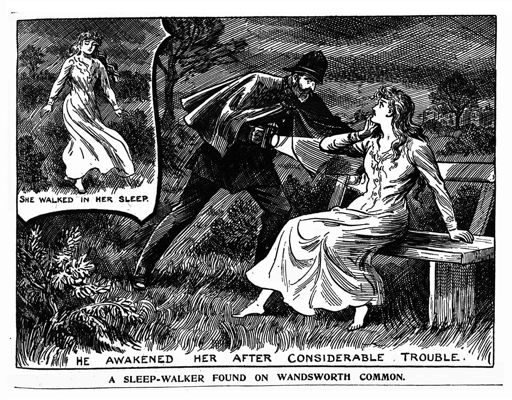
[Subject of Illustration.]
A POLICEMAN found young woman, clad only in a night-gown, asleep on one the eats on Wandsworth Common early in the morning. He awakened her only after considerable trouble. It was then he learned that she had been walking in her sleep. She knew nothing of how she got the common. She is employed housemaid in a house three-quarters of a mile away.
[BNA:
" target="_blank">Link
"Daily Mirror — Friday 4 October 1907
LONDON AT PLAY. How the L.C.C. Caters for the Pleasure-Seeker.
SPORTS AND PETS.
A striking illustratinn of the vngtnecq and many-sidedness of the work of the London County Council is revealed in the pages of the annual report, prepared by the clerk (Mr. G. L. Gomme), and published last night. No inconsiderable portion of the big orange volume — it consists of 465 pages — is devoted to a recital of the provision made for pleasure-seeking Londoners.
Here, for instance, is a guide for golfers: Golf links are provided on Blackheath, Clapham Common, Streatham Common, and Tooting common. Golf practice is allowed on Hampstead Heath and Parliament Hill, and putting golf on hilly Fields and Wandsworth Common.
The following table shows the number of places at which various other games may be playeo and the number of the pitches, courts, or rinks provided: — No. of No. of Pitches, Courts, Places, or Rinks. . . . 14 6S . . . 42 451 . . . 2U 26 38 234 . . . 22 34 . . . 5 10 . . . 35 450 . . . 14 25 Games. Bowls Cricket Croquet Football Hockey Lacrosse Lawn tennis Quoits As everyone knows, the Council has paid considerable attention to the provision of a stock of animals and birds at parks and open spaces where suitable accommodation is available. Fallow and red deer, it is intelesting to observe, are kept in the enclosures at Battersea, 'victoria, and Finsbury Parks and Avery Hill. axle Council is now the happy possessor of about-50 Swans. I90 Geese (8 varieties). 650 Ducks (19 varieties). 7 Storks. Pheasants, doves, pigeons, guinea-pigs, and squirrels are also incluued among many other things over which the Council's parental care is exeiLised. Powers of control in regard to structure and maintenance are exercised by the L.C.C. over the following places: Theatres Music Halls Art Galleries Town Hails Assembly Rooms Dill' Halls Exhibitions Hotels Institutes Halls (Mission) Coming to figures, a total expenditure under Capital Accounts for the year of .3, 707, 262 is found.
Among the thousand and one duties devolving upon the L.C.C. are those of licensing racecourses in the County of London within ten mites of Charing. Cross, payment of the costs of prosecutors and witnesses at quarter and petty sessions and at the Central Criminal Court, and authority, at the request of one or more Volunteer corps, to purchase and hold land for military purposes.
[BNA: Link.]
ST. JOHN'S SCHOOLS, USK ROAD.
The distribution of girls' prizes took place at the, shove schools on Friday evening. The chair was, taken by Mr. J. J. Taylor, and Mrs. Taylor distributed the prizes with the exception of those for swimming, which were presented by the Rev. Hughes, LLD. Mrs. Hughes and Mr. and Mrs. Palmer were among the visitors present. The schoolroom had been tastefully decorated for the occasion by the staff, and it was packed with relative.; and friends of the children and not a few old pupils of the school, some of whom now hold pormible positions in other schools. The chairman, in hi 9 opening remarks, said he noted with satisfaction that the average attendance was 87.2.
It was also most gratifying to learn that so many were to receive prizes for good conduct and punctuality in attendance. The labours of the head mistress, Mrs. M. L. Chandler, LLA., end the staff under her must have been very great. Patience and painstakig alone could have produced the following report from the Government Inspector A high standard of discipline and attainments is taken by the head teacher, and the results are in consequence highly creditable, and merit special praise in the first class."
The chairman also observed that a branch of the "Children's Guild of Courtesy" had been formed.
In conclusion. he said he was sorry to hear that the portion of Wandsworth Common allotted for hockey was so far away that they were unable to avail themselves of it. He hoped that in the near future the London County Council might be prevailed upon to allow them a portion nearer home.
_ _ _ The prizes were then distributed, after which an entertainment was given by the scholars, which appeared to please every one present. At the conclusion of the programme the chairman said the parents ought to be proud of their children, who had attained such a state of proficiency, which nothing but kindness and mutual good feeling between teacher and pupil could bays brought about. The Rev. James Hughes, in presenting the prizes for swimming, said this was only the commencement of teaching the art to the girls, who at first appeared to rather dread the ordeal, but who soon acquired the necessary confidence. Some of them were now able to swim 100 yards with and many of them 50 yards. He had reason te believe he might be able to present more prizes for next year.
The entertainment programme was as follows: Pianoforte solo, Mice M. Norton; action song, "The Tailor and his Mouse, " girls in Standard II; recitation, "Little Red Cap, " Mary Smith and girls of Standard III: action song, "Snowflake., " Standard IV; drill, Ball Drill, Standard II; fan song and drill, music "Country Girl, " Twehe Elder Girls; song, "The Child and the Butter. fly, " Standard It " Roaa'n Dream " — fa glimpse of fairvlandl — Characters: Rosa, V. Nine; Mother Hubbard, E. Woods; Jack and Jill, H. Buckingham and A. Pett; 80-Peep, A. Knowehion; Little Boy Blue. E. Cook; Contrary Mary, V. Parker; Miss Muffet, J. Barnham; Cinderella, L. Sommerville; Don't Dare, K. Campbell; Tom the Piper's Son, F, Winter: Red Riding Hood, R. Deeding: Queen Maio, Elsie Buckingham: action song, "Fairy Circle., " Standard IV: song and dance. "Gypsies, " Standard II!: drill, "Bed-time, " Standard II: song, " Dolly's Good-night, " Stan' dard 111: part singing, "A Merry Christmas, " the school choir. the following is the primlist: GIRLS. PEtzes. STAND tan IT — Bessie Lanslwy. Julia Verken.. May rhate. Th, mas, Alice Janes, Gladys Flatware Anstrai. Svori.ann ITT — Emily Target% Daiay Woodr, FlNieJohn oo, Lily Mote. Connie Merryfield. ri oar Ayre., Bettie Buckingham, Kate Franklin, Annie Potts STAVD4RI) IV. — .Tana Barnhart), Camp. Winitie Floe;chem. Targett, Tins Sommerville. Chrh.vio White, Etta.' ernith. Bertha Ayres. STANDARD V. — Ethel Clark, AliPe Franklin, Green Johns, " Lydia Perry, Annie Knownidea, Mary Amon. STA VI. — LIICT Jonee. Lily ROW Edith Cook, Daisy Dsnison. ST 1, V Elsie Buckingham, Maggie Ayliug, Mabel Root. Screim. PRI/PA. — Lily Thompson and Ethel Clark (no ronduct marka Init during the year), Elaw Bucking. ham (top girl in the @chop!). — Mind Mountain varde), Elsie Birk in@ sm (100 yards). Mabel Root (50 yards), Annie Sales (50 yards).
[BNA: Link.]
"North Down Herald and County Down Independent — Friday 3 January 1908
SUICIDE THIOUGN Yr. John Troutbeck held as inquiry. Batterere. as William Stewart aged 19, an insurance clerk, lately residing' witp his parents at Morella Road, Mailman, who committed maid& by throwing himself in front of an express train at Wandsworth Common Station on the previous He was identified by his father, Mr. Alfred Nicol Henderson, superintendent resistrar for Wandsworth, who dated that on Tuesday night Iris eon complained of headache. He had no troubles of any kind that the witness knew of. He attributed the unfortunate occurrence to Ter-study, as his son bad been working bard to pees an examination to be- come an actuary. He was very ambitious, and wanted to get more marks them the other pupils who were being coached for the exam. U worked very bard, bat when witoma asked him a week ago whether he was not , overdoing it be said he wan not. He said work at the office had been in arrear, but he had got it straight. Mr. Oeorge Kiniber, a draughtsman, of Colborne Road, ltaMaui, stated that on Wednealay mo ghe wee at Waudaworth Common Station. when he saw the deceived man .*anding at the Balboni end of the platform, near the signal-box. An up main-line exprewa ratite in eight, and the porters shouted for the paanetiger4 to stand clear. Rendereon, howcvek jumped into the ift. way, and fell with his body aercon the outer rail. A moment later the engine had gone over him. He certain the net of jumping was intentional.
[BNA: Link.]
"Sheffield Independent — Monday 13 January 1908
Ministers and Their Homes. The President the Board Trade, wlio is about to transfer his London residence from Wandsworth Common, where he has been living for several years past, to Chelwa, will have m'ar neighbour one hts in the Cabinetthe Marquis of Rjpoowho occupies a beautiful mansion tle Brnbankment, few doors only from that of Lord Mookswell. Mr. John Morky and the President of 'lie Local Government Board are now t-he only members of the Cabinet who retdde on the south side of the riverthe Secretary State for India having house at W.mble [BNA: Link.] "Staffordshire Sentinel — Monday 13 January 1908 The Union," and said he appreciated the conditions of life that the meg present had to work under, and he thought the Union to which they belonged had done, and could do, an immense amount to improve thei: conditions.. If there were a Managers' Union started to-morrow, he would be one of the first to join, on principle. If the success of their Union was to be ideal, if the Union was to grow to be more permanent, it rested upon the members themselves to bring that about Be had haq aorne experience of their officials, Mr. John Ward, M.P., and Mr. Blase in particular, and he could assure them that so far as their head men were concerned, they were in the right hands. In his opinion, dur ing the oast five years there had beeen a oecided change racially in the labouring awe( of this country. lie thought the labouring man was better than ever before. He never saw drunkenness now to the extent that he used to see it amongst the labouring classes. The workingmen now had better homes their children acre bettee cared for, and at a class they were far better than they were five years aro, and he put this improvement down largely to the success of Unions. (Applause.) If they wanted their Union to continue to be successful, let each man try to bring new members miring the amnia! year, and he was sure those new members would never regret joining. (Applause.) MR. JOHN WARD, 11. P. Mr. John Ward, M.P., who was heartily remised on rising to respond, said the Union to him during the last 18 years had been prac tically himself; it had been everything, and all the energies he had possessed he had put into his organisation. Mt. Ward spoke reminiscently of the early (iays of the Union. and said he used to spend from, two to three months regularly in Bursiem, agitating the cause of the labourer and organising them into this body. He attended four arbitrations with reference to the wages connected with the labourers of the whole of the Potteries towns between 1880 and 1900, and he was pleased to say they were successful in advancing the rates of pay for labourers connected with the building industry 2 He remembered working on the Masonic Institute at Wandsworth Common, and he remembered perfectly well with what views he took up his pick and shovel and decided to strike out on a new career, wondering whether it would he successful, or whether the workingmen were utterly hopeless to their social condition; but he was glad to say that in spite of obstacles they had unquestionably been able to do an immense amount of good in raising the status of their workpeople, and giving to that section of the community known as the unskilled worker a senile of respectability and usefulness which he was afraid previously the unskilled worker did not possess, or at least, not in the way they would have liked him to have done. He did not say that trades unions had been entirely responsible for that; there had been many agencies at work such as the P.S.A. movement and the Brotherhood movement. The calling of. men together in a sort of fraternal way and the mixing of the different strata of their industrial and commercial society, had in his opinion made their working population during the past 25 years self-reliant; it had taught them how to respect themselves; it had, as a matter of fact, taught them how best to enjoy life and human existence. He believed that if the workingmen would only put their principles forward, if they were fair and reasonable end if they would state their grievances properly and fairly and squarely, as man to man, to those who required their services, they could always get something like decent and humane treatment from the men who employed them, and hence lie said. if their condition to-day was nut what they would like it to be, they might take it from him it was largely of their own making. whatever it was, whether good, bad. or indifferent. When the people of this locality raised their standard of intelligence, when they raised their ideal of what life ought to be, and the amount of enjoyment that should be got out of human existence, just in proportion as they raised their standard and their outlook upon the world, so the standard of cornforth both social, mental, and physical. would be improved, not only for them, but for those who were dependent apon them. This was the beginning of the nineteenth year, and h.. was appointed an officer of this society, having nearly 10.000 members when he was 22 years of age. Whatever his leadership might have been, it had always been the best that he could give, and lie hoped whatever calling those pre ent might be in that they would decide to give the hest they could iu the wprk they undertook. They must not merely work as it were irksomely; they must understand that after all the meanest thing in the world had to be done by someone. The scavenger was as useful as the watchmaker or the architect. (Applause.) Let them understand that they were no mean things creeping about a: it were to save themselves dishonourable graves! applause.) They were men, performing useful inactions in the world, and they weye entitled to respect and consideration from those who required their services, and he thought that when they stood together solidly one with another and demanded fair play. that fair play would be their portion. If they only questioned them selves sufficiently deeply and sufficiently clearly they would understand that if their interest had been neglected it had been due to themselves. Let them band themselves together as men, not to take advantage of anyone. but to see that they got definite and fair conditions of life and labour for the work which they did. (A pplan se.) This concluded the toast list. and a concert followed. which was given by the Spa Pierrots from Hanley. The varicus items on the programme were very good indeed, and were warmly applauded. The artistes were: Miss Annie Newmann ;soprano). Miss Lela Rayner (comedienne), Mr. Harry Barlow (bass). Mr. J. Maynard (tenor), Mr. J. Handles (comedian), Mr. Charles Leighton (banjoist) and Mr. Howard Redding (pianist). [BNA: Link.] "Hartlepool Northern Daily Mail — Saturday 18 April 1908 The booking office of Wandsworth Common Station was destroyed by fire last night. It was built last year. [BNA: Link.] "BOWLING NOTES. On Saturday. May 2nd, the members of the South London B.C. may be reflected to outeemble in great force for the opening of the green at Lyford-road, Wandsworth Common. As exclusively announced in these columns, Mr. John Bryant was induced to retain the presidency of the club, and Mr. Torn Robertson, the erstwhile president of E.8.A., holds the office of vice-president. The latter gentleman is credited with the honour of being the first to introduce northern strand greens into the South of England. Mr. W. B. Dorlwell will, as last season, lead the " brew biddies " in the club's engagements, and Mr. T. Cook. as of yore, will keep a watch. ful eye over the finances of the club. The jovial and kindhearted Mr. J. E. Latham comm again into prominence out hon. Pecretary. and any new residents wishing to join the club should communicate with the above at May Cottage, Althorp road, Upper Tooting. The committee of management consists of ileum. J. Doherty, W. Kerr, C. Morel. T. Moseman, H. Musgrove, SeHey, and R. P. Walker. Entries for the elub tournaments close on May 18th, and for the handicap on May 30th. London County will have the pleasure of providing the first away match for the club on May 13th, and a week later a visit will he made to the Streatham Constitutional Club. Each match is for 12 aside. The Reading B.C. are due at Lyford.road on June 3rd. and three days later the Cardiff club will be entertained. The visit of the Welshmen will doubtless be accepted by Mr. Lloyd George, M.P., himself resident of Wandsworth.Common, as a fitting opportunity to " throw up the jack." This event, unlike arse other functions relating to M.P.'s, need not entail a by-election. Rumour has it that team of Canadian bowler.' will also be seen at Lyford-road during' the se on. A "scotching " time should be experienced on Friday, July 24th, when the South Londoners will receive visit from the famous team of Kirkcaldy bowlers. The preliminary round of the London and Southern Counties Bowling Association silver shield competition closes on Saturday, May 23rd. and the final will be played on Saturday, July 26th. Bowls promises to be well patronised on the London County Council green, this year, and Miss Nellie Gillespie, said to be the youngest howler of her sea, in the United Kingdom, will perform the ceremony of throwing the first jerk and bowling the first wood at the opening of one ot the above-mentioned greens. Its other contents include a " Historical Sketch of Bowls, " from the Pe of Mr. James A. Manson; " How to Bowl, ' by Mr. William Btoneliewer; and "Bowling Greens, " by Dr. W. G. Grace, The Earl of Eoriebery, K.G.. the Earl of Jersey, and Sir Thomas Brooke Hitehing prise some of the patron+ of the amoriation. The members of the Balham Bowling Club will own the season at Boundaries road on Wednesday, April 29th, when a team match will take place between aides captained by the president, Jr. C. J. Garland, and the vicepresident, Mr. T. Simkins. Mr. W. -arson is captain for the ensuing year, and Ifni an abk lieutenant in Mr. R. Elliott. Mr. W. Pritchard is the hon. trea surer, and Mr. W. J. Rogerson the hon. secre. tary. The executive committee include Messrs. A. Cleaver, G. Edwards, E. W. Handcock, B. Dare, J. Ilan, A. J. Manning, and W. Wallis. The club trophies will be played for in the following order: — Club Cup (first handieap); Challenge Cup, presented by Messrs. Treves and Neal (second handicap); Garland Cup, presented by Mr. R. W. Miller (third handicap), and the cup presented by Mr. F. Curtis will be the Championship Cup. Each trophy has to be won three timot to become the property of the winner. The Lambeth Carlton B.C. will be entertained at home on Saturday, June 6th, and on the following Wednesday the club will visit the headquarters of the Hero of Switzerland B.C. The South Londoners are announced to visit the Ralham Green on Wednesday, July Ist, and the captain's and vice-captain's match takes place on Wednesday, September 30th. [BNA: Link.] LIGHTLY PUNISHED Edward Reynolds (35), chemist, 21, Galesbury.road, Wandsworth, was --anted on remand with indecently assaulting Lily Newbury, aged nine, 25, Newcomen-roed, Battersea, at Wandsworth Common on June IS — Mr. Hindle prosecuted and Mr. Henna appeared for prisoner. — Prisoner had been remanded for medical examination, which showed that be was quite right in his mind. — Mr. Francis fined him 5 or one month. [BNA: Link.] "Surrey Comet — Wednesday 22 July 1908 KINGSTON, Wednesday. July 221908. A Grand Old Man. Full of years, full of honours, John Charles Bnckmaster, Justice of the Peace and District Councillor, has, after a life of nearly ninety years, spent in the following of honourable callings, and the pursuit of great passed to "that bourne from which no traveller returns." If to leave the world better than one found it is a joy at the end of life, then that joy must have been Mr. Buckmaster's ; for from the time of his early manhood he was engaged as practical and active worker in social and political efforts for the betterment of the condition of the people, and was privileged to continue his activities until within few days of the end of his long life. When he came to reside in this neighbourhood Mr. Buckmaster was already well stricken in years; but though an old man in years, his wonderful energy and vitality, his remarkable mental activity declared him to still young — younger than many men twenty years his junior. The story of his public life in this locality would fill a volume. We find him engaged a Justice of the Peace, regular at the weekly meetings of the Spelthorne Bench, and daily hearing cases, when the police required, the local police station. Anon, the Licensing Sessions, see him descending into the arena of the Coart plead with his unwilling colleagues to exercise their powers for the reduction the number public-houses. observe him in the last two decades of his life fighting several contested elections lor position on the local District Council. In season and out of season see him contending for the establishment Free Library Teddington, or pouring out the vials of bis wrath upon jerry builders and district councillors who palliated their sins against society. A keen controversialist, ho had attained great facility in speech and writing, and his flow of language was remarkable. He was a picturesque speaker, and carried conviction his hearers hj his transparent honesty, earnestness and persuasive eloouence. Had Mr. Buckmaster been trained for the Bar, must inevitably have achieved distinction. It difficult for those who have known this veteran only during the past twenty years, to realise that before rose upon the local horizon had already >pnii half century in social and political work. The late Mr. A. J. Mundella said of Mr. Buckmaster's early life that "some parts may read like romance." Those who are interested in the story his life may find it in " A Village Politician: The Life-Story of John Buckley." Left motherless at the age two, and his early years served in sufferings beyond the ordinary, the child's character stiffened and formed, and wrought in him the mettle and the courage that enabled him to give practical sympathy and assistance to the moral force section of the Chartist movement and throw himself unflinchingly into the Anti-Corn Law agitation, in spite of the fact that his relations were chiefly agriculturists, who in consequence disowned him. Through the enthusiasm and ability displayed in this agitation he attracted the attention of Lord Morpeth, who advised him to give up politics and turn his attention the growing cause public education. Says Mr. Mundella, " This was the turningand perhaps the savingpoint future life.*' Anon we see him at training college, and subsequently Government official the head teacher at juvenile convict establishment; after that science master a new tradeschool, and finally professor science and art, and lecturer upon cookery, under the Science and Art Department, South Kensington. It remarkable career, and Mr. Buckmaster was remarkable man. He had dear convictions. and the ability and the courage to stand for therm all times and all places. By his consistency and straightforwardness no fern than ov ths loros of his ability, won tha admiration man who were firmly opposed to him in their convictions. Teddington and Hampton Wick are the poorer for the of this devoted life from their midst; and in wide district around kindly, well-esteemed presence will sussed and mourned among men and women in all classes of society. [BNA: Link.] 1908_07_22_Buckmaster_obit_SurreyComet_22jul1908.jpg] "Uxbridge & W. Drayton Gazette — Saturday 25 July 1908' FRIEND OF COBDEN AND BRIGHT — The death is announced, at the age of 89, of Mr. John Charles Buckmaster, J.P., of Teddington, one of the best-known public men in the district. There were few local movements in which he did not take a practical interest, and at the time of his death he was chairman of three Education Committees. In his younger days Mr. Buckmaster took an active part in the Anti-Corn Law movement, and enjoyed the friendship of Richard Cobden and John Bright. It was largely through his efforts that Wandsworth Common was secured as a playing ground for London. Mr. S. 0. Buckmaster, K.C., the well-known Chancery barrister, is one of the deceased's sons.' [BNA: Link.] "Surrey Comet — Saturday 25 July 1908 THE fifTT%inffT COMET. DEATH OF MR. J. BUCKMASTER. Termination %of Long sad Useful Public Career. A Friend sad rkomidMi %% the Mr. It with 4a%p ragnt to-dsj %%nwrii th% death of Mr. J. C. Buckmaster~~ which took plmo Moodoy r%u-toT--% l-. <^ilal be %M witk iUsat oe meiei %< Saeurdey, My A after bed been ttleediee leee Chedleld erd the Kiecetoa Guild ot the CHppled. Althdtwk et tMe bopee tteee eaterteiaed thet be mi(bt footer, yet, batiaff to bit adtaaoed eee. theee rate eery elaader. Deriae the ftrat week of bit illaaea Uiotieboet the emtar pert the lollowiae weak, altbaevk eery veak. tree perfectly ooaactoue. eiaapt hr oaeeeeieel peeled, ead bia eenditiM the aaae uatil Saturday, tree obaafe for the batter. On Sunday the tatprauemant wee ataiottieed until the Than beaaan iroiaa, and m Monday BWbtM UJS a poo deeay. It at worthy note, end etrikiafly in kaepiaa with the of hit liCAte iateaae lore for the poor%that hie laat publio tppeeream, tad leal apeeeh. wee in tapport of the crippled end afflicted. Deceased wee bore February O. IMS. la the little tcrioulMral nllepe of Slapton, Backs, when hit bed resided for upwards of wee therefore bia ninetieth year. Mr. Buckmaster cafe Teddiaitoa about twenty yea% ayo. tad tkiee yeera later aeSated the neat bereeseaieot of hit Hlo-the death ad hie wile, whoee awaory ha plaatd stained (laai wiadow in church of St. AlbaJL Hi had four mm daarhtor, oil of whom ourrivo him. the A. w Column 2 ,fiuh. iohamoa canid BOt S%S2S%S. iSS? sSvx'dSSS^, 777, . . . . werhed let the itiie ud of hie iellow teeaMeae. % Iweed m% jf. kbMi. M^d-a. peep dowmthoM I. BpekS Be pjoafhed%ead wh. tewed ie not Be wha- baa Hie Adweesey Tenipurwooc. Wood had Cookorj Abm%Moa. in whaoh wawoeioftod with Uw Bomb% BordoU Co%o, who had o; e He h%l ho%. ooenty, %aywtc. te Mao. 1895, oad wm oWa- a%%bor of thoJotol Stoadimt for Poanty. Teddiarloa -M tSuWOOTiM, r with, hy lb. PW% secured from IbcM puhlsMtlMe WM shied to (lee bit Mae aollafa sad Mitetsrty tdaeatiM. A few mm. sro, miniatry of the Raw. Father Ooodndk el the of Saoied Heart aiaw hwhia haM. Mr. bapaa la lb. Catholio Che rob, bet wan. aeter — aA ekes friawddnp warn aware ilS-oth% lotb al-w%plaM wLy. His wse too brood. pint to ereeds and lermalitSM ohurohW pood is all of aed m ready to sSalwaboeArmy meetor mrt rherrk hit pieacnee aad hwpatM aa wee t. anpnert the Chorch ef Enjrlaad Charah of Rom. . H. wm deer ead wm often heard eomork thot woo in# rent%plotion her hio%iki ih%4 ha aonAd boot worship hit Ood. Mr. Bockm%ter-- Mr. BnrkmortVr hot pvt dank Storyof Job. BeSSy.. w ini- dpmiM Hw leW A%l. Maadtlla. who Tut PnwdaM of the IbM CommilUa Rderetieo. wm mo Mr. ok iris. Mr. Buckmarito was first iadaoad to attaotK- to adaMtioa. prinei pally the Mokamal rid. ri it, Lord Morpeth, aAarwatda the srteetk Bari o) Carlisle, and both Chief Serf!try aad Lord Lieutonaat Iralaad. Mr. Backawriar mat him whilat it kit leform work, for he lordship waa a atafalarly arikariarim prociea. altar tod knew all edwmeoad time. Ha waa mack impraasad by Mr. Mckmastar%a teal tad ability, aad h%aall bate the Boodior hit to Iraisin, colic reUltimataly Mr. Buekmeriar ahfaiaad appoiotmanl under OoaaraMaat the old SeiaaM and Art Dapartatont at South Km%inetoo. Ha labMied thaM for thirty-tra yaaia, asentually baatraa orgaaiain, teacher, pari he held for dared, after the asaal s%e limit, aad only roHaqaiabad when it WH abolishtd in ISM. Be waa than ptaiioatd off. thottrh hie dye WM net dim ate kit forte abated. % Mis Work far ScScnec Art. Among tbs raried aottritiaa Mr. Bnckmaatsr%a career, that with this work to probably the meat important. Neither his youthful ardour the Anti-Corn Law League nor his picnam sCmnto in tbs attempt praaaree the MetropcCtan Ocmmoos open apneas, nor his untiring agorU at Battenea aU aanwbara for purity and Bonth kSirWn'SmeSm, whiah the nation the of Prince Albert and the energy of Sir Henry Cola, was (rat established, Mrr%ackmsster was appal atad mtiatant keeper nadsr the tow Lord Playfair, sad was placed in charge the Food CoUacticna. organised by insad Dr. Zdwin Tenkmttr who, liks kimsall. was the father dtotinguiahed seas. tkw poet showed such marked that whan an organising master wan requind urmme lbs country the raise ameaos and art isnlrac lion as the basis of national indutoriat, and explain tbs ocndiliont under wkmh the SSt tSs prwt occupied for thirty Tarious~hraachau U art sprsng wM-t& St^TtSlsfe to thus dan to Mr. aaiaasouary anal w muck as to the ndnuaistiaUrn afkrto South Keaaiagtcn aatkcriltos orally looked. That dam of the than Lord President ha tootwed on, the art traassru oollaetsd the annual esktbitlon IJ7I-UJI, whHe in I-7l. the Uesty of the ear lea of food mad mead throughout the ooantoy jlourtohing — daualopment gonial aaattl the eprand ef eemmee teaching, Mr. BuckanasWr, with Inrd Play(eir'a imcooragament, end the aaaitoaaoe. one two friends. publiaM setae altmtsdsty text books of sotsaeo which wwo prsctioaUy -We> Ante which stods%ls obtain laottag bom the work fiwrm the jmis of his Ufo to oslaod. A Hard Life. A oetin Favaral" in in the "aanay haw aaah aaperiaocaa left with %aa and aaeee; httaat environmant to being out kia heal qmalitha. Bereft of hie %otlm, . ha%ora W ay ta% yearn old. %p grandmpthar. tarna%thaaa arc the connecting liaka in the chain of not too happy invaailily. Thea ha Kna-ETStf fat Holy lectured freda Bench where ifty tea yearn aftarwarda eat adaeiaMar jantioa. raa pd Maa pa khia yyrtayMf MMMMfvllj, th- boildinf of ft Country m ansi on, which atill %lands "sn what work akoftld bo%; waa nesrlj csrriod off by %Mll-po-, bftl was the grataitoaa gipay: and finally manual laboar throw himaelf into anti-Cora Law ngititioa the lortiea The AnthCorn Law Agiletion. Beat rained and mmaggamtad aa Mr. BuekmaHar%a uarratira ia, cue can aamly aaa that' hs interact ia political wtaiwnl which culminated ia each important darrlnamiala m our national hiaaory aatirilp whali haartad that all anaaidaraticaa nalii ilr altimata aanaam ware of far anhnrdiaata import, aoca. Ha trarallad about tnuuliy lacturing and dobatiag ia town and rillaga. conducting alactinua, attending nagloctiag nothing that prnmata of oaura had at haart; aad did all thia with aad praciaa Utaullaa dntnil that aa hum hewght. and ifaquallly WQfninil. %mo% tarn cmr Boost%y %s% %os %illtoMU% can never on%end the%. One of the I%t %lections tknt Mr. BnakaM%cr ~ ef Sir Mallhl~ Weed, aad wte toe 3?SmamMLjalk%aSM apM MOM MS --~ paaMaSirS JS/w weald wear aam maenad the battle had what would b. Wm la sturdy Sffhfi the praaarratsM ad palitka M waa-tor bit help aad Itbanllly. The Asfis Hit Uay-. of many Ireuda. leaham Muad z ri thol they woroi%oto rifhft. Hcf% to the noM haiM the regret %d turnm mil who k%w him. o bright mo-jfU of doty well doae. nh%pio% of the poor oad oppri%d, kind bontfontor to tto widow bin APPEBCIATION. The following it orttoo fi% the Mid-Wooklr CoonT of Wodnttdoy Imt: % of tall bl%. Jpbn Ctorko lUii, JmMm of the taoM %d boo. ofler o lilt of ntorly mi%y ytorth tytat in tto MMto bi%iarpMi ooUiofa, and tto panoit gi% idtok, %tto to a ltot tr% which tovno. — Imm the b%tr tton (tato Joy tto oad Bta, ttoa thot Joy anal haaa baaa Mr. iaekMaa%-a; trtto ttoa of tarty aaaatoto to waa eaaagto a araatfaaf, aad %fas warbar mc% aad aclitiflal cfferla tar battasMaat oaadi- tfaaaftto poopfap aad to waa artvtogto to otiaaa baa ocUritiM wftbta taw daya %f tto aad bfa to% Ufa. Wbaa to aa%to %lda ta this aaighboartoto Mr. Baatonrtif ahaady wrtl atrtrbaa ia ytaro; bat aa oM aaaa ta yoan, woadortal oad rttoUty. bit rwrtiiMi m%tol aetfaity dttfarto bto te atffl yeaaayoaogtr ttoa %ay twoaty yean bit Jaafar. Iht %ry bfafaMfa Ufa thfa faaaUty weald a rota%. Wo tod hto oogtgW M JaMiet tto Psaaa. far at tto %nliogt too bgaHbaraa ataph, dafly baariay oaato. %fata. Btmima, bto <%adfag lato tto or% the Coart to flood with hio aawOUag auMsto-ta %-%%aiaa thair far tto saiaatiaa the a%bar of baa%. iksirea hto ia tto laat twa daaadaa of' hs lilt dghtiag aaearal epatsafad ofaatfaaa far poaitioa tto Diatffat Coaaa%. Ia %aoa aad oat eaaaaa of at IVliiagtM, or poariag ont tto rfafa of wrath aaaa Jerry baflfato dfatrtat oeandDort who foOiatod thair aiar agaiaat %faty. A Malta%fallrt, had graat facility ia tpooch ond writing- and his tow was r%arbalda a fieta%oaqno tfookor. aarrfad Maeialisa to' hs bsariro bia baaaaty, ooraottotta aad Ttoodet tloantaea. had Mr. jnckiaatir boon troiord fortho Bor, to aMat \orto% who tors known thfa %otoroo only dnrt% tto part twoaty yo% to that bolero to r% aaaa tto tori- aaa to had alroody aaoat tolfoaaatary aoefal aad political work. The fata Mr. A. J. MaadaUa aaid af Mr. Baeto%far'o party life that -a%o parts a% rood Hto %%aaoa. Th% who art S%alrd tto atory hit life say tod it M A Tiltafo PoUtleioat The tita-Story tf Joha Baekfay. %- Left a%tort% tto ago baa. hio tarty yo% %rod with aatoriaga beyoad tto ordinary, tto atUfaaod fenaod. aad wroaght ia bto tto %Mlo tto eoorago that bto te giro practical eym- potby oad aarttoort fa tto fereo ttelita of tto moti%at aad fa throw Maoartf nafliaehiagly into tto AatMfara Law tgitotfaa, ia Mifa tto feat that hio nfallMi w% chfafly Mvioafaariafa. diMwnod hitoTlir%rh the oatbaafa% aad obOity to dfapfayod this agifatioa to attracted tto alfaatfaa of Lord Mbrprtk, who adriaod hto to gin polities attaatiaa fa growing oaan odaaatiaa. Soya Mr. Mm Jaffa, %The wm Ik. tacela, an. paakapa print af lilt. " _erila%a. ta. fceu\-ia%t!!ar "ri -a {aaaa%t one riot taMUfakaaoat; of% that m aafaaea %afar aaw tvodo-sehool, aad ftaally m pvofa%r aaiaaaa aad art, aad lartarar eookory. tto Seioaeo aad Aft Ifaparfaiaat. Sowtb K%fagfaa. It fa so%rtaMa Mr. SorHautw woe TMMrkable ana. had cfaor eerietfaaa, tto ability aad tto eowrago fa afaad afar th% a% tfa% aad aU pfa%% fosittfpy otvni|htforworda% go faot ttoa fore- his ability, to tto afaaimtfaa aaaa who wan ftrialy %.. e _. t. . Ie Dun to OMn%twa. -oaangv% mm H%pfaa Wick tto poenr far tto fan tkia dorofad Ufa ffaat thair artitt, la district oasaad kindly. woB stt%f PUBLIC REFERENCES. At Taasday aight'a milting of the Ramptca baton heginaing the homana the Chainaaa, Dr! H. B. Nehea, J. F, nea capram the regret the the death Mri%odoMater. mid that although aat readme ia the village Mr. had tthia great iataaam la it. and had the mimnrial Timothy Bipaatt, which wm erected aotraam Boahy Park. AHkoagh (the nheirm. aj did aot profima to with dmaoaad worda Beantt memorial, leave world hotter ka iooad it. would move that rata of farwardad badly. Thin waa tiiinlil the Mr. Ba%oa. tad earriad la aeaal madhtr. ytlvg, ada. . 1 thT lUma which the public had mittlail through %pen the ef mam aprigkt irgiegai, whom cedent Mmit adCalaMraHaa at jacliae %--%---%% %% the mart at Siiikiag at the pebe diekHhatba the % u-n m! t- d, y dear Irimdi%. MeT %aeeter had gaaa hi. them wmw vary law mmAacc the Church and them wha warn act mem heir af it, who dad aog great doat him iar what M had fiar the poor dMtM. They Ml aaw. net they weald bat it mam haaaly wbea nevarty mam b wiadn aad that hemd had gaaa from tkma. Aad ka weald ach thma umialhli that goad mao wha had wartmd dMrM. aad mpamaJly far the pear. WhHe they. nmmmlil him aovk had data allavicHag paaarty of Ike poopla ia Tclfligtm. that work would atiH remem them as oharickaf cry, tad mnamcly kb work uaamtiia with that fa orgaaMag which taak oack liiiml af the Fwmagal wfll toaad aa page J, uS^wSTl%d dhan eem %la the Mawm. aedOn. Meiw Lanr.da oMaial analdmllna made laaaradyntimwtal i. Ar^-. . County Oouaeil im taamiu hmil % Wrldagrura mad. T lihlliti I I%%l %%d d%O%tf Oenmfl cn% Wfcw %%jr [BNA: Link.] SE ALSO FUNERAL REPORT, SAME DATE, p7"
"BUCKMASTER FUNERAL Surrey Comet — Saturday 25 July 1908 THE LATE Mi G%n%ral ManifcatoUoiu ot B*%ard mt Fantral Ycatcrdajr. Tto i*towtt> tk. tot. Mr lit will, th. funeral nw'cTtkTtonr netor. * Inot wtok," k. wrtWra! %% foe "i":?.%% ktot %Tfrito* %konld k* wnrahto aa mj MaoaaCia* 1 kara fiakked Ik. work Irad to d?^ %% peneihto tkra. wkhra %m rototi, ooetphod wMk b, hi. (natilr. Ik* bode %m .odoud ia rototod %%- ptoto MMtoaa ud tk. oely Inran it -or. Bra f.iail. wrratlo para, toiM. Bot atoarallT hi. awlrirad. whora too. factor ks had kata %% araar raan, oould not allow aa* * !& to . "% ptooa wtlkoot ahow ia, ttoir toot atark rrapro, (or kiu to thtor praMooa, and oonraqraotlj than tJa* praarot 81 AW. Charak, tad onwd of poraora oanjrtai,, in whioh all d.ata war. (all, rapra- Atth. ekoroh wm atamw otkwa. Mr. %f Brato. Mr. T, AWillroth, J.P.. H TraorKua, J.p,. Mra Tiaarr?%% Mr. PMlataa, JJ.. Dr. H. & Mr. Joka FaSaaa, Bar. (Vtoar.of P~%ptoa Wiokl. Mr a .J. Wtotortoora. Jat of Wwk). tto Rar. A. Tan era (ehoptoia to toittf Haraptoa Cbart Pttoea), Mr. O. Wrakinrtop Fox (Oeift to EinaMoa Bolfrrra.k Bada Fowfca tad ohto>l..B rad>rdin.rT Kin*), Mr. F. WoodkooraMra A. Baporl Joora. Mr. W. X Scorirar. kr. Brwao-Atwtia. Dr. Pooto, Mr. Saadiarator of Hampton gyfktojl. Mr. W. H. T. Wrfcbor. Major Bom Mr. 0. Rmwuw%raa Mr. l . Loti, %w (rapramtoin, ton Natiooal Cookrrr aad Food Aaonatioal.. Mr. W. O. OnOtor. Mr. A. Molromx (nptamatto* tha MidtHtm* % lott Mrmra Han Joan. ma. aad I to % N.twf , Oarrar, W. Mttor, A. W.ttrktoo aad J. ai:J^rrfc. w T%%r-i^i.%a At tha Chorcii. body waa eoa%yad in alirr iiamllld aar, by aa%a pri%to aarriawaa, waa mat tha Parry-road (aim fay IbaViaar Bar. .A M. Catalat) aad aim all choir, pmoadad the Crum, oarriad Mr. J. A Bn%y. Tba ahialmournamwa%tha tanraaaa daacaaad. Mr. C. A Buckmaster, Dr. Buckmaster, Mr. Stanlay Owan Buckmaster. M-P.. and Mr. Mmtia A Buckmaster; Mr. A J.P. Blnptoa, Buoka; Mr. W. Alaxtn'dar, alark to tb. Bdiahnnrh School Board; and Mr. O. B. Buekmaatar. Iran d%n. Mtanwkila .imp), aad appropriato h-d h%n t>l-%d by tha W. Tha body hayiaw bean wkaalad into the almreh on her. tWbtantifal Cbomk at Enpland ana l Ac waat door, with tha npaaina aa monrana paaaad the aa% and took thatr acata. Than fallowed ataritur tha mmarkaMy appropriate hymn, — Now the teak ia a'cr." Aaotbar kyaw waa alto anas donna mrriaa. — Puna, way to tha eamstary tha o'dMk to roaolatioa ayawathy aad eoadolanoa; joined funeral prnntaainn, walkwhil, th. local jnatiaaa aad walked hahind tha aartiaaw The Interment. the oamitiry, aa wa ha% air%dy said, Aft- waa laraw crowd, whioh hnad both %{*%%* lha.dri% from patm to tha -h-P-H and meludad abowt tha polisa, with aarpaanla, and Shy bo% from tha Councol School. pamoaal friandt %d other, aaaamblad war. Prebendary Ram (Vmtr of Hampton and Rural Dean and ahnirnun tha Ramptoa Grammar Bebool Go%roori), Mr. John J.P. (ahniimaa of Baach), B%lo Mr. Williama loeputy clerk to. iaatiem). Aldermen ArtW^Pri^ !^* Bwkop Brook Lender nod the Bar. W. X. Younjr (of Chrirt Ckurokl. Mr. T. Wheeler, Mr. W. Sawyer. Mr. W. Beadior. Mr. D. Herdmr. Mr. R. B. Skinner, Mr. Hopei Mr. A. J. Walls. Mr. T. Pope, Mr. W. Jerroma, Mr. W. T. Millin. end many ctimu. The body borne to the grave by pel ice-constables, end the committal prayers which concluded the aarrice were said by the Vicar and tha Rer. W. Anderson. After the mourners had left, Mr. Sinclair, of the National Club. etaading.bT open grare. gars oration npon %M many virtue* aad good qualities of the deceased, whom, eeid. bed been hie privilege know aad love for greet many yearn. remarked that their daer friend. Jobs Charles Bnekmaater. wan not man who mads any grant parade or prefemioa about religious beliefs. f%H that hk nmnon ia life wan to do, and did. The funeral arnngwn%ts ware entrust if to Hid# aad Market-pines, Kingston. were ably carried oat under toe superintendence Mr. Onbbine. RsnohitMiis svnspsilrv nod boon received fnasilT from tbo Teddington Diet riot Council, tbs Teddington end Hamptons Reform Chris tbo TVddington end Hsmpton Wick Constitutions! Club, and staff of tbo Teddfagton Council Sobool; also numerous sympathy %fom pomonal friends. The Temperance Party** Sympathy. Aft meeting Cbsofield.. Wodneaduy, in connect ion with tbo temperaaoe fete, Mr. Treogrooso wao asked convoy Mrs. Alexander behalf of family, deep very groat torn cause of temperance boo sustained tbo death Mr. Boekmaster. who had give* addresses similar occasions, and whom earnest and continuous advocacy and efforts vnHoos way* would bo long cherished in grateful remembrance. Hod death net overtaken Mr. aster, end if able, be would bane been aa anal, Wednesday laai THE COUNCIL'S SYMPATHY. Condolence Ezprcaecd Special Meeting. Yesterday afternoon a opeeial meeting of tb* Teddington District Council was bold prior funeral. There were prsesol Dr. Loam don-Down (chairman). Mr. H. Witten (vie*, chairman), and Messrs. BoQ. Barge, Fountain. Gibb. Howe. Medoalf, Millsst, Orton, Leaden and The Chairman said thoy were me* together that day to pay last tribute of respect ten very valued member of the CouneiL Mr. Buckmaster bad bad very buev life many ways %race came Into that district twenty years and an-age which would have entitled him to have osased from bis labours. Tbo*# labour* were of mean merit, but instead of resting upon bis laurels became interestod local affairs and agntn nought to onblie work by joining the District Council. Ever rinse be IIBt-with.one Acrt interval%be bed been oMoaber of their body. Couuefl had kwt not oaf, % twryility bat men who, aoemdaMC t% Hghtu. had trkd da gtaaM poamkla good la, dmtrial. RaTinir M(%md to tfco but pablio Joti%ad%rtaMa Mr. BMkaMMtor %a tin of tko CooDcil. tho CWinou mid u- wm ofanoMooUralT 400 toku.onrUoDA AM e^ss* (or thocoaotr >U Barkmrflter wrr nd% U opjmrrrd. wooU mo hiM.rory hroalT. JorW aria Wrldodly tho m%h 1, #Me4. il% would h%. *eked.tehewele%ed with *ho Sits. ".L Mod ho hod triad to mold So.WW ATomiem. Hi.oo.oto wgto tho fftaotaat ha It%cmgSt*sJgj %%t*%hS wJd^faood , th. world, oad world rmcm* h% mwiory. _ . ~ . Th. Coaneii thro rhawoo odooM tho ftlUno [BNA:
"Bucks Herald — Saturday 1 August 1908 By the death of Mr. John Charles Buckmaster. Ashleigh, Hampton Wick, which took place on Monday, 20th ult.. there has passed away an interesting personality whose memoir will "long kept green this district. Born "at Slupton more than 80 ago. when education had not obtained the prominent position in public estimation that it holds to-day, his own industry and exertions he rose "from the lowly occupation of " a farmer's boy" to a post of considerable prominence in the educational world. In fact, his decease numberless teachers and others of his acquaintance will fe-.-l that they have lost a valued friend. The late Mr. Buckmaster was one of the early students at Battersea Training College. He for a Iong time filled the post of schoolmaster at Parkhurst Prison, Isle of Wight, and later on was on the staff of the Trade Schools at Poplar and Wandsworth. Mr. Buckmaster's wide acquaintance with teachers was, however, due to his position as Organising Master of Schools and Classes under the South Kensington Science and Art Department. The remarkable success which attended his efforts in this post was largely due to the confidence inspired in the Elementary teachers the country, and to his nnfailing sympathy with their difficnlti.- Technical instruction in this country owes its present position very largely to Mr. Buckmaster's official work as the accredited organisations England Scotland have not failed to testify. [BNA: Link.] "Middlesex & Surrey Express — Friday 7 August 1908 Spencer A v. Ealing Park A. — Played at Wandsworth Common enclosure on Bank Holiday in tropical weather on a very fast wicket. Spencer were well represented, but the "Parkites " rendered a good account of themselves. They won the toss, and, although they lost Sydney Foster at 21..3. W. H. Wahid i42 — eight fours) and L. J. Norman carried the .core to 83, when both were sent back. P. J. Williamson (2.3) ', attest sell. hut wicket. fell cheaoly for a time. Sul, e-quently. A. B. Stevens (32) hit in fine Ay', and, thanks chiefly to him, the innings ("n pleted after luncheon) realised 167. S. ', Mi. took for 25 and S, J. Pettitt 4 for 54 runs for Spencer. If B. Corti-, Sydney Foster. and Williamson. backed by, , I to smart work in the field (capital catch, going to the visitors' credit) — the visiting captain (V. J. Prout) also &topping a hest cut, and enabling Collis to run out l'ettitt. who was batting finely — put in excellent work with the ball for the "Park." nine men being disposed of for only 78 run:. . 1 . Ruddy hit out well for 311. and 124 in all were obtained, the teams playing 12 a-side. Curtis a for 421. Foster (3 for V), and tt ii' lianison all bon led capitally. In their second venture Ealing Park compiled IST for 5 wicket., Fester (34). W. Seders. D. Southierwood. and Stevens (the last two "not out") all being seen to advantage. Thf, visitors won a well-contested match by 43 roan on the first innings [BNA: Link.] "Middlesex & Surrey Express — Friday 7 August 1908 Spencer A v. Ealing Park A. — Played at Wandsworth Common enclosure on Bank Holiday in tropical weather on a very fast wicket. Spencer were well represented, but the "Parkites " rendered a good account of themselves. They won the toss, and, although they lost Sydney Foster at 21..3. W. H. Wahid i42 — eight fours) and L. J. Norman carried the .core to 83, when both were sent back. P. J. Williamson (2.3) ', attest sell. hut wicket. fell cheaoly for a time. Sul, e-quently. A. B. Stevens (32) hit in fine Ay', and, thanks chiefly to him, the innings ("n pleted after luncheon) realised 167. S. ', Mi. took for 25 and S, J. Pettitt 4 for 54 runs for Spencer. If B. Corti-, Sydney Foster. and Williamson. backed by, , I to smart work in the field (capital catch, going to the visitors' credit) — the visiting captain (V. J. Prout) also &topping a hest cut, and enabling Collis to run out l'ettitt. who was batting finely — put in excellent work with the ball for the "Park." nine men being disposed of for only 78 run:. . 1 . Ruddy hit out well for 311. and 124 in all were obtained, the teams playing 12 a-side. Curtis a for 421. Foster (3 for V), and tt ii' lianison all bon led capitally. In their second venture Ealing Park compiled IST for 5 wicket., Fester (34). W. Seders. D. Southierwood. and Stevens (the last two "not out") all being seen to advantage. Thf, visitors won a well-contested match by 43 roan on the first innings [BNA: Link.] FACTS FROM MEMBERS OF PARLIAMENT. Although political agitation in respect to unemployment has died down, at least for the present, in somewhat remarkable manner, the distress amongst worker# in many parts of London remains very acute. It was stated by Mr. Burns in the House of Commons yesterday that whereas 38, 678 unemployed had registen'd themselves in London to December 6, the number for whom work had actually been found was 4185. These figures leave very serious margin distress from unemployment, — although Mr. Burns declared in the Lobby, last night, that at least 10,000 men, who would not otherwise be work, had been provided with employment — from funds derived through rates, loans, and grants — by the Local Government Board, the Water Board, the London County Council, Central Unemployed Committee, borough councils, and distress committee-. Notwithstanding the efforts of these bodies, atx'ounts given by various London members, both Unionist and Liberal, of the acuteness the distress in their several constituencies show relatively abnormal industrial conditions in the present year. The views given to our tabby Correspondent are follows; Battersea. Mr. Burns claims that there are proportionately fewer men out work Battersea than in roost other parts of the metropolis. ascribe# this the existence, in his particular district, of parks and common-, where London County Council have been able find a good deal of work for extra bands. For instance, ISO men ere employed this way Clapham Common, 70 men in Battersea Park, and others Tooting and Wandsworth Commons. Clapham. The distress in Clapham proper, says Mr. Percy Thornton, decidedly worae than it was the foregoing year; but it has slightly improved, according the reports him by those who are position to judge, since the question of unemployment waa discussed recently in the House of Commons. Mr. Thornton admits that the improvement is due to the endeavours of the London County Council and the Local Government Board. [BNA: Link.] "DEER HANSARD 18032005 1900s 1908 December 1908 14 December 1908 Commons Sitting Oral Answers to Questions Deer Hunting. HC Deb 14 December 1908 vol 198 c1253 1253 MR. G. GREENWOOD (Peterborough) Ibeg to ask the Secretary of State for the Home Department whether his attention has been called to an incident which occurred on 3rd November last near Uckfield, when a carted deer hunted by the Surrey staghounds, being dead-beat, and with one of its forelegs hanging from the fetlock, broken in an attempt to jump a fence, was worried by the hounds while vainly trying to limp away until the huntsman came up and killed it with a knife; whether he is aware that on 6th November last another carted deer, hunted by the Berks and Bucks stag-hounds, broke its neck in the course of the run in leaping into a lane; and whether, in view of the fact that such incidents are of frequent occurrence, and are inevitable when the sport is pursued under such conditions as prevail in the home counties, he will consider the desirability of so amending the Acts for the Prevention of Cruelty to Animals that such cases may be brought within their operation. MR. GLADSTONE My attention was not drawn to these particular incidents. I have stated before, in answer to a Question, that I think the hunting of carted deer is open to strong objection, but Iregret I am not in a position to make any promise of legislation. MR. BYLES (Salford, N.) Is not the right hon. Gentleman aware that there is a private Member's Bill before the House which the Government could, by consent, press through? MR. GLADSTONE Yes, I am quite aware of that, and the Bill can be brought in again next session. [BNA: api.parliament.uk/historic-hansard/commons/1908/dec/14/deer-hunting"
"Newcastle Daily Chronicle — Thursday 14 January 1909 / man killed on line at Prison Bridge Early yesterday morning the body of a man was found or the London and South Western Railway, near the Prison Bridge, Wandsworth Common. A train had passed over it, and the head was completely severed. [BNA: Link.] "Norfolk News — Saturday 2 January 1909 TOM SAYERS' FIRST FIGHT. The following incident may help to explain bow it is that there have been many regularly put prize fight* which somehow managed to escape the interference of the police : Nothing occurred during the time wa* at Tooting, except this A new lunatic asylum w.i* l-eing built in Garrett Lane for the county o* rev. wa* told off for duty the works, Tom Sayers, afterward* the well-known pugilist, was one of th? workmen. There also fellow named McGrath. One dinner hour a pit hob* Wandsworth Common theso* two ntested with each oth-r which was the bc*t man was given in favour of Saver*. was behind hedge watching the whole thing When called on why did not stop it. explained it all over before was aware of it Not true! Th-s was Sayers nr*t real fight. No. more bricklaying was done him after [BNA: Link. Plus a LOT on "Inspector Bocking's recollectionsbreaking the heads of the Chartists""
"Norfolk News — Saturday 2 January 1909 TOM SAYERS' FIRST FIGHT. The following incident may help to explain bow it is that there have been many regularly put prize fight* which somehow managed to escape the interference of the police : Nothing occurred during the time wa* at Tooting, except this A new lunatic asylum w.i* l-eing built in Garrett Lane for the county o* rev. wa* told off for duty the works, 'tom Sayers, afterward* the well-known pugilist, was one of th? workmen. There also fellow named McGrath. One dinner hour a pit hob* Wandsworth Common theso* two ntested with each oth-r which was the bc*t man was given in favour of Saver*. was behind hedge watching the whole thing When called on why did not stop it. explained it all over before was aware of it Not true! Th-s was Sayers nr*t real fight. No. more bricklaying was done him after [BNA: Link. Plus a LOT on "Inspector Bocking's recollectionsbreaking the heads of the Chartists""
"The Use and Abuse of the English Commons, 18451914 Bucks Herald — Saturday 2 January 1909 London the last days of the dying year have been rendered most unpleasant by a blizzard which produced all sorts of dire results. " Snow, beautiful snow " may be very nice in the country, but in London, to the vast majority of people it is an unmitigated nuisance. This morning it was difficult to get to the City, for 'buses were few and far between, and the muclilauded electric tram service had broken down as it always does when a little extra pressure is put upon it. In the main thoroughfares the surfaces were covered with churned coating of melting snow and mud, and when at last the City was reached it was found wrapped in sepulchral gloom. Anything more depressing could hardly imagined, and the few business men who had ventured up from their suburban homes soon returned to them, leaving their clerks to put in few hours under the glare the electric lights. The work of street-clearing is proceeding apace, and the "unemployed" are luck! The cost promises to reach huge total. The authorities at Westminster this morning placed the figure for the whole of London at from .130,000 to .150,000. The irrepressible British youth has made something out our visitation. With plenty of snow to favour the sport, toboggan carnivals commenced at early hour Hampstead Heath. Wandsworth Common, Hilly Fields, Lewisham, and one or two other favoured spots around the Metropolis. Hundreds of people flocked to these resorts with every kind of article, from the solid bob-sleigh the impioved orange box. and the scene was one of great merriment. It is also good to know that at this trying season much being done to relieve the sufferings of the poor, and bring brightness the lives of neglected children. . . . " Finally, if Inot too late, Iwill again take the pleasure of wishing my readers A HAPPY NEW YEAR. [BNA: Link.] "Bucks Herald — Saturday 2 January 1909 London the last days of the dying year have been rendered most unpleasant by a blizzard which produced all sorts of dire results. " Snow, beautiful snow " may be very nice in the country, but in London, to the vast majority of people it is an unmitigated nuisance. This morning it was difficult to get to the City, for 'buses were few and far between, and the much-lauded electric tram service had broken down as it always does when a little extra pressure is put upon it. In the main thoroughfares the surfaces were covered with churned coating of melting snow and mud, and when at last the City was reached it was found wrapped in sepulchral gloom. Anything more depressing could hardly be imagined, and the few business men who had ventured up from their suburban homes soon returned to them, leaving their clerks to put in few hours under the glare the electric lights. The work of street-clearing is proceeding apace, and the "unemployed" are in luck! The cost promises to reach huge total. The authorities at Westminster this morning placed the figure for the whole of London at from 130,000 to 150,000. The irrepressible British youth has made something out our visitation. With plenty of snow to favour the sport, toboggan carnivals commenced at early hour Hampstead Heath, Wandsworth Common, Hilly Fields, Lewisham, and one or two other favoured spots around the Metropolis. Hundreds of people flocked to these resorts with every kind of article, from the solid bob-sleigh the improved orange box. and the scene was one of great merriment. It is also good to know that at this trying season much being done to relieve the sufferings of the poor, and bring brightness the lives of neglected children. . . . Finally, if I am not too late, Iwill again take the pleasure of wishing my readers A HAPPY NEW YEAR. [BNA: Link.] "The Era — Saturday 9 January 1909 MISS ITALIA CONTI At Liberty. 41, Crockerton road. Wandsworth Common. [BNA: Link.] "The Era — Saturday 9 January 1909 MISS ITALIA CONTI At Liberty. 41. Crockerton road. Wandsworth Common. [BNA: Link.] "Shoreditch Observer — Saturday 9 January 1909 The proposal to form bowling-greens Wandsworth Park, and on Tooting and Wandsworth Commons has been abandoned for the present. [BNA: Link.] "Newcastle Daily Chronicle — Thursday 14 January 1909 / man killed on line at Prison Bridge Early yeAterday morning the body of a man was found or the London and South Western Railway, near the Prison Bridge, Wandsworth Common. A train had passed over it, and the head was completely severed. [BNA: Link.] Manchester Evening News — Saturday 16 January 1909 MARRIED MAN'S DECEIT. A Pathetic Farewell A verdict of suicide was returned at an inquest at, Wandsworth to-day on William Powell, a chemist's assistant, of Kidderminster, who was found decapitated on the London and South-Western Railway at Wandsworth Common on Wednesday. The evidence showed that the deceased was separated from his wife, and had been passing as an unmarried man, gaining the affections of a young lady who lived with her mother. On his real position being discovered the mother and her daughter wrote him letters, as the result of which 'no, it was stated, attempted suicide in December by taking laudanum, for which he was bound over. On the body was found a letter addressed to the Coroner directing that all letters, photos, &c., be given to a young lady whose name was not disclosed, and that all property belonging to deceased, which was in possession of a certain Kidderminster lady, be given to her. The letter continued God forgive me for all my sins. I cannot stand this life any longer. I have not a penny in the world, and my heart is broken. I have no wish to live. ____ The latetst London parlour craze, "Futty," is football on your own table. Ask to see It.-E4D.I [BNA: Link.] "Manchester Evening News — Saturday 16 January 1909 MARRIED MAN'S DECEIT. A Pathetic Farewell A verdict of suicide was returned at an inquest at, Wandsworth to-day on William Powell, a chemist's assistant, of Kidderminster, who was found decapitated on the London and South-Western Railway at Wandsworth Common on Wednesday. The evidence showed that the deceased was separated from his wife, and had been passing as an unmarried man, gaining the affections of a young lady who lived with her mother. On his real position being discovered the mother and her daughter wrote him letters, as the result of which 'no, it was stated, attempted suicide in December by taking laudanum, for which he was bound over. On the body was found a letter addressed to the Coroner directing that all letters, photos, &c., be given to a young lady whose name was not disclosed, and that all property belonging to deceased, which was in possession of a certain Kidderminster lady, be given to her. The letter continued God forgive me for all my sins. I cannot stand this life any longer. I have not a penny in the world, and my heart is broken. I have no wish to live. ____ The latetst London parlour craze, "Futty," is football on your own table. Ask to see It.-E4D.I [BNA: Link.] "Sheffield Daily Telegraph — Tuesday 13 April 1909 EASTER MONDAY IN LONDON. Rain Interferes with Holiday Makers. Eastertide is essentially a Londoner's holiday. The three or four days' relaxation which is afforded by the festival gives the Cockney opportunity of enjoying himself such has at other period of the year, and, needless to say, it is taken full advantage of. Friday, Saturday, and Sunday created record in the way of sunshine, and this accounted for the unparalleled exodus which took place from London to the seaside and country resorts on those days. Yesterday, however, the Clerk of the Weather was unkind, and although the morning opened clear, later heavy clouds began to gather and rain commenced to fall, with the result that many who had seized the opportunity of bringing out straw hats and other summer attire had cause to regret their somewhat hasty departure from winter conditions. But notwithstanding the uncertain state of the weather, the many thousands Londoners who annually look forward to Easter Monday for outing took their trips abroad as usual, although the entertainments under cover had a rather larger percentage of holiday makers than is generally the case. The various theatres and music-halls, where special Easter Monday "shows" were provided, did excellent business, and the National Gallery, the Tate Gallery, the Wallace Collection, the Tower, and other places of artistic and historical interest, received their full quota visitors. Madame Tussaud's was also the Mecca of many. In the East End, brake load after brake load of Cockneys, with their women-folk, set_ off for Epping Forest and other popular spots, with flags flying and concertinas playing, regardless of threatening rain, and only intent on tlioroughly enjoying themselves. Many took the opportunity of having a day's racing at Kempton Park, while others journeyed further afield, and took their annual trip to Brighton and other seaside towns, which outings were offered at specially cheap fares by the various railway companies. On the south side of the river, additional cars were ran on the London County Council tramway system to carry holiday makers to Clapham Common, Streatham, Wandsworth Common, and suchlike open spaces, and large crowds waited at the termini at the various bridges, in order to obtain a seat. In the west, the London United Tramways Company. notwithstanding the threatened strike, had no difficulty in carrying thousands of trippers to Kew Gardens, which proved a source of great attraction, Richmond, Kingston, and Hampton Court, and other up-river resorts. In the north the tramway extensions, which have been carried out by the London County Council during the last twelve months, proved bo a t boon to the residents of Islington, Highbury, King's Cross, and other nortnern disbricLs. and the taims running to Highgate Woods, Bamet, and Finchley were crowded throughout the day. The Alexandra Palace had some 80,u00 visitors, and the special holiday attractions included a circus, minstrel entertainments, music six military bands, a grand firework display Messrs. Pain and Sons. What created most interest, however, was the ascent of two balloons during the afternoon, under the direction of Professor Gaudin. As at the Alexandra Palace, the chief attractions the Crystal Palace, wh:ch was visited by over 70,030 holiday makers, consisted of balloon ascents and fireworks display. The other attractions consisted of variety entertainments, a performance "The Gentleman Jockey" in the theatre, music the Coldstream, Grenadier, Irish, and Soots Guards, with the drums and fifes, and in the evening a display of Brock's fireworks — one of the finest shows of its kind yet given- The scenes on Hampstead Heath were of the usual holiday character. Londoners in their thousands assembled there, and the famous Heath presented the picturesque appearance which has made it celebrated. The rain in the afternoon, however, sadly interfered with the merry-making, and the crowd had, perforce, to forsake their favourite spot at a much earlier hour than would have been the case had it been fine. [BNA: Link.] "CYCLING PLANE / AEROPLANE AERIAL WC [BNA: Link.] What was a Cycleplane or "Cycloplane"? Western Times — Saturday 21 August 1909 Inventive Physician's Sad Death A verdict of "Death from natural causes" was returned at inquest Wandsworth yesterday, respecting the demise of Taylor, 78, retired physician, and formerly coroner and magistrate for Woodstock, Oxfordshire, who expired whilst cycling on Wandsworth Common early on Thursday. The deceased, who suffered from heart disease, left home the early hours to try a cycleplane which had made, and the brought heart failure. He was found dead by constable. [BNA: Link.]
South Western Star — Friday 3 July 1908
London Evening Standard — Thursday 10 December 1908
"On 12 Mar 2022, at 16:24, Philip Boys
[BNA: Link.]
Cycleplane?
Western Times — Saturday 21 August 1909
Inventive Physician's Sad Death A verdict 0 f "Death from nAtural causes" was returned at inquest Wandsworth yesterday, respecting the demise of Taylor, 78, retired physician, and formerly coroner and magistrate for Woodstock, Oxfordshire, who expired whilst cycling on Wandsworth Common early on Thursday. The deceased, who suffered from heart disease, Jett home the early hours to try a cycleplane which had made, and the brought heart failure. He was found dead by constable.
[BNA: Link.]
Mr. John Troutheck held an inquest on the body of Frederic Taylor, aged 74, of Beauchamp-road, Lavender Hill, a retired medical practitioner who died from heart failure whilst testing a contrivance.
The widow dated that her husband went out at four o'clock on Thursday morning to try a cyclo-plane he had invented before the traffic got too dense. He had often done so before.
A police-constable stated that be found the deceased lying dead on the road side near Wandsworth Common, with the contrivance on his head. Witness had previously seen him cycling with it, and he appeared to get along as if nothing was wrong.
Dr. Trevor said that the contrivance did not contribute to tie man's death.
A verdict of natural death was returned.
[BNA: Link.]
"COMMON SCHOOLGIRL COMMENDED.
John Johnson (69), a costermonger, of 56, Welford road, Croydon, was charged on remand with begging from house taboos* at West Side, Wandsworth Common, on Monday week. — Prisoner's arrest was the outcome of the smartness of a scboolgirl named Holly Leggett, 40, West Side, Wandsworth Common. He tried to obtain money from her by telling a pitiful tale about his wife having been robbed at Clapham Junction which she did not believe. She followed him and discovered that be told a somewhat similar story to a gentleman. She then gave him into custody.
- lt was stated that prisoner had served 30 years in prison, including 21 years' penal servitude for minor offences.
- Mr. de Grey said great credit was due to the girl, who followed prisoner and found him out. He would be sentenced to a month's bard labour.
Prieonee: Thank you, air.
[BNA: Link.]
AN "INIQUITOUS" PROPOSAL
A proposal to spend 35 on tar-paving a footpath on Wandsworth Common. near Wandsworth Common Station, objected to by Mr. Phillip, who pointed out that the Borough Council paid heavy sums to the County Council and might not to do that body's work as well. He mentioned that in a similar matter the London County Council had turned its back on Balham.
Mr. Lidiard said the matter rennin-1 a gond deal of consideration. If the Borough Council started this kind if thing where was it going to stop. Mr. Wire said the path in its present condition wee a disgrace. Be urged the Council to carry out the work. Mr. Turnbull followed with the declaration that the proplesl was iniquitous. The Borough Council osteht not to make good the negligence of the County Council. Mr. Wise real document which showed that the Borough Council had agreed to maintain the path. The Council referred the matter back to the committee.
[BNA: Link.]
"Sheffield Daily Telegraph — Thursday 13 January 1910
Mr. Lloyd-George's Old House in the Election. Tho house in which Mr. Llovd-George formerly resided at Wandsworth Common bound up with Liberal traditions to such an extent that the present occupier has decorated the roof with a huge poster enjoining the neighbours to "Vote for Warren," the Liberal candidate for Wandsworth. The place has, indeed, become for the nonce a glorified posting station, election literature creeping up from the garden fence to the chimney pots, and the main poster can be read a mile away. But Liberals are few and far between in that part of London, which has been represented by Sir Henry Kimber for quarter of a century.
[BNA: Link.]
"[Needs closer attention since I can't work out whether Wandsworth Common was deemed good or bad!]
Leicester Evening Mail — Saturday 15 January 1910
COMFORTS OF WELFORD ROAD.
A topic that is very. mech to the front in The Match with ffirmineham. "Rugger" circles just now is that of ground To-day speculation will be rife as to the accommodation. There has been rather a outcome of the English Cup-tie between Lot said about the inadequacy of the Birmingham and Fosse. The tie is one of the new ground at Twickenham, but that is for, three in which Second Division clubs meet, perhaps, only one great event in the whole Wad although the League records of the rear. hat about a ground like that of the teams are of a totally different character, I,ondon Welsh at Wandsworth Common. there is not the slightest doubt that the game The Welford Road enclosure thought of in will be one worth watching. Fosse possess contrast is a veritable fur-lined drawing., far better record than Birmingham, being ro om. Local lover* of the have heaps 14 points above them in the and an to be thankful for. So have the players, the only occasion on which the clubs have when at home, for the club house on the met this season the Leicester eleven won by ground is a luxury. Compare it, for in-3-1. This game was played on the Filbert stance, with the dressing accommodation at Street ground, and it is very likely that as Wandsworth Common. 'fhe difference is as the Cup-tie is to be _played at Birmingham great as walking in a muddy ditch is from that this margin be reduced, for it is motoringl have done both inside the same well known vast difference exists minute. But think of it! In up-to-data between Cup and League form. Still, if Fosse London, and not an inch of cover around play with anything that spirit and dash the arena; not even a stretch of canvas over of which they are capable, and the defence the reporters' table. There are some open maintain that perfect understanding and flower-pot stands for spectators to sit and solidity which has distinguished its perform- risk every possible disease known to science, this season, there seems to be no reason Old as am I should not have preferred why the Leicester team should not delight playing in that keen NVeeterly wind to their supporters by pulling off a welcome watching. victory.
Enough of Wandsworth! It Fosse do not seem to have much luck in however, the comforts enjoyed by the cup competitions, however, and it is rarely titters of the Tigers' home matches. It that they succeed in advancing beyond the shows that not only in the calibre of second round. year they did make a sport provided, but in other matters, Tiger towardsthe Palace by defeating suporters get their money back. NOW, Watford in a replayed tie at Leicester, but transfer with me. in thought, to Twicken. their next opponents were Derby County, barn! Remembering our two great seated who inflicted defeat upon them. Fosse seem and covered stands extending practically to be warticularly unlucky in the matter of along the whole of both sides of the playing the draw, and it is rare that local people pitch let us enter into the indignation that have an opportunity of witnessing a cup has ben aroused by ts arrangements of the match on the Filbert Street ground. The Rugby 'Jnion for te -sal game coffers ef the club, therefore, do not gain between England . much advantage from its cup contests, but The first cause for I hope that this year the team will have a fact that there are littla better luck, and that it will some 3,500 are On Stand "i milky tangible advantage from partici- and that the whole PO,Czon. in be great football tournament of plied for and sold. country. the whole basins,' latAtrustional
[BNA: Link.]
"Illustrated Police News — Saturday 9 April 1910
THE RED BAND
or
The Mysteries of the Mint
By Douglas Stewart
Revelations of Life in London Seventy Years Ago
CHAPTER VI, The Mystery f Rose Lodge, Nightingale Lane.
At the furthermost end of Nightingale Lane, and facing Wandsworth Common, at the period our life romance, stood pretty cottage-like tenement that with thatched roof and covered with jessamine, clematis, and climbing roses, was a veritable arcadia in summer, and in the winter wore a cosy, cheery, comfortable appearance.
The night following the illuminations and festivities in London was a dark and murky one — the moon, in a clouded sky, only occasionally illumining the highway and open country.
Black, grim, and weird looked Wandsworth Common, with its thickly-wooded furze-bushes, brambles, and giant fern, while a finger-post at its cross-roads. in the flashes of pale moonlight, appeared like a tall, spectral form in the centre of the bleak, open waste.
Looming out in the gloom, Rose Lodge (as it was called), with its white stuccoed front and its grey roof, looked cheerful and inviting the passing wayfarer, a light from diamoud-paned window in the upper torcy throwing out bright gleam of yellow in the murky air. Faint and dull the hour of midnight echoed over the common as it boomed out from the parish church of the old town.
At the last stroke of twelve was dying away the muffled figure of a man suddenly striding forth from Nightingale Lane mad his way the gate of Rose Lodge.
This obstacle to the entrance to the garden running all round the front of the house being locked, was unhesitatingly scaled by the midnight visitor, who, darting across the grounds, and gaining the hall door, opened it without any delay or trouble with a key he had taken from his pocket.
Softly this mysterious and ill-timed visitor made his way into the hall, closing to tho door without sound of creaking hinge or bolt.
Well acquainted, in spite his seemingly burglarious entrance, appeared the intruder into the lonely house.
Though pitch dark he, w;ith unerring footsteps, made his way to a flight of stairs, and ascending these with the cat-like tread had pursued all along, presently paused at the door of that room from the window of which flashed the yellow light into the grounds outside. Placing his ear to the door listened intently for any sound from within. All, however, was quiet, and skilfully now, for the door was locked, he with a skeleton key, succeeded in gaining admittance. With flashing eyes that shone like polished steel from the eyelet holes of -a velvet mask, the man mystery passing into the room, at once made his' way to table upon which scattered variety of letters and papers, some fresh and of late date, and others yellow with age.
Stooping down for moment, the intruder cast glance upon an old man seated by the table, his head hanging back over his chair as though overcome by fatigue had fallen asleep.
Gone! as Pedro predicted, and I'm safe ! muttered the stranger, who leaning forwards, now clutched at the pile of yellow, faded papers the table, in his eager haste not hearing a soft footfall outside nor discerning the tall figure of woman standing by the now half-open door.
Only as a slight exclamation escaped the lips that spring figure at the door did the man, with startled cry. turn upon his heels, the mask he wore, as he did so, falling from his features.
"A deep-laid, villainous plot, carried out with all your usual cunning, Miles Belton!"
The woman's voice rang clear and menacing, ns with extended finger she pointed to the grim, ghostly form lying in the chair.
"How came you here, Deborah Sjmiiks? Il thought my undo had strictly ordered you to remain in the house at Portman Square? said the alarmed Belton, still clutching the coveted papers stood in rage and fear glaring at that tall, erect figure by the door.
"Sir Arthur Belton desired me not to leave his town house, yes, but I came here to warn him !
"Warn him of what?
Of a cowardly and vile plot on his life ! But 1 arrived too late! follower and assassin, Pedro Vinezzi, here before mo ! "-
Woman, you are mad ! There was an ominous glitter, a tigerish expression in the steely blue eyes now, the speaker made step forward.
Stand back ! Don't attempt any tricks with me. My clog, Snapper, is outside! said the woman, with a slight wav o! her hand huge savage-looking mastiff
PIC
CLUTCHED AT THE PILE OF YELLOW, FADED PAPERS.
crawled in from the dark corridor, and _ Maude Mainwaring, followed the servant sinking down at the feet of his mistress girl into the house tenanted by the burly with & fierce growl, fixed his gaze on the smith. stranger.
Conducted into a pleasant, cheerful little
You are playing dangerous game De- room overlooking the Thames, the servant, borah Spinks ! said Miles Belton in a despite their protestations that they did not tone of rage and fear. .
l}} lre anything, left the two frmnds alone while she went below to prepare refreah"
You will find you are playing a losing mentg for them one ! was her defiant reply. Very pale and wan was Maude's pretty
Bah! Do you think Ishall allow face, a hectic flush mantling her comlate uncle's housekeeper to thwart me in panion's cheeks, whose dark eyes kindled my plans? You should know me better, as exclaimed in an excited tone : Marm Deborah ! Cheer up, dear! When things are at your suggestion!"
I have known you long as an u.nprin- their worst they sometimes mend ! Rememcipled and daring schemer, man who her, Maude, have a very powerful ally hesitates at nothing to gain his ends, as working on our behalf. That good creawitnesa that wretched old gentleman ture. Bond, would not have sent that verbal poisoned your suggestion ! message by the dwarf Come,' without he
"My uncle poisoned? What can you be thinking of. He has evidently died of a fit!"
had learned something of importance." thinking of. He has evidently died in a But neither the honest smith nor anvfit i one else cau shield now, Laura, from my late guardian's wicked nephew ! Left his sole heirmy little worldly wealth confiscated unless Imarry him. 'That wretch, Miles, has me at his mercy," said the poor girl, gobbing bitterly. Not solely at his mercy, Maude, while lam near to protect you! See ! you know that writing?" Rising from her seat here, the lovely brunette, leaning over the table, at the other side of which sat the weeping girl, held out for her perusal time-worn and faded letter. Very brief were the contents, and starting up Maude, with a trembling, nervous grasp, clutched at the document. And I say has died by poison !
Perhaps you can tell next that you can prove it!
Yes ! I can do that Miles
There was startled uneasy look upon Beiton's taco now, and, forgetting the dog, made a step forward, only being saved from the latter's fangs his mistress forcibly held him back.
Have a care! I don't answer for Snapper."
Fierce giving utterance to fierce oath the enraged and discomfited villain exclaimed, Tell me, woman, what you know and what you want!
Ah ! Now we're coming to business.
But. uuh! we will hold further conference below. The dead with the deadthe living with the living! With shudder, still holding the mastiff by its collar, the woman beckoned Miles to precede her she left the death chamber, softly closed the door, and in another five minutes the strange trio were gathered in a back parlour of the house, the dog never moving its fiery red eyes from the face of the man as the latter conversed long and earnestly with its mistress.
CHAPTER VII, The Meeting with the SmithA Consultatio The Message from the River.
It was upon a bright and sunny morning, about a week after the incident related our last chapter that two women, making their way down Nine Elms Lane, came pause they gained detached dwelling standing on that side of the highway abutting on the river.
It was an old and time-worn building, its blackened wooden frontage (in parts worm-eaten and decayed) and its low red-tiled roof denoting its antiquity.
Knocking timidly at the door of the lonely-looking house, the summons was at once answered by a smart, buxom girl, with red face, and large laughing blue eyes, who with a genial smile exclaimed, You the young ladies master hev been awaitin' for, I suppose? He's jest gone out to Nat Whiffles, the butcher, and said as prap's you'd wait if you coomed?
Certainly we will wait until your master Mr. Bond's return. We are sorry we're late, but we could not get here before," said the beautiful girl, Laura -Anson, who, with her companion, pretty
Maude Mainwaring, followed the servant
[bit missing]
To-night at eight by the Pont Neuf," she read aloud. That was allno name or initials affixed. But in a husky whisper Claude breathed the name of her lover's hateful cousin. _ * Miles Belton? Yes ! You recognise the villain's handwriting?" "Yes! Was that brief message sent to you? said the girl with a shudder and questioning glance of surprise. No, Maude! This scrap of paper was found on the body of my young sister, Bella, when she was dragged from the Seine the night of January 1, 1835!" Poor girl! Andandshe was drowned then, Laura, that New Y'ear's Eye, two years ago?" Found drownedyes, and placed in the Morgue, but I am convinced that the hand a cowardly assassin hurled her into the river! How awful! And he, whom you suspect of having perpetrated so foul deedwho was he?" There was no reply from the now ashen Laura's lips, but with her fine eyes aflame, she tapped significantly with her — fingers the crumpled piece of paper she held her hand. God ! man is very fiend wilio holds me his power! cried the young heiress, she suflk again into her chair. Hold him in your undying hatred, but fear him not, Maudethe wretch will even, tually meet hia deserts, be assured. He is enmeshed into web of crime from which will only be snatched the hangman's hand. His wretched unde's sudden has given to the ruffian wealth and power, tout my wit against his gold! Iwill hunt him down to destruction tnd will know rest until I have avenged wronged sister's death ! Grandly beautiful Laura Anaon looked in her wrathher tiny hands clenched, and raised heavenward, while, like a lovely lily broken at the stem, Maude, with drooping head, aat by the table, apparently prostrated by grief and despair. A heavy footstep outside, succeeded by the opening of a door, now caused the two girls give utterance to a simultaneous cry of glad greeting, and in another moment the brawny smith was seated with them in the room. "Don't be downhearted, pretty," said the giant, kindly, as he gently patted with his huge hand the sunny hair of Maude. We have found out the tiger Belton's lair, and by his master, the devil, and my goodly forge hammer, I dare swear by this time to-morrow we'll have his cousin safe "out hia talons!" " I knew you had discovered poor Frank's prison house," said Laura, as she pressed with her soft palm, the hairy fist of the smith, who with smile exclaimed: "Well, it I exactly found out the place where that demon had hidden his cousin. It were Tiny Tit, the dwarf." " Heaven reward him for the deed," cried Maude, with excited fervour. "But where is poor Frank, and can we rescue him at once We can, do nothing until dark, pretty! It's a rough crib they've got him ina house the police is rather shy of." "And where is it?" asked 'Maude, with a shudder. ,~ Mint Street, Southwark, pretty. That devil of cousin has got Master Frank actually in irons in a cellar of the old Duke's Head, Warm him ! but I'll soon rid the youngster of his gyvesand to-morrow weil have him here with us ! How will you effect thief asked Laura anxiously. Oh, Bond, have a care! good fellow. Should that demi-devil have tho least suspicion of your intended project all Would be lest r' Never fear! I know man ! Heart alive 1 'tvyouldn't be such a daring job entering the Duke's Head to-night as yours was, misaie, when you really made your way into the old Marsh House, Battersea Fields! said the smith, cast an admiring glance on the lovely face the girl that caused a momentary flush to mantle her cheeks. (To be continued. J A curious accident has occurred on board the steamer Trafalgar, Cardin, which has put into Falmouth. A young stoker named" William Orchard was engaged shovelling coal into one of furnaces when there was a loud explosion- A sheet of flame shot out of the fumace> and there was a strong smell It is surmised that a stray blasting cartnac. must have been left in the coal- was so badly injured that died later.
[BNA:
"Illustrated Police News — Saturday 21 May 1910 CHAPTER X continued [BNA:
"QUOITS Owing to the Wandsworth Common Police Club having withdrawn from the league, no match will be played this afternoon, but Mr J. Lane, of the Hanwell Quoit Club, will play a match with Mr. W.H. Davis, of Grove Park, in the first round of the Chesterman Cup at 5 o'clock. [BNA: Link.] "THE END Illustrated Police News — Saturday 2 July 1910 START ON MAT 1. By May Ielectric trains will be running from London Bridge and Victoria Stations, right through to the Crystal Palace. Already the overhead girders are in position, and the contractors have promised a delivery of the rolling stock early in April. The carriages will be similar to those at present in use on the London Bridge to Victoria line. It is estimated that the journey, which DOW takes half an hour, will be reduced by at least ten minutes, and the large quantity of rolling dock ordered by the Landon, Brighton, and South Coast Railway will permit of trains being started ima& cliately they are full, and run at about five-minute intervals Many of these trains will be non-stop ones, and on Saturdays and holidays it will also be possible to introduce steam-driven trains to cope with the iecreassd traMc. The route to the Crystal Palace from Victoria will be via Battersea Park, Clapham Junction, Wandsworth Common, Balham, Streatham-hill, West Norwood, and Gipsy-hill; that from London Bridge via South Bermondsey, Peckham Rye, Tulse hill, and Gipsy-hill. From the Palace both trains will go on to Norwood Junction, where the principal power station will be situated. AU the high tension apperatus, which is of the simplest nature, will be inclosed in an entirely fireproof steel compartment, and access to it can only be obtained after the current has been cut of and connected to earth, thereby rendering it absolutely safe. This is otw tamed by a very simple interlocking arrangement. All the currents for lighting and control, and, in feet, every circuit to which it is possible to obtain poems, while current is on, in no ems ezcseds 300 volts. [BNA: Link.] "Belfast Weekly Telegraph — Saturday 14 January 1911 PUBLISHED BY SPECIAL ARRANGEMENT ROMANCES OF CRIME By the author of.e author of " My. Remarkable Clues," be., be. STRANGER THAN FICTION. A more singular series of puzzles than aal presented by the case of Adelaide Bartlett, &rwith poisoning her husband, can im cited. It explanation, and ems respect occupies a unique position. It instance in criminal annals of intentional poisoning where death Iran by the swallowing of chloroform. Apart from the mystery of the death itself. the story presents unusual elements of romance, such, indeed, as are more likely to be found in the creations of fiction rather than in real life. -The chief actor in the story was a fascinating French girl, with the attractive name of Adelaide Blanche de La Treadlie, who came to England from her native plant, Orleans, in her teens, on a visit to the family of a Mr. Charles Bartlett. She was slight in figure, with an olive vmplczion which bad not a trace of sallowness Ii it, big black eyes, and luxuriant haira trim daughter of Southern France. _ At the louse of Charles Bartlett she was Introduced to her host's brother, Thomas Edwin Bartlett, who straightway fell in love with her. Re evidently believed in the wooing that it, not long a.cloing. and before three months were over the two were married one bright spring morning in the parish ehnSch at Croydon. The bridegroom was considerably past thirty, the bride twenty. At the very outset Mr. Bartlett showed to .1: possessed of singular ideas. Thus the marriage we. not followed by the usual blissful honeymoon trip. Instead, the amorous Edwin peeked off his bewitching young bride to a wheal at Stoke Newington, to complete her education; and from there. later on, to a convent school in Belgium. It the oddest gement possible. the child-wife working hard at her studies, spending her holidays with her husband in apartments, and going back to school at the and of each vacation. Two years of this strange married iife went over. Aix! then Mrs. Bartlett came to England from her convent schoo! permanently to live with her htuiband. The year after the Bartlett* had taken np Their residenor M Herne Hill, here Hr. Bertleft bad grocer's ebop, hie mother and et the joint invitation of hu , band and wife Mr. Bartlett, senior, went to live with them. All through their married life, Edwin Bartlett and his wife were looked upon by all who knew them as a most affectionate couple. and if ever there a rift within the lute it occurred about this period. For Soon after her father-in-law came to reside with them he began to circulate defamatory stories with regard to his daughter-in-kn. Ultimately he was prevailed upon to write sr apology, which was printed and distributed at the instigation of Edwin Bartlett, who bad the greatest regard for his wife. Some two years later the Bartletts removed from Herne Pill to another shop in Lordship Lane. Dulwich; and soon after from 'here to The Cottage, Phipps Bridge, Morton Abbey. Dear Wimbledon. At Merton there entered upon the scene a young man who was destined to influence the futures of both Mr. and Mrs. Bartlett. This was George Dynan. a Wesleyan minister, then about twenty-seven years old. Mr. Dyson was in charge of a small chapel in the High Street. Merton. where the Bartletts attended, and he called upon them as members of his eongregation. The young preacher would occasionally take tea at The Cottage, and Mr. Bartlett conceived such a liking for him that he invited him to call more frequently. This pleasant friendship wan interrupted for while. Dyson going to Trinity College. Dublin, where he graduated, and took his B.A. degree. On his return to Merton, Mr. Bartlett said he would like his wife to take up her studies again, and requested Dyson to have the supervision of them. Be consented, and used to call and give Mrs. Bartlett lessons in Latin, hist or y, geograp h y , and mathematics. At the of September. the Bertlett* to reside at 85. Clarerton Street. Pim/ice, where thej engages' a furnished first floor. On taking possession of the rooms early in October, Mr. &Men told the landlord that a clergyman would come and dine with them there onee a week. IAt that time Dyson had gone to live at 18, Parkfield Road. Putney, where he had been appointed the minister of a large chapel. At C Ia verton St reef the lesson!' were resumed, and instead rf coining once a week. Dyson would call three or four times, generally about three o'clock in the afternoon. The close companionship of Dyson was indicated by Mr. Bartlett providing him with a season ticket, while a blue serge lounge coat and a pair of slippers were kept for his use so as to make him feel at home and comfortable. They sere now on such terms of familiarity that husband and wife ; would allude to him as " Georgic's Rex." ISome time previously Mr. Bartlett made a will, leaving all he possessed to his wife. This will was as follows: "Herne Hill. S.E. 3rd September. 1885. Iwill and bequeath all my property and everything I am pownessed of to my wife Adelaide for her sole use, and appoint George Dyson. 8.A.. Wesleyan minister. sad E. Wood. solicitor, my executors. (Signed) Thomas Edwin Bartlett. Witness to my signature. Herbert Eustace and Arthur Brooks." The Bartlett& had now been married some ten years. and up to this time Edwin Bartlett had been looked upon as a strong. healthy man. After coming to Pimlico. however, be suffered a good deal from neuralgia. and nerve disturbance generally, and there seems to be little doubt that be dosed himself with all kinds of medicine, as people who are in continuous pain often are tempted to do. Then came on a sudden illness, and for the time a doctor was sent for. Mrs. Bartlett acting on her own Iinitiative. Tbe doctor. Mr. Alfred Leach. a Furgeon, on entraining Mr. Bartlett was rather puzzled. The symptoms internally indicated gastritis, but the state of the gums suggested that the illness was due to mercury. Questioned on the point by the doctor, the patient attributed his condition to having taken a pill of unknown strength out of a drawer of sample pills. The explanation confirms the suggestion that Bartlett was addicted to physicking himself indiscriminately. The doctor's treatment was successful. condition of his teeth, however, caused trouble, and on December 16th, Mr. T. Roberta, a dentist, was called in to see them. Be examined Mr. Bartlett's teeth and gums. and formed the conclusion also that he was suffering from mercury poisoning. The dentist extracted on three occasions within week seventeen teeth. _ _ . On the 19th a Dr. Dudley was called in in consultation, at the special desire of Mr. Bartlett himself, on the extraordinary ground that if anything fatal occurred his friends might suspect his wife of having poisoned him. Dr. Dudley examined the sick man and found that his organs were healthy without the least sign of any disease. He approved the treatment that was being followed, and the suspicious symptoms soon passed away. From the beginning of his Slums Mr. Bartlett had occupied a small iron bedstead In the front room by the fireplace, while hie wife rested on a sofa or a chair. She attended to her husband night and day with anxious attention. at night-time seeing to the Ire. making beef-tea, etc., and the doctor stated he could not have wished for more devoted nurse. day his father called tome him. Mr. Bartlett mentioned that he suffered from Insomnia and was taking sleeping draughts. Be also complained of other ailments. Throughout his which Mr. Bartlett himself put down to being mainly due to his having been overworked in business, his condition was one of nervous exhaustion and depressiou. He was hypochondriacal and anxious. He had crying its. nod would sit in a chair and cry for an hour. When asked why b. did so. he gave the contradictory reply that it wee because be felt so happy. Dr. Leech advised him to Torquay wMbout Mrs. Bartlett. as be wan really an hysterical patient. and was too much petted by his wife. A sea voyage would do him most good. the doctor thought. On the oth Mr. Bartlett went for a drive sad came bases showing every sign of returning health. On December 10th he was so well that Dr. Leach decided to diaoonthine his visits. The next day he dined &tont three la the afternoon. when he ate a ____ Hearty meal of judged hare. APL--6%;: tem prate. 4 alive, died. _ of e year. When be retir . ed from the dentist's, told his Landlady that he thought the worst wee over, and he would get better. Be theaked Las for the dines's*. served sad told ber how mach be had enjoyed it. Be had a tea eujiper, with oysters, cake, chutney, etc. He sat up to eal, sad afterwards walked about the room. He wee altogether in moellest spirits, his mind dwelling da the good things of life, for he told the to set him a haddock for the *lst asebines breakfast, saying he would ' get up ea boar earlier at the thought of baring It as &seek be alter. sated between over-eating and overdosing himself. At four o'clock as morning of Year's Day. tho Deigstts. who *weed the bows. were aroused hy a Mackin at their doer. down. I"Mr. Bartlett is we* the startling announcement uttered in the agitated voice of Mrs. Bartlett. Thee the servant was ant poet Mete kir the doctor, When the Doggetta reached the drawl. rain. Mrs. Bartlett &eked these if they thontbt bar wee dead; whereupon Mr. Dogett rat his baud over his heart. " Yes." the reply. " he most have been dead two or three hours. He is perfectly cold." 11;a. Bartlett then explained what had happened. " I had fallen asleep." she. " with my hand over his foot. Iawoke with cramp in ply *res. and found him lying on Al. face. Iput him in the position in which you nee him, and tried to pour brandy down his throat." When the Doggett, saw him, he was lying on his hack with his left hand on bresst. Dr. Leach confirmed the landlord'e statement that Mr. Bartlett had been dead from two to three hours. lire. Bartlett then burst out crying bitterly. 011 tattler examination, the doctor found the pupils of the eyes much dilated. the mouth partly open, and the tongue white. The expression of the face was natural, there was no froth on the lips, and no appearance of any convulsive action. The chest smelt elt.ghtly of brandy, but the mouth had no odour whatever. The doctor wee puzzled. and aaked Bartlett whether she could give him any explanation. and she replied that she unable to do so. The post mortem examinatioa was reside on the following day. The organs were found to be healthy. and all that remained to de was . to analyse the contents of the stomach. The analisis waa made on January 12th. and on the 26th the widow called on Dr. Leach. " Mrs. Bartlett." said he, I think Isome good news for you. Report says the Government analyst is going to give acetate of lead as the oause of death, which is nonsense: and there is also another report that he is going to return chloroform as the comae of death, and that is impossible. At any rate it should set your mind at rest. Had it been one of thee cases of secret poisoning that is, poison given in small dosesyou might be accused by some people of having poisoned him." Mrs. Bartlett's answer was one which struck the doctor dumb with amazement. " I am afraid, doctor, it is too true," said she sadly. " Iwish that anything but chloroform had been found." Mrs. Bartlett explained that she had bad chloroform in her pospession" and that she had obtained it to soothe her husband when he fell into paroxsyms of neuralgic pain. On the first day of the year she took the chloroform to him, he looked at the bottle, took it, and put it on the mantelpiece by the side of the bed. She went to sleep with her arm round his foot, and then woke and found him dead. The inquest followed in due course. and according to the medical evidence chloroform was thy only poison found present in the body.. ..liive.rythiag pointed to the administration at a large and fatal of the drug. Then came another startling surprise. Tho Rev. George Dyson voluntarily related the story of his share In the mystery. Re warn the person who bad supplied Mrs. Bartlett with the chloroform. The result warn that the jury returned a verdict of" wilful murder' against Adelaide Bartlett, making Dyson "an accessory before the fact." 'l'he part that Dyson played was this. It appeared that during Mr. Bartlett's illnese he made frequent calls at Claserton Street to inquire after him. On one of these occasion. Mrs. Bartlett asked him to obtain some chloroform for her. She had been to get it from a name, but the latter bad gone to America. Dyson suggested she should get it through the doctor, but she replied he did not know she was skilled in drugs and medicines. and that he would not entrust her with it. She added that she possessed a medicine chest. and Droop had himself noticed a copy of "Squires Companion to the British Pharniacopoiia " on her bookshelf. Curiously enough. when the coroner handled this book at the inquest, it at once open at the description of chloroform, and there a note on the — Bartlett next confided to Dyson that her hothead suffered from an internal complaint. for which had doctored hies for or Mx yews. Ile was very aeneitive about it, and on that account would have no regular doctor. The disease. she said. ramod him very great pain, and to soothe him she was accustomed to nee chloroform, which she applied externally. . . Upon receiVing his explanation. about the truth of which there is a little doubt. tbe young Wesleyan minister promised to obtain some of the drug if he could. She handed him a sovereign to cover the expense. Al a shop at Putney. within a few yards of his chapel. be procured an ounce bottle of the drug, and at two chemists at Wimbledon, who had been members of his congregation. he succeeded in obtaining four ounces more. He poured the whole into a larger bottle and gave it to Mrs. Bartlett. When Mr. Bartlett died so euddenly and unexpectedly, and thinge began to look black. Dyson got nervous and asked the widow whether she had used any of the chloroform, and she assured him she had not. He, however. continued to harp upon the subject, oa hearing the rumours that were about, and she few into a passion and stamped her foot on the ground. She asked him why he did not charge her outright with giving chinroforus to her husband. Mrs. Bartlett's anger bad the effect of frightening Dyson, still more. and on Wandsworth Common be threw away the two bottles which were at his lodgings. His explanation afterwards was that the eight of them distasteful to him, but the wawa his atm= lest he should be further implicated. As for the larger bottle in the perms Mon of Mrs. Bartlett, threw it into the pond on Peckham Bye. No doubt she much terrified as Dyson. and their actions at this juncture certainly supported the theory of the prosecution. The trial came on en April. and lasted a Whole week. No being offered against Dyson, be was at once acquitted, and from the dock stepped into the witness-box to tell his story. The ptaitioa was not nice for the Bev. Occres Dywou. It' cannot be said that chivalry as hit strong point. lodised, it was clear be wee to minima, his shore in the trammel:km clear hismoff at any cost. But throughout hie airy there was set one word whisk showed that Mrs. Bartlett had any guilty inteat, nor that their relations wore other than strictly platonic , . It Is pretty certain that if the pragmatism could hays the reverse the widow* would, have beet forthemaing. But as it the accused from the ordeal samathed. _ . Amid a of the wildest she declared to be not guilty. aka the crowded received the verdict with vociferous cheering, echoed by the mob outside. The verdict certainly a popular one. but it added nothing to the solution of the mystery. It simply suggested as the only possible alternative that Mr. Bartlett died by his own hand, whether intentionally or by accident does net matter very much. The medical wideness on the of chloroform takes interaally not with,- factory. The fact the doctors had no data to go upon. They sot say how or bow MU wsidd asides * aeons to by amok pada . If lbws bad pola, ci r. pot Moo tom OD am It shorty um I. whs. lo Os nem dfo. bided no miell of &boot Om lips. Aided to be tbe diflooky of peen. 2 . 1 . = *woo of num. Ti. ofmelsokam to voluedoryl draught. Owe may be sr Agates MIM I, Judges aospestism pemon sellarbs professed insensate in mks IS ad. be rieesm- I for ofralimmi lag so of het kind. The key, bowevair, to wink eeteally *NS plan on that dawn of New Year will probably our be known. (The Sad.) — - — LA? WALICER-4ganted to know the present whereabouts of John Walker, aged about 28" who was List beard of in India four yeare egos. a Rillensan. Any information will be thankful,' received by his father and mother. Catherine and Hugh Walk er . 17 Disraeli Street, Crtunlio Road, Belfast, Ireland. PAYNEWanted to know the whereabonte of Edward and Jamie Payne, eons of Alexeader or Samuel Payne. They were born ha [BNA: Link.] "Railway News — Saturday 14 January 1911 THE BRIGHTON COMPANY'S NEW ELECTRIC LINES. Those who remember the long delay, quite unavoidable and unforeseen, which took place in connection with the electrification of the Victoria to London Bridge suburban lines of the London Brighton and South Coast Company, will be pleased but not surprised to learn that the . additional electrification scheme now in hand is making such rapid progress that the line to the Crystal Palace is to be opened in May next. The reasons wh;ch determined the Company upon the electrification of addifonal mileage are not far to seek. The South London lines have, since their conversion to electric traction, proved so popular as to bring back to the Company a very large amount of passenger traffic VICTORIA. the first-mentioned line is met, and on through Gipsy Hill to the Crystal Palace. There is also an extension to Selhurst, making a total length of line of 15 miles. The line already electrified is known as the South London line, and extends from Victoria to. London Bridge, via Battersea, Wandsworth Road, Clapham, East Brixton, Denmark Hill, Peckham Rye, Queen's Road, Old Kent Road, and South Bermondsey, and is just under q miles in length. Inside Victoria Station seven lines have been equipped with overhead construction, giving access to five platforms, and in London Bridge Station, five platforms have been similarly fitted. The time taken by the steam trains from Victoria to LONDON BRIDCC CROSS. BROCKLE MONOsr:Y. 'V. PLAN SHOWING ELECTRIFIED LINE COMPLETED AND UNDER CONSTRUCTiON FOR THE LONDON BRIGHTON AND SOUTH COAST RAILWAY. which had been lost, and it will not be surprising if the Company decides upon a far-reaching scheme of electrification of its system. Indeed, it is breaking no confidence to state that the subject is even now receiving serious consideration. For the moment, however, the Crsytal Palace electric lines claim attention. Tlx extension scheme which is now in rapid progress consists of the equipment ot the railway from Peckham Rye, where a j u nct ion is made with the South London line from London Bridge, through East and North Dulwich and Tulse Hill to the Crystal Palace; and fro . m Battersea Park, where a second junction is made with the South London line from Victoria, through Clapham Junction, Balham, Streatham Hill, West Norwood, where London Bridge was thirty-six minutes; electric traction has reduced this to twenty-five minutes, and permits a much more frequent service of trains. The installation of electric traction adopted in the old lines, and to be adopted for the extension now in progress, is the single-phase alternating-current high-tension system, involving the use of the overhead conductor, which is quite impossible when the ordinary continuous current system of traction is used. This system was decided upon after the most careful consideration, and since its adoption the majority of railway engineers throughout the world have concluded that it is the only satisfactory one for electrically operating any portion of a main line railway, and Herr Geheimrat Wtttefeld, LINES ALREADY ELECTRIrIED WANDSWORTH COMMON. in NE am LINES BEING ELECTRIFIED fNORTH DULWICH. 44 WEST NORWOOD. 4 6 a_ GIPSY HILL. NORBURY. SELHURST NORWCOD JUNG I [BNA:
"COUNTY ARMS — MUSIC — CHILDREN — LOSES LICENCE — THEN GETS IT BACK AGAIN Kenilworth Advertiser — Saturday 15 April 1911 CONCERTS IN A PUBLIC-HOUSE GARDEN. IMPORTANT DECISION AFFECTING PUBLICANS. A question of importance to licensed victuallers and the public generally was decided ty Mr. Loveland-Loveland, K.C., and other Justices at the Loudon Sessions on Friday. It was raised by way of an appeal by Claude Lound and Messrs. Young and Co.'s Brewery, Ltd., against a refusal by the Wandsworth licensing Justices to renew a licence to the appellant Lound to sell intoxicating liquors at the County Arms, Trinity Road, Wandsworth Common. It was stated that the house had been licensed for over 100 years, and that Mr. Lound had an interest of in the premises. Mr. George Elliott, %vac, represented the respondent Justices, said that attached to the County Arms was a garden in which summer concerts were given, and children were Fermated to be present with their parents, the L.C.C. having granted a licence for music. He agreed that the character of the concerts and the people attending them were above reproach, but the Justices argued that the garden came within the meaning of the Children Act, because it was a place mainly used for the purposes of the sale of alcoholic liquors. The view held by the Justices was that it was an extremely harmful practice that children. should be present in such circumstances, and a distinct infringement of the Act of Parliament. These concerts, counsel urged, were only an auxiliary to a large consumption of liquor. Mr. Marshall Hall, K.C.. for the appellants, submitted that the suggestion that the garden was mainly used for the sale and consurnpticn of liquors was insupportable. The garden was used for the purposes of the concerts, and was only incidentally used for the serving of liquor to people legitimately and lawfully there. The whole matter was brought before the L.C.C. when the music licence was applied for, and the police had put the question before the authorities. As no proceedings were taken it was evident that the police did not agree with the Justices view. — Commenting on the fact that the licensee had refused to give the Justices an undertaking not to allow children to he present, Mr. Marshall Hall, K.C., said he admired the position taken up, because he thought it was directly opposed to the whole principle of modern temperance "That principle," said counsel, "is to improve the condition of public-houses, to give opportunities for legitimate and "honest amusement, and the service of drink is incidental to the enjoyment of the liberty and freedom. Isubmit that it is in the interests of true temperance that this licence should be renewed, ' that the policy of this licensee is to be supported, and that there is no evidence to say that there has been any contravention of the Act, which we all wish to see carried out in its . true and legitimate manner." The Judge: Is there any fixed bar in this garden? Mr. Marshall Hall: Nothing at all. The liquor is brought from the house. The Bench decided that the garden was not mainly or exclusively used for the sale of liquor, and the appeal wag allowed, and the licence renewed."
"EXTENSION LCC IN AND AROUND LONDON. A Piece of Wandsworth Common for Sale. A determined effort is to be made locally and by the London County Council to prevent some twenty acres of land, held by the Royal Victoria Patriotic Asylum on Wandsworth Common, from being sold. This land originally formed part of the Common, and was conveyed by the Lord of the Manor in 1854 to the Patriotic Fund Commissioners for the purpose of the Asylum, for £3,000. The twenty acres were leased by the Commissioners some fourteen years ago, and have since been used for agricultural purposes. Now it is proposed to sell them, and to this the Wandsworth Borough Council strongly object, being of opinion that the land should be restored to the or preserved as an open space. The L.C.C. have the matter in hand, and are considering whether the land shall be acquired. [BNA: Link.] "Evening News — Monday 5 June 1911 The People and Wandsworth Common. Mr. Rive. Fisher, M.P.. NA ho is vice. president of the Royal Patriotic Fund Corporation, gives today an assurance that the agricultural land wbah lies in the middle of Wandsworth Common, and which belongs to the Royal Victoria Patriotic School, is not to be sold for building purposes. Such a proposal, he says, has never been considered. The Royal Patriotic Fund Corporation are anxious to sell it to the London County Council. so that these twenty acres may be added to the common . . . . . The Corporation are compelled to try to sell the land because the endowment fund of the sch is insufficient for the permanent maintenance of the building itself, The Corporation have had to spend 10,000 on repairs to the building, but there is fund from which to draw the money to pay the bill. The land was originally purchased in 1857 out of the national funds for those who had been dependent upon soldiers and sailors who fell in the Crimean War. In 1881, it was found necessary to sell the boys' school and eleven acres of laud on account of the inadequacy of the endowment. [BNA: Link.] Some needless but excusable alarm has been experienced by the dwellers about Wandsworth Common at the circulation of a rumour that the Royal Patriotic Fund Corporation contemplated the sale of twenty acres of their grounds for building purposes, in order to increase the endowment of the Royal Victoria Patriotic School.
Such a calamity would be viewed with dismay by the whole of the inhabitants of Wandsworth, Clapham, Battersea, and the districts beyond, for the loss of so large a slice of this incomparable breathing-space would be grievous and irreparable. Mr. Hayes Fisher, the Vice-Chairman, reassures us this morning. The Corporation would only entertain such sale as the very last extremity. At present they are offering the land as an open space, and if the London County Council do not entertain the offer, no doubt the London Playing Fields Society or some other body in search of recreation ground will. The land can be had for this purpose at a reasonable figure, and it is good to that the Corporation are so mindful of their obligation to the public as to use their utmost endeavours to preserve the amenities of the Common in the way the public would approve. [BNA: Link.] WANDSWORTH COMMON. Possibility of Sale being Averted. The prospect of a twenty-acre strip of ground in the middle of Wandsworth Common being sold on a building lease has caused considerable local apprehension. The ground in question is part of 55 acres bought ,n 1557 by tne Royal Patriotic Fund Corporation for the purpose of founding a boys 'and girls' institution for the orphans of soldiers and sailors. On July 11th of that year the late Queen Victoria laid the foundation stone of the institution, and the girls' school was opened on July let. 1859, the boyis' school not being opened till October. 1872. In 1881 it was found that the endowment fund was insufficient to maintain the boys' school, and this portion of the property, representing about 11 acres, was $01(1 to the United West minster Schools Committee for upwards of L 35,000. A. portion of the remainder. the twenty-acre strip now in question, was let as a farm on a 21 yews' lease, which will expire in March next. Sir Henry Kimber's statement as to the intention c, the Fund Corporation to dispose of this property has attracted the attention of the London County Council, the Wandsworth and Battersea Borough Councils, the 0011 1110116. and Footpaths Preservation Society, and other bodies interested in the preservation of London's open spaces. Steps were at once taken to ea v e the property from the builder, and negotiations between the London County Council and the Royal Patriotic Fund Corporation began about two weeks ago, and are still going on. It was urged on behalf of the council that the property should he restored to the common. seeing that it was no longer needed for the putpose for which it was originally acquired. The Fund Corporation Committee expressed their willingness to afford every reasonable opportunity for the land to be saved as a public space. They .had, they contended, purchased the property under a clear title from Lord Spencer, lord of the manor, in 1857. At that time they could have bought land for their purpose in other parts of Lindon at a fair price. "The Patriotic Fund Corporation." remarked the secretary. Major Stanton, "are most anxious that this land should be preserved as an open spew, and if the Wandsworth Council or any other body will help to accomplish this, we stall be only too pleased. The position is simply that in 1859 0140.000 was set aside as an endowment fund, and invested at 51 to 6 per cent. In November, IWO, the then actuary of the Royal Commissioners estimated that the liabilities in respect of allowance@ to widows on the Patriotic Fund exceeded the reasonable assets by over £60,000. This report caused considerable stir at the time, and resulted in lengthy correspondence between the-Secretary of State for War and the Royal Commissinners. It was consequently decided in 1881 to sell the boys' school, the farm—then no required—lieing leased off. "We are now faced by the fact that the income from the fund. originally invested in 6 to 8 per cent. stocks. has of late years shrunk to .11 nr 4 par cent., and this rednetiers is not vet at an end. The present income. therefore, is only sufficient to maintain the school without any extensive repairs to the fabric, and it is to 'meet the latter that we have to reconsider our finarie!al position. Tree, the increase of the income from the endenvir-ent fund has been counterbalanced Sri of the increment value of the land et Wandsworth. The committee, however. is nut appreaching any of the public in a purely mercenary spirit. Wha• they want to do is to see to the permanent manila of the girls' institution, which is otherwise PeE-supporting, and if any of the nehlie bodies are prepared to meet the renewatien expenses nre eoneonms9 aboet. I feel mite sere that the ittee would be fayoorahly disposed towards handier over the 20 acres in question with',lit fertiles rest on the understanding that the ground was to be preserved a an open grace. The committee. meanwhile, are in weenemication with the London County Creineil with a view to this land being purchased for nubile recreation groueds. and they sincerely hone that the council will Instil@ t,, rive nn nctecyuste sum to enable the committee to niece the endowment fund that will the necessity of selling Harland for building purposes." [BNA: Link.]
"BOWLS AN INTERNATIONAL LOST. Refreshing and encouraging as is our nation's athletic victory over Ireland, this is discounted somewhat by England's victory in bowls over Scotland. This featEngland's third in the series since the institution of the matches in 1903was accomplished on the greens of the South London Club in Wandsworth Common. That England should conquer in a pastime which Scotland made her own, and was supposed to be superior to all other nations, is most creditable to John Bull's bowlers on the green. We must., however, lest they become boastful, ask them to remember that this victory was accomplished by the aid of the Anglo-Scots in her ranks, and who in her clubs have for some years been teaching Englishmen how to draw and strike, and, above all. how to build their heads in rink play. A purely national born and bred out-and-out match is desirable at bowls as in other sports r ,- heii a championship of nations is at stake. This was England's third national bowling victory. for she won in 1003 and 19013. Scotland can afford her a win, for she won the last four 'Nationals in succession. C [BNA: Link.] THE PATRIOTIC SCHOOL LANDS. PROPOSED TOWN'S MEETING . lo the event of the result of des of the Wandsworth and Battersea Borough Council to the London County Council, on the subject of the proposed eels of the Patriotic Farm. proving unfavourable, be Wandsworth Common Protection Association are calling (by requisition so the Mayer of 50 ratepayers) town's meeting, to be bold, If necessary, on Friday, July 29 iost., as the Town Hall, Wandsworth. The Mayor of Wandsworth has provisionally consented to take the chair..- [BNA: Link.] WANDSWORTH COMMON. At a public meeting held at Wandsworth last night protest against the sale by the Patriotic Corporation of twenty acres of land formerly part of Wandsworth Common, a resolution was passed deploring the suggested sale for building purposes, and urging upon the London County Council and the Wandsworth and Battersea Borough Councils the necessity of taking immediate steps to secure the land as an open space. A fund was opened in the hall for this purpose, and considerable sum subscribed. [BNA: Link.]
Ealing Gazette and West Middlesex Observer — Saturday 11 June 1910
Evening News — Monday 29 May 1911
Pall Mall Gazette — Monday 5 June 1911
Croydon Express — Saturday 10 June 1911
Scottish Referee
South Western Star — Friday 21 July 1911
Daily News — Friday 27 October 1911
Sporting Life — Wednesday 8 November 1911
THE STORY OF THE L.C.C.
The London County Council, who play at Eltham, are not, perhaps, a Kentish club in the strictest sense, but since they play within the county's boundaries it certainly has some claim on them. The L.C.C. had a Rugby club about fifteen years ago, but it was disbanded owing to the number of officials who, through injuries sustained in the game, were absent from their duties.
In 1902 H. M. Rushworth, a member of the old Croydon team. got np a scratch side on two or three occasions, but it was not until the following year that the clrb was properly revived. Y. Hamill. an Irishman who would have held hiA own in tfirst-clasa football as a back, was elected captain, and Earl Vernon hon. secretary, and the latter, who has done any amount of good work for the club. has remained office ever since. — in — 190.3 . a1l the matches were played on:opponents' grounds, bat the club did very well, winning all but four of its fixtnres. I
At this time H. M. Roshworth was playing for the first fifteen of Roselyn Park, but in 1904 when a ground was procured at Wandsworth Common he joined his friends and captained the side until 1911.
During most of this time W. Maggs, an old Denstone College boy. was vice-captain. The L.C.C. soon learnt to play an attractive game under such able leadership, and they never enffered from lack of good outsides. Indeed. since the visit of the New Zealanders, they bays played seven forwards and eight men outside the scrum, a policy which may have been influenced by the number of good backs available. In 1904-5 they scored 537 points against 94. and in the following years, although the fixture list was strengthened each seamen. they won more than 75 per cent. of the matches' played. Their oldest opponents have been the Old WhitgiftianQ, who have been the only team to beat them so far this season. Hongkong and Shanghai Rank and Three Banks hare also been played eines the. club started, and the Old Charltonians are also old oppnnonts. The pre.ent fixture list includes Catforrl Bridge. MiddleQex and Charing Cro, a Hospitals, and the Royal lhigineers.
NOTABLE PERSONALITIES. A few words on the player., who have carried the club to witch n prominent _position will he of intereet. They have ha d two Ane full backs in .T. llamill, who played in 19034-5. and %. W. Wallington, the oil U.C.S. boy. who ha. played einre 1906. and ha: turned out for Surrey on two or three H. M. Rnebworth (190441), already referred to; R. R. Summer.. a Tory brainy centre three produced by the School for the Sons of Ifieetonsriee, who has inst retired; and, among the newer ntett. If. L. Mollie, If. W. Snelgar, and J. T. Real. have been the beet three-orrarters. Of half-bark.. the clevere.t hart, IV. A. I). Jones the present enotnin, who is .good both in attack and defence, end \V.
[BNA: Link.]
WANDSWORTH COMMON PROTEST MEETING.
At the Wandsworth Town Hall. on ) Thursday evening of last week,a protest meeting was held against selling 20 acres of land which once formed part of Wandsworth Common. The land for a long number of years has been owned by the Royal Victoria Patriotic Corporation, but that body, now being in need of funds, proposes 1o obtain them by the disposal of the land.
The Mayor of Wandsworth (Alderman Archibald D. Dawnay) presided. supported by the Mayor of Battersea (Mr. Johm Astill) and other well-known public men in the boroughs of Wandsworth and Battersea.
Among the many letters of sympathy with the objects of the gathering was one from Sir Henry Kimber, M.P. for Wandsworth. Mr. Haves Fisher, M.P . . . who is chairman of the Patriotic Corporation, and also a member of the London County Council, wrote intimating that arrangements were being made with a view to the County Council taking over the land. Alderman Ennis referred to the huge sum—over one and a-half million pounds once possessed by the Patriot i Corporation, who, in spite of their past wealth, were now in need of an endowment. They did not wish to act in an unfriendly spirit.and hoped that the 20 acres would be restored to Wandsworth without their having to appeal to Parliament or to the Charity Commissioners.
Mr G. D. Faber, M.P. for Clapham. supported the general demand, but added that they must be perfectly fair in considering the position of the corporation. They were all agreed, he said, that it was vital to them that the 20 acres should be preserved to them in perpetuity.
A resolution deploring the proposal of the Patriotic Corporation was passed.
[BNA: Link.]
South Western Star — Friday 1 December 1911
The great object of punishment is reformative. That is agreed on all hands there is not a member of Parliament who would dispute it. Wandsworth Prison is a great reformative agency. It is, therefore, a little puzzling to hear, as we have heard, the Rev. Theodore Wood assert that his church at Wandsworth Common has been pillaged five times in the course of one year, and that the pillagers were discharged prisoners. If there were nothing wrong with national theories and national principles, the neighbourhood of a prison ought to be morally the moat salutary in the land. All the undesirable persons would be safe in gaol, and all who were discharged would be reformed characters anxious to redeem the pron. Unfortunately persons who have undergone a course of reformatory discipline have been known to go straight to the nearest church and take whatever they could lay their experienced hands to. If discharged prisoners will rob a church when they get a chance, the private residents in the neighbourhood of the gaol must feel it their duty to be extremely watchful.
[BNA: Link.]
"ECK-Gonner-Common-Land-and- Inclosure-1912
[BNA:
Inclosure is still a useful text for giving an introduction to any discussion of what common rights were, and how in theory they were to be applied. ' Therefore much of this chapter relating to the definitions of the type of different common rights are based on the first section of Gonner's opening chapter except where otherwise indicated. " Find his criticisms.] CORNELL UNIVERSITY LIBRARY COMMON LAND AND INCLOSURE BY E. C. K. GONNER BRUNNER PROFESSOR OF ECONOMIC SCIENCE IN THE ONIVERSITY OF LIVERPOOL MACMILLAN AND CO., LIMITED ST. MARTIN'S STREET, LONDON 1912 PREFACE The main object of the present work is to trace the process whereby the land of this country came into agricultural use under full individual control. That movement, as will be seen, is treated as continuous and as due in the main to the operation of large economic and, so to say, normal causes. While the rapidity and extent of inclosure varies from time to time, and while its kind undergoes certain changes, progress continues. Moreover, despite the particular features which appertain to different periods, the movement owes its impetus and direction to certain dominant though often undetected influences. Hence the emphasis laid in the following pages on such factors as the soil, the effect of the addition of new agricultural land on the use of that already in cultivation, the date of inclosure from the wild state, the influence of progress in farming, and of the new demands arising from an advance in industrial development. The connection of these with the progress of inclosure and with its results, differing as these often do from epoch to epoch, are treated of in detail. But there is one subject touched on, with regard to which Imay be blamed for not attempting any definite and general conclusion. Irefer to the effect of the eighteenth century inclosures upon the condition of the labouring class. As a matter of fact the controversy of that period is subjected to very careful examination, and conclusions are reached which may be employed in support of varying views; but when it comes to a question of general approval or condemnation, Ifind a simple vi PREFACE one-sided decision difficult. Inclosure is so much a part of a wider economic movement, and so often a consequence rather than a cause, that to set out its results as wholly had or wholly good seems to me quite impossible. Some results, indeed, are fairly clear, but they do not point uniformly in the same direction. Thus, on the one hand, it is pointed out that in certain parts of the country the inclosures of that century facilitated the operation of the forces which led to larger farming and so to the diminution and partial extinction of the yeomen and small farmers. Similarly, it seems probable that a considerable amount of common field inclosure in a district often led to a temporary pressure on poor relief On the other hand, the beneficial effect on farming taken as a whole is undoubted. This displays itself on all sides, and particularly in the increased utilisation of what is, after all, the distinctive agricultural wealth of England, rich grazing and dairy lands. Again, the examination attempted and the tables adduced seem to me to prove that rural population at the end of that century did not vary with inclosure, and that this movement was not at any rate the main cause of the increase in poor relief expenditure. Nor does the accusation of general arbitrary or unfair treatment of the small farmer or the poor owner appear to me tenable. In my view the inclosure movement was an inseparable part of a much wider movement, and hence an estimate of its results must take into account not only the local disturbance and the individual consequences it entailed, but the broad general effects which it achieved or rendered possible. But for this, regard must be paid to certain facts or aspects which for one reason or another have received inadequate attention. Among such are the importance of inclosure to progressive farming, the strict geographical limits within which inclosure occurred, and the close connection between inclosure from the wild state and the waste and inclosure of land under arable. Of PREFACE vii even greater importance was the change whereby agriculture from being a means of subsistence to particular families had become a source of wealth to the nation, a change in progress alike in the seventeenth and eighteenth centuries, and one which made improvement in its productivity momentous in a national sense. From this point of view the retention of a system which withheld land from its best use was an obstacle to general progress only to be defended by arguments equally applicable to any improvement or invention in a productive process. On the other hand, the consequences of the alteration were manifold. Owing in the main to the circumstances of the time, and principally to the mechanical change which led to the disappearance of industries allied to and plied with agriculture, the allotments to the small holders were often inadequate as a sole means of livelihood, and in a large number of instances soon sold. As a consequence, small independent holders grew rapidly fewer, and in agriculture as in industry' the proportion of those who work for and live by wages increased. But this occurred, it should be remembered, not only in counties or districts subject to inclosure in the eighteenth century, but in those where there was little trace of such; not only again in regions where at some time or other the open field had existed, but in those where there is reason to believe open field either never existed or played a very insignificant part. I have purposely abstained from dwelling at length on the incidents of a few cases. Such a method, while it may make things more picturesque, is misleading when the instances are few out of many thousands, and not necessarily typical. To touch further on this point would travel outside the province of a preface, and lead to a discussion of what forms the subject of the text itself A few words are needed as to the maps and tables appended to or included in the present work. Of the five maps three require little or no explanation. viii PREFACE The one based on Ogilvy's Britannia has been traced from the road plans and descriptions given in that book. The map may be taken as illustrating the condition of the country, open or inclosed, shortly after the Restoration, as far as that is reflected in the hedged, fenced, and walled or open condition of the roads. I think it is a reliable index, though no doubt some modification is necessary for reasons set out elsewhere. The two which depict actual inclosure by act, respectively of wastes and open field, need little comment. It must, however, be remembered that a certain proportion of so-called open field inclosures consisted of commons. The remaining two are attempts to represent the condition of the country towards the close of the seventeenth and the sixteenth centuries respectively. To arrive at them I have worked backwards, starting from the land inclosed in the eighteenth century and so open before, and making similar additions for other recorded inclosures, much on the lines of the tabular statement on pp. 268-9. Of course the treatment has been according to the registration district and not the county. In showing land as open they do not distinguish between waste or wild and open field. After some consideration Igave up any such attempt as too uncertain. The main tables may be divided into three groups according to the particular aspect with which they deal. Firstly, there are two treating of the progress of inclosure from the beginning of the sixteenth century either in general (pp. 268-9) o"" i" respect of direct inclosure into individual use from the wild state (p. 285). These two tables should be read in conjunction with the statements offered as to the development in the separate counties in Book II., Appendix A. Thus studied it is hoped that they will afford some brief indication of the very important matter which constitutes the subject of Book II. Secondly, there are the tables which attempt the geographical allocation of the recorded inclosures by PREFACE ix act. For reasons given in the text the data on which these are based, though approximately accurate, are only approximately accurate, and therefore too much importance must not be attached to decimal points. Further, -the mass of detailed computation involved in the tables in Book IL, Appendices B and C, is so great that the occurrence of some error is possible. Ibelieve them, however, to be substantially correct. In Appendix C, the percentage of townships affected is added in round figures. To do this the list of parishes or civil townships given in the Census Return is employed. As compared with the percentage of land this indicates the degree in which inclosures were widely spread over the district, a matter, as it seems, of considerable importance in interpreting the evidence furnished by the tables as to the previous condition of the land. This calculation was difficult, and cannot claim to be precise. One thing more, it must be remembered that where percentages of land are given these are calculated on the whole acreage of the county or district as if the whole area had been open to inclosure. As a matter of fact some deduction must be made for the site of the villages and for the surface occupied by road or water. Hence the percentages of available land brought under inclosure are greater than those stated. Thirdly, the tables giving the comparisons between inclosure, population, and poor relief need a word. In certain cases towns had to be excluded. When this was done, it was done impartially; and I consider that the case is under rather than overstated with regard to the greater density or increase of population, and the less increase 'in poor relief expenditure in the inclosed parishes. The large number of tables constructed with reference to this general matter is due, Iought to add, to my surprise at the absence of evidence as to any effective relation between inclosure and both population and poor relief But further calculation only corroborated the results already ascertained. X PREFACE I have to thank Messrs. Longmans, Green & Co. for permission to use the chapter on the seventeenth century, originally published in the English Historical Review, and also the map prepared from Ogilby's Britannia. In conclusion, Iwish to express my sincere acknow4edgment of the opportunities for study offered by the various libraries in which I have worked. In Liverpool Ireceived much assistance from the officials in the .Public Reference Library and the Athenaeum Library, the University Library, partly by reason of its newness and partly owing to its inadequate funds, possessing few of the books or papers which I had to consult. But it is difficult to estimate my obligations to the officials of the British Museum Library and the Public Record Office. In this, as in other cases, I have found them not only willing but anxious to afford and extend facilities to the genuine worker. E. C. K. GONNER. Undercliff, West Kirby,, lUh Jan., 1912. ANALYTICAL TABLE OF CONTENTS BOOK ICOMMON ANp INCLOSURE I COMMDN AND INCLOSURE PAGE A. Difference between popular conception of common and its early nature — - I B. Description and nature of system of common cultivation - 1. Description 2 2. Nature of common and common right - (a) Pasture 8 (i) Common of pasture on the waste 8 (ii) Common of shack 12 (iii) Other intermixed rights — 13 {b) Estover, turbary and miscellaneous rights — 14 3. Common as supplementing arable — 16 C. Widespread permanence of incidents of common - 1. General illustrations 18 2. Illustration of leading features 22 D. Significant tendencies towards adaptation — 29 1. In respect of common and especially pasture, common in gross and stints — - 29 Effect as leading to general claims — 31 2. Methods of cultivation of land — - ^2 xii ANALYTICAL TABLE OF CONTENTS PAGE E. Change and reasons for change — - 33 1. Basis of system, its suitability — 33 Conditions of suitability — - 35 (a) Universal importance of arable. (6) Uniformity of method. {c) Relation between arable and stock. 2. Alteration in these resptcts — 36 F. The eighteenth century - 1. Illustrating causes of disintegration while witnessing to strength of system — - 40 2. Difference between various parts of country 41 II EXTINCTION OF COMMON AND COMMON RIGHTS Extinction of common and so indosure the most effectual means of meeting defects in the common system — 43 Several methods - A. Extinction of common in ordinary process of law 43 Its chief forms 43 B. Withdrawal from common by sufferance 46 C. Approvement — - 48 1. Nature and enactments — - 48 2. Importance — 49 3. Use made of it at different times 50 (a) Eighteenth century. (6) Seventeenth century. {c) Sixteenth century. D. Agreement - 1. Nature and variety — 51 2. Use made of it - (a) Eighteenth century 52 (b) Seventeenth century 53 Chancery suits — 54 ANALYTICAL TABLE OF CONTENTS xiii E. Private acts and parliamentary enactments — pack 1. Parliamentary enactments before eighteenth century — 56 2. Extension of parliamentary activity at end of seven- teenth century — 57 3. Development of private act — - 58 (a) Aim of inclosure illustrated 60 (6) Need of safeguards revealed — 62 As to general provisions — 62 As to procedure 63 (c) Growth of uniformity — - 65 4. Demand for a general act — 65 (a) Early suggestions and projects — - 66 (6) Struggle at end of eighteenth century 66 (c) Act of 1 801 . . . 69 III THE METHOD OF INCLOSURE IN THE EIGHTEENTH AND NINETEENTH CENTURIES A. Inclosure under private act — 71 1. Matters outside the proceedings of the commissioners - (a) Influence of large proprietors — - 73 (i) On determination to inclose — 73 (ii) On drawing up the act — - 73 (iii) In appointment of commissioners 74 {6) Commissioners - (i) Method of appointment 74 (ii) Powers — 75 (iii) Exercise of powers — - 76 General fairness. (c) Publicity of proceedings 77
2. Proceedings of the commissioners - (a) Holding of meetings and appointment of officials 7j The survey and valuation. xiv ANALYTICAL TABLE OF CONTENTS PACK (i) Claims to be met and methods of meeting them 78
(i) Expenses of inclosure, how met — 78
(ii) So-called abstract claims — 79 Of lord of manor. Of tithe owner, (iii) Claims of those entitled to common — 79 Variety of methods of estimate. (c) Other functions with regard to claims or otherwise 82
(i) Roads — Public and private 83
Road making 85 (ii) The poor — Their needs — 86 Methods of meeting these, (iii) Fencing and hedging 87 Expense. Different methods. 3. Expenses 87 (a) Various classes of expense 88 (6) General estimates 89 {c) Complaints go 4. The award 91 B. Inclosure under the act of 1845 91 1. Central body of commissioners 91 2. Sketch of proceedings 91 C. System of inclosure and partition - 1. Its evolution 93 2. Its fairness considered 94 APPENDICES . A. Legal nature of common 96 B. Admeasurement — 100 ANALYTICAL TABLE OF CONTENTS xv BOOK I IPROGRESS OF INCLOSURE I PROGRESS OF INCLOSURE FACE A. Nature of inclosure complex; chiefly of three kinds 107 1. Firstly, as a part or adaptation of open field cultivation 107 (a) Closes taken in and inclosed 108 (J)) Temporary inclosures out of waste 108 {f) ' Severals ' or inclosures out of arable open field — 108 2. Secondly, extension of cultivation led to new land coming into cultivation inclosed 109 (a) Hill and moor 1 10 (6) Woodland and forest — 1 1 1 (c) Fen and bog — 113 3. Thirdly, inclosure of arable open-field — 114 Circumstances of its earlier occurrence. B. Factors controlling and influencing inclosure 115 1. Natural features of land 115 (a) Soil 115 (6) Topography — 115 (c) Position with regard to water supply — 116 2. Urban and industrial growth 1 16 Effect of this in several ways. 3. Effect of introduction of new land on use of old — 118 (a) Such new land often used as arable 1 19 (i) Open field inclosures as a rule include waste 120 4. Progress of agriculture 12 1 (a) Exhaustion by incessant cropping in open field — 121 (6) Differences in skill manifest themselves, si.\teenth century — - 121 (c) Convertible farming and new crops 121 5. .Alterations and improvements in transport 122 d. xvi ANALYTICAL TABLE OF CONTENTS PAGE C. In dealing with the above the extent of settled open field an important question 123 1. Counties with few inclosures in eighteenth century 124 2. Extent in seventeenth century 125 3. Reasons for excluding certain counties considered 125 Causes affecting early agricultural settlement 125 Causes affecting desire to inclose 129 D. General course considered 13- 1. To middle sixteenth century 132 (a) New factors 132 (^) Their influence i33 (c) Locality of inclosures i33 ((/) General effect 135 2. From middle sixteenth centurj' to end seventeenth century 137 (a) New factors 138 (i) Agricultural progress, (ii) Transport and locomotion, (iii) Additions to cultivated area, (iv) Growth of towns, etc. {6) Their influence 138 (f) Their locality 139 This period continues into the eighteenth century 140 E. Bearing of above considerations — 141 1. The connection with general factors — 141 2. Applied to general conclusions 143 Especially as affecting different regions - West Midlands — 143 South-west — 143 Western counties 143 Southern counties — 144 East Anglia — - 144 The North 145 3. Extent to which course of inclosure explained 145 4. The same compared with and illustrated by the record of inclosures by act in eighteenth centurj' — 147 5. Summary of conclusions 150 ANALYTICAL TABLE OF CONTENTS xvii II THE SEVENTEENTH CENTURY PACR A. The close of the sixteenth century 153 1. New economic forces 154 2. Attempts to repress inclosure 1 55 3. Memorials and other proposals — 156 B. Movement in seventeenth century — - 158 1. Literary references: books, pamphlets, etc. 158 (a) First quarter — 159 (6) Second quarter 1 60 (c) Third quarter 160 (d) Fourth quarter 162 Above supplemented by survey of literature in early eighteenth century 162 2. Official and legal notice 163 (a) First half century — 164 Especially commissions — 165 and compositions — 166 (6) Second half century 167 Especially Chancery decrees — 167 and Parliamentary proposals — 168 3. Comparison of accounts of condition of country at beginning and end 169 (a) Comparison between Leland and Ogilby 169 {d) Other comparisons 171 (c) Ogilby's Britannia 1 72 C. Locality of inclosure in seventeenth century 175 1. Foregoing evidence summarised 175 2. Certain features considered — 176 Especially inclosure from wild state 178
3. General outline traced 179
D. Method in seventeenth century l8i 1. Methods i8i 2. Development towards acts — 182
E. Nature — 183
1. Apprehension of depopulation and lack of grain not realised — - — 183
2. Conversion to grass not the chief feature 184
xviii ANALYTICAL TABLE OF CONTENTS III EIGHTEENTH CENTURY PAGE A. Inclosure in early eighteenth century other than that by act 187 1. Testimony of books, pamphlets, etc 187 2. Natureofearly acts, largely confirmatory of agreements 188 3. Sporadic distribution of inclosures under act — 189 Inclosure by agreement during century discussed 190 B. Introduction and increase of private acts 190 1. Leads to development of inclosure 190 2. Controversy in this century 191 3. Points of agreement between the advocates and opponents of inclosure — 192 C. Statistics of inclosures under act — 193 1. Necessity of taking into account inclosure of waste and commons, as well as of open field 193 (a) Occurrence of former of much influence 193 (i) Open field inclosures often include commons 193 2. Accuracy of figures in acts examined — - 193 (a) Difference between them and those in awards 194 (i) Occasional inclusion of roads and old inclosures 195 (c) Amount of waste in open field inclosures considered — 195 3. Statistics tabulated 195 (a) By decades, showing different waves of inclosure 197 Different districts differently affected- — 197 (6) In registration districts, in order to obtain a smaller unit to calculate percentages on 200 4. Certain preliminary considerations before applying above 201 (a) Aspects of different waves or periods — - 201 (6) Expense of inclosure — 201 (c) Distribution of inclosures over areas 202 ANALYTICAL TABLE OF CONTENTS xlx PAGS D. Certain factors and forces needing consideration 203 1. Soil and physical features 203 (a) Influence in different regions examined — 203 East Anglia 205 Western counties 209 Middlesex and Hertford 216 Cambridge — 218 Midlands 219 Northern parts 219 Southern parts — - 223 (3) General conclusions as to influence of soil and physical conditions — 225 {c) Relation of soil and inclosure traced in outline 228 2. Industrial growth and stage of development — 231 3. Enlargement of area in strict cultivation — 232 E. Summary of inclosures under act as affecting general view of movement 233 1. Inclosures before eighteenth century — - — 233 2. Inclosures mainly in eighteenth century — 234 (a) General purposes and arable 234 (b) Lands suited to pasture 236 APPENDICES A. Progress of inclosure in the various counties 238 B. Tabular statement indicating progress of inclosure 268 C. Percentage of land inclosed by act in various counties according to registration districts (to 1870) — - 270 D. Percentage of land inclosed by act in the counties, given in decades and periods as well as totals (to 1870) — 279
E. Inclosure from the wild state — - 282
XX ANALYTICAL TABLE OF CONTENTS BOOK II IEFFECTS OF INCLOSURE IGENERAL EFFECT OF INCLOSURE PAGE A. While inclosure a general movement its effects far from uniform 293 They require investigation in respect of 294 . I. Cultivation 294 (a) Agriculture in general. (^) Particular products. (c) Animals and grain. i^^ 2. General features, especially of rural life 294 ^ 3. Condition of people — 294 (a) Population. {F) Employment. B. Certain general causes of difference in result 294 J. I. Waste or open field — 294 ^2. Soil — 297 " 3. Management of the inclosure 298 j_4. Circumstances of the district or period 299 {a) Local employment, rural or mixed 299 {b) Facilities for transport 299 1/ C. Some minor advantages or disadvantages attributed to inclosure enumerated 299 II EFFECT ON AGRICULTURE A. General advantageous effect on agriculture — 302 J I. This very apparent during whole term of progressive agriculture — - — 302 2. Before sixteenth century, and even in its early years, the open field system compares more favourably 304 Defect of this system, its growing unsuitability 306 - ANALYTICAL TABLE OF CONTENTS xxi PARK ^^ 3. Value of commons and common right considered. Cases where inclosure less advantageous than expected 306 B. Chief advantages under three headings 308 1. Improvements in arrangement and management 308 (a) Land put to use for which best suited 308 (i5) Compact farms and estates enable better control 308 (c) Economy in working — 309 (d) Manure used to more purpose 310 {e) More thorough use of plough and other implements 310 (/) Occasional and special advantages 311 (g) Utility or detriment of hedges 31 1 2. Relief from vexatious restrictions 313 (a) Less injury from negligent neighbours 314 {!>) Less liability to trespass and litigation 314 {c) Exoneration from tithe 315 (i) Importance of this 315 (ii) Reasons why not invariably adopted — 316 3. Improvements in cultivation 318 (a) In many different ways 318 (b) Rotation of crops 318 (c) Drainage 320 (i) Reclamation 320 (ii) Ordinary drainage 321 C. Extent to which above experience varies from time to time and place to place: largely dependent on certain features in inclosure 322 1. Special suitability of land 322 2. Nature of inclosure, waste or open field 323 3. Stage of agiiculture 323 4. Local growth and requirements 323 5. Facilities for transport 324 6. Particular circumstances 324 D. Interaction of these, and part played by inclosure in agri- culture briefly indicated — 324 1. Fifteenth and early sixteenth century — 324 2. End of sixteenth and seventeenth century 326 3. Eighteenth century 328 xxii ANALYTICAL TABLE OF CONTENTS III EFFECT ON PARTICULAR PRODUCTS PAGE A. Minor and miscellaneous products 330 1. Horses 33- 2. Pigs 33 - 3. Poultry 33' 4. Flax, hemp, etc. — 33' 5. Cattle foods and roots 331 6. Fruit 331 B. Trees and timber — 332 1. Importance of these 332 2. Open field detrimental to them. Evidence as to this considerable 332 3. Hedges as affording wood for fuel 333 4. Effect of inclosure on planting 334 C. Cattle and sheep 335 1. General improvement of cattle, cows and sheep — 335 2. Reasons and nature of this 336 (a) Poor and starved condition of commons 337 {b) Better pasture lands put to their use 338 {c) Careful breeding becomes possible 339 (rf) Security from infection .,-. 339 3. Improvement in quality of products, as milk and butter 340 4. On other hand, alleged deterioration in quality of wool 340 IV EFFECT ON AMOUNT OF ANIMAL PRODUCTS AND GRAIN A- Influence of inclosure on amount of animal product and grain important as involving use of land and its possible conversion from one use to another 343 This must be viewed apart from that as to effect on quality — 343 ANALYTICAL TABLE OF CONTENTS xxiii cite>acf: B. Eifect with regard to stock — 344 1. Fifteenth and early sixteenth century — 344 2. Later sixteenth and seventeenth century — 345 3. Eighteenth century 347 {a) Opinions in early part 347 (6) Figures as to the latter part 348 C. Effect with regard to arable and grain 349 Reasons for great importance attached to this 350 1. Fifteenth and early sixteenth century — 350 The tillage laws — 352 2. Late sixteenth and seventeenth century 353 Continued controversy — 354 3. Eighteenth century 356 Some general conclusions possible - (a) Much change in use of land 356 (6) Wheat acreage in some counties decreased 357 (c) Increase in yield of corn 357 (rf) No general diminution of total arable 357 V EFFECT ON CONDITIONS OF RURAL LIFE i' -^ A. Effect of inclosure on conditions of rural life, apart from amount of employment, and examination in respect of 359 General conditions of life 359 Conditions of employment 359 Before this certain other points noticed - 1. Influence on mutual relations and litigation 359 2. General effect of commons, whether beneficial or othern-ise 360 B. Effect on general conditions 361 I. The effects much discussed in eighteenth century 361 {a) On those owning or occupying common right cottages — 362 (i) Allotments very small 362 (ii) Expenses on inclosure great 362 (iii) In case of occupants, owners often take allotment where occupants had enjoyed previous rights of common 363 xxiv ANALYTICAL TABLE OF CONTENTS PACK (d) On poor living near commons — 363 (i) Instances of loss 364 (ii) Difficulty in making good their claims 364 The claims not legal 364 Attempts at remedy 365 (iii) Compensation not uniform and only occasional — 365 Cowkeeping and fuel considered 365 2. Allegation that inclosure led to increase in poor rates considered 366 ^ 3. Effect on small owners, cottagers, and general poor very different at different periods — 367 (a) Prior to private acts, etc, small owners little consulted or considered 367 This remedied in proceedings under act. Still they may suffer as a class. {ff) Poor more prominent in later than in early controversies — - 368 v^ C. Effect on system of employment — - 368 I. General and steady disappearance of small farmers and yeomen in eighteenth century 369 a) Special reasons apart from inclosure — 369 (i) Change in this respect general — 369 ^ 2. Connection of this with inclosure examined 370 (a) Some influence generally admitted — 371 (d) On other hand, change proceeding where little inclosure occurs 374 73. Much change in this direction prior to eighteenth century uncertain — 374 y 4. The change in eighteenth century — 376 (a) Alleged connection with poor law system 376 (d) Growth of capitalistic farming — - 378
(c) Growth of wage-paid class — 379
ANALYTICAL TABLE OF CONTENTS xxv V IEMPLOYMENT AND POPULATION PAGE yy A Decrease of employment, and so of population, a general charge against inclosure for at least three centuries 380
1. Its examination entails an examination of the country at different periods and in different localities 381
2. It rests in the main on the contention that much land was converted from arable to pasture 38 1 {a) Evidence of this in the general admission that inclosure of wastes, etc., was not to public detriment 381
(b) The direct evidence bearing on conversion 381
3. The usual argument is threefold — - 384
(a) Conversion of land to pasture. (J)) Detrimental effects of this on employment and population. (c) Lack of compensating industries and employment. Opinions on this point vary at different times — 385 (i) As to new agricultural labour, (ii) As to other industries. (iii) As to absolute or relative decline in population. B. Fifteenth to middle of sixteenth century — 387 1. The alleged increase of sheep farming at expense of the plough 387 2. Grounds for this belief — 387 3. Connection with unprogressive state of agriculture 388 C. Middle of sixteenth to end of seventeenth century 390 1. Apprehension as to depopulation on part of the State 390 2. Little actual attempt at remedy 390 Reasons for this — 391 {a) Recognition of difference of result in different places — 391 (V) A more general and less local view taken 392 \j 3. Improbability of detrimental conversion and decline in population in seventeenth century — 395 xxvi ANALYTICAL TABLE OF CONTENTS PAGC D. Eighteenth centur>' and afterwards 396 Assertions of absolute decline less frequent. Better evidence exists in this period for testing the accuracy of alleged detrimental effects 397 1. A priori probability — 397 (a) Amount and nature of inclosure at this time. Limited area in which it could be effective 397 (J>) Against conversion and diminution of wheat land, 400 If or when such occurs, must be put - (i) Other crops and uses — 401 (ii) Great increase of stock 402 {c) Large additions to area of the land in regular use 402 (i) Inclosures of commons, etc. (ii) Inclusion in open field inclosure of some commons, etc. (iii) Utilisation of fallow. Application of this to inclosure statistics — 404 {d) Attempted classification of counties as to initial probability 405 2. Statistical tests described and discussed — 407 (a) Comparison of whole counties — 407 {b) Inclosed parishes compared with others and with total respective counties 409 3 So-called _^?'fi5<2/J/^ counties compared, also others 410 {a) In respect of population statistics 411 (i) 1750-1801 412 (ii) 1S01-1811 414 {b) In respect of poor rates 415 (i) Comparison 416 (ii) Significant variations 417 Some uncertainty of work 417 This irrespective of conversion — 41& Old inclosed counties not affected 419 General conclusions — . — 41^ ANALYTICAL TABLE OF CONTENTS xxvii PAGE 4. Inclosed parishes compared with other places in the so-called probable counties, as to 42 1 (a) Increase in population, 1801-181 1 — 421 (S) Density of population, 1801 424 (c) Density where wheat acreage reported as increased or decreased 425 {d) Poor rates (five counties) 426 5. Certain counties and special areas considered sepa- rately with regard to these various tests 427 (a) The so-called ^ro^ai/e counties examined 427 Rutland 427 Nottingham — 428 Bedford 428 Buckingham — 428 Northampton — 430 Warwick 431 Leicester 432 Berkshire and Oxford 432 Cambridge and Huntingdon 433 (b) Two special areas examined — 434 North Midland area 434 Thames Valley 435 6. General conclusions 436 {a) Tendency to conversion where such existed subject to certain modifying and counteracting influences — 437 {b) Diminution of population and decrease of employment not a" 1912 "Shoreditch Observer — Saturday 6 January 1912 / LCC extension of Wandsworth Common Philip Boys To: Philip Boys philip.boys@btinternet.com; 16/12/21 17:34 1 Shoreditch Observer — Saturday 6 January 1912 / LCC extension of Wandsworth Common Lancaster Gate, on Thursday, the monthly meeting of the Metropolitan Public Gardens Association was held under the chairmanship of Mr. Bernard Gibson (vice-chairman). The annual financial statement was presented, showing an income of 2,700 for the past year, which, but for special donation of 500, would have been 200 less than the income of 1910, and an actual expenditure of slightly leas than the amount received, but the liabilities carried forward were greatly in excess. Representatives were appointed serve on local committees formed for the extension of Valentine's Park, Ilford, and for restoring to Wandsworth Common land offered for sale the Royal Patriotic Fund Commissioners, a portion of their school ground, being part of the 55 acres taken from the common in 1866 for patriotic school purposes, for which very small sum was paid to Earl Spencer. Substantial progress Was reported regarding schemes for acquiring the Shad well Market site, and for the extension of Wimbledon and Putney Commons. appeal was made to obtain new members and subscribers to lake the places of many of the older friends of the Association who have died during the past year or two. [BNA: Link.] "Wilts and Gloucestershire Standard — Saturday 6 January 1912 / THE VICAR'S SECRET. BY GEORGE A. WADE Philip Boys To: Philip Boys philip.boys@btinternet.com; 16/12/21 17:38 1 Wilts and Gloucestershire Standard — Saturday 6 January 1912 THE VICAR'S SECRET. BY GEORGE A. WADE Author of "Lad? Muril's Lovers, Mlles an Hour.' A Nit:row FAcor The T. of Tcwton. 'to. " As a matter of faM, 'darling." whimpr red th e curate, " beliiive I've loved you ever since Ifirst saw you come to the !peachday festivities at the school, when Vernon and Iwere chums there together. Do you remember. darling, how you used to wear a as a t Y..b r t itute tohe ed i w s it C h hoo y li icolours, i days? How lovely Iused to think you Indeed, strolling round the flue quadrangle at Christ's Hospital on a glorious summer afternoon! And bow little Iever thought at that ti:ny, 1d. dam, that the dsy wiuld cons* when you would promise to be my wife, so you havo .0,0. dons!" She mailed gaily, sod paid into his eyes with such a lov , -gbince so must have told him how much her heart wns his. They were walkirs together on the charming little beach at Babbsoonthe, with the big red sandstone roc:, lx- ..mtbire as the background, sod the delicious blue sea in front, lapping the apple-grams coloured stones with its gentle waved. ii was delightful at Horsham that first ymr or two," said the young lady, softly, bolding the curate' hand in her own as be bent to kiss her when they reached the projccdog cliff hid them from prying eyes. 'Yet even then Imat to be struck by your superiority to the other boys in father's bons.," eke went oa. " Iseemed to take to you from first meeting you there. and 1 think I've loved you ever Gino'', though, like all Moe :Irv! girls, had w keop my own secret till you yourself broke the bonds that held it, and set me free to confess my love by telling me how much you wanted me for your :wife." . .. .. . . . . " I do, I certainly do, dtrliog Ida!" he replied, full of isr,loar and eagerness. "Yes, I've loved yo.: from that first sight of you. I'm sure of it! Of eu..l e, then I thought that the good old house-master, Mr. Dailey. woe really your father. I had no idea that you were his adopted daughter only, his niece, in fact, brought up by him and Mrs. Dailey when your own mother was dead, and after your own father had disappeared. But it was yes Iloved , you, Ida dar ling; so what does it matter whether Mr. Dailey use your father or your ouekt I. ..ou't mote a pin's difference to our love end marriage, will itt". " I don't ace it able d, answered the girl, looking proudly at her lover as they turned their steps back again towards the white rived %bleb leads to top of the cliffs and to Babliscombe parade. " i don't see why it should. And yet. dearest Roland, Ioften wish I knew where father bad died, and more about tem and mother. One seems to have only half a history when one knows so little about one's parents! Even my uncle end aunt never appeared to know more about father than that he went away to week his fortune abroad, and died somewhere in Australia, as they heard later. So you, dear, will have to take me on trust, solely for what I am on my own merits, small though they be. I've an fortune or influence to bring you, Roland, and you know well bow important and useful such things ar,.. to a young curate who has great talents, and much ability, who has many g':fts, an? is sheathed in his splendid work for (kid, but who has not family connections or high influence behind him to give him &WAlance when necessary." The Rev. Roland Watson bent out laughlug heartily, and took advantage of the bend in the white road to Cm the fair and beauti ful maiden again. She blushed end laughed in return, but her warm kiss in answer to his made him intensely happy, and told him how Ilicrtughly ho had won her heart. "Never mind either about wealth or loan*nee. darling Ida," he said. "We can live comfortably, at all events, for I'm not altogether dependent on the one hundred and eighty pounds a year that Iget as a curate, as you may know. I won that scholarship at Christ's Hospital, and Ibad a rare time at the fine old school to which Iowe so much te-dayincluding you. Then from it I got the sehelarship at Queen's, Cambridge, and with that and the money the school gave me too I did well until I was ordained. And now, since I've obtained my heart's greatest desire in winning you, Ida, what does it matter that you've no fortune, or that your people are not of aristocratic influence! I've got yam: and I'd rather have you than all the money or influence in the world." Her cheeks reddened at his eager &velarstion of passionate affection, but her smiling face showed how much she wa r pleased. "It's good of you to say so, Roland," she answered. " try to make you happy, at any rate, dearest; I'll promise you that. you foolish boy, don't you know we're nearly at the top of the cliff, and that there are a doyen people wk. can see us?" The last remark was mane in response to the clergyrien's attempt to stet.' another kiss as they round the last turn of the wind. ing rc . d. But, with the chsrieteriAiie daring of an old Dimmest boy, he took it, neverth less. Mrs. Dailey, widow of the former housemaster of Rotund at sehOol, in the little front room at her reSideUeat by the side of Wandsworth Common. And it was on the third evening af:er the betrothal of Roland and Ida ut 11.:.5hacuinbe that her son Vermin, who had heti let into the girl's secret, broke the interesting news to her. "Mother," said be, "whom do you think Ida and mrself not at Toesiteir? Why, good old Watson! You rernemb:r Roland Wstou, who ass iu father's house at ',duvet He was a clam chum of min,'on: if the best of fellows, as you may recollect." "Yoo. f e , rtaiuly rememit , Wamon." replied Mrs. Dailey, with a appearance of interest. "Let me bee, he u,come a clerGy man after leaving Cambridge, didn't lie?" "Exactly: Ho is curate in a village not far frnm Torquay. and is wry po,:id.tr. We met him several times v.tile we'd :ia:ty j.tuats logith.r. It was hie old ,Ity.:" " I suppose he'd hanlly Ida. even though In: and you tore friend,." amid the lady, with eurioas g Iat her Fodor son, for Vernon was non a n naval officer. "Not remember Ida` Ci he did! Why, ware not Id and Iinit like broiher and sister, instead of COURiCIP. at that timer' Mrs. Dailey smiled, wanly aa i Ilia enthusiastic youth. " Iused to wonder in she said, ituizsiuglt nelf would ever rail in In And so did your poor fat! Vernon huglie:l till the ever. ''Not s bit of it"' ith each oilier? Lc acid. Inever thought of such a We are as fond of one anot6.r but not in that way. Ida's not nit style of girl for a wife. and I'm quite lik's ideal of a huslisiol. have mentleined it. Iha% you. mother. I tohind Iand she's accepted him. f lore each other. Of i on t.O really do a,k your onient ; but kno's 'll have that, di? Rut firs Halley's w white and her form ire:711.1..1. Iler ^w^..; fell In the round. cid ie her I. anres twitched. T:: careless. genial Vernon stared at 1 . . . r an fur he aim that eumething ',ad occurred for which none of them had I.rgained. ' Whites is the matter. mother?" be *aid. "Ar. ii't you well " "Roland Watson ham *eked lila to he his wife. end she has (tormented? And he is coming here to ?et my sanction? Do Iunderstand you aright. Vernon?" " Esactly, ' answered t.io yonng men. mystified. "What is wrung in that! Hasn't Le known and toted Ida estr since be first saw her at school? And isn't he man to be proud of -a real, true eterayman of tloc very best sort? I think Ida extremely lucky. and I should say you do also, to have won the love of such man!" But Mrs. Dailey only sat staring. dry-lipped and haggard. So Vernon rose to roll Ida from the room shove to bring some restos-a- live. for his mother (teemed ready to faint . But she motioned him to all still, and then she spoke almost in a whisper. Vernon, this must not be! Ida's marriage with Roland Watson is Impossible! They two could never he man and wife!" Rot sit/" asked theounig man. utterly n..unlte, , d mid astounded at this unexpected turn of ~ff.gir. " Wh'. mother? What is a ith Roland, Inn Ihe a most desirable for our Hat" It can't be was the frightened reply. Whatev'r Mr. Watson is or isn't. Ida most never mare him. of a! Imvu': It is simply out of the question!" see you must give better han w {wk life's happiness s slake, and Rafe, Dal!es groaned ataild. let her Mend sink on her hands and sobbed. But to hir sitt;:ig therzi in wonder, all her utterly mysterious that spate lost. los must give es a utter reason. or neither Iloland ncr Ida ill ever draw back. — be vaid. II. A I hopvtl it vroti!tt trrct Deed to abe montataed. Iof agato looe aro that liked tle , p , rl. we. of ii further .hen he got sway from the school. Aid now- . She quite broke down in her distress. Iler son p-t his arm round her Deck gently. "Tell me what is the trouble, mother," he whispered, softly, as be stroked her hair. And in brolt:n accents, with falling tears. she told him the bidden story. When she had finished it was Vernon Dailey who sat with a fans deathly white and with quivering lips. "Gracious heaven!" he muttered. "Aid I must tell them both that?" Vernon had gone down to that pretty little village just outside Torquay where his friend was so popular and well-beloved as a citrate. The two old chums were walking along one of the sweetest country lanes in all Devonshire, that lending to Cockington, and young Dailey had beet trying to tell his comrade how much his mother objected to the engagement. Roland stared in surprise at him, but luckily the two .n arrived at the curate's lodgings, and there, in ao attractive and pleasant sitting-room, they thrashed the affair out. The clergyman's dark eyes were resting tull on the lace of Vernon as he spoke. " Mrs. Dailey forbids our marriage!" enclaimed the .orate. " And she has a serious secret reason for doing so! You have been told ii, and you also declare that our engagement is quite impossible? Is that what you wish me to understand, Vernon?" The other man's (yes looked troubled, and his gase sou ht the floor. He scarcely np at his friend as he said: " That's it, Rol' Iimmure you, old boy, it's made me feel worse than you can dream of at all! And I do tryst that you'll not require me to give you mother's reason, for I'd much rather not do so." " Ott, but you must see that's perfectly absu.d. Vernon," ext.laimed the clergyman, impatiently. "There's my darling Ida, who has 'vied me for years, and there's myself, who been loving and waiting and working and hoping ever since Ileft Christ's Hospital, eagerly wanting to win her affection and to takt her to be my wife. And now that we're both so happy you and Mrs. Dailey can't for minute suppose we are going to break our engagement without some extraordinary reason for so doi:ig. Why, it would break Ida's heart for me to leave her like that, and without her knowing why!" "Oh, Ifeel that; and I told mother it would be necessary for you to know the secret, if you insisted," said Vernoo. " I do insist!" wee the curate's reply. "ig;ll, — ti;en. I'll speak. But you moat keep it from Ida's knowledge somehow or other. This is mother's story: "Your ~ther was, as you are aware, Leeds wuoileis merchant who made fortune. His head manager was man named Pi!son, a most capable fellow, who always expected to receive a partnership. however small, for what be bad dune in the business. He, under that espectancy, lived far beyond his means and got deeply into debt. When he found later that your father would not listen for a moment to any s uch proposal as his having a in the business he became half-mad. He hardly knew what be did, for he was in such financial straits. "Pi!son then owed at least three thousand pounds to various folk, and naturally his creditors began to demand their moey. But be hadn't the least idea where to end even half of it. Bo be forged your father's name to many cheques, and swindled him out of some two thousand pounds. Of course warrant was issued against him, but he had Bed abroad and was never caught--never teen again. No doubt be changed his name as well as his ways and work." "But what has all that to do with me and Ida?" asked Roland, staring and impatient. "Wait moment and you'll see. His wife died bsartbroken a few months afterwards. She was a sweet woman indeed; but this terrible business, of which she bad know. nothing till her husband was gone, killed her. Andale left behind her when she died--e little girl! Andthis Mrs. Pilson was the sister of my mother! Don't you understand now. Roland! Is it necessary for me to confess the shameful thing further?" The curate hastily rose and put his bands to his bead. He understood indeed! His darling Ida was the little girl, the daughter of that man who had robbed leis father, who had killed a loving wife by his dreadful crime. Ida's fatherlovelr, dear, sweet Ida's fatherwas a erisiitil of the deepest dye! No wonder Roland reeled as he stood there. But after a slight pause his lips whispered hoarsely: Yee, Iunderstand, old fellowl understand. Andishe--deadnow?" "Nobody knows," answered the other man. "But you see bow impossible it is for you ever to marry Ida, Boland," he said. " You and I have been friendsclose chumsfor years. Ishall never forget your kindness, nor, I am sure, will Ida; but as to your marrying her, of course you see it's quite out of the question!" The curate smiled as he laid his band tenderly on Vernon'. shoulder. His voice was. soft, and the love light in his eyes was worth going miles to see. "Is itf " be said, quietly. "What do you take me for? Should Ibe worthy of the grand school where you and Iwere charms together, where darling Ida used to wear the dark blue dress with the deep yellow flowers as our if Itleerteil you and her wbeu you need me sort? Not a bit of it, my boy. Let heigones be bygones, and let the dead past Lary its d, ad. Ida shall never know more t'-.:1 , he am, now. if I can help it. But Ida be my wife; whilst Vernon Dailey shall hs best friend. am ever. And Heaven blew yen both !" You're a fellow to be proud of, old " eselsised the eaval Iiutenant in hit enthrutiamae, as he grasped the other's hand warmly. When his old Cambridge college pry — enter] the. Rev. Boland Watson. M.A., with the vacant living of AU Souls. Richmond. there war no happier or more delighted couple in Chao the curate and his beautiful charming wiC,, who was just as popular in the village outside Torquay as her dear lit. -band as,. And when the new Vicar and Yea Walton fully i!irtal!ed in their pariah by the that made many friend, iind 1-iirerit as then had left behind the!:: iu nnth Devon. For Ida went about the parish lily like a regular ministering angel, and it hardly be exaggerating to say that . tlee, were many old toll in Richmond who :.:erall. worhipiced her. Iler pretence was like gleam or sunt!:ine brightening each poor home she entcr — sl, wl.i:st her gilt and smiles and eneetaaging were dispensed with gracinione. drrw all hearts to her shrine. Whether I. r protege a little cripple like I+era Itswne. or an old man like Thomas Backhon . . . . Ida Watson. the Vicar's wife, was to foal protegt.: a goddess Indeed! Old Thomas Backhonse was simply ent'."nai astir in his praise of his. Watson. He hail lived for the past live years in the parish on very. small private income, and his bold on life . was now fast ebbing away. He bad, in deed. been under the doctor's hand for some month+. and the doctor had hinted to the Vicar that it would he well for him to call on the old man regularly. as he would no. live tong:r. Ilene, it came that Rahn sod his wife were suds frat ' ueut visitors at Jim little cottage not far from the baiikii u: the river; and Thomas Rackhouse's fare alis..y* brightened when it saw them there. Is there anything more 1 (.au do for you, Mr. Backhouse!' asked the Vicar one a;tr-noon when the old man seemed *cater diva incr. " Yes, sir, there is oue thing o r.a.i do; if you will. But I'm afraid to mention it. Still, 1 must tell you, if you're to grant toy one deep desire err 1 die." doge if et all tioebible," tweeted tlw Vicar, " Well. sir. lie nil PAM /0114, no I. Vt . id before to y.. 11. OW. x6o is loot to nun. 11l 11l lie if I. for I'd like to losoo kis. from VP tie jowl roomain --Irons h.r Islet t;or null." The Vienr tooldd iroltdgetith I don't think she'd object!" said he. halt why do on sperially osido it to hot.. "Because." said . the old man, strange look in hi, Nee, the clergyman. "h. .daughter .1%. Istare, sir"'. The Vtear tip ..t..l.lealy. a. if Or' ek tonexpectudlt. 11.. .4.'0.1 1.. looked eagerly at the olsing man "And who are you he te.kt..l, not untenderly, after that ten..e. 'tient minute %o. " Pil , niior ans. 11,. %rm. Ron!" he murmured -- Yes. Isent to Australia. made a hit of Tommy after worm: years, and CAMP hack h.-re to lire my life out. Vet I did not wish to kill ms girl. as I had killed my sweet wife. by the awful crime. But soon as von and she came here to this pariah I knew you both at mem! IM sorry. sir. and Ibeg your torgiveuess for it all now, Mr. Watson!" " I forgave you long ago." was the quiet reply. " For if ye forgive not meu their trespasses. how shall your H Iv Father forgive you? So My. the good old Honk. and Ibelieve it Yes. Mr. PiNon, she shall is ope; Ida shall come and kiss you. But she must re main ignorant about your identity!" It was as they sat. together is his study at the Vicarage that evening that Roland said. as casually as he could: "Oh! Ida. I saw old Rackhonse to any; the doctor thinks he's nearly done for. poor chap. And the old man made a curious request of me. lie says he's no relations living cseept one daughter. wherss name is like yours. Ida. WILTS AND GLOB anti wno is tar away somewhere. Anti be says he'd like you to give him kiss for her before he dies. since he's taken such a fancy to you. What do you think, dear? Can you humour the old man's whim?" Her face was lit with love for that manly form whose hands took it in them and kissed it most affectionately as be spoke. " You don't mind losing one, Rol?" she said. shyly, as she smiled. " Not in this case, dearest," be said, softly. " I think it would satisfy the poor fellow ere he passes away. for, from what be told me, he loved his daughter dearly." " I'll do it. darling," she replied. "I'll do it. though Iwere his own daughter, if that'll make him haPpy." And so next day ihe youthful and beautiful wife of the Vicar of All Souls. Richmond. leant over the bed of a man who was citing in a cottage near the banks of the Thames. His half-closed eves opened and smiled at her most tenderly as she kissed his face thrice affectionately. His life was almost gone: but he managed with effort lb kiss her in return. " Yes, I'm glad Ikissed him." she said to her husband that evening. " Yet it was a curious request, wasn't it, love?" And Roland looked at ber with his sweetest smile as he nodded. But his eyes appeared to be fixed on vacancy, as if he were ate:sg something far beyond that room. [Tea SUL] [BNA: Link.]
London Evening Standard — Saturday 6 January 1912 LONDON VICISSITUDES. MAN6IONS WHICH HAVE FALLEN ON EVIL TIMES
Philip Boys
To: Philip Boys philip.boys@btinternet.com;
16/12/21 17:40
1
London Evening Standard — Saturday 6 January 1912
LONDON VICISSITUDES. MANSIONS WHICH HAVE FALLEN ON EVIL TIMES
The constant announcement of memorial tablets upon paruoular honer* to indicato the there, at or other. of Noss famous man. recalls a melancholy femur* of lue in the oaptialths dedine of localitiea which once were the resort et *sebum.
Some of the courts about Fleet-street were originally the homes of rich or famous people. The dismal Blackfriars-road am owe the address et well-to-do Londoners. Now it Mader trict of lodging-houses. In its large houses derelicts of the town often sleep in lofty wainscoted room.. with rich friezes on the wal,s. Even where marble fireplaces are absent, the carved wooden fireside are still there to the glories of the old time.. The directly to the south of Blackfriars Bridge were, witliin the of Mr. Jones. who until recentlY was to the Southwark Beard of Gitardians, in the vitzrupsary of rich 3 wellies. OW Berton residents van remember when Acre-lane was the home of prosperous City 'merchants. Now one of its fine serves the porpore of & Church Army home for human derelieta. while many other firs t. 14 places are used for commegeod porpoises. The still rural (taphole Park. too. has had to ander. As its old monsioas, many of which mewl in acres of ground, become empty. new tenants be found. One is now used as home for cripples. In elephant Park, too, the London County Council has rented an old insesion for home for little boys. In other either.* large dwellings of the kind have been taken as private adventure lunatic *by- Innis.
The other day the London County Council gave a licence for the use of one fine mansion in Wandsworth Common as a home for inebriates.
In st. and the adjoining borough of Islington am n hundreds tit houses *boa SOW are diiided into apertmonte tor as WW Ihell M I can bon accommodated. Thum am plenty of wootierful old hini.eis in Islington, bnt the recent nt.inriesto ot the thleditai 011iter of Health, who dwelt upon the advantage tit in London, has :lad no elect in bringing tenant.. The explanation is teat tho people who cam stool to *campy such lam,e now exist, prefer to live out of Loodon, away trim the tnaddtng crowd. The district mind about Soho alto is rich in Matamoros of the decline and faU of past glories. Greek-street. described in one of police reports as the worst street in Lowden, Soho-ovum sro notable examples.
[BNA: Link.]
TOOK MUCH MEDICINE. But Relief Came from Right Food. Food, when it i< the right kind, often accomplished what remedies fail to do. An instance of this truth is shown by the experience of Wandsworth Common, London, woman 11 For many year*," she say a, I have been terrible sufferer. Have had leave off my household duties several times in the day and gain strength to get through my work. "About twelve months ago 1 began to have dreadful nervous attacks, violent tremblings, and fits depressionfeeling .though the worst was going to happen. I have taken I don't know how many bottles of medicine. At last Ifelt it was useless to take any more drugs, I must look to food to me. One day Iread about Grape-Nuts, and told mv husband I thought it might do me some good. He only laughed, and wanted to know bow many more things are you going to try?' began on Grape-Nuts and cream for breakfast. Wonderful relate, I soon began feel brighter, stronger, happier. 1 left off taking drugs from that day, and kept taking Grape-Nuts. Now I have no more nervous attacks, my heed is clear, I can read and sing, and long walks without feeling tired, do my household work for my husband and three children, and grateful to Grape Nuts." "There's a reason."
[BNA: Link.]
TOOK MUCH MEDICINE. But Relief Came from Right Food. Food, when it is the right kind, often accomplishes what remedies fail to do.
An instance of this truth is shown by the experience of Wandsworth Common, London, woman 11
"For many years," she says, I have been terrible sufferer. Have had leave off my household duties several times in the day and gain strength to get through my work. "About twelve months ago Ibegan to have dreadful nervous attacks, violent tremblings, and fits depression — feeling .though the worst was going to happen. I have taken I don't know how many bottles of medicine. At last Ifelt it was useless to take any more drugs, I must look to food to me.
One day Iread about Grape-Nuts, and told my husband I thought it might do me some good. He only laughed, and wanted to know how many more things are you going to try?' began on Grape-Nuts and cream for breakfast. Wonderful relate, I soon began feel brighter, stronger, happier. Ileft off taking drugs from that day, and kept taking Grape-Nuts. Now I have no more nervous attacks, my head is clear, I can read and sing, and long walks without feeling tired, do my household work for my husband and three children, and grateful to Grape Nuts."
"There's a reason."
[BNA: Link.]
""EXTENSION
LCC
The twenty spare acres of open space adjoining Wandsworth Common, which were threatened by the jerry-builder, may be saved after all. After two months of private negotiations with the Patriotic Commissioners, who own the property, the committee appointed to save it have made such arrangements as will justify them in issuing a public appeal for subscriptions in a few days' time.
It will be remembered that about two months ago a public meeting was held at the Wandsworth Town Hall to protest against the proposal of the Patriotic Commissioners to sell the land for building purposes.
Since then the committee appointed has met the commissioners, and they agreed to sell the land to the public for what the committee consider a reasonable price. The sum asked is £550 per acre, which for 20 acres means £11,000.
In addition to this, there must be the outlay of another £800 to £1000 for the construction of a wall to fence the land off from the playing-fields, as the commissioners think that the children should enjoy some measure of privacy while playing.
Six months — commencing on January 1 of this year — have been given by the commissioners for the subscription of the —12,000 required.
It is the usual custom in London, when land is to be acquired for open spaces, for the local people to subscribe a portion of the purchase price, frequently about one-third.
The Wandsworth and Battersea Borough Councils are certain to contribute something towards the £4,000 that must be raised locally. Wandsworth is a large and wealthy borough, and, though the fortunate possessor of many open spaces, has suffered much through encroachment on the common which bears the borough name. It recently subscribed £500 towards the purchase price of an extra stretch of land at Streatham Common, known as the Rookery.
As the piece to be added to Wandsworth Common is more than six times the size of the Rookery, it is anticipated that Wandsworth may contribute as much as £1000. Three thousand pounds more would have to be collected publicly, and from Battersea, a borough not quite so well favoured financially as its neighbour.
These 20 acres at the present time are being used as pasture land, for which a rental of £150 per year for the past 21 years been paid. The lease of this land expires in March.
[BNA: Link.]
""Pall Mall Gazette — Thursday 18 January 1912
[PHOTO]
AN OLD CRICKET COACH.
WHEN MR. JOHN BURNS HAD SOME PRACTICE.
arm, first mt George Miles one warm afternoon last August. 1 was sitting a rustic seat under one of the old elms Wandsworth Common watching local cricket match. Point had missed very simple catch, and some one sitting by said, iult above his breath, Oh! dear me! The subdued sorrow expressed in the exclamation made me turn round to see who my neighbour was. A weather-beaten (ace, but keen eyes, a sturdy figure, describes the old veteran — and he is non- in his sixty-fourth year. Then began talking crir' I have seen some and played some in Hitt's country — he nad played for MidcT.esex before I was bom. Yes, sir," he began telling me. It was at Maidenhead, in Berkshire, 1 learned GEORGE MILES, the M cricket coach. play cricket. Those days the vicar Bray Church, Mr. Lee, was a* great local cricketer. There were eleven in the family, boys and girls, and they could all play a bit. Young Master Austen Lee — he afterwards sat in the House of Commons — interested himself In me, and one fine day he took me up to Lord's and introduced to old Tom Hearne. Then Tom took,hand, and in my second season Captain Kennedy engaged to to Scotland with his eleven; and as neither Shaw, Morley, nor Scotton could go, I was the lucky one. Flt Tear* with Middlesex. After that Iplayed five years for Middlesex, and well remember Dr. Gay, who always batted with a pad on his elbow, and those fine gentlemen players the Walkers and Lyttletons. But it was at Farpbofough College Ibegan coaching young cricketers, amongst them Lord Chelsea and the Hon. Gerald Cadogan, who both played for Eton afterwards, and the present Lord Dudley. Jlten Earl Cadogan engaged for Babranham Hall to finish off ' the two young gentlemen. There was one famous match in 1880, remember, when the Duke of Leeds' eleven (Gogmagog) played Earl Cadogan's eleven on the Duke's private ground. It was only four balls to the over then, and in the last over of the day 1 took four wickets, thus gaining victory for Earl Cadogan's side. He was highly pleased, and gave me a cheque for 15, a new cricket ball, and a cap with the Eton colours; and that cap Istill have in a little glass case at home. At Sandhurst Military College Fred Shaw and 1 were together for a couple of years. When Ihappened to be picked to go as umpire in an out match, well, it meant a day out for me. A four-in-hand, of course, the young gentlemen all on the outside, and Miles and the cricket bags the only inside passengers. "At Cheltenham College coached amongst others Mr. Salter, now of the Gloucestershire eleven, and then went Radminster. There I was fortunate enough to save gentleman and his son from drowning. Do you know, for weeks after that daren't go into Bristol Town; people all wanted to treat me. But the local folks made me a presentation and the club raised salary. Tottenham I coached Mr. Percy Perrin, and in later years I was ground man and coach at Battersea Park.
John Burns, b Miles.
Mr. John Burns, the member of Parliament, used to practise at the nets very often. And when the news would go round that John was going to pad up there would hundreds there to watch and applaud him. Mr. Bums's style was hit or miss, and one hot afternoon he pasted all over the place for ten minutes. Well done, Bums! ' the crowd shouted. Presently he walked down the pitch and called out, Miles, a new hat or half a guinea if you can bowl me in seven balls.' * very good, sir,' said I. At the fifth ball down went his leg stump. That's just fourteen years ago, but the new hat is still on the road.
My last engagement was at Mr. Percy Thornton's ground, near Clapham Common, and at mv benefit match Mr. Thornton put strong eleven into the field against Clapham United. G.' came down to play for Mr. Thornton, and he drove one ball right into Broomwood-road — the biggest hit ever made on the ground. cricket-coaching days are over now, and things are rather quiet. Although none of my lads ever turned out great cricketers, two of them are serving the King, one in the Royal Marines and the other in the Shropshires, in India, the latter being champion light-weight boxer of the regiment." This old-time cricketer quite unknown to the present generation, but his stories past champions would fill volume. George Miles, however^ still plays the game," and hravriv keeps his end up sunshine and in shadow.
G.
[BNA: Link.]
"Truth — Wednesday 24 January 1912
I am glad to see that in this connection Mr. Stead has called attention to the case of Mr. Boulter. In November last Mr. Boulter was going to speak on Wandsworth Common on the evidences of the Christian religion. A number of rowdy youths, said to be " students and fish porters," whose religious convictions were deeply outraged by this proposal, declared their intention of preventing the address by force and of throwing Boulter into the pond.
A police officer gave information that a riot was to be apprehended, and that 500 policemen would not be sufficient to prevent it. Upon this Boulter was ordered by Mr. Curtis Bennett to desist from his intention and bound over to keep the peace, or alternatively to go to prison for three months.
This is probably the most outrageous perversion of justice where the right of free speech was concerned that has ever taken place in this country. The matter was made worse by the Home Secretary's subsequent declaration in the House of Commons that he was satisfied the police took a wise and prudent course. That the obvious duty of the police, when a number of persons who can be identified openly purpose to commit s breach of the peace in order to prevent another man exercising a public right, is to proceed against those prospective law breakers, not against the man who is exercising his right, does not seem to have occurred to Mr. McKenna any more than to the magistrate, or the policemen themselves. A pretty state of things in a free country under a " Liberal " Government! But there it is.
Had it not been for this case, nothing would have been simpler than for the Irish authorities to have Lord Londonderry and all who are acting with him bound over under the heaviest recognisance, to keep the peace
Leicester Evening Mail — Thursday 25 January 1912
RIGHT OF "FREE SPEECH." Radical Precept and Practice. As the Radical Press to protest in the name of the right of "frte speeoh" against the action of the Uhster Unionists, it may be interesting to gire following extract on this subject from this week's issue of "Truth": " I am glad to me that in this connection Mr. Stead has called attention to the ease of Mr. Boalter. In November Mr. Bonito" was going to on Wandsworth Common on the evidences of Christian religion. A number et rowdy . . . 2teetio.. to be 'students nod lab ' who. T A* I
by this proposal; declared their intention of preventing the address by force and of throwing Boulter into the pond. A police officer gave information that a riot was to be
espondent says to desist from his intention and bound over to keep the peace, or alternatively to go to that a "Herald" telegram from Honolulu prison for three months. states that the Ilambastr — Aineric-In liner "This is probably the most outrageous per- Cleveland, from New York, oa a world's version of justice where the right of free speech was concerned that has ever tak en c ruise with hundreds of passenger*, was in this country. The matter WaS up the h a rbour when the pilot was stricken with a vi The liner then made worse by the Home Secretary subse. suddenly swerved, striking the warship quent declaration in the House of Commons that be was satisfied the police took a w i se that which W^N at anchor, in the stern, and prudent eourse. l'hat the obvious duty d and rmged e occurred among the ilaMaging her. The liner was lin. A panic of the police, when a number of persons who p assengem can be identified openly purpose to commit a breach of the rsace in order to prevent another man exercising a public right, is to. — FR, proceed againet those prospective law breakers. not against a man who is exercising his right, does not .seem to have occurred Italy Pre — lared to Give Way. to Mr. McKenna any more than to the Magistrate or the policemen themselves. A l'he Paris " Mafia " states that Italy has pretty state of things in a free country under notified the French -truhasc.ader in Rollie et a "Liberal" Government! But there it ie. her readiness to hand over to France the 29 "Had it not been for this case, nothirg detained Turks. would have been simpler than for the Irish , Itenter's Home correspondent says that the authorities to have Lord Londonderry and French linhassador had an interview with all who are acting . with him bound over I the Foreign Minister to-day. ander the heaviest recoirnieances to keep the peace when Mr. Churchill conies to Belfast, or alternatively ordered to prison for three months. But, as Mr. Stead points out. Mr. Birrell and his colleagues are rather estopped from taking this course by Mr. McKenna's expreseed approval of the Oilhellion procedure adopted towards Mr. Harry &miter. Nevertheless, there may still be an opening left for Sir George Askwith. The Government could cave their faces by referring the 13 , Ifast diffieulty to arbitration, and the arbitrator ee , ile the matter by ordering Mr. Churchill to be bound over or sent to prison. So far as he is concerned, the case is precisely on al fours with the leading case of the King v. Boulter,"
[BNA: Link.]
"RUGBY-NETBALL
RUGBY NETBALL
[BNA: Link.]
ATHLETICISM IN LONDON
HOW THE PUBLIC PARKS ARE UTILISED.
An interesting return appears in a report to be presented today to the London County Council by ths.Parkii and Open Spaces Committee. It sbowe the extent to which advantage had been taken dnring the year ended September 30 last of the facilities afiorded for the playing of gamee at the parka and pep space. under the control of the Council. It is pointed out that a complete record iv kept of the number of games played on " reserved " pitches, but, as many games of cricket and football are played on unreserved" pitches they are not recorded, and the figures given cannot be regarded en giving a complete return, although they give an indication of the extent to which the various games are indulged in at the several places
No. of Games played pitches. during year ended courts. Sep. 30 Sep. 30 Games or rinks. 1910 1011 Bowls 100 . . . 14, 122 15, 558 Cricket 470 . . . 2.1, 508 ~. 24, 728 Croquet Football Hockey Lacrosse Lawn Tennis 493 . . . 98, 739 . . . 134.405
Quoits
In addition to a golf course of 18 boles at Hainault Forest. facilities for playing golf are provided free of charge at — Blackheath. Clapham Common, Streatham Common, and Tooting Common. while golf practice is allowed at Hampstead Heath. Hilly Fields. Parliament Hill, and 'Vormwood Scrubba. Rugby net-ball ie allowed at Battersea Park, Clapham Common, and Wandsworth Common. Badminton, basket-ball. hurling, and shinty are also allowed at a few places. Organised games by pupils and scholars of institutions under the Council to the number of about 15,000 were also played at 42 parks and open spare during last year.
[BNA: Link.]
Progress h:is been made with regard to the preservation of the "Farm", Wandsworth Common. The Farm is the picturesque estate, once a part of the common, which the Patriotic School commissioners must sell in order to raise the wind.
As most of readers know, a committee was formed for the purpose of securing the land for the public. The Mayor of Battersea (Mr. J. E, Astill), and the Mayor of Wandsworth (Mr. A. D.Dawnay), took a leading part in the matter, , and obtained the support of their respective borough councils. Mr. Astill is now hon. treasurer of the fund which is being raised towards the purchase of the estate. The committee have secured a six months' option for the acquisition of the property for 11,000 or 550 an acre, there being about 20 acres. In addition they will have to construct a boundary wall and iron fence, which are estimated to cost I,I00. The price is considered very moderate; it is said to be less than one third the value of the land as a building estate, if teoltsi can be raised by subscription it is hoped that; the London County Council and , other public bodies will provide the remander.
We trust the land will be secured for purposes of public health and pleasure. On the subject of the price, however, we have a word to say. ft Imay be perfectly true in theory that, SP a building Iestate, the farm is worth three times more than are asking, but in these days theory and practice are not infrequently separated by a great gulf. We have in mind a noble estate far more advantageously situated that The Farm. It was acquired at great cost and laid out as a building site some years ago, but it is still far from being completely built on. There are wide, dianallooking empty 'Tacos, and there are a number of half finished houses, technically termed carcases, which give the estate a derelict and melancholy appearance. The roadways are quagmires, a disgrace to the district and a menace to its health.
Speculative building has had its day. The thrifty public are not so easily attracted as they used to be. There is not the least probability that. The Farm estate would prove profitable as a field for the builders' enterprise. It is faced by the county gaol, the cemetery is not far away, and close by is the main lino of. a great railway. In all the circumstances, ill,fmn is a generous price. The commissioners might not unreasonably be asked to lower it. — -
[BNA: Link.]
[WHERE WAS THIS DISMAL ESTATE ? Magdalen park? Especially. The lower end?]"
Progress h:is been made with regard to the preservation of the "Farm", Wandsworth Common. The Farm is the picturesque estate, once a part of the common, which the Patriotic School commissioners must sell in order to raise the wind.
As most of rearkrs know, a committee was formed for the purpose of securing the land for the public. The Mayor of Battersea (Mr. J. E, Astill), and the Mayor of Wandsworth (Mr. A. D.Dawnay), took a leading part in the matter,, and obtained the support of their respective borough councils.
Mr. Astill is now hon. treasurer of the fund which is being raised towards the purchase of the estate. The committee have secured a six months' option for the acquisition of the property for 11,000 or 550 an acre, there being about 20 acres. In addition they will have to construct a boundary wall and iron fence, which are estimated to cost I,I00.
The price is considered very moderate; it is said to be less than one third the value of the land as a building estate, if teoltsi can be raised by subscription it is hoped that; the London County Council and, other public bodies will provide the remander.
We trust the land will be secured for purposes of public health and pleasure. On the subject of the price, however, we have a word to say. ft Imay be perfectly true in theory that, SP a building Iestate, the farm is worth three times more than are asking, but in these days theory and practice are not infrequently separated by a great gulf.
We have in mind a noble estate far more advantageously situated that The Farm. It was acquired at great cost and laid out as a building site some years ago, but it is still far from being completely built on. There are wide, dianallooking empty 'Tacos, and there are a number of half finished houses, technicidly termed carcases, which give the estate a derelict and melancholy appearance. The roadways are quagmires, a disgrace to the district and a menace to its health.
Speculative building has had its day. The thrifty public are not so easily attracted as they used to be. There is not the least probability that. The Farm estate would prove profitable as a field for the builders' enterprise. It is faced by the county gaol, the cemetery is not far away, and close by is the main lino of. a great railway. In all the circumstances, ill,fmn is a generous price. The commissioners might not unreasonably be asked to lower it. — -
[BNA: Link.]
[WHERE WAS THIS DISMAL ESTATE? Magdalen park? Especially. The lower end?]"
WANDSWORTH'S OPEN SPACES.
AN APPEAL FOR FUNDS
A public meeting was held at the Wandsworth Town Hall on Friday evening of het week under the auspices of the committee inaugurated to raise a sum of 12,000 for the extension of Wandsworth Common by the purchase of the Royal Patriotic Corporation lands. some 20 acres in extent and known as "The Farm, " Wandsworth Common.
His Worship the Mayor of Wandsworth (Alderman A. D. Dewey) presided, and was supported by Viscount Curzon, the prospective Conservative candidate for Battersea, Sir Robert Hunter, K.C.8., chairman of the National Trust, Alderman J. W. Lorden, Alderman S. Creswell, and Messrs. Edwin Evans, John Audi, ex Mayor of Batts:wee, Basil Holmes (Metropolitan Public Gardens Association), Lawrence, W. Chubb (Commons and Footpaths Preservation Society), and numerous others.
The Mayor said he much regretted that there was not a larger attendance at that meeting, hut if those present were all good and true burgeons, they would no doubt amend in the object they had in view, namely to raise a sum of 3,000 before October 28th. They had arranged within a little an the purchase, price of "The Farm," and it would be wicked thing if this opportunity was lost.
Mr. EDWIN EVANS said the cooesithee had been able to secure the option of the land the most reasonable terms possible and in such a thickly populated weigh there would be no doubt of the readily and liberally responding to tee for funds. They in Wandsworth were sot bard up for a good class population, and they did want to preserve every bit of open they could. The Wandsworth Borough Council had agreed to subscribe 2,000 on condition that a similar amount was given by the inhabitants of the district, and the Battersea Borough Council and others. They could not expect that a body like the Wandsworth Borough Council would find all the money necessary for the purchase of this land, and he considered that the Council had acted in a very proper and generous; manner. Already sum of about 290 had been promised or subscribed and he did want to me the scheme generally supported by donations of Is. or Od. from the reeidento the borough. They wanted everybody to give little.
Wandsworth sent two very excellent members to the L.C.C. in Aldermen Hunt and Lord's, and he felt very sanguine that these two gentlemen would succeed in persuading the L.C.C. to make grant of 1l000 towards the purchase money.
Except for postage not penny of the funds subscribed were being used for committee charges, and he paid a well merited tribute to the work of the hon. secretary, Mr. F. C. Borer. He had pleasure in moving the following reeol "That this meeting of the inlia Wandsworth and Battersea most approve of the action of the Patriotic ( Land Acquisition Committee, and plod itself to do all in its power to wriat in seour. ing for the people of these districts, and public generally, the twenty acres of adjoining Wandsworth Common and Patriot is SchooL The option to purchase already been secured upon very favourable terms. They further urge the committee to approach the London County Council other public bodies concerned, with to their giving financial assistance."
Ald. .1. W. LORDEN, L.C.C., in supporting the resolution, said "The Farm " was delightful spot and he felt confident that LC.C. would find half of the money if they found the — he was looking forward to the time would see the old people and the people of the neighbourhood themselves in the Farm enclosure. open spaces were required for riposte in .. tennis, football, cricket, bowls, etc. As L.C.C. they were being pestered at every meeting for more bowling greens, and applications for football, hockey and pitches were greatly in adviser- of what could accommodate. Some of them wish to know what the purchase of land would mean to the rates. W the interest and repayments would about 190 a year. and as a penny rate in the borough produced some 8, 200 SIM/very evident that the ratepayers ttel any extra burden. He was INV keen on the land being acquired', Tear and he hoped that every one .
Sir ROBERT HUNTER said he had lived in the neighbourhood for about 40 years, he well remembered Wandsworth C. when it was in a neglected and discreditable condition, resembling an unsightly desert.
A committee was formed to see what e done and Sir H. Peek said he would give to preserve further encroachment common. and as result of the nom overtures Lord Spencer agreed to land for an annuity equal to the amount be was then realising from the en — Efforts to preserve open spoon in 'Norwood, Brockwell Park, and Denmark Hill, had recent years been successfully accomplished and the cost per acre had been very m more than was requital for" The 1
Mr. STEPHEN Coutss, M.P., Mr. Holmes', Major Stanton, secretary of Royal Patriotic Fund, also spoke in favour of the resolution, which was carried with acclamation.
Mr. Joa/Amu proposed a vote of thanks to the Mayor for presiding, and Alderman S. Creswell seconded. His Worship in reply said he would be glad to arnist with cheque for 20 guineas and he hoped that those present would do all they could to help the committee in the matter. During the evening telegrams and letters apologising for non-attendance wercre. . . . yea from Mr. G. D. Faber, C. 8., His Worship the Mayor of Battersea ((Animator A. Runneeklea), Mr. Jas. Fairbairn, the prospective Liberal candidate. Alderman Willi . Hunt, J.P., LC.C., and others.
[BNA: Link.]
HAMPSHIRE HOUSE v. WANDSWORTH COMM0N POLICE.
A good company was present on Saturday at Wandsworth Common to witness the match in the first round in the second division of Pimm's Shield, between Hampshire House and Wandsworth Common Police, the heats being 15 points up, 18yds, catch-weight quoits. The police played well, but were defeated by 9 points . . .
Hampshire House. ol. 9. 1 5 . t 3e r Kemp. P.. 15. beat Bull. r 11. H. 9. Heat 3: Janaway. P.. 15. beat Smith, 11_ . . . H. 13. Heat 4: Munro, H.R. 15. beat Hoodsell, P. 2. Heat 5: Bean, P . ., 15. beat Lock. H.R.. 12. Heat 8: forge. ILH., 15. beat Dybee. 8. Heat 7: Stocks. H.FL. 15. beat Betcbener. P.. 4. Heat 8: Kitchin, P., 15, beat Ward. H.H.. 6.
[BNA: Link.]
WANDSWORTH COMMON. Sir Edward Davis Stern has informed Mr Edwin Evans, the Chairman of the Farm Land (Wandsworth Common Extension) Act,sl Committee, that he is prepared, as as the local subscription list is closed. ton up the whole amount required, which probably amount to about 500, in order to secure this open space to the public;or ( ~ cr. Sir Edward Stern some time ago presente r home in Nightingale-lane, Wandawortb, deaf and dumb iewa,
[BNA: Link.]
""aily News — Friday 3 January 1913 / Why Ilike the exhibition / Rushmere
Philip Boys
To: Philip Boys philip.boys@btinternet.com;
16/12/21 16:54
1
AN APPRECIATION. Prize Essay_ on "Why ILike the Exhibition." The first batch of children's opinions about the exhibition was received yesterday, and the prize for the day s Water- Ideal" fountain pen. valued las.lld.--has bees awarded to Mabel " Rushmore," 22, North Side, Wandsworth Common, S.W., for the following bright little explanation of why she likes the Children's Welfare Exhibition: If one wonders what is the chief attraction of the Exhibition, undoubted', it is the Pageant of Dien., the Magic City, aid all One other wonderful . siesta described by 'The Daily News and ; bet if the subjwt is further pursued after Paying a visit then, what has afforded most pleasure? Though perhaps unoonseines of the fact, yet the visitor more pleasure from the kindness with he is met than from anything course, no child would consciously notice it, but, nevertheless, it enjoys more thoroughly dipping into the bran-tub oder the Christmas tree, with kind aid smiling Santa Claus, than with one who thinks of nothing but how he can nuke most petit with least inconvenience to himself. On the contrary, everyone owneeted with the exhibition see nis to do the utmost he can to increase the pleasure of vlsitors. ersonally, I think the Pageant of Faerie is the most ettractive item. Innumerable graceful little beings, dressed in bright fairy coptume" dance merrily nnder changing coloured lights. The charming, especially when the screen, lighted up from behind in green, shows a mermaid combing her hair. Oberon and Titania sit on raised seats. sad direct the proceedings as the fairies, give dance after dance. The aim of the play is evidently to increase belief in fairies, for the story 'hose three non-believing children, who *etch the fairies performing their "Nightly antics, and before long are conso to speak, and swear never to doubt or disbelieve again. "There are numberless amusements and Noes downstairsthe lake, with her boats loal steamers, ongines of all descri j r a irs. a collection of the works of Daphn e Allen, the c hild artist, being among .i. which have most impressed me. The spare which is allowed for this essay is so short that I must lime, hoping that from this sad account it is possible for one who has not seen it to realise in some small degree that this exhibition is Ity of the approbation of any who like to visit it." Daily Prim for Boys and Girls. Every day the exhibition is open Prise If a Waterman's "Ideal" fountain Ii uttered for the beet paragraph o f tare than 300 words. written by nay sr 61 under 15, entitled " Why ILike inildren's Welfare Exhibition." Jeaterday'e prize of 1. for the indwriting by a child under 15 at "noti Daily News and Leader" stand maw aw, srded to Joseph Chapman, IW. Pes* '504-avenue. Pimlico. S.W. Reports of yesterday's exhibition lectures-will be found on Page Two. your appointments with friends at The Daily News and Loader" root in centre
[BNA: Link.]
Philip Boys
To: Philip Boys philip.boys@btinternet.com;
16/12/21 16:55
1
London Evening Standard — Thursday 9 January 1913
A alteration is being put before the London County Council that a portion of the land to be added to Wandsworth Common should be set apart for the special purpose of children's gatherings.
[BNA: Link.]
"Pall Mall Gazette — Friday 10 January 1913 / 49 Bus extension
Philip Boys
To: Philip Boys philip.boys@btinternet.com;
16/12/21 17:12
1
Pall Mall Gazette — Friday 10 January 1913
49 SERVICE No. 49. AN EXTENSION. This service SOUTH KENSINGTON STATION to Clapham Junction, and afforded a convenient connection by which the residents of Battersea and Clapham were able to reach the Underground.
Now it is extended through Balham and Upper Tooting to Streatham and enables residents in these fresh districts to reach the western parts Central London with greater ease and facility. The route taken from St. John's Road, Clapham, is via Northcote Road', Montholme Road, Estcourt Road, Nightingale Lane, Bellevue Road, past Wandsworth Common Station, Trinity Road, Tooting Bee Road, Tooting Bec Gardens, Streatham Hill to the GREYHOUND HOTEL, STKEATHAM.
From SOUTH KENSINGTON STATION the faras are- TO Latchmere Tavern, Battersea Park Road Id, The Falcon, Clapham Junction . . . IHd. Chatham Road . . . 2d. Surrey Tavern, Trinity Road ~ . . . 2Md. High Road, Balham . . . . . . . . . . . . . 3d. Mitcham Lana, Streatham -. . . . 3%d. The Greyhound, Streatham. . . . . . . .. 4d. LONDON OBNBRKL OMNIBUS GO., LTD.
[BNA: Link.]
"The Sportsman — Saturday 11 January 1913 / predict Londo Welsh to beat Bedford
Philip Boys
To: Philip Boys philip.boys@btinternet.com;
16/12/21 17:17
1
The Sportsman — Saturday 11 January 1913
London Welsh entertain Bedford Wandsworth Common, and should reverse the result their meeting at Bedford.
[BNA: Link.]
Philip Boys
To: Philip Boys philip.boys@btinternet.com;
16/12/21 17:11
1
[BNA: Link.]
he Rugby Game : Special Notes on the Principal Clitb Matches : Defeat of the Harlequins
BEDFORD WIN. ONE POINT VICTORY OVER LONDON WELSH. NEW SCRUM-HALF.
By T. C. W. saturday will live in the me:limy as one the worst football days. It wan terrible out on Wandsworth Common, but it is somewhat singular to timl that Rugby game wan not intertertsl with to the extent an was the sister code. .1.-sueiation football. as'a rule. tees superior to weather conditions. but it was beaten badly on Saint-. day, and when one to look back at the atternoon, reason toy wonder swat'.. Wandsworth lemon van be a bleak kind of plate, even when the sun is shining. It neetue to be situated at the point where all the winds start out on their journey, and at the London 11elsh ground, in particular. it you choree your day carefully, you "111 be finely Rosen an you could out the way to the North Pole. Yet the ground stun better than some of those I have seen this miserable season. St. Heleit'e. Swansea, for eventide, worse when the Africans were beaten on Holing Day, butt the ninth' detect of the Loudon IVelsh ground at the moment is that there is place at all for shelter. There is an idea to erect a stand and thoroughly drain the playing area, but that cost* money, and is fairly certain that nothing will be done t his season, at least. The handful ot spectators well deserved to be described as. enthueiaets. It was a day not tit for a dog, and yet scarcely one of the few hundreds that weembletl !eft the held before the end the play. Needles. to remark, it was not good play. However ekilful men may he, however hard they try, It is impossible to play deeent football when the ground is little better than a mud heap, when rain drives pitaleeely down, and when the wind helps to numb every portion of the body. It is to the credit of the mon that they were able to introdure blight patches. Bedfordwho managed to get home by a single pointwere deserved bat right at the end London Weigh commenced to play as they can do when they like, and it wan probably only the call of time that prevented them from snatching a vietory, The final minutes were, indeed. the best in t h whole game, for it was not until then that the majority of the players had thawed.
THE LACK OF TRAINIPIC. When one conics to think over it. It la quite remarkable that ,ome of the lades clubs play as well as they do. I know of no London combination that makes the learnt pretence of consistent training. and yet in the niain the men play footba:.l quite up to the average. In the provinces training afternoons are as important as the days on which fixtures are to be decided, and I know of half a dozen club.. where practice is thought to be of such importance that the failure of a player to turn up is sufficient to lose him his place in the ~:de. London. of course. is an awkward place. 1 recollect trying hard some time ago to find a club or ground where training was indulged in any one afternoon a week. The search ended in a dismal failure. Probably it is because grounds are so far away front men'a home., that they never ate. them from Saturday to Saturday. but it is safe to that with proper practice, the play at London chile nook! materially improve. was: because the majority of louden Welshmen never train that their spurt in the lest quarter of an hoar became astonishing. It way hard work chasing about on such ground. and according to th , usnal order of things. the hone pluyersfor it is reascrirble to assume that Bedford are able to torn out together in the weekshould have been nishecl some time before the end.- flow the placers keep fit puzzles me. One game a week io certainly not enough. and yet in some marvellous manner they seem to manage it. ioine day; perhaps, will arise with a scheme which will make weekly practices possible for all. One hope.a is air, lee soon, for then it will he clearly demonstrated what a difference it will make. It stands to reason that a man well conditioned can play much better than one cnly halt fit. THE LONDON WELSH CLUB. They are a cheery lot, these London Welsh- men. (Mite a number of tales could be told of Baturvlsiv afternoon het. and not one would deal with the game. There as, for example. the episode of the motor-ear. That it jibbed nt a critical moment was proof of its pod sense. The London Welsh tints is a club in every sense of the word. The members are all excellent friends, and with some knowledge of London grounds, L can cay with feeling that the enclosure at Wandsworth is a cheery place to tisit as compared with some of the others in London. It has not always been plain sailing for London Welsh. however. Hut they are wonderfully enthusiastic, the people who keep the club alive. Dr. Pryce-lenlcins, Mr Clem Simon. Mr Tim Evans, Mr Wallace Watts are only four of the notables. They have to work bard to keep things going at times. They never seem to have the same team, and yet they are never short when they field.* There is a type of Welshman who obviously thinks that London Welsh is not a good enough tor him. and so ho goes elsewhere for hi'. game. When the Welsh Union this season picked a couple of men for the National team who had never given their assistance to London Welsh there seemed the prospect of trouble, for the Welsh Union had once deliberately placed on their books a regulation which dealt with such macs. It is rather a pity the Londoners did not protest. for it is dne to them that Welstpnen in London should at least offer their ser- : vices. 'the club always make a strong point of qualification- man has to be a 'Welshman, or at least lived for a time in Wale , . before he can playand they are handicapped because of it. Clubs like Blackheath and the Uark'quinc can have the pick of — the world if they like. if the Welshman tresh to London 'knew the, merry crowd he I would meet at Wandsworth he would display more anxiety to offer his services than does at present. 8011 E INDIVODUALL The game was not of the kind that calls for much eritieism. It was taken charge of by the forwards almost from the start. and although they were not the better pack. the London Welsh forwards still posses that uncanny knack of mptnritig the hall in the scrums. But the Bedford eight were more dashing, and they played with better method. They were splendidly led by Manton, who played a game that entities him to be considered with some of the beet forwards. His style is very like that of the late lamented R. C. Statiord. He pledies hard, but he is quick on the breakaway, and he has the kmetk of keeping bis together whet. things are moving. Osborne and Carter are two other forwards sell worthy of mention. It was, of course. hot a day fur backs. but there were times when the Bedford threequarters passed quite well. Milton and Mayes were the ts-st of the four, the centre in pertienlar doing some excellent things, whilst at times Roberts kicked with diecretion.lward Stiipson ut half-back. dirt not have any too pleasant a time, but they played pluckily, although it was hard work getting the ball. There was, however, nu one more siweessfnl ou the field than Fowler, the full lark. Granted thatthe hall war frequently kicked his way, he played a remarkably game. He never mix- Seidel. he kitten well, and his deforms was good. Fowler was not tar short of being the lest Mall or. the field. Bedford this wpm pre quite is good side. /lad the sinditionaaa Saturday been favourable they would prohubly have won by more.
A CLEVER INSIDE NALF. earher, London Welsh are' tr ying men. Their ground is rapidly Jer.oining a school for recruits. Their newest man on Saturday Was . perbapa the out . . . sanding suece-s. W. E. Evans is .. , .boolhoy, and conies, Ibelieve, from Dulwich, shore they breed good footballers. Ile is an inhale half, and li his game on this occasion is any criterion et all, he iii destined to make big earn. for himself. Auy youngster who can play football such' as be did on a day like Saturday must have tons of football in him. and it will lie cur-, prising indeed if Evans does not train into a fret-class man. fle is excellently built for a boy, has a thorough knowledge of the game, and nut only gets the baH from the scrums, but passes it out with accuracy. It
The conditions were all against Rood football at Wandsworth where Bedford deleted London Welsh by S pts to S pts. The latter have found a clever half in W. E. Evans. is in that that he differs from the majority of hslf-back.:. The tendency — of most halves is to sling the ball anywhere and anyhow; with Evan- it is different. He is certainly the best and most promising scrum half have seen in England this season. He may conceivably play for Wales before he finishes. for already he has the style and this skill. ' His partner, Meredith-Davies. also did will. although some of his passes were not properly diverted. Best of the three-quarters was R. H. Leigh. who did a lot of good saving, but there was. too. a capital wing three-quarter ,in Trevor .lohn. scarcely ever got a pass daring the game. hut enough was semi of him to make clear that he has merit. Pugh land S. Evans. two forwards who played with the backs. rendered good service. whilst the ,chief of the forwards was W. 1.. Michael. one of the three best forwards in London today. J. E. Ririe"( played as hard a game as any. whilst Levi Jones led his men well. N. lays, the wrestling champion, can also play good football, and his tackling is especially good. In the firs) half Bedford gained a clever tie through Manton, who doubled past the, full-back. and 'scored behind the posts. The kick at goal failed. In the second half. Clestorne snorts, another unconverted try, and after that came the Welsh rally. Leigh ass twice all but over, and then Meredith- Davits was tackled ou the line. Close to, time. Leigh crossed. and converted. the final Were reading .Bedford. — 2 . tries (6 points): London Welsh. 1 goal (5 points)."
Philip Boys
To: Philip Boys philip.boys@btinternet.com;
16/12/21 17:19
1
and the London County Council, who u season after the club was revived in 1903 were found playing at Wandsworth Common, but who have been located at Eltham for several years now, are the new entrants.
[BNA: Link.]
"West London Observer — Friday 24 January 1913 / Pitch in wretched condition
Philip Boys
To: Philip Boys philip.boys@btinternet.com;
16/12/21 17:23
1
D
MALVERN v MARLBOROUGH. Malvern travelled Wandsworth Common Saturday to meet Marlborough Athletic, in the London and Suburban League, and although the ground was in a wretched condition, a good game was the outcome. Malvern well deserved their victory by 2 goals to 1. and much praise due for tbeir success to the efforts F. KuH (captain) and J. (back) tor their able defence Malvern go*i scorers: T. Bom and
Etc
[BNA: Link.]
Persistent efforts are being made to raise the funds necessary to complete the extension of Wimbledon Common. We have received some particular from the hon. secretary of the fund, Mr. Richardson Evans,who may justly lay claim to that erratically bestowed adjective indefatigable. The voluntary subscriptions to date amount to 14,270.
The total is increased by grants from public bodies, but it is far short of what is needed. , The time seems to be opportune for the people to come along with their pence. Wimbledon Common, if extended as proposed, will form a stretch ot country in extent to the domains of small states, and comprising charming diversity. What the public ought to demand, however, is some efficient guarantee that the choicest portions of the common shall not be given over to golfers and amateur soldiers.
[BNA: Link.]
I'e sitent efforts are being made to raise the funds ncrei.-ary to complete the extension of imble Common. We have received some particular from the hon. secretary of the fund, Mr. Kiel iardsonEvans, who may justly lay claim to that erratically bestowed adjective indefatigable. The voluntary subscriptions to date amount to iil4, T7it The total is increased by grants from public bodies, but it is far short of what is needed., The time seems to be opportune for the people to come along with their pence. Wimbledon Common, if extended as proposed, will form a stretch ot country in extent to the domains of small states, and comprising charming diversity. What the public ought to demand, however, is some efficient guarantee that the choicest portions of the common shall not be given over to golfers and amateur soldiers.
[BNA: Link.]
LOTS MORE REFS TO THE EXTENSION"
"Whitstable Times and Herne Bay Herald — Saturday 25 January 1913 / alleged desertion of his 3 children
Philip Boys
To: Philip Boys philip.boys@btinternet.com;
16/12/21 17:25
1
Whitstable Times and Herne Bay Herald — Saturday 25 January 1913
NOT SUFFICIENT EVIDENCE. ALLEGED DESERTION OF HIS Sidney Arthur Herman was charged St. Augustine's Petty Sessions, Canteaburv, Saturday, before Messrs. F. H. Wilbeo (in the chair), W. A. Lochee, G. W. Rivaz, and C. A. TlQey, with deserting his three children. R-:se, aged 4, Hila 2, and Cyril 1 year, whereby they became chargeable to the common fund of Blear Union. Prisoner pleaded not guilty. Mr. J. E. Burch, Clerk the Bican Board Guardians, prosecuted, and stated that the pr soner first wont away to and no doubt tainking that was not far enough prevent him from being found, h went off to London, where was arrested, Mr. Burch explained that the wife (since dead) and the family were originally the Union M'orkkjuse and prisoner then took out the children and they for time with his father, but returned the Workhouse. The family subsequently went Croydon, and upon fine chSMren baing taken into the Croydon Workhouse they were sent hack to the Blean Workhouse as tbcar place settlement a Justices order. summons for desertion was taken out in preference to one failing to maintain it relieved the Guardians of the difficulty of having to prove means. In this case the prisoner had gone right away without making any arrangements for his whereabouts icnown, or rrvkLrg enquiries in reference to his children. Thomas Edward Dilnot. the relieving officer, proved t'no chargeability of the children to the fund, and said it had cost the Guardians so far sum of 12s. week, or 5 Bs. up to date. In reply to the Chairman witness stated that the defendant's wife died in the House ou the 10th of March, 1912, and the children were disckargied from the House on March 24th. They were origmally admitted to the House with their motner on February 13th, and upon the death of the rife the husband was allowed until April 20th to find v a housekeeper and get home for them. Mt. Bunch': That was a concession on the pai* the Guardians, as legally they could not allow the wile and family to come without the father. did it allow him to got work and take them away again.
Police Sengt. Dengate gave evidence to receiving the prisoner into his custody from the W'andnwoetth Common Police. When witness read the coni tents the warrant to prisoner he replied, " Ileft Hern Bay get work," Prisoner was arrested one night at 11.30 on Wandsworth Common. The Magistrates' Clerk said there was really no evidence of defendant having run away. Mr. Burch submitted that a case of desertion had been made out, but course if the Justices thought fit they could dismiss it. The Guardians had had time to get further evidence tfiey were only notified the day previous prisoner's arrest. If remand was granted wou 5 d see if he could get more evideucs. The Chairman said the Bench did not think the evidence was sufficient to justify them in convicting prisoner, and would be discharged.
[BNA: Link.]
"Westminster Gazette — Thursday 30 January 1913 / Women's Imperial Health Association
Philip Boys
To: Philip Boys philip.boys@btinternet.com;
16/12/21 17:29
1
Westminster Gazette — Thursday 30 January 1913 / Women's Imperial Health Association
WOMEN'S IMPERIAL HEALTH ASSOCIATION. At the annual meeting the president, Muriel Viscountess Helmsley, was present and took the chair. The association has a year of good work to report; its energies have been directed to improving the health of women and children, and new enterprises have been vigorously undertaken. Schools for Mothers have been started in Lambeth, North Kensington, and Tottenham, and a juvenile Health Crusade is enlisting children all over the kingdom as soldiers to fight the battle against disease. At the meeting reference was made to the anti-tuberculosis play which was successfully produced at the Court Theatre in November. The association has continued the caravan tours, which have proved successful in the past. Sussex was visited and certain places in Kent and Surrey. T
he London Parks Caravan worked during the summer at Battersea Park, Clapham Common, Wandsworth Common, and Tooting Common: the London County Council gives special permission for the van to take up its stand in the parks, and then a lecture is given which is illustrated by lantern-slides and cinematograph pictures thrown on a daylight screen which is hung on the side of the van. During the year 310 lectures have been delivered under the auspices of 'the association, many of them illustrated t v lantern slides and cinematograph films. The treasurer's report was very satisfactory.
[BNA: Link.]
"KITES
SCOPE
[NOT on Heathfield Ground, but NEAR it — the presence of bushes suggests it was the Scope!
Daily Mirror 17 April 1913
BY WIRELESS TO " DAILY MIRROR."
First Message Received at Station on Office Roof.
ACROSS-LONDON TEST.
How Dispatches Can B Sent from Isolated Parts of the Country.
With the ease of sending a sixpenny telegram, the first wireless message to be received by an English newspaper office possessing its own wireless receiving apparatus was dispatched from Wandsworth to The Daily Mirror Office yesterday afternoon.
A kite attached to a mol Common, acting as the message across the smoke the newly-erected Daily Mirror on the roof of these offices in Bouverie-street, E.C.
The possibilities of this enormous. enormous. It is hoped the less news messages may be a distance of fifty miles or .
By this novel method reporter, equipped with tr apparatus, is independent graph.
In isolated parts of the co a telephone or a telegraph his message — direct to this hour! it-car on 'Wandsworth Bless aerial, sent the ad fog of London to friar wireless station Bouverie-street, E.C. }wireless station are a short time wirebut to this office from pore. sending news the simple transmitting telephones or telentry miles away from Kfice he could send office within half an
Mr. T. Thorne Baker am were in charge of yesterday
Just before noon Mr. Ba motored out to Wandswort telegram; the text of which
MESSAGE VI.
Then, in the cabin of t ffi wireless station on l o the roof of these offices, t young students of wireless telegraphy took to s with the receivers, keenly on the alert for the sound of Morse signals.
It was just about one o'clock when Mr. Thorne Baker stopped the motor-car near the Heathfield cricket ground, Wandsworth Common, and quickly prepared to send the-message.
A coil of wire netting was — first placed on the ground for the " earth" connection. A man-lifting kite, capable of lifting 300 3i4ards of copper wire, was sent up into the air, and within ten minutes had reached a height of 500 ft — the wire thus providing an effective aerial frokia which the wireless message would radiate.
The copper wire was attached to the transmitting apparatus in the car, and Mr. — Thorne Baker began to tap out the message.
Sending the message was mite simple and matt' of-fact, but in the wireless tbin on the roof these offices there was keen: . . . xcitement when first buzzing sounds of the message came throng.
It happened that the messan sent by Mr. Tho. Baker was first intercepted the British of Telegraphy at Clapham, ad it was that sch, which flashed the message tope receiver at th offices.. .
Since noon the operators id The, Daily Mir wireless station had been picking up wireless to grams sent from other statioq. Itwas like he ing the secrets of the air as t faint " buzz-buz sounded through the teleplinne receivers.
THE FIRST MVSAGE.
Then at 1.45 p.m. the wirigess operator star and grabbed his pencil. Hirote-book lay op before .him. A message fro. the motor-car coming through! He took the words down alAidst as quickly as. would:write a letter. This N-as the mes spelled' out letter by letter:-
Editor The Daily Mirror. I am sending first wireless mtssage from motor-car direct to newspaper office by wireless. Congratulate Mirror on unceasing enterprise inaugurating unique means cf reporters communicating under scial cumstances. THORNE BAKER.
This wireless telegram was ent by Mr. Baker 1.20 p.m., so that, even with he time taken in transmitting the message fr Clapham, the w was dispatched and received: ithin half an hour Special permission was obtatned from the Gene. Post Office to send this message.It is hoped t. the General Post Office will give permission for Daily Mirror to receive I-Tess messages, fr. greater distances. It is also hoped that in future the receivi of wireless messages, such ls the Eiffel Tot weather reports and also nes from corresponde on special occasions, may 4come a practical f Lure of this paper. (Photographs on page 11.) Mr. A. W. Sharman initial experiment.:r and Mr. Sharman to send the wireless was kept secret. KITE.
THE DAILY MIRROR WIRELESS APPARATUS FOR NEWSPAPER REPORTERS: FIRST MESSAGE RECEIVED AT NEW " DAILY MIRROR " STATION. Trials were made yesterday with a portable wireless apparatus for use on motor-cars to enable reporters to transmit messages to the newlyerected station on the roof of The Daily Mirror Offices in Bouverie-street, E.C. The trials marked a new and wonderful step in the history of journalism, as with the apparatus correspondents in lonely and desolate parts of the country would be independent of telegraph or telephone.
(1) Part of the receiving apparatus at The Daily Mirror Offices.
(2) Flying the kite which suspends the aerial wires.
(3) Cabin and mast on The Daily Mirror roof.
(4) Sending a message from Wandsworth Common.
- (Daily Mirror photographs.) .
["Ease of sending a sixpenny telegram" !]
Mr. A. W. Sharman initial experiment.:r and Mr. Sharman to send the wireless was kept secret. KITE.
THE DAILY MIRROR WIRELESS APPARATUS FOR NEWSPAPER REPORTERS: FIRST MESSAGE RECEIVED AT NEW " DAILY MIRROR " STATION. Trials were made yesterday with a portable wireless apparatus for use on motor-cars to enable reporters to transmit messages to the newly erected station on the roof of The Daily Mirror Offices in Bouverie-street, E.C. The trials marked a new and wonderful step in the history of journalism, as with the apparatus correspondents in lonely and desolate parts of the country would be independent of telegraph or telephone.
(1) Part of the receiving apparatus at The Daily Mirror Offices.
(2) Flying the kite which suspends the aerial wires.
(3) Cabin and mast on The Daily Mirror roof.
(4) Sending a message from Wandsworth Common. — (Daily Mirror photographs.) .
1913-04-17-by-wireless-to-daily-mirror-BL_0000560_19130417_016_0003.pdf
1913-04-17-wireless-DailyMirror-BL_0000560_19130417_095_0011.pdf
1913-04-17-wireless-kite-DailyMirror-.png
[BNA: gracesguide.co.uk/Thomas_Thorne_Baker
Thomas Thorne Baker
(Redirected from T. Thorne-Baker)
Jump to:navigation, search
Thomas Thorne Baker (1881-1962)
1881 Born in Tadcaster
Educated at Mercers' School, London
Passed Intermediate Science examination at the University of London.
Worked as research chemist
1907 went to Paris for the Daily Mirror to take up Prof. Korn's system of photo-telegraphy
Superintended the operation of the Korn system between Manchester, Paris, and London.
The Korn system was eventually superseded by a system of Baker's invention.
Then focussed on research on high-frequency and X-rays.
1911 Thomas Thorne Baker 30, consulting engineer, lived in Willesden with Moira Colville Thorne Baker 28, Yvonne Moira Thorne Baker 4, Vivien Eilken Thorne Baker 1[1]
1940 Living in the USA with Elsie Grace Baker[2]
1962 Thomas Thorne Baker lived in Middlesex at the time of his death[3]
See Also
1917 Year Book of Wireless Telegraphy: Biographical Notes
The Engineer 1911/06/23
The Engineer 1911 Jan-Jun: Index: Paragraphs
Sources of Information
1911 census
1940 census
National probate calendar"
NEWS BY WIRELESS.
London Newspaper's Remarkable Enterprise Meets with Success.
The day when all news will be transmitted by wireless may be far distant, but a decided step in this direction has been made by The Daily Mirror, which, haw fitted ' up Marconi installation on the roof of its ' offices in Bouverie-street, London, and the ot Har Gyre of a conversation with] Mr. T; Thorne Baker itf-a motorcar at/' Wandsworth, South London.
A coil of wire netting was first placed on the ground near the Heathfield Cricket Ground, Wandsworth Common, for the "earth" connection. A man-lifting kite, capable of lifting 300 yards of copper wire, was sent up into the air, and within ten minutes had reached a height of 50Cft. — the wire thus providing an effective aerial from which the wireless message would radiate. The copper wire , 'was attached to the Le OO rae iwa motor-car, and Mr. Thorne Baker began to tap out the.
It happened that the message sent by Mr. Thorne Baker we relegraghy ct Clagnam,
ritish Sc of Te y at Clapham, sa cree
eto receiver ' irrer, .
as follows:
Editor The Daily sire tees ' ' ret wor.
cor. direct to newspaper office by wireless. Oca: gratulat. Mirvor on unceasing enterprise in fe-] auguretizg unique meane of reporters communicating under epavved circumstences. Tuoens Bsxss, {
The wire was despatched and received , within half an hoar. It is hoped that the/' General Post Office will give fermission for fhe Daily Mirror to receive Frese Messages from greater distances. "i, SSS SSS — - — - Weekly Dispatch — Sunday 20 April 1913
[BNA: Link.]
1913-04-20-news-by-wireless-WeeklyDispatch-20apr1913.jpg]
!-- ---------------------------------------------- -->"\
Grissel to the rescue — dog rescues drowning child — Eastbourne Gazette — Wednesday 28 May 1913
*' GRISSEL 99 TO THE RESCUE. Grlssol,- oollle owned by l>r. 81. Vincent Ryan, is the recipient of the bronze medal the National Canine Defence League. While being led along the side of Wandsworth Common pond the dog dashed into Ihe water and brought ont a yoong child. Dr. Ryan and his eon bad not seen anything in the water, and but for the dog the child would have been drowned. It disgrace to Christians that dom like the one which rescued the child are fiendishly tortured thou sands by vivisectors and their deeds of torture sanctioned by the majority of the clergy of sfrcaUed Christian ingland and also by numbers the laity, who areinflnenoed by the clergy many instances. (Inserted M. E. Bbatbbookf..)
[BNA: Link.]
Dog rescues drowning child — Eastbourne Gazette — Wednesday 28 May 1913
[NB An anti-anti-vivisection story! Link to the Brown Dog]
SEE ALSO
Yorkshire Evening Post — Friday 23 May 1913
HONOUR FOR " Grit*]," oolhe owned Dr. St. Vincent Ryan* has been given the bronze medal of the National Canine Defence League. While being led along the side Wandsworth Common pood the dog dashed into the water and brought out young child. Dr. Ryan and his eon had not seen anything the water, and but for the dog the child would have been drowned.
[BNA: Link.]
"1913_08_06_stamping_out_revolt_in_upper_tooting_Punch_6aug1913_cartoon.jpg
STAMPING OUT REVOLT IN UPPER TOOTING
1913_08_06_stamping_out_revolt_in_upper_tooting_Punch_6aug1913_cartoon.jpg
1913_08_06_stamping_out_revolt_in_upper_tooting_Punch_6aug1913_cartoon.jpg]
!-- ---------------------------------------------- -->"1913_08_06_stamping_out_revolt_in_upper_tooting_Punch_6aug1913_whole_page.jpg
1913_08_06 stamping out revolt in upper tooting Punch 6 aug 1913"
THE PATRIOTIC LAND. PREPARING THE "FARM!" FOR PUBLIC USE.
The cutting down of the trees which formed the orchard on the "Farm — -that portion of the Patriotic School land which has been purchased for the extension of Wandsworth Common — has caused some regret.
It was, however, regarded as practically inevitable from the first: . The organisers of the Acquisition Fund learned early in their campaign to raise a public subscription, I that the County Council, in view of their trying experience with fruit trees on open spaces in other parts of London, were exceedingly unlikely to keep the trees on this estate standing.
The public were informed of this on every opportunity. Mr. Astill in particular speaking at meetings called to promote the Acquisition Fund, said that practically no precaution short of the employment of a watchman night and day would keep the trees free from the attention of the younger generation. Stress was also laid on the extra facilities for sport which the addition of the lanil to the common would provide.
The County Council, we believe, have now nearly completed their plans for the laying out of the ground. If these designs are not modified the land will be almost entirely occupied by tennis courts, cricket pitches, and accommodation for football and basket ball. There will also be a bowling green and a lawn, it is true. for the enjoyment of refreshments, which will be obtainable at the old house.
The Acquisition Committee are not convinced, however, that there is any need to devote so much of the ground to the purposes of sport. They feel that more of it, at least about one fifth of its area, should be laid out as a pleasaunce where leas strenuous folk can stroll and rest at ease. They argue, with considerable justice we think everyone will concede, that the bulk of the community consists of those who are not enthusiastic cricketers or followers of other violent exercises. The large proportion of more elderly folk, who almost coincide with the numbers of those who most in rateo and play least at games, should be studied to the extent of giving them more of garden and less risk of dangerous blows from erratic cricket balls.
The committee are making representations to this effect to the County Council, which body there is no doubt is quite willing to give their suggestions every consideration, and will it is hoped carry them Into effect as far as possible, next year.
[BNA: Link.]
"West London Observer — Friday 8 August 1913
QUOITS
WEST LONDON DISRICT QUOITING ASSOCIATION
PIMM SHIELD COMPETITION
SATURDAY FIXTURES
. . .
Diviiision I I- Hampshire House v. City of London; Willesden v. Wandsworth Common; Swan v. W. Division; Wimbledon v. Hanwell.
[BNA: Link.]
"The Sportsman — Thursday 6 November 1913
On or after Saturday next all reserved pitches for the playing of football, hockey, Rugby netball at the London county council parks and open spaces will be fully marked out by the councils staff free of charge, as is already done in the case of other games, such as lawn tennis.
[BNA: Link.]
"Westminster Gazette — Friday 9 January 1914 / Public gardens Association gives some money to extension of Wandsworth Common
Philip Boys
To: Philip Boys philip.boys@btinternet.com;
16/12/21 16:41
1
Westminster Gazette — Friday 9 January 1914
COST OF PRESERVING OPEN SPACES. At the monthly meeting of the Metropolitan Public Gardens Association, held at 83, Lancaster-gate, W., Sir William Vincent, Bart., 'ice-chairman, presiding, the report and financial statement for the past year were considered and adopted, showing receipts 2,058 17s. ld., slightly in excess of the income for the previous 'ear, and a largely increased expenditure of nearly 4,000, which had necessitated the withdrawal of the amount, l,lOO, held in reserve, and left a deficit of about 550, in the liquidation of which assistance is sought. The main items of expenditure included 350 contributed, and a further sum of 475, paid up under a guarantee entered into by the association, to complete the sum required, before the time limit expired, for the purchase of St. Peter's square, Hammersmith; l,OOO in the laying out of this ground and of St. Paul's Churchyard, Deptford; 250 towards the Crystal Palace Acquisition Fund, and smaller sums towards schemes for the extension of Valentine's Park, Ilford, and of Wandsworth Common, and for the provision of a playing-field at knight's Hill, Norwood, treeplanting, grants of seats and gymnastic apparatus in various places, and the maintenance of sundry grounds.
[BNA: Link.]
"Eastbourne Chronicle — Saturday 24 January 1914 / PROMOTION OF THE STATIONMASTER
Philip Boys
To: Philip Boys philip.boys@btinternet.com;
16/12/21 16:48
1
Eastbourne Chronicle — Saturday 24 January 1914
PROMOTION OF THE STATIONMASTER.Mr Wm John Dolloway, stationmaster at the Westham and Pevensey Station, has been promoted to the corresonding position at the more Important station of Wandsworth Common. Mr. Dolloway has held his motet post for 12 years and by his ability and uniform courteey he has enjoyed the respect and good opinion or the passengers, as well as of the residents generally. He leaves for Wandsworth in about a fortnight.
[BNA: Link.]
"[THE FARM]
WANDSWORTH RATEPAYERS' ASSOCIATION.
"CONNAUGHT PARK GRUMBLES AND SUGGESTIONS.
Discussion of the state of the 23 acres of land recently added to Wandsworth Common was the chief proceeding at a meeting of the Wandsworth Ratepayers Association, held at the Town Hall on Wednesday evening. It was stated by one speaker that residents near the common were bitterly disappointed that the land had not been laid out as park.
"Connaught Park' was sup gamed as name. Mr. R.J. Lister (chairman of the association) presided. There were present IMessrs C. Worthy (hon. secretary), C. R. Bianchi, T. Devonshire, Ik. F. Thomas, .1. Musselwhite, .1, Heard, W. Robertson, C. H. Front, .1. R. Kennelly, .1. Plumridge, F., l. Slarmoy, S. H. Tribe, W. Lino, C.. 1. Webb and T. W. Critlin. Three new members were elected.
SUGGESTED RAILWAY STATION
[???!!!]
The hon. secretary reported that since the last meeting he had had a letter from the genera manager of the London and South Western Rail. way, stating that the company had carefully considered the association's proposal of a station at Wandsworth Common, near Trinity road, but were unable to adopt the suggestion. Mr. Robertson thought that the association should persist. Fire hundred people had signed the petition for a station, and if each one contributed a shilling the 2.1 might act as an inducement to the company to open a station. Mr. Thomas said that a station would cost at least 1, tP. He lid not see why a halt should not be provided when the line was being electrified. Mr. Ilumnilire remarked that the company might be informed that if a station were not established the residents in and near Trinity road, would consider the advisability of asking the motor bur companies for a service. Mn Robertson: If the bums. are to come down Earlsfield road I, for one, Phall oppose at, especially if my house falls down. The chairman said the proposal of a public contribution had not been seriously considered. He had not heanl of halt.. PO near the centre of London. Mr. Thomas. mined aml Mr. Robertson seconded that another letter be pent to the cons piny asking that if notation could not be provided halt should be made. The motion wa adopted unanimoualy. With reference to the association suggestion for new railway station between Pone', and Wpridaworth Town, the general manager of the London and South Weatern Railway Company had written that in view of the expenae that would be involved in conotrurtion, maintenance and manning, it gran not proikroell to in the matter. gam Putney Station it pointed out, was only:01 &dant from the mug. . It agretal, on the motion of Mr. l'himralge. ieronded I.y Mr. Thomas, that the letter boon the table. Irokssl 4.11 Answering an inquiry by the aociation, the Wandsworth Town Clerk had wntton internanp secretary that the Borough Council had been in correspondence . with the . National Insuranie . . . . . LbromissiOners and the Public Works Board with regard to the question whether loans could not be granted out of the funds of those boards to local authorities. The information obtained was that loans out of those funds could be granted to London Borough Councils only for the purposes, of the Small Dwellings Acquisitioa Act. IMELEIHos IARk IWAD. The Town Clerk wrote that the question of renaming part of Wimbledon Park, red with a view to avoiding confusion had been referred to a subcommittee, who would view the road . . . . . The cha;rman said She road seemed a Int of Chinese puule. (Laughter.) " . . . , ,
"CONNAUGHT PARK."
Mr. Thomas moved: "That the Wandsworth Ratepayers' Association are of the opinion that the piece of land recently added to Wandsworth Common should be named Connaught Park (after H R. H. the Duke of Connaught, K.G.), and opened to the public as soon as practicable, and that the London County Council should lay out a portion of the land, not exceeding one quarter as a flower garden and also erect a permanent bandstand within the added area.
He said the added land should have a separate name, and 'Connaught Park' would be appropriate. He believed that a triangular piece of land had, for the time-being, been railed off as the site of a bandstand, but it was so near Dorlcote-road that in case of illness the residents might have cause for complaint.
Mr. Bianchi seconded. He said he had always been of the impression that part of the land would be made a secluded flower garden. Mr. Robertson said it was surprising that the County Council should be content to leave a piece of public land without trees or seats.
Mr. Worthy replied that he been told on good authority that a portion was to be set out as a rock garden with a few trees. At a meeting if the Acquisition Committee a plea had been made for a bowling green.
The secretary read a letter from Mr. Edwin Evans, L.C.C., stating that he had done what he could to move the Parks Committee, without success. This year's estimates would not permit carrying out of a scheme for laying out a park. More might he done next year.
Mr Innonms (a visitor) said be personally had collected 100 towards the acquisition fund, and he felt he had taken money under false pretenses — (laughter) — because he assured the subscribers that the extension would be formed into a park. The inaction of the County Council had caused bitter disappointment. The present bandstand site was within 50 yards of houses and might lead to unbearable nuisance. He was told that the stand would be put there because the site was near the refreshment rooms. If the bands were to annoy the neighbourhood for the sake of selling County Council gingereer(laughter) — it would not be fair.
Mr. Taylor (another visitor) said that he understood that instead of making the extension into a park they had left it desert, a treeless waste.
Mr. Tribe sail he for one had understood that bandstand would be put in the extension.
The resolution carried, one member voting against. .
[BNA: Link.]
"Have Ialready added this to DB?
WANDSWORTI IRATEPAYERS' ASEOCIATION.
CONNAUGHT PARK GRUMBLES AND SUGGESTIONS.
Discussion of the state of the ttl acres of land recently added tn Wandsworth Common was the chief proceeding at a meeting of the Wandsworth Ratepayene Association, held at the Town Hall on Wednesday evening. It was stated by ono speaker that residents near the common were bitterly disappointed that the land had not born laid out as park. "Connaught Park' was sup gamed as name. Mr. H. .7. Lister (chairman of the association) presided. There were present IMessrs C. Worthy (hon. secretary), C. R. Bianchi, T. Devonshire, Ik. F. Thomas, .1. Musselwhite, .1, Heard, W. Robertson, C. H. Front, .1. R. Kennelly, .1. Plumridge, F., l. Slarmoy, S. H. Tribe, W. Lino, C.. 1. Webb and T. W. Critlin. Three new marchers were elected.
RAIL% AV TATIOV,
he hon. secretary reported that since the last meeting he had had a letter from the genera manager of the London and South Western Rail. way, stating that the company had carefully eonsidered the association's proposal of a station at Wandsworth Common, near Trinity road, but were unable to adopt the suggestion. Mr. Robertson thought that the association should persist. Fire hundred people had signed the petition for a station, and if each one contributed a shilling the 2.1 might act as an induce. merit to the company to open a station. Mr. Thomas said that a station would cost at least 1, tP. He lid not see why a halt should not be provided when the line was being electrified. Mr. Ilumnilire remarked that the company might be informed that if a station were not established the residents in and near Trinity road, would consider the advisability of asking the motor bur companies for a perviee. Mn Robertson: If the bums. are to come down Earlefield road I, for one, Phall oppose at, especially if my house falls down. The chairman said the proposal of a public contribution had not been eariously considered. He had not heanl of halt.. PO near the centre of London. Mr. Thomas. mined aml Mr. Robertson seconded that another letter be pent to the cons piny asking that if notation could not be provided halt should be made. The motion wa adopted unanimoualy. With reference to the arooriation'a puggeation for new railway tat inn between Pone', and Wpridaworth Town, the general manager of the London and South Weatern Railway Company had written that in view of the expenae that would be involved in conotrurtion, maintenance and manning, it gran not proikroell to in the matter. gam Putney Station it pointed out, was only:01 &dant from the mug. . It agretal, on the motion of Mr. l'himralge. ieronded I.y Mr. Thomas, that the letter boon the table. Irokssl 4.11 Answering an inquiry by the aociation, the Wandsworth Town Clerk had wntton internanp secretary that the Borough Council had been in correspondence . with the . National Insuranie . . . . . LbromissiOners and the Public Works Board with regard to the question whether loans could not be granted out of the funds of those boards to local authorities. The information obtained was that loans out of those funds could be granted to London Borough Councils only for the purposes, of the Small Dwellings Acquisitioa Act. I
MELEIHos IARk IWAD.
The Town Clerk wrote that the question of renaming part of Wimbledon Park, red with a view to avoiding confusion had been referred to a subcommittee, who would view the road . . . . . The cha;rman said She road seemed a Int of Chinese puule. (Laughter.) " . . . , , :sAVGIIT PARK." Mr. Thomas mowed: "That the Wandsworth Ratepayero' Asoociation are of the opinion that the piece of land recently added to Wandsworth Common should be named Connaught Park (after H R. H. the Due of Connaught, K.(.), and opened to the public as soon as practicable, and that the London County Council should lay out a portion of the land, not exceeding one quarter as a flower garden and also erect a permanent bind. stand within the added area. He said the added land should have a separate name, and 'Connaught lark' would be appropriate. He believed that a triangular piece of land had, for the time- being, been railed off as the site of a bandstand, but it wan so near Dorlcote.road that in case of illness the resident might have PIM for complaint. Mr. Bianchi seconded. He said he had always been of the impression that part of the land would be made &secluded flower garden. Mr. Robertson said it was surprising that the County Council should be content to leave a piece of public land without trees or oeats. Mr. Worthy replied that he V/lIA told on good authority that portion WW I to be set out as a rock garden with a few trees. At a meeting if the Acquisition Committee a I.lea had been made for a bowling green. The secretary read a letter from Mr. Edwin Zvans, L.C.C., stating that be had done what he could to move the Parke Committee, without leacceon. This year's estimates would not permit carrying out of a scheme for laying out a park. More might he done next year. Mr Innons la visitor) said be personally ha.) eallected Pio towards the acquisition fund, and be felt he had taten money under false pretesee---(laughter)because he assured the au), scribers that the extension would be formed into apart. The inaction of the County Council had leituoed bitter disappointment. The present bandstand oite was within 50 yards of houses and sight lead to unbearable nuio-rice. Re was told that the stand would be put there because the ate warn near the refreshment rooms. If the bands were to annoy the neighbourhood for the Nike of selling County Council ginger.beer(laughter) — it would not be fair. Mr. Taylor (another visitor) said that inotea.l almaking the extension into a park they had left it desert, a treeless waste. Mr. Tribe sail he for one had understood that bandstand would be put in the extension. The resolution carried, one member voting against. "
[BNA: Link.]
"Illustrated London News — Saturday 23 May 1914
GK Chesterton mentions WC in a facetious article. Mot very interesting
[BNA: Link.]
"Westminster Gazette — Monday 15 June 1914
WANDSWORTH'S NEW PARK, Wandsworth Council will be asked on Wednesday to support a request that the piece of land recently added to the Common should be named Connaught Park, and that the L.C.C. should lay out not less than a quarter as a flower-garden, and that a permanent bandstand should be erected in the new area.
[BNA: Link.]
ditto
London Evening Standard — Tuesday 16 June 1914
[BNA:
"Coventry Evening Telegraph — Wednesday 17 June 1914 Trees and Lightning;. — The-two species of trees- — lime and elm — concerned in the lightning fatalities on Wandsworth Common Sunday are differently affected by the electric fluid, remarks the " Westminster Gazette." Trees rich in starch and deficient in fatty oils offer the least j resistance, while those containing pieaity of fatty j substances are rarely struck during a thunderstorm. The lime belongs the latter categorv, but any tree standing alone, was the lime beneath which the unfortunate chiltiren sheltered, .is liable struck, particularly when several people congregate together near its trunk. The elm should always be avoided during an electrical storm. Even more dangerous than elm trees are the poplar and oak tree?. The safest trees are walnut, lime, beech, and birch; M. Ftammarian failed to trace a single instance of the latter .having been struck lightning when collected statistics the subject some years ago. [BNA: Link.] "STANLEY OWEN BUCKMASTER STANLEY WC DRILLED MEN Sunderland Daily Echo and Shipping Gazette — Friday 20 November 1914 [BNA: Link.] THE POSITION OF DRILLED MEN House of Commons, Thursday. The Speaker look the chair at 2.45. RUSSIAN CONQUESTS. Mr Kin# aciked the Foreign Secretary whether the Russian Government had formally communicated JI.M. Government that the provinces of Lukovina and Galicia hud been annexed to the Russian Empire. Sir Edward Grey; The answer is in the negative. THE "IRISH VOLUNTEER.% Mr Hunt asked the Solicitor-General whether his attention had been called ah' article in the recent issue the ** Irish Volunteer in which it was stated that/or Ireland the only chance for her safety national honour was to cut herself free from the last tie which bound her people to English Imperialism and that the only path to glorious and happy Ireland was through the downfall the British Empire, whether this paper was organised ami financed the Germans, and whether the Press Censor would continue to allow these sort of articles to be published. Sir Stanley Buckmaster said had not seen a copy of the paper alluded to. did not know anything of the history or organisation of the pap*r, nor whom it was financed. None Hie matter referred to was submitted to him. would certainly not allow% articles the kind mentioned published. Long Sir Stanley Buckmastcr: should have thought that was obvious. TERRITORIALS FAREWELL FURLOUGH. J. M. Henderson asked whether Territorials were allowed three days' furlough to enable them to visit their relatives before going to the front and had themselves to pay much as 42 and for railway fares to enable them to do so, and whether free railway conveyance could be arranged for them. Mr Harold Baker said the Army Council were carefully considering the question raised by his hon. friend, of which they fully recognised the importance. DRILLED CIVILIANS AND INVASION Tennant informed Mr Boyton that it was not intended to utilise the National Reservists, who had not been called and therefore they would not supplied with uniforms. Asked what would be their position in the event of invasion, said it would be the same as that any other civilians. Mr John Ward: Has the War Office no intention whatever using the different contingents which are now being drilled different parts of the country in case of invasion, and of recognising them? Tennant said did not know what contingents the lion, member was alluding to. John Ward: If the right hon. gentleman will to Wandsworth Common sometimes he will see thousands of men being drilled whom the War Office don't recognise at all. Bridgman asked whether in the particular case the National Reservists they could not be made use of in the event of invasion? Tennant: Ishall have to consider that. (Hear, hear.)"
"Belfast News-Letter — Thursday 14 January 1915 / marriage of soldier Philip Boys To: Philip Boys philip.boys@btinternet.com; 16/12/21 14:53 1 Belfast News-Letter — Thursday 14 January 1915 WOUNDED SOLDIER'S ROMANCE, Wounded and removed to the Patriotic Hospital, Wandsworth Common, Private Foley, of the 18th. Royal Irish Regiment, was married St. Mary Magdalene, Wandsworth, Tuesday Miss Nellie O'Keefe. For some time the soldier's life was in danger. His left leg was amputated, and owing to loss of blood his condition became precarious. But slowly he recovered, and then decided to marry without delay the young lady whom he had been engaged before war broke*out. Miss O'Keefe entered the church on the arm Colonel Brace Porter, the officer commanding at the hospital, and she was attended the matron, Miss Holden, as bridesmaid. wedding breakfast was given the hospital by the oncers, and later the other wounded men attended reception. Lady Constance Butler sent bunch of shamrock from Kilkenny, and the wedding cake was present from the Honourable Winifred Douglas-Pennant. [BNA: Link.] "Belfast News-Letter — Thursday 14 January 1915 / marriage of soldier Philip Boys To: Philip Boys philip.boys@btinternet.com; 16/12/21 14:53 1 Belfast News-Letter — Thursday 14 January 1915 WOUNDED SOLDIER'S ROMANCE, Wounded and removed to the Patriotic Hospital, Wandsworth Common, Private Foley, of the 18th. Royal Irish Regiment, was married St. Mary Magdalene, Wandsworth, Tuesday Miss Nellie O'Keefe. For some time the soldier's life was in danger. His left leg was amputated, and owing to loss of blood his condition became precarious. But slowly he recovered, and then decided to marry without delay the young lady whom he had been engaged before war broke out. Miss O'Keefe entered the church on the arm of Colonel Brace Porter, the officer commanding at the hospital, and she was attended the matron, Miss Holden, as bridesmaid. wedding breakfast was given the hospital by. the oncers, and later the other wounded men attended reception. Lady Constance Butler sent bunch of shamrock from Kilkenny, and the wedding cake was present from the Honourable Winifred Douglas-Pennant. [BNA: Link.] "Votes for Women — Friday 22 January 1915 / Letter about prostitution from Gorst Road Philip Boys To: Philip Boys philip.boys@btinternet.com; 16/12/21 14:55 1 Votes for Women — Friday 22 January 1915 THE TREATMENT OF PROSTITUTES To the Editors of VOTES FOR WOMEN. Dear Editors,l have read with interest the correspondence and articles with regard to the treatment of prostitutes, and would like to say a few words in connection with Dr. Evans' letter in your issue of January 8. Firstly, Dr. Evans suggests that girls who have been proved to be living partly or wholly on wages earned by prostitution shall be kept under treatment until they have recovered control over themselves. Do you not think that forcible confinement, in any sense of the word, for a de fi nite or indefin ite period, would rather cause rebellion and indignation, confirming and strengthening immoral motives, instead of reforming them? Human nature, like nations, must mould itself, and that it cannot do in .confinement; it must have freedom. Before such means as Dr. Evans suggests should be put in practice, conditions must be altered so that women, to earn a living, are not necessarily forced back to their " oldest trade." Then, those who still degrade themselves and others, knowing that there are better sand nobler ways of living, should be treated in some such manner as the one suggested. Secondly, such method is proposed " until the end of the war." Is the evil of prostitution only to he deplored and put down in time of war? Is it not as great an evil to the community in time of peace? Thirdly, so much is heard with regard to the women. Is this question not raised, when the men are en masse, by the colonel of the regiment, or whoever may be in command of the various camps all over the country? There is so much said about the women, but the men, who perhaps in a few weeks or months will return to the. One Who gave them life, wilfully commit sin against humanity, the evil effects of which may still he felt in two) or three generations hence. We are all .human. and all sin at times, but for one to he blamed and punished and not the other is the most unjust proceeding possible, and will never put matters right. Yours, &c., GWENDOLINE KEMBALL 35, Gorst Road, Wandsworth Common, S.W. [BNA: Link.] "Votes for Women — Friday 22 January 1915 / Letter about prostitution from Gorst Road Philip Boys To: Philip Boys philip.boys@btinternet.com; 16/12/21 14:55 1 Votes for Women — Friday 22 January 1915 THE TREATMENT OF PROSTITUTES To the Editors of VOTES FOR WOMEN. Dear Editors,l have read with interest the correspondence and articles with regard to the treatment of prostitutes, and would like to say a few words in connection with Dr. Evans' letter in your issue of January 8. Firstly, Dr. Evans suggests that girls who have been proved to be living partly or wholly on wages earned by prostitution shall be kept under treatment until they have recovered control over themselves. Do you not think that forcible confinement, in any sense of the word, for a de fi nite or indefin ite period, would rather cause rebellion and indignation, confirming and strengthening immoral motives, instead of reforming them? Human nature, like nations, must mould itself, and that it cannot do in .confinement; it must have freedom. Before such means as Dr. Evans suggests should be put in practice, conditions must be altered so that women, to earn a living, are not necessarily forced back to their " oldest trade." Then, those who still degrade themselves and others, knowing that there are better sand nobler ways of living, should be treated in some such manner as the one suggested. Secondly, such method is proposed " until the end of the war." Is the evil of prostitution only to he deplored and put down in time of war? Is it not as great an evil to the community in time of peace? Thirdly, so much is heard with regard to the women. Is this question not raised, when the men are en masse, by the colonel of the regiment, or whoever may be in command of the various camps all over the country? There is so much said about the women, but the men, who perhaps in a few weeks or months will return to the. One Who gave them life, wilfully commit sin against humanity, the evil effects of which may still he felt in two) or three generations hence. We are all .human. and all sin at times, but for one to he blamed and punished and not the other is the most unjust proceeding possible, and will never put matters right.Yours, &e., GWENDOLINE KEMBALL 35, Gorst Road, Wandsworth Common, S.W. [BNA: Link.] Orville road boy pirate LIGHTERMAN'S BOAT SCUTTLED A' the South Western for Juveniles, o — fro Mr 4)rozwood on re , soay, intsciorsaus form of stAsfs was aganssa a ,thatobliy, George Daveopart (13), 47 0-vine-rot:I, Batteries Ho charsreol with P on April Iby w,y of a frotn a itgbierman'. Lint, lyiair in the Thaws" off Albion Wiwi, a head shaft and stern valued onituther a; LI, the proper!), of Wiloun E halo Chamberlain, 2 L,mbardromi. ff..terea Prosecutor, a Wee owoer, said he went to nit on Satutday If ArIAOUO sort found the which had been secured to the taro was hruke", sod the boa was miesioo. le was tioar.or of froo2 prat:pipet. with a bole bokao in hsttom eSitlejOK her to The , 011 2. he had Mao p:1-031 r in mar ritt,t wi h his muff, wittiness said; itt was an old thief, and could not leave the premises for blot. so East' raid that on arresting psieoner, he said, "Yet, I had brie pieces of wood, and tiold it for firewosd for 2t" AS the p-slicestation pd.mnor snll, " I had wool. Iwill take all the blame" Edward Efr.rman, bri living at 29, 0 valeroad, tn, raw the pritocer near the buts ron with other bop, and they had some wood heir pottes4 ' Dirrc — tre Eo lake said the prianner wan a great trouble to the neighb)arhand Tto police bad complaint,' every day of theft, of wood and coal. Witnate be would make a good lad if placed under proper guar ilanahlp Sir. Aylwio, Industrial Schools officer, said the lai wt with warehouse breaking in 1910. Mr. Drummond : I think this boy had isetwr go to a reformatory. Prisoner tearfully asked to be placed on a ship. A remand was ordered until April 20 for this mune Co be adopted. [BNA: Link.] 1915-04-16-Orville-road-boy-pirate-SouthWesternStar-16apr1915.png"
South Western Star — Friday 16 April 1915
Weekly Dispatch — Sunday 30 May 1915
POLICEWOMEN AT THE CAMPS.
Extension of Activities to London Parks. "FRIENDS TO US GIRLS. " The work of the women patrols which have been formed to influence and restrain the excitable girls who congregate in the neighbourhood of soldier camps and recruiting stations is so much appreciated by the police authorities that they have just been given permission to extend their activities to the London parks. These patrols, who now number 1. 860, of which 200 are enrolled for London. work under the auspices of the National Union of Women Workers, and no fewer than ninety places in (heat Britain are already embraced in the scheme. Since their establishment they have met with greet and a considerable improvement has been brought about in the conduct of the young girls for whose protection the patrols work. The patrols are all voluntary workers, recruited mostly from the professional women class; they are on duty in couples and work for two hours at a time in that pert of the evening when the soldiers are duty. . Before a woman is passed as a patrol she la given a brief course of training taking &bent a fortnight, a sufiicient test as to her suitability for the work. It is regarded as loosontial that the patrols must be women of tact and experience between thirty and tifty years of age. Their duties are: (I) To patrol a beat assigned to them by an organiser in charge cf the district. (2) To make friends with the girls and gain their confidence. (l) To warn girls who have been seen Braking to men on duty or behaving unsuitably. (4) To put the girls in tench with local societies, clubs, or elegem. patrol wears an armlet of striped drill round the left arm, with the letters " N. U. W. W. " in red on a small black shield. and carries a signed card instructing the police to assist her if required. In London the patrol card is signed by the Commissioner of Police; in the provinces it it 'ivied by the Chief Constable. The patrols are recognised both by the Rome Office and by Scotland Yard; Lord Kitchener his also given them his official recognition, ond officers in command of military districts understand that the Wax Office desire them to take steps to help the patrols when working in their commands. Likod by th Authoritioir The women patrols have everywhere been sympathetically received by the police, and it is admitted that they are doing work which is beyond the scope of the police. The military authorities realise the value of the services of the patrols, and several *ellknown generals have expressed their willingness to do everything possible to assist the movement. One commanding officer asked for them at his camp, and another said his experience of them had beeu so favourable-that he proposed to ask for their services at his next station. The officer in charge of Territorial camps in London has expressed himself as thoroughly appreciative of the scheme. BY tact and persistence the women patrols are able to influence the girls on their beat, and to get thew to spend their evenings in a local club or war room that is established in each district. At some of these clubs a girl may bring her soldier friend. how liked the patrols are is illustrated by an incident recorded by one of the patrols. In a certain district some unmannerly girls were discussing the organiser who was managing the club, and wound up with the remark. "Oh. she's nothing but woman copper from London. " The club girls warmly defended her, saving. "She ain't, she's a working woman like us; she's got the N. U. W. W. badge on her arm to show she'i a friend to us girls. The women patrols never interfere with a girl in the company of a ookbers they only interfere in cases where it is obvious the girls are seeking to, their atiquaintance on soldiers. Thlt women should voluntarily agree to do this work is eloquent tribute to the splendid spirit which obtains among so many of the sex, for the duties are often dull, wearisome, and monotonous. The training classes for the patrol organisers who are in charge of the patrols are addressed. among other women. by Mrs. Creighton, who is the " chairman " of the movement, the talks being concerned with the general intention of patrol work, Its responsibilities. and its limits. Oppor. t'inities are afforded of seeing /something of night work under the auspices of the Church Army, the Salvation Army, and the West ' London Mission. To enhance the value of the appeal of the counter-attractions which the patrol movement has organised, many admirable ideas to amuse the girls are being considered, notably. organised games. morris dancing. drill, pastoral plays, open-air clubs, country rambles, swimming, and gardening. It is thought that if some of these girls ran he trained in gardening they might later on take t tap professionally. The work of the patrols deserves every praise, and their suces. . . in inducing young girls to turn their attention and energies to something Meer than hnngine shout places where : soldiers are congregated has been eery remarkable.
N W. P. V. quite a different movement is the Women Police Volunteers, now sixty in number. who in their navy blue uniforms, with the letters " W. P. V. " on ; shoulder, may be noticed about the streets. They perform a variety of useful work, such as looking after school children at dangerous crossings. watching over the safety of children playing in the parks, and patrolling such public places as Regent's Park and Primrose Hill, Hampstead Heath, Hyde Park. Battersea Park, Ealing C. mt in. and Wandsworth Common.
A local branch patrols Brighton see front end Hove Gardens. These women police attend the different police-courts and sessions and watch eases concerning women and children. One policewoman was present at Bow-street during the hearing of the brides case. An important branch of the work relatm to investigation. A mother wrongfully deprived of her child and her War Office allowance on a false accusation had her reputation cleared and her position r. . tored. Intricate came concerning matrimonial disputes and the care of girls enter into the work. It is hoped by the success of these policewomen to demonstrate in England the practical value of experienced women as a protection to women and children and as a preventive of crime. Both the women patrols and the women police, each in their way, appear to be doing a great work, and it is probable both movements will survive the war.
[BNA: Link.]
"The People — Sunday 2 January 1916 / Parades on WC
Philip Boys
To: Philip Boys philip.boys@btinternet.com;
16/12/21 14:37
1
The People — Sunday 2 January 1916
HEROES ALL. WONDERFUL RECORDS OF FOUR FIGHTING FAMILIES. The Year-Book tho Society Dorset Mom in (62, London-wall, E.C.), contains photographs a rare fighting family, Capt. Alfred Pope, National Rcscirvc, of Wracklelord Uousg, Dorset, and 10 sons and a sondudaw. Mr. and Mrs. John Youngs, the Laurels, Wenlmston, . have eight sons serving In the R.A.M.C., Royal Engineers. Army Service Corps, 2nd Canadian Cyclists, 6th Suffolk Regt., 10th Suffolk Regt., and one in the Volunteer Training Corps.Mr John Roberts, New lands, Witheridge, Devon, lias no fewer than 30 grandsons at front. Mrs, K. Webb, a v, idow, Warsash, Hampshire, has nine sons, eight of whom are enrolled for military service, and the other was rejected for physical reasons. London Volunteer Rifles had a battalion parade Ealing yesterday and went out on outpost duty and field operations. To-day there will be usual fire and hospital duties.
Wandsworth paraded on Wandsworth Common yesterday for company drill, and day there will bo a battalion parade, also on the Common, a.m.
TRAINING FOR "DERBY'S." Hammersmith, who yesterday had company drill Upper Latymer School, are making special appeals to men enlisted under the Derby scheme, and also those over the military age, to join them in training that they may ready if the military ago Is again extended through the exigencies of war. Chiswick had battalion parade headquarters under the Commanding officer, and today assemble at the west side Turnham Green at 10 a.m. for church parade. Veteran Athletes meet at London Bridge this morning lor trcnch-dlgglng at Knockholt, Kent. Corps Citizens had a battalion parade at Inner Temple Gardens, and are also engaged in drilling Derby recruits. St. resume ,lhelr drill parades at headquarters to-morrow, and are meanwhile carrying on with trenchdigging. Fleet-st. Volunteers have changed their drill days at Inner Temple Garden from Mondays and Fridays to Tuesdays and Thursdays at 11 a.m. and | 3 p.m., and are maintaining their night j guard at Btrd in-Hand Court, Poultry.
[BNA: Link.]
"Daily Mirror — Saturday 8 January 1916 / Dardanelles & 3rd London general Hospital
Philip Boys
To: Philip Boys philip.boys@btinternet.com;
16/12/21 14:40
1
Daily Mirror — Saturday 8 January 1916
VISCOUNT FRENCH AND WOUNDED. Field-Marshal Viscount French paid a visit yesterday afternoon to the 3rd London General Hospital, Wandsworth Common, where a large number of Australian soldiers from Gallipoli as well as men from France are recovering. Almost all the wards were inspected by Lord French, who chatted freely to the soldiers and thanked the nurses for the splendid work which they were doing. When he entered the hall, where convalescent soldiers were enjoying a concert, he was immediately recognised and lustily cheered. In a short address he said that the men in France watched with keen interest and admiration the magnificent landing made at the Dardanelles and the heroic deeds which followed.
[BNA: Link.]
"Sheffield Evening Telegraph — Monday 17 January 1916 / burial of 3rd London General Hospital soldier in Brimington
Philip Boys
To: Philip Boys philip.boys@btinternet.com;
16/12/21 14:43
1
Sheffield Evening Telegraph — Monday 17 January 1916
MILITARY FUNERAL. Brimington Youth's Supreme Sacrifice. A military funeral was accorded Private Horace Stott, of the 6lh Lincolns, at Brimington. yesterday The coffin was covered with the Union Jack, and was borne to the grave by soldiers the Sherwood Foresters. The Brimington Ilcyne Guards were also in attendance. The Rev. W. A. Dutton officiated the funeral ceremony. Deceased was only 17 years of age. enlisted in the airmy in March, 1915, was sent to the Dardanelles in August, and was 'seriously wounded. From the hospital at Alexandria he was brought over to England and transferred to hospital at Wandsworth Common, and died there on January 13tb. Letters of sympathy have been received by his parents, who live at Station Road, Brimington, from Gunner Bennett, of the 3rd Battalion Field Battery, and Nurse G. Bckstein. Deceased was a very enthusiastic football player, and played many times with the Brimington schoolboys for the Clayton Challenge Shield.
[BNA: Link.]
"Illustrated London News — Saturday 11 November 1916
[BNA: Link.]
WOMEN MUNITION-MAKERS: WORKERS OF WHOM MORE ARE NEEDED. DRAWN BY OUR SPECIAL ARTIST, S. BEGG. AT THE BATTERSEA POLYTECHNIC
1916-11-11-women-munitions-workers-battersea-polytechnic-11nov1916.jpg]
!-- ---------------------------------------------- -->"[https]://gardenmuseum.org.uk/collection/postcard-allotment-movement-in-world-war-i/" target="_blank">Link.
Postcard: Allotment Movement in World War I
A comic postcard on the allotments movement during World War Iwith a line of people marching with garden tools towards an allotment and titled, 'There's a long long trail a winding to the land of spuds and greens'. Addressed to Mrs E. Orford, of Dorset and postmarked 1917.
allotments-ww1-1917-garden-museum.png
1917-allotments-ww1-1917-garden-museum.jpg" 1917
"Evening Mail — Wednesday 31 January 1917 / THE COLD WAVE. SCENES IN FROST AND SNOW. ICE PASTIMES AND DISCOMFORTS.
Philip Boys
To: Philip Boys philip.boys@btinternet.com;
16/12/21 14:31
1
Evening Mail — Wednesday 31 January 1917
THE COLD WAVE. SCENES IN FROST AND SNOW. ICE PASTIMES AND DISCOMFORTS. . The front show: at present no sign of giving way. Jn London, and in most other parts of England. Maniac night and the telly hours of yesterday morning Were the sharpest recently experienced. A few slight showers of snow fell in London yesterday, and more sledded were reported in several parts of One eastern midland and south-eastern counties. In London ..now fell heavily at night, and iti some Of the suburbs it was an inch by midnight. According to the official weather report (covering the 24 hours which ended at G o'clock last evening) the severest frosts were recorded at Southport, Colwyn Bay, and Burls., which bad Meg. each With the exception of two or three places on the south coast, Banff WW I the warmest place in the litritisb Isles yeaterday, there being only Meg. of frost it the coldest period, and for a considerable time the tlwrnionteter registered 36degl, only one degree lower than was enjoyed at Penzance aud Tatmay. Ol.evations in Landon show that in the shelter of the semen the thermometer in many fell at least below the freezing point. On the surface of the around the told was naturally far more severe. readings below 20deg. being observed in many parts ' even Id the London district. As regards the forma-1 (ion of ice the temperatures experienced in the open, excretes an influence alteksther out of proportion to I those recorded by thermometers exposed in the' orthodox fashion (with us view to obtaining accurate shade temperatures) in a screen at a height of 41t. above the ground KO far the readings observed that way have been decidedly low, but by no moans temarkable for the mid-winter season. What has contributed in r. very large measure to the satisfaction of the ekater has b-en the absence of say day temperatures sufficiently high to thaw the ice which has been formed during the night.. At Wandsworth Common the thermometer in the daytime has not risen more than 3deg. above the freezing point since January 23. At Hampstead frost has prevailed for an unbroken series of 11 days.
[BNA: Link.]
"Evening Mail — Wednesday 31 January 1917 / THE COLD WAVE. SCENES IN FROST AND SNOW. ICE PASTIMES AND DISCOMFORTS.
Philip Boys
To: Philip Boys philip.boys@btinternet.com;
16/12/21 14:34
1
On 16 Dec 2021, at 14:31, Philip Boys
Evening Mail — Wednesday 31 January 1917
THE COLD WAVE. SCENES IN FROST AND SNOW. ICE PASTIMES AND DISCOMFORTS. . The front show: at present no sign of giving way. Jn London, and in most other parts of England. Maniac night and the telly hours of yesterday morning Were the sharpest recently experienced. A few slight showers of snow fell in London yesterday, and more sledded were reported in several parts of One eastern midland and south-eastern counties. In London ..now fell heavily at night, and iti some Of the suburbs it was an inch by midnight. According to the official weather report (covering the 24 hours which ended at G o'clock last evening) the severest frosts were recorded at Southport, Colwyn Bay, and Burls., which bad Meg. each With the exception of two or three places on the south coast, Banff WW I the warmest place in the litritisb Isles yeaterday, there being only Meg. of frost it the coldest period, and for a considerable time the tlwrnionteter registered 36degl, only one degree lower than was enjoyed at Penzance aud Tatmay. Ol.evations in Landon show that in the shelter of the semen the thermometer in many fell at least below the freezing point. On the surface of the around the told was naturally far more severe. readings below 20deg. being observed in many parts ' even Id the London district. As regards the forma-1 (ion of ice the temperatures experienced in the open, excretes an influence alteksther out of proportion to I those recorded by thermometers exposed in the' orthodox fashion (with us view to obtaining accurate shade temperatures) in a screen at a height of 41t. above the ground KO far the readings observed that way have been decidedly low, but by no moans temarkable for the mid-winter season. What has contributed in r. very large measure to the satisfaction of the ekater has b-en the absence of say day temperatures sufficiently high to thaw the ice which has been formed during the night.. At Wandsworth Common the thermometer in the daytime has not risen more than 3deg. above the freezing point since January 23. At Hampstead frost has prevailed for an unbroken series of 11 days.
n Divine Worship," Dan', said that in many matter of cold it bah been nothing to the lot of the cases the National Mission bad brought Churchmen men of the Royal Navy and merchant seamen. i together, but the efforts of men and women had in Early yesterday morning a came up to the Iother places been partly neutralised by the aggresdocks with her rigging. mast.,, and funnel stays ! sine conduct of a fart ion, who had pot followed cooled and festooned with icicles. She had been four the good example of secular politicians and called day,. it sea, nail during the whole of that time had a trirvi to party manoeuvres. It was a sad thing experienced bitter weather. Sho reported peening I that the sacrament of brotherhood, which liras in. patrol boats and other ships in & worse plight than tended to unite all Christians, should be the storm herself. It stated that small floes of ice centre of controversy and the very symbot of exwen floating in tbn waters in the North of Britain. and elusiveness. in plaCes niasses of ice, admust email bergs, wage He said it must be admitted that Morning and aeon. -.
ACCIDENTS ON TH E ICE.
I the introduction of an interred for silent prayer. and 11 really congregational Communion on one , Sunday in the month. The Bisgor of prefaced his address
RETIRED NAVAL OFFICER DROWNED, by reading a letter received from a lady. who wrote that to restrict the Iloly Communion to Commander C. Paget. R.N.. retired. of Fairhaven, , the early hour would result in the practical Weyhridue. was drowned yesiterday while skating on :communication of an important section of the pope- Broodwater Lake at Oakwood Fork, near Weyhndge. lationthe working-class motherhood." The &- Commander Paget was unaccompanied 011 ti had mend tor reservation for purposes of ado. covered ,the full distance of half a init, when at the observed the Bishop, was irresistible corollary waiton end, the ire gave way near the bank under o f the Anglo-Catholic view of the Eucharist. They trees. No saw him disappear. but. Mr. Ibeing appealed to to take a retrograde step Seals, gardener to Sir Arthur Annesley, whoie house; and restore the Mars ; if they did so they would be hi in Oatlands Drive, hearing shouts, rushed to guilty of disobedience to the Lord. spot. Commander Paget had by that time , appeared and only his pipe, stick, and a box of matches were on the eurhice of the Ice. Seals obtained boat-book and rake and with some difficulty hooked and hauled out the body from under the ice. Commander Paget. who was a prominent Roman Catholic and a member of the committee several local organizations, was a midshipman in the Octavio during the Abyssinian campaign of lles and was awarded the Abytainian medal. Ile was one of the prize crew of the Spanish ironclad Vittoria she was seised by Vice-Admiral Yeiverton and sent to Gibraltar. Gear:a,. Edward Iliscocls. aged of Milton-road. West Hendon. the son of a soldier in the Surrey Regiment, wee drowned yesterday while sliding with a number of other boys on the Harp water. Plucky attempt* at rescue were made by George Beery Totten, aged 69 years. who was twine immersed through ice breaking, and hail himself to be hauled to motet v with a rope. Two imotheis. named Davies. aged 16 and 9. were sliding on Mackin Lake. fUsosucigr. when the ice gave way and both were drowned. At 3loira. Leierstenrhire. a number of boys were Aiding canal when one of them, Ernest. Coacher. aged 11, fell through the ice. A woman threw hoe line to the boy but he faded to grip it and was drowned. At Woodville, in Derbyshire, a named Yates. aged 22 . was sliding on an old e ine pit when the ice gave way and he was drowned.
SKATING AND CURLING. Skating was general in London and the country erday. For the tiret time for many ?vats Wimbledon Skating (tub was able to permit skating on Wimbledon Park estate lake. which extends to over acre., and no which there is a line strong sheet of Many slaters not only took advantage of this stretch, but also the Rushmere pond, Wimbledon Common, although the latter is not yet wholly frozen over. Curling has been taking place on the artificial pond, Camp-road, Wimbledon Common, but the surface of the ice is not sufficiently keen to Lpermit of competitions being played, sand and grit ying been blown on to it during formation. Th e Crowland (Lincolnshire) Skating Association held a match on Crowland Wash on Monday afternoon, on behalf of the Red Crone Society. There was a good entry of well-known Fen skaters, and large company witnessed the running. The final Charles Stator and J. Mocks, the former winning in Smin. 33nee. The race resulted as follows :(l) C. Siator (I) J. Stocks E. R.
HE FROST AT SEA. RIVERS AND CANALS FROZEN.
Owing to the freezing of the canals in the South Staffordshire district a famine is feared. Merchants are without stocks and various works now deprived of supplies will have to close down unless the situation is quickly relieved. The toe boobs are working day and night. then, being at least 60 coal boats frozen in. It took one boat live days to cover 16 miles recently. The Dee at Chester, which usually freezes over with 'Meg. to lades. of frost, was yesterday covered from hank to bank with ice a couple of inc h es thick. In 1695 the Doe was frozen over for six weeks and skating wee possible from Eaton Hall to Chester, a distance of seven miles. . . fty-nine street maulsin Liverpool have been broken by the frost.
FARMERS' DILEMMA.
Farmers in lb. Penrith district are troubled less b the severity of the weigher itself than by 14 caj difficulty which has arisen owing to the frozen condition of roads. The Penrith magistrates yesterday convicted in 10 eases where the perm's of steam, threshers were charged with using spikes or studs in the wheels of their road locomotives. The owners thereupon resolved not to the engines until the fruit breaks. This paralyses threshing wort, and at a meeting of farmers held tact night it was decided to send a deputation immediately to London to :nterview the Food Controller and Board of Agriculture to ask them to interfere. Mr. Thomas Heskett. Plimpton Ball, the chairman, said he had 130 cattle and 12 hones and could not get particle of corn or straw for them through the suspension of threshing.
[BNA: Link.]
GENERAL HOSPITAL.
The following interesting account of the 3rd London General Uoapital, Wandsworth Common, is from the hospital Gaze tte for February "On July 1, 186 e, the London suburb of Wandsworth witnessed a noteworthy event — the opening ot a noble institution for the bene6t of orphan daughters of soldiers, sailors, and Marines. The Royal Victoria Patriotic Asylum, as it was called, was the outcome of the Crimean War; it had been established and endowed from the Patriotic Fund which that, tragic conflict evoked: and its foundstion stone had been laid by Queen Victoria, greatest of British sovereigns. . _ . _ . . . " The fine edifice, grey and dignified, 'tending in the midst of its own beautiful lawns, has wen the coming and going of many orphan girl-children since then and it is — steal — likely to be the home of many more. But. for the moment. it has been emptied of its inhabitants (who are housed close by), and " The Patriotic School, " as it is locally named, has been converted to another — but wholly appropriate — purpose. It has been made the nucleus uf a War Hospital, the 3rd Loudon General, now one of the biggest in the British Isles. " This transformation took place automatically in August, 1914. in consequence of the farsighted arrangements made by Sir Alfred Keogh. When the Territorial Force was founded, it was Sir Alfred Keogh who planned its medical organisation, and under his scheme certain public buildings were earmarked for employment as hospitals in the event of war. 'The Patriotic School' at Wandsworth was one of these building', and the promptitude with which it was occupied for it. present use may be gathered from the fact that already on August 5, 1914 — the day after the declaration of war — twenty N.C.O's and men had arrived (under the charge of tins late Major Miller) to make the initial prepare. Lions; while Lieut..Co' lonel Bruce Porter, the hospital's commanding officer, was simultaneously busying himself at headquarters with the negotiations for equipment. " The metamorphosis of the school into the hospital was an extremely complicated task; not only had practically all the school's furniture to be removed, but many structural changes were madethe windows altered, !topper sashes put in, lava-! tories and baths attached to (hoes rooms which were to become wards, and so forth. In this rapidly-performed through laborious task the N.C.O.'s and men to whom the first credit is due were supplied from the unit (founded long before the war, and gallantly kept up even at a time when peace seemed assured) by the City firm of Messrs. Hitchcock, Williams and Co. Sir Alfred Pearce Gould, the late Sir Victor Horsley, Captain Humphris, Captain Dodson, Sir Shirley Murphy, and Colonel Russell assisted the C.O. to superintend the work in all its details. The hospital's staff (medical and surgical) was supplied from the Middlesex, St. Mary's, and University College Hospitals — these provided virtually the whole of the officers available on mobilisation. "Almost immediately it became apparent that the six of the Patriotic School would be insufficient, . and the first of the extensions (now known as the Letter Block) Was put in hand. This long corridor of huts (and operating theatre) was built in the short space of eight weeks; its architect was Mr. Pain Clarke; when completed, the hospital had 520 beds. "It now has 1, 800, for vast new extensions have been added. stretching out beyond the original hospital grounds on the land which had been prepared as a recreation place for Wandsworth by the London County Council. These extensions, which include Inot only magnificent wards (of a new pattern), Ibut also kitchens, recreation room, new operating theatre, X-ray department, stores, bathrooms, and boardroom, have enabled a portion of the main building to be taken for office purpthes; but though Bungalow Town, as the ward huts have been called, now shelters the largest proportion of our patients, the affection of all will continue to centre round the Patriotic School. The memory of its impreesive facade and turrets, rising in against the pale sky of the Metropolis. will be carried home to many a far county of these islands and many a colony of that Empire of whioh ILondon is the heart."
[BNA: Link.]
"Evening Mail — Friday 6 April 1917
GOOD FRIDAY. CHURCH SERVICES AND WORK ON ALLOTMENTS. The customary Good Friday servleee of " The Throe flours" in Anglican and Boman Catholic churches yesterday were very largely attended. lb was noticeable that now& visited the many war shrines erected outside churches, most of which were decorated with flowers. Before the early service at St. Bartholomew-the- Great, Smithfield, an old Good Friday custom was observed. Twenty-two women attended to pick from a certain tombstone in the churchyard M Iequal number of new sixpences. The gifts were supplemented by new shillings rent by Mr. Deputy B. Turner, the parish churchwarden. who was prevented by from attending. By many people the day will be remembered for two things not hitherto &emaciated with Good Friday. No newspapers were published, and the planting of vegetables on unoccupied leads throughout London began in real earnest.
Good Friday has always been the day selected for seed sowing an the back gardens. In the morning there were showers of elect and snow, but later in the day the skies cleared and the sun shone brilliantly. In the afternoon the plotlaolders turned out in their thousands to make the most of the spell of weather. There are now over 5,000 plotholders in London, and to meet the demand for mere allotments the authorities agreed that parts of the commons should be brought under cultivation. Yesterday Mr. Gerald W. Butcher, superintendent of the Vacant Lend Cultivation Society, allotted 195 plots on Clapham 47 pious on Wandsworth Common, and 150 plots on Lower Putney Common. Each plot comists of 10 rods. Potatoes, onions, parsnips, and cabbages are being grown. For the rest Good Friday was a stay-at-home holiday. There were only a fair number of travellers.
[BNA: Link.]
The Board of Agriculture — we write with full respect — appears not to be a wide-awake body. Apparently it Si true to type, for agriculturalism is popularly regarded as being rooted in somnolence. This week the Board is inviting local and county authorities to allow sheep to graze on their lands or to take up the art of municipal haymaking. We presume that the haymaking is to be done by the authorit.es, not by the sheep. These things have been done and are still in the doing. Months ago "sax boondud' sheep — es the Scottish shepherd e rated them — woes nibbling at the frost-blackened grass on Wandsworth Common. Today a similar dock — mostly black sheep, heavily wooled — are bleating with satisfaction in the luxuriant hers bage of the common of Clapham. They are well watched. The public have learned that sheep is mutton in its natural state, and the public are hungry-eyed. As to municipal haymaking. Battersea took the lead years ago. The hay from Morden Cemetery is noted for its quality. Before the war, which is a long time ago, it was pinposed to bold a hay festival at Borden on the iiith of June. It was thought that a municipal beanfeast on the spot would increase the popularity of Borden as a burial place, but the propel was abandoned. Conneillors are rarely able le unite for any unexceptional purpose .
[BNA: Link.]
"Illustrated Police News — Thursday 25 October 1917
The prize-winning potato in a competition among 12,000 members of the Vacant Land Cultivation Society for the largest potato grown on an allotment this season weighed 2 lb. 13 1/2 oz. It was grown on Wandsworth Common by Mr. A. Bonham.
[BNA: Link.]
[2 lb, 13.5 oz = 1.2899 kg or 1289.9 g = 1300g
How big would this potato have been?
Density = about 1.1g/ml
So 1300g = 1430ml = 1.43 litres = 2.5 pints
= 14 cm diameter = 7cm radius
sphere / ball"
A NEW MECHANICAL HAND.
BATTERSEA SCULPTOR'S INVENTION.
Mr. Thomas Rudge, the well-known sculptor, of St. Vincent Studios, Bolingbroke-grove, Wandsworth Common, has invented and perfected a mechanical hand which is believed to be a great improvement on all previous efforts. During a demonstration at the studios it was proved that the hand could do almost all that can be done by the living limb. It is of great strength, and of such delicacy that it can pick up pins and small coins from the floor. The great merit, of the hand are its simplicity and strength. It can be manufactured at a price which renders it easily possible for one to be supplied to every soldier who has had the misfortune to be maimed . . . . . . Mr. Rudge is, we believe, the only inventor who has solved the problem of flexing both finger joint. The thumb and all four fingers can open and shut at the same moment. If desired, the thumb and only the first two fingers work, the other two fingers being in a set position. Thew, fingers and thumbs are detachable. Fingers suitable for special requirements can be reidib inserted. The expansion of the muscles of the chest or shoulder one quarter of an inch opens the fingers and thumb to the extent of 21in. to 3in. The power of the *and can regulate the grip of the fingers and thumb to his own liking. Mr. Rudge's invention has been favourably considered by the authorities
[BNA: Link.]
[BNA: victorianweb.org/sculpture/rudge/index.html" target="_blank">Link.
[BNA: victorianweb.org/victorian/sculpture/architectural/16.html" target="_blank">Link.
Mapping the Practice and Profession of Sculpture in Britain and ireland 1851-1951
Thomas Rudge
Born 1871 (Circa)
Active: 1901
Country of birth and death: England
Sculptor, carver
Born in Clifton, Gloucestershire.
Locations
View all on map
Address 96 Clapham Common North Side Wandsworth London | View on map
1901
Descriptions of Practice
Occupation given in Census Returns of England and Wales, 1901
'Sculptor' worker
Sources
Census Returns of England and Wales, 1901
2001
Class: RG13; Piece: 457; Folio: 12; Page: 15
Citing this record
'Thomas Rudge', Mapping the Practice and Profession of Sculpture in Britain and Ireland 1851-1951, University of Glasgow History of Art and HATII, online database 2011 [[http]://sculpture.gla.ac.uk/view/person.php?id=ann_1400150384, accessed 06 Nov 2022]
[BNA: sculpture.gla.ac.uk/view/person.php?id=ann_1400150384
IMAGES e.g.
Philip Boys
To: Philip Boys philip.boys@btinternet.com;
16/12/21 13:58
1
Croydon Times — Saturday 19 January 1918
SPIRITUAL WARMTH.
Cold Storage was the foundation upon which Mr. Harry Jeffs built his addrews, and cold storage being, so to speak. in everyone's mouth to-day, it was a teat full of interest, and, as Mr. .Jeffs handled it. full of possibilities. Cold storage was a very important subject just now, and Mr. Jeffs showed that not only was it important in out national life, but, in our spiritual life &leo, because it was a thing to be avoided. There were churches — and Brotherhoods tot- where the atmosphere was that of cold storage; you could not attend without the danger of getting influenza or chilblains. The Brotherhood movement was started to bring back warmth and fellowship into religion.
The first thing in the religion of Jesus Christ was the heart in a glow, lame of fellowship communicating itself from heart to heart, and where there was fellowship religion wait in cold storage and often as dead as frozen mutton.
He had seen couples sitting close together under an umbrella on Wandsworth Common amid the snow to keep warm. The way to get warm in religion was to get close together and keep close together There was cold storage in the home. Old married men forgot the days when they used to sit, under an umbrella in the snow storm. The Apostle of Kiss the Missile was what he used to be called. Women had u ntugh time to-day, what with the tea shortage, the margarine queues, and the sugar tickets, and perhaps oft unhinged *and used the rough side of their tongues. Then was the time to cuddle close and get the loving wife out of the cold storage and into the glow of the old courting days. They wanted also to get the economic lif of the nation out of — the cold storage. Let there be an end of the bitter and destructive hostility of class; that bitter and destructive oondict of capital and labour that was so deadly a menace to our country before the was. What was the reason of it? Keeping the human side of things in cold storage. The success of reconstruction after the war would depend oii getting economics out of cold storage and getting masters and men to realise that they were not working simply for private profits or private wages, but were working for the good of the country in, which we all lived, for which our lads in khaki and blue were shedding their rich red blood in river streams.
[BNA: Link.]
What some people would consider a supplemental supply of food was providentially thrown at us last seek. A whale was landed at Battersea, and whale is alleged to be very good eating. Our whale was claimed and carried away the authorities of the Natural History Moseum — in what right we slo not know. Those authorities have sent • whole steak to the Lord Idayot. A curious presetting. it to us. Lord Mayors are nointsheil with tattle ruts, not with the flesh of whales. Fish is not flesh, of course, •hut the newspapers have it " a portion of flesh from the white.' and we are not disposed to enter into a contentious Ispiitition with them now. If the Natural History Museum authorities had mole whale than they could eat they shouhl have sent it to the Mayor of Battersea. It was his whale if it was anybody's, beintow it wall in his borough brit the whale was stranded. And we are quite sure that the Mayor of Battersea is as good a fudge of whale steak as the best Mayor that ever lived.
[BNA: Link.]
DON'T RUN ANY RISKS WITH ALLOTMENT CUTS & BRUISES ALWAYS CARRY ZAM-BUK, THE ANTISEPTIC HEALER. WORK on the allotment produces a big crop of Cuts, P, | W i Scratches, and Blistered Hands, fiL 111 with the risk of dirt and dangerous ja fflS. disease germs infecting the broken M skin and setting up blood-poisoning. jj \ ; V'' This applies especially to the tens of //thousands of people who have been J unaccustomed to the use of ji jL The best way to get over tins trouble is to always carry fe box of Zam-Buk. This unique healing balm is of herbal origin, and has Soothing and Antiseptic qualities of rare power not present in ordinary first-aid dressings. Not only is it good plan to rub the hands over with Zam-Buk before starting work, but by immediately dressing wounds %vith Zam-Buk dangerous complications are prevented, and the sore places healed quickly and painlessly. the foot that Injuries, at first mom -_ ** sorious than slight soraioh, may lead to amputation of a limb, and even death, shows how neoessary Is to always have handy a box of Zam-Buk, POISONED FINGER. — Mrs. Purrant, writing from 22, Bennerley Road. Wandsworth Common, London, S. W. , says Some time ago my husband contracted a poisoned finger. tried number well known remedies, but 1, , and grew no better, and so be stayed from his work treated the "Panel" Doctor. Still there was no improvement, so, having heard of link decided to give it a trial. Zam-Buk soon made the finger look better, and within a few days my husband was completely cured. " liuh has n World-Wide refutation as the Standard household remedy for Eczema, Bad legs, Ringworm, Piles, Poisoned Sores, Pimples, Itching Spots, Sunburn, Heat Rash, Insect Bites and Stings, Boils etc . . . Sold in large quantities to Soldiers, Sailors and the WAACs Both. 6c. 11l a box. at alt Chemists arut Drug Sold in Uirge iiutinttltes Soldiers, Satlors, ana the A. A. C. through the Ann} dnd Savy Canteen Committees. y [BNA: Link.] 1918-07-05-zam-buk-WhitbyGazette-5jul1918_2x.jpg] KING AND QUEEN AMONG ALLOTMENT HOLDERS The King and Queen, who have all along, taken much interest in the question of food production, have learned with much satisfaction of the great extension of allotment holdings, and have set a splendid example by turning all the flower beds in the Buckingham Palace grounds into vegetable gardens. Last year they intended to visit some of the principal allotment centres in the London area, but the arrangement was spoiled by heavy rain. No further opportunity arose until Saturday, when they visited Wandsworth Common, Putney Common, Wimbledon Park, Wimbledon, Morton Park and Clapham Common and spent a couple of hours in inspecting allotment gardens and chatting with allotment holdors. A very cordial reception was given to Their Majesties at all points of the journey and at the various centres visited. Crowds of people lined the approaches to the allotments, many bouquets were presented to the Queen, and repeatedly flowers ( some of them grown on the allotments) wore thrown at or into the Royal motor as it passed. Mr Prothero, President of the Board of' Agriculture, lunched at Buckingham Palace ' and accompanied the King and Quoen on their tour of inspection! His Majesty wore military uniform ana the Queen'a navy blue costumeColonel-Clive Wigram and Captain Brian Godfrey-Faussett were in attendance. The first stopping place was Putney. Lower Common where the Royal visitors were received by the Mayor and Mayoress of Wandsworth, . the vice-chairman of the Allotments Committee, the Town-Clerk, the Borough Engineer, and the Chairman of the Putney Allotments Society. Their Majesties were informed that in the Borough of Wandsworth there are altogether 7457 allotments, or /a total acreage of oC 9, as against a pre-war acreage of 50. The crops were almost without exception very fine indeed, and everywhere there were evidences of application and great care. As the visitors were leaving, an elderly woman, apparently of the gipsy type, pressed forward and managed to grasp the King's hand, which she shook very heartily. She did not notice the Queen for a moment, but then apologised in a naive way for her neglect. She said, " You are not jealous, are you? " And the Queen replied, with a very hearty laugh, "Oh dear, no — not at all. " "God bless you both" exclaimed the old lady fervently, and then she asked Her Majesty to accept a pea pod "for luck. "The Royal lady, aware of the legend aboul the luck bC ' dine peas in a iv-d, smilingly accepted the " gift, and although the give did not add the familiar " cross my hand with silver, " the King directed his equerry to hand to her a sum of money. After visiting other centres, the King said the whole tour had been most interesting and instructive, and the Queen and he were glad to have had practical demonstration of the excellent work being done in increasing the country's food production. That phase was very important, but it was also of undoubted benefit to get bo many workers into the open air. From the health point of view, as well a 8 that of food production, the allotment system was of great advantage Loud cheers were given for the King and Queen as they entered * their car { or tno drive back to Buckingham Palace. [BNA: https://www.britishnewspaperarchive.co.uk/viewer/bl/0000540/19180722/132/0004" target="_blank">Link
Whitby Gazette
"The Trittons who lived at Wandsworth Common / its beauty / the Wash
Philip Boys
To: Philip Boys philip.boys@btinternet.com;
16/12/21 11:56
21
73.4 KB
Tritton-family.pdf
174.2 KB
TRITTONS-50.16_st_john_s_hill.pdf
Show all 2 Attachments
Save all as ZIP
NB There's good info in the Survey
[BNA:
Moss. Going on some hundreds of years, but wall only then reaching the Nonnan Conquest. we find the place.nanie of Treton in localities corresponding to the angles and three, sides of a triangle. the hasp of which ix from ttlitutonbury to eanterleury. and the apex is in south-west Yorkshire. with the Roman roads following roughly the same triangular figure. Further inquiries and Investigations estab. fish a reit. actable link between what rray be cancel the 'fritton districts in Kent. the Tinton ofistriets in Yorkshire.. and the Tritton districts in Wessex. 'l' he name too, is getting into a settled form. for in the " Anglo. Norman in county Kent there occur the names Roger Tritt um. 1100. Raoul 'l' rit ton. 1163. Roger Tritton. 118:i. etc. Unb_ the Angrvies. The most notable members of the flintily in the 14th oentury were two of the name of Richard de Treton. The firxt. who flourished in the reign of Edward 11. (1107-1327), was a supporter of the Banos wed the Parliament against the King MIA hi, favourites, the Despeucers; he took part in the "pursuit " of the Despencers. fetter, and sun. to whom Edward, in hi, listlii — Luss and sloth, after the ignominy of thy Battle of Bannockburn. 1314. had handed over the conduct of national affair-. and by whirr the patience of Englishmen was exhausted. The second was Richard de Treton. elerieus. probably grondson of the shove. He wan "clerics, " end " familiaris of Robert de Thorpe. Knight. Chancellor of England. on whose death. at the residence of Robert. Bishop of Sarum. "is Fletatems is the suburbs of London. — he and another conveyed the Beal with due formality to N?et minster. In the mare century Richard 'Ninon was Raster of Carpus Christi College, Cam bridge. Swing MMus Thew At the southern centre in East Kent the Tritton homes were ranged along the edge of that vast forest of Anderida, which originally stretched from east to west some eighty miles, nearly as far a. Winchester. with a width from north to south of thirty Here on the edge of the Weald they sitnessed the introduction of haps nod of cherries: in fact. one of the earliest cherry orchards is said to bays been on a Tritton farm at Chilliagham Green. near (treat ('hart. (renege Fox. the founder of Quakerism. and the famous apemair preacher. was, according to his journal. on a preaching tour tbroegh Kent in 1655 and in 1656. and was in Ashford in 164g1. 1668. and in 1670 in which last year he revords that his meetings in Kent were "glorious and precious." John Tricson's eon, Robert, an apprentice in Canter bury. had come under the influence of Fox or one of his band. for in 1661. and again in 11011 he was fined and imprisoned by the High Sheriff for attending illegal meetings. and for absence from the national worship. Trlttess and niudaya It waR in 1667 that Cotoned Uav id Barclay and his .on. Robert Barelay the Apologist. harem.) Quakers. These two and John and Robert Tritton ware -like destined to suffer for their faith. and later the descendants of the families of Barclay audwTritton were more than once to be united in matrimony. Pawl, . Redden miler!be In the Devonshire House MSS.. under date lent. it is stated that " John and Robert Tritton were in trouble for not send. ins out orisons the fourth month. for which was taken from John Tritton I Ifleeces of wool) weighing 341 pounds. though the said John had not any warning to send out any arms that summer." And again--" 1705. John Tritton of Ashford had taken from him by S. Warren. priest. of Ashford, by his Constable Borshodler and substitute by warrant 25 pounds of pewter worth les. for ss. of offerings au d 88. barges." lOh Oisteri Father's LOW. JOBS TBITTON TO TIITTON. Ashford 6 mo 17th 1728. DEAR Twain. IReed thine some time since and was glad to hear thou west well in Health. wch Blessing I hope will be continued to thee, as through mercy we are partakers of the like att peent. IDesire thoult be Diligent to improve thyselfe in Learning, and also very observant of all thy Master Admonitions, and likewise what thou hearesit Delivered in public, that thou mayest both Advance in Virtue and Learning, wch will be a great Comfort to we to hear and for thy Advantage both hear and hereafter with this Caution I conclude (Be sure to speak Truth, and commit no Undeeent action), Remaining thy Lovg Father, JOHN TRITTON. Give my respects to Mine with thy the Masts and Mists Mother's and wth love to Cousin Brother's (who 1 Hammy, they are all found this after. well at his Father's noon much out of for ought I know. order wth a fever being since Iwrote as above). Dear Love to thee. Neighrs Morton and Wood give their services. to thee." MUSICAL AND DRAMATIC JOTTINGS. I should like to call attention to a memorial service whic h will be held at St. Paul'. Cathedral on Saturday. February 22nd. at 2 p.m. It is being organised by the Newspaper Conference and kindred bodies, including the printing Trade Unions. to commemorate the journalists. printers, and other persons employed in the offices of newspapers. magazines and periodicals, who have fallen in the war. An influential committee has been appointed to make the arrangements. on which are the best known names in jour. nalism. The names of the fallen men will he printed in the service books. and it is intended to include the names of men employed in general printing offices. The Bishop of Hereford will give the address and the appropriate service will be arranged by the Dean and Chapter. in which the band of the (lrenadier Unards will take part. Mr. Frederic Lomond. bark from his internment in Ruhleben ramp. showed last wee k that as a pianist, and especially its an exponent of Beethoven, his hands have not lost their running nor his head its sympathetic note. Before the war he was recognised as a first ranker. and ho will keep his place. It is strange that the change of one letter .in his name would indicate his origin to the eye. for he Is a Scotsman. horn at Glasgow 51 years ago this week. Mr. Lamond was organist at Laurieston Park Church in 1880. and as he also studied the violin and the oboe. he is quadruply equipped as a player. He studied at Frankfort. and later had lessons from Liszt and Von Bubo.. Asa virtuoso he has performed in all the musical centres in Europe. and it was whilst so engaged that he was caught in Germany at the outbreak of the war and interned. The Actors' Church Union has now completed arrangements for a war shrine to commemoratp members of the theatrical profession -rho have given their lives for their country. including members of orchestras. stage hands. etc. The shrine will be dedicated at St. Anne's Church, Soho. early in Mamh. after which it will be exhibited at various theatres, finally possibly to find a permanent home in the first Memorial Hostel for the children of touring actors. the 1.000 for which has been fully subscribed. Row a name brings bark recollections! I have just been reading a paragraph about Mr. Catty Sellars. an organist. who has been touring in South America. giving recitals on behalf of the Red Cross Fund. Ifirst came across the name of this organist on one of those halfday excursions to Skegness run in the days so long ago — it seems now — by the C.N.R. for about 4s. 6d. return. I think. I can't say I was much taken by the sea-front, so my companion clergyman. by the way and Istrolled into the town to investigate the churches. There. at the door of one. we found a notice of a recital by Mr. Getty Reliant. the organist. And. stranger still, within a few days! heard the same gentleman play on the great organ at the Crystal Palace. When people have a hobby. they are often inclined to ride it to death. It is something like this with the fervent devotees of the Folk Song cult. Quite lately prominent members of the society like Mr. Plunket Greene. Dr. Somervell. Mr. Granville Harker, and Mr. Cecil Sharp. have been showing, or attempting to show. the value of the folk song to the public singer. its educational value, its democratic aspect and dramatic value. and how the national life can be leavened by its means. It was only the other day we heard that National Kitchens would be the leaven that would leaven the whole masa. So with National Kitchen', and Folk Songs we ought to be quite all right. It is good news to hear that Westminster Abbey is to have a really good peal of eight bells Biiold ones are to be t horo ughly overhauled and retuned. and two added to complete the octave. It appears that the old bells, except the treble. which is of early 14th century date, were east at the Wbitechnpel foundry of Mears and Stainhank. A few years ago. by the way. the senior partner in this firm lived Upper Norwood. and the pitiful clang of the hell at the newly erected St. Margaret's Church so disturbed his musical ear that he presented a new one from the Whitechapel foundry to take its place. as/ WIN= PION. The Trittons. the Barclays, and then the Browns. continued their relationships as Quaker.. bankers and friends. Henton Brown heed at the banking house in Lombard-street. and also had a house on the south side of Clapham Common. which was opposite one of the ponds. of whioh we read: The mound in the centre of one of the ponds was raised and a Pagoda summer house placed on its summit by Henton Brown. Rem.. of Lombard.street. Mr. Brows it seems spent great deal of money on this mount and . gond. The mount was planted with choice shrubs as well as trees. and bridge was carried over from the east side to connect it with the Common: a pleasure boat was also kept thore. . He had it fenced round with poets and rails, and he made a conduit front the pond to supply reservoir la his own grounds . . . This worthy Quaker, Henton Brown. not only had considerable business a banker, but was also among the number of literary bankers, writing several books (recorded in the Catalogue of Friends' Books) on the Divinity of our Lord Jesus Christ, and in support of the principles of the Quakers as laid down in Robert Barclays works. He was also evidently on very good terms with the then Archbishop of Canterbury. who. in response to an invitation to dine with the Quaker honker. wrote thus: ARCHBISHOP Or CAWIIIRSCRY TO HINTON Me. Beowx. You oblige me very much by yr kind Invitation to dine with you. and those noble Friends of yours who have my most respectful Esteem, but I must beg leave to decline the favour. for tho'. Ibless Cod. I am abundantly better. I am become so much a-valetudinarian that Ihardly ever dine abroad. Ipurpose before the beauty of the slimmer goes to catch you some afternoon. and look upon the 'Aerations in your pretty Ds oiling; Ihale observed that you have been at work. I am. Mr. Brown. Your obliged Friend. CANTAU R. Croydon Holw. .rune 1901. 1734. Wandsworth Common Beauties The Trittons lived hard by Wandsworth Common in the eighteenth century. and its beauties appealed to them. There was the magnificent healthy golden Wandsworth Common stretching in a glorious expanse of green. brown. and yellow tints as far as the eye could reach in the direction of /Wham. This common was, indeed. at that time a meet enchanting eight. and the many noble avenues. venerable oaks, clumps of elms. and graceful groups of mountein ash. which by nature had been so beautifully planted. must have made it delightful spot. Before them, looking away east. could be seen the great metropolis. its many church spires and towers. which gave London such characteristic appearance. bring distinctly observed. A little to the right, the river. hexing forsaken the regular embankment. had forced its way inland. form ing a creek. Into this rusk a stream. known to our forefathers as the Falcon Brook, flowed. The stream rose in the neighbourhood of Balham. and. meandering through a beautiful valley in the direction of Northcote-road passed through three lakes. whose water., extended the whole length of the potent t. John's road. known then as the Wash But St. Margaret's Church. Norwood. and Westminster Abbey have not much in common; so to return. What changes that 14th century treble bell has seen! The early part of the century takes in the reigns of Edward 11. and his queen. the "she-wolf of Prance with unrelenting fangs." and later the " Mighty Victor. Mighty Lord." Edward 111.. and his son the Black Prince. victors of ('recy and Poitiers on that Picardy field. where "The lion of the sea treads the gay lilies down." Now on that same Picardy field. the lion SOME FAMOUS CHURCH BELLS. Iand the lilies. or rather. its successor. the To h. core inued.) he Ancient Society of College Youths, was founded in 1617 by Sir Charles Frereton, Sir Chffe Clifton. and others. to promote the art of scientific ehnge ringing. The Ancient Soriety has its headquarters at St. Paul's Cathedral. and holds poetic. meetings St many of the City belfries. Pertispe the finest performance ever recanted in heavy bell. ringing was that at rd. Mary.le Buw, Cheap. side. on January lath. 1911, when eight member. of the Ancient Society acromplished peal of London Surprise M for (the most difficult of methale) in four hours. One man rang the 63orit. tenor and conducted the peal. A peal consists of 3.000, or more. changes. Anything below that number is called "touch." Frequently for Sunday services, quarter.peals are rung — about 1, 260 chengee — but it is only when over 6,000 change. are rung that it is c lkd by ringers tricolour. have fought side by side. and have trodden down the eagle of Prawn'. Carty the mind on through the centuries from Edward 111., and what a telethis leth century could tell of coronation.. of victory songs. of funeral dirges. around which cluster the history of the land. When the new peal is complete. Westminster will. in the belt-ringing world, compete on equal terms with the East Minute-. Lancelot." in the Referee. has couple of pertinent paragraphs on the question of organists' salaries. It would be of real interest if we could have a list of those ehurobes in which the organists' salaries have been increaaed, and in what proportit.n. liner. the outbreak of the war. When other folks have been getting riots, bonuses. and extra boouses, how have organists fared t As fact, the whole system of payment of organists needs overhauling and salary given proportionate to the dignity of the office and the standing of the organist. peal" Westminster Abbey will, 00n possess the howviest ring of eight hells in London. Tlivre are, hoiccvcr. heavier peals. St. Mil's (-thodral conteine ring of 12. the tenor weighing Went. Other peals of 12 are 84. Mary.le.Fkiw. Cheapside (the famous "Bow Belle "1. tenor 63 cwt.; Southwark Onthedral, tenor 60 cert.; St. Michael's. on rornhill. tenor 41 cwt. "One- . Torn, " of Lincoln Cathedral. weighs 5 tons cwt. The great bell of Westminster elork tower, which strikes the boors, weigh. 13 tone 10 rwt. 3qr. 151 b., end is the 'egret bell ever rest in London. It must le eight or ten years ego that I chronicled the suoceepful appearance of a very youthful violinist — Hobert Marno. of Sydenham — at one of Mr. Gustav Ernest's students concerts. Later he won a scholarship at the R.C.M.. and is now member of the Queen's Hall Orchestra. Now I hear that his sister. Dorothy. gives evidence of becoming proficient 'cellist. A pupil of Miss Dora Petherick. one of the well. known sisters, she has jest passed the higher division examination of the Asso elated Board at the age of 13. the examiners encouraging her to stick to her studies berati&e of. th promise she gives. Mr. Hosing is so well known in the Norwood and Sydenham districts that his CROYDON AND THE " VINDICTIVE/ — To the new "Vindictive " Croydon ia presenting an oil painting of the famous; Zeebrugge affair, where Captain A. T. B. Carpenter. who lives in the borough, was in command of the old " Vindictive " and earned the V.C. The picture haa been painted by Hr. C. J. De Ineey, from deocription given by Captain Carpenter. It is to be hong in the ward-room of the new " Vindictive." of which Captain Chace. son of the late Dr. W. G. Orem the Oloucestershire and All England cricketer, in in command. friends will be glad that he is gaining moro sad mere _he good opinion of the critics. One rays he has "such secure grip of his songs and such a good-tempered love of his NOTED' AND NOTIONS. DANCING AND DANCE FROCKS. To welcome our home-coming soldiers and sailors. d noes and parties are the order of the day. Everyone who can dance is dancing. and the demand for suitable frocks is great. For the young girl, the most simple toilette is undoubtedly the prettiest. and as present fashions are without much fit, this should present few difficulties to the home surlier. First and foremost there is the frock of extreme severity, cut in one from shoulder to hem. and held in at the waist by a girdle of tissue or sequins. Then there is the very easily runup gown, showing peg. top draperies and the tunic of transparent fabric so desirable in the matter of remove. Lions. The average width at the hem for dance frock of firm material is about a yard mid a half, but more fragile fabrics require a hem measurement of at least two and half yards. All dance frocks for young girls are short, the little sleeves being also short and tight, while the neck is ' out only moderately low. The "NEWS, " for Norwood, Anerley, Penge, Sydenham, Selhurst & Woodside, Friday, January 31, 1919 [BNA: Link.] "MRS HUDSON LYALL Skip to content Hornsey Historical Society HORNSEY WOMEN AND THE VOTE Meeting at Crouch End An article from the Hornsey Journal, 11 April 1919 Under the auspices of the Hornsey Conservative and Unionist Association, a meeting for women was held at the Parish Hall, Edison Road, Crouch End on Thursday afternoon last week (4th), when addresses were given by Mr Kennedy Jones MP and Mrs Hudson Lyall, London County Council, on "The Powers and Responsibilities Conferred on Women by the Vote". Mrs Longman of Highgate presided and there was a large attendance. Mrs Longman said that now every woman over 30, irrespective of class, had the vote, it was a sacred duty to use it for the best possible good of their country. (Applause). Mr Kennedy Jones began his speech with characteristic caution. With the Chairman and Secretary of the Association at the back of the platform, and another mere man at the Press table, he was justified in addressing the company as 'Ladies and gentlemen'. Then he took the ladies into his confidence. "It is rather a fearsome business" he said, "for a man, unsupported and alone even if he is a Member of Parliament to attempt to address a large gathering like this composed solely of women. Varied as my experiences in life have been, somehow I have never lost or got rid of my sense of fear of the other sex. (Laughter). You cannot argue with them at least Inever do, because Ialways get the worst of the argument and then women always want the last word. Well, I do not blame them: Ilike to have it myself and I have observed in Parliament that when awkward questions arise the one thing Ministers want is the last word so that no one can reply to them and point out what a mess they are making of our affairs". Mr Kennedy Jones proceeded: "In these days of disturbance and unrest it is to my mind of the greatest importance that women should make themselves acquainted with and come to a full understanding of public affairs. It is their duty that they should do so, and indeed, it is to their own benefit that they should do so. Angry men, irritated men, selfish men, visionary men may do things hastily and hurriedly. Women are in the main dominated by the desire to achieve the comfort and happiness and the unity of their homes and the prosperity of their families. I want you to play your full part with wise, understanding and calm judgement". (Applause). Mrs Hudson Lyall said they had met to consider the responsibilities of their new-born citizenship at a solemn hour in their country's history. They had come through the dark night of war, but there were threatening clouds about. They seemed to stand at a great pause in history at a time of national peril and if women did not use the great weapon placed in their hands, they would fail in their duty to use it for the highest purposes and the loftiest ideals. Just before the General Election a well-known London MP had said, in her presence, that he had always opposed women taking part in public life because politics was a dirty game and he did not care to see them besmirched. That gave her the opportunity to say that she hoped with their influence politics could no longer be what he had described. (Applause). But they would not be able to do so unless they became interested in public questions and used both their vote and their influence upon others. She hoped that one result of that meeting would be the formation in that borough of a big, strong women's organisation with regular meetings held because in that way they could get instructed and be enabled to exercise their due influence on public affairs. When the armistice came a great many people, who never seemed to look beyond their noses, seemed to think that all was over bar the shouting, but that was not so. The victory won by our men was only the end of a terrible struggle that had shaken mankind to its depths, and civilisation to its foundations. The real peace was something different. It was for the citizens at home to build on the sacred soil won by our men something worthy of the great price paid for it, and women would fail in their duty if they did not take their share in the task. Women must learn to think for themselves and not take their opinions from the newspapers. Women should vote and influence others to do so at both Parliamentary and municipal elections. There were very few women on public councils and any organisation set up in Hornsey would help enormously to women being properly represented. Out of 5,000 County Council members only eight were women and three of them were aldermen. There were only 26 women on the Metropolitan borough councils and only 17 out of the 16,000 urban district councillors throughout the country. Women should have larger representation on these bodies. They should not stand as women against men, but work together to make a complete whole. It was very difficult, she knew, to get good women candidates, and when obtained they might not be elected because the men did not particularly want them. (Laughter). But they must persevere. There were questions in which women were particularly interested. Housing was much more a woman's question than a man's. Then there were the clinics and schools for mothers which had not only reduced infant mortality, but had resulted in stronger and better survivors. Food questions also affected the women of the country. Touching upon the mischievous propaganda of Bolshevism in this country, Mrs Lyall said that 1,800 meetings a week were held in this country, but a wholesome public opinion would keep the country right. She would like to see a new censorship of the Press that would exclude pictures of fancy veils at 3 each. (Hear, hear.) It was foolish enough to have such things; let them not advertise their folly. In conclusion, Mrs Lyall said that in securing for this land, and the world, a brighter, better future they would be creating the finest memorial to those who had made it possible by their victories on the battlefields of Europe (Applause). A hearty vote of thanks was accorded to the Chairman and the Speakers and the company, before leaving, 'took tea' with the Member for Hornsey. [BNA: hornseyhistorical.org.uk/hornsey-women-vote/"
Norwood News- Friday 9 May 1919
BOWLS
[BNA: Link.]
"V INTERESTING
Woman's Dreadnought — Saturday 24 May 1919
OUTSIDE WANDSWORTH PRISON.
BY CLARA GILBERT COLE.
Mrs. Cole who, in support of the action of the conscientious objectors, has stood with a banner outside Wandsworth Gaol daily since January 15th gives the following account of ROMe of her experiences. The majority of the soldier prisoners are young, their ages ranging from 17 to 20. Some of th e lads joined up when they were 15 and one soldier told me ho ran away and joined up at 14. These young lads cannot stand the discipline. Most of these boys and men would never have seen the inside of a prison but for the war. As the escort to whom one had been handcuffed rubbed his badly-marked wrists, he said the lack was dangerous-he was only 16 years old. That morning he had asked for a drink of water and upon receiving it threw the pail over the officer. " A high-spirited lad " would have been the verdict had he behaved thus to an alien enemy. Two lads were brought up and as the door shut their escorts fumed up and down, declaring they were heroes and ought to be decorated for what they had done, not imprisoned. They had been twice over the top, taken prisoners in Germany and escaped, then, just for overstaying their leave, they were imprisoned. I have yet to see officers, either in handcuffs, or escorted to be punished by drill until they drop, and, as one soldier said, to be picked up to drill again. No, the officers order the punishment instead, and as a C.O. remarked : " The principle of militarism is to make the men more afraid of their own officers than they are of the enemy." One day about fifty soldiers went in with fixed bayonets, and from the mutterings around Igathered that ghastly things go on in the *iilitary side of a prison as well as in the trenches, but these are committed in the name of discipline, justice, and freedom. Prisoners going out and prisoners coming in meet and greet little to look forward to in either case, as Ima told prisoners are r e lsasod before their sentences am up, in order that they may be sent abroad and then to the front-a mean way of getting recruits. On January 25th a group of French Canadians asked what my banner meant, and offered me money. I thanked them and 1-aid I was doing it for love. They wore anxious to know about it ; as they knew little English and Iloss French we were getting on slowly until a soldier stepped forward giving he understood English perfectly and would act as interpreter. After that we had a good talk on " The International," Socialism, and the war. They were war weary, and only anxious for home ; agreed with all I said, emphasising each point by sharp nods and gestures, awl again tried to press money upon me. Their trusting faces were male for better things than war, and it must be torture for such men to live in the army. They said they had learnt many things since coming here and were quite disillusioned. I said they must not judge England, or English people, in war-time. A girl wife came out of prison and told me her husband and another C.O. who were on the military side were to be sent to France. Knowing what that meant, Iunderstood her state of mind as she hurried off to try and set the indifferent and ctunbersome machinery of the War Office in motion, and then, in case he should be sent away without warning, came back to watch the prison for hours in extreme cold, as so many poor relatives and friends of both C.O.s and soldiers do. A Belgian officer slowly read my placard, which bore the inscription "Wo protest against the per:fleution and imprisonment of Conscientious Objectors to war," then clapped his hands and no idol his head. As a white-faced soldier read the banner and entered the prison he added : " And for us too." The door clanged to before I could reply, and my heart surged with pity for him and revolt at capitalism, that has made conscripts of us all in some measure, for is not some portion of every penny we spend used to keep the war going ? One old gentleman of 85 often passes and greets me with a sympathetic word, and at parting " Goodbye and God bless you. I am glad to see you here again." Two gipsy women, wonderful characters for devotion and common sense, who reminded one of ' Lavengro,' are quite old friends. The tall one, with big beautiful, antique gold ear-rings, a very straight back, extremely clean and tidy, a white apron, and a face that has known trouble, told me her son is in for a year, only served a few weeks, kit she comes daily fearing ho will be sent to }ranee before his sentence expires, then on to the front, as I am told is often the case. She said, pointing to one side of the prison : " Little did I think many years ago before those buildings were up, when Iused to throw lit tlo plug: of tobacco for the prisoners wheeling their harrows, that I should have a son in there. — 1 longed to be able to recognise and watch for her son, it seemed hand to think he might pass out and I could not tell him he was not forgotten. One day as we three women were chatting together, I saw a man advancing who always threw a scornful word. Iwaited expectantly, feeling 1 need not defend either myself or the C.O. He remarked : " You ought to bo ashamed of yourself," thinking he would surely be backed up by those two women. For a few moments the air was blue with a strange language ; when the atmosphere cleared mine enemy was walking away quicker than he came, and has not since troubled a-e. Before he was great on rushing out to kill Germans, yet ran away from two women's tongues. Red letter day to-day had more sympathisers than usual ; one, an elderly working man, questioned an unsympathetio escort about my placard, but not feeling satisfied with the replies came across to me and asked me to explain, saying he could not road. After my explanation, he said : " I should be in prison. 'too, if Iwere a young man." Then I:" I should carry the banner for you also." A woman who said she had noticed me for many days asked me to toll her all about it, afterwards thanked me very much, and said joyfully : " Ishall be able to show my friends these papers you have given me." A bluejacket and soldier approved of my banner, and gave me a fair chance to state the case. Another said : " You are a sticker," and two prisoners (soldiers) came out who had evidently changed their thinking, and said my banner was quite right. So, though the snow was falling, these and other signs that people are coming to after the chloroform of the press, made the day more bearable. An armed escort with flied bayonets of between forty and fifty men took in a batch of prisoners, mostly boys. What had they done " You are a marvel of endurance," mid a warder, A sergeant, in no way a pacifist, for he would not oven discuss my views, wanted to know if Ireceived money for this work. Although not agreeing with my views, he told me that the other sergeants had said I was well paid for the job. but he had maintained I got nothing and wanted me to corroborate it. 1 told loin untold wealth would not buy what was my labour of love. Saturday, February Bth, an a-abulance car, No. L.U. 4470 C 39 drove up, out of it hobbled with difficulty a German prisoner with one leg accompanied by a soldier with fixed bayonet. What tragedy lay behind that and many other strange entrances and exits, I dumbly wondered. I had a disheartening morning, for some soldiers offered personal violence for the first time during my sojourn of a month. Ono took me by the shoulders and pushed me along, after threatening to take my banner and trying to make me go away. A woman joined in, and threatened what she would do. I did not remove my !melt.; front my muff, but told them I did not take orders from soldiers, that I should resist no personal violence, but if they took my banner away I should go home and get another 1 had thirteen more. For two hours afterwards they waited out in extreme cold, not daring to attack me again, nor yet daring to demand admittance to the warm waiting-room that was on the other side of the wall, against which they tried to rest their tired bodice. The adjutant always waits inside ; as usual, the bottom dog suffers. A bright girl with pretty hair, waited long and restlessly with a sailor friend ; finally the door opened for her and out came her lover. As he stepped over the threshold she flung her arms wide, then clasped him tight, let him go only to repeat the action. It was so passionate, so spontaneous, that every one was touched, and as the doorkeeper goodnaturedly called out " Hold on a bit," the tension was relaxed, the sailor friend shouldered the kit, whilst the girl grasped her lover's arm tightly with both hands, as though to keep him from the escort, who smilingly and considerately walked behind. A sergeant came up to three soldiers to whom I was speaking and told them to clear off or 1 should convert them to Bolshevism. After they had gone away, Iremarked to the sergeant : " You are not afraid of me, are you " In a friendly voice he replied " It's a pity every one else has not got your intelligence. A soldier told toe that when a friend of his received his discharge papers. he tore them up, laid them on the officers table, and said " Now I am going to be a conscientious objector." Today I saw two C. 0.0 going back to prison. They had been out to attend, one a mother's funeral and tho other a sister's. I was looking out for a third, who had just had his 2lst birthday in prison and out at his sweetheart's funeral. Fancy tw-o to three years in prison. these painful hours of roloitse, then picture (if you ran) the going back, the cell. the thoughts and tears. tho silence, no kindly voice, no tender touch to soften the bitti-rne.s ( 4 death. February '26th.-- Three women in wretched health and much worried a-kert me to protest for the soldiers in prison and t lee the soldier they were visiting been let otT three years' Pell- Wilco in order that he might go to tJ-e war. Ho was now re-arrested to serve his former conviction. They thought going to the war would .exempt him from serving his previoti term. Is'aw Miss IL who she was going to Palestine the next day on relief work ; her brother had been on work strike for months. This means no hooks. no exercise, no visits, like living in a dead world. The tears fell from her eyes as she quietly told me that. she just mine to look at. the Prison where ho was for the last time before she went away, awl excused her tears, saying it made them fall to see the soldiers being taken into prison. I wanted to help, but a helpless feeling tied my tongue and hatuls, as has so often hap. Ironed before outside those gloomy gates. Just as I was rolling up my banner a friend handed mo hot tarts and a cake. A soldier came up anti said " I was a volunteer, but. I am not proud of it." Today I hear the Australians hare mutinied inside the prison. The new thiverner insulted the C.O.s in unmentionable words, ordered one into Irons and dark tell, mud all on brttl and water- this with the armistice signed, after all the lads hat gone through, and a law still in the land that aims a man to have a conscience ! Saw an old mother picking up fags from expectoration at the &Ml' hour Princess Pat was being married in shi-un-oring robes, riding in a carriage -natlo by peoplo who have to stand up in trains after exhausting labour. A boy prisoner as he we- , being escorted in said badly : " Iwi-h I had been a ('.0." March Iflst-A poorly clad woman, 1k child, and an old mother, shivering with cold t out eyes weak she couhln t read the placard, asked me to tell her about it, and in return unfolds, a tale of misery that would move any mu , -me this Go' eminent. Her son hearing there was a death at home and knouing there were Matters his old mother could tt t, tintlerstand went home (to protect her) without leave, Ay. Re-ult imprisonment. As we were talking a Canadian soldier came up ( Ihail been speaking to him previously), pointing to me ho paid : 141 w is quite right." At that moment the son they were waiting for came out. The wife kissed him, he caught up the atilt, and hugged it ; the escort hurried him on, anal the old mother, crying bitterly a dozen yards behind tottered forward to catch up with the quick stride of the impatient escort. The eyes of toy friend the Ctuta4Lan were tnoist as he stud : "Look at that poor old woman crying." Ioverheard one of the sergeants say " The army is all right. Inever hail a warm overcoat or a decent pair of hoots till Ijoined up." My fifteenth week ; a Cam Tian cane up and MIT Ihe had wen me weeks ago an. I wanted to speak but didn't get the champ. lie 'aid he had never forgotten " The Qreatest Conscient Objector and the picture' Y ; that if hail burnt into his brain and he had gone back and told the orderly about it. I had hour's talk in the pouring rain, anti-" Mothers, you don't know what your boys are going through." With apologies for so much use of tho pronoun " I," this concludes some of my experiences outaido Wandsworth Prison.
[BNA: Link.]
OUTSIDE WANDSWORTH PRISON.
BY CLARA GILBERT COLE.
Mrs. Cole who, in support of the action of the conscientious objectors, has stood with a banner outside Wandsworth Gaol daily since January 15th gives the following account of some of her experiences.
The majority of the soldier prisoners are young, their ages ranging from 17 to 20. Some of the lads joined up when they were 15 and one soldier told me he ran away and joined up at 14. These young lads cannot stand the discipline. Most of these boys and men would never have seen the inside of a prison but for the war.
As the escort to whom one had been handcuffed rubbed his badly-marked wrists, he said the lack was dangerous-he was only 16 years old. That morning he had asked for a drink of water and upon receiving it threw the pail over the officer. " A high-spirited lad " would have been the verdict had he behaved thus to an alien enemy.
Two lads were brought up and as the door shut their escorts fumed up and down, declaring they were heroes and ought to be decorated for what they had done, not imprisoned. They had been twice over the top, taken prisoners in Germany and escaped, then, just for overstaying their leave, they were imprisoned. I have yet to see officers, either in handcuffs, or escorted to be punished by drill until they drop, and, as one soldier said, to be picked up to drill again. No, the officers order the punishment instead, and as a C. O. remarked: "The principle of militarism is to make the men more afraid of their own officers than they are of the enemy. "
One day about fifty soldiers went in with fixed bayonets, and from the mutterings around Igathered that ghastly things go on in the military side of a prison as well as in the trenches, but these are committed in the name of discipline, justice, and freedom.
Prisoners going out and prisoners coming in meet and greet little to look forward to in either case, as Ima told prisoners are released before their sentences am up, in order that they may be sent abroad and then to the front-a mean way of getting recruits.
On January 25th a group of French Canadians asked what my banner meant, and offered me money. I thanked them and 1-aid I was doing it for love. They wore anxious to know about it; as they knew little English and Iless French we were getting on slowly until a soldier stepped forward giving he understood English perfectly and would act as interpreter. After that we had a good talk on " The International, " Socialism, and the war. They were war weary, and only anxious for home; agreed with all I said, emphasising each point by sharp nods and gestures, awl again tried to press money upon me. Their trusting faces were male for better things than war, and it must be torture for such men to live in the army. They said they had learnt many things since coming here and were quite disillusioned. I said they must not judge England, or English people, in war-time.
A girl wife came out of prison and told me her husband and another C. O. who were on the military side were to be sent to France. Knowing what that meant, Iunderstood her state of mind as she hurried off to try and set the indifferent and cumbersome machinery of the War Office in motion, and then, in case he should be sent away without warning, came back to watch the prison for hours in extreme cold, as so many poor relatives and friends of both C. O. s and soldiers do.
A Belgian officer slowly read my placard, which bore the inscription "We protest against the persecution and imprisonment of Conscientious Objectors to war, " then clapped his hands and no idol his head.
As a white-faced soldier read the banner and entered the prison he added: "And for us too. " The door clanged to before I could reply, and my heart surged with pity for him and revolt at capitalism, that has made conscripts of us all in some measure, for is not some portion of every penny we spend used to keep the war going ?
One old gentleman of 85 often passes and greets me with a sympathetic word, and at parting " Goodbye and God bless you. I am glad to see you here again. "
Two gipsy women, wonderful characters for devotion and common sense, who reminded one of 'Lavengro', are quite old friends. The tall one, with big beautiful, antique gold ear-rings, a very straight back, extremely clean and tidy, a white apron, and a face that has known trouble, told me her son is in for a year, only served a few weeks, kit she comes daily fearing ho will be sent to France before his sentence expires, then on to the front, as I am told is often the case. She said, pointing to one side of the prison: "Little did I think many years ago before those buildings were up, when Iused to throw lit too plug: of tobacco for the prisoners wheeling their harrows, that I should have a son in there. — i Ilonged to be able to recognise and watch for her son, it seemed hand to think he might pass out and I could not tell him he was not forgotten. One day as we three women were chatting together, I saw a man advancing who always threw a scornful word. Iwaited expectantly, feeling Ineed not defend either myself or the C.O. He remarked: "You ought to be ashamed of yourself," thinking he would surely be backed up by those two women. For a few moments the air was blue with a strange language; when the atmosphere cleared mine enemy was walking away quicker than he came, and has not since troubled a-e. Before he was great on rushing out to kill Germans, yet ran away from two women's tongues.
Red letter day to-day had more sympathisers than usual; one, an elderly working man, questioned an unsympathetic escort about my placard, but not feeling satisfied with the replies came across to me and asked me to explain, saying he could not road. After my explanation, he said: " I should be in prison. 'too, if Iwere a young man. " Then I: " I should carry the banner for you also. "
A woman who said she had noticed me for many days asked me to toll her all about it, afterwards thanked me very much, and said joyfully: " Ishall be able to show my friends these papers you have given me. " A bluejacket and soldier approved of my banner, and gave me a fair chance to state the case. Another said: "You are a sticker, " and two prisoners (soldiers) came out who had evidently changed their thinking, and said my banner was quite right. So, though the snow was falling, these and other signs that people are coming to after the chloroform of the press, made the day more bearable.
An armed escort with flied bayonets of between forty and fifty men took in a batch of prisoners, mostly boys. What had they done "
You are a marvel of endurance, " said a warder.
A sergeant, in no way a pacifist, for he would not oven discuss my views, wanted to know if Ireceived money for this work. Although not agreeing with my views, he told me that the other sergeants had said I was well paid for the job. but he had maintained I got nothing and wanted me to corroborate it. I told loin untold wealth would not buy what was my labour of love.
Saturday, February 8th, an ambulance car, No. L. U. 4470 C 39 drove up, out of it hobbled with difficulty a German prisoner with one leg accompanied by a soldier with fixed bayonet. What tragedy lay behind that and many other strange entrances and exits, I dumbly wondered.
I had a disheartening morning, for some soldiers offered personal violence for the first time during my sojourn of a month. One took me by the shoulders and pushed me along, after threatening to take my banner and trying to make me go away. A woman joined in, and threatened what she would do. I did not remove my!melt.; front my muff, but told them I did not take orders from soldiers, that I should resist no personal violence, but if they took my banner away I should go home and get another — I had thirteen more.
For two hours afterwards they waited out in extreme cold, not daring to attack me again, nor yet daring to demand admittance to the warm waiting-room that was on the other side of the wall, against which they tried to rest their tired bodice. The adjutant always waits inside; as usual, the bottom dog suffers.
A bright girl with pretty hair, waited long and restlessly with a sailor friend; finally the door opened for her and out came her lover. As he stepped over the threshold she flung her arms wide, then clasped him tight, let him go only to repeat the action. It was so passionate, so spontaneous, that every one was touched, and as the doorkeeper good-naturedly called out "Hold on a bit," the tension was relaxed, the sailor friend shouldered the kit, whilst the girl grasped her lover's arm tightly with both hands, as though to keep him from the escort, who smilingly and considerately walked behind.
A sergeant came up to three soldiers to whom I was speaking and told them to clear off or I should convert them to Bolshevism. After they had gone away, Iremarked to the sergeant: "You are not afraid of me, are you " In a friendly voice he replied " It's a pity every one else has not got your intelligence. A soldier told toe that when a friend of his received his discharge papers. he tore them up, laid them on the officers table, and said " Now I am going to be a conscientious objector. "
Today I saw two C.0.s going back to prison. They had been out to attend, one a mother's funeral and the other a sister's. I was looking out for a third, who had just had his 2lst birthday in prison and out at his sweetheart's funeral. Fancy two-o to three years in prison. these painful hours of roloitse, then picture (if you ran) the going back, the cell. the thoughts and tears. the silence, no kindly voice, no tender touch to soften the bitterness of death.
February 26th. — Three women in wretched health and much worried a-kert me to protest for the soldiers in prison and t lee the soldier they were visiting been let otT three years' PellWilco in order that he might go to the war. Ho was now re-arrested to serve his former conviction. They thought going to the war would. exempt him from serving his previous term.
I saw Miss H. who she was going to Palestine the next day on relief work; her brother had been on work strike for months. This means no hooks. no exercise, no visits, like living in a dead world. The tears fell from her eyes as she quietly told me that. she just mine to look at. the Prison where ho was for the last time before she went away, awl excused her tears, saying it made them fall to see the soldiers being taken into prison. I wanted to help, but a helpless feeling tied my tongue and hands, as has so often happened before outside those gloomy gates.
Just as I was rolling up my banner a friend handed me hot tarts and a cake. A soldier came up and said " I was a volunteer, but I am not proud of it. " Today I hear the Australians hare mutinied inside the prison. The new thiverner insulted the C.O.s in unmentionable words, ordered one into Irons and dark cell, mud all on brttl and waterthis with the armistice signed, after all the lads had gone through, and a law still in the land that aims a man to have a conscience!
Saw an old mother picking up fags from expectoration at the &Ml' hour Princess Pat was being married in shi-un-oring robes, riding in a carriage — natlo by people who have to stand up in trains after exhausting labour. A boy prisoner as he we-, being escorted in said badly: " Iwish I had been a C.0."
March 21st — A poorly clad woman, 1k child, and an old mother, shivering with cold t out eyes weak she couldn't read the placard, asked me to tell her about it, and in return unfolds, a tale of misery that would move any mu, — me this Go' eminent. Her son hearing there was a death at home and knowing there were Matters his old mother could not, understand went home (to protect her) without leave, Ay. Result imprisonment.
As we were talking a Canadian soldier came up ( Ihail been speaking to him previously), pointing to me ho paid: 141 w is quite right. " At that moment the son they were waiting for came out. The wife kissed him, he caught up the atilt, and hugged it; the escort hurried him on, anal the old mother, crying bitterly a dozen yards behind tottered forward to catch up with the quick stride of the impatient escort. The eyes of my friend the Canadian were moist as he said: "Look at that poor old woman crying."
Ioverheard one of the sergeants say " The army is all right. Inever had a warm overcoat or a decent pair of hoots till Ijoined up."
My fifteenth week; a Cam Tian cane up and MIT Ihe had wen me weeks ago an. I wanted to speak but didn't get the champ. he 'aid he had never forgotten " The Greatest Conscient Objector and the picture' Y; that if hail burnt into his brain and he had gone back and told the orderly about it. I had hour's talk in the pouring rain, and — "Mothers, you don't know what your boys are going through."
With apologies for so much use of the pronoun " I, " this concludes some of my experiences outside Wandsworth Prison.
www/britishnewspaperarchive.co. uk/viewer/bl/0002236/19190524/010/0003" target="_blank">Link.]
target="_blank">Link* Not sure why, but the BNA lists this as "The Woman's Dreadnought" rather than Worker's Dreadnought.
[BNA: libcom.org/article/cole-clara-gilbert-1868-1956 Cole, Clara Gilbert, 1868-1956 — short biography of Clara Gilbert Cole, anti-militarist and anarchist."
"TALK ON HISTORY OF WC
In the current issue of "St. Andrew's (Presbyterian) Review." Clapham Common, an able and entertaining article appears by Mr. A. J. Fawley, dealing with the historical features of Wandsworth Common. Some extracts are given, as they will probably prove interesting tJ present-day residents: " Wandsworth Common is a remnant," says Mr. Fawley. " of the waste land of the manor which belonged to the monastery of Westminster, and after to Hamptan Court. Thomas Lord Cromwell obtained a lease for 60 years from Henry VIII. in 1534. In 1760 the inhabitants in Garrett-lane, Tooting, formed a society to protect their interests, and those who encroached upon the land were proceeded against. The president of the organisation was called the " Mayor of Garrett," and was elected annually for the poet. The event drew great crowds, as many as 100,000. Foote paid nine guineas for a window from which to view the uproarious proceedings in 1791. It is stated that he, Garrick and Wilkes, wrote the candidate's election address. The last Mayor was a seller of muffins. The proceedings were suppressed in 1796, and an attempt to revive them in 1826 was a failure."
Continuing this interesting study, the author refers to Mulberry Cottage on the common, " where lived Francis Grose, F.S.A., the antiquary who said he only kept two accountshis right and left breeches pockets, took and gave no receipts, and when his accounts as paymaster and adjutant of the Surrey Militia showed serious deficiency, he made the account good from his own ' account books.' He died in 1791." There were five large mansions along Bolingbroke-grove, and Mr. Fawley points out that only one remains, which is Bolingbroke Hospital. Sir John Gorst's residence is commemorated by Gorst-road, Bolingbroke-grove. Several fine old houses overlooked the Common, and between it and Garrett-lane was Burntwood Grange (now the residence of Sir Henry Holloway), which was noted for its magnificent conservatory and gardens.
It is interesting to learn that the Common was a favourite resort for gipsies.
Coming to more recent times, the author says that there was a large lake on the common which was fern* by Mr. Wilson,founder of Price's Candle Works, who lived at Black Sea House. " When the question of constructing the railway came along, " Mr. Fawley says, "the charming lake and islands was just described as ' Pond No. 3.' The company, however, had to allow 8,000 for keeping it in good condition. When the lake was filled in Spencer Park was built on the site." I
[BNA: Link.]
Evening papers have recently informed the world that great expanses of furze and undergrowth have been destroyed on Wandsworth Common and elsewhere. With regard to elsewhere, the information may be accurate enough, but for a long time Wandsworth Common has not possessed may great expanses of furze. The County Council sees to that. The Council's liking is for a bare and open plain, and its policy for years past has been to destroy every semblance of rurality that it can set its workmen on. Wandsworth Common has not suffered to the extent that Clapham has,
[BNA: Link.]
BATTERSEA IN THE HEAT WAVE.
Battersea and the parts adjacent have suffered from sunstroke this week. The district has sweltered and has done very little else. Everybody seemed to agree that the heat would not permit of more work bring done than was absolutely necessary. What has been done has been done leisurely, if not well.
Clothing was worn for appearance sake, but not more of it than could be helped, except by those very old-fashioned folk who adhere to the belief that what will keep out the cold will keep out the heat. Thu t explains why now and then one met a man with his winter overcoat on. He was wrapped up to keep himself cool — just as ice is wrapped in blankets.
Children, freed from the oppressive decorum which is associated with the schools. sauntered along bare-footed and bare-headel. A single garment. and that not always a whole one, sufficed.
All the week the rush for the ponds on the commons has been great. Convention requires that juvenile bathers and plungers shall wait until 8 p.m., but this convention has been burnt up. Little boys luxuriate in the cool waters as early as 10 a.m., and their sisters stand on the bank, either pretending not to be there or watching for the common-keeper.
Contrary to expectations — for we delight to anticipate the worst — Wednesday was less oppressively hot than Tuesday, there being a fresher breeze. Several cases of prostration have occurred,
[BNA: Link.]
"MISCONDUCT CHARGE ACCUSATION AGAINST EX-SOLDIER
At the South Western Police Court before Mr. Boyd, Saturday last week. Conrad Purdue. 31. bricklayer, Whittingstall-road. Fulham, was charged with wilfully misbehaving himself with insult two schoolgirls Wandsworth Common. Mr. G. Hindle defended.
Cotninonkeeper Manaer that four o'clock Friday afternoon two little girla came to him at Wandnworth ommon and made a communication. walked warda a furze hush (hey had indicated. As approached prisoner got up from the ground and walked away Witness went after him and told him two little girls had made a complaint him. Prisoner asked Wbat was it? Wanes# " Kzpoamg youraelf." Prisoner maid They've marie mistake. I've only been demobilised two days." Phod>e Burke, aged 12. 4 Green lane, Battersea. said aim was at. Wandsworth Common on Friday afternoon with another girl picking berries. They saw prisoner seat, ami iieckoned them come him. They aaid *' No." then walked towards the washes, and. facing them, committed the offence. They were about half dozen yards away ami ran Ue keeper. Prisoner said nothing to them. Croe* examined, witness denied that prisoner was 25 yards from them. There were " a good few " people about. the aeat prisoner was reading a book. The? did not laugh at him or move closer him.
Answering the magistrate, witness said there were a lot of bushes about that part of the common. Agnes Sinclair, 2 Green-lane, said their attention was first drawn prisoner when was the seat and beckoned them while they were picking berries. He afterwards hid himself in the bashes. C. 403V' said that prisoner was brought Trinity-road Police Station two commonkeepers. When charged be said was not guilty. On him were found eleven postcards and a quantity of indecent manuscript writing. said had brought the cards from Egypt. Mr. Hindle said the postcards were purchased Cairo, many soldiers brought some home. The defence the case was that there was no wilful misconduct. Prisoner went into the bushes for natural purpose. Recalled. t!h witness Burke said There was narrow space in the bushes through which he was trying to make aee him." Bindiir also said there were bushes between, but she did not see prisoner through the narrow space. Site saw him buttoning his clothing. Prisoner was remanded till Wednesdsy. hail being allowed his father's surety. On W edneedsy Mr. Boyd completed the Mr. Hsrris, on behalf of the County Council, asked that the eergeant who looked the charge might called. P.B. 58V said that lie was the station officer duty at Wandsworth Common and investigate*! the charge. said lie asked prisoner whether went behind the bushes for a natural purpose, and reftlied " No, Ihud previously been to the lavatory only yania away." When charged he made no reply. Prisoner, giving evidence, said He had served in the Fusiliers snd had come home from Egypt the day before was charged. was at Wandsworth Common last Friday afternoon and was sitting a seat reading a book. saw two little girls 10 15 yards away. They were lying on the grass and afterwards got up and commence*! black berrying There were several other children about. Afterwards he went to the relieve himself. They were low bushes and he lay down, not to seen. It was not his knowledge that anyone saw him. When he got he walked across the common and the common keeper spoke him. denied thM he had misbehaved view of the children had beckoned or spoken them. had the postcard* and writing in his pocket. Some of the photographs were bought at Can tar a and she others at Cairo. Anybody could buy them from the natives. The writing was the copy of letter given him at Marseilles copy for another individual.
Mr. Boyd: You copied it. This is your handwriting*
Prisoner Ves Ione hand likelr ciuse it . . . Jlpr- Prisoner further stated that this limn h; Ia.i;se that the man and hid l-een in the Arms two rears and three] that that was the cause of the He had never been in trouble bo-| dent, " ",", . r . Idn*. of 225 North Bad-road.
Answering Mr. Harris, prisoner said the! a,d the deceased came under his notice statement (ti.en hr the sergeant was not erenmc He had exactlr worded. _ I told him I'd been long inner side of the right the levator, and also to U,e bushes. thigh the Mr. Boyd; How long before you went, ha pulse ass rapid ami id lieen ih, bushes' ting die-i early the T morn- Prlaoner Some considerable time. At a postmortem Mr, Hindle: When went the (mdiea tom Ibe wound was found to over two did rou take rare to see tnat no-one was niches deep. The heart was fatty rn-Siehmir' IUrged and the right kidne, was ruptured Ves, previouslr I had looked, The cause of death was ma. due to the nplire4 kwiiej. Yo,. thought it impossible for the girl, to the Coroner Dal he tell you what hod 1 PO lb '*' Te, he Uld me that die Bord: Tell me what were doing sllp|od snd tnat 'w fell to some railings. The! Vpo*'-T. oblige ' Hfect the^rn snout your pocket since' — Vos. | "''"S >>* of the accident.
And the letter; you allowed yourself copy?%l copied it out in ilugno merely to oblige a mace. Mr. Hindie addressed the magistrate on prisoner's behalf. the charge wtlfulns*** ami intent insult females. Such cases frequently depended on the evidence of children. In tins case there %uch dj%crepanry their evidence that it would be dangerous convict When first told the charge the man said They've made a mistake.'' A* the cards and writing founs! on prisoner, he had given a frank It wa* unfortunate thing they were found him at U/ne had such charge. Mr. Boyd i*aisl lie has! remanded the case for prisoner u% have ample coaaider his position. The charge had been made out. considered the children stone* not inconsistent, ami there must conviction. Ii was a very serious offence, ami dreadful thing that little girls should I%% insulted in thia fashion by a man who had just come home from foreign service. would have a month without hard labour. Mr Hindle intimated that probably we would appeal.
[BNA: Link.]
1919-09-05-misconduct-charge-against-ex-soldier-FulhamChronicle-5sep1919-102"
"Globe — Thursday 1 January 1920 /. Travel to and from Wandsworth Common Station as torture
Philip Boys
To: Philip Boys philip.boys@btinternet.com;
16/12/21 11:22
1
Travel to and from Wandsworth Common Station as torture
Globe — Thursday 1 January 1920
SWEARING — IN 1920. TALES THEY TOLD IN THE TRAIN TO-DAY. SOME RESOLUTIONS. WHAT WAS YOUR NEW' YEAR RESOLVE? (By Special Representative of "The Globe.") Thv guard of the 8.45 from Streatham Hill blew his whistleitnd waved his flag and the train gave a jerk. Bang! Crash! Thud! Down the stairs, six a time, came Smith. He bolted for the end smoker, and I could se he was just gulping down the last his breakfast. "Hi, stand away there," roared a porter. But Smith took a flying leap to the footboard. Iopened the door, and he fell in. Thanks," he gasped out. That was a near thing. Inearly broke it already. New Year's resolution, Imean," explained, adjusting his collar. I had to do something, you know. Making resolutions New Year's Day is as much a habit as eating hot cross buns on a Good Friday, and saying, Isn't like his father!' to everybody's baby.
SENSIBLE JONES. Now wish I had chosen something sensible like Jones. He's going to kill his mother-in-law's parrot, Hide his boy's punching ball, Jigger up the family gramophone. Poison the dog next door, Send the girl who sings in the top flat a muzzle or some voice lozenges, and refuse his wife's birthday present of cigars. Or," continued Smith, with, undisguised envy, take my old friend Brown. He's promised to give up all sorts of things he can't afford, doesn't like, and doesn't want."
OBEEN CHUCKLES, Green, who was trying to hang himself in the luggage rack, chuckled and looked knowing. "My family go in for all the fads," he said, amd, of course, I have to follow suit, from jazz to knitting jumpers. So I had to make resolutions like Aunt Maria and the kids. I've sworn off Whisky Cigars Billiards Hap." The occupants of the carriage regarded him with looks of horror, mingled with pity and amazement. Poor old chap," said Smith softly, forgetting for the moment his own troubles. Oh, I don't mind, really," said Green. "You see," he added with another chuckle, I don't mind giving wlusky. Beer will just well. Cigarettes are cheaper than cigars. Iprefer skittle's to billiards, and Iwin more bridge than nap." NEVER AGAIN. I don't mind telling you," said the little man in the corner, that I've sworn on the ashes of my ancestors never again to forecast when * Chu Chin Chow ends. Bolshevism gets on its really lest legs. Th 3 ex-Kaiser is tried. Our rates go down. Oarpentier takes the Inll count, or a New 'fin epidemic begins. I had a go at all those last year," said, sadly, but n&Ver again. And for Joe Beckett and Cabinet crises . . . 1 However, I have made one more besides those. If I have to pace the bedroom floor every night at 2 a.m. with the baby, Ishan't get wild and tear mv hair. No! Ishall just smile and be grateful that the baby wasn't twins."
A TERRIBLE RESOLVE. < What's yours ? asked Smith the absentminded looking man beside him. Brandy and soda." Your New Year's resolution, Imeant," replied Smith hurriedly. I don't think I've made one. Yes I have tlrough, terrible, awe-inspiring resolve which will shake the foundations of our very' country, sir. No less than a fearful outrage which will set the papers jumping and make love dramas melt down into paragraphs for the back page." W-w-what is it," whispered Smith edging away as far as he could. " M-m murder ? Worse," groaned out the other, with a mack the lips. " Torturelong, lingering, terrible torture! " He beat towards the horror-stricken Smith and hissed into his ear. going to kidnap director of the L.B. and S.G. and make him travel third class on the t.4S IAnd he will have to get in at Wandsworth Common! Smith brightened up considerably, and then looked round for new victims. Have you made a New Year's resolve my boy," he asked of a youth reading a novel with flaming cover. Yus, I have," said the youth, without looking up. It's this: Iain't going to answer any your silly questions." Then there was silence for the rest of the journey.
[BNA: Link.]
"Sevenoaks Chronicle and Kentish Advertiser — Friday 2 January 1920 / Neal's acquires 2 new nurseries
Philip Boys
To: Philip Boys philip.boys@btinternet.com;
16/12/21 11:25
1
Sevenoaks Chronicle and Kentish Advertiser — Friday 2 January 1920
IMPORTANT NOTICE. MESSRS. R. NEAL & SON (Established 1820)
the well-known nurserymen and LANDSCAPE GARDENERS, TRINITY ROAD, WANDSWORTH COMMON, BEO TO ANNOUNCE THAT THEY HAVE PURCHASED from Mien M- V. Seale, of Sevcnoaki, the whole of the old-established ST. BOTOLPH'S NURSERY and ST. JOHN'S NURSERY, and will once give them the same attention that has made their Wandsworth Common Nurseries so widely ROSES. FRUIT TREES, SHRUBS, A SPECIALITY. All communications be made to ST. JOHN'S NURSERY. Office Hours; a.m. to 5 p.m.
[BNA: Link.]
"East London Observer — Saturday 17 January 1920 / Searchlight and Gun Stations, Wandsworth Common,
Philip Boys
To: Philip Boys philip.boys@btinternet.com;
16/12/21 11:57
1
Ministry of Munitions. BY DIRECTION OF THE DISPOSAL BOARD. (Huts and Building Materials Section). SALE BY AUCTION 01' Hutanents and Contents, at Bolingbroke Grove and Spencer Park
Searchlight and Gun Stations, Wandsworth Common,
On Friday, January 23rd, at 12 o'clock and 2 o'clock respectively. Including : Stoves, Sheaving, Benches, "Colinda" Range, Farm Boilers, Baths. 1200 ft. Corrugated Iron Fencing, three Canvas Hut Tanta. Catalogue;Oi Itectionesra, Messrs. inn and SON, 72, King Wein. Ranuninniith, W. 6. Tel. 103. NOTE.For pesticidal+ of other 001rn meet property for sale, see "SURPLUS," Price 3d., at all bookstalls, or by quarterly subscription of Si., Pre fres, payable in advance to the ptrector of Publicity, ]limiter of Munitions, Whitehall Moe, lAednno a W. L Ministry of Munitions. BY DIRECTION OF THE DISPOSAL (Hula and Building iateriala Section).
East London Observer — Saturday 17 January 1920
Searchlight and Gun Stations, Wandsworth Common,
Ministry of Munitions. BY DIRECTION OF THE DISPOSAL BOARD. (Huts and Building Materials Section). SALE BY AUCTION 01' Hutanents and Contents, at Bolingbroke Grove and Spencer Park
Searchlight and Gun Stations, Wandsworth Common,
On Friday, January 23rd, at 12 o'clock and 2 o'clock respectively. Including: Stoves, Sheaving, Benches, "Colinda" Range, Farm Boilers, Baths. 1200 ft. Corrugated Iron Fencing, three Canvas Hut Tanta. Catalogue;Oi Itectionesra, Messrs. inn and SON, 72, King Wein. Ranuninniith, W. 6. Tel. 103. NOTE. — For pesticidal+ of other 00
1rn meet property for sale, see "SURPLUS," Price 3d., at all bookstalls, or by quarterly subscription of Si., Pre fres, payable in advance to the ptrector of Publicity, ]limiter of Munitions, Whitehall Moe, lAednno a W. L Ministry of Munitions.
BY DIRECTION OF THE DISPOSAL (Hula and Building iateriala Section).'
[BNA:
"Globe — Monday 26 January 1920 SUNDAY SPORT QUESTION. DELUGE OF PROTESTS TO L.C.C. FOOTBALL IN PARKS. The proposal to allow Sunday games some of the London parks is not to be discussed at to-morrow's meeting of the London County Council after all. The Chairman and members of the Council have been literally deluged w'th letters and postcards protest, and has been decided to postpone the discussion in order to allow a deputation from the Imperial Sunday Alliance and Sunday Lay Movement to express their views themiatter to the Parks Committee. The deputation will wait upon the Committee on Friday, writes Globe representative. The recommendation of the Parks Committee appeared originally on the agenda before the Council at itheir last meeting before Christmas, but was not discussed, and in the ordinary course it should have been brought up to-morrow, when the Council meet for the first time after the vacation. The Committee had reported that they had been considering applications for permission to play golf at Hainault Forest and football Hackney Marsh on Sundays. Under Regulation No. 605 games were prohibited Sundays, but the Committee were of opinion that games might reasonably be allowed at some of the parks and open spaces under the control of the Council. In connection with this proposal, the Committee had also considered the question of allowing boating on Sundays at certain parks, in addition to Battersea and Victoria Parks, wherethe practice was in vogue before they were taken over by the Council, an i ir being continued. Boating facilities are also provided at Finsbury, Dulwich, and Southwark Parks. The Committee therefore recommended: That games of cricket, football, golf, quoits, and lawn tennis, and other games, and boating allowed on Sundays, subject to the regulations applicable thereto on other days at such parks and open spaces under the control of the Council as may be prescribed. [BNA: Link.] "Globe — Saturday 7 February 1920 ARE THEY NOW WANTED? UGLY ACCUMULATIONS EVERYWHERE. SPECIAL TO "THE GLOBE." There appears to be little chance that London will regain the full use its parks and commons for the summer season. A tour round the chief London parks today showed that no progress has yet been made towards evacuating the temporary offices erected there. SLACK BUSINESS. In the Embankment Gardens, where thousands of people are accustomed to ait bn summer evenings, the Ministry of Munitions still hold their ground, although their building has a deserted air, and the click of occasional typewriter re-echoes through empty rooms. But there is no sign of putting up the shutters, much less of demolishing the buildings. . In the Victoria Gardens, on the west of Charing Cross, the War Office have completely filled the aforetime public space. This huge block is sacred to, the Director Railways and Movements. The jungle of huts on the Horse Guards Parade is no great hardship to the public, although it remains eyesore; but when we fetor St. James's Park we find most depressing scene of desolation. This little park, which, with its Jake and waterfowl, used to one of the most attractive in London, now handed over to the Passport Office, the Ministry of Shipping, Admiralty annexes, and various other Departments. Only small corner the lake has been left to the waterfowl, many of which must have flown away from London, never to return. THEY TSMPOKJJtT "f the Passport Office now extends across the bed of the lake. Near the bridge another large building reserved for the canteen of the members the Ministry of Shipping. Hyde Park has fortunately escaped the clutches of the Office of Works; but compensation they have taken heavy toll of Regent's Park. At the south end the Ministry of Munitions have their Stores Depot No. 111. This occupies acres of the Park, and consists of brick-built' sheds, bearing very little appearance of being temporary." On the east side of the park, extending far the entrance to the Zoological Gardens, are the huts of the Pensions Ministry and the Amy Poet Office. Those form small town In themselves and aerionsly curtail the area of Regent's Park open to the public. the Pensions Ministry offices -, 00 employees are boused, and there a good dial of comment among local residents to what they all day long. The London County Council parks and commons have not escaped. Battersea Park is the home of the Army Clothing Department, and much valuable space for playing fields is lost. The No. 3 London General Hospital is still sitting on land purchased the year before the war by residents of Wandsworth as addi-~ Wandsworth Common. There is no sign of this land being thrown open to the public this summer. WIMBLEDON'S EYESORE. Wimbledon Common is still scarred by of practice trenches and all the ngly accumulation of reception camp. Richmond Park contains airship hangars and many Army huts. Here some progress has been made towards packing up. The hospital near the Star and Garter Gate still exists, but it in a corner of the park and the spot is pleasant one for patients, no one is likely to grnmble. As the summer draws on. the need for the parks will become more strongly felt, and His Majesty's First Commissioner Works, : is responsible for housing all the Government Departments, will find that the London public attaches the same value its parks it did. [BNA:
We gladly print Battersea Field Club's protest against the destruction of trees on Clapham common. We fear, however. the ()mien will be unavailing. Nothing short of a ratepayers strike will stop the orgy of destruction in which successive Councils have been indulging for many years. At Spring Gardens there is a fixed idea that every vestige of natural beauty is wrong and demoralising, and that therefore the common most be hacked and levelled to a prim uniformity. The peculiar charm of open country is its diversity. its gentle slopes and verdant hollows, the play of light and the stateliness of well grown trees, the picturesqueness of furze clump and bramble bush. The pride of the County Council is to destroy and to level. Wandsworth Common has suffered terribly and will continue to suffer with Clapham Common until both places are dusty areas sparsely strewn with struggling blades of grass. In this district the council's greatest achievement is the reduction of the once smiling orchard of "The Farm", Wandsworth Common, to a well-rolled cricket pitch. [BNA: Link.] TREE FELLING ON CLAPHAM COMMON A PROTEST. To the Editor. Ibeg leave to enclose the following resolution, and to ask the favour of your powerful assistance in our attempt to prevent the destruction of trees on Clapham Common. From thirty to forty specimens are apparently to be cot down, on the plea of providing more space for games. Some of these trees are well-developed, robust specimens, a few might be historic, and were probably looked upon by Wilberforce, Macaulay, Henry Thornton and other celebrities of the neighbourhood. Already the common has been in part "suburbanised" to a drab uniformity; the removal of these tree will further diminish its natural charm. The Battersea Field Club, representing, it is believed, a considerable section of puts be opinion in this matter, recently passel the following resolution " this meeting of the Battersea Field Ilearns with dismay of the intention it fell a large number of trees on elephant Common, and, realizing that many of these trees are well-grown, healthy specimens which cannot be replaced within the lifetime of the present generation, and that there exists a widespread feeling against the proposed act of vandalism. respectfully liege the London County Council to re-consider the question with a view to cancelling the order for destruction. ' - 1 ant, sir. yours faithfully. ( MISS L. B. Mosses, (Hon. Sec.) 64 Stormont-road, Clapham Common. March 23. 1920. [BNA: Link.] AIM25 Wandsworth Heritage Service Battersea Field Club IDENTITY STATEMENT Reference code(s): GB 0347 D51 Held at: Wandsworth Heritage Service Title: Battersea Field Club Date(s): 1893-1944 Level of description: Collection Extent: 1 box Name of creator(s): Please contact the Archive for further information. CONTEXT Administrative/Biographical history: The Battersea Field Club and Literary and Scientific Society was formed on 10th January 1895 and was a development of the University Extension Society — Battersea Students Association, which had started in 1890. In 1902 the name was changed to the Battersea Field Club and the society was affiliated to the South East Union of Scientific Societies and the Photographic Survey and Record of Surrey. In 1906 it was associated with the British Association and finally disbanded in 1944. CONTENT Scope and content/abstract: The collection consists of minutes, lists of members and lecturers, press cuttings, notes, programmes and balance sheets. [BNA: aim25.com/cats/133/17489.htm"
"NEEDS EDIT(another article is intermingled)
South Western Star — Friday 26 March 1920
Daily Herald — Thursday 13 May 1920
NET CRICKET ON SUNDAYS
FEWER AT STREET CORNERS, MORE IN PARKS
LC.C. STARVING SPORTS
Since the agitation for Sunday games for the workers was started in the Daily Herald, letters have been re reived from ail quarters supporting the proposal and making suggestion". Here is one whirh comes from Bradford.
"Has anyone realised," asks L. H. what an admirable game net cricket would for a Sunday afternoon* The objection to full-size cricket matches, when a number people want to play, is that they would take up so much room. To be playing in one of half of half of half a dozen cricket matches crowded together is too much like suicide for me.
But with net cricket there is no such danger. A great many games can be played on a very area, and from six to 10 people can share the fun at each net. Sunday is the ideal . day for this sort thing, as the grounds are not occupied by the ordinary matches, and a great many more people are at liberty to play."
"A Bit of a Shock"
M Dane writinng from London.,;ot w, without lvl d. describe, but introduction to | Hundreds are looking games. I was Manohea- f<|r September And October, ter i some!- 2 >'! manv landladies state that they n * ii.oiiari.ra .u .month.
"It was a bit of shock. had promise he a bumper, and intending been brought op on strict! visitors would well advised to form,st lines, with all the toys and i secure apartments beforehand,1 they story hooka locked on Sunday, and want avoid sleeping the kitchen. 1 did not. know that such things were done. Hut. after watching and thinking for hit, I saw how splendid was that all these people should having good time out in the open instead lounging about in the towns. cam away converted, and have been the eld of Sunday gam*, for people ever since. Good luck the Daily campaign! "
Councillor R.Moore, secretary St. Joseph'a Cricket Club, Battersea, says " Our members are very pleased with the action of your splendid paper in this matter. A few weeks ago Ipointed out in the Council Chamber that the L.C.C. is starving aporta by not allowing games on Sunday."
London's Playgrounds
bowling-green are provided only the following parks and o(cii apace, except Sunday: Betters** -Dark Horn*, Brock well Park (61 . BWkheath (4) Common (S) Victoria Park Gardens Kinsbury Park Ruskin Park '7l Hackney Park ( ) Hillv i'.elds (7) Park!-land Gardens <6> 1-idvwell Sydenham We. Hon Ground <6l ~.P<"k M.mntefleld Park Tark '} (e, > Wandsworth Park Pee! ham Bra Park (t) Many people are booking room* well in advance this year, with the result that several of the hfrger hotels and board in; houses, well many apartment houses, are. rapidly being booked for the latter part of July and August. Great Yarmouth Great Yarmouth's busiest, period is during July and August, and already one hears big bookings for these months, particularly the latter. Intending visitor* to The Children's Paradise " would well advised make their arrangements well in advance they are secure accommodation at all. July never fullv booked up at this early stage, but the local belief i.s that this year's holiday crowds in July and August will a record. Weymouth Although Weymouth has been booked in almost unprecedented way for July and August, there is still plenty of accommodation some of the outlying parts of the town, particularly at West ham. course, nearly all the more expensive apartments facing Weymouth Bay are let for the whole the summer. Bournemouth <6>
Tennis court* are to bo the following places, except Sunday Avery Hill Psrk Baltersea Turk Moetn Garden# Beaumont Square Mil'.irelds B' irkheatli. inelud- Park inn Kaer* North brook Park House Norwood Pk st all Heath Parliament Hill Park Rye aad Common Park .lineoM Park Park Park Park Victoria Kit hem Park Gardens Park Ruelun Park Hackney Downs Hmithwark Park 11 Fields Springfield Park llor&iman Oankai lady well Rsmsn Sydenham Walls ftrpnnd Pwi 1 .inoote's Inn TUUm Telegraph Hill 1-ittle Wormwood Common Scrubs Park lon. lon Fields
Wandsworth Common
Wandsworth Park M
Waterlow Park
LCC PLAY CENTRES
London Education Committee yesterday arranged for 13 play centres for school children in the parks, and for 21 playground centres for children who cannot get to parks.
[BNA: Link.]
THREATENED COMMON
Health Ministry and Open space In S.W. London
Public opinion is is greatly increased at the action taken by the Ministry of Health with regard to the portion of Wandsworth Common extension at present occupied by the buildings of the Third London General Hospital, erected during the war.
The war being supposedly over, the Ministry has now written to the London County Council expressing the hope that "there will no insuperable obstacle to the appropriation of the buildings and site for the treatment of disease in the civil population. "
"The L.C.C. would be the last body in the world to oppose the erection of hospitals for the legitimate treatment of the civil population of London, ' said a representative of the Council to a Daily Herald reporter yesterday, "but the proposed step would not be legitimate.
"Before the war it was our intention to open the land to the public as recreation ground, and it was bought for this purpose from the Royal Patriotic Fund for the enormous sum of 12,000 — half which was paid by the Wandsworth and Battersea Borough Councils.
"It is obvious that in view of this, and the increasingly crying need of open spaces, it would be a breach of trust for us to seek the legislative authority necessary to fall in with Dr. Addison's suggestion."
Patriotic Fund's Action
" Imay add that the Royal Patriotic Fund Corporation has written to our Council urging that the conditions which the land was sold should be strictly adhered to, and the Council will be asked to insist on this course.
"Hospitals are, unfortunately, an acute necessity — so on the other hand — for the children especially — are as many open spaces possible.
"In this case it may be a question of prevention being better than cure."
[BNA: Link.]
1920-07-27-LCC-resists-calls-for-hospital-on-WC_DailyHerald-27jul1920.jpg
""Globe — Saturday 14 August 1920
ready for hockey. The Spencer Hockey Club returns next season to its ground Herondale Avenue. Wandsworth Common, which is nly minutes' distance from the it\. , members are wanted, ami special facilities are offered Greater London public school seeking first-class chib. Apphcat ions v* .ij the C\ptdin Recor structed last season after the war. very creditably in spite oi shortage playia* mwnbera.
[BNA: Link.]
HOCKEY WANDSWORTH COMMON SEARCH
[BNA: Link.]
FRIDAY, SEPTEMBER 10, 1910.
The meteorological department of the London County Council, if such a thing there be, is sadly at fault. Recently it concluded that last winter had begun to reassert itself — the theory of an English summer being no longer tenable — and that outdoor recreations must cease. Accordingly the fences that ringed the dancing enclosures on the commons, and made them select instead of promiscuous, have been removed. The material will be quite good for use next year, seeing that the fences had only just been put up and that the common keepers and their assistants had scarcely recovered from the fatigue caused by erecting them before they were called upon to take them down again.
There is no matter for adverse criticism in this. The staff have been provided with healthful employment and some portion of the rates have been usefully expended. The distressing thing is that as soon as the Council has completed its preparations for winter, the sun has taken to showing itself again, the air has become warm, and the skies translucent.
For the Council it may be said that it was deceived by its own trees. Indeed it shall be said, and we say it, putting it in print to prevent misunderstandings and quiblings. The trees some weeks ago were fully convinced that winter was breaking out again. They changed colour. they IWithout hesitation we commend an ap'shrivelled up their leaves, they suffered their. peal, backed hr the Mayor of Battersea, for bra/plies to be stripped by the lightest of Imoney on behalf of devastated and plague. winds. In particular. the chestnuts shivered Istricken Europe. Working men are es. themselves, bare without waiting for the, specially apepaled to. "It is their coppers boys I to make the anntal raids for 'maker, . we wnnt, " the agent of the organisers tells At the present moment the chestnut avenues Yet we cannot help reflecting on the meson a bewildering spectacle. Forlorn i irony of facts. The war is over, in fact if brenehes. Alagrees of twigs, checker the Ieat o ffi cially. Peace reigns. not in Warsaw clear blue of the summer sky. The pave — or Dublin and a f e w mor e places, yet we, meat is thickly covered with crisp brown have p. . ce in Battersea. Democracy is safe. which crunch complainingly under Iso r, so secure, that it is fast degenerst: the inelastic tread of leather substitute 1ing into anarchy. We bare peace, but we boots. These leaves are the nowly. faThan, lack the plenty that should accompany it. the stragglers, and camp followers of the ITo " consolidate " and "stabilise " this main host. Those that have gone before — peace and its manifold blessings it has been an innumerable host — lie ground to dust, necessary to devastate half the world. Our which looks more like snuff than anything rulerpromised that before the ink could else, and which might possibly serve as a dry on treaties that Sr. the forerunners.! useful adulterant of that once popular coolnew wars the wilderness and the solitary modity. _ _ place should rejoice and the desert should blossom like the role. Now, the most power; ful Government of the greatest Empire of the universe is appealing to its working men for coppers wherewith to raise a harrier a7rinst the threatened ravages of pestilence, which recognises no party awd is incapable of distinguishing true liberty Pros-umbra. The Mayor of Battersea supports the appeal of the Government. De is a good democrat. We second his appeal., 1, 0
When the languorous heat abates and the. evening aioerts with nn nip, then there in a rustling among the dead leaves, a murmuring, revolt against for nature has not yet learned to keep ita masses quiet by something analogous to unemployment dole. . Boon the fallen foliage in in revolt insensate agitated ni!dly, moaning such pathetic clamour an withered lifelennness in capable of, ilturrying along with!tins anti entitle, whirling fights into the air tin though it would return again to the ancestral branch and twig.
County councillors have noted this. They have waded among the fallen leaves and then they have said "Summer is over. We must let the ratepayers know it. Otherwise they (the ratepayers) will continue to clothe themselves mightly and wander abroad at diusk. The will catch cold, and colds (if
unregulated) develop into something more serious, in which case the death rate will go up and we shall be blamed. We must instruct the people, for to that end were we Isleeted. — Thus the county councillors have reasoned, not unwisely, among themselves. They have not issued a proclamation do. charm; summer to be over. Unfortunately they hare no power to do that, the matter having unaccountably been omitted from the last omnibus bill they presented to Parliament. The Council, however, is doing what it can. It is getting the commons ready for winter. Already the dancers enclosures have been thrown open. Much other work is in progress.
At Wandsworth Common this week men, properly supervised, have dug a number of holes and filled them up again. There is a wise purpose in this. We do not know what it is. We shall know perhaps when we attain to county aldermanship, though it does not follow that every alderman knows.
Of this much, however, we are certain. l The digging of holes or pits and the filling of them or the falling into them is a primitive labour. Therefore it is a healthful one. It exercises the body of the digger and and faller without putting undue strain on the mind. It qualifies for the receipt of the standard rate of wages which in these hard times is a very blessed thing indeed. lo this instance it proclaims to the people that in spite of appearances and of the thermometer, summer and winter, seedtime and harvest, have not ceased.
Among other things noticeable on the face of the commons are a number of geometrical patterns formed with great accuracy. The County Council is an educative body. It has made this plain to the mind of the most indifferent ratepayer. A straight line is a line drawn without deviation between two points. Old Euclid found that out, but be did not demonstrate it as effectively as the County Council has done. Euclid was content to trace his lines with his finger tip in the sand, a sketchy method and one that could not have been absolutely accurate.
The London County Council's straight lines are about 50 yards long. 'They are drawn with whitewash and they improve on Euclid in a very important respect. A line, said Euclid, who knew no better, is length without breadth. The whitewashed lines on the commons in Battersea have a breadth of at least four inches. Circles and triangles are marked out with equal boldness. But far as we can judge, they are mathematically correct. No doubt they serve their purpose, which is to train the eye of the citizen and to teach him to view County Council proceedings in perspective.
[BNA: Link.]
1920-09-10
1920-09-10-South-Western-Star-10sep1920.jpg]
!-- ---------------------------------------------- -->"PB: I don't understand much of this. But it does have the interesting reference to building the bridge on the common — presumably an action for Keynesian motives?
UNEMPLOYMENT
BRIDGE ON LAKE
Everybody is concerned about the rates. Not least concerned are those Socialistic administrative bodies who used to chuckle over a high rate as a good thing. " A big rate means that the people are getting a bit of their own back. " we have heard them say. In Battersea Borough Council-room, years yaeor,,; l man: with a red tie got up dethat he hoped to see the time when the rate would be al in the E. lie prophesied that when that glorious time came the %socking classes would not need to work. All that would be necessary would be a little walking exercise for the benefit of the liver. Well, a rate approaching Ms in the is pretty general now; in some districts it has been exceeded.
Wearers of vermillion ties are not particularly jubilant. On the contrary, they seem rather more depressed than people whose taste in neckties is somewhat less pronounced. Another circumstance worth taking note of is that scarlet neckwear is not seen so frequently as it used to be. The men who in pre-war times professed to be pining for a rls. rate are now humbly apologetic. They have rapidly come to see that rating authorities are not free agents. but are in the grip of circumstances. Of it the Socialistic theories could be brought to full fruition high rates and general happiness would be interdependent; the higher rates the greater the happiness. Equally, of course, there must be an intermittent stage. it is this stage that the community is riming through. We are suffering from evolution. The process is not altogether pleasant, though it is extremely interesting to students of sociology, that is to say, to members of Borough Councils. The exasperating thing is that high rates cannot be levied exclusively and exhaustively on the upper and middle classes, on the war profiteer and the persons of moderate income, who still fociliahlt struggle to keep up a respectable appearance. Rent and rates are now matters that have to be taken into account by the people themselves. Even a democratic Borough has no option but to exact more rent from tenants and to require them also to pay their share of the increased rates.
For once the people's organisation, the Triple Alliance. the Council of Action, the Threes and the Little Fours have been caught napping. They should have been guided by the wisdom of Wales, in which case "the standard " would be exempt from rates end tears. which unprofitable disbursements would be a knit charge on the people who look down on Labour and who strive to preserve medieval traditions. There is no evil without its compensating good. Additional rest end exams' rates are in themselves extremely undesirable, hue if they lead to the realisation of that which is implied in the old catchwords "efficiency and economy" the nation as a whole will have cause to congratulate itself. It will have learned to keen in mind the Micawberian pronouncements: — " Annual income twenty pounds, annual expenditure nineteen nineteen and six, result happiness: annual income twenty pounds. annual expenditure twenty oughd six, result tniaery. "
From Parliament down to the parish Council our representative bodies have spent far mere than they were justified in spending. The phase of extravagance which characterised the industrial world was bound to influence administrative authorities. Mope — was only scrape of paper, easily obtained, therefore lightly got rid of. The Government had only to print enough paper and then everybody amid have everything, including fur coats and motor-cars. Borough Councils set about rebuilding the communal world on a paper basis. They "equalised up." Everybody who asked for increased pay could have it. Every innovation that the "social reformer" had vainly dreamed of could be effected. The cost of living necessarily went up, but that could be met by lumping something on to the wages. In some districts the process of lumping on created an unexpected embarrassment. "Wages take a deal of spending noradars" has been the complaint of the Yorkshire miner's wife. It is not heard so often now. The paper Paradise is proving, to be not a Paradise at all. "The more paper you print the less valuable it is. " There comes a time when all the presses in the country cannot tarn out enough to "equalise the cost of living. " That time may be approaching. At all events the situation is sufficiently serious to alarm the Labour and Socialist parties. Their alarm is primarily due to the discovery of she fact that "reforms" hare to he paid for, and that, owing to recent legislation, some share of the payment has to he drawn from the classes who hitherto have been practically exempt. "It'll come out of the rates, " been a phrase that has implied financial immunity to the majority of people in industrial boroughs. That can be lie no longer. The occupant of two rooms must contribute his quota equally with tenant of a mansion. Wages can be raised, but in that case rates and everything else go Up and the last state is worse than the first. The working man whose attitude to things municipal was one of lofty indifference is beginning to ask where all the money goes to. He may not be satisfied with asking. He may, when the rates go up again, insist on obtaining some definite information. Then it may be found that the Borough Councils and other public bodies can profitably economise, that some of the expensive departments are unnecessary or are overstaffed, that it is costly, cumbersome, and unsatisfactory to attempt to do communally many of the things that should be done by the individual. _ _ aaa The County Council has published a first list of persons who have subscribed 500 and upwards for housing bonds. This first list indicates that moneyed folk in the country and in the remote suburbs are keener on a good thing than Londoners themselves. Battersea, however, shows up remarkably well. The Morgan Crucible Company 016, 0016 heads the borough's investors. Then come Mr. H. Hendra, Manchuria-road. Clapham Common, with 300; Mr. C. J. R. Beauchamp. Cambridge-road, 300: and Mr. J. Ale: seder, Battersea Park-road. 500. Sometimes we hear that 'the trade" are slow to do anything on behalf of the community.
The statement is not borne out by the housing bond list. A good proportion of the subscriptions are from licensed victuallers. It is well to bear in mind that housing bond; pay 6 per cent. and that their value cannot depreciate, because the total invested is repayable after the passing of a v: ected. period of years.
Unemployment is growing, to the embarrassment of the Government, who pro'astir sill not get much sympathy from the Town '; i meeting" which is to be held at Nine nuns ner. t week. The Government are greatly to: dame. It is always safe to assert that. In this ease it is correct, ea acell as safe. Having sown the wind, our rulers and guides must reap the whirlwind, unless they can transfer this very unsatisfactory harvest to others. This week a well-known Battersea firm advertised for a girl clerk. Shoals of letters came in reply. The advertisement also brought= young ladies who mule pemonal application for the recent post. These two facts are in themselves sufficiently depressing, but is IrOISC Iis that of the 120 young ladies who made personal application none was qualified to perform the duties and most or them were not fit for anything else. It is not entirely their fault. Responsibility for their unhappy predicament Teets in Dart with the Government. " The 120 considered themselves competent clerks. They had given satisfaction to the Government. and had been paid from 2 to 3 a week each. Today their commercial value is practically While emplirTeiT by the Government the duties they performed. apart from the making and drinking of tea, were trivial and mechanical. _ _
Checking and numbering, the oonetant repetition of official messages, couched in cast steel official phrases, do aot fit any young porton business life. Having learned nothing, the young Isdieis consider there is nothing to be learned. They want wages at the rates formerly paid by the Government. If they cannot Gum they will make eat with the unemployment dole, the most demoralising bribe ever devised. Business men are condemned as prejudiced bemuse they will not employ exmunition clerks at war-time valuation. 'They are not. Their attitude, we hope, will help to bring about an atanciaghere of industrial anti commercial sanity. No employer, whether it be the Government or the tradesman, can afford pay wages unless honest is rendered in return.
A crowd of several a hundred workless men in the neighbourhood of the Battersea Labour Exchange yesterday was cheerless a sight. particularly as most of the men were exsoldiers. The fact of their being without work is not the worst characteristic. It is that enforced idleness impairs the capacity for effort. We all know that rusty metals are worthless, or nearly so. rt: st in a similar m and when thoroughly rusted are equally useless.
Our unemployed are rapidly rusting; that was evident from the appearance of many of those who composed yesterday's crowd. The remedy is work. not doles. Agitatorraw: mite that. but their ideas with recacl to work are crude; they do not trouble to envisage work in relation to its results. While a man is doing something and is regularly paid wages, the agitator is satleffol.
Work may be useless, or unnecessary, like the building of a bridge over the lake at Wandsworth Common, which is being undertaken because the County Council happen to have a little spare cash.
It may be destructive, like many of the other operations now in progress on the public lands by order of the Council.
Unemployment cannot he removed except by prosbictive and economically remunerative operations. Endeavours in other directions are expedients which may be palliative, but' generally are nothing but camouflaged pauperisation. Weary and dispirited men who listened to the speaker' near St. John's-road yesterday were ready enough to realise this. They did not respond enthusiastically to the suggestion that Borough Councils are the bodies to provide work for the workless. The most Socialistic of Councils dare not attempt to add to the rates a single penny more than circumstances force them. The familiar crude formulas of the street corner will have to be amended. There is a deepening feeling that the highly organised trades have gone too far, have exacted too and — most serious of all — that they have behaved meanly and selfishly towards the exservice
Orators who set themselves to increase the discontent of the unemployed easily ae. comyilisb their task, but not in the manner they intended. Intelligence, keener, and hatter informed than in 1914, has to be faced. Questioners want to know why anyone should of necessity be idle while so much work is crying out for labour. They will not be put off with any fudge about the capitalist. The capitalist is only too anxious to invest his money in operations that will benefit the workers as well as himself. No-one knows better than the that a discontented population makes for stability, and instability is the last thing he desires. Demobilised who find themselves out of work are allowing that they are aware of the principal causes of their plight — restricted output, uneconomical wages, the influx of foreigners, and the non-resumption of overseas trade.
It is mischievous and disruptive to proclaim that affairs can be materially improved by any action on the part of the borough councils. National effort, such as was put forth during the crucial stages of the war, is celled for. Until that effort is in being things will become worse not better. Foolish and criminal talk of "direct action" and the like ought to be repressed, especially when the talkers occupy well paid positions and are apparently overfed every day of their lives.
[BNA: Link.]
THE PRINCE'S HOME COMING. BATTERSEA ISCHOOL GUARD OF HONOUR. The arrival of the Prince of Wales was eagerly waited at Battersea on Monday. The }loyal train, timed to reach Victoria at 12A0, was keenly watched for from Wandsworth Common and from the bridges near Clapham Junction.
Hundreds of young people pressed themselves against. the railings by the aide of the line. Progressive cheering started aa soon as the most distent watchers caught sight of the smoke of the engine. None of the boys were more loyally enthusiastic than pupils of Emanuel School, who apparently sat in perfect comfort on the spikes and knife-edge glass which adorn the top of the parapet of the "Freemasons" Railway Bridge at Battersea Rise.
Battersea Grammar School Cadet Battalks was accorded the distinction of supplying the guard of honour at the Ambassadors Court, St. James's Palace. The guard compeaed of N. C. O. 's and cadets. fifty in number. His Royal Highness complimented the commanding officer, Major J. M. Carrell, and exprowei. l his appreciation of the smartness and efficiency of the unit. The following is an extract from the Court Circular: "St. James's Palace. October 11. A guard of honour of the Battersea Grammar School Cadet Corps, under the command of Major J. H. Carroll, was mounted at fit. James's Palace. -
[May be a bit more?]
[BNA: Link.]
[Reminded me of the Garibaldi crowds!]"
DEFENDANT'S 18 LIABILITY
A fine of 5s was imposed on William Appleton, Park Farm, Finchley, for driving 36 sheep at West Hill after 10 o'clock in the morning. Defendant said it was 10.20 am, when he was stopped on his way to Wandsworth Common. He could not have reached there quicker without overdriving the sheep.
Mr. Boyd, when imposing the fine, said defendant was liable to a penalty al 10s. for each sheep.
[BNA: Link.]
"1920-11-12-petition-SouthWesternStar-12nov1920-512.jpg
1920-11-12-petition-SouthWesternStar-12nov1920.jpg
1920-11-12-petition-SouthWesternStar-12nov1920.jpg
Residents of the Wandsworth Common district on the other side of the Catsback Bridge are signing a petition to the County Council. That is to say, the majority of them are, and of this majority a good many have already signed. We have signed. At any time we are ready to charge a pen and write a bold signature of protest against action contemplated or projected by the London County Council. The King can do no wrong. The County Council can do no right. Those sentences are articles of faith to be held in perpetuity by all who consider themselves good citizens. Therefore are such citizens in duty bound to sign any petition of protest or expostulation — to sign twice over if they can sufficiently well disguise their handwriting.
* * *
We regret that a few of the residents beyond the Catsback Bridge are hesitating. It is in their mind to protest, to make angry expostulation, but they are conscience-bound. Too sensitive are these halting citizens. They entertain the idea that in some psychical way which passes the comprehension of themselves or anybody else they have an obligation of allegiance to Spring Gardens. 'We voted for the Council;" — they say, "and we can't go back on it now." To do so they think would be to negative and nullify the blessings of the ballot from which spring all our ties. We urge such electors and payers of rates to put their scruples in their pockets. The time is rapidly coming when they will have little or nothing else there. Let them every possible occasion petition against the costly mistakes of the County Council.
* * *
The petition which is being signed by some, and left unsigned by other residents on the transpontine side of the common, protests against the secret resolve of the Council to convert or pervert the tennis ground into a permanent bear garden and dancing green. It is a monstrous proposal, the petitioners allege, and one that will destroy the amenities of the common. We agree with them, not because we object to dancing greens, or to bear gardens, but became the project is a County Council one. It will cost a lot of money.
It has already resulted in the destruction of much charm. Large areas of furze have been rooted up. Diversities of surface, which are nature's beauties, have been reduced to a monotonous level. The loss of the furze clumps are mostly regret. [[sic] The Council might have left them alone, if only out of regard for the memory of Linnaeus.
It may be that London County Councillors have never heard of Linnaeus. For their information we state that he was the originator of scientific botany. It was his misfortune to be born in Sweden, but to the best of his power he repaired that misfortune by coming over to us. When first he saw Wandsworth and Wimbledon Commons in their glorious wealth of golden-spiked furze he went down on his knees and thanked God he was alive.
As fast as it can the County Council is "converting" London commons into so many desolate wastes of downtrodden grass. It would do the like with majestic Wimbledon if it had the chance.
* * *
We shall have great pleasure in signing the petition a second time if anybody will bring it round to us at a reasonable hour, though it is not a petition such as we altogether approve. It is too humble in tone. It begs, instead of insisting. And, worse still, it is chicken-hearted. Most of the petitions that we have signed have the note of determinedness. From the humble appeal of the Wandsworth Commoners this note is altogether lacking.
We have looked in vain for the words "and your petitioners will ever pray, etc." Those words are the effective portion of a petition. They express the resolve of the petitioners to keep ow petitioning and importuning, to give the objectionable public body no rest. And there is more. "&c.," or less vulgarly, "etc.," denotes all that the imagination is capable of conceiving.
At the end of a petition it is equivalent to a threat. "We shall keep on petitioning until we are convinced that stronger measures are necessary, and then we shall resort to 'etc.'
That may even mean that when the next election day comes a body of citizens, enraged, disappointed, despairing, will deliberately spoil their ballot papers. Let the Council beware.
[BNA: Link.]
"DUCKS ON THE POND
POND
LAKE
LCC
SWANS
ICE
SNOW
FOG
FOG AND FROST.
This week we had weather enough to fill an almanac. "It may be remembered" — it may also be happily forgotten — that Monday opened with a fog, the like of which has seldom been felt or tasted in daylight. Nothing could be seen but a blank mass of dark grey, seemingly impenetrable. You had to push your way through it, risk the consequences. Fortunately these were not disastrous, thanks to the care taken by everybody and to the restraint of the people who took pains not to walk unperceived into shops and there serve themselves with bargains on credit.
Trains, tram. and bus services were for the most part suspended or held up. The roads were almost empty. At Battersea Rise we heard a voice condoling with a horse — " Jimmy, my boy, we've got out. Goodness knows how we shall ever get back the stable again."
At wide intervals buses went forth — by companies — four 77's at a time, 308 in all. Though the sun struggled out at noon and after a while drove the fog away, the entanglement of traffic continued. At night the 19 buses lost themselves and were not for a season.
[PB: We still have the 77 bus, but the 19 has been renumbered the 219.]
From Monday on frost and mist have prevailed. The frost has bitten deep. It has coated the paths and roads with crystally rime so thick that it crunched pleasantly under one's foot and made one think of the joys depicted on the pre-war Christmas cards. Ponds on the commons were coated with ice as early as Sunday morning and as late as Thursday night.
In anticipation of Christmas the County Council have stocked some of these ornamental waters with feathered fowl, ranging from gulls to swans.
The frost was a great surprise to the pheasant-coloured ducks [PB: presumably female mallards]. They stood moping on the ice, their necks drawn down between their shoulders and their sheeny green heads held on one side. The leader of the tribe has for aome dove been pondering over the riddle of the universe and has not solved it. A gull silently derided the profound thinker.
To the swans the ice on Wandsworth Common pond was a personal affront. It prevented them from getting at the policeman who stood by the rails and smiled provokingly. Again and again father swan, swimming across a square yard of open water, tried to act as ice-breaker but each time he pulled up with a thud.
One of the unemployed — unfeathered and nestless — made remarks.
"You'd go for him if you could, wouldn't you, old man? You've got a grudge against the pleece."
He explained why.
"When they (the swans, not the police) was anesting on the island the night duty men used to shine the bull's eye on 'em. Lumme he ain't never forgot it."
[BNA: Link.]
[Interesting. Notice the rather facetious reference to an unemployed man, and the presence of police on the Common day and night.]
""FOOTBALL
FOOTBALL.
BOLINGBROKE v. ROYAL ARMY CLOTHING
These teams met on Wednesday on Wandsworth Common. Result, Bolingbroke] 2, Army Clothing 0. Brown scored goal ' for the We., followed by Roadie, who kicked a fine drop goal. E. R. Jeeeop, of the Army team, has played now for 31 years, starting at the age of 11, and is not thinking of retiring yet.
On Saturday Bolingbroke met Avondale P.C., but owing to the storm Mr. J. Orton (referee) stopped the game at half-time.
[BNA: Link.]
"Worthing Herald — Saturday 8 January 1921 / Nurse's Downfall on WC
Philip Boys
To: Philip Boys philip.boys@btinternet.com;
16/12/21 11:11
1
Worthing Herald — Saturday 8 January 1921
Nurse's Downfall. At Brighton Beatrice Bell (26), a nurse, was ordered to be sent to Brentry Inebriates' Home for twoy ears as an habitual drunkard. Bell, who was stated to belong to a gpod family, appealed for a term of imprisonment instead, and said that she had firmly resolved to live down her deplorable past. Twenty-three convictions were recorded against her, chiefly for drunkenness. She had been sent to an inebriates' home, but had escaped, and was found in a state of collapse on Wandsworth Common. She had been in almost every infirmary in London.
" Ishall not stay there ten minutes," said accused on hearing the decision of the Bench. She then clung to the rails of the dock, and had to be forcibly removed. In the cells she became very violent, and smashed everything she could lay hands upon.
[BNA: Link.]
"????
MAGNUS OPUS. HOUSE SHIFTING AT WANDSWORTH COMMON.
A great work has been performed at Wandsworth Common. As a London County Councillor said, the end justifies the means. A house has been lifted bodily from its foundation, slid on a lorry and wafted away. In America they move whole streets, but the method is different. Movable streets in America have no foundations. They are built on rollers, and when the tenantry want to move they assemble at one end of the street, give a shove, and the thing is done.
Our buildings, especially those erected by the County Council, are more solidly planted. This one on the common near the Catsback Bridge had its roots deep-sunk in the mod. They were placed there and trodden in last year, and the surrounding area was pleated with marigolds and sage bushes, which made a pretty site. The sage bushes were looked upon by some as promising great things for the Christmas geese. After the geese had been killed and eaten (without stuffing) there went out the order from the august Council that, the plantation must be destroyed and the castle removed, tt wasn't really but the children who played round it and found tennis balls before they were lost so dubbed it. In their imagination it was a habitation for hobgoblins and giants, instead of which the common keepers — decent, well spoken men took their meals there and boded their kettles over an oil stove. Constructed of real wood, painted green, the ratepayers' colour, the house was about enteen feet sonar& It had a roof, a floor, and a window, with a pipe for a chimney. Of its kind it was a model. Architects of housing bond dwellings used to come and study it under the supervision of the Council's surveyors.
To remove such a structure whole unimpaired was a mighty work. In prepartition therefor sundry men of the Conncil's staff selected by reason of their long experience and great intelligence, attended a course of lectures in dynamics, statics, and hydraulic.; in connection with the latter lexperiments were performed with the Council's hosepipe. It was demonstrated that the green wooden licuse on the common could he demolished plank by plank in a specified time, provided the whole force of a London water main were scientifically applied. The next step WU to enrol two teems of the otherwise unemployed. Their job to do a tug-of-war contest without a prise, but their training was neglected. The preliminary stage of the operation. last week are unknown to us. Someone phoned to the SmstA Irestrrn Mgr office that Wandsworth Common was being car. vied away. We went to the snot and there sow the green house bound like a refractory prisoner of war. It was encircled with ropes and was tied so tightly that it was impossible for it to jump away. This it might have done had not precautions been taken. From its base the foundations had been shovelled. It seated on its door which was damp and in places decayed. The job was to get it on a lorry, which stood in waiting like the Council's Gold Stick or the Board of Green Cloth. Planks, some sound, some green and rotting, sloped from the ground to the lorry. Cp those planks the house had to he battled. That was where the teams of the otherwise unemployed came in. The teams were five a side. One side was much heavier than the other. A laudable effort to squabs-a matters was made the heavier side throwing off their coats and waistcoats tightening their belts lon weight told in spite of that. When the pulling and hauling began the house towards the side 'if the hipper men. They, determined to win, gripped the rope and lay well back, their heels firmly embedded in the ground. What swaying, what creaking. what strain.ing. Crack went a rotten plank. The green house tilted ilangeromly "Whoa, " cried the enginecr. in-chief. The members of the Parks and Open Spaces Committee stepped hack well out of danges: . If it Re" said the second engineer Rattly. He did not finish the sentence, but everybody knew what was in his mind. "If it was to — " that is to say, if the heavier team won and the house crashed to the ground a heap of green wreckage Loudon would soon be -blase with pester% depicting the "Was feels" latest art of wanton vandalism. Economists would hastily write to the Times. pointing out first that it was a foolish, wasteful, and destructive thing ever tb think of moving an edifice which served as a landmark to the befogged mid enabled engine drivers to know when they were Dearing Clapham Junction Sta lion. Secondly, that if it was necessary to rhift the house, which no-one in his munirips' acmes would admit, it would be cheaper to instal the proper plant than to engage the otherwise unemployed. They would have shown that a derrick, steam engine, a night watchman, and the services of the union secretary have cost leas titan the money actually expended, and would have ensured a sate "If it should- — but it didn't. The second engineer, albeit a man of long seevice and short breath, with his own hands seised a sound plank and used it to shore up the tottering structure. Another precaution was taken. Between the shafts of the lorry stood a horse. It had been contentendly eating its lunch front a nosebag, hut when operations were fairly begun curiosity took the place of appetite. ft wriggled its nose from the bag, turned its head round, -nil squinbod from between ite blinkers. Then it began to think. It suspected a design to inflict upon it more work than is sanctioned by the Equine, "Don't let him see, " eriell one of the directors of operation. . "He'll get fitl getty. Take him out of the shafts. " The animal belonged to the horse marines. Its hareem was decorated with tablets of brass, on which, deeply incised, were the letters "R. N. " — Royal Navy. At first it seemed amused, then it decided to have no more of this foolery. "Take him out: take him out. Quick. " The order was imperative. Horse 1 1 marines, who Were supposed to direct animal, hastened to obey. but in their vousners they got the right eye in the nosebag and twisted the reins round the horse's neck. The otherwise itnemploved gave another tremendous pull, making the lorry shiver sod setting the brass work of the harness in a jingk. The moment was s critical one. One man got out a penknife wherewith to cut the traces. Fortunately . . . the horse, mainly by its own endeavours, "ut free of the harness 3n41 retired to an open part of the emrnion, whence it viewed subsequent operations with undisguised disdain. of the chief officials the ad. 'legibility of imparting knowledge to the public. Asked what was the weight of the green house, the eltiefest of them all, haring taket, time to reflect, answered "Not a great weight. " This was a diplomatic statement. After hearing it no kind-hearted lady eould go and complain that the poor unemployed had been given a task beyond their strength, and had been harnessed up like brute beasts. The answer was supplemented one from the second engineer, who olaerred that it was the wet weather that made it so hears. Rotten planks were hammered under the floor of the green house. A fresh start we. . made. Haulers at the ropes putted with such energy that the house threatened to nose-dire. The edge of the floor cut into the plank. ., which swayed under the pressure. New principle, of engineering were applied. Here and there thick planks, all green and reeking, were thrust. The shoring beems were made secure. Now. my lads: all together. " The otdlcrwi. e unen; plored wt. on their palms. They pulled as one man and the lorry moved. forward two inches. The Council', W, t: qldll4T7 with touch of the colic — that is to -ay collie, sniffed and turned its tail. That signified &niter. We thought it time to go, anti we went. It is no part of our business to present catastrophes: ilia, morning we were in no mood to chronicle them. When next we came that way. the green house, the the unemployed (having, we summile, worked themselves out of a job) had vanished. Not a trace, not a foot. print, a vestige (which is the same as a footprint). not a ', Winter of wood, not a spot Of green paint. The impossible had been accomplished. The County Council had justified itself in the eyes of the ratepayers.
[BNA: Link.]
"MILITARY OCCUPATION AT WANDSWORTH COMMON.
Mr. Thomas read correspondence he had had with the County Council and War with regard to the continued occupation of Wandsworth Common anbas extension. lie pointed out that in 191. 1 an appeal was made for 12,000 to acqure Neal's Farm, siljoining the Patriotic Sii and Weidaworth Common. The land was purchased and laid out to form Connaught Park.
The Patriotic Schools and then the common extensions were taken to form the 3rd London lieneral Hospital. Naturally no-one had objected to this, but as nearly 9j years had elapeed since the armistice he t h ought it sun time that there should he some prospect of the land reverting to it proper use. It was for this reason he had written to the County Council and the War Office.
After writing a second time he had obtained reply from the War Office that the hospital was closed, and all patients removed in July, 1920, and that the lists of the huts and her surplus property were passed to t, he Disposal Board in September, 199 D. The 'tette, added that the loosl military authorities had been requested v. expedite as fax they the return of the land to the' public. The meeting unanimously agreed " That it be an instruction to the Executive Committee to take an possible steps to secure, early reversion to the use of the public : of that portion of Wandsworth Common which is now in the occupation of the War Office. '
[BNA: Link.]
NB patients still there as late as 1920!
[NB There are quite a few "Connaught Parks""
Canon Theodore Wood, vicar of the Church of St. Magdalene. Wandsworth Common, is the preacher at the one o'clock service held at St. Andrew's Holborn, no Wednesdays in Lent. He has. achieved a reputation in the district. Of the thousands who throng the streets and crowd the shops in the vain hope and foolish expectation of, getting something for nothing (we secured — a pair of braces last Wednesdayl a couple ot hundred or so attend the service and are jrMeful for the quiet, comfort, and roesotatcoC afforded them. Canon Wood's quaintly pithy style, his wide knowledge, his unfailing aptness are valued assets at St. Andrew's, .
[BNA: Link.]
THE MILITARY OCCUPATION OF THE WANDSWORTH COMMON EXTENSION
The question of the continued occupation, of Wandsworth Common Extension (Nears Perm) by the War Office considered. The War Office had itself stated that the 3rd London General Hospital was closed in July last. and that the last of the huts and other surplus property had been passed to the Deposal Board in September. 1923. In view of the facts it was thought that the time had come when the various authorities interested in the extension should be urged to take steps to secure its early reversion to the use of the public for games and recreation. It was unanimously agreed that a letter in these term, be sent to the Wet Office, Wandsworth Borough Council, Battersea Borough Council, and the London County Centred. On the stigneetion of Alderman 3. Plumridge. it was also decided that the attention of the lass three bodies should he drawn to the opportunity of finding work for of the unemployed.
[BNA: Link.]
"West London Observer — Friday 1 April 1921
iiii R. By Order of the Surplus Government Property Disposal Board. (Mate and Building Materials Section). WANDSWORTH COMMON, 3rd LONDON GENERAL HOSPITAL between ' Clapham Junction and Wandsworth 'Common Stations aNd un 'Bus Route incurs sal Will SELL by AUCTION upon the PULSES as above, On WEDNESDAY, APRIL 20th, 1921, At Twelve o'clock. CORRUGATED IRON AND WOODEN SERGEANTS' MESS. 6lft. a 21ft, DINING ROOALS, 95ft x 29ft. HOSPITAL WARDS, 110 ft x 21ft. Divided into small rooms by partake and passage. WOOD FR..AMINO; LINED ERALITE. AND BALOONY, RECREATION ROOM, elf t. z 2lft., STORES. 2lft. OFFICERS' MESS, 79ft. z 2lft. SIX WOODEN lIVTS, each Oft. x ilft., TWO WEBLEE HUTS. WATER TOWERS, KrITIIENS, 9lft. x 37ft. LINEN STORES, lltft. x 219. , Bath, Boiler Incineratot Shed, Meter — Rouse, About 4,000 ft. Run CORRUGATED IRON CORRIDORS, With Wooden Floor & Glazed Sashes. Boilers, Stoves, Glazed Sinks, 100-gallons Tank, Lavatory Basins, Wooden Racks, Counters, ELECTRICAL FITTINGS and MISCELLANEOUS MATERIALS. May be Viewed upon production 01 Catalogues, obtainable of the !uctioneers lbws. BRUN ISal 72, KING STREET, 11kMMERSMITII, Estd.. 1854. Tel.: 103 Ilammersmith. PRELIMINARY NOTICE OF FORTRSONLING PROPERTY SALE. HAMMERSMITH.Important Factory Premises. FULHAM. Extensive Factory and Wharf. H.43I.IIERSMITH.K'ng Street, Shop Premises. BARNES.With Possession, Leasehold Residence. Glooors. GREEN & SON Are instructed _tl) .. !3liLL . the . .alwre by AUCTION in APRIL. Auction Offices. 72, sing Sheet, Hammersmith, W. 6. OWNERS DESIROUS of INCLUDING PROPERTIES in any of the above SALES are kindly requested to instruct the Auctioneers as soon as possible. PRELIMINARY NOTICE OF FORTHCOMING FURNITURE SALE. BARNES.-M, MADRID ROAD. CONTENTS OF THE RESIDENCE. Messrs. GREEN & SON Will RILL the FUILNITURL as above on the PREMISES on APRIL 21st. Auction Oth(.os: 72, King Street, Hammersmith. THE WEST LONDON OBSERVE C. RAWLEY CROSS & Co. (L mated.) LCHESTER HOUSE. UXBRIDGE ROAD, W. 12. Teiephous: Hammersmith 106. City Office : 21, BEDFORD BOW, Telophoue: ilaborn 21n. C. RAWLEY CROSS & CO., Ltd. Will SELL by AUCTION at the PROPERTY SALE ROOM. "ILCHESTER HOUSE," THURSDAY, 7th APRIL, 18111, at 7 o'clock, the following LEASEHOLD PROPERTY and SHORT LEASE. HOLD GROUND /LENTS: No. 141, ARM* ROAD, SHEPHERD'S BUSH. LEASEHOLD GROTND RENTS of LSO secured upon Nos. 80 and 82, HOLLAND P.UL AVENUE. Particulars and Cenditons of Sale may be obtained from the Auctioneers, as above. PRELIMMARY. By Order at the Executors of the late W. A. Raikes, Ext. C. RAWLEY CROSS & Co., Ltd. Will SELL by AUCTION at "WINCHESTER, HOUSE.' E.C., during NEXT MONTH. FREEHOLDS at 50110, HATTON GARDEN. SHEPHEIHYS BUSH. MILL HILL, WALLINGTON and
[BNA: Link.]
[BNA: Link.]
[BNA: Link.]
1921-04-01-auction-3rd-general-hospital-buildings-etc-WestLondonObserver-1apr 1921.png"
"The Sphere — Saturday 20 August 1921
The SPREAD of TENNIS.
The Growth of a Great Summer Game The Activities of London's Public Courts Special Sphere Pictures The Popularity of Tennis Lining Up to Secure a Court The tennis courts in the London parks and elsewhere are now being so well patronised that it is no uncommon sight to see numbers of players in a queue waiting to secure a game. This picture illustrates what has been a frequent spectacle in all London parks where tennis has been played during the present summer A Game on the Tennis Courts at Barnes Common Another View of the Public Tennis Courts at Barnes In the south-western suburbs of London the game has always had very ardent supporters, and on fine summer evenings the public courts at Barnes are very full and this despite the number of private clubs in the vicinity. It may be of interest to mention here that the charge in certain districts is 4s. an hour for each court
A Game in Progress at the Harpenden Lawn Tennis Club
A Tournament Game in Progress at the Harpenden Club
Two pictures taken at Harpenden, where there are excellent tennis and crcquet courts for the benefit of the local residents. There are twelve grass courts here, each in its own enclosure and surrounded by high netting. The Harpenden club is one of many such surrounding London on its outer fringes
The Public Tennis Courts on Wandsworth Common
The Well-Kept Grass Courts in Pechham Rye ParK
The growth of tennis has been steady and continuous fc." some years, but this season it has developed at an amazing pace; in London now there are hundreds of public courts, in addition to those belonging to various clubs. At these public courts, on payment of a small charge, one may indulge in a hearty game, on well-kept lawns, for as long as the light lasts. This latest public amusement is, needless to say, being very well patronised by tennis devotees
Addeddate
2020-09-24 22:01:28
Coverleaf
0
Identifier
chatterbox-1922
Identifier-ark
ark:/13960/t7kq7ck21
Ocr
ABBYY FineReader 11.0 (Extended OCR)
Page_number_confidence
95.72
Ppi
600
Scanner
Internet Archive HTML5 Uploader 1.6.4" 1922
"SPORT ON SUNDAYS
SABBATARIANISM
[PB: I'm not sure about these claims. Surely bans on Sunday sport were already the default?
(NB The Times in 1922 said the bans did not apply to many other sports.)
But that although some leading LCC councillors were anti-Sunday sport, a substantial number wanted to change the regs and were frustrated by the others? So the 1922 "decision" was the result of liberalisers losing a vote to have Sunday sport? Nevertheless they carried on and on until the bans were gradually relaxed? How influential were communist organisations? Maybe, but the (non-communist? Labour-supporting?) Daily Hetald too appears to have been influential in campaigning on the question.]
From Matthew-Taylor-Clas-and-Sport-in-Britain-1885-1939
In 1922, the London County Council (LCC), under pressure from influential Sabbatarian lobbyists, made the decision to ban organized football matches from its pitches on Sundays. Its rationale, that as well as degrading the Sabbath, Sunday sport encouraged noisy and disruptive crowds, betting and the exploitation of employees, was rejected by the communist-inspired British Workers' Sports Foundation (BWSF), which organized a campaign against a policy that it saw as depriving workers of the opportunity to enjoy sport on the one free day available to many of them. Led by Michael Condon, a former top-level footballer and secretary of the BWSF-associated London Workers' Football Council, the BWSF publicized its case effectively in the working-class press and was able to count on the support of nearly 600 teams and thousands of players by the time it convinced the LCC to consider its case in 1933. [PB: 1923?]
Although the Council made some concessions, by the following summer a formally constituted Sunday League Football Campaign Committee claimed to be backed by over 30 active leagues and 25,000 members. Under such pressure, and aided by increased sympathy as a result of Labour Party gains at the 1934 municipal elections, the LCC finally relented and in July 1934 acknowledged 'that the large majority of Sunday players is labouring under a deep sense of grievance on account of the action of the Council in
prohibiting games of this character' and agreed to rescind the ban.37 Further concessions were also made to increase the space available and improve the amenities for organized working-class sport in London.38
35 Stephen Jones, Sport, politics and the working class: organised labour and sport in interwar Britain (Manchester 1988) 130.
36 See: Ross McKibbin, 'Introduction' in: Lawrence Black et al. ed., Consensus or coercion? The state, the people and social cohesion in post-war Britain (Cheltenham 2001) 1- 11, 3.
35
Matthew Taylor
Matthew-Taylor-Clas-and-Sport-in-Britain-1885-1939.pdf
[BNA: scholarlypublications.universiteitleiden.nl/access/item%3A2722458/view" 1922
THE TENNIS BOOM
L.C.C. to Lay Down Many New Hard Courts
There are least 52,000 lawn tennis players in Greater London who use the courts in the public parks. At present the number of hard courts is not nearly equal to the demand. The London County Council 1a doing its best for park players, but it will be some time before all those who wish it be accommodated can be satisfied.
A considerable stop towards the accomplishment of their desires, however, has been made by the announcement that new hard courts have been sanctioned by the London County Council, and will soon be laid in the following parks and pubic places: Battersea Piark. Brockwell Park, Dulwich Park, Myatts Fields, Wandsworth Common, Wandsworth Park, Lady well Recreation Ground. Manor House Gardens. Mountsfield Park. Rye Park. Royal Victoria Gardens (N. Woolwich), Telegraph Hill, .Clissold Park. Hackney Downs, Mill Field., Springfield Park. Victotia Park, Kilburn Grange. Lincoln's Inn Fields. Parliament Hill, Wormwood Scrubs.
[BNA:
Philip Boys To: Philip Boys philip.boys@btinternet.com; 16/12/21 11:04 1 Pall Mall Gazette — Thursday 26 January 1922 THE BOOM IN THE GAME The big boom in hockey this season has attracted many new recruits to the game, and, from a playing point of view, the pastime vies in popularity with amateur Association football. The fact that many of the clubs turn out three and four elevens every Saturday is proof itself of the remarkable manner in which the game has progressed during the past few years. Below will found the arrangements of many of the leading hockey clubs for the week-end : City of London Mental Hospital on Saturday play St. Thomas's Hospital on the former club's ground near Dartford. The " bully-o ff " will be at 2.45 p.m. The team will be oompobed of the following: Goal, J. Rudman; backs, J. Gower and F. Branton; half-backs, G. A. Fletcher, L. Howard, T. Patchett; forwards, J. Ekins (right). C. Sayers, C. Southgate, R. Howard, J. Clayton. Reigate and Redhill Hockey Club have done so well this year that they have decided to arrange a fixture list for a third eleven next season. The club also runs a ladies' section. A big attendance is expected at the club's annual dance at the Market Hall, Redhill, next Saturday. There will be bridge for those who do not dance. The hockey matches for Saturday are: First Eleven v. Guy's, at Catfordi Second Eleven v. Guy's, at the Priory, Reigate. Dulwich H.C. fixtures for next Saturday are: First Eleven v. Ilford, at Ilford, 2.30; Second Eleven v. Barclays Bank, at Dulwich, 2.30; Third Eleven v. Barclays Bank H.. at Norbtay. 2.30; Fourth Eleven v. Star Athletic Club IL, at Southall, 2.30. Harlesden's Ist XI. next Saturday v. Old Loughtonians, at Loughton (bully off, 2.45 p.m.), will be S. F. Beeehey, N. W. Beeson, R. Ashby, A. F. X. Pearson, G. J. Luekett, S. Alderton, H. D. Waite, H. Cadwallader, R. W. Ball, C. A. Watts, and E. L. Pearson. Train 1.90 from Liverpool-street. East Grinstead Hockey Club is in a most flourishing condition, and it has been possible to place two elevens in the field on several occasions during this present season. So far fifteen lit Xl. games have been played against strong sides, and only three matches lost, the others having been won. Goals for, 68; against, 29. The fixture list is being gradually strengthened. The Supra performance was on Saturday last, when the club defeated the powerful Worthing side by 4-1. Next Saturday the chip are at home to the Bellevue, H.C., and a good game should result. East Grinstead hope to be at almost full strength, but many of their leading members are down with the 'flu. The team will be selected from S. Brideland; F. Maplesden and G. G. Lovell; C. Johnsof. R. A. Castle, and J. Rogers; A. Hett, R. Johnson or R. Hales, V. P. Law or E. Walford, R. Streeter, and W. E. Sealy. Spencer H.C.'s fixtures for Saturday are: Ist XI., Polytechnic, at Chiswick; 2nd XI., Mid-Surrey, at home; 9rd XI., Wimbledon, at Wimbledon; 4th XI., Wimbledon, at home. Trains to Spencer club's grounds are from Victoria or London Bridge to Wandsworth Common, or from Waterloo to Earlsfield. The club's record to the end of December was: Goals P. W. L..For.Agst Ist Team 2nd Team 3rd Team 13 5 4 4 45 31 4th Team 6 5 nil 49 33 Tulsa Hill Hockey Club are holding their second dance of the season at the Wharncliffe Rooms, Hotel Great Central. N.W.. to-night. Dancing from 7.45 till midnight. By the way, the third eleven of the Tulse Hill club have to date scored 101 goals to 32 In sixteen matches. Hendon Hockey Club's first and second teams for Saturday v. H.A.C. first and second respectively have been selected as follows :First XL : Elliott, Bacon, Edwards. Dottridge, Sergeant La nd ray, Mellor. H. Oaker, Portch, F. G. Bromley, Sienesi. at H.A.C. Headquarters, Finsbury, bully off 2.30 p.m. Second XI.: Lucking, R. Webb. F. C. Bromley, G. Oaker, Sneath, Bevkett. Arnold, C. Oaker, Cowper, Young, Lambert. at Parson-street, Hendon, bully off 2.30 n.m. The club has just altered their first and second XI. changing accommodation, and the teams now change at the Bell, Hendon. instead of at Tenterden Hall. The third XI. plays Henley and Purley second at home, but the fourth XL has no fixture. Any club who can give them a fixture at home on Saturday turday should telephone City 6502. Streatham Cricket Club are holding their annual dinner in the Ring's Hall at the Holborn Restaurant on Friday evening at 7.45 Sir William Lane-Mitchell, M.P. for Streetlima, will be in the chair, and among those who are expected to be present are Mr. H. D. G. Leveson-Gower, Mr. N. Miller, and Mr. R. C. N. Palairet. B [BNA:
"Middlesex County Times — Saturday 28 January 1922 / Hockey at Wandsworth Common Philip Boys To: Philip Boys philip.boys@btinternet.com; 16/12/21 11:06 1 On the Common or was "Wandsworth Common" shorthand for e.g. the Field? Middlesex County Times — Saturday 28 January 1922 Hockey. 111.E.SJLC. ollix4d) 1, Lae/mg (Nixed) 4. Played at Mervyn-read, West Luling. on Saturday. Half-time score: Wesac 1, Langley 3. Goahowlers: Wasac, Poole; Langlei, Leggett and Chilton (2 eaoh). In this mixed game play commenced at a fast pace in a alight rain. The Wesac team nets soon on the defensive. A smart pass from Miss Fox (visitor.' outside-left) put Leggett, their centreforward, in meseemon, and he scored with a hard shat. be line farm took up the oPaueire, but fhe visitors' defenee sound. Time and again the Weise forward, attacked, and more than once they 10 .led like scoring, but they finished oriy, the state the ground no doubt being the cause of uncertain play. The players found it increasingly difficult to keep their feet- The Langley forwards eon attacked again. A hoe movement oft the part of the visitor.' centre-fora and put Leggett in poeseasion, and he scored with a hard drive. Being two togs down. Weser pressed etrnairty, and this sat/ thyr thside-rtipit. finish a brilliant run from the liglioar line. He beet the entire Langley defence, and scored a fine goal. This was quickly followed by the Langley inside-lett, Chilton, scoring their third goal with a terrific, drive. In the second half Wesac prettied strongly, but the visitors' defence was sound. A sudden break-away on the part of the lain(ley forwards looked dangerous, but Steele (home centre-half) cleared well. Throughout he played brilliant game. The Langley team took another turn ..t attack, and Chilton, their insidelett, sent a bard, drive, which was eared. hut from an emoting scrimmage in the goal-mouth. he scored. A tine game ended with the W mac Ist Mixed having been beaten for the first time this 0P14.011, at home. Accurate play was impossible owing to the slippery nature of the ground. and Testisi Mad) i, Sad (Mud) 5. Played at Wandsworth Common, on Saturday. Half-time score: Balloon 6. Weser. 0. The Weaac team fielded two Mort, with the visitors playing live men to the Weesc four. 'll5llO home aide attacked almost at once. anal were soon a goal up through their inside-right, who, shortly afterwards, bagged a second goal. Sheer weight compelled the Worm team to give ground. and they were entirely on the defence. They conceded several corners, from which the Balloon team scored their third goal. Although the visitors took a turn at attack, they were unable to score. Ten minutes before half-time the home side again cored through their outside-left, and this was quickly followed by two more through their centreforward. In the aeconei half the visitor made desperate attacks on the home goal. and lamb, their outside-left, scored. He was continual source of worry to the home defence. Encouraged by their success, the ll'esso team kept the home side on the defence, and S. Field. the visitors' outside-right. scored the l'ease's areond goal. The %them goal now given a hot time, Lid gulden opportunities Ipia through the inability of the pla,ers keep their feet on the idippery ground. However,*. Yield again scored for the with a halo abut. Tlit sieitura undo arrinal unavailing attempt.. to add further goals. Time canoe with the Halharu team winners by a margin of three goals, a fine, though uneven game. in downpour. Credit alvuld 1091 fur the _display of the Crew, teem generary. They played fine hockey ander had conditions. To-day. it nreenford. Wessic Mixed lat meet Hyperion noted let, and away. Mixed entertain Weane end. A l Southall. Holy Trinity LattieA meet %%twine Ladies. [BNA: Link.] NO SHELTER At the meeting of the London County Council on 'Tuesday, May 30th, Mr. Herbert Morrison (Labour, Woolwich East) asked the following questions of the chairman of the Parka and open Spaces Committee:
1. Whether the attention of the committee has been called to the desirability of a shelter being constructed on Plumstead Common, particularly haring regard to the fact that it would be much appreciated by the old people; and that a good sized sheiter near the tennis courts, say opposite the Links Stores, would serve all purposes?
2. If so, what action has been taken;
and 3. If the answer to the first question is in the negative will he undertake to bring the matter before the committee? The chairman, Brigadier-General R. J. Cooper, replied In answer to (1) and (2), the attention of the committee has not been drawn to the matter certainly for the last three-ars. In answer to (3) it is not the practice to provide shelters at commons or open spaces which are not closed at night. A shelter erected at Wandsworth Common had to be removed owing to mis-use being made of it after dark. [BNA: Link.]
Kentish Independent — Friday 2 June 1922
Weekly Dispatch — Sunday 9 July 1922
SUNDAY GAMES IN THE PARKS. FINAL L.C.C. BATTLE ON TUESDAY. THE OPPOSITION. Games to be permitted in London parks on Sundays, if the London County Council at its meeting on Tuesday adopts the recommendations of its Parks Committee, are: Boating. Croquet. Tennis. Badminton. Football, Netball. Boni, Noll ()twits llackderl' Giber fain& Cneket. The recommendations will be opposed, however. Mrs. Lyill and the Earl of Haddo will move that the proposal — except as regard; boating — be referred back to the committee
HOURS OF PLAY.
The hours for play will be from 1 p.m. in winter and 2 p.m. in summer until the respective closing times for other games during the week.
It is estimated that the additional cost of labour and other extra expenditure can he met from the games receipts taken during the week. The committee disposed of a large number of petitions from associations of various kinds and from individuals urging reasons for and against Sunday play. "
Broadly speaking, " the committee say. "the opposition is based on religious grounds, or on the ground that the playing of games will interfere with the quiet enjoyment of the parks and open spaces by those who do not desire, or are unable, to play.
"On the other hand, the executives of various working lads' and girls' institutions are strongly in favour of facilities for Sunday play being provided on the ground that, in the absence of such facilities, the boys and girls whom the institutions are designed to benefit are driven to expend their energies in harmful pursuits."
[BNA: Link.]
Sheffield Daily Telegraph — Monday 10 July 1922
SUNDAY GAMES IN PARKS.
Favourable Recommendation by L.C.C. Committee. The Parks and Open Spaces Committee of the London County Council recently had a resolution referred to them "to consider and report as to allowing as an experiment in selected parks and open spaces, a certain amount of Sunday play under suitable conditions." Reporting on the matter, the Committee say that since the instruction became known to the public, there had been received a large number of petitions and communications from associations of various kinds, and from individuals urging reasons for and against the grant . facilities by the Council for the playing of on Sundays. "Broadly speaking, " the committee say, "the opposition is based on religious grounds, or on the ground t the pl games will interfere with the quiet of the parks and open spaces by those who do not desire or are unable to avail themselves of the facilities for playing games ' and who will have to bear the greater part of the cost of providing such facilities.
On the other hand, executives of various working lads' and institutions are strongly in favour of fact for Sunday play being provided on the grounds that, in the absence of such facilities, the boys and girls whom the institutions are designed benefit are driven to expend their energies in harmful pursuits."
The recommendations to be submitted to 1 Council by the committee to-morrow are follows: "That boating be permitted on Sunday subject to the regulations applicable and open spaces under the control of where the necessary facilities are or taa7 provided"; also, "that, provided the convenience of the general public be not in any way prejudiced thereby, the games of bowls, cricket, croquet. football. golf, lawn tennis, netball, quoits and other games be allowed on Sundays from one p.m. in winter p.m. in summer, until the respective cl es for such games on other days of the ject to regulations applicable at such p ' dens and open spaces under the control Council as may be prescribed." ri amendment to the second recommends relating to games, is to be moved by 11, seconded by the Earl of Haddo, referred back to the Committee.
[BNA: Link.]
Western Daily Press — Wednesday 12 July 1922
SUNDAY GAMES IN PARKS. L.C.C. AGREE TO INNOVATION. The London County Council yesterday Icussed the Park Committee's — of allowing g-me 3 in the parks and open on Sundays. j
Mrs Hudson Lyall moved and the Eat" Haddo seconded that report be back. Lord Haddo said the great majority people wanted to look upon Sunday as a day. livod in arduous times, and pealed for oa day of peao in the week.
Mr Harry Gosling, supporting the comniit w report, said tliat. personally he Jiked Sunday, but that kind of thing could not secured a great city. Th G whole subject he looked from the point of view of community as wlv.de, and the danger at it from purely religious ' On a division 49 voted for Mr s — thai report be referred back and 83 again — The recommendation o committee was — \ adopted.
[BNA: Link.]
NOT A NEWSPAPER STUNT
The London County Council yesterdav decided, by a vote of 74 to 47, adopt recommendation the parks and Open Spaces Committee that games should be allowed in the London parks on Sundays. Committee proposed permit tin-, game- from 1 p.m. Sundays the winter, and from 2 p.m. in the summer, provided that the conveti.cuce the general public not in any way prejudiced, " and specifically mentioned badminton, bowls, cricket, croquet, football, golf, hockey, lawn tennis, net ball and quoits. " v
The reference back the Committee's recommendation was moved Mrs. Hudson Lyall (Mod.), and seconded by the Earl Pog.). decline to called killjoy I" declared Mrs. Lyall, In her speech. She asserted that the Committee's recommendation was arrived only a small attendance and small majority, and that there real demand for Sunday game-. The demand, dm declared, was not coming fiom the poor; the working mothers of London did not want it. Council's decision would be irrevocable, she warned, and die asked that that fact should be taken into account the rata.
The Earl Haddo declared that, judge from appearances in the this was " " agitation. relieved that the Council was settling up very dangerous principle. was not the thin end of the sedge. he said, but the thick end of very thick wedge, because increased transport and other facilities would follow-, and the way would be opened fur Sunday trading and League meant Saturday over into Sunday,
H. (Labour) said that, for himself, he wanted vary quiet Sunday, but one couldn't ardor things in that way in great city. recalled the debates that had taken place in the Council when the >i-ct!ing picture houses on Sunday ( ml \e-en issue. Kent to the people? He denied that there was any public for it. There was newspaper stunt — (A Member: And chapel stunt!) which had been carefully stimulated. The question had failed to raise ripple of interest in any one the constituencies the last L.C.C. election.
C. J. Mathew (Labour) declared that when the Church began to interfere in matters which were not religions and not essentially moral, it is going very far to make the public anti-religious. The Council was doing absolutely nothing for the younger people, he said, to help them avoid the temptations of loafing and of having nothing to do.
Several other speakers were on their feet, but there was general cry " Vote, " and so the vote was token.
The reference bock was rejected on a show of hands by 49 78. A division was claimed, but the previous resuit was endorsed by 49 to 83, majority of 34 for the retention the idation, A last stand the opposers of Sunday games was made by several Moderate members, who put forward amendments, which chairman declined to accept, being out order. Major E. H. Coumbe, in one amendment, wished the Council to able to itself that the Parks Committee could satisfy itself on what was ." the general convenience the public " — an involved pfopoaition that gave rise to humorous interlude.
WIAT It Tit J. G. Butler (Lab.): Imove that the Council adjourn for five minutes while the hon. member writes it-out. Mr. E. M. Dence endeavoured put forward an amendment that in the recommendation the convenience of large section the public " should substituted for the words " general public." C. J. Matthews (Lab.) IWhat ia section the public? Ia that which holds our own views ar those the other side On the recommendation btiflg finally put substantive motion, it declared adopted by votes to 47.
FINAL SCENE
[They're moving to the new County Hall!]
Singing OounoWoro MoMNnft Booh Other's MonOo " Anld Lang Syne " sung by the members standing with clasped hands around the Chamber, the conclusion the meeting. The new County Hall ia to be opened on Monday, July 17. Speaking the occasion, the chairman (Mr. F. R. recalled that the council had there since it was established 33 years ago. was. he' said, more than ever regrettable that had not with them the late Sir John Benn. who was the last those who had been a member the first council of London. They would leave the old building possibly with regret, but. thought, also in the highest hopes that in the beautiful building on the other side of Westminster Bridge their good work done for benefit the whole London would not diminish, but ia-
[BNA: Link.]
Mrs Hudson Lyall claims backing for her opposition, and says it was a libel to call her a kill-joy
[BNA: Link.]
Haddo opposes the a proposal that games should begin the following Sunday . . .
[BNA: Link.]
Pall Mall Gazette — Saturday 22 July 1922
Further debate — no league or cup games
Agreed that WC should aallow Bowls, Football, Lawn Tennis
[BNA: Link.]
[BNA: Link.]
Daily Mirror — Saturday 22 July 1922
Lord Haddo, the Die-Hard on the L.C.C., who has caused this morning's special meeting to be held on the Sunday games in the parks, , married, when a young man, the mother of his college chum. He is a strict Sabbatarian and will be a, famous "beaver." One of the unwritten rules of the Earldom of Aberdeen, to which he is heir, is that the Earl must cultivate a beard!
[BNA: Link.]
Sunday Illustrated — Sunday 23 July 1922
SUNDAY GAMES TO-DAY.
Fifty-Nine Spaces in Use in London. WHERE TO GO. League Matches forbidden by the L.C.C. At two o'clock this afternoon fifty-nine London parks and open spaces will be thrown open for the playing of games. A final effort was made by the opponents of Sunday pastimes. at a special meeting ot the London County Council yesterday. The Earl of Haddo moved that all clubs and individual players not for, or not using, the parks on Saturdays should have preference on Sundays. He got only three votes.
Motions that no games be allowed on Clapham Common and in Clissold Park were also heavily defeated.
Permission to play on Sundays was given .to clubs suffering from confined space on . weekdays.
NO LEAGUE MATCHES.
By sixty-five votes to eight_ a motion by Mr. Hall that no league match of any kind be played wat' carried. Mr. Hall argued that such matches, if played on Sunday, would draw large crowds and cause additional travelling. — Among the principal open spaces allotted by the Parks Committee are the following: -
CRICKET. — Fin sbUrV, Hackney Marsh, Hampstead Heath Extension. and Plumstead Common. Casual play only: Blackheath, Broekwell and Wormwood Scrubs.
FOOTBALL. Blackheath, B roc kwell, Clapham Dulwich, Finsbury, Hackney Marsh. Hainault, ITlmpstead Heath, Hilly Fields, Marble Hill, Millfields, Parliament Hill, Plumstead Corn'ton, Southwark, Tooting Common, Victtria, We ii Common, Wandswcrth. and Wormwood Sembs.
POPULARITY OF TENNIS. LAWN TENNls.
Battersea, Brockwell, Clapham, Clissold, Deptford, Dulwich, Finsbury, Golders Hill. Hack"" Dmvng, Highbury Fields, Parliament Hill, Peckham Rye, Plumstead Common, mreainam Common, Svdenham Wells, Telegraph Hill, Tooting Common, Victoria Park, 'Wandsworth Common, and Wormwood Scrubs.
Bowls. — Battersea. 151a, .!kheat1i. Clapham, Clissold, Dulwich, Finsbury, Hackney Downs, Peckham Rye, Ravenscourt, Royal Victoria Gardens. Southwark.
NOT A SABBATH GOLFER.
Spaces are also allotted for golf (Hainault Forest), badminton, croquet, quoits, hockey, and netball. " I am desired by Mr. Lloyd George to say that he does not play golf on Sunday, " says his private secretary in a letter to a correspondent.
GAMES THIS AFTERNOON.
59 LCC PARKS AND OPEN SPACES. GOLFERS' FOREST. Games will be played at 2 o'clock afternoon in 59 parks and open spaces as the result of the action of the London County Council when it definitely adopted its Parks Committee's programme.
Play will be as follows
Tennis 47 parks.
Football 31 parks
Netball 49 parks
Hockey 10 parks.
Bowls 22 parks
Cricket 8 parks.
Badminton, croquet, and quoits may be played in certain parks, and golf will, be permitted in Hainault Forest on payment of a sum equal to about 6d. a week.
Opponents of Sunday games adopted delaying tactics at yesterday's meeting. The Earl of Haddo moved on amendment which Mr. J. M. Gatti described as an effort to influence the council's decision. Other amendments sought to exclude Clapham Common and Clissold Park. All were defeated by the council.
PROVISION FOR NEW SPORT.
The Parks Committee have recommended the L.C.C. to apply for parliamentary authority to provide greens for golf putting and ground for games other than lawn tennis.
The committee explain that at some future time a new court game may become popular, when it may be of advantage — for the council to have power to provide ntl make charged for the use of the grounds.
[BNA: Link.]
"Pall Mall Gazette — Tuesday 18 July 1922
NO FACILITIES FOR SCHOOL CHILDREN.
Following on the decision of the London County Council, to permit the playing of games on Sundays in parks and open spaces under their control, the Parks and Open Spaces Committee, in a report to be presented at the meeting of the Council this evening, state that subject to the completion of the necessary arrangements, the selected grounds will be open for games on Sunday next. Issue of Permits. The Committee have decided, for the present, to issue permits for the use of reserved pitches on the same conditions, except as regards the time of commencement, as those ruling on week-days, but to give no additional facilities for the playing of games by children of elementary school age.
Current season tickets for bowls will not be available on Sundays, and those for golf at Hainault Forest will be available only on payment of an additional sum equal to sixpence a week for the unexpired term. Golf will only be allowed on Sunday-6 on condition that paid caddies are not employed. Dealing with Complaints.
The Committee state that it is their intention to consider very carefully any representation which may be made to the Council after Sunday play has commenced, to the effect that those who do not play games are inconvenienced thereby, and to modify the arrangements in any case in which the complaints are substantiated. Areas Allotted. Following is a list of the places at which certain areas will be allotted to the games specified without, in the opinion of the Committee, prejudice to the convenience of the general public:
BADMINTON. Brockwell Park. Wapping Recreation Ground.
BOWLS. Battersea Park, Blackheath, Brockwell Park, Clapham Common, Clis-o:d Park. Dulwich Park, Finsbury Park, Him kaey Downs, Hilly Field-, Island Gardens, Mountsfield Park; Peckham Rye and Park, Rayenseourt Park, Royal Victoria Gardens, Ruskin Park Southwark Prrk, Springfield Park, Syde nl, am Wells Park, Victoria Park, Wandsworth Common, Wandsworth Park. CRICKET. Blackheath, Brockwell Park, Eltham Park, Finibnry Park, Hackney Man-h, liampgtead Hepth Extension, Pluinstedd Common, Worm wood
CROQUET. Clissold Park, Peckham Rye and Park. FOOTBALL. Avery Hill, Blackheath. Prof-Ice:ell Park, Clapham Common, Dulwich Park, Eltham Park, Finsbury Purk, Hackney Marsh, Hainault Forest, Haw, stt ad Heath Extension, Hilly Fields, Marble Hill, Mill Fields, Parliament Hill. Plumstead Common, Southwark Park, Tooting Common, Victoria Park, Waiidsworlh Common, Wandsworth Purk. Worniwcod Scrubs. GOLF. ilainault Forest . HOCKEY. Avery Hill, Clapham Common, Finsbury Pa k, Hampstead Heath extent ion, Higlibur# Fields, Marble Hill, Southwark Park. Victoria Park. Wormwood Scrubs.
LAWN TENNIS Avery Hill, Battersea Park, Beaumontsquare. Blackheath, 13rock all Park. Clapham Common, Clissold fuck, Dept'ford Park, Dulwich Park, Eltham Park, Finsbury Park, (folders Hill, Ilii, kney Downs, Highbury Fields, Hilly Fields, Horniman Gardens, Kilburn Grange, King Edward Memorial Park, La lvaell Recreation Ground, Lincoln's Inn Fields, London Fields, Manor House Gardens, Marble Hill, Maryon Park, Meath Gardens, Mill Fields, Mountsfield Park, Watts Fields, Northbrook Park, Norwood Park, l'arliament Hill, P. ckham Rye and Park, Plumstend annuli, Ravensconrt Park, Royal Victoria Gardens, Ruskin Park, S'outuwark Park. Springfield Park, Streatham Common, Sydenham Wells Park, Telegraph Hill, Tooting Common, Victoria Parl., Wandsworth Common, Wandsworth Park. Waterloo Park, Wormwood Scrubs.
[BNA: Link.]
""Throwing open the parks" on a sunday for sport!
park games to-morrow?
L.C.C. to Decide Meeting To-day
DIE-HARDS' LAST DITCH
The London County Council ta holding special meeting today to decide whether Sunday games in the parks are to begin to-morrow, recommended the Parks Committee the report presented to the Council last Tuesday. It will be remembered that at the C'C meeting on July 11, the decision to open the parks was taken | after non-party debate and dm. and that the meeting last Tuesday the Parks Committee presented its plan for putting the decision into immediate operation — only meet with the opposition of Lord Haddo, who had taken leading part against the proposal the previous week. This necessitated the adjournment consideration of the Committee's report, and it was decided hold special meeting today to deal with it. The matter was urgent, many clubs had prepared for the commencement the games this week-end. '
EVERYTHING READY — If Council adopts the Parka Committee's adjourned report to-day, all have been completed for throwing open the parks this Sunday and officials at the parks concerned will be notified telegram the decision.
The Committee has drawn a list of the places at which specified games may played. It includes the following:
Battersea Park. — Available for bowk Blaekheeth. — Bowk, cricket, football. Brockwell Park. — Badminton, bowk, cricket, football. Common. — Bowk, football, hockey, and quoits. Histoid Park. — Bowk, croquet, and ouoita. Dulwich Park — Bowk, football. Finsbury Park. — Bowls, cricket, football, Hackney Marsb. — Cricket, football. Heath Extension. Cricket, football, hockey. Mill Fields. — Football. Peckham Rye and Park — Bowls and croquet. Uuakin Park. — Bowls Park — Bowls, football, and hockey
Victoria Park and Wandsworth Common. — Bowls, football, and hockey.
Wandsworth Park. — Bowlsand football. Wormwood Scrubs. — Cricket, football, and hockey Lawn tennis is permitted at all but the smaller the scheduled parks aad open spaces, and excepting Hackney Marsh and the Hempstead extension.
Sunday golf will permitted Hainault Forest, on condition that paid caddies are not employed.
[BNA: Link.]
[But not tennis!]
Lord Haddo
George Gordon, 2nd Marquess of Aberdeen and Temair
From Wikipedia, the free encyclopedia
Jump to navigation
Jump to search
The Most Honourable
The Marquess of Aberdeen and Temair
OBE KStJ JP
George Gordon, 2nd Marquess of Aberdeen and Temair.jpg
The Marquess in 1953.
Born George Gordon, Lord Haddo
20 January 1879
Grosvenor Square, London, England, U.K.
Died 6 January 1965 (aged 85)
Alma mater Harrow School
St Andrews University
Balliol College, Oxford
Occupation Politician
Political party Progressive
Spouse(s) Mary Clixby
Anna Forbes
Parent(s) John Hamilton-Gordon, 1st Marquess of Aberdeen and Temair
Ishbel Hamilton-Gordon, Marchioness of Aberdeen and Temair
Lord Lieutenant of Aberdeenshire
In office
1934 — 1959
Preceded by The Marquess of Aberdeen and Temair
Succeeded by Sir Ian Forbes-Leith
George Gordon, 2nd Marquess of Aberdeen and Temair OBE KStJ JP (20 January 1879 — 6 January 1965), styled Lord Haddo until 1916 and Earl of Haddo from 1916 to 1934, was a Scottish peer and politician.
Aberdeen was born in 1879 at Grosvenor Square, London, the eldest son of The 7th Earl of Aberdeen (later created The 1st Marquess of Aberdeen and Temair in 1916) and his wife, Ishbel, daughter of The 1st Baron Tweedmouth. He was educated at Harrow, St Andrews University, and Balliol College, Oxford.
He was a Progressive member of the London County Council for Peckham from 1910 to 1925 and for Fulham West from 1931 to 1934. He was also Chairman of the Charity Organization Society from 1934 to 1937 and Lord-Lieutenant of Aberdeenshire between 1934 and 1965.
Aberdeen was invested as an Officer of the Order of the British Empire (OBE) in 1920, as a Knight of the Order of St John (KStJ) in 1949, and was awarded an honorary doctorate of Laws from the University of Aberdeen in 1954.
Lord Aberdeen and Temair married, firstly, Mary Florence Clixby, on 6 August 1906. After her death in 1937 he married, secondly, Anna Orrok Stronach Sheila Forbes, on 21 December 1940. She died in 1949. There were no children from the two marriages. Lord Aberdeen and Temair died in January 1965, aged 85, and was succeeded in the marquessate by his younger brother, Dudley.
Notes
This article needs additional citations for verification. Please help improve this article by adding citations to reliable sources. Unsourced material may be challenged and removed.
Find sources: "George Gordon, 2nd Marquess of Aberdeen and Temair" — news newspapers books scholar JSTOR (February 2013) (Learn how and when to remove this template message)
References
Kidd, Charles, Williamson, David (editors). Debrett's Peerage and Baronetage (1990 edition). New York: St Martin's Press, 1990, [page needed]
Leigh Rayment's Peerage Pages [self-published source][better source needed]
Lundy, Darryl. "FAQ". The Peerage.[unreliable source]
External links
Hansard 1803 — 2005: contributions in Parliament by George Gordon, 2nd Marquess of Aberdeen and Temair
Portraits of George Gordon, 2nd Marquess of Aberdeen and Temair at the National Portrait Gallery, London
Portraits of Mary Florence Gordon (ne Clixby), Marchioness of Aberdeen and Temair at the National Portrait Gallery, London
[BNA: en.wikipedia.org/wiki/George_Gordon, _2nd_Marquess_of_Aberdeen_and_Temair
NO contributions in House of Lords
HANSARD 1803 — 2005 _ People (G)
Mr George Gordon
January 20, 1879 — January 6, 1965
Titles in Lords
Earl of Haddo March 7, 1934 — January 6, 1965
Viscount Gordon of Aberdeen March 7, 1934 — January 6, 1965
Lord Haddo, Methlick, Tarves and Kellie July 31, 1963 — January 6, 1965
Earl of Aberdeen July 31, 1963 — January 6, 1965
Viscount of Formartine July 31, 1963 — January 6, 1965
Other Titles
Earl of Aberdeen March 7, 1934 — January 6, 1965
Lord Haddo, Methlick, Tarves and Kellie March 7, 1934 — January 6, 1965
Viscount of Formartine March 7, 1934 — January 6, 1965
Contributions
By year, 0 in total:
[BNA: api.parliament.uk/historic-hansard/people/mr-george-gordon-2"
SPECTATOR'S DEATH AT HEATHFIELD CRICKET GROUND.
HEART GIVES WAY.
About o'clock on Saturday evening Mr. Benjamin Young. aged OD. 58 Fullertonroad, East Hill, died suddenly at the Heathfield Cricket Ground, Trinity-road, Wandsworth Common., The inquest was held by Mr. Oddie at Wandsworth Baths on Tuesday. Mr. Harry Young, 46 Fullerton-road, stated that deceased, his brother, was a Isolicitor's clerk. He had had no occasion to consult a doctor for the put eight years. Witneas last saw him when he took . . . . . . the milk in on Friday morning. Sines his wife died three years ago (leeched had lived sllne. He kept to hie work up to the time of hi. death. _ _ P.C. Mem, 864 W. said that at 8.5 on Saturday evening he was called to the hut It licathficld cricket ground and saw de. ceased lying unconscious on the door. A V.A.D. nurse was attending him. A stretcher waa obtained, and he was taken to St. James's Infirmary. Witness's isquiriea showed that deceased, while sitting on a seat, offered a match to another man, and fell hack anconarioes. _ — - Dr. A. Piggott. St. James's Infirmary, said deceased was brought in dead. A postmortem examination showed that, there disease of the mitral valve of the heart. Except that this had affected other organs, there was no other disease of the body. Death was due to heart failure from valvular disease of somewhat unusual type. The coroner recorded "Death from Natural Causes."
[BNA: Link.]
WANDSWORTH BRIDGE
LOCAL FIRMS ADVOCATE WIDENING.
It is satisfactory to note that the Fulham Borough Council are leaving no stone unturned to bring about at an early date the regenot rue ion of Wandsworth 'Bridge" and the widening of the approaches thereto. The protect has alou enlirted the enthusiwit or nuppott of the local trader. amonatton. From business point of rww and the wider a.pect of the convenience of the traveJling' public. it to felt that this wild.- improve.' ment ought to be taken in hand as early' as posoilgle. It has been talked of for several years, and there Is no doubt the work would have been undertaken ere, lino but for the need for economy on the part of the Government and the Comity Council. However. the need io so urgent now. with the growth and development OA both sider of the river. that it to to be hoped the utboritiego will give the scheme prior place in their public improvements. NW, Mt n s SISIWIrZ. Appended are entraets front letters received f turn fulhato busmen, nine, on the subject: Mr. E. M. Pratt, general haulage eon. tractor, etc.: In my opinion the construction of a new up-to-date bridge would prove an immense advantage in many wary It would open up new direct trade route for tramport between the north and *math. relieving very considerably other bridges. particularly Putney Bridge. which is a verittble deathtrap at buoy periods. It would he a direct. route to 001111, very important centres. To mention a few: On the Battersea aide — Clapham Junction Station for southern linen: L.S.W. Railday main line goods station; L.B. and S.C. Railway, flatterees depot: S.E. and C. Railway (Stewart.-lane', for heavy goo& traffic. On the Fulham side — L. and N.W. Railway, Chelsea or Weil Brompton; Midland West Kensington; O.N. Railway, Chelsea Basin, for heavy goods traffic. At present the bridge is incapable et being served by bias traffic and a new bridge would create a direct route from Nana,- worth, Tooting, Streatham, etc.. for Olympia, Chelsea and Fulham Football rounds. White City. Earl's Court. queen Cloth, etc. The Thames side, north and eolith, east and west of the bridge, le more thickly occupied with factory works than any part of the Thames above London Bridge, and eve, r worker who resides one side of the river and work. on the other side has no alternative hut to walk in all kinds of Inclement weather. Further largo majority of these, and they number thousands, are scantily attired girls. Masson. Scott, and Co., Ltd., engineers and millwright*: We are quite certain that new bridge affording a through route and bua serves would be of great advantage to us . . . We frequently have bear/ consignments of machinery f torn the south aide of London, which have to come to as by Battersea or Putney Bridge. It would sate a great deal of time if they could be brought over Wandsworth Bridge. Lrait and Lewis. Ltd.. engineers and ironfounders: We think the suggested new bridge would he a great improvement and would con siderahly facilitate the conduct of our horiineoe. especially the transport of heavy machinery. which now has to go via Putney, Bridge when being delivered anywhere in South I.iindiin. Mears, Ltd.. contractors and ivioarfiulter..! . It w a matter of great importance to mt. are unable to use the prewili bridge with our hears* motor traffic. We are consequently plaid at a serious disadvantage with regard to trade math of the river, and what little we do get has to go via Putney and Bettetwea Bridges. Thomas Tilling. Ltd.. road transport ow tractors: . _ In our opmion the improvements suggested would tie of great public value. Oaborn and Sheartsan, wall paper manufacturer.: A letter bridge at Wandsworth would he of considerable advantage to in our busine.s. because, althoult our loads are not too heavy f d the bridge, the present bridge is too narrow and inconvenient, espedally its approaches nu the Wandsworth side. Ilsny persona employed here live on the smith site of the river, and at preAeut they have to walk from the London Cotutty Itramway, in York-road.
Van den Bergh Ltd., margarine factory:
We are most certainly handicapped by not being able to send large loads to the country across Wandsworth bridge, would be a great advantage to us if the hridge were reconstructed and widened. Not only could this facilitate our bumneon cionnections on the south suite of the river, but it could also he of material nor finagles to a large, number of our ho worl- with=w base to go to aad from their so other means of getting *eras the bridge than by foot. Jerks i. Lee and Nona, Ltd., timber mer- We would strongly support the proposal as. for heavy ti &Sc. we have to send either via Putney or Battersea bridges for deliverie s to Wandsworth or district, whereas if we could use Wandsworth Bridge it would considerably facilitate and cheapen all deliveties. Darracy Motor Engineering Co., Ltd.: We we this bridge very little ourselves, but consider that it the proposed mow. struction was carried out it would be of great assiataiws to the firms in this district. Macfarlane. Lang, and Co., Imperial Biscuit Works: Anyone who knows the bridge and the district feels that in sieving in this matter the Borough Conaciis concerned are taking in haad very nommary piece of public work. Our own vehicles are not of a weight which is prohibited from crossing the bridge, but it in an ill-constructed bruise with a gradient which is extremely difficult. and as soon as means can be found it would be an improvement to the district to have this bridge completely rebuilt . . . IA bridge across the Thames from the end of Imperial-road is also advocated.) Hammon and Rogers, Ltd.. steam sawmills: ti P e consider that this will be very beneficial improvement and that it will greatly facilitate business. particularly it the further proposal is carried through to open a new direct road from the south side of the bridge to Trinity-road, Wandsworth Common. X.Y.Z Transport, Ltd., haulage contras. IOrs: This improvement will he greatly wet. rowed by se. as owing to the present limitation of the weight of vehicles using the bridge our business ta much hampered. You will readily realise tes, as about SO per cent. of our Beet of motor and steam vehicles comprises steam wagons and trailers and motor lorries, the gram weight of each of which, when loaded. emceed* the present maximum weight of 6ve tons. Under these circumstances. when making journeys te the south of the Thames, we have to tine either Bailer., Bridge or Putney Bridge. This, of course. ix a great handicap to us, as 4 these days of keen competition tow am compelled to take a roundabout route. which naturally redeem on our costa, and we are at once at a disadvantage. We also steamily vote in favour of the propexed arterial road from Wandsworth Bridge to Streatham tie Wandsworth Common as from this district one has to deviate to nick up the main roads for Surrey and Beres.
The Drayton Paper Work.. Ltd.: If the gradient of Wandinvorth Bridge one improved and recoavatrorted to carry our loads r emild make daily use of it, and it mould be of great advantage to our Warne..
Price's Patent Candle Co, Ltd.! Thy., matter is of smelt interest to wt. Ind we ma mention that if and when the mrcettcl "tow-memento to Wandsworth Bridge _rr eomplcted our business. from a t rInallor? tx.rlit of Two, would be facilitated.
[BNA: Link.]
MORE WORK.
UNEMPLOYED TO TITIVATE WANDSWORTH COMMON
. A further list of works consisting of the renovation of bare areas is parks and open spaces, including Clapham Common and Wandsworth Common, were recommended by the Parks Committee to the L.C.C., on Tuesday, to be carried out for providing additional employment at an estimated cost of 8,005, of ',Mei 5,300 would represent the east of labour. and E 2,645 that of materials and other incidental charges. The scheme was adopted. The Finance Committe of the eenseil reported that the sum mentioned could be charged to the maintenance aceonst.
[BNA: Link.]
Philip Boys
To: Philip Boys philip.boys@btinternet.com;
16/12/21 10:58
1
UNSUPPORTED EVIDENCE "Follow Employed to Something Invariably Find It" Coaniel at London Court The question of the arrest of a man Wandsworth Common when one had made a complaint was raised the South-Western Court yesterday, Mr, Hatme, for the defence. said that it would be positive to the public using the commons if the police could arrest a man criminal charge without complaint. "Though have wish to offensive," he added, 1 must say that police officers employed in plain clothes see something, invariably find it "
[BNA: Link.]
WIDER FOOTPATHS. STRIPS TO BE TAKEN OFF WANDSWORTH COMMON.
The London County Council will today be asked to agree that strips of land, about 18 inches in width, and of a total area of approximately 378 square yards, of Wandsworth Common on both sides of Trinity-road, between Wandsworth Common West Side and Windmill-road, may be added to the public way in order that the footpaths may be widened to eight feet. It is proposed that the land so surrendered should be made up as a part of the two footpaths by Wandsworth Borough Council at its own expense. The Parks Committee of the L.C.C. has approved the scheme on the condition that the entire cost is borne by Wandsworth Council.
With the consent of Wandsworth Council, Battersea Council has applied to the L.C.C. to agree that the railings of Clapham Common, where it abuts upon Nightingale-lane, between Clapham Common, West Side and Baham-hill, may be set back a sufficient distance to allow of the formation of a footpath 10 feet in width on the northern side of that road. The Parks Committee of the LC.C. has approved the scheme on the same conditions.
[BNA: Link.]
Fifty Eight More Open in . London Parks To-day.
Tennis courts open . . .
There will be better facilitier, tor lawn tennis in the London parks this season, which opens to-day. Fifty-eight new hard courts have been laid down by the L.C.C. Last year *hero were only 56 courts. This year there will be 114. New courts will be found at: Parliament lull Park Park Battersea k'ark Kennington Ladywell Itsnor Hume Gdns. }3ruckwrtl Fare Brook Orem Claitharo Common Chewld Park Dulwich ParL: Plnmateed Common Eel Brook Common [Finabury Park Hackney Down. Righbury Fields Hilly Fields Myatt's Fields Its reepiconrt Park Syden h in Wells Park Wateri..W Perk Worm wood t+erubbs Wandsworth Park Tooting Common Wandsworth Common
The registration fee for hard courts has been increased front 1s. to 2s. 6d.. but the charge for playing on the black courts has been reduced from 1s 6d. to 1s. per hour.
For the admirable red rubble or green courts the charge is 1s 6d.
The rule that must prove residence In the county of London bas been relaxed.
[BNA: Link.]
1923-07-06-Falconbrook-overflows-FulhamChronicle.jpg
FALCONBROOK
ACTION AGAINST WELL-KNIWN ULHAM TRADER
An actions was heard in the Chancery Divisiion of the High Court en and YrWar la.t week, before Mr. Jhentiee in which the plaintiff was Mr. H. Came.. of 158 Falcon road. Battersea, sad the defendant wa. J. H. liargrie, the wellknown clothier and outfitter, el 312 North End-road. Fulham, and Bahasa. The claim wan for damage ranged by water in the basement at 158 Falcon-roed, alleged to have percolated from 100, the door premium, owned by Mr. Merritt. As injunction also was sought. Mr. Castile, KC., appeared for plaintiff, and Mr. Manning, If., represented defendant.Tii. — s — risins sad evideere eau be thoroughly understood the judge's mamma, up, gives below.
THE JUDGMENT.
The case was ably summed nit on Monday morning Mr. Justice Romer [?]. in delivering judgment. His lordship said. Plaintiff COM plan's that defendant has collected upon Ow premises of his house a quantity of water; that this water hods iis wan into the cellar of plaintiff's preminis He accordingly asks for an injunction to restrain defendnnt from eausuig or permitting water to percolate, enter, or come into or upon his premises, sod he claims damages. The defence is that defendant has not. nor has anybody for whom he Is 111 law responsible. brought any water upon his premises. but that the water that in ilouldeilly there has found its way there through the ordinary operations of main
If that be the fact then whether the water 011 plaintiff's premises comes Irons defendant's premises, a fact which the defendant does not admit. it is conceded that the defendant would not be liable. defendant not himself done anything upon his own premises to raise the water to percolate. It is not a fact that the defendant has any art of his brought himself within any principle of the case Whalley v. The Lancashire and Yorkshire Medway.
A QUESTION OF FACT.
The question I have to decide is purely a question of fact. If defendant. or some person for whose arts he is has brought water on his premises he must take care to tee that that water does not esscape to the prejtufice of hw neighbour. I have to determine whether the water has been brought upon his premises by defendant or whether the water finds its way there by the ordinary operations of nature, Roth. these houses are built upon the site of an old water which has long teased to exist — the Falcon Brook.
The Falcon Brook teed to rise away to the south, somewhere at Nightamale-lane. And it then flowed in a northerly direct:on along the valley which is situated betseen tlt.. steeply sloping ground on the east rising to the heights of Clapham Common. and on the west the steeply sloping ground ending on Wandsworth Common. The treani used to flow along the hottorn of valley-well defined valleypass i ng joist i ii t h. west of, is now knosii as Faleon-road A little further to the north the bract to pin another brook coming down omewhere In the north of Lavender Hill. and the brooks found their way into the Thames at a point that is now pioltably ocrupted by Price's Candle Works.
In the days when the brook was open water upon the high ground of the slopes would find its wav into the stream and would be carried off, the stream draining the water shed.
END OF THE FALCON BROOK
By the 1868. ii appears from an old map which was produred Mr. I'air 'Young ' n a also for may years has been the chief molten inspector to the local authority, upper part of the brook had, been diverted and the water conducted 'down valley into a sewer. The brook to the north of Bat terse& Rim had ceased to emst. It had been replaced by a sewer which wt. called main low level sewer No mg. of the brook above Battersea Rise remains. It was probably filled up by 1888. The site of the brook ts. however, shown as the plan north of Battersea Rise, and it would
[COLUMN 2]
appear that the brook ran rather to the est of the road, which is right along the bottom of the valley, which is now St. John's-Road. Tb. old brook that remained north etf Battersea tilt-equentiv done away with. A portion was enclosed sit a sewer. That -ewer eventually . r . low MIM Ilevel sewer at a point to the south of Faleon-road. That. I think. was the only portion of the brook that was actually culverted.
The brook to the south of Battersea Rise ' had been diverted and the rest ot the brook was in of time op by builders with clay and rubbish, the latter vet r likely of a porous tharaeree In the course of tune the whole of the of the brook was filled up. The result of that, of rouree, wee that rain water falling upon the shed, in so far as it fell upon rods of banes and paved surfaces, would be ducted the surface drains into sewers and would be carried away.
THE WATERSHED
But the rain that fell upon the uncovered portione of the watershed would gradually soak down into the fictions of the talky and!ender it of a swampy character for some distance beneath the surface. That was the elate of affairs when 160 Falconroad was built. It had no bessensent at first, hut in the rear of the home them was yard. wlneh was covered over. In 1066. before No. 1511 was built, the tenants of 160 desired to have basement for the purpose of erecting their printing machine, for the W. steers Ntar. They began .to excavate the yard. When they had got Sit. down they to water. Not any definite vtreans. The ground was found to be mos-t. just as on.. niight have expected. They slug little sleeper. and the moisture did nos of course iniprov . They found the pound was getting wetter. Thereupon they abandoned the idea of sinking a basement to the pre-determimd depth and derided to get the room required by raising the floor. Having excavated the as far as they thought was practicable they down a concrete floor. To dram the floor y slug a sumphote and concreted over the top of the sump, thinking they would no longer have any fee i. Unfortunately again as might have expected it WA% rotlll.l that the water and calms the emir Ifloor, the fact leing Ill It the floor of the lise-cment was below she genesal satyr level of that water.logged area.
DEFENDANT NOT RESPONSIBLE
So far it doee not appear to mne that the had lour 1)1 lug that would mak. them reopon.thle. In in, by then dal any water there: the Water We. there he comee the water had hecome p--parent. could DO Ilw 1 frneon of the fem. that if was underground. When they found the watre they opened the sump and after a little tune enlarged and up hand pump and the. ..ite that was el rtneally driven.
They continued to pump the from the sump and they kept basement dry. Than continued to the sear 1922 Ileauttme the ad) g house, . Nos 156 and 1511 were . No. 158 was built with a cellar in The Indtom of the cellar was etnliee higher than bottoni of the ham.nient at the rear if 160. Ai the cellar at 158 wan Iv remauturd div to Anyone. 1622, for rea.ore--at 160 the pump was slwata acute operat, on. The of the ininiping wit, of rout, .., to keep down the general water of dAttict. To that extent the pumping done by and
AT THE EXPENSE OF THE TENANTS
was of great, ervire to the owner and ortnyorr of 1% and soy houses had ha.etnttL it the were kept drt.
In the year 1908 a peculiar thlng happened. The amount of sale r co nttig the basement of N. 160 was yuddridg Increa e.i. Immediately bchnel pretn or, and on a togher leyer had been s ome tramway What had hap petted was that In 19011 the huddling% were pulled down. The surface of the ground had been concreted. Of .-our, the effect us to of the area open to thc elements. The cam thyl It-'1 upon tt no longer 1.. cossdur, od if, . cuefare drams to the would a u t a Into the ground. Ihate no doubt that the writ amount of water added to tie general
[COLUMN 3]
water whirh sat arnin, , alntM at the lint el the valley was increased and never. aitated further pumping.
In 1917 the area previously by the tramway stables was tensed into aflotmi gardens. and the of the coo. floor we. removed. No part of the tramway stable. site — about an sere lat ettent-was now drained by say dram. The falling on that would therefore find its way into the valley.
ADDITIONAL PUMPING
A consequence was that at 100 Falconroad suuip had row to be pumped every eight hours or no, instead of every 13. That seems to be a perfectly obvious and sat oral result, because there is now the sod water in addition to the water amine down and settling in the bottom of the valley. also was noticed at 100 that whereas after heavy lain the effort before 1917 was not appreciable until some three or four i.ays after rain had fallen. in 1917 the effect of the rail was felt is 24 hours. That again is what one would have expected The water front Wandsworth Common would take sonic iirne to soak through the ground into Valeon-road. Now that the to the wt, t. of 190 is no longer wholly drained, tbs ..urtace water being there would make its presence felt in the valley 113 a veryliort Water now Imme down to where the pumps were from very much nearer ihan before.
Is the defendant responsible for the in creased water that down in 1906 and agam in 1917 lu way opinion; No. I cannot we that he had done to hit water to that spot. Whether be dug basement or not the titer faliotg on the stable would .1.11 have found It. tat into the valley and would have increased
THE NORMAL AMOUNT OF WATER
that had been found there before.
It is said by plaintiff that defendant, or his tenant, must have done something to eau, the eater to go ihele. SIN I that for two reason, Ii o that Water stand. at higher Iat ISO than it doe. on the adjoining pienr tss. I should hate mentioned that when the tu June. 1922. loses to 156 The pumping ii. week it, JON No poloc..lty iiren dune I hose I I exception. The result of the o-essa; 0 the pumping of hat tlo niter rime at and to i.e basements of 156 and 156. The is pot Insfore an. WI. Itrotte:llt wafer wan pumped out of 160. oloi the onthe. disappeared from trilmment of That. of course. Most, ' there 1, 14 4; Ilen But when pumping does take place the teak.at to found at a level than the water at 156 or 156. Plaintiff ea). that On maim lung ha born j. ihe outlet tot 160. or his tenant, to bring the water upon the premises.
COMPARATIVE BASEMENTS
The other circumstance upon which plaintiff reliesis that with the exception tensor: to lir.og the miter the pi The oilier .ff WI., in i i pon which plain kat h ilia ..a. ep: on of — lap there Is DO Ily Iw 11 WO Ot bout this r 0: 114 nllrll a prlfertlY i.a.emest, .0 he 4 Ihe neigh+. r nr 17 He it sdi . I don't an higher A.. ' IYoung — told 'lt north to to Latrpoder s v.
bar.tnelits at 160, other I, aarturnt In:a e.ra damp _ la Ipoint. f 1 H.. .a..i 11. I I- l, Jt 1!1 110'41 VIC 4.11041 He a has alwayA be n ft I111 level 'than ii, . FAlcou-teed h fly Hill 'here is a I:si of somi 'ii feet. 178 is sem. no, 11 neater Lavender Hill than 160 n. and must licteti ie be on an appreciably higher it . . . ! It was the oi 174. 1 think. %be, . id there was opposite him a Immo161 hat a kr. and the had been In the habit of going into that orllar There again I know nothing about the depth of the cellar or the of the basement and the Mbar. hi point of fact Ihase no doubt whatesir, hat you dug ID the of s o u would. at a lipth ti se Iset or tlwreabout., no
[COLUMN 4]
DAMP SOIL
When they were digging in the rear of 156 for the purpose of making a hoieniest there they experienced precisely be same thong as when they dug the basement at 160. They found water from the surface. They mane bole a foot deeper and in very short water stood in the hole. That is strong indication that the sml in this neighbourhood is waterlogged at the depth a Sit, just as 1 should it to be from the formation of the gnsund.
The other exception is iliat water elands at an appreciably higher at 1110 than at 158. At Snit sight. it may he at second sight, it is oot very easy to And an explanation. it is impossible to ha certain that one has arrived at the true esplanation. There is one explanation — the site of the tramway stables Is immediately behind 160 Underground water, as we know, boa a CY IHMIs habit of Sowing in direction rather than another, and it may well ha that the water that falls on the tramway stables area Sods it. way underground to 160, before t gets to the ite of 158 or 156. It is agreed. by the expert. that in that ease it would be found on the site of 100 a higher keel than on the ad-, joining premises, the water from the area ot the stables would get to 180 lust. It would be retained there for some time before it would by
THE OPERATIONS OF NATURE
drain away Into the adjoining premien.
That being the possible explanation. how an 1 that the plaintiff ha, proved hi, cap among the water, tand, on a higher level in 1610 than it doe- in 1% The 011 UP upon the plaintiff to watnify me that defendant. or momehealy for wham he i rettponsoble. brought the water upon 160. li, my opinion he faded to barge the 0111/4 On the contrary. in my opotion, everything to the conelwoon that the water found on 160 I, water which told. ow way there through the ordinary operation, of rainfall and gravity. That being so I can only dismiss the plaintiff's?
Defendant's counsel asked for costs. They were allowed.
[BNA: Link.]
"Hampstead News — Thursday 19 July 1923
In a letter to The Times, the Rev. R. C. Gilke, chairman. and Rev. H . M. Gooch, general secretary of the United Council for Sunday Protection, said: Mr. Grantham appears to take it for granted that the voice of the London County Council in its vote last Tuesday is the voice of the majority in their constituencies, but there is no proof that this is the case. We still maintain that the L.C.C. are without a mandate from the electors on this subject. In spite of the fact that the whole of the London Newspaper Press has supported Sunday games, there is a strong body of citizens who view the action of the L.C.C. as retrograde, and anticipate the issues from their action with grave concern. The opportunity to demonstrate this, at present denied us, will, in due course, occur.
Besides, it is to be remembered that London is not England. The verdict of the provinces is against the example of the L.C.C. The verdict of Scotland is the same, as the plebiscite taken last Saturday at Bo'ness reveals, only 139 people out of a total electorate of 4,505 being found to vote for Sunday games. And this was a test case.
[BNA: Link.]
"theodore
Saturday 15 December 1923 The Scotsman
Reports death of Revd Theodore Wood on Thursday 13 December
SMM"
"Illustrated Police News — Thursday 20 December 1923
VICAR'S SUDDEN DEATH AFTER A FUNERAL. Canon Theodore Wood, vicar of St. Uary Magdalene and rural dean of Wandsworth, died suddenly at' his home Lyford-road, Wandsworth Common. He had conducted a funeral service at Wandsworth Cemetery in the morning, and shortly after reaching home he collapsed in his study. Canon Wood, who was sixty-one years was well-known lecturer on natural history, and had written numerous works on the subject. His recreation was collecting British beetles.
[BNA: Link.]
"NOTICE "HARE AND HOUNDS" persisted in the name of the clubs e.g. Thames Hare and Hounds, even though it was more like cross-country or long-distance
The Sportsman — Saturday 5 January 1924 / London to Brighton Marathon Relay via W
Philip Boys
To: Philip Boys philip.boys@btinternet.com;
16/12/21 10:52
1
LOTS of reports
[BNA:
[BNA: Link.]
Daily Herald — Friday 4 January 1924
LONDON — BRIGHTON Exciting Contest Promised in To-morrow's Relay Race Sixteen clubs neve entered teams fur the relay rare from London Brighton, which begins to-morrow morning at 11 o'clock from Wertminste-r (writes " ner''). Each team will consist ten men, and each stage will be between five and six miles. This year the route will lie lie Grosvenor-road. QueenVroad. Cedar's-road. Clspham Common and Wandsworth Common Station, distance miles, where the first thang [BNA: Link.] Shields Daily News — Saturday 5 January 1924 LONDON TO BRIGHTON First Relay Race Marathon To-Day. An enormous crowd watched the start of the first relay race from London to Brighton at Westminster this morning. Long before 11 o'clock when the race started, thousands had gathered in the roadway which stretched from the Abbey along the riverside to the western exit from London. There were 16 team-. 10 men in each, and the race, organised the "News the World, " consisted of 10 relays over a distance of 54 miles SCO yards, W. A. Brim son, Cambridge Harriers, ran the front the start and set a strong pace the pack. The first relay was Westminster Wandsworth Common Station, miles. At the end of the first relay A. T. Mugjgridge, Brighton and County Harriers, led, his time being 28 mins. 16 secs., G. Constable, Wolverton A.C., being second, in 28 mins. 48 secs., and C. Benham, Surrey A.C., third, in 28 mins. 49 secs. SURREY TEAMS LEADING. The second relay was Wandsworth Mitcham Green — four miles 1.232 yards. T Dear, Surrey's second man, made good headway on the second relay, at the completion of which he held a long lead. At Mitcham the positions were: — W. T. Dear, Surrey, 1; F. Baker, Brighton, 2; L. Sykes, Woodford Green, 3. The third relay was Mitcham Porfey Corner — five miles 528 yards. The third Surrey man, A. H. N'choll. went even further away, and led by half-a-mile between Mitcham and Purley. The Surrey team had established the strong lead of nearly three minutes at Purley. and the positions and times the first six men there were: — A. H. Nicholi, Surrey A.C., 1 hour 17 mins. 29 sees. H. R. Butcher-. Brighton and Connty H., 1 hom20 nrins. 16 secs. J. Groves, H., 1 hour 21 mins. 39 secs. Signaller Reeves. Roval Corps of Signals, 1 hour tnms. 13 secs. L. W. Mellish, Queen's Park H., 1 hour 22 mins. 44 secs. R. Reed. Smith London TL, 1 hour. 22 mins., 55 secs. [BNA: Link.] Reynolds's Newspaper — Sunday 6 January 1924 RELAY RACE TO BRIGHTON. ATTEMPT ON SURREY CLUB'S RECORD FAILS. 160 RUNNERS. The much-talked-of London id Brighton race started from Westmin. stir yesterday morning at eleven o'clock, amid scenes of enthusiasm. There were sixteen starters, representing the following clubs: Brighton and County Harriers, Cambridgo Ilar:iers, Enfield Athletic Club, Eitsom Harriers, Essex Beagles, Highgate Harriers, Luton United Harriers and Cycling Club, Queen's Park Harriers, Royal Corps of Signallers Athletic Club, Royal Fusiliers (Dover), South London Harriers, Surrey Athletic Club, Thames Hare and Hounds Woodford Green Athletic Club, -olverton Athletic Club, M and the etropolitan Athletic Club. With ten relays there were in all 160 runtime The first relay was run ar. tar as Wandsworth Common Station. a distance of lye and a half miles. and the relay from there as far as Mitcham. the rest of the runners ..overed stages Lf about utiles. An attempt was made to heat the record, put up by the Surrey Athletic Club of 4 hours 39miu. 43 in 1921 in a triak in which ten of their members took part. The positions at Mitcham wert_. 11. T. Dear (Surrey AC.), 1; F. Baker (Brighton and County II.), 2; K. Piggott (Highgate 3. On entering the oecond stage. Dear took up the lead for Surrey and handed it over to Cummings who wa, Ar 4 at Ntersthans. Cummings'. iime was lhour. 39utin. -Mee. H. Hartland (Brighton and ('ount) li.) was second, time 1 hour 51see.t 0. C. Clarke (Highgate 11.), 3, 1 Ilene 34min. 13, ee. The %inners were Surrey Athletic (in% the 4 home being C. T. Clibbou. The time WM 4 hour. 30iiiiii. 1-sser.,.0 the record of the Surrey Club stands. W. T. DEAR and A. C. NICHOLL, ! two prominent membered Ow! rho, WAD J. C. nelhaille r. Thar, .1. 4. Nieholl, Shaeklirk. Evans, J. D. Sang.ter, A. D. Elliott, la L M. Cummins. aad C. T. Clibbnn. Corporal Cotterell, of Dm Royal Corpi of Signals. was third in 5 4n/in. Wee.; H. W. Payne, ot Woodford (ireen. fourth. in 5 beam. 4inin. 47w4..; and T. 4yling. of Brighton and CetAiity Bacriers, in 5 boors ssuin.:mil .1. 'l'. roan-, of Cambridge, was .11th.' in 5 hour". 6mis. 19wer. The ~..eond team (farrier. the English inteinatioual, I. J Webber, running in, making the tints 4 boor. min. 2.5'.F.ee. — fr [BNA: Link.] The Sportsman — Monday 7 January 1924 THE RAGE. Sir Emsley Carr started the runners, and Iimmediately there was a rush for the lead. At IClapham Common the Brighton and County harrier. A T sfugridge, had gained a Weill/ lead from the Nolrerton and Surrey representatives J C Benham was close on the heels of Mugridge when the first exchange stationo, Wandsworth Common, was reached idiauinte 53 miles), in 23min lust W T Dear, a youthful runner, who vent on for Surrey., 00I1Pleeed his aide ahead, and at )(tidier. "4 miles 1232yds front tatting over) lie led F Baker (Brighton and County H.) tw fully 5(10 eards. Taking. up the nest relay, Arihug Ni, taills. the exSou t hero (7n n tics and es. Interne ii 911141 champion, despite his many rears' s:rewa, gave a very impressive exhibitiou em the htol, oourae between Mitcham aid.Purlev, where the roads, under the influence of the sun, made the going pretty heave. At Purley (toner '5 miles and Ist miles from the start) Nicholls's time was Mute 29see, end then tame H R Butchers (Brighton and ('ows. li.). 80min 16eate. J Groves (Highgate H.). Efltnin 30, e. At Horley (relay, 6 miles 262Yds. total diftenet. 26 miles 1552vds) Erin . ), 44 for Autrey in 2 6 rs 22min 43aec. and B D Taylor L ipgilgate was second to 2brs 2Trein 4.sapt, ON lee was reacted first by J Sangster (Rueray A.C.) in Shis 50min Wee, and second by J Gauen (Ilightr owe ato 15.) in 2hre 36rciu They were folld to th t nt maytance 32 mike 7dyds; la a st poi relay, O 'modal by BrigfiVie and Cowitv 13min 46sec;, ::smbridge H. ' 3hrs 43aN.; S t rati Londao H., 9trs 56sec; Woodford Green, ars beats L3sat; Royal Corps of Mewls, Stirs lm.n 27sye. Continuing the inswing relay. Hanoi — Los; _(7 miles 665vdsi total distant-. 36 mike Rtrda) Wert readied 1y Arthur Elliott (Haney .1.C..1 in Mr., 16min llsee: W E De%mell If.) in 3hrs 23nuo 24sec; and Flr.k a u ants County If., Stirs Zmin llate. Jab VV 1, 610. the old:wettish luternational. took tip the runt:nth: for Sorrel/ from Handernss to Hickstead (6 miles Ze2yds; total, 42 miles 96lyds) and he appentad to Unseat., the lead over H J Storey IHiohgate H.). The times theie wale: 31irs, 47min — Mset and Stirs 55m:n 23. e. ninth relay was taken by .7 Sbaddiek, the Norfolk eraii, for Surrey. and he ran his journey owo e miles 405 yards to Pycomhe Poat Office in kmanlike style. The time to that n-int--47 miles 1456 yards — waa 4l, rs 17tniu 53sec. [BNA: Link.] "Sheffield Daily Telegraph — Monday 14 January 1924 / Death of Phebe Doncaster Philip Boys To: Philip Boys philip.boys@btinternet.com; 16/12/21 10:54 1 Sheffield Daily Telegraph — Monday 14 January 1924 DEATH OF MISS PHEBE DONCASTER. A member of a well-known Sheffield family has passed away Miss Phebe Doncaster, fourth daughter of the late Mr. Daniel Doncaster, avho died at her residence, Wandsworth Common, London, in her 77th year. member of the Society of Friends, Miss Doncaster took a keen interest in it activities all her life, both in Sheffield and London, where she had lived since her father's death in 1884. She was of a sweet disposition, and beloved by all who knew her. She devoted considerable time to literary work, and, in spite increasing deafness, maintained a remarkably wide contact with all current affairs, political, religious, social, and literary. The funeral,will take place in London to-morrow. [BNA: Link.]
Daily News — Thursday 24 April 1924
TENEMENT BUILDING. Sir,The London County Council propose to spend nearly 4,000.000 on housing this year, and riniong the sites purchased is that of the Fishmongers' Almhouses. East Hill, Wandsworth, one of the most picturesque spots n dot,.
It is eight acres of land close Wandsworth Common, and according to the regulations of the Ministry of Health should provide accommodal ten for sbon, gist people. The L.C.C. pron , st. to erect lofty tenement lveildings for 3.2 4 9 per.. ins notwithstanding the serious "ojections rd-ed by various Departmental Housing Committees to the piling up of the population in lofty buildings, except in -salfined areas, and the fact that this system is guide unsuitable for a working-class population
The Wandsworth Ratepayers' Association ate actively opposing the L.C.C. scheme in its present form, and it is to be hoped that the Ministry of Health will refuse to satieti..n or subsidise the erection of these tenement buildings.
W. F. Wandsworth,
[BNA: Link.]
POLICE WIN GAME OF QUOITS
Bolingbroke Quoit Club at Wandsworth Common Traterday played a return snatch at quoit. with reprentatives of L of Police. The last naniere more was 124. That of the Quoit Club was 51. Teassa: — Boliagbroke: Messrs. Briggs. Beet, Strouogler, and Reynolds. L Sergeant James (captain). P.C. Wises (vsee-captain). P.C.s Nye, Ward, Waldron, and Anglestein.
[BNA: Link.]
MT. TOWNIEWAD Roan. — =to the geollloos interest of a few in the neighbourhood the children attending St. Matthew's Sunday morning service (conducted by Mr. Oeoge H. Sergeant) recently spent a very enjoyable time on Wandsworth Common by LC.C. permit regular Z lic kt i en received invitations. together with several helpers, and all were by special motor omnibuses. for one brief shower the weather beautifully An excellent Ma provided. Daring the day lorry ride", and various games and competitions gave much pleasure to the children, who heartily appreciated the effort made on their behalf. On subsequent evening the children were regaled with biscuits, fruit, sweets, and flute.
[BNA: Link.]
WANDSWORTH COMMON ARRANGEMENTS FOR SUMMER GAMES.
The L.C.C. has allocated space for the coming season of summer pastimes at Wandsworth Common. It has been decided to retain the former site for the open air dancing, and the band performances on Sundays will be given on the same site. No additional facilities will be provided for tennis.
The twenty acre extension which formerly belonged to the Royal Patriotic Corporation and which was purchased by local authorities for 12,000 will be thrown open to the public. Though heavy games will not be allowed owing to the nature of the soil, light games will be permissible. The expenditure for laying out the land has amounted to more than 3,000.
An improved and enlarged quoits pitch will be available, and a croquet court will be provided in the vicinity of Bolingbroke Grove.
[BNA: Link.]
1925-03-31-LCC-summer-sports-NorwoodNews-31mar1925.jpg]
p>The dispute over the destruction of gorse and trees, the planting and mowing of grass, and the erection of fences was still alive five years later . . .
Vandalism in the Parks.
LONDON takes a legitimate pride in its parks and open spaces, but the habit of fencing off certain portions of the common land is developing into a nuisance.
Ibelieve I am right in saying that when the parks were taken over by the L.C.C. the Act of Parliament laid it down that no part of the land intended for the public was to be enclosed.
To the annoyance of thousands of people in south-west London sections of the parks and commons have been fenced in to such an extent that it is only possible to walk on the footpaths.
Wandsworth Common is one of the chief sufferers. Not only have large portions of the Common been fenced round, but the natural beauties have been laid waste. Lovely gorse bushes have been destroyed and trees cut down.
Protests have been raised against this vandalism on the part of the L.C.C.
[BNA: Link.]
" target="_blank">Link,]
"Vandalism in the Parks.
LONDON takes a legitimate pride in its parks and open spaces, but the habit of fencing off certain portions of the common land is developing into a nuisance. Ibelieve I am right in saying that when the parks were taken over by the L.C.C. the Act of Parliament laid it down that no part of the land intended for the public was to be enclosed. To the annoyance of thousands of people in south-west London sections of the parks and commons have been fenced in to such an extent that it is only possible to walk on the footpaths.
Wandsworth Common is one of the chief sufferers. Not only have large portions of the Common been fenced round, but the natural beauties have, been laid waste. Lovely gorse bushes have been destroyed and trees cut down.
Protests have been raised against this vandalism on the part of the L.C.C.
[BNA: Link.]
"1925-11-17-letter-against-levelling-and-fencing-DailyNews-17nov1925.png
WANDSWORTH COMMON.
Sir,-1 fully endorse "Newsman's" remarks in regard to the fencing in of Wandsworth Common. The pleasing undulations. dotted with red and white hawthorn, which made an especially beautiful picture in the spring, have been ruthlessly cleared.
The Common, which Ialways understood was an open space in which the public might ramble at will, is now a series of level fields intersected by a few narrow footpaths fenced in on either side.
G. HIPKINS. Wandsworth Common.
[BNA: Link.]
"WANDSWORTH COMMON.
Sir, Ifully endorse "Newsman's" remarks in regard to the fencing in of Wandsworth Common. The pleasing undulations, dotted with red and white hawthorn, which made an especially beautiful picture in the spring, have been ruthlessly cleared.
The Common, which Ialways understood was an open space in which the public might ramble at will, is now a series of level fields intersected by a few narrow footpaths fenced in on either side.
G. HIPKINS. Wandsworth Common.
[BNA: Link.]
"Philip Boys
To: Philip Boys philip.boys@btinternet.com;
16/12/21 10:34
1
COMPANY NEWS. PARTICULARS OF NEW REGISTRATIONS. The undermentioned particulars of new Icompanies recently registered are taken from the daily register compiled by . Jordan and Sons, Ltd., Company Registration agents, 116-118, Chancery-lane, London, W.C.2.
. . . R. Neal and Sons, Ltd., The Nurseries, Trinity-road, Wandsworth Common, 5.W.18. To carry on the business of nurserymen, landscape and market gardeners, etc. Nominal capital: 5,000 in 1 sham. Directors: A. R. Neal, Heathfield-road, Wandsworth Common, 5.W.18; V. J. Neal, Heathfield-road, Wandeworth Common, 8.W.18.
[BNA: Link.]
"Westminster & Pimlico News — Friday 15 January 1926 / Sir Bruce Bruce-Porter on schoolboys and health
Philip Boys
To: Philip Boys philip.boys@btinternet.com;
16/12/21 10:39
1
Westminster & Pimlico News — Friday 15 January 1926
THE SCHOOLBOY.
Sir Bruce Bruce-Porter's Views. Sir Bruce Bruce-Porter has been educating the head masters. He is wellknown in S.W. London. For several years be was the commandant of the 3rd General Military Hospital at the Patriotic School, Wandsworth Common. sore recently be had taken an active intervet in social welfare work at Tootag. Last week at the euildhall Sir Bruce Bruce-Porter gave a heart to heart talk to members of the Head 'limiters' Association. He said there was nothing more sad, wise* boys or girls had passed for valuable posts, than that they were found on medical examination to be quite unfit to take up the post for which they had , qualified mentally. He had not infrequently been consulted about eases, and in the vast majority had only been able to confirm the opinion given. The first essentials of health were attention to four primary rulesfresh air, fresh water, fresh food, and a good drainage system. Most of the ills which were found in C 3 people could be traced to neglect of one or more of these rules.
Eye Strain. Eye strain was the commonest cause headaches. Any child holding his took at an awkward angle, or too close or too far, should be brought to the notice of the school medical officer, as it would cause nervous irritability to muse the eyes without glasses in these cases, and mild defects were often worse, as the strain was cumulative. The habits of health, like those of morality, were the results of early training. He would to see arrangements for a substantial midday meal for all children who come from districts too great to allow of them ring home for a meal. Money spent in ensuring feeding and care in childhood would be saved a hundredfold later in life. He might be asked where all the money was to come from. Sarkis Ills answer was they would save it later their hospitals and Poor Law costs and earn it in the increased efficiency of the next and rising generation. There were many hundreds of thousands to-day in our land incapable of earning enough to keep themselves because of mental and physical deprivation in childhood. .Referring . to the _ -question of children with heart — disease, he said it was serious to allow boys who had had rheumatic fever to go in for violent games. It was essential that boys should play games, even when they had heart defects. but they must be supervised and graduated cording to to the effect. The desks and seats in schools should be of to suit the pupils, and should be adjustable. Nothing was worse than to allow children to crouch over low desks on uniomfortable seats. They would produce stooping shoulders, cramped chests, and curvature of the spine.
Can't Sit Still. The length of the class would depend to some extent on the subject, and should never extend beyond the tie' in which the average normal child's attention could be fixed. It was very 'liflicult for any healthy child to Mt still long, and for tbe average class and this average child 30 minutes was the limit. Homework depended on the child and the home. It was cruel to set home tasks to a child who lived in a poor neighbourhood. where the housing problem was so great that there was not a quiet spot for the child to study in. If a child's health were to be maintained and be was encouraged to keep physically fit, he would be brighter and more capable of absorbing his teaching, and if be joined some boys' movement like the Scouts or :pent some time out of school learning some hobby, which would be a godaend in his adult days it would be of far greater than home lessons. Ho often met man past middle life who could not give up liminess because he had been taught nothing else; he had no single bobby. Many men made themselves a nuisance in business, which they might hand over to somebody else, but they could not do so bethey had S not been taught a bobby.
Ni Late Hours. All late hours, whether in boys' clubs or cinemas, were bad. Children required lunch more sleep than grownups, and should always go to bed early. Children were horn with no moral seam. Moral sense was a matter of training, and so games were essential in the formation ef character.
Replying to a question on the subject of smoking by boys, Sir Bruce Bruce-Porter said he began smoking when he was a boy, with the result that he had to give it up for 20 year, when he would have liked very to hare done it. Boys should not be told it was wicked to smoke. It was not wicked, it was simply silly. It was foolish to begin smoking young, because it did undoubtedly make the heart ver7 irritable. Boys would do anything if they were treated as creatures of intelligence and given reasous for doing or not doing things. If told that if he smoked " fags " or brown paper it would spoil his wind and stop him from getting into the school team, a boy was most likely to let smoking ahine.
MORE?
[BNA: Link.]
TRAGEDY OF THE HOURS' ANOMALY. Fulham Girl's Story. --- SCENES IN A CROWDED CARRIAGE. The death of Frederick John Muddle, aged 44, a road sweeper in the of Battersea Borough Council, and who lived at 49 Beaufoy-road, Battersea. the subject of an inquiry opened by Mr. Othlie at Battersea Coroner's Court cm Tuesday. On the night of Good Friday deeemed received an injury to his bead at Wandsworth Common station and died while being taken to Bt. James's Infirmary close by. 'Lily Condon, 30 Carniratii-road, Fulham, stated that she was a kitchen maid, and had been out of employment for seven months. She was not receiving the dole. On Good Friday night she was in the "Falcon," Clapham Junction, till 9 o'clock, closing time. She then went by train to Victoria. Detective-Inspector Berrett : The closing time in Westminster that day was 10 o'clock. The Coroner (to Condon): went with you? Witness: A girl, Emily Smith, and a male friend known to me as " Darky." Who at Victoria. Where were you drinking at at Victoria ?At the American Bar in Al!Wigton-street. We remained there till 10. What were you drinking all the tillle ?Stollt. Then you went to Victoria Station soon after Io.Yes, the three of us. Any other friends ?No. You got into a carriage.Yes. about 20 people were in it, several being more or leas drunk. Two were on the racks.Yes. There was a good deal of noise, singing and disturlianoe.Yes. Amongst the 20 people were there any you knew ?--Six altogether in addition to our party. These six men had also gone from the " Falco." They made a practice on Saturdays and Sundays. 1 What did they know you as?l'm generally known as Lily Cole, my mother has been married twice. Can you give the names of any of the six ?Mike Guest, Duksey Ward, Johnny Pelham, Buller Morgan, his brother George Morgan, and Thomas Simpson. You have not *eon the body here. Do you think you could recognise him if he is the men who sat next you in the train ?Yes. Witness was taken down to the mortuary. On her return she said, " lie is the man." Proceeding with her evidence she said that when the train went out from Victoria deceased tried to put his hand down her chest. She tried to get up but he held her down with one arm round her neck. Deceased and several others then tried to their hands up her clothes. She was not drunk. She started screaming and Simpson kicked her in the stomach. Buller Morgan then eat on her lap to protect her. With the exception of about six all got out at Clapham Junction. She tried to get out hut was pulled back. Her friend Smith, near the door, got out. Buller Morgan said to the other men, If you don't pack it up I'll fight the 'hest man among vou.' They all got out at Wandsworth Common Station and went through the barrier for train back to Clapham Junction. Witness added "We went down to No. 2 platform from No. 1. Three fellows there tried to cause trouble with four strangers. The dead man crossed the line lack to No. I. Iturned round and said, 'That's one who done it for a cert,' referring to those who had assaulted me. With that the three men ran up the staircase from No. 2.. , Simpson was with me, the other Morgan (George) and a stranger who had been in the carnage but had not assaulted me, and the other man (deceased) ran up from No 1. The next I heard was a terrible hang as if someone was falling down a lot of stairs of No. 1, where he was going up. The men came down again and said, ' We've hit him, we're greasing,' and went over the bridge. Witness remained with Buller Morgan. The Coroner: Had either of those men got a bottle? Witness: No. Or sticks PNo. Were they wearing overcoats? Two were. Might there have been a bottle in one of the overcoats ?There might have been. I couldn't see. The coroner said deceased was found unconscious on a staircase at Wandsworth Common Station. A lot of rowdy drunken people were about. Deceased was found to have a fractured skull and died in a short time. The evidence showed it was a very serious case, and he hoped that anyone who could throw any light on the matter would give what help they could to the police. He hoped the press would publish the description of the stranger in the dark grey suit and muffler, so that he could come forward and give his explanation. He would adjourn the inquiry till 2 o'clock on Monday afternoon, April 26, when the evidence already taken would be read over to a jury, who would be summoned.
[BNA: Link.]
James Wedlake 1214 a seaman cook, 34 Ascalon-street, Battersea, was again before Mr. Cousins at the South Western Polite Court on Tuesday charged with the manslaughter of Frederick John Muddle (44) . a Battersea Borough Council road sweeper, who lived at 49 Beaufoy-road, Lavender Hill. During a disturbance at Wandsworth Common railway station on Good Friday at about 10.40 p.n. deceased struck by someone. He fell on a staircase and fractured his skull. An inquest was held on Monday. June 7, and the jury returned verdict of Manslaughter" against Wedlake. Mr. Wallace. opening the case on ITuemilay. said that probablv all the i men in the parts drunk with the excei.tion of prisoner, who wad i a teetotaller. Dr. Allan Piggott. At. James's Infirmary. deposed that deceased died from fracture of the skull. He found no obvious of alcohol in dereseed's stomach. Lily l'ondon, a kitchen maid, 30 Carnwath-road, Fulham. said that on Good Friday evening she went to Vietoria, and 'after drinking in a publichouse there till closing time she re'turned by train. di Me Pared The carriage was full. People were standing in it and two were on the parcel racks. She knew five men who were in the carriage. Deceased and others behaved improperly towards her. A man named Buller Morgan took her part and stopped them. At Clapham Junction she tried to get out, but some of the men pulled her back. At Wandsworth Common they all got out and went from No. 1 platform to No. 2. Deceased crossed the lines back to No. 1. Witness said, "That's one of them who did it for a cert." Prisoner, George Morgan, and Simpson went up the stairs and crossed to meet deceased. George Morgan, hawker, 6 Lithgowstreet Battersea, said prisoner struck deceased on the jaw. Deceased fell down the stairs and prisoner said, " I've killed him." Thomas Simpson, a hawker, 10 Umwick-road, Battersea, said they met deceased on the stairs. made to kit Wedlake. They both shaped up and Wedlake hit 'him Deceased fell and the three of them ran away. He and George Morgan were stopped by a Ipoliceman. William Henry Ballard, 61 Deadystreet, ISa!horn, a ticket _collector, said that about 16 semi-drunken men in two gangs arrived by train from Victoria. A fight between the two gangs took place on the landing leading from the platform. Witness went for the police, and when he returned he found deceased lying on the stairs leading to No. 1 platform. William Waterworth, a club night porter. 2 Althorps-road, Wandsworth Common, said he was at the station land saw prisoner and other men. Prisoner shouted to deceased, "You interfered with my girl." Prisoner, George Morgan, and Simpson ran up the stairs from No. 2 platform and deceased ran the stairs from No. I. Afterwards witness heard a fall. The three returned to No. 2 and prisoner said, "That's put that one out. an do it when Ilike." Reed P.C. Turner, 769 W. who took deceased to hospital, stated that he found LIT in notes in his pockets. Mr. Walls": And be is a road sweeper . sir. Prisoner, who said " I did not do it,' committed to the Central Criminal Court for trial. Bail was allowed.
[BNA: Link.]
"NEEDS EDIT
POEM
WANDSWORTH COMMON, S.W.18.
Written on a sand-dune in the Sahara, near Timbuctoo, August, 192 — .
Oh! would Iwere in Wandsworth Common,
Where the Trees Are Green.
No place on Earth can compare to Thee, S.W. 18.
Here Isit on the arid banks of a river
Almost dry. Ye in Wandsworth Common, Give Thanks! Ye are not Like I. How much would Igive To be With Ye now! And see Once again The sign of " The Plough."
Home of my birth! Your greens Isee. Sweeter than Timbuctoo! Far o'er the sea. Here Stubby palms, And coarse rough grass, Ugly Cacti, But where, Alas! Are the cabbages IDo Love? Where are the Onions? Where the Leeks? That do not grow
On Sahara creeks. Red-roofed houses, And blue ones too. Nothing like that In Timbuctoo.
There on the hill-top Stands The Church! All around Elms, And birch. The winding High Street, Lined With Shops, Smelling Of Beer And its constituent Hops.
Here There's no Beer, But only Bananas. People May sing Of their "Sunny Havanas, " But I've had by now Enough Of hot places; And Iwill return To familiar faces.
-
Farewell hot sands! Ukelele Bands! Cocoa-nut palm! Ireturn! Ireturn! To the land of my youth, To live Like a Christian, Under A Roof.
"THE BARON."
WANDSWORTH-common-POEM-from-EMANP1926_Iss_098-1.jpg
Cut and pasted from Emanuel School, Portcullis, 98, 1926
Is it for real, or entirely imaginary? I suppose it could be real. Was "The Baron" working on a W African plantation / he refs to cocoa-nut palms and bananas? Ukelele bands?
" 1926 8"Westminster Gazette — Wednesday 15 September 1926
HOUSING FOR LONDONERS.
L.C.C. SAFEGUARDS MANY SITES.
A large area of London land mouth of the River Thames, including parts of Battersea, Camberwell, Deptford. Greenwich, Lambeth, Lewisham, and Wandsworth, have been protected from any but publicly approved development under the Town Planning Act.
The London County Council have, by means of legal process, made it obligatory for any who desire to use the land to submit plans. If these run counter to the L.C.C. plans, the Council can prevent their operation. The reason for this action of the L.C.C. is that in these thickly-populated boroughs it may be very necessary in the future to build dwellings, and until private enterprise builders or the municipalities are ready to build, the land is saved from other uses.
Most of the boroughs concerned have no waste land, the Council's action having reference to sites on which leases are running out. In Battersea and Wandsworth the areas include the grounds of Emanuel School and a small part of Wandsworth Common. In Camberwell the only building land is the ground of the old Ivy Cricket Club, where 100 houses a year are being erected.
[BNA: Link.]
{PB: WHAT'S THIS ABOUT? Leases running out on Emanuel School's grounds? A small part of WC? Town Planning Act?"
"WANDSWORTH BRIDGE
TRINITY ROAD
WESTERN EXITS OF LONDON SOCIETY
Meeting of Fulham Committee.
A special meeting of the Fulham committee of the Viestern Exits of London society. convened for the purpose of considering the Royal Commission', report (which supported the society's proposed), was held sit the Fulham Town Hall on Wednesday evening, December 15. The Mayor of Fulham (Alderman W. J. Waldron) presided, supported by Lieut.-Colonel Vaughan Morgan, M.P. (the chairman of the society), Colonel R. E. Crompton C.B. and Councillor E. H. Frit&aid. imong the audience was Dame Beatrix Hudson-Lyall, L.C.C., and oeveral Fulham Borough councillors.
The Commissioners's Report
Respecting the western exits of London the Royal Commission reported:
Traffic difficulties in Western London are aggravated . . .
built, with the road connecting them across the Casteluau peninsula, and a connexion made on the west with the new Merbthey Road and on the east with the Fulham Palace-road. We also assume that from the junction of the new Chertsey Road and Hogarth-lane. Chiswick, a thoroughfare to link with the Great West Road The Oesandesion's Repert. will be constructed, but this is a common and essential feature of both
Respecting the western exits of Lou-chem., under consideration. The don the Royal Commission reported: — linking up of the Dorset Wharf bridge Traffic &Scotties in Western London with the western end of Cromwell-road are aggravated both by the lack of reeds by means of a bridge over the railway capable of coping with the increasing at the latter point is not an immediate volume of traffic, and by the madenecessity (although we consider that quscy of the bridges, especially in such this should ultimately be effected in districts as Fulham. the Castelnau order to complete the scheme), ma, peninsula, and the Chiswick-Barnes much as Lillie-road already provides Ares, which are somewhat isolated by stems to the new river creasing. Mean the bends of the river, while we are in favour of the proposal, Schemes have been brought before us which we understand is already under by the Ministry of Transport and by contemplation by the London County the Western Exits of London Society Council. to widen Lillie-road to 60ft. which aim at providing a new and un The Proposed new roadcross the obstructed way out of London, and at Caatellian peninsula, connecting the the same time give more convenient two bridges. may involve some re-planand; direct access to the districte above flifl of the housing scheme of the mentioned. i London County Council. but we do anticipate that this will be a serious ' The scheme of the Ministry of Transport, which is explained at length on When this westan exits scheme is page 40 of the first annual report of it will be possible to tabs the London and Home Counties Trtfin hand the reconstruction of Hansfie Advisory Committee, antaila ape Hammersmith Bridge, a task which would, construction of a new road from the! otherwise present serious difficulties, ' west end of Cromwell-road leading by ss whilst the work was in progress a new bridge over the railway to the there would he no alternative crossnew Chertsey road. This would un river route in this area, except Put doubtedly afford relief to King-street, "y Bridge. w hi c h i"ire, d, very conHammersmith Broadway and Ham"; gested and itself requires rebuilding. meremith-road. all of w ich are at prei Wandsworth Bridge. sent much congested. The proposed bridge over the railThis iron girder bridge was built in way at the west end of Cromwell-road 73. It has s carriageway of 18 feet would have the additional advantage of and two footways of five feet 10 inches each. It has a weight limit of five constituting a route alternative to Kensington High-street and Kensingtons. The Ministry of Transport and the ton-road, which are both very conpolice authorities are agreed that, gestalt and it would also relieve the were it not for this limit and the some traffic block at Addison Bridge. At its w western end the new thoroughfare is hat steep approaches (1 in 27), it intended to link up with the Greet could take 100 per cent, more traffic. West Road. The total cost of this We re g ard the improvement of this scheme is estimated at about bridge as an important and urgent C 2,000,000. matter and recommend that it should be reconstructed as a four-line heidipi to take all classes of traffic, provided that the approaches on the south side are simultaneously improved so as to provide adequate access to Trinity road at Wandsworth Common.
The total cost of the bridge . as estimated by the Ministry of Transport, would he about t 600,000. To this should, in our opinion. be added a sum of approximately 400,000 for the improvement of the approaches, making 1,000,000 in all. The alternative route proposed by the Western Exita of London Society is also designed to continue Cromwell road westward, but it would bridge over the railway in a south-westerly direction, and proceed by way of Greyhound-lane to the river which would be crossed by a new bridge near Dorset Wharf. The new road would then continue the positionliar to Chiswick Ferry, where a second new bridge would take road across the river to form a link with the Chert ey Road and the Great West Road. At present the cross-river traffic which passes through Fulham must use either Hammersmith or Putney Bridge. The proposed new bridge near . The Mayor said the society and Lieut.-Colonel Vaughan-Morgan in particular, were to be highly congratulated on the fact that the Royal Commission had concurred with the society's suggestions in tato. Their weather had along at the pryoological moment, and Cromwell-road bridge, which they had been waiting for since 1870, was on the horizon. They now had to centralise public opinion in order to get the schemes fulfilled. Creamll-road bridge was the most urgently needed of the three bridges, and he suggested that Fulham should collaborate with Kensington to press for the construction of the bridge. (Applause.)
It was also necessary to get into touch with the Wandsworth authorities, for only by united effort would they get a new Wandsworth Bridge. Fulham Hammersmith. Wandsworth. and Kensington should co-operate in making a strong official deputation to the Ministry of Transport. pressing forward the West London scheme. (" Hear, hear.") no Rest of Landon's Problem's. Lieut Tau ghan-Morgan . M.P., said he had written to the Minister of Transport with regard to his receiving a deputation from the localities concerned . and the reply was that the Government were seriously considering the recommendations in the Royal Commiraion's report. Continuing, he said if Fulham was nos careful Hammersmith's needs would lead in point of interest. Hammersmith was largely concerned with their interests, and he hoped Fulham would not be behind in seeing that their tauntwere properly safeguarded. The problem of London's comminhestions was at the of London's great social problems. The proposals of their society weft to spend more money on construction than on compensation. The launching of their propoials would materially benefit grOst usdastriao. and would take many peethe dole. The proposal of the Royal Cass= that a central authority should be established by which various schemes could be considered would involve legislation, and legislation spelled time. Having considered the financial aspeot the schemes should be placed at the disposal of the Ministry of Transport, with the cooperation of the local authorities concerned. The cost of the whole London scheme had been estimated at 27} million pounds, 75 per cent, of which would come from the Road Fund, The Commission rquired 20 million pounds for interest. and a sinking fund over a period of 60 years. London should oertainly be allowed the million pounds a year for the scheme; they deserved three, but they would be prepared to compromise on two million pounds. It was reasonable to expect the local authorities concerned to contribute something towards the cost, and London's contribution, as suggested by the Commission. would Uso on a basis of ono-fourth of the sum. With regard to the suggested delaying of the Cromwell-road bridge he thought it advisable to press for the simultaneous undertaking of the whole scheme. (" Hear, hear.") aroma Rod Bridge. Colonel Crompton, chairman of the Kensington Committee, said it was necessary that the Cromwell-road bridge proposals should be carried out forthwith. ("Hear hear.") Without that bridge, the other new bridges would be isolated. (" Hear, beer. ") Councillor Miss Packer asked if the Coal Commission's terms of reference could be widened, arid if not, could they approach the difficulty POMO other Iway. Colonel Vaughan-Morgan said the terms could not be altered, but the document wy, with the general pubaarcral. a widely conceived one. Coufffilllor Pratt asked if the Commission had taken into consideration, when estimating the cost of the scheme at 29 millions, the unemployment it would do away with. Colonel Vaughan Morgan: There is no doubt that probably threequarters of the coat of the scheme would be spent on new construction and labour. Dame Beath: Lvall, expressing confidence in the scheme, said that probably some of the bcrotighs would start grumbling at having to contribute to the cost of the proposals. She pointed out that, with the building of these new bridges and roads, the rateable value of the boroughs concerned would go up.
" First Round." Councillor E. H. Pritchard, proposing a vote of thanks to the chairman, included in his speech some glowing tributes to the unceasing work of Lieut-Colonel Vaughan-Morgan for the, adoption of the western scheme. He I had won the first round in the fight that was before him, and he would need their support in his efforts to get better communications for London. During the evening a series of lantern slides depicW the congested Istreets of London, and several sides were shown dealing with the awkward corner at Harwood-road, New King'sroad. This corner, u Col. VaughanMorgan said, will be banished if Wandsworth Bridge is rebuilt.
[BNA: Link.]
"Westminster Gazette — Saturday 22 January 1927 / Compmpalinst from Loxley Road about changes to Children's Hour on the BBC
Philip Boys
To: Philip Boys philip.boys@btinternet.com;
16/12/21 10:31
1
Westminster Gazette — Saturday 22 January 1927
13. B.C. REPLY PHEASANT THAT ON AUNTS COST l00. AND UNCLES. NOTHING DON E IRREVOCABLE." AN APPAL FOR PATIENCE. " Nothing that has been done is irrevocable," is the comment of the current issue of the Radio Times. the B.B.C. journal, on the changes in the Children's Hour. In a lengthy apoltigia the journal states: " Children are notoriously conservative in their instincts and inclined to be suspicious of any change. . . "Our hope is that by introducing some fresh methods and personalities and inviting them to shape the actual oonduct of the Hour at the microphone. we shall effect improvements in the long run. We therefore ask our friends to exercise a little patience and suspend judgment."
AGGRIEVED LISTEN LIM It is admitted that a large number of letters have been received by the 8.8.C.1 from aggrieved and disappointed listeners. A further selection of the many letters received by the Westminster Gazette is appended: Cane, age 11, 1'i:1111mnd-read, Maids Hill, W.: Iquite agree with All that has been raid by members of the Radio Circle. There is none of the friendliness now between the Aunts and Uncles and children. A. Pettit, ag. 61, Chicliez:ter-road, Leytonstone, The alteration of the natural features of the Children's Hour is deplorable. Surely, it Bhould not be in the .hands of the B.B.C. (with their red tape) to decide what form the broadcast shall take. They should accede to the desires of listeners-in.
Ada O. Anderson, Loxley-road, Wandsworth Common. It does seem to be a step in the wrong direction and will, I think, result in the loss of a great power for good over children of all ages.
The OW Ordae. Where is the chorus of voice; so sunny t " Hullo, children! Now isn't this fun! With See Peter, the AuntiesJeff, He:, and Bunny Why, life is a frolic that's only begun." Mow. Good afternoon, children. How do you do t This is London and Daventry calling to you. Mrs. 'Grimm Strafer will sing you a It's dreadfully dreadfully dreary, but not very long. Mr. W. J. will grind out a dirge, Which, somehov>, it seems, has lost its Life Urge. And now we'll read Birthdaysnot very many The Twins have got lostor no ouc has any. Well close the proceedings by being — - polite And wishing you all a wintry goodnight." A Little listener, age 11, Grimsby: The Children's Corner is not half so nice as last year. We have never missed it for months, but now, with the alterations, it is not worth putting on.
[BNA: Link.]
"West Sussex Gazette — Thursday 18 August 1927
One critic says that the LCC is pushing the public off Wandsworth Common, or what is left of it.
[BNA: Link.]
[WHAT DOES THIS REFER TO? MAKING LAND OVER TO GAMES?]
see
"""seven different kinds of air, "?
Are we going going mad?
Many Fulham people will sympathise with a correspondent who strongly objects to the L.C.C. filching more and more of Wandsworth Common for the playing of games. Such a large portion of Fulham Park has been railed off or reserved for games that the general public begin to feel like trespassers when they enter the Park. We hope the Council will keep a tight hand against the further encroachment of organised games.
We are not so much concerned with Wandsworth Common, although many Fulham people regard that area, with its "seven different kinds of air, " as their own by adoption.
The argument adduced against the L.C.C. railing off more of the common for games is the same ventilated at Fuham. The Council, it is urged, are in the position of trustees for the benefit of the public. As beneficiaries a large number of residents are being sacrificed for the advantage of one Ideas.
How often we have heard this Ibrought forward at Fulham!
[BNA: Link.]
"SEVEN DIFFERENT KINDS OF AIR"?
Igoogled it and there are refs to Lavoisier's experiments on the composition of air. Is this an oblique reference? There were no more refs in BNA (though check)
Local man Henry Cavendish was also involved in these experiments.
"Several factors led to [the Chemical Revolution], such as proof that air was not an element but was composed of seven different gases. Chemists such as Henry Cavendish and Joseph Priestley performed important experiments to prove these facts. "
[BNA:
"TREES ETC IN ANGLES OR CORNERS Chelsea News and General Advertiser — Friday 26 August 1927 WANDSWORTH COMMON. Policy of the London County Council. Respecting criticisms of the London County Council with regard to Wandsworth Common, about which Fulham people are always interested. Mr. T. W. Cole, of "Normanhurst," Routh-road. Wandsworth Common, gives the following explanation: "The policy of the London County Council in regard to Wandsworth Common rate carefully thought out and consistent. and has the fullest regard to the interest of every class of the public. It folows the principles laid down by, Parliament in the 'Wimbledon and Putney Commons Act, 1871.' which are contained in the injunctions that the conservators shall (1) preserve the commons for purposes of exercise and recreation, and (2) at all times preserve, as far as may be, the natural aspect and state of the commons, and to that end shall protect the turf, gorse, heather, timber, and other trees, shrubs, and brushwood thereon. "On Wandsworth Common the London County Council are trying to balance these two. The big open spaces are most carefully levelled, drained, and turfed for cricket, football, and school games. (To get proper and durable turfage it is necessary, at times, to fence off temporarily the portion under reconstruction). All this space is, of course, available for walking for the general public, although there are low railings, mostly round the boundaries, mainly to prevent the grass being trodden down in regular trackways. In the care of games as tennis, bowls, and putting, where the grass is costly to prepare and readily injured, provision is made, as far as possible, for the reservation of angles or corners where the public normally would not be walking. All the hard courts and netted courts are certainly in these out-of-the-way" situations. "Then as to the second point, preserving the natural beauties of the common. Here again the London County Council are acting under a most careful policy. New plantations, where saplings are planted, together cure record of the time taken to hawthorn etc., are placed in positions unsuitable for games or bordering pathways, et., so that the trees in the undergrowth in the open spaces die down or are removed, the new saplings will take their place, but in another position. Naturally these new small plantations must be fenced in. The public, in return for being debarred the right of walking inside, have the present added picturesqueness to the common, together with the assurance that the common will year by year be improved. which ought to be a great satisfaction to those who own property round the common. " I do not think the public at all adequately realise what they owe to the County Council in the work they have done on this and other commons, nor do they fully appreciate the. forestry skill, inventiveness, and artistry of the executive officers of the Council, who year by year beautify these commons." [BNA: Link.] "TREES ETC IN ANGLES OR CORNERS :which ought to be a great satisfaction to those who own property round the common." ! his is the same as Chelsea News and General Advertiser — Friday 26 August 1927
Fulham Chronicle — Friday 26 August 1927
WANDSWORTH COMMON.
Policy of the London County Council.
Respecting criticisms of the London County Council with regard to Wandsworth Common, about which Fulham people are always interested. Mr. T. W. Cole, of "Normanhurst," Routh-road. Wandsworth Common, gives the following explanation:
"The policy of the London County Council in regard to Wandsworth Common rate carefully thought out and consistent. and has the fullest regard to the interest of every class of the public. It follows the principles laid down by Parliament in the 'Wimbledon and Putney Commons Act, 1871' which are contained in the injunctions that the conservators shall (1) preserve the commons for purposes of exercise and recreation, and (2) at all times preserve, as far as may be, the natural aspect and state of the commons, and to that end shall protect the turf, gorse, heather, timber, and other trees, shrubs, and brushwood thereon.
"On Wandsworth Common the London County Council are trying to balance these two. The big open spaces are most carefully levelled, drained, and turfed for cricket, football, and school games. (To get proper and durable turfage it is necessary, at times, to fence off temporarily the portion under reconstruction).
All this space is, of course, available for walking for the general public, although there are low railings, mostly round the boundaries, mainly to prevent the grass being trodden down in regular trackways.
In the care of games as tennis, bowls, and putting, where the grass is costly to prepare and readily injured, provision is made, as far as possible, for the reservation of angles or corners where the public normally would not be walking. All the hard courts and netted courts are certainly in these out-of-the-way" situations.
"Then as to the second point, preserving the natural beauties of the common. Here again the London County Council are acting under a most careful policy. New plantations, where saplings are planted, together cure record of the time taken to hawthorn etc., are placed in positions unsuitable for games or bordering pathways, et., so that the trees in the undergrowth in the open spaces die down or are removed, the new saplings will take their place, but in another position.
Naturally these new small plantations must be fenced in.
The public, in return for being debarred the right of walking inside, have the present added picturesqueness to the common, together with the assurance that the common will year by year be improved. which ought to be a great satisfaction to those who own property round the common.
" I do not think the public at all adequately realise what they owe to the County Council in the work they have done on this and other commons, nor do they fully appreciate the. forestry skill, inventiveness, and artistry of the executive officers of the Council, who year by year beautify these commons."
[BNA: Link.]
1927-08-26-FulhamChronicle-26aug1927.jpg]
!-- ---------------------------------------------- -->WANDSWORTH COMMON
MORE LETTERS
THE COUNTY COUNCIL'S ALLEGED VANDALISM at Wandsworth Common continues to inspire letter writers to send their protests to the Press.
The Council
/he Clamed hes feed Ms act fist Mr. T. W Cele, of _Ileselieeed. his. eigeabere. the felishing happeneed ire last week's bef2 ell" ia reZtit Wandeleorth=sen is can f sty has the sat aril ..alibi, , soil regard to the inhered at . . . my elms 4 the pithier.. It Mews Me "rrit=hlid &ell taribmaskt is the sad Nasty Comment AA, 1171.' whieh ere contained is the iajmatime Met the cepeervatem (I Iprawn the mamas fer rupsees -serene mid anneMisa, toed (w at an times M kw as easy be, the .Mural amp=1:4 dale ef the eastmees, mid thM Ind Mall rasa the turf, gene, heather, timber, and other trees, sad lingweed themes.' "Oa Weadmemik Cameo the Leeds, 011emeg_ Omen are tryieg to eer- these ewe. The hig "iea are met eare-:24.1evelled, draisiermand turfed ter footing, and wheel games. (To Ilst PM sr and durable tartar it is awes-esey: et times, to fence of temporarily Me pertain order reeenetnectios). All the b, of swiss, swainish, for spathes der general mild- altheugh there are leo raHisla. mostly resod On beundarish _ to Fromm the grass being treddllt One is regular trash-wags. la Me ere of gams psi as teneds, . beer- end where the paw is me- eneen"411.4 readily blared, peeving. is ase m tar es passible. or the maervaties of mead eagles or minters where the igilati= would net be walkieg. All eons% are tereeinly is lithe '11=ethe mama peiaL siamiliesh the natural beauties of the Landea Gem- invent ere astieg in_ duro not dime nti: l =41111 ore s gs its h eplanigilltild= limelhem, Mo. are pinesd gibleiess mashie ter gems, er beeikeiog Me., se thin ea the tress sad is the spew die dews or are the saw and babes rhassie new small Melissa met he bet is amoebae. famed is. The pub-, is nears for being debarred the right el walla ha IteeF ever, m the present Pic M the weave, tegethrw einuraeoe Mat
re year hp Ira be improved, which sada to he "a great smidamisa to these win owe pro sendessamea, de=thiell the pablie at all ado Iobse they Mee to the Ins-Csunty Cased is the work they ham diems ea this end ether ennemen aer de gainass.silly -precise. the the' and artbitry of the enseative of the Comsell, vim year by year WIWI, Os. ammesmr.
A Lod PROM. On the ether bead heal roffient, lige. iag lineal! " Cesnms mi . . . .s put cut p=strefeeting, " the pew-" eTalei= 4 the general publie QM am made mareadm ale ea the rights antringeseihrge M that parties .1 Wandmeerth whia tesimies the Monis enures mad bowl' feetway, hasrem/ally been Wiled, :rm., . herb pubis' grass, wrens IM Wan sad inset mas order forbids s it to niiemdeg esi this path es, any portion elf Me en. eineare_jahost Iff er M email, mem. ea a bed. Ceases ry detersened be pretes I Imade against emiveashetente web tear thee is c4"ase Mt mar lbws the etagerl tUr b:: . wile ere able to per OW the andonares. --AT up COMM SAM Ares so,11. yew -Medd sets. Mr Iftlter. lag.ddes . . Mess beet ep streg-ceZzarimmotat then " the Lem de Me if Noment legal " Iagree that, ie se meek as Obey =171 delft teell% twelsetot beans emt the grimed, the L.C.C. hem dm obeyed the natural beauty of sash sidle= of the open yams as are used fer_marm and games. Mb I should like te pelM see Mat they have amply compenested us for this by Outing new trees she hashes, and preteetiag those already minim, in ether parts when they eau be seen seeseeieutly grows. Te put it briegy, they bays set really destroyed the asters! beauty. but bay- merely triihderred lb- Map of Mealy fressepass where they would-inter. Isre witill miresof the slierplow whine they To Mu= this pond. let us Salm so! mereple Me eres Is which yew czdi eirodeAse — Weadswerth Carew Camel int= of this ammo appsaie, the presiders of jhe Is amid of gradually clearing away tress and bushes Irma the centres of the epee spares, se as to provide plenty of room far games. To esingeonto ter tin has of thine her the Cosmoil bevel wow trees, ANL pretested minim en 'the margins et enparilisby fannies awe pleasant swarm- end bees abs sti= 'esiessios seer pasatatises is anise swam of the ceeppen. Their aka. appeseally, is to separate the par- Militarism parts at the asmeme PAIN — the methelie parts, trying thereby I. meekly all parties. do regards allsontai tile, the Crush hem dew great deel to increase this particular fees of aMIWI I homey aloes they_ task ewer the seemall Iht Ihams) IM Is feet, them b. whatever teat Me sumber of and old, at present to be found se that the antimal, 011 21 1.11 r that were gra mg, I I worth Common irreatIW Me we le, y of this warn is direetly las to the work at the County Cana is Me and preservation of trees ask . The pientiag gmemlly has been Stad either to fore mauve er in act es to give the men pktsrmsse Assetherseeni et the work of the Cemmall is the Monneneg ornamental pond, whirl isms ago wee merely, a peel. Thh 0 an Imbue et OM bliel ism by binnWrog_ subbing Mee ie year area theretohere is:111=0 what lb. Council &lie the way of wow tweety spots. The, ntemehaas Newsom rend Maine. when of London to produce in an acreage such feenaming sad varied anneal beauty at Mom Ulm- lawas and sidles!. The above are typical insular.. of whist the dusty Cowartan ding their area to add to the beauty of — Tours faithfully, W. Qum. Itesti road, Wadsworth Common, L.W. 11. August V, 1N7.
[BNA: Link.]
"SEEMS TO BE A COPY/RESPONSE TO LETTERS IN THE DAILY TELEGRAPH
WANDSWORTH COMMON
Rights of the Public
The County Council's policy with respect to Wandsworth Common is further defended in another letter written to the editor of the "Daily Telegraph" by Mr Y W Cole, Routh-road, Wandsworth Common, writes,:
"Sir — Would it not help matters if the various criticisms on the London County Council's management of Wandsworth Common were brought down to their real isse, especially as this is one which affects all London commons?
This issue is between the paessplayisig sod the non-games-playieg- — for necessarily etilidia ! yauses, partial Mt di li t al i bl et pispig , a le= saw 14 he — esly Imam is VW equity *ng tastes. Oa Wandsworth Common the London County Canned tlia pearided 18 football i tches or o 4 OM herd courts, two putting gins, l dry playgrounds for children, one red-sised bowling green, and one green for and dancing. All your apparently think this is too MIL (It is the preparation for, and Si t e ll eale illa n a k e ed ;If, the preset; protest., rt a few retively insigaidenat eaciassase.) SOO or es of the public Can enjoy gasses ea, one time, sad N we count in the friends and Mom, who evidently enjoy games. the total is it is not amostaient only that the tendon County Council have in view in thus encouraging games.
The health and physique of the next generation is the paramount consideration, and even at the risk of displeasing those who do not wish to exercise the right of playing games, or who have some of their .130 of walking, etc., curtailed in Mall part or at times, the London u ntv Council have given priority to players. Front a national point at view there does not seem to be any question as to the judiciousness of this policy. — " Moreover, in actual fact, the curtailment of the rights of the public is negligible on Wandsworth Common, even with wide and wise provision for players.
What your critics really complain of is not that the London County Council restricted the rights of public on the common, but have extended them to auncialr. bowls, putting, etc. Every member of the public in the.. ' rights ' equally. But one cannot such extension of rights without a corresponding limitation on individual option. It is individual option, not public rights, that is in question. In the present case there is DO doubt that the non-plareta are few and far between and that the London ()minty Council Sr. pleasing the vast (lurt mumticulatel majority, besides adding in the health-wealth of the country.
[BNA: Link.]
Two rs of VW st. Club, , the red of the 30 to race any test of theta in 'a relay race of five miles mead Wandsworth Common. Start Thursday meet at 8.30 p.m., lop of ('hatbees-reed. Thu two challengers are F. 'weber. Belgrave Barriers st. and C. Foch has to run hi miles to the others' half-mile each. There is a Wigs' section in the club, and the isco will be keenly supported, but the prize for the winner is not mentioned.
[BNA: Link.]
WANDSWORTH COMMON
RIGHTS OF THE PUBLIC
The county councils policy with respect to Wandsworth Common is further defended in another letter written to the editor of the Daily Telegraph mr TW Cole, Ralph Road, Wandsworth Common, rights:
Sir, would it not help matters if the various criticisms on the London county councils management of Wandsworth Common were brought down to
their real issue, especially as' this is one which affects all London commons? This issue is between the games-playing and the non-games-playing public.
The provision for games necessarily entails temporary enclosures, partial railings, netting, restrictions on dogs, etc. Everybody agrees that games should be played, and the only question is that of preserving equity among the various conflicting tastes — for
On Wandsworth Common the London County Council have provided 18 football pitches, 24 tennis courts, two putting greens, two dry playgrounds for children, one good-sized bowling green, and one green for band and dancing. All your critics apparently think this is too much. (It is the preparation for, and the maintenance of, the grass, etc., which has evoked the present protests, apart from relatively insignificant permanent enclosures.)
Some 500 or of the public can thus enjoy gasses ea, one time, sad N we count in the friends and Mom, who evidently enjoy games. the total is it is not amostaient only that the tendon County Council have in view in thus encouraging games. The health and physique of the next generation is the paramount consideration, and even at the risk of displeasing those who do not wish to exercise the right of playing games, or who have some of their .130 of walking, etc., curtailed in Mall part or at times, the London County Council have given priority to players. Front a national point at view there does not seem to be any question as to the judiciousness of this policy. — " Moreover, in actual fact, the curtailment of the rights of the public is negligible on Wandsworth Common, even with wide and wise provision for players. What your critics really complain of is not that the London County Council restricted the rights of public on the common, but have extended them to auncialr. bowls. Putting, etc. Every member of the public in the.. ' rights ' equally. But one cannot such extension of rights without a corresponding limitation on individual option. It is individual option, not public rights. that is in question. In the present case there is DO doubt that the non-plareta are few and far between and that the London ()minty Council Sr. pleasing the vast (lurt mumticulatel majority, besides adding to the health-wealth of the country.
[BNA: Link.]
WANDS lights onWORTH COMMON
Rights of the Public.
The County Council's policy with respect to Wandsworth Common is further defended in another letter written to the editor of the daily Telegraph Leicester TW Cole, Ralph Road, once with common, rights: sir, would it not help matters if the various criticisms on the London county councils management of Wandsworth Common were brought down to the real issue especially as this is, aTiM b e: ' this is one which affects, This issue is between the paessplayisig sod the non-games-playieg- — for neeessatily etilidia! yauses, partial Mt di li t al i bl et pispig, a le= saw 14 he — esly Imam is VW equity -ng tastes. Oa Wandsworth Osmon the London County Canned tlia pearided 18 football i tches or o 4 OM herd courts, two putting gins, l dry playgrounds for children, one red-sised bowling green, and one green for and dancing. All your apparently think this is too MIL (It is the preparation for, and Si t e ll eale illa n a k e ed;If, the preset; protest., rt a few retively insigaidenat eaciassase.) SOO or es of the public Can enjoy gasses ea, one time, sad N we count in the friends and Mom, who evidently enjoy games. the total is it is not amostaient only that the tendon County Council have in view in thus encouraging games. The health and physique of the next generation is the paramount consideration, and even at the risk of displeasing those who do not wish to exercise the right of playing games, or who have some of their .130 of walking, etc., curtailed in Mall part or at times, the London County Council have given priority to players. Front a national point at view there does not seem to be any question as to the judiciousness of this policy. — " Moreover, in actual fact, the curtailment of the rights of the public is negligible on Wandsworth Common, even with wide and wise provision for players. What your critics really complain of is not that the London County Council restricted the rights of public on the common, but have extended them to auncialr. bowls. Putting, etc. Every member of the public in the.. ' rights ' equally. But one cannot such extension of rights without a corresponding limitation on individual option. It is individual option, not public rights. that is in question. In the present case there is DO doubt that the non-plareta are few and far between and that the London ()minty Council Sr. pleasing the vast (lurt mumticulatel majority, besides adding in the health-wealth of the country. I- -1 . i .P4ils. Watts, aid other of the Ilisttaram &keel, as. in considerable numben at Lake-, mem Baths ea Tuesday evening for tka aanual wheel gala. Mr. J. G. 1 1-' L.C.C., me of tie visitors. the eveaing Mr. H. R. Wootton, tie _ master, distributed certificates for 40 yards
[BNA: Link.]
Mr. T. W. Cole is so bent on defending the authorities' treatment of Wimbledon and Wandsworth Commons to the last ditch, so to speak. He means to have the last word, too.
In answer to an idealist who wants Wimbledon Common "Left to wild nature, unfenced, open, free," he writes: "The Conservators have been unremittingly at work here. They plant, drain, enclose, do forestry work, and so on, exactly the same as the LC.C. They have a different problem, that neither Wimbledon Common nor Wandsworth Common would be anything like they are if left to 'wild nature.' The beautiful Queensmere pond at Wimbledon was the work of the Conservators. It is a pity the public do not know or realise how much they owe to the L.C.C. and their staff and to the Wimbledon and Putney Conservators for these beautiful commons. Their discretion and policy can be trusted, guided as it is by expert advice."
[BNA: Link.]
PB: I have not been able to find the original letter from the idealist"
Philip Boys
To: Philip Boys philip.boys@btinternet.com;
16/12/21 10:16
1
RIDDLE OF THREE DEAD WOMEN Unexplained Tragedies of London Commons Two more women were testerday found dead commons in London. making three within three days. case lias any explanation lite tragedies been found. In the Wimbledon Common swamp, only yards from the place in which the body Mrs. Adamson was found on Wednesday, was found in the morning a identified last night Air. .lohn William Hunt, of Peckham. that of Ml rift, Mr*- Idea nor Eva Hunt, aged M. who bad been misting from since the previous day. Mrs. flu** sai- 1 L.ive good health and woman cheerful disposition. , Children playing on Wandsworth Common, also in the morning, saw " bundle " floating on the lake, which is about four feet deep. keeper found the bnndle'' to he the body woman, afterwards identified as Mrs. Adelaide Potter, aged 62. widow, of Cotherntonestreet, who had been since Thursday night. handbag found near the pond led her identification.
[BNA: Link.]
"aily News — Saturday 7 January 1928 / 3 WOMEN DROWNED.
Philip Boys
To: Philip Boys philip.boys@btinternet.com;
16/12/21 10:17
1
3 WOMEN DROWNED. SECOND CASE IN SWAMPS OF WIMBLEDON. Three death mysteriestwo on Wimbledon Common and one on Wandsworth Commonare being inquired into by the London pollee. The second Wimbledon Common mystery within the space of two days was discovered yesterday morning. A keeper found the body of an unknown woman lying in the stretch of water known as the swamps. on the eaitern edge of the comm .- on. where the body of Mrs. Adamson, a Marylebone cook, was found on Wednesday. It was only a few yards from the footpath. The water is about 3ft. deep. The woman was identified late last night by Air. John W. Hunt, Choumertroad Peckham, as his wife, Eleanor Eva Hunt, aged M. She is said to have been a woman of cheerful disposition, and her husband cannot account for her visit to Wimbledon Common. The body of Mrs. Adelaide Potter, W. widow, of Cotherstone-road. Brixton. lull, was recovered from Belle Vile ' Pond, Wandsworth Common. yester-day. A handbag found near the pond led to identification. Mrs. Potter was onky missed from her home on Thursday night.
[BNA: Link.]
"Westminster Gazette — Saturday 7 January 1928
Philip Boys
To: Philip Boys philip.boys@btinternet.com;
16/12/21 10:19
1
Westminster Gazette — Saturday 7 January 1928
TRAGIC COMMONS. THREE WOMEN'S BODIES IN PONDS.
Following the discovery, in mysterious circumstances, of an elderly woman's body in a swamp on thimbledmi Common, the bodies of two more elderly women were found yesterdayone in the same swamp on Wimbledon Common, and the other in a lake ou Wandsworth Common. The body on Wimbledon Common was discovered in about two feet of water, only a few yards front the place where Mrs. Adamson's body was found on Wednesday. It had apparently been there for about ten to twelve hours. The discovery was made by children playing on the Common. and the body was later identified as that of Eleanor Eva Hunt, aged years. The identification was made by her husband. Mr. John William Hunt. of Peckham. SE.
The body found in Belle Vue Pond. Wandsworth Common, was identified as that of Mrs. Adelaide Potter. aged C 2. widow. of Cotherstone-street. Streatham. A handbag led to identification. There is no suggestion of foul play.
[BNA: Link.]
"Daily Mirror — Saturday 7 January 1928 /. MYSTERY OF 3 WOMEN
Philip Boys
To: Philip Boys philip.boys@btinternet.com;
16/12/21 10:21
1
Daily Mirror — Saturday 7 January 1928
MYSTERY OF 3 WOMEN
Second Body Found in Wimbledon Common Swamp Within Few Days London police are ir-restigating three tragedies, the victims in each case being women whose bodies were found in swamps or ponds. In the same swamp on Wimbledon Common in which the body of Mrs. Adamson was found on Wednesday a keeper yesterday came upon another dead woman. About sixty . years of age, the woman appeared to have been in the water ten or twelve hours. There was no sign of a struggle. She was identified last night as the wife of Mr. John William Hunt, Choumert-road, Peckham. The body of Mrs. Adelaide Botter, of Cotherstone-street, Streatham. was yesterday recovered from. Belle Vue Pond, Wandsworth Common. She had been missing from home since the previous night.
[BNA: Link.]
"Dundee Evening Telegraph — Monday 9 January 1928 / 3 drowned women IWimbledon & WC
Philip Boys
To: Philip Boys philip.boys@btinternet.com;
16/12/21 10:14
1
Dundee Evening Telegraph — Monday 9 January 1928
POND WITH A SINISTER REPUTATION.
Three Women Found Drowned. Scotland Yard Called In. Three mysterious tragedies on London commons are now engaging the atention of the police. In each case the victims are women whose dead bodies have been found in ponds or swamps.
Wimbledon police are making inquiries into the death of an unknown woman, about 60 years of age, whose body was discovered in 4 ft. of water on Wimbledon Common. The body has been examined by the police surgeon, and, while nothing has been discovered that would suggest foul play, the police are being particularly careful in their investigation, in view of coincidence. The spot where the body was found only 2 ft. or ft. from where the body of another woman, Mrs Adamson, was found on Tuesday with a gash in her throat. It was suggested that the wound in Mrs throat might have been caused by cut received as she fell into the water and broke the ice. The circumstances in that case were so suspicious that Scotland Yard detectives took up the inquiries. The woman, whose body was found, was well dressed, and it is believed that she had been in the water for eight or ten hours. Although the pool where the body was found is almost bordered a main road across the common from Wimbledon, the drowned woman was not noticed until about 10 a.m. The discovery was made one of the common keepers going on his usual morning rounds. His attention was drawn to the pool by a dark object floating on the top of the water. investigated the matter, and found woman's coat, which was attached by one sleeve to the body of an elderly woman. The body was lying behind a clump of rushes. The park keeper called a butcher's boy, who was cycling past at the time, and asked him to summon a policeman, and the woman's body was then taken out of the water. Swampy Marsh. The pond in which the bodies were found is known locally as the " Swamps." Actually, it is not a pond, but a dip in the Common land, which frequently fills with rain-water during the wet season, but the summer is nothing more than a pool. Recently, however, owing to the very heavy rains and the thaw of ice and snow, the water has been lapping over the footpath, and has become a waste of swampy marsh yards or 300 yards across. There are many clumps of rushes in the vicinity similar to the one near which the body was found. This may account for the fact that the discovery was not made earlier in the day. So far as can be ascertained at the moment, no woman answering the description of the drowned person, is missing from the Wimbledon area. No marks of violence have been found on the body, but tho coincidence of the two women being found drowned in the same pool within few feet of each other, and within two or three days, is so remarkable that the pool is acquiring sinister reputation in the neighbourhood. Women residents in the district are avoiding the road which leads past this silent black stretch of water.
The body of another woman, aged about 65, has been recovered from a pond on Wandsworth Common. She had apparently been in the water for about week.
[BNA: Link.]
"Surrey Mirror — Friday 13 January 1928 / Suicide of woman in "Belle Vue Pond"
Philip Boys
To: Philip Boys philip.boys@btinternet.com;
16/12/21 10:12
1
Surrey Mirror — Friday 13 January 1928
The body of Mrs. Adelaide Potter, aged 62, widow of Cothcrstono-street. Streatham. S.W., was recovered on Friday by the police from Belle Vue Pond, Wandsworth Common.
[BNA: Link.]
"Vote — Friday 20 January 1928 / Call for women police on WC
Philip Boys
To: Philip Boys philip.boys@btinternet.com;
16/12/21 10:10
1
Vote — Friday 20 January 1928
THE VOTE THE LONDON COUNTY COUNCIL. In another column we . publish a list of women who have been adopted as candidates for the forthcoming elections in March, and in the next few weeks we hope to add others to the list. In the meantime, we shall be sending the following questions to all candidates, men and women : Will you, if elected, (I) Do all in your power to secure that women and men employed by the London County Council shall have equal treatment in regard to opportunities and payment? (2) Work actively for the rescinding of the Council's resolution, which requires its women employees to resign their positions on marriage? (3) Press for the employment of women police or women park-keepers by the Council in all its parks andopen spaces? (4) Urge the London County Council to provide and run lodging-houses for women on the same lines as the lodging-houses which they run for men? We rely upon our readers to help us to get these questions not only before the candidates, but also before the electorate.
It is essential that the electors should understand our demand for the equal treatment of women and men in regard to opportunities and remuneration. We want to see all posts under the Council open to men and women alikethe ratepayers have a right to expect the members elected by them to choose the best person for the vacant position, irrespective of the sex of that person and irrespective also of the fact whether that person is married or single. The question, too, of the patrolling of parks and open spaces is an urgent one. Women police ought to be on duty on Clapham Common, Wandsworth Common, in Battersea Park, Brockwell Park, Finsbury Park, and Victoria Park, all of which come under the jurisdiction of the London County Council. If the Home Office will not provide women police, then the Council should appoint its own women officials to patrol these parks and commons.
Mrs. Cecil Chesterton is dealing valiantly with the question of lodging-houses for women, but why should this matter be left to private initiative ? The Council provides well-equipped common lodging-houses for men. Why should not the ratepayers' money provide decent accommodation also for homeless women? Women as well as men pay rates under the London County Council, and women have a right to claim that the money spent by the Council should be in the interests of both men and women. The sundry, mysterious, ill-defined and uncontrovertible reasons against extending to women these municipal common lodging-houses, so possible, useful, and necessary for men, never struck us as having any force, and now that, in Cecil Houses, the usual successful concrete example has been held up by private individuals before the eye of the public, there is no further excuse for officialism, in delaying this sorely needed reform.
[BNA: Link.]
Philip Boys
To: Philip Boys philip.boys@btinternet.com;
16/12/21 10:08
1
[BNA: Link.]
Despite the mild weather. a large
number of seagulls still remain on
Wandsworth Common. and some people
thing this is a sign of another return
of cold weather"
P.C. KNOCKED DOWN.
WHILE CARRYING SACK OF POTATOES.
Carrying a sack of potatoes on his back, P.C. Jakeman. of Wandsworth Common Police Station. Trinity-road, was returning from his allotment in Burntwood-lane. Wandsworth Common, on Friday afternoon, when he was struck and knocked down by a motor car. He was taken to the station, where he was treated for injuries to the back by the divisional-surgeon, and was afterwards taken home.
1928-11-30- pc-knocked-down-NorwoodNews_ 30nov1928.png"
"Belfast Telegraph — Wednesday 16 January 1929 Suicide of solicitor's clerk near Wandsworth Common Station
Philip Boys
To: Philip Boys philip.boys@btinternet.com;
16/12/21 10:01
1
Belfast Telegraph — Wednesday 16 January 1929
[Suicide of solicitor's clerk near Wandsworth Common Station]
WORRIED BY LOSS OF JOB. CLERK'S SUICIDE ON RAILWAY. A verdict of suicide whilst of ansound mind was returned at an inquest on Tuesday afternoon at Battersea on Arthur Richard Pullen. aged 33, unmarried, a solicitor's clerk, living at Elsie, Road, Battersea, who was found deed on the Southern Railway, near Wandsworth Common Station. Evidence was given by the father that there was a very had history of insanity in the family, two members of which were at present in a mental institution. Deceased had suffered for some time from neurasthenia and insomnia, and had got vary depressed. He had not worked since August last, but his grin had treated him generously. Eventually they had writhes bim nice letter disAarging him and giving him a month's salary. This fact worried him more than ever. but he had never threat*fled to take his life. Albert Parroft, a railway ganger. employed by the Southern Bailwa, said that be found the body of deceased lying near a bridge. There were marks on embarkment as though deceased bad climbed ovor a wall to get on to the lino Sir Bernard fipilsbary mid that the bead of deceased was badly fractured aad, in his opinion, deceased was first struck a smashinblow on the cheek, probably by a train. The Coroner, in returning a verdict as stated, said it was a very sad case eta man suffering from incipient insanity. Probably hos brain gave wsv and be took his own life.
[BNA: Link.]
THE L.C.C. PLANS. Mr. Robertson. opening for the L.C.C.. said that It had been considered necessary in some cases to include areas where existing development had already occurred. In these cases the zoning would only take significance In the event of re-development. The area included In the sobenie was almost entirely residential. and no change In Its character was likely to take place. It had also been found possible to Include two areas for industrial development — one along the railway at Catford, and the other in Wandsworth.
With regard to open spaces. Wandsworth was already well supplied. but Lambeth, Camberwell and Lewisham were not so fortunate, and It was proposed to reserve three areas for public open spaces in these districts. The scheme also provided for a large number of private open spaces already used as sports grounds and athletic grounds, and 36 acres were to be retained as allotments. There were also ten proposed road widening.. and It was suggested that the building line should be put hack twenty feet from the edge.
SOUTHFIELDS.
The areas affected were divided into nate sections. Section one included a very considerable portion of the Southfield and Putney Wards, taking In all the land In the neighbourhood of King George'sPark. Which lbw between Garrett-lane and Merton-road. the properties In or adjacent to West Hill, the whole of Wimbledon Park, the major portion of the Putney Ward south of the upper Richmond-road. and the whole of Roehampton. There were two proposed road widenInls In this Well. It was proposed to widen Roehampton-lane to 60ft, when building operations rendered it possible. and to widen Kingston-road to 70 ft. between Tibbett's Corner and its Junction with the Portsmouth-road, near Putney Vale Cemetery.
WANDSWORTH.
Section two extended between Wandsworth Common and the River Wandle. This area was chiefly of a residential character, but Included In It were Mime zones for business. five private hospitals. the Springfield Mental Hospital belonging to the Middlesex County Council. Emmanuel School and the Royal Patriotic Institute. The object of including these was simply to protect the owners of the Institutions concerned.
Section three was a small area on the ao .t.h aide of Capham Common. It contained the convent and grounds of Notre Dame, and a piece of ground which the L.C.C. proposed to use for higher education purposes .
CLAPHAM PARK. Section tour represented the area known Clapham Park, and was developed nearly 80 years 1.0. It con. a:sted plainly — of &macs with large grounds. but parts of it had already been more closely developed by the erection of a aloe type of house in a greater density than was previously there. It had been zoned for residential purposes. with provision for commercial develOPinent Section five included Rush Common. re?resented by the fore-courts of the houses on the east side of Brixton Hill. and under statutory protection. The remainder of the section consisted of houses in the course of development. The area was soned for residences and btops.
STREATHAM VALI. Section ate represented the whole of S::eathan Vale. which had already been developed and required no canSection seven was a small portion on the west side of Herne Hfll, containing Ine grounds of large houses likely to be ct veloped. Section eight fell into three divisions. That on the west consisted mainly of he Dulwich College Estates. containing .4rge =built on areas. In the prepare-4n of the scheme the L.C.C. had had:.terchange of ideas with the Governors the Estate, and t'le result was, .bocited in the scheme. It was propos, d to eons the property for houses and od-class residences, with certain parts — private open spaces. The central \osion comprised Camberwell and the ound of Tewkesbury Lodge. while the rd. division was further east still. Fesilop, ten was near Blackheath.
DULWICH ESTATE.
Mr. Frank Hunt. valuer to the L.C.C.. . reply to Mr. Robertson. said that the stern portion of section eight dealt with the Dulwich Estate. Most of . . . eCounoll's proposals were in accordance ~ th the wishes of the Governors. who suggested that, as they had Ideas of their own on the development of the ate, the Council might as well adopt sese as their own. This the Council done, though there were variations parts. sir. E. J. Naldrett (representing the .w..ch Estate Oovernotsl raised two nts of objection. The first was the proposed widening of Dui' Common to SO feet. with the 10tonof Including It as part of a new . hcro circular arterlsl road. Dulwich College. Nag Db. . . . retL. one end of which abutted on Commou were Motels where a .b.r of the boys attending the school Continued Next Column).
[BNA:
"FISHING ANGLING'
[1930s]
Daily News — Wednesday 5 February 1930
TRUST THE TIDDLERS
Ponds on Wandsworth Common have been stocked with tiddlers, and this conversation took place yesterday between a "Daily News" reporter and a keeper.
Reporter: How many tiddlers were put the pond?
Keeper: About 2.000.
II.: Will there be many boys fishing in the Spring?
K.: About 2,000.
R.: Then the tiddlers have no chance?
K.: That shows all you know about tiddlers. .
1i ii'uz there be many left at the end of Spring?
K.: About 2.000.
[BNA:
"FISHING ANGLING Dundee Evening Telegraph — Wednesday 5 February 1930 "Tiddlers" From the Thames. The Thames Angling Preservation Society has just presented 5000 " tiddlers " for restocking the ponds of Wandsworth Common and Hampstead Heath, two of the most popular youthful hunting-grounds. Attempts to secure a restocking of the ponds were made in Parliament last year by various members without result and the question has been, troubling the L.C.C. ever since. It is to be hoped that the youthful anglers will properly appreciate this gift from older members of the craft. A touch of sport makes the whole world kin. [BNA: Link.] "FISHING ANGLING PLEASURES TO COME. School children watching men who are restocking the ponds on Hampstead Heath and Wandsworth Common with 5,000 good fat tiddlers SAFEGUARD YOUR HEALTH WITH HULLO. TWINS!The twin grat. of Mr. George Lansbury were christened . . . Published: Sunday 9 February 1930 Newspaper: Reynolds's Newspaper County: London, England Type: | Words: 3185 | Page: 2 | Tags: none"
"Still being called the Extension in 1930
Fulham Chronicle — Friday 20 June 1930
CRICKET.
Authentics v. Holborn Old Boys.
In Division lll. of the Fulham and District League the Authentics defeated Holborn Old Boys by the narrow margin of seven runs at Wandsworth Common Extension on Saturday.
Winning the toss and batting first the Authentics soon collapsed, seven wickets falling for 21 runs. C. Fulford then made a stand itli F. Price and W. Bredbrooke, and after a real struggle for runs, the whole side were finally put out for 50 runs. Holborn Old Boys fared just as badly as their rivals, losing seven wickets for 94 runs. In spite of a fine innings by Mathison they could not effect a recovery and dismissed for 43. One of the notable points of thin match was the keen and alert fielding of the Authentics, demonstrated by the fact that two Holborn men were run out in attempting doubtful runs.
Scores: — Authenties, 50 (C. Fulford 11, W. Bradbruoke 10; W. Wrixton for 17). Holborn Old Boy., 43 (O. Mathison 13; F. Lambert 5 for 22).
[BNA: Link.]
Ladder Against Wall
Careful plans had been made for the escape.
While a number of prisoners were at morning exercise, shortly after eight o'clock. a ladder was thrown over the prison wall. A car drove up to the wall outside the prison and, apparently, a window cleaner's ladder was placed against the wall. A man went up it and threw a rope ladder down the other side. Turner and Sparks us to the ladder, and the either in followed. Ile was in time to stop ISparks, but Turner went up the wall like 'lightning. According to a statement made at the officio of the Prison Commissioners. Turner ran towards Wandsworth Common when be had descended the ladder outside the The tolling of the prison bell and the 4 of warders and people living the who had heard of the WM* ev , deritly made him change his WM, Anti lie turned at = angles lain garden. climbed an wall, and disappeared into some shrubbery. were rushed to the vicinity, and with warders began an intensive comb-out for the fugitive. Whether Turner able to get away later in his friends' motor car is not known. Efforts were made to trace the direction taken by the car which drove up to the prison wall. Turner and Sparks were in the " star " class of prisoners " good conduct" men who work in parties on various tasks about the prison. They were attached to a building party engaged on decorating and repairing work.
This was their second bid for freedom within a fortnight. On one occasion Turner was caught in his attempt to escape. Just before that unsuccessful bid for freedom Turner and Sparks had been working with n party who were repaint!ng the Governor's house in readiness for its occupation by the new Governor. When prisoners are employed on this type of work they are not always under immediate supervision, and the two hid themselves for a while in the houee. Some little time afterwards a warder saw a man dressed in clothes belonging to the Governor walking across the prison yard. The warder was not deceived, and challenged the well-dressed man whore clothes did not fit. It proved to be Turner. Both he and the wood man were very useful at the type of work allotted to them, and, following their first attempt, although they were not allowed beyond the actual prison buildings, they were again employed on building work.
[BNA: Link.]
The bandstand on Wandsworth Cornmon is not an unmixed blessing. On band nights and on entertainment nights some of the elements composing crowds who are drawn together are not in keeping with the atmosphere of Wandsworth Common, which is an atmosphere of reposeful rurality.
Clapham-common bandstand used to be a rallying place for unbridled hooliganism. It looks as though Wandsworth Common in the neighbourhood of the may become as bad as Clapham his been.
Last Sunday witnessed a deplorable manifestation of bad manners. The band performance varied by vocal solos. A lady vocalist was loudly cheered by a crowd of young people, whose purpose was not to applaud the singer, but to make as much noise as possible.
Presently jeering laughter mingled with the ironical cheers as a parliamentary journalist would call them.
The lady stopped and left the bandstand. Shortly afterwards, with her friends who included a couple of gentlemen, she left the common. It was an unpleasant experience.
We sympathise with the lady, and hasten to assure her that her singing was fully appreciated by all the decent people who were in the vicinity of the bandstand.
One naturally asks whether the County Council is promoting the public weal by bringing together crowds who do not know how to behave themselves.
Wandsworth Common has a well deserved reputation for quiet; its beauty is unrivalled. It would be a pity if so lovely a place should vulgarised, not of course by good music, but by the presence of mobs of young people who are never so happy as when they are interfering with the pleasures of others.
[BNA: Link.]
"The Royal Society for the Prevention of Cruelty to Animals has sent us a circular in which humane methods for the snaring of rabbits are advocated. Rabbits do not swarm prolifically in the Battersea area. There are a few in the park, and credulous persons have reported that a wild rabbit has now and then scared them from Wandsworth Common. The society, therefore, has no data for assuming that Battersea people make a hobby of laying snares for rabbits.
There is the possibility that local residents, in whom the urge of primitive instincts are strong, go far afield on cycle, 'bus, car or train, and that they may not be too proud to pick up a rabbit if they can lay hold of one by the ears.
In times past, expert poachers have hailed from Battersea. Should any of their spiritual descendants be with us we hope they will take their pleasure and their ground game humanely. A humane snare for rabbits will be forwarded to any reader who cares to send two penny stamps to the society's offices.
[BNA: Link.]
"FRIDAY. AUGUST 29. 1990.
Local interest attaches to the discovery of the body of Andree, the Swedish explorer, and those of his two companions. The balloon in which they made their fatal attempt to reach the North Pole more than 30 ago, was the Passe Partout. That balloon was inflated for the first time at Wandsworth Gas Works. We remember the occasion well. A ha. crowd watched the process of filling the as bag which was the biggest ever constructed up to dial time. We could have gone oa the firell. trip, but we hinted it, to our subsequent regret. There were enough without us, however, so many that after the Passe Partout had ascended a few yards it had to be hauled down in order that some of the excess passengers might jump out. The aeronaut on this occasion was a French count, a very polite gentleman lavishly hospitable ,with champagne and sandwiches.
[BNA: Link.]
BELLE VUE CYCLISTS Successful Season Reviewed At Annual Dinner The Belle Vue Cycling Club held its thirteenth annual dinner and presentation of prises at Hill's Restaurant. Ludgate-hill. Possibly some of the members the club are superstitious, because quite number to whom cupa. prises, or medals were to be presented failed to put sn appearance. The gathering, nevertheless, proved most enjoyable. and Mr. H. W. Bart lee:, the president, extended hearty greetings to numerous friends and visitors, including psst load and track cycling champions. Mr. B. H. Hogsn. in reminiscent speech, proposed the toast of the Belle Vue Club. Mr. H. Rigarlsford. the secretary, responding. pointed out thst several members of the club had done exceedingly well during the past season. J. R. Sanders had been the outstanding rider on the track, while E. A. Johnson had performed valiantly the roads. A. R. Cos proved the best novice of the year. Mrs. Hogan presented the prises, which Included six cups and 80 Standard medals.
[BNA:
[BNA: Link.] "Sheffield Daily Telegraph — Saturday 10 January 1931 WELL-KNOWN NATURALIST. Former Sheffield Man's Death in London. Mr. Arthur Doncaster, formerly of Sheffield, has died at his home Wandsworth Common. London, the age of 75. Mr. Doncaster, who was a bachelor, was a son of the late Mr. Daniel Doncaster, steel manufacturer, of Sheffield, being the youngest of a family of ten, only three of whom Mr. Samuel Doncaster and two sistersare now living. He the misfortune to be born totally deaf, and after receiving his education at home he went into business as a naturalist in London. After a short time lie became sole proprietor of his firm, Messrs. Watkins and Doncaster, 36, Strand. managed the business until a few years ago. He imported thousands of specimens every year, among which were hundreds new species, including butterflies, which he had to get named the South Kensington Museum. Particularly fond of walking, for 16 years before the war he spent his annual holidays climbing the highest of the Swiss mountains. When resident in Sheffield Mr. Doncaster was Keenly interested in the welfare of the local deaf and dumb. He was the means of establishing convalescent home for deaf and dumb people in the South of England. Sheffield. [BNA: Link.] [BNA: Link. [BNA: Link.]
Norwood News1931-01-30 / RIOT BY UNEMPLOYED 1886 — won't open — TRY AGAIN LATER
[BNA:
" Can you read without glasses? " " No." — " Can you hear a pin drop without using an ear-trumpet? '" " No. I can hardly hear you without an ear-trumpet." "To what do you attribute your' good health? " " I haven't good health." " Then how can you dig so heartily in a cold garden? " " Perseverance, young man. Ioften feel more like lying in bed all day, but Itry to forget my ailments by working. Yes, I was sorry to leave the Police Force. but I don't think I should care to go back now, even if Iwere young and in better health. " I don't know, though . . . . The Police Force of today is a far better career than it was in my time. We had longer hours, practically no pay to speak of, and more trying restrictions. No, I was never suspended for failing to salute a superior officer." When I asked him what he thought of that action, Mr. Eatherley replied with a non-committal " Ha, ha! Whatever strength he may lack, Mr. Eatherley looks and sounds like one of those strong, silent policemen who carry undisclosed memories of perilous experiences. " I was made a sub-inspector after nine years as a sergeant, and served at Southgate. Paddington and Kilburn," he said. " That's all I did. " No, nothing exciting happened to me. Ijust did my work as well and as long as I could. No, no stirring adventures " Well, I was near the old Clerkenwell Prison when it was partly blown up by a barrel of gunpowder in 1867. Several men were killed, but I was too far away even to be injured. UNEMPLOYED RIOT. " Oh, and I was one of the 500 men who had to deal with the fierce riot organised by the unemployed at Trafalgar-square in 1886." He then resumed his digging, with tightly pursed lips. " What do you think of the new ' speed cops '? " I asked. "Ha, ha! " he replied. [BNA:
Something will have to be done about it, say the people who live opposite the swan pond at Wandsworth Common. A few of these good people have already done something have written to the County Council, hat that body is too busy — considering shins for the reduction of the ratessuggest le h any practical In e or urrig for rose e lt Vr en efore to he feared s lau ghter of innocent young s will go on. The slaughterer is a singularly ferocious swan, who has it into his head that the Pond . so hink alaibe spouse, and .ot_ hee, SMAlnnesd creatures who assents trespassers asking for According to Moe et ve wftals, the as grips the darlings by the neck holds er water till they are drowned. The idea of drowning a dock would not occur to average human being, but swans seem to have an uncanny Instinct. Public opinion in the neighbourhood favours the ducks. Men, armed with sticks, endeavour to protect them from the murderous malice of the swan, and old ladies call out from bedroom windows. In spite of these heroic measures, the fate of the ducklings will be sealed unless the County Council comes to the rescue. [FISHING / ANGLING / LAKE / POND] There are rules and regulations which govern the practice of angling. At times we ask ourselves why these laws of the ponds and rivers are enforced by . the London County Council. Fishing — if it can be so termed — of the most lawless type is openly and continuously carried on in the ponds that are supposedly under the Connell's jurisdiction. At Wandsworth Common, for example, there are obviously no restrictions as to methods, bait, or season. The pond is hooked and netted — w hope these terms are correct — every day of the week by crowds of shildres. True sportsmen and aportsormasa d they catch a fish below a reasonable awe and weightthey carry a IlFmeasure and a scale to determine se matters — return it to the water. But the youthful anglers at Wandsworth Common scoop up everything they can get, irrespective of age or anything The wonder is that a single finny creature is left in the pond. Nothing of edible size has ever been taken out of it to our knowledge and nothing ever will unless the County Council give the fish a chance to grow up. [BNA: Link.] It grieves us to write the words, but write them we will. They are these: One of the prettiest and most restful spots open to the public is the bowling green at Wandsworth Common. The green, itself so smooth, so trim and perfect, is in itself a delight to look upon. Its chief charm lies in its surroundings. A broad garden of flowers bounds it on every side, and beyond, looking to the west, is apparently the open country, with the towers and battlements of Wandsworth Gaol set therein like a medieval castle. The flower beds are gorgeous just now and the lavender diffuses a delightful perfume. We wish the bowling green at Wandsworth Common were less beautiful and attractive. People would not then flock thereto in troops and multitudes. Formerly, in its solitude, it was like a lodge in a garden of cucumbers. Now on a fine Sunday afternoon it is as populous as a city; gone is the charm of solitude it once possessed. Even aliens resort thereto, Chinamen to wit, who presumably pay no rates and are not on the voting list. A band of them foregathered at the bowling green one evening last week, and with derisive smiles on their faces watched a game of bowls. No doubt it appeared ridiculous to them that even foreign devils, if grown up, should try to amuse themselves by trundling balls over a level stretch of grass. Given a set of bowls the average Chinaman would set himself down and juggle with them, using not his hands but his feet. The game of bowls, as practised at Wandsworth Common and elsewhere, would no more appeal to him than solo whist appeals to the man who can break the Bank at Monte Carlo. We like the Wandsworth Common bowling green best in wet weather or on one of the cold and frosty mornings that we haw experienced of late, because then there are no bowlers and no spectators. [BNA: Link.] "15 January 1932- Death of John Henry Dearle (1859-1932) Wikipedia: en.wikipedia.org/wiki/John_Henry_Dearle " target="_blank">John Henry Dearle ""she has a unique collection of water colour drawings of Wandsworth Common and its neighbourhood in the 1840's." BLACK SEA ETC
South Western Star — Friday 12 June 1931
South Western Star — Friday 14 August 1931
South Western Star — Friday 22 July 1932
"The ramifications of Wandsworth are extensive." That is what the scholarship boy wrote in response to lus master's ukase, " I want a 'sentence 'embodying the word ramification " The scholarship boy did not exaggerate. Wandsworth has ramifications, and they extend far and wide.
Some of them are to be found, after diligent search, in the peaceful town of Seaford, which, as the geography books jell us, is in the County of Sussex, Iand is dominated by the Seven Sisters. 'Battersea should by this time have a Seaford ramification as well, for did not Dr. Taylor (formerly head of Sir Walter St. John's School) declare his intention of retiring to Seaford?. He did.
Wandsworth's ramifications at Seaford are associated with Price's Candle factory. A granddaughter of the founder of Price's, who was a Mr. Wilson, has a delightful house and Istill more delightful garden at Seaford. What is more, she has a unique collection of water colour drawings of Wandsworth Common and its neighbourhood in the 1840's.
The late Mr. Wilson lived at Spencer Park, Battersea, which in those times was very park-like. One of its attractions was a lake, broad enough for boating and deep enough to swim in. The lake was private property; the idea that everything IS agreeable should be over to the community had not than taken root.
Wandsworth Common in 1840 or thereabout was a much more rural place than it is now. Parishioners grazed their cows and donkeys thereon. Some of Miss Wilson's pictures show parishioners looking for their asses, much in the same manner as Saul, the son of Kich, sought those that belonged to his father. It must have been even more difficult than now to dirtiexuimb otie Wandsworth donkey from another.
Some day Battersea will have an opportunity of judging for themselves, since the pictures will in all probability fall as a bequest into the hands of Battersea Borough Council. Already the nucleus of an art gallery exists at the Lavender Hill Library and some of the pictures therein were painted by a Mr. Evil [PB: Evill? who lived on St John's Hill?], who in his day and generation was prominently connected with Price's. Mr. John Burns was also connected therewith, though less prominently.
And why should Battersea rather than Wandsworth be endowed with the pictures of Wandsworth Common? The reason is that old Mr. Wilson's commercial interests were in Battersea. As we have already stated, and, as we hope, the reader has forgotten, for we do not wish to bore him, Mr. Wilson founded Price's Patent Candle Factory. At this distance of time it is Impossible to determine who Mr. Price was and why it was thought worth while to patent him. One suggestion is, however, that m in those days it was not considered the thing for a gentleman to engage in trade or industry other than n respect to the collection of rents from the ancestral estates, the late Mr. Price was the business sign, as it were. And "with regard to rent, no genelmesn own collector; he left the raking in of the, rent roll to a properly ordained agent. "
The late Mr. Wilson was a model employer during times in which model employers thought to be a little weak in the head. Re concerned himself greatly for the moral and material welfare of the employees. We are told that before starting work each day everybody connected with Price's assembled for prayer. The daily prayer meeting was instituted by Mr. Wilson in the teeth of much opposition from his fellow directors, some of whom were hard-headed bstsinera men.
And the hardest-headed and most business-like of them all was a clergyman of the Church of England, whose financial holding in the company was 1 smaller than that, of any of the other directors. He argued that there was no scriptural authority for associating prayer with dividends. The outcome of it all was a compromise. Ten minutes were allotted to prayer and it was agreed that five of those minutes should be conceded by the company and the other five should be given by the employees.
[BNA: Link.]
Because 20 years have not elapsed since Thomas Hardy's death a suggestion for putting a tablet of the house In Trinity Road. Wandsworth Common, where lived, isbeing shelved by the London County Council.
[BNA: Link.]
FULHAM CHAMBER OF COMMERCE MEETING. Captain Bertram Mills, L.C.C. Explains. The proposed attendance of a deputation at the County Hall to secure the immediate rebuilding of Wandsworth Bridge wee again under discasaion at Wednesday's meeting of the Fulham Chamber of Cowmen.. Captain Bertram Mills, 1..C.C., had offered his assistance in arranging for the reception of deputatirn, and he attended to explain his position to the traders. The chtirman of the Chamber (Mr. A. )4. Donnell. presided. and others t included Mr. John C. Wilmot, Councillor A. Minute. the leader of the Fulham Borough Council and other members of the Fulham Borough Council.
The chairman, altar mentioning that Mr. Mills had brought with him plans and details with reference to Wandsworth Bridge, read correspondence from Mr. Mills, and Mr J. ('. Wilmot, M P., and. letter from the Town Clerk (Mr. W. Townend), conveying the decision of the Works and Highways Committee of the Borough Council at their meeting the previous day. Mr. Mills, who was in evening dress. apologised at the outset. for being dressed liked a Chri-tmu turkey."' He was afraid, he said, that he would to weary them with details, because the history of what had taken in recent years was very important. He congratulated Mr. Wilmot on his Parliamentary " I have always been a jolly good sportsman Mr. Mills said, ' and the next heat thing to being winner is to be well beaten." Work of lioanail lover at a Standstill. Mr. Mills on to explam that ream, la a ant newssary, attended many
tbs . IW. lag bad committee during the Christmas The work at the County Hall was elieetly and unostentatfoualy by the members of the Council, and he was pseudof their work, whether they Conservative. Liberal. or Labour. He had been on the Improvements Committee for sii years, and Wandsworth Bridge had paramount during the whole of that time. He repre , sntative of Folhatn, and he knew his duty to the division. There was a time, however, when hi* vote should be for the best interests of London, irreq.active of Fulham. He had twice voted against Wandsworth Bndge taking priority. because in his opinion.' lousiness man,it was best for the general good of London. There was very definite resew. It was hoped to get not less than 50 per cent. grant from the Ministry f Transport, and it would he sheer waste of the ratepayers' money to submit *cheese to the Ministry until they knew officially that that scheme would receive at sympathetic consideration, not only from the Mini-ter of Tran-port but from the Treasnry. who had to the money. Be admitted,withont any blushing "that questions had been asked in the House of cammons and the County Hall, and they had been replied to accurately afar s- they referred to certain part of the history of Wandsworth Entige. They did not give the whole history, however. and — applementary questions could have been asked.
Loathed fer Wandrirerth Bridge. . Mr. Mills thee referred to the 01 I the all Sir k. P. Vaughan-Morgan in Marone to Wandsworth Briega and the Western of Londor. It is to protein hiss," Mr Mills said. ' It has been eaggestedand Iregret it very much that he dtit not think Wandsworth Bridge of paramount importance, mad should come before Putney. Chelsea, or Chiswick Bridges. That la not feet. I have only disliked but loathed whenever we got up to mention Wandsworth Bridge. bat when it comm to casting one's vote in the Chamber of the County Council I am not ashamed of voting the way I think is be,t for Loudon as a whole" Mr. Mils went on to say that Wandsworth Bridge had needed rebuilding for a great number of years. and when the last deputation attended at the County Halls very .leLhite proiniac made to them that after Putney, Waiotworth Bridge should ewne oest, but Chelsea Br Woe came in ones pectertly. The coat of keeping Chelsea Bridge going between 15.000 and 20,000 a year, and the bridge had got into a ecndition that that expenditure was money thrown into the A million pounds we involved in the rebuilding of Wandsworth Bridge. Chelsea Bridge could be rebuilt oi thoroughly repaired at a much smaller cost, and the question wee, which should be attended to first. The' County Council had not received any intimation from the Monster of Transport or the Treasury that they were piepared to deal with Wandsworth Bridge since the "full stop" on all work of that sort made ny the tiovernment in Iiscember. 19.31, owing to the financial crisis. Negotiatime, besreser, bad been continuing between the County Council and the Ministry. and the idti,sors of the County Council had not stopped their work on the aid:Ames in hand. Detailing at eons* length the isorrespolidence, Mr. Mills drew particular attention to the fact that the Ministe of Transport in the Labour tiovernment recominendod that priority should he given to Chelsea Bridge over Waietaworth Bridge. .tt the County Hall there were definite plans for Wandsworth Bridge, and the County Council were
Waiting Only far an Intimation from the Minister
'that the matter receive favourable consideration for thee minty to proceed. It was useless to rebuild Wandsworth Bridge without other serious points being settled. hoped that a thoroaelifaie would be continued from Harwood-road, through the site howes opposite in New King's-rood, to in Imperial-road, thus making an extra road to relieve the heavy traffic uf Wandsworth Bridge-road. But that was infinitesimal to the approaches on the south side of the river. To deal effectively with the truffle pr , ,bism. a roadway would have to be carried from the bridge ovet York-road to East Hill and Wandsworth Common. That 'chews, in the (ion : lion — of peosi,*. would cost as much as the rebuilding of the bridge.' and it would he useless to retituld tbo bridge unless the approaches ..o the side were made adequate for traffic. (Hear. hear). Again referring t.. the I,w:eminent's withdrawal of rants in 1931 owing to this economic crisis, Mr. Mills said that 'up to the present, officially that was the. position, but be war glad to say unofficially they knew now that very favourable consideration would he given to a scheme for the rebuilding of the bridge and the southern approaches. was not allowed to say move, but . the Chamber take it trove him that that was the position 1111 , far as the , Ministry of Transport And the Treasury were concerned. Toe County Council want your help." M. Mills continued. "What I want yen to realise is that the Connty Council -.l.?nt 25.000 and much tune of the member. sod officers, over the Charing Cr 0 , . . . scheme, and it was turned down in Parliament alter all the wort and preparation. I am prepared, 114 a member of ties Iimprovements Committee, to speed one penny more than is absolutely necsneary in carrying on the work. unless we . have an intimation that Parliament. the Ministry of Transport, and the Treasury, will consider favourably the schemes we are going to put forward. It is, thersdors, absolutely necessary that we should get all the help we can, not only from the Chamber* of Commerce in Fulham and Wandsworth. but everybody interest/id." Mr. Mills added that the
lefoutation Ilheuil be as &presentative as Possible. and he suggested that the heavy interests the river*ideshould M, t . be represented. It bad teen estimated that riverside dram had lost half a million pounds of the conditioo of Wandsworth Bridge. Two large Bross in Townniesd.roed had Met Fulham. and he (Mr. had Moro it said that they . wm* 4 premises, however. First comet the County Hall," Mr. Mills concluded, 1" and than if necessary, send a depute' tion to the Minister of Tree-port. The 'Comity Council are not responsible, exrept so En- as they are responsible for spending tin ratepayei money. We I should welcome Wandsworth Bridge being done as quickly possible." Loud enplanes greeted the conclusion of Mr. Mills *pinch. The chairman pointed out that the Chamber was not for single moment complaining of Chelsea Bridge taking priority over Wandsworth Bridge. hut they were anxious to make 801. that Wandew.irth Bridge not forgotten. Ile disagreed with Mr. DC 118 that the departure of two drew front road had nothing to do with Wandsworth Bridge. A director of of the assured him (Mr. Duane), that Wandsworth :fridge was the they left. The Chamber saw manufacturing firms leaving Fulham. and they thought the time hart come when they shnuld strive to rp , " thaomvi let eye-sore" attended to. Mr. Mills Ionly wish it was the reason why them tirmP left. The r hairman : It is imposeible for us or the borough to let the wharves nn:il the bridge 18 rebuilt. Mr. Milk' : I appreciate that. The chairman went on to say that the' arguments now heard were heard 30 years ago. The promise that Wendtworth l::idge was next to he rebuilt ! f a d going on and on, hut nothing ' Jappened. The Chamber wanted to preen on the County Council the time had really arrived when something sihoulii be done, and that Fulham, as a borough. was detinitely losing its prestige, by the limitation of the nee of Watid.w-irth Bridge. Chato her believed that Mr. Mills was doing all be could, but the Chamber asked him to see that the bridge was rebuilt after all theme years. Mr. Mills suggested that deputation should go to tbe Count y Hall on January 31.
decided to t.,li a meeting at thP Hall, at which the B s :41:1ot liensington would preside, sap by the Mayor o Fulham, Sir Cyn Cobb, M.P.. Mr. .1. Wilmot, M.P., Mr. .1 W. M.P., the. Earl-of Haddo, I-CC., 11t1111111lestriz Lyall, Captain B. Mille, I. C.C., the Ray. C. U. E. Hicks, Mr. Coppin (representing the Fulham Rotarians), and Mr Cyril Black (representing the Falliesn Free Church Council). The would be addressed by Mr. W. B. Tlavidge, who recently gave a lecture on the town planning of Fulham to the Chamber. We are out of al to the Fulham Borough Council to agree to the town planning principle," the chairman said. We stand little chance of getting NVereieworth Prides done antes. Fulham is town planned. We have one slid lonly one idea improvement of Fill. ham." The chairman WM asked number questions, and in reply Its said the Chamber of Commeros was not cot 'bitted to any scheme. Alderman ArrnHeld said it. hoped the chairman realised that t . . . w0 planning as ideal was a different matter to town planning as laid down in the Town Planning Act, tehtch was a drivitii inet . . . Mr. W. Brooks: What has the Fulham Chamber of Confinetee !o do with town planning le it thing What do we get oat of it
WY thalied ts — s — - saill asis =rt tie to lime '- Follow it To Maks Flamm a treat Shopping Centro. The chairman paid thiltre bad been grievercee of tradeopeople seeing hmi. flees going out of the borough, and the only way to make Fulham a great shopping centre to the whole place. Mr. Lister Barber remaiked that if town planning meant spending a large sum of money and the Isles being pushed op to considerable extent. he was not in favour of it. but in the.. days it was necessary to look ahead. Not only were the approaches to the borough bed. hut the shopping in its heart were disconnected. The Fulham Borough Conned would not be ! losing any dignity if they sought a little advice from the Chanitier of Commerce when it came to a question of building property. especially shop property. The census showed that the number of people living in Fulham was slightly decreasing. It possible to Increase the number again by trying to make Fulham more decent place. not only in which to live, hat by making more open sparse. Keversl schemes were likely to he proposed in the next few months, and he suggested that people should not at the outset pour cold water on them. A number of further questions were pat to the chairman, and lie repeated that the Chamber was ni t committed to any town planning scheme. ' Aldermen Areetteld : If yes ask the Borough Connell to do it they will have to do It through legal channels andel the Act, and then the majority of this meeting will be sorry. Councillor Minot.: Mr. Barber wantthe inn upend at the same time more oven spaces, which POWITIA Pt me to he a mathematical imposeibility. A member asked who was paying for the of calling the impending meeting, but the chairman ruled tOm out of order. C-mncillor White : All members f ilie Chamber should get a copy a the T. — iwn Planning Act and see what it really says. ;.ome of you look a little fultlci than a pretty picture on map I
[BNA: Link.]
"Philip Boys
To: Philip Boys philip.boys@btinternet.com;
14/12/21 11:39
1
Shields Daily News — Monday 22 January 1934
Invitation to Murder
By J. R. WILMOT, author o f "On the Night of the Ninth" and "Zora, the Invisible."
CHAPTER XXlContlnued. particular eevices. lle didn't much care for' the job allotted to him ; felt that Burke was being unreasonable in assigning him such a Boy Scout job. It was beneath the dignity of a sergeant of Forster's mentality. Forster picked up Rodgers' shadow an hour later after a round of telephone calls. The detective was disconsolate. lle had left Rodgers' house at nine-thirty that morning. Rodgers had come down to the City as usual and made his round of the stockjobbers' offices. Then he hail boarded a Chelsea 'bus in the Strand Vanished "You are forgetting Parliament, ~r. and the House of Lords," smiled Burke, knowing that he hail won his point. Sir Michael made a peculiar noise that might have been mistaken for derision or even annoyance. "Get on with it, and stop wasting my time," commanded the A.C. And the next time you come in here, don't forget to bring either Vance or . . . or whoever you pick on." he concluded. _ . Curtis Burke felt inordinately pleased with himself. The interview with Sir Michael had gone as he hoped it would. In his own office, Burke immediately sent for Sergeant Forster who had been told off to round up the London inquiries and present a full statement. Forster came in humming a tune which might have been a hymn or a fox-trot. "What's the broadcast now Burke inquired, swinging around in his chair. "Very thin programme, sir. Very thin ndeed. All holders of Mexican Oil stock have been interviewed with the exception of two." " I, gave orders that everyone should be seen,' interrupted Burke, irritably. "That was impossible, sir. The people concerned are dead and left no addmss. " "Cut out the comic stuff, Forster and let me see the report." Forster, chastened, handed to Burke a sheaf of papers all neatly typed. No Replj "Any reply to the newspaper appeal ?" be asked. Detective Rafter had boarded the same vehicle. Rodgers had gone upstairs and Rafter had an inside seat. close to the door. Halt way along the King's Road the bus pulled up sharply. Rafter looked out to see what was the matter and discovered second 'bus drawn up alongside the (Ate in which he was travelling. It appeared that a portion of the road was under repairpermitting only one vehicle to pass at a time. The driver of a bus coming from the opposite direction evidently imagined that he had the right of way while a similar thought crossed the mind of the driver of Detective Rafter's bus. As a result of this instance of simultaneous thought a collision was narrowly averted and for a few moments the two buses stood abreast and nearly touching. Rafter scrutinised the descending passengers at each stop but there was no sign of Rodgers and when eventually the vehicle arrived at its destination Rafter was amazed to discover that there were no passengers at all on the top deck. Rodgers had mysteriously vanished. The truth was Rodgers was beginning to grown anxious. Ile bad been aware that "None, sir. People don't like to come out into the open over things like that. Makes them look mugs. I know I wouldn't." "Perhaps you're right. Forster. Now what about our old friend Rodgers." Burke glanced through the report of the man who had been guarding Mr. Rodgers as though he were a brother for a week. Burke had heard a report about the incident in the tavern down by Wapping Steps but had not been inclined to pay very much attention to it. Men in liquor could not be relied on. and what Rodgers had said to his "friend" was probably nothing more than sheer bravado. (To Dv t.,,..L.0ued.) Mr. Rodgers had made a journey each day to the City presumably in search of further employment. Every day that was, except yesterday when he had spent the balk of his time on a round tour of the public houses getting himself pleasantly drunk. His "shadow" had reported that this was unusual for, apart from the incident at Wapping. Rodgers had always appeared the posseawr of sober habits. "We'd better find out where he's getting his money from," instructed Burke. 'Withdraw the man you've got on to him and take it on yourself. Forster. Rodgers didn't strike me as the type of man who had saved a great deal of money. He appeared rather careless." _ . "It shall be done stir. I'll take over right away." Beneath Hts Dignity "And see if then 'sanyone at home at Delisie's Sat in Jernsyn Street. If he's left Macon be's almost sure to be in Town." SergeaTtt Forstw left — lurks to his own LESSONS IN SPARRING SAFE AT LAST thing or two about the noble art. by Fonn he was being shadowed for a day or two and the fact began to distress him. There were moments when he found himself being flung into a panic. On several occasions he had endeavoured to throw the watcher off the scent but he had never been wholly successful. Always the fellow was there somewhere around the house waiting for him to begin the trail all over again. Now Mr. Rodgers particularly wanted to be without an escort this day and though he knew that Rafter had boarded the 'bus behind him, he fancied he would be able to outwit the fellow later. It was when the altercation between the drivers of the two buses in the King's Road took place that Rodgers, being perplexed with a problem decided to take immediate action. He found that the bus proceeding Citywards, was so close to his own that, from the' open top he could stretch out a hand and touch the rail. The idea came to him immediately and before anyone knew what was taking place, Mr. Rodgers had clambered from one bus to the other and, noting that the conductor of his newly acquired chariot had come down from his platform to see what all the trouble was about, he sprang lightly down the steps and into the street. "1 Want Cash"
About half-an-hour later he approached a large detached house on the far side of Wandsworth Common and entered by the hack door. A few minutes later he was' talking across a table to Rodney Delisle. "What the devil did you come here for ?" Delisle demanded, fiercely. "Are you insane ? Didn't you have my instructions ? I'll have you know, Roderrs. that when Igive instructions 1 mew , to be carried out." ' P r' Mike Cantwell, Max liaer's trainer, eh three M.U.M. bathing beauties a
[BNA: Link.]
FIGHT FOR HONOURS Argyle _Just _Lose to the Heathens WESTMINSTER ARGYLE 1 HEATHENS Played at Wandsworth Common IStreatharn League. Premier Divisioni. As was expected. a great struggle resulted. The visitors came out worthy winners by the odd goal, speed and . height telUng in their favour The homesters dres first blood. CRAFT netting from a pass by Lee. Heathens soon drew level, their inside left heading in from unaer the bar, from what appeared an offside position The Argyle should have gone ahead, but a certain scoring chance was lost by the forwards being in each others Page was severely tested, but aided by two stalwart backs. in Bth, mends and Storey. and a solid pivot ir Pates, he kept his charge intact until just before the interval. when Heathens Iserrel again. 'This Wee it was the inside right, who, taking the ball in his stride. Ibanged the ball in, giving Page no earthly chance. The second half was not so good as 1 the first, there but cne team ir Iit. namely. the Heathens. who gave the . Argyle defence a gruelling time. The home team were seldom attacking, and . their most infrequent raids never looked dangerous. Next Saturday. the two teams meet ln the return match when another duel should be forthcoming. If the Argyle can turn the tables, they will !till have a chance of league honours
[BNA: Link.]
934 1 24It is not a thing we should like everybody to know, but it is a fact none the less — that the bowling green at Wandsworth Common is a very pleasant place. And why shouldn't that be known to everybody? Well, 'we believe it would cause pain to many excellent and charitable people in the provinces if they knew, beyond the shadow of a doubt, that Batteries and Wandsworth children have grassy spces to romp on, beautiful trees to look at and even to climb (when the beeper is not about), and clumps of flowery furze among which to play hide and seek. Those people in the provinces have been rO c t l ight up to believe that children born and bred in London's industrial areas never see a blade of grails and never have the delight of gazing on opening buds in springtime. And it gives those good people much joy to try and better the .lot of the poor children in London. It is good to subscribe to " funds " of one sort and another, at least it makes the subscriber feel good, which is much the thing as feeling happy. Further, subscriptions do real good to organisers and helpers. We therefore will not write any-thing snore in praise of our commons, or of liatterses Park, or the great joyous of Putney Heath and Wimbledon spaces o f over which the ebildren, and adults too, may roam as they please. Far be it from us to cause a potential subscriber to say to himself, " Now what shall I do with my money, and how Iset my conscience at ease?"
All the same, the bowling green at Wandsworth Common is an extremely pleasant place. particularly when the sun is shining, and the lower borders are blooming and the birds are warbling, and when rival teams of bowlers are strenuously striving for cups and medals. Among the many people who enjoy the pleasantness of the bowling green at Wandsworth Common is Mr. W. S. Sanders, exM.P. for North Battersea, and prospective candidate for the further representation of that desirable constituency. We do not know if Mr. Sanders plays bowls — a form of marbles for grown-ups — but he watched the games on Saturday with peculiar interest. And while he watched be talked, which a man who has taken up politics may do with ease to himself and with pleasure, if not with profit, to those who listen. Mr. Randers talked of the great revival of Labour, which he is helping to organise. Such a revival would come of itself, but it will be the better for being peones). directed. Political preponderance omits in cycles, like earthgue7. — firTii a!wave Meat spends itself. Theo a wave of Labour or Socialism comes sweeping along submerging everything else. Liberalism used to do some of the submerging. but Liberalism, we are told, is a spent force. The Labour wave is gathering to a bead. Properly directed and organised, it will deluge the country-31r. Sanders says so. It will, be hem, . carry him into Parliament from North Battersea, This Labour triumph will not be attributable to any shortcomings that may have been noticed on the part of the National Government. It will he a natural comequenee, due to what is called the swing of the pendulum, and it is peculiar to England and the English. So much fer home politics. Mr. Sanders talked also of the economic position which. though we do not understand it, is why bacon is now
Etc etc
[BNA: Link.]
"Daily Mirror — Wednesday 16 May 1934
LONDON PARKS FOR HOUSES
Socialist Plan May Have Support of Municipal Reformers
SLUM AREAS AS NEW "LUNGS"
Socialist proposals to convert London parks into housing estates may receive the support of the Municipal Reform minority on the London County Council. The attitude of Municipal Reformers depends entirely upon how soon alternative parks and open spaces can be provided to replace those which have been utilised in this way. Proposals are now being drawn up by the Socialist L.C.C. Housing Committee to close a number of parks and open spaces and build on them large blocks of flats similar to those constructed by their Socialist counterparts in Vienna. Overcrowded areas will be demolished, cleared and laid out as new parks. It is claimed that this plan will greatly assist in reducing overcrowding and facilitating slum clearing. " When the proposals ai e brought forward we shall examine them on their intrinsic merits," said Mr. W. H. Webbe. leader of the Municipal Reformers on the L.C.O, to the Daily Mirror yesterday. " Everything hinges on how soon new parks and open spaces can be provided to replace those which have been taken. We shall certainly expect to receive clear assurances on this vital point.
VERY EXPENSIVE BUSINESS
" Actually, it will be a great deal more difficult than the Housing Committee at present realise. Londoners are very jealous of their privileges in sharing their beautiful parks and open spaces. " They will be hard to convince that they are not going tc lose permanently these ' lungs.' " Just before the election the then Municipal Reform Housing Committee considered a scheme for converting a part of Victoria Park which is in a very overcrowded East End area into a housing estate. "It will, of course, be a very expensive business to convert derelict areas into the pleasant open spaces to which Londoners have been accustomed. " Much of the money, too, would be wasted which has been spent on beautifying our present parks. " It is impossible to make any definite pronouncement until detailed proposals are laid before the full Council for consideration
MILLIONS FOR UNSPECIFIED PLANS
Commenting on the Housing Committee's estimates, which were presented to the Councilyesterday afternoon, Mr. Webbe expressed surprise that no mention had been made of constructing higher buildings. " I am convinced," he said, " that this, method would help very considerably. " There is a very large congestion of population in certain areas, and dwellers cannot be taken too far away from their work. The housing estimates showed that the provision for the year was 4,000,000. lOf this, 1,754,000 is to be voted at once. A provisional sum of 2,245,500 is included to cover expenditure on purposes not yet specifically approved by the Council.
The estimates had been prepared by the former Committee before the election.
L.C.C. maintains within its administrative area a total of 5,993 acres of parks and open spaces.
Among the largest are: — Hackney Marsh (340 acres), Victoria Park (217 acres), Clapham Common (205 acres), Battersea Park (199 acres) and Wandsworth Common_ (175 acres).
[BNA: Link.]
OUTINGS FOR THE POOR.
Story of a Titled Woman's Offer.
A curious story of a meeting on Wandsworth Common was related at the West London Police Court on Saturday by Harriet Whitt (67), married, 74 Felsham-road, Putney, who appeared before Mr. Marshall on a remanded charge of stealing 2s. by means of a trick from Mrs. Ellen Darkin, widow, 52 Waldo-avenue, College Park.
There were now further charges against her with reference to 5s. alleged to have been obtained, an Jana July IS from Alice Lamias try, Basith'a klmahonsaa, Hammararaita; and Is. ob Jwlv 1 from Eva Wills, Camp-road Alaaahooaes. Wimbledon.
Mrs. Florence Reynold-, 3 Latchfordgardens, College Park, stated that an July the accused, who was stranger to her, stopped her near her hooao and asked her if sh knew any poor people who would like to go for an outing. She explained that the outing was being arranged by lady that although it would be
Entirely free,
everyone who intended going had to pay a deposit of 2s. The lady insisted upon this, ahsaid, kaeawomaay people who had promiaad to other outings had not turned an. the money would returned to those who went an the outing. Witness gars her 6a., for herself and bar daughter, and friend, ami to Mr-. Darkin about it. Later, however, ahsaw the aocgasd again and asked far her monohack, telling her she was told it was fraud. The accused replied, Well, you can plenayourself, '' slid gave her back the money. Mrs. Darkin said the accused told her similar story. Witness agreed to oo the outing ami gars bar 2-.
In answer to the magistrate, Detective Hilton said the additional charges were of similar nature, and Mr. Marshall intimated that would not take the evidence in those cases. The accused then went into the witness-box.
She said that tome weeks ago, while walking home from Tooting, she felt ill and sat on seat on Wandsworth Common. While she there lady came along with little dog, and, seeing she was not wen, asked her if she could anything for her. The lady told her she lived just over there, " and went to house close hr and got some brandy. She seemed have plenty of money, and asked her (defendant) if she would like to go for an outing, saving she spent great deal of her money in taking poor people the seaside. She added that she waa taking her staff for outing the next Fridav and asked her if she would like to come.
She (defendant) agreed and the lady then said she would nave to pay 2s. deposit, because, she explained, sometimes people who promised to did not turn up and was put to needless expense in hiring coaches for them. Those who went, said, would have the money returned to them.
A Glorious Day."
Ipaid the money, " defendant continued, and we had a glorious day. When we got back to Clapham Junction the lady gave me back the 2s. and a pound to spend."
Afterwards, defendant continued, she met the Iady several times at Wandsworth Common, they spoke about other outings. The lady asked her to get several other people to join in an outing on the same terms.
Mr. Marshall; Did the tell you who she was?
Defendant: She said, name Ladv Elmbank."
Did she give you her card?
- No.
Then where were you communicate with her?
She said she was living close by.
What were you going do with the money?
I was going to take it her., . .
But you didn't know where she lived
Iused to meet her often.
Have you seen her since you were arrested f
l didn't get bail until two days ago, and have been ill.
Mr. Marshall: Well. Iwill give you an opportunity of finding her. Ishall remand you on bail 10 for a week, and you must take the police to the place where, you say you met this lady.
[BNA: Link.]
BABY'S BODY IN A PARCEL Early Morning Find in Some Bushes An open verdict was recorded at the inquest on Wednesday on a newly born female baby which was found wrapped in newspaper among the bushes on Wandsworth Common. Sir Bernard Spilsbury said the child had had a separate existence. There were no marks of violence externally, and death was caused by syncope due to congenital disease of the heart. The child had probably lived for only a few hours.
The Coroner (Dr. Edwin Smith): But whether death was accelerated by neglect you don't know?
Sir Bernard: No.
P.c. Fenner said his attention was drawn to the parcel by a lady who stopped him in Balham Park-road at 8.40 a.m. on Saturday. The body was wrapped in an evening newspaper dated January 2.
The Coroner said that on the evidence the verdict must be an open one. The child died from congenital disease of the heart, but there was insufficient evidence to show whether death was accelerated by neglect.
[BNA: Link.]
PUBLIC CONVENIENCE ON WANDSWORTH COMMON. It was mentioned by the chairman that the recommendation of the Highways Committee to construct a new public convenience for both sexes on Wandsworth Common, at the corner of North Side and West Side had been "referred back" at the last meeting of the Borough Council. A further long discussion took place on the subject during which one of the speakers mentioned that so far as the Association was concerned the question appeared to have got into somewhat an involved position. What the Association had been working for during some years a convenience for users of the Common, either on the site of the old gun station, or near the keeper's hut. On the other hand appeared to be the purpose of the Highways Committee to build a new convenience for the general public on the site previously mentioned, In substitution for the existing underground convenience opposite the Council House. Various suggestions were made during the discussion, including one that the most useful site of all the existing one if it could be extended with safety to the public, and provided that approach subways were constructed from each aide of the road. The trend of the discussion was distinctly to reaffirm the association's previous objection to a convenience at the corner of the north and west sides of the common. and that efforts should be continued to Induce the London County Council to provide a convenience for common — Users near the old gun station, all the keepers heart. In the end however, it was decided to hold over further action until the matter next comes before the Borough Council.
[BNA: Link.]
PHOTOS!
LONDON, FRIDAY BANK HOLIDAY. Picnic Time.
Not only the banks and the personnel — (that word fits the banks and is almost as good as a cheque — the Americans spell It check) — of the banks, but everybody else kept holiday on Monday. Everybody, that is, excluding busmen and caterers and Ice-cream persons who wanted to be stopped. and shopkeepers.
Crowds of people flocked to the seaside in the hope of there finding coolness and restful peace. Trams, motor coaches, cars and trucks all were full, as also were the go-carts in which the children conveyed themselves to Wimbledon Common.
For all that, a goodly number of people kept holiday at home. Battersea Park and the commons attracted them by crowds.
Wandsworth Common, one of Battersea's finest open spaces, drew large crowds. Picnic parties were very numerous. From four o'clock till six the common was dotted with family groups sitting in semi-circles round the festive board. Of course there wasn't any board but that is the proper way to put it. Festive board is figurative language for a newspaper spread on the grass and loaded with nice things for tea. Thermoses and milk bottles, bread and butter — the butter laid extra thick.
"Mum, " we heard a little girl say, "you've had four pieces and I've only had two."
There were cakes also and jam — anybody could see It smeared all over the children's lips, but who expects part manners at a picnic?
TEA AL FRESCO.
It was a hot job taking tea. Father took off his coat, and often his waistcoat as well. Mother had to look nice — " You don't know who you're going to meet when you're out." As likely as not "her upstairs" or that woman next door is flaunting herself about. Besides which mother had to keep the cups filled and to see that the children did not do altogether as they pleased. Happy little tea parties they were. Some people teaed on a high scale. They annexed a whole semi-circle of chairs (tuppence a chair, which we consider waste of money).
On some of these chairs they reclined, the ladles reclining very gracefully, especially if they had neat ankles. Other chalks were made to do duty as tables and passers-by could see there were paste sandwiches as well as cakes.
Elderly folk had little tea parties by themselves in a nook formed of furze and bramble bushes or under a clump of trees.
"You seem to be enjoying yourselves." we remarked to the head of the table (figurative language again) at one of these parties.
"We it's very nice here, " was the reply, and the entire company smiled a smile as sweet as the cup of tea into which we had seen three lumps of sugar stirred. "
"A good hot of tea must be very refreshing on an afternoon like this."
The head of the table instantly became frigid. She hastened to throw a newspaper over the thermos, and she said but one word, an Icy "Yes". A woman of experience, she suspected that we were loafing round to see what we could pick up, as, in a sense, we were. But we should never pick up a cup of tea; we don't drink anything but hot water, and we don't eat picnic cakes.
HOLIDAY GAMES
Having had tea the people rose up to play. Some played strenuously — cricket. rounders, and other ball games, in one of which the young men had to run after the young ladies. Some there were who played from a sense of duty to themselves. There's nothing like It for slimming, " said a grey old gentleman, who was batting a ball to his wife. Neither the gentleman nor his wife were whjat you would call fat — perhaps they been slimming for years.
In family cricket matches mother took her turn at the wicket, and the children dutifully did their utmost to get her out, and father, without hat, coat, or waistcoat, encouraged them.
Dollies and dogs shared in the treats and were not forgotten at tea-time. Fortune smiled unexpectedly on one batch of children. They came running to their parents, saying. " Mum, we've found a ball " Searching of heart followed. Was it lawful to retain the ball?
We could have told the party that anything found on the commons or in the park is the property of the London County Council until such time as it can be restored to Its lawful owner. It was, however, none of our business. Neither was it our ball.
Mother, being something of a casuist, as all women are, decided that her children might play with the ball and that if nobody claimed it they might assume it was theirs. "People shouldn't their things about on a day like this, " she said. Father rather discreetly concentrated on his pipe.
Great activity on the bowling green, where opposing teams, with faces like those of alleged statesmen at Geneva, performed mighty deeds. Most of them mere In correct costume; they had thrown off coat and vest, and they evidenced a catholic taste In braces: no bits of string for them; no missing buttons.
Cricket matches were also indulged in, languidly, because of the heat and many lady spectators knitted and kept count of their stitches rather than of the score.
Children did not find it too hot for acrobatics — for standing on their heads and walking on their hands. Such exercises make them grow up lithe and graceful.
Next to the tea house, with its ice-cream, the most popular institution was the drinking fountain, which was always surrounded by a crowd of damp and thirsty children.
[BNA: Link.]
"CATASTROPHE IN A BUS.
Disastrous Explosion at Wandsworth Common. Our special correspondent writes. Last Friday evening a disastrous explosion occurred in a 19 bus which was hound to the " Wbeatsheaf, " at the corner of Tooting and Balham High-road. Fortunately, no-one was injured, but the conductor's was out of action and two passengers were iA consequence carriefl bevond the di'. . tante for which they hail paid.
The circumstances of the disaster are these: A lady boarded the bus at. Inling and Hobles's (loner, Clapham Junct . She carried a bunch of mistletoe in one hand and her shopping bag in the other. It was noticed with satisfaction that there were a good many en the mistletoe, berries being nom year, a circumstanee %huh soma pooplo maintain denotes a hard winter, h was also uot iced that the lady careful not at any moment to hold the mistletoe over her head. She was accompanied by a little girl five or six years of age. The child carried a long and highly-inflated balloon, ' such as those seen at most Christmas toy banners. She seemed both fond] and proud of her treasure, and from time to time eke gently caressed it, and talked to it suftiv, as little girls, talk to their dolls. The bus being, crowded, the balloon was for a time el source of embarrasment, until a made rat for it and the child. — The mother was a lady of foreip birth. She was extraorifinarily for a passenger in a London bus, hound. She said, " Thank vow, " tioneve . . . . arilv as was tl gist. When the full-up signal had been given (three sharp (mils at the bell ropei. and the bus was ploughing its way across the wilds of Wandsworth Common, everybody. was startled and alarmed by a loud bang. gripped their. dioeeing baskets. Men placed their hand. over the pockets which contained their wallets. The conductor tugged at the bellrope to signal the driver to go forward with all speed, there having been a rumour that raiders sad hold-op men were lurking on the common. To the conductor dismay rope "came off in his hand. " as ono timorous penny fare expressed it. It had been blown or otherwise forcibly, removed from the hell lever. A from the little girl who belonged to lath, with the mistletoe caused all tol look in her direction. To the surprise of everybody she no longer was toying with the captive balloon. It had burst and nothing of it remained but a shapeless bit of rubber dangling from a strum. The cause of the disaster could not he discovered, but. one of the older lady passengers gave it as her opinion that the heat of the bus had something to do with it.
[BNA: Link.]
FELL FROM TRAIN KILLED ON EVE OF HIS CHILD'S BIRTHDAY the eve of his baby's third birthday. Geoffrey George Carter, aged 36. an assistant linesman the Southern Railway, ol Loger-street. Battersea. S W . was kilicd falling from a train while on his way to work Saturday night. The train arrived at Wandsworth Common Station with a broken carriage door, and a search party was sent along the line The body was found near Freemason's Bridge. Battersea. and was taken on a g6ods engine a siding. He was looking forward to baby's birthday celebration." said Mrs. Carter to the " Daily Herald yesterday. " and was decorating the home just before he leit lor work."
[BNA: Link.]
1
Daily Mirror — Monday 6 January 1936
Geollre George Carter and his two children. LAST PROMISE FOR HIS BABY Father Killed on Eye of a Birthday FEW hours after decorating his home A on the eve of his baby's birthday and promising to buy some toy balloons, a rather was found dead on the railway line near Clapham Junction on Saturday night. He was Geoffrey George Carter, thirty-six, an assistant linesman, of Odger-street, Bat- tersea. How he came to fall from the train in which he was travelling to work is a mystery. The alarm was given when damage to a carriage door was noticed at Wandsworth Common station. Carter's body was in a deep cutting. Owing, to the steepness of the banks the body could not be carried to an ambulance. The body was placed on a light engine, which carried it half a mile to a siding. Rescuers were in great danger from live rails and passing trains.
[BNA: Link.]
"[Isn't she the anti-capital punishment activist?]
Belfast News-Letter — Thursday 9 January 1936
MRS. VAN DER ELST FINED 12 Sequel to Incident Outside a Prison . Mrs. Van Der Elst appeared the South Police Court, London, yesterday, afiawer four summonses which had been adjourned account her illness. . Aho summonses allege that she aided and abetted two men, James Kohane and David rarrar, in the use of noisy instrument for the purpose of gathering people together in Trinity Road, Wandsworth Common, that she used motor horn when such was unnecessarv and she caused an obstruction, and tailed to produce her driving licence. Mrs. Van Der Elat was lined for sounding the hooter of her motor car, 0 tor obstruction, and 2 for failing to produce her licence. She was also ordered to pay five guineas costs. The summons against her for alleged aiding and abetting was dismissed, and the summons against was also dismissed. Air- R. Waitbrown (prosecuting) said that when m. policeman approached Mrs. Van Elat Outside Wandsworth Priion, she Got out of my way or will not be responsible for what happens*'*
[BNA: Link.]
WANDSWORTH BRIDGE TO WANDSWORTH COMMON
County Council's Costly Scheme
GRADIENT TO BE ENGINEERED WITH CUTTINGS
Dual Carriageways and Footbridges lying between North Me mad Yorkroad, a gap of leas than yards. The scheme the approval the Ministry Transport. provides for a widening Bridgend-road its southern end to feet, with a roundabout at York-read, the construction which will he facilitated by the impending change-over from trams to trolleybuses along York-road. New Road Under East Hill and North Side TheLondon County Council on Tue-11 ~ day Kk-d yt4c4c jKiwers in next RftwtMm and the Southern IeMton 4f Parliament to carry out Railway the roal will Iestimated to cost it 845,000 in width ami will to net! for the improvement where the road under the OMMit of the southern approach to railway to provide room for a central Wandsworth Bridge, which is now bepier. Crossing Pod more-road, the road demolished preparatory reeonvutl ascend hv nmderwte gradients strnction. The need for the provision open cutting to East Hill, under which of a new approach has been urged for it will pass in a covered cutting <7 feet many years by both Wandsworth and wide, continuing open cutting Fulham Borough Councils and the North Side, and under that road in Minister of Transport. The Roval covered cutting again. It will then Con in-" mjn Cross River Traffic in continue 75 feet in width on an also recommended the improveing gradient in oven cutting to its ment thi- approach. junction with Trinity-road MandsIt ha- alwavs been recognised that worth Common, continuing across the -4- heme for the construction of an common hv a widening Trinity-road, adequate southern approach should ami the junction with Windmill-road. Tlie joining the southern bridge-head Ischeme provides for dual with Trinity-road, which k a very well-1 each feet width. separatol road in the direction — continuous central strin five feet .wide. Wand-worth Bridge and onlv separates! The footway- will lie feet wide on froui it by the steeply-sloping ground the --s feet wide sections and five feet
vide fori in cutting There will be no -<-c-s for between tike new rood and the erered portions of and Podmore-road. The port ion# Podmore-road will be connected a footbridge. Wood well-street will be closed to Tehicle-, the eastern end of Elmsleigb-terrace will be stopped up and also The Minister of Transport will be empowered the application the Council or the Wandsworth Metropolitan Borough Council to rrobibit or limit the of vehicles the new road and those streets. the suggestion of Wandsworth Borough Council, provision has been made for (t>nne< ting roads to take traffic travelling between Trinity-road, Huguenot-pla-e, and North tint, in view traftc statand increased co't involved, — further suggestion the Borough Council for a roundabout t the iunetion of Huguenot-place \ North Side, and Wort Side was not adnf ted. The new road will, however, le so graded a to permit of the construction of the roundabout future, necessary.
The scheme involves a net loss to Wandsworth Common of just over an acre and a third. In lieu of just over three and a third acres of the common which will be absorbed by the scheme, another area and the site of certain roads (including St. Ann's-road) which will be closed, will be added to the common. The triangular area (of about two acres) will then become united with it,
Increasing the General Amenities, and these proposals will mitigate any ill-effects attributable to the construction of the new road. The Council in consultation with the Parks Committee as to compensation for the net loss to the common.
The Minister of Transport has been asked to agree that the scheme will rank for grant at the higher rate of WANDSWORTH BRIDGE- [BNA: Link.] 1937-07-30Wandsworth-Bridge-to-Wandsworth-Common-underpass-FulhamChronicle-30jul1937.jpg]
Fulham Chronicle — Friday 16 September 1938
NATIONAL CYCLISTS* UNION The South-Wetern Section of the National Cyclists Union (private members) had a busy time last week-end. Seven different event* were organised for their benefit, consisting of four separate runs on Sunday, a youth hostel weekend, and the Sorian 200 [?] and ladies' 15 time trial.
and tb* 300 and ladle*' It tune trial*. The social aectlon. taking lull advantage of the last taw days of summer, were scheduled for coastal trip and, leaving London Saturday afternoon, the YH A, members wended their way through Mentsham. UngfleM. and Ashdown Forest, eventually arriving at the hostel at Croaa-ln-Hand about pm.
On Sunday the run was continued to Pcvenaey Bay. the ultimate venue, and the party were joined by other members of the social sectloo. who had left London am. that morning. About pm. the aectlon took to the road again, gotag to Ardtnglay. the tea-place, via Lewes. A fast run boms through Horley and RedhlU. with the members dispersing at Mitcham, fanned the end of vary happy and jolly week-end awheel. The went Pangbeurne: the went to Kwhurst. having at Shere; and the Intermediate*, moat of whom were either partldpaUng In the >OO time trial or acting marsbale that event, held an Impromptu run.
Neat Sunday five separate rune will start tram Marcilly-road, Wandsworth Common (the section's new meeting place).
The social sectlon, meeting at 8.45a.m., are going to Haslemere, tea being booked at the "Prince of Wales," Shere, and the Intermediates, starting at 7 am, have a run to Winchester, tea for them being at the "Broadwater Hotel," Godalming.
The hardriders and tandems will both meet at 7.45 a.m., the former for the "skipper's day out" and the latter for Goring Gap, with tea at "Dog and Duck," Warnham.
There will also be a ladles' run, "Gracie's gruelling grind," leaving Marcilly-raad at 9 a.m. tea for them being at Shere with the socials.
[BNA: Link.]
"Daily Mirror — Saturday 8 October 1938
LONDON AIR DEATH WEB WILL. SPAN SKY TO DAY LONDON'S " WEB OF DEATH " FOR ATTACKING AIRCRAFT, THE BALLOON BARRAGE OF THE AUXILIARY AIR FORCE WILL GO UP TO-DAY FOR ITS FIRST LARGE-SCALE EXERCISES.
Zero hour for the Barrage men will be 8 o'clock this morning when the balloons will be placed in position at central and suburban areas. The balloons will be inflated with hydrogen at about 10 a.m. and will come down again at 6 p.m. . The exercises will give Londoners their first opportunity of seeing the barrage at work, and will be a means of recruiting men for the balloon squadrons. An Air Ministry official said to the Dai "Men within the age limits of twenty. spreading of a web of death in the sky " We hope that what London will see will impress on the minds of the public how great a part the Balloon Barrage will be playing in the defence of London. " We still need thousands of recruits for the 6,000 at which we aim, and we are expecting a rush on all recruiting centres tomorrow." From every point from which the balloons will be flown the general public will be allowed to get close views of the work. Private air pilots are warned not to fly any- Where Balloons Will co Up Points at which balloons will be flown are: Putney Bridge, Kensington Palace, Hampstead Heath, Hackney Marshes, Rainham, Erith and Wandsworth Common, Green Park (at Hyde Park Corner), Regent's Park (South-east end of lake), Tower of London, Grosvenor-square, W., Clapham Common (north-east corner), Temple Lawn (north end), and Canning Town recreation ground (Beckton — road entrance). where in the neighbourhood; the balloons will be flying at any height, says the Air Ministry. Winch tenders carrying hydrogen cylinders will speed through the centre of London all to-morrow. The exercises will not be the complete barrage planned for London, but a mass demonstration of a " steel net air defence." In time of war the balloons will be disposed round London and flown at points over the Metropolis. They will be loaded on lorries, which carry the winches, and will thus possess great mobility. Conditions of service in the Balloon Barrage Squadrons are, in general, the same as those for the aeroplane squadrons of the Auxiliary Air Force. Applicants in receipt of disability retired pay or disability pensions cannot be acepted. Recruits are required for balloon operation and. maintenance. Technical trades of the squadrons include balloon riggers, fabric (Continued on back page) 'y Mirror last night: five and fifty are urgentty needed to help in the tgainst enemy aircraft attacks. Betty Booth
[BNA: Link.]
1938-10-08-barrage-balloon-web-Daily Mirror — Saturday 8 October 1938 .jpg
[BNA: Link.]
NB Ter are some barrage balloons showing in RAF aerial photos of the Common"
"SHELL FOUND AT CLAPHAM JUNCTION
Porter's Discovery on Station Platform A pom-pom shell. measuring about six Inches long and two inches In diameter. was found In a lavatory on No. 10 platform at Clapham Junction railway station on Monday morning. The discovery waa made by a porter about 10 o'clock. The Southern Railway's head at Waterloo was notified, and they in turn Informed the local police, who took charge of the shell. It is believed it s a souvenir of the war, but whether it 's a " live" relic is not known by the statism staff. The shell had obviously been subjected to repeated polishUrgc The placing of the shell at the station Is not thought to have had any connection with the recent bomb outrages in various parts of the country, but, as an official said shortly after the discovery was made. "One has to be wary at th. present time. It would be very easy for a person with knowledge of explosives to place a time bomb inside a shell case to allay suspicion." No. 10 platform serves one of the down suburban linesWandsworth Common. and 50 on." 1939
"Protection for Battersea , IIf Battersea Communists have received , orders as above, the reaction thereto is ' remarkable. They have published a penny pamphlet--the cover embellished with a picture of the Nine Elms power ' — - , ..king "a plea for real A.R.P. CO Battersea's Reply to Alleged Orders 3 V o i in Battersea." The pamphlet demands "complete protection for 143.000 Battersea people." It strikes an alarmist note thug: If an enemy air force attacks Battersea will be one of the first it will try to bomb. The enemy have two almsto destroy min Actives and to terrorise and kill working in key Industries and families. In Battersea there are several Important military objectivesNine Elms power station, the gasworks, and. above all, Clapham Junction. . . . . Apart from this, there are DOOM humdred and twenty factories In the area. two of which are already producing war materials. Surrounding these live then. sands of engineers, railwaymen. and workers of all descriptions. In such district the enemy will try to do much damage as Possible. "EAKV TO LOCATE" Battersea Is particularly easy for an enemy bomber to locate from the air, as there are two outstanding landmarks the river and the power station which can be seen from an aeroplane for many miles. and cannot be camouflaged. And It must be remembered that it is very difacult to aim accurately from the air, and a bomb intended for the power station may easily fall as far away as Lavender Hill. It is clear that no part of the borough will be safe. We propose the evacuation of 33.000 Battersea people. namely. 10,000 schoolchildren. 10,000 toddlers and babies-W--arms. with, their anotbere, all old people and Invalids. The last three would make another 5.000. We believe that the Oovernment should be premed to carry out the following ill A very much larger scheme for children's holiday camps; adequate protection to be provided in the places where our people are to be sent; (3) a clear statement should be made to the Battersea people where their "evacuation area" is to be. ! SCHOOL EVACUATION COMMITTEE We propose that at each Batterma school an evacuation committee should be formed, consisting of the teachemai and a limited number of mothers, wars , will become school evacuation wardens. Finally. we believe that although many people will be opposed to evaeua mothers who will not want to leave their husbandsnevertheless. would be wrong to expose children and old people to the mental and physical horrors of aerial warfare. We therefore believe that it is necessary that all evacuation schemes should be made absolutely clear immediately, that everything should be done to explain to people the importance of these sections being evacuated, while opposing any sort of , compulsory evacuation. But we believe that if the standard of accommodation is high, and preparations made well In advance, a large majority of the people will take advantage of such schemes. We are left with 110.000 people in Battersea who will need the best protection possible. DEEP BOMBPROOF SHELTERS . . — - There is only one known method of giving protection against the penetration of high explosive bombs. This is by placing as great a thickness of earth. concrete, rock, or other material as possible between the people protected and the position where the bomb is likely to We therefore advocate the provision of deep bombproof shelters in South Batteries and In those parts of North Battersea where this is possible. while in parts down by the river, where the soil is waterlogged, we would propose a concrete shelters. We feel that it is urgently necessary that Battersea Borough Council arrange for scheme suitable to Battersea to be drawn up. after careful consideration and comparison of all existing schemes. We propose that, where possible, the shelters built should have a peacetime value, and suggest that the scheme for underground roads outlined In the Bressey Report might be used. as one of these roads is designed to run from the river under Lavender HIM in the direction of Clapham Common. We believe that a car park on the Finsbury pattern could be extremely valuable at Clapham Junction. The entrance should be placed within easy reach of the Peabody building. where hundreds of people are living In one spot We therefore propose that the Borough Council should set up a body of engineers and experts to work with the Borough Surveyor in preparing a complete scheme of bombproof shelters for Battersea. One of the most important jobs before the Council is the working out of a type of protection. new In Britain. for those living and working near the river. We suggest that the first step should be to design a shelter suitable for the people living on or near the St. John's Estate. using the dog track as an entrance. At the same time, a scheme should be drawn up for shelters which will accommodate all there working In the factories mentioned above. THE COST --AL210.000 — - The heaviest cost will be for the bomb- 1 proof shelters. Amu:nine that the Imalority of Battersea people can be provided with shelters at AS per bead. and that the cost of shelters in North Battersea will be consklerably more than a Net of mit" 1939 TO-MORROW'S FEATURES Next Sunday all sections will meet Marcilly-road, Wandsworth Common at 8.45 am and the socials and tandems are booked for "A day out with Gertie," tea being at Mlckleham. The hardrlders will have a surprise run led by Len Coldwell, and the Intermediates will embark on 'Phil's chalk chase," tea for them being at Hookwood. near Povey Cross.' [BNA: Link.]
South Western Star — Friday 27 January 1939
AIR RAID PRECAUTIONS
Battersea Borough Council's Dissatisfaction
DEMAND FOR BOMB-PROOF SHELTERS
" The Cost Should Not Enter Into it Against the Lives of the People"
Air Raid Precautions were uppermost In the proceedings at Battersea Council meeting on Wednesday evening. Uneasiness at the dilatoriness of the Government in dealing with a matter of vital concern to the people and at the inadequacy of the measures proposed were expressed In a resolution which spoke of the " failure of the Government."
The resolution also requested the provision of bomb proof shelters, at the expense of the National Exchequer. The resolution was moved by Councillor J. P. Lane. junior. The leader of the Municipal Reform Party. Captain P. A. Abbott. unsucces-' fully moved an amendment deleting the words of the resolution which were condemnatory of the Government. The divisions were on party lines. The resolution was carried by a large majority. The Mayor (Councillor W. J. Mclver. J.P. Ipresided., The resolution was: — That the Council view with concern the failure of the Government to initiate adequate — _ measures to protect the citizens from aerial attack, and consider the present policy of trenches inadequate. They therefore request the Government to reconsider their policy and to take over the whole ftnanolal . responsibility for air raid precautions with — a view to providing for the people air raid shelters which shall be protective In war and useful In peace.
INEPTITUDE
Mr. J. T. Lane. Junior. moving the resolution. said it was not brought forward In any party spirit. Since the crisis. air raid precautions had not made the progress they should. There had been general condemnation of the rotectlve it's ineptitude in providing measures for the people. The — number of trenches In London Infinitesimal compared with the needs. In Battersea very few had been actually completed. When the maximum number of trenches had been constructed there would be protection for only. 15 Or 20 thousand of the inhabitants of Battersea. The trenches were placed In such positions that It would take people a considerable time to reach them, an — d before they could reach them the air raid would be In progress. The object of an enemy: according to Mr. Chamberlain. would be to strike immediate terror into the hearts of people In capital cities. That meant an attack on London Immediately war broke out. After evacuation of sections of the people had taken place, there would still be millions of people in London.
STAGNATION CONTINUES
When it new minister was appointed to take charge of A.R.P. people thought that progress would be made, but the stagnation had continued. No-one could . _ jutify the Vs policy with redud to A R.P. at the present: moment. because It had no policy. If a war were to break out nest — mot:all we should be In precisely the same position as we _ were In eNs September. The financial _ arrangements for complete alr raid shelters must fall on the Government. It would be unfair and Impossible to put It Cu local authorities. The resolution expressed the stews of the mass of the people of this country. Adequate shelters would cost million-, but millions were already being spent on the defences of the country, and if war broke out millions a day would be spent. The question of cost should not enter Into it when It was a question of the lives of the people. Italy and Germany were setting the and unfortunately we had to foliate them unless we wished to be dominated by them. Shelters could take the form of underground or stores. There was also the poesibility of developing tubes where they did not at present exist.
NOT TO BE PUT OFF CHEAP TKENCHEN
Mr. Percy, seconding, said the Home oMce had kept Battersea waiting six months for permission to proceed with a building for A.R.P. purposes. Battersea had power stations, and large works. and was a great railway centre. It needed consideration more than many boroughs. Some of the Batteries _ trenches were full of water a week after they were dug. It was the duty of the aiuncil to make It clear to the Government that people wanted shelters and were not to be put off with cheap trenches and fourth rate gas masks, Mr. Lewin. supporting the resolution. said they were anxious to serve but did not want to be made fools of as they were last time. They wanted to know what the plans were.
The need was for a central authority with a central plan. If bombs dropped they would drop not only on the Labour wards of the borough but the Municipal Reform wards as well. The poorest inhabitant of &Melons was better protected than the mass of the people in London. Mr. Lewin went on to say that If people knew of the danger over their beads they would adopt the tactics of the unemployed and go and lie down In Whitehall. "Lt us go." a member. Its a bit cold just now." said another. " I know It's cold." retorted Councillor Lewin. "but you might have to stay in trenches in worse weather than this."
LABOUR PARTY'S INITIAL DELAY
Capt. Abbott. leader of the Municipal Ref omen. moved as an that the dist few lines of Omani/Mr Lane's reaohnion should be &Mei iind that the resolution amid beim That the Council mueslis Ms Closment to take over the "hats for air raid precatitions." thi of ths motion to be as moved by Mr. Lane. He said that two years ago the Municipal Reform party urged the Labour party to get on with the A.R.P. work suggested by the Mr. What were the . . . oment's suggestions? Mr. Abbott, without taking any notice of the Interruption. went on to say that the mover and seconder of the resolulon Quickly broke out Into party spirit. ('he Government had not treated councils bally in undertaking to pay up to — --- . . . mture. Two — spirit. dO per ccnt of expenattu.v. — years, go the Labour party refused to do sayhing unless they.had a guarantee about be cost ("Hear. hear.") They did not do anything. Mr. Abbott. continuing. said there had leen an agitation against the Labour,rty within its own ranks for not get" g on with the work, and the resolution wee the result. Mr. Blunden. who seconded the amendment. said that for three years the Labour party did nothing towards structing any form of protection.
COUNCIL' SUPEIUOR SPEED
Mr. Douglas said he was not prepared to agree to the deletion of the first Snell Of the resolution Wimp they were-was as awing with ter speed ihs During the side. es hed band. it ssearmied wilt lulg Wed. It weSsIMWWWW =Mk WessmanOw timid Meeingest sir raid proShea =l:illughwese to be Is.. 11 is at WesilsineWr sad M IMISSIde Dattersis s Issellesso shoulder the de
"ALL IN A MESS"
"We are all in mess, and we have got to get out of IL" said Mr. Mac Donnell. "We can dad with the Government another time. While we are in the middle of a mess like this we are not talking about swopping horses. We have to deal with the situation quickly." Mr. Pineran said Capt. Abbott wanted the censure on the Government to be deleted. The resolution was mild compared with what had been said about the Governmint by Conservative members in the Rouse of Commons. Mr. Norman Prichard said the real reason for the delay was that when the Government got face to face with the Problem they were appalled by It. Too much stress had been placed on gas masks. Sir John Anderson had said war could not be made safe for civilians. The only way was the avoidance of war. Councillor Lane. replying to the debate, said that the municipal Reform party had really in effect accepted the resolution. The amendment proved that the Reformers knew the Government were wrong, but they did not possess the courage to say so. It was about time that members of the Council ceased to think along petty parochial lines. On tieing put to the vote, the amendment was lost, and after a division the result was 44 for the resolution and eight against. Capt. Abbott explained that the smallness of the Municipal Reform vote was due to the illness of members of the party. Mr. Mac Donnell: I'm sorry they're ill. I thought they had deserted you. A copy of the resolution is to be forwarded to the Prime Minister. the Lord Privy Seal. the Home Secretary, and the two local members of Parliament.
GAS MASK CENSUS
The Air Raid Precautions Committee stated that In their report submitted to the Council in October last, as to the emergency measures taken during the International crisis In September, it was stated that the supply of small and medium slew respirators for the public ran short and that 20.000 additional respirators Of these two sizes had been requisitioned from the Home dice. and that after the crisis about 20 per cent Of the population in the borough had still to be supplied with respirators. The additional respirators had now been received. together with supply of cardboard cartons for the purpose of keeping respirators In and good condition. They had given instructions for arrangements to be made for the cartons to be delivered to every person In the borough to whom respirator had already been issued. Local authorities were given discretion by the Home (Mace as to whether the balance of respirators should be Issued or not to those residents still without them. The committee were of opinion that they should be issued, and had given instructions for this to be done. They had also had under consideration a letter from the Home Moe requesting local authorities to carry out a census of the respirators haued in their areas and to make periodical inspections to see that the respirators are being kept in good condition and in suitable places. It was proposed that this work should be carried out at the same time as the distribution of respirators and cartons by the air raid wardens' making house-to-house visits and, in order that experience may be gained before the final details of the scheme were settled, they had arranged to carry out a preliminary distribution and Inquiry in one or two streets In the borough. They recommended that the proposal to complete the issue of civilian respirators to all residents in the borough be approved. The recommendation was approved. TO BE The committee also reported that they had for some time had under consideration the action to be taken with regard to the trenches dug during the emergency In September last on Clapham and Wandsworth Commons and In Battersea Park. At that time the Home Office approved plans for digging trenches to accommodate 15.000 people approximately 10 per cent of the inhabitants of the borough). but, In fact, when digging Operations were stopped on Saturday. October 5. there was trench accommodated.. . sufficient for co this number. This less than atton had been further decreased by reason of the Borough Councils decision to approve the suggestion of the London County Council to in the trenches dug on the dry playground in Battersea Park in order that the playground might be, restored to its former use.
A PERMANENT STRUCTURE
They had received a letter from the Home Office stating that it was proposed that the trenches. where already dug to a depth of not less than aft. and where they had been properly sited, should be covered In. and given a permanent structure. The cost of the work. provided it did not exceed the estimate in the Home Office specification. would, rank for grant at the appropriate rate, and a 11-year loan sanction would be ' in respect of the expenditure would be granted i respect of the expenditure.
CONCRETE OR STEEL
The committee had inspected the steel-lined trench on Clapham Common on which they reported in December last, and also concrete-lined trenches at Islington, and, having received reports from the chief officers concerned were of opinion that the Borough Council should, subject to the consent of the County Council, proceed to permanently line those trenches in Battersea which conform to the Home Office requirements with concrete and/or steel, and should invite tenders for the work. The length of trenches Involved was approximately 1, 425 yards (accommodation for approximately 3,000 people). They recommended that, subject to the approval of the County Council, advertisements inviting tenders for the permanent lining with concrete and/or steel of such of the trenches as coe within the requirements specified by the Home Office.
Approval was given to the recommendations.
[BNA: Link.]
1939-01-27-trenches-on-wc-SouthWesternStar-27jan1939.png
[BNA: Link.]
1939-01-27-trenches-on-wc-SouthWesternStar-27jan1939.png"
Sirens Next Wednesday South London residents should not be alarmed Wednesday evening if they hear air raid sirens in hall blast and all the symptoms of an attack from the air. In conjunction with the exercises the Fire Brigade A.R.P. dress will be tried out at Balkan, Wandsworth Common, Earisfleid, Lavender Hill, Tooting, and Streatham Police Stations at 8 o'clock in the evening and again at 18.38 p.m. On previous occasions the police have been inundated with telephone calls from terrified householders who think that war has broken out unawaresso this time they let you know in advance.
[BNA: Link.]
WEDNESDAY.Nest Wednesday night at eight o'clock. alr rald at Sal/um Earlsadd. Lavender RM. Streatham, Tooting, Wandsworth Common, will give "warning signal." Air Raid Precaution exercises in connection with the brigade will take place, and at 1040 p.m. the r Raider' Pulped " signal will as given. p.m.
[BNA: Link.]
SHOTS FIRED CROWDED were fired into a crowded "Two holes were made in ihe window London business train near ab ve thP door of compartment." Wandsworth Common. S.W. last c< ? ,li,n l said that was believed evenin? ' ' the shots 113(1 ben fired by children from Wandsworth playground, probably Two holes were blown in a com- with an air-gun. partment window and passengers Mr. A J. Twyman. of Churchmoorewere sprinkled with glass. No one street. Streatham. who was in the comwas hurt. partment with eight others, said last The train was the 5.38 p.m. from n>sht: Victoria to Epsom Downs. I" Just came out of the cutting Last, night Southern Railway official "Utside Clapham Junction there was said the " Daily Herald crash. " Shots of some kindwe cannot say! "We were too astonished to do much whether they were from revolverwere until the train arrived at Streatham fired the 5.38 after the train left Common. Clapham Junction. j had splintered glass over my legs."
1939-02-24-shots-fired-at-train-from-playground- DailyHerald-4feb1939.png
Daily Mirror — Friday 24 February 1939
10 ESCAPE WHEN BULLETS HIT TRAIN
Too surprised to pull the communication cord, ten passengers in a Souther Railway carriage travelling from Victoria to the Kin Epsom Downs, were showered with glass when two bullets bored North -Ea s t. claimed Queen Mary, as The farm is holes the size of half-crowns in the centre window of the car- part of a Land she caught sight of a tiny figure in riage last night. Settlement a tar t an kilt an d tie, standing stiffly . at the salute outside a stall
Cne passenger, Mr. Dennis Osmond, told the " Daily scheme Mirror " last night : " The train was passing over Wandsworth Common "Good gracious," said Queen Mary . when Ihappened to glance out of the window. I saw two young men jump up from some BOY FALLS INTO " I thought you were a mechanical doll Where do you live ? " bushes and raise what looked like a rifle. " Then there were two sharp cracks and two " Ilive at Lancing, in Sussex," replied Basil holes appeared in the window . of the carriage."
1939-02-24-10-bullets-hit-train-Daily Mirror-24feb1939.png"
MRS. S. WATLING O
Over Half a Century at Wandsworth Common
The Wandsworth Common district has lost one of its oldest residents and most interesting characters by the death at her home in Brodrick-road on Saturday, of Mrs. Sarah Watling. aged 85.
After her marriage in 1883 at the Church of St. Paul, Walworth, Mrs. Watling with her husband, Mr. William Watling. a silk agent, came to live in a little cottage at the end of Burntwood-lane, at that time a muddy lane beside the Springfield Hospital, adjacent to the village of Tooting, which could be reached across the fields. Until their new home was built, Mr. and Mrs. Watling lived in Garrett-lane, then moving to the house overlooking Garrett Green. Their eldest daughter can remember walking across the fields to fetch milk from a farm nearby.
In the course of 58 years' residence in the district, Mrs. Watling had Made many friends. Since the death of her husband ten years ago her health had broken up, and for some time she had been partially paralysed and been taken out in an invalid chair. Four daughters are left to mourn their loss.
To-day (Friday) the Rev. Kenneth Budd will conduct the service in Holy Trinity Church, and the interment will be at Wandsworth Cemetery, Magdalenroad. Funeral arrangements are In the hands of Messrs. W. J. Mellhulsh and Son. 118 Upper TooUng-road.
[BNA: Link.]
"ANXIOUS TIMES — Anxiety about bombs leads thied to dump cigarettesetc o WC
"ABOUT BOMB SIZE" Brussels Road Man Throws Away 1,000 Stolen Cigarettes Richard Ray f 321, a barge trimmer, 11 Brussels-road, Battersea. was charged before Mr. Mullins at the South Western Police Court on Monday with stealing on Saturday from the Temperance Billiard Hall, 66 BetICTIPet Rise, 1,040 cigarettes and ilb. of tea, valued together at 2 135.. the property of Temperance Billiard Halls, Ltd. He pleaded guilty. Detective-sergeant Brockman said prisoner concealed himself In the billiards i hall on Friday night and after the premises were locked, went into the and took the cigarettes and tea. He got out of the premises by forcing a lavatory window. Witness saw him on Saturday at his house. Prisoner then mid he was desperate. and did not know what made him do it. Also, he mid he became frightened and the cigarettes on Wandsworth Common. Three packets of cigarettes and lib. of tea were found on Mr. Mullins: Was anything found on Wandsworth Common? Witness: No.
"GAMBLING AT THE DOGS"
Witness went on to say that prisoner told him he left the cigarettes in paper. Be had no previous convictions. Ha was married, and had three children. He occupied two rooms, and reeelied notice to quit because he had Mt NM paying the rent. Blase Pe had done one day's wadL " IMa that this Is a case the man has been gambling at the MM." added witness. Prisoner stated that what the MOW had said was true. He pp cigarettes away. When Waal terse& Rise he saw a palleidiad. ranrer:reeent trouble he us to be seal a parcel under his arm. Mr. Mullins: Do you sincerely think a Policeman would mistake 1,000 cigarettes for a bomb? Detective-sergeant Brockman indicated the of the parcel 1.000 cigarettes would make, and Mr. Mullins said, "It would be about bomb else." Prisoner was remanded In custody for a week.
[BNA: Link.]
WHY HE THREW PARCEL AWAY Policeman Might Suspect a Bomb! BUT CONTENTS WERE STOLEN CIGARETTES RRICHARD RAY (aged 32), coach trimmer, Brussels-road, Battersea, was charged at the South-Western Police Court on Monday with stealing cigarettes worth 2 10s. from a billiards hall at Battersea-rise. Det-Sergt. Brockman said that on Friday night accused concealed himself in the billiards hall, and after the place was closed he entered the office and stole the property. Afterwards he left by a window. Witness saw him the next day and he admitted the theft. Some of the packets of cigarettes were found in his possession, but Ray stated that he had thrown the rest away on Wandsworth Common. Accused was a married man and had a good character. The reason for the theft, he said, was that he was out of work and desperate, but witness believed that he had been gambling at a dog track. Accused told the magistrate that what the detective said was correct. He was walking up Battersea-rise when he saw a constable. He thought it was dangerous to carry the parcel in view of the present trouble, and he threw It away on the Common. The magistrate (Mr. Claud Mullins) : You thought the policeman would think the parcel was a bomb ? Accused : Yes. What was the size? Det.-Sergt. Brockman illustrated the size to the magistrate, and Mr. Mullins replied, " Yes, that would be bomb size." Ray was remanded for a week.
[BNA: Link.]
Stanley Baron's Saturday Article
An Open Letter To The Minister of Transport
Give Room To Breathe!
IWANT to have a heart to heart talk with you, Mr. Burgin, about a little matter which for a way is not the outr of a conflict of the interests you normally encounter.
What with cyclists, pedestrians. railways and the road wople, not to mention half, thers, you must often feel between a punching bag .:.0(-war rope.
. . . today Ibring up the question en spaces of England you somewhat relieved at the of a contrast. We may we shall — find that is a question on which years past I have been he light-hearted way in highway authorities of Piave 'been taking off imon land, corners of and in general what . call " waste " lands. for of road widening acre a bit has gone and:ntil what were formerly en places afroth with and meadowsweet hit tled away until in practically nothing is
. . . n a very gradual pro-les the ie case road at all, boards mrds.;n open by rtieular t herenne to a very IIt is sn easy nr two of the s that Ones on iced. tAi of g of the rids Act irtment's tineering ere perhaps through the medium of the county courts.
Ibelieve the first big arterial road scheme to be carried under your authority fact. be that the plan acres of byaround the aces on the Portsmouth Road. roI Inaturally make a very tnh of these id because, your own, be subject maximum of critical ton. and very well precedent by which the prepa! of all other similar road will he guided.
That being the case I, like a large .rr of other people, have been to discover that if carried as at present designed the roads in question will make a cut through some of the lovernmmons in Surrey, severing as completely as years ago the ivs were allowed to sever and the famous Mitcham Common.
SINCE the plan of the proposed route was issued I have walked over the and Iwish you could hren with me last weeklo.-n the young birches were nning to show those first vivid irs of green that come like a ring from heaven to town kers such as you and I.
Ater the sort of news we read &Jays it was like being touched a healing hand to walk among quiet trees and sniff the:Y scents of the unfolding furze. whole place was alive with song. In the reality of nature as possible to forget, if only for hour, the nightmare world in eh we live.
That country. Mr. Burgin. is not more than a dozen miles from Park Corner and Iput it to that we daren't spare even a;ment of such peace when by seems almost like a magical, It remains unspoiled so near to London
You have the reputation of being
WIMBLEDON COMMON
No interference with the amenities of any common is ever a purely local affair."
a human kind of fellow not overwilling to be strangled by red tape or dismayed by technicalities. Yet it is largely because of a technicality (the bogey of de-trunking) that your engineers have adopted a scheme which, if endorsed, will throw a 120 ft. road slap through the heart of these lovely commons.
By taking second thought, they could so easily be avoided. Of course, there are the faint hearts who do not care where any road goes so long as it does not devalue their properties . . . .
I have been amused to hear arguments that the road should be tolerated because it is said to touch only the marshy parts of the common.
THAT reminds me that 90.000 London schoolchildren are brought to Oxshott and Esher every year and some 18.000 of them have the time of their lives wandering over the so-called marshes to the bathing place at tree-girt Black Pond. If your road is put through on the line planned those kiddies are either going to be cut off completely from their paddling or some of them are going to be killed.
A road across a common does more than bisect it. It destroys it and my fear is that once your engi
In fact, I notice that Fairmile Common at Cobnam is already marked out for intersection and the next step, no doubt, will he a slip road over the common at Ripley.
Does it seem to you that 1 am making a big noise about a local affair? The fact is, no interference with the amenities of any commcn is ever a purely local affair expect you know that one of the most serious attacks on the common lands of England in modern times Involved none other than Hampstead Heath.
Out of the successful fight to save It came the classic defences of Epping Forest, Wimbledon Common, riiimstead Common. Tooting Common, Wandsworth Common. Ashdown Forest, the Malvern Hills and the Banstead Commons, to mention a few of the more famous.
" Punch " wrote a poem about the 120 navvies who dug up Lord Brownlow's I:1.000 fence on Berkhamsted Common in a night. Literally hundreds of thousands of pounds were poured out in these cases.
In earlier years men went to prison in defiance of attempts to steal their common rights. Believe me, Mr. Burgin, the same spirit still prevails.
IT is not a question, nowadays, of course, of pasturage, pannage, estovers, turbary, — and all the other rights which were once essential for the poor commoner's living. It is a question today of the right to breathe.
In a sense, we are all commoners now and Isometimes think that the fierce resentment which is always caused by attempts to infringe our right to wander over the open lands of England is a sort of inherited memory of an age when the common and the village green were part and parcel of our English way of living. I think we associate them in a vague hut very real way with the village games and dancing round the Maypole and roasting the ox and all the rest of the fun and jollity that went with the village life in bygone days.:
A time is coming, maybe, when the men of England will again he called upon to fight to save their country. There is an urgent responsibility on you. above all members of the Government, to make sure that there is still some country left to save.
Why not start now with these five miles of our green and pleasant land, where at present the people have the precious right to wander at their will? To save or to destroy — the responsibility is entirely yours.
PASTURAGE: The right of pasturing cattle. PANNAGE: The right of feeding swine in wood or forest. ESTOVERS:Woocr which a tenant is allowed to take from his landlord's: Right to dig turf or peat on another's land.
[BNA: Link.]
COMMUNISTS AND MOSCOW
Battersea's Reply to Alleged Orders
According to the "Christian Science Monitor" of April 4. "Communists of the United States. Great Britain, and I4 i 7i 7 France have publicly been given their orders to organise strikes and mass demonstrations against the present governments of Britain and France and their foreign policies. The orders were, Iannounced by M. Maniulsky, Joseph Stalin's chief representative in the Communist International, at a meeting of the Russian Communist Party Congress.
He accuses British reactionaries, by which he obviously means the present Government of Great Britain. of plotting with so-called Fascist States against the Soviet Union and the whole world. I
"PLAN THE BRITISH (BOURGEOISIE "
"He said: ' The plan of the British r Ibourgeoisie (we always said " berjoice " at Sydney Hall) is to sacrifice the small East European States by pushing Germany eastward against Russia. They hope that by that counter-revolutionary
aonaryT h w e a yr letting divert Germany's he co e lon t i ee al clai th ms by Iher smash . 0 ' Soviet fist — and thus to ensure for many / 1 years a British imperial hegemony over Europe.
The British Government also is atempting to share Spain and the Mediterranen with Italy at the expense of Britain's ally, France, said M.Maniulsky. He predicted that Britainn would later force Japan to share its gains in China, after the Japansese had been sufficiently weakened.
Protection for Battersea
If Battersea Communists have received orders as above, the reaction thereto is remarkable. They have published penny pamphlet--the cover embellished with a picture of the Nine Elms power ' — -, ..king "a plea for real A.R.P. in Battersea."
COMMUNISTS AND MOSCOW
Battersea's Reply to Alleged Orders 3 V o i in Battersea." The pamphlet demands "complete protection for 143.000 Battersea people." It strikes an alarmist note thug: — If an enemy air force attacks Battersea will be one of the first it will try to bomb. The enemy have two alms — to destroy min Actives and to terrorise and kill working in key Industries and families. In Battersea there are several Important military objectives — Nine Elms power station, the gasworks, and. above all, Clapham Junction . . . .. Apart from this, there are DOOM humdred and twenty factories In the area. two of which are already producing war materials. Surrounding these live then. sands of engineers, railwaymen. and workers of all descriptions. In such district the enemy will try to do much damage as Possible.
"EAKSY TO LOCATE"
Battersea Is particularly easy for an enemy bomber to locate from the air, as there are two outstanding landmarks — the river and the power station — which can be seen from an aeroplane for many miles. and cannot be camouflaged. And It must be remembered that it is very difficult to aim accurately from the air, and a bomb intended for the power station may easily fall as far away as Lavender Hill. It is clear that no part of the borough will be safe. We propose the evacuation of 33,000 Battersea people. namely. 10,000 schoolchildren. 10,000 toddlers and babies-in-arms. with, their anothere, all old people and Invalids. The last three would make another 5.000. We believe that the Government should be premed to carry out the following ill A very much larger scheme for children's holiday camps; adequate protection to be provided in the places where our people are to be sent; (3) a clear statement should be made to the Battersea people where their "evacuation area" is to be.!
SCHOOL EVACUATION COMMITTEE
We propose that at each Batterma school an evacuation committee should be formed, consisting of the teachemai and a limited number of mothers, wars, will become school evacuation wardens. Finally. we believe that although many people will be opposed to evaeua mothers who will not want to leave their husbands — nevertheless. would be wrong to expose children and old people to the mental and physical horrors of aerial warfare. We therefore believe that it is necessary that all evacuation schemes should be made absolutely clear immediately, that everything should be done to explain to people the importance of these sections being evacuated, while opposing any sort of, compulsory evacuation. But we believe that if the standard of accommodation is high, and preparations made well In advance, a large majority of the people will take advantage of such schemes. We are left with 110.000 people in Battersea who will need the best protection possible.
DEEP BOMBPROOF SHELTERS
There is only one known method of giving protection against the penetration of high explosive bombs. This is by placing as great a thickness of earth. concrete, rock, or other material as possible between the people protected and the position where the bomb is likely to We therefore advocate the provision of deep bombproof shelters in South Batteries and In those parts of North Battersea where this is possible. while in parts down by the river, where the soil is waterlogged, we would propose a concrete shelters. We feel that it is urgently necessary that Battersea Borough Council arrange for scheme suitable to Battersea to be drawn up. after careful consideration and comparison of all existing schemes. We propose that, where possible, the shelters built should have a peacetime value, and suggest that the scheme for underground roads outlined In the Bressey Report might be used. as one of these roads is designed to run from the river under Lavender HIM in the direction of Clapham Common. We believe that a car park on the Finsbury pattern could be extremely valuable at Clapham Junction. The entrance should be placed within easy reach of the Peabody building. where hundreds of people are living In one spot We therefore propose that the Borough Council should set up a body of engineers and experts to work with the Borough Surveyor in preparing a complete scheme of bombproof shelters for Battersea. One of the most important jobs before the Council is the working out of a type of protection. new In Britain. for those living and working near the river. We suggest that the first step should be to design a shelter suitable for the people living on or near the St. John's Estate. using the dog track as an entrance. At the same time, a scheme should be drawn up for shelters which will accommodate all there working In the factories mentioned above.
THE COST--AL210.000
The heaviest cost will be for the bomb-proof shelters. Amu:nine that the Imajority of Battersea people can be provided with shelters at AS per bead. and that the cost of shelters in North Battersea will be considerably more than
this owing to the soil, we believe that it would be correct to estimate an all round cost of All per head. Por 110.000 people. this amounts to 1, 210.000. This is the money needed to protect Battersea. If the Government were to pay 76 per cent of the cost of this scheme, this still leaves 300,000 to be found by Battersea Borough Council — much too large a sum for Battersea ratepayers to provide. We therefore retire the demand that the Government should give the Borough Council emergency powers to levy from local industry the rates excused them under the Derating Act. At present they are let off no less than three-quarters of their rates. If they paid the full rate, the Council and L.C.C. would receive another 70,000 every year. We are opposed to the action of Battersea Borough Council in spending 7.000 on lining the trenches on Clapham and Wandsworth Commons with concrete.
We appreciate the fact that the Council are endeavouring to make these trenches as effective as possible, but we believe that this money could be better saved for real protection.
[BNA: Link.]
"REAL PROTECTION"?"
ELTRINGHAM STREET MAN'S MISHAP
On Wednesday evening while vaulting the iron railings surrounding Wandsworth Common, West Side. Maurice Pimm, of 36 Eltringham-street. Wandsworth. slipped and cut his hand. He was taken by ambulance to Bolingbroke Hospitai
[BNA: Link.]
"THE SILVER TASSIE " Anti-War Play at Wiseton Road Sean O'Casey's four act tragi-comedy "The Silver Tusk." which had a long run in the West End few years back, was presented at the Church Institute, Wiseton-road, Wandsworth Common, last Friday and Saturday by the well-known local dramatic society, " The Players:- " The Silver Tamale" is an anti-war play, with dramatic in the front the last war — scenes reminiscent " Journey's End." The story Is simple. A young man goes to war full of Ideas about humanity and returns sadis disillusioned and a cripple. The players did excellently. Realistic scenery was designed by A. C. Rattersley.
CAST — Sylvester Heegan, Dermot X. llarkin, Mrs. Henan. Margaret Dewhurst; himol Norton. Denis Kelly; Susie Monican. Carmen (Mover; Mrs. /loran. Molly Bailey; Teddy Foram Laurence Davies, Harry Reagan. Ralph Ellis; Jessie Tait, Margaret 0. White; Barney Jac.' Mullinor The Croucher. Ernest Tribe, ; First Soldier. Ralph Elite; Second Soldier. Arthur Watts: Third Soldier, Laurence Davies; Fourth Soldier. Cyril Sawyer; The Corporal. P'rederi:k Haines; The Visitor, C. E. Brooke; The Staff Wallah. Charles Beatles; Surgeon Forby Maxwell, Ernest Tribe; The Sister 01 the Ward. Eve Carpenter. Bertram R. Ratcliffe was the producer.
[BNA: Link.]
TRENCHES ON COMMONS
Sir John _Anderson Explains Delay (From Our Parliamentary Correspondent) Mr, }:, Shinsvell (Seaham, Labour), in the House of Commons, asked the Lord Privy Seal whether he could explain the reason for the unfinished condition of the air-raid trenches in Wandsworth, Tooting, and Clapham commons.
Sir John Anderson (Lord Privy Seal): Tenders for the permanent, completion of trenches and Clapham commons were approved by my department on the 10th Marob. I am informed that work commenced on Clapham Common on March 27.
With regard to Wandsworth Common, work has been held up in consequence of a special drainage problem, but this has now been overcome, and work may be expected to start very shortly.
Tooting Common has presented a special problem owing to the presence of ground sulphates. Special treatment and designs were therefore necessary and have occasioned some research. The contract for the work has now been placed and cork will commence immediately,
[BNA: Link.]
PRESUMABLY TIS THE ANDERSON OF THE ANDERSON SHELTER?
[spme good pics in Loobey )"
JEWISH LEADER INDICTS DICTATORS
Says They Incited the Arabs in Palestine The statement that Italy and Germany supplied money and arms to the terrorist Arabs in Palestine to try to break the British Mandate was made by Professor S, Brodetsky, heed of the English Political Department of the Jewish Agency for Palestine, at a meeting of the South-West London Zionist Society at the Synagogue. Bolingbroke-grove, Wandsworth Common, on Monday. Professor Brodetaky gave an address on "The International Crisis and Palestine." He was one of the Jewish delegates at the recent conference with the British Government and Arab representatives at St. James's Palace. He gave a resume of the present position of the Jews, and added that it was always meant that Palestine should be the Jewish National Home. "The Jews don't make the Jewish problem." he went on, "the attitude of the non-Jews created it." IN VIENNA. The appreciation of the rights of liberty and the natural sportsmanship of the Britisher made it impossible to have a Jewish problem in this country, but in central Europe they were an object of aggressive nationalism. Thus in Germany it was one of the ideals of Hitlerism to persecute the Jews. Prof. Brodetsky quoted figures: There were 180.000 Jews in Vienna before the Anschluss. Half of them were thrown out by the Nazis, 33,000 existed by getting food from the soup kitchens, and the remainder lived a terrible existence as best they could. Speaking of Palestine, he said that the Jews formed 30 per cent. of the population, but paid 70 per cent. of the total taxes. They were mostly farmers, and had all been settled on terrible ground which, through their industry and ability, they had made productive. It was only a small band of Arabs who caused the trouble. They were terrorising the other Arabs into demanding release from the British Mandate. But it would be a disaster this country if the mandate war; abolished. The British soldiers were polite and 00UrtOOtto to all, and had said on many occasions that the Jews
[BNA: Link.]
ATTACK ON THE "JITTERBUGS " Should be Ashamed of Themselves AUCTIONEERS ARE IN CONFIDENT MOOD "JITTERBUGS " were attacked by South London auctioneers at the Ardington Rooms, Clapham Junction. on Friday. At the twelfth annual dinner of the South London branch of the National Association of Auctioneers, House Agents, Rating Surveyors and Valuers, Mr. H. Marshall (national president), proposing " The Branch," expressed the hope that when the branch next met they would not have the shadow of threatened trouble from overseas. The difficulty of carrying on business worried him and he could see no way out of the difficulty, except that he was confident that the international horizon would clear before long. " I think people to-day who are suffering from 'jitters' should be ashamed of themselves," he went on. " They are behaving neither as Britons nor even human beings. Great Britain and the British Empire have been in wars hundreds of times and we have always been successful. No doubt we should be successful again, although I do not think war will come. (Hear, hear.) To get the wind up before it comes, at any rate ,is being childish."
THE FINEST INVESTMENT. Mr. Marshall urged that those who dealt in property should be brought to realise that property was still the finest investment. If war came, stocks and shares would fall, but bricks and mortar would stand. To Imagine that flocks of aeroplanes would destroy London In a few days was absurd and gave no consideration to the naval and antiaircraft measures. If people would get over the "jitters" and get on with their jobs, auctioneers and property agents would have no difficulty in earning their livings. Mr. Marshall congratulated Mr. R. J. Dean (chairman of the branch) on his election as a member of the National Executive, and Mr. J. Kimber (hon. secretary of the branch) on his selection as national vice-president. Mr. Dean presided at the dinner, and replying to the toast proposed by Mr. Marshall. paid tribute to the manner in which the officers carried on the work of the branch so that the chairman had little to do and was a figurehead. The character and reputation of the National Association, he said, was high and wide, and in its name was goodwill. There was nothing but unity among members of the Association, Mr. W. Bolton (vice-chairman of the branch) said, toasting the ladies and guests. As he travelled the country, he called on members and talked with them. That was the unity he meant, and it was a good thing. Coun. Talbot Nansen (Mayor of Brighton) was a member of the Association. and he had sent a message of goodwill.
EFFECTS OF COMPULSION.
The examination cpmmittee of the Association was prepared for anything that misi3t happen, said Mr. H. Oram (examination secretary of the Association) responding. They were ready to make provisions whatever compulsion was introduced affecting their younger members, for it was on the young members that the future of the Association depended, and examinations would preserve their professional standards. Mr. C. Slocornbe (Central London branch secretary) toasted Mr. Kimber and congratulated him on his national office. Mr. N. Dayer-Smith (past national president) was also present. Dancing to Stan Morrison's Walton Band followed with Messrs. M. W. Enefer and N. A. Chandra as M.C.s. Dancing pupils of Miss Tony Shanley presented a cabaret.
[BNA: Link.]
STORY OF HANDBAG SNATCHING
Youths Alleged Romance of Crime
Eric Kemp f 21), paper maker. 9 Connaught-road, tiUttlngbourne. Kent. and
L!onel Joseph Woolridge UM, clerk, 142 Pets 11111. Northlt Park, Middlesex
were charged on remand before Mr. Wilson at the South Western Police Cour. ca. Friday with stealing a handbag on April 22, at Wisley-road. Battersea, front Joan Wallace. a telegraphist, living at 71 Kyrle-road. Eattersei. The beg contained a pound note. a 10s. note, and and other articles, together worth E 3.
Prisoners were now further charged with being concerned together at Vardens-road. Battersea. on April 22. in attempting to steal a handbag from Ltvtnl Ayckbourne. Bag and contents were valued at 10s.
Woolridge was charged with stealing on!larch 10. from 2 audlow-road Wandsworth. two watches. four rings. and a gold bracelet. worth 2O. the property of Mrs. Alice Brown.
GAVE HIMSELF UP
On April 28 Detective Barker gave evidence of the . arrest of Kemp at Woburn. Bucks. Detectivesergean — t Brockman on Wednesday last week said Woolridge gave himself up the previous evening Si Livender Hill Police Station.
On foriday Detective Barker said he took Kemp from Woburn to Lavender Hill Police Station. At Lavender Hill Police Station Kemp made a statement in which he said he enlisted in th Royal Scots in February hist in Edinburgh. He was transferred to Aldershot. he did not like life in the army. in he absented himself without leave. He came straight to London and slept in There men's hostel In he met Woofridge. On Saturday. Apr:l 22. they went out together. Woo'ridge gave a knuckle duster. They well to V Ibilliards hall. On corniati out they decided to do their first Jo?).
A LADY'S PHILOSOPHY
They saw a Iady coming down Vardensroad. and Kemp made a grab at he: handbag, but he could not get hold of it The lady said. 'Better luck next time."
They went to another road. where they saw another lady. Kemp ran past her, took her handbag, and parsed It to his mate, who gave him rune shillings out of It.
KNUCKLE DUSTER ON WANDSWORTH COMMON
Next day they were on Wandsworth Common and saw an old man by some railings. Kemp hit him with the knuckle duster and knocked him down. He took 3s 6d. from his pocket. He and Woolridge ran across the common. They saw the old man get up. Witness went on to say he was present at the rear of the court that morning when the two prisoners were further charged with attampting to steal a lady--4 handbag frosts Mrs. Ayctbourn. Woolridge said. "Yes. Iadmit it. Kemp said. " Yes, all right." Witness tiler showed Woolridge the statement mad, by Kemp. and after reading it Woolridge said. " Yes, but the last bit is all invented. He said that because he wanted t(, _get out of the army." _ Ansa Joan Wallace. telegraphist. 72 Kyrle-road. said that when she was walking along Wisley-road, about 9.1 i p m. on April 22 a boy came up behind her and snatched her handbag. He ran away, and a second boy ran after him. Bhe ran after them, but lost them on Clapham Common . . . kiln Joan Parmer, a clerk, 74 Mancuuria-road. Battersea. said that whit. she was walking along Amner-roati a youth ran round the corner from Kyrieroad. Just after he had gone less Wallace ran round the corner. In reply to Mr. Wilson, witness said she identified Woo'ridge. but was not certain about Kemp.
A VARDENS ROAD INCIDENT
Mrs. Nellie Ayckbourn. 39 Vardens road, Battersea, said that while walking along Vardens-road about nine o'clock on the night of April 22. the smaller prisoner (Kemp, tried to snatch her handlbag. She could see they were up to something as she approached them, so she held on to her bag tightly. She away and called out. "You dirty rats, you're unlucky this time." Mrs. Alice Brown. 2 Sudlow-roal. Wandsworth. said Woolridge rented a room at her house on March 1. Be stayed until March 10. On that day she went out shopping in the morning, leaving him having his breakfast. Be was not there when she returned about 11 o'clock. She had not wen him since About 10.30 that night, when she went to bed, she discovered that her husband's gold watch, another watch, fon."' rings, and a gold bracelet were missing from the bedroom.
A CALL AT THE POLICE STATION
Detective-serzeant Brockman said that when Woolncise came to Lavender Hill Police Station at 11.13 p.m. on Tumid." last week, he said. " Iwish to give myself up for stealing a lady's handba3 from a lady at Clapham Common las, Saturday week." He also said, " I was with another man, who was a deserter. He snatched the bag. There was about 2 Bs. tkl . and we shared it." When charged he said, " Iplead guilty." At 10 30 that morning, at the rear of thi court, witness told prisoners he proposed to put them up for identification. Kemp replied, "There is no need to do that. Iadmit it." Woolrklge said, " admit it also." When witness told them they would be put up for identification for a similar Job at Vardens-road where they attempted to snatch a handbag. Kemp said, " There is no need to do that. I8130 admit it." Woolridge replied, " Iadmit that, too." Witnes then served Kemp with a copy of a statement made by Woolridge. After he had read It he said, "That's right."
WANTED EVERYTHING CLEARED UP
In the course of the statement Woo:ridge said he wanted everything cleared Lp He joined the Royal Engineers August. 1938. and was stationed at Chatham. He did not rejoin his battalion alter Christmas. but stayed at various places in London. He got a job as a salesman In a secondhand furniturc shop at Westminster Bridge-road. After . . being there four days he absconded with .2. 44. cash and a bicycle, which he for 1. He next got a job as errand boy at a wine store at Maids Vale. He war there for four days. He was sent to th.. bank with 17 4s. and a cheque. He absconded with the money and he tore up the cheque and paying-in book. Next he went to Plaistow and stole ET from nis landlady's bedroom. He met and went to live with him at Upper Tube Hill-road. They left the lodging. without giving notice. He did not take anything. Next he went to live at But low-road, where he stole watches. rings, and bracelet. He afterwards lived in lodgings at Hoyle-road. Tooting. was there about a week, stole 188., and absconded.
ALLEGED 50 HAUL
Fom there he went to New and ctole 4O or 5O cash and some Jewellery from the landlady's bedroom. He sold the jewellery as old gold. With another man he took a flat near the Oval. The other man went to live at Clapham and witness visited him, and they stole two rings from there. He and another man went to a factory at Park Royal and broke open the sate with a sledg hammer. They took some money. On April 22 he met another man, who was also a deserter, and with this man he stole handbag. On April 21 he met a man named Lovett at Clapham Junction and helped him repair a motor. He accepted this man's invitation to sleep at his house that night. At seven the neat morning he got up and stole a Post Office savings book belonging to Mr. Lovett. sen. (Contd et foot of next aim.)
MONEY FROM THE POST OFFICE
He obtained 3 from the post office at High-street. Battersea. by forging the signature. He then went to lice at New Cross. where he stole a suit from thc bedroom. When told he would be charged with stealing the jewellery from 2 Sudlow-road. Wandsworth. he said. _ _ " Yes. that's right. Iadmit it. Iok, some of the Jewellery for old gold and the ring Ipawned in asked remand. There were. he said, furthe. inquiries to be made. Both prisoners were remanded in cu- lady until today (Friday). This morning they were commttted for trial at the sessions.
[BNA: Link.]
PROTEST AGAINST CONSCRIPTION Meeting at Battersea Town Hall A protest meeting against conscription and against the tax on sugar and tobacco, was held at Battersea Town Ball on Sunday evening. About 300 attended. Mr. T. Harrison, chairman of the Battersea branch of the Communist party. presided. I The speakers were Clive Branson, late of the International Brigade In Spain, who was P2IIIICOII prisoner, and Mick Bennett. In their speeches they deplored conscription, which, they said, was designed to interfere with trade union conditions and with democratic rights. They demanded a pact with Russia. as the surest way to peace. Deep bombproof shelters for every citizen were also called for, as also was the complete abolition of profiteering in the armaments industries. A collection amounted to £4 be.
[BNA: Link.]
South Western Star — Friday 26 May 1939
" A SIGN IN HEAVENS."
0n Sunday night many people, especially those walking across Wandsworth Common and other open spaces. saw the meteor which flashed across the sky about nine o'clock on Sunday night. It was green with yellow and white sparks, and was shrouded In what looked like a mist. It has been stated that the meteor was probably about 50 to 100 miles from the earth.
[BNA: Link.]
Battersea children ought to live long. Their development is not restricted as was that of the children of Victorian days. One afternoon last week in St. John's-road, where people wait for buses, a boy hurried by, making_ horrid noise with his mouth. This greatly displeased an oldish man, who had just been crowded out of a 49 bus. "Stop yer beastly row, " the man shouted. had a Victorian schoolboy been thus reproved he would have said, "Oh, please, sir, Ibeg your pardon. I'm really most sorry. Do, please, forgive me. And, oh, air, please don't inform my parents or my schoolmaster. They would punish me severely if they knew." The Hatteras& boy said not word. He stopped, drew a formidablelooking pistol from his pocket, took steady aim at the old chap, and rapidly pulled the trigger half a dozen times. Fortunately, the weapon was not loaded.
Victorian children died young because they were so good. — Especially the little girls. They never fully inflated their lungs; they never stretched their limbs; they never stood on their head on Wandsworth Common, or climbed trees, or scrambled over fences; and they never knew what it was to have a good blow-out. As for pointing a pistol at a respectable man in a crowded street, the mere thought of such a thing would-have given them a paralytic stroke. Who says we not progressed?
In a Clapham Junction store we have seen the young ladies from other departments eating ices at the confectionery counter. Those ices they bought and paid for. The proceeding was so unorthodox that we felt obliged to exclaim in a tone of rebuke, " What, are you eating your own ices." The young ladies were not in the least abashed. Unblushingly they took another lick at the ice cone, then said, " Why not? They're good. Why not?' Because the traditional practice is to allow assistants in establishments where sweet things are sold to surfeit themselves during the first week or two of their employment. Thereafter they will never have any desire for more. This wholesome practice seems to have died out, for not long ago we saw a delivery boy standing by his van devourinp a cream butt. He told us he often did it, but he may have been boasting. After thinking the matter over, we have come to the conclusion that there might be more in it than met the eye. Most people bare beard or read of the psychology of salesmanship, the purpose of which is to make people buy things and thus to stimulate trade. Might not the young ladies and the vanbov hare been endeavouring to incite the public to purchase ices and cream buns?
Wandsworth Borough Council is not a Labour Council. If it were, it would hardly have ventured to press for the possession of one of its municipal flats. To be sure, the tenant was in arrear with the rent, but in some boroughs that state of things is regarded as almost normal. If the local authority is going to press for payment the moment few weeks' rent has been missed, what is the advantage of a municipal tenant? One may as well be at the mercy of the private landlord. At any rate, that is how many people feel in democratic boroughs. Battersea Borough Council would, we think, not hive cared to sue for possession of a flat in which six children were housed, no matter how large the amount of back rent. In the Wandsworth case, an offer to clear the debt by instalments was made. It is possible that many people in Wandsworth, even if they are not democratic, and if they had no prejudices against landlordism, feel that that offer might have been accepted. At the same time, it must not be forgotten that, although municipal houses below, to the people, individual responsibilities with regard to them cannot be altogether ignored.
On top of all this comes the distressing news that a municipal rent strike has been started at Battersea and that it will probably spread. Battersea Municipal estates are controlled by Labour. As everybody ought to know, Labour's policy in relation to the wage-earners is apt to err, if it should err at all, on the side of generosity. It is scarcely possible to believe that Battersea Borough Council, with its traditional antipathy to landlordism, should exact more rent than it ought. Rather one would expect the Council to proclaim a moratorium, though at the present juncture we will iiot suggest that they should do so. Mow, then, Te we to amount for the prevalent unrest and the present reluctance to comply with the demands of the rent collector. One reamn may be that money is being put by for the holidays. We prefer to think, however, that the present state of affairs is traceable to the September crisis. During that distressing period everyone's nerves were wrecked and wracked. We are now experiencing the aftermath. one consequence of which may be the breaking out of rent strikes in so many London districts. }lettersets Borough Council would, we are sure, act with characteristic generosity, but possibly it has before its eyes the fear of the ratepayer who is not privilegecl to be a municipal tenant.
Last week-end there, was a great i bowls match on one of the rinks n the neighbourhood of Wandsworth Common. The Heathfield, perhaps; we are not sure, and our informant was too elated with victory to be definite. The all-important fact to him was that " when the scores were added up we were 90 ahead of the others." What the total scores were and who were the others he did not bother to tell us. We caught some of his enthusiasm. It
canoed us to burst into epic poetry thus:
" It was the _old una, " Gaspar crieU "That put the net to rout . . . . _ Though — why they bowled each other so I could not well make out. Lut things like that. you 1(1101; be every famous victory." D
Bowls is getting to be a kiddies' game. The notice board at the County Luuncil green on Wandsworth nom/urn:CV that children under 14, " unless bonafde players, " are not ad. mated.
A boy ot 14 daring to howl against a veteran of 80 would seem to many people to be the height of impudence. lhat is what comes of electing a Socialist County Council. In the good old times nu-one under ut age was allowed to touch a wood.
Tooting has always been a source of worry and vexation to magistrates. Mr. Mullins Nays he is sick and tired, nut exactly of Touting, but of the (sisters uhu congregate there. fellows " be called them one day this week. Hardly a dignified expression, perhaps, but touch may be forgiven to one who is sick and tired of costermongers and their obstructive ways. A former magistrate, the Hon. John de Grey, made up his mind to effect a great reformation at Tooting. fie was annoyed by the mouth-organist, who performed there. Perhaps and tired of them, but, fie not so. Instead, he went to Tooting and saw and heard for himself. After that be instituted a campaign equal iii antes. city to that which is now being conducted against street betting. in effect Mr. de Grey's instructions to the police were, " henever you, ee and hear a month-organiat at Tooting, arrest hies." . . .
Arrested they were, dozens of them, and dealt with under the coinprehensive law of Edward which forbids the use of insulting words and behaviour. It was once argued that a mouth-organist dues not use any words, insulting or otherwise. He can't, his mouth tieing glued to his instrument. A musician who can sing, or even shout, and accompany himself on the mouth-organ would be one of the wonders of the world. The Honourable John set aside all such arguments. He pointed out that the behaviour of amouth-organ player at Tooting was likely to cause breach of the peace. It was at Tooting also that a woman put out her tongue to a police while he was in the execution of his duty. She was fittingly dealt with by the late Hr. Bankes. Obstructive costers seem more difficult to repress. We sympathise with Mr. Mullins to such an extent that, when we go to Tooting, we shall refrain from luling anything at a cost:r;s barrow.
Many more or less luxurious vehicles bound for Ascot have passed through Battersea this week. Ascot, or Aroot, a. the Londoner calls it, is not That fact is well known to all sports folk. They behave accordingly; an fact, those who go to Ascot seem to be Behaviourists rather than lovers of sport. In every " cherry " this week the passengers sat bolt upright and maintained a demeanour of the utmost gravity. If they had been going to J.:psoini on Der- 'Day they would have lawtheid chatted and. perhaps, have scattered a. trail of peanut shells. Derbyllay is a festival; . Cup Dar at Ascot is a time for dignified decorum and for the offering of sacrifice to the goddess of Fashion. We did not see any of the devotees returning. hut we hope their faces were more cheerful than throe of some of the exrevellers at Epsom.
[BNA: Link.]
BOY'S PAINFUL MISHAP
Reginald Spong. aged 15, of 49 Strathville-road. Earlsfield, slipped when climbing some iron railings on Wandsworth Common on Saturday morning. A spike penetrated his body. His mother took him to St. James's Hospital.
[BNA: Link.]
"AFTER THE TAPS"
Labourer's Alleged Admission Two hot:Aetna labourers. . William Baker (MK and Eric Oeorge Rickard (111). pleaded guilty at the South Western Police Court on Friday to being found In the County Council Sports Pavillon. Wandsworth Common, for an unlawful on Thursday evening. P. Borkett. SW, said that on Thursday evening be went to Bellevue-road. Wandsworth Common, and kept observation on prisoners. who were lying on the near the sports pavilion on the common. Raker climbed the gate and dropped Into the enclosure that surrounded the pavilion.
VERY LITTLE THERE The magistrate (Mr. Wilson! . What!s In there? Witness: Vert little Progeny, but there are 32 bnus taps and quantity of lead. After few minutes Baker whistled and Rickard went to the enclosure and threw over two sacks. Iand another allow arrested them. This morning Baker said. " I was after the taps to get a few coppers to buy something to sat." Detective-sergeant Coveny said Baker had three convictions. He had twice been sent to mental institutions. He had escaped three or four Withad been Informed that Richard had two cow/talons, but Rickard denied it. Prisoners were remanded in custody.
[BNA: Link.]
"NO REASONING ABILITY" Young Man With Mentality of a Bog Before Mr. Wilson at the South We-tern Police Court on Saturday. William Baker (25). a homeless labourer. was chlrged on remand with being found in Vie County Council sports pavilion. Wandsworth Common, for an unlawful purpose on June 22. It had been stated that PS. Borkett. 2W. saw prisoner climb the gate and drop into the pavilion enclosure A youth who was with Baker was dealt with last week. Baker. when questioned. said. " Iafter the tape to get a few capperto buy something to eat. On Saturday Dr.ingham. medical cdicer to the County Council. said he examined Baker at Brixton Prison . on . . . .. June 20. Witness found he was feebleminded and certifiable under the Mental Deficiency Act. His mental age was that of a boy about nine years old. He showed a degree of surface Intelligence which could carry him a little distance but he had no reasoning ability. Mr. Wilson made an order for the young man to be sent to a County Council institution.
[BNA: Link.]
FOOTBALL TEAM OF 11 SONS IT is not every father who can put his own football team of eleven sons in the field. When Mr. H. Drummond, of Stockwell, is not going his round with his Southern Railway parcels van between Nine Elms and the City he is dreaming of the day when he will meet another father with eleven sons and match his own boys against them. " I have a complete football team of my own," he told the News Chronicle. " The eldest player is 34 years old and the youngest 13. The team includes twins of 20. and the missis and Igave them the same names. One twin is called Victor George. and the other George Victor. "So far only seven of them have played together, chiefly on Clapham, Streatham and Wandsworth Commons. Five of the team live at home. hut I am hoping to see them all in the field together against another family."
MOR ITO OE HEARD OF THEM
More will heard of the Drummond team in London football circles. The players are: Herbert John, aged 34, canteen barman at Nine Elms. Frederick, 32, employed by meat carrying firm. Ernest, 3n, compositor. Joseph, 28, in estate agent's office. Samuel, 26, builder's labourer. Henry, 24, labourer. Victor George. 20. in engineering firm. George Victor, 20, employed by a Co-op. society. Sidney. 18, joined the Territorial Army. Ronald, 16. hotel waiter at Folkestone. _ . . Aubrey, 13. still at schooL Mr. Drummond has one daughter, Lilian. the eldest of the family, aged 35. She is married. with four sons. Five of the Drummond team are married. . " I don't know whether they will ask me to referee the game when it comes off." said Mr. Drummond. who is nearly 60. " I was a keen player in my youth. but the game has changed a bit since my day. I don't know much about modern football.
[BNA: Link.]
NETBALL
[BNA:
South Western Star — Friday 21 July 1939
PERMANENT TRENCHES ON WANDSWORTH COMMON
In view of the amount of sub-soil water In the trenches on Wandsworth Common and the decision of the London County Council not to permit the drainage of trenches on open spaces under their control to be connected to sewers. It was decided in April not to proceed with the original scheme of lining these trenches with pre-cast concrete units.
The Home Office have now approved revised proposals to make permanent these trenches with In eitu concrete, and have approved for grant purposes an additional expenditure not exceeding 1:917 In excess of the amount of the tender, viz.. 7,084 145. gd.. In respect of the trenches on both Wandsworth and Clapham Common/.
FIRST AID POSTS
The Borough Surveyor's estimates of 8.326 Bs. 2d.. 1.346 17s 9d., and 1.009 195. for converting parts of three buildings in the neighbourhood of Clapham Batteries Church-road. and Nine Elms-lane. respectively, as aid posts were approved by the Council. Proposals for a first aid post at Bolingbroke Hospital entail the erection of new underground building on the property. In view of the urgency of the matter, the committee have authorised negotiations to be entered into with the hospital authorities for the necessary plans and estimates to be prepared for submission to the Ministry. The architect's fee for this .prellininary work is estimated not to exceed l2O, towards which the Council may be called upon to contribute. The London County Council have offered facilities for volunteers for the first aid service to attend the casualty department of St. James's Hospital for observation and instruction.
GARDEN sHELTERS _ _ (Costbeusil Oros precedby cotermiLl swimming baths which are converted to public halls during the winter months. ----- The number of steel garden shelters on order is 3.646. 1.600 have been delivered by the railway companies, and of this number. 760 have been erected by the Council's contractors. In a number of cases the householders do not desire the Council to erect the shelters but are either storing the parts or erecting shelters thecnselves.
WATER FROM THE Sit DIMINO BATHS
The Borough Council will co-operate as far as possible with the London County Council by making available for fire-nghting purposes In time of emergency the water in the Councils swimming baths. The Baths Committee have received a letter from the County Council stating that they have surveyed the baths premises and suggesting certain adaptations in order that the water may be made more readily available for use by fire brigade pumps. The County Council asked whether the Borough Council will agree to the work being carried out. subject to their being reimbursed the whole of the expenditure involved. The estimated cost of carrying out the work is 56. The committee are also negotiating with the County Council as to the possibility of retaining for their use in emergency the water in the three
swimming baths which are to be converted to public halls during the winter months.
. . .
[BNA: Link.]
PUBLIC CAN BE MORE HELPFUL
Unexpected Problems of the Steel Shelters
An appeal the publics to be mere helpful In the matter of the Andersen stool shelters was made by Calm Evan Rees, chairman of the Wandsworth Civil Defence Committee, at a meeting of Wandsworth Owned on Tuesday.
He said that since the distribution of the shelters the administration had been faced with many problems, quite unexpectedly, through the refusal of many thousands of the public to take advantage of the accommodation offered or in accepting the shelters and subsequently asking that they should be removed. These refusals had complicated the situation in many directions, and it would be appreciated that the requests for removal retarded the general progress of the work.
"Our experience in the erection of these shelters has been that the public has not been quite so helpful as we hoped they would be. Many instances have been reported where, after a shelter has been erected and surplus soil banked round it in accordance with official instructions, through the inclement weather we have experienced recently, some of the soil has slipped. and application has been received for reinstatement of the soil without any attempt whatever on the part of the owner to restore it himself. "
Iagree that in many instances time is short, and there may be certain reasons why it cannot be done, but my committee are of opinion that an appeal should be made to the general public to the effect that the council would be glad — in fact, reasonably expects — that the public should be more helpful in this connection, as the task of the general shelter accommodation is a very heavy one." Coun. Alexander, on behalf of the Labour members, endorsed this appeal.
CIVIL DEFENCE DECISIONS.
Decisions and matters reported by the Civil Defence Committee included:
Nos. 13 and 15, Defoe-road. now known as Nos. 974 and 972 Defoe-road. Tooting, are to be rented for accommodation of A.R.P. stores for Balham and Tooting.
In order to furnish the maximum complement of wardens in the borough, 2,531 electric hand lamps for wardens' posts have been ordered. More whistles have also been ordered. During the "black out" during the Royal Air Force exercises between August 8 and August 11, the council are to co-operate "as it will provide a valuable guide to the lighting restrictions which might be required during a state of emergency." A tender was adopted for the adaptation of Clapham Baths as a first aid post.
ADAPTING BASEMENTS
Following surveys of some 800 basements which appeared to be most suitable for strengthening for shelter for persons caught in streets during air raids. 558 have been selected for possible adaptation, giving shelter to' some 29,700 persons.
Reporting on this the committee stated that while it was felt that the provision of the full complement of shelters is of great urgency, it would be better, in their opinion, to select a suitable number of basements to be strengthened in the first instance in order that some specification may be evolved for the conversion of the remainder to be dealt with. There is the further point that the preliminary selected basements for strengthening would serve as a valuable guide to persons,. outside the council's scheme, upon which the Civil D
efence Scheme throws the onus of providing shelter for workpeople. So 12 basements, so far as practicable two in each division of the borough, are to be dealt with.
Tenders were accepted for the completion of the trenches at Gerratt-green, Wandsworth Common, and two sites on Clapham Common.
PAID ONIEF WADDEN. An officer who will be wholly responsible for the wardens' service to the Chief Warden is to be appointed at a salary of 4OO per annum.
It is anticipated that some 4,000 domestic surface shelters (precast concrete block single abetters) will be needed in Weredswertb. at a cost of about 100,000, of which 14,600 will have to be borne by the council.
About 1,200 basements are to be steel shored at a cost of about 30,000, of which the council will have to find8640.
3,000 PERSONNEL.
It is anticipated that some 3,000 whole-time personnel will be engaged by Wandsworth Council in time of war additional to the council's normal staff, so the council are obtaining a wage paying machine!
Brick-built shelters above ground on suitable sites are to be provided in the rear of all blocks of council fiats. They can be used'in peace time for such purposes as drying rooms, perambulator and cycle stores, etc. The cost of the scheme is estimated at 19,500.
An official connected with the Wandsworth A.R.P. contemplates taking another engagement.
Athe meeting of the Wandsworth Council, on Tuesday, Ald. Sir Douglas Regimen Warred to the fact that during the mess the Mayer in esnoultation with oortain chairmen of iminunlttims will deal with urgent business, and he Intimated that one matter will be to endeavour to coins to some arrangement whirelly the torch:we of an Moor. who mullein- Plates taking another engligemont, are retained.
Questioned as to whother It was a Junior Mose, he saw It was net a senior, nor was It a hinter. It was sermons osnrieetad with A. .P.
[BNA: Link.]
AIR PISTOLS ON WANDSWORTH COMMON
Two Lads Fined Jack Goldsmith. aged 19. of 5 IWimbledon -road. Tooting. and Hawke. 16, of 38 Waldron-road. Iliuisneld. were summoned before Mr. Wile= at the South Western Police Court on Satuaday for discharging a firearm or other missile to the danger of persons at Lyford footpath, Wends'worth Common. on June 26.
Hawke pleaded guilty.
Golding was not in court. His mothe rexplained that he was at work.
P.C. Willis, 208 W, said that at 6.15 pm. on June 26 he saw both lads running about behind some bushes on the common and on the footpath. ems firing Diana air pistol. Minim told them they wan committing an offense. said, " I didn't fire at anyone. I didn't think I had to have a licence." Goldsmith said he didn't think he had to have a licence for the Pistol. No-one was hit by the boys. They had surrendered their pistols and 200 lead shots each.
Mr. Wilson: They are dangerous things. It will be sufficient if the boys pay 2s. od. each.
[BNA: Link.]
Is "Mick" a Victim of Dog Thieves? THE police of South London are sparing no effort to track down a gang of dog-stealers who are at work on the Commons and open spaces ".f the district. They have been particularly active en Wandsworth, Tooting Sec, and Streatham Commons, and a number of Weal residents hays complained of the less et valuable animals. Among them is the manager of Balham Pavilion, Mr. F. W. Andreas, who lives in Ormeley-road, Baiham. His five-year-old pedigree Airedale " Mick " is familiar to many Salaam people, who have anxiously inquired of its whereabouts since it ' disappeared " on Wandsworth Common. on Sunday. July 16. Mr. and Mrs. Andreas took " Mick " for exercise on the Common rbout noon, and while they were sitting in deck chairs he was. as they think, decoyed away and stolen. The dog's sister won a 100 guinea prize at Crutt's show, and "Mick" is worth more than 25. A black and tan five-year-old dog, he has been recently clipped, and has operation scars beneath both eyes. Mr. Andreas is offering a reward of 5 for the return of the dog, and anyone who has seen him should 'phone Balham Pavilion (Str. 0471) or Mr. Andreas' home, Str. 8305. " International crises and the trade depressions are bad enough for Balham." says Mr. Andreas. " without these despicable thefts of valuable dogs." " Although ' Mick ' is worth so much money. 1 should feel just the same if he were a mongrel." said his wife. "It is intolerable that these thefts should continue." They are both grateful to the local police for the trouble they have taken in trying to trace the thieves, and have spared no effort since complaints have been made by a number of Baiham people.
[BNA: Link.]
THE BIG BLACK-OUT Please Dim Your Lights Between 12.30 cm. and a am. next Thursday morning London to hays a " black out." This is not an A.R.P. try-out, but an Air Force exercise to find out how effectively London can be blacked out. However, the local A.R.P. authorities have been asked to co-operate. In Wandsworth posters have been printed drawing the attention of the public to the exercise, and asking them to co-operate by either extinguishing or screening lights during the Wick out. These notices are to be posted up at various prominent spots throughout the borough, and several thousand are to be distributed to the air raid wardens, who are to be asked to display them outside their premises.
HOW WARDENS CAN HELP.
Although the A.R.P. organisation is not actually participating in the exercise, it is being suggested that wardens might co-operate by patrolling their sectors to see what lights are showing. If they see any, they can show their warrant cards to the " offenders" and ask that the lights be extinguished or screened. Steps are also being taken to check up on the places where usually there are lights at this period, such as allnight garages and cafes, and so get the necessary co-operation.
[BNA: Link.]
YOUTHS MAKE WHOOPEE Frolic at Wandsworth Common At the South Western Police Court before Mr. Wilson on Friday William James Lewis ,11), bottler, 36 Demister — road, Wandsworth, and three boys, respectively aged 15. 15. and 14, admitted using insulting words and behaviour at Wandsworth Common on Thursday evening. They denied damaging two deck chairs, the property of M. W. Shanty (Park Chairs). Ltd. P.C. Hunt, 426 W, said that at 8.15 p.m. on Thursday he saw the four youths pushing about on a footpath at the rear of Baskerville-road. They ran a barrow, used by chair attendants, up and down the path. Pedestrians had to get out of their way. The lads next threw down deck chairs which had been standing in a field. Two of the younger youths Jumped on deck chairs and broke them. All fcur climbed to the bandstand and danced and sang. When a Park -keeper approached they ran away, shouting Insulting remarks to him. " MADE FOOLS OF THEMSELVES" Witness and another officer stopped them. Lewis said ," Ishall be turned out of my home for this." One of the Younger youths said. We made fools of ourselves." Another said. "1 threw a chair up. but I didn't think 1 broke it." Lewis took no part In running the chair barrow up and down. Lewis did not challenge the evidence in any way. He said he did not wish to give evidence or make a statement. One of the other youths said. " IMeted up a deck chair and put it above my head and put it down again. I didn't break it at all." Mr. Wilson dismissed the charge of damage against Lewis, but ftned him be. for using insulting behaviour. "You had no business to behave Hite this," the magistrate said. His worship remitted the three younger youths to the Juvenile court.
[BNA: Link.]
1939 8 11BL_0004606_19390901_008_0001.pdf
[NB — I"VE ALREASY DONE A LOT OF WORK ON THIS ELSEWHERE . . . ]
I've downloaded some but not all of the text
Much of it is in the wrong place, because OCR sometimes took in 2 or 3 columns
THE CRISIS South-West La lon Keeps Cal: RIBA tense anxiety during the l A- week-end in Batteraea and Wands- 1 worth, hut the people preserved admirable self-control. In the streets, especially at Clapham Junction, the crowds were greater than on a normal Saturday Might, and almost everybody wore an anxious look—and other things las well.
Sharing Out the Headlines
People who bought papers were most obliging. They did not mind who looked over their shoulder and read the headlines, which seemed to be the principal portion of the contents. In one of the aide streets off St. John's-road the Trotskyites, or real Red Socialists, prepared to hold their weekly meeting. We asked some of the junior leaders. Who appeared to j belong to the intelligentsia, what they thought of Stalin now. They answered by asking another. namely, " What did you expeetl" We did not stay for the meeting, nor did we linger near the Red Flag in the next street. There. perhaps, local Communists explained Stalin to be the great champion of world peace.
Where were the Kiddies?
An unusual circumstance on Saturday afternoon and evening was the almost complete of children from Wandsworth Common. Generally at such time. the common swamis with happy Youngsters diverting themselves after their own fashion and playing pranks with Mr. Shanly'a chairs. On Saturday evening the lakeside was deserted. There at normal times men and 'boys, with an occasional girl or two, etfiow each other in the endeavour to successfully angle for tiddlers and 1 sticklebacks, with which the lake il4 supposed to swarm. Rods and lines I were laid aside on Saturday, and the finny creatures of the deep had a period of quietude. The public displays given each Wednesday afternoon by the London Fire Brigade at the brigade headquarters and the Saturday afternoon " turnouts " are (-smelled until further notice.
Prisoners Moved to Wandsworth
Allthe prisoners serving sentences in Wormwoisl Scrubs have been evacuated to Wandsworth and Pentonvine. Borstal 1)0VX have been moved to the Borstal in4itution at Fe!them, Middlesex. Books and documents from the Aliens' Office, Romney HOLM% Westminster. have been taken to Wandsworth Prison.
What the Crisis Means to Wandsworth and Battersea
500 GALLONS OF WHITE PAINT The crisis is providing work for many unemployed men in Battersea and Wandsworth. _ . At the Municipal Buildings, Wandsworth, we were told that about 100 men have been ;minting over 240 miles of roads in the borough with about 500 gallons ot quick-drying white roadlime paint. Most of this was purchased but not used, during the crisis last September, and has been stored at depots all over the borough. Traffic lights have been darkened, shades have been fixed over the illuminated bollards, and most of the Borough Council cars and lorries have been fitted with shades over the headlamps. If an emergency arises, the rest of the vehicles will be attended to at once. Wandsworth has a population of 3.15,000, almost equal to that of Leeds. During the past few months, hundreds of men have been fixing air raid shelters in the back gardens. Lieut.- Col. Doland has charge of the emergency arrangements. —
Battersea is Ready
EVACUATION CARDS DISTRIBUTED
Battersea is for any eventuality. Menibers of the A.R.P. Committee have been meeting frequently this week and have been discussing :the instructions from the Home Office. These instructions are being put into effect by Cart. CoReA, the A.R.P. chief and his department. and the highways department of the Council. Overtime i• the order of the day and night.
Black and White
Since last Thursday. all the principal street corners in the borough have been picked out with white paint for the guidance of pedestrians. The work is nearly complete, and is being carried out by the Council's works department. Every painter employed by the Council is engaged on this week, which in some places will soon have to be done againpaint wears off when much trodden on. Sandbags are piled high against the front of the Municipal Buildings—as they were during the September crisis last veer.
Evaouetion Scores of people, mostly women, continue to call at the !Municipal Buildings, inquiring about evacuation. This is nothing to do with the Borough Council. The responsibility of evacuating women and children belongs to the Counts — Council, whose local offices are at Si. John's Hill. Most of the mothers and mothers-to-be have already received their evacuation
Cards,
WHAT THE LONDON COUNTY IS DOING
There have been more than 50 weddines at the Wandsworth Register COUNCIL IS DOING during the week. In a normal Emergency food supplies for families week the number jot about 16. "1 who might be rendered homeless have think the young peorle want to get beau planned by county councils in co- 'the wedding over before anything operation with the Government. • happens," an official told the "South London County Osencil has speettWestern Star " yesterday. 0,000 on an "iron ration "of this 7 Getting out of Loodina type, £1,500 on portable coppers -- . . . . cooking it, and crockery for serving it.% All I.C.C. institutions have a — ONR-WAY STREETS reserve for three or four weeks to cover any temporary dislixet In order to exredite road traffic from . Mr. W. T. Wilson, L.C.C. ch i ef London a number of routes became one- Officer of ipkies, has been appointed way streets from 7 o'clock this morna member of the Food Cuuil. after i nk. d They include the following in this the resignation of Mr. F. W. d ist rict:— Nleckinney. Miss Anne Loughlin, For Sunny and woman organiser of the National r nion clapham-road, of Tailors and Garment Workers, has High-street, Clapham, been appointed an additional member. Clapham Common, South Side, Bal- They have also been appointed mem- l am hers of the f'onsumerti Committee B a lk an , Hi g h- roa d, under the Agricultural Marketing Art. Upper Tooting-road, L.C.C. Records Safe . Tooting Broadway, ; Tooting High-street, High-street, Colliers Wood, Only a skeleton staff would be on , duty at County Hall in wartime; the Highetreet. Merton main staff would carry on outside Smith Wimbledon Station • , London. All impertun .0 t L.C. records Morden-road. have already hem' removed to rural Hall-road, headquarters. , St. Helier-avenue. Trenches at East Hill . I Par alir n„ " t ag " ki h m ist re ' and th.
cards, which will be used if arises. The staffing of report and ronl centres, and also first aid post , . in borough is going ahead.
Iron Rations — Copies of the evening papers were AO eagerly bought that one newsveudor confided to us his determination to go on strike. " No more finals for me to-night," he said. 1 ln the paper trade,_ " final " does not finality. There are " finals." " special finals," " late finals," and " late night finals," to mention only a few. " I've had enough for one day," said the neweyendor. " soon as I've sold out this lot I'm going to pack up." His pockets were bulging with coppers: probably they would have burst if he hail added many more thereto.
THE MENACE OF WAR Mr. H. R. Selley's Message to His Constituents Mr. H. R. Selley, M.P. for South Battersea, has sent us the following letter for publication: — To &Nor. I feel at this acute stage ' in our history that I would like to say a word or two to my constituents, and I would particularly stress the House of atme_aphor• lieptantbar aad yestenlay. llfloptaisbor anxiety was written on the facie of every man and woman, and was particularly marked in the House of Commons. The dramatic announcement of another message from Berchtesgaden reacted immediatelv as a relief and spread the mestage o( peace. These pent-up feelings culminated in a demonstration unseen in the House .before—everyone 1W cheering our Pritne Minister. A lAssose A year passed and yesterday the House met with the menace probably even greater. There was no dramatic climax to the calm. cold recital of events by the Prime Minister. endorsed by the deputy leader, Mr. Arthur Greenwood, . Operations have begun on the Sloane Square, ging of emergency trenches and Mier King's-road, protective works for the tenants of New King's-road. L.C.C. flats at East and elsewhere High-street, Fulham, , . to ensure protection if war should come Putney Bridge. before permanent shelters nre corn- High-etreet, PutneY, plated. . Putney Hill, The Couneil's housing maintenance Old Tortnmouth-road. staff have the work in hand, but extra Roehampton Vale, help is urgently required to get the Putney Vale, task finished in the shortest possible Kingston Vale. time. About 40 'nien were hard at Kingston By-Pass-road to work on the East Hill Estate yesterday. Portsmouth-road. . the West el lingWomi TOWNS' Ogeentlility ' Great Cliertsev-road, Mr. Herbert Morrison. chairman of Clifferd-avenue, the L.C.C. Air Raid Pret , autionn Com- Lower Richmond-road, mittee, has said. " Here is a fine Lower Mortlake-road. opportunity for the tenants to make an important contribution to civil defence and, at the same time. 'safeguard them-;
SCHOOLS AND THE ' -elves and their families. I hope that , meny hundreds of the tenants will he , CRISIS cooperating with the Courieirn etas L. • 'a joint effort to complete the work." _____ _ Soil From Clapham Common Evacuation Rehearsals At Clapham Common a mechanitial Children all over London went back excavator is used to dig earth with to school on Monday I which to till seeks. Tie sacks of earth rehearsa l. In Londofor an evacuation n County Council will take the place of sandbags. , schools the assembly was a day earlier 1 than is usual after the holidays. In Hospital Preparedness I mans. other schools, it was weeks A Ministry of Health circular deals ' ea A rl t ier La . vender Hill School the scene with the equipment of casualty hen- was typical of many others. Three pitals in time of war. Extra beds and hundred children began to arrive at bedding and a wide variety of items of 8.30 in the morning, with gas masks, ward and operating theatre equipment, pyjamas and nighties, toilet things, including instruments, X-ray appitra- and food to last them a day, the whole tus. drugs and dressings, are being. packed away in suitcases, haversackn, or have already been, supplied to the and parcels. Eight hundred children appropriate hospitals by Govern- attend the school. The parents want ?tient from central stores, and the Office of Works are equipping the additional hutted hospital accommodation 1 scheduled time, the children were lined as it in completed. The circular author- up in the playground ready for deparj.:p4 ha-al authorities and voluntary ture. Many mothers, and all the hospitals to Require certain additional teachers and other helpers, were equipment locally on the Minister's be- present. half. Citizens' Advice Bureaux I Exesiinst During the morning, Miss Hors- During the past few months plans brugh, 31. P., and Mr. Lowndes, L.C.C. have been erepared by the National visited the school. They expressed Council of Social Service for betting up satisfaction with the organisation and "Citizens' Advice Bureaus" in Lon- arrangements made by the head don and the larger cities and towns teachers, staff, B.nd helpers, to whom throughout the country. At these they were introduced. They gave helpbureaux it will be possible to get ad- ful advice, and spoke words of envice about fancily and personal prob- couragentent to the mothers. lent and difficulties which may face, While the children played, apparently people in time of war. The bureaux care-free, in the playground, Mr. R. A. will give personal interviews to arpli- , Bridgland (head master, senior boys), cants, but their main purpose will be Miss Page (head mistress, senior to advise them as to which national or' girls), Miss Clark (head mistress, local government departments, or J unior mixed), and Mrs. Bore (head which voluntary organisations thy mistress, infants) , held a consultation should apply in their particular di — with those narents who will smomculty. Although it is imrortant to panr note that the bureaux will not be and with the staff. Problems were the children if they are evacuated, centres of information about A.R..P..,. or: raised, ' the preliminary evacuation scheme, it is discussed. and disposed of. The expected that the local and national . children and teachers remained until 4.30. 'They left their packages at the authorities will find the bureaux of sc h oo l . • great value as centres to which can refer cases of difficulty needing ad- Trott Street Preparedness vice or help from voluntary sources. While, therefore, the bureaux will act Before nine o'clock on Monday mornmainly as clearing houses, they will, ing one of our representatives made a where necessary, try to take action call at the Roman Catholic School, themselves to meet their applicants' I Trott-street, Batteriea-nquare. In the needs. course of a chat with Mr. M. Donaghy . , I " j ow ca i mars The bureaux are being organised the head master, he was told that the locally by voluntary social service 1 children had assembled at six o'clock . holiday curtailed by a day, the lessons bodies, in all cases with the knowledge and were fully prepared to be on the I must be of quite an easy character as a of the municipal authorities, and in I move by seven. Their orders—in the' "tort off. some cases, under their auspices. It event of evacuation from London— I A complete rehearsal for the evacuis hoped that there will be at least one ' were to march to Plough-road School, lation of the children from the above bureau in each local government area, o bureaus. with scholars from other schools, and nclool_,lo was held on Monday morning at and in densely populated areas several then entrain at Clapham Junction i'• bureaux. So far as possible, each Station. On Monday morning the TA_Lhe ..timesc_heduled for the school bureau will he under the control of 1 youngsters were not disappointed, but ma "' ry lie ' trained social workers assisted by a instead of marching along the public' for _staff . , t parents, and children to awake in he early staff of volunteer helpers. thoroughfare they had a wade round hours of the morning. The rehearsal 2N for London the grounds of the Salesian College. was a complete euecess. Two hundred land sixty-eight children had their kit Teachers and other lady friends of the , inected , were sorted out in families
It is estimated that about 200 bur.schort. then supervised the nerving .eaui will be required in the London of , an groups of friends, and finally ararea. Plans have already been coin- ' ranged in squads. , pleted for opening about 90 as soon Replying to a question, Mr. Donaghy I A full complement of managers, las the need arises in all the 29 metros that ' stathe morn- teachers, care-committee, friends, and pnlitan boroughs in the County of Lon- ing in the senior departments was 75 members of the Katharine Low settledon and in 11 boroughs of outer Lon- Per cent of the gaolers on the roll. ment were present. They will act as don. Intensive efforts are being made , St. Mary's School escorts to the party, and several of I and it is hoped that plans will be coin — them will remain with the party for an Meted throughout the Metropolitan At St. Mary's Church of England indefinite period. Pollee district in a very short time. s c h oo l , Vicarage-crencent, Battersea, I The staff of the school wish to ex- Plans for the London area are in the Mr. J. Powrie, the head master, was p ress through this column their apprehande of the London Council of Social equally enthusiastic. The attendance elation of the splendid co-operation of Service and the Charity Organisation was most satisfactory. An early visitor the parents, who were most helpful in Society. There is a Reed for volun- who complimented the head teachers every way. The manner in which they teers to assist in staffing the bureaux and their staffs on the efficient organi- Elelied up the efforts of the staff showed It is expected that each bureau will sation was 3lr. Dawson, the former t heir trust in the p lans made for the need at least four volunteer helpers principal of the school. It was reco c hildren. lk • . who are prepared to give full-time ser — nised that as the children had had their Should evacuation become vice and also a panel of part — t ime it is most essential that the . . . . . . helrers, who could undertake special party assemble at the same early hour, pieces of work as required,
secretarial and clerical work in the °floe; visiting people in homes and institutions; escort duties, etc., and on application to their local bureau, those who have not already promised their services to other branches of civil defence, can obtain information about the needs for workers. This work requires skilled and experienced people, and they may lie assured that it is recognised as of essential national importance in time of war. Boom in Weddings
itech as 6.30 am. Weathered et NW • I mit aphom4 Ms. H. R. SILLIST J.P., M.P. and 1 may here his one most tidlingl phrase in in world opinion the obvious truth : " No nation in Europe will make war except one, and there will be no , war if Herr Hitler wills it." That passage expressed in my opinion the view , of every member of the House and the , world at large. I Sir Archibald Sinclair gave for his party the assurance of unit. What of the people? The Prime Minister paid 'great tribute to their calmness. necessary — school •4 3 ,r .
[BNA: Link.]
Norwood News- Friday 20 October 1939
Don't Have Your Pets Destroyed
The lion. secretary of the Balham and Tooting branch of the Royal Society for the Prevention of Cruelty to Animals writes in support of the statement made by the hon. secretary of a neighbouring branch and others, deploring the large number of dogs, cats and birds destroyed on the outbreak of war, and of the great regret now being felt by the owners.
It was most unfortunate that many people appeared to think there was a emii i msory order for destruction, hut thi. t was merely a humane measure advised in the case of the evacuation of whole families, so that pet animals should not be left to starve in the streets. The hon. secretary appeals to all owners of domestic animals to spare them as long as possible, taking care to keep them within call, especially in the event of an air raid, also to keep them indoors at night.
There were over 1000 animals humanely destroyed in the Balham and Tooting branch Had its auxiliaries (Wandsworth Common, Streatham Vale and Long Thornton) during the first few days of September. The question of finance is now a very serious one, as heavy extra expenses have had to be incurred, and several arrangement s made for raising fonds during the autumn and winter have had to lie abandoned owing to the black-out, and so many supportors keying the neighbourhood.
Any donations towards the special wartime work of the society will be most gratefully received by the hon. secretary, Mrs. Lee, 4, Bushnell-road, Tooting Bee Common, 5. W. 17. If it becomes unavoidably necessary to have animals humanely destroyed, the branch inspector is ready at all times to give help and advice.
New address: Inspector Taylor, 12, Devereaux — road, Thurleigh — road, 5. W. 11. Telephone Batt. 6082.
[BNA: Link.]
WAS THERE ANOTHER PAGE?
MAKE a pasture, break a man; break a pasture, make a man, " said an old country wisecrack, and so, hard-pressed, we are hoping to make ourselves by bra g our pastures, digging into the capital resources of our soil.
More and more in recent years grass has come to prominence: as a crop (hay) it has only been gathered here for 200 years; the conversion of it to silage, a valuable aid to stock rations, is no older than this century; most modem is the compressing of young grass into cakes which are said to supplant imported oil cakes; and finally, Mr. J. R. B. Branson, a thoughtful and distinguished retired lawyer, swears by grass as a human food, in wh t man er as we here illustrate.
Mr. Branson, who lives in Battersea, is a brother of Sir George Branson, a judge in the King's Bench Division, is a graduate of Trinity, Cambridge, an ex-captain and coach of the First Trinity Boat Club. He practised as a solicitor in Madras, was G.C. clothing at Aldershot in the last war.
Now he he retired to think out his philosophy, which is belief in God but opposition to religion. The grass diet is a sideline
The same hour was the mug fulfinedon Nebuchadnezzar: and he was driven from men, and did eat grass as oxen ." [Daniel, 4, 33J
We hope German propagandists don't see this picture
Mixing: the ration is weighed out and mixed with sugar: though grass contains everything necessary to the human organisrri, its carbohydrate ( cellulose) is unassimilable. Mr. Branson changed his diet gradually to 100 per cent. grass; he was eating 25% other vegetables when these pictures were taken.
Consuming: he eats in appropriate surroundings, keeps moving while he masticates.
Every morning at 6 a.m. Mr. Branson runs thus round Wandsworth Common. Though he is the first man seriously to try a full grass diet, he is not the pioneer of the possibilities of grass as a human food: Eustace Miles used to make a jam of it.
Mr. Branson's food bill for the week is reckoned at 2s. but the rental on a decent-sized grass-producing garden in London is not included, nor depreciation of lawn mower and so on. The grass-eater, at sixty-seven, declares he has never felt better than now. Storage is effected in carefully labelled boxes Bowling green short 1938, '- Long topped 1939, " and Dried grass 1938." In the winter these rations are very necessary to a grass-eater. Will the gourmet of the future speak reverently of such vintages as Centre Court 1941 or Berghof lawn 1937.
"Unscreened Lights Lewis Fisher. Stormont-road, Battersea, was fined 2s. 1d. at the South- Western Police Court for allowing an unscreened light at his fiat at 8.90 p.m. It was stated that the light was showing from a top-floor window. Defendant said. " I have just taken over the house, and have not had time to put up the black-out yet" Defendant added that he was out of work.
Mrs. Lilian Lan ridge, North-side, Wandsworth Common, was fined IN. for a similar offence at her flat at p.m. P.O Willis stated that a light was showing from a third-floor window. It came from a candle on a dressing-table in front of the window. Defendant said. " I took the curtains down to wash them, and forgot to put them up. Will It go against me? I have three wits in the Army."
[BNA: Link.]
IN MEMORIAM. FRIDAY, FEBRUARY 23, 1940.
Those who best knew the late Mr. John C. Astill will most keenly regret him. At the same time, regret will be associated with appreciation of his public work. Mr. Astill was for many ' years one of the leading traders in St. John's-road. He had three large shops there, and his business as a milliner and general draper was very intensive. In the years before the great war St. John's-road was a market street lined on one side by (miters' barrows and baskets. The confusion, the inconvenience, and even the danger resulting from such a state of things were great. Mr. Astill put himself at the head of a movement to make the road free for vehicular traffic and for general trade. There were then almost as many bus services along the route as there are now. The consequent congestion can therefore be imagined. Yet, such is the innate conservatism of people, the proposal to shift the street traders from St. John's-road was vehemently unposed. Even the Borough Council favoured the opposition, and the democratic parties, of course, fulminated against "the attempt to deprive poor people of their means of livelihood." In spite of all, Mr. Antal persevered. He and his supporters had the satisfaction one morning of seeing a novel sight. As if by word of command, the long line of (voters' harrows moved off, and kept moving until they reached convenient pitches in Northcote-road. There they have 'teen ever since, and they have not been less prosperous or less helpful to the people than when they were a grievous obstruction in the Bond-street of Battersea. Mr. Astill was a leading figure, too, in the agitation against what, was considered to be the unfair assessments of property in Rt. John's-road. Shops which on the original leases were let at about 3O a year were assessed at ten times that amount. The conflict was long and fierce. Recourse was had, we believe, to the law courta, and in the end a compromise fair to all parties was arrived at. As one of the founders of the Battersea Municipal Alliance, Mr. Asti!l came into great pro minence. The alliance was formed with the object of opposing what was then styled the Progressive part nd of checking what were considered to be that party's extrarfances. What these extravagances were like may be imagined from the fact that one wild proposal was to establish an eight-hour day for municipal employees and to pay a minimum wage of .)Os. week. If that came to pass, it was maintained, the ratepayers would be ruined. Hence the formation of the Municipal Alliance. first public meeting at the Town Hall was a memorable one. Headed by Mr. W. S. Sanders, the member for North Hattersea, the Progressives rose in their might and stormed the platform. Mr. Sanders was the first to charge over the reporters' table and to clamber across the brass railings. During the onslaught those railings were grievously bent and otherwise impaired. The bill for repairing them had to be paid for by the alliance, it being argued that if there had been DO meeting there would have been no damage. Mr. Astill and his party fared better at the poll when the opportune time arrived. He was the first Municipal Reform mayor of Battersea, and model mayor be proved, characterised by urbanity, dignity, and tact. It was durinz Mr. Astill's year of office that the Lord Mayor of London, with the sheriffs. in — full civic pomp, first attended a mayoral hinquet at Battersea Town Hall. Wandsworth went green with envy.
Mr. Astill will long be remembered for his efforts to preserve and enlarge Wandsworth Common. Adjoining the common and abutting on Trinity-road, near the "County Arms," was Mr. George Neale's farm — compact but delightfully rural. On the death of Mr. Neale the property came into the market. There was grave danger that the speculative builders would avail themselves of itas sites for " eligible villa residences." Mr. Astill, then a member of Battersea Borough Council, bestirred himself, and indeed the Council, to intervene. A generous grant of money was voted. Additional funds were provided by the County Council, with the result that the site of Neale's farm is for ever the property of the people. On it are large playing fields and the most charming bowling green in London — a green embowered in towers. Until very recently Mr. Astill was often to be seen walking in the neighbourhood. The bowling green is a permanent memorial of his public services.
As showing the social progress that has been made during Mr. Astill's long career we mention that when he was in business in St. John's-road closing time was nine o'clock on four nights of the week and ten on Saturdays. Every Saturday a satisfying supper was spread for Mr. Astill's staff, and beer was servgd to those who chose to drink it, which most of the young ladies did. Twenty years unscrupulous persons would have tried to work the " kinshin lay " in Battersea. Few people now know what the kinchin lay is, or was. It was a particularly despicable method of robbing little 1 children, and it was imported from the, East End. That that was not the 1 place of its origin is clear enough from the fact that " kinshin " is a corruption of the German word " Kindclien, " a little child, and is associated with our now respectable words " kid " and " kiddies." The practitioner of the kinshin lay was usually a plausible sort of woman. She hung about the smaller streets until she spotted a child who had been sent on an errand by an overworked mother. Not unnaturally, the child, if entrusted with a two-shilling piece or half-crown, looked admiringly at the gleaming coin from time to time. That gave the woman her opportunity. "My dear, ' she would say to the child. "Yen must be very careful. Them are a lot of thieves about. Let money in paper and then see what you have got." The confiding child handed over its. half-crown and received a coin wrapped in paper, but the coin was only t Ipenny. At one period there were;several eases of this kind every week in Battersea. Unfortunately, the thief usually got clear. She would get nothing from the children of to-day. Among the groups who have lately been endeavouring to buy coal there have been a good many youngsters who carried a two-shilling piece in their hand and who were proud to show it as evidence that they were prepared to rav for what they asked for. No kinshin lay worker, however expert she might he, would bave got hold of any of that money. The children, especially the little girls, knew how to speak up for themselves. The language some them used to the coal porters is even now ringing in our ears. It was not bad language; on the contrary it was very good, but it was most emphatic.
[BNA: Link.]
HOW TO DEAL WITH FIRE BOMBS
A.R.P. [Air Raid Precautions] Demonstrations at Wandsworth Common
A crowd of several hundred people at Wandsworth Common on Friday evening watched an interesting and instructional demonstration of the most effective methods of dealing with incendiary bombs.
The demonstration was given by members of Wandsworth's A.R.P. service, and was held on that part of the common facing Burntwood-lane. A barn-like construction with an open front had been erected about three feet above the ground on wooden piles. It had a timber frame and corrugated iron sides and roof.
The demonstrator first gave a lecture, in which he described the composition and working of an incendiary bomb. He said the bomb load of an aeroplane carrying incendiary bombs, which are light in weight, is about 1000.
Allowing for the number that would fall in open spaces in the suburbs of town like London, and the number that would hit gutterings, and fall into places where they could do little harm, it had been worked out that, roughly speaking, 83 out of every bomb-load would fall on houses or other buildings. Incendiary bombs, when dropped from the correct height, would penetrate most roofs and would probably stay on the top floor.
IMPORTANCE OF CLEARING ATTICS
In some cases it would be the attic, hence the importance of clearing all rubbish and inflammable material from attics. The bomb threw off an intense heat, 1,300 degrees Fahrenheit [c.700° C.]. Furniture and other inflammable material spread the fire, and unless the bomb was properly dealt with there was a danger of adjoining property being involved.
The lecturer then demonstrated with the official Reading sand container and long handled shovel, and with a stirrup pump. He ignited an Incendiary bomb on the floor of the barn, and when it was burning fiercely (these bombs consist principally of magnesium) another A.R.P. man put two shovelfuls of sand around and on it, raked it on to the showel, deposited it in the remainder of the sand in the Reading container and carried it to where no further harm could be done.
The whole procedure took no more than a couple of minutes. showed what should be done if a bomb could be tackled before it had set its surroundings alight.
A TERRIFIC BLAZE
The stirrup pump demonstration was more spectacular. For this demonstration a quantity of old furniture, piled high with straw, was soaked with turpentine. In addition to the igniting of an incendiary bomb, the straw was set alight and a terrific blaze started.
The demonstrator entered the barn and crouching with his face only three or four inches from the floor, played a stream of water on the burning furniture. He had explained the necessity of keeping low on the floor. At that level the air was cooler and purer. It was also comparatively free from smoke. It he had stood uprignt the dense cloud of smoke coming from the burning straw would have suffocated him.
Not till he had sufficiently extinguished the furniture did he set about the bomb. For this he turned the fitting on the nozzle of the hose and obtained a fine spray. The ordinary stream of water should not be used for tackling the bomb.
To show why this is so he deliberately did what he should not have done. As soon as the heievy stream of water struck the burning bomb its flare increased and burning particles flew about the room. The spray quickly reduces the burning time of an incendiary bomb.
How the youngsters in the crowd cheered as the demonstrator crawled about the floor with hose nozzle held high. They would have watched this sort of thing for hours. It was far more exciting than the pictures.
ONLY SMALL QUANTITY OF WATER USED
When he had satisfied himself that there was no danger of further fire breaking out in the smouldering furuitake. the lecturer told the audience that his colleague, who had been pumping the water from fair-sized buckets, had used only one and a quarter buckets of water for the demonstration, which was over in a very short time. He said that in practice the A.R.P. service had never used more than two buckets of water to extinguish an incendiary bomb and fire of that character.
He also warned people who thought they would be able to connect their garden hose to the kitchen tap for the same purpose, instead of buying a stirrup pump.
He explained that the fire fighting services would be drawing heavily on the water main supply in the event of bombs being dropped. So the pressure from the home supply would be very low. In addition there was the possibility of mains being damaged because incendiary bombs were often dropped in conjunction with high explosive bombs.
The demonstration was repeated on Saturday and Monday evenings. There were large crowds of people who followed the demonstration with keen interest.
[BNA: Link.]
[IWM: 8 objects used by air-raid wardens during the Blitz.]
"DEMAND FOR ALLOTMENTS
County Council's New Plans
The Minister of Agriculture is planning a new "Dig for Victory" campaign for 500,000 more allotments. At the same time there are potential allotment holders who are finding it difficult to get plots.
In one case a man who applied for an allotment on Wandsworth Common three months ago is still on the waiting list. An officer of the County Council has explained that all the plots available at Wandsworth Common were allocated last season and it had taken some time to set out new plots. They would soon, however, be available.
The People's Recreation
It was pointed out that, while there might appear to be land available, the allotment holders' claims must be weighed against the people's recreation needs. It is intended to open up several hundred more allotments in the this autumn. The chief problem is the use of much of the land for military or civil defence purposes. Trench shelters have been dug in many of the parks, and excavations have been made to fill sandbags.
The County Council are exploring other ways of meeting the need. It is possible, for instance, that playing fields, apart from those in the public parks, may be used for allotments.
[BNA: Link.]
""ERNEST BEVIN
MOBILE LABOUR FORCE
BUILDING / CONSTRUCTION
DOCKS
ETC
CALL FOR MAN-POWER. T HE statement made by Mr. Ernest Bevin, Minister of Labour, in the British House of Commons on Tuesday foreshadows a scheme for the conscription of manpower on a large scale for the manufacture of munitions and for home defence. There can be no doubt as to the necessity for such measures, distasteful as they may be from the point of view of those who cherish individual liberty. While the number of unemployed in Great Britain has been much reduced, it is still of considerable dimensions, which must be considered anomalous in respect of the present crisis.
We in Northern Ireland have at present a heavy burden of unemployment to bear, largely due to the fact that one of our staple industries is being hard hit by the restriction of supplies and war conditions in general. It is evident that those who are thrown out of work from such causes have a strong claim upon the Government to be found employment, and when there is a demand for labour to be utilised on munitions they ought not to be left idle. Mr. Bevin anticipated that during the next few months there would be a heavy demand for the employment of both men and women on munitions, and arrangements would probably have to be made for registering youths of 19 as well as men of over 36 years of age. Mr. Bevin said that there would be a "combing" of industries to see how far work done by men at present could be undertaken by women, and registration would be carried out by age groups in the same way as it is done in connection with military service. The rigorous nature of the requirements of the Government is shown by the statement that in vital war work the right of dismissal would be taken out of the employers' hands except in cases of misconduct, while at the same time no worker would be allowed to leave his employment without permission. In this connection we must remember that Germany can draw upon the services not only of her own civilian population for war work but also on a large part of the populations of the countries which she has overrun, who are regarded as virtual serfs under the Nazi whip. There is an encouraging report as to the progress made in the production of munitions during the past year. Notwithstanding enemy air raids, the output has continued to increase, and a further advance is expected in the output of arms in the first quarter of the present year. There has also been a great expansion in naval and merchant shipping tonnage completed since the beginning of the war, but improvement is still needed. For the handling of cargoes and also for the building and repair of ships there is needed, Mr. Bevin says, a permanent organised, mobile labour force under co-ordinated management. The provision of hostels and other accommodation for workers to reduce as far as possible the distances to be travelled to and from places of employment was foreshadowed by Mr. Bevin, and it may be anticipated that, generally speaking, the welfare of those engaged on Government work will be well looked after. The proposals which will be placed before the country will be an innovation to a great extent, but it can be confidently expected that they will receive support from all patriotic citizens who realise the magnitude of the issue at stake.
[BNA: Link.]
"BALLOON
FICTION
Leicester Chronicle — Saturday 1 March 1941
But Ieventually ran the proprietor johnny to earth at a Balloon Barrage station on Wandsworth Common — " "But you didn't persuade us!" Lillian. ' We'd alms* decided — " "Tut, tut. I told the johnny that you were in doubt about the wisdom of purchasing a residence on the fringes of the London area at a time like this. I said it would need my personal Influence to clinch the sale, and I extracted 'a promise of ten quid commission if Imanaged it. Business is pretty stagnant with the johnny, you see. He's had a number of such disappointments, and didn't want another. Besides, he was having difficulty in getting leave from Wandsworth Common for his appointment with you — " A limited acquaintance with Cusick's wangling capacities had placed Lillian temporarily at a loss for words. B
A Home Of Their Own " ivr o tb. ubt about it, !addle, " declared 11 Cusick. " If we follow the offickd athice, and wait till our respective age-groups are called upon, what happen. % We get separated for the duration, and very probably go through the war humping a rifle each, or else tugging baulk. of timber and stuff about with the mob. Whereas if we join up togeher, now --" "They're not accepting recruits now. " Cusick dismissed this objection of mine with a wave of the _hand, . I went rapidly along the pavement to meet her, as if I wasn't aware of Cusick land hadn't had anything to do with him for the past four or five months. For Lillian, to tell the truth, was rather strongly opposed to Cusick, and always had been. At the outset of our engagement she bad declared him to be an unwholesome and deleterious influence, and I'd promised her I'd excommunicate him. SO to speak, from then on. But it's diffi. — "We could wangle it. " He spoke confidently, one might alntost say negligently; for Cusick must be one of the world's greatest experts at wangling things. His life fur years past, according to his own description, has seemingly been one continuous wangle or series of wangles. "If we look for an early opportunity of wangling into, say, r sure young lady ap Reed of 1-- wt7 I said. cult to excommunicate a pushful, friendly soul like Cusick, and before I'd a dunce to say " Hello, darling, " and swiftly into the passenger seat, he WW I there again in our midst, courteously raising his hat. Lillian gave him a dirty look — me too — and compressed her lips. It's really hard to understand her extraordinary animosity toward old Cusick. "You future husband and I, " he began genially, "have been turning over the advantages of joining up right away, so as to be able to stick together during our army service. " "Indeed?" "A sound plan, don't you think? Shortens our civilian freedom by a mere matter of weeks, most likely, whHe offering untold advantages from the wangling standpoint. " Having, as he thought, settled the matter of our early enlistment, Cusick passed on to the other matter which he had in mind. "Now about petrol--" "My future husband, unfortunately, won't be able to do anything of the kind, " chipped in Lillian. "He won't ? Why not?", "Because, in the first place, I don't want his civilian freedom shortened, even by a matter of weeks. And in the second place, it'll be some time yet before we can get married. " "Tut, tut. Marriage can be in a day or so in these enlightened times, " said Cusick paternally. "The special licence, the plain gold ring obtainable at any jeweller's, the flat in Kensington. It's a good time for renting flats, by the way — hundreds have been vacated by folks who've moved to the country to dodge airraids. " "Thank you. But we happen to have decided' house of of _. clay. YES, for a fleeting minute or two Cusick and the recruiting-station held a wistful attraction. I could present Lillian with the fait acconitli, so to speak, and declare that with the commencement of my training transformed into a matter of days, probably, instead of weeks or months, there wouldn't be time for us to embark on the detailed and protracted business of purchasing a house. When Iurged getting married and renting a fiat at mice, she would be compelled to agree. Or would she? In her anger at my intrigue with Cusick, she might break of the engagement. And a still small yoke even asked me if I'd be altogether heart-broken at this. Weighed down by the thought of being saddled with a suburban house and garden as from to-morrow, I couldn't help harking back to the ideals about confirmed bachelorhood which I'd held until so recently. Iactually felt Inclined to blame the sea air of Cragness last August, plus the moonlight on the water and all the rest of it, for making me forsake them all too soon. WhHe Iruminated thus, Lillian turned in at one of those filling-stations on the Great West Road. A big handsome chap in a clean white overall stepped forth and saluted us. Lillian said Three gallons, please, " and it was by pure chance that Ihappened to see her wink at him. And my mood of fleeting half-regret was banished instantly when the chap winked back. For he wasn't the ordinary type' of garage-hand, but a jaunty, curlyhaired fellow who looked as if he might be the son of the proprietor, ' tending petrol pumps to pass the time whHe awaiting his commission' in the Air Force or something. Nor was it an ordinary, casual. wink be- 1 tween strangers. closed one eye very deliberately twice, and sort of fluttered the othera special, meaning kind of wink, eloquent of some secret, long-established understanding with Lillian. And when he'd gone to squirt petrol into the tank, she fumbled in her purse and hopped out. I'll swear this wasn't necessary. It was just an excuse for a conversation in low tones round at the rear of the car. For when Lillian climbed in again, the handsome fellow in white winked at her in the same meaning way, and she winked back. Perhaps I should have asked with 'rigned indifference as we drove away whether he was on old friend of hers. large Fair '. iousing Estate. althost rubbed my eyes; for standing beside it was a vehicle both disreputable and familiar. As we drew up, Cusick heaved hies. self forth from it, and crossed over us. " You're late, " he greeted affair. "I've been waiting twenty minutes. ". Lillian, with a chilling stare, replied: "May we ask why?" "To show you over these flesirable properties, and explain our unrivalled facilities for easy purchase. " We both regarded him blankly. Never before had I known Cusick to lay claim to any definite activity or job. — Lillian said: ' I didn't know you were connected with the Fair View Housing Estate. " And he answered: " I wasn't, until you told me yesterday that you were buying a house here. I saw it as a prime opportunity to wangle myself a bit of introductory, commission. " "A bit of what?" "A rake-off, or cut, " he said, "from, the building-firm for persuading you to ' buy one of their houses. I had a bk of trouble getting into touch with thou, it being Saturday afternoon. But Ieventually ran the proprietor johnny to earth at a Balloon Barrage station on Wandsworth Common — " "But you didn't persuade us!" Lillian. ' We'd alms* decided — " "Tut, tut. I told the johnny that you were in doubt about the wisdom of purchasing a residence on the fringes of the London area at a time like this. I said it would need my personal Influence to clinch the sale, and I extracted 'a promise of ten quid commission if Imanaged it. Business is pretty stagnant with the johnny, you see. He's had a number of such disappointments, and didn't want another. Besides, he was having difficulty in getting leave from Wandsworth Common for his appointment with you — " A limited acquaintance with Cusick's wangling capacities had placed Lillian temporarily at a loss for words. But recovering, she said: "If you imagine you're going to get a rake-off or cut, as you call it, out of any house that wa buy, you're mis. taken. " "It's al! fixed. As soon as you sign the contract, Iget my commission. " "Then we shan't sign any contract!" "Eh?" "We won't buy a house tiffer al), " said Lillian wrathfully. And pressing cd on a _ our own, out one of the ne surburban estates. " And tilting her chin, Lillian re-started her engine and tugged at the gear-lever. "Hold on, " called out Cusicic, pursuing us into the roadway. "You mean to say you're buying a house?" "With concrete approaches, brick e ma g e. green-tiled bathroom and a halfgarden, odt on the Fair View Estate near Mill Hill, " said Lillian very definitely. "Good-bye. " INTHHE reeling off the foregoing' string of particulars, she had given a sort of challenging sideways glance at me, and Ibestirred myself restively as we drove away. For our projected future domicHe had been a bone of contention between Lillian and myself ever since the start of our engagement. "Don't you think, darling, " Iventured, "that a flat in London would be a sounder plan, in the circumstances? ere are lots of them available just, now, as Cusick says, whereas I hear i acre !there View 1 Ife!gnrd there's endless delay in the completion By of new suburban houses, due to shortage of labour and materials. " Lillian turned her wondrous eyes from the road ahead, and regarded me H. GIBSON reproachfully. "Would you really be content to go WARWICK off into the Army, perhaps as early as next week, and leave me in a flat practically in the heart of the city, at the, mercy of air-raids?" "Nunno, not exactly that darling. But — . " si "Besides, houses will be at a premium after the war. And what Ilook forward to is the end of it all, with )ou back home tending the garden. " "That's just it. " I said wriggling. "The reason I don't fancy living in the suburbs, darling, is because I'm not at all keen on gardening. " Since the ghastly prospect first cropped up, in fact, it had cast a secret cloud over my engagement, haunting all the tender moments and spoiling the sweetness of the kisses. "But darling, gardening is so good for sedentary workers. It will prevent your putting on flesh and developing a corporation as you grow older. " Iprotested against this, but in her charming way Lillian just didn't listen. My slight and unpretending figure isn't the sort that develops a corporation. n later years. "It's not much use our inspecting the Fair View Estate properties to-day, " she said, gently overruling me, "because the proprietor has given up his week-ends to Houle Defence or something. But he's seeking Sunday n afternoon off, in order to meet us on " it to you, anyway ? the site at 3 p. m. to-morrow. I've arranged it all But I'd like to know if it wasn't rather the self-starter; she barkedth Lii in a For months I'd had warning o f Lillian's p!ace to say, "That's a chap Ihalf-circle. the approach of this crisis, and now it used to be quite friendly with at one Cusick trotted alongside. was upon me. I saw clearly that time. , And the plain fact is that she " But you can't cry off new ~ It unless I wanted to join the ranks made no reference at all to the incident. would MOM doing me out of a cool Its of those fellows at the office who Probably she thought I hadn't twigged quid!" were obliged, mutts, to dash off that tell-tale exchange of winks. . 'Unblushing sharp practice, " into Surrey or V: ) s l e. x every night before We had a pleasant enough run dared Lillian, tugging at the gear-levet dark in order to hoe the vegetables or through the spring lanes of Berkshire " Ilike that!" Cusick was red tie up the climbing roses, I would have and Hants, winding up with tea at indignation. "From the fiancee of as to take drastic steps of some kind within ilindhead. Bt e the enjoyment of it old school chum, that's pretty rick, the next twenty-four hours, was clouded for me by a dark, gnawing that is. Why, I've picked up a pee But my brain seemed to refuse to doubt that I'd never known before. centage on the purchases of my grapple with the problem. The sole for years! Half the tailors in Boo!. feasible way out that I could think of lIIHE following day we took one of street slip me stray quids now and the was to wangle into the Forces before- the by-roads off the Barnet by- for bringing along old schoolfelloss: hand with the aid of old Cusick — and it pass, turned left and right into the And when any friend of mine buys a will speak volumes about my a g l 'Y of wilderness and then left agai n. Flung- 1 always coMect an introductory coo mind when I say that Iactually toyed from h. mg onwards over roads e- mission motor firm. Theo with the idea. To be burdened with Cusick for the duration of the war would tween half-erected dwellings, concrete- inconsiderable sums are practically a be affliction enough. But it wasn't misers' stacks of timber and dumps of perquisite of mine, dash it. It's a nearly so gruesome a prospect as spend- brick, we eventually came in sight of -. acne that I've worked for goodnesi big the rest of my life farming a half- a ' ', -ge signboard bearing the legend, — how long!" acre -- Middlesex, — 13 View It ' attempted ii. — - i ga n. I knows " You've _ _ it once, often. " Lillian started the cal yids jerk. " Hoy! " And I couldn't help feel. ing as we bumped away that for once old Cusick had been hardly treated. Imean to say, if he collected a tenser from the estate firm, what would be the hurt to us? Such a trifling, windk shouldn't have counted with Lillian st all, considering how dead keen she had been to buy a house here. Up to yesterday. This last 5 tabbing thought revived all my hideous doubli of the previous afternoon. AS we circled the roundabout aid twisted and turned along familiar suburban roads, I heard a repeated tooting behind and was of Cusick pursuing us in his old rattle. trap. But Ipaid him little attentics Was it just my tortured imaginatios, or had Lillian really been not so into! on house-purchase, early marriage, settling down, and so forth — since terday afternoon? Anyone who has suffered the pangs et jealous doubt will understand iny feel. ings. Not for the first time in the Pad twenty-four hours Icompared that handsome winking fellow in the romantic white kit with my own unda. tinguished appearance and lack Of inches, and my suspicions grew and stronger. I could not refrain Eros putting them to the test. " Won't it delay our marriage rather seriously, darling, if we turn dows this house you've hitherto been so veil ket. on — , , " Not seriously. There's no realli great hurry, is there? " You see? No suggestion of nat taking a house on some other estate, where Cusick couldn't wangle a pound commission. Antagonism ta Cusick had been to Lillian just a came pretext, I told myself, on whi_cli to start drawing back from the who mistaken business. Probably she, too, had just carried away by the seaside air autumn. And since re-encounterint that virHe and dashing old flame she must have come to wonder how OS earth she managed to get engag e d Ii me. WhHe musing darkly thus, Ioeived that we had emerged from urban byways on to the Great Road. After a half-mHe or so with a fine unpremeditated air, tinlo into that self-same fillfmg station. Quite needlessly, mind y 0 f ur a sharp glance at the fuel gaise me that the tank was still one-ethird and half full.
CONTINUED ON PAGE FIFTEEN,
[BNA: Link.]
1941 3 1IN TRAINING FOR THE R.A.F.
Signalling Practice at Wandsworth Common
To-morrow (Saturday. at 3 P.m.
A small Party of the Battersea Squadron Mr Training Corps will signal by hand from Wandsworth Common to their headquarters Si Belleville-road School. The signal lamps to be used are the latest type supplied by the Air Ministry, and, although they are of low voltage mintage@ may be read at very long distances. The sigmals officer of the Battersea Wing will be in charge of the the common. and will be made welcome.
[BNA: Link.]
1941 10 17By the way, the South Western Star made the following reference to West Fulham's M.P. last week: "Dr. Summerskill, one of the members for Fulham, has almost gone so far as to suggest that sausages may be made of grass or of what we will term extract of grass. That is not on a par with saying that the moon is made of green cheese. The moon is not within reach of those to whom we look for our daily sustenance. Grass is unpalatable, but nourishment may be extracted therefrom. There was not so very long ago a gentleman who lived on grass gathered on Clapham Common. He might have fared better on Wandsworth Common where the grass has always appeared to us to be particularly tender.
Major Lloyd George, when questioned in the House by Dr. Summerskill, made the encouraging statement that a grey substance has been extracted from grass. As yet, however, this substance has not been used as stuffing for sausages. Possibly it consists of chlorophyl. If so it is one of the most nutritious of substances. abounding in all the vitamlns . . . .
Grass eating by human beings is no new thing. During the discussion in Parliament a member referred to Nebuchadnezzar and alluded to that, monarch's fate as a warning. Nebuchadnezzar it is recorded 'did eat grass like an ox.' His experience should, however, he an encouragement rather than a warning. The Babylonian king was mad with the lust of power. period of life in the fields and an exclusive diet of grass had the effect of restoring him to his senses. It would be well for the world if Hitler and his chief ruffians could be compelled to go out and 'eat grass like the ox.'
[BNA: Link.]
1950-01-13-domestos-stergene-ad-bellevue-FulhamChronicle-13jan1950.jpg]
!-- ---------------------------------------------- -->[BNA: Link.]
REQUIRED, capable woman to prepare
and cook mid-day meal for about
dozen munition workers 6 days per
week.--Apply in writing, Althorpe
Engineering Co., Ltd.. 18, Bellevue-rd.,
Wandsworth Common."
FUR COATS remodelled, cleaned, repaired: no fur coat too old for repair. Louis. 44 Bolingbroke-grove, Wandsworth Common.
[BNA: Link.]
LONDON'S MAY QUEEN Distinction for Wandsworth Common Schoolgirl
To-morrow at Hayes Common. Jacqueline Fletcher. of 1 Althorp-road, Wandsworth Common, will be crowned London's May Queen.
For two years in succession Jacqueline was an attendant to Balham's May Queen. and then in 1940 she was herself elected and crowned Balham's Queen.
Jacqueline who was aged 14 last March, is a clever little dancer and a hon. secretary of the Steens Hill Allot- about the fight for existence of a corn- good elocutionist. She was born In Batersea and won a scholarship from Belleville-rood School, tenable at Balham Central School. where she still attends. She is the only childof Quartermaster-sergeant James Fletcher, Royal Army Pay Corps, and Mrs Fletcher.
[BNA: Link.]
"Illustrated London News — Thursday 12 November 1942
Grimm illustrations of the Common
[BNA: Link.]
1942-11-12-grimm-wc-12nov1942.png
"Samuel Hieronymus Grimm
ENGLAND in the 18th Century
The most fascinating and picturesque period in the history of our country, and one which has proved an inspiration to count less authors and artists. Among the latter was Samuel Hieronymus Grimm, a Swiss, who arrived in England in 1768 and who, for 26 years, with pen and brush, moved ceaselessly about the land of his adoption, recording for posterity the social life and scenes of the period. He had a real enthusiasm for nature, and took delight in drawing peaceful corners of urban and rural districts, everyday scenes and every day people, and buildings of historic interest.
The examples of his work reproduced on this page show parts of London and its environs: Wandsworth, for example, which derives its name from the Wandle and the Anglo-Saxon worth, signifying a village or shore, was then a thriving village with the famous common a wide and beautiful expanse known chiefly for the pike-fishing in its Black Lake.
Near the Common is Battersea Rise, which Grimm shows as a quiet country lane with a solitary cottage lost amongst trees.
Turnham Green, so called, according to some, from the medieval turnum, the court of the hundred or sheriff, is another interesting spot: here stands the famous inn the " King of Bohemia," reputed to have been the resort of highwaymen, a credible story when one remembers that it was surrounded by common land and open fields. Returning to London proper, Grimm shows us two aspects of Marylebone in the 18th Century. How different and how much more beautiful than that district to-day.
GRIMMS-PICS-OF-WANDSWORTH-COMMON-1760s-ILN-1944-BL-0001578-19421112-029-0018-tweaked.jpg]
!-- ---------------------------------------------- -->IN NIMORIAN "DIG FOR VICTORY" COMPETITION Bromfield Road Allotment Holder Wins Silver Cup A MISTAKE RECTIFIED We are informed that on re-checking the Hat of aTimpetitors in the recent "Dig for Victory' contest it was found that a mistake had been made in the award of the silver cup for the best allotment in Battersea Park. The winner was given by the Ministry of Agriculture at the beginning of this month as Mr, George Biggs, of 220 Battersea Bridge-road, who cultivates Allotment 104 in Battersea Park. The mistake was discovered about a week after the results were originally announced.
The allotment holder who should have received the cup in the Bret place is Mr. H. J. Freeman. of 90 Bramfield-road. He also cultivates Allotment 104--but his plot is on Wandsworth Common. not in Battersea Park.
Our reporter was told this week that the position has been explained to Mr. Biggs. "He was very disappointed, but took it very sportingly. " said a Council official. " There is no doubt about Mr. Freeman's plot being the best in the borough. In the summer Judging he was awarded 92 points. and In the autumn 96 out of 100 When the mistake was discovered we thought the only thing to do was to correct It. and this was done after the matter had been brought before the Open Spaces and Cemeteries Committee. "
[BNA: Link.]
" target="_blank">Link,]
""Philip Boys
To: Philip Boys philip.boys@btinternet.com;
14/12/21 10:11
1
[Cab man in hot water]
" CHRISTMAS PRESENTS " Cabman and 12 Hot Water Bottles
On Wednesday. before Mr. Bennett, at West London Police Court. Edwin Thorns.. Bell 02). taxi-cab driver, 105 Earlsfield-road, Wandsworth Common. was charged. on remand, with having in his 'possession at Fulham-road, 12 rubber hot water bottles, -aspected of having been etolen or unlawfully obtained. Prisoner pleader not guilty. He was defended Ply Mr. H. Pierrr :. . . P.S. iztraihearn. 613. said that at 1.15 A.m. on Ilecamber 15 be saw prisoner come from cafe at 488 Fulham-roe — I, carrying a parcel. He put the parcel in a cab standing outside the cafe. "Sam Washise " Asked what was in the parcel prisoner "Some washing." On the floor of the cab witnes- saw a brown paper I.arrier covered by a newspaper. The carrier ..ontained 12 rubber hot water both!, 4. Asked whero they came from prisoner said. I have just bought them from a chap in there," indicating the cafe. Asked how much he paid he replied, Ten shillings each. Igave him C 6 for the lot." %%lied if he knew the men he said. " I don't know. He left about a hour ago. He is going to give me a receipt tomorrow, in the cafe about midday." Prisoner gave a description of the man and said. " I have never seen him before but I, veld recognise him." Witness told prisoner he was not satisfied and that he would be arrested for being in posseesien of property believed to have been stoke.', On being charged at Wallies Omen police station he made no reply. Dlr. Pierron : He humedeavoured to eeeiet the Wive trace this man' Witness : He has. Roth the proprietor 51 the cafe and the assistant agreed that a strange man had been in the cafe some time before ? They agreed that another cumotner had been in the cafe. Detective-sergeant Henson said the proper value of the hot water bottles ,wee ?s. each. New Controlled The magistrate 1 hey are now only obtainable on p.pdt: tin ..1 a doctor'r cost irks*, Witness : A retader can sell them if be had them in stock before the control came into force. In reply to Mr. Pierron, witness paid there WW Ino evidence that the property had been stolen. Prisoner, giving evidence. said he had driven tail-cabs for about 14, years. Previously he was in the Royal Air Force for foes years. On December 15 be was on night work. I went' to the snack bar. — he said, "and while I was waiting for my supper a man came, in. I had never seen him before. He had a suitcase and told me be was a traveller for a inn of chemists. In the' case were some hot water bottles' and some bottles hair oil. He asked me 10s. its. .h for the hot water bottle,. They were new and I thought it a reasona ble price. Lthoughti they would make v umful Christ Mas gre.ents. Igave him my name and address and he said be would Nand the receipt. He finished his cup of tea and Went oat." — fir. Pierrou . Had you the slightest ides that these Lot water bottles had been stolen Prisoner : No, sir. Alexander Haggis, proprietor of a 'cafe at See Fulham-road. said he knew 'prisoner as a customer. Another man rams into the cafe while prisoner was Were on Ikeeember 15. 1 was in the 'back parlour, — said witness. " I don't know how long I.e was there."
[BNA: Link.]
Press TAB five times to redirect to the Accessibility page."
"Frederick Wiseman dies Aberdeen Press and Journal — Monday 17 January 1944
Philip Boys
To: Philip Boys philip.boys@btinternet.com;
13/12/21 20:02
1
Aberdeen Press and Journal — Monday 17 January 1944
Methodist Leader Dead The Rev. Frederick Luke Wiseman, one of the leaders of the Methodist Church, died suddenly yesterday at his home at Wandsworth Common, London, at the age of eighty-five. He had delivered two sermons one at Wesley's Chapel, City Road — fell asleep in his chair and never wakened Among the great pastors and preachers of Nonconformity, Luke Wiseman in his day held a unique place by reason of the diversity of his gifts and, above all, by his fifty years' record as a "master missioner." In 1913 he was appointed general secretary the Home Missions Department of the Wesleyan bodv, and after twenty-six years in that post became in 1940 minister of. Wesley's Chapel. He was president of the United Methodist Church in 1933.
[BNA: Link.]
L.C.C. HAS " BRIGHTER LONDON " PLAN
More Lidos, Bandstands, Bowling Greens and Sports Grounds
THE London County Council is to undertake an extensive programme of special works' for the provision of additional amenities and recreational facilities in the Council's parks and open, spaces after the war. The total expendittire involved In carrying out the programme is estimated at 1401, 040, based on pre-war prices, spread over a period — of five Mrs. The scheme has been drawn up with the object of taking advantage of the immune possibilities for improvements do the Council's parks and open spaces, so that they could provide greater opportunities for rest, recreation., and refreshment for people of all ages. "We wish to see the Council's parks and open spaces used to the fullest possible extent by all sections of the community whenever the weather permits, " stated the Parks Committee in its report to ithe L.C.C. last week. _ which mr:r. C. R. Douglas, M.P. (North Battersea) is chairman. does not appear too optimistic. That committee states: "In considering the financial aspects of the programme, it must be borne in mind that after the war the Council will probably balm on hand large programmes of work in connection with-housing. educatiions. roads, and other Reviola which may be expected to impale a heavy burden on its capital resources. It seems open to doubt. too, whether in any allocation of brbour and materials by the Government. developments at parks and open spaces would have a very high priority. Moreover, the White Paper on Employment Policy recently issued contains a suggestion that public expenditure should be timed to redress the balance of private investment, i.e., that it should be used to check the onset of an economic depression, and expenditure on parks and open spaces might perhaps come to be regarded as adaptable to such a policy. "In the circumstances, while we do not desire to offer any observations at this stage on the details of the parks and open spaces programme. which can be examined individually when the time arrives for them to be undertaken, we would point out that the speed at which the programme can be proceeded with must depend on various factors, including in particular the relation between the requirements of the Council's services as a whole and the resources available. as well as the order of priority which the Council itself may be able to assign to parks and open spaces in comparison with its other services." An important feature of the scheme is that 3 covers practically every one of the seventy-Ave parks and open spaces controlled by the L.C.C., and it ensures that the various facilities are within easy reach of Londoners in every district Thirty-one parks and open apace' are scheduled for reconstruction and revised lay-out. and among them being Battersea Park, where it is proposed to develop and improve port lon a of its features. 1.100 FOR OATTERSEA. — Owing to the Is ennead if existing lidos, It Is ennead te mistrust two -then, nerth the Thome and sear en the south at Sattsisse Additional accommodation will be provided at Brockwell Park and prov:sion is being made for improvements to be effected at the existing swimming baths, including the one at Tooting Bee Common. WORKERS AND AIR RAID SHELTERS BANDSTANDS. For some time districts in SouthWest London have complained about the poor provision made on the open spaces for band concerts. The question has received the attention of the London County Council, which has made provision for the erection of bandstands and concert platforms of a modern type, called Shell bandstands, equipped with dressing rooms, modern lighting, and good acoustics at twenty — four open spaces. among them being Battersea Park, Clapham Common, Streatham Common, Tooting Bec Common, and Wandsworth Common. Croydon Councillors' Contradictions "Is he aware that imported labour is housed in huts without shelter accommodation " asked Coun. H. A. Banks of Coun. Admiral J. H. Harrison (chairman. Civil Defence Committee) at the meeting of Croydon Council on Monday. "It is a disgraceful way to treat workmen to put them in wooden huts and give them no shslter." hejaid. Coun. Harrison declared the matter did not come under his committee. ___ Coun. F. W. Cook contradicted Coun. Banks, saying It was these men who took the shelters from regular users. " Ipersonally settled one dispute last week-end he said. "These men have taken the steel-' ten which belong to the residents who have used them for years . They have pinched their bunks!"l FORTS FACILITIES. More and larger Bower gardens and greenhouses are to be erected and seven new bowling greens are to be laid out, among the places to be provided are Streatham Common and Tooting Bec Common. It is also intended that the athletic tracks at Battersea Park should be remodelled and that hard lawn tennis courts shalt be laid out on several open spaces, including Streatham Common. Many Years in St. Paul's Choir The L.C.C. has not overlooked the needs of the children and in order to attract them in:o the parks and away from the dangers of the streets, it is proposed to provide paddling ponds, sandpits, and gymnasia in crowded districts. Among the places suggested for the construction of ordinary children's paddling ponds are Tooting Bee Common and Wandsworth Park, and a children's lido. for (swimming and sun-bathing, at Wandsworth Common. A presentation of a handbag, was made recently by Miss Osborne to Miss G. Secretren. Thornsett-road, Anerley, in recognition of her many years' service in the choir at St. Paul's, Upper Norwood. Children's gymnasia, including sandpits, are to be provided at Streatham Common and Wands'worth Park and that at Battersea (Park is to be remodelled. It is also intended to make the refreshment houses more attractive, and able to provide more accommodation. Among the twenty-two open spaces to be dealt with are Battersea Park( Clapham Common, Tooting Bee — Common, and Wandsworth Common. THE QUESTION — WHEN? When will London. and South London in particular, see all these marvellous schemes put into something? The Finance Committee, of
[BNA: Link.]
L.C.C. HAS " BRIGHTER LONDON " PLAN
More Lidos, Bandstands, Bowling Greens and Sports Grounds
THE London County Council is to undertake an extensive programme of special works' for the provision of additional amenities and recreational facilities in the Council's parks and open, spaces after the war. The total expenditure involved In carrying out the programme is estimated at 1401, 040, based on pre-war prices, spread over a period — of five Mrs. The scheme has been drawn up with the object of taking advantage of the immune possibilities for improvements do the Council's parks and open spaces, so that they could provide greater opportunities for rest, recreation., and refreshment for people of all ages. "We wish to see the Council's parks and open spaces used to the fullest possible extent by all sections of the community whenever the weather permits, " stated the Parks Committee in its report to ithe L.C.C. last week. _ which mr:r. C. R. Douglas, M.P. (North Battersea) is chairman. does not appear too optimistic. That committee states: "In considering the financial aspects of the programme, it must be borne in mind that after the war the Council will probably balm on hand large programmes of work in connection with-housing. educatims. roads, and other Reviola which may be expected to impale a heavy burden on its capital resources. It seems open to doubt. too, whether in any allocation of brbour and materials by the Government. developments at parks and open spaces would have a very high priority. Moreover, the White Paper on Employment Policy recently issued contains a suggestion that public expenditure should be timed to redress the balance of private investment, i.e., that it should be used to check the onset of an economic depression, and expenditure on parks and open spaces might perhaps come to be regarded as adaptable to such a policy. "In the circumstances, while we do not desire to offer any observations at this stage on the details of the parks and open spaces programme. which can be examined individually when the time arrives for them to be undertaken, we would point out that the speed at which the programme can be proceeded with must depend on various factors, including in particular the relation between the requirements of the Council's services as a whole and the resources available. as well as the order of priority which the Council itself may be able to assign to parks and open spaces in comparison with its other services." An important feature of the scheme is that 3 covers practically every one of the seventy-Ave parks and open spaces controlled by the L.C.C., and it ensures that the various facilities are within easy reach of Londoners in every district Thirty-one parks and open apace' are scheduled for reconstruction and revised lay-out. and among them being Battersea Park, where it is proposed to develop and improve port lon a of its features. 1.100 FOR OATTERSEA. — Owing to the Is ennead if existing lidos, It Is ennead te mistrust two -then, nerth the Thome and sear en the south at Sattsisse Additional accommodation will be provided at Brockwell Park and prov:sion is being made for improvements to be effected at the existing swimming baths, including the one at Tooting Bee Common.
WORKERS AND AIR RAID SHELTERS BANDSTANDS. For some time districts in SouthWest London have complained about the poor provision made on the open spaces for band concerts. The question has received the attention of the London County Council, which has made provision for the erection of bandstands and concert platforms of a modern type, called Shell bandstands, equipped with dressing rooms, modern lighting, and good acoustics at twenty — four open spaces. among them being Battersea Park, Clapham Common, Streatham Common, Tooting Bec Common, and Wandsworth Common. Croydon Councillors' Contradictions "Is he aware that imported labour is housed in huts without shelter accommodation " asked Coun. H. A. Banks of Coun. Admiral J. H. Harrison (chairman. Civil Defence Committee) at the meeting of Croydon Council on Monday. "It is a disgraceful way to treat workmen to put them in wooden huts and give them no shslter." hejaid. Coun. Harrison declared the matter did not come under his committee. ___ Coun. F. W. Cook contradicted Coun. Banks, saying It was these men who took the shelters from regular users. " Ipersonally settled one dispute last week-end he said. "These men have taken the steel-' ten which belong to the residents who have used them for years . They have pinched their bunks!"l F
SPORTS FACILITIES. More and larger Bower gardens and greenhouses are to be erected and seven new bowling greens are to be laid out, among the places to be provided are Streatham Common and Tooting Bec Common. It is also intended that the athletic tracks at Battersea Park should be remodelled and that hard lawn tennis courts shalt be laid out on several open spaces, including Streatham Common.
The L.C.C. has not overlooked the needs of the children and in order to attract them in:o the parks and away from the dangers of the streets, it is proposed to provide paddling ponds, sandpits, and gymnasia in crowded districts. Among the places suggested for the construction of ordinary children's paddling ponds are Tooting Bee Common and Wandsworth Park, and a children's lido, for swimming and sun-bathing, at Wandsworth Common.
Children's gymnasia, including sandpits, are to be provided at Streatham Common and Wandsworth Park and that at Battersea (Park is to be remodelled. It is also intended to make the refreshment houses more attractive, and able to provide more accommodation. Among the twenty-two open spaces to be dealt with are Battersea Park( Clapham Common, Tooting Bee Common, and Wandsworth Common.
THE QUESTION — WHEN? When will London. and South London in particular, see all these marvellous schemes put into something? The Finance Committee, of
[BNA: Link.]
"[ I think this mixes two articles — separate them]
BATTLE OF THE FLYING BOMBS
Sleepwalker's Fall
HOUSING PLANS FOR
From Window Battersea and Wandsworth Portal Houses as a Stop Gap Measure Bear Many Scars Except for a possible few last shuts the battle of the flying bomb has been won, although London smany scars to show and many lost citizens to mourn. During 80 days bombardment 8,000 bombs were launched, of which 2, 300 reached the London region. The record bag for the defences was on August 28, when out of lot bombs which approached the coast W 7 were brought down and only four reached the London region. In the first week 33 per cent, were brought down and the same proportion reached Loud la the last week 70 per cent. were brought down, and only nine per cent, reached London. South London suffered severely than North London. Of the boroughs In the me '-rolsolitaa area, Wandsworth was one of the wont Mt. Batter Sea, for as site, suffered as much as anywhere, With the 'veeption of Croydon. The worst incident in Battersea was at Lavender Hill when a bomb hit a has and Mt extensive damage to shops and other pre'MAPS. The killed numbered 26. The total killed la the borough was 131. Wandsworth had 349 killed. The figures which we are now able to give will dispose of a good many runumrs which have at different times gained currency. Needless say these rumours circulated im-mediately after each incident greatly exaggerated the number of deaths.
FIFTY-TWO FALL casualties owing to the interior damage. Fortunately, too, the 51Between June 17 and August 17 ternoon cinema performance had 96 bombs fell in Battersea and an not started, so that there were only additional 18 which fell on the a few people in the building. perimeter caused damage in the
ASSISTANCE FROM THE The number of persons killed — 1 In order to relieve the whole-time 31, and 228 injured persons were taken to hospital. No reliable wardens during their day duties. figures of minor casualties are availwardens were drafted in from Brigable. The total of houses destroyed tot, and have given very valuable wits 575. and were damaged help. Some stayed in the borough but are repairable. for a month. some came in .relays for a fortnight at a time; others
THE TWO WORST INCIDENTS, have volunteered to stop for an indefinite time. The total number of One of the two worst incidents the wardens who have come from In Tennyson-street on a S unBristol is 38. day morning in the middle of the A number of men have been day. -hen people were in their drafted in to the Heavy Rescue Bee. houses 'having their midday meal. . vice from Scotland in order to inThe ether was in Lavender Will crease the strength of the parties. on a 'Thursday, also in the middle Considerable help has been given of the day. when a bus was wrecked to the Civil Defence services at the by a bomb which fell on and deincidents by the National Fire Sermolished a number of shops and vice, the Home Guard, and the damaged the Pavilion Cinema and Women's Voluntary .Services for the Public Library. Moat of the Civil Defence. 'Maple killed were in the bus or in the shops. The Public Library was WAR RESERVE POLICEMAN fortunately closed for the usual KILLED Thursday afternoon holiday, otherOne of those killed at Lavender there would have been more Hill was War Reserve P.C. Hunt, who lived at 65 Bolingbroke-grove. He had been a war reserve constable for four years. His funeral was attended by Superintendent Miller, Chief Inspector Reid, Subdivisional Inspeotor Jones, and about 50 regular and reserve police. Police acted as pall bearers. P.C. Runt left a widow and one child. The position of the bombs and number of fatal casualties were ILS follows: IN THE BOROUGH-FATAL CASUALTIES BATTERSEA MARINE'S TRAGIC DEATH A Royal Marine, Charles Francis Duffy, aged 22. whose home was at 14 Alexandra-avedue, Battersea, fell to his death from a third floor window of a Hove naval establishment while The inqueV on Friday des officers service could have. Evidence was given that deceased, who had served with the Eighth in Africa, was on call during the early part of Sunday morning. About 1.30 am. he was found lying gravely injured In the basement 014 the building, 39 feet below a third floor window, and died before reaching hospital. wal, was In his at Brighton sleep. Inquest Nos. 82-86 St. John's Owynne-road Battersea Rlse Cemetery .. Nos. 88-94 Tennyson-street.. Clapham Common, Speaker's dr described in — as one Nll 19 Ground .. .. .. Nil
No. 18 Petworth-street .. 9 Nos. 63-87 Honeywell-road. .. 6 Nos. 102-112 Nightingale-lane 4 Battersea Park, opposite Overstrand Mansions NU Nil St. James's Drive, at Junction of Sarsfeld-road .. 6 Radstock-street — Price's Patent Candle Co., Ltd., York-road Nil Railway at back of Brottghton-street .. . Nil
Bolingbroke-grove, .be ny, leen INil Nil o — I4 Wakehurst and Balcott-rds Battersea Park, tennis courts River wall by Chatfield-road In river, opposite " Old Swan" public-hiluse, Battersea Church-road Devereux-road E3lsters-ivenue Price's Patent Candle Co., Ltd., York-road 2 Light and Coke Co., Nine Elms-lane Nil Between Lubeck andBatten. . streets . . . . . . Nerwtown-strec t . . Sabine-road, at junction of Brasiey-anuare .. .. Lavender Hill, at junction of Elspeth-road .. 5 Battersea Park, by children's paddling pool Nll Battersea Park Sarsfeld-road .. 2 Corunna-terrace In the river, off Morgan Marine Albert Edward Ince, a room mate, said he shared a double tiered bunk with deceased. About a fortnight before the tragedy he found Duffy walking in his sleep and took him back to bed. This had happened before. Deceased had no knowledge of these incidents next morning. Crucible Co., Ltd. liampton and Co., Ltd., Ingate — place Clapham Common, oPpoelte Nil Gas Light and Coke Co., Nine Elms-lane Albert Palace Mansions .. 6 Lavender Hill 26 Those which fell outside the borough but caused damage within It were at Clapham Common, opposite Manchuria-road; Nightingale-lane, behind the Jews' Home; Bradmede School, Thessaly-road; Clapham Common, near the bandstand; Spencer Park, Wandsworth Common; Ravenslea-road; Mayfordroad. Wandsworth; Wilcox-road, Wandsworth-roadl; Southern Railway, Nine Elms Hay Yard; Fulham, near Power Station; Lyford-road, Wandsworth Common; Wandsworth Common. west of Trinity-road. south of Routh-road; Grosvenorroad, Westminster; In the river off Chelsea Basin (Lots-road); Blandfield-street, Wandsworth; West Side, Wandsworth Common. .
Aiderman J. Lane, J.P., chair of Battersea Borough Council Highways and Works Committee, was this week interviewed by a South Western Star reporter concerning the Council's plans for the near future. Housing, he said, would have priority, in the view of the Council the whole of North Battersea requires reconstructing. The work will be tackled area by area. The first Portion to be dealt with will be an area off Battersea Park-road. The County has a building scheme for the Hibbert-street area. With respect to se said that they may be utilised as a stop gap), but that they do not hinder permanent detake advantage of any relaxation of _Black-able to London. It May be that full lighting cannot lbs — A', .. till the end of hostilities. Portal houtoes, only on the understanding applicable restored Dealing first with housing, Alderman. Lane said: Battersea Borough Council, in spite of the most trying times we have just experienced and the enormous amount of work necessitated by enemy action, have not neglected the consideration of post-war reconstruction. Priority will, without doubt, be given to housing, and perhaps it is worth while considering the present position. oersted." Isuggest we have yet to see the enlarged powers, arid that until s. )me movement in that direction is made Ifeel that no proper planning can be carried out, for, wit:bout doubt, it Is too great a burden for the local rates to beFr. don Plan, and to large areas for reconstruction on tate principle of community and neighbourhood units. That Isee little hope of such plans reaching fruition unlcss mote Government help is forthcoming. That consideration will be given to erection of pre-fabricated homes where it can be shown that 'such development is not likely to interfere in any way with per41 lias manent devehrPment. . Sneaking personally and in no way on behalf of the Counel, I should like to mention that it will take a lot to convince me, a practical builder, that. the sucgulled prefabricated Government houses will provide a satisfactory substitute for the traditional hoire built of bricks and mortar. iklng S held Septeetmg 1., , Deieseski velopment. bS of Ms superior The Council of the finest type the nut s -P
[PRE-FABS /PREFABS]
Wandsworth A total of 145 flying bombs fell on. Wandsworth, 122 within the boundary and 23 on the boundary. Casualties were: 349 killed, 709 seriously injured, some of them proved fatal, and 1, 590 injured. 1, 734 houses were demolished and 12, 940 sellously damaged. The number of houses damaged by blast was 27, 010.
[BNA: Link.]
HAPPY EVENING ON THE COMMON
Broomwood Road's Celebrations The Mayor and Mayoral, were present for nearly an how* at a party on Saturday given to about 40 children of Broom-wood-road. Owing to the Wank wfaich uses the road the party was held on Wandsworth Com-mon. On arriving the Mayoress was presented with bouquet of tea roses, which, she said were her favourite flowers. They were given to her by six-year-old Joyce Run-acres. The highlight of the tea, which included sandwiches, pastries. jellies, blancmanges, and trifles was a large iced " victory " cake with an iced " V " motto on top. After tea there were races for money prizes. The small toter enjoyed themselves on a rocking horse lent by Mrs. Lawrence. As soon as it was dark enough came the event for which every boy and girl Cad been waiting expectantlya firework display given by Mr. Lillistone. The organisers of the party were Mesdames Ftunaccrea and Murphy, and Mr. F. Grifilths, assisted by Mesdames Runa-cres, June Griffiths, Dagley, Lawrence and Brown, Miss Runacres, and Messrs. Dagley and Lawrence.
[BNA: Link.]
I've made an image of the party on the Common from Patrick Loobey's book on Wandsworth and battersea in the war"
VICTORY FAIR
Wandsworth Common Goes Gay
All the fun of a victory fair is to be found on Wandsworth 'Common, South Side. Crowds of young people, accompanied by those who remain young at heast, found exciting attractions and thrills galore. There you can swing high in the air, or try your skill at managing "Dodgem" cars. You may ride in a chair-o-plane or visit Noah's Ark. You can roll, bowl or pitch to your heart's content, or visit a host of inviting side shows.
BORN IN THE BUSINESS
Mr. Harry Grey, the proprietor of this fair, told a 'South Western Star" representative that he was the son of a fair showman, and that members of his family had been "on the road" and caravan dwellers for over 100 years. His wife was born and brought up on a Battersea fair ground. " It is difficult to obtain new and novel attractions these days, " said Mr. Grey, " but even so, fairs are much more elaborate and costly than they were In my young days.. _ _
" When my father left me some cars Istarted on my own account with a few swings and dart throwing stalls, but I soon bought a "cake walk' and a steamboat and been on the look out for novelties ever since.
"The most successful fair innovation in my time has been 1 the " Dodgem " car. This has certainly come to stay and more than retain its popularity because people like to feel that I they are independently in charge of the cars."
[BNA: Link.]
"SPORTS START UP AGAIN
Probably the Romany Club on Lyford Road?
SPORTS ANNOUNCEMENT
TENNIS CLUB with a pleasant and secluded ground near Wandsworth Common, are restarting their activities and would welcome a few keen members: moderate fees. — Write for at. Invite to the Secretary, 73. Sarsfeld-rd . Balham S.W.12. Streatham 5551
[BNA: Link.]
"BEVIN ON WANDSWORTH COMMON
VL DAY London Backs The Victory Call By H. R. S. PHiLLPOTT CALL to Britain to make July s — polling5 — polling day for most of the country — VL Day (Victory for Labour Day) went out from a great Labour Party demonstration in the Albert Hall. London, last night, arranged by the London Labour Party in association with the Daily Herald." The speakers were: Mr. Attlee, Mr Herbert Morrison, Mr. Ernest Bcvin, Miss Ellen Wilkinson, Mr. Harold Clay (chairman of the London Labour Party), and Mr. Percy Cudlipp, Editor of the Daily Herald." Security was the keynote of the rally. God, " said Mr. Bevin, this is a crusade against a return to poverty and degradation." Miss Ellen Wilkinson had come straight down from Tyneside and she said: Something like a religious revival is taking place up there, but there is no noise — it is very quiet. There is a great seriousness, feeling too deep to very demonstrative It was much like that at the Albert Hall last night The great place was crowded. Frequently there were bursts of cheers, but the abiding impression 1 had was of thoughtful and determined throng of men and women who followed every argument and weighed every point. There was little or excitement. Just an Intense earnestness that must have frightened the Tories who were present. Mr. Attlee summed it up when agreeing that It Is crusade." he said; " I do not think the electors will again misled by Ked hogys. They know perfectly well that l.ahour men and women are not ogres, hul men and women like themselves. have a great faith, our Socialist faith. We apply it to every phase of human life, and say that after five grim years of war it is only by the application of our great principles th?.; can reach an era of peace and social justice." Security Live Happy Lives Hr listed the kinds of he nation need From the tear war. From the tear o) leant. In old nijr In sickness. At work, through decent tactor]/ conditions. In housing And then said, as a chccr went up; ' Security for the savings of the people, " adding the warning that the menace to the savings came from the City sharks and from those responsible for having the nominal value of savings reduced (as they were In 1919) by the abandonment of controls and the unrestricted license of private enterprise To his list he addl'd: "Security for the children to have a fair chance; security for all to live fine lives." That what the audience seized on all the time — security for peace, security for happy, decent, healthy conditions at home. another thing they seized on was Mr. Attlees challenge that the Tones, who had betrayed both in the past, should not be given the chance betray them again. Mr. Harold Clay, the chairman touched things off when said that the demonstration was typical of our movement which is fighting independently for a programme that is clear, realistic and understood by the people." Then came Mr Ernest Bc\in who started by emphasising that
Continued on Back Pape
CALL Continued from Page One
, the fight Is one that is going to dctcrmme the kind of Britain we are going have for many years to come." Thanking the " Daily Herald for arranging the demonstration, he asked the great audience to pay their pennies the right place for the newspaper." and remarked: " A clean Press is great asset to the nation. In every great fight we have had the Dally Hefald ' has never let us down " This led him to give a contrasting example of what he called the gutter Press."
He told of a meeting which he addressed on Saturday on Wandsworth Common. "It was very hot, ' he said, " and the people moved back under the trees and Ienvied them. But a few children came before the van from which I was speaking and this gutter Press published a great photograph this morning in their provincial editions indicating that there were only 14 children at the meeting. I don't complain. 1 only mention it to show what depths that man is prepared to plumb." Mr. Bevin commented that the It children must have been well off because the collection at the meeting realised Clt Bs.
After which he didn't bother any more about Lord Beaverbrook, but went on to argue the case for freedom. Labour, he said, was not content with political freedom alone, but was striving for economic freedom — freedom to work, freedom for the right to live, freedom from the fear of starvation The Whip To Get
[BNA: Link.]
target="_blank">Link.][BNA: Link.]
Daily Mirror — Monday 25 June 1945
Bevin makes a picture clear Mr. Ernest Bevin spoke In London last night of what he called a " gutter Press " photograph published yesterday of a meeting he addressed at Wandsworth Common on Saturday "It was very hot and the people moved back under the trees; Iunfortunately was in the sun, " he said. " A few children came before the van from which I was speaking and this ' gutter Press' published a crowd photograph this morning indicating all I had at my meeting was fourteen children." Mr Bevin added: " These children must have been very well off: The collection was 14 Bs. 4d."
[BNA: Link.]
Photo is here:
The Sphere — Saturday 30 June 1945
MR. ERNEST BEVIN HOLDS A MEETING IN HIS OWN CONSTITUENCY
On June 23 the former Minister of Labour one of the big Voices during the present election held a meeting on Wandsworth Common.
At its start, only a mere handful of listeners put in an appearance and these were mainly children but, later, a crowd estimated at several hundreds gathered to hear the Labour point of view.
LORD BEAVERBROOK FACES ONE OF HIS STORMY MEETINGS
Speaking in support of the Conservative candidate in Battersea Town Hall. At a number of places Lord Beaverbrook has encountered organised opposition on a heavy scale. He is regarded by his opponents as one of the chief directors of Conservative policy and tactics as such, he has aroused much hostility from his opponents.
[BNA: Link.]
I have found the pic and copied/tweaked it
Also the whole page
1945-06-30-TheSphere-1945jun30.pdf"
PILFERED FROM ALLOTMENTS
Tomatoes and Cabbages
John George Bowring (69), no occupation, 38 St. John's Hill-grove, (Battersea), was charged at South Western Magistrates' Court on Saturday with stealing two cabbages and 9lbs. of tomatoes, together worth about 14s., from allotments at Wandsworth Common.
P.C. Leonard said that at 8.45 a.m. on Friday he saw prisoner on one of the allotment gardens at Spencer Park, Wandsworth Common, where he pulled two cabbages. He then went to four other plots, from each of which he picked some tomatoes, putting some in his pocket and some in a shopping bag he was carrying.
At the fourth plot witness spoke to him while he had some tomatoes in his hands, and asked if that was his allotment. He replied that that and another plot were his.
Witness then said "Why have you been on the other allotments to pick produce?" and he replied " I haven't been on another allotment."
When charged at Lavender Hill Police, Station prisoner said "Not guilty." He had two cabbages and 9lbs. of tomatoes in his possession.
FELT HOW FIRM THEY WERE
Prisoner: I didn't take anything from the other allotments. Ijust felt how firm they were.
Detective-sergeant Parrish said that when told he would be charged prisoner said " I don't think he saw me take them."
Prisoner had nothing more to say and Mr. Wilson found the charge proved.
Detective-sergeant Parrish said there were no convictions as far as the police could ascertain. Prisoner was suffering from diabetes and was attending hospital for treatment. During the past 20 years he had done no work apart from odd jobs and he lived on the rental of two flats which he owned. He also lived in his own house.
Mr. Wilson: This was a very mean theft. Were it not for your age and physical disabilities I should send you to prison. As it is you must pay a fine of £2 10s.
[BNA: Link.]
"PRE-FABS. ON THE COMMONS
The first of a new type of pre-fabricated dwelling to be built in Battersea should be completed within three weeks. This house is on the verge of Wandsworth, Common, facing Bolingbroke Grove. It is proposed to build 107 of these dwellings.
They are the "Arcon type l and are different in many l respects from other pre-fabricated houses in the borough.l They have steel frames, sloping roofs, and steel doors. The Ioutside walls are made of corrugated asbestos. Inside l there are to be many new appliances for the housewife, including a refrigerator. The l house consists of two bedrooms, a living room, kitchen, bathroom, and a separate lavatory. There is only one fireplace, and that is in the living room. The heat from that fire is blown through ventilators into every room.' and warms the whole house. Cupboards are built in the walls.
Other sites for this type of home will be Clapham Common. und a portion of Wandsworth Common, adjoining St Marks Church, Battersea Rise
[BNA: Link.]
"PREFABS
BALLOONS
Houses — How Long! As the weeks pass by, home-hungry citizens of South-West London continue their weary search for somewhere to live in reasonable comfort and privacy. Time and again, the " South Western Star" is asked by readers for definite information concerning the progress of local building schemes and for news of any fresh moves towards the solving of this pressing problem. But definite official news is still bound up in more than a little red tape and shrouded in a mist by departmental secrecy. Plain replies to plain questions do not appear to be possible, when, perhaps, half a dozen different departments in several different Ministries need to be combed for essential facts. This newspaper, for instance, has recently been niggling inquiries about the progress of work on. the Arcon type prefabricated bungalows being built on the fringe of Wandsworth Common, along Bolingbroke Grove, as well as about other building estates, in the hope that home-hunting readers could be given a little cheerful news concerning the future. Officials in charge of the work on the spot, flowever, are strictly debarred from disclosing any information to the Press. Civil service officers and contractors, alike, have been warned that any inquiring pressman must be referred to headquarters before the simplest fact is recorded. At the vast London County Council building, County Hall, courteous and urbane departmental heads refer the seeker after knowledge from one office to another, or give vague assurances that "Inquiries will be made, " Borough Council officials disclaim knowledge of* responsibility for any work that is in the charge of the Ministry of Works or the London County Council, and so on.
One helpful Public Relations Officer of the Ministry of Works, though, has, after an interval, provided the "South Western Star" with the information that the contract for the 107 Arcon houses along Bolingbroke Grove was placed on January 23 this year, and that it is hoped to hand over 16 completed houses to the County Council on, August 6. Also that, provided there are no further delays in the delivery of fittings, it is expected to have completed, ready for occupation, six houses a week. This same officer pointed out that R. A. F. buildings, underground shelters, and a balloon barrage site had to be demolished and cleared before work on the fringe of Wandsworth Common could actually commence.
Another point that he stressed was that there had been delay in the delivery of internal fittings, so that houses that appeared complete could not be handed over as ready for occupation. It is in no spirit of carping criticism that the "South Western Star" asks that closer and more free and easy co-ordination between various. authorities should be insisted on in dealing with such a tremendous problem as housing. It is, after all, nearly two years since various authorities did first make an effort to plan ahead together on a large scale. Since then, we have been told again and again that temporary houses could be made ready for habitation in a matter of weeks. Yet the same story of unforeseen delays comes to light on almost every housing estate in London. Building contractors complain that their men stand around almost idle while waiting for essential fittings and parts. They find themselves, too, confused by a welter of ministerial forms, permits, and contradictory instructions. The result is obvious. A plain, straightforward job takes months instead of weeks to complete, and homeless and overcrowded families wait, and wait, and wait. Even when such estates as that along Bolingbroke Grove are completed, there appears to be no guarantee that local people who have been putting up with every kind of inconvenience for years will have any priority over others when the houses do come to be let. No assurance on this point can be given by the borough councils. The County Council, ruliog authority, vaguely says that consideration will be given to all cases. We feel there is a sad lack of driving force somewhere.
[BNA: Link.]
ARCON PREFABS
[BNA: Link.]
[BNA: engineering-timelines.com/scripts/engineeringItem.asp?id=967" target="_blank">Link.]
[BNA: en.wikipedia.org/wiki/Prefabs_in_the_United_Kingdom" target="_blank">Link.]
Lots of pics online"
Houses — How Long!
As the weeks pass by, home-hungry citizens of South-West London continue their weary search for somewhere to live in reasonable comfort and privacy. Time and again, the " South Western Star" is asked by readers for definite information concerning the progress of local building schemes and for news of any fresh moves towards the solving of this pressing problem. But definite official news is still bound up in more than a little red tape and shrouded in a mist by departmental secrecy. Plain replies to plain questions do not appear to be possible, when, perhaps, half a dozen different departments in several different Ministries need to be combed for essential facts. This newspaper, for instance, has recently been nigiing inquiries about the progress of work on. the Arcon type prefabricated bungalows being built on the fringe of Wandsworth Common, along Bolingbroke Grove, as well as about other building estates, in the hope that home-hunting readers could be given a little cheerful news concerning the future. Officials in charge of the work on the spot, flowever, are strictly debarred from disclosing any iniormation to the Press. Civil service officers and contractors, alike, have been warned that any inquiring pressman must be referred to headquarters before the simplest fact is recorded. At the vast London County Council building, County Hall, courteous and urbane departmental heads refer the seeker after knowledge from one office to another, or give vague assurances that "Inquiries will be made, " Borough Council officials disclaim knowledge of- responsibility for any work that is in the charge of the Ministry of Works or the London County Council, and so on. One helpful Public Relations Officer of the Ministry of Works, though, has, after an interval, provided the "South Western Star" with the information that the contract for the 107 Arcon houses along Bolingbroke Grove was placed on January 23 this year, and that it is hoped to hand over 16 completed houses to the County Council on, August 6. Also that, provided there are no further delays in the delivery of fittings, it is expected to have completed, ready for occupation, six houses a week. This same officer pointed out that R.A.F. buildings, underground shelters, and a balloon barrage site had to be demolished and cleared before work on the fringe of Wandsworth Common could actually commence. Another point that he stressed was that there had been delay in the delivery of internal fittings, so that houses that appeared complete could not be handed over as ready for occupation. It is in no spirit of carping criticism that the "South Western Star" asks that closer and more free and easy co-ordination between various . authorities should be insisted on in dealing with such a tremendous problem as housing. It is, after all, nearly two years since various authorities did first make an effort to plan ahead together on a large scale. Since then, we have been told again and again that temporary houses could be made ready for habitation in a matter of weeks. Yet the same story of unforeseen delays comes to light on almost every housing estate in London. Building contractors complain that their men stand around almost idle while waiting for essential fittings and parts. They find themselves, too, confused by a welter of ministerial forms, permits, and contradictory instructions. The result is obvious. A plain, straightforward job takes months instead of weeks to cOmplete, and homeless and overcrowded families wait, and wait, and wait. Even when such estates as that along Bolingbroke Grove are completed, there appears to be no guarantee that local people who have been putting up with every kind of inconvenience for years will have any priority over others when the houses do come to be let. No assurance on this point can be given by the borough councils. The County Council, ruliog authority, vaguely says that consideration will be given to all cases. We feel there is a sad lack of driving force somewhere.
[BNA: Link.]
House Hold-Up
Some weeks ago, in our leader, "Houses, How Long, " we announced that it was hoped that the Ministry of Works would be handing over to the County Council on August 6, 16 completed prefabricated houses on the Bolingbroke Grove, Wandsworth Common, Arcon estate. At the time of writing, late this week, no houses have yet been occupied. This paper has not been guilty of deliberate deception, however. for the date and number of houses to be handed over was provided in information given by the Ministry of Works. The Ministry further stated that. providing there were no holdups in the supply of Sittings, it was expected to hand over an additional six each week. Move-In Day A County Hall whom we first questioned earlier this week on the apparent delay in tenants moving into the houses, told us that she did not know whether or not the County Council had actually been told to invite tenants to commence occupation. _ Yesterday, however, another department informed us that prospective tenants for the first 16 completed houses would be Invited to inspect the houses today and to move in to-morrow. A few in Bellevue Road were also reported ready for occupation.
[BNA: Link.]
target="_blank">Link.]MobHe Labour Force wants more men
Employment exchanges are now campaigning for more recruits for the MobHe Labour Force which was formed by the Ministry of Works to travel anywhere in the country to do urgent jobs, mainly connected with the temporary housing programme. The men are guaranteed a year's work at the "inner London" rate. lodging allowances, holidays with Pay and free "home travel" facilities.
[BNA: Link.]
Aberdeen Press and Journal — Wednesday 21 August 1946
NATIONAL SCHEME FOR MOBHE BUILDERS DROPPED
Government Weapon That Was To Break Housing "Rings"
LOCAL AUTHORITIES DID NOT GIVE IT SUPPORT
From OUR HOUSING CORRESPONDENT
THE National Building Corporation is dead. Heralded with a flourish of trumpets last year as the Government weapon to break "housing rings" by erecting houses with a nationalised building force, it has gone out of existence in almost hush-hush conditions.
Yesterday the Ministry of Works admitted quite freely that the scheme had been dropped.
"The Minister of Works, in consultation with the Minister of Health, is not, in the present circumstances, proceeding with the establishment of the National Building Corporation, " it was announced.
Originally planned for inauguration last January, the National Building Corporation was intended to keep in being the mobHe labour force used for bomb-damage repairs.
Inaddition 10,000 building workers were to be recruited from the building industry and all preparations for a recruiting drive were made, including the printing of numerous leaflets and forms.
It was announced that Mr Luke Fawcett, general secretary of the Amalgamated Union of Building Trade Workers, would be the chairman and that Mr Richard Coppock, general secretary of the National Federation of Building Trade Operatives, would be a director.
No further names were officially announced but it was understood that the board was to be made up mainly from trade union ranks.
r~ ~ The employers' organisations refused to have anything to with it. The start was postponed until July of this year, and then further postponement was ordered.
No official reason was given for the withdrawal of the scheme, but Iunderstand that many difficulties were met with.
One was the problem arising from the fact that the corporation employees, earning a special "mobile" rate, would be earning much more than other men working; for private builders in the same districts.
Another obstacle was the conspicuous absence of any demand from local authorities for the services of a nationalised building force.
Apart from these considerations, the bottleneck in supply of fittings and components has made it impossible to speed the housing programme beyond a certain point.
[BNA: Link.]
Bolingbroke Bungalows
After several times criticising the slow rate of progress on the Bolingbroke Grove, Wandsworth Common, Arcon bungalow site, we are now able to report that at last the fist, of the ultimate 107 tenants have moved in. Last week we stated that invitations were to be sent to 16 families to inspect on Friday the earliest of the bungalows to be ready for occupation. For the fist time in the history of the construction of the little settlement, the planned schedule was adhered to. The prospective tenants were shown over the bungalows and invited to make their choice, front or rear sited homes. We are happy to report that apart from occasional complaints of insecurely bolted fittings, the new tenants are really contented with their new homes. Let us hope that the remaining 91 bungalows will be occupied with a minimum of delay.
[BNA: Link.]
BOLINGBROKE BUNGALOWS
Happy Tenants in L.C.C. Arcons
SIXTEEN HAPPY FAMILIES HAVE BEEN MOVING INTO THE FIRST COMPLETED BUNGALOWS ON WANDSWORTH COMMON, FACING BOLINGBROKE GROVE, THIS WEEK.
THE LUCKY FAMILIES WERE NOTIFIED LAST THURSDAY THAT THEY COULD INSPECT THEIR NEW HOMES. ON FRIDAY THEY WERE SHOWN. OVER BY A COUNTY COUNCIL OFFICIAL.
They were told how the various labour saving devices in the kitchen worked. The purpose of the various concealed cupboards and drawers In the all-metal enamelled kitchens were explained.
Without exception all the tenants interviewed by our reporter expressed their complete satisfaction with the houses, one going so far as to say that this type. the "Arcon." is the best she has seen.
A MODEL KITCHEN
Mr. and Mrs. Edwards have been allocated No. 6 in what is to be known in the future, as Bolingbroke Bungalows. Mrs. Edwards was setting out her home when our reporter called. She was not too busy to show him over the kitchen, of which she Is very proud. Carried out In cream and green enamel. this room Its fittings are better than many found In pre-war houses built for purchase.
There is ample space to "move around in" as Mrs. Edwards put it. There are waist-high cupboards and containers the full length of the kitchen, with a gas cooker built in half way along. At one end there is a gas refrigerator, but the continuity bf the equipment is not interrupted. The whole gives an enamel table top working space. In addition there is a small built-in kitchen table, and an airing cupboard. Other facilities include a- electric bath heater, electric kettle and Iron points.
SELF-CONTAINED BATHROOM
The bathroom is self-contained, and includes a pedestal wash basin, and there is a separate indoor W.C. There are two bedrooms, the larger one comfortably accommodating the largest o/ everyday_ bedroom suites.
Mrs. Edwards had some large carpets she anticipated having to discard or fold under. but was agreeably surprised to find they easily fitted into the larger bedroom and large sitting-room. The latter is fitted with a slow combustion stove. The rent of the bungalows is 18s. 3d. per week.
For five years Mr. and Mrs. Edwards, who have one young son, have occupied one room and a small kitchen at West Norwood.
JUST IN TIME
Another happy tenant is Mrs. D. West, a young housewife, who, together with her husband. young child, and invalid sister, has been living with her parents in police quarters at Brixton Hill. Apart from overcrowding. Mrs. West has recently been worried about the prospect of finding another home. Her father, a policeman, is shortly retiring from the force, giving up his quarters, and taking a situation including accommodation, in the country. The County Council letter inviting her to inspect the Bolingbroke Bungalows reached Mrs. West at just the right moment.
PITIFUL STORIES
" I thought I had been hard pressed or living space, but some of some of the stories I heard from other tenants whim we Inspected the bungalows on Friday were pitiful." she told our reporter. "There are some people who have had as many as 15 homes in just over two years. They have only been in some places a few weeks when they become unwanted because of their children."
TWO-YEAR WAIT
Mrs. West had had her name down on the County Council list for two years when she heard the good news. Other tenants have come from as far &fled as Holborn. The Ministry of Workb. which Is responsible for the erection cf the bungalows, announced a few weeks ago that they hope to hand over for occupation six additional tomes each week. There are to be 107 bungalows on the estate.
[BNA: Link.]
Allotment Holders Aid Hospital
More than a tickets were sold for Wandsworth Common Allotments' Association's exhibiiton of vegetables, fruit, and flowers at Chatham Hall, on Saturday. The exhibition was in aid of Bolingbroke Hospital.
The show was opened by Major-General Sir H. Wemysa, D. 5.0., M.C. said that he was a keen , allotment holder and at theWar Office he often stopped talked with the porter about tomatoes.
There were 450 exhibits, divided into 51 classes and contributed to by 70 competitors. Mr. L. Mills gained Lir highest number of prize point In the horticultural class, bu' as he won the Banksian Medal In 1945, he was not eligible for it this year. The Banksian, Medal was awarded to Mr. F. A. Lillistone. and Mr. Mills received the silver medal.
Messrs. G. Heywood and K. H. Arkill, tied 'for the position and the bronze media: the result was determined by a draw. Mr. Arklll eventually received the medal.
The prizes were distributed by the matron of Bolingbroke Hospital. thel Eiluasion 1
The weather was kind an enabled the crowds to themselves on the sideshows and corn which were attended by n of the hospital and memt. of the allotment association.
During the evening a sale of the exhibits was held by Mr. S. T. Spray. P.A.L.P.A., and realised the total of
The judges were Mr. W. Poyser and Mr. A. Etheringtoi A.R.H.B. enjoy Ioutcloor — 1 competitions ILurses I'IS
[BNA: Link.]
BUILDING COSTS
WHAT THE EMPLOYERS tHINK
When they met at Margate, on Tuesday, members of the East Kent Associations of Building Trades Employers endorsed the recent statement of Mr. Aneurin Bevan that building costs must go no higher.
A wide variety of matters was discussed at the meeting, at which the president of the Isle of Thanet Association (Mr. W. G. Layfleld) presided.
Those present included Mr. R. R. O. Berwick, of Dover, president-elect of the Southern Counties Federation. On the question an application for a 44 hours week, the meeting agreed that if this came into force it would have the effect of losing the advantage of the 461 hour week which operated throughout '' summer time.
" In view of the urgent need for houses, it was considered that any application to reduce the working week now was ill-timed and showed no regard to the public need for houses.
A proposed application for a further increase of sixpence hour in wages was discussed.
Reference was made to an increase of fourpence an hour made in January last, which was agreed to because it was realised that the building industry must be contended and was conditional on output returning to 1938 level as quickly possible.
Few members were able to report evidence of the anticipated increased output and grave doubt was expressed as to the wisdom of relying on any such further assurances put forward.
The difilculties of carrying out work at economical price owing to the delay in getting necessary materials was also discussed.
It was stated that there was a wait of 35 weeks for metal sashes and it was extremely difficult to obtain anything like adequate supplies of timber of any description.
Members were inclined to doubt the assurances given by Mr. Sevan that no building materials were being exported.
Severe criticism of the Ministry of Works' mobile labour force was offered on the grounds that they were enticing operatives away from their normal employment by offering them better terms than those which the ordinary employer was allowed to do under the working rules governing the industry. It was pointed out that owing to this, the work carried out by that force was bound to cost more than if carried out in the normal way.
Dissatisfaction was expressed regarding the delay on the part of the War Damage Commission in agreeing estimates and settling claims.
[BNA: Link.]
"Source?
1947-01-01-wc-fynnon-salt-1jan1947.jpg
Suffolk and Essex Free Press — Thursday 9 January 1947
[BNA: Link.]
Kensington Post — Saturday 4 January 1947
[BNA: Link.]
[Use original ad]
Rheumatism dispirited him until Wandsworth Common, S.W.18. Dear Sin, Ifeel I must testify to the.gw* have derived from taking Fynnon Salt following a had attack of fibrosltis (muscular rheumatism). . . . Ibecame somewhat dispirited at the slow progress towards* recovery and wondered if would ever again able to walk any great distances It was THEN THAT A FRIEND ASKED TRY FYNNON SALT. I did and within a month . . . I observed considerable improvement. I continued regularly with Salt and to my Intense relief and pleasure all tub PAINS AND SYMPTOMS RHEUMATISM HAVE ENTIRELY % DISAPPEARED. ~ . (Stfned) C.M. # If you have rheumatism, lumbago, neuritis, fibrosins, sciatica gout * then get supply Salt from your chemist! It will do you good. Fynnon Salt RHEUMATISM LUMBAao, WEimiTiit sciatica large Six* 1/ VrM. Par. Tax) Fynnon Ltd., Brentford, M*. (577 D)
[[https]://www.britishnewspaperarchive.co.uk/search/results/1947-01-01/1947-01-31?basicsearch=%22wandsworth%20common%22&phrasesearch=wandsworth%20common&exactsearch=true&retrievecountrycounts=false&sortorder=dayearly]"
ON Wandsworth Common this Sunday evening. the bandstand performance will be by the Crystal Palace Band.
[BNA: Link.]
NATIONALISATION GENERALLY A SWINDLE" Unionist M. P. Hits Out " I would claim without any fear of serious contradiction that so far nationalisation has proved economically a failure and generally a swindle, and also politically, thoroughly dangerous, "declared Lord John Hope, Unionist M. P. for North Midlothian and Peebles, when he addressed a well attended meeting of Burntisland electors in the Music Hall on Monday evening, Mr W. I. Alison presiding.
Lord John Hope had told his audience that they were on the eve of another measure of socialism, the nationalisation of steel. After saying it was true that the Labour Party had stated in their general election manifesto that they intended to nationalise steel. Lord John went on to say that he did not think that anyone who took an objective view would be prepared to stand by a paper argument. Obviously, after three years of government circumstances might arise for any party which ought to make that party fiause before putting through to the ast degree what it had said it would. In this case the opposition felt that after the previous experiments in nationalisation, the Government ought to have postponed the measure until the electorate had had another chance to have their say. Lord John Hope then quoted from a speech by Mr Herbert Morrison. Leader of the House, in which Mr Morrison had said with regard to nationalisation that efficiency and the public interest must be the tests. It was up to the nationalisers to prove their case. Change might be necessary, but it was up to those who so declared to show it was necessary. Lord John Hope then referred to the saying that if change was not necessary, then it was necessary not to change. So far as steel was concerned, he said it was not necessary Since the early days of the present Parliament much had happened to discomfort those who thought perfectly sincerely that nationalisation was going to be the salvation of this country and of the people. What had happened was that the doing was not proving so successful as the talking about it. T would claim without any fear serious contradiction that so far nationalisation has proved economically a failure and generally a swindle, and also politically, thoroughly dangerous, " added Lord John Hope. Continuing, the speaker said that those who had foreseen this had warned the people against nationalisation. He then went on to point out that there had been a 2O million deficit on the first year's working of the nationalised coal industry, 8 million deficit on civil aviation, and there were other measures which had not yet got properly under way, but so far as the figures for electricity were concerned, the cost had gone up 25 per cent, in the Edinburgh area straight away. He thought these figures proved that nationalisation was an economic failure. Declaring that nationalisation was a swindle. Lord John Hope said that the name was completely bogus. It was not public ownership, but ownership the executive of the government of the day. The moment an industry became nationalised it ceased to be publicly owned at all and the public had much less say in the industry than when it was in private hands and those running the industry were accountable to the shareholders. Lord John Hope referred his audience to a speech made by Mr Shinwell in May in Edinburgh when the former Minister of Fuel and Power had admitted that far too little detailed preparation for nationalisation had been carried out Lord John remarked that when the responsible minister had made such an admission, he thought that the electorate would acquit the Government of any double-crossing if they had asked the electorate to endorse once more the nationalisation steel before proceeding with the measure in the light of other previous examples. He had made that suggestion in the House of Commons the other day but it had had as little effect as he had expected. The reason the Socialists were pushing through the steel nationalisation biil now was that they knew if it went to the electorate, in the light of the circumstances, the electorate would say "No. "- (Applause). At the outset his address Lord John Hope attacked certain sections of the Labour Party for spreading what he called "dishonourable" propaganda. I have seen nothing so dishonourable as the present scare that is being raised by the Labour Party to the effect that the Unionist Party is a war party. " declared the speaker. "That is being said in speeches about the Tories, it is being written about in articles which support the Socialist Party. Anyone who searches his heart knows very well that no political party is in favour of war. " (Applause. )
"If it was going to come to unpleasantness and arguments, then would remind you that there were a great many more Conservative members in Westminster in the Services than there were from the Parliamentary Labour Party. " (Hear, hear). Memories of war cut right across things like party differences and no matter what your politics are, when you have taken part a war and you have seen good friends and comrades taken from you, whom, a minute before you were planning the future, when you have seen that happen the wound goes very deep. It does not matter whether you are Tory or Socialist, after you have seen war and known it, you never want another war. "
He expressed the hope that this particular form propaganda would be officially discouraged from the Headquarters of the Labour Party at Transport House.
Criticising government extravagance, Lord John Hope said that his Party was often asked how they would curtail the extravagance. And he went on, before they could give a reply, the questioner very often said that the Tories would cut down the social services. That was quite untrue. There were many ways in which the government expenditure could be. cut down without touching the social services. An example which was crying out loud was the enormous item government printing and stationery which cost the country 10,000,000 per annum. That was away above what any government before the war had spent, and a lot of it contained nothing more nor less than Socialist propaganda. Another example was the Potato and Carrot Division of the Ministry of Food. There were no fewer than 72 officers and the annual bill for this Division was 500,000. The amount spent by the Ministry of Works had risen from 500,000 before the war to 9 million last year.
One particularly flagrant example was the Ministry's Mobile Labour Force which consisted of 7,005 men. That mobile force had no fewer than 469 people directing That was a perfectly true example. It was little wonder that the cost to the taxpayer was some 3BO nullion for government officials. At the close, Mr C. W. Graham Guest prospective Unionist Candidate, proposed a vote of thanks to Lord John Hope, and Brig. W. C. Gordon Black, 0. 8. G. , M. C. , thanked the chairman for presiding.
[BNA: https://www.britishnewspaperarchive.co.uk/viewer/bl/0001062/19481106/085/0004" target="_blank">Link.]
"Richmond Herald — Saturday 5 February 1949
Probe Into New Housing Scheme
PEOPLE of Roehampton meeting on Monday in the Parish Hall decided to set up a committee to probe into the L.C.C. hous.ng project which will oring over 21,000 people into Putney and Roehampton and Lo make ricommendacious 1.4) the L.C.C. and Government Departmems about modalcaL.ons to the . scheme.
The Parish Hall was very full and there .was a general commendailon the scheme in its present form, particulariy &mu:, the fiats, which one spEalter described as monstrosities, and about the difficulties which would be created with transport witn one exura population.
The meeting. explained the chairman, Major G. C. PJoie, M.C., iollowea she exhibition of the model of the new estate, which had been inspecteck ay 1, 500 people.
Major Poole instanced the first .11flicuity as transport for the big influx. He also asked whether the. people who were coming to Iive in the sew scheme had been properly comitted and there was the feeling whether those already in the area had Seen considered. Roehampton was a well-balanced village community and .t did appear to him to be a mixed 3:essing if that community were going to be upset by introducing a .arge number of people who perhaps would not so read i: y be absorbed into their community.
"GLORIOUS OPPORTUNITY"
Comaidnder ttyan, Yucney's repre.entacive on the London County;Juncil, sa.a that the L.C.C. had the .nose gLorious opporcuniey that. they aad had for many years, as Roehau.l)-on was one ox the few remaning ~tes which could be developed in a .cal imaginative way. It was no use .oolting oacat with regret and saying .t was a p.ty and, thereiore, they should do nothing.
The housing problem was so great .hat all available sites must be utilised, but 21,000 was out of all prouortion to the number that the d:s--rict should be asked to house. They could not cram in so many people unless they went up in the air and s. Jets were proposed. Some would b.. _sight storeys high. though the greater number would be four to slit storeys:sigh. That was not the type they w.shed to see in Roehampton and .hey would not be comfortable for chose who had to move in.
During the exhibition of the model Aid Commander Ryan, many people toad signed their opinions in a book And a pretty fair cross-section of opinion had been obtained. Women with children wanted houses with ardens, others wanted an extension of the Dover House-road scheme. others condemned the whole scheme outright and yet others said that they Approved anything that would give _hem a roof over their head. The whole scheme, he said. would have a tendency to look like barracks and would be a nightmare of overcrowdng, and representations should be .nade before it was too late.
DOUBLING POPULATION
Coun. East, Putney member of Wandsworth Council, said that onequarter of the available sites of the L.C.C. were in the Parliamentary ii)-vision and the scheme would mean doubling the present population. Coun. East said it rather passed his comprehension that the L.C.C. and .he London boroughs did not develop the bombed areas.
Mr. Rusk informed the meeting that a committee called the Villagers;f Roehamp ton had been formed in Novembar when the project was first announced, and following meetings, letters were sent to the L.C.C., the Ministry of Town and Country Planning and the Ministry of Health, and .he scheme was criticised on a number of points. They had received acknowledgments, but were not concerned so much with the L.C.C. as with the Ministry of Town and Country Planning, who would have the inal say.
Speaking as a mother of four children, Mrs. Cooper deplored the fiats, saying that mothers wanted housts with gardens in which their ch.ldren could play — something like the Dover House-road scheme. She complained of the lack of playing fields and said that if this sort of development was going to go on, Richmond Park and a lot of their open spaces would disappear.
Mr. Whitaker took it whatever they said the L.C.C. was conunittel to build in the area and it seemed to him that the object of the meeting should be to get an agreed opinion and prove to the L.C.C. that the scheme was too big and should be cut down by at least half; that It should be of small dwellings. They were all agreed they did not want 21,000 people, but wanted reasonable, well-spaced artistic houses.
FED UP WITH FLATS
Ald. C-. r. Morris said tne area was zoned by Vvanasworai Council at four ilouses to the acre. It was accepted jy win L.C.C. who, lattr, without c-n--sultation with the borough council, put it up to 70 persons to the acre and, again without consultation with ', tie borough council, had put it up to something over 130 persons to the acre.
in a very few years the scheme would degenerate into slums bs.cause people would get fed up with living _n flats and would never s.op grunto.ing about the transport cLiticulties. fhe L.C.C. should bu..cl on the vacant sl6es and not spoil a neighbourhood like Roehampton with the monstrosities they intended to put up.
Mr. Harrison agreed with Mr. Leeson that houses were wanted, not fiats, but gave the view that they could not say that there should be no flats. A reasonable number of flats could be put up and with good permanent housing it might lead to the "prefabs" disapp earing from Wandsworth Common' Clapham Common and other p.aces.
Speaking as a "strap-hanger, " Mr. Car Ler pointed out that the transport diflicu:ties with the increased population would be tremendous and they were had enough at the present. The Underground irom Putney had just about reached its limit and there was very little room on the road for more buses.
No one seemed to have heard the rumour ventilated by Mr. Moody that .he Underground was to be extended to Kingston and the Roehampton station would be near the gates of Putney Vale Cemetery.
NOT BEST SCHEME
--Mr. Pearson, an architect, said they wanted the best scheme and the workers wanted the best scheme, and they should see they had it. The proposed scheme was by no means the best scheme. The model they had seen gave no clear idea, but they should go to Holborn, where nine-storty fiats had been erected and they would see .he proper perspective and get the shock of their lives. s. er complai ned that there were no big playing fields attached to the proposed schools, the scholars of which had to go miles out for p.aying fields. She did not want a repetition of the present position where their own children could not use the fields in Dover House-road, which were reserved for children from Chelsea and Fulham.
It was decided to form a committee, with power to co-opt, and their terms of reference are that they should consider the scheme in the light of the feeling expressed at the meeting and formulate modifications to be sent to the proper quarter. Mr. Rusk said he could not, without consulting his fellow members. say that his committee would join with the new one, but the closest cooperation was promised.
Those appointed to the committee were Major Poole the Vicar (Canon Campl.nq), Mr. Whitaker. Mr. Harrison, Mr. Leeson. Mrs. Cooper, Mr. Palmer, Mrs. Hill Mr. Newton, Dr. MacCormac, Miss Elsey. Vurpthe
[BNA: Link.]
Hope for allotment holders Tenants of L.C.C. allotments on Clapham Cmmon, Garratt Green, and Wandsworth Common, whose annual tenancies are not to be renewed because of the urgent need of their land for sports purposes, now have hope that they may not be compelled to quit their allotments for some considerable time.
The Allotments Committee of Wandsworth Borough Council has written to the L.C.C. to request that holders may be allowed to remain in occupation until development of the sites for sports purposes has actually commenced.
[BNA: Link.]
"DOUBLE AND MOORE
The match to walk three miles, for i aide, between F. Dmbleand L. Moore (both of London), the former giving 10 yards tart, c*me off on Monday last, ou Wandsworth Common, but appears it ended very unsatisfactorily.
Moore, it ia said, led for upwards of two miles, but was compelled to give up the contest at that distance, through number of roughs surrounding him and not allowing him to go any farther; therefoie Double went ahead and came m alone.
We have received a vast number of letters concerning this disgraceful affair, and it appears that Double's party took down number of rour'is to make sure of win, if not to bring
One fellow, a pugilist, is mentioned * being the fureni'si of the g4 r. one whom struck Mr Smith, Moore's backer, cevere the f ce, and another person got bissbo shoulder dislocated, being knocked under
We have, hawever, received the following: — Mr Editor: Being appfint.d referee m M ore and Dou le'a walking match, 1 have to state that Double woo, after rt contest, two miles and a quarter, when Moere gave in completelv exhausted. Double putting oa his coat and completing tbc distance (three miles) easily, in few seconds under 26} minutes. — Yours, See, Thomas Pbarson, 16, Bermondsey New-rosd
[BNA: Link.]
1849-11-18-trouble-at-pedestrian-race-BellsLife-18nov1849.png"
[Stergene? Domestos? Nice advert. Probbaly quite a few refs to Domestos / Bellevue Rd]
]
STERGENE -- BIG PRICE REDUCTION TENFOLD DEMAND BY WOMEN IN FEW MONTHS NOW ONLY 119 A BOTTLE Because ten women now ask for Stergene for every one who used it a few months ago it has been possible to reduce the price to only 5,9 per bottle. _ Griffiths say "This wonderful saving means, soapless there Is of course, washing no t mor e Stergene thorough the you less. Stergene fantily or for was the most eon- washing-up, or dozens of omical of cleansers. A tea- daily cleaning Jobs. is spoonful of Stergene will go of things Iabout as as a handful of powder. Stergene--it do all Stergene is washing cleaning. Ant lit be cheaper ever: dolone MP — ., ONLY it — PLUS 1 d. DEPOSIT AND L Id. ALLOWED ON BOTTLE. _,,f-* SAME QUANTITY SAME NICK QUALITY If your shopkersper does not stock Stergane, write, giving his address to . Domestos Lmuted, 18-Ih, Belle Vure load, Wandsworth Common, London, 5.W.17. Pone: ialham 4478 9. I1 la; 1111; 1 1 \ '9 1110 ..,\
[BNA: Link.
1950 1 13"Western Mail — Friday 14 July 1950
CARDIFF BUILDERS CLEARED OF "SHODDY WORK CHARGES"
Private buildrs engaged on Cardiff municipal housing estates who had been accused of shoddy work and "twisting" were defended yestarday at a meeting of the Corporation Estates Committ.
1 maintenance work on corporation houses costing more than 1. 20. Yesterday a deputation of the Cardiff Association of Building Trades Employers told the committee that the operatives seemed to have sought by a series of abusive charges, to establish that direct labour was the cheapest and most efficient method. The deputation spokesman, Mr. E. J. Smith, quoted the Minister of Health as saying that direct labour could be an expensive luxury. INDICTMENT OF STAFF Quoting examples of local authorities having to ask for extra loans because of additional costs on direct labour schemes, Mr. Sinith said that the L. C. C. had no use for direct labour whHe Wembley, Wandsworth and Halifax had also given up direct labour schemes.
In addition the MobHe Labour Force had been thoroughly discredited. He could offer no comment on Cardiff's labour scheme because the public were entirely without information, but added, " I can say, however, that we will be as pleased as any advocate of direct labour if it can be shown that the scheme is efficient. " The only possible reason for direct labour, he added, was lowered costs and speedier construction compared with the private contractor and the deputation was asking that full details of the scheme should be published if the confidence of the public and the building industry was to be established. The operatives' charges were, Mr. Smith said, also an indictment against the clerks of works and supervisory staff of the corporation.
SURVEYOR SATISFIED
"We are aware, poignantly aware, that there are very many inefficient men in the industry. The operatives know it, and probably) deplore it. but they admit them to the unions and the possession of a union card is not the guarantee that CARD F BU IC ' IOF v pR IVATE builders engaged an Pardiff municipal housing estates who had been acceded of shoddy work and "twisting" were defended yeaterder at a meeting the Cel" poratlon Estates Committee. It wao s o m pat te d gnat, — The allegation bad Urn made at row, a recent meeting of estates Private bandies did not want to exclude direct labour scheme committee by a deputation of the entirely t ho r wanted to bo allowe d local branch of the National reds- to with it. ration of Building Troika Opera- Mr. B. C: fives. Roberts. in a report, said the primary *Jed of allegationg The operatives '. deputation bad. appearedite be that the coninfiftee% asked the committee to reconsider decision would readt in= adecision to invite tenders for of implement. the was understandable and deserving of sympathy because the majority of the employes had given long and faithful service and many had elected to remain with the corporation after the war when more attractive employment was available with outside contractors. — The operatives' lePiitaii; n were also under the impression that the lowest tender would invariably be accepted and that insufficient regard would be paid to quality. These fears, Mr. Roberts felt, would not be realised if there was willing co-operation in the newly-introduced system of rational tendering based on agreed target times and an incentive to share any saving effected on the tender. Mr. Roberts considered that the allegations could not be substantiated. Shortage of labour necessitated the employment of trainees and it was futHe to expect a high standard of construction comparable with pre war years. " The standard should be related to the, material, " he added, " I am satisfied the standard in Cardiff is comparable with that throughout the country as a whole. HIGH STANDARD " I am also satisfied that the work done by local builders in the negotiated contracts has generally been of a high standard, and that they have been a most Important contribution in the endeavour to solve the city's housing problem. " The committee agreed that copies of the report be circulated to members of the council and the organisations represented by the two deputations. Installation of a system of district heating in the proposed 3, 500-house estate at Llanrumney would mean rents between 55. 6d. and Bs. 6d. higher than those in other estates, it was stated. The Surveyor said the scheme would add to the amenities of the estate. _ Alderman Sir Herb er t Hiles asked. "Are we hous'ng the type of people who can afford to pay even ss. or its a week extra ? "
[BNA: https://www.britishnewspaperarchive.co.uk/viewer/bl/0000104/19500714/031/0003" target="_blank">Link.]
New-type pitch worried Regency
Amid such distracting disturbances as a scratch game of football, youthful cowboys chasing still younger Indians. and flashing London-Brighton expresses regularly passing through the station behind the bowler's arm Fulham Regency drew with Andrea on a newly laid cork pitch on Wandsworth Common.
Regency lost three wickets for four runs, but Cockle drove hard. and high. for 25 valuable runs.
Pollard adopted Cockle's tactics. and contributed a not out 30. With valuable support from skipper Smith. Regency were able to play out time.
Andrea: 129 for 5 dec.
Regency 73 for 5 (Pollard 30, Cockle 25).
[BNA: Link.]
Two youths slept under bandstand
alleged statement
Three youths, two of whom were stated to have been sleeping under the bandstand on Wandsworth Common, were, it was stated at the South Western Magistrates' Court on Thursday. arrested while walking to llNlghton.
They were Lawrence Bernard Joseph Vogt (17), van guard, of Wiseton Road, Wandsworth; James Hugh Francis Delahunt (17). engineer's assistant, of Chestnut Grove. Balham; and Patrick Kinsella. i 16), van guard, of St. Luke's Avenue. Clapham.
They were charged with stealing from an unattended motor car at Fernwood Avenue. Streatham. a brief case, umbrella. and other property. together worth 1O 4s. 6d. Vogt and Kinsella were further charged with breaking into a prefab in Cornford Grove. BCham, and stealing groceries and other property worth 2 15s.
Mr. K. C. Payne said he left some property in a friend's car in Fernwood Road. When they went back to the car some 'time later. his %lather brief case and other property were missing.
Mr. Reginald Cook. a bus driver, said he found the interior doors of his prefabricated bungalow in Cornford Grove open and s4ight disorder in the kitchen. A watch, fountain pen, and other property were missing.
P.C. Bailey said he saw the three youths walking along Purley Way towards Purley. Questioned. Kinsella said some sugar he had on him was stolen. At Wallington Police Station witness found other property on them. Kinsella said. " Ingot it from a house in Ba'ham. Vogt was with me when Ibroke tn. but not Delahunt." Kinsella also said. "We have done a car in Streatham." De!shunt then handed him a bag. and said. "We got this."
BLANKETS UNDER BANDSTAND
The omcer said that later he went to Wandsworth Common and under the bandstand he found four blankets 6 and in the
fork of a tree he found the brief case. A detective each of the youths made a signed state+ ment. Vogt, in his statement, , said that after taking stuff from a car, he and Kinsella "went back to the bandstand for the night." The next night he decided to "do a job, " and after taking the property from the prefab they both went back to the bandstand. They later met Delahunt and they walked to Streatham and took the brief case, shopping bag, and other things from a car. They started to walk to Brighton, but were stopped by two detectives.
SHORT OF MONEY
Kinsella. In his statement, said he had been sleeping under the bandstand with Vogt. They got shcrt of money and were hungry, and after breaking into the prefab they put the stuff under the bandstand. The statement also said that they "pinched" a loaf of bread and some milk from a doorstep. They took blankets and a coat from a car. Delahunt, in his statement. said the other two tole, him they had run away from home and were "sleeping rough." All three were committed for trial at the Sessions and granted bal. with a surety.
[BNA: Link.]
EARLY CLOSING OF SHOPS WANDSWORTH.A well-attended and very spirited public meeting, for the promotion of this object in all trades, was held at the Assembly flumes. Wandsworth, oa Friday evening last, and was presided over by Dr. Longstaff. The meeting was t.slveoed sad conducted by some of the principal tradesmen of the town, and severally addressed by the Chairman. Mr. Lilwall (who attended as a deputation the parent society). Mr. Treacy (draper), Mr. Nicholson (builder), RAT. K. L. fowidiend, M.A. (vicar), Martin Blackinore, A. Brown, Esq. (surgeon), Bev. G. P. DAViii, B.A. (lalmam. dent), Mr. Thomas Hayden (butcher), William Nottidge, Esq., Rev. H Mosely [Moseley]. M.A. (King's College), &c. A short report, of a very encouraging character, was read by the honorary secretary. Mr. L. Hayden (draper). and several motions favourable to the object of the meeting. were unanimously passed, also one containing a vote of thanks to the Chairman, when the audience separated.
[BNA: Link.]
"QUEEN'S ROUTES AROUND LONDON
Here is where crowds will see the newly crowned Queen ROADS through which the Queen and the Duke of Edinburgh will pass in their Coronation drives on June 3. 4, 8 and 9 were announced yesterday. The first covcrs North and East London to Stoke Newington, returning through Whitechapel and the City. The second goes through Chelsea to Be!size Park. and includes Bloomsbury on the return. The third is south to Lewisham and Blackheath, returning thro Borough. Mayors will he presented to the Queen during the drives.
WEDNESDAY. JUNE 3: Queen's Gardens. The Mall, Trafalgar Square, Strand, Aldwych (West'. Kingsway, Southampton Row, Theobald's Road, Rosebery Avenue. St. John Street. Islington High Street. Upper Street (Islington town hallhalt). St. Paul's Road. Newington Green Road. Newington Green. Albion Road. Stoke Newington Church Street. Stoke Newington High Street. Northwold bourne Part Road, Great Western Road. Elgin Avenue. Abercorn Place. Abbey Road. Belstze Road, College Crescent. Auckland Crescent. Belsize Park. Belsize Avenue. Haverstock Hall (Hampstead Town Chalk Farm Road. Camden High Street. Hampstead Road. Gower Street. Bloomsbury Street. Shaftesbury Avenue. Monmouth Street. Upper St. Martin's Lane. St. Martin's Lane. St. Martin's Place. Trafalgar Square, The Mall, Queen's Gardens.
MONDAY. JUNE 8.Queen's Gardens, Spur Road. Birdcage Walk. Great George Street, Bridge Street. Westminster Bridge. Westminster Bridge Road, York Road. Addington Street, Westrngaster Bridge Road, St. Georg's Road. New Kent Road. Old Kent Road. New Cross Road. Pepys Road, Drakefell Road, Endwell Road. Brockley Cross. Brock ley Road. Adelaide Avenue. Ladywell Road, Lewisham High Street, Rushes Green, Brownhill Road. St. Mildred's Road. Westhorne Avenue. Well Hall Road. Shooters Hill Road. Blackheath Hill. Blackheath Road, Deptford Bridge. Deptford Broadway. Deptford High Street. Evelyn Street. Lower Road, Rotherhithe New Road. Raymouth Road. Southwark Park Road. Grange Road. Alscot Road. Spa Road (Bermondsey town hallhalt). Grange Road. Tower Bridge Road. Old Kent Road, Great Dover Street, Trinity Street. Borough High Street, Borough Road. St. George's Circus. Westminster Bridge Road. Lambeth Palace Road. Stangate Green. Stangate, Westminster Bridge, Bridge Street. Parliament Square. Great George Street, Birdcage Walk. Spur Road, Queen's Gardens.
TUESDAY, JUNE 10.Queen's Gardens. Spur Road. Birdcage Walk. Great George Street. Parliament Square. St. Margaret Street. Old Palace Yard. Abmgdon Street, Millbank. Grosvenor Road, Cihelse a Bridge, Queenstown Road, Battersea Park Road. York Road. Fairfield Street tWandsworth Town Hallhalt).
East Hill, Huguenot Place. Wandsworth Common (West side'. Trinity Road, Tooting Bee Road. Tooting Bec Gardens. Streatham High Road. Streatham Hill. Christchurch Road. Norwood Road. Thurlow Park Road. Dulwich Common, College Road. Dulwich Village.
Red Post Hill. Sunray Avenue. Denmark Hill, Camberwela New Road. Brixton Road. Kennington Park Road. Kennington Road. Lambeth Road. Lambeth Bridge. Horseferry Road. Greycoat Place. Artillery Row. Buckingham Gate, Queen's Gardens.
[BNA: Link.]
Queen visits Wandsworth
trinity rd etc
[BNA: boroughphotos.org/wandsworth/search-results/?fYear=&fAreas=&fThemes=&fSearcher=queen" target="_blank">Link.]
"
"TUESDAY, JUNE 10 1953
TUESDAY, JUNE 10. — Queen's Gardens. Spur Road. Birdcage Walk. Great George Street. Parliament Square. St. Margaret Street. Old Palace Yard. Abmgdon Street, Millbank. Grosvenor Road, Cihelse a Bridge, Queenstown Road, Battersea Park Road. York Road. Fairfield Street tWandsworth Town Hall — halt).
East Hill, Huguenot Place. Wandsworth Common (West side'. Trinity Road, Tooting Bee Road. Tooting Bec Gardens. Streatham High Road. Streatham Hill. Christchurch Road. Norwood Road. Thurlow Park Road. Dulwich Common, College Road. Dulwich Village.
Red Post Hill. Sunray Avenue. Denmark Hill, Camberwela New Road. Brixton Road. Kennington Park Road. Kennington Road. Lambeth Road. Lambeth Bridge. Horseferry Road. Greycoat Place. Artillery Row. Buckingham Gate, Queen's Gardens."
"COSSACK ORCHESTRA? WHERE? COULDNT SEE ON LINK PAGE — BUT MAY BE ABLE TO TRACK DOWN
300 ladin' SUMMER
. . . John Pritchard': Orchestra ;
Streatham Common. Camberwell Silver Band:
Tooting Common. Strelsky's Cossack Orchestra
Wandsworth Common, British Imperial Military Band.
All Aboard, a popular open-air show. comes to Clapham Common next Thursday. Friday and . . .
Published: Friday 13 June 1952
[BNA: Link.]
Strelsky's Cossack Orchestra
several videos / photos online"
"1953-09-04-WC-football-horse-roughs-KensingtonPost-4sep1953-cropped.jpg
Kensington Post — Friday 4 September 1953
FOOTBALLERS NEED SHOWER-BATHS — NOT HORSE TROUGHS
SPORTS TALK by KEN DRURY
AWAY WITH THE HORSE-TROUGHS and let's have decent washplaces at L.C.C. grounds. That's the plea the Sunday Football Association will shortly be making to the body which controls most of London's playing fields — and a good few horse-troughs, too.
And there'll be a lot of Kensington footballers behind them. For many of our players have had a sample, oh too often, of the the abominable washing facilities that the L.C.C. have to offer at a host of grounds.
Ibelieve it was a Kensal House footballer who last season described the facilities at Wandsworth Common as the nearest thing to a horse-trough in which he had ever had to wash.
And a horse-trough it certainly resembles. A few extra taps make about the only difference.
It's situated in an open courtyard approachable through an entrance that's never closed and which, therefore, lends no privacy to mud-spattered footballers washing their bodies.
And don't think Wandsworth Common an exception among LCC grounds. It might be the worst, but there are several others with washing facilities of the common-or-garden horsetrough style, including Wormwood Scrubs.
Mr. Halfacre, general secretary of the Sunday Football Association, tells me that he will ask the L.C.C. to instal shower baths at their ground. By charging about 3d. for a shower, sthey would soon recover the cost, he thinks.
Round trip of a hundred With flannels flying across the dressing room from one player. shirt from another and socks from a third. Ionly needed a top hat to match my black shoes and I'd have looked the real part. if a bit behind the times. Improvisation stopped when it came to shoes and I came a cropper because Of that when it came to fielding a ball at cover point. But fortunately — though not for me — l was the only man to go down. It was my first game of cricket for about five years and I must say I was very impressed by my batting. Only once was Iout in a 15-minute knock and I must have made a good five runs. And don't think Wandsworth:niles in vain was the price Common an exception among Dickle Greene. the Kensington L.C.C. grounds. It might be the C.O skipper. had to pay on Sun1 worst, but there are several day for his loyalty to the club others with washing facilities and entnusiasmfor cricket. But, please. no offers from clubs! My legs are still stiff. of the common-or-garden horsepickle came back for the day trough type including Wormfrom a Kent holiday — specially wood Scrubs. to captain Kensington in their 23, 400 with war Mr. Halfacre, general secrekey thatch. which did not take tary of the Sunday Football Asplace. with Rugby Old Guard sociation, tells me that he will Ist XI. ask the L.C.C. to instal shower Told that the match had been baths at their ground& By scratched he took the disapcharging about 3d. for a shower. pointment like a true sportsthey would soon recover the than. then turned round and set cost. he thinks.off to continue his interrupted — holiday. — - Many I was a guest consolations Kensington C.C. men made pensions There are over 23.400 disablement pensioners from the two World Wars in the War Pensioners Welfare Service area. which covers most of Middlesex and five London boroughs, including Kensington. Of these, over 650 are seriously disabled, 93 are provided with motor cars. and 350 receive allowances for a lowered standard of occupation. Consolation for non-affiliation. the most of their last day et Most secretaries of League clubs "home" by playing among tnem-1 have offered fixtures to Hillselves, on Sunday and before Iside's 2nd X Isince the team was could say " I haven't any kit, " denied affiliation by Kensington I found myself a guest player. There are also 152 war Roy
[BNA: Link.]
"Kensington News and West London Times — Friday 20 November 1953
LOCAL FOOTBALL
By SPORTSMAN
Report on Pitches Survey
After a full inspection and investigation into complaints received of soccer pitches, the following report has beon sent to the L.C.C. by Mr. R. S. Halfacre, Chairman of the Sunday Football Association. Clubs who have personal experience of conditions such as those mentioned in the report are asked to send de tails of their complainte to the " Kensington News " Sgorts column, Enclosed Private Pitches
The number of enclosed grounds available for Sunday play are very few, due to the Football Association ban on Sunday soccer. After inspecting several of these pitches we have the following comments to make :
(1!) Pitch kept in very good con dition, well marked ; Neta, available.
{2) Dressing room arrangemente excellent usually consist of three separate rooms, one for Home Team, one for Away Team, the other for Referees and Linesmen,
(3) Washing facilities very good, hot water available, and in most cases hot showers.
The cost of rental of these pitches is very high, ranging from 2 10s. per match to 3 15s. In some case Saturday Clubs rent these same pitches at about half this cost. | If the F.A. relax their ban on Sunday soccer, the price of these pitches would drop to ) 5e, to 1 10s, which is about ir true value.
These pitches are most suitable for Cup Finals and Representative Matches.
Private Grounds (not enclosed)
In most cases the rental is far above the true value, the sanitary conditions and washing arrangements in many cases very poor and anti +r Agi mm be
rts cies seem to be actise 6 midd 'can in the rental of some of the Private Grounds. The Committee feel that one Private Ground in particular should be blacklisted, end all League Secre taries and Clubs warned regarding conditions that exist there.
These comments are quoted in respect of one ground at Sidcup:
(i) Pitches, eight in number, in very poor condition, on steep incline.
(2) Pitch marking completely in correct.
(3) Sanitary arrangements if they can be called that, consist of a bucket in the centre of six sheets of tin, no roof, both sexes expected to use same.
(4) Washing facilities mene ; there was no hot or cold water available.
Cost of pitch per match, 1 108, Most certainly the worst we have come across.
London County Council Pitches
' over 82% of the Sunday soccer clubs competing in organised League football, in the London area, use L.C.C, pitches. The rental of these cna' per match is most reason al 5s. Pitch ; 4s. Private Dressing Room,
The pitches in general are in good condition, and well marked. Nets should be made available at all grounds, Washing facilities in gen eral are considered very poor, in many cases consists of an iron type trough, with six or more cold water tape, and is often situated in the open ; there is ne hot water. Dressing Room arrangements could be greatly improved ; one is unable to leave any valuables, etc. even in Private Dressing Rooms, with any degree of safety. A central dressing roam for Referees should be set aside at all main centres of play.
Sale and Unauthorised Exchange of
L.CC. Permits
The sale and exchange of permits is being carried on, the lattes to eome considerable extent. Increased allocation of Permits to Clubs has helped curb the illegal sale of permits. There are many open to the numerous sports agencies and individuals, who do busineas_in lieu of obtaining permite. Some of the methods used are detailed below, and we wish to draw particular attention to the fact that certain L.C.C. Rules and Reglations indirectly aid undesirable sources which supply clubs with per mite for a service fee, to obtain same.
(1) Registered Clubs which close down at the end of the season. The L.C.C. Parks Department have ne way of checking this, consequently Application Form for next season in forwarded to the Club in the usual way, this is completed and returned, with the rogult that a complete allocation of Permits in issued to & non-existent club.
This ia one of the many ways in which the over-incteasing number of Sporte Agencies start. A practical solution to this particular problem would be to introduce # suitable form, which League Secretaries would be required to complete each season, detailing clubs which were not now operating.
(2) Individuals which set up a club in name only to obtain Permita ; this is usually confined to one man spare time Sports & Fixture Agencies.
(3) RecuLation 13.This Regulation which requires Club Secretaries to give 10 days' notice in order to obtain a credit on pitches required, presents a considerable problem to all Club Secretaries in general.
With Cup Ties, Replays, re-arrangement of fixtures due to bad weather, Secretaries are not in a position to know if a certain pitch will be required until the Monday preceding the match (Sunday). Clubs are reluctant to forward the Permit and loge the fee, and usually arrange to pass it on to one of their fellow members, if they ere unable to keep it within their own circle, it is then passed to a Fixture Agency.
Xf Regulation 13 was amended to allow clubs a credit on permits re pag eT tee fot on Tuesday morning before the jay for which the permit is not required, this would
' stop a considerable amount of trading in ite, at the same time it would block one source of supply to these Agencies.
(4) Regulation 23.A_ cancellation of a fixture on a Thursday evening due to illness, or in a more recent case a firm's team which is on strike duty, puts the home team who hold the permit, in a very difficult position. Clubs rather than be faced with an enquiry, etc., paaa the permit to one of the many Agencies which arrange late fixtures at a foe.
(5) Regulations 17, 19 & 27. At Hackney Marsh and Wormwood Scrubs, clubs which are known and can afford to be a little generous, receive preference in respect of vacant pitches.
Sports Agencies & Fixture Bureaux
(8) With the rapid growth of Sunday soccer, and the ever increas ing shortage of pitches, one man Sports Agencies, Fixture Bureaux, have sprung up all over Londoa. Their one and only object is to make as rnuch money out of Sunday soccer
-as possible, They act for anyone who pee thom a percentage, and
have little or no regard for the sport
iteelf, Private pitches, etc, can be
ooaaned through them, but at a ice,
Clube which have been black listed and are unable ta obtain entry into League football, arrange their whole season's fixturea through these Agencies.
(6) Wandsworth OcmmenComplaints received from three different clubs regarding broken glass on pitches at Wandaworth Common should be disregarded, as this Committee found no evidence to support these complaints.
(7) Wandsworth CommonPrron 21.Clubs complain that this pitch is too close to a row of: pre-fabs.; they constantly have difficulty in retrieving their ball from the fenced off gardens of these pre-fabs, and considerable annoyance is caused to the occupants. Having visited this pitch, we would confirm the complaint is well founded, and request the attention of the L.C.C. Parks Department be drawn to this matter.
A further report will be issued in January, 1054. .
R. 8, Haraons,
Chairman.
[BNA: Link.]
1953-11-20-soccer-pitch-problems-KensingtonNews-20nov1953.pdf"
"Daily Mirror — Monday 12 July 1954
Swan that turned killer
MEN with ropes will set out today, to try to catch Bill, the " killer " swan of Wandsworth Common, London. For twenty-five years Bill has reigned over the pond on the Common — but recently he has been terrorising his kingdom by killing ducks, driving off other birds and attacking dogs. Now he even scares children, say Wandsworth park officials.
Park Superintendent Henry Davies said last night: "We have tried to coax him near enough to grab him, but he hisses, flaps his wings and makes off. As he packs a knockout blow in each wing, we have to be careful."
Bill, now under sentence of death, turned "killer" after his mate was stoned to death some years ago, say park attendants.
[BNA: Link.]
1954-07-12-swan-turns-killer-DailyMirror-12jul1954.png"
EUROPE'S LARGEST CIRCUS RETURNS TO SOUTH LONDON 200 Animal Show TO OPEN ON
WANDSWORTH COMMON AUG. 16th For One Week Only
"GEORGE" TIE GIRAFFE EVERYONE'S FAVOURITE
The nye CHIPPERFIELDS' CIRCUS achieved a new high in Television programmes when they were broadcast recently from Gloucester. They are the biggest Circus ever to be in the whole of September 28
[BNA: Link.]
1954-08-06-chipperfields-circus-6aug1954-1000px.jpg]
!-- ---------------------------------------------- -->"Linden Lodge, near London's Wandsworth Common, is the miracle of S.W.11"
"Torbay Express and South Devon Echo — Saturday 26 February 1955 WOMAN'S BODY FOUND ON A COMMON AFTER '999' CALL A WOMAN believed to aged about 40 was found dead today behind a clump of bushes on Wandsworth Common London about 15 yards away from Lyford-road a busy residential thoroughfare The body lay near a much-used path leading to the road There is an inn nearby Detectives went to the common after a 999 call from a woman who reported finding the body The caller did not give her name Within 200 yards of body was found a red handbag containing correspondence in name of Mrs F K Carwardine room In Westbourne Park-road Paddington So far as police could ascertain Mrs Carwardine lived there for only about week Preliminary Investigations suggested that she might have been employed as a kitchen hand or waitress. One of Scotland Yard's "Big Five, " Chief-supt Jack Capstick who charge South London 'a police forcea went spot. The area was cordoned off and while plain-clothes men scoured it for clues police worked under direction of Chief-supt Law the Yard Behind tarpaulin screen body covered with a blanket woman was in a raincoat and red shoes Chief-insp Capstick has not ruled out possibility that her death was due to foul play and the investigation being treated murder inquiry Noise At 5 am Before driving away with other Yard officers superintendent commented: do not yet know the cause of death" Methodist minister who lives within 20 yards spot told reporter member of my household a noise about am but could not exactly place what It was" Council workmen erected lengths of flexible fencing around the spot and covered it sacking Householders taking their dogs out for morning were warned from area police Behind the screen three plaster impressions were taken Two pairs of women's shoes one pair brown and the other red were removed by detectives Chief-supt Capstick carried out an empty rum bottle The dead woman as being about 45 about 5ft with brown hair features and thin build [BNA: Link.] BL_0001329_19550226_001_0001.pdf"
Norwood News- Friday 20 May 1955
Tree is blown down, blocks the road A LARGE elm tree was blown across Bellevue-road, Wandsworth Common, on Wednesday. Other trees on open land were also blown down. While policemen struggled to clear the blocked road a *mum reported that her prefab was In danger of being smashed by an elm tree which was swaying dangerously. After inspection the police said they did not think the tree would fall. One woman had washing ripped from her line by the wind, and dustbins were blown about.
[BNA:
South Western Star — Friday 15 July 1955
LIGHTNING BRINGS TREE CRASHING
Dog killed, iron leaves man's hand
LIGHTNING which struck and brought crashing the upper half of a 60 ft. tree in front of the gardens of a row of prefabs in Bellevue Road, Wandsworth Common, on Monday evening, also struck the metal name-plate on a dog's collar and killed the animal.
Mr. T. Netherway was walking from the common when he saw what looked like a "ball of fire" strike the tree in front. of his bungalow, No. 62. The top of the tree split in two — one part crashing on to the road. the other on to the pavement.
When I got indoors, " he told the "S.W. Star"my wife wa, under the table. She was so shocked, she could hardly speak. Later she went to hospital for treatment.
The only casualty, "Tubby" the retriever pet of Mrs. Mary Prince of No. 39. was standing at the open doorway of the shed In the hack garden, when lightning street. When Mrs. Prince went to pies him up he slipped
through her arms. A neighbour confirmed that "Tubby" was dead. The metal name tag on the collar was melted right away.
Several telephones on the estate of prefabs were put out of order and in one bungalow where a man was ironing, the iron flew out of his hand as the lightning struck.
[BNA: Link.]
"The People — Sunday 22 January 1956
PLAYER DIES AT SOCCER
NINETEEN -YEAR-OLD Kenneth Brown collapsed after being struck by the ball while playing Soccer for his firm's team at Wandsworth Common yesterday. The trainer and team mates tried to revive him, but he was dead. Brown's home was at Rawson Court, Battersea Park-rd.
[BNA: Link.]
1956-01-22-ThePeople-22jan1956.png"
"NEEDS A LOT OF EDITING — MAY NOT BE WORTH IT
OR DO SCREENGRAB AND OCR?
Marylebone Mercury — Friday 2 November 1956
LONDONERS DESERVE HOUSING PRIORITY
Sir. Having been compelled to admit that the Labour Government did make a mistake or two during its term of office. Mr Walsh . . . .
I have read his letter several times . . .
On the contrary, his con
Why come to London and leave your home and family when there is full employment
kindly provided by Mr. Walsh of course?
As a Londoner it is good to Let us thank God. that the ecclesissecal affairs, but will f &lea However. he pleads so des- be pleased
L.C.C. HOUSING RECORD He at least would have told unions were afraid of uneptrn — a champion of the oppressed- onus of stating a case lies with We brute force, the coloured ACCIDENTS those hair-brained fools where progressed by exploiting. must. and the transport unions But all is grist to the Corn- Mr. Russell and his fellow- by IS ALMOST INVISIBLE the money was most needed and would have left the cue demanded that the women be munist mill. and Moscow dint- sufferers. for racial integration races. IN HOME tur e until j usti c e was done to disnensed with at the earliest treesmust be obeyed, i s a f ac t. W e a re a ll one in poises:, date. D. Sornervilles reference to Mankind, we come from coin- Centuries of education have Sir. These self-styled Socia- sui.able excuses. But desperate the homeless. When it was proved. that "white supremacy" in connec- mon stock _or does nu & increased our knowledge but lists of the Labour Party make people cannot be satisfied with* Sir, I should be grateful for For heaven's sake stop apolothere was no danger of real Lion with Prime Minister St ij- sell believe that there were not our intellect. An Einsten me sick. Ask any I.L P. mem- mere excuses. They demand your co-operation in giving pub- fesing for the incompetents unemploment t this demand dom of South Africa is a reseveral separate acts of human Is horn, perhaps every second ber what he thinks of Labotel deeds and the implementation licity to a campaign which the who brought this country to was quietly dropped. eognitable Red smear. The pc:- creation? century. Einstein himself in a pretensions to represent Soca- of Labour's promises. . London County Council is con- the verge of disaster and were icy of the Nationalist Govern- Secondly we must discard different environment. might list policy. The answer would Indeed. the L.C.C. h as a ducting during the week corn- glad to get out leaving the In Birmingham there was no meat of South Africa is not religious "proofs" for the Riale have been a cattle herdsman. be that the Labour Party no "fine" hcilSi/1g record, fine mencing November 5. 1958, for debts they had accrued to be so agitation against the women, concerned with "white su- can "prove" anything and no- Education gave him the longer represents the Socialism as to be almost inv i si b le. It is the prevention of accidents in paid off by the:r opponents. but against the Irish instead. prey" but with white au:- body can know the Will of knowledge discovered by other of Keir Hardie and other great a . . . " "promising"! the home. Have you forgotten how they In fact the shortage of bus vival God or indeed if the re i s su c h intellectuals. of China, India. pio neers o f 1893. Yours faithfully. In England and Wales in one scoffed at the promise to build crews became so severe that Because D. Somerville bea Being. Egypt. Palestine. thousands of The old idealism has not GEORGE FELTON rear rbcot thousand people over 300,000 houses per year Birmingham City Transport de-!leers in Red supremacy and This is all belief which it is Years IS ' stood the teat of time, and the Weobourne Park Road, are kited and nearly one having been unable to produce cidad to employ coloured work- the subjugation of the free to prove. Let us Desp te his genius. without Labour Party has been tits- W. 2. n injured in home accidents more than 185.000 themselves? era. This resulted in a strike, white world, he understand- stick to facts. this knowledge he could never credited as an instrument of which, quite apart from the W hy stoop to abuse and and it was left to the Birming- ably confuses the policy of have made the discoveries true Socialism. The old prin. personal suffering involved. sneers, Mr. Walsh? Facts canham Liberals to stage demon- racial society as visualised by Fundamentally we are a.l which led in turn to others ciples have been betrayed. BOGUS cost the ia\pa v or nearly e ye not be hidden and the figures speak for themaelves. Labour strations and appeals to give racial supremacy. alike. Differences of colour, which will probably ratan In — million pounds for medical the coloured worker,a chance. — Apartheid." which Commu- shape of nose, etc. are super- Man ' s biggest advance — or The Labour Party is still the could also have built 300.000 Eventually the staff returned nista and their stooges delleer- We have the same basic his total extinction. Einstein sante Party whose governments ELECTRICITY trea tm ent. homes per year — plenty of to work. ately misrepresent, stands for needa, biological functions, em- was of Semitic orig'n. have carried out reforms, brok. plc are killed and subsidies then. alone power of reason and en strikes and waged war in 4 injured in the "safety" of their The fact that they did not The expei anent proved so separate racial development in sense of right and wrong. Mr. Russell states ora cap that Mr. the traditil italist way. INSPECTOR' own homes than are k'lled in even b ui ld 200 .0 0 0 per year is successful that not only has separate racial territories in . Bab has no rational backing road ad accidents although. as we p roo f enoug h f or me t h at, t h e y there been no further trouble, which each:ace will be free to In intelligence thire no- for his opinion and then gives The Labour Government con- Sir, A number of the board's know, these latter figures re — had neither the ability nor the but today Birmingham City develop itself in its own way, thing to choose between races us this gem of logic: A large tinned military conscription in consumers have been vic- present a tragic enough situa- gumption to tackle the Transport employs more than the Africans being assured of — indeed:n an intelligence number of white transp or t peace-time and initiated in telexed by a plausib:e trickster eon. This fact is not generally problem. 20 per cent coloured conductors white guidance and support tin- test among children in the workers say their coloured 1950 the colossal arms drive, posing as an employee of the realised. It is true that the Labour and has dectded to train a few til able to stand on their own U.S.A. the coloured children are le e r therefore all An awkward question might be Board. He has not confined his The vast majority of home party has now drawn era a of them as drivers. feet, as a group beat the whites. coloured people are lazy and asked. — Who started the anus activities to one locality but accidents involve people over "plan" which will Involve the In London the L.P.T.B. as it Such independence could where is the evidence of consequently inferior to whites Programme and built the first has moved about fairly widely 66 years of age and children acquisition of some six million was, first employed two colour- never be achieved in a multiwhite stitteriortty? Has Mr. Yours faithfully. British atom bomb?" throughout the board's area. under five. The most common rented homes and has made a ed conductors at their Stock- racial society as visiainsed by Russell contributed anything (C — uncillor) R. WALSH As for the argument that the His la procedure simple,statement that at least two well Garage. Here. too, there Communism. to the sum total of human 154 Droop Street. Labour Party is the party of calls at a house, says he is fails. burns and scalds, suffo. million new homes are urgently was a abort strike, but it only The alternative to "Apart- knowledge? Have any of his W.lO. the working class, it is from the London Board and ea ti n and coal gas poisoning, needed. lasted a couple of days and it held" would be the complete ent to say that it is quite vs:- haa been sent to test the meter. In that order. Thus the problem is already did not spread. disappearance as a racial endent that several million work- or change the meter, or even About nine-tenths of the falls solved — on paper. For there A compromise was reached of the white South Afric- PROUD OF LEAGUE OF ing class votes must have gone to switch off at the over half the burns and scalds still remains the Question of between London Transport and ans. The white South Africans the unions. that the two are not prepared to commit to Conservative candidates. The main switch for a short period, and nearly two-thirds of the where the cash will come from Poisonings happen to to carry out these proposals, ductors should be allowed to racial suicide at the dictates EMPIRE LOYALISTS working class no longer believes In the policies of the Labour On being admitted he tries c oa l g as to arrange he old people, while at least eight Another dollar loan probably, remain, on condition that there of the Kremlin. Party. e things so that out of every ten cases of suffo- My conception of Socialism would be no more. South Africa is prepared to left atone at the meter cation and one in five of the clashes with that of Mr. Walsh Sir. — I have asked for a or all of the League's members spend many more millions on Councillor Walsh in a ramel- which, If it is a shot meter. he Then. In November 1954 the development of agricultural, in- defence. of — integration" from to be members of such a body, ing disjointed letter maintains then breaks open and empties. burns and scalds occur to chin on several po nts. I do St Marylebone Liberal Assoc:a- dustr i al and social services in Mr. Bab. Mr. D o w h a s f or e — The Socialist and Liberal in face of evidence to the eon- When it i s nor a s l ot meter dren under five. not agree, for instance, that housing must. be subsided — than decided thin.. further Pro- separate native territories. stalled him, however. and his parties are united in the pro- trary that the L.C.C. has ahe trios to get the householder Hazards such as obstacles on except. for the Md or inflrm. eras was needed, The moos- How much are the Comm unletter,n the "Mercury' 'of Oct- mot i on of policies that will "fine housing record"! It most to assist him by watching the stairs, un g uarded f ire s and _ i am earning 1956 wages tion's Executivf Committee his ed d i ober 26 may perhaps charitably destroy prepared to spen d on sim — this country; hence be so: Councillor Walsh has incier while he goes into the make-shift electrical repairs and am prepared to pay 1956 passed a resoletten "that this tar developments in the West be called at least a response the attack on the Empire. said it! other rooms of the house "to need never arise. Avoidable rents for a home. Yet we are meeting of the Eitecutive Com- Indies and other colonial areas to the challenge to the raceThe race-mixing programme Recentl 0 0 . tes the switches." In doing Recently 165. 0 people re t b o hazards should be eSminated told by the Labour Party that be mitt* of the Mar y lebone in order to improve the lot of mixers ' i s another as of the.r dm- ceived a rude shock. They were he pockets cash and anything and unsafe practices should a fair rent should be no inure Liberal Aasociacon, considering the inhabitants? The letter is headed "No integration of British and told that the L.C.C. housing list cite he can lay his hands on. for safe ones. than a sixth's of one's income the Inefficient bus service is the difference be. peace without a multi-racial Christian values. The product i s to be scrapped because the It cannot be too widely Only in tilts way will the and because of eebside throughout the sees. tween a constructive policy. society". This reminds me of of marriages between two races e.c.c. sees no chance of pro- known that every employee of dreadful toll in human life and i removals they cannot build deplore the fact that at the "Apartheid" and a destructive the Smirk's views on bathing of extremely different types Is Wing them with homes. the Board whose duty might suffering be reduced. present time the LYE. is em- coney. Communism. — Yours machines: — it believes th at n — a higher being. It is the The L.C.C. offers iti take him into a consumer's During the campaign leaflets Pmaiaaa.'--- ployinz only a handful of they add to the beauty of b a lf_ caste. reasons — the credit squeeze. premises carries an identity will be distributed and posters coloured people on the uses.wei s TE scenes — a sentiment open to lack of co-operation and short- card which bears his photo- displayed at London County "We tall upon L.T. whose p a:theater Roa d . doubt." If it is natural and moral age of sites. graph and whtch is Aleut. by Council welfare centres. day recruiting cemtre is situated ei W. 2. Now I have searched Mr. for Africans and Europeans to The L.C.C. is quite at liberty an official of the Board. nurseries. school treatment, our constituency.,to make an, . Dow's letter but can Ifind intermarry why is so much to excuse shortcomings, but in IThis is done solely for the centres and s"n — cfnces — all — out effort to engage. and any evidence for th's assertion? fuss an — d a great volume of if necessary trate, as much as SCHOOLBOY -Mr. Russell knows perfectly legislation being made to excuses cut no . ice, with des- boroughs of Hampstead. Pad.; __. protection of consumers who ~ . 0 _, _ perste people who have p.nnea t St Pancras St. possible of the available labour well." (says the invincibly is- force them to mix? This makes would be well advised in every ding to n. that can be obtained through norant Mr. Dow. "that racial the case of the integration- their hopes on Labou as r nro. ce of doubt to ask for pro-
houses to let for thoie an:he lower-income group. They maitre the fact thousands are paying half thetr sarnings for one furnished roam and would cheerfu.:y the same or a modern gy en the opportunW . of course. But such sane methods do th; appeal to Mr. Walsh. He prefers to live in a world of faireconomics similar to uhieh brought us to the ve:ee of (Lasater in 1956. Had the Labour Government followed the example At wicked capitalist U.S.A. rtgranted low-intetest house purchase to . tug . exServ.cemen our pc: would be different today. Instead, we have to at bafk. whilst the scum of the word drifts to this country and get homes and flats before our own people. This i go to horrible damp basements to find elderly Londoners rotting away whilst in nearby Council flats the newcomers are well housed. /Selfish as it may seem to M. Walsh, my contention is that Londoners have a lust right to primity to a new Councit flats in London and I deplore what is happening in Paddlnyton and Brixton. Lastly Mr. Walatia attain; — to cover up the demolition . pre-fabs will not wash. Iau gested that those Wandsworth Common for ex ample. might, have been left until the position was better. They have been pulled down as "no longer required" and there is no question of the sheet. being used for building. for this .3 common land, of course. Those on suitable building sites will be the last to come down thus keeping up to the usual inept standards of Socialist "planning!" Mi. Walsh is indeed a pour spokesman for the Socialist Party and Ifind his concern for all folk other than Londoners rather sickening. Perhaps he feels that we have right to be here at all. Icertit:lllY Set that impression at County Hall. Yours faithfully. _ G. PAULSON 36. Kensington Gardens Square W 2. COMMITTEE AIDS T.B. PATIENTS A:derman George Elmer, a member of St. Marylebone _ . Council. is seeking as many serviceable clothes and items Of glassware, china and metal. ware as he can possibly find for a sale to be held at mour Hall Baths on November 17. The sex. he told the "Meicury" ttns week, is to raka funds for the St. Maryleborm Tuberculosis After-Care Coromaw and the Nursing AssociaCon. It la a joint effort on behalf of the two organisations who. says Alderman Elmer. are In need of funds. "This valuable work undertaken by the Nursing Association is known throughout the boroughs of St. Marylebone and Paddlngton. and both organ:!salon; are now in need or unds. "Ass stance rendered to T.B. patients IS assistance not pro- Clded by the National Board or the National Health Insurance Act. "Contributions can be arranged through Mrs. Bakei. 1. Spencer Court. Marlborough Place. or Miss Downs. Chest Clinic, St. Marylebone Towb Hall." he said. iIIIIIIII11lIlIIII! IM ',11111111111111111111! IBen tlie — - London built to Libran. pnvate books and mar he is presenting sity. Was open Queen Elizat Mother.. An Amer.ca ignored the tra tion to "Co Wet travelled East, boat. reaching: he has since n with thirty doll., a One house in Ht. John's Woc This benefactor and marked his 50:I: a gift of 500.1 ployees and when he TVRA further 3OO 000 the last 30 gifts to 200 totalled a milli, pounds. His latest gi sonal library 200.000. It. Shakespeare ft Plowman dating tired years nnol lion of printini (Tints of BYrOr Tennyson. Of the entire touts is keeping that contain so himself and Chi Marlborough is graphed peraoru Room for jugs Asked what would do with ted toF the rem, rary from his S home. Sir room w'.ll be Toby jugs and Japanese pott e collecting for Y Guestiat the sentation includ for of Senate Ntolseiwitsch. S ILady Reid Dick Lady Herbert, al and Lady Berne feel." says the great city all tell IWas in grate from An aftntury before. to me; and I ho of my libraiy twknowledgemen don has given IJust in case yl ot tapping Sir odd hundred b 0, 1 wf 11 receive nowledgement a the last 25 year sway fully two-t money I have even now I am ing to about ts ferent chanties the Whole of n tart of my rer each year. " I have now when I have t family and I cannot add add to my nor the sunounts I charitable He send four a di:. 68 books U.S. elect societ,. Africa, the bacl presidential PHILL] G. F. Titehborne SALE EVEN atu Silver, CATALOG
[BNA: Link.]
"West London Observer — Friday 8 February 1957
A LONG AND HAPPY LIFE
FROM Viscountess Davidson, D.8.E., M.P., the L.C.C. have accepted a presentation copy for the Members' Library of a recently published memoir of her father, the late Lord Dickinson, who was a member of the first London County Council elected in 1889 and Chairman of the L.C.C. at the turn of the century.
Willoughbv Dickinson came to London in the late 70's where his home was first at Bramblebury House, Wandsworth Common, and later in Kensington. He began as a Liberal, Joined the Progressives when he was elected to the L.C.C., and accepted the Labour Whip soon after he took his seat in the House of Lords in 1930.
The memoir shows how he was always humbly grateful for the independent means and the long years of happy married life which made his full-time service possible.
The latter half of the memoir, with a special foreword by Lady Dickinson, comprises extracts from the diary which Lord Dickinson kept with meticulous care from 1883 until his death 60 years later.
The memoir is published by John Bellows Ltd., of Eastgate, Gloucester (price lis. 6d.).
[BNA: Link.]
Alarm signal kills driver T'HE communication cord was pulled on a crowded rush-hour train last night. Seconds later the driver, who climbed out to investigate, lay dead beside the track. had been killed by a millionto-one chance. A loose door on the packed fi 35 p Victoria to Littlehampton train had been worrying passengers. As the train neared Wandsworth Common, the door flew open. Mr. Henry Griggs, of Dawes-close. Worthing, pulled the communication cord. the cab Motorman Norman Johnson, of Belloc-road. Wick. Littlehampton. slammed on the brakes. He climbed down on to the track to investigate, but did not see the lights the 5.8 p.m. Brighton to Victoria thundering towards him. He died instantly, struck by the other train.
[BNA: Link.]
Railman answers alarm dies The motorman of the 8.35 p.m. Victoria to Littlehampton train was killed last night when he went to find out why the communication cord had been pulled. As he stepped out of his driving cab near Wandsworth Common station the motorman. Mr. Norman Johnson, of Wick. Littlehampton. was struck by a train coming the other way. The cord had been pulled because of a fault in a door.
[BNA: Link.]
Alarm signal kills driver T'HE communication cord was pulled on a crowded rush-hour train last night. Seconds later the driver, who climbed out to investigate, lay dead beside the track. had been killed by a million-to-one chance. A loose door on the packed fi 35 p Victoria to Littlehampton train had been worrying passengers. As the train neared Wandsworth Common, the door flew open. Mr. Henry Griggs, of Dawes-close. Worthing, pulled the communication cord. the cab Motorman Norman Johnson, of Belloc-road. Wick. Littlehampton. slammed on the brakes. He climbed down on to the track to investigate, but did not see the lights the 5.8 p.m. Brighton to Victoria thundering towards him. He died instantly, struck by the other train.
[BNA: Link.]
Railman answers alarm dies The motorman of the 8.35 p.m. Victoria to Littlehampton train was killed last night when he went to find out why the communication cord had been pulled. As he stepped out of his driving cab near Wandsworth Common station the motorman. Mr. Norman Johnson, of Wick. Littlehampton. was struck by a train coming the other way. The cord had been pulled because of a fault in a door.
[BNA:
"Kensington News and West London Times — Friday 26 September 1958 STRANGE DECISION AT WANDSWORTH COMMON Many teams due to play off their League and Cup games at the LCC ground Wandsworth Common when inquiring as to the of the ground were informed No play at present a further decision will be taken at 12 am A number of clubs that met at the ground were left to hang about until 12 am only then to be informed that there was no change One does not have to be an expert to know that if a pitch is under water and unfit for play at 10 am it will still be in the same state just two hours later This is not the first time that decision of this nature has been made this ground it is hight time that the Officer in Charge decided one way or the other either No Play or Play Play Wormwood allowed quick action by the Officer Charge in switching pitches which were in worse condition than others also in other cases leaving the question of play up to the Referees enabled Sunday Clubs play a full programme on this ground . . . [BNA: Link.] BL_0001745_19580926_002_0002.pdf"
"Daily Mirror — Tuesday 5 January 1960 'ATOM-HOT' CAR IS FOUND A car containing a radioactive dangerous-to-handle isotope, stolen during the week-end; was found on Wandsworth Common yesterday with the isotope intact in its container. [BNA: Link.] "QUESTIONS . . . made to the full council? w, idiot are the local councillors ing about it? At present nearly 100 Sunday clubs wish to play soccer on a Sunday but are unable to as they can not obtain ground. nl looks as 11 the You today are not being /air chance as far . . . Published: Friday 24 January 1964 Newspaper: Kensington Post County: London, England Type: | Words: 2730 | Page: 13 | Tags: none [BNA:
Opening of new road Frustrated local motorists who have the unenviable daily task of going to or coming from business on the other side of Wandsworth Bridge will be pleased to know that the new Southern Approach will be opened to traffic in the immediate future. This road replaces the present narrow approaches to Wandsworth Bridge from the south. It provides a direct link between the bridge and Trinity Road with a roundabout at the intersection with York Road, and slip roads giving access to East Hill and Wandsworth Common. This new route, freed from conflict with the major east-west traffic flows on the A3, should provide easier and safer traffic conditions in the Wandsworth area. [BNA: Link.]
Fulham Chronicle — Friday 27 February 1970
Fulham Chronicle — Friday 2 July 1971
SIX-A-SIDE TOURNAMENT THE SIX-A-SIDE Tournament — which includes many local teams — entered its Challenge Cup stage when some 32 clubs arrived at Wandsworth Common to determine who should enter the semi-finals of the Carreras Open Challenge Cup competition which are to be played on Tuesday, July 27 at Belle Vue Road. Peter Sackett got the winner in a tight tie against BCM for Valley United who ran out 3-2 winners, and went on to beat Larkhall Phoenix by the odd goal in three, the winner being snatched by the Ex-England international goalkeeper Ron Springett. Valley ended their cup aspirations there, however, for Crown Meads put them out with four goals, all from Willmott and the Fulham side could reply with only two. exciting league program iof the this week. Division Two has a similar struggle, but only goal average decides the positions here. Division Three secs a three point lead for Barnes Sports Reserves over contenders Chelsea Old Boys, and the Fourth Division finds St. Johns on the top with 13 points, ahead of rivals Melbourne who have 12, and YSF with 11. The competition reverts to the second half of the league programme this week, and the final placings here could well be influenced by the outcome of this week's matches. With five clubs locked at the top of the First Division, with one point separating them. much will hinge on the Six-a-Side soccer is an exciting game to watch, and spectators are welcome. Programmes are Issued free of all charge, as are the league's weekly results sheets. Matches are from 7 p.m. until 9 p.m. and are played at Wandsworth Common, Belle Vue Road. adjacent to Wandsworth Common, SR station.
[BNA: Link.]
BL_0001984_19710702_023_0002.pdf"
CROWN GO TOP OF THE TABLE WITH JUST four league games per team remaining, the outcome of the Battersea Institute's summer six-a-side soccer tournament at Wandsworth Common is still as undecided as ever in each of the four divisions. Crown Meads overhauled Barnes Sports at the top of Division One after beating Tooting Scobra and then snatching a 1-0 victory against close challengers St. Helens. Coleman hit the winner in the Saints match three minutes from time . . . _ Earlier, St. Helens had beaten Barnes 1-0, and Barnes were later held to a 1-1 draw by Ulysees. Imperial Athletic snapped up two points after luckless Varsovia Veterans scratched from the league but they finished 1-0 losers to Stamford Rovers. — - Barnes Sports Reserves stay unbeaten at the top of the Seed Division. They took four points from 2-0 wins over Chelsea Old Boys and Corpus Christi. _ Larkhall Phoenix are pres:i-ing Barnes however, just waiting to pounce should the leaders slip. They too took four points, Terry Cooke grabbing all their goals in 3-0 and 1-0 wins against Old Grammarians and Cahn. — - -
[BNA: Link.]
BL_0001984_19720707_011_0002.pdf"
ailit to7 Isea. Playground, Blendwertis Court. Iitoeltamplon Lane, IWandsworth Common by Pond, Bolingbroke Grays, IBattersea. King dirges Park Bandstand, Mapleton Road, IWandsworth. Tooting Gardens, Grieves IPlace, Tooting. PWyground, Henry Prince Estate, Garratt Lane, Wands- I worth.
[BNA: Link.]
"Big Bad Mouse — Wikipedia
Genre: Farce
Date premiered: 1964
Written by: Phillip King and Falkland L. Carey
Setting: The offices of Chunkibix Ltd
Big Bad Mouse is a British stage play and theatrical comedic farce by Phillip King and Falkland L. Carey. Although not specifically written for Jimmy Edwards and Eric Sykes, it became a vehicle for the British comedy actors and has been revived many times with other stars right up to 2008. Based on an original idea by Ivan Butler, Big Bad Mouse was first staged in 1964 but did not become a box office hit until Edwards and Sykes took over the lead roles and toured the show across the UK in 1966 a
Liverpool Echo — Monday 29 January 1973
BIG BAD MOUSE, one of the funniest shows ever to run in the West End, arrives in Liverpool next month for a week's run at the Royal Court.
Stars of the play are Jimmy Edwards and Eric Sykes and what makes it such good fun is not a highly sophisticed polished script but their limitless clowning and ad-libbing.
Big Bad Mouse, written by Philip King, first opened at the Shaftesbury in 1967. where it ran for 15 months, with Eric Sykes and Jimmy Edwards as its stars.
They revived it towards the end of 1971 for a short tour and returned to the West End. this time with Bryan Wolfe (husband of " Emergency Ward 10 actress Jill Browne) directing.
The play is set in the offices of a biscuit firm. Eric Sykes plays the down-trodden Mr. Bloom. with Jimmy Edwards as the self-important senior partner. Mr. Price-Hargreaves. The action is sparked off when Bloom is accused of attacking the chairman's niece on Wandsworth Common.
[BNA: Link
Belfast Telegraph — Wednesday 23 January 1980
Theatre
'Mouse' in a trap
FARCE is one of the most difficult types of play for an amateur dramatic society and even the experienced Holywood Players lack the finesse to make a success of Big had Disuse, by Philip King and F. L. Cary.
Sit in the office of Chunkibix Ltd., the play is about a dull, dreary office clerk (the mouse of the title), who is wrongly accused of molesting a young woman on Wandsworth Common.
The reaction of the women in the firm, from the chairman, Lady Chesapeare to the young typists, is not one of horror but of excitement and admiration.
Sydney Colquhoun, one of the most talented of our amateur directors, has obviously tried to get the players to be larger than life with all kinds of exaggerated mannerisms and gestures. But it just doesn't work.
The cast are not convincing as a group of English office workers though they all try hard. Peter La Grue as the "mouse" is a bit too much of a clown. Norman Smith as the office senior and Liz McFerran as his secretary are, I think, actors who would be happier in more straightforward roles.
Two of the smaller parts are delightfully played Mary Grum:tin as the autocratic Lady Chesapeare and Kay Masterson as the flighty typist.
This is the type of show that needs warm response from the audience. With one of those pre-Christmas crowds who come to the theatre after office parties, determined to enjoy themselves it would no doubt have been more successful. (There is, after all, an office party scene in the play).
But last night's small audience gave little stimulus to the cast.
[BNA: Link.]
"Newcastle Evening Chronicle — Saturday 11 January 1975
How Great Aunt Elizabeth looks after her Wombles
by Albert Watson
"HOW do you send a Christmas card to a Womble?" asked Elizabeth Berestord. I don't know, said I, how do you send a Christmas card to a Womble? In a le!omehtee." she said. I. — " can you do any better'" she challenged. "The BBC asked me to think up some Womble Aka, and that's all I have moaned so tar." Miss Beresford, wife of TV commentator Max Robertson, is the creator of the Womble' and. despite the overgrowing popularity of the ecological little beasts, she Mill keeps a close eye on them. In her home, lovely white house on the edge of Wandsworth Common yes. Wandsworth Common not Wizablr don, though the latter is only a few miles away she writes Wonibles books. Wonfbles TV scri Wombles Christmas shows, and checks the lyrics of each hit by the Wombles pop group. Yost people would by now Dave "hived off" some of the responsibility for e mb' industry to other th peopl Wo e, but Miss Bamford is dead Malan the Idea. " The Wombles are l~tott gossamer, and if Istarted hiving off, the original vision would ge aod the Wombles would soon lose their appeal. " I know them all they are members of m is my f y family. Great Uncle Bulgaria atker inlaw: Madame Cholet is my mother; on a young cousin of Wel minelingt is. and Orinoco, e th lary one, is my son. All the by Albert Watson NVolubles are based on the characters of people in my lamily." U this quote makes her sound lake an unworldly Beatrix Potter character. It soon become:. obvious that she lost. She comes across as a professional writer who earns a living through the Wombles: She takes the Wombles more 'seriously than she pretends to. but there is no likelihood of her becoming involved in the fantasy world she creates. Everyone must by now know the story of how the Wombles idea was born in Miss Beresford's mind. She was, walking across Wimbledon Common with her children. Kate and then Mam a la the 966 when Kate, saidi summer ero L l th a slip of the tongue " It's great to be on Wimbledon Common." "It really_ happened Just like that," said Miss Beresford. "and immediately I thought: 'That's it a new idea for a children's book!' She had been looking for one for some time: "Oh yes?' she said. " I was getting desperate. I had already written 30 childrea's books, and I didn't know what to do next" The first Wombles book came out in 1968, and has since been joined by eight others but,it wig' not undl February, 1973. that Womblemanta really descended on us. .It was then that the Sve-minute animated TV series, narrated by Bernard Cribbins, came to the screen, with a catchy signature tune called "The Wombling Song wnnen and sung by Mike Batt. It was released u a single. credited to The Womble" and became a hit. Amazingly. the Wombles turned out not to R.'rellord. for the be a one bit novelty--dace then Batt has hit the charts with "Remember You're a Womble," " Banana Rock." 47. )linaito Alleiretto," and now " Wombling Marry Christmas." There have been two hit LP., and a third has just been released. " I think Mike is so clever." said Miss Berestord. always comes over here and sings the new songs to me on our battered old piano, and Iusually wake up next morning with them on my brain."
BNA: Link.]
target="_blank">Link-------------"
"Daily Mirror — Friday 9 July 1976
SELVEY IS A REAL SWINGER
By Chris Lander
SKIPPER Tony Greig saluted England hero Mike Selvery when he said: "Mike did his job well. He's not a typical strike bowler like the ones who charge in.
"He bowled some particularly good balls, and stuck to our plans for the different West India batsmen. They also played one or two indifferent shots.
"We held on to our catches, and there was a plot that worked when we had Frank Hayes up as a second leg-slip for Clive Lloyd."
Selvey, who learned his cricket on Wandsworth Common, said: " Inever felt nervous. I got it to swing a bit, but I did nothing different from the way Iopen the bowling for Middlesex."
[BNA: Link.]
"BUCKMASTER_SCIENCE_EDUCATION FOR EVERYONE_NEW_SCIENTIST_25aug1977.pdf
Founding Fathers of science education (3), Science education for everyone!
John Charles Buckmaster (1819-1908), the son of a country girl, was a labourer and joiner who took science education to the working people.
Mary Tasker
[Mary Tasker is a lecturer in the School of Education School of Education at the University of Bath.]
New Scientist 25 August 1977, pp.484-5
John Charles Buckmaster was recognised as an outstanding practitioner and propagandist of science education. For 35 years he held the post of Organising Master at the Department of Science and Art and was directly responsible for bringing the government's version of scientific and technical education to several generations of artisans and working men. But today he is almost forgotten, remembered if at all by domestic science students for "amusing" Queen Victoria by tossing an omelette at the International Exhibition of 1873, and launching a successful crusade for cookery classes in elementary schools. If we look at Buckmaster's conception of science education we can perhaps find a reason for this neglect.
Buckmaster believed that science should be taught to everyone in such a way that the reasoning powers of the individual pupil should be developed to the fullest extent. In order to achieve this end the kind of science taught should be both practical (involving the hand and eye as well as the mind) and relevant, in that the subject matter was grounded in the learner's own experience and would be useful to him in his work and everyday life.
This popular tradition of science education which by the end of the 19th century had taken root in a network of educational institutions was, however, overtaken by a very different version of science education, one which had grown up in some public schools in the last quarter of the 19th century. The scholastic tradition saw science in school as a necessary preparation for the study of pure science in the university; science had become part of a liberal education to be studied for its own sake and not for any utilitarian purposes. Not surprisingly this model of science education was adopted by the new local education authority (LEA) grammar schools of the 20th century, and indeed, in a watered-down form, is still with us. In view of the obvious lack of appeal of this kind of academic science to large numbers of schoolchildren today, it is perhaps appropriate to look again at Buckmaster's ideas on science for the people, as a possible first step towards transforming science in school and in society from a minority pursuit into a majority concern.
When Buckmaster was born in 1819 in a remote village in Buckinghamshire, education in the form of schooling was itself a minority activity. By the time he was put to work as a ploughboy at the age of ten he had attended an elementary school in Uxbridge, 20 miles away, only irregularly and had acquired little more than the rudiments of the three Rs. Left motherless at the age of two and abandoned by a drunken father soon afterwards Buckmaster, like other members of the labouring poor, faced the prospect of pauperdom and the workhouse or at best a life of unremitting toil on the land. But he displayed from an early age those qualities of self-help commemorated by Samuel Smiles in his Victorian best-seller and sought to improve himself through education.
gained his zest for learning in informal ways; from the Methodist village shoemaker who introduced him to political radicalism and from the village curate who taught him a smattering of Latin and elementary natural philosophy. Apprenticed at the age of 13 to a carpenter and joiner, he learnt the manual skills of the trade as well as its terminology and developed a flair for mechanical inventiveness to the point of constructing a novel mortise machine. His early workshop experience convinced Buckmaster that a workman in any trade or craft needed to be instructed in what he called the "science" of his work (for the carpenter this meant mechanics, i.e. physics, and geometry) for three main reasons. The first was to acquire greater accuracy and command over his materials. The second was to encourage him to think out improved methods, and the third was to raise his labour to the dignity of an educated occupation.
Buckmaster believed that there was an enormous wastage of talent among the working class because of ignorance of what he called "basic principles". He gave an example, when speaking on this point, in 1860 of a very steady and ingenious workman known to him as a boy, who spent 15 years of his leisure time in an effort to discover perpetual motion as he believed it could be created by a combination of wheels, bands and cranks. Buckmaster''s realisation that the mass of the working people lived in a state of ignorance, poverty and suffering, victims of the economic and political fluctuations of the time, was deepened by his work as a political agitator in the late 1830s and early 1840s, a period of acute economic distress. As an electioneering agent for the Anti-Corn Law League he arrived at an unswerving faith in the politics of gradualism and not of revolution, believing that in the process of social improvement the education of the working people would play a vital part.
The science of common things
In any educational programme for the people, science, Buckmaster argued, should be a major component. He had gained his own love of science and belief in its educational importance from the inspired teaching of Thomas Tate, science lecturer at Battersea Normal College for training teachers and from the government inspector for the College, the Reverend Henry Moseley (see New Scientist, vol 75, p 404). Moseley, a former university professor and scientist of high standing, proved to be a valuable friend and patron; he invited Buckmaster to tutor his own two sons at home, and introduced him to the ideas of Richard Dawes thus involving him in the movement for teaching the science of common things in elementary schools in the 1840s and 1850s. Buckmaster acquired a theoretical base to his practical scientific knowledge from Tate's lectures at Battersea and a few years later from a course for practising science teachers at the Government School of Mines in Jermyn Street. Although this was an intensive, highly academic course taught by eminent scientists, including the young T. H. Huxley, it was not a degree course. Buckmaster, therefore, never attained degree status; his qualifications were confined to a teacher's certificate and a first class certificate in chemistry and a second class certificate in physics from the School of Mines. He became a fellow of the Chemical Society and an examiner in chemistry and
'For most pupils scientific knowledge must be seen to be relevant to them personally and useful in its applications . . . ' tion for an examinership in chemistry with the Department f Science and Art, his employing institution, was rejected in 1861 on the grounds that he lacked the necessary academic background. Buckmaster never became an academically respectable scientist and the appearance of his textbooks in the 1860s and 1870s did little to enhance his reputation with the scientific establishment. But Buckmaster was a teacher not an academician. His textbooks, which ran into several editions, were written with the interests of teachers in mind and their emphasis on the Department of Science and Art examinations was a necessary evil. For many ordinary men and women passing the science and art examinations was, at that time, the only means of acquiring a scientific education and to Buckmaster a knowledge of science was the key to the improvement of the moral and material condition of society. Buckmaster's teaching experience had confirmed him in this belief.
His first professional task was to assist in the examination of the Norwood Poor Law or pauper school. An outbreak of cholera, largely the result of the appalling sanitary conditions at the school, put an end to the examination but the suffering and squalor which he had experienced at first hand at Norwood drove Buckmaster to begin his teaching career in that other refuse dump of Victorian society, Parkhurst Prison.
In the juvenile convict prison Buckmaster was able to test his theory that even in the most hostile environment children could learn provided the content and method of their lessons were adapted to their needs. The content was
| elementary science: the properties of the simple gases, strata and fossils and the basic laws of mechanics. The method was Pestalozzian, viz. the object lesson, and the excitement and imaginative appeal of science was conveyed by simple experiments performed by the teacher. The heuristic approach was not yet fashionable in the 1840s; indeed, science as an elementary school subject was not widely accepted until the 1870s and Buckmaster's revolutionary, and apparently successful, educational ideas and open criticism of the Parkhurst regime led to his dismissal within two years.
Vocationally oriented science
Despite the efforts of Moseley and other members of the movement for teaching the science of common things there were few openings for science teachers in the 1850s. Buckmaster taught for some years at Battersea Normal College, finally succeeding Tate as science lecturer; in this capacity he advised Sir Robert Peel, the former Prime Minister, on the curriculum for a new school at Tamworth (Peel's estate), in which the sciences relating to agriculture and the mechanical trades were to be taught in the place of Latin and Greek. Because of Peel's accidental death the following year these plans came to nothing. So, too, did the Government's policy for vocationally orientated science schools in the 1850s. At two of these schools, the Wandsworth Trade School and the Poplar and Blackwall Trade and Navigation School, Buckmaster taught science to the sons of artisans and: working men whose aptitude for science was such that within three months they had learnt the symbols and combining equivalents of the commonly occurring bodies and could perform simple experiments.
With the failure of these vocational science schools, Buckmaster's schoolteaching career came to an end. He spent the rest of his working life, from 1859 until 1893, in the service of the Department of Science and Art, popularising science and publicising the Department's examinations, which T. H. Huxley considered to be the most important engine for forcing science into ordinary education. Throughout his life Buckmaster remained in touch with what Moseley called the springs of public opinion; his own life experience provided him with an insight into the needs and interests of working people which it was perhaps more difficult for the academically trained educationalist to achieve. His common sense view that for most pupils scientific knowledge must be seen to be relevant to them personally and useful in its application before they could begin to inquire, observe and question and thus acquire the power to order and perhaps to transform their own lives, is worth restatement today." 1977
SUMMER'S STILL IN FLOWER
AT
NEALS WE'VE GOT SPRING BULBS TOO
ALWAYS AT YOUR SERVICE FOR THE GARDEN
GET GROWING WITH
NEALS NURSERIES LTD
(OFF TRINITY ROAD WANDSWORTH COMMON) HEATHFIELD ROAD LONDON SW18
1983-09-09-neals-nursery-FulhamChrnicle-9sep1983.png
Several other adverts around this time in Fulham Chrnicle"
ACROSS the river down in Battersea there's a place called Bolingbroke House A large unpretentious looking building facing Wandsworth Common it looks like the sort of house that might be occupied by a large well-to-do professional family.
It isn't It's a day centre for mentally ill people from the local neighbourhood. It provides a haven for men and women who are isolated often unemployed and unable to organise themselves
The Bolingbroke Centre organises outings to parks arts centres to the cinema for its users and over the years has become a popular and much appreciated refuge for those suffering from mental illness
But all that is about become a thing of the past At the end of the month the day centre is to be closed by Wandsworth Council and the staff are to redeployed
And the people who use centre? Well two of them will allowed opportunity to travel several miles to Wandsworth's only other day centre for mentally ill in Putney As for the rest they will have go back to their "normal" lives which according to one regular user means sitting in bed and watching telly.
Why you might ask is a centre which does such useful valuable work being closed9 The answer is the council wants to save money How much money? A paltry 66000 That means that thanks to Wandsworth's prudent housekeeping" the average ratepayer in borough will save a fraction of a penny every week
To rework Churchill 's famous phrase never has anything which means so much to so few been sacrificed for something which means so little to so many
Of course I do not entirely blame Wandsworth's Tory-controlled council for demonstrating these perverse priorities They are after all only responding to government dictatorial control over local government
Like the loyal Tories they are Wandsworth councillors have been blithely cutting down on services ever since the took control of the borough in 1978 But instead of satisfying demands for cuts to their horror they find that the government's appetite for cuts is growing
Now they see that valuable and much needed services such as those provided at Bolingbroke are to be sacrificed to the government's greed for public spending cuts
The fate of Bolingbroke House puts row over ratecapping in its true The government will yell and shout that they have to curb high spending authorities They will point to targets and limits demand that councillors toe the line threaten them with surcharges and disqualification but they will not admit that ratecapping will bring savage and irreversible cuts in the services that are provided to the poor needy and disadvantaged in our society Patrick Jenkin and his cohorts at the Department of the Environment know full well that the rate limits they have set the rate-capped authorities will mean arasnc cuts in services
To work within the budgets the government have set will mean the closure of old peoples' homes day nurseries and libraries It will mean reductions in the number of meals on wheels for the elderly and people with disabilities It will mean fewer home helps holidays for the elderly higher rents less repairs and an end to grants for the voluntary organisations In short it will mean a dozen more Bolingbroke Houses There is another point about ratecapping which the government will neglect to mention and that is the principle of local democracy Voters elect local councils to carry out the policies outlined in their manifesto Mrs Thatcher is a great believer in manifestos as she never hesitates to mention in the context of abolition
But when comes to allowing ratepayers decide who would spend their money and what it should spent she is firm non-believer in thst kind of mandate
From now on it won't matter whether you vote for Liberal Tory or Labour council the budgets of of them will decided oy tne bureaucrats at Whitehall people with no local knowledge and even less local interest If elected councillors do not do what the Whitehall officials tell them grants will be withdrawn rates capped and ultimately they will be sacked
All this without a single vote being cast
I'm not arguing for higher rates. What I am arguing for is a fair system of finance for local government one that does not penalise Wandsworth any more than it does the GLC
Ken Livingstone Leader GLC
[BNA: Link.]
By WENDY FULLER
PET lovers beware! Timid turtles and terrapins could grow into the terrifying tyrants of the Thames.
Those who buy the little nasty-tempered snappy pets to keep in indoor tanks beasts and as they grow they are often unaware that some can inflict a really nasty of the creatures grow into bite. A fully grown one has a massive vicious snappers up head the size of a small dog to a metre long and capable with a horny beak some of inflicting a very nasty one could lose a hand or a bite. foot. — Fears about the presence 0 of exotic animals was boosted on Saturday when a
And as the popularity of fisherman found a terrapin the unusual pets grows, the size of a dinner plate in Thames Water Authority is Wandsworth Common Pond. becoming more and more And a colony of terrapins concerned that worried is established in a stretch of owners will set their pets the Thames in Oxford. free in rivers and ponds, wreaking havoc with native fish and mammals.
Spokeswoman Brigitte Thames Water would like Daniels said: "People who to warn all prospective ownbuy snapper turtles don't ers to be aware just how big seem to realise the nature of turtles and terrapins grow. the beast they have bought Miss Daniels added: "The sr what size they will grow snapper is possibly something that should not be "
'Terrapins have already been found in the waterways and we fear it is only a matter of time before some one dumps one of these snapper turtles.
They are nasty-tempered snappy beasts and as they grow they are often unaware that some can inflict a really nasty of the creatures grow into bite. A fully grown one has a massive vicious snappers up head the size of a small dog to a metre long and capable with a horny beak someof inflicting a very nasty one could lose a hand or a bite. foot.
Fears about the presence 0 of exotic animals was boosted on Saturday when a And as the popularity of fisherman found a terrapin the unusual pets grows, the size of a dinner plate in Thames Water Authority is Wandsworth Common Pond. becoming more and more
And a colony of terrapins concerned that worried is established in a stretch of owners will set their pets the Thames in Oxford.
Thames Water would like to warn all prospective ownbuy snapper turtles don't ers to be aware just how big seem to realise the nature of turtles and terrapins grow. the beast they have bought Miss Daniels added: "The sr what size they will grow snapper is possibly something that should not be sold
[BNA: Link.]
[Vestry?]
Enclosure of Wandsworth Common . . . .the clerk Corsellis seeks legal opinion about Costeker's huge wooden barriers, covered with tar, across the footpath, the right of which is disputed . . .
[BNA: Link.]
In consequence of the stoppage of the footpath across Plough Green (a portion of Wandsworth Common) by Mr. Costeker, the Wandsworth Board of Works has appointed committee to take evidence the subject, with a view of ascertaining the legality or otherwise of the recent enclosure.
[BNA: Link.]
. . . AND JEAN CAN'T JEAN was playing handball. Jean was playing It well, catching the ball that came at her from all angles. by Victor Thompson and Wales, and used 12,000.) Linden Lodge puts on school plays, has scholarships, turns out whole citizens. It is one of the most heartwarming Educational projects in the world and what Ilike particularly about it Is that you and Iare paying for it. There are no fees. Needs are studied, but not cash. As Ileft, boy, 95 per cent Which was specially clever of her because she has been totally blind for twelve of her thirteen years . . .
Jean is one of 107 boy and girl pupils at Linden Lodge, near London's Wandsworth Common. The Lodge is the miracle of S.W.11 a school that has survived all educational streamlining to become the foremost training centre for the blind in all the world, a Mecca for teachers everywhere.
BEFORE Imet Jean, and Iwalked up the school drive, three sturdy boys swirled past on roller skates. was about say, "Look where you're going, " when realised that, being pupils, they could not look. " Von should havesaid It, " said Headmaster R. Peppttt, kind, spare, grey-haired. "We make few allowances for disability here. Our whole idea Is to develop independence." He showed not wily Jean playing handball, not only the blind roller-skaters, but blind footballers, blind billiards players. The green-baize experts, Oliver and Henry, had about one tenth one good eye between them. Oliver confessed me almost shyly that " I can see the sun sort of." SEE A THING blind, peered at me and said, I've lost my school tie." They have a school tie of black and gold though? will it.
Where? " asked. " I put it down with my pullover somewhere near here." "Then it will be somewhere near here, old chap. Have look for it." The teacher with me nodded approvingly. I had told a blind person to LOOK. I had learned more than anybody .else had. there, that day.
[BNA: Link.]
[The Waste-Land Question]
WANDSWORTH COMMON. A letter was received front Mr. Forster, conveying Lord Spencer's permission for trees to be planted on the side of the triangular piece of water running parallel with the railway station at New Wandsworth, the trees to become the property of the lord of the manor. It is assumed that an application had been made, as though the board had been desirous for the permission, which is erroneous.
[BNA: Link.]
1868-01-23-boy-sent-to-industrial-schoolCroydonTimes-23jan1869
young boy in court for stealing a chain . . . no shoes on his feet — allegedly because he had chilblains — sings comic songs outside pubs — is sent to Mr Leyland's Industrial School, at Wandsworth Common, for six years, where he would be taught a trade and made a useful member of society . . .
[BNA: Link.]
ROBERT & GEORGE NEAL (Sons and Successors to Robert Neal), NURSERYMEN, SEEDSMEN, AND CONTRACTORS, WANDSWORTH COMMON, S.W. TAR PAVING and all kinds of ASPHALTING done by Contract. Estimates furnished at the shortest notice. Loam, Peat, Mould, Turf, Gravel, and Sand. FLOWER POTS, STICKS, STAKES, HURDLES AND FAGGOTS, &c. GROUNDS LAID OUT AND PLANTED.
[BNA: Link.]
Capital Residence, with Twenty Acres of fine Park-like Land, near to Clapham Common. & By Mr. HOGGART, at the Mart, on Friday, February 25, at Twelve, unless an acceptable offer is made by Private Contract, AN Elegant Detached VILLA, called SPENCER LODGE, delightfully situate on Wandsworth Common, within four miles and a half of the Bridges, with extensive gardens, pleasure grounds, lawns, shrubbery walks, and fine Meadow Land; the whole containing together about Twenty Acres. The House and offices are in complete and substantial order, containing eight bed rooms, two dressing rooms, closets, and water closet, dining parlour 26 feet by 19 feet, elegant drawing room, morning room, gentleman's room, and offices of every description. The detached offices include coach-houses, excellent stabling, farm yard, and outbuildings entirely new; daily, laundry, and wash-house. The purchaser may have early possession, and be accommodated with the Furniture at a valuation. To be viewed with Tickets only, which, with Particulars, may be had of Mr. Hoggart, 6, Old Broadstreet, Royal Exchange; Particulars also at the Mart. Patent Company for Sube ay
[BNA: Link.]
Also
Public Ledger and Daily Advertiser — Thursday 27 January 1825
[BNA: Link.]
[BNA: Link.]
The Craig Telescope. — This giant refractor lately erected Wandsworth Common, of two feet aperture and eighty feet focal length, has been brought to bear up in the planet Saturn on the first favourable evening after its erection. The instant result has been to set the question at rest for ever amongst astronomers as to the satellite haring a third ring. This Telescope has brought out this third ring beautifully. It of a bright elate colour, and one the Fellows of the Royal Society is preparing a drawing of the planet, exhibiting it with its rings, as now palpably defined. are unable to state the powers brought to bear upon the planet when the rings were discovered. The appearance the moon in crossing the meridian at midnight — this telescope having the power of about 1, 0)0 looking upon itis object surpassing beauty. The Craig telescope, however like that of the Earl of Ross's giant reflector, can only work so ns to bring to light its marvelous powers in weather that affords a calm as well as clear atmosphere. When the atmosphere is disturbed, the telescope shows its rising and surging like the waves of the sea and hence no high powers can be used to look at the heavens through such medium. In fine weather the wonders of the heavenly bodies are exhibited by this eighty feet refractor, in a way that the eye of man has never heretofore been permitted to see them.
[BNA: Link.]
[House and 12 acres for sale]
A FREEHOLD ELEGANT RESIDENCE, deemed, pleasantly cured at Wandsworth Common, Sut on a Lawn, tastefully disposed and adapted for tlui account. of a Family of the first Respectability; containing Soh-. sante Apartments on the Principal Story, with a tastefully c, .. signed Entrance by a double flight of Stone Steps to he three capital bed-chambers, with Dressing-rooms — closet on the First Floor, with S-rvinte Apartment the Basement, numerous excellent Offices of all d plentifully supplied with; Coach-Houses; five Ilones, and sithtir Out-buildings; Kirm-yard, Folding-gates, with Stable, Cow-h Cattle-shei houses, Piggery, Dog-kennel, Rick-yard, Ste. Kitchen-garden, Melon-ground, Tool and Rabbiteltssed by a lofty Wall and Paling; a beautiful Lam sure-ground, tastefully laid out, and ornamented by a . Cold Bath, with a constant supply of fine Water:. — untaining about TWELVE ACRES, in high cond May be viewed by Tickets, and Particulars hid mises; at the Spread %Ile, Wandsworth; common; Griffin, and Mr. Knight. Kiagstott; T mond; Red Lion, Hounslow; of Messrs. Green, and Crawley, Solicitors, Salisbury-square Flret-strei raw ay's; and of Mr. Robins, Warwickstreet, Gul of whom Tickets for viewing may be had.
[BNA: Link.]
[25th — yet school started 23rd — so must have been under-recruited. What relation to Halbrake? And Highfield on Trinity/Patten?]
231 HIGHFIELD COLLEGIATE SCHOOL, Park. road. Wandsworth Common. .Head Master, Mr. J. Hadwem, F.K.G.S. NEXT TEEM, commence JANUARY 23 1879. For prospectus and all particulars, apply to the Head Master.
[BNA: Link,]
POLICE. BOW STREET.
pair of venerably-bearded Turks, in the full costume of the East, appeared before the sitting Magistrate, a few days ago, attended by one of the porters belonging to the Home Secretary of State's Office, who informed his Worship, that Mr. Hobhouse had desired they should be conducted before him, they having some complaint to make against a member of the University of Cambridge. Neither of the Asiatics could speak a syllable of English, but they were accompanied by a man who offered himself as their interpreter, and who also called himself a Turk though he was an exact personification of an English stage-coachman a sturdy, curly headed, red-faced, knowing-looking fellow; in top-boots, bird's-eye, and poodle berrjamin.
To this man one of the strangers talked for nearly a quarter of an hour, with astonishing volubility, and most redundant gesticulations; and, having concluded, the man delivered the following narrative partly in English, partly in French, partly in Turkish, and partly in a dialect of his own, composed of all the others: The Turks, in the course of their travels, had sojourned some days at Cambridge; and whilst there had sold about ten pounds worth of their merchandize to a " college man, " (a collegian one Mr., of Wandsworth Common, as appeared from an address written on a slip of paper which they produced). The " college-man" did not pay them for the merchandize at the time of their bargain; but promised to be ready with the money on a future day. When the day arrived, however, he was " gone somewhere away, " and they could not find him. Some days more elapsed before he made himself visible; and then another day of payment was appointed; but when the day came he was gone away again. In short, as the interpreter said, he was " always far off, round about in the countries sometimes here, and sometimes there, sometimes every where, and sometimes nowhere at all." In all these eccentricities .the poor Turks endeavoured to keep up with him; and urged the chace so warmly that, it would appear, he began at length to grow confoundedly tired of it; and, hopeless of exhausting their patience by this kind of wild-goose chase, he hit upon the following queer contrivance to rid himself of their troublesome presence: Having apologised for the delay that had occurred, he appointed to meet them on the following morning at a certain public-house, about five miles from Cambridge, on the road to London, The Turks were exact in keeping their appointment, and they had not waited long before the " college-man" made his appearance. He was accompanied by a young woman; and he proposed to the Turks that they should escort this young woman to town for him; that they should take great care of the young woman, as she was very dear to him, and wait altogether at the White Horse Cellar, Piccadilly, till he joined them; that he would follow them in a day or two at farthest, and immediately on his arrival in town he would give them a cheque upon his banker for the original debt, and the travelling expenses altogether! This would have been a comical proposition to have made to an Englishman, but it answered very well with the poor Turks' they readily agreed to it; not doubting but he would keep his word when they had a Lady in pawn who was so " dear" to him and they took their departure for the Metropolis by the first coach that passed; the " college-man" taking a tender farewell of the Lady, and the simple Mussulmans escorting her along the road with as much care as though they had been conducting some fair Circassian to the Seraglio of the Grand Seignior. They arrived at the White Horse Cellar in due course, and waited day after day for the arrival of the "college-man;" but to their astonishment he never came, and their patience and faith evaporating together, they at length sought redress from the laws. The Magistrate (G. R. Itltnsnumt.. Esq.) said it appeared that the collegian, by this unprincipled trick, had killed two birds with one stone" he had disburthened himself of his creditor and his mistress at once. The stratagem, he said, was the more unprincipled, inasmuch as it was played off upon foreigners, who were utterly ignorant of the customs of the country, but still he was afraid it did not come within his jurisdiction. After some further conversation, his Worship having learned that the young woman was still under the protection of the Turks, he desired that she might be brought before him: and the Turks, with their interpreter, left the Office for the purpose of fetching her; but they did not return in the course of the day.
[BNA: Link.]
Also
[BNA: Link.]
[BNA: Link.]
BIG had MOUSE, one of the funniest shows ever to run in the West End, arrives in Liverpool next month for a week's run at the Royal Court.
Stars of the play are Jimmy Edwards and Eric Sykes and what makes it such good fun is not a highly sophisticed polished script but their limitless clowning and ad-libbing.
Big had Mouse, written by Philip King, first opened at the Shaftesbury in 1967. where it ran for 15 months, with Eric Sykes and Jimmy Edwards as its stars.
They revived it towards the end of 1971 for a short tour and returned to the West End. this time with Bryan Wolfe (husband of " Emergency Ward 10 actress Jill Browne) directing.
The play is set in the offices of a biscuit firm. Eric Sykes plays the down-trodden Mr. Bloom. with Jimmy Edwards as the self-important senior partner. Mr. Price-Hargreaves. The action is sparked off when Bloom is accused of attacking the chairman's niece on Wandsworth Common.
[BNA: Link.]
Theatre
'Mouse' in a trap
FARCE is one of the most difficult types of play for an amateur dramatic society and even the experienced Holywood Players lack the finesse to make a success of Big had Disuse, by Philip King and F. L. Cary.
Sit in the office of Chunkibix Ltd., the play is about a dull, dreary office clerk (the mouse of the title), who is wrongly accused of molesting a young woman on Wandsworth Common.
The reaction of the women in the firm, from the chairman, Lady Chesapeare to the young typists, is not one of horror but of excitement and admiration.
Sydney Colquhoun, one of the most talented of our amateur directors, has obviously tried to get the players to be larger than life with all kinds of exaggerated mannerisms and gestures. But it just doesn't work.
The cast are not convincing as a group of English office workers though they all try hard. Peter La Grue as the "mouse" is a bit too much of a clown. Norman Smith as the office senior and Liz McFerran as his secretary are, I think, actors who would be happier in more straightforward roles.
Two of the smaller parts are delightfully played Mary Grum:tin as the autocratic Lady Chesapeare and Kay Masterson as the flighty typist.
This is the type of show that needs warm response from the audience. With one of those pre-Christmas crowds who come to the theatre after office parties, determined to enjoy themselves it would no doubt have been more successful. (There is, after all, an office party scene in the play).
But last night's small audience gave little stimulus to the cast.
[BNA: Link.]
The rapid swallowing up of all the open spaces near London, owing to the building operations going on everywhere in the outskirts, has attracted the attention of the board, which declares itself fully alive to the necessity, which springs out of the rapid extension the metropolis, of securing absolutely as much open space as shall provide for the inhabitants of London and its suburbs the proper means of health and recreation." It has had hard fight in various quarters owing claims of lords of the manor and other grasping litigants, and, among duties of this sort, it has had to step in to prevent the gradual enclosure of Wandsworth Common. This was attempted the ground of an alleged sale of part of the Common the London and Brighton Railway Company.
A deputation from the Wandsworth Preservation Society presented a memorial, in which they stated that the inhabitants of that district were most anxious to preserve what remains of the Common for public use and enjoyment, and complained that the company had enclosed the north-east corner, near the Wandsworth-road, so as to cause the greatest possible amount of inconvenience and obstruction the use of the rest of the Common, and, in fact, entirely block out the inhabitants of New Wandsworth and Battersea from the use of what remains.
The memorialists further complained that several footpaths had been stopped, the company maintaining the fences for stopping those footpaths, and refusing to try their rights to act in this outrageous manner. On this memorial the board appears to have taken prompt action. It has been referred to a committee with view to proceedings under the Metropolitan Commons Act, for securing the Common to the use of the public. The sooner the better.
[BNA: Link.]
The action raised against Mr. J.C. Buckmaster, M.A., of St. John's Hill, New Wandsworth, for breaking in the windows of a beerhouse erected at the corner of Wandsworth Common, to assert the public right to the use of the Common, and to protest against the lord of the manor (Earl Spencer) leasing the ground to builders, is still pending. A fund is being raised to defray the costs of the action, as Mr. Buckmaster acted exclusively in the public interest. Sir Charles Dilke, Bart, M.P., has subscribed £5 towards the fund.
[BNA: Link.]
. . . absorbed in the one desire to keep out the Tory foe. Wandsworth Common Enclosures. Admirable in every way is the letter which Mr. Buckmaster has addressed to the papers in reference to Wandsworth Common. Its tone is manly, earnest, and unflinching, and the . . .
[BNA: Link.]
[PB: appears to be an editorial.]
href = "/years/1870/1870_01_23_SouthLondonPress_23jan1870.jpg" Target="_blank">South London Press — Saturday 22 January 1870
Wandsworth Common Enclosures.
Admirable in every way is the letter which Mr. Buckmaster has addressed to the papers in reference to Wandsworth Common. Its tone is manly, earnest, and unflinching, and the issue to which he is now sacrificing himself is simply and temperately stated.
The question involved is: What is Commonright? As understood by Earl Spencer, Lord of the Manors of Wandsworth and Wimbledon, it is something differing widely from that which the public, the copyholders and freeholders suppose, and it is gratifying to find that Mr. Buckmaster is determined on behalf of Wandsworth (as Mr. Peake is on behalf of Wimbledon) to have the point "clearly defined and determined by law."
For want of this being done (as it should have been done by those in authority long ago, instead of being left to individual pluck), the public have been injured to the most serious extent. The statement Mr. Buckmaster has to make is enough to arouse the indignation of the most phlegmatic.
Here is a noble Common, becoming more and more valuable every day in consequence of the land about it being built on, which has been nibbled at by one and another apparently with the full knowledge of the Lord of the Manor, and even within the last fifteen years over one hundred acres of it have been quietly appropriated.
The District Board has watched this appropriation without a word of protest. There is no authorised Conservator of the Public Rights, no public Prosecutor even, who might have interfered with the tailor, the tapster, the lawyer, and the rest of the individuals with a taste for brigandage, who have taken what they wanted without molestation, and now there is every prospect of the rest of the Common going, since the Board of Works pretends that it is powerless, and Mr. Buckmaster can hardly be prepared to sustain actions against the Lord of the Manor, two railway companies, a speculating builder, gravel contractors, and other unscrupulous individuals concerned.
The thing is monstrous to reflect on — as monstrous as the picture Mr. Buckmaster draws of the sneaking obsequience and lick-spittle devotion of the copyholders to Earl Spencer and his underlings — and reveals a state of things which could have happened in no other country. Even in Ireland public spirit would have asserted itself, and the Lord of the Manor, or some one of his agents, would have experienced the benefit of an ounce of cold lead in his inside.
Such a thing is, of course, out of all question here. Agrarian outrage is, happily, the last thing to which an Englishman turns his thoughts; but there is surely a miserable want of patriotism, of public spirit, of all that elevates and digsflea manhood, in the tame submission and obsequious concurrence of those immediately interested in this outrage on their rights and privileges.
The question is a very simple one. If, as Mr. Buckmaster puts it, the public have no rights, then they are trespassers; if they have rights which have been violated, then the aggressors are well, we will not say more than that they are worthy of the severest punishment known to the laws of any civilized community. That they will receive any such punishment nobody is sanguine enough to suppose; but a stop may be put to further exploits in the way of enclosure, and if the neighbourhood is not sufficiently on the alert to back up Mr. Buckmaster in his patriotic exertions, why it deserves to lose the Common altogether, and to suffer all the consequences of its truckling flunkeyism and moral cowardice.
[BNA: Link.]
Case of Wholesale Bobbebt a Poothah.The Advantages of Photography. Henry Wurnecke, loolmsn, and Ksndolpb KUlk copper smith, both Germans, were re-examined at Wand"
By WENDY FULLER
PET lovers beware! Timid turtles and terrapins could grow into the terrifying tyrants of the Thames.
Those who buy the little nasty-tempered snappy pets to keep in indoor tanks beasts and as they grow they are often unaware that some can inflict a really nasty of the creatures grow into bite. A fully grown one has a massive vicious snappers up head the size of a small dog to a metre long and capable with a horny beak someof inflicting a very nasty one could lose a hand or a bite. foot. — Fears about the presence 0 of exotic animals was boosted on Saturday when a
And as the popularity of fisherman found a terrapin the unusual pets grows, the size of a dinner plate in Thames Water Authority is Wandsworth Common Pond. becoming more and more And a colony of terrapins concerned that worried is established in a stretch of owners will set their pets the Thames in Oxford. free in rivers and ponds, wreaking havoc with native fish and mammals.
Spokeswoman Brigitte Thames Water would like Daniels said: "People who to warn all prospective ownbuy snapper turtles don't ers to be aware just how big seem to realise the nature of turtles and terrapins grow. the beast they have bought Miss Daniels added: "The sr what size they will grow snapper is possibly something that should not be "
'Terrapins have already been found in the waterways and we fear it is only a matter of time before some one dumps one of these snapper turtles.
They are nasty-tempered snappy beasts and as they grow they are often unaware that some can inflict a really nasty of the creatures grow into bite. A fully grown one has a massive vicious snappers up head the size of a small dog to a metre long and capable with a horny beak someof inflicting a very nasty one could lose a hand or a bite. foot.
Fears about the presence 0 of exotic animals was boosted on Saturday when a And as the popularity of fisherman found a terrapin the unusual pets grows, the size of a dinner plate in Thames Water Authority is Wandsworth Common Pond. becoming more and more
And a colony of terrapins concerned that worried is established in a stretch of owners will set their pets the Thames in Oxford.
Thames Water would like to warn all prospective ownbuy snapper turtles don't ers to be aware just how big seem to realise the nature of turtles and terrapins grow. the beast they have bought Miss Daniels added: "The sr what size they will grow snapper is possibly something that should not be sold
[BNA: Link.]
"Reading Evening Post — Saturday 31 January 1987
By WENDY FULLER
PET lovers beware! Timid turtles and terrapins could grow into the terrifying tyrants of the Thames.
Those who buy the little nasty-tempered snappy pets to keep in indoor tanks beasts and as they grow they are often unaware that some can inflict a really nasty of the creatures grow into bite. A fully grown one has a massive vicious snappers up head the size of a small dog to a metre long and capable with a horny beak someof inflicting a very nasty one could lose a hand or a bite. foot. — Fears about the presence 0 of exotic animals was boosted on Saturday when a
And as the popularity of fisherman found a terrapin the unusual pets grows, the size of a dinner plate in Thames Water Authority is Wandsworth Common Pond. becoming more and more And a colony of terrapins concerned that worried is established in a stretch of owners will set their pets the Thames in Oxford. free in rivers and ponds, wreaking havoc with native fish and mammals.
Spokeswoman Brigitte Thames Water would like Daniels said: "People who to warn all prospective ownbuy snapper turtles don't ers to be aware just how big seem to realise the nature of turtles and terrapins grow. the beast they have bought Miss Daniels added: "The sr what size they will grow snapper is possibly something that should not be "
'Terrapins have already been found in the waterways and we fear it is only a matter of time before some one dumps one of these snapper turtles.
They are nasty-tempered snappy beasts and as they grow they are often unaware that some can inflict a really nasty of the creatures grow into bite. A fully grown one has a massive vicious snappers up head the size of a small dog to a metre long and capable with a horny beak someof inflicting a very nasty one could lose a hand or a bite. foot.
Fears about the presence 0 of exotic animals was boosted on Saturday when a And as the popularity of fisherman found a terrapin the unusual pets grows, the size of a dinner plate in Thames Water Authority is Wandsworth Common Pond. becoming more and more
And a colony of terrapins concerned that worried is established in a stretch of owners will set their pets the Thames in Oxford.
Thames Water would like to warn all prospective ownbuy snapper turtles don't ers to be aware just how big seem to realise the nature of turtles and terrapins grow. the beast they have bought Miss Daniels added: "The sr what size they will grow snapper is possibly something that should not be sold
[BNA: Link.]
--------------------------------------------------
. . . AND JEAN CAN'T JEAN was playing handball. Jean was playing It well, catching the ball that came at her from all angles. by Victor Thompson and Wales, and used 12,000.) Linden Lodge puts on school plays, has scholarships, turns out whole citizens. It is one of the most heartwarming Educational projects in the world and what Ilike particularly about it Is that you and Iare paying for it. There are no fees. Needs are studied, but not cash. As Ileft, boy, 95 per cent Which was specially clever of her because she has been totally blind for twelve of her thirteen years . . .
Jean is one of 107 boy and girl pupils at Linden Lodge, near London's Wandsworth Common. The Lodge is the miracle of S.W.11 a school that has survived all educational streamlining to become the foremost training centre for the blind in all the world, a Mecca for teachers everywhere.
BEFORE Imet Jean, and Iwalked up the school drive, three sturdy boys swirled past on roller skates. was about say, "Look where you're going, " when realised that, being pupils, they could not look. " Von should havesaid It, " said Headmaster R. Peppttt, kind, spare, grey-haired. "We make few allowances for disability here. Our whole idea Is to develop independence." He showed not wily Jean playing handball, not only the blind roller-skaters, but blind footballers, blind billiards players. The green-baize experts, Oliver and Henry, had about one tenth one good eye between them. Oliver confessed me almost shyly that " I can see the sun sort of." SEE A THING blind, peered at me and said, I've lost my school tie." They have a school tie of black and gold though? will it.
Where? " asked. " Iput it down with my pullover somewhere near here." "Then it will be somewhere near here, old chap. Have look for it." The teacher with me nodded approvingly. I had told a blind person to LOOK. I had learned more than anybody .else had. there, that day.
[BNA: Link.]
BIG had MOUSE, one of the funniest shows ever to run in the West End, arrives in Liverpool next month for a week's run at the Royal Court.
Stars of the play are Jimmy Edwards and Eric Sykes and what makes it such good fun is not a highly sophisticed polished script but their limitless clowning and ad-libbing.
Big had Mouse, written by Philip King, first opened at the Shaftesbury in 1967. where it ran for 15 months, with Eric Sykes and Jimmy Edwards as its stars.
They revived it towards the end of 1971 for a short tour and returned to the West End. this time with Bryan Wolfe (husband of " Emergency Ward 10 actress Jill Browne) directing.
The play is set in the offices of a biscuit firm. Eric Sykes plays the down-trodden Mr. Bloom. with Jimmy Edwards as the self-important senior partner. Mr. Price-Hargreaves. The action is sparked off when Bloom is accused of attacking the chairman's niece on Wandsworth Common.
[BNA: Link
Theatre
'Mouse' in a trap
FARCE is one of the most difficult types of play for an amateur dramatic society and even the experienced Holywood Players lack the finesse to make a success of Big had Disuse, by Philip King and F. L. Cary.
Sit in the office of Chunkibix Ltd., the play is about a dull, dreary office clerk (the mouse of the title), who is wrongly accused of molesting a young woman on Wandsworth Common.
The reaction of the women in the firm, from the chairman, Lady Chesapeare to the young typists, is not one of horror but of excitement and admiration.
Sydney Colquhoun, one of the most talented of our amateur directors, has obviously tried to get the players to be larger than life with all kinds of exaggerated mannerisms and gestures. But it just doesn't work.
The cast are not convincing as a group of English office workers though they all try hard. Peter La Grue as the "mouse" is a bit too much of a clown. Norman Smith as the office senior and Liz McFerran as his secretary are, I think, actors who would be happier in more straightforward roles.
Two of the smaller parts are delightfully played Mary Grum:tin as the autocratic Lady Chesapeare and Kay Masterson as the flighty typist.
This is the type of show that needs warm response from the audience. With one of those pre-Christmas crowds who come to the theatre after office parties, determined to enjoy themselves it would no doubt have been more successful. (There is, after all, an office party scene in the play).
But last night's small audience gave little stimulus to the cast.
[BNA: Link.]
Railman answers alarm dies The motorman of the 8.35 p.m. Victoria to Littlehampton train was killed last night when he went to find out why the communication cord had been pulled. As he stepped out of his driving cab near Wandsworth Common station the motorman. Mr. Norman Johnson, of Wick. Littlehampton. was struck by a train coming the other way. The cord had been pulled because of a fault in a door.
[BNA: Link.]
12 December 1988 — The Clapham Junction railway crash
The Clapham Junction railway crash occurred on the morning of 12 December 1988, when a crowded British Rail passenger train crashed into the rear of another train that had stopped at a signal just south of Clapham Junction railway station in London, England, and subsequently sideswiped an empty train travelling in the opposite direction
""1992 IRA Bomb on track
Bomb at Wandsworth Common station
Genre
News report; Interview; Vox pop
TX Date
10 Mar 1992
Year of production
1992
Play audio
To listen to the audio files, please log in.
Duration
00:01:49
Description
Nicky Broyd reports on a bomb going off at Wandsworth Common British Rail station just 11 days after an IRA bomb exploded at London Bridge station. A coded warning was phoned through to Westminster Hospital. With comment from eyewitnesses Andrew Thompson(?); Brian Orderman(?) and Mavis Burke; comment from Network South-East Divisional Director Chris Iago(?)."
[https]://petition.parliament.uk/archived/petitions/73996
Petition Save Wandsworth Common
We the undersigned are opposed to the current planned routing of Crossrail 2 under Wandsworth Common. The siting of two access shafts next to the Skylark cafe on a children's playground and on the corner of Trinity Fields will have a devastating effect on the our common for many years in addition to creating an enormous safety issue for local children
This petition closed early because of a General Election
2,128 signatures
10,000
Date closed 30 March 2015"
Back to the top of this page . . .
!["EXCELLENT — but part of the right hand column has been cut off. Any possibility of finding the complete article? Morning Herald — Friday 21 December 1827 ENCLOSURE OF CLAPHAM COMMON. Considerable sensation has been excited for some time past amongst the inhabitants of Clapham, Wandsworth, Tooting, Battersea, &c., a threat having been held out by Lord Spencer, as Lord of the Manor of Battersea, to cause a Bill to be brought in, in the ensuing Session of Parliament, for enclosing all the waste and common lands in the neighbourhood; and on the Bth of November last public notice was given by Messrs. Bicknell and Spedding, his Lordship's solicitors, that a petition would be presented to the Honourable the House of Commons, during the ensuing Session o Parliament, for leave to bring in a Bill, in order to obtain an Act of Parliament for "dividing, allotting, and enclosing all commons, open and common fields, meadows, pastures, and commonable lands and waste grounds, within the Manor and Parishes of Battersea and Wandsworth, in the county of Surrey. " This notice so alarmed the inhabitants, from the highest to the lowest, that deputations from each parish, consisting of the most opulent and respectable inhabitants, were formed, in order to negotiate with Lord Spencer and his agents on the subject; these negotiations, however, did not terminate to the satisfaction of the: inhabitants, and in consequence it was suggested to call a General Meeting, for which purpose the following circular letter was sent to all the inhabitants: BATTERSEA AND WANDSWORTH ENCLOSURE. We, the undersigned, having been deputed by many of the Inhabitanta and having in consequence had a conference with Lord Spencer, in order to state the strong objections which are felt to the proposed application to Parliament for a BID to obtain an Act for Dividing, Allotting, and Enclosing all the Common., Open and Common Fields, Meadows, Pastures, and Commonable Lands and Waste Grounds, within the Manor and Parishes of Battersea and Wandsworth, " Have deemed It necessary that a Public Meeting of the Inhabitants, Owners and Occupiers of Lands and Houses, In the Parishes of Battersea and Wandsworth, should be held, in order to take into consideration the probable effects of the measure, and to determine upon the steps which ought in consequence to be adopted. We do therefore request that you, and all persons interested, will meet on Thursday, the 20th December instant, at the Swan Tavern, Stockwell, at Nine o'clock in the Morning. ROBERT W. BARCHARD. JOHN DEACON. ALEXANDER GORDON. GEORGE SCHOLEY. WILLIAM NOTTIDGE. WILLIAM WILLIS, Jan. THOMAS ROOKE. The Chair to be taken at Ten o'clock precisely. At the appointed hour, yesterday morning, a very large number of some of the most respectable bankers, merchants, &c. of the city of London, and several Magistrates of the county, who have residences in the manor, owing to contiguity to the metropolis, were in attendance, and there were also present a number of the most humble of the peasantry of the neighhourhood, who appeared to take as deep an interest as their wealthy neighbours in the proceedings of the day. JOHN DEacoN, Esq. was called to the Chair, when he briefly told the Meeting the object for which they were assembled, in which they were all so deeply interested, and observed that Mr. R. W. Barchard, who had taken a most active part in the business, would relate to them all the previous correspondence and communication between the deputation and Lord Spencer, and his Lordship's agents, on this important subject. Mr. BARCHARD then, at some length, stated that so long hack as September last a rumour was afloat that it was the intention of Lord Spencer to resort to the measure of enclosing. the commons within the Manor. He was the first that called the attention of the inhabitants to it, and, in consequence, he had an assemblage of a number of those most interested, in his own parlour. It was resolved that a Committee of twelve Gentlemen should he appointed to watch the interests of the inhabitants, and that they should communicate to his Lordship in strong, although the most respectful terms, what the feelings of the inhabitants were. A communication of that sort was made, and a very polite reply was received; a number of negotiations followed this, and eventually his Lordship granted the deputation an interview. At that interview his Lordship, with his well-known urbanity, behaved in the most courteous manner to the deputation. Those Gentlemen represented to his Lordship, that any measure of the sort proposed would be destructive to the property of all the respectable inhabitants of the neighbourhood of Clapham; because, in the first instance, the opulent people residing there had paid enormous prices for their dwellings, for the purpose that they and their families should derive the benefit of fresh air, well knowing that the neighbourhood was surrounded by open commons and fields, and, therefore, the advantage was to be obtained. They next submitted to his t L h o i r s d a s a h v ip a, nt t a h g a e t it f thewas not possible to expect they could erjoy proposed Bill was passed; because it was manifest that the ground, when enclosed, would follow the fate of all other enclosed grounds in the neighbourhood of London, and be devoted to the purposes of building, and thus destroy the intentions of those who had become inhabitants for the express purpose of enjoying the air of the neighbourhood. His Lordship admitted the force of these arguments, but replied that they would not exist in the present case. The deputation urged particularly that the part of Clapham Common, within the jurisdiction of his Lordship's Manor should remain in its present state, and that such should form part of the Bill; and the result of the interview was, that Mr. J. G. Shaw Lefevre, his Lordship's Steward, should communicate a sketch of the intended Bill to the deputation; and accordingly the following letter was received from that Gentleman: 7, Fleet-street, Dec. 7. Dear, Sir, — l have the honour to submit the following propositions to the consideration of yourself and the other Gentlemen, who are adverse to the enclosure of Battersea and Wandsworth Commons, and open fields, I should feel obliged to you to communicate to me in writing their sentiments an soon as possible; for if the propositions are approved of, Ishall, without lows of time, submit them to Lard Spencer, and the other parties interested in favour of the enclosure, with the hope that they will, in their turn, consent to the introduction of clauses in the Bill to the same effect. — l have the h)nour to be, dear Sir, your obedient Servant, (Signed) JOHN GEORGE SHAW LEFEVRE. Addressed, "11. W. Barchard, Esq. Wandsworth. " — This was the reply of Lord Spencer's Steward; and the propositions he submitted, and which were referred to in his letter, were these, " That part of Clapham Common which is within the Manor of Battersea to remain in its present state. " But there was this note attached to it by the Steward, " I have no doubt but that Lord Spencer will concur with the gentlemen resident on that part of Clapham Common in such regulations respecting the digging of gravel, &c., and the planting and preserving ornamental timber, as may be found conducive to the beauty of the Common. " The next proposition was, that the avenue on the east side of Wandsworth or Battersea Common should remain in its present state, and then that the rentabacr of Battersea and Wandsworth Commons and wastes were to be enclosed, but no buildings to be erected thereupon, except dwelling-houses of the value of 1,000/. at the least, anst stables and offices necessary thereto — buildings (not dwelling-houses) requisite for the cultivation of the land, buildings for parochial or charitable purposes, excepted. The open fields were to be enclosed, but dwelling-house of less than to be erected upon them. Latchmoor Common (about 18 acres) was to be appropriated for the Battersea poor, and an appropriation of about the same quantity for the poor of Wandsworth. The cricket-ground was to be preserved as at present, or, if removed further south, the expense of the removal not to fall on those who were at the expense of making it. After some few more local suggestions, Mr. Lefevre concluded his statement by saying, "Although I much regret that any houses should be diminished in value by the interference of new buildings with their prospect, yet I cannot think this sufficient reason for imposing further of open field lands. I do not enter in of enforcing the above restrictions, I have clauses framed which shall effect litigation. " Now the deputation anything but satisfactory, and, the the determination of taking the opini public meeting on the subject; for t these propositions amounted to riot hi the Common which his Lordship to remain as it it was Ns property; for a doubt existed as to his Lordship's manor, or to an adjc e f limitation tieing so close. The poin ago disputed in a of Justice, a sides was so strong, that both parties juror, so that there was no boon in immediately this bill was passed, aid, part of the land was exempted, the might agree together, and find it to ti disputes, and get a Bill passed to em position regarding the other common less value than 1,000. was to be ere pletely ridiculous, because they knew was enclosed, it must be cut into 11 those who had a right of common; that any man who was entitled to not to do what he liked with that his own? And it was more likely that to a piece, would erect a hut or cettas suffer it to be disposed of otherwise; sition, that the remaining fields were cept for houses of value, why it house of less than MO/. value eon!d that description would, therefore:, be I would be found for them, and then parisb, whilst, in consequence of this the tespectable houses now inhabited creased, for the tenants would not re thus got surrounded by other houses 1 prospect, which was the only induce there. Another thing would be, the spectahle inhabitants left, the poor w, people that inhabited these ne become chargeable to the parish, must, of necessity, increase. Instanci bourhood of London were too frequen mons had been passed for Norwood, and in every instance had been attest(just described — namely, annoyance 1 tants, so as to compel them to remove consequently of poor's rates. But the: to look to the effect that it would man. Every poor labouring man mon for the purpose of pasturing an had any; hut let this Bill pass, and t he gone. Under all the circumstances that they were bound to oppose the not to he supposed that the oppositio to Lord Spencer, for there was no pe who entertained any personal feeling was against the system of enclosures g in particular. He had embodied the consulted in a series of resolutions, v now take the liberty of feeding to the lst — That it is the opinion of this /i sore. if carried into effect, will prove higi and interests of the inhabitants of thee, 2d — That it will operate as a measure c a considerable number of person, , whole, to the piece nought to be enclosed; and this Meeting, that they have only to vies system of enclosure in other nelghbourb crease of poor rates, and of the worst which will be more particularly felt by t cinity of the river and metropolis. 3d — That the preservation of the corny don, is eminently conducive to the healt of its inhabitants, and that the prop(highly objectionable upon public ground 4th — That the desired change in. the pri pregnant with these injurious results, is other bawls than the pecuniary interests and has no objects or advantages of a pu sth — That the modifications of the mea posed by Lord Spencer appear to this the principal objections in their full force acceded to. 6th — That this Afeeting will, from thee to the utmost of their power, the introd Intended Bill. 7th — Tnat a Committee be appointed, upon, and carry into execution, all such expedient for rendering this oppositior to add to their number the names of they shall think tit. St — h — That a subscription be entered of these proceeding., and that the eame hands of XVllllam Wittig, Eq., who is h Treasurer to the Committee. He truted that every Gentleman pres sentiments on this subject, and expr have; and, in order to give an oppor that the resolutions he had just read h Mr. Alderman SCIPLET seconded t The CHAIRMAN put them serialini. After the second resolution had bee affirmative — Mr. GUDE (of the Crown Office) inc cer had been apprised of the present IV The CHAIRMAN said that it was n. and, therefore, his Lordship must have Alderm'an SCHOLEY said he for he had rode that morning along wi ship's agent, and that Gentleman had fully aware of the Meeting; but from determined not to attend, as it was c inhabitants should be left to thernsel in an unbiassed manner. A Gentleman of the name of HORN] before the resolutions were passed, again submitted to the consideration o certain that his Lordship was still opei &iodation that could he suggested. Mr. inquired whether Lord! upon, and asked to consent to any fur intended Bill. It was replied that he had not. A Gentleman observed that he thoi to pause, and again negotiate with hi passed these resolutions, and thus heli length, be might be disposed to dot would not do. He thought there was that hit Lordship could, by his influel a Committee of the House of Commoi therefore, that a Committee should be sentiments of the Meeting to his Lr that personally there was not a tenant manors but what had the highest resp At the same time the speaker expressei lion to the enclosing of manors, both London, in the way they had been em years. After an explanation from Mr. HOR IThe CuAinmaN said that be trustei forget his own peculiar interests, and was assembled to act for the benefit of Mr. KATE (the Bank Solicitor) said must say, although the property he he that when he purchased it, which was under the impression that nothing of contemplated; for he had put that qu agent, and the reply he received was, tried during the period when his Lord Admiralty, hut could not be can arid therefore, if it could not Lordship was in the Cabinet, i to he carried when he was or His Lordship had, as he understood, rough state and appearance of Clapha Kaye) had offered himself, at his o counnon, and plant some ornaments ship would give him leave, and he wa time to time. Sixteen years, however not yet received an answer to the ques Commissioners of Woods and Forests contemplation to enclose Enfield C near 20,000 acres, and was more Oar but they 'did not succeed; and he, that Government would never sanctit spot of three or four hundred acre miles of the metropolis, and which health and recreation of the inhabiter London. Mr. GUDE read an extract from prove the necessity of this enclosure, new palace and new buildings in St, posed that fresh habitations on their necessary, particularly as an extra co plated by the proposed new bridge. Mr. KAYE said that what the Gent nothing hut an extract from a Joint tus for a new bridge — CA laugh.) A Gentleman observed that be felt cer would never persist in this measu of his tenants. It could not bring hi. a-year more; and that sum could be Mr. KATE said that, with respect t meant the disputed part) if that was eery suit would he chalked out for eel A Gentleman (a Magistrate, we bel parish of Wandsworth the enclosure w sequence, for on Wandsworth Comm which rave employ to 60 or 70 paupei contributed to keep in repair their were taken away, the employment for and the roads would lose the benefit Mr. BARCHARD (a Magistrate) fully lutions, and wished them to he adopt JELLICOE said that the propost lands would cause new roads to be n materially increase the highway rate. . After various suggestions, the reso and a Committee appointed. A subscription was immediately er expenses of opposing the Bill, and ab were subscribed in the room instantl: A vote of thanks was then passed t Meeting separated. [BNA: Link.] "London Courier and Evening Gazette — Friday 21 December 1827 CONTEMPLATED AJKASVRh FOR ENCLOSING BATTERSEA, WANDSWORTH, AND CLAPHAM COMMONS, AND OTHER OPEN LANDS. very numerous lueeting of the most affluent nod respectable resident gentry of the neighbourhoods of Kattersea, Wandsworth, and Commons, assembled at the Swna Tavern at for the purpose of adopting measures counteract a bill which was about U> be introduced into Parliament, for dividing, allotting, and enclosing ail the Commons, open and common fields, meadow, psstare, and commonable lands, and waste grounds, within the manor and parishes aforesaid. Several Gentlemen, whose properly was not at all likely to he affected by a measure of the kind, attended from public feeling, which is now in very active operation against the tremendous system ot which the projected Bill is considered a part. Deacok, Esq. in the Chair, The Chairman briefly stated, that the object of the meeting was to oppose Bill about be brought into Parliament Lord Spencer — a Bill calculated to very eJtensive mischief. Mr. Barciiako rose to slate the circumstances under which they were called together. A. rumour had bedn, he said, afloat, that it was the intention of his Lordship, and other persons who had an interest copyholders, to bring in bill for the abovementioned purpose. The rumour increased, and and about dozen other genilemeu met at his house consider subject of such impurUnco their interests. They determined write a strong but respectful letter, urging their objections to the proposition, and requesting a conference. Uis Lordship granted the conference to a deputation of the joint parishes, on the 2Gth of November, and upon that occasion admitted the strength of gome of the objections, if such objections had any found ition at all; blit thought that they could be easily removed if they really did exist. His Lordship added, that if his project could be proved to him to calculated to deteriorate property to any extent, be would cease to proceed — (Hear.) — and directed his steward to gi'e sketch of thn bill, which, thought, wouhtelfectually removeall |K>ssibleobjections. In correponrtence between the deputation and Mr. Lelevro, upon thepurl of his Lordship, that gentleman submitted the following propose tions way of modifications that part of Claphat-o Common vvliii.li was within the manor of Battersea, should remain in its present state; that the avenue on the east side of Wandsworth Battersea Common should remain its present state; that the remainder of the commons and wastes of Battersea and Wandsworth be enclosed; but that no buildings erected thereupon, except dwelling-houses of the value ofI.000/. each least, buildings (not dwelling-houses) lequisils for the cultivation of land, and buildings for parochial and charitable purposes; that theopen fields be enclosed, but no dvvelling-houtr of less value than 2001, be erected thereupon; that Lachmererommon (about 18 acres) appropriated the benefit Battersea poor, in such manner shall appear most beneficial; and that un appropriatiou of a similar extent be made for the Wandsworth pour." The deputation replied to this communication, that the propositions di not appear them calculated to obviate the objections, and a public meeting of the inhabitants wascalled. Now, with respect to the alleged modifications, the offer of his Lordship not enclose certain part of the common was certainly great favour, for it happened not to he possible to so, asa writ had been on former occasion issued to determine the boundary, without effect. Next, it was but prudent in his Lordship leave the avenue in the same state, ns any alteration there would certainly prejudice his Lordship's properly. With respect the proposal that no building of lets value than 1,0001. should erected the common, it was well known, that if the common was enclosed, it would he soon rut into small slices; and what was to prevent proprietor from building whatever sort of house he pleased U|ion his portion As for buildings requisite for the cultivation of land, a pigsty, or any foil of wretched cabin, was included under that head. He called up:ii the meeting to reflect upon the cons- icnccs of the erection of small houses. All small portions of land were devoted to building — the most profitable mode disposing of them. immense population of poor would b come parishioners, and the parish-rates would necessarily Buttaio alarming increase. (Hear, hear.) In Bromley enclosure of common was some time carried into effect, and the consequence was, that many of those who were induced to vote for it had much reason to regret the redundancy of a poor population, whicb the measure drew together, to declare that they would give 1,0001. each for repeal of it. There was similar cas-at Bexley; and in Chelsea, where but very small portion of land was enclosed, the rates at once rose from 9, 1. to Ud. At Horpsey and Norwood the annoyance and inconveniences were likewise intolerable, from the same cause. Mr. Barchard then spoke the great advantages of the situation and extent of Claplitnn-common and its vicinity the metropolis, and argued with considerable force against any intention troy those public end private advantages. The poor inhabitants would sustain great injury if the measure were carried into effect. They laid claim for their cattle to the pasturage the common, which they had enjnved so long that it was, if not actual right, something very like a r and their means in that respect would not only be quite destroyed, bat thev would driven into public-houses, mere roads not being the moat agreeable of walks. instant ed the rases of sume gentlemen who had taken houses, upon the impression that enclosure would take place, but who were scarcely settled in their habitations when they re surrounded by receptacles. The case of Botany Bay, Wandsworth, was in point. That wretched spot grown out of one of those measures which "ere evrr attended with public b>ss and iucouvriiieuc--. Mr, Barchard then called upon the meeting, with every respect for the character and conduct of Lord Spencer, to adopt such resolutions would show the determination of the inhabitants to resist the bill, and concluded staling that his Lordship had expressed that be was ashamed to see the Common in such a state as it was Id, and yet had refused either to improve its condition biiusr if, ur allow others to so. Resolutious which were the echo of the speech were then posed. Alderman SeiioLtv seconded the resolutions. He declared that be did more from feeling towards the public than from private feeling, although he was one of those who would be aff eted the projected measure. (Hear, hear.) Mr. Gude (of the Crown-office, we understood) asked whether Lord Spencer was apprised of this mMbng? Alderman ScHOLxy said that Mr. Uwtese knew of the meeting, but declined attending from a point of delicacy. parishioner said that he understood Lord Kpencer was most willing to hear from them on the Kubject of further modifications. The general principle was extremely exceptionable, hut something urglit done by modifying'. dJ Mr. Gcdf. said satisd Rpeucer whs aware any H>osi;ioq^^^^Hph^pKofH|RVLiil. Mr. Kin whole of the filled in sur.b manner to cause the every respectable man, had given high pnce.for his boose, under the impression that the enclosures which ware now meditated would not lake place. Some years ago, when llie common was in a very had slm.', asked Lord Spencer whether would allow him to drain it, and toM him be would plant trees in it also b.r, own exponce. His referred him to Mr. Harrison, who approved highly of the suggestion, and in the course of conversation said that Lord Spencer would net attempt obtain an enclosure bill, had failed in that object while was First Lord of the Admiralty. But although uoobjectioa was made, no answer was ever relumed to the application. His Lordship had said that was ashamed to see the state of the Gomroon. Why Because would neither drain and plant it himself, nor allow any body else to do to. (A laugh and applause.) At Enfield Chase, wbeu was the intentum of iho Conmiissionera Woods Hml Forest- to enclose some land, the inh&bituuts opposed the measure, principally on the ground of the fear of rendering the place nnhealthy coufiuing it, and the measure was withdrawn. Here that principle stronger operation, for the Common — in the immediate vicinity of town. What was the fact. They were driving thieves and vagabonds out of Field-lane, and otter places of the kind, and was it nut likely that Clapham, if converted into enclosed by and by be the place of refuge of persons of the Mnd^^^Kera). Mr. part an advertisement, rocon.incndicg the bridge, and used it as arguiu-ut to show that of property w as about lo take place Sunjgrsidc of the water. parisniooer said, that modification whatever obviate the pbwerftn to the Bill. The tueetieg should object the Bill altogether, and it was to hoped, that Lord Spencer would not allow an advantage of 1,0001 or 2, O(KW. year to induce him to such immense puWie, injury. (Hear, hear.) If his Lordship was waited upon with the resolutions, he' would most probably give up the measure altogether. (Cheers.) Mr, Kf.VE — The fact is, this Bill chalks out Chancery suit for every little cottage that may raised upon the ground. is nut amiss to sry, that pending the passing of the Bill, great many pretty promises are made which arc laughed when Hie thing discussed in Committee. Mr. Hknrv Barciiard objected the measure from his sense of the injury it would entail upon the country all round. Atier some more strong remarks upon the inevitable consequences of the obnoxious measure In contemplation by hla Lordship, the resolutions wereogreed to with no moie than three dis sentienls. Committee was then nppoinLd lo carry the into effect. Such was the alacrity upon the part the niembert of the assembly, that in lesa than five minutes after the Committee was appointed, the subscriptions to carry on resolute opposition amounted to between 1, 1002, and I2002. Thanks having leen ih(f Chairman, the meeting separated. launch at am . — Yesterday the Africiiine, a frigate of gaiuMAvhicli has been, some 'time lai.nhced tI? k 'l|6|BCmplctecl, was The dinner, given by the Friends of Civil and Religious Liberty Earl FiUwilUatn, took place oTe-day evening at Hayes Rooms. sou-street, Dublin. Lord Killeen, eldwt son of the Earl of Fingal, was in the Chair. Lord Pitzwilliaot sat on his right. Among the company were-Sir T. Esra inde Bart.; the Hon. Mr. Preston; Meters. O'Connell, Shiel and several other individuals of eminence. The company exceeded 120, and the entertainment was of the most eumptnous des-Hnlion. Among the toasts drunk, were the healths of their guest of The Marquis Welt-sle, "-Lord Goderich, and the Administration — ' The Marquisof Mr Suriag theeveniti^ '~ con>p — ny P , e late hour [BNA: Link.] Morning Herald — Saturday 22 December 1827 The rage for enclosing and building upon the commons and other open grounds in the neighbourhood of the metropolis, threatens as complete an extinction of green. Ads and "country air" within four or five miles of London in the very centre of the city. The open spaces i rr tzd about London have always been considered as very acdt. cive to the preservation of the health of its inhabitants. So essential did the late Mr. WYNDHAM believe thole, open spaces to be to the salubrity of the air of the metropolis, that, at a former time, when some Babylonish project r.. 3 were for converting the squares and parks into pile!. bricks and mortar, he opposed every thing of the kind as 5 public evil, and called those places the " lungs of the metropolis. " It is now better than twenty years ago since TArl SPENCER, then a Member of the Administration, attempted to get a Bill brought into Parliament for the purpr: se of enclosing Clapham Common, and other comnieps and wastes in the manor and parishes of Battei!ea and Wandsworth. His Lordship, with all his power inflaence, failed in his object, as it was thought by Parliament that the encroachment upon open spaces in the; nity of this great city had gone far enough, and that th( bealth and convesdence ought not be sacrificed to tterests of an individual. We regret to find that Ear( peen has now thought proper to revive this project, but we hope the manly, firm, and judicious resistance to the proposed plan for " allotting, dividing, and enclosing all the commons, open and common fields, meadows, pastures, and commonable lands, and waste grounds within the manor and parishes of Battersea and Wandsworth, " will be effectual in preventing such a project from obtaining the sanction of the Legislature. The public meeting held on the subject, the other day at Stockwell, attended as it was by so many persons of respectability and opulence, whose interests this measure seriously affects, may give assurance to his Lordship that his Bill will not, like too many other local Acts pass sub silentio through Parliament, if he should persevere in his intention. It is a measure that deserves to be resisted, not only on the ground of public convenience, but as an infringement on the rights of both the rich and the poor. A great many wealthy persons reside with their families in the neighbourhood of Clapham Common, who, as Mr. BARCHARD stated at the Meeting have paid enormous prices for their dwellings, that their families might h: 1 the benefit of fresh air and the enjoyment of an ornamental prospect, and surely they have a right to what they paid for, as much as Lordship has to his estate. Indeed, Mr. KAYE, the Bank Solicitor, stated that he purchased the property under the impression, which Lord SPENCER'S agent encouraged, that no such act of enclosure was ever to take place. Then, as to the poor, their rights are also to be cut up, and taken away — for every poor inhabitant who keeps a horse or a cow has a right by law to depasture it on the Common, but the proposed Act would, of course, operate as a confiscation of that right, and thus would the Act, by driving the opulent families out of the neighbourhood, and limiting the means by which the poor man makes a livelihood, contribute, in a two-fold way, to increase the parish burdens. One fact which was stated by a Magistrate at the meeting, would of itself show that more mischief might be done by a Bill of this sort than could be easily obviated. He observed, that on Wandsworth Common there are gravel-pits which give employment to sixty or seventy paupers, and, at the same time, afford the means of keeping the roads in repair. Now if this ground were taken away, the employment for those paupers would be lost, and the gravel no longer obtained for the roads. We are glad, therefore, that the inhabitants have taken up the subject, as a matter of common interest, in the united and energetic manner which they have done. Their perseverance will probably be not only useful in this particular instance, but operate as a beneficial example in similar cases of projected encroachment on private rights and public convenience [BNA: Link.] "[https]://convictrecords.com. au/convicts/gunyon/james-charles/110225 James Charles Gunyon James Charles Gunyon, one of 184 convicts transported on the Woodford, 29 April 1828 Name, Aliases & Gender Name: James Charles Gunyon Aliases: none Gender: m Birth, Occupation & Death Date of Birth: 1790 Occupation: Clerk Date of Death: - Age: - Life Span Life span Male median life span was 52 yearss s Median life span based on contributions Conviction & Transportation Sentence Severity Sentence Severity Sentenced to 14 years Crime: Receiving stolen property Convicted at: Middlesex Gaol Delivery Sentence term: 14 years Ship: Woodford Departure date: 29th April, 1828 Arrival date: 25th August, 1828 Place of arrival Van Diemen's Land Passenger manifest Travelled with 183 other convicts References Primary source: Australian Joint Copying Project. Microfilm Roll 89, Class and Piece Number HO11/6, Page Number 383 (193). Tasmanian Archives, Convict Register (CON84-1-1). England Criminal Register (Class: HO26, Piece: 33, Page: 89). UK Prison Hulk Registers (HO9/8). Old Bailey — online. Source description: This record is one of the entries in the British convict transportation registers 1787-1867 database compiled by State Library of Queensland from British Home Office (HO) records which are available on microfilm as part of the Australian Joint Copying Project. Did you find the person you were looking for? If James Charles Gunyon was the person you were looking for, you may be able to discover more about them by looking at our resources page. If you have more hunting to do, try a new search or browse the convict records. Know more about James Charles Gunyon? Contribute to this record Community Contributions Iris Dunne on 25th November, 2018 wrote: Criminal Register: Aged 37, Offfence: Receiving stolen goods, Tried at Old Bailey Old Bailey: - SOPHIA GUNYON, JAMES CHARLES GUNYON, Theft > theft from a specified place, Theft > receiving, 13th September 1827. Before Mr. Justice Gazelee. 1603. SOPHIA (THE WIFE OF JAMES CHS. ) GUNYON was indicted for stealing, on the 12th of August, at St. George, Hanover-square, in the dwelling-house of Charles Crosby, one 50l., three 10l., and four 5l. Bank notes, the property of Marian Mason, against the statute; and the said JAMES CHARLES GUNYON was indicted for feloniously receiving the said notes, well knowing them to have been stolen, against the statute. MARIAN MASON. I am single, and teach the gymnastic exercise to ladies. I lodge in the house of Mr. Charles Crosby, at No. 3, George-street, St. George, Hanover-square. I pay my rent to Mrs. Crosby, his wife, who lives in the house. On Sunday, the 12th of August, I went out about half-past two o'clock in the afternoon, and left a pocket-book, containing 500l. in Bank notes, in my bed-room drawers — they consisted of twenties, tens, fives, and there was one of 50l.; I had seen both the pocket-book and the notes at nine o'clock in the morning — Ileft Margaret Peel, my servant, in the house, when I went out; I had given her leave to go out — Ileft my drawer locked; I found Peel at home on my return. I went to bed about half-past ten o'clock, without going to my drawer — I was disturbed at one o'clock in the night, by a ringing at thehouse-door bell — I got out of bed, looked over the stairs, and asked who was there — I saw nobody, but the female prisoner answered me, and said it was her husband, who had come to fetch the key of her house — she was in the room she slept in — she did not live in the house, but was engaged by Mrs. Crosby, as a charwoman, and had liberty to sleep in the house if she chose. I do not know how far off she lived — I did not miss my property till the Saturday after, about half-past two o'clock, when I was going to take it to Messrs. Drummonds', the bankers; I had placed the notes, 100l. in each parcel — I found the drawer locked; I took the notes out to count them, and missed 100l., the 50l. note was among it — the notes were confused, not as I had left them — I am not certain how many parcels I found; I did not know the date of the 50l. note till after Ilost it — I have not found it. I have seen one note since, but cannot say it is mine, not having the dates or numbers. EMMA MARGARETTA PEEL. I am the prosecutrix's servant. On Sunday, the 12th of August, she went out about half-past three o'clock — I went out at five, leaving the female prisoner in the house, and nobody else. Ireturned at seven, and found her still there; I had been to mistreas' bed-room in the morning — the door was quite open about twelve o'clock. I did not see her door after she went out — I went to bed at twelve o'clock that night; before I went to bed the prisoner told me her husband was to return from Battersea-house; I did not see her husband till the morning — he breakfasted there, and went away about nine o'clock. I saw him give her 1s. before breakfast — he said that was all he had got at Battersea-house the day before. Cross-examined by MR. PHILLIPS. Q. Are there many lodgers in the house? A. My mistress is the only lodger there — she holds her school there; many persons attend the school — there was a servant in the house at the time; I did not hear the bell ring in the night. MISS MASON re-examined. I have never seen Mr. Crosby in the house — he has not been there since I have been there; which will be twelve months in October — his wife lives in the house; I do not know where he lives — Ibelieve he is a house-agent. I saw him before I went to lodge there, for he made the agreement with me. MARY SIDWELL. I am a laundress, and live at Hampstead with my husband. I have known the female prisoner from an infant, and her husband, since they have been married, which is eleven years or more. On the 14th of August, about four o'clock in the afternoon, they both came to me and continued about an hour — they both asked if I had been into the country — I said No, but I was going down on the Saturday following, if nothing happened — that I was going to St. Albans; they both said they should very much like to go down with me, for they had not been down in the country for nine years before (the woman was born at St. Albans). I asked Mr. Gunyon if he had had a death in his family — he said No; that a friend had sent him some money — I asked that question because I knew they were very poor before, and I thought it not in their power to go into the country — they left; he said they would come up again on the Wednesday, which they did, between two and three o'clock; they both sat down, and Mr. Gunyon pulled out this purse with money in it, and said there were forty sovereigns in it — his wife asked him to give it to her, which he refused — she then said he had better leave it in my care, and he gave the purse into my hand; his wife took it and opened it, she put in a 10l. note, and said that made 50l.; she gave me the purse; Ilocked it up in a drawer — they stopped till the evening. I saw no more of them till Saturday morning, when they came to me again and had breakfast; Mrs. Gunyon took five sovereigns from the purse; we put it back into the same place again, under lock and key — we left Hampstead that morning and went to St. Albans, remained there until Monday morning at eight o'clock, and returned to Hampstead — they staid with me till evening, and then went home; they did not take the money with them. I told them I was coming to town on Tuesday morning on business; they said they would meet me at the Blue Posts, public-house, Tottenham-court-road. Iwaited there an hour for them; they did not come, and I went to their lodging in Monmouth-street, and found only a strange woman and their eldest child there; they were in custody, Iunderstood. Q. Was anything said about the money when they left you on Monday? A. Not a word; I was not to bring it to town, and did not — they had said they were going to take a little shop, and should like me to go with them; we were all at my mother's, at St. Albans, part of the time — the male prisoner is a waiter, or something at hotels. I did not know of the woman being employed at Crosby's. Cross-examined. Q. Had the prisoners a lodging of their own? A. Yes; they deposited the money with me of their own accord. Inever heard any thing against either of them before. HENRY GODDARD. I am a Marlborough-street officer. On the 18th of August Ifirst heard of this robbery: Imade inquiry; and, in consequence of suspicion, Iand Ballard took the prisoners into custody, at No. 68, Monmouth-street, on the Monday night, between ten and eleven, or rather later; we had been there at eight o'clock, but they were from home; we told them we took them on suspicion of stealing Bank notes from Miss Mason; they said we were welcome to search, for they knew nothing of them — we searched, and found no notes, but some new bed linen and wearing apparel; we asked how they became possessed of it — the woman said she had a 5l. note sent her from a Mrs. Pears, her sister, at Clapham, and had purchased them with that; we took them to the watch-house, and next day (21st) they were examined and remanded till the following Tuesday — we went to Mrs. Pears, at Clapham. I had information and went to Mrs. Sidwell, on the Tuesday afternoon, at Hampstead, with Ballard. Mrs. Sidwell gave Ballard thirty-five sovereigns and a 10l. note; on the following day we saw the male prisoner; and told him we had get 45l. from Mrs. Sidwell, and that he need not answer any questions unless he thought proper; that he might use his own discretion — Ineither threatened or promised him anything; he then said he had received the money from his wife on the Monday morning — we then asked what he had done with the 50l. note; he said he had taken it to a Mrs. Aglen, in Wellclose-square, and sold it for forty sovereigns — we asked if the knew where any of the other notes were changed — he said he did not; after that we saw his wife, and told her not to answer any questions unless she thought proper; she then said she had taken the money — that she had changed a 10l. note in Monmouth-street. another 10l. note at Waterloo-house, and a 5l. note in Oxford-street, that all she had taken was 85l. and that she thought at the time that the 50l. note was a five. Cross-examined. Q. Did you tell them that whatever answers they gave, you must give in evidence? A. No; their apartments appeared in a most distressing state. WILLIAM BALLARD. I am an officer, and assisted Goddard in taking the prisoners: we told them the woman was suspected of having stolen 100l. from Miss Mason, of George-street; she said she knew nothing about it; I said it was my duty to search; she said she was surprised Miss Mason should suspect her, and we were welcome to search — they were in bed at the time; I told them to remain in bed while we searched — we found a new bolster, new blankets, a mattress, and in the female prisoner's pocket were two sovereigns and some silver; their clothes appeared to be new; I asked how she came by the new things; she said she bought them with a 5l. note, which her sister, of Clapham, had given her — we took them to the watch-house. I went to Hampstead, and received thirty-five sovereigns and a 10l. note from Sidwell; we then went to the prisoners, and saw the man first — we held out neither threat nor promise to him. I told him we were come to ask him questions, and he was to do as he pleased about answering them; I thought it my duty to tell him first that I had thirty-five sovereigns, a 10l. note, a silk dress, and a lace cap and collar, from Sidwell; I did not say I must state what he said. I then said, "What have you done with the 50l. note?" he said, " I have sold it. " — "For what?" said I; he said for forty sovereigns — I asked to whom; he said Mrs. Aglen, who lived at a butcher's shop in Wellclose-square, and he must leave his wife to tell where the rest was changed; he said, "You say I took the notes, but I did not; " I said, " I cannot say you took them — when did you first have them?" he said in the morning — I asked at what time he got to Miss Mason's house; he said between twelve and one o'clock — that he had been at Battersea, and got home late. I then went to his wife and said she must do as she pleased about answering my questions, that we had got the things from Sidwell, and her husband had said he had changed the 50l. note, and left it to her to say what she had done with the others, but she must do as she pleased: she then said she had changed a 10l. note at Waterloo-house, where she bought a silk dress and collar, a 10l. note in Monmouth-street, and a 5l. note in Oxford-street, where she bought the bolster, blankets, and mattress: I said, "What have you done with the others?" she said there was no more; I said there was 100l.; she said No, there was only 85l., and she thought the 50l. note was a 5l., and she gave it to her husband on the following morning. Cross-examined. Q. They were in custody when you examined them? A. Yes; I did it of my own accord. COURT. Q. Were you present when they were examined before Sir George Farrant? A. Yes: I saw their examinations taken, heard it read over to them, and saw them sign them; Sir George said, "What have you to say for yourselves? you need not say anything unless you like" they said it was true, and they were very sorry. Sir George asked if they objected to sign it if it was taken down; they said the case was bad enough, and they hoped he would have mercy on them — it was taken down, and I saw them both sign this paper, (looking at it) and here is Sir George Farrant's signature to it. Cross-examined. Q. Had you given evidence of the confession they made to you before they signed this? A. I had. (Read. ) Charles Gunyon says "he admits receiving the 50l. Bank note, and a 10l. Bank note, from his wife, last Monday fortnight, and sold the 50l. note to a woman in Wellclose-square, for forty sovereigns. " J. C. GUNYON. Sophia Gunyon voluntarily says "Last Sunday fortnight she went up to Miss Mason's bed-room in the evening, and found on the floor a roll of papers, which she picked up, and then discovered that they were Bank notes; she put them into her pocket, and next day gave her husband the 50l. note. SOPHIA GUNYON, X her mark. MR. PHILLIPS to MISS MASON. Q. How do you know Crosby's name is Charles? A. I have heard him spoken of as such; my receipts have been always signed by his wife, in his name, as Charles. SOPHIA GUNYON — GUILTY — DEATH. Aged 32. J. C. GUNYON — GUILTY. Aged 37. Transported for Fourteen Years. Both recommended to mercy by the prosecutrix, believing them to be in great distress, and having five children. [BNA: Morning Advertiser — Monday 19 May 1828 LINK^p Wandsworth fair will be held a* usual, viz.: on MONDAY, TUESDAY, and WEDNESDAY in the WHITSUN-WEEK. N. B. The first Day will he a Cattle Fair nsnal." Sun — Monday 29 September 1828](https://www.britishnewspaperarchive.co.uk/viewer/BL/0003358/18271021/042/0005?browse=true</p>
<p>1827-10-21-hopping-WeeklyDispatch-210ct1827.png)


!["The People — Sunday 2 January 1887 [Many versions — some possibly with more detail.] A fire occurred on Wednesday evening at the Boys' Home, Wandsworth Common, caused, it is believed, by "clothing falling on as stove." The front room on the first floor, used as offices and stores, was injured. Part of the roof was destroyed, and the workshop adjoining was seriously affected. [BNA: Sporting Life — Monday 3 January 1887 SKATING RESORTS IN TXS METROPOLITAN DISTRICT. . A sharp frost prevailed yesterday, with every prospect of a con. tinnaaoe. Skating was carried with vigour at the various resorts. For the convenience of onr readers append the follow* ing resume of the principal skating resorts round about the metropolis The south of London, though not so well watered as the east and west, has a fair share of surface. Among the best known sheets are those on Eye. Clapham Common, Wandsworth Common, Blackheath, Greenwich Park, Champion Hill, and, of course, the Crystal Palace. A large piece of private water is be found Barnes Elmes. estate recently opened as a club, while other ponds are at Manor Park, Streatham, Herne Hill, and Lewisham. There Is also ft small piece of water on Barnes Common, near tnd Richmond Railway. Tempting as all these spots may be, it fa to the north of London that skaters flock their thousands. On this side of the metropolis all tastes are catered for. The public generally, (that is to say, those skate but indifferently at best) frequent the ponds on Hampstead Heath, or perchance those Lora Mansfield's grounds dt Thera latter, five in Humbes, are close to Gospel Oak, and are usually densely, and not too aristocratioally, crowded. The Hampstead pond proper, in the Vale ol Health, fa too well known to need more than mention, while the four upper ponds at the southern extremity the Heath are, thanks to the researches of the famous Mr. Pickwick, among the best known features of London. For those who prefer the use of ioe reserved from the genera) public, and especially those energetic skaters who are never happy unless cannoning off other people in their mad career, attempting to beat record over the ioe and rushing to their own destructionthose in short who disdain figure skating, and go In for the straight, we most cordially recommend the Brent reservoir Ilendqn, locally known Kingsbury Lake, and colloquially referred to the Welsh Han). This anortnous sheet of Water Covers SoO acres. It fa two miles long, and half a mile wide at the broadest part, measuring eight miles round its entire margin. Here fa space, and to spare, for many thousand skaters, and the ice is usually the best, owing to the time allowed elapse before the reservoir fa thrown Open to skaters, this being necessary account of its size and its great depth, in parts over 00ft. There are many pieces of water in London, besides those mentioned. but they are for the most part closed, excent the privileged few. In this class are the various reservoirs the different water companies: the river Ravensbourae, which. the neighbourhoad qfCfttford Bridge, fa exceedingly beautiful; the Wand Te. between Wandsworth Wimbledon ; and the Mole, near BshCr. These waters are bordered, for the most pvt. private grounds, and are therefore not open the general public. [BNA: Link.] South London Press — Saturday 8 January 1887](https://www.britishnewspaperarchive.co.uk/viewer/bl/0000098/18861217/017/0013</p>
<p>1886-12-17-vandalism-PallMallGazette-17dec1886.png)
![Home News for India, China and the Colonies — Friday 28 February 1890 [BNA: "Home News for India, China and the Colonies — Friday 3 January 1890 CHEERFUL refined HOME-SCHOOL LIKE in a moat bracing country situation. with the hest educational advantage., and facilities for in and nut door reereatione, thus ensuring good health and steady progress to young, delicate, or backward BOYS. Indian and Colonial pupils re. main during holidays pns mtg.Dr Blackburn, M. A., B.Sc.. The Beeches, Wandsworth common, Surrey. [BNA: Daily News — Saturday 4 January 1890 ? "Wandsworth Common Protection Assosiation. ciation has its hands full of work just now. There is an action impending to test the claim of the Patriotic Fund Trustees to a right of way over the Common to certain points of the land they hold, a claim which is stoutly opposed by f the many of those who live in the neighbourhood. The County Council holds the Common in trust, c ess in accordance with the terms ot au.Act passed iu. d ere 1S71, and the Association is doing all it ean-to- t ion impress upon theso trustees that the dispute , le. cannot be settled by any plan which would u ble alienate any part of the open space, Waudsworth 1 on. Common is now only a fraction, probably about a a Us- third, of -what it once was. Large enclosures c is have beon made, and a long slice has been it absorbed by the railway which runs down the 2 le- middle. No wonder that the commoners jealously watch over the relics of their play- Iground, and look to the County Council for C ?en help in the ecfort to regain at least those parts C ral of the enclosures which have not yet beon h !ite covered by bricks and mortar. Another matter sat -vhiehl has come before the Association is the C )rn question of making proper footways along h for some of the beaten tracks, and lighting these at v DS0 iight. The Dist ict Board of Works has refused n a to do either, much to the disgust of those who c' r- have to grope their way from one side to the b g o'her in the inky darkness of a moonless night. o There is a great deal of traffic along these 8 ,at paths, and the present wide tracks might be c ich replaced by narrow footways with great ad- h o. vantage to the turf as -well as to the passengers, 3ut and the absence of lamps is little short of a v .ng public danger. [BNA: Link.] South London Press — Saturday 18 January 1890 The Wandsworth Ratepayers' Association, which has a membership of nearly 100, held meeting on Wednesday evening the Spread Eagle Assembly Booms, Wandsworth, nnder the presidency of Mr. Steed. The association decided petition the Local Board in favour of the introduction of electric light into the district. The Lighting Wahdswoeth Common. The residents of Wandsworth Common are making strenuous efforts to get their demands granted in the matter of the lighting of the common. They have communicated with the Wandsworth District Board of Works, which decided to hear a deputation from them at their next meeting. The deputation will ask that the main footpaths which cross the common, many being five feet wide, shall be lighted with gas lamps. [BNA: Link.] "GRASS West London Observer — Saturday 8 February 1890](https://www.britishnewspaperarchive.co.uk/viewer/bl/0003281/18900103/110/0028</p>
<p>beeches-Home News for India, China and the Colonies — Friday 3 January 1890.png</p>
<!-- ---------------------------------------------- -->
<hr>
<p>ditto?</p>
<p>Home News for India, China and the Colonies — Friday 20 September 1889</p>
<p>[BNA: <a href=)
![Philip Boys To: Philip Boys philip.boys@btinternet.com; 16/12/21 11:04 1 Pall Mall Gazette — Thursday 26 January 1922 THE BOOM IN THE GAME The big boom in hockey this season has attracted many new recruits to the game, and, from a playing point of view, the pastime vies in popularity with amateur Association football. The fact that many of the clubs turn out three and four elevens every Saturday is proof itself of the remarkable manner in which the game has progressed during the past few years. Below will found the arrangements of many of the leading hockey clubs for the week-end : City of London Mental Hospital on Saturday play St. Thomas's Hospital on the former club's ground near Dartford. The " bully-o ff " will be at 2.45 p.m. The team will be oompobed of the following: Goal, J. Rudman; backs, J. Gower and F. Branton; half-backs, G. A. Fletcher, L. Howard, T. Patchett; forwards, J. Ekins (right). C. Sayers, C. Southgate, R. Howard, J. Clayton. Reigate and Redhill Hockey Club have done so well this year that they have decided to arrange a fixture list for a third eleven next season. The club also runs a ladies' section. A big attendance is expected at the club's annual dance at the Market Hall, Redhill, next Saturday. There will be bridge for those who do not dance. The hockey matches for Saturday are: First Eleven v. Guy's, at Catfordi Second Eleven v. Guy's, at the Priory, Reigate. Dulwich H.C. fixtures for next Saturday are: First Eleven v. Ilford, at Ilford, 2.30; Second Eleven v. Barclays Bank, at Dulwich, 2.30; Third Eleven v. Barclays Bank H.. at Norbtay. 2.30; Fourth Eleven v. Star Athletic Club IL, at Southall, 2.30. Harlesden's Ist XI. next Saturday v. Old Loughtonians, at Loughton (bully off, 2.45 p.m.), will be S. F. Beeehey, N. W. Beeson, R. Ashby, A. F. X. Pearson, G. J. Luekett, S. Alderton, H. D. Waite, H. Cadwallader, R. W. Ball, C. A. Watts, and E. L. Pearson. Train 1.90 from Liverpool-street. East Grinstead Hockey Club is in a most flourishing condition, and it has been possible to place two elevens in the field on several occasions during this present season. So far fifteen lit Xl. games have been played against strong sides, and only three matches lost, the others having been won. Goals for, 68; against, 29. The fixture list is being gradually strengthened. The Supra performance was on Saturday last, when the club defeated the powerful Worthing side by 4-1. Next Saturday the chip are at home to the Bellevue, H.C., and a good game should result. East Grinstead hope to be at almost full strength, but many of their leading members are down with the 'flu. The team will be selected from S. Brideland; F. Maplesden and G. G. Lovell; C. Johnsof. R. A. Castle, and J. Rogers; A. Hett, R. Johnson or R. Hales, V. P. Law or E. Walford, R. Streeter, and W. E. Sealy. Spencer H.C.'s fixtures for Saturday are: Ist XI., Polytechnic, at Chiswick; 2nd XI., Mid-Surrey, at home; 9rd XI., Wimbledon, at Wimbledon; 4th XI., Wimbledon, at home. Trains to Spencer club's grounds are from Victoria or London Bridge to Wandsworth Common, or from Waterloo to Earlsfield. The club's record to the end of December was: Goals P. W. L..For.Agst Ist Team 2nd Team 3rd Team 13 5 4 4 45 31 4th Team 6 5 nil 49 33 Tulsa Hill Hockey Club are holding their second dance of the season at the Wharncliffe Rooms, Hotel Great Central. N.W.. to-night. Dancing from 7.45 till midnight. By the way, the third eleven of the Tulse Hill club have to date scored 101 goals to 32 In sixteen matches. Hendon Hockey Club's first and second teams for Saturday v. H.A.C. first and second respectively have been selected as follows :First XL : Elliott, Bacon, Edwards. Dottridge, Sergeant La nd ray, Mellor. H. Oaker, Portch, F. G. Bromley, Sienesi. at H.A.C. Headquarters, Finsbury, bully off 2.30 p.m. Second XI.: Lucking, R. Webb. F. C. Bromley, G. Oaker, Sneath, Bevkett. Arnold, C. Oaker, Cowper, Young, Lambert. at Parson-street, Hendon, bully off 2.30 n.m. The club has just altered their first and second XI. changing accommodation, and the teams now change at the Bell, Hendon. instead of at Tenterden Hall. The third XI. plays Henley and Purley second at home, but the fourth XL has no fixture. Any club who can give them a fixture at home on Saturday turday should telephone City 6502. Streatham Cricket Club are holding their annual dinner in the Ring's Hall at the Holborn Restaurant on Friday evening at 7.45 Sir William Lane-Mitchell, M.P. for Streetlima, will be in the chair, and among those who are expected to be present are Mr. H. D. G. Leveson-Gower, Mr. N. Miller, and Mr. R. C. N. Palairet. B [BNA: "Middlesex County Times — Saturday 28 January 1922 / Hockey at Wandsworth Common Philip Boys To: Philip Boys philip.boys@btinternet.com; 16/12/21 11:06 1 On the Common or was "Wandsworth Common" shorthand for e.g. the Field? Middlesex County Times — Saturday 28 January 1922 Hockey. 111.E.SJLC. ollix4d) 1, Lae/mg (Nixed) 4. Played at Mervyn-read, West Luling. on Saturday. Half-time score: Wesac 1, Langley 3. Goahowlers: Wasac, Poole; Langlei, Leggett and Chilton (2 eaoh). In this mixed game play commenced at a fast pace in a alight rain. The Wesac team nets soon on the defensive. A smart pass from Miss Fox (visitor.' outside-left) put Leggett, their centreforward, in meseemon, and he scored with a hard shat. be line farm took up the oPaueire, but fhe visitors' defenee sound. Time and again the Weise forward, attacked, and more than once they 10 .led like scoring, but they finished oriy, the state the ground no doubt being the cause of uncertain play. The players found it increasingly difficult to keep their feet- The Langley forwards eon attacked again. A hoe movement oft the part of the visitor.' centre-fora and put Leggett in poeseasion, and he scored with a hard drive. Being two togs down. Weser pressed etrnairty, and this sat/ thyr thside-rtipit. finish a brilliant run from the liglioar line. He beet the entire Langley defence, and scored a fine goal. This was quickly followed by the Langley inside-lett, Chilton, scoring their third goal with a terrific, drive. In the second half Wesac prettied strongly, but the visitors' defence was sound. A sudden break-away on the part of the lain(ley forwards looked dangerous, but Steele (home centre-half) cleared well. Throughout he played brilliant game. The Langley team took another turn ..t attack, and Chilton, their insidelett, sent a bard, drive, which was eared. hut from an emoting scrimmage in the goal-mouth. he scored. A tine game ended with the W mac Ist Mixed having been beaten for the first time this 0P14.011, at home. Accurate play was impossible owing to the slippery nature of the ground. and Testisi Mad) i, Sad (Mud) 5. Played at Wandsworth Common, on Saturday. Half-time score: Balloon 6. Weser. 0. The Weaac team fielded two Mort, with the visitors playing live men to the Weesc four. 'll5llO home aide attacked almost at once. anal were soon a goal up through their inside-right, who, shortly afterwards, bagged a second goal. Sheer weight compelled the Worm team to give ground. and they were entirely on the defence. They conceded several corners, from which the Balloon team scored their third goal. Although the visitors took a turn at attack, they were unable to score. Ten minutes before half-time the home side again cored through their outside-left, and this was quickly followed by two more through their centreforward. In the aeconei half the visitor made desperate attacks on the home goal. and lamb, their outside-left, scored. He was continual source of worry to the home defence. Encouraged by their success, the ll'esso team kept the home side on the defence, and S. Field. the visitors' outside-right. scored the l'ease's areond goal. The %them goal now given a hot time, Lid gulden opportunities Ipia through the inability of the pla,ers keep their feet on the idippery ground. However,*. Yield again scored for the with a halo abut. Tlit sieitura undo arrinal unavailing attempt.. to add further goals. Time canoe with the Halharu team winners by a margin of three goals, a fine, though uneven game. in downpour. Credit alvuld 1091 fur the _display of the Crew, teem generary. They played fine hockey ander had conditions. To-day. it nreenford. Wessic Mixed lat meet Hyperion noted let, and away. Mixed entertain Weane end. A l Southall. Holy Trinity LattieA meet %%twine Ladies. [BNA: Link.] Kentish Independent — Friday 2 June 1922 NO SHELTER At the meeting of the London County Council on 'Tuesday, May 30th, Mr. Herbert Morrison (Labour, Woolwich East) asked the following questions of the chairman of the Parka and open Spaces Committee: 1. Whether the attention of the committee has been called to the desirability of a shelter being constructed on Plumstead Common, particularly haring regard to the fact that it would be much appreciated by the old people; and that a good sized sheiter near the tennis courts, say opposite the Links Stores, would serve all purposes? 2. If so, what action has been taken; and 3. If the answer to the first question is in the negative will he undertake to bring the matter before the committee? The chairman, Brigadier-General R. J. Cooper, replied In answer to (1) and (2), the attention of the committee has not been drawn to the matter certainly for the last three-ars. In answer to (3) it is not the practice to provide shelters at commons or open spaces which are not closed at night. A shelter erected at Wandsworth Common had to be removed owing to mis-use being made of it after dark. [BNA: Link.] Weekly Dispatch — Sunday 9 July 1922](https://www.britishnewspaperarchive.co.uk/viewer/bl/0000681/19220117/190/0008'</p>
</blockquote>
<p>1922-01-17-new-hard-tennis-courts-DailyHerald-17jan192.jpg]</p>
!-- ---------------------------------------------- -->
<hr>
<p>)