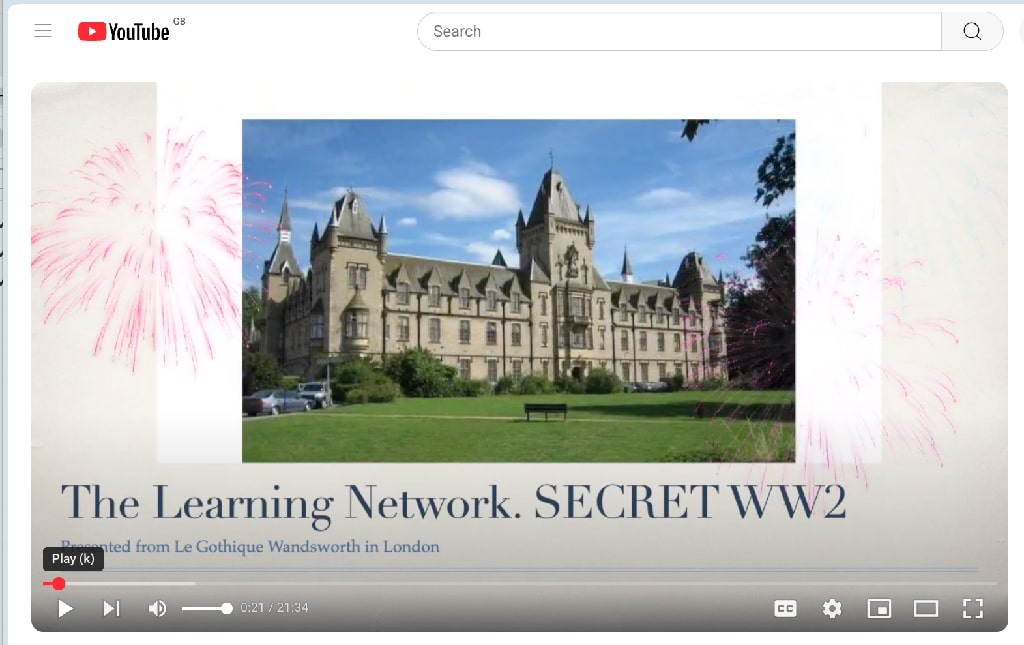
John Crossland made a video of the talk, which can be viewed here:
— YouTube: Secret World War II talk and plaque unveling RVPB May 2025
[I have transcribed the video — not perfect, but prett good.]
Louisa:
Hello and good afternoon to you, and may I give you a very warm welcome to the Royal Victoria Patriotic Building.
It is now time — you've had enough of me — for me to introduce Paul McCue our executive trustee — our author military historian — who has worked endlessly towards this and other events, and we are truly grateful for all you do towards the charity and for recording and remembering such events as these; and so, thank you.
So I'm delighted to hand over to you. Thank you, Paul.
Paul McCue:
Thank you, Louisa. As Louisa says, my name is Paul McCue. I'm the executive trustee of our network, Secret World War II Learning Network, which is a registered charity in the UK. We like to think of ourselves as global. Sounds good, but we do work in other countries occasionally as well.
During the Second World War the rapid invasion of the Netherlands, Belgium, France, Norway and Denmark by Nazi Germany in the spring and early summer of 1940, after the earlier occupation of Poland and Czechoslovakia, resulted in a stream of allied refugees which we called "aliens" — so the aliens came here, having reached the UK.
They arrived by a wide range of methods including by fishing boat, Royal Navy motor gunboat, Royal Air Force aircraft operating to and from clandestine air strips in France, and via escape lines into neutral countries such as Spain and Portugal.
Among these refugees the enemy stood the best chance of infiltrating spies into Britain, so the UK's security service MI5 addressed this immediate challenge by establishing a new section of "examiners" — these were interrogators largely former employees of British consulates in the occupied countries, so they had knowledge expert knowledge of the country and of the inhabitants.
So the establishment of a central reception and vetting centre for the refugees was urgently required if any sort of effective security check was to be carried out.
The centre would need to house the arrivals securely until their stories could be heard and checked, and from the 8th of January 1941this establishment was established by the Internment Camps Division of the Home Office and was called the London Reception Centre.
In addition to the Royal Victoria Patriotic School here, another much smaller school building was appropriated in Nightingale Lane, which is about a mile away in Balham, and that hosted the female refugees and their children, who were far fewer in number.
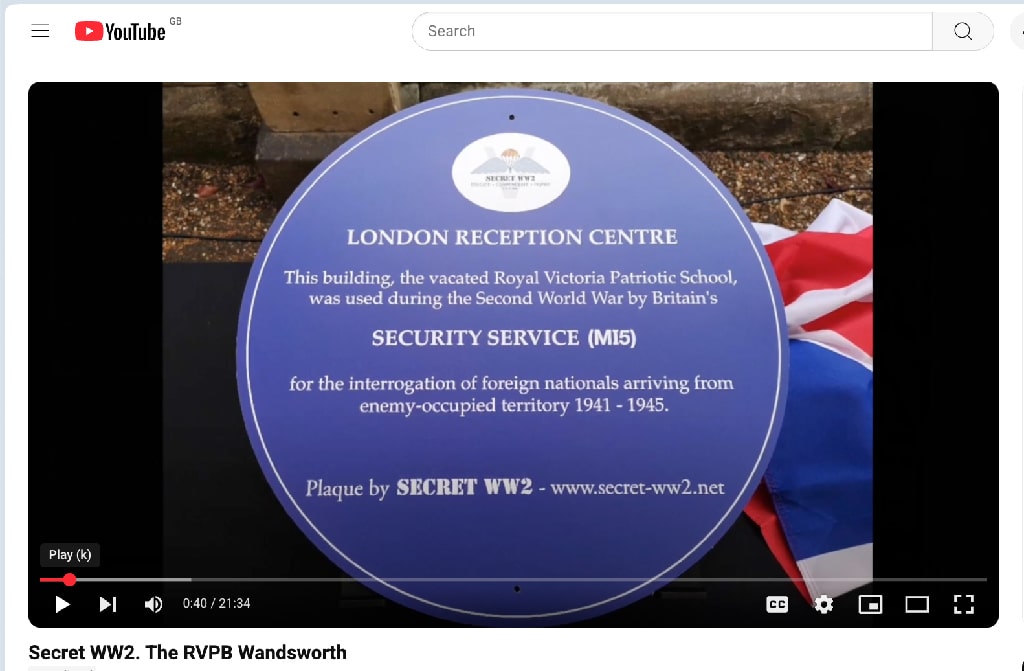
A commemorative blue plaque in what is now a purpose-built modern care home records its wartime use.
Arrivals came to the London Reception Centre under escort from their point of entry into the UK accompanied by immigration officers of the Home Service and security control officers of MI5, assisted by personnel of the field security sections of the British Army's intelligence corps.So, good to see representation here today.
It was guarded by territorial army units of the British Army. (There's only six more pages.)
Within the London Reception Centre, the interrogators had four main purposes:
One was the detection of what were called "goats". These were the enemy agents so they had to detect the goats from the sheep — the sheep were the genuine refugees, the goats were the enemy agents.
Secondly, the weeding out of "undesirables" — so these were people who were deemed to be telling a lying story or were a renegade or a collaborator with the enemy to some degree — so not necessarily an agent but perhaps a collaborator in occupied Europe. It did not cover political issues, so it did not cover left-wingers in particular, so the official history makes a point that they did not pick out left-wingers.
Thirdly, it was responsible for gathering of intelligence for the allied military forces regarding, for example, ports, enemy bases and defence positions. In the bar area you'll see sketches that were made of Norway, France and even Sachsenhausen concentration camp in Germany, north of Berlin.
And finally, it was responsible for the identification of potential agent recruits for Britain's Secret Services, including the Secret Intelligence Service (SIS) which, during the Second World War, also became known as MI6, which was its cover and name and which has continued; MI9, the Escape and Evasion Organization; and the Special Operations Executive (SOE).
The general process involved MI5 undertaking the initial interrogations in order to identify enemy agents, the goats, and those who were then cleared could be questioned by two other sections of the LRC: MI6, SIS and also MI19.
MI6 officers were chiefly concerned with obtaining information for use in their offensive operations in occupied Europe. MI19 personnel represented almost all other governmental and military agencies, including military intelligence, naval intelligence, and air intelligence. And they were assisted and joined by visiting representatives of all other organizations, and of SOE, as required. Begrudgingly, clearly from the history, begrudgingly they use foreign interrogators if necessary. So they tried to keep it British because they thought that was more secure.
I will mention the fact that General De Gaulle did not like this place. In theory, General de Gaulle had the first call on anybody from France coming through the Centre and being cleared and we British — perfidious Albion — used to sneak people out — calling what we called them side-doored people — out of the centre so that we could use them for our secret intelligence services. So de Gaulle was supposed to have first call but we used to sneak people out.
There was an interrogator here — again you'll see his photograph and a little bit about him inside. Kim Philby was an interrogator for SOE before he became an MI6/SIS officer and we found a document which reports on him doing an interrogation here of a Russian, and at the time he was working for the Soviet secret police (the NKVD) and reporting back to them. So the poor Russian chap at least that we know he interrogated here. He was probably passed on to the Soviets as a danger.
In terms of doing the interrogations, the British staff here, even if they weren't originally from the military, within MI5, they were uniformed, and they were expected to be polite. So the approach was to try and be friendly and polite to the people who were being interrogated and to some extent that was quite at odds with what happened afterward. Because if you were detected as an enemy agent you went off to something called Camp Zero-20 at Ham near Richmond and there's quite a lot of evidence of fairly brutal treatment by us. And certainly also at the end of the war, at the top of Kensington Palace Gardens, which is now the Russian embassy, we had something called the London Cage; and there were even more stories of brutal treatments of Nazis who were taken there at the end of the war.
If you came here you could be cleared in a few days. Some people took several weeks to be cleared here, and so there was sometimes quite a bit of discontent. If big parties came and in particular some large parties came from Norway when there were commando raids on on some of the islands and quite a few people were brought back, so they would be given a questionnaire and there was a streamlined form.
Almost 33,000 refugees were released from the London Reception Centre and when I started looking at this subject I just instinctively thought that that the majority would be French with it being geographically close. But of course France had an unoccupied zone for part of the war, so people weren't as keen to leave France in the early days, and indeed the majority are the Norwegians.
So there were 8,800 Norwegians who came here right from the very first days of the war and with, I think, the longest coastline in the world, if I remember my geography, but relatively easy to get across to Shetland.
Following the Norwegians, there were 6,875 French and then 5,699 Polish. I think that's really remarkable when you consider the geographical distance of Poland, and the difficulties of getting to Britain from occupied Poland from 1941 onwards. So, very good to see Polish presence here today.
3,569 Belgians and 3,200 Dutch, so good figures.
There were 757 Danish, which I think also reflects the fairly lenient occupation of Denmark by the Nazis, and then all other nationalities were just over 4,000.
The Germans when they put agents into here, they weren't stupid — they didn't use Germans. Too obvious. They used Norwegians, Icelanders, Swedish, Dutch, French, Belgians and Portuguese, and at least 50 were identified here.
It's believed that only three enemy agents with missions in Britain were known to have passed through the London Reception Centre undetected. So 50 identified, 3 believed got through unidentified.
Those who were identified, who were not turned to work for the allies — so we had a a very elaborate double cross system of using double agents back against the Germans — they were either imprisoned or executed, and three of the enemy agents identified here were, after trial, taken across the road and hanged at Wandsworth prison.
As the war progressed the spotting of enemy agents grew less important because the enemy's activities eased off. But in doing the research for this I was absolutely fascinated to see in the latter half of 1944 someone called Alfred Krauss turned up here and was identified as a German agent, and he was an agent of their Sicherheitsdienst [SD], the German SS counter-intelligence service.
I recognized the name because two years ago I was researching an SAS officer who had served in occupied France.
He had brought back illegally into the country, dressed as an SAS soldier, a "friend" who he met in Paris. The SAS officer was court-martialed and dismissed the service. I read the court-martial proceedings and there was Alfred Kraus, but there was no mention of the fact that actually he was an enemy agent. So after the SAS officer had been dismissed Kraus was interrogated here and he was found to be an enemy agent. So I was flabbergasted to find that the SS counter-intelligence people were still trying to put enemy agents into Britain in the latter half of 1944, after the invasion. Interesting.
The London Reception Centre closed on the 31st of May 19445. It's now a mixture of residential and and business premises, and I've said to you in terms of our network, please do take a leaflet. I would just mention that we will also have one of our charity's publications on sale for the first time today and it's called Uncle Charlie, and any of you with any parachute interest might be interested in buying a copy. It's only £7.50, and it's the memoir of the man who ran the SOE parachute training school throughout the war.
I will warn you that there are some very interesting comments about the different nationalities that he covered. It's a bit cheeky about our Polish friends. It's very complimentary about Czechoslovaks, and there's quite a bit about Belgians in there. So I recommend it to you, and you will see it shortly. That's it from me. Thhank you very much for listening, and I'll pass back to Louisa. Thank you.
Louisa:
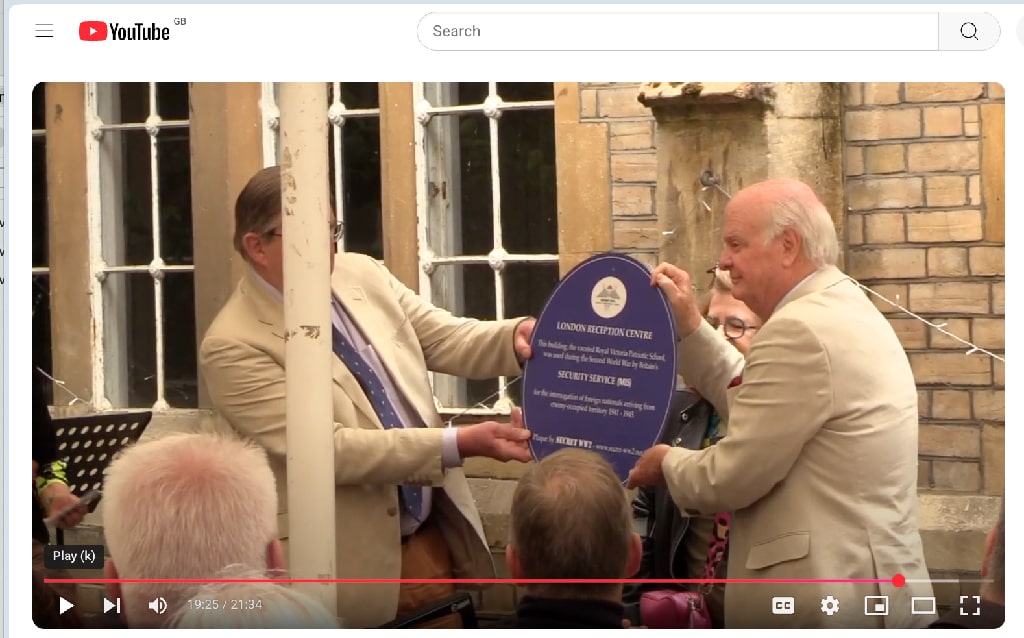
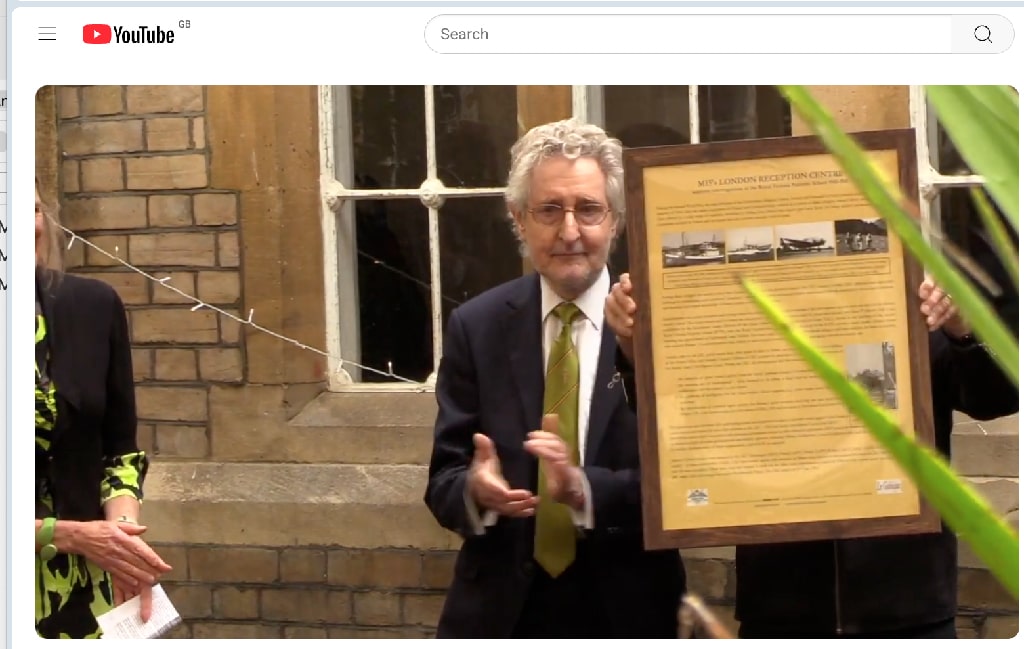
Right, we now come to the unveiling of the plaques, and I would like to call upon family members to unveil the plaques....
The first one being Tom and Sue, and Simon, please.
Right now before you when you do unveil it could we ask you to hold it up so that our audience might be able to see it as well it's over to you but thank you. Gently. Sorry
I'll ditch that i don't understand it
Thank you all yes thank you very much.
And we now move along to this one, and if I could ask Fred, Thomas, please, and Richard, Mark and that way people I know there's four of you. Well, you're all very important people you see so that's it right when you're ready yes lovely thank you there we are thank you [Applause] thank you very much gentlemen thank you now these won't be staying out here they will be positioned inside behind oh I'll pick up behind this wall behind us.
Sorry, Paul, I forgot to mention - — everyone should know that Uncle Charlie was written by Paul. He failed to admit that not true not true i edited it's the memoirs of Uncle Charlie are you sure well I thought I was doing a bit of editing. I edited it, and proceeds go to our charity.
[Applause]