
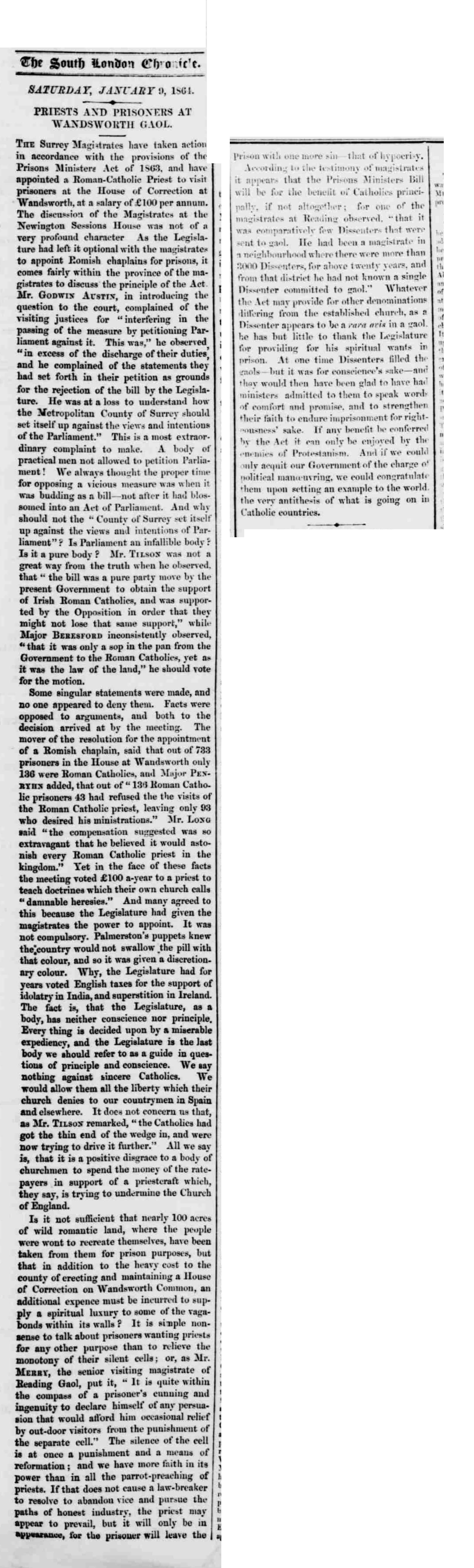
PRIESTS AND PRISONERS AT WANDSWORTH GAOL.
SATIURDAY, JANUARY 9, 1864
PRIESTS AND PRISONERS AT WANDSWORTH GAOL.
The Surrey Magistrates have taken action in accordance with the provisions of the Prisons Minister? Act of 1863, and have appointed a Roman-Catholic Priest to visit prisoners the House Correction at Wandsworth, at a salary of £100 per annum. The discussion the Magistrates at the Newington Sessions House was not of i\ very profound character As the Legislature had left it optional with the magistrates to appoint Romish chaplains for prisons, it comes fairly within the province of the magistrates to discuss the principle of the Ac.
Mr. GODWIN AUSTIN, in introducing the question to the court, complained the visiting justices for "interfering in the passing of the measure petitioning Parliament against it. This was," he observed "in excess of the discharge of their duties, and he complained of the statements they had set forth in their petition as grounds for the rejection of the bill by the Legislature. He was at a loss to understand how the Metropolitan County of Surrey should set itself up against the views and intentions of the Parliament."
This is a most extraordinary complaint to make. A body of practical men not allowed to petition Parliament ! We always thought the proper time for opposing a vicious measure was when it was budding as a bill—not after it had blossomed into an Act of Parliament. And why should not the "County of Surrey set itself up against the views and intentions of Parliament"? Parliament an infallible body? Is it pure body ?
Mr. TILSON was not a great way from the truth when he observed, that the bill was a pure party move the present Government to obtain the support of Irish Roman Catholics, and was supported the Opposition in order that they might not lose that same support," while Major Beresford inconsistently observed, u that it was only a sop in the pan from the Government to the Roman Catholics, yet as it was the law of the land," he should vote for the motion.
Some singular statements were made, and no one appeared to deny them. Facts were opposed to arguments, and both to the decision arrived at by the meeting. The mover of the resolution for the appointment of a Romish chaplain, said that out of prisoners in the House at Wandsworth only 136 were Roman Catholics, and Major PENRHYN added, that out of " 136 Roman Catholic prisoners 43 had refused the the visits of the Roman Catholic priest, leaving only who desired his ministrations." Mr. LONG said "the compensation suggested was ho extravagant that he believed it would astonish every Roman Catholic priest in the kingdom." Yet in the face of these facts the meeting voted £100 a-year to a priest to teach doctrines which their own church calls "damnable heresies." And many agreed to this because the Legislature had given the magistrates the power to appoint. It was not compulsory. Palmerston's puppets knew would not swallow the pill with that colour, and so it was given discretionary colour. Why, the Legislature had for years voted English taxes for the support of idolatry in India, and superstition in Ireland. The fact is, that the Legislature, as a body, has neither conscience nor principle. Every thing is decided upon by a miserable expediency, and the Legislature is the last body we should refer to as a guide in questions of principle and conscience. We say nothing against sincere Catholics. We would allow them all the liberty which their church denies to our countrymen in Spain and elsewhere. It does not concern that, Mr. Tilson remarked, "the Catholics had got the thin end of the wedge in, and were now trying to drive it further."
All we say is, that it is a positive disgrace to a body of churchmen to spend the money of the ratepayers in support of a priestcraft which, they say, trying to undermine the Church of England.
Is it not sufficient that nearly 100 acres of wild romantic land, where the people were wont to recreate themselves, have been taken from them for prison purposes, but that in addition to the heavy cost to the county of erecting and maintaining a House of Correction Wandsworth Common, an additional expense must be incurred to supply a spiritual luxury to some of the vagabonds within its walls ?
It is simple nonsense to talk about prisoners wanting priests for any other purpose than to relieve the monotony of their silent cells; or, as Mr. MERRY, the senior visiting magistrate of Reading Gaol, put it, "It is quite within the compass of a prisoner's cunning and ingenuity to declare himself any persuasion that would afford him occasional relief by out-door visitors from the punishment of the separate cell."
The silence of the cell is at once a punishment and a means of reformation; and we have more faith in its power than in all the parrot-preaching of priests. If that does not cause a law-breaker to resolve to abandon vice and pursue the paths of honest industry, the priest may appear to prevail, but it will only be far the prisoner will leave the prison one more sin — that of hypocrisy.
According the testimony of magistrates it appears that the Prisons Ministers Bill will be for the benefit Catholics principally. if not altogether; for one the magistrates at Reading; observed, "that it was comparatively few Dissenters that were I sent to gaol. He had been magistrate in a neighbourhood where there were more than 3000 Dissenter, for above twenty year, and from that district had not known a single Dissenter committed to gaol."
Whatever the Act may provide for other denominations differing from the established church, as Dissenter appears to a rara avis in a gaol, he has but little to thank the Legislature for providing for his spiritual wants prison. At one time Dissenters filled the gaols — but it was for conscience's sake — and they would then have been glad to have had ministers admitted to them to speak words of comfort and promise, and to strengthen their faith to endure imprisonment for righteousness' sake. If any benefit conferred by the Act can only enjoyed by the enemies of Protestantism. And if we could only acquit our Government of the charge political manoeuvring, could congratulate them upon setting an example to the world, the very antithesis of what is going on Catholic countries.
[I wonder if this was written by [James?] Lord? It certainly reads like it. OPr is it too moderate for him?
Back to the top of this page . . .