— Link
— Link
— Link
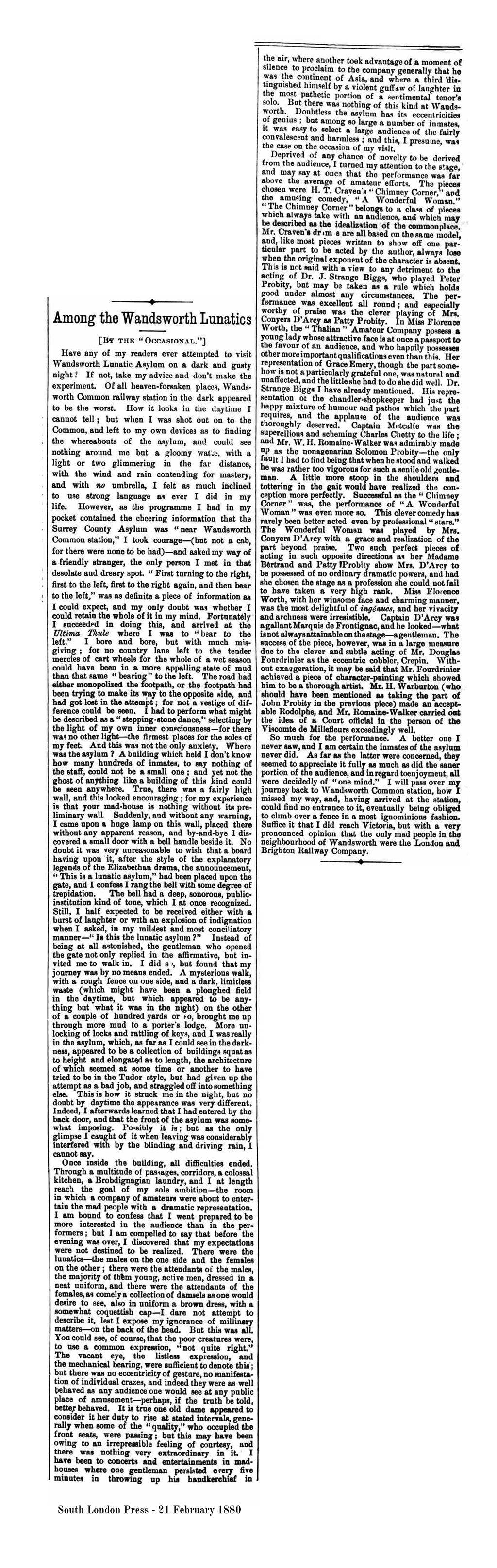
Among the Wandsworth Lunatics
[BT THE "OCCASIONAL"]
Have any of my readers ever attempted to visit Wandsworth Lunatic Asylum on a dark and gusty night ? If not, take my advice and don't make the experiment.
Of all heaven-forsaken places, Wandsworth Common railway station in the dark appeared to be the worst. How it looks in the daytime I cannot tell; but when I was shot out on to the Common, and left to my own devices as to finding the whereabouts of the asylum, and could see nothing around me but gloomy waste, with a light or two glimmering in the far distance, with the wind and rain contending for mastery, and with no umbrella, I felt as much inclined to use strong language as ever I did in my life.
However, as the programme I had in my pocket contained the cheering information that the Surrey County Asylum was "near Wandsworth Common station," I took courage — (but not a cab, for there were none to be had) — and asked my way of a friendly stranger, the only person I met that desolate and dreary spot.
First turning to the right, first to the left, first to the right again, and then bear to the left," was as definite piece of information as I could expect, and my only doubt was whether I could retain the whole of it in my mind.
Fortunately I succeeded in doing this, and arrived at the Ultima Thule where I was to "bear to the left." I bore and bore, but with much misgiving; for no country lane left to the tender mercies of cart wheels for the whole of a wet season could have been in a more appalling state of mud than that same "bearing" to the left. The road had either monopolized the footpath, or the footpath had been trying to make its way to the opposite side, and had got lost in the attempt; for not a vestige of difference could be seen, I had to perform what might be described as a "stepping-stone dance, " selecting by the light of my own inner consciousness — for there was no other light — the firmest places for the soles of my feet.
And this was not the only anxiety. Where was the asylum ? A building which held I don't know how many hundreds of inmates, to say nothing of the staff, could not be a small one; and yet not the ghost of anything like a building of this kind could be seen anywhere. True, there was a fairly high wall, and this looked encouraging; for my experience is that your mad-house is nothing without its preliminary wall.
["A fairly high wall" - was there one? All round? Even along Burntwood Lane? If so, when was the wall removed? (I recall it was lowered on Beechroft.)]
Suddenly, and without any warning, I came upon huge lamp on this wall, placed there without any apparent reason, and by-and-bye iI discovered a small door with a bell handle beside it. No donbt it was very unreasonable to wish that a board having upon it, after the style of the explanatory legends of the Elizabethan drama, the announcement, This is a lunatic asylum," had been placed upon the gate, and I confess I rang the bell with some degree of trepidation. The bell had a deep, sonorons, public institution kind of tone, which I at once recognized. Still, I half expected to be received either with burst of laughter or with an explosion of indignation when iI asked, in my mildest and most conciliatory manner — "Is this the lunatic asylum ?" Instead of being at all astonished, the gentleman who opened the gate not only replied in the affirmative, but invited me to walk in. I did but found that my journey was by no means ended.
A mysterious walk, with a rough fence on one side, and a dark, limitless waste (which might have been a ploughed field in the daytime, but which appeared to be anything but what it was in the night) on the other of a couple of hundred yards or so, brought me up through more mnd to a porter's lodge. More unlocking of locks and rattling of keys, and I was really in the asylum, which, as far as I could see in the darkness, appeared to be a collection of buildings squat to height and elongated as to length, the architecture of which seemed at some time or another to have tried to be in the Tudor style, but had given up the attempt as a bad job, and straggled off into something else. This is how it struck in the night, but no doubt by daytime the appearance was very different. Indeed, I afterwards learned that I had entered by the back door, and that the front of the asylum was somewhat imposing. Possibly it is; but as the only glimpse i caught of it when leaving was considerably interfered with by the blinding and driving rain, I cannot say.'
Once inside the building, all difficulties ended. Through a multitude of passages, corridors, colossal kitchen, Brobdignagian laundry, and I at length reach the goal of my sole ambition — the room in_ which a company of amateurs were about to entertain the mad people with a dramatic representation. I am bonnd to confess that I went prepared to be more interested in the audience than in the performers; but I am compelled to say that before the evening was over, I discovered that my expectations were not destined to be realized.
There were the lunatics — the males on the one side and the females on the other; there were the attendants ot the males, the majority of them young, active men, dressed in a neat uniform, and there were the attendants of the females, as comely a collection of damsels as one would desire to see, also in uniform a brown dress, with a somewhat coquettish cap — l dare not attempt to describe it, lest I expose my ignorance of millinery matters — on the back of the head. But this was all you could see, of course, that the poor creatures were, to use common expression, "not quite right." The vacant eye, the listless expression, and the mechanical bearing, were sufficient to denote this; but there was no eccentricity of gesture, no manifestation of individual crazes, and indeed they were well behaved as any audience one wonld see at any public place of amusement — perhaps, if the truth be told, better behaved.
It is true one old dame appeared to consider it her duty to rise at stated intervals, generally when some of the quality, " who occupied the front seats, were passing; but this may have been owing to an irrepressible feeling of courtesy, and tnere was nothing very extraordinary in it I have been to concerts and entertainments in madhouses where oae gentleman persisted every five minutes in throwing up his handkerchief in Price Twopence. the air, where another took advantage of a moment of silence to proclaim to the company generally that he was the continent of Asia, and where a third _distinguished himself violent of laughter in the most pathetic portion of a sentimental tenor's solo But there was nothing of this kind Wandsworth.
Doubtless the asylum has its eccentricities ot genius; but among so large a number of inmates, it was easy to select a large audience the fairly convalescent and harmless; and this, I presume, was case the occasion of visit.'
Deprived of any chance of novel tv to be derived from the audience, I turned my attention the stage, and may say at ones that the performance was far above the average of amateur efforts. The pieces chosen were 11. T. Craven Chimney Corner, and "musing comedy, Wonderful Woman." The Chimney Corner " belongs to class of pieces which always take with an audience, and which may be described as the idealization of the commonplace. aren
drim s are all based on the same model, and, like most pieces written to show off one particular part to he acted by the author, always lose when the original exponent of the character is absent. This is not said with a view to any detriment to the acting of Dr. J. Strange Biggs, who played Peter Probity, but may taken as a rule which holds good under almost any circumstances. The performance was excellent all round; and especially worthy of praise was the clever playing of Mrs. Conyers D'Arcy as Patty Probity.
In Miss Florence » orth, the Thalian Amateur Company possess young lady whose attractive face is at once a passport the favour of an audience, and who happily possesses other more important qualifications even than this. Her representation of Grace Emery, though the part somehow is not a particularly grateful one, was natural and unaffected, and the little she had to do she did well.
Dr. Strange Biggs I have already mentioned. His representation or the chandler-shopkeeper had just the happy mixture of humour and pathos which the part requires, and the applame of the audience was thoroughly deserved. Captain Metcalfe was the supercilious and scheming Charles Chetty to the life; and Mr. W. H. Komaine-Walker was admirably made as the nonagenarian Solomon Probity — the only £ au It I had to find being that when he stood and walked he was rather too vigorous for such a senile old gentleman. A little more stoop in the shoulders and tottering in the gait would have realized the conception more perfectly.
Successful as the Chimney Corner was, the performance of A Wonderful Woman" was even mote so. This clever comedy has rarely been better acted even by professional stars." The Wonderful Woman was played by Mrs. Conyers D'Arcy with a grace and realization of the part beyond praise. Two such perfect pieces of acting in such opposite directions as her Madame Bfertrand and Patty IProbity show Mrs. D'Arcf to be possessed of no ordinary dramatic powers, and had she chosen the stage as a profession she could not fail to have taken a very high rank.
Miss Florence Worth, with her winsome face and charming manner, was the most delightful of ingenues, and her vivacity and archness were irresistible. Captain D'Arcy was a gallant Marquis de Frontignac, and he looked — what is not always attainable on the stage — a gentleman. The success ot the piece, however, was in a large measure due to the clever and subtle acting of Mr. Douglas Fonrdrinier as the eccentric cobbler, Crepin. Without exaggeration, it may be said that Mr. Fourdrinier achieved piece of character-painting which showed him to be thorough artist.
Mr. H. Warburton (who should have been mentioned as taking the part of John Probity in the previous piece) made an acceptable Rodolphe, and Mr. Ilomaine-Walker carried out the idea of Court official in the person of the Viscomte Millefleurs exceedingly well.
So much for the performance. A better one I never saw, and I am certain the inmates of the asylum never did. far as the latter were concerned, they seemed to appreciate it fully as much did the saner portion of the audience, and in regard to enjoymeut, all were decidedly of one mind."
I will pass over my journey back to Wandsworth Common station, how I missed my way, and, having arrived at the station, could find no entrance it, eventually being obliged to climb over a fence in most ignominious fashion. Suffice it that I did reach Victoria, but with a very pronounced opinion that the only mad people in the neighbourhood of Wandsworth were the London and Brighton Railway Company.
[BNA: Link.]
Back to the top of this page . . .