
[Patch]
Although treatment as we now know is was for che Te om Ing, active management and occupation was 2 import ae the first. The men were empbryed in the waren
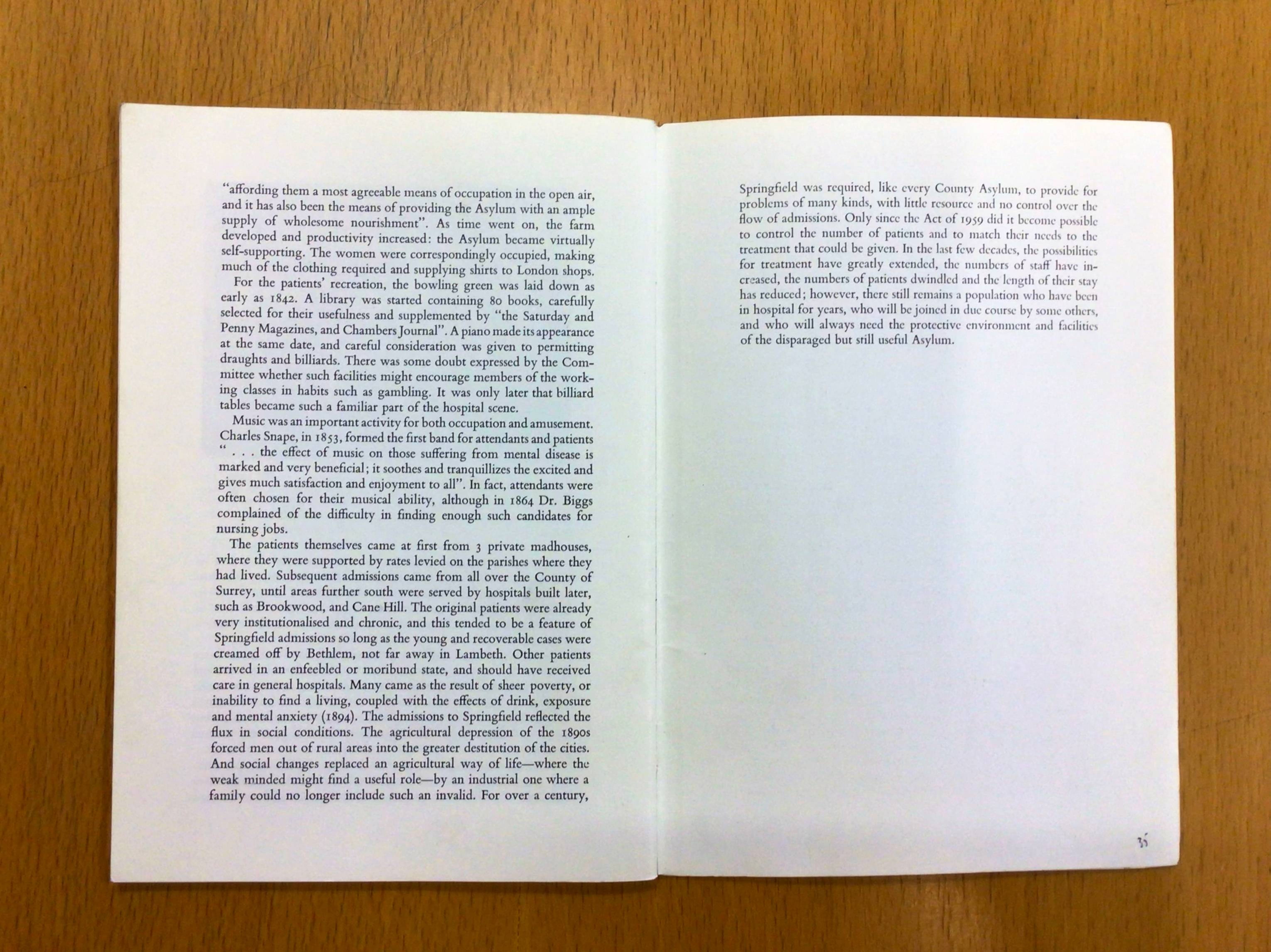
The patients themselves came at first from 3 private madhouses, where they were supported by rates levied on the parishes where they had lived. Subsequent admissions came from all over the County of Surrey, until areas further south were served by hospitals built later, such as Brookwood, and Cane Hill.
[Three private madhouses: Peckham House? and others?]
The original patients were already very institutionalised and chronic, and this tended to be a feature of Springfield admissions so long as the young and recoverable cases were creamed off by Bethlem, not far away in Lambeth. Other patients arrived in an enfeebled or moribund state, and should have received care in general hospitals. Many came as the result of sheer poverty, or inability to find a living, coupled with the effects of drink, exposure and mental anxiety (1894).
[Lost Hospitals]
The water supply ran out in 1850 and, while a new well was drilled, the Lambeth Waterworks Co. supplied the Asylum with "not fewer than 30,000 gallons daily", at a rate of 3d (just over 1p) per 1,000 gallons. (The new well became operational in 1860.)
[Patch]
The water supply was another source of anxiety to the Committee. They started in 1839 by boring a well in a site that is now surrounded by workshops. The pipes broke at 358 feet, but the boring continued until enough water was found; the resulting supply was enough only for a few years and by 1850 an additional well was needed.
In the meantime a contract was signed with the Lambeth Waterworks Company for "not fewer than 30,000 gallons . . . daily" — at a cost of 3d. per thousand gallons. The water received in this way was taken directly from the river at Thames Ditton. This source lay above the massive sewage pollution of London's water that continued till the 1880s and was responsible for repeated drastic epidemics. When cholera broke out in 1854, John Snow (1813-1858) demonstrated that areas of London supplied from the higher reaches of the Thames had much lower mortality: Springfield was fortunate in its location.
The second well was not completed until 1860, but maintenance and deepening were often needed, as the population of the Asylum increased, and baths became an everyday occurrence.
The building of the water tower in 1885 (for £1,300) was also designed to improve the supply, as well as to produce sufficient pressure in case of fire: it was demolished in 1976. The wells themselves, although still in existence have not been used since the Second World War. The newer pump — a single column beam engine, with its graceful Doric column — was broken up for scrap, but the original pump — a Maudslay table engine — continued in use until after the Second World War, and then found a permanent home in the Science Museum in South Kensington.
[PB: In addition to personal needs for water, fire was always a deep concern.]
[PB: I have yet to find this Maudslay Table Engine in the Science Museum - but it would be good to do so.]
[Patch]
"affording them a most agreeable means of occupation in the open air, and it has also been the means of providing the Asylum with an ample supply of wholesome nourishment".
As time went on, the farm developed and productivity increased: the Asylum became virtually self-supporting. The women were correspondingly occupied, making much of the clothing required and supplying shirts to London shops.
[Lost Hospitals]
The farm had 50 cows producing 800 gallons of milk a week; poultry produced eggs, and provided meat, as did pigs. Fruit was provided by the orchard, and vegetables and salads were grown in the kitchen garden.
In 1955 all dairy farming ceased and the use of the farm gate was discontinued as an exit and entry point.(Burntwood School now stands on part of the farmland, where Springfield Farm's Grade II listed ice house remains in its grounds; the other part became Springfield Park Golf Course, now renamed the Central London Golf Centre.)
But both farm and orchard were under threat and, in 1951, 2 acres were taken from the orchard end for a school playing ground.
[PB: And flats built (west of Garratt Green/Aboyne Road) by the LCC where bombs had dropped in WWII? I think this is called the Aboyne Estate. Other blocks were built for staff at St George's Hospital when it moved here from Hyde Park Corner
Wikipedia:
Former St George's Hospital at Hyde Park Corner (now The Lanesborough hotel). In 1948, the National Health Service was introduced and plans for a new site for St George's at The Grove and Fountain Fever Hospitals at Tooting were eventually agreed upon.
In 1954, the Grove Hospital became part of St George's, and clinical teaching started in Tooting.[5]
After a new hospital had been built at Tooting, St George's Hospital at Hyde Park Corner closed its doors for the last time in 1980...
The new hospital at Tooting was built in stages. The first stage, which included 710 beds and the medical school, was completed in 1976, although the main hospital was not completed until 1980.[8]
[https://en.wikipedia.org/wiki/St_George%27s_Hospital]
[[Other references to work? ]These sources mention men working on the farm, but I'm pretty sure I've seen references to women working there too. And given that much agricultural work was carried out by women - milking, caring for animals, horticulture etc it would be amazing if they were not so employed.]
[Other kinds of work? Cooking? Laundry? Cleaning? Clothes-making? Other? Was it really almost "self-supporting?" Perhaps so.]
[Lost Hospitals]
Leisure
[Patch]
For the patients' recreation, the bowling green was laid down as early as 1842. A library was started containing 80 books, carefully selected for their usefulness and supplemented by "the Saturday and Penny Magazines, and Chambers Journal". A piano made its appearance at the same date, and careful consideration was given to permitting draughts and billiards. There was some doubt expressed by the Committee whether such facilities might encourage members of the working [class?] in habits such as gambling. It was only later that billiard tables became such a familiar part of the hospital scene.
[Was the cricket pitch marked on a number OS maps for patients or staff - or both?]
Music was an important activity for both occupation and amusement. Charles Snape, in 1853, formed the first band for attendants and patients " . . . the effect of music on those suffering from mental disease is marked and very beneficial; it soothes and tranquillizes the excited and gives much satisfaction and enjoyment to all". In fact, attendants were often chosen for their musical ability, although in 1864 Dr. Biggs complained of the difficulty in finding enough such candidates for nursing jobs.
Recent developments
Springfield University Hospital, 15 Springfield Drive, London, SW17 0YF
South West London and St George's Mental Health Trust. Trinity Building, Springfield University Hospital 15 Springfield Drive London SW17 0YF.
Groundbreaking facilities for Springfield University Hospital
At the heart of Springfield University Hospital are our new cutting-edge Trinity and Shaftesbury hospital buildings. Together, they represent a £150m investment and are the culmination years of hard work from our teams, communities and partners in South West London.
The facilities have been designed to provide high quality inpatient services that deliver modern mental healthcare. This ensures people have the best chance to recover in the best environment, and support our staff to deliver the outstanding care our service users deserve from us.
Construction began in January 2020 and continued throughout the pandemic. Trinity, which opened on time and in budget in December 2022, is home to over 30 teams, including over 500 staff and provides care to patients in two acute wards, two specialist wards including our national Deaf services ward, and adult community and children’s and young people’s outpatient services. Since opening, Trinity has received national and international acclaim.
Trinity was followed by the new Shaftesbury building in October 2023, which houses three forensic wards as well as a specialist unit for adults with intellectual disabilities with or without autism.
Co-designed with patients, carers and service users, space, light and nature have been guiding principles in the buildings’ development. They include spacious ensuite bedrooms, world-class artworks and garden courtyards, providing places for rest and reflection.
[https://swlstg.nhs.uk/redeveloping-springfield-hospital]Creative spaces for healing
As part of the innovative design, the new Trinity and Shaftebury buildings feature 20 world-class artworks created in partnership with arts and mental health charity Hospital Rooms – the first time an art project of this scale has been undertaken in the NHS.
Taking place over three years, Hospital Rooms led 120 art workshops with patients, carers and staff, which inspired incredible conversations, collaborations and artwork proposals. From this, artists co-designed vibrant and uplifting artworks that have helped to shape a new creative landscape for mental healthcare in South West London.
“Our first ever Hospital Rooms project took place at the Trust’s Phoenix Unit. Six years later, we are delighted that our most ambitious project to date is a collaboration with everyone at the Trust.
“After more than 120 artist-led creative workshops that took place at the hospital with service users and staff, we have now installed 20 extraordinary, co-created artworks throughout the new Trinity and Shaftesbury buildings.
"From murals to video installations, wall sculptures to opera, there are many firsts for us, and we are proud to be part of this new vision for a mental health hospital. We have loved working so closely with everyone at Springfield Hospital over the last 18 months.”
– Niamh White and Tim A Shaw, co-founders of Hospital Rooms
You can find these artworks in the shared spaces throughout the buildings and on our wards. From large scale vinyl installations and detailed painted murals to sound and moving-image based pieces, these works are ambitious, thought provoking and fundamentally reimagine the role of creativity in mental health environments.
“Joining the Hospital Rooms project has been lifechanging for me. The opportunities I’ve had to meet new people, learn new skills and spend time being creative has had enormous positive effects on my mental wellbeing and recovery. Without Hospital Rooms I don’t think I would have recovered and got back to normal life as quickly as I did.”
– Liam, service user
[https://swlstg.nhs.uk/redeveloping-springfield-hospital]
[Note language change: "service user", "mental distress", "mental wellbeing", "recovery".]
Back to the top of this page . . .
Philip Boys ("HistoryBoys")