— Link
— Link
— Link
PREFACE
MAINLY FOR THE INTEREST of those who work and have worked at Springfield, I have collected here some aspects of its past which might easily be forgotten. This book does not set out to tell a complete story, or one that has been traced up to the present time, but it does record some of the events and personalities that have left their mark upon an institution and its work.
Many individuals have contributed helpfully with information and material of various kinds, and to all of these I am very grateful. | must particularly mention Miss P. Philpott who worked on the photographic material and Miss Adrienne Burrows, for information about Hugh Diamond. Finally I must thank Mrs. Barbara Powell, my secretary, for much long-suffering organization and typing.
IAN LODGE PATCH
INTRODUCTION
Institutions such as Springfield preserve, in a permanent form, contemporary attitudes and ideas. Although modifications adapt old buildings to new ideas, the concepts that prevailed at the beginning are still to be traced in the bricks, mortar and furnishings that remain. These materials also form the backcloth against which our predecessors moved and worked; with tesver resources, they dealt with similar problems, and in ways that often seem surprisingly up to date. Although much is unchanged, the traces of an institution's past arc lost with increasing speed. Since the end of the Second World War, many of Springfield's possessions have disappeared, mostly through neglect or lack of interest, sometimes by actual theft.
In 1948, hundreds of pictures which lined the walls, and which had been collected (for example by Hugh Diamond in the 1850s) from Agnews, Colnaghis and other dealers, were removed and destroyed.
More recently a hundred glass pharmacy jars, dating from the opening of the hospital, were sold.
In 1981, six mahogany chairs, dating from 1840, were stolen from the Committee room. In the same way historical details are lost or forgotten and the character of the hospital atrophies.
This book sets out to preserve some of those details to illustrate a particular step in the development of psychiatric care. That step — the establishing of County Asylums — took place gradually, was the consequence of many inter-acting factors, and was a landmark both scientific and humanitarian.
Many individuals were of course involved, of every degree of social importance, but some, of permanent note, were associated one way or another with Springfield — Faraday, Paget, Tom Sayers, Vignoles, Pollock, Elliotson, Bence Jones, Conolly, Hope, Spencer, Barclay, Perkins and Shaftesbury — to name but a few. The individuals mentioned or illustrated here must be regarded simply as the representatives of the many who, since 1840, have worked at this hospital seeking to establish, or to maintain, high standards of patient care.
Until the 19th century, the mentally ill wandered at large, or were looked after by their own families or in private madhouses where standards were often very low. The few public hospitals, such as Bethlem or York, were little better; supervision and inspection was lacking and inept. By the close of the 18th century, public scandals (such as the York Asylum) and the illness of George III had become factors promoting reform. William Tuke demonstrated at the Retreat (founded 1792) that humanity was practicable and that neglect and brutality were Indefensible.
The Asylum Act of 1808 encouraged the building of public hospitals for those who could not pay; however the Counties were slow to respond and by 1827 only 9 such hospitals had been built. Inspection and supervision were provided for in the Madhouse Act (1828) and more fully in 1845 when the Lunacy Commission was established and given responsibility for the standards throughout theI w.to.e country; the prime mover of many of these reforms was the 7th Earl of Shaftesbury (1801-1885).
As the century continued, public opinion became increasingly sensitive to allegations of cruelty or harshness in the name of cream-km, and to practices that could be construed in this way.
In 1838 Robert Gardiner Hill delivered 'A Lecture on the Management of Lunatic Asylums" showing that mechanical restraints (gloves, straitjackets, etc.) were usually unnecessary in the care of the mentally ill, and John Conolly showed that mechanical restraints could be abolished throughout an entire hospital.
Gentlefolk and those able to pay were cared for in private madhouses with decent standards but most paupers were accommodated under dismal conditions in houses with contractual arrangements with the parishes of origin. In 1839 Alexander Morison had found that 366 Surrey lunatics were being cared for in various private madhouses catering for paupers. Of this number, Morison arranged that 299 should be transferred from Peckham House, Hoxton and Bethnal Green Asylum, to Springfield at the time of its opening on 14th June, 1841.
Details of that event have been lost, but these chapters outline some of the characters and events of the century and a half that have followed.
THE ESTATE AND ITS BUILDINGS
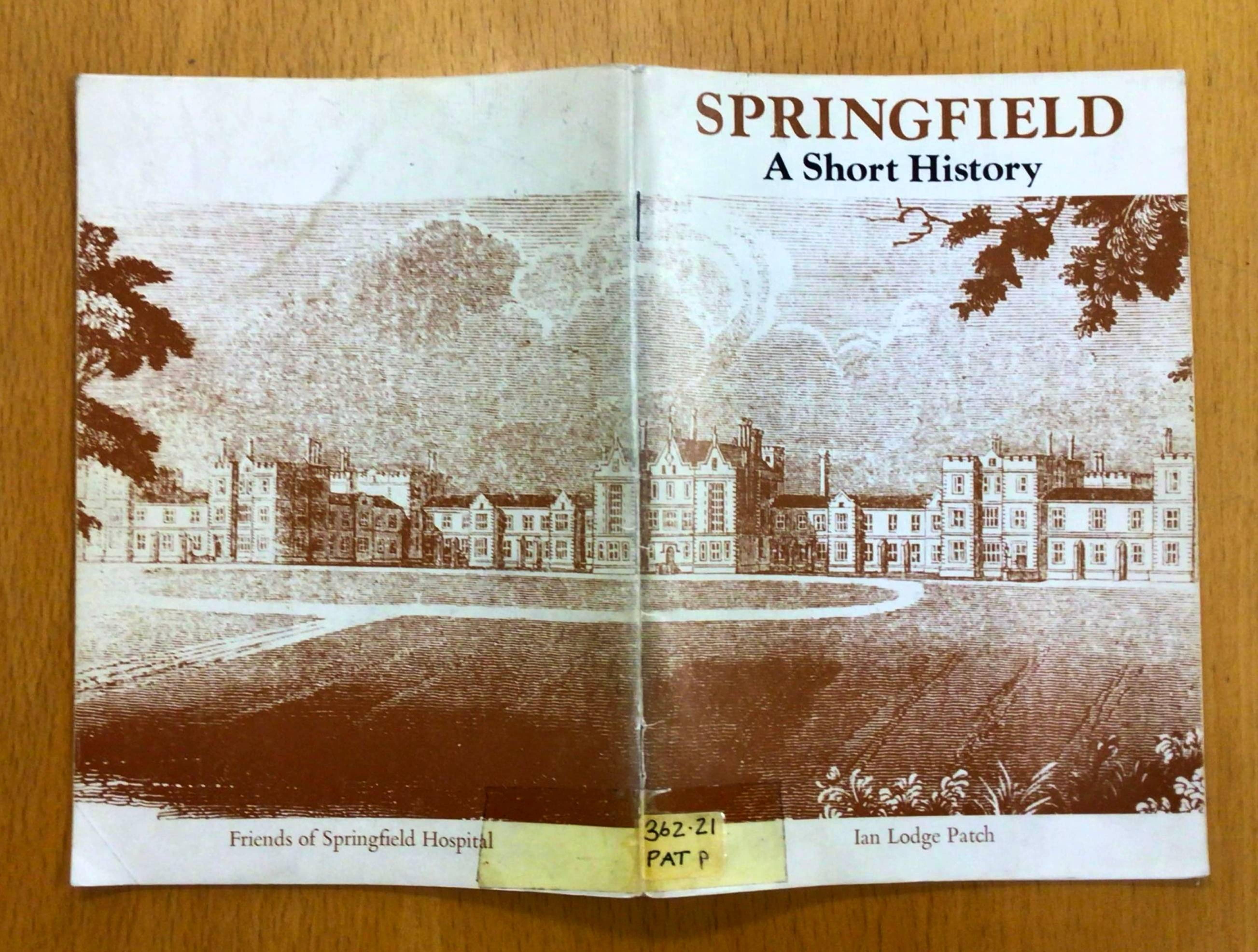
IT WAS STILL LESS than 20 years since the death of George III when the Surrey Magistrates decided to follow the example of others and to establish a County Asylum. Their Committee began looking for a suitable site near to the centres of population and having a southern aspect, good air and a ready supply of water. They soon found wealthy they needed at Springfield Park (Wandsworth was still itr S then being offered for sale by Henry Perkins since 1823,;letthairlyt, brewer and partner in the firm of Barclay, Perkins. He had, since 1823, leased the estate from the Second Earl Spencer and had begun to collect in the mansion his immensely valuable library.
After his father's death in 1834, the Third Earl sold the freehold to Perkins, who soon afterwards decided to move to Dover. Of the 18th century mansion no trace now remains and no print, although its outline appears on maps as law as 1858. But its farm buildings, stables and coachman's house stood until the building of Garratt Green School. Of the large complex, which included also pleasure gardens and an indoor riding school, now only the ice-well is standing, fenced from further depredations of vandals and surrounded by the playing fields of the school.
At the time of the purchase, the northern boundary ran from east to west at the level of the Gardiner Hill Unit, and along a line marked by the original lodge (1844) opposite these new buildings. The eastern border followed the line between the parishes of Clapham and Streatham. Along this line (the drive from Glenburnie Gate, between the present Admission Hospital and the main building) a public foot-path allowed passers to peer at the patients in the ward gardens — or "airing courts".
The Committee were therefore particularly pleased when, about 1860, they were able to extend the eastern border to its present line, giving greater privacy to their patients. A year or two later they added two strips, from the estate of Mr. McKellar, carrying the northern boundary to the line of Beechcroft Road, from Burntwood Lane to Glenburnie Road. No further land was added to the estate after this (1864): a lodge was added to the new entrance with a weighbridge (1893) and a further lodge at Glenburnie Road (1897).
The building of the Asylum started about 1838 to the design of Mr. W. Moseley, the County Surveyor for Middlesex, "lately occupied in the extensions at Hanwell Asylum", advised by Alexander Morison and Sir William Ellis. Its Tudor style, with gables and twisted chimneys (now removed as dangerous and not replaced) was praised in the architectural journals, who commented on the subtle angles and variegated brickwork that save the long facade from monotony. But
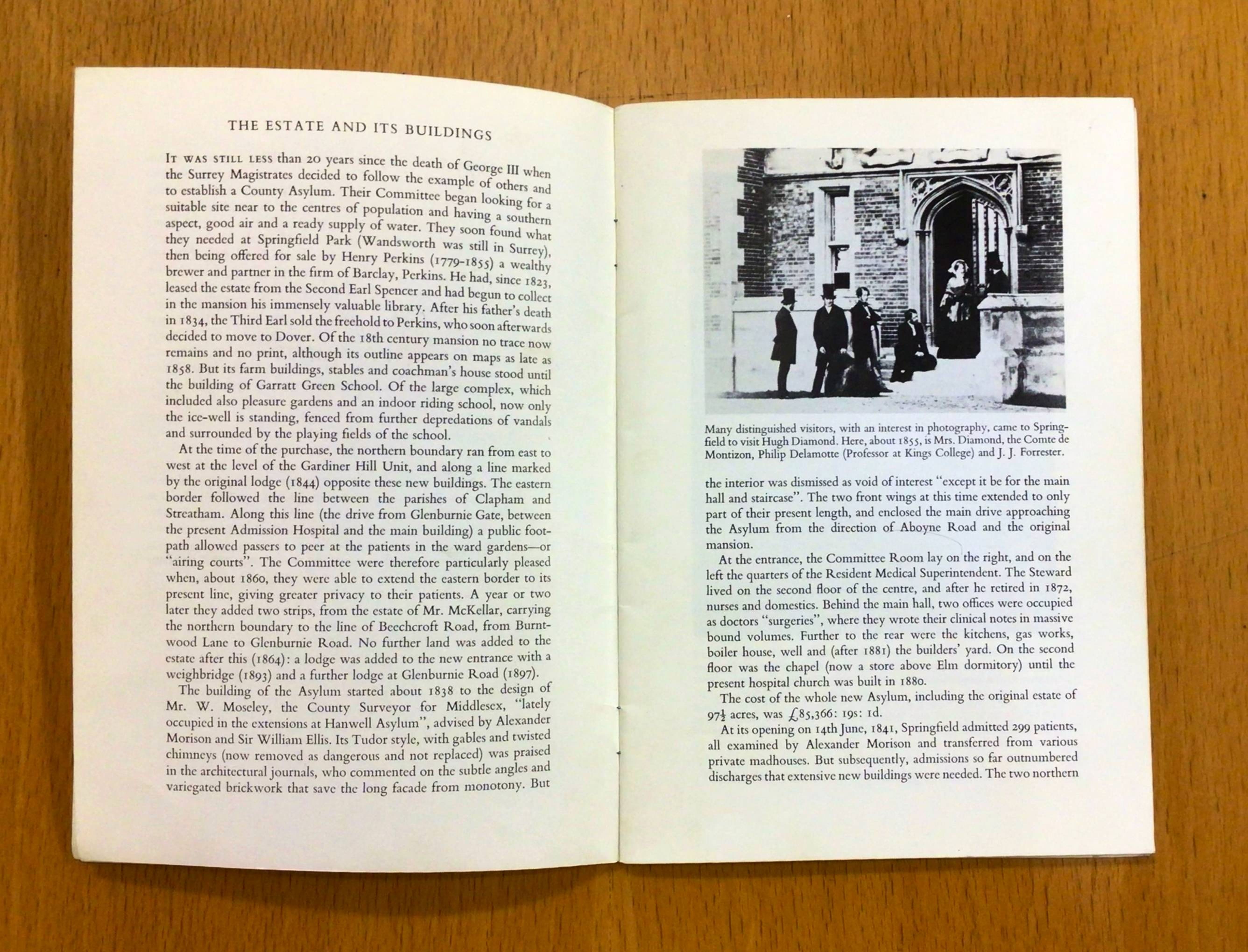
[IMAGE]
Many distinguished visitors, with an interest in photography, came to Springfield to visit Hugh Diamond. Here, about 1855, is Mrs. Diamond, the Comte de Montizon, Philip Delamotte (Professor at Kings College) and J. J. Forrester
the interior was dismissed as void of interest "except it be for the main hall and staircase". The two front wings at this time extended to only part of their present length, and enclosed the main drive approaching the Asylum from the direction of Aboyne Road and the original mansion.
At the entrance, the Committee Room lay on the right, and on the left the quarters of the Resident Medical Superintendent. The Steward lived on the second floor of the centre, and after he retired in 1872, nurses and dome rats come down yeah look at I see your glasses on your glassessties.
Behind the main hall, two offices were occupied as doctors "surgeries", where they wrote their clinical notes in massive bound volumes.
[Where are these "massive bound volumes" — dd the doctors take them away when they left, since they were (I believe) regarded as personal to them, not permanent public records. There's an amazing photograph of just such giant volumes mouldering — see "Derelict Springfield"]
Further to the rear were the kitchens, gas works, boiler house, well and (after 1881) the builders' yard. On the second floor was the chapel (now a store above Elm dormitory) until the present hospital church was built in 1880.
The cost of the whole new Asylum, including the original estate of 97+ acres, was £85,366 19s 1d.
At its opening on14th June, 1841, Springfield admitted 299 patients, all examined by Alexander Morison and transferred from various private madhouses. But subsequently, admissions so far outnumbered discharges that extensive new buildings were needed. The two northern
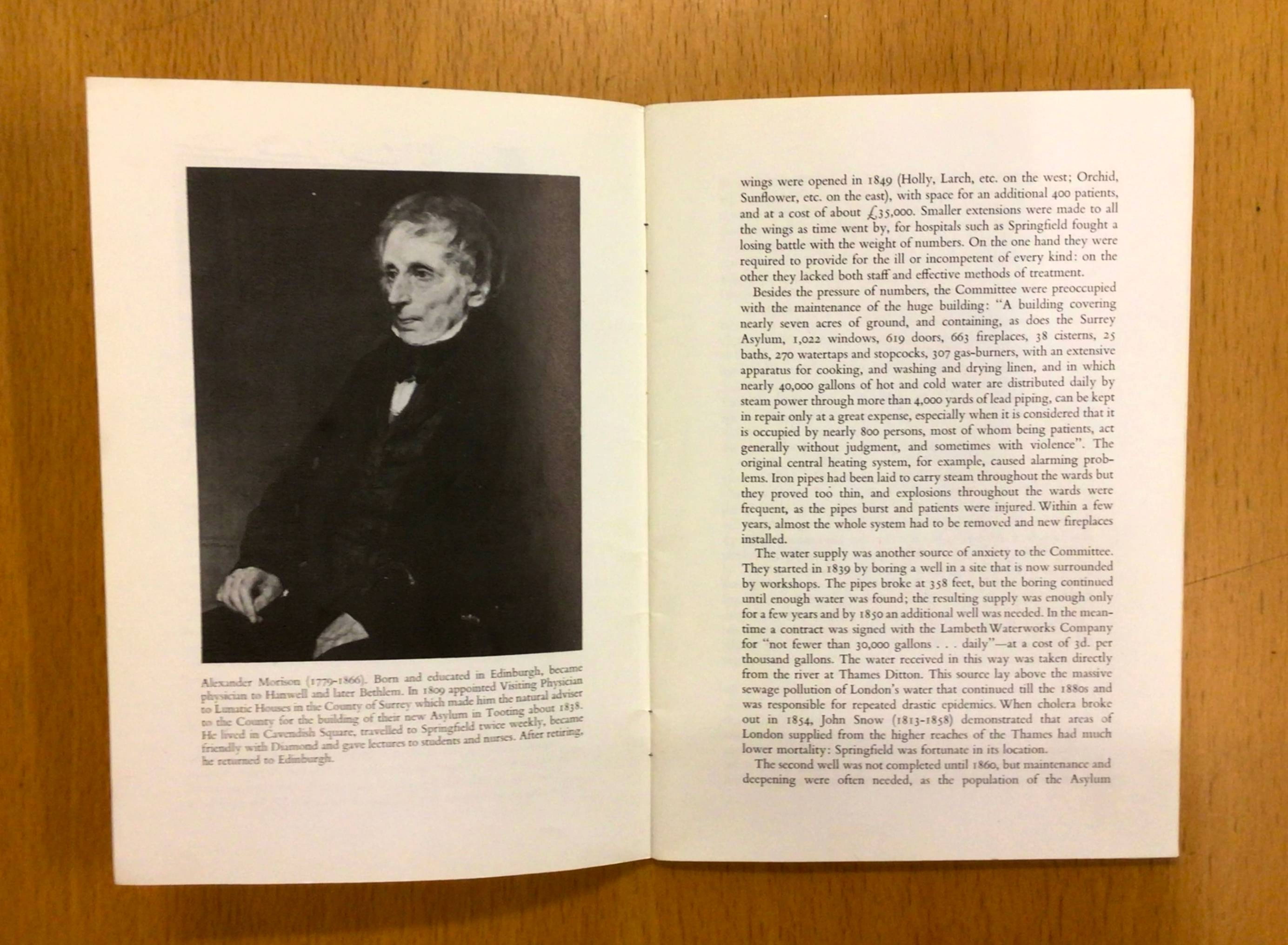
[IMAGE]
Alexander Morison (1779-1866]. Born and educated in Edinburgh, became physician to Hanwell and later Bethlem. In 1809 appointed Visiting Physician to Lunatic Houses in the County of Surrey which made him the natural adviser to the County for the building of the new asylum in tooting about 1838. He lived in Cavendish Square, travelled to Springfield twice weekly, became friendly with diamond and gave lectures to students and nurses. After retiring, he return to Edinburgh.
wings were opened in 1849 (Holly, Larch, etc. on the west; Orchid, Sunflower, etc. on the cast), with space for an additional 400 patients, and at a cost of about £35,000. Smaller extensions were made to all the wings as time went by, for hospitals such as Springfield fought a losing battle with the weight of numbers. On the one hand they were required to provide for the ill or incompetent of every kind: on the other they lacked both staff and effective methods of treatment.
Besides the pressure of numbers, the Committee were preoccupied with the maintenance of the huge building: "A building covering nearly seven acres of ground, and containing, as does the Surrey Asylum, 1,022 windows, 619 doors, 663 fireplaces, 38 cisterns, 25 baths, 270 water-taps and stopcocks, 307 gas-burners, with an extensive apparatus for cooking, and washing and drying linen, and in which nearly 40,000 gallons of hot and cold water are distributed daily by steam power through more than 4,000 yards of lead piping, can be kept in repair only at a great expense, especially when it is considered that it is occupied by nearly 800 persons, most of whom being patients, act generally without judgment, and sometimes with violence". The original central heating system, for example, caused alarming problems. Iron pipes had been laid to carry steam throughout the wards but they proved too thin, and explosions throughout the wards were frequent, as the pipes burst and patients were injured. Within a few years, almost the whole system had to be removed and new fireplaces installed.
The water supply was another source of anxiety to the Committee. They started in 1839 by boring a well in a site that is now surrounded by workshops. The pipes broke at 358 feet, but the boring continued until enough water was found; the resulting supply was enough only for a few years and by 1850 an additional well was needed. In the meantime a contract was signed with the Lambeth Waterworks Company for "not fewer than 30,000 gallons . . . daily" — at a cost of 3d. per thousand gallons. The water received in this way was taken directly from the river at Thames Ditton. This source lay above the massive sewage pollution of London's water that continued till the 1880s and was responsible for repeated drastic epidemics. When cholera broke out m 1854, John Snow (1813-1858) demonstrated that areas of London supplied from the higher reaches of the Thames had much Jower mortality: Springfield was fortunate in its location.
The second well was not completed until 1860, but maintenance and deepening were often needed, as the population of the Asylum
increased, and baths became an everyday occurrence. The building of the water tower in 1885 (for £1,300) was also designed to improve the supply, as well as to produce sufficient pressure in case of fire: it was demolished in 1976. The wells themselves, although still in existence have not been used since the Second World War. The newer pump — a single column beam engine, with its graceful Doric column — was broken up for scrap, but the original pump — a Maudslay table engine — continued in use until after the Second World War, and then found a permanent home in the Science Museum in South Kensington.
Although from the first the Asylum had to cope with every sort of clinical problem, the development of special facilities followed only gradually. Infectious cases in the enclosed wards, a constant source of epidemics and anxiety, were not separated until 1872 when the Cottage Hospital was opened: designed by the Medical Superintendent, Dr. J. Strange Biggs and built by hospital labour for £955. The "Infirmary Block" for the physically ill, with its operating theatre (now the Dispensary) was opened in 1931, and typified the enclosed, self-contained view of the mental hospital perpetuated since the last century.
The most ambitious addition involved the removal of the mentally handicapped, and especially children, from the wards for the mentally ill. The "Annexe for Idiot Children" (now the Admission Hospital) was opened "'in the sixtieth year of Her Majesty's reign" (1897). The idea had been strongly advocated by the Superintendent, Hugh Gardiner-Hill (1856-1925), no doubt supported by an expert member of the Committee, John Langdon-Down (1812-1896).
The building, designed by Rowland Plumbe, was opened on 15th October, 1897 with the admission of 20 "idiot children". It was equipped with visiting rooms (and toilets) at the front; the wards (into which visitors did not penetrate) lay to the rear. On the right of the entrance was spacious accommodation for a doctor and his family. It was lit from the first by electricity, although the change from gas needed a grant of an extra £5,000.
Its opening made possible at Springfield an active approach to the education and training of the mentally handicapped, previously dispersed — to everyone's disadvantage — through all the wards. Hugh Gardiner-Hill stated the objective as "teaching them to acquire habits of cleanliness, and to develop their dormant senses, so as to adapt their minds and bodies for industrial training, and make their lives the happier by engaging in such occupations as tailoring, mat, basket, brush and shoe making . . . it would be a noble achievement to bring back this unfortunate class within the pale of ordinary life".
This aspiration continued until the First World War when the building became a military hospital for the wounded. It was never again used for the mentally handicapped but underwent a further adaptation as the result of the Mental Treatment Act of 1930, providing accommodation for the new "Voluntary" patients.
THE COMMITTEE
AS A COUNTY INSTITUTION and facility, the Asylum started from the first as a service to the people of Surrey. At the time, that County reached as far north as the Thames, and Wandsworth represented a particularly densely populated area.
Before the County Council's Act of 1888, Counties were administered by the Magistrates who were appointed by the Home Secretary after nomination by the Lord Lieutenant of the County. The system ensured that Magistrates were chosen exclusively from among the landed gentry, aristocracy or a few individuals who had risen by sheer industry or merit. Trades-people, the middle classes, or in fact anyone contaminated by business or trade found no place on the Bench or on the Subcommittees recruited from it, such as that which managed the County Lunatic Asylum.
Throughout most of Queen Victoria's reign, the Lord Lieutenant of Surrey was William King, Earl of Lovelace (1805-1893). As a young man he had a promising career as a Diplomat, spoke four or five languages and while in the Middle East often talked with Mehmet Ali, the legendary Pasha of Egypt. In 1833 his father died unexpectedly; he returned hastily to look after the family estates and in 1835 married [Ada] the only daughter of Lord Byron, the poet. She brought with her not only a large inheritance, but also influence with the Whig Prime Minister, Lord Melbourne; these were the means by which King acquired his title and social eminence in the County. Although deaf and somewhat eccentric, he was a benevolent and competent landlord of his large estates — on which he designed many cottages and schools, as well as his own mansion (Horsley Towers) in what was described a "vaguely Rhenish Gothic" style.
In such a milieu, it was natural to appoint minor, or under-employed, members of the aristocracy; Viscount Midleton, for example, or the
Hon. Sidney Roper-Curzon, and Sir Richard Frederick Bt. The 6th Duke of Northumberland (1810-1899) was another who served on the Springfield Committee (1846-1869), although, as the largest landowner in the country, he spent much of his time at Alnwick Castle. When in the south of England, he lived at Albury Park, near Guildford, with his father-in-law, Henry Drummond (1786-1860). This banker and M.P. is particularly remembered for founding the Chair of Political Economy at Oxford (1825) and a Sect known as the Catholic Apostolic Church, which sprang from the ministry of Edward Irving, a young and gifted preacher of Pentecostal doctrines and experience. After Irving's early death, the centre of these "Irvingites" shifted from Holborn to Albury where a church was built and which is still co be seen.
Many other Committee Members sat in Parliament for Surrey; Samuel Gurney (1816-1882) the son of a more famous banker and associate of Wilberforce, lived as a country gentleman in Carshalton: he served as President of the British and Foreign Anti-Slavery Society and founded the Metropolitan Drinking Fountain and Cattle Trough Association. Others included Thomas Alcock (1801-1866) and Richard Alsager (?-1841).
William Crawford, who had returned as a rich "nabob" from service in the East India Company; William Stone (1834-1896) had obtained a First in Classics, as well as being a Wrangler, and Henry Kemble (1787-1857) had supported William Pitt and served as Chairman of Springfield through some difficult years: William Denison (1770-1849), another banker, sat for Surrey from 1818 until his death.
Some of those associated with the Asylum had reached greater distinction. Sir Richard Baggallay (1816-1888) was called to the Bar at Lincoln's Inn (1843) and later became Solicitor General and Attorney General; he drafted many of the legal documents for Parliamentary reform.
Henry Goulburn (1784-1856), a wealthy West India proprietor, became Under-Secretary for the Home Department in 1810, for the Colonies 1812-1821, and Secretary for Ireland 1821-1828. He became Home Secretary in 1828 and again in 1841, and it was during his time in this office that he joined the Springfield Committee where he remained until 1849, a combination of functions that nowadays is hard to conceive. His home in Surrey, Betchworth House, which he bought in 1819, remains in the possession of his family.
William Jolliffe Hylton (1800-1876) had at the same time a long political career as a Conservative. He had been Under-Secretary for Home Affairs in Lord Derby's administration and in the Crimea War lost his son at the siege of Sebastopol. A year or two after the war was over, he joined the Springfield Committee where he served for nearly ten years.
[Jolliffe Hylton — rings a bell — or am I confusing him with Hedworth Joliffe? — no "Hyltons", I think — follow up.]
Like Drummond, a few were financiers. James Freshfield (1775-1864) who, after Cambridge entered the Law and became Solicitor to the Bank of England for 20 years; he became Chairman of the Globe Insurance Company and a member of the legal firm that still bears his name. He was also an important backer of the property developer Thomas Cubitt (1788-1855).
At the time there were many members of the middle classes looking for safe investments offering a secure return: reliable speculation in property, and the business in mortgages, was particularly attractive at a ime when "blue chips" did not exist.
Cubitt, whose firm developed Belgravia and Pimlico, was a self-made man who had started life as a carpenter. His business acumen led him to increasingly ambitious ventures in developing large arcas of London and his need for capital was increasingly easily met as his reputation for reliability and financial security became widely known. It was through backers like Freshfield that public confidence and Cubitt's security grew.
Thomas Cubitt himself, although dying a millionaire and leaving a son who entered the aristocracy, never sought public office. It was left to his younger brother, William (1791-1863), a partner in the business, to enter polities and to become, more than once, Lord Mayor of London. William served as Member of Parliament for Andover, 1847-1861, at the same time that he was a Committee member for Springfield. His altruistic interests were also expressed by organizing a relief fund for the cotton workers thrown out of work by the American Civil War.
Altruism was an important motive among men who sought election to an Asylum Committee. Springfield, situated a mile or so south of Clapham, attracted the interest of the serious minded and evangelical families who had, a generation earlier, formed the "Clapham Sect". Led by William Wilberforce (1759-1833), and worshipping in the Parish Church on Clapham Common under Henry Venn, they shared the belief that their Christian faith should be expressed in reforming social abuses such as slavery.
Thomas Henry Thornton (1832-1913) was a member of this second generation. A brilliant Classical and Hebrew Scholar at Oxford, he distinguished himself in the Indian Mutiny and became Secretary to
the Punjab Government: for a year he acted as Foreign Secretary to the Government of India, He maintained an active interest in the Universities of Calcutta and Lahore and retired to England to serve on the Springfield Committee and to write two books on India.
Two others, similarly motivated, were members of the Barclay family. Charles (1780-1855) had himself been a member of the Clapham Sect, and had taken a prominent part in the anti-slavery campaign. Most of his working life was divided between the brewery (Barclay, Perkins & Co.) and various public offices, Parliament, Guy's Hospital and Springfield (1837-1842). His son, Arthur Kett Barclay (1806-1869) succeeded his father as Head of the House of Barclay.
He developed many scientific interests of his own and for his researches in astronomy was elected to the Royal Society. He remained a prominent figure in the scientific world until he developed a progressive paralysis at the aye of 50; after his death he was remembered as a man of "noble and unselfish character, strong religious principles, just and calm judgment".
The interest, to a present day observer, of some of the Committee members, is often accidental. Lewis Loyd (1811-1891), for example, was the eldest son of a banking family and played a part in the family firm, but he lived in Beckenham and his house and estate were bought by the Governors of Bethlem when the hospital was to be moved from St. George's Fields in Lambeth. The Loyd mansion, Monks Orchard, stood on the site of what is now Witley House, Bethlem.
The cultural background of the period is evoked by Henry Thomas Hope (1808-1862) whose father had lived at Deepdene, a mansion on the hillside above the main road to the coast, near Dorking. A scholar as well as a man of great wealth, Thomas Hope had introduced into furniture design patterns taken from antiquity: his book of Household Furniture (1807) was a source book for many years, and a set of chairs deriving from Hope's patterns were in the Springfield Commuttee Room for 140 ycars until they were stolen in 1981. His son, who sat on the Springfield Committee (1848-1852) no doubt used them himself.
Another individual of special interest was Sir George Pollock (178 1872) whose distinctions had all been gained elsewhere before 4 retired to Clapham; he was already 76 when he joined the Springhic; Committee for 4 years. His father had been saddler to George i _ his two brothers became distinguished lawycrs. Pollock himse we Commissioned in an artillery regiment in India (1803) where to continued to serve for many years. In 1841, a British expedition [to?] Afghanistan had been annihilated on the Khyber Pass with only a solitary survivor. The following year Pollock, on his own initiative, relieved Kabul, secured the release of hostages and returned safely. His campaign and methods were regarded as a model of mountain warfare, and were often referred to in the military text books.
A name that is familiar to every housewife is that of Henry Peck [Peek!] (1825-1898). A typical successful Victorian businessman, he centered the firm of Peck [Peek] Bros. which dealt in tea, coffee and spice in its trade with the East Indies. In the years following the Napoleonic wars, business conditions were very favourable and Peck became extremely wealthy. The family firm diversified and expanded, forming the origin of Peck [Peek], Frean & Co., Brooke Bond, Associated Biscuits, as well as other companies. Peck [Peek] lived in Wimbledon House and gave a large tract of land to the Government to enlarge the common. When he retired to Devon in 1863, he occupied himself with building a house containing 104 bedrooms.
Very few doctors were represented on the Committee, but one was himself a distinguished psychiatrist. Charles Hood (1824-1876) had been the first Medical Superintendent of Friern Barnet (Colney Hatch Asylum). He moved in 1852 to Bethlem, as Superintendent, and ended a long tradition of absenteeism by himself living in the hospital. He did much to improve the activities and lot of his patients, was consulted by the Springfield Committee over the death of Daniel Dolley (1856), and himself joined the Committee for a couple of years in 1865.
The pattern of the Committee, in its membership and function, continued along traditional lines for nearly fifty years. Its character reflected the hegemony of the gentry and aristocracy, whose domination derived from agriculture and whose feudal organisation sprang from the Middle Ages. But although it reached its peak in Victorian times, it was soon to crumble.
Around the 1870s, the economic basis of this agricultural society was shaken by an increasing flood of cheap grain from America. The penetration of the West by the railways made possible the transport of huge quantities of grain, grown cheaply, to markets in Europe. In this country, prices were depressed, agriculture suffered sharply, and the power and wealth of country landlords diminished, a change marked in 1888 with the passing of the County Councils Act.
From that time power in the Counties was no longer the prerogative of the Lord Lieutenant and his nominees: councillors were now elected and the position suddenly became open to the middle
classes and tradespeople, from the traditional point of view social nonentities. However, although a few were people of permanent distinction, most become more difficult to trace and identify, and their personal history is unknown to us. One of the aristocracy so elected was George Bingham, who succeeded his father as the 4th Earl of Lucan in 1866. During the Crimean War, he had served as A.D.C. to his father who had been held responsible for the confused command which sent the Light Brigade on its disastrous charge.
The 3rd Earl had treated his unfortunate Irish tenantry with similar lack of feeling and had died in old age full of honours but held in awe or even fear. His son, by contrast, has been called "the most lovable and universally beloved of men", and as Earl set about rectifying his father's abuses in Mayo. Although his family no longer live there, it is his name that is still remembered with affection. He was active in County affairs in Surrey and served on the Springfield Committee for nearly twenty years until his death in 1909.
Another member of the old class was Edward Hugh Leycester Penrhyn (1427-7). He had sat on the Committee with his father for a ycar or two after 6867 and remained a member until in 1889 the hospital was transferred to Middlesex; two years later he became Chairman of Surrey County Council, the culmination of a career of public service — Chairman of the Quarter Sessions, the Board of Guardians and an officer in the Surrey Militia. He lived and died in the house in Ease Sheen where he had himself been born.
Typical of the new type of Councillor was Cory Francis Cory-Wright (1839-1909), a coal merchant who prospered and in 1903 was created a Baronet. His father, William Wright, had been severely wounded at Waterloo: he chose to christen his son Cory after his friend of that name whose business he eventually entered. He joined the Springfield Committee in the year that he died.
The natie of another doctor is of particular interest: John Haydon Langdon-Down (1829-1896) was born in Cornwall and left school at the age of 13 to help his father in his work as an apothecary. He came to London a few years latcr as an assistant to Michael Faraday and later entered the London Hospital where be distinguished himself with many prizes before being appointed Assistant Physician im 1859. The previous year he had also been appointed Medical Superintendent of the Asylum for Idiots at Earlswood where he stayed for 10 years (and was then succeeded by Dr. Grabham from Springfield) before opening his own institution, Normansfield. This provided for the "feeble-
minded of the upper classes", and since 1948 has been incorporated into the National Health Service. In 1866 he made his "Observations on the Ethnic Classification of Idiots" in which he described the group of Mongolian appearance, with which his name is now permanently associated. In 1889 he became a County Alderman for Middlesex, and served on the Asylum Committee until his death: he must have been a powerful influence in separating the mentally handicapped from the mentally ill, and building for them a new and thoughtfully designed "Annexe", later to become the "Admission Hospital".
No account of the Springfield Committee could be complete without mention of Stephen Bridgland (1805-18802), its first effective Clerk and Steward to the hospital. He was appointed in 1842, to succeed the Steward who had quarrelled with Dr. Quick, end remained for 11 years, after which he continued for another 6 years to serve as Clerk and to administer the farm reallyloor of the Administration Block, and retired in old age to Mitcham. However, he gave the Asylum, according to the standards of his time, an efficient and smooth adminivtration and was described as a man of "habitual courtesy and good feeling". The greatest test of his abilities came: int 1856, after the deazh of Daz! Dolley. The enquiries of the Commissioners of Lunacy were communicated by their Secretary, John Forster (1812-1876) himself a highly cultivated man, a biographer of distinction and later to be a Commissioner himself. Yet Bridgland's replies, on behalf of Springfield, reveal a man of character and intelligence, able to represent the hospital's view with clarity 2s well 2s force and no doube able tn gniée the Committee wisely. Springfield at a time of crisis was particularly fortunate in its first Administrator.
[https://en.wikipedia.org/wiki/John_Forster_(biographer)]
THE DOCTORS
THE HISTORY OF clinical psychiatry over the past century and a half is illustrated by the doctors who have worked at Springfield during that time. Initially psychiatry was the preserve of a few who were trained haphazardly simply by experience and an informal apprenticeship. Although the public expected much of thens, there were no clear professional standards of knowledge or practice. Specialist associations Did not exist until the founding of the Association of Medical Officers of Hospitals for the Insane in July 1841, a date that virtually coincided
with the opening of Springfield itself. This association soon established the "Asylum Journal", later vs become (1858) the "Journal of Mental Science'" and in due course the "Scottish Journal of Psychiatry". In the later years of the century, the Association established an examination of "Efficiency in Psychological Medicine", and itself became in turn The Royal Medico-Psychological Association and The Royal College of Psychiatrists,
One of the original participants in these developments was Alexander Morison (1779-1868), the first Visiting Physician to the Surrey Asylum. Morison had been bom in Edinburgh and in 1799 presented his MD thesis on "De Hydrocephalo Phrenitico", demonstrating his early interest in mental disases. An amibitious man and a hard worker, he sured us Londen in 140% and hecame in due course Physician ws Senwell Asrlum, Vethlem (1435) and Uridewell. As the Visiting Viysician to the Lunatic Howes in the County of Surrey, he was asked abenss 1937 ty 2dvisve on the building of the new Asylum in Tooting. fe was he whe surveyed the Surrey pauper Junaties cared for in the vations private madhoues and arranged for the firse 24 to be tran ferred us the Asylum when i opened in June 1441.
Morison bived in Cavendish Square and travelled ws Taming once ar vatce weekly to we the patients and w supervise the work of the Reddene Medical Supcrintendents. His eflesency in this respect faded enthin 18569 he cctired, was knighted, and returned tw Edinburgh for the bese years of his life. Although not « man of great intellectual powes, be was 2 moderate and thoughtful doctor. He published in 142% a "Vhystognomy of Mental Diseases" — illustrated by drawings. a work which 15 years later stimulated Hugh Diamond w recead his patients photographically.
Sorison, from the firm, used the dinical opportunities at Springfield for teaching medical uudents, He had been giving, since 1423, lectures on mental dneases bah m Edinburgh and London: he reported tw the Springfield Committee 2s carly as 14453 "I have, with your sanctum. been accompanied by a limited number of medical pupils in my visits to the Asylum, and as hav been my custom for the last twenty years, S have endeavoured w communicate to chem all the information in ty power respecting the nature, causes and treatment of the very isnportent class of dicases with which the inmates of the establishment ace peculiarly aftctcd™.
At the time «f the opening, Morison was assisted by one Resident Medical Superintendent. As the only resident doctor he was required to reside in the Aslam cntnwaly and na ty doent hing fate the permision f the Canine, Soesides treaty the matey, Mery their notes and various caher reesad:, he had wadvix on ce appt ment of attendants, disp-ns: all die mofcnes, and sad prayers night and moming, The first ws be appointed war Vhoinas Quick, vho cane with his wife as the Matron from Dowheuce where they had ware together for some years. Quick had qualified LSA. in tim 2nd proceeded MD, Glayuw in 1439, having worked fur a period a Hanwell Asylum. No vemer had Quick arrived at Gpenigfield dan he fell into a dispute with the Seward regarding tic repeuie responsibilities. Both were suspended, bur after six months Ouick (although not the Steward; was reinsated, Sion his wife feil si] and in 1242 had to resign the post of Matron; she died after a lingering lnc (probably tuberculosis) and her husband, without her support, vent pieces. He was asked tw resign, fell on hard times and died protabl, about 1350.
Quick was followed by Samuel Hill (1815-1874) who had qualified at St. Thomas' in 1836. Springfield seems to have been his first apointment in psychiatry, but this inexperience did nos deter him from publishing the following year "Suggestions for providing for all the Pauper Lunatics in England and Wales". At Springfield he was anactve and energetic resident and in 1446 he became Superintendent af the South and East Riding Lunatic Asylum, Clifem, York: nis wife being appointed at the same time as Matron. He was man of independent opinions, vigorously expressed; he did not, for example. join i the demand that so-called criminal lunatics should be excluded from County Asylums and regarded 2 Central Asylum such a: Broadmoor as quite unnecessary. He exercised 2 firm though benevolent cenitro) over his patients and was regarded 2s an unconverted reactionary by the proponents of the non-restraint system of management. He continued working at Clifton until 1266 when he resigned in order 10 be able to look after his wife who, in the previous year, had developed paralysis. He retired to Wambrook, near Chard, where his neglected gravestone can still be identified.
Joseph Holland followed Hill in 1846 as the wlitary resident. He seems to have been a conscientious man, but inclined ws use restramning methods much more than his two successors. He stayed only a few years, bur in September 1843 was joined by Charles Snape (1) 6 g-1262,. Now, with two residents, the responsibilities for male and female patients were separated, and Snape could live comfortable in the
Superintendent's house at the end of the newly opened wing (Holly, Larch, etc.) This new doctor ale seen to have had no previews poychiatrie experience: he came from General Practice in Faversham, Kent, Snape ne married a young widow, Agnes 'Taylor, by whom he had a-daughter during bibs tine as Spongfeld. In his hoaehold he could live income style with an marricd female relative, a footman, lady's innld, governess and nurse, In hpite of fis back of experience, Ie Wat ayprotneeel in the teeth of much COMpCt On, probably testimony to his Incisive manner and hin vigoroin approwh to treatment. The nurses were greatlydiritated by his meticulous, pedantic concern with every detail of his patients' condition, bat even din enemies testified to his ke booclavernss and good intentions, ble remained, however, a untrained practitioner, whose VIPOUr eck Ina te stale ngot COREECTIC Op TdOna UCIT cally; his independence kept hin fron: subsitting, Ins adeay to the scrutiny of his colleagues and he suffered no doubt from Morison's increasing age and incapacity. All this culminated in the death of Daniel Dolley, ax che result of excessive though well-meaning treatment, and demonstrates the need for, ay well as the objectives of thorough professional training, | Although after this misfortune Snape was reinstated, he resigned four years later, and moved to Great Stanmore, where he died about IKO2,
Within a year or so of Snape's appointment, Holland left, and was replaced by Hugh Diamond (1808-1847) who had in 1848 already applied unsuccessfully for the post. Although he came with considerable psychiatric experience, Diamond's real interest lay in photography. The technique was still very new and Diamond himself made significant contributions to its technical development, However, at Springfield he applied it to patients in the Asylum, capturing their appearance and improving on the work of Morison of 15 years before, The application of new techniques as they appeared to the study of clinical material, was a process often repeated as the century progressed. Although thy particular work could not have led much further, it was av early example of the principle that hey at the basis of all clinical science,
In the enquiry that followed the death of Daniel Dolley in 1856, Diamond's conduct was heavily criticized, and his resignation requested, He spent the next thirty years as Superintendent of Twickenham House, a private madhouse for ladies, where he became known as a collector and antiquary, but he no longer took photographs and
[IMAGE]
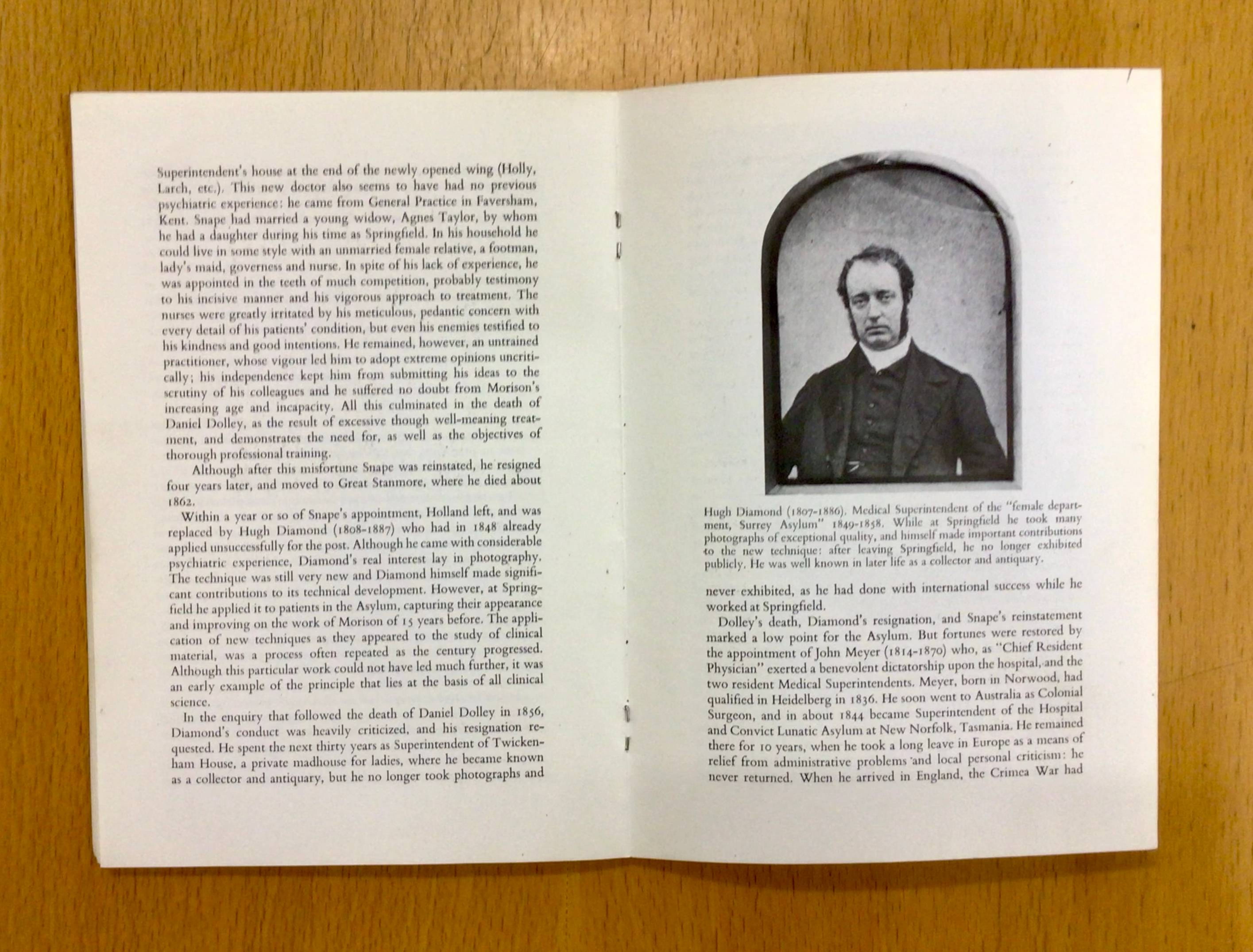
Hugh Diamond (18071446), Medical Superintendent of the "female depar ment, Surrey Asylum ik4y-1858, While at Springfield he took many photographs of exceptional quality, and himself made important contributions to the new technique: after leaving Springfield, he no longer exhibited publicly. He was well known in later life as a collector and antiquary, never exhibited, as he had done with international success while he worked at Springfield.
Dolley's death, Diamond's resignation, and Snape's reinstatement marked a low point for the Asylum, But fortunes were restored by the appointment of John Meyer (1814-1870) who, as "Chief Resident Physician" exerted a benevolent dictatorship upon the hospital, and the two resident Medical Superintendents. Meyer, born in Norwood, had qualified in Heidelberg in 1836. He soon went to Australia as Colonial Surgeon, and in about 1844 became Superintendent of the Hospital and Convict Lunatic Asylum at New Norfolk, Tasmania, He remained there for 10 years, when he took a long leave in Europe as a means of relief from administrative problems 'and local personal criticism: he never returned, When he arrived in England, the Crimea War had
broken out, and Florence Nightingale an object of great public interest, Meyer was at once invited to join the party of Mary Stanley and Jocelyn Percy, M.P., who with a dozen nurses were about to embark for the war. They travelled slowly and by the tine they reached the Crimea, their resources had been dissipated .Miss Nightingale, however, who had not asked for their help or even been consulted, refused to acknowledge them: she would make no use of their services or help them in their subsequent embarrassing difficulties: Eventually Meyer was given charge of the British Hospital in Smyrna, returning when the war was over to England, and to Springfield.
He remained here unl in 1862 he was invited to take charge of Broadmoor as its first Superintendent. In 1866 while kneeling in the chapel at the Communion rail, he was struck from belind by a patient using # stone slung in a handkerchief, Meyer never recovered from this head injury: he reuyned his position in 146% and, two years later, died.
When Snape left Springfield, Meyer had appointed William Orange (1%34-1616), whess he later invited to join his at troadmoor, Orange had qualified fron St. Wioinay' Hospital in 1456, after an apprenticeship starting at the aye of ¢§, Almost at once he set out on a long continental tour with a patient, using his time to learn French, German and Italian, His work at Broadmoor led to a distinguished career in forensic psychiatry, He became Superintendent there in 1870, on Meyer's retirement, but himself suffered an almost identical personal injury, In 14824 patient, the Kev, J. Dodwell, struck Oratige on the head with a stone slung, in a handkerchief, Orange retired from Broadmoor in 1886, but was able to work for many years in consulting practice and as adviser ty the Home: Office, He had then reputation of heitiy « cold, urlikeable-man, but after hie marriage in 5692 to a girl 24, years younger tha hina, he lived a devoted and lively family life.
Statin ad teen replaced (185%) bry Sasries Strange Siyys (shay Sty whe spent wiest Of hit working Wife at Springfield, He came i tee and after Mayer's departure was appointed Chief Resident Physician at the-age of 93. He seris to have been 4 rather colourless bat hardworking: sian, ackicraledyed as "bind, judicious and cet yeti ", However, Sie meticulous concern for regularity probably etait siireasingly riysa, and the practices A restraint, given ay by his prodecevtas, yratually coos tack dunn fits tine, Sis virble roatntetiol ss the Crys Mest "for the recnption Of 14 cas of safaccitnis divas, 7 th oa oe anil arsigned by inyys heise dF.
[IMAGE]
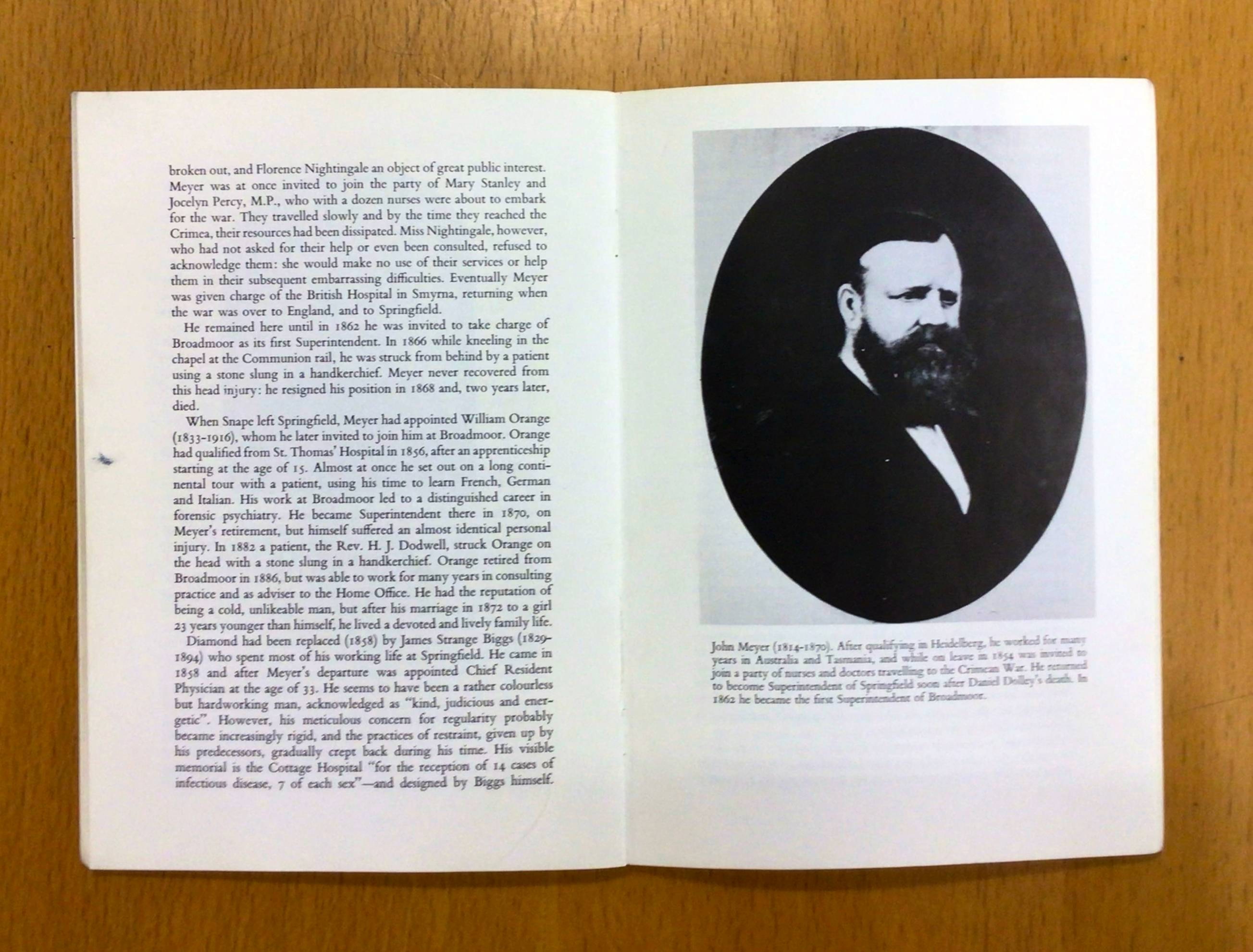
John Meyer (1814-1890). Alter qualifying in Heidelberg, he worked for many years in Australia and Tasmania, and while on leave in 1854 was invited to join party of nurses and doctors travelling to the Crimean War. He returned to become Superintendent of Springfield soon after alter Dane) (ell. pa teatle fn tha he became the first Superintendent of Lituadiners
Built by the hospital artisans, it cost £955, and was finished in 1872. Biggs resigned in 1888, after 30 years at the levsprttarl "Paving, parvee the age at Go and teeling that the great reponsibillty and amvtety connected with the chan af coke Hanatle pclennts lavcl prraclitally TH pan his physteal anchnervaus strength' |
Biggs's vedi ava anacked by a sinitioant landmark in psychiatrte alivtnistrations tie tog, the Goumiluee deeided to establish hii position as Medleal Superintendent, signifyliyy bis new: preeeninent postion in the Asylum administrative ay well ay medical Medical dominance and authority was now complete, bur remained in visthle vers abseures Biggs lived ac chi-dime in the buildlag ar the extreme end of the wings built de go (atid containing, wards such as Holly, Larch), 'This accommodation is distinguished by ditevent brickwork anal, with its rather grand entrance, is stl] obvious enough. However, the Committee were surprised at this dime to realise that the Asylum had been baile without providing accommodation for its senior doctor af a standard which they now: regarded as suitable: In 1879 they started to build a mansion of some grandeur: Biggs moved ta live there in i881, leaving, his old house to be absorbed into the nearby wards, Tn raga the house became a hostel for ao mate nurses and later the Centre for Occupational Therapy, the role it still fulfils,
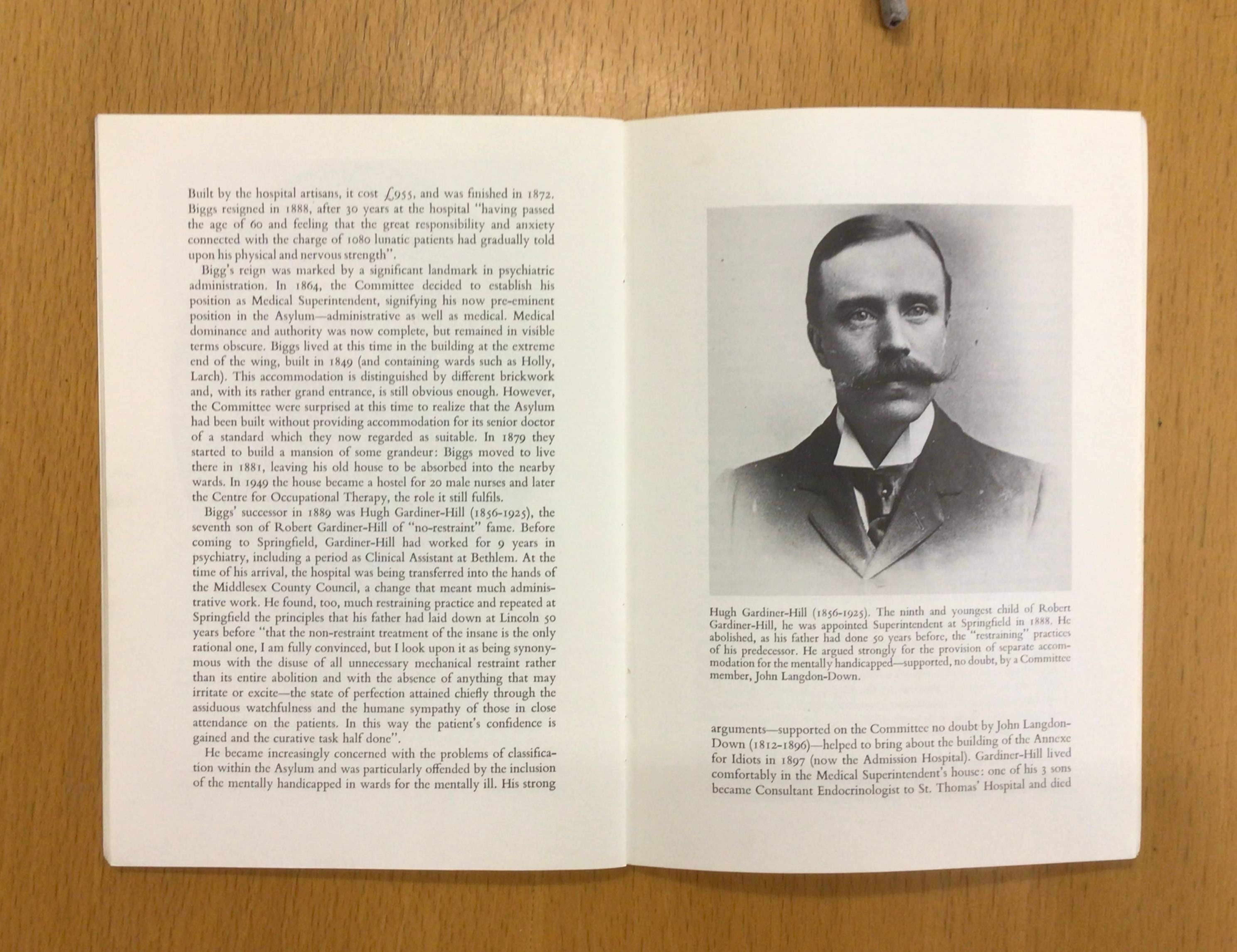
Biggs's successor in 1889 was Hugh Gardiner-Hill (1856-1925), the seventh son of Robert Gardiner-Hill of "noerestraine" fame, Before coming to Springtield, Gardiner-Hill had) worked for 9 years in psychiatry, Including, a period as Clinical Assistant at Bethlem, At the time of his arrival, the hospital was being transferred into the hands of the Middlesex County Council, a change chat meant much administrative work, Ele found, too, much restraining: practice and repeated at Springfield the principles that his father had laid down at Lincoln so years before "that the non-restraint treatment of the insane is the only rational one, Lam fully convinced, but look upon itas being synonymous with the disuse of all unnecessary mechanical restraint rather than its entire abolition and with the absence of anything that may irritate or excite — the state of perfection attuned chiefly through the assidtious watehfilness and the humane sympathy of those in close attendance on the patients. In this way the patient's confidence ts pained and the curative task half done".
He became increasingly concerned with the problems of classification within the Asylum: and was parucularly offended by the inclusion of the mentally handicapped in wards for the mentally ill, His strony
[IMAGE]
Hugh Gardiner-Hill (1856-1925). The ninth and: youngest child of Robert Gardiner-Hill, he was appointed Superintendent at Springfield in 1888. He abolished, as his father had done so years betore, the "restraining" practices of his predecessor. He argued strongly for the provision of separate accommodation for the mentally handicapped — supported, no doubt, by a Committee member, John Langdon-Down,
arguments — supported on the Committee no doubt by John Langdon-Down (1812+1896) — helped to bring about the building of the Annexe for Idiots in 1897 (now the Admission Hospital). Gardiner-Hill lived comfortably in the Medical Superintendent's house: one of his 3 son became Consultant Endocrinologist to St. Thomas' Hospital and died
IMG_0782
in 1980. After the death of his wife in 1904, he became much less active and vigorous: he retired to Wimbledon Park in 1912, where he died in 1925.
His successor (in 1912) as Superintendent was Reginald Worth, who had come to Springfield in 1897. Within a couple:of years, the war had broken out and he became responsible for the hospital with the help of only onc other doctor, G. Warwick Smith. In 1917, Lt. Fearnside was appointed to care for the War casualties in the Admission Hospital, and Worth himself was given the rank of "Major": his military approach to his work never left: him in peace time. In 1939 he resigned to become Superintendent at the City of London Mental Hospital. John Ewens (appointed 1912) became Superintendent through the War years until Harold Beccle succeeded him in 1948. With Morris Murkowe (1965) the post changed to that of Medical Administrator; the rotation of the appointment between various Consultants marked the final change from the hierarchical structure established over a century before.
During this time Junior Doctors came and went, usually after a few years experience in the hospital. A few continued a psychiatric career: G. W. Grabham (1863) was appointed the first Superintendent of Earlswood (1868). E. H. Paddison (1880) went to Stone, A. M. Jackson (1886) went to Barming Heath in 1892, and L. W. Rolleston (1894) became the first Superintendent of Napsbury in 1904. Edward Hare (1945) went to the Maudsley and Max Hamilton (1951) became Professor in Leeds. Two died at Springfield, C. Eardley Wilmot in 1896 and William Ferris in 1909. Many left for private practice.
Between 1841 and 1900 only 24 doctors were appointed to Springfield, and the slow progress of a career reflected the limitations both of training and of subsequent opportunities. The gradual increase in numbers, and speed of turnover, reflected the rise of psychiatry and the more so after the Second World War. Until then, the educational opportunity at mental hospitals were scarcely utilized, althoush Morison had brought students to the hospital froni the time of it opening. In 1927 an "association" was formed avith the Westminster Hospital and Medical School: the doctors at Springfield would conduct outpatient clinies and 'teach the students; who would also use the playing fields. In return the Westminster "Consultants would provide a service to Springfield's patients — thevarraiigement continued until after the Second: World War. These academic antecedents have since been fulfilled in the highly developed relationship with St.
George's Hospital and Medical School and the designation (1976) of Springfield itself as a University Hospital.
THE CASE OF DANIEL DOLLEY
IN THE CARE of the mentally ill, the borderline between what is acceptable as treatment and what is actually puntshment, or harshness, needs to be considered from time to time. Every generation has cases that stir up discussion and help to decide the standards that guide the caring professions.
At the end of the 18th century, public opinion was sensitive to the abuse that patients sometimes experienced in psychiatric institutions. Even the King himself had been treated harshly when he had Been ill, and the horrors of the York Asylum had been aggravated. by the secrecy with which they were surrounded. The legislation which was aimed at humanizing the situation was slow to take effect; the persistence and drive of a reformer like Shaftesbury was still awaited. It was a period in which cases and scandals, whether suspected or real, could arouse much debate.
A case of this kind arose in Springfield in 1856: it was discussed widely and determined standards of practice for many decades to come. At that time the patients were cared for by two resident Medical Superintendents, Hugh Diamond on the female side and Charles Snape on the male: Alexander Morison had retired at the age of 76 only the year before. Diamond had already received psychiatric training as a pupil at Bethlem and had held a psychiatric appointment elsewhere. When he came to Springfield he found much in common with Morison, whom he accompanicd on his visits, and no doubt discussed psychiatric matters. Snape, on the other hand, had had no previous psychiatric appointment or training and seems to have been entirely self-taught. At Springfield he seems to have avoided Morison, whom he rarely met and from whom he received little or no instruction OF supervision. Snape was a brisk, incisive man, very conscientious and interested in every detail of his patients' care. However he became self-important and opinionated and did not submit his own ideas to the scrutiny of expericnced colleagues, whether by discussion oF by publication. He did not expose himself to constructive criticism and no doubt became an eccentric in matters of treatment.
The patient concerned was Daniel Dolley, a mole catcher aged 65, who had been admitted in September 1855. He was an exceptionally vigorous and powerful man for his age and had been excited and overactive, On Wednesday, gth April, 1456, Snape entered Ward 4 in the course of his daily round: Dolley had been dancing and shouting and kicked another patient: Snape decided that a shower bath was called for, but as he opened the door "the old man struck him a violent blow an the back of the head and ran away", He was quickly brought back, undressed and Jed without resistance for his treatment, Snape directing that the shower should lace half an hour and be followed by "a good dose of the light colourcd mixture".
The shower, in fact, lasted 26 minutes and was followed by a dene of z grains of antimony tartrate. Dolley by now was shivering and while he was being drewed had « convulsion and died, She cause, not recognivd at the time, yas presumably due to a fall in blood pressure caused by the low temperature of the water.
At that time there was no requirement that unexpected deaths should he investigated by an independent coroner's pathologic, instead, the examination was performed by Hugh Diamond's son who had only just graduated. The opinions of the three doctors present diverged: Snape thought that the heart war dicated and chat this undsaynoned, serious Mies accounted for Dolley's unfortunate and unexpected death, Diamond thought otherwise that the heart was normal and that therefore it was the rash of excessive treatment that had been responsible.
The clinical standards of the asylums were supervised by the Commissioners of Lunacy, and thew enquiry (pasticularly tharough) was presided over by the 7th Earl of Shaftevbury. It emerged that after the postmortem Hugh Diamond had weretly removed the paticnt's heart to discover what other doctors might think of it. Henry Hancock, the surgcon at Charing Crow Hospital, and Sis James Paget of Se. Bartholomew's both thought that Daniel Dolley was physically well enough to have lived much longer. But after gathering thew opinions, Diamond took the heart back to Springfield and burnt st, thercby destroying the evidence that might have cxoncrated Snape,
The Commissioners went on to examine the various factors that might have contributed to Daniel Dolley's death. In doing so, they consulted men of great distinction. Mr. Shields, engincer of the Crystal Palace waterworks, calculated that no Jess chan 618 gallons of water descended on Dollcy's head. Dr. Charles Hood, of Bethlem, thought that "15 or 16 gallons of water was enough to Ict fall on any
man whether sane or inane", and Ve, fohu Conally fied never oc. athower bath of more than one minute's durations all agrer¢ tated minutes war a danycrouly long, time for a shower, Howes, the matter was put te a more dircet tert by two cxperinietits,
Dr, Ellictwon, Professor of Medicine at University Colleye, a tian of 4 at the time, remained in the shower at SprisigSteld for 6 trinutes ate go ccumds and then found "ie had exhausted and not refreshed ban", Mor. Bence Jones (then 42 and Physician at St. George's Hespirsi, diaovered from James Glaisher (Superintendent of the orczesyscal Department of the Royal Greenwich Obserratery, the i probable temperature of the water:had been abour 45°F I Avy ot, bor Hence fories, using, ice, lowered the temperature of the shower tn 3% and stood under it for 1o-minutes, By that tite: be pales war aes, slow and irregular — he was qreak and faint and tok more that. henur to recever, OC
The Commissioners of Lunacy had no choice bart itt ee chasye of manslaughter against Snape, She etal tell pac cay c, partly becauw: one of the leading Counsel was takes: su, bot ow because the Comrts were occupied with an accusation of in ie against another doctor, In due cours: Willies Palmer war fr: guilty of poiwoning his nephew for marcy and caccuted, Wit the. coincidence of this cav: urengthened the public vaipictosi thet coctons might sometimes use their expertise for tifarse 2. aids, wach a. pais ut revenge, and this was the suspicion that foil upon Snape. Heacree, 2 September the caw eventually came before the Grant ftp oe: quickly decided that Snape had no caw Us anvirt, be nat ett and at once rcinwated at Springfield.
There were many repercussions and dimes that feat th cate, It was generally agreed that Snap: tad 0 raat 6 pees be patient for the axsaule he had suffered. Hower ca: preerbpute Hae thought to be excessive and condemned by he ota ee tai. & doctor could have his own ideas absnue trcatsnetst, a2 tet Oley CA about by such initiatives, but Snape had ani cigatset fe pote be ideas and lay himself open tw the criti et ethic WF oe profession. This Snape never did, until af: te cra Th. (ne missioners laid it down that shower bath: shud meet et et Smee 3 Minutes, and there standard practice remain 2. Da 2H HE Sees continued 25 a useful procedure until fleas. 2g (et ee available nearly a century later.
It was also required that exceptional forms of treatment should be recorded in detail at the time and should be supervised personally by the doctor who prescribed thent, In this instance the attendants had complained that the treatment had been given "without the presence of Mr, Snape, and by his orders, his horse and chaise waiting at the time to take him to the Crystal Palace". The nurses had always found Mr, Snape a difficult and demanding colleague, but even then some came forward to testify that he was a particularly conscientious doctor,
Nurses still have misgivings about medical treatment: in' some instances; by and large they are expected to accept and co-operate with what is conventional; where there are exceptional circumstances, it is important that doctors take their full: share of responsibility for carrying it into effect — a point that has recently been considered in the revision of the Mental Health Act (1983).
Although so many years have passed since this tragedy, some of its lessons are as topical today as when they were discussed so conscientiously more than a century ago.
NURSING
MORE THAN TEN YEARS were to pass from the opening of the Asylum before Florence Nightingale made her contribution to the nursing profession, establishing a training, and raising its status. Although the aspirations of the County Justices were to provide humane and competent care for these patients, no real expertise existed in England. It is truce that at the Retreat, for the previous so years, patients had been treated with particular concern and humanity. But a systematic professional training, was yet to come, and it was not until i885 that the Medico-Psychological Association first prepared the "Handbook for the Instruction of Attendants on the Insane". Those who first cared for the patients at Springtield were therefore "attendants'--and the Committee took some care with their selection, realising that "their capacity and yood conduct materially affect the comfort and care of their charge. They are instruments for carrying into effect every remedial measure, and it requires on their part firmness and self control, blended with humanity and forbearance; at the same time they are called on to perform many menial offices". Although there were about 300 patients to be cared for, the mitial complement of attendants were 9 male and 9 female under the supervision of the Matron, Mrs. Quick. The
attendants lived in rooms alongside their patients, and "are not to be permitted {0 leave their wards, cxcepit tt the tines above Perec tatyeodae ef without some sudden Or Urpent Guise a I hey went lacitied ale Asylum Report as "Coryants rather Una "Otheens ) anda sharp distinction mnade between the sexes: the males were pad beaween foo and 63! annually, the females from foto f2160 that isconuderabl, less than the cook or laundress and rather more than the homeniand They were required to rise at 6 o'clock, to "wash and comb the patients, to examine if there be any soreness or discoloration of the skin on any part of the hady, to inspect the discharges, and on ans pationt appearing illl, immediately to inform the Superintendent or Matron". At the beginning of the day, they took thea thiys and tin to the central kitchen, receiving food and medicines for than patient From the first they were on duty myhtas well as day, and it was ons after two or three years that their need for sleep was considered. In 1844 the Committee reported that "An importint change has been made in the practice of night watching on the female side, by the appointment of an additional nurse, who is solely appointed for that purpose. This change has proved very beneficial, both as regards the attendants and patients. The former are grateful for being relieved tron an oncrous and harassing duty, especially in the winter season; and the latter are superintended with preater attention than was found practicable when the watching at myhe had to be performed, ni rotation, by individuals who had been actively engaged all day in esccatmy: then various and important duties". Increase in such resources was slow: in November 1859 an additional night attendant was appomted tor each division of the Asylum; "since that arrangement, no death from suffocation has occurred".
_In spite of their heavy responsibilities, the attendants had hale or no mstruction, but only regulations and exhortations to guide them, These were provided from the beginning: "Much attention has been likewise given to the cultivation of systematic habits of kindness and fae dean the part of the attendants towards their afflicted charge, pany ever ect of moral influence in word and deed might accom satisfaction an nee ia measures and the spontancous expressions «repaid the solicitude af sk from patients on their recovery have we lations formin ude 0 t we Commnittce, shown the importance . ne insane''. There Principal feature in the improved treatment oO ue appeal for hel as, Oo course, nobody to whom the hospital mht P or example in training their attendants: Nor was there,
IMG_0788
[IMAGE]
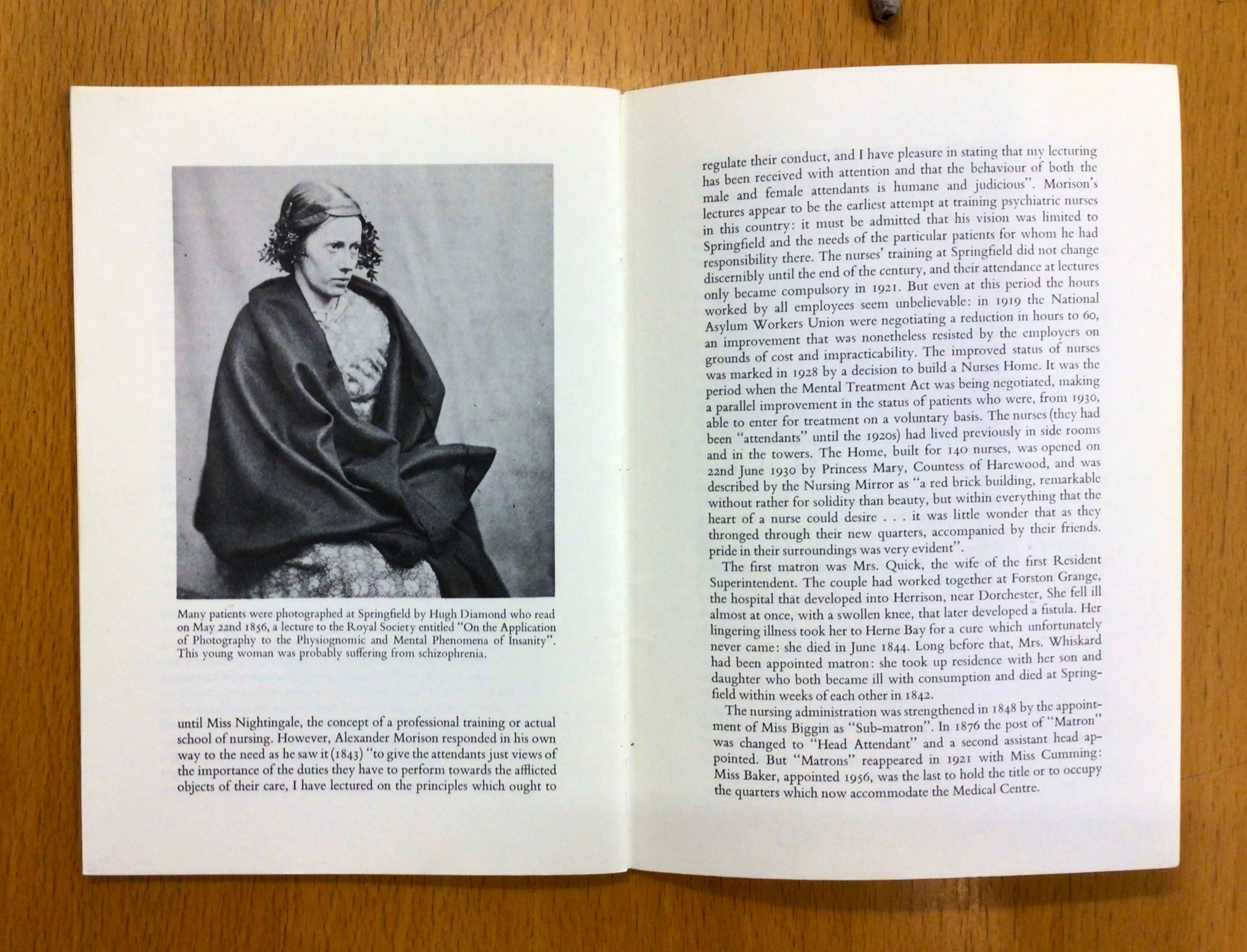
Many patients were photographed at Springfield by Hugh Diamond who read on May 2nd 1856, a lecture to the Royal Society entitled "On the Application of Photography to the Physiognomic and Mental Phenomena of Insanity". This young woman was probably suffering from schizophrenia.
[NB Diamond has dressed her as Ophelia, the archetypal made young woman.]
until Miss Nightingale, the concept of a professional training or actual school of nursing. However, Alexander Morison responded in his own way to the need as he saw it (1843) ''to give the attendants just views of the importance of the duties they have to perform towards the afflicted objects of their care, I have lectured on the principles which ought toregulate their conduct, and I have pleasure in stating that my lecturmy has been received with attention and that the behaviour of both the male and female attendants is humanc and judicious". Morison's lectures appear to be the carliest attempt at training psychiatric nurves in this country: it must be admitted that his vision way limited to Springfield and the needs of the particular patients for whom he had responsibility there.
The nurses' training at Springfield did not change discernibly until the end of the century, and their attendance at lectures only became compulsory in 1921. But even at this period the hours worked by all employees seem unbelievable: in 1919 the National Asylum Workers Union were negotiating a reduction in hours to 60, an improvement that was nonetheless resisted by the employers on grounds of cost and impracticability.
The improved status of nurses was marked in 1928 by a decision to build a Nurses Home. It was the period when the Mental Treatment Act was being negotiated, making a parallel improvement in the status of patients who were, from 1930. able to enter for treatment on a voluntary basis.
The nurses (they had been "attendants" until the 1920s) had lived previously in side rooms and in the towers. The Home, built for 140 nurses, was opened on 2nd June 1930 by Princess Mary, Countess of Harewood, and was described by the Nursing Mirror as "a red brick building, remarkable without rather for solidity than beauty, but within everything that the heart of a nurse could desire . . . it was little wonder that as they thronged through their new quarters, accompanied by their friends. pride in their surroundings was very evident".
The first matron was Mrs. Quick, the wife of the first Resident Superintendent. The couple had worked together at Forston Grange, the hospital that developed into Herrison, near Dorchester. She fell ill almost at once, with a swollen knee, that later developed a fistula. Her lingering illness took her to Herne Bay for a cure which unfortunately never came: she died in June 1844. Long before that, Mrs. Whiskard had been appointed matron: she took up residence with her son and daughter who both became ill with consumption and died at Springfield within weeks of each other in 1842.
The nursing administration was strengthened in 1848 by the appointment of Miss Biggin as 'Sub-matron". In 1876 the post of "Matron" was changed to "Head Attendant" and a second assistant head appointed. But "Matrons" reappeared in 1921 with Miss Cumming: Miss Baker, appointed 1956, was the last to hold the title or to occupy the quarters which now accommodate the Medical Centre.
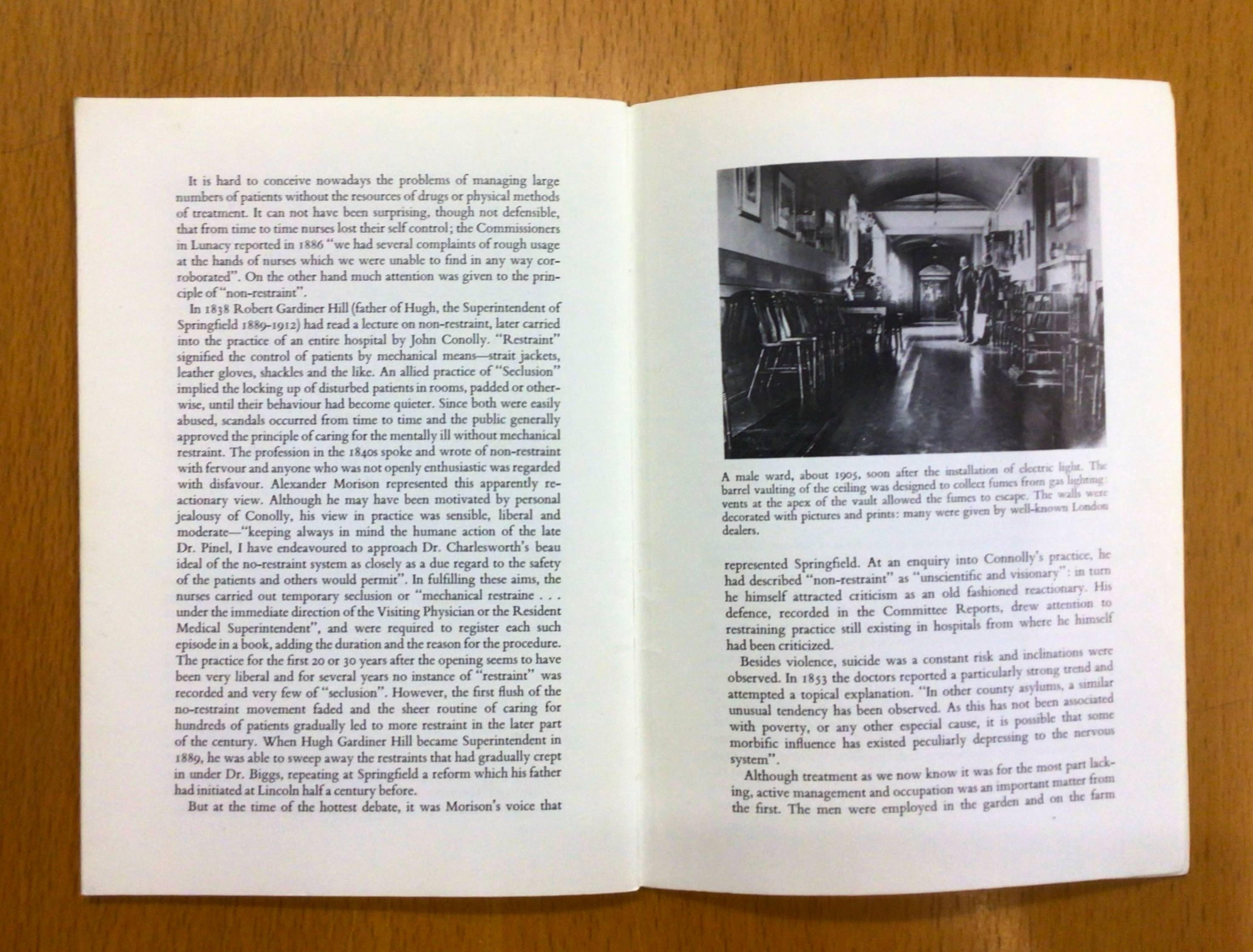
It is hard to conceive nowadays the problems of managing large numbers of patients without the resources of drugs or physical methods of treatment. It can not have been surprising, though not defensible, that from time to time nurses lost their self control; the Commissioners in Lunacy reported in 1886 "we had several complaints of rough usage at the hands of nurses which we were unable to find in any way corroborated''. On the other hand much attention was given to the principle of "non-restraint''.
In 1838 Robert Gardiner Hill (father of Hugh, the Superintendent of Springfield 1889-1912) had read a lecture on non-restraint, later carried into the practice of an entire hospital by John Conolly.
"Restraint" signified the control of patients by mechanical means — strait jackets, leather gloves, shackles and the like. An allied practice of ''Seclusion"' implied the locking up of disturbed patients in rooms, padded or otherwise, until their behaviour had become quieter. Since both were easily abused, scandals occurred from time to time and the public generally approved the principle of caring for the mentally ill without mechanical restraint. The profession in the 18405 spoke and wrote of non-restraint with fervour and anyone who was not openly enthusiastic was regarded with disfavour.
Alexander Morison represented this apparently reactionary view. Although he may have been motivated by personal jealousy of Conolly, his view in practice was sensible, liberal and moderate — "keeping always in mind the humane action of the late Dr. Pinel, I have endeavoured to approach Dr. Charlesworth's beau ideal of the no-restraint system as closely as a due regard to the safety of the patients and others would permit". In fulfilling these aims, the muses catried out temporary seclusion or "mechanical restraine . . . under the immediate direction of the Visiting Physician or the Resident Medical Superintendent", and were required to register each such episode in a book, adding the duration and the reason for the procedure. The practice for the first 20 of 30 years after the opening seems to have been very liberal and for several years no instance of "rensaint'" was secotded and very few of "seclusion". However, the first flush of the mo-tetiaim movement faded and the sheer routine of caring for humdceds of patients gradually led to more restraint in the later past 1860, he was able to sweep away the renraints that had gradually crept ju ender Ds, Biggs, sepeaing, at Springfield 2 reform which his lathes had smicisted 21 Lincoln hall a cemury before.
But at the end of the hottest debate, it was Morison's voice that
[IMAGE]
A male ward, about 1905, soon after the installation of electric light.The barrel vaulting of the ceiling was designed to collect fumes from gas" ale were vents at the apex of the vaule allowed the fumes to escape, : Me Han ee decorated with pictures and prints: many were given by well-known London dealers.
represented Springfield. At an enquiry into Connolly 5 practice, } had described "non-restraint' as "unscientific and visionary +18 "Ue he himself attracted criticism as an old-fashioned reactionary ta to defence, recorded in the Committee Reports, drew a restraining practice still existing in hospitals from where he hums. had been criticized, | sactinations ver
Besides violence, suicide was a constant risk and jncknati a na observed, In 1353 the doctors reported 4 particularly ane ". sriidar attempted a topical explanation. "In other county ie nesses unusual tendency has been observed. As shis has not ti be ne with poverty, or any other especial cause, I 6 po the pervens morbific influence has existed peculiarly depressing "
Although treatment as we now know is was for che Te om Ing, active management and occupation was 2 import ae the first. The men were empbryed in the waren
"affording them a most agreeable means of occupation in the open air, and it has also been the means of providing the Asylum with an ample supply of wholesome nourishment". As time went on, the farm developed and productivity increased: the Asylum became virtually self-supporting. The women were correspondingly occupied, making much of the clothing required and supplying shirts to London shops.
For the patients' recreation, the bowling green was laid down as early as 1842. A library was started containing 80 books, carefully selected for their usefulness and supplemented by "the Saturday and Penny Magazines, and Chambers Journal". A piano made its appearance at the same date, and careful consideration was given to permitting draughts and billiards. There was some doubt expressed by the Committee whether such facilities might encourage members of the working [class?] in habits such as gambling. It was only later that billiard tables became such a familiar part of the hospital scene.
[Was the cricket pitch marked on a number OS maps for patients or staff - or both?]
Music was an important activity for both occupation and amusement. Charles Snape, in 1853, formed the first band for attendants and patients " . . . the effect of music on those suffering from mental disease is marked and very beneficial; it soothes and tranquillizes the excited and gives much satisfaction and enjoyment to all". In fact, attendants were often chosen for their musical ability, although in 1864 Dr. Biggs complained of the difficulty in finding enough such candidates for nursing jobs.
The patients themselves came at first from 3 private madhouses, where they were supported by rates levied on the parishes where they had lived. Subsequent admissions came from all over the County of Surrey, until areas further south were served by hospitals built later, such as Brookwood, and Cane Hill.
The original patients were already very institutionalised and chronic, and this tended to be a feature of Springfield admissions so long as the young and recoverable cases were creamed off by Bethlem, not far away in Lambeth. Other patients arrived in an enfeebled or moribund state, and should have received care in general hospitals. Many came as the result of sheer poverty, or inability to find a living, coupled with the effects of drink, exposure and mental anxiety (1894).
The admissions to Springfield reflected the flux in social conditions. The agricultural depression of the 1890s forced men out of rural areas into the greater destitution of the cities. And social changes replaced an agricultural way of life — where the weak minded might find a useful role — by an industrial one where a family could no longer include such an invalid.
For over a century,Springfield was required, like every County Asylum, to provide for problems of many kinds, with litle resource and no control over the flow of admissions. Only since the Act of 1959 did it become possible to control the number of patients and to match their needs to the treatment that could be given. In the last few decades, the possibilities for treatment have greatly extended, the numbers of staff have in creased, the numbers of patients dwindled and the length of their stay has reduced; however, there still remains a population who have been in hospital for ycars, who will be joined in duc course by some others, and who will always need the protective environment and facilities of the disparaged but still useful Asylum.

(Click on image to enlarge)
Back to the top of this page . . .