A HISTORY OF
WANDSWORTH COMMON
Added
IN PROGRESS — NOT FOR PUBLICATION
Refresh this page
Index
Wandsworth Common
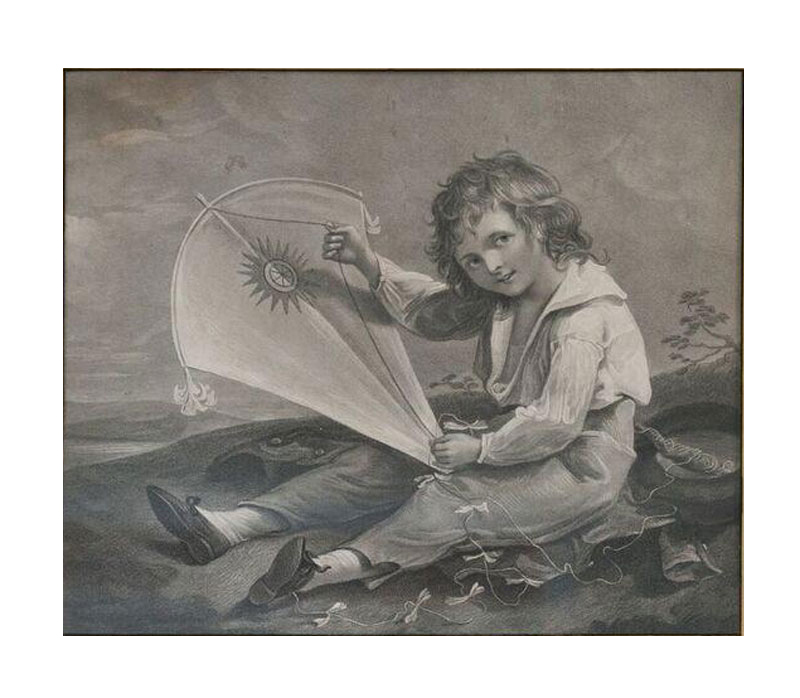
(Click on image to enlarge)
Cornelius Webbe, The Tale of a Kite (1841)
(Click on image to enlarge)
Cornelius Webbe, The Tale of a Kite (1841)
Philip Boys:
Here is a remarkable - and completely true - story about a donkey that flew a kite on Wandsworth Common in the year 1841.
I have taken it from Cornelius Webbe's Glances at Life in City and Suburb, published in London just a handful of years later, in 1845.
But for the benefit of today's readers, I have cut it down slightly, removed some rather obscure words phrases and references, and made some of its many dangerously long sentences just a little shorter, and therefore not quite so alarming.
As well as being rather a good story, I think it tells us a lot about Wandsworth Common in the early years of the nineteenth century. It tells us in passing about what the Common looked like, the trees (or lack of them), the grass, and the birds and insects, and other creatures that inhabited the place, including young boys and donkeys.
And finally, after you've read or heard the story, I'm going to try to persuade you that the donkey in the story - whose name is Sir Isaac, after the great scientist, mathematician and all-round genius Isaac Newton- is none other than Winnie the Pooh's great friend Eeyore.
"THE TALE OF A KITE"
Strolling over Wandsworth Common in the ever-memorable year 1841, we observed in a corner of that wide waste a solitary donkey. No uncommon sight to be seen on a common, it will be said. True, but this donkey was seen under uncommon circumstances, as we shall relate.
Before we came up to him we had been puzzling our little wit to account for a large kite floating high in the air in that open spot, without the usual accompaniment to a kite -a boy at one end of it, to conduct its ascent and descent.
We looked all over the long, level flat, and devil a boy was there to be seen anyhow - not even the whistle or whoop of a boy to tell us of the whereabout of one.
Much marvelled we at this miracle of an effect seemingly without a cause as we went leisurely towards the spot over which the kite was hovering.
But shortly a light broke in on our darkness.
It was the donkey we had seen, and no soul else, that was flying the kite!
Here the Reader, whether gentle or simple, will stare, and shake his head incredulously, and cry "Oh! Oh!"
Now, the Reader may shake his head, if he will, till his teeth rattle like dice in a box; and still he will not shake the fact, that a donkey was seen, and by a veritable witness, flying a kite on Wandsworth Common in the ever-memorable year 1841.
Here we hear cries of "Explain! Explain! Who ever saw a donkey flying a kite?"
We have already said that we did.
"How came a donkey to be flying a kite? "
We will tell you how. Why, marry, thus.
Sam Snaffle and Sir Isaac, the donkey
Sam Snaffle (for we were curious enough to inquire the name of the ingenious young person we are about to introduce to the reader) of Lower Tooting, a little village in the neighbourhood, was, it seems, the proprietor of said kite.
Sir Isaac, the donkey, was, on the other hand, the whole and sole property of Sam Snaffle, senior. Sir Isaac being entitled, through his owner, to the right of free commonage, was sent on the common accordingly for an afternoon's grazing, Sam the younger being his guide and conductor on the occasion.
Not to lose time, Sam took his large paper kite with him, that, while the one stuck to the earth earthy, the other might hold some converse with the skies.
Having loosened Sir Isaac's body-girth, that he might a get a bellyful of the sweet short grass thereabouts without hurting his button-holes, Sam next let out the string of his kite (and there was plenty of it) and away the paper currency mounted into thin air.
It was when it was thus "flying all abroad," at the very top of its tether, that Sam, for some unknown purpose or other, felt all about him for his knife, and felt it not - not nowhere, as he expressed its entire absence.
Where was it? Ay, where indeed?
He remembered now that he had used it as he turned out of Obligation-lane [today we call this Beechcroft Road], which runs into the common, to cut a swish for Sir Isaac, should he want it; and there he had dropped it, he feared.
Every man who has been a boy in his time (and most men go through that preliminary process) must remember how dear a thing to a boy is his knife and nobody else's.
With his kite a quarter-mile high, and an hour's work to bring it down and wind it in again - his knife a mile off - how was Sam to run back to Obligation-lane, and recover it, before anyone passing that way could pick it up?
There was the rub!
Here was a fix!
The fix!
He looked round him. There was not a tree, a tree-stump, a bush of any bulk, an old post, or a good lump of a stone on the bare common, to which he could tie his kite while he ran back to find what was lost.
There was nothing there but Sir Isaac and himself, three sparrows, a cuckoo in a corner somewhere, a lark hovering overhead, and his kite, to be seen anywhere, and these were all particularly and privately engaged.
Sir Isaac was whisking his tail, at the moment, as a general warning to a dragon-fly which had been buzzing about him for some time as though he meant to settle an old account with him, and open a new one.
"That's it!" cried Sam, slapping his young thigh, with a shout of exultation at the happy thought; and it was the work of no time at all to give the kite-string half-a-dozen turns round the tail of Sir Isaac just above its tufty end, tie it in a knot, and leave the high-flyer to his management for a quarter of an hour at the most, which time it would take him to run back and return from Obligation-lane.
It was towards the termination of this inter-regnum that we chanced to come up to Sir Isaac in all the asinine agonies of his trusteeship: for, poor fellow, being no philosopher, he could not understand what was the matter with him - what had hold of him by the tail, and was lugging and tugging him this way and that way - and how to act for the best.
He had kicked till he was tired of kicking the air only, and gave that up as unprofitable. He had tried all sorts of ways to get rid of the entail. He had run round in short circles till he was giddy; rolled over and over on the ground till he was worse; pitched head and stern; but in none of these ways could he shake off the horrible incubus behind.
At last, wearied with vain efforts, he ratted from opposition, and let the kite lift him up by the tail, till at times he was fairly off his legs behind, and on his nose before.
The wind then swelling almost to a hurricane . . .
The wind then swelling almost to a hurricane, he could stand it no longer; and so, as well he might, he took to as many heels as he could get to the ground at one time, and bolted to the opposite comer of the common.
There there were, fortunately, a few trees; and there, the wind being as rude as ever, and his tail lugged and tugged till it was numbed with the torture, with an intelligence which does not fall to the lot of one ass in a thousand, that he might not be borne away up to the second heaven, when next it struck him as a happy thought, and it was, and no sooner thought than done - he incontinently clapped his forelegs round about the stem of a sturdy sapling till the wind blew over.
It was in this critical position of affairs that we leisurely came up to him and found him head downwards - heels up - and his tail perpendicularly erected, like unto the handles of certain parish pumps by roadsides against which passengers bump their noses.
Wondering to see any animal, and especially one of his sedate race, in so ludicrous a plight, as soon as we could for laughing (and surely it would have moved the crying philosopher to mirth to have beheld him!) conjecturing that it was the wicked trick of some young wags ambushed somewhere thereabouts and enjoying the joke, we untied the string, now as tight as a tourniquet, set him free, and took the management of the kite into our own hands.
The poor beast shook himself, and, turning one look upon us - such a look! - with his lacklustre eyes, seemed to thank us, how gratefully! It was a look which came from his heart if it came from anywhere, and so entered readily into ours, always wide open to such angels' visits.
We had not had charge of this unusual ward for us, as well as Sir Ikey, more than five minutes, and, as we knew not what else to do with it, were winding it in, when we heard the quick beating of hasty feet over the hollow ground; and in a few moments, puffing, blowing, and broiling red in the face with hot running, up comes a boy with the cry of "That's my kite, please. Sir!"
"That's my kite, please. Sir!"
Well, perhaps it was: we could not deny it: we granted it: we did not, we could not, dispute it: we knew it was not ours: men who fly kites mostly know their own paper. We made signs of not unwillingly wishing to avoid any further responsibilities.
"Oh," said Sam, (for it was he - graciously deeming, no doubt, that it must be a treat, a great indulgence, even to hold and not to have a kite of such lofty pretensions as a quarter-mile high,) "Oh, I'm in no hurry. Sir!" said he; "Oh no: you may fly it as long as you like. Sir; only hold it in, Sir!"
We bowed, and were certainly obliged to so trusting a young person. A very churl could not have refused so handsome an offer, so naively tendered, with so generous a desire for our amusement as an old boy who had not the look of having quite forgotten that he was once a young one.
We held on accordingly a little longer, till, as the wind was high, and the kite tugged like a tar at a tiller-rope, it was not half so amusing as it seemed to be.
"Don't it tug, neither," quoth Sam, exulting in its strength.
We believe that, in our abstraction, we might have held the kite somewhat awkwardly, as though we held it not, and were not alive to our serious responsibilities.
Seeing this, Sam very considerately (but somewhat impatiently, we thought) took all further charge of it out of our incompetent hands; and, running off with it before the wind, left Sir Isaac and ourselves to our ruminations as before.
Great is the glorious privilege of youth! - so great, indeed, that it ought never to be taken away from those who enjoy it, but be theirs to the end, or until they are thoroughly tired of it, and, not wisely, wish to be a "man, and leave off childish things."
The end.
If you want to read Cornelius Webbe's original story, you can find it here.
And here's a pdf of the chapter.
But now for my case that Sir Isaac is commemorated in A.A. Milne's lugubrious character Eeyore . . . [COMING SOON]