A debt scheme wearing a trading company’s clothes
The South Sea Company was chartered in 1711, in the last years of the War of the Spanish Succession, at a moment when the Government urgently needed somewhere to put a great deal of short-term war debt that merchants and contractors were owed and could not easily be paid off. The Company agreed to take on roughly £10 million of it in exchange for company stock and a guaranteed rate of interest from the Treasury — exactly the same kind of arrangement, on a smaller scale, that had created the Bank of England seventeen years earlier. The trading privilege described below was the inducement that made this exchange attractive to creditors and to the public; it was never, in practice, the Company’s main business. That business was managing a slice of the national debt, a role it went on performing for the next 140 years, long after its trading rights had lapsed — which is the subject of a separate note on the Wandsworth wills themselves.
The word “asiento”
Asiento is Spanish for “seat” or “settlement,” from the verb asentar, to seat or settle (ultimately from Latin sedere, to sit). In the language of the Spanish crown’s finances it had come to mean something more specific: a contract between the crown and a merchant or banker — an asentista — covering a loan, a transfer of payment, or the right to collect a royal tax or monopoly, in exchange for a fee or a share of the proceeds. Spain used asientos for all sorts of crown business. The Asiento de Negros — literally the “slave-trade contract” — was simply the application of this ordinary Spanish financial instrument to one particular, appalling trade: the right to supply enslaved Africans to Spain’s American colonies.
Spain itself had no African slaving stations, so from the sixteenth century onward it always contracted this trade out to others — first Portuguese and Genoese merchants, then a series of Dutch, French and finally British holders. The French Guinea Company held the asiento immediately before Britain, from 1702. What made the 1713 British asiento different was simply its scale and its timing: it was awarded, as part of the peace settlement ending a major European war, to a company created for the specific purpose of holding it.
What the asiento actually granted, 1713–1739
The Treaty of Utrecht (1713), which ended the War of the Spanish Succession, gave the newly formed South Sea Company a thirty-year asiento, running from 1 May 1713. Its terms were precise and narrow:
- Quota
- 4,800 enslaved people a year, 144,000 over the full thirty years; at least two-thirds male, at least 90 per cent classed as adult.
- Pricing to the Spanish crown
- £10 for each enslaved adult over 16, £8 for each person aged 10–16.
- Entry payment
- 200,000 pesos (about £45,000) paid up front for the contract.
- Profit-share
- One quarter of the profits reserved for the King of Spain — who, in an unusual arrangement, was also personally a quarter shareholder in the Company itself.
- Permitted ports
- Buenos Aires, Cartagena, Caracas, Havana, Panama, Portobello, and Vera Cruz — company trading posts (“factories”) allowed at each.
Bundled with the slave asiento was a second, separate privilege, the navío de permiso (“permission ship”), sometimes called simply the annual ship: the right to send one vessel of up to 500 tons (raised to 650 tons for later voyages) to Portobello each year, loaded with ordinary merchandise for sale at the great trade fair held there — again with a quarter of the profits nominally due to the Spanish crown. The Company had a mixed record even by its own lights: contemporary accounts note that of one early cargo of woollens sent to Cartagena in 1714, despite warnings there was no market for it, much of it went unsold for two years; and, tellingly, the Company appears never to have paid Spain the promised quarter-share of profits from the first annual ship, nor from any of the six that followed.
Slaves, silver, and the meaning of “South Sea”
The Company’s name traded on something much larger than its actual charter. To early eighteenth-century Europeans, “the South Seas” meant South America and the waters around it in a broad, romantic sense — a byword, ever since the Spanish conquest two centuries earlier, for fabulous mineral wealth: the silver of Potosí in upper Peru above all, but also Chile, Mexico, and the whole Pacific coast reachable in theory by rounding Cape Horn or crossing the Isthmus of Panama. None of that lay anywhere near what the asiento actually granted. Every port named in the 1713 contract — Buenos Aires, Cartagena, Caracas, Havana, Panama (the Caribbean-facing town at the isthmus, not a Pacific port), Portobello, Vera Cruz — sits on the Atlantic, Caribbean, or Río de la Plata side of the continent. The Company held no right of any kind to trade for silver, and no access to the Pacific at all. Even sympathetic contemporaries could see the gap: Daniel Defoe, reviewing the scheme skeptically, doubted Spain would ever surrender “so valuable, indeed so inestimable a jewel, as the exclusive trade to their own plantations.”
What the asiento actually amounted to, in other words, was a tightly quota’d licence to sell enslaved people at seven fortified Atlantic-side ports, plus one annual cargo ship — not a door into Peru’s silver mines. That did not stop the name “South Sea” doing a great deal of imaginative work for the Company’s promoters when its stock took off in 1720; the distance between the name’s promise and the charter’s reality was, if anything, part of what let speculation run so far ahead of anything the Company could plausibly earn.
Contemporaries were also well aware that the legitimate trade was not where the money was. As one modern account puts it bluntly, the real profit “was not in the slave trade but in the illegal contraband goods smuggled in the slave ships and in the annual ship” — extra merchandise run ashore alongside the permitted cargo, or the “single” annual ship quietly restocked from supply vessels waiting offshore during the months-long Portobello fair, in defiance of the one-ship rule.
Souring relations, smuggling, and the road to war
Spain’s complaints accumulated steadily through the 1720s and 1730s: the Company routinely failed to submit the accounts the treaty required, was suspected (rightly) of large-scale contraband dressed up as legitimate trade, and simply never paid over the King of Spain’s promised share of the annual ship’s profits. Spanish coastguard vessels (guardacostas) responded by stopping and searching British shipping in the Caribbean, sometimes violently. The most famous resulting grievance, at least in British telling, was that of Robert Jenkins, master of the brig Rebecca, who claimed a Spanish captain sliced off his ear during just such a search in 1731; the story goes that the pickled ear itself was produced before Parliament in 1738 to whip up outrage. Modern historians are generally sceptical that the incident mattered much in itself — it served as a useful pretext for politicians already spoiling for war — and the label by which the resulting conflict is now always known, the War of Jenkins’ Ear, was coined only retrospectively, in the 1850s, and was never used at the time.
Robert Walpole tried to head off war with a negotiated settlement, the Convention of Pardo (January 1739): Spain agreed to pay British merchants £95,000 in compensation for ships and goods it had seized, while the Company agreed to pay Spain the £68,000 it owed from the asiento accounts. The settlement collapsed anyway, and Britain declared war in October 1739.
The end of the asiento, and what survived it
The thirty-year asiento was due to run to 1743 regardless, but the outbreak of war in 1739 ended British slave-trading and annual-ship voyages under it several years early. The formal position was only settled afterwards, in the Treaty of Madrid of 5 October 1750: Britain gave up all further claim to the asiento and the annual ship, in exchange for a payment from Spain of £100,000.
None of this touched the Company’s other, quieter business — managing the government debt it had held since 1711 and taken on so much more of in 1720. That role, entirely separate from the trading rights described here, is what let the Company go on existing for another century after both the Bubble and the asiento were long over, and is why perfectly ordinary Wandsworth testators can be found holding “South Sea Stock” as a safe, unremarkable investment as late as the 1760s. See the Notes on Wills for that part of the story, and for the specific wills concerned.
Ward’s 1847 painting: a scene in ‘Change Alley
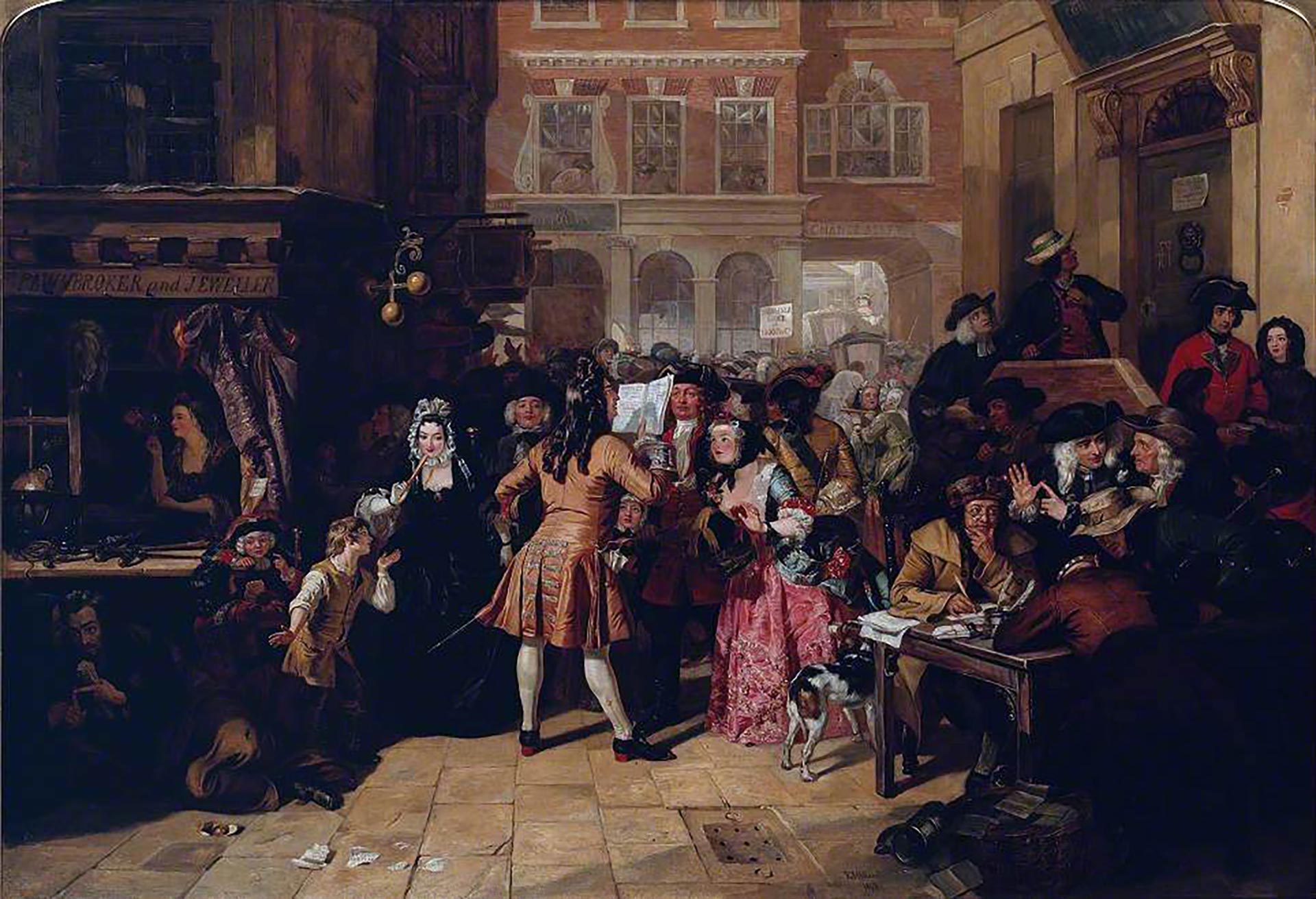
First thing worth straightening out: despite the title, this crowd isn’t standing outside South Sea House itself. It’s ‘Change Alley — Exchange Alley, the cramped tangle of lanes and coffee-houses off Cornhill where the actual buying and selling of stock happened, chaotic and informal, half the City crammed into an alleyway. So this is a painting about speculation and mania as street theatre, not a picture of the Company’s own business.
And there’s a lot of street theatre packed in. Working across the canvas: a pawnbroker or jeweller has set up a stall so people can turn valuables straight into cash to buy more stock; there’s a chimney-sweep and a knot of street children down among the crowd’s feet, because the joke is that everyone, top of society to bottom, got swept up in this; a seated figure is absorbed in counting money, oblivious to the crowd around him. Centre-stage, a man in a gold coat gestures theatrically while an older man in red holds out a document — probably meant as a broker pressing a subscription on a mark, though I wouldn’t swear to it being a specific, documented transaction rather than an invented type-scene. There are well-dressed women elbow-deep in the crowd too (contemporary satire made a great deal of women speculating, respectably or otherwise), a liveried Black page-boy, a dog, a notary or scrivener working at a little table, and, tucked into the crowd, a clergyman or Quaker figure looking on — a reminder that piety was no defence against the mania either. Playing cards are scattered on the pavement, which is about as unsubtle as a Victorian painter gets: this is gambling, dressed up as investment.
None of the individual figures seem to be documented as specific, named historical people, as far as I can find — this reads as an invented, composite scene rather than a record of one actual moment, in the tradition of history painting built to illustrate a general truth rather than a particular event. And it’s worth remembering Ward wasn’t painting this in a vacuum in 1847: Britain was in the middle of its own Railway Mania at the time, a fresh bout of speculative madness, so a Royal Academy audience looking at ‘Change Alley in 1720 had a very immediate, contemporary parallel sitting right in front of them.
Hogarth’s 1721 print: an emblematical send-up
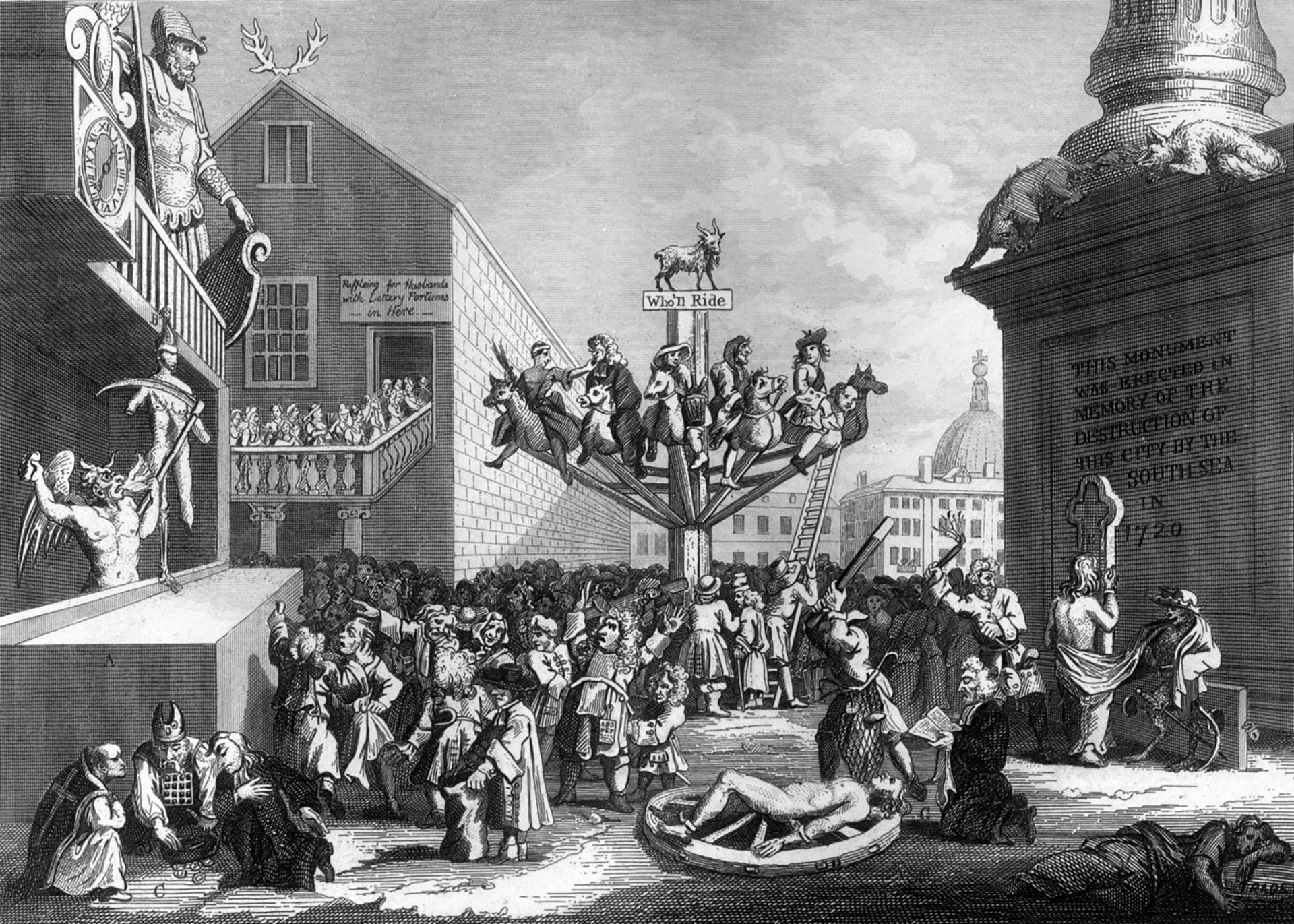
Worth getting the title right, since it often gets shortened or garbled: it’s An Emblematical Print on the South Sea Scheme, and it’s Hogarth’s first big satirical outing — engraved and published in 1721, so this is contemporary reaction, not a later retrospective the way Ward’s painting is. And it is dense: practically every inch of the plate is doing allegorical work.
Centre-left there’s a merry-go-round built around a “Who’l Ride” sign topped by a goat — a broad joke about being “fleeced.” The riders Hogarth puts on it are a pointed cross-section of society: a whore, a clergyman, a housewife, a hunchback, a Scottish nobleman — everyone, respectable or not, taking the same ridiculous ride. In the middle distance stands a building doing double duty as the Guildhall and, allegorically, the devil’s own shop: a winged devil is shown literally dismembering a blindfolded figure of Fortune, and hanging over the scene is a sign reading “Raffleing for Husbands with Lottery Fortunes in Here” — marriage itself reduced to a game of chance for money, a real satirical target of the period rather than just a throwaway joke.
Off to one side Hogarth plants a wickedly deflating version of the real Monument to the Great Fire of London — its actual inscription rendered just legibly enough to read — but rebuilt taller and grander than St Paul’s itself, with foxes fighting on top instead of the real flaming urn: a monument to greed dwarfing the church and the establishment alike. Beneath the column, Villainy is shown scourging a bound figure of Honour, with a monkey rifling through Honour’s discarded cloak for anything worth stealing, while a figure of Trade lies on the ground, dead or fainted, simply ignored by everyone rushing past. Elsewhere in the scene, Self-Interest is shown breaking Honesty on the wheel — the real judicial punishment for treason — while an Anglican clergyman looks on and does nothing about it. And tucked into a corner, Hogarth adds a trio representing a Catholic priest, a Jewish moneylender and a Puritan, all three absorbed in their own private gambling and entirely oblivious to the carnage going on around them — his way of saying greed cut across every faction and creed in England, not just the fashionable speculators up front.
Set the two images side by side and the contrast is quite striking: Ward gives you a single, legible crowd scene you can read as social comedy from a comfortable distance of over a century; Hogarth gives you an entire moral universe collapsing at once, drawn while the wreckage was still fresh, with barely a square inch of the plate not carrying some separate allegorical charge.
Sources consulted: Wikipedia, “South Sea Company” and “Asiento” (both accessed September 2026), which in turn draw on the standard secondary literature, chiefly John Carswell, The South Sea Bubble (1960). This is a background/context note compiled from secondary sources, not original archival research; treat specific figures as a good starting point rather than a final citation.
On the two images above: Tate (Ward, “The South Sea Bubble”), Wikipedia articles on both the painting and on Hogarth’s Emblematical Print on the South Sea Scheme, Art UK, the Wellcome Collection, and the National Portrait Gallery (all accessed September 2026).