
THE INSANITY OF LOVE
Miss Alice Crosse, aged 20, daughter of the parish clergyman of Ockham, has afforded abundant food for gossip during the last ten days. The young lady had formed an attachment to Master George Smith, aged 18, a groom in her father's service, and as Mr. Crosse considered the young gentleman from the stable was scarcely suited to be the husband of his daughter, he turned him out of the house.
Miss Crosse, however, appears to have a will of her own, while Master Smith seems to be more fool than rogue. The young lady planned an elopement; but the lovers were followed and arrested, and last week Master Smith found himself before the Wandsworth police magistrate charged with the abduction of his young mistress.
Miss Crosse told the story of her elopement with extraordinary candour. "I think," she said, "I proposed to leave the house. I arranged it. He (the groom) was sent away at a minute's notice. I saw him in the passage when he was leaving, and I merely told him to come the night after to my bedroom window. I lit papers in the window, and he came up outside. I put my things out of the window, and then I got out myself. I scrambled out somehow, as I had no assistance. I was slipping, and he held me. Nothing further took place, except that we walked together to the station.
"I did not know where I was going, but I thought I was going to London. I proposed walking to Weybridge station. It is a distance of about five miles and a half along the road. We walked there together. We took a mail train to London, and I paid the fare. We went to Waterloo station, and from thence to a coffee-house in the City, where we had some coffee. We went to Doctors' Commons for a license of marriage. He applied for it. We could not have it without my father's consent.
"We came straight to Wandsworth. I proposed Wandsworth, as I thought it would be more convenient. We took lodgings at Mrs. Wiggins's from seeing a card in her window."
Mrs. Wiggins described how the young people came to her house, how she questioned them whether they really were "man and wife," how she thought they looked more like brother and sister, and how she was sure all the time that the lady was a "real lady." The magistrate had no doubt that Miss Crosse had given her consent to the elopement, but doubted whether, as a matter of law, a young lady under age was competent to give it. He therefore adjourned the case, but admitted the defendant to bail, and the poor boy was led out of court by his sureties, the report says, "in a half-fainting and hysterical condition."
Miss Crosse was entitled to considerable property, and had proposed to her lover that as soon as she got possession of it they should take a business. When the magistrate at Wandsworth concluded his examination, the friends of the young lady wished her to go home with them; but this she resolutely refused to do.
At last she consented to remain with the family of Mr. Inspector Lovelace, and promised that she would not hold any communication with her lover. The latter, however, discovered her abode, and proved his fidelity by repeatedly walking up and down in front of the inspector's house. The inspector urgently requested him to desist from so doing, but he persisted, defied the officer as he was in the highway, and said that nothing short of his "dear one" wishing him to go away should induce him to do so.
Miss Crosse, in the presence of the inspector, accordingly asked him, and said, "George, go away; I don't wish to see you." George at once yielded to his mistress, and walked off.
On Wednesday Smith again appeared at the police-court, but there was no one present to prefer any charge against him. He was therefore discharged, and his money was ordered to be returned to him.
Mr. Lewis, solicitor, who attended on behalf of the Rev. Mr. Crosse, said after the young lady eloped that her father set inquiries on foot, and was informed that the prisoner had by cunning induced her to leave her home; but after the evidence which he heard on the last examination, and which took him by much by surprise, he resolved to withdraw from the prosecution. The young lady had by her own wish returned to her home, and was as intact as on the day she left.
When Smith left the court he was loudly cheered by the spectators. A contemporary has discovered some amusing nominal coincidences in connexion with the affair. The Earl of Lovelace bestowed the living of Ockham on the young fugitive's father; Inspector Lovelace first discovered the retreat of the runaways; and the house in which they took up their abode was most appropriately situated in Love-lane.
The story has been terminated dramatically by the marriage of the parties, at Wandsworth, with the consent of the bride's father.
After the first inquiry before Mr. Ingham the young lady had returned to her father's house, and was said to have bidden an eternal farewell to her lover. The romance was thought to be at an end, especially when the father withdrew from the prosecution, and George Smith, the object of Miss Crosse's misplaced affection, was discharged from custody amid the cheers of a sympathising crowd. The finale however was yet to come.
Finding his daughter really attached to Smith, and determined to marry him as soon as she might come of age, Mr. Crosse wisely relented, the marriage ceremony was performed on Thursday, and the scene ended by Mr. Smith addressing his admiring friends from a first-floor window. The bridegroom was daintily dressed in black, with white waistcoat and kid gloves.
The Times says, "It was surely a great pity that Mr. Crosse, instead of proceeding hastily against the culprit, did not at once make such inquiries as would have satisfied him of the true state of the matter. He would thus have saved himself and his family the pain of a public scandal, which has greatly shocked well-regulated minds in the genteel portion of society, but which, after the brilliant sequel, will doubtless be the theme of admiring comment in many a servants' hall."
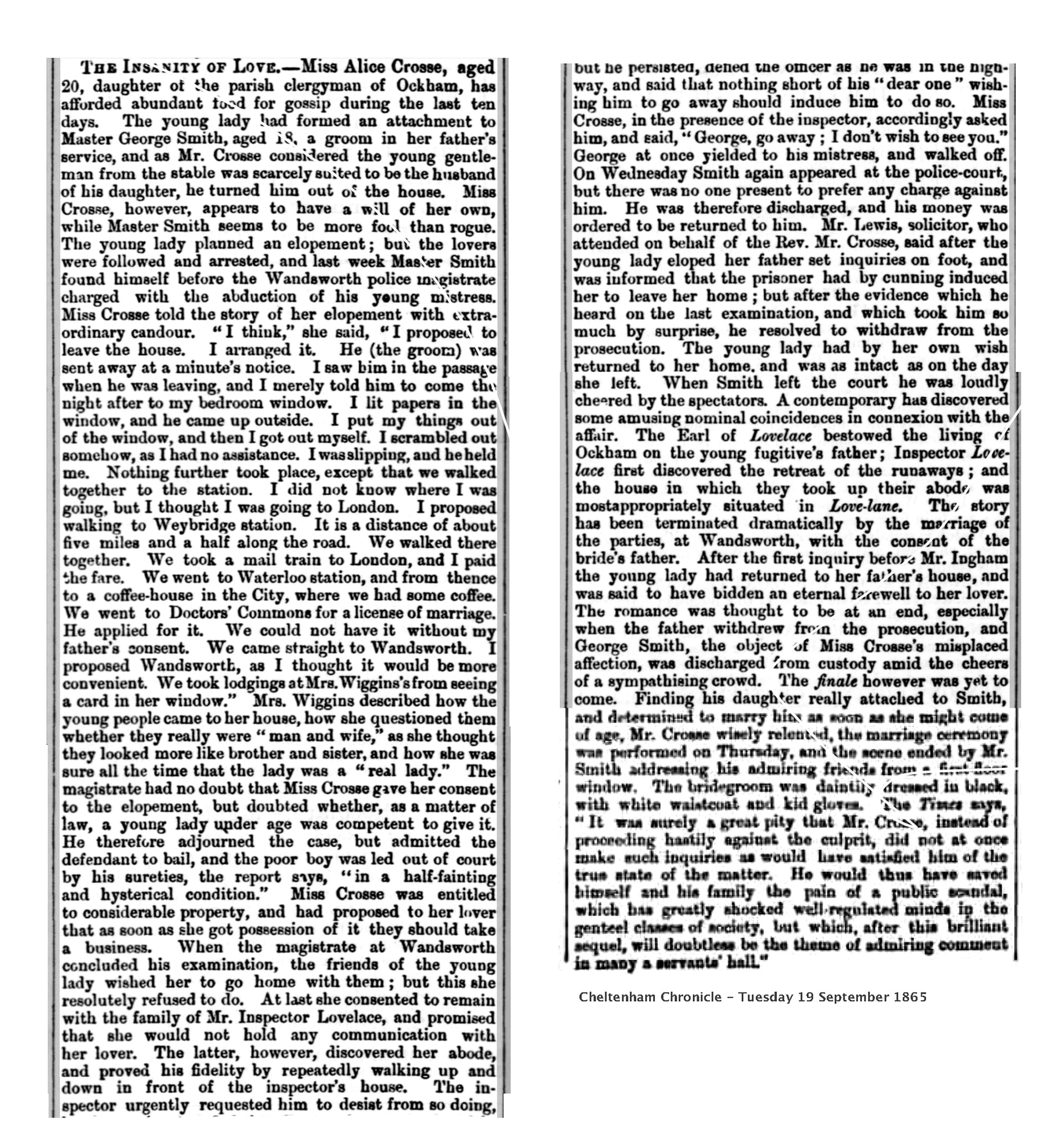
Cheltenham Chronicle — Tuesday 19 September 1865
Back to the top of this page . . .