IN PROGRESS — NOT FOR PUBLICATION
"The Bride and Her Groom"
Evening Standard — "The Bride and Her Groom" — 18 September 1865
I wrote a brief account of this poem last September, when I assumed it was entirely fanciful. I've since learned that it was "based on a true story" that featured in local and indeed national newspapers, so I'm returning to it now.

The poem as published in the Evening Standard — you can read the whole poem here. It's quite hard work in places (until you get the hang of it), but great fun.
(Click on image to enlarge)
Miss Alice Crosse, the daughter of a Surrey vicar, falls for the family's groom, one George Smith. (Note the pun on "groom" — George is by trade someone who takes care of horses, and is also the bridegroom. There is also the suspicion, as we shall see, that he "groomed" her in the modern sense — that he exploited her feelings with a view to stealing her inheritance.)
Her father ("Reverend +" i.e. Crosse) is outraged and forbids their meeting ("he gave Miss A. a scolding sharp / And Mr George the sack").
The couple elope to London but can't get a licence (from "Doctors' Commons") to marry speedily. But the daughter is more than equal to the challenge. She rents a room in Wandsworth and arranges for the banns to be called at All Saints.
Alice's father calls in the police, alleging that George has stolen a number of items. When the case comes to court, Alice is interrogated about whether George pressed his attentions on her and caused her to elope, using her money. She has none of it. ["We did this together", she asserts.]
Here's a short extract (the complete poem is here).
"The Insanity of Love", by Policeman X. The Standard, 19 September 1865.
Notice Wandsworth locations such as "Love Lane" (today's Putney Bridge Road), "St Hans" (St Anne's) and of course our windmill, by the railway line.
Their true love's course untimely checked!
By hobstacles like these,
Towards Wandsworth Common off they set,
And sat beneath the trees,
And sor the windmill turnin round,
And herd the cacklin geese.
Vich rooral sounds inspirin hope,
They joins each other's hands,
And off they goes, and tells the Clerk
To publish of their bans,
And takes a lodgin in Love-lane
In a terras called St. Hans.

After some shenanigans (that you can read for yourself), Alice is successful in her plot and her father's opposition comes to nothing:
So Friday last, in Wandsworth Church,
There was a wedding gay,
And George and Alice one were made
By Mr. Gower that day.
The belles ring out! the people shout!
True love has got its way!
I used to think this was an entirely fanciful invention, but I was wrong. Here is a contemporary account, from the Globe (14 September 1865), as reprinted in an Irish newspaper.
According to reports it involved "one of the most exciting cases that had ever startled and so deeply interested the good folks of Wandsworth."
Kings County Chronicle — Wednesday 20 September 1865
MARRIAGE OF MISS CROSSE WITH HER GROOM
SCENE IN WANDSWORTHYesterday morning, at half-past nine o'clock, George Smith, who was discharged yesterday at the Police-court the charge preferred by the Revd. R. Crosse, of Ockham Rectory, was married to his daughter by licence, and with his consent, in All Saints' Church, High-street, Wandsworth, the interesting ceremony being performed by the curate, the Rev. Mr. Gower.
One of the most extraordinary scenes ever witnessed in Wandsworth occurred on the occasion.
Although the townsfolk often assembled in large numbers at the church on wedding occasions, yet there was never such a crowd as gathered this morning in and about the sacred edifice. The church was crowded and every available spot, both inside and out, in which a glimpse could be obtained of the happy couple was occupied.
The roads and paths were literally blocked up for some distance, and the pretty church bells rang a merry might have supposed that nothing short of a Royal marriage was being celebrated.
The happy couple arrived in Wandsworth last night, and took up their temporary abode at the house Mr. George, a baker, in the High-street, who was one of the groom's bail. They were unaccompanied by any friends except those which had been made in Wandsworth. Mr. George and his daughter accompanied them to church and acted as their best friend.
After the ceremony was concluded, and on walking from the church, they were received with loud and continued cheering.
The young lady was dressed in a pink bonnet, with black silk cape and purple silk dress. The young gentleman looked exceedingly happy, and escorted his bride his arm to the residence of Mr. George, Inspectors Lovelace and Usher exerting themselves manfully to clear the path for them.
As the young couple walked for the few yards from the church she seemed to have the advantage of height over her husband, who, however, presented a "natty" appearance, he being dressed in a black coat and trousers, with a white waistcoat and white kid gloves.
They were quickly ushered into the baker's shop by the police, but quickly reappeared at the first-floor window, where Mr. Smith took off his hat and bowed repeatedly to the crowd with a few appropriate remarks. He thanked his friends sincerely for all their kindness and sympathy shown to him since he had been in Wandsworth, and hoped they would all live long and happy
This short speech was received with tremendous cheering, and it was some time before the police could clear the streets and restore order. It was understood that the happy pair intended to travel for a short time.
Thus finished one of the most exciting cases that had ever startled and so deeply interested the good folks of Wandsworth.
Globe of Thursday.
[BNA:Link]
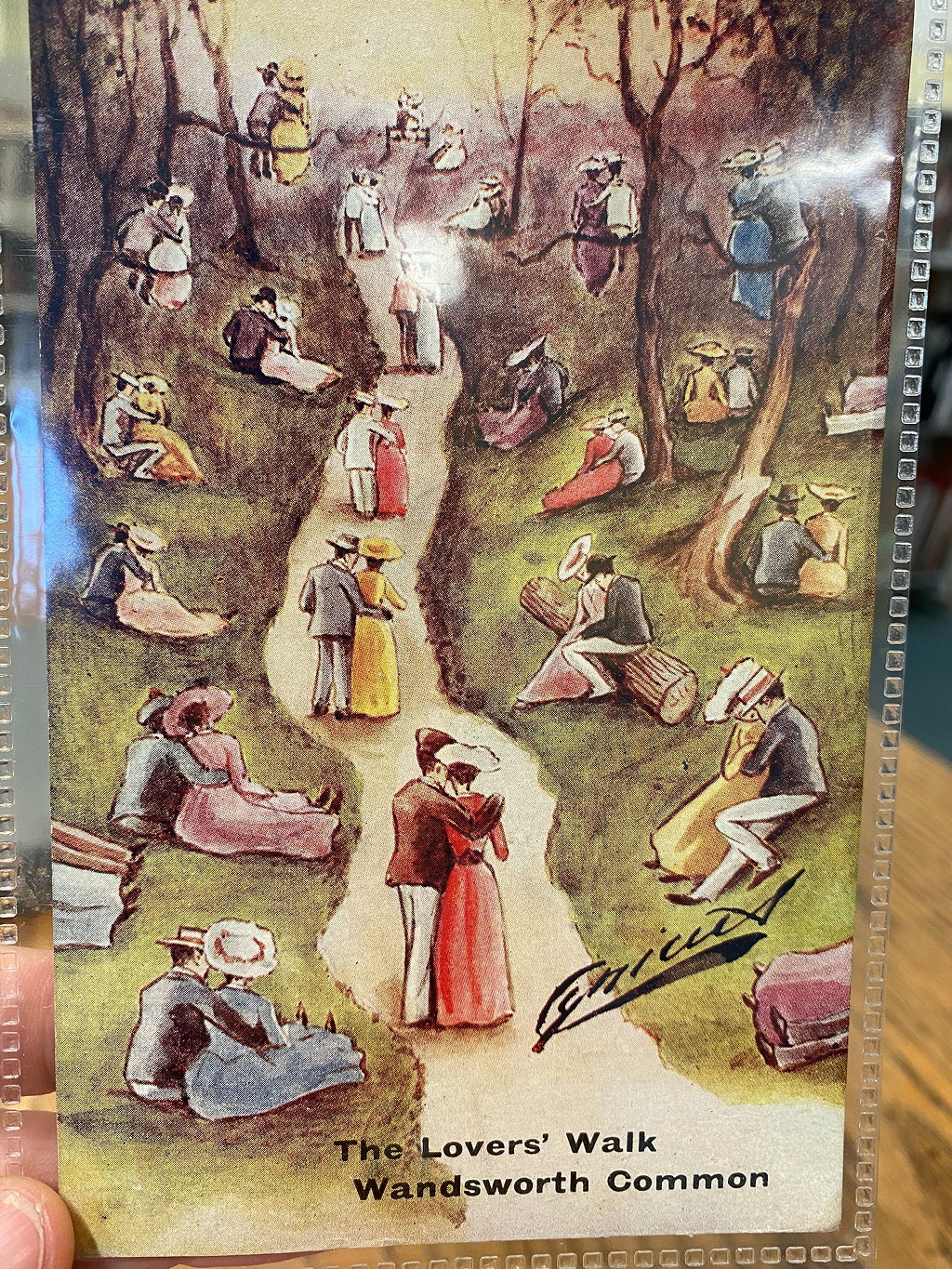
Edwardian postcard: The Lovers' Walk, Wandsworth Common
This card was customised for local commons and parks by the simply changing the black text at the bottom. I have seen examples from all over Britain, including here, here, and here.
(Click on image to enlarge)
I thought I'd better try to find out that happened to the couple. Was it "happily ever after" for Alice Crosse and George Smith?
I'm afraid not.
In ?, George is described as a "Railway clerk". The couple moved to Exeter (she had been born nearby)...