Ancestry: Link.
Father [PB: Notice the Bermondsey connection again - did he know the Bevingtons or the Nottidges, who lived nearby?]
Ancestry: Link.
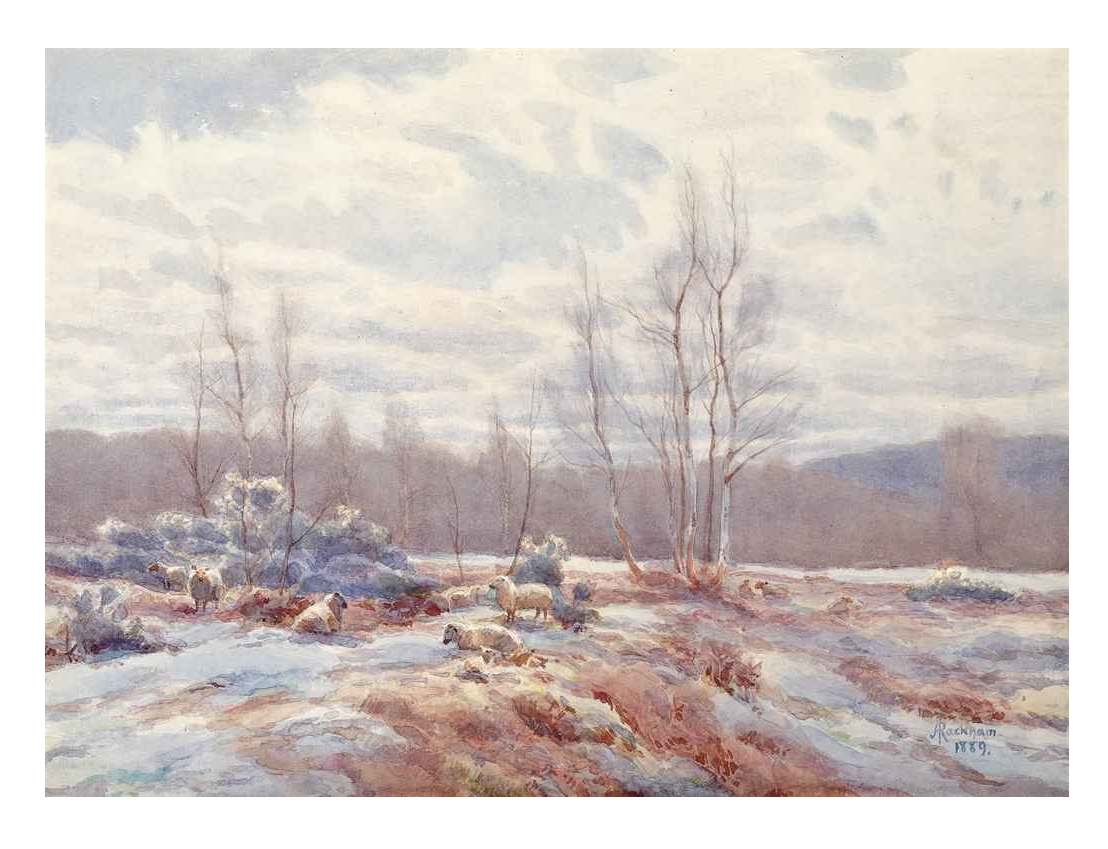
1889 Winter - in the Woods
An exceptionally early and uncommon Rackham watercolour dated 1889. A label on the back of the frame cites Rackham's address (3 St Ann's Park Villas in Wandsworth), provides the title of this watercolour and a price (£5.5.0). This landscape predates Rackham's published illustrations and dates from the period he was working for the Westminster Fire Office. He had started evening studies at Lambeth School of Art in 1884. A small handful of early works have surfaced ("Wimbledon" and "Gresford" were, for example, sold in these rooms in July 1993 and dated 1892 and 1894 respectively).
https://www.sothebys.com/en/auctions/ecatalogue/2013/english-literature-history-l13408/lot.375.html
[Source: Link.]
[Source: Link.]
[DNB: Link.]
Arthur Rackham
1867-1939
British, English
(b London, 19 Sept. 1867; d Limpsfield, Surrey, 6 Sept. 1939). British illustrator, celebrated for his work in children's books. He established his reputation with Fairy Tales of the Brothers Grimm, published in 1900, and from then until the First World War he had his golden period, when Edmund Dulac was his only serious rival in his field. They were very different in style: Dulac was much more painterly, using strong expressive colour, whereas Rackham relied on wiry line and subtle, muted colour.
He said he believed in 'the greatest stimulating and educative power of imaginative, fantastic and playful pictures and writings for children in their most impressionable years', and he worked in a striking vein of Nordic fantasy, creating a bizarre world populated by goblins, fairies, and weird creatures (he looked rather like a gnome himself). After the First World War the market for expensive children's books declined, but he continued to prosper from gallery sales of his work.
[Source: Link.]
[Source: Link.]
1911 Census
https://www.ancestry.co.uk/family-tree/person/tree/55711296/person/280094709918/facts
Death of father 1912 at 43 Earlsfield Road
[Source: Arthur Rackham Society.]
[Arthur Rackham Society: Links (Biography, Bibliography, Illustrations etc).]
[Peter Harrington: Link (good introduction and fabulous collection of images).]
[V & A: Search: "Arthur Rackham".]
[V & A: Sketch of trees, 1892 [no illustration!]]
"Sketch of trees" [no image available online — go to V&A and find!]
V&A
Sketch of trees
Object:
Drawing
Place of origin:
Britain (made)
Date: 1892 (made)
Artist/Maker:
Rackham, Arthur, born 1867 - died 1939 (maker)
Materials and Techniques: Pencil, on a page torn from a sketchbook
Museum number: E.3007-1990
Gallery location: Prints & Drawings Study Room, level E, case I, shelf 55, box F
The V&A says: "Possibly drawn on Wandsworth Common, where Rackham lived with his parents in the years around 1890." Frustratingly, in August 2026 there wass no image online. [https://collections.vam.ac.uk/item/O191948/sketch-of-trees-drawing-rackham-arthur/]
[Clarke Historical Library: Arthur Rackham.]
https://search.ancestry.co.uk/cgi-bin/sse.dll?indiv=1&dbid=6598&h=11632562
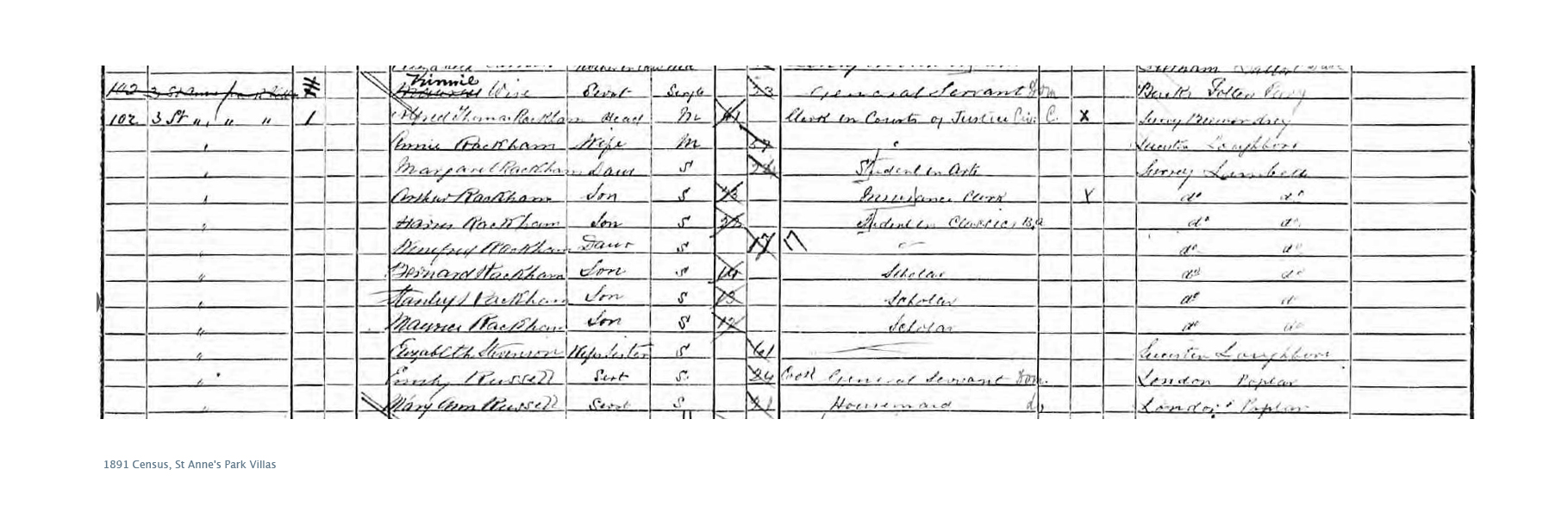
Alfred Thomas Rackham 67
Annie Rackham 57
Margaret Rackham 24
Arthur Rackham 23
Harris Rackham 22
Winifred Rackham 17
Bernard Rackham 19
Stanley Rackham 13
Maurice Rackham 12
Elizabeth Stevenson 61
Emily Russell 24
Mary Ann Russell 21
Sunday, August 24, 2008
Arthur Rackham - Transpontine Cockney
Arthur Rackham (1867-1939) was an illustrator best known for his work on fairy tales and children's books. He was also rather proud of his South London origins, entitling a 1934 self-portrait 'A Transpontine Cockney'.
Rackham was born in 1867 at 210 South Lambeth Road, where he spent most of his childhood. His family moved a short distance to 27 Albert Square, Clapham Road in 1882 and to 3 St Ann's Park Road, Wandsworth in 1885 (near Wimbledon [PB: No - WANDSWORTH!] Common). They regularly attended the Brixton Independent Church in Brixton Road and Rackham himself attended Lambeth School of Art (1884).
PB: if 1885, then he was c.18.
Lived locally as a teenager. Is said to have drawn on Wandsworth Common (I know of at least one fine watercolour of sheep on Wimbledon Common). Needs looking into.
Born in Lambeth? Lewisham, but moved to 3 St Ann's Park Villas, St Anns Hill, Wandsworth in ??, when he was ?
Rackham was born in Lewisham, then still part of Kent, as one of 12 children. In 1884, at the age of 17, he was sent on an ocean voyage to Australia to improve his fragile health, accompanied by two aunts.[2] At the age of 18, he worked as a clerk at the Westminster Fire Office and began studying part-time at the Lambeth School of Art.[3]
In 1892, he left his job and started working for the Westminster Budget as a reporter and illustrator. His first book illustrations were published in 1893 in To the Other Side by Thomas Rhodes, but his first serious commission was in 1894 for The Dolly Dialogues, the collected sketches of Anthony Hope, who later went on to write The Prisoner of Zenda. Book illustrating then became Rackham's career for the rest of his life.
[Wikipedia: Link.]
See Pinterest: Link.
Home > Artists > Arthur Rackham
Arthur Rackham
Born: September 19, 1867 | Died: September 6, 1939
Biography
Born in Lambeth, London on September 19, 1867, Arthur Rackham was a prolific artist from a young age. Sneaking pencils into his bed to draw under the covers, he eventually resorted to drawing on his pillow case when paper was taken from him. Inspired to become an artist while traveling to Australia in 1884, Rackham drew avidly during his journey, and also began painting in watercolor. Though his father insisted he enter the business sector, Rackham enrolled at the Lambeth School of Art, which he attended in the evenings after finishing a day's work as a junior clerk in the Westminster Fire Office. He continued to work in the Fire Office until 1892, and labored tirelessly after business hours to produce drawings and watercolors to submit to illustrated newspapers. In 1888 a watercolor he painted of Winchelsea, Australia was accepted by the Royal Academy of Art and sold for two guineas. Beginning in 1892, Rackham began illustrating for the Westminster Budget Newspaper, a job he kept until 1896. The majority of the illustrations for the Westminster Budget were more conventional, and only a few submitted to this and other London newspapers showed his imaginative side. It was during this time that Rackham became particularly interested in book illustration, a place where he could focus his creative efforts.
Rackham's entrance into book illustration began with a guidebook of Canada and the United States entitled To the Other Side (1893), and later on, The Ingoldsby Legends (1898) and Tales from Shakespeare (1899) which were considered his two most successful illustrated books at the time. Both of these works were re-issued less than a decade later as deluxe editions (with additional illustrations by Rackham) due to his success at the turn of the century. The year 1900 marked the breakthrough of Rackham's success as a book illustrator with the publication of his illustrated The Fairy Tales of the Brothers Grimm. This book featured ninety-nine black-and-white drawings with a color frontispiece. Two new editions were issued within ten years of the original, with new and edited illustrations by Rackham in each. The most notable of these editions is considered to be the one released in 1909. Rackham continued to succeed in his illustrations of fairy tales and fantasy stories, attributing the success to his intimate familiarity with the texts. Largely influenced by Aubrey Beardsley, George Cruikshank, Randolph Caldecott, and Richard Doyle during the beginning and height of his career, Rackham's style remained unique and set him apart from contemporaries and competitors.
The year 1900 was also a milestone for Rackham because of his marriage to Edyth Starkie, a portrait artist with whom he remained married until his death. In 1905, Rackham's illustrated version of Rip van Winkle established him as the leading decorative illustrator of the Edwardian period. It was at this time that his illustrations began to be displayed in Leicester Galleries, London where nearly all included in Rip van Winkle sold during the exhibit. J.M. Barrie, author of Peter Pan, commissioned Rackham to illustrate the first edition of his classic children's tale Peter Pan in Kensington Gardens (1906) because of his enjoyment of Leicester Galleries' exhibition of Rip van Winkle. After this monumental publication, Rackham was asked to illustrate another classic, Alice's Adventures in Wonderland (1907), which proved to be much more controversial because of the already beloved version illustrated by John Tenniel. Nonetheless, Rackham's watercolors for Lewis Carroll's beloved story were largely a success, and it led to him illustrating other tales such as A Midsummer Night's Dream (1908), Gulliver's Travels (1909), Undine (1909), Aesop's Fables (1912), Mother Goose (1913), A Christmas Carol (1915), The Romance of King Arthur (1917), Cinderella (1919), The Sleeping Beauty (1920), Comus (1921), The Tempest (1926), and The Legend of Sleepy Hollow (1928).
During the early 1920s sales of Rackham's books in Britain decreased while those in the United States were on the rise. Exhibitions of Rackham's work took place in New York City, and he received a substantial commission from the New York Public Library to create a series of watercolor paintings of A Midsummer Night's Dream. The 1930s were trying for the Rackhams as Edyth's health declined and shortly after, Rackham himself began to have health problems. Despite these trials, Rackham continued to produce numerous illustrations, both for reissued deluxe editions of his books, and additional commissions. Deluxe editions of classics such as The Night Before Christmas (1931), Fairy Tales by Hans Andersen (1932), Goblin Market (1933), and The Arthur Rackham Fairy Book (1933) were released throughout the early 1930s. Rackham's illustrations for Fairy Tales by Hans Andersen were especially successful, and the work was named the best picture book of the year by Hugh Walpole for The Observer in 1932. By 1936, exhibitions of Rackham's work took place all over the world, though by now he was suffering from chronic illness and was unable to produce the magnitude of work he once had.
The summer of the same year, Rackham was approached by American publisher, George Macy about a commission to illustrate James Stephen's The Crock of Gold. Rackham accepted this opportunity and told Macy that he could take on another commission as well. Macy suggested The Wind in the Willows, a particularly sentimental project for Rackham. Thirty years earlier, Rackham had been offered the opportunity to illustrate The Wind in the Willows, but had to decline the offer due to his deadline for A Midsummer Night's Dream in 1908. Rackham's response to a letter from three children in 1909 (who wrote to him to ask if he planned to illustrate The Wind in the Willows) shows that he greatly regretted turning down the commission, and would cherish the opportunity to finally accept the offer. Rackham decided to begin illustrations for The Wind in the Willows before those for The Crock of Gold. Due to his failing health, the illustrations for The Wind in the Willows took him three years to complete. A perfectionist, Rackham would not rest until he was satisfied with the appearance of each illustration. The Wind in the Willows was Rackham's last completed illustrated work before he died on September 6, 1939. It was published in 1940 by George Macy's company, the Limited Editions Club, in New York City. An obituary in London newspaper The Times described him as "one of the most eminent book illustrators of his day" with " a special place in the hearts of children."1
1. Derek Hudson, Arthur Rackham: His Life and Work (London: Heinemann, 1960), 150.
Corryn Kosik, Walt Reed Distinguished Scholar, March 2018
"The Illustrator in America, 1860-2000," by Walt Reed
BB BB
Dalby, Richard. The Golden Age of Children's Book Illustration. London: Michael O'Mara, 1991.
Doyle, Susan, Jaleen Grove, and Whitney Sherman. History of Illustration. New York: Bloomsbury, 2018.
Hudson, Derek. Arthur Rackham: His Life and Work. London: Heinemann, 1960.
Meyer, Susan E. A Treasury of the Great Children's Book Illustrators. New York: Harry N. Abrams, 1987.
Rackham, Arthur. Arthur Rackham's Book of Pictures. New York: Avenel, 1979.
Arthur Rackham papers, 1904-1967
http://www.columbia.edu/cu/lweb/archival/collections/ldpd_4079245/
26 NOVEMBER 2008
Arthur Rackham - Stockwell-born artist
Illustrator Arthur Rackham (1867 - 1939), famous for his pictures of fairies, sprites and other magical creatures, was born at 210 in South Lambeth Road (the street was renumbered and the house has since disappeared under the Mawbey Borough Estate) to Annie and Alfred Rackham, the third surviving child of their 12 babies. The family later moved to 27 Albert Square, site of a blue plaque.
Arthur's artistic talent was evident early: he was sent to City of London School in 1879 and trained under Herbert Dicksee, the School Drawing Master. He was awarded a school prize for the best "Memory Drawing" during the summer and received another award for Drawing during the winter term in 1883. Arthur was not a strong child and after leaving school the family relocated to Australia for six months in order to improve it.
At 18, he was working as a clerk at the Westminster Fire Office and in 1884 began studying at night school - the Lambeth School of Art (founded in 1854 and associated with St Mary the Less Church in Black Prince Road). He later became a reporter and illustrator on The Westminster Budget, a weekly magazine but he first made his name in 1890 with his illustrations of Grimm's Fairy Tales.
Rackham illustrated over 60 books, including Rip van Winkle (1905), The Ingoldsby Legends (1906) and Alice in Wonderland (1907). He won gold medals at Milan (1906) and Barcelona (1911), and his books and original art are now collected in many countries throughout the world.
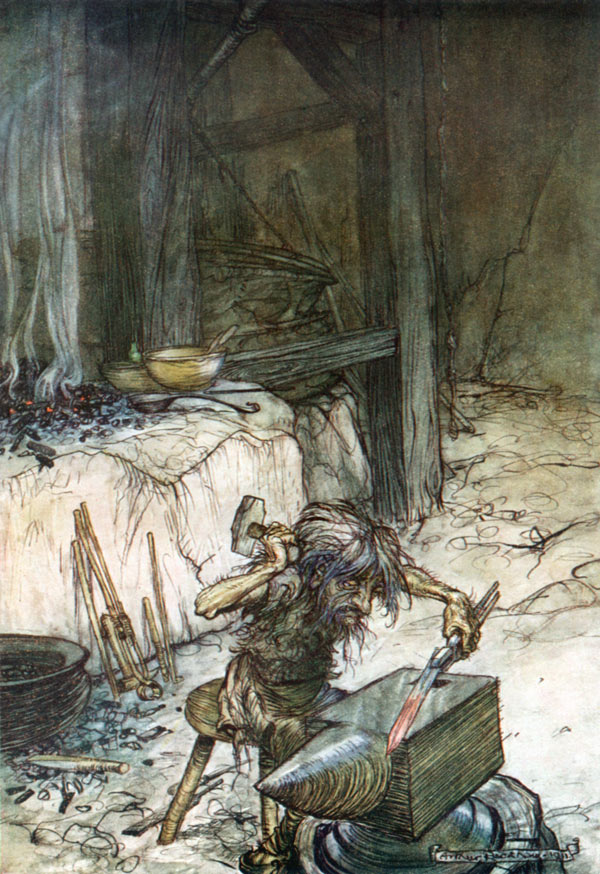
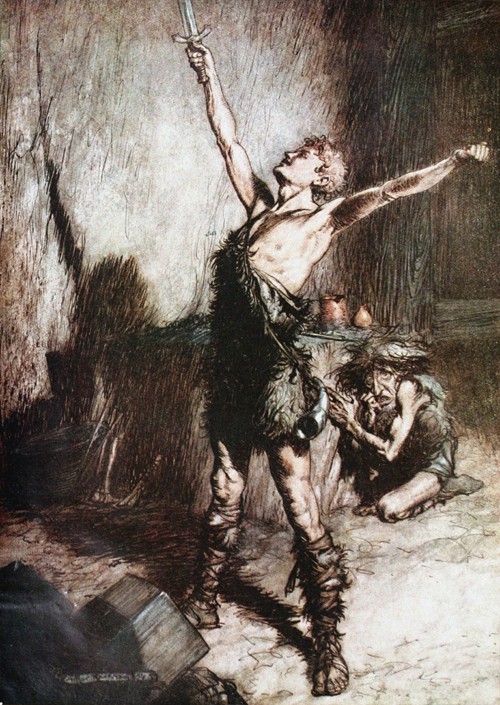
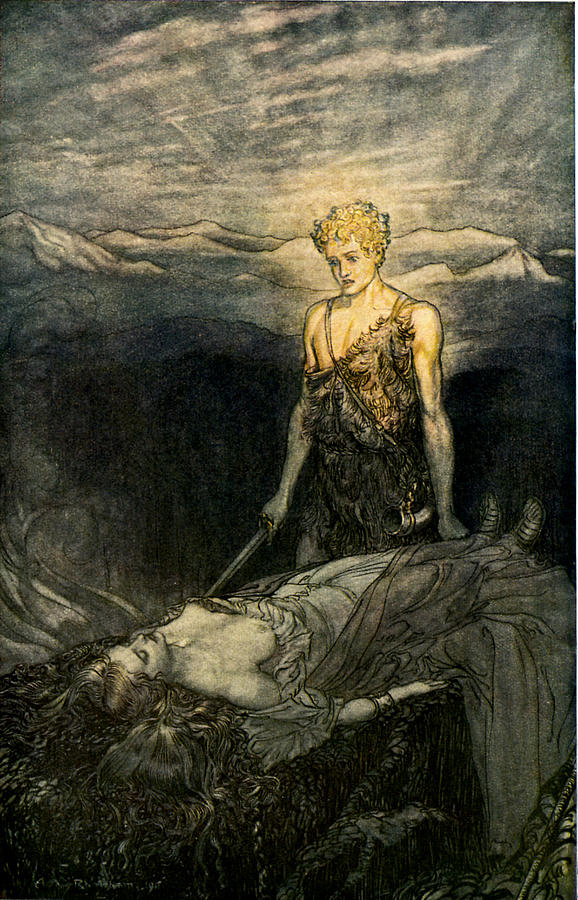
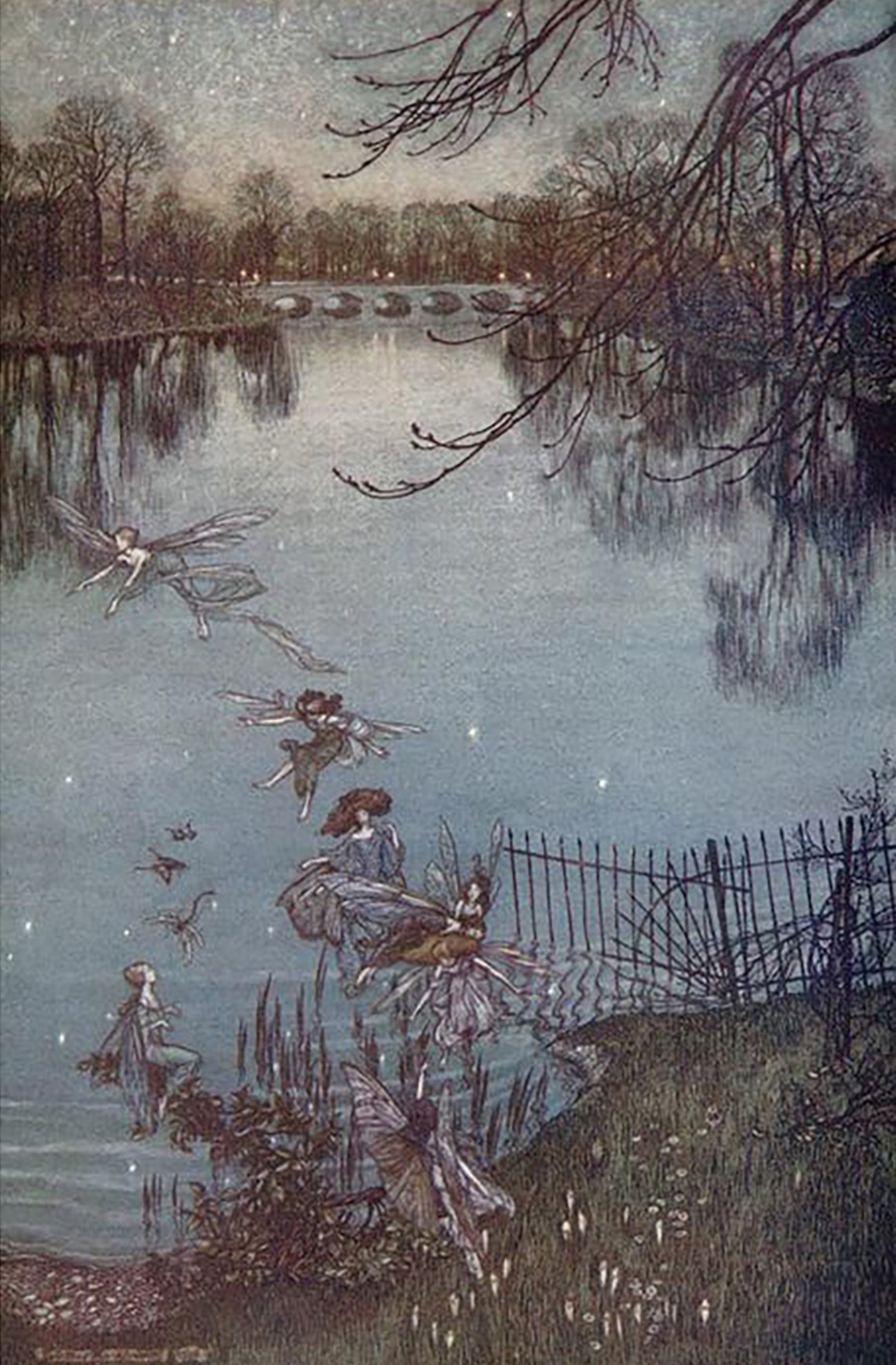
The main characteristics of Rackham's art are: lines softened with muted watercolour; forests of looming, frightening trees; ethereal fairy maidens; ogres and trolls, often good natured; little creatures and hidden images in the background.
In 1903, he married Edyth Starkie, with whom he had one daughter, Barbara, in 1908. Rackham won a gold medal at the Milan International Exhibition in 1906 and another one at the Barcelona International Exposition in 1911. His works were included in numerous exhibitions, including one at the Louvre in Paris in 1914. He died in 1939 of cancer in his home in Limpsfield, Surrey.
Hugely influential, his work has been cited by many, including Walt Disney (Snow White and the Seven Dwarfs), Mabel Lucie Attwell and Guillermo del Toro (Pan's Labyrinth).
Arthur Rackham and his art
Clark Historical Library
Arthur Rackham Society
The Tate
Home Ground (pdf)
The Illustrators Project
See also Local Online for a misguided and ill-informed view of Rackham.