The Times, 21 December 1827
See Years: 1827 & Hansard Enclosure 1830s for RW Barchard's leading role in the defence of WC against Earl Spencer.
Was RWB the "Mr Barchard" who led the campaign against Earl Spencer's attempts to enclose WC c.1827?
RWB's daughter married GFW:
George Fergusson Wilson (1822-1902) [industrial chemist, botanist and horticulturist (his garden at Wisley is now the RHS's), born Wandsworth Common, son of founder of candle-makers E.Price & Son. He was later MD of a new firm (based on his own prodigious chemical discoveries), Price's Patent Candle Company.
Wilson married on 13 August 1862 Ellen, eldest daughter of Robert Wildman Barchard, of East Hill, Wandsworth, who survived him with two sons and a daughter. The elder son was Scott Barchard Wilson (1865-1923), ornithologist and explorer.
[Source: Link.]
[PB: Reprinted from the Times?]
[PB: Is this the first reference to a campaign against enclosure?]
[PB: CHECK letters to the Times etc for a vitriolic dispute about enclosure in that year.]

Morning Advertiser - Friday 21 December 1827
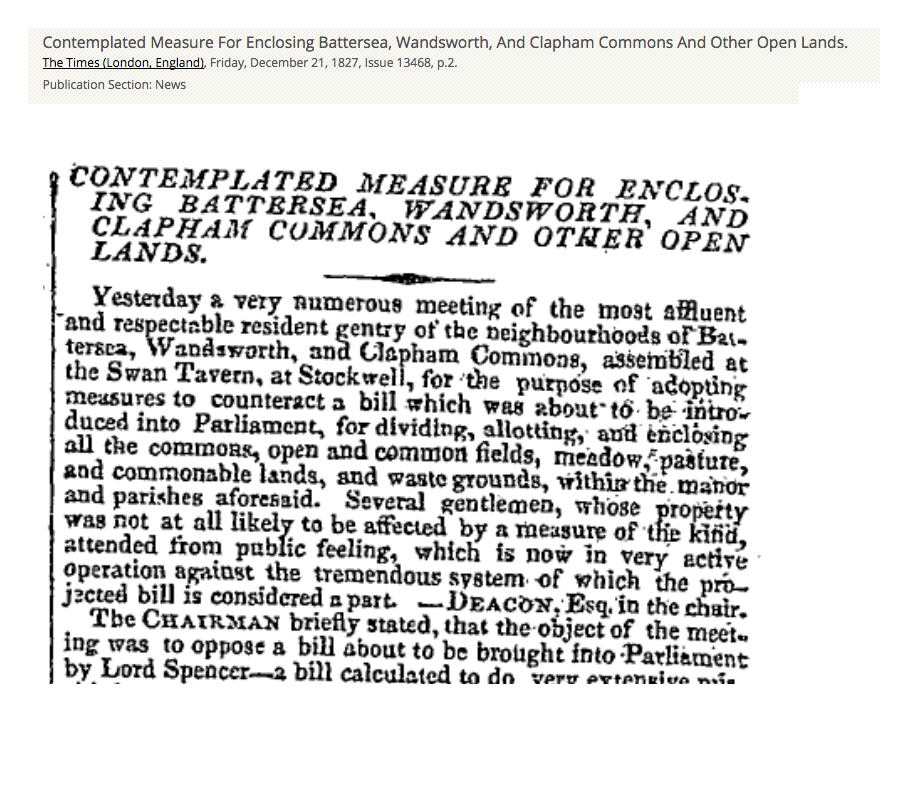
CONTEMPLATED MEASURE FOR INCLOSING BATTERSEA, WANDSWORTH, AND CLAPHAM COMMONS, AND OTHER OPEN LANDS.
Yesterday a very numerous meeting of the most affluent and respectable resident gentry of the neighbourhoods of Battersea, Wandsworth, and Clapham Commons, assembled at the Swan Tavern, at Stockwell, for the purpose of adopting measures to counteract a Bill which is about be introduced into Parliament for dividing, allotting, and enclosing the commons, open and common fields, meadows, pastures, and commonable lands and waste grounds, within the manor and parishes aforesaid. Several gentlemen, whose properly is not at all likely to be affected by a measure of the kind, attended from public feeling, which is now in very active operation against the tremendous system of which the projected Bill is considered a part.
________ Deacon, Esq. in the Chair.
The CHAIRMAN briefly stated that the object of the Meeting was to oppose a Bill about be brought into Parliament by Lord Spencer - a bill calculated to do very extensive mischief.
Mr. BARCHARD rose to state the circumstances under which they were called together. A rumour had been, he said afloat, that it was the intention his Lordship, and other persons who had interest as copyholders, bring in a bill for the above-mentioned purpose. The rumour increased, and he and about dozen other gentlemen, met at his house, to consider a subject of such importance to their interests. They determined to write a strong, but respectful letter, urging their objections to the proposition, and requesting a conference.
His Lordship granted the conference to a deputation of the joint parishes on the 26th of November, and upon that occasion admitted the strength of some of the objections, if such objections had any foundation at all; but thought that they could be easily removed if they really did exist.
In a correspondence between the deputation and Mr. Lefevre, upon the part of his Lordship, that gentleman submitted the following propositions by way of modifications.
That that part of Clapham Common which was within the manor of Battersea, should remain in its present state - that the avenues on the East Side of Wandsworth, or Battersea Common, should remain in its present state
- That the remainder of the commons and wastes Battersea and Wandsworth be inclosed, but that no buildings be erected thereupon, except dwelling-houses of the value of £1,000 each at least, buildings (not dwelling-houses) requisite for the cultivation of land, and buildings for parochial and charitable purposes; that the open fields be inclosed, but no dwelling-houses of less value than £200 be erected thereupon; the Lachmere [sic] Common (about 18 acres,) be appropriated to the benefit of the Battersea poor, in such manner as should appear most beneficial; and that an appropriation of similar extent be made for the Wandsworth poor.
The Deputation replied to this communication, that the propositions did not appear to them to obviate the objections, and a public meeting of the inhabitants was called.
Now, with respect to the alleged modifications, the offer of his Lordship not to inclose a certain part the Common was certainly no great favor, for it happened not to be possible to do so, as a writ had been issued on a former occasion to determine the boundary without effect; and it was but prudent in his Lordship to leave the avenue in same state, as any alteration there would certainly prejudice his Lordship's property.
With respect to the proposal, that no building of less value should £1000 be erected on the Common, it was well known, that if the Common was inclosed, it would be soon cut into small slices - and what was to prevent a proprietor from building whatever sort of house he pleased upon his portion?
- As for buildings requisite for the cultivation of land, a pig-stye or any sort of wretched cabin, was included under that head.
He called upon the Meeting to reflect upon the consequence of the erection of small houses: all small portions of land were devoted to building the most profitable mode of disposing of them, an immense population of poor would become [?] that the parish rates would necessarily sustain an alarming increase - (Hear, hear).
In Bromley an inclosure of common had some time ago been carried into effect, and the consequence was, that many who were induced to vote for it, had so much to regret the redundancy of a poor population, which the measure drew together, as to declare that they would give £1,000 each for a repeal of it.
There was a similar case at Bexley, and in Chelsea, where but a very small portion of land was inclosed - the rates rose from 9d. to 14d.
At Hornsey and Norwood, the annoyance and inconveniences were likewise intolerable from the same cause.
Mr. Barchard then spoke of the advantages of the situation and extent of Common and its vicinity to the Metropolis, and argued, with considerable force, against any intention to destroy those public and private advantages. The poor inhabitants would sustain great injury if the measure was carried into effect. They laid claim for their cattle to the pasturage of the Common which they had enjoyed so long, that it was, if not an actual right, something very like a right; and their means in that respect would not only be quite destroyed, but would be driven into public houses, mere roads not being the most agreeable of walks.
He instanced the case of some Gentlemen who had taken houses upon the impression that no inclosure would take place, but who were scarcely settled in their habitations when they were surrounded by miserable receptacles.
The case of Botany Bay, in Wandsworth, was in point; that wretched spot had grown out of one of those measures,which were ever attended with public loss and inconvenience.
Mr. Barchard then called upon the Meeting, with every respect for the character and conduct of Lord Spencer, to adopt such resolutions as would show the determination of the inhabitants to resist the Bill, and concluded by stating that his Lordship had expressed that he was ashamed to see the Common in such state it was, and yet had refused either to improve its condition himself, or allow others to do so.
Resolutions, which were the echo of the speech, were then proposed.
Alderman SCHOLEY seconded the Resolutions. He declared that hs did so more from feeling towards the public, than from a private feeling, although he was one of those that who would be affected by the projected measure.
After some further discussion, the Resolutions were agreed to, and a Committee was appointed to superintend the opposition to the Bill.
The alacrity of the Meeting in opposing the Bill, may be guessed from the fact, that the subscriptions in the room amounted, in five minutes, to between £1,100 and £1,200.
BNA: Link
BNA: Link
This appears to be a precis of an original article, "Contemplated Measure For Enclosing Battersea, Wandsworth, And Clapham Commons And Other Open Lands", that appeared in The Times, 21 Dec. 1827, p. 2, here.
"The case of Botany Bay, in Wandsworth, was in point; that wretched spot had grown out of one of those measures, which were ever attended with public loss and inconvenience."
ADD INFO/DISCUSSION OF WHERE THIS WAS, AND WHAT IS REFERRED TO...LIVELY DISCUSSION ABOUT ITS MEANING - PROBABLY A GYPSY ENCAMPMENT NEAR THE WILSON HOUSE / BLACK SEA / TODAY'S SPENCER PARK.
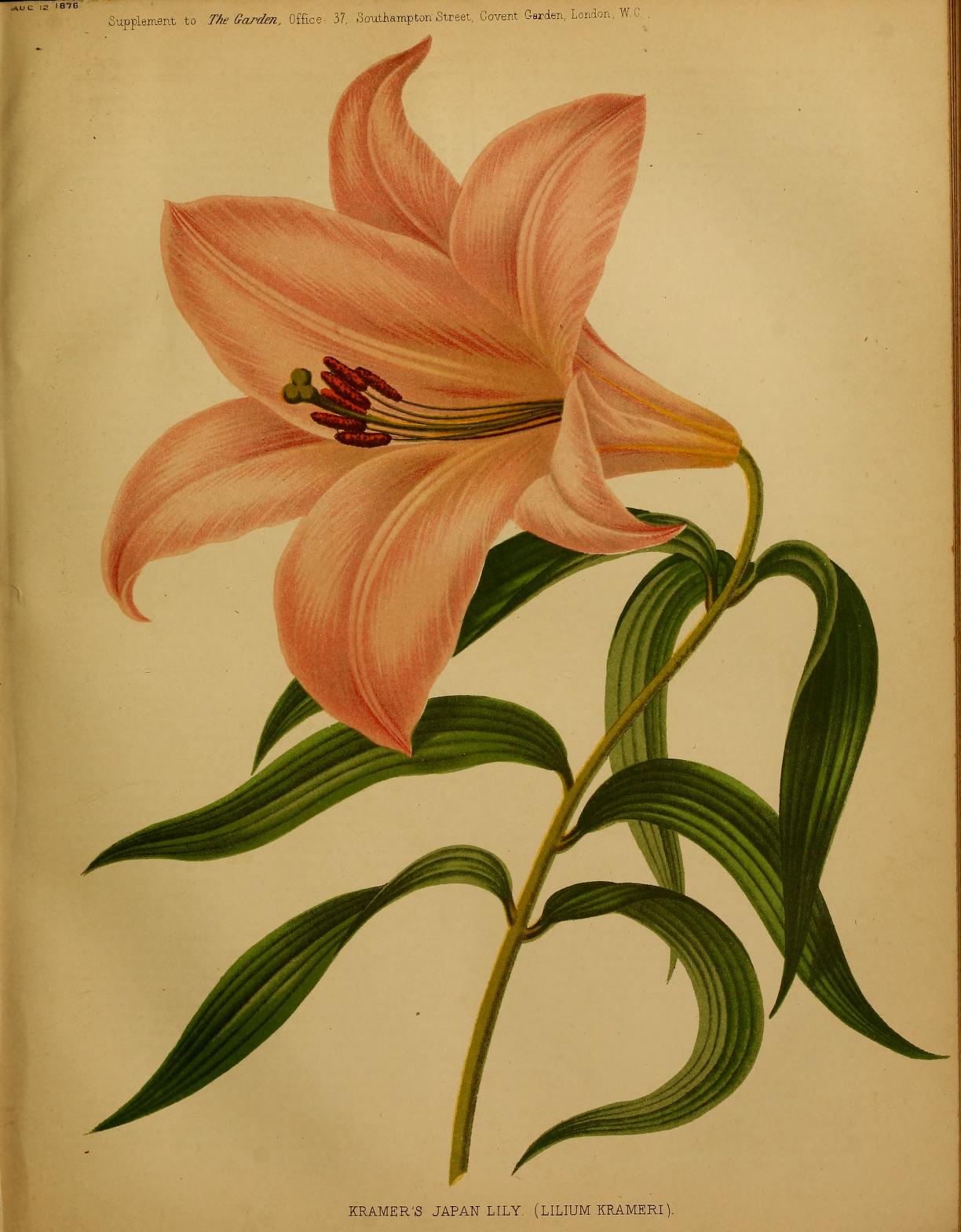
[At "Black Sea House", the Wilsons were particularly hot on lilies, weren't they?]
This material is held at
Royal Horticultural Society Lindley Library
Reference
GB 803 RHS/WY/Owd
Dates of Creation
1878-1903
Name of Creator
Wilson; George Fergusson
Language of Material
English
Physical Description
4 A boxes and 2 OS items
Scope and Content
This part of the RHS Wisley archive comprises garden journals maintained by Wilson's head gardener, Alfred Tatnall, 1888-1902, seed bed records in Wilson's own hand, 1878-1902, a volume recording signatures of several thousand visitors to the garden, 1884-1902, and deeds and papers relating to the estate, 1878-1903. Visitors to Oakwood included Gertrude Jekyll, William Robinson, Alfred Wallace, Edwin Lutyens, E.A. Bowles, Constance Lytton and many others.
Administrative / Biographical History
George Fergusson Wilson (1822-1902) was born in Wandsworth, one of 13 children born to William Wilson and his wife Margaret. In 1840 he joined the family firm, E. Price & Co, later Price's Patent Candle Company, developing the technical side of the business. In 1858 he patented Gishurst Compound, an important insecticide in use for a century. He held office at the Society of Arts, was a fellow of the Royal Society and of the Chemical Society. He retired from Prices in 1863 but he maintained his involvement in the company for the rest of his life. He was a member of the RHS Fruit & Vegetable, Floral, and Scientific Committees, Treasurer of the Society from 1866-1868, and a member of Council.
Wilson married Ellen Barchard in 1862 and they had three children: Scott Barchard, born in 1864, Herman George, born in 1866, and Alice Charlotte, born in 1869.
Wilson had a garden at Heatherbank, Weybridge, and in 1878 he purchased Glebe Farm and 60 acres of farmland at nearby Wisley, where he created an experimental garden he called Oakwood, trying plants in the various soils and conditions there. He published the results of his experiments in articles in the horticultural press, along with updates on the development of his Wisley garden. He began with the development of the area known as the Wild Garden, in the shade of an old oak wood, and the slope beside it, introducing lilies in the wood and colourful blooms on the hillside.
He went on to develop a field garden, where deep drainage ditches were filled with iris, and lupins grew on the mounds of earth dug from the ditches. He established a pinetum in the north of the garden, where lilies also grew, two vegetable gardens and an avenue of flowering trees along the approach road to the garden. He was renowned for his cultivation of lilies and breeding of primroses, one of which he named 'Oakwood Blue'. Wilson had a number of gardeners at Wisley, headed by Alfred Tatnall. Many prominent horticulturists and dignitaries visited the garden, and private events were held there such as an annual garden party.
Wilson was one of the original 60 recipients of the Victoria Medal of Honour. He died at Heatherbank on 28 Mar 1902. His wife survived him. The following year his garden at Wisley was bought by Sir Thomas Hanbury and presented to the RHS as an experimental garden.
etc etc
George Fergusson Wilson (1822-1902) [industrial chemist, botanist and horticulturist (his garden at Wisley is now the RHS's), born Wandsworth Common, son of founder of candle-makers E.Price & Son. He was later MD of a new firm (based on his own prodigious chemical discoveries), Price's Patent Candle Company.
Wilson married on 13 August 1862 Ellen, eldest daughter of R. W. Barchard, of East Hill, Wandsworth, who survived him with two sons and a daughter. The elder son was Scott Barchard Wilson (1865-1923), ornithologist and explorer. Was RWB the "Mr Barchard" who led the campaign against Earl Spencer's attempts to enclose WC c.1827?
WILSON, GEORGE FERGUSSON (1822-1902), inventor, born at Wandsworth Common on 25 March 1822, was the sixth son in a family of thirteen children of William Wilson, at one time a merchant in Russia and subsequently founder at Battersea of the candle-making firm known as 'E. Price & Son.' His mother was Margaret Nimmo Dickson of Kilbucho and Cultur in Scotland.
After education at Wandsworth, and a short time in a solicitor's office, Wilson in 1840 entered his father's business. Though without training as a chemist, he showed keen interest in the firm's experimental work, and in 1842 patented, in conjunction with W. C. Jones, a process by which cheap malodorous fats could be utilised in the place of tallow for candle-making. The original features of the process were the use of sulphuric acid as a decoloriser and deodoriser of strongly-smelling fats, and their subsequent distillation, when acidified, by the aid of super-heated steam. The invention added materially to the firm's profits, and in 1847, in the midst of a commercial panic, the business was sold for £250,000.
A new concern, called Price's Patent Candle Company, with a capital of £500,000, was then formed, George Wilson and an elder brother, James, being appointed managing directors. Both engaged continually in research work which effected repeated changes in the firm's processes of manufacture. George in 1853 introduced moulded coco-stearin lights as 'New Patent Night Lights,' and the two together made improvements on a French patent which led to the wide adoption by English manufacturers of the company's 'oleine' or 'cloth oil.' In 1854 George made a discovery of first-class importance, namely a process of manufacturing pure glycerine, the glycerine being first separated from fats and oils at high temperature and then purified in an atmosphere of steam. Previously even glycerine sold at a high price was so impure as to be comparatively useless for most purposes. He retired from the position of managing director in 1863.
In 1845 Wilson was made a member of the Society of Arts. He contributed frequently to its 'Journal,' read a paper before it in 1852 on 'Stearic Candle Manufacture,' was a member of its council from 1854 to 1859 and again from 1864 to 1867, and its treasurer from 1861 to 1863. In 1854 he read before the Royal Society a paper on 'The Value of Steam in the Decomposition of Neutral Fatty Bodies,' and was elected a fellow in 1855. In that year, too, he was elected a fellow of the Chemical Society, and read at the meeting of the British Association at Glasgow a paper on 'A New Mode of obtaining Pure Glycerine.'
In later life Wilson lived at Wisley, Surrey, where he devoted himself to experimental gardening on a wide scale. The garden formed by him at Wisley now belongs to the Royal Horticultural Society. He was particularly successful as a cultivator of lilies, gaining between 1867 and 1883 twenty-five first-class certificates for species exhibited. Elected a fellow of the Horticultural Society, he served on various of its committees, and was at one time vice-president. At his suggestion the society introduced guinea subscriptions, and in 1876 he published a pamphlet entitled 'The Royal Horticultural Society: as it is and as it might be.' He was Victorian Medallist of Horticulture in 1897. In 1875 he was elected a fellow of the Linnean Society. He died at Weybridge Heath on 28 March 1902.
Wilson married on 13 Aug. 1862 Ellen, eldest daughter of R. W. Barchard, of East Hill, Wandsworth, who survived him with two sons and a daughter. The elder son, Scott Barchard, was author of 'Aves Hawaiienses: the Birds of the Sandwich Islands,' a handsomely illustrated work, which was issued in eight parts (large 4to, 1890$9).
[Proc. Roy. Soc., vol. lxxv.; Who's Who, 1902; Men and Women of the Time, 1899; Soc. of Arts Journal, 1902; The Garden, 1 Jan. 1900 (portrait) and 5 April 1902; Journal of Horticulture, 5 and 10 April 1902; Gardeners' Chronicle, 5 April 1902; Price's Patent Candle Company's Calendar, 1908; Pamphlets by Price's Patent Candle Company, 1853.]
[Source: Fryer, Sydney Ernest (1912). "Wilson, George Fergusson", Dictionary of National Biography (2nd supplement), London: Smith, Elder & Co. pp. 189-190.]
Superb paper, with numerous photographs etc
[Source: Brent Elliott, Link, Occasional Papers of the RHS Lindley Library, vol.? Jan 2014: ]
1851 CENSUS /
EAST HILL
Lydia Wilson - any relation?
https://www.thegenealogist.co.uk/search/master/?type=person&source=&search_type=person&master_event=&person_event=&fn=James&phonetic_mode_fn=1&sn=Bevington&phonetic_mode_sn=1&kw=wandsworth&yr=&range=10&search=Search#loadwindow_778206291
Charlotte Barchard
https://www.thegenealogist.co.uk/search/master/?type=person&source=&search_type=person&master_event=&person_event=&fn=James&phonetic_mode_fn=1&sn=Bevington&phonetic_mode_sn=1&kw=wandsworth&yr=&range=10&search=Search#loadwindow_778206291
__________________
"WANDSWORTH COMMON"
William Wilson [retd General merchant] and wife, Lady
George Fergusson Wilson Manager of Patent Candle Co
James W Wilson, Manager of a Patent Candle Co
https://www.thegenealogist.co.uk/search/master/?type=person&source=&search_type=person&master_event=&person_event=&fn=James&phonetic_mode_fn=1&sn=Bevington&phonetic_mode_sn=1&kw=wandsworth&yr=&range=10&search=Search#loadwindow_778206291
Henry Barchard, Wine Agent
https://www.thegenealogist.co.uk/search/master/?type=person&source=&search_type=person&master_event=&person_event=&fn=James&phonetic_mode_fn=1&sn=Bevington&phonetic_mode_sn=1&kw=wandsworth&yr=&range=10&search=Search#loadwindow_778206291