PB: I've noticed a couple of references to John Burns's defence of people's right to hold political meetings on Wandsworth Common (and Clapham Common) - c.1899. Hence, I emailed Sean Creighton, as the person most likely to know about this. He replied, with comments, suggestions for links, and his brief summary of JB's life, work and significance.
Also a reference to Burns hitting a man on Wandsworth Common who had abused him for not being patriotic - Burns was opposed to the Boer War.
From Matthew Johnson, Militarism and the British Left, 1902-1914, Palgrave-Macmillan, [date?]:
He [Burns] responded robustly to any who questioned the sincerity of his support for the troops, as for example on one occasion in January 1902 when the MP was accosted by a 'jingo' [PB: a vociferous supporter of policy favouring war, especially in the name of patriotism] while admiring the Coldstream Guards on Wandsworth Common. As Burns recorded in his diary,
"Had a terrific row with a fellow who suggested I should like to see them cut up. I retaliated by attempting to knock him down. He ran like a rabbit to a bus and skedaddled. I caught bus up, and to give him a lesson followed omnibus to Chelsea. He was in an awful funk all the way."
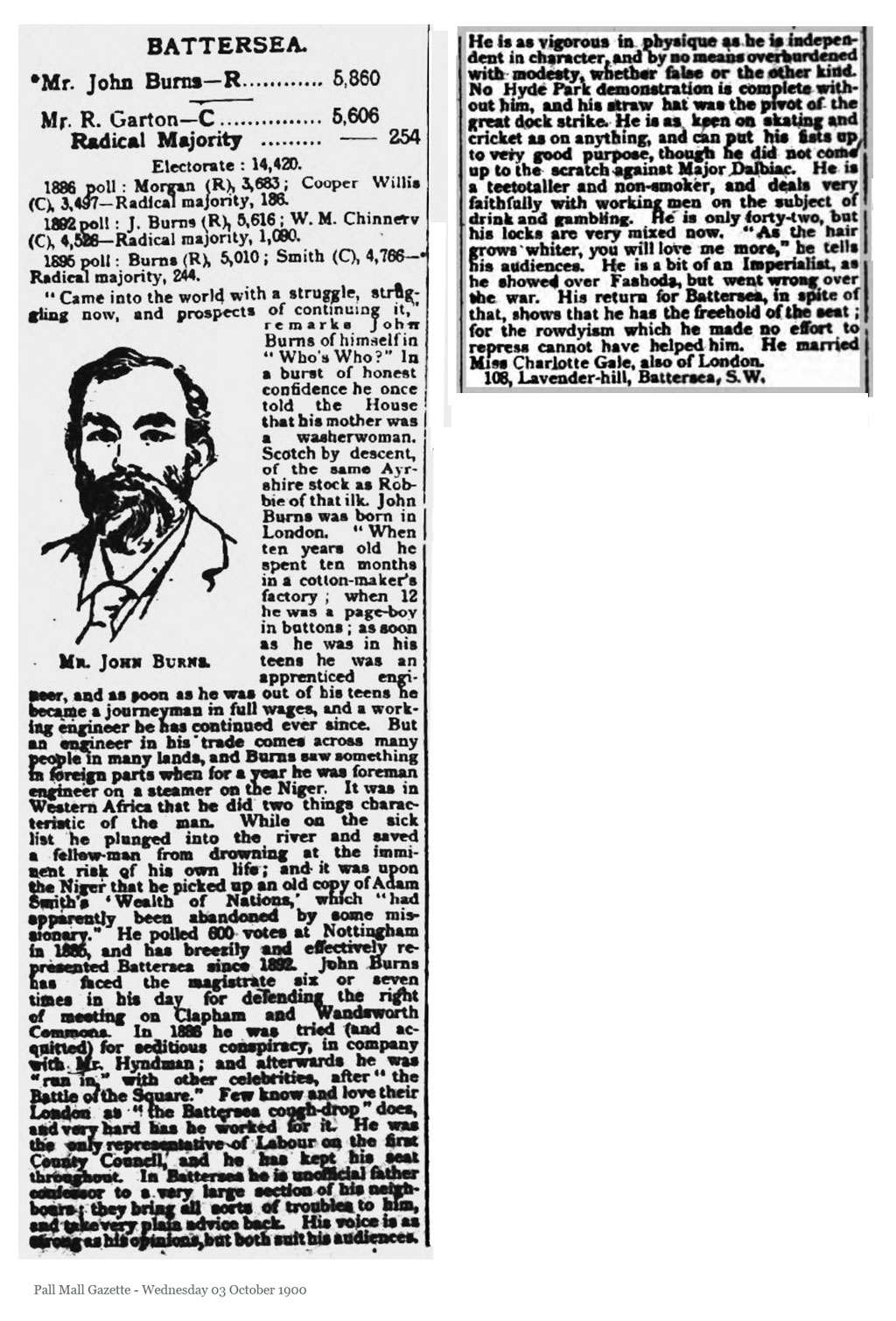
John Burns re-elected
[NEEDS EDIT & SOME EXPLANATIONS MAY BE USEFUL]
BATTERSEA.
Mr. John Burns - R [Radical] - 5,860
Mr R. Garton - C [Conservative] - 5606
Radical Majority - 254
[Earlier results]
"Came into the world with a struggle, struggling now, and prospects of continuing it," remarks John Burns of himself in "Who's Who?"
In a burst of honest confidence he once told the House that his mother was a washerwoman. Scotch by descent, of the same Ayrshire stock as Robbie of that ilk, John Burns was born in London. "When ten years old he spent ten months in a cotton-maker's factory; when 12 he was a page-boy in buttons [?]; as soon he was in his teens he was an apprenticed engineer, and as soon as he was out of his teens became a journeyman in full wages, and a working engineer he has continued ever since.
But an engineer in his trade comes across many people in many lands, and Burns saw something in foreign parts when for a year he was foreman engineer on mteamer on the Niger.
In Western Africa that he did two things characteristic of the man. While on the sick list he plunged into the river and saved a fellow-man from drowning at the imminent riak of his own life; and it was upon the Niger that he picked an old copy of Adam Smith's "Wealth of Nations," which "had apparently been abandoned by some missionary."
He polled 600 votes at Nottingham in 1886, and has breezily and effectively represented Battersea since 1892.
John Burns has faced the magistrate once or twice in his day for defending the right of meeting on Clapham and Wandsworth Commons.
In 1886 he was tried and acquitted for seditious conspiracy, in company with Mr Hyndman; and afterwards he was "run in" with other celebrities, after "the Battle of the Square" [Trafalgar Square]."
Few know and love their London as "the Battersea cough-drop " [?] does, and very hard has he worked for it.
He was the only representative of he was the only representative of Labour on the first County Council [LCC date?], and he has kept his seat throughout. In Battersea he is an official father confessor to a very large section of his neighbours; they bring all sorts of troubles to him, and take very plain advice back.
His voice is as strong as his opinions, but both suit his audiences. He is as vigourous in physique as he is independent in character and by no means overburdened with modesty, whether falls or the other kind no Hyde Park demonstration is complete without him, and his Strawhat was the pivot of the great docs strike.
He is as keen on skating and cricket as on anything, and can put his fists up to very good purpose, though he did not come up to the scratch against major Dalbiac [?]. He is a teetotaller and non-smoker, and he is very faithfully with working men on the subject of drink and gambling. He is only 42, but his locks are very mixed now. "As the hair grows whiter, you will love me more," quotes he tells his audiences.
He is a bit of an imperialist, as he showed over Fashoda, but went wrong over the wall. His return for Battersea, in spite of that, shows that he has the freehold of the seat; for the rowdyism which he made no effort to repress cannot of helped him.
He married Miss Charlotte Gail, also of London.
108, Lavender Hill, Battersea S
[BNA: Link.]
[as sent by SC to PB, June 2020. If any part is to be made public, check with Sean that he's happy with that.]
BURNS, John Elliot (1858-1943)
John Burns, the first working class socialist MP for Battersea, became the first manual worker to sit in the British Cabinet.
The 16th child of a Scottish fitter, he was born in Lambeth and raised in poverty by his deserted mother in the Queenstown Road area of Battersea. He was apprenticed as an engineer but soon got involved in political activity. In 1878, at the age of 20 he was arrested for holding a political meeting on Clapham Common. He was a powerful and eloquent speaker, preaching socialism and trade unionism.
He joined the Marxist Social Democratic Federation in 1884. His talk on Poverty at the Battersea National Secular Society led to the formation of a local branch of the SDF.
He was in demand all over London, was arrested twice at demonstrations in Trafalgar Square in 1887.
He split with the SDF over disagreements with its national leader, but remained in a good working relationship with the Batttersea branch. In 1889 it seconded the resolution to form the Battersea Labour League as a vehicle to support Burns and other labour movement candidates at municipal level.
He made his national reputation as one of the leaders of the London Dock Strike of 1889 and of the militant wave of union organisation and strikes known as New Unionism between 1889 and 1892. The spark for this militancy had been the successful Match-Girls Strike in the East End which Burns had supported. He went on to support the establishment of the Womens Trade Union Association in October 1889.
It helped ensure that his putting together a Progressive Alliance with the liberals and radicals meant his election to the newly formed London Count Council at the end of 1889.
Both in Battersea and in New Unionism he worked closely with Tom Mann, another engineer socialist. The one reform they had disagreed on was the merits of introducing the Eight Hour Day. Burns defeated Mann in a Battersea SDF debate, but Mann went on to set up the Eight Hour League. As a member of the London Trades Council he ensured that eight hours was the theme of the first celebration iof May Day in Hyde Park by the labour movement in May 1890.
By now Burns supported the demand. At least 200,000 people took part with several processions to Hyde Park for it from different parts of London. As one of the speakers Burns had an "enormous audience". This overwhelming support for the eight-hour day and the parallel success of the 'New Unionism', enabled both men to carry the day at the Trades Union Congress in September 1890 and have the eight-hour day adopted as policy.
Burns reported back on the Congress at a meeting of the Battersea Labour League at Washington Music Hall on Sunday 21 September 1890. "There has been a lot of cant talked about the "new" and "old trades unionism. The difference between them, if any, is entirely due to the fact that the "new" see that labour saving machinery is reducing the previously skilled to the level of unskilled labour, and they must, in their own interests, be less exclusive than hitherto. The "new" believe that DISTINCTIONS OF LABOUR MUST DISAPPEAR, and that class prejudices that have disintegrated the labour movement must be abolished."
He was elected as MP for Battersea 1892 and remained as such until 1919. The other socialist elected as an MP at the same time was Keir Hardie. Hardie sought Burns's support in his attempt to set up a separate Labour Party. But Burns preferred to keep his independence and freedom of action and the inability to work with Liberals and Radicals.
In Battersea on his initiative the Progressive Allaince was strengthened in with the formation of the Battersea Trades & Labour Council in 1894. That year the Alliance won control of the Battersea Vestry and then in 1900 its successor the Battersea Borough Council. The Alliance kept control until 1909 when due to a complex set of factors it lost control to the Conservative Municipal Reformers until 1912. The Alliance regained control till 1919 even though the Liberals seperated off during the War. In 1919 the newly formed Batttersea Labour Party & Trades Council swept control of the Borough Council.
The national Liberal leadership valued Burns's vociferous support over free trade and opposition to the Boer War, so they at the end of 1905 they appointed him to the Cabinet. in early 1906 Liberals election landslide he was appointed President of the Local Government Board, and so became the first member of the working class to sit at the Cabinet table in Downing Street.
He remained President of the Local Government Board until 1914 when he became President of the Board of Trade 1914. Many argue that he was not a success as a Minister, but as yet his influence In Cabinet has not to my mind been fully analysed. He was the key voice that won full legal immunity for trade union funds. He introduced the first Town & Country Planning Act. He resigned from the Cabinet in August 1914 in opposition to the declaration of First World War.
Many of his speeches were published as pamphlets. He lived at 108 Lavender Hill between 1900 and 1906, at 37 Lavender Gdns from 1907. He moved to 110 North Side Clapham Common in 1914.
At the end of the First World War, he was interviewed by the Battersea Labour party to be their official candidate at the 1918 General Election, but he would not accept the rules of the Parliamentary Labour Party. Instead they chose as candidate Charlotte Despard but she lost because of a ConLib Coalition.
In 1919 he was left an annuity of %1000 by the Scottish millionaire and philantrophist Andrew Carnegie. This made him financially independent. He spent the rest of his life devoted to his interests in books, London history and cricket. He was an acknowledged expert on the history of London. In 1929, when an American compared the River Thames unfavourably with the Mississippi, he responded "The St Lawrence is water, the Mississippi is muddy water, but the Thames is liquid history".
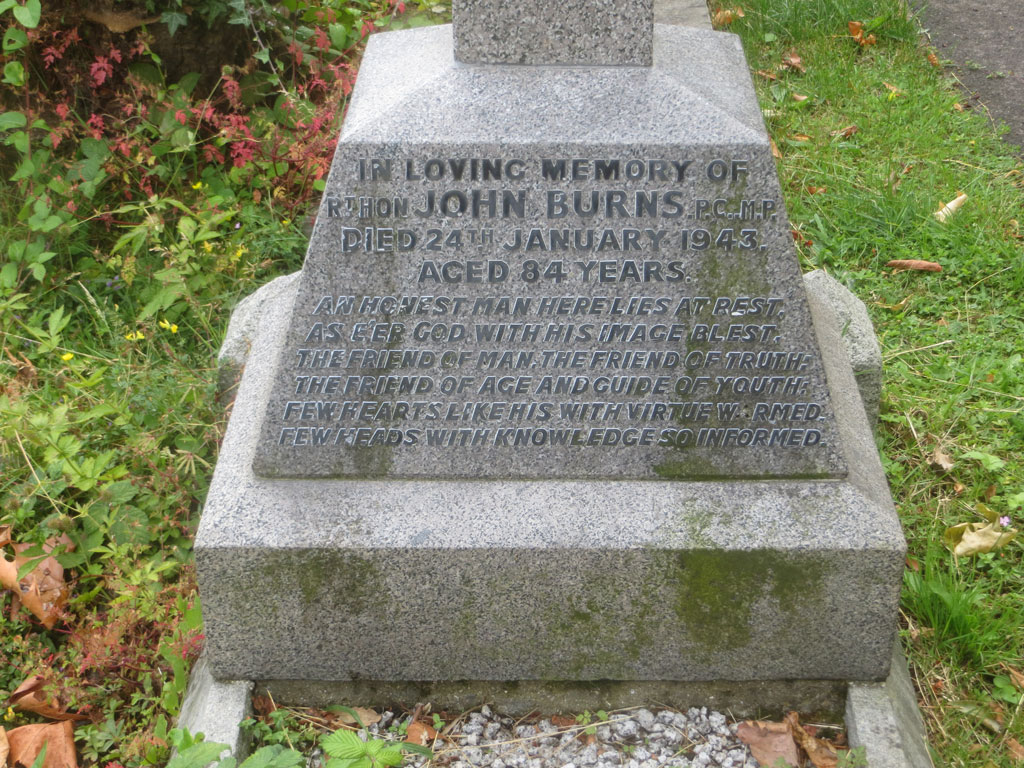
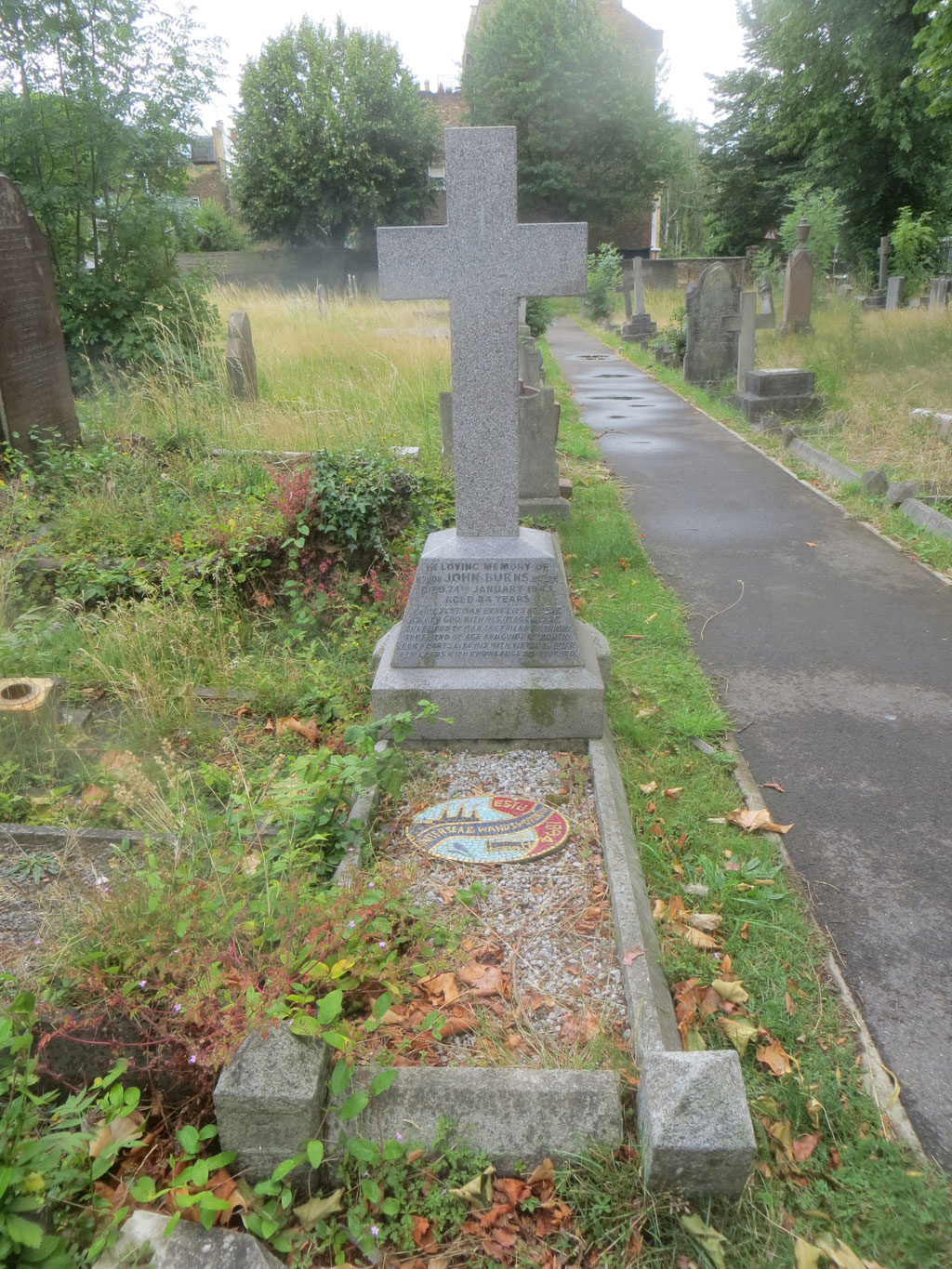
He died on 24 January 1943.
In an email (18.06.2020), Sean added:
I lead an annual walk for the Trades Council about Burns usually starting at the Cemetery and depending on the route sometimes goes along the common before going down to Northcote Rd.
Like most people Burns was a complicated person and inevitably his views on some issues did change. All the books on him are flawed with too anecdotal by a friend, or hostile by political opponents, or thin in terms of more modern academic. His major achievement in Government was the Town Planning Act. He resigned in protest at the declaration of War. I have long argued that there needs to be a total reassessment of him but the task is daunting given the amount of material there is.
I attach my very very brief review of his life. I have written in detail about various periods of his life and activities.
I have no references to Burns speaking on Wandsworth Common.
However there is a reference to him having an altercation there during the Boer War in Militarism and the British Left, 1902-1914. Matthew Johnson, Palgrave Macmillan, 11 Jan 2013 - a book I had not seen reference to before
[PB: I have found and transcribed this (below).]
Also from Google Books there appears in 1912 to be either a transfer of the Common to the LCC or it funded an extension. e.g. see London Municipal Notes, Volume 15
London Municipal Society, 1912 -
But as there are no full page details you will have to wait till post COVID to check out LCC records at London metropolitan Archive. It is possible that the LCC had to have Burns permission at the Local Government Board.
The problem with Burns is the sheer mass of material that exists e. at British Library, which has not been researched or if it has been has not seen the published light of day. The last two people who were researching his life Stan Shipley and John Tilley both died before they had been able to publish, and it appears that their files on him were not saved
The important thing about Burns is that he was what we would now call an environmentalist. His manifesto when he stood for the LCC made this very clear, e.g.
4. That the Council establish free baths and wash-houses, as well as free libraries, in all districts of London, and set on foot free gymnasiums and recreative grounds for the people, throwing open all enclosed squares to the public.
6. Artisans' dwellings to be constructed by the Council, and let at rents to cover the cost of construction and maintenance alone, such dwellings to wholesale, airy, and peasant, with proper provision for playgrounds for the children.
8. That the shameful fouling of the Thames, the Lea, the Regent's Canal, and other Metropolitan waters be at once put a stop to.
For speeches in parliament linked to open spaces and pollution of the Thames see e.g.
[Source: Link.]
[Source: Link.]
[Source: Link.]
[Source: Link.]
Of course the campaigns to save Wandsworth and Wimbledon Commons were just two of many across London which led to their preservation in the 1870s.
They are just a small part of the on-going difference sof opinion about free speech and open spaces, and the conflicts over who can use and control open spaces. See:
And my chapter in the book History Riots ed. Keith Flett which is on Google Books, and the discussion of issues at
History & Social Action
From Militarism and the British Left, p.36:
More remarkably, those on the left who opposed the war were generally at pains to do so without criticizing the British army itself. John Burns, the independent-minded Battersea labour leader, whose opposition to British policy in South Africa was at this time bringing him closer into the Liberal orbit, condemned the war as 'unnecessary, unjust, and immoral', but lavished fulsome praise upon the 'gallant deeds' and the 'valour and character' of the British soldiers.'
He [Burns] responded robustly to any who questioned the sincerity of his support for the troops, as for example on one occasion in January 1902 when the MP was accosted by a 'jingo' while admiring the Coldstream Guards on Wandsworth Common. As Burns recorded in his diary,
"Had a terrific row with a fellow who suggested I should like to see them cut up. I retaliated by attempting to knock him down. He ran like a rabbit to a bus and skedaddled. I caught bus up, and to give him a lesson followed omnibus to Chelsea. He was in an awful funk all the way."
[PB: It is likely that this was during a military display in/on the Frying Pan - the only suitable area for a Parade.
In part, Burns's sympathy for the soldiers stemmed from his recognition that most of the troops serving in South Africa had been drawn from the working classes at home, including many from among the more 'respectable' workers who had enlisted for the duration of the war.As he remarked of the Northumberland Fusiliers, 'I know them well. They are our collier lads from Northumberland and Durham, and fine soldiers they are. When at home every man joins his trade union, and every man is a keen politician and an enemy of oppression of every kind'.'i
But Burns was also a genuine admirer of the soldiery, who frequently attended army manoeuvres in his spare time - a surprising leisure activ-ity for one who later came to be regarded as a pacifist for his opposition to the First World War."
In August 1906 Burns joined a party hosted by General Sir Ian Hamilton to observe a sham fight at Tidworth. He made a favourable impression on his military companions, who observed that 'his whole mind [was] wrapped up in army mailers.... He knows the history of every regiment and is "quite a good fellow".'.
Burns was not alone among opponents of the Boer War in refusing to criticize the soldiery. Most 'Pro-Boers' focused their ire on the gov-ernment - in particular the colonial secretary, Joseph Chamberlain -and on the British High Commissioner in South Africa, Alfred Milner. Chamberlain had already aroused Liberal suspicion over his supposed complicity in the Jameson raid of December 1895, and the Boer War was frequently described by its opponents as 'Joe's War' .
Matthew Johnson, Militarism and the British Left, 1902-1914, Palgrave-Macmillan, [date?]
PB: I sent this to the WC150 history group:
JOHN BURNS & WANDSWORTH COMMON
I'm collecting material on John Burns and Wandsworth Common - early days yet, but there are some intriguing connections
He's buried in St Mary's / Battersea Cemetery, so on the edge of the Common. And I know he was quite an environmentalist.
He was arrested for speeches on Clapham Common, and probably elsewhere, but I've come across a number of explicit refs to Wandsworth Common too - above all that he argued (successfully) for political meetings to be allowed on Wandsworth Common [I imagine the LCC had banned them - I'll check.]
Here's another reference to WC, from Matthew Johnson, Militarism and the British Left, 1902-1904, Palgrave-Macmillan, 2013 p.36:
John Burns, the independent-minded Battersea Labour leader, whose opposition to British policy in South Africa was at this time bringing him closer into the Liberal orbit, condemned the [Boer] war as 'unnecessary, unjust, and immoral', but lavished fulsome praise upon the 'gallant deeds' and the 'valour and character' of the British soldiers.
He responded robustly to any who questioned the sincerity of his support for the troops, as for example on one occasion in January 1902 when the MP was accosted by a 'jingo' while admiring the Coldstream Guards on Wandsworth Common.
As Burns recorded in his diary,
"Had a terrific row with a fellow who suggested I should like to see them cut up. I retaliated by attempting to knock him down. He ran like a rabbit to a bus and skedaddled. I caught bus up, and to give him a lesson followed omnibus to Chelsea. He was in an awful funk all the way."
In part, Burns's sympathy for the soldiers stemmed from his recognition that most of the troops serving in South Africa had been drawn from the working classes at home, including many from among the more 'respectable' workers who had enlisted for the duration of the war.
PB: And no wonder the chap ran away. Here is how Pall Mall Gazette described John Burns's "exceptional physical gifts":
TO-DAY'S TITTLE TATTLE
Have you noticed that highly-coloured picture of Samson on the walls of London, with his huge arm doubled up, busy bursting a chain of iron?
"Jack" Burns's biceps are moulded on the same heroic proportions, allowing for the imaginative increment of the wall artist. The leader of the Dock Strikers is an enormously powerful fellow, and he has told me that it is his exceptional physical gifts which have enabled him to begin his day's work at three in the morning and continue it till close on midnight. That is actually what he is doing now as General of the Strikers.
"Jack" is the beau ideal of the best type of British working man; big in build, independent in character, hearty in manner, and intelligent in mind. His fists are as hard as his head, and his voice is as strong as his opinions.
He has often been before the "beaks" for defending the right of meeting-on Clapham-common, on Wandsworth-common, and in Trafalgar-square. He picked up his education by burning the midnight oil after ten hours in a factory; he is an engineer by trade, and iron is a hard master. He polled 600 votes at Nottingham Parliamentary election in [????], ran George Shipton close for the presidency of the late International Congress, and is now on the council of the Amalgamated Society of Engineers.
He stood for Battersea, on the full Socialist ticket, and was returned as a member of the County Council at the head of the poll. He is a Scot by extraction, he has a charming wife, he is a non-smoker, and a total abstainer.
Mr. Sydney Holland, who, as one of the directors of the Dock Company, is taking an active part in the struggle on the other side, is the eldest twin son of Lord Knutsford. In spite of his aristocractic connections, Burns says he's got the root of the matter in him, and he will turn Socialist yet. Mr. Holland is dark, good-looking, and thirty-four. He is married to Lady Mary, daughter of Earl Ashburnham.
[PB: There are a number of articles in the Wandsworth Historian, e.g.:
WH 80, an article on the Latchmere Estate
WH 96, Penny Corfield:
Supporters of widening access also campaign for better educational opportunities and the ending of all forms of discrimination - policies that are taking time to implement world-wide. But it is notable that popular politics and trade-unionism in nineteenth-century Britain had already begun to bring some remarkable men to the fore. They were working-class leaders, who got their education and skills on the job. John Burns was one notable pioneer. In 1858 he was born in the Nine Elms slums, spawned by Battersea's fast-growing riverside industries. His father, a Scottish fitter, abandoned his large family to poverty. The young Burns left school at the age of ten and made his way in the early trade union movement. He founded his own Battersea Labour League, whilst also supporting pragmatically the Lib-Lab political alliance. From 1905-15 he was welcomed into power by the Liberal government. He served as minister for local government, before Burns eventually (and regretfully) resigned in opposition to World War I. Considered as a social trajectory, from the slums to the British cabinet, this rise was even more impressive than that of Emma Hamilton's. Moreover, Burns gained power in his own right. Throughout, he remained loyal to his working-class roots. Both in and out of power, he continued to live in Battersea. And in 1901, he declared stoutly to his fellow MPs: 'I am not ashamed to say that I am the son of a washerwoman'. It was the proud claim of a self-made man. Meanwhile, today, he remains commemorated locally, not least in the name of John Burns School. In general, however, the reputation of the man once known as the 'Colossus of Battersea' has faded over time, as even the greatest of political reputations usually do.
Keith Bailey?, WH 98:
John Burns - a revisionist's view
Today we are well used to politicians massaging their back stories to enhance their elector-appeal, writes Keith Bailey. Was this also the case in earlier times? In her essay on various Wandsworth meritocrats in WH 96 Penelope Corfield included the radical politician John Elliott Burns (1858-1943), the first working man to attain cabinet rank (PCor). Burns is also the subject of an extensive, annotated entry in the Oxford Dictionary of National Biography (ODNB). Both contain statements about Burns's early life which prompted some thoughts as to their validity.
Burns was born 'in the slums of Nine Elms' (PCor) or in South Lambeth (ODNB) Nine Elms was scarcely developed in 1858. Burns's parents - Alexander, an engineering craftsman, and Barbara - married at Aberdeen in 1838 and led a peripatetic existence for two decades. Their nine children were born during stays in Newcastle, Manchester (twice), Belfast, Stepney and Battersea. The 1861 census found them at 1 Vittoria Cottages, Horace Street, South Lambeth. Alexander was an 'engine driver on railway', probably based at Nine Elms on the London & South Western Railway. The two youngest children, John, aged 2 and Alexander, 12 weeks, are both said to have been born at Ratcliffe Highway in Stepney. Alexander's birth was registered at Stepney, John was registered at Lambeth in late-1858, suggesting the possibility of an earlier stay there. The birthplace of both boys is given as 'Battersea' in 1871. John Burns later gave his birthplace as Vauxhall, London and Lambeth. In so far as there is some doubt about the Stepney evidence, the balance of probabilities is that he was born in South Lambeth/Vauxhall, close to but not actually in Battersea. Horace Street was working-class rather than a slum. The family occupied a whole house in 1861, and Alexander was clearly a skilled artisan
John Burns was the family's sixteenth child (ODNB); the family was abandoned by their father to a life of poverty (PCor/ODNB); Burns's mother had to take in washing and move to a basement dwelling (ODNB) These propositions stem from a misreading of the 1871 census, when the family lived at 80 Grant Road, Clapham Junction. Alexander was again an 'engineer', with the three youngest of his nine recorded children still at home. Also present were no fewer than five grandchildren, aged 4 to 12 and all born in north Kent. These were the children of Alexander's eldest daughter, Eliza[beth] born c.1840, who married John Elliott, a turner at the Royal Arsenal, Woolwich in 1858. It is probable that the Elliott children were the ones who had been abandoned and taken in by Alexander and Barbara Burns.
Alexander Burns died in mid-1876, leaving a widow and several unmarried children, not necessarily still living at home, the youngest of whom was then thirteen. It seems unlikely therefore that the family would have been plunged into penury, unless they were still caring for the Elliott children. It is probable that Barbara had to move to smaller accommodation, conceivably in the [semi-]basement of a three-storey house, and may have taken in washing to make ends meet.
Whether she had earlier been the 'washerwoman' of whom Burns spoke in the Commons in 1901 seems less plausible. In 1881 Barbara Burns lived in Riverhall Street, Lambeth, where she was supported by her sons Alexander and David, both engineering workers. Later, she lived with David (a railway-engine fitter) and his family in Riverhall Street, dying in 1901. Although John Burns lived in the Lavender Hill area from his marriage in 1882, he seems not to have been especially close to his mother.
Burns left school at 10 (ODNB) John was recorded as 'scholar', aged 12, in 1871. He attended the St Mary's National School in Green Lane, Battersea (now Vicarage Crescent), probably leaving at 13. He followed in his father's footsteps, beginning a seven-year engineering apprenticeship in 1872-73. He travelled to West Africa to work for the Niger Company c.1880-81. He described himself as an engine fitter in 1891, engineer (retired) and MP in 1901, and Privy Councillor in 1911.
It appears that John Burns himself projected an image of his origins somewhat at variance with the reality, a situation exaggerated by later commentators. Here then is a not-uncommon discrepancy between a politician and 'the facts', no rare occurrence and a cautionary tale indeed.
Who Revises Whom? - the Birthplace of John Burns
The writer, William Kent, a friend of Burns and author of John Burns: Labour's Lost Leader (Williams & Norgate, 1950), recorded that Burns had been born in 1858 at 19 Simpson Street (later changed to Blean Street), Wilcox Road, South Lambeth. That is consistent with the registration of his birth in the same year at Lambeth without 'suggesting the possibility of an earlier stay', as supposed by Keith Bailey in WH 98. Wilcox Road runs between Wandsworth Road and South Lambeth Road; the western end was close to Nine Elms Depot.
Dermot Jones, who is one of our regular contributors, goes on to say that WHS members may be interested to know that the house occupied by John Burns in later life (from 1914) at 110 Clapham Common North Side, Battersea, is still in existence and bears a small commemorative plaque. In his book London Worthies (Heath Cranton, 1939) Kent included a photograph of Burns (reproduced here) standing outside that very house on the day of his eightieth birthday, 20 October 1938. Burns died in January 1943.
Just inside the entrance, on the right.