
— HoWC: People
Google Search: CRW Nevinson Images
BritishArts: CRW Nevinson
Meisterdrucke: CRW Nevinson
VisualDiplomacyUSA > Artist of the day: CRW Nevinson
[The Futurist artist] CRW Nevinson on Wandsworth Common
Good idea for a talk or article?!
Correspondence and papers relating to Nevinson's contact with the Ministry of Information and with the Imperial War Museum. Nevinson and his father, the journalist H W Nevinson, both wrote proposing him for official art commissions. At the same time, Nevinson was in correspondence with the Museum regarding a work purchased and presented by Sir Alfred Mond ('A Taube', IWM:ART 200) and the gift of another work by Nevinson (IWM:ART 517). It was agreed that Nevinson should go to France as the second temporary artist, to be succeeded by Lavery. The conditions of his employment are at (224). (At this time Nevinson was already working on lithographs for the series 'Britain's Efforts and Ideals').
Nevinson went to France in July 1917, as a civilian visitor which meant he had to be accompanied by an officer at all times. He wrote back frequently describing his adventures, and, at his request, his stay was extended; he was back by early August.
Biographical notes written by Nevinson are at (194-5). Thomas Derrick visited Nevinson's studio to look at the work to date (192) and made some interesting comments, that he felt Nevinson was restraining his natural artistic inclinations for the sake of official acceptance.
The file also discusses plans to superseded the publication 'The Western Front' with a publication featuring a wider range of artists. Nevinson was to be the subject of the first volume of 'British Artists at the Front'. There is extensive correspondence regarding the planning and publication of this volume, which hit numerous problems along the way. C F Montague wrote one of the introductions and also discusses introductions for the other volumes, for example in (82) he discusses his concerns over writing the introduction for the Lavery volume.
There is also extensive correspondence regarding the issue of censorship of Nevinson's work, 'A Group of Soldiers' (IWM:ART 520) being judged by the Chief Censor in France, Major Lee, to represent types of men "not worthy of the British Army" (156) and 'Paths of Glory' (IWM:ART 518) being banned because it depicted dead soldiers. Nevinson was outraged at both these verdicts; the former because he felt it amounted to aesthetic censorship rather than military (148-151) and the latter because of its hypocrisy.
The file also refers to preparations for Nevinson's exhibition at the Leicester Galleries in March 1918. From this exhibition, the Imperial War Museum purchased seven works (IWM:ART 513-516, 518-520), selected by Robert Ross under the terms of Nevinson's original appointment with the MoI. There is also correspondence relating to the commissioning of 'The Harvest of Battle (IWM:ART 1921).
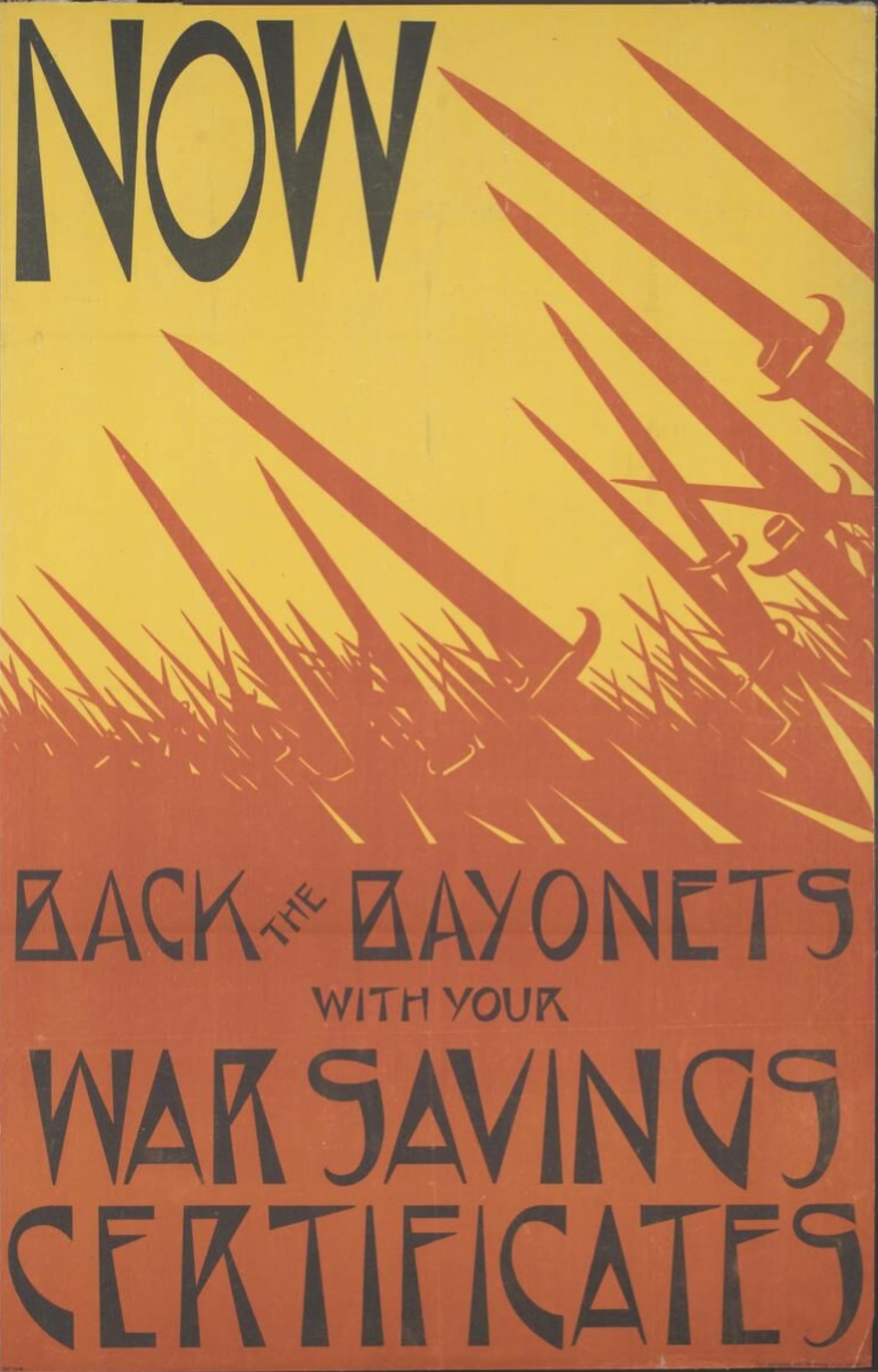
A further visit to France was arranged in connection with this picture. The file also includes some general notes about the history of the war artists' schemes ((61) and (148)); Nevinson's completed MoI 'Particulars Required' form (41); correspondence regarding Nevinson's offer to donate his 'red bayonet poster' design (as used in IWM:PST 0411 and 8167) to the War Board Poster Department (39); loans of works to the MoI's touring exhibition to America, and continuing discussions over terms and conditions of Nevinson's appointments.
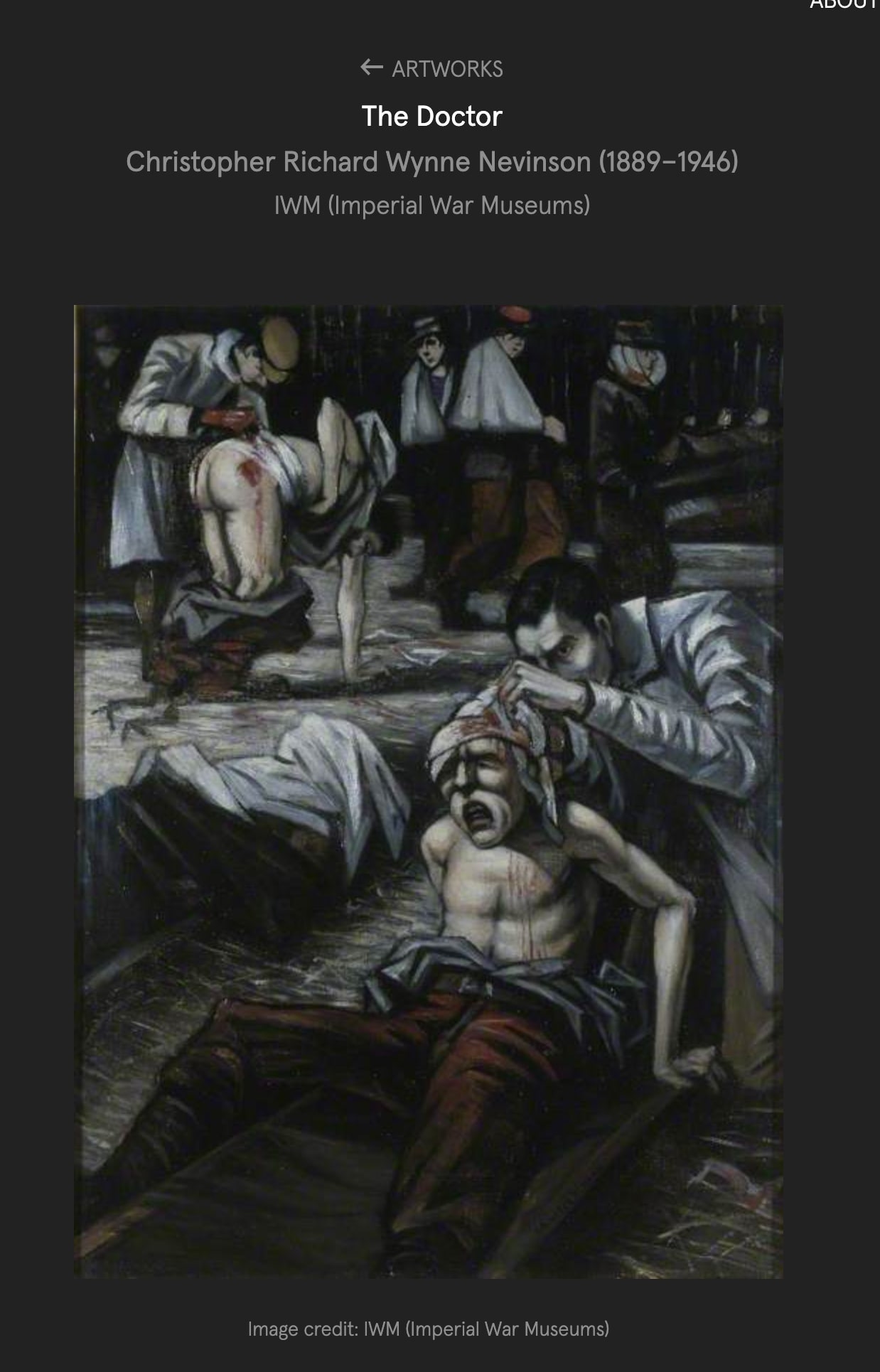
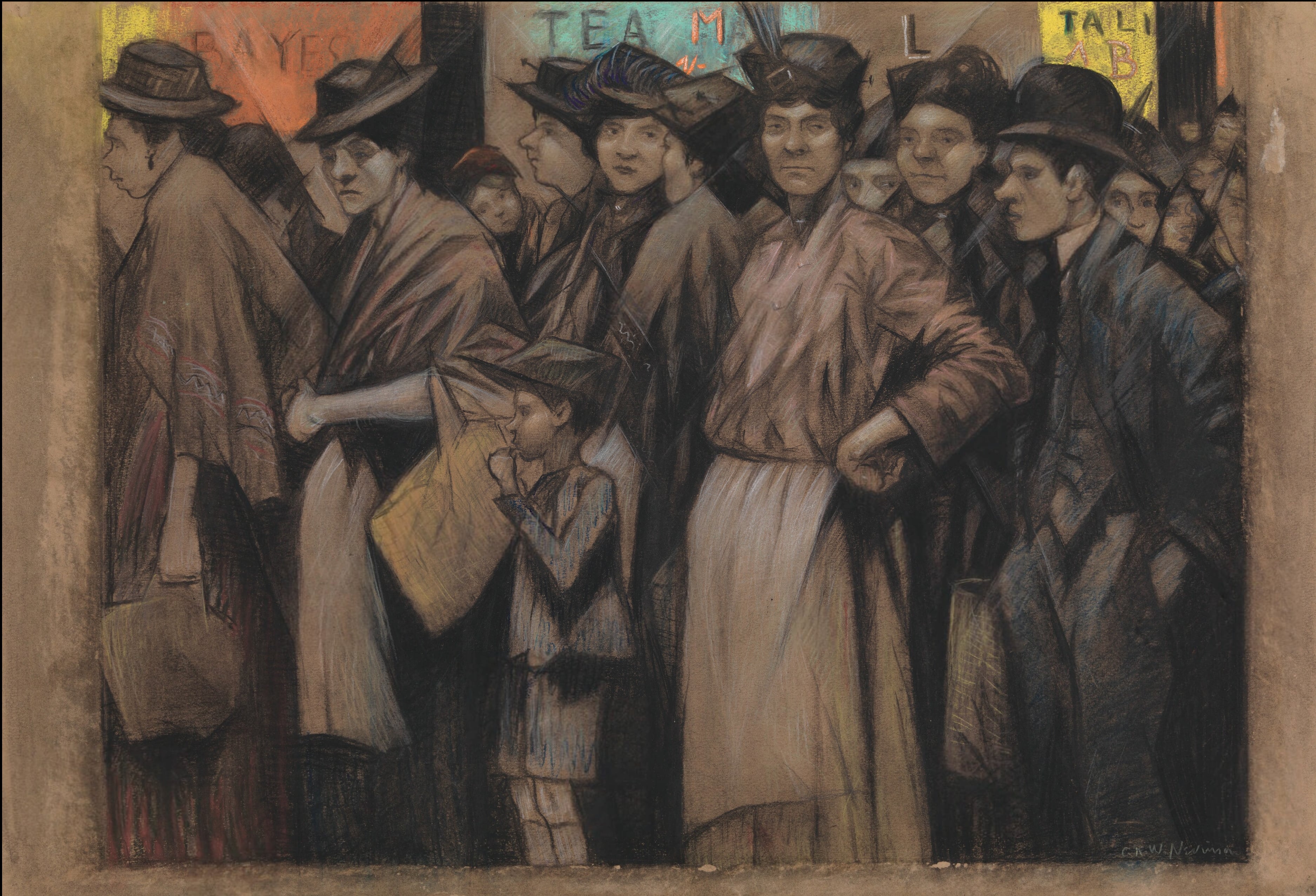
Two works are mentioned under differing titles from those by which they are now known: IWM:ART 725, now known as 'The Doctor' but then called 'The Dressing Station', and IWM:ART840, now known as 'The Food Queue' but then referred to as 'Squalor'.
Paths of Glory
The corpses of two dead British soldiers lying face down in the mud among barbed wire. Their helmets and rifles lie in the mud next to them.
___
The Doctor
____
The Harvest of Battle
The Underworld: Taking cover in a Tube Station during a London air raid
ArtUK
Nerves of the Army
C.R.W. Nevinson: This Cult of Violence
ISBN: 9780300095074
Artist(s): C.R.W. Nevinson
Author(s): Michael J K Walsh
Format: hardback
Edition: First
Year published: 2002
Publisher: Yale University Press
Publisher Location: London
Total Pages: 256 pages
Illustrations: 75 illustrations, 25 in colour
C.R.W. Nevinson was one of the most important, colourful, and talked about artists of his generation. In the turbulent days of pre-World War I London, he gained notoriety as England's only Futurist, and during the war he produced some of the most memorable and harrowing images of that conflict. This book focuses attention on Nevinson's dynamic early career, drawing on freshly located archives and on the press of the period to shed new light on the young artist and the power of his progressive paintings.
Reliefs at Dawn, 1917
____
C.R.W. Nevinson: The Twentieth Century
Edited by Richard Ingleby, Jonathan Black, David Cohen, and Gordon Cooke
Published by Merrell Holberton in association with the Imperial War Museum London
192 pages, 9 x 6 x 1 inches, 144 illustrations, hardcover and paperback, ISBN 1858940907 (hardback), 1858941024 (paperback)
Publication date: February 25, 2000
Exhibition
C. R. W. Nevinson: The Twentieth Century
Friday, February 25, 2000–Sunday, May 7, 2000
Painter, printmaker, and avant-garde controversialist, the British artist Christopher Richard Wynne Nevinson (1889–1946) is probably best known for his powerful and unflinching depictions of World War I, but this work is just one aspect of an extraordinarily diverse career. The first retrospective of Nevinson's work held in the United States, this exhibition provided a long-overdue and comprehensive reassessment of his significant contribution to twentieth-century art.
Initially influenced by impressionism and post-impressionism, Nevinson affiliated himself in 1912 with the Italian futurist movement, attracted by its celebration of modernity, technology, and warfare. With characteristic independence, Nevinson developed his own distinctive hybrid futurist style of painting; the finest surviving work of this period, The Arrival, was included in this exhibition.
When World War I broke out, Nevinson went to France as an ambulance driver with the Red Cross. Nevinson's futurist notion of "the beauty of strife" soon turned to disillusion as he experienced the grim reality of life in the trenches. Released from active service due to illness in 1916, he produced a series of stark and eloquent images which used the vocabulary of modernism to powerfully convey the bleakness and futility of twentieth-century warfare. In June 1917, Nevinson returned to the service as an official war artist.
After the war, Nevinson rejected modernism and turned to more conventional landscapes and cityscapes. Two visits to New York, in 1919 and 1920, resulted in a group of paintings and prints that convey the dynamism and vertiginous scale of the rapidly expanding city. As Fascism spread in Europe in the early 1930s, Nevinson responded to fears about the recurrence of world war with a group of brooding allegorical pictures. His most iconic late work, The Twentieth Century, provided a resonant conclusion to this exhibition.
Venues
Imperial War Museum, London: October 28, 1999–January 30, 2000
Yale Center for British Art: February 25–May 7, 2000
View works from the collection included in this exhibition here.
Credits
C. R. W. Nevinson: The Twentieth Century was organized by the Imperial War Museum, London, and curated at the Center by Gillian Forrester, Assistant Curator of Prints and Drawings at the Center. A full-color catalogue accompanied the exhibition.
Top image
C. R. W. Nevinson, The Wave (detail), 1917, oil on canvas, Yale Center for British Art, Paul Mellon Fund
...However, the best part of the exhibition lies in the work of CRW Nevinson, as his futurist style captures the intensity of the situation. A good example is an abstract bursting shell, painted as if above the viewer, which would be seen as beautiful if not for the devastation it brings. Nevinson's portrayal of resting troops and their angular jaws does not mark them out as heroes, but shows instead the cogs of the machine that is war.
This is a small exhibition that's being ignored by most of the crowds, but it's just as insightful as the permanent displays. Plus, the comparative lack of visitors means the full impact of the works has time to sink in.
Biography
Christopher Richard Wynne Nevinson (13 August 1889 – 7 October 1946) was an English figure and landscape painter, etcher and lithographer, who was one of the most famous war artists of World War I. He is often referred to by his initials C. R. W. Nevinson, and was also known as Richard.
Nevinson studied at the Slade School of Art under Henry Tonks and alongside Stanley Spencer and Mark Gertler. When he left the Slade, Nevinson befriended Marinetti, the leader of the Italian Futurists, and the radical writer and artist Wyndham Lewis, who founded the short-lived Rebel Art Centre. However, Nevinson fell out with Lewis and the other 'rebel' artists when he attached their names to the Futurist movement. Lewis immediately founded the Vorticists, an avant garde group of artists and writers from which Nevinson was excluded.
At the outbreak of World War I, Nevinson joined the Friends' Ambulance Unit and was deeply disturbed by his work tending wounded French and British soldiers. For a very brief period he served as a volunteer ambulance driver before ill health forced his return to Britain. Subsequently, Nevinson volunteered for home service with the Royal Army Medical Corps. He used these experiences as the subject matter for a series of powerful paintings which used the machine aesthetic of Futurism and the influence of Cubism to great effect.
His fellow artist Walter Sickert wrote at the time that Nevinson's painting La Mitrailleuse, 'will probably remain the most authoritative and concentrated utterance on the war in the history of painting.'
In 1917, Nevinson was appointed an official war artist, but he was no longer finding Modernist styles adequate for describing the horrors of modern war, and he increasingly painted in a more realistic manner. Nevinson's later World War One paintings, based on short visits to the Western Front, lacked the same powerful effect as those earlier works which had helped to make him one of the most famous young artists working in England.
Shortly after the end of the war, Nevinson travelled to the United States of America, where he painted a number of powerful images of New York. However, his boasting and exaggerated claims of his war experiences, together with his depressive and temperamental personality, made him many enemies in both the US and Britain. In 1920, the critic Charles Lewis Hind wrote of Nevinson that 'It is something, at the age of thirty one, to be among the most discussed, most successful, most promising, most admired and most hated British artists.'
His post-war career, however, was not so distinguished. Nevinson's 1937 memoir Paint and Prejudice, although lively and colourful, is in parts inaccurate, inconsistent, and misleading.
This biography is from Wikipedia under an Attribution-ShareAlike Creative Commons License.
— Archive.org: C.R.W. Nevinson, Paint and Prejudicee
— Encyclopedia 1914-1918 Online C.R.W. Nevinson
— Sothebys: Link.
C.R.W.Nevinson (1889 - 1946)
[Full TableNevinson
C.R.W.Nevinson joined the Red Cross in 1914 and went straight to the war front. After a period of ambulance work, he developed what was called 'rheumatism' and returned to the United Kingdom where he served in the Royal Army Medical Corps (also known as Rob All My Comrades or Rats after Mouldy Cheese) at the 3rd London General Hospital at Wandsworth. Once there, he contributed to The Gazette which was an ambitious and amusing magazine sent monthly to everybody there. The standard of prose and drawing was high - many of the staff and patients being artists and journalists.
Here is Nevinson marked on the group photograph published in October 1917 of The Chain Gang, a "squad of men working on the grounds".
Here are the images Nevinson contributed after he had left the Hospital to the three volumes of its magazine.
The Gazette, June 1916 p.243, gives details of his stays at Wandsworth; :Mr. - formerly Private - C.R.W.Nevinson sends a memento of his sojourn here in the shape of a Futurist reminiscence of the audience at a concert in our Recreation Room (p.237 and beneath here).
Mr.Nevinson has, as it were, seen these audiences from both points of view, both as a member of the staff and a patient, for he had the unusual experience first as working as an orderly here and then being himself an inmate of one of the wards." All pages of The Gazette measure 13 x 20 cms. March 1917 p.162
TEMPERATURE 102' 4 image measures 9 X 10 cms Oct 1915, p.20 untitled but at the foot of an article on 'Bungalow Town' an ad hoc collection of walkways and buildings put up on Wandsworth common and land attached to the main hospital; image 6.5 x 10.5
Nov 1915, p.30 Night Arrival of Walking Wounded, 8.5 x 10cms, attached to an article on The Captives Home-Coming, a group of exchanged prisoners of war arriving in Red Cross wagons and ambulances at Wandsworth from the Station .
Feb.1916. p.115 A Futurist's Impression, 10 x 16.7 cms. A view of The Receiving Hall . not attached to a particular article. Whole page illustration. In April 1916, an article describes The Receiving Hall, " On the table at the far end stands a great tank of steaming cocoa and an array of cups. Orderlies are bringing in piles of bundles of 'blues'; others are ready with string and labels and vast volumes in which the newcomers' belongings may be listed before they are taken to the pack store."
April 1916, p.179, image measuring 9 x 10cms; The Driver of the Ambulance, attached to an article on An Intake of the Wounded. The Ambulances collected the wounded from the station at Wandsworth and drove slowly over to the Hospital.
An article in this issue describes the arrival of the ambulances at night, " The orderlies' ranks stiffen : the chat ceases : cigarettes are thrown away. The first ambulance has passed through the gates and is gliding up the drive. .."
June 1916, p.237, 10.5 x 10.5 cms. At the Concert. A Comic Song .
He also sent them a drawing after an image originally created at Wandsworth. The Sprucers.
The images are interesting in that they make subtle allowances for the magazines' readers - with fewer Futurist abstractions and more identifiable objects which his readers would have been familiar.
Malcolm Arbuthnot's photographic portrait of Nevinson in stylish war garb appeared in The Gazette, and also in national periodicals such as The Graphic and Vogue.
The Gazette March 1917 describes him as "late of this unit"
Other artists who contributed to The Gazette include; J.H.Dowd, the Punch artist (who was an orderly) R.B.Ogle and H.M.Bateman. READING...
exhib.catal.C.R.W.Nevinson, Retrospective, Kettle's Yard, Cambridge 1988-9
Richard Cork Vorticism and Abstract Art in the First Machine Age, Gordon Fraser, London, 1976, Volume 2. "Synthesis and Decline".
THE ARTIST MAGAZINE, 1943 ARTISTS OF NOTE
Review of Paint and Prejudice News Review 1937
A SELECTION OF PRINTS
Biography
Christopher Richard Wynne Nevinson (13 August 1889 – 7 October 1946) was an English figure and landscape painter, etcher and lithographer, who was one of the most famous war artists of World War I. He is often referred to by his initials C. R. W. Nevinson, and was also known as Richard.
Nevinson studied at the Slade School of Art under Henry Tonks and alongside Stanley Spencer and Mark Gertler. When he left the Slade, Nevinson befriended Marinetti, the leader of the Italian Futurists, and the radical writer and artist Wyndham Lewis, who founded the short-lived Rebel Art Centre. However, Nevinson fell out with Lewis and the other 'rebel' artists when he attached their names to the Futurist movement. Lewis immediately founded the Vorticists, an avant garde group of artists and writers from which Nevinson was excluded.
At the outbreak of World War I, Nevinson joined the Friends' Ambulance Unit and was deeply disturbed by his work tending wounded French and British soldiers. For a very brief period he served as a volunteer ambulance driver before ill health forced his return to Britain. Subsequently, Nevinson volunteered for home service with the Royal Army Medical Corps. He used these experiences as the subject matter for a series of powerful paintings which used the machine aesthetic of Futurism and the influence of Cubism to great effect. His fellow artist Walter Sickert wrote at the time that Nevinson's painting La Mitrailleuse, 'will probably remain the most authoritative and concentrated utterance on the war in the history of painting.' In 1917, Nevinson was appointed an official war artist, but he was no longer finding Modernist styles adequate for describing the horrors of modern war, and he increasingly painted in a more realistic manner.[1] Nevinson's later World War One paintings, based on short visits to the Western Front, lacked the same powerful effect as those earlier works which had helped to make him one of the most famous young artists working in England.
Shortly after the end of the war, Nevinson travelled to the United States of America, where he painted a number of powerful images of New York. However, his boasting and exaggerated claims of his war experiences, together with his depressive and temperamental personality, made him many enemies in both the US and Britain. In 1920, the critic Charles Lewis Hind wrote of Nevinson that 'It is something, at the age of thirty one, to be among the most discussed, most successful, most promising, most admired and most hated British artists.'[2] His post-war career, however, was not so distinguished. Nevinson's 1937 memoir Paint and Prejudice, although lively and colourful, is in parts inaccurate, inconsistent, and misleading.[3]
Angela V. John on Henry W. Nevinson: Neighbours of Ours (1895)
In the mid-1880s, a well-educated, middle class couple and their baby daughter moved into six rooms at 252 Brunswick Buildings East in Goulston Street, Whitechapel. Today this is London Metropolitan University territory, close to the City and the modern chic of Spitalfields. Then it was a slum area. But these rooms (two self-contained workmen's flats) had views of the sunset behind St. Paul's and rent was fifteen shillings and sixpence a week. It was an improvement on their Bloomsbury digs and an invigorating experience.
[PB: 1888 - the serial killer "Jack the Ripper" in this area.]
[PB: Henry Nevinson wrote an autobiography - title? ]
[PB: One of CRWN's fellow orderlies - Peet? "the new Dickens" - wrote many well-received - saccharine? - stories about the area ]
These 'slummers' were Henry Nevinson (1856-1941) and his wife Margaret Wynne Nevinson. Their decision to live 'among bugs, fleas, old clothes, slippery cods' heads and other garbage' was inspired by high-minded thoughts. In Henry Nevinson's case socialism and social reform were paramount. He was, for a time, an early member of the Social Democratic Federation.
[PB: William Morris was very active in the SDF, which he too left - did WM and HN know each other? I imagine so. Were they on the same side?
https://en.wikipedia.org/wiki/William_Morris]
For Margaret Nevinson, the daughter of a clergyman, the Christian creed was her prime inspiration. Both were attracted by the new experiment in university settlement developed by the Rev. Samuel Barnett round the corner from them in Toynbee Hall and participated in its work. etc etc
Shortly after the end of the war, Nevinson travelled to the United States of America, where he painted a number of powerful images of New York. However, his boasting and exaggerated claims of his war experiences, together with his depressive and temperamental personality, made him many enemies in both the US and Britain. In 1920, the critic Charles Lewis Hind wrote of Nevinson that 'It is something, at the age of thirty one, to be among the most discussed, most successful, most promising, most admired and most hated British artists.'[2] His post-war career, however, was not so distinguished. Nevinson's 1937 memoir Paint and Prejudice, although lively and colourful, is in parts inaccurate, inconsistent, and misleading.[3]
Biography
Early life
Christopher Richard Wynne Nevinson was born in Hampstead, one of the two children, and the only son, of the war correspondent and journalist Henry Nevinson and the suffrage campaigner and writer Margaret Nevinson.[4] He was always known as Richard to his friends.[5] Educated at Shrewsbury and Uppingham, which he hated, Nevinson went on to study at the St John's Wood School of Art. Inspired by seeing the work of Augustus John, he decided to attend the Slade School of Art, part of University College London. There his contemporaries included Mark Gertler, Stanley Spencer, Paul Nash, Maxwell Gordon Lightfoot, Adrian Allinson and Dora Carrington.[2] Gertler was, for a time, his closest friend and influence, and they formed for a short while a group known as the Neo-Primitives, being deeply influenced by the art of the early Renaissance. Gertler and Nevinson subsequently fell out when they both fell in love with Carrington.
Whilst at the Slade, Nevinson was advised by the Professor of Drawing, Henry Tonks, to abandon thoughts of an artistic career. This led to a lifelong bitterness between the two, and frequent accusations by Nevinson, who had something of a persecution complex, that Tonks was behind several imagined conspiracies against him.[6]
Study for Returning to the Trenches, drawn between 1914 and 1915.
After leaving the Slade, Nevinson studied at the Academie Julian in Paris throughout 1912 and 1913[7] and also attended the Cercle Russe. In Paris, he met Vladimir Lenin and Pablo Picasso, shared a studio with Amedeo Modigliani, became acquainted with Cubism and also met the Italian Futurists Marinetti and Gino Severini.
Back in London he became friends with the radical writer and artist Wyndham Lewis. When Wyndham Lewis founded the short-lived Rebel Art Centre, which included Edward Wadsworth and Ezra Pound, Nevinson also joined. In March 1914 he was among the founder members of the London Group.[8] In June 1914 he published, in several British newspapers, with Marinetti, a manifesto for English Futurism called Vital English Art.[8] Vital English Art denounced the "passéiste filth" of the London art scene, declared Futurism as the only way of representing the modern, machine age and proclaimed its role in the vanguard of British art.
Lewis was offended that Nevinson had attached the name of the Rebel Arts Centre to the manifesto without asking him or anyone else in the group. Lewis immediately founded the Vorticists, an avant garde group of artists and writers from which Nevinson was excluded, though he devised the title for the Vorticists' magazine, BLAST.[2]
World War One
Medical orderly
The Doctor (1916) (Art.IWM ART 725)
At the outbreak of World War I, Nevinson joined the Friends' Ambulance Unit, which his father had helped to found. From 13 November 1914, Nevinson spent nine weeks in France with the FAU and the British Red Cross Society, mostly working at a disused goods shed by Dunkirk rail station known as the Shambles. The Shambles housed some three thousand badly wounded French troops, who had been evacuated from the Front and then all but abandoned. For weeks they had been left unfed and untended with the dead and dying lying together on dirty straw.[9] Nevinson, alongside his father and other volunteers, worked to dress wounds, help clean and disinfect the shed and started to make it habitable.[10] Nevinson later depicted his experiences in The Shambles in two paintings, The Doctor and La Patrie.[11][12] As the French authorities began to take control of the situation, Nevinson was reassigned as an ambulance driver. Although Nevinson would often make much of this time as an ambulance driver, particularly in his publicity material, he only held the role for a week as, due to his poor health, he lacked the strength to steer the vehicle.[3] By January 1915 his worsening rheumatism had made him unfit for further service and he returned to Britain.[10]
Nevinson had four pictures included in the Second Exhibition of the London Group held in March 1915. Nevinson's Futurist painting, Returning to the Trenches, and the sculpture The Rock Drill by Jacob Epstein received the most attention and greatest praise in reviews of the show.[3][13] After his father received assurances that he would not be posted abroad, Nevinson enlisted as a private in the Royal Army Medical Corps and spent the rest of 1915 working at the Third London General Hospital in Wandsworth.[11] Despite its name, the 3rd LGH was a specialist centre for the treatment of both shell shock and severe facial injuries. Nevinson worked there as an orderly and as a labourer helping build roads and fit out new wards. Sometimes he would be sent to Charing Cross to meet, and unload, the hospital trains arriving from France and for a while he worked on a ward for mental patients. Nevinson married Kathleen Knowlman on 1 November 1915 at Hampstead Town Hall and, after a week-long honeymoon, he reported back to the RAMC but was invalided out of the service in January 1916 with acute rheumatic fever.[2]
1916
A Taube (1916) (Art.IWM ART 200)
Nevinson used his experiences in France and at the London General Hospital as the subject matter for a series of powerful paintings which used Futurist and Cubist techniques, as well as more realistic depictions, to great effect. In March 1916 he exhibited his painting La Mitrailleuse with the Allied Artists Association at the Grafton Galleries. The artist Walter Sickert wrote at the time that La Mitrailleuse 'will probably remain the most authoritative and concentrated utterance on the war in the history of painting.'[14]
The reaction to La Mitrailleuse prompted the Leicester Galleries to offer Nevinson a one-man show which was held in October 1916. The show was a critical and popular success and the works displayed all sold.[15] Michael Sadler bought three paintings, Arnold Bennett bought La Petrie and Sir Alfred Mond bought A Taube which showed a child killed in Dunkirk by a bomb thrown from a type of German plane known as a Taube.[16] Several famous writers and politicians visited the exhibition; it received extensive press coverage and Nevinson became something of a celebrity.[2]
Official war artist
A Group of Soldiers (1917) (Art.IWM ART 520)
Paths of Glory (1917) (Art.IWM ART 518)
In April 1917, with the support of Muirhead Bone and his own father, Nevinson was appointed an official war artist by the Department of Information. Wearing the uniform of a war correspondent, he visited the Western Front from 5 July to 4 August 1917, a period which included the start of the Battle of Passchendaele on 31 July. Nevinson was billeted with other visitors in the Château d'Harcourt, south of Caen.[6] Although life at the Chateau allowed Nevinson to demonstrate his cocktail making skills to the other visitors,[17] he soon transferred to the 4th Infantry Division near Arras. From there he moved widely along the Front, visiting forward observation posts and artillery batteries. He flew with the Royal Flying Corps and came under anti-aircraft fire. He spent a night in an observation balloon above the Somme. Making his way to a forward post one day he was pinned down by enemy fire for an hour. An unauthorised visit to the Ypres Salient earned Nevinson a reprimand and added to his reputation for recklessness.[3]
When he returned to London in August 1917, Nevinson first completed six lithographs on the subject of Building Aircraft for the War Propaganda Bureau portfolio of pictures, Britain's Efforts and Ideals,[18] and then spent seven months in his Hampstead studio working up his sketches from the Front into finished pieces. A number of officials from the Department of Information visited the studio and soon began complaining about these new works.[19] Nevinson was now focused on individuals, either as people displaying heroic qualities or as victims of warfare. He did this by painting in a realistic manner using a limited colour palette, sometimes only mud-brown or khaki. Whereas for his 1916 exhibition Nevinson had displayed both realistic works and pieces using Cubist and Futurist techniques, for his 1918 exhibition all the works were realistic in style and composition.[6]
Not only did the Department of Information art advisors consider these new works dull, but the War Office censors also objected to three of the paintings. Nevinson was quite happy to reverse the direction of traffic in the painting The Road from Arras to Bapaume but was not prepared to compromise over the other two paintings. The censor objected to A Group of Soldiers on the grounds that "the type of man represented is not worthy of the British Army". Amid the sarcasm and vitriol of Nevinson's response, he did make the point that the soldiers in the painting were sketched from a group home on leave from the Front that he had encountered on the London Underground. The canvas was eventually passed for display.[3] Not so Paths of Glory, Nevinson's painting of two fallen British soldiers in a field of mud and barbed wire. Told at the beginning of 1918 that the painting would not be passed for exhibition Nevinson insisted on displaying it with a brown strip of paper across it, with the word 'Censored' scrawled on it. This earned Nevinson a reprimand not just for displaying the painting but using the word 'Censored' without authorisation.[20][21][22]
Hall of Remembrance Commission
The Harvest of Battle (1918) (Art.IWM ART 1921)
In 1918, after some negotiation, Nevinson agreed to work for the British War Memorials Committee to produce a single large artwork for a proposed, but never built, Hall of Remembrance. He was offered an honorary commission as a Second Lieutenant but refused, fearing it would prejudice his medical exemption from combat duties. A short visit over a long weekend to the Western Front was arranged but without a commission Nevinson had to be accompanied wherever he went and his movements were restricted. Nevinson quickly fell out with the Army minder assigned to him in France, and claimed he was refused permission to visit the casualty stations he wanted to sketch in.[6]
While on the trip, he did sketch a line of walking wounded, and some prisoners making their way to the rear from an early morning offensive.[23] This became the basis of the painting The Harvest of Battle which was the largest single work Nevinson painted. It was completed in February 1919 and Nevinson arranged a 'private view' of the painting in his studio on 2 April for numerous critics and journalists. Whilst this produced some favourable reviews, notably in the Daily Express, it also led to articles claiming that the painting was so grim that it was being withheld from the public.[6][10] When the painting was shown at the huge The Nation's War Paintings and Drawings exhibition organised by the Imperial War Museum in December 1919 at Burlington House Nevinson was furious to find it had not been hung in the main room but rather in a side gallery.[24] He began a campaign of vilification against all those he held responsible for this insult. Unreasonable as Nevinsons' outrage was it did have consequences; it destroyed his friendship with Muirhead Bone, who had been on the organising committee for the exhibition, made the Imperial War Museum wary of dealing with him, and blinded Nevinson himself to the high esteem in which his war paintings were held.[6]
Post-war career
After The Push (1917) (Art.IWM ART 519)
Nevinson, alongside Edward Elgar and H. G. Wells represented British culture at the celebrations of the first anniversary of the Republic of Czechoslovakia in Prague in 1919.[25]
Nevinson first visited New York in May 1919 and spent a month there while his World War One prints were being shown, to great acclaim, at the Frederick Keppel & Co gallery.[25] A second exhibition at the same venue in October 1920 was poorly received. This led to Nevinson becoming disillusioned with New York, to the extent he changed the name of his painting New York-an abstraction to The Soul of the Soulless City.[26] Nevinson claimed to have been the first artist to depict New York in a modernist style but in fact several British avant-garde artists had painted in the city before World War One.[27][28] In May 1919, while Nevinson was in America, Kathleen Nevinson gave birth to a baby son, but the child died shortly later and before his father could return to Britain.[29]
Nevinson's boasting and exaggerated claims concerning his war experiences, together with his depressive and temperamental personality, made him many enemies in both the US and Britain. Roger Fry of the Bloomsbury Group was a particularly virulent critic. In 1920, the critic Charles Lewis Hind observed in his catalogue introduction to an exhibition of Nevinson's recent work: 'It is something, at the age of thirty one, to be among the most discussed, most successful, most promising, most admired and most hated British artists.'[2]
In September 1920, Nevinson designed a poster for a production, by Viola Tree, of The Unknown by Somerset Maugham which showed bombs exploding around a crucifix.[25] The image was deemed to be offensive and was banned from display on the London Underground. Nevinson distributed the poster outside the theatre and gained a great deal of press coverage in the process.[25]
Cover of the 7 May 1937 edition of Radio Times, marking the Coronation of King George VI and Queen Elizabeth
Throughout the 1930s Nevinson painted a number of cityscapes in London, Paris and New York which were generally well received. The most notable of these is The Strand by Night from 1937.[30] The same year, he illustrated the cover of the edition of Radio Times, marking the Coronation of King George VI and Queen Elizabeth.
His post-war work generally included landscapes in a more naturalist style. A sunlit landscape design by Nevinson was among the winning entries in the 1933 Famous Artists competition run by Cadbury's for a series of chocolate box designs and which were displayed at the Leicester Galleries in London.[31]
His large painting of 1932 and 1933, The Twentieth Century used futurist devices to attack Fascism and Nazism.[27] He also produced large historic allegories which were considered inferior to his World War One paintings. Kenneth Clark, then the Director of the National Gallery, made some comments on these lines and, in return, Nevinson became a fierce critic of Clark.[32]
Nevinson was awarded the Chevalier of the Legion d'Honneur in 1938 and was made an Associate of the Royal Academy in 1939.[8][33]
World War Two
Anti-aircraft Defences (1940) (Art.IWM ART LD14)
At the start of World War Two the British Government created the War Artists' Advisory Committee, WAAC, and appointed Kenneth Clark as its chairman.[34] Despite the public hostility between Clark and himself, Nevinson was disappointed not to be offered a commission by WAAC. He submitted three paintings to WAAC in December 1940 which were also rejected.[35] He worked as a stretcher-bearer in London throughout The Blitz, during which his own studio and the family home in Hampstead were hit by bombs.[2] WAAC eventually purchased two pictures from him, Anti-aircraft Defences and a depiction of a fire-bomb attack, The Fire of London, December 29th – An Historic Record.[6]
Nevinson obtained a commission from the Royal Air Force to portray airmen preparing for the Dieppe raid in August 1942 and they also allowed him to fly in their planes to develop pictures of the air war.[6] He presented a painting, a cloudscape entitled The Battlefields of Britain, to Winston Churchill as a gift to the nation and which still hangs in Downing Street.[36]
Shortly afterwards a stroke paralysed his right hand and caused a speech impediment. He applied for a junior clerical post with WAAC and was refused.[6] Nevinson taught himself to paint with his left hand and had three pictures shown at the Royal Academy in the summer of 1946. He attended that exhibition, with the assistance of his wife Kathleen, in a wheelchair but died a few months later aged fifty-seven.[3]
Bibliography
1918 Nevinson, C.R.W. and Flitch, J.E. Crawford, The Great War: Fourth Year. London. Grant Richards Limited.
1917 Nevinson, C.R.W. and Konody, Paul G., Modern War Paintings. London. Grant Richards Limited.
1938 Nevinson, C.R.W., Paint and Prejudice. New York. Harcourt Brace and Company.
References
Art from the First World War. Imperial War Museum. 2008. ISBN 978-1-904897-98-9.
David Boyd Haycock (2009). A Crisis of Brilliance: Five Young British Artists and the Great War. Old Street Publishing (London). ISBN 978-1-905847-84-6.
Paul Gough (2010). A Terrible Beauty: British Artists in the First World War. Sansom and Company. ISBN 978-1-906593-00-1.
H. N. Brailsford, revised by Sinead Agnew (October 2009). "Henry Woodd Nevinson". Oxford Dictionary of National Biography (online ed.). Oxford University Press. doi:10.1093/ref:odnb/35206. (Subscription or UK public library membership required.)
"Christopher Richard Wynne Nevinson". British Museum. Retrieved 31 August 2023.
Merion Harries & Susie Harries (1983). The War Artists, British Official War Art of the Twentieth Century. Michael Joseph, The Imperial War Museum & the Tate Gallery. ISBN 0-7181-2314-X.
Ian Chilvers (2004). The Oxford Dictionary of Art. Oxford University Press. ISBN 0-19-860476-9.
Government Art Collection. "CRW Nevinson in London". Government Art Collection. Archived from the original on 6 October 2014. Retrieved 17 September 2014.
Charles E. Doherty (1992). "Nevinson's Elegy:Paths of Glory". Art Journal. 51 (1): 64–71. doi:10.1080/00043249.1992.10791554. JSTOR 777256.
Toby Thacker (2014). British Culture and the First World War: Experience, Representation and Memory. Bloomsbury Publishing. ISBN 978-1-4411-3058-7.
Michael J.K. Walsh (2002). CRW Nevinson: This Cult of Violence. Yale University Press. ISBN 0-300-09507-4.
"Oil Painting – LaPatrie". Birmingham Museums and Art Gallery. Retrieved 8 February 2017.
Tate. "Catalogue entry, Study for Returning to the Trenches". Tate. Retrieved 25 September 2014.
Tate. "Catalogue entry, La Mitraillense". Tate. Retrieved 22 September 2014.
Michael Glover (3 November 1999). "Arts: A man who did well out of the war". The Independent. Retrieved 29 September 2014.
Roger Tolson (July 2006). "Wars and Conflict;Taube". BBC History. Retrieved 17 September 2014.
Felten, Eric (6 October 2007). "St. Louis – Party Central". The Wall Street Journal. Dow Jones & Company. p. W4. Retrieved 6 October 2007.
Mari Gordon, ed. (2014). The Great War: Britain's Efforts and Ideals. Amgueddfa Cymru-National Museum Wales. ISBN 978-0-7200-0627-8.
Imperial War Museum. "First World War Art Archive, CRW Nevinson (Part 1)". Imperial War Museum. Retrieved 27 September 2014.
Allan Little (23 June 2014). "The faceless men". BBC News. Retrieved 23 June 2014.
Richard Slocombe (30 May 2014). "CRW Nevinson Painting: Paths of Glory". The Telegraph. Archived from the original on 22 August 2014. Retrieved 17 September 2014.
Imperial War Museum. "Paths of Glory". Imperial War Museum. Retrieved 19 September 2014.
Imperial War Museum. "The Harvest of Battle". Imperial War Museum. Retrieved 23 September 2014.
Imperial War Museum. "First World War Art Archive, CRW Nevinson (Part 2)". Imperial War Museum. Retrieved 27 September 2014.
Michael J.K. Walsh (2008). CRW Nevinson: Hanging a Rebel. The Lutterworth Press. ISBN 978-0-7188-3090-8.
Felicity MacKenzie (29 April 2019). "Looking for solace: C.R.W. Nevinson and Futurism". Art UK. Retrieved 28 May 2020.
Toby Treves (May 2000). "The Soul of the Soulless City (New York-an abstraction) 1920". Tate. Retrieved 19 September 2014.
"Looking Down into Wall Street". British Museum. Retrieved 21 March 2017.
Michael J. K. Walsh, ed. (2007). A Dilemma of English Modernism: Visual and Verbal Politics in the Life and Work of C.R.W. Nevinson (1889–1946). University of Delaware Press. ISBN 978-0-87413-942-6.
Stephen Farthing, ed. (2006). 1001 Paintings You Must See Before You Die. Cassell Illustrated/Quintessence. ISBN 978-1-84403-563-2.
Lucy Ellis (10 April 2020). "Luxury assortment: the British artists behind Cadbury's chocolate boxes". Art UK. Retrieved 22 July 2022.
Brain Foss (2007). War paint: Art, War, State and Identity in Britain, 1939–1945. Yale University Press. ISBN 978-0-300-10890-3.
Royal Academy. "CRW Nevinson, ARA". Royal Academy of Arts. Retrieved 25 September 2016.
Imperial War Museum. "War artists archive, CRW Nevinson". Imperial War Museum. Retrieved 27 September 2014.
Imperial War Museum. "Anti-aircraft Defences". Imperial War Museum. Retrieved 19 September 2014.
Government Art Collection. "Battlefields of Britain". Government Art Collection. Archived from the original on 13 June 2018. Retrieved 23 September 2014.
Further reading
Black, J. (2014). C.R.W. Nevinson: The Complete Prints. Farnham, Surrey. Lund Humphries. ISBN 978-1-84822-157-4.
External links
Wikimedia Commons has media related to C. R. W. Nevinson.
108 artworks by or after C. R. W. Nevinson at the Art UK site
Works by Nevinson in the Imperial War Museum collection.
Works by Nevinson in The Royal Air Force Museum London collection.
Works in the UK Government Art Collection
C. R. W. Nevinson: List of works
The Weir, Charenton, 1900
Elizabeth Darley, 1900
Self Portrait, 1911
The Railway Bridge, Charenton, 1912
The Towpath, 1912
The Arrival, 1913
Limehouse, 1913
Le Vieux Port, 1913
Paris Fortifications, 1913
A Dawn, 1914
Column on the March, 1915
Pursuing a Taube, 1915
Bursting Shell, 1915
La Mitrailleuse, 1915
A Star Shell, 1916
Ypres After the First Bombardment, 1916
Searchlights, 1916
The Doctor, 1916
Searchlights, 1916
A Taube, 1916
Column on the March, 1916
Dog Tired, 1916
La Patrie, 1916
French Troops Resting, 1916
Archies, 1916
Swooping Down on a Taube, 1917
After a Push, 1917
Acetylene Welder, 1917
Paths of Glory, 1917
War Profiteers, 1917
Banking at 4,000 Feet, 1917
Assembling Parts, 1917
In the Air, 1917
Making the Engine, 1917
Over the Lines, 1917
Loading Timber at Southampton Docks, 1917
Rain and Mud After the Battle, 1917
Swooping Down on a Hostile Plane, 1917
A Group of Soldiers, 1917
A Tank, 1917
Building Aircraft. Acetylene Welder, 1917
The Road from Arras to Bapaume, 1917
The Wave, 1917
Reliefs at Dawn, 1917
A Howitzer Gun in Elevation, 1917
Nerves of the Army, 1918
A Front Line near St Quentin, 1918
After the Recapture of Bapaume, France, 1918
He Gained a Fortune but He Gave a Son, 1918
The Harvest of Battle, 1919
Sandy Path, 1919
Venetian Twilight, 1919
Night Raid, 1917, 1920
La Corniche, 1920
The Soul of the Soulless City ('New York An Abstraction'), 1920
View of Lower Manhattan, 1920
Victoria Embankment, London, 1924
Fitzroy Square, 1924
Tiller Girls, 1926
A Winter Landscape, 1926
A Studio in Montparnasse, 1926
View of the Sussex Weald С, 1927
Blackfriars Bridge, London, 1927
Silver Estuary, 1927
London, Winter, 1928
Any Wintry Afternoon in England, 1930
Amongst the Nerves of the World, 1930
View on the Thames (Tower Bridge from the Pool of London), 1930
Notre Dame De Paris from Quai Des Grands Augustins, 1930
The Unending Cult of Human Sacrifice, 1934
Twentieth Century, 1935
The Strand by Night, 1937
The Temporary Waterloo Bridge, London, 1938
The Thames at Southwark, London, 1938
Fishermen on the Seine, 1939
The Thames at Deptford, London, 1939
Three Aircraft, 1940
Whitley Bomber. Dawn Return, 1940
Anti Aircraft Defences, 1940
French Landscape, 1940
March of Civilisation, 1940
Thameside, 1941
Whitley, 1941
Battlefields of Britain, 1942
A River in England, 1944
Summer in the Downs, 1946
Bicyclettes, Paris, France, ?
Motor Lorries, ?
Barges on the Thames, ?
One Summer's Day, ?
Oxford, on the Cherwell, ?
St Paul's from the South, ?
Spanish Women Washing, ?
Steep Hill, Lincoln, ?
The Old Harbour, ?
Welsh Hills, ?
Winter Time, ?
The South Downs, ?
Greenwich Reach, ?
Pays Basque, ?
Sinister Paris Night, ?
A Mountain Landscape in Wales, ?
St Malo, France, ?
Asters, ?
Fire of Life, by Henry W. Nevinson; with a Preface by John Masefield, O. M. Hardcover – 1 Jan. 1936
https://www.amazon.co.uk/Fire-Henry-Nevinson-Preface-Masefield/dp/B0029XC7KW/ref=sr_1_8?crid=1PNTU06AN7HH6&dib=eyJ2IjoiMSJ9.IznGcPFk7FBh4I3PwM95KhgIe7nYJn3S_TrC77GLm9PK9Z_stxkjy35OvuN-V2sU2yzuAmf5KLdG9gPWO8nkaKzSvsHFVFWuJiH5pGp_sECTtgsdYeAd10iTYVnooQPrBMnN-izSU7_qNPr75cEgr-J31cj1BE0W-o1QLHWNkPBKolC5gOctj6aOuhmMP-Qf36NU0CBf_hfCLhJ1gwcFbFX0JpNBdDWkaxsSsiMxj5g.AdZgmcMYkbW9QUnPS2SYF6yQuiDzZX-ayblO2ApSzts&dib_tag=se&keywords=nevinson&nsdOptOutParam=true&qid=1729072635&s=books&sprefix=nevinson%2Cstripbooks%2C171&sr=1-8
C.R.W.Nevinson: The Twentieth Century Hardcover – 1 Oct. 1999
by Richard Ingleby (Author), etc. (Author)
C.R.W. Nevinson: The Complete Prints Hardcover – Illustrated, 18 Sept. 2014by Jonathan Black (Author)
C.R.W, Nevinson (1889-1946) is regarded as one of the finest British printmakers of the first half of the twentieth century - admired by contemporaries and modern-day viewers in equal measure. Yet despite this assured reputation, nothing substantial has been published on his remarkable printmaking career until now.Nevinson began creating prints in 1916, only stopping, due to ill health, in 1932. During this period he produced 148 prints, all of which reflecting his distinct vision and outstanding skills as a printmaker. Providing historical and social insights, his body of work is impressive in its range - images depicting the horrors of the First World War sit alongside contrasting cityscapes which present Nevinson's singular interpretation of Paris, New York and London. Drawing on original archival research and including a catalogue raisonne of Nevinson's prints, this unrivalled resource stands as a landmark publication in the literature available on this outstanding British modernist. It is an essential reference volume for all those who collect, sell or study Nevinson's prints and also provides much needed context for those with a general interest in the artist and the period in which he worked.
Product description
Review
'Dr Black takes the reader on the dynamic journey that was Nevinson's printmaking career: from the well known Western Front images, through the vibrant jazz age in New York, and the delights and depressions of post war Paris, to his home town, London, and the tranquility afforded by the English countryside.' British Art Journal
About the Author
Dr Jonathan Black is a Senior Research Fellow in History of Art at Kingston University. His publications include The Sculpture of Eric Kennington (2002), Form, Feeling and Calculation: The Paintings and Drawings of Edward Wadsworth (2006), The Face of Courage: Eric Kennington and the Second World War (2011) and (with Sarah Ayres) Abstraction and Reality: The Sculptor of Ivor Robert-Jones (2014).
The Bitter Truth – Avant–Garde & the Great War: Avant-garde Art and the Great War Hardcover – 6 Jun. 1994
by Richard Cork (Author)
"It is unspeakable, godless, hopeless. I am no longer an artist interested and curious. I am a messenger who will bring back word from the men who are fighting to those who want the war to go on forever. Feeble, inarticulate, will be my message, but it will have a bitter truth." - Paul Nash, 1918, at Passchendaele. The trauma of the First World War had an immensely powerful effect on the painters, sculptors, and printmakers who participated in it. They produced an extraordinary range of striking images that conveyed the immediacy and horror of their experiences and feelings. This arresting book is the first to bring together and examine the full international array of images spawned by the Great War. Richard Cork shows how avant-garde artists from Europe, Russia, and the United States challenged the recruiting posters and other propagandist views of the struggle by producing art that reflected the degradation of the trenches. The conflict was anticipated before hostilities began by the visionary and apocalyptic work of painters such as Meidner and Kandinsky. Chagall, Nevinson, Hartley, Beckmann, Kirchner, and other artists were quick to define war's essential tragedy with objective, expressionist, or allegorical art that alluded to their own wartime experiences. The harshest images of war were made in the latter stages or after the Armistice, when artists such as Dix had time to consider their participation in the war. Ironically, the post-war years also witnessed the redemptive work of Spencer and Brancusi, who after the Armistice produced monumental affirmations of brotherhood, fortitude, and love. This lavishly illustrated book will accompany a major exhibition of art from World War I, to be held at the Altes Museum in Berlin from June 4 to August 28 and at the Barbican Art Gallery in London from September 29 to December 11, 1994.
Nash, Nevinson, Spencer, Gertler, Carrington, Bomberg: A Crisis of Brilliance 1908-1922 Paperback – 26 Jun. 2013
by David Boyd Haycock (Author), Frances Spalding (Author), Alexandra Harris (Author)
4.5 4.5 out of 5 stars 11 ratings
See all formats and editions
David Bomberg, Dora Carrington, Mark Gertler, Paul Nash, C.R.W. Nevinson and Stanley Spencer - six of the most important and distinctive British artists of the twentieth century - had all been students together at the Slade School of Art in London. They formed part of what their drawing teacher, Henry Tonks, described as the school's last 'crisis of brilliance'. For young British artists working in the years immediately before the Great War it was an exciting and demanding time as various Modernist movements fought for precedence: Primitivism, Futurism, Cubism, Vorticism and Expressionism. Each of the six artists found their own distinctive response. David Boyd Haycock's group biography, 'A Crisis of Brilliance', was published to much acclaim in 2009. Jenny Uglow wrote in her review in the 'Guardian', 'We should call for a joint exhibition of [their] work, to complement the moving portrayal of their lives in this engrossing and enjoyable book.' This book marks the fulfillment of that wish. It features Haycock's selection of 70 works, ranging from their early student drawings, watercolours and oil paintings, to the first great mature works that they made during and immediately after the Great War of 1914-18.
A Crisis of Brilliance Hardcover – 13 Nov. 2009
by David Haycock (Author)
4.5 4.5 out of 5 stars 135 ratings
See all formats and editions
Stanley Spencer, Paul Nash, Mark Gertler, Richard Nevinson and Dora Carrington were five of the most exciting, influential and innovative British artists of the twentieth century. From diverse backgrounds, they met in the years before the Great War as students at the Slade School of Art, where they formed part of what their teacher Henry Tonks described as the school's last 'crisis of brilliance'.
Using letters, diaries, memoirs and biographies, Haycock recreates in intimate detail the formative years of these supremely gifted and committed painters. More than just a history of art, A Crisis of Brilliance is a story of individual artists and their times. It is an exploration of artistic ambition, struggle and success; and of lives linked by close friendships, fierce rivalries and love.
To the Bloomsbury Group critic Roger Fry they were 'les jeunes': the Young British Artists of their day. As their talents evolved in different directions, they became Futurists, Vorticists and 'Bloomsberries', and befriended the leading writers and intellectuals of the time, from Virginia Woolf and Rupert Brooke to D. H. Lawrence and Katherine Mansfield. They and their Bohemian colleagues led the way in fashion with their avant garde clothes and haircuts; they slept with their models and with prostitutes; their tempestuous love affairs descended into obsession, murder and suicide. And as Europe plunged into the madness of the 'War to end Wars', they responded to its horror with all the passion and genius they could muster.
445 | Crellin: Jonathan Black Sarah Crellin
https://doi.org/10.3828/sj.2024.33.3.06
Jonathan Black MA PhD FRSA FRHistS, 1966–2023
It was sad and shocking to learn of Jonathan Black’s sudden death from the obituary in The Times last August.1 Many who knew and worked with him shared this experience. Writing about people in the past tense is the historian’s metier, but it is melancholy to apply biographical dates to a friend and colleague. A character like Jonathan does not leave an easy trail, so in preparing this piece I have, as he would have insisted, done the archive research and talked to friends and colleagues, aiming to capture something of the man and set him and his work in context.
Jonathan read history and art history at St John’s College, Cambridge.
An undergraduate interest in wine led to employment in the trade, and for several years he was a marketing manager for the champagne house Pol Roger, until he began a PhD with David Bindman at University College London (UCL) in 1998. His thesis examined the construction of masculinities in portrayals of the WWI British Tommy by C. R. W. Nevinson, and the sculptors Eric Kennington and Charles Sargeant Jagger.2 By the time he was awarded his degree in 2003, Jonathan had already curated an exhibition of Kennington’s graphic art3 and published a monograph, The Sculpture of Eric Kennington, for the British Sculpture and Sculptors Series (BSS).4
I first met him at a conference on ‘War, Art and Medicine’ at UCL in late 2002; I had just published an essay about the First World War work of Francis Derwent Wood in this journal, and we had interests in common from then on.5 Jonathan and I were fortunate to be part of an intellectual milieu supported and encouraged by Penelope Curtis and Tim Llewellyn at the Henry Moore Institute (HMI) from the late 1990s. As Curtis reflected in 2014, they wanted the BSS to expand the historical understanding of the British sculptural context, and so advertised for titles and authors.6 Jonathan’s Kennington volume was the first of several in the series that examined the careers of soldier-sculptors and interwar figurative artists.7
The early 2000s were particularly innovative and productive for sculpture studies, with a new two-volume history of sculpture in twentieth-century Britain involving numerous authors published by the HMI in 2003,8 the revision and rewriting of sculptors’ lives for the Oxford Dictionary of National Biography in 2004, and the instigation of the AHRC Mapping Sculpture project 2005–07.9 It was stimulating to be in that cohort of sculpture scholars.
At the time, Jonathan described his interests as ‘visual modernism and military history’, and the work of Nevinson, Wadsworth, the Vorticists, Kennington and Gaudier Brzeska were his principal subjects,10 but a new
446 | Sculpture Journal 33.3 [2024]
element was added when he became the AHRC Research Fellow at Kingston University, working on the Dora Gordine archive and collection at Dorich House Museum between 2004 and 2006. This project generated a substantial book,11 and a major retrospective exhibition of Gordine’s work in 2009 that went on tour with Jonathan to Tallinn in 2012. In the meantime, there was another exhibition and text on Kennington, and a book on Nevinson was in the pipeline.12 Jonathan’s prolific output continued throughout the rest of his career, and he remained a Senior Research Fellow at Kingston. Writing about the house and collection of a Kingston University benefactor followed,13 in parallel with his next major sculpture research project on Ivor Roberts-Jones.14
It was around this time that Jonathan’s studies expanded into the broader field of art and its place in the history of Britain during and between the two world wars. In 2017 he curated and wrote the catalogues for exhibitions on the art of Sir Oswald Birley,15 and the British army in Italy in the First World War.16 His exhibition Alfred Munnings, War Artist, 1918, at the National Army Museum in 2019, was discussed during an ‘evening of talks and wine’ between Jonathan and Brough Scott, the racing commentator and co-author of the accompanying book.17 Writing the majority of the book and catalogue raisonné of the work of Ivor Roberts-Jones (1913–96) must have suited Jonathan well. His fascination with the political, military and socially powerful figures who shaped and were shaped by the turbulent history of the twentieth century is amply demonstrated in the meticulous biographical details of Roberts-Jones’s eminent sitters and subjects for monuments.
None was more famous than Sir Winston Churchill (1874–1965), whose statue in Parliament Square was unveiled in 1973. It seems fitting that Churchill, whose life and career spanned and united so many of Jonathan’s interests, and whose image was captured in so many forms – from grand manner portraits to scurrilous cartoons – was the subject of his last major publication.18 We shared an interest in Clare Sheridan, Churchill’s sculptor cousin. The book was well received and Jonathan’s reputation as a major scholar of war art was secure.19 It is poetic and pleasing that Pol Roger was Churchill’s favourite champagne.
For Jonathan, the archive was the fons et origo of his work, and real-world historical context was vital. His narrative historiography and lucid storytelling might sometimes raise questions from his audience or readers, but his clarity, human feeling, avoidance of jargon and theoretical fashion provides a broad and authoritative articulation of often neglected or unexamined material, permitting others to use his work to stimulate and propose answers to those questions. At the end of his life Jonathan was a fellow of the Royal Society of Arts and a fellow of the Royal Historical Society.
He had been on the editorial advisory board of Sculpture Journal and was a trustee of the Public Statues and Sculpture Association.
A connoisseur of wine, coffee and good food, Jonathan was a charming, sociable but private man. People who admired and were fond of him, despite working and socializing with him, could still find him elusive. That was his prerogative. He would chortle (a very Jonathan verb), I think, to be described in Churchillian terms as ‘a riddle, wrapped in a mystery, inside an enigma’.20 Yet his work teems with human sympathy and people whose interconnections, appropriately for his scholarly passions, would make a lively interwar cocktail party.
Jonathan’s sculptural interest was, at heart, chiefly in the artists who portrayed the great political and military figures of two world wars. He empathized with the ordinary Tommy, depicted and represented by Kennington and Jagger – soldier-artists who shared the life of the poor bloody infantry and created some of the most impressive memorials of the First World War. Let us ring the passing bell for Jonathan and say we will remember him.
1. All publications lised in the notes are by Jonathan Black unless otherwise attributed. Obituary, The Times, 23 August 2023. Jonathan Black was born on 3 December 1966 and died of a heart attack on 14 April 2023.
2. ‘“Neither beasts, nor gods, but men.” Constructions of Masculinity and the Image of the Ordinary British Soldier or ‘Tommy’ in the First World War Art of: C R W Nevinson (1889–1946); Eric Henri Kennington (1888–1960) and Charles Sargeant Jagger (1885–1934)’, unpub.
PhD thesis, UCL, 2003.
3. The Graphic Art of Eric Kennington (exh. cat.), College Art Collections, University College London, Strang Print Room, UCL, October–December 2001.
4. The Sculpture of Eric Kennington, Aldershot, Henry Moore Foundation in association with Lund Humphries, 2002.
5. S. Crellin, ‘Hollow men: the masks and memorials of Francis Derwent Wood 1915–1925’, Sculpture Journal, 6, 1, 2001, pp. 89–99.
6. P. Curtis, ‘Lund Humphries landmarks: British Sculptors and Sculpture Series (1991–)’, 11 November 2014, https://www.lundhumphries.com/blogs/features/54764932-lund- humphries-landmarks-british-sculptors-and-sculpture-series-1991, accessed 7 March 2024.
7. C. Moriarty, The Sculpture of Gilbert Ledward, Aldershot, Henry Moore Foundation in association with Lund Humphries, 2003; A. Compton, The Sculpture of Charles Sargeant Jagger, Aldershot, Henry Moore Foundation in association with Lund Humphries, 2004; S. Crellin, The Sculpture of Charles Wheeler, Aldershot, Henry Moore Foundation in association with Lund Humphries, 2012.
8. P. Curtis et al. (eds), Sculpture in 20th-Century Britain, 2 vols, Leeds, Henry Moore Institute, 2003.
9. The database Mapping the Practice and Profession of Sculpture in Britain & Ireland 1851–1951 was initiated by Ann Compton, who led the project with Alison Yarrington and others. It is hosted by Glasgow University and can be found online at sculpture.gla.ac.uk (accessed March 2024).
10. For example, Blasting the Future! Vorticism in Britain, 1910–1920, London, Philip Wilson, 2004; Form, Feeling and Calculation: The Paintings and Drawings of Edward Wadsworth, London, Philip Wilson, 2005; as well as several articles and chapters cited in J. Black and B. Martin, Dora Gordine: Sculptor, Artist, Designer, London, Philip Wilson, 2008.
11. Black and Martin, as at note 10.
12. The exhibition took place at the Royal Air Force Museum, London, in 2011. The Face of Courage: Eric Kennington, Portraiture and the Second World War, London, Philip Wilson, 2011; C.R.W Nevinson: The Complete Prints, Aldershot, Lund Humphries, 2014.
13. Black contributed substantially to a book on the home of the Kingston University art benefactor, Stanley Picker: J. Black, D. Falkner, F. Fisher, F. Lloyd, R. Preston and P. Sparke (eds), The Picker House and Collection: A Late 1960s Home for Art and Design, London, Philip Wilson, 2013.
14. J. Black and S. Ayres, Abstraction and Reality: The Sculpture of Ivor Roberts-Jones, London, Philip Wilson, 2013. Ayres was a Kingston colleague who contributed a chapter to the book.
15. Power and Beauty: The Art of Sir Oswald Birley, Philip Mould Gallery, Pall Mall, September–October 2017.
16. War in the Sunshine, Estorick Collection, London, 2017.
17. J. Black and B. Scott, Alfred Munnings: Memory, the War Horse and the Canadians in 1918, London, National Army Museum, 2019.
18. Winston Churchill in British Art, 1900 to the Present Day: The Titan with Many Faces, London, Bloomsbury Academic, 2017.
19. Jonathan was highly regarded by gallerists and museum specialists.
I am grateful to Andrew Sim of Sim Fine Art for talking to me about their friendship and collaborations. Sim prompted The Times to publish an obituary.
20. Churchill’s famous description of Russia in October 1939, reflecting the fact that he could not predict Russia’s actions following the Russo-German non-aggression pact of August 1939.
https://www.liverpooluniversitypress.co.uk/doi/epdf/10.3828/sj.2024.33.3.06
Back to the top of this page . . .
Philip Boys ("HistoryBoys")