
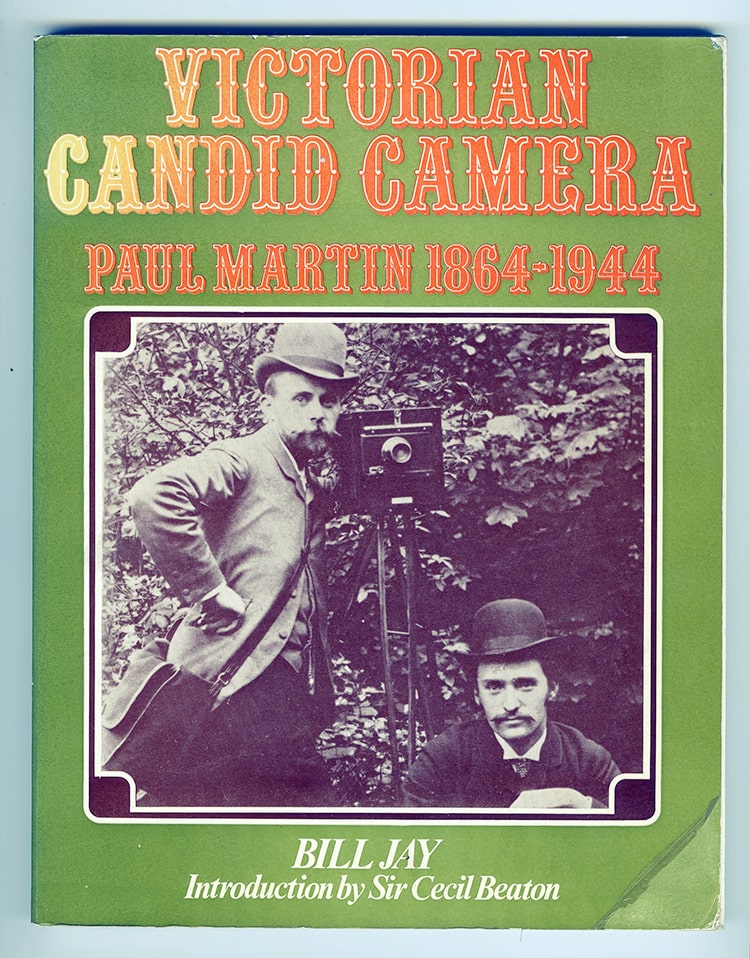
Introduction In his lifetime Paul Martin received scant recognition: little was known of him except that he worked hard for a living for a very long period of years. It is significant that he should have dwindled on in obscurity for two years after he was presumably thought to be dead. His story fills me with sorrow and pity.
Thanks to Mr Bill Jay’s brilliant discoveries, we have recently learnt that this obviously delightful, quiet and gentle individual was more of an artist than he ever imagined, and that it was the snapshots that he took purely for his own pleasure — and as a hobby — that have given him a high place in the history of British photography.
Paul Martin spent most of his early days as an engraver of wood blocks illustrating scenes of contemporary life and events until he discovered, to his unceasing joy, that the camera was able to record for him, with greater accuracy, the scenes that he wanted to depict.
He not only enjoyed documenting the historical events of the day — the Jubilee celebrations of Queen Victoria, the great frost of 1895 — but also showing us his views of Corn- wall, Brittany and Switzerland (which he visited with the London Polytechnic). To these somewhat banal subjects he gave a poignancy, as well as a remarkable quality of light and shadow.
But Martin earned his living by churning out commercial portraits in his Wandsworth Common and Strand studios; his most profitable sideline was the production of button miniatures of popular generals. Then, after a busy week, he loved nothing more than to take long walks in the countryside and to record his enjoyment. This is now shared by others and will be for as long as human beings are interested in photography.
Perhaps the best of Martin is to be found in his choice of his fellow human beings at work, leisure and at play; the fishermen mending nets, workmen digging up the roads (strangely wearing tall bowler hats and suits that are like those of office workers), tinkers and old market women in high-styled Victorian bonnets, and the street traders in the New Cut. He made a whole series of ‘one man’ businesses in the city the knife-grinder, the shoe-shiner, the Cheapside flower girl, the seller of Tit-Bits at Ludgate Circus, the gipsy girl telling fortunes with love-birds.
In an effort to appear inconspicuous, and to prevent his subjects from becoming self- conscious and forming an archaic line-up, Paul Martin disguised his camera held under one arm. Martin was no voyeur or ‘peeping Tom’ merely on the look-out for strange, or even obscene sights.
It is true that he was as amused as we are by the spectacle of the fat man about to take a plunge into the ocean at Jersey, but Martin’s search was not for the morbid, the grotesque, or even the tragic. It was more a quest for simplicity: the children, little dwarfs in cumbersome grown-up clothing, playing on Hampstead Heath, or on the seashore at Ilfracombe watching the menagerie or the Punch and Judy, or lining the streets in awe for the passing of a local police-man’s funeral procession.
He showed the irrepressible gaiety of the children living in poverty as they swung on the lamp-post and danced to the street organ. Martin imbued the young lovers with an idyllic quality as they sat enjoying a picnic among the daisies and grasses by the riverside, or a boating party at Teddington Reach.
Martin was a man who loved flowers and natural phenomena like Leonardo, he was fascinated by rough waters and the formation of waves (he always took with him changes of clothes on visits to Hastings and St Leonards for he knew he would soon be soaked with spray). He could make one conscious of the pure lyricism of a very simple dwelling with its windows and wooden gate overgrown with summer foliage. (His ‘Old Cottage in Devon 1894’ is a masterpiece.)
One feels that, though he may have been a lonely man, he was very much in sympathy with his fellow men. The poor did not fill him with horror, or even with pity. He realised that they—like all of us— had varied lives of their own, and life in all its forms had an acute interest for him.
Martin never lost his sense of surprise in what the lens was able to record: he never became blasé about the actuality. He did not wish, as did his more pretentious contemporaries, to create ‘fake’ paintings with the camera by extraneous means; nor, as his successors, did he wish to use solarisation — developing or distorting lenses for creating documents of possible ‘shock value’ He was content to record what he saw and pleased him, and his snapshots have more significance than much of the work by more ‘concerned’ photographers of today.
Paul Martin was able to create, for the first time, this unique collection because, not only was he fascinated by nature and by people, but he was an instinctive ‘picture-maker’ with a built-in sense for composition. Also by his extraordinary mechanical and engineering talents, he was able to improve on many of the photographic apparatuses that were on the market. This extra talent — and a very commercial one it should have been — brought him in very little money. His agent was never able to find means of bringing commissions to him, and seems only to have had a depressing effect upon this sensitive artist.
Martin did sell his negatives to the press, but they were seldom used in his lifetime. Later, many of these prints became well-known examples of Victorian photography; but they do not do justice to their creator for, not only is the over-contrasting quality of the print almost unrecognisable from the original carefully modulated tones, but, by being cropped to Fleet Street proportions, even the composition has been changed.
It is typical of this delightful, trusting man that dishonest, grasping manufacturers exploited his inventions to their exclusive advantage, and are still thriving on Martin’s genius. By speeding up his equipment and capturing the fleeting instant, he is the precursor of all today’s ‘flash’ photographers. It is said that, during the last year, five million instamatic cameras have been sold. We take for granted that, whenever we wish to record the fly in amber, it is merely a question of pressing a trigger; yet few of today’s snap-shots have any of the poetry of Paul Martin’s.
One feels from the little that one knows of Martin that he was a patient, sweet man who bore no one a grudge. He loved his wife although she appears to have been extremely domineering, pernickety, and class-conscious.
This bourgeoise looked down upon her husband who came of peasant stock, yet it was he who had the natural instincts of the born aristocrat. She showed no interest in her husband’s hobbies, and spent her energies ‘tidying up’ after him. Even when they were away from home she would remain in the hotel lobby while he went off with his camera in pursuit of the life of the neighbourhood.
During his last years Martin became dispirited and lonely. His snapshots, which he felt to be his main contribution, were decried as ‘non-artistic’ In an effort to be taken seriously he started to work more in the vein of a deliberate ‘camera-artist’ As a pictorial photographer Martin’s work was mediocre, yet it was these ‘aesthetic’ works that were accepted for exhibition, and were the reason for his being asked to lecture to amateurs. His pictures of sunsets and the play of light on water, printed on blue-tinted or coarse-textured paper, were too controlled and self-conscious his sense of spontaneity and naiveté was missing.
Paul Martin eventually gave up hope that his life’s work was of any interest to others, and when, in his last years, Mr Gernsheim and other discriminating collectors began to call upon him with requests for his snapshots, he gave away his remaining negatives, grateful that anyone should show a sparkle of interest. He was now content to potter about looking after his prized collection of fuchsias.
In appearance, with aquiline features and large, domed forehead, he looked not unlike Cézanne; in character, he was naturally what Disraeli denominated as ‘a worthy’. With his curiosity about people, and sympathy for their foibles, he might be called the Charles Dickens of the lens. From his snapshots, future generations can learn a great lesson on the values of integrity, unpretentiousness and truth.
C.B.
LONDON, SUMMER 1973
Back to the top of this page . . .