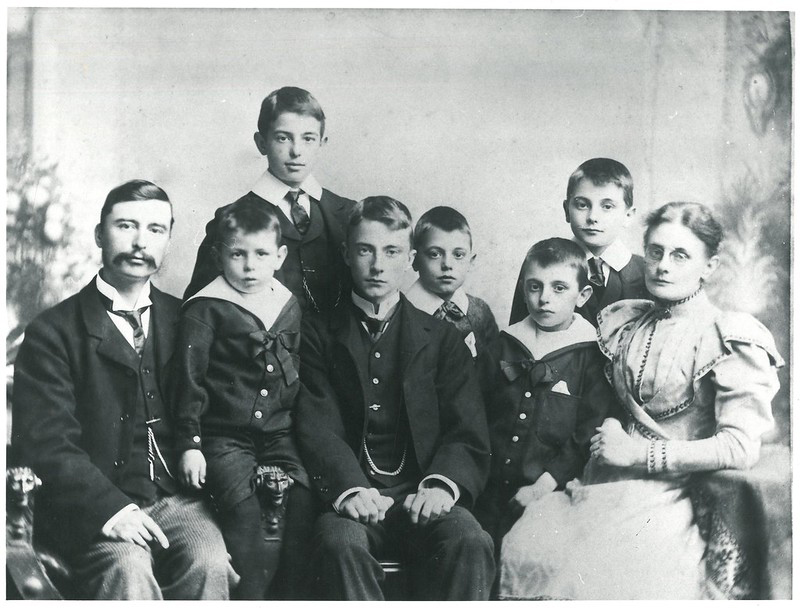
There is a Blue plaque at 61 Shelgate Road, SW11 1BA . But he had previously lived from age 2 to 9 in Wakehurst Road, very close to the Common.
What about other houses he (and Helen, and his parents lived in) ? Locate and make map.
Where did Helen's parents live?
Helen, Edward & Myfanwy
Also
Thomas was survived by his wife, Helen, their son (Philip) Merfyn and their two daughters (Rachel Mary) Bronwen and (Helen Elizabeth) Myfanwy. After the war, Thomas's widow, Helen, wrote about her courtship and early married life with Edward in the autobiography As it Was (1926); later she added a second volume, World Without End (1931). Myfanwy later said that the books had been written by her mother as a form of therapy to help lift herself from the deep depression into which she had fallen following Thomas's death.
Helen's short memoir My Memory of W.H. Davies was published in 1973, after her own death. In 1988, Helen's writings were gathered into a book published under the title Under Storm's Wing, which included As It Was and World Without End as well as a selection of other short works by Helen and her daughter Myfanwy and six letters sent by Robert Frost to her husband.[15]
"The landscapes of Edward Thomas' childhood had nothing of the sweep of Buchan's Border hills, Haggard's Norfolk acres, or the South African High Veld. They were the scrubby wastes of Wandsworth Common in the 1880s, relieved by long visits to the railway town of Swindon , where his uncle was a fitter in the locomotive works. His early memories were of throwing stones at rats , moorhens —
Kay Dunbar, Letters to Helen: and an appendix of seven letters to Harry and — (2005), p.154
"The received image of Edward Thomas is of a man of the English soil, steeped in country ways from birth, — The closest Edward came to a green, open space was Wandsworth Common, where this nature-lover watched, with almost hypnotic fascination , as older boys dissected live frogs . His knowledge of the real countryside came from holiday — — "
[Source: C.L.S. Bulletin - Issues 122-168 - Page 187. Link
"Wandsworth Common was all America — "
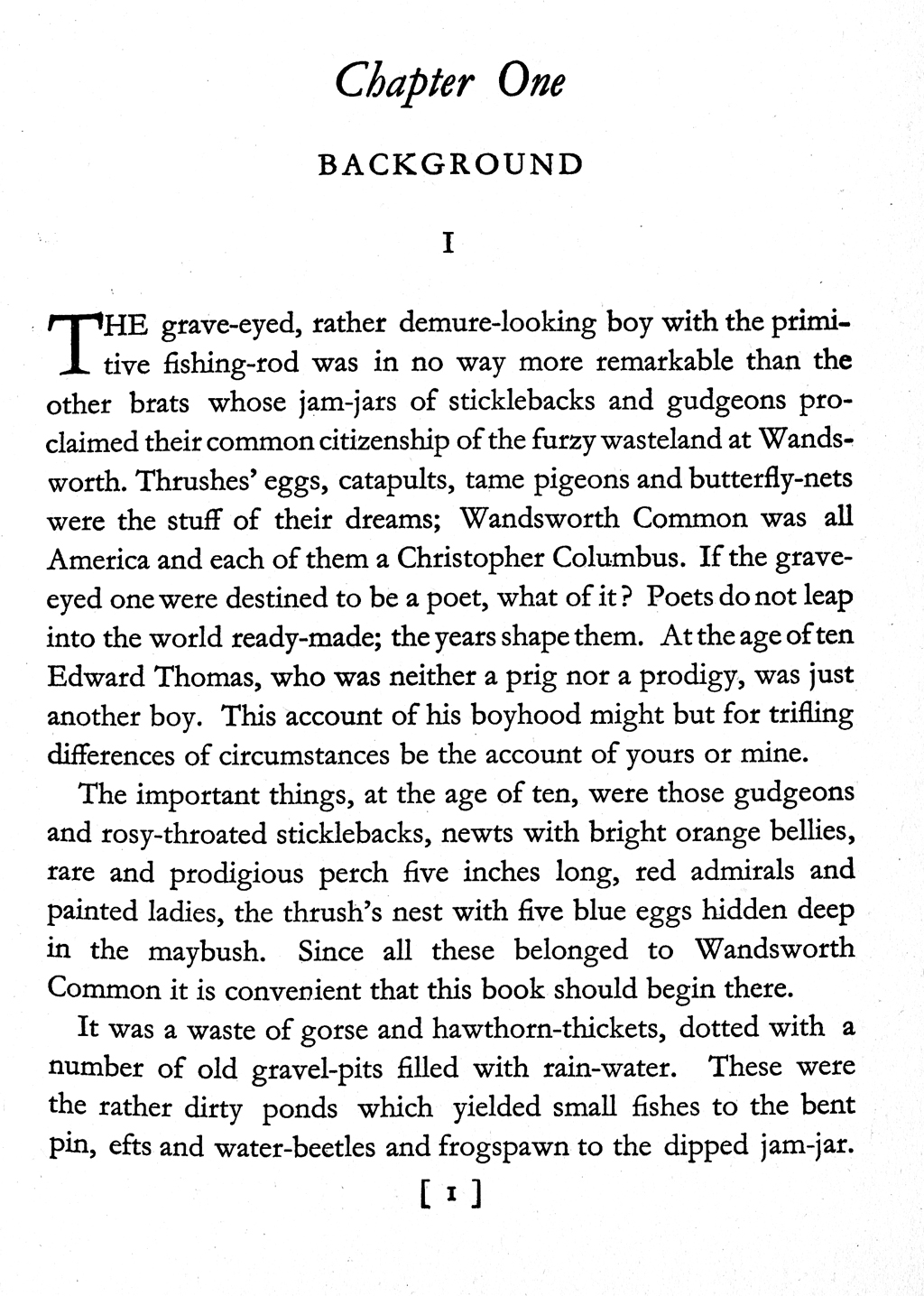
"Thrushes' eggs, catapults, tame pigeons and butterfly-nets were the stuff of their dreams; Wandsworth Common was all America and each of them a Christopher Columbus. If the grave-eyed one [Edward Thomas] were destined to be a poet, what of it?"
Check for other refs —
(Click on image to enlarge)
Chapter One
BACKGROUND
I
[1]
THE grave-eyed, rather demure-looking boy with the primitive fishing-rod was in no way more remarkable than the other brats whose jam-jars of sticklebacks and gudgeons pro-claimed their common citizenship of the furzy wasteland at Wands-worth. Thrushes' eggs, catapults, tame pigeons and butterfly-nets were the stuff of their dreams; Wandsworth Common was all America and each of them a Christopher Columbus. If the grave-eyed one were destined to be a poet, what of it ? Poets do not leap into the world ready-made; the years shape them. At the age of ten Edward Thomas, who was neither a prig nor a prodigy, was just another boy. This account of his boyhood might but for trifling differences of circumstances be the account of yours or mine.
The important things, at the age of ten, were those gudgeons and rosy-throated sticklebacks, newts with bright orange bellies, rare and prodigious perch five inches long, red admirals and painted ladies, the thrush's nest with five blue eggs hidden deep in the maybush. Since all these belonged to Wandsworth Common it is convenient that this book should begin there.
It was a waste of gorse and hawthorn-thickets, dotted with a number of old gravel-pits filled with rain-water. These were the rather dirty ponds which yielded small fishes to the bent pin, efts and water-beetles and frogspawn to the dipped jam-jar.
Check for other refs —
(Click on image to enlarge)
[2]
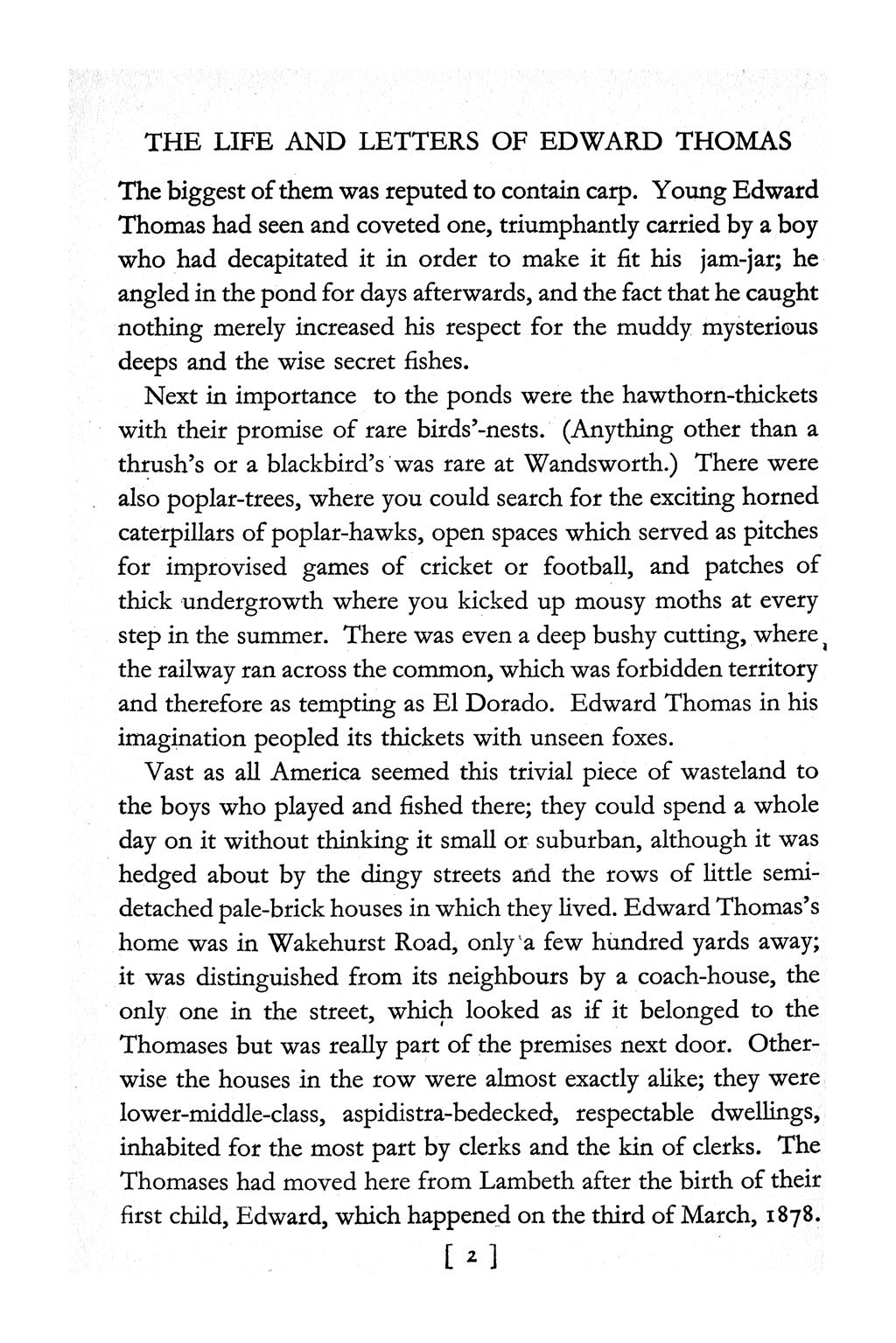
The biggest of them was reputed to contain carp. Young Edward Thomas had seen and coveted one, triumphantly carried by a boy who had decapitated it in order to make it fit his jam-jar; he angled in the pond for days afterwards, and the fact that he caught nothing merely increased his respect for the muddy mysterious deeps and the wise secret fishes.
Next in importance to the ponds were the hawthorn-thickets with their promise of rare birds'-nests. (Anything other than a thrush's or a blackbird's was rare at Wandsworth.) There were also poplar-trees, where you could search for the exciting horned caterpillars of poplar-hawks, open spaces which served as pitches for improvised games of cricket or football, and patches of thick undergrowth where you kicked up mousy moths at every step in the summer.
There was even a deep bushy cutting, where , the railway ran across the common, which was forbidden territory and therefore as tempting as El Dorado. Edward Thomas in his imagination peopled its thickets with unseen foxes.
Vast as all America seemed this trivial piece of wasteland to the boys who played and fished there; they could spend a whole day on it without thinking it small or suburban, although it was hedged about by the dingy streets and the rows of little semi-detached pale-brick houses in which they lived.
Edward Thomas's home was in Wakehurst Road, only a few hundred yards away; it was distinguished from its neighbours by a coach-house, the only one in the street, which looked as if it belonged to the Thomases but was really part of the premises next door. Other-wise the houses in the row were almost exactly alike; they were lower-middle-class, aspidistra-bedecked, respectable dwellings, inhabited for the most part by clerks and the kin of clerks. The Thomases had moved here from Lambeth after the birth of their first child, Edward, which happened on the third of March, 1878 —

Check for other refs —
(Click on image to enlarge)
The family was not well-off, Mr. Thomas's moderate salary was quickly spent in "keeping up appearances," in consolidating the position of bowler-hatted, black-coated respectability to which he had laboriously attained. So Edward was sent to a Board School, where, in a great lofty class-room which always smelled faintly of carbolic soap, he duly learned "for ever and ever" the names of the tributaries of the Thames and the dates of the Kings of England, and repeated aloud such parrot-like and mystical-sounding phrases as "Witney on the Windrush Manufactures Blankets."
Here also he learned to fight, which in spite of his demure appearance he did quite well; the Common was the scene of frequent guerilla warfare, and sometimes of pitched and bloody battles, between the Board School boys (opprobriously known as "Boardy Blags") and the boys belonging to a neighbouring Grammar School, who felt themselves to be socially superior although they walked the same way home.
When there was nobody to fight, the brats played unorganized and individualistic games of the sort which are almost forgotten now: tipcat and hopscotch, with all their nameless and esoteric variations. They purposelessly bowled hoops and spun tops. They played marbles. (And once the casual mention of marbles at home led Edward to make the astonishing and awe-inspiring discovery that his father, in his youth, had played marbles, too; that he had even been something of an expert, and still remembered the trick with thumb and forefinger and the curious terminology of the game. Edward could hardly believe it; he had not completely realized, until that moment, that his father had ever been young.)
When he was ten, Edward left the Board School and went to a small Private School near by.
Notes
The "Board School"was Belleville, of course.
The Grammar School was Battersea Grammar, where the old Granada Cinema stood on the corner of St John's Hill and Plough Road. Clapham County would have been in about the right place ("they walked the same way home") But CC was a girls' school, and it didn't open until 1909.
[Source: John Moore, Life and Letters of Edward Thomas (1939)), pp.1-2.
"Wandsworth Common, completely away from both school and home. One hundred and seventy-five acres of coarse grass, shrubs and trees, it was the nearest these Battersea Board schoolboys got to nature, and a stimulating escape from — "
Jean Moorcroft Wilson, Edward Thomas: A Biography and a Bibliography (date?), p.327. Link?.
"We fished here and there with hopes of better things than came out of the Wandsworth Common ponds. We met — The three-mile walk was, however, good in itself, whether we went by Wandsworth, Earlsfield, or Wimbledon."
[Add Source]
A talk by Richard Purver, illustrated with readings in prose and poetry by Anne Harvey, for the Wandsworth Society)
This is an edited version of the talk given by Richard Purver on behalf of the Fellowship at the request of the Wandsworth Society at their AGM, held at West Side Church, at the corner of Melody Road and Allfarthing Lane, on 24 March 2011. Richard opened the talk by referring to his own family background in the area, his mother Hilda Evershed coming from Wandsworth and his father William Purver from Battersea, and past Fellowship activities held locally, including readings by Anne Harvey of Edward Thomas's poetry, for example at Wandsworth Museum in October 2005 to coincide with the exhibition "Our Country: the Battersea and Wandsworth of Edward Thomas" [PB: does anything survive of this? Images? Commentary?]. A version of this article appeared in the Christmas 2011 Bedside edition of the Wandsworth Society newsletter.
The writer and poet Edward Thomas was born in March 1878 in Lambeth and moved with his parents to Battersea when he was about two. After his marriage to Helen Noble they moved to Kent and then Steep in Hampshire, and finally High Beech in Epping Forest. He was killed in the First World War at the battle of Arras in April 1917. In this talk I would like to concentrate on the idea of locality and the way our lives unfold within surroundings which acquire a lasting meaning for us. In the case of Edward and Helen Thomas they left a record of their memories and experiences and we can still visit the streets and houses where their descriptions and vignettes evoke real lives lived in these particular places in the late Victorian and Edwardian period.
Edward's father and mother Philip Thomas and Mary Townsend were born in South Wales and came to London when Philip obtained a post as a civil servant with the Board of Trade. He was involved in local Liberal politics and gave lectures at Battersea Town Hall for the Battersea Ethical Society. Edward was the eldest of six brothers. The first house the Thomases lived at in Battersea was 49 Wakehurst Road, near to Wandsworth Common. In his posthumously published autobiography, The Childhood of Edward Thomas, Edward talks of his explorations of the varied habitat of the Common and games played there:
A railway ran across the Common in a deep bushy cutting, and this I supposed to be a natural valley and had somehow peopled it with unseen foxes. The long mounds of earth now overgrown with grass and gorse heaped up at my side of the cutting from which they had been taken were 'hills' to us — Equal to them in height and steepness, and almost equal as playing grounds, were the hills of snow lining Northcote Road, the principal street, one winter — the Common — was large enough to provide us with many surprises and discoveries for years. We could spend a day on it without thinking it small or having to retrace our steps.
Edward gives a precise description of the nearby roads and the house itself, explaining that even when new the 'little semi-detached one-storied pale brick houses' had distinguishing features, for example the beginnings of creepers on the wall or flowers in the gardens, and because the people were different:
Our street like three or four others parallel to it was in two halves, running straight up the opposite sides of a slight valley, along the bottom of which ran the principal street of mixed shops and private houses. Our house was low down in the half which ran up westwards to Bolingbroke Grove, the eastern boundary of Wandsworth Common — Inside from the front door to the back of the house there was as long a passage as possible, the rooms opening out of it. The staircase ran up to a room with an opaque glass window in the door, a second room, and two others connected by a door — Through the open window — one Mayday, Jack-in-the-Green bounded in to beg a penny, showing white teeth, white eyes, black face, but the rest of him covered and rippling with green leaves. The passage was a playground when it was too wet or too dark to be out of doors. Here, when I had [a brother was old enough to] run, we two raced up and down the passage to be pounced upon by the servant out of a doorway and swallowed up in her arms with laughter.
Edward Thomas attended the local Board School, Belleville Road as an infant and was admitted to the main school in April 1886, his name appearing in the register in the Welsh form of 'Edwy'. The school of course is still there and housed in the original building. In his autobiography Edward describes his teachers and fellow pupils, the lessons and the games in the playground, remembering
'crawling in and bursting out — We were huddled close together in great lofty rooms with big windows and big maps and on Mondays a smell of carbolic soap'
He tells how boys gathered in large groups for mock battles on the Common and these could become more serious when the local grammar school boys, probably from Emanuel, taunted the 'Boardy Blags', that is blackguards, from the Board School.
The writer and poet Edward Thomas was born in March 1878 in Lambeth and moved with his parents to Battersea when he was about two. After his marriage to Helen Noble they moved to Kent and then Steep in Hampshire, and finally High Beech in Epping Forest. He was killed in the First World War at the battle of Arras in April 1917.
In this talk I would like to concentrate on the idea of locality and the way our lives unfold within surroundings which acquire a lasting meaning for us. In the case of Edward and Helen Thomas they left a record of their memories and experiences and we can still visit the streets and houses where their descriptions and vignettes evoke real lives lived in these particular places in the late Victorian and Edwardian period.
Edward's father and mother Philip Thomas and Mary Townsend were born in South Wales and came to London when Philip obtained a post as a civil servant with the Board of Trade. He was involved in local Liberal politics and gave lectures at Battersea Town Hall for the Battersea Ethical Society. Edward was the eldest of six brothers. The first house the Thomases lived at in Battersea was 49 Wakehurst Road, near to Wandsworth Common. In his posthumously published autobiography, The Childhood of Edward Thomas, Edward talks of his explorations of the varied habitat of the Common and games played there:
A railway ran across the Common in a deep bushy cutting, and this I supposed to be a natural valley and had somehow peopled it with unseen foxes. The long mounds of earth now overgrown with grass and gorse heaped up at my side of the cutting from which they had been taken were 'hills' to us — Equal to them in height and steepness, and almost equal as playing grounds, were the hills of snow lining Northcote Road, the principal street, one winter — the Common — was large enough to provide us with many surprises and discoveries for years. We could spend a day on it without thinking it small or having to retrace our steps.
Edward gives a precise description of the nearby roads and the house itself, explaining that even when new the 'little semi-detached one-storied pale brick houses' had distinguishing features, for example the beginnings of creepers on the wall or flowers in the gardens, and because the people were different:
Our street like three or four others parallel to it was in two halves, running straight up the opposite sides of a slight valley, along the bottom of which ran the principal street of mixed shops and private houses. Our house was low down in the half which ran up westwards to Bolingbroke Grove, the eastern boundary of Wandsworth Common — Inside from the front door to the back of the house there was as long a passage as possible, the rooms opening out of it. The staircase ran up to a room with an opaque glass window in the door, a second room, and two others connected by a door — Through the open window — one Mayday, Jack-in-the-Green bounded in to beg a penny, showing white teeth, white eyes, black face, but the rest of him covered and rippling with green leaves. The passage was a playground when it was too wet or too dark to be out of doors. Here, when I had [a brother was old enough to] run, we two raced up and down the passage to be pounced upon by the servant out of a doorway and swallowed up in her arms with laughter.
Edward Thomas attended the local Board School, Belleville Road, as an infant and was admitted to the main school in April 1886, his name appearing in the register in the Welsh form of 'Edwy'. The school of course is still there and housed in the original building. In his autobiography Edward describes his teachers and fellow pupils, the lessons and the games in the playground, remembering 'crawling in and bursting out — We were huddled close together in great lofty rooms with big windows and big maps and on Mondays a smell of carbolic soap'. He tells how boys gathered in large groups for mock battles on the Common and these could become more serious when the local grammar school boys, probably from Emanuel [PB: More likely to have been Battersea Grammar?], taunted the 'Boardy Blags', that is blackguards, from the Board School.
his first book to him after he died in 1896. The funeral service was conducted by Mr Tarrant at the Unitarian chapel. James Ashcroft Noble and in 1907 his wife Esther, were buried in Wandsworth Cemetery, where the gravestone carries a touching inscription recording the admiration and love of his 'comrades in letters'. We are told that Edward and Helen tended the grave with wildflowers. I came across the tombstone by chance in the 1990s when looking for those of my Evershed ancestors.
Edward was still a student at Oxford when he and Helen married at Fulham Register Office in June 1899 and Helen went to stay with his family at 61 Shelgate Road while expecting their first child Merfyn. Helen would take Merfyn to Clapham Common and enjoyed looking for signs of spring flowers in the large overgrown gardens of the old country houses of bygone city merchants in the surrounding streets. Many children have been born in the houses around us here of course and will have been referred to in private letters and diaries, but we have a published account by Helen of Merfyn's birth at 61 Shelgate Road in her memoir As It Was, with a detailed description of their room at the top of the house as it became vividly memorable to her when the labour started:
I remember standing at the door of our room and seeing it with a new vision - this attic reaching over the whole house, with a large old-fashioned fireplace with hobs at each side, on which a copper kettle always stood. It had a sloping roof, and a dormer window at each end. Half of it was Edward's study, and our sitting-room, where his books, his fishing rods, his clay pipes and walking-sticks were kept, and where he wrote and read, and I had spent such happy hours sewing and reading and dreaming. The other half was our bedroom, with the big bed, the bow-fronted chest of drawers, the low rockingchair, and the large semi-circular dressing-table with a muslin petticoat round it. On the floor was an old faded carpet that had once been gay with bunches of impossible flowers. In the study part was a huge arm-chair — a replica of one that Edward had at Oxford. On the mantelpiece were the brass candlesticks I had given him for his birthday, his tobacco jar, and a miniature of his mother as a young and beautiful girl.
The pictures in the study were two old silhouettes of Welsh ancestors above the plain oak table, which served as a desk; a large photograph of the Vénus Accroupie, which Richard Jefferies so much admired; an old rather ribald ballad, with a coloured picture at the top, which we used to sing to a jolly tune; and a funny old painting on glass of Tintern Abbey. In the bedroom part was a large coloured reproduction of Botticelli's Primavera, and his round Virgin and Child, and a water-colour drawing of my father. I had always loved this room, and on that day every detail of it imprinted itself on my mind for ever. I was content that it should be the birth-room of my first-born — On an oak chest which Edward had made, near to the fireplace, stood the cradle.
It is interesting to compare this passage with Edward Thomas's identification with a similar place in his poem "The Long Small Room". Edward and Helen lived for three months from November 1900 in a 'half-house' or 3-room upper flat at 117 Atheldene Road, a new street in Earlsfield, 'obviously doomed to become a slum' according to Helen, although it had a good sitting-room which they had distempered in a warm French grey. She says there was 'a little kitchen with steps leading from it to a tiny squalid back-yard, used by the downstairs people for keeping ramshackle rabbit hutches and hanging out washing which was always wet and never clean'. The tenants downstairs, whom she regarded as 'terribly poor and degraded' often moved out in the middle of the night to avoid paying the rent. No 117 has now gone. It may be this street which is referred to in an essay of 1902, Recollections of November, in which Edward Thomas contemplates the moon and fragments of nature seen from his room.
They then lived from February to October 1901 at 7 Nightingale Parade, Nightingale Lane in Balham. This was a flat above a parade of shops which is still there on the corner of Blandfield Road, close to where Edward's parents moved to 13 (now No 12) Rusham Road.
Balham and the surrounding district is the explicit setting of Edward Thomas's only novel, The Happy-Go-Lucky Morgans, published in 1913. The centrepiece of the story is an imagined dwelling, Abercorran House, based on the large old houses with grounds still existing locally, many of which would be knocked down and replaced with new villas:
To-day the jackdaws at least, if ever they fly that way, can probably not distinguish Abercorran Street and Wilderness Street from ordinary streets. For the trees are every one of them gone, and with them the jackdaws. The lilies and carp are no longer in the pond, and there is no pond. I can understand people cutting down trees - it is a trade and brings profit - but not draining a pond in such a garden as the Wilderness and taking all its carp home to fry in the same fat as bloaters, all for the sake of building a house that might just as well have been anywhere else or nowhere at all.
The novel also contains an interesting description of 'Our Country', which seems from its reference to The George Inn to be the area around Merton and Morden, then still a rural location beyond the suburbs, which is also mentioned in The Childhood as a favourite place that Edward and his friends used to walk out to from Battersea. His life-long capacity for walking long distances was shown early in these treks; he also often walked to Wimbledon Common or Richmond Park, sometimes taking the train to Barnes from Clapham Junction in the latter case or to go further afield.
Starting very early on a Sunday on occasions he 'walked to Kingston and back in time for morning service'. Helen later joined him on some of these expeditions.
The theme of another early essay, Broken Memories, is that of walking out across the railway bisecting Wandsworth Common and through the encroaching streets to the fields and woods, and The Happy-Go-Lucky Morgans features a detailed description of a typical long road leading north into the suburbs from the London countryside, past building sites fronted with hoardings, a new cemetery and a factory, isolated blocks of new houses, an old inn with a Gypsy's cart outside and then the Victoria Hotel, 'built in the Jubilee year of that sovereign', old cottages and the overgrown gardens of empty or soon to-be-abandoned dwellings:
Beyond the 'Victoria' the road straightened itself after a twist, and was now lined by a hundred houses of one pattern but broken by several branch streets. These were older houses of grey stucco, possessing porches, short flights of steps up to the doors, basements, and the smallest of front gardens packed with neglected laurel, privet, marigold, and chickweed — a man walking [to London] would begin to feel tired, and would turn off the pavement into the road, or else cross to the other side where the scattered new shops and half-built houses had as yet no footway except uneven bare earth. On this side the turnings were full of new houses and pavements, and admitted the eye to views of the welter of slate roofs crowding about the artificial banks of the river which ran as in a pit.
Although Edward Thomas deplored the crowded brick streets of the city he was also fascinated by and saw beauty in them, and despite his move away in 1901 and his role as a chronicler of the countryside in prose and verse, his involvement in the South London suburb he grew up in continued all his life. He visited his family and friends here regularly over the years, and wrote some of his early poems while staying with his parents when stationed near London after enlisting in the Artists' Rifles in July 1915.
Edward and Helen's own children came to know the area in turn through staying with their relatives. Their third child Myfanwy remembered being taken for long walks on Wandsworth Common by her paternal grandfather and the fierce Welsh cook named Emma who occupied the basement of the 'tall, dark house' in Balham.
Another overnight visitor to Rusham Road was the American poet Robert Frost who encouraged Edward Thomas to write poetry after years of producing a series of prose books on a wide variety of subjects as a professional author.
Edward continued his early practice of making natural history notes in his diaries, observing on 8 July 1913, 'Rusham Road: 6-7.15 a.m. one thrush hammering away at one triple cry, message or whatever anyone else likes' and on 1 February 1915, 'How I noticed the one thrush near the tip of poplar 250 yards beyond Nightingale Lane in opening of Rusham Road - he was singing, the only one'. This sentence was adapted for use as the second verse of his poem The Thrush.
As recorded in his War Diary, it was at Rusham Road that Edward had supper with all his brothers on 11 January 1917 and said goodbye to his elder daughter Bronwen and his mother and father the next day, before embarking for France on the 29th. My last quotation is a passage from The Childhood of Edward Thomas, where Edward gives an account of walking to Wimbledon Common with other boys and girls. In it he talks of the paper factory which was located on the river Wandle where it runs parallel to Garratt Lane. The Royal Paper Mills was demolished in 1910 but a nearby road, Esparto Street, carries a reminder in its name, as esparto was a type of grass used in paper-making.
I know you will enjoy this mention of the Wandle because of the great interest your Society has taken in the restoration and management of the river, and perhaps even more the reference to a location with special relevance to where we are meeting tonight:
The three-mile walk was — good in itself, whether we went by Wandsworth, Earlsfield or Wimbledon — Allfarthing Lane was worth going down for its name's sake. We invented explanations and repeated those of our parents. At the top dwelt an old woman in what looked a one-room hut who presumably knew and had something to do with the origin of the queer name. But above all, whichever way we took, the Wandel had to be crossed — best of all was the middle way through Earlsfield, crossing the Wandel at the paper mills. The smell of the mills wafted over a mile and a half on certain still evenings gave me a quiet sort of poetic delight. Hereby the water ran over a steep artificial slant, swift, glittering, and sounding; and sometimes we stayed here and caught minnows instead of going on to Wimbledon. It was the first place where I saw and realized the beauty of bright running water. We paddled with our stockings in our shoes and our shoes tied together and slung over our shoulders. We talked and laughed and shouted and splashed the water. I cannot remember cold or rain or any clouds there'.
I will now ask Anne to finish our talk by reading a small selection of Edward Thomas's poems, starting with one of his most popular, Adlestrop. By the way Anne has published a book, Adlestrop Revisited, about the wide response to the poem from readers and other writers over the years. Adlestrop / Birds' Nests / March / Helen / Good-night'''''
On a sun-baked Monday at 2.30pm, in equatorial South West London, Richard Purver, with noble (no pun intended) assistance from Anne Harvey, led a 3 hour walk visiting both the homes where Edward and Helen had lived, and other places with which they had important connections.
21 intrepid devotees, many members of the Wandsworth Society (who organised the walk), mostly sporting protective sunhats and carrying the obligatory bottle of water, plus a plucky little dog called Hetty, convened at Battersea Arts Centre in Lavender Hill, which had formerly been Battersea Town Hall, at the start of a most interesting talk and walk led by Richard. Anne provided additional information, and also captivatingly read one or more of Edward's poems or prose at each location.
Of course, the homes where Edward lived, and the other houses we were to visit, did not fall in a convenient straight line or in a perfect circle; so, understandably, the chosen route took in places in an order which was geographically efficient, rather than chronologically accurate!
In the vestibule of what had been Battersea Town Hall, Richard mentioned that Edward's father had been interested in philosophy and politics, and had stood, unsuccessfully, as a local Liberal candidate in Battersea. He walked regularly across St James's Park with Lloyd George - who also lived in Wandsworth (although Battersea was a distinct borough from Wandsworth in those days). Anne read two very appropriate poems, "Battersea" and "Lavender Hill" from Nursery Rhymes of London Town by Edward's friend Eleanor Farjeon.
We then walked through a street of handsome Victorian terrace houses - of which there are so many in London - to Clapham Common North Side, better known to motorists as "The South Circular". Here, Richard pointed out a magnificent house where John Burns a statesman and a (radical) Liberal politician had lived; in Edward Thomas's autobiography, Edward recalls being bowled out at cricket by John Burns on Clapham Common. Close by lived Charles Barry, the architect who designed the Houses of Parliament; another neighbour was Edvard Grieg. In fact, many famous people have lived along Clapham Common North Side and nearby; there is a positive epidemic of LCC and English Heritage blue plaques in the area!
Edward Thomas was born in Lansdowne Gardens, South Lambeth, near Stockwell, in March 1878. When he was 2, his parents moved to 49 Wakehurst Road (originally called 2 Tremorvah Villa[s] as Richard had recently discovered from the 1881 Census and other documents), at which several of Edward's brothers were born. When Edward was about 10, the family moved to 61 Shelgate Road, which was our next port of call. This large house, with very small front garden, and many-windowed attic, sports a plaque stating that Edward Thomas, Essayist and Poet, 1878-1917, lived here. Helen and Edward's first child, Merfyn, was born in this house in 1900, and Anne read Helen's very vivid description of the room in which he was born, no doubt with emotions and sensibilities heightened by her pregnancy, followed by Edward's poem about a similar place, "The Long Small Room".
Helen became a writer in her own right; two books about her life with Edward (As It Was and World Without End) and children's stories, although she never composed any poetry.
We then processed to Belleville Road, to an archetypal Victorian London primary school, Belleville School, built in the mid-1870s on a fairly steep hill. Edward attended this school, then the local Board School. He later recalled "crawling in (to school) and bursting out" - a feature perhaps common to all children, as we witnessed by the eruption of a multitude of energetic children from the school in mid-afternoon, ready to be collected by mums, dads, and grandparents!
By prior arrangement, we were able to visit the school, view a typical classroom and the assembly hall, and be able to imagine it as Edward had known it. Although very colourfully decorated, and with the children's pictures on the walls and along the corridors, and the inevitable presence of modern technical equipment, the original structure of the building had evidently not been changed since it was built, so that it was not too great a leap of imagination. Edward remembered his school as having lofty rooms and large windows - and smelling of carbolic soap! He progressed to the main school from the Infants here in 1886, when he was recorded as Edwy, his pet name.
After being shown round the school by two members of staff, Baki Gashi and Alexandra Turnbull, deputy head Sarah Atherton told us about the recent journey by 15 Year 5 Belleville pupils to Steep in Hampshire, where they visited sites associated with Edward Thomas and met pupils from Steep Primary School. A report of the visit is carried on the school's website.
We went on to look at 49 Wakehurst Road, where Edward's world consisted of home, school, and the streets neighbouring the common (Wandsworth Common) where he would engage in mock battles, and take an increasing interest in wildlife and nature, while playing in and around the ponds and gravel pits. He visited blacksmiths and pigeon fanciers, and began keeping pigeons and white mice. He subsequently went on to attend Battersea Grammar School (and then St Paul's School, before going up to Oxford).
We then walked onto Wandsworth Common by Bolingbroke Grove and set off across the common in the sun, glad at the beginning to experience some shade of the trees.
On 13 April 1895, when Edward was 17, he recorded that swallows, house martins and sand martins came to Wandsworth Common; his early work consisted in what we might term nature notes or natural history jottings, rather than poetry and inspired him to write his first book, The Woodland Life. It was later that he used similar material to compose two poems, which Anne then read: How at once? [The Swifts] and Birds' Nests.
We continued across the common, reaching the footbridge going over what must have been in Edward's day the line of "The London, Brighton and South Coast Railway", and crossed the common on the other side of the line to reach 6 Patten Road where Helen Noble had lived with her parents (they had previously lived in St Ann's Hill). Helen's father was the writer and critic James Ashcroft Noble, and Edward met her through both families attending the Unitarian chapel in East Hill (no longer standing).
Helen had been born in Liverpool in 1877, and the family returned to Wandsworth in 1893 after a previous stay, Helen attending Wimbledon High School. Helen and Edward took long walks to Merton and Wimbledon, as part of their courtship. Anne read Helen's description of first meeting Edward and his later poem for her: And You, Helen.
We then passed some two blocks of fine large houses to view the home at 3 Routh Road where David Lloyd George, former Liberal Prime Minister had lived. As mentioned, Lloyd George knew Edward's father through local politics, although, of course, Lloyd George was much more successful as a politician.
A further pleasant walk across another part of the common towards Wandsworth Common station provided an opportunity to hear another of Edward's poems. Anne read "Adlestrop" on a patch of green near the station, from which it is possible that Edward and Helen set off on the railway journey which produced arguably the best-loved of all his poems. Interestingly, although the poem has a profound sense of solitariness, Helen was with him when he experienced arriving at Adlestrop station.
Crossing the railway line again, near Nightingale Lane, we found 12 Rusham Road, a tall, handsome, well-built house surrounded by a garden of trees. Edward's parents moved here, from Shelgate Road, in 1902, and Edward and Helen and their children regularly used to travel up from Steep to visit them, despite Edward's preference for the country.
(Edward's father was to die in this house in 1920, three years after Edward's death at Arras in April 1917.) Earlier, though, in 1913, Edward wrote a travelogue of a bicycle journey from London to the West Country, In Pursuit of Spring. He started out from Rusham Road on 21 March 1913 and his route was followed on the 80th anniversary in a charity cycle ride by Mary Wynn-Jones. Anne had been in the party seeing her off and read for us the same passage from the book as she had that day in 1993.
Edward had been writing mostly prose, essays and nature notes, but his friendship with Robert Frost (who visited Edward here) proved decisive in encouraging Edward to write poetry. It was at Rusham Road that Edward said goodbye to his family before embarking for France on 29 January 1917. Anne spoke Eleanor Farjeon's elegiac poem for Edward Thomas, "Easter Monday" - and it was a much appreciated conclusion to an excellent afternoon, demonstrated by a spontaneous round of applause for Richard and Anne, much to the astonishment of some passers-by!
(With thanks to both Richard and Anne for some corrections)
John Haskey (member of both The Wandsworth Society - and also of The Edward Thomas Fellowship) June 2012
[Edward Thomas Fellowship Newsletter 69 February 2013.pdf]
PB: According to the Index to the Edward Thomas Fellowship Newsletters 1-82 there was an article in issue 80, August 2018, "Wandsworth Ramble", by B. Mackay. I have not viewed this - the last issue available online in August 2020 was no.76.
Myfanwy Rodnight, "Edward Thomas & Battersea: Somme connexions", The Wandsworth Historian, no.20, 1978
ROUGH OCR'd VERSION - NEEDS EDIT!
It seems regrettable that the centenary of the birth of the poet Edward Thomas is drawing to a close with no word of remembrance or any celebration in the borough with which he was associated for auoh of his-early life.
Born in Stockwell on 3rd March 1878, Edward Thomas was brought to live in Battersea when he was two years old. He was the first child of a family of six sons and his father, Philip Henry Thomas, a Civil Servant, was to stand at one time as Liberal candidate for the constituency.
The family lived successively at 49 Wakehurst Road, 61 Shelgate Rood and 13 Rusham Road. In Thomas's autobiographical work and that of his wife Relengthere an% references to the district which bring alive with great vividness conditions at the turn of the century.
In a future edition of the Historian I hope to review some works published to celebrate this centenary year. The most popular and well-known book to date has been, of the work of Edward Thomas himself, but the story of their life together, written by his wife Helen, Ills It Was: ;World Without End", now obtainable in a paperback edition.
Helen Thomas was the daughter of James Ashcroft Noble's. well-known critic and publisher, who had also brought his family to the &rift, first in Nicosia Road, Wandsworth and then. at 6 Patten Road: Here Edward. Thomas brought some of his earliest work for Noble to consider. He received encouragement and help, and introduced to Helen formed a friendship based on their shared interest in books and the countryside. Their later marriage, many vicissitudes and great courage are movingly portrayed in her book.
The poetry of Edward Thomas is in print, but his prose works are now difficult to find. Extracts from them show how the youthful and serious mind of a great writer was nurtured in this unpretentious, still somewhat rural, suburb of London. This article, it is hoped, will provide a taste of what is ther.4 for the historian as well as giving some details of Thomas's life story.
In "The Childhood of Edward Thomas", he wrote of Battersea, in particular of Wakehurst Road as he recalled it. The houses were then (1880s) new, and each had "something distinguishing the%.and preventing monotony. The people in them made them different. Is additionoome were beginning to be draped in oreepersoome gates stood %pontoon. were shut. One had bushes in the garden another had flowers another nothing but dark trodden gravel. The house above ours in the next pair was presumably meant for a doctor and possessed a coach house which looked almost as if it belonged to us. That was our outward. distinction — Through the open window — .. one
Mayday, Jaok%in%the Green bounded in to beg a penny, showing white teeth, white eyes, black facelbut the net of him oovered and rippling with green leaves. The passage was a playground when it was wet or too dark to be out of doors. Kerel when I had at any rate one brother." — who oould runtye two raoed up and down the passage to be pounoed upon by the servant out of a doorway and 'wallowed up in her arms with laughter." At night, when the fog was thiok, there was another kind of excitement. "People went about with lanterns and you oould get lost, r if not you oould pretend toond stay out late. It was good also to belong to a searoh party, and, perhapst in spite of a lanternIturn out to be lost yourself or back at your starting place. Clapham Common on those foggy nights was in many ways like desert undisoovered country, yet perfectly harmless."
Of Wandsworth Common he wrote that it, "offered many temptations to more irregular games and aimless roving.. For it was an uneven pieoe of never oultivated gravelly land. Several ponds of irregular shape and siselvarying with the rainfall thad been hollowed out, perhaps by old gravel diggings. It was marshy in other places. Hawthorn and gorse olustered tall and dense in great and little thickets. Tall elms and poplars stood about irregularly We picked sorrel leaves and ate them among the gorse bushes . . . . A railway ran &arose the Common in a deep bushy outting, and this I supposed to be a natural valley and had somehow peopled it with unseen foxes." When he was older and able to wander a little further, he discovered the neglected grounds of Battersea Rise House described by his biographer thus, near by, at the edge of Clapham common was "The Wilderness." (so Thomas called it)gna triangular three-acre field, with a pond covered with water lilies abounding in miry
Beyond The Wilderness were broad pastures and wild thickets, where Thomas once found a lane of larohesla long waterside copse, which he sought again and againg looking for the eggs of the moorhen. It seemed a deserted forgotten land the broad meadows became an almost mythical land ; the sun there seemed brightervithe grass greener.% Thomas himself, a solitary boy, there with as imaginary companion, remembered, MI have never seen thrushes eggs of a blue equalling those we toxin(' there . . . . No wonder Our Country was supernaturally beautiful. It had London for a foil and background;what is more, on that first day it wore an uncommon autumnal splendour also that I cannot hope to meet again such heavily gilded elms smouldering in warmorindless sunshine, nor suoh bright meadows as they stood in, nor suoh blue sky and such white billowy aloud as rose up behind the oaks on its horison." Soon, "Our Country", shared sometimes with a real oompanion, expanded to include Richmond, Wimbledon and Merton and later Surrey, Kent, Wiltshire and the West.
From the time he was fifteen, and during his four years at Battersea Grammar School and his few months at St. Paul's, he was contributing to several notable publications. Even in his early work that meticulous observation which could have made him a naturalist lies behind his writings.
During the year 1895-1896 he kept a delightful Diary chronicling his observations over a wide area of "Our Country". For example at home in Battersea he noted, "April 13th 1895 - Swallows, house-martins and sand-martins came to Wandsworth Common in fine blue weather." "August 6th - Five pairs of martins have built under the eaves of two houses in a crowded thoroughfare of shops: their hawking is done over mud-pools or chimney-tops and literally under the horses' feet or the wheels that go by without end." "August 31st - At this time a cuckoo flew up and down a London street bewildered, sheltering in its limes." "Ootober 20th - Hawthorn blossoming, in spattered sprays on Wandsworth Common; while the leaves are gone or going with purple about them."
In 1897 this Diary and some of 11.1.8 articles were published together as his first book! 'The Woodland Life". By then he was preparing for Oxford and had met Helen.
With Edward still to spend his final year at Oxford they were married in 1899. Helen stayed with his parents in Shelgate Road and there their son was born in January, 1900. Tenacity was one of Edward's great gifts; marriage, fatherhood and work for his history finals were one side of his life. But writing was his vocation and, in 1902, his second book, "Torae Solitariae", appeared, Meantime, the young family had found a flat at 115 Atheldene Road and then another in Nightingale Parade both of which were unsatisfactory the next move was away from Loudon and into the country for good.
However, Edward Thomas continued to know Battersea well all his life, returning frequently to stay with his parents at 13 Rushes Roadlto whioh they moved on a date between October, 1901 and Ootober, 1902. (Indeed, this house must have continued to be the centre for this interesting family up to 1936, when Edward's gentle, sensitive mother died. Eleanor Farjeon tells of her visits there and records her appreciation of Mrs Thomas).
From various country homesover a decade and a half, Thomas was to write articles and books for scant payment. His output was large;it was also great in talent and graceful in scholarship.
In a strange happy interlude between this incessant, badly rewarded toil and the outbreak of war Edward Thomas and Robert Frost and their families became friends. Some of the prose that Thomas had written, Frost held to be already poetry. An acceptance of this seems to have been a turning point and an emancipation to Edward Thomas.
When war oame and he joined the army he was freed from the threat of penury. And the poetry came the culmination of over twenty years apprenticeship to prose - and ended with his death at Arras on 9th April 1917.
Thomas is a writer's writer, as Turgeniev is said to be the novelist's novelist and yet94p both cases their work can be followed with satisfaotion, pleasure and insight at a less critical level. Battersea can claim few writers; to have nurtured him as he quietly gains a more and more central and important place in the country's literature is perhaps some compensation.
Photograph album containing 92 colour photos taken by Anthony Berridge in 1979-1981 of places associated with Edward Thomas and his family.
This looks interesting — Follow up. Anthony Berridge must surely be a relative of Elizabeth Berridge, who wrote Across the Common, about WC?
The following places are identified:
- Shoulder of Mutton, Steep, Ashford Chace (5);
- Cambria Place, Swindon;
- [Wakehurst Road, Battersea, S.W.?];
- 14 Lansdowne Gardens, Lambeth, S.W. (3);
- House on Bearsted Green, Kent;
- Bearsted Green;
- Belleville School, Battersea, S.W.;
- 13 Rusham Road, Balham, S.W.;
- 61 Shelgate Road, Battersea, S.W.;
- Nightingale Parade (now Blandfield Road), Balham, S.W.;
- Wandworth Common (2);
- Much Birch Vicarage, Herefordshire;
- 6 Patten Road, Wandsworth Common, S.W.;
- No? Atheldene Road, Earlsfield, S.W.;
- 113 Cowley Road, Oxford;
- 17 Worcester Place, Oxford;
- Lincoln College, Oxford (2);
- Hodson Bottom Cottage, near Swindon (4);
- Elses Farm, Sevenoaks Weald, Kent (4);
- Steep, Ashford Chace (3);
- Edward Thomas' study at Wick Green, Hants.;
- Red House, Wick Green (2);
- Kelmscott House, Hammersmith, W. (2);
- Yew Tree Cottage, Steep, Hants. (4);
- Little Iddens, Dymock, Glos. (2);
- Manor Farm, Hatch, Wilts. (2);
- 137 Fellows Road, South Hampstead, N.W. (2);
- Lane near High Beech, Essex;
- Kobo(?) Cottage, South Harting, Sussex;
- White House, Flansham, Sussex;
- Starwell Farm, Sheldon, Chippenham, Wilts. (2);
- Bridge Cottage, Eastbury, Berks.;
- Thomas family graves at Eastbury (4);
- Manor Farm, Priors Dean, Hants.;
- Selsfield House, East Grinstead, Sussex;
- 14 Duke's Avenue, Chiswick, W.;
- War memorial, Steep (2);
- Manor House, Broughton Gifford, Wilts.;
- 11 Luxembourg Gardens, Hammersmith, W.;
- Shiffolds, Leith Hill, Surrey;
- Broom Farm, Wilts;
- Arras (3);
- Military cemetary at Agny, with Edward Thomas' grave (7);
- Memorial stone, Shoulder of Mutton, Hants. (3);
- Coastguard Cottages, Minsmere, Suffolk;
- Capel House, Orlestone, Kent;
- 40 St Lukes Road, W.;
- Forge House, Otford, Kent;
- unidentified (4).
Enclosed is a note by Myfanwy Thomas and a letter to Myfanwy from Anthony Berridge, 1981.
Photograph album of sites associated with Edward Thomas, compiled by Anthony Berridge
DP/VD/40 Subseries c.1978-1983, 2000, 2003
Part of Dymock Poets Special Collection
Photographs taken by Anthony Berridge between 1979-1983 of sites related to Edward Thomas. Identical album held in the Edward Thomas Collection at Cardiff University. Includes loose photographs [some copyrighted images of Edward Thomas], list of photographs in album, "The Wandsworth Historian" with article on Edward Thomas December 1978 [Wandsworth Historian 20] and "Common News: A Newspaper sponsored by Churches in South Battersea" February 1979.
Also includes letter from Anthony Berridge to Myfanwy Thomas, 14 April 2000, and explanatory note from Richard Emeny of The Edward Thomas Fellowship, July 2003.
[Source: Link]
Edward Thomas writing about the state of the land and rights of access, The South Country (1906).
Threeacresandacow blog: here
Full text of The South Country (1909): here. Refs to Wandsworth pp.74 (Childhood home), 255 (damage to trees on Gorst Rd)
"Three Acres and a Cow" performances include "A History of Land Rights and Protest in Folk Song and Story".
'Three Acres And A Cow' connects the Norman Conquest and Peasants' Revolt with Brexit, fracking and our housing crisis via the Enclosures, English Civil War, Irish Land League and Industrial Revolution. The show draws a compelling narrative through the people's history of England in folk song, story and poem.
Part TED talk, part history lecture, part folk-club sing-a-long, part poetry slam, part storytelling session — Come and share in these tales as they have been shared for generations.
Portraits of ET in the National Portrait Gallery
Wandsworth in WWI Blog
Outline of ET's life on WWI website
Edward Thomas: from Adlestrop to Arras: A Biography (date?)
Robert Paul Eckert (1937)
Wandsworth Common, 6, 19, 22, 29, 3°, 31 Watkins, Charles W., acknowledgement to, xviii Watson, R. L., — Library, the, Edward Thomas's edition of the poems of John Dyer for, 7 1 Westerling, Miss Margaret, acknowledgements to, xiii, xviii —
The Childhood of Edward Thomas
Edward Thomas, _Helen Thomas, _R. George Thomas - 2000 - _Snippet view
— and an appendix of seven letters to Harry and Janet Hooton Edward Thomas, R. George Thomas Helen Thomas — walks with five- months old Merfyn across Clapham Common and the railway embankment on Wandsworth Common: In this —
Solicitors' Journal and Reporter - Volume 48 - Page 359
The Life and Letters of Edward Thomas - Page 1
National Library of Wales - 1993 - _Snippet view - _More editions
5 Quoted in R. George Thomas, Edward Thomas: a Portrait (Oxford, 1985), 80. b The fullest treatment is that by R. George — presumably after 1899 when Ll.G. took a house in Trinity Road, on the opposite side of Wandsworth Common from —
The Letters of Edward Thomas to Jesse Berridge: With a Memoir by —
Edward Thomas, _Jesse Berridge, _Anthony Berridge - 1983 - _Snippet view
With a Memoir by Jesse Berridge Edward Thomas, Jesse Berridge, Anthony Berridge — In Edward's second year the Thomases moved to Wakehurst Road, close to Wandsworth Common, and when he was eleven to Shelgate Road, which is —
For the novelist Elizabeth Berridge, novelist, presumably a relation, see WandsworthCommonHistory: Literature.
William Cooke - 1978 - _Snippet view - _More editions
On the first day he was at the heronry in Richmond Park; on the twelfth he went to Wimbledon; next day he was on Wandsworth Common in fine blue weather, watching the return of swallow and house-martin. On 15 April he set off to walk to —
Journal of the Society of Arts - Volume 25 - Page 22
Edward Thomas - (2013)
Edward Thomas. ornamental pond on Wandsworth Common. Empty it was, and the sodden bed did not improve the look of the common - flat by nature, flatter by recent art. The gorse was in bloom amidst a patchwork of turf, gravel, and puddle —
The Life and Letters of Edward Thomas - Page 10
John Moore (1939)
Wandsworth Common, the ponds, the sticklebacks, the cutting with its dream-foxes, were left behind. — quality, it was a gospel, its concluding words ("Let us get out . . . into the sunlight [ 10] THE LIFE AND LETTERS OF EDWARD THOMAS.
The Letters of Edward Thomas to Jesse Berridge: With a Memoir by —
Edward Thomas, Jesse Berridge, Anthony Berridge - 1983
With a Memoir by Jesse Berridge Edward Thomas, Jesse Berridge, Anthony Berridge — In Edward's second year the Thomases moved to Wakehurst Road, close to Wandsworth Common, and when he was eleven to Shelgate Road, which is —
Cylchgrawn Llyfrgell Genedlaethol Cymru: The National Library of —
The Prose of Edward Thomas - Page 23
Edward Thomas, _Roland Gant - 1948 - _Snippet view - _More editions
Edward Thomas Roland Gant. Hedge-sparrow laying: in a low-built nest with the willow — Swallows, house-martins, and sand-martins come to Wandsworth Common in fine blue weather. London to Marlborough Forest on foot. Swallows' and —
Francis Richard Banks (1984)
— district, reached also from Clapham Common North Side by Battersea Rise, which passes to the north of Shelgate Road, where Edward Thomas (6. 1917), the poet and essayist, lived at No. 61, and of the elongated Wandsworth Common.
Violets from oversea - Page 66
Charles Lamb Society (1955)
Edward Thomas was born at Lambeth in 1878, the eldest of six sons of a Civil Servant at the Board of Trade. Both father and mother were Welsh, and soon after his birth the family moved to Wandsworth Common where during his childhood —
Selected Letters - Page xi
Edward Thomas, _R. George Thomas (1995)
INTRODUCTION Philip Edward Thomas (3 March 1878-9 April 1917), born in London of Welsh parents, was the eldest of six — Across Wandsworth Common he visited the eminent critic and editor James Ashcroft Noble who helped place his —
Landscape Into Literature: A Writer's Anthology, p.154
WC and Richmond Park etc, from The Woodland Life, Edward Thomas (pdf)
[Source: Download pdf.]
The Poetry of Edward Thomas - University of Leicester (pdf)
https://www2.le.ac.uk > english-association > publications > bookmarks
Born in 1878 in South London Edward Thomas's passion for the English — fostered by his ramblings over Wandsworth Common and his holiday visits to his —
[Source: Download pdf.]
Edward Thomas: a portrait - Page 8
William Cooke - (1978)
His opponent immediately began by complimenting him on his 'admirable summary of Bright,' and Thomas sat blushing under his cleverness. — James Ashcroft Noble, a new member of his congregation, had recently moved with his family to Wandsworth from Liverpool. — to Wimbledon; next day he was on Wandsworth Common in fine blue weather, watching the return of swallow and house-martin.
Violets from oversea - Page 66
Edward Thomas, _R. George Thomas - (1995)
INTRODUCTION Philip Edward Thomas (3 March 1878-9 April 1917), born in London of Welsh parents, was the eldest — moved successively outwards to houses in Lambeth and Wandsworth until he settled finally at Rusham Gate in Balham.
Landscape Into Literature: A Writer's Anthology - Page 154
Kay Dunbar - 2005 - _Snippet view
The landscapes of Edward Thomas' childhood had nothing of the sweep of Buchan's Border hills, Haggard's Norfolk acres, or the South African High Veld. They were the scrubby wastes of Wandsworth Common in the 1880s, relieved by long —
Elected Friends: Robert Frost & Edward Thomas to One Another
Robert Frost, Edward Thomas, Matthew Spencer - 2003 - _Snippet view - _More editions
Robert Frost & Edward Thomas to One Another Robert Frost, Edward Thomas Matthew Spencer. 13 Rusham Rd Balham SW1 My dear Frost I was nearly asking you to come here with me for the night & when I got here my mother said she —
Hello, John
I think you'll like this
I'm attaching a pdf of the nature poet Edward Thomas's cycle ride from Wandsworth to the Quantocks in 1913
See especially p34 and following — it's very specific - and so weird to think his route in your own mind
I found info about the photographs he took en route, now lodged in Cardiff
See them here:
Pinterest: In Pursuit of Spring
The Guardian did a nice then-and-now feature here:
Guardian: Edward Thomas in pursuit of spring - historic photo locations revisited.
Wandsworth Historian article on Edward Thomas and Battersea, December 1978 by Myfanwy Rodnight [Wandsworth Historian 20]
Download a copy Edward_Thomas_and_Battersea_from_WH20_Dec_1978.pdf.
Wandsworth 1914-1918
Commemorating the First World War as it happened in the borough of Wandsworth
TLS, 2012, review mainly of "The Happy-Go-Lucky Morgans"
"Thomas was born in Lambeth, and for many years his family lived at 61 Shelgate Road in Clapham. His parents moved a little further south, to Rusham Road, nearer Wandsworth Common, after Thomas moved out of town. So he knew the area well, and revisited it frequently."
PB: ADD INFO ABOUT THEIR FIRST HOME, ON WAKEHURST ROAD.
English Heritage: Blue Plaques: Edward Thomas
WANDSWORTH - EDWARD THOMASWandsworth 1914-1918
Commemorating the First World War as it happened in the borough of Wandsworth
Tag Archives: Edward Thomas
28 September-5 October 1915: Edward Thomas at Camp
Posted on September 28, 2015
Edward Thomas often did not date his letters, other than writing the day of the week at the top of the page. He is far from the only person to have done this, the Wandsworth archive collections are full of correspondence which is not well dated and for which other information has to be used to establish when it were written.
For two letters written to Eleanor Farjeon in late September/early October 1915, one has a postmark which dates it to this week and the other has no clue at all - the envelope has been lost and all that Edward Thomas wrote on it by way of date was "Wednesday".
ET Oct 1915The letter with the postmark was postmarked Loughton, 9.30pm, 30 September 1915. Thomas gives no address, but the later letter was written from Hut 23, Harehall Camp, Gidea Park. Romford South, so it seems reasonable to assume that the earlier letter was as well. Thomas had joined the Artists' Rifles, more information about them in Harehall Camp can be found here and here, and Havering Museum have photographs of the Camp and local area here.
Thomas's opinion of the camp was that: "It is not so bad, but now that the rain has come it is worse. There is no comfort after wking + it is dark. The canteen is the only place, noisy, draughty and ugly. Everything is badly arranged, ugly and dirty. But one has an appetite and can satisfy it, and the country is beautiful, and for a week the weather was perfect."
He was writing in response to a letter from Eleanor, which presumably asked after his own reading or writing:
"It is not so bad, but now that the rain has come it is worse. There is no comfort after wking + it is dark. The canteen is the only place, noisy, draughty and ugly. Everything is badly arranged, ugly and dirty. But one has an appetite and can satisfy it, and the country is beautiful, and for a week the weather was perfect."
His other letter from this period, undated, but place in the sequence of letters as if written the following week, also refers to writing: "We are having too easy a time, so that again I have reverted and written some verses, I am afraid they aren't finished. I never have any time really to myself and have continually to be putting my paper away..I will copy out the verses as they exist now + if you like them will you make a copy or two of them?"
The verses in question are a draft of the poem, There's Nothing Like the Sun:
There's nothing like the sun as the year dies
Kind as it can be, this world being so,
To stones and men and beasts and beer and flies,
To all things that it tricks except snow
Whether on mountainside or street of town
The south wall warms me. November has begun.
Yet never shone the sun as fair as now
While the sweet last-left damsons from the bough
With spangles of the morning's storm drop down
Because the starling shakes it whistling what
Once swallows sang. Yet I can forget not
That there is nothing, too, like March's sun,
Like April's, or July's, or June's, or May's,
Or January's, or February's, great days:
August, September, October and December
Have equal days, all different from November.
No day of any month but I have said -
Or if I could live long enough should say -
There's nothing like the sun shining today -
There's nothing like the sun till a man's dead.
ET October 1915 2
Edward Thomas letters to Eleanor Farjeon, 123 &124, ref: D112/1/3
____________________
20-26 July 1915: Poetry written whilst waiting in Balham
Posted on July 20, 2015
Last week's blog post mentioned the letter from Edward Thomas to his friend Eleanor Farjeon about coming to London to be attested. This week's post looks at the letters he wrote a few days after he joined up, again to Eleanor.
On Tuesday 20th July, Edward wrote from his parents' house in Rusham Road, Balham, that "yesterday I was attested". Attestation was the start of the process of joining up when the recruit completed the attestation forms. He also wrote that he had been having trouble with his feet and was due to visit the doctor, apologising for delay in writing:
Otherwise I should wait longer until I had seen the doctor. I only hope he won't give me leisure to think why I joined. Several people have asked me; but I could not answer yet.
The following day he writes again, also from Balham, having had to be signed off by the doctor until the tendons in his foot had recovered.
Letter to Eleanor Farjeon
This letter finishes with him requesting "don't tell anybody I aren't a soldier yet, tho I am in uniform", presumably in relation to being signed off, but the bulk of it refers to the poetry he has been writing whilst in Balham waiting:
— six hours over ten lines which perhaps are not right yet. But if you would type them for me could see them better. They are
What matter makes my spade for tears or mirth
Letting down two old pipes into the earth?
The one I smoked, the other a soldier
Of Blenheim, Ramillies, & Malplaquet
Perhaps. The dead man's immortality
Lies lightly represented with my own,
A yard or two nearer the air of day
Than bones of ancients who, amazed to see
Almighty God erect the mastodon,
One laughed or wept at what earth had to bear
Detail of "Digging"
The finished version of the poem can be seen here. Prior to the war Thomas had mainly written criticism, rather than poetry, the outbreak of the war and the influence of his friend Robert Frost meant that he began writing poems in autumn 1914. He often sent drafts or material for typing to Eleanor, getting her to comment on it as well as to type it up - the commentary was a service he provided for her as well. Drafts of his poems within the collection include "Lob" and "Lights Out", the latter we'll come to in a future blog.
Letters to Eleanor Farjeon, 1915, ref: D112/1/3
Letters quoted are numbers 114 &115 and available on microfilm in the first instance.'
_______________
13th - 19th July 1915: Battersea Council controversy and Edward Thomas plans to join up
Posted on July 13, 2015
The minutes of the Battersea Borough Council meeting of 14 July 1915 do not give much hint of a controversial meeting. Amidst the usual business, four members of staff from the Highways department were given permission to join the Forces (W Franklin, labourer; J Connolly, roadman; R G Vollar, pavior; G W Sinden, labourer), as were W J Kelly, a second class clerk with the Borough Surveyor's department and J Lee, whose permission came from the Baths and Washhouses Committee but doesn't record his occupation. There was also a decision not to pay an additional War Bonus requested by the London, Erith and Southall District Allied Engineering Trades Joint Committee.
The controversy, well reported by the South Western Star but only hinted at in the minutes, was over the reduction in labour required by the Highways Department. The recommendation was for the Council to approve the road cleansing section going from 142 workmen to 100, pensioning 30 of the men and saving £1784 18s a year (roughly £76,857 in today's money).
Mr Willis stood down as leader of the Progressives on Battersea Council, because they had wanted to refer all the reductions back to the Finance Committee and raise the money to keep the posts by further appealing to the ratepayers. The Star refers to this as a "noble stand". After much discussion over whether other Committees were also cutting back, and if it was right to cut jobs - with one councillor protesting that it was taking bread out of the mouths of the poor and he could not agree as he was a "trade union leader" - the decision eventually went to a vote. 33 members of the Council voted in favour, and 22 against. This caused uproar in the gallery, with people calling Mr Willis a traitor and a turncoat - although the Star acknowledged that Mr Willis was clearly affected by emotion during the proceedings.
Elsewhere the paper reports on the ongoing recruitment drive, saying that there were now 100 men in the Battersea battalion. It also records that Wandsworth had instituted a "corps of lady recruiters — Battersea will go one better, it always does when in competition with Wandsworth. Wait a little while and we shall have a recruiting procession in Battersea that will make Wandsworth despair".
The recruitment drive across the country was clearly having an effect, as on 15th July the writer and critic Edward Thomas wrote to his friend, Eleanor Farjeon:
"My mystery was this. I have just seen the doctor and been passed by him + am coming up to town again on Monday to join the Artists Rifles — "
Wandsworth Heritage Service holds Thomas's letters to Eleanor Farjeon and we'll be coming back to what he writes about his experiences in future weeks.
Battersea Borough Council minutes, ref: MBB/1/15
Edward Thomas correspondence, ref: D112/1/3
South Western Star available on microfilm
Archives
Edward Thomas' papers are held in several repositories across the UK, USA and Canada including: the National Library of Wales, Aberystwyth; Harry Ransom Humanities Research Center, University of Texas at Austin; Lincoln College Library of Oxford University; University of British Columbia Library; Bodleian Library; Eton College; Palace Green Section of Durham University Library; King's School, Canterbury; Wandsworth Local History Service Library; and the British Library's Manuscript Collections. Research conducted by Dr R. George Thomas, Professor of English at Cardiff University, resulted in the accumulation of a large collection of photocopies, transcripts and notes from holdings in other libraries, making this the largest single collection of material relating to Edward Thomas and his family. Edward Thomas' personal library, and a comprehensive collection of his published work is also held.
Edward Thomas archive at Cardiff University
Archiveshub: Link
"Wandsworth Common" 21 matches
[? but phrase mainly refs to addresses such as "6 Patten Rd, Wandsworth Common" - the Nobles' house
Also "5 Nicosia Road, Wandsworth Common" - Lancelot Noble? Who he?
Reference GB 1239 424/8/1/2/6
Dates of Creation1900
Physical Description 2 photographs
With Merfyn. Two photos by Dorrett and Martin, Wandsworth Common, S.W. 93 x 59mm.
Photograph by Dorrett & Martin, Wandsworth Common: Four generations: Mrs Rachel Thomas, Mary Elizabeth Thomas, Philip Henry Thomas, Edward Thomas and Merfyn as a baby
Photo , S.W. 100 x 151mm. Published in Edward Thomas: A Portrait (1988), facing p. 119.
FIND THIS PHOTO - I THINK I HAVE IT SOMEWHERE - YES, A VERSION IS IN UNDER STROM'S WING
See also 424/8/1/16/3/8
ReferenceGB 1239 424/8/1/13/10
Dates of Creation 1896
Physical Description 1 photograph
Arthur Hardy. Photo by Frederick Kingsbury, Wandsworth Common, S.W. 149 x 104mm.
Kingsbury? Wandsworth Common? Who he?
GOOGLE SEARCH: "EDWARD THOMAS" "WANDSWORTH COMMON"
Jean Moorcroft Wilson, Edward Thomas, From Adlestrop to Arras: A Biography
Letters to Helen, and an appendix of seven letters to Harry and Janet Hooton
_Violets from oversea_
_Tonie Holt, _Valmai Holt, _Charlotte Zeepvat
_Leo Cooper_, 1996 - _Poetry - _242 pages_
With every year interest grows in the extraordinary eruption of poetry that the First World War inspired: the patriotic, the unquestioning, the bitter, the brutal, the idealistic and realistic, the love poems and the hate poems, the works of the professionals and the gifted amateurs.
Everyone has his or her 'favourite poet' - one who touches an emotional chord in today's reader from over three quarters of a century ago. This unusual and beautiful book collects together many of these often read, well-loved poets, as well as some of the lesser known. Tonie and Valmai Holt give comprehensive biographical studies which firmly place the poets in the battlefield and literary context in which their work was conceived. Much new material is included in these original essays. Each section is illustrated by, and many have contributions from, the talented freelance artist, writer and researcher, Charlotte Zeepvat, and has one of their subject's most interesting poems reproduced in 'script'.
Sadly, many of these young poets lie on the battlefields of France and Belgium where they fought. Among them are several who, with the benefit of hindsight, are today judged to have had the potential to join the ranks of Britain's greatest poets: Isaac Rosenberg, Charles Sorley and Wilfred Owens. Also included in the book are the lovers Vera Brittain and Roland Leighton; the perceived 'golden lads' Rupert Brooke, Edward Wyndham Tennant and Julian Grenfell. There are the thoughtful older men, Edward Thomas and Robert Vernede; the troubled Ivor Gurney and Siegfried Sassoon; the caring young officers E. A. Mackintosh. A. P. Herbert and W. N. Hodgson: the whimsical Gilbert Frankau and W. W. Gibson; the autobiographers Robert Graves and Edmund Blunden; the American volunteer Alan Seeger; the journalist Leslie Coulson; the exceptional human being the Rev G. A. Studert Kennedy ('Woodbine Willie') and the author of the war's most famous poem, John McCrae.
_The new Penguin guide to London_
_Francis Richard Banks
_Penguin Books_, _3 Jul 1984_ - _Travel - _608 pages_
Edward Thomas_: _A Biography and a Bibliography_
_Robert Paul Eckert
_J.M. Dent & sons, Limited_, 1937 - _THOMAS, EDWARD,1878-1917 - _328 pages_
0 Reviews
Google: Books" "Edward Thomas Wandsworth Common"
8 pages matching "edward thomas" "wandsworth common" in this book
Page 6
Page 29
Page 327
Where's the rest of this book?
Results 1-3 of 8
Delphi Complete Poetical Works of Edward Thomas (Illustrated)
By Edward Thomas
esp. chapter: "Infancy"
SEARCH:
"edward thomas" "wandsworth common"
Search Results
Edward Thomas: from Adlestrop to Arras: A Biography
Robert Paul Eckert - 1937 - _Snippet view
Wandsworth Common, 6, 19, 22, 29, 3°, 31 Watkins, Charles W., acknowledgement to, xviii Watson, R. L., — Library, the, Edward Thomas's edition of the poems of John Dyer for, 7 1 Westerling, Miss Margaret, acknowledgements to, xiii, xviii —
In Pursuit of Spring - Page 21
National Library of Wales - 1993 - _Snippet view - _More editions
5 Quoted in R. George Thomas, Edward Thomas: a Portrait (Oxford, 1985), 80. b The fullest treatment is that by R. George — presumably after 1899 when Ll.G. took a house in Trinity Road, on the opposite side of Wandsworth Common from —
The Prose of Edward Thomas - Page 23
Helen Thomas, Under Storm's Wing
Helen Thomas - 1988 - _Snippet view - _More editions
This text collects: all that Helen Thomas wrote about the poet Edward Thomas; the volumes As It Was and World Without End; her letters to Edward; and separate memoirs of her meetings with W.H. Davies, D.H. Lawrence, Ivor Gurney, Eleanor —
Edward Thomas: a portrait - Page 8
1877 - _Read - _More editions
Hawes, James C., Derby house, Mallinson road, Wandsworth common, S.W. (2) 1849. Hawes, William, 17 Montague place, W.C. (3) 1873. Hawker — C.E., 63 St. Andrew's road, Southampton (3) 1873. Henman, Edward Thomas, 12 Blomfield —
The new Penguin guide to London - Page 534
Reference to?
Cylchgrawn Llyfrgell Genedlaethol Cymru: The National Library of —
https://books.google.co.uk/books?id=hQvhAAAAMAAJ&focus=searchwithinvolume&q=wandsworth" target="_blank">Link
If you would like me to let you know whenever I write another post, please email me, Philip Boys (HistoryBoys), via info@historyofwandsworthcommon.org