inn with a red painted board up and a row of old dark small cottages mostly with longish front gardens and low wooden fences and a rustic outmoded look inspiring a sort of curiosity and liking as well as some pity or contempt.
If I cannot call up images of most of the streets as they were then, because I have witnessed the gradual development since, perhaps the reason is the same for my being unable to call up images of my father and mother or of my brothers. No. I have only one clear early glimpse of my father — darting out of the house in his slippers and chasing and catching a big boy who had bullied me. He was eloquent, confident, black-haired, brown-eyed, all that my mother was not. By glimpses, I learnt with awe and astonishment that he had once been of my age. He knew, for example, far more about marbles than the best players at school. His talk of 'alley-taws' — above all the way his thumb drove the marble out of the crook of his first finger, the speeding sureness of it — these betokened mastery. Once or twice I spent an hour or so in his office in an old government building. The presence of a wash-stand in a sitting-room pleased me, but what pleased me still more was the peculiar large brown carraway biscuit which I never got anywhere else.
My waking life was divided between home, school and the streets and neighbouring common. Glimpses of the outer world I had few. But I remember General Gordon's death at Khartoum, and, whether from a picture in a newspaper or from imagination, I retain an image of a soldier in a fez and armed with a revolver standing with his back to a portico, facing the enemies who swarmed up the steps
[PB: This was 1885. I have added a couple of contemporary images.]
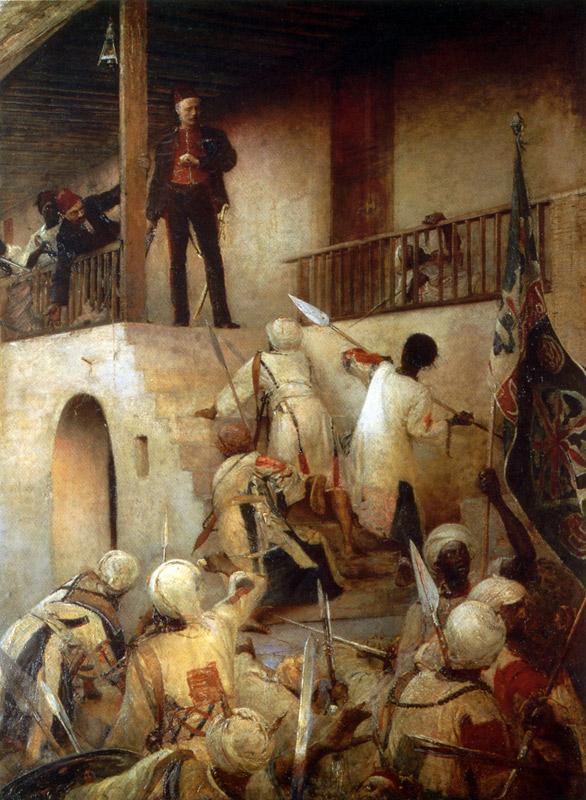
(Click on image to enlarge)
My friends were chiefly boys of our street; if other boys harassed us we used to say 'My father's a policeman' to frighten them. But only one grievance remains in my mind, that an older boy, not of my acquaintance, once lured me to drink urine by offering it to me in a bottle as ginger-beer.
Some time later on a Sunday I pointed out this boy standing with others by the Three Island Pond, and my father clouted his head.
One Christmas morning I woke up and felt a long lean smooth straight cold thing with straps at my bedside. It had a handle, and pulling that with one hand I brought out what I discovered to be a sword, while in the other hand was a scabbard. The daylight came upon me still unsheathing and sheathing the sword, trying hard for the hundredth time to put it back the wrong way. As soon as I could I fastened the belt round my waist so that the sword hung on the right instead of the left side and went out alone. The streets were empty. I was proud though without spectators. Once or twice the weapon caught between my legs. I marched up the street, crossed the road separating it from the Common and turned to the left between the
[17]
elm-trees of Bolingbroke Grove, having the road upon my left, the Common upon my right.
[MABEL LOOMS]
At the top of one of the streets parallel to ours, but at that time divided from it by that big private meadow with the pond and elm-trees, I stopped and looked down. For there lived Mabel Looms, a schoolfellow whom I adored. She had had a Christmas card from me that morning. The street was empty. I walked backwards and forwards along the Grove past the top of the street, waiting, sufficiently proud not to be overcome by long disappointment. How many times since have I waited thus for somebody, with a dog's patience. There began to be others in the streets. At last Mabel came up towards the Common, in the company of some elders. Without a sign I continued walking backwards and forwards. They turned to their left at the top, away from our street. I turned in the opposite direction homeward, pleased with my swinging sword and believing that the passers-by admired it. At home they knew well where I had been.
My attachment to Mabel lasted for several years and more than once after it had been broken I attempted to renew it. She was a perfect loving friend. I thought her beautiful. Her hair was light brown, her face round rather than a long face. She had elder sisters — one named Agnes — whom I did not always like; and a brother named Arthur to whom I was indifferent; and a freckled slighter cousin, with a name something like Catherine Haythorn, whom I liked equally for her own and for Mabel's sake.
Girls practically never joined in our games: even bowling our iron hoops beside their wooden ones was rare. Those girls who did play much with boys were scandalously talked about, but they were older than I was, and I neither knew nor know anything positive against them. I only have an idea that I had seen one of them — a deep-voiced dark-skinned good-looking girl who walked with long strides and a slight stoop — coming from among thick bushes with a boy or two boys. This caused laughter and was afterwards mentioned with hints and jeers
[18]
which I do not think I understood: I became fairly curious and expectant; the veil over the sex thickened.
The Common and the streets leading up to it were the scene of our principal game. It was played chiefly on Saturday, our whole holiday. We assembled, for example, at the top of the road in the well-trodden garden of a doctor who had a rowdy son; each bringing a weapon or several weapons, wooden swords and pikes, or daggers, shields, pistols, bows, arrows and with horns and trumpets, and perhaps some bread and cheese and an apple or orange. There sides were chosen. One side went out to seek a fort in someone's garden or among the gorse bushes. Ten minutes later the other set forth, often in two divisions.
Sometimes stealth was the rule of expedition, we advanced whispering and in some order. Sometimes everyone was shouting for his own plans and against another's. At other times the methods alternated, the stealth would become wearisome, we began to chatter and disagree, or the riot of anarchy would suddenly strike us as wrong, everyone said "hush", and for some minutes we modelled ourselves on Sioux, Mohicans or Hurons, crouching, pausing, trying to hush the sound of our breathing. We forgot everything in this Indian ideal.
[BIT MISSING?]
Nevertless the enemy had to be found. Nor were they loth. Someone was sure to show himself and wave defiance, or to leap out on us, supposing we passed by. If seen at a distance they might change the stronghold and there would be a chase. If they were content to stand a storm, the second army would gather all its numbers together and, with yells and counter-yells, batter and push them out or be battered and pushed out itself. The struggle was one of character, not weapons. The side possessing the fiercest and most stubborn boys won. The winners would than in turn fortify themselves and sustain an attack; and so it went on, until a mealtime, or nightfall, or rain, or a serious quarrel, finished the war.
At long intervals fiercer battles were waged. The boys of a neighboring school of the
[19]
grammar-school standard looked down upon the Board-school boys, or 'Boardy Blags' (i.e. blackguards). The Board-school boys resented this. The feud was usually hardly in so much as a smouldering condition, and so far as I know must have been all but forgotten. Then suddenly it would flame out. A loose army of Board-school boys several score strong moved along the Grove at the edge of the Common towards the enemy's school. The army was continually being swelled from the side streets. With all the smaller or more timid boys hanging on its fringes, more angry than warlike, more curious than angry, the numbers were considerable. Stones were the long-distance weapons. But rarely, I think, did both sides muster a fairly equal army at the same time.
When they came in sight of one another they began to throw stones. They halted, odd stones were thrown here and there, the hangers-on disappeared. I doubt if both sides ever advanced and clashed in hand-to-hand conflict. Usually after some challenging shouts, some wavering and dissension, the victors knew themselves and set up a shout and moved forward confidently. The smaller army broke and fled down the streets; the larger broke and pursued. Here and there a group kept together and set upon any solitary enemy it could discover. I, who was too small to be in the army, was content to hang on the outer outskirts, pick up the news, and occasionally insult one of the enemy if I remembered that he was one.
As a relaxation we hung about in corners smoking cigarettes of rolled brown paper. Making these, lighting them, puffing them, coughing, relighting them, asking one another if they were alight, and silently enjoying the act and the seclusion, filled hours. Our sense of discipline was slight and transient. It was not encouraged by doing lessons, a few ridiculous exercises under the eye of an unsleeping master, and playing mostly individualist games in the playground. Being in a little mob increased our boldness and also our ease and safety. According to our tempers, I
[20]
think we hoped that the others would either shelter us or support us in doing signal deeds. As member of the army, any one of us could most likely insult a passing outsider with impunity: if, however, there had been any swift retaliation the victim of it would often have been left to suffer alone. Therefore the armies did not always wait for a formal order of disbandment.
The Common, for example, offered many temptations to more irregular games and aimless rovings. For it was an uneven piece of never cultivated gravelly land. Several ponds of irregular shape and size, varying with the rainfall, had been hollowed out, perhaps by old gravel diggings. It was marshy in other places. Hawthorn and gorse clustered tall and dense in great and in little thickets. Tall elms and poplars stood about irregularly. And the level spaces suitable for cricket, football and tennis were not many.
With this variety the Common, even though the railway ran through it parallel to Bolingbroke Grove and only two or three hundred yards away from it, was large enough to provide us with many surprises and discoveries for years. We could spend a day on it without thinking it small or having to retrace our steps. We wandered about it with or without our hoops. For any kind of hiding and hunting games the thickets were excellent. We played the other games in the open spaces.
The ponds were for paddling in. One of them, a shallow irregular one, weedy and rushy-margined, lying then in some broken ground between the Three Island and the railway, was full of effets [eft, newt] and frogs. Bigger boys would torture the frogs, by cuffing, skinning or crushing them alive. The sharp penknives sank through the skin and the soft bone into the wood of the seat which was the operating table. The seat and the earth under and about it would be strewn with fragments, pale bellies slit up, and complete frogs seeming to be munching their own insides. At that time I could not have done it myself, but my horror lacked pity and turned into a kind of half-shrinking, half-gloating curiosity. I fished
[21]
for sticklebacks and gudgeon in the long pond on the far side of the railway, which owed its name of "Backaruffs" or "Pack of Roughs", so I always thought, to the poor ill-dressed boys who used to swarm to it from Battersea on Saturdays and bank holidays. I fished with a worm either tied on the cotton line or impaled on a bent pin, and put my stickleback or my rare lovely spotted gudgeon in a glass jam-jar. Once at least I did as I had seen others do, hauling a heavy fruit basket out into the pond and dragging it in full of weed and mud and the little 'blood worms' that breed in mud, and sticklebacks, even a red-throated one, but never a gudgeon. The gudgeon was so attractive, partly for its looks, perhaps chiefly for its comparative size, that many times I willingly paid a halfpenny for one and let it be believed that I had caught it. Even when dead it was hard to part with, so smooth and pure was it. I liked even its smell, yet never dreamed of eating it. There were carp, too, in this pond and in the roundish Box Pond that lay half-way between the top of our street and the railway.
[ADD MAP]By the longer pond I once saw a carp many times as big as a gudgeon in the possession of a rough: he had torn its head off to make it fit his jar. Much larger ones were talked about, caught in the Box Pond by the elder brothers of one boy. I saw them fishing there once or twice without a motion of the float in the motionless water. Once I tried there myself all alone. My expectations were huge: that I failed completely only increased my respect for the sacred pond.
Bigger boys used to fish in the Penn Ponds at Richmond Park and allowed me to buy from them a perch of four or five inches long, which looked magnificent with its dark bars, standing almost on its head in my little round bowl. There in spite of worms and breadcrumbs it shortly afterwards died. I was pained at coming down in the morning and finding such a magnificent, uncommon and costly creature dead. Nor did I ever like the perch's stiff hard prickly corpse, faded in death, and looking much smaller out of the bowl than inside. [9] below and being struck at by one from the side.
Our street like three or four others parallel to it was in two halves, running straight up the opposite sides of a slight valley, along the bottom of which ran the principal street of mixed shops and private houses. Our house was low down in the half which ran up westwards to Bolingbroke Grove, the eastern boundary of Wandsworth Common.
These little semi-detached one-storied pale brick houses in unbroken lines on both sides of the street had each, even then when they were new, something distinguishing them and preventing monotony. The people in them made them different. In addition, some were beginning to be draped in creepers. Some gates stood open, some were shut. One had bushes in the garden, another had flowers, another nothing but dark trodden gravel. The house above ours, in the next pair, was presumably meant for a doctor, and possessed a coach house which looked almost as if it belonged to us. That was our outward distinction.
Inside from the front door to the back of the house there was as long a passage as possible, the rooms opening out of it. The staircase ran up to a room with an opaque glass window in the door, a second room, and two others connected by a door.
The rooms downstairs I hardly remember at all. But in one of them my great-uncle James Jones lay asleep after dinner, a red handkerchief covering his face and trembling in the blast of his snoring which we called "driving the pigs to market".
Through the open window of another, one Mayday, Jack-in-the-Green bounded in to beg a penny, showing white teeth, white eyes, black face, but the rest of him covered and rippling with green leaves.
[Interesting — follow up: "Through the open window of another, one Mayday, Jack-in-the-Green bounded in to beg a penny, showing white teeth, white eyes, black face, but the rest of him covered and rippling with green leaves." Black face? Find out more about "Black Sal". See e.g. here.]
I was not much at other boys' houses except for Christmas or birthday parties. We met either in the street or in the back gardens, where some had swings fixed. Most of them lived in the same street, but their parents and mine were not as a rule on terms of more than distant acquaintanceship. The chief party was
[12]
the doctor's, some time soon after Christmas. There was a great crowd of strange boys and girls whom I had got to like and hate, or be indifferent to, for a few hours, and probably never saw or thought of for another twelve months. Most were older than myself; some, I was conscious, had parents who were richer or of different class; we were restrained and suspicious of one another, and the only unquestionably good things there were the mince pies, jellies, sausage rolls.
Now and then we visited friends in Lambeth, where my father and mother had lived from their marriage up to the time of their removal to Wakehurst Road when I was about two. I remember the girls faintly, not so as to describe them, but well enough to wish that I could see them again to revive their images. In most houses I had at least a preference for one of the girls and liked to be teased afterwards for having kissed her in a game of forfeits, or for shouting her name up the chimney.
Helen Noble
Edward Thomas, In Pursuit Of Spring (published 1914)
ET gives 21 March 1913 as the starting date of his In Pursuit of Spring Quantock-bound journey.
Wet Common from Pursuit of Spring
Man with umbrella
This road links Burntwood Lane down on the right and Nightingale Lane just over the railway bridge on the left. Thomas gives 21 March 1913 as the starting date of his In Pursuit of Spring Quantock-bound journey. He first cycles along these roads flanking the Common before turning left at the bottom
19
on to Garratt Lane, bound for South Wimbledon, Merton and the rest of his Spring pursuit. He says this stretch of road was tame; it was at once artificial and artless, and touched with beauty only by the strong wind and by the subdued brightness due to the rain — with its not quite lusty grass, the hard, dull gravel, the shining puddles and sharp green buds.
10 am, 21 March 1913: Edward Thomas set off to cycle from Wandsworth Common to Nether Stowey, in the Quantock Hills of North Somerset.
Why Nether Stowey? Because Coleridge had lived there in the late 1790s, and there Edward Thomas would see "the native soil of "Kubla Khan," "Christabel," and "The Ancient Mariner," where Coleridge fed on honey-dew and drank the milk of Paradise."
[Sets off across a sodden Wandsworth Common]
I had planned to start on March 21, and rather late than early, to give the road time for drying. The light arrived bravely and innocently enough at sunrise; too bravely, for by eight o'clock it was already abashed by a shower. There could be no doubt that either I must wait for a better day, or at the next convenient fine interval I must pretend to be deceived and set out prepared for all things.
So at ten I started, with maps and sufficient clothes to replace what my waterproof could not protect from rain.
The suburban by-streets already looked rideable; but they were false prophets: the main roads were very different. For example, the surface between the west end of Nightingale Lane and the top of Burntwood Lane was fit only for fancy cycling — in and out among a thousand lakes a yard wide and three inches deep. These should either have been stocked with gold-fish and aquatic plants or drained, but some time had been allowed [35] to pass without either course being adopted.
It may be that all the draining forces of the neighbourhood had been directed to emptying the ornamental pond on Wandsworth Common. Empty it was, and the sodden bed did not improve the look of the common — flat by nature, flatter by recent art.
The gorse was in bloom amidst a patchwork of turf, gravel, and puddle. Terriers raced about or trifled. A flock of starlings bathed together in a puddle until scared by the dogs.
A tall, stern, bald man without a hat strode earnestly in a straight line across the grass and water, as if pleasure had become a duty. He was alone on the common. In all the other residences, that form walls round the common almost on every side, hot-cross buns had proved more alluring than the rain and the south-west wind.
The scene was, in fact, one more likely to be pleasing in a picture than in itself. It was tame: it was at once artificial and artless, and touched with beauty only by the strong wind and by the subdued brightness due to the rain. Its breadth and variety were sufficient for it to respond — something as Exmoor or Mousehold Heath or Cefn Bryn in Gower would have responded — to the cloudily shattered light, the threats and the deceptions, and the great sweep of the wind.
But there was no one painting [36] those cold expanses of not quite lusty grass, the hard, dull gravel, the shining puddles, the dark gold-flecked gorse, the stiff, scanty trees with black bark and sharp green buds, the comparatively venerable elms of Bolingbroke Grove, the backs and fronts of houses of no value save to their owners, and the tall chimney-stacks northwards.
[PB: i.e. factories along the Thames. Price's?]Perhaps only a solitary artist, or some coldish sort of gnome or angel, could have thoroughly enjoyed this moment. That it was waiting for such a one I am certain; I am almost equally certain that he could create a vogue in scenes like this one, which are only about a thousandth part as unpleasant as a cold bath, and possess, furthermore, elements of divinity lacking both to the cold bath and to the ensuing bun.
It is easier to like the blackbird's shrubbery, the lawn, the big elm, or oak, and the few dozen fruit trees, of the one or two larger and older houses surviving — for example, at the top of Burntwood Lane. The almond, the mulberry, the apple trees in these gardens have a menaced or actually caged loveliness, as of a creature detained from some world far from ours, if they are not, as in some cases they are, the lost angels of ruined paradises.
These "larger and older houses" are Burntwood Lodge? Grange? Collamore? Soon to be demolished.
ADD MAP
REFER TO AUCTION of Burntwood Lodge and Collamore, 1911.
BURNTWOOD-LODGE-COLLAMORE-Sales Brochure 1911.doc
Who bought the? When were they demolished?
Did the Grange last much longer — when was it demolished?
[Continues down Burntwood Lane, past the playing fields, the Asylum, Garratt Green, Huntspill Street etc]
PHOTO OF TWO WOMEN CYCLING