Added
IN PROGRESS — NOT FOR PUBLICATION
20 February 2021
An Edward Thomas Birthday Walk
At the age of two Edward Thomas, born 3 March 1878, moved to 49 Wakehurst Road (also called 2 Tremorvah Villas). It was a new house — .[etc etc]
He attended various schools in the area, starting at Belleville, at that time the new "Board School". At age 9 he moved with his family at 61 Shelgate Road (where there is now a blue plaque), at later to ?? Rusham Road — , and with his wife Helen at 117 Atheldene Road, ["a slum — " 1900] off Garratt Lane, a above a shop at 7 Nightingale Parade, Nightingale Lane [near Blandfield Rd. Feb-Oct 1901].
Although the move to Shelgate Road meant Edward was closer to Clapham Common, and to the grounds of deserted houses such as — , he continued his intimate relationship with Wandsworth Common. At the age of ? he met Helen Noble and then became intimate friends - [from 9 December 1895) she lived at 6 Patten Road across the railway track on the other side of the Common from Edward.This walk concentrates on his very early life (the "Wakehurst Road Years"), much of which he spent on and around Wandsworth Common.
It mainly refers to his very young life - he really had the most extraordinary capacity to recollect and render the experience of childhood.
The plant/mammal/fish/bird/human life on the Common that filled his teenage diaries and notebooks and found their way into his first published book (he was age? still a teenager), [his only novel?], and also some of his finest poetry. But the most complete account of his life on the Common is contained in — .into a [gorgeous] memoir and
This was not published until ??, many years after his death in the First World War in 19??)
Anyway, I've always wanted to work out a walk, connecting places he wrote about in his memoirs and poems. And this is my first draft of it.
[Walk it, talk about it, tell me how to make it better.]Article (15.02.2021): An Edward Thomas Birthday Walk (b. 3 March 1878).
The formative influence that Wandsworth Common played — Usually commented on rather sniffily — ?
"The landscapes of Edward Thomas' childhood — were the scrubby wastes of Wandsworth Common in the 1880s — "
"The landscapes of Edward Thomas' childhood had nothing of the sweep of Buchan's Border hills, Haggard's Norfolk acres, or the South African High Veld. They were the scrubby wastes of Wandsworth Common in the 1880s, relieved by long visits to the railway town of Swindon , where his uncle was a fitter in the locomotive works. His early memories were of throwing stones at rats , moorhens —
Kay Dunbar, Letters to Helen: and an appendix of seven letters to Harry and — (2005), p.154
[REF?] Tonie Holt, _Valmai Holt, _Charlotte Zeepvat - 1996 -
"The received image of Edward Thomas is of a man of the English soil, steeped in country ways from birth, — The closest Edward came to a green, open space was Wandsworth Common, where this nature-lover watched, with almost hypnotic fascination , as older boys dissected live frogs . His knowledge of the real countryside came from holiday — "
[Source: C.L.S. Bulletin - Issues 122-168 - Page 187. Link
"Wandsworth Common was all America — "
THE grave-eyed, rather demure-looking boy with the primitive fishing-rod was in no way more remarkable than the other brats whose jam-jars of sticklebacks and gudgeons proclaimed their common citizenship of the furzy wasteland at Wandsworth. Thrushes' eggs, catapults, tame pigeons and butterfly-nets were the stuff of their dreams; Wandsworth Common was all America and each of them a Christopher Columbus. If the grave-eyed one were destined to be a poet, what of it? Poets do not leap into the world ready-made; the years shape them. At the age of ten Edward Thomas, who was neither a prig nor a prodigy, was just another boy. This account of his boyhood might but for trifling differences of circumstances be the account of yours or mine.
"Thrushes' eggs, catapults, tame pigeons and butterfly-nets were the stuff of their dreams; Wandsworth Common was all America and each of them a Christopher Columbus. If the grave-eyed one [Edward Thomas] were destined to be a poet, what of it?"
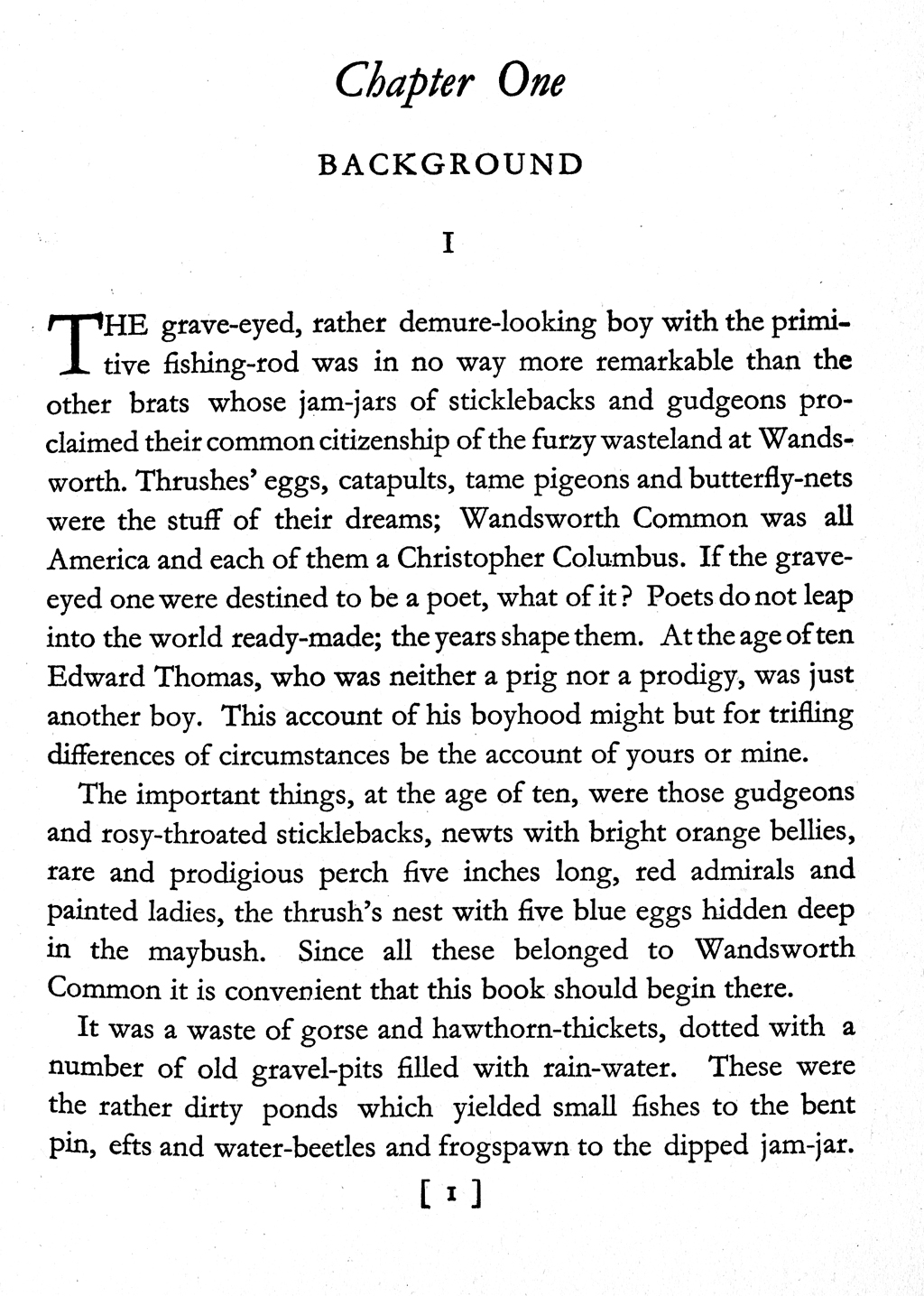
The best summary of Edward Thomas's relationship with Wandsworth Common that I know of was written by John Moore in 1939, for his edition of Edward Thomas's letters. I am including the first few pages here, because it really does get across so much of the [feel] - and does it very much better than I ever could —
John Moore, Life and Letters of Edward Thomas
But good as Moore's account is, you really ought to read Edward Thomas himself —
But good as Moore's account is, you really ought to read Edward Thomas himself —
Check for other refs —
(Click on image to enlarge)
Chapter One
BACKGROUND
I
[1]
THE grave-eyed, rather demure-looking boy with the primitive fishing-rod was in no way more remarkable than the other brats whose jam-jars of sticklebacks and gudgeons proclaimed their common citizenship of the furzy wasteland at Wandsworth. Thrushes' eggs, catapults, tame pigeons and butterfly-nets were the stuff of their dreams; Wandsworth Common was all America and each of them a Christopher Columbus. If the grave-eyed one were destined to be a poet, what of it? Poets do not leap into the world ready-made; the years shape them. At the age of ten Edward Thomas, who was neither a prig nor a prodigy, was just another boy. This account of his boyhood might but for trifling differences of circumstances be the account of yours or mine.
The important things, at the age of ten, were those gudgeons and rosy-throated sticklebacks, newts with bright orange bellies, rare and prodigious perch five inches long, red admirals and painted ladies, the thrush's nest with five blue eggs hidden deep in the maybush. Since all these belonged to Wandsworth Common it is convenient that this book should begin there.
It was a waste of gorse and hawthorn-thickets, dotted with a number of old gravel-pits filled with rain-water. These were the rather dirty ponds which yielded small fishes to the bent pin, efts and water-beetles and frogspawn to the dipped jam-jar.
Check for other refs —
(Click on image to enlarge)
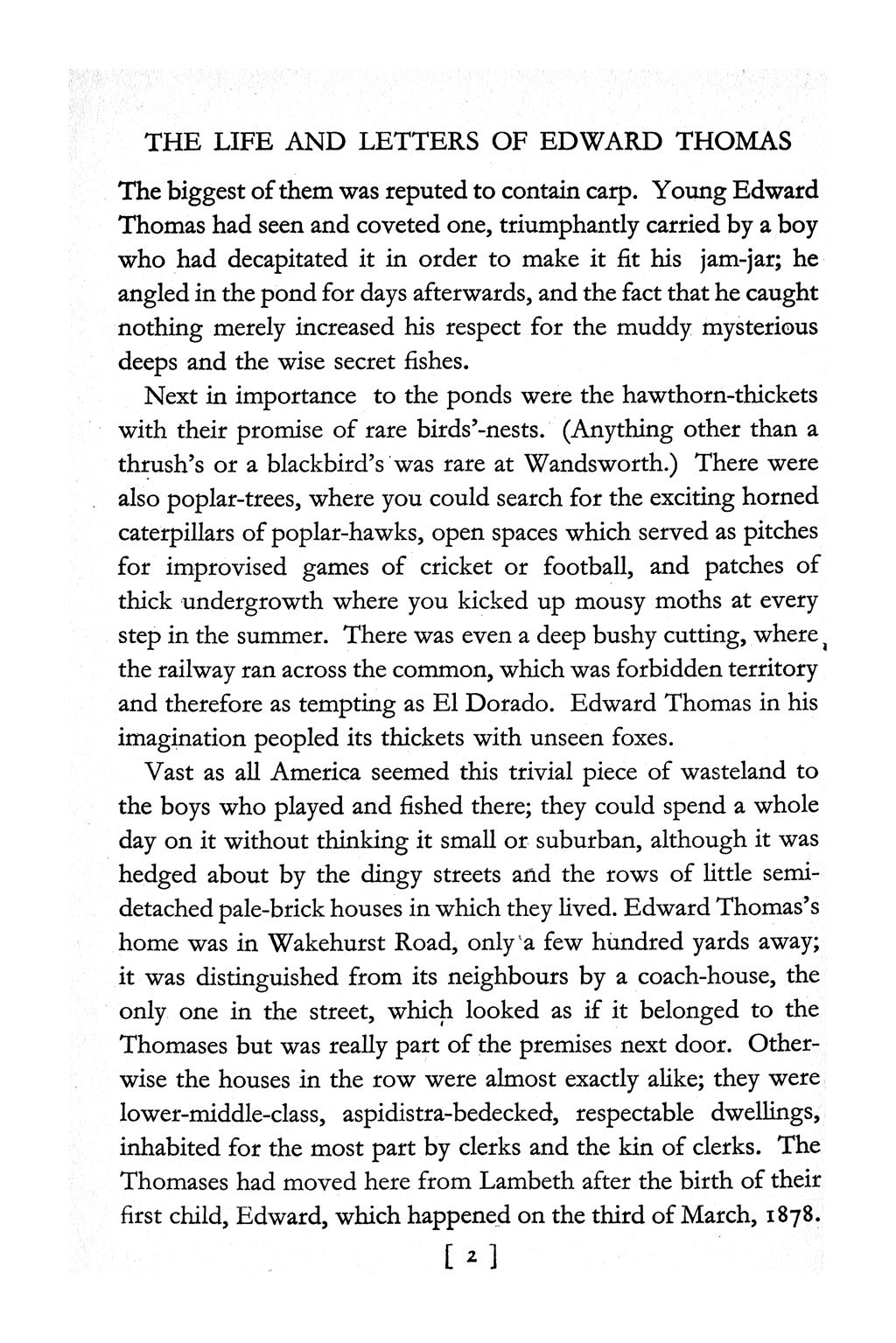
[2]
The biggest of them was reputed to contain carp. Young Edward Thomas had seen and coveted one, triumphantly carried by a boy who had decapitated it in order to make it fit his jam-jar; he angled in the pond for days afterwards, and the fact that he caught nothing merely increased his respect for the muddy mysterious deeps and the wise secret fishes.
Next in importance to the ponds were the hawthorn-thickets with their promise of rare birds'-nests. (Anything other than a thrush's or a blackbird's was rare at Wandsworth.) There were also poplar-trees, where you could search for the exciting horned caterpillars of poplar-hawks, open spaces which served as pitches for improvised games of cricket or football, and patches of thick undergrowth where you kicked up mousy moths at every step in the summer.
There was even a deep bushy cutting, where the railway ran across the common, which was forbidden territory and therefore as tempting as El Dorado. Edward Thomas in his imagination peopled its thickets with unseen foxes.
Vast as all America seemed this trivial piece of wasteland to the boys who played and fished there; they could spend a whole day on it without thinking it small or suburban, although it was hedged about by the dingy streets and the rows of little semi-detached pale-brick houses in which they lived.
Edward Thomas's home was in Wakehurst Road, only a few hundred yards away; it was distinguished from its neighbours by a coach-house, the only one in the street, which looked as if it belonged to the Thomases but was really part of the premises next door. Otherwise the houses in the row were almost exactly alike; they were lower-middle-class, aspidistra-bedecked, respectable dwellings, inhabited for the most part by clerks and the kin of clerks. The Thomases had moved here from Lambeth after the birth of their first child, Edward, which happened on the third of March, 1878 —

Check for other refs —
(Click on image to enlarge)
The family was not well-off, Mr. Thomas's moderate salary was quickly spent in "keeping up appearances," in consolidating the position of bowler-hatted, black-coated respectability to which he had laboriously attained. So Edward was sent to a Board School, where, in a great lofty class-room which always smelled faintly of carbolic soap, he duly learned "for ever and ever" the names of the tributaries of the Thames and the dates of the Kings of England, and repeated aloud such parrot-like and mystical-sounding phrases as "Witney on the Windrush Manufactures Blankets."
Here also he learned to fight, which in spite of his demure appearance he did quite well; the Common was the scene of frequent guerrilla warfare, and sometimes of pitched and bloody battles, between the Board School boys (opprobriously known as "Boardy Blags") and the boys belonging to a neighbouring Grammar School, who felt themselves to be socially superior although they walked the same way home.
When there was nobody to fight, the brats played unorganized and individualistic games of the sort which are almost forgotten now: tipcat and hopscotch, with all their nameless and esoteric variations. They purposelessly bowled hoops and spun tops. They played marbles. (And once the casual mention of marbles at home led Edward to make the astonishing and awe-inspiring discovery that his father, in his youth, had played marbles, too; that he had even been something of an expert, and still remembered the trick with thumb and forefinger and the curious terminology of the game. Edward could hardly believe it; he had not completely realized, until that moment, that his father had ever been young.)
When he was ten, Edward left the Board School and went to a small Private School near by.
Notes
The "Board School"was Belleville, of course. The "small private school" was ? And the
The Grammar School was Battersea Grammar, where the old Granada Cinema stood on the corner of St John's Hill and Plough Road.
[Source: John Moore, Life and Letters of Edward Thomas (1939)), pp.1-2.
Send me an email if you want to comment on anything you've seen or read on the site, or would like to know more about something, or just want to be kept in touch.
Philip Boys (aka "HistoryBoys")