
Regrettably I don't have much time today to talk about the various schools Edward went to, and the brilliantly evocative way he describes them. Perhaps another time.
But I would like to mention some of the children he met and played with out of school - particularly on the Common and surrounding streets.
In his descriptio of Belleville, he writes:
There were some boys and more girls whom I desired and sometimes struggled to sit next; and at least two whom I avoided. One a poor dirty girl without eyelashes who came from an old hovel at the top of one of the poorer and older streets, and has lent a certain disrelish ever since to the name of "Lizzie’; the [15] other was a boy whom I had seen charging at his desk with his head lowered, like a bull.
I'll start then with girls:
I knew boys and girls in several of the streets parallel to ours or crossing it. One or more of them was with me when I found myself somehow on the forbidden side of a black fence which divided the back gardens of one street from a meadow and cut short another street; there were trees and cows in the meadow, and a small pond not far from the fence. With one of these friends, a girl, I went home once and in her back garden I first saw dark crimson dahlias and [16] smelt bitter crushed stalks in plucking them. As I stood with my back to the house among the tall blossoming bushes I had no sense of any end to the garden between its brown fences: there remains in my mind a greenness, at once lowly and endless. [Tottie Armour — ] Why some children, whether my equals or old enough to protect me, were pleasant, and how, I cannot say. Their faces are invisible to me all except one: I can say only that some were fat and the eyes narrow, and that some girls had dark hair, others fair. The one that I can see has black curly hair, dark eyes and cherry lips; and she is smiling: her name was Tottie Armour. We picked sorrel leaves and ate them among the gorse bushes on Wandsworth Common. Tottie Armour! This is the first person given a full name in his autbiography. I always rather assumed he had made her up, or at least concealed her identity by renaming her. But no. What do you think "Tottie" is short for?Why some children, whether my equals or old enough to protect me, were pleasant, and how, I cannot say. Their faces are invisible to me all except one: I can say only that some were fat and the eyes narrow, and that some girls had dark hair, others fair. The one that I can see has black curly hair, dark eyes and cherry lips; and she is smiling: her name was Tottie Armour. We picked sorrel leaves and ate them among the gorse bushes on Wandsworth Common.
I was rather interested in his very precise description of her. So I went looking:
"The one that I can see has black curly hair, dark eyes and cherry lips, and she is smiling; her name was Tottie Armour."
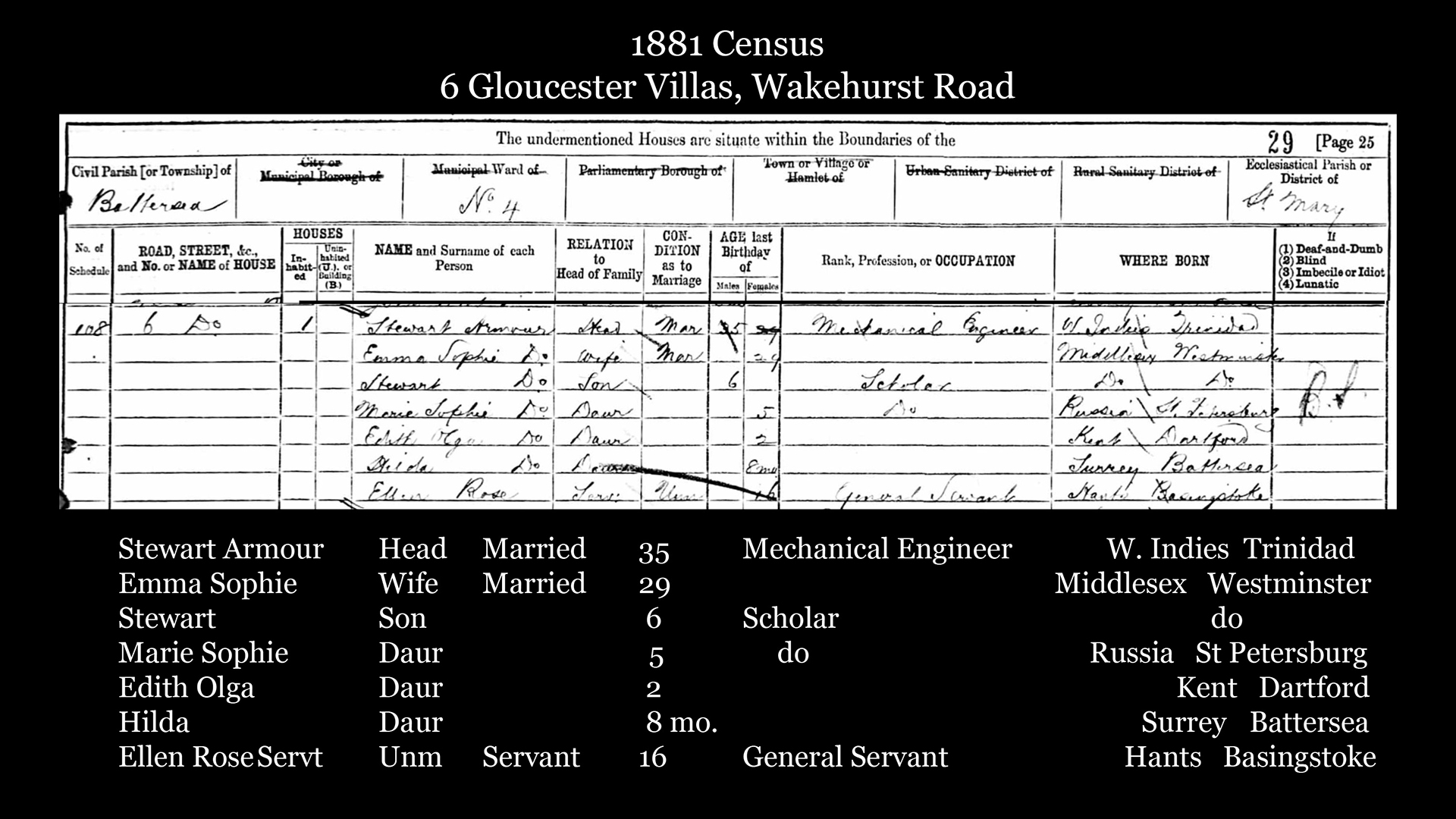
Interesting, eh? Father a mechanical engineer from Trinidad. Who had worked in St Petersburg (which is where ? was born. And hence, presumably, Tottie's unusual middle name, "Olga". I dug a little deeper and found that Tottie devoted herself to fabric design. Here she is winning one of the very few gold medals awarded by the ..... There is an asterisk that declares that she also was given a "scholarship"" of £11.
-- CLICKABLE PIC STARTS -->Here is a blown up section, that helps us see the design a little more clearly"
-- CLICKABLE PIC STARTS -->Maybe a bit of a stretch, but I'm interested that her gold-medal-winning design is of water, and fishes, and willows. Very Wandsworth Common, eh?
So what happened to Tottie? I have very little extra information.
The main repository for a her work appears to be Budapest, in Hungary, which is remarkable in itself. There is nothing by her in the V&A.
And then, at the edge of just 32? she was in a cottage hospital, in ??, where she died. I would lie to know more, but I wouldn't.And finally . . .
Here's a wonderful recollection of Christmas Day on Wandsworth Common more than a century ago, featuring a sword and Mabel Looms (who lived on Broomwood Road).
Whose recollections? Where did he live? Which school did he and Mabel attend?
To add to the festive fun, I've interspersed the text with some wonderful images of swords, all by the same (local) artist.
Who painted the images? And which stories do they depict?
ONE CHRISTMAS MORNING I woke up and felt a long lean smooth straight cold thing with straps at my bedside. It had a handle, and pulling that with one hand I brought out what I discovered to be a sword, while in the other hand was a scabbard.

The daylight came upon me still unsheathing and sheathing the sword, trying hard for the hundredth time to put it back the wrong way. As soon as I could I fastened the belt round my waist so that the sword hung on the right instead of the left side and went out alone.
The streets were empty. I was proud though without spectators. Once or twice the weapon caught between my legs. I marched up the street, crossed the road separating it from the Common and turned to the left between the elm-trees of Bolingbroke Grove, having the road upon my left, the Common upon my right.

At the top of one of the streets parallel to ours, but at that time divided from it by that big private meadow with the pond and elm-trees, I stopped and looked down. For there lived Mabel Looms, a schoolfellow whom I adored. She had had a Christmas card from me that morning.
The street was empty. I walked backwards and forwards along the Grove past the top of the street, waiting, sufficiently proud not to be overcome by long disappointment. How many times since have I waited thus for somebody, with a dog's patience. There began to be others in the streets.


At last Mabel came up towards the Common, in the company of some elders. Without a sign I continued walking backwards and forwards. They turned to their left at the top, away from our street. I turned in the opposite direction homeward, pleased with my swinging sword and believing that the passers-by admired it.

At home they knew well where I had been.
My attachment to Mabel lasted for several years and more than once after it had been broken I attempted to renew it. She was a perfect loving friend. I thought her beautiful. Her hair was light brown, her face round rather than a long face.

A year or two later, "I exchanged the Board-school when I was ten for a private school":
Here there were fifty or sixty boys of from ten to seventeen years of age, perhaps half of them boarders. They were the sons of tradesmen, professional men, moderately well-to-do clerks, and men of small independent means.
My companions were now boys exclusively. I had no sisters; my girl cousins I saw but two or three times in all my childhood; none of my friends had sisters of their own age; my father and mother had but a few close acquaintances, who rarely came to the house and hardly ever brought their children, boys or girls, with them.
Mabel and I had forsaken one another. If we met we smiled without words, without stopping.

One Christmas morning I woke up and felt a long lean smooth straight cold thing with straps at my bedside. It had a handle, and pulling that with one hand I brought out what I discovered to be a sword, while in the other hand was a scabbard. The daylight came upon me still unsheathing and sheathing the sword, trying hard for the hundredth time to put it back the wrong way. As soon as I could I fastened the belt round my waist so that the sword hung on the right instead of the left side and went out alone. The streets were empty. I was proud though without spectators. Once or twice the weapon caught between my legs. I marched up the street, crossed the road separating it from the Common and turned to the left between the
[17]
elm-trees of Bolingbroke Grove, having the road upon my left, the Common upon my right.
At the top of one of the streets parallel to ours, but at that time divided from it by that big private meadow with the pond and elm-trees, I stopped and looked down. For there lived Mabel Looms, a schoolfellow whom I adored. She had had a Christmas card from me that morning. The street was empty. I walked backwards and forwards along the Grove past the top of the street, waiting, sufficiently proud not to be overcome by long disappointment. How many times since have I waited thus for somebody, with a dog's patience. There began to be others in the streets. At last Mabel came up towards the Common, in the company of some elders. Without a sign I continued walking backwards and forwards. They turned to their left at the top, away from our street. I turned in the opposite direction homeward, pleased with my swinging sword and believing that the passers-by admired it. At home they knew well where I had been. My attachment to Mabel lasted for several years and more than once after it had been broken I attempted to renew it. She was a perfect loving friend. I thought her beautiful. Her hair was light brown, her face round rather than a long face.
[She had elder sisters - one named Agnes - whom I did not always like; and a brother named Arthur to whom I was indifferent; and a freckled slighter cousin, with a name something like Catherine Haythorn, whom I liked equally for her own and for Mabel's sake. ]
He moves schools at 10, and again at around 13... boys-only schools, of course.
He writes of the h
My companions were now boys exclusively. I had no sisters; my girl cousins I saw but two or three times in all my childhood; none of my friends had sisters of their own age; my father and mother had but a few close acquaintances, who rarely came to the house and hardly ever brought their children, boys or girls, with them.
NB he has 5 brothers by this time.
[He ends rather plaintively:Mabel and I had forsaken one another. If we met we smiled without words, without stopping.
But with Edward, you're never far from what he calls the "veil of sex", which he desperately wants to pull back:
[https://en.wikipedia.org/wiki/Hoop_rolling] [Barrel hoops? Wheel hoops?]Girls practically never joined in our games: even bowling our iron hoops beside their wooden ones was rare. Those girls who did play much with boys were scandalously talked about, but they were older than I was, and I neither knew nor know anything positive against them.
I only have an idea that I had seen one of them — a deep-voiced dark-skinned good-looking girl who walked with long strides and a slight stoop — coming from among thick bushes with a boy or two boys. This caused laughter and was afterwards mentioned with hints and jeers which I do not think I understood: I became fairly curious and expectant; the veil over the sex thickened.
Back to the top of this page . . .
Philip Boys ("HistoryBoys")
