Wandsworth Common
Francis Grose (1731-1791)
(Antiquary, soldier, draughtsman, lexicographer)
&
Samuel Hieronymus Grimm (1733 - 1294)
(Topographical artist)
Francis Grose (1731-1791)
(Antiquary, soldier, draughtsman, lexicographer)
&
Samuel Hieronymus Grimm (1733 - 1294)
(Topographical artist)
- [Wikipedia: Francis Grose]
- INFO about Grose's collaborator, the topographical illustrator Samuel Hieronymus Grimm
- Francis Grose: Dictionary of the vulgar tongue, 1811 (pdf of text) - (includes some refs to Wandsworth and the Mayor of Garratt).
- [Download facsimile of whole volume here (20Mb!).]
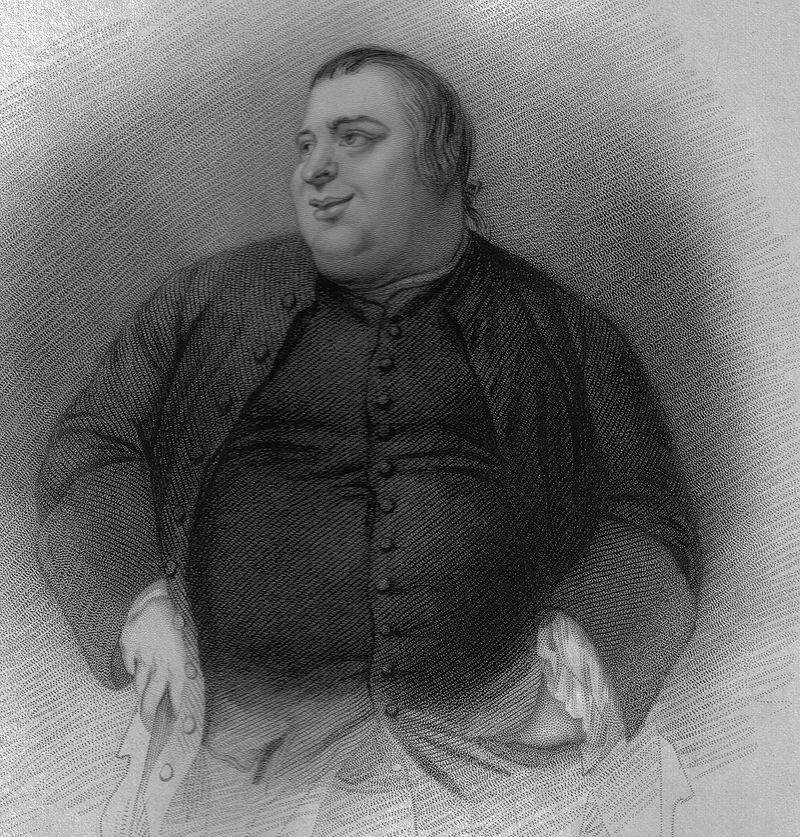
[Portrait by ? date?]
(Click on image to enlarge)

Mulberry Cottage [add info]
(Click on image to enlarge)
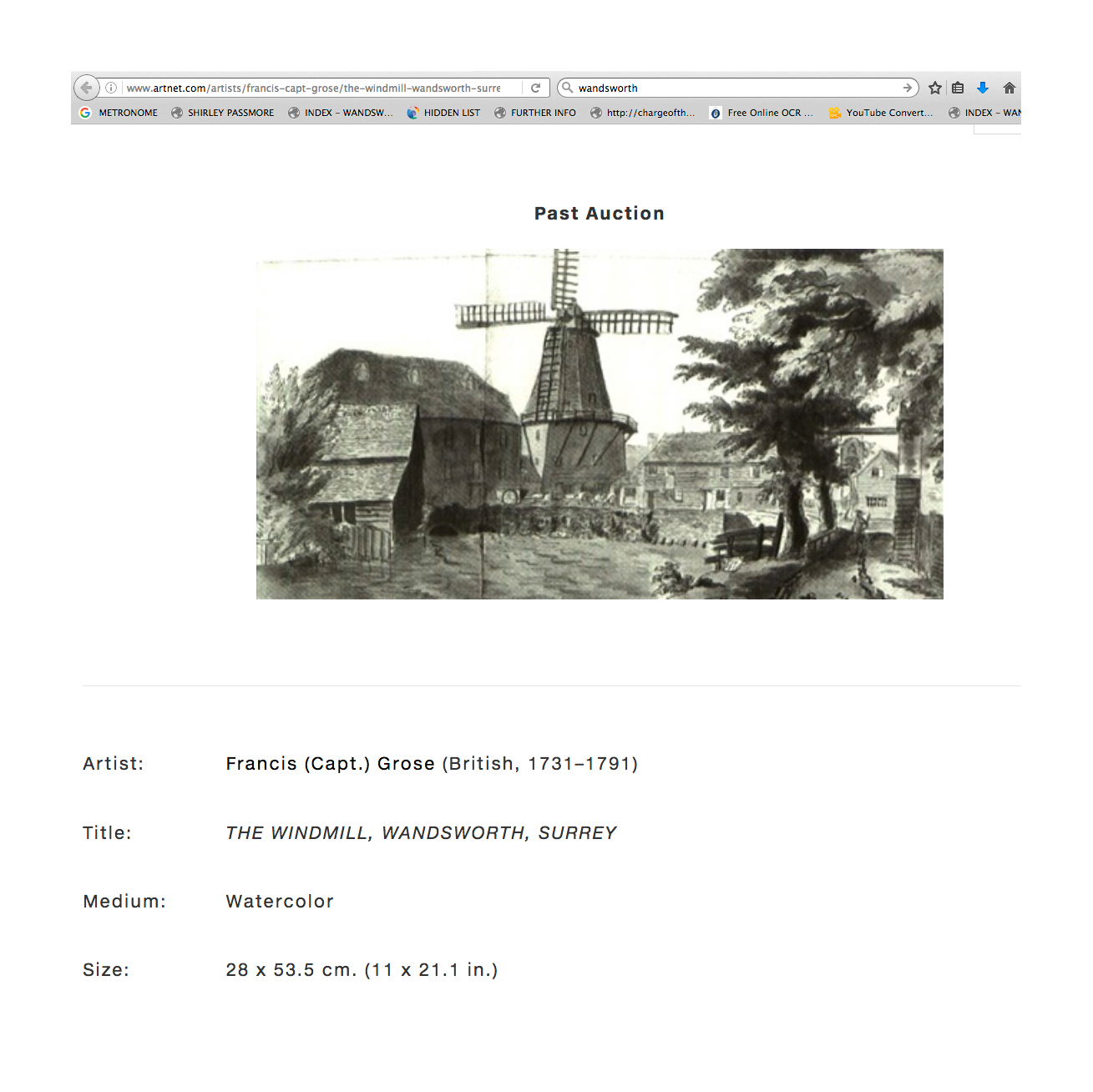
[Windmill, Wandsworth - add info.]
(Click on image to enlarge)
FRANCIS GROSE, ANTIQUARY
Lived Mulberry Cotage, Wandsworth Common
Where exactly this? [Check but I'm pretty sure it later became known as The Gables, North Side, top left of the Common, the Trinity rd underpass and adjacent block of shops/flats having annihilated it. There is an good article by Dorian Gerhold on this and an adjacent C17/C18 house, and some excellent photographs from c.1900. Isn't this where Asquith (?) spent holidays, which in later life he cherished?
[Source: Link.]
"Every Man is Naturally an Antiquarian: Francis Grose and Polite Antiquities"
Stephen Bending
University of Southampton
ABSTRACT
Francis Grose produced well over a thousand low-cost antiquarian images of the antiquities of England and Wales. While it may be tempting to dismiss him as a mere popularizer and a charlatan, his works open up to a wide national public the antiquities of their native land. Central to his venture is at once the commodification of the past and an attempt to represent that commodification as nothing of the kind. Grose sets about repackaging the old as the new - a now classic act of consumerism - but also works hard to deny this activity by drawing on the language of scholarship and accuracy. Ultimately, his cheaply produced and mass - marketed images and texts demonstrate an antiquarian past which repeatedly collapses into a commercial present: cheap prints for a mass market create a national past in the very act of contemporary consumer aesthetics.
Stephen Bending is a Lecturer in the English Department at the University of Southampton. He has written numerous articles on landscape and polite culture in the eighteenth century and has co - edited with James Raven and Antonia Forster The English Novel 1770 - 1799: A Bibliographical Survey of Prose Fiction in the British Isles (Oxford University Press, 2000), and with Stephen Bygrave Henry Mackenzie's, The Man of Feeling (World's Classics, 2002), and is editor of the forthcoming anthology, The Writing of Rural England, 1500 - 1800 (Longman, 2002).
Francis Grose (1730/1731-12 June 1791), born at Greenford in Middlesex, antiquary, draughtsman, and lexicographer, of Swiss extraction.
Grose's father, also Francis Grose, was a wealthy Swiss jeweller), was Richmond Herald from 1755 to 1763. Probably the eldest son, Francis served in the Army, retiring at the rank of captain. He became Paymaster and Adjutant of the Surrey Militia, a position that led to his financial ruin as he kept no books and gave no receipts, the deficits costing him all his inherited wealth.
Robert Burns met him while he was staying with Robert Riddell at the Friar's Carse in Scotland collecting material for his Scottish work. Burns became firm friends with this by now this fat, and suggested to him that he should include Alloway Kirk in his Scottish work. Grose agreed on condition that Burns provided a witch tale to go with his drawing. In June 1790, Burns sent Grose a prose tale with a variant in a letter to Grose, following it up with a rhymed version, 'Tam o' Shanter'.
Gross's Antiquities of England and Wales (1773 - 87), which was well received, and thereafter, in 1789, set out on an antiquarian tour through Scotland, the fruit of which was Antiquity of Scotland (1789 - 91). He afterwards undertook a similar expedition to Ireland, but died suddenly in Dublin after an apoplectical stroke. Edward Ludwich, who had already published a book on Irish antiquities, completed the final volume of Grose's Antiquities of Ireland in 1791.[1] In addition to the works above mentioned, he wrote A Classical Dictionary of the Vulgar Tongue (1785), A Provincial Glossary (1787) and Treatise on Ancient Armour and Weapons. He was an accomplished draughtsman, and illustrated his own works.
Additionally, it is noted that he is the author of Advice to the Officers of the British Army: With the addition of some Hints to the Drummer and Private Soldier, which was published in 1783 as a mocking look backwards on the conduct of the war against the American Colonies. Every instance of corruption, disregard and vice are suggested for every rank of the army. Tongue in cheek, but obviously rooted in truth, it is a great companion to Vulgar Tongue.
Two parodies by Thomas Bridges, A Travestie of Homer and The Battle of the Genii, were once attributed to Francis Grose.
GROSE was, er, grossly fat - hence this:
Robert Burns (1759 - 1796). Poems and Songs.
The Harvard Classics. 1909 - 14.
THE DEVIL got notice that Grose was a-dying
So whip! at the summons, old Satan came flying;
But when he approached where poor Francis lay moaning,
And saw each bed-post with its burthen a-groaning,
Astonish'd, confounded, cries Satan - "By G -,
I'll want him, ere I take such a damnable load!"
[Source: Link.]
Grose on the "Garret Election"
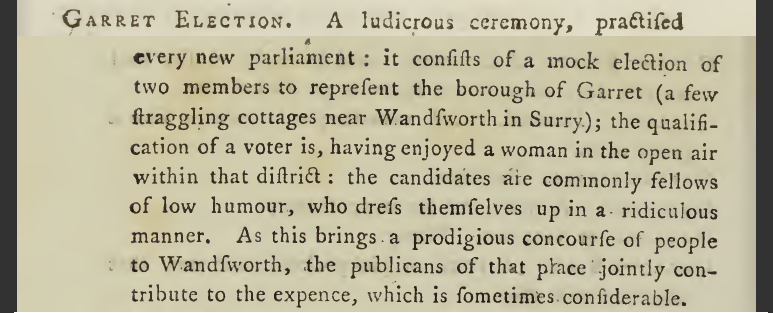
Garret Election, from A Classical Dictionary of the Vulgar Tongue (1785)
GARRET ELECTION
A ludicrous ceremony, practifed every new parliament; it confifts of a mock election of two members to reprefent the borough of Garret (a few straggling cottages near Wandfworth in Surry); the qualification of a voter is, having enjoyed a woman in the open air within that diftrict: the candidates are commonly fellows of low humour, who drefs themfelves up in a ridiculous manner. As this brings a prodigious concourfe of people to Wandfworth, the publicans of that place jointly contribute to the expence, which is fometimes confiderable.
(Click on image to enlarge)
Another FG reference to muddy roads in Wandsworth
HASTY PUDDING.
Oatmeal and milk boiled to a moderate thickness, and eaten with sugar and butter. Figuratively, a wet, muddy road: as, The way through Wandsworth is quite a hasty pudding. To eat hot hasty pudding for a laced hat, or some other prize, is a common feat at wakes and fairs.
FG on Gypsies
GYPSIES
A set of vagrants, who, to the great disgrace of our police, are suffered to wander about the country.
They pretend that they derive their origin from the ancient Egyptians, who were famous for their knowledge in astronomy and other sciences; and, under the pretence of fortune-telling, find means to rob or defraud the ignorant and superstitious. To colour their impostures, they artificially discolour their faces, and speak a kind of gibberish peculiar to themselves. They rove up and down the country in large companies, to the great terror of the farmers, from whose geese, turkeys, and fowls, they take very considerable contributions.
When a fresh recruit is admitted into the fraternity, he is to take the following oath, administered by the principal maunder, after going through the annexed forms: First, a new name is given him by which he is ever after to be called; then standing up in the middle of the assembly, and directing his face to the dimber damber, or principal man of the gang, he repeats the following oath, which is dictated to him by some experienced member of the fraternity: I, Crank Cuffin, do swear to be a true brother, and that I will in all things obey the commands of the great tawney prince, and keep his counsel and not divulge the secrets of my brethren.
I will never leave nor forsake the company, but observe and keep all the times of appointment, either by day or by night, in every place whatever.
I will not teach any one to cant, nor will I disclose any of our mysteries to them.
I will take my prince's part against all that shall oppose him, or any of us, according to the utmost of my ability; nor will I suffer him, or any one belongiug to us, to be abused by any strange abrams, rufflers, hookers, pailliards, swaddlers, Irish toyles, swigmen, whip jacks, jarkmen, bawdy baskets, dommerars, clapper dogeons, patricoes, or curtals; but will defend him, or them, as much as I can, against all other outliers whatever. I will not conceal aught I win out of libkins or from the ruffmans, but will preserve it for the use of the company. Lastly, I will cleave to my doxy wap stiffly, and will bring her duds, marjery praters, goblers, grunting cheats, or tibs of the buttery, or any thing else I can come at, as winnings for her weppings.
The canters have, it seems, a tradition, that from the three first articles of this oath, the first founders of a certain boastful, worshipful fraternity (who pretend to derive their origin from the earliest times) borrowed both the hint and form of their establishment; and that their pretended derivation from the first Adam is a forgery, it being only from the first Adam Tiler: see ADAM TILER.
At the admission of a new brother, a general stock is raised for booze, or drink, to make themselves merry on the occasion.
As for peckage or eatables, they can procure without money; for while some are sent to break the ruffmans, or woods and bushes, for firing, others are detached to filch geese, chickens, hens, ducks (or mallards), and pigs.
Their morts are their butchers, who presently make bloody work with what living things are brought them; and having made holes in the ground under some remote hedge in an obscure place, they make a fire and boil or broil their food; and when it is enough, fall to work tooth and nail: and having eaten more like beasts than men, they drink more like swine than human creatures, entertaining one another all the time with songs in the canting dialect.
As they live, so they lie, together promiscuously, and know not how to claim a property either in their goods or children: and this general interest ties them more firmly together than if all their rags were twisted into ropes, to bind them indissolubly from a separation; which detestable union is farther consolidated by the above oath.
They stroll up and down all summer-time in droves, and Dexterously pick pockets, while they are telling of fortunes; and the money, rings, silver thirribles, &c. which they get, are instantly conveyed from one hand to another, till the remotest person of the gang (who is not suspected because they come not near the person robbed) gets possession of it; so that, in the strictest search, it is impossible to recover it; while the wretches with imprecations, oaths, and protestations, disclaim the thievery.
That by which they are said to get the most money, is, when young gentlewomen of good families and reputation have happened to be with child before marriage, a round sum is often bestowed among the gypsies, for some one mort to take the child; and as that is never heard of more by the true mother and family, so the disgrace is kept concealed from the world; and, if the child lives, it never knows its parents.
'Everything Curious': Samuel Hieronymus Grimm and Sir Richard Kaye
Over 3000 drawings by Samuel Hieronymus Grimm are housed in the British Library's Department of Manuscripts: the impressive result of over 20 years touring to record 'everything curious' in England. A project funded the antiquary Sir Richard Kaye, Grimm's drawings capture local history and contemporary life in England in the last decades of the 18th century. Brett Dolman explores.
The British Library's extensive collections of British topographical drawings have been assembled over the last 250 years largely as a result of the collecting instincts of antiquarians with a passion for recording, in word and image, the urban and rural landscapes around them. Whilst the British Museum Department of Prints & Drawings concentrated on acquiring drawings of primarily artistic interest, the Museum's then Department of Manuscripts (now part of the British Library) gradually assembled a wealth of material by ungarlanded or unknown artists. Their drawings of lost and altered landscapes, architecture and the social scenes of the past, especially when placed beside the associated written material, provide a wealth of useful and sometimes unique information on local history and antiquities...
[BL: Link.]
Captain Francis Grose - populariser of antiquities
Article written by: John Farrant
Themes: Antiquarianism, Country
John Farrant takes a look at the work of 18th-century antiquarian Captain Francis Grose, whose hobby for making sketches - many of which are now in the collections of the British Library - culminated in the publication of works on the antiquities of Britain.
Francis Grose (1731 - 91) published the 18th century's most extensive series of illustrations of ancient monuments. A thousand plates with accompanying descriptions, based on his and others' views and researches, appeared in the 10 volumes of The Antiquities of England and Wales (1772 - 76, Supplement, 1777 - 87), of Scotland (1789 - 91) and of Ireland (1791 - 95).
Undecided what profession to follow, Grose in his early years had the makings of the dilettante antiquary. At the age of 40, however, he was inspired to respond to widening interest in British antiquities and to make the remains of the past more intelligible and accessible to his lay readers. Financial necessity later drove him harder. While he may not have advanced the scholarly projects of learned antiquaries, he had an uncommon breadth of conception of what antiquarian studies should embrace. Well equipped by an amiable personality, Grose was as able to collect dialect among the rank and file of the Army, as to examine the curios of the gentry. By doing so, he contributed significantly to the study of slang and folklore and of military antiquities, as well as to popular appreciation of the medieval monuments of Britain.
When The Antiquities started to appear in 1772, Samuel and Nathaniel Buck's Views of the Ruins of Castles and Abbeys in England and Wales (428 plates, 1726 - 42) was the only sizeable collection of its sort in print. The dedication to a grand patron took precedence over any description of the ruin in the narrow space on the engraved plate beneath the view, never more than 200 words and usually fewer. Grose's views, though much smaller, were similar in character, as panoramas of medieval structures to convey the maximum information, rather than interesting compositions or illustrations of details. Grose's novelty was to publish text with the views, typically about 600 words.
To meet Grose's debts at his death, his family auctioned his library and pictures, and those pictures now traceable are widely scattered. King George III's librarians bought several lots of views, mainly in Kent and Sussex. These are now in the British Library, along with some pictures Grose made for William Burrell, two volumes which were likely to have been acquired from booksellers (one of views in Scotland and Ireland, the other of notes on four tours in 1775 - 77), and a few other pictures.
Grose was born in 1731, the son of a jeweller, an immigrant from Switzerland, who traded in the City of London and retired to Richmond in Surrey. He first looked to the Army for a career. In early 1747 he saw the final campaign of the War of the Austrian Succession in Flanders and obtained a commission in November 1748. He resigned in October 1751, just as his regiment was ordered to Scotland, probably because he was by then married to the daughter of a vintner in Canterbury. In 1755 his father bought him the place of Richmond Herald, but Grose showed no great taste for heraldry and sold it in 1763. As early as 1749 though, he was sketching medieval buildings in Kent, and in the mid-1750s attended William Shipley's drawing school in London.
Joining the militia enabled him again to don uniform while avoiding distant postings. In times of war, the militia was 'embodied' in regiments from each county for home defence, and in November 1759 he was commissioned as a lieutenant in the Surrey Regiment and appointed adjutant and paymaster of its 2nd (Western) Battalion. Before being disembodied in December 1762, the Surrey Militia marched to and fro across southern England, often to patrol the coast against smugglers. But he had ample opportunity to sketch, with, unsurprisingly, a strong emphasis on castles. As adjutant, Grose continued to receive a salary in peacetime, and promotion to captain in 1765 gave him the title by which he was commonly to be known.
Now living in Wandsworth, Surrey, Grose sketched in the vicinity and on social visits to relatives. In London, though only an indifferent draughtsman, he mixed with professional and amateur artists, and exhibited at the Society of Artists in 1767 - 68 and at the Royal Academy in the nine years following. His first published pictures were etchings in the second edition of his brother John Henry's A Voyage to the East Indies (1766). His militia salary, together with inheritances from his parents and on his wife's death in 1774, gave him the means to maintain his family in comfort, with prudent management.
So hope of profit may not have motivated Grose's Antiquities of England and Wales. His purpose was popular, 'for the use of such as are desirous of having, without much trouble, a general knowledge of the subjects treated in this publication', and a similar motive guided his contributions to the periodical Antiquarian Repertory (1775 - 86). The first part of the Antiquities appeared in February or March 1772, with each view and its descriptive text on a separate page, at a price per view one third of the Bucks'. Parts comprising six views each appeared initially at roughly monthly intervals, and periodically a title-page and introduction were issued to signal completion of a volume. For the reader, what views comprised a 'part' was haphazard, following no geographical pattern (as had the Bucks') but being what was ready for printing.
Having promised to cover the whole of England and Wales, Grose did not have material at the outset to satisfy his subscribers for long. He was on a treadmill, drafting text to accompany views already to hand, travelling to sketch new views, recruiting collaborators willing and able to provide views and information for the text, and reducing his and their views as grey-wash 'cartoons' for the engraver to copy. From 1772 he was touring to make sketches which were engraved and published within a few months, and was borrowing pictures from friends, particularly John Inigo Richards, Paul Sandby, and, from 1774, Moses Griffiths. Sometimes the accompanying text came almost entirely (with acknowledgement) from published books, or from fellow antiquaries; in other cases Grose was in correspondence to collect material from which he could draft.
Ironically, in 1774, just when Grose was touring most for views, someone else was seizing on each part as it appeared for another project. In the previous year, Empress Catherine II of Russia, 'Catherine the Great', had ordered from Josiah Wedgwood for her summer palace a 50-place dinner service, the 'Green Frog Service'. Each of 952 pieces was to be hand-painted with a view of Britain. In February 1774 Thomas Bentley, Wedgwood's partner in charge of the design studio in London, bought every one of Grose's views already published in parts 1 to 25, and then took subsequent parts on issue, until the service was completed on 6 August, using 122 of the 183 views in parts 1 to 33. Grose or his publisher even allowed Bentley access to views engraved but unpublished and to cartoons awaiting engraving, indeed to two which were never engraved.
Part 60, with a set of 33 plans, brought to a close the fourth volume, and with it, the project to cover the whole of England and Wales as had been announced by Grose, but only until he started publishing the Supplement a year later. This reached three parts before a lengthy interruption.
The cause of this interruption was the militia's embodiment from March 1778 to February 1783. Grose did not enjoy this active service. Firstly, the Surrey militia functioned as a single battalion, so increasing his responsibilities. Most of the summers - the prime time for antiquarian tours - were now spent in camp with other corps for training. Secondly, his easy relationship with the previous commanding officer, George Onslow, was lacking with Jeremiah Hodges, who was the target of some biting satire in Grose's Advice to the Officers of the British Army (1782). Thirdly, his haphazard management of the regiment's finances landed him in substantial debt to his fellow officers: so much so as to shape the rest of his life.
Grose gave up the large house in Wandsworth for lodgings at Clement's Inn, just west of the City of London, and then nearby with his publisher Samuel Hooper, now being a regular and genial participant in the Society of Antiquaries, to which he had been elected in 1757. The sympathetic sketch by Nathaniel Dance engraved in 1787 shows the stocky, corpulent figure which Grose himself caricatured.
From 1783 he published in a torrent to make a living. The Supplement to the Antiquities was resumed, with a greater proportion of views from other artists, particularly S H Grimm, and was completed with 309 plates in 1787. This and the main series were reissued in a smaller format in 1783 - 87, at half the price. A Classical Dictionary of the Vulgar Tongue (1785) and A Provincial Glossary, with a Collection of Local Proverbs, and Popular Superstitions (1787) were at the time the largest assemblage of 'non-standard' words or meanings, containing about 9,000 items omitted from Samuel Johnson's Dictionary; they drew on Grose's fieldwork as far back as the 1750s. The first parts of two other pioneering works appeared in 1786: Military Antiquities and A Treatise on Ancient Armour. Both relied mainly on Grose's specialist library and the armouries at the Tower of London, but also included observations on military music from the 1740s. Of more popular appeal was Rules for Drawing Caricaturas: with an Essay on Comic Painting (1788).
By now Grose must have exhausted for publication the stock of sketches and notes which he had accumulated over 40 years. He returned to touring, even though, (as he said in a volume of satirical essays, The Grumbler, 1791), he was too fat to ride a horse and too poor to keep a carriage. The Antiquities of Scotland was compiled with tours in 1788, 1789, and 1790 with publication completed in April 1791. In summer 1789, he became firm friends with Robert Burns and the subject of some witty verses by Burns, whom Grose inspired to write 'Tam o' Shanter' to accompany a drawing of Alloway kirk printed in The Antiquities.
Work began on The Antiquities of Ireland in 1790. It was to be completed by his nephew Daniel and Dr Edward Ledwich in 1796, for on his second visit Grose died in Dublin of an apoplectic fit. One newspaper, the St James's Chronicle (26 May 1791), suggested his epitaph should read:
Here lies FRANCIS GROSE
On Thursday, May 12, 1791,
Death put an end to his
Views and Prospects.
[Source: Link.]
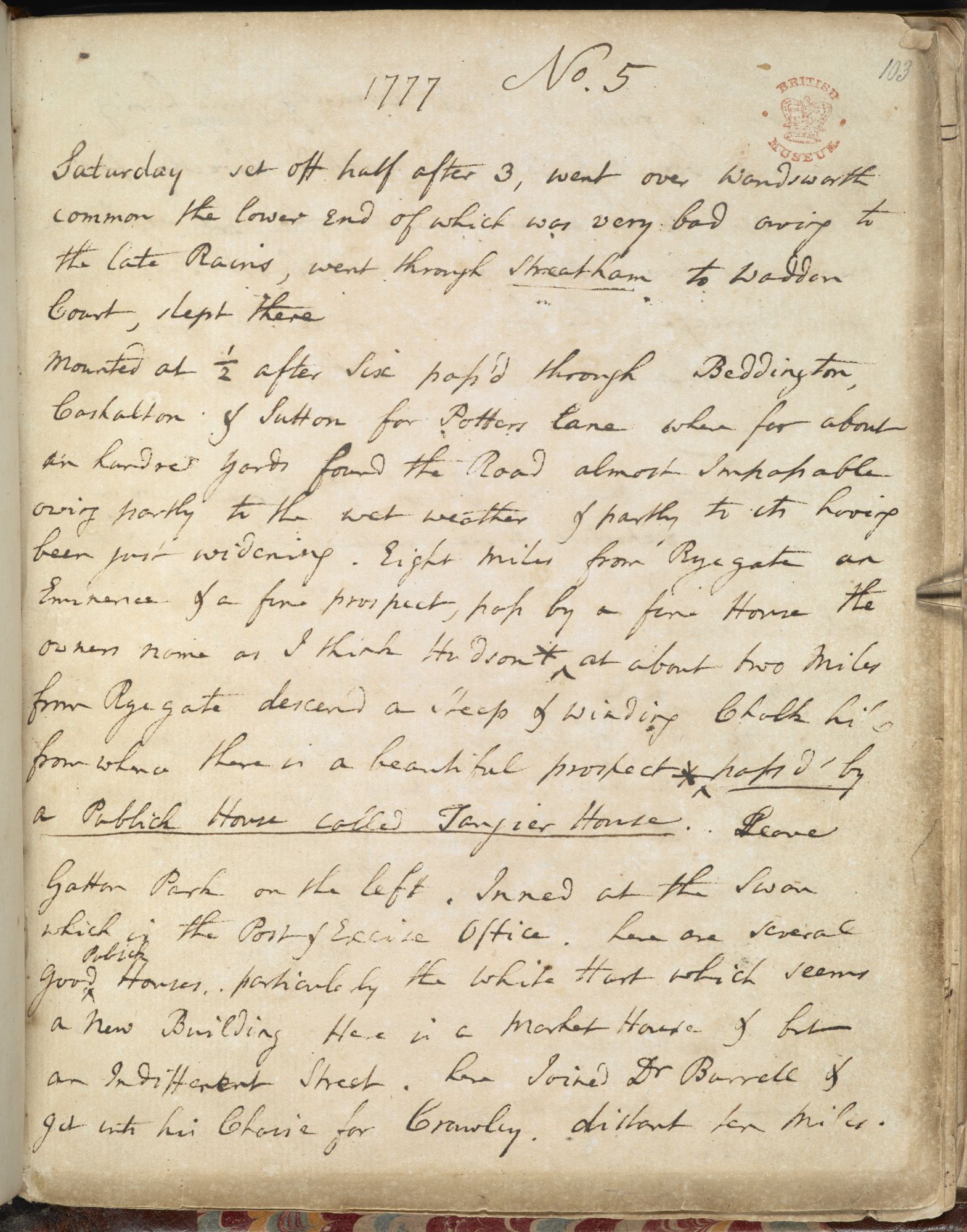
Francis Grose, Diary of a Tour in Sussex, 17-29 May 1777, Pen and Ink, p1 of 7pp, British Library, Add MS 17398
(Click on image to enlarge)
My (unedited) transcript of the opening:
1777
Saturday set off half after 3, went over Wandsworth Common the lower end of which was very bad owing to the late Rains, went through Streatham to Waddon Court, slept there
Mounted at 1/2 after six pop'd through Beddington, Carshalton and Sutton for Potters Lane where for about an hundred yards found the Road almost Impossable owing partly to the wet weather and partly to its having been Just widening. Eight miles from Rygate an Eminence of a fine prospect...
[PB: Hey, this reminds me of the start of Edward Thomas's In Search of Spring!]
These are pages from Francis Grose's diary of a tour of Sussex, undertaken with his friend and fellow antiquary Sir William Burrell (1732 - 96) in May 1777. By 1777 Grose had already published views of Sussex for his monumental study The Antiquities of England and Wales, but intended to cover more of the county for a Supplement to that publication.
The diary starts on Saturday, 17 May, when Grose left his house in Wandsworth for Ifield. Meeting Burrell on the way at Crawley, the pair spent the next twelve days travelling south, following the coast from Seaford to Rye and up again in the direction of Tonbridge.
Many of the destinations were churches, Grose paying particular attention to funerary monuments on the advice of his colleague at the Society of Antiquaries, Richard Gough (1735-1809). Some of the pen and ink sketches which illustrate the diary were engraved for Grose's Supplement, for example the drawings of brasses at Battle, Bodiam and Northiam Church (ff.117-18, f.124, f.123). Other sketches by Grose, such as the church and font of Bishopstone Church, were later copied into Burrell's notes on churches from the tour (British Library Add MS 5697).
A full transcript of the Sussex diary was published in John H. Farrant, Sussex Depicted: Views and Description 1600-1800 (Lewes: Sussex Record Society, 2001).
[BL: Link.]
FG'S SON, ALSO FRANCIS GROSE
?? Brought up on Wandsworth Common?
Lieutenant-General Francis Grose (c. 1758 - 1814) was a soldier and Lieutenant-Governor of New South Wales.
Early life
Grose was was born in Greenland, Middlesex England, the eldest son of Francis Grose the well-known English antiquary, and Catherine Jordan. Grose received a commission as an ensign in 1775, in the 52nd Foot and was promoted to lieutenant later that year. Grose served during the American Revolutionary War, where he was twice wounded (at the assaults on Fort Montgomery and Monmouth Court House). Returning to England in 1779 as captain of the 85th Foot, he acted as recruiting officer. He attained the rank of major in 1783, in the 96th Foot and in November 1789 was placed in command of the New South Wales Corps, and appointed lieutenant-governor of New South Wales.
Australia
Grose did not leave England until late in 1791, arriving in Sydney on 14 February 1792. Grose became colonial administrator when Governor Arthur Phillip, whose health had been poor for some time (probably due to poor diet), received permission to depart. The European population of New South Wales when Grose took over was 4,221, of whom 3,099 were convicts.
Phillip had realized that unless there was some control over the sale of alcoholic spirits, great evils would follow, but Grose made no efforts in this direction, and great abuses such as the payment of wages in spirits became common. The custom of officers trading in spirits was almost universal, and in the interregnum before the arrival of Captain Hunter the colony was rife with drunkenness, gambling, licentiousness and crime. Officers gained control of the rum trade to form what became known as the Rum Corps.
How far Grose was responsible for this state of affairs it is now impossible to say. There is, however, no reason to doubt the statements of the chaplain, the Rev. Richard Johnson, that he could get no support from the lieutenant-governor and no assistance in building a church.
On the other hand the charges against Grose of making indiscriminate grants of land to his friends and fellow officers appear to be without foundation, as the grants made were in accordance with his instructions, and to those officers who requested them.
In spite of the low state of morality, and the drinking habits of the people, the position of the colony had improved very much when Grose left for England on 17 December 1794. However, most of the credit for this cannot be given to Grose. His substitution of military for civil power was not for the good of the state, and he showed no foresight or real strength in his government.
In all probability the improvement was simply the result of better farming methods, for much of which credit may be given to the two chaplains, Johnson and Samuel Marsden. Grose did, however, increase the rations and improve the housing conditions of his troops.
Return to England
After leaving Australia Grose filled various posts in the army. In 1798 he was on the staff in Ireland, and in 1805 was at Gibraltar with promotion to the rank of major-general. He was again on the staff in Ireland in 1809. He was promoted lieutenant-general.
Grose's first wife died in January 1813. In April 1814 he married Elizabeth, widow of William Paterson. A month later, on 8 May 1814, he died in Croydon, Surrey, England.
[Source: Link.]