THE HISTORY OF
WANDSWORTH COMMON

BACK-UP NOTES ABOUT CHARLOTTE (& C.R. LESLIE) TO CHECK

Refresh this page

Index

Charles Robert Leslie, painter (1794-1859)

George Borrow Society: Wandsworth Gypsies [this site]

George Borrow: Wandsworth Gypsies [from Romany Lavo Lil?]

Wikipedia: George Borrow (1803-1881).

Wikipedia: Charles Robert Leslie (1794-1859).

Wikipedia: Charles Godfrey Leland (1824-1903).

History of Wandsworth Common: Charlotte Cooper (dates?).

Jack Cooper

Notes to follow up about Charlotte Cooper

PB: Some years ago I came across an image of a Gypsy encampment on Wandsworth Common, featuring a tall and very beautiful Charlotte Cooper. Or did I? I now can't find it anywhere (and I've spent a long time trying). But there are a number of references to Charlotte in the literature, and to a fine portrait of her, from around 1830, by CR Leslie.

Most recently, the Survey of London volume on Battersea reports:

Survey of London [date?], vol 49, chapter 5:

Various nuisances were dealt with, notably clearing away rubbish, such as detritus dumped from the building trade and road-making, and removing unauthorized livestock and people, including 'encampments of gypsies, itinerant photographers and vendors of goods'.

Gypsies had long been present on Wandsworth Common, contributing to local folklore in the form of the gypsy wife of a boxer, Jack Cooper, famed for having 'knocked West Country Dick to pieces' and killing Paddy O'Leary the 'pot Boy'. She was the subject of a Romany song and a portrait by Constable's friend and biographer, C. R. Leslie, painted c.1830. [n.174]

[Source: 49_references: ch.5 n.174. LMA, OS/W/5/1: Sexby, pp.237-8.]

[PB: Is the portrait shown?]

Does the Survey show the pic? Had the authors seen the painting?

[Also, the Survey (following Sexby?) says Charlotte Cooper lives on the Common, or, as Borrow says, on a smaller area nearby, "the Plain" [CHECK HIS PHRASES]? And where exactly was the Plain?]

See: 49_introduction.pdf

[PB: Notice n.174 says only "LMA, OS/W/5/1: Sexby, pp.237-8". What is the LMA reference? Is the author merely paraphrasing Sexby [who is himself quoting Borrow? CHECK] - there is no independent source.]

Sexby [title? date?],

Sexby is quoting from Borrow [does he credit him?]. Sexby appears to know Leslie's painting of Charlotte Cooper, but is it as a portrait or (as the last sentence suggests), a larger view of the encampment? In any case, she can't be the tall figure I recall.

One portion was the resort of gipsy vans and tents, one of whose occupants has been immortalized in a picture by C. R. Leslie, R.A., painted about 1830.

The following story is told about this gipsy beauty:

'There is a very small tent about the middle of Wandsworth Common; it belongs to a lone female whom one frequently meets wandering, seeking an opportunity to dukker (tell fortunes) to some credulous servant girl. It is hard that she should have to do so, as she is more than seventy-five years of age, but if she did not she would probably starve. She is very short of stature, being little more than five feet and an inch high, but she is wonderfully strong built. Her face is broad, with a good-humoured expression upon it, and in general with very little vivacity; at times, however, it lights up, and then all the gipsy beams forth. Old as she is, her hair, which is very long, is as black as the plumage of a crow, and she walks sturdily, and if requested would take up the heaviest man in Wandsworth and walk away with him. She is upon the whole the oddest gipsy woman ever seen; see her once and you will never forget her.

Who is she? Why, Mrs. Cooper the wife of Jack Cooper, the fighting gipsy, once the terror of all the lightweights of the English ring, who knocked West Country Dick to pieces and killed Paddy O'Leary, the "Pot Boy," Jack Randall's pet. Ah it would have been well for Jack if he had always stuck to his true lawful Romany wife, whom at one time he was very fond of, and whom he used to dress in silks and satins, and best scarlet cloth, purchased with the money gained in his fair, gallant battles in the ring.'

A characteristic song was written on her in the original Romany of which the translation runs:

Charlotte Cooper is my name,
I am a real old Lee;
My husband was Jack Cooper,
The fighting Romany.
He left me for a shameful girl
Who stole a purse, while he
Took all the blame, and all the shame,
And went beyond the sea.

A gipsy encampment forms a romantic subject for a picture, but the reality is quite a different thing, and Wandsworth is quite willing to sacrifice the romance in losing these unwelcome visitors.

And Sexby in turn was drawing on George Borrow:

[Charlotte Cooper]

There is a very small tent about the middle of the place; it belongs to a lone female, whom one frequently meets wandering about Wandsworth or Battersea, seeking an opportunity to dukker some credulous servant-girl. It is hard that she should have to do so, as she is more than seventy-five years of age, but if she did not she would probably starve. She is very short of stature, being little more than five feet and an inch high, but she is wonderfully strongly built. Her head is very large, and seems to have been placed at once upon her shoulders without any interposition of neck. Her face is broad, with a good-humoured expression upon it, and in general with very little vivacity; at times, however, it lights up, and then all the Gypsy beams forth. Old as she is, her hair, which is very long, is as black as the plumage of a crow, and she walks sturdily, though with not much elasticity, on her short, thick legs, and, if requested, would take up the heaviest man in Wandsworth or Battersea and walk away with him. She is, upon the whole, the oddest Gypsy woman ever seen; see her once and you will never forget her.

Who is she? you ask. Who is she? Why, Mrs. Cooper, the wife of Jack Cooper, the fighting Gypsy, once the terror of all the Light Weights of the English Ring; who knocked West Country Dick to pieces, and killed Paddy O'Leary, the fighting pot-boy, Jack Randall's pet. Ah, it would have been well for Jack if he had always stuck to his true, lawful Romany wife, whom at one time he was very fond of, and whom he used to dress in silks and satins, and best scarlet cloth, purchased with the money gained in his fair, gallant battles in the Ring! But he did not stick to her, deserting her for a painted Jezebel, to support whom he sold his battles, by doing which he lost his friends and backers; then took from his poor wife all he had given her, and even plundered her of her own property, down to the very blankets which she lay upon; and who finally was so infatuated with love for his paramour that he bore the blame of a crime which she had committed, and in which he had no share, suffering ignominy and transportation in order to save her. Better had he never deserted his tatchie romadie, his own true Charlotte, who, when all deserted him, the painted Jezebel being the first to do so, stood by him, supporting him with money in prison, and feeing counsel on his trial from the scanty proceeds of her dukkering.

All that happened many years ago; Jack's term of transportation, a lengthy one, has long, long been expired, but he has not come back, though every year since the expiration of his servitude he has written her a letter, or caused one to be written to her, to say that he is coming, that he is coming; so that she is always expecting him, and is at all times willing, as she says, to re-invest him with all the privileges of a husband, and to beg and dukker to support him if necessary. A true wife she has been to him, a tatchie romadie, and has never taken up with any man since he left her, though many have been the tempting offers that she has had, connubial offers, notwithstanding the oddity of her appearance.

Only one wish she has now in this world, the wish that he may return; but her wish, it is to be feared, is a vain one, for Jack lingers and lingers in the Sonnakye Tem, golden Australia, teaching, it is said, the young Australians to box, tempted by certain shining nuggets, the produce of the golden region.

It is pleasant, though there is something mournful in it, to visit Mrs. Cooper after nightfall, to sit with her in her little tent after she has taken her cup of tea, and is warming her tired limbs at her little coke fire, and hear her talk of old times and things: how Jack courted her 'neath the trees of Loughton Forest, and how, when tired of courting, they would get up and box, and how he occasionally gave her a black eye, and how she invariably flung him at a close; and how they were lawfully married at church, and what a nice man the clergyman was, and what funny things he said both before and after he had united them; how stoutly West Country Dick contended against Jack, though always losing; how in Jack's battle with Paddy O'Leary the Irishman's head in the last round was truly frightful, not a feature being distinguishable, and one of his ears hanging down by a bit of skin; how Jack vanquished Hardy Scroggins, whom Jack Randall himself never dared fight.

Then, again, her anecdotes of Alec Reed, cool, swift-hitting Alec, who was always smiling, and whose father was a Scotchman, his mother an Irishwoman, and who was born in Guernsey; and of Oliver, old Tom Oliver, who seconded Jack in all his winning battles, and after whom he named his son, his only child, Oliver, begotten of her in lawful wedlock, a good and affectionate son enough, but unable to assist her, on account of his numerous family.

Farewell, Mrs. Cooper, true old Charlotte! here's a little bit of silver for you, and a little bit of a gillie to sing:

Charlotta is my nav,
I am a puro Purrun;
My romado was Jack,
The couring Vardomescro.
He muk'd me for a lubbeny,
Who chor'd a rawnie's kissi;
He penn'd 'twas he who lell'd it,
And so was bitched pawdel.

Old Charlotte I am called,
Of Lee I am a daughter;
I married Fighting Jack,
The famous Gypsy Cooper.
He left me for a harlot,
Who pick'd a lady's pocket;
He bore the blame to save her,
And so was sent to Bot'ny.

Strangely, although there are numerous references over the last 150 or so years to this "fine portrait", but it proved difficult to find a copy anywhere, e.g. on the ArtUK site, where 81 paintings are attributed to Leslie.

There are other sources, too:

Leland:

Letter in response [?] to Leland

So did Leslie paint the whole scene or just the portrait?

Show engraving from Leland article in The Century...

Note the similarity to Leslie's Dulcinea del Toboso (1839)

V&A

The title of this painting comes from Cervantes' comic novel Don Quixote (1605). The fanciful aristocratic name 'Dulcinea Del Toboso' was given by Don Quixote to a pretty peasant woman. The eccentric Don believed that he was her protector and she was a 'great lady or Princess'. She was unaware of his fantasies.

[Source: Link. Also vanda-cis-O76302.pdf]

See also:

"According to the anonymous reviewer of the Royal Academy show in 1839...the title of Charles Robert Leslie's Dulcinea del Toboso ... was a "a misnomer": "It is not a portrait of the inamorato [sic] of Don Quizote ... although a very carefully painted picture of a buxom country wench," the reviewer wrote, perhaps forgetting that Quixote's beloved, who is in fact only a country wench herself, never actually appears in the novel. [not 14] p131

[Source: Ruth Bernard Yeazell, Picture Titles: How and Why Western Paintings Acquired Their Names - Link

See AUTOBIOGRAPHICAL RECOLLECTION BY THE LATE ?? CHARLES ROBERT LESLIE, R.A. EDITED, WITH A PREFATORY ESSAY ON LESLIE AS AN ARTIST, AND SELECTIONS FROM HIS CORRESPONDENCE, By TOM TAYLOR, Esq. (1860?)

Check whether a portrait (or a scene of the encampment) is recorded in the catalogue of Leslie's paintings in Tom Taylor's edited version of Leslie's biography of Constable [title?]...

[Why did TT edit Leslie? Did he know him?]

There is no reference in the listing of Leslie's paintings to his portrait of Charlotte Cooper, so far as I can see, But notice three references to "gipsies".

1820. Londoners Gipsying. (Exhibited) 1820.

1829: Sir Roger de Coverley and the Gipsies. Engraved.

1839: Dulcinea. Painted for J. Sheepshanks, Esq. In the National Collection"

Letter CRL to "Miss Leslie" [what relation?], April 9, 1820:

"Since I last wrote I have completed my picture of the 'Gipsying Party,' and sent it to Somerset House. In a few days I hope to hear where it is placed, and how it is liked by the Academicians."

Letter CRL to "Miss Leslie" [what relation?], April 9, 1820:

I have not yet sold my picture of the 'Gipsying Party,' and scarcely expect it now.

TT [writing in 1860]: "I have not been able to ascertain where the 'Gipsying Party' now is, or anything of the way in which the subject is treated."

PB: For a long time I thought 'Londoners Gipsying' almost certainly depicted a group of aristocrats coming out from London to remote semi-rural locations such as Wandsworth Common [see below].

But I was wrong. It seems the painting is now in the Geffrye Museum, with the title 'Londoners Gypsying (the Family Holiday Party, in Epping Forest, neat London':
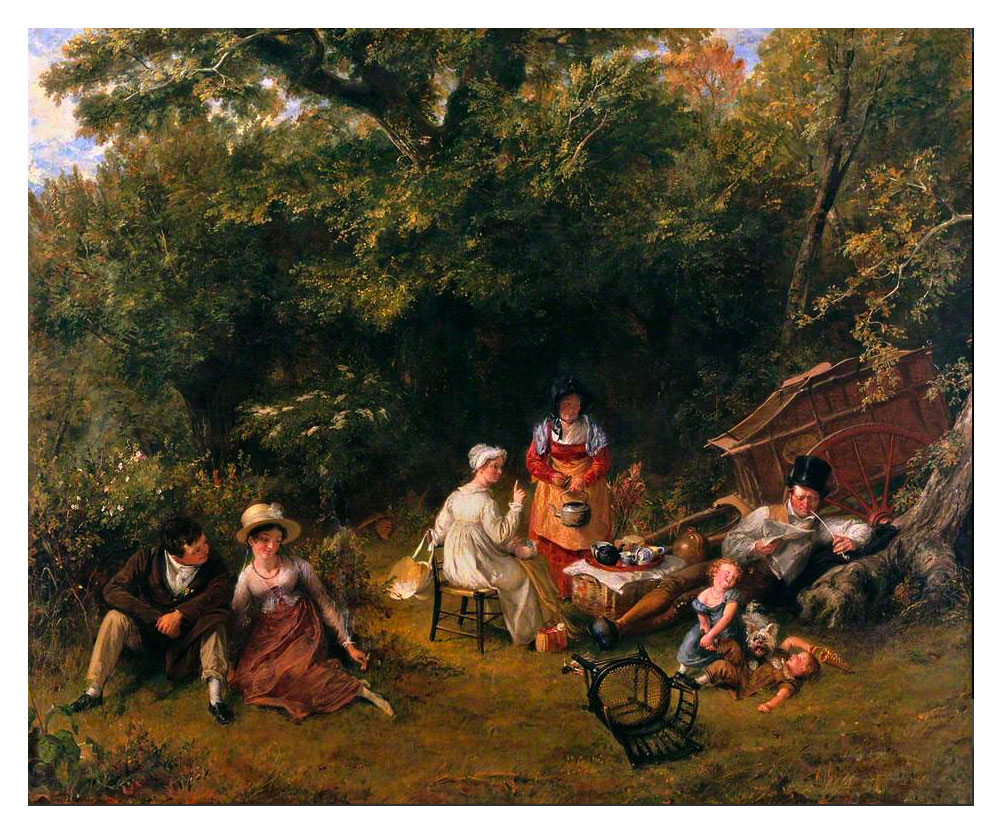


CR Leslie, "Londoners Gypsying (the Family Holiday Party, in Epping Forest, neat London" (1830), Geffrye Museum

[https://artuk.org/discover/artworks/londoners-gypsying-the-family-holiday-party-in-epping-forest-near-london-133015]

(Click on image to enlarge)

PB: I rather hoped Leslie had depicted something like this event, but sadly not:

Globe, Monday 30 July 1827


(Click on image to enlarge)

The Party, Friday last, pitched their tent among the cedars [PB: cedars?] on Wandsworth Common, at five p.m. The viands were brought by the Duchess Leinster, Dowager Marchioness Salisbury. Marchioness of Tavistock, Lady Caroline Stanhope, and Mrs. Parnther. The wines by Lord Tullamore and a number of bachelors. At the hour of eight the carriages were ordered; at nine they were in town attend the fete at Chesterfield House. lhe supper was laid in the grand banqueting hail, with covers for between three and four hundred persons; all served off a new and massive service of plate. The dancing was kept up with great spirit till half-past five o'clock.

[Source: Link.]

Wikipedia: Charles Robert Leslie

Blackwood's Edinburgh Magazine, Volume 46: "Leslie's "Dulcinea del Toboso" is capital; but is *the* character? Perhaps Mr Leslie's conception of it is right."

Link

Link

vanda-cis-O76302.pdf

Link

Link

"According to the anonymous reviewer of the Royal Academy show in 1839...the title of Charles Robert Leslie's Dulcinea del Toboso ... was a "a misnomer": "It is not a portrait of the inamorato [sic] of Don Quizote ... although a very carefully painted picture of a buxom country wench," the reviewer wrote, perhaps forgetting that Quixote's beloved, who is in fact only a country wench herself, never actually appears in the novel. [not 14] p131

Picture Titles: How and Why Western Paintings Acquired Their Names, Ruth Bernard Yeazell

Link

Check whether a portrait or a scene of the encampment is recorded in the catalogue of Leslie's paintings in Tom Taylor's edited version of Leslie's biography of Constable [title?]...Why did TT edit Leslie?

Link

[PB: This is curious: a fine photograph of a Charlotte Lee, wife of Jack Cooper, photographed in the C20: Link

[PB: I have recently come across some very good material, which should be added. E.g.

[TO SORT...]

https://www.myfamilysilver.com/blog/index.php/2010/01/sir-roger-de-coverley-and-the-gipsies/#.XhIZkIWZOME

http://romanygenes.com/#/jack-cooper/4524446645

LOC: The Gyspies y Charles G Leland in the Joseph and Elizabeth Robins Pennell Collection not digitalised = http://www.loc.gov/pictures/item/24020494/

[Eliz. Pennell was Leland's niece [?]]

Pennells: http://dla.library.upenn.edu/dla/ead/ead.html?id=EAD_upenn_rbml_MsColl50&

https://en.wikipedia.org/wiki/Elizabeth_Robins_Pennell

https://en.wikipedia.org/wiki/Joseph_Pennell

Are there any gipsies around here:

https://c8.alamy.com/comp/E7YBRR/pennell1893-p169-are-there-any-gipsies-around-here-E7YBRR.jpg

http://dac-collection.wesleyan.edu/Art37123

Univ of Teas: Pennells https://norman.hrc.utexas.edu/fasearch/pdf/00225.pdf

Pennell: Broklyn Museum: https://www.brooklynmuseum.org/opencollection/artists/56/objects

Pennell-Whistler collection,

Joseph Pennell papers / Elizabeth Robins Pennell papers / James McNeill Whistler papers

https://www.loc.gov/item/mm79035857/