A HISTORY OF
WANDSWORTH COMMON

IN PROGRESS — NOT FOR PUBLICATION

GYPSIES & TRAVELLERS ON WANDSWORTH COMMON

Refresh this page

Index

Charles Robert Leslie, painter (1794-1859)

George Borrow Society: Wandsworth Gypsies [this site]

George Borrow: Wandsworth Gypsies [from Romany Lavo Lil?]

Wikipedia: George Borrow (1803-1881).

Wikipedia: Charles Robert Leslie (1794-1859).

Wikipedia: Charles Godfrey Leland (1824-1903).

History of Wandsworth Common: Charlotte Cooper (dates?).

Jack Cooper

[Univ. of Liverpool Archive]: Galician Gypsies [to follow up].

Old Bailey Online: Gypsies and Travellers [to follow up].

Backed up notes about Charlotte to check [to follow up].

Gypsy and Traveller settlements and facilities in south west London are being charted in an online interactive map. https://www.swlondoner.co.uk/mapping-the-gypsy-and-traveller-community-in-south-west-london/

John Thomson, Street Life in London
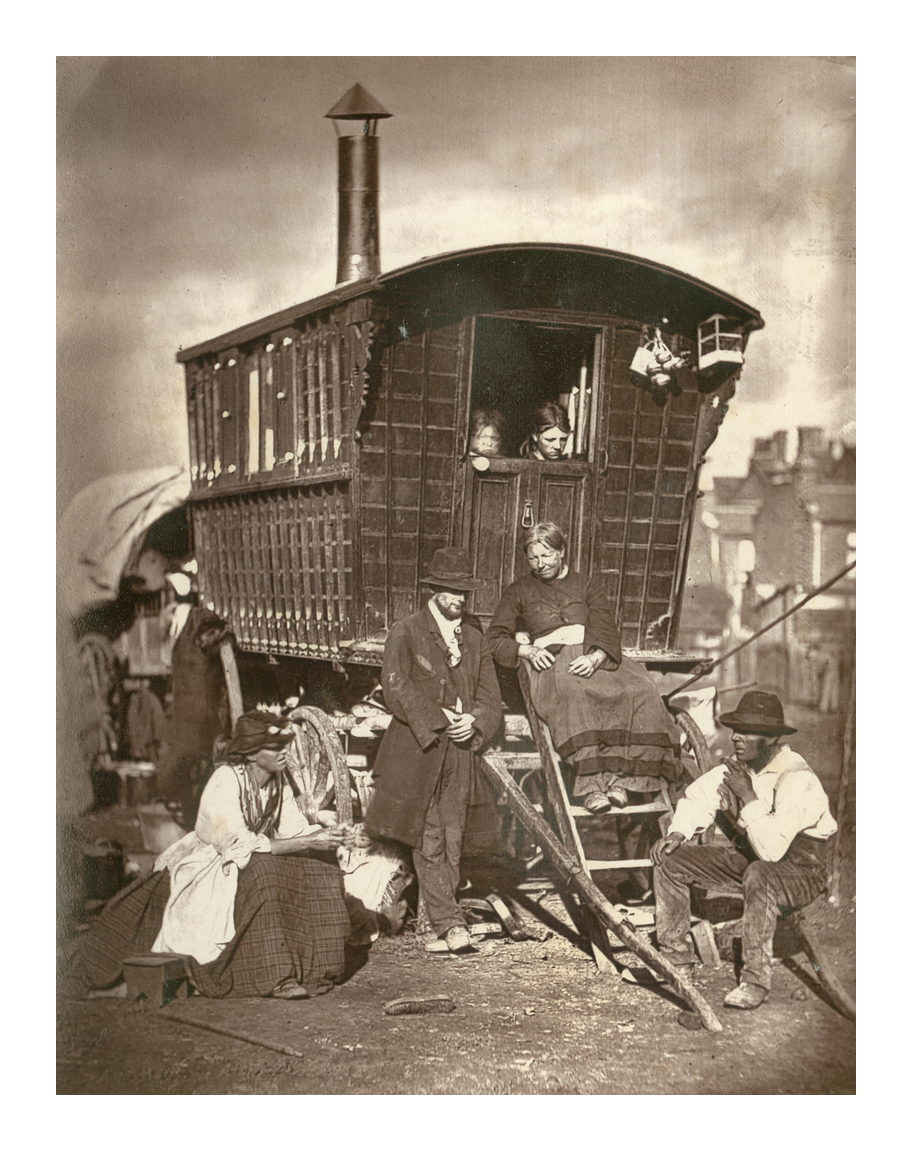


"London Nomades", from 'Street Life in London', 1877, by John Thomson and Adolphe Smith

Photographed at Battersea. The people shown are likely to have been relatively better off than many travelling people because they have a caravan.

(Click on image to enlarge)

From 'Street Life in London', 1877, by John Thomson and Adolphe Smith:

"The class of Nomades with which I propose to deal makes some show of industry. These people attend fairs, markets, and hawk cheap ornaments or useful wares from door to door. At certain seasons this class 'works' regular wards, or sections of the city and suburbs. At other seasons its members migrate to the provinces, to engage in harvesting, hop-picking, or to attend fairs, where they figure as owners of 'Puff and Darts', 'Spin 'em rounds', and other games.

[...]

"The accompanying photograph, taken on a piece of vacant land at Battersea, represents a friendly group gathered around the caravan of William Hampton, a man who enjoys the reputation among his fellows, of being 'a fair-spoken, honest gentleman'. Nor has subsequent intercourse with the gentleman in question led me to suppose that his character has been unduly overrated.

[...]

"He honestly owned his restless love of a roving life, and his inability to settle in any fixed spot. He also held that the progress of education was one of the most dangerous symptoms of the times, and spoke in a tone of deep regret of the manner in which decent children were forced now-a-days to go to school. 'Edication, sir! Why what do I want with edication? Edication to them what has it makes them wusser. They knows tricks what don't b'long to the nat'ral gent. That's my 'pinion. They knows a sight too much, they do! No offence, sir. There's good gents and kind 'arted scholards, no doubt. But when a man is bad, and God knows most of us aint wery good, it makes him wuss. Any chaps of my acquaintance what knows how to write and count proper aint much to be trusted at a bargain.'

[...]

"The dealer in hawkers' wares in Kent Street, tells me that when in the country the wanderers 'live wonderful hard, almost starve, unless food comes cheap. Their women carrying about baskets of cheap and tempting things, get along of the servants at gentry's houses, and come in for wonderful scraps. But most of them, when they get flush of money, have a regular go, and drink for weeks; then after that they are all for saving... They have suffered severely lately from colds, small pox, and other diseases, but in spite of bad times, they still continue buying cheap, selling dear, and gambling fiercely.'

[...]

"Declining an invitation to 'come and see them at dominoes in a public over the way', I hastened to note down as fast as possible the information received word for word in the original language in which it was delivered, believing that this unvarnished story would at least be more characteristic and true to life."

https://digital.library.lse.ac.uk/collections/streetlifeinlondon

https://digital.library.lse.ac.uk/objects/lse:jer426cev

https://digital.library.lse.ac.uk/objects/lse:jer426cev/view

NB: Check Raph Samuel's essay "Comers and Goers". I haven't been able to view the whole essay, but I understand it says gypsies lived on Wandsworth Common until around 1870 [?], when the new Conservators threw them off. I seem to recall that police too had only very limited powers on the common until then [?].

I have copied a few pages of RS's essay as " Raphael_Samuels_Comers_and_Goers_in_Dyos_and_Wolff_123-129_ends_160.pdf"


Gypsy encampment, Essex, C19

[Image from History Today, no other source, no date given other than "19th century". I have yet to find any photographs of Gypsies on Wandsworth Common. But this image may be relevant as Borrow records that a number of Gypsies regularly travelled between Essex (Epping Forest/Loughton) and Wandsworth.] ]

(Click on image to enlarge)

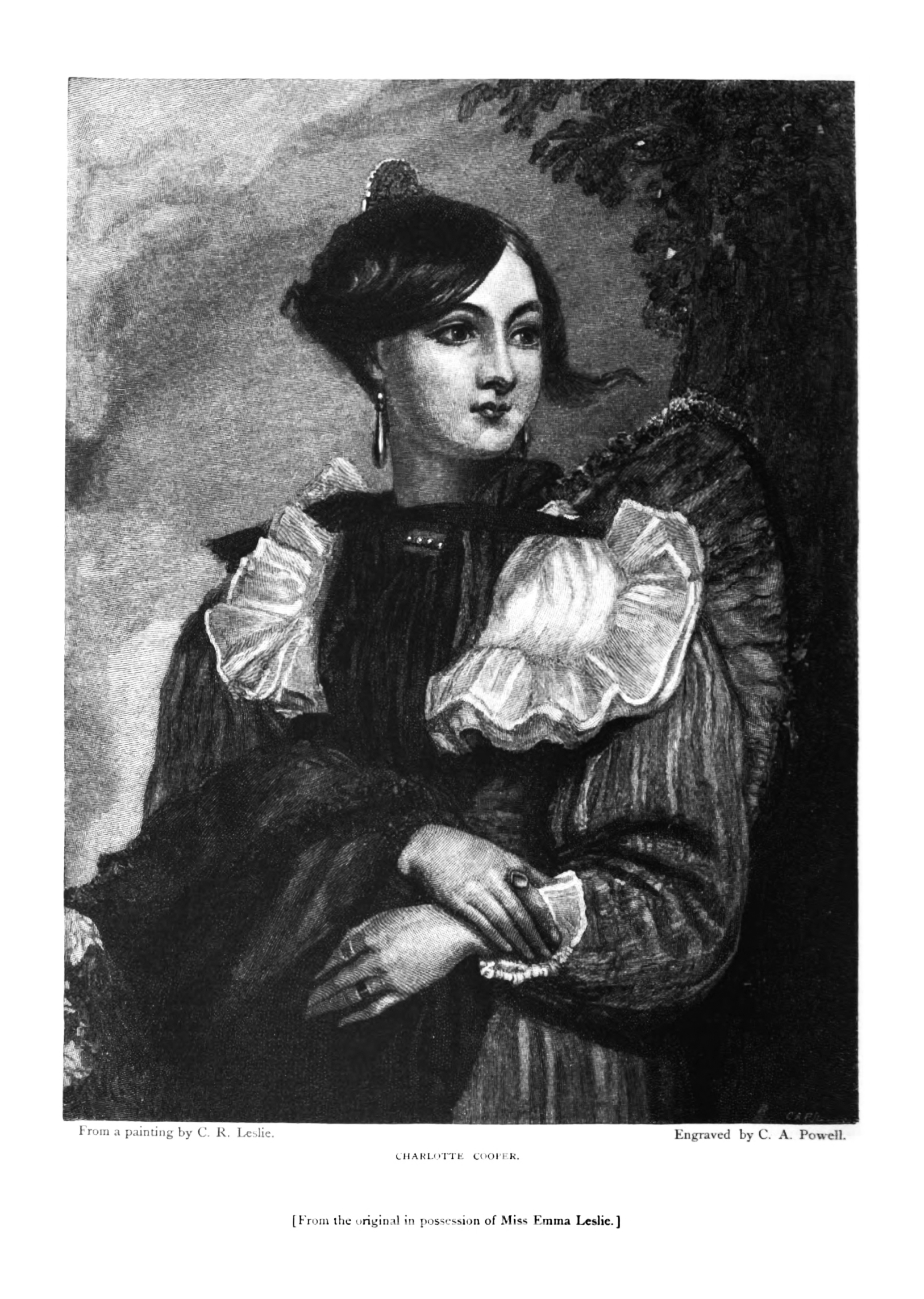
PB: Some years ago I came across an image of a Gypsy encampment on Wandsworth Common, featuring a tall and very beautiful Charlotte Cooper. Or did I? I now can't find it anywhere (and I've spent a long time trying). But there are a number of references to Charlotte in the literature, and to a fine portrait of her, from around 1830, by CR Leslie.

Most recently, the Survey of London volume on Battersea reports:

Gypsies had long been present on Wandsworth Common, contributing to local folklore in the form of the gypsy wife of a boxer, Jack Cooper, famed for having 'knocked West Country Dick to pieces' and killing Paddy O'Leary the 'pot Boy'. She was the subject of a Romany song and a portrait by Constable's friend and biographer, C. R. Leslie, painted c.1830 [n.174].

Does the Survey show the pic? Had the authors seen the painting?

[Also, the Survey (following Sexby?) says Charlotte Cooper lives on the Common, or, as Borrow says, on a smaller area nearby, "the Plain"? And where exactly was the Plain?]

Borrow:

What may be called the grand Metropolitan Gypsyry is on the Surrey side of the Thames. Near the borders of Wandsworth and Battersea, about a quarter of a mile from the river, is an open piece of ground which may measure about two acres. To the south is a hill, at the foot of which is a railway, and it is skirted on the north by the Wandsworth and Battersea Road. This place is what the Gypsies call a kekkeno mushes puv, a no man's ground; a place which has either no proprietor, or which the proprietor, for some reason, makes no use of for the present. The houses in the neighbourhood are mean and squalid, and are principally inhabited by artisans of the lowest description. This spot, during a considerable portion of the year, is the principal place of residence of the Metropolitan Gypsies, and of other people whose manner of life more or less resembles theirs.

See: 49_introduction.pdf

[PB: Notice n.174 says only "LMA, OS/W/5/1: Sexby, pp.237-8". What is the LMA reference? Is the author merely paraphrasing Sexby [who is himself quoting Borrow? CHECK] - there is no independent source.]


An engraving of Leslie's famous portrait of Charlotte Cooper - which may not be a good representation of the original paiting - which I ahve not been able to locate (it is probably in the USA, since Leslie is known to have sent it to his sister there).


Leslie, Dulcinea - it seems likely that the model was Charlotte Cooper

Sexby [title? date?],

Sexby is quoting from Borrow [does he credit him?]. Sexby appears to know Leslie's painting of Charlotte Cooper, but is it as a portrait or (as the last sentence suggests), a larger view of the encampment? In any case, she can't be the tall figure I recall.

One portion was the resort of gipsy vans and tents, one of whose occupants has been immortalized in a picture by C. R. Leslie, R.A., painted about 1830.

The following story is told about this gipsy beauty:

'There is a very small tent about the middle of Wandsworth Common; it belongs to a lone female whom one frequently meets wandering, seeking an opportunity to dukker (tell fortunes) to some credulous servant girl. It is hard that she should have to do so, as she is more than seventy-five years of age, but if she did not she would probably starve. She is very short of stature, being little more than five feet and an inch high, but she is wonderfully strong built. Her face is broad, with a good-humoured expression upon it, and in general with very little vivacity; at times, however, it lights up, and then all the gipsy beams forth. Old as she is, her hair, which is very long, is as black as the plumage of a crow, and she walks sturdily, and if requested would take up the heaviest man in Wandsworth and walk away with him. She is upon the whole the oddest gipsy woman ever seen; see her once and you will never forget her.

Who is she? Why, Mrs. Cooper the wife of Jack Cooper, the fighting gipsy, once the terror of all the lightweights of the English ring, who knocked West Country Dick to pieces and killed Paddy O'Leary, the "Pot Boy," Jack Randall's pet. Ah it would have been well for Jack if he had always stuck to his true lawful Romany wife, whom at one time he was very fond of, and whom he used to dress in silks and satins, and best scarlet cloth, purchased with the money gained in his fair, gallant battles in the ring.'

A characteristic song was written on her in the original Romany of which the translation runs:

Charlotte Cooper is my name,
I am a real old Lee;
My husband was Jack Cooper,
The fighting Romany.
He left me for a shameful girl
Who stole a purse, while he
Took all the blame, and all the shame,
And went beyond the sea.

A gipsy encampment forms a romantic subject for a picture, but the reality is quite a different thing, and Wandsworth is quite willing to sacrifice the romance in losing these unwelcome visitors.

And Sexby in turn was drawing on George Borrow:

[Charlotte Cooper]

There is a very small tent about the middle of the place; it belongs to a lone female, whom one frequently meets wandering about Wandsworth or Battersea, seeking an opportunity to dukker some credulous servant-girl. It is hard that she should have to do so, as she is more than seventy-five years of age, but if she did not she would probably starve. She is very short of stature, being little more than five feet and an inch high, but she is wonderfully strongly built. Her head is very large, and seems to have been placed at once upon her shoulders without any interposition of neck. Her face is broad, with a good-humoured expression upon it, and in general with very little vivacity; at times, however, it lights up, and then all the Gypsy beams forth. Old as she is, her hair, which is very long, is as black as the plumage of a crow, and she walks sturdily, though with not much elasticity, on her short, thick legs, and, if requested, would take up the heaviest man in Wandsworth or Battersea and walk away with him. She is, upon the whole, the oddest Gypsy woman ever seen; see her once and you will never forget her.

Who is she? you ask. Who is she? Why, Mrs. Cooper, the wife of Jack Cooper, the fighting Gypsy, once the terror of all the Light Weights of the English Ring; who knocked West Country Dick to pieces, and killed Paddy O'Leary, the fighting pot-boy, Jack Randall's pet. Ah, it would have been well for Jack if he had always stuck to his true, lawful Romany wife, whom at one time he was very fond of, and whom he used to dress in silks and satins, and best scarlet cloth, purchased with the money gained in his fair, gallant battles in the Ring! But he did not stick to her, deserting her for a painted Jezebel, to support whom he sold his battles, by doing which he lost his friends and backers; then took from his poor wife all he had given her, and even plundered her of her own property, down to the very blankets which she lay upon; and who finally was so infatuated with love for his paramour that he bore the blame of a crime which she had committed, and in which he had no share, suffering ignominy and transportation in order to save her. Better had he never deserted his tatchie romadie, his own true Charlotte, who, when all deserted him, the painted Jezebel being the first to do so, stood by him, supporting him with money in prison, and feeing counsel on his trial from the scanty proceeds of her dukkering.

All that happened many years ago; Jack's term of transportation, a lengthy one, has long, long been expired, but he has not come back, though every year since the expiration of his servitude he has written her a letter, or caused one to be written to her, to say that he is coming, that he is coming; so that she is always expecting him, and is at all times willing, as she says, to re-invest him with all the privileges of a husband, and to beg and dukker to support him if necessary. A true wife she has been to him, a tatchie romadie, and has never taken up with any man since he left her, though many have been the tempting offers that she has had, connubial offers, notwithstanding the oddity of her appearance.

Only one wish she has now in this world, the wish that he may return; but her wish, it is to be feared, is a vain one, for Jack lingers and lingers in the Sonnakye Tem, golden Australia, teaching, it is said, the young Australians to box, tempted by certain shining nuggets, the produce of the golden region.

It is pleasant, though there is something mournful in it, to visit Mrs. Cooper after nightfall, to sit with her in her little tent after she has taken her cup of tea, and is warming her tired limbs at her little coke fire, and hear her talk of old times and things: how Jack courted her 'neath the trees of Loughton Forest, and how, when tired of courting, they would get up and box, and how he occasionally gave her a black eye, and how she invariably flung him at a close; and how they were lawfully married at church, and what a nice man the clergyman was, and what funny things he said both before and after he had united them; how stoutly West Country Dick contended against Jack, though always losing; how in Jack's battle with Paddy O'Leary the Irishman's head in the last round was truly frightful, not a feature being distinguishable, and one of his ears hanging down by a bit of skin; how Jack vanquished Hardy Scroggins, whom Jack Randall himself never dared fight.

Then, again, her anecdotes of Alec Reed, cool, swift-hitting Alec, who was always smiling, and whose father was a Scotchman, his mother an Irishwoman, and who was born in Guernsey; and of Oliver, old Tom Oliver, who seconded Jack in all his winning battles, and after whom he named his son, his only child, Oliver, begotten of her in lawful wedlock, a good and affectionate son enough, but unable to assist her, on account of his numerous family.

Farewell, Mrs. Cooper, true old Charlotte! here's a little bit of silver for you, and a little bit of a gillie to sing:

Charlotta is my nav,
I am a puro Purrun;
My romado was Jack,
The couring Vardomescro.
He muk'd me for a lubbeny,
Who chor'd a rawnie's kissi;
He penn'd 'twas he who lell'd it,
And so was bitched pawdel.

Old Charlotte I am called,
Of Lee I am a daughter;
I married Fighting Jack,
The famous Gypsy Cooper.
He left me for a harlot,
Who pick'd a lady's pocket;
He bore the blame to save her,
And so was sent to Bot'ny.

Strangely, although there are numerous references over the last 150 or so years to this "fine portrait", it proved difficult to find a copy anywhere, e.g. on the ArtUK site, where 81 paintings are attributed to Leslie.

There are other sources, too:

Leland:

Letter in response [?] to Leland

So did Leslie paint the whole scene or just the portrait?

Show engraving from Leland article in The Century...

Note the similarity to Leslie's Dulcinea del Toboso (1839)

V&A

The title of this painting comes from Cervantes' comic novel Don Quixote (1605). The fanciful aristocratic name 'Dulcinea Del Toboso' was given by Don Quixote to a pretty peasant woman. The eccentric Don believed that he was her protector and she was a 'great lady or Princess'. She was unaware of his fantasies.

[Source: Link. Also vanda-cis-O76302.pdf]

See also:

"According to the anonymous reviewer of the Royal Academy show in 1839...the title of Charles Robert Leslie's Dulcinea del Toboso ... was a "a misnomer": "It is not a portrait of the inamorato [sic] of Don Quizote ... although a very carefully painted picture of a buxom country wench," the reviewer wrote, perhaps forgetting that Quixote's beloved, who is in fact only a country wench herself, never actually appears in the novel. [not 14] p131

[Source: Ruth Bernard Yeazell, Picture Titles: How and Why Western Paintings Acquired Their Names - Link

See AUTOBIOGRAPHICAL RECOLLECTION BY THE LATE ?? CHARLES ROBERT LESLIE, R.A. EDITED, WITH A PREFATORY ESSAY ON LESLIE AS AN ARTIST, AND SELECTIONS FEOM HIS CORRESPONDENCE, By TOM TAYLOR, Esq. (1860?)

Check whether a portrait (or a scene of the encampment) is recorded in the catalogue of Leslie's paintings in Tom Taylor's edited version of Leslie's biography of Constable [title?]...

[Why did TT edit Leslie? Did he know him?]

There is no reference in the listing of Leslie's paintings to his portrait of Charlotte Cooper, so far as I can see, But notice three references to "gipsies".

1820. Londoners Gipsying. (Exhibited) 1820.

1829: Sir Roger de Coverley and the Gipsies. Engraved.

1839: Dulcinea. Painted for J. Sheepshanks, Esq. In the National Collection"

Letter CRL to "Miss Leslie" [presumably sister?], April 9, 1820:

"Since I last wrote I have completed my picture of the 'Gipsying Party,' and sent it to Somerset House. In a few days I hope to hear where it is placed, and how it is liked by the Academicians."

Letter CRL to "Miss Leslie", April 9, 1820:

I have not yet sold my picture of the 'Gipsying Party,' and scarcely expect it now.

TT [writing in 1860]: "I have not been able to ascertain where the 'Gipsying Party' now is, or anything of the way in which the subject is treated."

PB: For a long time I thought 'Londoners Gipsying' almost certainly depicted a group of aristocrats coming out from London to remote semi-rural locations such as Wandsworth Common [see below].

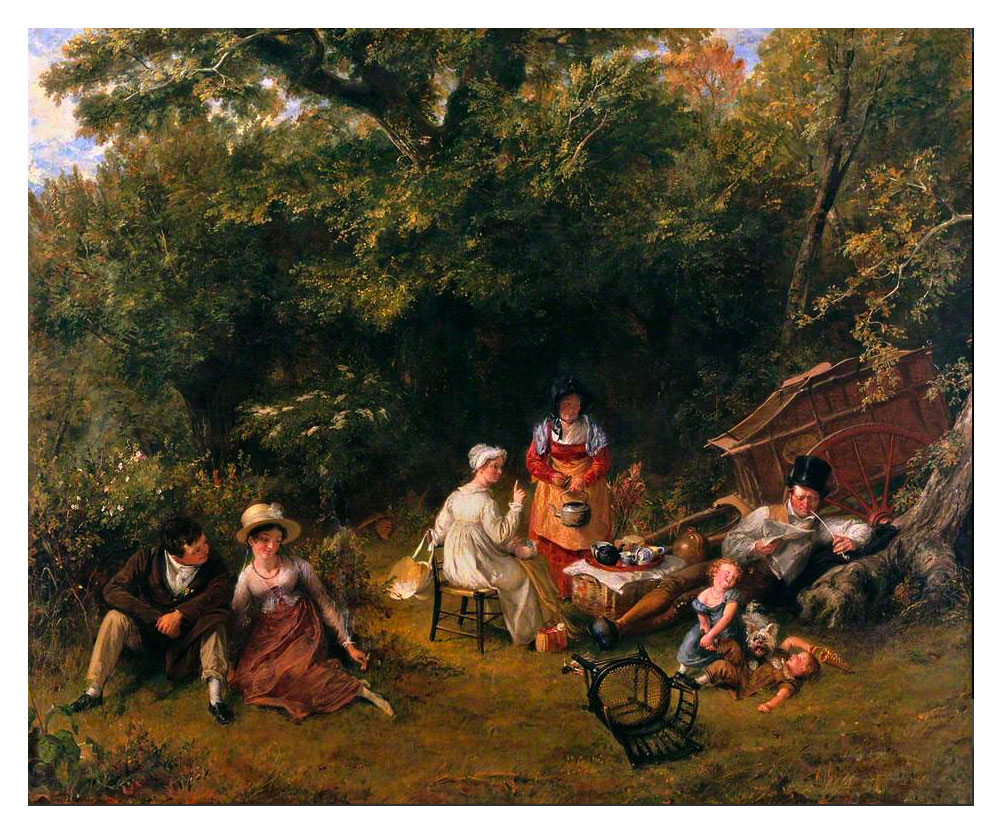
But I was wrong. It seems the painting is now in the Geffrye Museum, with the title 'Londoners Gypsying (the Family Holiday Party, in Epping Forest, neat London':


CR Leslie, "Londoners Gypsying (the Family Holiday Party, in Epping Forest, neat London" (1830), Geffrye Museum

[https://artuk.org/discover/artworks/londoners-gypsying-the-family-holiday-party-in-epping-forest-near-london-133015]

(Click on image to enlarge)

PB: I rather hoped Leslie had depicted something like this event:

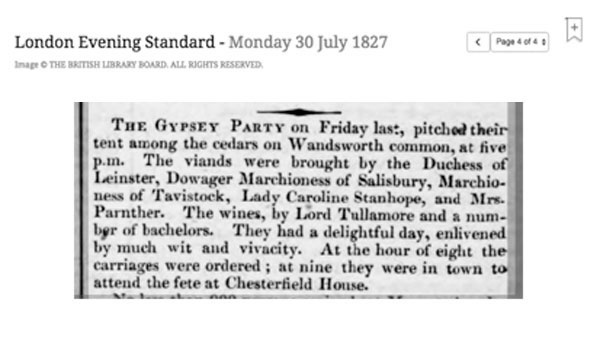
London Evening Standard, Monday 30 July 1827

The Gypsey Party pitch their tent on Wandsworth Common


(Click on image to enlarge)

The Gypsey Party on Friday last, pitched their tent among the cedars on Wandsworth common, at five p.m. The viands were brought by the Duchess of Leinster, Dowager Marchioness of Salisbury, Marchioness of Tavistock, Lady Caroline Stanhope, and Mrs. Parnther. The wines, by Lord Tullamore and a number of bachelors. They had a delightful day, enlivened by much wit and vivacity. At the hour of eight the carriages were ordered; at nine they were in town to attend the fete at Chesterfield House.

[Source: Link.]

Slightly longer account:

Globe, Monday 30 July 1827


(Click on image to enlarge)

The Party, Friday last, pitched their tent among the cedars [PB: cedars?] on Wandsworth Common, at five p.m. The viands were brought by the Duchess Leinster, Dowager Marchioness Salisbury. Marchioness of Tavistock, Lady Caroline Stanhope, and Mrs. Parnther. The wines by Lord Tullamore and a number of bachelors. At the hour of eight the carriages were ordered; at nine they were in town attend the fete at Chesterfield House. lhe supper was laid in the grand banqueting hail, with covers for between three and four hundred persons; all served off a new and massive service of plate. The dancing was kept up with great spirit till half-past five o'clock.

[Source: Link.]

Some reprinted accounts [which was the original?]

Public Ledger and Daily Advertiser, Tuesday 31 July 1827: Link

Morning Advertiser, Tuesday 31 July 1827: Link.

Saunders's News-Letter, Thursday 02 August 1827: Link

Wikipedia: Charles Robert Leslie

Survey of London [date?], vol 49, chapter 5:

Various nuisances were dealt with, notably clearing away rubbish, such as detritus dumped from the building trade and road-making, and removing unauthorized livestock and people, including 'encampments of gypsies, itinerant photographers and vendors of goods'. Gypsies had long been present on Wandsworth Common, contributing to local folklore in the form of the gypsy wife of a boxer, Jack Cooper, famed for having 'knocked West Country Dick to pieces' and killing Paddy O'Leary the 'pot Boy'. She was the subject of a Romany song and a portrait by Constable's friend and biographer, C. R. Leslie, painted c.1830. [n.174]

[Source: 49_references: ch.5 n.174. LMA, OS/W/5/1: Sexby, pp.237-8.]

[PB: Is the portrait shown?]

Blackwood's Edinburgh Magazine, Volume 46: "Leslie's "Dulcinea del Toboso" is capital; but is *the* character? Perhaps Mr Leslie's conception of it is right."

Link

Link

vanda-cis-O76302.pdf

Link

Link

"According to the anonymous reviewer of the Royal Academy show in 1839...the title of Charles Robert Leslie's Dulcinea del Toboso ... was a "a misnomer": "It is not a portrait of the inamorato [sic] of Don Quizote ... although a very carefully painted picture of a buxom country wench," the reviewer wrote, perhaps forgetting that Quixote's beloved, who is in fact only a country wench herself, never actually appears in the novel. [not 14] p131

Picture Titles: How and Why Western Paintings Acquired Their Names, Ruth Bernard Yeazell

Link

Check whether a portrait or a scene of the encampment is recorded in the catalogue of Leslie's paintings in Tom Taylor's edited version of Leslie's biography of Constable [title?]...[PB: I couldn't find it there.] Why did TT edit Leslie?

Link

NB: Tom Taylor, also editor of Punch, lived in Lavender Sweep, off Battersea Rise. He was part of the committee formed in 1869-1870 to save Wandsworth Common, and author of the fine poem "Warning of Wandsworth Common" (1865).

Various nuisances were dealt with, notably clearing away rubbish, such as detritus dumped from the building trade and road-making, and removing unauthorized livestock and people, including 'encampments of gypsies, itinerant photographers and vendors of goods'. Gypsies had long been present on Wandsworth Common, contributing to local folklore in the form of the gypsy wife of a boxer, Jack Cooper, famed for having 'knocked West Country Dick to pieces' and killing Paddy O'Leary the 'pot Boy'. She was the subject of a Romany song and a portrait by Constable's friend and biographer, C. R. Leslie, painted c.1830. [n.174]

[49_references: ch.5 n.174. LMA, OS/W/5/1: Sexby, pp.237 - 8]

Link

Edward Thomas, "The Gypsy" (date)

[Add info about this poem - I recollect that it describes the Christmas Fair on WC. Find sources to confirm.]


[More on Edward Thomas & this poem]

(Click on image to enlarge)

Hazel Sheeky, Camping and Tramping, Swallows and Amzaons: Interwar Children's Fiction and the Search for England, PhD thesis, University of Newcastle, 2012.

GYPSIES_WC CAMPING & TRAMPING_Sheeky_12.pdf

Refers to Patch and WC

David Severn, Waggoner series of novels for children


Patch Cooper was smiling, deepening the wrinkles on his weatherbeaten face. If she hadn't known him so well; if his expression hadn't been so kind, why, she would have been quite terrified of him. As it was, his face didn't seem to matter at all. [...]

My family used to live in London," continued the gypsy. "Wandsworth Common. Aye, there were tents as far as the sky could reach. That were in my father's father's time ... things are changed today. I do reckon we Romanies ... we of the true blood ..." Patch Cooper hesitated, looking down at his rough, gnarled hands that held the smooth leather of the reins. "I do reckon we be a dying people."

David Severn, A Cabin for Crusoe (1943)

Stephen Bigger, David Severn (David Storr Unwin), Children's Writer.

David Severn (3.12.1918 - 11.2.2010) is a pseudonym for David Storr Unwin, British, son of Sir Stanley Unwin the publisher. Not wishing to trade on the Unwin name, he chose the name Severn as a family name (his uncle Severn Storr went with Sir Stanley on a world tour (Unwin and Storr, 1934).

David Severn wrote 30 children's books, mostly for John Lane at The Bodley Head, mainly school holiday adventures on a farm, or camping or travelling. The war is not mentioned till it is over, and then barely: the stories offer vicarious countryside peace at a time of national stress and danger, drawing positive learning from adventures, including with Romanies and a hermit artist, at a time of bombs, bullets and hunger in a countryside littered with tank traps, barbed wire and pill boxes.

His first series (1942-6) featured 'Crusoe' Robinson who was befriended by youngsters in holiday adventures, many featuring a Romany group and included a Romany funeral pyre. The Warner family series followed (1947-52) featuring pheasants, ponies and country life. The woodcut illustrations of Joan Kiddell-Monroe greatly enhance these two series.

A number of books experimented with the paranormal and time-slip, and can be compared with many modern books exploring supernatural themes. Drumbeats! has a musical youngster beating a native drum which transports children to a lost expedition to Africa twenty years earlier. Dream Gold shows the hypnotic power of one boy over another, with dreams actually reliving the conflicts of their ancestors. The Future Took Us is a time-slip into 3000AD. The Girl in the Grove, his longest book, is a psychological ghost story. He produced books for younger children, often to contract and for series.

David_Severn2007_eprint_updated.pdf David_Severn2007_eprint_updated.rtf

The Crusoe Series, 1942-46.

Severn's first children's novel was Rick Afire (1942), the first of five excellent 'Crusoe' stories. Rick Afire is a tale of two children evacuated from London because father was in hospital, to Whitehouse Farm1 where they had adventures in the countryside with the twins Brian and Pam with a pony called Nobby ('Pegasus') and a dog called William. Joan Kiddell-Monroe's artwork is excellent.

Rick Afire starts:

"Stonebury Junction...Stonebury...change 'ere for the Muddlington, 'amsford and Downpoort line... Stonebury Junction...Stonebury..."

The station was crowded with people. People were swarming out of the train and more were pushing their way in; people were stumbling and tripping over bags and hampers, throwing large suitcases through the doors and heaving them up into the racks. At last the train steamed out, the bustle died down, and after a while the platform cleared. Derek and Diana Longmore grouped their rucksacks and cases in a heap and looked around. There was no sign of the twins.

1 Based on a farm in Essex, according to his biography (Unwin, 1982).

The twins arrive helter skelter in a galloping home-made donkey cart.

"They came around the curve like a rocket. As he spoke the trap tipped violently, jerking both passengers off their balance, and they heeled over, clinging grimly to the sides while they took the bend on a single wheel...Then the trap hung poised for a moment; then the wheel dropped back with a thud and pony and cart came tearing along the straight into the station yard. The twins were sitting up on the seat as if nothing had happened...The trap drew up to the railings and the stocky figures of a girl and boy, in shorts and blue shirts, with tanned arms and legs and freckled faces, dropped down to the ground."

The twins were like peas in a pod, with freckled snubbed noses. Pam had a pony tail, the only way they could easily be told apart. They chattered most of the time. Actually, identical twins are genetically identical and therefore are always same sex. The values in Rick Afire include a love of the countryside, close observation of nature and a sense of preciousness of the environment. Readers are warned against collecting birds' eggs; there is delight at fox cubs at play; birds flit across the pages; compassion for animals at the market is expressed.

In Rick Afire two London children stay at a farm and are shown country ways. A pig escapes to farrow, a mysterious camper is stalked and later befriended (Mr Robinson, or 'Crusoe'), a hay rick catches fire and after proving Crusoe innocent, Tim Tinker (illustrated), an itinerant, is identified as the culprit, and chased in a dramatic car chase.

The second Severn book was A Cabin for Crusoe (1943)where an attempt to build a wilderness cabin brings Crusoe and the children into conflict with a group of Romanies, a conflict fomented by the farmer. The Romanies are painted realistically with a gang of lads, a bad-tempered heavy, his scheming and cheating wife, and a decent elder figure who appears continually throughout the series, Patch Cooper. The story discusses traditional Romany camping sites, the Romany way of life, and attitudes of settled folk in a very sensitive way. The Romanies are real people, not stereotypes. The tone is respectful. The conflict is resolved, and with Patch's help, Crusoe gets a caravan instead of a cabin.

In the third Crusoe book, A Waggon for Five (1944) the group join up with Cooper's circus run by a relative of Patch. They experience circus life and foil a plot to steal the takings of the circus by the strong man. He is apprehended in a frantic lorry chase. Another family is introduced in this book, the Crosbies, who live on a houseboat and whose father is an artist. These also feature in the fourth book, Hermit in the Hills (1945), an adventure that in real time follows immediately on from the circus. Mr Crosbie is a nationally famous artist who makes a living selling his paintings, living precariously in bohemian style with his three children in a houseboat. The Crosbies hijack the 'Waggoners' for a cricket match and later met up with them at the circus. Motherless, and looked after by elder sister Jean, they had a "large, old fashioned tourer", an old and unreliable car. Leonard Crosbie was nationally famous in his own field, living by creative artistic endeavour, empowering his children to grow up to be free and independent.

Hermit in the Hills is an inspired exploration of the philosophy of art (e.g. pages 48-51). Two sections will suffice here.

"Take something more simple," he said, "a tree growing out from a slope..."

People will see it in different ways,

"But of all the people who come by, perhaps only one will know the birch and feel with it; see the backward twist of the trunk as it adjusts itself to the pull of the slope; the curve of the branches, supple, yet firm and strong as steel; feel the life in it, roots groping down deep into the soil, leaves and twigs swayed and rustled by the wind... only one person will go away with the wholeness, the perfection of that tree as a tree firmly printed in his mind. And he would be the only person qualified to paint it."

The hermit was brought up as a farmer, disowned by his father and in self-chosen exile to the hills in order to paint on the wall of a cave. He drew Mr Crosbie:

The stranger's sketch was in complete contrast to Mr Crosbie's drawings. Instead of their bold, forceful shading, he had achieved his effect with a few lines; the curve of the artist's hat, the sagging outline of his coat and trousers. The essentials alone were there; nothing more. (pp. 108-9).

In the final book of this series, Forest Holiday (1946), joining instructions are misunderstood, so the children are lost in a forest. They survive by their wits, building a shelter, and observe a great deal of wildlife. It culminates boisterously with gipsies at a local fair.

The Joan Kiddell-Monroe FEPs of A Waggon for Five and Forest Holiday are illustrated below.

[PB: This is curious: a fine photograph of a Charlotte Lee, wife of a Jack Cooper, photographed in the C20: Link

[This probably summarises contemporary views pretty well.]

Cambridge Chronicle and Journal - Friday 26 July 1816

[Link.]

[NEEDS EDIT]

THE GYPSIES

Of l ite years some attempts have been made to reduce the numbers, nt any rate to civilize the habits, of that vagabond aud useless race, the Gipsies. pursuance of such purpose, society gentlemen have been making all the preliminary enquiries requisite to a proper understanding of the subject. series of questions has been proposed competent persons in the different counties in England and Scotland and answers have been received. Our readers will, think, amused will* the follow ins specimens these answers

1 Gipsies suppose the first (hern came from Egypt.

2. They cannot form any idea of the number England.

3. The Gipsies of Bedfordshire, Hertfordshire, part of Buckinghamshire. Cambridge, and Huntingdon-hire, are continual)) making revolutions within the range of those counties.

4. They are either ignorant of the number of Gipsies the counties through which they travel, or unwilling disclose their knowledge.

4. The most common names are Smith, Cooper, Draper, Taylor, Bosswel, Lee, Lovell, Loversedge, Allen, Man-field, Glover, Williams, Martin, Stanley, Buckley, Plunketl, and Corrie.

6. and 7. The gangs in different towns not any regular connexion or organization; but those who take up their winter quarters in the same city, or town, appear to have some knowledge of the different routes each horde will pursue; probably with design prevent interference.

8. In the county of Herts it computed there may sixty families having many children. Whether they are quite sť numerous in Buckinghamshire, Bedfordshire, and Northamptonshire, the answers are not sufficiently definite to determine. In Cambridgeshire, Oxfordshire, Warwickshire. Wiltshire, and Dorsetshire, greater numbers are calculated upon. various counties, the attention has not been competent to the procuring data for any estimate of families or individuals.

9. More than half their number follow no business: others are dealers in horses and asses; farriers, -miths, tinkers, braziers, grinders of cutlery, basketmakers, chair-bottomers, and musicians.

10. Children are brought up in the their parents, particularly music and dancing, and are di-s.alute conduct.

11. The women mostly carry baskets with trinkets and small wares: and tell fortunes, Too ignorant to have acquired accounts of genealogy, and perhaps indisposed by the irregularity of their habits.

13. In most counties there are particular situations to which they are partial. In Berkshire is a marsh, near Newbury, much frequented by them; and Dr. Clarke slates, that Cambridgeshire their principal rendezvous near the western villages. It cannot ascertained whether, from their first coming into the natiou, attachment to particular places has prevailed. lj,

16, 17. When among strangers, they elude inquiries respecting their peculiar language, calling it gibberish. Don't know of any person that can write it, or of any written specimen of it.

18. Their habits and customs in all places are peculiar.

19. Those who profess any religion represent to that of the country in which they reside; but iheir description of it seldom goes beyond repeating the Lord's Prayer and only few of them are capable of that. Instances of their attending anyplace of worship are very rare.

20. They marry for the most part pledging to each other, without any ceremony. A few exceptions have occurred when money was plentiful.

21. They teach their children religion.

[Source: Link.]

Mapping the Gypsy and Traveller community in south west London

By Luke O'Reilly

July 5 2018, 15:30

Gypsy and Traveller settlements and facilities in south west London are being charted in an online interactive map.

The interactive map, designed by Mapping For Change in partnership with London Gypsies and Travellers (LGT), aims to work with both local authorities and members of the Gypsy and Traveller community to more accurately map the community across London.

Ilinca Diaconescu, policy officer at LGT, said that inspiration for the map came from the need to have an accessible resource for Gypsy and Traveller community members to find and input information about services in their local area that they need, as well as comments about how these could be improved.

Ms Diaconescu said: "There is a lack of consistent data collection about the community at different levels of government and public service.

"In a recent initiative by the government, a website called 'Ethnicity facts and figures, there is very little information about Gypsies and Travellers."

According to Ms Diaconescu this lack of information is 'mainly around education issues'.

The lack of data around the numbers of Gypsies and Travellers in London has led to uncertainty around how many of them there are, which in turn impacts how local authorities and the government plan for them.

The 2011 census was the first census to have a Gypsy/Traveller ethnicity option.

In London only 8200 people self-identified as Gypsy or Traveller, considerably lower than the estimate on the LGT's website of around 30,000.

Overall 57,680 people self-identified as Gypsies and Travellers in the 2011 census.

However, the 2006 Common Ground report put together by the Commission For Racial Quality estimated the number of Gypsies and Travellers in the UK to be between 200,000-300,000.

In south west London the interactive map charts the Trewint street site in Wandsworth, Lathams Way in Croydon, Lonesome depot (pictured) on the Mitcham-Streatham border as well as the Brickfields traveller site in Merton among others.

Information in the map is presented under different categories, such as services that are available or that have been lost, along with comments and experiences of those services.

Users can look up a place, keyword or browse through the categories to find out information about services and facilities they are interested in such as housing, education, advice, work, leisure, culture, community places, and community businesses.

They can then click on an icon and get a range of additional information what services are offered, who are the contact details as well as videos, photos and comments associated with that place.

Users can also add comments about their experiences using these services and facilities in the form of an audio, video, photo, text.

The LGT encourage map users from the Gypsy and Traveller community and from local authorities and public service providers to add contributions to the map, for instance around services they use or offer.

Ms Diaconescu said: "This is essential as the content of the map and the information available depends on people's participation."

Ms Diaconescu said that another reason for the map is that the caravan count, a bi-annual process whereby the government counts the number of gypsy and traveller caravans across the UK, fails to account for the settled gypsy and traveller population.

She added that in London 80% of the Traveller and Gypsy population live in social housing which prevents them from being counted in the caravan count.

Mapping for change, the LGT's partner in the project is a wholly owned subsidiary of University College London.

The first part of the project involved collecting existing sources of data and to use them to create maps that illustrated different statistics around accommodation, health and unemployment.

This set of maps was used as part of the evidence base for the mayor of London's draft London plan for caravan pitches for the city's traveller and gypsy population.

Ms Diaconescu said that this is because many Travellers and Gypsies hide their identities when interacting with public institutions and the outside world for fear of discrimination.

Another aim of the map is to support and mobilise members of the Gypsy and Traveller communities to identify common concerns in their local areas and campaign for equality and services that better meet their needs.

Ilinca hopes that through interacting with the map local authorities and public services will understand more about Gypsy and traveller communities and can help support greater inclusion and challenge negative stereotypes.

Launched a month ago, the map is in its early stages.

They have been updating the map to show basic information for each of the local authorities, including the location of traveller and gypsy sites, how people can register for a pitch, community places, and information about support organisations.

Ms Diaconescu said: "Community contributions have come through a number of workshops and we are developing a series of videos explaining how to use the map for different purposes.

"There have been some contributions from local authorities."

[Source: Link.]

[Source: GT Maps. Mapping for Change https://communitymaps.org.uk/welcome]

Odds and ends to follow up

See also a number of excellent AllThingsGeorgian articles on Romany gypsies, including detailed, well-illustrated ones about Victoria's acquaintance with gypsies at Claremont, near Esher, c.1836, just before she became queen.

Whilst reading her journal it becomes very clear that these gypsies held a very special place in her heart. They were travellers who had set up camp near Claremont from December 1836 to early January 1837 just a few years before her coronation and then her marriage to Prince Albert. She records her every meeting with the family and even drew pictures of them.

It seems likely that these gypsies would have known Wandsworth Common well. Claremont House is near Esher, only 10 miles from Wandsworth straight down the old Portsmouth Road between Wimbledon Common and Richmond Park and through Kingston (the old A3).

The article contains numerous illustrations of Cooper family members and others, many by Victoria herself. She draws attention to their vivacity and beauty.

From Victoria's diary, 7 December 1836:

We met the same two Gipsies as the other day accompanied by another very pretty one, who, the young one of the other day told us, was her sister-in-law, & was in daily expectation of her confinement; the old woman, she told us the other day, was her mother; her own name, she said was Cooper. They are encamped on the Portsmouth road now, where we walk every day.

Could this be Charlotte Cooper? She could have been a "sister-in-law" - but CC is said to have been painted by Leslie c.1830, which is probably too early. However, the more securely dated "Dulcinea" painting is from 1836, isn't it? And that would be spot on.

PB: Did Victoria own paintings by Leslie? Yes! And only a few years later.


[Source: Royal Collection Trust: C.R. Leslie: The Christening of Victoria, Princess Royal, 10 February 1841 c. 1841-2.]

(Click on image to enlarge)
  • AllThingsGeorgian: "Princess Victoria and the gypsies, part 1", Sarah Murden (date?).
  • AllThingsGeorgian: "Princess Victoria and the gypsies, part 2", Sarah Murden (December 2016).
  • AllThingsGeorgian: Search: Gypsy.
  • AllThingsGeorgian: "Fascinating gypsy genealogy resource" (2016). This is Eric Trudgill and Ann-Marie Ford's Gypsy Genealogy website. Site did not appear to be working properly in Jan 2020.
  • AllThingsGeorgian: "Mrs Bridget the Norwood Gipsey", Sarah Murden (January 2017).
  • AllThingsGeorgian: "Misjudged gypsies".
  • Stolen by gypsies, 1802: fascinating article (with good images) on an alleged kidnap by gypsies of a young girl. The gypsies were "apprehended at Wandsworth".

    When Elizabeth Mary Kellen presented herself at the door of a gentleman's house at Southend near Lewisham in the June of 1802, dressed in little more than rags and quite obviously starving, her tale of being stolen by the gypsies was readily believed.

    She looked to be around ten or twelve years old, and it was clear that she had previously been educated and well brought up. The gentleman took her in and an investigation was put into place...

    The gypsies Elizabeth did identify, a married couple together with another woman and six children, had been apprehended at Wandsworth and were held in the House of Correction before being questioned by Sir Richard Ford and Mr. Thomas Robinson Esquire at the Public Office in Bow Street.

    BALH: Jeremy Harte, "Gypsies in local history", (2016) (pdf). Excellent article, which mentions Charlotte Cooper. Follow up.

    [TO CHECK & SORT...]

    https://www.myfamilysilver.com/blog/index.php/2010/01/sir-roger-de-coverley-and-the-gipsies/#.XhIZkIWZOME

    http://romanygenes.com/#/jack-cooper/4524446645

    LOC: The Gyspies y Charles G Lelan in the Joseph and Elizabeth Robins Pennell Collection no digitalised = http://www.loc.gov/pictures/item/24020494/

    [Eliz. Pennell was Leland's niece [?]]

    Pennells: http://dla.library.upenn.edu/dla/ead/ead.html?id=EAD_upenn_rbml_MsColl50&

    https://en.wikipedia.org/wiki/Elizabeth_Robins_Pennell

    https://en.wikipedia.org/wiki/Joseph_Pennell

    Are there any gipsies around here:

    https://c8.alamy.com/comp/E7YBRR/pennell1893-p169-are-there-any-gipsies-around-here-E7YBRR.jpg

    http://dac-collection.wesleyan.edu/Art37123

    Univ of Teas: Pennells https://norman.hrc.utexas.edu/fasearch/pdf/00225.pdf

    Pennell: Broklyn Museum: https://www.brooklynmuseum.org/opencollection/artists/56/objects

    Pennell-Whistler collection,

    Joseph Pennell papers / Elizabeth Robins Pennell papers / James McNeill Whistler papers

    https://www.loc.gov/item/mm79035857/