IN PROGRESS — NOT FOR PUBLICATION — DRAFT
JAMES ANDERSON ROSE
Solicitor, art collector, and confidant of the Aesthetic Movement — a Wandsworth Common resident who found himself at the centre of the most notorious art trial of the Victorian age.
Origins and career
Outline of JAR's life drawn largely from Martin Hopkinson's 2013 Print Quarterly essay, 'James Anderson Rose, First Major Collector of Whistler Etchings':
— Born 1819, eldest son of Arthur Rose, an oil merchant of Southwark; family descended from the Scottish clan Rose of Kilravock, Nairnshire, on the Moray Firth.
— Articled to Joseph Bebb from 1838; admitted as a solicitor in 1843. Bebb & Rose practised at 12 Argyll Street, off Regent Street, until 1848.
— Opened his own office at 23 Salisbury Street, off the Strand, in 1849 (his brother William Anderson Rose is also recorded there in the Post Office Directory); later moved up the street to No. 11, then to 1 Lancaster Place in 1882.
— Partner of Ralph Thomas from 1862–75 — this Ralph Thomas was son of Whistler's first publisher, Ralph Thomas senior. Hopkinson suggests Rose was the active partner in the firm, since the younger Thomas is never listed at the firm's address.
— London home at 64 Trinity Square, Southwark; also kept a house at Wandsworth Common, where he lived as a bachelor with his widowed mother.
[PB: I think MH is wrong about this. I have several references to a wife and at last one daughter. I'm following this up...]
— Away from the law: Secretary of the North London, Highgate and Alexandra Park Railway, and a promoter of a proposed Hampstead, Highgate and Charing Cross Railway (a route through Kentish Town, not unlike the later Northern line), defeated in Parliament.
— Said to have lost "thousands of pounds" in the scheme's 1866 collapse — Hopkinson suggests this may explain a subsequent shift in his collecting toward prints rather than paintings.
Campaigner for Wandsworth Common
Rose was one of the most committed local campaigners in the fight to save Wandsworth Common from enclosure. In February 1870, the philanthropist and MP Henry Peek offered to give £1,000 toward a fighting fund if local people could raise a further £4,000 between them — money that was needed to challenge Earl Spencer's disputed rights over the Common in court.

Announcement of the fund to save Wandsworth Common, 1870: Henry Peek MP's offer of £1,000, conditional on a further £4,000 being raised locally.
Rose was among the signatories to the resulting "Great and Good" subscription poster of 1870:

The "Great and Good" subscription poster of 1870, to which Rose was a signatory, in the campaign to save Wandsworth Common.
The published subscription list of 1 June 1870 records a rather wonderful detail: Whistler himself contributed a guinea to the fund, presumably at Rose's own prompting, alongside a cross-section of the neighbourhood's residents, tradespeople, and one "working man named Forrester," who gave half a crown.

The subscription list published 1 June 1870, in which Whistler's own contribution of a guinea appears among the neighbourhood's residents and tradespeople.
[NOTE: Add info about fundraising fêtes for the Conservative Party held on Rose's own grounds]
— Other clients, beyond the artists already covered above: the novelist Ouida; the architect Thomas Jeckyll, designer of the original Peacock Room for F. R. Leyland; and the newspaper The Standard.
— A staunch Conservative, Rose was chairman of the Strand Conservative Association and of several Conservative bodies in Wandsworth. He was a member of the Conservative, Junior Carlton, and Constitutional Clubs. All these clubs were politically based, but Rose was also a Fellow of the Royal Geographical Society and a Fellow of the Anthropological Society.
— Died 19 September 1890. Obituaries appeared in The Athenaeum (27 September 1890) and The Academy (vol. XXXVIII, 1890).
The Railway Extension Piece
Rose's efforts to protect the Common didn't stop at fundraising and signatures — at least once, he put his own money directly into buying land to keep it out of developers' hands. In December 1892, the South London Press reported that Battersea Vestry had refused to contribute £1,000 toward a London County Council proposal to purchase five acres of land near the Surrey Tavern, adjoining Wandsworth Common railway station, for public use.
That land was known as the "Railway Extension Piece" — ground that had originally formed part of the Common itself before being acquired by the West End of London and Crystal Palace Railway. The company extracted large quantities of gravel from the site, then used what remained as a goods and coal distribution yard. After Wandsworth Common station opened there in 1869, some of the surplus land was sold on — and part of it was bought by Rose himself, whose own house, facing the station, stood close by.

The "Railway Extension Piece" shown on an Ordnance Survey map of 1893. This land was originally part of the Common, but was acquired by the West End of London and Crystal Palace Railway, who used it for gravel extraction and then as a goods and coal yard. After Wandsworth Common station opened on the site in 1869, some of the remaining land was sold to James Anderson Rose, whose house (marked in red) faced the station.

The same area today, for comparison — extended slightly to the east so that modern street names are visible.
Rose's purpose in buying the land seems to have been protective rather than commercial. Like the loss of common land at Chivalry Road before it, he seems to have been determined this piece shouldn't fall into developers' hands, and intended it eventually to be restored to the Common — a plan the 1892 Vestry refusal suggests hadn't yet succeeded by the time of his death two years earlier in 1890, and evidently still hadn't succeeded some years after it either.
A solicitor among the artists
James Anderson Rose (1819–1890) practised as a solicitor from offices at 11 Salisbury Street, off the Strand, in partnership with Ralph Thomas junior between 1862 and 1875. For much of his life he lived on the edge of Wandsworth Common itself — in a large house with substantial, park-like grounds, next door to Fernside and facing what became Wandsworth Common Station, roughly on the site of today's Airedale Road. It was there that he died in 1890.
Rose's legal practice brought him into close professional — and evidently personal — contact with some of the most prominent artists of his day. His clients included Dante Gabriel Rossetti, the Aesthetic painter Frederic Sandys, and Morris, Marshall, Faulkner & Co., the decorative arts firm founded by William Morris. The closeness of the Whistler connection in particular is clear from a striking document: Whistler's will of 31 January 1866, drawn up before a possibly risky trip to South America, in which he left all his worldly goods to his companion Joanna Hiffernan and named Rossetti and Rose as his executors.

Whistler's Last Will and Testament, 31 January 1866, naming Dante Gabriel Rossetti and James Anderson Rose as executors. Transcript below; source and full image link given underneath it.
Transcript (dated 31 January 1866, headed "Will of James Abbott McNeill Whistler Esqre"):
THIS IS THE LAST WILL AND TESTAMENT OF ME James Abbott Mc Neill Whistler OF No. 7 Lindsey Row Chelsea IN THE COUNTY OF MIDDLESEX ARTIST I DEVISE AND BEQUEATH ALL THE REAL AND PERSONAL ESTATE TO WHICH I SHALL BE ENTITLED AT THE THE TIME OF MY DECEASE UNTO Joanna Hiffernan OF No. 7 Lindsey Row AFORESAID SPINSTER ABSOLUTELY AND I APPOINT MY FRIENDS Dante Gabriel Rossetti OF No. 16 Cheyne Walk Chelsea AFORESAID Artist AND James Anderson Rose OF No. 11 Salisbury Street Strand IN THE COUNTY OF MIDDLESEX Gentleman EXECUTORS OF THIS MY WILL HEREBY REVOKING ALL OTHER TESTAMENTARY WRITINGS IN WITNESS WHEREOF I HAVE HEREUNDER SET MY HAND THIS THIRTY first DAY OF January - ONE THOUSAND EIGHT HUNDRED AND SIXTY SIX
James Abott McNeill Whistler
SIGNED BY THE SAID James Abott McNeill Whistler AS AND FOR HIS LAST WILL AND TESTAMENT IN THE PRESENCE OF US PRESENT AT THE SAME TIME WHO AT HIS REQUEST IN HIS PRESENCE AND IN THE PRESENCE OF EACH OTHER HAVE SUBSCRIBED OUR NAMES AS WITNESSES
J Anderson Rose
Solicitor
11 Salisbury Street StrandLawson Jas McCreary, Clerk to W. Rose [sic in transcript — presumably a slip for J. Anderson Rose, worth checking against the original if it matters]
Rose himself witnessed the will, alongside his own clerk, Lawson James McCreary — so beyond being named executor, he was physically present in his own office when Whistler signed it. Transcript source: University of Glasgow, The Correspondence of James McNeill Whistler (document 11483). Glasgow's editors note three companion legal documents from the same moment (their records 11480–11482), drawn up as Whistler prepared for the Valparaiso trip — possibly worth chasing down for the fuller picture of what Rose was arranging for him. Their transcription/edition carries its own copyright notice; the underlying 1866 document itself is long out of copyright.
Above all, he was solicitor to James McNeill Whistler, and it was in that capacity that Rose acted for Whistler in his 1878 libel action against the critic John Ruskin — the case provoked by Ruskin's savage review of Whistler's Nocturne in Black and Gold: The Falling Rocket, in which Ruskin accused the artist of "flinging a pot of paint in the public's face."
[CLAUDE NOTE: your original Chronicles draft phrased Ruskin's insult slightly differently — worth knowing that the actual, well-documented line from Fors Clavigera (1877) runs in full: "I have seen, and heard, much of cockney impudence before now; but never expected to hear a coxcomb ask two hundred guineas for flinging a pot of paint in the public's face." Both "coxcomb" and "pot of paint" come from that single sentence — worth using the fuller quote here if you'd like the "coxcomb" detail back in.]
As solicitor rather than barrister, Rose directed the legal strategy behind the scenes and retained the barrister John Humffreys Parry to argue the case in court. Whistler won, but was awarded only a farthing in damages, and the ruinous legal costs contributed to his bankruptcy the following year. Rose's role placed him at the heart of a trial that came to define the clash between Ruskin's Victorian moralism and the emerging Aesthetic doctrine of art for art's sake.
A portrait of Rose
A portrait of Rose does survive, in two related forms. The Pre-Raphaelite artist Frederic Sandys drew him from life in 1861, in black, white, and red chalks — a portrait later described as showing the sitter "deep in thought, emphasizing his keen and penetrating mind." That original drawing is now held in the Mark Samuels Lasner Collection at the University of Delaware, and was exhibited there in 2020–21 as part of Friends & Enemies: Whistler and his Artistic, Literary, and Social Circles.
In 1890 — the year of Rose's death — the engraver Charles William Sherborn made an etching after the Sandys drawing. That impression is now in the National Portrait Gallery, London (NPG D21207), which holds a digitised image.
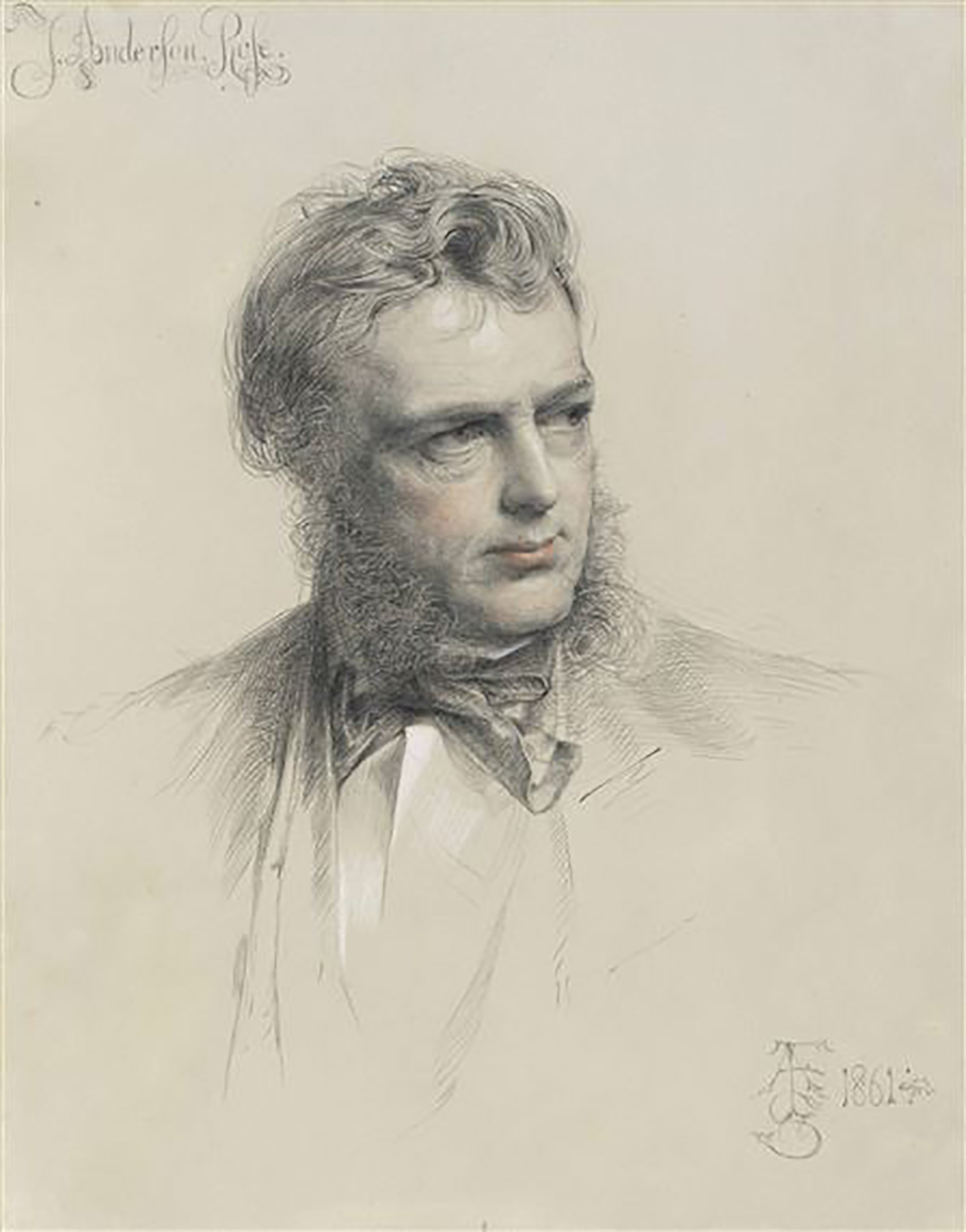
James Anderson Rose, drawn by Frederic Sandys in 1861 (black, white, and red chalks). Mark Samuels Lasner Collection, University of Delaware. Source: University of Delaware Library, Museums and Press.
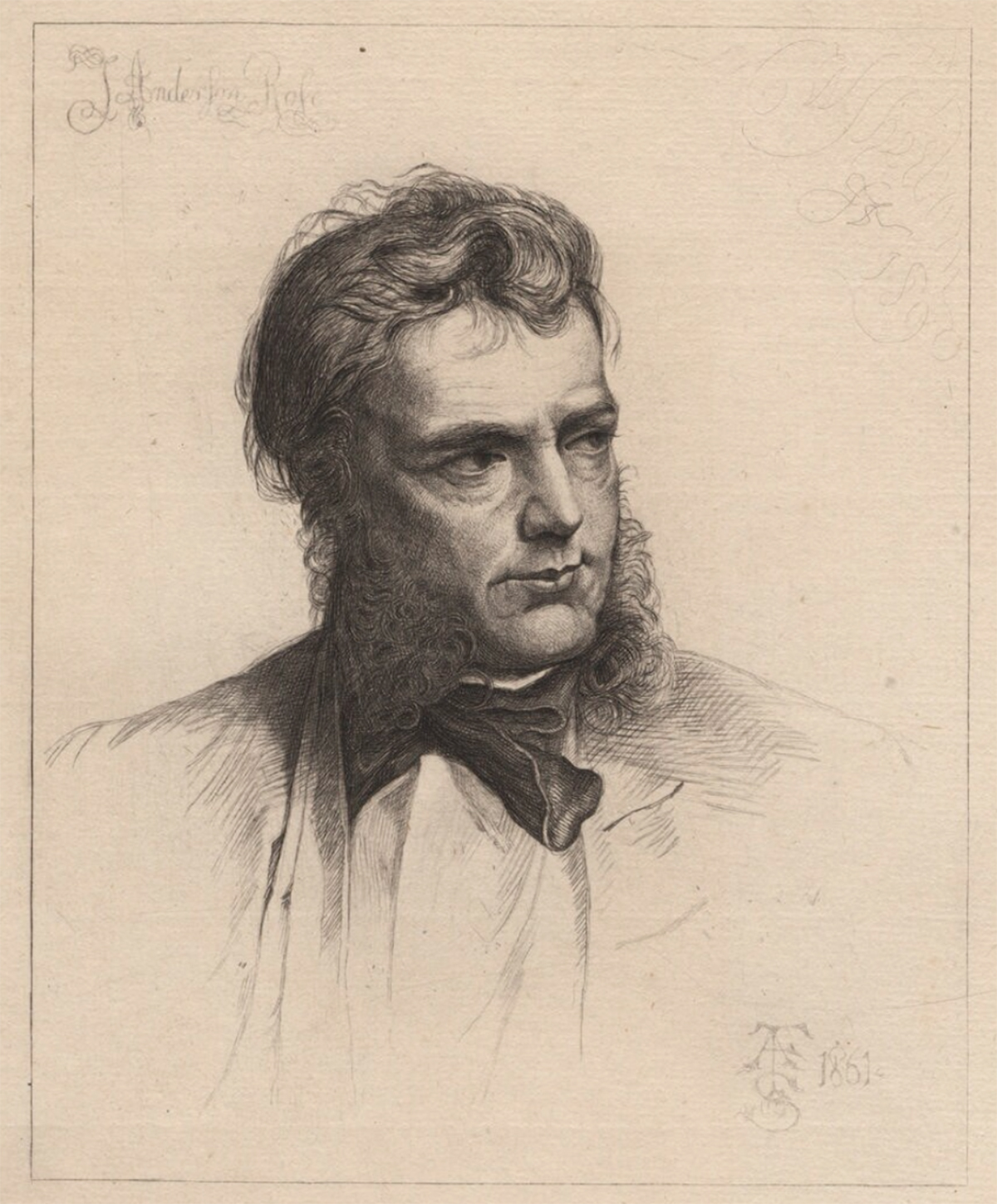
James Anderson Rose, engraving by Charles William Sherborn after Frederic Sandys, 1890 (after the 1861 drawing above). National Portrait Gallery, London, NPG D21207. Source: National Portrait Gallery.
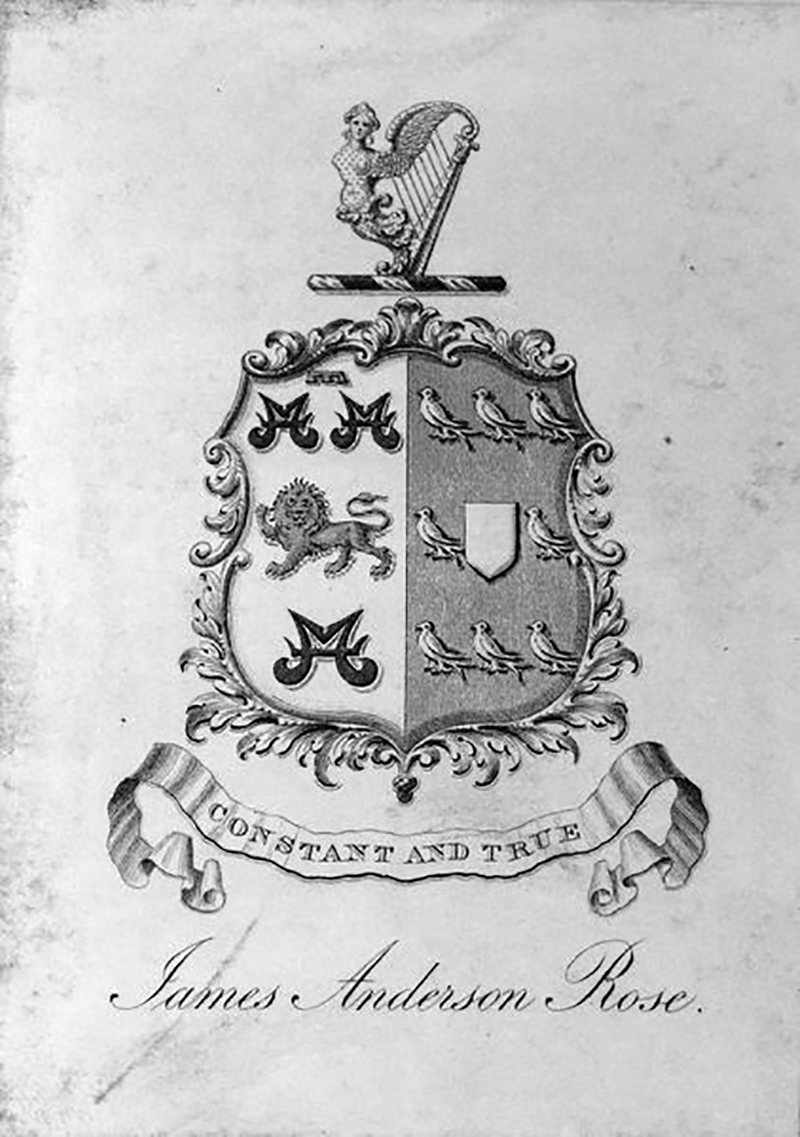
"Constant And True" — the personal heraldic bookplate of James Anderson Rose, depicting a coat of arms divided in two, with a lion between three water bougets, a shield between eight birds, and the Rose family crest of a winged maiden with a harp. Source: Seattle Art Museum Libraries: Digital Collections.
[CLAUDE NOTE: all images on this page are held under their respective institutions' own copyright/reproduction terms — worth checking each one's re-use policy before this goes any further than the draft stage.]
1882-08-10 Yes — and this is a wonderful find, because it's exactly the missing piece the page has been flagging as an open question ("Add info about fundraising fêtes for the Conservative Party held on Rose's own grounds"). Here's the transcription: LORD CRANBROOK ON PUBLIC AFFAIRS.—A demonstration of Conservatives took place on Saturday afternoon in the grounds of Mr. J. Anderson Rose, Wandsworth common. A resolution condemning the present ministry for having occasioned increased taxation, tampered with rebellion &c., was proposed by Lord Midleton, and the motion was supported by Lord Cranbrook. In some preliminary observations his Lordship referred to the invective which had been levelled at the Conservative Administration in 1879 and to the unfulfilled promises of unequalled prosperity which the orators of the Liberal party foretold would follow upon a change of Ministry. Upon the question of finance, everybody looked forward to this great financier, but within the last few days this great magician had acknowledged that his wand was impotent to bring about economy and that he could do nothing in order to reduce the expenditure, and that, if he wanted to look back at a period when economy was in the ascendant, and when everything in England was done on economical principles, he was obliged to go back to Conservative Admistrations, in order to find specimens of that which he required (cheers and laughter). His lordship then reviewed in detail the course of events in Ireland, and saying a word on legislation, his remarks, he stated, would be very short, because there was none (roars of laughter). The master magician said, "I cannot get on, my tools are so bad." Now there was nothing more desirable than that the House of Commons should get control of its own business; but there was nothing more undesirable than that one party should by means of procedure rules get an absolute majority and victory over the others (loud cheers). The resolution was carried by acclamation. Bromley Journal, 10 August 1882 [CLAUDE NOTES: Worth knowing, for the page: this doesn't name the "great financier"/"master magician" directly, but the target is almost certainly Gladstone — that mocking nickname and the Irish-legislation context fit his second premiership (1880–85) precisely, and "the great financier" plays on his long-standing reputation from his Chancellor years. Worth a quick check if you want it stated outright rather than left implicit, but I'd be very confident in it. This also answers the open question rather neatly: it wasn't a fête exactly, but a full-blown political demonstration, complete with a peer proposing a resolution and another (Cranbrook — a former Cabinet minister) seconding it, held in Rose's own garden. That's a proper example of exactly the kind of Conservative gathering on his grounds you remembered. Want this folded into the page now, replacing the open [NOTE: Add info about fundraising fêtes...] with the real story? 1882-08-10-james-anderson-rose-conservative-demo-BromleyJournal.png https://www.britishnewspaperarchive.co.uk/viewer/BL/0004638/18820810/033/0003
London Evening Standard - Thursday 15 November 1883 https://www.britishnewspaperarchive.co.uk/viewer/BL/0000183/18831115/008/0002?browse=False
London Evening Standard - Thursday 07 August 1884 [?] https://www.britishnewspaperarchive.co.uk/viewer/BL/0000183/18840807/003/0001?browse=False
06-06-1891 WANDSWORTH COMMON. Charming Residential Property, held for a long unexpired term at a peppercorn.—With possession.—By order of the Executor of the late J. Anderson Rose, Esq. MESSRS. G. A. WILKINSON & SON will SELL by AUCTION, at the Mart, on Tuesday, June 23, at 2, the valuable LEASEHOLD PROPERTY, comprising the comfortable Residence standing in its own grounds of about 4½ acres, situate in the private road at the corner of Nightingale-lane, Wandsworth Common, within three minutes' walk of the railway station. It contains two reception-rooms, six bed and dressing-rooms, and domestic offices; beautiful pleasure grounds and ornamental water, orchard, paddock, and capital kitchen garden, stabling for four horses, &c.; held for 44 years to run at a peppercorn. Particulars of Messrs. Routh, Stacey, and Castle, Solicitors, 14, Southampton-street, Bloomsbury; of Messrs. Lofts and Warner, Land Agents and Surveyors, 130, Mount-street, Berkeley-square; and with orders to view of the Auctioneers, Poultry, City. South London Press, 6 June 1891 https://www.britishnewspaperarchive.co.uk/viewer/BL/0000213/18910606/143/0004 [CLAUDE NOTE: The only real value in this second copy is confirming the ad ran across (at least) two consecutive Saturday issues in the fortnight before the sale — standard practice for a property auction of this size, and mildly useful if you ever want to note "advertised repeatedly in the South London Press" rather than citing a single appearance. Nothing new factually beyond the 13 June one. Worth flagging while we're accumulating: this is a second copy of the same source, so when it comes to citing it on the page, you'd really cite it once (perhaps "South London Press, 6 and 13 June 1891") rather than as two separate finds — just so the Sources list doesn't end up double-counting it as if it were independent corroboration the way the Cranbrook demonstration piece is.]
WANDSWORTH COMMON. Charming Residential Property, held for a long unexpired term at a peppercorn.—With possession.—By order of the Executor of the late J. Anderson Rose, Esq. MESSRS. G. A. WILKINSON & SON will SELL by AUCTION, at the Mart, on Tuesday, June 23, at 2, the valuable LEASEHOLD PROPERTY, comprising the comfortable Residence standing in its own grounds of about 4½ acres, situate in the private road at the corner of Nightingale-lane, Wandsworth Common, within three minutes' walk of the railway station. It contains two reception-rooms, six bed and dressing-rooms, and domestic offices; beautiful pleasure grounds and ornamental water, orchard, paddock, and capital kitchen garden, stabling for four horses, &c.; held for 44 years to run at a peppercorn. Particulars of Messrs. Routh, Stacey, and Castle, Solicitors, 14, Southampton-street, Bloomsbury; of Messrs. Lofts and Warner, Land Agents and Surveyors, 130, Mount-street, Berkeley-square; and with orders to view of the Auctioneers, Poultry, City. South London Press, 13 June 1891 This is worth a lot. It gives you: [CLAUDE NOTES: A precise location description at last: "the private road at the corner of Nightingale-lane, Wandsworth Common" — this genuinely nails down the house's position far more precisely than "next door to Fernside," and confirms the Nightingale Lane connection from your own earlier notes. "Within three minutes' walk of the railway station" — consistent with "facing Wandsworth Common Station" from your Chronicles. Real physical detail of the house and grounds: 4½ acres, two reception rooms, six bed/dressing rooms, ornamental water, orchard, paddock, kitchen garden, stabling for four horses. That's a proper country-house-in-miniature, not just a large villa — worth knowing for how you picture and describe it. A "long unexpired term at a peppercorn" — he held the house on a leasehold, not freehold, for 44 years at a nominal rent, which is itself a small interesting fact about his tenure there. The executor and professional team — Routh, Stacey & Castle (solicitors) and Lofts & Warner (land agents), which might be worth chasing if you ever want to track down further estate papers.]
South London Press - Saturday 27 February 1892 WANDSWORTH COMMON. The committee reported that adjoining Wandsworth Common station, near Nightingale-lane, were about nine acres of land which were originally part of Wandsworth Common, and purchased many years ago by the London, Brighton, and South Coast Railway Company, and by them freed from commonable rights. The company having used all the land they required, resold the remainder to the late Mr. J. A. Rose, who kept the area unbuilt upon as an adjunct to his own grounds. Mr. Rose, however, died last year, and his property was now in the market. The committee thought that so much of it as comprised what was originally Wandsworth Common should be obtained if possible, and restored to that open space, but they were not prepared to recommend the Council to pay an excessive or building land price for it. They recommended: "That Mr. R. M. Bray be informed that, although the Council consider the ground referred to would be of use as an open space, it is not prepared to pay £12,000 for it." At the suggestion of Mr. Burns, the matter was referred to the local authorities for their opinion. https://www.britishnewspaperarchive.co.uk/viewer/BL/0000213/18920227/165/0008?browse=False
[CLAUDE NOTES: This is a genuinely excellent find — it fills in almost everything that was still murky: The railway company is finally named: the London, Brighton, and South Coast Railway Company — not the "West End of London and Crystal Palace Railway" mentioned in your December 1892 cutting. Worth reconciling those two names; it's possible the land passed through more than one company's hands over the decades, or one of the two sources has the name slightly wrong. Worth a note on the page either way. This directly confirms and dates itself: "Mr. Rose... died last year" places this report in 1891, squarely between his September 1890 death and the property auction you found (June 1891) — so this LCC committee discussion was happening at almost exactly the same moment his house and grounds were being sold off. It confirms your own instinct from earlier: Rose bought this land specifically "as an adjunct to his own grounds," deliberately keeping it unbuilt — exactly the protective motive you and I discussed for the Railway Extension/Enclosure Piece, now stated plainly in a contemporary source rather than inferred. "At the suggestion of Mr. Burns" — if this is who I think it is, this is a lovely connection: John Burns, the Battersea radical and later LCC member (elected 1889, MP for Battersea from 1892), was exactly the kind of figure who'd push a matter like this toward "the local authorities" rather than let the LCC quietly shelve it. Worth confirming it's the same Burns, but the dates line up well. Between this and the Bray letter, you now have a genuinely coherent narrative: Bray raises it in February, the LCC clerk reports the £12,000 asking price in March, this cutting shows the committee's considered (rather stingy) response and Burns pushing it onward to the vestries, and the later cuttings show those vestries eventually declining their share years afterward. That's a proper documented campaign, not just scattered fragments.]
South Western Star - Saturday 12 November 1892 THE enlargement of Wandsworth Common by the throwing into the "Railway Enclosure Piece," which originally formed part of the Common, is a very desirable object and one to which I hope the Vestry will extend the most sympathetic consideration. £7,500 is the sum required and the committee hope to get £1,000 from the Battersea Vestry, £1,000 from the Wandsworth Board of Works, half the purchase money from the London County Council, and the remainder by public subscription. Everything which tends to make the locality more attractive pays in the long run, and a thousand pounds expended in this way will find its way back again in rates largely increased by the fact that there are few empty houses in the parish. Moreover, the value of property increases and the rateable value in proportion. It pays to have open spaces and attractive commons, and if only from that point of view the project is worth supporting. https://www.britishnewspaperarchive.co.uk/viewer/BL/0004605/18921112/070/0005 [CLAUDE NOTES: Two things worth correcting/adding on the page because of this: The name itself — this cutting calls it the "Railway Enclosure Piece," not "Railway Extension Piece." Both may well have been in casual use at the time, but this is a contemporary source putting it in quotation marks as if it were the established name, so it's worth checking which (or both) your December 1892 source and this one actually use, and possibly retitling the page section, or noting the variant name explicitly. I think I read the previous two cuttings slightly wrong, and this one corrects me. I told you those described two different pieces of land — the "five acres near the Surrey Tavern" and the "piece adjoining the railway station" — being separately refused by two separate bodies. This cutting makes clear it's actually one single acquisition, with a proper funding plan: £7,500 total, half from the LCC, £1,000 each asked of the two neighbouring vestries (Wandsworth and Battersea), and the rest by public subscription. So the two refusals you found aren't two separate land deals — they're two of the four funding sources for the same purchase, each declining their respective £1,000 share. Worth fixing that distinction on the page now that we have the fuller picture; my earlier reading undersold how connected the story actually is. This also nicely reinforces the earlier "Railway Extension Piece" section already on the page (Rose personally buying part of the land to keep it from developers) — it's now clear that was one strand of a much longer-running, multi-decade campaign to get the whole parcel back into public hands, still being fought over in the press years after Rose's own death.
South London Press - Saturday 27 February 1892 https://www.britishnewspaperarchive.co.uk/viewer/BL/0000213/18920227/165/0008?browse=False
South London Press - Saturday 12 March 1892 PROPOSED ADDITION TO WANDSWORTH COMMON. The Works and General Purposes Committee recommended that, with reference to the letter from Mr. R. M. Bray, dated February 4, suggesting the desirability of the Council acquiring and adding to Wandsworth Common the piece of land lying between Wandsworth Common railway station and the private lane at the south-west end of Nightingale-lane, and asking that the vestry should contribute towards the cost, the vestry clerk should be directed to address a communication to the Council urging the desirability of the acquirement by the Council of the land in question for the use of the public.
In connection with the same subject a letter was read from Mr. H. De la Hooke, clerk, London County Council, dated March 3, stating that the Council had been offered this land for the sum of £12,000, but that the Council were not prepared to pay so large a sum for the land, although they were satisfied that the acquisition of the land would be of advantage to the public, and they inquired whether the vestry and the board of works for the Wandsworth district were prepared to contribute towards the cost and to what extent. The recommendation of the committee was adopted. https://www.britishnewspaperarchive.co.uk/viewer/BL/0000213/18920312/028/0002?browse=False [CLAUDE NOTE: This is a genuinely useful addition, and you're right that it's earlier — it fills in the beginning of the story the other cuttings only show you the later stages of: A new name to track down: Mr. R. M. Bray, whose letter of 4 February first raised the idea of the Council acquiring this land. Worth finding out who he was — a vestryman, a local resident, possibly connected to Rose himself given the shared cause. The asking price started much higher: £12,000, not £7,500. The South Western Star piece you sent just before this has the committee working to a £7,500 target — so somewhere between this letter and that later report, the price came down substantially, or the scope of what was being bought changed. Worth being precise on the page about this being a negotiation that evolved over time, rather than a single fixed sum throughout. The location is described here in the clearest terms yet: "between Wandsworth Common railway station and the private lane at the south-west end of Nightingale-lane" — consistent with everything else you've found, and about as precise a description of the parcel's boundaries as you're likely to get from a documentary source. Mr. H. De la Hooke, LCC clerk, is the official correspondent on the Council's side — a useful name if you ever want to chase the LCC's own minute books or correspondence files on this. Given how many pieces are now accumulating — the 1870 Common-preservation campaign, Rose's personal purchase, this earlier £12,000 negotiation, the later £7,500 funding plan, and the two vestries' refusals — this is shaping into a proper multi-decade saga rather than a single episode. Still happy to hold off folding any of it into the page until you've gathered what you're after.]
South London Press - Saturday 31 December 1892 https://www.britishnewspaperarchive.co.uk/viewer/BL/0000213/18921231/097/0006 Wandsworth Common. The Wandsworth District Board have refused to contribute towards the purchase of five acres, near the Surrey Tavern, Wandsworth Common, which the London County Council propose to acquire. Battersea Vestry declined to contribute £1,000 towards the purchase of the piece of land adjoining the railway station, Wandsworth Common, for the use of the public.
Weekly Dispatch (London) - Sunday 01 January 1893 This one clarifies and firms up a detail already on the page — it's the fuller version of the same December 1892 story, but this time it explicitly names the body that's only called "The District" in your existing source, plus it turns out there were actually two separate refusals, not one. Transcription: The Wandsworth District Board on Wednesday night refused to contribute towards the purchase of five acres, near the Surrey Tavern, Wandsworth Common, which the London County Council propose to acquire. Battersea Vestry declined to contribute £1,000 towards the purchase of the piece of land adjoining the railway station, Wandsworth Common, for the use of the public. https://www.britishnewspaperarchive.co.uk/viewer/BL/0003358/18930101/004/0001 [CLAUDE NOTE: This is genuinely useful for tightening up "The Railway Extension Piece" section: the page currently only credits the refusal to Battersea Vestry, but this makes clear there were two separate local bodies turning down two separate pieces of land in the same short report — the Wandsworth District Board declining to fund the five acres near the Surrey Tavern, and Battersea Vestry separately declining the £1,000 for the piece adjoining the railway station (the Railway Extension Piece itself, which is the one connected to Rose). Worth being precise about that distinction on the page, since it's easy to conflate the two pieces of land as one and the same when they're clearly being treated as two separate proposals in the source.] [PB: No, I think it probably means that Battersea Vestry, as a component part of the Wandsworth District Board, refused, even though Wandsworth Vestry (and perhaps others) were for buying the land. But worth checking.] [CLAUDE NOTE: Good instinct to want it checked — and it turns out the answer is almost the opposite of the hypothesis, though for an interesting reason. Battersea was originally a constituent part of the Wandsworth District Board of Works, from its creation in 1855 — so your theory would have been exactly right for anything before 1888. But Battersea broke away and became its own fully independent vestry on 25 March 1888, under the Metropolis Management (Battersea and Westminster) Act 1887, specifically because its population had grown too large to keep sharing a board with the other Wandsworth-area parishes. By December 1892 — the date of your cutting — Battersea Vestry had already been a completely separate, independent local authority for nearly five years. So the report genuinely does describe two distinct bodies, each separately declining to fund a different (if nearby) piece of land: the Wandsworth District Board turning down the five acres near the Surrey Tavern, and Battersea Vestry, quite independently, turning down the £1,000 for the piece adjoining the railway station — not one declining as part of the other. Worth knowing for the page either way, since it's a nice small piece of context: Rose's Railway Extension Piece story is playing out right at the moment these two neighbouring authorities had just gone their separate ways, which may itself be part of why coordinating funding for adjoining pieces of land was proving difficult — two independent bodies, each reluctant to pay for something partly benefiting the other's residents, rather than one unified authority making a single decision.]
A collector's eye
Alongside his legal career, Rose built a serious and wide-ranging collection. He was, in particular, one of the earliest and most important collectors of Whistler's etchings, alongside those of the French printmaker Charles Meryon. His collection also extended to engraved portraits, English watercolours, and paintings by contemporary French and British artists — Frederic Sandys among them — as well as ceramics and oriental material. Among the Whistler works he owned were The Sleeper and Sleeping Woman.
Rose was a prominent member of the Arundel Club and a generous lender to exhibitions of the period. In 1874, an exhibition of his collection toured to Liverpool, Newcastle, and Birmingham. In November 1872, he lent a further selection of his engraved portraits for the opening of the new library and museum of the Corporation of London, an exhibition accompanied by an introduction from Gordon Goodwin.
Findagrave.com
The funeral of Mr. J. Anderson Rose took place on Thursday, in St. Mary's Cemetery, Wandsworth-common, where the family vault is. Numerous memorial wreaths were sent, and there was a large gathering of private and professional friends. The First Lord of the Treasury was represented, as well as the Westminster, the Strand, and many other Conservative associations.
Deceased was a brother of the late Sir William Anderson Rose, who at one time represented Southampton, and was a prominent figure here at the Parliamentary elections in November, 1862, and July, 1865. | The Hampshire Advertiser, issue of 1 Oct 1890. He was in the 71st year of his age.
Also e.g. The Standard (London), 20 Sep 1890; and The Morning Post (London), 20 Sep 1890. https://www.findagrave.com/memorial/235455974/james-anderson-roseDispersal of the collection
Rose's collection was sold in stages during his lifetime — sales are recorded on 1–2 May 1861 and 12 April 1862 — and a major print sale was held at Sotheby's beginning 27 June 1876 and continuing for ten further days, from which the British Museum made a substantial number of purchases.
Following his death in 1890, the remainder of his collection was dispersed at auction by his executrix. Christie, Manson & Woods sold his pictures and watercolours on 11 May 1887 [CLAUDE NOTE: this date is from the source list and predates his death — worth checking whether this was a lifetime sale or the date needs correction] and again on 6–7 May 1891, 15 May 1891, and 11 November 1891, with a further sale on 1 December 1891. The 5 May 1891 sale is independently confirmed elsewhere: lot 112 was a pair of Whistler drawings of Joanna Hiffernan that had belonged to Rose, bought by the dealers Dowdeswell — which makes the 1887 date look more likely to be an error somewhere upstream, rather than a genuine separate lifetime sale.
Sources
British Museum, collection database biography.
Etchings Arts Glasgow (University of Glasgow, Whistler etchings project), biography of James Anderson Rose.
University of Glasgow, The Correspondence of James McNeill Whistler — a searchable archive that includes numerous original letters between Rose and Whistler, worth mining further for material specific to Rose's life and dealings.
Philip Boys, April 2022 Chronicles, June 2022 Chronicles, and December 2022 Chronicles, The History of Wandsworth Common — on Rose's house, his role as Whistler's executor, his signature on the 1870 subscription list to save the Common, and the Railway Extension Piece.
South London Press, Saturday 31 December 1892 — on Battersea Vestry's refusal to fund the purchase of the Railway Extension Piece.
Seattle Art Museum Libraries: Digital Collections, 'Constant And True, James Anderson Rose' (personal bookplate).
Martin Hopkinson, 'James Anderson Rose, first major collector of Whistler etchings', Print Quarterly, XXX, 2013, pp. 409–22 (no. 4).
Linda Merrill, A Pot of Paint: Aesthetics on Trial in 'Whistler v. Ruskin', Washington and London, 1992.
Dianne Sachko Macleod, Art and the Victorian Middle Class: Money and the Making of Cultural Identity, Cambridge, 1996, pp. 469–470.
Catalogue of the Valuable Collection of Modern Pictures and Water-Colour Drawings of James Anderson Rose, Esq., Deceased, Late of Salisbury Street, Strand, and Wandsworth Common, sale catalogue, Christie, Manson and Woods, 5 May 1891. Available via HathiTrust.
A Collection of Engraved Portraits (Further Selection) Exhibited by the Late James Anderson Rose, at the Opening of the New Library and Museum of the Corporation of London, November, 1872, introduction by Gordon Goodwin. Available via HathiTrust.
Notes and queries
— The 11 May 1887 Christie's sale date sits oddly before his 1890 death — worth checking against the original source, since it may be a lifetime sale of a different kind, or a transcription slip somewhere upstream. (The 5 May 1891 sale is now independently corroborated via the Joanna Hiffernan drawings, lot 112 — see Dispersal section above.)
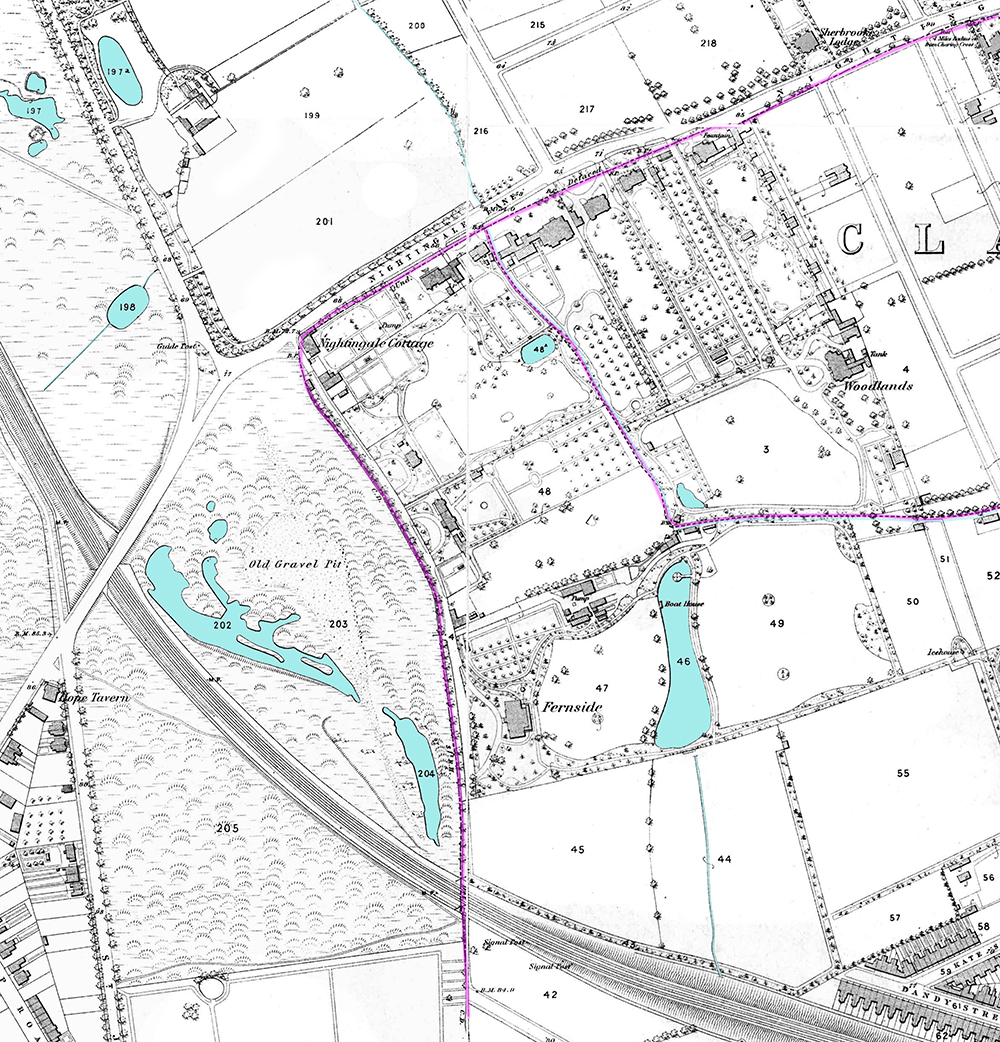
Extract from an Ordnance Survey map, tinted, showing the row of houses from Nightingale Cottage to Fernside — the row in which Rose's own house stood. Click to view full screen. [Date approximate, 1860s — to be confirmed.]
— Must establish exactly where on the edge of Wandsworth Common Rose lived - it was in the short row between Nightingale Cottage on Nightingale Lane and Fernside - next house along from Fernside? [Now addressed in "A solicitor among the artists" above — next door to Fernside, facing what became Wandsworth Common Station, roughly the site of today's Airedale Road, per your own April/June 2022 Chronicles.]
— Find and add images of the house itself. The 1893 OS map above (in "The Railway Extension Piece") marks its location in red, but that's still not a picture of the actual building — I'm sure I have an engraving or illustration somewhere - but where?
— New: worth establishing what eventually happened to the Railway Extension Piece — did it ever actually get restored to the Common, and if so when?