
SEARCH: BNA: BUCKMASTER ANTI-CORN
[Source: Link]
The Anti-Corn Law League was a successful political movement in Great Britain aimed at the abolition of the unpopular Corn Laws, which protected landowners' interests by levying taxes on imported wheat, thus raising the price of bread at a time when factory-owners were trying to cut wages. The League was a middle-class nationwide organisation that held many well-attended rallies on the premise that a crusade was needed to convince parliament to repeal the corn laws. Its long-term goals included the removal of feudal privileges, which it denounced as impeding progress, lowering economic well-being, and restricting freedom. The League played little role in the final act in 1846 when Sir Robert Peel led the successful battle for repeal.
However, its experience provided a model that was widely adopted in Britain and other democratic nations to demonstrate the organisation of a political pressure group with the popular base....
Model for other lobbying organisations
The League marked the emergence of the first powerful national lobbying group into politics, one with a centralized office, consistency of purpose, rich funding, very strong local and national organization, and single-minded dedicated leaders. It elected men to Parliament. Many of its procedures were innovative, while others were borrowed from the anti-slavery movement. It became the model for later reform movements.[Asa Briggs, The Making of Modern England, p. 116]
The model of the League led to the formation of the Lancashire Public School Association to campaign for free, locally-financed and controlled secular education in Lancashire. It later became the National Public School Association. It had little success because national secular education, was a divisive issue even among the radical groups However it did help convert the Liberal Party from its laissez-faire philosophy to that of a more interventionist character.[Donald K. Jones, "The Educational Legacy of the Anti-Corn Law League." History of Education 3.1 (1974): 18-35. ]
Historian A. C. Howe argues:
Although historians remain divided on the impact of the league on Peel's decision to abandon the corn laws it was undoubtedly, in appearance, the most successful of nineteenth-century single-issue pressure groups, in its ability to generate enthusiasm, support, and unparalleled financial backing. Although its potential was not realized, it had shown the capacity for an extra-parliamentary middle-class organization to reshape politics so as to reflect the anti-aristocratic objectives of a determined band of entrepreneurial politicians.
It remained the model for many diverse pressure groups, for example the United Kingdom Alliance, the National Educational League, the Navy League, the Tenant League in Ireland, and the National Society in Piedmont, as well as those specifically related to free trade, including the Edwardian Tariff Reform League and Free Trade Union, and in the 1950s S. W. Alexander's Anti-Dear Food League. It also inspired imitators in France, Germany, the Low Countries, Spain, and the United States. The league had only temporarily reshaped the landscape of parliamentary politics but it had helped create a vibrant popular attachment to free trade within British political culture that would last well into the twentieth century.[A. C. Howe, 'Anti-Corn Law League (act. 1839-1846)', Oxford Dictionary of National Biography, Oxford University Press]
Critics
R. S. Surtees satirized the league in his 1845 novel, Hillingdon Hall. His cockney protagonist refers to "the 'umbuggery of its ways...strong symptoms of utilitarian self-interest"; while a roguish actor is shown being coached as a paid lecturer for the League: "you have nothing to do but repeat the same old story over and over again... Whatever is wrong, lay it to the corn tax. If a man can't pay his Christmas bills, attribute it to the bread tax".[R S Surtees, Hillingdon Hall (Stroud 2006) p. 44-7 and p. 39]
[Wikipedia: Anti-Corn Law League. NB the article includes extra material, including some interesting-looking refs to follow up. Notice e.g. the anti-feudal/aristocratic sentiment, significance for the development of mass education, and above all as an inspiration and a model for (successful) popular political protest.]
[R.S.Surtees (notes on this site). I have downloaded pdfs of Hillingdon Hall.]
THE ANTI-CORN-LAW CONFERENCE. (From the Globe.)
After Mr. O'Connell had addressed the meeting of the Anti -Corn-La w delegates at t he Crown and Anchor, yesterday, Mr. Greg, of Manchester, Mr. G. Thompson, Mr. Rawsm, Mr. Massey, and Mr. Coates severally expressed their sentiments upon the new sliding scale of Sir Robert Peel, and the following resolution was unanimously adopted: "That, whereas her Majesty's present advisers have wholly dissatisfied the country, by refusing to bring in a measure for the immediate and total abolition of the Corn and Provision Laws, memorial from this Conference be presented to the Queen, expressing an utter want of confidence in her present advisers, or in any Ministers who will not propose to Parliament the total and immediate abolition of these laws, and their alarm at the consequences likely to arise from the distress of the suffering people." Another meeting took place in the evening, Mr. Taylor again presiding — not fur the purpose of passing any resolution, but to give those deputies who were desirous of so doing an opportunity of laying an account of the statistics of the respective distress before the conference. The conference was addressed by Dr. Penny, of Reading; Dr. Baillie, of Sheffield; Mr. Ashdown. delegate of the Sussex Anti-Corn Law Association; Mr. Sterling; the Rev. Francis Bishop, of Warrington; and the Rev. Mr. Strachan, of Forfar; who severally entered into details of the injurious working of the Corn Laws in their respective districts. The Chairman then intimated that a circular had been issued by the executive committee, inviting all the Members of Parliament, and all the clergy of this city, to attend a meeting of the conference on Saturday, at the Crown and Anchor Tavern, where every facility would be afforded for inquiry and counsel.
Mr. Buckmaster, of Buckinghamshire j Mr. Thomson, of Northwich; Mr. Griffith Evans, chairman of the Carnarvon conference; Mr. T. Eger, of Grimstead; and other gentlemen, addressed the meeting, which separated at ten o'clock.
PROCEEDINGS THIS DAY. The Anti-Corn Law delegates again resumed their meeting this morning at the Crown and Anchor shortly after eleven o'clock. Mr. Taylor took the chair, and said they read in history that in ancient times the people had their treasure wrested from them by the great and powerful, by means of instruments of torture. The landed aristocracy of the present age were, however, more daring than their ancestors, and used an engine of torture which wrung from the whole nation its wealth, and exercised their cruelties upon the destitute instead of the wealthy. (Cheers.) They (the delegates) had met again this morning for the purpose of destroying this monstrous machine; and it was in vain for Sir Robert Peel to tell them that the complex engine which he had introduced was not so painful — that the agonies it inflicted were not quite so intense — that its levers were not so long, and that the sinews of humanity would not be stretched to the same extent by it, as by that which it was intended to replace. (Cheers.) They had met to tell him that the use of neither the one nor the other should be continued. (Cheers.) They had the peace of the country in their hands. (Hear, hear, hear.) For t was much to be feared that the patience and long suffering of the people would give way when they learnt the heartless conduct of the aristocracy, as evinced through the First Minister of the . No, after what he had done he could not call him the First Minister of the Sovereign. (Hear.) If anything defended him from an outbreak of the people's vengeance, it would be the fact of their trusting to the deliberations of their delegates, and a wish lo hear what they had to propose as an alleviation of their grievances. (Hear.) Mr. Charles Villiers, M.P., then came forward amid great cheering, and said he wished to address a few words to them on those notices of motion which had been given in the House of Commons last night, and which they had doubtless seen in the newspapers — the one given by Lord John Russell, and the other by himself (Mr. Villiers). It was that given by himself which he wished to answer for. (Hear.) It had been given in consequence of the resolution which they had communicated to him, adopted at this meeting, expressive of a desire on their part that the opinion of the House of Commons should, at the earliest opportunity, be taken on the question of the instant and entire abolition of the Corn Laws. (Cheers.) On learning their wish, he at once made inquiry of the Speaker as to the earliest opportunity he could take of making a motion to that effect. The Right Hon. Gentleman informed him that, it being a question of duties, no motion could be made upon it until the Speaker had left the chair The instant, therefore, that the Speaker left the chair, would be the moment for making a motion for the total abolition of the Corn Laws. (Cheers.) With respect to the notice of motion given by Lord John Russell, he (Mr. Villiers) believed it had been given in compliance with a request from several Liberal Members in the House, that he (Lord John Russell) would take an opportunity, before the House went into committee, of condemning the | proposition of Sir Robert Peel. (Loud cheers.) He was not j aware that that motion would at all prejudice the motion which would be made by himself in conformity with their wish. (Hear, hear.) Neither was he aware whether any motion falling short of total repeal would meet their views; and although there were many persons in the House of Commons interested in Lord John's motion, he was not sure it was the best sort of condemnation of Sir Robert Peel's imperfect, he might almost say, insulting motion. (Loud cheers.) The Liberal Members of the House would, however, be able to elect which of the two courses they preferred, either to vote with Lord J. Russell against the sliding scale, or to vote with him (Mr. Villiers) for the total abolition. After some further remarks the Hon. Gentleman concluded by saying that he would not longer occupy their time, thinking it more becoming that the delegates should enter into the statistical statements which they had to make to the meeting. (Cheers.) The Rev. Thomas Spencer, of Hinton, near Bath, next presented himself to move the first resolution, to the effect that it was desirable that simultaneous meetings of ministers of congregations should take place throughout the country. The resolution having been seconded by another clergyman of the Church of England, was carried unanimously. Other delegates addressed the meeting at considerable length. The memorial to her Majesty, adopted by the meeting yesterday, has already received a large number of signatures'.
[Source: Link.]
DARTFORD. On Tuesday last a meeting was held at the Town Hall, convened by the anti-corn law party, for the purpose of a Mr. Buckmaster, delivering a lecture against the "abominable, cruel, and iniquitous Corn Laws" as the bills expressed it.
As generally upon these occasions, the room was crowded almost to suffocation with the rabble of the town, who not being the politest of the polite, were vainly entreated to keep silence.
After some little time order was obtained, and Mr. Hadley (a most strenuous opposer of the Corn Laws) was called to the chair. He opened the meeting by making a few comments the state the country in general, and concluded by saying that was aware that it was usual in other towns, where similar meetings had been convened, to open them by singing a few verses called "Anti Corn Law Hymns," and (if they would allow him) he would read them the first verses of one, and sing the two last.
After reading in a peculiarly solemn and touching voice some lines, depicting in most heart rending-language almost every misery attendant on human life, each misery arising, of course, from the Corn Laws, the two last verses were sung by the whole of the gentlemen constituting the assembly, and this chanson de ble was rendered particularly melodious by each adapting it to whatever tune and key he thought most suitable.
When the singing had subsided, Mr. Hadley once more begged the attention of his "respected friends" in order to introduce to them Mr. Buckmaster who rose amid the shouts and yells of the multitude, and proceeded to set forth, in most glowing and enthusiastic language, the shameful duty imposed on the common necessaries of life, more especially on the poor man's loaf; and again, on the other hand, the small tax levied upon the luxuries of the great.
After quoting from different authors — drawing few exquisite similies — and giving innumerable instances of the poverty so predominant in England, he concluded, after a lecture of about two hours and a half.
What good it will do in Dartford, with respect to any of Sir Robert Peel's measures, we know not, neither will presume to judge.
Another circumstance occurred last week which must inevitably lead to Sir Robert Peel's resignation. A few of the aristocracy of Dartford, to show their utter contempt for that individual, burnt a figure, calling it his effigy.
[Source: Link.]
THE REPEALERS' CARD. Each member of the Loyal Repeal Association is presented with a handsome green card, upon which, along with a certificate of his admission, verified by the sign manual of Mr. Secretary Ray, are engraved various devices and reminiscences, very pat to the matter. In the centre is a map of Ireland, per is, without even a remote glimpse of the confines of Great Britain, or of any other spot of earth; although by the scale the surrounding waste should, according to Pinkerton, be pretty well studded with islands at least. Planking this tupertnlated island, by way of supporters are a pair of banners, emblematic of the hopes and feelings of the Association. Upon one of them appears the ancient Oriflamme of the Land, "The Sunburst," and on the other a Shamrock, of which the triple leaf stands for the religious divisions of its inhabitants, viz. " Catholic-Dissenter-and Protestant," with this curious device upon the stalk," Quis Separabit?" as if they were all three now living, or like to live (as President Tyler might Say), in the closest bonds of brotherhood and kindness. The flagstaffs, upon which those colours are borne aloft, are like Purcell O'Gorman's e stake in the country;" they have each a fine big pike at the end of it. Pikes, however, are to be seen pictorially on many flagataffs, being, in that combination, understood as More for show design'd than use." It might be unfair, therefore, to pash this point of the allegory too far. At each corner of the card, reminding one of the French revolutionary quadrille of " Le Feu auo quatre coins," are the names of four places renowned in Irish history for as many victories achieved over foreign invaders. Clontarf, where Brian Boroihme overthrew the Danes, stands first in the order of time, and then, in due succession, come Bealae-atha-buidhe, Benhurb, and Limerick. Mr. John Cornelius O'Callaghan, who has supplied an eloquent cemmnentary upon The Card, relates the signal successes gained by Irish prowess on those four classic spots of Irish ground. At Clontari, he says, they conquered the Danes, at a time " when the English were reduced to the basest slavery by the Danes;" and pithily adds, "The honest Tipperary Mountaineer, in last week's Nation, might well writeOhthese heartless oppressors of Saxon extraction! How at all do they keep us to languish in chains? When we couquer'd their betters by far, in an action That smash'd into powder the plundering Danee.'" The battle of Beal-au-atha-buidhe (q name, quod Anglice dice-re eon est; mecall itBantlthabmee)" vwas gained over ibe English (says Mr. O'Callaghau) in their infamous attempt, during Elizabeth's reign, to put down the religion of the Irish people." "The victory of Benburb," we are informed on the same authority, " was gained by the Irish, in the reign of Charles I., against the Parliamentary or Cromwellian rebels of England and Scotland." After enlarging on the details of the conflict, in which 4,000 of the " rebels bit the dust, with itdle comparative loss to the victors, Mr. O'Callaghan slyly remarks:-" Considering that we have English and Anglo-Orange authority for the statement, that the Irish always fight badly at home-this was doing pretty well." The last victory is that which Irish men and Irish women achieved over William the Third at Limerick. It is, indeed, a bright spot in Irish history; but why these things are so prominently put forward, upon all occasions, for the purpose of exciting the brave and pugnacious people of Ireland to seek repeal by Iegal, moral, bloodless, and peaceful means, is more than our uninformed philosophy can make out. They cannot, surely, be adopted in the hope of frightening Great Britain into submission to the Repealers will. Mr. O'Callaghan's spirit-stirring explication of The Card was read, amid cheers of approbation; and, upon the motion of Mr. O'Connell, inserted amongst the archives of the Association.
THE BUCKINGHAMSHIRE MEETING. TO SIDNEY SMIITH, ESQ., SECRETARY METROPOLITAN ANTI-CORN -LAW ASSOCIATION, 448, STRAND.
SIR-I attended the county meeting at Aylesbury, held at the town-hall to-day.
J. Buckmaster addressed the meeting for nearly half an hour, with great force and effect, pointing out to the farmers (several hundreds of whom were present), that the prices for their produce depended on the manufacturers being employed, &c. His speech was very well received, and he refuted the arguments advanced by Lord Stanhope, and other previous speakers, in a very concise and clear manner.
___________
As the meeting had been listening to Lord Stanhope, Dr. S1eigh, Lord Nugent, and a farmer (who seconded Lord Nugent in a free-trade resolution), for near four hours, he was obliged to be rather short in his observations. On sitting down, he publicly challenged Dr. Sleigh, the farmer's advocate, to a public discussion at Aylesbury, on the subject of free-trade, &c., which the doctor declined, and Mr. Buckmaster was most vociferously applauded throughout. I should observe, the doctor had attacked the manufacturers and the League most furiously. Mr. Cobden's name was received most rapturously. Lord Stanhope having stated there was not one member in the county fit to present the pro-corn-law petition,
J. Buckmaster proposed Mr. Cobden should be requested to do it, which elicited such a burst of applause as one might not have expected in this county. Buckmaster, considering his age, not twenty, certainly surprises me. Lord Nugent thanked him for his support, and frequently cheered him. I have said enough to show you that there is good seed at Aylesbury. The farmers, disgusted with their county members, are looking about for other leaders.
Yours, in haste.
Saturday, April 8,8 rs. P
[Source: Link.]
... to be well ducked Llaughter and cheers, amidst which Mr. Buckmaster was seen to shrug his shoulders]. The Doctor: Were the meeting of my mind, they would forthwith deal with you. Mr. Buckmaster (amid cries Irom the doctor's friends of hear, hear, began ..
[Source: Link.]

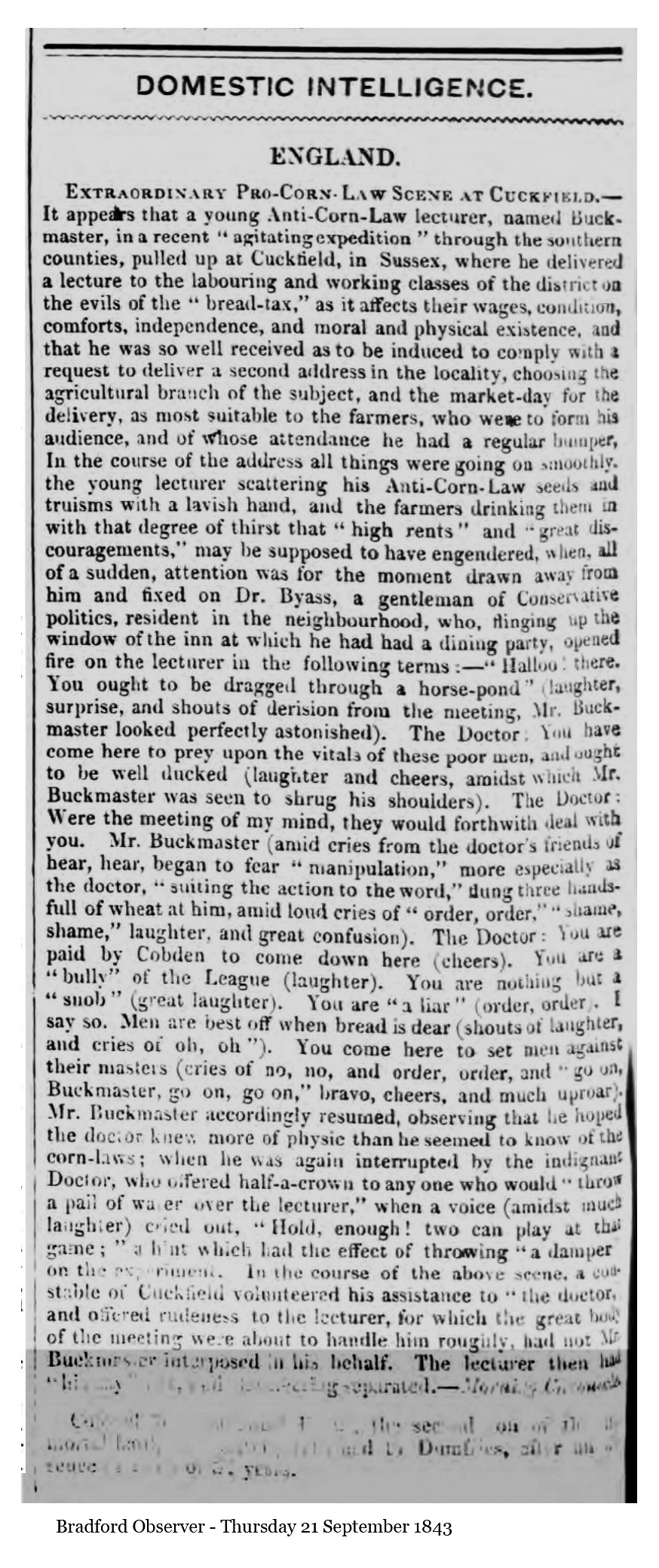
EXTRAORDINARY PRO-CORN LAW SCENE AT CUCKKIELD.
It appears that a young Anti-Corn-Law lecturer, named Buckmaster, in a recent "agitating expedition" through the southern counties, pulled up at Cuckfield, in Sussex, where he delivered a lecture to the labouring and working classes of the district on the evils of the "bread-tax," as it affects their wages, condition, comforts, independence, and moral and physical existence, and that he was so well received as to be induced to comply with a request to deliver a second address in the locality, choosing the agricultural branch of the subject, and the market-day for the delivery, as most suitable to the farmers, who were to form his audience, and of whose attendance he had a regular bumper.
In the course of the address all things were going ou smoothly, the young lecturer scattering his Anti-Corn-Law seeds and truisms with a lavish hand, and the farmers drinking them in with that degree of thirst that "high rents" and "great discouragements," may be supposed to have engendered, when, all of a sudden, attention was for the moment drawn away from him and fixed on
Dr. Byass, a gentleman of Conservative politics, resident in the neighbourhood, who, flinging up the window of the inn at which he had had a dining party, opened fire on the lecturer in the following terms:
"Halloo! there. You ought to be dragged through a horse-pond" (laughter, surprise, and shouts of derision from the meeting, Mr. Buckmaster looked perfectly astonished).
The Doctor: You have come here to prey upon the vitals of these poor men, ami uught to be well ducked (laughter and cheers, amidst which Mr. Buckmaster was seen to shrug his shoulders).
The Doctor: Were the meeting of my mind, they would forthwith deal with you.
Mr. Buckmaster (amid cries from the doctor's friendo of hear, hear, began to fear "manipulation," more especially as the doctor, "suiting the action to the word," flung three handsfull of wheat at him, amid loud cries of "order, order," "shame, shame," laughter, and great confusion).
The Doctor: You are paid by Cobden to come down here (cheers). You are a "bully" of the League (laughter). You are nothing but a "snob" (great laughter). You are "a liar" (order, order). I say so. Men are best off when bread is dear (shouts of laughter, and cries of "oh, oh"). You come here to set men against their masters (cries of no, no, and order, order, and "go on, Mr. Buckmaster, go on, go on," "bravo," cheers, and much uproar).
Mr. Buckmaster accordingly resumed, observing that he hoped the doctor knew more of physic than be seemed to know of the corn-laws; when he was again interrupted by the indignant Doctor, who offered half-a-crown to any one who would "throw a pail of water over the lecturer," when a voice (amidst much laughter) cried out, "Hold, enough! two can play at that game; "a hint which had the effect of throwing "a damper" on the experiment.
In the course of the above scene, a constable of Cuckfield volunteered his assistance to "the doctor", and offered rudeness to the lecturer, for which the great body of the meeting were about to handle him roughly, had not Mr. Buckmaster interposed on his behalf.
The lecturer then had "his say" out, and the meeting separated. Morning Chronicle
[Source: Link]
DOMESTIC INTELLIGENCE
ENGLAND
EXTRAORDINARY PRO-CORN LAW SCENE AT CUCKKIELD.
It appears that a young Anti-Corn-Law lecturer, named Buckmaster, in a recent " agitating expedition" through the southern counties, pulled up at Cuckfield, in Sussex, where he delivered a lecture to the labouring and working classes of the district on the evils of the "bread-tax," as it affects their wages, condition, comforts, independence, and moral and physical existence, and that he was so well received as to be induced to comply with a request to deliver a second address in the locality, choosing the agricultural branch of the subject, and the market-day for the delivery, as most suitable to the farmers, who were to form his audience, and of whose attendance he had a regular bumper.
In the course of the address all things were going ou smoothly, the young lecturer scattering his Anti-Corn-Law seeds and truisms with a lavish hand, and the farmers drinking them in with that degree of thirst that "high rents" and "great discouragements," may be supposed to have engendered, when, all of a sudden, attention was for the moment drawn away from him and fixed on
Dr. Byass, a gentleman of Conservative politics, resident in the neighbourhood, who, flinging up the window of the inn at which he had had a dining party, opened fire on the lecturer in the following terms:
"Halloo! there. You ought to be dragged through a horse-pond" (laughter, surprise, and shouts of derision from the meeting, Mr. Buckmaster looked perfectly astonished).
The Doctor: You have come here to prey upon the vitals of these poor men, ami uught to be well ducked (laughter and cheers, amidst which Mr. Buckmaster was seen to shrug his shoulders).
The Doctor: Were the meeting of my mind, they would forthwith deal with you.
Mr. Buckmaster (amid cries from the doctor's friendo of hear, hear, began to fear "manipulation," more especially as the doctor, "suiting the action to the word," flung three handsfull of wheat at him, amid loud cries of "order, order," "shame, shame," laughter, and great confusion).
The Doctor: You are paid by Cobden to come down here (cheers). You are a "bully" of the League (laughter). You are nothing but a "snob" (great laughter). You are "a liar" (order, order). I say so. Men are best off when bread is dear (shouts of laughter, and cries of "oh, oh"). You come here to set men against their masters (cries of no, no, and order, order, and "go on, Mr. Buckmaster, go on, go on," "bravo," cheers, and much uproar).
Mr. Buckmaster accordingly resumed, observing that he hoped the doctor knew more of physic than be seemed to know of the corn-laws; when he was again interrupted by the indignant Doctor, who offered half-a-crown to any one who would "throw a pail of water over the lecturer," when a voice (amidst much laughter) cried out, "Hold, enough! two can play at that game; "a hint which had the effect of throwing "a damper" on the experiment.
In the course of the above scene, a constable of Cuckfield volunteered his assistance to "the doctor", and offered rudeness to the lecturer, for which the great body of the meeting were about to handle him roughly, had not Mr. Buckmaster interposed on his behalf.
The lecturer then had "his say" out, and the meeting separated. Morning Chronicle
[Source: Link.]
COMMERCE, AGRICULTURE, &c
... injurious * and impolicy of | which pointed out, frequently eliciting the applause the me« ting. An Anti-Corn Law lecture Cuckfield, delivered by Mr.! Buckmaster, a young lecturer, was recently interrupted in a ludicrous manner, by a hot-headed opponent the ..
Published: Friday 29 September 1843
Newspaper: Coventry Herald
County: Warwickshire, England
Type: Article | Words: 2475 | Page: 2 | Tags: none
free trade meeting
... of London, was also one of the glorious results of the labours of the Anti-Corn-law League, and it was getting such men into the House of Commons, and by the ebolition Of the corn laws, that the silvation of the country was alone to effected. — (Hear, bear .
Published: Thursday 02 November 1843
Newspaper: Morning Advertiser
County: London, England
Type: Article | Words: 3379 | Page: 3 | Tags: none
NEWMARKET FIRST SPRING MEETING, 1845..Thursday
... meeting at some length in support of the memorial, and was followed by a Mr. Buckmaster, who, it was stated, was a paid emissary of the Anti-CornLaw League. Mr. Buckmaster's oratory in opposition to some portions of the memorial was interrupted by the ...
Published: Thursday 16 November 1843
Newspaper: London Evening Standard
County: London, England
Type: Article | Words: 814 | Page: 4 | Tags: none
SHIP NEWS
... in support of the memorial, and was followed a Mr. Buckmaater, who, it was stated, was paid emissary of the Anti-Corn Law League. Mr. Buckmaster's oratory in opposition to some portions of the memorial was interrupted by the announcement that the authorities ...
Published: Friday 17 November 1843
Newspaper: Evening Mail
County: London, England
Type: Article | Words: 8571 | Page: 3, 4 | Tags: none
The Ipswich Journal — Saturday 18 November 1843
PROTECTION OF LABOUR
Wednesday evening a meeting was held in the British school-room of the British School Society, Abbey-street, Bethnal-green-road, for the purpose of taking into consideration a memorial for the protection of labour, which it had been announced has been "within the last month enthusiastically adopted by public meeting in Huddersfield, Bradford, Keighley, and other places in Yorkshire, and would be submitted for adoption by Dr. W. W. Sleigh."
A silk-weaver, named Delaforce, was called to the chair, and introduced to the meeting, which was principally composed of artisans, the promovent [PB: meaning?] of the business of the evening.
Dr. Sleigh, who, in a speech which occupied upwards of two hours in the delivery, urged the necessity of labour being protected by legislative enactment, and the advantages which would accrue even to manufacturers themselves from such protection. The speaker contended that the repeal of the corn laws was only agitated to benefit manufacturers, and that all the evils which now operated upon the industrious classes were to be attributed to the employment of machinery, and ended by moving the adoption of a memorial to Her Majesty, embodying these opinions. A Mr. Sherrard seconded the motion, but declared his conviction that the prayer of the memorial would never be effected until " the People's Charter" became the law of the land.
Mr. W. Campbell Sleigh addressed the meeting at some length in support of the memorial, and was followed by a Mr. Buckmaster, who, it was stated, was a paid emissary of the Anti-Corn Law league. Mr. Buckmaster's oratory in opposition to some portions of the memorial was interrupted by the announcement that the authorities in charge of the school-rooms could no longer, after the late hour 11 o'clock, which had now arrived, permit the premises to he occupied, and that the meeting must either separate or adjourn. Considerable confusion ensued, in the midst of which the chairman put the memorial to a show of hands, and after declaring it to be carried, the meeting dissolved.
[Source: Link.]
MISCELLANEOUS
... the subject of the corn laws, and the objects professedly sought by the league. put the following pertineut query:I cannot for the life of me understand to what end the corn agitation is directed. Is it to raise the price of corn, or is it to reduce ...
Published: Saturday 18 November 1843
Newspaper: The Ipswich Journal
County: Suffolk, England
Type: Article | Words: 10941 | Page: 3 | Tags: News
Advertisements & Notices
... belonged to the de esseed WroLrmni WATT. Grocer, Draper, Wine anti Spirit Merchant. High Street, Fisherrow; also the OUTSTANDING DEBTS due to the deceased. INVENxTOIES Of the STOCi an anti SrS Of DErTs to be seen on application to TDavid Ridpathi, Con...
Published: Thursday 30 November 1843
Newspaper: Caledonian Mercury
County: Midlothian, Scotland
Type: Advertisement | Words: 8446 | Page: 1 | Tags: Advertisements & Notices
Chartist Intelligence
... received for the Miners M.Tuff from Stratford locality XI Ito5 6d;o Mr. Stmillwoed, from Hammeramith locality 4s 4Md; Mr. Buckmaster, from Marylebone locality, collected at the door on the night of Mr.. OlConnce's lecture 100;. Mr. John Stephenson is; ...
Northern Star and Leeds General Advertiser Saturday 03 August 1844
[Source: Link.]
Northern Star and Leeds General Advertiser — Saturday 03 August 1844
THE FARRINGDON CLUB
... chairman of the Licensed Victuallers' l;tt Society;i M C. Wood, Mr. Lowe, Mr. CarTlce president of the evening was John Buckmaster, Chairialan of the Board of Guardians of the West Laces, who was ably assisted by Dr. Lynch, as The cloth having been removed ...
Published: Sunday 22 December 1844
Newspaper: Lloyd's Weekly Newspaper
County: London, England
Type: Article | Words: 1842 | Page: 9 | Tags: News
HER MAJESTY'S BIRTH-DAY
... dimensions, supported by the Royal initials V. R., in variegated and amber coloured lamps. vr (iAiiin;.. (occupied by the Anti-Corn Law League). — The words, Free Trade, under the portico in jets of gas. H ay.market. — A radiating star of Brunswick, surmounted ...
Published: Wednesday 28 May 1845
Newspaper: London Evening Standard
County: London, England
Type: Article | Words: 10265 | Page: 3, 4 | Tags: none
preM »hir!i hits ably advocated our principles, irivo publicity to my .perches [cheeraj. I see around me per...
... iin1 |*orfr, hut v' corn is levied adopt t!s ...
Published: Monday 08 December 1845
Newspaper: The Evening Chronicle