
(Click on image to enlarge)
Stanley Owen Buckmaster (1861-1934), First Viscount Buckmaster
Born Battersea ...
Like his father, active in defence of Wandsworth Common — find the letter(s) he wrote
Campaigned in Battersea/Wandsworth for free public education.
Active in promoting interests of women e.g. to become barristers
Dogged would-be divorce reformer, against intense opposition
Became more radical as he got older.
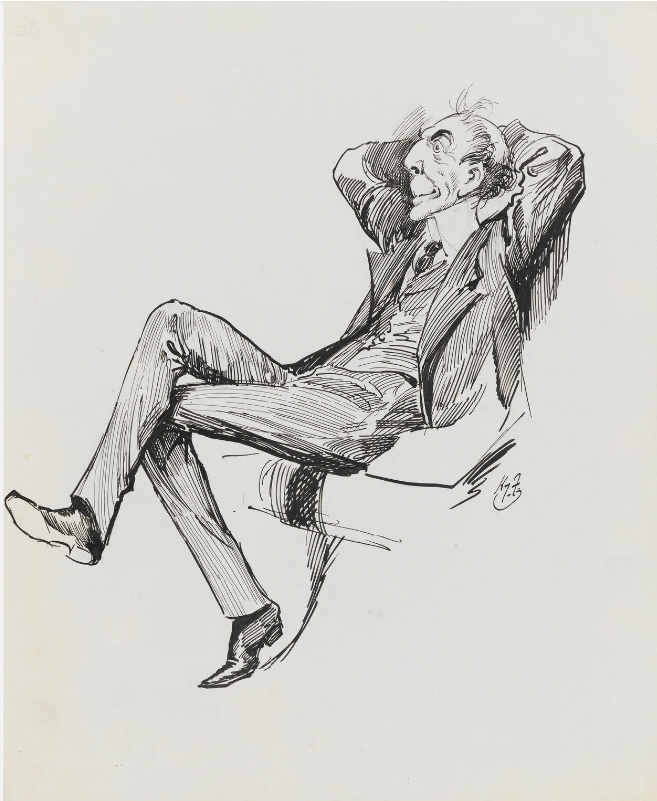

After the war Buckmaster strongly attacked the atrocities committed in Ireland by the 'Black and Tans', the auxiliary police force recruited by the British government.
He became recognized as one of the leading orators of his day, speaking on a wide variety of subjects both in the House of Lords and on public platforms. He never wrote out his speeches in advance, but relied on scribbled notes.
Subjects on which he spoke ranged from the treatment of Germany after the war to the protection of lapwings (for which purpose he secured the passage of the Protection of Lapwings Act 1928).
He supported improved housing for the poor, birth control, the abolition of capital punishment, and women's sufrage. Unlike most people, Buckmaster became more radical, particularly on social issues, as he grew older.
He was particularly active in the field of divorce reform, where he sought to provide for divorce on grounds other than adultery, which at that time was the only ground recognized by the law.
In November 1918 he introduced a bill adding desertion as a ground for divorce, which was defeated. In March 1920 he moved the second reading in the House of Lords of a bill which would have provided five additional grounds for divorce. This bill was narrowly passed by the House of Lords but it failed because the government never introduced it in the House of Commons. Similar bills were introduced in the House of Lords in 1921 and 1924 but failed to get enough support to be enacted.
Buckmaster's only success was to pilot through the House of Lords the Matrimonial Causes Act 1923 which made a limited extension to divorce law by allowing women to obtain a divorce on the ground of their husband's adultery alone; previously women (but not men) had had to prove cruelty as well as adultery.
Buckmaster was not a creative or reforming judge — he stuck firmly to the maxim that hard cases make had law — but he was highly regarded by other leading judges of his day. Lord Birkenhead described him as 'a consummate judge' (Heuston, 301).
Lord Dunedin was asked, 'Whom do you regard as the greatest colleague you have had?' and replied:
"You will be surprised when I tell you — Buckmaster. I have not and I never have had any sympathy with Buckmaster's political ideas and performances and I think him to be a sentimentalist — until he is sitting on his arse on the bench; there he is one of the most learned, one of the most acute, and the fairest judge I ever sat with."
1st Baron Buckmaster 1915 — December 5, 1934
1st Viscount Buckmaster 1932 — December 5, 1934
Viscount Buckmaster February 24, 1933 — December 5, 1934
[Source: Link.]
[Wikipedia: Stanley Buckmaster, 1st Viscount Buckmaster.]
Viscount Buckmaster, of Cheddington in the County of Buckingham, is a title in the Peerage of the United Kingdom. It was created in 1933 for the lawyer and Liberal politician and former Lord Chancellor, Stanley Buckmaster, 1st Baron Buckmaster. He had already been created Baron Buckmaster, of Cheddington in the County of Buckingham, in 1915, also in the Peerage of the United Kingdom.
[Wikipedia: Viscount Buckmaster.]
STANLEY OWEN BUCKMASTER IN THE HOUSE, NOVEMBER 1914
WC DRILLED MEN
Sunderland Daily Echo and Shipping Gazette — Friday 20 November 1914
House of Commons, Thursday.
The Speaker took the chair at 2.45.
RUSSIAN CONQUESTS.
Mr Kin# asked the Foreign Secretary whether the Russian Government had formally communicated JI.M. Government that the provinces of Lukovina and Galicia hud been annexed to the Russian Empire. Sir Edward Grey; The answer is in the negative.
THE "IRISH VOLUNTEER"
Mr Hunt asked the Solicitor-General whether his attention had been called ah' article in the recent issue the Irish Volunteer in which it was stated that/or Ireland the only chance for her safety national honour was to cut herself free from the last tie which bound her people to English Imperialism and that the only path to glorious and happy Ireland was through the downfall the British Empire, whether this paper was organised and financed by the Germans, and whether the Press Censor would continue to allow these sort of articles to be published.
Sir Stanley Buckmaster said had not seen a copy of the paper alluded to. did not know anything of the history or organisation of the paper, nor whom it was financed. None the matter referred to was submitted to him. would certainly not allow articles the kind mentioned published.
Long asked whether the powers exercised Censors over newspapers iu Ireland were identical with those exercised them over newspapers iu the rest the United Kingdom.
Sir Stanley Buckmaster: Certainly, but newspapers in Scotland and England are more immediately under notice than newspapers in Ireland. (Cries " Why-%) Because he saw one and did nut see the other.
Mr Hunt It I send him a copy will lie look into the matter? Sir Stanley Buckmaster; Certainly bend me copy.
Mr John Redmond: Is he aware of the tact that this newspaper has no connection of any sort or kind with the Irish National Volunteers? (Cheers.)
Sir Stanley Buckmastcr: should have thought that was obvious.
TERRITORIALS' FAREWELL FURLOUGH.
J. M. Henderson asked whether Territorials were allowed three days' lurlough to enable them to visit their relatives before going to the front and had themselves to pay much as 42 and for railway fares to enable them to do so, and whether free railway conveyance could be arranged for them.
Mr Harold Baker said the Army Council were carefully considering the question raised by his hon. friend, of which they fully recognised the importance.
DRILLED CIVILIANS AND INVASION
Tennant informed Mr Boyton that it was not intended to utilise the National Reservists, who had not been called and therefore they would not supplied with uniforms. Asked what would be their position in the event of invasion, said it would be the same as that any other civilians.
Mr John Ward: Has the War Office no intention whatever using the different contingents which are now being drilled different parts of the country in case invasion, and of recognising them? Tennant said did not know what contingents the lion, member was alludin"- to.
John Ward: If the right hon. gentleman will to Wandsworth Common sometimes will see thousands of men being drilled whom the War Office don't recognise at all. Bridgman asked whether in the particular case the National Reservists they could not be made use of in the event of invasion?
Tennant; I shall have to consider that. (Hear, hear.)
[Source: Link]
Buckmaster, Stanley Owen, first Viscount Buckmaster 1861-1934, lord chancellor and statesman, was born at Slapton, Cheddington, Buckinghamshire, 9 January 1861, the third of the four sons of John Charles Buckmaster, of Slapton, afterwards of Wandsworth, by his wife, Emily Anne, eldest daughter of George Goodliffe, of Trumpington, near Cambridge.
[PB: No, this was his father, JCB — Stanley Owen was born in Battersea.]
John Buckmaster was a remarkable man who, beginning life as an agricultural labourer, became successively a joiner, a well-known platform speaker in the cause of free trade, and, under the patronage of the Prince Consort whom he had advised and helped in the matter of the Great Exhibition of 1851, an inspector in the Department of Science and Art at South Kensington, which has since developed into the Imperial College of Science and Technology.
Stanley Buckmaster was sent to Aldenham School where he remained until 1879, living a life so hard that he never forgot its hardships. He then went, with a junior studentship, to Christ Church, Oxford, where he obtained a second class in mathematical moderations (1881) and in the final mathematical school (1882).
Buckmaster was a devoted liberal and, as his father had been, an ardent free trader. In 1906 he was returned to parliament for the borough of Cambridge: in January 1910 he lost that seat, which, in the following December, he again unsuccessfully contested; but at a by-election in October 1911 he was returned for the Keighley division of the West Riding of Yorkshire. Under the leadership first of Campbell-Bannerman and afterwards of Asquith, Buckmaster was a supporter of the government. But often he would speak, albeit from the government benches, from the experience of a practising lawyer rather than as a party man, and such speeches as the defence of Sir William Grantham [qv.], a strong conservative, in connexion with a petition in respect of the election at Yarmouth in 1906, and his criticisms of the criminal appeal bill (1907) came from him as a lawyer's guidance of the House.
It was not, however, until he reached the House of Lords in 1915 that Buckmaster's powers as a parliamentary debater, and as a parliamentary orator, reached their height and that he became a leader of debate. While he was on the woolsack he took the ordinary part of a lord chancellor in debate and was sometimes the most prominent speaker for the government; and afterwards he often availed himself of the benefit of the custom by which an ex-lord chancellor, as distinct from the other law lords, is granted by the House full liberty to take part, and even a leading part, in general political debate. He spoke thus on many subjects, including finance, industrial unrest, disarmament, the treatment of Germans after the war of 1914-1918, the government's Irish policy, the reform of the House of Lords, many times on the reform of the divorce laws (a subject always much in his mind), birth control, and women's suffrage: what he said always compelled the respect of the House and the manner of his saying it its admiration. During the same years he made many important speeches outside parliament, a number of which, especially the speeches which he made in 1925 to lawyers in Canada and the United States of America, will be remembered. As a platform orator he was regarded by many as supreme in his time.
In 1884 Buckmaster was called to the bar by the Inner Temple and in 1902 became a member of Lincoln's Inn. He was made a bencher of Lincoln's Inn in 1910 and was treasurer in 1934. He practised first on the Common Law side, largely on the Oxford circuit and in county courts, and it was because he did there, as a young man, so much litigation work, unled, that he learnt to lean on his own judgement about a case as a whole, and so, when he went over into Chancery and as a junior was soon engaged in cases involving different questions and more important amounts, he was competent from experience, and bold from having known responsibility, to determine, and to advise without waiting for a leader, not only on the law and the form of the pleadings, but on the merits of the case and the strategy and tactics for the court. On the Chancery side he had a large practice as a junior and in 1902 he took silk. In those days the King's Counsel practising on the Chancery side were attached to the courts of particular judges of that division and he went to Sir H. B. Buckley (afterwards Lord Wrenbury) [qv.]. In 1907 he went special and so for a special fee could, and did, practise before any Chancery judge. Like every great success at the bar, Buckmaster's was gained by hard work and thoroughness: he was by nature and training a good lawyer; he learnt and understood what equity might be necessary; he was quick enough and industrious enough to scrutinize the facts put before him, and had skill and judgement in the selection and presentation of what among those facts was material. He never sought to evade a difficulty by pretending that it was not there; it was a precept of his that before you put together the stones of which a house is to be built you must look all round each stone to see whether there is a beetle underneath it.
In 1913 Buckmaster was appointed solicitor-general in succession to Sir John Simon. His work as a law officer earned much commendation from the bench, the bar, and the departments, but soon after the outbreak of war he was given additional duties as director of the Press Bureau. To a press accustomed to freedom and a public whose curiosity was insatiable, his methods appeared too drastic, nor did his explanations always command satisfaction in the House of Commons or in the country.
On the reconstruction of Asquith's government into a coalition ministry in May 1915, and the retirement of Haldane as lord chancellor, the great seal was given to Buckmaster, who the same day was sworn of the Privy Council. He took the title of Baron Buckmaster, of Cheddington, in Buckinghamshire. When the coalition ministry fell in December 1916, Buckmaster, who had been lord chancellor for only eighteen months, was succeeded by R.B., Lord Finlay [qv.]. With the exception of some time passed in the City, in 1925-1926, in a crusade against what he regarded as an injustice (for which time he relinquished his pension) he spent the rest of his life as an appellate judge in the House of Lords and the Judicial Committee of the Privy Council and often presided in those tribunals.
Buckmaster was probably best known as an orator, but the work which he did as a judge is the work that will be remembered longest. It was not the work which he most enjoyed, but it was done under the compulsion of a stern sense of duty and the recognition, when sitting as a judge in the highest tribunals of the Empire, that justice, which had always been the ruling motive of his life, was now best served by statement of the law as it was. Any temptation to find a construction of the law which would right a wrong in the particular case or would mitigate a hardship caused by the law itself was resolutely resisted. No one ever saw more clearly that hard cases make had law, and that the cure in such cases was for parliament. Lord Birkenhead said of him that he was a consummately equipped judge; and when Lord Dunedin was asked: Whom do you regard as the greatest colleague you have had?, he answered: You will be surprised when I tell you — Buckmaster; I have not and I never have had any sympathy with Buckmaster's political ideas and performances and I think him to be a sentimentalist — unless he is sitting on his arse on the bench; there he is one of the most learned, one of the most acute, and the fairest judge I ever sat with; and he will leave much in the books.
Buckmaster was appointed G.C.V.O. in 1930 and advanced to a viscountcy in 1933: the step in the peerage was made, certainly in the opinion of the profession, particularly in order to enable him, after he had ceased to be lord chancellor, to preside in appeals in which some other law lord or member of the Judicial Committee, junior to him but a viscount, might be sitting: it was a legal, not a political, nor a social, advancement. He was counsel to Oxford University from 1910 to 1913; was elected an honorary student of Christ Church in 1917; and received honorary degrees from the universities of Toronto (1925) and Oxford and Edinburgh (1933). He held a very special position in regard to the boot and shoe trade as umpire for determining wages and disputes about conditions. He had held this position for three years before his appointment as a law officer, and in 1925 was re-appointed and held the office until his death. In 1923 he became chairman of the governing body of the Imperial College of Science and Technology, an appointment of which, for the sake of his father's memory, he was most proud.
Buckmaster was much beloved by his friends and particularly at the Garrick Club of which he was a member from 1909 until his death. He seldom said a witty thing and seldom told a good story, but his speeches at the famous Sunday dinners of the club were delightful in their always kindly humour. Perhaps the best of his talk was when, on a fishing holiday beside the Spey, he would be lying on the bank with a friend, often his faithful and much-loved gillie, waiting for the sun to go off the pool.
Buckmaster married in 1889 Edith Augusta (died 1935), fourth daughter of Spencer Robert Lewin, of Widford, Hertfordshire; they had one son and two daughters, the elder of whom predeceased her father. He died in London 5 December 1934, and was succeeded as second viscount by his son, Owen Stanley (born 1890).
A portrait of Buckmaster, by Thomas McKegger, is in the possession of Dr. Dorothy Tasker. Another (posthumous) portrait, in his lord chancellor's robes, by Reginald Eves, hangs in the hall of Christ Church, Oxford.
Sources:
The Times, 6 and 7 December 1934
A Village Politician. The Life-Story of John Buckley (edited by J. C. Buckmaster whose autobiography it is), 1897
James Johnston, An Orator of Justice. A Speech Biography of Viscount Buckmaster, 1932
private information
personal knowledge.
Contributor: Geoffrey Russell.
Published: 1949
The descendant family is reviewed in some detail in ThePeerage.comStanley Buckmaster, 1st Viscount Buckmaster, 1928 2
Stanley Owen Buckmaster, 1st Viscount Buckmaster was born on 9 January 1861.1
He was the son of John Charles Buckmaster and Emily Anne Goodliffe.1
He married Edith Augusta Lewin, daughter of Spencer Robert Lewin, on 29 December 1889.1
He died on 5 December 1934 at age 73 at London, England G.1
He was buried on 7 December 1934 at Golders Green Cemetery, London, England G, cremated.4
He was educated in 1871 at Aldenham School, Elstree, Hertfordshire, EnglandG.4
Hegraduated from Christ Church, Oxford University, Oxford, Oxfordshire, EnglandG, in 1882 with a Bachelor of Arts (B.A.)1
He was admitted to Inner Temple in 1884 entitled to practise as a barrister.1
He graduated from Christ Church, Oxford University, Oxford, Oxfordshire, EnglandG, in 1886 with a Master of Arts (M.A.) 1
He held the office of Justice of the Peace (J.P.) for Hertfordshire.1
He was appointed King's Counsel (K.C.) in 1902.1
He held the office of Bencher of the Inner Temple.4
He held the office of Member of Parliament (M.P.) (Liberal) for Cambridge Borough between 1906 and 1910.1
He was counsel to Oxford University between 1911 and 1913.1
He held the office of Member of Parliament (M.P.) (Liberal) for Keighley between 1911 and 1915.1
He held the office of Solicitor-General between 1913 and 1915.1
He was appointed Knight on 15 November 1913.1
He was Director of the Press Bureau between 1914 and 1915.4
He was appointed Privy Counsellor (P.C.) on 27 May 1915.1
He held the office of Lord High Chancellor between 27 May 1915 and 5 December 1916.1
He was created 1st Baron Buckmaster, of Cheddington, co. Buckingham [U.K.] on 14 June 1915.1
He was president of British Controlled Oilfields Ltd in 1926.4
He was awarded the honorary degree of Doctor of Civil Law (D.C.L.) by Oxford University, Oxford, Oxfordshire, EnglandG.1
He was awarded the honorary degree of Doctor of Law (LL.D.) by University of Toronto, Toronto, Ontario, CanadaG.1
He was awarded the honorary degree of Doctor of Law (LL.D.) by University of Edinburgh, Edinburgh, Midlothian, ScotlandG.1
He was appointed Knight Grand Cross, Royal Victorian Order (G.C.V.O.) in 1930.1
He was created 1st Viscount Buckmaster [U.K.] on 24 February 1933.1
He has an extensive biographical entry in the Dictionary of National Biography.5
Children of Stanley Owen Buckmaster, 1st Viscount Buckmaster and Edith Augusta Lewin
Owen Stanley Buckmaster, 2nd Viscount Buckmaster+6 b. 24 Sep 1890, d. 25 Sep 1974
Hon. Margaret Anna Buckmaster+1 b. 8 Mar 1893, d. 4 Jun 1929
Hon. Barbara Buckmaster+1 b. 21 Oct 1903, d. Sep 1966
Citations
[S37] BP2003 volume 1, page 579. See link for full details for this source. Hereinafter cited as. [S37]
[S300] Michael Rhodes, "re: Ernest Fawbert Collection," e-mail message to Darryl Roger Lundy, 8 February. Hereinafter cited as "re: Ernest Fawbert Collection."
[S266] World War II Unit Histories — Officers, online http://www.unithistories.com/units_index/default.asp?file=../officers/personsx.html. Hereinafter cited as World War II Unit Histories — Officers.
[S6] G.E. Cokayne; with Vicary Gibbs, H.A. Doubleday, Geoffrey H. White, Duncan Warrand and Lord Howard de Walden, editors, The Complete Peerage of England, Scotland, Ireland, Great Britain and the United Kingdom, Extant, Extinct or Dormant, new ed., 13 volumes in 14 (1910-1959; reprint in 6 volumes, Gloucester, U.K.: Alan Sutton Publishing, 2000), volume XIII, page 201. Hereinafter cited as The Complete Peerage.
[S18] Matthew H.C.G., editor, Dictionary of National Biography on CD-ROM (Oxford, U.K.: Oxford University Press, 1995), Buckmaster, Stanley Owen. Hereinafter cited as Dictionary of National Biography.
[S37] BP2003. [S37]
[Buckmaster, Fithian et al seek election to London School Board.]
Under the auspices of the Bolingbroke Tradesmen's and Ratepayers' Club a meeting was held on Tuesday night at the Lecture Hall, Northcote-road, to consider the addresses of the local candidates, and to decide which the club should support. Mr. Tumor presided.
Mr. Thomas pointed out the desirability of Battersea securing some share of representation at the School Board. He held that the present School Board divisions were far too large. The members could not be "in touch" with their constituents, and there was a consequent loss of a sense of responsibility. (Hear.) Battersea could not hope to carry more than two candidates, and he thought the club would best mark their sense of the necessity for diminishing the area of a division, and the desirability of local candidates, resolving only to support those candidates who resided within the area embraced by the Wandsworth Board of Works. He moved to that effect. The motion was carried.
Messrs. Buckmaster, Fithian, Lucas, Thomson, Helby, and Tims were found to be the local candidates. The addresses of these gentlemen were read and discussed at some length.
Mr. Phillips hoped the club would support those gentlemen who favoured free education. He pointed out that of the £107,000 paid for school fees a large proportion was spent in the collection. If education were free, the attendance would be larger, and larger Government grants could earned. He thought the Government grant of 17s. 6d. — the average grant in London — could be much improved. He believed that if free education were established the Government would be compelled to lessen the cost to the ratepayers by getting for the purposes of education the educational endowments which were now misapplied. (Hear.),
Mr. Thomas also spoke in favour of free education. Basing his remarks on a statement published the Board, he said that the ratepayers provided £1,030,000 against some £107,000 paid in school fees, so that only the tenth of the coat of education was paid in fees. In 1884 the net result of school fees was but £56,000, and when the smallness of the sum paid each child was taken into consideration, it would found that the sum was made up of 16 million fees. This involved vast amount of work on the officers, and when their time was taken into consideration, and the expenses of enforcing the payment of the fees calculated, the result of the present fee system was almost nil.
With regard to the charges of extravagance brought against the Board and the promises of economy," a good many of those speeches were made with a view to catch the votes of unthinking men. (Hear.) Mr. Blackburn nominated Mr. Time for the support of the club. Mr. Hyem nominated Mr. Lucas. Mr. Thomson and Mr. Fithian were also nominated. On the name of Mr. Helby being mentioned, a member moved the next business," and Mr. Helby was not nominated.
An exhaustive ballot was then taken, with the result that the club agreed to support Messrs. Tims, Thomson, and Fithian. Mr. Thomas urged the necessity for united, energetic action, and business-like meeting closed with a vote of thanks to the chairman.
A meeting was hold at the Memorial Hall, Wandsworth, on Wednesday, to promote the candidature of Mr. Stanley Buckmaster and Rev. G. M. Murphy.
[Stanley Buckmaster's speech reported.]
After a few remarks by the chairman (Mr. Calderwood, F.R.S.E.), Mr. Buckmaster addressed the meeting. He said, with regard to the Education Acts, he believed there was no Act that had brought forth better fruit in the past or was full of promise of greater possibilities for the future. He advocated strongly the cause of free education, and was opposed to a further extension of the system of remitting fees, for he considered it a cruel injustice that a man, for perhaps the first time in his life, should sacrifice his independence and be degraded by appearing to beg before body of guardians, many of whom would probably have no sympathy with the man or the object for which the fees were to be remitted.
He was unable to understand how any man could possibly declare that free education would destroy the independence of the people, and yet at the same time advocate fuller extension of pauperization by the remission fees. Free education, he maintained, could not destroy the independence of the people. It was free education not for class or sect, but for the whole nation, and every one could avail themselves the national benefit. In Scotland for generations the son of the landowner, the son of the farmer, and the son of the ploughman sat side by side at the same school and learned the same lessons, the benefit of all. The decay of this system had led to the gradual estrangement of classes.
With reference to the increased burden on the ratepayer, which would be caused by the abolition of foes, maintained this was greatly exaggerated; nearly the whole of the fees were lost in the cost of collection. The amount of fees last year was £108,900, and he would like to ask those who clamoured against this being in future levied by taxation, why they did not protest when £109,000 of the ratepayers* money was paid to the London Pavilion Music Hall as a compensation for widening a street.
The truth was that all expense was borne with long-suffering, except an expense for improving the position of the poor for refining their tastes, elevating their social life, and giving them access the store-house of knowledge. There were many obstacles to be overcome in their struggle for maintaining that education was the birthright every citizen — they had to meet class selfishness, sectarian bitterness, aristocratic prejudice, and often the blind ignorance of those they wished to benefit; but he was convinced that there were no difficulties which would not yield to determination, and the greatness of the obstacles was not ground for despair, but a call for greater and more determined effort.
He then explained his views technical and secondary education, saying that life was game played according to fixed rules, the knowledge of which was called science, and ignorance of these rules would inevitably lead to national disaster. He should never be contented until every child blessed with industry and intelligence was enabled education to fill the highest position that his abilities entitled him to occupy. Foreign competition was only dangerous when it was intelligent, and with knowledge, industry, and business habits, qualities which education would impart, they could defy the competition of the whole world.
With regard to the expenditure, he was pledged to promote economy as fully as any other candidate, but he would not support an economy which tried to secure its ends the erection of bad buildings for the children. He believed great importance should attached to the early environments and associations of a child. Many were obliged to live in places joyless and hopeless and comfortless, and the school should stand out in bright relief to the squalor of their homes.
In conclusion, he said that he would gain no man's vote the concealment of his opinions; but if bis views were in accordance with their principles, he asked for their support to be enabled to carry them into practice. (Cheers.)