This Is My Life
1915–1926: A Battersea childhood
Muriel Mary Baldrey (Johnson), 1915–1999
Part 1 1915–1923
When my father died in March 1969 we had the opportunity of reading the very small part of the story of his life that he had managed to write. It finished abruptly in the middle of the 1914-18 War, and vividly described his life as a soldier behind the lines in France. Strangely enough although it goes beyond 1915 when I was born in May, he makes no mention of my birth, but I presume the awfulness of the battle in France had so impressed itself on his mind that events in his domestic life were in the background.
I was born at 12, Dulka Road, Battersea and my paternal grandmother helped the Doctor to deliver me, as although she was not a qualified Mid-wife, she was an able assistant to the family Doctor. From all accounts she hurried down a flight of stairs to the kitchen to show me to my father, and stumbled on the hearth nearly dropping me into the fireplace. However, all was well, and I was apparently a very good baby sleeping most of the time — my Godfather, a Mr Curzon, called me Moo-moo-the sleepy one. I had lots of black hair and from photographs looked rather Japanese.
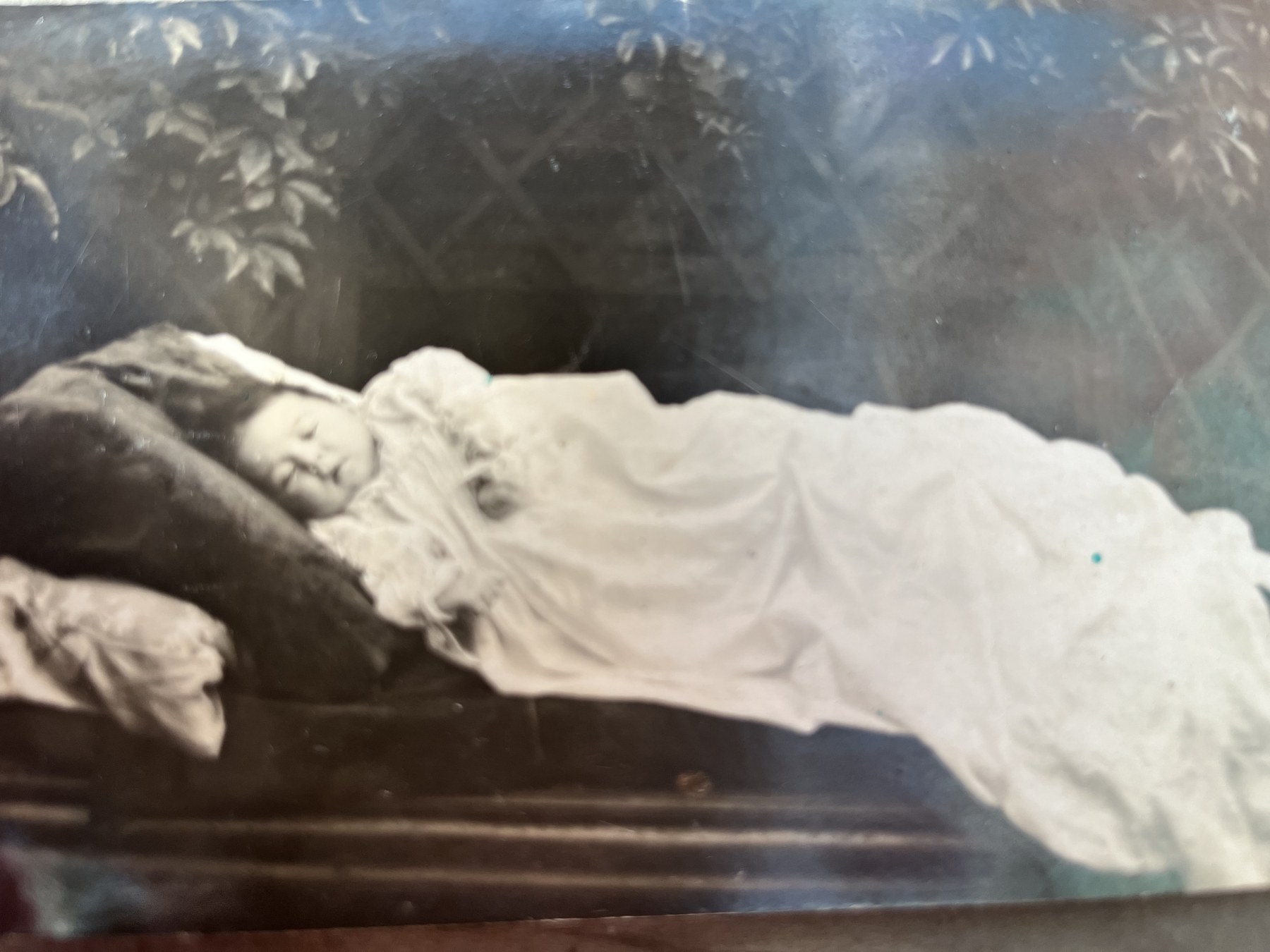
Muriel at ten weeks old, in the summer of 1915: “Moo-moo, the sleepy one”. The photograph is a postcard; the family thinks it was probably taken at Dulka Road, though it may be a studio portrait. Click to enlarge.
In May 1915 the First World War, which started on July 29th, 1914, was in its tenth month; battles had been fought including the Battle of Ypres, when poison gas was first used. At this time two great Armies of about 2,000,000 men faced each other in trench Warfare across France from Switzerland to the North Sea.
Russia, Italy and France were our Allies against Germany, Austria and finally Turkey. During the year 1915, there was a naval attack on the Dardanelles, and an attempt to land a force at Gallipoli, which ended in disaster. Russia was keeping part of the German Army busy in the Caucuses.
My father joined the Army soon after, leaving my mother and me in the three roomed upstairs flat, at the same time the lady downstairs, Mrs Brodie, was left on her own as her husband also joined the army. Mrs Brodie had a baby also born in April, Phyllis, and the two mums decided to cut down on housekeeping expenses and spent one week in each flat, turn and turn about. They apparently enjoyed their life as much as it was possible during Wartime, and my mother said that they had heard that it was possible to get sea breezes on Clapham Common early in the morning, as it was supposed to be the highest spot from the South Downs, so consequently they were to be seen on the Common with the two prams at about 7a.m.
During 1916 more battles were fought at the Battle of Verdun. The French line held against the German attack, but there was hideous carnage.
The German Fleet emerged and challenged the Royal Navy to a Battle at Jutland. There were great losses on both sides, but finally the German ships retreated and went back into hiding. There was a Russian attack at Bukovina, and a British offensive on the Somme, when tanks were first used. Rumania joined in the War with an attack on the German Army, but the Germans counter attacked, and drove them back, finally capturing Bukarest.
I believe all went well, until my mother set out to visit my grandmother in Vardens Road one day, when the maroons went signifying Zeppelins. She was apparently petrified with fear and ran all the way home. She may also have been short of money, but soon after she gave up the flat in Dulka Road and went to live with my Grandmother, who had a five roomed flat upstairs in the house of my father’s mother. My mother’s sister Nell and her two brothers Will and Len were also living at home, so it was rather cramped conditions. My mother went to work at a Men’s Hosiery shop in Clapham Junction called Woollards. Nell also worked there, and my grandmother looked after me and ran the flat.
Probably at 2 ½, I have a memory of seeing an observation balloon from the window of 43 Vardens Road, (which had apparently broken its moorings), as it got bigger and bigger, and finally came past the window across the railway and landed in St Mary’s cemetery, it was such an exciting event, that my grandmother ran with me in her apron to the cemetery, and we saw that the man was unhurt.
Two big events happened during 1917 — one was the start of the Russian Revolution and the other was a declaration of war by the U.S.A. The first meant that the Russian front collapsed, but the German troops could not be withdrawn until the outcome of the Revolution was known.
With regard to the War against Turkey the British made a thrust in Mesopotamia with some success. On March 21st 1918 the Germans signed a Treaty with the Russians whose leader was now Trotski. This meant the release of thousands of German troops from the Russian front, and they planned a big onslaught on the British and French in France hoping to win the War before the America troops arrived. There was a big battle against the French across the Marne, but they pushed them back, and finally with the arrival of the Americans, the Germans started to retreat, and on November 11th the Armistice was signed.
When the War ended and my father returned, probably early 1919, he and his brother Henry rented flats in a house in Strathblaine Road. As far as I can remember we had the ground floor rooms and a bedroom at the top of the house — 34 stairs to climb, Uncle Henry had the three middle floor rooms, a widow and her daughter had a large top floor room, and a small living room. My brother Dennis was born here in the November, but I have no memory of this, and here also my Aunt Alice had Hazel in October 1920. Hazel was a difficult baby to feed, and in desperation my Aunt tried Nestles Milk — I have a memory with regard to this, as I loved this and still do. I apparently went into her kitchen and dipped my fingers into the tin, of course leaving a nice lot of mess in the cupboard. My mother was very annoyed with me.
Uncle Henry bought a dog whilst he was in the flat, which must have had difficulties. It was a white pom, and he was very proud of it, we also had a mongrel dog called Peter. The story goes that both families were out giving their dogs airings, and when they met on the Common, Peter suddenly attacked the pom and rolled him in the mud, he was a sorry sight, much to Uncle’s annoyance.
I remember Grannie Baldrey taking Alice, my cousin, and I to have our names put down on the register of Plough Road School, we were both excited. However, I did not like school, but as I was in the same class as Alice, I think I clung to her like a leech, she was a much more independent child, due I expect to the fact that she had three older sisters. When we were six Alice suddenly developed scarlet fever, which at that time meant being rushed to an Isolation Hospital for at least six weeks. Poor Alice, but I was absolutely desolate, and I remember crying so much in the class, that the teacher didn’t know what to do with me. When Alice finally arrived back, she was greatly admired for the stories she had to tell about the Hospital.
My mother and father seemed to be able to afford a summer holiday for us each year, and as far as I can remember we went to Bournemouth in 1920. I have vague recollections of a teenage girl with fair hair who went around with us and who my father teased a lot. I think also the highlight of this holiday was that we had a hansom cab (horse drawn) to take us and fetch us from the station.
The following three years we went to Westgate-on-Sea near Margate. We stayed with very nice people with a daughter Sybil, who was about a year older than me, and went to a Convent School. One year Dad’s mother came with us, and another year my mother had a bad attack of tonsillitis whilst we were there and had to stay in bed. I remember rather appropriately that at the local Concert Party the Comedien sang a song — “I’m getting better every day”, which we sang to Mum every morning.
Finally in 19223 when Dennis was nearly four he didn’t seem too well whilst we were away, he didn’t want to go in the sea, and Mum and Dad tried hard to persuade him to paddle. When we came home, one morning he came in from the garden and Mum realized that he was talking very oddly and his legs weren’t working too well. After much examination by two or three doctors it was discovered that he had had nasal diphtheria whilst we were on holiday and he was now suffering from the after effects. He had to lie flat in bed for some weeks, and Grannie came to live with us and look after him, as he was also in isolation. When he was stronger in October, he went to stay with Uncle Henry, he was just able to write and we kept his letters for a long time.
In May 1922 I was chosen to be May Queen at the Plough Road Infants School, at the same time my father, who was an organiser at the Waifs and Strays Society was producing a Pageant at the Battersea Town Hall, and a lot of local schools and Dancing Schools were roped in to produce a scene. The Headmistresses at Plough Road had agreed to produce a scene from Midsummers Night Dream, the one in which Titania and Oberon meet, and there were lots of fairies around.
We were chosen to be elves, we were then in the second from top class of the infants. It must have been a very busy time for my mother as she had to make this green costume for me as an elf, and then arrange about my dress as a May Queen. The daughter of the lady living at the top of the house was a dressmaker, and she undertook to make the dress. It was long and of crepe de chine, and the long train was of satin embroidered with tiny beads.
I think I was proud to be chosen, but after a time I suppose the rehearsing and trying on the dress etc, became boring. I remember I longed to join the boys and girls who were rehearsing dancing round the Maypole. My part was to sit on the throne the whole time that the Concert was performed, and then to dance a minuet with the departing Queen. However, despite the boredom, I was presented with a gold locket and chain, and a very much cherished book of poetry. I carried lily of the valley, and this has always been my favourite flower.
I do not remember much of the Pageant, except that we were very excited, and as the little boy Ronnie Lines who had promised to marry me (!!!) was in it also, I think I enjoyed myself.
I was the last May Queen at this school, and we were invited to the Whitelands Training College with lots of other children from South London. We performed out minuet.
Uncle Henry and my father were both working at the Waifs and Strays Society whilst living at Strathblaine Road. I think it was in 1923 that Uncle was promoted to an Organiser for the Midlands, and he went in search of a house near Birmingham. He found an enormous house, which, because of its size — about twenty rooms — was going at a very cheap rent, and so he and my Aunt, Hazel and the dog departed for The Lodge, Saltisford, Warwick, with a minimum of furniture.
About the time that Uncle Henry moved to Warwick, Grannie Baldrey was in touch with relatives at Leamington Spa, her mother’s sister lived there in a large old house, and with most of her family around her. One daughter Lil had married and moved to Coventry, and her husband, Uncle Bob, was working for a printing firm there, however he had a bad accident, he slipped in the snow and broke his thigh. He was in hospital for ages and the leg did not mend properly, which meant he would always walk with a stick.
It must have been a bad time for Auntie Lil as there was not much money available and I think she had to take in washing to make ends meet. However, finally Uncle Bob was offered a job in the London branch of the printing works and they wrote to Grannie asking whether she could put them up until they found a flat. They stayed at 43 Vardens Road for a time, and then when Uncle Henry moved they took our flat at Strathblaine. They had three rooms on the middle floor and my mother let them have the use of the bathroom for washing up, etc. Incidentally there was no hot water in this bathroom, as the kitchen range had long since ceased to function and my father did not have the money to replace it.
He had, however, installed a bath in the rather solid greenhouse attached to the back of the house, and water was hosed to this from an enormous stone copper which had a fire underneath and was in the scullery. The people in the top flat had gone so my father had three rooms right at the top of the house, two bedrooms and one he used as an office, as at this time he was an organiser for the Waifs for the southern counties. With regard to bathing facilities for my Aunt, she used a big tin bath in front of the fire, which was quite usual at this time.
Our house backed on to the railway, and the noise of the trains was terrific, but as a child I liked to hear a train go by in the night, the noise comforted me!!
We had no electricity at that time, only gas, and when we went up to bed we had to climb 32 stairs, so we broke our journey in the dark by going in to say goodnight to Auntie Lil and Uncle Bob and, of course, we prolonged this as long as long as possible. The bedrooms in the winter were freezing cold, and if we had a hot water bottle it was a big stone thing, which could hurt your feet. Our bedroom had a gas jet, which gave a queer light and cast shadows all around the room, when my mother want back to the kitchen 32 stairs away, it seemed very lonely up there in the dark. I think I was a nervous child, as I would often imagine I was in the house alone, and would call out just to hear somebody answer.
At that time there were very few cars, everything was horse drawn, but there were trams, which seemed enormous, and open topped buses, if you had to travel on the top when it was raining, there were waterproof covers which you pulled up round you. We also had terrible fogs, and I can remember being met from school at 4 p.m. and taken home in this thick yellow cloud.
Looking back life seemed quite hard for people living around us. In the house opposite these was a family, husband and wife and three children living in the downstairs flat, and the husband developed T.B. which was a terrible thing in those days, like cancer is now. There was nothing they could do for him, and he just shrank away, and she was left to cope with the three children. Further along there was a very nice older lady whose daughter and husband had died in the terrible ‘flu epidemic during the war, and she looked after the two little girls, her granddaughters, she was a widow, and I t hink let rooms in her house to make enough money to live on.
The husband of another woman further up the road fell into a boiling sugar vat at Tate and Lyle’s where he worked, and she was left with four children to bring up.
Two other widows with three or four children had lost their husbands in the War, and I Believe took lodgers to help them feed their families. Women did not go to work except perhaps as charwomen, once they had married, it must have been very hard for women
Part 2 1923–1926
We had a family of Germans living next door, they must have been refugees from Germany or perhaps Belgium, as there had been Belgians in our house during the War. My mother did not like the old lady, Mrs Zimmerman, but she was quite friendly with the married daughter who lived in the top flat and had a son the same age as Dennis.
On the other side lived an elderly couple with one son, who had the whole house, and must have had quite a bit of money as it was very well kept. They had a grape-vine in their garden which grew over our side, but I don’t think the grapes ever ripened — they always seemed hard and green. They also had a parrot with one leg, which just said “Pretty Polly”, and whistled the same tune over and over again.
After Uncle Henry had been in Warwick for some months he bought a car, the first one in the family — a three wheeler — Morgan. He came to stay with us, and we all took it in turns to have a ride round the Common, including all the members of the Vardens Road family — great excitement, and I suppose my first ride in a car.
This year — 1923 — was my first in the “Big Girls’ School” — we had a very nice teacher called Mrs Clarke, and I liked her very much. It was whilst I was in this class that I had rather an odd illness. They said it was something to do with the nerves of my throat, as sometimes when I was drinking or eating I was unable to swallow and would feel that I was choking. Or course, as I was so young, I decided that I didn’t want to eat at all, it must have been a great worry for my mother. One event that stands out is that when I went back to school again, probably looking rather pale, Mrs Clarke said that she thought Dorothea Hancocks and I were like twins, and one day she mentioned this to another teacher Mrs Woodford, who said she could tell fortunes and read our palms. She said that I would marry a poor man, have a large family and would be happy, and that Dorothea would have plenty of money and live in a big house. Actually Dorothea lives in Ellerton Road — but she was right about the large family and the Cottage!
We always had big family parties at Christmas, and I can remember on one occasion that Dad got hold of a trestle table and we sat down about 15 in the small kitchen at Strathblaine, and afterwards great fun in the evening. The folding doors were opened, two big fires kept going, Christmas Tree at one end and the piano going at the other. Sometimes Uncle Len would play or Reg, they both ran Dance Bands in their spare time. Bert played the banjo, and they would usually rustle up a drum, so we always had dancing.
Before my mother married she had managed to save up enough to but a piano, and her young brother Len learnt to play, and became a good pianist. I don’t know why my mother did not take lessons, perhaps she did not have enough money. However,when I was seven we heard of a very good Music Teacher, Mrs Blastock, who lived in Oberstein Road, and Mother decided that both she and I would have music lessons. I think I did quite well, as in 1923 I took my first Music Exam and passed fairly well. Mrs Blastock held a party each year when each of her students would play a piece of music or sing. I remember going to one with my mother and one little girl sang “ours is a Nice House Ours is”, and we all joined in the chorus. I even remember what I wore, a fawn woolly dress with gold bands round the sleeves, and I had a gold coloured hair ribbon.
I don’t think my mother kept up with the lessons but I do remember her playing “The Naughty Waltz”, and I think I could still play it now. When I had this trouble with my throat, the Doctor suggested that I should give up the music lessons, so that was it until I was about twelve when I started learning again.
It was about this time that my mother found she was pregnant and Peter was on the way. I think we must have spent the Easter of 1924 at Warwick, as I have a memory of Mum, Dennis and I arriving at Warwick Station on our own to be met by Uncle Henry, but somehow he missed us, and we had to find our way to the Lodge which was rather difficult. When we reached the gates, I stumbled over the gate block, and badly cut my knee, so I arrived crying loudly.
Auntie Alice soon had us settled in, and I shall never forget the glorious garden, although it was terribly overgrown, there were masses of trees and shrubs, all with their springtime bloom, and stretching away from the house the Common leading to the Warwick race-course, and from then open country.
We had some marvelous times here, my mother and Auntie got on so well together, and looking back I realise how easy going Auntie must have been, as at holiday times she always had a house full of people, with us children having the run of the garden.
I think it must have been this first holiday when Uncle and my father decided they would make a tennis court, which must have been tremendously hard work, as first they had to get the grass down, and then they borrowed a roller from the local gas-works, and worked like Trojans pulling it backwards and forwards. My father who had a sedentary occupation seemed to have boundless energy when on holiday, and always reckoned to get rid of any extra weight.
They finished their court and were soon equipped with the necessary nets and rackets, so that they became quite expert during the following years.
St. Mary Church, Warwick, is a lovely old Church, it is almost like a small Cathedral. Uncle joined the Choir and he and Dad always sang the Easter anthems. I can remember the sound of the bells on Sunday mornings and looking back it was always gloriously sunny. I suppose as I was a town child, this was a marvelous new experience for me, and as out parents got on so well, all our holidays were happy ones.
Peter was born on the 6th July 1924, I think he arrived in the morning, as I remember Dad telling Den and I to wait in the garden, and it was a glorious sunny morning. Dad always moved a bed down to the front room for Mum’s pregnancies and Grannie moved in. I remember being allowed to peep at the babe snuggled beside Mum.
We weren’t having a holiday this year, so as Auntie Rose and Uncle Bert were going to Hastings it was arranged that I should go along with them and Bert. I had stayed with Auntie Rose at her house at Twickenham for a short time — once with Alice and Elsie — thereby hangs a tale — as one day she took us for a picnic to Teddington Locks, and we were allowed to paddle. I remember Alice slipped and fell under the water and I can remember seeing her covered with water and just screaming. However, she was all right except that she had tot go home in wet clothes.
Back to Hastings, I don’t know why, but I was terribly homesick, each night I cried, and I don’t think I ate very much. Poor Auntie, it must have spoilt her holiday. However, she must have written and told Mum, as Uncle Henry came down to collect me with Grannie, and we went home via Eastbourne, where her sister Edie lived. I think Uncle’s car broke down that evening, as I remember sitting in the garage for ages. When we returned we went up to Warwick, I suppose this must have been at the end of August when Pete was about 6 weeks old. As I mentioned before Mum and Auntie got on so well together, otherwise I don’t think she would have gone away with such a young baby.
Den started School this year, and he hated it, he cried everytime Mum left him there, and this made her miserable and as she had Peter so small she was kept busy. I can remember coming home to dinner on Mondays which were wash days, and Mum was always in the middle of washing. I would help her turn the handle of the enormous mangle, and then see about the cold meat, mashed potatoes and rice pudding, which we always had. I liked the rice as it was done in a double saucepan, very milky and we had lots of syrup with it.
We couldn’t afford to have coal fires in the other two rooms during the week, so we stayed in the kitchen in the evenings where the kitchen range was kept going. Mum and Dad always seemed to be working in the evenings — Mum would be washing or ironing, and my father always had some job on in the house, or her would clean out the cupboards, or sometimes of my mother was tired he would clean the kitchen floor. He always changed into old working clothes after he had had his tea, and often he would think up some game for us before we went to bed.
My father often went to St. Peter’s Church with his mother, and then my mother would go round to 43 Vardens Road to see her mother and her sister Auntie Rose and her husband Uncle Bert, who often came up from Twickenham on Sunday. Bert and Reg would be with them, and sometimes we would all be allowed to play in Auntie Edie’s kitchen while the grown ups talked. I remember our favourite game was “Dead Man Arise”, I suppose there were about nine of us with the Duprey children, and the game was for two people to stay in the room whilst the rest went outside, there would be a pile of clothes in the middle of the room, and one person either hid or pretended to hide in the pile of clothes. It was for the others to guess without touching the clothes whether there was anybody hidden in them or not.
We always went to Sunday School at St. Mark’s as St. Peter’s was too far away. Alice, Elsie and Fred called for us and we were given one penny to put in the box for the children overseas. I am afraid that often only one halfpenny went in and we spent the other. Sweets were cheap, it was possible to get a farthing liquorice, or an ounce of sweets for 1/2d, and the shopkeepers didn’t mind weighing up an ounce and putting them in small bags. Sometimes if Alice and I were on our own, we would go for a walk in St. Mary’s cemetery after Sunday School.
In 1925 I went into a higher class and met my b^ete noire — Miss Mickleburgh. I sometimes think that perhaps I had been rather spoilt by being May Queen, Miss Mickleburgh thought she would change all that, and I was certainly not one of her favourites. She took us for knitting and needlework, and I was absolutely hopeless and unable to improve under her evil eye. I remember that we had to knit a pair of socks, we did one whilst she watched us closely, then she said get on and knit the other — mine was supposed to be for my father, but the second sock turned out so big it would have fitted a giant, she was mad!!! She hit me and made me undo it in front of the class. I suppose we were all petrified of her, she was likely to throw books back at us if they displeased her, and when she shouted at us she went all red down the neck. She hated children I think except perhaps one or two very good little girls who could sew like angels. I saw her when we were living at No. 16 (Dorlcote Road) during the War, and she looked like an old witch — poor Miss Mickleburgh.
During 1925 there was a big Exhibition at Wembley Stadium a much smaller thing, but similar to the Festival of Great Britian. There were stands from all Nations and a gigantic Fun Fair. For some reason or other Auntie Edie decided to go mid-week and offered to take Dennis and I. We had a marvelous time, I can remember coming down the Helter Skelter on a mat, my first experience of this. On returning to School the next day, I took a note to say that I was not well, but unfortunately I had mentioned previously to a girl that I was going to Wembley, and she had told Miss Mickleburgh. Once again there was hell to pay, another smack and standing in the corner with oceans of tears. I was told off for telling lies, but odd treatment considering my parents were aiding and abetting.
It was during this year that I had an unfortunate experience. I had stayed behind with another girl to tidy up the books, as I was Monitor for the week, I think it must have been in November as it was almost dark when we left. We normally finished school at 4.30 and I suppose this must have been about 4.45. The other girl whose name was Yvonne Pearce lived along St. John’s Hill, so I said I would walk across the playground with her and go out of the far exit. This meant going through the school shed to the big playground. As we were going through the shed a youth jumped out of the shadows and grabbed me round the neck, I was so frightened I couldn’t cry out, and Yvonne ran off as fast as she could go. His hand started exploring in the area of my panties, and he said “Kiss me or come into the lavatories with me”. At that moment a gang of boys came running across the playground, and he let me go. I ran across to the schoolkeeper’s house, where Yvonne was telling him all about it, and finally his wife took me home, I was so weak with fright that I could hardly walk.
The rather strange outcome of this was that the Headmistress decided that this was something that must be kept quiet at all costs, and it was not reported to the Police. In fact I rather felt Miss Mickleburgh blamed me for it — she was certainly a queer woman.
In t he early part of 1926 we took the Preliminary Examination for the Junior County Scholarship, and only those that passed this exam were allowed to sit for the Final, this weeded the numbers down to about 20. I remember sitting for the Final in the large Hall of the Senior Boys at Plough Road. I didn’t like the Arithmetic Problems, which I consider would be thought very stiff these days for a child of eleven. However, as there were usually only about five scholarships for each school allowing children to go to Grammar Schools without payment — they had to make the exam hard.
When you consider there were about 450 girls at this school, and out of this number five would go on to Grammar Schools, fifteen to Central Schools, and the rest leave at fourteen except for a few who might pass the Trade Scholarship at fourteen taking them on to Technical Schools. The only work available for the bulk was in factories as run-abouts, offices as tea-girls or shops as run-abouts. Their salaries would probably be about 15/- (shillings) per week. Alternatively they could go into Domestic Service and live-in, then they would command the magnificent sum of 24 pounds per year.
Back to the Scholarship, we knew before we took the Exam who was likely to pass, as Miss Mickleburgh had picked out the favourite five and coached them for all she was worth, by giving them old scholarship papers to work on at home. I was not one of the five, and when the results came out I had passed to a Central School. This would have been Wandworth Central which was at All Farthing Lane School. It was a mixed school, and Commercial subjects were taught there — shorthand, typing, book-keeping, etc. However, my father decided that he didn’t want me to go there, and he started enquiring about paying fees at a Grammar School.
I think this was the year that Uncle Henry decided that he would have a big House-party at Easter, and he invited Uncle Sidney, Auntie Norah and their Lodger — Uncle Bob, and Uncle Sidney’s Secretary Auntie Rene, and of course all of us. Sid and Norah were old Army friends of Dad and Uncle Henry. When they were in training, my mother, Auntie Alice and Norah took a Cottage at St. Margaret’s Bay to be near them. This was of course when I was a baby. Sid and Norah lived in a very nice house in Grandison Road, and when they came to see us my mother got in a big flap, as their house was so nice and ours always so untidy.
However, I realise now that all was not well in their domestic life, as it appears that Noral was having an affair with the lodger Bob, and Sid was enjoying himself with Rene, the Secretary. What a carry-on. However, this Easter it was arranged that I should travel to Warwick with Auntie Norah in their car, which was considered to be a great treat. Actually there were two cars with dickie seats — Sid’s and Bob’s, we left at about 7 p.m., I can only remember that they kept getting lost, and when they got lost they went to an Inn had a drink and asked the way. I didn’t like it very much despite the crisps that were handed out to me.
I slept in the same room as Rene, and I think a good time was had by all that Easter, with plenty of tennis and high jinks in the evening when we had gone to bed.
We must also have spent a month at Warwick in the Summer. Uncle Henry had looked up our relations in Leamington Spa and Birmingham, and one day he took us over to Hillside, Leamington, which was a very big house owned by Grannie’s mother’s sister and her husband, Uncle Harry and Aunt Harriet. They were very old, they were looked after by their son Jack and his wife, who had four children, Phylilis, Nancy, Joan and Norman, and there was another son Harry and his wife Jenny living in a flat in this great big house. I got on very well with Joan, who was my age. Lil Atkins who lived in our house at Strathblaine was a daughter of this couple, and finally Fred and Beatrice, who was another son took a flat in Uncle Henry’s house as it was such a barn of a place. Apparently there was another sister living at Rugby, who we went to seem and she kept a General Shop, we enjoyed eating the sweets from the shop. She had three sons, who afterwards became very prosperous.
I think Grannie came down to stay with Uncle Henry whilst we were there in the summer, as I remember Uncle taking her and I to visit relatives in Birmingham at King’s Heath. I believe this was one of Grannie’s father’s brothers, and he was a solicitor, and had a lovely house. However, he was very ill when we got there, I think he must have been dying, as I was not allowed to see him, and I sat alone in their lounge, where there was a great big picture of one of our ancestors, and I was convinced that the eyes in this picture moved, I was quite glad to get away from that place.
We also went to Stratford-on-Avon and saw the old Shakespeare Theatre before it was burnt down. Another treat was a picnic on the Malvern Hills, which was absolutely lovely country. On one occasion I climbed up this hill which was almost a mountain with my father, and as it was so steep we slid down parts of it coming down, and I burnt my seat, by friction on the grass.
With thanks to Muriel’s family.