
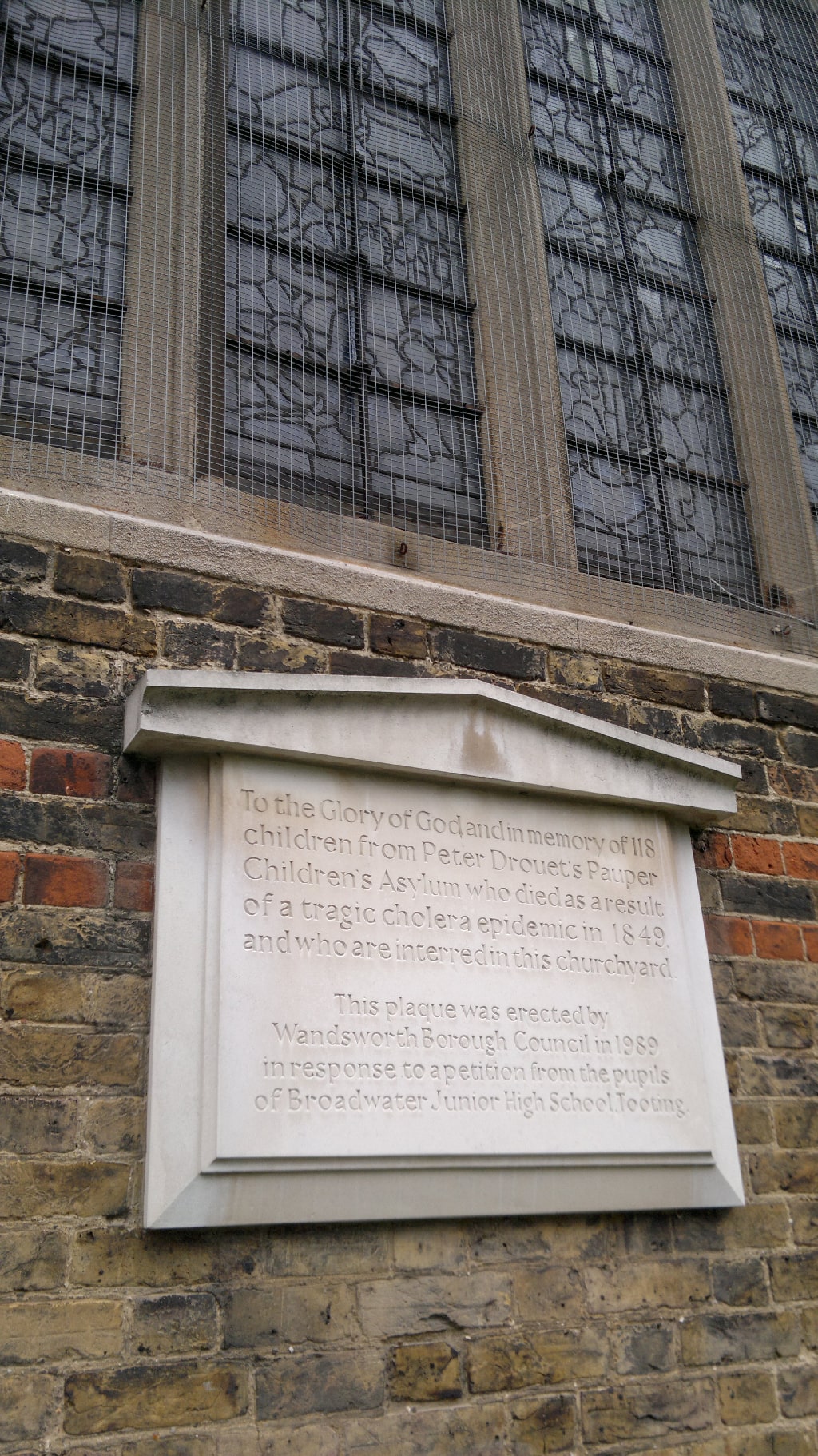
To the Glory of God in memory of 118
children from Peter Drouet's Pauper
Children's Asylum who died as a result
of of a tragic cholera epidemic in 1849
and who are interred in the churchyardThe plaque was erected by
Wandsworth Borough Council in 1989
In response to a petition from the pupils
Of Broadwater Junior High School Tooting.
— Drouet's Establishment at Tooting [Workhouses.org?]
— 1849-04-09-drouet-indictment-for-murder-oldbaileyonline
— 1849-01-07-drouet-and-cholera-at-tooting-Times
— 1849-01-07-ravages-of-cholera-BellsNewWeeklyMessenger
— John Buckmaster visits Drouet's Farm
— Report of the General Board of Health on the epidemic cholera of 1848 & 1849 (online, pdf) [Only a passing mention of Drouet: To send a vessel to sea with cholera on board is to follow the example of those Guardians of the Metropolitan Unions, who persisted in keeping their pauper children in the poisoned atmosphere of Drouet's establishment at Tooting, obstinately refusing to remove and disperse them, the result being that 180 perished."]
____ pp36-29 Overcrowding. — Without a certain quantity and quality of air life cannot be maintained. When a number of persons are crowded together in a small space, without the constant admission of fresh air, they are exposed to a double evil ; they are deprived of the necessary quan titv of air, and what air they do breathe becomes more and more vitiated at every respiration. It is found by experience that unless extraordinary means are taken for the constant renewal of the air by some special apparatus for ventilation, health and strength cannot be maintained in a breathing space of less than from 700 to 800 cubic feet, and that to live and sleep in a space of less than from 400 to 500 cubic feet for each individual, especially during the prevalence of an epidemic, is not compatible with safety to life. Some conception may be formed of the extent to which the atmosphere must necessarily become vitiated when a number of persons are confined together in a small space without the means of renewing the air, from the fact that the skin and lungs exhale at each moment a definite and measurable quantity of poisonous gas (carbonic acid gas) too-ether with a certain amount of animal matter of a highly putrescent nature, the existence of which is demonstrated by condensing the vapour in which it is suspended as it passes from the lungs. It is found that this putrescent animal matter, if it is not allowed to escape, is deposited on the walls of living and sleeping-rooms, and clings to articles of clothing, bedding, and other furniture, and is the source of the nauseous smell perceived on entering" dirty and crowded dormitories, living-rooms, schoolrooms, and other places of public resort. Under confinement in such a place tlie most robust health gives way, and the extent to which the habitual respiration of its atmosphere destroys the resisting power of the constitution and predisposes to disease, becomes manifest in an appalling manner when such a place happens to be invaded by an epidemic influence. Of the many proofs of this afforded by late experience it may suffice to cite itlie following; : — " In the beginning of June, 1849, a sudden and violent outbreak of cholera occurred in the workhouse of the town of Taunton. No case of cholera had previously existed, nor did any subsequently take place, among the general inhabitants of the town, though diarrhcpa was prevalent to a considerable extent. The workhouse is badly constructed, the ceilings of the rooms being in general not more than 8 feet 9 inches in height, and the ventilation extremely defective. Into the girls' school- 38 Overcrotndivg. room, a slated shed, 50 feet long, 9 feet 10 inches hroad, and 7 feet 9 inches in height to the top of the walls, the roof being sloping, there were huddled 67 children. Each child had, therefore, for respiration only about 68 cubic feet of air. The epidemic influence which was pervading the district struck this establishment. On November 3rd, one of the inmates was attacked, with cholera ; in ten minutes from the time of the seizure the sufferer passed into a state of hopeless collapse. Within the space of 48 hours from the first attaclc 42 cases and. 19 deaths had taken place, and in the course of one week 60 of the inmates had been swept away. ' A curious circumstance,' (says Dr. Sutherland), ' occurred with respect to the boys' school. This apartment was rather worse than that of the girls ; but the boys, who were good and obedient in other respects, could not be kept from breaking the windows. In the girls' school the windows were never broken ; and the chaplain of the workhouse states his firm belief, that it was to the better ventilation, which the broken windows maintained in the boys' school, that the children in some measure owed their lives." A similar outbreak occurred in the parish of East Farleigh, near Maidstone, among the hop-pickers engaged at a farm on which about 1,000 persons of all ages were employed. As an example of the manner in which these people were lodged, it is stated, that in a room containing 700 cubic feet 14 persons slept, so that each indivividual had for respiration about 50 cubic feet of air. Within four days after the first seizure of this population there had occurred upwards of 200 cases of diarrhoea, 97 of developed cholera, and 47 deaths. Precisely similar was the outbreak among the pauper children at Tooting, where each boy had for respiration in the dormitory 150 cubic feet, and each girl 133 cubic feet ; the windows of the girls' dormitories small and few, being closed during the night, the doors shut, and the chimney-places boarded up. Before cholera had decidedly manifested its presence in London, and while its existence was doubted, and even denied, out of about 1,000 inmates in this establishment, 300 were seized with cholera, and 180 died.Back to the top of this page . . .