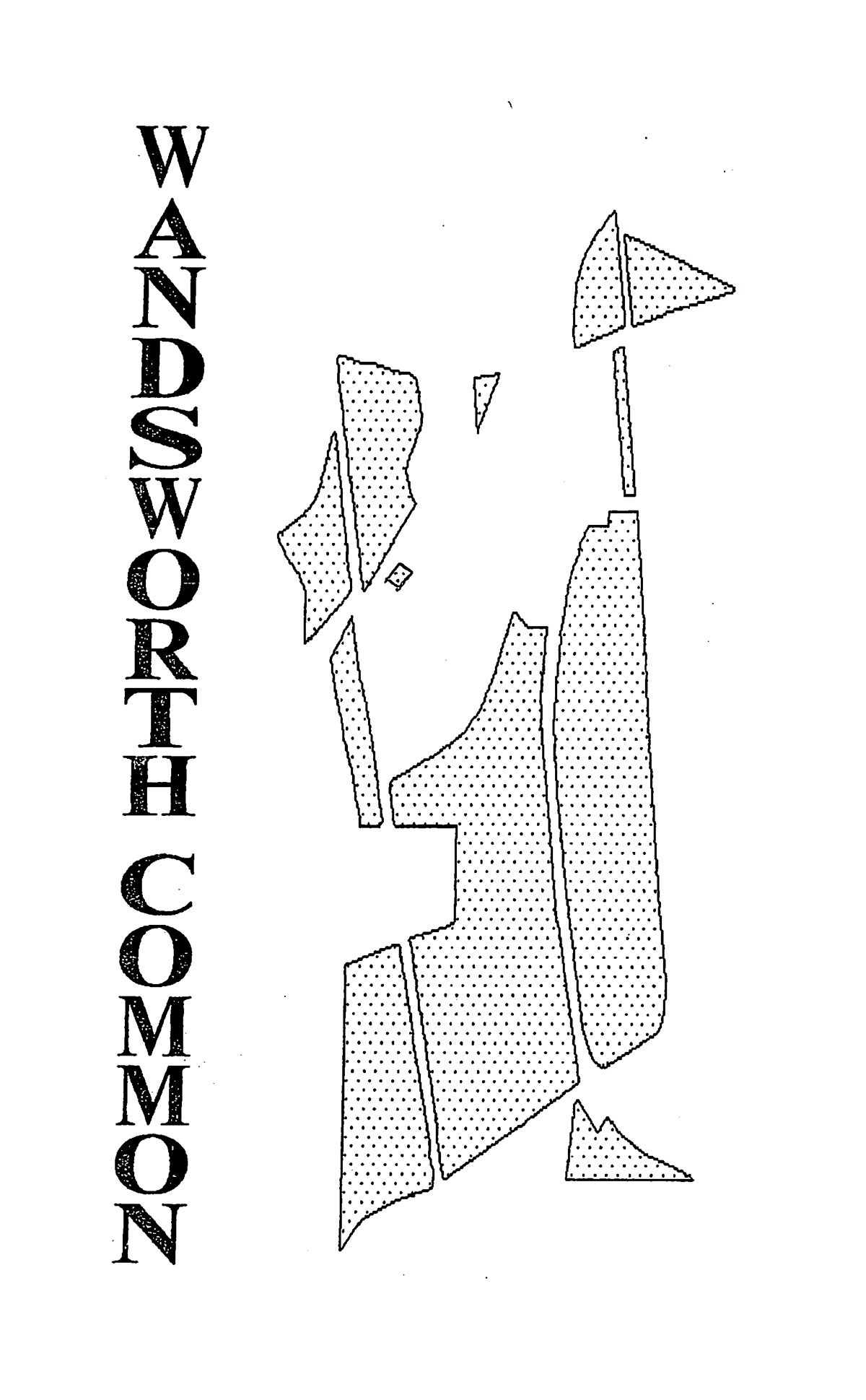
[Original cover illustration showing how fragmented Wandsworth Common has become - roads, railways, buildings have reduced and divided the former Common. It is shown here with 12 fragments.]
(Click on image to enlarge)
SHIRLEY PASSMORE (dates? - 2017)
[PB: Shirley Passmore's invaluable (and inspiring) outline of the history of Wandsworth Common was (so far as I know) never published, or indeed ever edited for publication, but it has circulated widely as a photocopied typescript (and, more recently, as a pdf). There were no illustrations and only two hand-drawn maps (the cover, above, and one outlining enclosures and restoration (below)). I have begun to annotate and illustrate her essay. Notes: I have changed "common" to "Common", when it implies Wandsworth Common.]
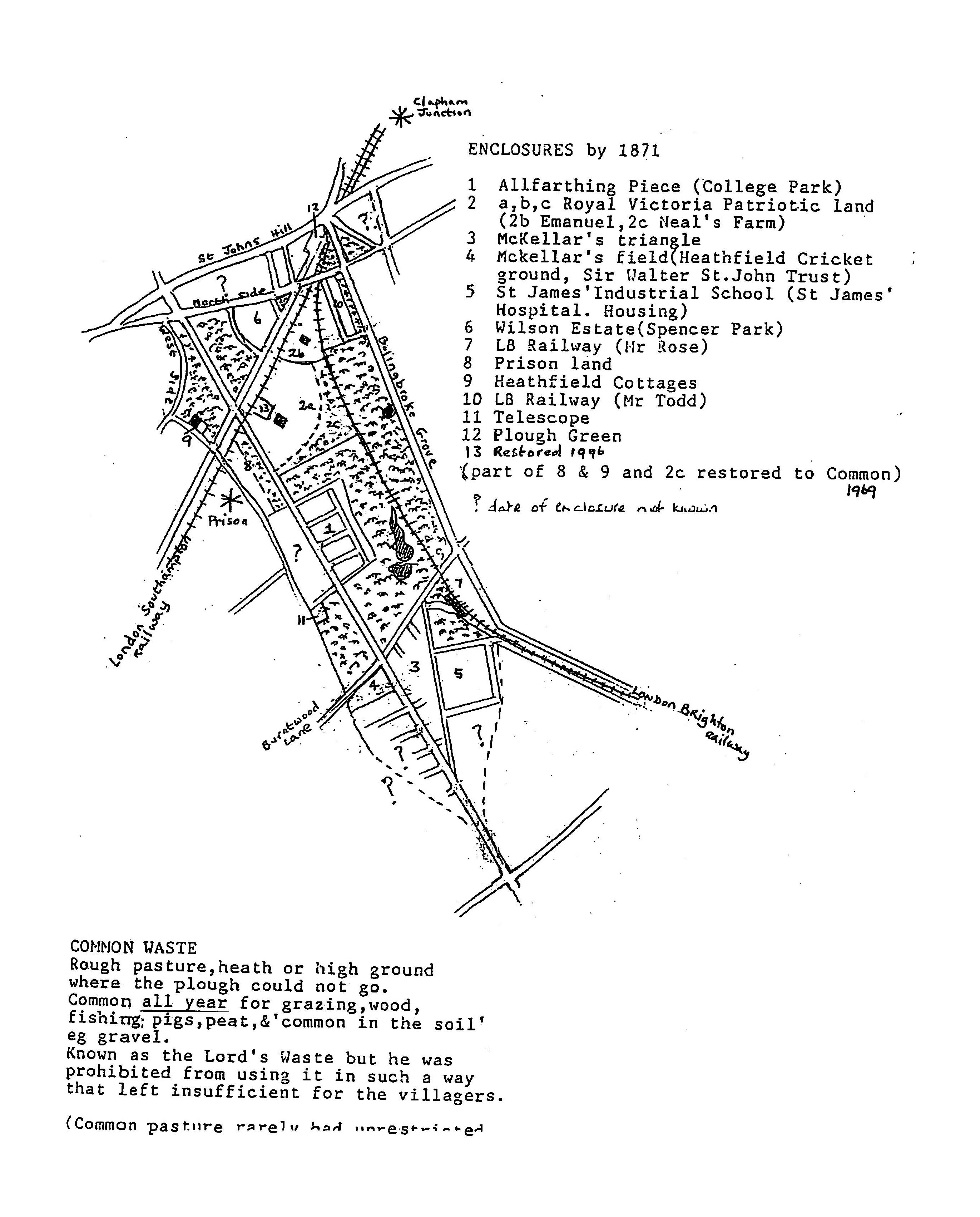
[Enclosures by 1871]
(Click on image to enlarge)
WANDSWORTH COMMON
ORIGINS - ENCLOSURES - FIGHT TO SAVE - MANAGEMENT - LEGAL PROTECTION.
Origins & Size
What we now call Wandsworth Common was formerly a portion of the wastes of the Manor of Battersea and Wandsworth and was known as Battersea West Heath (that part in Battersea parish) and Wandsworth East Heath (that part in Wandsworth parish) and was one of several wastes of this large manor. It is a plateau of gravelly land lying between the valley of the Wandle in the west and the Falconbrook (now underground) in the east.
Some documentation about common land in Wandsworth does not differentiate clearly between Wandsworth East Heath and Wandsworth West Heath (Putney Heath and Wimbledon Common), or Garratt Common (now Garratt Green), nor between common cultivated fields, common pasture, and manorial wastes.
Common in Wandsworth and "Wandsworth Common" are not synonymous. Thus all figures relating to the original extent of the common (Battersea West Heath & Wandsworth East Heath) are subject to a margin of error. It is unlikely that it once stretched from Clapham to Wimbledon as is frequently stated.

[This pleasingly coloured version of John Rocque's map was published (in Switzerland) in the 1760s - it is very similar to the original monochrome 1740s map.]
(Click on image to enlarge)
The John Rocque map of 1741-5 clearly indicates the difference between waste and pasture. The whole waste is now called Wandsworth Common. The outline shape of the common is similar to its outline today. However, this masks the nibbled away holes in its interior and the loss of most of the land south of Bellevue Road.
[PB: "Nibbled" is hardly the word!]
[PB: It is also likely that already by the mid-C18 areas of open waste had been enclosed.]
[PB: For comparison, I have added Thomas Milne's accurate map of 1800.


[Source and further information: Link. Notice incidentally that there is no "Black Sea".]
(Click on image to enlarge)
Today the common covers about 180 of an original (estimated) 400 acres. By 1866 the acreage had been reduced to 150 but some land has been restored since then.
[Sizes in acres as this is the unit given in early documents. Sources differ on size - Spencer's Agents figures are taken where known.]
Enclosures
Early enclosures of common land in Wandsworth are said to have been mainly on a small scale, but by 1818 around 170 acres had been enclosed and some of this land had been part of the area we know as Wandsworth Common.
About 20 acres, known today as the "Toast Rack", had been alienated quite early on and was known in 1642 as Allfarthing Piece. By the early 19th century it was owned by Magdalen College, Oxford. In time they leased it to a Mr Neal to use as a plant nursery but by 1883 the College began the building of the five residential roads with their Oxford-connected names (Routh, Patten, Henderson, Dorlcote, Baskerville). The estate was called College Park.
Rapidly increasing urban populations gave landowners financial incentive to develop any open space, and in Wandsworth the advent of the railways curving their way through the conveniently open space of the Common almost sealed its fate.
From 1763 the Lord of the Manor of Battersea and Wandsworth and its sub-divisions was Earl Spencer. The fourth earl, Frederick, from 1845 until December 1857, and the fifth earl, John Poyntz, until 1910. It was under Frederick that many of the major land sales and enclosures occurred and it was John Poyntz who finally gave up all Spencer rights to the common.
The London and Southampton Railway (later the London and South Western Railway) cut a swathe through the common between 1836 and 1838 (Railway Act 1834) taking 14 acres and beginning the process of division into distinct sections which is such a feature of the common today.
The West London and Crystal Palace Railway (later the London, Brighton and South Coast Railway) acquired various parcels of land between 1857 and 1862, in total over some 37 acres. Seven of these acres (bought 1861 and 1862) were "only very slightly used by them for railway purposes" (House of Commons Committee of Inquiry, 1865). Some reports say as much as 16 acres were not needed for the line but went to speculative builders or for contractors' yards. The railway had paid £580 to Earl Spencer for the right to lay track across the common and built Lammas Hall and a school in Battersea as compensation for loss of commoners' rights. Protest and an interview with Spencer about the excess land taken was to no avail.
Twenty acres sold (1850) to the St James's Westminster Industrial Schools, together with a reported 21 (McKellar's Triangle) to a Mr Mckellar in 1848 and a further 12 to him by 1856 removed all the remaining common south of Bellevue Road, with the exception of the small area around Wandsworth Common Station.
In 1852 the Justices for Surrey had bought eight and a half acres in front of the prison, presumably for security reasons, and this land was conveyed on trust that it would be "laid out ornamentally". Earl Spencer reserved the power to prevent development without his consent, a power he handed on to the LCC in December 1890.
1852 also saw the erection of the (then) world's largest reflecting telescope, the Craig Telescope, on two acres of land temporarily donated by Spencer on the north-west corner of what is now called "The Scope". It could not live up to the claim of being able to see [?]-inch letters half a mile away and did not last long. A Time Team archaeological dig in 2003 tried to locate the remains of the structure but failed.
The enclosure that was to cause enormous damage to the common and have far-reaching consequences for its future, but which was not much opposed at the time, was the 52 acres of land between the railway tracks sold to the Royal Victoria Patriotic Fund Commissioners on 24th June 1857, to build an orphanage (or "asylum") for the daughters of soldiers, sailors and marines killed at Crimea.
It was, however, the repeated attempts to enclose the small Plough Green between St John's Hill and North Side (the Road to Clapham) with its footpath between the two roads, which irritated more, and aroused people to action on several occasions.
The Wilson Estate and the Black Sea
An early enclosure (date not known) on the north-west comer of the common was a house surrounded by a large garden that later expanded to about 8 acres of parkland. It is shown on the Rocque map of 1741. The estate was leased in 1829 from Earl Spencer by William Wilson the founder of Price's Candle Factory. On later maps a 5-acre lake known as The Black Sea adjoins the park. This was most probably a disused gravel pit and later was utilised as a reservoir. It supplied 12,000 gallons of water a day to properties around.When the cutting for the London Southampton Railway was made it cut off the end of the lake and its feeder spring. The LSR Company was obliged under the 1834 Act to take various steps to "for ever thereafter keep up and maintain a supply of water in the said pond No 3 and two other ponds contiguous thereto" (or until the Lambeth Water Company would take over the supply). A pumping mill was installed on the railway embankment to pump back water from the cutting into the lake.

The Black Sea, Stanford 1864.
[Source and further information: Link.]
At some stage, perhaps 1846 when a new lease is recorded between Anne Wilson and Earl Spencer, the estate was expanded right up to the edge of the lake taking in one and a half acres of common. The lake ceased to be a reservoir at about this time and it is suggested that the 1846 Lease also included the lake. However, the Battersea and Wandsworth parishes were stated to own the lake when used as a reservoir so the situation is unclear.
What is clear is that at least from this time, perhaps earlier, Wilson looked after the lake and was responsible to a large extent for turning it into "One of the most picturesque and ornamental waters near London". It has to be a myth that he put in an island to commemorate the birth of each of his 13 children because the islands are already there on the Cruchley map of 1829.
In November 1866 the fifth Earl Spencer bought back the lease of this estate from the widow of William Wilson and "the gravest apprehensions were entertained that the 13 acres would be turned into building sites". (It was to become Spencer Park).
Concerns Increase
In 1867, the London, Brighton and South Coast Railway Company offered for sale some of its surplus land. The site, opposite St Mary's Cemetery in Bolingbroke Grove, was bought by Christopher William Todd. Excavations for building foundations were begun. "As bricks and mortar rose so dissatisfaction increased". Many people, those living around the common in particular, were becoming greatly disturbed by the speed and extent of enclosures.
John Buckmaster, a political reformer of his day and a prime motivator in the battles to save the common, said "The common was fast melting away. Private owners adjoining were adding portions to their own properties ... villas sprang up like mushrooms ... land grabbers and jerry-builders would soon have joined hands on the last square foot of turf".
The Vicar of Battersea, the Revd John Jenkinson, invited "a few gentlemen" to meet at his house to discuss what could be done, perhaps under pressure from Buckmaster who was his Churchwarden. They met in May 1868.
A committee was appointed which approached the District Board of Works for support in an appeal to the Metropolitan Board to take over the common under the powers of the Metropolitan Commons Act 1866. On 17th June 1868, with District support, a deputation from Battersea and Wandsworth put their case to the Metropolitan Board. They stressed the need for open space for the rapidly expanding population, a need that had been recognised by Parliament when it passed the 1866 Act.
Ironically, considering the damage already done to Wandsworth Common by the railways, one of the arguments used to convince the Board that it should be involved was that "notwithstanding their present neglected state ... the commons were still greatly resorted to by the inhabitants of the metropolis, the access by rail being remarkably easy and the fares low."
The matter was referred to the Board's Works Committee and went on a tortuous round of committee meetings and nothing was heard of it, so on 16th November 1868 Mr Ransome, another leading activist in the cause, waylaid the Chairman of the Metropolitan Board on his way to his office. He was horrified to learn that should the Board decide to take control of the common they would need to sell yet more of it to provide money for compensation to the Lord of the Manor and for management costs.
Ransome learned that nothing could be done yet anyway because of impending local lawsuits (there was a legal battle being waged over Wimbledon Common also). He commented "We began to be afraid of them lest Wandsworth Common might be still further reduced if they took it in hand and we began to despair of being able to rescue our common from the hands of speculative builders, dust contractors and others ..." (recent losses had been land taken for Windmill Road, up to the lake, for the slip road alongside the Wilson estate, and for straightening the estate's northern boundary along North Side).
Local action in knocking down enclosure fences had resulted in fines and in one case imprisonment. Buckmaster himself had organised one fence-removing protest - in the presence, it is said, of 2000 people. In court the case against him was dismissed as one of trespass only. Clearly the only hope of success would be to find a Copyholder with rights to the use of the common to bring an action in the courts.
The Digby Lawsuit
A local lawsuit was filed on behalf of a James Smith Digby. It is described in Buckmaster's A Village Politician. Digby was a copyholder of land in the acreage bought by Mr Todd. He lived in a tumbledown cottage and made a living "selling potatoes, brickdust and treacle". He liked the developments because they brought more trade. However, he was persuaded to sign a form put in front of him, little realising that he had begun proceedings on behalf of himself and all other tenants of the Manor against Earl Spencer, the Brighton and South Coast Railway Co., and four others. He was no match for the lawyers and revealed his true feelings and how he had been persuaded to sign the document.
All seemed lost but the case was adjourned and was eventually overtaken by the Wandsworth Common Act in 1871. It had nevertheless given extra time for concerted action to save the common.
Meanwhile, a petition was sent to Earl Spencer, signed by 200 residents of New Wandsworth, and there was plenty of interest shown for the cause by letters to national as well as to local newspapers. Earl Spencer's answer to the claim that commoners on both commons had a whole series of listed rights was to deny the existence of either. [In his view] He was the absolute owner of the common pasture and the common wastes of the manor.
Fund-raising Defence Committees Set Up
On 14th March 1870 a large meeting was held at the Lammas Hall in Battersea. Buckmaster read a letter he had received from Mr (later Sir) Henry Peek MP who offered to put £1000 into a fund to finance legal action if wealthy men around Clapham and Wandsworth Commons would match it with another £4000. The offer was open until June. Clapham Common was largely the old Battersea East Heath and over half of it was in Battersea parish. Peek had earlier sponsored prizes for the best essays on how, legally, to protect commons.
It was decided to have a committee of management with sub-committees in Battersea and Clapham and to hold meetings in the various areas to ask for money. Perhaps not wanting to seem motivated by self-interest, Ransome, who lived overlooking the common, said he was motivated by a religious conviction that it would be good "both morally and spiritually" for those that might succeed him to have such an open space preserved. He enjoyed coming back from "the noise and bustle of the city to what was left of the country".
On 4th April a Mr Lord chaired a well-attended meeting at Price's Candle Works Institute where Mr Fithian of the newly formed (national) Commons Preservation Society tried to explain the law of common rights. The workmen promised £5. In April also Mr Ransome and Mr Mason of the committee went to the Mansion House to try to persuade the Lord Mayor to hold a meeting to raise public awareness. They failed.
Plough Green
An attempt around 1850 to remove fences around Plough Green had resulted in a court ruling that there was a public footpath. [However, after] a second attempt, and another court case, Mr Justice Bovill ruled that because no defined path could be seen a plea of free user could not be established. On Appeal, also lost, the ruling was that since the railway had cut the [path] it had lost continuity and therefore no longer existed.
It was some 20 years later, on 13th April 1870, that there was a very determined public effort to remove the fences. It was a splendid affair with bands and cheering crowds. The "stir and tumult continued until dusk" (Mid-Surrey Gazette).
[PB: In the evening of this eventful day, a crowded public meeting was held in the Spread Eagle. [It was] Chaired by a Mr Bevington JP and supported by the fund-raising committees. However, Mr Bevington was of the opinion that the kind of activity at Plough Green was not considered the best way forward. This meeting had two aims: to get wider public interest and to raise more money. Battersea had already contributed liberally to the Defence Fund but Wandsworth was lagging behind. Buckmaster gave an impassioned speech. A Wandsworth sub-committee was formed. Mr DuBuisson, active for and generous to the Fund from the start, now offered a further £100 and the use of his house for committee meetings. However, even with the evening's takings of £478, the Fund only stood at £909.7s.6d. A public meeting in Putney raised a further £180.
Campaign gains approval of eminent people
The Spread Eagle meeting certainly provoked further action for more influential support. A decision was taken for all funds raised by both the Battersea and Wandsworth committees to be used for the benefit of Wandsworth Common, Clapham Common residents having proved they were well able to "take care of their own common". Fund raising from now on was more methodical. Banks opened subscription lists, posters were put on railway stations, weekly collections were made at work sites. A public meeting was held.
In July 1870 Buckmaster and Ransome again asked the Lord Mayor to hold a meeting in the Mansion House. This time, presumably because the cause was becoming more respectable, he agreed. It was held on 14th July 1870 and ten members of Parliament attended including Sir Charles Dilke, Henry Fawcett, WH Smith, and Mr Mundella. Apologies came from such notables as Dean Stanley Bishop of Winchester (then Wandsworth's diocese) and CH Spurgeon of the Baptists. At this meeting Resolutions of support were made and permission given to raise money in the City.
The Lord Mayor had one concern. He thought that Earl Spencer was willing to enter into the same agreement over Wandsworth Common as was being negotiated at Wimbledon and he said "nothing should be done that could be construed as throwing sand into the machinery".
Negotiations
The Spencer archives show that on 15th August 1870 [?] Forster, Spencer's Agent, wrote to the committee via [?] Dryden, a negotiator at Wimbledon. He was prepared to negotiate if the committee a) abandoned litigation b) accepted the status quo and c) paid Earl Spencer £500 annually from a local rate, or set up a body of Trustees with power to sell outlying pieces to pay Spencer a lump sum. He suggested that the outlying pieces were unimportant and would be difficult to manage.
The committee felt that £500 was too much annual compensation for "disappearing gravel" particularly as Wimbledon (six times the acreage of Wandsworth Common) was only being asked for £1000. They could not agree either with the claim that the Black Sea was part of the Wilson Estate and therefore not part of the unenclosed common. Wilson's management, they said, had not conferred ownership of this lake which remained largely unfenced and open to the public on three sides.
Meantime on 3 September, Mr Watson of The Gables, a big house on the edge of the common, and an original committee member, wrote directly to Earl Spencer pleading with him not to listen to those who were advising him to fill in the lake for their own profit. He said he was "prompted by a strong feeling on the subject and anxious that it may not be a reproach to one possessed of an ancient and honoured title, ample fortune and large domains, to have destroyed a little comer of beauty which gave delight and enjoyment to many thousands."
He wrote again later asking for a personal interview. Spencer agreed to meet him and one other on 4th October for one hour. Watson, together with Ransome, had what turned out to be an historic and friendly meeting. Spencer repeated the same offer that Forster had earlier indicated to give up his rights to the common for compensation of £500 a year paid from a local rate but he wanted the Black Sea not to be included in the deal as he had plans to fill it in to add to his already advanced plans for the Spencer Park estate. Ransome said that this annuity would be more than could be raised annually and ventured to suggest £250 as a more realistic sum. Spencer agreed to reconsider and let them know.
Forster was somewhat annoyed that his negotiations had been side-stepped but the result was that Spencer agreed to either transfer the whole common including the Black Sea for £500 p.a., with the proviso that the lake was filled in because a (by now) murky body of water next to his building proposals for the Wilson Estate would be unacceptable, or alternatively he would hand over the common minus the Black Sea for £250 p.a. The committee chose the latter option and they agreed to cease to question Spencer's right to the lake.
The 1871 Wandsworth Common Act.
Now that the Defence Fund would not be needed for further legal action, the money was to be used to put a Bill through Parliament.
There were still hurdles to overcome. Three lawsuits were pending. There was opposition from two railway companies. Pieces of land to restore (Ransome negotiated with the railways for the restoration of some small areas, notably the "bumps" alongside the railway in the Bolingbroke field), but most significantly, the opposition of the Metropolitan Board of Works to management being placed in the hands of Conservators instead of themselves. The Board, with the support of the District Board, would oppose the Bill on this ground. If they succeeded the Bill would fail.
The Defence Committee left no stone unturned in seeking support for the Bill. They sent out leaflets, held a public meeting, canvassed as many people in Battersea and Wandsworth as they could. Sixty-nine percent of those canvassed were supportive.
The Bill (in the name of the Wandsworth and Battersea Vestries) came before Parliament on 21st April 1871. The Committee Stage was reached on 24th. Mr Watson and Mr Ransome were questioned at length but succeeded in convincing the MPs that the Metropolitan Board should not be given control.
It reached the House of Lords on 8th May and was to be passed in early June. One last hiccup occurred when Earl Spencer suddenly realised that his annuity depended on the Poor Rate and his payments might be jeopardised if this changed. He sought provision to be able to dig gravel or reclaim his estate if payment ceased. His request was refused and the Bill became law on 10th July 1871.
A map accompanies the Act and it shows land that must be restored within 6 months. The Act freed from rights of Common all the land then enclosed and gave the Conservators the right to buy or be given back this land which would then automatically revert to common (years later the LCC acquired Garratt Green under this clause in the Act and this is now a common).
At this time Wandsworth common was in a pretty dire state after years of neglect. The Mid-Surrey Gazette of the time writes of stinking ponds and disused gravel pits full of rubbish. Mud and slush everywhere. No paths, no seats, huge muddy ditches, piles of rubbish and "every conceivable nuisance, the result of gipsy vans and tents and naked women washing their clothes in the said ponds".
On a visit to Battersea in connection with the installation of [John] Erskine-Clarke as Vicar, Earl Spencer is said to have remarked "is this the common there has been so much trouble about?" It was probably the first time he had seen it.
[Can we find a copy of this 1871 map ? Is it materially different from the 1888? map?]
The Wider Picture
The battle to save what was left of Wandsworth Common cannot be viewed in isolation. There was a national concern about the plight of commons around London. A Parliamentary Committee of Inquiry had been set up in 1865 and, because Earl Spencer had already brought in a private Bill in 1864 to enclose Wimbledon Common, it looked at the situation there first. It was the future of that common that set the seal on what was to happen in Wandsworth and elsewhere. In particular, much is owed to the clear analytical thinking of a Wimbledon solicitor, Philip Henry Laurence.
[PB: Or "Lawrence"? On Lawrence, see e.g. https://www.stirtoaction.com/article/preserving-or-policing-commons]
Earl Spencer had brought in his Bill under a statute of 1236 (Statute of Merton) in which commons could be enclosed if the Lord left enough common pasture for his free tenants. Spencer's case was that there were so few commoners they could be ignored. He proposed selling 113 [?] of the common to raise money to turn the remaining 2/3rds into a managed park. The Metropolitan Board's solution for all the remaining commons in London was similar.
The Committee of Inquiry issued a majority report (guided by Laurence) which can be summarised as follows: The Metropolitan Board's proposal was condemned, no land could be spared. Non-use of Rights did not mean abandonment of them. Owners of Rights did not have the means to defend them in court. Rights across the common existed in all directions. A "servitus spaciandi" (right of roaming) was also understood and known to the law yet legal authorities were unwilling to admit any general public rights except those limited to a particular parish or tenants of a particular Manor.
Binding judicial decisions seemed to rest on "no very intelligible principle". A law should be passed to encompass the greater public, bearing in mind the original intentions of commons law. The Statute of Merton should be repealed. It could be argued that commoners had transferred their rights to the public, so no enclosures to be authorised within the Metropolitan Police District under the Inclosure Act 1845. Rights therefore could not be claimed by Lords or for that matter by Commoners.
The Report led to the withdrawal of Earl Spencer's Bill.
[PB: 1894 = English Commons and Forests: The Story of the Battle During the Last ... / https://books.google.co.uk/books?id=TEfKAAAAMAAJ
Commons, Forests and Footpaths: The Story of the Battle During the Last Forty-five Years for Public Rights Over the Commons, Forests and Footpaths of England and Wales, George Shaw-Lefevre Baron Eversley, Cassell and Company, 1910 - Commons - 356 pages.
Other Lords of Manors reaction was to rush to indicate their claims with enclosures already begun, or threatened. So in 1865, under the question [?] of Philip Laurence and the Chairmanship of the Rt Hon G Shaw-Lefevre MP (later Viscount Eversley), the Commons Preservation Society (now Open Spaces Society) had been founded. It had a distinguished founder membership, John Stuart Mill, Octavia Hill, Henry Fawcett and WH Smith among others.
The Commons Preservation Society was able to co-ordinate action. Cases brought to court had central knowledge advantage. There was a tendency for Judges to favour enclosure. Laurence revived an old form of suit in which a single tenant on behalf of other tenants asked for an injunction to restrain the Lord of the Manor. This process went through the Equity Courts whose judges took a much broader and less technical view of the subject than the Common Law judges. More cases were won. Shaw-Lefevre states much was owed to Judge Lord Romilly and Judge St George Jessel.
In 1866 the Metropolitan Commons Act was passed under which commons near London could be permanently secured for the people. This was the Act that the Metropolitan Board of Works had failed to use during the fight to save Wandsworth Common.
The Wimbledon Commoners, however, began a suit in the Law Courts against Spencer. By April 1871 when it had become clear that Rights of Common existed over a large area of Wimbledon, Earl Spencer, fearful perhaps of losing all his rights, negotiated for an agreed settlement. There was then every reason for him to settle with Wandsworth in similar terms.
After the Act. Use of Patriotic School Land.
After the 1871 Act, with the remains of the common saved and safely in the hands of Conservators, all controversy ought to have been at an end. It was not to be.
The Royal Patriotic Fund Commissioners had bought their land largely by public subscription at a low price, £3,700 for 52 acres. It was never contemplated that it would be used for anything but a girls' asylum surrounded by open space. A boys' school was considered in 1870 and suitable buildings sought in vain. Eventually it was decided to utilise part of the girls' school grounds for a new building. A contract was signed in April 1871 and the building finished in 1873. The boys' school was not a successful enterprise and the building and 12 acres of land were sold to Emanuel Hospital [?] in 1880 for £32,000 (in competition with the Surrey Education Board whom they gazumped by placing a new offer on the table as the SEB was about to clinch a deal).
The land surrounding the girls' school had been intended as a farm or market garden to supply the needs of the school and presumably also to provide work for the orphans. In November 1885 it was noted that part of this land was being separated from the rest and it was learned that the [Patriotic Fund] Commissioners intended letting the farm buildings, a cottage, and about 20 acres of land to a "desirable tenant" who would continue the market garden use of the land. The desirable tenant was a Mr Neal who combined his market garden activities with those of a lime and cement merchant, tar pavior [i.e. road-maker], and public works contractor.
At the first hint that the land was not needed for school purposes, the Common's Conservators offered to buy it back. This offer was refused. The refusal brought suspicion that the ultimate aim of the Commissioners was to sell the land for building purposes. The attention of the public was aroused when the "desirable" tenant began to use the Common for carting his building materials to and from his "farm". It was not long before this part of the Common was in a terrible state, full of ruts and deep pot-holes full of mud.
From October to November 1886 many letters were written to the press, local and national. They all asked more or less the same questions. How could land acquired by a charity through public donations at a very low agricultural price and without any compensation to Commoners for loss of rights, be used for any other purpose than that originally intended? Why, in any case, were the [Patriotic Fund] Commissioners allowed to let their tenant damage the Common as he was doing? Were the Commons Conservators asleep to allow such things to happen?
Mr Ransome, the Chairman of the Conservators, wrote to the Daily News (21 October 1886) to explain what they had been doing. "At the present time there is before the Queen's Bench Division of the High Court of Justice an action in respect of the damage caused by the tenant in passing across the present Common to the enclosed land that was formerly part of this Common and which enclosed land, if not wanted for charity should be restored to the Common."
They had begun an action against the Official Trustee of the Patriotic Fund for alleged trespass.
There was some suggestion that the Wandsworth Common Protection Association (presumably what the Defence committee had become) was not being as active as it might be. Maybe that was why it was decided to hold a public meeting at Wandsworth Town Hall in November 1886. A Memorial was sent to the Patriotic Fund Commissioners. Correspondence followed but the Commissioners refused to say anything because of the pending legal proceedings.
Great efforts were made to get the Neal's Farm land back for the Common. Questions were raised in Parliament. Henry Kimber MP (Wandsworth) asked the Secretary of State for War all those questions that the local people had been asking but the Secretary of State was not prepared to intervine. The [Patriotic Fund] Commissioners were on fairly strong ground over the right to do what they liked with their land. It had been bought, not given. They had the right to lease it to Neal for 21 years with an option for a further 21 if they so desired. The Conservators did have a case however regarding trespass and damage to the Common by Neal's animals and vehicular traffic.
The Protection Association said "there remains to them [the Patriotic Fund Commissioners] the strong temptation presently to convert the whole acreage into a crowded building estate in the very centre of the Common".
Metropolitan Board gains Control
At about the time of the issue over Neal's Farm, there was a petition to the Metropolitan Board to take over the Common from the Conservators. It was partly a battle over whether the Common should be urbanised or remain natural. The Conservators had done a lot to improve the state of the Common since 1871 but money was limited and they preferred it wild anyway. Other people, and some Conservators, thought that the needs of the growing populace should be met with lighting, pruned trees, paths etc.
A leading article in the Daily News compared the "dreary flat" of Clapham Common (already in the hands of the Metropolitan Board) to the beauty of the "gorse covered area in front of Bolingbroke Grove" and it complained of "fussy over-regulation".
[I have yet to find this article, which looks interesting.]
However, public opinion was moving in favour of the Board and it gained control in 1887.
In an LCC Parks Department publication of 1924 the opinion is given that the Metropolitan Board gained control because local people objected to paying twice for their Common - by a levy from the Metropolitan Board for all London Commons and a local rate from Wandsworth's District Board. The local rate had not been based on a system of "Betterment" [?] i.e. the further away you lived the less you paid. Everyone paid the same. Those people who lived a long way from the Common and who did not use it objected to paying.
Two years after the Board took control it was itself overtaken by the formation of the London County Council.
Meanwhile, there had been no result, or even much action in the courts over the trespass issue. The new LCC came to an agreed settlement with the Patriotic Fund Commissioners. The result is recorded in a committee report of 9th December 1890. The right of way for horses and vehicles was withdrawn. Plaintiffs should give the Defendants £200 towards the cost of building a new road on their own land with an entrance in Trinity Road. Defendants could use the Common track for all ordinary usage but the gateway onto the track from the farm was to be partially stopped up by the Defendants to prevent passage of horses, cattle, sheep, pigs, carts, barrows, other animals or vehicular traffic. Should the Plaintiffs build a road over any of the land in the future, the Defendants would have a right of way. Both sides to pay costs.
Thus after 5 years Mr Neal was prevented from spoiling the Common. Prior to the agreement, posts had been placed on the path at irregular intervals to stop Neal's traffic. Correspondence in the local paper about poor lighting on the Common brought the remark from Edward Johnson that the posts were very unpleasant to bump into in the dark. He had also criticised the LCC's suggestion that perhaps Dorlcote Road would be a more suitable route by which Mr Neal could reach Trinity Road. Johnson was the Hon Sec of the Protection Association and lived in Dorlcote Road. By 1891 the Patriotic Fund Commissioners had enlarged the farmhouse for Mr Neal and leased it to him for a further 21 years.
Restoration of the 20 acres to the Common.
In 1912 the RVP Commissioners offered the 20 acres of Neal's Farm for sale. It was bought by the LCC for £12,000, including £1000 towards the cost of a wall to divide it from the remaining RVPA grounds. Wandsworth's Mayor, Archibald Dawney, had negotiated time and a low price with the Commissioners in order that the money could be raised locally. Money was contributed from the LCC (£6000) WBC (£3000) Battersea BC (£1500) City Parochial Charities (£250) and Public Subscription (£1500).
It was to be another 12 years before the public could use the restored Common because of the Great War of 1914-18
[CHECK I've gt the figures right.]
In 1914 the RVPB was taken over by the War Office to house the 3rd London General Hospital for the military wounded. The hospital overflowed from the building and tented hospital wards and other temporary buildings covered all available land, including the newly bought land for the Common. The girls from the school were housed in properties on the north side of Spencer Park.
When the war ended and the temporary buildings on the land were no longer needed for the hospital, they were used to house "clerical staffs from other Government departments." on the persuasive logic that other premises could be released for housing at a time of great shortage.
It was not until 1924 that the LCC was able to open what was called the Wandsworth Common Extension to the public. They had by then laid out two tennis courts, a bowling green and adapted the farmhouse for use as a refreshment room. The girls had returned to the school building.
Common affected by 1939-45 War and the Wandsworth Bridge Southern Approach Road
As early as 1937 there was a plan to build the Wandsworth Bridge Southern Approach Road (the Underpass). It was intended to turn [the entire length of] Trinity Road, from Wandsworth Bridge to Balham, into a dual carriageway. An Act of Parliament was passed in 1938 to allow this to happen. The plan entailed taking a great swathe of the Common for the extra road width and the LCC looked to see where it could find suitable exchange land.
The 8 acres in front of the prison, now leased to Neal's Nursery garden, was an obvious choice. The LCC had tried in 1890 to get possession of it from the Home Office, referring them to the restrictive covenant. They had failed but had acquired from Earl Spencer the manorial rights to prevent building. The 1924 LCC Parks publication said "It is improbable that the Home Office contemplate building on the land ... but the situation needs watching and the most strenuous opposition should be offered if ever an attempt is made." However, all plans for the new road came to a standstill in 1939 with the outbreak of WW2.
During the war the Common was dug up in places to make anti-tank trenches. It housed barrage-balloon sites and AA guns. All of these were removed when the war ended but the Common was then used for temporary housing. Pre-fabricated bungalows, known as the "prefabs', were placed alongside Spencer Park, Bolingbroke Grove and Bellevue Road. They developed all the appearance of permanency with neatly attended gardens, but the prefabs too were eventually removed in stages between 1956 and 1966 (exact date of removal not verified).
In 1964 the road plans were resurrected. A new Act of Parliament (repealing the 1938 Act) was passed for the purpose. The plan now was limited to a dual-carriageway as far as The County Arms.
The Home Office parted with half of the land in front of the prison in a long strip parallel to the road. Other exchange land was acquired by reducing the length of the gardens of Heathfield Gardens. These cottages had been compulsorily acquired with the intention that they be pulled down and all the land made into Common. However, public outcry and national publicity at the proposed loss of this attractive row resulted in just their gardens being taken. To make up for this, that part of Marcilly Road that crossed the Common from North Side was removed (an avenue of trees now indicates where the road once was). Work on the Wandsworth Bridge Southern Approach Road (now fortunately just an extension to Trinity Road [from the County Arms northward]) began in 1966/7, and was officially opened in March 1970. It had cost under-budget at £4m.
The Patriotic School leaves.
The Patriotic School vacated its building and moved to Surrey just before the 1939/45 war. During the war the RVP building was used as an interrogation and internment centre for aliens ["aliens"]. Post war it was leased for six years to the Ministry of Works and became Wandsworth Training College. In 1951 the LCC moved Honeywell School into the building while the Honeywell building was repaired from war damage.
In 1952 the building and all its land was bought by the LCC from the Patriotic Fund Commissioners. LCC use of the land was to have a devastating effect upon the visual openness of the Common. The site was divided between the 10 acres of the Honeywell School area which included the building, and the remaining 10 acres for which a housing estate (Fitzhugh) was planned.
An LCC Minute of 18th November 1952 states "The Ministry of Housing and Local Government has agreed to the use of this part of the site for housing purposes on the understanding that it will be laid out so as to preserve as far as possible a sense of spaciousness in keeping with the character of Wandsworth Common and in particular to maintain a view between the two parts of the Common lying on each side of the railway track... The approved scheme meets these requirements and concentration of dwellings in high point blocks will leave a large area of open space". The five tall blocks of the Fitzhugh Estate, completed in 1952, left half the land as open space.
A new secondary school [for boys] was established in the building. Stuck in the middle of Wandsworth Common it was given the totally inappropriate name of Spencer Park School. In 1974 a new building for the school was erected within the grounds. Initially 2-3 acres of the Fitzhugh land was taken for its games courts but later this expanded up to 4 acres. The RVP building was abandoned and slowly deteriorated until in 1980 it was rescued by Talex Ltd, who were given a long lease in return for restoring the building to its former glory. It now houses a theatre school, flats, craft workshops and offices.
Spencer Park School was later to amalgamate with Wandsworth School and be renamed John Archer, but this closed in 1991 and all the school buildings were demolished a year later. In 1994 the site and all the land surrounding three sides of the Patriotic Building was put up for sale by Wandsworth Borough Council. The planning brief limited to 60 the number of homes that could be built if the only access was through the Fitzhugh Estate. With a bridge across the railway this could rise to 200. A building scheme for 140 flats and 64 houses, together with a new bridge was approved and built. The bridge took Common land from alongside Windmill Road, but a much larger amount in front of the RVPB was given in exchange.
Taking on the mantle of the old Wandsworth Common Protection Association, the Wandsworth Society argued that Wandsworth Borough Council, as successor to the original Conservators who, under section 39 of the 1871 Act, were to restore to the Common any ex-Common land they acquired, should itself restore the land to Common and not sell it for redevelopment. In the opinion of lawyers consulted by both the Council and the Society, the council was acting in its capacity as an Education Authority in acquiring the land and did not have to act as a Conservator. Hence it could sell for development. Nevertheless a public Inquiry was held into the matter before the Council could proceed.
When in 1887 the residents of Wandsworth and Battersea handed over the control of their Common from a body of Conservators to a local authority in the form of the Metropolitan Board of Works, they did not realise the consequence of that action. There was and remains a conflict of interests within a multi-purpose authority whose duty to protect and enhance the Common is only one of many other duties. Wimbledon Common, by contrast, has retained its Conservators and they act only for the Common. Because they are a one-purpose body there can be no internal deals between different departments. The case of the John Archer site was an example of just such a conflict.
Encroachment in the name of amenity.
The battles to preserve the essential nature of Wandsworth Common as an area of natural, unenclosed, and unbuilt-on open space have not ceased since 1871. In January 1974 having recently been handed management of the Common by the Greater London Council, the WBC Recreation Committee presented a policy paper to the Council with proposals for radical development of the Common. New buildings, an all-weather play area complete with floodlighting, playgrounds, dressing-room accommodation for 20 teams in the Baskerville Road area and also by Neal's Farm, together with a new cafe, a mess room for 20 men, office accommodation and a store and service area.
In addition, the Common was suggested as a possible site for a new athletics track, to Olympic standards with a terraced stand, dressing accommodation with showers for 100 athletes, garage and storage space, offices, toilets, and refreshment facilities. The track would have covered 5 acres.
The Wandsworth Society held a Common-users survey. Only a few users had heard of the proposals. A resounding 81.5% wanted the Common to retain its existing character. Fortunately the proposals were not implemented. Public opinion, or perhaps money, saved the day. Legal restrictions about building on Common land imposed by the Wandsworth Common Act and also by the Law of Property Act 1925 were not considered. It is doubtful if at this stage of its management the Council was even aware of them.
Open-air playgrounds on the Common for very young children have expanded into One o'Clock Clubs with sizable buildings for indoor play. A project to provide a specialised adventure playground for handicapped children became a timetabled Inner London schools facility, with again a large building for indoor play.
An accumulation of minor incursions & visual damage
All of the following: shaving the Common to improve road junctions, provision of lay-bys for bus stops, car-parking bays cut into the Common alongside the railway station, land used to house telecommunication equipment, greatly widened pavement areas at road junctions, car-parking spaces on roads that cross the Common (and no objections to a bus stand on one of these roads) ... and more besides, both before and since WBC control, have taken place removing land or causing visual damage. The visual damage is often far greater than any yardage taken. The road between Heathfield Road and West Side was once a mere track across the Common.
After lengthy Public Inquiries, legal cycle routes across the Common have replaced a system of illegal but tolerated casual use. The footpaths are divided by white lines and the consensus of opinion is that they are visually intrusive and more hazardous for pedestrians than the old pragmatic system.
Management of the Common is under the direction of the Parks Service. Protection of the land is outside its jurisdiction. Without Conservators, it is not clear who, if anyone, since local authority control has had the responsibility to carry out the duty to prevent encroachments, however small, and to put in motion a process of compensation where damage is done.
Management since 1871
When the Conservators first took control of the Common, they had inherited a piece of natural open space, wild and untidy and pitted with 29 water-filled holes left from gravel workings. There is no doubt too that a lot of rubbish had been dumped there from the ever-increasing local population. It was nevertheless a gorse-filled piece of Surrey heathland with considerable charm and its joys are mentioned in some literature of the time. The Conservators had little money to spend but did what they could to remove the problems, put in some paths and fill in some pits.
In tum, the Metropolitan Board continued the task and had inherited the ongoing problem of Neal's traffic. A Board Minute in 1887 reports added by-laws to prohibit carpet beating and to prohibit the Cavalry from moving over the Common! In 1888 it sought the removal of railings around "the match grounds." and laid 7000 drainpipes in the "marshy land." alongside Bolingbroke Grove. However, it only had two years in charge before the LCC was established and became owner of the Common.
The LCC management programme was governed by what it saw as the needs of the time. People did not have cars. Saturday afternoons and Sundays, the only non-work time for most except for an annual one week holiday, were spent within the local area. There was a demand for sports facilities for the young, and smooth paths for prams, and seats for those just strolling around. It set about a systematic improvement programme. It flattened out any humps and bumps. It formalised the edges of Three Island Pond and around the large pond and laid out numerous football and cricket pitches. Not everyone approved. Ransome was to deplore the way the Common had become "dead level." and its gorse, "the perfection of loveliness", removed and the tendency to plant just Plane trees. He said "Beauty does not consist of dead-levelling every part like Clapham Common"
The aim seems to have been for a neat and tidy open space, with sports pitches, tennis courts and a bowling green, tarmac and lit paths, seats in all areas, with playgrounds and later a cafe. There was once also a bandstand and drinking fountains. It was very much the municipal park philosophy, not questioned, no doubt welcomed by many, and in response to demand. It failed to give any credence to the idea that there was also a need for some natural open space, or to the fact that Common land was inherently different from enclosed parks. The LCC had its own workforce of gardeners and Park Keepers. The Keepers wore a distinctive brown uniform with boy-scout style hats and were always in evidence on the Common. They were a definite asset.
After the LCC, in 1965, came the GLC and this body continued management much as the LCC had done but around 1968 it decided to hand over the control of its Commons to the respective boroughs whilst retaining ownership. Thus Wandsworth took on the management of Wandsworth Common. It was not until the demise of the GLC in 1986 that actual ownership devolved to the council.
Initially the Wandsworth Parks Service continued with the LCC's municipal-park philosophy but the public reaction to proposals for hugely increased sports facilities and the formation of the Management Advisory Committee brought a fresh outlook and new ideas on how the Common could be managed. Whilst recognising the demands for all the facilities provided under the LCC it slowly set about the task of transforming parts of the Common into a more natural state.
It planted more and different varieties of indigenous trees and allowed areas of natural grassland to develop. The cinder running track on what is now called "The Scope." was removed and this whole area planted with trees and undergrowth allowed to build up. Some of the many football pitches were removed and the Common emerged from a fairly plain, sports-grassland area into one with a mixture of "amenity." and "environmental." areas. Copse-like shrubbery has been placed along the edges of Trinity Road helping to lessen its visual and noise intrusion. It has given back to the Common some of its erstwhile natural beauty and re-created some wildlife habitats.
In recent time, most gardening work is contracted out instead of being done by council employees. It leads to more remote control and systems of work that can't be changed in a hurry as they are subject to contract. There remains however a core of approachable officers who retain the dialogue with the public over management. Parks Police now patrol the Common instead of the old Keepers but they do not have the same continual presence there.
There is now a welcome awareness of the legal constraints applying to Common land but the conflicts between council departments inevitably continue. The parks and the arboricultural officers have to bow to the demands of Highways, Play Services, Events Teams, and to perceived.but not always real, dangers. Contracts for gardening and other work cover all the borough's open spaces thus specific funding for the Common, if any, is difficult to ascertain.
Legal Status Since 1871
In 1994, a spokesman for the Open Spaces Society said "We thought there would be no more legal problems with urban Commons as they were all clearly defined, but we have had to employ the services of a lawyer who specializes in the field".
The 1871 Act established the then boundaries of the Common and that it was to forever remain open and unenclosed and unbuilt upon. It established Earl Spencer's right to the £250 annunity (which remains) and it contained the noted Clause 39 which allowed the Conservators to regain land and, without further legislation, to restore it to the Common.
Since 1871 the boundaries have changed by the addition of 20 acres of Patriotic School land in 1912 ["Neal's Farm"], the exchanges of land for the Trinity Road widening in 1969, and the addition of a further one and a half acres of Patriotic Building land in 1996 [more land was gained than lost when the new access bridge was built across the railway]. Other small adjustments have also occurred [incuding the strip along Bolingbroke Grove, opposite St Mary's Cemetery?].
The 1925 Law of Property Act had a section (194) that prohibited any structural works on Commons without prior approval of the Secretary of State. It also governed the by-laws that apply to most Commons with regard to the protection of habitats, and the prohibiting of vehicles, camping, advertising or fires, etc. The relevant Section is now replaced by Section 38 of the Commons and Rights of Way Act 2006.
1965 Registration of Commons Act.
This poorly drafted Act has since been overtaken by the Commons and Rights of Way Act of 2006. The LCC registered all its Commons, even though it was not a requirement for it to do so. It was a far-sighted move giving much added protection. The Act aimed to establish, once and for all, what was Common. New Common could be made by statute, prescription, gift, or substitution. Registration Authorities (the boroughs) are (still) required to keep a register, with map, amend it if necessary, keep copies of any relevant Acts, and make it available to the public at any reasonable time.
Local Law (Greater London Council and Inner London Boroughs) Order 1965.
After its formation, the GLC wanted to simplify all the many regulations that governed its open spaces and to repeal local Acts, or parts of Acts, that had been overtaken by later legislation. The Wandsworth Common Act was drastically modified. For the first time, all reference to Conservators was removed and replaced by the words Greater London Council and all clauses referring to their election and funding and functioning were deleted. Clause 39 also went, on the basis presumably that the Registration of Commons Act now laid down how new Common could be established.
The 1967 Greater London Parks and Open Spaces Act was passed under the GLC.
This Act, with its "notwithstanding any other enactment" phrase, gives wide-ranging permission for the provision and use of buildings for recreational, social or educational facilities by clubs or societies on open space in London. Land can be enclosed and leased off for such purposes. The Wandsworth Common Act still strictly forbids the leasing out or building on of any part of the Common for any purpose, but is over-ruled by this Act. Fortunately, just as under the Law of Property Act, the Secretary of State's prior permission is needed before any of this is allowed on a Common.
It was under this Act that WBC widened some Common paths for cycle tracks. Unlike Lambeth Council that provided exchange land when a cycle track was made on Clapham Common, the council interpreted the Act differently. It pointed out that the land was still there and its status not changed because it claimed that all the lit common paths were already highways. This was at least logical - if flawed - reasoning, but WBC also famously stated that in any case the requirement for replacement land of "equal value" meant land of "equal financial value". The Common having no financial value, no exchange land was required.
The 2006 (CROW) Act, Section 38 replaces Sl94 of the Law of Property Act.
It states more exactly what the Secretary of State must consider when deciding upon applications to construct anything, or enclose any part, of a Common. He/she must consider if the works will "protect, maintain, or improve " having regard to all the interests in it, including nature conservation, conservation of landscape, and protection of the public's right of access to any area of land. This Act is the best safeguard the Common has had since the 1967 London Parks Act that so undermined the Wandsworth Common Act. It shows the wisdom of the LCC in registering its Commons.
Where there is no confirmation conveyance, the dates and acreages for period 1845-65 are given by Lord Spencer's Agent, [?] Forster, to the Committee of into the Means of Preserving Forests Commons and Open Spaces around London, 1865.
[PB: I have not yet tidied up the bibliography below.]
Conveyance RVP Fund Commissioners /Earl Spencer and others 1857
/Ne%ai 1891
/LCC 1952 Preamble to Conveyances of houses Spencer Park Estate.
Anthony Shaw, research into Springfield Hospital land and editorial on reprint of 1893 Ordnance Survey map. Rita Ensing. Editorial reprint of Ordnance Survey Map 1894
John Rocque map 1741-45
Cruchley map 1829
Ordnance Survey map 1866-70
Wandsworth & District Sewerage map 1849
Greater London Development Plan 1967
Lysons History of Wandsworth reprint.
Local History Reports.
'A Village Politician', John Buckley [John Buckmaster], reprinted 1932
'London Parks and Open Spaces' LCC 1923.
'How the Battle of Wandsworth Common was Won' reprint from Mid-Surrey Gazette 1868 ..
Railway Act. 1834
Wandsworth Common Act.1871
Minutes - LCC Dec.1890, March 1921, Nov. 1938, Nov.1952.
District Board of Works. Jan.1871, March 1921, July Dec. 1921.
Metropolitan Board of Works. August 1887, Oct.1887, Jan.
1888, March 1888. RVPF Commissioners (various)
Wandsworth Common Protection Association booklet 1889.
Emanuel School History.
A History of Wimbledon and Putney Commons. Wandsworth Common
'Englands Commons "Commons Forests & "The Common Lands Stamp.1963. "South Battersea'
& Forests'.Rt Hon.Shaw-Lefevre MP. 1894 Footpaths'. Lord Eversley 1910
[Commons?]. of England & Uales' WG Hoskins & L Dudley
Wandsworth Historical Society 1977.