— Involved in the campaign to save the Common (e.g. see his name as a committee-member on the "Preservation of Wandsworth Common" poster, 1870.
— See TT's Commons-related poems:
— "The Warning of Wandsworth Common" (1865).
— "The Commons to the Rescue" (year), punning on "Spencer" and "Tailor/Taylor". See also The Wandsworth Common Story p.173.
— "The Cry of the Commoners" (1870), on Peek, fence-breaking etc.
— "The Cry of the Commoners" (1870), on Peek, fence-breaking etc. [THIS VERSION IS MUCH BETTER THAN THE PREVIOUS.]
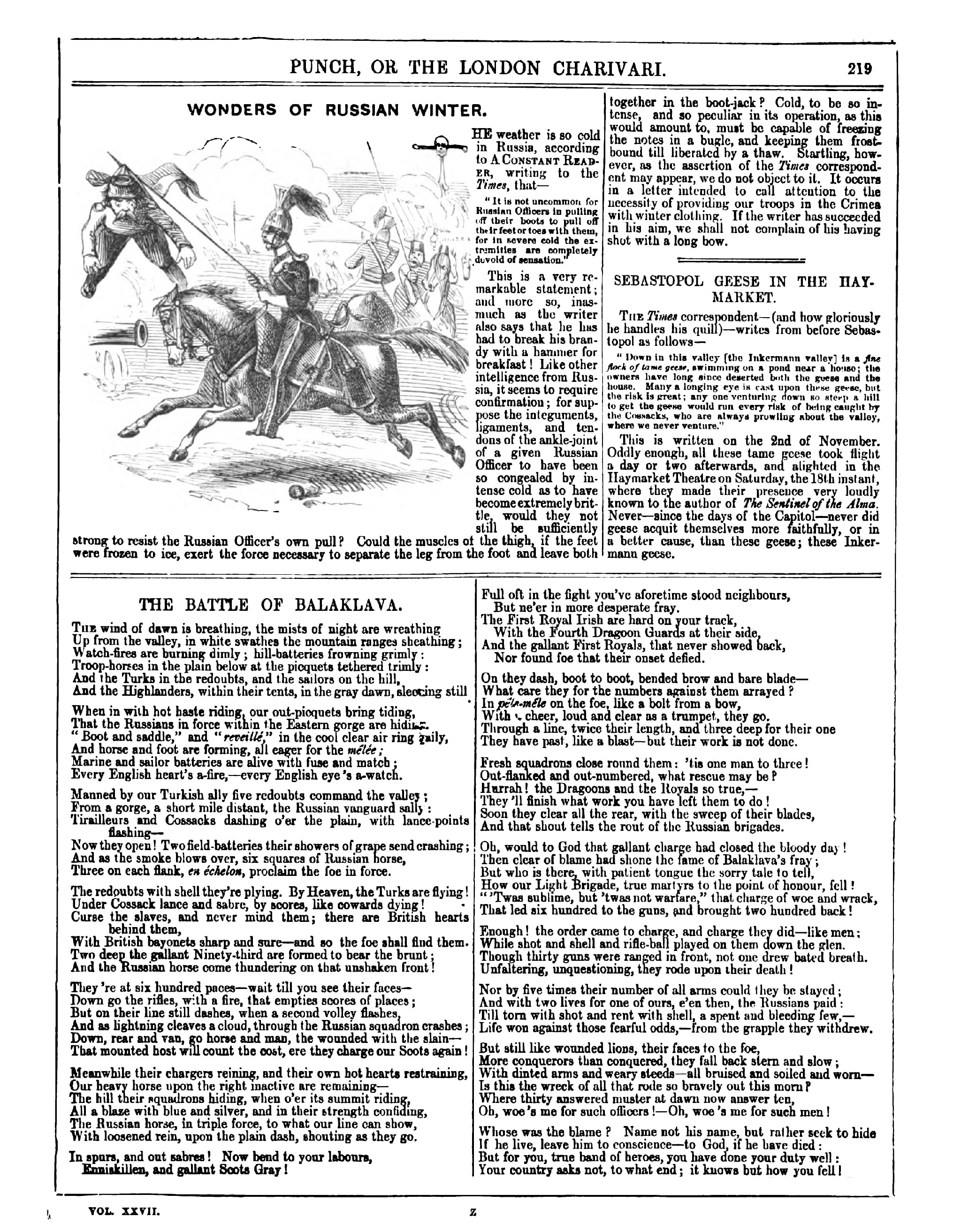
— "Battle of Balaklava"
— King Cholera's Procession [date?}
— Slide: King Cholera's Procession [1853?}
— Balaklava [Punch, Feb 1855?] - below.
— The Due of the Dead, Punch
— Jeanne Rathbone https://sheelanagigcomedienne.wordpress.com/2016/10/19/tom-taylor-dramatist-editor-of-punch/
— Wikipedia: Tom Taylor. — Numerous references in Survey of London: Battersea: Lavender Sweep. — Proselytising-Public-Health-Reform-in-Punch-1841-1858-Clare-Louise-Horrocks-PhD-2009 As sent to the history group in July 2020 I don't know how I missed this before, but it was printed a week after after the big poem ("The Warning of Wandsworth Common", Punch, March 4 1865) [WandsworthCommonHistory: Link. It's interesting for any number of reasons... Sorry to state what might be bloomin' obvious but: - The places named (Barnes, Streatham, Wandsworth, Wimbledon) are all SW London commons under threat at this time (1865) - Notice the lovely cloth and imagery - Lord plays tailor - coat - gorse as gold lace - turf as velvet - skirt - AND - and this is really delightful - notice the MULTIPLE puns and allusions in the poem - the poem was (almost certainly) written for Punch by Tom Taylor - ho ho - to tailor is to cut, of course - "a Spencer" was defined as clothing whose tails or skirts had been cut off The spencer, dating from the 1790s, was originally a woolen outer tail-coat with the tails omitted. It was worn as a short waist-length, double-breasted, man's jacket. ... It was also soon adopted as a popular women's fashion on both sides of the Atlantic during the 1790 - 1820 Regency style period [2][3][4] The spencer was worn as a cardigan, or as a short, fitted jacket cut to just above waist level, or, in Empire style, to the bust line, and tailored on identical lines to the dress.[5] The use of the term spencer continued well into the 19th century to mean more generally any type of short jacket or coat.
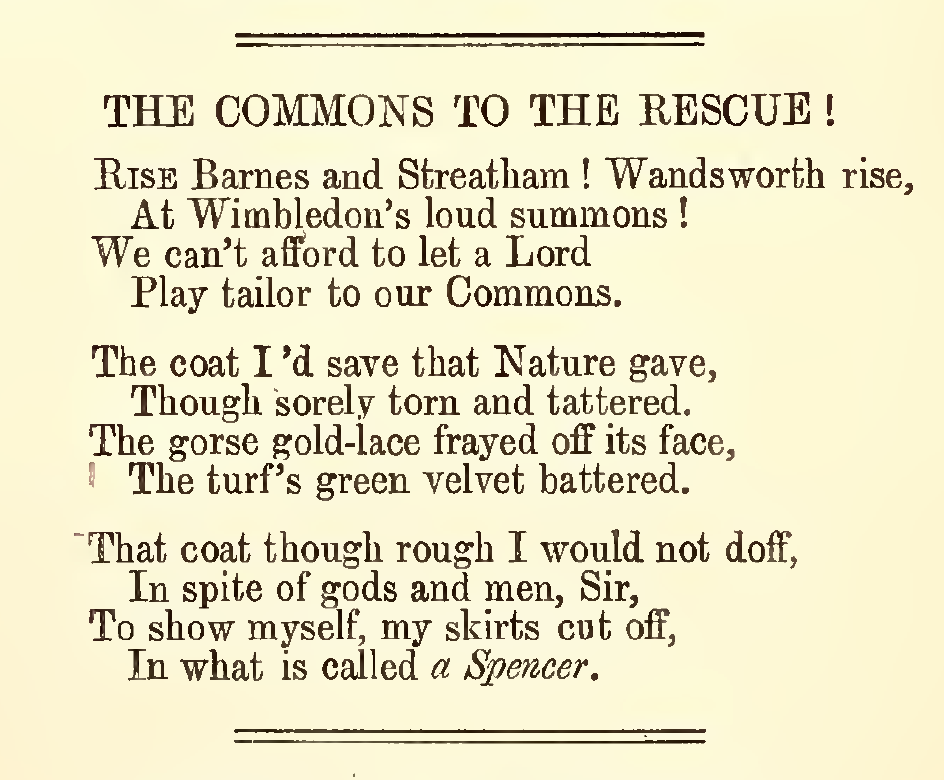
(Click on image to enlarge)
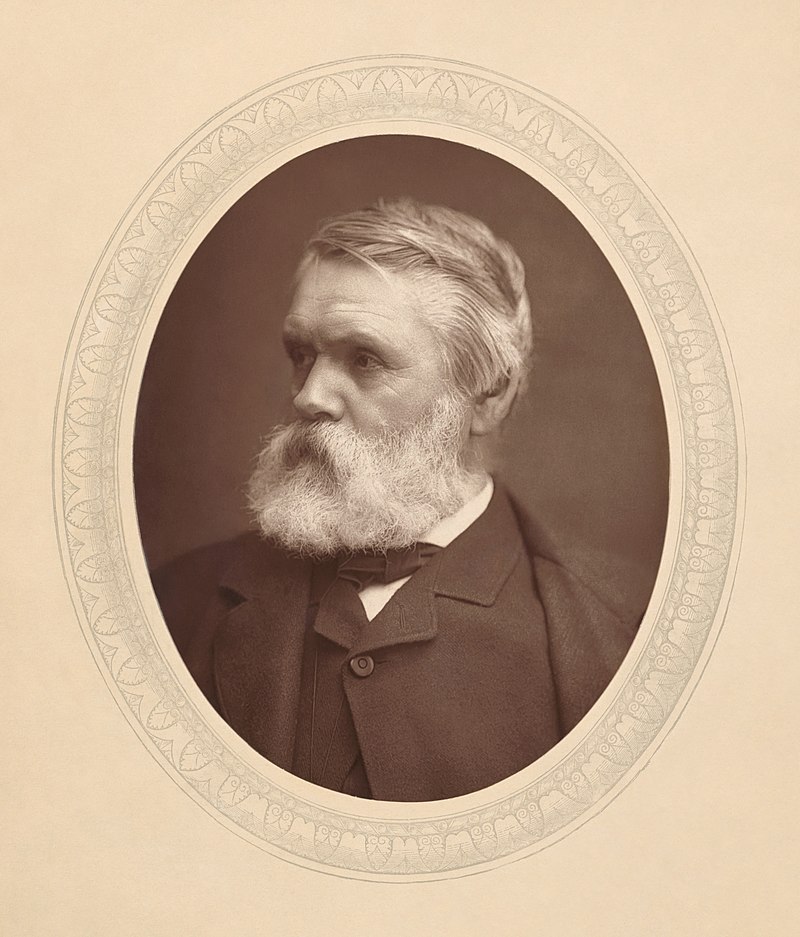
Photograph of Tom Taylor (1817-1880), by Samuel Lock and George Whitfield, from Men of Mark, a Gallery of Contemporary Portraits, published by Sampson, Low, Marston, Searle and Rivington in 1881. (The publisher Edward Marston, by the way, sent his son to Halbrake School, Wandsworth Common.)
(Click on image to enlarge)

Photograph of Tom Taylor (1817-1880), by Lewis Carroll, 1863. Carroll visited (and photographed) a number of Battersea residents, including Taylor and the Pre-Raphaelite painter Arthur Hughes.
(Click on image to enlarge)
It was named "spencer" after George, the 2nd Earl (born Wimbledon Park), "who is reported to have had a tail-coat adapted after its tails were burned by coals from a fire"
Incredible stuff, eh?
And of course there's the pun in the title, which I missed at first - i.e. an implicit call to the (House of) Commons to act.
Preceded Tennyson's Charge of the Light Brigade, but obviously nowhere near as famous either mid-19th century, let alone since.
TT's (much longer) poem reviews the events of the whole of the day, 24th October 1854 - the morning's build-up, the capture by the Russians of key Turkish redoubts (gun emplacements), the ("successful") "line" of infantrymen resisting a Russian cavalry attack (the phrase "Thin Red Line" had not been coined yet - though Times-correspondent William Russell does refer to them as "that thin red streak tipped with line of steel", the Charge of the Heavy Brigade (also "successful"), and only ends with the Charge of the Light Brigade itself.
The Charge of the Light Brigade is the infinitely better known "heroic failure" with its call to find who to blame, who had blundered etc, and the talk of "honour", of heroes having done their duty by obeying orders and riding through "shot and shell" towards almost certain death (just the last 5 verses). Unlike Tennyson, who writes about "the six hundred" (there were perhaps nearly 700, but the number didn't sound as good), TT is not specific about numbers, though he does quantify the casualty rate: "Where thirty answered muster and dawn not answer ten". TT names the regiments involved explicitly ("Enniskillen and gallant Scots Gray ... First Royal Irish...Fourth Dragoon Guards... First Royals",
(Tennyson, on the other hand focuses narrowly on the "Light Brigade" Charge, and no specific regiment is named.)
But TT uses much the same language as Tennyson, because both derive from William Russell's Despatches to The Times, which both will have read on ? November, a few days after the Charge.