
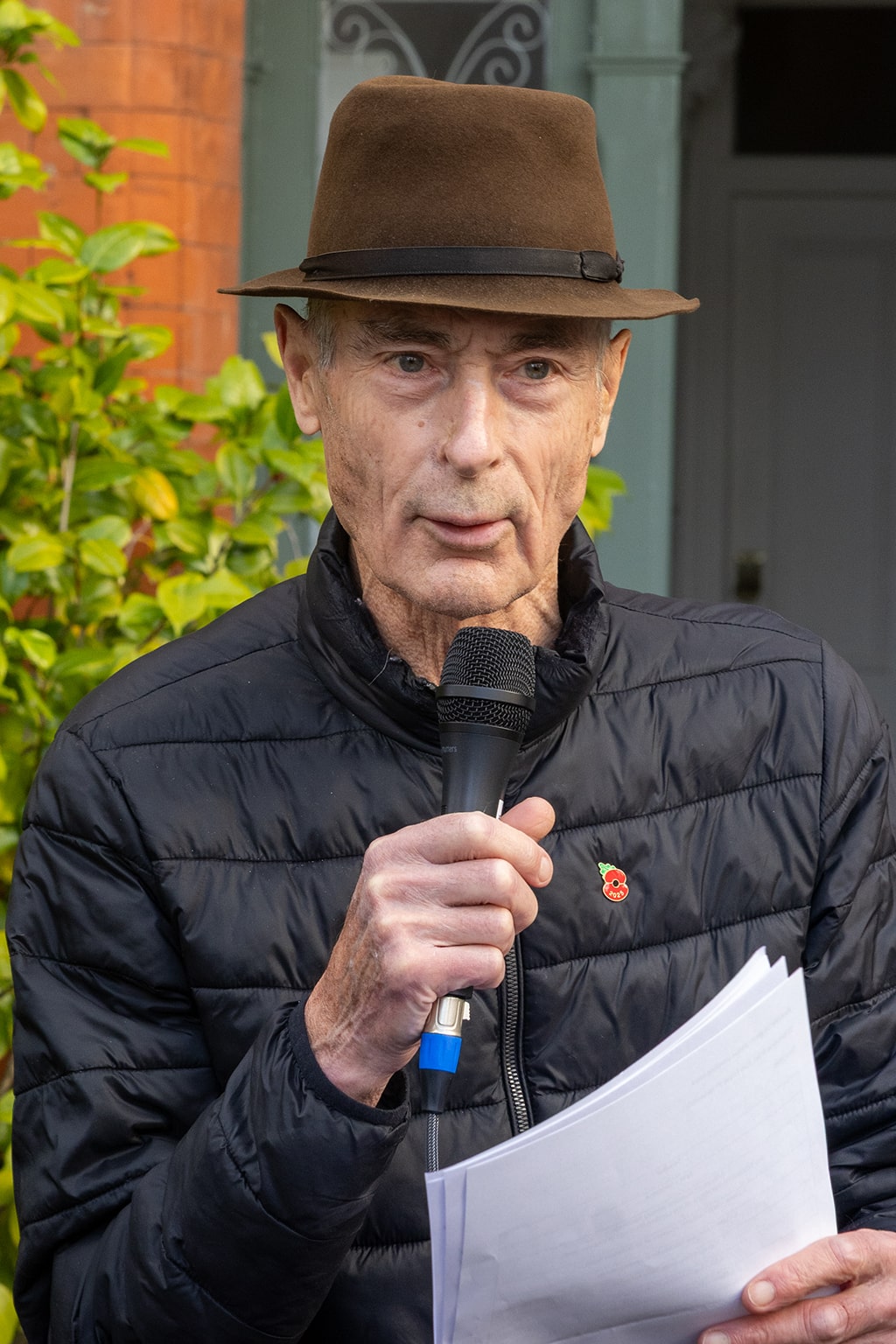
It’s purely by virtue of prior occupancy here at No. 16 that I have the honour of addressing you all here today. I shan’t, though, detain you for quite as long as I’ve been fortunate enough to count myself a resident, now 47 years and counting.
I shall also have to disappoint you where Le Maître Martin is concerned. I’d long been aware of the building’s past existence as a photographic studio but had dismissed this as just another late Victorian equivalent of a Photo Me booth, an exercise in painted backdrops, potted palms, and assorted fancy dress, best calculated to transport those captured in the lens to realms far removed from “the tittle-tattle of the Tooting tea-table”.
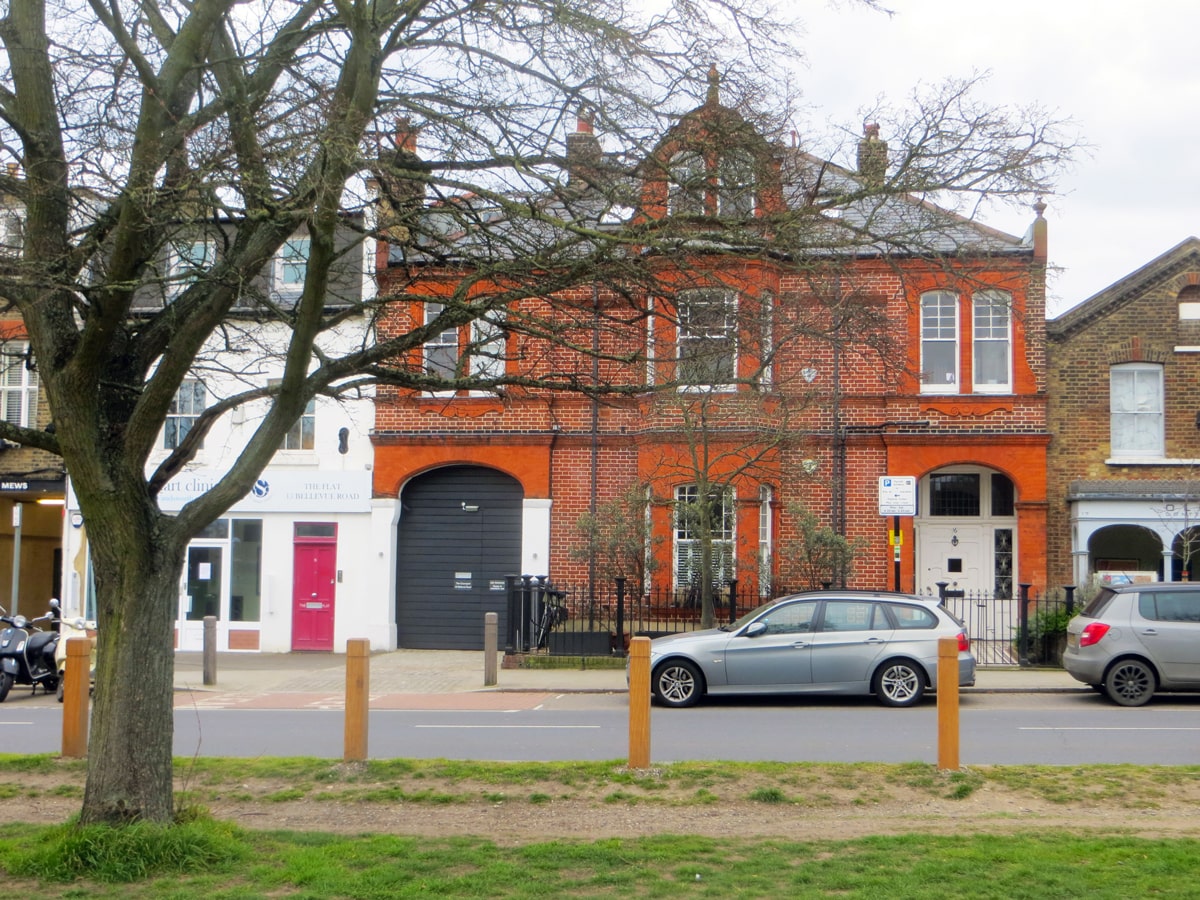
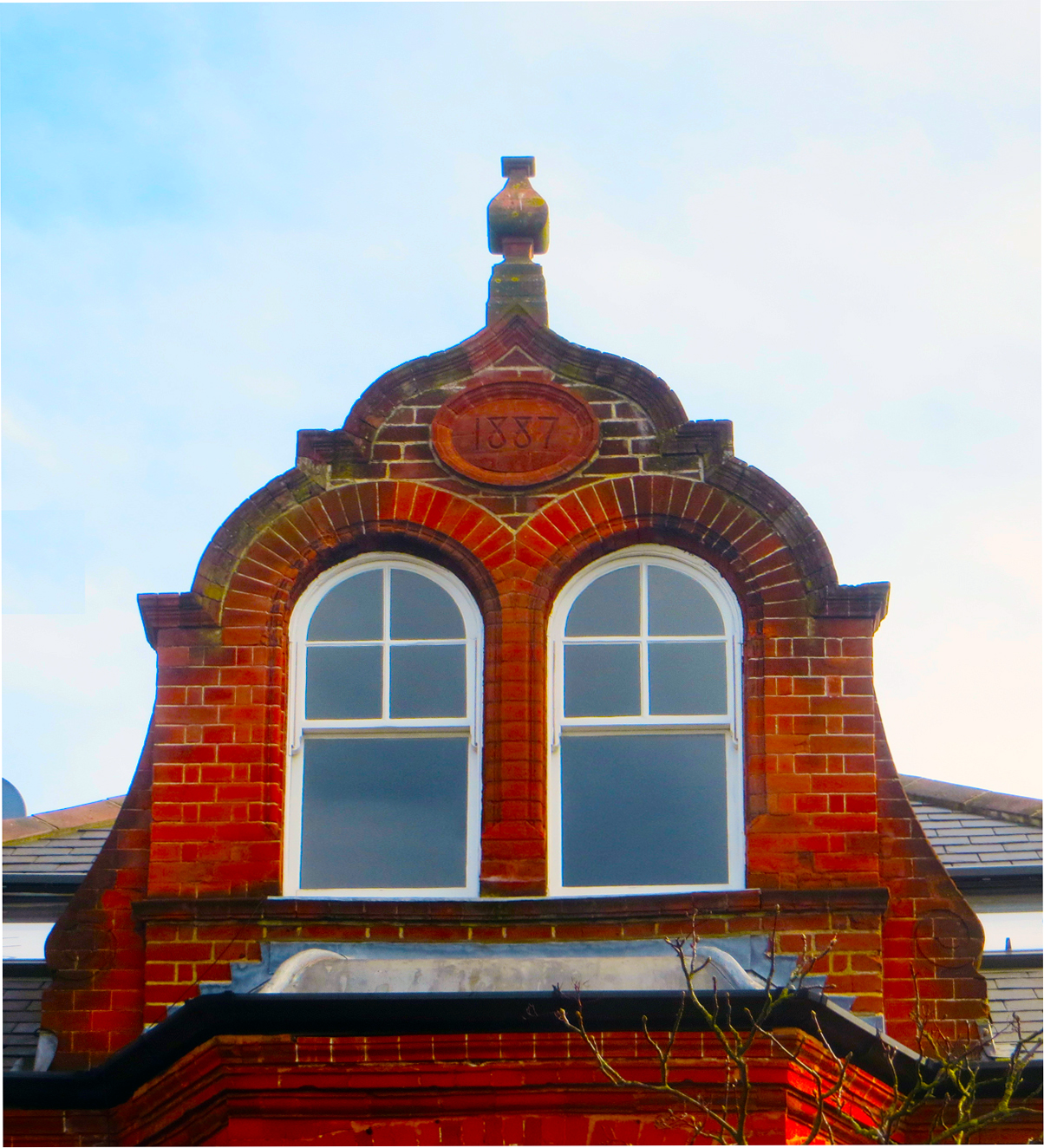
And yet, without our man’s quarter-century in our midst, we’d all of us be deprived of this handsome memorial, one worthy of a handsome building, itself the pick of all its residential neighbours in the all-but continuous sunset-facing terrace that is our particular Bellevue Road. Built, it seems, by local builder Leonard Bottoms for his own use, the date of its completion (the Golden Jubilee year of 1887) is recorded in the newly restored rubbed brick lozenge visible above the Dutch-style dormer that serves as my own far-seeing window on the world.
It was only after I’d lived here some while that the level of craftsmanship achieved was brought home to me, and then by a master of brickwork who’d just helped put Hampton Court back together after the palace’s disastrous 1986 fire. Alerted by a surveyor who just happened to live next door to the condition of our now century-old front elevation, us residents, acting in concert as the association we’d formed to buy the freehold in 1988, embarked on the first of what became a series of projects of inevitable complexity and cost.
The brickwork consultant we recruited to oversee this our maiden undertaking came recommended by the Victorian Society, of which I’d long been a member, and quickly proved an inspired choice. Tim Shepherd, for that was he, spoke in his initial report back in 1998 of “this fine Victorian house” blessed with “an unusually large amount of gauged brick features” — that is soft bricks (or “rubbers”) cut to chosen profiles — whose various defects “will begin to escalate if thorough works are not undertaken soon”.
The gauged work, he said, had been “executed to a very high standard, with pure lime joints averaging 1/32nd of an inch, i.e. less than a millimeter” and comprised “two fine semi-elliptic arches over the front door and the side drive, three ornate cornices...[or] strings... [featuring] ... scotias, ovolos, and dentilation, and ten fine cambered arches over the windows.
The gauged mouldings to these windows extend down the jambs to the gauged cills, which have aprons. On the top floor is an ornate Dutch Gable type of double dormer window with moulded copings and two semi-circular gauged arches with gauged reveals similar to those below. At each end is a gauged fluted corbel with a cut finial to finish”.
Work finally got underway in the millennial year 2000, using proprietary gauged and rubbed special bricks to match the existing fabric, whose provenance Shepherd had already traced to a quarry near Faversham. The contractor in this connection was the Billingshurst-based specialist brick supplier, Lamb’s Bricks & Arches.
If I’ve rather gone on, it is only so as to impress on you all the degree to which ownership of a house such as this confers heavy and inescapably expensive obligations on its owners.
Subsequent improvements had, for lack of funds, to await their turn, but once agreed upon, they included the installation of a secondhand run of Victorian cast and wrought iron railings, supposed once to have graced the RAC Club in Pall Mall; the restoration of a fast-crumbling front path; and in 2015 a full-blown roof renewal employing a full set of Spanish slates.
Enough of the house, but what of its former residents? Material held in Emma Anthony’s Borough Archive reveals how Paul Martin and his partner Harry Dorrett had been beaten to it by a fellow photographer, Fred Kingsbury, in business here in the late 1890s, and followed later, between 1930 and 1950, by a Catalan family, the Bachs, who ran the place as both a boarding house and a restaurant, The Rendezvous.
They, in turn, handed over to a Mary Poole-Connor, who took on the boarding house side of things, now trading as a “guest-house”, as well as providing a continuing refuge on the top floor for the already well-established Moya Kennedy Dance School. It was on Miss Poole-Connor’s retirement aged 68 in 1977 that an enterprising developer split the building into four flats, while preserving an arrangement whereby builders AJ Sutcliffe held onto their base on what is now the site of The Courtyard but was then simply our cobbled back yard.

My own observations — cue a collective sigh of relief — I shall limit to just one: the street as I came upon it for the first time in the early spring of 1978.
Just how different, you may have asked yourselves, was Bellevue Road back then? Now, I shan’t pretend my memory isn’t fading fast, but my answer all along would have been: “Hardly, if at all.” Shops have swapped places or, like the two butchers, the dairy, and The Surrey Tavern at the top of the road, all of which I started with, gone entirely.
Cafés have sprouted where once there was none, while our complement of estate agents has more than doubled. As has, of course, the cost of housing, and then some! But prices apart, the mix of businesses, the look of the place, and the familiar procession of proud parents and their charges are all much as ever they were. Only our pavement cyclists, mobile zombies, and jostling joggers came late to the party.
I would like to thank William for agreeing to my publishing his talk - thanks, Will!
Back to the top of this page . . .
