A HISTORY OF
WANDSWORTH COMMON
Added
IN PROGRESS — NOT FOR PUBLICATION
The Black Sea
TO FOLLLOW UP
NB This part of a bigger project - The Anatomy and Developmental History/Evolution of Wandsworth Common
Collect and review all maps
Refs in newspapers etc
Photos e.g. by
Geoffrey Bevington - get a better version?
? Le Neve - find?
Do I recall refs to watercolours e.g. possibly by ? Barchard?
Something about them all going to Seaford - museum?
Eels
Jack Black
Suicides e.g. the two Amelias
The trap laid for the foreign seducer
Other plants, insects etc in the lake
The Elodea canadensis invasion
George Fergusson Wilson models Wisley/future RHS on Wandsworth Common
The Windmill
Stories about the Frying Pan
Collect every photo and reference
Buckmaster et al's complaints about how they used to be able to walk all round.
Afterwards, how the rest of the ponds were filled in. How the lake was created and enlarged.
How the lake was filled in. And Spencer Park was built on the site. Who built the houses? Who lived there?

(Click on image to enlarge)

When was the Black Sea filled in? Find statements that it would be or should be. And that it has.
View from Black Sea towards the RVPA, c. 1880
[PB: This may (or may not) be the date of the painting - but the Black Sea had been filled in some years earlier - 1871-ish?]
'"The Royal Victoria Patriotic Asylum, Wandsworth Common" (c.1880). Watercolour, artist unknown. I scanned this from a Wandsworth Museum greetings card. I was unable to find it online in July 2019, but I assume it is in storage somewhere. Is it listed in ArtUK? No. [It might be now - check].
(Click on image to enlarge)
Why is it called "The Black Sea"? Is it Crimean-war connected? There is a painting dated 1858, so it could be. Or are there references prior to 1853/4? Was the house also called Black Sea House, as I recall one source saying?
[No, there are references to the Black Sea from well before the Crimean war [i.e. pre-mid-1850s] - find.]
Price's Candles certainly used an image of Cardigan and the Charge (and other battles) in their publicity [date?].
Shirley Passmore, The Black Sea
The Wilson Estate and the Black Sea
An early enclosure (date not known) on the north-west comer of the common was a house surrounded by a large garden that later expanded to about 8 acres of parkland. It is shown on the Rocque map of 1741.
The estate was leased in 1829 from Earl Spencer by William Wilson the founder of Price's Candle Factory. On later maps a 5-acre lake known as The Black Sea adjoins the park. This was most probably a disused gravel pit and later was utilised as a reservoir. It supplied 12,000 gallons of water a day to properties around.
When the cutting for the London Southampton Railway was made it cut off the end of the lake and its feeder spring. The LSR Company was obliged under the 1834 Act to take various steps to "for ever thereafter keep up and maintain a supply of water in the said pond No 3 and two other ponds contiguous thereto" (or until the Lambeth Water Company would take over the supply). A pumping mill was installed on the railway embankment to pump back water from the cutting into the lake.
[The Black Sea, Stanford 1864. Source and further information: Link.]
At some stage, perhaps 1846 when a new lease is recorded between Anne Wilson and Earl Spencer, the estate was expanded right up to the edge of the lake taking in one and a half acres of common. The lake ceased to be a reservoir at about this time and it is suggested that the 1846 Lease also included the lake. However, the Battersea and Wandsworth parishes were stated to own the lake when used as a reservoir so the situation is unclear.
What is clear is that at least from this time, perhaps earlier, Wilson looked after the lake and was responsible to a large extent for turning it into "One of the most picturesque and ornamental waters near London". It has to be a myth that he put in an island to commemorate the birth of each of his 13 children because the islands are already there on the Cruchley map of 1829.
In November 1866 the fifth Earl Spencer bought back the lease of this estate from the widow of William Wilson and "the gravest apprehensions were entertained that the 13 acres would be turned into building sites". (It was to become Spencer Park).
[Shirley Passmore, 2010]
The Black Sea (Spencer Park)
Built by ? Wilson, owner of Price's Candles. According to Sexby Municipal Parks... [1905], an extra island was created for every new child. (Shirley Passmore pooh-poohs this on the grounds that the many islands can be seen on maps made before the children were born. Check.)
When the control of the common was transferred to the conservators, Lord Spencer reserved to himself a portion at the north adjoining the London and South-Western Railway main line on which was a sheet of ornamental water called the Black Sea, which was studded with thirteen small islands, and beautified with shrubs and flowers. This lake was formed by a Mr. Wilson, the founder of Price's Candle Works, who lived at Black Sea House. For every child added to his family, he constructed a little island in the lake, fringing each with yellow iris.
In the Act for the construction of the railway, the Black Sea was called Pond No. 3, and was said to be the property of Battersea and Wandsworth, [p.246] and by this Act the Company were compelled to place apart the sum of 8,000 for the purpose of covering the bed of the pond with clay, and making a drain into it from the cutting, and keeping it in good condition. Shortly afterwards in another Act certain sections enabled the Company to withdraw this sum, but still they were bound to repair and keep intact the pond and drain on both sides of the railway.
The Black Sea has now been filled up, and Spencer Park has been built upon its site so that one of the most picturesque and ornamental waters near London has disappeared. The old windmill, of which the stump remains (which is utilized as a tool-shed by the labourers on the common), was used for the purpose of pumping water into the Black Sea.
* "Old and New London", vol. vi., p. 482.
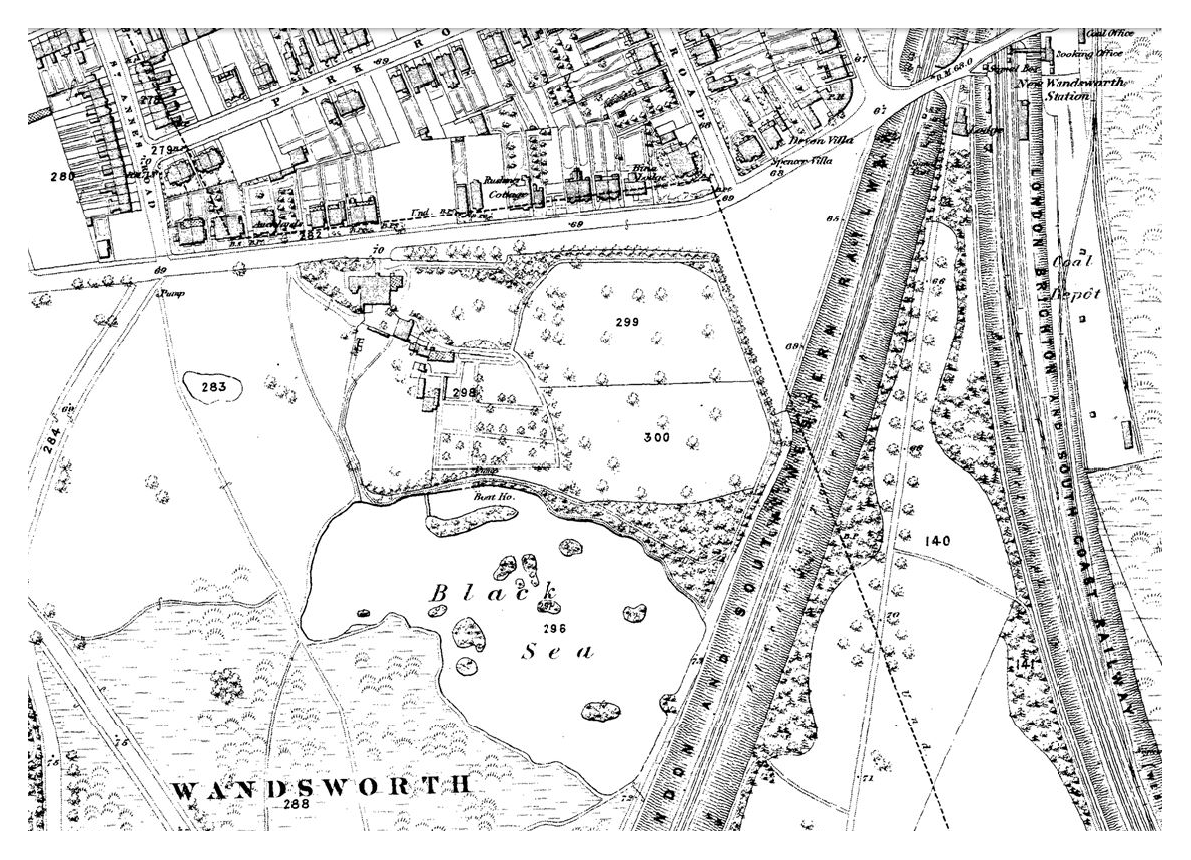
(Click on image to enlarge)
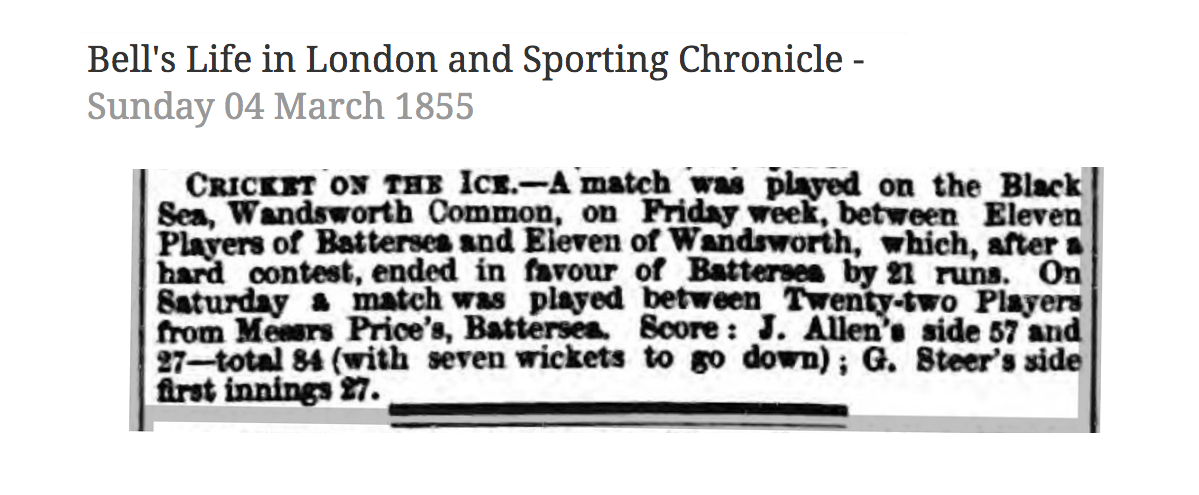
Bell's Life in London - 4 March 1855
Cricket on the ice
(Click on image to enlarge)
Cricket on the ice
The match was played on the Black Sea, Wandsworth Common, on Friday week, between 11 players of Battersea and 11 of Wandsworth, which, after a hard contest, ended in favour of Battersea by 21 runs.
On Saturday a match was played between 22 players from Messrs Price's Battersea. Score; J Allen's side 57 and 27 total 84 with seven wickets to go down; G Steer's side first innings 27.
[Source: Link.]
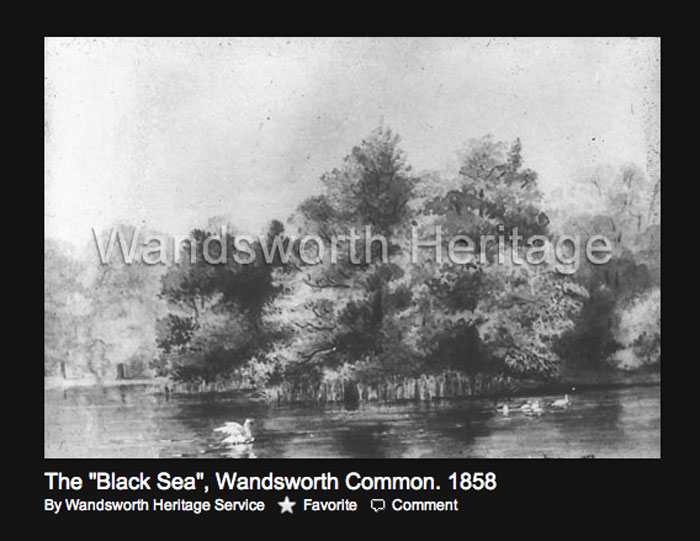
Black Sea, 1858, watercolour?
From Wandsworth Heritage Service. Link? Do they have a better copy? the original watercolour?
(Click on image to enlarge)
Jon Newman, Battersea's Global Reach: The Story of Price's Candles
Battersea's Global Reach tells the story of Price's Candles at Vauxhall and Battersea and how it helped to light the world. Price's Candles of Battersea was and still is a household name. Yet the company's history is so much more than the making of candles. From its inception in the 1830s it re-invigorated a sleepy and unchanged industry by the application of scientific research. Industrial chemistry allowed it to develop the first stearine candles and provide inexpensive good quality lighting.
Forty years later the discovery of oil and the use of paraffin wax for candle manufacture additionally turned it into an position oil company. As well as commercial success the company was noted for its ethical on products - particularly the use of Palm Oil for manufacture and the strong anti-slavery message that this sent out in the 1850s - and for its radical approach to employee relations, providing schools, housing and pensions for its workers. The story of the 20th century is a familiar one of decline and reinvention - from manufacturing industry to retailer to heritage brand.
Jon Newman, the author, is an archivist working freelance and for Lambeth Archives.
Published by History & Social Action Publications, 6 Oakhill Rd, London, SW16 5RG.
Launched at a talk by the author during the Wandsworth Heritage Festival (June 2009).
Price: £5 & £1 p&p.
To order:
Click Add Cart button below or send order with cheque payable to 'Sean Creighton' to the address above.
Or order via email: sean.creighton1947@btinternet.com.
https://sites.google.com/site/historysocialaction/battersea-s-global-reach
"WANDSWORTH COMMON BLACK SEA" SEARCH IN GOOGLE BOOKS
http://books.google.co.uk/books?id=gdlCAAAAIAAJ&q=black+sea+wandsworth+common&dq=black+sea+wandsworth+common&pgis=1
WC in he Municipal Parks, Gardens, and Open Spaces of London
By John James Sexby
[Source: Link.]
More details
The Municipal Parks, Gardens, and Open Spaces of London: Their History and Associations
By John James Sexby
Published by E. Stock, 1905
646 pages
Autobiography of Sir Walter Besant (1836-1901).
Besant moved from Portsmouth? to London (at age ?) to study at Stockwell Grammar School.
[p.61]
There were many curious and pleasant places within reach of Stockwell. Clapham Common, on the south, the first of the Surrey heaths. It was surrounded by stately mansions, sacred to the memory of Wilberforce, Thornton, and Macaulay, standing amidst broad lawns with splendid cedars. The common itself was left absolutely untouched; winter water-ways made little ravines; there were ponds, there were no roads, there was gorse and fern. It was our playground.
Beyond lay [p.62] Wandsworth Common, another wild heath with a lake called the Black Sea, wherein, it was rumoured, gigantic pike attacked and bit great holes in the boy who ventured to swim across.
On the west one could easily reach the Battersea Fields. As I recollect this place, it was most dreary and miserable; a broad flat, lower than the river, and protected by an embankment. On the bank stood the once famous Red House tavern, now long forgotten, and beside it the pigeon-shooting ground. This sport went on continually. If a pigeon escaped he was potted by men who carried guns and lay waiting for him outside the grounds. Battersea Church was on the wall of the Fields, the transformation of a great part of which into Battersea Park took place between 1851 and 1858.
In summer our favourite rambles were farther afield, in the direction of Champion Hill, Herne Hill, Dulwich, and even Penge. No one visiting these places at the present day can understand their loveliness before they were built over. Dulwich, with its ancient college and its inn, its greenery and its orchards, was surely the sweetest village in the world. I always looked about in case I might come upon Mr. Pickwick, who was then a resident, but I was never privileged to see him. The hanging woods of Penge in autumn were lovely beyond the power of words. Its Common on the Hill had been enclosed long before in 1824. Howe laments the fact in that year; but in the fifties Penge, Norwood and Sydenham formed a group of suburbs still rural, [p.63] still covered with woods and gardens, and as beautiful as any country village.
As yet there were neither omnibuses nor railway. The people who went into the City drove in their own carriages or rode their own horses. Any morning along the Clapham Road there were still many who rode into town.
We were not great at games at the school. There was a cricket club, but my short sight disqualified me from any game of ball; in the winter there was hockey on Clapham Common. I think that football had not yet come in; in fact athletics, in such schools as this was, hardly existed. On the other hand we took long walks; we walked to Richmond, and rode ponies in the Park; we walked to Putney, and took boats on the River; we jumped the Effra, in the Dulwich Fields; we had a gymnastic bar and did things of strength; sometimes we wrestled; sometimes we fought. On the whole it was a healthy kind of life, with plenty of outdoor exercise.
For my own part, I had a form of recreation all my own, of which I said nothing, because the other boys would not understand it. I had friends at Camberwell and Brixton, who asked me two or three times a term to dinner on a half-holiday. On such occasions I used to get away at two and walk all the way into the City of London, which was to me then, as it has been ever since, a place of mystery, full of things to be discovered. Nothing could be more delightful than to wander about, not knowing where, so long as one was in the City.
[Source: Autobiography of Sir Walter Besant, Hutchinson & co., 1902.
Various formats available at here. Downloaded and saved as e.g. "BESANT_AUTOBIOGRAPHY_OF_SIR_WALTER_BESANT_autobiographysi01besagoog.pdf". Also a text version (partly edited).]
- Wikipedia: Walter Besant
Times, 6 March 1868
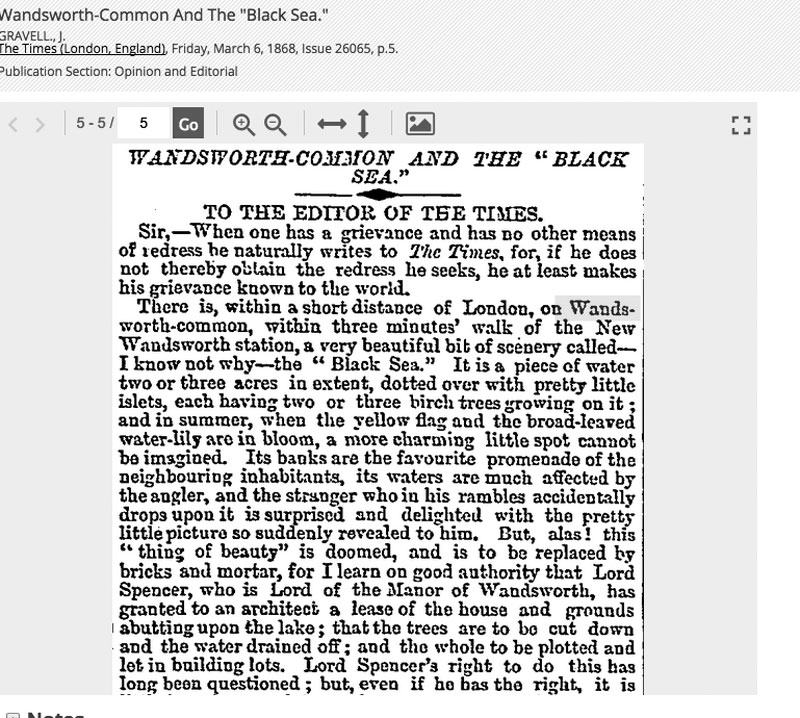
"But, alas! this thing of beauty is doomed", The Times, 6 March 1868
[to be completed]
(Click on image to enlarge)
The Popular Science Review: Animalcules, Wandsworth Common
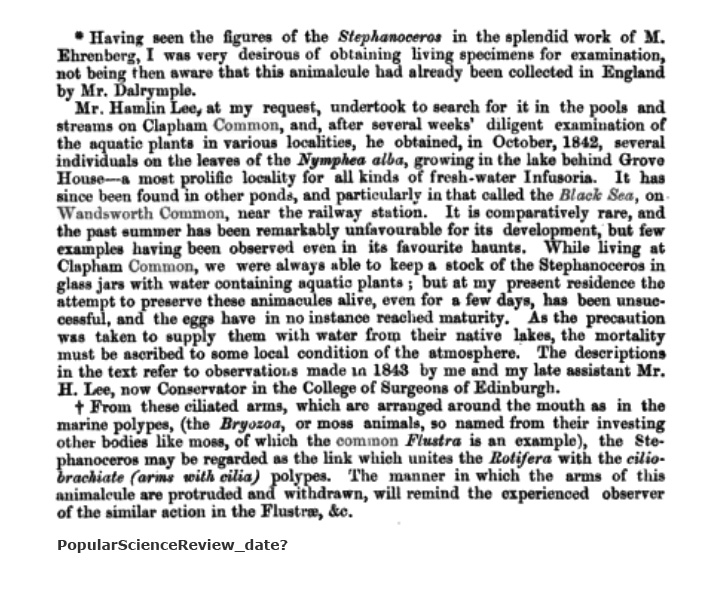
Popular Science Review, date?
(Click on image to enlarge)
Nymphaea alba - Wikipedia: https://en.wikipedia.org/wiki/Nymphaea_alba
Beautiful short film of the rotifer Stephanoceros fimbriatus
Published Jun 29, 2017. The rotifer Stephanoceros fimbriatus. Collected from a Southern California mountain lake, this was filmed in full 4K using a Panasonic GH4 camera, an Olympus BHS microscope, SPlan objectives, and Olympus DIC.
Also Link.
NB Philip Gosse, 'On Stephanoceros,' 1862.
On distribution of Rotifera, including Stephanoceros: Link (fabulous last para!)
Windmill
- See The Windmill
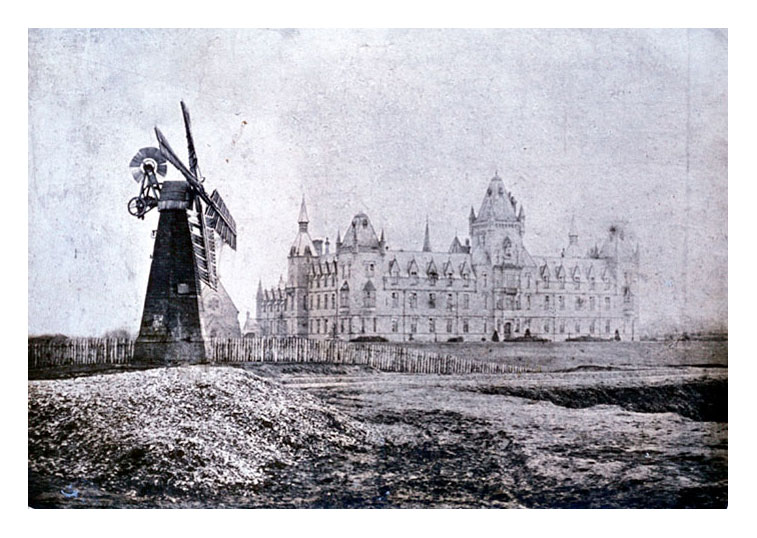
Windmill supplying water to Black Sea after railway cutting interrupted natural supply, date? Royal Victoria Patriotic Asylum for Girls in the background.
Notice how bleak and treeless the area is at this time.
windmill_in_front_of_rvpa.jpg
(Click on image to enlarge)
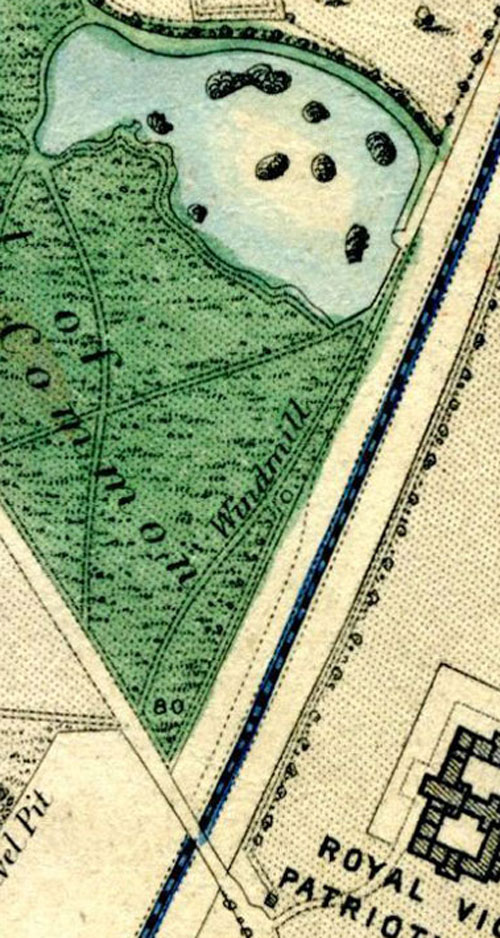
Map: Black Sea, Windmill, RVPA, railway line.
map_black_sea_windmill_rvpa.jpg
(Click on image to enlarge)
The Frying Pan
[PB: Notice there is no "Frying Pan" - the dead-flat depression on the other side of Windmill Drive opposite the RVPA. When did it appear? Find on maps. What was extracted and why? Was it to fill the Black Sea? This seems reasonable. I have seen a reference once [Greg Smye-Rumsby in his Scope website] that it was dug to make bricks for the Prison - but this seems unlikely. Was there much/any clay suitable for brickmaking on WC? Probably not. To build what? - the main part of the prison having already been built by the time of this image. No, it was a later sand pit. The "handle" is the approach path on the western side.]
Shirley Passmore: The Wilson Estate and the Black Sea
The Wilson Estate and the Black Sea
An early enclosure (date not known) on the north-west comer of the common was a house surrounded by a large garden that later expanded to about 8 acres of parkland. It is shown on the Rocque map of 1741.
The estate was leased in 1829 from Earl Spencer by William Wilson the founder of Price's Candle Factory. On later maps a 5-acre lake known as The Black Sea adjoins the park. This was most probably a disused gravel pit and later was utilised as a reservoir. It supplied 12,000 gallons of water a day to properties around.
When the cutting for the London Southampton Railway was made it cut off the end of the lake and its feeder spring. The LSR Company was obliged under the 1834 Act to take various steps to "for ever thereafter keep up and maintain a supply of water in the said pond No 3 and two other ponds contiguous thereto" (or until the Lambeth Water Company would take over the supply). A pumping mill was installed on the railway embankment to pump back water from the cutting into the lake.
At some stage, perhaps 1846 when a new lease is recorded between Anne Wilson and Earl Spencer, the estate was expanded right up to the edge of the lake taking in one and a half acres of common. The lake ceased to be a reservoir at about this time and it is suggested that the 1846 Lease also included the lake. However, the Battersea and Wandsworth parishes were stated to own the lake when used as a reservoir so the situation is unclear.
What is clear is that at least from this time, perhaps earlier, Wilson looked after the lake and was responsible to a large extent for turning it into "One of the most picturesque and ornamental waters near London". It has to be a myth that he put in an island to commemorate the birth of each of his 13 children because the islands are already there on the Cruchley map of 1829.
In November 1866 the fifth Earl Spencer bought back the lease of this estate from the widow of William Wilson and "the gravest apprehensions were entertained that the 13 acres would be turned into building sites". (It was to become Spencer Park).
[Shirley Passmore, 2010]
Follow up
- Jack Black
- Ornamental lake or reservoir (or both?)
- Refs to its decline in later years
- Info about filling in and our other lake created
NB Locate and add info about Peter Le Neve Foster's photograph of his children boating on the Black Sea c. 1850s.
Also his photo of a lake, whic may be the Black Sea.