A HISTORY OF
WANDSWORTH COMMON
IN PROGRESS — NOT FOR PUBLICATION
The Black Sea
DRAFT 2

(Click on image to enlarge)
Hello, my name's Philip Boys. I sometimes masquerade as HistoryBoys.
I research just about anything I can find on the long history of Wandsworth Common. Every month I publish some of the findings as Chronicles of Wandsworth Common.
Tonight I'll be talking about the Black Sea, that once flourished in the north-west of the Common, in the angle between North Side and the London-South-Western Railway.
It's part of a bigger project - that I think of as on the lines of an Anatomy, Physiology and Evolution of Wandsworth Common considered a kind of complex living organism that changes over time.
And to see that organism in relation to its wider ecosystem of Battersea and Wandsworth, London, England and indeed the world as a whole.
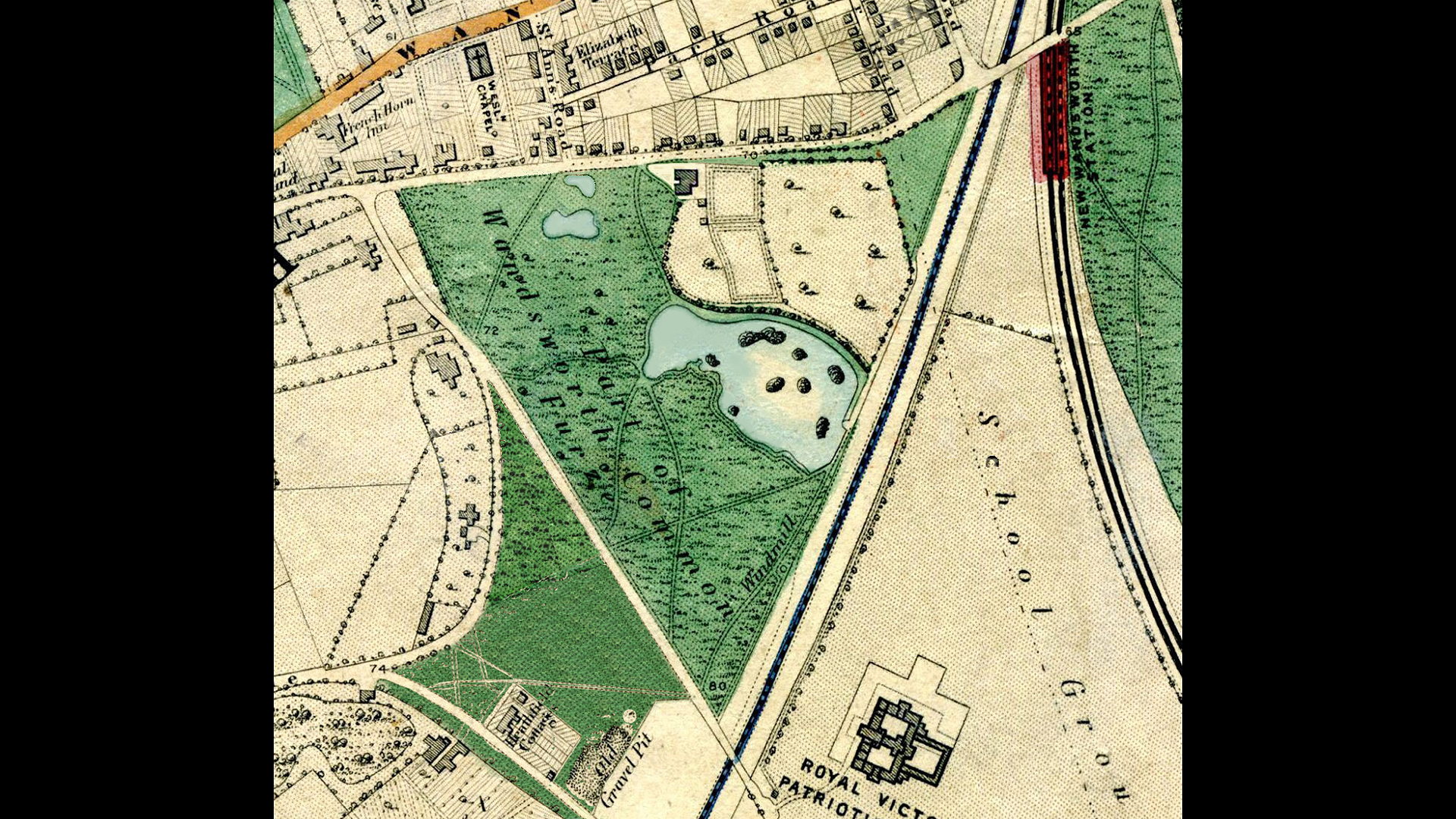
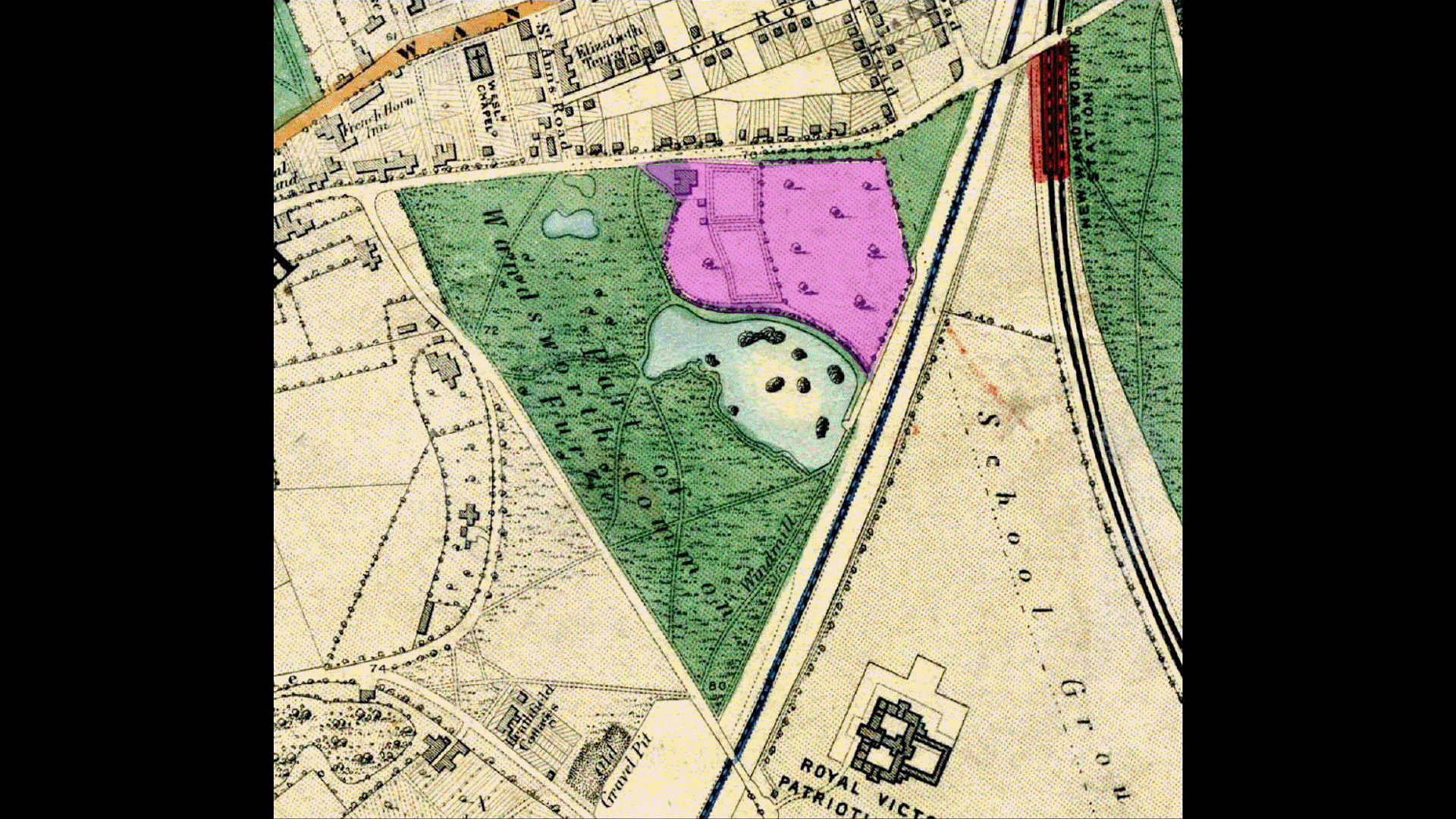
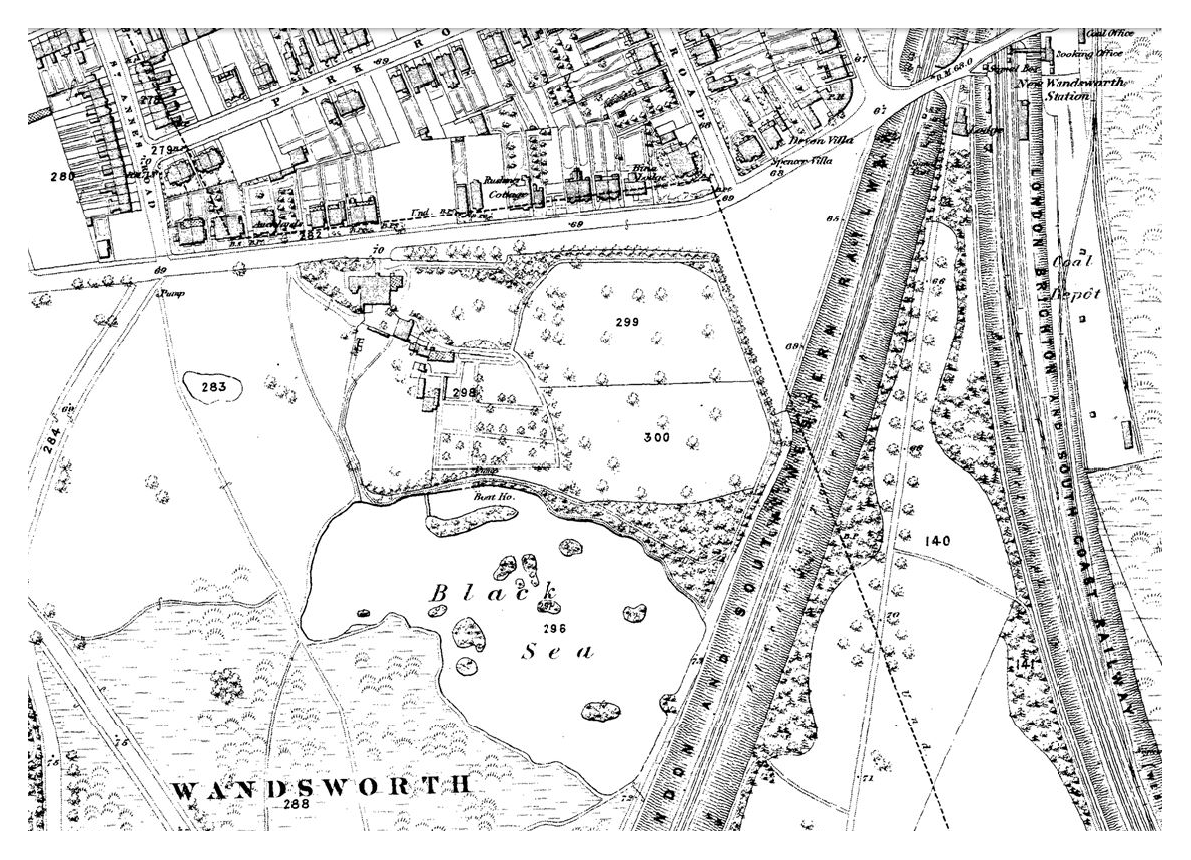
Here is the Black Sea, in a Stanford map of about 1864?
(Click on image to enlarge)
Let's take a minute or two to orientate outselves.
The railway line between London and Southampton, opened in ?
Here's North Side
Trinity Road
West Side
The old "New Wandsworth Station"
Does anybody need some more pointers?
Several things missing
And of course, Trinity Road is much narrower and there's no underpass...
The RVPA's there but no Emanuel School
No Spencer Park
No Earlsfield Road or Windmill Road...
At this time the Black Sea was a well-known beauty spot. But not just a place for strollers, or picnickers, or anglers.
Also for a range naturalists historians - the Black Sea was famous for its rare plants, insects, ? and ?. It features in many specialist listings...
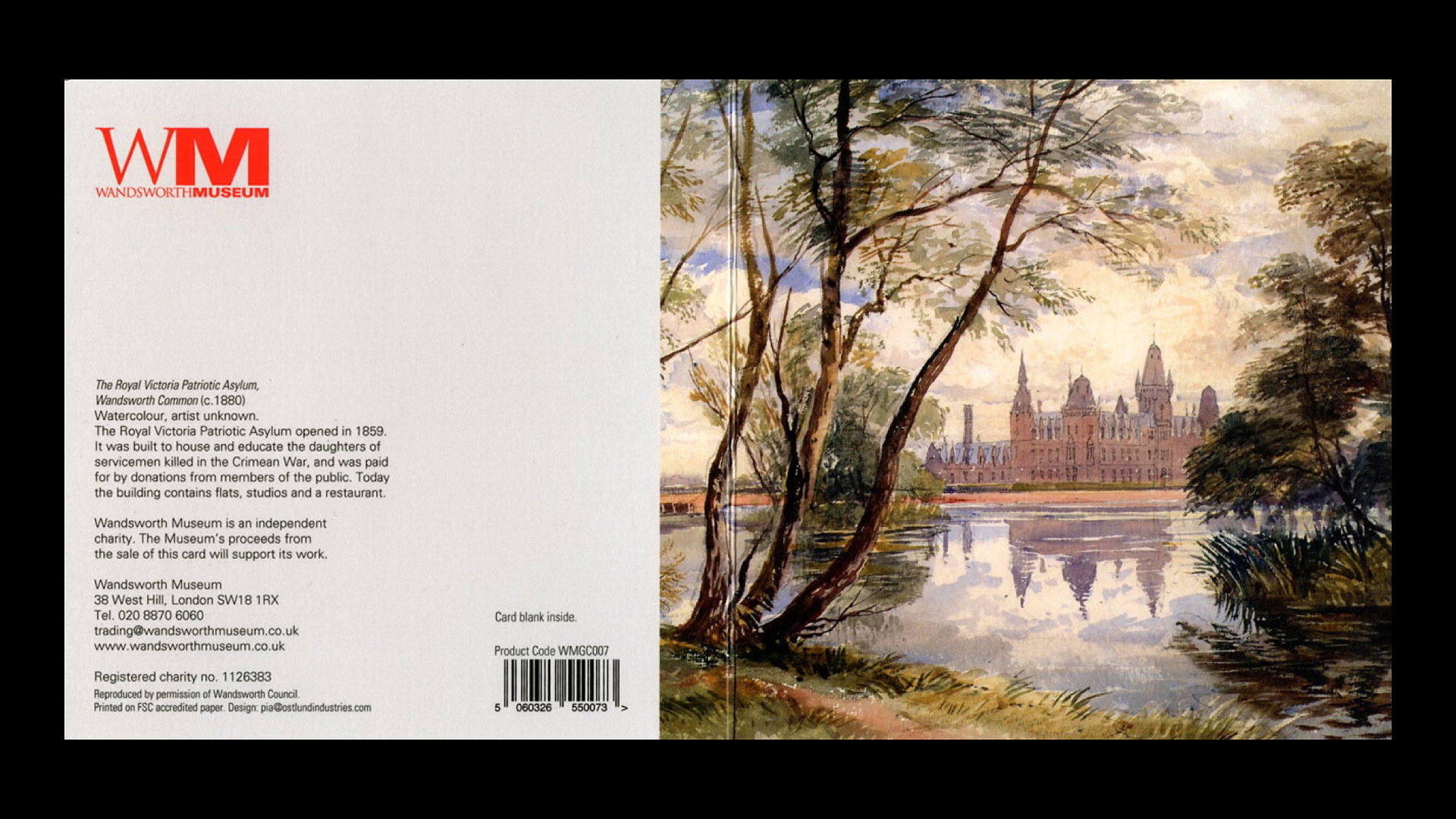
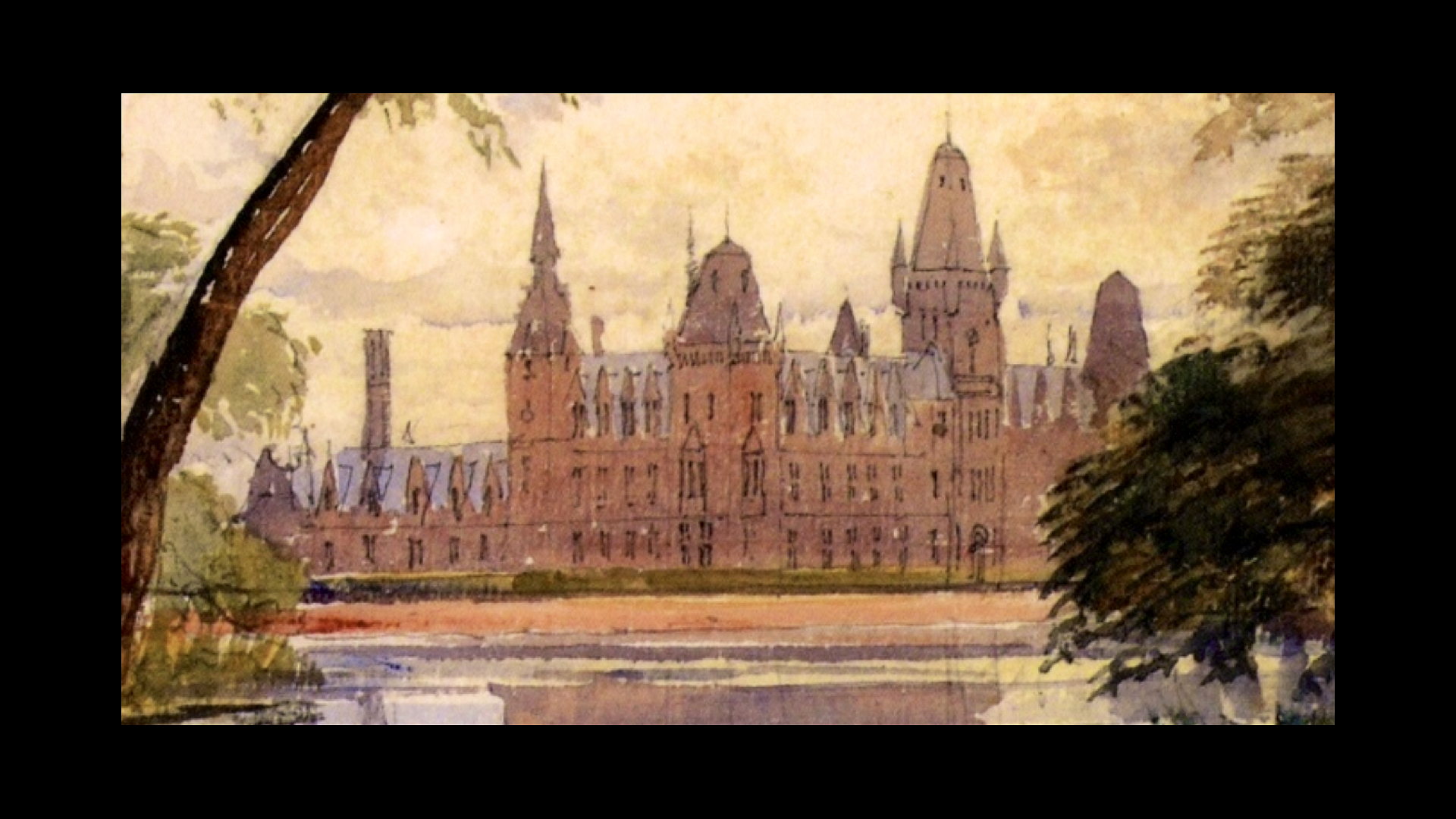
Here's one of my favourite images of the Black Sea, that gives an idea of what it was like in its heyday. [Though it may have been [scheduled for destruction already].]
(Click on image to enlarge)
I first saw this many years ago on a greetings card, published by the Wandsworth Heritage Service.
(Click on image to enlarge)
I've never seen the original, which I assume is safely stored somewhere in the basement at the old West Hill Library - where I'm told most of the much-missed Wandsworth Museum is located.
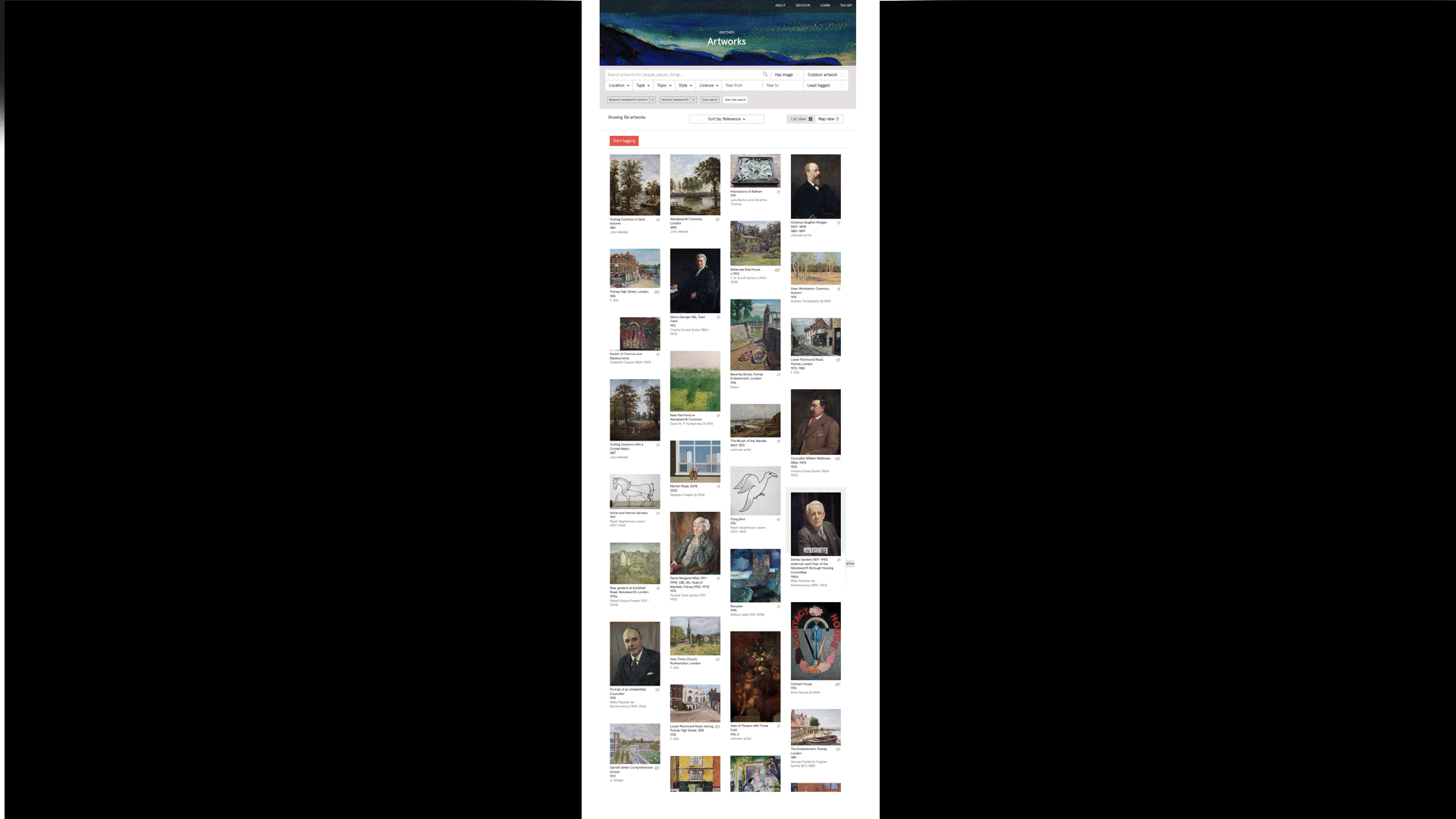
Many of the old images in Wandsworth's collection can be seen on ArtUK website.
(Click on image to enlarge)
But not, alas, this image.
If you don't know the ArtUK website, I strongly recommend it.
www.artuk.org
So what are we looking at?
It's a watercolour, and skilfully done (though I don't know by whom).
We appear to be peering out from the bank of a lake, with a small island to our left, partly obscured by a silver birch tree. There are flag irises and dense vegetation on our right, possibly alder trees.
In the foreground, probably a path, and more flourishing vegetation.
In the centre, some way away, quite clearly rendered, is the Royal Victoria Patriotic Asylum for Girls.
The surface of the lake is still, and the bulk of the building, with its many towers and pinacles, are reflected in the water.
There may be some grass, but are no trees around the school.
It was probably still quite young in 1858 [?] - it was built to house orphans whose fathers had been killed in the Crimean War of 1853-6.
It doesn't look like a painting from a photograph to me, though I suppose it might be. It lloks as though it was painted from life.
And we can't know if it is a literal "photographic" depiction. It might have been tweaked.
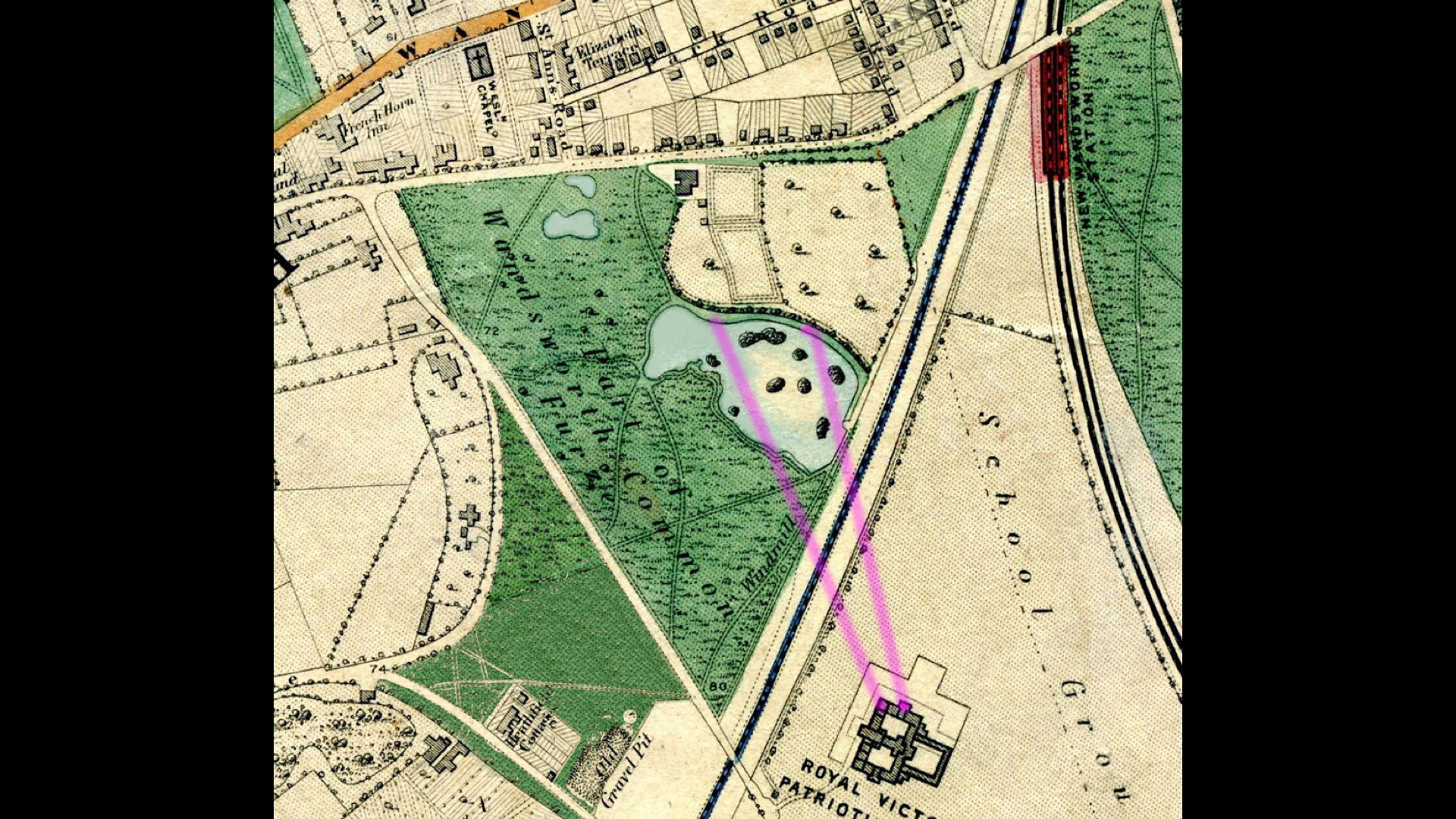
But if we assume this is we appear to be somewhere along the north bank of the lake, possibly from one of these two positions:
(Click on image to enlarge)
Coming in closer:
(Click on image to enlarge)
Frustratingly, there's no windmill to be seen. Did the artist ignore it? Or, more likely, it is obscured by the vegetation on the right.
In any case, as we shall see, it had already lost its sails so it had ceased to pump water.
Notice there are no signs of the railway line that crosses the picture right in front of the Asylum - admittedly in a deep cutting.
Nor of the road - Windmill Road parallel to it. An extension of what is now Earlsfield Road. At this time, neither road had yet been built. There was quite a hoo-hah from Conservators and other local people about the loss of common entailed.
Eventually, the roads were agreed.
We may return to this later.
John Rocque's maps of London and its surroundings, from 1740s onwards...
In the meanwhile, I want to go back to the origins of the lake.
I'd like now to go back in time.
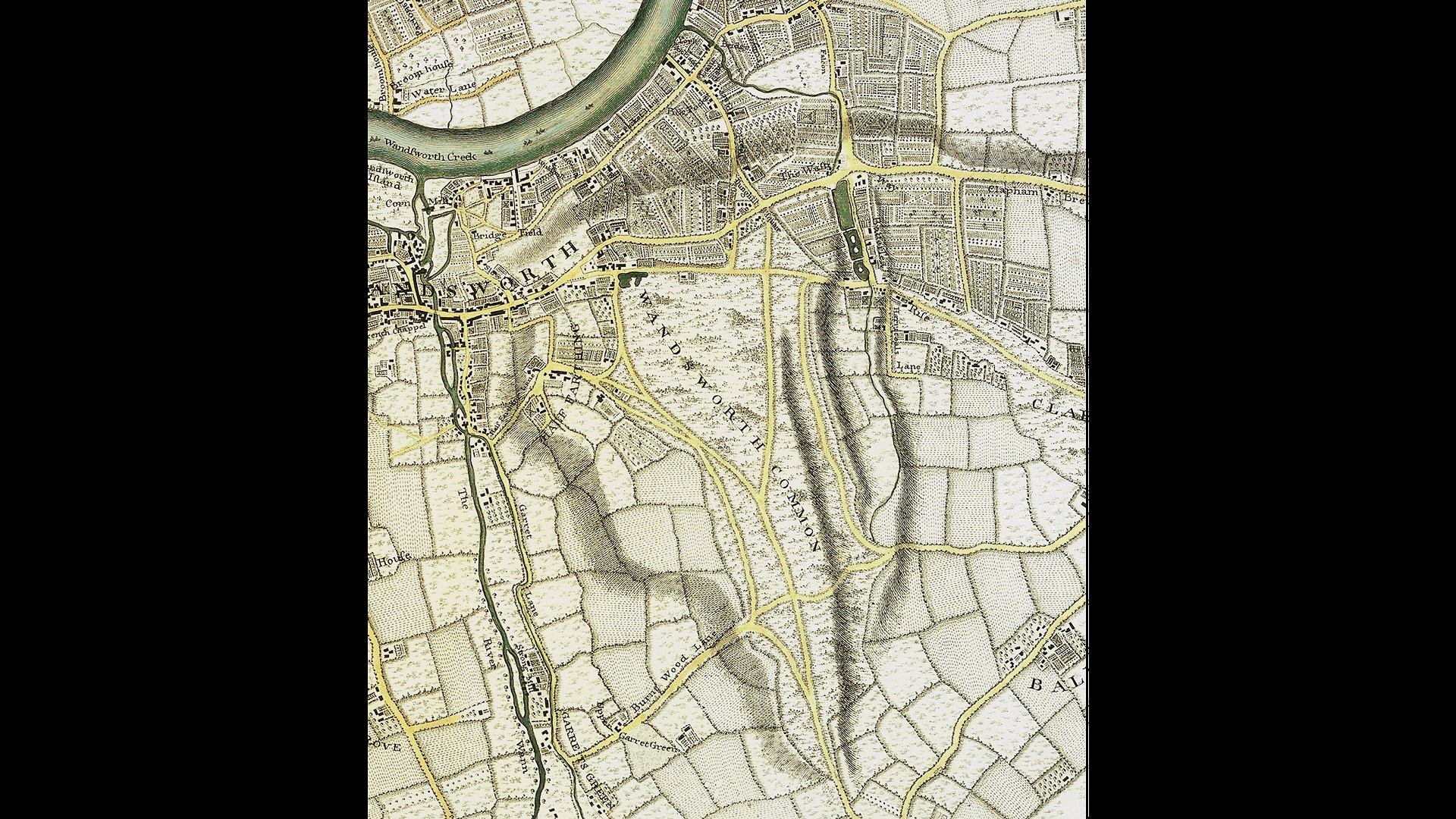
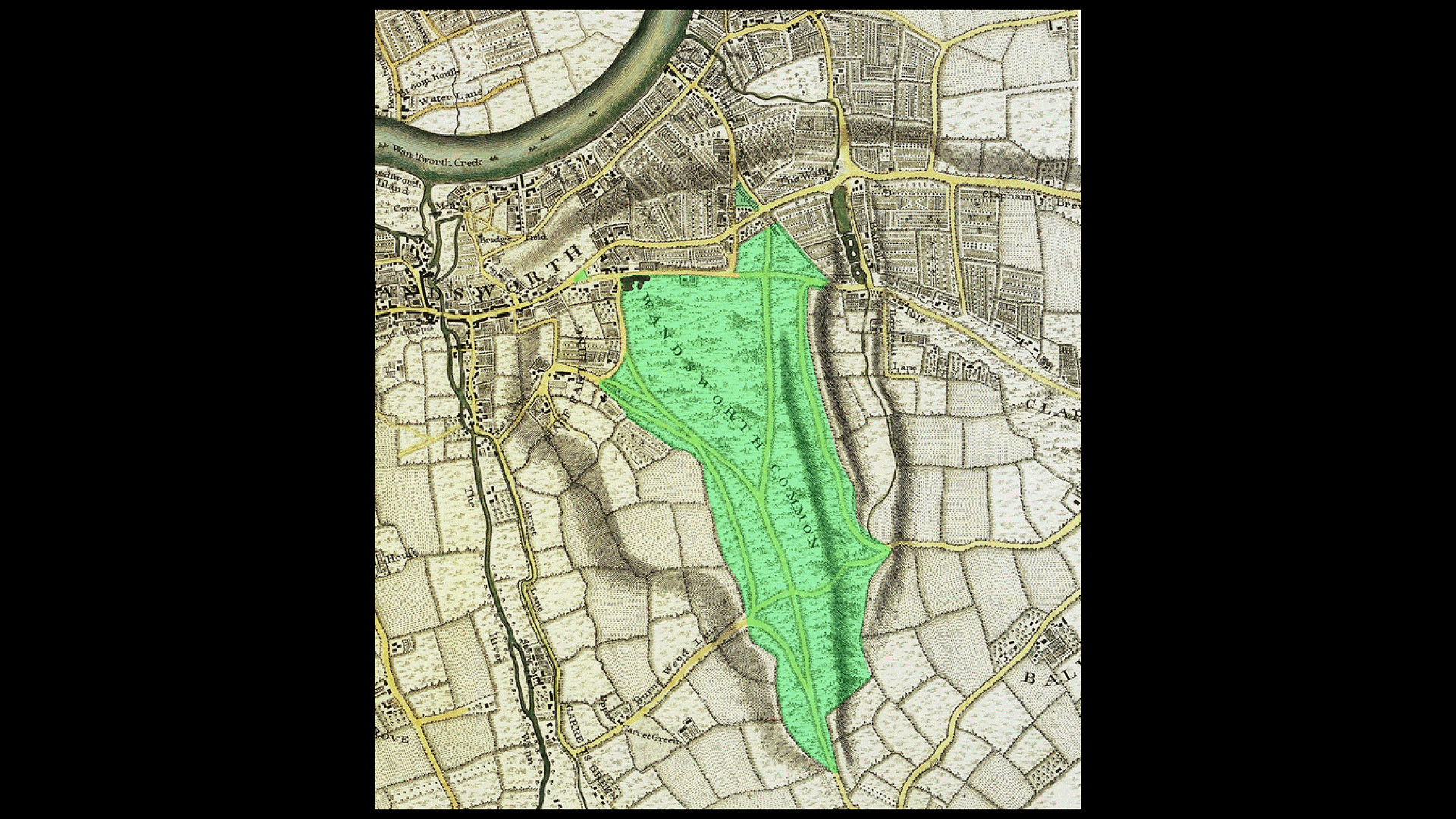
Here's the earliest map that I know of of Wandsworth Common as a whole - Rocque's ... of 174?
I've tinted the area covered by Wandsworth Common
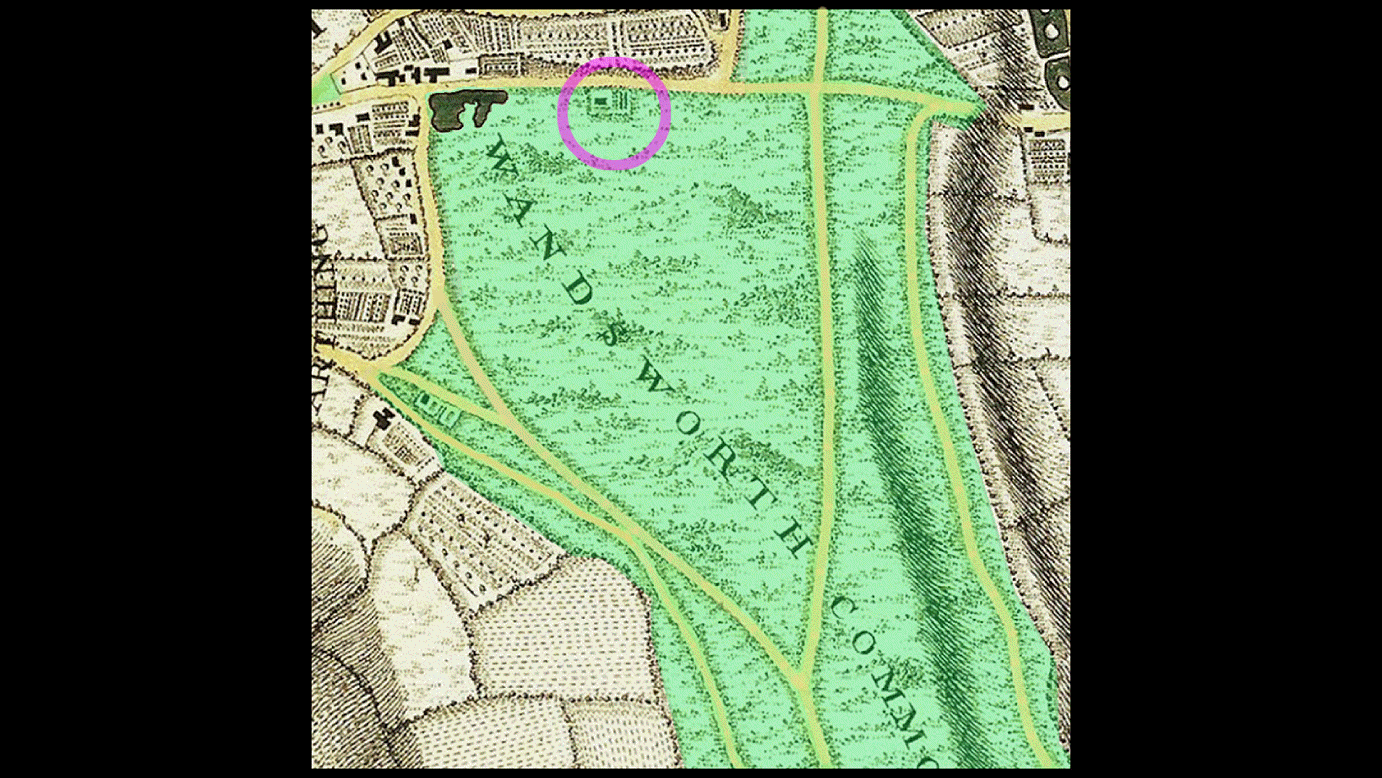
Here's a closeup
You can see a house and its grounds - fairly small at this point.
But no lake.
There is a lake in the area, but it is over here, a few hundred yards to the west.
Incidentally it was this lake that caused the otherwise dead straight Trinity Road to vere to the left at the top of East Hill.
It looks as though this was filled in and enclosed at more or less the same time as the Black Sea was created.
(Click on image to enlarge)
(Click on image to enlarge)
(Click on image to enlarge)
Let's have a quick look at different maps to see when the Black Sea arises...
Corris estate maps, 17??
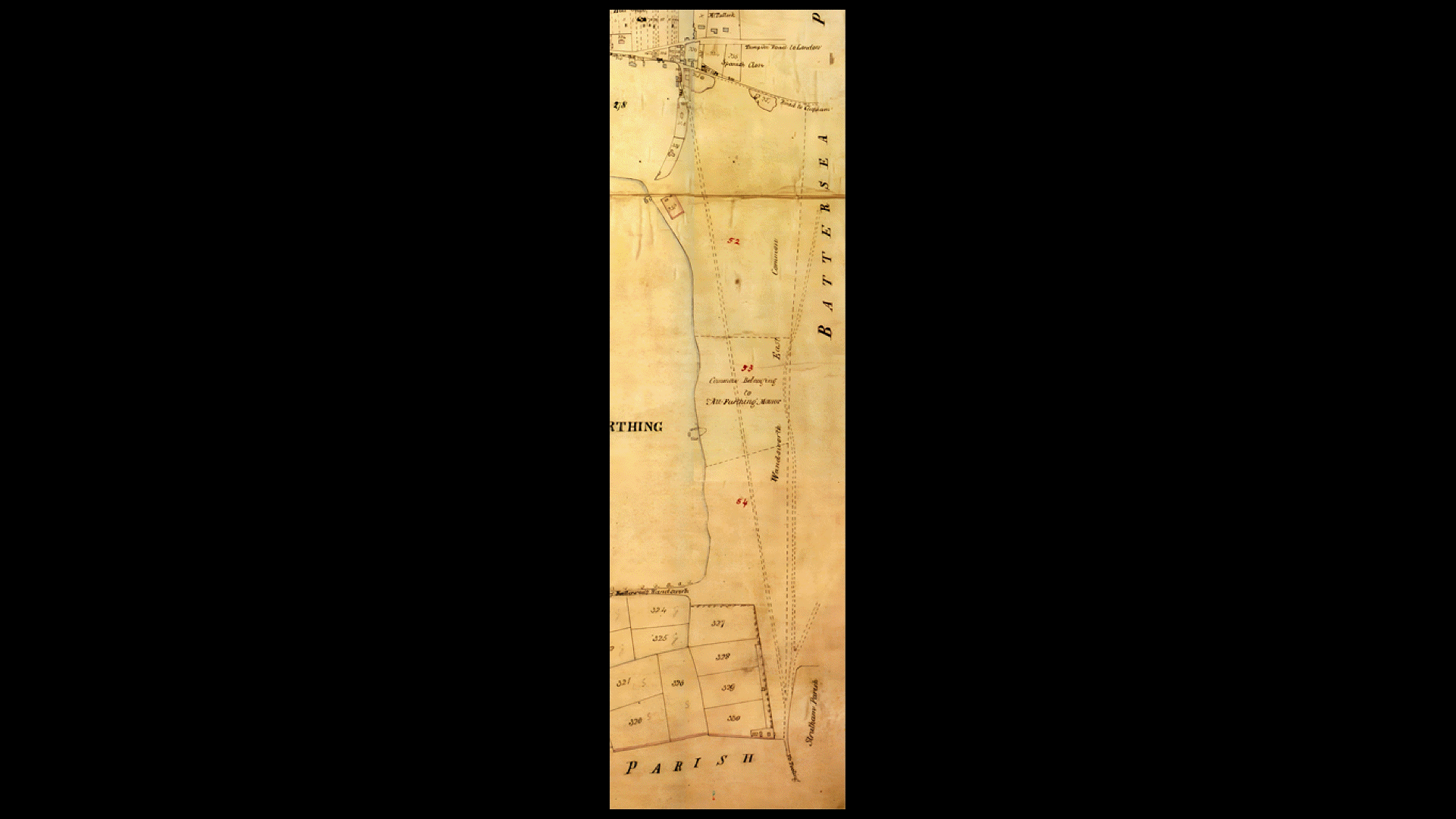
(Click on image to enlarge)
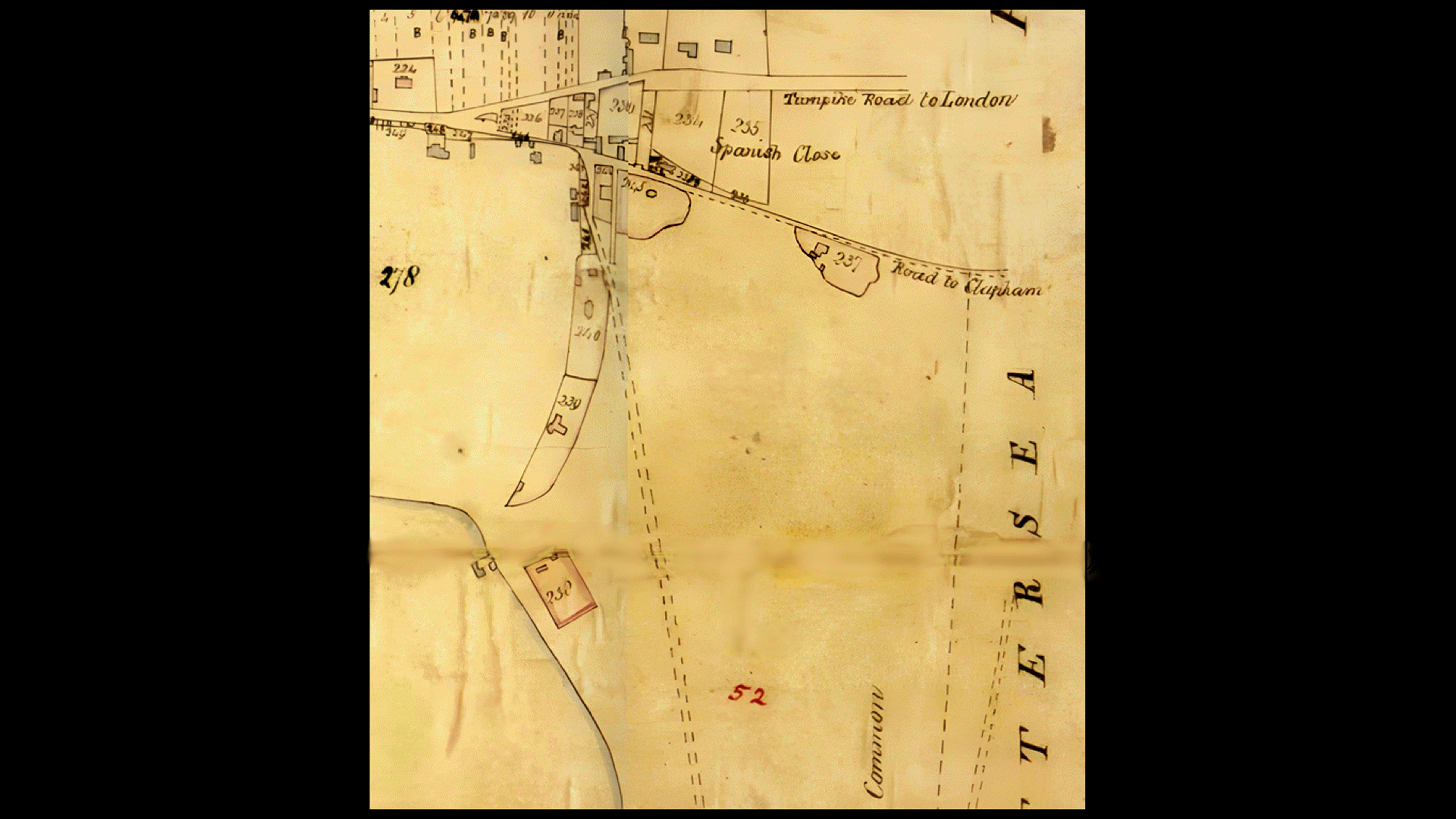
(Click on image to enlarge)
1800 / Milne
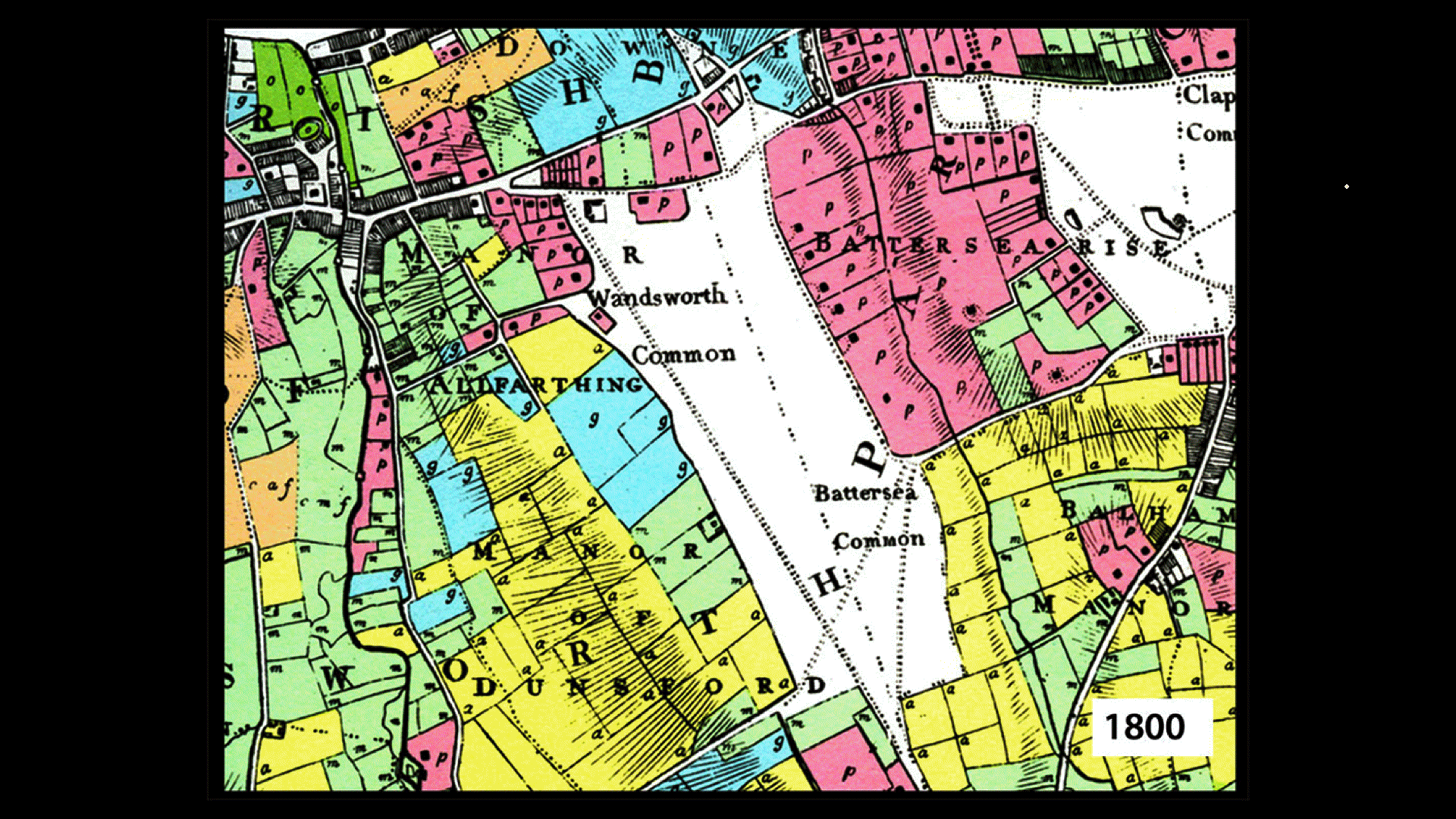
(Click on image to enlarge)
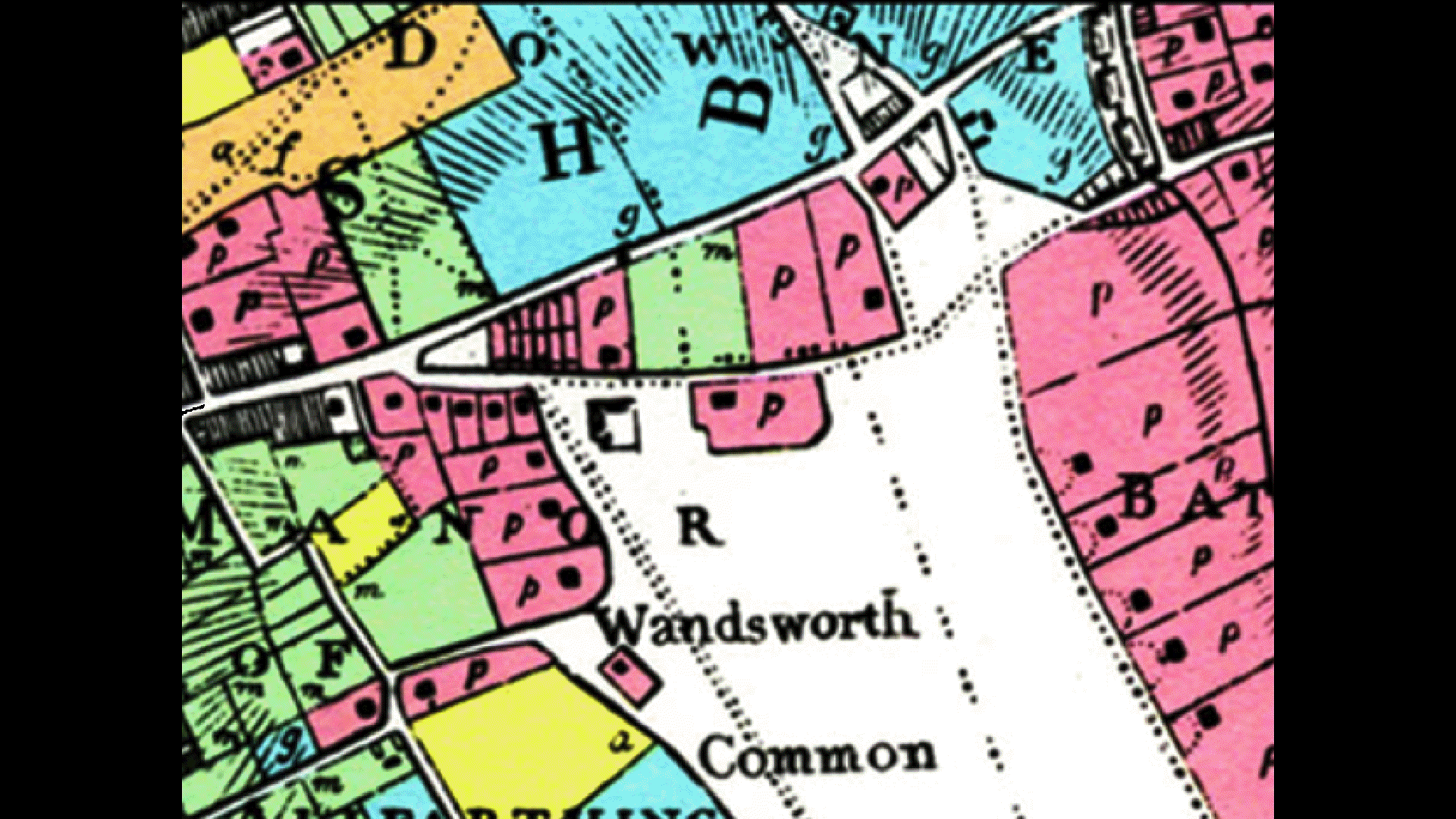
(Click on image to enlarge)
milne-wc-black-sea-house-no-sea-web.png
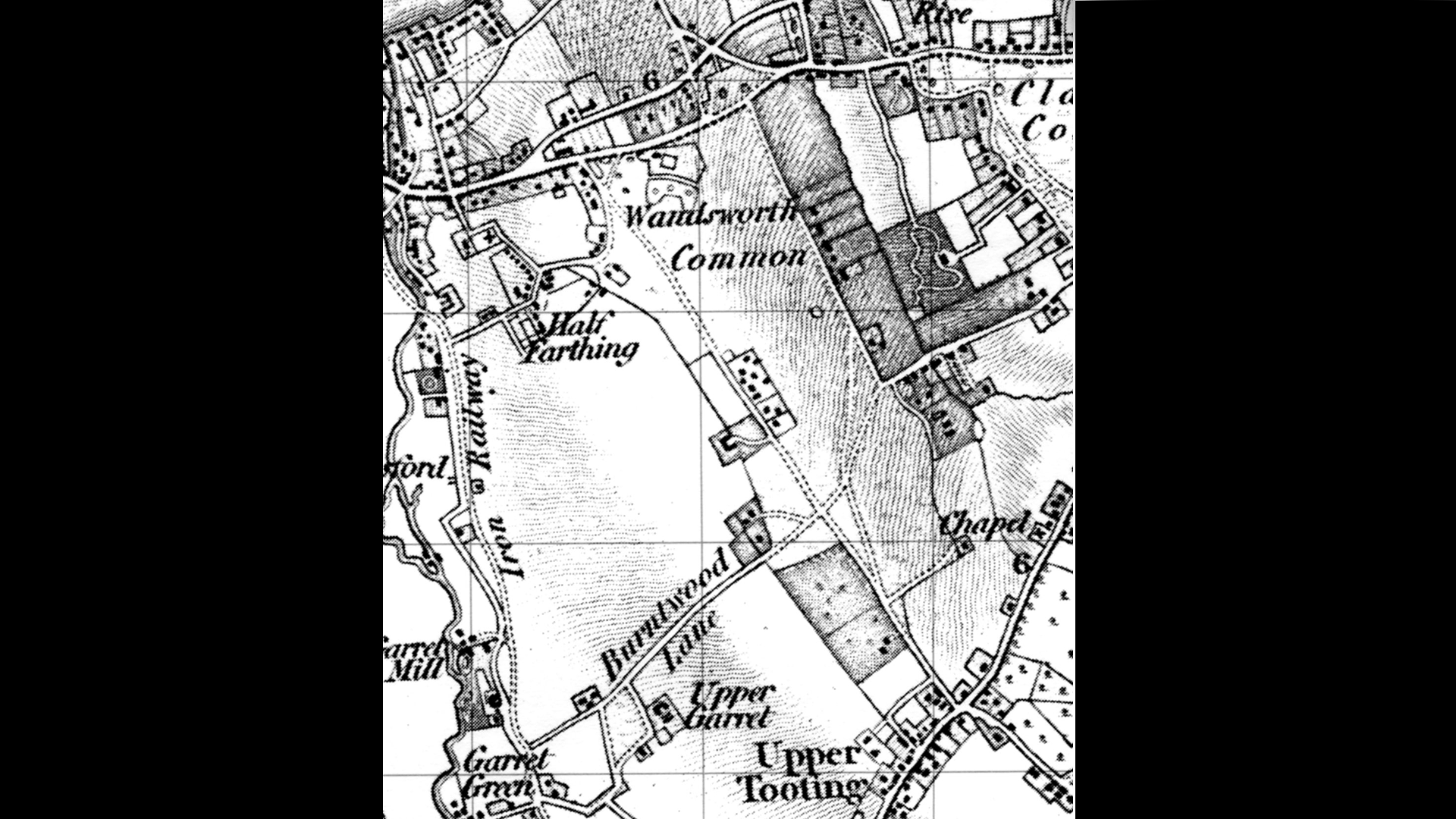
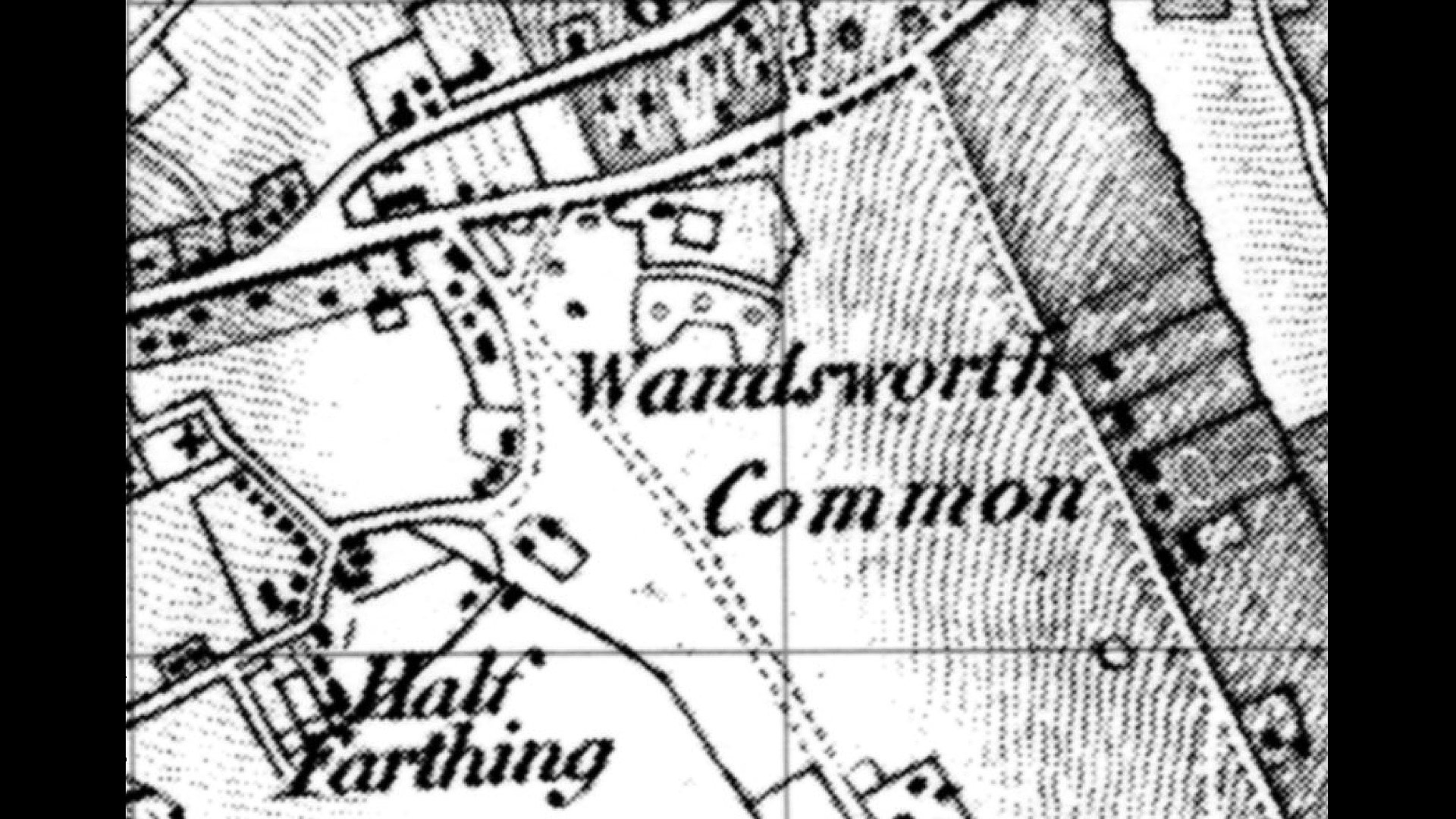
But here it is on the earliest OS map, 18??-18??
OS c.1810 / OS
And now finally, we see the lake...
(Click on image to enlarge)
(Click on image to enlarge)
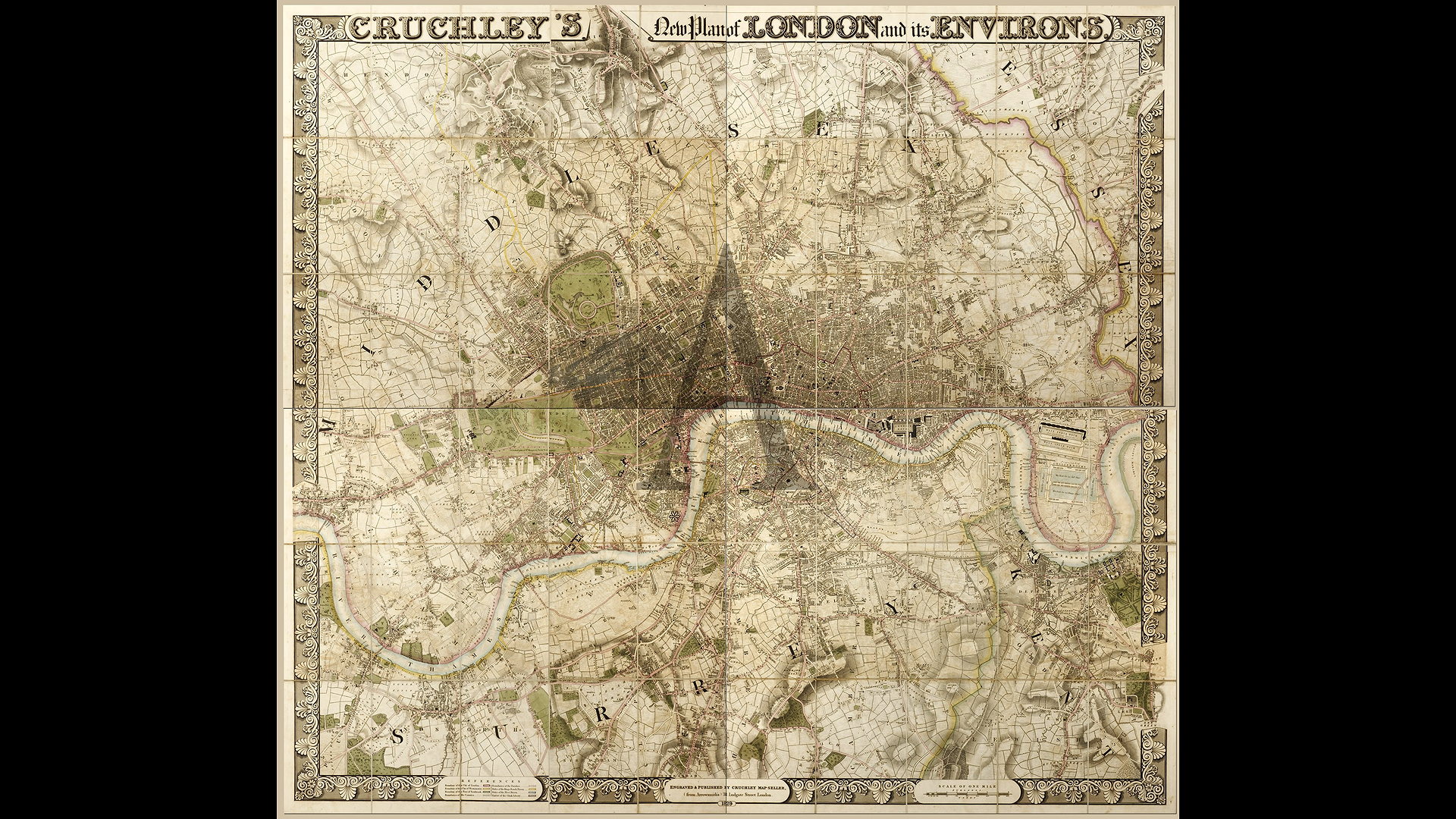
Cruchley maps, 1820s and 1830s
Now we come to the most curious sequence of maps by Cruchley
I've never found any decent high-resolution scans of the Cruchley maps but by using versions online (mainly at auction) I've been able to enlarge and digitally enhance them.
Here's the earliest, from 1828/9
(Click on image to enlarge)

(Click on image to enlarge)
But something important is about to happen.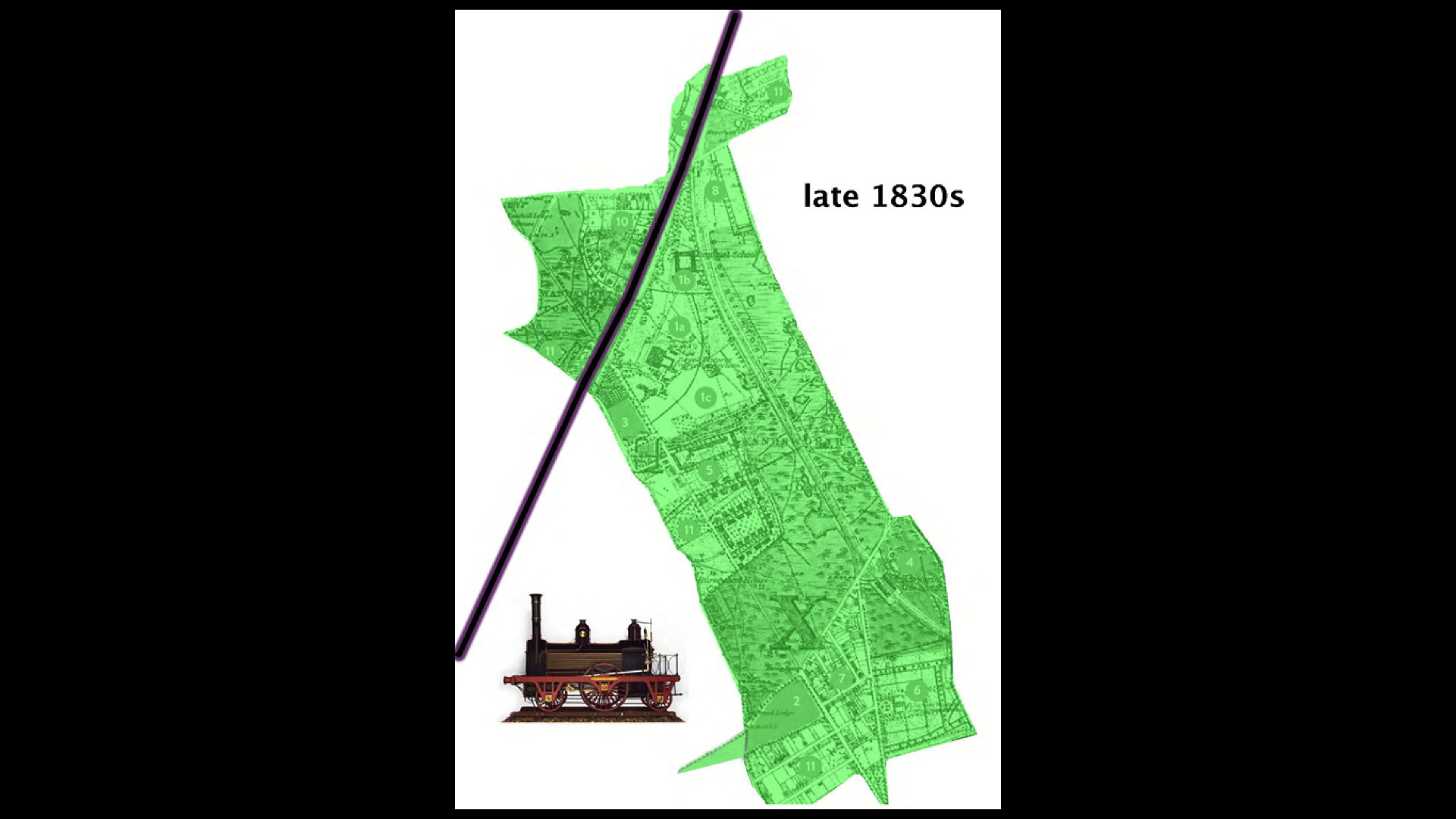
(Click on image to enlarge)
the railway. But it's route has not been precisely determined 1834 Act acts of Parliament allowing the construction of railways, and the approximate route. But often with [line of deviation?]Here's one from ?, with a [red] line denoting the course of the future London and South Western Railway to Woking and Southampton
And here it is again a few years later, presumably after the line has been cut and trains are running.
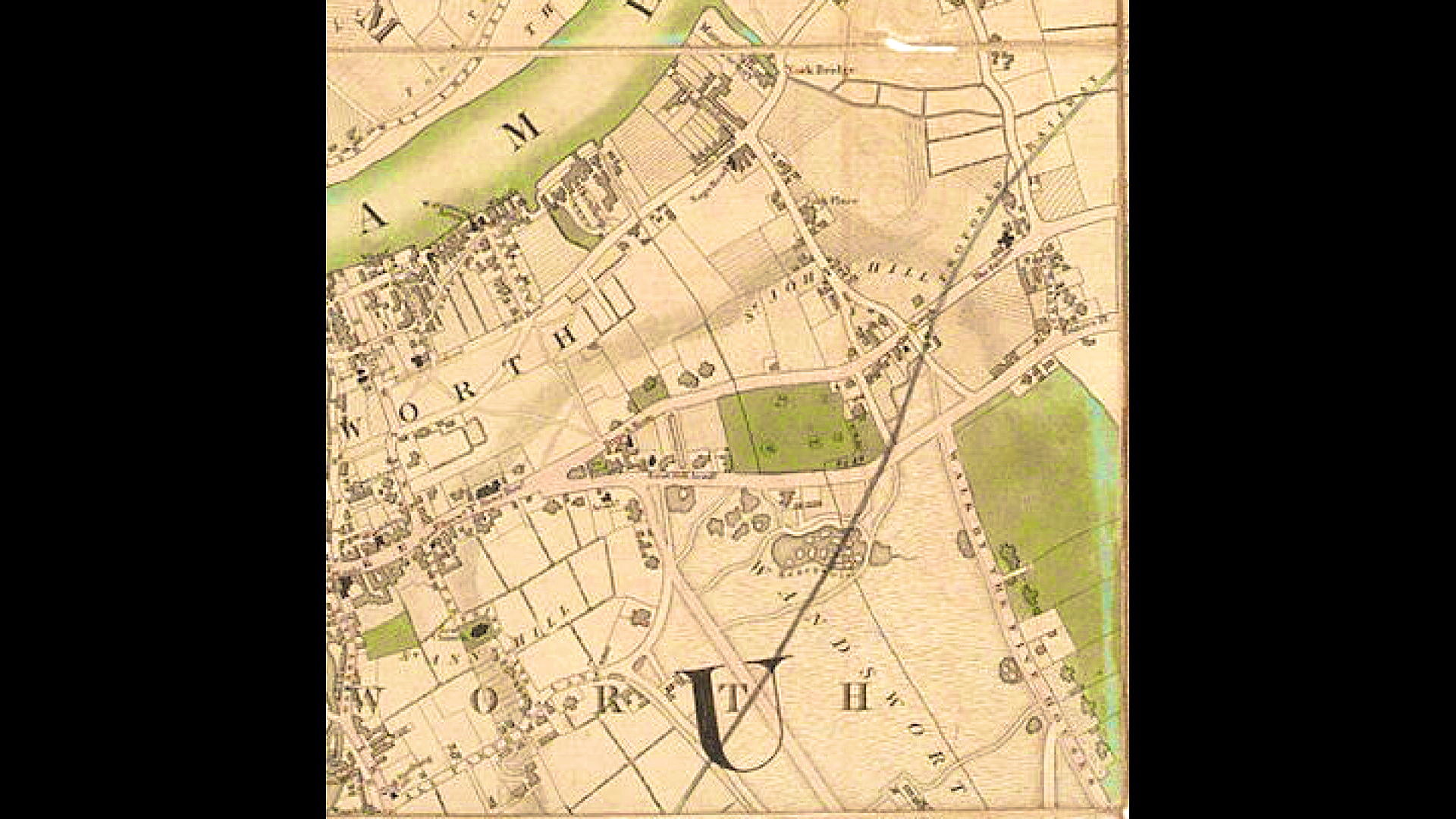
(Click on image to enlarge)
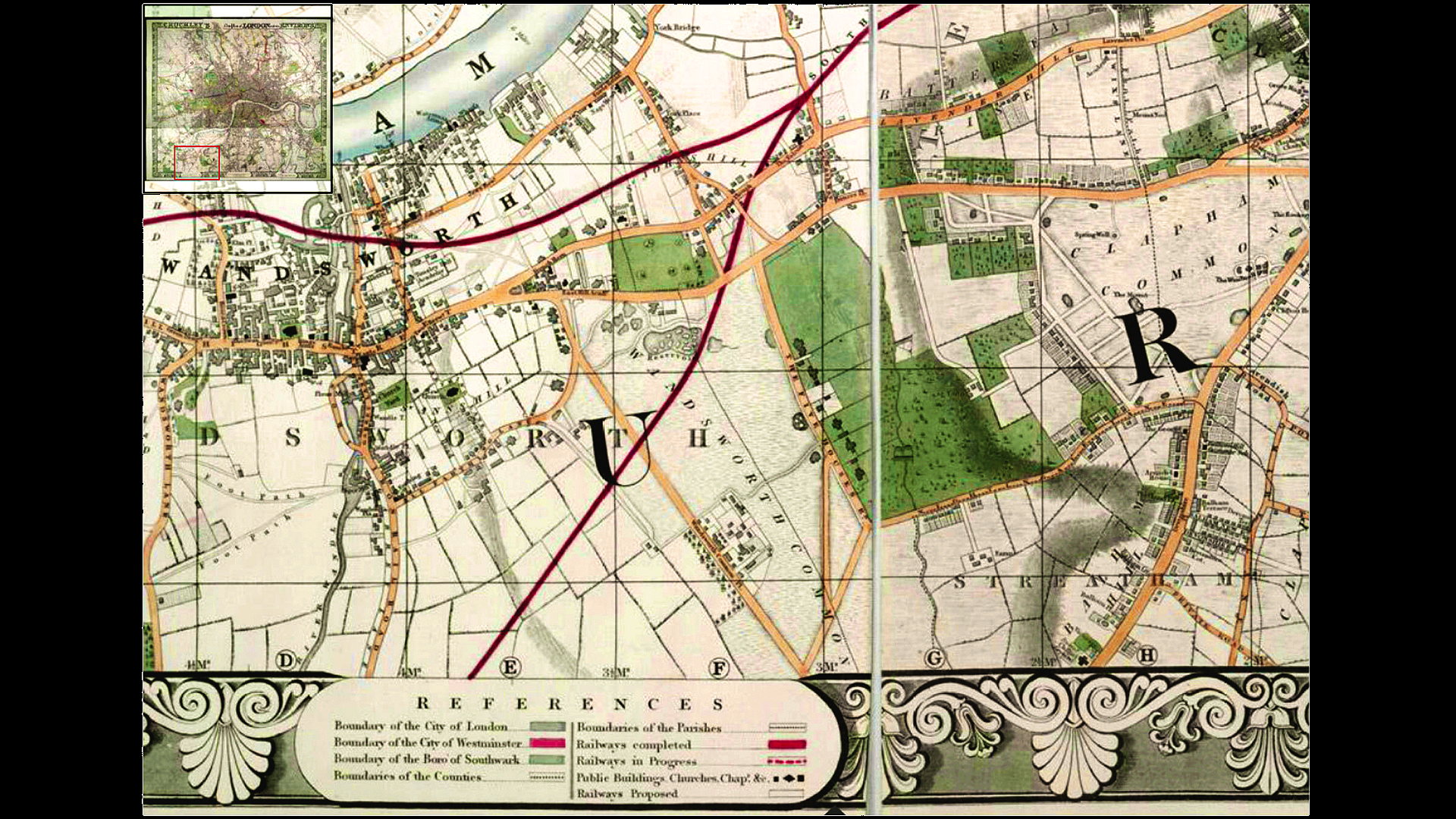
(Click on image to enlarge)
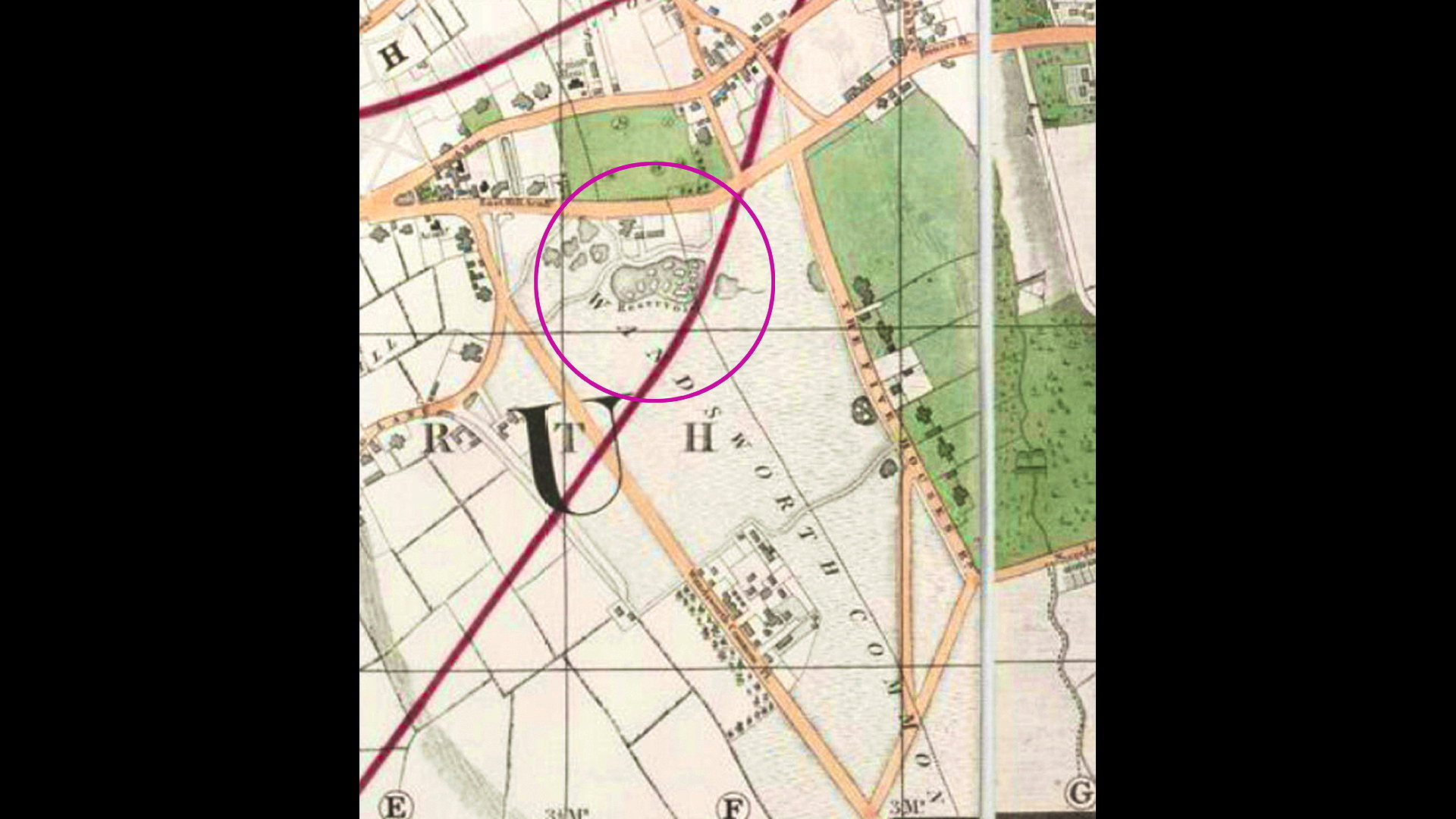
(Click on image to enlarge)
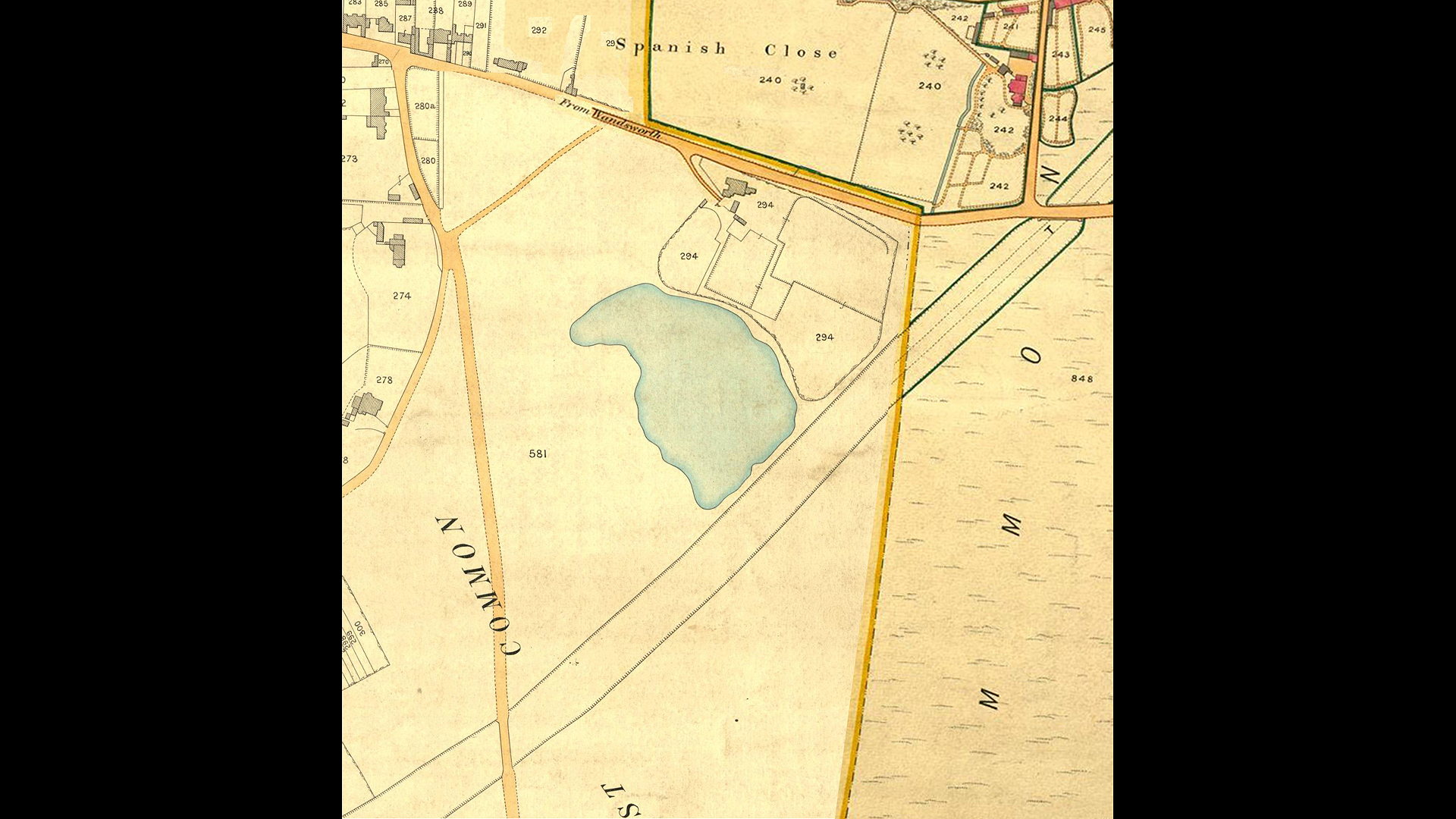
Tithe map / c1840 / Tithe
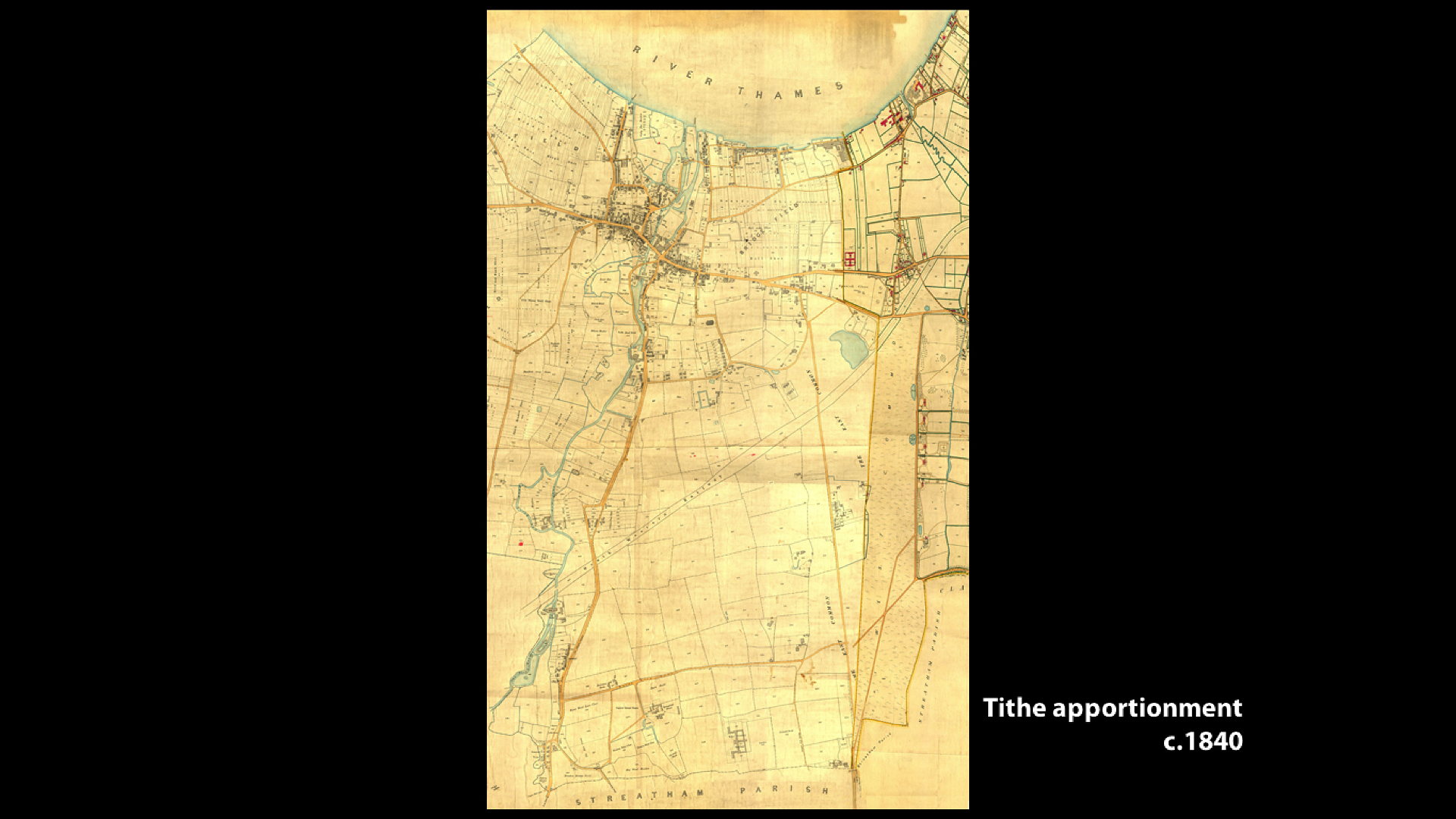
(Click on image to enlarge)
(Click on image to enlarge)
(Click on image to enlarge)
(Click on image to enlarge)
How many islands? 13? [or 7? or?] - one for every child?
Did the railway cut through Black Sea?
Stops water flowing naturally off the Common, hence a clay lining and a wind pump were necessary...
Why is no water shown to east of [proposed?] railway line on the Tithe map?
Notice the projected rail tracks for Wandsworth and Battersea do not quite align - the Battersea line would have cut further into the lake. Which tithe map was completed first?
Let's return to the map I showed at the start, from the 1860s, to show the house...
The Wilsons of Price's Candles / "Black Sea House"?
(Click on image to enlarge)
The Wilsons leased the house and grounds from earl Spencer in 1829. The pater familias was William Wilson, founder of Price's Candles, by the Thames...
The houas already surrounded by a large garden, but the Wilsons expanded it to about 8 acres.
From ? onward, William and his wife ? had 13 children.
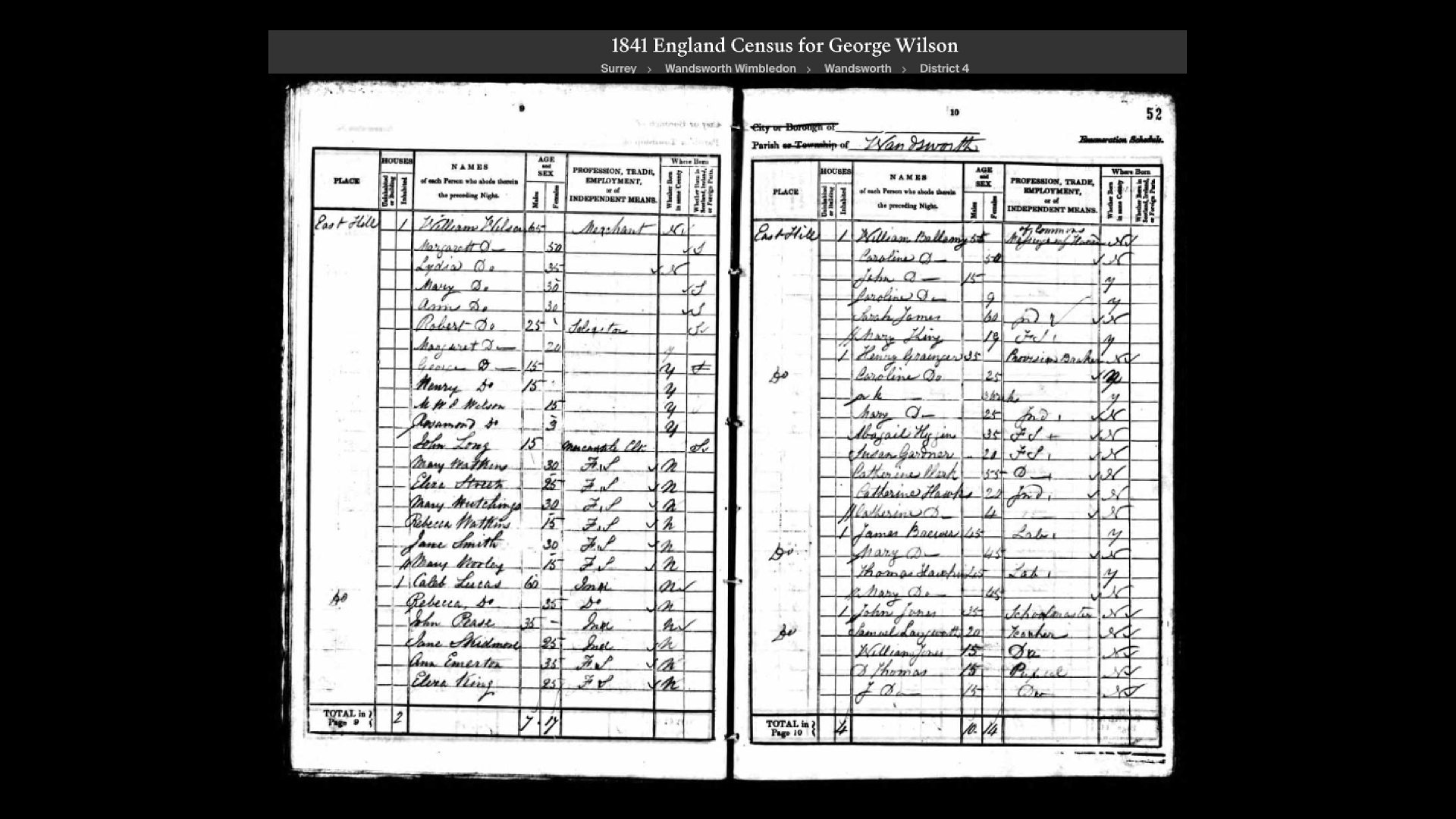
1841 Census
(Click on image to enlarge)
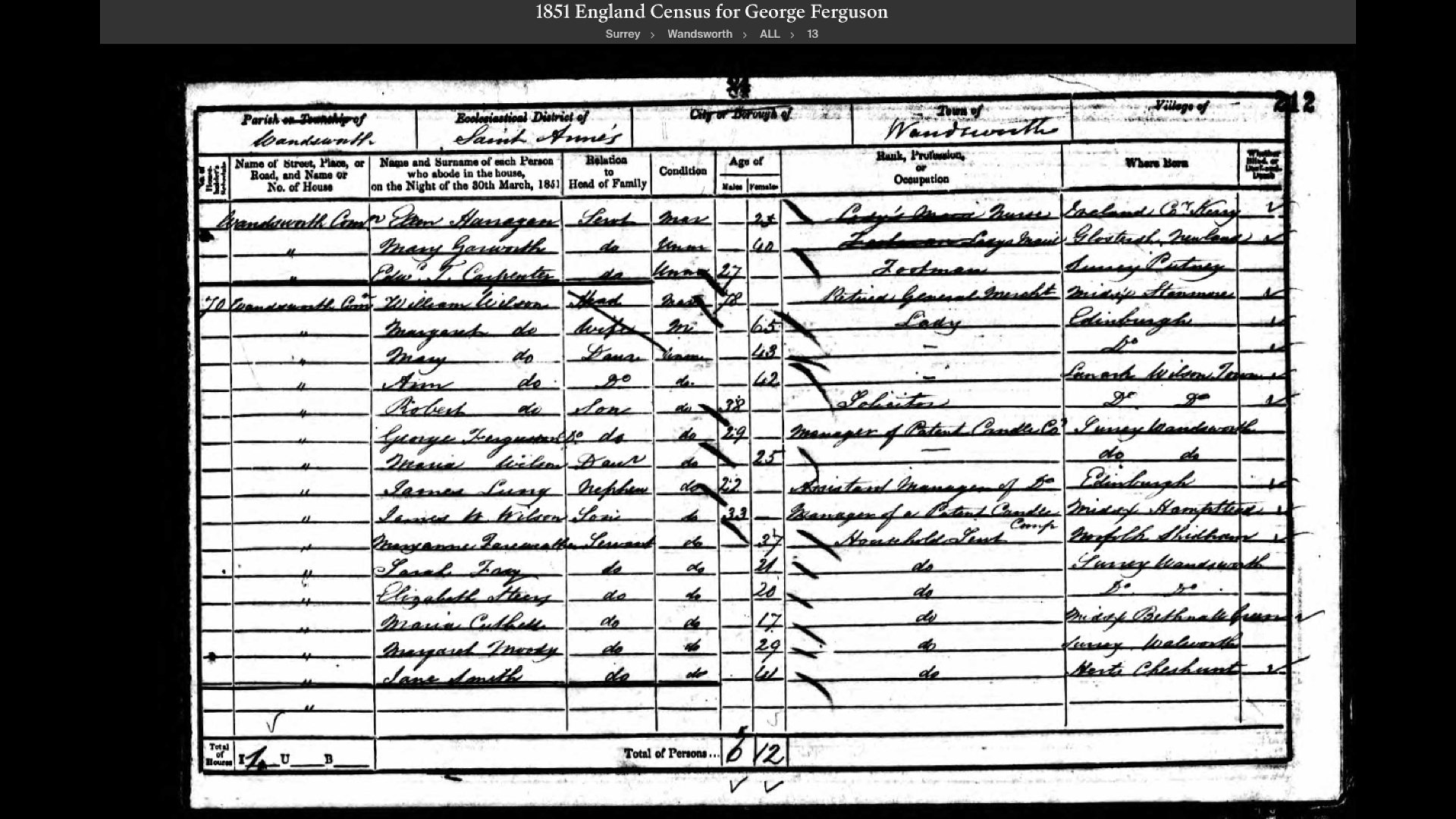
1851 Census: William and Margaret, parents, with 6 children. Also 6 "Household Servants"
All censuses say George was "born Surrey, Wandsworth". Really? Since they didn't move to Black Sea House until 1829, where? Or had WW taken in fact it earlier than 1829? Mary, 14 years older, was born Edinburgh. Ann, 13 years older, was born "Wilson Town, Lanark", as was Robert, 9 years older. James, 4 years older, was born Hampstead. Maria, born 4 years after George, was also born Wandsworth.
(Click on image to enlarge)
[By 1861 George had moved with his new wife to Weybridge...]
According to Sexby he added a new island every time there was a new child.
A lovely story, and a memorable one. But as Shirley Passmore has pointed out, there are already lots od islands shown on the Cruchley maps.
The company flourished in large part because of the genius of one of the sons, George Fergusson Wilson.
wilson-george-fergusson-photo-portrait-web.jpg

Carte de visite, 1863
(Click on image to enlarge)
He was a prodigious chemist and found new ways of making candles, soaps, and lubricants using [a mix of tallow and vegetable fats and oils - composite]...then from pal oil, initially sourced from 1000 acres of land they bought i Ceylon - now Sri Lanka.Anti-slavery...
Here's a map from 1862 showing the relation bwteen the Wilson household at the Black Sea / Black Sea House and their candle works on the banks of the Thames below them:
[ADD LOCATOR CIRCLES?]
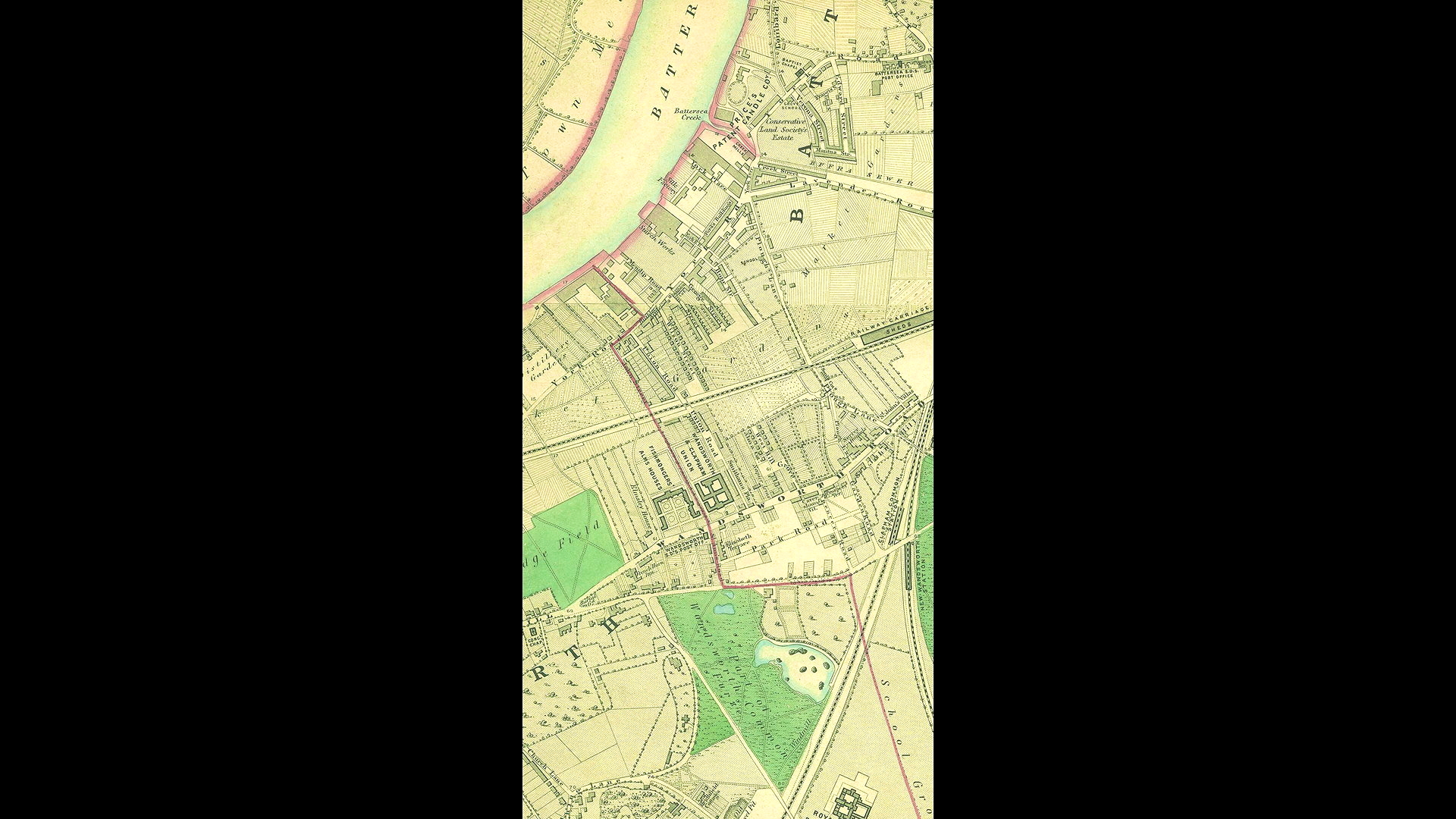
(Click on image to enlarge)
In 1830 a middle-aged Scotsman living in London was considering his business future. He was no stranger to commercial failure. As a young man in Scotland he had seen the collapse of his father's iron works in 1812 during the economic slump of the Napoleonic Wars.
He had then travelled south to London and set himself up as a successful merchant in the 'Russia trade', importing goods from Moscow and Saint Petersburg. Now at the age of 58 William Wilson was approached by his partner with an invitation to go into a new venture: candle manufacture.
Perhaps it was William's familiarity with the Russian tallow trade that had suggested the idea. Tallow, a purified form of beef or mutton fat, was the only cheap available alternative to beeswax for making candles at this time. But if William was already familiar with the candle trade, he must have paused for thought.
Candle manufacture had barely progressed since the Middle Ages. The wealthy and the Church burned beeswax candles, everyone else used the cheaper tallow lights which smoked, smelled and guttered. The poor either made their own tallow dips from hoarded animal fat with rush wicks — known as 'rushlights' — or lived in darkness.
Royal Warrant
By 1840 the perfect product was ready for Queen Victoria's wedding. It was traditional for every loyal household to burn a candle in its front room window on the evening of the monarch's wedding, and in London on 20 February most people lit one of Price's new stearin 'composite' candles made from a mixture of refined tallow and coconut oil.
By 1840 the perfect product was ready for Queen Victoria's wedding. It was traditional for every loyal household to burn a candle in its front room window on the evening of the monarch's wedding, and in London on 20 February most people lit one of Price's new stearin 'composite' candles made from a mixture of refined tallow and coconut oil.
Price's Patent Candle had long had a close association with the Royal Family. From the earliest days when the launch of their new composite candle coincided with the wedding of Queen Victoria and Prince Albert, there had been an ongoing Royal connection. Price's Patent Candle has held the Royal Warrant — either in its own name or through its subsidiaries Francis Tucker and Charles Farris — since the 1850s. Today it holds the Royal Warrant[1] in its own name for Her Majesty the Queen of the United Kingdom. The company's special status as Warrant Holder means that it supplies candles for all Royal state occasions — coronations, weddings, lyings-in-state and funerals.
Innovations
Technological
There was a potential market in England for a mid-priced candle that gave a brighter cleaner light than tallow but was not as expensive as beeswax. What William Wilson and his partner discovered in 1830 was a new raw material and a scientific process that would allow them to manufacture such a candle. The firm they set up, Edward Price and Co, would make candles from coconut! Wilson took out a licence on an 1829 patent for the hydraulic separation of coconut fats, the partners built a candle factory at Vauxhall on the Thames in South West London, a crushing mill just up river at Battersea and invested in 1,000 acres of coconut plantation in Sri Lanka. The initial results were not that impressive, but the infant company had a couple of good breaks: in 1831 candle tax was abolished and by 1835 it had developed better chemical processes to obtain solid fats.
In the 1820s a French chemist, Michel Eugène Chevreul, had published his researches into fatty acids. By mixing a strong alkali with vegetable or animal fats he discovered that the solution separated into liquid and solid components. This technique, known as saponification, was already used by soap makers, but nobody had employed it for candle manufacture.
William Wilson's son, George, experimented with this process; by adding a further distillation using a vacuum or high pressure steam he improved Chevreuil's basic chemistry. Price's were now able to refine tallow and vegetable oils to produce a harder, pure white fat known as stearin. Candles made from this burned brightly without smoke or smell. The same chemistry could also be applied to a range of unsavoury raw materials that had previously been unusable — skin fat, bone fat, fish oil and industrial waste greases could all be rendered into hard white candles.
Another of George Wilson's innovations allowed Price's to exploit a second overlooked tropical product. Palm oil, extracted from the palm nut was harvested and processed in West Africa. Soap makers were already using the oil but its dark orange-brown colour made it unattractive for candle-making. George devised a process for cleaning palm oil with sulfuric acid and a new cheap source of fat was available.
There was an additional advantage to using palm oil. The region that produced the oil - the present day Ghana, Nigeria and Togo — was also the centre of the African slave trade. Slavery had been abolished in Britain and its colonies by 1833,[2] but a huge and lucrative market for African slaves continued in the United States, Brazil and Arabia. Palm oil provided an economic alternative to that slave trade and was actively encouraged by the British government. Slavery had become immensely unpopular in Britain and 'politically correct' products like Price's palm oil candles and non-slave-produced sugar were very popular. In 1847, when Edward Price and Co became Price's Patent Candle, the new joint stock company considered its ethical use of palm oil so significant that it became the basis for the company's seal which depicted Africans bringing calabashes of palm oil to a seated Britannia figure under a palm tree.
Labour
In 1840 the company employed 84 staff; by 1855, with two factories in London and one in Liverpool, this figure had risen to 2,300 of whom 1,200 were boys. To any Victorian factory owner child labour was logical and attractive: it was cheap, flexible and in some cases carried out intricate tasks that adults were incapable of. At Price's Patent Candle nightlights and candle packaging were "turned out by the deft fingers" of its child employees. But if there was a single issue that enraged the British public as much as slavery did, it was factory child labour. Unusually for an employer Price's shares these concerns.
The Wilsons were a deeply religious family. William had worked for the London Missionary Society in his youth and his son James was an earnest and evangelical Christian. James was so concerned for the well-being of his child employees that in 1849 he had set up a Christian society at the factory. Each boy was given his "own drawer with lock and key in which to keep his own testament, prayer book, hymn book, arithmetic book, slate and copy book". Boys were encouraged to attend a religious service in the factory in the morning and to go to the factory school in the evening; they were rewarded with games of cricket and outings in the summer. James's religious and education programme was radical for its time - it was most unusual for a factory owner to be treating his workers in such a way.
Other examples of this attitude were the free breakfasts and suppers for night shift workers and warm baths for the boys.
Price's benevolent attitude was an enduring one that continued beyond the Wilson family. The company sought to build good quality housing for its workers in London but could not buy any land. However, the Liverpool factory at Bromborough Pool — "our colony on the Mersey" — was a green field site. Here Price's eventually built a village of 147 houses with church, institute, shop and library for its workforce of "come downs" (the Battersea families who migrated to the new factory). This model village was an inspiration to other employers and was copied at Lever's Port Sunlight factory adjacent to Bromborough in the 1880s and by Cadbury's Bourneville village in the 1890s.
Other examples of the company's far-sighted approach to its employees included the introduction of a profit sharing scheme for all staff in 1869 and a contributory employees' pension in 1893 - the first scheme in the country to include floor workers.
[https://en.wikipedia.org/wiki/Price%27s_Candles]
Earlsfield Road / Windmill Road / stops short at Battersea Rise railway bridge
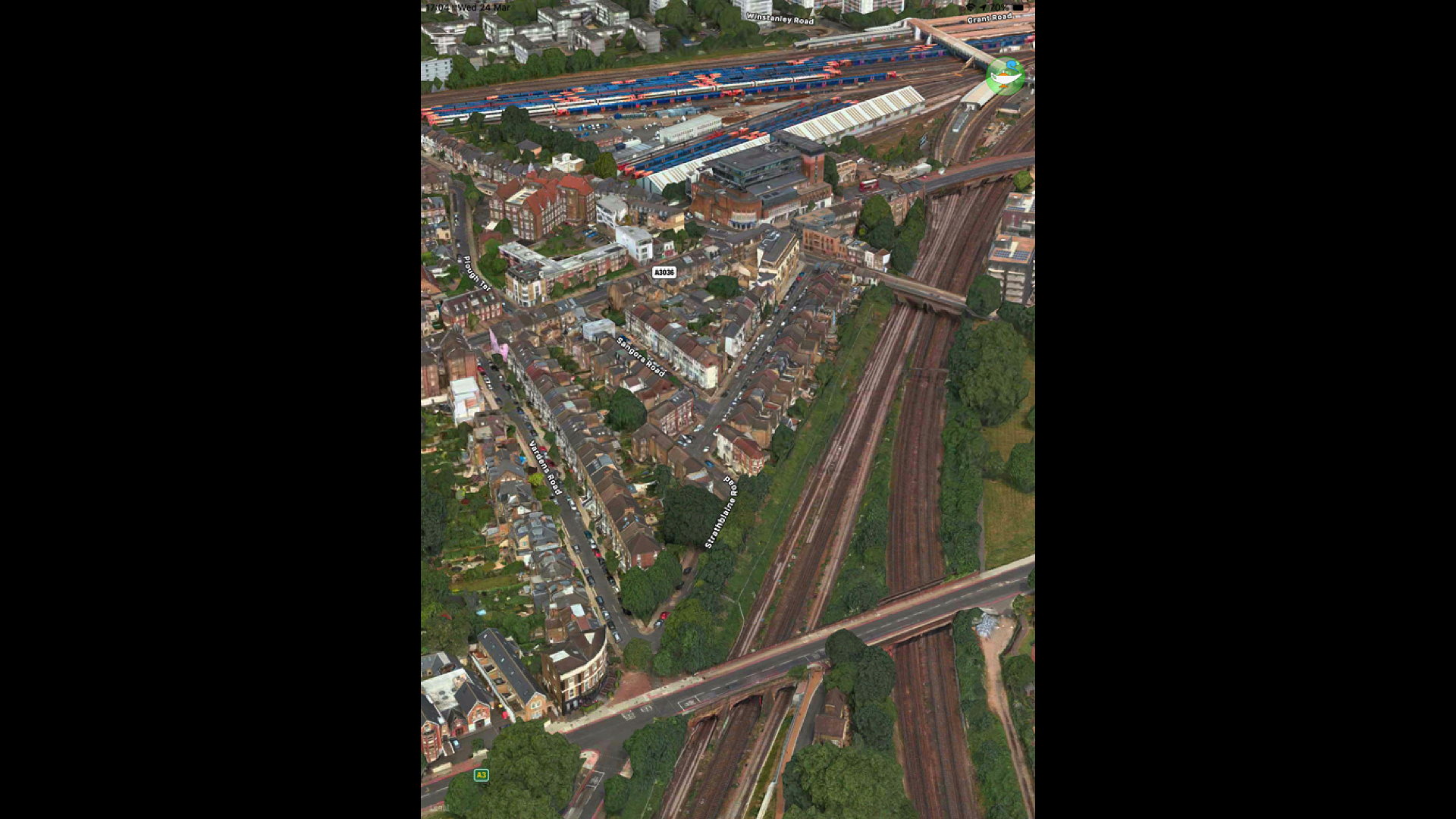
Railways may solve many transport problems, but they create others - they cut through areas - interrupt roads - demand bridges and viaducts - many of which are very narrow - they create pinch points - up and make it harder for roads...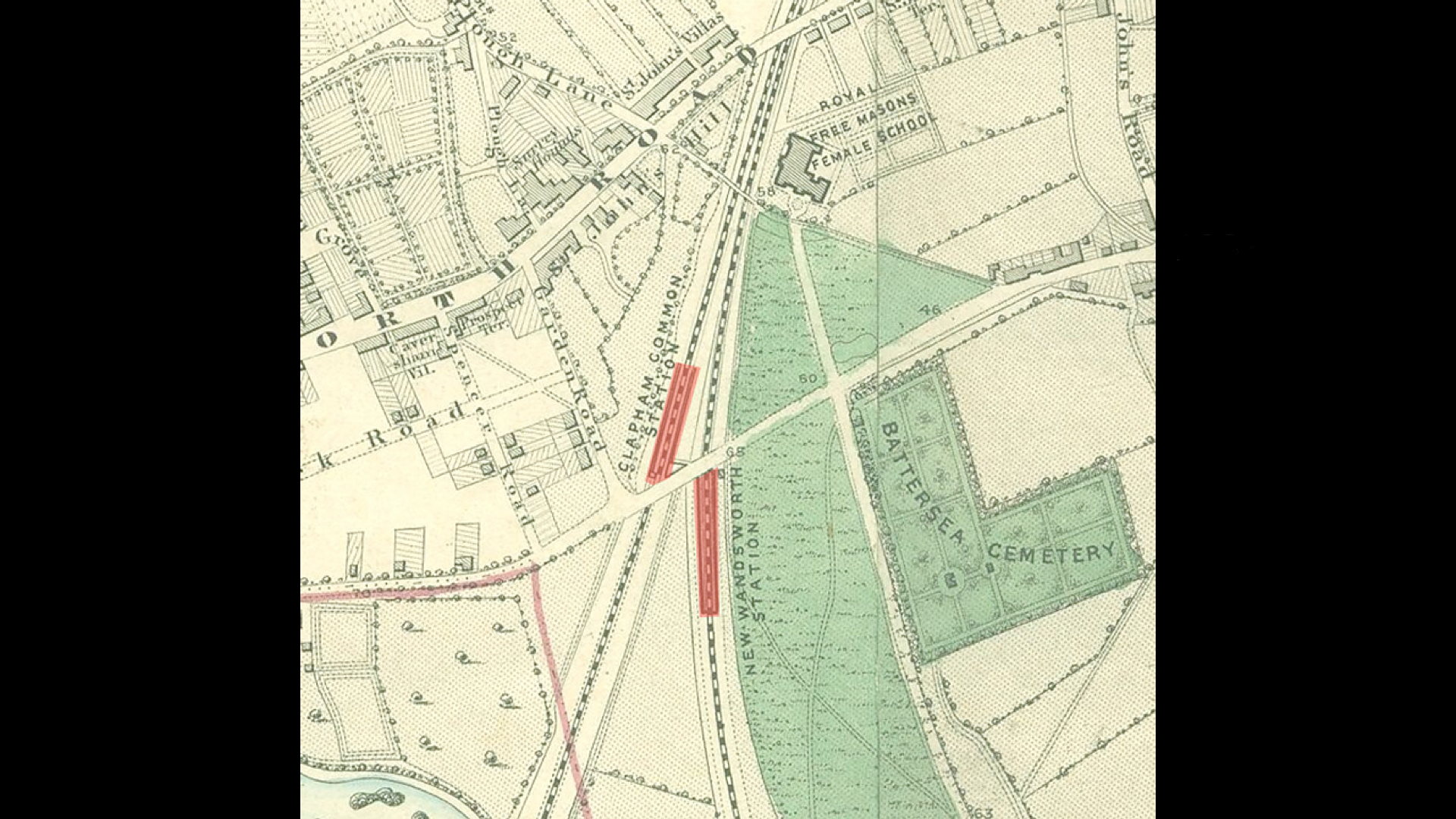
(Click on image to enlarge)
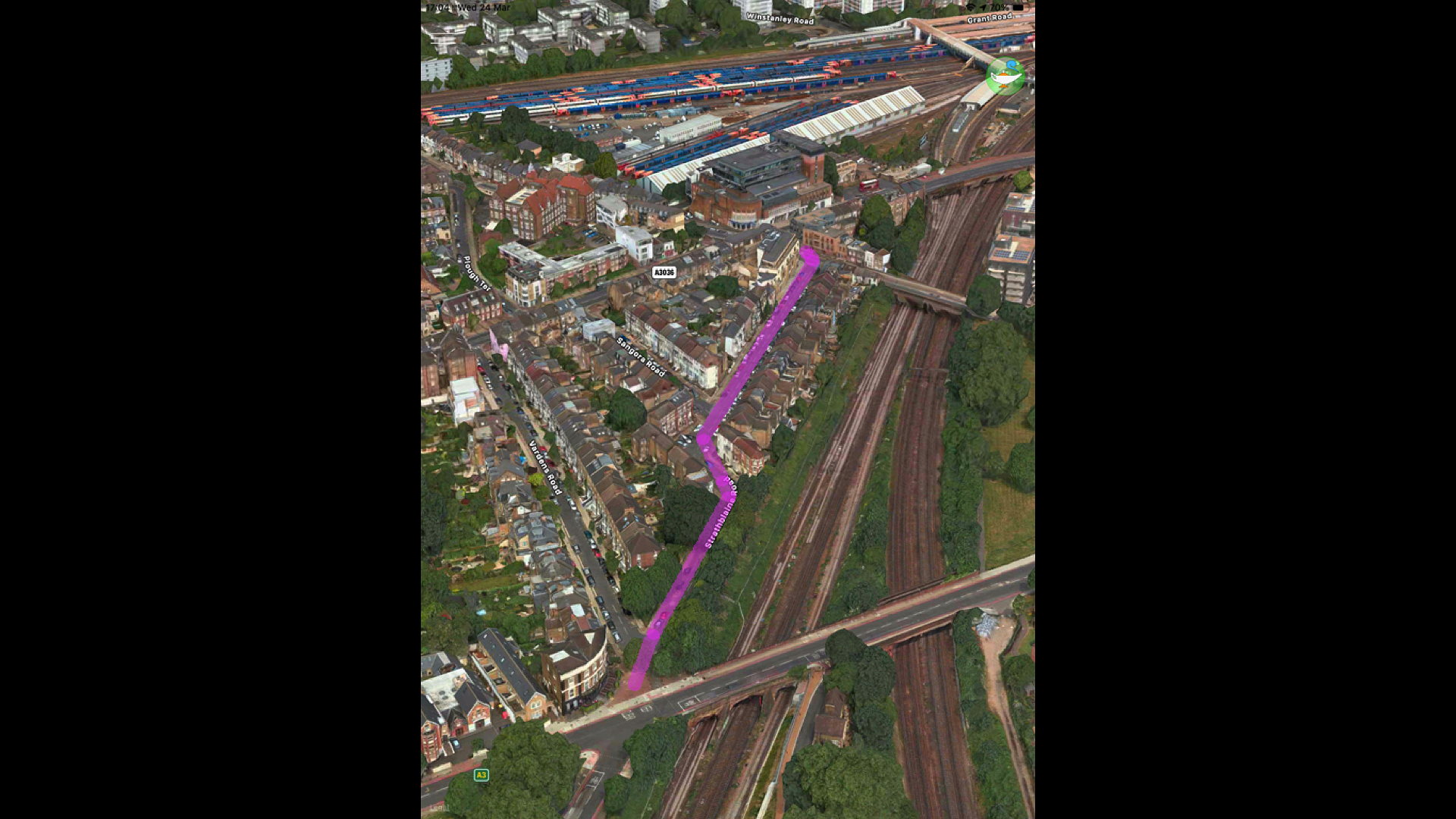
Incidentally, the original intention was to continue the road right through to St John's Hill, roughly along the line that Strath? now takes.
(Click on image to enlarge)
This is part of "Plough Green" - the site and cause of so much radical agitation in the 1860s.
Too much valuable building land was involved, and it never happened.
Which goes a long way towards explaining the awful muddle and congestion at the junction with the railway bridge.
This image is slightly earlier - date? - notice two stations - the absurdly named "Clapham Common" and "New Wandsworth"
(Click on image to enlarge)
(Click on image to enlarge)
(Click on image to enlarge)
Actually, this is not "incidental".One of the most loudly heard complaints during the Plough Green demonstrations was that the enclosures and barriers erected by [Forename?] Compton? Smith and [forename?] Costeker in this area impeded the access people had enjoyed "from time immemorial".
The railways lines- first the London Southampton, then the London-Crystal Palace / Brighton line had made access to this part of the Common for people of Battersea to cricket but also to the Black Sea was very difficult.
The agitation of the 1860s culminated in the 1871 Act, which saved the Common [for ever].
But at a price. A steep price. Negotiating with Earl Spencer [or rather, his lawyers and estate manager] was tough. He demanded £500 a year for the loss of his "rights". This was beyond the means of local people to raise in rates at this time [even if they were prepared to pay such an amount].
It was eventally agreed that local people would have to find be £250 a year in perpetuity.
I say in perpetuity - I still havent been able to find out whether the Earls Spencer continue to receive £250 a year or whether it was somehow paid off [which is what Wimbledon Common has done].
BUT the price was to return the Black Sea and nearby land one which Spencer could build a cherished project - "Spencer Park". [A vanity project?]
Here it is in the C19:
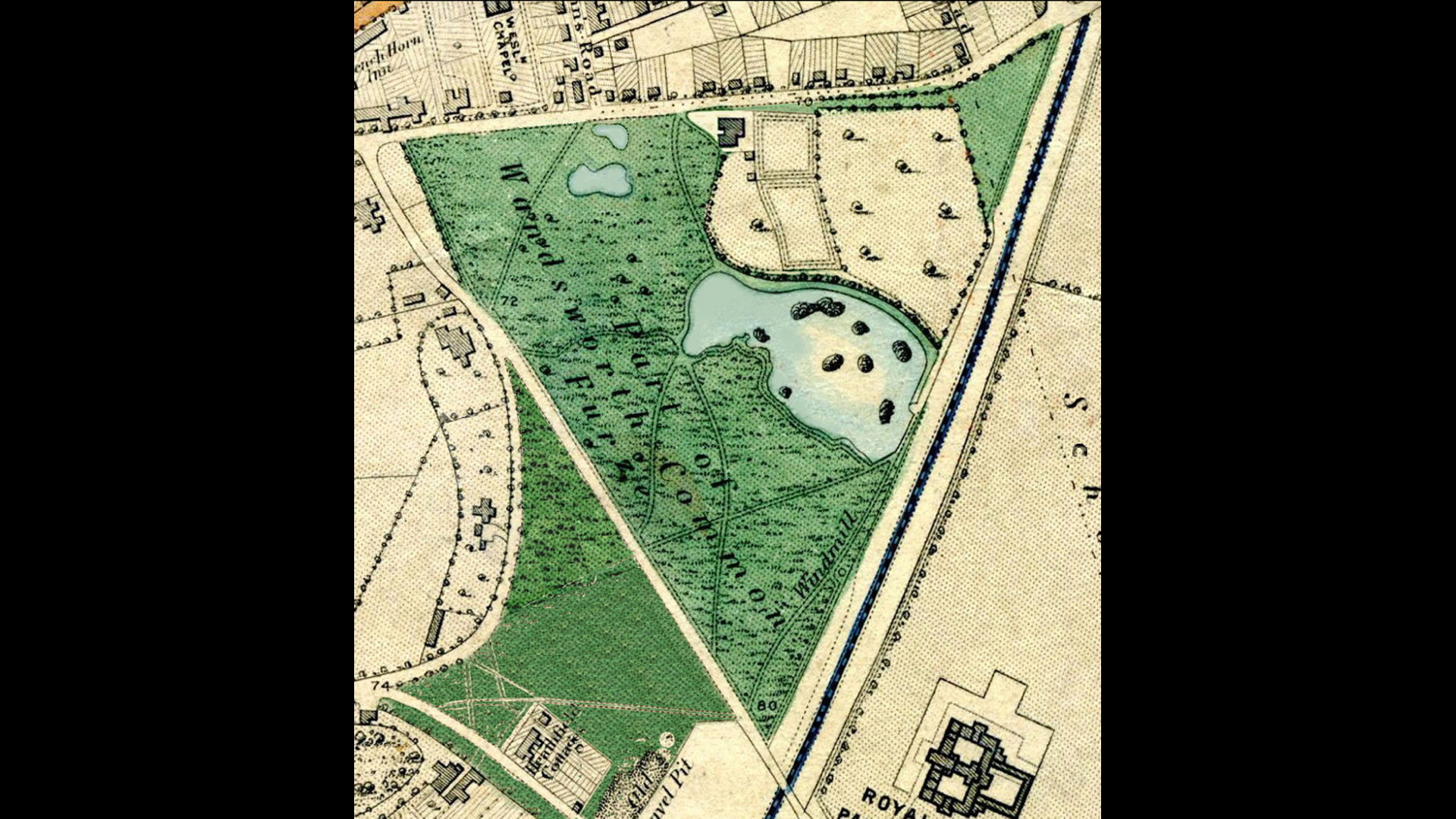
(Click on image to enlarge)
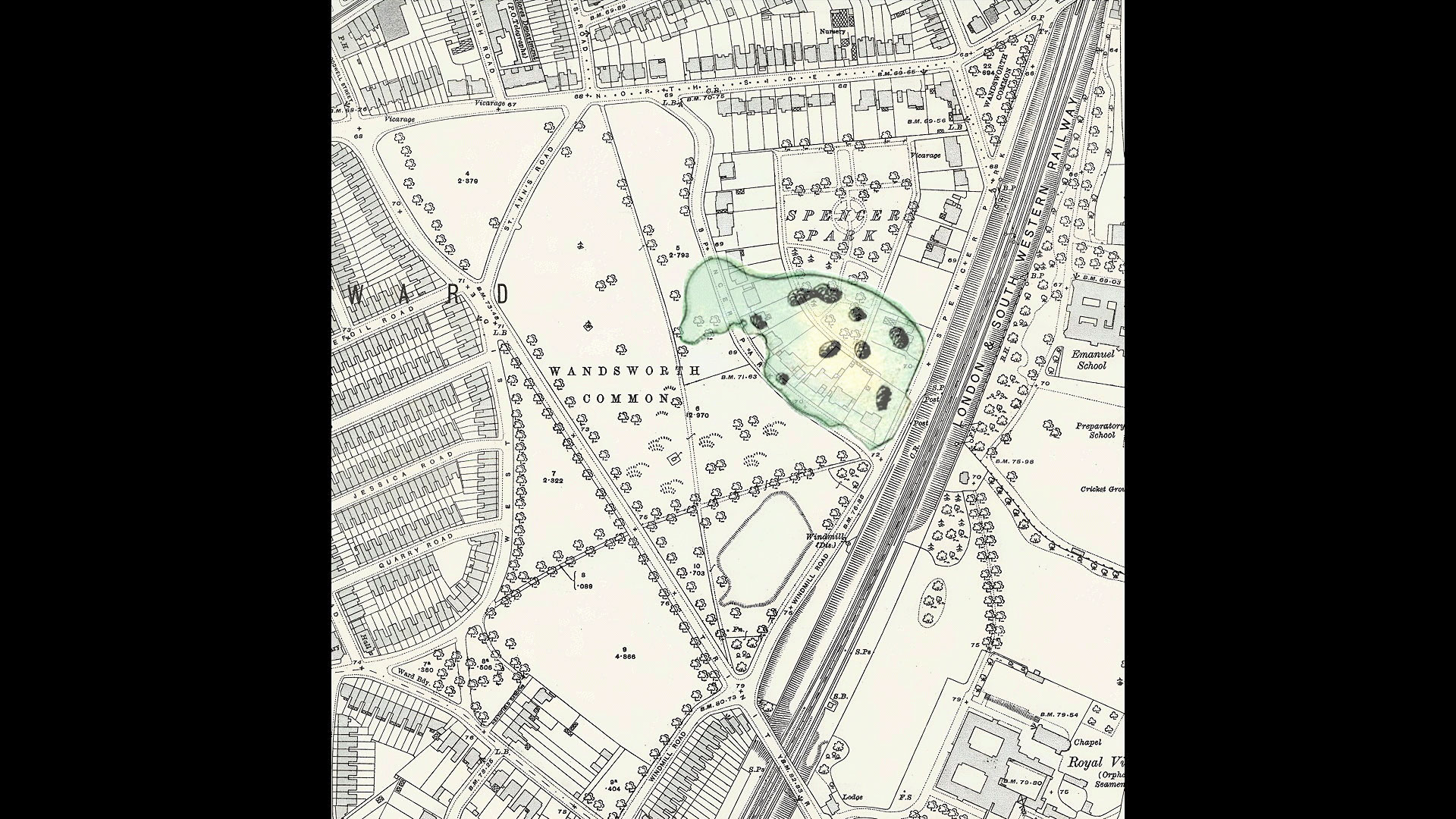
(Click on image to enlarge)
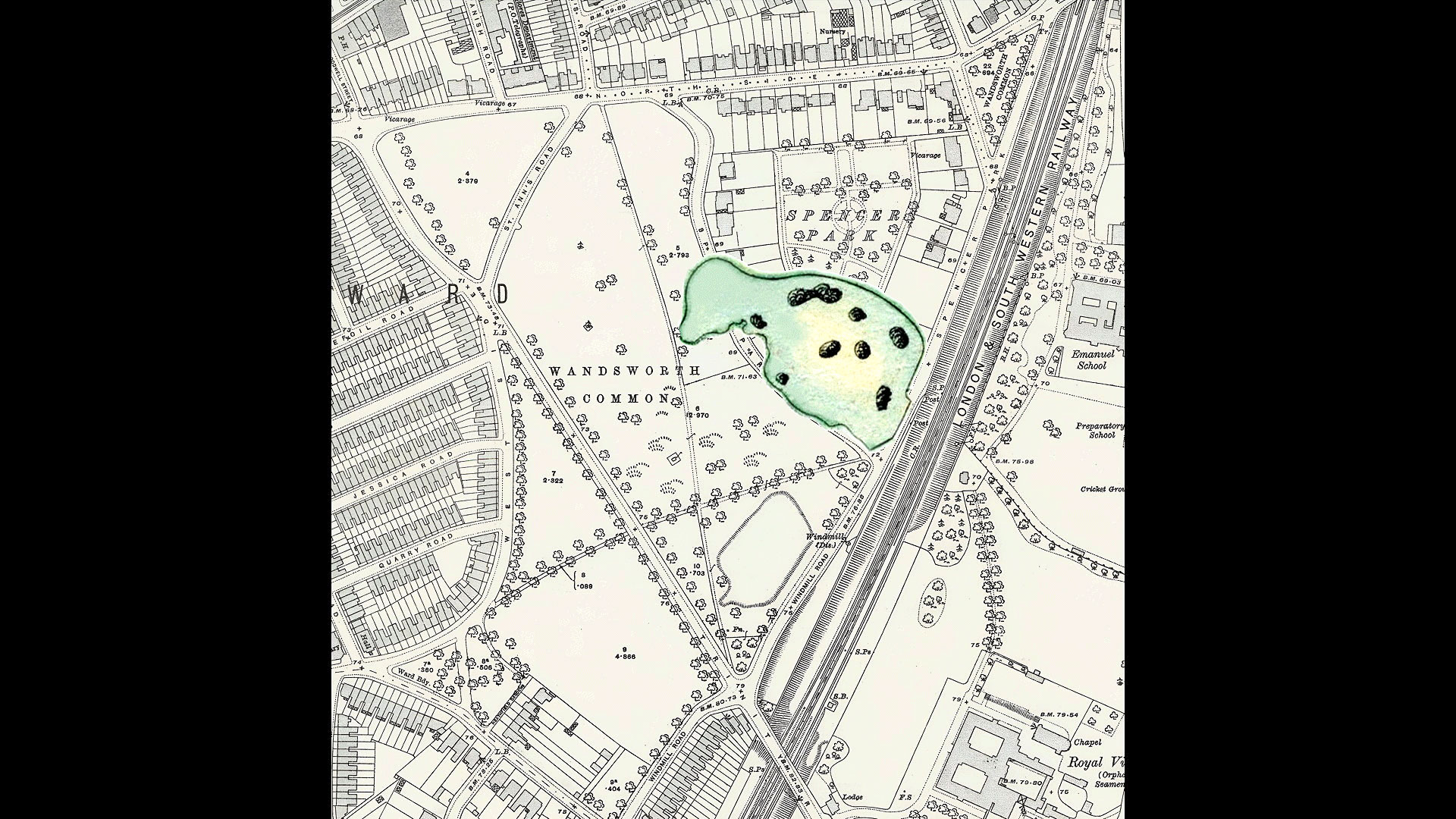
(Click on image to enlarge)
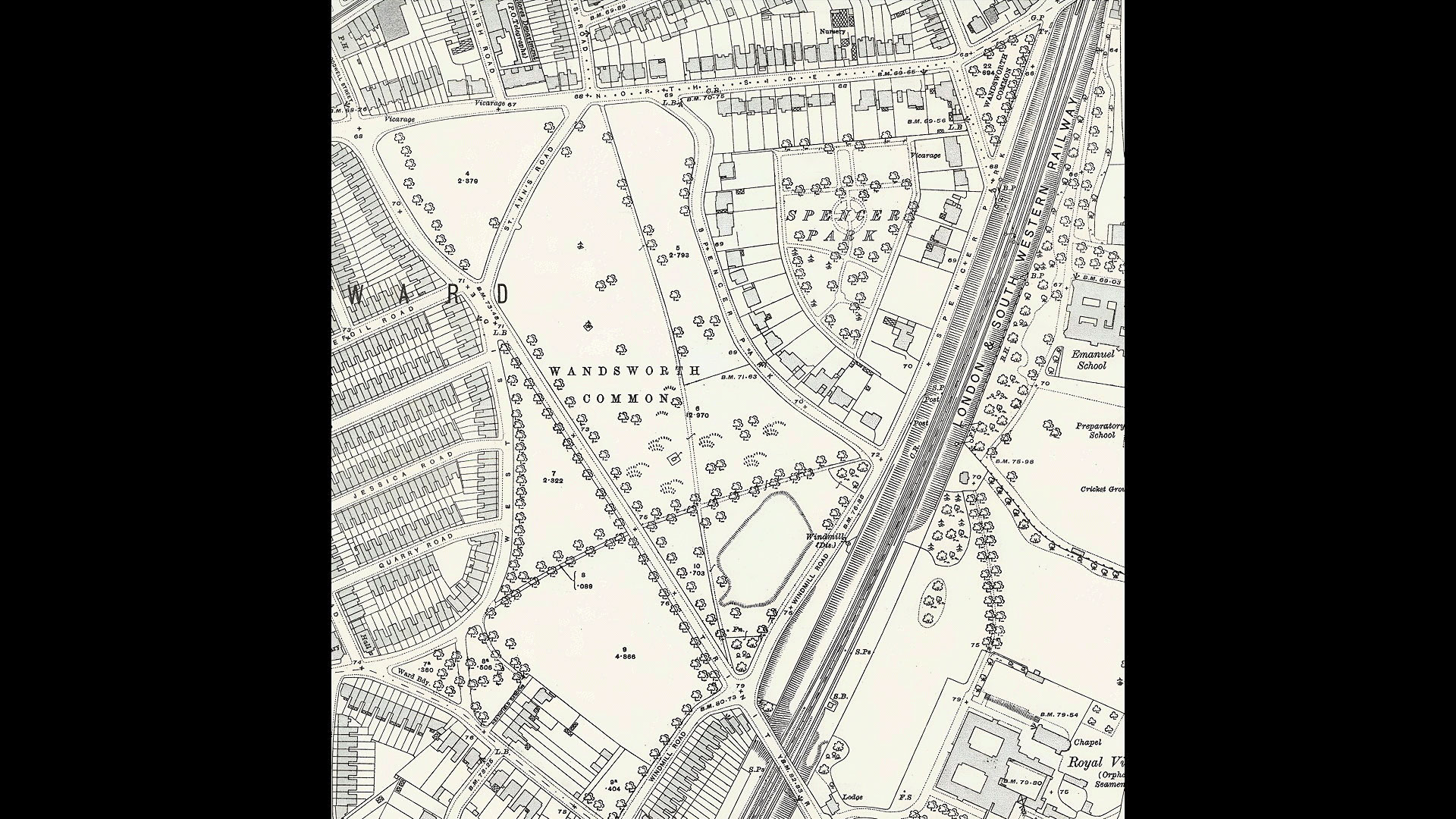
(Click on image to enlarge)
And here in an aerial photograph from the last couple of years:
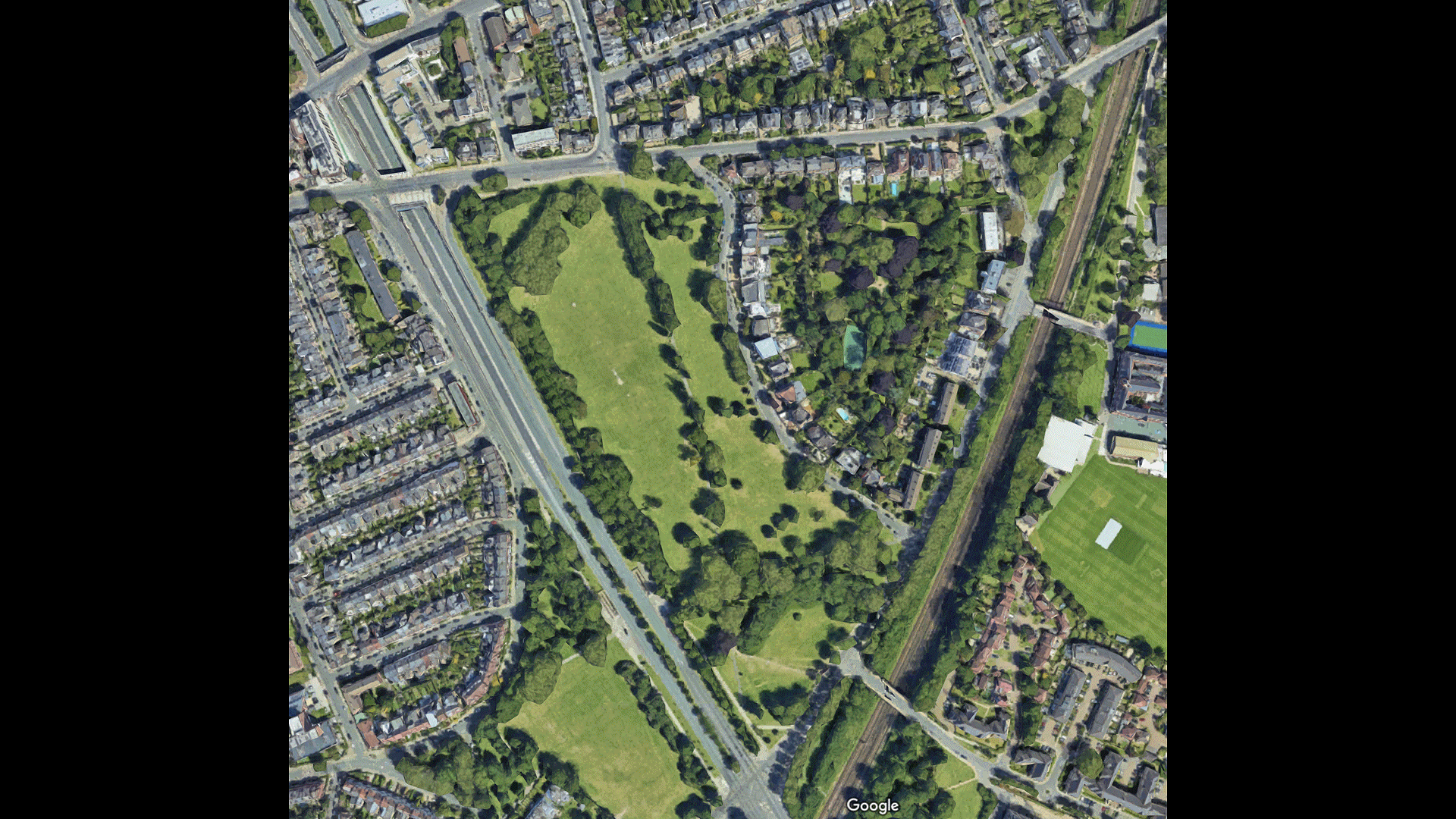
(Click on image to enlarge)
Within a few years, the lake was filled in.MOVE? DROP? The note on the back of the card says painted "around 1880"? Again, possibly. But if so, it was painted after the lake had been filled in - which (as we shall see) was some time between 1871, when the Wandsworth Common Act was passed, and the mid-1870s.
Let's go back to the map / look at a roughly contemporary map This is a hand-coloured Stanford map of 18?? There were numerous editions from ? to ? Given the sightlines, with a clear view of the RVPA, and with what is likely to be an small island on out ?, we must be somewhere here...or here Notice there is no evidence of a railway line in between "us" - the artists or viewer - and the enormous orphan asylum. Whenever this image was painted, it represents the last days of the lake. By 1880, it was gone, and Spencer Park built in its place. [Map from 1880s? Aerial pic?]
Now we have a problem. Did the railway line go through the Black Sea, or simply cut off its water supply? We know it did cut off the supply because.... hence court case? agreement for the railway company to provide a windpump and maintain the lake Are these maps accurate? Or at least accurate enough It certainly looks as though it went through...
Here are some images of this windpump - always called the Windmill, of course... Thanks to the efforts of the Wandsworth Society, a large part of it is still there today - though oddly camouflaged by trees as if it's lurking behind them
If so, the lake once spread into the grounds now occupied by Emanuel School. Now here's a little enigma. Until the 1930s [date?] there was strange wooded knoll "venerable elms" on what are now the school playing fields. Yes it got in the way, but it had its uses... ?picnics? ? military manoeuvres here are some photos from around But sport won , as it did more or less everywhere around. The knoll was removed etc Now what if this knoll was originally an island in the lake?
https://www.historyofwandsworthcommon.org/people/wilsons-prices/wilsons-prices.html
Ellen Barchard was born on East Hill, the daughter of Richard Wildman Barchard. Richard Wildman Barchard was the first named person that I know of to publically defend Wandsworth Common
[https://www.historyofwandsworthcommon.org/years/1827.html - there's this, but also a longer and more detailed article, with several refs to WC] CONTEMPLATED MEASURE FOR INCLOSING BATTERSEA, WANDSWORTH, AND CLAPHAM COMMONS, AND OTHER OPEN LANDS. Yesterday a very numerous meeting of the most affluent and respectable resident gentry of the neighbourhoods of Battersea, Wandsworth, and Clapham Commons, assembled at the Swan Tavern, at Stockwell, for the purpose of adopting measures to counteract a Bill which is about be introduced into Parliament for dividing, allotting, and enclosing the commons, open and common fields, meadows, pastures, and commonable lands and waste grounds, within the manor and parishes aforesaid. Several gentlemen, whose properly is not at all likely to be affected by a measure of the kind, attended from public feeling, which is now in very active operation against the tremendous system of which the projected Bill is considered a part. ________ Deacon, Esq. in the Chair. The CHAIRMAN briefly stated that the object of the Meeting was to oppose a Bill about be brought into Parliament by Lord Spencer - a bill calculated to do very extensive mischief. Mr. BARCHARD rose to state the circumstances under which they were called together. A rumour had been, he said afloat, that it was the intention his Lordship, and other persons who had interest as copyholders, bring in a bill for the above-mentioned purpose. The rumour increased, and he and about dozen other gentlemen, met at his house, to consider a subject of such importance to their interests. They determined to write a strong, but respectful letter, urging their objections to the proposition, and requesting a conference. His Lordship granted the conference to a deputation of the joint parishes on the 26th of November, and upon that occasion admitted the strength of some of the objections, if such objections had any foundation at all; but thought that they could be easily removed if they really did exist. In a correspondence between the deputation and Mr. Lefevre, upon the part of his Lordship, that gentleman submitted the following propositions by way of modifications. That that part of Clapham Common which was within the manor of Battersea, should remain in its present state - that the avenues on the East Side of Wandsworth, or Battersea Common, should remain in its present state - That the remainder of the commons and wastes Battersea and Wandsworth be inclosed, but that no buildings be erected thereupon, except dwelling-houses of the value of £1,000 each at least, buildings (not dwelling-houses) requisite for the cultivation of land, and buildings for parochial and charitable purposes; that the open fields be inclosed, but no dwelling-houses of less value than £200 be erected thereupon; the Lachmere [sic] Common (about 18 acres,) be appropriated to the benefit of the Battersea poor, in such manner as should appear most beneficial; and that an appropriation of similar extent be made for the Wandsworth poor. The Deputation replied to this communication, that the propositions did not appear to them to obviate the objections, and a public meeting of the inhabitants was called. Now, with respect to the alleged modifications, the offer of his Lordship not to inclose a certain part the Common was certainly no great favor, for it happened not to be possible to do so, as a writ had been issued on a former occasion to determine the boundary without effect; and it was but prudent in his Lordship to leave the avenue in same state, as any alteration there would certainly prejudice his Lordship's property. With respect to the proposal, that no building of less value should £1000 be erected on the Common, it was well known, that if the Common was inclosed, it would be soon cut into small slices - and what was to prevent a proprietor from building whatever sort of house he pleased upon his portion? - As for buildings requisite for the cultivation of land, a pig-stye or any sort of wretched cabin, was included under that head. He called upon the Meeting to reflect upon the consequence of the erection of small houses: all small portions of land were devoted to building the most profitable mode of disposing of them, an immense population of poor would become [?] that the parish rates would necessarily sustain an alarming increase - (Hear, hear). In Bromley an inclosure of common had some time ago been carried into effect, and the consequence was, that many who were induced to vote for it, had so much to regret the redundancy of a poor population, which the measure drew together, as to declare that they would give £1,000 each for a repeal of it. There was a similar case at Bexley, and in Chelsea, where but a very small portion of land was inclosed - the rates rose from 9d. to 14d. At Hornsey and Norwood, the annoyance and inconveniences were likewise intolerable from the same cause. Mr. Barchard then spoke of the advantages of the situation and extent of Common and its vicinity to the Metropolis, and argued, with considerable force, against any intention to destroy those public and private advantages. The poor inhabitants would sustain great injury if the measure was carried into effect. They laid claim for their cattle to the pasturage of the Common which they had enjoyed so long, that it was, if not an actual right, something very like a right; and their means in that respect would not only be quite destroyed, but would be driven into public houses, mere roads not being the most agreeable of walks. He instanced the case of some Gentlemen who had taken houses upon the impression that no inclosure would take place, but who were scarcely settled in their habitations when they were surrounded by miserable receptacles. The case of Botany Bay, in Wandsworth, was in point; that wretched spot had grown out of one of those measures, which were ever attended with public loss and inconvenience. Mr. Barchard then called upon the Meeting, with every respect for the character and conduct of Lord Spencer, to adopt such resolutions as would show the determination of the inhabitants to resist the Bill, and concluded by stating that his Lordship had expressed that he was ashamed to see the Common in such state it was, and yet had refused either to improve its condition himself, or allow others to do so. Resolutions, which were the echo of the speech, were then proposed. Alderman SCHOLEY seconded the Resolutions. He declared that he did so more from a feeling towards the public, than from a private feeling, although he was one of those that who would be affected by the projected measure. (Hear, hear.) Mr GUDE (of the Crown-office, we understood) asked whether Lord Spencer was apprised of this meeting? Alderman SCHOLEY said that Mr. Lefevre knew of the meeting, but declined attending from a point of delicacy. After some further discussion, the Resolutions were agreed to, and a Committee was appointed to superintend the opposition to the Bill. The alacrity of the Meeting in opposing the Bill, may be guessed from the fact, that the subscriptions in the room amounted, in five minutes, to between £1,100 and £1,200. BNA: Link BNA: Link Original article probably "Contemplated Measure For Enclosing Battersea, Wandsworth, And Clapham Commons And Other Open Lands." Times, 21 Dec. 1827, p. 2, here. Notes & queries [PB: Who was "Mr Barchard"? I notice there is a Barchard Street very close to the Town Hall. Several generations of Barchards are named on the Wandle.org website as Wandsworth dyers (particularly of scarlet dyes) here. George Fergusson Wilson (1822-1902), the pioneering MD of Price's Candle Works, married on 13 August 1862 Ellen, eldest daughter of [the late] R. W. Barchard, of East Hill, Wandsworth. Is it him? "WILSON BARCHARD. On the 13th. inst., at St. Anne's, Wandsworth, by the Rev. W. Howard, 51. A., rector of Great Witch- ! ingham, Norfolk, George Fergusson Wilson, F. R.S., son of the late William Wilson, Esq., of Wandsworth-common, to Ellen, eldest daughter of the late R. W. Barchard, Esq., of East-hill, Wandsworth." [Morning Post - Thursday 14 August 1862 / https://www.britishnewspaperarchive.co.uk/viewer/bl/0000174/18620814/044/0008] GOOGLE SEARCH: "R W BARCHARD" BNA SEARCH: "R W BARCHARD" - looks interesting. NB a man of his name is frequently cited along with Michael Faraday. Check? Numerous refs to the Horticultural Society. I assume all refs to RWB refer to the same man, and he is from Wandsworth? There are several refs to RWB in relation to coal, e.g. resolving at "A Meeting of the Coal Factors, Coal Merchants, and others interested in the Coal Trade of the Port of London, held at the Coal Market" 28 February 1844, to petition "Parliament against a proposed new Duty of Fivepence per Ton upon Coals imported London to defray the Expense of the contemplated Thames Embankment" [ Newcastle Journal - Saturday 09 March 1844] "RW" = "Robert Wildman". His daughter [Ellen?] married George Fergusson Wilson, of Price's Candle Works and the large estate that became "Spencer Park".
In 1841 RWB contributed a detailed letter on [evaporation in greenhouses] to the Gardeners Chronicle.[copy in hand]
Ellen was unmarried at 36 [1861 Census] - relatively late in Victorian times. Living with her long-widowed other, Charlotte. There were visitors in the house. A coachman, footman, cook, housemaid, and a ladies maid.
She married George Fergusson Wilson the following year - 1862
Ellen was an accomplished botanical illustrator.
Here is one of her pictures.

(Click on image to enlarge)
And this lily is named after her.
Their children - Scott, Herman and Alice- were all born in Wandsworth, almost certainly at Black Sea House.
Scott Barchard Wilson was baptised at All Saints Wandsworth 27 June 1864.
I'd like to tell you more about the great naturalist and explorer Scott Barchard Wilson, but now is not quite the time.
What's all this got to do with the Black Sea? - the Wilsons incorporated it, and enlarged, beautified and planted it. - they rowed on it - nb the boat house - how big? GFF calls it "5 acres" in his 1863 letter. Is it ever described as any larger?
The Elodea story
2 October 1863
George Fergusson Wilson (of Price's Candle Works) on how he dealt with the invasion of "American Water-Weed" in the Black Sea, which lay outside his house on the Common.

Several years ago the weed made its appearance in a five-acre pond on Wandsworth Common. We were told that an aquarium owner, living more than half a mile off, had put a small plant in a pond near his house, for the sake of getting a good tank specimen. With us it spread very rapidly, soon overpowering all the old weeds, and destroying all pleasure in rowing.
[Source: Chronicles October 2021
Wilson's American Water-Weed, Anacharis is more usually called "Canadian Pondweed", Elodea canadensis.
Westmorland Gazette - Saturday 03 October 1863
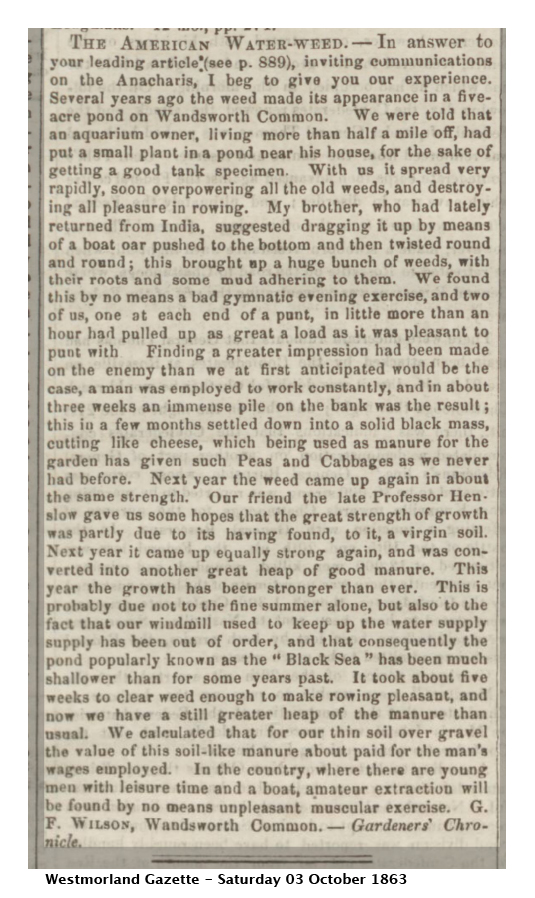
(Click on image to enlarge)
The American Water-weed.
In answer to your leading article (see p. 889), inviting communications on the Anacharis, I beg to give you our experience.
Several years ago the weed made its appearance in a five-acre pond on Wandsworth Common. We were told that an aquarium owner, living more than half a mile off, had put a small plant in a pond near his house, for the sake of getting a good tank specimen. With us it spread very rapidly, soon overpowering all the old weeds, and destroying all pleasure in rowing.
My brother, who had lately returned from India, suggested dragging it by means of a boat oar pushed to the bottom and then twisted round and round; this brought a huge bunch of weeds, with their roots and some mud adhering to them.
We found this by no means a bad gymnastic evening exercise, and two of us, one at each end of a punt, in little more than an hour had pulled up as great a load as it was pleasant to punt with. Finding a greater impression had been made on the enemy than we at first anticipated would be the case, a man was employed to work constantly, and in about three weeks an immense pile on the bank was the result; this in a few months settled down into a solid black mass, cutting like cheese, which being used as manure for the garden has given such Peas and Cabbages as we never had before.
Next year the weed came up again in about the same strength.
Our friend the late Professor Henslow gave us some hopes that the great strength of growth was partly due to its having found, to it, a virgin soil. Next year came up equally strong again, and was converted into another great heap of good manure.
This year the growth has been stronger than ever. This is probably due not to the fine summer alone, but also to the fact that our windmill used keep up the water supply has been out of order, and that consequently the pond popularly known as the "Black Sea" has been much shallower than for some years past. It took about five weeks to clear weed enough to make rowing pleasant, and now we have a still greater heap of the manure than usual.
We calculated that for our thin soil over gravel the value of this soil-like manure about paid for the man's wages employed. In the country, where there are young men with leisure time and a boat, amateur extraction will be found by no means unpleasant muscular exercise.
G. F. Wilson, Wandsworth Common.
Gardeners' Chronicle.
[BNA: Link]
[Anacharis - today more usually called Elodea or "Canadian Pondweed" Elodea canadensis. To follow, up, visit e.g. Gardeners' Chronicle, 1863 - in the Biodiversity heritage Library, which has a superb search function.]
[Biodiversity Library: Link]
Ley's look at the islands in the lake. (And the family that lived next door.) Often stated there were 13 - one for each of William wilson's chilsdren Here's ?, the LCC ... Shirley Passmore, whose work on the history of Wandsworth Common continues to inspire and inform me, pooh poohs this. She points out the islands are already there in Cruchley's maps.
Collect and review all maps
Shirley Passmore bits
Refs in newspapers etc
Photos e.g. by
Geoffrey Bevington - probably took several photos of the Black Sea and Black Sea House - get better versions?
Peter Le Neve Foster - I have a photo of the BS by him - but try to find the photo of his children boating there - said to be "his most charming photo"
There's a painting in the Wandsworth Heritage Centre/Borough Photos
Do I recall refs to watercolours e.g. possibly by [Ellen?] Barchard?
Eels
Jack Black
Suicides e.g. the two Amelias
Infanticide
Deaths on the ice
"Botany Bay"?
The trap laid for the foreign seducer
Other plants, insects etc in the lake
The Elodea canadensis invasion
George Fergusson Wilson models Wisley/future RHS on Wandsworth Common
GEORGE FERGUSSON WILSON AND WISLEYThe Windmill
Stories about the Frying Pan
Collect every photo and reference
Buckmaster et al's complaints about how they used to be able to walk all round.
Afterwards, how the rest of the ponds were filled in. How the lake was created and enlarged.
Collect info about how polluted, evil-smelling it had become
Find story about how it was blamed for deaths in the RVPA for Girls - then detail how the sewers worked, with human excrement spread on the grounds (and on Neal's bit of the Common? - the death of Dr Anstie blamed on the sewer gases (but was actually septicaemia briught in by a prick during dissection)
How the lake was filled in. And Spencer Park was built on the site. Who built the houses? Who lived there?

(Click on image to enlarge)

View from Black Sea towards the RVPA, c. 1880
[PB: This may (or may not) be the date of the painting - but the Black Sea had been filled in some years earlier - 1871-ish?]
'"The Royal Victoria Patriotic Asylum, Wandsworth Common" (c.1880). Watercolour, artist unknown. I scanned this from a Wandsworth Museum greetings card. I was unable to find it online in July 2019, but I assume it is in storage somewhere. Is it listed in ArtUK? No. [It might be now - check].
(Click on image to enlarge)
Why is it called "The Black Sea"? Is it Crimean-war connected? There is a painting dated 1858, so it could be. Or are there references prior to 1853/4? Was the house also called Black Sea House, as I recall one source saying?
[No, there are references to the Black Sea from well before the Crimean war [i.e. pre-mid-1850s] - find.]
Price's Candles certainly used an image of Cardigan and the Charge (and other battles) in their publicity [date?].
The Black Sea (Spencer Park)
Built by ? Wilson, owner of Price's Candles. According to Sexby Municipal Parks... [1905], an extra island was created for every new child. (Shirley Passmore pooh-poohs this on the grounds that the many islands can be seen on maps made before the children were born. Check.)
When the control of the common was transferred to the conservators, Lord Spencer reserved to himself a portion at the north adjoining the London and South-Western Railway main line on which was a sheet of ornamental water called the Black Sea, which was studded with thirteen small islands, and beautified with shrubs and flowers. This lake was formed by a Mr. Wilson, the founder of Price's Candle Works, who lived at Black Sea House. For every child added to his family, he constructed a little island in the lake, fringing each with yellow iris.
In the Act for the construction of the railway, the Black Sea was called Pond No. 3, and was said to be the property of Battersea and Wandsworth, [p.246] and by this Act the Company were compelled to place apart the sum of 8,000 for the purpose of covering the bed of the pond with clay, and making a drain into it from the cutting, and keeping it in good condition. Shortly afterwards in another Act certain sections enabled the Company to withdraw this sum, but still they were bound to repair and keep intact the pond and drain on both sides of the railway.
The Black Sea has now been filled up, and Spencer Park has been built upon its site so that one of the most picturesque and ornamental waters near London has disappeared. The old windmill, of which the stump remains (which is utilized as a tool-shed by the labourers on the common), was used for the purpose of pumping water into the Black Sea.
* "Old and New London", vol. vi., p. 482.
Shirley Passmore, The Black Sea
The Wilson Estate and the Black Sea
An early enclosure (date not known) on the north-west comer of the common was a house surrounded by a large garden that later expanded to about 8 acres of parkland. It is shown on the Rocque map of 1741.
The estate was leased in 1829 from Earl Spencer by William Wilson the founder of Price's Candle Factory. On later maps a 5-acre lake known as The Black Sea adjoins the park. This was most probably a disused gravel pit and later was utilised as a reservoir. It supplied 12,000 gallons of water a day to properties around.
[PB: her sources?
When the cutting for the London Southampton Railway was made it cut off the end of the lake and its feeder spring. The LSR Company was obliged under the 1834 Act to take various steps to "for ever thereafter keep up and maintain a supply of water in the said pond No 3 and two other ponds contiguous thereto" (or until the Lambeth Water Company would take over the supply). A pumping mill was installed on the railway embankment to pump back water from the cutting into the lake.
[The Black Sea, Stanford 1864. Source and further information: Link.]
At some stage, perhaps 1846 when a new lease is recorded between Anne Wilson and Earl Spencer, the estate was expanded right up to the edge of the lake taking in one and a half acres of common. The lake ceased to be a reservoir at about this time and it is suggested that the 1846 Lease also included the lake. However, the Battersea and Wandsworth parishes were stated to own the lake when used as a reservoir so the situation is unclear.
What is clear is that at least from this time, perhaps earlier, Wilson looked after the lake and was responsible to a large extent for turning it into "One of the most picturesque and ornamental waters near London". It has to be a myth that he put in an island to commemorate the birth of each of his 13 children because the islands are already there on the Cruchley map of 1829.
In November 1866 the fifth Earl Spencer bought back the lease of this estate from the widow of William Wilson and "the gravest apprehensions were entertained that the 13 acres would be turned into building sites". (It was to become Spencer Park).
[Shirley Passmore, 2010]
(Click on image to enlarge)
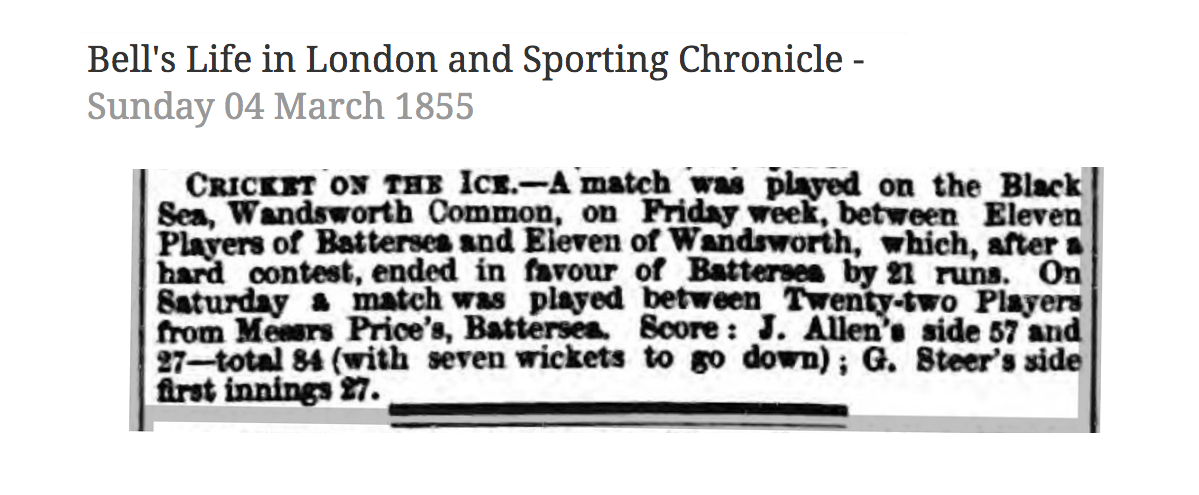
Bell's Life in London - 4 March 1855
Cricket on the ice
(Click on image to enlarge)
Cricket on the ice
The match was played on the Black Sea, Wandsworth Common, on Friday week, between 11 players of Battersea and 11 of Wandsworth, which, after a hard contest, ended in favour of Battersea by 21 runs.
On Saturday a match was played between 22 players from Messrs Price's Battersea. Score; J Allen's side 57 and 27 total 84 with seven wickets to go down; G Steer's side first innings 27.
[Source: Link.]
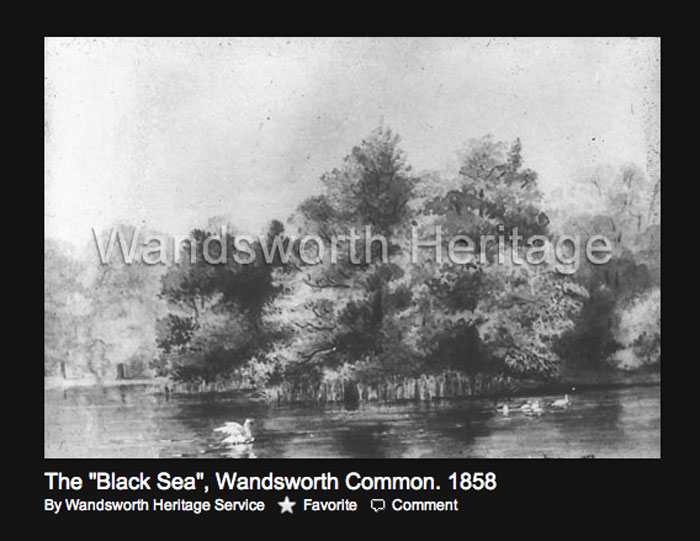
Black Sea, 1858, watercolour?
From Wandsworth Heritage Service. Link? Do they have a better copy? the original watercolour?
(Click on image to enlarge)
Jon Newman, Battersea's Global Reach: The Story of Price's Candles
Battersea's Global Reach tells the story of Price's Candles at Vauxhall and Battersea and how it helped to light the world. Price's Candles of Battersea was and still is a household name. Yet the company's history is so much more than the making of candles. From its inception in the 1830s it re-invigorated a sleepy and unchanged industry by the application of scientific research. Industrial chemistry allowed it to develop the first stearine candles and provide inexpensive good quality lighting.
Forty years later the discovery of oil and the use of paraffin wax for candle manufacture additionally turned it into an position oil company. As well as commercial success the company was noted for its ethical on products - particularly the use of Palm Oil for manufacture and the strong anti-slavery message that this sent out in the 1850s - and for its radical approach to employee relations, providing schools, housing and pensions for its workers. The story of the 20th century is a familiar one of decline and reinvention - from manufacturing industry to retailer to heritage brand.
Jon Newman, the author, is an archivist working freelance and for Lambeth Archives.
Published by History & Social Action Publications, 6 Oakhill Rd, London, SW16 5RG.
Launched at a talk by the author during the Wandsworth Heritage Festival (June 2009).
Price: £5 & £1 p&p.
To order:
Click Add Cart button below or send order with cheque payable to 'Sean Creighton' to the address above.
Or order via email: sean.creighton1947@btinternet.com.
https://sites.google.com/site/historysocialaction/battersea-s-global-reach
"WANDSWORTH COMMON BLACK SEA" SEARCH IN GOOGLE BOOKS
http://books.google.co.uk/books?id=gdlCAAAAIAAJ&q=black+sea+wandsworth+common&dq=black+sea+wandsworth+common&pgis=1
WC in he Municipal Parks, Gardens, and Open Spaces of London
By John James Sexby
[Source: Link.]
More details
The Municipal Parks, Gardens, and Open Spaces of London: Their History and Associations
By John James Sexby
Published by E. Stock, 1905
646 pages
Autobiography of Sir Walter Besant (1836-1901).
Besant moved from Portsmouth? to London (at age ?) to study at Stockwell Grammar School.
[p.61]
There were many curious and pleasant places within reach of Stockwell. Clapham Common, on the south, the first of the Surrey heaths. It was surrounded by stately mansions, sacred to the memory of Wilberforce, Thornton, and Macaulay, standing amidst broad lawns with splendid cedars. The common itself was left absolutely untouched; winter water-ways made little ravines; there were ponds, there were no roads, there was gorse and fern. It was our playground.
Beyond lay [p.62] Wandsworth Common, another wild heath with a lake called the Black Sea, wherein, it was rumoured, gigantic pike attacked and bit great holes in the boy who ventured to swim across.
On the west one could easily reach the Battersea Fields. As I recollect this place, it was most dreary and miserable; a broad flat, lower than the river, and protected by an embankment. On the bank stood the once famous Red House tavern, now long forgotten, and beside it the pigeon-shooting ground. This sport went on continually. If a pigeon escaped he was potted by men who carried guns and lay waiting for him outside the grounds. Battersea Church was on the wall of the Fields, the transformation of a great part of which into Battersea Park took place between 1851 and 1858.
In summer our favourite rambles were farther afield, in the direction of Champion Hill, Herne Hill, Dulwich, and even Penge. No one visiting these places at the present day can understand their loveliness before they were built over. Dulwich, with its ancient college and its inn, its greenery and its orchards, was surely the sweetest village in the world. I always looked about in case I might come upon Mr. Pickwick, who was then a resident, but I was never privileged to see him. The hanging woods of Penge in autumn were lovely beyond the power of words. Its Common on the Hill had been enclosed long before in 1824. Howe laments the fact in that year; but in the fifties Penge, Norwood and Sydenham formed a group of suburbs still rural, [p.63] still covered with woods and gardens, and as beautiful as any country village.
As yet there were neither omnibuses nor railway. The people who went into the City drove in their own carriages or rode their own horses. Any morning along the Clapham Road there were still many who rode into town.
We were not great at games at the school. There was a cricket club, but my short sight disqualified me from any game of ball; in the winter there was hockey on Clapham Common. I think that football had not yet come in; in fact athletics, in such schools as this was, hardly existed. On the other hand we took long walks; we walked to Richmond, and rode ponies in the Park; we walked to Putney, and took boats on the River; we jumped the Effra, in the Dulwich Fields; we had a gymnastic bar and did things of strength; sometimes we wrestled; sometimes we fought. On the whole it was a healthy kind of life, with plenty of outdoor exercise.
For my own part, I had a form of recreation all my own, of which I said nothing, because the other boys would not understand it. I had friends at Camberwell and Brixton, who asked me two or three times a term to dinner on a half-holiday. On such occasions I used to get away at two and walk all the way into the City of London, which was to me then, as it has been ever since, a place of mystery, full of things to be discovered. Nothing could be more delightful than to wander about, not knowing where, so long as one was in the City.
[Source: Autobiography of Sir Walter Besant, Hutchinson & co., 1902.
Various formats available at here. Downloaded and saved as e.g. "BESANT_AUTOBIOGRAPHY_OF_SIR_WALTER_BESANT_autobiographysi01besagoog.pdf". Also a text version (partly edited).]
- Wikipedia: Walter Besant
Times, 6 March 1868
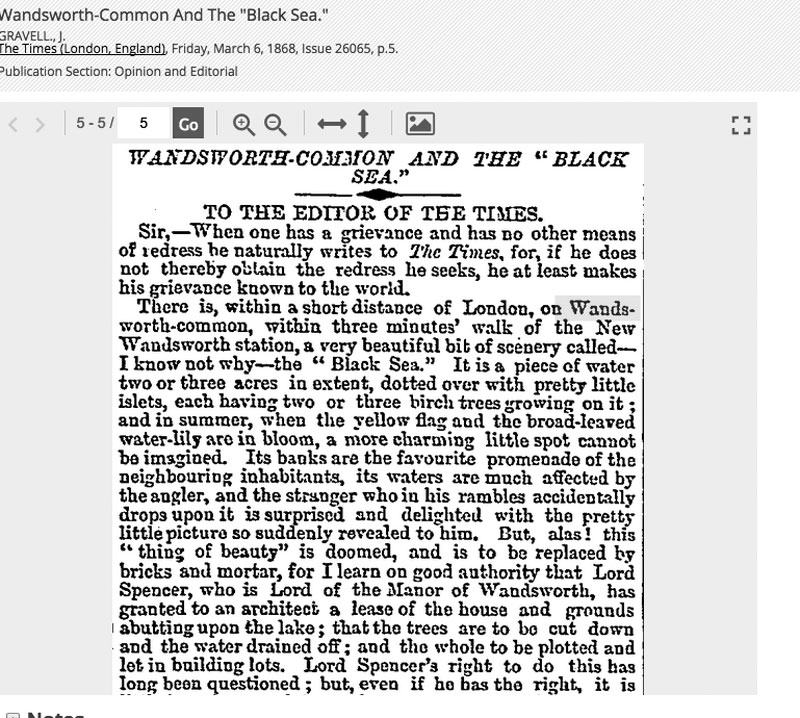
"But, alas! this thing of beauty is doomed", The Times, 6 March 1868
[to be completed]
(Click on image to enlarge)
The Popular Science Review: Animalcules, Wandsworth Common
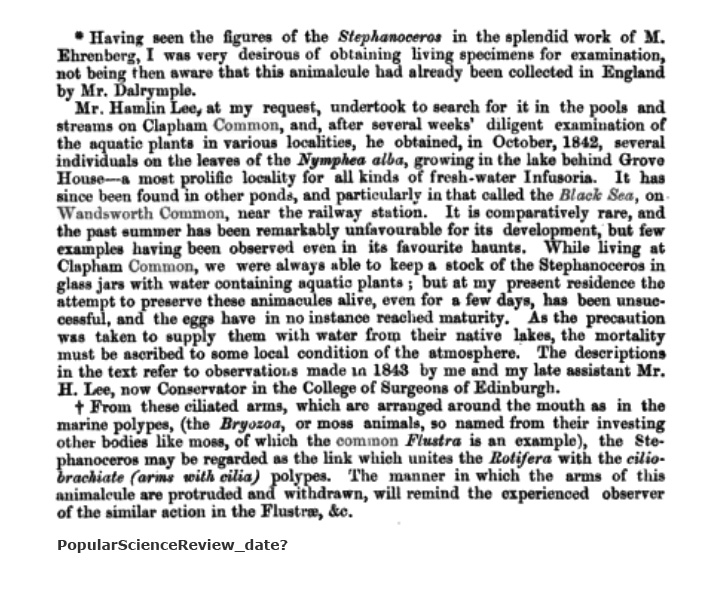
Popular Science Review, date?
(Click on image to enlarge)
Nymphaea alba - Wikipedia: https://en.wikipedia.org/wiki/Nymphaea_alba
Beautiful short film of the rotifer Stephanoceros fimbriatus
Published Jun 29, 2017. The rotifer Stephanoceros fimbriatus. Collected from a Southern California mountain lake, this was filmed in full 4K using a Panasonic GH4 camera, an Olympus BHS microscope, SPlan objectives, and Olympus DIC.
Also Link.
NB Philip Gosse, 'On Stephanoceros,' 1862.
On distribution of Rotifera, including Stephanoceros: Link (fabulous last para!)
Windmill
- See The Windmill
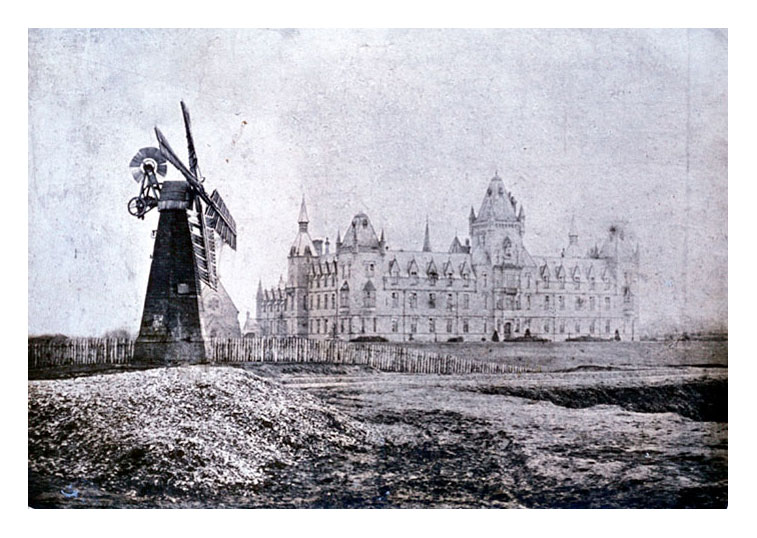
Windmill supplying water to Black Sea after railway cutting interrupted natural supply, date? Royal Victoria Patriotic Asylum for Girls in the background.
Notice how bleak and treeless the area is at this time.
windmill_in_front_of_rvpa.jpg
(Click on image to enlarge)
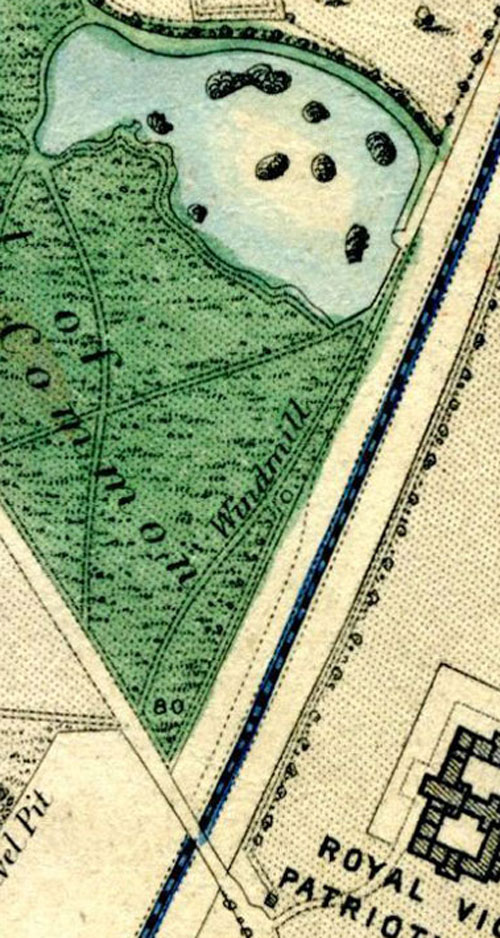
Map: Black Sea, Windmill, RVPA, railway line.
map_black_sea_windmill_rvpa.jpg
(Click on image to enlarge)
The Frying Pan
[PB: Notice there is no "Frying Pan" - the dead-flat depression on the other side of Windmill Drive opposite the RVPA. When did it appear? Find on maps. What was extracted and why? Was it to fill the Black Sea? This seems reasonable. I have seen a reference once [Greg Smye-Rumsby in his Scope website] that it was dug to make bricks for the Prison - but this seems unlikely. Was there much/any clay suitable for brickmaking on WC? Probably not. To build what? - the main part of the prison having already been built by the time of this image. No, it was a later sand pit. The "handle" is the approach path on the western side.]
Shirley Passmore: The Wilson Estate and the Black Sea
The Wilson Estate and the Black Sea
An early enclosure (date not known) on the north-west comer of the common was a house surrounded by a large garden that later expanded to about 8 acres of parkland. It is shown on the Rocque map of 1741.
The estate was leased in 1829 from Earl Spencer by William Wilson the founder of Price's Candle Factory. On later maps a 5-acre lake known as The Black Sea adjoins the park. This was most probably a disused gravel pit and later was utilised as a reservoir. It supplied 12,000 gallons of water a day to properties around.
When the cutting for the London Southampton Railway was made it cut off the end of the lake and its feeder spring. The LSR Company was obliged under the 1834 Act to take various steps to "for ever thereafter keep up and maintain a supply of water in the said pond No 3 and two other ponds contiguous thereto" (or until the Lambeth Water Company would take over the supply). A pumping mill was installed on the railway embankment to pump back water from the cutting into the lake.
At some stage, perhaps 1846 when a new lease is recorded between Anne Wilson and Earl Spencer, the estate was expanded right up to the edge of the lake taking in one and a half acres of common. The lake ceased to be a reservoir at about this time and it is suggested that the 1846 Lease also included the lake. However, the Battersea and Wandsworth parishes were stated to own the lake when used as a reservoir so the situation is unclear.
What is clear is that at least from this time, perhaps earlier, Wilson looked after the lake and was responsible to a large extent for turning it into "One of the most picturesque and ornamental waters near London". It has to be a myth that he put in an island to commemorate the birth of each of his 13 children because the islands are already there on the Cruchley map of 1829.
In November 1866 the fifth Earl Spencer bought back the lease of this estate from the widow of William Wilson and "the gravest apprehensions were entertained that the 13 acres would be turned into building sites". (It was to become Spencer Park).
[Shirley Passmore, 2010]
Follow up
- Jack Black
- Ornamental lake or reservoir (or both?)
- Refs to its decline in later years
- Info about filling in and our other lake created
Internal links
- The Black Sea, Wandsworth Commmon [link to page on this website]
- The Windmill, Wandsworth Commmon [link to page on this website]
NB Locate and add info about Peter Le Neve Foster's photograph of his children boating on the Black Sea c. 1850s.
Also his photo of a lake, whic may be the Black Sea.
Love, Death on the Black Sea
[https://www.historyofwandsworthcommon.org/people/amelia-alfrey/amelia-alfrey.html] [https://www.historyofwandsworthcommon.org/years/1827.html]
AMELIA ALFREY/ALFERY/AFRID ETC
Monday, 29 July 1844 Amelia Alfery attempts to drown herself and her two youngest children in the Black Sea Twenty-six year-old Amelia was tried at the Old Bailey on 19 August 1844. Her son William was the first witness called. His stream-of-consciousness account, recorded almost verbatim, is extraordinarily evocative. The Black Sea was a large ornamental lake now covered by Spencer Park. (Click on image to enlarge) WILLIAM ALFERY: I do not know how old I am - the prisoner is my sister - I live with my father, by the White Horse, on the water side, Wandsworth. On the 29th of July I was on Wandsworth-common - I saw the prisoner there by herself, at a place called Black Sea - there was plenty there - she had her children with her, a little girl and a boy - their names were Henry French and Mary French - she has lived with a man of the name of French, and the children were called by his name - I went away for some time, and came back to play at cricket - I did not see her then - when I went over in the afternoon, I saw her walking about, and the children with her - I do not know what time it was - I did not see her do anything - I heard her scream - she was then in the water, in a pond there - the children were with her - I do not know whether they were tied to her - I went in - it was very shallow water - I held up the children's heads, and tried to hold her head up too - I kept the children's heads above water till somebody came - I saw her before I saw her in the water, and asked her to go home with me, and she told me to go home - I did not see her sitting on a bench, I saw her walking about - I did not hear her say anything to the children - I saw them with her before I saw them in the water - I did not hear her call to them - I did not see her do anything with a shawl before she went into the water - I did see her go into the water - I do not know how the children were taken into the water - I was not watching her - I saw her go in - I think the children walked in - nobody has talked to me about this since I was before the Magistrate - I think the children walked into the water - I did not see them go in - I did not see her carry them - I was looking another way when she went in. [Old Bailey Online: AMELIA ALFERY indicted for feloniously attempting to drown Mary Sarah French, with intent to murder her.] -->