
— Lake

A couple of years ago, I was asked to research two benches recently placed on the railway side of the lake commemorating Benny, Bella, and Ruth Spanier.
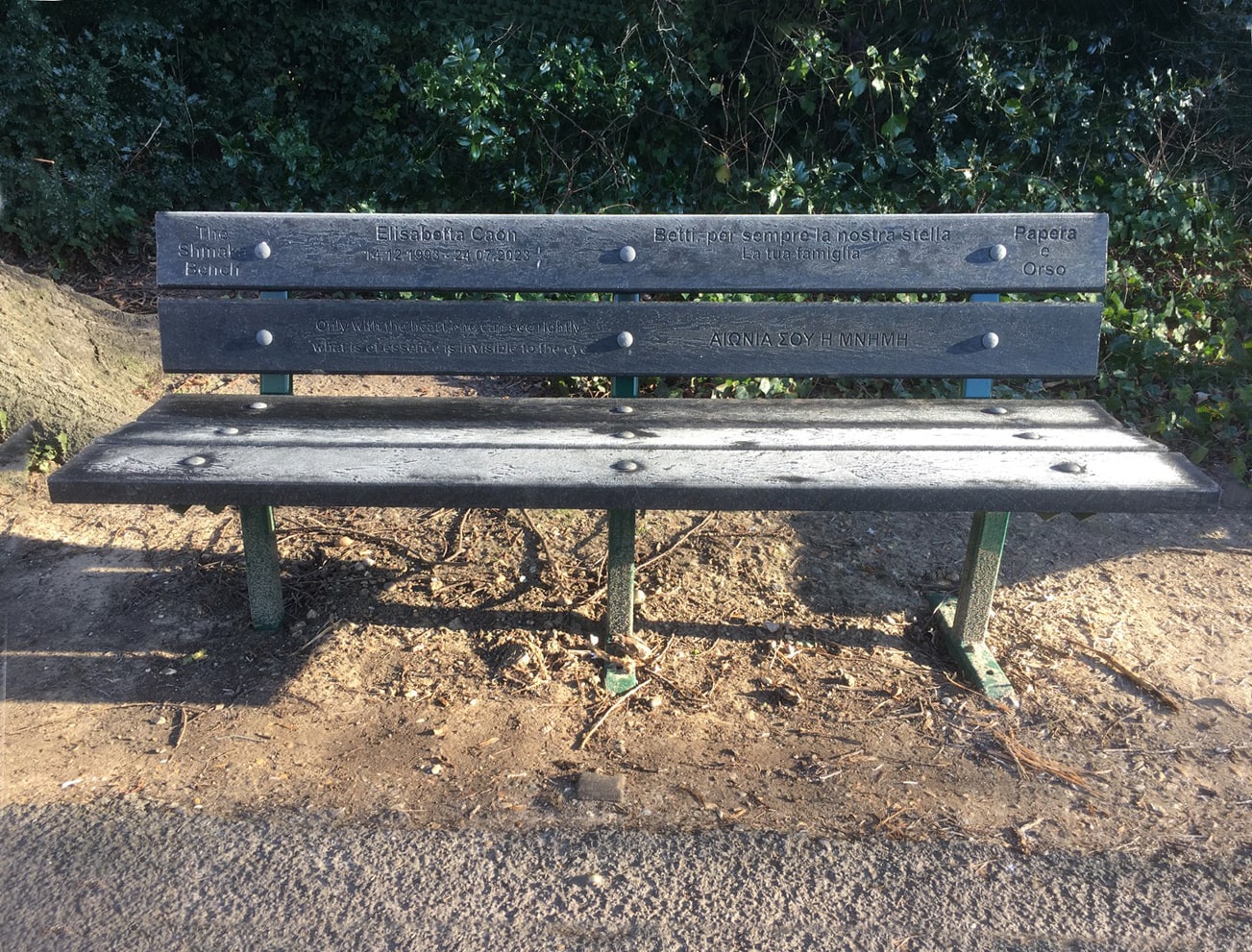
Since then, another bench has appeared nearby, with inscriptions in English, Greek and Italian. It is dedicated to Elisabetta (or Elizabeth) Caon, a young medical researcher at University College London who died two years ago.

The Shmaka Bench
[I'm not sure of the meaning of "Shmaka" — can anyone help?]
Elisabeth Cain 14.12.1993—24-07-2023
Betti, per sempre la nostra stella [Betti, for ever our star]
La tua Famiglia [Your family]
Papera e Orso [Duck and Bear] [?]
Only with the heart we can see rightly
What is of essence is invisible
[Epigram from Antoine de Saint-Exupéry's novel The Little Prince.]
AIONIA SOY I MNHMH [Your memory is eternal — a reference to the Greek Orthodox funeral liturgy]
At the time of her death, Elisabetta/Elizabeth was a gifted researcher at University College London, where she had just completed a PhD. Two professors at UCL wrote:
Obituary for Elisabetta Caon.
It is with heavy hearts that we share the profoundly tragic news of the untimely passing of Dr Elisabetta Caon on July 24th, 2023.
In 2017, Elisabetta joined us at the Institute for Liver and Digestive Health, University College London, UK as a young and promising MSc student in Industrial Biotechnologies, from the University of Padua, Italy, to undertake an Erasmus Student Mobility Traineeship.
Elisabetta's dynamic nature were undeniable. This was further exemplified when she was awarded the prestigious Juan Rodés PhD Fellowship by the European Association for the Study of the Liver (EASL), a distinction that allowed her to extend her studies in our team.
Elisabetta's endeavours knew no bounds, as she presented her ground-breaking findings in esteemed international meetings including the International Liver Congress (ILC — EASL), the Liver Meeting (American Association for the Study of Liver Disease — AASLD), European Club for Liver Cell Biology (ECLCB), and the Tissue Engineering and Regenerative Medicine International Society World Congress (TERMIS).
On the 28th of June 2023, Elisabetta was awarded her PhD, Doctor in Philosophy. What began as a junior fellow blossomed into an independent investigator, ready to embrace her first post-doctoral role.
Elisabetta was a kind, bright and caring person, with a strong resilience and a great heart for all her colleagues and collaborators. Elisabetta will be greatly missed, a great loss to everybody who knew her, it was a privilege to work with Elisabetta. As we navigate this sad time, our thoughts and heartfelt sympathies extend to Elisabetta's family, her partner, and friends.
Professor Krista Rombouts Professor Massimo Pinzani
[UCL: Obituary: Elisabetta Caon.]

Elisabetta's death was reported in a number of European news media. She had been on a beach in Sparta with her Greek boyfriend, Yannis (if you know his surname, please let me know), when she suddenly fell ill:
She was quickly transported to the nearest hospital, where, however, the doctors could not help but confirm her death.
According to the medical reports, the girl did not suffer from any particular pathology and it seems that she died because of an ischemic cardiac arrest.
Who was Elisabetta Caon?
The young woman was a researcher originally from Resana, in the province of Treviso. Elisabetta Caon leaves her mother Rosetta Stocco, professor at the Itis Barsanti of Castelfranco, her father Franco Caon, surveyor at the Municipality of Castelfranco, and her brother Alberto.
Once informed of the tragic news, Elisabetta Caon’s family members immediately boarded the first available flight to Greece to be able to say a last goodbye to the girl, who had recently completed an important doctorate in London.
[Breaking Latest News: "Greece: 29-year-old girl who died of an illness" (July 29, 2023). This link was broken when I returned in June 2025.]
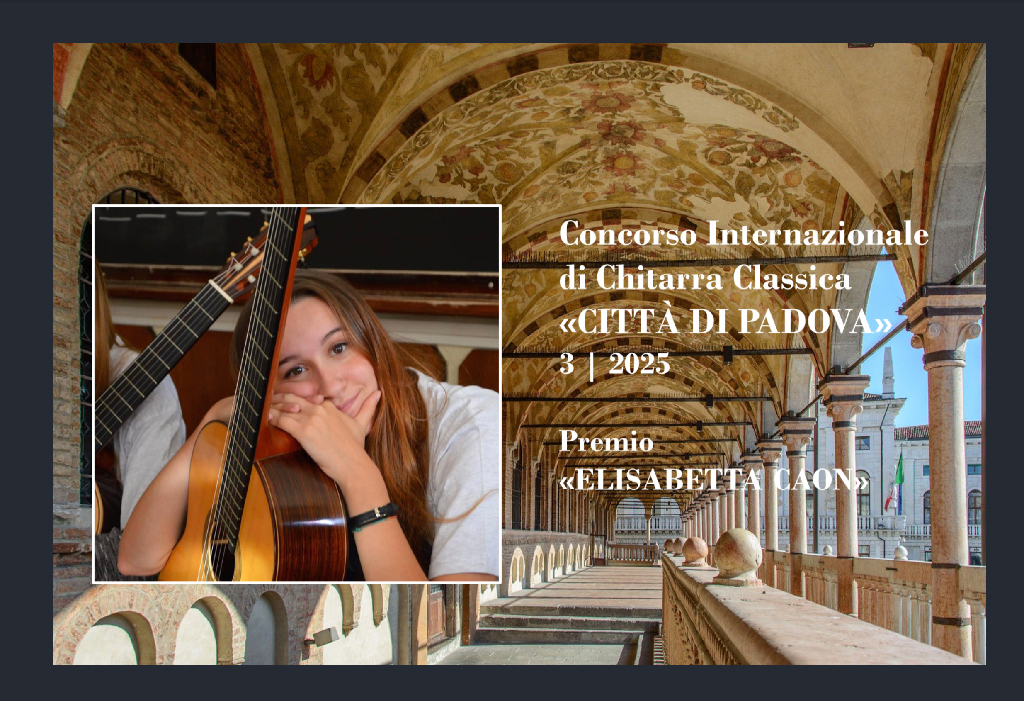
Elisabetta was also a talented classical guitarist, a founder member of the Sliwowitz Quartet:


Benches such as Elisabetta's, and the Spaniers', are the result of almost unbearable grief, but also of great love. I am grateful to their families and friends for placing memorial seats that everyone can share in such a beautiful place by our lake.

Early in June I became pretty obsessed with trying to find out more about the people named on two benches on the Common. I'd never really looked at benches before, but it soon became a compulsion.
It all started when local resident Jenny Sheridan emailed the Friends of Wandsworth Common about some inscriptions she'd seen:
Do you know anything about Bella and Benny Spanier and their daughter Ruth? They are mentioned on two benches on the Common. One says Bella and Benny were killed in Auschwitz, the other that they contributed to the life of the area. Ruth apparently came to England on Kindertransport.
Who could resist a challenge like that?
Stephen Midlane took photographs, transcribed the texts, and established exact locations:


It took a little while, but I think I've established some useful information. The couple lived in Berlin, where Bella was an actor and Benni a theatre director.


I have found a number of helpful references, including Wikipedia Ben Spanier, Gedenken9nove38: Ben Spanier, and Wikipedia: Stolperstein ("Stumbling Blocks").
Where these are in German, I have used Google Translate: (See English texts here).


And what of Benni and Bella's daughter Ruth?
Having come to England on the Kindertransport in 1939, Ruth Spanier continued to live in London — I've found likely addresses for her in Sussex Mansions, Old Brompton Road, SW7, and in Battersea. I believe she married Robert Wing in 1975.
I'm still not sure why Wandsworth Common was selected as the site of the benches — either it had a special significance for Ruth (though she didn't live locally, unless perhaps she moved in later years to Nightingale House, on Nightingale Lane), or for Anna and Ben. (I have emailed Enable, who supervise all the benches on the Common, in the hope of making contact with Anna and Ben.)
Given that Benni and Bella were deeply involved in the theatre, I've speculated that there could possibly be a connection with the wonderful Cook sisters, Ida and Louise, who lived for 60 years on Morella Road. Before WWII they travelled to Germany to . . . Their inspiring story was outlined in The Wandsworth Common Story (pp.183—4). I don't know yet but it's possible.

There may be more information about the Spaniers in Ida Cook's own account, We Followed Our Stars (1956 — there are several subsequent editions with different titles), or the recent book by Isabel Vincent on the sisters (Overture of Hope: Two Sister's Daring Plan That Saved Opera's Jewish Stars from the Third Reich, 2022), but I haven't read either yet.) There a number of excellent articles online — just search for "Ida and Louise Cook".
Perhaps you know something more about Benni, Bella and Ruth Spanier? Or Anna and Ben? If so, do let me know and I'll pass the news on.
[A bit of a wild surmise this, but could the "Ben" in the inscription be the "Ben Higlett" who left (virtual) flowers for Benni and Bella on a memorial website? Twitter and LinkedIn tell me that a Ben Higlett lives in Wandsworth and attended Dulwich College, so it's not impossible. If you know (or are yourself) Ben, do please get in touch.]
STOP PRESS !
Just as I was about to send out July's Chronicles I chanced upon another source: Jews in Nazi Berlin: From Kristallnacht to Liberation, edited by Beate Meyer, Hermann Simon, and Chana Schutz, from which the following is taken:

The Kindertransport
In Great Britain and other countries, the pogrom of November 9, 1938, unleashed a wave of indignation at Nazi brutality as well as a wave of sympathy for those persecuted.
The British government, bowing to public pressure, announced in late November 1939 that it would take in 10,000 Jewish children from Germany. British aid organizations arranged the rescue operations in cooperation with the Reichsvereinigung der Juden in Deutschland (Reich Association for Jews in Germany).
The first Kindertransport reached Great Britain on December 2, 1939. Jewish organizations arranged for the accommodation, board, and education of the children and teenagers aged up to seventeen.
Most of the approximately 11,000 children and teenagers who arrived in Great Britain between December 1938 and November 1939 during this campaign never saw their parents again. The Kindertransport was the last farewell. Only a few of the desperate parents who had entrusted their children to strangers in a foreign country survived the Nazi killing machine.
Ruth Wing, née Spanier, was the daughter of the actor Ben Spanier and his wife Bella. Her parents had asked her if she would like to go to England for a vacation to learn English and told her that they would join her soon.
At the end of August 1939, at the age of eleven, she left for England on the final Kindertransport from Berlin. Ruth and her parents maintained contact through Red Cross letters — brief messages limited to twenty-five words in length.

One note she received (shown here), dated January 24, 1942, simply stated: "Herzele!* Happy with September letter. We are healthy, together again soon. Greetings Uncle Jacob and Grandma. We're constantly thinking of you. Million kisses, Daddy and Mummy."
Contact ceased in May 1943 when her parents were deported to Theresienstadt.
Ben and Bella Spanier were subsequently deported to Auschwitz and murdered there. Along with the numerous documents and photos that Ruth Spanier has gathered over the years, she still has two silver spoons that she had been allowed to take with her as mementos.26
Ruth was taken in by the family of a London rabbi, although he did not bother much with her once she was evacuated with her school from London to Windsor.
As a German and with no means of her own, she had to drop out of school at age fourteen and was sent to an institution similar to a kibbutz in Scotland.** This institution prepared young German and Austrian Jews for emigration to Palestine. Ruth Spanier had no wish to go to Palestine.
After the war she returned to London, where she has lived ever since.
[From Jews in Nazi Berlin: From Kristallnacht to Liberation, edited by Beate Meyer, Hermann Simon, and Chana Schutz (2009), pp.42-3.]
[PB:
* Herzele— probably a colloquial version of "Herzelein", "Little Heart".
** It is not impossible this was Whittinghame Farm School — links to a remarkable article.]

[Windsor & Royal Borough Museum: Evacuee Suitcase, about 1940
Ruth "was evacuated with her school from London to Windsor" (where she was billeted at 2 Gosswell Cottages). Hmm, girls from Clapham County School were evacuated to Windsor — surely she wasn't a pupil there?! That would certainly help to explain a connection with Wandsworth Common. But isn't that too much to hope for?
(In any case, Clapham County was a grammar school, and Ruth is unlikely to have been sufficiently fluent in English. On the other hand, it is not impossible that schools gave places to Kindertransport children.)
I asked Cathy Rowntree (archivist for Clapham County as well as Honeywell School) if she had any records for the war years.
Cathy's response:
"I am sorry to say that I have no pupil lists for any Clapham County year. I can glean lists of exam results, sports team members etc. and names of contributors from the annual magazines, but after 1941 the magazines were suspended due to paper shortages, so wouldn't reveal anything about Ruth Spanier. The next one I have is from 1947.
I have lots of information about the evacuation, from the official school history of 1959 (the 50-year jubilee) and more interestingly from personal reminiscences in contributions to the newsletter, including photos.
In 1999 a group got together with boys from the Windsor County Boys School, whose building they shared, for a 60-year reunion. There is also an illuminated certificate of thanks to the people of Windsor who made the girls welcome."
Back to the top of this page . . .
