IMPORTANT MEETING AT THE MANSION HOUSE
A public meet was held at the Mansion House on Wednesday in favour of a measure being introduced into Parliament in the ensuing session for preserving the commons and open spaces round the metropolis for the use of the public. The Lord Mayor presided.
Amongst those present were Mr. J. Locke, M.P., Mr. C. Ruxton, M.P., Mr. Chambers (Common Serjeant), M.P., Mr. T. Hughes, M.P., Professor Fawcett, M.P., Mr. Shaw Lefevre, M.P., Sir T. F. Buxton, M.1.; Alderman Hale, (ex-Lotd Mavor), Lawrence Rose. Lusk, M.P., and Lesley; Dr. Lank ester, Mr. Scott (City Chamberlain), Messrs. Carpraael and Le Bret n (of the Metropolitan Board of orks), Mr. Gassier, J.P., Mr. Taylcr, Mr. Bontems (Islington Vestry), Mr. G. Saywtll (Clerkenwell Vestiy), Colonel Adair, Mr. F. C. Buckmaster (Wandsworth Common), and good many other gentlemen representing the influence and wealth of tne metropolis.
The Chairman, in opening the proceedings, called attention to th proposal of the Board of Works to place the control of those open spaces in their hands, and that the Board he allowed let for building purposes portions th land, so as to defray some of the expense of the purchase. lie gave the Board credit for doing their work well; but he thought they ought to take the responsibility and legislate the matter.
Mr. J. Locke, M.P., moved the first resolution, as follows;
"Globe — Friday 16 February 1866
HOUSE OF COMMONS, Feb. 15. The Speaker took the Chair Four o'clock. Hampstead, Hiqhoate, and Charinq cross Railway Bill. — Hampstead Heath. the motion for a second reading.
Mr. DOULTON moved that this bill read a second time this day six months, on the ground that it was proposed to give powers to purchase 29 acres of Hampstead-heath.
Mr. W. S. POWELL said the House had manifested a spirit to prevent encroachments the commons of the metropolis. He was glad that this was the case, but he had to call their attention to the fact that Wandsworth Common had almost ceased to exist, and that Tooting Common had also been invaded. The House should pause before allowing the second reading of this bill. It should protect the open spaces where the humble citizens enjoyed great rights, the exercise of which their health was greatly promoted.
Mr. WATKIN understood the object of the bill was to provide means whereby people could get to place where they could get fresh air, and he appealed to the House whether it ought not to be committed.
Mr. HUGHES thought the House ought not to grant such immense powers to the metropolitan railways which were springing up in this city (cheers) without insisting upon proper terms for the poor (hear, hear). Unless this were done those companies would become social tyranny (hear, hear).
The first thing a new company did was to pull down all the houses they were empowered to take, and for many which, belonging to the poor, they gave no compensation, although the inhabitants were forced out after few weeks' notice, and had to throw themselves into whatever courts and cellars they could find in the neighbourhood (hear, hear).
Such was the amount of social disorganisation they were producing that it might take 50 years to bring these classes into state of Christian civilisation. He hoped the House would, not only in this case but in all others, make proper terms with railway companies before entrusting them with compulsory powers under the Lands Clauses Consolidalion Act {hear. hear).
The SPEAKER then took the opinion of the House, when the measure was thrown out without division.
North Metropolitan Railway Bill.
Mr. H. LEWIS, moving the second reading of this bill, arrangement had been come to, by which the proposed railway would not interfere either with Hampstead Heath or Hackney Downs.
Mr. DOULTON intimated that, after this explanation, he would withdraw his opposition to the bill. The bill was then read second time.
[BNA: Link.]
Morning Advertiser — Monday 2 April 1866
A TRIP to the COUNTRY with an OBJECT. At the famous hostelry of Mr. Perns, the Surrey Tavern, beautifully situate the borders of Wandsworth-common, will Drawn for on the .''th April, Eight o'clock in the Evening, GRAND WARDKOBE, the tune of the Commonwealth. The Wardrobe may seen and Tickets procured, os. each, on application the Landlord. Supper will provided on the Evening of the Drawing, and the proceedings will enlivened by the Volunteer Rand.
[BNA: Link.]
1866-04-02-surrey-tavern-MorningAdvertiser-2apr1866.png"
Morning Advertiser — Monday 23 April 1866
(Click on image to enlarge)
Valuable Freehold Property — Wandsworth-common
MESSRS McLaren, SON, and ROLFE have received instructions to submit for Sale by Public Auction, at the Mason's Hall, Masons-avenue, Basinghall-street, on the 3rd day of May next, at Io'clock (unless previously sold by private treaty) a valuable
FREEHOLD PROPERTY
known as the
HOPE TAVERN
conspicuously placed at the junction of two important thoroughfares on
WANDSWORTH-COMMON
The property consists of newly-erected establishment, upon scale both extensive and great completeness, combining in its appointments every facility for business and every domestic comfort of a home. As the construction but recently finished, the property at present stands without a spirit licence, although there can be no doubt, fairly judged, that it will granted upon application.
When the building operations now in progress in the neighbourhood are completed, and the railway station which is to be placed immediately opposite is established, an extensive trade must the result, which will stamp the Hope Tavern a very valuable and first-class property.
Cards to view of the Auctioneers. Particulars and conditions of sale of George Brown, Esq., Solicitor, 19, Paddington-green; at the Masons Hall; upon the premises; and at the Auction Offices, 119, Great Russell-street, Bloomsbury.
Morning Advertiser — Wednesday 25 April 1866"
"1866_04_24_abandoned_baby_catherine_leonard_Times_24apr1866.jpg
The Times — Wednesday 25 April 1866
(Click on image to enlarge)
At WANDSWORTH, a young woman, who gave the name of Catherine Leonard, and stated that she was without a home, was placed in the dock on a charge of wilfully abandoning her infant, whereby its life was endangered.
Inspector Usher, V division, stated that at 9 o'clock on Saturday evening he was on duty at the station, when a man named Richard Davis and his wife came in with a baby, between four and five weeks old, and informed him that they found it in a field, among some cabbages, on Wandsworth-common. The child was shivering, and appeared to require immediate attention. It was dressed in a frock and flannel. He immediately sent for a person to do something for the child, and he afterwards had it removed to the union workhouse.
He subsequently made inquiries which led to the apprehension of the prisoner, who admitted that the child belonged to her. She said destitution had caused her to leave the child on the common, and she was very sorry for what she had done. She further stated that she had been in Lambeth Union for a week, and she left there on Friday morning, as she did not receive sufficient food. The prisoner said she left the workhouse on Saturday morning. In reply to the Magistrate, the inspector stated that neither Davis nor his wife had attended.
Other evidence was given to the effect that the, prisoner, who was sent to the workhouse after her apprehension, stated to the nurse who gave up the child to her to suckle, that she left her baby on the path as she thought some person would pick it up.
Mr. Ingram remanded her until Tuesday next. Inspector Usher wished to know whether the magistrate would send her back to the workhouse, where she would be perfectly secure. Mr. Ingham thought it would not do the prisoner any harm to send her to prison in the usual way. The prisoner was then removed to the cells.
[Source: Link]
Morning Advertiser- Wednesday 25 April 1866
INHUMAN CONDUCT OF A MOTHER. CHILD DROPPING.
WANDSWORTH. INHUMAN CONDUCT OF A MOTHER. CHILD DROPPING. A young woman, who gave the name of Catherine Leonard, and stated that she was without a home, was placed in the dock on a charge of wilfully abandoning her infant, whereby its life was endangered.
Inspector Usher, division, stated that at nine o'clock on Saturday evening was on duty at the station when man named Richard Davis and his wife came with a baby between four and five weeks old; and informed him that they found it in a field among some cabbages on Wandsworth-common. The child was shivering and appeared to require immediate attention. It was dressed in frock and flannel. He immediately sent for person to do something for the child, and afterwards had it removed to the union workhouse. He subsequently made inquiries which led to the apprehension of the prisoner, who admitted that the child belonged to her.
She stated that it was destitution that caused her to leave the child on the common, and she was very sorry for what she had done. She further stated that she had been in Lambeth Union for a week, and she left on Friday morning she did not receive sufficient food to support the baby.
The prisoner said she left the workhouse on Saturday morning.
In reply to the magistrate, the inspector stated that neither Davis nor his wife had attended.
Other evidence was given to the effect that the prisoner, who was sent to the workhouse after her apprehension, stated to the nurse, who gave up the child to her to suckle, that she left her baby on the path, she thought some person would pick it up.
Inspector Usher said he believed the prisoner had been an inmate of a lunatic asylum. Mr. Incham remanded her until Tuesday next to give full time for inquiry.
Inspector Usher wished to know whether the magistrate would send her back to the workhouse, where she would be perfectly secure. Mr. Ingham thought it would not do the prisoner any harm to send her to prison in the usual way.
The prisoner was then removed to the cells.
[Source: LINK ]
Also Express (London) — Tuesday 24 April 1866
[BNA: Link.]
NB She is called Catherine "Lemaire" in the Pall Mall G`zette and elsewhere, 15 May 1866
1866_Catherine_Lemaire_Pall_Mall_Gazette_15may1866.png
[NOTE]
Morning Advertiser, 16 May 1866
A Case of Exposing a Child on Wandsworth Common
[Refs to Burntwood House, Alma Terrace, County Arms, "Garratt Lane Lunatic Asylum" (presumably Springfield?), Wandsworth Workhouse (the old one or the new in Swaffield Rd?]
(Click on image to enlarge)
Note: In a number of accounts she is called "Catherine Lemaire".
THE CASE OF EXPOSING A CHILD ON WANDSWORTH COMMON.
WANDSWORTH. THE CASE OF EXPOSING A CHILD ON WANDSWORTH COMMON. Catherine Leonard, aged 26 years, who was described as having no home, was brought before Mr. Ingham, for final examination, the charge of unlawfully abandoning exposing a child, being under the age two years, whereby the life of such child was endangered. The case bad stood over for some time for the completion of the depositions. Richard Davis, coachman at Burntwood House, Wandsworth-common, stated that Saturday night, the n t., was walking along a path near some cottages in field about quarter of miie from the railway bridge Wandsworth-common, when he heard the crying of a child. He looked into the field and saw a child lying upon a piece of flannel among some cabbages. He at once took the child to the police-station. In answer questions, the witness further stated that there was no person in sight when he found the child. At that time of night the footpath is not frequented. The weather was foggy, but not Emma Raneb. of Ata -l ii e, WMiiimorth-'oaimoii. said that ,h. .. r . . ' , '> the cuter the County Arms," and she then a child hr arms. S — ' I' ttlJg ' r ,hnel, of . M d that cn Sunday, t!. t came t the station at Olapham mid bt&temcnt to the effect that she had child about five week old; that she had been with Lambeth Workhouse, but not harm sufflaent food she left, and that her mother-in-law had behaved badly to her and would not her return home. the night before, about eight o clock, she was near Garratt-lane Lunatic Asylum, when the felt tired, and laid down to rest in a field. Not having change of clothing for the child, or food, she thought the best tiling the could do to leave it close to a footpath, so that if an; one came along it cnes would be heard that she hoped would found alive, and take harm. Witness then sent her to the Wandsworth Loliccstation. r Nurse Parker, at the Wandsworth Workhouse, where the prisoner was afterwards taken to suckle her child, proved tt the prisoner said distress was the cause of her leaving child, but that she afterwards returned to look for it and found it gone. Mr. Ingham committed the prisoner for trial.
[Source: LINK ]
[NOTE: Is there a follow up to this story? A BNA search for "Catherine Lemaire" produced only brief accounts: www.britishnewspaperarchive.co.uk/search/results/1866-01-01/1866-12-31?basicsearch=catherine%20lemaire%20&exactsearch=false&retrievecountrycounts=false&sortorder=dayearly" target=__blank">LINK]"
[UNKNOWN PUBLICATION — header not detected. Please review.]
"A later account Morning Advertiser, 16 May 1866>
[Refs to Burntwood House, Alma Terrace, County Arms, "Garratt Lane Lunatic Asylum" (presumably Springfield), Wandsworth Workhouse (check — elsewhere she is reported to have left the Lambeth Workhouse — but if Wandsworth, presumably the one on St John's Hill.]
added that Catherine Leonard was aged 26, that the baby was found by Richard Davis, coachman at Burntwood House,
aturday night, the n t., was walking along a path near some cottages in field about quarter of mile from the railway bridge Wandsworth-common, when he heard the crying of a child. He looked into the field and saw a child lying upon a piece of flannel among some cabbages. He at once took the child to the police-station. In answer questions, the witness further stated that there was no person in sight when he found the child. At that time of night the footpath is not frequented. The weather was foggy, but not Emma Raneb. of Ata — l ii e, WMiiimorth-'oaimoii. said that, h. .. r . . ', '> the cuter the County Arms, " and she then a child hr arms. S — ' I'ttlJg 'r, hnel, of . M d that cn Sunday, t!. t came t the station at Olapham mid bt&temcnt to the effect that she had child about five week old; that she had been with Lambeth Workhouse, but not harm sufflaent food she left, and that her mother-in-law had behaved badly to her and would not her return home. the night before, about eight o clock, she was near Garratt-lane Lunatic Asylum, when the felt tired, and laid down to rest in a field. Not having change of clothing for the child, or food, she thought the best tiling the could do to leave it close to a footpath, so that if an; one came along it cnes would be heard that she hoped would found alive, and take harm. Witness then sent her to the Wandsworth Loliccstation. r Nurse Parker, at the Wandsworth Workhouse, where the prisoner was afterwards taken to suckle her child, proved tt the prisoner said distress was the cause of her leaving child, but that she afterwards returned to look for it and found it gone.
Mr. Ingham committed the prisoner for trial.
_____
Birmingham Daily Post — Thursday 17 May 1866
[BNA: Link.]
CATHERINE LEMAIRE — OTHER NAME? LEONARD?"
South London Press — Saturday 19 May 1866
Abandoning a child.
TuosJay, Catherine Leonard (iti), who was doaeriboil M having uo home, waa charged on remand with unlawiully abandoning and exposing child, being under the age two yean, whereby the life of such child wa endangered The ease had stood over for some time for the completion ot the depositions. Richard Daria, coachman Hurutwoodbouse. Wandsworth-common, stated that Saturday night, the 21st nit., ho was walking along a patli noarsoms cottages in Held about quarter of a from the railway bridge Wandsworth-common, when hoard the crying of child. lie looked into the Held and saw a child lying upon a piece of liannel among somo cabbagoa. once took the child the on. Emma Bough, of Alma-terrace. Wandsworth-common, said that the evening In question she saw prisoner outer Hie County Arms, and she then carried child in her arm*. Witness subsequently met her near the railway bridge, and she was then without the child. Inspector Itushnell said that Sunday, the 22ud ult, prisoner came station Ciapham, and made a statement to the effect that she had child about live weoka old; that site bad been with It in Lambeth Workhouse, but not having sufficient food aha left; tnat her mother-in-law had behaved badly to her, and would not let her return homo. On the night before, about rt o'clock, she was near Lunatic Asylum, when she felt very tired, and laid down to rest in Held. Not having change of clothing or food tor the child, she thought the best tiling she could was to leave it close to the footpath, so that if any one came along its cries would heard, that alio lioiied it would be found alive and take harm. Witness then sent her to Hie Wandsworth police-station. N urso 1 aruor, at the Wandsworth Workhouse, where prisoner was afterwards taken to suckle her child, proved that pr sonar said distress was the cause of her leaving the child, nl that she afterwards returned lo look for it and found it gone. ilr. Ingliam committed prisoner for trial
[BNA: Link.]
[Note: Some newspaper accounts refer to her as "Catherine Lemaire". Is there a follow up to this story? A BNA search for "Catherine Lemaire" produced only brief accounts: www.britishnewspaperarchive.co.uk/search/results/1866-01-01/1866-12-31?basicsearch=catherine%20lemaire%20&exactsearch=false&retrievecountrycounts=false&sortorder=dayearly" target="_blank">Link.]
While I was looking for further information about Catherine Leonard, Icame across this story. [It's not directly relevant]
1866-02-10-poor-and-their-dead-ManchesterTimes-10feb1866.jpg
POOR AND THEIR DEAD.-On Mr. Dayman, police magistrate of. Wandsworth, taking his seat upon the bench on Saturday, a poor looking young woman p eselnted herself before him, and said. Please, sir, my husband went to the parish on Wednesday or Thursday to busy our baby, and they would not. He was told to get up a subscription amongst his friends and neighbours. I have only got 3s., and I don't know 'what -to do.-Mr. Dayinan : Imake it a; rule never to give ,'nythin- for a funeral.-Applicant: Can you give me any advice ?-Mr. Dayinan: No, I cannot.-Applicant: Mly husband only earns sia week, and he has been out of work three months. Mr. Dayman: If the parish officers think that you require relief, or that it is necessary for them to bury your child, they wi ll o so. -Applicant: The child has been dead four days, aimd I have no coffin for it, Mr'. Dayman: I am very sorry for you. I cannot give you any advice. I think the law is in a very unsatisfactory state on the subject of people burying their dead. Imake it a rule never to subscribe toa ?? applicant, who cai'ried the certificate of her child's death in her hands, then left the court, evidently perplexed as to what she should dloin her dilemma.
[BNA: Link.]
See also this n appalling story from the same month (and doubtless a proper search would reveal many more).
Clerkenwell News — Monday 9 April 1866
[BNA: Link.]
South London Press — Saturday 19 May 1866
Abandoning a child. — TuosJay, Catherint Leonard (iti), who was doaeriboil M having uo home, was charged on remand with unlawiully abandoning and exposing child, being under the age two yean, whereby the life of such child wa endangered The case had stood over for some time for the completion of the depositions. Ilichard Daria, coachman Hurtwoodbouse. Wandsworth-common, stated that Saturday night, the 21st nit., ho was walking along a patli noarsoms cottages in Held about quarter of a from the railway bridge Wandsworth-common, when hoard the crying of child. lie looked into the Held and saw a child lying upon a piece of liannel among some cabbages. once took the child the on.
Emma Rough, of Alma-terrace. Wandsworth-common, said that the evening In question she saw prisoner outer Hie County Arms, and she then carried child in her arm-. Witness subsequently met her near the railway bridge, and she was then without the child. Inspector Itushnell _aid that Sunday, the 22ud ult, prisoner came station Clapham, and made a statement to the effect that she had child about live weoka old; that site had been with It in Lambeth Workhouse, but not having sufficient food aha left; tnat her mother-in-law had behaved badly to her, and would not let her return homo. On the night before, about rt o'clock, she was near Lunatic Asylum, when she felt very tired, and laid down to rest in Held. Not having change of clothing or food for the child, she thought the best tiling she could was to leave it close to the footpath, so that if any one came along its cries would heard, that alio lioiied it would be found alive and take harm. Witness then sent her to Hie Wandsworth police-station. N urso 1 aruor, at the Wandsworth Workhouse, where prisoner was afterwards taken to suckle her child, proved that pr sonar said distress was the cause of her leaving the child, nl that she afterwards returned lo look for it and found it gone. ilr.ingliam committed prisoner for trial
[BNA:
South London Press — Saturday 19 May 1866
WANDSWORTH. "Spttlins" with an Organ-grinder. On Satu dy, Mr. M. jwn, of hebterjeld-lo;tge,Clphm--r >ld, w:i. sammooe 1 kii Ital.an named Joseph for wilfully duma^in; his Defendant said the organ-srind''rm had become serious nuisance his neighbourhood. Complainant was playing in front premises on part vrhirh was not public, and on telling bim to away defied him, and began to cbatter pretending not to understand him. then told complainant if di 1 not go lie should nse force to remove him. be would not pushed him and his organ away. looking at the organ, Mr. Ingham thought half-a-sovereign would more than enough to cover liio damage. He told defendant should not impose a penalty, buibo recommended him to settle with complainant. The parties then withdrew, when complainant accepted the half-sovereign. .%n Expensive "Smoke." Saturday, Hr. C. Major, of Alawbey-atreet, South i.ambolh. appeared to answer summons which charged him with smoking tobacco in second-class carriage while passenger on the South-Western Railway. Mr. Horns, also of South Lambeth, stated that the -hid inst. de rndaut, who was accompanied by another young man, entered a secondclass carriage in which be was seated, at Wandsworth station, and smoked all the way to Vauxhali. Defendant, in explanation, said the witness never made any objection to his smoking. Witness, in reply, reminded him that never asked him whether his smoking was objectionable. Defendant further said that did not ask for bis consent, but ho had the sanction of two ladies in the carriage. The magistrate said smoking in railway carriage was not proper thing It was contrary to law, and It should no assumed that smoking was offensive all persona If defendant intended break the law, the least could was to obtain the consent of his fellow passenger*, as it wa not fair throw the odium upon them to make complaint. It was his business in the tlr.-t instance to ascertain whether the smoking would be disagreeable ar not those persons who were riding with him. Defendant was eventually ordered pay Uuo of -JOs, and it. costs.
Derby-day Aiuenltlc*. On Thursday, Louit UtlJock, gentlemanly-looking young man, was charged follows: Sergeant Beaumont said that on the previous night was on duty opposite Alexander Hotel, Clapham-road, when he saw prisoner throwing crackers, one of which hit person the bead, and witness then took him into custody. Witness produced number of crackers which he found upon prisoner. Prisoner was fined half-a-crown William Kaby, was next charged with throwing empty soda water bottle female named Frances and Beverley cutting her on the bead while standing with her husband in Hlgh-etreet of Tooling loo.tiug at people returning from Derby. Several witnesses wore called, and proved that prisoner passed inafour-horse carriage threw the bottle which struck the female Her head was cut open, and site did not recover her souses until the next morning. The husband proved that she Wits too ill to attend. Prisoner denied having thrown tho bottle the particular time, but admitted having previously thrown away some empty bottles on the road side- His ister, an underwritar at Lloyd's, was called, and proved that the prisoner was sober. lie master) did not see the bottle thrown. .Mr. Ingham said had uo doubt prisoner threw the bottle. Unfortunately there was great deal of thoughtless kind of conduct on these Derby days. Ho did not believe prisoner intended to do any mischief. The master expressed his willingness pay the docior's bill and expenses, and lo hound for bis servant's appearance on Wednesday to see how the iemsie progressed.
[BNA:
[UNKNOWN PUBLICATION — header not detected. Please review.] "- Saturday 7 July 1866 [BNA: Link.] BATTERSEA VESTRY The above Vestry was held at the Lammas Hall Tuesday evening, Mr. Walton in chair. Present: Messrs. Alder. Poupart, Purdy, Spooner, Denny, Clark, Smith, Finch, Gerrard, &c. The principal event of this meeting was to consider the resolution of the Ratepayers, at a meeting recently held, touching the appointment and duties of the Vestry clerk. The Clerk haring read the announcement of the meeting. Mr. Turner introduced the subject and referred to Mr.Buckmaster in connection with it, saying he had devoted much time in the interest of the parish, and hoped the business they would have to consider would be conducted in a straightforward manner. If they were wrong in the appointment of their officer it was too late to alter it now, but if there were certain duties neglected in that office it was a matter the Vestry should take cognizance of. There were questions concerning an overcharge of accounts, but this he thought was impossible the Vestry could through then, but it was compatible for them to see that their Clerk performed his duties. He then intimated that Mr. Buckmaster should address the Vestry. The Chairman said it was quite clear that none but Vestrymen could speak on this occasion, but a Reporter being present made the matter public, and any parishioner was free to speak. On the subject however before them, they could appoint Committee from the Vestry and elect to call evidence. The Clerk read the Resolution at the meeting of Ratepayers, and said that the Poor Law Board had written to him to communicate to them what he chose on the subject. But this he considered a private correspondence. Mr. Buckmaster did not think the communication should be private. The Chairman thought if they appointed a committee the letters received on the subject would be read and report be afterwards delivered to the Vestry. Mr. Buckmaster remarked that the Poor Law Board said the Committee was not necessarily to be appointed Vestrymen but could also be selected from the Ratepayers. Mr. Turner said he did not scruple at the manner of forming the Committee and therefore named Mr. Buckmaster, Mr. Spooner, Mr. Ayles, to serve upon it. The Chairman observed that he had laid to Mr. Corsellis, Why not and answer any one at the Committee, and he could then rebut any charge that was made." fie approved of a Committee, and had every desire that all should be done fairly aod compatible with their position. He had spoken to Mr. Ayles and others on the matter. Mr Smith said if the Vestry were not composed entirely of Vestrymen he should wish to propose Mr. Symonds to act upon it. The Chairman said he must rule that the Committee be formed strictly of Vestrymen and several names were mentioned. Mr. Smith then remarked that he objected to a packed body. The names proposed were all o d members, and he could not understand why new blood could not be introduced into it. After a discussion, as to the propriety of the Chairman's ruling, the following names were agreed upon as terming the Committee: Messrs. Turner, G. Todd, Walton, Gerrard, Young, Smith, Witt, Purdy, and C. W. Todd. Mr.Smith then proposed that the Committee should have access to all books and papers of the Vestry. The Chairman said the Committee had full power to examine everything, and then consider the resolution of the Ratepayers and report thereon to the Vestry. Mr. Buckmaster objected to the notice convening the meeting of Ratepayers, saying it should have been signed the Churchwardens He referred to Mr. Stewart's meeting called by the Churchwardens, and said unless the change was made as he desired he would not attend the meeting and give evidence, but continue his correspondence with the Poor Law Board. A Vestryman asked the Clerk if the meeting alluded to was legal. The Clerk replied that he only took the minuter of the Vestry meetings but that alluded to was not one. After some interrogatories by Mr.Buckmaster to the Clerk to former precedents, wherein the latter took minutes, the alteration in the notice as desired by Mr. Buckmaster was agreed to. Mr. Buckmaster said he dil not think lie should attend the Committee, notwithstanding what had been done, he thought the whole affair would be useless by reason of tha minutes of the meeting not being fully recorded by the Clerk. Mx. Watson said this wanthg first time he had addressed that Vestry, an knew tiltl# of the matter befjre them, tie thought the Committee should meet t after fully cunsiderina: the subject should give full report to the Vestry Air. Buckmaster'a charge was one of a grave character. It was, however, ex parti statement, they all knew the effect of getting up a meeting and making flaming statements. He thought the subject should be fully investigated, an I knew nothing of Mr Corsellis, yet thought fair play should exercised. Any one could get meeting, but such a place was not a proper one for Mr. Corsellis 10 explain It occurred him that the gentleman who made the charge should be present at the Committee to fully substantiate it, and be did so Mr. Corseliis was not worthy to fill his office at that Board. The party who made accusation now say he did not know whether he would at* tend the Committee, therefore if he did not go a id state the charges face to face with the Clerk the meeting would be usj'ess. The question should r>e fully sealed at once. There was no difficulty in the case,and with common sense they would soon know who was right sad who wag wrong. Mr. Buckmaster asked the speaker if he could state the specific charges that were made. Mr. Watson said the impression on his mind was from the statements, that the Clerk bad been doing something with the parish money which he ougiit not have done. He spoke also of the impression of the meeting, which was of a derelictio aof duty. Mr. Poupart said that such was his impression. Mr. Buckmaster said he was the gentleman who made the statement, but never charged Mr. Corsellis with dishonesty, that he repudiated. A Vestryman referred to the origin of the matter, and said there were certain charges in the parish accounts which ought not to he. Mr. Watson then rose to order, saying they had appointed Committee and the present was not the time to discuss the question He thought the best plan would be to the next business. Mr. Buckmaster observed that he was ready to go before the Committee if Mr. Turner would confine himself to the five points concerned in the question. Half-past six o'clock was then determined on as the time of meeting of the Committee next Tuesday evening, and Mr. Bnckmaster in the meantime was allowed free access to the books, to arrange his case. Mr. Smith asked Mr. Buckmaster if he pledged his word to attend at the Committee. Mr. Buckmaster replied that he did, and the Vestry proceeded discuss the questions of the stoppage of the foot path from the New Wandsworth Railway Station, of the path across Plough Green, and the foot-paths generally throughout the parish."
"Illustrated Sporting News and Theatrical and Musical Review — Saturday 14 July 1866 LONDON PRESS v. CANTERBURY (NIAUDSLAY'S). A match between the above clubs was played on a portion of Wandsworth Common, near Finch's, "County Arms, " on Saturday last, terminating in favour of the London Press on the first innings. time not allowing the match to be played out. The fielding was very good on both sides. Score: - LONDON PRESS. J. Weedon bW. Comber Hose b Batt Prebble c Aylilig b W. Comber Bri, ter bW. Comber lO b Denny Piek wick b W. Comber 0 b Batt Triggs, hw, b Batt 0 b Batt W. Weedon b Batt lO b Batt W. Steele b W. Comber Weldon b Batt 1 Robinson not out lO b Comber 4 Winder c Strickland b Batt 1 not out 1 B 3, 1 b 2, w 3 Total Total As. 6l CANTERBURY. H. Ackerman run out G. Ayling bJ. Weedon W. Oomber run out 23 Denny bJ. Weedon R. Batt b J. Weefion Strickland b J. Weedon 0 Reeve b Robinson 1 Luke b J. Weedon Quelcb, 1 b w, b Robinson 3 _ Total ---t. e"' In!M=; ; [BNA:
A cricket match between a one-armed and a one-legged man is announced for Monday, on Wandsworth-common. The opponents are to be "Randall, the Barber, " and "W. Cook, of the East-end," who compete for 1 a side. [BNA: Link.] The Burial of the Dead at Wandsworth. A resident of Wandsworth, writing on the disposal of the dead, states that in that large district there is but very small piece of ground set apart for that purpose, and part of the ground, long since closed by order of the Secretary of State,has been yet used. A person once connected with the undertaking business, and of course familiar with the place, assured that ho constantly saw bodies interred within three or four feet of the surface. Ve all know that putrescent matter evolves gas, and that gas seeks an upward course. I have observed myriads of gnats come from this graveyard the summer; they hover about the ground they would over stagnant atmosphere near the surface. Now, this place, with a largely-increasing population, say in round numbers 20,000, has only this small ground available for this multitude Battersea Cemetery now used exclusively for residents in that parish, and rodents only are allowed to purchase ground in it. [BNA: britishnewspaperarchive.co.uk/viewer/bl/0000213/18660825/082/0010" target="_blank">Link
South London Press — Saturday 11 August 1866
South London Press — Saturday 25 August 1866
"Sporting Gazette — Saturday 25 August 1866
CRICKET — BUTCHERS V BAKERS
(The Bakers won)
BUTCHERS OF WANDSWORTH V. BAKERS OF WANDSWORTH.
Played at Wandsworth Common on the 21st lust, the bakers being victorious by 71 rune. Score: -Butchers: Claridge 4 and 2, Speed 4 and 12. Frost 17 and 0, Pearce 0 and 21, T. Front 0 and 3, Jones 1 and 0, Townsend 1 and (not out) 0, Smith 2 and 0, Jenkins 0 and 1; extras and 10; total 39 and (ii. Bakers: Sinclair 3 and 7, Boxiill 20 and 0, Parkes 1 and (out out) 39, Cook 2 and 1, Vale 4 and 3, Vincent 2 and 9, Sherman' 2 and 2, and 4, Winn 3 and 4, Spell 0 and 3, ineeLt 4 and 6; extra,. 6 . nnd 13; total bland 110.
[BNA:
London Evening Standard — Thursday 18 October 1866

WANDSWORTH. Mtstkriocs Assault uVoh Obvtlsmav. — Daniel Shcttle, one armed watchman, was finally examined on charge of violently assaulting Mr. Nicholas L. Steppings, of South Fields. Wandsworth. Complainant states! that between one and two o'clock the morning of the 2d inst. he was returning from the new railway station Wandsworth Town, when he drove a dog out of his way with an umbrella. A voice immediately said, What did you knock ray dog for," and he then received blow at the back of his head that forced him on to the railings. He turned to defend himself, and blow was struck at his face, and that be received on his arm. He tried to catch the person who struck him, but found he had disappeared. Witness also fount! that be was wounded, and that he was bleeding from the side of his throat, lie ran and called out for the police. watchman from the other side of Wandsworth Common came his assistance. Witness returned with him to the place where had been attacked, but found the man and the dog gone. He went the station and gave information, and about three o'clock the prisoner was brought in. Witness bled considerably, and was unable to appear for several days. The dog was a large black one. He could not identify the prisoner as the man. Servant Dudley proved going to Wandsworth Common after the complainant came to the station, where he saw the prisoner, who was watchman at a sewer there. He told witness that he heard shoutiug, and ran to see what it was, but could see no one. The witness also proved seeing a large black dog in the prisoner's watchl>ox. asked the prisoner why he was otf the works, and said he had been down to the French Horn public-house and lack. Witness said he had been from one end of the works to the other, and could not find him. He had been in the habit of wearing a hook on his arm, and seeing he had none he asked him where it was. He replied that he broke it a few days before, and he had thrown it into the river. At the station he said be was not the man, and the prosecutor said, Yes, you are." The Prisoner, having declined to make an apology the complainant, who was willing to forego the charge on his admitting the assault, he was fully committed for trial.
ill required.
[BNA: Link.]
South London Press — Saturday 27 October 1866
ALLEN V BUCKMASTER'
THE BATTERSEA VESTRY CLERK
To the Editor of the South London Sir, Iread with no little surprise and pain the letter of Mr. Allen in the columns of your contemporary, the Souih l.omlon Journal, of the 19th in-t. Those who attended the meeting hold at the Lammas Hall, Battersea, short time ago, to consider Mr. Corsellis's legal appointment and management (?) of the affairs of the parish as vestry clerk, will well remember the apeoch of Mr. Allen on that occasion, and Mr. Buckmaster's reply. Sorely wounded and piqued, Mr. Allen has found relief in your contemporary's columns for the outpouring of his splenetic mind and disappointed feelings. I say "disappointed" advisedly. Mr. A. is not a parish officer. Looking down from the supreme pinnacle of his sapience with sorrowful commiseration on three or four hundred ratepayers of the parish, devoid of the common-sense which should prompt them to reject the "demagogue "-like, self-laudatory, mischievous utterances of such a "spouter" as Mr. Buckmaster, Mr. Allen must indeed have been suffering excruciating agony while at the meeting, and is matter for surprise that he was silent. Allow to state, in vindication of Mr. Buckmaster, who, with Mr. Ayles, deserves the best thanks of the parish for his efforts in bringing jobbery to light, and thns paving the for leas burdensome rates, that the repetition the M tale a schoolboy would be ashamed of was essential the enlightenment ef those gentlemen who had not attended former meetings; and that far from not making a "point, " or having any pith, " the reading of the letter from the Poorlaw Board, explaining their reason for allowing to the vestry clerk what surcharges their auditor had justly disallowed%viz., that the parochial authorities, who are the trustees of the parish funds, had requested that the disallowed money might be paid%was very strong point; and the memorial to the Poor-law Board, signed by the chairman on behalf of the meeting, surely was something approaching to pith. To term Mr. Buckmaster's oratory verbal juggling, " and Mr. Ayles's jocose utterances of unpalatable facts clownish, reminds one of the bestowal of abuse on the opponent's counsel by unscrupulous attorney who has no case.
The meeting was enthusiastic in its applause of Mr. Buckmaster; and his proposition for the presentation of the memorial was carried without a dissentient. If any besides Mr. Allen dissented, they, with him, had not the courage to exhibit their opposition. Mr. Allen's letter, judgment, is wanting in courtesy, in good taste, and in truth; and it would have been well if Mr. Allen had refrained from writing on a subject upon which, in the Lammas Hall, with full opportunity for discussion, he had observed the golden rule of silence.%l am, sir. yours obediently, Carolus.'
[BNA:
South London Press — Saturday 3 November 1866
[BNA: Link.]
BATTERSEA DOCTORS' BILL.
To the Editor of the South /xmdoit Sm, — It would be a good thing for Mr. Allen's soul if were retire for a time into private life and do penance for course of inconsistent conduct which has no parallel in parochial politics. A number of men are still living who can recollect Mr. Allen as fierce Radical, if not a Republican; he is now staunch Conservative, enemy to Reform, and muscular supporter of Church and State. was once the sworn enemy Mr. Reynolds; he was Mr. Buckmaster's rival in strong invective against the lawyer; and subsequently became the boon companion and friend of the man whom had publicly denounced as parish thief and a robber.
He advised Mr. Horcock to appeal the Quarter Sessions against the decision of the-magistrate, and then left the poor man and his surety to got out the difficulty and expense as best they could.
He was ready to sell his shirt to contest the legal right of Mr. Hart to the churchwardenship. During his short official career he offered to fight either Mr. Ayles or Mr. Buckmaster, or both of them. He was brought forward to contest, unsuccessfully of course, the churchwardenship against Mr. Walton; and is there any one in the parish who can forget the inglorious career of Mr. John Allen as sergeant-major and secretary of the 21st Surrey?
And does he remember that Mr. Ayles and Mr. Buckmaster, the men whom he delights to vilify, once successfully interceded with the parish officers prevent the execution of a warrant 'which had been issued against Mr. Allen's goods and chattels for the payment of rates?
Would it not better reflect on these things rather than write letters to newspapers about persons whose public conduct and character lose nothing by comparison with Mr. Allen's?
How would a little gentle exercise at pianoforte-making and teetotalism suit Mr. Allen's complaint? It might carry off the excess of bile to which is liable, and perhaps be more conducive his own happiness and the welfare of his family. Before he daubs other people, he might with advantage little whitewash on himself. John Allen, then bitest against file, and the vestry clerk is proud of your teeth. Verbum Sap.
[PB: "pianoforte-making and teetotalism" ? A reminder/hint that TR got drunk and smashed a piano?]
[PB: Verbum sap = short for Verbum sapienti satis = a word to the wise is sufficient = "enough said"]
[PB: I've got a vague recollection that JCB uses the phrase "bitest against a file" in his autobiography — I wonder if "Verbum sap is JCB himself?]"
London Evening Standard — 7 November 1866
"They hate trees and everything that is beautiful" — John Buckmaster
href = "/years/1866/1866_LondonEveningStandard_7nov1866.jpg" Target="_blank">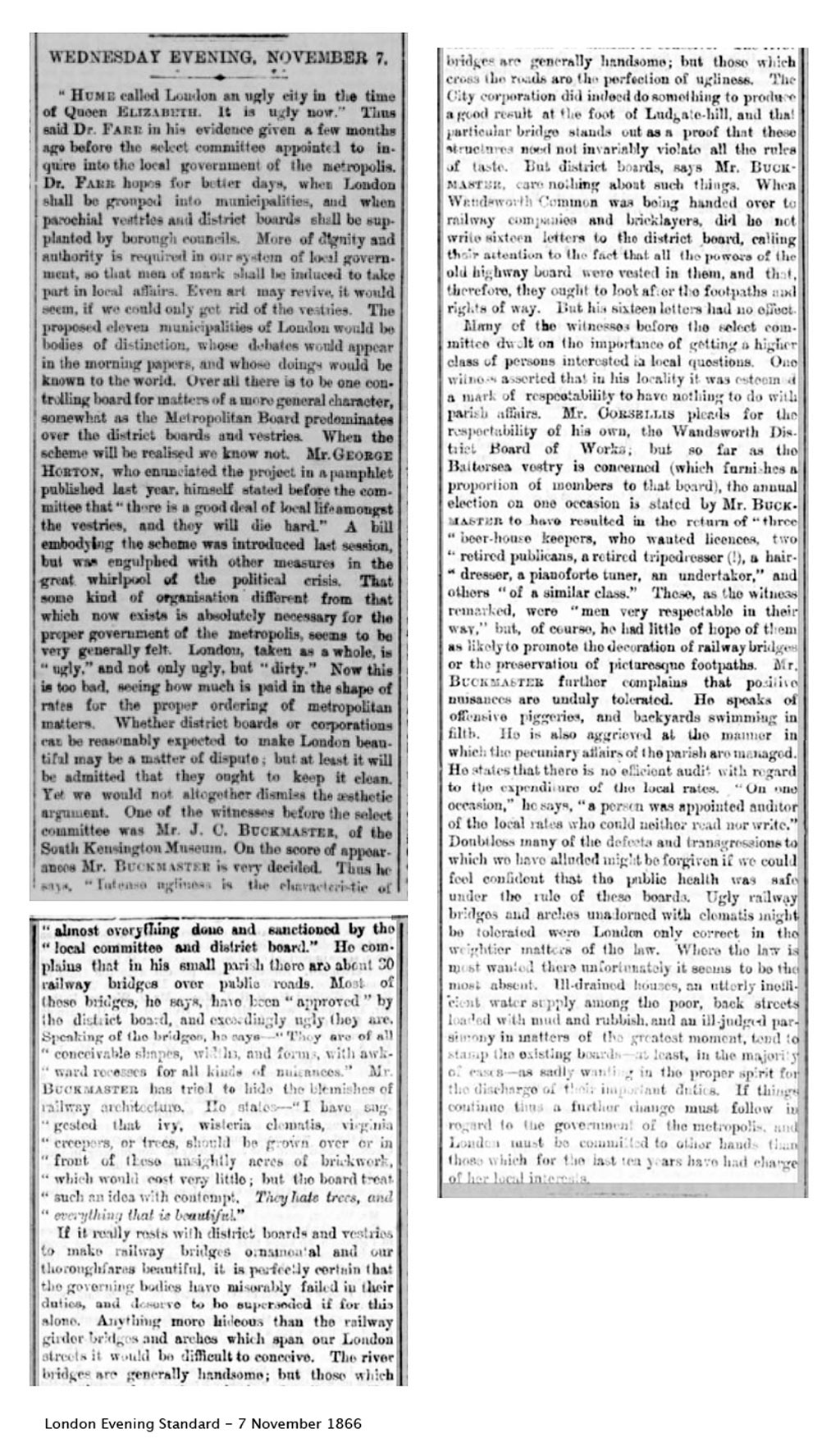
(Click on image to enlarge)
WEDNESDAY EVENING. NOVEMBER 7.
Hume called London an ugly city in the time of Queen Elizabeth. It is ugly now.
Thus said Dr. Farr his evidence given few months ago before the select committee appointed to inquire into the local government of the metropolis. Dr. Farr hopes for better days, when London shall be grouped into municipalities, and when parochial vestries and district boards shall supplanted by borough councils. More of dignity and authority required in our system of local government, so that men of mark shall be induced to take part in local affairs. Even art may revive, it would seem, if we could only got rid the vestries. The proposed eleven municipalities London would be bodies of distinction, whose debates would appear in the morning papers, and whose doings would be known to the world.
Over all there is to be one controlling board for matters of a more general character, somewhat as the Metropolitan Board predominates over the district boards vestries. When the scheme will be realised we know not. Mr. George Horton, who enunciated the project in a pamphlet published last year, himself stated before the committee that there is good deal of local life amongst the vestries, aud they will die hard." A bill embodying scheme was introduced last session, but was engulphed with other measures in the great whirlpool of the political crisis.
That some kind of organisation different from that which now exists is absolutely necessary for the proper government of the metropolis, seems to be very generally felt.<.p
London, taken a whole, is "ugly," and not only ugly, but "dirty." Now this is too bad, seeing how much is paid in the shape of rates for the proper ordering of metropolitan matters. Whether district boards or corporations can be reasonably expected to make London beautiful may be a matter of dispute; but at least it will be admitted that they ought keep it clean. Yet we would not altogether dismiss the aesthetic argument.
One of the witnesses before the select committee was Mr. J.C. Buckmaster, of the South Kensington Museum.
On the score of appearances Mr. Buckmaster is very decided. Thus he says, "Intense ugliness is the characteristic of almost everything done and sanctioned by the local committee and district board." He complains that in his parish there are about 30 railway bridges over roads. Most these bridges, he says, have been approved by the district board, and exceedingly ugly they are. Speaking of the bridges, he says — "They are of all conceivable shapes, widths, and forms, with awkward recesses for all kinds of nuisances."
Mr. Buckmaster has tried to hide the blemishes of architecture. He states — " I have suggested that ivy, wisteria, clematis, virginia creepers, or trees, should be grown over or in front of these unsightly acres of brickwork, which would cost very little; but the board such an idea with contempt.They hate trees, and everything that is beautiful."
If it really matters with district boards and vestries to make railway bridges and our thoroughfares beautiful, it is perfectly certain that governing bodies have miserably failed in their duties, and deserve to be superseded if for this alone.
Anything more hideous than railway girder bridges and arches which span our London streets it would difficult to conceive. The river bridges are generally handsome; but those which cross the roads are the perfection of ugliness. The City corporation did indeed do something to produce a good result the foot of Ludgate-hill, and the particular bridge stands out as a proof that those structures need not invariably violate all rules of taste. But district boards, says Mr. Buckmaster, care nothing about such things.
When Wandsworth Common was being handed over to railway companies and bricklayers, did he not write sixteen letters to the district board, calling their attention to the fact that all the powers of the old highway board were vested in them, and that, therefore, they ought to look after the footpaths and rights of way. But his sixteen letters had no effect.
Many the witnesses before the select committee dwelt on the importance of getting higher class persons interested in local questions. One witness asserted that in his locality it was esteemed a mark of respectability to have nothing to do with parish affairs.
Mr. CORSELLIS pleads for the respectability of his own, the Wandsworth District Board of Works; but so far as the Battersea vestry is concerned (which furnishes a proportion of members to that board), the annual election on one occasion is stated by Mr. BUCKMASTER to have resulted in return of "three beer-house keepers, who wanted licences, two retired publicans, retired tripedresser (!), a hairdresser, a pianoforte tuner, an undertaker," and others "of a similar class."
These, as witness remarked, were "men very respectable in their way," but, of course, had little of hope of them as likely to promote the decoration of railway bridges or the preservation picturesque footpaths.
Mr. BUCKMASTER further complains that positive nuisances are unduly tolerated. He speaks of offensive piggeries, and backyards swimming in filth.
He is also aggrieved at the manner in which the pecuniary affairs of the parish are managed. He states that there is no efficient audit with regard to the expenditure of the local rates. "On one occasion," he says, a person was appointed auditor of the local rates who could neither read nor write."
Doubtless many of the defects and transgressions to which we have alluded might be forgiven if we could feel confident that public health was safe under the rule of these boards.
Ugly railway bridges and arches unadorned with clematis might be tolerated were London only correct in the weightier matters of the law. Where the law is most wanted there unfortunately it seems to be most absent. Ill-drained houses, an utterly inefficient water supply among the poor, back streets loaded with mud and rubbish, and an ill-judged parsimony in matters of greatest moment, tend to stamp the existing boards — at least, in the majority of cases — as sadly wanting in the proper spirit for the discharge of their proper duties.
If things continue thus a further change must follow in the government of metropolis, and London must be committed to other hands than those which for the last years have had of her local interests.
[BNA: Link.]
South London Press — Saturday 17 November 1866
On Saturday, Abraham Smith (12), whose feet were naked, and who appeared destitute of underclothing, and Edward Cherry (13), both living in the gipsy encampment near the Wandsworth Railway Station, were brought up on remand charged with soliciting alms off foot passengers on Wandsworth-common. In answer to questions.
Police-constable Smith, who took the into custody, said he had made inquiries about them. He went to the tent in which Cherry lived, and found his sister in it with child, which was "stiff" from cholera. There was mao in the tent, also suffering from cholera. Prisoner had father, but not a mother. The father had four children, and they all lived and slept in the tent In the case of the other boy he found lu persons, consisting of two families, all sleeping in one small tent. There was piece of canvas in the tent used to separate the families, but it was full of holes.
Mr. Dayman: How do they get their living?
Constable: Ity nuking lew pegs and selling them.
The father of Cherry came forward and stated that he was employed on the sewer works, and that he was obliged to live in the tent, he was unable to obtain lodgings.
Mr. Dayman said there were great complaints about little boys, who, under the pretence of sweeping crossings, made it a means of begging, and they had become quite nuisance to the inhabitants. He would have to send some of those children to reformatory, and make an order upon the parents to contribute towards their maintenance. If the nuisance continued. He told the father of Cherry that It would be better to send his children to school than for them to go out sweeping crossings.
Smith's mother said if his worship would let her boy go this time she would send him to school.
Mr. Dayman remarked that tlie for boys to to school was when they were young. It was their only opportunity, for when they grew older they would expected to earn their owa living. Prisoners were then with caution.
[BNA:
"NOTTIDGE — MOSELEY — ORIGIN OF EARLSFIELD RD — South London Journal — Saturday 1 December 1866 BUILDING APPLICATIONS. Letters from the Metropolitan of Works stated that they had approved of Mr. Maplesden's plan to form a new road (40 feet) along the north-eastern corner of Wandsworth-common, to be called Freemasons-road ; and that they had under consideration a proposal of Mr. William Moseley to form a new road (40 feet) to be called Nottidge road leading, leading out of Garratt-lane, Wandsworth: and an application from Messrs. Hovenden and Heath for permission to bring forward the fronts of three houses, and to erect two new houses in Falcon-lane, to the same line as shops recently sanctioned there. [BNA: Link.] ["
"JCB mentions Bovill, doesn't he? Positively, I think (but could be wrong) The fat that he lived in Wimbledon may be significant
Illustrated London News — Saturday 15 December 1866
[BNA: Link.]
THE NEW CHIEF JUSTICE OF THE COMMON PLEAS.
Sir William Bovill, who has exchanged the precarious office of Solicitor-General to the Administration of Lord Derby for a permanent seat on the judicial bench as Chief Justice of the Court of Common Pleas, is the second surviving son of B. Bovill, Esq., of Dunsford Lodge, Wimbledon, and was born in 1814. He was called to the Bar at the Middle Temple in January, 1841, and went the Home Circuit; he was made a Queen's Counsel in 1855, and is a Bencher of the Middle Temple. Mr. Bovill was first returned to Parliament as member for Guildford, in March, 1857; and married, in 1844, the eldest daughter of J. H. Bolton, Esq., of Lee Park, Blackheath. The members of the Home Circuit entertained the new Lord Chief Justice of the Common Pleas at dinner at the Albion Hotel two or three weeks ago. Mr. Montagu Chambers was in the chair. Three times within the last three years the Home Circuit has thus met to commemorate the promotion of one of its leaders. That Circuit has now six of its old members on the judicial bench, and if we may add to the list the Lord Chief Baron, who travelled the Home Circuit before joining the Norfolk, his name will make a seventh. Of these seven all were present, with the exception of Mr. Justice Lush, whom the Winter Assizes had called away from London. The dinner had been originally arranged to enable the Circuit to congratulate Sir William Bovill his appointment as Solicitor- General ; but, as was remakedby Sir Fitzroy Kelly, "his advancement had outrun their good intentions," and in the interval between the invitation and the dinner he had become Lord Chief Justice of the Common Pleas. In responding to the toast of the evening, Sir William Bovill gave sketch of his progress at the Bar ; and, the fact of his having been a pupil of Mr. Baron Channell having been mentioned, stated that in his chambers he had learnt, what was more valuable to a young barrister than knowledge of special pleading, that the profession of the law was not inconsistent with high conscientiousness and enlarged benevolence. He dwelt slightly on his political career, remarking, however, that when he, from SH IWILLIAM BOVILL, THE NEW CHIEF JUSTICE OF THE COUBT OF COMMON PLEAS, -v J-> -Vi*"
[UNKNOWN PUBLICATION — header not detected. Please review.]
"allen buckmaster battersea vestry 1866
[BNA: Link.]
[UNKNOWN PUBLICATION — header not detected. Please review.]
"A possible vignette? An extract of 1866 — Gypsy Life As It IS
[UNKNOWN PUBLICATION — header not detected. Please review.]
" target="_blank">Link,]
"