Wandsworth Common

1938

Daily Mirror

Hurt Boy's 'Who Won?'
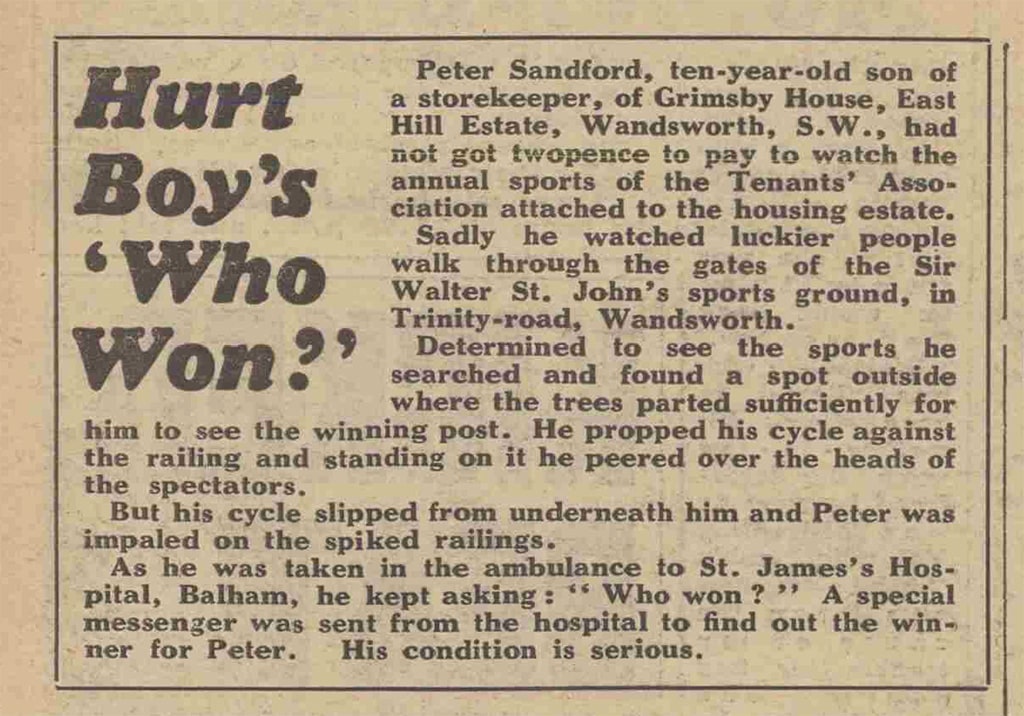
Daily Mirror cutting: Hurt Boy's 'Who Won?', 16 August 1938
Daily Mirror, 16 August 1938.

Peter Sandford, ten-year-old son of a storekeeper, of Grimsby House, East Hill Estate, Wandsworth, S.W., had not got twopence to pay to watch the annual sports of the Tenants' Association attached to the housing estate.

Sadly he watched luckier people walk through the gates of the Sir Walter St. John's sports ground, in Trinity-road, Wandsworth.

Determined to see the sports he searched and found a spot outside where the trees parted sufficiently for him to see the winning post. He propped his cycle against the railing and standing on it he peered over the heads of the spectators.

But his cycle slipped from underneath him and Peter was impaled on the spiked railings.

As he was taken in the ambulance to St. James's Hospital, Balham, he kept asking: "Who won?" A special messenger was sent from the hospital to find out the winner for Peter. His condition is serious.
[BNA link to be verified.]
Fulham Chronicle

NATIONAL CYCLISTS' UNION. The South-Western Section of the National Cyclists Union (private members) had a busy time last week-end. Seven different events were organised for their benefit, consisting of four separate runs on Sunday, a youth hostel weekend, and the Sorian 200 [?] and ladies' 15 time trial.

The social section, taking full advantage of the last few days of summer, were scheduled for a coastal trip and, leaving London Saturday afternoon, the YHA members wended their way through Mentsham, Lingfield, and Ashdown Forest, eventually arriving at the hostel at Cross-in-Hand about [8] pm.

On Sunday the run was continued to Pevensey Bay, the ultimate venue, and the party were joined by other members of the social section who had left London [early] that morning. About [4] pm the section took to the road again, going to Ardingly, the tea-place, via Lewes. A fast run home through Horley and Redhill, with the members dispersing at Mitcham, formed the end of a very happy and jolly week-end awheel. The [hard-riders] went [to] Pangbourne; the [tandems] went to [Ewhurst], [having tea] at Shere; and the Intermediates, most of whom were either participating in the [300] time trial or acting as marshals at that event, held an impromptu run.

Next Sunday five separate runs will start from Marcilly-road, Wandsworth Common (the section's new meeting place).

The social section, meeting at 8.45 a.m., are going to Haslemere, tea being booked at the "Prince of Wales," Shere, and the Intermediates, starting at 7 a.m., have a run to Winchester, tea for them being at the "Broadwater Hotel," Godalming.

The hardriders and tandems will both meet at 7.45 a.m., the former for the "skipper's day out" and the latter for Goring Gap, with tea at "Dog and Duck," Warnham.

There will also be a ladies' run, "Gracie's gruelling grind," leaving Marcilly-road at 9 a.m., tea for them being at Shere with the socials.

BNA link
South Western Star

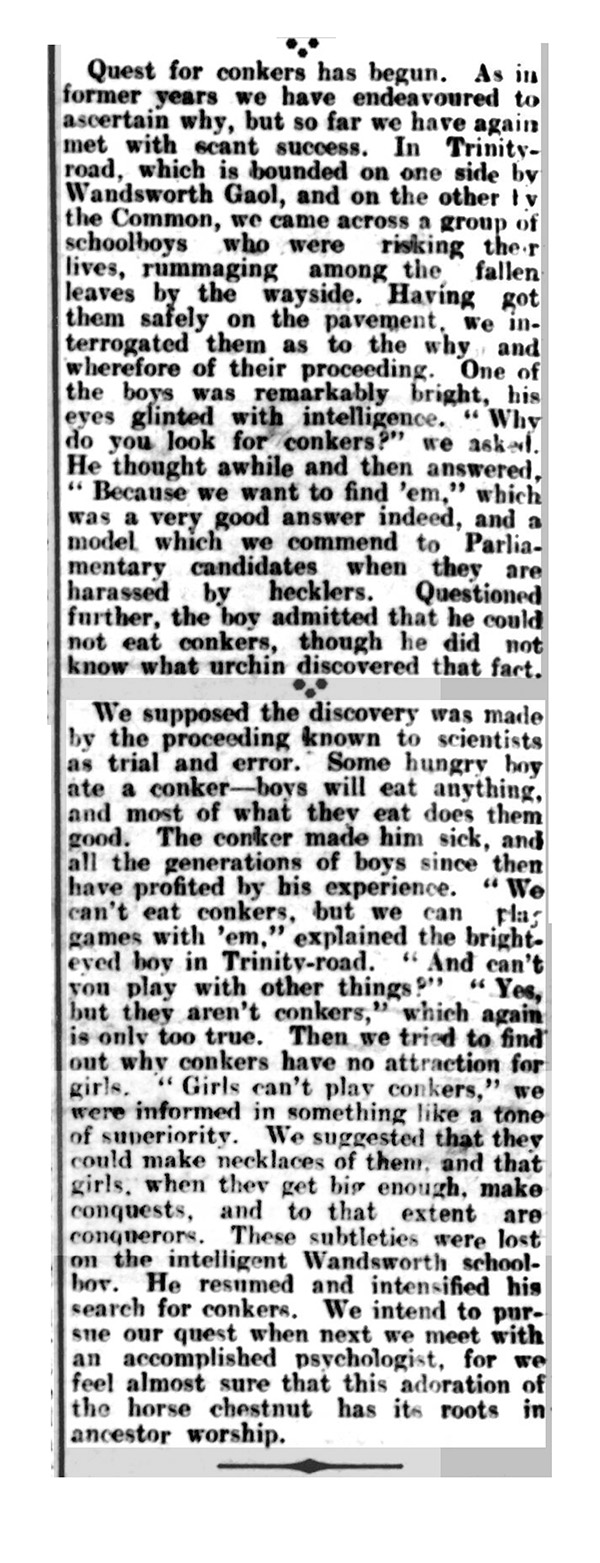
Quest for conkers has begun. As in former years we have endeavoured to ascertain why, but so far we have again met with scant success. In Trinity-road, which is bounded on one side by Wandsworth Gaol, and on the other by the Common, we came across a group of schoolboys who were risking their lives, rummaging among the fallen leaves by the wayside. Having got them safely on the pavement, we interrogated them as to the why and wherefore of their proceeding. One of the boys was remarkably bright, his eyes glinted with intelligence. "Why do you look for conkers?" we asked. He thought awhile and then answered, "Because we want to find 'em," which was a very good answer indeed, and a model which we commend to Parliamentary candidates when they are harassed by hecklers. Questioned further, the boy admitted that he could not eat conkers, though he did not know what urchin discovered that fact.

South Western Star cutting: Quest for conkers, 23 September 1938
South Western Star, 23 September 1938.

We supposed the discovery was made by the proceeding known to scientists as trial and error. Some hungry boy ate a conker — boys will eat anything, and most of what they eat does them good. The conker made him sick, and all the generations of boys since then have profited by his experience. "We can't eat conkers, but we can play games with 'em," explained the bright-eyed boy in Trinity-road. "And can't you play with other things?" "Yes, but they aren't conkers," which again is only too true. Then we tried to find out why conkers have no attraction for girls. "Girls can't play conkers," we were informed in something like a tone of superiority. We suggested that they could make necklaces of them, and that girls, when they get big enough, make conquests, and to that extent are conquerors. These subtleties were lost on the intelligent Wandsworth schoolboy. He resumed and intensified his search for conkers. We intend to pursue our quest when next we meet with an accomplished psychologist, for we feel almost sure that this adoration of the horse chestnut has its roots in ancestor worship.

[BNA link to be verified.]
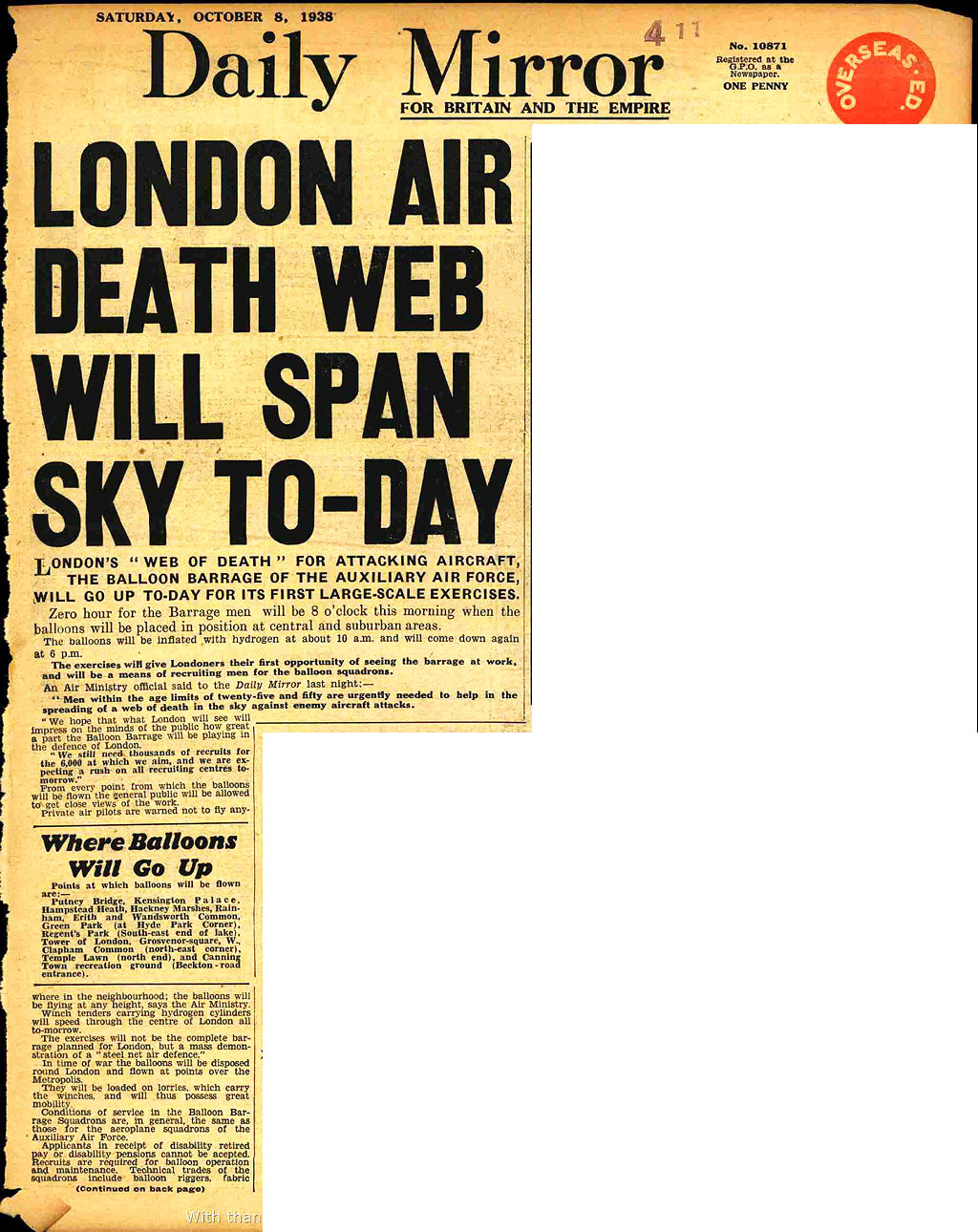
Daily Mirror

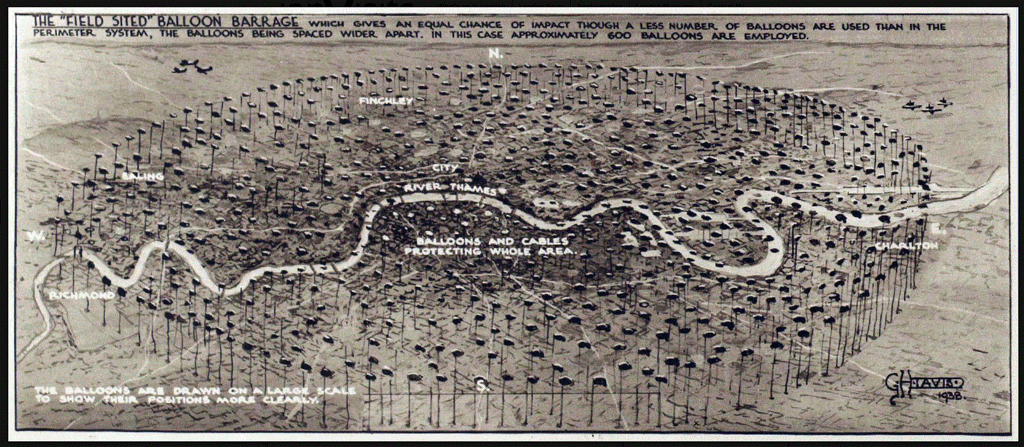
LONDON AIR DEATH WEB WILL SPAN SKY TO-DAY. London's "web of death" for attacking aircraft, the Balloon Barrage of the Auxiliary Air Force, will go up to-day for its first large-scale exercises.

Daily Mirror cutting: London Air Death Web, 8 October 1938
Daily Mirror, 8 October 1938.

Zero hour for the Barrage men will be 8 o'clock this morning when the balloons will be placed in position at central and suburban areas. The balloons will be inflated with hydrogen at about 10 a.m. and will come down again at 6 p.m. The exercises will give Londoners their first opportunity of seeing the barrage at work, and will be a means of recruiting men for the balloon squadrons.

An Air Ministry official said: "Men within the age limits of twenty[-five] and fifty are urgently needed to help in the spreading of a web of death in the sky. We hope that what London will see will impress on the minds of the public how great a part the Balloon Barrage will be playing in the defence of London. We still need thousands of recruits for the 6,000 at which we aim, and we are expecting a rush on all recruiting centres tomorrow."

From every point from which the balloons will be flown the general public will be allowed to get close views of the work. Private air pilots are warned not to fly anywhere in the neighbourhood; the balloons will be flying at any height, says the Air Ministry.

Points at which balloons will be flown: Putney Bridge, Kensington Palace, Hampstead Heath, Hackney Marshes, Rainham, Erith and Wandsworth Common, Green Park (at Hyde Park Corner), Regent's Park (south-east end of lake), Tower of London, Grosvenor-square W., Clapham Common (north-east corner), Temple Lawn (north end), and Canning Town recreation ground (Beckton-road entrance).

Winch tenders carrying hydrogen cylinders will speed through the centre of London all to-morrow. The exercises will not be the complete barrage planned for London, but a mass demonstration of a "steel net air defence." In time of war the balloons will be disposed round London and flown at points over the Metropolis. They will be loaded on lorries, which carry the winches, and will thus possess great mobility.

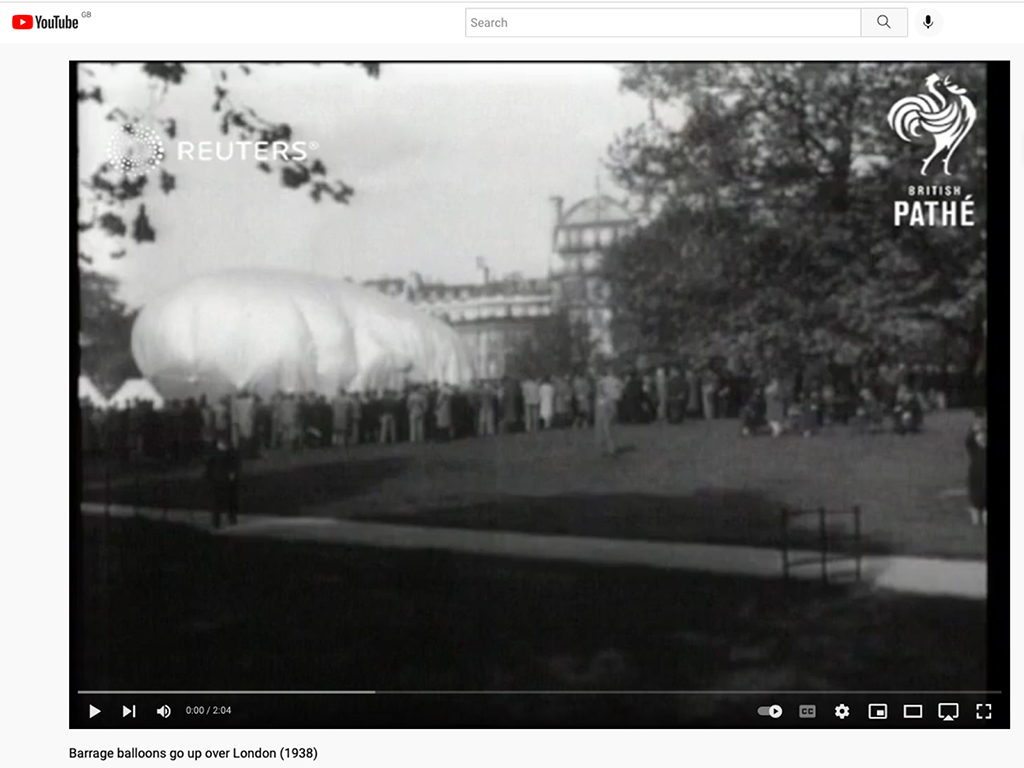
[See also: British Pathé / Reuters film "Barrage balloons go up over London (1938)", 2 min 4 sec.]

BNA link
South Western Star

THE AERIAL BARRAGE. Balloon Breaks Away at Clapham Common.

South Western Star cutting: The Aerial Barrage — Balloon Breaks Away, 14 October 1938
South Western Star, 14 October 1938.
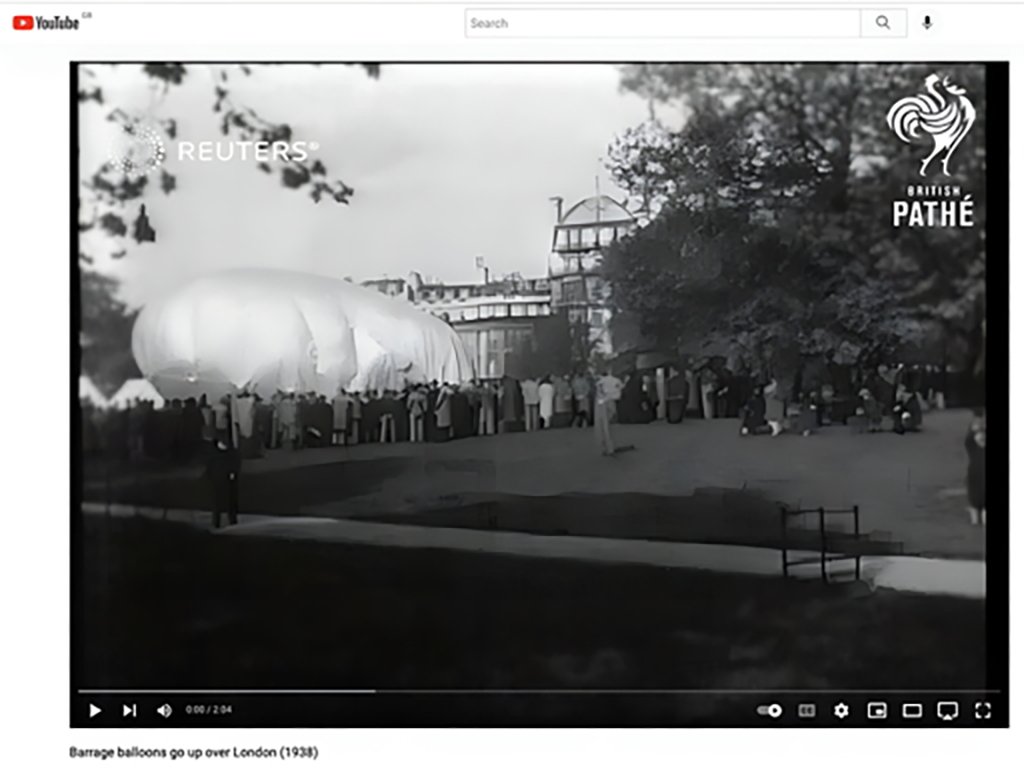
British Pathe still: barrage balloons over London, 1938
British Pathé film still: barrage balloons being deployed, 1938.
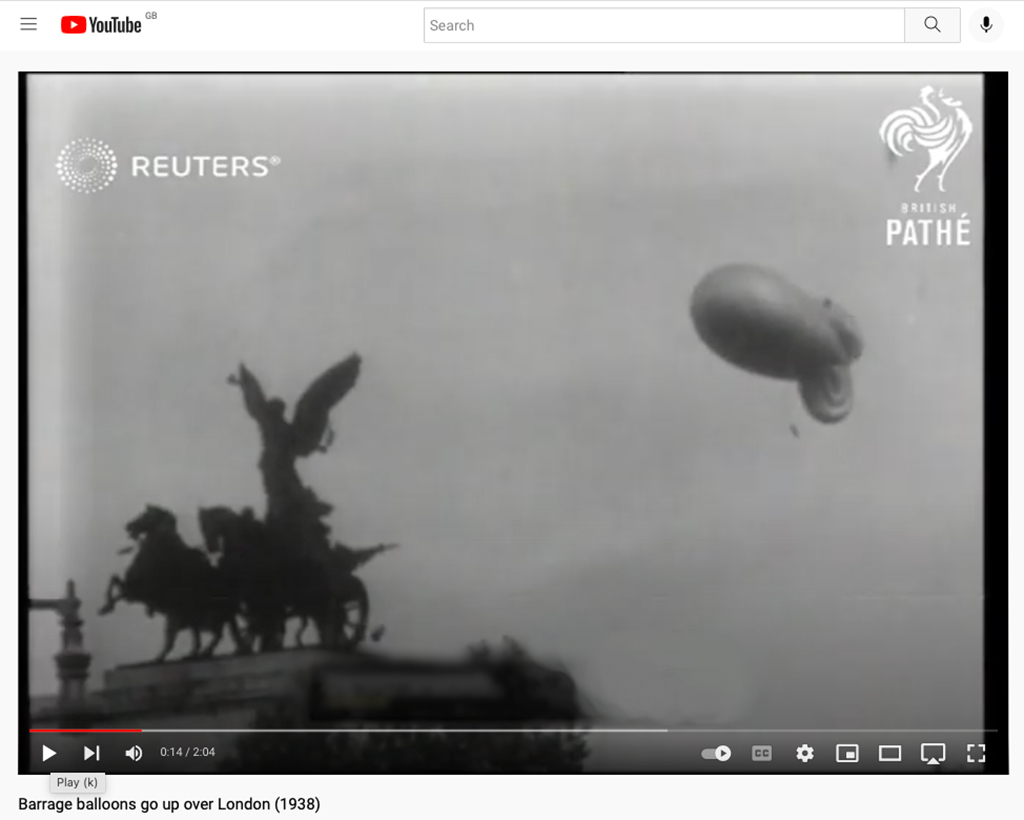
British Pathe still: barrage balloon, 1938
British Pathé film still: barrage balloon, 1938.
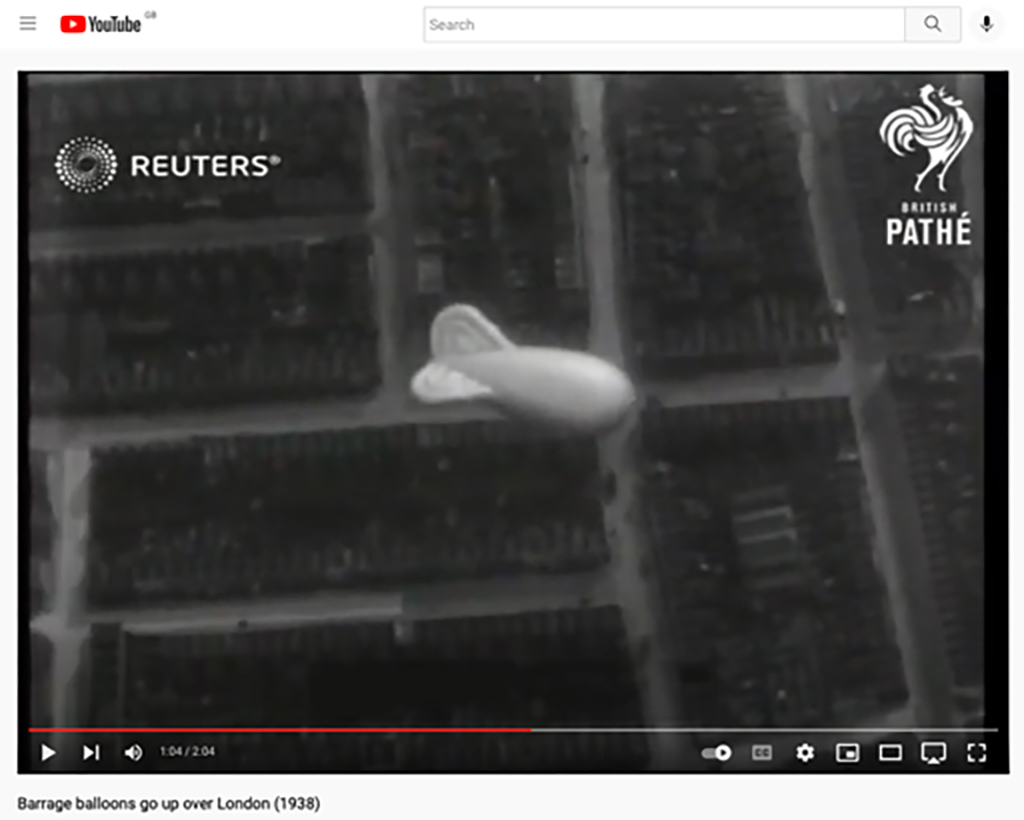
British Pathe still: barrage balloon, 1938
British Pathé film still: barrage balloon, 1938.
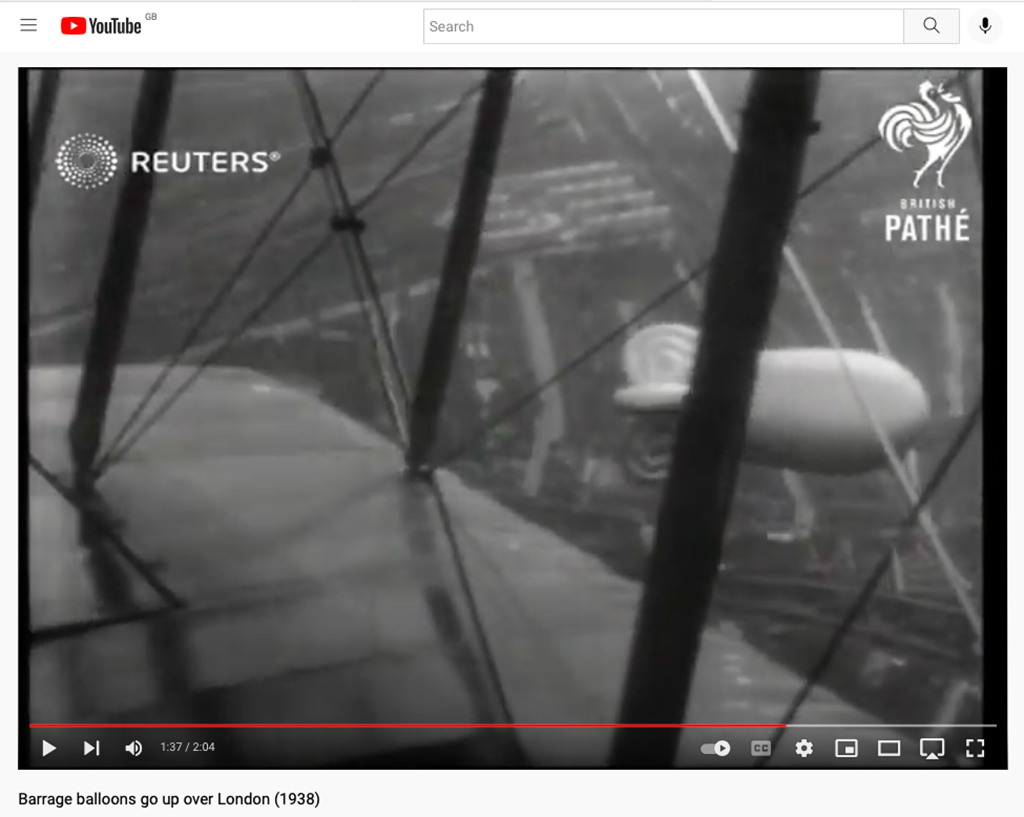
British Pathe still: barrage balloon, 1938
British Pathé film still: barrage balloon, 1938.
British Pathe still: barrage balloons in field position, 1938
British Pathé film still: barrage balloons in field position, 1938.
Barrage balloons field-sited, Wandsworth Common, 1938
Barrage balloons in field position, Wandsworth Common, 1938. [Requires prep-images.py conversion from .png]

The balloon barrage demonstration on Saturday attracted much attention in the boroughs of Battersea and Wandsworth. An unexpected mishap caused a balloon above Clapham Common to break away. Also a balloon further east. The balloons from Clapham Common were caught by onlookers at Stockwell and anchored to some garden rails. They were then held down; raised by the strain, but they held. An army lorry arrived and towed it back. Another balloon which broke loose outside Lambeth had a short spell of freedom. The cable, as it broke loose, became entangled in the superstructure of a factory roof and was held firm long enough for members of the crew to climb and secure it.

At 2 p.m., some hours earlier than had originally been arranged, the practice ended and all the balloons were brought in. By this time those which had broken loose were secured.

TOO MUCH WIND — NOT ENOUGH LIGHT. The reason for the early termination was stated to be too much wind and failure of light, creating an element of danger for aircraft over the city. This was the first daylight rehearsal of the raising of part of the barrage, the object of which was to throw up a barrier around London against enemy aircraft.

The Air Ministry had warned pilots that the balloons would be flown at any height in the neighbourhood of Putney Bridge and Clapham and Wandsworth Commons. Each balloon, when inflated, measured about 31ft. in length, with a circumference of 70ft. They were raised and wound at the rate of about 500ft. a minute, so that in three minutes it was hovering overhead at 5,000ft.

OBJECT OF THE BARRAGE. The object of the barrage is to force enemy aircraft to a height at which they can be effectively engaged by anti-aircraft guns. Should an enemy plane come in contact with any of the cables which anchor the balloons it would be destroyed. The total personnel eventually employed will be something like 5,000 officers and men. The height of the balloons flown on Saturday was from 4,000 to 7,000 feet.

The Air Ministry announces that results of the small scale exercise for the London area carried out on Saturday are satisfactory and useful.

AUXILIARY AIR FORCE — RECRUITS WANTED. Applications are required for duties in connection with balloon operations and maintenance. Technical trades of the squadrons include balloon riggers, fabric workers, rigging workers, and hydrogen workers. Ages 25 to 50.

[Note: RAF aerial photos of the Common show barrage balloons in position.]

BNA link