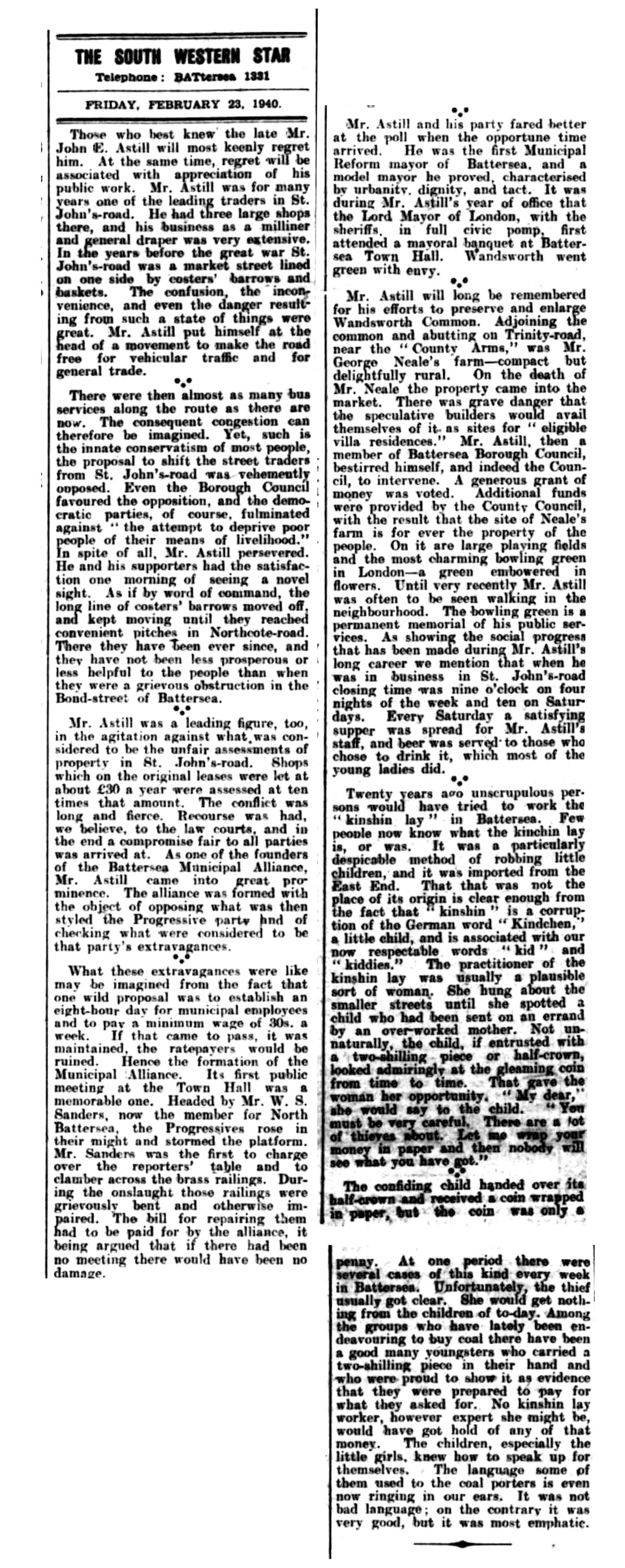
An extended obituary of John E. Astill, for many years one of the leading traders in St. John's-road, Battersea, and a prominent figure in local public life. He is particularly remembered here for his role in saving the site of George Neale's farm — adjoining the Common and abutting on Trinity-road, near the "County Arms" — from speculative builders who had earmarked it for "eligible villa residences." Astill, then a member of Battersea Borough Council, mobilised the Council to intervene; money was voted, additional funds provided by the County Council, and the site secured for the people. On it were laid out large playing fields and what the Star calls "the most charming bowling green in London — a green embowered in flowers."
The article also recalls his earlier campaign to clear costers' barrows from St. John's-road; his role as a founder of the Battersea Municipal Alliance (formed to oppose the Progressive party and its proposals for an eight-hour municipal working day and a minimum wage of 30s. a week); and his distinction as the first Municipal Reform mayor of Battersea — during whose year of office the Lord Mayor of London first attended a mayoral banquet at Battersea Town Hall, to Wandsworth's considerable envy.
A long closing digression — topical in the coal-shortage winter of 1939–40 — describes the "kinshin lay," a Victorian confidence trick worked on children sent to run errands, in which a plausible woman would offer to "wrap" a half-crown for safe-keeping and return a paper-wrapped penny in its place. The Star notes that modern Battersea children, hardened by wartime queuing for coal, would have given short shrift to any such operator.
Full text
Those who best knew the late Mr. John E. Astill will most keenly regret him. At the same time, regret will be associated with appreciation of his public work. Mr. Astill was for many years one of the leading traders in St. John's-road. He had three large shops there, and his business as a milliner and general draper was very extensive. In the years before the great war St. John's-road was a market street lined on one side by costers' barrows and baskets. The confusion, the inconvenience, and even the danger resulting from such a state of things were great. Mr. Astill put himself at the head of a movement to make the road free for vehicular traffic and for general trade.
There were then almost as many bus services along the route as there are now. The consequent congestion can therefore be imagined. Yet, such is the innate conservatism of most people, the proposal to shift the street traders from St. John's-road was vehemently opposed. Even the Borough Council favoured the opposition, and the democratic parties, of course, fulminated against "the attempt to deprive poor people of their means of livelihood." In spite of all, Mr. Astill persevered. He and his supporters had the satisfaction one morning of seeing a novel sight. As if by word of command, the long line of costers' barrows moved off, and kept moving until they reached convenient pitches in Northcote-road. There they have been ever since, and they have not been less prosperous or less helpful to the people than when they were a grievous obstruction in the Bond-street of Battersea.
Mr. Astill was a leading figure, too, in the agitation against what was considered to be the unfair assessments of property in St. John's-road. Shops which on the original leases were let at about £30 a year were assessed at ten times that amount. The conflict was long and fierce. Recourse was had, we believe, to the law courts, and in the end a compromise fair to all parties was arrived at. As one of the founders of the Battersea Municipal Alliance, Mr. Astill came into great prominence. The alliance was formed with the object of opposing what was then styled the Progressive party and of checking what were considered to be that party's extravagances.
What these extravagances were like may be imagined from the fact that one wild proposal was to establish an eight-hour day for municipal employees and to pay a minimum wage of 30s. a week. If that came to pass, it was maintained, the ratepayers would be ruined. Hence the formation of the Municipal Alliance. Its first public meeting at the Town Hall was a memorable one. Headed by Mr. W. S. Sanders, now the member for North Battersea, the Progressives rose in their might and stormed the platform. Mr. Sanders was the first to charge over the reporters' table and to clamber across the brass railings. During the onslaught those railings were grievously bent and otherwise impaired. The bill for repairing them had to be paid for by the alliance, it being argued that if there had been no meeting there would have been no damage.
Mr. Astill and his party fared better at the poll when the opportune time arrived. He was the first Municipal Reform mayor of Battersea, and a model mayor he proved, characterised by urbanity, dignity, and tact. It was during Mr. Astill's year of office that the Lord Mayor of London, with the sheriffs, in full civic pomp, first attended a mayoral banquet at Battersea Town Hall. Wandsworth went green with envy.
Mr. Astill will long be remembered for his efforts to preserve and enlarge Wandsworth Common. Adjoining the common and abutting on Trinity-road, near the "County Arms," was Mr. George Neale's farm — compact but delightfully rural. On the death of Mr. Neale the property came into the market. There was grave danger that the speculative builders would avail themselves of it as sites for "eligible villa residences." Mr. Astill, then a member of Battersea Borough Council, bestirred himself, and indeed the Council, to intervene. A generous grant of money was voted. Additional funds were provided by the County Council, with the result that the site of Neale's farm is for ever the property of the people. On it are large playing fields and the most charming bowling green in London — a green embowered in flowers. Until very recently Mr. Astill was often to be seen walking in the neighbourhood. The bowling green is a permanent memorial of his public services. As showing the social progress that has been made during Mr. Astill's long career we mention that when he was in business in St. John's-road closing time was nine o'clock on four nights of the week and ten on Saturdays. Every Saturday a satisfying supper was spread for Mr. Astill's staff, and beer was served to those who chose to drink it, which most of the young ladies did.
Twenty years ago unscrupulous persons would have tried to work the "kinshin lay" in Battersea. Few people now know what the kinchin lay is, or was. It was a particularly despicable method of robbing little children, and it was imported from the East End. That that was not the place of its origin is clear enough from the fact that "kinshin" is a corruption of the German word "Kindchen," a little child, and is associated with our disreputable words "kid" and "kiddies." The practitioner of the kinshin lay was usually a plausible sort of woman. She hung about the smaller streets until she spotted a child who had been sent on an errand by an over-worked mother. Not unnaturally, the child, if entrusted with a two-shilling piece or half-crown, looked admiringly at the gleaming coin from time to time. That gave the woman her opportunity. "My dear," she would say to the child. "You must be very careful. There are a lot of thieves about. Let me wrap your money in paper and then nobody will see what you have got."
The confiding child handed over its half-crown and received a coin wrapped in paper, but the coin was only a penny. At one period there were several cases of this kind every week in Battersea. Unfortunately, the thief usually got clear. She would get nothing from the children of to-day. Among the groups who have lately been endeavouring to buy coal there have been a good many youngsters who carried a two-shilling piece in their hand and who were proud to show it as evidence that they were prepared to pay for what they asked for. No kinshin lay worker, however expert she might be, would have got hold of any of that money. The children, especially the little girls, knew how to speak up for themselves. The language some of them used to the coal porters is even now ringing in our ears. It was not bad language; on the contrary it was very good, but it was most emphatic.