Go to Goodwins — cycles at 15 Bellevue Road, Wandsworth Common
Norwood News, Friday 11 January 1952
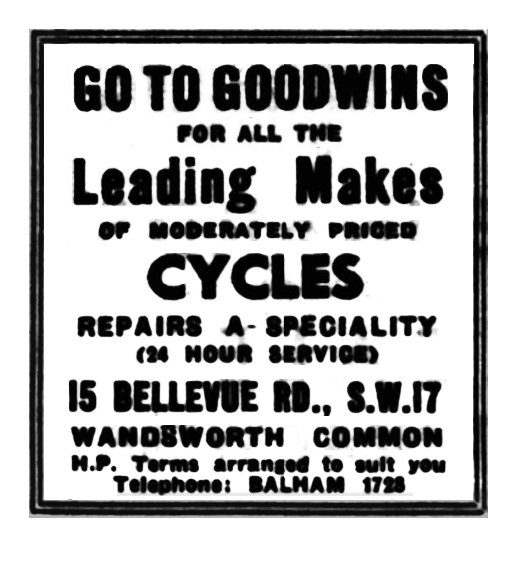
"Go to Goodwins for all the Leading Makes of Moderately Priced Cycles. Repairs a Speciality (24 Hour Service). 15 Bellevue Rd., S.W.17, Wandsworth Common. H.P. Terms arranged to suit you. Telephone: Balham 1728."
[Bellevue Road runs along the south side of the Common. A cycle shop at this address with a 24-hour repair service and hire-purchase terms speaks to the importance of the bicycle as everyday transport in the early 1950s, well before the age of mass car ownership.]
Friday 25 January 1952
South Western Star
Three youths sleeping under the bandstand — blankets in the fork of a tree
Three youths were arrested while walking towards Brighton, and charged with stealing from an unattended motor car in Fernwood Avenue, Streatham, and with breaking into a prefab in Cornford Grove, Balham. Lawrence Vogt (17) and Patrick Kinsella (16) were further alleged to have been sleeping under the bandstand on Wandsworth Common.
Summer bandstand programme — British Imperial Military Band for Wandsworth Common
The summer bandstand programme for the open spaces of South London was announced. Wandsworth Common was to be entertained by the British Imperial Military Band. Neighbouring commons had: Streatham Common — John Pritchard's Orchestra; Tooting Common — Strelsky's Cossack Orchestra. "All Aboard," a popular open-air show, was also coming to Clapham Common.
Three men who gave the Cabinet jitters — interrogated at the Royal Victorian Patriotic School
The Voice (Hobart, Tasmania), Saturday 20 September 1952. Article by Robert Glenton.
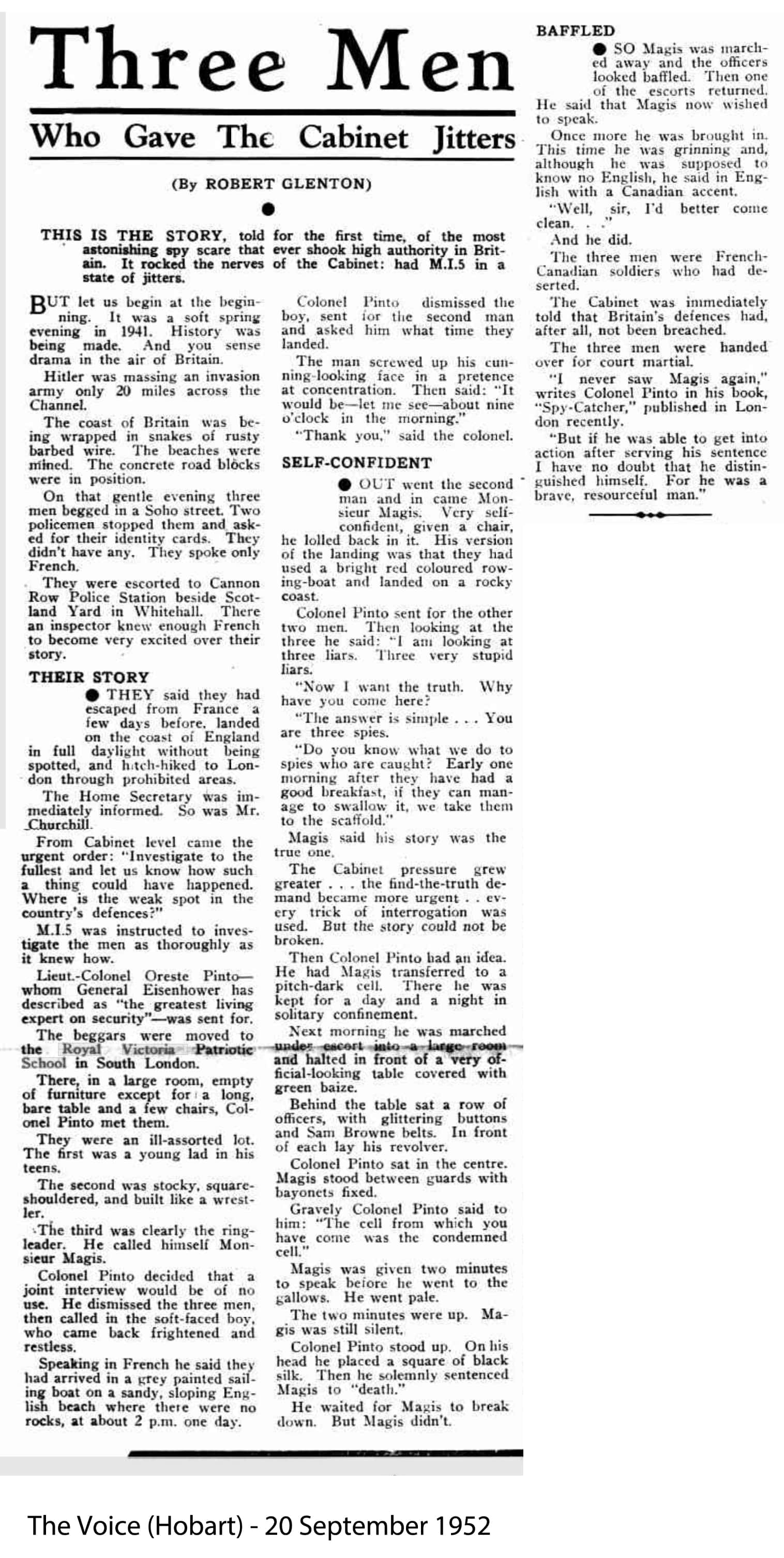
An account, by Robert Glenton, of the most astonishing spy scare ever to have shaken high authority in Britain. Three men had escaped from France and landed on the coast of England at daylight. Spotted and hitch-hiking to London, they were stopped by two policemen who asked for their identity cards — they had none, and spoke only French. Escorted to Cannon Row Police Station, then Scotland Yard, they were found to be carrying no papers. The Home Secretary was immediately informed. M.I.5 moved in, and from Cabinet level came the word: "Investigate the men as thoroughly as anything could be." They were moved to the Royal Victorian Patriotic School in South London — on the edge of Wandsworth Common.
In a large room furnished with only a long bare table and a few chairs, Colonel Pinto conducted the joint interview. He had been sent for on the authority of General Eisenhower, who had described him as "the greatest expert on security." The three men proved to be ill-assorted: one young and stocky like a wrestler; one thin and self-confident, clearly the ringleader; the third a soft-faced boy who came back frightened and restless. Colonel Pinto dismissed the first, called in the second man, and asked what time they had landed. The man screwed up his cunning-looking face in a grimace of concentration, then said: "It was just three o'clock in the morning." — "Thank you," said the colonel.
The self-confident man's nerve slowly grew greater as the find-the-truth device was used. Pinto tried one last trick — and the man broke. The three turned out to be French-Canadian soldiers who had deserted. The Cabinet was immediately told that Britain's defences had not, after all, been breached. The men were handed over for court martial.
[The Royal Victorian Patriotic Building on Wandsworth Common — built in 1857 as an asylum for the daughters of soldiers killed in the Crimean War — had a long intelligence history. During the Second World War it served as the principal MI5 reception and interrogation centre for all refugees and escapees arriving in Britain. This article, published in Australia seven years later, suggests the building continued to be used for security purposes into the early 1950s. The colonel in the story is almost certainly Colonel Oreste Pinto, the Dutch-born British counter-intelligence officer and author of Spy-Catcher (1952).]
Friday 3 October 1952
South Western Star
Mixed feelings at this show — the Earlsfield Men's Institute flower and vegetable show
South Western Star, Friday 3 October 1952
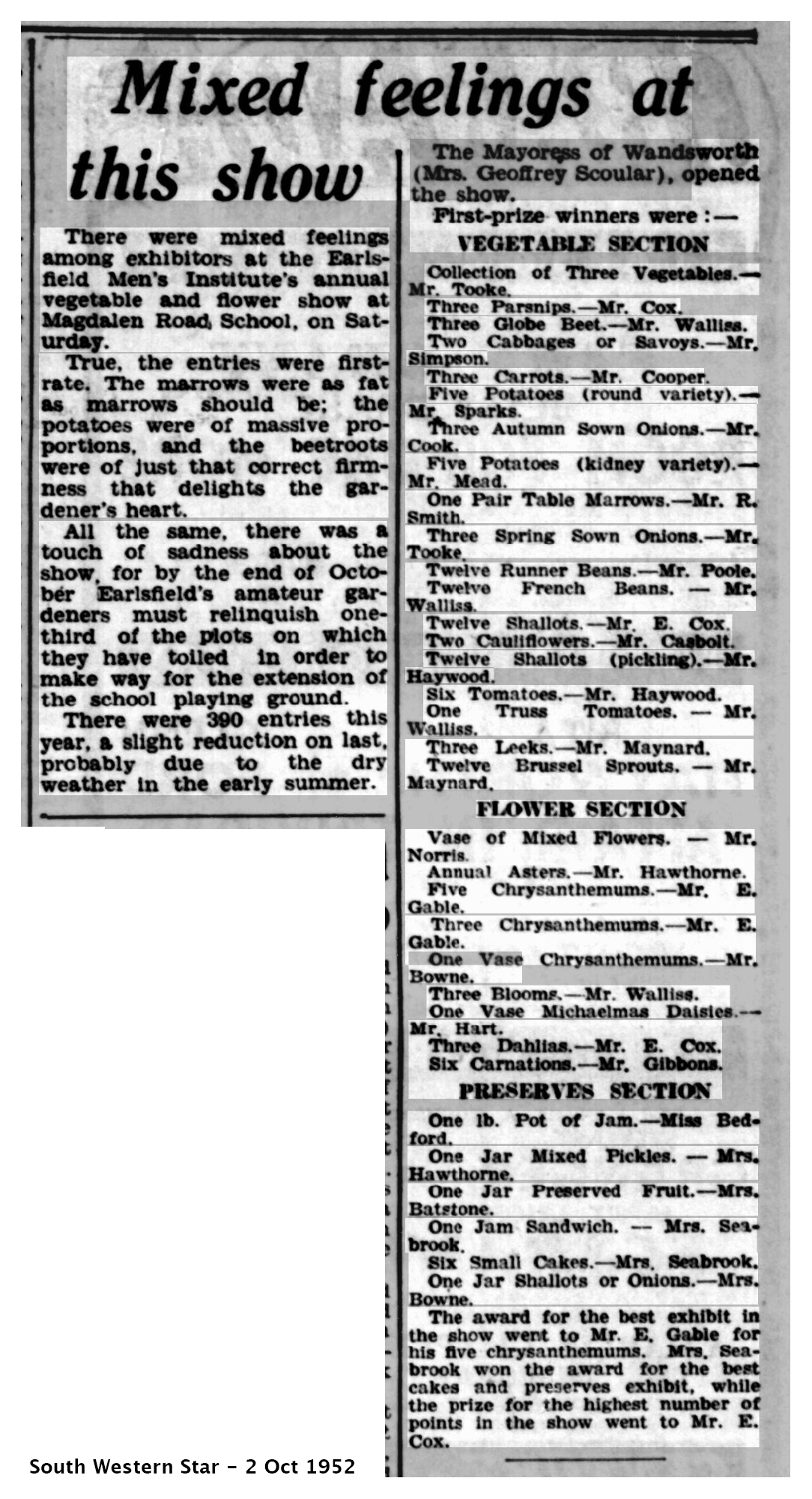
The Earlsfield Men's Institute held its annual vegetable and flower show at Magdalen Road School on Saturday. The Mayoress of Wandsworth (Mrs Geoffrey Scoular) opened the show. The produce was first-rate — "the marrows were as fat as marrows should be" — but there was a touch of sadness: by the end of October, Earlsfield's amateur gardeners would have to relinquish one-third of the plots on which they had been toiling, to make way for an extension of the school playing ground. There were 390 entries, a slight reduction on the previous year, probably due to the dry early summer.
First-prize winners included, in the Vegetable Section: Three Vegetables (Mr Tooke); Three Parsnips (Mr Cox); Three Globe Beet (Mr Walliss); Two Cabbages or Savoys (Mr Simpson); Three Carrots (Mr Cooper); Five Potatoes, round variety (Mr Sparks); Five Potatoes, kidney variety (Mr Mead); One Pair Table Marrows (Mr R. Smith); Twelve Runner Beans (Mr Poole); Twelve French Beans (Mr Walliss); Two Cauliflowers (Mr Casbolt); Six Tomatoes (Mr Haywood); Three Leeks (Mr Maynard); Twelve Brussel Sprouts (Mr Maynard). In the Flower Section: Mixed Flowers (Mr Norris); Annual Asters (Mr Hawthorne); Five Chrysanthemums (Mr E. Gable); Three Chrysanthemums (Mr E. Gable); One Vase Chrysanthemums (Mr Bowne); Three Blooms (Mr Walliss); One Vase Michaelmas Daisies (Mr Hart); Three Dahlias (Mr E. Cox); Six Carnations (Mr Gibbons). In the Preserves Section: One lb. Pot of Jam (Miss Bedford); One Jar Mixed Pickles (Mrs Hawthorne); One Jar Preserved Fruit (Mrs Batstone); One Jam Sandwich (Mrs Seabrook); Six Small Cakes (Mrs Seabrook); One Jar Shallots or Onions (Mrs Bowne). The award for the best exhibit in the show went to Mr E. Gable for his five chrysanthemums; Mrs Seabrook won the best cakes and preserves; the highest points overall went to Mr E. Cox.
[Magdalen Road School, Earlsfield, is now known as Beatrix Potter School — named for the author, who spent childhood summers with her family in the area. The allotments mentioned would have been part of the wartime Dig for Victory scheme, many of which were retained into the 1950s on public land.]
Friday 5 December 1952
Press photograph
The Great Smog — London brought to a standstill
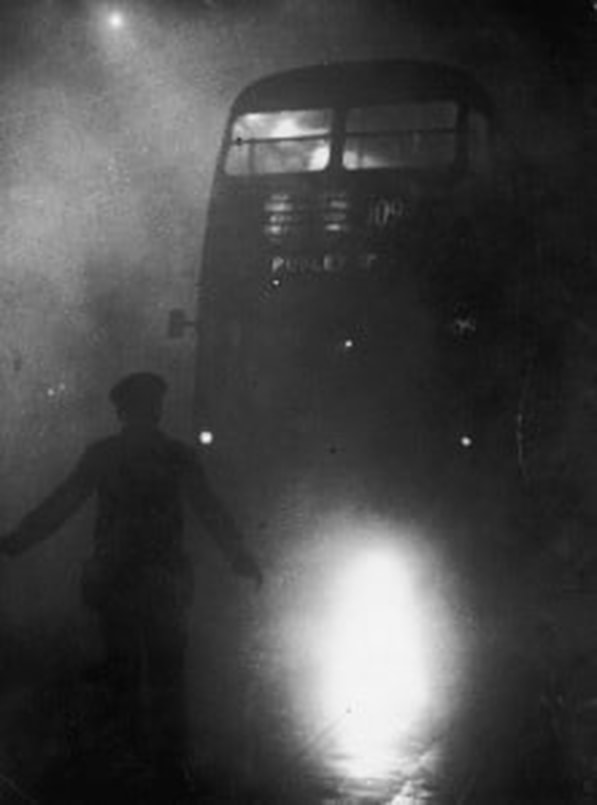
A London bus — destination Purley — looms out of the Great Smog, guided by torchlight. Press photograph, December 1952.
The Great Smog of London descended on the city on the night of 4–5 December 1952 and did not lift until 9 December. A lethal combination of cold windless weather, industrial emissions, and the coal smoke from millions of domestic hearths, it reduced visibility to a few yards. Buses were guided by conductors walking ahead with torches. Cinemas, concert halls, and sports events were abandoned as the smog seeped indoors. At its worst, in the Wandsworth area as elsewhere, it was impossible to see across the street.
The death toll — initially minimised by the government — was enormous. At least 4,000 Londoners died immediately; later studies put the total, including delayed deaths from respiratory illness, at up to 12,000. The disaster led, eventually, to the Clean Air Act of 1956, which prohibited the burning of coal in designated smoke-control areas and effectively ended the era of the London pea-souper.
[The Purley destination board on the bus suggests this photograph was taken somewhere along the south London corridor — a route that would have passed through or near Wandsworth. The image is one of the most iconic press photographs of the period.]
1952 (undated)
Advertisement
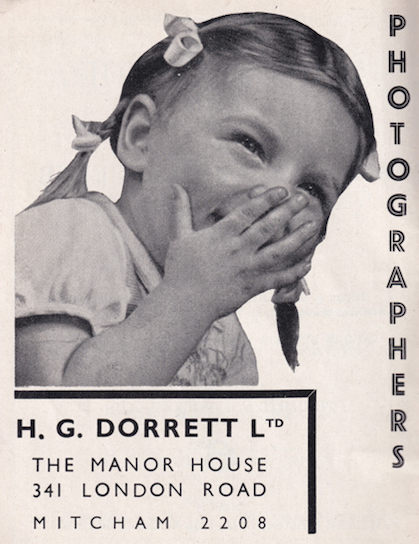
H. G. Dorrett Ltd — photographers at The Manor House, 341 London Road, Mitcham
H. G. Dorrett Ltd, Photographers. 341 London Road, Mitcham. Telephone: Mitcham 2208.
"H. G. Dorrett Ltd. Photographers. The Manor House, 341 London Road, Mitcham 2208."