EVERY June hundreds of people visit the Antique Dealers' Fair which is held at Grosvenor House in Park Lane, London.
There the Great Hall is transformed into a treasure house of objets d'art created before 1830 which draws connoisseurs, collectors, dealers and people from all over the world who are fascinated by the fine craftsmanship of past generations.
Unfortunately, the exhibits on sale exceeded the income of a bachelor girl journalist, so I visited the local antique shops in South London.
Hopeful of acquiring some object of priceless rarity, I questioned the proprietors about the existence of any "bargains" in their stock. Not surprisingly, I was told, with the number of books and articles about antiques and the foraging by international dealers, there are few "finds" in local shops that are ever likely to cause a furore at Christie's or Sotheby's.
Specialise
Nonetheless, there are objects in almost every shop which would delight the collector of specific articles.
One of the most important things in collecting antiques is to specialise in, say, furniture, glassware, silver, porcelain or one of the many thousands of articles sought all over the world these days.
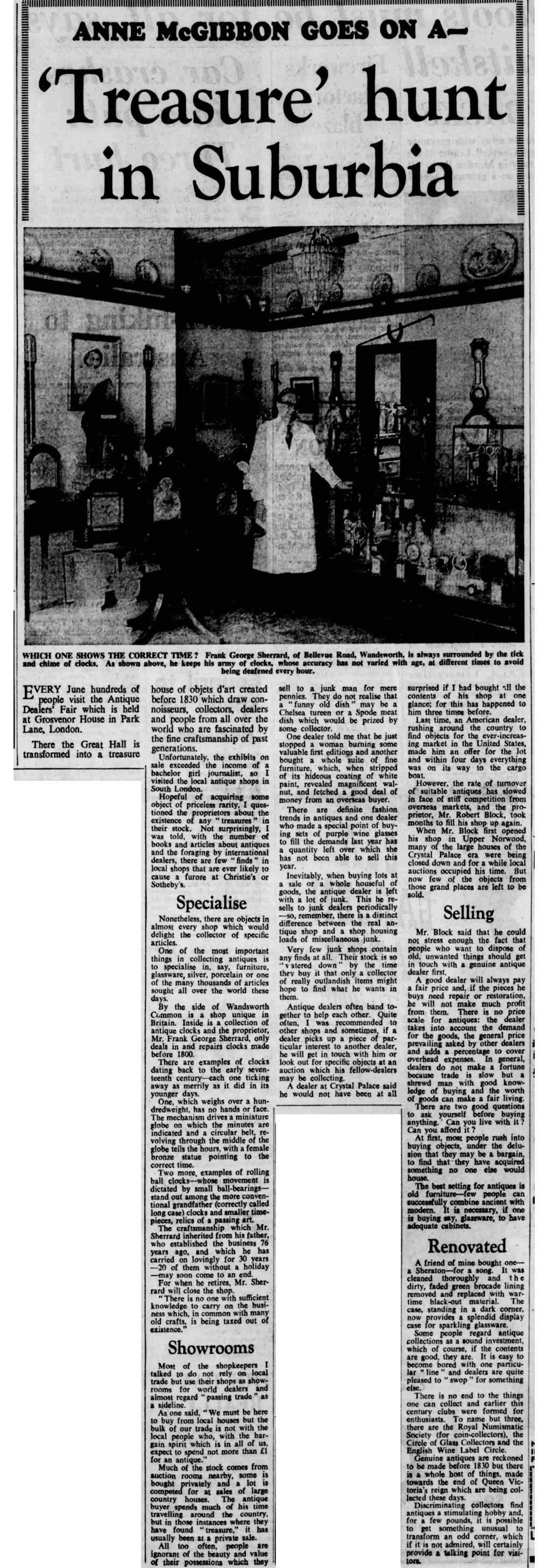
By the side of Wandsworth Common is a shop unique in Britain. Inside is a collection of antique clocks and the proprietor, Mr. Frank George Sherrard, only deals in and repairs clocks made before 1800.
There are examples of clocks dating back to the early seventeenth century. A gilded ticking sphere, as merry as it did in its younger days.
One, which weighs over a hundredweight, has no hands or face. The mechanism drives a miniature globe on which the minutes are indicated and a smaller bell revolving through the middle of the globe tells the hours, with a female bronze statue pointing to the correct time.
There are examples of rolling ball clocks — whose movement is dictated by small ball-bearings — stand out among the more conventional grandfather (correctly called long case) clocks and smaller timepieces, relics of a passing art.
The craftsmanship which Mr. Sherrard inherited from his father, who established the business 70 years ago, and which he has carried on lovingly for 30 years — 20 of them without a holiday — may soon come to an end.
"There is no one with sufficient knowledge to carry on the business which, in common with many old crafts, is being taxed out of existence."
Showrooms
Most of the shopkeepers I talked to do not rely on local trade but use their shops as showrooms for world dealers and almost regard "passing trade" as a sideline.
One said: "We must be here to buy from local houses but the bulk of our trade is not with the local people who, with the bargain spirit which is in all of us, expect to spend not more than £1 for an antique."
Much of the stock comes from auction rooms nearby, some is bought privately and is often competed for at sales of large country houses. The antique buyer spends much of his time travelling around the country, for in those instances where they have found "treasure", it has always been in a private sale.
Too often, people are ignorant of the treasures hidden in their possessions which they sell to a junk man for mere pennies. They do not realise that a "funny old dish" may be a Chelsea tureen or a Spode meat dish which would be prized by some collector.
One dealer told me that he just stopped a woman bartering some valuable first editions and another bought a whole suite of fine furniture, which, when stripped of its hideous coating of white paint, revealed magnificent value, and fetched a good deal of money from an overseas buyer.
There are definite fashion trends in antiques and one dealer who made a special point of buying sets of purple wine glasses to fill the demands last year has a quantity left over which she has not been able to sell this year.
Inevitably, when buying lots at a sale or a whole houseful of goods, the antique dealer is left with a lot of junk. This he resells to junk dealers periodically — so, remember, there is a distinct difference between the real antique shop and a shop housing loads of miscellaneous junk.
Very few junk shops contain any finds at all. Their stock is so "watered down" by the time they buy it that only a collector of really outlandish items might hope to find what he wants in them.
Antique dealers often band together to help each other. Quite often, I was recommended to other shops and sometimes if a dealer picks up a piece of particular interest to another dealer, he will get in touch with him or look out for specific objects at an auction which his fellow-dealers may be collecting.
A dealer at Crystal Palace said he would not have been at all surprised if I had bought all the contents of his shop at first glance; for this has happened to him three times before.
Last time, an American dealer, dashing around the country to find objects for the ever-increasing market in the United States, made him an offer for the lot and within four days everything was on its way to the cargo boat.
However, the rate of turnover of suitable antiques has slowed in face of stiff competition from overseas markets and the proprietor, Mr. Robert Block, took months to fill his shop up again.
When Mr. Block first opened his shop in Upper Norwood, many of the large houses of the Crystal Palace era were being closed down and for a while local auctions occupied his time. But now few of the objects from those grand places are left to be sold.
Selling
Mr. Block said that he could not stress enough the fact that people who want to dispose of old, unwanted things should get in touch with a reputable antique dealer first.
A good dealer will always pay a fair price and, if the pieces he buys need repair or restoration, he will not often detach profit from them. There is no price scale for antiques; the dealer takes into account the demand for the item, the general price prevailing asked by other dealers and adds a percentage to cover general expenses. Antique dealers do not make a fortune because trade is slow, but a shrewd man with good knowledge of buying and the selling of goods can make a fair living.
There are two good questions to ask yourself: "Do I enjoy anything? Can you live with it? Can you afford it?"
At first, most people rush into buying and are under the delusion that they may be a bargain, to find that they have acquired something no one else would house.
The best setting for antiques is old furniture — few people can successfully combine antique with modern. It is necessary, if one is buying any glassware, to have adequate lighting.
Renovated
A friend of mine bought one — a Sheraton — for a song. It was cleaned thoroughly and the dirty, faded green brocade lining removed and replaced with warmer black-out material. The case, standing in a dark corner, now provides a splendid display case for sparkling glassware.
Some people regard antique collectors as a secret community, which of course, if the contents are good, they are. It is easy to become bored with one particular set; hence the end of Victoria's reign which are being collected these days.
Discriminating collectors find antiques a stimulating hobby and, for a small outlay, it is possible to get something unusual to stimulate the imagination, which, if it is not admired, will certainly provide a talking point for visitors.