
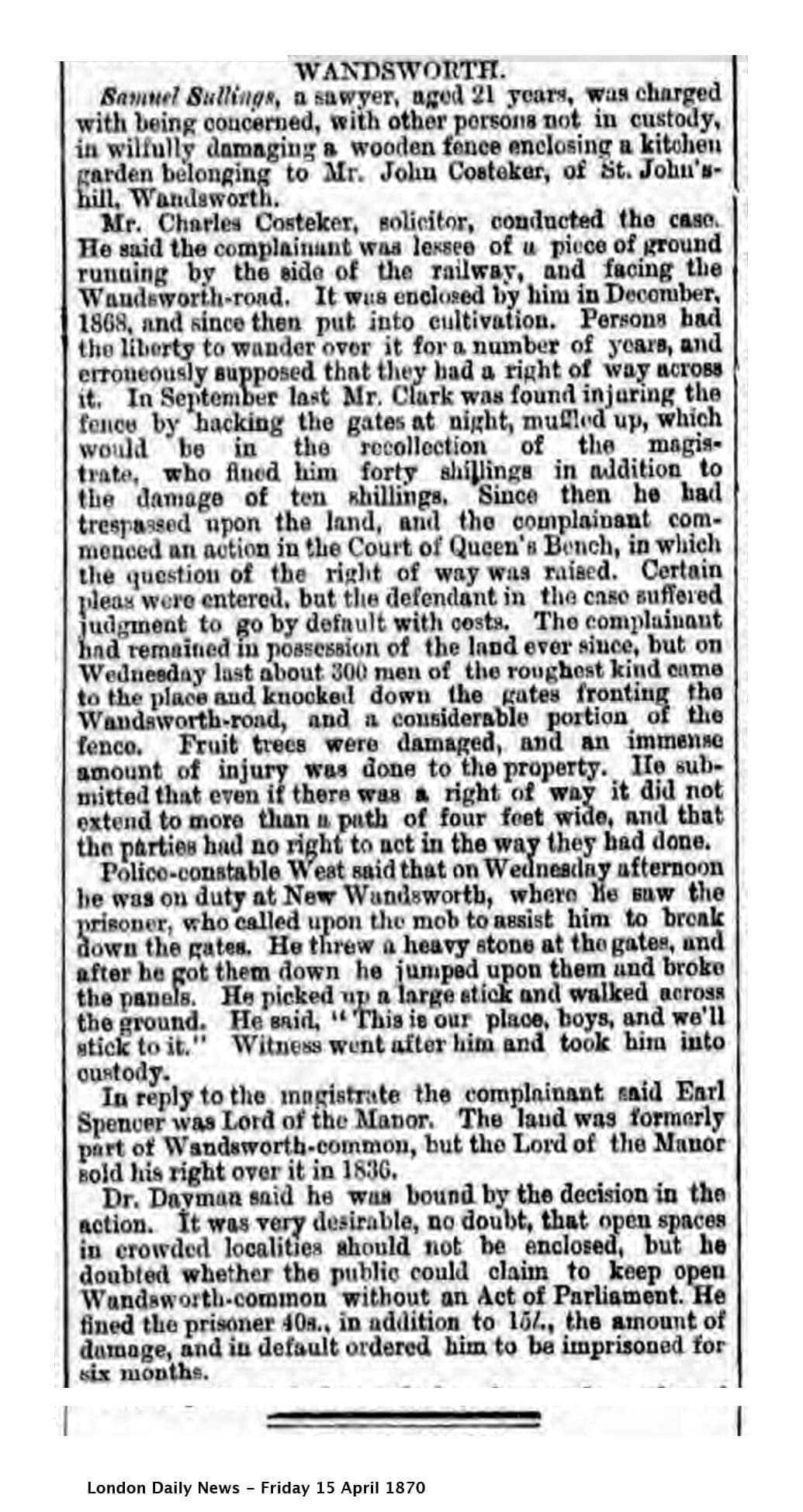
WANDSWORTH.
Samuel Sullings, a sawyer, aged 21 years, was charged with being concerned, with other persons not in custody, in wilfully damaging a wooden fence enclosing a kitchen garden belonging to Mr. John Costeker, of St. John's-hill, Wandsworth.
Mr. Charles Costeker, solicitor, conducted the case. He said the complainant was lessee of a piece of ground running by the side of the railway, and facing the Wandsworth-road. It was enclosed by him in December, 1868, and since then put into cultivation. Persons had the liberty to wander over it for a number of years, and erroneously supposed that they had a right of way across it.
In September last [i.e. September 1869] Mr. Clark was found injuring the fence by hacking the gates at night, muffled up, which would be in the recollection of the magistrate, who fined him forty shillings in addition to the damage of ten shillings. Since then he had trespassed upon the land, and the complainant commenced an action in the Court of Queen's Bench, in which the question of the right of way was raised. Certain pleas were entered, but the defendant in the case suffered judgment to go by default with costs.
The complainant had remained in possession of the land ever since, but on Wednesday last about 300 men of the roughest kind came to the place and knocked down the gates fronting the Wandsworth-road, and a considerable portion of the fence. Fruit trees were damaged, and an immense amount of injury was done to the property. He submitted that even if there was a right of way it did not extend to more than a path of four feet wide, and that the parties had no right to act in the way they had done.
Police-constable West said that on Wednesday afternoon he was on duty at New Wandsworth, where he saw the prisoner, who called upon the mob to assist him to break down the gates. He threw a heavy stone at the gates, and after he got them down he jumped upon them and broke the panels. He picked up a large stick and walked across the ground. He said, "This is our place, boys, and we'll stick to it." Witness went after him and took him into custody.
In reply to the magistrate the complainant said Earl Spencer was Lord of the Manor. The land was formerly part of Wandsworth-common, but the Lord of the Manor sold his right over it in 1836.
Dr. Dayman said he was bound by the decision in the action. It was very desirable, no doubt, that open spaces in crowded localities should not be enclosed, but he doubted whether the public could claim to keep open Wandsworth-common without an Act of Parliament.
He fined the prisoner 40s. [i.e. £2], in addition to £15, the amount of damage, and in default ordered him to be imprisoned for six months.
[BNA Link.]
Back to the top of this page . . .
