[BNA Search: "Wandsworth Common"]
[The Times: Search: "Wandsworth Common"].
[BNA: Buckmaster Battersea 1873]
[BNA: Buckmaster Wandsworth 1873]
[London Evening Standard: Buckmaster Wandsworth 1873]
John Conder letter on the London School Board.]
[BNA: Link]
[Source: Link]
To pond or not to pond?
The pond they refer is NOT what is now "the lake".
Perhaps surprisingly to us today, most of the letters are very much against creating a pond, even if it were to be financed by voluntary subscription. Its critics mock the tendency of people who do not live close to the Common to say "Oh, we like to see a piece of water when the sun shines on it". The critics outline numerous risks, from an extra burden on rate-payers and Common-keepers, to pollution and disease, and its inevitable use for bathing, when "grown lads . . . would be seen undressed or partially attired, to the disgust and annoyance of . . . every lady who passed by").
I had tended to assume that a lake was almost universally considered a "good thing". Not so - the majority of the letters that follow are very much anti.
BUT until now [11 October 2025] I had also assumed they were opposing the digging of our current lake, but evidently not.
It must have been another pond that was proposed but never dug (or only a small one dug experimentally) - on North Side. One of the letters refers explicitly to "Clapham Road".
Why here? Was it because it would have been close to the Black Sea, only recently filled in?
Or because there had been ponds nearby, as shown or e.g. Cruchley, 1829 (several ponds), Stanford 1862 and ODS 1868 - a single pond north-west of the Black Sea. Two ponds are shown on Stanford 1872. Was one the experimental small pond?Is there any evidence of this on any map? This also explains why so many of the objectors lived nearby - e.g. Peter Le Neve Foster. They would not have been affected by the lake that was eventually dug by the railway line, so are less likely to have have objected.
[NB - From the Conservators' report, 1875:
In regard to the formation of an ornamental piece of water, it may be mentioned that an experimental pond (the cost of which was defrayed by subscription) was ventured upon, but the general opinion of those more immediately concerned being, so far as could be ascertained, averse to the project, it has since been abandoned.
[BNA: Link.]
Does this help explain the lake's final location? Not in the north-west, since so unpopular, so where? By the railway line near Bellevue. NB The Toast Rack had not been built at this time.]
So when exactly was our lake dug?
The annual meeting of the Wandsworth-common
Conservators appointed under the Act of 34 and 35 Viot., cap. 131, was held at the *Spread Eagle" Assembly-rooms on Monday evening. J. Du Buisson, J.P., occupied the chair, supported by Messrs, Ransome, Watson, and Eccles. There were but few rate-payers present, the proceedings being of a purely formal character.
The balance-sheet —a copy of which was given to those present—showed a total receipt
during the past year of £1,993 ls. 2d, inoluding a balance from last year of £25 4s. 11d., and a loan of £1,500. the total expenditure amounted to £1,945 4s., the law charges (including the balance af the costs of the prometers of the Wandsworth-common Bill) absorbing £1,297 16s. 2d.—On the motion of Mr. Ransome, seconded by Mr. Watson, Mr. Du Buisson was re-elected chairman for the ensuing year. The olerk read a list of subscriptions not named in the balance- sheet to the extent of £174 os. 7d.
—The Rev. J. Conder moved that the thanks of the ratepayers be tenderect to the Conservators
—Mr. Cleave, in seconding, said that the smallness of the meeting was a proof of the confidence felt ia them. (Hear, hear.)
The chairman remarked that many people had expressed a desire that they should form another Black Sea; and they had made an experiment, that they might see if it was appreciated during the skating season. He thought a smal piece of ornamental water on the common more desirable than otherwise.
— The Rev. J. Conder had heard much in favour of the experiment.
— Mr. Ransome also favoured the scheme, which, however, would not be done at the expense of the ratepayers, but by voluntary subscriptions.
They hesitated to move before taking the sense of the inhabitants. A rate payer said there could be no two opinions as to the desirability of the project.
—Rev. J. Conder moved that it was desirable that there should be some ornamental water upon the common, which upon being duly seconded, was carried.
—Mr. Ransome said the proposed pond would have three islands, planted with various shrubs, the depth would not be more than two feet six inches, and care would be taken to secure a constant flow of running water.
A vote of thanks to the chairman brought the meeting to a termination.
[Presumably this cannot refer to the Three-Island Pond, which was already well-established. Is it the small, narrow pond shown near the Cats Back Bridge? ]
Wandsworth Common Conservation.
In pursuance of the Act under which the local Conservators of this open space are appointed, the annual meeting, at which the ratepaycrs are entitled to he present, was held on Monday at the Assembly Rooms, Wandsworth. Mr. Du Buisson, the chairman of the Conservators, presided. There were also present Messrs. Eccles, Ransome, Watson, &c.
The accounts which were submitted showed that the receipts during the year ended February, 1873, had been £1,998, including a sum of £1,500 borrowed on the security of the rates. The principal expenditure was £1,297 16s. 2d. for law charges, of which it was stated that all but a few pounds had been rendered necessary by the opposition to the Wandsworth Common Bill in Parliament ; £223 had been spent out of the Conservators' funds on the improvement of the Common, whilst a further sum of £174 had been raised by rubscriptions, and laid out in the same way.
Mr. Du Buisson was chosen chairman for the ensuing year. Resolutions were expressing thanks to the gentlemen who had oo liberally subscribed towards the improvement of the ammon, and to the Conservators for their laboours during the past year.
Reference was made to the formation of a lake in lieu of the defunct "Black Sea," and it was explained that if one were made, it would be with moneys voluntarily subscribed, and not from the rates ; that it would be properly concreted, and a stream of constantly running water secured.
It was then moved by the Rev. J. Conder, secondded ny Mr. Cooke, and carried unanimously, "That it is extremely desirable that an ornamental pond be formed on the Common."
The meeting separated, after a vote of thanks to the chairman.
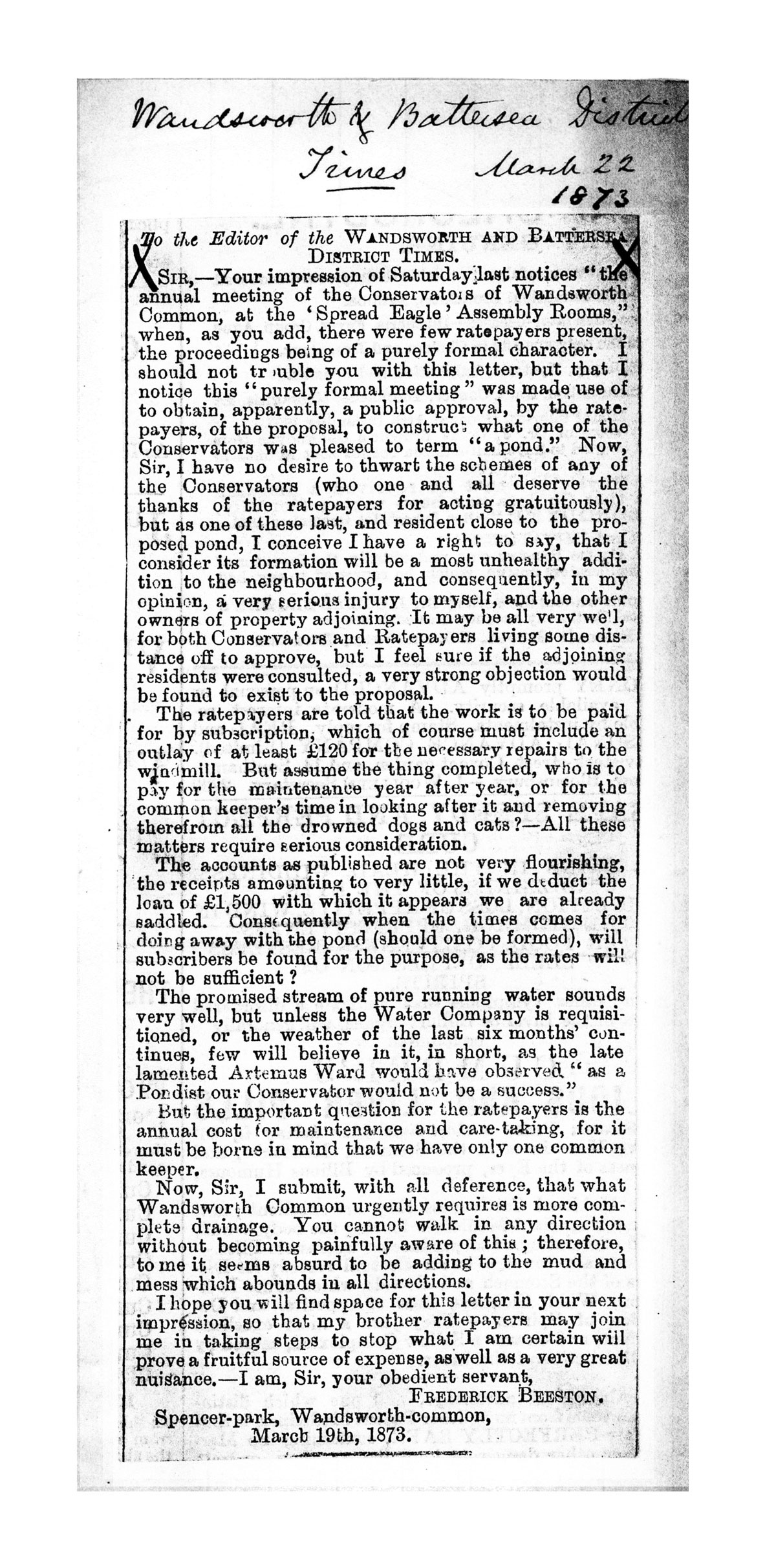
To the Editor of the Wandsworth and Battersea District Times.
S1m,—Your impression of Saturday:last notices ** tidy:annual meeting of the Conservato:s of Wandeworth:Common, at the '5 pread Eagle' Assembly Rooms,"when, ag you add, there were few ratepayers presentsthe proceedings being of a purely formal character.abould not tr uble you with this letter, but that Inotice thia '' purely formal meeting " was made use ofto obtain, apparently, a public approval, by the rate-payers, of the propcsal, to conatruc: what one of theC onservatora wae pleased to term ''apond."
Now,Sir, [have no desire to thwart the schemes of any ofthe Conservators (who one and all deserve the thanks of the ratepayers for actiog gratuitously),but as one of these Jast, and resident close to the pro-posed pond, I conceive [have a right to say, that I consider its formstion will be a moat unhealthy saddi-tion to the neighbouchood, and consequently, in my opinion, a very eerions injury to myself, and the otherowners of property adjoining. It may be all very we'l,for both Conservatora and Ratepayers living some distance off to approve, but I feel sure if the adjoining residents were consulted, a very strong objection would be found to exist to the proposal.
The ratepayers are told that the work is to be paid for by subscription, which of course must include anoutlay cf at least £120 for the neceesary repaire to thewjoimill, But sume the thing completed, who is topoy for the maintenance year after year, or for thecommon keeper's time in louking after it and removingtherefroin all the drowned dogs aud cats ?—All thesewatters require eerious consideration.
The accounts as published are not very flourishing,the receinta amounting to very little, if we deduct theJoan of £1,500 with which it appears we are alreadysaddled. Conacquently when the timea comea fordoing away with the pond (shoold one be formed), willaub:cribers be found for the purpose, as the rates wil!not be aufficient ?
Tho promised stream of pore running water sounds very well, but unless the Water Compsny is requisitioned, or the weather of the last six months' continuea, few will believe in it, in short, as the latelamented Artemus Ward wonld bave observed "as aPordist our Conservator would not be a success,"
But the important question for the rat«payers is theannual coat (or maintenance and care-taking, for itmust be borns in mind that wo have only one comoionkeeper.
Now, Sir, I anbmit, with sll deference, that what Wandsworth Common urgently requires is more com-plets drainage. You cannot walk in any direction without becomin; painfully aware of this ; therefore,tome it seems absurd to be adding to the mud and mess which abounds in all directions, .
Thope you will find space for this letter in your nextimpréssion, so that my brother ratepayers may join me in taking steps to stop what I am certain willprovea fruitful source of expense, as well a8 9 very greatnuisance,
I am, Sir, your obedient servant,
5 ie, Wandaworth FREDERICK BEESTON.
mncer-par! isworth-common,Re Mareb 19th, 1873. :
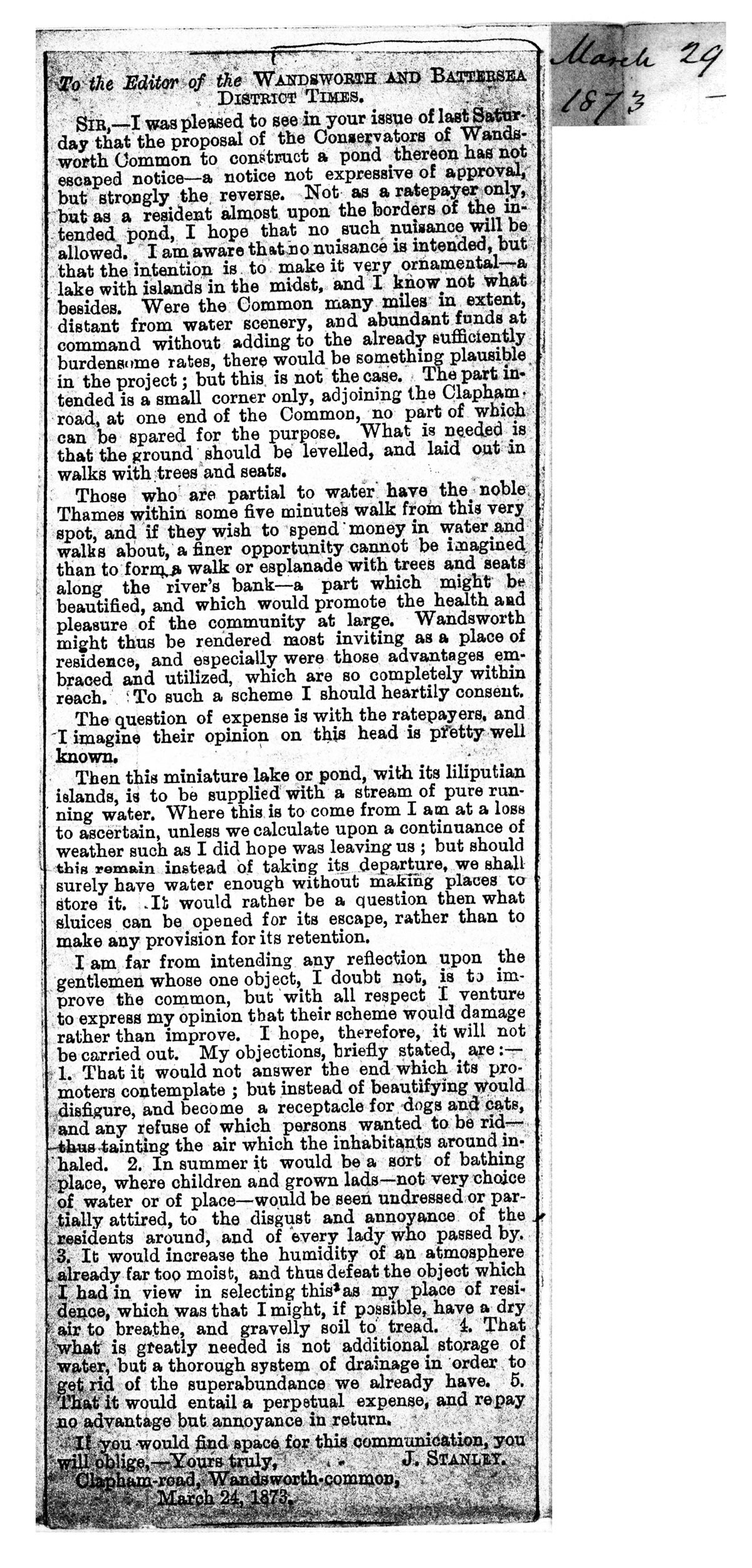
To the Editor of the Wandsworth and Battersea District Times.
at of Dieraror Tues. Fg
Sim,
—I was pleased to see in your issue of last Saturday that the proposal of the Conservators of Wandsworth Common to construct a pond thereon has not escaped notice — a notice not expressive of approval, but strongly the reverse.
Not as a ratepayer only, but as a resident almost upon the borders of the intended pond, I hope that no such nuisance will be allowed. I am aware that no nuisance is intended, but that the intention is to make it very ornamental - a lake with islands in the midst, and I know not what besides.
Were the Common many miles in extent, distant from water scenery, and abundant fonda at command without adding to the already sufficiently burdensome rates, there would be something plausible in the project; but this is not the case. The part intended is a small corner only, adjoining the Clapham road, at one end of the Common, no part of which can be spared for the purpose, What is needed is that the ground should be levelled, and laid out in walks with trees and seats.
Those who are partial to water have the noble Thames within some five minutes walk from this very spot, and if they wish to spend money in water and walks about, a finer opportunity cannot be imagined than to form.» walk or esplanade with trees and seats along the river's bank — a part which might be beautified, and which would promote the health and pleasure of the community at large.
Wandsworth might thus be rendered most inviting as @ place of residence, and especially were those advantages embraced and utilized, which are so completely within reach. 'To such a scheme I should heartily consent.
The question of expense is with the ratepayers, and I imagine their opinion on this head is pretty well known.
Then this miniature lake or pond, with its liliputian islands, is to be supplied with a stream of pure running water. Where this is to come from I am at a loss to ascertain, unless we calculate upon a continuance of weather such as I did hope was leaving us; but should this remain instead of taking its departure, we shall surely have water enough without making places to store it. .It would rather be a question then what sluices can be opened for its escape, rather than to make any provision for its retention.
I am far from intending any reflection upon the gentlemen whose one object, I doubt not, is to improve the common, but with all respect I venture to express my opinion that theie acheme would damage rather than improve. I hope, therefore, it will not be carried out. My objections, briefly stated, are:
1. That it would not answer the end which its promoters contemplate ; but instead of beautifying would disfigure, and become a receptacle for dogs and cats, and any 'refuse of which persons wanted to be rid — thus tainting the air which the inhabitants around inhaled.
2. In summer it would be a sort of bathing-place, where children and grown lads — not very choice of water or of place — would be seen undressed or partially attired, to the disgust and annoyance of the residents around, and of every lady who passed by.
3. It would increase the humidity of an atmosphere .already far too moist, and thus defeat the object which 'IT badin view in selecting this*as my placo of residence, which was that T might, if poysible, have a dry air to breathe, and gravelly soil to tread.
4. That what is gteatly needed ia not additional storage of
'water, but a thorough aystem of drainage in order to get rid of the superabundance we already have.
5. That it would entail a perpetual expense, and repay no advantage but annoyance in return.
aE vou would find space for this communication, you'
Fee ea we ow de Seangt,
scan Baan 7000, Nene pmorth-cominon, aces eee.
peal LALO ack, SLA El, Poe og Sy ae oer ee

To the Editor of the Wandsworth and Battersea District Times.
Sir,
- As a dweller on the borders of the Common, I beg leave to express my hearty concurrence in the sentiments contained in Mr. Beeston's letter, in your last issue, protesting against the formation of a pond or pool by the Common Conservators.
As a piece of ornamental water it is too insignificant to be a feature in the landscape; whilst in other respects it is, I fear, quite large enough to give a swampy character to the land around, and to be detrimental to the healthiness of the neighbourhood.
In these days of Boards and officers of health, and with the general attention now given by the public to such matters, I must say I am somewhat surprised that such a project should for one moment be entertained, and the drainage of the Common neglected.
What is wanted is a thorough draining of the Common, not mere surface drains, but a systematic under drainage which would do away with the damp and sodden condition of the soil now giving rise to those mists and fogs which so constantly hover over it.
This seems to me the first and all important work for the Conservators to take up. It may be that it would be costly, but a portion might be thoroughly done yearly, as far as the half-penny rate would admit, and in a few years the whole might thus be completed with vast advantage to the adjacent neighbourhood, as well as to the holiday folk who frequent it.
At all events I trust we may not have inflicted on us that which at best can only be a puddle in the winter, and when partially dried up in the summer, as it necessarily will be, a pestiferous patch of malarious mud and decaying vegetable matter.
I am, Sir, Your obedient servant.
P. LE NEVE FOSTER.
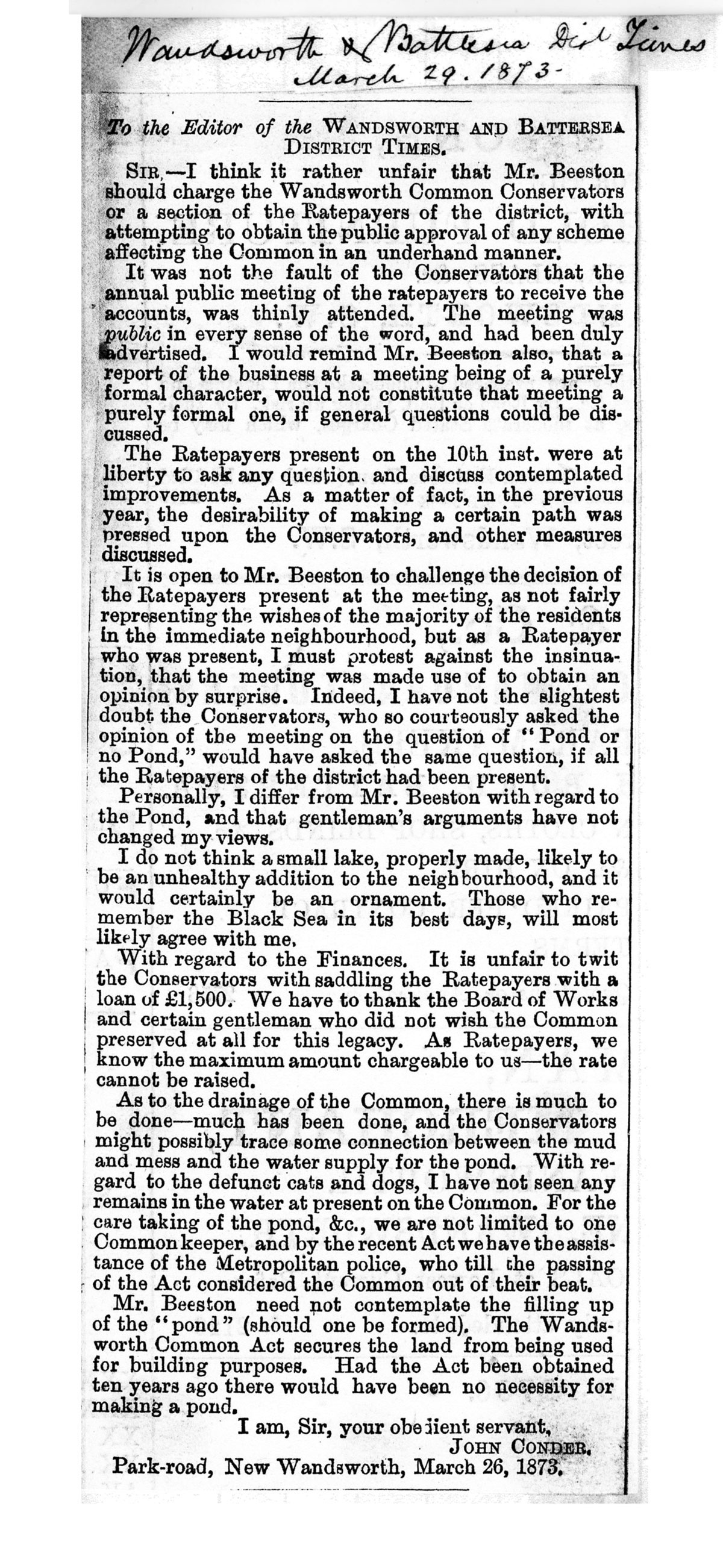
<To the Editor of the Wandsworth and Battersea District Times.
¢ District Times. :
Sir
~ I think it rather unfair that Mr. Beeston should charge the Wandsworth Common Conservators 'or a section of the Ratepayers of the district, with attempting to obtain the public approval of any scheme affecting the Common in an underhand manner.
It was not the fault of the Conservators that the 'annual public meeting of the ratepayers to receive the accounts, was thinly attended. The meeting was eicic in every sense of the word, and had been duly advertised, would remind Mr, Beeston also, that a report of the business at a meeting being of a purely formal character, would not constitute that meeting a "Purely formal one, if general questions could be discussed.
The Ratepayers present on the 10th inst. were at liberty to ask any question. and discuss contemplated improvements, As a matter of fact, in the previous year, the desirability of making a certain path was pressed upon the Conservators, and other measures discussed,
It is open to Mr, Beeston to challenge the decision of the Ratepayers present at the meeting, as not fairly representing the wishes of the majority of the residents in the immediate neighbourhood, but as a Ratepayer who was present, I must protest against the insinua- tion, that the meeting was made use of to obtain an opinion by surprise. Indeed, I have not the slightest doubt the Conservatora, who so courteously asked the opinion of the meeting on the question of "Pond or no Pond," would have asked the same question, if all the Ratepayers of the district had been present.
Personally, I differ from Mr. Beeston with regard to the Pond, and that gentleman's arguments have not changed my views.
I do not think a small lake, properly made, likely to be an unhealthy addition to the neigbbourhood, and it would certainly be an ornament. Those who remember the Black Sea in its best day s, will most likely agree with me,
With regard to the Fioances, It is unfair to twit the Conservators with saddling the Ratepayers with a loan of £1,500. We have to thank the Board of Works and certain gentleman who did not wish the Common preserved at all for this legacy.
As Ratepayers, we now the maximum amount chargeable to us —the rate cannot be raised.
As to the drainage of the Common, there is much to be done—much has been done, and the Conservators might possibly trace eome connection between the mud and mess and the water supply for the pond.
With regard to the defunct cate and dogs, I have not seen any remains in the water at present on the Common. For the care taking of the pond, &c., we are not limited to one Common keeper, and by the recent Act we have the assistance of the Metropolitan Police, who till the passing of the Act considered the Common out of their beat,
Mr. Beeston need not contemplate the filling up of the '*pond" (should one be formed), The Wandsworth Common Act secures the land from being usedfor building purposes, Had the Act been obtained ten years ago there would have been no necessity for
making a pond.
I am, Sir, your obedient servant,
JOHN CONDER
Park-road, New Wandsworth, March 26, 1873,
POND, OR NO POND.
To the Editor of the Wandsworth and Battersea District Times.
S1r,
-Into the general question of the desirability of making a pond, or lake, on the Common, I do not proposee to ask you for space to enter, since means are being taken to collect the opinions of those more immmediately interested in the question. Each person must form an opinion for himself, but it is of importance that he should nonot do so on false premises - and there are three misconceptions — one or other of which has entered into the statements of each of those who have addressed you, in opposition to the proposed piece of water.
1. By the terms of the Wandaworth-Common Act, any piece of water, to be made on the Common, must not be so constructed, as to its bottom, by puddling and concrete, as to present the possibility of the escape of water into the surrounding soil, and the consequent production of "mud and mess."
2. The pond would be kept always full, and in motion, by an unfailing supply of the purest water.
3. No part of the expense of construction would be defrayed out of the Common rate.
This — en passant — what I want more particularly to point out is, the mistake into which one or two of your correspondents hive fallen respecting the *drainage* of the Common.
It ia not fair to consider this question under such conditions as the exceptionally wet state of the soil has presented for nearly the last twelve months — but, at any time, in a wet season, ail that can be hoped for, or desired, is to keep the regular footpaths tolerably dry; and so to arrange the slope of the ground and the fall of the open ditches that the water may not anywhere lie in puddles.
If a system of deep drainage were to be carried out so that, in a wet season, all the Common should be quite dry soon after rain, the consequence would be that in a dry summer instead of having flourishing trees and pleasing green turf to contemplate, there would be only a brown dreary plain, utterly bare of trees, gorse, or turf.
Even in our own gardens, which are not particularly well drained, we are obliged to water constantly, in a dry season, to keep the grass green and make the strawberries and lettuces thrive.
If you want a plain *at all times* free from damp exhalations, you must cover it up with houses and pavements.
In the village of Lewisham there used to be a row of splendid elm trees about a mile long — the pride of the inhabitants. Then Metropolitan deep-drainage came and killed the trees; deprived of the water in the soil which nourished them, they all died.
If the Common is to be so drained as to be always fit for clean and comfortable football in winter, it will be too hard in the summer for cricket.
I am, Sir, yours faitLfully,
P.S. WATSON
The Gables, 2nd April, 1873.
To the Editor of the Wandsworth and Battersea District Press
Sir,
—I have read with much satisfaction the letters addressed to you by Mr. Beeston and Mr. Le Neve Foster, respecting the pond proposed to be formed on the Common by the Board of Conservators, and take the liberty of expressing my hearty concurrence ju the objections raised thereto. I beg to ask what possible or conceivable good is to be gained by this pond?
[I have no doubt the Conservators are actuated by the best intentions, and desirous of seeing the Common ja a fit state for enjoyment by the large population around. Why not therefore employ their funds and energies in effecting improvements which all would agree to, leaving this questionable project to a more convenient season.
It will be come considerable time before the Common is properly drained, planted with trees and shrubs where necessary, but whenever there real improvements are carried into effect, they might then consider the desire said to be expressed by some parties for a pond, but who I am convinced are not the residents on the spot.
—I am, Sir, your most obedient servant,
SAMUEL DIXON
3, Spencer-park, Wandsworth Common
2nd April, 1673,
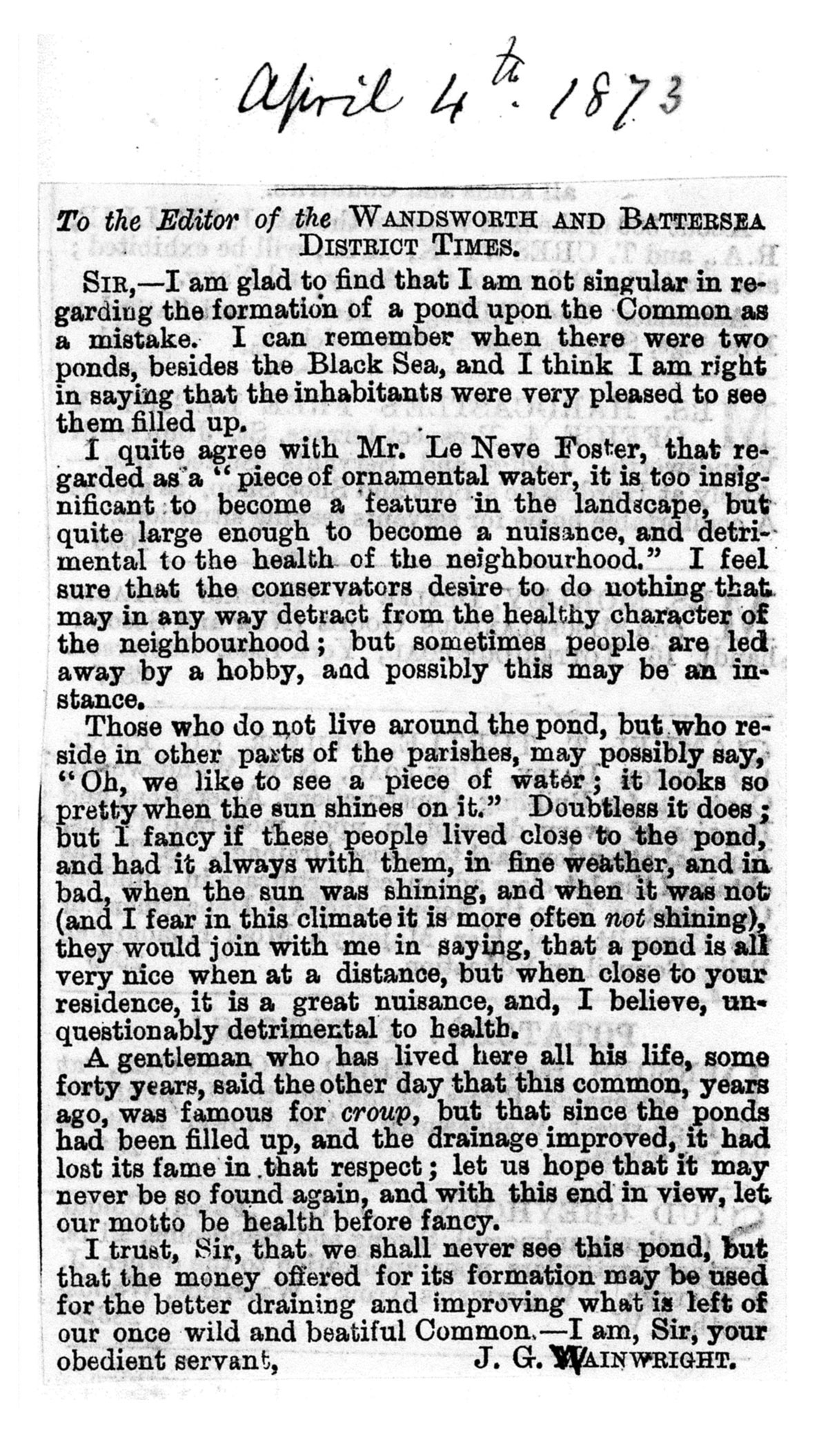
To the Editor of the Wandsworth and Battersea District Press
Sir,
—I am glad to find that I am not singular in regarding the formation of a pond upon the Common as a mistake. I can remember when there were two ponds, besides the Black Sea, and I think I am right in saying that the inhabitants were very pleased to see them filled up.
I quite agree with Mr. Le Neve Foster, that regarded as a "piece of ornamental water, it is too insignificant to become a feature in the landscape but quite large enough to become a nuisance, and detrimental to the health of the neighbourhood." I feel sure that the conservators desire to do nothing that may in any way detract from the healthy character of the neighbourhood; but sometimes people are led away by a hobby, and possibly this may be an instance,
Those who do not live around the pond, but who reside in other parts of the parishes, may possibly say, "Oh, we like to see a piece of water; it looks so pretty when the sun shines on it."
Doubtless it does; but I fancy if theso people lived close to the pond, and had it always with them, in fine weather, and in bad, whon the sun was shining, and when it was not (and I fear in this climate it is more often not shining) thoy would juin with mo in saying, that a pond is all very nice when at a distauco, but when close to your residence, it is groat nuisance, and, I believe, unquestionably detrimental to health,
A gentleman who has lived hero all his life, some forty years, sald tho other day that this common, years ago, was famous for croup, but that since the ponds had been filled up, and the drainage improved, it had lost its fame in that respect; let us hope that it may never be so found again, and with this end in view, let our motto be health before fancy.
I trust, Sir, that we shall never see this pond, but that the money offered for its formation may be used for the better draining and improving what is left of our once wild and beautiful Common,
I am, Sir, your obedient servant,
J.G. MAINWRIGHT [Wainwright]
(Click on image to enlarge)
["Robert James Mann, M.D., F.R.G.S., &c, late Vice-President of the Meterological Society of London".]
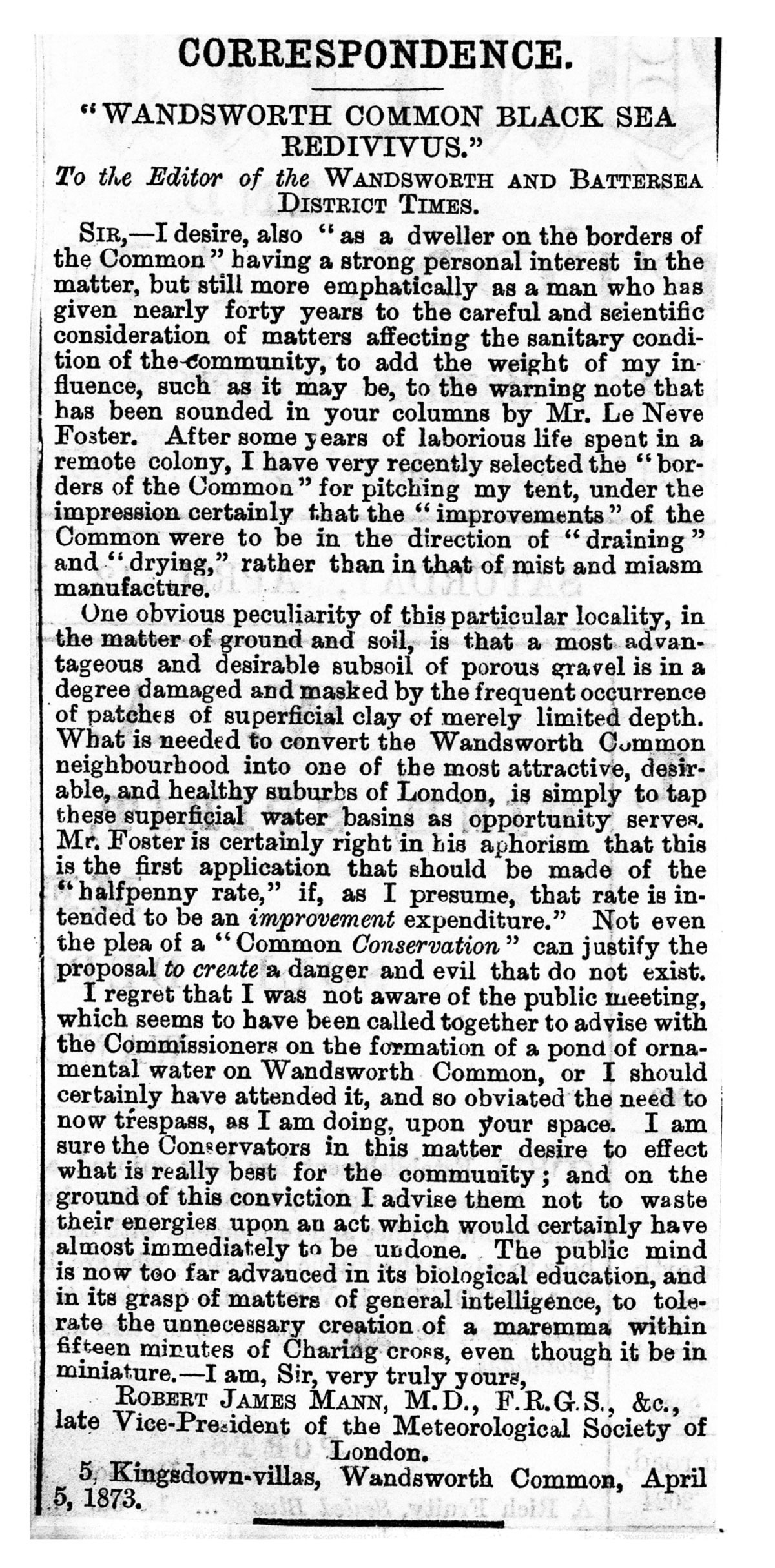
CORRESPONDENCE.
WANDSWORTH COMMON BLACK SEA
REDIVIVUS." |
To the Editor of the WANDSWORTH AND BATTERSEA
District TImEs.
SIR,
— I desire, also ''as a dweller on the borders of the Common" having a strong personal interest in the matter, but still more emphatically as a man who has given nearly forty years to the careful and scientific consideration of matters affecting the sanitary condition of the community, to add the weight of my influence, such as it may be, to the warning note that has been sounded in your columns by Mr, Le Neve Foster.
After some years of laborious life spent in a remote colony, I have very recently selected the '* borders of the Common" for pitching my tent, under the impression certainly that the "improvements" of the Common were to be in the direction of " draining " and "' drying," rather than in that of mist and miasm manufacture,
One obvious peculiarity of this particular locality, in the matter of ground and soil, is that a most advantageous and desirable subsoil of porous gravel is in a degree damaged and masked by the frequent occurrence of patches of superficial clay of merely limited depth.
What is needed to convert the Wandsworth Cummon neighbourhood into one of the most attractive, desirable, and healthy suburbs of London, is simply to tap these superficial water basins as opportunity serves.
Mr, Foster is certainly right in his aphorism that this is the first application that should be made of the ""halfpenny rate," if, as I presume, that rate is intended to be an improvement expenditure." Not even the plea of a ''Common Conservation" can justify the proposal to create a danger and evil that do not exist.
I regret that I was not aware of the public meeting, which seems to have been called together to advise with the Commissioners on the formation of a pond of ornamental water on Wandsworth Common, or I should certainly have attended it, and so obviated the need to | now trespass, as Tam doing, upon your space. I am sure the Conservators in this matter desire to effect what is really best for the community; and on the ground of this conviction I advise them not to waste their energies upon au act which would certainly have almost immediately to be undone. The public mind is now teo far advauced in its biological education, and in its grasp of matters of general intelligence, to tolerate the unnecessary creation of a maremma within | fifteen minutes of Charing cross, even though it be in | miniature.
—I am, Sir, very truly yours,
ROBERT JAMES MANN, M.D., F.R.G. S., &c,
late Vice-Pre:ident of the Meteorological Society of
. London.
. 7 guingsdown-villas, Wandsworth Common, April
"9 e .
SRG .
[PB: Needs more work. ]
When was the Black Sea filled in? Was the new pond intended to substitute?Who was going to pay? Who were the "subscribers"?
NB this is presumably one of the first activities of the new board of Conservators.
Arguments against the pond:
— a "perpetual expense" to ratepayers for its maintenance — a receptacle for dead dogs and cats and other refuse, the removal of which will be an extra task for commons keepers — a source of unhealthy damp air, mud and messIn reply:
— if the Common is too thoroughly drained the surface will be fine for football in the winter but too hard for cricket in the winter — Other defences?Easy for us to mock, but what about the reasonable fear of the recurrence of cholera in mid-C19 e.g. in Lambeth, Battersea, Tooting, most recently in year ? /p> — https://www.thegazette.co.uk/all-notices/content/100519 — https://www.ph.ucla.edu/epi/snow/lambethcholeraplaque.html — https://johnsnow.matrix.msu.edu/work.php?id=15-78-7F — Drouett
And the critics are not all against "nature" - the ornamental pond for some is perhaps promoting an "unnatural" ugly and potentially dangerous environment...]
One of the first challenges to the Conservators after the 1871 Act was whether to create a new ornamental lake, to compensate for the lovely Black Sea so recently filled in on the northern edge of the Common (and now under Earl Spencer's "Park")
There was a LOT of opposition
The Common as a whole was very very wet - covered with small ponds into which unwary people fell and drowned, many of the ponds filthy with ordure and refuse, a source of pestilential miasmas
"the pestiferous patch of malarious mud and decaying vegetable matter", "mist and miasm", "tainting the air", "the common, years ago, was famous for croup but since the ponds had been filled up...it had lost its fame in that respect", "The public mind is now too far advanced in its biological education...to tolerate the unnecessary creation of a maremma within fifteen minutes if Charing-cross, even though it be in miniature"
So why create yet another?
And who would pay for it? The Earl's cut of £250 p.a. from the halfpenny rate left very little money over for any substantial work to be done
But some local people were prepared to fund the pond / lake for general benefit - a lake would be beautiful, nice to perambulate round, nearby Battersea Park had a large ornamental lake ,
And of course lakes (and swans swimming serenely on lakes) were compulsory features in any Capability Brown-inspired English romantic landscape
But what if boys should go skinny dipping?
in summer it would be a sort of bathing place, where children and grown lads - not very choice of water or of place - would be seen undressed or partially attired, to the disgust and annoyance of the residents around, and of every lady who passed by"
[PB: boys and men typically swam nude at this time. Remember Kilvert's Diary [written 1870-79]. But clearly young boys continued to do so into the C20, although not always approved of by authority figures. See e.g. the famous photographs of boys chased by police or park-keepers [?] at the Serpentine, Hyde Park. Date?]
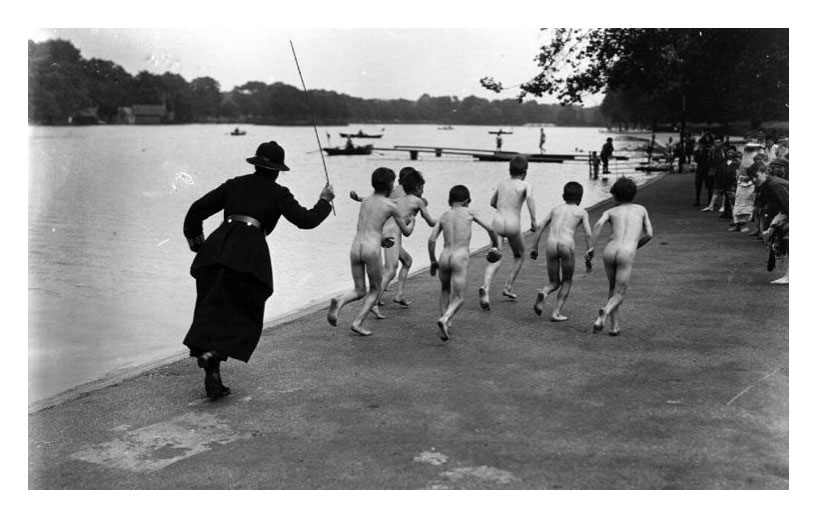
A famous photograph but I have found nothing about the photographer or date. 1920s? Is the "police (?) woman" a Royal Parks Keeper (did they even have women parkies?). As with the James Jarche photo below, the image must have been posed.
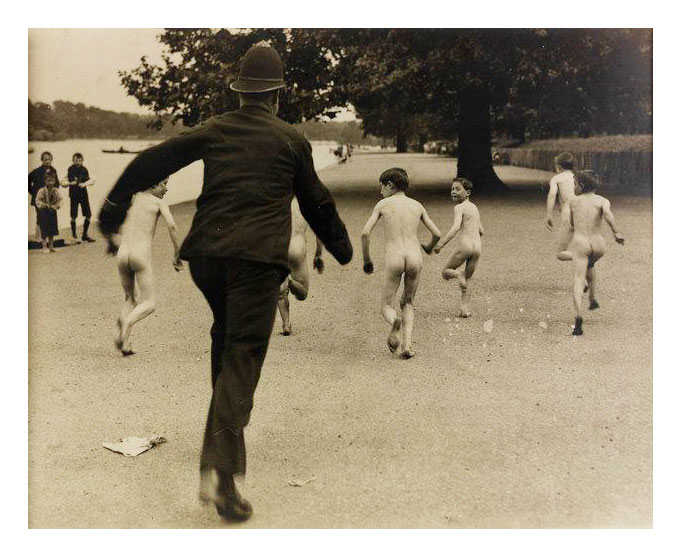
Was this image derived from the one (featuring a "police" woman) above?
Francis Kilvert's Diary (written 1870-1879), i.e. contemporary with the pond, famously excoriates "the detestable custom of bathing drawers", and adds "If ladies don't like to see a man naked why don't they keep away from the sight?"
Lucy Adlington, Stitches in Time: The Story of the Clothes We Wear, mentions some town councils in the 1880s made it illegal to bathe nude, but adds "Nevertheless skinny-dippers continued to plague public parks and rivers".
I have dloaded a couple of photographs of nude bathers in public parks and in Trafalgar Square c.1900? or around WWI e.g. "nude_bathing_victoria_pool_1900?.jpg", "nude_bathing_trafalgar_square_2_date?.jpg", "nude_bathing_trafalgar_square_1_date?.jpg".
I wonder if early WC bye-laws say anything about it? Check? It would be worth looking at these anyway. I also have a distinct memory that I downloaded some early(ish) bye-laws. I wonder where they are?
It would be worth checking the first set regulations:
Wandsworth Common: bye-laws
Date: 1871-1872
Reference: WORK 16/1038
Held by: The National Archives, Kew
NOT DIGITISED
[Source: National Archives: Wandsworth Common: bye-laws 1871-2.]
The LCC Regulations of 1897 say: "Bathing is allowed at Brockwell-park, Victoria-park, Hampstead-heath, Parliament-hill, Clapham-common and Plumstead-common . . . Persons bathing in the waters named above are required to wear bathing drawers". Swimming was allowed at very restricted times - mainly early morning. [See " WC_LCC_REGULATIONS_PARKS_AND_OPEN_SPACES_1897_b24398597.pdf"
[John Conder FRGS recites poetry & reads stories]
"The Rev. J. Conder, F.R.G.S. [Fellow of the Royal Geographical Society] is to give a series of readings at the Christ Church Schoolroom, Falcon Grove, Battersea, on Tuesday evening, from the work of Tennyson, Longfellow, Hood Manville Fenn, Lewis Carroll, and other authors. Mr. Condor's ability is well known as a reader in point of merit above the average, and as the programme is also interspersed with vocal selections by several gentlemen belonging to the Battersea Harmonic Society, the school funds, in whose . . .
"The programme was agreeably interpolated with readings by the Rev. J. Macarthy, the Rev. J. Conder, and Mr. Matthews, all of whom acquitted themselves with a fair amount of success, the Rev. Mr. Conder's interpretation of Mr. G. Manville Fenn's stirring social episode, entitled "In Jeopardy," exciting well-deserved and spontaneous applause. Mr. Winchester was, as usual, a painstaking conductor: and the reverend president may congratulate himself upon the progress the society is making."
[BNA: Link]
[Wikipedia: George Manville Fenn]
"Fenn, the third child and eldest son of a butler, Charles Fenn, was largely self-educated, teaching himself French, German and Italian. After studying at Battersea Training College for Teachers (1851-1854), he became the master of a national school at Alford, Lincolnshire."
[Fenn wrote a biography of Henty / No wonder John Conder liked to read his books - doubtless he was looking for adventure too, hence South America.]
[Salamanca Corpus: Fenn]
Shame I can't find "In Jeopardy" = though there are many other Fenn books online e.g.
[Archive.org: George Manville Fenn]