
— Links
— Link
— Link
— Link
CLAPHAM AND HER COMMONS.
This beautiful open space—the threatened enclosure of which by Lord Spencer has so justly excited the alarm of the inhabitants and neighbourhood—contains two hundred and two acres of land, and lies partly in Clapham parish, and partly in that of Battersea...
There has been a dispute of very ancient standing between the parishes of Clapham and Battersea, respecting this Common; the inhabitants of Battersea claiming about one-half of it as within their parish, whilst the inhabitants of Clapham, on the contrary, assert that the whole common, as far as Batterse-rise, is in the Clapham parish.
In 1711 the inhabitants of Battersea enclosed with a ditch and bank that part of the common which they considered to be within their boundaries; this was resisted by the inhabitants of Clapham, who filled up the ditch and levelled the bank, for which an action of trespass was brought against them by Lord Viscount St. John, the Lord of Manor of Battersea.
The case was heard at the Lent Assizes for October, held at Kingston in 1718, when, after a long trial, Lord St. John suffered a nonsuit.
The inhabitants of Battersea, nevertheless, kept up the claim, and included the disputed ground in the perambulations.
[nonsuit = "stop (a lawsuit or the plaintiff bringing it), either by voluntary withdrawal by the plaintiff, or by a finding by the judge that the plaintiff has failed to make a legal case or bring sufficient evidence."]
This is how puts Simmonds puts it (in All About Battersea), quoting Brayley [follow up]:
The greater part of Wandsworth Common, which extends nearly two miles in length towards Streatham, and a considerable part of Clapham Common are in the Parish of Battersea." The boundaries of Clapham Parish, according to the oldest documents of that Parish and Manor, when taken, have usually commenced at the corner of Wix's Lane, formerly called Browmell's corner. The limits of Clapham Parish where it adjoins Battersea in the early part of last century was the subject of a legal contest, that part of Clapham Common extending to Battersea Rise being claimed by both parishes. In 1716 the inhabitants of Battersea inclosed with a ditch and bank the tract of land in question, and the people of Clapham levelled the bank and filled up the ditch; in consequence of which Henry Lord Viscount St. John, the Lord of the Manor of Battersea, brought an action for trespass against those who were engaged in this work, or their employers, which was tried at the Lent Assizes at Kingston, in 1718, when the plaintiff was non-suited. The men of Battersea however were not discouraged but persevered with greater determination than ever in supporting their claim by including when they beat the boundaries of their Parish the disputed ground in their perambulations; and says Mr. Brayley "it would seem to have been eventually successful, a certain portion of the Common being now held on lease of Earl Spencer as Lord of the Manor of Battersea." — Brayley, Surrey Mantel, Vol. III. p. 281. Clapham parish is bounded, on the north, north-west, and west, by that of Battersea;ontheeast,by Lambeth;andonthesouth,by S treatham. Thelimits
of the parish where it adjoins Battersea have been the subject of a legal contest, that part of Clapham common extending to Battersea-rise being claimed by both parishes. In 1716, the inhabitants of Battersea inclosed with a ditch and bank the
tract of land in question, and the people of Clapham levelled the bank and filled
up the ditch; in consequence of which, Henry, lord viscount St. John, then lord
of the manor of Battersea, brought an action for trespass against those who were
engaged in this work, or their employers; which was tried at the assizes at Kings
ton,in 1718,when the plaintiff was non-suited. The men of Battersea, however,
persevered in supporting their claim, by including the disputed ground in their
parochialperambulations;'and itwould seem tohavebeeneventuallysuccessful;
a certain portion of the common being now held on lease of Earl Spencer, as lord of the manor of Battersea.
[9. Lysons, Environs of London, vol. vi.; Supplement, p. 18.]
Clapham Common.— Until after the middle of the last century, this common, which comprises an area of two hundred and two acres, was an almost impassable marsh; but about the year 1760, through the influence and exertions of Christopher Baldwin, esq., a Surrey magistrate, who had resided many years near the spot, the land was drained, and trees planted of various species, and the roads crossing it were repaired.10 The cost of these improvements was defrayed by a subscription raised among the neighbouring inhabitants; and similar means have been since employed to keep the common in good order. From a falling off of the subscrip tions, however, some fifteen or twenty years ago, and a want of due authority, the common was greatly neglected, and much exertion was required of the neighbouring gentry to devise efficient remedies. At length, in the years 1835 and 1836, leases of the manorial rights over the entire common were obtained for twelve years; that part in Clapham parish, at an annual rent of 45/.; and that in Battersea parish, at a rent of 20L During the above and the following years to the end of December, 1838, donations to the amount of 896/. Is. were made for carrying into effect the contemplated improvements; in 1839 and 1840, further sums to the extent of 248/. 6s. were given for the same purpose; and other donations, amounting to 138/., were made in 1844. Subscriptions, amounting on the average to about 150/. per annum, have likewise been received;" by which means the trustees, (to w h o m the leases had been granted), were enabled to restore the drainage and water-courses; cleanse out the three principal ponds, namely, the Island pond, the Long-boat pond, and the Mount pond; improve the plantations, and, generally, to execute whatever other works were necessary to give the c o m m o n that attractive park-like character
[10. Lysons, Environs,vol.i.p.159: 1792.— In consequenceoftheimprovementsthuseffected,thevalue of the surrounding lands was greatly augmented, and Mr. Baldwin himself (a few years before Lysons wrote),soldfourteenacresoflandnearhisownresidenceforthesumof5000/. In1810,Mr.Robert Thorntonsoldhislandhereattherateof500/.peracre.— ManningandBray,Surrey,vol.i.p.359.]
11 Much to the honour of Earl Spencer (the lord of Battersea), and Henry Bowyer, esq. (the lord of Clapham), theirnames are registered in the list of subscribers; the former subscribing 20/. annually (the amount of his rent),andthelatter10/.10s. The common subscriptionsareoneandtwoguineasper annum.
and appearance which it now possesses. This extensive tract is nearly surrounded by well-built villas, and other dwellings, the residences of merchants and gentlemen to w h o m its short distance from the busy haunts of the metropolis render it of convenient and easy access. The airy cheerfulness of this spot greatly tends to the salubrity of the neighbourhood. It is, at all times, available for recreation; and being now under the regular superintendence of a keeper, (who acts as constable, also), is free from the nuisances of former times.
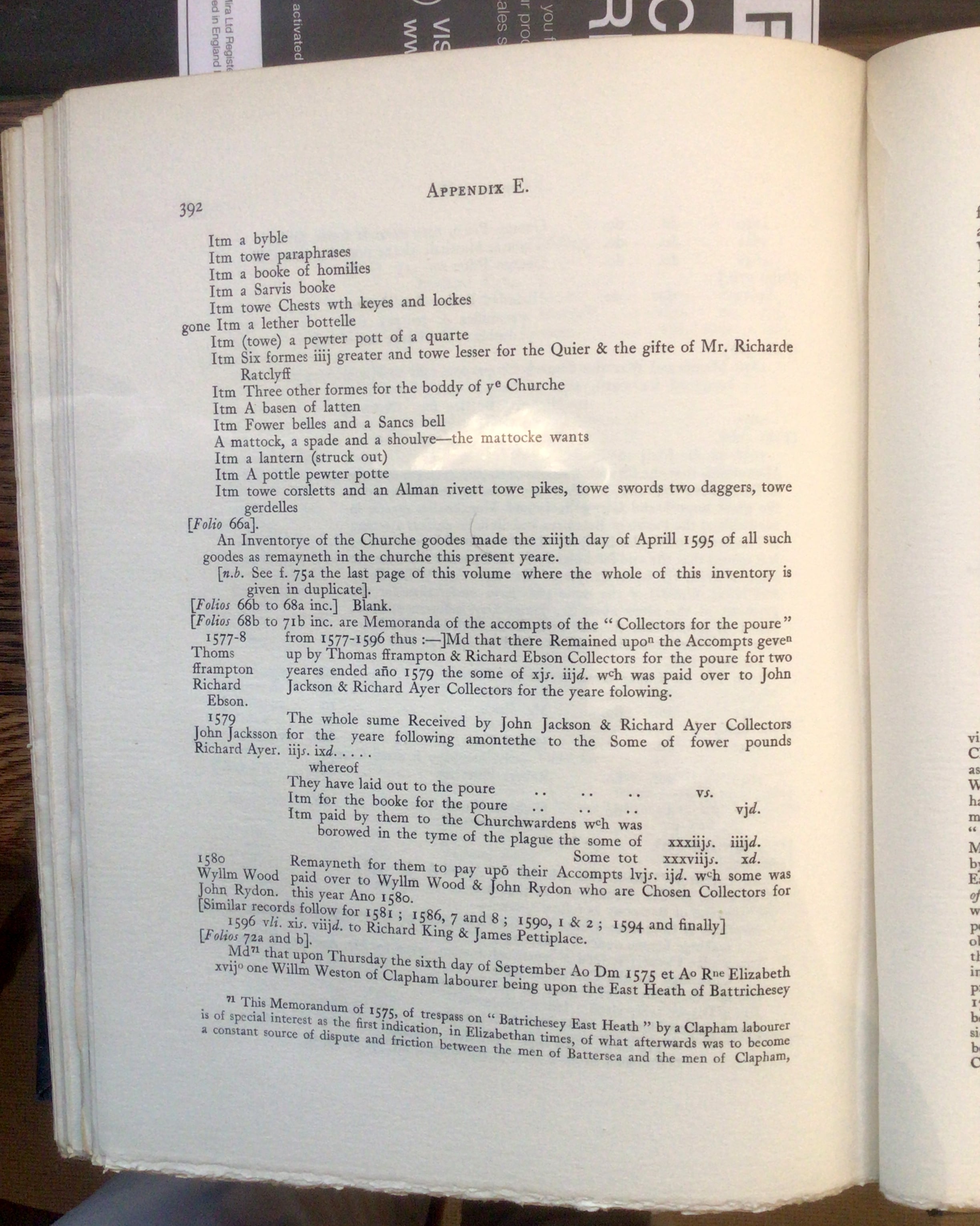
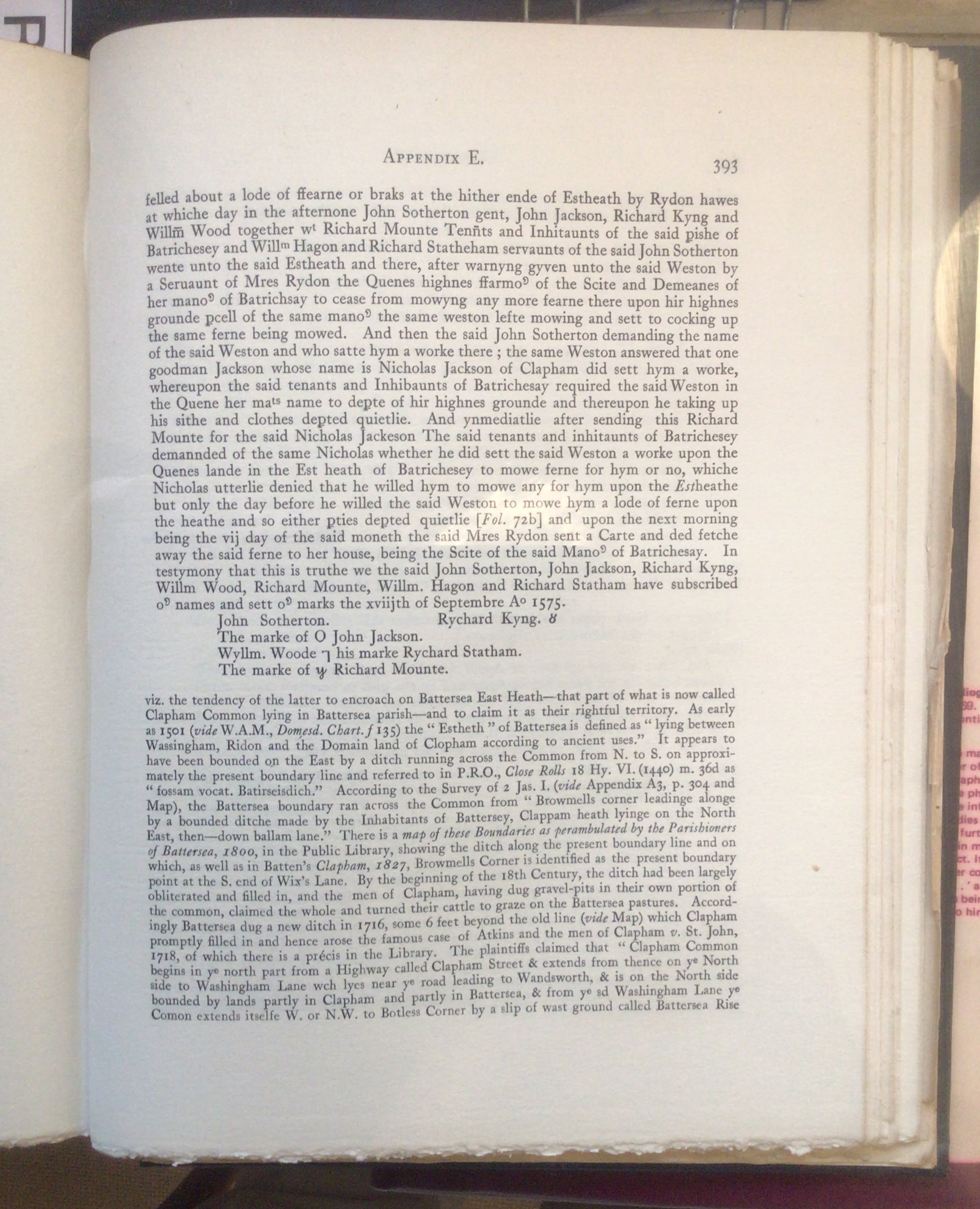
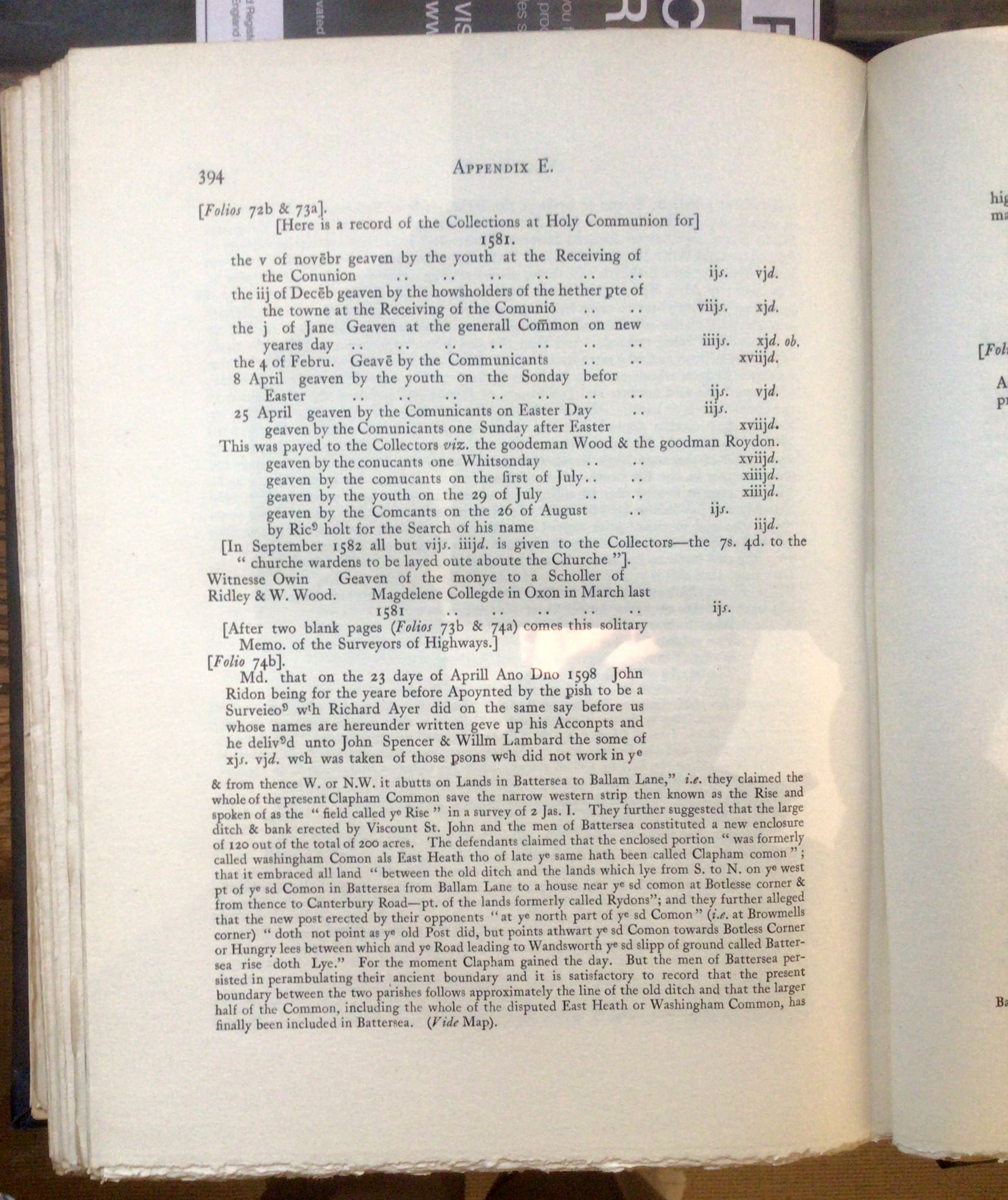
J.G. Taylor, Our Lady of Baterseye (1925), Notes on 392-394 Md [n.71] that upon Thursday the sixth day of September Ao Dm 1575 et Ao One Elizabeth xvijo one Will Weston of Clapham labourer being upon the East heath of Battrichesey felled about a lode of ffearne or braks at the hither ende of Estheath by Rydon hawes at whiche day in the afternone John Sotherton gent, John Jackson, Richard King Willm Wood together wt Richard Mounte Tennts and Inhitaunts of the said pishe of Batrichesey and Willm Hagon and Richard Statheham servaunts of the said John Sotherton wente unto the said Estheath and there, after warnyng gyven unto the said Weston by a Seruaunt of Mres Rydon the Quenes highnes ffarmo [+ strange sign = "r"?] of the Scite and Demeanes of her mano [same "r" sign] of Batrichsay to cease from mowyng any more fearne there upon hir highnes grounde pcell [p has a cross across the downstroke] of the same mano [same "r" sign] the same weston lefte mowing and sett to cocking up the same ferne being mowed. And then the said John Sotherton demanding the name of the said Weston and who satte hym a worke there; the same Weston answered that one goodman Jackson whose name is Nicholas Jackson of Clapham did sett hym a worke, whereupon the said tenants and Inhibaunts [sic?] of Batrichesay required the said Weston in the Quene her mats name to depte of hir highnes grounde and thereupon he taking up his sithe and clothes depted [p has a cross across the downstroke] quietlie. And ynmediatlie after sending this Richard Mounte for the said Nicholas Jackeson The said tenants and inhitaunts of Batrichesey demannded of the same Nicholas whether he did sett the said Weston a worke upon the Quenes lande in the Est heath of Batrichesey to mowe ferne for hym or no, whiche Nicholas utterlie denied that he willed hym to mowe any for hym upon the Estheathe but only the day before he willed the said Weston to mowe hym a lode of ferne upon the heathe and so either pties [p has a cross across the downstroke] depted quietlie [Fol. 72b] and upon the next morning being the vij [>] day of the said moneth the sid Mares Rydon sent a Carte and ded fetche away the said ferne to her house, being the Scite of the said Mano [strange sign = "r"?] of Batrichesay. In testymony that this is truthe we the said John Sotherton, John Jackson, Richard Kyng, Wi ood, Richard Mounte, Willm. Hagon and Richard Statham have subscribed o[+strange sign = "r"?] names and sett o[+strange sign = "r"?] o marks the xviijth of Septembre A° 1575. John Sotherton. Rychard Kyng. [Mark] e marke of O John Jackson. Wyllm. Woode 7 [Mark] his marke Rychard Statham. The marke of y [Mark] Richard Mounte. Taylor comments: Note 71 This Memorandum of 1575, of trespass on " Batrichesey East Heath " by a Clapham labourer is of special interest as the first indication, in Elizabethan times, of what afterwards was to become a constant source of dispute and friction between the men of Battersea and the men of Clapham, viz. the tendency of the latter to encroach on Battersea East Heath— that part of what is now called Clapham Common lying in Battersea parish—and to claim it as their rightful territory. As early as 1501 (vide W.A.M., Domesd.Chart. f 135) the " Estheth " of Battersea is defined as "lying between Wassingham, Ridon and the Domain land of Clopham according to ancient uses. " It appears to have been bounded on the East by a ditch running across the Common from N. to S. on approximately the present boundary line and referred to in P.R.O., Close Rolls 18 Hy.V1.(1440) m.36d a * fossam vocat. Batirseisdich." According to the Survey of 2 Jas. I. (ezde Appendix A3, p. 304 and Map), the Battersea boundary ran across the Common from " Browmells corner leadinge alonge by a bounded ditche made by the inhabitants of Battersey, Clappam heath lyinge on the North East, then — down ballam lane." There is a map of these Boundaries as perambulated by the Parishioners of Battersea, 1800, in the Public Library, showing the ditch along the present boundary line and on which, as well as in Batten's Clapham, 1827, Browmells Corner is identified as the present boundary point at the S. end of Wix's Lane. By the beginning of the i8th Century, the ditch had been largely obliterated and filled in, and the men of Clapham, having dug gravel-pits in their own portion of the common, claimed the whole and turned their cattle to graze on the Battersea pastures. Accordingly Battersea dug a new ditch in 1716, some 6 feet beyond the old line (vide Map) which Clapham promptly filled in and hence arose the famous case of Atkins and the men of Clapham v. St. John, 1718, of which there is a précis in the Library. The plaintiffs claimed that " Clapham Common begins in ye north part from a Highway called Clapham Street & extends from thence on ye North side to Washingham Lane wch lyes near ye road leading to Wandsworth, & is on the North side bounded by lands partly in Clapham and partly in Battersea, & from ye sd Washingham Lane ye Common extends itselfe W. or N.W. to Botless Corner by a slip of wast ground called Battersea Rise & from thence W. or N.W, it abutts on Lands in Battersea to Ballam Lane," i.e. they claimed the whole of the present Clapham Common save the narrow western strip then known as the Rise and spoken of as the "field called ye Rise" ina survey of 2 Jas.1. They further suggested that the large ditch & bank erected by Viscount St. John and the men of Battersea constituted a new enclosure of 120 out of the total of 200 acres. The defendants claimed that the enclosed portion "was formerly called washingham Comon als East Heath tho of late ye same hath been called Clapham comon"; that it embraced all land "between the old ditch and the lands which lye from S. to N. on ye west pt of ye sd Comon in Battersea from Ballam Lane to a house near ye sd comon at Botlesse corner & from thence to Canterbury Road — pt. of the lands formerly called Rydons"''"; and they further alleged that the new post erected by their opponents "at ye north part of ye sd Comon" (4.2. at Browmells corner) "doth not point as ye old Post did, but points athwart ye sd Comon towards Botless Corner or Hungry lees between which and ye Road leading to Wandsworth ye sd slipp of ground called Batter- sea rise doth Lye." For the moment Clapham gained the day. But the men of Battersea persisted in perambulating their ancient boundary and it is satisfactory to record that the present boundary between the two parishes follows approximately the line of the old ditch and that the larger half of the Common, including the whole of the disputed East Heath or Washingham Common, has finally been included in Battersea. (Vide Map).
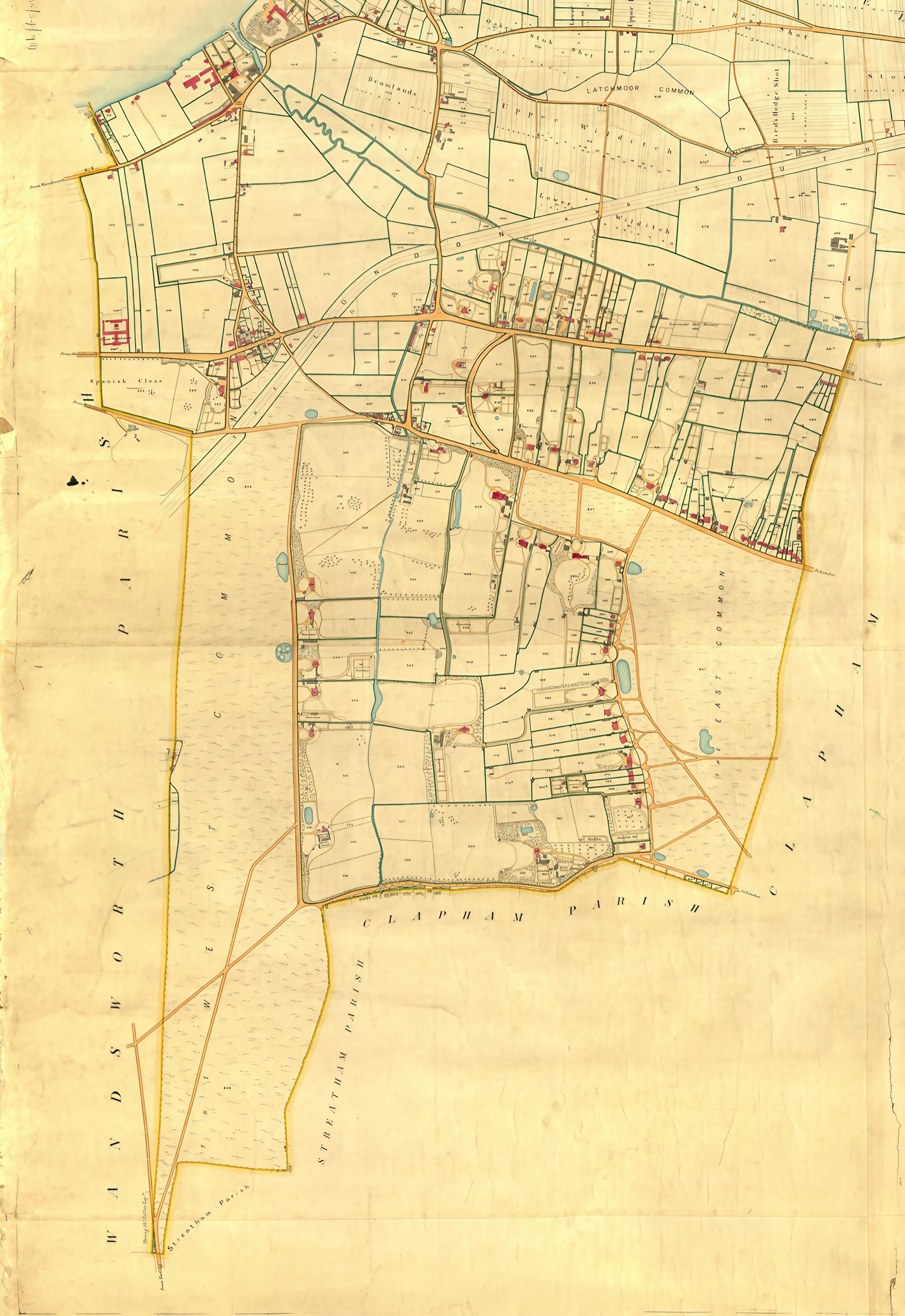
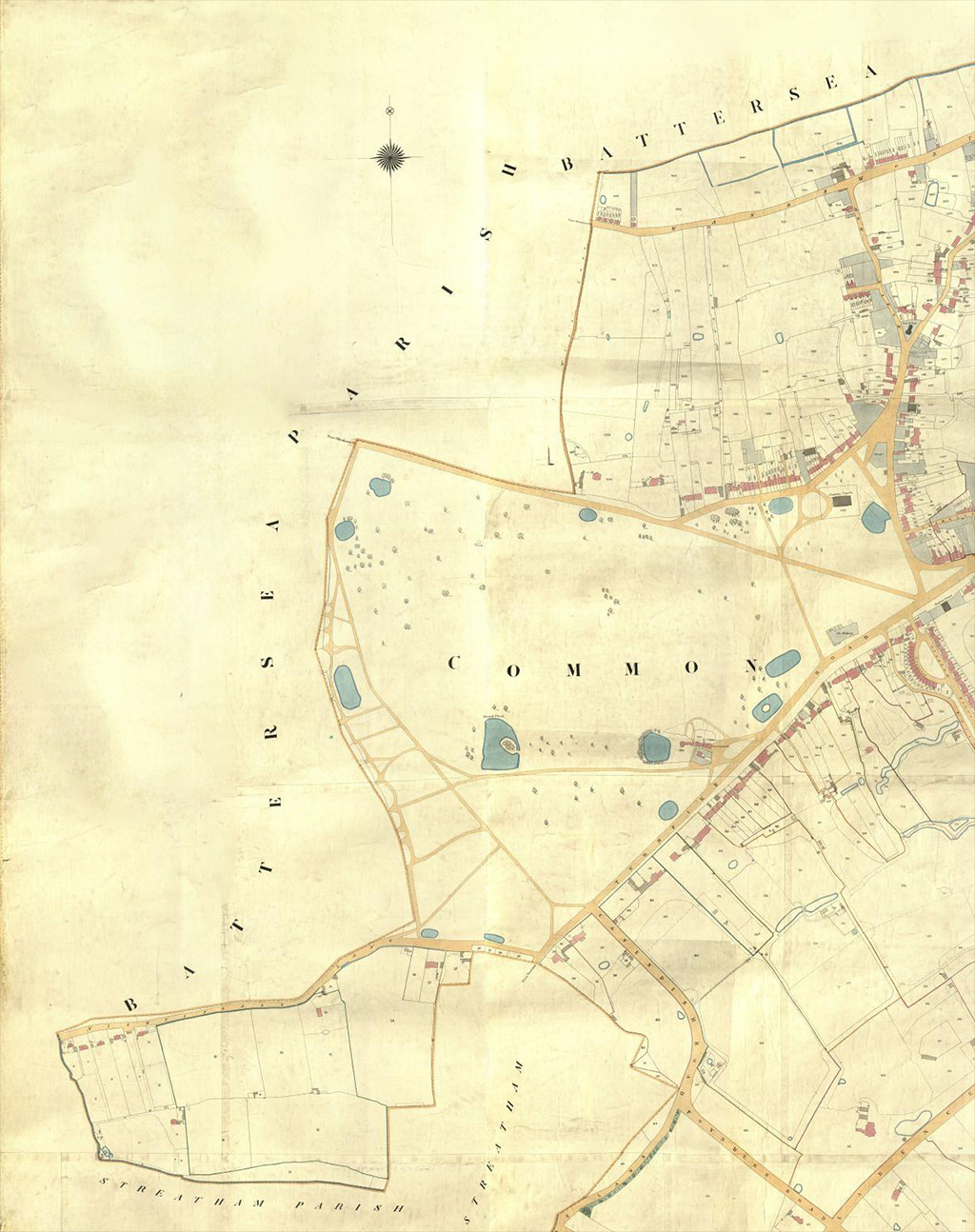
(Click on image to enlarge)
Tithe maps from c.1840 for Battersea and Clapham — both claiming the western side of Clapham Common for their respective parishes. I had assumed that the early OS 1-inch maps and the tithe maps put an end to such boundary disputes. Clearly not.
J.G Taylor, Our Lady of Baterseye (1925), pp.392-94.
(Click on image to enlarge)
(Click on image to enlarge)
(Click on image to enlarge)