A History of Wandsworth Common
Added 17.02.2021
IN PROGRESS — NOT FOR PUBLICATION
Wandsworth Common
Edward Thomas, The Childhood of Edward Thomas
A fragment of autobiography (date?)
Excerpts relating to Wandsworth Common: mainly "Infancy" and "First Schooldays".
[2]
I. INFANCY
When I penetrate backward into my childhood I come perhaps sooner than many people to impassable night. A sweet darkness enfolds with a faint blessing my life up to the age of about four. The task of attempting stubbornly to break up that darkness is one I have never proposed to myself, but I have many times gone up to the edge of it, peering, listening, stretching out my hands, and I have heard the voice of one singing as I sat or lay in her arms; and I have become again aware very dimly of being enclosed in rooms that were shadowy, whether by comparison with outer sunlight I know not.
The songs, first of my mother, then of her younger sister, I can hear not only afar off behind the veil but on this side of it also. I was, I should think, a very still listener whom the music flowed through and filled to the exclusion of all thought and of all sensation except of blissful easy fullness, so that too early or too sudden ceasing would have meant pangs of expectant emptiness. The one song which, by reason of its repetition or of some aptitude in me, I well remember, was one combining fondness with tranquil if peevish retrospective and regret in a soft heavy twilight. I reach back to it in that effort through a thousand twilights lineally descended from that first one and from the night which gave it birth.
If I cried or suffered pain or deprivation in those years nothing remains to star the darkness. Either I asked no question or I had none but sweet answers. I was at peace with life. Indoors, out of the sun, I seem never to have been troubled by heat or cold strong enough to be remembered. But out of doors, somewhere at the verge of the dark years, I can recall more simply and completely than any spent indoors at that time one day above others. I lay in the tall grass and buttercups of a narrow field at the edge of London and saw the sky and nothing but the sky. There was some one near, probably a servant, necessary but utterly insignificant. I
[3]
was alone and happy to be so, just as indoors I was happy among people and shadows between walls. Was it one day or many? I know of no beginning or end to it; but an end I suppose it had an age past.
[Belleville School]
Then I entered the lowest class of a large suburban board school. [PB: This was Belleville.] There were some boys and more girls whom I desired and sometimes struggled to sit next; and at least two whom I avoided. One a poor dirty girl without eyelashes who came from an old hovel at the top of one of the poorer and older streets, and has lent a certain disrelish ever since to the name of "Lizzie"; the other was a boy whom I had seen charging at his desk with his head lowered, like a bull.
Of the mistresses I can see a tallish one, with pink complexion, high cheekbones and sleek light brown hair, whose home was a confectioner's shop, so that it happened that she gave away sweets for slight merits; one dark and shorter, more likeable and hateable; and a stout, short, bustling head mistress in whom I never knew of anything but her appearance to prove her common humanity with the children and other teachers.
I learnt easily: perhaps my memory would record the sweets I earned but not the punishments, nor yet the morning and afternoon labours, whether well or ill performed, of five days in the week. I had no elder brother, and the younger ones of three and one were not yet old enough to accompany me; if I had any friend with whom I walked or trotted home, embraced and embracing as I see children now, I have forgotten. Not that I was lonely, but that I was stung with no intense delight by company, nor with pain by lack of it.
[Local children]
I knew boys and girls in several of the streets parallel to ours or crossing it. One or more of them was with me when I found myself somehow on the forbidden side of a black fence which divided the back gardens of one street from a meadow and cut short another street; there were trees and cows in the meadow, and a small pond not far from the fence. With one of these friends, a girl, I went home once and in her back garden I first saw dark crimson dahlias
[4]
and smelt bitter crushed stalks in plucking them. As I stood with my back to the house among the tall blossoming bushes I had no sense of any end to the garden between its brown fences: there remains in my mind a greenness, at once lowly and endless.
[Tottie Armour]
Why some children, whether my equals or old enough to protect me, were pleasant, and how, I cannot say. Their faces are invisible to me all except one: I can say only that some were fat and the eyes narrow, and that some girls had dark hair, others fair. The one that I can see has black curly hair, dark eyes and cherry lips; and she is smiling: her name was Tottie Armour. We picked sorrel leaves and ate them among the gorse bushes on Wandsworth Common.
[The Common]
A railway ran across the Common in a deep bushy cutting, and this I supposed to be a natural valley and somehow peopled it with unseen foxes. The long mounds of earth now overgrown with grass and gorse heaped up at my side of the cutting from which they had been taken were 'hills' to us, who wore steep yellow paths by running up and down them.
[Snow on Northcote Road]
Equal to them in height and steepness, and almost equal as playing grounds, were the hills of snow lining Northcote Road, the principal street, one winter.
I remember the look of many of the streets, but as not a year has since gone by without my seeing them it is probably not their very early look, save in perhaps a few cases. The first was when I stood by the beerhouse at the bottom of one of them and watched what was happening fifty yards up in the roadway. A mad dog had run into one of the narrow front gardens and lay just inside the railings; a man on the other side with a pickaxe was about to kill the dog; and a small crowd had collected in the roadway. I do not know that I saw the blow struck, but the idea of sharp heavy steel piercing the shaggy hair, flesh and bone of a living creature has remained horrible and ineffaceable every since.
[The street that ceased — where?]
Another street which I seem to recall as it was then and as it soon afterwards ceased to be was one leading to Clapham Junction Station. It consists of a low
[5]
inn with a red painted board up and a row of old dark small cottages mostly with longish front gardens and low wooden fences and a rustic outmoded look inspiring a sort of curiosity and liking as well as some pity or contempt.
If I cannot call up images of most of the streets as they were then, because I have witnessed the gradual development since, perhaps the reason is the same for my being unable to call up images of my father and mother or of my brothers.
[Father]
No. I have only one clear early glimpse of my father — darting out of the house in his slippers and chasing and catching a big boy who had bullied me. He was eloquent, confident, black-haired, brown-eyed, all that my mother was not. By glimpses, I learnt with awe and astonishment that he had once been of my age. He knew, for example, far more about marbles than the best players at school. His talk of 'alley-taws' — above all the way his thumb drove the marble out of the crook of his first finger, the speeding sureness of it — these betokened mastery.
Once or twice I spent an hour or so in his office in an old government building. The presence of a wash-stand in a sitting-room pleased me, but what pleased me still more was the peculiar large brown carraway biscuit which I never got anywhere else. My father at this time gave or was to have given lessons to Lady Somebody, and he mentioned her to me once when we were together in his office. She became connected somehow with the carraway biscuit. With or without her aid, this rarity had a kind of magic and beauty as of a flower or bird only to be found in one wood in all the world.
I can hear but never see him telling me for the tenth or hundredth time the story of the Wiltshire moonrakers hanging in a chain over a bridge to fetch the moon out, which they had mistaken for a green cheese, and the topmost one, whose hold on the parapet began slipping, crying out, "Hold tight below while I spit on my hands," and many another comic tale or rhyme.
[Mother]
My mother I can hardly see save as she is now while I am
[6]
writing. I cannot see her but I can summon up her presence. She is plainest to me not quite dressed, in white bodice and petticoat, her arms and shoulders rounded and creamy smooth. My affection for her was leavened with lesser likings and with admiration. I liked the scent of her fresh warm skin and supposed it unique. Her straight nose and chin made a profile that for years formed my standard. No hair was so beautiful to me as hers was, light golden brown hair, long and rippling. Her singing at fall of night, especially if we were alone together, soothed and fascinated me, as though it had been divine, at once the mightiest and the softest sound in the world.
Usually perhaps there was a servant, but my mother did everything for us in the house, made many of our clothes and mended them, prepared and gave us food, tended us when sick, comforted us when cold, disappointed, or sorrowful.
The one terrible thing I witnessed as a small child was my mother suddenly rising from the dining-table with face tortured and crying, "I am going to die." My father took her on his knee and soothed her. I had and have no idea what was the matter.
[Aunt]
For her younger sister I felt a similar affection and admiration, though less, and far less often exercised, for her visits were neither long nor frequent. The grace, smoothness and gentleness of her voice and movements gave me pleasure. My first conscious liking for the female body was at sight of her sitting less than half dressed in a chair, her head bent and one foot on to which she was pulling a stocking lifted from the floor.
Years afterwards I used to think of this from time to time to envy the privilege of early childhood. She sang livelier songs, e.g. from Patience, than my mother ever did. But she did not know our ways and her complaints or corrections were harsh by comparison with my mother's.
[8]
[GeneralGordon's death at Khartoum, 1885]
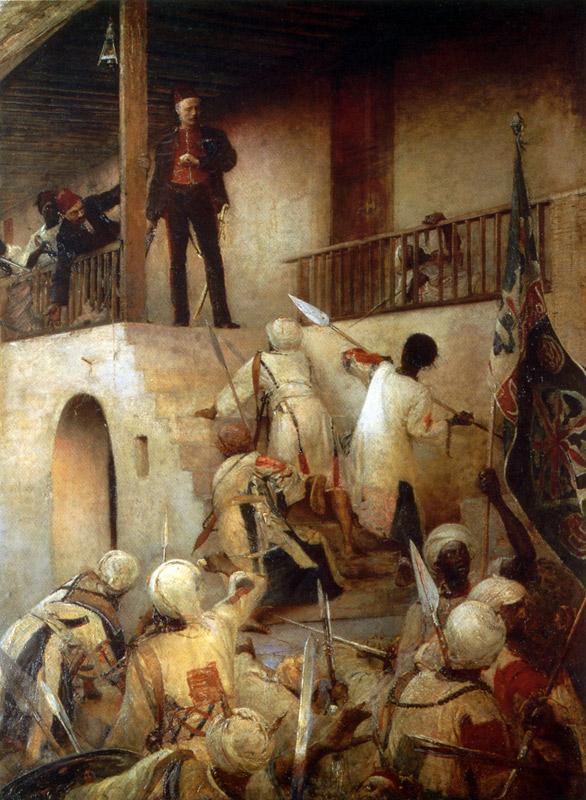
My waking life was divided between home, school and the streets and neighbouring common. Glimpses of the outer world I had few. But I remember General Gordon's death at Khartoum, and, whether from a picture in a newspaper or from imagination, I retain an image of a soldier in a fez and armed with a revolver standing with his back to a portico, facing the enemies who swarmed up the steps
[PB: This was 1885. I have added a couple of contemporary images.]
(Click on image to enlarge)
[9]
below and being struck at by one from the side.
[Wakehurst and parallel roads]
Our street like three or four others parallel to it was in two halves, running straight up the opposite sides of a slight valley, along the bottom of which ran the principal street of mixed shops and private houses. Our house was low down in the half which ran up westwards to Bolingbroke Grove, the eastern boundary of Wandsworth Common.
These little semi-detached one-storied pale brick houses in unbroken lines on both sides of the street had each, even then when they were new, something distinguishing them and preventing monotony. The people in them made them different. In addition, some were beginning to be draped in creepers. Some gates stood open, some were shut. One had bushes in the garden, another had flowers, another nothing but dark trodden gravel. The house above ours, in the next pair, was presumably meant for a doctor, and possessed a coach house which looked almost as if it belonged to us. That was our outward distinction.
[The house]
Inside from the front door to the back of the house there was as long a passage as possible, the rooms opening out of it. The staircase ran up to a room with an opaque glass window in the door, a second room, and two others connected by a door. The rooms downstairs I hardly remember at all. But in one of them my great-uncle James Jones lay asleep after dinner, a red handkerchief covering his face and trembling in the blast of his snoring which we called "driving the pigs to market". Through the open window of another, one Mayday, Jack-in-the-Green bounded in to beg a penny, showing white teeth, white eyes, black face, but the rest of him covered and rippling with green leaves.
The passage was a playground when it was too wet or too dark to be out of doors. Here, when I had at any rate one brother — probably three or four years old when I was five or six — who could run, we two raced up and down the passage to be pounced upon by the servant out of a doorway and swallowed up in her arms with laughter.
Upstairs the room with the glass door was at
[10]
long intervals occupied by a visitor, such as my father's uncle James or my mother's sister, and I think cards were played there.
Except relatives I think there were few visitors to the house. Sometimes the old red-faced gent next door, a court usher, came in: and once as he laid his hand on a large sheet of printed matter, perhaps at an election time, he said impressively, 'I am a staunch Liberal, staunch.' Once a young couple had tea with us and everyone laughed at some cheerful remark about the lady's name being about to be changed — I and at least one brother slept in one of the two connected bedrooms. I had no night fears and few dreams. Several times some shapeless invisible thing threatened me at the end of the bed and I lay in terror, trying vainly to scream for help.
On Christmas morning I used to wake up in the dark and smell the oranges and feel my presents, and guess at them and begin an apple and go on to sweets, especially those contained in a cardboard box scented curiously, loaf-shaped, and coloured like a top of a bun, which came from a cousin of my mother's at the Much Birch Vicarage.
[Early books]
When I and a brother were recovering from scarlet fever we lay or sat up in our cots, while our father in the other room read aloud the Cuckoo Clock. Not a shred of the story is left to me, but I seem to see my father — thought I could not see him at the time — sitting in an arm-chair bent over the book.
[https://en.wikipedia.org/wiki/The_Cuckoo_Clock]
He also read at least the opening chapters of Great Expectations, with such effect that, though I have never since looked at them, I have an indelible impression of a churchyard in cold and misty marshland and out among the stones a convict in clanking chains, and a tiny feeble boy with the absurd and as it were enfeebling name of Pip.
I do not know whether I read Robinson Crusoe or had it read aloud to me. I loved it entirely, and a faint spice of amusement was added to my love by the repetition of 'says I'. Two scenes most impressed me. The first was the picture of men tumbling savages over the sides of a ship by means of brushes like a sweep's dipped in tar.
[11]
The second was where wolves are pursuing a doomed riderless horse over the snow. But I cannot remember the act of reading this or any other book at home.
Fairy Know-a-bit by A.L.O.E. was read to me. The fairy in it was created for the purpose of imparting facts about things in everyday use. The facts though not distasteful passed rapidly through my brain, and the fairy, though probably an inartistic invention, fascinated me and attained such a measure of reality for me that I used to fancy it possible for him to appear from between the leaves of some big old book as he did in the story. To my mind the book would have been a certain cookery book with pictures of flesh, fish, and fowl, or dishes.
[https://childrensbookshop.com/book-103500.html]
[https://www.abebooks.co.uk/Fairy-Know-a-Bit-Nutshell-Knowledge-A.L.O.E-London/7031221067/bd#&gid=1&pid=3]
["The Key of Knowledge"]
There were, I suspect, invented fairies in another book which had and has a charm impossible for me either to communicate or, I fear, to make credible. It was my first school prize. The words, "The Key of Knowledge", occurred in its title or they stood out somewhere else. It was illustrated by coloured pictures. But it disappeared, I never had any idea how, before I had read far into it, and I never saw it again.
From time to time down to the present day I have recalled the loss, and tried to recover first of all the book, later on the thread of its story, something that would dissipate from its charm the utter darkness of mystery. For example, fifteen years ago in Wiltshire two strangers passed me and I heard one of them, a big public schoolboy, say to the other, a gamekeeper, "What do you think is the key of knowledge?" and back again came the old loss, the old regret and yearning, faint indeed, but real. There were times when I fancied that the book had held the key to an otherwise inaccessible wisdom and happiness, and the robbery appeared satanically sinister.
[Local children]
I was not much at other boys' houses except for Christmas or birthday parties. We met either in the street or in the back gardens, where some had swings fixed. Most of them lived in the same street, but their parents and mine were not as a rule on terms of more than distant acquaintanceship. The chief party was
[12]
the doctor's, some time soon after Christmas. There was a great crowd of strange boys and girls whom I had got to like and hate, or be indifferent to, for a few hours, and probably never saw or thought of for another twelve months. Most were older than myself; some, I was conscious, had parents who were richer or of different class; we were restrained and suspicious of one another, and the only unquestionably good things there were the mince pies, jellies, sausage rolls. Now and then we visited friends in Lambeth, where my father and mother had lived from their marriage up to the time of their removal to Wakehurst Road when I was about two.
I remember the girls faintly, not so as to describe them, but well enough to wish that I could see them again to revive their images. In most houses I had at least a preference for one of the girls and liked to be teased afterwards for having kissed her in a game of forfeits, or for shouting her name up the chimney.
II. FIRST SCHOOLDAYS
[Belleville]
When I think of school I smell carbolic soap. I see the caretaker by the wall of one room ringing the bell. I deposit my weekly fourpence on the master's desk. I go round, as a privilege, filling the scores of inkpots from a tin with a long thin spout. I join in the one-verse hymn before and after lessons. I see large light bare rooms with a map or two, and boys in long parallel desks facing a master; for we were soon separated from the girls. We repeated aloud "Witney on the Windrush manufactures Blankets". We learned the names of the tributaries of the Thames for ever and ever. What I most enjoyed was doing maps of Great Britain and Ireland, inking in the coast lines with red, and marking the mountain ranges with thin parallel strokes arranged herringbone fashion. I never fired of the indentations of the western coasts, especially of Scotland. The line
[13]
of the Hebrides I think I actually loved.
One of the masters, named Jones, was little, with dark prominent eyes, round plump red face and quick steps and fiery temper; another, named Spragg, was a tall fairer bony man, who had a deep resonant voice; and I think that once when the two quarrelled the tall one lifted the little one into the air. There was a third named Wigley, a mild man, a chewer of his moustache, who struck me as feeble even before Spragg got the better of him in a tussle.
The head master was short, square-shouldered, lean, pallid, bearded, took long rapid strides with head low and projecting, flat high overhanging forehead, deep-set eyes, always on the verge of anger, a harsh barking voice, a general expression of dark solitary determination. He appeared unexpectedly from time to time in the several classrooms which I passed through in the course of three or four years. Sometimes he went by me in the street, his hands in his black overcoat pockets, an umbrella under his arm, overtaking everybody, with rapid sidelong dark glances.
I remember crawling in and bursting out, but very little about school itself. We were huddled close together in great lofty rooms with big windows and big maps and on Mondays a smell of carbolic soap. Addition, subtraction, multiplication, parsing, were easy to me, and I did them pretty well. Sometimes things were tediously easy to me, sometimes I took a pleasure in overcoming what looked hard and of course in earning praise, reward, a superior position. I rather liked wearing the numbered ticket on examination days, and took pride in having the numbers neatly printed in black ink with a 4 rather than an open 4 and so on, as I did in saying, when questioned, that my father was an 'Officer' in the Civil Service. Discipline was strict. I think I must have been usually fully employed, save for glances at the clock. At any rate I know more about what I did before and after than in school.
The one moment in school at this time which I cannot forget is when I found myself being lifted from a grating where I
[14]
had fallen, having been hit hard in the stomach by a boy on my way from the classroom to the main exit. In the hard asphalt playground we played rounders and egg-cap and games with tops, marbles and cherrystones.
[Street games]
Going home, we spun our tops or two of us helped ourselves along by bowling hoops or by playing a progressive game with a marble or a stone each, called Buckalong. We used to exchange things and ratify the deed by touching the iron with which our heels were shod, saying 'touch cold iron can't change back'.
We used to make fun of a solitary boy, probably of a better class than ourselves, who used to live in the same street and walked about with a snake round his wrist. We called him 'Soppy', prepared to run away. But he never retaliated or took any notice of us.
My friends were chiefly boys of our street; if other boys harassed us we used to say 'My father's a policeman' to frighten them. But only one grievance remains in my mind, that an older boy, not of my acquaintance, once lured me to drink urine by offering it to me in a bottle as ginger-beer.
Some time later on a Sunday I pointed out this boy standing with others by the Three Island Pond, and my father clouted his head.
[Sunday was a bad day: church, chapel, Sunday school]
School was not an affliction, but church or chapel or Sunday school was. At an early age I did not go regularly, nor I think did my parents. They were sober reverent people without a creed, though their disbelief in Hell and the Devil almost amounted to a creed. My father and I made merry over the Devil and the folly of believing in him as we supposed many did. He used to try different chapels or different preachers, sometimes taking me with him, more especially when he had become an almost weekly attendant at a Unitarian Chapel. Here from the prickly silence of two hundred or three hundred people I gradually came to feel a mild poison steadily creeping into me on all sides. I never made a friend of any of the boys who attended there. A deathly solemnity filled the chapel. After the service couples walked to and fro or gathered into knots on the pavement
[15]
outside. The deathly solemnity was strong enough to cling about the people even there in the sunlight: some of them it accompanied to their one o'clock roast beef or mutton. But at first the Sunday-school was my particular allowance. I liked singing and liked the melodies of 'Jerusalem the Golden' and 'Fair waved the golden corn', and I liked going with all the rest for the annual treat somewhere in Surrey, where I could run about in a wood, become fond of another girl or two (I remember one with a very deep but I think also husky voice), eat bread and butter, watercress and slices of cake and drink tea. The confinement in the schoolroom was not quite a positive ill. It was regular, it was inevitable, and until later on there was usually nothing in particular of which it deprived me except liberty. But Sunday was a bad day and this was the worst part of it. That deathly solemnity, whether we respected it or not, was equally thick in the schoolroom. I became accustomed to making a sort of drug of boredom. I did not rebel, but taking this poison became fairly oblivious to the good or evil that befell Jesus Christ, or Servetus, or myself. Moreover, I did positively loathe with continuous loathing the trailing with one or more of my brothers along the Sunday streets, in our stiff Sunday clothes and our Sunday hats. I hated these clothes and hats and I felt also that they made me ridiculous in the eyes of others. If the hat was blown off by the wind it was some relief: and I could then stamp on the thing and put it down to the wind and mud. What wonder that I made no friends under this Upas-tree.
The majority of the children came from homes poorer or less refined than mine, and with the exception of one or two girls whom I thought pretty I looked down on them though ever so lightly. The few boys whose parents knew ours, if they never visited one another, never became our friends. Some suspiciousness existed between us which our best clothing did not permit us to destroy. Chapel and Sunday-school were to me cruel ceremonious punishments for the freedom of Monday to
[16]
Saturday.
I have still a profound quiet detestation of Sunday in whatever part of England or Wales it overtakes me, but most of all in London. I think I began learning to hate crowds and societies, and grown-up people, and black clothes, and silk hats and neatly folded umbrellas and shining walking-sticks, and everything that seemed a circling part of that deathly solemnity as I was not. Nevertheless, I may have looked decidedly a part of it with my shy bored silence, my fear of disagreement or quarrel in public, and my thin long narrow face that always shrank and chilled and stiffened into solemnity under the gaze of grown-up people, strangers, and numbers.
[One good thing about Sunday]
There was, however, always one good thing about Sunday, and that was the biscuits, two large oval ones or one of these and two small round ones, which I found on a bedside chair upon awaking. The crumbs of these biscuits among the sheets became a nuisance; for we got up later on Sundays than weekdays.
[Out of the house]
The best of life was passed out of the house and out of school. I remember going out for the first time after scarlet fever. Perhaps because the spirit of many days had been stored up within me untouched, I felt that I was very strong and could do anything. I started to run; the eagerness of the spirit was overmuch; I stumbled and fell down.
[Christmas]
One Christmas morning I woke up and felt a long lean smooth straight cold thing with straps at my bedside. It had a handle, and pulling that with one hand I brought out what I discovered to be a sword, while in the other hand was a scabbard. The daylight came upon me still unsheathing and sheathing the sword, trying hard for the hundredth time to put it back the wrong way. As soon as I could I fastened the belt round my waist so that the sword hung on the right instead of the left side and went out alone. The streets were empty. I was proud though without spectators. Once or twice the weapon caught between my legs. I marched up the street, crossed the road separating it from the Common and turned to the left between the
[17]
elm-trees of Bolingbroke Grove, having the road upon my left, the Common upon my right.
[Mabel Looms]
At the top of one of the streets parallel to ours, but at that time divided from it by that big private meadow with the pond and elm-trees, I stopped and looked down. For there lived Mabel Looms, a schoolfellow whom I adored. She had had a Christmas card from me that morning. The street was empty. I walked backwards and forwards along the Grove past the top of the street, waiting, sufficiently proud not to be overcome by long disappointment. How many times since have I waited thus for somebody, with a dog's patience. There began to be others in the streets. At last Mabel came up towards the Common, in the company of some elders. Without a sign I continued walking backwards and forwards. They turned to their left at the top, away from our street. I turned in the opposite direction homeward, pleased with my swinging sword and believing that the passers-by admired it. At home they knew well where I had been.
My attachment to Mabel lasted for several years and more than once after it had been broken I attempted to renew it. She was a perfect loving friend. I thought her beautiful. Her hair was light brown, her face round rather than a long face. She had elder sisters — one named Agnes — whom I did not always like; and a brother named Arthur to whom I was indifferent; and a freckled slighter cousin, with a name something like Catherine Haythorn, whom I liked equally for her own and for Mabel's sake.
[Girls. The veil over sex.]
Girls practically never joined in our games: even bowling our iron hoops beside their wooden ones was rare. Those girls who did play much with boys were scandalously talked about, but they were older than I was, and I neither knew nor know anything positive against them. I only have an idea that I had seen one of them — a deep-voiced dark-skinned good-looking girl who walked with long strides and a slight stoop — coming from among thick bushes with a boy or two boys. This caused laughter and was afterwards mentioned with hints and jeers
[18]
which I do not think I understood: I became fairly curious and expectant; the veil over the sex thickened.
["Our principal game"]
The Common and the streets leading up to it were the scene of our principal game. It was played chiefly on Saturday, our whole holiday. We assembled, for example, at the top of the road in the well-trodden garden of a doctor who had a rowdy son; each bringing a weapon or several weapons, wooden swords and pikes, or daggers, shields, pistols, bows, arrows and with horns and trumpets, and perhaps some bread and cheese and an apple or orange. There sides were chosen. One side went out to seek a fort in someone's garden or among the gorse bushes. Ten minutes later the other set forth, often in two divisions.
Sometimes stealth was the rule of expedition, we advanced whispering and in some order. Sometimes everyone was shouting for his own plans and against another's. At other times the methods alternated, the stealth would become wearisome, we began to chatter and disagree, or the riot of anarchy would suddenly strike us as wrong, everyone said "hush", and for some minutes we modelled ourselves on Sioux, Mohicans or Hurons, crouching, pausing, trying to hush the sound of our breathing. We forgot everything in this Indian ideal.
[BIT MISSING?]
the enemy had to be found. Nor were they loth. Someone was sure to show himself and wave defiance, or to leap out on us, supposing we passed by. If seen at a distance they might change the stronghold and there would be a chase. If they were content to stand a storm, the second army would gather all its numbers together and, with yells and counter-yells, batter and push them out or be battered and pushed out itself. The struggle was one of character, not weapons. The side possessing the fiercest and most stubborn boys won. The winners would than in turn fortify themselves and sustain an attack; and so it went on, until a mealtime, or nightfall, or rain, or a serious quarrel, finished the war.
[Fiercer battles with boys of neighbouring school — Emanuel? Battersea Grammar?]
[19]
grammar-school standard looked down upon the Board-school boys, or 'Boardy Blags' (i.e. blackguards). The Board-school boys resented this. The feud was usually hardly in so much as a smouldering condition, and so far as I know must have been all but forgotten. Then suddenly it would flame out. A loose army of Board-school boys several score strong moved along the Grove at the edge of the Common towards the enemy's school. The army was continually being swelled from the side streets. With all the smaller or more timid boys hanging on its fringes, more angry than warlike, more curious than angry, the numbers were considerable. Stones were the long-distance weapons. But rarely, I think, did both sides muster a fairly equal army at the same time.
As a relaxation we hung about in corners smoking cigarettes of rolled brown paper. Making these, lighting them, puffing them, coughing, relighting them, asking one another if they were alight, and silently enjoying the act and the seclusion, filled hours. Our sense of discipline was slight and transient. It was not encouraged by doing lessons, a few ridiculous exercises under the eye of an unsleeping master, and playing mostly individualist games in the playground.
[A little mob]
Being in a little mob increased our boldness and also our ease and safety. According to our tempers, I
[20]
think we hoped that the others would either shelter us or support us in doing signal deeds. As member of the army, any one of us could most likely insult a passing outsider with impunity: if, however, there had been any swift retaliation the victim of it would often have been left to suffer alone. Therefore the armies did not always wait for a formal order of disbandment.
[The Common]
The Common, for example, offered many temptations to more irregular games and aimless rovings. For it was an uneven piece of never cultivated gravelly land. Several ponds of irregular shape and size, varying with the rainfall, had been hollowed out, perhaps by old gravel diggings. It was marshy in other places. Hawthorn and gorse clustered tall and dense in great and in little thickets. Tall elms and poplars stood about irregularly. And the level spaces suitable for cricket, football and tennis were not many.
With this variety the Common, even though the railway ran through it parallel to Bolingbroke Grove and only two or three hundred yards away from it, was large enough to provide us with many surprises and discoveries for years. We could spend a day on it without thinking it small or having to retrace our steps. We wandered about it with or without our hoops. For any kind of hiding and hunting games the thickets were excellent. We played the other games in the open spaces.
[The ponds, vivisection and dissection]
The ponds were for paddling in. One of them, a shallow irregular one, weedy and rushy-margined, lying then in some broken ground between the Three Island and the railway, was full of effets [eft, newt] and frogs. Bigger boys would torture the frogs, by cuffing, skinning or crushing them alive. The sharp penknives sank through the skin and the soft bone into the wood of the seat which was the operating table. The seat and the earth under and about it would be strewn with fragments, pale bellies slit up, and complete frogs seeming to be munching their own insides. At that time I could not have done it myself, but my horror lacked pity and turned into a kind of half-shrinking, half-gloating curiosity.
[The long pond, "Backaruffs" / sticklebacks and gudgeon]
I fished
[21]
[The gudgeon]
The gudgeon was so attractive, partly for its looks, perhaps chiefly for its comparative size, that many times I willingly paid a halfpenny for one and let it be believed that I had caught it. Even when dead it was hard to part with, so smooth and pure was it. I liked even its smell, yet never dreamed of eating it. There were carp, too, in this pond and in the roundish Box Pond that lay half-way between the top of our street and the railway.
[Carp]
[Richmond Park / perch]
Bigger boys used to fish in the Penn Ponds at Richmond Park and allowed me to buy from them a perch of four or five inches long, which looked magnificent with its dark bars, standing almost on its head in my little round bowl. There in spite of worms and breadcrumbs it shortly afterwards died. I was pained at coming down in the morning and finding such a magnificent, uncommon and costly creature dead. Nor did I ever like the perch's stiff hard prickly corpse, faded in death, and looking much smaller out of the bowl than inside.
[22]
[The streets as playground / hoops]
The streets were a playground almost equal to the Common. The labyrinth of them, all running at right angles and parallel to one anther, with some culs de sac, could be mastered but indefinitely extended; every month or two I should think I added a street or two to my knowledge. Alone or with others I bowled my hoop up and down them either in purposeless pleasure or on some errand for my mother.
[The blacksmith to mend a hoop]
Best of all errands was to the blacksmith's to have a broken hoop mended. The smithy was a primeval forest cave that broke a line of ordinary shops. The bellows snored, the sparks spouted up, and the pallid, gaunt, bare-armed man made the anvil ring its double or its single song.
When it was very cold I ran along with hands in pockets striking sparks out of the rough kerbstone with my ironshod heel.
[Night games]
At night we often played games of hide and seek with lanterns. We picked up sides, fixed the boundaries which were not to be exceeded, and laid down rules against hiding in our own houses. One side went out to hide, to be followed in a few minutes by most of the other side, except one or two who were left behind to guard the home, which the other side had to reach without being touched. Setting out with bull's-eye shining and a good companion, and exposing the others behind laurel bushes and catching them after a chase; or ourselves being the quarry and eluding capture for the whole evening whether with constant obedience to rules or not — these were great joys. If the game became monotonous we rang people's bells and ran away, or we went into shops and asked for sweets with ridiculous names just invented by ourselves.
[To Lambeth]
On Saturday sometimes I would go to Lambeth, two miles away, to take a message or a parcel for my mother, riding back by tram, or walking in order to spend the fare on sweets. I remember once, too, walking to Chelsea and back with an elder boy. As we went along the far side of the Thames he explained to me why it was women could plunge from greater heights into water than men.
[Battersea side of the river]
The Battersea side of the
[23]
river was strewn with prodigious broken architecture very impressive to me and seeming of unknown giant antiquity.
[The walk to Wimbledon Common]
When I was eight or nine, the boundaries of my domain were stretched by several miles all at once. I walked to Wimbledon Common. Of the first visit I have no recollection. But I can distinguish two later visits: one because I discovered the joy of throwing stones over into the unknown depths of a great garden and hearing the glass-house break; another because I limped all the way back with a low shoe gone wrong. I did not go alone, but as one of several hangers-on to older boys and girls. We fished here and there with hopes of better things than came out of the Wandsworth Common ponds. We met strange boys there who occasionally possessed or talked about enviable fish.
The three-mile walk was, however, good in itself, whether we went by Wandsworth, Earlsfield, or Wimbledon. We always recognized the old landmarks with pleasure and a kind of surprise. There would be a cage of pigeons or rabbits or guinea-pigs to look at outside a cornchandler's, or an old man with some trait of surliness or quaintness whom we hoped to see again, or a chestnut-tree where we had to stop to throw up at the 'conkers', or a shop where we had once bought a specially good halfpenny cake. Other shops and houses had an altogether indescribable charm.
[Allfarthing Lane]
Then Allfarthing Lane was worth going down for its name's sake. We invented explanations and repeated those of our parents. At the top dwelt an old woman in what looked a one-room but who presumably knew and had something to do with the origin of the queer name.
[The "Wandel"]
But above all, whichever way we took, the Wandel had to be crossed. Going by Wimbledon we had to cross the bridge by the copper mill. You might stop to look down at the fish or along at the fishermen, or to carve your name on the parapet. In Wandsworth there were two bridges, fishermen hanging over the less frequented one who were never seen catching anything but never exhausted our curiosity. But best of all was the middle way
[24]
through Earlsfield, crossing the Wandel at the paper mills. The smell of the mills wafted over a mile and a half on certain still evenings gave me a quiet sort of poetic delight. Hereby the water ran over a steep artificial slant, swiff, glittering, and sounding; and sometimes we stayed here and caught minnows instead of going on to Wimbledon.
It was the first place where I saw and realized the beauty of bright running water. We paddled with our stockings in our shoes and our shoes tied together and slung over our shoulders. We talked and laughed and shouted and splashed the water. I cannot remember cold or rain or any clouds there.
[Holidays]
[30]
One evening after tea I went up on to Wandsworth Common with some bigger boys and sat on the seat by the Box Pond. A cigar was produced, lit and given to me to smoke. A few minutes afterwards I was crawling down the road by giddily clinging to the railings of garden after garden. I slunk into the house neglecting my mother's question 'What's the matter?' but soon answering it by deeds not words. My father said that I should not go to Wales. Nevertheless, I went.
[31]
[32]
. . . ; Part of the pleasure of a book was still, I think, the strangeness of words as well as things. Thus I was arrested by the quaintness of Izaak Walton's spelling, as in 'pearch' for perch, of his archaic names such as 'luce' for pike, of unfamiliar personal names like those of the travellers Speke and Grant, as well as by the nasty horror of Africans eating fat torn from a live human body in Sir Samuel Baker's book.
These things were no less and no more remote than the fairy tales. I did not often feel that they were part of my world of newspapers, a comfortable home and a clockwork school. But several houses became associated with certain wonders out of books, either by accident or because at some point they resembled places in
[33]
the books. The gravelly shore of the Long Pond on Wandsworth Common was confused in my mind with the sea sand where Robinson Crusoe saw the cannibals' footprints.
IV. BOOKS AND SCHOOL FRIENDS
[Eager walks across Wandsworth Common to borrow books]
For the most part I remember rather the joy of having and reading books than particular passages. I remember the eager walks over Wandsworth Common to borrow volume after volume of the Waverley novels, but of Waverley, Heart of Midlothian, Peveril of the Peak and The Talisman, not a rack is left. Of The Last of the Mohicans and The Pathfinder rather more is left. They gave me an idea of a noble savage. The Pathfinder himself towers in memory as grandly as Milton's Satan but more dimly. The name of the girl Cora has folded itself up in my mind like a gentle snake ; . I read some of Scott's poems in the same year. They made deeper impressions than the novels. I was continually repeating with a throb:
"With Chester charge and Lancashire, or Charge, Chester, charge!"
[34]
The only one of the many songs we sang at school which I can recall was in the minor key. It was a kind of dirge for a North American Indian. I can still hum the melody, but I remember no more of the words than 'Far far away in the depths of the wild wood'. These were several times repeated. The rhyme to 'wild wood' was I believe 'childhood'. I used to sing this to myself, and have periodically returned to it ever since. I liked also 'Lucy Gray', the one poem which I remember to have learnt at the Board-school: but I never could understand 'and snapped a faggot band'. I do not think I had any tangible sadness to which the song gave utterance.
[The old houses and orchards destroyed]
There was for me at that time no sadness, e.g., in the destruction of the orchard of the great house near by, and the portioning of its park-like meadow into streets. Anybody could enter now. We pillaged artichokes. Some boys took sackfuls of the soil and I helped one to drag his down the street; out of the wounds
[35]
thus worn in it, it was bleeding dark mould on the pavement. My books did not hamper my games, nor in any way alter them except that I could not wear sword and shield hereafter without FitzJames haunting and inspiring me.
[Is a bit missing here?]
played as much as ever and walked to Wimbledon more and more.
[Fighting without poetry]
I could also enjoy kinds of fighting where it was impossible to think of poetry. For example, I had a long tussle with a rough after a quarrel during fishing, and was only beaten by the intervention of a third party armed with an old kettle. It was fun, too, to battle at a distance with stones, dodging and casting at the same instant. In one of these combats I got a deep scalp wound made ever more memorable by my aunt fainting at the blood.
While we were at this house my mother presented me with four brothers at intervals of two years, but, as I have no recollection of them during that period beyond the fact that on certain dim occasions in our street or at Swindon one or other was present, I say nothing about them.
[The move to Shelgate Road]
Being thus seven in family we moved to a large house in one of the roads parallel to the old one [i.e. from Wakehurst to Shelgate Road]. The great long low windowless van that we stamped about in — the bread and cheese eaten anyhow in the confusion — the odd jobs of fetching and carrying — these were pleasures. I am not at all sure now whether I made one of the journeys on the tail of the cart. And yet I am perfectly sure that the name of the elder boy who shared these pleasures was — and that my mother said he was a good boy and had been very useful.
On the first few days after the move I went several times most of the way down from school to the old house before realizing my mistake. Whether I had regrets for it or not, it began almost at once to have a dreamy charm too faint to be describable. It was a visible piece of the past, a skeleton, a hollow shell that did without us.
[The box room in the new house]
Of course the new house had also a charm. Its size allowed an empty room for us to play in, and a box-room. Perhaps it was not until a little later that the box-room became attractive,
[36]
because it was dark and because in it was a wooden box containing inexhaustible treasures. These were chiefly old books, old magazines, old photographs of unknown people. Many and many a time I took them all out, sometimes in search of something I had noticed among them before and then not troubled about, sometimes in more uncertainty but equal eagerness, at other times with no object save testing the inexhaustible surprises of the box. At intervals of a year or less I must have taken everything out and put it back again, with moments of hastiness when things were moved in armfuls, fully a dozen times. I think I could do it at least once yet. My slender undefined expectations connect the search with that lost book of my earlier childhood about the key of knowledge. But I forbear to amplify this.
One of the discoveries I made was of Pickwick Papers. Sitting in the dust with dusty eyes I read about sticklebacks in the Hampstead Ponds. I could not get on much farther. Too many of the people had ridiculous names. The books had nothing in common with the Waverley novels or the Compleat Angler or Sir Samuel Baker's travels.
At about this time I began to keep my own books on a shelf of their own and to paste numbers inside them as I had seen done with library books: to raise the numbers to a respectable size I took my two next brothers into partnership and we lent them out to one another with formality. The sum of our united ingenuities would at no time have been very great. However, I had my own way. It was usually easy for me to get it.
[Later days at Belleville]
While I was still at the Board-school I was conscious of possessing some power over my physical superiors, though the use of it was unconscious. I cannot say how much it was exerted, if it was at all, by means of wheedling, begging, cringing, or perhaps putting others into the position of feeling brutal or awkward if they refused me. My later days at the Board-school were pleasant enough. My class sat in the same room and was taken by the same master as a special
[37]
small class of the oldest boys in the school. They used to read accounts of the Massacre of Glencoe and produce essays on what they remembered. I made friends with one or two of them, laughed at their jokes and catch-phrases, and was expected to enjoy the picture of the gravid uterus of a rabbit in a book which one of them showed me.
[A private school]
I exchanged the Board-school when I was ten for a private school. Here there were fifty or sixty boys of from ten to seventeen years of age, perhaps half of them boarders. They were the sons of tradesmen, professional men, moderately well-to-do clerks, and men of small
[PB: What/where was this school?]
[38]
independent means.
Only one of them had I known before. He preceded me by a term from the Board-school and at once asserted his superiority by making a fool of me. In the small gravel playground there was a swing consisting of a long board suspended at either end by a pair of chains. A boy at each end could work it up to what seemed to me a terrible height, the prime fear being to jump off backwards from your position just as the board began to swing forward. I took my first ride with this old school-fellow. The bell for lessons rang while we were well up, and he dropped off, leaving me helplessly to wait and watch the school assemble, and pointing me out with malice as well as grins when I at last took my place.
The schoolroom was a large single hall adjacent to the large old brick house where the boarders lived with the head master. The three classes under the head and two assistants all occupied the same room, but faced different ways. In the fourth quarter of the room stood the boarders' more substantial desks, where they kept silkworms and white mice.
The boarders predominated in other ways. The familiar life together had given them a style and subject matter of their own. Knowing the masters privately they treated them with open ease and half-concealed amusement. They were pretty faithfully imitated by the day boys. But the head master was of stone. He wore a black gown. So long as he was in the room no sound was to be heard beyond a dismal foot shuffling, a pen dropping, a boy asking a question, a master answering or explaining, the head dictating or clearing his throat. While he was out the hubbub was so general that the assistants could hardly single out a particular one to punish, for if it had a ring-leader it was some spirited bright popular boy whom it would be unpleasant and ruinous to punish. I continued to accumulate information in history and geography, to do harder and harder sums, to copy models of handwriting. I learnt a few Latin declensions and conjugations. With the rest of the school I sat listening to Mr. -
[39]
talking physiology as if the body were a newly discovered machine and we were angels.
Just before the holidays like everyone else I wrote a letter to my dear parents telling them what had been done during the term, when the holidays began and how long they were to last. But I learnt also how to keep silkworms alive, and added to the boarder's pocket-money by buying as many as I could. I had a penny or twopence a week. One of the masters, a black-haired snub-nosed kindly energetic freshman, was fond of me. He chaffed me about the freckles I got in the summer holidays; he gave me the Lamplighter and numbers of Horner's Penny Stories; he came round to see my father and offered to take me to the baths and teach me to swim. I had no particular liking for him or gratitude for his liking for me, and when I left the school I left all but the first of his letters to me unanswered and so tired his attention.
I only knew one boarder at all well. He was a Welsh boy from Flint several years older than myself, and wanting to do something to please him, I gave him the leather-bound New Testament which I had received as a prize at the Board-school.
I cannot recall that boarders and day boys had any united or organized games except paper-chases. A paper-chase made one of the Saturdays at this school a great and notable day for me. For I then discovered a piece of country as it seemed to me, exactly like the real country at Swindon and quite unlike the commonland at Wimbledon. Here were private but not inaccessible copses, hedges with oaks in them, and wandering paths, rough lanes, scant cottages. I got left behind and lost the rest of the school except one older boy. We had bread and cheese at the 'George Inn'. That day I ran, walked and crawled six or seven miles out and the same distance back. For a year it may be I left this piece of country unrevisited. I made several friends among the day boys. One who had a deep voice and must have been much older used to take me out to share his
[40]
adventures on a double 'sociable' tricycle; and he gave me white rats. But I had most to do with a boy only a year or two older than myself, named Jonathan, who introduced me to some of his father's workshops, and particularly the carpenter's shop. Adjoining this shop were roomy houses for pigeons of several kinds, Belgian hares, rabbits, guinea-pigs, and white rats. Fine afternoons, therefore, had now scarce any advantages over wet ones. Making additions to the cages, cleaning them out, feeding the birds and animals, handling them, selling or exchanging them, talking about them, set the hours rolling lazily, swiftly. In a day or two I had learnt all, alas! that I ever did about the use of saw, hammer, screwdriver, and brace. That is to say I was now a quick unscrupulous maker of cages of all sizes. I fitted doors to them, fronts of split wood and wire-netting, roofs of tarred felt laid upon laths. I spent all the shorter sections of my spare time in making, altering, and mending cages for pigeons, rabbits and white mice.
I retained few of my old school friends. One of them, though he too had moved and in the opposite direction, made several attempts to keep up our friendship. He was a very swift runner and always walked in the middle of the road wearing sandshoes. The short period of separation made me shy when he came to the door on a Saturday afternoon, so that I was almost inclined to deny that I knew him. He must have felt this and at length altogether ceased to come. Before long I was sorry for this.
I must have begun keeping pets soon after entering the new school. Through them, or rather through the pigeons, I got to know other fanciers, men and boys, in the neighbourhood. For example, a pigeon house hung on the wall of a house in the street at right angles to ours and visible a hundred yards away from the back garden where I kept my pets. I used to see the owner, a much older boy called Henry, leaning out of the window to attend to his pigeons or to set them at liberty for a flight. They ascended half a mile high and remained circling for a
[41]
great time, or if they did not and tried to perch they were driven up again with loud clappings. The boy's whistle to his pigeons, a peculiar shrill anxious one, and a mild luring one, I acquired as soon as possible. Still I felt that the boy looked down on me. My birds never flew much higher than the topmost chimneypots, and they used to get lost or caught by cats. One day I was sure that a pigeon of mine had entered his cage and I went round to ask for it. Thus we became acquainted. He began by denying the fact with a mixture of indignation and chaff, and I think he made a small charge before restoring the bird. But I supposing this was the custom or admiring his superior age, skill, and aplomb, was far from complaining. I accepted his patronage gladly. He used to come round for me in the evening with a whistle instead of a knock — not like either of the pigeon calls, but very expressive. He would begin with pairs of notes imperious in tone, and repeated if necessary several times more and more loudly. Then he waited, sauntering backwards and forwards outside. If I did not come out he changed to a more questioning call which had in it a despairing quality or one meant to raise despair in me. It gave me a last chance. Often he had a bird to show me for admiration or for sale. I found it hard ever to refuse anything he praised to me. In my case to acquire a new pigeon was a delight. So in I used to go, if success was at all possible, to tell my father and mother about this supreme opportunity, in short to ask for a shilling or one-and-six. Not too seldom, I succeeded. At times I possessed a dozen of different breeds — athletic homers, heavy wattled antique-looking dragons, dainty almond tumblers, feminine owls. For a few days I rejoiced in a pair of red-ruffed Jacobins sent me from Wales, delicate pretty birds; but they never flew beyond the roof and seldom higher than the fence, where a cat caught first one, then the other. This was one of the few sorrows of pigeon-keeping. The pleasures were innumerable. Chief of all was to set the birds
[42]
free, watch them to the roof, clap till they flew round and round, draw them down by whistling and scattering seed. The mere purchasing of seed out of my pocket-money was a pleasure, especially as I was always experimenting with my own fancifully proportioned mixtures of dari, barley, maize, tares, and peas. Even the four useless eggs laid by a devoted couple of hens were not thrown away on me: I discovered that no young ever came from them, and thereafter I diligently blew every one and treasured them. The great excitement was tempting a stray bird down with the rest into the pigeon house. Only once did I have a stray safely trapped and housed. She was for me a bird of mark, with the name of the Columbusian Society on her wings;i kept her proudly with infinite expectation of her offspring. I was disappointed. For her one pair of fertile eggs I could not leave patiently to hatch. As soon as the young began to make a stir in them I answered them by chipping the shell with a pin; they were pricked and died unborn.
The rabbits were less interesting. But they were possessions. I learnt to handle them in the right manner. It was something to bury one from time to time. Also the business of rabbit-keeping took me to new country. One of our servants had a brother-in-law in Battersea who was a fancier, and I used to go down there to see his animals, and occasionally to buy one. One of the shops in his neighbourhood sold bran or pollard more cheaply. Such were my triumphs. And I remember that once when coming home from a visit to this man I found in my overcoat pocket a sum of money amounting to about a couple of shillings. Probably it was the change from some purchase for my mother which I had forgotten to hand over. It happened a second time. I mention only for the sake of pointing out that after the first surprise at each find I had a feeling of good fortune, mysterious indeed but not puzzling. I believe that I really thought the money had entered my pocket by some unique, magic accident. My companions were now boys exclusively. I
[43]
had no sisters; my girl cousins I saw but two or three times in all my childhood; none of my friends had sisters of their own age; my father and mother had but a few close acquaintances, who rarely came to the house and hardly ever brought their children, boys or girls, with them. Mabel and I had forsaken one another. If we met we smiled without words, without stopping.
Then there were the servants. Usually one general servant shared the work of the house with my mother, everything except the washing. That was done by a woman who came over from Lambeth every week on Mondays. Her great red arms and her clean rapid ways awed me, her glass of beer and plate of bread and cheese in the middle of the morning awed and delighted me. Her rule lasted for many years; the servants rarely stayed more than a year or two. Their names, Eliza, Emily, Jane, Martha, call up individual but indefinite images of the bodies and natures of those girls: Eliza, grey-eyed, round-faced, bustling, laughing; religious Emily, cross-eyed, mild, severe; clever Jane, white, hazel-eyed, pretty but with a large nose and a tendency to a cold; Martha, Irish, blackhaired, always talking or singing her song of The press-gang came for William When he was all alone, but safe and sound, and much missed when she went to Australia. Then there were two sisters, Alice and Clara, who were with us together, and had conspicuous powers as actresses and managers. They were always dressing up themselves or us, to surprise my father, who had no wish to be surprised. Alice, the elder, a tall dark girl, had the supreme gift of being able to step out from the attic window on to the gutter and up on to the roof, and move freely there or look down on us in the garden. These sisters regarded themselves as not exactly servants. That they knew an aged German count whom we used to see about in the streets gave them a sort of glory. Our quiet stiff home could not contain these two very long: even Alice without Clara proved impossible.
For a time we tried mother's
[44]
helps instead of servants. We called them 'Miss' Brown and so on. One was a prettyish small thing who once hid herself under my bed and emerged while I was undressing: it made me indignant at first as I always was if taken unawares, but a little vain afterwards because I thought she liked me. The most exciting was a girl from Hampshire, a rather handsome, tall, bony, and pale girl, a farmer's daughter who had left home after some quarrel. I think she said her father was a gentleman farmer. She talked a lot about horses. At supper she did practically all the talking, and I remember that my father did not much want to be amused when she was telling of the lovers who would get lost in her father's copses on fine evenings. She was a merry creature. She and a pretty friend who came to see her, an actress with soft dark hair and a romantic name, wanted to romp with us and be familiar. But I drew off, suspiciously, feeling that I did not understand them, wishing not to give myself away. I left them alone with my younger brothers, drawing enigmatical figures on paper and asking riddles and laughing both openly and to themselves. If I could not hold my own I would retreat and not be victimized. Miss ____ also did not stay long. I was sorry when she was gone. Nearly all these women I liked in some way. For one thing, they were very patient and kind, while several of them, I can see now, I admired and enjoyed admiring for their sweet looks or language or presence.
The only woman I had anything to do with regularly was my mother, and except at meals and bedtime I did not see much even of my mother. Occasionally we played cards or draughts together in the evenings. My mother played the piano a little; my father sang 'Bonny Mary of Argyle' to her accompaniment. No doubt often I went to London with them. For example, I was taken to a pantomime, where the mannish donkey and the clown wreathed in sausages seemed to my memory worth retaining. London made no impression: I simply recall sitting inside a bus and studying the list of fares at the inner end. I suppose I had
[45]
gradually in my own populous and busy neighbourhood become accustomed to something like all that could be seen or heard in London except the river. Even a visit when I was thirteen with only a lesser boy for company left me nothing to recall it by except my pride at making my way to a big shop in Cheapside unaided. I only knew enough to make a dim picture of squalor, rags and blood, when I heard the newspaper boys hoarsely breaking the silence of the cold foggy night with shouts of 'Horrible murder in Whitechapel. Another Ripper Murder. Horrible murder.'
<