Added

IN PROGRESS — NOT FOR PUBLICATION

P.Y. Betts

People Who Say Goodbye

[20]

There was an old discarded oak draining-board lying about at the bottom of our garden in London. It was a perfectly quiet, sunny afternoon, almost hot, but of its essence not like a summer afternoon. It was different. Why? It was different because it was not summer, it was October. This was important. It was unusual, in my experience, for October to be as warm as this. The event must be recorded. I went into the house and came back with the brass-bound magnifying-glass with the mother-of-pearl handle. I settled down for the afternoon with the draining-board and the burning-glass, focusing the hot spot of sunlight on the wood. Years and years later the old draining-board was still lying about with the legend burnt into it: October 6th 1915. It was a time for marvels. I was six.

[THE FIELD]

Our house backed onto a field of eleven acres bounded by the gardens of houses built four sides of a square. It was a real meadow with hedges and ditches and many

[21]

big trees. In the summer hay was cut there and after the hay sheep were turned in to graze. Usually there was nobody there, at most two or three children from the neighbouring houses, playing.
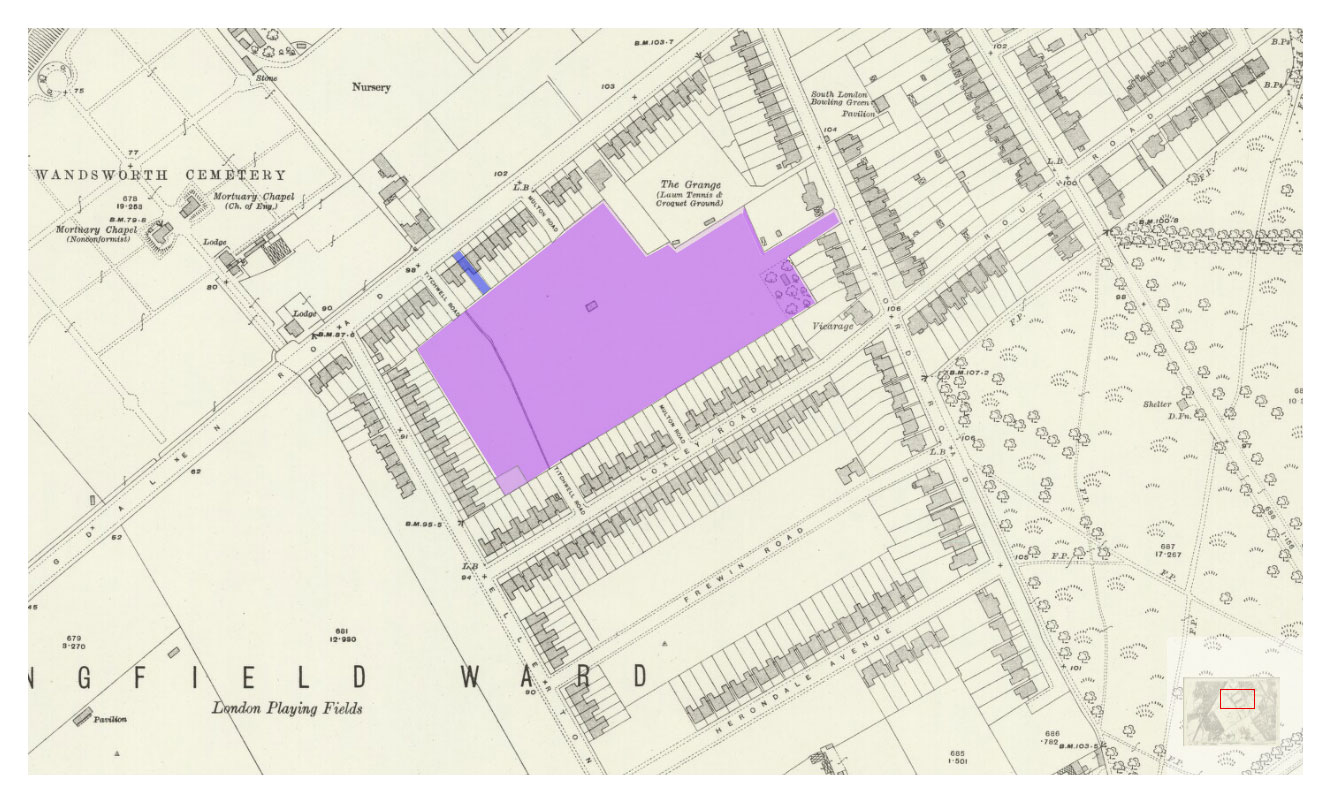


77 Magdalen Road (blue) and "the field" (purple) behind it, enclosed by the backs of houses along Magdalen, Lyford, Loxley and Ellerton - before Multon, Titchwell and Burcote Roads were built.

The house number varies in different censuses, but I think the Betts family always lived at what is now 77 Magdalen. The undertaker/monumental mason [Buchanan's?] and Mrs Stroud's school was opposite. Behind them was a nursery and the prison. There were no cottage-style semis opposite. Notice "London Playing Fields" came up as far as Ellerton Rd.

PB: Presumably the field had been the old Spencer Sports Ground, which had moved further down the hill, to where it is now, so the field must by this time have been overgrown - before Multon or Burcote or Titchwell were built (although planned and marked on several maps for years before they were built)?

(Click on image to enlarge)

[THE HIRSTS]

One summer evening, when I was six, I went with my father strolling in the field and near their garden gate met for the first time a young man and woman who had just moved into the house the Marwood girls had recently left. A sturdy young tabby cat was with them. I occupied myself with the cat which they said was on the wild side and might scratch me, but didn't, while the grown-ups above my head got to know one another. The new couple's name was Hirst, soon to be known as Frank and May. He was fair and rather colourless, a very polite young man with regular features, a lawyer. His wife was fairly big and somehow soft, with dark hair and dark blue, very shy eyes. She blushed a lot. They had been married only a few weeks and this was their first home. There was a special atmosphere about this meeting, not a word of which remains with me except to mind the cat. The summer evening, a quiet evening smelling of flowers and grass, seemed to stand still for hours. It was transfixed in some way that was not tedious as grown-up encounters often were but as if suspended in a time of its own. I have realised since that what I was enjoying

[22]

were the faint vibrations of the controlled sexual tension of those others, the grown-ups. The honeymoon electricals held that summer evening entranced in their field of force. From then on the Hirsts joined those of our friends who turned up from time to time at Brattle Place. They soon had a car, partly to get about in, partly for Frank to tinker with. He was an able man who qualified as a professional organist before studying law and he could make anything work. When wireless came in he had receivers all over the house, on the stairs and hanging from every ceiling, all on at once, fortissimo, in an attempt to get the stereo effect from orchestral concerts long before true stereo was available. The huge noise, and the clutter, nearly drove his wife mad; but that was in the future, when the honeymoon electricals were things of the past. In years to come Frank went on to become Public Trustee and was given a knighthood. He asked my father what he should be known as. "As your second name is Wyndham, certainly Sir Wyndham," my father advised. "Nobody is going to remember Sir Frank, but Sir Wyndham is Sir Wyndham." So Sir Wyndham he became. Nobody in his life had ever called him Wyndham but Sir Wyndham he suddenly became.

Unlike some other yuppies of that time who lived

[23]

on our housing estate but moved on when they got their knighthood or sterling equivalent, the Hirsts stayed in their modest house till old age moved them on. Four bedrooms were more than enough for a childless couple, after all. May Hirst had a pretty young sister, Bea, yellow-haired with big blue eyes and a ringing laugh. She was like a high-class barmaid. Flashier than her shy sister, she was an outrageous flirt. As my mother's name was also Bea, short for Beatrice, my father judiciously nicknamed this Bea Mark II, Fifi, a nonsense name which permitted a degree of nonsense behaviour. My mother was perfectly tolerant of this rather stagey little flirtation which, by bringing it right out into the light of day, she turned into a situation comedy. No doubt she was aware that nothing disinfects the germ of romance as effectively as laughter. The thing became a family joke in which the two participants were happy to play their farcical parts.


Because my mother had a low opinion of education, as a process which tended to unfit children for life, I was not sent to school till I was seven and a half. Even in those days children were required to attend school from the age of five and this rule was supposed to be enforced by a school inspectorate. No school inspector ever approached my mother, as far as I know. Either she was never shopped by the neighbours, whose own young regularly attended kindergarten, or perhaps an inspector had called one day and had afterwards gone missing, died of wounds. Way back she had taught me to read and spell and in due course to write, add up, subtract, multiply and divide. More than that no one needed to know. If the young had any sense they could pick up the rest as they went along; if they hadn't any sense it was all up with them anyway. She

[35]

herself had been to the best school in her neighbourhood till the age of eighteen. It was the former Greek Embassy near Clapham Common and had beautiful ceilings painted with cupids and angels and dolphins. However, all she had learnt there, she said, had been a lot of Bach cantatas and the single fact that the capital of Portugal was Lisbon on the Tagus. That was not much to show for all those years of going to school, she remarked, was it? For this reason I had a longer exposure to what may be called 'home influence' than most children. The summers, apart from holidays away, were mostly spent playing with the local small boys in the field where my father and I met the Hirsts and their cat.

[DR BIGGS]

A great part of the winter, after the first fog gripped my throat as I bowled my hoop in November, was spent indoors coughing and wheezing and often alarmingly struggling to breathe. Nowadays I suppose it would be said that I was allergic to the sooty fogs of those winters and the cure would have been to send me away out of London to school. Nothing of the sort ever crossed anybody's mind. I stuck it out, wheezing my way through the winters, in the care of our family doctor, Dr Biggs. I am sorry to have to speak ill of the dead, but Dr Biggs was a fool. I knew this early on. So did my brother. My father also had

[44]

lovely work as the finished links piled rustling up. Our guest, not exactly loved but tolerated because we had a common enemy, sat beside us at the table and was free to take part in this blissful occupation. One would have thought that just seeing the thing done would have been enough for anyone, even deaf and dumb, to get the hang of it, but no, petite Mignon did not seem to cotton on at all. Again and again she kept picking up a strip of one colour and linking it on to a link of the same colour - red, red, red, etc., or green, green green... In vain we laid strips of differing colour alongside each other, nodding savagely and crying, 'OUI! OUI!' then putting the same colour together, the same the same the same, and screaming, 'NON!' In vain. It made me mad. Paper chains were precious and she was wasting them. I thumped the table. 'NON!' My brother was a clever, thoughtful boy, five years older than I and advanced for his years, but not even his careful demonstration of how paper chains should be made, and his tentative 'Comme Ca?' had the slightest effect on our guest. Was she exceptionally stupid or plain obstinate? Were Belgian paper chains all made of the same colour and did she think our variegated ones crude and garish, vulgar tasteless British kitsch? We were never to know. She did not come

[45]

to tea again. Later that winter, aghast grown-up talk going on over my head revealed that she had fallen in the fire and was dead. When my brother came in from school I told him the news. We agreed it was a good job she was dead. People who couldn't make paper chains properly had no future anyway. The fire was the best place for them.

[COMMON, NURSERY, AIR]

Our suburb was a favoured one on account of its wide roads and many open spaces. Not only was there the Common, there was a nursery garden full of flowers, threaded with footpaths, there were enchanting glimpses through wrought-iron gates of the secret gardens of the big houses in the road between two commons where my grand-parents lived. No wonder our estate, with its comfortable modern housing, pulled in youngish couples who were, they expected, going to get on in the world. There were so many trees. There was such abundance of fresh air. It was incidental that much of the fresh air blew in from the domains of madness, crime, wounds and death, each of which required a large acreage of living space, if living is the word.

[ASYLUM]

Madness was accommodated in the large lunatic asylum with its own farm, not far from the Common. In the days of my youth there were no euphemisms for mental disturbance. If you were mentally ill you

[46]

were mad and if you were mad you went to a lunatic asylum and no messing. If you were very, very mad they put you in a padded cell. My mother of course had something to say about lunatic asylums because as a girl she had visited one. Her father had taken her when he went there on business. He was a Commissioner in Lunacy, whatever that may have been - something to do with committing patients, I suppose, as he was a Justice of the Peace. While he went off to attend to what may have been gruesome business she remained behind, engaged in conversation with a pleasant gentleman to whom she had been introduced. They were on an upper floor with a view of the hall below, and when in due course her father came in sight, talking to an official, my mother's companion walked with her to the head of the stairs, where he bowed and took his leave, explaining regretfully that he was unable to accompany her down the stairs as his legs were made of glass and might break. (His glass legs were vivid in my mind. They were like the very solid chunky kind of cut glass tumblers that stood ranged on shelves in my grandparents' butler's pantry.) But my mother had a more disturbing story than this. It was about a woman in a padded cell. I doubt whether she had been invited to see for herself, more likely her father had

[47]

told her about it, but its impact on my mind was powerful and lasting. The madwoman was raving, flinging herself at the walls of her padded cell and screaming that she was burning to death, burning to death... This horrified me. It seemed to me that being deluded that you were burning to death was far worse than really being burnt to death, because being burnt to death would end, in death, but being burnt to death in the head would go on and on. It was merciless. It was an eternity of torment. It was hell itself. Glass legs, comparatively, were a bagatelle. You could lead quite a happy life on one floor, preferably the ground floor. But that was in the past. In my own day no especial horror stories came out of the asylum. There were high walls round the grounds.

[BELLEVUE]

Sometimes a happy band of more or less presentable inmates would issue forth in the care of their keepers, busily chattering. I liked to look at them though I was not supposed to. Their enjoyment was intense. They were mostly, if not all, female, with bright excited eyes and frizzy grey hair, darting jubilantly in and out of the parade of shops facing the Common, clutching small purchases. 'They always buy sardines,' my mother said, and it was true: fourpenny tins of sardines gleamed in their hands as they emerged, discarding paper bags, afternoon

[48]

light blazing back from their shining eyes. My mother would point out that mad people usually had either lank hair hanging in dank hanks or fuzzy stuff frizzing up all over their heads, and the frizzy sort was more often seen. The hair style of the happy lunatics came naturally. Their hair stood on end of its own accord. In my own generation, for people near the age of the century in its last decades, the chosen hair style of nearly all old women is a similar frizzy mop, more or less veiling the pink skin beneath. The only difference is that now their faces are not bright with joy as were those of the happy loonies of my early childhood, nor are they joyfully clutching tins of sardines.

[THE PRISON, EXECUTIONS]

The domain of crime was the prison which, with its ancillary buildings, was as big as a village, whole streets of warders' houses and big houses with gardens for the Governor, chaplain, doctor. There was a cordon sanitaire of open ground around it, leased off to bowls and tennis clubs. Opposite our house was a rough field with a footpath leading away into the prison hinterland, whence sallied forth at times a hooligan family of red-haired boys, warders' children, to terrorise clean little prep school boys in their grey flannels. Neighbours tut-tutted about these boys, who seemed ripe for

[49]

imprisonment themselves. Occasionally an active prep school father would catch and beat one of the redheads, as could be lightly undertaken in those days without fear of a suit for assault. Bad boys were not easy to catch, but once caught, they could be beaten - that was the way of it then.

The façade of the prison was sombrely impressive, a fortress. It had a huge main gate like the gate of a mediaeval castle, with a small door let into it. Onto the main gate was posted the notice of execution when a murderer was hanged. When she was young, my mother said, they would run up a black flag which could be seen at a distance when a hanging had been done, but now there was only the notice, posted up by a warder. I was told that when the notice was posted a great sigh, a communal collective exhalation, would go up from the crowd that had assembled in front of the prison at the time of execution. I thought of this enormous sigh as the last breath of the hanged murderer, all the breath that had ever been in his lungs going out into the world without him. On winter mornings before it was light on the day of an execution there would be a clippety-shuffle noise on the pavements outside our house. It was the sound of the leather-shod or hobnailed booted people from the bottom of the hill coming up to

[50]

watch outside the prison in time for the execution at eight o'clock. They walked without a word. They would stand in silence waiting for the deed to be done on the hour, and from them would go up the great sigh. Whether that sigh was of pity or of grief, satisfaction at justice done or fear of the wrath of God, it went up into the raw air as a single sigh such as a man might heave before taking up again his burden. At home, no impairment of appetite was felt at breakfast on execution mornings. That was how things were. You took a life, they took your life. It was a simple trade-off. We had been warned.

[MAGDALEN RD, PLANE TREES, EARLSFIELD SCHOOL]

Our house in London was at about the middle of a long, very wide road lined with (then) young plane trees. The top of the road near the Common was the 'better' end, going down past our house and other houses like it and then more steeply downhill to a stretch not built on, a vague area of slightly messed-up open spaces, a Board school with its shrieking playground, and the cemetery. The Board school was for pupils, drawn from the nether regions at the bottom of the hill, who were too poor to pay fees, though some of the more ambitious parents, according to my mother, scraped together fourpence a week to pay for violin lessons. She was full of a sort of exasperated

[51]

pity for these needy little aspirants scraping away on their tiny fiddles till their fourteenth birthday pitched them empty-handed into the nearest factory, which was a smelly one. I never knew what was made there. Something to do with glue, I think, or gas.

[GARRATT LANE]

At the bottom of the road was a short terrace of run-down Victorian houses, not far from the railway, where the road met at right angles a main road of tramlines, cheap shops and shabby people. Charwomen came from somewhere round here. There was also a most interesting sewage farm.

[FUNERALS OF SOLDIERS]

Down this road on winter afternoons came the military funerals. No doubt they came on summer mornings too, like the ordinary funerals - they came all the time, several a day - but it is the winter afternoons that I remember. These were the funerals of the soldiers who had died of wounds in the military hospital up the road and round the corner. Going down the hill where I stood on a chair by the window watching, they went at a measured pace, the hooves of the horses - ordinary brown horses not black funeral ones - clopping soberly by. Behind the pairs of horses came the gun carriage with its coffin draped with the Union Jack. There were mounted soldiers, khaki-clad, useful-looking riders without ceremonial trappings. Following the gun-carriage were

[52]

usually some ordinary mourners, people as distinct from soldiers, in carriages drawn by undertakers' black horses. The number of following carriages and the amount of flowers varied. Some flag-draped coffins had no mourners following. Why? The procession would go by, down the hill into the wintry afternoon with its faint foggy smell that gripped your throat if you were out in it. It was the smell of coal fires and winter. The sky, when the cortege had gone out of sight, would be smoky grey with red streaks over the low-lying ground beyond the cemetery. Those afternoons were very quiet. The road seemed scarcely used. I would wait. Then faintly the bugle would sound, final and sad, the lamenting never-coming-back notes of the Last Post. It seemed to me a dark, smoky, red slash of sound against the quiet grey of the London winter evening coming down. Not long afterwards the soldiers and the horses were to be heard coming back at a smart trot, the coffin and the flag gone from the gun-carriage. The soldiers were hurrying home to their barracks for tea with plum-and-apple jam. My mother would come in with a loaf of bread and a stone jar of dripping. We would toast the bread at the fire, by the light of the fire. With luck the dripping would be used up to near the bottom of the jar, where

[53]

delicious beef-jelly could be reached. This would improve the toast enormously. 'What happens to all those dead people who are put into graves?' I asked my mother. 'They rot,' she replied, spreading dripping. Because of the funerals passing the house so regularly on the way to the cemetery, the idea of death had always been familiar to me. I liked the way my father raised his hat when a funeral passed by on the road. Older ladies bowed and I liked that, too. However, I did not feel equal to bowing as they did; at six years old my waist was somehow too near the ground. One day, when I was missing, my mother asked a passer-by if she had seen a little girl in a blue woolly hat. 'Yes,' the stranger replied, 'she's standing at the corner up the road, raising the hat to funerals.' No doubt I had found it wiser to pay my respects to the dead out of sight of my mother. I would not have wanted to bring on another Effie Dry situation.

[UNDERTAKER - BUCHANAN'S?]

On the other side of the road from us there were only two houses, built close together. They were bigger and older than the modern houses on our side. One was the undertaker's, the one next door was a small private school. The undertaker's family lived over the shop, which had a big front show-room with a display of coffins and artificial

[54]

flowers under glass domes. Behind this there was the joiner's shop where the coffins were made. There must have been a mortuary too, because in later years, when refrigeration became common, my mother had the bright idea of getting round the undertaker to store her furs in the cold room there during the summer - it was so much handier than the Army and Navy Stores. Cheaper too, no doubt - just one or two of my mother's dazzling smiles would do the trick with the undertaker, whose customers were so much less lively than my mother.

[MRS STROUD'S SCHOOL]

The private school was run by Mrs Stroud, who had white hair and a quite young face. Her husband was an optician who went off every morning to work elsewhere, like all the other fathers. They had a little girl whose name was Molly. I knew Molly, though not well. It might have been expected that we would play together, two small girls in a neighbourhood of small boys only, but by hindsight I can see that as I went to no school, let alone Mrs Stroud's as might have been expected, a certain strangeness may have attached itself to me. Mrs Stroud's school was a sort of happy bedlam, not at all up-market. It catered for children of all ages and both sexes, boys of kindergarten age and girls from tiny children to what appeared to be ripe womanhood. What made it down-market was that its pupils were drawn almost

[55]

entirely from down the road. Shopkeepers' daughters went there, well-nourished girls whose fathers wielded cleavers behind butcher's blocks, or kept pubs. These were far from needy, though considered, of course, common. But some of the girls who went to Mrs Stroud's school came from families who were only a pay packet away from the Board school, families who must have had a struggle to pay the fees, low as they were, at a down-market private school. From my window where, wheezing, I watched the military funerals go by, I would see the children across the road coming out of school and trooping down the hill to tea in parlours behind shops. It was in the Christmas holidays, a quiet time, that we heard that Molly Stroud had caught measles. I had already had measles, very badly but quite unremembered as I was only eighteen months old at the time. Somehow I had survived Dr Biggs's two medicines, but from that time began the boiling oil treatment down the ears that was such a feature of my childhood. Measles, they said, did bad things to ears and some-times to eyes, too. Complications, these bad things were called. Molly Stroud began to have complications. Her kind of measles was special. It was called black measles. When I asked what black measles was I was told that it

[56]

was a sort of measles that did not come out properly but went inward and did deadly damage. To this day I am no wiser about what black measles may be and have never heard of anyone else having it. But Molly Stroud died of it.

[CHILDREN'S FUNERALS]

Children's funerals were not uncommon when I was a child. Less riveting than the military funerals, they were somehow more interesting than the funerals of grown-ups. They were identifiable at a glance because of the small size of the coffin and its different disposal in the hearse - crosswise behind the coachman instead of fore and aft. These small coffins were always heaped with flowers. Their occupants would have died usually from infectious diseases against which there was no protection. Immunisation, except for smallpox, did not exist. Except for a child's natural resistance, there was no defence against tuberculosis, whooping cough, tetanus, measles, polio and diphtheria. Many children caught these illnesses and some died of them. Tubercular meningitis was a certain killer; there was no hope for its victims. However skilled the nursing they received, these children were doomed to scream for a few days and then to die. Molly Stroud's funeral was to take place on this winter afternoon. Her house was in full view of ours. Surprisingly, there was no

[57]

hearse, no top-hatted coachmen with their black horses. Instead their front door opened and out came Mr Stroud and the undertaker, bare-headed, each bearing on a shoulder the weight of the small coffin. Mr Stroud was bald with a pink scalp and the remains of some reddish hair. They turned downhill, carrying the coffin, and that was all. Away they went, two men and a small coffin borne carefully down to the cemetery. It was the quietest funeral I had ever seen, and the most sobering. I went to my tea that day in a serious mood. That a father should carry his child to the grave was a solemn thing. My mother naturally was matter-of-fact about this. Full of sympathy as she was for the Strouds, going as far as to wipe away a tear on their behalf, she was quick to point out that for people living so close to the cemetery and with a coffin so small and so light, the expense of the full panoply of hearse and horses would have been unjustifiable. Nor was the present arrangement, or something even more informal, unprecedented. There had been Mr Batsford up the road. When his wife had had a dead baby - born at home, as most babies were then - Mr Batsford had put the baby in a shoebox, parcelled it in paper and string and had taken it, after dark, down the hill to the cemetery.

[60]

I was always included in the trip, the only girl among a bus-load of prepubescent boys. Who arranged this I never bothered to think. Being a girl I was naturally ostracised but suffered no pain from this, knowing that boys had to behave as other boys expected them to behave and that no personal slight was intended. Individual small boys could fraternise with a small girl but when in a pack they must ignore her. At Mortlake we piled on to a barge, wore favours and yelled as the crews shot past. I forget now who was for Oxford and who was for Cambridge, though I remember at one stage I transferred my allegiance from one university to the other, in an effort to balance up the support which was heavily weighted in favour of Oxford (or was it Cambridge?). I did not really care who won and I expect most of the boys didn't either - it was an outing, rarer then than now.

Canon Stowe had a somewhat faded but still pretty and elegant wife. She wore a grey squirrel coat and a bunch of Parma violets. What made her interesting was that she was said to be a great invalid who had survived, but only just, that operation which was spoken of as 'having all her insides out'. As a consequence of this heroic surgery her digestion was delicate (and no wonder, with no insides left) to the point that her diet consisted only of oysters and champagne. I

[61]

had no idea what champagne was but somehow it had acquired a romantic aura, probably from the uncensored trash I read in Woman's World. This was a twopenny weekly, delivered on Monday mornings, mostly made up of instalments of three or four serials dealing with mill girls and gaffers, shop girls and commercial travellers, or the kitchen maid and the young master. It was a weekly aimed at the lower end of the market, to be read mostly by servants - certainly none of the yuppie mothers of the small boys I played with would be seen reading it. My mother, however, enjoyed it greatly and so did I. I do not doubt that my acquaintance with champagne was made through the medium of this excellent publication, probably at the wedding reception of the young master and the kitchen maid. Mrs Stowe was not the only lady to have all her insides out. She had a grown up son, but there was also a childless class of lady who would have loved children but had parted with her insides, as if there were a connection between no insides and a passionate love of children. I had observed that those couples who loved children very much never had any of their own. This was perfectly understandable. My own mother, who had retained her insides, did not love her children all the time. Not only were there several ladies walking

[62]

about who had had all their insides out, but my mother had known one who had actually burst. Her name had been Rose Layton, one of a family my mother had known as a girl, and she had burst. 'How, burst?' I asked. 'Her stomach swelled up and she burst.' 'What had she eaten to make her burst?' 'How do I know what she had eaten?' 'Well, you were there, weren't you?' 'No.' 'Didn't you ask her what she'd eaten to make her burst?' 'How could I, you little idiot? She was dead.' Another case of all the insides gone. My mother was obviously not in a child-loving mood, or I would have asked her whether Rose Layton would have loved to have children.

[DENTIST]

Ladies' insides were not the only personal fittings to be summarily whipped out. Teeth could go the same way. Chicken-pox at the age of five brought on an eruption of second teeth in my mouth, unfortunately before the first ones showed any sign of loosening, so I soon had the beginning of a grotesque double row. The situation required a number of visits to Mr Crocker the dentist on the other side of the Common. It was a walk of more than

[63]

a mile each way. During this walk on the first occasion, my mother told me that having a tooth pulled out hurt terribly, it was really a very bad pain but one that lasted so short a time that by the time it was felt it was over. I had better expect the pain but it would be over at once. Afterwards we would go home and she would give me sixpence and a slice of cake hot from the oven. Clara had just popped it into the oven so that it would be ready for me the moment we got home. We went into the dentist's and Mr Crocker settled me in a big chair. I opened my mouth and he wielded his forceps and gripped. There was a sudden awful pain and a crunch inside my head. 'There!' said Mr Crocker, wielding a white tooth with bloody roots. I was yelling hard but soon stopped as the pain stopped. Mr Crocker explained that it had been unusually firmly rooted with fangs like a grown-up tooth - milk teeth normally had a shallow root with a kind of suction grip and gave up easily. All my teeth that were later pulled had these strong grown-up roots and must have hurt as much as grown-up teeth would have hurt, but not knowing that other children had it easier I had no complaints. An anaesthetic was never suggested - milk teeth were supposed to be loose. Mine were not.

[64]

After the extraction I was led away to the kitchen to bleed for a few minutes in the company of Mr Crocker's nice fat house-keeper and her enormous tabby cat, who became a friend of mine. My mother stayed chatting with Mr Crocker, an old chum, for there never seemed to be any other patients. If it was winter, before we left the house my mother would wrap a scarf round my mouth to keep the cold out and we would set out to cross the Common again, while my tongue probed the seemingly bottomless bloody cavern that was a new feature of my mouth. Sure enough, when we got home there was the hot cake and the sixpence. My mother had her faults but she kept her word. If she said it would hurt badly, hurt badly it did, but not for long, as she had promised. She could be counted on. By the next morning the cavern had lost its pulpiness and by dinner-time was forgotten. This procedure was followed a good many times, until my second teeth had all emerged unimpeded. It hurt badly every time but because I had been warned I never dreaded it. I knew that some mothers lied to their children about wounds and death but I should have been ashamed to have had a soft-centre mother like that. My mother was rather unlike other children's mothers in her ways, but though she could be embarrassing

[65]

I was quite proud of her, and of my father too, because they were bold and good-looking. I should not have liked the funny-looking parents who fussed about everything that some children had.

[SERVANT - CLARA]

I never met Clara because she had always been there. She had always been there though she was not there always. There can be no first impressions unless there have been remembered first meetings, so it seems to me that I never met Clara. She was there before I was born. More accurately, before I was born she had come and gone. By the time I remember her, therefore, she was always there but not there always. Clara had been my newly-married parents' first little maidservant, a fourteen-year-old up from Somerset. That was in a house I never lived in, the other side of the Common. My brother was born there. Later my parents moved to the modern house where I was born, but by that time Clara had left to better herself in the ritual fashion of all my mother's maids. When I was about three she was employed

[70]

looked paler than ever. Clara was ill and was taken into St Mary's Hospital, Paddington. I went with my mother to see her there. She was in a long ward with many beds. Her face was bony and peculiarly pale but she looked pleased to see us. Her lips did not slide properly over her teeth. When we were leaving she smiled at me but because her mouth was dry her lips seemed stuck and her smile went on too long, somehow fixed, as if it might go on for ever with her teeth showing. Half a lifetime later there was a story in the paper about a young French mountaineer who became trapped on an icy ledge in the Alps with the base blowing and no hope of rescue. He would have been hopelessly frostbitten but was still living. He could be seen up there, far off, and the paper published a picture of him taken with a long-distance lens and blown up to seem quite near. Dying of cold, he stood there, trans-fixed, with his teeth bared in a sort of shuddering grin. I knew that his lips must have been too stiff, and his teeth too dry, for that smile ever to leave his face. Some time later my mother remarked that George had put up a headstone for Clara and on it had described her as 'my noble wife'. For all her imperviousness to education my mother had an ear for words and the description struck her as ridiculous. It

[71]

amused her. Certainly it was inappropriate, I could see that, but somehow it did not amuse me. I never again saw George nor did I ever go to see for myself that silly adjective on Clara's headstone.

When Clara left us to get married it was in the middle of the War. Soon afterwards I was sent to school for the first time. Far from being the traumatic experience so often suffered by people who write books about it, school was at once painless and meaningless. I was never set upon by bullies. It was a small private school run by a lady with kindergarten qualifications and a goitre. To assist the pupils with their reading, the books we were issued with were printed with hy-phens in between the syll-ables. As I had been reading the daily papers for a long time this struck me as laughable (in fact my bro-ther and I start-ed at home a cult man-ner-ism of talk-ing to one an-other in hy-phen-ated syll-ables). We sat at little desks of varnished deal - or pine as it is now called. One day, bored, I took the corner edge of my ruler and, pressing down hard with it, inscribed my name in intaglio on the varnished surface of the desk. The next morning when I arrived at school there was my goitred headmistress already stagily installed, fitting tightly into

[72]

the small desk, yellow duster at the ready, facial expression ratcheted into more-sorrow-than-anger, rubbing away at my indented signature. She lifted her head as if in surprise at my entrance and started in on a pained reproof. That finished her for me. A woman who thought strong dents could be rubbed off with a duster was not fit to teach me, I could teach her. The gym uniform at this school was a pleated tunic in navy blue serge worn over a reseda green blouse of tussore silk. In this garb we walked in crocodile across the Common to a gym where sometimes we did gym things like jumping or climbing ropes or, ludicrously, galumphed about pretend-ing to be fairies or toads. I could not see any sense at all in these antics. They had nothing to do with real life nor were they in any way satisfying to the imagination. Soon the winter with its annual gift of fog, asthma and bronchitis put an end to the farce of school for many weeks. I remember nothing of my last term there. The following autumn I went to another school.

Meanwhile at home, minus Clara, we were 'without'. 'Without' meant being without domestic help and was accepted verbal currency among ladies who customarily employed. Even my grandparents who kept several servants were partially without - Minnie the parlourmaid had gone for a

[73]

soldier, a female soldier in the WAACs. My mother revelled in this deprivation. She had long striven to sink socially and now here was her chance. We ate in the kitchen. A kitchen in those days was usually a room with a cooking range, a lot of cupboards and a deal table. Unlike the kitchens of our day, where families eat and have their being, there was no sink in the kitchen of the past. The sink was in the scullery, along with the gas cooker and possibly a copper for boiling sheets, with a firebox underneath. Nobody would think of eating a meal in a room containing a sink, with its connotations of drains and sludge. A maid would not be expected to eat in a scullery, because of the sink. My father, exiled from the comforts of dining room meals, reminisced with an added touch of bitter prophecy. He reminded my mother that when they were first married they had a breakfast room, with main meals in the dining room. This was before my mother had shaken off the habits of her affluent upbringing. When the breakfast room had become the nursery they still had the dining room to eat in but now that, too, had been taken from him. 'Next move, the scullery,' he prophesied, 'and after that, meals eaten off the croquet box.' The croquet box, like an upended coffin, stood in the backyard opposite the

[BROTHER, BOYS]

[86]

mother's diet, to which he did not always take as readily as I did, my brother, at thirteen, was a grown man, just under six feet, with voice broken, shaving every day and pursuing girls industriously at any moment that could be snatched from his studies. Such precocious development is not common even today and in 1917 was highly unusual. My manly thirteen-year-old brother, trawling the summer evenings on his bicycle for girls, would be accosted by women, though not in the way he might have fantasised. They called after him: 'Why aren't you in the Army?' It would be neat to write that they offered him white feathers but I cannot bring myself to believe that women went about provided with a clip of white feathers ready to offer one to the next thirteen-year-old with over-active hormones who might happen along, riding the summer dusk on his gleaming Swift, darting predatory glances from behind his studious spectacles. It may be of interest to parents with sons of nineteen who have not yet started to shave and still sing treble in the bathroom that my brother's chosen and invariable teatime diet was butterless brown bread and golden syrup taken with cold water. My brother was a brainy boy, a scholar of St Paul's. His interests were simple: mathematics and girls. His mathematics helped

[87]

him to keep count of the girls. My only companions up to the age of nine were small boys. There were several of these living in the houses which, like ours, backed on the Field, where we played the war games natural at the time. It just happened that the parents living near us seemed to produce only boys and often only one boy at that. Being only boys they were pampered by their mothers, readily wrestled to the ground and their heads sat on. Once, when I was about eight, some bigger boys of twelve or thirteen set up a boxing match between me and the boy next door, Percy, who was two years older than I was. Percy had been a lifelong buddy of mine, always ready to oblige with an interesting parabola of pee. He had bad teeth and a pleasant, weak, personality. I bore him no but when the fight was set up and a ring of big boys formed, there was no choice but to fight him. Having spent many hours of my bed-fast asthmatic winters reading and re-reading my brother's huge red annuals of Chums and Boys' Own Paper, I considered myself well-versed in the mystique of boxing matches - seconds out of the ring, the clinch, the quick jab to the ribs, straight left, straight right, the stagger against the ropes, the bell ... on and on and on for fifteen rounds or so, pounded, bloody, until knocked or knocking out.

[88]

It sounded fearfully painful. The boys in the school stories took it bravely enough on the chin, but when you came down to it they were only story boys. This, the loose ring of bigger boys, the hazel coppice behind them, Percy my opponent opposite me, smiling a nervous smile of bad teeth - this was real life. It was going to go on a long time till one of us was out for the count, so I had better begin. A whistle sounded (no bell available) and I raced into the ring, meeting Percy with a solid punch on the nose before he was well out of his corner. He tottered back as blood poured from his nose. Immediately a shout of applause went up from the cruel boys who had staged the match, the ring broke up and Percy was offered a second hanky. The fight was over! It was nice to find out that sometimes, just sometimes, life on earth went more smoothly than life in books.

[THE FIELD - SEX/CHILD ABUSE - WOLFF'S LIGHTNING ERASER]

It was in this little glade, sheltered by hazel bushes, that I had my statutory early experience of sex - better still, child abuse. There was a big boy of eighteen, a young man really, ten years older than me, who lived in one of the houses on the other side of the Field. He had younger brothers and sisters, all older than me, whom I knew only slightly. His name was Tom. He was an art student but for how long I do not know. He was there in the glade and then later on he

[89]

was not there any more, so very likely he went to the War and was killed.

We would lie down in the bushes and he would cuddle me. He would look at me a long time and then ask if he could kiss me. I was not keen on being kissed so he took a Wolff's Lightning Eraser out of his pocket and said he would give it to me if I would kiss him. Being a stationery fetishist I found the india rubber irresistible and let him kiss me. The kiss did not affect me emotionally, all my desires were focused on the rubber. We met in the hazel coppice several times. Each time he would cuddle me and ask to kiss me. I began to hold out for brand new Wolff's Lightning Erasers, spotless white ones with geometrically sharp corners. He never did anything but cuddle me, look at me, kiss me gently and hand out quantities of new india rubbers, wonderful for swopping at school or keeping and gloating over. It all ended without my noticing. Perhaps the art school got suspicious about the run on erasers, or perhaps Tom was called up and got killed. I did not notice when it ended. I had enough rubbers to be going on with. Their smell was so alluring, so satisfying.

[132]

When inquisitive older persons inquired of my mother what religious instruction her children were receiving and whether they attended Sunday school regularly, she would reply that no, they did not attend Sunday school at all because she herself had not enjoyed Sunday school as a child. As for church-going, her children had been baptised into the Church of England and she had felt that she owed it to them to see that they were introduced to the services of that church. Accordingly she had taken them to church from the time when they were in decent control of their bladders until the age of five. After that they were old enough to judge for themselves. Her instinct was true. The splendid rhythms and cadences of the Anglican ritual have resonated unforgettably through the echo chambers of my memory from those days to this. Remember now thy Creator in the days of thy youth, while the evil days come not...

[GRANDPARENTS & AUNTS - SHERBROOKE LODGE, NIGHTINGALE LANE]

Though we were not forced to go to church, our Sundays were not without their burden of duty. We were expected to

[133]

accompany our mother on the weekly walk across the Common to visit our grand-parents for tea. We went half willingly, half unwillingly. The general background to these visits was one of habit and tedium, but there were compensations of a material kind. The house was a substantial Victorian one with two entrance gates and a sweep-around drive. It was covered with creeper that was not, however, permitted to straggle. A flight of steps led up to a storm porch, closed in winter, and the front door. The brass door furniture was brightly polished. In summer a striped awning shielded the paintwork from the blistering action of the sun. There was a brass bell-pull with echoes in the depths of the house, followed by the approaching footsteps of the parlourmaid. We would say, 'Good afternoon, Alice,' in answer to her greeting. Off the hall there was a room scarcely ever used, half study, half library, where we would leave our coats and hats. After that we would go on to the drawing room which was at the far end of the hall. There, almost always, my grand-father and my two aunts would be sitting, he in his armchair, the two aunts very often at opposite ends of a large sofa, with papers and magazines scattered between them - no sewing on Sunday. Sometimes my grand-mother would be there too, but as often as

[134]

not she would be away on some domestic trail of her own, rootling in the linen press or checking that there was still fish and milk in the two saucers left for the refreshment of Ben, the blue Persian, on the landing at the head of the back stairs. We would make the round of our seated relations, who would each proffer us a cheek to kiss. They did not kiss us. Grandpa's cheek was covered in carefully clipped white whiskers, what would now be known as designer stubble. He had a neat white moustache but his chin was clean-shaven. He had a head of thick white hair and strong, even features, with a chin like granite. His grey eyes were bright, keen, intelligent and merciless. Grandpa was immaculate. Everything about him was clean and fastidious. His well-kept hands were shapely. His speech was impressive - when Grandpa spoke, people listened. His articulation was crystalline. He never hesitated for the right word. All in all, Grandpa was a well polished specimen. It was hard to believe that he had started life in a miner's crowded cottage in Nottinghamshire and had had no schooling after the age of eleven. With her father's example before her, it was not surprising that my mother held the teaching profession in such low esteem. If with no further education beyond his own unsupervised reading, a child of eleven

[135]

could go on to make a comfortable fortune;Ind, except for an ignorance of field sports And the classics, pass for a gentleman born, why torment bored adolescents with years of unnecessary schooling? As well as being a shrewd business man, Grandpa must have been a consummate actor, aping his social betters in speech and manners whenever one crossed his path. That cannot have been often in a blackened mining village of the eighteen fifties. Did he once see passing him, on some country lane, an open carriage with four beautiful people in beautiful clothes on their way to a picnic? Did he hold open a gate in a woodland path for some divine lady riding side-saddle and did her nod of thanks fire his heart with ambition and change his life? He had made his money. He had become a perfect imitation of a gentleman. And here he was in his own spacious drawing room on a Sunday afternoon with two unmarried daughters and the married youngest one, who constantly lowered the tone of the family, now entering with his only grand-children, a bespectacled boy swot and a ruffianly little girl who answered back. Where were the beautiful people? Grandpa shifted his head with an air of weary distinction to receive my kiss on his stubble. He did not love me and I did not love him, in fact I hated him. He aroused in

[136]

me a strong antagonism. We were always sparring. Yet I admired his handsome head, his easy fluency, his unfaltering confidence in himself. We would look straight into one another's eyes and challenge one another silently, all through my childhood. He was a man full of the sin of pride but he was no petty snob. He never turned his back on the remnants of his socially unredeemed family with the coal dust still on their backs. My mother used to tell me with obvious pleasure of a visit she had made there as a twelve-year-old, with her father. To this miner's cottage after his shift at the coal face she had seen a cousin return, a young man with blackened face and blazing blue eyes, fine white teeth gleaming as he smiled at her. Through the crack of a door ajar she had seen his back as he squatted in the tub in the back kitchen while his mother poured warm water over his head and shoulders and soaped him, and then poured again the water to rinse him. 'It was wonderful to see his great shoulders all at once coming up white under the pouring water, all the black washed off. And afterwards, when his head was dried and he came into the kitchen for his meal, his hair was as gold as a guinea.' This early vision of male beauty had given my mother her first true thrill and she never forgot it. Her own father in youth would

[137]

have been just such another blonde beast, but his skin had never been blackened by coal dust. At eleven he had gone to work in a tape factory and from there had set off on his quest for the beautiful people. My two aunts on either end of the sofa, with a scatter of light reading between them, were called Ethel and Ada. There was a period, not so long past, when almost everybody had an aunt called Ethel. I even knew one or two who not only had an aunt called Ethel but were themselves called Ethel and were themselves aunts - Aunt Ethels, that is. There was something about the name that not only brought on aunthood but was somehow marriage-repellent. Ethels did not breed much. Perhaps that is why they have become comparatively rare. My aunts had been christened Ethel Jarratt and Ada Shackell, names that my mother considered, and I was inclined to agree with her, a lifelong handicap. By the time she was born they had run out of unbecoming surnames so she was christened Beatrice Helena. Her more melodious name encouraged my mother, who was a martyr to romantic fiction, to identify as a Cinderella-type character with two Ugly Sisters. But her sisters were not ugly, though Aunt Ethel was borderline peculiar to look at and did her best to make herself less than lovely. Aunt Ada was fairly good-looking, quite tall with

[138]

big eyes and high cheekbones, a Scottish face. She dressed well. They were a musical family and when Aunt Ada sang, people smiled slightly because the admired voice then was a rich contralto and Aunt Ada, as was said rather disparagingly, had 'a voice like a choirboy'. People said there was no 'feeling' in it, but I had a sneaking liking for the sound of it: it was clear and went up without seeming to care whether people listened or not. Aunt Ethel did not sing. She had a delicate throat and a very quiet speaking voice. She played the piano, well enough. The piano was a fine one, a Broadwood grand. She was the shortest and dumpiest of the sisters, perhaps because she moved about very little. She was short-sighted and wore glasses with gold oval eyepieces. Her black hair was scraped back savagely from a high broad forehead. She had grey eyes with short black lashes, and a big chin. Late in life, looking through some old family photographs, it suddenly struck me that Aunt Ethel had looked weirdly like Lord Longford - could there be Irish blood in the family? I remembered names like Kate and Michael, tales of distant cousins too fond of the bottle, my grandfather's merciless grey eyes and his gift of the gab, my own mother's wild colonial ways. And my brother who grew up to look like President Woodrow Wilson, who came

[139]

from Ireland. All this has persuaded me that my grandfather's family, on his mother's side, were Irish navvies who came over to dig the canals and had settled in the Midlands. Our only claim to distinction is that we do not claim to be descended from Irish kings.

Although Aunt Ethel may have looked like Lord Longford in drag, she had been sought in marriage, though only by a curate. This offer had been refused. Her heart belonged to Daddy. Aunt Ada had received more than one proposal and had actually been engaged to one suitor called Ralph who had been, according to my mother, 'an organist at Balmoral', whatever that appointment meant. Unhappily Ralph had died of consumption. I pictured him as an emaciated dark young man, coughing blood over the keys as he laboured at the mighty organ, its vast golden pipes rising high as mountains, tremendous diapasons making the air shudder while down there, alone in the body of the kirk but for a few lords in waiting, Queen Victoria sat with tears on her cheeks, thinking about death and Albert. With Ralph dead and gone, Aunt Ada sidestepped her other suitors and settled for life at home, where she was well provided for. Grandpa was generous enough with his womenfolk, so long as they did not stray into the arms of other men. In this respect

[140]

my mother had offended and had not been entirely forgiven. When she returned Sunday after Sunday to the home of her girlhood, the air of the family drawing room did not glow rosier, it took on a bluish tinge. The aunts always seemed to me quite nasty to my mother; I wondered why she kept on going there. But occasionally, when I was alone with them, some small thing would suddenly send them into a fit of the giggles and they would laugh till they cried, just like human beings. My mother did not bring out the best in them. If the best had ever been brought out in Grandpa it must have gone back in again before I was born. He could not be said to be a mean or small-minded man but he was so cold, critical and joyless that his very presence filtered pleasure out of the air. Yet on the Bench he had the reputation of being the best of magistrates, unprejudiced, just and merciful. However, his family did not see him when he was chairman of the Bench. We saw him on Sunday afternoon and at Christmas and we did not like what we saw. He was a Liberal of Radical tendencies. Consequently he had to appear tolerant, whatever his inward feelings may have been. Ridden on this loose intellectual rein, the various members of his family worshipped some in church, some in chapel, and might

[141]

have voted for different political parties if women had then had the vote. It was in small, foody ways that they showed their liberalism and in this they were indulged. There were some cousins of that generation, nieces and nephews of my grandfather, whose parents had stitched away so industriously in their tiny upholstery business that in a few years they had expanded into a chain of furniture shops and were short of nothing that money could buy. This Midlands family my mother visited as a girl. There were eight children, seven boys and finally a girl. At mealtimes each child would require, and would be given, potatoes done this way or that, nearly all different. One would want baked potatoes, his brother potatoes mashed, the next would ask for potatoes roasted round the joint, or for potato salad or fried potatoes or potatoes plain boiled or chipped or potato straws. The youngest, the darling daughter, could have duchesse potatoes if she wanted them, the pet. My mother said she felt quite sorry for the cook. But this tradition, handed down perhaps from our all but penniless great grandmother - doling out a raisin here, a lick of treacle there to spoilt though barefoot children - had carried on in a fragmented way to my aunts. It resulted in a great spread at tea, which was served at half past four on the dining room table.

[Several more pages on the grandfather...not scanned or OCRd yet]

[176]

unpleasant habits of one of the older directors. 'Old Paul was at it again - coughing and spluttering over everybody, blowing his now like an elephant trumpeting, and then, if you please, walking over to the fireplace to shake out his handkerchief in front of the fire t dry off the snot; stood there with his back to the rest of us a good couple of minutes. I longed to kick his baggy old backside.' 'He always was quite a repulsive person,' my mother remarked, 'and he won't have improved with age.' 'Face like a rhino, too,' he added. 'Not fit to put in a servant's bedroom?' I suggested. 'Emphatically not,' he replied.

[ARMISTICE DAY - 11 NOV 1918]

If there were bells and sirens I do not remember them. It was November 11th, 1918, Armistice Day. We children crowded on to the front steps of the school and knew that the fighting was over. There was an air of painful rejoicing. The little Belgian pupil teacher, a refugee of about twenty, burst into tears and ran away along the road to the shops, and ran back again with a paper

[177]

bag full of Allied flags which she pinned on our coats, laughing and crying and hugging us. Perhaps it was her tears that made the celebration poignant and silenced in my memory the bells and sirens, as if a bloodied hush had fallen over Europe.

[SOLDIERS ON THE COMMON]

The walking wounded from the military hospital wore bright blue jackets and trousers of a hairy flannel that was not pressed or tailored like a uniform. It had a cosy look about it, more like a bed jacket. Their shirts were white and their ties were bright red. They were hatless. They humped about on crutches or on two sticks. They wore an arm in a sling or were minus a leg or bandaged round the head. Some showed no visible signs of injury. On fine days they lurched and hirpled about the Common. Most of the benches would have two or three wounded soldiers in their hospital blue, resting, when the sun was shining. When they looked up as I scudded past them on my scooter they did not look sad. They smoked cigarettes and seemed contented enough. But these were the ones who were not going to die. For many months after the war ended the military funerals from the hospital went on coming, though at longer intervals, down the road past our house. The soldiers, the limbers, the sound of hooves, the coffin draped in the flag, still passed. Still the Last

[178]

Post sounded for these stragglers. These were the soldiers who had died late of their wounds, for whom there had once been hope but it had faded. I was aware that these latecomers who came last to the Last Post had died slowly: just up the road from me.

The living soldiers began to come home from the war. These were not the same as the ones who had gone away. They looked older and duller; their hair was not so bright. At the beginning of the war, when I was small, there had been several young subalterns who had come to the house to say goodbye to my mother before they went away to fight. Some had worn beautiful tightly fitting leather leggings with the colour and gloss of conkers. One had a sword. He had unbuckled it and laid it on a settle in the hall before he went into the drawing room to pay his farewell respects to my mother. The door was shut. I was excluded. My mother's farewells to these young soldiers were always private affairs. I went up to the sword where it lay in its sheath on the settle. A real sword was thrilling. I withdrew it partly from its scabbard and felt the edge with my thumb. It was not as sharp as I could have wished, used as I was to my mother's razor-sharp dinner knives. While I was fingering it the drawing room door

[179]

opened and out came my mother and the young soldier, both a little pink. She pushed the sword back into its sheath and drew me slightly away from it, but not crossly. 'Is it sharp enough?' I asked the tall, yellow-haired soldier, as he was buckling it back on. 'If it isn't, Mother could sharpen it for you, like our knives.' He laughed at this. You could see he was happy. You could see he loved having a sword to wear. Just for a moment you could see he was not quite a man yet, only a big boy like the scouts who sometimes made dens of branches in the field. He was still a big boy as he went down the path to the gate, but as he closed the gate and turned back to us and saluted, he became a soldier. At the end of the war, suddenly, I remembered him, half a lifetime away. I asked my mother: 'That soldier who came to say goodbye at the beginning of the war, what happened to him?' 'What do you mean? There were quite a number.' 'He was a one-pipper with yellow hair. Tall. He had a sword.' 'That must have been Colin Cowper. What a good-looking boy he was!... He was killed in the autumn of 1914. He was only twenty.'

[180]

I saw the sword drawn in his hand, saw him hit and saw him fall, saw the bright sword fall from his hand, point down int(' the mud, and be lost like a spoon in a jar ()l jam. There it had fallen and there it lay still, rusted, the bright sword. The soldiers who came back were not the same as the ones who went away.

Uncle Jack came back from the war. He was my mother's brother. I liked him but had not often seen him because he had been away at the war for so long. He always gave me presents at Christmas but was seldom there himself. My only memory of him was watching him walking towards me down a long corridor in my grandparents' house, where at the top of the main staircase the landing widened. Between two doorways there was a console table sup-porting the white marble bust of a lady. She was cut off short just below the shoulders and was not wearing any clothes, so perhaps that was why she had been cut off short, either that or a scarcity of marble if there was a war on when she had been made. I was wondering about this when I saw my uncle in uniform walking along the corridor towards me and the staircase. He was a slim man with big, rather sad blue-grey eyes that looked at something further off. As he passed me he ruffled my hair with his hand and said,

'Hello, Poodle,' and passed on down the main staircase. That is all I remembered about him, yet he seemed a known and familiar figure. I asked my mother why Uncle Jack looked sad. 'I expect the war made him sad. Because he was in the Territorials he was in it right from the beginning, in a West Riding regiment. He worked somewhere up there, as a land surveyor... He was a wizard with animals, always had been, got on with every sort of animal as a boy, even used to take a pet snake into church and offered to fight the verger when he was ordered to take it outside... He was particularly good with horses, so when he joined his regiment he was put in charge of the horses they used for transport. This was not a smart cavalry regiment, you understand, the horses were used for hauling everything that was needed from base up to the front. There were convoys of them, hauling guns, munitions, rations, spares of every sort - more like a train, really but over any sort of difficult country ... ruined farms, seas of mud, bomb craters and shell holes to be got round somehow. Poor Jack ... he loved his horses so much, and when they were wounded he had to shoot them. That must have been a kind of hell for him, seeing his horses and mules mutilated and having to shoot them. I expect that is why he looks sad.'

[192]

marry him, he wants me to marry him and live with him in Russia ... but I don't know.' 'Don't you want to marry him?' 'I don't know what I want.' 'You could have the Russian national anthem played on the organ at your wedding.' Of all the Allied national anthems we had learned to recognise, this was the one whose wild minor surges swept me away to the other country. 'I don't think they play that any more, not since the revolution. Anyway, weddings are not the place for national anthems and we would want to be married in England: if at all,' she added. An uneasy thought struck me. If my aunt and Valentine Atkins married in London, was I not, as an only niece, in danger of being roped in as a bridesmaid? In a flash, as before drowning, I saw the gruesome procession of events - the many fittings, the tight curling-rags the night before, the shining sausages of hair to be kept unruffled, my own face under a chaplet of flowers being bidden to simper time and again at the photographer. I was simply not bridesmaid material. 'As you are both so old,' I suggested, 'you might prefer a quiet wedding at a register office.' 'As I am so old,' my aunt retorted, 'I am getting too crotchety to put up with any

[193]

more asinine remarks from young idiots, so run along now and wash your hands and tidy your hair before tea.' By now her tears were dried and she was putting her face in order. On my way out I noticed the bell of sand from the Isle of Wight. It had somehow lost its magic and was only a glass ornament with layers of sand inside. The steppes of Russia called to me now, the endless melancholy versts where always the wind sang in a minor key.

[SERVANT - ANNIE]

The next Saturday I walked across the Common to my own home to see my other grandmother and my father and brother. Annie my mother's current trainee from the slums of Battersea, let me in. 'Hello, ducks,' she said. 'No motor-car and shover for you today, I see. Been chucked out by His Nibs or what?' 'Grandma was out in the car at her bonnet makers or something, so I thought it would be a chance to walk. They didn't want me to, they gave me sixpence for the bus, but I walked instead.' 'You'll spend the bus money on sweets, eh?' 'I'm a bit sick of sweets, when they are always there you don't want them. You can have threepence to get some for Madge and Ernie if you like.' Madge and Ernie were her youngest siblings. I counted out the three

[194]

coppers into her red palm. 'Thanks ever so, ducks.' She winked at in, and spat on the money. 'And better not call me ducks,' I added quietly as my grandmother came down stairs. 'How are you, darling?' She kissed me warmly on the mouth and then on both cheeks. She had slightly Frenchified ways, picked up from all those French chefs and their wives that she and my Grandfather Betts had known. She was tall, with the sort of face seen on cameo brooches. Her figure was full and stately. She wore a lot of petticoats and when she hurried away along a platform to catch a train she was rather-like a hen scuttling towards thrown grain. The next thing to say was how I had grown. 'How you have grown! But of course we don't see you often. How I wish we were not so far away from Will and you children.' 'I wish Grandpa had come with you.' I liked my Grandfather Betts. He had a twinkle in his eye behind round gold spectacles. 'He would only have been another man to look after as well as your father and brother. Hilda will keep an eye on him.' Hilda was my aunt. 'And between you and me,' my grandmother said, lowering her voice, 'Annie is only good for the rough. She has no idea how to serve up a meal decently or

[195]

answer the door to a visitor. She quite embarrassed me yesterday, when a lady called who was kind enough to bring a dozen of new-laid eggs, thinking no doubt that your mother might be home by now. I got there just in time to find Annie practically shutting the door in her face. Can you imagine what she said? She said: 'Thanks, m'm, the missus'll see you right soon as she's ahter orspital.' 'Well, of course I asked who it was. It was a Mrs James, quite handsome and very well-dressed, and I apologised as well I might but it was awkward for me; after all, Annie is not my maid or one I would ever have engaged, but your mother... I think I made it right with Mrs James though she wouldn't come in, said she'd just come by to drop in the eggs. Naturally I had to lay it on a bit about what a kind thought it was, such a generous impulse and new-laid eggs were always so welcome a gift, more especially if one had been convalescing ... and so on. I think she went away smoothed over but I must say it was embarrassing. Why, I wonder, does your mother always pick such young, uncouth maids?' 'I think they are the only ones about who are not able to better themselves,' I explained. 'Who is Mrs James, by the way?' Grandma asked.

[216]

'Then he should get his specs changed or retire. Does he think it's not sound medical practice to diagnose head-lice before you can see the whites of their eyes? Child's head must have been squirming like an over-ripe Gorgonzola.' 'It was,' agreed my mother ruefully. I knew what an over-ripe Gorgonzola looked like. We had a microscope. It occurred to me to wonder why my mother had not spotted my teeming head before ever Dr Biggs had been called in. It dawned on me that it was not Dr Biggs that my mother was defending. She was defending herself. My capable mother had missed a trick. Her shame at my infestation had not been because of what the neighbours would think; she had never given a toss for the neighbours. Her shame was at herself that she had not spotted what the conscientious mother she deemed herself to be, should have spotted. Like her imperious and disdainful father, my mother had a sin of pride. 'It was mostly my neck that itched,' I ventured, trying to make it better for her. After all, we had been in it together over many shameful days, suffering as every louse was drawn down its yard of hair to the bitter end. She flashed me a grateful look. 'Your hair looks simply lovely now, darling,' she said.

[217]

This was the second compliment my mother had paid me. The first had been when I was five years old, blowing experimentally on my mouth-organ. Then she had said: 'I must say you don't make the atrocious noises on a mouth-organ that most children do. You pick out quite musical little phrases, almost a pleasure to listen to.' From my mother, a compliment every five years was not bad going. The source of the infestation was traced to Annie, our rough diamond from Battersea. She was released to better herself but instead married a young man who was willing to make an honest woman of her.

[SUGAR - THE FIELD]

It must have been getting on for the summer after the Armistice that sugar came off the ration. Marion Morris and I went to the grocer's and bought a quarter pound of pieces sugar in a blue bag. This was a soft brown sugar like sand with a taste we just knew but had never had enough of. We did not touch the sugar till we reached the field. This was a planned celebration. We climbed the big old pear tree that yielded

[218]

hard, sharp, uneatable pears - a perry pear tree, I suspect - and settled on our special branches. Mine had another strong branch running parallel a little in front and above it, like a narrow table. There was a small hollow at the right-hand side which I thought of as an inkwell. Marion had a slightly inferior but still esteemed perch within reach of mine. We opened the blue bag carefully. We each shook a helping into a palm and licked it off. The flavour was unspeakably delicious. We took a second helping, which we chewed over and gulped. Then the same again. And more. Till it was all gone. A wonderful feeling crept over me and evidently over Marion too, for we began to giggle so much we had to get down from the tree. There we lay on the ground, rolling about, shrieking with laughter. Yet there was no joke in sight. Nobody had said anything funny, yet we had to roll about and laugh and shriek. There is no doubt about it. We were drunk, plain intoxicated with the un-accustomed charge of sugar into the blood. It was a great sensation, full of bliss with no hangover to follow. Later shots of alcohol could never touch that first taste of intoxication at ten years old. It could never be repeated.

One day I went to Marion's house to call for her. It was some time before the door

[219]

was answered. Cathie came to the door and said in an abrupt way that was not like her that Marion could not come out today. She shut the door at once. Screams were coming from upstairs. It was Mrs Morris carrying on in her mad way again. I hoped it was not Marion she was screaming at. It was high time Mrs Morris got shut up in the linen cupboard to cool off. It would be worth taking out the shelves if necessary. The sheets and towels could be neatly stacked under a tablecloth on a spare bed, quite easy to get at, and the house would be much quieter. Mrs Morris could be let out from time to time to go to the lavatory. If they followed this procedure whenever Mrs Morris started screaming, life would be better for them. Unfortunately I felt I could not make this useful suggestion to Marion. Except for that early lament about how her mother had burnt her Bulldog printing set, she never spoke of her mother at all. Come to think of it, if I had a mother like that I would never speak of mine. Cathie's young man was home from the war and they were going to be married. They were happy about that but she was distressed because in the last weeks of the war he had been hit in the arm by shrapnel and would probably always have a rigid elbow. My father had seen her at the station and

[220]

they had walked across the Common together. "Cathie was upset about his arm. Luckily he has a safe office job to come back to but he was such a keen cricketer and that is over for him now. She kept saying, what is the purpose of war?" Grown-up people were always asking what was the purpose of war. Any child could have told them. The purpose of war was to kill as many of the enemy as possible so that you could take whatever they had that you wanted. It was so obvious. Yet grown-ups were always asking each other what war was for. They should know by now. "She was talking about you," my father said to me. My mother was not present. 'She seems so fond of you. She said that since Marion had got to know you she had been a different child, so much brighter and livelier, and rosier, too. It was lovely, she said, to see Marion with her hair untidy and getting into mischief like other children. She had been rather a sad little girl till you came along.' I was astounded. Accustomed as I was to being considered a bad influence, here was someone who was next thing to a parent being actually pleased at seeing the child of the family led into mischief. I wondered if it had reached her ears that her next-door neighbours had come back from a holiday

[221]

to find their back door keyhole glued up. Marion and I had been feeding their kitten, which we decided they had neglectfully abandoned during their absence, so we had arranged reprisals. Could Cathie be approving of this sort of thing? If it made Marion rosier and happier, apparently yes. That must be why Cathie's eyes always dwelt upon me so kindly, as if she liked me. At this time Marion and I were engaged in academic research. We were investigating the origins of the species. Though we had an inkling, admittedly sketchy, of how babies got out, we were unable to discover how they got in. Unlike the children I have read about since, we suffered the terrible disadvantage of never having been talked dirty to. Marion had always been under the wing of her big sisters, and as for the small boys who had been my companions, they had been pure in word and deed, if you do not count peeing competitions. In fact they had never talked about anything except to boast to one another about how good they were at things they were bad at. Years later my mother was to tell me that when she had asked me, at the age of five, whether I knew where babies came from and I had said yes, she had considered further information on the subject superfluous. I am satisfied that she invented this conversation. The fact is that she, like most parents, had

[222]

found the details of human reproduction, recounted in cold blood, so improbable and so plain ridiculous that she had squirmed away in embarrassment from a description of those ludicrous activities in which she must have engaged. Marion and I were thus thrown upon our own resources. We decided to consult the article on Reproduction in the Encyclopaedia Britannica, of which we had a set in the revolving bookcase in the dining room. It was an old edition, the ninth, which had been thrown out of my grandfather's library, to land, years before my birth, in our house. Some of the essays had been written by people like Lord Macaulay who, even in 1919, had been dead long enough to become part of history. The light of antiquity lay also upon the science sections of the venerable encyclopaedia. It is doubtful whether anaesthetics were in common use when these were printed. The article on Reproduction was about as intelligible to Marion and myself as the Rosetta Stone. The lack of information was doubly galling. Not only had I hoped that these arduous studies would explain clearly how babies got in, but I had hoped to précis the information for use in the personal encyclopaedia for which I was beginning to gather material and expected soon to throw together. The old Ency Brit's tortuous investigations into the

[223]

sexual mores of glutinous lower animals baffled me. 'There's not much there you can pick out to put in your encyclopaedia when you write about reproduction,' Marion remarked. 'I shall have to keep it short. I shall say something like "Birds reproduce by hatching eggs. The higher animals do it in ways appropriate to their species."' 'That sounds very good. Shall we look again at the article on Medical Juri-prurience?' 'You mean Medical Jurisprudence. Yes, all right. But it will only be that old stuff about contusions and punctured wounds and impacts on the base of the skull.' 'There is that bit on poisons,' she said hopefully. 'Babies getting in has something to do with people being married. How could poison come into that?' We had no idea.

[MRS STROUD'S SCHOOL]

By now I had parted company with Queen's College and attended, as a place of last resort, the school run by Mrs Stroud in the house opposite ours. It goes without saying that I bore with me from Queen's College, and still wore, the brown and blue gym outfit I had not long enjoyed, having finally grown out of the navy and reseda green tunic and blouse of my previous school. But

[224]

now I was ten and so immunised against public opinion that I felt able to wear my noticeably wrong gym colours almost with panache, to the point that when at last I grew into my new (navy and scarlet) outfit I hardly noticed the change. Not that Mrs Stroud was a woman to bother about a little thing like school colours. The school swirled with the diversity of the human genetic pool. This was a private house. The ground floor was occupied by Mr and Mrs Stroud and the small daughter who had replaced that Molly who had died of black measles when we were both six. The pupils, of all ages and sizes, mostly girls but including a sprinkling of tiny boys, were packed into the first floor and the attics, that ran from front to back of the house. The place was crammed. A few small children were given lessons in the school kitchen, also on the first floor, where dinner was served to a dozen or so of girls who stayed in school for the meal. A cheerful charwoman called Mrs Wingrove dished out the food. For some reason I ate there once and remember hot boiled potatoes and cold beetroot. There was no room to move. The only game possible in the eleven o'clock break, which perforce had to be spent in the classroom, was Sardines. Nobody gave a thought to the fire risk. The undertaker's was conveniently

[225]

placed next door. The top class was in the main front room, what would now he known in estate agency terms as the master bedroom. Every square foot was packed with desks in rows, desks of all shapes and sizes, ranging from large comfortable desks to the left of the front row down to small cramped joined-up desks intended for young children, to the right of the back row. Those at the top of the class occupied the left front desks, the dunces the back right-hand ones, near the door. In case of fire the dunces might perhaps escape, the giant brains up front would certainly perish. In this top class I was on my first day installed, without benefit of examination. We were told to sit anywhere we liked, a test of ability would soon sort us out into our proper places for the week. A smiling Mrs Stroud entered, looking as if she really enjoyed the new term beginning, and everybody beamed back at her, for she was greatly loved. She unfolded the Daily Mail and began dictation from the leader. The system of priority - that is whether one got to sit at a good desk in the front row or at a thigh-nipper at the back - depended entirely upon one's ability to spell correctly. The leading article in the Daily Mail was read out at dictation speed. The next day the corrected exercise books were returned, marked, and according to the number of

[226]

spelling mistakes recorded, so the order of desk precedence was established for the coming week. Since I happened to be good at spelling (though at nothing else) I never had to shift lower than the top three front left-hand desks during my year or so at Mrs Stroud's school. The other two top contestants were also about ten or eleven. It was an absurdity that the first three rather splendid front desks, with their ample writing area and padded seating, should be lolled in by us youthful lightweights while the abhorred four-seaters in the back row were stuffed to capacity by fat and nubile seventeen-year-olds who could barely spell their own names. Their fleshy tophampers and hindquarters overflowed on to the cramped writing surfaces of their tiny desks and pressed against the iron framework of their benched seating like a bulging trawl of codfish. They squashed giggling against one another's overheating flanks. The greatest good humour prevailed. The fat older girls, who must have spent years failing to spell 'receive' and 'conspicuous', bore no resentment at all against the juvenile prodigies in the front row who took 'recidivists' in their stride. One of the big girls lived over a sweet shop. In the press of eleven o'clock break, from her cattle-crush in the back row, she would give out lumps of

[227]

cur

ap.

french almond lock to he passed hand over hand like crowd casualties for us to enjoy as we queened it at our comfortable desks in front. I cannot call to mind any lessons that could be called lessons at Mrs Stroud's school. Sometimes, after the Daily Mail dictation, she would read to us from a small hook of etiquette, with useful hints on how to start a letter when writing to a bishop and how it was not nice to blow the nose too obviously but at all times it was better to blow than to pick the nose (particularly when writing to a bishop). Mrs Stroud had been to Italy and was cultured. When we did well she would exclaim Eccelente! Eccelente!'. She gave piano lessons in her own, downstairs, part of the house.

[TEACHER - MISS SNEAD]

I never attended any lessons that were not conducted personally by Mrs Stroud, though in the heavily populated hinterland of the school there were other classes, less advanced than ours. In view of the educational standards of my own class it is hard to imagine even deeper abysses of ignorance, but such classes, lower than mine, did exist and one of them was conducted by Miss Snead. Miss Snead was the sort of person you have to look at when they pass you out of doors. She would be in her late forties, tall, thin and rectangular. Her face was a yellow-ish brown, with dark eyes and black hair

[228]

above a high forehead. Seen from the front she appeared to be a sketchily articulated series of oblongs, some longer and thinner than others, the head almost square. But these rectangles were not in parallel with one another, nor did they move to the same rhythm. There was a touch of wryneck about Miss Snead - the head a little tilted to one side, the face on yet another plane, the lower part pushed forward, the lips stretched in a contained smile over uncountable false teeth. She was like a cluster of metal mirrors set at different angles, jangling together as they flashed uneasy light into the eyes of strangers. She could have scared crows. We three or four at the top of the class, who knew what a verb was, dubbed this pushing forward of the lower face over a tight smile, sneading. I snead, thou sneadest. Our young elastic faces became adept in the skill of sneading. Passing Miss Snead on her way to or from school, we would slightly snead at her by way of greeting. Miss Snead was a few days absent from her class at school. A rumour began to circulate. Somebody's parent had been overheard to say that Miss Snead had been found wandering the Common with nothing on. She had been taken care of. This rumour was neither confirmed nor denied. But Miss Snead was never seen

[229]

again by any of her pupils. We did wonder whether our sneading at her could possibly have urged her to throw off her clothes and take to the Common, but after all she had been sneading at us for ages and we were all right: so far.

[SOLAR ECLIPSE]

Mr Stroud, the optician, kindly brought back from his shop some dozens of smoked-glass lenses. These were for us to look through at a dramatic eclipse of the sun expected shortly. Each of us was handed one lens: a treasure. It was not framed. It could either be held up to one eye, the other eye being shut, or daringly held screwed in by will-power, like a monocle. We were packed into the small front garden as tightly as folded sheep, the tallest girls the hindmost. It was morning, with the sun more or less opposite, above my own house across the road. At the appointed hour we were told to hoist lenses and look at the sun. A shaving began to be cut off it. The cut bit deeper into the body of the sun. The air grew somewhat darker. Might this be how the world would end? Beside me there was a tinkle and a kind of gasp. A precious lens had been dropped and had broken. It had been dropped by the tall pale thirteen-year-old at my side - Edna, a girl it was always being hinted about that everybody should be nice to, something to