The History of Wandsworth Common
IN PROGRESS — NOT FOR PUBLICATION
Refresh this page
Index of years
1803 | 1805
Wandsworth Common
IN THE NEWS
1804
BNA Search: "Wandsworth Common" .]
The London and Portsmouth Railway project had apparently died quietly a little earlier. The last reference to its promotion I have found is in a notice, dated 22 December 1803, published a few days later, and again during January 1804, announcing that "the Model, together with Plans and Sections of the Country through which the Railway will pass", would be on display at the Beneficial Society's Hall at Portsea until further notice.[46]
There had earlier been a development in respect of the London Extension Railway, when a notice of the intention of the Croydon, Merstham and Godstone Iron Railway Company to apply to Parliament for a Bill to authorise the making of a railway from Wandsworth to Southwark, dated 16 September 1803, was published [47]. A plan showing the route was deposited with the Clerk of the Peace for Surrey on 29 September [48].
The line shown commenced by a junction with the Surrey Iron Railway at the entrance to the Wandsworth dock, and ran approximately in a east-northeast direction. Relative to present- day topography, the route was to the northwest of and roughly parallel to St.John's Hill and Lavender Hill to join Wandsworth Road, then turned to the north through South Lambeth. It continued along Kennington Road, ran to the east of Waterloo Station, then turned eastwards along Stamford Street to terminate some distance short of Blackfriars Road.
On 30 January1804, a number of "Gentlemen who are Proprietors and Occupiers of Land and Houses in Clapham and Lambeth" gave notice that they would oppose the application "by every legal means in their power. " [49] On 3 February they convened a meeting which persons with property interests along the route of the proposed railway were invited to attend, in order to consider the best means of opposing the scheme [50].
The meeting was duly held on 10 February at the Royal Oak Inn at Vauxhall, with Samuel Goodbehere in the chair. It was unanimously agreed that the proposed railway was an "unnecessary measure", and that it would be "highly injurious to private property." Twelve persons were elected to be a committee for conducting the Parliamentary opposition, and a subscription fund was opened to defray expenses[51].
In the event, the landowners had no need to take any action; the Croydon, Merstham and Godstone Iron Railway Company never proceeded with the delivery of a petition to
Parliament, nor pursued the matter further.
Referring to the London and Portsmouth Railway scheme in a report published in 1810, Edward Banks wrote: "provided a sufficient sum could have at once been raised, there can be no doubt, but that the Plan would have been immediately carried into effect: but the inadequacy of the Subscription rendered it then impracticable." [52]
46. The Hampshire Telegraph, 26 December,1803.
47. The London Gazette, 17-20 September,1803.
48. Surrey History Centre, QS 6/8/17.
49. The Morning Chronicle, 31 January,1804.
50. The Morning Chronicle, 4 February,1804.
51. The Morning Chronicle, 13 February,1804.
52. The Report of Edward Banks on the practicability and expence of a Navigable Canal proposed to be made between the Grand Southern Canal and Merstham 1810. (institution of Civil Engineers Library).
.
Morning Post — Tuesday 31 January 1804
Morning Post — Tuesday 31 January 1804.png
Morning Post — Tuesday 31 January 1804-2.png
SURREY INTENDED IRON RAIL0WAY from Wandsworth to London.— Notice having been Riven, mat an application wili he made to Parliament for an Act to mat*.* the above' Rail-way, several Gentlemen, who mc-c proprietor ami occupiers of land and iiouses in Clapham, ai.d Laniberh, a-.A^ t lie neighbourhood, through which the £-iaic is 1 'tended to pass, 'iccording to tke plans tliat have heeu 1 «,, nave desired .me 10 give this notice',, that they will oppose such application to Parliament, by every legal means in their power, .and that-* public meeting of i^to^e who are inte ested in tl>c measure, and who may disapprove of Sflch intended Rail- way, wvH very soon be called, by public edvcrtis.uieni, to take the business into consideration, #and to adopa the most sr>€3<.ly and efficacious measures tor opposing the said application.
In the mean tin- e, any information m the subject will be thankfully received and attended to here, or at the offices of Messrs. White and Ridlihgton, Gough-square, Fleet-street.
S. WHITE. Claph^nij Jan. 28, iB^). il — .. -
Kentish Weekly Post or Canterbury Journal, 25 September 1804
"Grand sham fight" — local militia (in this case the River Fencibles and the Royal Westminster Vounteers meet in mock battle on Wandsworth Common.
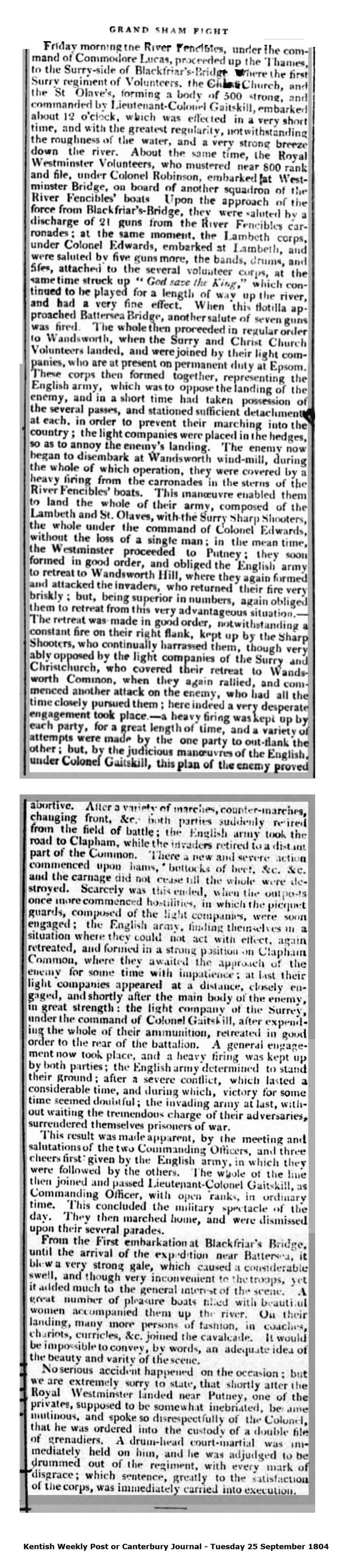
"Grand Sham Fight", Kentish Weekly Post or Canterbury Journal, 25 September 1804
"River Fencibles" (local militia voluntarily formed in 1790s by Thames tradesmen during the Napoleonic War) engage in mock battle training exercise on WC.[Link to BNA]
(Click on image to enlarge)
[NEEDS EDIT.]
GRAND SHAM FIGHT
Friday morning the River Fencibles, under the command of Commodore Lucas, proceeded up the Thames, to the Surry-side of Blackfriar's-Bridge, where the first Surrey regiment of Volunteers, the Christchurch and the St Olave's, forming a body of 500 strong, and commanded by Lieutenant-Colonel Gaitskill, embarked about 12 o'clock, which was effected in very short time, and with the greatest regularity, notwithstanding the roughness of the water, and very strong breeze down the river.
About the same time, the Royal Westminster Volunteers, who mustered near gno rank and file, under Colonel Robinson, embarked at Westminster Bridge, board another squadron of the River Fencibles. boats the approach of the force from Blackfriar's-Bridge, they were -aluleil hv discharge of 21 guns from the River Fencibles carronades; at the same moment, the Lambeth corps under Colonel Edwards, embarked at Lambeth ami were saluted by five guns more, the bands, drums, ami fifes, attached the several volunteer corps, at the same time struck "God save the King", which continued to be played for a length of way up the river and had very fine effect.
When this flotilla approached Battersea Bridge, another salute seven guns was bred whole then proceeded in regular order to Wandsworth, when the Surry and Christ Church Volunteers landed, and were joined by their light companies, who are at present on permanent duly Epsom
These corps then formed together, representing the English army, which oppose the landing of the enemy, and in a short lime had taken possession of the several passes, and stationed sufficient detachment at each, in order to prevent their marching into the country; the light companies were placed in the hedges, to annoy the enemy's landing.
The enemy now began disembark at Wandsworth wind-mill, during the whole of which operation, they were covered heavy firing from the carronades in the sterns of the Kiverrenables' boats. This manoeuvre enabled them to land the whole of their army, composed of the Lambeth and St. Olave's, with the Surry sharp shooters, the whole under the command of Colonel Edwards, without the loss single man; in the mean time, the Westminster proceeded to Putney; they own formed . . . good order, and obliged the English' army to retreat to Wandsworth Hill, where they again formed and attacked the invaders, who returned their fire very briskly; but, being superior in numbers, again obliged them to retreat from this very advantageous situation.
This retreat was made in good order, notwithstanding constant fire on their right flank, kept up by the Sharp Shooters, who continually harassed them, though very ably opposed the light companies of the Surry and Christchurch, who covered their retreat to Wandsworth Common, when they again rallied, and commenced another attack on the enemy, who had all the time closely pursued them; a very desperate engagement talk place heavy firing wakes up each party, for a great of lime, and a variety attempts were made the one party to ont-rank the other; hut, by the judicious manoeuvres of the English, under Colonel Gaitskill, this plan of the enemy proved abortive.
After a variety of marches, counter-marches, changing front, &c, both parties suddenly retired from the field of battle; the English army took the road to Clapham, while the invaders retired to a distant part the Common. There a new and severe action commenced upon hams, buttocks of beef, &c. &c and the carnage did not cease till the whole were destroyed.
Scarcely was this led, when the outposts once more commenced hostilities, in which the picquet guards, composed the ccmpaim.s, were soon engaged; the English army, themselves situation when they could not act with elteci, again retreated, ami formed in strong position.in Clapham Common, where they awaited the approach of the enemy for some time will, impatience; at last their light companies appeared at distance, closely engaged, and shortly after the main body ol the enemy, great strength the light company the Surrey, under the command Colonel Gaitskill, after expanding the whole of their animunition, retreated good order the rear the battalion.
A general engagement now took place, and a heavy firing was kept up parties; the English army determined stand their ground; after a severe conflict, which lasted a considerable time, and during which, victory for some time seemed doubtful; the invading army last, without waiting the tremendous charge their adversaries, surrendered themselves prisoners war.
This result was made apparent, the meeting and salutations of the two Commanding Officers, and three cheers first. given the English army, in which were followed by the others. Ihe wfcole ot the line then joined and passed Lieutenant-Colonel Gaitskill, Commanding Officer, with open ranks, in ordinary time, this concluded the military spectacle the day. They then marched home, and were dismissed upon their several parades.
From the First embarkation at Blackfriar's Bridge, until the arrival of the expedition near Battersea, it blew a very strong gale, which caused considerable swell, and though very inconvenient to the troops, yet added much to the general interest of the scene. A great number of pleasure boats with beautiful women accompanied them up the river. On their landing, many more persons of fashion, in coaches, chariots, curricles, joined the cavalcade, it would impossible to convey, by words, an adequate idea of the beauty and variety of the scene
No serious accident happened on the occasion; but are extremely sorry to state, that shortly after the Royal Westminster landed near Putney, one of the privates, supposed to be somewhat inebriated, became mutinous, and spoke so disrespectfully of the Colonel, that he was ordered into the custody of a double file of grenadiers. A drum-head court-martial was immediately held on him, and he was adjudged drummed out of the regiment, with every mark of disgrace; which sentence, greatly to the satisfaction of the corps, was immediately carried into execution.
[Source: BNA: Kentish Weekly Post or Canterbury Journal, 25 September 1804, p.3.]
The Times, 9 October 1804
Mayor of Garratt

(Click on image to enlarge)
CORONATION AT GARRAT
Yesterday, notwithstanding the official declaration from Sir HARRY DIMSDALE, the Mayor of that high and respectable department. of his intention to comply with what he conceived to be the unanimous sense of the Citizens of Garrat, namely, the assumption of the high title of Emperor, and the gracing his brows with the Imperial crown, and his civic shoulders with the purple mantle, the ceremonial, for reasons best known to the worthy Baronet, and to the great disappointment of the citizen rabble, was deferred sine die.
Solemn reasons, no doubt, have on this occasion swayed the councl3s of the mur
Knight. Whether he has thought ut to a,,__ the decision of the Tiers Etat of Wandsworaik, o
that of the Diet of Battersea, or of a verv coz siderable. portion of those his intended sb_ jects, whose diet is, in a very princip u0026 degree, composed of imlins and c u003dnsqas, i
the trade and mianufacture of which the worty Knight is deeply engaged, and who shrewdik cos jectured, that their favourite luxury would be imperialiwed by the coronation to double their usuQ price, is not exactlv certain. The onpv conjec. tures v:hicl the Lditors of 'Lie Wffwrd u0026wortb Ga-ete venture on the subject, are, — ltat the woi)Ih
MAYOR of GARRAT, upon due consideration u0026. the proposed' change of his civic title, for that of ain Imperial dignity, and not wishing, likeater tain Corsican upstart, to represent the vanity 3o hi,
own ambition, as the wish of the people*over whom. he contemplated absolute sway; and desirous. moreover, of some farther experience, from tb example of the said Corsican, whether he mavny
render, in a short time, the title of E ..p Emperor as odious as that of ' R4 Cwosmi, postpone, for tb present, any farther steps on this important subject, until he is better ascertained of the sentiments of those who were to have become ite subjects of his Imperial sway.:
A Courier Extraordinary was dispatched so residence of the Envoy ior Garrat, in St Giles's with this intelligenice, very much to the disappointment of the stage and hackney-coachmen, and the drivers of all manner of vehicles, vi were big with the hopes of reaping a rich haiure from the votaries of curiosity, aud punctual ti. servers of St. londay, as well as to the boiJOas o f Battersea, Clapham, and Wandsworth, and the s2tkers, who had plied at Croydon Fawr, aui bid formed new and extensive speculations in f, g grrl;reod, and o/stsaw.
Private letters from Clapham add, that the known sentiments of the Citizens of Garrat, have been long averse to innovation; thev la-0 bear4, too, enough about the character and exploits of another newly-made Emperor, to decide them against encouraing the manufacture in lieir oal districts. They were, beside, apprelxetvie that such a -measuTe might tend to iuvolie tOeir teruitories in a uwar vith the tcan Kziugs ot ' rcq tfrd, who might tektaez amzige dt the ambition of the Zew-Ma* Alonarch; arid. therefore, had Sir HA tLY proceeded to the business of coronotion, it is prolble he might have experienced atormidable revoiL It is further stated, that the good Citizens of Garrat equally hate Pope and Plerniedr, andJ 112emfor the influence even of hlis Hofifsss, would have be weight in seducing them to implicit submiin under a self-named Emperor.
The ambition of Lady DIMSDALE is, hor-ft, not slightly wounded on the occasion; as thlefJaw of the chaste and illa.strjoas 3osnsritix £ had woaderfully caught her fancy amd excited her eiulation"};
[Source: Link]
- Wikipedia: Sea Fencibles (includes section on River Fencibles.