The History of Wandsworth Common
Added 2.10.2019
IN PROGRESS — NOT FOR PUBLICATION
Refresh this page
Index of years
1826 | 1828
Wandsworth Common
IN THE NEWS
1827
[The Times: Search: "Wandsworth Common"].
CARRY ON SEARCH: BNA_BUCKMASTER WANDSWORTH_LONDON_EVENING_STANDARD_1827-1879
[London Evening Standard: Buckmaster Wandsworth 1827]
[Pall Mall Gazette: "Wandsworth Common" 1827]
[London Daily News: "Wandsworth Common" 1827]
TO ADD:
[South London Chronicle: "Wandsworth Common" 1827]
[Daily Telegraph: "Wandsworth Common" 1827]
[Clerkenwell News: "Wandsworth Common" 1827]
[London Daily News: "Wandsworth Common" 1827]
[Globe: "Wandsworth Common" 1827]
OTHERS? NORWOOD ?
Or SEARCH BY MONTH.
Morning Advertiser, 9 March 1827
The first mention of Neale's nursery? It would be good to know of earlier (and later) refs.

(Click on image to enlarge)
Nursery Stock — To Noblemen, Gentlemen, Nurserymen, and Others — The Valuable Stock of Mr Robert Neale, late in the occupation of Mr. Harper — By Mr WILMOT, on the Premises, near the French Horn, Wandsworth Common, MONDAY next, March 12, at Eleven precisely, without reservation.
The choice and valuable Stock consists of young trained trees, Portugal laurels sorts, China roses, filberts, lilacs, box trees, rhodadendrons [sic], variegated hollies, privets, evergreens, lancestinus, junipers, honeysuckles, arbarvitas, yellow and white broom, standard pears and plums of sorts, evergreen oaks, sycamore, fruit, and fruit trees, &c. &c . . .
. . . on the Premises; and of Mr. Wilmot, Auctioneer, Appraiser and Estate Agent, Sloane-square. Chelsea.
[Check this BNA link: Link.]
The Atlas, Sunday 18 March 1827
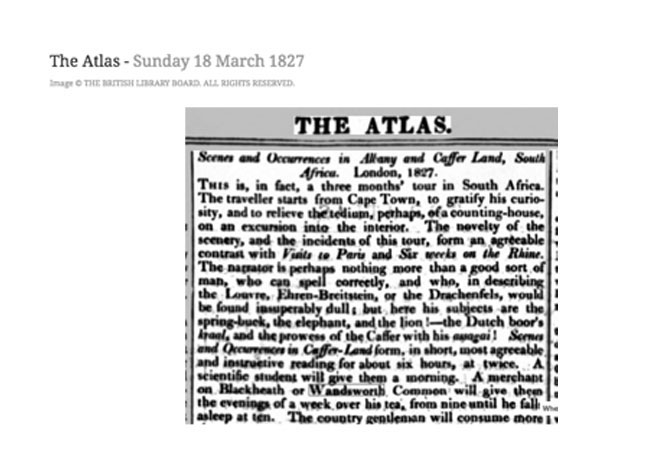
Interesting association of Wandsworth Common (with Blackheath) as the home of rich merchants. And their implicitly dull lives . . .
(Click on image to enlarge)
THE ATLAS
Scenes and Occurrences in Albany and Caffer Land, South Africa. London, 1827.
This is, in fact, a three months' tour in South Africa. The traveller starts from Cape Town, to gratify his curiosity, and to relieve the tedium, perhaps, era counting-house, on an excursion into the interior. The novelty of the scenery, and the incidents of this tour, form an agreeable contrast with Visits to Paris and Six weeks on the Rhine. The narrator is perhaps nothing more than a good sort of man, who can spell correctly, and who, an describing the Louvre, Ehren-Breitstein, or the Drachenfels, would be found insuperably dull; but here his subjects are the spring-buck, the elephant, and the lion! — the Dutch boor's kraal, and the prowess of the Caffer with his assegai! Scenes and Occurrences in Caffer-Land form, in short, most agreeable and instructive reading for about six hours, at twice.
A scientific student will give them a morning. A merchant on Blackheath or Wandsworth Common will give them the evening of a week over his tea, from nine until he falls asleep at ten. The country gentleman will consume more than one rainy day over them. A boy greedy of adventure and novel excitement will sit up with them in bed with a stolen candle, and before his brother's first sleep is out, he will have hunted several lions, killed more than one Caller, and caroused with various hospitable Dutch settlers. like the book — not much the less because it is evident the writer cannot write. Read the following description of a lion-hunt, and acknowledge the power of a rude hand, on a new and exciting subject. . We mustered by day-light; and en too -*ere anxious, for the sake of the novelty, to have some of the Toaabookies to accompany us, we promised to kill them plenty of bucks, and were not long in persuading thirty of them to follow us.
[Source: Link.]
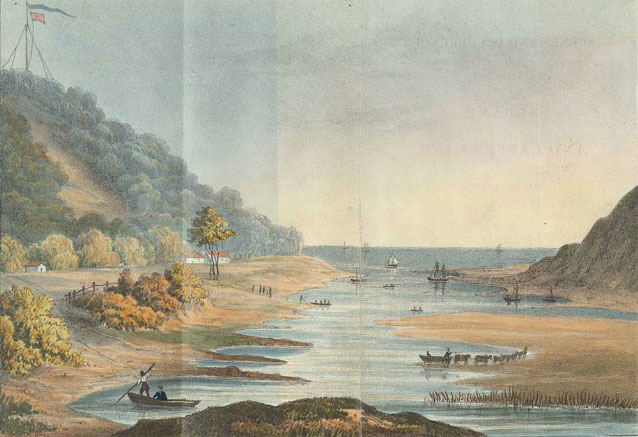
Illustration from Scenes, The Kowie River
[Source: King's College London: The Boers and the British.]
(Click on image to enlarge)
The original book is available in various formats via Google Books here.
Bell's Life, 15 July 1827
Match on "Wandsworth New Cricket Ground"
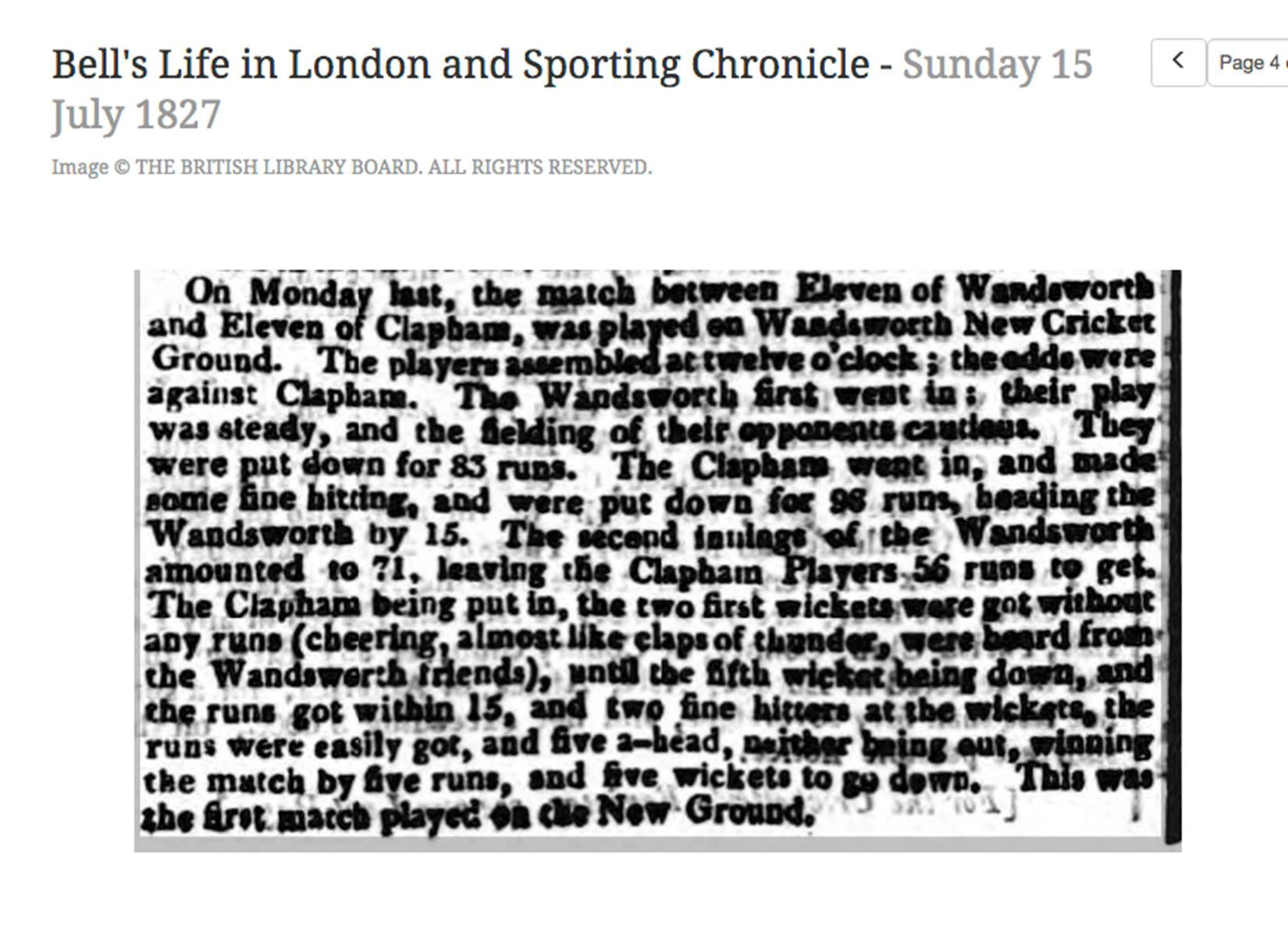

This is almost certainly the ground on which the Wandsworth tradesmen played prior to the 1863 meeting with John Buckmaster at the County Arms to plot a defence of the Common.
See 1827 for mention of the "Wandsworth New Ground", where the MCC presumably played.
Also 1880 for local conflicts over the ground.
London Evening Standard, Monday 30 July 1827
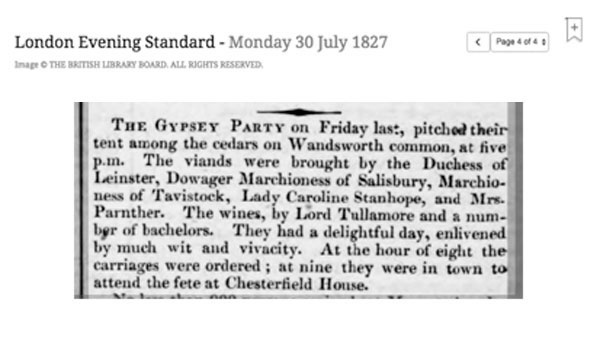
The Gypsey Party pitch their tent on Wandsworth Common
(Click on image to enlarge)
The Gypsey Party on Friday last, pitched their tent among the cedars on Wandsworth common, at five p.m. The viands were brought by the Duchess of Leinster, Dowager Marchioness of Salisbury, Marchioness of Tavistock, Lady Caroline Stanhope, and Mrs. Parnther. The wines, 'by Lord Tullamore and a number of bachelors. They had a delightful day, enlivened by much wit and vivacity. At the hour of eight the carriages were ordered; at nine they were in town to attend the fete at Chesterfield House.
[Source: Link.]
Slightly longer account:
Globe, Monday 30 July 1827

(Click on image to enlarge)
The Party, Friday last, pitched their tent among the cedars on Wandsworth Common, at five jun. The viands were brought by the Duchess Leinster, Dowager Marchioness Salisbury. Mnrchioness of Tavistock, Lady Caroline Stanhope, and Mrs. Parmher. The wines by Lord Tullamore and a number of bachelors. At the hour of eight the carriages were ordered; at nine they were in town attend the fete at Chesterfield House. le supper was laid in the grand banqueting hail, with covers tor between three and four hundred persons; all served off a new and massive service of plate. The dancing was kept up with great spirit till half-past five o'clock.
[Source: Link.]
The story was repeated verbatim in e.g.
Public Ledger and Daily Advertiser, Tuesday 31 July 1827, Link
Morning Advertiser, Tuesday 31 July 1827, Link
Saunders's News-Letter, Thursday 02 August 1827, Link
The Times, 26 September 1827
[PB: Interesting. Add the missing section to the image and finish off transcription.]
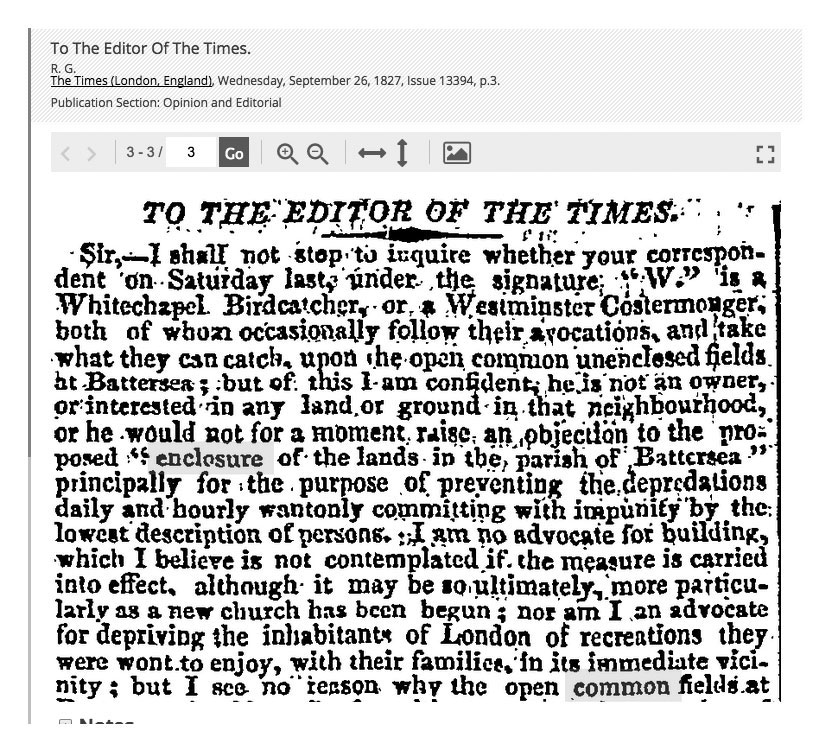
(Click on image to enlarge)
The Times, 29 September 1827
[PB: Who is "W"?]
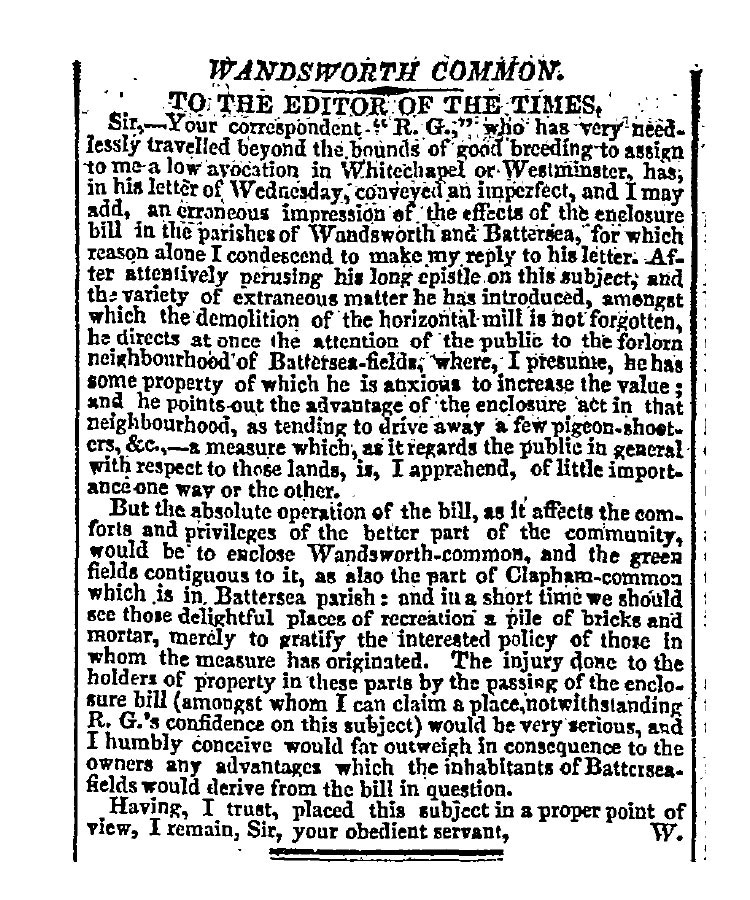
(Click on image to enlarge)
[NEEDS EDIT]
WANDSWORTH COMMON
TO THE EDITOR OF THE TIMES
Sir, — Your Correspondent "R.G." who has very needlessly travelled beyond the bound of breeding to assign to me a low avocation in Whitechapel or Westminster, has; in his letter of Wednesday, conveyed an imperfect, and I may add, an erroneous imoression of the effects of the enclosure bill in the parishes of Wandsworth and Battersea, for which reason alone I condescend to make my reply to his letter.
After attentively perusing his long epistle on this subject; and the variety of extraneous matter he has introduced, amengst which the demolition of the horizontal-mill is not forgotten, he directs at once the attention of the public to the forlorn neighbourhood of Battersea-fields, where, I presume, he has some property of which he is anxious to increase the value; and he points out the advantage of the enclosure 'aft in that neighbourhood, as tending to drive away a few pigeon-shooters, &c.,--a measure which, as it regards the public iin general with respect to these lands, in, I apprehend, of little importance one way or the other.
But the absolute operation of the bill, as it affects the comforts and privileges of the better part of the community, would be to enclose "Wandsworth-common, and the green fields contiguous to it, as also the part of Clapham-common which is in Battersea parish: and in a short time we should see those delightful places of recreation a pile of bricks and mortar, merely to gratify, the interested policy of thole In whom the measure has originated. The injury done to the holders of property in these parts by the passing of the enclosure bill (amongst whom f can claim a place notwithstanding It. G.'s confidence on this subject would be very serious, and I humbly conceive would for outweigh In consequence to the owners any advantages which the inhabitants of Battersea-fields would derive from the bill in question.
Having, I trust, placed this subject in a proper point of view, I remain, Sir, your obedient servant,
W.
NB ref to Horizontal mill
The Times, 21 December 1827
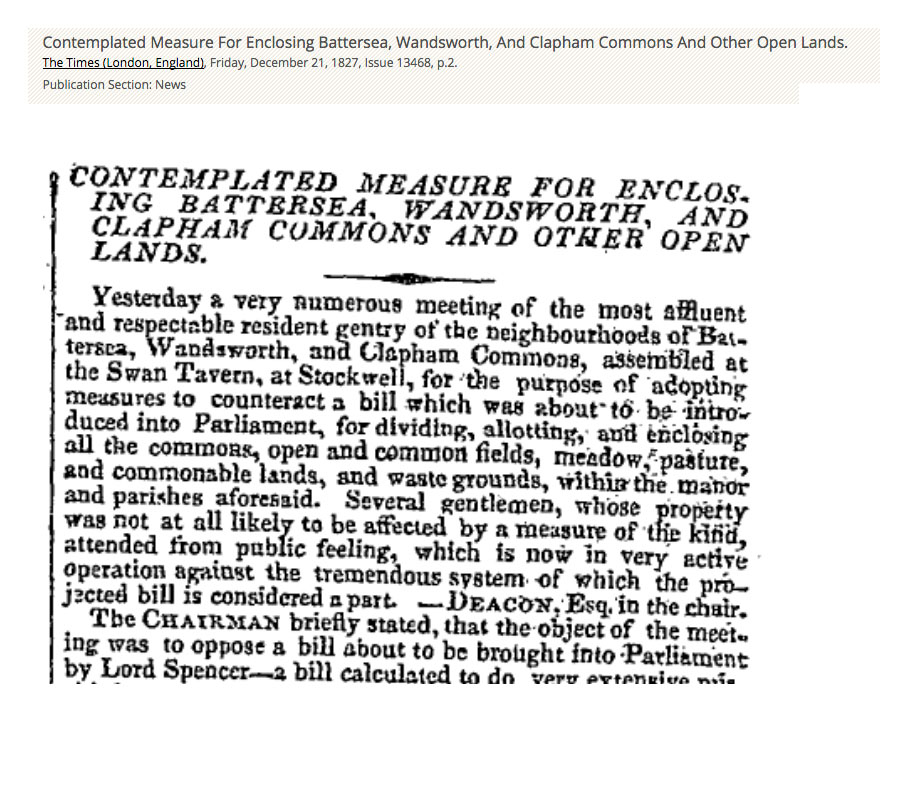
(Click on image to enlarge)
Morning Advertiser, 21 December 1827:
"CONTEMPLATED MEASURE FOR INCLOSING BATTERSEA, WANDSWORTH, AND CLAPHAM COMMONS, AND OTHER OPEN LANDS."
[Source: Link.]
[PB: Reprinted from the Times?]
[PB: Is this the first reference to a campaign against enclosure?]
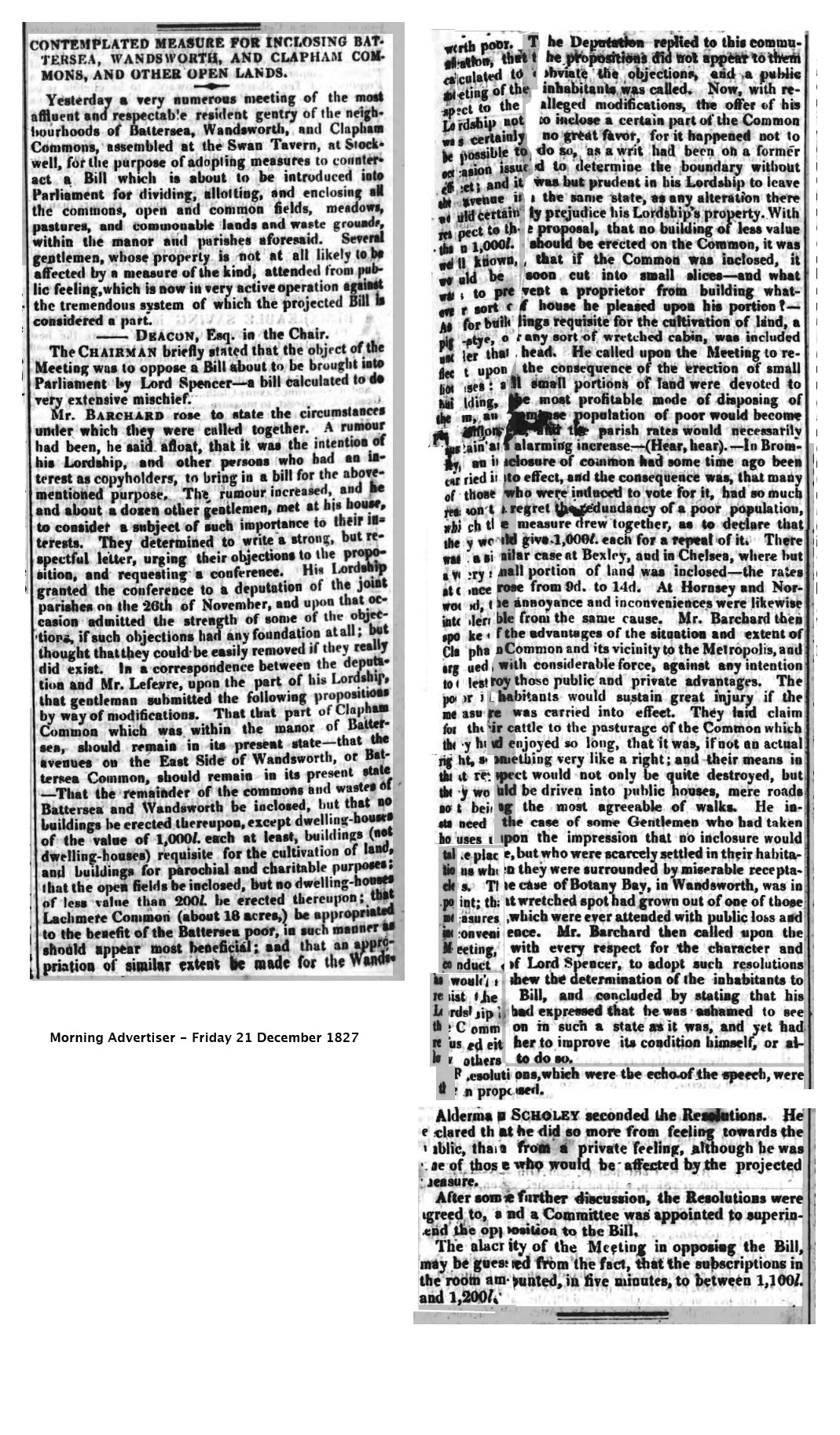
Morning Advertiser, 21 December 1827
(Click on image to enlarge)
Morning Advertiser — Friday 21 December 1827
CONTEMPLATED MEASURE FOR INCLOSING BATTERSEA, WANDSWORTH, AND CLAPHAM COMMONS, AND OTHER OPEN LANDS.
Yesterday a very numerous meeting of the most affluent and respectable resident gentry of the neighbourhoods of Battersea, Wandsworth, and Clapham Commons, assembled at the Swan Tavern, at Stockwell, for the purpose of adopting measures to counteract a Bill which is about be introduced into Parliament for dividing, allotting, and enclosing the commons, open and common fields, meadows, pastures, and commonable lands and waste grounds, within the manor and parishes aforesaid. Several gentlemen, whose property is not at all likely to be affected by a measure of the kind, attended from public feeling, which is now in very active operation against the tremendous system of which the projected Bill is considered a part.
________ Deacon, Esq. in the Chair.
The CHAIRMAN briefly stated that the object of the Meeting was to oppose a Bill about to be brought into Parliament by Lord Spencer — a bill calculated to do very extensive mischief.
Mr. BARCHARD rose to state the circumstances under which they were called together. A rumour had been, he said, afloat, that it was the intention his Lordship, and other persons who had interest as copyholders, bring in a bill for the above-mentioned purpose. The rumour increased, and he and about dozen other gentlemen, met at his house, to consider a subject of such importance to their interests. They determined to write a strong, but respectful letter, urging their objections to the proposition, and requesting a conference.
His Lordship granted the conference to a deputation of the joint parishes on the 26th of November, and upon that occasion admitted the strength of some of the objections, if such objections had any foundation at all; but thought that they could be easily removed if they really did exist.
In a correspondence between the deputation and Mr. Lefevre, upon the part of his Lordship, that gentleman submitted the following propositions by way of modifications.
That that part of Clapham Common which was within the manor of Battersea, should remain in its present state — that the avenues on the East Side of Wandsworth, or Battersea Common, should remain in its present state
That the remainder of the commons and wastes Battersea and Wandsworth be inclosed, but that no buildings be erected thereupon, except dwelling-houses of the value of £1,000 each at least, buildings (not dwelling-houses) requisite for the cultivation of land, and buildings for parochial and charitable purposes; that the open fields be inclosed, but no dwelling-houses of less value than £200 be erected thereupon; the Lachmere [sic] Common (about 18 acres) be appropriated to the benefit of the Battersea poor, in such manner as should appear most beneficial; and that an appropriation of similar extent be made for the Wandsworth poor.
The Deputation replied to this communication, that the propositions did not appear to them to obviate the objections, and a public meeting of the inhabitants was called.
Now, with respect to the alleged modifications, the offer of his Lordship not to inclose a certain part the Common was certainly no great favor, for it happened not to be possible to do so, as a writ had been issued on a former occasion to determine the boundary without effect; and it was but prudent in his Lordship to leave the avenue in same state, as any alteration there would certainly prejudice his Lordship's property.
With respect to the proposal, that no building of less value should £1000 be erected on the Common, it was well known, that if the Common was inclosed, it would be soon cut into small slices — and what was to prevent a proprietor from building whatever sort of house he pleased upon his portion?
As for buildings requisite for the cultivation of land, a pig-stye or any sort of wretched cabin, was included under that head.
He called upon the Meeting to reflect upon the consequence of the erection of small houses: all small portions of land were devoted to building the most profitable mode of disposing of them, an immense population of poor would become [?] that the parish rates would necessarily sustain an alarming increase — (Hear, hear).
In Bromley an inclosure of common had some time ago been carried into effect, and the consequence was, that many who were induced to vote for it, had so much to regret the redundancy of a poor population, which the measure drew together, as to declare that they would give £1,000 each for a repeal of it.
There was a similar case at Bexley, and in Chelsea, where but a very small portion of land was inclosed — the rates rose from 9d. to 14d.
At Hornsey and Norwood, the annoyance and inconveniences were likewise intolerable from the same cause.
Mr. Barchard then spoke of the advantages of the situation and extent of Common and its vicinity to the Metropolis, and argued, with considerable force, against any intention to destroy those public and private advantages. The poor inhabitants would sustain great injury if the measure was carried into effect. They laid claim for their cattle to the pasturage of the Common which they had enjoyed so long, that it was, if not an actual right, something very like a right; and their means in that respect would not only be quite destroyed, but would be driven into public houses, mere roads not being the most agreeable of walks.
He instanced the case of some Gentlemen who had taken houses upon the impression that no inclosure would take place, but who were scarcely settled in their habitations when they were surrounded by miserable receptacles.
The case of Botany Bay, in Wandsworth, was in point; that wretched spot had grown out of one of those measures,which were ever attended with public loss and inconvenience.
Mr. Barchard then called upon the Meeting, with every respect for the character and conduct of Lord Spencer, to adopt such resolutions as would show the determination of the inhabitants to resist the Bill, and concluded by stating that his Lordship had expressed that he was ashamed to see the Common in such state it was, and yet had refused either to improve its condition himself, or allow others to do so.
Resolutions, which were the echo of the speech, were then proposed.
Alderman SCHOLEY seconded the Resolutions. He declared that he did so more from feeling towards the public, than from a private feeling, although he was [not?] one of those that who would be affected by the projected measure.
After some further discussion, the Resolutions were agreed to, and a Committee was appointed to superintend the opposition to the Bill.
The alacrity of the Meeting in opposing the Bill, may be guessed from the fact, that the subscriptions in the room amounted, in five minutes, to between £1,100 and £1,200.
BNA: Link
BNA: Link
This appears to be a precis of an original article, "Contemplated Measure For Enclosing Battersea, Wandsworth, And Clapham Commons And Other Open Lands", that appeared in The Times, 21 Dec. 1827, p. 2, here.

(Click on image to enlarge)
Notes & queries
[PB: "Mr Barchard" — there is a Barchard Street very close to the Town Hall. Several generations of Barchards are named on the Wandle.org website as Wandsworth dyers (particularly of scarlet dyes) here.
George Fergusson Wilson (1822-1902), the pioneering MD of Price's Candle Works, married on 13 August 1862 Ellen, eldest daughter of [the late] R. W. Barchard, of East Hill, Wandsworth. Is it him?
"WILSON BARCHARD. On the 13th. inst., at St. Anne's, Wandsworth, by the Rev. W. Howard, 51. A., rector of Great Witch- ! ingham, Norfolk, George Fergusson Wilson, F. R.S., son of the late William Wilson, Esq., of Wandsworth-common, to Ellen, eldest daughter of the late R. W. Barchard, Esq., of East-hill, Wandsworth." [Morning Post — Thursday 14 August 1862 / https://www.britishnewspaperarchive.co.uk/viewer/bl/0000174/18620814/044/0008]
GOOGLE SEARCH: "R W BARCHARD"
BNA SEARCH: "R W BARCHARD" — looks interesting. NB a man of his name is frequently cited along with Michael Faraday. Check? Numerous refs to the Horticultural Society. I assume all refs to RWB refer to the same man, and he is from Wandsworth?
There are several refs to RWB in relation to coal, e.g. resolving at "A Meeting of the Coal Factors, Coal Merchants, and others interested in the Coal Trade of the Port of London, held at the Coal Market" 28 February 1844, to petition "Parliament against a proposed new Duty of Fivepence per Ton upon Coals imported London to defray the Expense of the contemplated Thames Embankment" [ Newcastle Journal — Saturday 09 March 1844]
"RW" = "Robert Wildman". I believe his daughter [name?] married [name?] Wilson, of Price's Candle Works and the large estate that became "Spencer Park".
London Courier and Evening Gazette — Friday 21 December 1827

(Click on image to enlarge)
CONTEMPLATED MEASURE FOR ENCLOSING BATTERSEA, WANDSWORTH, AND CLAPHAM COMMONS, AND OTHER OPEN LANDS.
A very numerous meeting of the most affluent and respectable resident gentry of the neighbourhoods of Battersea, Wandsworth, and Commons, assembled at the Swna Tavern at for the purpose of adopting measures counteract a bill which was about U> be introduced into Parliament, for dividing, allotting, and enclosing ail the Commons, open and common fields, meadow, pasture, and commonable lands, and waste grounds, within the manor and parishes aforesaid. Several Gentlemen, whose properly was not at all likely to he affected by a measure of the kind, attended from public feeling, which is now in very active operation against the tremendous system ot which the projected Bill is considered a part. Deacok, Esq. in the Chair, The Chairman briefly stated, that the object of the meeting was to oppose Bill about be brought into Parliament Lord Spencer — a Bill calculated to very extensive mischief.
Mr. Barchard rose to state the circumstances under which they were called together. A. rumour had been, he said, afloat, that it was the intention of his Lordship, and other persons who had an interest copyholders, to bring in bill for the abovementioned purpose. The rumour increased, and about dozen other gentlemen met at his house consider subject of such injurious their interests. They determined write a strong but respectful letter, urging their objections to the proposition, and requesting a conference. His Lordship granted the conference to a deputation of the joint parishes, on the 2Gth of November, and upon that occasion admitted the strength of some of the objections, if such objections had any foundation at all; but thought that they could be easily removed if they really did exist. His Lordship added, that if his project could be proved to him to calculated to deteriorate property to any extent, be would cease to proceed — (Hear.) — and directed his steward to gi'e sketch of thn bill, which, thought, wouht effectually removeall |K>ssible objections. In corre»ponrtence between the deputation and
Mr. Lefevre, upon thepurl of his Lordship, that gentleman submitted the following propose tions way of modifications that part of Claphat-o Common vvliii.li was within the manor of Battersea, should remain in its present state; that the avenue on the east side of Wandsworth Battersea Common should remain its present state; that the remainder of the commons and wastes of Battersea and Wandsworth be enclosed; but that no buildings erected thereupon, except dwelling-houses of the value ofI.000/. each least, buildings (not dwelling-houses) lequisils for the cultivation of land, and buildings for parochial and charitable purposes; that theopen fields be enclosed, but no dwelling-house of less value than 200l, be erected thereupon; that Lachmere-common (about 18 acres) appropriated the benefit Battersea poor, in such manner shall appear most beneficial; and that un appropriatiou of a similar extent be made for the Wandsworth pour." The deputation replied to this communication, that the propositions di not appear them calculated to obviate the objections, and a public meeting of the inhabitants was called. Now, with respect to the alleged modifications, the offer of his Lordship not enclose certain part of the common was certainly great favour, for it happened not to he possible to so, as a writ had been on former occasion issued to determine the boundary, without effect. Next, it was but prudent in his Lordship leave the avenue in the same state, ns any alteration there would certainly prejudice his Lordship's properly.
With respect the proposal that no building of lets value than 1,0001. should erected the common, it was well known, that if the common was enclosed, it would he soon rut into small slices; and what was to prevent proprietor from building whatever sort of house he pleased U|ion his portion As for buildings requisite for the cultivation of land, a pigsty, or any foil of wretched cabin, was included under that head. He called up:»ii the meeting to reflect upon the cons* icnccs of the erection of small houses. All small portions of land were devoted to building — the most profitable mode disposing of them. immense population of poor would b come parishioners, and the parish-rates would necessarily Buttaio alarming increase. (Hear, hear.)
In Bromley enclosure of common was some time carried into effect, and the consequence was, that many of those who were induced to vote for it had much reason to regret the redundancy of a poor population, whicb the measure drew together, to declare that they would give 1,0001. each for repeal of it. There was similar cas-- at Bexley; and in Chelsea, where but very small portion of land was enclosed, the rates at once rose from 9,1. to Ud. At Horpsey and Norwood the annoyance and inconveniences were likewise intolerable, from the same cause.
Mr. Barchard then spoke the great advantages of the situation and extent of Claplitnn-common and its vicinity the metropolis, and argued with considerable force against any intention troy those public end private advantages. The poor inhabitants would sustain great injury if the measure were carried into effect. They laid claim for their cattle to the pasturage the common, which they had enjoyed so long that it was, if not actual right, something very like a right and their means in that respect would not only be quite destroyed, bat thev would driven into public-houses, mere roads not being the moat agreeable of walks. instant ed the rases of sume gentlemen who had taken houses, upon the impression that enclosure would take place, but who were scarcely settled in their habitations when they re surrounded by receptacles.
The case of Botany Bay, Wandsworth, was in point. That wretched spot grown out of one of those measures which "ere evrr attended with public b>ss and iucouvriiieuc*-.
Mr. Barchard then called upon the meeting, with every respect for the character and conduct of Lord Spencer, to adopt such resolutions would show the determination of the inhabitants to resist the bill, and concluded staling that his Lordship had expressed that be was ashamed to see the Common in such a state as it was Id, and yet had refused either to improve its condition biiusr if, ur allow others to so. Resolutious which were the echo of the speech were then posed. Alderman SeiioLtv seconded the resolutions. He declared that be did more from feeling towards the public than from private feeling, although he was one of those who would be aff eted the projected measure. (Hear, hear.)
Mr. Gude (of the Crown-office, we understood) asked whether Lord Spencer was apprised of this mMbng?
Alderman ScHOLxy said that Mr. Uwtese knew of the meeting, but declined attending from a point of delicacy. parishioner said that he understood Lord Spencer was most willing to hear from them on the Kubject of further modifications. The general principle was extremely exceptionable, hut something urglit done by modifying'. dJ
Mr. Gcdf. said satisd Rpeucer whs aware any »H>osi;ioq^^^^Hph«^pKofH|RVLiil.
Mr. Kin whole of the filled in sur.b manner to cause the every respectable man, had given high pnce.for his boose, under the impression that the enclosures which ware now meditated would not lake place. Some years ago, when llie common was in a very had slm.', asked Lord Spencer whether would allow him to drain it, and toM him be would plant trees in it also b.r, own exponce. His referred him to
Mr. Harrison, who approved highly of the suggestion, and in the course of conversation said that Lord Spencer would net attempt obtain an enclosure bill, had failed in that object while was First Lord of the Admiralty. But although uoobjectioa was made, no answer was ever relumed to the application. His Lordship had said that was ashamed to see the state of the Gomroon. Why Because would neither drain and plant it himself, nor allow any body else to do to. (A laugh and applause.)
At Enfield Chase, wbeu was the intentum of iho Conmiissionera Woods Hml Forest* to enclose some land, the inh&bituuts opposed the measure, principally on the ground of the fear of rendering the place nnhealthy coufiuing it, and the measure was withdrawn. Here that principle stronger operation, for the Common — in the immediate vicinity of town. What was the fact. They were driving thieves and vagabonds out of Field-lane, and otter places of the kind, and was it nut likely that Clapham, if converted into enclosed by and by be the place of refuge of persons of the Mnd^^^Kera).
Mr. part an advertisement, rocon.incndicg the bridge, and used it as arguiu-ut to show that of property w as about lo take place Sunjgrsidc of the water. parisniooer said, that modification whatever obviate the pbwerftn to the Bill. The tueetieg should object the Bill altogether, and it was to hoped, that Lord Spencer would not allow an advantage of 1,0001 or 2,O(KW. year to induce him to such immense puWie, injury. (Hear, hear.) If his Lordship was waited upon with the resolutions, he' would most probably give up the measure altogether. (Cheers.)
Mr, Kf.VE — The fact is, this Bill chalks out Chancery suit for every little cottage that may raised upon the ground. is nut amiss to sry, that pending the passing of the Bill, great many pretty promises are made which arc laughed when Hie thing discussed in Committee.
Mr. Hknrv Barchard objected the measure from his sense of the injury it would entail upon the country all round. Atier some more strong remarks upon the inevitable consequences of the obnoxious measure In contemplation by hla Lordship, the resolutions wereogreed to with no moie than three dis sentienls. Committee was then nppoinLd lo carry the into effect. Such was the alacrity upon the part the niembert of the assembly, that in lesa than five minutes after the Committee was appointed, the subscriptions to carry on resolute opposition amounted to between 1,1002, and I 2002. Thanks having leen ih(f Chairman, the meeting separated.
https://www.britishnewspaperarchive.co.uk/viewer/bl/0001476/18271221/017/0003
[EXCELLENT — but part of the right hand column has been cut off. Any possibility of finding the complete article?]
Morning Herald (London) — Friday 21 December 1827
ENCLOSURE OF CLAPHAM COMMON
Considerable sensation has been excited for some time past amongst the inhabitants of Clapham, Wandsworth, Tooting, Battersea, &c., a threat having been held out by Lord Spencer, as Lord of the Manor of Battersea, to cause a Bill to be brought in, in the ensuing Session of Parliament, for enclosing all the waste and common lands in the neighbourhood; and on the Bth of November last public notice was given by Messrs. Bicknell and Spedding, his Lordship's solicitors, that a petition would be presented to the Honourable the House of Commons, during the ensuing Session o Parliament, for leave to bring in a Bill, in order to obtain an Act of Parliament for "dividing, allotting, and enclosing all commons, open and common fields, meadows, pastures, and commonable lands and waste grounds, within the Manor and Parishes of Battersea and Wandsworth, in the county of Surrey. "
This notice so alarmed the inhabitants, from the highest to the lowest, that deputations from each parish, consisting of the most opulent and respectable inhabitants, were formed, in order to negotiate with Lord Spencer and his agents on the subject; these negotiations, however, did not terminate to the satisfaction of the: inhabitants, and in consequence it was suggested to call a General Meeting, for which purpose the following circular letter was sent to all the inhabitants:
BATTERSEA AND WANDSWORTH ENCLOSURE.
We, the undersigned, having been deputed by many of the Inhabitanta and having in consequence had a conference with Lord Spencer, in order to state the strong objections which are felt to the proposed application to Parliament for a BID to obtain an Act for Dividing, Allotting, and Enclosing all the Common., Open and Common Fields, Meadows, Pastures, and Commonable Lands and Waste Grounds, within the Manor and Parishes of Battersea and Wandsworth, " Have deemed It necessary that a Public Meeting of the Inhabitants, Owners and Occupiers of Lands and Houses, In the Parishes of Battersea and Wandsworth, should be held, in order to take into consideration the probable effects of the measure, and to determine upon the steps which ought in consequence to be adopted. We do therefore request that you, and all persons interested, will meet on Thursday, the 20th December instant, at the Swan Tavern, Stockwell, at Nine o'clock in the Morning.
ROBERT W. BARCHARD. JOHN DEACON. ALEXANDER GORDON. GEORGE SCHOLEY. WILLIAM NOTTIDGE. WILLIAM WILLIS, Jan. THOMAS ROOKE.
The Chair to be taken at Ten o'clock precisely. At the appointed hour, yesterday morning, a very large number of some of the most respectable bankers, merchants, &c. of the city of London, and several Magistrates of the county, who have residences in the manor, owing to contiguity to the metropolis, were in attendance, and there were also present a number of the most humble of the peasantry of the neighhourhood, who appeared to take as deep an interest as their wealthy neighbours in the proceedings of the day. JOHN DEacoN, Esq. was called to the Chair, when he briefly told the Meeting the object for which they were assembled, in which they were all so deeply interested, and observed that Mr. R. W. Barchard, who had taken a most active part in the business, would relate to them all the previous correspondence and communication between the deputation and Lord Spencer, and his Lordship's agents, on this important subject.
Mr. BARCHARD then, at some length, stated that so long hack as September last a rumour was afloat that it was the intention of Lord Spencer to resort to the measure of enclosing. the commons within the Manor. He was the first that called the attention of the inhabitants to it, and, in consequence, he had an assemblage of a number of those most interested, in his own parlour.
It was resolved that a Committee of twelve Gentlemen should he appointed to watch the interests of the inhabitants, and that they should communicate to his Lordship in strong, although the most respectful terms, what the feelings of the inhabitants were. A communication of that sort was made, and a very polite reply was received; a number of negotiations followed this, and eventually his Lordship granted the deputation an interview.
At that interview his Lordship, with his well-known urbanity, behaved in the most courteous manner to the deputation. Those Gentlemen represented to his Lordship, that any measure of the sort proposed would be destructive to the property of all the respectable inhabitants of the neighbourhood of Clapham; because, in the first instance, the opulent people residing there had paid enormous prices for their dwellings, for the purpose that they and their families should derive the benefit of fresh air, well knowing that the neighbourhood was surrounded by open commons and fields, and, therefore, the advantage was to be obtained. They next submitted to his t L h o i r s d a s a h v ip a, nt t a h g a e t it f thewas not possible to expect they could erjoy proposed Bill was passed; because it was manifest that the ground, when enclosed, would follow the fate of all other enclosed grounds in the neighbourhood of London, and be devoted to the purposes of building, and thus destroy the intentions of those who had become inhabitants for the express purpose of enjoying the air of the neighbourhood.
His Lordship admitted the force of these arguments, but replied that they would not exist in the present case. The deputation urged particularly that the part of Clapham Common, within the jurisdiction of his Lordship's Manor should remain in its present state, and that such should form part of the Bill; and the result of the interview was, that Mr. J. G. Shaw Lefevre, his Lordship's Steward, should communicate a sketch of the intended Bill to the deputation; and accordingly the following letter was received from that Gentleman: 7, Fleet-street, Dec. 7. Dear, Sir, — l have the honour to submit the following propositions to the consideration of yourself and the other Gentlemen, who are adverse to the enclosure of Battersea and Wandsworth Commons, and open fields, I should feel obliged to you to communicate to me in writing their sentiments an soon as possible; for if the propositions are approved of, I shall, without lows of time, submit them to Lard Spencer, and the other parties interested in favour of the enclosure, with the hope that they will, in their turn, consent to the introduction of clauses in the Bill to the same effect. — l have the h)nour to be, dear Sir, your obedient Servant, (Signed) JOHN GEORGE SHAW LEFEVRE. Addressed, "11. W. Barchard, Esq. Wandsworth. " — This was the reply of Lord Spencer's Steward; and the propositions he submitted, and which were referred to in his letter, were these, " That part of Clapham Common which is within the Manor of Battersea to remain in its present state. " But there was this note attached to it by the Steward, " I have no doubt but that Lord Spencer will concur with the gentlemen resident on that part of Clapham Common in such regulations respecting the digging of gravel, &c., and the planting and preserving ornamental timber, as may be found conducive to the beauty of the Common. "
The next proposition was, that the avenue on the east side of Wandsworth or Battersea Common should remain in its present state, and then that the rentabacr of Battersea and Wandsworth Commons and wastes were to be enclosed, but no buildings to be erected thereupon, except dwelling-houses of the value of 1, 000/. at the least, anst stables and offices necessary thereto — buildings (not dwelling-houses) requisite for the cultivation of the land, buildings for parochial or charitable purposes, excepted.
The open fields were to be enclosed, but dwelling-house of less than to be erected upon them. Latchmoor Common (about 18 acres) was to be appropriated for the Battersea poor, and an appropriation of about the sante quantity for the poor of Wandsworth. The cricket-ground was to be preserved as at present, or, if removed further south, the expense of the removal not to fall on those who were at the expense of making it.
After some few more local suggestions, Mr. Lefevre concluded his statement by saying, "Although I much regret that any houses should be diminished in value by the interference of new buildings with their prospect, yet I cannot think this sufficient reason for imposing further of open field lands. I do not enter in of enforcing the above restrictions, I have clauses framed which shall effect litigation. " Now the deputation anything but satisfactory, and, the the determination of taking the opini public meeting on the subject; for t these propositions amounted to riot hi the Common which his Lordship to remain as it it was Ns property; for a doubt existed as to his Lordship's manor, or to an adjc e f limitation tieing so close. The poin ago disputed in a of Justice, a sides was so strong, that both parties juror, so that there was no boon in immediately this bill was passed, aid, part of the land was exempted, the might agree together, and find it to ti disputes, and get a Bill passed to em position regarding the other common less value than 1, 000. was to be ere pletely ridiculous, because they knew was enclosed, it must be cut into 11 those who had a right of common; that any man who was entitled to not to do what he liked with that his own? And it was more likely that to a piece, would erect a hut or cettas suffer it to be disposed of otherwise; sition, that the remaining fields were cept for houses of value, why it house of less than MO/. value eon!d that description would, therefore:, be I would be found for them, and then parisb, whilst, in consequence of this the tespectable houses now inhabited creased, for the tenants would not re thus got surrounded by other houses 1 prospect, which was the only induce there. Another thing would be, the spectahle inhabitants left, the poor w, people that inhabited these ne become chargeable to the parish, must, of necessity, increase. Instanci bourhood of London were too frequen mons had been passed for Norwood, and in every instance had been attest(just described — namely, annoyance 1 tants, so as to compel them to remove consequently of poor's rates. But the: to look to the effect that it would man. Every poor labouring man mon for the purpose of pasturing an had any; hut let this Bill pass, and t he gone. Under all the circumstances that they were bound to oppose the not to he supposed that the oppositio to Lord Spencer, for there was no pe who entertained any personal feeling was against the system of enclosures g in particular. He had embodied the consulted in a series of resolutions, v now take the liberty of feeding to the lst — That it is the opinion of this /i sore. if carried into effect, will prove higi and interests of the inhabitants of thee, 2d — That it will operate as a measure c a considerable number of person, , whole, to the piece nought to be enclosed; and this Meeting, that they have only to vies system of enclosure in other nelghbourb crease of poor rates, and of the worst which will be more particularly felt by t cinity of the river and metropolis. 3d — That the preservation of the corny don, is eminently conducive to the healt of its inhabitants, and that the prop(highly objectionable upon public ground 4th — That the desired change in. the pri pregnant with these injurious results, is other bawls than the pecuniary interests and has no objects or advantages of a pu sth — That the modifications of the mea posed by Lord Spencer appear to this the principal objections in their full force acceded to. 6th — That this Afeeting will, from thee to the utmost of their power, the introd Intended Bill. 7th — Tnat a Committee be appointed, upon, and carry into execution, all such expedient for rendering this oppositior to add to their number the names of they shall think tit. St — h — That a subscription be entered of these proceeding., and that the eame hands of XVllllam Wittig, Eq., who is h Treasurer to the Committee. He truted that every Gentleman pres sentiments on this subject, and expr have; and, in order to give an oppor that the resolutions he had just read h Mr. Alderman SCIPLET seconded t The CHAIRMAN put them serialini. After the second resolution had bee affirmative — Mr. GUDE (of the Crown Office) inc cer had been apprised of the present IV The CHAIRMAN said that it was n. and, therefore, his Lordship must have Alderm'an SCHOLEY said he for he had rode that morning along wi ship's agent, and that Gentleman had fully aware of the Meeting; but from determined not to attend, as it was c inhabitants should be left to thernsel in an unbiassed manner. A Gentleman of the name of HORN] before the resolutions were passed, again submitted to the consideration o certain that his Lordship was still opei &iodation that could he suggested. Mr. inquired whether Lord! upon, and asked to consent to any fur intended Bill. It was replied that he had not. A Gentleman observed that he thoi to pause, and again negotiate with hi passed these resolutions, and thus heli length, be might be disposed to dot would not do. He thought there was that hit Lordship could, by his influel a Committee of the House of Commoi therefore, that a Committee should be sentiments of the Meeting to his Lr that personally there was not a tenant manors but what had the highest resp At the same time the speaker expressei lion to the enclosing of manors, both London, in the way they had been em years. After an explanation from Mr. HORI The CuAinmaN said that be trustei forget his own peculiar interests, and was assembled to act for the benefit of Mr. KATE (the Bank Solicitor) said must say, although the property he he that when he purchased it, which was under the impression that nothing of contemplated; for he had put that qu agent, and the reply he received was, tried during the period when his Lord Admiralty, hut could not be can arid therefore, if it could not Lordship was in the Cabinet, i to he carried when he was or His Lordship had, as he understood, rough state and appearance of Clapha Kaye) had offered himself, at his o counnon, and plant some ornaments ship would give him leave, and he wa time to time. Sixteen years, however not yet received an answer to the ques Commissioners of Woods and Forests contemplation to enclose Enfield C near 20, 000 acres, and was more Oar but they 'did not succeed; and he, that Government would never sanctit spot of three or four hundred acre miles of the metropolis, and which health and recreation of the inhabiter London. Mr. GUDE read an extract from prove the necessity of this enclosure, new palace and new buildings in St, posed that fresh habitations on their necessary, particularly as an extra co plated by the proposed new bridge.
Mr. KAYE said that what the Gent nothing hut an extract from a Joint tus for a new bridge — CA laugh.) A Gentleman observed that be felt cer would never persist in this measu of his tenants. It could not bring hi. a-year more; and that sum could be Mr. KATE said that, with respect t meant the disputed part) if that was eery suit would he chalked out for eel A Gentleman (a Magistrate, we bel parish of Wandsworth the enclosure w sequence, for on Wandsworth Comm which rave employ to 60 or 70 paupei contributed to keep in repair their were taken away, the employment for and the roads would lose the benefit Mr. BARCHARD (a Magistrate) fully lutions, and wished them to he adopt JELLICOE said that the propost lands would cause new roads to be n materially increase the highway rate. . After various suggestions, the reso and a Committee appointed. A subscription was immediately er expenses of opposing the Bill, and ab were subscribed in the room instantl: A vote of thanks was then passed t Meeting separated.
Morning Herald (London) — Friday 21 December 1827-4000px. jpg> https://www.britishnewspaperarchive.co.uk/viewer/bl/0002408/18271221/016/0002
[May be identical to the next article below . . . ]
Morning Herald (London) — Saturday 22 December 1827
1827-12-22-resisting-enclosure-of-commons-MorningHerald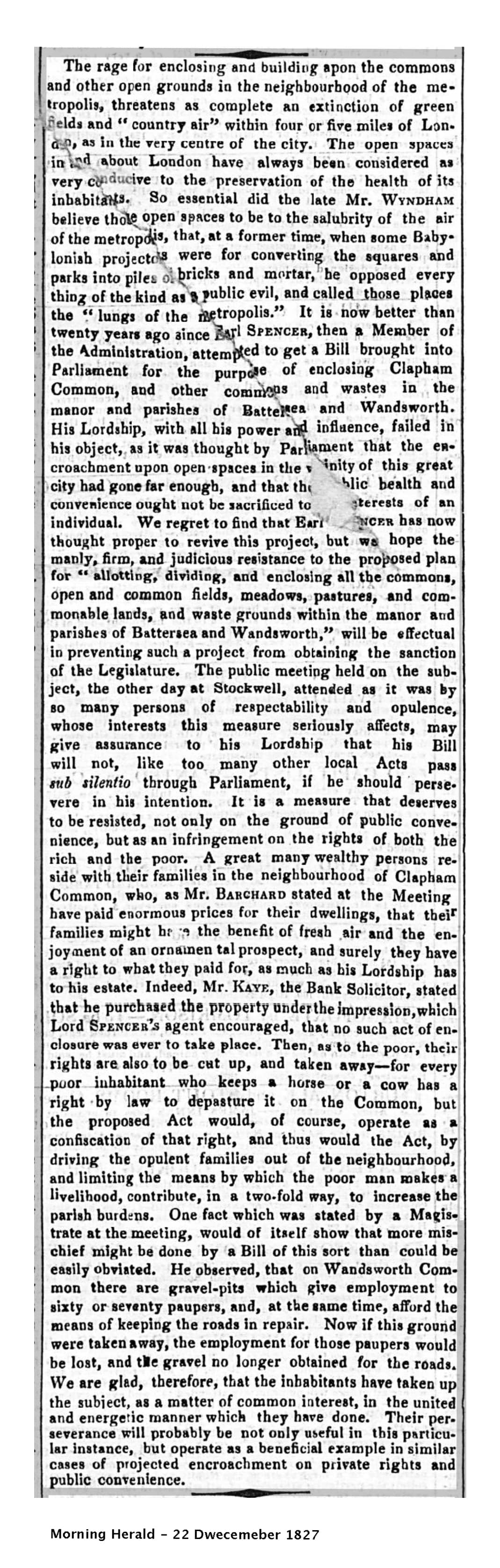
(Click on image to enlarge)
The rage for enclosing and building upon the commons and other open grounds in the neighbourhood of the metropolis, threatens as complete an extinction of green. Ads and "country air" within four or five miles of London in the very centre of the city. The open spaces i rr tzd about London have always been considered as very acdt. cive to the preservation of the health of its inhabitants. So essential did the late Mr. WYNDHAM believe thole, open spaces to be to the salubrity of the air of the metropolis, that, at a former time, when some Babylonish project r.. 3 were for converting the squares and parks into pile!. bricks and mortar, he opposed every thing of the kind as 5 public evil, and called those places the " lungs of the metropolis. "
It is now better than twenty years ago since Earl SPENCER, then a Member of the Administration, attempted to get a Bill brought into Parliament for the purpr: se of enclosing Clapham Common, and other comnieps and wastes in the manor and parishes of Battei!ea and Wandsworth. His Lordship, with all his power inflaence, failed in his object, as it was thought by Parliament that the encroachment upon open spaces in the; nity of this great city had gone far enough, and that th( bealth and convesdence ought not be sacrificed to tterests of an individual. We regret to find that Ear( peen has now thought proper to revive this project, but we hope the manly, firm, and judicious resistance to the proposed plan for " allotting, dividing, and enclosing all the commons, open and common fields, meadows, pastures, and commonable lands, and waste grounds within the manor and parishes of Battersea and Wandsworth, " will be effectual in preventing such a project from obtaining the sanction of the Legislature. The public meeting held on the subject, the other day at Stockwell, attended as it was by so many persons of respectability and opulence, whose interests this measure seriously affects, may give assurance to his Lordship that his Bill will not, like too many other local Acts pass sub silentio through Parliament, if he should persevere in his intention. It is a measure that deserves to be resisted, not only on the ground of public convenience, but as an infringement on the rights of both the rich and the poor.
A great many wealthy persons reside with their families in the neighbourhood of Clapham Common, who, as Mr. BARCHARD stated at the Meeting have paid enormous prices for their dwellings, that their families might h: 1 the benefit of fresh air and the enjoyment of an ornamental prospect, and surely they have a right to what they paid for, as much as Lordship has to his estate.
Indeed, Mr. KAYE, the Bank Solicitor, stated that he purchased the property under the impression, which Lord SPENCER'S agent encouraged, that no such act of enclosure was ever to take place. Then, as to the poor, their rights are also to be cut up, and taken away — for every poor inhabitant who keeps a horse or a cow has a right by law to depasture it on the Common, but the proposed Act would, of course, operate as a confiscation of that right, and thus would the Act, by driving the opulent families out of the neighbourhood, and limiting the means by which the poor man makes a livelihood, contribute, in a two-fold way, to increase the parish burdens. One fact which was stated by a Magistrate at the meeting, would of itself show that more mischief might be done by a Bill of this sort than could be easily obviated.
He observed, that on Wandsworth Common there are gravel-pits which give employment to sixty or seventy paupers, and, at the same time, afford the means of keeping the roads in repair. Now if this ground were taken away, the employment for those paupers would be lost, and the gravel no longer obtained for the roads.
We are glad, therefore, that the inhabitants have taken up the subject, as a matter of common interest, in the united and energetic manner which they have done. Their perseverance will probably be not only useful in this particular instance, but operate as a beneficial example in similar cases of projected encroachment on private rights and public convenience
[BNA: .]
[Same as below?]
London Courier and Evening Gazette — Saturday 22 December 1827
(Click on image to enlarge)
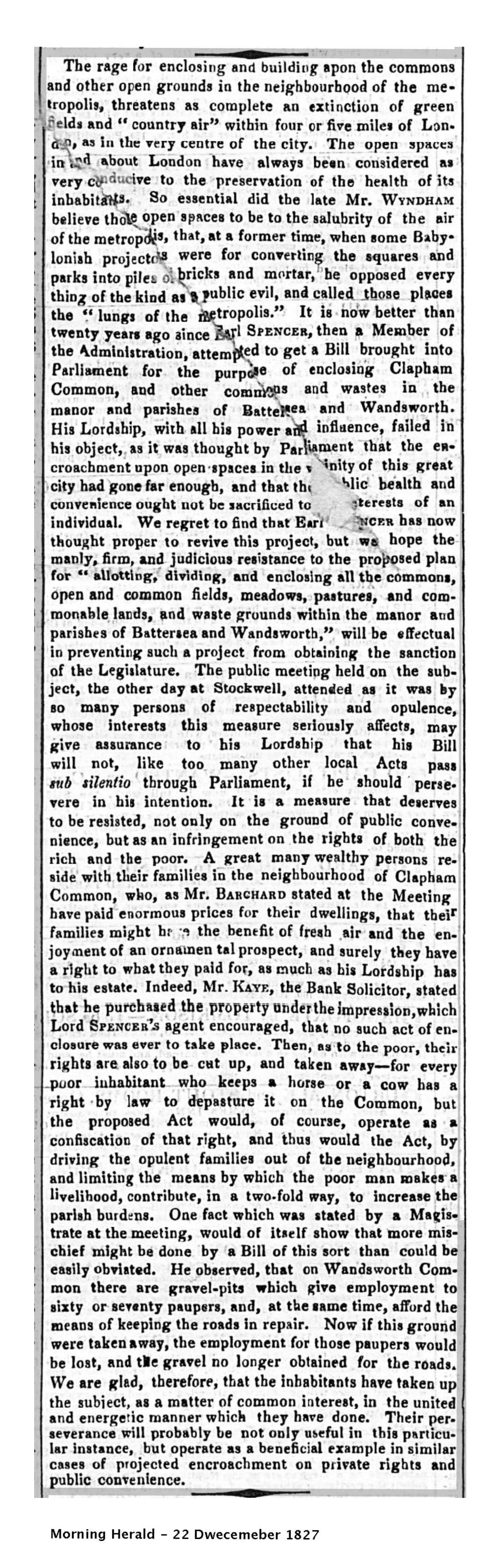
The rage for enclosing and building upon the commons and other open grounds in the neighbourhood of the metropolis, threatens as complete an extinction of green — .Ads and "country air" within four or five miles of Lonas in the very centre of the city. The open spaces i rr tzd about London have always been considered as very acdt.cive to the preservation of the health of its inbabitans. So essential did the late Mr. WYNDHAM believe thole, open spaces to be to the salubrity of the air of the metropolis, that, at a former time, when some Babylonish project r . — . 3 were for converting the squares and parks into pile!. bricks and mortar, he opposed every thing of the kind as 5 public evil, and called those places the " lungs of the metropolis."
[DATE? c.1805?]
It is now better than twenty years ago since Earl SPENCER, then a Member of the Administration, attempted to get a Bill brought into Parliament for the purpr:se of enclosing Clapham Common, and other comnieps and wastes in the manor and parishes of Battei!ea and Wandsworth. His Lordship, with all his power inflaence, failed in his object, as it was thought by Parliament that the encroachment upon open spaces in the ;nity of this great city had gone far enough, and that the health and convesdence ought not be sacrificed to interests of an individual. We regret to find that Ear( peen has now thought proper to revive this project, but we hope the manly, firm, and judicious resistance to the proposed plan for " allotting, dividing, and enclosing all the commons, open and common fields, meadows, pastures, and commonable lands, and waste grounds within the manor and parishes of Battersea and Wandsworth," will be effectual in preventing such a project from obtaining the sanction of the Legislature.
The public meeting held on the subject, the other day at Stockwell, attended as it was by so many persons of respectability and opulence, whose interests this measure seriously affects, may give assurance to his Lordship that his Bill will not, like too many other local Acts pass sub silentio through Parliament, if he should persevere in his intention. It is a measure that deserves to be resisted, not only on the ground of public convenience, but as an infringement on the rights of both the rich and the poor.
A great many wealthy persons reside with their families in the neighbourhood of Clapham Common, who, as Mr. BARCHARD stated at the Meeting have paid enormous prices for their dwellings, that their families might h: •1 the benefit of fresh air and the enjoyment of an ornamental prospect, and surely they have a right to what they paid for, as much as Lordship has to his estate. Indeed, Mr. KAYE, the Bank Solicitor, stated that he purchased the property under the impression,which Lord SPENCER'S agent encouraged, that no such act of enclosure was ever to take place.
Then, as to the poor, their rights are also to be cut up, and taken away—for every poor inhabitant who keeps a horse or a cow has a right by law to depasture it on the Common, but the proposed Act would, of course, operate as a confiscation of that right, and thus would the Act, by driving the opulent families out of the neighbourhood, and limiting the means by which the poor man makes a livelihood, contribute, in a two-fold way, to increase the parish burdens.
One fact which was stated by a Magistrate at the meeting, would of itself show that more mischief might be done by a Bill of this sort than could be easily obviated. He observed, that on Wandsworth Common there are gravel-pits which give employment to sixty or seventy paupers, and, at the same time, afford the means of keeping the roads in repair. Now if this ground were taken away, the employment for those paupers would be lost, and tke gravel no longer obtained for the roads.
12-We are glad, therefore, that the inhabitants have taken up the subject, as a matter of common interest, in the united and energetic manner which they have done. Their perseverance will probably be not only useful in this particular instance, but operate as a beneficial example in similar cases of projected encroachment on piivate rights and public convenience.
1827
[BNA: Link.]
ENCLOSURE Yesterday a vety Meeting of, tkg most affluent and 'teipectahle resident Gent 6 hi the nebboutlinods of Battrr ea, Clisoh)sus . . .
Published: Friday 21 December 1827
Newspaper: Star (London)
London Evening Standard
CONTEMPLATED MEASURE h'Oli ENCLOSING.CLAPHA..I COMMON, &c
. . . become parishioners, and the parish-rates would necessarily sustain an alarming increase. (Hear, hear.) In Bromley an enclosure of common was some time ago carried into effect, and the consequence Mas, that many of those who were induced to vote for . . .
Published: Friday 21 December 1827
London Courier and Evening Gazette
— Friday 21 December 1827CONTEMPLATED MEASURE FOR ENCLOSING BATTERSEA, WANDSWORTH, AND CLAPHAM COMMONS, AND OTHER OPEN LANDS.
very numerous lueeting of the most affluent nod respectable resident gentry of the neighbourhoods of Kattersea, Wandsworth, and Commons, assembled at the Swna Tavern at for the purpose of adopting measures counteract a bill which was about U> be introduced into Parliament, for dividing, allotting, and enclosing ail the Commons, open and common fields, meadow, psstare, and commonable lands, and waste grounds, within the manor and parishes aforesaid. Several Gentlemen, whose properly was not at all likely to he affected by a measure of the kind, attended from public feeling, which is now in very active operation against the tremendous system ot which the projected Bill is considered a part. Deacok, Esq. in the Chair, The Chairman briefly stated, that the object of the meeting was to oppose Bill about be brought into Parliament Lord Spencer — a Bill calculated to very eJtensive mischief. Mr. Barciiako rose to slate the circumstances under which they were called together. A. rumour had bedn, he said, afloat, that it was the intention of his Lordship, and other persons who had an interest copyholders, to bring in bill for the abovementioned purpose. The rumour increased, and and about dozen other genilemeu met at his house consider subject of such impurUnco their interests. They determined write a strong but respectful letter, urging their objections to the proposition, and requesting a conference. Uis Lordship granted the conference to a deputation of the joint parishes, on the 2Gth of November, and upon that occasion admitted the strength of gome of the objections, if such objections had any found ition at all; blit thought that they could be easily removed if they really did exist. His Lordship added, that if his project could be proved to him to calculated to deteriorate property to any extent, be would cease to proceed — (Hear.) — and directed his steward to gi'e sketch of thn bill, which, thought, wouhtelfectually removeall |K>ssibleobjections. In corre»ponrtence between the deputation and Mr. Lelevro, upon thepurl of his Lordship, that gentleman submitted the following propose tions way of modifications that part of Claphat-o Common vvliii.li was within the manor of Battersea, should remain in its present state; that the avenue on the east side of Wandsworth Battersea Common should remain its present state; that the remainder of the commons and wastes of Battersea and Wandsworth be enclosed; but that no buildings erected thereupon, except dwelling-houses of the value ofI.000/. each least, buildings (not dwelling-houses) lequisils for the cultivation of land, and buildings for parochial and charitable purposes; that theopen fields be enclosed, but no dvvelling-houtrß of less value than 2001, be erected thereupon; that Lachmererommon (about 18 acres) appropriated the benefit Battersea poor, in such manner shall appear most beneficial; and that un appropriatiou of a similar extent be made for the Wandsworth pour." The deputation replied to this communication, that the propositions di not appear them calculated to obviate the objections, and a public meeting of the inhabitants wascalled. Now, with respect to the alleged modifications, the offer of his Lordship not enclose certain part of the common was certainly great favour, for it happened not to he possible to so, asa writ had been on former occasion issued to determine the boundary, without effect. Next, it was but prudent in his Lordship leave the avenue in the same state, ns any alteration there would certainly prejudice his Lordship's properly. With respect the proposal that no building of lets value than 1, 0001. should erected the common, it was well known, that if the common was enclosed, it would he soon rut into small slices; and what was to prevent proprietor from building whatever sort of house he pleased U|ion his portion As for buildings requisite for the cultivation of land, a pigsty, or any foil of wretched cabin, was included under that head. He called up:»ii the meeting to reflect upon the cons- icnccs of the erection of small houses. All small portions of land were devoted to building — the most profitable mode disposing of them. immense population of poor would b come parishioners, and the parish-rates would necessarily Buttaio alarming increase. (Hear, hear.) In Bromley enclosure of common was some time carried into effect, and the consequence was, that many of those who were induced to vote for it had much reason to regret the redundancy of a poor population, whicb the measure drew together, to declare that they would give 1, 0001. each for repeal of it. There was similar cas-at Bexley; and in Chelsea, where but very small portion of land was enclosed, the rates at once rose from 9, 1. to Ud. At Horpsey and Norwood the annoyance and inconveniences were likewise intolerable, from the same cause. Mr. Barchard then spoke the great advantages of the situation and extent of Claplitnn-common and its vicinity the metropolis, and argued with considerable force against any intention troy those public end private advantages. The poor inhabitants would sustain great injury if the measure were carried into effect. They laid claim for their cattle to the pasturage the common, which they had enjnved so long that it was, if not actual right, something very like a r and their means in that respect would not only be quite destroyed, bat thev would driven into public-houses, mere roads not being the moat agreeable of walks. instant ed the rases of sume gentlemen who had taken houses, upon the impression that enclosure would take place, but who were scarcely settled in their habitations when they re surrounded by receptacles. The case of Botany Bay, Wandsworth, was in point. That wretched spot grown out of one of those measures which "ere evrr attended with public b>ss and iucouvriiieuc--. Mr, Barchard then called upon the meeting, with every respect for the character and conduct of Lord Spencer, to adopt such resolutions would show the determination of the inhabitants to resist the bill, and concluded staling that his Lordship had expressed that be was ashamed to see the Common in such a state as it was Id, and yet had refused either to improve its condition biiusr if, ur allow others to so. Resolutious which were the echo of the speech were then posed. Alderman SeiioLtv seconded the resolutions. He declared that be did more from feeling towards the public than from private feeling, although he was one of those who would be aff eted the projected measure. (Hear, hear.) Mr. Gude (of the Crown-office, we understood) asked whether Lord Spencer was apprised of this mMbng? Alderman ScHOLxy said that Mr. Uwtese knew of the meeting, but declined attending from a point of delicacy. parishioner said that he understood Lord Kpencer was most willing to hear from them on the Kubject of further modifications. The general principle was extremely exceptionable, hut something urglit done by modifying'. dJ Mr. Gcdf. said satisd Rpeucer whs aware any »H>osi;ioq^^^^Hph«^pKofH|RVLiil. Mr. Kin whole of the filled in sur.b manner to cause the every respectable man, had given high pnce.for his boose, under the impression that the enclosures which ware now meditated would not lake place. Some years ago, when llie common was in a very had slm.', asked Lord Spencer whether would allow him to drain it, and toM him be would plant trees in it also b.r, own exponce. His referred him to Mr. Harrison, who approved highly of the suggestion, and in the course of conversation said that Lord Spencer would net attempt obtain an enclosure bill, had failed in that object while was First Lord of the Admiralty. But although uoobjectioa was made, no answer was ever relumed to the application. His Lordship had said that was ashamed to see the state of the Gomroon. Why Because would neither drain and plant it himself, nor allow any body else to do to. (A laugh and applause.) At Enfield Chase, wbeu was the intentum of iho Conmiissionera Woods Hml Forest- to enclose some land, the inh&bituuts opposed the measure, principally on the ground of the fear of rendering the place nnhealthy coufiuing it, and the measure was withdrawn. Here that principle stronger operation, for the Common — in the immediate vicinity of town. What was the fact. They were driving thieves and vagabonds out of Field-lane, and otter places of the kind, and was it nut likely that Clapham, if converted into enclosed by and by be the place of refuge of persons of the Mnd^^^Kera). Mr. part an advertisement, rocon.incndicg the bridge, and used it as arguiu-ut to show that of property w as about lo take place Sunjgrsidc of the water. parisniooer said, that modification whatever obviate the pbwerftn to the Bill. The tueetieg should object the Bill altogether, and it was to hoped, that Lord Spencer would not allow an advantage of 1, 0001 or 2, O(KW. year to induce him to such immense puWie, injury. (Hear, hear.) If his Lordship was waited upon with the resolutions, he' would most probably give up the measure altogether. (Cheers.) Mr, Kf.VE — The fact is, this Bill chalks out Chancery suit for every little cottage that may raised upon the ground. is nut amiss to sry, that pending the passing of the Bill, great many pretty promises are made which arc laughed when Hie thing discussed in Committee. Mr. Hknrv Barciiard objected the measure from his sense of the injury it would entail upon the country all round. Atier some more strong remarks upon the inevitable consequences of the obnoxious measure In contemplation by hla Lordship, the resolutions wereogreed to with no moie than three dis sentienls. Committee was then nppoinLd lo carry the into effect. Such was the alacrity upon the part the niembert of the assembly, that in lesa than five minutes after the Committee was appointed, the subscriptions to carry on resolute opposition amounted to between 1, 1002, and I 2002. Thanks having leen ih(f Chairman, the meeting separated. launch at am . — Yesterday the Africiiine, a frigate of gaiuMAvhicli has been, some 'time lai.nhced tI? k 'l|6|BCmplctecl, was The dinner, given by the Friends of Civil and Religious Liberty Earl FiUwilUatn, took place o»T«e-day evening at Hayes Rooms. sou-street, Dublin. Lord Killeen, eldwt son of the Earl of Fingal, was in the Chair. Lord Pitzwilliaot sat on his right. Among the company were-Sir T. Esra inde Bart.; the Hon. Mr. Preston; Meters. O'Connell, Shiel and several other individuals of eminence. The company exceeded 120, and the entertainment was of the most eumptnous des-Hnlion. Among the toasts drunk, were the healths of their guest of The Marquis Welt-sle, "-Lord Goderich, and the Administration — ' The Marquisof Mr Suriag theeveniti^ '~ con>p — ny P «, e late hour
[BNA: Link]
Morning Herald (London)
HAVRE DE GRACE, DEC. M
. . . SPENCER, then a Member of the Administration, attempted to get a Bill brought into Parliament for the purpr:se of enclosing Clapham Common, and other comnieps and wastes in the manor and parishes of Battei!ea and Wandsworth. His Lordship, with all his power . . .
Published: Saturday 22 December 1827
Morning Post
PROJECT OF INCLOSURES
. . . numerous meeting of the most affluent and respectable resident Gentry of the neighbourhoods of Battersea, Wandsworth and Clapham Commons, assembled at the Swan Tavern, at Stockwell, for the purpose of adopting measures to counteract a bill which was about . . .
Published: Saturday 22 December 1827
Englishman
CONTEMPLATED INCLOSURE OF BATTERSEA, WANDSWORTH, & CLAPHAM COMMONS
. . . CONTEMPLATED INCLOSURE OF BATTERSEA, WALWORTH, & CLAPHAM COMMONS. On Thursday, a very nunirous Meeting of the resident Gentry in the neighbourhood of the above Commons was held at the Swan Tavern, Stockwell, for the purpose of adopting measures to counteract . . .
Published: Sunday 23 December 1827
Newspaper: Englishman
Type: Article | Words: 956 | Page: 1 | Tags: none
English Chronicle and Whitehall Evening Post
CLAPHAM COMMON
. . . CLAPHAM COMMON. This beautiful We — ti — s — p;Ce:--t — h — e-th;.e — a — tened enclosure of which by Lord Spencer has so justly excited the alarm of the inhabitants and neighbourhood — contains 202 acres of land, and lies partly in Clapham parish . . .
Published: Tuesday 25 December 1827
Newspaper: English Chronicle and Whitehall Evening Post
Morning Herald (London)
UNI(iN HALL
. . . CLAPHAM COMMON. This beautiful open space — the threatened enclosure of which by Lord Spencer has so justly excited the alarm of the inhabitants and neighbourho . . .
Published: Tuesday 25 December 1827
Sun (London)
CLAPHAM COMMON
. . . CLAPHAM COMMON. This beautiful open space — the threatened enclosure of which by Lord Spencer has so justly excited the alarm of the inhabitants and neighbourhoodcontains 202 acres of land, and lies partly in Clapham parish, and partly in that of Battersea . . .
Published: Wednesday 26 December 1827
Morning Post
CLAPHAM COMMON
. . . CLAPHAM COMMON. Tin. beautiful open space — tine threatened enclosure of which has so justly excited the alarm of Ihe inhabitants and neighbourhood — contain-. 202 acres of land, and lies partly in Clapham parish, and partly in that of Baltersea. In . . .
Published: Thursday 27 December 1827
Type: Article | Words: 449 | Page: 3 | Tags: none
London Packet and New Lloyd's Evening Post
. . . CLAPHAM COMMON. The beautiful open space — the threatened enclosure of which has so justly excited the alarm of the inhabitants and neighbourhood — contains 202 acres of land, and lies partly in Clapham parish, and partly in that of Battersea. In 1160 (three . . .
Published: Friday 28 December 1827
. . . CLAPHAM COMMON. The beautiful open space — the threatened enclosure of which has so justly excited the alarm of the inhabitants and neighbourhood — contains 202 acres of land, and lies partly in Clapham parish, and partly in that of Battersea. In 1760 (t . . .
Published: Saturday 29 December 1827
Englishman
CLAPHAM AND HER COMMONS
. . . CLAPHAM AND HER COMMONS. This beautiful open space — the threatened enclosure of which by Lord Spencer has so justly excited the alarm of the inhabitants and neighbourhood — contains two hundred, and two acres of land, and lies partly in Clapham parish . . .
Published: Sunday 30 December 1827
London Packet and New Lloyd's Evening Post
. . . A meeting is held at Stockwell respecting the Proposed enclosure of Clapham Common. Lord Goderich has another long interview with the King, at Windsor. 21 The election of Common Councilmen for the . . .
Published: Monday 31 December 1827
Type: Illustrated | Words: 3003 | Page: 3, 4 | Tags: none
Morning Herald (London)
. . . A Meeting Is held at Stockwell respecting the proposed enclosure of Clapham-common. Lord Goderich has another long interview with the King at Windsor. 21 The election of Common Councilmen for the . . .
Published: Monday 31 December 1827