[The Times: Search: "Wandsworth Common" 1851].
Shipping and Mercantile Gazette — Monday 12 January 1852
LOOKS INTERESTING — EDWARD HERRING — BANKRUPTCY OF PHARMACEUTICAL CHEMIST — BURNTWOOD [which house? Check 1851 Census]
[PB: Which "Burntwood" house? Ask Stephen if he knows. "Gisewood" is presumably "Grisewood". The bark is Cinchona, used to make the antimalarial Quinine — vital for imperial expansion. When was Indian Tonic Water mae?]
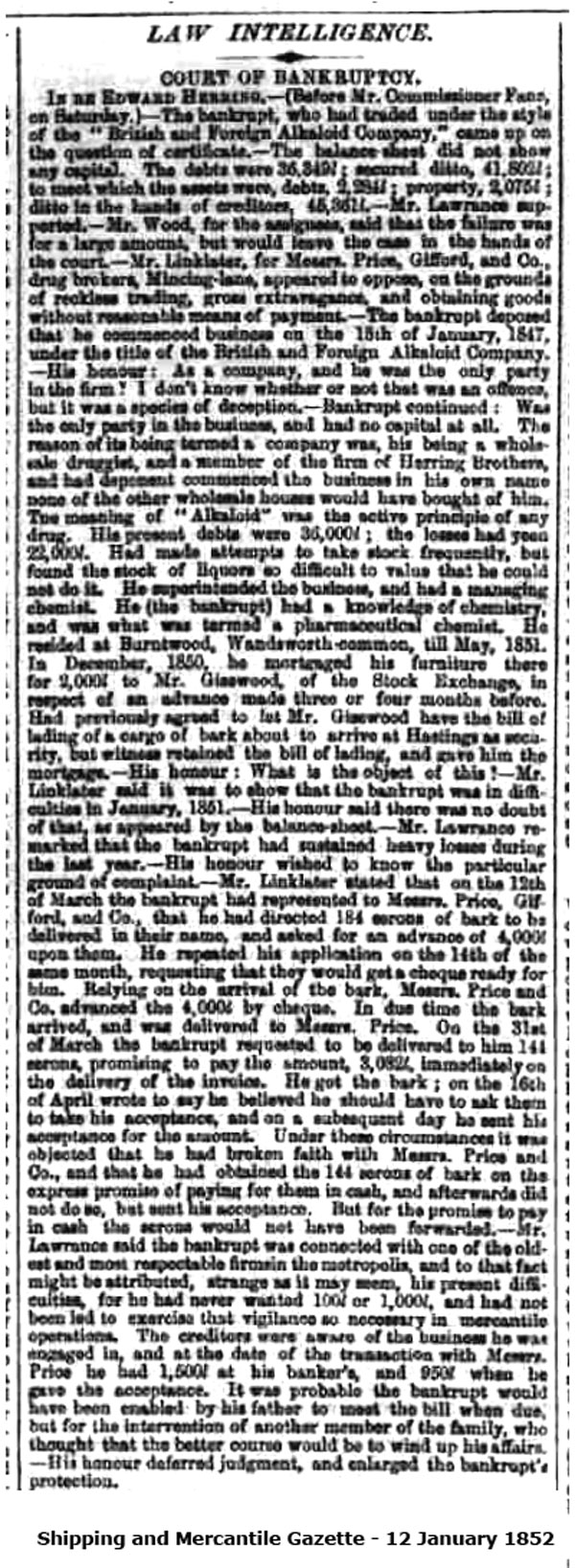
(Click on image to enlarge)
Shipping and Mercantile Gazette
Monday 12 January 1852
LAW INTELLIGENCE
COURT OF BANKRUPTCY
IN RE EDWARD HERRING (Before Mr. Commissioner Fane, on Saturday.)
The bankrupt, who had traded under the style "of the British and Foreign Alkaloid Company," came up on the question of certificate. The balance sheet did not show any capital. The debts were £36,349: secured ditto, £41,802; to meet which the assets were, debts, £2,234: property, £2,075; ditto in the hands of creditors, £45,362. Mr. Lawrence supported. Mr. Wood, for the assignee, said that the failure was for a large amount, but would leave the case in the hands of the court. Mr. Linklater, for Messrs. Price, Gifford, and Co., drug brokers, Mincing-lane, appeared to oppose, on the grounds of reckless trading, gross extravagance, and obtaining goods without reasonable means of payment. The bankrupt deposed that he commenced business the 15th of January, 1817, under the title of the British and Foreign Alkaloid Company.
His honour: as a company, and he was the only party in the firm! I don't know whether or not that was an offence, but it was a species of deception.
Bankrupt continued; Was the only party in the business, and I had no capital all. The reason of its being termed a company was, his being a wholesale druggist, and a member of the firm of Herring Brothers, and had deponent (?) commenced the business in his own name none of the other wholesale houses would have bought of him.
The meaning of "Alkaloid" was the active principle of any drug. His present debts were £36,000; the losses had been £22,000. Had made attempts to take stock frequently, but found the stock of liquors so difficult to value that he could not do it. He superintended the business, and had managing chemist. He (the bankrupt) had a knowledge of chemistry, and was what was termed a pharmaceutical chemist.
He resided at Burntwood, Wandsworth common, till May, 1851. In December, 1850, he mortgaged his furniture there for £2,000 to Mr. Grisewood, of the Stock Exchange in respect of an advance made three or four months before. Had previously agreed let Mr. Grisewood have the bill of lading of a cargo of bark about to arrive at Hastings as security, but witness retained the bill of lading, and gave him the mortgage.
His honour: What is the object of this?
Mr. Linklater said it was to show that the bankrupt in difficulties in January, 1851.
His honour said there was no doubt of that, as appeared by the balance sheet.
Mr. Lawrence remarked that the bankrupt had sustained heavy losses during the last year.
His honour wished to know the particular ground of complaint.
Mr. Linklater stated that on the 12th of Match the bankrupt had represented to Messrs. Price, Gifford, and Co., that he had directed 184 serons of bark to be delivered in their name, and asked for advance of £4,000 upon them. He repeated his application on the 11th of the same month, requesting that they would get a cheque ready for him. Relying on the arrival of the bark, Messrs. Price and Co. advanced the £4,000 by cheque. In due time the bark arrived, and was delivered to Messrs. Price.
On 31st March the bankrupt requested to be delivered him 111 serons, promising to pay the amount, £3,000, immediately on the delivery of the invoice. He got the bark on the 16th of April and wrote to say he believed he should have to ask them to take his acceptance, and subsequently sent his acceptance for the amount. Under these circumstances it was objected that he had broken faith with Messrs. Price and Co., and that he had obtained the cargo of bark on the express promise of paying for them in cash, and afterwards did not do so, but sent his acceptance. But for the promise to pay in cash the sacks (?) would not have been forwarded.
Mr. Lawrence said the bankrupt was connected with one of the oldest and most respectable firms in the metropolis, and that fact might be attributed, strange as it may seem, to his present difficulties, for he had never wanted £100 or £1,000, and had not been led to exercise that vigilance so necessary in mercantile operations. The creditors were aware of the business he was engaged in, and the date of the transaction with Messrs. Price had £1,500 at his bankers, and £950 when he gave acceptance.
It was probable the bankrupt would have been enabled by his father to meet the bill when due, but for the intervention of another member of the family, who thought that the better course would be to wind up his affairs.
His honour deferred judgment, and enlarged the bankrupt's protection.
[BNA: Link.]
[September 2021: Many thanks to Stephen Midlane for improving this transcription, originally created by OCR.]
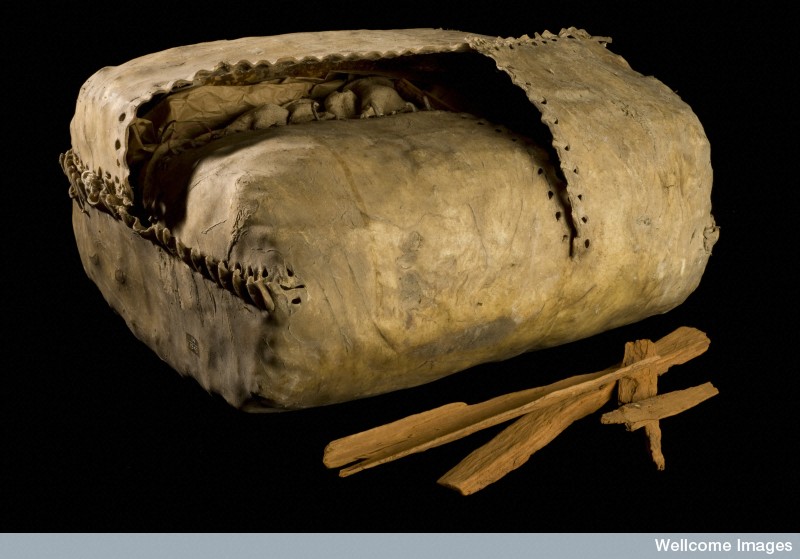
For information on the word "Seron" see e.g. University of Strathclyde: Journeys Through Health History Seron (Rawhide Bag)]
(Click on image to enlarge)
Known as a seron in its native Peru, South America, this rawhide bag was used to store and carry cinchona bark. For centuries, local people had chewed or ground up the bark as a treatment for fevers and malaria. As the European powers began to expand both their trade routes and empires, cinchona became a highly important commodity. In the early 1800s, quinine, the primary anti-malarial component of cinchona, was first isolated, allowing the production of more effective drugs to combat the disease.
The bag was originally collected by the expedition of Hipolito Ruiz Lopez and Antonio Pavon y Jimienz, which was sent to Peru in 1777 by the Spanish monarch Charles III to explore the region.
The bag was later presented to the Wellcome collections by Alfonso XIII, King of Spain (1886-1941), in 1930.
maker: Unknown maker
Place made: Peru made: 1777-1785
Credit Science Museum, London, Wellcome Images L0058857" target="_blank">Link]
Age 1852 — Saturday 17 July 1852
"Died by the Visitation of God."

(Click on image to enlarge)
DEATH FROM COUP DE SOLEIL
On Monday evening, Mr W Carter, coroner for East Surrey, held an inquest at the County Arms Tavern, Wandsworth Common, upon the body of Matthew Kerley, aged 75, a labourer, who died under the following circumstances.
On Friday last deceased, who worked for Mr Robert Male [presumably NEAL], a nurseryman on Wandsworth Common, was hoeing some ground, when he suddenly dropped to the ground, and was found by a labourer named John Young, lying on his back, with his eyes wide open and senseless. This man got assistance, and a deceased was conveyed to a shady part of the ground.
Mr Wilkinson, the resident surgeon of the new prison, was apprised of the circumstance, and quickly attended the deceased, whose head he found to be very hot, and the pulse beating fast. He bled him in the temples and adopted are the remedies, but he gradually sunk, and died in about two hours. There was no doubt of the powerful rays of the Sun bring the the primary agent. The jury returned a verdict of quotes "Died by the visitation of God."
https://www.britishnewspaperarchive.co.uk/viewer/bl/0003023/18520717/056/0008
London Daily News — Tuesday 03 August 1852
"A healthy spot for the asylum"
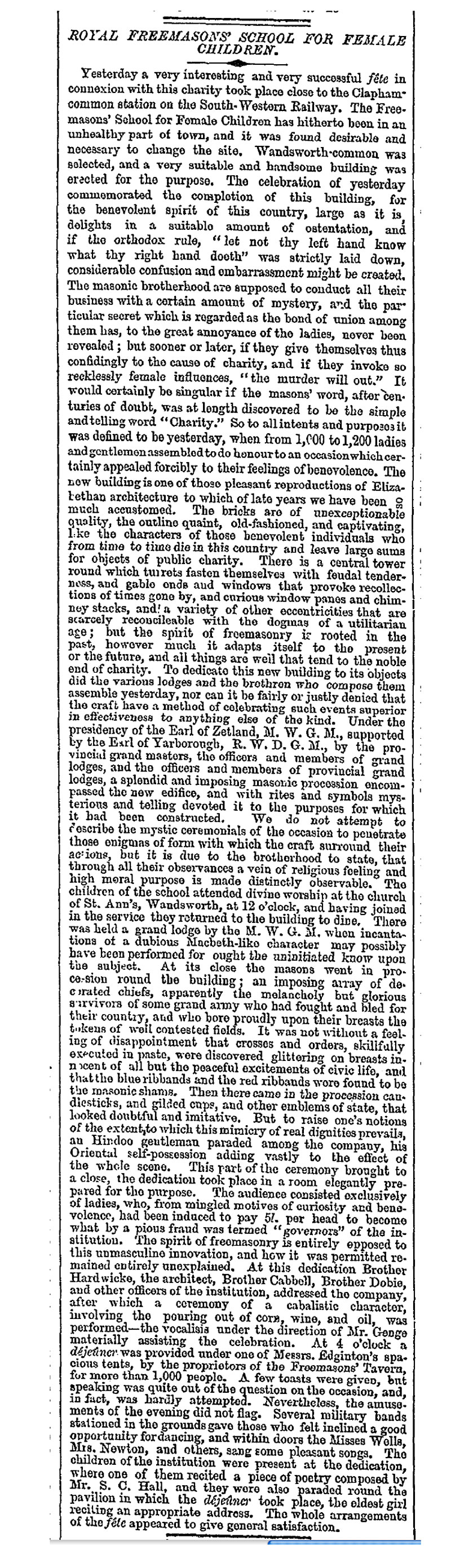
ROYAL FREEMASONS' SCHOOL FOR FEMALE ORPHANS, WANDSWORTH-COMMON.
The pre-eminence of the Freemasons' Orphan School among the metropolitan charities has long been acknowledged, both for the mode of training adopted and the superior character of the children who were the object of relief. One desideratum, however, still was wanting, and that was a healthy site for the asylum, which, up to this time, has been situated in the Westminster-rord. a locality by no means recommended by the learned in sanitary matters. This object has now been achieved by the removal of the school to the more airy and healthy part of Wandsworth Common, where the formal dedication of the building took place yesterday, with all due solemnity.
The new building, which is in the Elizabethan style of architecture, is situated close to the Clapham Common station of the South Western Railway, and comprises every accommodation which modern science could suggest, although it might be desirable that the surrounding grounds were on a more extended scale. The great value of ground so near the metropolis must however be taken as a sufficient excuse for the limited character of the external accommodations.
The influx of company commenced so early as one o'clock, and more than one special train was put in requisition on the South Western Railway, besides which every omnibus, cab, and van, that was procurable was put into requisition. The grand master, the Earl of Zetland, arrived at two o'clock, accompanied by the Earl of Yarborough, Lord Dudley Stuart, and other high dignitaries of the masonic institution, and was received by one of the most numerous companies of masons and their friends that has ever been seen within or in the immediate neighbourhood of the metropolis.
A grand lodge was immediately held, which was, of course, unapproachable by the uninitiated, after which, a grand procession round the grounds took place previous to the formal dedication. Here the varieties of masonic costume had an exceedingly striking effect, which was much heightened by the dresses of the foriegn brethren, among whom the Ex-Rajah of Coorg and the Tunisian Envoy were conspicuous. There were also present Germans, Poles, Russians, Italians, and Frenchmen, proving the universality of the principle by which freemasonry is kept together.
The procession having gone round the grounds, accompanied by two military bands, proceeded to the grand hall, when the formal dedication took place. The Earl of Zetland, Grand Master, having taken his seat on the throne, the vessels sacred to freemasonry were formally deposited on the places reserved for their reception; after which the superintendent of works gave an explanation of the plan of the building, and Brother Cabbell described the objects of the institution and the gratifying progress it had made during the last low year". We regret to say that, owing to an extraordinary pressure, and the low tone in which the hon. gentleman spoke, we are unable to do more than mention the purport of his remarks.
An anthem was then sung by the choir, under the direction of Mr. Genge, in the absence of Mr. Farquharson Smith; and Brother Beadon gave a short sketch in reference to the origin and completion of the new edifice. He stated that the committee had examined several sites in the neighbourhood of London, and had selected Wandsworth Common, as possessing the qualities of a gravelly soil, good air, abundance of pure water, a pleasant vicioty, and easy access to medical relief.
The ground-landlord, on hearing that the object was a site for a school for female children, had at once entered into their views, and the negotiations had been carried on in the most satisfactory manner. The result had been the erection of the building in which the company then were congregated. On the conclusion of this address, which was most favourably received, another anthem was sung, after which an occasional copy of verses, composed by Mr. Carter Hall, was recited by Rhoda Davis, one of the pupils, and loudly applauded.
The formal ceremony of dedication was then performed, accompanied by all the mysteries of masonry, after which the company adjourned to Mr. Edgington's largest pavilion, which had been erected on the grounds, and in. which the enormous number of 1,200 ladies and gentlemen sat down to an excellent cold collation, prepared by Messrs. Watson, Cogging and Banks, of the Freemasons' Tavern. A musical party, comprising the talents of the Misses Wells and Mr. Genge, sang several popular madrigals, glees, and solos, among which Miss Wells's performance of E Bonnie Dundee " was loudly and deservedly applauded.
The usual loyal and constitutional toasts were given, after which the chairman, the Earl of Zetland, gave, "Prosperity to the Freemasons' Schools," at the same time congratulating himself and his brother masons on the progress which the charity had made within the last few years. Other routine toasts were then disposed of, after which the company adjourned to the lawn, where dancing to the music of an excellent quadrille band was kept up to a late hour of the evening.
[Source: Link]
["The ground-landlord" is presumably Earl Spencer, himself a prominent Mason.]
The Times, 3 August 1852
(Click on image to enlarge)
Illustrated London News — Saturday 07 August 1852

(Click on image to enlarge)
ROYAL FREEMASON'S SCHOOL FOR FEMALE CHILDREN, WANDSWORTH COMMON, OPENED ON MONDAY LAST. (SEE NEXT PAGE )
Published: Saturday 07 August 1852
Newspaper: Illustrated London News
County: London, England
Type: Illustrated | Words: 16 | Page: 13 | Tags: none
[Source: Link.]
Dloaded as: BL_0001578_18520807_041_0013.pdf ROYAL_FREEMASONS_SCHOOL_FOR_GIRLS_BL_7aug1852_0001578_18520807_041_0013.jpgCricket — Bell's Life in London and Sporting Chronicle — Sunday 08 August 1852
(Click on image to enlarge)
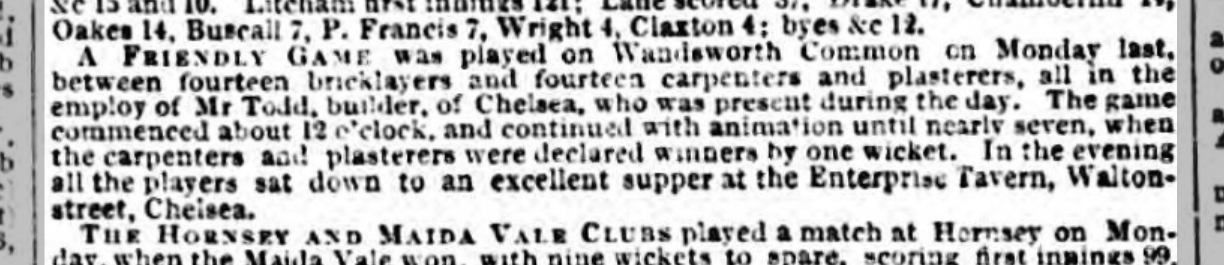
A FRIENDLY Game was played on Wandsworth Common on Monday last, between fourteen bricklayers and fourteen carpenters and plasterers, all in the employ of Mr Todd, builder, Chelsea, who was present during the day. The game commenced about 12 o'clock, and continued with animation until nearly seven, when the carpenters and plasterers were declared winners by one wicket. In the evening all the plavers sat down to an excellent supper at the Enterprise Tavern, Walton-street, Chelsea.
[BNA: Link.]
The Times — 23 August 1852
(Click on image to enlarge)
[NEEDS EDIT]
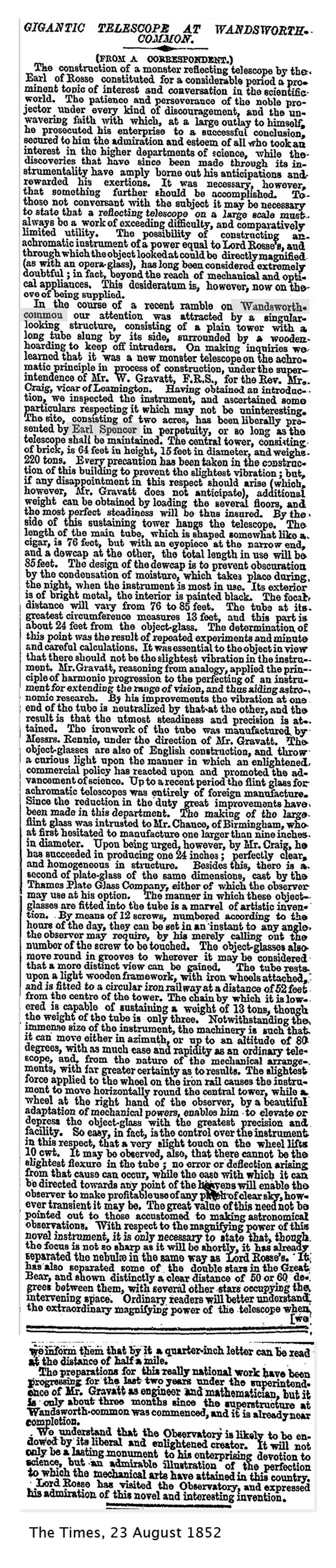
GIGANTIC TELESCOPE AT WANDSWORTH COMMON.
(FROM A CORRESPONDENT)
The construction of a monster reflecting telescope by the. Earl of Rosso constituted for a considerable period a prominent topic of interest and conversation in the scientific world. The patience and perseverance of the noble projector under every kind of discouragement, and the unwavering faith with which, at a large outlay to himself he prosecuted his enterprise to a successful conclusion, secured to him the admiration and esteem of all who took an interest in the higher departments of science, while the discoveries that have since been made through its instrumentality have amply borne out his anticipations and a rewarded his exertions. It was necessary, however, that something further should be accomplished.
To those not conversant with the subject it may be necessary to state that a reflecting telescope on a large scale must always be a work of exceeding difficulty, and comparatively limited utility. The possibility of constracting anachromatic instrument of a power equal to Lord RossBe, and through whichthe object lookedat could be directly magnified. (as with an opera-glass), has long been considered extremely doubtful; in fact, beyond the reach of mechanical and optical appliances. This desideratum is, howvever, now on the eve of being supplied.
In the course of a recent ramble on Wandsworth. common our attention was attracted by a singular lookimg structure, consisting of a plain tower with a long tube slung by its side, surrounded by a wooden hoarding to keep off intruders. On making inquiries we learned that it was a now monster telescope on the achromatic principle in process of construction, under the superintendence of Mr. W. Gravatt, F.R.S., for the Rev. Mr Craig, ncarofLeamnington. Having obtained an introdauction, we in spec ted the instrnament, and ascertainecl som e particulars respecting it which may not be uninteresting.
The site, consisting of two acres, has been liberally presented by Earl Spencer in perpetuity, or so long as the telescope shall be maintained. The central tower, consisting of brick, is 64 feet in height, 1S feet in diameter, and weighs. 220 tons. Every precaution has been taken in the construction of this building to prevent the slightest vibration; but, if any disappointment in this respect should arise (which, however, Mr. Gravatt does not anticipate), additional weight can be obtained by loading the several floors, and the most perfect steadiness will be thus insured.
By the side of this sustaining tower hangs the telescope. The length of the main tube, which is shaped somewhat like a. cigar, is 76 feet, but with an eyepiece at the narrow end, and a dewcap at the other, the total length in use will be 85 feet. The design of the dewcap is to prevent obscuration by the condensation of moisture, which takes place during. the night, when the instrument is most in use. Its exterior is of bright metal, the interior is painted black. The focal, distance will vary from 76 to 85 feet.
The tube at its greatest circumference measures 13 feet, and this part is about 24 feet from the object-glass. The determination of this point was the result of repeated experiments and minute and careful calculations. It was essential to the object in view that there should not be the slightest vibration in the instrument. Mr.Gravatt, reasoning from analogy, applied the principle of harmonic progression to the perfecting of an instrument for extending the rage of vision, and thus aiding astronomic research. .B_ his improvements the vibration at one end of the tube is neutralized by that.at the other, and the result is that the utmost steadiness and precision is at.. taiued.
The ironwork of the tube was manufactured by Messrs. Rennie, under the direction of Mr. Gravatt. whe object-glasses are also of English construction, and throw a curious light upon the manner in which an enlightened, commercial policy has reacted upon and promoted the advancement ofscience. Up to a recent period the flint glass for achromatic telescopes was entirely of foreign manufacture. Since the reduction in the duty great improvements have, been made in this department.
The maldng of the laredint glass was intrusted to Mr. Chance, of Birmingham, who at first hesitated to manufacture one larger than nine inches in diameter. Upon being urged however, by Mr. Craig, he has succeeded in producing one U4 inches; perfectly clear, and homogeneous in structure. Besides this, there is a. second of plate-glass of the same dimensions, cast by the, Thames IDate Glass Company, either of which the observer may use at his option. $he manner in which these object glasses are fitted into the tube is a marvel of artistic invention. .By means of 12 screws, numbered according to the hours of the day, they can be set in an instant to any angle. the observer may require, by his merely calling out the number of the screwv to be touched. The object-glasses also. move round in grooves to wherever it may be considered that a more distinct view can be gained.
The tube rests. upon a light wooden framework, with iron wheels attached,.. and is fitted to a circular iron railway at a distance of 52 feet from the centre of the tower. The chain by which it is lowered is capable of sustaining a weight of 13 tons, though the weight of the tube is only three. Notwithstanding the immense size of the instrument, the machinery is such that. it can move either in azimuth, or up to an altitude of 80 degrees, with as much ease and rapidity as an ordinary telescope, and. from the nature of the mechanical arrangements, with far greater certainty as to results.
The slightest force applied to the wheel on the iron rail causes the instrument to move horizontally round the central tower, while a. wheel at the right hand of the observer, by a beautiful adaptation of mechanical powers, enables him . to elevate or depress the object-glass with the greatest precision and facility. So easy, in fact, is tho control over the instrument in this respect, that a very slight touch on the wheel lifts 10 cwt. It may be observed, also, that there cannot be the slightest flexure in the tube; no error or deflection arising from that cause can occur, while the ease with which it cam be directed towards any point of the -venss will enable the observer to make profitable use of any pklrof clear sy, however transient it may be. The great value ofthis need not ba pointed out to those accustomed to making astronomical observations. With respect to the magnifying power of this novel instrument, it is only necessary to state that, though. the focus is not so sharp as it wi]l be shortly, it has already separated the nebuLe in the 8amoe way as Lord Bme7s. It, has-also separated some of. the double stars in the Great Bear, and shownu distinctly a clear distance of 60 or 60 de-, grees between them, with several other stars occupying tb% intervening apace.
Ordinary readers will better understand the extraordinary magnifying power of the telescope when we inform them that by it a quarter-inch letter can be read at the distance of half a imile.
The preparations for this really national work ta. beoen Vrogresasng for the last two yer under the superintend. Oace of Mr. Gravatt as engineer lid nMathematician but it Is only about three months Bince the superstructre at Wandsworth-commron was comnmenced, and it is already near completion.
We understand that thoe Obervatory is likly to be en. dowfel by its hberal and enlightened creator. It will not only be a hasting monument to his enterprising devotion to science, but admirable illustration of the perfection to which the mnechanical arts have attained in thais country.
Lord Reese has visited the Observatory and expressed his admiration of this novel and interesting invention.
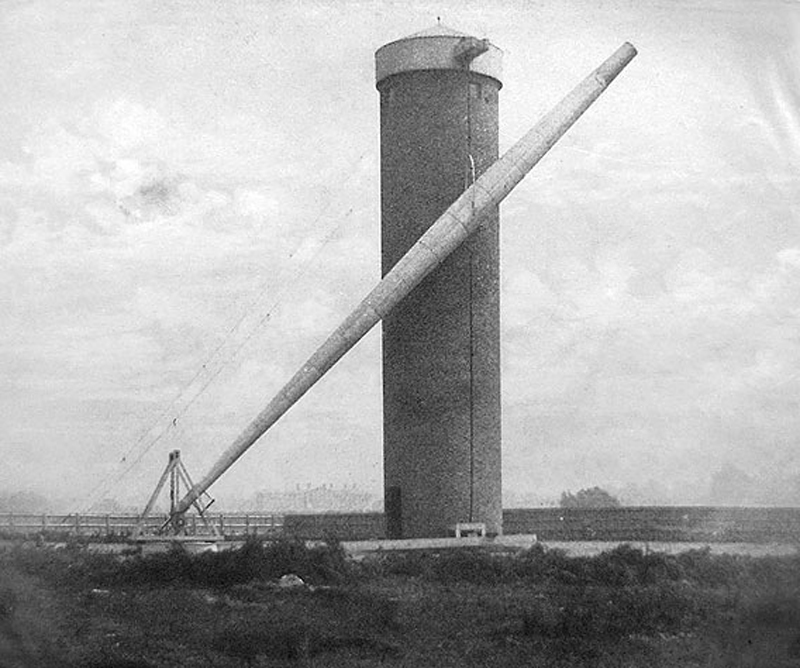
Photograph by Dr Hugh Diamond (Surrey Lunatic Asylum) of the Craig telescope / Greg Smye-Rumsby's site (caption below)
Notice, just to the left of the tower, the St James's Industrial School.
(Click on image to enlarge)
A rare photograph taken by Dr Hugh Diamond of the telescope shortly after its completion in 1852.
The Azimuth Arm supports the Dolly at right and connects to the base of the telescope tower by means of a bogey on rails. Highlighted in the circle is the large azimuth wheel which ran on a circular track. Whether this arrangement was fully successful is not clear.
Courtesy David Hulse Associates
[PB: How secure is the 1852 date? Notice, incidentally, the new St James's Industrial School on the skyline just to the left of the structure.]
Kentish Independent, 28 August 1852
The telescope nearing completion
TELESCOPE
. . . superintendence of Mr. Gravatt engineer and mathematician, but it only abqut three months since the superstructure at Wandsworth Common was commenced, and already near completion. understand that the Observatory is likely be endowed its liberal and enlightened . . . Published: Saturday 28 August 1852 Newspaper: Kentish Independent
[Source: Kentish Independent, 28 August 1852.]
>Windsor and Eton Express — Saturday 11 September 1852
Buckmaster at cricket match Kneller Hall v Battersea Training Schools
Cricket Match between the Kneller Hall and Battersea Training Schools. — A match, which had beon arranged the week before, between these two schools, was played on the Kueller Hall grounds, on Wednesday last. Kneller Hall was victorious, with 40 runs to spare, the score being follows — Kneller Hill, first iuDingn, second innings, 01; total, 117. Battersea, first innings, 66; second innings, 41; total, 76. The Battersea eleven, accompanied by more than SO of their fellow students, arrived on the ground about half-past ten. The wickets were pitched, and the play commenced a little after eleven. Kneller Hall went In first, and the rapidity with which their wickets fell seemed to promise ill for their success Stubbing's bowling, and Piper's fielding gave them some trouble; there were at the end five round O'a in their score, and two of these stood opposite (he names of Crook and Benson, two of their beat batsmen; the rest, however, contrived to cut out quite enough work for their opponents.
The Battersea men went in about half-past twelve, and held their wickets for nearly two hours; their cautious batting and running presented a marked contrast to the somewhat reckless style or Kneller Hall. The bowling of Morris and Marsh, and the fine wicket keeping of Benson, gave them enough to do to defend their wickets, without attempting to get runs. Their innings came to an end at last, dead and buried, it were, in Graves, who, with more good nature than knowledge of the lawa, picked up the ball, and was immediately given out" on appeal to the umpire.
After a cold dinner in the school dining hall, the play was resumed at half-past three. Past experience seemed to have given a little, but only a little, caution to the men of Kneller Hall; their score was much more even, and only three were caught instead of five. The second innings of Battersea wore the same general appearance the first, but the figures were higher, and the whole play shewed that the men only wanted practice, of which they have hitherto had but few opportunies, to der them tmich more formidable competitors. The play terminated at quarter before seven, and the whole then adjourned to tea in the dining hall.
The principal of Kneller Hall, after tea, in a short, but very hearty address, gave welcome to the students of Battersea, and hoped that this would not be the last of such friendly meetings.
Mr Buckmaster, chemical lecturer, and Mr. Taylor, model master, o( Battersea, expressed, on behalf of the Battersea men, their pleasure at the reception they had met with, and hoped soon show, in another trial of strength, that, though defeated for the present, they were not cowed.
The whole passed off the most friendly spirit. are certain that no one who wishes well to our training schools will fail to respond to the wish of the principal of Kneller Hall, that this friendly meeting, the first of the kind, may be the prelude to many others like it
[Source: Link]
[PB: I have a vague recollection that Kneller Hall was in 1856 earmarked for the RVPA, but for some reason plans changed of course and the asylum was erected on the Common instead.]
Morning Advertiser — Wednesday 8 December 1852
(Click on image to enlarge)
Where was the intended enclosure?
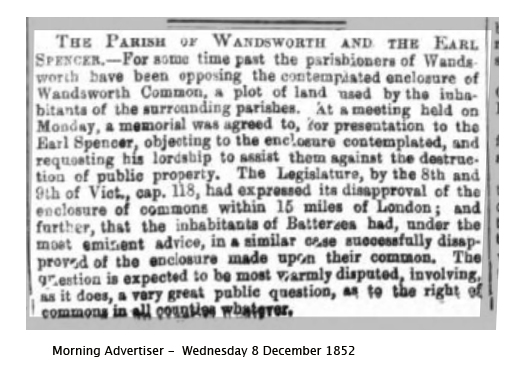
V brief Sun (London) — Wednesday 08 December 1852 THE PARISH OF WANDSWORTH AND THE EARL 25 SPENCER. — For some time past the parishioners of Wandsworth have been opposing the contemplated enclosure of Wandsworth Common, a plot of land used by the inha- bitants of the surrounding parishes. At a meeting held on Monday, a memorial was agreed to, for presentation to the Earl Spencer, objecting to the enclosure contemplated, and requesting his lordship to assist them against the destruction of public property. https://www.britishnewspaperarchive.co.uk/viewer/bl/0002194/18521208/033/0003The Parish of Wandsworth and the Earl Spencer
For some time past the parishioners of Wandsworth have been opposing the contemplated enclosure of Wandsworth Common, plot of land used by the inhabitants of the surrounding parishes. meeting held on Monday, memorial was agreed to, for presentation to the Earl Spencer, objecting to the enclosure contemplated, and requesting his lordship to assist them against the destruction of public property. The Legislature, the 8th and 9th of Vict,, cap. 118, had expressed its disapproval of the enclosure of commons within 15 miles of London; and farther, that the inhabitants of Battersea had, under the most eminent advice, in a similar successfully disapproved the enclosure made upon their common. The question is expected to be most warmly disputed, involving, as it does, a very great public question, 9 the right commons
[Source: BNA: www.britishnewspaperarchive.co.uk/viewer/bl/0001427/18521208/018/0003 ]
[NOTE]
Magdalen College
This appears to be a private Act of Parliament giving Magdalen College the right to lease out / develop etc the land President Martin Routh's sister Sophia Sheppard has given the college.
[Copy saved as 1852_MAGDALEN_COLLEGE_ACT_TO_ENABLE_LEASES_OF_BUILDINGS_ETC_IN_WANDSWORTH_HL_PO_PB_1_1852_15&16V1n254.pdf
Source: Link]
1851 | 1853