[BNA Search: "Wandsworth Common"]
[The Times: Search: "Wandsworth Common"].
[BNA: Buckmaster Battersea 1858]
[BNA: Buckmaster Wandsworth 1858]
[London Evening Standard: Buckmaster Wandsworth 1858]
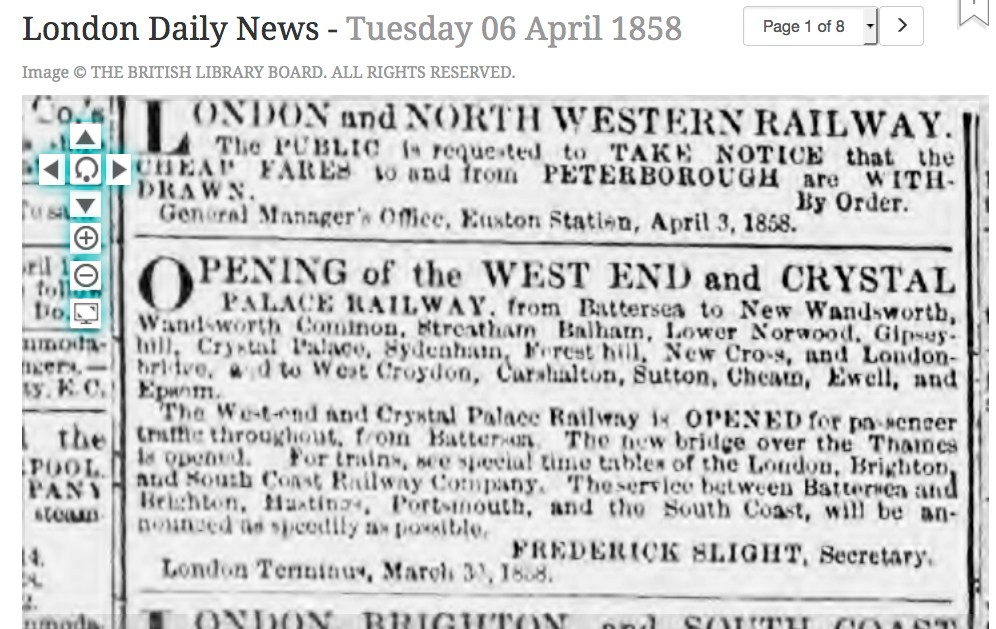
London Daily News — Tuesday 06 April 1858
OPENING of the WEST END and CRYSTAL PALACE RAILWAY, from Battersea to New Wandsworth, Wandsworth Common, Streatham, Balham, Lower Norwood, Gipsey-hill r,,1 alaoii Sydenham, Forcs; hill. New Cross and London- ?? all LI esyt Croydon, Carshalton, Sutton, Cheats, Ewell, and Epsom.
The West-End and Crystal Palace Railway 1s OPENED fer pa-eciacer e traffic throughout, frmi Battersea. The new bridge over the Thames is opened. For trains, see special time tables of the London, Brighton and South Coast Rilaway CJompany. The service between Battersea and Brighton, kiastinas, Portstmouth, and the South Coast, will be an- nuucc a spedlyas osibe.FREDERICK SLIGHT. Secretory. London Terminus, March 3), I8O.
Now the railway has come, why not erect barracks on Wandsworth Common and remove soldiers from the unhealthy crowded centre of London?]
THE Commissioners, in their Report on the Sanitary Condition of the Army, have recorded their opinintore that the defective construction, the want of ventl-whi ?? tion, and the over-crowded state of the barracksket: contribute in a very great degree to produce that per excess of mortality which has been found to exist in Iwai the Army as compared with the civil population at bah the same ages.
Lord PANMURE, in his late speech the be on barrack accommodation, while admitting that the there was still great room for improvement, denied his that it exercised such an injurious influence as was wa alleged, and attributed the high rate of mortality in by the Foot Guards to the amount of night duty required Pa. thy~ ~ ~ ~ ~ ?? of them. He also stated that the principal objectionhi to the increase of barrack accommodation in London yoi was the enormous expense and the difficulty of finding sor a site, and in support of his statement asserted that Po "1including the purchase of a site, the erection of barracks in the neighbourheodof London for the accommodation of 1,000 Guards would not cost less than Hi "from 150,0001. to 200,0001."
Now, it appears a d question of great importance whether the night duty of could not be reduced and suitable barracks provided to without involving so serious an outlay; for it is by tie no means improbable that after the money has been off el ~ ~ ~ ~ ~ ~ ~ ~ ~ ~~~d expended it would be discovered that there had been g some serious oversight on the part of the engineers, 'ri and that the new was not one -whit better or more w' healthy than the old barrack. C1 a The first question that occurs with. reference to ?? enight duty is, Of what use are the numerous sentries bE I now posted at the doors of the public officesP Do ar e they ever interfere in any way with persons enter- hi 10ing or leaving the buildings? and even if To 1l called upon by any one to do so, could t 2 Si "they interfere P
The duty of protection is at S tpresent done by the police, and if the sentries were d] )r all removed to-morrow the buildings would not be hi anin any degree the less secure. There are no sentries il oc to protect the Houses of Parliument,uand yet we never t,s hear of any mischief arising from want of them- a ~y nay, even the War- office, in Pall-mall, is left without at r. one. The present system of sentries on the public ei Ir- buildings is but another proof that the military autho- u,h rities, like the laws of the Modes and Persians, change p at not. The necessity for these sentries ceased when a er the Metropolitan police was organised, butb the san- E ~.tries still are posted. The first step, therefore, to. an wards improving 'the health of the Guards should be f, to to remove all the sentries in the West-end of Lon don b,c- except those at Buckingharn Palace. If it be deemed ' lie necessary as a matter of State to keep up those at of St. James's Palace, their number might easily be re- a gs duced by at lcast two-thirds.
If this arrangement r okwere fairly carried out, we doubt whether it would 11 cd. be necessary to have more than fifty men mounting s ad guard daily for public duties at the 'West-end. The t to sentries for the Cownmander-in-Chief's office would,th of course continue to be furnished by the gentlemen Iin cuirasses and jackboots. he But another advantage would arise from this re- lo- duction in the number of sentries. Two battalions Lie would be sufficient to furnish all the public and in the barrack guards, and to allow the men to have er- ten or even mnure nights in bed. By retaining only as two battalions for the West-end duties the number I ~en of men would be so small as to enable the autho- on, rities to give up Portman Barrack, and still have aed sufficient accommodatin; and the rooms in the 3x- other barracks might be re-distributed so as to Ie- afford to each man abundant cubic space.
The other:us two battalions thus sat free might be sent to Alder- urd shott, where they would be removed from those de- dr. moralisiug influences which are alleged by some to Lof be among the chief causes of the high mortality of de- the Guards, and from whence they could be brought ner to London when required for occasions of State, at an ice. expense much less than the interest of the sum men- hts tioned by Lord PAN MURE. the It may, however, be allegedl that it is necessary to ~er- have a larger force iu London or its vicinity than and two battalions. Now, although we do not see the 'ion necessity for this, the objection might be met in a ical way which would be conducive to the health of the 04ards. The (QQmmissioners atotg that thef. olay 01 11 1,I,I .I 11 1i L: aI II a i army in which the mortality is lower than that of the civil population is the native army of India, and it has this peculiarity, that it is hutted instead of being barracked. They also mention as a fact worthy of notice that the mortality of the army before Sebastopol in 1856, " when hutted," was less than that of the army at home.
Why should not the experiment be made of hutting the two battalions of Guards within a short distance of London? There would be no great difficulty in getting sufficient space to erect hut barracks at Wandsworth-common, or some other point on the Crystal Palace Railway, by which the troops could on an emergency be brought into London in as short a time as if they were at St. John's-wood; while on ordinary occasions they might be marched into town, and thus be practised in that duty in which it is said they were fairly beaten by the Line in Bulgaria. If this plan were adopted, it would be not only an experiment in improving the sanitary condition of the Guards, but also a measure of great economy.
Instead of costing 2001. per man for barrack accommodation, according to Lord PANMURE'S estimate, the expense of hutting ought not, if the system is honestly worked, to exceed 101. per man. If the huts required to be renewed every ten years-and they ought to last much longer-or if at the end of five years the experiment were found to be unsuccessful, the cost to the country would not have amounted to the interest of the capital which under the present system mast be sunk in building a barrack which after all may not be found suitable or healthy. The measure proposed would as a matter of course be unpopular with the officers of the Guards; but it is high time that their convenience should be sacrificed when opposed to the health and lives of the men.
We are not sanguine, however, that it will find favour with the military authorities, for it appears by the evidence of Sir A. TULLOCII, given before the Commission, that lie recommended the adoption of the hut system at Aldershott as a measure of economy, but his proposition was negatived by the military authorities. We trust, however, that some of the friends of the soldier in the House of Commons, who are untrammelled by the fetters of military routine, and are anxious to obtain the greatest amount of health and comfort for the soldier compatible with his position, even though it may be obtained with economy and despite of red-tape, will take up the question, and force it, if necessary, upon the consideration of the War Minister.
[Source: Link]
West Middlesex Advertiser and Family Journal — Saturday 24 April 1858
BATTERSEA RATEPAYERS' PROTECTION SOCIETY.
A meeting of this Society was held on Tuesday evening last at Mrs. Kendall's, the Plough Inn, Battersea Rise. Mr. Jacob Hart in the chair. Mr. J. Pemberton, the secretary, read the minutes of the previous meeting, by which it appeared that several ratepayers were then enrolled as new members. Mr. Hart considered that Battersea stood in great need of a Ratepayers' Protection Society. He would wish to see it so conducted as that it should gain the respect the parishioners, and he believed that they would greatly increase number before long. While he recommended the ratepayers to meet and discuss the parochial matters, order to have their grievances redressed, would particularly avoid the idea of being understood as wishing to act contrary to the Metropolis Local Management Act. He desired not to make enemies, but the ratepayers would show that they were determined to act according to the dictates of their conscience, livery ratepayer ought to be made acquainted with parochial proceedings, and then he could judge for himself as whether things weie going on right wrong. He complained of the recent appointment of the churchwarden, and considered it wrong that he should hold that office for three successive years. With respect to the approaching election of Vestrymen, he rejoiced that there were tradesmen among them, but he feared, in parish like Battersea, they could scarcely expect to be independent. In May next the following members of the Vestry will have to retire, but they could be re-elected: — Mr. Griffin, Mr. Smith, sen., Mr. Poupart,' Mr. Hart, Mr. Everett, Mr. Brock ing, Mr Passinore, and Mr. Hew, besides which there was a vacancy occasioned by death. was particularly anxious to exhibit no angry feeling towards those in office, but still, as ratepayers, they were bound to see that justice was done to all parties. Mr. Lyth said that the delegates had been unsuccessful in getting the Old School Room, in Green Lane, for the purpose of an antiChurch-rate lecture, the reason assigned being that such rates would soon be abolished. He then read a copy of a letter which he had forwarded to the Vestry Board, in which he declared that the present rating was most unjust, and strongly urged the necessity for a re-assessment. The rates now amounted to 6s, lid. in the pound, and surely it was not asserting too much to say, that it was high time the ratepayers looked into the cause of the present state of the parochial affairs. Battersea was behind all other parishes, and he hoped they would remain so no longer. A short conversation then ensued relative to there being greater publicity given to the meeting in May, after which the business of the evening terminated.
[Source: Link]
[A comer and goer?]
1858_05_28_TimesThe Times — Friday, May 28, 1858
[Times: Link.]
POLICE.,3LuxsmOy.narsE.
Thomas Smith was charged with baying had in his possession a large gold miniature brooch of which he could not give a satisfactory account. The shopman to Messrs. Barker, pawnbrokers, in Houndsditch, said, — Yesterday the prisoner came to the shop and asked whether the brooch produced was gold. As I saw that the frame was gold, and worth about two guineas, I suspected that he had got it dishonestly, and asked him to came with me to a silversmith's to settle the question decisively, and gave him into custody as soon as we met a policeman.
The prisoner said, in answer to the LORD MAYOR, that he was a general dealer and a brushmaker, but that he had no house residence, and therefore could not give any house address; that he had purchased the article near Wandsworth-common (where he had his cart, in which he followed his occupation for the present) of a man wham he met for the sum of hgs, and that, not knowing of what quality it was, he went to ask about it.
The LORD MAYOR — You say you arca general dealer, and that you did not know whether the brooch was gold or not. How is that ?,
Prisoner — I thought it very likely that it was. I never attempted to sell or to pawn ff.
The LORD MAYOR — The broach appears as if it had been torn from a dress or a shirt. Have you been at the races?
Prisoner — No, my Lord, I never go to such places.
The LORD MAYOR — Where do you make your brushes?
Prisoner — I work in my cart, which is now on Wandsworth-common, with my wife. I never have been in such a place as this in my life before.
The officer said he found in the prisoner's possession he sum of 41. 1s., but nothing which could lead to any suspicion of wrong-dealing.
John Brown — I am brother-in-law to the prisoner, and was with him when he purchasea the brooch. I know him to be an honest man, and I travel with him.
The brooch was examined. It represents the likeness of a vulgar man about 30 years of age, and is upon a swiveL
The LORD MAYOR — said that he would allow the prisoner to go at large upon his promise to attend the justice-room on a future day, but directed that the money found upon him should not be restored to him until the day on which he should again appear, Upon which occasion, in all probability, the owner would, through the instrumentality of the press, appear to say something about it.
[Times: Link.]
STORMY VESTRY MEETING AT BATTERSEA.
A public meeting of the ratepayers of Battersea, was held in the Infant School, Green-lane-road, Battersea, on Thursday evening, for the purpose of electing nine members for the Vestry, and five auditors of accounts.
Mr. Picking, churchwarden, occupied the chair. About 100 ratepayers were present.
Mr. Reynolds proposed Mr. Neate and Mr. Jeuer inspectors of votes. The Chairman nominated Mr. Reynolds and Mr. S. Smith, jun., inspectors of votes. After considerable dispute the names passed. A contention succeeded as to the reading of the minutes of the last Vestry meeting. After the Clerk had read them, Mr. Jeuer opposed the minutes being signed as they were incorrect. The minutes related to the accounts of the church-rate contest. z.ad stated that the accounts had D-?�ssed the meeting.
Mr. Jeuer, however, contended that these accounts did not pass the meeting, but it was adjourned. A call was then made for the rough minutes; the Clerk, however, said he had destroyed them, after entering in the minute-book. Several persons then remarked on the importance of preserving the rough minutes.
Mr. Reynolds defended the Clerk from the insinuation of "cooking the minutes." He had heard of such practices as cooking accounts, but not of cooking minutes. Possibly the Clerk might be dilatory; but neither he nor his father before him were guilty of the conduct now alleged against him.
Mr. Jeuer denied accusing the Clerk of cooking the minutes: but really what did Mr. Reynolds know of the parish, he was only a mere mushroom in its affairs. He wished the business of the evening to go on, but protested against confirming the minutes. He moved the minutes be not signed.
Mr. Reynold's said he would move they be signed, or demand a poll upon it. After some discussion as to the difference between confirming and signing the minutes it was decided to adjourn the question.
Mr. Chadwin, the clerk, having read the requisition calling upon the parish to elect nine members for the Vestry — eight to supply ordinary vacancies, and one by death, Mr. Starling said that 10 members were required — 8 ordinary vacancies, 1 by death, and 1 in the place of Mr. Reynolds. To suit his purpose, the latter had confused the 54th and 64th clauses of the Act. (Hisses.)
Mr. S. then quoted the respective clauses which went to show that no person holding any office or emolument under the Vestry or District Board was eligeble for Vestryman. Battersea was included under schedule; and as Mr. Reynolds was solicitor to the Vestry, he was thereby disqualified and not legal Vestryman, though he had sat there for two years. He (Mr. S.) was aware they could not then elect a tenth member, as they had not given proper notice but he could inform Mr. Reynolds he should not continue a member of the Vestry, remaining which he was liable to a penalty of £50.
Mr. Reynolds — Perhaps Mr. Starling thinks he would make a fitter member. (No, no interruption.) Let Mr. Starling put the fine in force. (Great confusion.)
Mr.Buckmaster said it was some years since he had taken any active part in parish affairs, and if he had consulted his own convenience he would not have been there. But the time had come when it was a virtue to resist and duty to obey. Parochial affairs had not been conducted aright, and he disapproved of the way in which the money had been spent; to expose which he knew he would subject himself to the calumny of those whose good word could not help him and had word could not injure him. But he was not going to be disturbed by a little inflated feeling. It was too evident that one right after another had gradually disappeared — little more than the right to elect Vestrymen remaining. It may be no matter to some whether the rates be 2s. or 6d. in the pound; but to the majority it is of importance, especially to those who can scarcely obtain sufficient to procure a Sunday's dinner. ww their duty to stand between the rich and the poor, protecting the interests of the latter.
The question was whether oligarchy of Mr. Reynold's providing should sit in the Vestry, or a fair representation of the spirit of the parish. (Vociferous cheering.) For few years past the parish had been governed by one man — the churchwardens, clerk, vestry, fee, being under his influence; the Board of Guardians alone escaping his domination, and even that Board he had tried to subvert. He (Mr. Buckmaster) had two or three years ago lifted up his voice in opposition to the perversion of parochial management. He would next allude to the law costs of the parish. If that question was to be tried, why not have done it in a business way. He had seldom known such nefarious transaction.
Mr. R. may be profound the law, but they might find another lawyer equally learned. Originally the question was to have been settled within a month, then in three months, then some other time was named, when, nobody knows. It was high time the case was put into other hands. For the last two or three years a tide of corruption had set in such as no other parish would tolerate.
In a calm and temperate tone he was determined to use what influence he might have until the neck of the corruption was broken, and the foot of Mr. Reynolds was removed from the throat of the parish. (Hear.) He had eaten none of Mr. Reynold's suppers. (Tremendous cheers.) Some years ago a sum of money was given for a right of common to the inhabitants, and Mr. Reynolds, through the churchwardens and overseers, attempted to divert the expenditure of the money from the object which had been decided on by the ratepayers. (Hisses.) Nothing was too great or too small for that individual to engage in — like the trunk of the elephant he could pick up pin or employ himself in transactions of magnitude to suit his purposes. (Vociferous applause.) He hoped to obtain the support as well as sympathy of the meeting in proposing the following names for Vestrymen: — Messrs. Poupart, Hewer, Hart, Finch, Evill, Starling, Brayne, Broad, and Passmore.
Mr. Graham seconded.
Mr. Reynolds said he had been elected last year for three years as Vestryman. He expected Mr. Buckmaster would have given figures support of his accusations. He protested against the incorrectness of the placards relating to Penge. The sum of 18s. 6d. was for magisterial proceedings, mostly for police expenses. £197 was for removals, but against that they had received £300 last half-year. Some of the paupers had been chargeable for five or six years. As to the £900 (A voice, "Not particular to hundred or two.") for law costs, there were included fees to various persons. The auditor could produce vouchers for £200 more, which had been paid and was owing to him. (Oh, oh.) He now proposed for Vestrymen: Messrs. Lambert. Walton, Whiting, Carnes, Brocking, Dives, Griffin, Smith, sen., Jones.
Mr. Neate seconded.
Mr. Parsons had first drawn attention to the Penge question, when he was given to understand that it would prove good " hatch" for the parish; but be would like to know where the hatch was.
Mr. reach proposed a third list, selected from all classes.
Mr. Buckmaster should remember if a second lawyer was employed, he would have to go through the whole case and thus entail further legal expenses. He had been called a slippery fish, it not being known what he was — and he would take care they did not know, being determined to belong to no party: The ratepayers should have their eye upon the District Board. He proposed Messrs. Evill, Finch, Hewer, Baker, Whiting, Fowns, Poupart, Noble and Carr.
Mr. Lee seconded.
Mr. Starling showed how the names of the above list were either already proposed or ineligible. He then reviewed the Penge affair observing that the case was only begun, and no one could tell when and where it would terminate. The meeting then divided, and the names being recorded there were for Mr.Buckmaster's list, 73; for Mr. Reynolds's list, 28. The result was received with deafening applause.
Mr. Reynolds, in the name of five ratepayers, demanded a poll, which was announced to take place on the next day.
The following persons were proposed and consented to become auditors: — Messrs. F. Parsons, Clark, Simmons, Darby, and Green. This terminated one of the most exciting meetings we have attended. On Friday, yesterday, the polling commenced at eight o'clock in the morning, and was to be continued until eight in the evening, consequently we are unable to give the result of the election.
[Source: Link]
[What was the Penge Question?]
"Melancholy Death of a Child on Wandsworth Common"
[NEEDS EDIT]
MELANCHOLY DEATH OF A CHILD ON WANDSWORTH COMMON
ORONER'S INQUEST
Yesterday Mr. Carter, coroner for East Surrey, resumed and concluded an inquest at the Nag's Head Inn, York-road, on the body of George F. Milne, aged seven years, whose death was caused by being struck down by a horse on Wandsworth-common.
It appears that the deceased was the son of Mr. Milne, a surgeon residing in the York-road, Battersea. At the first inquiry the father of deceased had made a charge that the horse in question was the property of Mr. Churchwarden Picken, and through this Mr. P. A. F. Reynolds, of 67, Chancery-lane, attended to watch the case on behalf of that gentleman.
After the empanelling of the jury a long dispute arose, relative to the choice of foreman, but ultimately Mr. S. Day, of the George and Dragon, York-road, was selected.
From the evidence adduced it appeared that the deceased on the day of the occurrence left his home and went on to Wandsworth Common. While seated on the grass a horse suddenly rushed upon him, and before he could get out of the way was knocked down, the horse passing over him. He was as soon as possible conveyed to his father's home, where he received every attention, but, strange to say, for some time, owing to his distorted features, was not recognised by him. The deceased lingered a short period, but graduailly sank and died. According to the testimony of Mr. Weston, surgeon, the deceased died from the injuries received.
From some further evidence it was however proved that the horse did not belong to Mr. Picken, it being shown that he was out with his horse from two o'clock until nearly five, thus proving that the horse could not have been on the common when the accident occurred.
This being the conclusion of the evidence, Mr. Reynolds in addressing the father of the deceased, said he hoped that after what had been stated he would not say that the horse was Mr. Picken's.
Mr. Milne (the deceased's father) said he was perfectly satisfied that it was not.
The court was then cleared of strangers, and after a short time the jury returned a verdict of accidental death, but also remarking that no blame whatever could be attached to Mr. Picken, as it was satisfactorily proved that is was not his horse by which the deceased was killed.
[BNA: Link.
Incidentally, a curious final paragraph suggests that Mr Churchwarden Picken had been blamed for the death of the boy for political reasons — because there were profound conflicts within the vestry:
It may be but right to mention that throughout the inquiry a deal of interest was mnanifested in the parish, owing to the present difficulties which the vestry are in, as regards that body not being yet completed in consequence of the difference of opinion of the inspectors of votes at the election as to whom were elected, and likewise owing to the cburchwardens not having published the list on the proper day. It was therefore rumoured that the charge at this inquiry against Mr. Churchwarden Picken was made through party feelings, hut whether or not, it has fallen to the ground. [??]
[BNA: Link.]
[WC: 1858.]
Battersea Ratepayers' Association
A meeting of the above Society was held Tuesday evening last, at the Prince's Head, Mr. Buckmaster in the chair.
It appears that for a long time the this parish has been thick grove, nulli impenetrabilis astro, and that apparent desire for secrecy has begotten intense curiosity, and a determination to see the interior of a book, which after all does not contain a novel half so interesting as Uncle Tom's Cabin, in fact nothing but words and figures, nevertheless get at we will, seems the determination of the ratepayers, who on every application are met with kind of nonchalant Dont you wish you may get it."
The business of the evening was principally a detail fail l,ires in their efforts, which terminated in a resolution to appeal to the magistrates, who probably will not be bamboozled quite so easily. The next meeting of the Society will be held at the Farnborough Arms, August 17th, and will be summoned for seven o'clock to report progress, and probably to make known the contents of this Svbile volume.
[BNA: Link]
[PB: Presumably a misquote of Statius, Thebaid, "Stat super occiduae nebulosa cubilia Noctis Aethiopasque alios, nulli penetrabilis astro" — translated as "Beyond the misty bowers of western Night and the other Ethiopians stands a still grove that no star can penetrate;" [Loeb: Link.] Uh?]
Battersea Ratepayers' Society
A meeting of the members of this Society was held on Tuesday evening last the Hope Tavern, York Road, Battersea. Mr. Buckmaster having been called to the chair, the minutes of the previous meeting were read and confirmed. The balance sheet was next produced, as moved for by Mr. Hart, which showed the Society to be a very favourable position.
In the absence of any other particular business, long conversation ensued with regard to the general parochial transactions, during which it was mentioned that the Auditors had promised to fulfil the request made the Society the following week. A resolution was subsequently proposed and carried, that the money collected to defray legal expenses be carried to tin; account of the Society, which means a considerable balance is in the hands of the Treasurer.
The next meeting will be held at the Duchess of York, Battersea Fields, on Tuesday evening, the 2Sth of September.
[Source: Link]